
Breed profile
Kangal Shepherd Dog: The India Guide
Turkey's national livestock guardian, weighed against the Indian climate, the Indian price pages and the Indian rulebook.
Quick answer
The Kangal dog price in India is published at Rs 60,000 to Rs 1,50,000, but the two pages ranking for the term carry one table and one dropped a zero. The Kangal is a 48 to 60 kg Turkish livestock guardian from a plateau whose hottest month averages 20.5 C, colder than Chennai’s coolest month. Turkey’s own kennel club says the breed dislikes hot humid weather. Bonbeno rates its heat tolerance 2 of 5.
This page reports published veterinary research and registry data for general information. It is not a diagnosis and it is not a treatment plan. A Kangal in India is a 48 to 60 kg dog whose heat tolerance, joint health and drug responses need individual assessment. Consult a registered veterinary practitioner before acting on anything here, and treat any collapse, laboured panting or sudden lameness as an emergency.
Kangal Shepherd Dog at a glance, rated for India
What the Kangal Shepherd Dog actually is
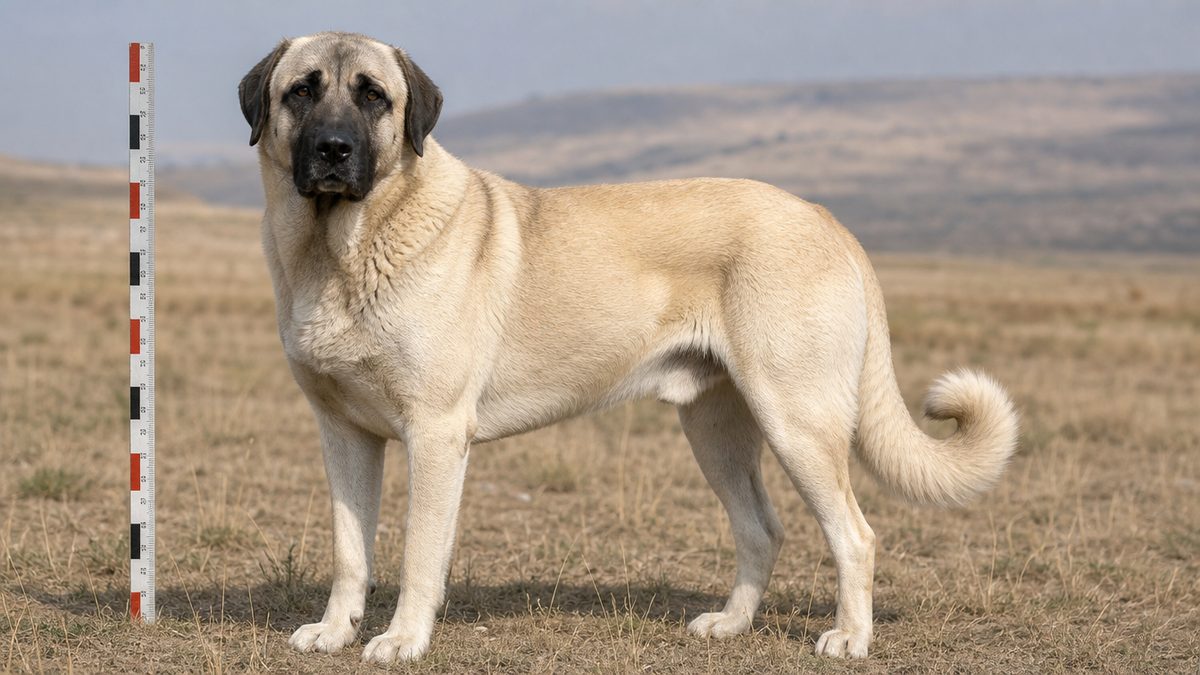
The Kangal Shepherd Dog is a large Turkish livestock guardian standing 72 to 78 cm at the withers in males and weighing 48 to 60 kg, with a short harsh double coat of 3 to 7 cm in one whole colour from fawn to wolf sable and a mandatory black mask over the muzzle. It takes its name from the town and district of Kangal in Sivas province, in the easternmost province of Turkey's Central Anatolia region.
Four numbers do most of the work on this page, and an Indian buyer should carry them into every conversation with a seller. A male Kangal is 72 to 78 cm tall with 2 cm of tolerance either way, and weighs 48 to 60 kg. A female is 65 to 73 cm and 40 to 50 kg. That is not a big dog in the way a Labrador is a big dog. A male at the middle of that range outweighs most adults in the household, and every housing, transport, feeding and veterinary decision follows from it.
The FCI describes the temperament in five words that matter more than any adjective a seller will use: steady and bold without aggression, naturally independent, very intelligent and tractable, loyal and affectionate to owners but wary of strangers when on duty. The Royal Kennel Club's version adds one clause the FCI leaves out, that the breed can be dominant and territorial and can be aloof with strangers. Both are describing a guard dog that was selected to make decisions alone, at night, with no handler present.
The breed standard, read rather than summarised
FCI standard 331 was published in its current English text on 15 June 2018, with the FCI's own version stamp reading 25 June 2018, and English is the authentic language for it. The breed sits in Group 2, Section 2.2, Molossoid breeds of Mountain type, and is not subject to a working trial.
Read the document itself and several details stand out that no Indian page mentions. The body is 10 to 12 percent longer than the height at the withers, so the outline is rectangular rather than square. The depth of chest is about 50 percent of the height at the withers. The muzzle is 40 to 44 percent of head length, and a muzzle only one third of head length is a disqualifying fault. The croup slopes at almost 30 degrees and sits a little higher than the withers.
| Point | Males | Females |
|---|---|---|
| Height at withers | 72 to 78 cm, tolerance 2 cm either way | 65 to 73 cm, tolerance 2 cm either way |
| Weight | 48 to 60 kg | 40 to 50 kg |
| Guard coat length | 3 to 7 cm, thick and harsh | 3 to 7 cm, thick and harsh |
| Undercoat | Dense, required; a coat devoid of undercoat is a disqualification | Dense, required |
| Colour | One whole colour, fawn to wolf sable | One whole colour, fawn to wolf sable |
| Mask | Black, mandatory; no mask is a disqualification | Black, mandatory |
Wikipedia prints heights that appear nowhere in the standard it cites
Check the most-read page on this breed against the document it links and one row does not survive. Wikipedia's infobox gives the height as 70 to 80 cm for males and 63 to 75 cm for females, attributed to FCI standard 331. The standard says 72 to 78 and 65 to 73, each with a 2 cm tolerance. Subtract and add the tolerance and you get exactly 70 to 80 and 63 to 75.
The infobox has folded the tolerance into the range, producing four numbers that appear in no document. The distinction is not academic. A tolerance is what a judge may forgive in an individual dog; a range is what the breed is. Wikipedia's own body text gets it right, saying dogs usually stand between 72 and 78 cm with a tolerance of 2 cm either way, so the article contradicts itself between its infobox and its prose. If a seller quotes you 80 cm as standard, you now know where that came from.
Where the breed comes from, in its own standard's words
The FCI is unusually candid about the history, opening its historical summary by admitting that although each nation eagerly designates a breed history for its national breeds, an accurate one is rarely possible, especially for livestock protection dogs. It then offers a specific and testable claim: the Kangal's uniformity of colour and type comes from the isolated steppe population of eastern Turkey and from the Akkaraman sheep it protects, which share the same black mask on a dun coat, so dog and sheep are camouflaged alike.
The UKC tells the same story with different emphasis, dating the arrival of Turkic nomadic tribes and their working dogs to the 11th century and noting that how far the modern breed descends from those dogs rather than from guardians already native to Anatolia remains an open question. It records that the dogs worked close to villages and on the high summer pastures known as yaylas, against wolves, bears and jackals, and that the Kangal Dog was first imported to the United States in 1985.
FCI standard 331 says the Kangal is capable of enduring extremes of heat and cold. The Royal Kennel Club repeats it as capable of hard work and enduring extreme temperatures. Turkey's own FCI member kennel club, writing about its own national breed, says something different: thanks to the double coat they withstand very cold weather, they shed heavily going into the warm season, and even so, we can say they do not much like very hot and humid weather. The climate section below sets both claims against measured data.
One more feature belongs in an overview because it decides what a photograph is telling you. The tail is long, reaching a little below the hock, carried low with a close curl at the tip when relaxed and curled high over the back when alert, especially in males. The UKC adds that the tail is undocked. A Kangal photographed with a short tail is a dog that has been docked, and docking is strictly forbidden in India.
Kangal, Anatolian Shepherd or Akbash: what each registry says
The registries genuinely disagree about whether these are one breed or three, and the disagreement runs along a clean line you can test. The FCI recognises only the Kangal. The American Kennel Club recognises only the Anatolian Shepherd and lists Kangal as one of its other names. The Royal Kennel Club recognises both and split them apart in 2013. Turkey recognises the Kangal and the Akbas and refuses the Anatolian altogether American Kennel Club The Kennel Club, press release 370.12.
Every claim in the table below was read off the body's own published document, and each was checked by confirming the breed name printed on the page that came back.
| Body | Recognises a Kangal? | Recognises an Anatolian Shepherd? | Source read |
|---|---|---|---|
| Federation Cynologique Internationale | Yes. Standard 331, Kangal Coban Kopegi, accepted on a definitive basis 6 June 1989 | No. The nomenclature's letter A runs Affenpinscher to Azawakh with no Anatolian entry at all | FCI nomenclature and standard 331 |
| American Kennel Club | No separate breed | Yes, in the Working Group, and the AKC's own page states the breed is also known as Goban Kopegi, Anatolian Karabash or Kangal | AKC breed page |
| The Royal Kennel Club, United Kingdom | Yes. Turkish Kangal Dog, Pastoral Group, recognised with effect from 1 April 2013 | Yes, separately, in the same group with its own standard | Kennel Club press release and both breed standards |
| Kopek Irklari ve Kinoloji Federasyonu, Turkey's sole FCI member | Yes. Kangal Coban Kopegi, FCI Group 2, breed code KAN | No. Turkish authorities decline to recognise the Anatolian as a purebred Turkish breed | KIF breed database and About page |
| United Kennel Club, United States | Yes. Kangal Dog, Guardian Dog Group, recognised 1998, standard revised 2 January 2023 | Registered separately from the Akbash Dog, which the UKC also recognises | UKC breed standard |
Britain's registry split one breed into two and let owners choose
The strongest single piece of evidence in this whole dispute is a Kennel Club press release from 3 October 2012, and no page ranking for this breed quotes it. The Kennel Club General Committee approved recognition of the Turkish Kangal Dog with effect from 1 April 2013, taking the number of pedigree breeds recognised in the UK to 211, and classified it in the Pastoral Group.
Then comes the sentence that decides the argument. Dogs currently registered as Anatolian Shepherd Dogs are eligible to apply to have their breed recorded as the Turkish Kangal Dog instead where appropriate. An interim breed standard was issued for information in December 2012, and the breed became eligible for exhibition at licensed shows from 1 July 2013. The Royal Kennel Club's current breed page still says it plainly: the breed has only been recently recognised in the UK and was previously included as an Anatolian Shepherd Dog.
So in Britain, the same physical dog could be an Anatolian Shepherd on Monday and a Turkish Kangal Dog on Tuesday, on the strength of a form. That is not a taxonomic finding. It is an administrative one, and it is exactly why a pedigree documents claim tells you less than a seller implies.
The two British standards for the two breeds do not describe the same dog
Both standards were last updated on 1 April 2025 and sit in the same group, which makes them directly comparable. Two rows are decisive.
| Point | Turkish Kangal Dog | Anatolian Shepherd Dog |
|---|---|---|
| Colour | Cream through fawn to dun or steel grey, with a characteristic dark or black mask and ears; brindle undesirable; any other colour unacceptable | All colours, with or without black mask and black ears; merle unacceptable |
| Height | Dogs 74 to 81 cm, bitches 71 to 79 cm | Dogs 74 to 81 cm, bitches 71 to 79 cm |
| Weight | No weight given at all | Dogs 50 to 64 kg, bitches 41 to 59 kg |
| Body proportion | Body slightly longer than height at withers, 10:9 | Body in proportion to leg length, no ratio given |
The mask is the whole difference. A Kangal must have a dark or black mask; an Anatolian may have one or may not. Feed a white dog into the two standards and it is an acceptable Anatolian Shepherd and an unacceptable Kangal. That is the mechanism by which an Akbash-type dog became an Anatolian in the West, and it is why the argument has run for fifty years.
Two other differences are worth carrying to a seller. The British Kangal standard publishes no weight, while the FCI gives 48 to 60 kg for males, so a UK pedigree tells you nothing about mass Federation Cynologique Internationale. And the British height floor of 74 cm sits above the FCI floor of 72 cm, which with tolerance runs to 70 cm, so a dog perfectly within the FCI standard can be four centimetres under the British minimum.
The FCI and Turkey give different years for the same recognition
Two primary sources disagree by twenty-nine years about when the Kangal became an FCI breed, and Bonbeno publishes both rather than choosing. The FCI's own nomenclature entry records the date of acceptance on a definitive basis as 6 June 1989. Turkey's sole FCI member kennel club states that its work on the Kangal was completed and its registration with the FCI was secured as of 25 June 2018.
Both bodies are primary sources writing about their own records, so neither can simply be dismissed. What settles the reading is a third figure printed in the same FCI table. The English text of standard 331 was published on 25 June 2018, the identical date KIF gives for the registration it says it secured.
The most economical explanation is that 1989 is when the breed entered the FCI nomenclature and 2018 is when Turkey's own standard text for it was adopted and published, and that KIF is describing the second event in the language of the first. Bonbeno records that as a reading, not as a fact established from either body's own words. What a reader should take away is narrower and safer: the FCI has recognised this breed on a definitive basis since 1989, and the standard you are being quoted from dates only from 2018.
| Event | Date printed |
|---|---|
| Acceptance on a definitive basis by the FCI | 6 June 1989 |
| Publication of the official valid standard | 15 June 2018 |
| English standard published | 25 June 2018 |
| French standard published | 16 October 2018 |
| Spanish standard published | 3 June 2019 |
| German standard published | 19 June 2019 |
The dates in that table are read as month-first, and the table proves its own format. Three of its rows print 25, 16 and 19 in the first field, and none of those can be a month. Anyone reading the same table as day-first would place the English standard in the twenty-fifth month of 2018.
What Turkey's own kennel club claims, and what it does not
KIF was founded in 2006 and describes itself as the only FCI member in Turkey and therefore the only organisation authorised to represent the country in cynology. It names the native breeds it is working to get registered at the FCI in Turkey's name: the Kangal Coban Kopegi, Akbas, Zerdava, Aksaray Malaklisi and Sultan Tazisi among others. For the Kangal it says that work is complete; for the Akbas, Zerdava and Aksaray Malaklisi it says the work has been started with significant progress.
KIF's own breed database lists the Kangal Coban Kopegi in FCI Group 2 under breed code KAN, with a registered breed club, and links the FCI standard directly. That is a materially different position from the one it gives the Akbas, which sits in its group for breeds the FCI does not recognise. Bonbeno's Akbash guide sets out that contrast from the other side.
KIF's English-language About page serves its body copy in Turkish, so an English-speaking buyer reading kif.org.tr in English is reading nothing. And the FCI's own illustration file attached to standard 331 is named STD-ANA-en, with ANA reading as Anatolian. Neither changes a fact on this page. Both are a reminder that the naming confusion reaches into the filing systems of the bodies arguing about it.
How the Anatolian Shepherd came to exist, and why Turkey rejects it
The American breed has a documented origin. In 1967 a United States Navy lieutenant stationed in Turkey, Robert Ballard, acquired two working livestock guardians near Ankara, a long-coated pinto dog named Zorba and a short-coated buff bitch named Peki, and their 1970 litter became the foundation stock in the United States.
The problem was geographic rather than malicious. Most founding imports came from the intermediate zone between the main breeding centres of the Akbash and the Kangal, where both types occur, and the American enthusiasts assembled them without an understanding of the regional Turkish varieties. The result was a registered breed that throws various coat lengths, colours and patterns, where in Turkey the separate breeds breed far truer to type.
The AKC standard still carries that history in one line an Indian buyer can check for themselves. Its breed page states that Anatolian Shepherds are also known as Goban Kopegi, Anatolian Karabash, or Kangal. Since the 1980s American breeders have imported almost exclusively Kangals and the Anatolian has increasingly conformed to that type, yet Turkish authorities still refuse to recognise the Anatolian as a purebred Turkish breed.
- Ask which registry issued the papers, and read the breed name printed on them. FCI or KIF paperwork can say Kangal. AKC paperwork cannot.
- Ask to see the mask. A Kangal without a black mask fails FCI 331 on a disqualifying fault, whatever the certificate says.
- Ask for the weight, in kilograms, on a scale. A British pedigree publishes no weight for this breed at all.
- Ask whether the dog or its parents were ever exported from Turkey, and on what permission. Turkey treats the Kangal as a protected genetic resource.
Kangal dog price in India, and why the two published figures are one figure
The published Kangal dog price in india is Rs 60,000 to Rs 1,50,000, and both pages that print it are printing the same table. Five of their six city rows match to the rupee. The sixth differs only because one page dropped a zero and now tells Indian readers a Kangal in Delhi starts at Rs 8,000. Treat this as one unverified source, not as a consensus.
Supertails published its table on 5 December 2024. Patmypets published its own on 19 August 2025. Both list the same six places in the same order, ending with Kerala, which is a state rather than a city, in both. Both then run the same five price factors in the same order: breeder reputation, pedigree and lineage, imported against locally bred, age and gender, and location and availability.
| City | Supertails, 5 Dec 2024 | Patmypets, 19 Aug 2025 | Match? |
|---|---|---|---|
| Delhi | Rs 80,000 to Rs 1,50,000 | Rs 8,000 to Rs 1,50,000 | No, one zero short |
| Mumbai | Rs 90,000 to Rs 1,60,000 | Rs 90,000 to Rs 1,60,000 | Identical |
| Bangalore | Rs 75,000 to Rs 1,50,000 | Rs 75,000 to Rs 1,50,000 | Identical |
| Hyderabad | Rs 70,000 to Rs 1,40,000 | Rs 70,000 to Rs 1,40,000 | Identical |
| Chennai | Rs 80,000 to Rs 1,50,000 | Rs 80,000 to Rs 1,50,000 | Identical |
| Kerala | Rs 60,000 to Rs 1,20,000 | Rs 60,000 to Rs 1,20,000 | Identical |
Eleven of twelve figures agree exactly. A price survey does not produce eleven exact matches across two independent markets. A copy does. And the twelfth number is the proof: Rs 8,000 for a Kangal puppy in Delhi is not a market observation, it is a typing error that has been live since August 2025 and is now being read by everyone who searches this term.
These are rupee-native numbers, not a converted dollar list
Bonbeno tests every Indian price table against the exchange rates that have produced fake rupee prices on this site before. This one behaves differently from those cases, and the difference is worth publishing.
| Rupee figure | At 84.38 | At 74 | At 80 | Verdict |
|---|---|---|---|---|
| 60,000 | 711.07 | 810.81 | 750 | No clean conversion |
| 70,000 | 829.58 | 945.95 | 875 | No clean conversion |
| 75,000 | 888.83 | 1,013.51 | 937.50 | Fails even at 80 |
| 90,000 | 1,066.60 | 1,216.22 | 1,125 | No clean conversion |
| 1,50,000 | 1,777.67 | 2,027.03 | 1,875 | No clean conversion |
| 1,60,000 | 1,896.18 | 2,162.16 | 2,000 | No clean conversion |
Not one figure divides cleanly at 84.38, the rate that has exposed three converted price lists on this site, and not one divides at 74. Most divide at 80, but that proves nothing by construction, because 1,000 divided by 80 is 12.5, so any figure ending in three zeros passes automatically. The Rs 75,000 row settles it: it gives 937.50, which is not a whole dollar amount, so the set cannot have come from one conversion.
The conclusion is a negative one and it is still useful. These are round rupee numbers a human typed, not a dollar list run through a calculator. The contamination mechanism here is not currency conversion. It is verbatim copying between two commercial pages, with an arithmetic slip along the way. If you were about to check these prices by dividing them, stop; check whether they were copied instead.
What is actually for sale in India under this name
One search-engine check belongs on the record here, because it changes how much any absence on this page is worth. Bing returned HTTP 200 and a plausible ten-result set for kangal dog price in india, and then returned the identical ten results under the identical About 12,200 results count for the completely different query is kangal legal in india. An engine that answers two different questions with one cached page is not reporting on the Indian market, so Bonbeno claims nothing from it in either direction and rests the price findings above on Google India and on the pages themselves.
Look past the two blogs and the Indian market for this breed thins out immediately. The top ten results for kangal dog price in india contain two Instagram template pages, a Pinterest board, two listings for the same paperback book on Flipkart and Amazon, and a five-year-old Quora thread.
The second result is a marketplace listing headed Kurdish Kangal Puppies For Sale. Its own structured description advertises Price: Rs 100 and Health-checked, while the visible page records Vaccinated: No and leaves the Seller Information, About The Breed and About Kurdish Kangal Puppies For Sale in India headings entirely empty. Its four Similar Breeds are two Labradors and two Poodles, and its four customer testimonials print the identical sentence under four different names.
The tenth result is more telling because the site is genuine. DogsIndia has been India's dog directory for two decades, and its Kangal page body text reads, in full, Kangal (Turkish Kangal - Information to be updated). Below it sits one breeder listing from Tamil Nadu advertising imported-line puppies, first posted 11 March 2026. The page's own keywords metadata still reads Chippiparai, hound, dog, a leftover from a different breed's template.
Asked for the Kangal dog price in India, Google's AI Mode replies that a Kangal generally costs between Rs 60,000 and Rs 1,50,000, citing Supertails, and adds city estimates citing Patmypets. Its lead thumbnail is the Kurdish Kangal listing whose structured price is Rs 100. So the answer engine is quoting one copied table and one shell listing, and presenting it as a market rate. Google printed no AI Overview for the query, reporting that one was not available.
The honest position is this. No verified Indian transaction price for a Kangal exists. What exists is one figure, published twice, with a typographical error in one copy, now being restated by an answer engine. If you are quoted Rs 1,50,000 for a Kangal puppy, the seller is quoting the internet back at you, and the internet is quoting one blog post from December 2024.
Monthly cost of ownership for a 55 kg dog in India
Budget Rs 9,000 to Rs 18,000 a month to keep a Kangal properly in an Indian metro, and treat that as a floor rather than an estimate. The cost of ownership for this breed is driven by one number in the standard: 48 to 60 kg. Food, drug doses, boarding rates and surgical bills all scale with body mass, and a Kangal sits at roughly double the weight of the Labrador most Indian cost guides are written around.
India's most detailed published account of dog costs comes from VOSD, which runs a 1,800-dog sanctuary and writes from its own operating experience. It puts the total monthly cost of owning a dog in India at Rs 3,000 to Rs 10,000 and beyond, with annual spending of Rs 25,000 to Rs 80,000 and a lifetime figure of roughly Rs 3 lakh to Rs 10 lakh. Crucially for this page, it notes that quality food for a medium dog runs Rs 1,500 to Rs 4,000 a month, while large breed dogs, especially working breeds, can push this to Rs 5,000 or more.
| Line item | Monthly range | Where the figure comes from |
|---|---|---|
| Food | Rs 5,000 to Rs 12,000 | VOSD puts large working breeds at Rs 5,000 or more; the two Indian Kangal pages claim Rs 5,000 to Rs 12,000 Patmypets, Kangal Dog Price in India |
| Preventive veterinary care | Rs 400 to Rs 700 | VOSD gives Rs 5,000 to Rs 8,000 a year for vaccines, deworming, tick control and one blood profile |
| Tick and flea control | Rs 600 to Rs 1,200 | Scales with body mass; a 55 kg dog needs the top weight band of every product |
| Grooming tools and baths | Rs 500 to Rs 1,500 | VOSD gives Rs 300 to Rs 2,000 per professional session; this coat needs a brush, not a clip |
| Training, first year | Rs 1,500 to Rs 3,000 | VOSD gives Rs 5,000 to Rs 15,000 for a basic course, spread across the year |
| Reserve for emergencies | Rs 1,500 to Rs 2,500 | Set aside monthly against VOSD's Rs 30,000 to Rs 80,000 orthopaedic range |
| Realistic monthly total | Rs 9,500 to Rs 20,900 | Sum of the rows above |
The three costs that catch Indian owners of giant guardians
Boarding is the first. VOSD puts a good boarding facility at Rs 500 to Rs 2,000 a day, so a ten-day trip costs Rs 5,000 to Rs 20,000. For this breed the real problem is not the rate but the acceptance. A territorial 55 kg guardian that is wary of strangers is refused by many Indian boarding kennels, and the ones that take it charge the top of the band.
Orthopaedic surgery is the second, and it is not a remote risk for this breed. OFA's published hip statistics put the Kangal Dog at 23.3 percent dysplastic across 146 evaluations. VOSD puts orthopaedic intervention at Rs 30,000 to Rs 80,000 and a one to three day hospitalisation at Rs 8,000 to Rs 30,000. A large-breed hip or cruciate repair in an Indian metro sits at the upper end of both.
Cooling is the third, and it is invisible in every cost guide written for a Labrador. A dog whose home plateau averages 7.8 C annually cannot be kept in a Chennai summer on a fan. Air conditioning for the hours the dog is indoors during April to June is a genuine recurring line item and belongs in the budget before the puppy arrives, not after the first collapse.
Two Indian cost claims on this breed that do not hold up
The two ranking pages publish monthly cost tables and both should be read carefully. Supertails gives food at Rs 5,000 to Rs 10,000, veterinary care at Rs 2,500 to Rs 5,000 per month, training at Rs 2,000 to Rs 5,000 monthly, grooming at Rs 1,000 to Rs 2,000 monthly and accessories at Rs 1,500 to Rs 3,000 monthly. Summed, that is Rs 12,000 to Rs 25,000 a month, or up to Rs 3 lakh a year, which is four times VOSD's upper annual figure for any dog in India.
A monthly veterinary bill of Rs 2,500 to Rs 5,000 describes a chronically ill animal, not a healthy one. Bonbeno's reading is that these are annual figures presented as monthly, and an Indian buyer should budget from the line items rather than from the headline.
The second page contradicts itself inside one article. It charges Rs 1,000 to Rs 2,000 a month for grooming in its cost list, then advises in its money-saving tips that Kangal fur is short so professional grooming is not necessary. Both sentences sit on a page that links five of its own city grooming services. Read that as advertising, not as advice.
VOSD's framing is the most useful sentence written about dog costs in India: whether you pay Rs 80,000 for a puppy or Rs 500 to adopt, a ten to fifteen year financial commitment begins the moment the dog crosses your threshold, and over a lifetime you are looking at lakhs. For a giant guardian, take the top of every range.
Heat tolerance: the hottest month at home is colder than Chennai's coldest
The Kangal's heat tolerance is poor for Indian plains conditions, and one comparison settles it. The hottest month in Kangal town averages 20.5 C. The coldest month in Chennai averages 24.1 C NASA POWER Climatology API. August in the breed's home district is 3.6 C cooler than January in Chennai, so a Kangal in Tamil Nadu never experiences a month as cool as its own breed's summer.
Bonbeno queried NASA POWER by explicit latitude and longitude rather than trusting a place name, because place-name climate lookups have served this project six wrong cities. Kangal town in Sivas province returned coordinates 37.39, 39.237 at a grid-cell elevation of 1,700.45 m; Sivas city returned 37.018, 39.748 at 1,485.82 m NASA POWER Climatology API. The two came back with different values throughout, so these are genuinely two model cells and not one cell queried twice.
| Place | Coldest month | Hottest month | Annual mean | Annual mean humidity |
|---|---|---|---|---|
| Kangal town, Sivas | January, -5.2 C | August, 20.5 C | 7.8 C | 66.8 percent |
| Sivas city | January, -3.5 C | August, 20.7 C | 8.8 C | 67.1 percent |
| Chennai | January, 24.1 C | May, 31.5 C | 28.0 C | 72.4 percent |
| Mumbai | January, 23.2 C | May, 31.2 C | 26.8 C | 67.4 percent |
| Delhi | January, 13.6 C | June, 35.9 C | 25.6 C | 45.6 percent |
| Bengaluru | December, 20.2 C | April, 28.4 C | 23.7 C | 67.9 percent |
Three readings fall straight out of that table, and no ranking page has any of them. Chennai's coolest month is 3.6 C above the Kangal homeland's hottest. Bengaluru's coolest month, at 20.2 C, is within 0.3 C of the Kangal homeland's hottest month, which makes India's mildest large city roughly a permanent Anatolian August. And Chennai's annual mean is 20.1 C above Kangal town's, one of the widest homeland gaps Bonbeno has measured for any breed.
The standard says extremes of heat. Turkey's kennel club says otherwise
FCI standard 331 describes the breed as capable of enduring extremes of heat and cold, and the Royal Kennel Club repeats it as capable of hard work and enduring extreme temperatures. Both sentences are true about the place they were written about. The Kangal homeland does reach a 36.9 C daily maximum, and its January mean is below freezing at -5.2 C. That is an extreme range, in dry air, on a plateau at 1,700 m, where the annual mean is 7.8 C.
It is not the extreme an Indian reader means. Chennai runs 72.4 percent mean humidity across the year and reaches 80 percent or more from September to November; Mumbai reaches 90 percent in July and August. Kangal town's August humidity is 46 percent. Panting is evaporative cooling, and evaporative cooling fails in saturated air. A dog bred to shed heat into 46 percent humidity at 20 C is being asked to shed it into 90 percent humidity at 26 C.
KIF writes on its Kangal page that the double coat lets them withstand very cold weather, that they shed a large part of the coat entering the warm season and pass the summer with a less dense coat, and then adds: even so, we can say that they do not much like very hot and humid weather. That is the country of origin's FCI member body contradicting the marketing line that every Indian page repeats. Bonbeno gives it more weight than the standard's summary sentence, because it is specific about humidity and the standard is not.
Where the heat-illness evidence does and does not transfer
The largest study of heat-related illness in dogs followed 905,543 UK dogs under primary veterinary care in 2016 and found 395 confirmed events, with a case fatality rate of 14.18 percent. Its bodyweight findings are the transferable part: dogs at or above their breed and sex mean bodyweight had 1.42 times the odds of heat-related illness, and dogs over 50 kg had 3.42 times the odds, with a confidence interval of 1.54 to 7.57.
Apply that carefully. FCI 331 puts male Kangals at 48 to 60 kg and females at 40 to 50 kg. A male at or above 50 kg falls inside the over-50 kg band; a 48 kg male and almost every female do not. So the 3.42 figure describes most adult males of this breed and almost no adult females, and Bonbeno states it that way rather than attaching it to the breed as a whole. The Kangal was not itself modelled in that paper, and no odds ratio here is breed-specific.
The companion paper on the same UK cohort found that 652 of the 879 events with a recorded trigger, or 74.2 percent, were exertional rather than caused by a hot car or ambient heat. For a guardian breed in India that is the operative finding. The danger is not the dog lying in the shade. It is the dog patrolling a compound boundary at 2 p.m. in May because that is what it was bred to do.
What this means city by city, and one warning about hill stations
The India Meteorological Department declares a heat wave when a station's maximum reaches at least 40 C in the plains or at least 30 C in hilly regions, with the peak month over India being May. On that criterion Delhi's climatological May maximum of 48.1 C and Mumbai's of 44.9 C are not outliers, they are the season.
Owners reach for a hill station as the answer, and here Bonbeno has to flag its own instrument. NASA POWER returns a grid cell, not a point, and in mountains the cell can miss the town by more than a kilometre of altitude. Queried for Shimla, POWER returned a cell elevation of 897.65 m against a real town elevation of roughly 2,200 m, so its figures describe a place 1,300 m lower and correspondingly warmer than Shimla. Bonbeno publishes no Shimla temperature for that reason. The plains cells are sound: Delhi came back at 206 m, Chennai at 49 m, Mumbai at 97 m and Bengaluru at 842 m, all within about 80 m of the real cities NASA POWER Climatology API.
Is the Kangal legal in India, and can one lawfully be imported?
The legal status in India of the Kangal is settled for now: owning one is lawful in 2026. The breed was named in the Union circular of 12 March 2024 that asked states to stop licensing dangerous breeds, but the Karnataka High Court quashed that circular on 10 April 2024 and the Delhi High Court set it aside on 16 April 2024 The Indian Express. Importing one commercially is a different matter, and that door is closed at both ends.
On 12 March 2024 the Union Ministry of Fisheries, Animal Husbandry and Dairying wrote to states asking them to stop issuing licences for the sale, breeding and keeping of breeds described as dangerous for human life. The Hindu printed the list, and Kangal is on it by name, alongside the Central Asian Shepherd Dog, the Caucasian Shepherd Dog, the South Russian Shepherd Dog, Tornjak, Sarplaninac, Akbash, Cane Corso, Boerboel and Rottweiler.
The Karnataka High Court quashed the circular on 10 April 2024, holding that the Centre could not impose a blanket ban by circular in the absence of any such power under the Prevention of Cruelty to Animals Act 1960 or the Animal Birth Control Rules, and recording that none of the stakeholders had been heard. The Delhi High Court set it aside on 16 April 2024. So no Indian law in force today bans owning, breeding or selling a Kangal. Karnataka expressly preserved the government's liberty to re-impose a ban after amending the rules and hearing all stakeholders, so this is not a settled all-clear either.
The count is settled by the instrument rather than by the press. CBIC Instruction 05/2024-Customs of 14 March 2024 reproduces the Department's letter in full and prints 24 comma-separated entries, which is the number the Delhi High Court used The Indian Express. Press reports say 23 because they fold the closing Bandog clause in, and 25 appears where the compound entry Japanese Tosa and Akita is split into two. The famous count dispute is an artefact of punctuation. It makes no difference here, because the Kangal is named either way. Bonbeno's Caucasian Shepherd Dog and Cane Corso pages carry the same litigation record.
India blocks the commercial import route outright
DGFT Trade Notice 22/2022-23 of 19 December 2022 makes live dogs a Restricted import under ITC(HS) 01061900. It permits entry only for a pet accompanying an importer holding a valid pet book in the importer's own name, for research with a CPCSEA recommendation, or for Defence and Police use, and it limits entry to a named set of ports. On applications made for trading or breeding, the notice is blunt: they shall be duly rejected.
The practical consequence is that no lawful commercial supply chain for this breed can form in India. A person relocating from Turkey may bring their own Kangal on the personal pet route with the paperwork in their own name. A kennel cannot import a breeding pair. Any Indian advertisement offering imported-line Kangal puppies for sale should therefore be able to explain which of those three narrow doors the founding animals came through.
Turkey restricts the exit, and it is prior permission rather than a ban
Under the Regulation on the Use and Export of Domestic Animal Genetic Resources, the Turkish Ministry of Agriculture and Forestry's implementation instruction for the movement of cats and dogs out of the country names the Kangal Coban Kopegi among the breeds determined by the National Committee whose genetic resources are under protection and whose exit from the country is subject to prior permission.
Two further clauses in that instruction matter to anyone tracing a pedigree. Animals whose passports record the breed only as mix or crossbreed cannot be exported at all, and the passport must be corrected to the nearest breed and colour before any export is processed. Crossbreeds of the prior-permission breeds are routed to a separate commission decision.
Say this accurately, because Indian sellers do not. The common line is that Kangal export from Turkey is banned, and that is used to justify a price. The document says something narrower: export needs a ministry permission controlled by a National Committee. A seller quoting Rs 3,00,000 for an imported Kangal should be able to name the permission, its date and the exporting kennel. Ask, and treat an inability to answer as the answer.
- Ask which port the dog or its parents entered through, and on which of the three DGFT grounds.
- Ask for the Turkish export permission reference if an imported line is claimed.
- Ask whether the pet book was in the importer's own name, because that is the only personal route the notice allows.
- Ask to see the microchip number and match it against the paperwork, since Rule 8(1)(e) requires every pup sold in India to be micro-chipped.
Ear cropping and outdoor kennelling: where the standards and Indian law collide
Two of the three Kangal standards explicitly accommodate ear cropping, and Indian law strictly forbids it. FCI standard 331 states that cropped ears, where allowed, are evaluated as the non-cropped ones. The UKC standard adds that Kangal Dogs in UKC conformation shall not be penalised for cropped ears. Second Schedule Part II paragraph 6(8) of India's 2017 Rules puts ear cropping in a list of procedures that are strictly forbidden.
Here is the Indian clause verbatim from the gazette, because it is paraphrased badly everywhere else. There shall be no tail docking, ear cropping de-barking, de-clawing, branding, dyeing, injecting substances to enhance visual appeal, performing a surgery or procedure to camouflage or hide any defect or infirmity or any other kind of mutilation of any body part of the pup and any change of appearance by artificial means is strictly forbidden.
Cite that correctly and you will not be misdirected. It is Second Schedule Part II paragraph 6(8), not Rule 6(8). The Rules themselves run 1 to 13 and stop there, so any citation reading Rule 14 or higher is wrong by construction, and the string Rule 21 appears zero times across the fourteen pages of the gazette. The Second Schedule's own paragraphs run 1 to 30 across four Parts.
| Body | Position on cropped ears | Consistent with Indian law? |
|---|---|---|
| FCI standard 331 | Cropped ears (where allowed) are evaluated as the non-cropped ones | Permissive; the where allowed qualifier does the work, and India does not allow it |
| United Kennel Club | Kangal Dogs in UKC conformation shall not be penalised for cropped ears | Permissive, with no qualifier at all |
| Royal Kennel Club | Silent. The standard describes medium, triangular, pendant ears set slightly below the top of skull and carried flat to the cheeks | Neutral, and the only one of the three that describes natural ears without an exception |
| India, 2017 Rules | Ear cropping strictly forbidden, alongside docking, de-clawing and de-barking | Prohibitive |
What that means when you look at a photograph. A large share of the Kangal imagery circulating online shows dogs with cropped ears, and Wikipedia's own gallery carries one captioned exactly that. In India those pictures are showing you an animal that could not lawfully have been produced here. If a seller's photographs show cropped ears, that is not a style preference, it is evidence about how the dogs are kept.
Two related clauses catch out breeders who copy overseas practice. The UKC standard says rear dewclaws may be removed, while FCI 331 simply accepts their presence. India's clause names de-clawing among the forbidden procedures, and the FCI's acceptance means there is no standard-based reason to remove them anyway. And Second Schedule Part II paragraph 6(9) prohibits breeding to create new breeds of dogs or unusual looks, which is the clause that bites when someone in India crosses a Kangal with a larger mastiff to make a heavier dog.
The outdoor-housing clause a guardian breed walks straight into
Guardian breeds get housed outside, which is what they were bred for. Second Schedule Part IV paragraph 21(1), headed Outdoor housing facilities, provides that three categories of dog shall not be kept in outdoor facilities unless specifically approved in writing by the attending veterinary practitioner: (i) dogs that are not accustomed to the temperatures prevalent in the area or region in question; (ii) dog breeds that cannot tolerate the temperatures prevalent in the area or region in question, such as long-haired breeds in high temperature locations; and (iii) sick, infirm, aged or young animals.
Limb (ii) is the one usually quoted, and for this breed it is the wrong limb. A Kangal's 3 to 7 cm guard coat is not long-haired in the show sense. Limb (i) is the one that applies. A dog whose home district averages 7.8 C across the year is not, on any reading, accustomed to the temperatures prevalent in Chennai or Nagpur NASA POWER Climatology API. Paragraph 21(2) then requires outdoor facilities to include roofed shelters accessible to every animal, plus separate shaded areas large enough to hold all of them and protect them from the direct rays of the sun.
Paragraph 21(1) does not forbid keeping a Kangal outdoors in India. It requires the attending veterinary practitioner's written approval before you do, for a breed in this position. That is a low bar and a genuinely useful one: it forces a conversation with a vet who has seen the dog, in your city, about your compound, before a Kangal spends its first Indian May outside.
One further clause governs the puppy itself. Rule 8(1)(a) provides that pups less than eight weeks in age are not sold, and Rule 8(1)(b) that dogs over six months are not sold without first being sterilised unless the sale is to another licensed breeder. Note the form: those are genuine Rules, numbered inside the Rules themselves, unlike the Second Schedule paragraphs above. A giant guardian sold at six weeks has missed the part of its socialisation window that decides how it treats strangers for the rest of its life.
Temperament and household fit: who should not buy this dog
Do not buy a Kangal as a first dog, as an apartment dog, or as a dog that will meet many strangers. Every standard describes the same animal in the same words: steady and bold without aggression, naturally independent, very intelligent, loyal and affectionate to owners, and wary of strangers when on duty. The Royal Kennel Club adds the clause the others leave out, that the breed can be dominant and territorial.
Read those descriptions as job specifications rather than as personality notes. The UKC is the most explicit: the Kangal Dog is first and foremost a livestock guardian dog, alert, territorial and defensive of the animals or human family it has bonded to, with an instinctive wariness of strange dogs, though not typically belligerent toward people. Working dogs are generally reserved with strangers unless the owner is present and offering reassurance.
The phrase to sit with is instinctive wariness of strange dogs. That is written into the breed standard as breed-typical, not as a training failure. Sellers translate it as protective, and protective is the word that sells this breed in India, but a protective dog and a dog that decides for itself who is a threat are not the same animal. In an Indian city, where free-ranging dogs are present on most residential streets, a powerful 55 kg guardian carrying that instinct is the single hardest daily management problem this page describes. It is not solved by socialisation, only reduced by it.
What independent means at 2 a.m.
Both the FCI and the Royal Kennel Club use the word independent, and buyers read it as stubborn The Royal Kennel Club, United Kingdom. It means something more specific. This breed was selected over centuries to be left alone with a flock on high summer pasture and to decide, without a human present, whether an approaching shape was a threat. The dogs guarded flocks near villages and on the yaylas against wolves, bears and jackals.
A dog bred to make that judgement call alone will make it in your compound too, at night, about a delivery rider or a relative arriving unannounced. The Kangal is not disobedient. It is authorised, by its own breeding, to overrule you. That is the trait Indian buyers most consistently underestimate, and it is why Bonbeno rates trainability for a first-time owner at 1 of 5.
Who this breed genuinely suits in India
- A farm, orchard or plantation with livestock to guard and a walled boundary the dog can learn, in a district that is not hot and humid year round.
- A household with prior experience of a large guardian breed, ideally a Caucasian Shepherd, Central Asian Shepherd or Tibetan Mastiff, so nobody is surprised by size or independence.
- An owner physically able to hold a 55 kg dog that has decided to move, which is a real and unglamorous requirement.
- A property where visitors can be managed through a gate rather than met at the door.
- A budget that carries Rs 9,500 to Rs 20,900 a month plus an emergency reserve.
Who should not buy one, stated plainly
- Anyone in a flat. The Royal Kennel Club's own summary specifies a large house, a large garden and country rather than town.
- Anyone buying a first dog, because independent plus 55 kg plus territorial is the hardest combination in dogs to get wrong safely.
- Anyone in coastal or deep-plains India without indoor cooling, on the climate evidence above.
- Anyone who wants a dog that greets guests. Aloof with strangers is the design, not a defect to fix.
- Anyone attracted by the guarding reputation itself, which is the motivation Turkey's own kennel club warns about.
KIF writes that people now acquire Kangals because they like them rather than because they need them, so personal taste sometimes rewards exaggerated physical and behavioural traits, and that a bigger or more aggression-prone dog can attract interest. It says that when the majority tends that way the breed undergoes serious degeneration, sometimes through crossing with larger breeds. It then asks breeders not to raise Kangals under external stress or by triggering reactive behaviour so as to present them as an aggressive breed, because that damages perception of the breed at home and abroad. That is the country of origin describing exactly the market a status buyer creates.
One practical note on children, since every Indian page asserts the breed is good with them. KIF does say Kangals get on well with children, and the FCI says loyal and affectionate to owners. Neither statement is about a 55 kg dog and a toddler in a small room. The realistic reading is that the breed is not child-hostile and that its size makes supervision non-negotiable, which is a different claim from good with kids.
Training a Kangal: what works, what it resists, and realistic timelines
To train a Kangal, build a relationship first and give commands second, because this breed complies with people it trusts and ignores people it does not. Both the FCI and the Royal Kennel Club describe it as naturally independent and very intelligent, and the FCI adds tractable. Tractable and biddable are not the same word. This dog can be worked with; it cannot be drilled.
Set expectations against a hard physical fact before any method question. KIF states that although shoulder height develops at a normal pace, the Kangal does not complete its ideal body development until after three years of age. The UKC measures the breed for height only at maturity, defined as a minimum of two years. You are training an adolescent for three years, in a body that reaches adult weight long before adult judgement.
| Period | Priority | What failure looks like later |
|---|---|---|
| 8 to 16 weeks | Neutral exposure to gates, deliveries, vehicles, house staff and calm adult dogs, in short sessions | A dog that treats every arrival at the gate as an intrusion at 40 kg |
| 4 to 8 months | Lead manners and a reliable recall while the dog can still be physically managed | A 45 kg adolescent that walks you, which no amount of later training fully undoes |
| 8 to 18 months | Structured introductions to strangers on the owner's terms, plus impulse work around food and gates | Guarding behaviour that generalises from the property to the car, the vet's table and the pavement |
| 18 months to 3 years | Maintenance, and re-testing everything as the dog matures into full guarding confidence | An owner who assumes the training took, and finds at 30 months that the dog has re-evaluated |
The two things this breed genuinely resists
Repetition without reason. A dog selected to make independent decisions gets very little from the twentieth repetition of a sit. Sessions of five to ten minutes with a real outcome at the end work far better than a half-hour drill, and this is the point at which owners coming from a Labrador or German Shepherd background misread the dog as stupid or stubborn. It is neither. It has assessed the exercise and found it pointless.
Correction-based handling from a stranger. The breed is described in every standard as reserved with strangers unless the owner is present and offering reassurance. An Indian board-and-train facility where an unfamiliar handler applies pressure to a 50 kg guardian is the worst available option for this breed, and it is widely sold. If you use a professional, use one who trains you and the dog together, in your own compound.
Socialisation in an Indian city, done honestly
You cannot socialise the guarding instinct out of a Kangal, and anyone promising that is selling something. What socialisation buys is a dog that has a large enough library of normal experiences that fewer things register as threats. In an Indian context the specific list matters more than the general advice.
- Gate traffic: couriers, gas cylinders, house help, security guards, the same faces at the same hours, paired with calm and food rather than with barking.
- Free-ranging dogs seen at distance and never allowed to become an encounter, because the standard records wariness of strange dogs as breed-typical.
- Vehicle noise, horns and two-wheelers passing close, which no Anatolian pasture prepares a dog for.
- Handling of feet, ears and mouth from eight weeks, because a 55 kg dog that objects to a vet's hands is a dog that gets sedated for routine work.
- Muzzle conditioning as a neutral, positive routine long before it is ever needed, so it is not introduced in a crisis.
A 2026 Turkish study measuring joint range of motion in Anatolian Shepherd dogs concluded that deep sedation or anaesthesia appears essential for obtaining valid data using the full range of motion in this breed, especially in aggressive animals. That is a research team with seventeen healthy adult dogs and full facilities saying the breed cannot reliably be examined awake. Every hour you spend on cooperative handling in the first year is an hour subtracted from future sedations.
One last realistic note about outcomes. The Royal Kennel Club puts the breed's exercise requirement at more than two hours a day and its housing at a large house with a large garden in the country. No training programme substitutes for either. Most Indian Kangal behaviour problems that reach a trainer are housing problems and boredom problems wearing a training costume, and the honest fix is the compound, not the curriculum.
Daily exercise, and why the Indian clock matters more than the distance
A Kangal needs more than two hours of exercise a day, which is the Royal Kennel Club's own figure for the breed, together with a large garden and a country rather than town setting. In India the harder question is not how much but when, because the largest study of canine heat illness found that 652 of the 879 events with a recorded trigger, or 74.2 percent, were exertional.
Two hours is a lot, and it is not two hours of running. The FCI describes the gait as even, supple and long-reaching with great power, giving the impression of stalking, and notes that pacing is acceptable at slow speed. The UKC adds that the natural gait is relaxed and efficient with strides of moderate length. This is a patrolling breed, not a sprinting one, and the exercise it actually wants is long, slow ground coverage with something to look at.
| Season | Morning | Evening | What changes |
|---|---|---|---|
| November to February | 60 to 75 minutes from about 6 a.m. | 60 to 75 minutes after 5 p.m. | The only months in most of India when a midday walk is even discussable |
| March to June, plains | 60 to 75 minutes finishing before 7 a.m. | 45 to 60 minutes after 7 p.m., on ground you have touched with a hand | The peak heat-wave month over India is May; nothing outdoors between 10 a.m. and 6 p.m. |
| Monsoon | 45 to 60 minutes, whenever it is not raining hard | 45 to 60 minutes, plus a full dry-off | Humidity, not temperature, is the limit; Mumbai runs 90 percent mean humidity in July and August |
| September to October | 60 minutes early | 60 minutes late | Chennai's humidity peaks at 80 to 82 percent in October and November |
The exertional finding, applied to a guardian breed
The UK study's trigger breakdown is the most useful heat number on this page for a working dog. Of 1,259 heat-related illness events recorded in 1,222 dogs, 380 had no trigger recorded, leaving 879 events with a recorded trigger, of which 652 were exertional, 113 environmental and 46 vehicular confinement. The percentages are computed on 879, giving 74.2 percent, 12.9 percent and 5.2 percent.
For a Kangal in India that reframes the risk entirely. The dog most likely to overheat is not the one shut in a car. It is the one doing its job. A guardian patrolling a boundary, running a fence line at a passing dog, or working itself up at a gate in May is generating heat by exertion, at a body mass where the over-50 kg odds ratio of 3.42 applies to most adult males.
Stop and cool the dog if panting becomes loud and open-mouthed with the tongue widened and spatulate, if the dog slows or stops on its own and will not restart, or if it seeks concrete or tile and lies flat rather than curling. Wet the dog with tap-temperature water over the neck, chest, groin and paws, move air across it, and offer water without forcing it. The UK study recorded a case fatality rate of 14.18 percent across 395 confirmed heat-related illness events, so this is not a wait-and-see situation. Call your veterinarian on the way, not afterwards.
What under-exercising a Kangal actually produces
The failure mode is specific to guardians and it is worth naming, because Indian owners often misread it as aggression. A Kangal with two hours of requirement and twenty minutes of delivery does not become hyperactive the way a Labrador does. It becomes more watchful, not less: patrolling intensifies, the perimeter it claims grows, barking at the gate becomes self-reinforcing, and the dog starts to treat the balcony, the stairwell or the lane as territory.
- Fence-line patrolling that wears a visible track and continues in the midday sun, which is the exact behaviour the exertional finding warns about.
- Escalating gate reactivity, because every departing courier confirms that barking worked.
- Destructive chewing at boundaries such as gates, grilles and doors rather than at toys, which is a containment behaviour rather than a boredom one.
- Night vocalisation, since this is a breed selected to work at night with nobody to tell it to stop.
The practical Indian answer is to replace intensity with duration and to move the whole schedule to the edges of the day. Two long, slow, early and late walks on varied ground beat one hard session, and they keep the dog out of the hours in which the heat-illness evidence says the damage happens. A weighted vest, a hot beach, or midday fetch on a terrace are all bad ideas for this breed in this country.
Grooming a double coat in Indian humidity, and the one thing never to do
To groom a Kangal in India, brush the double coat out weekly and heavily during the shed, bathe rarely, dry completely, and never clip the coat down for summer. The Royal Kennel Club puts grooming at more than once a week. FCI 331 specifies a 3 to 7 cm thick harsh guard coat over a dense undercoat, and lists a very short smooth coat devoid of undercoat as a disqualifying fault.
Start from what the coat is, because it drives every decision. The UKC describes it as a fairly short double coat that is very dense and nearly uniform in length in cold weather, with much of the undercoat shed in warm weather to leave a short, flatter outer coat; the outer coat is harsh and the undercoat is very soft, dense and cream or grey. The hair on the neck, shoulders and tail is only slightly longer than on the body, and the hair on the face, head and ears is quite short.
There is no feathering anywhere on this dog. The Royal Kennel Club standard is explicit: no feathering on ears, legs or tail, and the tail is never plumed. The UKC lists feathering on the ears, body, legs or tail as a fault, along with lack of undercoat and a long or shaggy coat. That matters commercially as well as cosmetically. A shaggy, feathered, long-coated Turkish-looking guardian being sold in India as a Kangal is failing the coat clause of every standard that exists for the breed.
| Task | Cool season | March to June | Monsoon |
|---|---|---|---|
| Brushing | Once or twice a week with an undercoat rake and a slicker | Three or four times a week through the heavy shed | Twice a week, plus after every wet walk |
| Bathing | Every 8 to 12 weeks | Every 6 to 8 weeks, or after heavy dust | Only when genuinely dirty, and always fully dried |
| Ear check | Weekly | Weekly | Twice weekly, and always after a bath or a swim |
| Nails | Every 3 to 4 weeks | Every 3 to 4 weeks | Every 3 to 4 weeks |
| Skin fold and dewlap check | Fortnightly | Weekly | Weekly, because a slight dewlap is tolerated and stays damp |
Never shave a Kangal for the Indian summer
This is the single most common and most damaging grooming decision made about double-coated breeds in India, and it is made with good intentions. The guard coat is the layer that reflects solar radiation and holds a boundary of still air away from the skin. Remove it and you expose skin that has never seen direct sun to a Delhi May with a climatological maximum of 48.1 C, and you also remove the mechanism by which the shed undercoat is supposed to leave.
The breed's own biology already does the job. KIF's description is that the Kangal sheds a large part of its coat entering the warm season and passes the summer with a less dense coat. Your job in March is to help that shed happen faster with a rake, not to shortcut it with clippers. A blown-out undercoat left in place is what actually traps heat, and it is what most owners are reacting to when they reach for a blade.
Ears, and why the overseas advice does not transfer
The Kangal's ears are medium, triangular, rounded at the tip and pendant, hanging with the front edge close to the cheek. A pendant ear over a humid ear canal is a well-known setup for otitis externa, and this is exactly the point where care guidance written for a Turkish plateau at 46 percent August humidity stops transferring to a country where Mumbai runs 90 percent for two months NASA POWER Climatology API.
- Check both ears twice weekly through the monsoon, looking for redness, a yeasty smell or head shaking.
- Dry the ear canal opening after every bath and every soaking, rather than letting the dog air dry, which is the standard overseas instruction and the wrong one for an Indian July.
- Do not flush the canal with water or push cotton buds into it; use a veterinary ear cleaner your vet has approved for this dog.
- Treat sudden head tilt, a foul smell or pawing at one ear as a same-week veterinary visit, not a home-remedy problem.
Three points of Bonbeno's grooming rating rather than one, because a short harsh guard coat with no feathering is genuinely low-maintenance by guardian-breed standards. There is nothing to mat behind the ears, nothing to comb out of leg feathering, and no trimming or stripping to pay a salon for. Patmypets says as much in its own money-saving tips, that Kangal fur is short so professional grooming is not necessary, while charging Rs 1,000 to Rs 2,000 a month for grooming in its cost table on the same page. The tip is right and the cost line is advertising.
One last note about ticks, which is a grooming task in India in a way it is not in Turkey. A dense undercoat over a large body surface makes tick checks slow, and the places to search are the ones the brush does not reach: inside the pendant ear flap, under the dewlap, in the groin and between the toes. Do it by hand after every walk on grass, in the same session as the brush-out.
Health: OFA holds the Kangal and the Anatolian as separate breeds, with hips 2.4 times apart
Screen the hips before anything else. The Orthopedic Foundation for Animals publishes the Kangal Dog and the Anatolian Shepherd as two separate breeds in its statistics, and their hip dysplasia rates are not close: 23.3 percent dysplastic across 146 evaluations for the Kangal Dog against 9.8 percent across 3,076 for the Anatolian Shepherd. That is a 2.4-fold gap between two populations that several registries insist are one breed.
Every figure below was taken from the raw statistics tables, with each table's identity confirmed against the disease code carried in OFA's own markup rather than inferred from column layout. The hips table is HD, elbows EL, eyes EYE, patella PA and thyroid TH. The rows also check out internally: for the Kangal Dog, Excellent 21.2 plus Good 41.8 plus Fair 13.7 equals the printed Normal figure of 76.7 exactly.
| Breed | Rank | Evaluations | Normal % | Dysplastic % |
|---|---|---|---|---|
| Caucasian Shepherd | 10 | 118 | 46.6 | 49.2 |
| Central Asian Shepherd | 36 | 243 | 72.8 | 24.7 |
| Kangal Dog | 40 | 146 | 76.7 | 23.3 |
| Akbash Dog | 119 | 617 | 88.0 | 11.5 |
| Labrador Retriever | 121 | 324,780 | 87.5 | 11.3 |
| Anatolian Shepherd | 134 | 3,076 | 89.3 | 9.8 |
Read that table carefully before quoting it. Rank 40 means fortieth worst hips of every breed in the table, and rank 134 means far better. Two dogs that the American Kennel Club calls the same breed sit ninety-four rows apart in the same register. The Kangal Dog is worse than the Labrador Retriever; the Anatolian Shepherd is better.
OFA submissions are voluntary, so these are not prevalence estimates for either breed and certainly not for India. 146 evaluations is a small sample against 3,076, and small samples move: publish the denominator every time, as this page does. What the figures do establish is narrower and still valuable. The dogs Americans register as Kangal Dogs and the dogs they register as Anatolian Shepherds are, on the evidence of their own hips, two different populations. Bonbeno's Akbash page reports the third.
What OFA holds beyond hips, and what it does not
The Kangal Dog appears in only one OFA table. It has a hips row and no elbow, eye, patella or thyroid row, which is what a breed looks like when it clears OFA's threshold for hips but not for the other databases. Every non-hip figure below is therefore an Anatolian Shepherd figure, and this page labels it as such rather than presenting it as the Kangal's.
| Database | Rank | Evaluations | Result |
|---|---|---|---|
| Elbow (EL) | 70 | 1,551 | 93.7 percent normal, 6.2 percent abnormal, of which Grade 1 5.4, Grade 2 0.8, Grade 3 0.1 |
| Thyroid (TH) | 28 | 576 | 85.6 percent normal, autoimmune thyroiditis 1.0, compensated autoimmune thyroiditis 5.6, idiopathic hypothyroidism 0.2, equivocal 7.6 |
| Patella (PA) | 159 | 85 | 100.0 percent normal |
| Eyes (EYE), summary row | 89 | 75 | 93.3 percent normal, 5.3 percent abnormal |
The thyroid row deserves attention because rank 28 is high and because Indian law reaches it. 6.6 percent of 576 Anatolian Shepherds carried autoimmune or compensated autoimmune thyroiditis, and the five categories sum to exactly 100.0. Second Schedule Part III paragraph 8(10) of India's 2017 Rules requires breeding dogs to have been tested for genetic defects including hip dysplasia, progressive retinal atrophy, night blindness, hypothyroidism, entropion, ectropion, jaw faults and cryptorchidism. Hips and hypothyroidism, the two things this breed's OFA record actually flags, are both named in that clause.
OFA's eye summary and its own detail rows do not agree
Bonbeno publishes both figures and the arithmetic, because they cannot both be right. The EYE summary row for the Anatolian Shepherd reports 93.3 percent normal across 75 evaluations. The per-diagnosis detail rows, on a near-identical denominator of 74, report NORMAL at 58 of 74, which is 78.4 percent. That is a 14.9-point gap on denominators one apart.
The detail rows also name what was actually seen: cataract of unknown significance in 6 of 74, punctate posterior-suture opacities in 3, other findings suspected as not inherited in 3, epithelial or stromal corneal dystrophy in 2, and entropion in 1. Neither figure should be quoted as the breed's eye rate. Quote both, show the division, and note that the detail rows are the ones naming diagnoses.
The 2026 Turkish finding no Indian page has
A 2026 study genotyped 161 clinically healthy dogs of five breeds across six provinces and five geographic regions of Turkiye for the SOD1 c.118G>A mutation associated with canine degenerative myelopathy. It found 141 homozygous wild-type, 20 heterozygous carriers and no homozygous mutants, giving an overall mutant allele frequency of 0.062, which reconciles exactly against 20 mutant alleles in 322.
The mutant allele was found in the Kangal Shepherd for the first time, at a within-breed frequency of 0.057, in a breed where it had not previously been reported. No dog in the study was affected, and carriers were clinically healthy, so this is a breeding finding rather than a clinical one. An Indian buyer taking a Kangal from a breeding programme now has a specific, named, testable question to ask, and it did not exist before 2026.
Lifespan, ivermectin and the breed-specific numbers Indian vets need
No study publishes a median lifespan for the Kangal, and Bonbeno prints none rather than borrowing a relative's. What does exist is a small, real, breed-specific veterinary literature that almost no Indian page has read: reference blood pressure values from 48 Kangal dogs, a warning about examining the breed's hips by hand, and a large negative result on ivermectin sensitivity Inal KS, Bagatir Kurban E, Nacar C Gramer I, Leidolf R, Doring B, Klintzsch S.
Four bodies publish a lifespan for this dog and they do not agree, so the honest presentation is the spread. The Royal Kennel Club prints Over 10 years. The American Kennel Club prints 11 to 13 years for the Anatolian Shepherd. FCI standard 331 gives no lifespan at all. KIF says only that Kangals live longer than many large breeds and can still work at an age when other dogs have retired.
The largest UK longevity study covered 155 recognised purebreds drawn from 584,734 dogs including 284,734 deceased, and its full text names neither the Kangal nor the Anatolian Shepherd. Bonbeno could not retrieve its Supplementary Table 3 to check the full breed list, so the accurate statement is that no median lifespan for this breed was found in that paper's main text, and the supplementary list was not reachable. What that study does give, usefully, is the neighbourhood: crossbreds sat at 12.0 years, large breeds at 12.5, and the Caucasian Shepherd Dog at 5.4 years with a hazard ratio of 2.4.
The temptation on a rare breed is to reach for the nearest relative's number. That would be fabrication with a citation attached. A 5.4-year median belongs to the Caucasian Shepherd Dog and to no other breed, and Bonbeno's Caucasian Shepherd Dog guide is where it belongs. A Kangal buyer should plan on a large-guardian lifespan somewhere around a decade and should treat any page quoting a precise Kangal median as having invented it.
Blood pressure: the standard canine reference range does not apply
This is the most directly useful clinical finding on the page and it is nineteen years old. A Turkish study measured arterial blood pressure by oscillometric and Doppler techniques in 48 healthy Kangal dogs aged 2 to 96 months, mean 36 months with a standard deviation of 16. Age had a significant effect on systolic, diastolic and mean arterial pressure by oscillometry and on Doppler systolic pressure, with mature dogs reading higher than immature ones, while sex had no significant effect.
The authors' own clinical significance statement is the sentence to take to your vet: canine arterial blood pressure values are highly breed and age dependent, so a reference value for any other breed is inappropriate for Kangal dogs, and giant breeds such as the Kangal are predisposed to cardiovascular disease. An Indian clinic assessing a Kangal against a general canine chart is using the wrong chart, and this paper is the citation to hand them.
Two more findings your vet will not have seen
Hips cannot be assessed reliably by hand in this breed. A 2026 study of seventeen healthy adult Anatolian Shepherd dogs compared goniometry against radiography and found inter-observer reliability of 0.56 to 0.98 for the elbow, carpus, stifle, hip and tarsus, but only 0.465 for shoulder flexion. Comparison with radiography showed no significant difference for the shoulder, elbow, carpus, stifle and tarsus, but significant differences at the hip in both flexion and extension at p below 0.001, with goniometry underestimating flexion and overestimating extension. The authors attribute it to the large gluteal muscle mass and recommend radiographic validation for proximal joints in giant breeds.
Ivermectin sensitivity has not been found in this breed. That matters in India, where ivermectin is the default treatment for sarcoptic mange and a common heartworm preventive. A German study screened 7,378 dogs, including 6,999 purebred and 379 mixed breed, for the nt230(del4) MDR1 mutation, deliberately including breeds that share breeding history with predisposed breeds. The mutation was not detected in the Anatolian Shepherd Dog, nor in Bearded Collies, Greyhounds, Belgian Tervuren, Kelpies, Borzois, Australian Cattle Dogs or Irish Wolfhounds, while it appeared as expected in Collies at 59 percent and Border Collies at 1 percent.
Read that as reassurance, not as a guarantee. A negative in one German sample is not a test result for your dog, and if your veterinarian recommends MDR1 testing before high-dose ivermectin, test.
How much veterinary literature this breed actually has
Bonbeno ran sixteen PubMed queries in one session across every published name for this dog, recording each printed query translation, with two control searches returning sane counts in the same session: Labrador plus hip dysplasia gave 124 records and Bergamasco plus dog gave 13. The searchable literature is small but real: about a dozen distinct breed papers, including skull typology in adult male Kangal dogs and bone turnover markers across adult, senior and geriatric Kangal shepherd dogs in six groups of eight.
Two name forms produce numbers that look like coverage and are not, and both are worth publishing so nobody repeats them. Kangal alone returns 329 records, but the hits include Kangal Akkaraman sheep and ewes, a surname on a wound-healing chapter and a study of scuba cylinders, because Kangal is also a sheep breed, a district and a Turkish surname. Karabash, the breed's other Turkish name, returns 26 records that are about a copper smelter in the Southern Urals, not about dogs at all. A count is not a literature.
Feeding a giant guardian in India, life stage by life stage
To feed a Kangal correctly in India, slow the puppy down deliberately and keep the adult lean. This is a breed that reaches adult height fast and does not complete its ideal body development until after three years of age, so the whole feeding argument is about protecting a skeleton that is loaded early. Budget Rs 5,000 to Rs 12,000 a month for food alone.
Two facts frame every decision. A male Kangal reaches 48 to 60 kg, and its OFA hip record is 23.3 percent dysplastic across 146 evaluations. Rapid growth and excess body condition are the two levers an owner controls that bear on developmental joint disease, so a Kangal puppy that grows slower and stays leaner is the whole of the nutritional strategy.
| Stage | What to feed | What to watch |
|---|---|---|
| 8 weeks to 6 months | A large-breed puppy formulation with controlled calcium and energy density, split across three meals a day | Ribs easily felt under a thin fat cover at all times; a visible waist from above by four months |
| 6 to 14 months | The same large-breed puppy food, two meals a day, portion reduced rather than increased as growth slows | Any limp, bunny-hopping gait or reluctance on stairs is a same-week veterinary visit, not a growing pain |
| 14 months to 3 years | Transition to an adult large-breed diet, two meals a day, adjusted to activity and season | Body development continues past three years; do not feed for a size the dog is not yet carrying |
| 3 to 7 years | Adult maintenance, two meals, portions cut in the hot months when activity drops | Weigh monthly on the same scale; a 55 kg dog can gain five kilos before anyone notices |
| 7 years onward | Senior formulation, joint support if your vet advises it, two smaller meals | Bone turnover markers change measurably with age in this breed; senior bloodwork is worth the money |
Two meals a day, never one, and never around exercise
Split the daily ration into at least two meals and leave a gap of at least an hour either side of any exercise. Deep-chested giant breeds are the classic gastric dilatation-volvulus population, and the Kangal's chest is deep to the point of the elbow with well-sprung ribs by the standard's own description. Nothing about GDV is worth risking to save a feeding slot in the morning.
In Indian conditions there is a second reason. The exertional-heat finding puts 652 of 879 triggered heat events in the exertional category, and a full stomach plus a patrol in May is a worse combination than either alone. Feed after the evening walk has finished and the dog has cooled, not before it starts.
The Indian availability question, answered honestly
Large-breed puppy food is the one category that is genuinely hard to source outside Indian metros. The formulations that matter here are those with controlled calcium and moderate energy density, and in smaller cities the practical choice is often between an imported large-breed line at a premium and a general adult food that is wrong for a growing giant. If you cannot get a large-breed puppy formulation locally, that is a reason to talk to your vet about portioning and supplementation, not a reason to feed an adult food to a four-month-old Kangal.
Home-cooked feeding is common in India and is not disqualifying, but for this breed it needs a veterinary nutritionist rather than a recipe from a forum. A 55 kg growing dog on an unbalanced calcium-to-phosphorus ratio is the specific way home feeding goes wrong in giant breeds, and it goes wrong permanently.
Do not supplement calcium into a Kangal puppy's diet, and do not accept a breeder's instruction to do so. It is a common piece of Indian breeder advice for large breeds and it is the opposite of what large-breed puppy formulations are engineered to achieve. If a seller hands you a calcium supplement with the puppy, that is a signal about the seller.
Water, salt and the hot-season adjustment
A Kangal's water requirement in an Indian summer is not comparable to its requirement in Sivas, where the annual mean is 7.8 C. Provide more than one water station, refresh them through the day rather than topping up, and put one where the dog rests rather than only where it is fed, because a heat-stressed dog will not walk far for water.
- Weigh the dog monthly and write it down; body condition scored by eye drifts, a number does not.
- Cut portions in the hot months when the two-hour exercise requirement is being met at the margins of the day rather than in full.
- Never leave dry food out all day in the monsoon, where humidity spoils kibble faster than owners expect.
- Keep treats under ten percent of daily calories, which for a 55 kg dog is a larger absolute allowance than owners realise and is where the weight goes.
Month by month through a Kangal's first year in India
Build the puppy timeline around two facts. The puppy must not leave its litter before eight weeks, because Rule 8(1)(a) of India's 2017 Rules prohibits selling pups less than eight weeks in age. And the dog reaches most of its adult height long before it reaches adult judgement, since ideal body development is not complete until after three years.
| Age | What matters most | The India-specific job |
|---|---|---|
| 8 to 10 weeks | Arrival, vaccination schedule started, three meals a day, sleep | Check the microchip number against the paperwork; Rule 8(1)(e) requires every pup sold to be micro-chipped |
| 10 to 16 weeks | The socialisation window: gate traffic, house staff, vehicles, calm adult dogs | Do this at 7 a.m. and 7 p.m. in summer, never midday, and never on hot ground |
| 4 to 6 months | Lead manners while the dog is still under 25 kg and physically manageable | First full Indian hot season for most litters; establish the indoor-by-day habit now |
| 6 to 8 months | Recall, gate impulse control, cooperative handling of feet, ears and mouth | Start monsoon ear checks twice weekly and never let the ears air dry after a bath |
| 8 to 12 months | Structured stranger introductions on your terms; growth slows and portions come down | Watch for any lameness; hips are the breed's flagged risk at 23.3 percent dysplastic |
| 12 to 18 months | Adolescent re-testing of every boundary; transition to adult food | Male weight enters the over-50 kg heat band during this period Hall EJ, Carter AJ |
What to do before the puppy arrives
- Fix the compound first. A territorial guardian needs a boundary it can learn, and a gate it cannot see through is better than one it can.
- Identify a veterinary clinic that will handle a dog which will weigh 55 kg, and take the puppy there twice before it needs anything done.
- Find out now whether any boarding facility within reach accepts guardian breeds, because you will need the answer during a family emergency, not before a holiday.
- Ask the seller for the parents' hip screening results in writing. If none exist, that is the answer to the health question, and the OFA table above is why it matters.
- Confirm the pup is at least eight weeks old on the date you collect it, and get that in writing.
The two windows that do not reopen
The socialisation window closes and does not come back. Between roughly eight and sixteen weeks a puppy files experiences as normal rather than as threats, and for a breed whose standard records wariness of strangers and of strange dogs as breed-typical, those eight weeks are the highest-leverage period of the dog's life. A Kangal that meets couriers, gas deliveries, house help and neighbours calmly at twelve weeks is a materially different dog at thirty months than one that did not.
Growth-rate control is the second, and it is equally one-way. You cannot un-grow a joint. A puppy carried heavy through months four to twelve is loading hips that already carry a 23.3 percent dysplastic figure in the breed's own OFA record. Ribs easily felt under a thin cover, every week, is a simpler rule than any chart.
A puppy that arrives in March in Delhi hits the peak heat-wave month of May at about four months old, exactly when it should be meeting the world. The answer is not to skip socialisation, it is to move it indoors and to the edges of the day: visitors coming in, sounds played at low volume, controlled meetings on a cool terrace at 7 p.m. A Kangal that spends its socialisation window shut in a room because it was too hot outside is a Kangal that will meet its first stranger properly at eight months and 40 kg.
Vaccination and parasite control, on an Indian schedule
Follow your veterinarian's protocol rather than any schedule printed on a website, including this one. What is worth saying about India specifically is that tick control cannot lapse for this breed, because a dense undercoat over a large surface area makes ticks easy to miss and Indian tick pressure is year-round in most of the country. Budget for the top weight band of every product from about eight months onward, which is what VOSD's Rs 5,000 to Rs 8,000 annual preventive figure looks like for a giant dog.
One more thing belongs in the first year rather than later. Get the dog comfortable being examined, because a 2026 study found that deep sedation or anaesthesia appears essential for obtaining valid range-of-motion data in this breed. Every month of cooperative-care practice in year one is a sedation you may not need in year six.
Kangal against the guardians Indian buyers actually cross-shop
Compare the Kangal against the Caucasian Shepherd Dog, the Central Asian Shepherd Dog, the Akbash and the Tibetan Mastiff and one thing separates them for an Indian buyer: hips and heat, in that order. On OFA's published hip statistics the four guardians span from 9.8 to 49.2 percent dysplastic, and the Kangal sits in the middle at 23.3 percent across 146 evaluations.
| Point | Kangal Shepherd Dog | Caucasian Shepherd Dog | Central Asian Shepherd Dog | Akbash |
|---|---|---|---|---|
| Male weight in its standard | 48 to 60 kg, read from the standard itself | Not verified at source here; see that guide | Not verified at source here; see that guide | Not verified at source here; see that guide |
| OFA hips, percent dysplastic | 23.3 of 146 | 49.2 of 118 | 24.7 of 243 | 11.5 of 617 |
| OFA hip rank, worst first | 40 | 10 | 36 | 119 |
| FCI recognition | Yes, standard 331 since 1989 | Yes | Yes | No, absent from the nomenclature |
| Named in India's 12 March 2024 circular | Yes | Yes | Yes | Yes |
| Bonbeno heat rating out of 5 | 2 | Lower | Lower | 1, per our Akbash guide |
| Verified Indian purchase price | None. One copied table Patmypets, Kangal Dog Price in India | Disputed, see that guide | See that guide | None |
Read the hip row first, because it is the row with the largest real spread and the one no cross-shopping page prints. The Akbash is the best-screened of the four at 11.5 percent dysplastic across 617 evaluations, and the Caucasian Shepherd is the worst at 49.2 percent across 118. The Kangal and the Central Asian Shepherd sit close together in the middle, four rank positions apart in the same table. Bonbeno's Central Asian Shepherd Dog and Caucasian Shepherd Dog guides carry those breeds' own records.
Kangal against Anatolian Shepherd, the comparison that is really a naming question
This is the only head-to-head where the two dogs may be the same animal, and it is the one every Indian seller relies on being confusing. The registries split three ways, and the practical test for a buyer is which paperwork exists American Kennel Club The Kennel Club, press release 370.12.
| Ask | Kangal answer | Anatolian answer | What it tells you |
|---|---|---|---|
| Which registry issued the papers? | FCI, KIF or UKC can all say Kangal Kopek Irklari ve Kinoloji Federasyonu United Kennel Club | AKC papers say Anatolian Shepherd Dog and cannot say Kangal | The registry decides the name, so the name on the certificate is a fact about the registry |
| Does the dog have a black mask? | Mandatory. No mask is a disqualifying fault | Optional. The RKC Anatolian standard says with or without black mask | The single most reliable physical test available to a buyer |
| What colour is permitted? | One whole colour, fawn to wolf sable | All colours, merle unacceptable | A white, brindle or particolour dog is not a Kangal under any standard |
| What does it weigh? | 48 to 60 kg for males in the FCI standard | 50 to 64 kg for males in the RKC standard; the RKC Kangal standard gives no weight at all The Royal Kennel Club, United Kingdom | Weigh the dog rather than reading the certificate |
The comparison an Indian buyer should actually be making
Set the Kangal against the native livestock guardians that already do this job in this climate, because that is the comparison the market never offers. India has its own guardian breeds, and none of them requires a Turkish export permission, an Indian import licence, or a Chennai air conditioner to survive the summer.
- The Bakharwal Dog guards flocks in the Pir Panjal and needs no import route at all.
- The Himalayan Sheepdog does the identical job in Indian mountains, on Indian forage, with Indian tick pressure already priced in.
- The Rajapalayam is India's own large white guardian, short-coated and evolved in the heat this page spends a whole section warning about.
- The Indian Pariah Dog is free to adopt, rated 5 of 5 for the Indian climate, and is the honest answer for most households reading a page like this one.
None of this makes the Kangal a bad dog. It is a functioning, uniform, genuinely ancient working breed with a real standard, a real studbook in its own country and a real job it still does, including on Namibian farms where guardian dogs are used to reduce cheetah predation on livestock. The argument of this page is not that the breed is poor. It is that India is the wrong country for it and that nobody in the Indian market is telling buyers so.
Eight mistakes Indian Kangal owners actually make
The eight failures below are specific to this breed in this country, and every one of them is checkable against a document earlier on this page. The first is the costliest and the least obvious: treating the Indian price as market evidence when it traces to one blog post copied once, with a zero dropped along the way.
1. Believing the price is a market rate
Rs 60,000 to Rs 1,50,000 is one figure published twice, not two sources agreeing. Five of six city rows match to the rupee across the two pages and the sixth is a typing error that now tells readers a Delhi Kangal starts at Rs 8,000 Patmypets, Kangal Dog Price in India. If a seller quotes you the band, they are quoting a blog.
2. Reading extremes of heat as suited to India
FCI 331 says the breed endures extremes of heat and cold, and Indian pages repeat it as though it settles the climate question. It describes a plateau where the annual mean is 7.8 C and the hottest month averages 20.5 C. Turkey's own kennel club says on its own breed page that Kangals do not much like very hot and humid weather. Believe the country of origin.
3. Shaving the coat in April
The guard coat reflects sun and holds still air off the skin, and FCI 331 disqualifies a coat devoid of undercoat. Clipping a Kangal down for a Delhi summer with a climatological May maximum of 48.1 C exposes skin that has never seen the sun. Rake the blown undercoat out instead, which is what the dog is already trying to do.
4. Exercising at the wrong hours
Owners cut the distance and keep the timing, when the evidence says the timing is what matters. Of 879 heat-illness events with a recorded trigger, 652 were exertional, against 113 environmental and 46 from vehicular confinement. A guardian patrolling its own compound at 2 p.m. in May is the exertional case, and no shorter walk fixes it.
5. Buying a cropped-eared dog and calling it breed type
Two of the three Kangal standards decline to penalise cropped ears United Kennel Club, and Indian buyers take that as permission. Second Schedule Part II paragraph 6(8) of the 2017 Rules forbids ear cropping strictly, alongside docking, de-clawing and de-barking. A cropped Kangal in India is evidence of an offence, not evidence of quality.
6. Accepting a white or black Kangal as rare
Google suggests both White kangal dog price in india and Black kangal dog price in india for this breed, which means Indian buyers are asking for them. Every standard rules them out. The UKC disqualifies a white, black, chocolate, red or liver main body colour outright, and the FCI requires one whole colour from fawn to wolf sable with a mandatory black mask Federation Cynologique Internationale. A white Turkish guardian is an Akbash, which is a different breed with its own guide.
7. Skipping the hip question because the dog looks sound
OFA puts the Kangal Dog at 23.3 percent dysplastic across 146 hip evaluations, ranked 40th worst of all breeds. Owners then rely on a hands-on check, and a 2026 study found that goniometry at the hip differs significantly from radiography in this breed at p below 0.001, underestimating flexion and overestimating extension because of the gluteal muscle mass. The hip cannot be assessed by hand on this dog. Ask for radiographs of the parents.
8. Buying for the guarding reputation
This is the mistake Turkey's own kennel club warns its breeders about. KIF writes that exaggerated size or aggression attracts interest, that this causes serious degeneration when the majority tends that way, sometimes through crossing with larger breeds, and it asks breeders not to raise Kangals under stress or trigger reactive behaviour to present them as an aggressive breed. India's 2017 Rules reach the same conduct from the other direction: Second Schedule Part II paragraph 6(9) prohibits breeding to create new breeds of dogs or unusual looks.
Bonbeno has not listed failing to import from Turkey as a mistake, because for most Indian buyers there is no lawful route to make. DGFT Trade Notice 22/2022-23 states that import applications for trading or breeding purposes shall be duly rejected, and Turkey subjects Kangal exits to prior permission from a National Committee. An imported line claim in an Indian advertisement is a claim that two governments were satisfied. Ask which permissions, and when.
One closing correction that belongs here rather than in the price section. The two ranking pages both assert that Indian weather suits this breed, with one answering its own FAQ that yes, Kangal dogs can adapt very well to Indian weather. That sentence is the single most repeated and least supported claim about this breed in India, and the whole climate section above exists to answer it with measured numbers and with the country of origin's own words.
Adoption, and how to verify a Kangal seller in India
Adopt rather than buy if what you want is a large guardian in India, because the supply side for this breed does not survive inspection. India's oldest dog directory prints Information to be updated on its own Kangal page, the top marketplace listing advertises Rs 100 and records Vaccinated: No Asia Pets, Kurdish Kangal Puppies For Sale, and no lawful commercial import route exists.
Start with the honest position on availability. Bonbeno found no verified Indian breeding programme for this breed, no Indian health-screening scheme covering it, and no Indian transaction price that can be traced to a document rather than to a blog. That is not a gap in this page. It is the most useful thing this page can tell an Indian buyer, and it is why the trait rating for availability in India is 1 of 5.
The adoption route, which is real and is not a consolation prize
Large guardian-type dogs and their crosses do reach Indian rescue, usually surrendered at eighteen months to three years when the size and the independence arrive together and a household that bought a puppy discovers what it bought. Those dogs are past the growth-plate risk, past the destructive adolescence and old enough that their temperament is legible rather than promised.
- Ask city rescues and breed-agnostic shelters to flag large guardian-type surrenders rather than searching for the breed name, which will return nothing.
- Meet the dog three times, in three settings, including at least one with strangers passing, before deciding anything.
- Ask the shelter directly about resource guarding, gate reactivity and behaviour with other dogs, and take a hesitant answer seriously.
- Budget the same Rs 9,500 to Rs 20,900 a month as for a purchased dog, because the running cost is set by body mass, not by acquisition price.
- Consider the Indian Pariah Dog honestly. It is free to adopt, rated 5 of 5 for the climate you actually live in, and it is the right answer for more households than will admit it.
If you are still buying: eleven questions, and what a bad answer looks like
| Ask | A good answer | What a bad answer tells you |
|---|---|---|
| Which registry issued the papers? | FCI, KIF or UKC, with the breed name printed as Kangal Kopek Irklari ve Kinoloji Federasyonu United Kennel Club | AKC paperwork cannot say Kangal, so a certificate claiming otherwise is an Anatolian registration or a fake |
| Does the dog have a black mask? | Yes, covering the muzzle, lighter on the skull, with dark ears | No mask is a disqualifying fault under FCI 331, whatever the certificate says |
| What does it weigh, on a scale? | Within 48 to 60 kg for an adult male | A British pedigree publishes no weight for this breed at all, so paperwork will not answer this |
| Hip radiographs for both parents? | Films and a report, not a verbal assurance | The breed's own OFA record is 23.3 percent dysplastic; a screen that was never done is the loudest answer on this list |
| Hypothyroidism testing on the parents? | Done, because Second Schedule Part III paragraph 8(10) names hypothyroidism among the defects a breeding dog must have been tested for | OFA ranks the Anatolian Shepherd 28th for thyroid disease, so this is not a theoretical item |
| How old is the pup on collection day? | Eight weeks or more, in writing | Selling under eight weeks breaches Rule 8(1)(a) and costs the pup the start of its socialisation window |
| Is it micro-chipped? | Yes, with the number matching the paperwork, as Rule 8(1)(e) requires | No chip means no traceable identity for a dog that will weigh 55 kg |
| Are the ears natural? | Yes | Cropped ears are strictly forbidden in India under Second Schedule Part II paragraph 6(8) |
| Is the tail natural and undocked? | Yes, long and reaching below the hock United Kennel Club | Docking is forbidden by the same clause as cropping |
| If imported line is claimed, which permissions? | A Turkish export permission reference and an Indian entry ground Directorate General of Foreign Trade | Trading and breeding import applications shall be duly rejected, so a commercial import claim needs explaining |
| Can I meet the mother, at the premises? | Yes, with the litter, where they live | A refusal answers every other question on this list at once |
Bonbeno does not sell dogs, does not broker puppy sales and does not recommend or link breeders. Every price on this page is reported as published editorial content, with its contradictions shown rather than averaged into a figure that would look more authoritative and be less true. Where no verified figure exists, as with the Indian purchase price of a Kangal, this page says so instead of filling the gap.
One last thought for the reader who has got this far and still wants the dog. The Kangal is a working breed that is still working, on Anatolian pasture and on Namibian farms where guardian dogs are used to cut livestock losses to cheetahs. It is uniform, ancient, hardy in its own climate, and genuinely rare and expensive wherever it is sold outside Turkey. None of that is in dispute. What this page disputes is the claim, made by every Indian page that ranks for the breed, that this dog is a comfortable fit for an Indian household in an Indian summer. On the measured evidence and on Turkey's own words, it is not.
Kangal Shepherd Dog questions Indian buyers actually ask
Is Kangal dog legal in India?
Yes, owning a Kangal is legal in India in 2026. The Kangal was named by name in the Union circular of 12 March 2024 that asked states to stop issuing licences for breeds described as dangerous, but the Karnataka High Court quashed that circular on 10 April 2024 and the Delhi High Court set it aside on 16 April 2024. Karnataka expressly left the government free to re-impose a ban after amending the rules and hearing stakeholders, so this is settled for now rather than settled for good.
Which dog is 20 crore price in India?
No dog has a verified 20 crore price in India, and this question comes from press coverage of a claimed Tibetan Mastiff sale rather than from any documented transaction. It has nothing to do with the Kangal. The published Kangal figures in India run from Rs 60,000 to Rs 1,50,000, and even those trace back to a single copied table.
What is the no. 1 costly dog?
No reliable ranking of the world's costliest dog exists, because the headline figures come from press claims rather than from receipts. For the Kangal specifically, the highest Indian figure any ranking page publishes is Rs 3,00,000 for an imported line, and that number is asserted without a source, an invoice or an import permit reference.
Which dog's price is 1 crore?
No Indian dog sale at 1 crore has been documented with paperwork that Bonbeno has been able to verify, and the Kangal is not involved in any of those stories. Treat crore-rupee dog headlines as marketing. The checkable Kangal numbers are the FCI standard's 48 to 60 kg and the 146 hip evaluations OFA holds for the breed.
What is the Kangal dog price in India?
Two pages rank for this and both publish Rs 60,000 to Rs 1,50,000. They are not two sources. Five of their six city rows match to the rupee, and the sixth differs only because one page dropped a zero and printed Delhi's floor as Rs 8,000. Bonbeno reports the band as one unverified figure and shows the copying rather than averaging it into a false consensus.
Is a Kangal the same dog as an Anatolian Shepherd?
The registries genuinely disagree. The FCI recognises only the Kangal Coban Kopegi as standard 331 and lists no Anatolian Shepherd at all. The American Kennel Club recognises only the Anatolian Shepherd Dog and names Kangal as one of its other names. The Royal Kennel Club recognises both, having split the Turkish Kangal Dog out on 1 April 2013 and allowed owners to re-register. Test any seller by asking which of those three registries issued the paperwork.
Can a Kangal survive the Indian climate?
In the plains, only with shade, cooling and a rearranged routine. The breed's home town in Sivas province has an annual mean of 7.8 C and its hottest month averages 20.5 C, which is colder than Chennai's coolest month at 24.1 C and about the same as Bengaluru's coolest month. Turkey's own kennel club says on its Kangal page that the breed does not much like very hot and humid weather.
Do Kangals have hip problems?
OFA's published statistics put the Kangal Dog at 23.3 percent dysplastic across 146 hip evaluations, ranked 40th worst of all breeds, against 9.8 percent across 3,076 evaluations for the Anatolian Shepherd. That is a 2.4-fold gap between two OFA populations, but 146 voluntary submissions is a small sample and this is not a prevalence estimate for the breed in India.
Is a white Kangal a real Kangal?
No. White kangal dog price in india is one of the searches Google suggests for this breed, and every Kangal standard rules it out. The UKC lists a white main body colour as a disqualification, the FCI requires one whole colour from fawn to wolf sable with a mandatory black mask, and an all-white Turkish guardian is the Akbash, a different breed. A black Kangal is likewise outside every standard.
Can you crop a Kangal's ears in India?
No. Ear cropping is strictly forbidden in India under Second Schedule Part II paragraph 6(8) of the Prevention of Cruelty to Animals (Dog Breeding and Marketing) Rules 2017, alongside tail docking, de-clawing and de-barking. This matters for this breed because two international standards accommodate the practice: FCI 331 says cropped ears where allowed are evaluated as the non-cropped ones, and the UKC says Kangals shall not be penalised for cropped ears.
How long does a Kangal live?
No study gives a median lifespan for this breed. The registries disagree instead: the Royal Kennel Club prints Over 10 years, the American Kennel Club prints 11 to 13 years for the Anatolian Shepherd, FCI standard 331 gives no figure at all, and Turkey's kennel club says only that Kangals live longer than many large breeds. McMillan 2024 covered 155 purebreds and its full text names neither the Kangal nor the Anatolian Shepherd.
Are Kangals sensitive to ivermectin?
Not on the evidence available, and that matters in India where ivermectin is the default mange and heartworm drug. A German study screened 7,378 dogs for the nt230(del4) MDR1 mutation and did not detect it in the Anatolian Shepherd Dog, alongside seven other breeds tested because of shared breeding history. Absence in that sample is not a guarantee for an individual dog, so test if your vet advises it.
Compare with similar breeds
Kangal Shepherd Dog sits in 1 Bonbeno group. Each one compares it directly against the breeds it is genuinely an alternative to, on the same figures.