
Breed profile
Kuchi dog: is it a breed, and can it live in India?
The livestock guardian of Afghanistan's nomadic Kuchi people, tested here against Bonbeno's own two-condition rule for what makes a breed rather than against anyone's opinion.
Quick answer
The Kuchi dog is a type rather than a breed on Bonbeno's own two-condition test, because it has neither a written standard nor a studbook, and no organising body for dogs exists in Afghanistan. No verifiable kuchi dog price in india exists either: the only Indian classifieds domain ranking for the query no longer resolves. It is a large nomadic livestock guardian, arid-adapted rather than humidity-adapted. Bonbeno rates heat tolerance 3 of 5.
This page reports published research, registry data and primary documents for general information. It is not a diagnosis and it is not a treatment plan. No veterinary literature on this dog exists at all, so nothing here is breed-specific medical guidance, and heat stress in a large guardian can become an emergency within hours. Consult a qualified veterinarian in your own city before acting on anything here, and treat any collapsed, distressed or non-responsive dog as an emergency rather than looking anything up.
Kuchi at a glance
What the Kuchi dog is, and who the Kuchi are
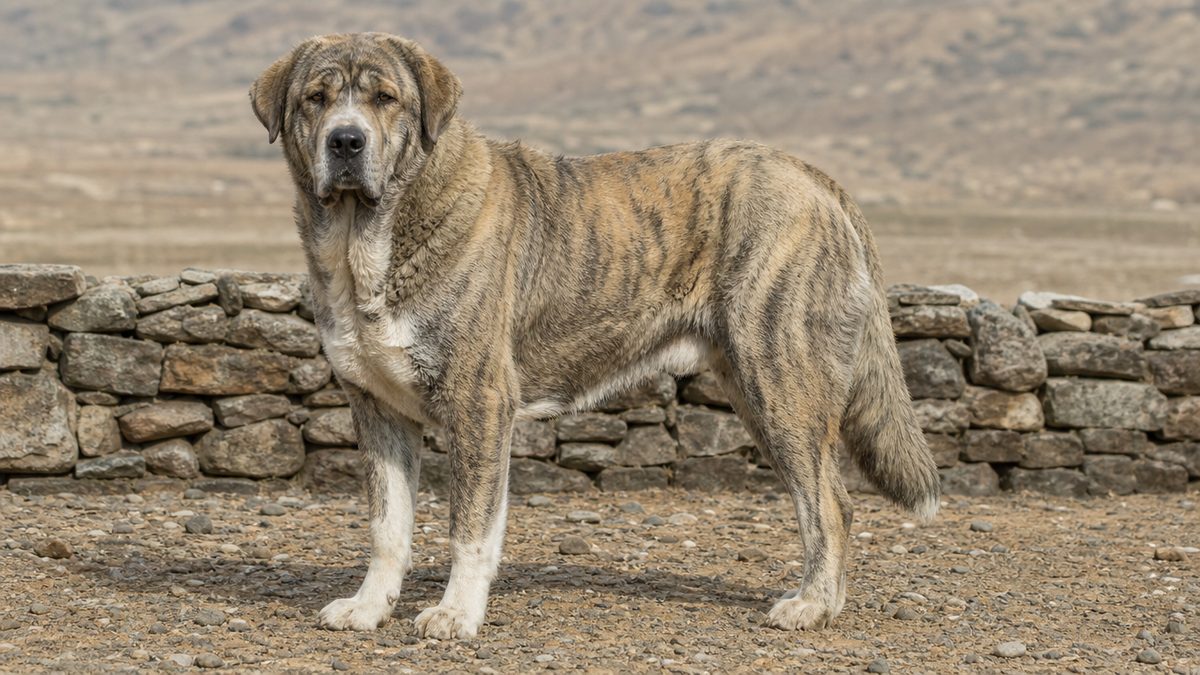
The Kuchi dog is a large Afghan livestock guardian named after the Kuchi, Afghanistan's nomadic pastoralists, and it is a working type rather than a registered breed. The dog is named for the people, not the other way round, and that ordering matters for everything else on this page.
Take the people first, because the dog only makes sense inside their system. The Kuchi are Afghanistan's nomadic and semi-nomadic pastoralists, and their identity is contested and politically live rather than a piece of folklore. The standard scholarly treatment is Richard Tapper's paper in the *Journal of the Royal Anthropological Institute*, titled "Who are the Kuchi? Nomad self-identities in Afghanistan", which examines how the label is claimed, assigned and disputed. Bonbeno uses the term because it is the name the dog carries in English and because Kuchi communities use it of themselves, and it does so without treating it as a settled ethnic category.
The Kuchi pastoral system is under pressure and has been for decades. The Food and Agriculture Organization has run targeted support programmes for Kuchi pastoralists in Afghanistan, including adapted assistance during the COVID-19 period, which tells you plainly that this is a livelihood needing support rather than a picturesque survival. A veterinary cross-sectional study in Herat province surveyed 204 livestock-owning households across six Kuchi and five sedentary villages, sampling 1,017 people, 1,143 sheep, 876 goats and 344 cattle, and found Kuchi households carried 2.5 times the odds of having a Brucella-seropositive person or animal.
That study is the closest thing to hard data touching this dog's world, and it does not mention the dog at all. Hold that thought, because it recurs.
What the dog does
The Kuchi dog works as a guardian for a moving camp. It follows the nomads, protecting caravans and flocks of sheep, goats, camels and other livestock from wolves, bears, hyenas, big cats and thieves, and it is found around the central and northern parts of Afghanistan. Its Pashto names record both halves of the job: De Kochyano Spai, dog of the nomads, and Jangi Spai, fighter dog. Other names in circulation are Sage Kuchi, Sage Jangi, Afghan Shepherd, Powindah dog and Afghan Mastiff.
This is a livestock guardian in the strict sense, not a herding dog. It does not move stock; it stays with stock and repels what approaches. The distinction decides everything about its temperament and its unsuitability for an Indian flat.
What it looks like, and why nobody can tell you precisely
There is no measurement here that a document fixes, and the wording of the available descriptions gives the game away. Males are given as 24 to 29 inches, that is 61 to 74 cm, "and more" at the withers, weighing 88 to 176 pounds, or 40 to 80 kg, "and more". Females run 23 to 26 inches, 58 to 66 cm, at 84 to 120 pounds, 38 to 54 kg. A range that ends in "and more" is a description of observed variation, not a specification.
The coat can be short, medium or long, over thick underwool, and colour is explicitly stated to be of no importance in determining the dog or its type. Heads vary from wedge-type to brick-type to bear-type. Dark spots often mark the body, the inside of the mouth, the bridge of the nose and the abdomen.
| Type | Where | Build and coat |
|---|---|---|
| Mountain | Pamir range and higher elevations, cooler and more humid | Very large-boned, heavy-coated |
| Steppe | Open flats | Much lighter build, medium to long hair, mastiff build with a sighthound look |
| Desert | Large desert flatlands, hotter and sparsely vegetated | Medium height, short to medium coat over very thick winter underwool |
| Lion-type (Djence Sheri) | Cuts across, mostly desert dogs | Heavier, larger bear-type head, deeper chest, head carried high |
| Tiger-type (Djence Palangi) | Cuts across, often steppe dogs | Athletic, brick or wedge head, shorter coat, sidewinding catlike movement |
Three regional types and two body types, with any of them able to show features of the others, is not a breed described badly. It is a landrace described accurately. A population shaped by terrain, work and local preference across a country the size of Afghanistan produces exactly this: real, consistent regional differences with no single form to certify. The next section turns that observation into a test with a yes or no answer.
Is the Kuchi a breed? Tested against Bonbeno's own rule
The Kuchi fails Bonbeno's two-condition test, so this site treats it as a type rather than a breed. The rule is published on Bonbeno's own page for names used like breeds that are not breeds, and it is short: a breed has a written standard and a studbook behind it, so a puppy can be measured against something. The Kuchi has neither.
Take the conditions one at a time, because a test only means something if it can come out either way. Bonbeno applied the same rule to the Koolie, another working dog no national kennel club recognises, and concluded that the Koolie is a breed, because three Australian organisations register it and its club publishes a written conformation document. The rule is not a way of dismissing unrecognised dogs. It asks a narrow question about paperwork, and here it gets a different answer.
Condition one: is there a written standard?
No, and no body exists to write one. English descriptions of the dog state plainly that there is no organizing body for dogs in Afghanistan. Bonbeno checked the international position independently rather than taking that on trust. Afghanistan does not appear among the FCI's members and contract partners, while India, Pakistan, Iran and Uzbekistan all do. So there is no national canine organisation to author a standard, and no route by which one could be adopted internationally.
The absence at the FCI is direct too. Bonbeno read the Group 1 index (Sheepdogs and Cattledogs) and the Group 2 index (Pinscher and Schnauzer, Molossoid and Swiss Mountain and Cattledogs), confirming each page's own printed title first rather than trusting the URL, and found no Kuchi entry in either. The controls were present on the same documents: Kangal Shepherd Dog 331, Central Asia Shepherd Dog 335, Caucasian Shepherd Dog 328 and Tibetan Mastiff 230 all appear. The provisional register, whose title was likewise read off the returned page, carries no Kuchi entry either.
This matters because an absence is only evidence when the instrument is proved to work. Four guardian breeds present, Kuchi absent, on the same pages in the same session. That is a real absence.
Condition two: is there a studbook?
No. There is no registry anywhere holding this dog, no herdbook, and nothing to register a litter into. The clearest illustration is a site that built the furniture for one and never filled it: an aggregator running a Kuchi page offers a marketplace, a herdbook, community profiles and a breeder directory, and all four counters read zero, with the herdbook explicitly stating that no public herdbook records yet exist. Bonbeno cites that page only as evidence of an empty apparatus, never for a fact about the dog.
| Condition | Koolie | Kuchi |
|---|---|---|
| A written standard | Yes, an unofficial conformation document published by its club | No. No body exists in Afghanistan to publish one |
| A studbook | Yes, three Australian registers issuing five-generation certificates | No. No registry anywhere, no herdbook records |
| National kennel club recognition | No | No |
| Verdict on Bonbeno's rule | A breed | A type, not a breed |
Landrace is not the reason, and this is where most writers go wrong
Being a landrace does not put a dog on Bonbeno's types-not-breeds page, and the rule says so explicitly. The English Shepherd is a landrace with United Kennel Club registration since 1927, and the Africanis is a landrace with a published Kennel Union of Southern Africa emerging-breed standard. Both are landraces and both have a document, so neither belongs there. What puts a dog on that page is a missing standard, not the way the population was shaped.
The Kuchi is a landrace *and* has no document. It is the conjunction that decides it, not the landrace half.
The FCI does recognise a breed drawn from this population: Central Asia Shepherd Dog, standard 335. Read its front matter and the picture sharpens. Its origin is given as USSR (Regions of Central Asia) and its patronage as Russia, with the current standard valid from 13 October 2010. Its own history describes a breed formed by natural selection across territory stretching from the Caspian Sea to China and from the Southern Ural to Afghanistan. So the standard that exists over this population was written under Russian patronage over a Soviet-era classification, and it is not Afghanistan's document. The Kuchi is what that population is called where nobody wrote the standard.
One consequence for an Indian buyer is immediate and practical. The Kennel Club of India issues pedigrees against FCI nomenclature, and the Kuchi is not in that nomenclature, so no KCI registration for a Kuchi is possible. Any dog offered to you in India as a registered Kuchi is either unregistered, or registered as something else. There is no third option.
None of this is a criticism of the animals. A Kuchi dog guards, and an unregistered dog is not an inferior one. It means only that there is no document to check, in a market where the document is usually the pitch.
Kuchi dog price in India: the one Indian domain ranking for it is dead
No verifiable kuchi dog price in india exists. The single Indian classifieds domain ranking for this query, buydogs.in, no longer resolves in DNS, so every rupee figure attributed to it comes from a search index rather than from a live listing.
Bonbeno tried to open that domain twice, with two independent tools, and both failed at name resolution rather than at the page. A direct request returned a DNS lookup failure, and a second, unrelated crawler returned the same verdict, reporting that the hostname could not be translated to an IP address. A dead domain cannot be quoting anyone a price.
This matters because a search engine's generated summary confidently reported that Afghan Kuchi dogs are available through Indian classifieds in Bangalore, Delhi, Bihar, Udaipur, Hyderabad, Jaipur and Ambala, with prices starting around Rs 1,500 and all-India delivery for Rs 2,000 to Rs 3,000. Those figures are drawn from a crawler's stored copy of a site that no longer serves. Bonbeno prints none of them, and neither should anyone else. A search snippet is not a live fetch, and index text can outlive the address it came from by a long way.
Sanity-check them anyway, because the arithmetic reinforces the point. Rs 1,500 for a 40 to 80 kg livestock guardian is not a plausible Indian price for the animal described. It is roughly what a street-sourced puppy costs, and it is far below what any Indian seller charges for even a common large breed.
The result set is Pakistani, not Indian
Look at what actually ranks for an Indian commercial query. Five of the seven results are either Pakistani classifieds or generic Indian price lists. Positions one and three are OLX Pakistan, for Lahore and Rawalpindi. Position two is a Pakistani livestock marketplace. That is the honest shape of this market: the live South Asian trade in this dog is Pakistani, and India is not part of it.
This is the trap specific to this breed and Bonbeno has not had to flag it before. Pakistani listings are denominated in Pakistani rupees, and Indian readers see the same abbreviation, Rs, that they use for Indian rupees. The two are not the same currency and have never traded near parity. A figure copied from an OLX Pakistan listing into an Indian price guide, with the symbol left as Rs, is not converted, not comparable and not a price in India. Bonbeno did not obtain a live exchange rate in this session, so it publishes no conversion at all rather than a stale one. Treat any Indian page quoting a Kuchi price in Rs as needing to prove which rupee it means.
The Indian price lists have no row for this dog
The generic Indian price guide ranking at position four is titled "Dog Price List in India 2026, 50+ Breeds" and prices Labradors at Rs 15,000 to 50,000, Golden Retrievers at Rs 20,000 to 60,000 and German Shepherds at Rs 20,000 to 75,000. Bonbeno searched its full text: Kuchi appears zero times, and so do Afghan, Kangal and Central Asian, while Labrador appears eleven times and Tibetan Mastiff once. Those last two are the control, and they passed. A fifty-breed Indian price list that ranks for this query has no entry for the breed.
Bonbeno also opened the OLX Pakistan Lahore page directly. It returned HTTP 200 with its title confirmed as "Kuchi Dog - Dogs for sale in Lahore", but the listing grid itself did not render, so no price is quoted from it here. A page that loads its chrome and not its data is not a source for a number, however tempting the headline.
The aggregator pages that do rank carry no Indian price at all, dealing instead in general descriptions of the type Dog-Learn, Kuchi Dog Breed. So the position is simple and it is worth stating without hedging: Bonbeno found no verifiable Indian price for this dog, from any seller, at any figure, and prints none.
Cost of ownership in India, which is real even when the price is not
Budget Rs 6,000 to Rs 11,000 a month to keep a dog of this size properly in an Indian metro. There is no purchase price to quote, but the recurring cost of ownership is real, published and sourceable, because every line applies to any 40 to 80 kg guardian living in this country.
The Indian baseline comes from VOSD, which prices each line separately. Across all dogs it puts the total monthly cost at Rs 3,000 to Rs 10,000 and beyond, and the annual cost at Rs 25,000 to Rs 80,000 or more, varying by breed, city and standard of care. A dog at the top of this type's weight range sits at the top of every one of those ranges.
| Line | Published Indian figure | Where this dog lands |
|---|---|---|
| Food, per month | Rs 1,500-4,000 for a medium dog; large working breeds push to Rs 5,000 or more | At or above the top of that range |
| Vet consultation | Rs 500-1,000 at a good clinic | Same, but expect more visits in humid months |
| Annual vaccination | Rs 1,500-3,000 | Same, and non-negotiable given the rabies picture |
| Preventive care, per year | Rs 5,000-8,000 done properly | Same. There is no breed screening panel to add, because none exists |
| Grooming, per session | Rs 300 basic wash to Rs 2,000 for a large long-haired breed | Anywhere in that range, because the coat is not fixed by a standard |
| Boarding, per day | Rs 500-2,000 | Top end, and many facilities will decline a guardian of unknown breeding |
| Training and behaviourist | Rs 5,000-15,000 for a course; Rs 3,000-10,000 for a behaviourist | Both, and budget the behaviourist as likely rather than optional |
| Emergency hospitalisation | Rs 8,000-30,000 for one to three days | Top end. Anaesthetic and drug dosing scale with body weight |
Two lines behave differently here than on a recognised breed's page. Screening costs less, because there is no breed-specific panel to run: no registry holds hip or elbow data for this dog, so there is nothing to compare a result against. That is a saving and a warning at the same time, and the health section explains why the warning is the bigger half.
Insurance is the other. Indian pet insurers underwrite by breed, and a dog that no registry recognises is difficult to declare accurately on a proposal form. Expect to be asked for a breed name that does not exist on the insurer's list, and expect the honest answer, an unregistered large mixed guardian, to change the quote or the acceptance.
Setup and the first year
VOSD budgets Rs 2,000 to 5,000 for a starter kit and another Rs 2,000 to 5,000 for the first vaccinations, deworming and health check, putting the first month at Rs 15,000 to 25,000 before anything unexpected. For a dog of this size, scale the fencing rather than the bed. A guardian that decides your boundary is its territory will test that boundary, and a compound wall is a larger line item than everything in this table combined.
VOSD's own comparison is the useful one: a dog costing Rs 4,000 a month to maintain in Pune may cost Rs 7,000 a month in South Delhi, with grooming, boarding and training following the same pattern. For a large guardian the metro premium bites hardest on boarding and training, which are the two lines this dog uses most and the two that facilities most often refuse.
Heat tolerance: this dog is arid-adapted, not heat-proof
The Kuchi handles dry heat well and humid heat badly, and almost every page about it gets this backwards. Kandahar reaches 32.78 C in July at 15.4 percent relative humidity. Chennai's hottest month is *cooler*, at 31.51 C, and sits at 64.5 percent. The temperature is not the problem in India. The water in the air is.
Bonbeno queried NASA POWER by explicit latitude and longitude for four Afghan points and seven Indian ones, echoing back each grid cell's elevation, because POWER returns a cell rather than a point and in mountains the cell can sit far from the town beneath it. The Afghan lowland points came back usable: Kandahar's cell reports 1,052.32 m against a city near 1,010 m, an error of 42 m. Kabul's cell reports 2,088.45 m against a city near 1,790 m, an error of about 298 m, which is real but tolerable. The high points are worse: Ghazni is out by roughly 483 m and Bamyan by roughly 623 m, both too cold as returned.
| Place | Cell elevation | Annual mean | Annual RH | Hottest month | RH that month |
|---|---|---|---|---|---|
| Kandahar, Afghanistan | 1,052 m | 20.24 C | 26.6% | 32.78 C (Jul) | 15.4% |
| Kabul, Afghanistan | 2,088 m | 11.74 C | 41.7% | 22.98 C (Jul) | 29.3% |
| Ghazni, Afghanistan | 2,703 m | 7.80 C | 46.0% | 19.46 C (Jul) | 36.4% |
| Bamyan, Afghanistan | 3,173 m | 3.40 C | 51.5% | 14.07 C (Jul) | 37.4% |
| Delhi | 206 m | 25.60 C | 45.6% | 35.88 C (Jun) | 36.4% |
| Pune | 636 m | 23.86 C | 66.8% | 28.93 C (Apr) | 42.1% |
| Bengaluru | 842 m | 23.74 C | 67.9% | 28.37 C (Apr) | 48.7% |
| Mumbai | 97 m | 26.77 C | 67.4% | 31.19 C (May) | 60.2% |
| Chennai | 49 m | 27.95 C | 72.4% | 31.51 C (May) | 64.5% |
Read the humidity column, not the temperature column. Kandahar is a hot place: its annual maximum reaches 44.9 C, hotter than anything Bengaluru or Pune produce. A dog from that country is not naive about heat. What it has never met is heat carrying water.
The physiology behind that is simple and it is why the distinction matters. A dog sheds heat mainly by evaporating water from the respiratory tract, and evaporation slows as the surrounding air approaches saturation. At 15 percent humidity panting works efficiently. At 65 percent it works far less well, so the same body temperature is much harder to shed. Chennai at 31.51 C and 64.5 percent is a harder thermal problem for this dog than Kandahar at 32.78 C and 15.4 percent, despite being 1.3 degrees cooler.
Delhi's annual relative humidity of 45.6 percent is the closest match in mainland India to Kabul's 41.7 percent, and its June humidity of 36.4 percent matches Ghazni's July almost exactly. Delhi is much hotter, at a June mean of 35.88 C and an annual maximum of 48.79 C, so it is not comfortable. But the *kind* of heat is the kind this dog's ancestors met. The coastal cities are the reverse: cooler and far worse for it. This is the opposite of the recommendation Bonbeno gives for a Kuvasz or a Komondor, and the reason is that those breeds come from a cold humid homeland while this one comes from a hot dry one.
The high-country half, and why the satellite cannot settle it
Mountain-type Kuchi dogs come from the Pamir range at elevations Ghazni and Bamyan only hint at, and India's equivalents are Leh and Srinagar. Both Indian cells are badly wrong: Leh returns 4,532.61 m against a town near 3,500 m, and Srinagar returns 2,630.66 m against a city near 1,585 m, errors of roughly 1,033 m and 1,046 m in the same direction. Both come back too cold. Correcting at the standard lapse rate of about 6.5 C per 1,000 m lifts Leh's annual mean from a returned minus 2.75 C to somewhere near 3.9 C, and Srinagar's from 9.13 C to somewhere near 15.9 C. Treat both as estimates and label them so.
The honest conclusion is that Ladakh and Kashmir are the Indian regions whose climate a mountain-type Kuchi would recognise, and that Bonbeno cannot give you a precise figure for either because the instrument is unreliable in exactly that terrain.
What the size does to the risk
Bodyweight is the transferable risk factor here. Dogs over 50 kg carried 3.42 times the odds of heat-related illness compared with dogs under 10 kg, with a 95 percent confidence interval of 1.54 to 7.57. A Kuchi described at 40 to 80 kg straddles that threshold, so weigh the individual dog rather than assuming. The same study found dogs at or above their own breed and sex mean bodyweight carried 1.42 times the odds, which applies whatever the scale says and converts into one instruction: keep the dog lean.
The timing rule follows from the companion paper. Of 1,259 heat-related illness events, 879 had a recorded trigger, and 652 of those 879, or 74.2 percent, were exertional. Walk before sunrise and after dark, and treat a humid evening as a rest day even when the thermometer looks mild.
Temperament: a dog built to work alone against predators
The Kuchi is territorial, independent and slow to accept strangers, because it was selected to hold a moving camp against wolves and thieves without a handler present. English descriptions of the type warn specifically about aggression toward people who encroach on its territory, including delivery workers, utility staff and even family members it has not met before.
Set the sourcing straight first, because it changes how much weight these claims carry. The English-language temperament description of this dog rests almost entirely on one Wikipedia article, and that article's own maintenance banners flag it as lacking sufficient inline citations since October 2010 and as possibly containing original research since September 2011. Its whole reference list runs to four items: a content-farm page, a breed dictionary entry, an anthropology paper about the Kuchi people, and a travel memoir. Bonbeno reports the description because it is consistent and plausible for a livestock guardian, and reports its provenance because you deserve to know how thin the foundation is.
With that stated, the description itself is coherent. The Kuchi people needed dogs that would be vigilant, tough enough for the journey, and able to function without special guidance or training, because there was often no spare time or energy to feed and manage them and no possibility of waiting for a dog that fell behind. What that selection produces is a dog with a keen sense of territory and ownership, deep bonds to its own group, and no interest at all in strangers.
The traits that make it unsuitable for an Indian household
- Territory is mobile and elastic. A dog whose territory was a caravan does not read a compound wall as a boundary. Descriptions note the claimed territory can extend well beyond the house and yard.
- Strangers are the job. Indian homes take deliveries, staff, gas cylinders and guests at the boundary several times a day, which is the exact stimulus this dog was bred to repel.
- Vocal in a way that is misread. The type is described as growling to express pleasure as well as displeasure, which children in particular can misinterpret with dangerous results.
- Same-sex conflict is likely, as with most guardian types, and an unfamiliar dog entering the claimed territory is met with an aggressive response rather than a curious one.
- No handler dependence. A dog selected to act without instruction will act without instruction, including when you would rather it did not.
Bonbeno's own summary of the type is that it is a working animal in a working system, and the system is a migrating pastoral camp in Afghanistan. The Herat study gives a sense of the scale involved: 204 livestock-owning households across eleven villages ran 1,143 sheep, 876 goats and 344 cattle between them. A dog guarding that against wolves at night is not being asked to be friendly, and it was never selected to be.
English writing about this dog uses "primitive" and "fighter" freely, and both need handling. Primitive here is a cynological term for an unstandardised working population close to natural selection, and it says nothing about the Kuchi people, who are a contemporary community whose identity is actively contested rather than archaic. Jangi Spai, fighter dog, is a genuine Pashto name recorded for the animal and refers to its defence of the flock. Some Western pages reach from that name to organised dog fighting. Bonbeno found no evidence for that reading and does not make it, and notes that organised animal fighting is an offence in India under the Prevention of Cruelty to Animals Act regardless of any dog's origin.
Who should consider one: nobody in an Indian city, and realistically nobody in India who cannot verify the animal's parentage. The temperament section of a normal breed page ends with a shortlist of suitable homes. Here the honest ending is that the dog is well suited to the job it was built for, that job does not exist in India, and no shortlist follows.
Training a dog selected to need no training
Train a Kuchi by managing its environment rather than by drilling obedience, because the type was explicitly selected to function without special guidance or training. That is not a gap in the dog. It is the trait the Kuchi people needed, and it is the single hardest thing to live with outside a pastoral camp.
Understand what you are working against. A herding dog was bred to take direction continuously. A livestock guardian was bred to be left alone with the flock for weeks and to decide for itself. Selection for independence and selection for biddability pull in opposite directions, and this population sits at the far end of the first. Expect a dog that hears an instruction, evaluates it, and complies when it agrees.
What to do in the first year
- Socialise before sixteen weeks, harder and wider than you think necessary, to every category of person the dog will meet for the rest of its life.
- Train a specific gate routine, because the boundary is where the guarding instinct will express itself several times a day in an Indian home.
- Teach loose-lead walking early, while the dog is still light enough to physically manage.
- Pay the calm, never punish the alert. A guardian corrected for warning learns to skip the warning.
- Build a reliable recall on a long line, and accept that off-lead freedom in a public Indian space is not going to be appropriate for this dog.
Prong collars, choke chains, alpha rolls and physical corrections applied to a 40 to 80 kg dog selected for independence and self-defence produce escalation rather than compliance. This is standard advice for every guardian breed on this site, and it applies with more force here because there is no breed club, no established training tradition in India, and no published behavioural work to fall back on if it goes wrong.
Two Indian conditions make this harder than it would be elsewhere. Heat compresses the socialisation window into the hours before sunrise, and there is no way to make up the window later. And there is no breed community to learn from: no Indian club, no experienced mentors, no established handlers who have raised one of these dogs in this country. An owner is on their own in a way they would not be with a Kangal.
Set the expectation properly. A well-raised Kuchi is a dependable guardian that watches its boundary and tolerates its household. It is not a dog that becomes sociable, and no amount of training changes that. What good handling buys is a dog that is safe to live with, which in an animal of this size is the whole objective.
Exercise: a dog that was walked across a country
Give a Kuchi at least 90 minutes of steady walking a day, split into two sessions and scheduled outside daylight. This dog's working life was migration: it moved with a caravan across mountains and desert, day after day, and a fixed suburban yard does not substitute for that.
The requirement is distance at low intensity rather than intensity in short bursts. Descriptions of the type emphasise stamina and the ability to keep up with a caravan without hindering its progress, over terrain that for days offered no shelter, food or water. That is an endurance animal, and it is a higher exercise requirement than most livestock guardians carry.
Set that against the Indian constraint. Most heat-related illness follows exertion: 652 of the 879 events with a recorded trigger, or 74.2 percent, were exertional rather than environmental. A dog that wants 90 minutes and lives in Chennai has to take all of it in the dark, and on a humid evening it should take none of it, because humidity is the axis this dog is least equipped for.
- Walk two sessions of 45 minutes, before sunrise and after full dark.
- Use the five-second test on the road surface: if you cannot hold the back of your hand on it, the dog cannot walk on it.
- Replace distance with scentwork and training indoors on humid evenings, rather than shortening the walk and hoping.
- Avoid running, cycling beside and forced marching entirely before 18 months, because a dog finishing at 40 to 80 kg closes its growth plates late.
- Carry water on every walk and offer it often, since a large dog in Indian humidity dehydrates faster than its owner does.
One honest note about the alternative that gets suggested. Giving a guardian breed "a job" is often good advice, but the job this dog was built for is guarding livestock against wolves, and there is no Indian equivalent that a suburban owner can offer. Patrolling a boundary is the nearest available substitute and it is a real one, provided the boundary is secure enough that patrolling does not become escaping.
Grooming, and the two procedures that are illegal in India
Brush a Kuchi weekly and more during seasonal coat drops, but the important grooming fact about this dog in India is not a brush. It is that the traditional presentation, with the ears cropped almost to the base and the tail docked by about a third, is prohibited outright under Indian law.
The coat itself is undemanding and genuinely variable. Descriptions record coats that can be short, medium or long over thick underwool, with colour explicitly unimportant to the type, and a strip of longer wiry hair often running the length of the backline. Because no standard fixes any of that, the grooming load depends entirely on the individual dog. A short-coated desert-type animal needs a weekly brush; a heavy mountain-type coat needs the same undercoat rake and the same seasonal daily work as any double-coated guardian.
In humid Indian conditions the priority is the same as for every dense-coated dog: get the undercoat out so the layer against the skin can dry. Wet underwool held against skin in monsoon humidity is where hot spots and pyoderma start.
Ear cropping and tail docking: what the law actually says
English descriptions of the Kuchi record that the tails are usually docked by about one-third of their length and that traditionally the ears are cropped almost to the very base. In India both procedures are forbidden. Second Schedule Part II paragraph 6(8) of the Prevention of Cruelty to Animals (Dog Breeding and Marketing) Rules 2017 reads that "There shall be no tail docking, ear cropping, de-barking, de-clawing, branding, dyeing, injecting substances to enhance visual appeal, performing a surgery or procedure to camouflage or hide any defect or infirmity or any other kind of mutilation of any body part of the pup and any change of appearance by artificial means is strictly forbidden";.
Cite that correctly, because it is routinely miscited. It is a Second Schedule paragraph, not a Rule. The Rules themselves stop at Rule 13, so any citation reading "Rule 6(8)" is wrong by construction.
The FCI standard for the Central Asia Shepherd Dog handles the same question and its wording is worth knowing. It states that traditional ear cropping and traditional tail docking are "still practiced in country of origin and in countries where it is not prohibited by law", and adds that a "natural tail is of equal value to a docked tail". India is a country where it is prohibited by law. So even the standard covering the nearest recognised version of this dog points an Indian reader to a natural ear and a natural tail, and a cropped or docked animal offered here was either imported already altered or was altered illegally.
There is one further practical consequence. A dog presented with cropped ears is being shown to you as evidence of authenticity by a seller, and in India it is evidence of an offence instead. Treat cropped ears on an Indian puppy as a reason to walk away rather than as a mark of a genuine working line.
Ears, in the dog you can lawfully keep
A natural Kuchi ear is medium-sized, thick and hanging, which is the same conformation the FCI describes for its recognised relative. That matters for care. In a UK primary-care study of 22,333 dogs, breeds with pendulous ear carriage carried 1.76 times the odds of otitis externa compared with erect-eared breeds, and breeds with V-shaped drop ears 1.84 times, against a one-year prevalence of 7.30 percent across all dogs. Add Indian humidity and the practical rule is to dry the ear canal after every bath, check weekly, and treat a head shake or an odour as a veterinary appointment.
Health issues and life expectancy: there is no data, and that is the finding
No health data of any kind exists for the Kuchi dog. No registry holds a screening row for it, no veterinary paper names it, and no longevity study includes it. Bonbeno publishes no lifespan, no disease list and no screening percentages for this dog, because there are none to publish.
That claim is a strong one, so here is how each half was earned, with a working control in every case.
| Instrument | Kuchi result | Control that passed |
|---|---|---|
| OFA published statistics, read live 2 September 2026 | 0 rows, on every disease table | LABRADOR returns 109 mentions in the same read |
| PubMed, six name forms | 0 records | Labrador and hip dysplasia 130, livestock guardian dog 80, Kangal dog 19 |
| McMillan 2024 supplementary Table S5, 345 breeds | No row at all | Afghan Hound, Central Asian Shepherd Dog, Turkish Kangal Dog and Labrador Retriever all present |
| Teng 2022 UK life tables | No coverage | Labrador present |
Teng 2022, the other major UK life-table study, does not cover this dog either. The six PubMed name forms were Kuchi dog, Kuchi shepherd, Sage Kuchi, Jangi dog, Afghan livestock guardian, and Kuchi restricted to title and abstract alongside dog. Every one returned zero. The bare word Kuchi returns 86 records, and none of them concerns a dog: they are a Japanese feeding-assessment index called the Kuchi-kara Taberu index, plus a scattering of author surnames. That is homonym capture, not literature, and an agent trusting the count would report the opposite of the truth.
The one genuine near-miss is worth naming. A search for Afghan Kuchi returns a single paper, and it is a real and useful one, but it is about the people: a cross-sectional brucellosis and Q fever study across six Kuchi and five sedentary villages in Herat province. It surveys households, sheep, goats and cattle. It does not mention the dog.
Bonbeno's Kuvasz page reports that McMillan 2024 lists the Kuvasz by name in Table S5 and marks it as not included in the analysis. The Kuchi is not in that table at all: the 345 rows enumerate breeds the study considered, and there is no Kuchi row to exclude. One dog was weighed and found to have too few records. The other was never a category the study recognised. That is the same distinction this whole page turns on, showing up inside a dataset.
What the absence does and does not mean
It does not mean the dog is unhealthy, and it does not mean it is healthy. An unstandardised landrace with a large open gene pool and heavy natural selection has real theoretical advantages: no closed studbook, no popular-sire effect, no selection for an exaggerated feature. Those advantages are plausible and they are also unmeasured, and Bonbeno will not convert a plausible mechanism into a health claim.
What the absence does mean is practical and it cuts one way. You cannot screen against a baseline that does not exist. For a Labrador you can compare a hip score against 100,000-plus evaluations. For this dog there is nothing to compare against, so a hip radiograph tells you about the individual animal and nothing about its risk relative to its population.
What to test anyway
Screen the individual dog even without breed baselines, because the tests still detect disease in the animal in front of you. Hips and elbows by radiograph under sedation, a thyroid panel, an eye examination, and a full physical are all worth doing for any large guardian in India.
If you intend to breed, Indian law makes some of that compulsory regardless of registry status. Second Schedule Part III paragraph 8(10) requires that dogs shall have been tested for genetic defects, including hip dysplasia, progressive retinal atrophy, night blindness, hypothyroidism, entropion, ectropion, overshot and undershot jaw, wry mouth, two or more missing teeth and cryptorchidism. The clause applies to the dog, not to the breed, so an unregistered dog of an unrecognised type is covered by it exactly as a Labrador is.
Note what Indian law does not require, because sellers invent requirements. Across the whole gazette the words patella, dental, BAER and deaf appear zero times, so there is no Indian patellar-grading or hearing-test requirement for any dog.
Life expectancy
Bonbeno prints no life expectancy for this dog. Aggregator pages give figures in the region of 10 to 12 years, and none of them cites a source, because no source exists. A number repeated across a dozen content farms is not a measurement. Where a page gives you a lifespan for an unrecorded landrace, it is telling you about its own sourcing rather than about the dog.
Feeding a large guardian with no breed guidance
Feed a Kuchi to a lean body condition on a large-breed complete food, weigh it monthly, and ignore any breed-specific feeding chart you find, because none of them rests on anything. There is no published nutritional work on this dog and no registry to define what an adult should weigh.
Start from the size, since that is all you have. Descriptions give males 40 to 80 kg and more, and females 38 to 54 kg. That is an enormous span, and it means a feeding plan has to come from the individual dog's body condition rather than from a table. Feel for ribs under light pressure, look for a waist from above, and adjust from there.
The Indian cost of that is real. VOSD prices quality food for a medium dog at Rs 1,500 to Rs 4,000 a month and notes that large breed dogs, especially working ones, can push this to Rs 5,000 or more. Budget the top of that range and treat anything lower as optimistic for a dog at the upper end of this weight span.
- Use a large-breed puppy formula to 18 months, because controlled calcium and growth rate is what those formulations exist for.
- Split into two meals for life, never one, given the deep chest typical of the type.
- Rest an hour either side of feeding, and feed on the floor rather than from a raised stand.
- Add no calcium or mineral supplements on top of a complete food unless a veterinarian has prescribed them for a diagnosed deficiency.
- Weigh monthly and record it, since a growth curve tells you what a glance cannot.
Dogs at or above the mean bodyweight for their own breed and sex carried 1.42 times the odds of heat-related illness, with a 95 percent confidence interval of 1.12 to 1.80. That is a within-population comparison, so it applies even to a dog with no breed mean on record: keep it at the lean end of whatever its own frame supports. In a humid Indian summer this matters more for this dog than any feeding brand decision.
The working-diet question, answered honestly
Owners drawn to a landrace often ask whether it should be fed as its people feed it. The available description of that system is that the Kuchi people often had no spare time or energy to feed and care for their dogs at all. That is a description of scarcity under migration, not a nutritional protocol, and it is not a model for feeding a dog in an Indian home. Feed a formulated complete diet, and if you prefer home-cooked food, have a veterinary nutritionist formulate it rather than improvising calcium to phosphorus balance in a growing giant-breed dog.
Water is the line that matters most in India. A large arid-adapted dog in humid heat drinks heavily and dehydrates faster than its owner notices. Provide multiple bowls, keep one indoors, refill through the day, and move outdoor bowls into shade.
The first year, if you end up with one
Plan the first year around three fixed constraints: the socialisation window closes near sixteen weeks, the guarding instinct switches on between nine and eighteen months, and Indian heat removes daylight from the schedule for most of the year. Everything below is arranged so the work lands before each door closes.
| Age | What is happening | What you do | The India adjustment |
|---|---|---|---|
| 8-10 weeks | Legal minimum sale age under Rule 8(1)(a) | Vaccination course begins, which the Rules allow from seven to eight weeks | Refuse any puppy offered younger and ask when the course started |
| 10-16 weeks | The socialisation window, and it does not reopen | Every delivery rider, watchman, child, vehicle and animal the dog will meet as an adult | All of it before 6 am from March onward |
| 4-6 months | Fast growth, boundary testing | Recall on a long line, settle on a mat, calm gate routine | Split walks into two cool-hour sessions |
| 6-9 months | Adolescent, still physically manageable | Loose-lead walking drilled until automatic | Hot-surface checks every walk |
| 9-18 months | Guarding behaviour appears at the boundary | Shape it. One bark, then come to the handler, then payment | Indian gate traffic makes this the highest-value skill on the list |
| 12-18 months | Growth plates still closing | No running, cycling beside or forced marching. Free play on soft ground | Monsoon coat care and weekly ear checks begin in earnest |
| 18 months+ | Physically mature | Hips, elbows, thyroid, eyes, and a full physical | Book ahead. None of these is a walk-in test in most Indian cities |
Two legal checkpoints apply to the purchase itself and are worth quoting rather than paraphrasing. Rule 8(1)(a) of the 2017 Rules requires every breeder to ensure that pups less than eight weeks in age are not sold, and Second Schedule Part III paragraph 8(9) provides that all pups shall be vaccinated, starting at seven to eight weeks and usually completed by eighteen weeks. The two use different numbering systems and confusing them is common: the first is a Rule, the second is a Second Schedule paragraph.
With a Kangal or a Caucasian Shepherd an Indian owner can find other owners, a club, a mentor and a body of shared experience. For this dog none of that exists in India: no club, no register, no experienced handlers, and no published behavioural or veterinary work in any language. A first-year mistake with a 40 to 80 kg protective guardian is expensive, and here you would be making it without a net. That is a stronger argument against acquiring one than anything about climate.
The socialisation window is where Indian heat does the real damage. The critical period does not pause for April, so if a household cannot commit to pre-dawn outings through the puppy's third and fourth months, the dog reaches adulthood under-socialised. In an animal this size that is a permanent management problem, not a training gap you can close later.
Kuchi against the guardians you can actually verify
Buy a Kangal or an Anatolian Shepherd if you want this dog's job done by an animal you can verify, and adopt a Himalayan Sheepdog or a large Indian rescue if what you want is a watchful dog that already lives here. The Kuchi loses this comparison on documentation, on data and on availability, and the comparison is not close.
| Breed | Written standard | Studbook | OFA hip data | Available in India? |
|---|---|---|---|---|
| Kuchi | None | None | No rows at all | No verifiable listing found |
| Kangal Shepherd Dog | FCI 331 | Yes, via FCI members | Filed under Anatolian Shepherd: 9.8% of 3,077 | Yes, a real market exists |
| Central Asia Shepherd Dog | FCI 335, origin USSR, patronage Russia | Yes | 24.7% dysplastic of 243 | Occasionally |
| Caucasian Shepherd Dog | FCI 328 | Yes | Published | Yes |
| Tibetan Mastiff | FCI 230 | Yes | 16.7% of 1,403 | Yes, with real Indian prices |
| Himalayan Sheepdog | Indian landrace | No formal studbook | None | Yes, and already living here |
The Kangal row is the fair benchmark, because it is the same job in a comparable climate with a full FCI standard behind it. The first row is the argument. Every other dog in that table can be checked against a document and, in most cases, against a registry dataset. The Kuchi cannot be checked against anything, which means a buyer's entire assurance rests on the seller's word.
The nearest recognised relative, and what standardising cost
The Central Asia Shepherd Dog is the closest thing to a registered Kuchi, and the relationship is worth understanding rather than glossing. Its FCI standard gives its origin as the USSR (Regions of Central Asia) with patronage held by Russia, and its history describes a population formed across territory reaching from the Caspian Sea to China and from the Southern Ural to Afghanistan. It sets minimums rather than ranges: males a minimum of 70 cm and 50 kg, females a minimum of 65 cm and 40 kg.
English commentary on the Kuchi argues that this standardisation produced a more uniform, heavier-headed, often white show type that diverges significantly from the native dogs, while the Kuchi population itself stayed diverse in colour, head type, body mass and coat. Treat that as a claim from a lightly sourced article rather than as a measured finding. What is documented, and not disputed, is that a standard exists for one and not the other.
The Himalayan comparison an Indian reader should take seriously
If the appeal is a large, protective, arid-and-altitude-adapted guardian with a landrace history, India already has one. The Himalayan Sheepdog fills the same ecological role in the same mountain system, is available here, costs a fraction of an import, and has none of this dog's verification problem. It is also, like the Kuchi, without a formal studbook, so an honest page has to say that the documentation objection applies to it too. The difference is that you can meet the dog, meet its parents and see the environment it came from, which is the practical substitute for paperwork that an import can never offer.
Bonbeno's Kuvasz guide sits at the opposite end of this spectrum: a standard published in four languages with a named authentic text, an FCI number, a national parliament's protection resolution, 2,127 OFA hip evaluations and three peer-reviewed papers. Same job, same rough size, same absence from the Indian market. The difference is entirely in the paperwork, and reading the two pages together is the clearest way to see what a breed standard and a studbook actually buy a buyer.
Mistakes Indian buyers and writers make with this dog
Seven mistakes recur around the Kuchi, and the first one is made by nearly every page that ranks for it: asserting the dog's breed status instead of testing it against a stated rule a reader could apply themselves.
1. Calling it a breed without saying what a breed is
Pages describe the Kuchi as a rare breed, a disputed breed or a landrace, and none of them defines the term or shows its working. Bonbeno publishes a two-condition rule, a written standard plus a studbook, and applies it in public. On that rule the Koolie passes and the Kuchi fails. Disagree with the verdict if you like, but ask any page that gives you a different answer what test it used.
2. Quoting a rupee price from a dead website
The only Indian classifieds domain ranking for this query no longer resolves in DNS, confirmed with two independent tools, yet a search engine's generated summary still quotes prices from it as though they were live listings. Index text outlives the address it came from. Fetch the URL yourself before repeating a number from a snippet.
3. Reading Pakistani rupees as Indian rupees
Most of the live South Asian listings for this dog are Pakistani, and Pakistani listings are priced in Pakistani rupees under the same abbreviation Indians use. The two currencies have never traded near parity. A figure carried across without conversion is not a price in India, and Bonbeno publishes no conversion because it did not obtain a live rate in this session.
4. Buying a cropped and docked dog as proof of authenticity
The traditional presentation crops the ears near the base and docks the tail by about a third, and sellers present that as evidence of a genuine working line. In India it is evidence of an offence. Second Schedule Part II paragraph 6(8) forbids tail docking, ear cropping and any change of appearance by artificial means outright. Even the FCI standard for the nearest recognised relative defers to local law on exactly this point and states that a natural tail is of equal value to a docked one.
5. Assuming a desert dog is heat-proof in India
This is the error that gets dogs hurt. Kandahar reaches 32.78 C in July at 15.4 percent relative humidity, and Chennai's hottest month is cooler at 31.51 C but sits at 64.5 percent. Panting cools poorly as humidity rises, so an arid-adapted dog can be in more trouble in a cooler coastal Indian city than in its own summer. Judge the humidity, not the thermometer.
6. Repeating a lifespan nobody measured
Aggregator pages give 10 to 12 years without a source Dog-Learn, Kuchi Dog Breed. The largest UK longevity study enumerates 345 breeds in its supplementary table and contains no Kuchi row, while the Afghan Hound, the Central Asian Shepherd Dog and the Turkish Kangal Dog all appear. A number repeated across content farms is not a measurement.
7. Trusting a result count instead of reading the results
A PubMed search for the bare word Kuchi returns 86 records, which looks like a literature. Open them and they are a Japanese feeding-assessment index and a run of author surnames. The disambiguated query returns zero across six name forms, with three controls passing in the same session. A big number for an obscure name is evidence of a homonym, not of research.
An aggregator ranking for this dog runs a marketplace, a herdbook, a profile directory and a breeder directory for it, and all four counters read zero, with the herdbook stating outright that no public records yet exist. Empty apparatus reads as infrastructure at a glance. Before you treat a site as a registry, check whether anything is actually in it.
Adoption, sourcing, and the honest recommendation
Adopt a large guardian-type dog from an Indian rescue rather than importing or chasing a Kuchi, because you cannot verify what you would be buying and there is no register to check it against. If you still intend to pursue one, the checklist below is the part no other page provides.
Begin with the position honestly stated. Bonbeno found no verifiable Kuchi offered for sale anywhere in India. The one Indian classifieds domain ranking for the query is dead, a fifty-breed Indian price list ranking for the same query contains no Kuchi row against working controls, and the live listings that do exist are Pakistani. A rescue Kuchi in India would be a remarkable event rather than a route you can plan around.
What Indian rescues do receive, constantly, is large guardian-type dogs of unknown ancestry that need exactly the home a Kuchi buyer is imagining. That dog is available today, in your city, and it comes without the import, the paperwork problem and the legal complication.
If somebody offers you one, verify these six things
| Ask for | What good looks like | What a refusal means |
|---|---|---|
| The dog's registration | There is none possible. A seller claiming KCI papers for a Kuchi is describing a different dog | The single fastest way to identify a misrepresentation |
| To see the mother with the litter | In the place the puppies were raised | The commonest sign of a broker rather than a breeder |
| Date of birth and vaccination record | At least eight weeks old, course started at seven to eight weeks | A sale below eight weeks is prohibited by Rule 8(1)(a) |
| Natural ears and a natural tail | Both intact | A cropped or docked Indian puppy means an offence under 6(8) has already occurred |
| The breeder's registration under the 2017 Rules | A number issued by the State Animal Welfare Board | An unregistered breeding establishment |
| Written health results on both parents | Hips, elbows, thyroid, eyes, with dates | Nothing can be inferred from breed baselines here, so the individual results are all you get |
The first row is unusual and it is the useful one. On most breed pages the advice is to check the registration. Here the advice is that there is no registration to check, so an offer of papers is itself the warning sign. A seller who produces a certificate for a Kuchi has produced a certificate for something, and it is worth finding out what.
Bonbeno did not verify India's current import instruments in this session and so makes no claim about ports or permits here. What it can say from documents it did read is narrower and enough to be going on with: no FCI pedigree can exist for this dog because it is not in the nomenclature, Afghanistan is not an FCI member so no national pedigree exists either, and any animal arriving already cropped or docked was altered in a way Indian law forbids performing here. Anyone seriously considering an import should take the current rules from the relevant Indian instrument directly rather than from this page or any other.
The honest recommendation
Bonbeno does not recommend acquiring a Kuchi dog in India, and the reasons are cumulative rather than any one being decisive. You cannot verify the animal, because no standard or studbook exists to check it against. You cannot register it. You cannot screen it against a breed baseline, because no registry holds one. The traditional presentation is illegal here. Coastal humidity works against a dog adapted to 15 percent. And no breed community exists in this country to help you when something goes wrong.
None of that is a judgement on the dogs. The Kuchi is a serious working animal that does a hard job well in the system that made it, and the Kuchi people who breed and keep them are not obliged to produce paperwork for a foreign market. The finding of this page is about documents, not about quality. A dog with no standard behind it is not a lesser dog. It is an unverifiable one, and in a market where the document is usually the pitch, that distinction is the most useful thing an Indian buyer can be told.
Kuchi dog questions, answered against documents
Is the Kuchi a real breed?
No, not on Bonbeno's own test, and the answer is not close. A breed here needs a written standard and a studbook so a puppy can be measured against something. The Kuchi has neither, and there is no organising body for dogs in Afghanistan to maintain either one. It is a landrace and a working type.
What is the Kuchi dog price in India?
No verifiable Indian price exists. The only Indian classifieds domain ranking for this query, buydogs.in, no longer resolves in DNS, confirmed independently by two tools, so the rupee figures a search summary quotes from it come from a dead site rather than a live listing.
Is the Kuchi the same as the Central Asian Shepherd Dog?
Not quite, and the difference is a document. The FCI recognises Central Asia Shepherd Dog 335, whose standard gives its origin as the USSR and its patronage to Russia. That standard was written over a varied Central Asian population; the Kuchi is part of that population without the standard.
Is the Kuchi recognised by any kennel club?
No. Bonbeno checked the FCI's Group 1 and Group 2 nomenclature indexes and its provisional register, confirming each page's own title first, and found no Kuchi entry while Kangal 331, Central Asia Shepherd Dog 335, Caucasian Shepherd Dog 328 and Tibetan Mastiff 230 were all present as controls.
Can you get a Kuchi with papers in India?
No. The Kennel Club of India issues pedigrees against FCI nomenclature, and the Kuchi is not in that nomenclature, so no KCI registration is possible. Any paperwork offered with an Indian Kuchi is either for a different breed or is not a pedigree at all.
Are Kuchi dogs' ears and tails cut?
Traditionally yes, and in India that is illegal. English descriptions record the tail docked by about a third and the ears cropped almost to the base. Second Schedule Part II paragraph 6(8) of India's 2017 Rules forbids tail docking, ear cropping and any change of appearance by artificial means outright.
Can a Kuchi dog survive Indian heat?
In dry heat yes, in humid heat much less well. Kandahar reaches 32.78 C in July at 15.4 percent relative humidity, while Chennai's hottest month is cooler at 31.51 C but sits at 64.5 percent. Panting cools a dog poorly as humidity rises, so this is an arid-adapted dog rather than a heat-proof one.
How long do Kuchi dogs live?
No reliable figure exists. McMillan 2024's supplementary table enumerates 345 breeds and contains no Kuchi row at all, while the Afghan Hound, the Central Asian Shepherd Dog and the Turkish Kangal Dog all appear in it. Any life expectancy quoted for this dog online has nothing measured behind it.
How big does a Kuchi dog get?
Descriptions give males 61 to 74 cm and more at the withers at 40 to 80 kg and more, and females 58 to 66 cm at 38 to 54 kg. Note the open-ended wording. A range that ends in 'and more' is a description of variation, not a standard, which is itself part of the answer about breed status.
Are there health tests for the Kuchi?
None specific to it. A live read of OFA's published statistics on 2 September 2026 returned zero rows for this dog, with the Labrador control returning 109 in the same read, and PubMed returns nothing across six name forms against three working controls.
What does the name Kuchi mean?
It comes from the Kuchi people, Afghanistan's nomadic pastoralists, and the dog is named for them rather than the other way round. The Pashto names recorded for it are De Kochyano Spai, meaning dog of the nomads, and Jangi Spai, meaning fighter dog.
Should I get a Kuchi dog in India?
For almost every Indian reader, no. You cannot verify what you are buying, you cannot register it, the traditional presentation is illegal here, no health data exists, and coastal humidity works against the dog. A Himalayan Sheepdog or a large rescue gives you the same job with none of those problems.
Are Kuchi dogs good family pets?
No, for almost every household. The Kuchi is territorial, independent and slow to accept strangers, because it was selected to hold a moving camp against wolves and thieves with no handler present. English descriptions warn of aggression toward anyone who encroaches on its territory, including delivery workers, utility staff and even family members it has not met, and the type growls to express pleasure as well as displeasure, which children misread with dangerous results.
What is a kuchi dog?
A Kuchi dog is a large Afghan livestock guardian named after the Kuchi, Afghanistan's nomadic pastoralists, and it is a working landrace rather than a registered breed: it has no written standard, no studbook and no organising body, and it appears in no FCI nomenclature. Descriptions give males 61 to 74 cm and more at the withers at 40 to 80 kg and more. The dog is named for the people, not the other way round.
Compare with similar breeds
Kuchi sits in 1 Bonbeno group. Each one compares it directly against the breeds it is genuinely an alternative to, on the same figures.