
Breed profile
King Shepherd: breed status, price in India and heat
A modern American breed created in 1990 to be a bigger, sounder German Shepherd, tested here against Bonbeno's own two-condition rule, against its own registries' documents, and against the one Indian law that speaks directly to breeds created this recently.
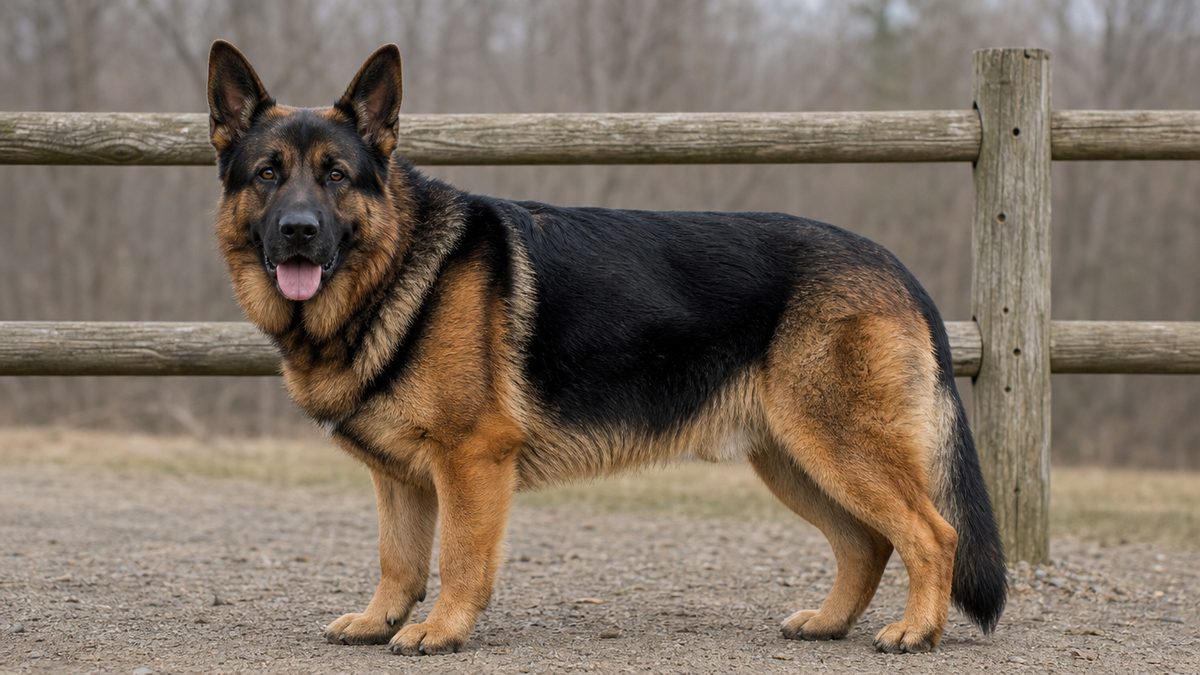
Quick answer
No king shepherd price in india can be quoted, because the breed appears zero times on India's fullest 40-breed price list and every India-located search collides with a Bollywood film and a gambling term. On Bonbeno's two-condition test the King Shepherd is a breed: two written standards exist and its founding club runs a register with a foundation-stock rule. English Wikipedia disagrees and redirects the name to German Shepherd. Heat tolerance 2 of 5.
This page is general information, not veterinary advice. It quotes orthopaedic screening figures, heat-illness odds ratios and drug-sensitivity data that describe populations rather than any individual dog. If you own or are considering a large shepherd-type dog in India, take these questions to a registered veterinarian: hip and elbow screening before breeding, an MDR1 genotype before any ivermectin, loperamide or sedative is given, and a weight-management plan. Nothing here replaces an in-person consultation.
King Shepherd at a glance
What a King Shepherd is, and what it was built to fix
A King Shepherd is a very large American shepherd-type dog created from 1990 by two American breeders, Shelley Watts-Cross and David Turkheimer, out of German Shepherd, Shiloh Shepherd, Alaskan Malamute and Great Pyrenees stock, bred back to European German Shepherds. The goal was explicit: a dog similar to the German Shepherd in nature and appearance, but larger and with fewer of the health and structural problems the German Shepherd was accumulating.
The dates are close together and worth separating. The King Shepherd Club of America gives 1990 as the year the breed was developed and says a breed club was created in 1995, describing the breed as still in development. The German Shepherd Dog Club of Canada gives the same club date, 1995. So the breed is younger than most Indian readers will assume: it is roughly thirty-five years old, which is a fraction of the German Shepherd's history from 1899.
The blend is not disputed in outline and is disputed in detail. The Continental Kennel Club says the founders used American-bred German Shepherds, Alaskan Malamutes, Great Pyrenees and Shiloh Shepherds, bred back to European German Shepherds. The King Shepherd Club of America says the breed must include the German Shepherd, is most often blended with the Alaskan Malamute or the Shiloh Shepherd, that some lines have incorporated the Great Pyrenees, and that some older lines trace back to the Akita. That Akita line appears on the breed's own club page and nowhere else in the material Bonbeno read.
Wikipedia does not think this is a breed
There is no English Wikipedia article for the King Shepherd. Requesting the title returns the German Shepherd article with the notice Redirected from King Shepherd printed at the top. That is the world's largest encyclopedia declining to treat the name as a separate breed, and it sits directly against two published breed standards and a founding club. Bonbeno publishes the disagreement rather than resolving it by preference, and works through what each side is actually asserting in the next section.
The labelling disagreement runs further than Wikipedia. One aggregator titles its page The Purebred King Shepherd. Another lists the same breed with a Type field reading Cross Breed. The King Shepherd Club of America's own page calls the dog a hybrid five times. The German Shepherd Dog Club of Canada calls it an American Rare Breed dog and says flatly that it is not a German Shepherd at all.
How big, and five documents that disagree
Size is the whole argument of this breed, so it matters that the published figures do not agree with one another. All five below were read off the documents themselves.
| Source | Males | Females |
|---|---|---|
| AKSC standard (minimums, disqualifying) | Min 27 in, min 110 lb, ideal 120 to 145 lb | Min 25 in, min 80 lb, ideal 90 to 110 lb |
| Continental Kennel Club standard | 27 to 32 in, 100 to 150 lb | 25 to 30 in, 80 to 120 lb |
| King Shepherd Club of America | 27 to 31 in, 90 to 150 lb | 25 to 27 in, 75 to 110 lb |
| ARBA figures, via the GSD Club of Canada | Over 29 in, ideal 130 to 150 lb | 27 in, ideal 90 to 110 lb |
| Two aggregators, combined | 25 to 29 in, 90 to 150 lb | same range quoted |
| German Shepherd, for scale | 24 to 26 in, 30 to 40 kg (66 to 88 lb) | 22 to 24 in, 22 to 32 kg |
Read the last row against the first and the breed's central claim becomes measurable. The King Shepherd standard's minimum height for a dog, 27 inches, is one inch above the German Shepherd standard's maximum of 26 German Shepherd Dog Club of America. Its minimum weight of 110 lb is 22 lb above the German Shepherd's top weight of 88 lb, and its ideal male range of 120 to 145 lb is roughly half as heavy again. The two populations do not overlap at all on the standards as written, and the King Shepherd is heavy-boned where the German Shepherd is not: its standard asks for thick, dense bone and a rear assembly that is powerful, muscular and heavily boned. Whatever else is arguable, the size claim is real and it is documented.
Coat, colour and the one thing the standard forbids it to look like
The King Shepherd comes in two coat varieties and the standard treats them as equal. The Continental Kennel Club describes a smooth variety that is short, dense, harsh and glossy over a thick soft undercoat, and a rough variety that is short on the face and forelimbs and longer on the neck, ears, rear limbs and tail, forming fringe and furnishings. The American King Shepherd Club standard calls the rough coat ideal and the smooth equally acceptable, and lists as serious faults a soft, silky or too long outer coat giving the appearance of a long haired Shepherd.
The judging notes at the top of that standard put it more bluntly still: a King Shepherd should not resemble a long haired German Shepherd, its head should be large and square, its bone thick and heavy, its body dense, wide and square, and its gait more lion-like. Colour is black-based throughout, in sable, bi-colour, black saddle with red, tan, gold or cream, or solid black, with a predominantly or solid white dog disqualified.
In the Indian market the phrase that circulates is king size German Shepherd, not King Shepherd, and the two are not the same claim. Indian sellers advertise oversized German Shepherd puppies under that phrase, and buyers searching for a King Shepherd land on them. The German Shepherd Dog Club of Canada names exactly this confusion: people ask for oversized German Shepherds mistakenly thinking they are King Shepherds. An Indian retailer puts the correction the other way round, noting that a King Shepherd is a genuinely different, larger crossbreed rather than a colour or size variant of the German Shepherd.
Is the King Shepherd a breed? Tested against Bonbeno's own rule
The King Shepherd is a breed on Bonbeno's two-condition test. The rule is published on Bonbeno's own page for names used like breeds that are not breeds, and it is short: a breed has a written standard and a studbook behind it, so a puppy can be measured against a document. The King Shepherd has two written standards and a register with a foundation-stock rule, and it passes.
Take the conditions one at a time, because a test only means something if it can come out either way. The same rule applied to the Kuchi found neither a standard nor a register anywhere on earth and concluded that it is a type rather than a breed. Applied to the McNab and the Koolie it found documents in both cases and returned the opposite verdict. Here it returns the same verdict as the McNab, and for once the sources that disagree are worth quoting on the page rather than dismissing.
Condition one: is there a written breed standard?
Yes, and there are two of them. The American King Shepherd Club publishes a complete conformation standard covering General Appearance, Size, Proportion and Substance, Head, Neck, Topline and Body, Forequarters, Hindquarters, Coat, Colour and Markings, Gait and Temperament, closing with a numbered list of seven disqualifications. It is prescriptive rather than descriptive. It sets minimum heights and weights and disqualifies any dog beneath them, requires 42 teeth in a scissors bite, disqualifies an undershot jaw, disqualifies cropped or hanging ears, disqualifies a docked tail, disqualifies a nose that is not predominantly black, and disqualifies a predominantly white dog.
The second standard is the Continental Kennel Club's, filed under its Breed Group 10, Pastoral and Stock Dog Breeds, and it is longer still, fixing an ideal body-height-to-length ratio of about 20:23 and a muzzle-to-skull ratio of 1:1. Two independent documents, both measurable, both published. Condition one is met more thoroughly than it was for either the McNab or the Koolie.
The American King Shepherd Club standard's Temperament section opens: "The breed has a distinct personality marked by direct and fearless, but not hostile, expression, self-confidence and a certain aloofness that does not lend itself to immediate and indiscriminate friendships. The dog must be approachable, quietly standing its ground and showing confidence and willingness to meet overtures without itself making them";. The German Shepherd Dog Club of America's standard opens its Temperament section with the identical sentences. So the breed created to be something other than a German Shepherd describes its own character in the German Shepherd's exact words. That is not fraud and it is not unusual in new breeds; it is, however, the single clearest measure of how far the two documents have actually diverged.
Condition two: is there a studbook?
Yes, run by the founding club, and its rules are stricter than the loose registries this site usually finds. The American King Shepherd Club's constitution states that the Official Registry of the club has been and will always continue to be operated by the Founding Officers of the club. Membership is compulsory to register: only members in good standing are eligible to register their litters, puppies or dogs, a non-member cannot register at all, and all King Shepherds must be registered through the AKSC to compete in any AKSC sanctioned event.
The registration qualifications addendum is the part that makes this a studbook rather than a list. Adopted by the Board of Directors on 11 July 2000, it states that any non-King Shepherd will be recognised as such and not as a King Shepherd; that any non-King Shepherd used as foundation stock will be registered as foundation stock and will not be considered a King Shepherd; that any non-King Shepherd currently registered as one will be reclassified as foundation stock; and that a majority vote of the Board is required before foundation stock registration is granted. That is an open studbook with a declared boundary, which is exactly what a breed under development should have.
The verdict, and three things that complicate it
The King Shepherd does not belong on Bonbeno's dog types that are not breeds page. Two standards and a register with a foundation-stock rule satisfy both conditions. Three findings complicate the picture without changing the verdict, and a reader deserves all three.
- The club's governance is unusual. Its bylaws state that the founding officers cannot at any time during the existence of the club be voted from the membership, will always hold an official position, and have the power to terminate any person's membership if they feel that person is working against the club, the welfare of the breed or the direction of the popular membership. A register whose keepers cannot be removed is still a register. It is not a democratic one.
- The objectives page carries stray boilerplate. Among the club's stated objectives sits a clause reading "for the breed as approved by the American Kennel Club as the only standard for excellence by which Newfoundland dogs shall be judged". The constitution reproduced immediately below it says the correct thing, naming the American Rare Breed Association as the authority whose standard governs. The Newfoundland line is a template that was never edited out, and it is worth knowing that the document was assembled from a model rather than drafted from scratch.
- The second club's public breed description is a third-party article, and it says so. The King Shepherd Club of America's About page ends with its own disclaimer: the information is from dogtime.com, with asterisks marking updates and corrections by the club. That is an honest disclosure and Bonbeno treats it as one. It also means the breed's second-largest club is not the author of its own public description.
| Condition | King Shepherd | McNab | Koolie | Kuchi |
|---|---|---|---|---|
| A written standard | Yes, two. AKSC and CKC, both with disqualifications | Yes, two | Yes, one club document | No |
| A studbook | Yes. Founding-club register with a foundation-stock rule | Yes, two | Yes, three | No |
| National kennel club recognition | No | No | No | No |
| Verdict on Bonbeno's rule | A breed | A breed | A breed | A type, not a breed |
One last point on why this matters more here than on the other three pages. The McNab, the Koolie and the Kuchi are all old working populations that a document caught up with, or failed to. The King Shepherd is the opposite: a document that came first, in 1990, and a population assembled to fit it. That distinction is what makes Indian law relevant to this breed and to almost no other on this site, and it is worked through under adoption below.
Which registries hold this breed, and which say nothing at all
Eight organisations are named as recognising the King Shepherd and not one of them is a national kennel club. The FCI, the United Kennel Club and the American Kennel Club all hold nothing for it, each checked against a control that returned results on the same document. What exists is a founding-club register, a rare-breed association standard, and a commercial registry that also registers dogs on photographs.
The King Shepherd Club of America publishes the list itself: American Rare Breed Association, King Shepherd Club of America, American King Shepherd Club, American Pet Registry Inc., Dog Registry of America Inc., Eastern Rare Breed Dog Club, States Kennel Club and World Wide Kennel Club. A second aggregator prints seven of the same eight. Read that list carefully: it is a list of rare-breed bodies and commercial registries, and a buyer should know the difference before a certificate is waved at them.
The Federation Cynologique Internationale: absent, and that settles India
The FCI holds no King Shepherd. Bonbeno read the Group 1 nomenclature page itself rather than assembling a breed URL, because FCI URLs resolve on their trailing number and will serve a different breed without erroring. The page's printed heading reads Group 1, Sheepdogs and Cattledogs (except Swiss Cattledogs), and its United States section contains exactly one breed, the Australian Shepherd, standard 342. The controls were present on the same document: German Shepherd Dog 166, Border Collie 297, Australian Kelpie 293.
That absence answers the practical Indian question. The Kennel Club of India issues pedigrees against FCI nomenclature, so no KCI registration for a King Shepherd is possible. The German Shepherd, by contrast, is recognised by the AKC, the FCI and the KCI, which is why an Indian buyer can get a papered German Shepherd and cannot get a papered King Shepherd.
The United Kennel Club and the American Kennel Club
The UKC recognises over 300 breeds and the King Shepherd is not one of them. Bonbeno read the full breed-standards index, including all 43 breeds in its Herding Dog group, and found no King Shepherd entry in that group or in any other. Controls present in the same group: German Shepherd Dog, White Shepherd, Dutch Shepherd, English Shepherd, Border Collie and Australian Shepherd.
The AKC holds no breed status for it either. It will, however, let one compete: AKC Canine Partners is open to mixed-breed dogs and, in the AKC's own words, any dogs without eligibility for full AKC registration, and enrolled dogs can earn titles in Agility, Obedience, Rally, Tracking, Coursing Ability Tests, Fast CAT, Scent Work and Farm Dog Certified. Enrolled dogs must be spayed or neutered. So a King Shepherd in America can title under the AKC's roof while the AKC declines to call it a breed, which is the same not-quite-binary recognition the McNab and the Koolie both sit in.
The Continental Kennel Club, and what its certificate proves
The Continental Kennel Club recognises the breed, publishes a full standard for it and runs a puppy marketplace for its registered breeders. It also runs a route called PAW for purebred dogs with no documented ancestry, and the requirements are worth stating precisely: the dog must be purebred and of an approved CKC breed, be at least one year old, not be pregnant or nursing, and come with a completed application, five photographs, two witness signatures from people familiar with the breed attesting to its purebred status, and a non-refundable USD 50 evaluation fee. No DNA. No pedigree. Only breeds on CKC's PAW Eligible Breeds list may apply, and Bonbeno could not render that list, which loads letter by letter through JavaScript, so this page does not claim the King Shepherd is on it or off it.
An American King Shepherd Club registration requires club membership, is issued by a registry the founders control permanently, and carries a foundation-stock rule that separates a King Shepherd from a non-King Shepherd used to breed one. A Continental Kennel Club PAW registration can be issued to a dog with no known parents on five photographs and two signatures. Both are paper. Only one of them is a statement about the dog's ancestry. If a certificate is ever produced for a dog in India, the question to ask is which of the two it is.
| Registry | Holds the King Shepherd? | Control that passed on the same document |
|---|---|---|
| FCI, Group 1 | No. The US section holds only the Australian Shepherd | German Shepherd Dog 166, Border Collie 297 |
| United Kennel Club | No, across 300-plus breeds and a 43-breed herding group | German Shepherd Dog, White Shepherd, Dutch Shepherd |
| American Kennel Club | No breed status. Competes as a Canine Partner | Canine Partners programme open to all dogs |
| American King Shepherd Club | Yes. Founding-club register, members only | Foundation-stock rule adopted 11 July 2000 |
| Continental Kennel Club | Yes, Breed Group 10, with a full standard | Standard published in full on the breed page |
King Shepherd price in India: the market sells a king size German Shepherd instead
No king shepherd price in india exists, and what an Indian buyer is actually offered under that search is an oversized German Shepherd. The breed appears zero times on India's fullest published 40-breed price list, no Indian classifieds site carries a listing for it, and every India-located search for the term collides with a Bollywood release and a gambling term.
Start with the list. India's most comprehensive published breed price table for 2026 covers more than 40 breeds, is compiled from breeder networks, Kennel Club of India registration data and marketplace surveys, and quotes the German Shepherd at ₹20,000 to ₹75,000, the Labrador at ₹8,000 to ₹80,000 and the Cane Corso at ₹50,000 to ₹2,50,000. The King Shepherd appears zero times on it. So does the Shiloh Shepherd. That is an Indian retailer assembling the widest breed list it can and having nothing to say about this dog.
What the Indian result set actually returns
The India-located organic results for this query are almost entirely about a different breed, and the pattern is the finding. Position one is a Quora thread whose answer discusses German Shepherd prices in India. Position two is an Indian retailer's German Shepherd price guide. Positions four, six, seven and eight are German Shepherd listings and price pages from Mr n Mrs Pet, Shubh Kennel, Tradeindia and Purfurry. Position five is a YouTube video titled KING SIZE GERMAN SHEPHERD PUPPY, and position nine another titled King Size German Shepherd for Sale, Heavy Bone Giant GSD. Position ten is an Instagram topic page whose visible entries include Mountain King victor king size German shepherd.
A separate targeted search across four Indian marketplaces, Mr n Mrs Pet, Puppiezo, Shubh Kennel and OLX India, returned exactly one result for the phrase King Shepherd, and it was an Indian breed guide explaining that a King Shepherd is a genuinely different, larger crossbreed rather than a German Shepherd variant. Not one listing. The Indian market does not sell this breed; it sells a size adjective attached to a breed it does sell.
Bonbeno ran two Bing queries from India on 2 September 2026. 'king shepherd price in india' with cc=IN returned HTTP 200 and 'About 197,000 results', and the ten organic results were the 2026 Shah Rukh Khan film King, King.com's game portal, IMDb, King the company, King on YouTube Music and a Satta King gambling results page. Adding two words and running 'king shepherd dog breed price india' returned a byte-identical result set and the identical printed count, which means the engine was not reading the query at all. A Labrador control in the same session returned 'About 46,600 results' and ten genuine Indian Labrador pages, so the instrument works and the word king is doing the damage. Nothing is claimed about the Indian market from either substituted set.
The American prices, and why no rupee figure appears here
Real King Shepherd prices exist in the United States and they are published in dollars. One breed aggregator gives an average of USD 1,500 to 2,500 and explains the band by rarity and demand, noting there are few reputable breeders and that prices start from around USD 1,500. That is the only price range on this page that was read off a page rather than off a snippet.
Bonbeno publishes no rupee conversion of it. Indian breed pages routinely take a dollar figure, divide it by one exchange rate and print the result as an Indian price, and this site has caught that at 84.38, at 74, at 80 and at 66.67 on other breeds. Run USD 1,500 through any of them and you get a plausible-looking figure between ₹1,00,000 and ₹1,27,000 that no Indian seller has ever quoted for this dog, because no Indian seller stocks it. If you see a rupee price for a King Shepherd anywhere, divide it by 84.38, by 80 and by 74 and see which one lands on a round dollar amount. Then ask what breed the puppy in the photograph actually is.
| Item | Published figure | Source type |
|---|---|---|
| King Shepherd puppy, United States | USD 1,500 to 2,500 | US breed aggregator |
| King Shepherd, India | No published price. 0 of 40+ breeds | Indian price list |
| King Shepherd listings on four Indian marketplaces | 0 | Targeted marketplace search |
| German Shepherd, India | ₹20,000 to ₹75,000 | Indian price list |
| Cane Corso, India, another giant guardian | ₹50,000 to ₹2,50,000 | Indian price list |
| Indie or native breed, India | ₹2,000, or free through adoption | Indian price list |
The last three rows are the honest answer to the question this page is named after. If size is what you want, an Indian buyer's realistic route is a large German Shepherd from a KCI-registered line, priced and papered, at a fraction of what importing an unregisterable American breed would cost. If what you want is a King Shepherd specifically, there is no Indian supply chain to buy it from and no registry here that could record it.
Cost of ownership in India for a 55 to 65 kg dog
Running a giant dog in India costs ₹12,000 to ₹20,000 a month on published Indian figures, roughly double the ₹6,000 to ₹10,000 a medium dog costs, and a first year lands between ₹80,000 and ₹2,00,000 before anything goes wrong. A King Shepherd at its standard's ideal male weight of 120 to 145 lb, which is 54.4 to 65.8 kg, sits in the giant column rather than the large one.
The mistake Indian buyers make with this breed is budgeting it as a German Shepherd. It is not one. A German Shepherd male weighs 30 to 40 kg on the German kennel body's figures; an ideal King Shepherd male weighs 54.4 to 65.8 kg. That is roughly 60 percent more dog, and food, medication doses, boarding rates and surgical costs all scale with it.
| Cost line | Large breed (Lab, GSD) | Giant breed (the King Shepherd's band) |
|---|---|---|
| Dry and wet food | ₹4,000 to ₹6,000 | ₹6,000 to ₹10,000 |
| Routine vet visits | ₹1,000 to ₹2,000 | ₹1,500 to ₹3,000 |
| Vaccinations | ₹1,800 a year | ₹2,000 a year |
| Grooming | ₹500 to ₹1,200 | ₹600 to ₹1,500 |
| Training, first six months | ₹3,000 to ₹8,000 | ₹5,000 to ₹10,000 |
| Treats and toys | ₹600 to ₹1,200 | ₹800 to ₹1,500 |
| Flea, tick and deworming | ₹500 to ₹800 | ₹600 to ₹1,000 |
| Monthly total | ₹8,000 to ₹14,000 | ₹12,000 to ₹20,000 |
Over a twelve-year life at the midpoint of that giant band, ₹16,000 a month, the running cost alone is a little over ₹23 lakh. That figure is not a scare tactic; it is arithmetic on published Indian numbers, and it is the number most people never do before buying a giant breed.
Four lines that are larger than the table suggests
- Anaesthesia and surgery. Every surgical cost in India scales with bodyweight, and a 60 kg dog needing a gastropexy, a cruciate repair or an emergency laparotomy is charged accordingly. A large deep-chested dog is also a gastric dilatation-volvulus candidate, which is an emergency surgery rather than a planned one.
- Preventives. Flea, tick and heartworm products are dosed by weight and the top weight bands cost more per month. Budget the highest band rather than the middle one.
- Boarding and transport. Indian boarding facilities price by size and many refuse dogs over a certain weight outright. An air-conditioned kennel is not optional for this dog in an Indian summer, and it is charged as a premium.
- Orthopaedic screening. Hip and elbow radiographs under sedation are the one discretionary cost worth paying for in a breed with the ancestry this one has, and the reason is set out in the health section below.
A KCI-registered German Shepherd costs ₹20,000 to ₹75,000 to buy, ₹8,000 to ₹14,000 a month to keep, can be registered here, is recognised by the AKC, the FCI and the KCI, and every Indian vet has treated one. A King Shepherd cannot be bought here, cannot be registered here, costs ₹12,000 to ₹20,000 a month, and no Indian vet has a breed-specific reference for it. If the appeal is size, buy the larger end of a breed that exists in India.
Heat tolerance: the breed standard puts this dog in the worst weight band there is
A King Shepherd copes badly with Indian heat, and its own breed standard is the evidence. Bonbeno rates heat tolerance 2 of 5. The standard's ideal male weight of 120 to 145 lb converts to 54.4 to 65.8 kg, which sits entirely above 50 kg, and 50 kg is the threshold at which the largest published study of canine heat-related illness reports its highest odds ratio.
The study is worth setting out properly, because most Indian pages quote it wrongly. Hall, Carter and O'Neill analysed 905,543 UK dogs under primary veterinary care in 2016 and identified 395 confirmed heat-related illness events, an incidence of 0.04 percent with a case fatality of 14.18 percent. Within that model, dogs over 50 kg carried an odds ratio of 3.42 with a 95 percent confidence interval of 1.54 to 7.57, and dogs at or above their breed and sex mean bodyweight carried an odds ratio of 1.42, interval 1.12 to 1.80.
The companion paper on the same cohort recorded 1,259 events from 1,222 dogs, of which 879 had a recorded trigger, and 652 of those 879, or 74.2 percent, were exertional rather than caused by a hot car or a hot room. Its exertional model gave dogs over 50 kg an odds ratio of 2.21, interval 1.02 to 4.79.
Neither paper modelled the King Shepherd, which did not exist in the UK cohort in the numbers required, and no odds ratio here belongs to the breed. What does transfer is the weight band, because the over-50 kg category is defined by kilograms rather than by breed name. A dog bred to a written standard whose ideal male weight starts at 54.4 kg falls into that band by construction. That is a legitimate application of the finding and it is the only one this page makes.
The ancestry points the same way
Three of the four founding breeds come from cold places. The Alaskan Malamute's homeland around Anchorage records an annual mean of 1.86 C, a July mean of 13.54 C and annual humidity of 85.64 percent. The Great Pyrenees is a mountain guardian. The German Shepherd is a temperate-climate dog carrying a double coat that its own club describes as insulating against temperature extremes. Only the Shiloh Shepherd contributes nothing cold, and it is itself German Shepherd and Malamute derived.
| Place | Annual mean | Hottest month mean | Highest maximum | Humidity in the hottest month |
|---|---|---|---|---|
| Anchorage, Alaska (Malamute homeland) | 1.86 C | 13.54 C (July) | 27.11 C | 77.92 percent (May) |
| Chennai | 27.95 C | 31.51 C (May) | 42.70 C | 64.52 percent |
| Delhi | 25.60 C | 35.88 C (June) | 48.79 C | 23.38 percent (May) |
| Mumbai | 26.77 C | 31.19 C (May) | 44.91 C | 44.45 percent (Feb) to 90.36 (Aug) |
| Bengaluru | 23.74 C | 28.37 C (April) | 40.38 C | 43.53 percent (March) |
| Pune | 23.86 C | 28.93 C (April) | 43.20 C | 38.94 percent (March) |
Bengaluru and Pune are the only two Indian cities on that table a King Shepherd owner should be considering, and both are helped by altitude: the POWER cells sit at 841.72 m and 635.99 m respectively, against Chennai's 48.95 m and Mumbai's 97.15 m. Both are plains-adjacent plateau cities where POWER's grid cell matches the town, so the figures can be used directly. Bengaluru's coolest-month mean of 20.22 C and Pune's 19.62 C are the closest thing India offers to a temperate baseline.
What an owner actually has to do
- Move all exercise to before 6:30 am and after 8:30 pm from March to October. Not most of it. All of it.
- Never shave the double coat. It insulates against heat as well as cold, and removing it exposes skin to sun without improving cooling.
- Treat exertional heat as the main risk, not the parked car. Exertional cases outnumbered vehicular ones by roughly fourteen to one in the published trigger data.
- Keep the dog lean. Bodyweight at or above the breed and sex mean carried an odds ratio of 1.42 in the same study, and it is the one risk factor an owner controls directly.
- Plan for power cuts. A 60 kg double-coated dog in a Chennai flat during a May outage is a genuine emergency, and an inverter that runs one fan is the cheapest insurance on this page.
Second Schedule Part IV paragraph 21(1) of India's 2017 rules bars keeping certain dogs in outdoor facilities without the attending veterinary practitioner's written approval: dogs not accustomed to the temperatures prevalent in the area, breeds that cannot tolerate them such as long-haired breeds in high temperature locations, and sick, infirm, aged or young animals. A rough-coated King Shepherd in an Indian summer is squarely the case that clause describes, and any breeding establishment kennelling one outdoors needs that written approval.
Temperament and household fit: a guardian, described in the German Shepherd's words
A King Shepherd is confident, aloof with strangers, strongly bonded to its own household and bred as a guard dog. Its own standard opens by calling it a working guard dog without equal, with a unique ability to protect livestock. Anyone buying it as a large family pet in India has misread the document.
The standard's temperament clause asks for a specific and demanding balance. The dog must show a certain aloofness that does not lend itself to immediate and indiscriminate friendships, and must at the same time be approachable, quietly standing its ground and showing confidence and willingness to meet overtures without itself making them. Shyness is penalised as a very serious fault and a dog showing pronounced indications of it must be excused from the ring. A dog that attempts to bite the judge must be disqualified.
That paragraph is, as the breed-status section shows, the German Shepherd Dog Club of America's own temperament wording. It is a good description of a German Shepherd's ideal character and it is what this breed asks of itself. For an Indian household the practical translation is that you are getting a guardian's default settings and you have to socialise against them deliberately.
The second standard is warmer, and that is a real disagreement
The Continental Kennel Club describes a vigilant and loyal companion with an enduring nature and a stable disposition, self-confident and self-composed when mature, highly intelligent and, if properly socialised and trained, capable of learning to discern friend from foe. It calls King Shepherds wonderful family dogs and well-known gentle giants around children, and states that any unprovoked aggressive or fearful behaviour toward people is incorrect for the breed.
The King Shepherd Club of America goes further still: protective of their families but not aggressive, nice to strangers, and able to get along well with dogs and other household pets including cats. Between an aloof dog that meets overtures without making them and a dog that is nice to strangers there is a real gap, and a buyer should know which of the two the breeder in front of them is breeding for.
Children, other pets, and the Indian gate
Both clubs describe the breed as good with children, with the usual and correct caveat that no dog of any breed should be left unsupervised with a small child, that children must be taught how to approach a dog, and that a dog should never be disturbed while eating or sleeping. With a 60 kg dog, ordinary clumsiness is a different proposition from ordinary clumsiness with a Beagle, and the size is a reason for supervision rather than a reason against the breed.
The Indian complication is the gate. A guardian-bred dog in a country of compound walls, watchmen, delivery riders, gas cylinder men and daily domestic staff is being asked to make a friend-or-foe judgement several times a day, on strangers who arrive unannounced and leave quickly. That is the highest-difficulty version of the job. It is manageable and it requires the socialisation programme in the training section to be treated as compulsory rather than advisable.
Anyone in a flat. Anyone buying a first dog. Anyone who wants a dog that greets guests warmly by default. Anyone in Chennai, Mumbai or coastal Kerala, on heat grounds alone. Anyone who cannot afford ₹12,000 to ₹20,000 a month for twelve years. And anyone whose actual want is a big German Shepherd, because that dog is available here, registrable here, and cheaper.
Training a guardian that will outweigh you
To train a King Shepherd, socialise it hard before sixteen weeks, teach impulse control before it reaches 40 kg, and use positive reinforcement rather than force. The Continental Kennel Club rates the breed at the top of its own trainability scale, at training to perform a specific job or skill, and describes a dog highly trainable and thriving on positive reinforcement King Shepherd Club of America.
One aggregator disagrees sharply and rates trainability 1 of 5, calling the breed unsuitable for a first-time owner and saying patience and perseverance are required. Both positions can hold at once. This is an intelligent dog that learns quickly and a large guardian that will test whether a rule is real, and the second half is what defeats inexperienced owners.
The physics matter more than they do for any other breed on this site. A 60 kg dog that has learned to pull, to jump up or to barge through a doorway cannot be physically overruled by most adults, and certainly not by a grandparent taking it to the gate. Everything you want at three years old has to be trained before the dog reaches 40 kg, which for this breed is somewhere between eight and eleven months.
An Indian timeline that works
- Weeks 8 to 16. Socialise deliberately and daily. Delivery riders, watchmen, autos, cows, temple bells, lifts, wet marble, umbrellas, children. For a guardian breed this fortnight-by-fortnight window is the single highest-value investment you will ever make in the dog.
- Weeks 10 to 20. Loose-lead walking from the first week, before the dog is strong enough to pull. Teach a hand-target and a chin rest early; both make vet handling of a large dog possible without sedation.
- Months 3 to 6. Impulse control. Wait at doorways, wait at the gate, leave it, and a settle on a mat while people come and go. The gate behaviour is the one that decides whether this dog is a pleasure or a liability in an Indian home.
- Months 6 to 12. Formal obedience with a trainer who has handled large guardian breeds. Avoid distance running and jumping entirely until growth plates close, which for a giant frame is later than most owners think.
- Months 12 to 24. Adolescence and guarding maturity arrive together. Expect the dog to start making its own decisions about visitors around 12 to 18 months, and be ready to answer them consistently every single time.
Positive reinforcement is not a philosophical preference for this breed; it is a safety decision. A dog bred to stand its ground and described by its own standard as direct and fearless does not fold under confrontation, and an owner who escalates with a 60 kg guardian is starting a contest they cannot win. Both clubs say the same thing in gentler words Continental Kennel Club.
What this breed resists
Isolation, above everything. The King Shepherd Club of America warns plainly not to leave these dogs alone for long periods, because they easily become bored, depressed and frustrated, which results in unwanted behaviours. An aggregator puts the same point as restlessness and destructiveness under-exercised. A guardian breed with nothing to guard and nobody to guard it for is the version of this dog that ends up rehomed.
Inconsistency across a household is the second one, and in a joint Indian family it is the default rather than the exception. Write the rules down, get every adult and every member of domestic staff to agree them, and enforce them identically. A dog this size only needs one person who lets it through the gate.
Daily exercise, and the growth window that constrains it
A King Shepherd needs about 90 minutes of structured daily exercise as an adult, and considerably less than that as a growing puppy. The breed's own literature says it loves strenuous activity preferably combined with training, craves a challenge, and becomes restless and destructive if under-exercised.
The German Shepherd benchmark from an Indian source is 60 to 90 minutes of daily exercise combining walks, running and mental stimulation such as puzzle toys or obedience drills. A King Shepherd sits at the top of that band as an adult and below it as a youngster, because giant-breed growth plates close later and joint damage done in the first year is permanent. The same Indian guide makes the point for the parent breed: puppies need shorter controlled sessions, and over-exercising a growing dog raises the risk of joint problems later.
An Indian week, by season
- Morning, 45 minutes before 6:30 am. Lead work, sniffing, controlled walking. In March to October this is the only reliably safe window of the day.
- Evening, 45 minutes after 8:30 pm. Structured training rather than a stroll. Recalls, positions, a search game, a long down while the household moves around.
- Daily, 15 to 20 minutes indoors. Puzzle feeders, scent games, a new trick. A guardian breed left mentally idle finds something to be vigilant about, and in an Indian building that is usually the corridor.
- Monsoon. Assume ten-day stretches with no usable outdoor time and have an indoor plan ready. Corridor recalls, stair work for an adult only, and food-dispensing toys.
- Never. Midday exercise from March to October, cycling alongside the dog before eighteen months, or forced running of any kind before the growth plates close.
The reason for the timing discipline is in the data rather than in tradition. Exertional heat-related illness accounted for 652 of the 879 events with a recorded trigger in the largest published series, which is 74.2 percent, while vehicular confinement accounted for 46. A large dog with a guardian's willingness will keep working past the point where a sensible dog stops, and it is the owner's job to stop first.
A large fenced yard is what every source recommends for this breed, and it is not a substitute for work. A guardian breed alone in a yard patrols a boundary and barks at a wall; it does not tire itself out and it does not learn anything. The yard makes the breed possible in India. The 90 minutes makes it liveable.
Grooming a double coat in Indian humidity
Brush a King Shepherd about three times a week and daily during the two annual coat blows, and never clip the coat short for an Indian summer. Its own clubs recommend a good brushing three times a week with other grooming as needed, and describe the coat as easy to care for.
Which coat you are dealing with depends on the variety. The Continental Kennel Club recognises both: a smooth coat that is short, dense, harsh and glossy over a thick soft undercoat, and a rough coat that is short on the face and front limbs and longer on the neck, ears, rear limbs and tail, forming well-developed fringe and furnishings, with an undercoat that may or may not be present. The American King Shepherd Club calls the rough coat ideal and lists a soft, silky, too long, woolly, curly or open coat as serious faults.
In practice a rough-coated dog in Mumbai in August is carrying furnishings that stay damp, and a smooth-coated one is not. If you are choosing between two puppies and you live on the coast, the smooth variety is the sensible pick, and both standards treat it as equally correct.
The clipping question, answered once
Do not shave this dog. The German Shepherd Dog Club of Canada explains why in the parent breed's own standard: the undercoat should always be present to a sufficient degree to keep out water, to insulate against temperature extremes, and as a protection against insects. Removing it in April strips the insulation and the sun barrier at once and leaves the dog hotter, not cooler, with sunburn risk on newly exposed skin. Indian groomers offer summer shaves for double-coated dogs constantly, and it is the single most common piece of bad advice given to owners of this coat type here.
What actually matters in an Indian year
- Brush three times a week, daily during the spring and autumn coat blows. An undercoat rake plus a slicker does the work.
- Bathe every six to eight weeks or when genuinely dirty, and dry the dog fully. A damp undercoat in monsoon humidity is where hot spots start.
- Check ears weekly. Erect ears are an advantage here, but a large dog that swims or gets rained on still needs its ears dried.
- Check skin folds and the ruff after every wet day. Look for damp warmth at the base of the neck, which is where the coat is thickest.
- Ticks, every day in season. Run your hands over the whole dog after outdoor time, checking the ear margins, between the toes, the armpits and under the collar. A dense double coat hides them well.
Shedding is the household reality nobody mentions in the brochure. One aggregator rates shedding moderate with routine brushing helping and warns owners to be prepared to vacuum often. On a 60 kg double-coated dog in a country where most homes have ceiling fans running eight months a year, moderate shedding covers a flat. That is not a health issue, but it is a decision an Indian household should make with its eyes open.
The King Shepherd Club of America states plainly that these are not a good choice of dog for allergy sufferers. No breed is. Nobody is marketing this dog as hypoallergenic, which is a small mercy on a page about a breed sold largely on size.
Health, hip dysplasia and the claim this breed was founded on
The King Shepherd was created to be a German Shepherd with fewer health and structural problems, and it has produced almost no data in the place the rest of the dog world looks. It holds exactly one row in the whole of the Orthopedic Foundation for Animals published statistics database, for degenerative myelopathy on 57 evaluations, and no hip row at all. Its founding club does publish health records, in its own format and on its own site, and those records are the most useful thing on this page.
The founding claim is stated plainly by both the breed's own club and the registry that recognises it. Breeders wanted a dog similar in nature and appearance to the German Shepherd but larger and with fewer genetic health concerns. The goal was a large guardian-type dog with some similarities to the German Shepherd but without the health and structural issues that were becoming rampant in the breed at the time. That is a testable claim, and orthopaedic screening is how you test it.
What OFA actually holds, checked with controls
Bonbeno read OFA's full statistics dump, which runs to 274 distinct breed labels and 11,589 data rows across 11 disease panels, searching case-insensitively because OFA prints breed names in capitals. The controls passed on the same retrieval: the Labrador Retriever returned a row in all eleven panels, and so did the German Shepherd Dog. So the absences below are real findings rather than a failed lookup.
| Panel | King Shepherd | Shiloh Shepherd | German Shepherd Dog |
|---|---|---|---|
| Hips | No row | 1,807 evals, 78.6% normal, 18.3% dysplastic | 146,742 evals, 77.2% normal, 20.4% dysplastic |
| Elbows | No row | 1,294 evals, 93.4% normal, 6.6% abnormal | 68,210 evals, 81.2% normal, 18.7% abnormal |
| Patella | No row | No row | 1,406 evals, 99.4% normal |
| Eyes | No row | 214 evals, 95.3% normal | Row present |
| Thyroid | No row | 470 evals, 91.9% normal | Row present |
| Degenerative myelopathy | 57 evals, 77.2% normal, 17.5% carrier, 5.3% abnormal | 446 evals, 73.3% normal, 24.0% carrier, 2.7% abnormal | Row present |
| Total rows sitewide | 1 | 27 | 75 |
Two things follow, and they point in different directions.
The Shiloh Shepherd's numbers partly support the founding argument, and partly do not. On hips the difference is real but modest: 18.3 percent dysplastic against the German Shepherd's 20.4, a gap of 2.1 percentage points, on a sample of 1,807 against 146,742. On elbows the difference is large: 6.6 percent abnormal against 18.7 percent, a gap of 12.1 points. So the older of the two derived breeds has demonstrably better elbows and marginally better hips than its parent breed, measured on real screening data. For comparison, the Labrador Retriever sits at 11.3 percent dysplastic on 324,852 hip evaluations, so neither shepherd is anywhere near a well-screened sporting breed.
The King Shepherd has produced no equivalent OFA evidence at all. No hip row, no elbow row, no patella, cardiac, eye or thyroid row. Its single published OFA row, the degenerative myelopathy panel, rests on 57 evaluations and reconstructs exactly: 77.2, 17.5 and 5.3 percent of 57 give 44 normal, 10 carriers and 3 abnormal, which sums to 57. OFA requires 100 hip evaluations, or 50 for its other databases, before it publishes a breed, so 57 clears the lower bar in the one place the breed appears and nothing clears the higher one.
The club does publish hip data, and it is more revealing than OFA's silence
The American King Shepherd Club maintains its own health statistics page, and it is the single most useful document about this breed that nobody quotes. It states that PennHIP is the club's preferred method of hip evaluation, and then publishes a named, per-dog table of 45 King Shepherds with their PennHIP distraction index scores. That is a level of openness most rare-breed clubs do not attempt, and Bonbeno treats it as a credit to the club rather than as ammunition.
Three of the club's own figures do the work here. It gives the breed median PennHIP score as 0.54. It states that any King above 0.70 is considered excessively loose and ideally should not be bred. And it states that a King closer to 0.30 or below would be considered to have excellent hips. Set those three numbers beside each other and the median sits 0.24 above the club's own excellent line and only 0.16 below its own do-not-breed line. On the club's own scale, the middle of this breed is nearer to too loose than to excellent.
| Item | What the club publishes |
|---|---|
| Named dogs in the hip table | 45, of which 34 carry a numeric PennHIP pair |
| Breed median PennHIP score | 0.54 |
| Club's own excessively loose threshold | Above 0.70, ideally should not be bred |
| Club's own excellent threshold | 0.30 or below |
| Dogs in the table with a confirmed DJD or dysplasia note | 5, ranging from mild to moderate |
| Entries recording a PennHIP done but never disclosed | 3 |
| Confirmed elbow dysplasia diagnoses on club record | 1 dog in 15 years |
| Eye problems on club record | 9 in 17 years: 5 pannus, 1 cataract, 3 extra lashes or membrane |
| Severe heart problems on club record | 1 in 15 years, requiring surgery |
| Exocrine pancreatic insufficiency on club record | 6 in 15 years |
Two limits on that table have to be stated with it. It is a club record, not a survey, so it counts dogs that were reported to the club rather than a defined population, and there is no denominator behind the elbow, eye, heart and EPI counts. And the hip list is dominated by two kennels: 27 of the 45 named dogs carry the founder's own Chateau De Chief prefix and another 11 carry the Royal Majesty prefix, leaving 7 from everywhere else. A published record built largely on two breeding programmes is evidence about those programmes first.
The three entries reading that a PennHIP was done but no numbers or information were ever disclosed are worth noticing rather than glossing over. A club that prints those lines instead of quietly dropping the dogs is behaving well. It is also telling a reader exactly where the incentive to withhold sits in any breed whose health claim is its selling point.
The exocrine pancreatic insufficiency entry deserves separate attention from an Indian reader, because it is inherited from the parent breed. The club's own page notes that until recently EPI was most prevalent in German Shepherd Dogs, describes it as a disease of maldigestion and malabsorption that starves the dog if untreated, and warns that visible symptoms may not appear until 80 to 95 percent of the pancreas has atrophied. Six cases in fifteen years is a small number and EPI is a condition where a small number still matters, because the diagnostic test is a specific blood test that an Indian vet will not run unless someone asks for it.
What the club requires before a breeding, which is stricter than most
The AKSC does not leave screening to the breeder's judgement. Its Ethical Guide states that the AKSC Breeding Committee oversees all breedings of King Shepherds, that all breeding pairs must apply and be approved by that committee, and that health checks and temperament tests must be completed and documented before any breeding takes place, screening hips, elbows, eye CERF and heart. Breeders are advised to certify temperament through a TDI, CGC, TT or equivalent, and outcross breedings need prior permission by a majority vote of the club's officers.
One rule in that guide is unusually pointed and it says something about the relationship with the parent breeds. A King Shepherd bitch or stud may not be used in an outcross where the resulting litter would be registered as a different breed, and the example the guide gives twice is breeding a King to a Shiloh Shepherd and registering the puppies as Shiloh Shepherds. Doing so is grounds for revoking the dog's registration, revoking its offspring's registration, and expelling the owner from the club. Two derived breeds sharing ancestry and policing the boundary between them that firmly is the clearest sign of how close they still are.
In OFA's hips table, Normal percent and Dysplastic percent do not add to 100. The residual is OFA's borderline and other category, and it runs to 1.2 points for the Labrador, 2.4 for the German Shepherd and 3.1 for the Shiloh Shepherd. Anyone quoting one of these figures should quote the sample size beside it, because a live register moves as evaluations are added. Bonbeno publishes both numbers for every row above for exactly that reason.
The gene pool, and why the evidence gap is structural
The King Shepherd does hold an OFA breed entry, so the absence of statistics is not an absence of the breed from the system. Bonbeno read OFA's own Browse By Breed list and the printed label KING SHEPHERD appears in it, alongside SHILOH SHEPHERD, WHITE SHEPHERD and CZECH SHEPHERD. The gap is in what owners submit, not in what OFA will accept.
Behind that sits a small gene pool and a founding structure that keeps it small. The breed was assembled from a handful of lines from 1990, its register is operated permanently by two founding officers, and only club members in good standing may register a dog at all King Shepherd Club of America. A closed community around a young gene pool is exactly the situation in which screening data matters most, because inherited problems concentrate fast when the founding population is narrow. The club's own answer is a foundation-stock route that lets approved non-King Shepherds contribute and be recorded as such, which is the right mechanism. What is missing is the published screening that would show whether it is working.
There is no veterinary literature on this breed, and there is one paper on its parent
Bonbeno searched PubMed through NCBI's own interface on 2 September 2026. Querying King Shepherd dog returns 26 records, and the query translation shows why: PubMed reads it as King in all fields, which catches every paper with an author or a term matching that word. Opening them confirms it. They include a study of L-citrulline and sildenafil on penile and testicular perfusion in dogs, a paper on breed-specific variations in canine spinal cord anatomy, a case report on oesophageal candidiasis, a UK epidemiological study of anal sac disorders, and a twenty-year survey of congenital heart disease in dogs. None is about the King Shepherd. A German Shepherd hip dysplasia control returned 102 genuine records in the same session, so the instrument was working. The honest number for this breed is zero.
The Shiloh Shepherd returns three records and one of them is genuinely about the breed: McDonnell and colleagues described thoracolumbar spinal cord compression caused by vertebral process degenerative joint disease in a family of Shiloh Shepherd dogs, published in the Journal of Veterinary Internal Medicine in 2003. One paper is not a literature, but it is one more than the King Shepherd has, and it concerns a spinal condition in a large shepherd-type dog, which is worth an Indian owner's attention.
What to screen for anyway
- Hips and elbows, before breeding and ideally before purchase. Both parent breeds carry meaningful rates, the German Shepherd at 20.4 percent dysplastic hips and 18.7 percent abnormal elbows on very large samples. India's own rules require breeding dogs to have been tested for genetic defects including hip dysplasia.
- Degenerative myelopathy, the one condition where a King Shepherd figure exists. 17.5 percent of 57 tested dogs were carriers and 5.3 percent were at risk. It is a simple DNA test.
- MDR1 drug sensitivity, through the German Shepherd side. Washington State University's live table gives the German Shepherd about 10 percent and does not list the King Shepherd at all. The peer-reviewed breed-distribution study behind that table genotyped 5,368 dogs and named nine affected breeds, the German Shepherd Dog among them. Loperamide, sold in India as Imodium, causes neurological toxicity in affected dogs at ordinary anti-diarrhoeal doses and should be avoided in every dog carrying the mutation.
- Gastric dilatation-volvulus awareness. A deep-chested dog of 55 to 65 kg is in the highest-risk body shape for bloat, and the standard requires a chest that is deep and broad with the brisket reaching the elbows. Know the signs and know which Indian clinic near you does emergency surgery at 2 am.
- Eyes and thyroid, where the Shiloh's figures give a reasonable expectation: 95.3 percent normal eyes on 214 evaluations and 91.9 percent normal thyroid on 470.
Life expectancy: three published figures, no study
Published life expectancy for the King Shepherd runs 10 to 11 years on one aggregator, 10 to 13 on another and 11 to 14 in the Continental Kennel Club's quick facts Continental Kennel Club. None of the three cites a study. For scale, an Indian guide gives the German Shepherd 9 to 12 years and notes it varies by line, weight management and veterinary care.
The two large published canine longevity datasets do not help here. Teng and colleagues' United Kingdom life tables and McMillan and colleagues' analysis of breed longevity are both built on British populations, and the King Shepherd is a modern American breed with effectively no British presence McMillan KM, Bielby J, Williams CL. Bonbeno prints the claimed ranges, names them as claims, and does not average them into a single figure that no source supports.
The idea behind this breed was reasonable and the evidence is mixed rather than absent. The Shiloh Shepherd, on 1,807 hip and 1,294 elbow evaluations, does measurably better than the German Shepherd on elbows and slightly better on hips. The King Shepherd's own club publishes 45 named PennHIP records and a breed median of 0.54 against its own excessively-loose line of 0.70, which is a real dataset and not a flattering one. What does not exist is an aggregate, third-party, comparable figure of the kind OFA publishes for 274 other breeds. The breed has not failed its founding claim. It has never been in a position to demonstrate it.
Feeding a giant-breed puppy without wrecking its joints
Feed a King Shepherd puppy a large or giant-breed puppy food, keep it lean, and never free-feed a deep-chested dog. Growth rate matters more than growth total in a breed whose adult males are meant to reach 54 to 66 kg, and joint damage done in the first year cannot be undone.
Published Indian food costs for a giant dog run ₹6,000 to ₹10,000 a month, against ₹4,000 to ₹6,000 for a large one. That is the honest budget line, and it is the one people underestimate most because they price the dog as a German Shepherd. An adult at 60 kg eats roughly half as much again as an adult German Shepherd at 40 kg.
The life-stage plan
- 8 to 16 weeks. Four meals a day of a large or giant-breed puppy formula, portioned so the puppy stays visibly lean. A fat giant-breed puppy is a joint problem in progress.
- 4 to 6 months. Three meals. Watch the growth rate rather than the number on the scale, and resist every instinct to push growth. The standard's minimum weights are adult minimums, not milestones.
- 6 to 14 months. Two meals. Transition to adult food later than you would for a medium dog, typically between 12 and 18 months for a giant frame.
- Adult. Two meals daily, never one. Adjust monthly against body condition: ribs easily felt under a thin cover, a waist visible from above, a clear tuck from the side.
- Senior, 8 years on. Same food, less of it, and a joint plan discussed with your vet rather than bought off a shelf.
The Continental Kennel Club standard is unusually useful here because it defines condition rather than weight. It requires an underline that is taut and firm without any indication of sagging or excess weight, and states that the weight of males or females is always in proportion to height. In other words there is no correct weight for this breed, only a correct condition, and that is the right way to feed a dog whose published weight range spans 75 to 150 pounds.
Three feeding rules that are safety rules here
Never feed within an hour either side of exercise. A deep-chested 60 kg dog is the classic bloat body shape, and feeding around exertion is the classic trigger. This is the single most consequential feeding instruction on this page.
Never free-feed. A bowl that is always full removes the earliest warning sign a large dog gives you, which is walking away from a meal. In a breed with almost no published health data, your own observation is the surveillance system.
Keep the dog lean, deliberately. Bodyweight at or above the breed and sex mean carried an odds ratio of 1.42 for heat-related illness in the largest published study, with a confidence interval of 1.12 to 1.80. In an Indian summer that is not an abstraction, and body condition is the one risk factor an owner fully controls.
A 60 kg dog in a Chennai or Delhi summer drinks far more than its winter volume, and the common failure is one bowl filled in the morning. Two large bowls in different rooms, refilled at least twice a day, and a splash of water added to dry food through the hot months. None of this is breed-specific. It is simply what gets forgotten for dogs whose owners are focused on the coat.
The first year, month by month, for a dog that will reach 60 kg
A King Shepherd puppy's first year has three jobs: socialise a guardian breed before sixteen weeks, protect growing joints from the exercise its energy invites, and train every rule you will need at 60 kg while the dog still weighs 25. Everything on this timeline is harder in India because the socialisation window and the hot season keep colliding.
Nothing here is an invitation to acquire one. Indian law prohibits selling a pup under eight weeks of age under Rule 8(1)(a) of the 2017 rules, no Indian seller of the breed was found, and the adoption section below sets out what Bonbeno actually recommends. This timeline exists for the reader who already has the dog.
- Month 2 (8 to 12 weeks). Four meals a day of a large or giant-breed puppy food. Vaccination begins; India's own rules note that puppy vaccination can start at seven to eight weeks and is usually completed by eighteen weeks. Start socialisation on day one, carried if the course is incomplete.
- Month 3 (12 to 16 weeks). The window that decides the adult dog. For a guardian breed described by its own standard as aloof and not given to indiscriminate friendships, this fortnight is worth more than the next two years of training. Twenty new people, ten surfaces, delivery riders, the watchman, the lift.
- Month 4. Three meals. Loose-lead walking now, while the dog can still be physically managed. Teach a hand-target and a chin rest for future vet handling. Adult teeth arrive; supply legal chewing before the dog picks something.
- Month 5 to 6. Impulse control at the gate and the front door. No forced running, no stairs as exercise, no jumping. The dog will look ready for all three and its joints will not be.
- Month 7 to 9. Adolescence. Two meals. The recall will fall apart and need rebuilding. India's rules bar selling a dog over six months without sterilisation unless the buyer is another licensed breeder.
- Month 10 to 14. Guarding maturity begins. The dog starts forming its own opinions about visitors, and every one of those opinions has to be answered the same way by every adult in the house. Transition to adult food in this window.
- Month 12 to 18. Growth plates close for a giant frame later than most owners expect. Only now can distance work begin, and only in the cool hours. Hip and elbow radiographs are worth taking from around this point.
- Month 18 to 24. The dog fills out to its adult mass. A King Shepherd that reaches two years thoroughly socialised, lean, joint-screened and consistently handled is the dog both standards describe. One that does not is a very large problem.
The two Indian complications
The socialisation window frequently lands in April, May or the monsoon, when there is no safe hour to have a puppy outdoors. Plan indoor and post-sunset socialisation deliberately rather than losing the window by default: a stairwell, a friend's terrace at 9 pm, a car park, a vet clinic waiting room. The window does not reopen.
The second is that the exercise restriction and the heat restriction happen to agree. A giant-breed puppy should not be doing distance work before its plates close, and an Indian summer makes distance work impossible anyway. That is the one place where the climate is doing an Indian owner a favour, and it is worth taking the favour rather than working around it.
The American King Shepherd Club standard disqualifies a dog with cropped or hanging ears and disqualifies a docked tail. India's Second Schedule Part II paragraph 6(8) states that there shall be no tail docking, ear cropping, de-barking, de-clawing, branding, dyeing, injecting substances to enhance visual appeal, performing a surgery or procedure to camouflage or hide any defect or infirmity or any other kind of mutilation of any body part of the pup, and that any change of appearance by artificial means is strictly forbidden. On this site that agreement is rare enough to be worth naming. One caveat: the standard also says rear dewclaws are undesirable and should be removed shortly after puppies are whelped, and paragraph 6(8)'s bar on de-clawing and on any other kind of mutilation covers that. Do not follow that line in India.
Head to head against the big dogs an Indian buyer can actually get
Against the large and giant breeds available in India, the King Shepherd loses on every practical axis except size, and size is available more cheaply elsewhere. The table below compares only things a buyer can verify: a published Indian price, a registry route, screening data and heat.
Every row was read off a register, a standard, an Indian price list or OFA's statistics rather than inferred. Heat ratings are Bonbeno's own and the reasoning for each sits on that breed's page.
| King Shepherd | German Shepherd | Tibetan Mastiff | Caucasian Shepherd | Indian pariah | |
|---|---|---|---|---|---|
| Published Indian price | None. 0 of 40+ breeds | ₹20,000 to ₹75,000 | See guide | See guide | ₹0 to ₹2,000 |
| FCI standard | No | Yes, 166 | Yes, 230 | Yes, 328 | No |
| KCI registration possible | No | Yes | Yes | Yes | No |
| OFA hip evaluations published | None | 146,742, 20.4% dysplastic | See guide | See guide | None |
| Adult male weight | 54 to 66 kg (ideal) | 30 to 40 kg | Giant | Giant | 15 to 25 kg |
| Monthly cost in India | ₹12,000 to ₹20,000 | ₹8,000 to ₹14,000 | ₹12,000 to ₹20,000 | ₹12,000 to ₹20,000 | ₹6,000 to ₹10,000 |
| Bonbeno heat tolerance | 2 of 5 | See guide | See guide | See guide | Highest |
| Availability in India | Effectively zero | Everywhere | Available | Rare | Everywhere |
The German Shepherd is the comparison that decides this page. It is recognised by the AKC, the FCI and the Kennel Club of India, priced at ₹20,000 to ₹75,000, available in every Indian city, and screened at a scale no derived breed comes close to, with 146,742 hip evaluations and 68,210 elbow evaluations in OFA's tables Orthopedic Foundation for Animals. Its weaknesses are real, at 20.4 percent dysplastic hips and 18.7 percent abnormal elbows, and they are at least measured. A buyer choosing a German Shepherd from a screened line in India is making a decision with evidence behind it. A buyer choosing a King Shepherd is not.
The Tibetan Mastiff and the Caucasian Shepherd Dog are the giant guardians Indian buyers actually reach for, and both hold FCI standards and KCI routes. Both are worse than the King Shepherd on heat rather than better, so neither is offered here as a climate solution. What they offer is paperwork that exists and Indian vets who have seen the breed.
The Indian pariah dog is the option nobody searching this term wants and many should take. At 15 to 25 kg it sits far below the 50 kg heat-risk threshold, it costs a third as much to keep, it is adapted to 42 C, and every Indian city rescue has one.
Size, and a temperament document that asks for stability rather than sharpness. If what you want is a very large, calm, guardian-tempered shepherd, the breed's own standards describe exactly that, and the Continental Kennel Club's line about gentle giants around children is not marketing invented by a seller. The problem is not the dog. It is that in India there is no lawful supply, no registry, no Indian veterinary familiarity, and a climate its own weight band is badly suited to.
Nine mistakes Indian readers and Indian sellers make about this breed
Almost everything written about the King Shepherd in India is either a translated American page or a size adjective sold as a breed. These are the nine errors that recur, in the order they will cost you money or the dog's welfare.
- Buying a king size German Shepherd and thinking it is a King Shepherd. This is the central Indian error and the German Shepherd Dog Club of Canada names it directly: people ask for oversized German Shepherds mistakenly thinking they are King Shepherds, and the King Shepherd is in fact not a German Shepherd at all. An Indian retailer makes the same correction from the other side. If a seller in Ambala, Kolkata or Delhi offers you a king size GSD puppy, they are offering you a German Shepherd.
- Budgeting it as a German Shepherd. A German Shepherd male weighs 30 to 40 kg; an ideal King Shepherd male weighs 54.4 to 65.8 kg. Indian monthly cost moves from ₹8,000 to ₹14,000 into ₹12,000 to ₹20,000, and every weight-scaled cost moves with it.
- Accepting a certificate without asking which registry. An American King Shepherd Club registration requires club membership and applies a foundation-stock rule. A Continental Kennel Club PAW registration can be issued to a dog with no known parents on five photographs, two witness signatures and a USD 50 fee. Both are paper. Only one describes the dog's ancestry.
- Reading no health problems as proven health. The breed was founded on a health claim and has published one row in OFA's entire statistics database, on 57 dogs, with no hip or elbow figures at all. That is an untested breed, not a healthy one.
- Quoting the PubMed hit count. Searching King Shepherd dog returns 26 records and every one is matched on the word King, including a canine spinal anatomy paper and a study of anal sac disorders. Read the titles rather than the count. The real figure is zero against a German Shepherd control of 102.
- Converting an American price into rupees. USD 1,500 to 2,500 is the published American band. Divided by any of the four exchange rates this site has caught in circulation it becomes a plausible Indian figure that no Indian seller has ever quoted for this breed, because none stocks it.
- Following the standard on rear dewclaws. It says they are undesirable and should be removed shortly after puppies are whelped. Indian Second Schedule Part II paragraph 6(8) forbids de-clawing and any other kind of mutilation of any body part of the pup. Overseas breed-club guidance is written for another jurisdiction.
- Clipping the double coat for the summer. The German Shepherd standard explains what the undercoat is for: to keep out water, to insulate against temperature extremes, and to protect against insects. Removing it in April makes an Indian dog hotter and sunburn-prone, not cooler.
- Treating the Wikipedia redirect as the last word. English Wikipedia has no King Shepherd article and sends the title to German Shepherd. That is a real editorial judgement and it deserves reporting. It does not erase two published standards with disqualification lists and a club register with a foundation-stock rule Continental Kennel Club American King Shepherd Club Inc.. Bonbeno publishes both positions and states which side its own test lands on.
The mistake this page had to work hardest to avoid
Bonbeno's first India-located search for this breed returned about 197,000 results and a screenful of the 2026 Shah Rukh Khan film, King.com games, IMDb and a Satta King gambling results page. Adding two words to the query returned the identical result set and the identical count, which is the tell that the engine was not reading the query at all. A Labrador control returned 46,600 results and ten genuine Indian pages in the same session. Had Bonbeno taken any of those counts as a measure of Indian interest in the breed, this page would have reported a large and entirely imaginary Indian market. A result count attached to a substituted result set measures nothing in either direction.
Adoption, Indian law, and the honest recommendation
There is no King Shepherd to adopt in India, and Bonbeno recommends against trying to import one. If what you want is a very large, stable, guardian-tempered shepherd, three routes exist here that are legal, registrable and immediate, and all three are better answers than an unregisterable American breed.
Start with what cannot be done. The Kennel Club of India issues pedigrees against FCI nomenclature, and the King Shepherd is absent from FCI Group 1, whose United States section contains exactly one breed. No KCI registration is possible. The breed appears zero times on India's fullest published price list, four Indian marketplaces returned no listing for it, and every India-located search for the term was answered with somebody else's results. A dog offered to you in India as a King Shepherd is a claim about size, not a pedigree.
The clause in Indian law that speaks directly to this breed
One provision of Indian law bears on the King Shepherd in a way it bears on almost no other breed this site covers, and it is worth quoting exactly as the gazette prints it. Second Schedule Part II paragraph 6(9) of the Prevention of Cruelty to Animals (Dog Breeding and Marketing) Rules, 2017 reads, in full:
"(9) Breeding to create new breeds of dogs or unusual looks shall be strictly prohibited." That is the entire clause; it is one sentence and there is nothing else to it. Bonbeno extracted the gazette text and read the clause rather than taking it from a summary, because this document has repeatedly been quoted wrongly. Note the citation form: it is a Second Schedule paragraph, not a Rule. The Rules themselves stop at Rule 13, so anything numbered above that is a Schedule paragraph.
What that clause does and does not mean for an Indian reader needs stating carefully. It regulates breeders, not owners. The Second Schedule takes effect through Rule 6, which sets out the requirements to be met by breeders and establishments used for breeding or housing dogs for breeding, so paragraph 6(9) binds a person breeding dogs in India. Owning an individual King Shepherd is not what that sentence prohibits, and no Indian law in force bans owning this breed.
What it does mean is that the activity that created the King Shepherd could not lawfully be carried out in India today. The breed was made from 1990 by crossing German Shepherds, Shiloh Shepherds, Alaskan Malamutes and Great Pyrenees to produce a new, larger breed King Shepherd Club of America. That is breeding to create a new breed of dog, in the clause's own words. Any Indian breeder attempting the same project, or attempting to establish a King Shepherd line here, would be doing the thing paragraph 6(9) strictly prohibits. That is a genuinely unusual finding, because most breeds on this site were shaped by centuries of local selection rather than by a founding decision anyone can date.
How to verify a dog offered to you as one
- Ask which registry issued the papers, and then ask what that registry required. A foundation-stock rule and compulsory membership mean one thing; five photographs and two signatures mean another.
- Measure the dog. The AKSC standard sets a disqualifying minimum of 27 inches at the withers for a dog and 110 pounds. A dog offered as a King Shepherd that measures 26 inches and 40 kg is a German Shepherd.
- Test independently. A commercial breed-composition test bought in India settles the ancestry question for a few thousand rupees and is worth more than any certificate a seller produces.
- Screen before you commit. Ask for hip and elbow scores on both parents. India's own rules require breeding dogs to have been tested for genetic defects including hip dysplasia, and this is the breed where that requirement matters most.
- Verify the age. Rule 8(1)(a) prohibits the sale of pups less than eight weeks in age. A seller vague about age is telling you something about the rest of the operation.
The three routes Bonbeno recommends instead
Buy a large, screened German Shepherd from a KCI-registered line. It is the parent breed, it is recognised by the AKC, the FCI and the KCI, it costs ₹20,000 to ₹75,000, it is screened at a scale of 146,742 hip evaluations, and every Indian vet has treated one Orthopedic Foundation for Animals. Ask for the parents' hip and elbow scores and walk away if they do not exist.
Adopt a large indie. Indian rescues consistently have big, confident, guardian-tempered dogs that no importer had to fly anywhere, that need an hour a day rather than ninety minutes, and that were born into 42 C. Tell a rescue what you want the dog to do rather than what you want it to look like.
If size is genuinely the requirement, take a recognised giant. The Tibetan Mastiff and the Caucasian Shepherd Dog both hold FCI standards and KCI routes. Read their heat sections before deciding, because neither is easier than the King Shepherd in an Indian summer.
Nothing on this page is a criticism of the dog in front of you. Do six things. Genotype it for MDR1 and put the result on file at your clinic. Take hip and elbow radiographs after eighteen months, and if you can, submit them, because this breed's evidence gap only closes if owners fill it. Keep the dog lean. Never shave the coat. Shift all exercise to before 6:30 am and after 8:30 pm from March to October. And learn the signs of bloat tonight, along with the address of the nearest Indian clinic that operates after midnight.
One closing note on sourcing generally, whatever breed you end up with. India's 2017 rules require registered breeders to keep full litter records, to have a consulting veterinary practitioner attending the establishment with a monthly examination of every dog, to maintain individual health records for every animal above eight weeks, and to have tested breeding dogs for a listed set of genetic defects. A breeder who cannot show you those four things is not compliant, whatever name is printed on the certificate.
Common questions about the King Shepherd
Is King Shepherd a real breed?
Yes, on Bonbeno's two-condition test, because a written standard and a register both exist. The American King Shepherd Club publishes a full conformation standard with disqualifications, the Continental Kennel Club publishes a second one, and the founding club runs a register with a foundation-stock rule. No national kennel club recognises it, and English Wikipedia has no article for it at all.
What is the price of a King Shepherd in India?
No Indian price exists. The breed appears zero times on India's fullest published 40-breed price list, which does carry the German Shepherd at Rs 20,000 to Rs 75,000, and no verified Indian seller of an actual King Shepherd was found. What Indian sellers offer under the name is an oversized German Shepherd, which is a different animal.
What's the difference between a German Shepherd and a King Shepherd?
No, and the German Shepherd Dog Club of Canada says so in its own words: the King Shepherd is in fact not a German Shepherd at all, and people asking for oversized German Shepherds mistakenly think they are King Shepherds. It is a separate American cross of German Shepherd, Shiloh Shepherd, Alaskan Malamute and Great Pyrenees.
Can a King Shepherd survive Indian summers?
Poorly, and its own standard is the reason. The ideal male weight of 120 to 145 lb is 54.4 to 65.8 kg, entirely above the 50 kg threshold at which the largest heat-illness study reports an odds ratio of 3.42. Add a double coat, Malamute and Great Pyrenees ancestry, and Delhi's 48.79 C. Bonbeno rates heat tolerance 2 of 5.
Is the King Shepherd healthier than a German Shepherd?
Nobody can say from comparable data, and the honest picture is mixed. The breed has one row in OFA's entire statistics database, for degenerative myelopathy on 57 evaluations, and no hip row. Its own club does publish 45 named PennHIP records and gives a breed median of 0.54 against its own excessively-loose threshold of 0.70, which is a real dataset and not a flattering one.
Does Indian law allow breeding King Shepherds?
Not as a breeding project. Second Schedule Part II paragraph 6(9) of the Prevention of Cruelty to Animals (Dog Breeding and Marketing) Rules 2017 states that breeding to create new breeds of dogs or unusual looks shall be strictly prohibited. Owning an individual dog is a separate question and is not banned by that clause.
Can I register a King Shepherd with the Kennel Club of India?
No. The Kennel Club of India issues pedigrees against FCI nomenclature, and the King Shepherd is absent from FCI Group 1, whose United States section contains exactly one breed, the Australian Shepherd. Any Indian dog offered as a registered King Shepherd is either unregistered or registered as a German Shepherd.
How big does a King Shepherd get?
Between 25 and 32 inches and between 75 and 150 pounds, depending on which document you read, and five published documents disagree. The American King Shepherd Club sets minimums of 27 inches and 110 pounds for a dog; the Continental Kennel Club gives 27 to 32 inches and 100 to 150 pounds for males; the American Rare Breed Association figures start at over 29 inches.
How long do King Shepherds live?
Between 10 and 14 years depending on the source, and no study covers the breed. One aggregator gives 10 to 11 years, another 10 to 13, and the Continental Kennel Club 11 to 14. The two large published canine longevity datasets, Teng 2022 and McMillan 2024, are both British and neither carries a King Shepherd row.
Are King Shepherd ears cropped or tails docked?
Neither, and unusually the standard and Indian law agree. The American King Shepherd Club standard disqualifies a dog with cropped or hanging ears and disqualifies a docked tail outright. India's Second Schedule Part II paragraph 6(8) forbids tail docking and ear cropping in any breed. On this point a buyer can follow the breed standard safely here.
What is the difference between a King Shepherd and a Shiloh Shepherd?
The Shiloh came first and the King descends from it. Tina M. Barber began developing the Shiloh in the 1970s and the American Rare Breed Association recognised it in 1991; Watts-Cross and Turkheimer then used Shiloh Shepherds, German Shepherds, Alaskan Malamutes and Great Pyrenees to make the King from 1990. The Shiloh has far more published health data.
Do King Shepherds carry the MDR1 drug-sensitivity mutation?
Possibly, through their German Shepherd ancestry, and no breed-specific figure exists. Washington State University's live table gives the German Shepherd about 10 percent and does not list the King Shepherd at all. Because the risk is inherited rather than breed-labelled, the sensible move is a single cheek-swab genotype before any ivermectin, loperamide or sedative is given.
Is a King Shepherd a good dog?
A good guardian, described in its own standard as a working guard dog without equal, and a demanding family pet. The American King Shepherd Club asks for a confident dog with a certain aloofness that does not lend itself to immediate and indiscriminate friendships, approachable and quietly standing its ground, which is the German Shepherd's temperament wording almost word for word. The Continental Kennel Club describes a vigilant and loyal companion with a stable disposition, calls the breed gentle giants around children, and states that any unprovoked aggressive or fearful behaviour toward people is incorrect. The problem for an Indian buyer is not the dog: there is no lawful supply, no registry that can record it, and an ideal male weight of 54 to 66 kg in a climate that punishes it.
How do I tell if my dog is a King Shepherd?
Only a register entry can tell you, because the German Shepherd Dog Club of Canada notes that people asking for oversized German Shepherds mistakenly think they are King Shepherds. The breed is recorded by the American King Shepherd Club, whose register admits only members' dogs and reclassifies any non-King Shepherd as foundation stock, and by the Continental Kennel Club. The Kennel Club of India cannot register it, so any Indian dog offered as a registered King Shepherd is either unregistered or registered as a German Shepherd. Against the standard itself, a dog with cropped or hanging ears, a docked tail, a nose that is not predominantly black, a predominantly white coat, or a height or weight below the minimums is disqualified.
Compare with similar breeds
King Shepherd sits in 1 Bonbeno group. Each one compares it directly against the breeds it is genuinely an alternative to, on the same figures.