
Breed profile
Shiloh Shepherd: two standards, two registries, one very large dog
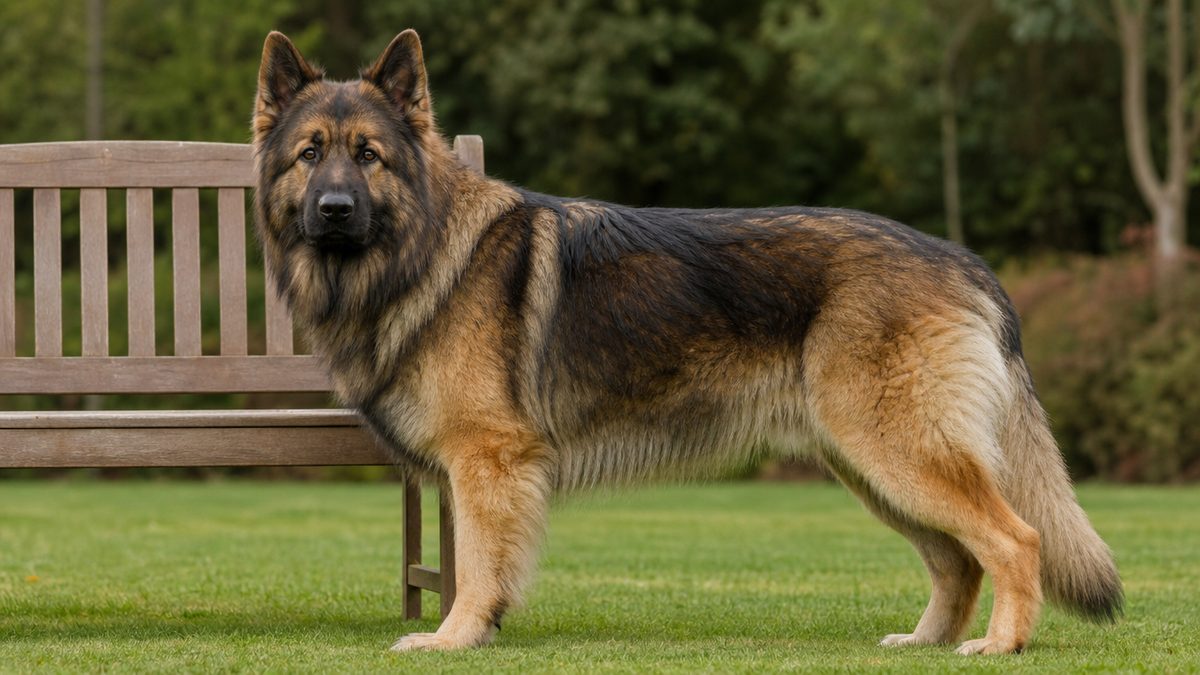
A very large American shepherd breed begun in the 1970s, holding two separately published standards, a mandated health-testing regime stricter than most kennel clubs impose, and recognition from no national kennel club anywhere.
Quick answer
The shiloh shepherd is a very large American shepherd breed begun in the 1970s by Tina M. Barber, standing at least 28 inches in males under one of its two published standards. Two private registries hold studbooks and publish standards that disagree, no national kennel club recognises it, and no verifiable Indian price exists.
This page reports published veterinary research, breed registry documents and club statements for general information. It is not veterinary advice and cannot diagnose any individual animal. Two points on this page are worth taking to a professional rather than acting on alone: an inherited ventricular arrhythmia that ordinary examination cannot detect, and a spinal condition documented in five related dogs. If a young dog of this type collapses, tires abnormally, or develops a weak or uncoordinated hind end, consult your nearby veterinarian promptly.
Shiloh Shepherd at a glance, rated for India
What a Shiloh Shepherd is, and which breed standard you are reading
A Shiloh Shepherd is a very large American shepherd breed begun in the 1970s by Tina M. Barber, and the first thing to establish about any Shiloh is which of two published breed standards the dog was bred to.
Two organisations publish standards for this breed. The International Shiloh Shepherd Alliance issues ISSA Breed Standard v4.0, document number ISSA-BW-0001, dated April 2025, running to five pages with a revision table and a formal amendment procedure. The International Shiloh Shepherd Dog Club publishes its own standard at shilohs.org, structured differently and giving different numbers. Both are real documents. Neither is a national kennel club's.
Size and weight, where the two documents part company
The ISSA sets a floor and no ceiling: males at least 28 inches (71 cm) at the withers with over 30 inches (76 cm) preferred, and females at least 26 inches (66 cm) with over 28 preferred. The ISSDC gives a band instead: dogs 28 to 32 inches and bitches 26 to 30, assessed at maturity at 36 months, with failure to reach the minimum by then a disqualification. Neither specifies a weight; the ISSDC says only that weight is what represents optimal condition for the individual dog.
For scale, the AKC's German Shepherd standard and the FCI's put males at 24 to 26 inches and 60 to 65 cm respectively Federation Cynologique Internationale. The Shiloh's floor begins where the German Shepherd's ceiling ends. The ISSA puts it plainly on its own site: the standard calls for two inches more in height than the German Shepherd standard. It is also a more large-boned dog than a German Shepherd, because the standard asks for medium to heavy oval bone while warning against a dog so large-boned as to appear lumbering and cumbersome. The general breed directories describe the same animal loosely as about 30 percent larger and heavier than a German Shepherd.
| Point | ISSA Breed Standard v4.0, April 2025 | ISSDC Breed Standard |
|---|---|---|
| Height, males | At least 28 inches, over 30 preferred, no ceiling | 28 to 32 inches, assessed at 36 months |
| Height, females | At least 26 inches, over 28 preferred | 26 to 30 inches |
| Failing the minimum height | Not addressed as a disqualification | Disqualifying if not met by 36 months |
| Body proportion | 9 to 10, height to length | 8.5 to 10, height at withers to length of body |
| Croup angle | Ideally around 25 degrees off the back line | Ideal 30 to 35 degrees |
| Plush coat maximum | Four inches on the body, five on the neck ruff and tail | Three inches on the torso, six on the legs |
| Ears not standing in an adult | A fault at 18 months | Disqualifying if hanging after 15 months |
| Weight | Not specified | Not specified, only optimal condition |
| Head description | 'Wolfish' removed from the standard in November 2022 | Wedge shaped, large, moderately broad between the ears |
Coat and colour
Both standards recognise two coat varieties, smooth and plush, both double. The ISSDC describes the smooth coat's undercoat as one to two inches deep. On colour the ISSA is the more detailed: sable, dual and bi-coloured or solid, with sables ranging from grey through golden to brown, saddle-marked duals from silver or cream through golden to reddish-tan, bi-colours mostly black with colour on the legs, and solid colours permitted including white and black. That white permission matters, because the Canadian White Shepherd is one of the founding breeds the club names.
The ranking set gives the breed as 26 to 30 inches and 80 to 110 pounds. The bottom of that height range, 26 inches, is two inches below the ISSA's floor for a male and is the ISSDC's floor for a bitch. A buyer using the directory range to judge a male puppy is using a number that neither breed standard supports.
Is the Shiloh Shepherd a breed? The two-condition test, applied strictly
The Shiloh Shepherd passes Bonbeno's two-condition test: two written standards exist and two private registries maintain studbooks with breeding-approval rules, so a puppy can be measured against a document.
The rule this site works to is short. A breed has a written standard and a studbook behind it. A national kennel club is a common way of supplying both, and it is not the only way. Applied here the test comes out yes, and the interesting part is how comfortably.
Condition one: is there a written breed standard?
Yes, and there are two of them, one of which is unusually well-governed for a private document. ISSA Breed Standard v4.0 carries a document number, a date, a page count and a four-row revision table: initial release October 2016, a tightening of wording in May 2017, a substantial revision in November 2022 and a further revision in April 2025, each approved by three named breed wardens. It also publishes its own amendment procedure: a proposed change must be emailed to the Breed Wardens with the new wording, a rationale and the signatures of at least ten ISSA breeders in good standing, and no amendment takes effect until approved by a two-thirds majority of the Breed Wardens under Article VIII Section 3 of the bylaws.
That is more procedural transparency than several kennel clubs publish. It is also, read carefully, a record of the breed changing under its own feet: the November 2022 revision removed the word 'wolfish' from the head description, changed non-standing ears from a disqualification to a fault, and added a temperament sentence about being observant and vigilant with strangers but not apprehensive. The club's own comparison page still describes the head as 'more wolfy in appearance';, which is the website disagreeing with the standard it publishes.
Condition two: is there a studbook?
Yes, and it has teeth. ISSA registration is conditional on health testing: for every breeding-quality pup born from March 2016 onward, a defined battery of tests is mandated, not optional, and pups who do not complete it will not qualify for their Breeding Certificate and may not be bred. That is a registry withholding breeding rights on evidence, which is the practical definition of a working studbook.
| Condition | Shiloh Shepherd | King Shepherd | White Swiss Shepherd Dog |
|---|---|---|---|
| A written standard | Yes, two, one versioned and document-numbered | Yes, two | Yes, FCI 347 and a Royal Kennel Club standard |
| A studbook | Yes, two, with mandated health testing gating breeding rights | Yes, a founding-club register | Yes, national and FCI |
| National kennel club recognition | No, on the club's own statement | No | Yes, in Switzerland, Britain and through the FCI |
| Verdict on Bonbeno's rule | A breed | A breed | A breed |
What the club itself says, which is the honest part
The ISSA does not overclaim, and that is worth quoting in full: 'Shiloh Shepherds are not currently recognized by the AKC, UKC, or FCI. Because they are still under development, stewardship of the breed falls to Shiloh Shepherd registries and clubs such as us here at the ISSA. The background and qualities of Shiloh puppies may vary between organizations and breeders depending on their differing goals';. A club telling prospective buyers that its own breed varies between organisations is being more useful than most breed marketing manages.
A breed, held privately. Two standards and two studbooks satisfy both conditions, and the health-testing mandate is stricter than what several kennel-club breeds face. What a buyer loses without a national register is not legitimacy, it is a single authority to appeal to when two documents disagree, and on this breed they do disagree, on height, proportion, croup angle, coat length and the age at which a soft ear stops being forgivable.
Which bodies hold this breed, checked one by one with controls
No national kennel club anywhere recognises the Shiloh Shepherd, and the organisations that do are a rare-breed association and the breed's own registries United Kennel Club, Breed Standards index.
The American Kennel Club, and the 40-year rule
The breed appears nowhere on the AKC's Foundation Stock Service and Miscellaneous list, whose seven group blocks were read in full: 17 sporting, 20 hound, 20 working, 4 terrier, 2 toy, 8 non-sporting and 18 herding. In-document controls on the same page: the Saarloos Wolfhond, the Dutch Shepherd and the Bohemian Shepherd are all present in the herding block.
The AKC also publishes why a breed like this waits. Its Foundation Stock Service guidelines, amended on 11 July 2022, require that a breed have been recognised by an acceptable foreign or domestic registry for 40 years with three-generation dogs, or, if developed within the United States, a documented history of a minimum of 40 years of a registry with three-generation dogs. A Shiloh registry dating from around 1990 crosses that line around 2030, not before.
The United Kennel Club and the FCI
The UKC's Herding Dog Group holds 43 breeds and the Shiloh is not among them, while the German Shepherd Dog, the White Shepherd, the Czechoslovakian Vlcak and the Saarloosewolfdog all are, which is the in-document control that the index rendered. The FCI holds nothing for the breed either, and the practical Indian consequence follows directly: the Kennel Club of India issues pedigrees against FCI nomenclature, so no KCI registration for a Shiloh Shepherd is possible.
What does hold it
- The American Rare Breed Association, whose Group 5 gallery carries the breed and states that it was recognised 'in the early 1990's', with a typo in the original, while describing the pictured dog as being in ARBA Group One on a page headed Group 5.
- The ISSA, which registers dogs, publishes the current standard and gates breeding certificates on completed health testing.
- The ISSDC, which publishes a separate standard for the same breed.
- FIC, named by the ISSDC as having recognised the breed in 1990, a year before ARBA.
And one body that declines to call it a breed at all
English Wikipedia has no Shiloh Shepherd article. Checked through the MediaWiki API with redirects resolved explicitly, both 'Shiloh Shepherd' and 'Shiloh Shepherd dog' redirect to the article German Shepherd. That is a position rather than a gap, and it is the mirror image of the ARBA's. This guide records both and follows the documents.
One caution about researching this breed online. The domain shilohshepherds.info returns HTTP 200 with a site name that still reads Shiloh Shepherds, and serves an article about outdoor clothing in Australia dated the day this page was written. A link checker passes it. A reader does not. Check the title of what comes back, not the status code.
History: one breeder, four decades, and the split that made another breed
The Shiloh Shepherd was begun in the 1970s by Tina M. Barber, a German Shepherd breeder in western New York state who wanted a larger, calmer shepherd with better hips, and the breed was recognised by the American Rare Breed Association in 1991 International Shiloh Shepherd Dog Club.
The ISSDC's account puts the visualisation in the 1980s and adds the mechanism: a specific type was bred for, a northern breed was introduced to the gene pool, and the public was educated on the benefits of x-raying hips. The ISSA dates the founder's work to the 1970s and gives over 40 years of development International Shiloh Shepherd Alliance. Those are not contradictory, but they are two different starting dates from two clubs for one breed, and this page prints both.
What went into it
The ISSA names the founding breeds directly: German shepherd, Sarplaninac, Malamute, Canadian White Shepherd, Altdeutscher Schaeferhunde, and more, and says the club continues to outcross to outside breeds and then breed the offspring back to Shilohs to regain breed type. Two of those founding breeds matter for the rest of this page. The Alaskan Malamute explains a coat heavier than a German Shepherd's, and therefore the heat rating below. The Canadian White Shepherd explains why white is a permitted solid colour in a shepherd standard, where both German Shepherd standards disqualify it: white in the German Shepherd is a recessive colour that two registries chose to exclude American Kennel Club.
| Date | What is claimed | Stated by |
|---|---|---|
| 1970s | Tina M. Barber begins working on the Shiloh | ISSA |
| 1980s | A German Shepherd breeder in western New York begins to visualise the type | ISSDC |
| 1990 | Formally recognised as a breed by FIC | ISSDC |
| 1991 | Recognised as its own rare breed by ARBA | ISSA and ISSDC |
| Early 1990s | Recognised by the American Rare Breed Association | ARBA's own gallery, undated |
| Around 1990 | A Shiloh breeder splits from the ISSR and founds the King Shepherd | ISSA |
| October 2016 | ISSA Breed Standard initial release | ISSA Breed Standard v4.0 |
| March 2016 | Full mandated health testing begins for breeding-quality pups | ISSA Health and Testing |
| April 2025 | ISSA Breed Standard v4.0 issued | ISSA Breed Standard v4.0 |
The split that produced the King Shepherd
The ISSA records it plainly: the King Shepherd's founder was a Shiloh Shepherd breeder who felt she had a different vision, split from the ISSR organisation and renamed her dogs King Shepherds, adding Great Pyrenees and a limited amount of Akita and pursuing a livestock-guardian purpose rather than a companion one. That is a breed founding a breed inside twenty years, and it is why the two are constantly confused.
One difference the ISSA highlights is worth carrying to the comparison section: Kings consider white dogs faulty and disqualify them, unlike Shilohs. Two closely related American shepherd breeds, opposite positions on the same colour.
Everything in this section comes from documents published by the breed's own organisations, which have an interest in the story. This page quotes them as statements by named bodies rather than as established fact, and where two clubs give two dates it prints both rather than choosing International Shiloh Shepherd Dog Club.
Health: a mandated Holter test, and the one study that is genuinely about this breed
The Shiloh Shepherd's health picture rests on two things a buyer can act on: a registry-mandated testing regime that gates breeding rights, and a single peer-reviewed study of five related dogs with spinal cord compression McDonnell JJ, Knowles KE, deLahunta.
What the registry mandates, and why each test is there
For every breeding-quality ISSA pup born from March 2016 onward the following is mandated rather than optional, and a pup that does not complete it will not receive a Breeding Certificate. Before 2016, the club says, the previous registry mandated only hips and Holter.
| Test | What it detects | Notes from the registry |
|---|---|---|
| Temperament test | Stable temperament | An ISSA test at 10 months or older, or a Canine Good Citizen plus a Gunsureness test, or video scored by Breed Wardens |
| Hips, OFA or PennHIP | Hip dysplasia | Inside the founder's Litter Mate X-ray programme, where the score across the whole litter is the indicator |
| Elbows | Elbow dysplasia | Added because the club decided rarity could not be assumed without testing |
| Holter monitor, 24 to 48 hours | Inherited ventricular arrhythmia | By twelve months at the latest, with five to eight months preferred. Undetectable by ordinary examination |
| Cardiac auscultation | Structural heart disease | An echocardiogram is required if any murmur or anomaly is heard |
| Degenerative myelopathy DNA | The SOD1 risk variant | Required unless clear by parentage; carriers may be bred only to tested-clear dogs |
| DNA on file with UC Davis | Genetic diversity | Part of a genetic diversity study the club runs with the university |
| CERF eye examination | Inherited eye disease | Not mandated. The club argues pannus appears at five or six years, after most breeding is done |
| TLI | Exocrine pancreatic insufficiency | Not mandated. The club argues a normal result gives a false sense of security |
The Holter mandate meets the literature
The club's reason for Holter monitoring is that the arrhythmia is impossible to detect by normal means and can be lethal in young dogs. That claim can now be read beside a peer-reviewed series. A 2024 study of 25 dogs under two years old with idiopathic juvenile ventricular arrhythmias and no structural heart disease included German Shepherds (eight), Boxers (four), Great Danes (three), two mixed breeds and one each of eight other breeds, including one Shiloh Shepherd.
Its findings soften the picture rather than confirming the worst of it. Average age at diagnosis was 7.9 months, range two to 22. Overall median survival was 10.96 years, range 1.75 to 15.66, and ventricular beats fell by an average 86.7 percent per year on Holter data. The authors conclude that in most cases the condition had a favourable long-term prognosis with reduced ectopy over time. A registry mandating detection of a condition that usually resolves is still doing the right thing, because the cases that do not resolve are the ones that kill.
The one breed study, and what it found
Five young Shiloh Shepherd Dogs, four males and one female, related by a common sire, were studied for progressive pelvic limb weakness and incoordination. All had spastic paraparesis and pelvic limb ataxia consistent with a lesion between spinal cord segments T3 and L3. Radiographs showed proliferative lesions of one or more articular processes from the eleventh thoracic to the second lumbar vertebra, with dorsal compression of the spinal cord on imaging. Postmortem examination of two dogs found abnormal synovial joints, bony proliferation indenting the dorsal surface of the spinal cord, and degenerative joint disease on histology.
The authors' conclusion is careful and worth repeating exactly: these dogs had a compressive myelopathy as a consequence of vertebral process degenerative joint disease that likely has a genetic component, and the joint disease could have been caused by a primary vertebral malformation or by an injury to the processes at a young age causing malarticulation. Five related dogs is a family, not a breed prevalence, and no follow-up study was found.
Both documented problems present in a young dog and both are easy to mistake for clumsiness or laziness. A Shiloh that tires abnormally fast, collapses, or develops a weak, wobbly or uncoordinated hind end is not being slow to mature. Take it to your nearby veterinarian and say the words Holter monitor and thoracolumbar, because those are the two things the published record on this breed points at McDonnell JJ, Knowles KE, deLahunta.
What is not known about this breed's health, stated rather than filled in
Three things a buyer would want are simply not published for the Shiloh Shepherd: a lifespan study, a breed-level hip dysplasia rate, and any independent screening statistics.
The literature audit is short enough to state in full. Searching PubMed on 9 September 2026 with the query translation line read each time, '"Shiloh Shepherd"[tiab]' returns exactly three records, all genuinely about Shiloh Shepherd dogs. The in-session control returned 126. Three records is a literature you can read in an afternoon.
- A breed study: five related dogs with thoracolumbar spinal cord compression, 2003.
- A case series entry: one Shiloh among 25 dogs with idiopathic juvenile ventricular arrhythmias, 2024.
- A single case report: an eleven-year-old intact male with an intranasal ganglioneuroma treated with intensity-modulated radiation therapy, in which clinical signs improved but the tumour progressed at 49 days, three months and six months.
The orthopaedic figures this page cannot give you
This site normally quotes published orthopaedic screening tables, and for this breed it cannot. The relevant statistics service was unreachable from this session: its statistics page serves only a JavaScript shell whose visible text reads 'Searching Database, Please wait.', and its two data hosts refused or timed out every connection attempted. Rather than quote a figure from a secondary source, this page states the limit. What the breed's own registry publishes instead is the requirement: hips and elbows radiographed on every breeding dog, with the founder's Litter Mate X-ray programme scoring whole litters rather than only breeding animals.
Two conditions the club names that have no published breed data
The ISSA states that exocrine pancreatic insufficiency is present in the Shiloh breed, and that pannus is the only eye disorder currently seen with any frequency, usually appearing at five or six years of age, after most breeding dogs have already had several litters. Both are statements by the registry rather than findings in the literature, and no prevalence figure exists for either. The club's reasoning for not mandating the corresponding tests is published and is worth reading: a normal TLI result can precede the disease and can occur in a carrier, and a clear eye examination at three years says nothing about a disease that appears at six.
The club reports that the number of degenerative myelopathy carriers in the ISSA gene pool is presently fewer than half a dozen, and that if the DNA test is accurate for Shilohs the breed is close to eliminating it. That is a striking claim and it is a club's own count rather than an audited figure, so this page reports it as one. The caveat the club itself attaches is the important part: the test is proven reliable in only a scattering of breeds and its accuracy in Shilohs is not established.
Shiloh Shepherd price in India, and why the search returns a Civil War battle
No verifiable shiloh shepherd price in india exists, and the word 'Shiloh' occurs zero times on India's fullest published dog price list.
That list covers India's top 40 breeds with city-wise costs, and its in-document controls pass: 'German Shepherd' appears 15 times and 'Labrador' 30 times on the same page. So an Indian retailer assembling the widest breed list it can has nothing to say about this dog.
The search failure, documented
Two Bing India queries returned one byte-identical set of ten results under an identical printed count of 'About 37,200 results': the Wikipedia articles 'Shiloh (biblical city)' and 'Battle of Shiloh', two Bible reference sites, a YouTube channel, a bar in the Veera Desai area of Mumbai listed on Zomato, and an Instagram account. The queries were 'shiloh shepherd price in india' and 'shiloh shepherd dog', which are not the same question.
The Labrador control passed in the same session at About 16,200 results with ten genuine Indian Labrador pages, so the engine was healthy. Two diagnoses apply at once here and both are worth naming. Identical output across genuinely different queries is query insensitivity, meaning the engine did not read either query. And the set itself is homonym capture: Shiloh is a biblical place, a Civil War battle, a personal name and a Mumbai bar before it is a dog. Neither of those is evidence about the Indian market, and this page claims none.
| Query | Printed count | What came back |
|---|---|---|
| shiloh shepherd price in india | About 37,200 | Biblical city, Civil War battle, Bible sites, a Mumbai bar, an Instagram account |
| shiloh shepherd dog | About 37,200 | The same ten results, byte for byte |
| labrador retriever price in india | About 16,200 | Ten genuine Indian Labrador pages. Control passed |
What an Indian buyer would actually be offered
Almost certainly an oversized German Shepherd. The Shiloh's own standard sits two inches above the German Shepherd's ceiling, and 'oversized German Shepherd' is a description Indian sellers use freely American Kennel Club. India's own market prices the German Shepherd at Rs 20,000 to Rs 75,000, with a note beneath the table saying a standard puppy starts at Rs 20,000 while show-quality dogs reach Rs 50,000, which is a disagreement inside one page. A large shepherd-type puppy at that puppy price is a German Shepherd. One at a large premium is being sold on a name that no Indian registry can put on paper.
A genuine Shiloh carries a registration from the ISSA or the ISSDC, and an ISSA breeding dog carries a Breeding Certificate that is conditional on completed health testing. Neither can be converted into a Kennel Club of India pedigree, because the KCI issues against FCI nomenclature and the FCI does not hold this breed. Whatever paperwork you are shown in India, it will not be an Indian registration for a Shiloh Shepherd.
Cost of ownership in India for a dog over 28 inches at the shoulder
The recurring cost of ownership for a dog this size in India is knowable from published rate cards even though its purchase price is not, because vaccination, parasite control, registration and boarding are priced by size rather than by breed.
Every figure below was read from the seller's own page on 9 September 2026, and each is what that seller charges rather than a market average.
| Item | Published price | Source and caveat |
|---|---|---|
| Puppy vaccination course | From Rs 6,499 | Vetic, six visits at days 30, 45, 75, 90, 105 and 120, against a struck-through Rs 8,111 |
| Annual booster | From Rs 3,199 | Vetic, against a struck-through Rs 3,806 |
| Anti-rabies, single dose | From Rs 699 | Vetic |
| Consultation | Rs 500 to 1,000 | VOSD. One data point, because a general insurer publishes the identical range |
| Tick, flea and worm cover | Rs 3,308 for three months | Supertails, NexGard Spectra 15 to 30 kg, so Rs 1,102.67 a month. This dog needs a larger pack |
| Pet dog registration, Delhi | Rs 500 new, Rs 500 renewal | MCD, valid one year, late fee Rs 100 per month |
| Boarding, Bengaluru | Rs 899 for up to 24 hours | PawSpace, with day care to ten hours at Rs 799 |
| Professional training | Rs 5,000 to 15,000 | Supertails, quoted for the German Shepherd and applicable here |
The three lines that are bigger for this breed than for a Labrador
- Cardiac screening. A Holter monitor for 24 to 48 hours is not a routine Indian service, and arranging one in a metro is the single hardest item on this list to price.
- Food and parasite cover by weight. Every dose in the table above is banded by bodyweight, and a dog over 28 inches sits in the top band of most of them.
- Boarding. A very large, unfamiliar breed is harder to place at short notice than a Labrador, and a Bengaluru home-boarding service publishes Rs 899 for a stay of up to 24 hours. Book it before you need it.
One cost is genuinely lower than the ranking pages assume. Grooming a double coat is brushing rather than clipping, and Indian salon prices of Rs 300 to 2,000 for a bath and tidy do not apply to a dog that must never be shaved. What this coat costs is time and a good undercoat rake.
Greater Chennai Corporation's municipal veterinary clinics provide treatment and anti-rabies vaccination free of cost, against Delhi's Rs 500 registration fee and a private chain's Rs 699 rabies floor Vetic, 'Dog Vaccination Near Me'. Where you live changes this budget more than which breed you own.
Heat tolerance: the size is the problem before the coat is
The Shiloh Shepherd rates 1 of 5 for heat tolerance in Indian conditions, and the reason is mass rather than coat alone: its own standard prefers males over 30 inches at the withers Hall EJ, Carter AJ.
The founding climate is North American and temperate. New York, queried by explicit latitude and longitude, returns a cell elevation of 10.17 m against a real 10 m, an annual mean of 12.26 C and a July mean of 23.71 C; Toronto returns 98.64 m against a real 76 m and a July mean of 21.66 C. The Alaskan Malamute in the founding cross pulls the coat colder still.
| Place | Cell elevation | Hottest month | Coolest month |
|---|---|---|---|
| New York, United States | 10.17 m | July, 23.71 C | January, 1.06 C |
| Toronto, Canada | 98.64 m | July, 21.66 C | February, minus 2.76 C |
| Delhi | 206.37 m | June, 35.88 C | January, 13.61 C |
| Chennai | 48.95 m | May, 31.51 C | January, 24.09 C |
| Mumbai | 97.15 m | May, 31.19 C | January, 23.19 C |
| Bengaluru | 841.72 m | April, 28.37 C | December, 20.22 C |
| Pune | 635.99 m | April, 28.93 C | December, 19.62 C |
Delhi's June mean is 12.17 degrees above the founding summer and Chennai's May mean 7.8 above it. Bengaluru and Pune, peaking in April rather than May at 28.37 and 28.93 C, are the only Indian cities in the table within five degrees of it, and both bottom out in December rather than January. If this breed is kept anywhere in India, those two cities are the argument.
Why the rating is 1 rather than 2
The heat-illness literature is the reason. The largest study of the condition, on 905,543 UK dogs, recorded 395 confirmed events with an incidence of 0.04 percent and an event fatality rate of 14.18 percent, and identified a higher bodyweight relative to the breed and sex mean, an age over two years, brachycephaly and a bodyweight over 50 kg as risk factors. Neither 'Shiloh' nor this breed is named anywhere in that paper's full text, while the in-document control 'German Shepherd' appears once, so no breed-level odds ratio exists here and none is invented. What transfers is the bodyweight finding, and a dog whose popular weight range runs to 110 pounds is close to that threshold before anyone overfeeds it.
Move the walk rather than shortening it, and treat the middle of the day as unusable from March to October in any plains city. A heat-sensitive double-coated dog of this size has one cooling system, and it is panting. Add a raised mesh cot bed and airflow rather than a haircut.
Temperament, in the current standard's own words
The ISSA standard asks for a Shiloh that is confident, with an attentive intelligent air and a majestic bearing, friendly and outgoing or aloof and self-possessed, but never shy, reactive, or fearful.
It adds that the Shiloh is observant and vigilant with strangers but not apprehensive, must be approachable, standing its ground and showing confidence to meet overtures without itself making them, and that the ideal dog is human-focused, eager to please and happy to be with its people. That middle clause is worth noticing, because the revision table records it being added in November 2022, which means it is a recent sharpening rather than a founding principle.
The ISSDC standard describes the same animal differently: of flock guardian descent, bred to be the ultimate companion dog, courageous and self-confident with an almost supernatural intelligence, calm, sweet and loving with children, elderly people and small animals, yet bold enough to protect them, with spooking at strange sights or sounds along with tucking of the tail treated as a very serious fault. Two clubs, one temperament target, and a shared insistence that a nervous dog is a faulty dog.
| Household | Verdict | Why |
|---|---|---|
| Small Indian apartment | No | A dog whose standard prefers males over 30 inches does not belong in a lift lobby |
| Large flat with an experienced owner | Marginal | Size and heat, not temperament, are the constraints |
| House with a garden, in Bengaluru or Pune | The best available case | The only Indian cities within five degrees of the founding summer |
| Home with children | Good | Both standards ask for a calm, family-friendly, non-reactive dog |
| First-time owner | Possible in principle | The club describes the breed as softer and less of a training challenge than a German Shepherd, but the size is unforgiving of handling errors |
| Guarding or working role | Poor fit | The club says overall the Shiloh is not a working breed |
The claim to treat carefully
The ISSA states that the breed was selected for a softer, calmer, more family-friendly temperament rather than a working one, that Shilohs are noticeably calmer and easier to handle than most working shepherd breeds, that they are more trainable and less of a training challenge than a German Shepherd, and that they are more amenable to going with the flow. No independent behavioural study of this breed was found, so that is a breeder organisation describing its own selection goals. A trainable dog described as trainable by the people who selected it is a plausible claim about a deliberate programme, and it is not a measurement.
A young Shiloh that becomes wobbly or weak behind is not being lazy. Five related dogs in the only breed study presented with progressive pelvic limb weakness and incoordination before anyone thought of the spine. Consult your nearby veterinarian first and the trainer second.
Training a very large dog through an Indian socialisation window
To train a Shiloh Shepherd, use the socialisation window on Indian city life and the first eighteen months on handling, because a dog that will finish above 28 inches must be manageable by hand long before it is fully grown.
The standard already promises a human-focused, eager-to-please dog, so the owner's job is exposure and physical management rather than motivation. In India the socialisation window collides with the vaccination course: a published Indian puppy course runs six visits from day 30 to day 120, finishing at about seventeen weeks. Do not choose between them. Carry the puppy while you still can, which with this breed is a genuinely short period.
- Weeks 8 to 12: register the household, one regular visitor at a time, at a distance the puppy chooses.
- Weeks 8 to 12: register the city, from a balcony or a car if the ground is not safe yet: horns, bells, lifts, marble floors, metal stairs, monsoon rain on tin.
- Weeks 12 to 20: teach loose-lead walking before the dog outweighs the handler. On this breed that deadline is real.
- Months 4 to 12: teach veterinary handling, ears, feet, mouth and belly, plus standing still in a harness, because a Holter monitor has to be worn for 24 to 48 hours.
- Months 6 to 18: proof a settle in public, because a 30-inch dog attracts hands in an Indian street whether you want it to or not.
What Indian law says about the equipment you may be offered
Second Schedule Part II paragraph 6(8) of the Prevention of Cruelty to Animals (Dog Breeding and Marketing) Rules, 2017 forbids tail docking, ear cropping, de-barking, de-clawing, branding, dyeing, injecting substances to enhance visual appeal and any other mutilation, and states that any change of appearance by artificial means is strictly forbidden. The ISSA standard agrees from the other direction: a dog changed in appearance by artificial means may not compete and is disqualified.
A dog that will not tolerate a harness of electrodes for two days cannot complete the test its own registry mandates. Teach the wearing of things early, in short sessions, with food. It is the cheapest health intervention on this page and almost nobody plans for it.
Daily exercise, and the growth window that limits it
A Shiloh Shepherd needs moderate daily exercise rather than a working dog's workload, because its own club says the breed is not a working breed and was selected for calmness.
That makes this one of the few large shepherd derivatives where the exercise requirement is not the binding constraint. The binding constraint is growth. A dog finishing above 28 inches is closing growth plates well past its first birthday, and the breed already carries two documented joint and spine concerns: hip and elbow radiographs mandated by its own registry, and a family study of vertebral process degenerative joint disease McDonnell JJ, Knowles KE, deLahunta.
- Dawn, 40 to 60 minutes of steady walking, which in an Indian plains city is the only reliably usable window from March to October.
- Evening, 30 minutes, later than feels necessary, because tarmac holds heat after the air cools.
- No forced running, no stairs as exercise and no jumping before 14 to 18 months, on a breed with this much frame to build.
- Free play on grass over structured roadwork for the whole first year.
- Mental work through the middle of the day, scent games and food puzzles, substituting for movement rather than adding to it.
The ISSDC standard is explicit that the dog should be assessed at maturity at 36 months, which is a useful signal about how slowly this breed finishes. Treat the second and third years as build years rather than as adulthood.
Of 395 confirmed heat-related illness events in the largest study of the condition, 14.18 percent were fatal. Exertion in warm conditions is the commonest recorded trigger in that literature and it is the one an owner fully controls. Move the walk.
Grooming a smooth or plush double coat in Indian humidity
To groom a Shiloh Shepherd in India, rake the undercoat out twice weekly all year and never clip the dog, because both standards specify a double coat and the two varieties differ only in length International Shiloh Shepherd Alliance.
The ISSDC describes the smooth coat as a thick, coarse, harsh double coat with a straight dense outer coat lying reasonably close to the body over an undercoat one to two inches deep, and the plush coat as less coarse with a softer undercoat, longer mane and chest hairs and pronounced feathering. The ISSA caps the plush coat at four inches on the body and five on the neck ruff and tail; the ISSDC caps it at three inches on the torso and six on the legs International Shiloh Shepherd Dog Club. Two standards, two different maxima, on the same coat.
Why the Indian plains break the shedding cycle
A double coat sheds on a temperature and daylight cue. Chennai runs from 24.09 C in January to 31.51 C in May, a swing of 7.4 degrees, against a New York swing of 22.65 degrees between January and July NASA POWER, climatology point API. In practice the dog sheds untidily all year here and holds dead undercoat against the skin, and that trapped layer is where humid-climate skin problems begin.
- Twice weekly, all year, with an undercoat rake rather than a slicker, down to the skin on the ruff, breeches and behind the ears.
- Daily for three weeks, twice a year, on dates you choose, because the dog will not choose them in an Indian climate.
- Dry the dog actively after every bath, ears included, rather than letting it air dry.
- Bath rarely, because stripping the coat's oils in humid weather makes skin problems worse. The coat is hardy against cold and rain and is not hardy against trapped damp.
- Check the belly, groin and armpits weekly, where hot spots start under a coat this dense.
Never clip a double coat
The outer coat is the sun barrier and the undercoat is the insulation, and a clipped double coat regrows unevenly with the undercoat first, leaving the dog hotter rather than cooler and sometimes permanently so. On this breed there is an extra reason: the ISSA standard disqualifies a dog changed in appearance by artificial means except as specified in the standard, and Indian law forbids any change of appearance by artificial means outright.
A raised mesh cot bed under a fan moves air under the dog and does more for a double-coated animal in an Indian summer than any grooming decision. It costs less than one salon visit at the Rs 300 to 2,000 range Indian sources quote, and it does not have to be repeated.
Feeding: growing a very large dog slowly
Feed a Shiloh Shepherd on a large-breed growth diet to body condition rather than to a chart, because neither published standard gives a weight and the ISSDC says explicitly that correct weight is whatever represents optimal condition for the individual dog.
That absence is the practical starting point. A dog whose height range spans 28 to 32 inches has an adult weight range wide enough that a portion calculated from the wrong end of it is badly out. The workable substitute is the standard large-breed practice: ribs easily felt under a thin layer of fat, a visible waist from above, a tucked abdomen from the side, checked weekly by hand.
- Weeks 8 to 16: four meals a day on a large-breed puppy formulation.
- Months 4 to 8: three meals a day, and the point at which most owners overfeed a visibly growing dog.
- Months 8 to 18: two meals a day, still on a growth diet, still visibly lean.
- Adult: two meals a day rather than one, because a deep-chested dog of this size sits in the body shape most associated with gastric dilatation and volvulus.
- Never free-feed, because a dog you cannot easily weigh needs an owner who can see what it ate.
Why lean matters more here than on most pages
Three separate reasons converge. The registry mandates hip and elbow radiographs because joint disease is the founding concern of the breed. The only breed study describes degenerative joint disease of the vertebral processes in five related young dogs. And the heat-illness literature names a bodyweight above the breed and sex mean as a risk factor in its own right. Every one of those gets worse in a heavy dog.
NexGard Spectra for a 15 to 30 kg dog costs Rs 3,308 for three tablets against an MRP of Rs 3,375, which is Rs 1,102.67 a month, and a Shiloh Shepherd will need the pack above that. Do not split a smaller dose to save money. Choose the product with your nearby veterinarian.
Month by month through the first year in Indian conditions
The first year of a Shiloh Shepherd in India runs on three clocks: a socialisation window closing at about twelve weeks, a vaccination course finishing at about seventeen, and a registry-mandated Holter test due by twelve months International Shiloh Shepherd Alliance.
| Age | What is happening | What it costs or constrains in India |
|---|---|---|
| Under 8 weeks | Legally unsaleable under Rule 8(1)(a) of the 2017 Rules | A seller offering a six-week puppy has answered every other question for you |
| 8 to 12 weeks | The socialisation window | Vaccination is incomplete, so socialise carried, in a car, indoors and on a balcony |
| Day 30 to 120 | The published Indian puppy course, six visits | From Rs 6,499 as a promotional floor, plus anti-rabies from Rs 699 |
| 3 to 4 months | First Indian summer for a winter-born puppy | A cot bed and a fan, or air conditioning, before May |
| 5 to 8 months | The registry's preferred Holter window for inherited ventricular arrhythmia | Arranging 24 to 48 hour Holter monitoring in an Indian metro is the hardest item to organise |
| 6 months | Rule 8(1)(b) bars sale over six months without sterilisation, unless to a licensed breeder | Relevant when rehoming rather than buying |
| By 12 months | Holter monitoring due at the latest under ISSA rules | Without it there is no Breeding Certificate |
| 9 to 18 months | Growth plates still closing on a 28-plus inch frame | No structured running, no stairs as exercise, keep the dog lean |
| 12 months | Delhi registration renewal, Rs 500, tied to the anti-rabies date | Late fee Rs 100 per month after a one-month grace period |
| 18 to 36 months | Ears must be standing, and the ISSDC assesses height at maturity at 36 months | The ISSA treats a non-standing ear at 18 months as a fault; the ISSDC disqualifies a hanging ear after 15 months |
Two of those rows are Indian law rather than preference. The 2017 Rules provide at Rule 8(1)(a) that pups less than eight weeks in age are not sold, and at Rule 8(1)(b) that dogs over six months in age are not sold without first being sterilised unless they are being sold to another licensed breeder.
A puppy whose ears are still soft at 16 months is a fault under one Shiloh standard and a disqualification under the other International Shiloh Shepherd Dog Club. If you are buying into a show programme, that difference decides which registry you should be dealing with before you choose a puppy, not after.
Head to head against the large shepherd-type dogs an Indian buyer cross-shops
Compare the Shiloh Shepherd against the King Shepherd, the German Shepherd and the White Swiss Shepherd Dog and one difference decides it in India: only one of the four can be bought and registered here.
| Breed | Registry position | Male height | Key health flag | Indian supply |
|---|---|---|---|---|
| Shiloh Shepherd | Two private registries plus ARBA; no kennel club | At least 28 inches, over 30 preferred | Mandated Holter for inherited ventricular arrhythmia | None verified |
| King Shepherd | Founding-club register plus a commercial registry | Slightly shorter on average than the Shiloh, heavier | No published breed screening statistics | None verified |
| German Shepherd Dog | FCI 166, registrable through the Kennel Club of India | 60 to 65 cm, about 24 to 26 inches | Hip and elbow dysplasia, degenerative myelopathy | Widespread, Rs 20,000 to 75,000 |
| White Swiss Shepherd Dog | FCI 347 definitive 2011; Royal Kennel Club imported register | 58 to 66 cm | MDR1 drug sensitivity at a 14 percent allele frequency | None verified |
Against the King Shepherd, which came out of it
The ISSA's own account is the clearest available: the King Shepherd's founder was a Shiloh breeder who split from the ISSR organisation and renamed her dogs, adding Great Pyrenees and a limited amount of Akita. The differences the ISSA lists are specific and checkable: Kings are generally the same size but their standard puts them slightly shorter on average and heavier; they are predominantly long-haired; their heads are specifically broad and square where the Shiloh head is narrower and smaller-eared; and Kings consider white dogs faulty and disqualify them, unlike Shilohs. Two breeds twenty years apart, opposite positions on one colour.
Against the German Shepherd, which is the parent
The honest comparison favours the German Shepherd on every practical Indian axis. It is FCI-recognised and registrable through the Kennel Club of India, available in every metro at Rs 20,000 to Rs 75,000, and served by veterinarians who have seen the breed a thousand times. What the Shiloh offers is a deliberately calmer temperament, a larger frame, and a registry that will not issue a breeding certificate without a Holter monitor, which is a real advantage that an Indian buyer cannot actually access.
If you want a very large, calm, family-oriented shepherd in India, the realistic route is a well-bred German Shepherd from a screened litter, at the top of its size range, with the money saved spent on hip and elbow radiographs. The Shiloh Shepherd is a good idea, seriously governed, in a country where you cannot buy one, register one or easily run the test its own registry considers essential.
Seven mistakes people make about this breed, and what the documents say
Most errors about the Shiloh Shepherd come from reading one page rather than two standards, and each one below is settled by opening a document International Shiloh Shepherd Dog Club.
- Calling it an oversized German Shepherd. It descends from one, but the founding cross also names the Sarplaninac, the Alaskan Malamute, the Canadian White Shepherd and the Altdeutscher Schaeferhund.
- Quoting one height range. Two standards give different ones, and one of them sets no ceiling at all.
- Using the directory figure of 26 to 30 inches. Twenty-six inches is below the ISSA's floor for a male.
- Assuming no kennel club means no standard. This breed has two written standards, one of them versioned, document-numbered and governed by a published amendment procedure.
- Skipping the Holter because the dog looks fine. The registry's whole point is that the arrhythmia cannot be detected by ordinary examination.
- Citing Wikipedia. There is no Shiloh Shepherd article; the name redirects to German Shepherd.
- Trusting a Shiloh website because it loads. One breed domain returns HTTP 200 with the site name intact and serves Australian outdoor clothing copy.
One mistake this page had to avoid itself
It would have been easy to quote orthopaedic screening percentages for this breed from a secondary source, because such figures circulate. This session could not reach the statistics service that publishes them: the page serves only a JavaScript shell reading 'Searching Database, Please wait.' and its two data hosts refused or timed out every connection. So this page publishes none, and says so, which is the honest outcome.
Second Schedule Part II paragraph 6(9) of the 2017 Rules provides that 'Breeding to create new breeds of dogs or unusual looks shall be strictly prohibited'. Owning an individual Shiloh is not what that clause reaches. Doing in India what Tina Barber did in New York, assembling a new shepherd breed from several others, is precisely what it describes.
Legal status in India: no ban, ordinary import law, and one breeding clause
No Indian law in force names the Shiloh Shepherd, and the only provisions that reach it are ordinary import law and the breeding rules that apply to every purebred dog.
This breed carries no wolf content and raises none of the wildlife-law questions that the wolfdog pages on this site have to leave unsettled. It is a shepherd derivative made from other domestic breeds.
Import law, which is where the real friction is
Two separate instruments govern a dog entering India and they are constantly conflated: the commercial route under the Directorate General of Foreign Trade's restricted-import policy for live animals, and personal pet import under the baggage rules. This session could not retrieve the current DGFT trade notice at its published address, so this page quotes no port list and no policy condition from memory. Read the live text of whichever route applies to you, and get the answer in writing. There is a second problem specific to this breed: a dog with no FCI-recognised breed name has no obvious box on a pedigree line, and an Indian registration for it does not exist.
The breeding clauses that do apply
- Rule 8(1)(a): pups less than eight weeks in age are not sold.
- Rule 8(1)(b): dogs over six months are not sold without first being sterilised, unless sold to another licensed breeder.
- Second Schedule Part II paragraph 6(3): in breeding, defined as breeding between relatives of the second to fourth grade within the first four generations, and incest breeding, are both prohibited. That matters for a breed whose only published study described five dogs related by a common sire.
- Second Schedule Part II paragraph 6(9): breeding to create new breeds of dogs or unusual looks is strictly prohibited.
- Second Schedule Part III paragraph 8(10): breeding dogs must have been tested for a list of genetic defects that opens with hip dysplasia.
Paragraph 8(10) requires testing for hip dysplasia before breeding, and the ISSA mandates hip radiographs on every breeding dog and will withhold a Breeding Certificate without them International Shiloh Shepherd Alliance. On this point the Indian gazette and a private American registry want exactly the same thing, which is not something this site gets to write often.
Adoption, responsible sourcing and the honest Indian recommendation
Adopting a Shiloh Shepherd in India is not a realistic route, because no verified Indian population exists to surrender from, and the practical alternative is a large German Shepherd from a screened litter or a shelter dog.
Every Indian metro has shelters holding large dogs that will meet an Indian summer better than this breed and need a home now. That is not a consolation line at the end of a breed page. For a breed with no Indian supply chain, no Indian registration route and a registry-mandated test that is hard to arrange here, it is the only route that stands up.
The four questions that separate a breeder from a seller
- Which registry issued the papers, the ISSA or the ISSDC? They publish different standards, and the answer tells you which document your dog was bred to.
- Do both parents hold a Breeding Certificate? Under ISSA rules that certificate is conditional on completed hip, elbow, Holter, cardiac, temperament and degenerative myelopathy testing.
- Was the Holter actually done, and at what age? The registry asks for it by twelve months at the latest and prefers five to eight.
- Is the puppy at least eight weeks old? Rule 8(1)(a) of the 2017 Rules prohibits selling younger, and a seller who breaks it has told you about everything else.
A fifth question worth asking
Ask whether the parents' DNA is lodged with the university genetic diversity study the ISSA runs. It has no legal force and it is the single best signal available that a breeder is inside the programme rather than using the name. A breeder who does not know what you are talking about is not an ISSA breeder, whatever the pedigree says.
If the size is the draw, look at the top of the German Shepherd's own range from a screened Indian litter. If the breeding programme is the draw, the ISSA's mandated-testing page and its versioned standard are free to read and are a better education than most breed books International Shiloh Shepherd Alliance. If a large calm dog is the draw, an Indian shelter has one waiting today.
Shiloh Shepherd questions Indian readers actually ask
Is Shiloh Shepherd a real breed?
On Bonbeno's two-condition test, yes. Two written standards exist, both published and one of them versioned and document-numbered, and two private registries maintain studbooks with breeding approval rules. What it does not have is recognition from any national kennel club, which its own club states plainly.
How big is a Shiloh Shepherd?
Very large, and the two standards differ. The ISSA standard sets a floor of 28 inches for males and prefers over 30, with no ceiling. The ISSDC standard gives 28 to 32 inches for dogs and 26 to 30 for bitches, assessed at 36 months, and disqualifies a dog that has not reached the minimum by then.
How much does a Shiloh Shepherd cost?
No verifiable Indian price exists. The word 'Shiloh' occurs zero times on India's fullest published dog price list, which covers 40 breeds and names the German Shepherd 15 times at Rs 20,000 to Rs 75,000. Any rupee figure you are shown for this breed is not coming from an Indian market observation.
Is the Shiloh Shepherd recognised by the AKC?
No, and its own club says so. The breed appears nowhere on the AKC's Foundation Stock Service and Miscellaneous list, and the AKC's admission guidelines require 40 years of registry recognition with three-generation dogs, which is a bar a registry founded around 1990 only recently reaches.
What is the difference between a Shiloh Shepherd and a King Shepherd?
The Shiloh came first and the King descends from it. The ISSA states that the King Shepherd's founder was a Shiloh Shepherd breeder who split from the ISSR organisation and renamed her dogs, adding Great Pyrenees and a limited amount of Akita, with a livestock-guardian purpose rather than a companion one.
What health tests do Shiloh Shepherds need?
More than most kennel-club breeds require. For every ISSA breeding dog born from March 2016: a temperament test, hip radiographs, elbow radiographs, a 24 to 48 hour Holter monitor for inherited ventricular arrhythmia, cardiac auscultation, a degenerative myelopathy DNA test where not clear by parentage, and DNA lodged with UC Davis.
Do Shiloh Shepherds have heart problems?
The registry treats it as the priority. Every breeding dog must wear a Holter monitor for 24 to 48 hours by twelve months at the latest, because inherited ventricular arrhythmia cannot be detected by ordinary examination. A 2024 case series of 25 dogs with idiopathic juvenile ventricular arrhythmias included one Shiloh Shepherd.
Can a Shiloh Shepherd live in India?
Poorly, and size rather than coat is the main reason. A dog whose own standard prefers males over 30 inches carries a mass that the largest heat-illness study associates with higher risk, and Delhi's June mean is 35.88 degrees Celsius against a founding climate whose hottest month averages 23.71.
Why does searching for this breed return the Battle of Shiloh?
Because the engine is reading a place name rather than a breed. Two different Bing India queries returned one byte-identical set of ten results under one identical count of about 37,200, covering the biblical city, the American Civil War battle, a Mumbai bar and an Instagram account, while a Labrador control passed in the same session.
What is the Shiloh Shepherd's life expectancy?
No breed-specific life expectancy figure could be sourced. Three peer-reviewed records name the breed and none of them is a longevity study, and neither published standard gives a lifespan. A directory page quoting a number for this breed is not citing research.
Do Shiloh Shepherds get hip dysplasia?
The breed was founded partly to reduce it, and the founder built a Litter Mate X-ray programme in which the whole litter is scored rather than only the breeding dogs. Hip radiographs by OFA or PennHIP are mandated for every ISSA breeding animal, and elbow radiographs were added after the club decided rarity could not be assumed.
Does Wikipedia have a Shiloh Shepherd article?
No. Checked through the MediaWiki API with redirects resolved, both 'Shiloh Shepherd' and 'Shiloh Shepherd dog' redirect to the article 'German Shepherd'. English Wikipedia does not treat the name as a breed, which is a real position rather than an oversight and worth knowing before you cite it.
What is the difference between a German Shepherd and a Shiloh Shepherd?
Size, bone, ancestry and paperwork. The Shiloh's floor begins where the German Shepherd's ceiling ends: the ISSA standard asks for males of at least 28 inches with over 30 preferred, against 24 to 26 inches in the AKC German Shepherd standard, and the ISSA says plainly that its standard calls for two inches more in height. It asks for medium to heavy oval bone, permits solid white where both German Shepherd standards disqualify it, and names German Shepherd, Sarplaninac, Malamute, Canadian White Shepherd and Altdeutscher Schaeferhunde among its founding breeds, which is why the coat is heavier. The German Shepherd is recognised by every kennel club and priced in India at Rs 20,000 to Rs 75,000; the Shiloh is recognised by none, so no KCI registration is possible.
Compare with similar breeds
Shiloh Shepherd sits in 1 Bonbeno group. Each one compares it directly against the breeds it is genuinely an alternative to, on the same figures.