
Breed profile
Lucas Terrier: breed status, registers and India
A small British working terrier with a written standard, a club register of over 700 dogs, a deliberately open studbook, a breakaway variant that got international recognition first, and an American registry entry dated 11 May 2026.
Quick answer
The Lucas Terrier is a breed on Bonbeno's two-condition test. Its club publishes a written standard and holds a breed register, and the American Kennel Club added it to Foundation Stock Service on 11 May 2026. A second dog shares the name: the Sporting Lucas Terrier, a separate 1990s breed the United Kennel Club recognised in March 2002. No lucas terrier price in india exists, and India's fullest 40-breed price list carries neither this breed nor either parent. Heat tolerance 2 of 5.
This page reports published veterinary research, registry documents and breed-club health policy for general information. It is not a diagnosis and it is not a treatment plan. Primary lens luxation is painful and can blind a dog quickly, intervertebral disc disease can paralyse one, and heat-related illness can kill one in an Indian afternoon. A sudden change in a dog's eye, a reluctance to jump or a wobbling back end all need an in-person examination by a registered veterinarian the same day, not a search engine.
Lucas Terrier at a glance
What a Lucas Terrier is, and which one you are looking at
The Lucas Terrier is a small British working terrier created in the late 1940s by crossing Ilmer Sealyham Terrier bitches with Norfolk Terrier dogs. It has a written breed standard, a club register, and, since May 2026, an entry in the American Kennel Club's Foundation Stock Service. It also has a namesake that is a different breed entirely.
Start with the founder, because the whole breed follows from one man's complaint. Major Sir Jocelyn Lucas, KBE, MC, born 27 August 1889 and died 2 May 1980, bred small Sealyham Terriers under the Ilmer Kennels prefix and concluded that the Sealyham had grown too big to work efficiently because of exaggeration driven by the show ring. In the late 1940s he mated one of his Ilmer Sealyham bitches to a Norfolk dog. The United Kennel Club's account adds the detail that he was concerned about the increasing size of show-bred Sealyhams and that he developed the dog with his partner, the Hon. Mrs Enid Plummer, as a small workmanlike terrier designed to work in a pack and push game out of thick cover.
The dog in the standard
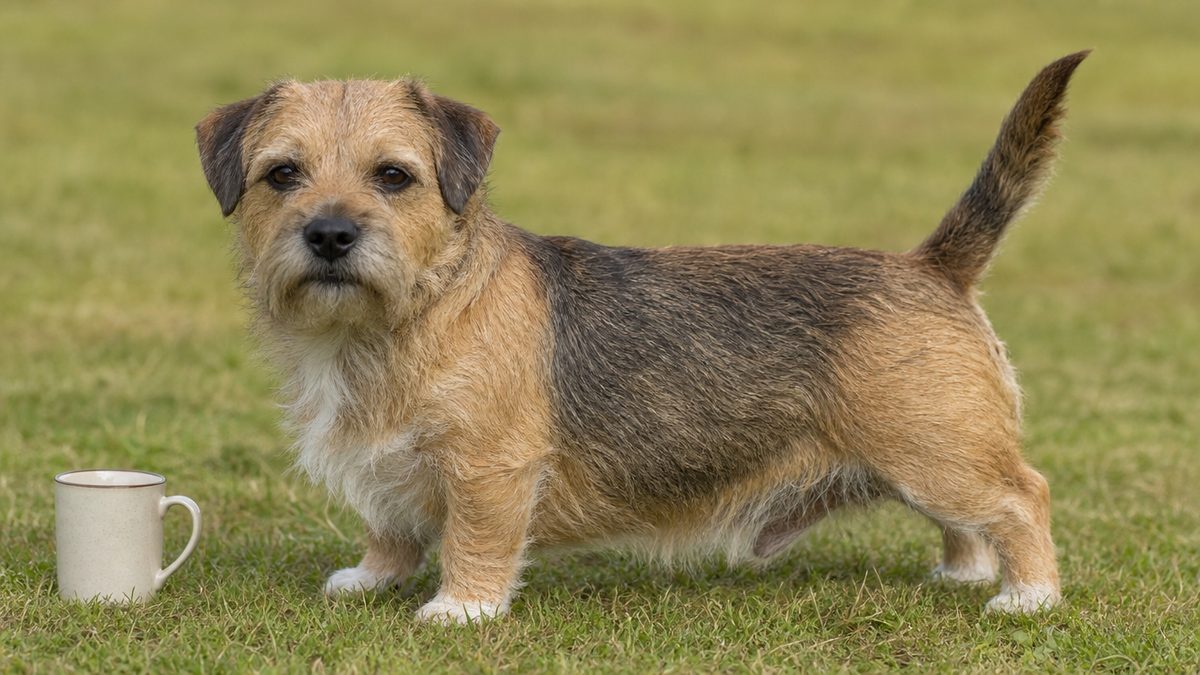
The Lucas Terrier Club's breed standard describes a sturdy, symmetrically built working terrier like an old-fashioned Sealyham type, with a broad skull curving slightly between the ears, a slight but definite stop, a medium-length deep muzzle, a black nose whatever the coat colour, dark almond eyes with pigmented rims, and medium V-shaped drop ears. The body is slightly longer than tall, the topline level, the chest deep and moderately broad. The coat is fairly harsh, weather resistant and of medium length. Colour is either predominantly tan or saddle-and-tan, or predominantly white with coloured markings.
| Measure | Dogs | Bitches |
|---|---|---|
| Height at shoulder | 10 to 12 in (25 to 30 cm) | 11 in (28 cm), a single figure |
| Weight | 14 to 20 lb (6 to 9 kg) | 11 to 17 lb (5 to 8 kg) |
That bitch height is worth pausing on, because it is not a range. The standard gives dogs a two-inch band and bitches one number. Bonbeno reports it exactly as printed rather than smoothing it, because two of the pages ranking for this breed print a bitch height of 9 to 11 inches, a figure that appears in no standard anywhere and whose lower bound comes from nothing Petlur, Lucas Terrier breed page. Retrieved….
The tail clause an Indian reader should notice
The standard permits either state. Docked means a tail of medium length with one-third off and two-thirds on, with a rounded tip, preferably carried erect. Undocked means a tail of moderate length, ideally carried erect but not excessively over the back, with no curl, kink or twist. That is a working-terrier convention written for Britain. In India, tail docked or not is not a choice, because Second Schedule Part II paragraph 6(8) of the Prevention of Cruelty to Animals (Dog Breeding and Marketing) Rules 2017 states that there shall be no tail docking, ear cropping, de-barking, de-clawing, branding, dyeing or any other kind of mutilation, and that any change of appearance by artificial means is strictly forbidden.
The traditional Lucas Terrier admits only Sealyham and Norfolk crosses tracing back to Ilmer. The Sporting Lucas Terrier, from a club that broke away in 1999, permits other breeds in matings, most commonly the Jack Russell, and is the one the United Kennel Club recognised in March 2002. The breed's American association says in writing that search engines and AI tools routinely conflate the two, especially in images, and that the two are simply different dogs. One of the ranking pages this page cites does exactly that, printing Sporting Lucas Terrier as an alternative name for the traditional breed.
For an Indian reader the practical shape of this page is short. There is no supply here, no Indian price and no Indian veterinary familiarity, so what follows is built out of documents you can open: two breed standards, a club register's rules, three registry indexes checked with controls, a government trade notice and twenty years of climate data. Where the documents disagree, this page prints the disagreement.
Is the Lucas Terrier a breed? Tested against Bonbeno's own rule
The Lucas Terrier is a breed on Bonbeno's two-condition test, and it passes on both counts with room to spare. The rule is published on Bonbeno's own page for names used like breeds that are not breeds, and it is short: a breed has a written standard and a studbook behind it, so a puppy can be measured against something.
Take the conditions one at a time, because a test only means something if it can come out either way. Bonbeno applied the same rule to the Koolie and found a breed, on an unofficial club document and three private registers. It applied the same rule to the Kuchi and found a type, because neither a standard nor a register exists anywhere on earth. It applied the same rule to the fell terrier and found a type, after checking four registers with a control in each. This dog clears the bar more easily than any of them.
Condition one: is there a written standard?
Yes, and there are two of them for the two dogs that share the name. The Lucas Terrier Club's standard runs through General Appearance, Characteristics, Head, Jaw, Neck, Forequarters, Hindquarters, Body, Tail, Coat, Colour, Height, Weight and Movement, with prescriptive language throughout: the teeth are not to be overshot, undershot or wry; black or badger should not be the predominant colour in a coloured dog; soundness is essential. That is a document a puppy can be measured against, which is the whole test.
The United Kennel Club's Sporting Lucas Terrier standard is longer and formally official, opening with the statement that its goals include furnishing guidelines for breeders, advancing the breed to a state of similarity throughout the world, and acting as a guide for judges. It carries named faults for a box Sealyham-type head, prick ears, a short neck, cloddy build, steep shoulders and barrel chest, and three disqualifications: cryptorchidism, viciousness or extreme shyness, and albinism.
Condition two: is there a studbook?
Yes, and the Lucas Terrier Club describes it precisely. The Club holds and maintains a register of Lucas Terriers from LTC registered parents or bred from acceptable stock, which it defines narrowly as Kennel Club registered Norfolk Terriers and Sealyham Terriers only. English Wikipedia records the register as holding more than 700 past and present Lucas Terriers around the world.
The breed register has real gatekeeping behind it. For a litter to be registered, one or both of the pair in every mating must be an LTC registered Lucas Terrier, which is what preserves the link back to the beginning of the breed. Puppies are not given pedigree and registration documents unless the genetic match has been approved by the Club. Membership is open only to owners of registered Lucas Terriers. A dog with no papers is not, in the Club's own terms, in the breed.
The Sporting Lucas Terrier's register is a different animal again, because it belongs to an international registry rather than a club. The United Kennel Club recognised the breed in March 2002 and lists it among the 45 breeds in its Terrier group, alongside the Sealyham Terrier, the Norfolk Terrier, the Lakeland Terrier, the Patterdale and the Jack Russell.
| Condition | Fell terrier | Kuchi | Lucas Terrier | Sporting Lucas Terrier |
|---|---|---|---|---|
| A written standard | No | No | Yes, the Lucas Terrier Club's | Yes, the UKC's |
| A studbook | No | No | Yes, 700-plus dogs | Yes, the UKC register |
| National or international recognition | No | No | AKC Foundation Stock Service only | Full UKC recognition since 2002 |
| Verdict on Bonbeno's rule | A type | A type | A breed | A breed |
The open studbook, and why it is a decision rather than a failure
The Lucas Terrier's register is deliberately open, and the Club's stated reason is the most interesting sentence anyone has written about this breed. Asked in its own FAQ why the breed is not Kennel Club registered, it answers that breeds can be registered once they have set the type, which means dogs and bitches from the parent breeds can no longer be used and the gene pool is closed to outside influence. If at that point the gene pool is too small, or contains unhealthy genes, the effects of inbreeding and disease will soon be felt and the breed risks becoming extinct. It concludes that the Lucas Terrier gene pool is currently too small to set the type, so Kennel Club membership is not even an option, and adds that even if it were larger there is a good case for keeping the type open so that fresh genes are always available.
That is a club refusing recognition on genetic grounds and saying so. Compare the Lakeland Terrier, which took the closed route, holds Royal Kennel Club recognition since 1921 and an FCI standard, and has still lost 58 percent of its UK registrations in a decade. Recognition is not a survival mechanism. An open studbook with two named parent breeds and a mandatory health screen may be a better one, and the Lucas Terrier Club is running that experiment in public.
The Lucas Terrier does not belong on Bonbeno's dog types that are not breeds page. That page's rule is that a missing standard puts a dog there, and this dog's standard is present, detailed and enforced by a register that withholds papers when a mating is not approved. Being an open studbook is not what puts a dog on that page either, any more than being a landrace is.
Four registries, checked one by one, each with a control
The Lucas Terrier appears in exactly one international registry, the American Kennel Club's Foundation Stock Service, and it arrived there on 11 May 2026. The Sporting Lucas Terrier appears in one other, the United Kennel Club, and has since March 2002. Neither is in the Royal Kennel Club or the FCI. Every check below is paired with a control that returned a result on the same document.
An absence is only evidence if the instrument was working, so each check names the register, names what was found instead, and names a breed that should be there and was. All four controls passed.
| Register | Lucas Terrier | Sporting Lucas | Control that did return a result |
|---|---|---|---|
| American Kennel Club, Foundation Stock Service | Present since 11 May 2026 | Absent | Brazilian Terrier, Jagdterrier and Japanese Terrier, the other three FSS terriers |
| United Kennel Club, more than 300 breeds | Absent | Present, Terrier Group | Sealyham, Norfolk, Lakeland, Patterdale and Jack Russell all listed |
| Royal Kennel Club, all seven groups | Absent | Absent | Sealyham Terrier and Norfolk Terrier present among 27 terriers |
| FCI, Group 3 Terriers, all four sections | Absent | Absent | Sealyham Terrier 74 and Norfolk Terrier 272 present |
The American Kennel Club, and the newest fact on this page
The AKC's own FSS News and Updates page, updated on 1 September 2026, carries a dated line: from the May board meeting, one new breed was added to the Foundation Stock Service Program, the Lucas Terrier, dated 11 May 2026. The AKC's group breakdown now lists the FSS Terrier Group as four breeds, Brazilian Terrier, Jagdterrier, Japanese Terrier and Lucas Terrier. Note the date format on that news page, because the neighbouring entry reads 7/14/2026 for a July meeting, and 14 cannot be a month, so the page proves its own month-first convention.
What Foundation Stock Service is matters more than the headline. The breed's American association describes it accurately as a record-keeping and pedigree service for rare breeds not fully recognised by the AKC, which enables participation in performance events, sometimes precedes full recognition and sometimes simply preserves a breed, and it states plainly that FSS recording of a dog does not guarantee or imply full AKC recognition. It also notes that no corresponding programme exists at the Royal Kennel Club.
Open the AKC's Lucas Terrier breed page today and it returns HTTP 200 with the breed name in its title and every vital field blank. AKC Breed Popularity has no rank, Height has no figure, Weight has no figure, Life Expectancy has no figure, and Group has no entry. That is what a four-month-old FSS listing looks like from the outside, and it is a useful reminder that a registry page existing is not the same as a registry page saying anything.
The United Kennel Club recognised the breakaway, not the original
This is the fact that reorders everything else. The UKC's complete list of the more than 300 breeds it recognises carries 45 terriers, and the Sporting Lucas Terrier is one of them while the plain Lucas Terrier is nowhere in the list, in that group or any other. The controls sit in the same table: Sealyham Terrier, Norfolk Terrier, Lakeland Terrier, Patterdale Terrier and Jack Russell Terrier are all present, which are precisely the parent breeds and the outcross.
So the dog that admits outside blood got the international standard, and the dog that guards its founding lines did not. The UKC standard is dated by its own copyright line to 2002 and records recognition in March 2002. The traditional breed waited a further twenty-four years for a lesser instrument in another country.
Britain does not recognise either one
The Royal Kennel Club publishes one index of every breed it recognises, arranged by group, and its Terrier group holds 27 entries from the Airedale to the West Highland White. Neither Lucas name appears there, nor in the Gundog, Hound, Pastoral, Utility, Toy or Working lists. The controls are on the same page: Sealyham Terrier and Norfolk Terrier, the two parent breeds, both hold standards.
The FCI is the same answer with a different consequence. Its Group 3 nomenclature covers four sections and a case-insensitive search of the returned document for the string Lucas returns zero, while Sealyham Terrier at number 74, Norfolk Terrier at 272, Lakeland Terrier at 70 and Jack Russell Terrier at 345 are all present. That answers the Indian question directly, because the Kennel Club of India issues pedigrees against FCI nomenclature. A breed absent from the FCI has no route to an Indian pedigree, so no dog can be registered here under either name.
- If someone in India offers you KCI papers for a Lucas Terrier, the papers are for a different breed or they are worthless.
- If they offer UKC papers, ask whether the dog is a Sporting Lucas Terrier, because that is the only one the UKC registers.
- If they offer AKC papers, an FSS recording is possible from May 2026 onward but confers no championship eligibility and no full recognition.
- If they offer LTC papers, only the Lucas Terrier Club issues them, only to members, and only where the Club approved the mating.
Lucas Terrier price in India, and the fivefold disagreement everywhere else
No lucas terrier price in india exists, because no Lucas Terrier is sold in India and neither of its parent breeds appears on the country's fullest published price list either. The only sourced figure anywhere is the Lucas Terrier Club's own published rate of GBP 1,000, and the two pages ranking highest for the breed name disagree with each other by a factor of five.
The Indian absence was tested rather than assumed. Supertails' 40-breed Dog Price List in India was retrieved in full and searched case-insensitively. The strings Lucas, Sealyham, Norfolk Terrier and Jack Russell all return zero occurrences. The instrument was proved on the same text: Labrador returns ten hits and Beagle thirteen, so the extraction was complete and the absence is real. The list's only two terriers are the Bull Terrier at Rs 25,000 to Rs 70,000 and the Scottish Terrier at Rs 30,000 to Rs 80,000.
What the sources that do exist actually say
| Source | Figure | What stands behind it |
|---|---|---|
| Lucas Terrier Club FAQ | GBP 1,000 | The breed's own club, stating the current rate, plus extra for microchipping, PLL testing, vaccines and vet fees |
| Petlur | USD 500 to 600 | No source given, and the page lists Sporting Lucas Terrier as another name for the same dog |
| DogBreedsList | USD 2,000 to 3,500 | No source given, on the page that ranks first for the term in an India-located search |
| India's fullest 40-breed price list | Nothing | The breed and both its parents are absent from it |
Two of those numbers are for the same animal and differ by roughly five times DogBreedsList, Lucas Terrier. Neither page says where its figure came from, neither mentions the club that actually places the puppies, and only one of them is even for the right breed. Bonbeno prints all four rows rather than averaging them, because an average of two unsourced numbers and one real one is worse than any of the three.
Why the price is nearly irrelevant anyway
The club's own account of supply is the part a buyer should read twice. There is no ready supply of Lucas Terrier puppies and there are few re-homers. There are no Lucas Terrier breeders, only dedicated committed members who have pedigree litters, perhaps regularly, perhaps only once. The club registers 10 to 15 litters a year on average, registered 29 puppies in 2019, and in years when there are exceptionally few puppies, sometimes under ten, all new puppy owners must be absolutely prepared to do their utmost to breed Lucas Terrier Club, Breeding.
About 160 people sit on the waiting list at any time, one puppy from each litter is asked to go to that list by club rule, and membership is only open to owners of a registered Lucas Terrier in the first place Lucas Terrier Club, The Club. So the transaction is not a purchase. It is joining a conservation programme in which you are expected to produce the next generation.
The India-located result set for this breed's price is instructive on its own. Alongside the two disagreeing foreign pages, it surfaces a Supertails guide to Jack Russell Terrier prices in India and a Karnataka kennel advertising Jack Russell puppies. India's search space answers a Lucas Terrier query with a different terrier, which is a fair summary of what is actually available here.
One thing this page will not do is convert any of those foreign figures into rupees. GBP 1,000 or USD 2,000 multiplied by an exchange rate is not an Indian price, it is arithmetic dressed as a market. Bonbeno has documented Indian pages doing exactly that on other breeds, and the result is a number no seller here would ever quote. The honest answer is that the breed has no Indian price, and the next section covers the figure that does matter, which is what a small terrier costs to keep in an Indian city.
Cost of ownership in India for a 6 to 9 kg hand-stripped terrier
Budget Rs 3,000 to Rs 7,000 a month for a small terrier in an Indian metro, plus Rs 5,000 to Rs 8,000 a year on preventive veterinary care. The line that runs high for this breed is not food, because the dog is small. It is coat maintenance, because a harsh coat needs stripping and almost nobody in India strips.
Bonbeno separates two things other pages merge. There is no purchase price for this breed in India and inventing one would be fabrication. But Indian cost of ownership is real, published and sourceable, and it is the number a reader actually plans around.
| Line | Published Indian figure | Where this breed sits |
|---|---|---|
| Total monthly cost of owning a dog | Rs 3,000 to Rs 10,000 and beyond | Lower half. A 6 to 9 kg dog eats a fraction of a Labrador |
| Annual spend, most owners | Rs 25,000 to Rs 80,000 or more | Lower half, except for grooming |
| Standard consultation, good clinic | Rs 500 to Rs 1,000 | Same as any dog |
| Annual vaccinations | Rs 1,500 to Rs 3,000 | Same as any dog |
| Preventive care done properly, per year | Rs 5,000 to Rs 8,000 | Same as any dog, and non-negotiable here |
| Basic grooming session | Rs 300 to Rs 2,000 | Top of the band, and the wrong service anyway |
| Starter kit, bed, bowls, collar, leash, tag | Rs 2,000 to Rs 5,000 | Bottom of the band, small sizes |
| First month, before anything unexpected | Rs 15,000 to Rs 25,000 or more | Applies in full |
The three lines that are different for this dog
- Coat. A basic grooming session at Rs 300 to Rs 2,000 buys clipping, and clipping a harsh coat permanently softens it. What this coat needs is hand stripping, which most Indian salons do not offer at any price. The realistic plan is a stripping knife, a stone and learning to do it yourself, which costs a few thousand rupees once and several hours every few months forever.
- Eyes and back. The breed's own clubs make Primary Lens Luxation and Inter-Vertebral Disc Disease screening compulsory before breeding. Even for a pet, budget for DNA testing and for a vet who will look at a back rather than prescribe a painkiller, and understand that spinal imaging in India starts in the tens of thousands of rupees.
- Cooling. A dog with a weather-resistant double coat bred for a Cornish climate needs a cool room from March to June in most of India. That is an electricity line no published dog-cost table carries.
The number over a lifetime
Take the middle of the published Indian band for a small dog and a twelve to fifteen year life, and the honest total is roughly Rs 5 lakh to Rs 9 lakh before a single emergency. The Indian source that publishes these figures is blunt that the purchase price is the smallest number in the equation, whether you buy a puppy for Rs 80,000 or adopt a dog for Rs 500, because what follows is a ten to fifteen year financial commitment.
The Jack Russell Terrier is a small British working terrier of similar size and drive, holds FCI standard 345 so a KCI pedigree is possible, has a real Indian supply chain, and carries a smooth or broken coat that no Indian salon can ruin with a clipper. Every line in the table above is the same or cheaper for it, and the grooming line is a fraction. If the attraction is the working terrier rather than the name, that is the dog.
Heat tolerance in India, measured against Hertfordshire and Cornwall
Bonbeno rates the Lucas Terrier 2 of 5 for heat tolerance in Indian conditions. The homeland grid cells give annual means of 10.32 C at Watford and 12.19 C at Camborne against 27.95 C at Chennai, and Cornwall's hottest month averages 16.81 C while Chennai's coolest averages 24.09 C.
Two British places anchor this breed. Sir Jocelyn Lucas's Ilmer kennels were in Hertfordshire, and after his death Enid Plummer moved the remaining dogs to Cornwall, where the Lucas Terrier Club's registered address still sits, at Camborne. Both are lowland, maritime and cool. Neither prepares a dog for anything an Indian summer does.
The grid-cell check, run on the homeland as well as on India
NASA POWER returns a grid cell rather than a point, so Bonbeno read back the elevation the model reports for every coordinate and compared it against a Copernicus digital elevation model at the same latitude and longitude. Both British points are close enough to use, and the Indian ones are the cities.
| Point | POWER cell | Copernicus DEM | Divergence |
|---|---|---|---|
| Watford, Hertfordshire | 87.34 m | 65 m | +22 m |
| Camborne, Cornwall | 22.54 m | 104 m | -81 m |
| Delhi | 206.37 m | 214 m | -8 m |
| Chennai | 48.95 m | 12 m | +37 m |
| Pune | 635.99 m | 561 m | +75 m |
Camborne is the only cell worth a caveat. The POWER cell sits 81 m below the town, which mixes coastal sea level into an inland Cornish upland, so the cell is very slightly warm for the place by about half a degree at a lapse rate of 6.5 C per 1,000 m. Bonbeno publishes that as an estimate and labels it one. It does not change any argument here, because the gap to India is measured in tens of degrees rather than fractions.
| Measure | Watford | Camborne | Delhi | Chennai | Pune |
|---|---|---|---|---|---|
| Annual mean temperature | 10.32 C | 12.19 C | 25.60 C | 27.95 C | 23.86 C |
| Hottest month, mean | 17.8 C (Jul) | 16.8 C (Aug) | 35.9 C (Jun) | 31.5 C (May) | 28.9 C (Apr) |
| Coolest month, mean | 4.0 C (Jan) | 8.2 C (Feb) | 13.6 C (Jan) | 24.1 C (Jan) | 19.6 C (Dec) |
| Highest recorded maximum | 34.9 C | 23.5 C | 48.8 C | 42.7 C | 43.2 C |
| Annual mean relative humidity | 84.7 percent | 84.3 percent | 45.6 percent | 72.4 percent | 66.8 percent |
One line does the work. Camborne's highest recorded maximum across twenty years is 23.52 C. That is roughly the temperature at which a Chennai January night bottoms out. A dog whose breed has spent forty years in a place that has never in two decades of record reached 24 C is not equipped for a country where the annual mean is 28 C.
The humidity point that surprises people
British humidity is higher than Indian humidity on the annual mean. Watford averages 84.7 percent relative humidity and Camborne 84.3 percent, against 72.4 percent in Chennai and 45.6 percent in Delhi NASA POWER, temporal climatology API. So a Lucas Terrier is not naive about damp. What it is naive about is damp at 30 C rather than damp at 12 C, and that combination is what defeats evaporative cooling in a dog. Treat the coat as a monsoon problem rather than a humidity problem, and see the grooming section for what that means in practice.
The evidence that transfers, and the evidence that does not
No study of heat illness in this breed exists, and Bonbeno will not import one from another. What does transfer is Hall and colleagues' finding, across 905,543 UK dogs under primary veterinary care in 2016, that dogs at or above the mean bodyweight for their breed and sex carried an odds ratio of 1.42 for heat-related illness. Their companion paper found that of the 879 heat-illness events with a recorded trigger, 652, or 74.2 percent, were exertional rather than environmental. This breed was not modelled and is nowhere near the paper's over-50 kg band, so only those two transferable findings are used here.
For a terrier the exertional finding is the operative one. A small dog with maximum prey drive does not overheat sitting on a balcony. It overheats chasing something across hot ground at four in the afternoon in Nagpur.
Second Schedule Part IV paragraph 21(1) of the Prevention of Cruelty to Animals (Dog Breeding and Marketing) Rules 2017 bars keeping in outdoor facilities, without the attending veterinary practitioner's written approval, dogs that are not accustomed to the temperatures prevalent in the area, and breeds that cannot tolerate them, such as long-haired breeds in high temperature locations. The Rules stop at Rule 13, so anyone citing this as 'Rule 21' is citing a provision that does not exist. The string 'Rule 21' appears zero times in the gazette.
Temperament and household fit, from two standards that agree
The Lucas Terrier's temperament clause is unusually demanding for a working terrier, because it requires friendliness rather than merely permitting it. The standard asks for a dog that is friendly, with no aggressive tendencies towards people or other dogs, and not fearful or nervous.
That is the entire Characteristics clause, and its brevity is the point. Most terrier standards describe fire and gameness and leave sociability to chance. This one names three failure modes, aggression to people, aggression to other dogs and nervousness, and rules all three out.
The Sporting Lucas Terrier's UKC standard describes a related but sharper animal: determined, self-confident, lively, bustling, alert, sharp-eyed, spirited, keen to hunt, fearless but not foolhardy, physically robust, active without being hyperactive, independent-minded yet responsive to training. It adds that the breed is friendly by nature, extroverted but not dog aggressive or prone to give tongue without good reason, and not immediately welcoming with strangers but not immediately submissive either. Read the two side by side and the difference is dosage rather than kind.
What the club says about who the dog suits
The Lucas Terrier Club describes an intelligent, willing dog with a delightful temperament, particularly good with young families and also very suitable for older owners, and adds a caution that while they love going on walks, like many puppies and young dogs they should not be over-exercised, especially in the first year or so. That last clause is doing quiet medical work, and the health section below explains why a long-backed terrier's first year matters more than most.
The trait no standard removes
Prey drive. This is a working terrier built from two go-to-ground breeds specifically to be small enough to follow quarry underground, and the UKC standard for its sibling breed is explicit that it is willing to hunt ground vermin above and below ground, persevering in difficult working conditions, with no hesitation in tackling ground quarry. The friendliness clause covers people and other dogs. It says nothing about squirrels, cats, rats or the neighbour's chickens, and it will not.
In an Indian city that has three consequences worth planning for. Free-roaming cats are everywhere. Rodents in a monsoon are everywhere. And a small dog that has locked onto something will cross a road without checking, which is a different order of risk here than in a Cornish lane.
Who this breed does not suit
- Anyone who wants a low-maintenance small dog. The size is small, the coat is not, and the grooming section explains the difference.
- Anyone who cannot fence a space. Terriers dig. This one was selected to.
- Anyone who will not join the club. In the United Kingdom the dog is effectively only available to members, and membership is open only to owners of a registered Lucas Terrier, which is a closed loop you enter by being placed a puppy.
- Anyone unwilling to breed. The club states that in low-puppy years all new owners must be absolutely prepared to do their utmost to breed unless there is an extenuating health or personal reason.
A ranking page for this breed gives its Apartment Friendly rating as one star out of five and then, in the same block, writes that the dog is good for apartment living and relatively inactive indoors. Those two statements contradict each other on the same screen. When a breed page contradicts itself about the single thing an urban Indian buyer most needs to know, treat the rest of its ratings as decoration.
Training a small terrier whose standard forbids aggression
To train a Lucas Terrier, train the recall first and everything else second. The standard requires a dog that is friendly with people and other dogs and not nervous, which removes the two hardest terrier problems and leaves the one no standard can remove, which is what the dog does when it sees something small and moving.
Start from what the documents promise. The club describes an intelligent, willing dog with a delightful temperament, and the sibling breed's UKC standard calls the type independent-minded yet responsive to training and commands, with an offensive approach without ever being out of control. That is a trainable animal with a hunting brain, not a biddable one with a switch.
The order that works
- Recall on a long line for a full year. A go-to-ground terrier that has learned it can self-reward by chasing will not unlearn it. Practise where there is nothing to chase, then where there is, on the line.
- Socialise from week eight. The standard's no-aggression clause describes a temperament the breeding selects for, not one that survives isolation. Lifts, autos, delivery riders, security guards, children, other dogs, in short cheerful doses.
- Train a settle. A bustling alert terrier in an Indian flat needs a taught off-switch on a mat, because the environment will not provide one.
- Teach a swap early. Terriers guard what they catch, and in India what they catch may be a rat or a bone off the street.
- Do all of it before 08:00 or after 20:00 from March to June, because the exertional pattern is what causes heat illness in a working dog.
The one thing to avoid entirely
Earthwork and any organised go-to-ground activity. In Britain that is the breed's job and its clubs treat it as such. In India it is unnecessary, has no infrastructure, and would put a small dog nose-first into holes containing snakes, monitor lizards and rats carrying leptospirosis. The drive is real and should be redirected into scent work and retrieve games above ground rather than satisfied literally.
Training a dog with a back you must protect
This is the training constraint most terrier advice misses. The club's own guidance is that puppies and young dogs should not be over-exercised, especially in the first year or so, and its breeding programme screens every breeding dog for Inter-Vertebral Disc Disease between two and three years of age. So the training plan for the first year excludes repetitive jumping, stair sprints, high-impact agility and anything that asks a long-backed dog to twist under load. Flat ground, short sessions, and a ramp onto the sofa rather than a leap.
Unlike some working-breed registers, the Lucas Terrier Club's does not require a working test to register a dog. What it requires is health testing before breeding and approval of the genetic match before papers are issued. So training here is for the dog's benefit and yours, not for a certificate, which is a more honest arrangement than it sounds.
For an Indian handler the practical summary is short. This is a small, friendly, clever, extremely high-prey-drive dog with a fragile back and a cold-climate coat. Train the recall, protect the spine, keep the sessions cool, and do not try to make a working earth dog out of it in a country that has no earthwork culture and a great deal of dangerous wildlife underground.
Daily exercise, and the first-year restriction that matters more
Give an adult Lucas Terrier about an hour a day split into two sessions, and give a puppy considerably less. The club's own guidance is that puppies and young dogs should not be over-exercised, especially in the first year or so, and for a long-backed terrier that is a spinal instruction rather than a comfort note.
The exercise requirement for this breed is moderate by terrier standards, which surprises people who expect a working dog to need mountains. The standard asks for movement that is true, free and supple, with the capability of quick and sudden movement. That is agility rather than endurance, and it is satisfied by short bursts and mental work rather than by long runs.
| Window | Adult | Under twelve months |
|---|---|---|
| 05:30 to 06:15 | 30 to 40 minutes walking plus scent games | 15 minutes, flat ground, sniffing rather than striding |
| Midday | Indoors on a cool floor | Indoors on a cool floor |
| 17:00 | Skip if the tarmac is hot to the back of your hand | Skip |
| 20:00 to 20:40 | 30 minutes walking plus training | 15 minutes plus five minutes of training |
The split matters more than the total. Hall and colleagues found that of the heat-illness events with a recorded trigger in a UK primary-care population, 74.2 percent were exertional rather than environmental. A dog does not overheat because it is outdoors. It overheats because it is working while it is outdoors, and a terrier works whenever there is something to work at.
The first year, and why the restriction is real
The Lucas Terrier is built long. The standard specifies that the length of body from the point of the breast bone to the buttocks is slightly greater than the height at the shoulder, which is the shape that puts load on intervertebral discs. The club screens every breeding dog for Inter-Vertebral Disc Disease and reports that over the past five years 8 percent of dogs tested have been affected, down from 19 percent. A puppy that spends its first year jumping off furniture is spending a genetic margin the club has worked hard to widen.
- No stairs as a game in the first year, up or down.
- No sofa jumps. A ramp or a step costs nothing and works.
- No repetitive fetch on hard ground, because the stop is the damaging part.
- No agility, flyball or high-impact class until the skeleton has finished.
- Swimming is ideal if you have access, and in an Indian summer it solves two problems at once.
What happens without enough
A small under-exercised terrier does not become calm. It becomes loud, and then it becomes a digger, and then it becomes a dog that has taught itself to hunt lizards on the balcony. The standard's own description of a lively, alert, sharp-eyed animal is a promise about what the dog will do with spare capacity. Give the capacity a job or it will find one.
Press the back of your hand to the pavement for five seconds. If you cannot hold it there, a dog standing 25 to 30 cm tall cannot walk on it, and a small dog's body is far closer to that radiating surface than yours is. Between March and June in most Indian cities that test fails from about ten in the morning until well after sunset.
Grooming a harsh coat in India, and why the clipper is the enemy
Hand strip this coat rather than clipping it, because the standard asks for hair that is fairly harsh and weather resistant and a clipper destroys both properties permanently. That single decision is the largest practical difference between owning this breed in Britain and owning it in India, where almost no salon strips.
The Lucas Terrier Club's coat clause is one line: the coat should be fairly harsh, weather resistant and of medium length. The Sporting Lucas Terrier's UKC standard is more specific about the same idea, describing a double coat with a wiry outer coat that is harsh and stiff, straight, lying close to the body and about one and a half inches long, over a thick dense undercoat, and naming excessive coat length and lack of density in the undercoat as faults.
Why hand stripping and not clipping
A harsh coat grows in cycles. Hand stripping removes the dead outer hairs at the root so new harsh ones grow in their place. A clipper cuts every hair mid-shaft, leaving the dead undercoat in place and the new growth soft, so the coat loses its texture, its water resistance and eventually its colour definition. In Britain that is an aesthetic argument. In an Indian monsoon it is a skin-health argument, because a soft coat holds water against skin and a harsh one sheds it.
- Weekly. Brush through with a slicker and a comb, checking behind the ears, under the elbows and between the toes.
- Every eight to twelve weeks. Roll the coat by hand stripping the longest dead hairs. Learning takes one afternoon and a stripping knife.
- After every wet walk. Dry the dog properly rather than towelling and leaving it. Overseas grooming guides written for a climate that dries do not transfer to Mumbai in July.
- Never. Clipper the body coat. If a salon insists, take the dog home.
- Ears and feet. Check weekly in the monsoon and after every walk in tick season.
The Indian salon problem, stated plainly
A basic grooming session in India costs Rs 300 to Rs 2,000, and what that money buys is a bath and a clip, because clipping is what the Indian market asks for. Hand stripping is a specialist service that most cities do not offer at any price. The realistic plan for an Indian owner is therefore to groom the dog yourself: a stripping knife, a stone, a table and about an hour every two months. That is cheaper than the salon and better for the coat, and it is the only reliable option outside two or three metros.
What the coat is for, and what it costs here
The coat exists because the dog worked in wet cold cover, and the two standards agree that weather resistance is the point. In Cornwall that pays for itself: the POWER cell there averages 84.3 percent relative humidity year round at an annual mean of 12.19 C. In Chennai the same coat sits over a dog in air averaging 27.95 C, and the insulation that kept the dog warm now slows heat loss.
The right response is not to remove it. A stripped harsh coat with a thinned undercoat still shades skin from Indian sun, and skin under a shaved working coat burns. Strip properly, keep the undercoat thin through summer, and use shade and timing rather than clippers to manage heat.
The standard permits two colour patterns. In coloured dogs the colour should be tan in all shades or saddle and tan, with the saddle black or badger-grey, and black or badger should not be the overall or predominant colour. In predominantly white dogs the base is white with coloured markings, piebald or extreme white spotted, and ticking is permissible. A white-bodied Lucas Terrier is frequently mistaken for a Sealyham, which is worth knowing before an Indian groomer decides it is one and treats the coat accordingly.
Health, screening and the two tests this breed takes seriously
The Lucas Terrier has no published life expectancy that Bonbeno can source, and no veterinary literature of its own. What it does have is an unusually specific screening regime: Primary Lens Luxation and Inter-Vertebral Disc Disease are both compulsory before breeding in the United Kingdom, and the club publishes its own IVDD trend.
Start with the absence, because it was tested. PubMed returns 27 records for Lucas Terrier and its own query-translation line explains why: the search became Lucas AND terrier across all fields, so the hits are intensive-care and epidemiology papers by authors named Lucas and Le Terrier. Not one is about a dog. The instrument was working, because Sealyham Terrier returned three records and a targeted lens-luxation query returned two in the same session. This breed has no veterinary literature under its own name.
Primary lens luxation, and why a carrier is not clear
Primary lens luxation is the first mandatory test. It is a painful and potentially blinding inherited condition in which the lens detaches from its suspensory fibres, and in terriers it is usually caused by a single known mutation. Gould and colleagues screened PLL-affected dogs of 30 different breeds for the c.1473+1 G>A mutation in ADAMTS17, already known in Miniature Bull Terriers, Lancashire Heelers and Jack Russell Terriers, and found it in PLL-affected dogs from 14 additional breeds, noting that many of them are terriers or breeds with terrier co-ancestry.
Two findings from that paper matter for a buyer. The mutation is present at high frequency within most breeds in which it segregates, with Miniature Bull Terrier estimates ranging from 0.27 to 0.39 and corresponding to 7.3 to 15.2 percent affected dogs. And the authors identified an increased risk of PLL associated with heterozygosity, meaning carriers carry a low risk of developing PLL themselves. That is why a club-mandated DNA test is worth more than a verbal assurance, and why a clear-by-parentage claim is worth less.
Intervertebral disc disease, and the number the club publishes
Intervertebral disc disease is the second mandatory test, taken between two and three years of age because that is the peak window for detecting calcification of the spine. The genetics behind it in short-legged breeds are well described: Brown and colleagues identified an FGF4 retrogene on canine chromosome 12 as responsible for chondrodystrophy and intervertebral disc disease in dogs.
The club publishes its own trend, and it is the most useful health figure on this page. Over the past five years, 8 percent of dogs tested have been IVDD affected, against 19 percent previously. Bonbeno cannot verify the underlying denominators, and reports the figure as the club's own claim rather than as an independent measurement. Read that way it is still striking: a club with 10 to 15 litters a year publishing a fall of eleven percentage points is doing more open reporting than most breeds with a hundred times the population.
| Test | Lucas Terrier Club, UK | United States Lucas Terrier Association |
|---|---|---|
| Primary Lens Luxation | Mandatory | Mandatory, DNA, before every mating |
| Inter-Vertebral Disc Disease | Mandatory, at 2 to 3 years | Mandatory, DNA |
| Degenerative Myelopathy | Not listed | Mandatory, DNA |
| Results accepted by descent | Not stated | Explicitly refused |
| Further testing at litter registration | Genetic match must be approved | Required |
The American association writes the regime into its bylaws and code of ethics, tests every breeding Lucas Terrier for Primary Lens Luxation, Degenerative Myelopathy and Intervertebral Disc Disease before any mating, requires additional testing at litter registration, does not accept results by descent, and says it monitors numerous disorders not yet identifiable by DNA methods as a matter of policy. The UK club adds that it is also monitoring malocclusion, curly tail and umbilical hernias.
What this page will not publish
A life expectancy. Two ranking pages give 14 to 15 years and neither cites anything, one of them on the same page where it prints a female height that appears in no standard. The AKC's own breed page has a Life Expectancy field and it is empty. No study of longevity in this breed exists. A small terrier from a health-screened line will probably do well, and probably is not a number.
Second Schedule Part III paragraph 8(10) of the Prevention of Cruelty to Animals (Dog Breeding and Marketing) Rules 2017 requires that dogs shall have been tested for genetic defects, including hip dysplasia, progressive retinal atrophy, night blindness, hypothyroidism, entropion, ectropion, overshot and undershot jaw, wry mouth, two or more missing teeth and cryptorchidism. The word is including, so the list is illustrative rather than closed, and neither PLL nor IVDD is named in it. Anyone breeding this dog in India would therefore have to satisfy the Indian list and the club's list, which do not overlap.
Feeding a 6 to 9 kg terrier with a back to protect
Feed a Lucas Terrier to keep it at the lean end of the standard's own weight range, because the two conditions this breed screens for are both made worse by extra kilos. The standard gives dogs 14 to 20 lb and bitches 11 to 17 lb, and the American population sits below the middle of both.
The numbers first. The club standard gives dogs 14 to 20 lb, which is 6 to 9 kg, and bitches 11 to 17 lb, which is 5 to 8 kg. The American association reports its own dogs averaging 15 to 17 lb and its bitches 12 to 14 lb, and states that even terriers not kept in proper weight rarely if ever exceed 9 kg. So a well-fed adult of this breed sits around 6 to 8 kg, which is a small dog with a small appetite.
Why lean matters more here than for most small dogs
Two reasons, both documented. Bodyweight at or above the mean for a dog's breed and sex carried an odds ratio of 1.42 for heat-related illness in a 905,543-dog UK study, and in India that is a live risk rather than an academic one. And a long-backed dog whose club screens every breeder for intervertebral disc disease is a dog whose spine you should not be asking to carry surplus weight. There is no third reason needed.
| Stage | Meals a day | Notes for Indian conditions |
|---|---|---|
| 8 to 16 weeks | 4 | Small-breed puppy food; steady growth, never a growth spurt |
| 4 to 12 months | 3 | Weigh monthly; you should feel ribs without pressing |
| 1 to 8 years | 2 | Larger meal after the evening walk, not before it |
| 8 years on | 2 | Reassess with your vet as activity drops; watch the waist, not the bowl |
Feed to body condition rather than to a chart. Run the standard's own description as your check: the body is slightly longer than tall with a level topline, ribs well sprung but not barrel ribbed, and loins broad, deep and muscular. A visible waist from above and a tuck-up from the side are the working targets.
Two Indian specifics
- Water discipline in summer. Small dogs dehydrate fast and a terrier will keep working past the point at which it should have stopped. Carry water on every walk from March to June, and offer it before the dog asks.
- Scavenging. An Indian street is a buffet for a dog with a hunting nose, and the swap cue trained early is worth more than any diet. Bones, chicken waste and rat bait are all realistic hazards, and a Rs 500 to Rs 1,000 consultation is cheaper than an endoscopy.
What it costs
Published Indian figures put total monthly dog ownership at Rs 3,000 to Rs 10,000 and beyond, with the top of the band driven by large or working breeds at Rs 5,000 or more a month on food alone. A 6 to 9 kg dog sits well below that food line, so the realistic food budget here is a fraction of what a Labrador costs and the money released should go into the grooming and screening lines instead.
There is no published nutritional requirement for this breed, no Indian retailer stocks anything aimed at it, and none is needed. A good small-breed food that suits your dog's stools, coat and energy is the whole answer. What the money is better spent on is the annual blood profile that Indian preventive care at Rs 5,000 to Rs 8,000 a year already includes.
The first year, month by month, with a back and a coat to think about
A Lucas Terrier's first year has two jobs that most terrier puppy plans miss: protect a long spine while it develops, and get the harsh coat onto a stripping cycle before an Indian summer arrives. Everything else is ordinary puppy work done earlier in the morning than you would like.
Before the timeline, the paperwork, because in this breed it comes first. Papers are issued only where the Lucas Terrier Club approved the genetic match, and a litter can only be registered where one or both parents are an LTC registered Lucas Terrier Lucas Terrier Club, FAQs. A puppy without those documents is not, in the breed's own terms, in the breed, however it looks.
| Age | Priority | What it costs or takes |
|---|---|---|
| 8 to 12 weeks | Socialisation, every day, in short cheerful doses | Free, and the highest-value hours of the dog's life |
| 12 to 16 weeks | Full vaccination course, deworming, first health check | Rs 1,500 to Rs 3,000 for annual vaccines; Rs 2,000 to Rs 5,000 for the first round and check |
| 4 months | Long-line recall begins; no stairs as a game | A 10 m line and patience |
| 5 to 6 months | First coat roll; introduce the stripping knife gently | A knife and a stone, a few thousand rupees once |
| 6 to 9 months | Adolescence; prey drive arrives; keep socialising | Nothing, except consistency |
| 9 to 12 months | First full Indian summer; all exercise before 08:00 and after 20:00 | Fans, shade, and a cool floor |
| 12 months | Adult coat established; reassess exercise upward slowly | A settled stripping cycle every 8 to 12 weeks |
| 24 to 36 months | IVDD screening window if the dog will ever be bred | Radiographs, arranged through the club's forms |
The spine rules, restated because they matter
The club's own guidance is that puppies and young dogs should not be over-exercised, especially in the first year or so, and its breeding screen for intervertebral disc disease is taken between two and three years of age because that is when spinal calcification is most detectable. Between those two facts sits a simple owner instruction: for the first twelve months, no jumping down from height, no stair sprints, no repetitive fetch on hard ground, and a ramp onto the bed rather than a leap.
The Indian summer calendar
A puppy born in October meets its first real heat at about seven months, which is exactly when it wants to run. Plan for that rather than discovering it. From March the whole routine moves to dawn and after dark, midday is indoors on a cool floor, and any wobble, hard panting or unsteadiness after exertion is an emergency rather than a rest. The exertional pattern is what causes heat illness in working dogs, and a terrier that has found a lizard is a working dog.
If a dog of any breed is bred in India
Two clauses bite early and both are worth knowing regardless of breed. Rule 8(1)(a) of the Prevention of Cruelty to Animals (Dog Breeding and Marketing) Rules 2017 provides that pups less than eight weeks in age are not sold. And Second Schedule Part II paragraph 6(3) prohibits in-breeding, defined as breeding between relatives of the second to fourth grade in straight or side line within the first four generations, and incest breeding, defined as mating between parents and children or between brother and sister.
The Lucas Terrier's whole conservation strategy is a small population managed with an approved-match system, in a breed the club itself says is too small to close. India's Rules set a hard four-generation in-breeding prohibition with no exception for rare-breed conservation. A UK breeding plan that the club approves could still be unlawful here, and anyone contemplating it should read paragraph 6(3) in the gazette rather than taking a club's approval as sufficient.
Head to head against the terriers an Indian buyer can actually get
Compared on recognition, availability and coat, the Lucas Terrier loses to every terrier on this table except one, and the one it beats is its own namesake on availability alone. What it wins on is health screening, where its clubs are stricter than several fully recognised breeds.
The comparison set is chosen by what an Indian reader is realistically choosing between: the namesake, the two parent breeds, the fell-country terrier this site has already built, and the small working terrier that is actually obtainable here.
| Breed | FCI | Royal Kennel Club | UKC | AKC | Obtainable in India | Coat work |
|---|---|---|---|---|---|---|
| Lucas Terrier | Absent | Absent | Absent | FSS since 11 May 2026 | No | Hand strip |
| Sporting Lucas Terrier | Absent | Absent | Full, since March 2002 | Absent | No | Hand strip |
| Sealyham Terrier | Standard 74 | Full, Terrier group | Full | Full | Rare | Hand strip |
| Norfolk Terrier | Standard 272 | Full, Terrier group | Full | Full | Rare | Hand strip |
| Lakeland Terrier | Standard 70 | Full, vulnerable native breed | Full | Full | No | Hand strip |
| Jack Russell Terrier | Standard 345 | Full, Terrier group | Full | Full | Yes | Minimal |
| Fell terrier | Absent | Absent | Absent | Absent | No | Varies, no standard |
The row that changes how you read the rest
The Lucas Terrier and the Sporting Lucas Terrier hold recognition in different countries from different bodies, and neither holds it in Britain, where both were made. The UKC recognised the Sporting variant in March 2002; the AKC recorded the traditional one in Foundation Stock Service on 11 May 2026; the Royal Kennel Club recognises neither among its 27 terriers; and the FCI's Group 3 contains no occurrence of the string Lucas at all. That is a genuinely unusual pattern, and it is the reason a reader who searches this name gets two different dogs and four different answers.
Against the Lakeland, the comparison that is actually instructive
Bonbeno built the Lakeland Terrier page from the other side of the same question. The Lakeland took the closed route: Royal Kennel Club recognition since 1921, FCI standard 70, AKC recognition since 1934, and a place on the vulnerable native breeds list with UK registrations down 58 percent in a decade. The Lucas Terrier took the open route, refused recognition on genetic grounds, and registers 10 to 15 litters a year Lucas Terrier Club, FAQs.
Neither dog is common. One is scarce inside a system with every document a buyer could want; the other is scarce inside a club that will not sell you one unless you already own one. The comparison does not settle which strategy works. It does settle that recognition on its own is not the thing that keeps a rare breed alive.
Against the parent breeds
The Sealyham and the Norfolk are both fully recognised everywhere that matters, both hold FCI standards, and both remain the only outside blood the Lucas Terrier Club will admit, and then only from Kennel Club registered stock. If what attracts you is the look, either parent is easier to obtain and comes with a closed pedigree. What you lose is the thing the Lucas Terrier was created to recover, which is a Sealyham small enough to work.
The Jack Russell Terrier is the only row in that table with a Yes in the availability column. It holds FCI standard 345, so a KCI pedigree is possible, it has a real Indian supply chain, and its coat needs a fraction of the work. It is also, not coincidentally, the breed the Sporting Lucas most commonly outcrosses to and one of the three breeds in which the ADAMTS17 lens luxation mutation was first described, so ask any Indian seller for the PLL test result.
Seven mistakes readers make about this breed
Every mistake below is checkable in a document, and most of them come from pages that rank for the breed's name. They are listed in the order a buyer meets them.
1. Treating Lucas Terrier and Sporting Lucas Terrier as one dog
They are two breeds with two registers and two histories. The Sporting Lucas Terrier came from a club that broke away in 1999, permits other breeds in matings, most commonly the Jack Russell, and holds UKC recognition since March 2002 English Wikipedia. The breed's American association says in writing that search engines and AI tools routinely conflate the two, especially in imagery, and that the two are simply different dogs. One of the pages ranking for the term makes exactly that error, listing Sporting Lucas Terrier as an alternative name.
2. Believing a price
The two top-ranking pages give USD 500 to 600 and USD 2,000 to 3,500 for the same dog, a fivefold gap, with no source between them. The only figure with a body behind it is the Lucas Terrier Club's published rate of GBP 1,000. If a page quotes you a price for this breed and cannot say who charges it, it is guessing.
3. Trusting a size table
Both of those pages print a bitch height of 9 to 11 inches. The club standard says bitches 11 inches, a single figure with no lower bound. Their weights match the standard exactly, which is the tell: the tables were copied and then a range was invented where the standard gave a point. When a page reproduces a document accurately in four cells and invents the fifth, the fifth is the one you will use and the one that is wrong.
4. Reading the club's non-recognition as a snub
The Lucas Terrier Club states its reasoning plainly and it is genetic. Registration follows setting the type, setting the type closes the gene pool to the parent breeds, and the club says its gene pool is currently too small for that to be safe. The American association adds that Sir Jocelyn Lucas himself was a Kennel Club judge, so the folklore that he rejected the institution is wrong on its own terms.
5. Assuming the AKC listing means AKC recognition
It does not, and the breed's own association is careful about this. Foundation Stock Service is a recording and pedigree service that enables participation in performance events and sometimes precedes recognition, and FSS recording of a dog does not guarantee or imply full AKC recognition. The AKC's own breed page proves the point: it exists, it returns HTTP 200, and every vital field on it is blank.
6. Searching the name and believing the result
Both words in this breed's name are common surnames, and the effect is measurable. PubMed returns 27 records for Lucas Terrier and its own translation line shows the query became Lucas AND terrier across all fields, so the results are intensive-care papers by authors named Lucas and Le Terrier. Controls in the same session worked: Sealyham Terrier returned three records and a targeted lens-luxation query returned two. On an India-located search engine the same query returned an American local news station and a run of YouTube pages, and the control query was hijacked the same way, so nothing at all can be concluded from those result sets.
One more pattern is worth naming because it is what most of the ranking set looks like. A listicle ranking for the term carries a single structural heading about the dog, its own article title, and nothing underneath it that a reader could check against a document. That is the state of the English-language internet on this breed: two clubs publishing real material, a handful of registries publishing real entries, and a layer of aggregators recycling each other's size tables.
7. Reading a breed history from a page that contradicts itself
Wikipedia's article carries a maintenance banner dated August 2022 saying a major contributor appears to have a close connection with the subject, and its external links date the Lucas Terrier Club to 1988 while the club's own page says it was founded in 1998. The American association's history page says the first litters were bred in the late 1940s and then that some of those puppies were brought to the United States in the early twentieth century. None of these are fatal errors. They are a reminder that on a breed this small the sources are volunteers, and dates drift.
Buying a small white-and-tan wire-coated terrier here under this name. There is no Indian supply chain, no KCI route because the breed is absent from FCI nomenclature, and no LTC papers without club membership Lucas Terrier Club, The Club. What you would be buying is a terrier cross with a story attached. If you want that dog, buy it as what it is, and ask for the PLL test result anyway.
Adoption, responsible sourcing and the only route that exists
You cannot adopt a Lucas Terrier in India, and outside the United Kingdom and the United States you very probably cannot obtain one at all. The route that exists runs through club membership, a waiting list of about 160 people, and an expectation that you will breed. What you can adopt in India is a small terrier that will be far happier here.
Take the real route first, because it is genuinely open to a reader in Britain and genuinely closed to one in Bengaluru.
- Membership comes first, and it is circular. The Lucas Terrier Club can only accept new members who already have a registered Lucas Terrier, so entry to the club is by being placed a puppy.
- Join the puppy list. Complete the Club's puppy and re-homing application, and expect to wait. About 160 people are on the list on average, and the Club registers 10 to 15 litters a year.
- Expect to be assessed. The Club states it is exceptionally careful where puppies are placed, because ownership comes with a commitment to the breed rather than to the dog alone.
- Expect to breed. In years with fewer than about ten puppies, all new owners must be absolutely prepared to do their utmost to breed unless there is an extenuating health or personal reason.
- Expect the health regime. PLL testing, IVDD testing, possible DNA testing and a conversation with the Club's breeding adviser to find the right genetic match, and papers withheld until that match is approved.
Re-homing exists but barely. The Club says there is no ready supply of puppies and there are few re-homers, and that a re-homed dog's move must be reported so that revised pedigree, registration and membership papers can be issued. In the United States the same shape of arrangement runs through the association there, which since May 2026 can also record dogs with the AKC's Foundation Stock Service.
How to verify anything offered to you
One question does most of the work. Ask which register the dog is on and then check it yourself. There are only four possible honest answers, and three of them are easy to test.
| Claim | Possible? | How to check |
|---|---|---|
| Lucas Terrier Club registration | Yes, in the UK | Only the LTC issues them, only to members, only where the mating was approved |
| UKC registration | Only for a Sporting Lucas Terrier | The UKC's breed list carries the Sporting name and not the plain one |
| AKC Foundation Stock Service | Yes, from 11 May 2026 | FSS is a recording service, not recognition, and confers no championship eligibility |
| KCI pedigree | No | India issues against FCI nomenclature and the FCI holds neither name |
What to adopt in India instead
The three things people want from this dog are a small size, a bright working brain and a coat with character. India can supply the first two immediately and the third with a different texture, for nothing, and with a body suited to the climate.
- A small Indian street dog. Every shelter in the country has them, they handle 40 C without drama, and the Indian Pariah Dog page sets out what that actually means for an urban household.
- A terrier cross in rescue. Indian metros surrender small terrier-type dogs constantly, and a cross with a wire coat is the closest thing to this breed that exists here.
- A Jack Russell Terrier in rescue. Same size, same drive, real Indian availability, and a coat no salon can ruin.
The Lucas Terrier is a breed on Bonbeno's own test, more clearly than the Koolie and unarguably more than the fell terrier. It has a written standard, a real register that withholds papers, mandatory health screening on two conditions, and an American registry entry four months old. None of that gets a dog to India, and none of it needs to. Read the register, admire a club that refused recognition to protect a gene pool, and then go and adopt a dog that can survive May in your city.
Common questions about the Lucas Terrier
Is the Lucas Terrier a real breed?
Yes, on Bonbeno's two-condition test. The Lucas Terrier Club publishes a full written standard covering appearance, head, body, coat, colour, height, weight and movement, and it holds and maintains a breed register of Lucas Terriers from registered parents. Since 11 May 2026 the American Kennel Club has also recorded the breed in its Foundation Stock Service. No national kennel club recognises it for showing.
What is the difference between a Lucas Terrier and a Sporting Lucas Terrier?
They are two different breeds with two different registers. Both descend from Sealyham and Norfolk stock, but the Sporting Lucas Terrier permits other breeds in matings, most commonly the Jack Russell Terrier, and came from a breakaway club formed in 1999. The United Kennel Club recognised the Sporting Lucas Terrier in March 2002. The traditional Lucas Terrier admits only Sealyham and Norfolk crosses back to the original Ilmer lines.
How much is a Lucas Terrier in India?
There is no lucas terrier price in india. India's fullest published 40-breed price list does not contain the breed, and does not contain the Sealyham, the Norfolk Terrier or the Jack Russell either, while listing the Labrador and the Beagle. The only two terriers on it are the Bull Terrier at Rs 25,000 to Rs 70,000 and the Scottish Terrier at Rs 30,000 to Rs 80,000.
How much does a Lucas Terrier cost?
The Lucas Terrier Club publishes a current rate of GBP 1,000 in its own FAQ, and says breeders may add costs for microchipping, PLL testing, vaccines and vet fees. The two pages ranking highest for the breed name give USD 500 to 600 and USD 2,000 to 3,500, a fivefold disagreement, and neither cites a source.
Why is the Lucas Terrier not Kennel Club registered?
The club explains it in writing and the reasoning is genetic rather than political. Kennel Club registration follows setting the type, which closes the gene pool to the parent breeds. The club says its gene pool is currently too small to set the type, that closing it would risk inbreeding and disease, and that there is a good case for keeping it open even if the numbers grew.
Is the Lucas Terrier recognised by the AKC?
Partly, and only since May 2026. The AKC added the Lucas Terrier to its Foundation Stock Service at the May 2026 board meeting, dated 11 May 2026, making it one of four breeds in the FSS Terrier group. Foundation Stock Service is a recording and pedigree service, not full recognition, and the AKC's own breed page for the Lucas Terrier is currently live with every vital field blank.
How big does a Lucas Terrier get?
The club standard gives dogs 10 to 12 inches at the shoulder, which is 25 to 30 cm, and bitches a single figure of 11 inches or 28 cm rather than a range. Weight is 14 to 20 lb for dogs and 11 to 17 lb for bitches. The American association reports its own population averaging 15 to 17 lb for dogs and 12 to 14 lb for bitches.
What health tests does a Lucas Terrier need?
Two are mandatory before breeding in the United Kingdom: Primary Lens Luxation and Inter-Vertebral Disc Disease, with the IVDD screen taken between two and three years of age because that is the peak window for detecting spinal calcification. The American association adds Degenerative Myelopathy, tests every breeding dog and refuses results accepted by descent.
Do Lucas Terriers get on with children and other dogs?
The standard requires it, which is unusual for a working terrier. Under Characteristics it asks for a dog that is friendly, with no aggressive tendencies towards people or other dogs, and not fearful or nervous. The club describes the breed as particularly good with young families and also suitable for older owners.
How much grooming does a Lucas Terrier need?
The standard calls for a coat that is fairly harsh, weather resistant and of medium length, which means hand stripping rather than clipping. Clipping a harsh coat permanently softens it and reduces its weather resistance. In Indian humidity the practical routine is a weekly brush, a strip every few months, and a groomer who is told in writing not to reach for clippers.
Is the Lucas Terrier a good dog for Indian heat?
No, and the homeland numbers say why. NASA POWER gives the Cornwall cell where the club is administered a hottest-month mean of 16.81 C and a highest recorded maximum of 23.52 C, while Chennai's coolest month averages 24.09 C. The dog's small size helps a little; a harsh double coat and terrier drive do not.
Can I import a Lucas Terrier into India?
Only as your own pet, and only under strict conditions. India's import policy allows dogs for a pet dog with a valid pet book in the importer's name, for research with CPCSEA recommendation, or for Defence and Police use, and states that import of commercial dogs for breeding or any other commercial activity is not permitted. Applications for trading or breeding purposes shall be duly rejected.
Why does searching for this breed give such strange results in India?
Because the name is two common surnames stuck together. In PubMed, a search for Lucas Terrier returns 27 records and the database's own translation line shows it searched for the words separately, so the hits are intensive-care papers by authors named Lucas and Le Terrier. On an India-located search engine the same query returned local American news and YouTube pages, and the control query failed the same way.
What type of dog is the Lucas Terrier?
A small British working terrier created in the late 1940s by crossing Ilmer Sealyham Terrier bitches with Norfolk Terrier dogs. The club standard puts dogs at 10 to 12 inches, 25 to 30 cm, and 14 to 20 lb, 6 to 9 kg, with a fairly harsh, weather-resistant coat of medium length that is hand stripped rather than clipped. It has a written standard and a club register, sits in the American Kennel Club's Foundation Stock Service since May 2026, and is deliberately not Kennel Club registered on genetic grounds.
What health problems do Lucas Terriers have?
Two conditions the breed screens for, and no published life expectancy or veterinary literature of its own. Primary Lens Luxation and Inter-Vertebral Disc Disease are both compulsory tests before breeding in the United Kingdom, with the IVDD screen taken between two and three years of age, and the American association adds Degenerative Myelopathy. The club publishes its own trend: over the past five years 8 percent of dogs tested were IVDD affected, against 19 percent previously, a figure Bonbeno reports as the club's own claim.
Are Lucas Terriers rare?
Yes, by the club's own account. There is no ready supply of puppies and few re-homers, there are no Lucas Terrier breeders, only committed members who have pedigree litters, and the club registers 10 to 15 litters a year on average, with 29 puppies registered in 2019 and some years under ten. About 160 people sit on the puppy list. In India the breed is absent from the country's fullest 40-breed price list and can only arrive as an owner's own pet.
Compare with similar breeds
Lucas Terrier sits in 1 Bonbeno group. Each one compares it directly against the breeds it is genuinely an alternative to, on the same figures.