
Breed profile
Sporting Lucas Terrier: Price in India and Health
A short-legged English working terrier created when Brian Plummer crossed Sir Jocelyn Lucas's Sealyham and Norfolk cross with one of his own, recognised by the United Kennel Club in March 2002 and by nobody else.
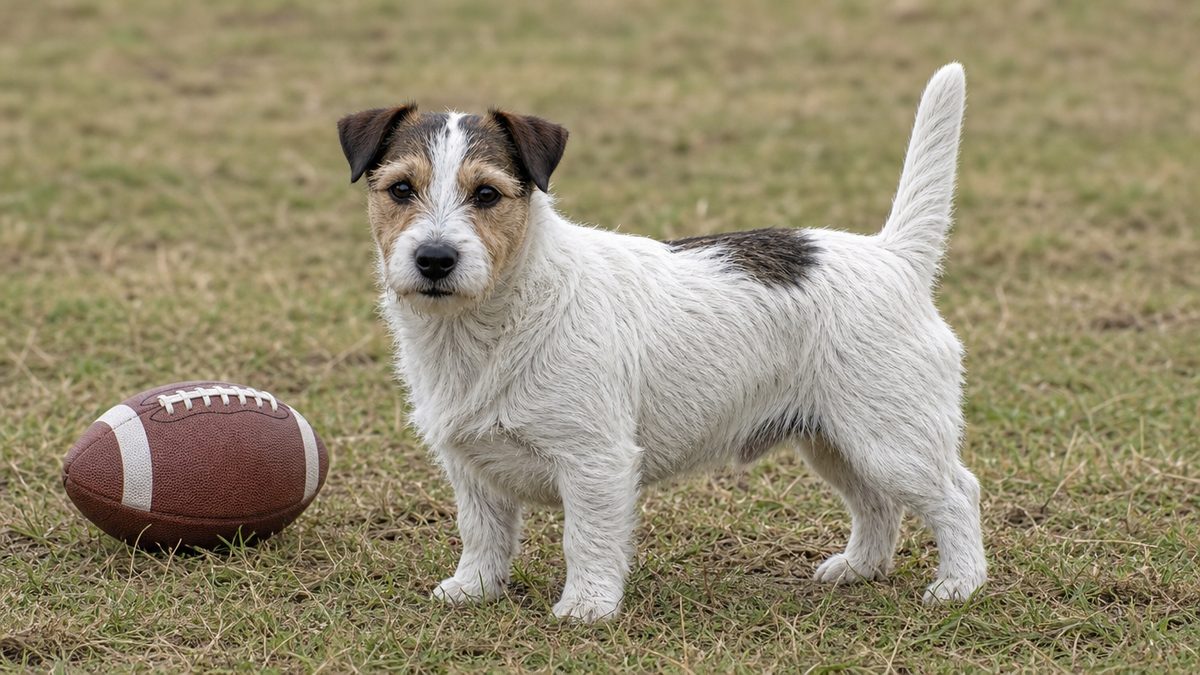
Quick answer
No Sporting Lucas Terrier price in India exists. The breed is held by one kennel club in the world, the United Kennel Club, which recognised it in March 2002, and India's dog import policy bars commercial import for breeding, so no Indian supply chain and therefore no Indian market price can form.
This page reports published registry documents, breed club records and Indian price data. It is not a diagnosis and it is not a treatment plan. A painful cloudy eye, sudden loss of coordination in a young dog, a hind leg that drags, and any suspected deafness in a puppy all need veterinary examination. Consult your nearby vet before acting on anything here, and before starting or stopping any medicine.
Sporting Lucas Terrier at a glance
What a Sporting Lucas Terrier is, and how it differs from a Lucas Terrier
The Sporting Lucas Terrier is a small English working terrier created in the early 1990s when Brian Plummer crossed Sir Jocelyn Lucas's Lucas Terrier with one of his own Plummer Terriers, and it was recognised by the United Kennel Club in March 2002.
Start with the distinction, because Google itself cannot make it. Three of the four People also ask questions returned for this breed on the Indian search results page are about the Lucas Terrier, not the Sporting Lucas Terrier, and the first of the four asks outright what the difference between the two is. The answer is documented and it comes from the breed association's own history page.
| Lucas Terrier | Sporting Lucas Terrier | |
|---|---|---|
| Created by | Sir Jocelyn Lucas | Brian Plummer, early 1990s |
| From | Sealyham crossed with Norfolk Terrier | The Lucas Terrier crossed with a Plummer Terrier |
| Kennel club status | AKC Foundation Stock Service | UKC Terrier Group since March 2002 |
| Height quoted by that body | 10 to 12 inches | 11 to 13 inches for dogs |
| Breed body | Various Lucas Terrier clubs | Sporting Lucas Terrier Association, from 2003 |
The Sporting Lucas Terrier Association's history page records it plainly: in the early 1990s noted terrier expert Brian Plummer was asked to step in, and he crossed the Lucas with one of his Plummer Terriers to create the Sporting Lucas Terrier. Showsight describes the parent as a historic Sealyham-Norfolk cross preserved for type, temperament, and true working ability. So the ancestry runs Sealyham and Norfolk, then Lucas, then Lucas crossed with Plummer. The two accounts of that last cross disagree, and the disagreement is published here rather than resolved. The association says Plummer crossed the Lucas with one of his Plummer Terriers. Showsight, writing from the Lucas side, says the Sporting Lucas broke off, partially under Plummer's influence, when other breeds, notably Jack Russell Terriers, were introduced into the mix. The breed association is the closer authority on its own foundation, and a buyer reading both should know they differ.
Search for the Sporting Lucas Terrier and the American Kennel Club page you are offered is for the LUCAS Terrier. It records that breed in the Foundation Stock Service, gives its height as 10 to 12 inches, and carries a typographical error in its own tagline, printing Athetic for Athletic. Do not read its trait bars, health notes or care advice as being about this breed.
One registry files both under one code
The conflation is not confined to search engines. The Orthopedic Foundation for Animals, whose statistics tables this site relies on for screening data across hundreds of breeds, holds a single row for these two dogs. Its breed selector carries data-name LUCAS TERRIER, code LUT, with a group attribute reading UKC Terrier Group (SPORTING LUCAS TERRIER). The parent breed's name and the derived breed's name sit in one record.
That has a practical consequence for anyone looking for health data: if screening records ever accumulate under LUT, it will not be possible to tell from the register which of the two breeds they belong to. This is worth knowing before the data exists rather than after.
The standard, and what it is for
Two organisations publish a breed standard for this dog and they are complementary rather than competing. Both describe a compact, short-legged working animal built to enter an earth. The United Kennel Club standard runs through History, General Appearance, Characteristics, Head with subheadings for skull, muzzle, teeth, nose, eyes and ears, then Neck, Forequarters, Body, Hindquarters, Feet, Tail, Coat, Color, Height and Weight, Gait and Disqualifications.
The Sporting Lucas Terrier Association standard opens differently, and its opening line is the more revealing of the two. Its first clause is not appearance but Working Role: to hunt ground vermin, going to ground when required. Everything that follows is subordinate to that. Its Dimensions clause gives height at the withers 11 to 13 inches for dogs and 10 to 12 inches for bitches, with weight 14 to 18 lbs for dogs and 11 to 15 lbs for bitches.
This site has documented cases where a UKC breed page prints a revised standard date in its footer while its body states that no standard exists, which is a trap for anyone reading the footer alone. That contradiction was checked for on this page and there is none. The UKC's Sporting Lucas Terrier page prints no revision line at all, only a 2002 copyright, and contains no statement about conformation eligibility in either direction.
Sporting Lucas Terrier price in India, and why there is not even a wrong number
No Sporting Lucas Terrier price in India exists, and unusually there is not even a fabricated Indian figure to correct, because no rupee amount of any kind appears on the Indian search results page for this breed.
The control passed and the result is clean. A Google India search for labrador retriever puppy price in india, run in the same session, returned ten genuine Indian commercial listings with real rupee figures, from Supertails at Rs 8,000 to Rs 70,000 to a marketplace quoting INR 30,000 to INR 1,20,000 with a city-by-city breakdown. Indian dog listings are richly indexed and easy to find.
The Indian results page for this breed contains no rupee figure at all. No Indian commercial listing appeared, no aggregator price table appeared, and unlike several breeds in this batch there was not even a merchandise listing to be mistaken for one. What ranks instead is Wikipedia, the UKC standard, the breed association, an AKC page for a different breed, a magazine article, a consumer breed site, a dead retailer URL, a stock photo library and an image board.
When a breed's search results include Adobe Stock and Pinterest in the top ten, that is a reliable signal that almost no editorial coverage exists. Search engines fill the gap with whatever has the breed name attached, and images are what is left. Treat a photo library in a breed's top ten as a measure of how thin the written record is.
Why no Indian price can form
India's import policy for pet dogs is restricted and permitted only with a DGFT authorisation. The permitted purposes are research with a CPCSEA recommendation, internal security by the Defence and Police forces, a certified therapy or emotional support dog, and a dog that has been with its owner for at least two years arriving on transfer of residence. The guidance then states that dogs for commercial purposes like breeding, as a gift or other purposes are not allowed to be imported, and that new born puppies of less than 7 months are not to be allowed.
Import runs through seven ports only, the airports and seaports of Delhi, Mumbai, Chennai, Hyderabad, Bengaluru and Kolkata and, since October 2024, Kochi airport, under ITC(HS) code 01061900, with an advance NOC from the Animal Quarantine and Certification Station required seven days before travel. For a breed held by one kennel club on one continent, those provisions close the question completely. The full route is set out in how to import a dog to India.
The British market for this breed exists but this page publishes no figure from it. The most complete consumer page for the breed carries headings for Purchase Prices, Initial Setup Costs, Ongoing Monthly Expenses and Lifetime Cost Considerations, and that page was retrieved for its structure rather than its numbers, so no figure is quoted from it here. A sterling price converted into rupees would be arithmetic rather than an observation, and this site does not publish those.
The word Terriers, and this breed
CBIC Instruction 05/2024-Customs of 14 March 2024 reproduces a Department of Animal Husbandry and Dairying letter listing breeds prohibited for import. Four of its entries are bare category words the instrument never defines: Mastiffs (boerbulls), Terriers, Wolf dogs and Canario. There is no interpretive question here. The Sporting Lucas Terrier is a terrier by name, by classification in the only kennel club that holds it, and by its own standard's stated working role, so the word reaches it squarely on its face.
The wider legal position is separate and settled. The Karnataka High Court quashed the circular on 10 April 2024 and the Delhi High Court set it aside that month, and the Centre told the Bombay High Court in January 2025 that it is not acting on it. No Indian law in force today bans owning, breeding or selling any of the breeds that list named.
Cost of ownership in India for a small working terrier
The cost of ownership for a 6 to 8 kg working terrier in India is low on consumables and dominated by parasite prevention and by the exercise infrastructure the breed actually needs.
No Indian breed page carries a cost table for this dog, so there is no template constant to inherit and no fabricated monthly figure to correct. What follows is Indian retail and municipal pricing that names its supplier, sized to a dog at the standard's 14 to 18 pound range.
- Core vaccination, per shot. Anti-rabies Rs 699, puppy DP Rs 849, 9-in-1 DHPPiL Rs 899, canine corona Rs 899 and kennel cough Rs 1,349 at one national clinic chain. These are promotional starting prices, and the same chain quotes different course totals on different city pages, so note which city quoted you.
- Deworming. Drontal Plus is Rs 754 for six tablets against an MRP of Rs 838, which is Rs 125.67 a tablet dosed at one per 10 kg. A dog at the top of this breed's weight range takes one tablet, so about Rs 126 per deworming. A terrier that actually works needs worming more often than a house dog, on your vet's advice.
- Tick and flea prevention. Budget for a monthly product in the small-dog weight band, and treat it as non-negotiable rather than seasonal, for the reasons in the health section.
- Municipal registration. Rs 500 in Delhi for a new registration and Rs 500 to renew, with a Rs 100 monthly late fee. Rs 50 in Chennai, where the corporation issued 9,115 licences in 2024 and runs six pet clinics giving treatment and anti-rabies vaccination free of cost.
- Grooming. A harsh working coat brushed weekly, with occasional hand-tidying. No salon clip is required and none should be given.
The cost that is not a line item
For a working terrier the real expenditure is containment and occupation. A dog whose own standard defines its role as going to ground will test the bottom of a fence rather than the top, and a dog with no legal outlet for that drive will make one indoors. In an Indian rented flat the cost of an unmet working drive is a deposit, not a vet bill, and the way to avoid it is to budget time rather than money.
Greater Chennai Corporation's six municipal pet clinics provide all treatment and anti-rabies vaccination free of cost, and the corporation issued 9,115 pet licences in 2024. For a Chennai household that removes the largest scheduled veterinary line above entirely, and it is a more useful fact for an Indian reader than any imported breed price.
Heat tolerance: Buckinghamshire against three Indian cities
The Sporting Lucas Terrier has poor heat tolerance, because it carries a harsh weather-resistant coat with an undercoat on a short-legged body that sits inside the hottest layer of air above the ground.
The homeland point is Princes Risborough in Buckinghamshire, the country around Sir Jocelyn Lucas's Ilmer kennel where the parent breed was made. NASA POWER returned a cell elevation of 87.34 m against a real elevation near 100 m, an error of about 13 m, so the cell describes the place.
| Place | Annual mean C | Annual RH % | Hottest month | Peak wet bulb C |
|---|---|---|---|---|
| Princes Risborough, Bucks | 10.32 | 84.69 | Jul 17.77 | 14.65 (Jul) |
| Bengaluru | 23.74 | 67.94 | Apr 28.37 | 21.86 (May) |
| Delhi | 25.60 | 45.56 | Jun 35.88 | 26.50 (Jul) |
| Chennai | 27.95 | 72.39 | May 31.51 | 26.11 (May) |
The Buckinghamshire hottest month averages 17.77 C. Chennai's coolest month averages 24.09 C. Chennai never gets as cool as this breed's homeland ever gets warm. Delhi's June, at 35.88 C, is eighteen degrees above it. Bengaluru, at 23.74 C annual mean, is the least hostile Indian metro for this dog.
Humidity is not the problem
Buckinghamshire runs 84.69 percent annual relative humidity, higher than every Indian city in the table, and twelve points above Chennai. The frequent warning that a British breed will find Indian dampness difficult is measurably backwards. What this dog has never met is air that is hot and humid at the same time, which is what the wet bulb column measures: its homeland peaks at 14.65 C and Delhi peaks at 26.50 C. Humid air is not the problem; humid air at thirty degrees is.
The short legs matter here
This is a point most heat advice misses. Air temperature is measured at two metres, and the layer immediately above hot ground is considerably warmer than that. A dog standing 11 to 13 inches at the withers has its entire body inside that layer, and its chest is a few centimetres from a surface that in an Indian May can be far hotter than the air. A short-legged breed therefore experiences a hotter afternoon than a tall one standing in the same place.
- Test the ground with the back of your hand before every walk from March to June. If you cannot hold it there for five seconds, the dog should not be walking on it.
- Work the dog before sunrise, and treat the afternoon as unavailable through the hot months.
- Carry water on every outing and offer it before the dog looks like it needs it.
- Watch for panting that does not settle within five minutes of stopping in shade, which is the line between exercise and a heat event.
- Substitute scentwork for pursuit in the hot months. A terrier's nose works indoors and its legs do not have to.
India's Dog Breeding and Marketing Rules 2017, Second Schedule Part IV paragraph 21(1), bar keeping dogs in outdoor facilities without the attending veterinary practitioner's written approval where they are not accustomed to local temperatures or where the breed cannot tolerate the temperatures prevalent in the area. A double-coated working terrier kennelled outdoors in an Indian summer is exactly the arrangement that clause addresses.
Temperament and household fit
The Sporting Lucas Terrier is a working earth terrier with a steadier temperament than most of its type, which is precisely what its Lucas ancestry was selected for.
The two standards agree on character, and the association's version is organised so that temperament sits directly beneath the working role, with separate clauses for Characteristics, Temperament and Aptitude. The United Kennel Club's own description calls the breed determined, self-confident, lively, bustling, alert, sharp-eyed, spirited and keen to hunt, fearless but not foolhardy.
Fearless but not foolhardy is the phrase that distinguishes this breed within its group. Sir Jocelyn Lucas's original cross was made partly to produce a working terrier that was easier to live with than the hardest earth dogs, and the Sporting Lucas inherits that. It is still a terrier, and it will still hunt.
Who this breed suits
- Owners who want a working terrier temperament in a slightly more manageable package than a Plummer or a Patterdale.
- Rural or semi-rural households with secure ground, since the standard's working role assumes access to earth and cover.
- People who enjoy training a thinking dog and will supply an outlet for the prey drive rather than trying to suppress it.
- Households without small pets, which is the single hardest constraint for any earth terrier.
Who should look elsewhere
- Anyone with cats, rabbits or other small animals. A breed whose standard's first line is to hunt ground vermin is not a candidate for a household with a hamster.
- Apartment households without serious daily occupation. The size fits and the drive does not.
- Anyone in an Indian metro without a reliable pre-dawn exercise routine through the hot months.
- Owners wanting a low-drive companion. This is a functional breed and its function is still selected for.
Nothing above concerns behaviour towards humans. The prey drive is directed at quarry, and the consistent account across the standards and the consumer pages is of a friendly, affectionate, biddable dog with its own family. Confusing hunting drive with aggression is the commonest misreading of working terriers and it is worth resisting.
Training a terrier bred to work underground
To train a Sporting Lucas Terrier, give the prey drive a legal outlet first and train obedience around it, because a dog selected to work out of its handler's sight will not be argued out of chasing.
The association's standard states the working role before anything else: to hunt ground vermin, going to ground when required. A dog working in an earth cannot be directed, so it was selected to decide for itself and to persist. That produces a fast learner who evaluates each instruction against whatever else is available, and it means training has to compete rather than command.
Four priorities
- Build recall against real movement, on a long line, for a year. A recall trained indoors does not transfer to a squirrel. Assume the line stays on until the dog has proved otherwise many times over.
- Give the drive somewhere to go. Scentwork, flirt pole with rules, retrieve games with a clear start and stop, and terrier racing where it exists. A drive with an outlet is trainable; a drive without one finds its own.
- Socialise with other dogs early and deliberately. Earth terriers can be sharp with strange dogs and the window before four months is when that is cheapest to shape.
- Teach a settle and reward stillness explicitly. A busy dog that has never been paid for doing nothing does not learn how on its own.
Digging needs a plan rather than a prohibition, since this is a dog bred to go into the ground. Provide a permitted digging area, bury things in it, and reward the dog for using it. Trying to eliminate the behaviour usually relocates it to a flowerbed or a sofa.
A short-legged earth terrier tests the bottom of a boundary, not the top. Walk your fence line at ground level, block gaps under gates, and remember that a dog which can fit its head through a gap can usually follow with the rest. In Indian housing the two failure points are building gate bottoms and balcony railings.
How much exercise a Sporting Lucas Terrier needs
A Sporting Lucas Terrier needs around 60 to 90 minutes of real activity a day plus daily mental work, and in India that has to happen before sunrise for four months of the year.
The UKC standard describes a lively, bustling, alert dog keen to hunt, and the association's standard has a dedicated Movement clause alongside its Construction, Forehand, Torso and Hind hand clauses. Sporting Lucas Terrier Association This is a functional animal and a lead walk on pavement satisfies neither half of it.
The good news for an Indian owner is that most of what this breed needs can be delivered indoors. Scent is the sense a terrier works with, and scentwork is the single most efficient way to tire one out. It also has the advantage of being available at two in the afternoon in May, which running is not.
- Scentwork daily, hiding food or a scented article and letting the dog search. Fifteen minutes of this settles a terrier more than half an hour of walking.
- A digging box, which channels a hardwired behaviour into a place you chose.
- Off-lead running in genuinely secure ground only, which in most Indian cities means a fenced compound rather than a park.
- Short frequent training sessions rather than one long one, which suits a dog with a short attention span and a high drive.
- Avoid forced repetitive exercise in a growing dog, and build to distance only after physical maturity.
A breed needing an hour and a half of real work a day, which can only be given in darkness for four months of the year, is a genuine logistical commitment. Delhi averages 35.88 C in June. Before taking on this breed in an Indian city, be honest about whether you will be awake at five in the morning in April, May and June, every day, for the next fifteen years.
Grooming a harsh working coat
Groom a Sporting Lucas Terrier by brushing the harsh coat weekly and hand-tidying occasionally, and never by clipping it, because clipping a harsh double coat softens the texture the standard requires.
The coat is a working one and the association's standard gives it two separate clauses, Coat Colour and Coat Texture, which tells you the texture matters independently of the colour. A harsh, dense outer coat over an undercoat is weatherproofing, and its function is to shed water and resist thorns rather than to look tidy.
This is where the breed differs most usefully from its Sealyham ancestor. A show Sealyham coat is a substantial and continuing commitment. The Sporting Lucas was bred back towards function, and its coat reflects that: brushed rather than sculpted, with far less furnishing to maintain.
What matters in an Indian climate
- Brush weekly and check the skin while you do it. A dense coat hides both parasites and lesions until they are established.
- Do not clip the coat for summer. Clipping a harsh double coat changes the texture on regrowth and removes the layer between skin and sun. Manage heat with timing and shade instead.
- Check the feet after every outing. Thorns, glass and grass seeds between the pads are the commonest working-dog injury and the cheapest to catch early.
- Dry the dog to the skin after rain. Air drying is standard British grooming advice and transfers badly to an Indian monsoon.
- Check ears after any work in cover, since a dog that puts its head into holes collects debris and Indian humidity turns debris into infection quickly.
A largely white dog shows ticks, thorns and skin lesions far more readily than a dark one, which in a country with the tick burden set out in the health section is a genuine benefit. It also reflects more solar radiation than a black coat. The trade-off is that it shows dirt, which is a laundry problem rather than a health one.
Health, and an evidence base that does not exist for either breed
No prevalence data exists for the Sporting Lucas Terrier or for its parent: no published OFA statistics, no PubMed records under either name, and no inclusion in the largest recent longevity study.
That absence needs establishing rather than asserting, because an unproven absence is worth nothing. Here is what was searched and what proved each search worked.
The literature
The quoted phrases Lucas Terrier and Sporting Lucas Terrier each return zero PubMed records, both with the database's own quotedphrasesnotfound warning, which means the phrase is absent from the index rather than that the search failed. Both singular and plural forms were run, because on other breeds the plural has recovered an entire literature the singular missed. Here neither form finds anything.
Dropping the quotation marks returns three records across two queries, and all three are author-name noise: a Danish medical-history article, a canine seminoma case report and a cerebral babesiosis case report, whose co-authors are surnamed Lucas. Controls run in the same session returned 126 for Labrador retriever hip dysplasia and 31 for a comparably rare European breed, so the instrument was demonstrably working.
The registers
OFA holds a code, LUT, but publishes no statistics. The string LUCAS TERRIER appears zero times in OFA's published statistics dataset, while in-session controls of LABRADOR 109, BULLDOG 170 and BEAGLE 61 all matched their expected counts. The correct wording is that this breed has no row in OFA's published statistics tables, not that it is absent from OFA, because OFA publishes a breed only once it holds at least 100 hip evaluations or 50 for its other databases. The two kennel-club negatives in the table below were run with in-document controls: the FCI's letter S index returned 41 entries on 17 September 2026 with the Sealyham, Scottish, Skye and Staffordshire Bull Terriers present and no Sporting Lucas Terrier, and the complete Dogs Australia breed listing of 18 March 2026 contains the string Lucas zero times while Tenterfield Terrier, Prague Ratter and Schipperke are present.
McMillan 2024 excludes both breeds. Neither appears in the 344-breed frame of the study's supplementary Table S5, although that table does carry the Sealyham Terrier and the Norfolk Terrier, the two founding breeds of the parent. Both grandparents are in the dataset and the descendant is not, so no life expectancy figure exists for this breed from any study.
| Source | Result | Control |
|---|---|---|
| PubMed, both names, singular and plural | Zero records | Labrador 126, Bearded Collie 31 |
| OFA statistics dataset | Zero rows | Labrador 109, Bulldog 170, Beagle 61 |
| OFA breed-code list | Present as LUT | 481 rows parsed |
| McMillan 2024, Table S5 | Absent from 344 breeds | Sealyham and Norfolk present |
| FCI letter S index | Absent from 41 entries | Sealyham, Scottish, Skye, Staffordshire Bull |
| Dogs Australia complete listing | Zero occurrences | Tenterfield, Prague Ratter, Schipperke present |
| United Kennel Club | Present, Terrier Group, since March 2002 | All nine groups enumerated |
None of this says the breed is unhealthy, and none of it says it is healthy. It says nobody has measured. Working breeds kept outside the show system are systematically under-represented in screening registers, because those registers are filled by owners who show and breed under a kennel club. A breed can be genuinely robust and still invisible to every dataset that exists.
What to screen for anyway
With no breed-specific data, the sensible approach is to screen for what the ancestry suggests and what related terriers are screened for. The Sealyham and the Norfolk are both eye-screened breeds, and primary lens luxation is the condition that recurs across small terrier breeds of this family. It is painful, it is inherited, and it has a DNA test. Late onset ataxia and degenerative myelopathy are the other DNA-testable conditions offered across this terrier group.
The practical instruction to a buyer is short: ask for certificates rather than assurances, and take them to your nearby vet if you cannot interpret them. In a breed with no register data, the individual dog's paperwork is the entire health record.
The Indian risk that has nothing to do with the breed
Tick-borne disease is the health issue with real Indian numbers behind it, and it matters more for a working terrier than for most dogs because a working terrier spends its time in exactly the cover where ticks live. A West Bengal study of 584 dogs screened at veterinary clinics detected Babesia gibsoni in 76.54 percent, with 72.9 percent of those 584 carrying two or more pathogens. A Kerala study of 120 dogs found Babesia in 80 of them, peaking before the monsoon between March and May.
Both studies sampled clinic caseloads and clinically suspected animals rather than random populations, so these are not general prevalence figures for Indian dogs. What they do establish is that year-round tick prevention is not optional here, and that a dog which pushes through undergrowth needs it more than one that walks on pavements.
Feeding a small working terrier in India
Feed a Sporting Lucas Terrier to body condition and to workload, keeping it lean, because the standard's weight range is narrow and a dog that cannot fit into an earth cannot do its job.
The association's standard gives an unusually precise weight range for a working breed: 14 to 18 lbs for dogs and 11 to 15 lbs for bitches, alongside height at the withers of 11 to 13 inches for dogs and 10 to 12 for bitches. Those are working dimensions rather than show ones. A dog above that range is a dog that will not go where the standard says it should be able to go.
Assess by hand rather than by chart. You should feel the ribs easily under a thin covering, see a waist from above and a clear tuck from the side, and on a harsh-coated dog you must use your hands because the coat hides both gain and loss. Weigh monthly on the same scale and adjust the ration in small steps.
Indian practicalities
- Two meals a day for an adult, three for a growing dog, and never a large meal immediately before or after hard work.
- Vary the ration with the workload rather than feeding an average that is wrong on both working and resting days.
- Do not free-feed in monsoon humidity. Food spoils faster than owners expect, and free-feeding hides the appetite change that is often the first sign of illness.
- Feed after the dog has cooled, not while it is still panting hard.
- Use part of the ration as training currency, which for a high-drive dog is worth more than any treat bought separately.
A terrier that actually works will eat what it catches, which changes the worming interval. Discuss frequency with your nearby vet rather than following a standard house-dog schedule, and tell them what the dog is catching, because the parasite risk differs between rodents, rabbits and carrion.
The first year, month by month
A Sporting Lucas Terrier puppy's first year is about socialising a working terrier before four months, establishing containment habits before the prey drive matures, and collecting the health paperwork that no register will hold for you.
- Months 0 to 2. With the breeder. Indian law sets the floor at eight weeks: Rule 8(1)(a) of the 2017 Rules provides that pups less than eight weeks in age are not sold. For an imported dog the DGFT floor is far higher at seven months.
- Month 2. Home. Vaccination begins, with anti-rabies around Rs 699 and multivalent shots in the Rs 849 to Rs 899 band at one national chain. Collect the parents' DNA certificates now, because no register will hold them for you.
- Months 2 to 4. The socialisation window and the most valuable eight weeks of the year for a terrier. Other dogs, traffic, children, lifts, watchmen and monsoon rain, all in short positive doses.
- Month 3 to 4. Deworming on your vet's schedule, about Rs 126 per dose at adult weight. Register with your municipality: Rs 500 in Delhi, Rs 50 in Chennai. Greater Chennai Corporation veterinary…
- Months 4 to 6. Teething, and the point at which chewing turns structural. Provide legal outlets before the illegal ones are discovered, and start the digging box now.
- Months 6 to 10. The prey drive matures and the recall that worked at four months stops working. This is normal, it is the point at which most terriers are lost, and the answer is the long line rather than more shouting.
- Months 8 to 12. Boundary testing intensifies at ground level. Walk the fence line and fix it now.
- Month 12 onwards. Physical maturity, and the point at which sustained hard work becomes reasonable. Ask your vet before starting any jumping or agility programme.
- Throughout. In an Indian metro, build the pre-dawn exercise habit during the cool season so it is already in place when April arrives.
A harsh working coat needs no puppy grooming programme beyond getting the dog used to being handled, which frees the whole of the first year's handling budget for feet, ears, mouth and veterinary examination. Teach those thoroughly and skip the elaborate brushing lessons a coated breed would need.
Sporting Lucas Terrier against the terriers it sits beside
The most useful comparison for this breed is not with other small dogs but with its own family, because the differences between them are documented in their standards and are the reason each exists.
| Sporting Lucas Terrier | Lucas Terrier | Plummer Terrier | Sealyham Terrier | |
|---|---|---|---|---|
| Made by | Brian Plummer, early 1990s | Sir Jocelyn Lucas | David Brian Plummer, from the 1960s | 19th century Wales |
| From | Lucas crossed with Plummer | Sealyham crossed with Norfolk | Working terrier stock | Founding breed |
| Recognition | UKC only, March 2002 | AKC Foundation Stock Service | None anywhere | FCI, Kennel Club, AKC |
| Height | 11 to 13 inches for dogs | 10 to 12 inches | Maximum 14 inches | Larger and heavier |
| Colour | Predominantly white bodied | Similar | Fiery red and white with collar or cape | White, sometimes with markings |
| Coat | Harsh working coat | Harsh working coat | Smooth and close | Profuse show coat |
Two rows in that table do the most work. Colour separates this breed from the Plummer instantly: a fiery red and white dog with a collar or cape is a Plummer Terrier, and a predominantly white bodied dog is not. And coat separates it from the Sealyham, which is the point of the whole lineage: Sir Jocelyn Lucas and then Brian Plummer were both breeding function back into a line that the show ring had been taking away from it.
The comparison that matters in India
None of the four is realistically obtainable here. What an Indian buyer wanting a small, hardy, active, intelligent dog will actually meet is an Indian pariah-descended dog, and that comparison deserves making honestly rather than avoiding. A pariah-type dog is hardy, alert, healthy and already adapted to the climate. What it will not have is the specific underground working drive this breed was built around, which for a pet home is a benefit rather than a loss.
The Sporting Lucas Terrier is a well-documented working breed with a clear purpose and a clean recognition history, and it is a poor practical choice for an Indian household. If you already have one, the climate, health and exercise sections above are written for you. If you are choosing a dog, start at the adoption section.
Mistakes people make about this breed
Almost every error about the Sporting Lucas Terrier comes from confusing it with its parent, and almost every error with the dog comes from underestimating what going to ground means.
- Reading the AKC Lucas Terrier page as being about this breed. It is not. It is the parent breed, in the Foundation Stock Service, with different dimensions.
- Assuming OFA data would tell you the two apart. OFA holds one code, LUT, whose name field says Lucas Terrier and whose group field says Sporting Lucas Terrier.
- Keeping one with cats or small pets. A breed whose standard's first clause is to hunt ground vermin is not a candidate for a home with a rabbit.
- Clipping the harsh coat for an Indian summer. It softens the texture on regrowth and removes the barrier between skin and sun.
- Assuming short legs mean low exercise needs. The standard describes a lively, bustling dog keen to hunt, and short legs mean more strides, not fewer.
Two errors that come from the search results
The first is trusting the VioVet breed page. Its URL returns HTTP 200 but redirects to the site's generic search shell, which carries robots noindex and lists horse tack and aquarium parts under a heading reading We found 10,000 results. There is no breed content at that address, and the same is true of that site's Plummer Terrier URL. A status code of 200 is not evidence that a page exists.
The second is reading a stock photo library's presence in the top ten as coverage. When Adobe Stock and Pinterest rank for a breed, that is a measure of how little has been written rather than a source.
The 2017 Rules, Second Schedule Part II paragraph 6(9), state that breeding to create new breeds of dogs or unusual looks shall be strictly prohibited. That is worth reading carefully for a breed whose own origin story is a deliberate cross made to create a new breed in the early 1990s. Paragraph 6(3) separately prohibits in-breeding within four generations and incest breeding, which matters for any breed with a narrow founding population, and paragraph 6(8) forbids tail docking.
Adopt, verify and source responsibly
There is no route to a Sporting Lucas Terrier in India that this page can recommend, and the honest thing is to say so and then set out what to do instead.
India's import policy for pet dogs is restricted and permitted only with a DGFT authorisation. Dogs for commercial purposes like breeding, as a gift or other purposes are not allowed to be imported, and new born puppies of less than 7 months are not to be allowed. The only route without an authorisation is the customs baggage route, for up to two pets, for a person transferring residence permanently to India after two years of continuous stay abroad.
If you are bringing your own dog to India
- Confirm the two-year rule applies to you, otherwise a DGFT authorisation is required.
- Start at least two months before travel, since the application goes to the Department of Animal Husbandry, Dairying and Fisheries for an NOC and then to the Exim Facilitation Committee, which meets monthly.
- Get the advance NOC from the AQCS at your port of entry seven days before travel, relaxable to three days.
- Plan on one of seven ports: Delhi, Mumbai, Chennai, Hyderabad, Bengaluru, Kolkata or, since October 2024, Kochi.
- Carry the UKC registration papers, which for this breed are the only kennel club papers in existence anywhere, alongside the pet book, vaccination certificate and official veterinarian's health certificate.
- Bring every DNA and eye certificate you have. No register holds health data for this breed, so your dog's own paperwork is the entire record an Indian vet will have.
If you are choosing rather than importing
There is no Indian population of this breed and no rescue network for it here, and pretending otherwise would waste a reader's time. What is worth saying instead is what the appeal actually consists of. Underneath the pedigree question, the standards describe a determined, self-confident, lively, alert, sharp-eyed, keen small dog that wants a job, is fearless but not foolhardy, and needs almost no coat maintenance.
Indian shelters rehome dogs answering to every one of those adjectives, already adapted to the climate that would be this breed's main problem, at no purchase cost. A pariah-descended dog with an owner who trains it and gives it work is far closer to what makes this breed appealing than any imported dog would be.
- Verify a claimed pedigree with the United Kennel Club directly, since it is the only body that registers this breed and its records are the only ones that can confirm one.
- Check which of the two breeds you are actually being offered. Ask whether the dog is a Lucas Terrier or a Sporting Lucas Terrier, and ask which registry issued its papers.
- Ask for eye certification and DNA results, particularly for primary lens luxation, and ask to see them rather than being told about them.
- Check the dimensions against the association standard. A dog well outside 11 to 13 inches and 14 to 18 pounds is outside its own breed's stated working range.
- Register the dog with your municipality. Rs 500 in Delhi, Rs 50 in Chennai. Greater Chennai Corporation veterinary…
We report published prices and registry documents as editorial content. We do not recommend breeders, link puppy listings or quote a live price as an offer. For this breed we publish no price in any currency, because no Indian figure exists at all and converting a sterling asking price would be arithmetic rather than reporting.
Sporting Lucas Terrier questions people actually ask
What is the difference between a Lucas Terrier and a Sporting Lucas Terrier?
They are two breeds, one descended from the other. The Lucas Terrier is Sir Jocelyn Lucas's Sealyham and Norfolk cross. The Sporting Lucas Terrier was created in the early 1990s when Brian Plummer crossed the Lucas with one of his own Plummer Terriers, according to the breed association's own history, and it is the derivative rather than the original.
What type of dog is the Lucas Terrier?
The Lucas Terrier is a small English working terrier, described as a historic Sealyham and Norfolk cross preserved for type, temperament and true working ability. The American Kennel Club records it in its Foundation Stock Service, the programme it describes as being for rare breeds currently being recorded, and states its height as 10 to 12 inches.
Are Lucas Terriers rare?
Yes, and the registries show it. The Lucas Terrier sits in the American Kennel Club's Foundation Stock Service rather than in its main register, the Sporting Lucas Terrier is held by exactly one kennel club in the world, neither appears in Dogs Australia's complete breed listing, and neither has enough screening records for OFA to publish a statistics row.
What health problems do Lucas Terriers have?
No prevalence data exists for either breed. OFA holds a code but publishes no statistics row, PubMed returns zero records for both names against working controls, and McMillan 2024 excludes both. The sensible position is to screen for what the parent breeds are screened for, particularly primary lens luxation, and to ask breeders for certificates.
What is the Sporting Lucas Terrier price in India?
There is none. No Indian commercial listing and no rupee figure of any kind appeared on the Indian search results page for this breed, against a control search that returned ten genuine Indian Labrador listings with real prices in the same session. India's import policy also bars commercial import for breeding.
Which kennel clubs recognise the Sporting Lucas Terrier?
Exactly one. The United Kennel Club recognised the breed in March 2002 and holds it in its Terrier Group with a full published standard. Wikipedia's own Recognition section states that of the major kennel clubs in the English-speaking world, only the United Kennel Club recognises it. This page checked the FCI letter S index and the complete Dogs Australia breed listing independently and found it in neither.
How big is a Sporting Lucas Terrier?
The Sporting Lucas Terrier Association's standard gives height at the withers as 11 to 13 inches for dogs and 10 to 12 inches for bitches, with weight 14 to 18 pounds for dogs and 11 to 15 pounds for bitches. Google's own knowledge panel gives 30 cm and 6.8 kg, which sits inside those ranges.
What was the Sporting Lucas Terrier bred to do?
Its association's standard states the working role in its opening line: to hunt ground vermin, going to ground when required. That single sentence governs the whole standard, which is why the dog must be narrow enough to enter an earth and strong enough to work once inside, and why the construction clauses matter more than any cosmetic point.
Does the Sporting Lucas Terrier have a studbook?
Its register comes from the United Kennel Club rather than from the breed association. The association publishes a standard and names a Breed Registrar in its contacts, but nowhere on its site does it state that it keeps a studbook or register of its own. So the standard exists twice and the register exists once, at the UKC.
Can a Sporting Lucas Terrier live in India?
Only indoors, with cooling, and with exercise moved to before sunrise for four months of the year. Its home country in Buckinghamshire averages 10.32 C across the year with a hottest month of 17.77 C, against Delhi's June at 35.88 C, and this is a working coat with an undercoat on a short-legged dog close to hot ground.
Does India's 2024 dog circular apply to this breed?
The bare word Terriers appears in that list and the instrument defines it nowhere, so on its face it reaches every terrier including this one. The Karnataka High Court quashed the circular on 10 April 2024 and the Delhi High Court set it aside that month, so no Indian law in force today bans owning, breeding or selling any breed it named.
Is tail docking of working terriers allowed in India?
No. India's Dog Breeding and Marketing Rules 2017, Second Schedule Part II paragraph 6(8), state that there shall be no tail docking, ear cropping, de-barking, de-clawing, branding or any other kind of mutilation, and that any change of appearance by artificial means is strictly forbidden. British working-terrier practice historically included docking; it is prohibited here.
Compare with similar breeds
Sporting Lucas Terrier sits in 1 Bonbeno group. Each one compares it directly against the breeds it is genuinely an alternative to, on the same figures.