
Dog breed profile
Dandie Dinmont Terrier Price in India, Rarity and Real Health Risk
An 8 to 11 kg terrier with a back nearly twice as long as its legs are tall, 88 puppies registered in Britain in 2025, the highest disc-disease allele frequency of any terrier measured, and a glaucoma screening test its own kennel club's breed page forgets to mention.
Quick answer
No verified Dandie Dinmont Terrier price in India exists, because the breed is not sold here. Google India's own AI Overview quotes Rs 75,000 to Rs 1,50,000+ while citing a page that lists three dogs, none of them this breed, and prints no price at all. The real numbers worth knowing are British: 88 puppies registered in 2025, a vulnerable native breed classification, and a chondrodystrophy allele frequency of 0.88.
This page summarises published breed-standard text, registry statistics, government notifications and peer-reviewed veterinary research for general information. It is not a diagnosis and it is not treatment advice. Consult a registered veterinarian near you about your own dog before acting on anything here. Two points are worth raising promptly rather than watching: any sudden reluctance to jump, arched back, wobbling hind legs or dragging feet in a long-backed dog is a spinal emergency and needs a vet the same day, and a red, cloudy or suddenly painful eye in this breed needs an intraocular pressure reading within hours, not days.
Dandie Dinmont Terrier at a glance
What a Dandie Dinmont Terrier is
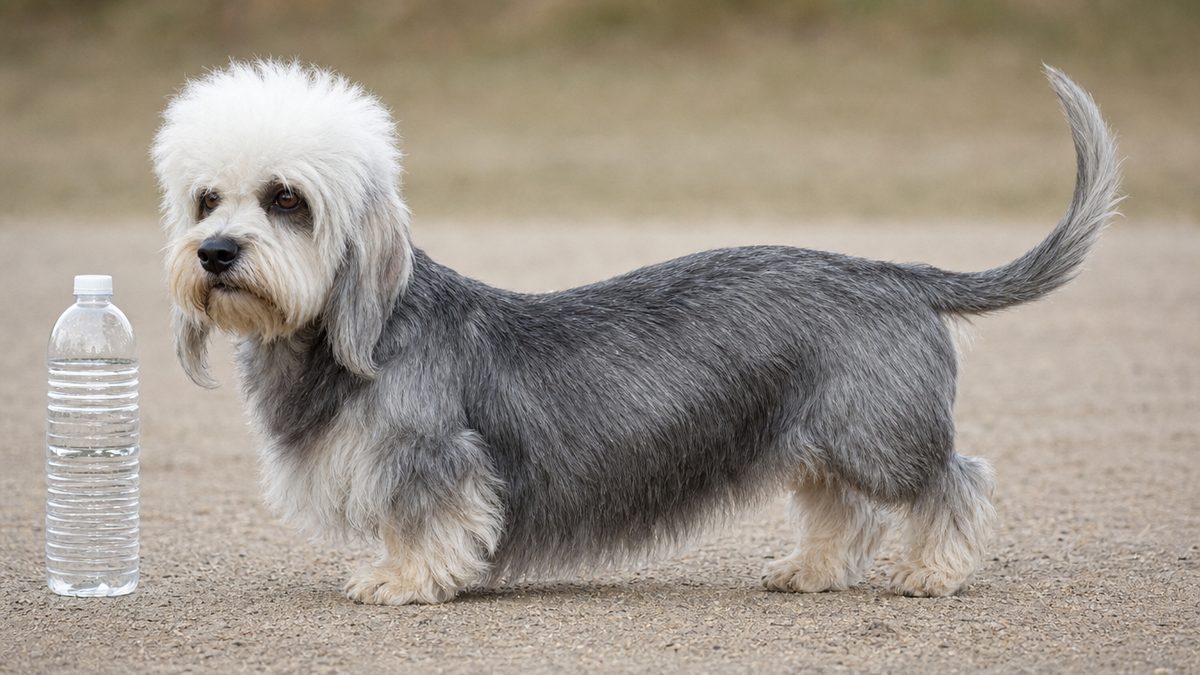
The Dandie Dinmont Terrier is a small British working terrier of 8 to 11 kg with a long low body, short heavily boned legs, a domed head under a silky white topknot, and a coat that comes in exactly two colours named after spices. The Federation Cynologique Internationale recognises it as standard 168 in Group 3, Section 2, small-sized terriers, on a definitive basis since 5 December 1955, with Great Britain as country of origin.
Every distinctive thing about this breed follows from one measurement. The Royal Kennel Club standard puts the height at 20 to 28 cm at the withers and states that the length from withers to root of tail should not be more than twice the height, but preferably 1 to 2 inches less. Run the arithmetic on a dog at the top of that height range and you get a body between about 51 and 53 cm long on legs 28 cm tall. Nothing else on this page, from the exercise advice to the flooring advice to the disc-disease genetics, is separable from that ratio.
The Federation Cynologique Internationale calls the outline weaselly, and the American standard describes it as long, low-stationed, with a curved outline and a continuous flow from the crest of the neck to the tip of the tail American Kennel Club. The topline is deliberately not straight. It sits rather low at the shoulder, dips slightly, then arches over the loin before dropping gradually to the tail root.
Pepper and mustard, and nothing else
The coat colour is one of two and the Royal Kennel Club marks every alternative unacceptable. A pepper dog ranges from dark bluish black to light silvery grey with intermediate shades preferable, carrying a profuse silvery white topknot and legs from rich tan to pale fawn. A mustard dog varies from reddish brown to pale fawn with a creamy white topknot and legs a darker shade than the head. Some white hair on the chest and white nails are permissible; white feet are undesirable.
The coat itself is about 5 cm long, a double coat with a soft linty undercoat and a harder topcoat that is not wiry but gives a crisp feel to the hand. The standard says the coat should not shed down the back but lie in pencils, caused by the harder hair coming through the softer undercoat. That pencilled texture is what hand stripping preserves and what clipping removes.
The head, and why the eyes matter later
The skull is broad and narrowing towards the eye, forehead well domed, covered in very soft silky hair that the standard is careful to say is not confined to a mere topknot. The eyes are rich dark hazel, set wide apart and low, described in all three standards as large for a small dog, bright, full and round but not protruding. Remember that description when you reach the eye section, because a large prominent eye in a breed with a documented drainage-angle problem is not a cosmetic detail.
The teeth get unusual attention for a small breed. All three standards call for a scissor bite and describe canines that are extraordinary in size for a small dog, meshing well against each other to give the greatest available holding and punishing power. That is a badger dog's dentition on a lapdog's frame.
What it was for
The breed was made to go to ground after otter and badger in the Teviotdale hills on the England and Scotland border, first recorded as a distinct type in the early 1700s. Working underground is why it needed a strong neck, strong jaws and a flexible body, and why the standard still asks for immense muscular development on short legs set wide apart. It is also why the American parent club's history page can quote a line from the 1815 novel that named it, in which the fictional owner says of his dogs that they now fear naething that ever cam' wi' a hairy skin on't.
8 to 11 kg, and the standard says the lower weights are preferred. Every risk on this page gets worse above the top of that band, and the owner controls that number more directly than any other.
Three breed standards, and the measurement one of them leaves out
Read all three standards for this breed and one difference stands out immediately: the Federation Cynologique Internationale standard prints a weight and no height at all, while the Royal Kennel Club and American Kennel Club texts both print a height and a body-length ratio. For a breed whose central health risk is body proportion, that omission is worth naming.
| Item | FCI standard 168 | Royal Kennel Club | American Kennel Club |
|---|---|---|---|
| Current text dated | 03.10.2017, valid standard 22.08.2017 | Last updated 1 April 2025 | Approved 9 February 1991 |
| Weight | 8 to 11 kg, lower weights preferred | 8 to 11 kg (18 to 24 lb), lower preferred | 18 to 24 lb preferred |
| Height at withers | Not stated | 20 to 28 cm (8 to 11 in) | 8 to 11 in at top of shoulders |
| Body length rule | Not stated | Not more than twice the height, preferably 1 to 2 in less | One to two in less than twice the height |
| Ear length | 7.5 to 10 cm | 7.5 to 10 cm (3 to 4 in) | 3 to 4 in |
| Tail length | 20 to 25 cm | 20 to 25 cm (8 to 10 in) | 8 to 10 in |
| Coat length | About 5 cm | About 5 cm (2 in) | About 2 in |
| Coat method named | None named | None named | Shortened by plucking |
| Dewclaws | If present, customarily removed | If present, customarily removed | Preferably removed on forelegs |
| Incisor count specified | No | No | Six per jaw, evenly spaced |
The height gap is real and it is checkable. The FCI text runs General Appearance, Head, Eyes, Ears, Neck, Body, Tail, Limbs, Gait, Coat, Colour, Weight, Faults, Disqualifying Faults, and there is no size or height clause anywhere in it. The word withers does not appear. So an owner or a judge working only from the FCI document has no published figure for how tall this dog should be, and no rule at all about how long its back may be relative to its legs.
Why that matters more here than on other breeds
Body length relative to height is the mechanical expression of chondrodystrophy, and chondrodystrophy is what carries the disc-disease risk in this breed. A standard that specifies weight but not proportion cannot restrain the one dimension that drives the risk. The British and American texts both cap it at just under twice the height, and both go further by preferring 1 to 2 inches less than that cap American Kennel Club. The FCI text does neither.
The dewclaw clause and Indian law
All three standards mention dewclaw removal, and in India that language collides with a rule. The FCI and Royal Kennel Club texts both say dewclaws, if present, customarily removed, and the American standard says dewclaws preferably removed on forelegs American Kennel Club. Second Schedule Part II paragraph 6(8) of the Prevention of Cruelty to Animals (Dog Breeding and Marketing) Rules 2017 reads that there shall be no tail docking, ear cropping, de-barking, de-clawing, branding, dyeing, injecting substances to enhance visual appeal, performing a surgery or procedure to camouflage or hide any defect or infirmity or any other kind of mutilation of any body part of the pup and any change of appearance by artificial means is strictly forbidden.
That is a genuine conflict rather than a technicality. A breeder in India following the standard's grooming-and-presentation custom would be doing something the Rules forbid by name. The practical answer is simple: leave the dewclaws on. No standard disqualifies a dog for having them, and all three phrase removal as customary or preferable rather than required.
The bite clause and the genetic-defect clause
Every one of the three standards demands a perfect, regular and complete scissor bite and calls any deviation highly undesirable. The American text adds a dentition count, six evenly spaced incisors in each jaw. Second Schedule Part III paragraph 8(10) of the same 2017 Rules requires that dogs shall have been tested for genetic defects, including hip dysplasia, progressive retinal atrophy, night blindness, hypothyroidism, entropion, ectropion, overshot, undershot jaw (when incisors do not touch or mesh), wry mouth, two or more missing teeth, unilateral cryptorchid or full cryptorchid males.
Here the standard and the law point the same way, which is worth saying because they often do not. A breeder meeting the American incisor requirement is already meeting the two or more missing teeth item in paragraph 8(10), and a breeder producing the required scissor bite is avoiding both the overshot and the undershot items.
The only dog breed named after a character in a novel
The Dandie Dinmont Terrier is named after a fictional farmer in Sir Walter Scott's Guy Mannering, published on 24 February 1815, and it is the only dog breed named after a character in literature. The dogs existed first and were called Pepper and Mustard terriers; the novel gave them the name they now carry.
The claim is unusually easy to check because the breed's own parent club states it flatly. The Dandie Dinmont Terrier Club of America opens its breed history with the sentence that the Dandie Dinmont is the only breed of dog named after a character in literature, and gives the publication date as 24 February 1815. In the novel a farmer named Dandie Dinmont owns six of these terriers and describes how he entered them, first to rats, then to stoats and weasels, then to foxes and badgers.
Scott named the dogs by colour in the book, Pepper and Mustard, and those two words became the breed's only two permitted coat colours, which is why a Royal Kennel Club standard written in 2025 still uses a novelist's vocabulary for a colour chart.
Two registries, two different stories about James Davidson
The registries disagree about whether a real farmer was behind the character, and we print both rather than choosing. The Royal Kennel Club states that in the novel Scott modelled the character Dandie Dinmont on a neighbouring farmer who owned terriers called Pepper and Mustard, that local readers recognised the farmer James Davidson and teased him with the nickname, and that the terriers took their name from there.
The Dandie Dinmont Terrier Club of America contradicts that directly. Its history says a rumour persisted that Scott's description was inspired by James Davidson, but that the novelist confirmed his character was based on a composite of the hardy Liddesdale farmers he had met, and adds a dating argument: Davidson did not meet Scott until a year after Guy Mannering was published. On the club's account, Davidson acquired the nickname because he named all his dogs Pepper or Mustard and supplied the market Scott's book had created.
Both are primary breed authorities and they cannot both be right. What survives the disagreement is the part that matters for the claim: on either account the breed took its name from the printed character rather than from the man, because on the Royal Kennel Club's version the nickname reached Davidson from readers of the novel, and on the club's version he never inspired it at all Dandie Dinmont Terrier Club of America.
What the book did to the dogs
The novel created demand. The breed had been held tightly within Borders families, including the Allan family who had bred them pure since the mid 1700s, and became sought after for hunting once Scott's writing spread. The British Dandie Dinmont Terrier Club followed in 1875, described by the American club as the second oldest breed club in the world, and the American Kennel Club admitted the breed to its Terrier Group in 1886, two years after the AKC itself was founded.
There is a modern coda that Indian readers will not find on the ranking pages. In February 2015 the Duke of Buccleuch, chief of Clan Scott, gave his blessing for the breed to adopt the black and white Sir Walter Scott tartan, which the Royal Kennel Club describes as making the Dandie Dinmont the only breed with permission to wear an official Scottish clan tartan.
The literary-origin claim is one of the few things repeated about this breed that survives verification. It is stated by the AKC parent club in its own words, it has a specific date attached, and the two permitted coat colours are direct evidence of it.
A vulnerable native breed, with the actual registration numbers
The Dandie Dinmont Terrier is classified by the Royal Kennel Club as a vulnerable native breed, and its own breed page prints the answer in one word: Vulnerable native breed, Yes. The scheme covers breeds of British and Irish origin with fewer than 300 registrations a year, with a separate At Watch list for breeds recording between 300 and 450.
Those two thresholds are the Royal Kennel Club's own words, not a summary of them. Its vulnerable native breeds page states that in order to protect those breeds of British and Irish origin that are considered at risk of disappearing, it created the vulnerable native British and Irish breeds list, breeds with fewer than 300 registrations a year, and the At Watch list, breeds with between 300 and 450 registrations a year, so that it can monitor them. The current sheet carries 39 breeds on the vulnerable list and 8 on the At Watch list.
This breed has never been near either boundary. Here is the full ten-year run, taken from the club's own downloadable statistics sheet and cross-checked against the same table published on its website.
| Year | Registrations | Against the 300 threshold |
|---|---|---|
| 2016 | 91 | 70 percent below |
| 2017 | 130 | 57 percent below |
| 2018 | 145 | 52 percent below, the ten-year peak |
| 2019 | 109 | 64 percent below |
| 2020 | 87 | 71 percent below |
| 2021 | 124 or 123, see below | 59 percent below |
| 2022 | 112 | 63 percent below |
| 2023 | 102 | 66 percent below |
| 2024 | 81 | 73 percent below, the ten-year low |
| 2025 | 88 | 71 percent below |
Across the decade the Royal Kennel Club registered 1,068 Dandie Dinmont Terrier puppies in total. In 2025 alone it registered 5,375 Staffordshire Bull Terriers, so the breed's entire ten-year output is roughly ten weeks of Staffordshire Bull Terrier registrations.
Where it sits among the terriers
Rank it inside its own group and the picture sharpens. Of the 27 terrier breeds in the Royal Kennel Club's ten-year comparative table, this one recorded the seventh-lowest 2025 figure at 88, above the Manchester Terrier at 74 and below the Smooth Fox Terrier and Soft Coated Wheaten Terrier, both at 92. The Cairn Terrier, a comparable short-legged terrier, recorded 447. The Border Terrier recorded 3,181.
The trend is genuinely downward but not collapsing. From the 2018 peak of 145 to 2025's 88 is a fall of 39.3 percent, while 2025 against 2016's 91 is a fall of only 3.3 percent, so most of the decline is the reversal of a mid-decade rise rather than a long slide.
Two Royal Kennel Club documents, one dog apart
The same organisation publishes this breed's 2021 figure twice and the two do not match. The 10 year Vulnerable Breed Stats sheet and the vulnerable native breeds web page both print 124; the Terrier group comparative registrations table prints 123 The Royal Kennel Club. Every other year in the run is identical across all three documents.
One dog in 2021 changes nothing about the breed's status and we would not mention it except that it is a live example of why a single figure from a live register should never be quoted as though it were fixed. The same extraction found a second inconsistency in the terrier table: the printed 2023 group total of 18,211 exceeds the sum of the 27 printed breed rows by two dogs, while the other nine annual columns sum exactly to their printed totals. Twenty of those 27 rows for 2023 were independently confirmed against the club's vulnerable breeds table.
A pedigree analysis of all 215 Kennel Club breeds over 1980 to 2014 names this breed first in a short list of numerically smaller breeds whose rate of inbreeding and effective population size look sustainable, attributing it to effective management of genetic diversity and noting only a slight departure from random mating. Small does not automatically mean genetically damaged, and on the published evidence this breed is a case in point.
Dandie Dinmont Terrier price in India, and why no honest figure exists
There is no verified Dandie Dinmont Terrier price in India, because on 27 August 2026 no Indian seller was offering one. The correct answer to the price question is that the market does not exist, and every rupee figure currently circulating for this breed can be traced to something other than a dog being sold.
Start with the page Google ranks first. Searching dandie dinmont terrier price in india from India returns Mr n Mrs Pet's page headed Dandie dinmont Puppies For Sale, which prints 3 Result Found. Those three results sit under a heading reading Similar breeds at other locations, and on the day we checked they were a Border Collie named Loki in Ahmedabad, a Border Collie named Griff in Gurgaon and a Bernese Mountain Dog named LAMBO in Ahmedabad. There is no Dandie Dinmont Terrier on the page and no price on the page: every View Price link routes to a sign-up form.
The same site publishes a Most Popular Breeds counter listing Shih Tzu at 650 listings, Siberian Husky at 549, Golden Retriever at 487, Labrador Retriever at 454 and German Shepherd at 412. That is what an actual Indian market for a breed looks like as a number. This breed appears nowhere on it.
Google's AI Overview quotes a price its own source does not contain
Google India's AI Overview for this query opens by stating that a Dandie Dinmont Terrier puppy generally costs between Rs 75,000 and Rs 1,50,000+ in India, and cites Mr n Mrs Pet. The cited page contains no rupee figure for this breed, no dog of this breed, and hides even its Border Collie prices behind a login. The AI Overview adds that litters are very uncommon in India, often requiring special import or elite specialised breeders, which is closer to the truth than its own number.
So the most visible price for this breed in India is generated text attached to a page that could not have supported it. An Indian buyer reading the top of the results page takes away a specific two-lakh-scale expectation with nothing behind it.
What the rest of the results page offers instead
| Position | Source | Price stated | Currency |
|---|---|---|---|
| AI Overview | Google, citing Mr n Mrs Pet | Rs 75,000 to Rs 1,50,000+ | INR, unsupported |
| 1 | mrnmrspet.com | None printed | None |
| 2 | emma.ca | $1,000 to $2,500 | USD |
| 3 | flipkart.com | A notebook, not a dog | INR, wrong product |
| 4 | justdial.com | None printed | None |
| 5 | dogbreedslist.info | $1,500 to $3,000 | USD |
| 6 | petfinder.com | None printed | None |
| 7 | supertails.com | Breed not in its 40-breed list | INR, other breeds |
| 8 | gooddog.com | $3,000 to $3,500 | USD |
| 9 | thestar.com | None printed | None |
| 10 | hillspet.com | None printed | None |
Three of the ten quote US dollars, from a Quebec insurance site, an American breed-list site and an American breeder marketplace Dogbreedslist.info, Dandie Dinmont - Price Good Dog, Dandie Dinmont Terrier puppies…. The third organic result is a Flipkart listing for the Dandie Dinmont Terrier February Notebook, a paper diary. The fourth is a Justdial category page headed Top Pet Shops For Dandie Dinmont Terrier Dog in Kolkata whose first named listing sits in Delhi.
Supertails, an Indian retailer, publishes a Dog Price List in India covering the top 40 breeds and giving a national range of Rs 2,000 for an indie up to over Rs 1,50,000 for a KCI-registered show-quality dog. Its 40 breeds do not include this one, which is a more honest answer than the AI Overview managed.
The remaining results simply do not address the query. Hill's Pet Nutrition holds tenth place with an American breed profile carrying no price and no India content at all, and Petfinder at sixth is a US adoption directory whose only price statement is that adopting costs significantly less than buying from a breeder. Neither is a bad page. They are just answering a different question from the one an Indian buyer typed.
If any Indian seller quotes you a Dandie Dinmont Terrier price, ask to see the dog, the pedigree and the import paperwork before anything else. There is no lawful commercial import route for this breed into India, so a seller with stock has a document problem they will need to explain.
Testing the rupee figures, and the page that is about a different dog
Test every rupee figure attached to this breed and none of them survives. Two are worth showing the working on, because the two failure modes are different and an Indian reader can run both checks in a calculator.
Indian pages routinely publish a dog price that is really a US dollar figure run through one exchange rate. The strong test on this site is division by 84.38, with 74.00 and 66.67 as secondary rates. Division by 80 is a weak test, because 1,000 divided by 80 is 12.5, so any rupee figure ending in three zeros passes by construction.
| Figure | Rupees | /84.38 | /74.00 | /80.00 | /66.67 |
|---|---|---|---|---|---|
| AI Overview, low end | 75,000 | 888.84 | 1,013.51 | 937.50 | 1,124.94 |
| AI Overview, high end | 1,50,000 | 1,777.67 | 2,027.03 | 1,875.00 | 2,249.89 |
| happypet.care, cost of buying low | 15,000 | 177.77 | 202.70 | 187.50 | 224.99 |
| happypet.care, cost of buying high | 35,000 | 414.79 | 472.97 | 437.50 | 524.97 |
| happypet.care, monthly basic | 2,200 | 26.07 | 29.73 | 27.50 | 33.00 |
| happypet.care, monthly premium | 3,750 | 44.44 | 50.68 | 46.88 | 56.25 |
Exactly one of those 24 cells lands on a whole number, and it is the weak one: Rs 1,50,000 divided by 80 is USD 1,875. No seller anywhere prices a dog at 1,875 dollars, and the low end of the same band fails the same test at 937.50. The figures are therefore rupee-native and arbitrary rather than converted, which is a different contamination mechanism and needs saying differently.
The cross-check settles it. If the AI Overview's band were a conversion of emma.ca's $1,000 to $2,500, the implied rates would be 75.0 at one end and 60.0 at the other, and a band that cannot hold one rate across its own two ends was not produced by conversion. Against gooddog.com's $3,000 to $3,500 the implied rates are 25.0 and 42.9. Meanwhile dogbreedslist.info's $1,500 to $3,000 converted at 84.38 would be Rs 1,26,570 to Rs 2,53,140, which sits above the AI Overview's own band rather than inside it.
The only rupee price for this breed sits on a page about another breed
Search for rupee figures for this breed in India and the one substantive result is happypet.care, at a URL ending danish-swedish-farmdog. That page carries an H1 reading Danish-Swedish Farmdog, two origin flags for Denmark and Sweden, and three photographs of Danish-Swedish Farmdogs. Its body text is about a different dog entirely.
- The overview heading reads Overview of the Dandie Dinmont Terrier.
- The price heading reads Adopt/Shop and Price of Dandie Dinmont Terrier Breed, above Rs 15,000 to Rs 35,000.
- The nutrition heading reads Nutrition Guide for the Dandie Dinmont Terrier.
- The grooming heading reads Grooming for Dandie Dinmont Terrier.
- All four FAQ entries ask about Dandie Dinmont Terriers.
- But the health heading reverts to Healthcare Tips for your Danish-Swedish Farmdog.
That last line is the damaging one. The health section lists bloat, hip dysplasia, parasites, parvovirus, heartworm, Lyme disease, kennel cough and panosteitis, and mentions neither intervertebral disc disease nor glaucoma, the two conditions that define this breed. So an Indian reader arriving from a price search reads a health section about a Scandinavian farm dog while being told it is about a Scottish Borders terrier.
This is not an obscure page. On 27 August 2026 every image in Google India's image block for this query came from that same happypet.care page, captioned Dandie Dinmont Terrier Breed Expert Guide. Its Rs 15,000 to Rs 35,000 must not be reported as a Dandie Dinmont Terrier price, and its ideal-weather band of 10 to 25 C is likewise attached to the wrong animal.
Take any rupee dog price you are shown and divide it by 84.38, then by 74. If a whole, plausible dollar figure falls out, you are looking at a converted American price list. If nothing divides cleanly and the quotients are numbers no shop would print, the figure was typed rather than sourced. Either way it is not evidence of what a dog costs in your city.
Import law, and why no lawful supply chain can form in India
Import of dogs into India is Restricted and is permitted for only three purposes, none of which is buying or selling a puppy. That single fact explains the empty Indian market for this breed more completely than rarity does, because even a wealthy buyer has no legal channel.
The governing instrument for the commercial and restricted route is the Directorate General of Foreign Trade's Trade Notice No. 22/2022-23, dated 19 December 2022. It records dogs under ITC (HS) 01061900, Mammals: Other, with an import policy of Restricted subject to Policy Condition 6 of that chapter.
Policy Condition (7) of the same notice states that import of dogs is allowed only for the following specific purposes: a pet dog with a valid pet book and relevant records or documents in the name of the importer; dogs imported by research and development organisations for conducting research with the recommendation of CPCSEA; and for internal security by the Defence and Police Force. Policy Condition (8) adds that import of commercial dogs for breeding or any other commercial activities other than the purposes mentioned above is not permitted.
Paragraph 6 of the notice is blunter still. It states that any applications for trading or breeding purposes, or applications made on behalf of some another person or entity, shall be duly rejected.
What the pet route actually requires
Permanent import as passenger baggage without an import authorisation from the DGFT is available only to persons transferring their residence to India after two years of continuous stay abroad, and only cats and dogs may be imported under baggage rules. An import authorisation is required if the stay abroad was under two years, if the pet is not travelling as passenger baggage, or if more than two pets are involved.
- Vaccination book, pet passport or pet book, plus a certificate for emotional support and the pet's own passport, for a permanent import.
- An application on ANF-2M against the importer's IEC, or against the standing IEC IIHIE0153E for persons importing for personal use.
- At least two months' lead time before travel, which the notice itself advises.
- An advance No Objection Certificate from the Regional Officer or Quarantine Officer of the arrival port, obtained seven days before travel and relaxable to three.
- Arrival through one of seven named ports: Delhi, Mumbai, Chennai, Hyderabad, Bengaluru, Kolkata or, since October 2024, Kochi. The full route is set out in how to import a dog to India.
Read those together and the conclusion is unavoidable. The only lawful way this breed enters India is inside the baggage of a person who already owned the dog abroad and is moving here. It cannot be ordered, cannot be bred to order, and cannot be imported on someone else's behalf.
Recognition, and the Indian registry question
FCI recognition answers the India question because India is an FCI member country, listed in the FCI's own members register. The breed is recognised by the FCI on a definitive basis as standard 168, accepted 5 December 1955, so a pedigree issued against FCI nomenclature covers it.
Do not read anything into an absence from an Indian registry search. The Kennel Club of India publishes no public breed list at all, so a query there returns nothing for this breed and nothing for any control breed either. That is a broken instrument, not a finding, and it must not be reported as the breed being unrecognised in India.
If a seller in India has a Dandie Dinmont Terrier, ask which of the three permitted purposes in Policy Condition (7) their import fell under and to see the pet book in the original importer's name. There is no fourth answer available under the notice.
What this dog actually costs to keep in an Indian city
Budget for a small dog's running costs plus two breed-specific line items that most small-dog budgets do not carry: a repeating specialist eye examination and a realistic reserve against spinal disease. The purchase price is unknowable, so this section deals only with what is knowable.
We do not publish a monthly cost total in rupees for this breed, because we have no verified Indian cost data for it and the one Indian page carrying a monthly cost for a Dandie Dinmont Terrier is published under a Danish-Swedish Farmdog URL. What we can do is set out the cost structure honestly and tell you which lines are unusual.
The ordinary lines
Food, routine vaccination, deworming, tick and flea control, and monthly grooming are the same as for any 8 to 11 kg dog in your city, and the market rates for those are set locally rather than by breed. A dog at the standard's preferred lower weight of 8 kg eats meaningfully less than one at 11 kg, which is one of several reasons the standard's preference is worth respecting.
The first unusual line: gonioscopy, repeated
This breed needs a specialist eye examination that most Indian small-dog owners never book. The Royal Kennel Club Health Standard names the pre-breeding test for the Dandie Dinmont Terrier as eye testing and gonioscopy for pectinate ligament abnormality under the BVA, Royal Kennel Club and ISDS Eye Scheme, and specifies that gonioscopy should be repeated every three years because the disorder is progressive.
Gonioscopy is not a routine consult. It needs a veterinary ophthalmologist with a goniolens and a slit lamp, which in India means a referral practice in a metro rather than a neighbourhood clinic. Budget for travel as well as the examination, and budget for it three times per decade rather than once.
The second unusual line: a spinal reserve
Set money aside against disc disease rather than hoping. The published surgical series of 569 intervertebral disc disease cases had a median age at surgery of 6.4 years with an interquartile range of 4.6 to 8.8 years, so this is a mid-life expense rather than an old-age one. Advanced imaging and decompressive surgery are available in Indian metros at referral hospitals, and they are among the more expensive procedures in small-animal practice anywhere.
The reason this line exists for this breed and not for a Cairn Terrier is genetic rather than anatomical, and it is covered in full further down: an allele frequency of 0.88 for the chondrodystrophy variant against zero in the Cairn.
Insurance, and what to check before you buy it
Pet insurance now exists in India but breed-specific exclusions matter more here than for a common breed. Read the policy for exclusions covering hereditary and congenital conditions, spinal conditions, and any waiting period on orthopaedic or neurological claims, because those are precisely the categories this breed's two documented risks fall into.
Weight. The standard prefers the lower end of 8 to 11 kg, and the surgical series' median body weight at disc surgery was 8.6 kg. Keeping a Dandie at 8 kg rather than 11 kg costs nothing and is the single most useful thing an owner can do for the spine.
Heat tolerance, measured against the place the breed comes from
The Dandie Dinmont Terrier is a poor fit for Indian heat, and the size of the mismatch is measurable rather than impressionistic. Hawick, in the Scottish Borders country where the breed was made, has an annual mean temperature of 7.81 C. Chennai's annual mean is 27.95 C.
We queried NASA POWER's climatology dataset by explicit latitude and longitude for six Indian metros and for Hawick, and every response returned the coordinates we asked for, so no substitute location could have been served. The comparison below is the breed's origin climate against the cities Indian buyers actually live in.
| Location | Annual mean C | Hottest month mean C | Coolest month mean C | Annual mean RH % |
|---|---|---|---|---|
| Hawick, Scottish Borders (55.42N, 2.79W) | 7.81 | 14.13 (July) | 2.51 (January) | 89.9 |
| Bengaluru (12.97N, 77.59E) | 23.74 | 28.37 (April) | 20.22 (December) | 67.9 |
| Pune (18.52N, 73.86E) | 23.86 | 28.93 (April) | 19.62 (December) | 66.8 |
| Delhi (28.61N, 77.21E) | 25.60 | 35.88 (June) | 13.61 (January) | 45.6 |
| Kolkata (22.57N, 88.36E) | 25.81 | 31.53 (May) | 17.31 (January) | 73.9 |
| Mumbai (19.08N, 72.88E) | 26.77 | 31.19 (May) | 23.19 (January) | 67.4 |
| Chennai (13.08N, 80.27E) | 27.95 | 31.51 (May) | 24.09 (January) | 72.4 |
The line that settles it is not the annual mean. Chennai's coolest month, at 24.09 C, is nearly ten degrees warmer than Hawick's hottest month at 14.13 C. A dog carrying a double coat with a soft linty undercoat, evolved where the warmest month averages fourteen degrees, spends every day of the Chennai year above the top of its ancestral range.
Even Bengaluru, the mildest option, does not rescue it. Bengaluru's coolest month averages 20.22 C, still 6.1 C above Hawick's hottest. There is no Indian metro in this dataset with a month cool enough to match a Borders summer.
The humidity finding is the opposite of what people expect
Hawick is more humid than any Indian city in this comparison, at an annual mean relative humidity of 89.9 percent against Chennai's 72.4 and Mumbai's 67.4. So the coat did not evolve in a dry place, and humidity by itself is not the novelty here.
What is novel is the combination. Mumbai in August runs 26.05 C at 90.4 percent relative humidity, and Pune in August runs 23.30 C at 90.8 percent. That is Hawick's winter humidity delivered at a summer temperature the breed never encounters at home, and high humidity is precisely what blunts evaporative cooling from panting, which is a dog's main heat-loss route.
City by city, in one line each
- Bengaluru and Pune are the least bad, with annual means of 23.74 C and 23.86 C, and a genuine cool season in December.
- Delhi is the widest swing: 13.61 C in January against 35.88 C in June, so a coat plan that works in winter is wrong by April.
- Mumbai never gets cool, with a coolest month of 23.19 C, and adds the monsoon humidity spike.
- Kolkata pairs a 31.53 C May with 89 percent September humidity.
- Chennai is the hardest posting in this list on both axes at once.
The standard specifies a coat about 5 cm long with a soft linty undercoat under a harder topcoat. Shaving a double coat does not make a dog cooler in a reliable way and removes the sun protection the topcoat provides. Manage heat with timing, water, airflow and indoor cooling rather than with clippers.
Temperament, and who should not buy this breed
The Dandie Dinmont Terrier is described in all three breed standards with the same seven words: independent, highly intelligent, determined, persistent, sensitive, affectionate and dignified. Read that list in order, because independent and determined come before affectionate, and the order is not accidental.
The Royal Kennel Club and the Federation Cynologique Internationale use that exact sequence, and the American standard shortens it to independent, determined, reserved and intelligent while adding that the breed combines an affectionate and dignified nature with tenacity and boldness in a working situation American Kennel Club. Note the word reserved in the American text. This is not a dog that greets strangers indiscriminately.
The parent club calls it the gentleman of the terrier group and quotes a description that names responsiveness as the trait that endears it most, contrasted against the indifference of certain breeds. That is a fair characterisation of a dog that is genuinely attached to its household while remaining self-possessed about everyone else.
What the working history predicts
The breed was made to go to ground against badger and otter, and that history sets the prey drive. In an Indian city that means squirrels, rats, cats and the street dogs beyond your gate all register as targets. A dog with a badger dog's dentition and a terrier's persistence is not going to be talked out of a chase by a recall you taught casually.
It also predicts the bark. A dog bred to work underground and be located by sound has a deep, carrying voice that surprises people who expect a small dog to yap. In a shared-wall apartment that matters, and it needs managing from the first week rather than the first complaint.
Household fit, honestly
- Good fit: an adult household or a family with older children, in a flat, wanting one deeply attached dog rather than a sociable one.
- Good fit: an owner who enjoys a dog with opinions and will train rather than command.
- Poor fit: a home with toddlers who pick dogs up, because of the back rather than the temperament.
- Poor fit: a household wanting a dog that is friendly with every visitor on sight.
- Poor fit: anyone who wants a low-maintenance coat and has not decided between clipping and hand stripping.
- Poor fit: an owner in Chennai or Mumbai who cannot provide indoor cooling through the hot months.
The most important line in that list is the toddler one, and it is worth being explicit about why. A child lifting a long-backed dog by the front legs leaves the whole rear half of the body hanging unsupported from a spine that is already the breed's structural weak point. Teach the two-handed lift, one hand under the chest and one under the hindquarters, to every person in the house before the dog arrives.
With other dogs and with cats
Expect same-sex friction, and socialise the puppy to cats deliberately rather than assuming it will tolerate them. Terriers bred to work alone underground are not naturally deferential, and this one is described as determined and persistent by its own standard. A puppy raised with a resident cat from eight weeks usually settles; an adult introduced to one usually does not, and pushing it is unfair to the cat. Socialise it to lift traffic, society gates and street noise on the same schedule.
A dog that is affectionate at home and reserved outside is well suited to Indian apartment corridors, lifts and society gates, where a dog that greets everybody is a nuisance and a dog that greets nobody is a liability. Reserved and non-reactive is the target, and it is reachable with early socialisation.
Training a determined terrier, and the one command that is medical
Train this breed with short, high-value, reward-based sessions and expect negotiation rather than obedience. The standard's own adjectives, independent, determined and persistent, describe a dog that learns a cue quickly and then decides case by case whether the cue is worth obeying.
That is a terrier trait and not a defect. The useful mental model is that you are not installing commands, you are making your instruction more rewarding than the alternative the dog was already considering. Punishment-based correction works poorly on a dog the standard describes as sensitive, and it damages the responsiveness the breed is admired for.
A realistic timeline
| Age | Priority | Why now |
|---|---|---|
| 8 to 12 weeks | Name, handling, crate, toilet | The socialisation window is open and handling tolerance is what makes later eye examinations possible |
| 10 to 16 weeks | Off, and a furniture boundary | Habits about sofas and beds set now and are hard to reverse later |
| 3 to 5 months | Recall on a long line, settle on a mat | Prey drive sharpens as the dog matures; recall built before it is worth ten times recall built after |
| 4 to 8 months | Ramp use, in and out, on cue | A ramp the dog already likes is used; a ramp introduced after a back episode is not |
| 6 to 12 months | Loose lead in a harness, not a collar | A harness spreads load across the chest instead of pulling the neck of a long-backed dog |
| Any age | Voluntary chin rest and eye handling | Gonioscopy every three years is far easier on a dog trained to hold still for the face |
The command that is actually medical
Teach off before you teach anything impressive. In a long-backed chondrodystrophic dog, a jump down from a sofa is a repeated impact through a lumbar spine whose discs degenerate prematurely, and the retrogene responsible acts in a dominant manner to lower the age at which surgery becomes necessary. A dog that reliably waits to be lifted, or uses a ramp, has had a mechanical risk removed from its daily routine.
The second medical command is a calm stand and chin rest for handling. Gonioscopy involves a goniolens placed on the cornea with coupling gel and a handheld slit lamp at ten-fold magnification, on a conscious dog. A dog that has practised being still while its head is held from eight weeks makes that examination possible; one that has not may need sedation every three years for the rest of its life.
Two mistakes worth naming
Do not train through jumping games. Agility jumps, catch-the-ball-in-the-air and stair repetitions are all fine exercise for a square dog and all wrong for this one. Substitute scentwork, which suits a dog bred to hunt underground, uses the same mental energy, and loads nothing.
Do not use a collar for lead work. A harness that sits across the chest is standard advice for small dogs generally, and for a breed whose defining feature is a long flexible body it removes a twisting load from the neck and forequarters every time the dog pulls.
Exercise, and what happens on both sides of the right amount
Give this breed up to an hour of daily exercise split across two or more sessions, which is the Royal Kennel Club's own figure for it. The unusual part is not the quantity but the shape: the same dog that needs a genuine terrier's worth of activity must avoid the jumping, stair-climbing and twisting that most owners use to deliver it.
The Royal Kennel Club's breed characteristics panel gives exercise as up to one hour per day, with size of home listed as a small house and size of garden as small to medium. That is achievable in an Indian flat, and it is achievable without a garden, provided the substitutions below are made.
What under-exercising produces
Expect barking, digging at furniture, chewing and general household destruction from an under-exercised terrier, because the breed was selected for persistence in the face of a badger and that persistence does not evaporate indoors. A bored terrier is not a passive animal.
What the wrong kind of exercise produces
Repeated jumping, stair work and hard turns on smooth flooring load the lumbar spine of a dog whose discs are genetically primed to degenerate early. Two dogs getting the same hour a day can face very different risk depending on whether that hour was walking on grass or leaping off a bed forty times.
| Instead of | Do this | What it protects |
|---|---|---|
| Fetch with a thrown ball | Rolled ball along the ground, or a flirt pole kept low | Removes the airborne landing and the twist on landing |
| Stair repetitions | Two extra ground-level walks | Removes the single highest-frequency spinal load in a flat |
| Jumping on and off the sofa | A ramp, trained as a game | Removes forty impacts a day |
| Agility jumps | Scentwork and food puzzles | Same mental tiredness, no impact |
| Rough play with a larger dog | Structured play with a similar-sized dog | Removes body-slam and shake injuries |
| Midday walk in May | 05:30 and post-sunset walks | Removes the heat load, see the climate section |
Timing in Indian conditions
Walk before sunrise and after dark through the hot months, not because that is generic advice but because of what the numbers say for this specific dog. Chennai's May mean is 31.51 C, Delhi's June mean is 35.88 C, and Hawick's warmest month averages 14.13 C. Midday exercise in an Indian summer is not a small mistake for a heat-sensitive double-coated breed.
Carry water on every walk and offer it before the dog looks like it needs it. Watch for the early signs, which are a widening tongue, a lowering head, slowing pace and a dog that starts seeking shade rather than following you.
Puppies and seniors
Restrict a puppy to about five minutes of formal walking per month of age, twice a day, until growth plates close, and keep stairs out of the routine entirely for the first year. For seniors, keep the walks and drop the intensity, because a dog that stops moving loses the muscle along the spine that supports it, and that muscle is doing real work in this breed.
Grooming a plucked coat in a country that clips
Brush this coat twice a week and decide early whether you will hand strip it or clip it, because the American standard says the body coat is shortened by plucking and almost no Indian salon offers that service. Clipping is legal, painless and available everywhere, and it permanently changes the coat the standard describes.
The coat is a double coat about 5 cm long, with a soft linty undercoat under a harder topcoat that is not wiry but gives a crisp feel to the hand, and it should lie in pencils rather than shed down the back. The American text is more specific still: the body coat is about two thirds hardish hair and one third soft hair, and it is shortened by plucking.
What plucking and clipping actually do
Hand stripping removes the dead topcoat hair from the follicle, so the new hair that grows in is hard and the pencilled texture is maintained. Clipping cuts the hair off above the follicle, leaving the dead topcoat in place, so over successive clips the undercoat comes to dominate and the coat becomes softer, denser and often duller in colour. Neither hurts the dog. Only one preserves what the standard describes.
For an Indian owner this is a genuine decision rather than a technicality, because hand stripping is a specialist skill offered by very few salons in Indian metros. Ask before you commit to the breed, not after the first appointment, and be prepared to learn to do it yourself with a stripping knife if no local provider exists.
A weekly routine that works in Indian humidity
- Brush twice a week with a slicker and a comb, working the topknot, the ear feather and the leg feather separately from the body coat.
- Check the ears every week, because the standard describes pendulous ears hanging close to the cheek, which is the shape that traps warm moist air.
- Dry the ears deliberately after every bath and every monsoon walk, using a towel and then a cool dryer setting rather than letting the dog air dry.
- Bathe roughly monthly, or more in the monsoon, and never leave the dog damp under a fan in a humid room.
- Trim the hair around the eyes only enough to keep it out of them, remembering that the topknot is a breed characteristic and not stray hair.
- Strip or clip the body coat on whatever cycle your chosen method needs, typically every eight to twelve weeks.
Where overseas grooming advice does not transfer
Overseas breed guidance routinely tells owners to towel a dog and let it air dry, which is sound in a British climate and wrong in an Indian monsoon. A drop-eared dog left damp in 90 percent August humidity in Mumbai or Pune is being given the exact conditions that favour otitis externa. Dry the ear canal opening and the folds under the ear deliberately, every time.
Shedding, and the hypoallergenic claim
The Royal Kennel Club's breed page prints Sheds: No, and the standard says the coat should not shed down the back The Royal Kennel Club. Neither statement is about allergens. A ranking page in the Indian result set prints Hypoallergenic: Yes for this breed, and that claim has no measurement behind it.
The controlled study measured Can f 1, the major dog allergen, across 196 dogs of so-called hypoallergenic breeds against 160 control dogs and found the hypoallergenic group had higher levels in hair, at a geometric mean of 2.26 micrograms per gram against 0.77, and in coat samples, at 27.04 against 12.98, with no difference in airborne levels. Its conclusion is that there is no evidence for the classification of certain dog breeds as being hypoallergenic. The breeds tested were the Labradoodle, Poodle, Spanish Waterdog and Airedale Terrier, so this breed was not measured in either direction, and nobody has published a figure for it.
An Indian buyer paying a premium for a supposedly allergy-safe dog is buying an unmeasured claim. If someone in the household is allergic to dogs, spend time with the individual dog before committing, because the study found differences between breeds were small relative to the variability within a breed.
Health: the body shape is the health story
This breed's two documented health concerns are intervertebral disc disease and primary closed-angle glaucoma, and the first of them is a direct consequence of the shape the standards describe. A long back on short legs is not a cosmetic choice in dogs; it is a specific developmental condition called chondrodystrophy with a known genetic cause and a measured disease risk.
Chondrodystrophy means the long bones stop growing early because the growth plates close prematurely, producing short curved legs, and it comes bundled with premature degeneration of the intervertebral discs. In chondrodystrophic dogs the disc's soft central nucleus is replaced early by cartilage-like tissue that calcifies, so a disc can rupture suddenly in a young adult rather than wearing out slowly in old age.
That bundling is not a coincidence, and since 2017 it has had a named cause. A retrogene copy of the FGF4 gene inserted on canine chromosome 12 is responsible for chondrodystrophy across dog breeds, including the predisposition to Hansen type I intervertebral disc disease, with an odds ratio above 50.
What the standards say about the shape
The Royal Kennel Club puts the height at 20 to 28 cm at the withers and the length from withers to root of tail at not more than twice the height, preferably 1 to 2 inches less. The American standard states the same relationship the other way round, giving the length as one to two inches less than twice the height. The Federation Cynologique Internationale standard prints neither figure.
So the breed is deliberately built at close to a two-to-one length-to-height ratio, and the two standards that constrain it do so only at the top end. Nothing in any of the three texts sets a minimum leg length.
What Indian law requires to be tested
Second Schedule Part III paragraph 8(10) of the Prevention of Cruelty to Animals (Dog Breeding and Marketing) Rules 2017 sets out a genetic-defect testing requirement, and it is worth reading in full because it names conditions relevant to this breed. It reads that the dogs shall have been tested for genetic defects, including hip dysplasia, progressive retinal atrophy, night blindness, hypothyroidism, entropion, ectropion, overshot, undershot jaw (when incisors do not touch or mesh), wry mouth, two or more missing teeth, unilateral cryptorchid or full cryptorchid males.
Two things follow. The word is including, so the list is illustrative rather than closed, and a defect is not outside the clause merely because it is unlisted. And the clause names hip dysplasia, entropion and ectropion explicitly, so an Indian breeder of any breed must have tested for those three.
What paragraph 8(10) does not name is the spine. Across all fourteen pages of the gazette, the words patella and luxation appear zero times, dental appears zero times, and BAER and deaf appear zero times. There is no Indian legal requirement to screen a breeding dog's back, which matters more for this breed than for almost any other on this site.
The disc-disease evidence is strong, quantitative and breed-specific. The glaucoma evidence is a single genome-wide study with real numbers but a small clinical sample. Both are covered separately below with their denominators printed, so you can see how much weight each one carries.
Intervertebral disc disease, and the terrier comparison nobody prints
The Dandie Dinmont Terrier carries the CFA12 FGF4 retrogene, the variant responsible for chondrodystrophy and Hansen type I intervertebral disc disease, at an allele frequency of 0.88 across 28 genotyped dogs. That is the highest figure recorded for any terrier in the published table, and it is the reason this breed has a disc problem while the equally short-legged Cairn Terrier does not.
The genotype data is worth showing rather than summarising, because the counts are small and a reader should see exactly what the number rests on.
| Breed | Dogs | CFA12: 0 copies | 1 copy | 2 copies | CFA12 frequency | CFA18 frequency |
|---|---|---|---|---|---|---|
| Beagle | 29 | 0 | 0 | 29 | 1.00 | 0 |
| Dachshund | 509 | 0 | 30 | 479 | 0.97 | 0.98 |
| French Bulldog | 113 | 0 | 14 | 99 | 0.94 | 0.01 |
| Dandie Dinmont Terrier | 28 | 1 | 5 | 22 | 0.88 | 0.98 |
| Welsh Corgi, Pembroke | 63 | 3 | 15 | 45 | 0.83 | 0.98 |
| Skye Terrier | 13 | 2 | 2 | 9 | 0.77 | 1.00 |
| Basset Hound | 38 | 3 | 20 | 15 | 0.66 | 0.92 |
| Mixed breed | 678 | 477 | 148 | 53 | 0.19 | 0.18 |
| Scottish Terrier | 12 | 11 | 1 | 0 | 0.04 | 0.93 |
| Cairn Terrier | 10 | 10 | 0 | 0 | 0 | 0.95 |
| West Highland White Terrier | 10 | 10 | 0 | 0 | 0 | 1.00 |
| Norwich Terrier | 19 | 19 | 0 | 0 | 0 | 0.84 |
The arithmetic checks out in both columns. One dog with zero copies, five with one and 22 with two gives 5 plus 44 alleles out of 56, which is 0.875 and rounds to the printed 0.88. On CFA18, none with zero copies, one with one and 27 with two gives 55 of 56, which is 0.982 and rounds to 0.98. Both sub-counts sum to the printed total of 28, which is not true of every row in that table.
Two sources give slightly different figures for the same breed and we print both. The 55-breed table above reports 28 dogs at a CFA12 frequency of 0.88. The University of California Davis Veterinary Genetics Laboratory, drawing on the same underlying 2019 dataset, publishes 27 dogs at a CDDY allele frequency of 0.89. One dog and one hundredth apart is not a meaningful disagreement about the biology, and neither figure changes the conclusion, but on a sample this small a reader deserves to see that the denominator itself is contested rather than being handed one number as settled.
The comparison that explains everything
Look at the last four rows. The Cairn Terrier carries the CFA18 retrogene at 0.95 and the CFA12 retrogene at zero across ten dogs. The West Highland White Terrier carries CFA18 at 1.00 and CFA12 at zero. The Scottish Terrier carries CFA18 at 0.93 and CFA12 at 0.04. All three are short-legged terriers. None of them is a disc-disease breed.
The authors say so in their own text, noting that short-legged breeds such as Cairn Terriers and West Highland White Terriers are rarely reported to have disc disease and carry only the CFA18 retrogene, in contrast to highly susceptible short-legged breeds carrying the CFA12 retrogene. The Dandie Dinmont Terrier and the Skye Terrier are the two terriers in that table carrying both retrogenes at high frequency, and they are the two terriers with the long-backed silhouette.
So the answer to why this breed's back matters is not that it has short legs. It is which of two gene copies produced them.
How much risk that translates to
The risk figures come from a separate study of 569 surgical intervertebral disc disease cases drawn from 61 breeds plus 127 mixed-breed dogs, which is the largest genotyped series published. Using mixed-breed cases and controls, the CFA12 retrogene was highly associated with disc herniation in a dominant manner.
- One copy of the CFA12 retrogene: odds ratio 18.42, 95 percent confidence interval 7.44 to 50.26, p below 0.001.
- Two copies: odds ratio 44.23, 95 percent confidence interval 12.92 to 163.3.
- The CFA18 retrogene: no significant effect on multivariable analysis, p equal to 0.079.
- Relative risk of disc surgery attributable to the CFA12 retrogene ranged from 5.5 to 15.1 across segregating breeds and mixed breeds.
Two numbers from the same series place the risk in time and in body size. The median age at surgery across all 569 cases was 6.4 years, with an interquartile range of 4.6 to 8.8 years, and the median body weight was 8.6 kg, with an interquartile range of 6.1 to 14.0 kg. This breed's entire adult weight range, 8 to 11 kg, sits inside that interquartile range.
Those odds ratios were calculated in mixed-breed dogs, where the retrogene segregates and there is a genuine comparison group of dogs without it. This breed was not one of the 61 breeds in the surgical case series. The transferable finding is that the variant this breed carries at 0.88 is the variant that carries the risk, not that any individual Dandie Dinmont Terrier has a 44-fold odds ratio.
The back, in an Indian flat: stairs, sofas, floors and weight
Protect this dog's spine by changing four things in an Indian home: how it gets on and off furniture, whether it uses stairs, what it walks on indoors, and what it weighs. Those four are where a genetic predisposition either does or does not meet a daily mechanical load.
The genetics are fixed at conception. The mechanics are not, and the mechanics are where an owner has leverage. Nothing below is a substitute for veterinary advice about a specific dog, and every point aims at reducing repeated load on the lumbar spine rather than at any single dramatic event.
Stairs
Carry the dog on stairs, or fit a gate. Indian flats and independent houses put stairs into the daily routine in a way a single-storey home does not, and a dog that descends a flight twice a day is loading its forelegs and thoracolumbar spine on every step. Descending is worse than ascending, because the front half takes the braking force.
Where carrying is impractical, a gate at the top and bottom removes the routine entirely. The dog is not deprived of anything: the same movement can be replaced with two extra ground-level walks, which is better exercise anyway.
Sofas and beds
Fit a ramp and train the dog onto it as a game before you need it. A dog jumping off a standard Indian sofa lands from roughly 45 cm onto forelegs 20 to 28 cm long, and it will do that repeatedly, every day, for years. This is the single highest-frequency spinal load most indoor dogs experience and it is the easiest to remove.
The alternative is a household rule that the dog is lifted on and lifted off, which works if everybody in the house complies. A ramp does not depend on compliance.
Flooring
Lay runners on polished vitrified tile, granite, marble and kota stone, which are the default indoor surfaces across Indian cities. A short-legged dog with wide-set forelegs and feet pointing slightly outward has poor traction on a smooth floor, and the standard describes exactly that stance. Every slip is a twisting load applied suddenly to a long spine.
Runners along the corridors the dog actually uses, plus a mat at each door where it turns, cover most of it. Keeping the foot hair trimmed between the pads helps more than people expect on tile.
Weight, which is the biggest lever
Weigh the dog monthly and aim at the lower end of the 8 to 11 kg band, because the standard itself says the lower weights are preferred. Going from 8 kg to 10 kg is a 25 percent increase in the load that spine carries every step of every day, and it is the only one of these four factors that also affects heat tolerance, joint load and lifespan.
Body condition score is more useful than the number on the scale. You should be able to feel the ribs easily under a thin fat covering, see a waist from above, and see an abdominal tuck from the side. On a long-backed dog the waist is genuinely hard to judge by eye, so use your hands.
Signs that need a vet the same day
- Sudden reluctance to jump onto something the dog jumped onto yesterday.
- An arched or hunched back, or a tense abdomen when picked up.
- Yelping when lifted or when turning.
- Wobbling, crossing over or knuckling of the hind feet.
- Dragging a hind foot, or scuffed nails on the top of the hind toes.
- Any loss of bladder or bowel control in a previously reliable dog.
The Royal Kennel Club runs an intervertebral disc disease screening scheme for both Dachshund coat varieties and lists no spine screening at all for the Dandie Dinmont Terrier. A buyer cannot ask a breeder of this breed for a spine score, because none exists. That absence is a reason to take the mechanical precautions more seriously, not less.
Glaucoma, the drainage angle, and the test the breed page forgets
Primary closed-angle glaucoma is this breed's documented eye disease, it appears late at an average age of 7.7 years, and the recommended screening test is gonioscopy repeated every three years rather than a one-off eye check. There is no DNA test, because the study that mapped the risk locus screened five candidate genes and found no causative variant.
The evidence base is one genome-wide association study, published in 2013, and it is unusually well documented for a rare breed. The researchers assembled 440 Dandie Dinmont Terriers from ten countries, including 33 cases and 157 controls, and ran the association scan on a cohort of 23 affected and 23 control dogs, followed by fine mapping, a replication study and candidate gene sequencing.
What they found
- A novel 9.5 Mb locus on canine chromosome 8, with a 1.6 Mb best-associated region, at p equal to 1.63 times ten to the minus 10.
- An odds ratio of 32 for homozygosity, on a wide confidence interval that the authors attribute to the small number of cases, and a 6.6-fold allelic risk.
- No causative variant in five sequenced candidate genes, so the locus is mapped but the mutation is not identified and no commercial DNA test follows from it.
- An average age at glaucoma diagnosis of 7.7 years, with the authors noting that true onset is likely earlier because most affected dogs reach a clinic only after pressure and drainage-angle damage have advanced.
- A disease that resembles human primary closed-angle glaucoma, at a locus syntenic to a region of human chromosome 14q.
The finding that should change what a buyer asks for
The same study examined 18 Finnish Dandie Dinmont Terriers that had not been diagnosed with glaucoma, aged 3 to 13, with tonometry, gonioscopy, slit lamp biomicroscopy and indirect ophthalmoscopy. All had normal intraocular pressure. Yet pectinate ligament dysplasia was diagnosed in 13 of the 18, which is 72.3 percent, and abnormal iridocorneal angle width was found in 9 of the 18, which is 50 percent. Only four of the eighteen had no ocular changes at all.
| Grade | Dogs | Percent | Age range (years) |
|---|---|---|---|
| 0, no dysplasia | 5 | 27.8 | 3 to 9 |
| 1 | 3 | 16.7 | 4 to 11 |
| 2 | 9 | 50.0 | 4 to 13 |
| 3, severe | 1 | 5.6 | 6 |
| Total | 18 | 100.0 | 3 to 13 |
Read that table carefully, because it is easy to misuse. It is not a glaucoma prevalence figure. Every one of those 18 dogs was free of glaucoma with normal pressures. What the table shows is how common the anatomical risk factor is in dogs that look completely healthy, which is exactly why a normal-looking eye is not reassurance in this breed. Nine of the 33 affected dogs in the wider study had significantly narrowed or closed pectinate ligaments recorded before they developed glaucoma, which the authors treat as evidence that the dysplasia is a risk factor.
The kennel club recommends a test its own breed page omits
The Royal Kennel Club Health Standard of February 2026 lists the recommended pre-breeding test for this breed as eye testing and gonioscopy for PLA using the BVA, Royal Kennel Club and ISDS Eye Scheme, and states elsewhere in the same document that gonioscopy testing for predisposition to glaucoma, also known as pectinate ligament abnormality or PLA, should be repeated every three years due to the progressive nature of the disorder.
The Royal Kennel Club's own breed page for the Dandie Dinmont Terrier does not mention it. Under Good Practice schemes and tests, that page lists a single item, prioritising genetic diversity, and no eye scheme at all. An Indian buyer researching the breed on the club's public page would never learn that the club's own health standard names a specific eye test on a three-year cycle.
What the eye registers show, and where they disagree with themselves
The Orthopedic Foundation for Animals holds 232 eye evaluations for this breed, its summary row and its detail rows give normal rates 25 points apart, and it records zero glaucoma findings. All three of those facts need stating together, because taken singly each one misleads.
The Orthopedic Foundation for Animals holds 232 eye evaluations for this breed, and its summary row reports 97.0 percent normal, 0.0 percent breeder option and 3.0 percent abnormal, ranking the breed 172nd. The detail rows beneath tell a different story, and the two do not reconcile.
| Finding | Affected | Percent |
|---|---|---|
| Normal | 167 | 72.0 |
| Persistent pupillary membranes, iris to iris | 16 | 6.9 |
| Cataract, significance unknown | 14 | 6.0 |
| Distichiasis | 11 | 4.7 |
| Other, suspected as not inherited | 10 | 4.3 |
| Persistent pupillary membranes, lens pigment foci | 8 | 3.4 |
| Punctate cataract, capsular | 7 | 3.0 |
| Punctate cataract, anterior cortex | 6 | 2.6 |
| Corneal dystrophy, epithelial or stromal | 4 | 1.7 |
| Glaucoma | 0 | 0.0 |
The summary says 97.0 percent normal. The detail row says 167 of 232 normal, which is 72.0 percent, meaning 65 dogs, or 28.0 percent, carried some recorded finding. Those two figures cannot both describe the same thing, and distichiasis alone at 4.7 percent already exceeds the summary's 3.0 percent abnormal. Publish both, and quote neither as the rate.
Zero glaucoma records, and why that is not reassurance
The OFA dump does carry a glaucoma table. It lists 29 breeds under GLAUCOMA (GLOBE 10.000), with denominators including 101,225 Labrador Retrievers, 125,453 Golden Retrievers, 6,392 Dachshunds and 2,115 Cairn Terriers, so the table loaded and is real. The Dandie Dinmont Terrier is not on it, despite having 232 eye evaluations on file.
Set that beside the study's average age at diagnosis of 7.7 years. Certification eye examinations are taken on breeding-age dogs and repeated annually, so a disease whose average diagnosis falls at nearly eight years is systematically under-represented in a register built from those examinations. A zero in an absence-based register is not a prevalence estimate, and it should never be read as evidence that the breed does not get glaucoma when a genome-wide study of the breed's glaucoma exists.
Acute closed-angle glaucoma is painful and it blinds fast. A red eye, a cloudy or blue-tinged cornea, a dilated pupil that does not respond to light, squinting, tearing or a dog rubbing its face needs an intraocular pressure reading within hours. In an eight-year-old dog of this breed, treat it as an emergency by default rather than waiting to see whether it settles.
Life expectancy, from 66 recorded deaths
The Dandie Dinmont Terrier's median lifespan in the UK is 12.8 years, with a 95 percent confidence interval of 12.2 to 14.6 years, calculated from 66 recorded deaths. That figure comes from the largest UK longevity dataset published, covering 584,734 dogs of which 284,734 were deceased, across 155 recognised purebreds.
The breed's hazard ratio against the crossbred baseline is 0.86 with a confidence interval of 0.68 to 1.1 and a p value of 0.23. That p value matters more than the median does. It means this breed's survival is not statistically distinguishable from the crossbred group, whose median is 12.0 years. The breed is neither a notably long-lived one nor an at-risk one in this dataset; it is unremarkable, which is a good result for a chondrodystrophic breed.
The two supplementary tables disagree, so quote the deaths
The paper's own supplementary tables give two different sample sizes for this breed and the same death count. Table S3 records 179 dogs alive and 66 deaths. Table S6 records 129 alive, 66 deaths and a total of 195. Table S6's own arithmetic is internally consistent, since 129 plus 66 is 195, while Table S3's 179 plus 66 would be 245.
We do not know which alive-count is correct and we are not going to average them. What both tables agree on is 66 deaths, and the median and its confidence interval are built on deaths, so the 12.8-year figure stands regardless of which N is right. This is the third breed on this site where those two supplementary tables have disagreed in exactly this way, always with the death count identical.
Where it sits among comparable breeds
| Breed | Median years | 95% CI | Deaths | Hazard ratio vs crossbred |
|---|---|---|---|---|
| Border Terrier | 14.2 | 14.1 to 14.3 | 2,427 | 0.53 (0.51, 0.55) |
| Miniature Dachshund | 14.0 | not extracted | not extracted | 0.7 (0.6, 0.7) |
| Sealyham Terrier | 13.1 | 12.3 to 16 | 33 | 0.58 (0.41, 0.81) |
| Dandie Dinmont Terrier | 12.8 | 12.2 to 14.6 | 66 | 0.86 (0.68, 1.1), p = 0.23 |
| Skye Terrier | 12.4 | 11.6 to 13.9 | 39 | 0.93 (0.68, 1.27), p = 0.64 |
| Crossbred baseline | 12.0 | 12.0 to 12.1 | 72,445 | reference |
Two of those rows carry meaningful confidence intervals and two do not. The Border Terrier's 14.2 years rests on 2,427 deaths and its interval spans 0.2 of a year. This breed's 12.8 rests on 66 deaths and its interval spans 2.4 years, and the Sealyham's spans 3.7 years. On a rare breed the median is a real estimate but a loose one, and an owner should read 12.8 as somewhere in the low-to-mid teens rather than as a precise expectation.
What the ranking pages say, and where it comes from
One of the pages ranking on the Indian results page gives a life span of 12 to 14 years and the Royal Kennel Club's breed characteristics panel gives Lifespan: Over 12 years The Royal Kennel Club. Both are consistent with the measured median of 12.8 years, which is unusual: on many breeds the circulating figure is higher than the measured one.
Nothing in this dataset separates a well-kept dog from a poorly kept one, because it is a breed-level median. For a single Dandie Dinmont Terrier in an Indian city, the controllable levers are weight, heat management, the four spinal precautions above and the three-yearly eye examination. None of those is exotic and all of them are cheap relative to what they prevent.
Feeding, where portion control is spinal management
Feed this breed to hold it at the lower end of its 8 to 11 kg band, because on a long-backed chondrodystrophic dog the food bowl is a spinal intervention rather than a nutrition question. The standards say the lower weights are preferred, and the surgical disc-disease literature says the median dog going to theatre weighed 8.6 kg.
Both British and FCI standards phrase the weight clause the same way: 8 to 11 kg for dogs in good working condition, the lower weights preferred The Royal Kennel Club. Very few breed standards express a preference within their own range, and this one does it for a reason that made sense to badger hunters and makes even more sense to an owner worried about discs.
Life-stage feeding
| Stage | Meals per day | Priority | Watch for |
|---|---|---|---|
| 8 weeks to 4 months | 4, reducing to 3 | Steady growth, not fast growth | A puppy outgrowing littermates is not a good sign in a chondrodystrophic breed |
| 4 to 9 months | 3, reducing to 2 | Body condition over the scale | The first weight creep, usually from training treats |
| 9 to 18 months | 2 | Settling at the low end of 8 to 11 kg | The post-neutering drop in energy requirement |
| Adult, 18 months to 7 years | 2 | Monthly weigh-in, same scale, same time | Two kilograms gained slowly is invisible day to day |
| Senior, 7 years and up | 2, smaller | Muscle retention along the spine | Weight loss that is muscle rather than fat |
Treats, and where the weight actually comes from
Count treats into the daily ration rather than adding them to it. On an 8 kg dog the entire daily food allowance is small, so a few biscuits is a meaningful proportion of it, and Indian households are generous with dogs by default. Take the training treats out of the measured daily portion before the day starts.
Table food is the other route in. Roti, rice and leftover sabzi given casually add up fast on a small dog, and a household where four people each give one thing has given four things.
Food availability in India
Small-breed complete diets from the major international and Indian brands are widely available in metros and online, and there is nothing breed-specific this dog needs that is hard to source. What matters is measuring the portion with a cup or a scale rather than filling a bowl by eye, because on a small dog the eye is wrong by a wide margin.
In hot months, expect appetite to drop and do not compensate by adding richer food. Offer the same measured ration in cooler parts of the day, keep water available everywhere, and check the weight monthly rather than reacting to a few light meals.
Body condition, assessed by hand
Assess this breed by touch rather than by looking, because a long low body with a proper loin arch hides a waistline. You should feel the ribs easily under a thin covering of fat, feel the spine without pressing hard, and find an abdominal tuck behind the ribcage. If you cannot feel individual ribs, the dog is carrying weight its back does not need.
Weigh the dog on the same bathroom scale on the first of every month, holding it and subtracting your own weight, and write the number down. A dog that gains 150 grams a month has gained nearly two kilograms in a year without anybody noticing.
What Indian law requires of anyone breeding this dog
Indian breeding law is set by the Prevention of Cruelty to Animals (Dog Breeding and Marketing) Rules 2017, and its Second Schedule binds any registered breeder on mating technique, mutilation, veterinary care and genetic-defect testing. The clauses below are quoted from the gazette text rather than paraphrased, because tidy invented rule numbers circulate widely for this document.
One structural point first, because it causes constant confusion. The Second Schedule opens with the line [See rules 5(2) and 6], and its paragraphs are numbered 1 to 30 across four Parts: Part I facilities, Part II general requirements for breeders at paragraphs 5 and 6, Part III health related requirements at paragraphs 7 to 9, and Part IV housing. There is also a separate Rule 8, headed Conditions for sale, in the main body of the Rules. So a citation must say which of the two it means.
Mating techniques: Second Schedule Part II paragraph 6(3)
This clause matters more for a numerically small breed than for a common one, because a shrinking gene pool is exactly where a breeder is tempted to close it further. Paragraph 6(2) permits out breeding, the mating of dogs not at all related to one another, and line breeding, mating between dogs marginally related to each other. Paragraph 6(3) then prohibits two techniques by name.
It defines in breeding as mating between dogs that are related, meaning at least one ancestor of either is present on the side of both sire and dam, and specifies breeding between relatives of the 2nd to 4th grade in straight or side line within the first four generations, giving uncle to niece, nephew to aunt, cousin to cousin and grandparents to grandchildren as examples. It defines incest breeding as mating between parents and children or between brother and sister, that is 1st grade relatives.
Note what the clause does not contain: it uses no father-to-daughter wording and no half-sibling wording. Quote it as it stands.
Mutilation: Second Schedule Part II paragraph 6(8)
The clause reads that there shall be no tail docking, ear cropping, de-barking, de-clawing, branding, dyeing, injecting substances to enhance visual appeal, performing a surgery or procedure to camouflage or hide any defect or infirmity or any other kind of mutilation of any body part of the pup and any change of appearance by artificial means is strictly forbidden.
For this breed the operative word is de-clawing, because all three breed standards describe dewclaws as customarily or preferably removed. Paragraph 6(9) adds a single sentence, that breeding to create new breeds of dogs or unusual looks shall be strictly prohibited.
Genetic-defect testing: Second Schedule Part III paragraph 8(10)
Paragraph 8(10) is the testing requirement, and its full text is quoted in the health section above. It names hip dysplasia, progressive retinal atrophy, night blindness, hypothyroidism, entropion, ectropion, overshot, undershot jaw (when incisors do not touch or mesh), wry mouth, two or more missing teeth, unilateral cryptorchid or full cryptorchid males, introduced by the word including.
Never write Rule 6(N) or Rule 8(10) for any of these. Paragraph 6 runs to sub-clause (9) and no further, so a citation to 6(10) or higher is wrong on its face, and paragraph 8 sits in the Second Schedule rather than in the Rules. Rule 8(1)(a) is a genuine Rule, and it is the eight-week clause: every breeder shall ensure that pups less than eight weeks in age are not sold. Rule 8(1)(b) adds that dogs over six months in age are not sold without first being sterilised unless they are being sold to another licensed breeder.
The rest of Part II that a small-breed breeder needs
- Paragraph 5: only dogs that have reached their eighteenth month shall be bred, certified healthy by a veterinary practitioner at least ten days beforehand, and the same eighteen-month rule applies to the male.
- Paragraph 5(3): no female dog shall be exploited to produce litters in two consecutive breeding seasons.
- Paragraph 5(5): only one litter shall be produced in one year, and artificial or unnatural techniques such as artificial insemination and rape stands shall not be used.
- Paragraph 5(6): no female dog shall be exploited to give birth to more than five litters of pups during her lifespan.
- Paragraph 8(2): a consultant veterinary practitioner shall examine each dog at the establishment at least once every month, with records maintained.
- Paragraph 8(9): all pups shall be vaccinated, which can start at the age of seven to eight weeks and is usually completed at eighteen weeks.
Across all fourteen pages of the gazette, the words patella and luxation appear zero times, dental appears zero times, and BAER and deaf appear zero times, with the single word teeth appearing once inside paragraph 8(10). There is no Indian patella-grading requirement, no dental requirement and no hearing-test requirement. Anyone telling you otherwise is quoting a document they have not read.
The first year, month by month
Plan the first year around three things this breed needs earlier than most: handling tolerance for later eye examinations, furniture and stair habits set before the dog is strong enough to argue, and a coat decision made before the first grooming appointment. Everything else is ordinary puppy raising.
| Age | What matters most | What to have ready |
|---|---|---|
| Before collection | Confirm the pup is at least eight weeks old, which Rule 8(1)(a) requires | Ramps fitted, runners laid, stair gates up |
| 8 to 10 weeks | Settling, name, crate, toilet routine, gentle daily face handling | A vet booked, first vaccinations under way |
| 10 to 12 weeks | Socialisation to Indian street noise, lifts, society gates, other dogs | Two-handed lift taught to every person in the house |
| 3 months | Furniture rule established, ramp introduced as a game | Harness fitted and worn indoors before lead work starts |
| 4 months | Recall on a long line, five minutes of walking per month of age twice daily | Groomer identified, and the strip-or-clip decision made |
| 5 to 6 months | First full grooming session, first proper coat work | Monthly weigh-in habit started |
| 6 months | Neutering discussion with your vet, and the energy-requirement drop that follows | Portion recalculated after any neutering |
| 7 to 9 months | Adult coat coming through, texture becoming apparent | Stripping knife or clipper cycle established |
| 9 to 12 months | Exercise built up towards the adult hour, still no jumping games | Baseline eye examination discussed with your vet |
| 12 months | Settled adult weight at the low end of 8 to 11 kg | A written record of weight, coat cycle and vaccinations |
The three things people leave too late
Face handling. A dog that has practised holding still while its head is supported and its eyelids touched, from eight weeks, can have gonioscopy done conscious at eight years. One that has not may need sedation on a three-yearly cycle for life.
The furniture rule. Habits about sofas and beds are set in the first three months and are difficult to reverse afterwards. A ramp introduced to a twelve-week-old puppy as a game is used for life; a ramp introduced to a five-year-old after a back episode is often ignored.
The coat decision. Choose hand stripping or clipping before the first appointment, because the American standard describes a coat shortened by plucking and the choice is effectively irreversible once several clips have softened the topcoat.
Growth, and what not to do while it happens
Keep stairs, jumps and long walks out of the first year entirely. In a chondrodystrophic breed the growth plates in the long bones close early by definition, and the developing spine is doing the work the legs would otherwise do. Formal exercise of about five minutes per month of age, twice daily, is the standard conservative guide and it suits this breed better than most.
Scentwork, food puzzles and short training sessions supply the mental tiredness a terrier puppy needs without loading anything. A tired terrier puppy is a quiet one, and how you tire it is the choice that matters.
How the Dandie Dinmont Terrier compares to the breeds people cross-shop
Compare this breed against the Dachshund, the Skye Terrier, the Cairn Terrier and the Sealyham Terrier, because those four bracket every question that matters: disc risk, rarity, coat work and lifespan. The comparison below uses one source per column rather than assembling a composite, so every cell can be checked.
The single most useful column is the CFA12 figure. It separates short-legged terriers that get Hansen type I disc disease from short-legged terriers that do not, and it explains why a Cairn Terrier owner and a Dandie Dinmont Terrier owner are not facing the same risk despite both dogs having short legs.
| Measure | Dandie Dinmont | Dachshund | Skye Terrier | Cairn Terrier | Sealyham Terrier |
|---|---|---|---|---|---|
| CFA12 FGF4 allele frequency | 0.88 (n=28) | 0.97 (n=509) | 0.77 (n=13) | 0 (n=10) | not measured |
| CFA18 FGF4 allele frequency | 0.98 (n=28) | 0.98 | 1.00 (n=9) | 0.95 (n=10) | not measured |
| UK registrations 2025 | 88 | not in terrier group | 45 | 447 | 111 |
| Kennel club list status | Vulnerable native | not listed | Vulnerable native | At Watch | Vulnerable native |
| UK median lifespan | 12.8 years | 14.0 (miniature) | 12.4 years | not extracted | 13.1 years |
| Deaths behind that median | 66 | not extracted | 39 | not extracted | 33 |
| Kennel club spine screening | None offered | IVDD scheme offered | None offered | None offered | None offered |
| Coat work the standard implies | Plucking | Varies by coat | Brushing a long coat | Hand stripping | Hand stripping |
Against the Dachshund, the breed most Indian buyers actually meet, the Dandie sits slightly lower on the disc-disease allele, at 0.88 against 0.97, but the Dachshund figure rests on 509 genotyped dogs and this one on 28. The difference that matters is not the allele. It is that the Royal Kennel Club runs an intervertebral disc disease screening scheme for both Dachshund coat varieties and offers no spine screening for this breed at all. A Dachshund buyer can ask for a spine score. A Dandie buyer cannot, because the score does not exist.
Against the Skye Terrier, the only other terrier carrying the CFA12 retrogene at high frequency, the two breeds are near-twins on paper: 0.88 against 0.77, 88 UK registrations against 45, both on the vulnerable native breed list, both with a median lifespan close to twelve and a half years. The Skye's UK longevity median is 12.4 years from 39 deaths and this breed's is 12.8 years from 66.
Against the Cairn Terrier, the comparison is the useful one for anyone who assumes short legs mean a bad back. The Cairn is equally short-legged, carries the CFA18 retrogene at 0.95 and the CFA12 retrogene at zero across ten genotyped dogs, and the authors of that table say in their own text that Cairn Terriers and West Highland White Terriers are rarely reported to have disc disease and carry only the CFA18 retrogene. Short legs are not the risk. The particular gene copy that produces them is.
Against the Sealyham Terrier, you are comparing two vulnerable native breeds with similar registration numbers, 111 against 88 in 2025, and a harsher grooming problem on the Sealyham side. The Sealyham's UK median lifespan is 13.1 years from 33 deaths.
None of these five is easy to buy in India, and three of them are barely present. If you want a small terrier you can actually find, verify the health of, and keep in a hot flat, look at what is genuinely available here rather than at what ranks for a price query. This page exists to describe the breed accurately, not to help you source one.
Seven mistakes Indian owners make with a long-backed terrier
Avoid the seven mistakes below, because six of them are physical and every one of them is cheaper to prevent than to treat. They are ordered by how often the underlying risk is documented rather than by how dramatic they sound.
1. Treating any rupee price you find as real
Never act on a Dandie Dinmont Terrier price in India, because no verified one exists. Google's AI Overview quotes Rs 75,000 to Rs 1,50,000+ and credits it to a page that prints no price. The only rupee band attached to the breed anywhere in the Indian result set, Rs 15,000 to Rs 35,000, sits on a page published under a Danish-Swedish Farmdog URL. A quoted price with no dog behind it is a lead-capture device.
2. Letting the dog use the sofa and the bed
Block the furniture from day one, or add ramps. A dog whose body length approaches twice its height at the withers is loading a long spinal lever every time it lands. The CFA12 retrogene that produces those proportions also produces premature disc degeneration, and it acts in a dominant manner to lower the age at which disc surgery becomes necessary. Ramps cost a few hundred rupees. Spinal surgery does not.
3. Ignoring Indian flooring
Lay runners on polished vitrified tile and granite, which is the default surface in most Indian flats. A short-legged dog with heavy bone and wide-set forelegs has poor traction on a smooth floor, and the standard itself describes forefeet pointing forward or slightly outward rather than tucked under the body. Slipping is a twisting load on the same lumbar segment that the genetics have already weakened.
4. Letting the dog gain two kilograms
Weigh the dog monthly against the standard's own instruction that the lower weights are preferred within its 8 to 11 kg band. In the largest published series of surgical disc cases, the median body weight at surgery was 8.6 kg with an interquartile range of 6.1 to 14.0 kg, which is this breed's entire adult weight range. Two extra kilograms on an 8 kg dog is a 25 percent increase in the load on a spine that is already the breed's weak point.
5. Booking a groomer who will only clip
Ask before the first appointment whether the salon can hand strip, because the AKC standard states plainly that the body coat is shortened by plucking. Clipping is legal, painless and widely available in India, and it permanently softens the crisp topcoat the standard describes. That is a choice, not a mistake, but making it by accident is.
6. Assuming a low-shedding coat means a safe one for allergies
Do not buy this breed on a hypoallergenic claim. The Royal Kennel Club's breed page prints Sheds: No and one ranking page prints Hypoallergenic: Yes, and neither is evidence about allergens Dogbreedslist.info, Dandie Dinmont - Price. The controlled measurement of Can f 1 across 196 dogs of so-called hypoallergenic breeds against 160 control dogs found the hypoallergenic group had higher allergen levels in hair and coat, and the authors concluded there is no evidence for the classification of certain dog breeds as hypoallergenic. This breed was not among those tested, so no measurement of it exists in either direction.
7. Skipping the eye examination because the dog is young
Book gonioscopy and repeat it, rather than treating one clear eye test as a lifetime pass. The Royal Kennel Club Health Standard instructs that gonioscopy for pectinate ligament abnormality should be repeated every three years because the disorder is progressive. The average age at glaucoma diagnosis in the only published study of the breed was 7.7 years, and the authors note the true onset is likely earlier because most affected dogs reach a clinic only after pressure and drainage-angle damage have advanced.
A long-backed dog that suddenly will not jump, arches its back, cries when lifted, wobbles behind or drags a hind foot is a same-day veterinary case. Time to treatment is what decides the outcome in acute disc herniation, and there is no version of watching it overnight that improves the odds.
Adoption, and what a responsible route into this breed looks like from India
Adopt rather than import if you want this breed in India, and accept that adoption here will almost certainly mean a different dog. There is no Dandie Dinmont Terrier rescue network in India, no Indian shelter population of the breed, and no lawful commercial supply chain that could create one.
Start from what the law permits. Import of dogs into India is Restricted under ITC (HS) 01061900, and Policy Condition (7) of the Directorate General of Foreign Trade's Trade Notice 22/2022-23 allows it only for a pet dog with a valid pet book and relevant records in the name of the importer, for research organisations with a CPCSEA recommendation, or for internal security by the Defence and Police Force. Policy Condition (8) of the same notice states that import of commercial dogs for breeding or any other commercial activities other than those purposes is not permitted, and paragraph 6 states that any applications for trading or breeding purposes shall be duly rejected.
That means the only lawful route by which this breed reaches India is a person moving here with a dog they already own. It is not a route you can buy your way onto, and any Indian seller offering to source one has, by the notice's own terms, no lawful mechanism to do so.
If you are set on this breed and living abroad
Verify three documents before money changes hands, in this order. First, the gonioscopy certificate, dated within three years, because the Royal Kennel Club Health Standard names gonioscopy for pectinate ligament abnormality as the pre-breeding eye test for this breed and requires it to be repeated on that cycle. Second, the eye examination under the BVA, Royal Kennel Club and ISDS Eye Scheme for both parents. Third, a CDDY genotype for both parents if the breeder has run one, remembering that the allele sits at 0.88 in the breed so a clear parent is uncommon rather than routine.
What adoption actually looks like in India
Adopt a small Indian dog and get a better outcome on every measure this page has discussed. An indie or a small mixed-breed dog carries the CFA12 retrogene at a population frequency of 0.19 across 678 genotyped mixed-breed dogs, against 0.88 in this breed, so the disc risk is a fraction of it. It is already acclimatised to Indian heat rather than descended from a line built for a place with an annual mean of 7.81 C. And it costs nothing to acquire, against a national price list where even a KCI-registered show-quality dog of a common breed runs past Rs 1,50,000.
The conservation argument, stated honestly
Understand what supporting a vulnerable native breed means and where it can be done. This breed sits below the Royal Kennel Club's 300-registration threshold in every one of the ten recorded years, with a low of 81 in 2024. Conservation of a numerically small breed is a job for breeders inside a functioning registry with pedigree records and health schemes, which is what has kept its rate of inbreeding sustainable so far. Importing one dog to a country with no registry population, no breed club and no gene pool does not help the breed. It removes an animal from the pool that is being managed.
If what attracts you is a small, affectionate, determined, quiet-in-the-house dog that does not need a garden, that description fits thousands of adoptable dogs in every Indian metro, and none of them arrives with a 0.88 disc-disease allele. If what attracts you is this specific breed, the honest route runs through the countries where it is registered and screened, and it starts with a gonioscopy certificate rather than a price.
Dandie Dinmont Terrier questions Indian buyers actually ask
What is the Dandie Dinmont Terrier price in India?
No verified Dandie Dinmont Terrier price in India exists, because no Indian seller lists the breed. Google India's AI Overview quotes Rs 75,000 to Rs 1,50,000+ and credits it to a page that prints no price for the breed and offers two Border Collies and a Bernese Mountain Dog instead.
Which dog costs 20 crore?
Google India answers this question itself with Cadabom Hayder, a Caucasian Shepherd in Bengaluru owned by breeder S. Satish, widely reported at Rs 20 crore. That is a publicised one-off transaction rather than a market price, and it has nothing to do with this breed, which has no Indian market at all.
What is the no. 1 costly dog?
There is no reliable answer, because the figures circulating for expensive dogs in India are reported transactions and publicity claims rather than prices anyone can pay. For this breed specifically, every rupee figure we tested failed the currency-conversion checks and none was attached to an actual dog for sale.
Which dog costs 1 crore?
No breed has a one-crore market price in India; the crore-scale numbers you see are single publicised sales, usually of guardian breeds. A useful contrast is the published Indian range for ordinary breeds, which runs from about Rs 2,000 for an indie to over Rs 1,50,000 for a KCI-registered show-quality dog of a common breed.
Which dog under 3000?
Adoption is the honest answer under Rs 3,000, and an Indian retailer's own national price list puts indie and native dogs at about Rs 2,000. An adopted Indian dog also carries the chondrodystrophy allele at a mixed-breed population frequency of 0.19 rather than this breed's 0.88, so the disc-disease risk is a fraction of it.
Is the Dandie Dinmont Terrier a vulnerable native breed?
Yes. The Royal Kennel Club prints Vulnerable native breed: Yes on its own breed page, and the scheme covers breeds of British and Irish origin with fewer than 300 registrations a year, with an At Watch list for breeds recording 300 to 450. This breed has been below 300 in all ten recorded years.
How many Dandie Dinmont Terriers are registered each year?
The Royal Kennel Club registered 88 Dandie Dinmont Terrier puppies in 2025, the seventh-lowest of 27 terrier breeds, against a ten-year peak of 145 in 2018 and a low of 81 in 2024. Across the full decade it registered 1,068 in total, which is roughly ten weeks of Staffordshire Bull Terrier registrations.
Why is the Dandie Dinmont Terrier prone to back problems?
Because it carries the CFA12 FGF4 retrogene at an allele frequency of 0.88 across 28 genotyped dogs. That retrogene causes chondrodystrophy and the predisposition to Hansen type I intervertebral disc disease, and it is the highest figure recorded for any terrier in the published 55-breed table.
If the Cairn Terrier also has short legs, why does it not get disc disease?
Because the Cairn carries a different retrogene. Across ten genotyped Cairn Terriers the CFA18 frequency is 0.95 and the CFA12 frequency is zero, and the authors of that table note that Cairn Terriers and West Highland White Terriers are rarely reported to have disc disease and carry only the CFA18 retrogene. Short legs are not the risk; which gene copy produced them is.
What eye test does a Dandie Dinmont Terrier need, and how often?
Gonioscopy for pectinate ligament abnormality, under the BVA, Royal Kennel Club and ISDS Eye Scheme, repeated every three years because the disorder is progressive. That instruction is in the Royal Kennel Club Health Standard, though the club's own breed page for the Dandie does not mention it.
How common is glaucoma in the Dandie Dinmont Terrier?
No prevalence figure exists, but the risk anatomy is very common. In 18 clinically unaffected Dandies examined with gonioscopy, pectinate ligament dysplasia was found in 13, which is 72.3 percent, and abnormal iridocorneal angle width in 9, which is 50 percent, with the average age at glaucoma diagnosis in the wider study being 7.7 years.
Is there a DNA test for glaucoma in this breed?
No. The genome-wide study mapped the risk to a 9.5 Mb locus on canine chromosome 8 with an odds ratio of 32 for homozygosity, but sequencing of five candidate genes found no causative variant, so no commercial DNA test follows from it. Gonioscopy remains the screening tool.
How long does a Dandie Dinmont Terrier live?
The UK median is 12.8 years, with a 95 percent confidence interval of 12.2 to 14.6 years, calculated from 66 recorded deaths in a dataset of 584,734 dogs. Its hazard ratio against crossbreds is 0.86 at p equal to 0.23, meaning its survival is not statistically distinguishable from the crossbred baseline of 12.0 years.
Can I import a Dandie Dinmont Terrier into India?
Only as your own pet. Import of dogs is Restricted under ITC (HS) 01061900, and DGFT Trade Notice 22/2022-23 permits it only for a pet dog with a valid pet book in the importer's name, for research with a CPCSEA recommendation, or for Defence and Police use, adding that applications for trading or breeding purposes shall be duly rejected.
Are Dandie Dinmont Terriers hypoallergenic?
No breed is, and this one has never been measured. The controlled study of Can f 1 across 196 dogs of so-called hypoallergenic breeds against 160 controls found the hypoallergenic group had higher allergen levels in hair and coat and concluded there is no evidence for the classification, though the Dandie was not among the four breeds tested.
Can a Dandie Dinmont Terrier live in an Indian apartment?
The flat size is fine and the heat is not. The Royal Kennel Club lists exercise at up to an hour a day and a small house as sufficient, but Chennai's coolest month at 24.09 C is nearly ten degrees warmer than the hottest month in the Scottish Borders where the breed was made, so year-round indoor cooling is not optional in the hotter metros.
Is the Dandie Dinmont Terrier really named after a fictional character?
Yes, and its own parent club states it flatly: the Dandie Dinmont is the only breed of dog named after a character in literature. The character is a farmer named Dandie Dinmont in Sir Walter Scott's Guy Mannering, published on 24 February 1815, whose terriers were called Pepper and Mustard, which are still the breed's only two permitted colours.
How big is a Dandie Dinmont Terrier?
It stands 20 to 28 cm at the withers and weighs 8 to 11 kg, with the standards preferring the lower weights. Its length from withers to tail root should not exceed twice its height, and preferably sits 1 to 2 inches under that, which is the proportion that drives every spinal precaution on this page.
Does the Dandie Dinmont Terrier need hand stripping?
The American standard says the body coat is shortened by plucking, which is hand stripping, and very few Indian salons offer it. Clipping is legal, painless and available everywhere, and it permanently softens the crisp pencilled topcoat the standards describe. Decide which you want before the first grooming appointment rather than after.
Is this breed recognised by the Kennel Club of India?
The question cannot be answered from an Indian register, because the Kennel Club of India publishes no public breed list, so a search there returns nothing for this breed and nothing for any control breed either. India is an FCI member country, and the breed is FCI standard 168 recognised on a definitive basis since 5 December 1955, so an FCI pedigree covers it.
Compare with similar breeds
Dandie Dinmont Terrier sits in 1 Bonbeno group. Each one compares it directly against the breeds it is genuinely an alternative to, on the same figures.