
Dog breed profile
Cesky Terrier Price in India, Coat and Full Breed Guide
A 6 to 10 kg Czech terrier built in 1949 from two named breeds, the only terrier whose standard tells you to cut the coat rather than pluck it, and whose standard disqualifies a neurological disorder by name.
Quick answer
The Cesky Terrier price in India cannot be verified, because no Indian seller has one: the two published bands are a size-class default printed beside zero listings, and a figure Google renders ten times too large. This is a 6 to 10 kg Czech terrier made in 1949 from one Sealyham and one Scottish Terrier, rare enough that Britain registered 17 puppies in 2025. Its coat is clipped rather than stripped, which Indian salons can do. Heat tolerance rates 3 of 5.
This page summarises published breed-standard text, registry statistics, government notifications and peer-reviewed veterinary research for general information. It is not a diagnosis and it is not treatment advice. Consult a registered veterinarian near you about your own dog before acting on anything here. One point is worth raising promptly rather than watching: episodes of stiffness, arching or a hind-limb skipping gait brought on by excitement or exercise should be filmed and shown to your vet, because the distinction between this breed's documented movement disorder and a seizure is made on what happens during the episode, and a thirty-second video answers that question far better than a description.
Cesky Terrier at a glance
What a Cesky Terrier actually is
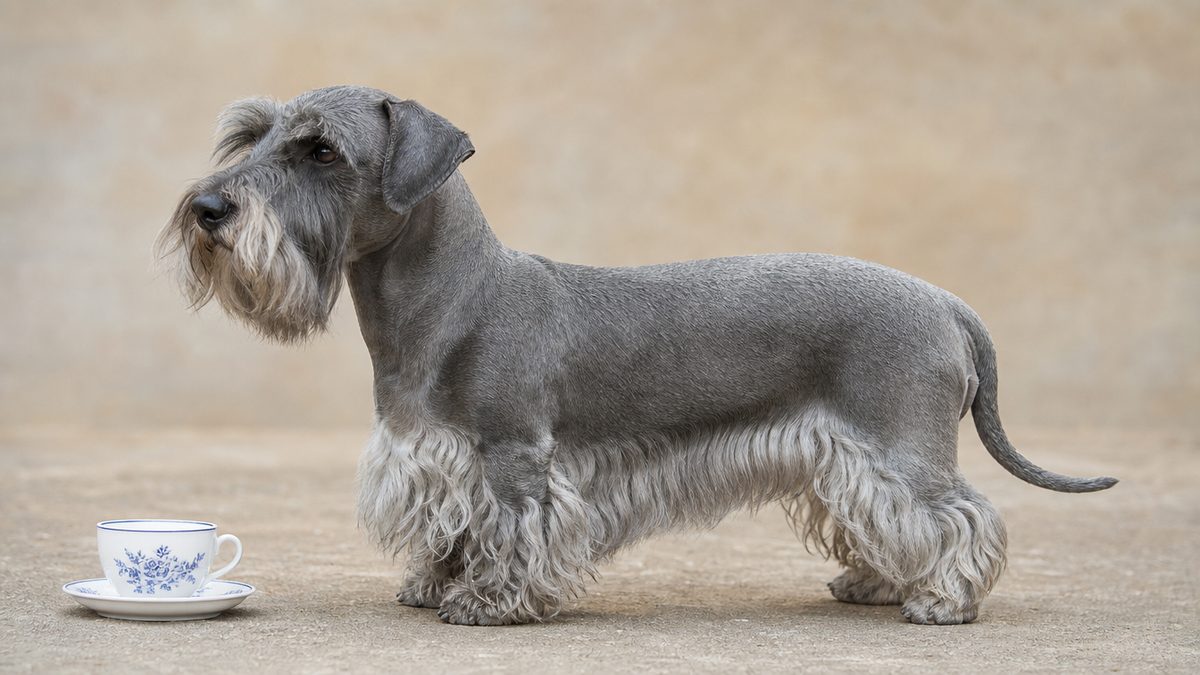
The Cesky Terrier is a short-legged, silky-coated Czech earth terrier of 25 to 32 cm and 6 to 10 kg, created deliberately in 1949 from one Sealyham Terrier male and one Scottish Terrier female, and it is the only terrier whose breed standard tells you to cut the coat rather than pluck it.
Start with the document India's own kennel club is bound by. The Kennel Club of India is a member organisation of the Fédération Cynologique Internationale, so the standard that governs the breed here is FCI standard 246, and reading it settles most of the questions the ranking pages get wrong. The nomenclature entry, read at its number rather than its name slug, prints CESKÝ TERIER (246), Group 3 Terriers, Section 2 Small sized Terriers, no working trial, country of origin Czech Republic, and definitive acceptance by the FCI on 24 May 1963.
The standard itself gives measurements that are unusually precise for a terrier. Height at withers runs 25 to 32 cm, with an ideal of 29 cm for a dog and 27 cm for a bitch. Weight must not fall below 6 kg or exceed 10 kg, and either failure is a disqualifying fault rather than a penalty. Five further ideal measures follow, given separately for the sexes: skull length 21 and 20 cm, skull width 10 and 9 cm, girth of thorax behind the elbows 45 and 44 cm, and length of body 43 and 40 cm. A chest circumference above 50 cm is itself disqualifying, which is the standard protecting the one thing the breed was built for, the ability to follow quarry into a hole.
The coat, and why it is the whole story
The coat clause is the reason this page exists. FCI 246 describes the hair as "long, fine but firm, slightly wavy with a silky gloss; not too much overdone", and then states in the same paragraph that "The Czech Terrier is groomed by scissors (clipping)". The German text, which the FCI names as the official authentic language for this breed, reads "Beim Cesky Terrier wird das Haar durch Scheren hergerichtet", the hair is prepared by shearing Federation Cynologique Internationale. The Czech translation served by the national kennel club puts it as "Český teriér se upravuje stříháním (nůžkami)", trimmed by cutting, with scissors. Three texts, one instruction: this coat is cut.
That single line separates the Cesky Terrier from every other terrier an Indian buyer is likely to meet. A Cairn, a Scottish Terrier, a Border or a Wire Fox Terrier carries a harsh double coat that has to be hand plucked, and Bonbeno's Cairn Terrier guide found only three Indian providers advertising that service. The Cesky's coat is soft, so it is clipped, and clipping is something every Indian salon already does. The Royal Kennel Club says the same thing in one sentence on its own breed page: "Unlike many of the trimmed terriers which have hand stripped wiry coats, the Cesky has his body coat clipped".
| Item | What the standard states |
|---|---|
| Standard number | 246, Group 3 Terriers, Section 2 Small sized Terriers, without working trial |
| Definitive FCI acceptance | 24 May 1963 |
| Official valid standard | Published 11 March 1997, translations dated 20 January 1998 |
| Official authentic language | German |
| Country of origin | Czech Republic |
| Use | Formerly a terrier for hunting foxes and badgers, today more a house and companion dog |
| Height at withers | 25 to 32 cm, ideal 29 cm dogs and 27 cm bitches |
| Weight | Not less than 6 kg and not more than 10 kg, either way disqualifying |
| Coat | Long, fine but firm, slightly wavy, silky gloss, groomed by scissors |
| Show coat length | 1 to 1.5 cm on the upper neck, shoulders and back |
| Colour | Two varieties only, grey-blue and light-coffee-brown |
| Tail | Ideal length 18 to 20 cm, low set, carried sabre-shaped when alert |
| Ears | Medium, triangular, set rather high, falling flat along the cheeks |
František Horák created two breeds. The Cesky Terrier is the FCI-recognised one, standard 246 since 1963. The other is the Bohemian Spotted Dog, a medium tricolour dog the FCI does not recognise at all, covered in Bonbeno's Bohemian Spotted Dog guide. If a page shows a black, tan and white ticked dog with folded ears, you are reading about the wrong breed.
Three breed standards, and the disagreements nobody publishes
Three kennel clubs publish a Cesky Terrier standard and they do not say the same thing, so the first job of an Indian buyer is to know which one applies. India follows the FCI text, and the FCI text is the strictest of the three on weight, the only one that names a neurological disorder, and the only one whose English translation is missing a clause its own authentic version carries.
The three documents are FCI standard 246 dated 20 January 1998, the American Kennel Club standard approved 18 October 2010 and effective 30 June 2011, and the Royal Kennel Club standard last updated 1 April 2025 American Kennel Club The Royal Kennel Club. They agree on the shape of the dog and on the fact that the coat is cut. They diverge on three points that matter.
One, the FCI's brown dog does not exist under AKC rules
FCI 246 recognises exactly two coat colour varieties, grey-blue, whose puppies are born black, and light-coffee-brown, whose puppies are born chocolate brown. The Royal Kennel Club keeps both, printing "Grey-blue or light brown" and listing Light Brown among its breed standard colours The Royal Kennel Club. The AKC keeps only one: "In mature dogs, 3 years or older, the correct colour is any shade of gray from charcoal to platinum gray";. A brown Cesky Terrier is a correct FCI dog and an unshowable American one.
This matters in India because Purina India, the second-ranking page here, reproduces the AKC's grey-only wording for an audience whose national kennel club follows the FCI. An Indian reader is being handed the American colour rule on a page that never says so.
Two, the FCI disqualifies on weight and the AKC explicitly does not
The FCI text lists "Weight above 10 kg or less than 6 kg" among its disqualifying faults. The AKC gives an ideal of 16 to 22 pounds, suggests a floor of 14 pounds and a ceiling of 24 pounds, and then adds that "no Cesky in good condition and otherwise well balanced shall be penalized for being only slightly outside the suggested weight". Twenty-four pounds is 10.9 kg. So a dog that an American judge is instructed not to penalise is a dog an FCI judge must disqualify.
That gap is why the Indian pages get the weight wrong in both directions. Purina India prints 7 to 10 kg, which excludes the bottom kilogram the FCI allows. Puppiezo prints 4 to 6 kg, a band that sits entirely at or below the FCI's disqualifying floor. PetBuy prints 4 to 10 kg. Only the Royal Kennel Club standard and the American reference page Dog Breeds List reproduce the FCI's 6 to 10 kg correctly Dog Breeds List, Cesky Terrier, Price.
Three, the English translation dropped a disqualifying fault
Read the German authentic text against the English one and a whole clause is missing. The German disqualification list includes "Vor- oder Rückbiß", overshot or undershot bite, as a separate bullet between the missing-teeth clause and the entropion clause. Neither the English translation nor the Czech translation served by the national kennel club carries that bullet at all Ceskomoravska kynologicka unie. Both translations keep every other item in the list, including the canine-in-vestibulo-position clause immediately above it.
So an owner reading the English standard would conclude that a bad bite is merely a fault in this breed, when the authentic version says it disqualifies. The practical consequence for an Indian buyer is small but real: check the bite yourself, because paragraph 8(10) of India's own breeding rules separately requires testing for overshot and undershot jaw.
| Point | FCI 246 (India follows this) | AKC 2011 | Royal Kennel Club 2025 |
|---|---|---|---|
| Height | 25 to 32 cm | 10 to 13 inches, 25.4 to 33.0 cm | 25 to 32 cm |
| Weight | 6 to 10 kg, outside is disqualifying | 16 to 22 lb ideal, 14 to 24 lb suggested, slight excess not penalised | 6 to 10 kg, no disqualification listed |
| Colour varieties | Grey-blue and light-coffee-brown | Grey only, charcoal to platinum | Grey-blue or light brown |
| Scottie cramp | Named as a disqualifying fault | Not mentioned anywhere | Not mentioned anywhere |
| Overshot or undershot bite | Disqualifying in the German authentic text, absent from the English and Czech translations | Not listed | Not listed |
| Chest girth | Above 50 cm disqualifying | 17 to 18 inches ideal, no limit | Not specified |
| Show coat length | 1 to 1.5 cm on neck, shoulders and back | Half to one inch saddle, quarter inch cheeks and thighs | No more than 1.5 cm on back and neck |
| Disqualifying faults section | Thirteen items | None at all | None, generic faults clause only |
The FCI standard gives an ideal tail length of 18 to 20 cm and the AKC standard opens by describing "natural drop ears and a natural tail"; American Kennel Club. No standard permits docking or cropping. Second Schedule Part II paragraph 6(8) of India's Dog Breeding and Marketing Rules 2017 forbids tail docking, ear cropping, de-barking, de-clawing and "any other kind of mutilation" outright.
The 1949 experiment: one Sealyham, one Scottie, and a written plan
The Cesky Terrier began on a written plan in 1949, when František Horák mated a Sealyham Terrier dog to a Scottish Terrier bitch at his Lovu zdar kennel near Prague, and it is one of very few breeds whose creator left a first-hand account naming every founding animal and every mating.
Horák was not a professional scientist, whatever the ranking pages say. The Czech Academy of Sciences' own biographical dictionary records that he was born on 12 June 1909 at Žehuň near Poděbrady, the son of a valet in the Kinský household, that he matriculated from a commercial academy in Hradec Králové in 1928, and that he then worked as a sawmill adjunct, for a timber firm in Plzeň, and from 1940 to 1948 as an accountant for the Prague Ironworks Company. The same entry calls him "nejúspěšnějším českým amatérským genetikem", the most successful Czech amateur geneticist, and the founder of Czech scientific cynology.
That word amateur is doing real work. Purina India tells Indian readers the breed was "developed by Czechoslovakian geneticist Frantisek Horak", and the Royal Kennel Club says it was "developed by geneticist František Horák"; The Royal Kennel Club. Both are repeating a title the Academy of Sciences qualifies. What he actually did, and it is more impressive rather than less, was consult a professional geneticist, Bohumil Sekla, before deciding on the cross.
The stated design brief
The FCI standard preserves the brief almost as a specification. The Czech Terrier is "the result of an appropriate crossbreeding between a Sealyham Terrier dog and a Scotch Terrier bitch, with the aim to develop a light, short legged, well pigmented hunting Terrier, with practical drop ears, easy to groom and easy to train";. The German authentic text puts the last item as "von einfacher Haarpflege", of simple coat care. Easy grooming was a design goal from the first sentence, not a later convenience.
The biography adds the motive. Horák bought his first Scottish Terrier in 1932 and, during his years in Plzeň, began thinking about how to improve the earth-working qualities of the breed. He founded the Lovu zdar kennel in 1938, and in 1949, after consulting Sekla, decided to cross a Scottish Terrier bitch with a Sealyham dog. Purina India describes the same goal in plainer words, a smaller dog that could work in a pack and fit into burrows that defeated both parents.
The matings, in his own words
Horák's own account, reproduced by the Institute of Canine Biology from the UK breed club, names the animals one by one. In 1950 he repeated the cross onto a Scottish Terrier bitch and got six puppies, of which only one, Balda Lovu zdar, had the dropped ears he wanted; Balda became the foundation sire. He then mated Balda's litter sister Baba to her half-brother Adam, unsuccessfully, then to Balda himself, brother to sister, also unsuccessfully. Finally he mated Balda to his own dam, Scotch Rose, and that son-to-mother cross produced two well-eared puppies, of which the bitch Diana Lovu zdar became the foundation dam.
The next generation is the same pattern. Diana was mated to a Sealyham, Jasans Amorous Artilleryman, because the earlier Sealyham Buganier Urquelle had died. Their son Fantom was mated to his sister Fenka, producing the single surviving bitch Halali, "a pillar of the breed"; then Fantom to his daughter Halali; then Fantom to his mother Diana. Brother to sister, father to daughter, son to mother, in four consecutive recorded matings.
The first studbook numbers
The register entries exist and are countable. Horák exhibited three dogs, Fantom, Chytry and Javor, at the International Dog Show in Liberec in 1959, and afterwards the terriers were entered in the Czechoslovak register under the name Cesky Terrier with the help of Dipl. Ing. Najman. Number 1 in that register went to the bitch Chrabra Lovu zdar, and thirteen further Cesky Terriers were initially registered, so the breed's documented starting population in the studbook is fourteen animals. The FCI recognised it four years later, in 1963.
Horák recorded that two brown puppies appeared in the early litters, Chytry, who was sterile, and Iris, who was given away and lost, and that "these two remained the only brown Cesky Terriers until 1993" when the male Vladyka del Monte was born. He also worked out the genetics himself: "The gene for the brown colour must come from the Sealyham Terrier, as it is not known in the Scottish Terrier";. That is why the FCI standard still lists a second colour variety most owners will never see.
The gene pool, measured: a **founder base** of three dogs
The Cesky Terrier's founder base was three purebred animals, and a published pedigree analysis of 5,073 dogs puts the consequence in numbers: an effective founder count of 2.8, a mean kinship of 59 percent, and an average inbreeding coefficient above 60 percent computed back to the founders.
Horák stated the founder count himself, as one of his two reasons for making the breed. His second stated aim was "to investigate the possibility of producing a completely different breed from a minimum number of individuals", followed by the parenthesis "In the origin of the Cesky Terrier only two dogs and one bitch were used";. The breed was, in part, an experiment in how few animals a breed can be built from, and the founder deliberately kept the number low.
The Institute of Canine Biology's analysis of a February 2016 pedigree database names those three. They are Buganier Urquelle, a Sealyham; Scotch Rose, the Scottish Terrier who was Balda's dam; and Jason's Amorous Artilleryman, the second Sealyham, Buganier's son. Two of the three contributed only one offspring each to the gene pool and the third contributed two.
| Statistic | Value | What it means |
|---|---|---|
| Total dogs in the pedigree | 5,073 | 310 of them without birth dates |
| Males with offspring | 509 of 2,478, 20.5 percent | Four males in five never bred |
| Females with offspring | 898 of 2,591, 34.7 percent | Two bitches in three never bred |
| Effective number of founders (fe) | 2.8 | The whole breed behaves as if descended from under three animals |
| Founder genome equivalents (fg) | 2.55 | Independent founder genomes surviving in the population |
| Effective number of ancestors (fa) | 2.05 | Two ancestors account for most of the gene pool |
| Mean kinship | 59.0 percent | Full siblings are 25 percent and half siblings 12.5 percent |
| Genetic equivalent of the live population | 1.12 dogs | Roughly two thirds of the initial diversity has been lost |
| Average inbreeding coefficient to founders | Above 60 percent | Current average around 70 percent, some individuals above 80 |
| Reference population born 2007 to 2015 | 1,337 dogs, 675 males and 662 females | The modern breed the figures describe |
Two checks are worth publishing. The male and female counts sum to 5,069 against a stated total of 5,073, a four-dog gap in the source itself, and 509 of 2,478 is 20.54 percent while 898 of 2,591 is 34.66 percent, both of which match the printed percentages. The analysis describes this breed's inbreeding as "the highest of any breed I have analyzed so far" and notes the population has never exceeded 200 dogs a year.
What the kennel clubs do with that
The Royal Kennel Club places the Cesky Terrier in the genetic-diversity arm of its breeding-for-health framework rather than recommending any breed-specific test, and its 33-page Health Standard of February 2026 lists the breed with no recommended pre-breeding test at all, while its immediate neighbours in the same table each carry two or three. The UK breed club opens its own health page on the same point, that maintaining sufficient genetic diversity is one of the problems concerning any minority breed.
A breed whose average inbreeding coefficient sits near 70 percent needs a large, coordinated, international breeding pool to stay viable. India has no Cesky Terrier population, no breed club, and a legal framework that prohibits importing dogs for breeding at all. Anyone trying to start a line here would be working from a handful of animals inside a gene pool that is already the tightest measured, which is the opposite of what the breed needs Institute of Canine Biology.
Is the Cesky Terrier recognised, and is it a vulnerable native breed?
The Cesky Terrier is fully recognised by the FCI, the AKC and the Royal Kennel Club, and it is not a vulnerable native breed, because that scheme covers British and Irish breeds only and this one is Czech. The Royal Kennel Club prints the answer on its own breed page as two characters: Vulnerable native breed, No.
Take the registers one at a time rather than assuming. The FCI recognised the breed on a definitive basis on 24 May 1963 as standard 246 in Group 3, and the entry read at its number prints the breed name CESKÝ TERIER inside the returned document. The Czech national kennel club keeps the studbook: its breed record 298 prints "Originální název: Czech Terrier", "Číslo FCI: 246" and "FCI skupina: III. - teriéři", assigns the breed to studbook workplaces I and III, and names two member clubs, Klub chovatelů českých terierů and Klub chovatelů terierů.
The American Kennel Club recognised the breed into the Terrier group with a standard approved on 18 October 2010 and effective on 30 June 2011. The Royal Kennel Club states on its breed page that the Cesky Terrier "was recognised by the FCI in 1963 and by The Kennel Club in 1990";.
The vulnerable-breed question, answered with a control
Bonbeno checked this against the register rather than reasoning from rarity. The Royal Kennel Club's 10 year Vulnerable Breed Stats sheet lists 39 vulnerable native breeds and a further eight At Watch breeds, and the Cesky Terrier appears on neither list. Its breed page states the same thing directly, printing "Vulnerable native breed No" in the characteristics block.
The control makes the point sharp. The Cairn Terrier is on the At Watch list, at 447 registrations in 2025. The Cesky Terrier had 17. So the breed with twenty-six times fewer puppies is the one that does not qualify, because the scheme protects native British and Irish breeds and this is a Czech one. Rarity is not the criterion, ancestry is.
| Breed | 2016 | 2019 | 2022 | 2024 | 2025 | Vulnerable or At Watch |
|---|---|---|---|---|---|---|
| Cesky Terrier | 30 | 43 | 43 | 20 | 17 | Neither |
| Sealyham Terrier (founding breed) | 113 | 131 | 138 | 100 | 111 | Vulnerable native breed |
| Scottish Terrier (founding breed) | 454 | 468 | 584 | 387 | 312 | At Watch |
| Cairn Terrier | 683 | 464 | 492 | 467 | 447 | At Watch |
| Australian Terrier | 44 | 23 | 33 | 23 | 12 | Neither |
| Whole terrier group | 19,436 | 17,219 | 20,247 | 15,952 | 14,963 | Twenty-seven breeds |
Two things about that table are worth flagging. The Cesky Terrier's ten-year total is 314 puppies, a mean of 31 a year, and 2025's 17 is its lowest year in the decade and the second lowest figure of any terrier breed after the Australian Terrier's 12. And the breed is rarer in Britain than either of the two breeds it was made from, one of which the same kennel club does classify as vulnerable.
All 27 terrier rows were extracted and re-summed against the printed group total. Nine of the ten annual columns reconcile exactly; 2023 comes to 18,209 against a printed 18,211. Separately, the vulnerable-breed sheet gives the Soft Coated Wheaten Terrier 227 for 2021 where the terrier sheet gives 277, and the terrier sheet's 2021 column sums exactly to its printed total, so 277 is the internally consistent figure.
Cesky Terrier price in india: what the ranking pages are actually offering
No trustworthy cesky terrier price in india exists, and the strongest evidence for that is Google's own AI Overview, which opens the results page by saying there is no standard or fixed market price for a Cesky Terrier in India because the breed is extremely rare here.
Every page ranking for this query was retrieved and read on 25 August 2026. Between them they print four different rupee figures, and not one is attached to a Cesky Terrier that anybody is selling.
| Source | Figure printed | What the same page shows |
|---|---|---|
| Happy Pet Care | Rs 50,000 to Rs 1,50,000 | No listings, no sellers, no breeders. A breed guide with a price block |
| Google AI Overview, main answer | Rs 1,50,000 to over Rs 3,00,000 as an import cost | Attributed to no Indian seller. Opens by saying no fixed Indian price exists |
| Google AI Overview, People also ask | Rs 50,000 to Rs 1,500,000 | Cites Happy Pet Care, whose page prints Rs 1,50,000. A ten-fold misreading |
| PetBuy.in | Rs 6,000 to Rs 25,000 | Listings 0, Live Avg dash. Identical band on four other zero-listing terriers |
| Mr n Mrs Pet, national page | None on the page | 3 Result Found, and the three cards are a French Bulldog, a Border Collie and an Australian Shepherd |
| Mr n Mrs Pet, Kochi page | Snippet advertises from INR 35,000 | The live page carried no price and offered a Goldendoodle and a French bulldog in Bangalore |
| Puppiezo | None for this breed | Available Cesky Terrier Puppies section empty. Carousel prints Rs 98,999, Rs 92,599, Rs 94,999, Rs 76,499, Rs 1,20,000 against Maltipoos, Poodles and a Rottweiler |
| Supertails, 40-breed price list | No Cesky row at all | Zero occurrences of the string Cesky in 44,502 characters |
| Wrapinfur, 50-breed price list | No Cesky row at all | Zero occurrences of the string Cesky in 37,094 characters |
| Dog Breeds List | 1,200 to 2,500 US dollars | No Indian figure anywhere, yet it holds first place in an India-located search |
The three-results page that has no Cesky Terriers
Mr n Mrs Pet holds first place and prints "3 Result Found" under the H1 Cesky terrier Puppies For Sale. Those three cards sit under a heading the page supplies itself, "Similar breeds at other locations", and on 25 August 2026 they were a French Bulldog in Bangalore, a Border Collie in Chennai and an Australian Shepherd in Jaipur. The control is on the same screen: the platform's Most Popular Breeds counter reads Shih Tzu 650, Siberian Husky 549, Golden Retriever 487, Labrador Retriever 454 and German Shepherd 412, so the site plainly holds real inventory for breeds it stocks.
The Kochi page tells the same story from a different angle. Google's result snippet for it advertises "Puppy starts at INR 35,000 and goes up to INR", but the page retrieved live carried no price at all, and the visible cards were a Goldendoodle and a French bulldog listed in Bangalore Cox town Google India search results page…. A price that exists only in a search snippet is not a price.
Two national price lists that rank without naming the breed
Supertails publishes India's most-cited national dog price table, covering forty breeds, and it holds a top-five position on this query. Its extracted text runs to 44,502 characters and contains zero occurrences of the string Cesky, against nine for Shih Tzu and ten for Labrador in the same extraction. Wrapinfur's fifty-breed list behaves identically: zero for Cesky, eight for Shih Tzu, eleven for Labrador across 37,094 characters. A third list, Dogbreedo's, likewise carries no Cesky row while listing eight other terriers.
India's oldest pedigree-dog noticeboard has never had a page for the breed at all. Dogs India serves cairn_terrier.htm at HTTP 200 with breed text and a Breeders' List, and returns 404 for cesky_terrier.htm.
The closest thing to an Indian price for this breed is the published band for one of its two parents. Supertails prices the Scottish Terrier at Rs 30,000 to Rs 80,000 in its forty-breed table. That is the founding breed, not this one, and it should be read as a size-and-rarity reference point rather than a Cesky Terrier quotation.
Testing the four rupee figures: a house default and a ten-fold slip
Two of the four rupee figures on this query fail a simple test. PetBuy's band is a size-class template printed identically on five different zero-listing terriers, and Google's own People also ask answer multiplies Happy Pet Care's ceiling by ten by misreading Indian digit grouping.
The house default, replicated on five terriers in one session
PetBuy prints "Typical Price in India Rs 6,000 to Rs 25,000" on its Cesky Terrier page beside "Listings 0" and a dash for the live average. Six further breed pages on the same site were pulled in the same session as controls, and the result is unambiguous.
| Breed page | Price band printed | Listings | Weight printed | Height printed |
|---|---|---|---|---|
| Cesky Terrier | Rs 6,000 to Rs 25,000 | 0 | 4 to 10 kg | 20 to 35 cm |
| Cairn Terrier | Rs 6,000 to Rs 25,000 | 0 | 4 to 10 kg | 20 to 35 cm |
| Scottish Terrier | Rs 6,000 to Rs 25,000 | 0 | 4 to 10 kg | 20 to 35 cm |
| Norwich Terrier | Rs 6,000 to Rs 25,000 | 0 | 4 to 10 kg | 20 to 35 cm |
| Skye Terrier | Rs 6,000 to Rs 25,000 | 0 | 4 to 10 kg | 20 to 35 cm |
| German Shepherd | Rs 12,000 to Rs 40,000 | 216 | 22 to 40 kg | 55 to 65 cm |
| Labrador | Rs 8,000 to Rs 30,000 | 60 | 25 to 36 kg | 55 to 62 cm |
Five small terriers share one price band, one weight range and one height range, and all five show zero listings. The two breeds the platform actually stocks get distinct bands and real listing counts. That settles it: Rs 6,000 to Rs 25,000 is a size-class default, not a Cesky Terrier price, and the 4 to 10 kg weight beside it is a template value too, which is why it contradicts the FCI standard's 6 to 10 kg. This replicates and extends a finding Bonbeno first published on the Cairn Terrier, where the same band appeared on four zero-listing terriers; the Cesky Terrier is the fifth.
The ten-fold slip, and why it is an Indian-notation problem
Happy Pet Care prints "Cost of buying Rs 50,000 - Rs 1,50,000" in its price block, twice on the page. Google's People also ask answer for "How much is a Cesky Terrier?" cites that page and renders the same band as "India: Rs 50,000 - Rs 1,500,000". One lakh fifty thousand became fifteen lakh. Indian digit grouping puts the comma after two digits above the thousand, so 1,50,000 and 1,500,000 look almost identical and differ by a factor of ten. A buyer reading the answer box would budget fifteen lakh for a dog whose cited source says one and a half.
Division tests on the figures that remain
Indian pages routinely publish a dollar figure run through one exchange rate, so each surviving band was divided out. Happy Pet Care's Rs 50,000 and Rs 1,50,000 give 592.6 and 1,777.7 at 84.38, and 675.7 and 2,027.0 at 74. Neither is a price a seller prints. At a flat 80 they give 625 and 1,875, which is arithmetically tidy but still not a figure anyone quotes, and the flat-80 test is structurally weak in any case, because any rupee figure ending in three zeros divides cleanly at 80 by construction. 84.38 is the strong test and this band fails it, so the Happy Pet Care figures are rupee-native rather than converted.
Google's own import estimate does not survive either. Rs 1,50,000 divided by 1,200 dollars is exactly 125.0 and Rs 3,00,000 divided by 2,500 is exactly 120.0 Dog Breeds List, Cesky Terrier, Price. Those are round multipliers, not exchange rates, so the answer box has taken an American breeder price and inflated it by a made-up factor rather than costing an actual import.
Puppiezo's Cesky Terrier page shows no Cesky Terriers and fills the space with an Other Available Pets carousel. It prints Rs 98,999 three times, against a Maltipoo named Fizey, a Maltipoo named Samy and a Doxiepoo named Yoki, alongside Rs 92,599, Rs 94,999, Rs 76,499 and Rs 1,20,000. Bonbeno has now recorded that exact figure and those exact animals on eleven separate pages of that site, for breeds it does not stock. It is never any breed's price.
Importing a Cesky Terrier into India, and the door that is closed
India permits a Cesky Terrier to arrive only as your own pet, and closes every other route by name. Trade Notice 22/2022-23 makes dogs a Restricted import and states that applications made for trading or breeding purposes "shall be duly rejected";.
The notice was read from the Directorate General of Foreign Trade's own content server rather than a summary. Under ITC (HS) 01061900, mammals other than those separately listed are Restricted, subject to Policy Condition 6 of the chapter. Policy Condition (7) then names the only three purposes for which a dog may be imported at all: a pet dog with a valid pet book and records in the importer's own name, dogs imported by research and development organisations with a recommendation from the Committee for the Purpose of Control and Supervision of Experiments on Animals, and dogs for internal security by the Defence and Police Force. Policy Condition (8) adds that import of commercial dogs for breeding or any other commercial activity is not permitted.
- Up to two pets, permanent move. Allowed as passenger baggage without any DGFT import authorisation, but only for a person transferring residence to India after two years of continuous stay abroad. Only cats and dogs qualify under the baggage rules.
- Under two years abroad, or shipped as cargo. An import authorisation from DGFT becomes compulsory, applied for under ANF-2M against your Importer Exporter Code or the standing personal-use code IIHIE0153E.
- More than two pets, or any temporary import. Import authorisation required, and the application goes first to the Department of Animal Husbandry and Dairying for examination against your justification.
- Seven ports only. Entry is permitted through the airports and seaports of Delhi, Mumbai, Chennai, Hyderabad, Bengaluru and Kolkata and, since October 2024, Kochi airport, with quarantine at the government station where required Department of Animal Husbandry…. The full route is set out in how to import a dog to India.
- Advance NOC. A separate No Objection Certificate from the Animal Quarantine and Certification Service regional officer must be obtained seven days before travel, relaxable to three, after submitting the DGFT licence and the exporting country's veterinary health certificate.
- Start two months early. The notice itself advises beginning the authorisation process at least two months before the travel date.
Put those together and the position for this breed is simple. A returning Indian family that already owns a Cesky Terrier abroad can bring it home. Nobody can lawfully import one to sell, and nobody can lawfully import a pair to breed from. Since the breed has no Indian population to begin with, that is the whole supply question answered.
Policy Condition (7)(ii) permits import by research organisations with a CPCSEA recommendation. It is worth naming because Horák worked at a physiology institute and his other breed, the Bohemian Spotted Dog, genuinely was a laboratory animal. The Cesky Terrier was not. It was a hunting terrier made at his private Lovu zdar kennel, and no research route into India is open for it.
One further Indian rule bears on the same question. Rule 8(1)(c) of the Dog Breeding and Marketing Rules 2017 forbids selling dogs or pups for use in experiments unless the purchaser is a breeder registered with CPCSEA. Whatever the breed's laboratory-adjacent history, an Indian seller cannot route around the pet rules by calling a puppy a research animal.
What a Cesky Terrier costs every month in India
Budget roughly Rs 4,000 to Rs 8,000 a month for a small dog in India, and add a clipping appointment every six to eight weeks on top, because this breed's monthly cost is dominated by a grooming line most small-dog budgets underestimate.
Two Indian sources publish monthly figures that bear on this dog, and they disagree, so both are given. Supertails' small-breed column totals Rs 4,000 to Rs 8,000 a month; Happy Pet Care's breed-specific estimate is Rs 3,300 for a basic lifestyle and Rs 5,400 for a premium one Happy Pet Care, Cesky Terrier Dog Breed…. The gap is largest on grooming, where Supertails gives Rs 1,500 to Rs 3,000 and Happy Pet Care gives Rs 1,200 to Rs 1,800 Happy Pet Care, Cesky Terrier Dog Breed….
| Line | Supertails, small breed | Happy Pet Care, Cesky Terrier |
|---|---|---|
| Food | Rs 1,500 to Rs 2,500 | Rs 1,200 to Rs 1,800 |
| Routine vet visits | Rs 500 to Rs 1,000 | Rs 900 to Rs 1,800 healthcare |
| Vaccination | Rs 1,200 a year | Included in healthcare |
| Grooming | Rs 1,500 to Rs 3,000 | Rs 1,200 to Rs 1,800 |
| Training, first six months | Rs 0 to Rs 3,000 | Not costed separately |
| Treats and toys | Rs 300 to Rs 800 | Not costed separately |
| Flea, tick and deworming | Rs 300 to Rs 600 | Not costed separately |
| Stated monthly total | Rs 4,000 to Rs 8,000 | Rs 3,300 to Rs 5,400 |
Notice one thing in the Supertails table that most readers skim past. Its grooming figure for a small breed, Rs 1,500 to Rs 3,000, is higher than its figure for a large breed, Rs 500 to Rs 1,200. That is not a misprint. Small dogs in India are the coated ones, and coated dogs are the ones that need cutting. A Cesky Terrier sits squarely in that group.
The clipping line, priced from Indian rate cards
A Cesky Terrier needs its body coat cut roughly every six to eight weeks, so the honest way to budget is per appointment rather than per month. Indian rate cards read on 25 August 2026 give a haircut at Rs 1,100 at PatMyPets in Delhi NCR, Rs 1,699 at PetLogix in Delhi, Rs 1,599 including GST at PawSpace in Bangalore, and Rs 1,699 for Haircut Only at the Vetic clinic chain PawSpace, Pet Grooming at Home… Vetic, Pet Grooming Costs and Factors…. Vetic adds that a breed-standard or complex cut carries a Rs 300 to Rs 800 premium over a basic trim.
- Six appointments a year at Rs 1,600 comes to Rs 9,600, or Rs 800 a month averaged.
- Eight appointments a year at Rs 2,200, a breed-standard cut with a bath, comes to Rs 17,600, or about Rs 1,470 a month.
- Buy the clipper instead and the arithmetic changes. An Indian grooming supplier lists a professional Andis AGC Super 2 at Rs 21,280 and a cordless Trixie TR1600 at Rs 8,750, so the cheaper machine pays for itself in roughly five salon visits.
- Add a scissor set at about Rs 5,319 if you intend to tidy the furnishings yourself.
- Keep a tick and flea line in the budget, because it is not optional here, and treat the Rs 300 to Rs 600 a month Supertails allows as a floor rather than a ceiling.
Taking the higher Indian monthly estimate and a breed-standard cut every seven weeks, an honest budget for this dog in a metro is about Rs 6,000 to Rs 9,500 a month, of which Rs 1,000 to Rs 1,500 is coat maintenance. That is more than a smooth-coated dog of the same weight and less than a Poodle or a Shih Tzu, both of which need the same clipping schedule plus daily brushing of a longer coat.
Can a Cesky Terrier handle the Indian climate?
A Cesky Terrier manages the Indian climate better than most imported coated breeds and worse than any Indian one, and the reason is measurable: Klánovice, the Prague suburb where the breed was made, has an annual mean of 8.92 degrees and a peak wet-bulb temperature of 16.10 degrees, against 27.86 in Kolkata Kucera M. HORAK, Frantisek, 1909-1997.
Climate figures here come from NASA POWER, queried by explicit latitude and longitude with the returned coordinates checked against the place asked for, because slug-based climate sites have repeatedly served this project a different city at HTTP 200. Klánovice was queried at 50.0894 north, 14.6664 east and the service returned 14.666, 50.089 at 353.91 metres.
| Place | Annual mean °C | Warmest month °C | Coldest month °C | Peak wet-bulb °C | Annual humidity % |
|---|---|---|---|---|---|
| Klánovice, Prague | 8.92 | 20.06 in July | -2.18 in January | 16.10 | 78.7 |
| Bengaluru | 23.74 | 28.37 in April | 20.22 in December | 22.66 | 67.9 |
| Pune | 23.86 | 28.93 in April | 19.62 in December | 23.56 | 66.8 |
| Delhi | 25.60 | 35.88 in June | 13.61 in January | 27.74 | 45.6 |
| Kolkata | 25.81 | 31.53 in May | 17.31 in January | 27.86 | 73.9 |
| Hyderabad | 26.10 | 33.30 in May | 20.76 in December | 24.44 | 60.3 |
| Mumbai | 26.77 | 31.19 in May | 23.19 in January | 26.55 | 67.4 |
| Ahmedabad | 27.57 | 35.06 in May | 19.93 in January | 27.62 | 48.3 |
| Chennai | 27.95 | 31.51 in May | 24.09 in January | 27.36 | 72.4 |
The surprising part: Bengaluru is inside the recommended band and Prague is not
Happy Pet Care gives this breed an "Ideal Weather" band of 15 to 25 degrees. Test that band against real data and something unexpected happens. Bengaluru's monthly mean sits inside 15 to 25 degrees in nine months of twelve, and Pune in eight. Klánovice manages three, because for the rest of the year the breed's home town is colder than the band, not hotter. Delhi, Kolkata and Ahmedabad each manage four, Chennai two.
So the ordinary Indian objection, that this is a cold-climate dog and Indian temperatures are too high, is only half right. On mean temperature alone the Deccan cities are a better match for the stated band than Prague is. The problem is not the average; it is the peak, and it is what the air does with water at that peak.
Wet-bulb, which is the number that actually matters
A dog sheds heat by panting, and panting works by evaporation, so the limit is set by how much water the air will still take. That is wet-bulb temperature, and the contrast is stark. Klánovice peaks at 16.10 degrees wet-bulb in July. Kolkata peaks at 27.86, Delhi at 27.74, Ahmedabad at 27.62, Chennai at 27.36 and Mumbai at 26.55. Bengaluru at 22.66 and Pune at 23.56 are the two mildest metros and still six to seven degrees above the breed's origin.
Relative humidity by itself is a red herring here, and the data proves it. Prague's annual humidity is 78.7 percent, higher than Bengaluru's 67.9 percent and Mumbai's 67.4 percent. Humid air at nine degrees is harmless. The same humidity at thirty is what kills dogs.
Monthly means hide the days that matter. NASA POWER's peak monthly T2M_MAX values are 48.79 degrees for Delhi in June, 48.58 for Ahmedabad in May, 46.81 for Kolkata in May, 45.00 for Hyderabad in May, 44.91 for Mumbai in April, 43.20 for Pune in April, 42.70 for Chennai in May and 40.38 for Bengaluru in April. Klánovice's highest is 37.97 in August, and it happens on a handful of days a year rather than most of a season.
Managing a silky-coated terrier through an Indian summer
Manage the heat by moving the dog's day rather than by cutting its coat shorter, because the evidence says the danger to a working terrier in India is exertional rather than environmental, and a shaved dog loses sun protection without gaining much cooling.
The largest study of the question found that exertional heat-related illness, not a hot car and not a hot room, is what actually harms dogs. Reviewing 905,543 dogs under UK primary veterinary care in 2016, Hall and colleagues identified 1,259 heat-related illness events in 1,222 dogs, and of the 879 with a recorded trigger 74.2 percent were exertional, 12.9 percent environmental and 5.2 percent vehicular, with young male dogs at the greatest odds of the exertional type. A Cesky Terrier is precisely the dog that will keep going.
A hot-climate hospital series puts numbers on the outcome. Among 54 dogs treated for heat stroke at a veterinary teaching hospital, 63 percent (34 of 54) were exertional and 37 percent (20 of 54) environmental, 78 percent (42 of 54) presented between June and August, and overall mortality was 50 percent despite treatment. Disseminated intravascular coagulation, diagnosed in 28 of 54, and acute renal failure, in 18 of 54, were both risk factors for death, and delayed admission beyond 90 minutes was another.
One finding from that series cuts in this breed's favour and should be stated fairly. Dogs under 8 kg were under-represented among heat stroke cases, at 2 percent with an odds ratio of 0.08. A Cesky Terrier at 6 to 10 kg sits at the top edge of that protected group, so it starts with an advantage a Labrador does not have. That advantage disappears the moment somebody takes it running at three in the afternoon.
What to actually do, city by city
- Bengaluru and Pune. Workable year-round with ordinary care. Move walks out of 11am to 4pm from March to May and the rest of the year needs nothing special.
- Hyderabad. Comfortable from October to February, restricted from March to June. The May mean of 33.30 degrees is the constraint, not the humidity.
- Delhi and Ahmedabad. Two clear seasons. November to February is easy; April to June is an indoor season with early-morning walks only, and a June daily maximum reaching 48.79 degrees in Delhi is not a temperature to negotiate with.
- Mumbai, Chennai and Kolkata. Hardest, because the wet-bulb stays high for months rather than peaking. Kolkata's 27.86 degree wet-bulb means panting is working against saturated air, and Chennai's coldest month is still warmer than Prague's hottest.
- Hill stations. Genuinely comfortable. A Shimla-type climate at 21.15 degrees annual mean and a 24.16 degree peak wet-bulb is the closest India gets to the breed's origin.
Do not shave it, and here is the specific reason
The temptation with any coated dog in India is to take the clippers down to skin in April. Resist it for this breed. The standard describes the show coat as 1 to 1.5 cm on the back and neck and the Royal Kennel Club repeats the same limit, so a correct summer trim is already short The Royal Kennel Club. Going shorter than that removes the layer that keeps direct sun off pale skin, and this is a breed whose puppies are born black and lighten to platinum grey over two years, so adult pigment can be very pale.
Feel the pavement with the back of your hand for five seconds before an evening walk. Carry water on every outing over fifteen minutes. Watch for panting that does not slow within two minutes of stopping, for a dog that lies down and will not get up, and for brick-red gums. Cool with tap-temperature water over the whole body and drive to a veterinarian; do not wait to see whether it settles, because delayed admission past ninety minutes was itself a risk factor for death.
Temperament, and who should not buy this breed
The Cesky Terrier is the quiet one in the terrier group, described by its own standard as "balanced, non-aggressive, pleasant and cheerful ... somewhat reserved towards strangers; of calm and kind disposition", and it is the wrong dog for a household with free-roaming rabbits, hamsters or birds.
Every standard agrees on the shape of the character. The AKC calls it "balanced, non-aggressive" and instructs that the breed is "not to be sparred in the show ring", which is a formal way of saying it is not expected to square up to another dog the way a Scottie is. The Royal Kennel Club standard says "friendly and companionable. Somewhat reserved towards strangers, but neither aggressive nor of a nervous disposition";. Purina India adds that it "can be stubborn" and is "not as excitable as other terriers";.
Reserved is the operative word for Indian households. This is a dog that will hold back when the doorbell brings six people in at once, and that reserve is standard behaviour rather than a training failure. The FCI text lists "aggressive or overly shy" among the disqualifying faults, so a Cesky Terrier that hides or snaps is outside the standard in both directions.
The prey drive is real, and the breed club is blunt about it
This is a working earth terrier, and the club that knows it best does not soften the point. Asked whether Ceskys can be trusted with other animals, the UK breed club answers that "with small animals such as hamsters, gerbils, mice and rabbits, the Cesky cannot be trusted to be left alone or near the animals due to the natural instinct to hunt and kill", while larger animals including cats can be managed with training. Purina India puts the same instinct more gently: "his hunting instincts can come to the fore on an off-lead walk";.
For an Indian flat that is a specific, checkable constraint rather than a vague warning. A household with a rabbit, a hamster or an unclipped bird in an open cage should choose a different breed. A household with a cat can make it work if the introduction happens young and supervised.
Noise, and what the sources disagree about
The sources genuinely conflict on barking, so both are reported. Purina India's need-to-know panel prints "Very vocal dog" and "Guard dog. Barks and alerts";. The reference page Dog Breeds List rates barking tendencies at three of five and describes them as occasional. Puppiezo's characteristic slider places the breed nearer the quiet end. No standard mentions barking at all American Kennel Club The Royal Kennel Club.
The safe reading for an Indian apartment is to plan for a dog that reports arrivals and can be taught not to continue. Treat Purina India's rating as the pessimistic case and budget the training time for it.
| Household | Verdict | Why |
|---|---|---|
| Family with school-age children | Good | Club describes the breed as loving to be with children, and the standards require a non-aggressive temperament |
| Two-bedroom metro apartment | Good | Small, indoor-oriented, and rated apartment friendly |
| Home with a resident cat | Workable | Club says larger animals can be managed with early training |
| Home with rabbits, hamsters or gerbils | Avoid | Club states the breed cannot be trusted near them |
| First dog for a busy professional | Workable with a plan | Needs about an hour a day and a clipping appointment every six to eight weeks |
| Household wanting a guard dog | Wrong breed | The standard disqualifies aggression outright |
| Owner who wants a low-grooming dog | Wrong breed | The coat has to be cut on a schedule, whatever the price pages say |
PetBuy's Cesky Terrier page prints "Grooming: Low" in its at-a-glance block. That is the single most misleading line on the Indian results page for this breed, and it appears on a page that also shows zero listings and a size-class template price. A breed whose standard specifies a 1 to 1.5 cm cut coat is not a low-grooming dog.
Training a Cesky Terrier, and the three things it will resist
Train a Cesky Terrier with short, reward-based sessions from week eight, and expect it to be genuinely trainable by terrier standards, because ease of handling was written into the breed's design brief and both surviving standards repeat it.
The FCI standard names the trait twice, first in the history as an aim, "easy to groom and easy to train", and then in the temperament clause, "easy to train". That is unusual. Most terrier standards describe courage and fire; this one advertises biddability. The Royal Kennel Club's breed page rates the dog as needing "some training" rather than extensive work, and Purina India lists agility, conformation, obedience, rally obedience and tracking among its activities Purina India, Cesky Terrier Dog Breed….
The three things it will fight you on
- Recall near a moving animal. The club states the hunting instinct plainly, and a dog bred to follow fox and badger underground does not negotiate with a squirrel. Build recall on a long line for the first year and never test it beside an Indian road.
- Standing still on a grooming table. This is the training that decides whether your adult dog gets a proper cut or a rushed one. Start table work at nine weeks, thirty seconds at a time, long before the first real clip is due.
- Digging. The name of the group comes from terra, earth. A Cesky Terrier in a Pune bungalow garden will excavate, and the fix is a permitted digging patch rather than a correction.
A realistic Indian timeline
Work from the day the puppy is legally allowed to leave its litter. Rule 8(1)(a) of India's Dog Breeding and Marketing Rules 2017 states that "pups less than eight weeks in age are not sold", so eight weeks is the earliest lawful start and any Indian seller offering a six-week puppy is breaking that rule.
- Weeks 8 to 12. Name response, a marker word, crate comfort, and thirty-second grooming-table sessions daily. Socialise to lift doors, autorickshaw noise, marble floors and the building watchman.
- Weeks 12 to 16. Loose-lead walking indoors before outdoors. Introduce the clipper switched on but not touching the dog, then switched on and resting against a shoulder.
- Months 4 to 6. First professional groom. Ask the salon for a short, calm, partial session rather than a full cut, and pay for the time.
- Months 6 to 12. Long-line recall around distraction. Formal obedience or rally class if one is available in your city; the breed is competitive in both.
- Year two onward. Maintain the recall and the table manners. Both decay if unused, and the second is what a groomer will judge you on.
Horák's brief asked for a terrier "gut zu führender", easy to handle, and every subsequent standard has disqualified aggression and excessive shyness Federation Cynologique Internationale. An Indian family buying this breed is buying three quarters of a century of selection against the reactivity that makes many terriers hard work in a flat.
How much exercise a Cesky Terrier actually needs
Give a Cesky Terrier about an hour a day, split across two or three outings, and the sources that disagree with that figure disagree downwards rather than upwards, which is the safer direction to be wrong in.
Three sources put a number on it and they nearly agree. Purina India says "the Cesky Terrier breed needs about an hour's exercise a day" and separately rates the dog as one that "enjoys walking an hour a day";. The Royal Kennel Club breed page gives "Up to 1 hour per day";. Happy Pet Care gives 45 to 60 minutes, and Puppiezo gives 30 to 45 Puppiezo, Cesky Terrier Puppies For Sale. Dog Breeds List rates exercise needs at three of five and notes the breed "will make a fairly good jogging companion";.
Take the hour. A dog whose gait the standard describes as "free, enduring, vigorous, with drive" and whose gallop is "rather slow but lasting" is built for duration rather than sprinting, which is exactly the profile that gets a dog into exertional trouble in Indian heat, because it will not stop on its own Hall EJ, Carter AJ.
How to split the hour in an Indian city
- Two walks of 25 to 30 minutes, one before 8am and one after 7pm, is the default from March to June in every metro except Bengaluru and Pune.
- Add fifteen minutes of scentwork indoors on days when the outdoor window closes. Hide treats in a rolled towel or a cardboard box; a tracking breed will work harder for its nose than for its legs.
- Use a long line rather than off-lead in any open Indian park, because recall around prey is this breed's weak skill.
- Skip the run in April and May. Exertional heat-related illness accounted for 74.2 percent of events in the largest study of the question, and it happens to healthy young dogs doing normal exercise.
- A companion dog does part of the work. The UK club notes the breed can be partly self-exercising when it lives with another dog, though that does not replace the walk.
One legal figure is worth knowing as a floor rather than a target. India's Dog Breeding and Marketing Rules 2017 require a licensed breeding establishment to provide "exercising for at least thirty minutes twice per day" and socialising with people for at least three hours a day for adults and five for pups under four months. If that is the statutory minimum for a kennel dog, it is not an ambitious target for a family pet.
The commoner mistake with this breed in India is not too little exercise but too much at the wrong hour, because owners compensate for a missed morning walk with a long afternoon one. A 6 to 10 kg dog is under-represented in heat-stroke case series, but that protection assumes you are not asking it to work at 3pm in May NASA POWER, Prediction Of Worldwide Energy….
Grooming a Cesky Terrier: clip the coat, never strip it
Clip a Cesky Terrier's body coat every six to eight weeks and brush the furnishings daily, and never let anybody hand strip it, because this is the one terrier whose standard specifies cutting and whose coat is too soft to pluck.
The instruction is in all three standards and in the breed club's own guide. FCI 246 says the coat is groomed by scissors, that the hair on the forepart of the head is not to be clipped so that it forms brows and beard, that the hair on the lower legs, under the chest and belly is likewise left, and that in show condition the coat on the upper neck, shoulders and back should be no longer than 1 to 1.5 cm. The Royal Kennel Club condenses it to "Clipped except on foreface and skull (forming beard and brows), legs and belly" with the same 1.5 cm limit.
The AKC standard is the most detailed clipping specification any kennel club publishes for any breed, and it is worth having in your phone when you walk into an Indian salon.
| Area | AKC length | UK club blade, pet trim | UK club blade, show trim |
|---|---|---|---|
| Body saddle, withers to tail | Half to one inch | Skip-tooth #7 or equivalent | #10 six weeks out |
| Sides of the body | Quarter to half inch | Skip-tooth #7 | #15 |
| Upper side of the neck | Half to one inch | #10 | #10 |
| Cheeks and underside of neck | Quarter inch | #10 | #15, redone days before the show |
| Thigh, hip bone to hock | Quarter inch | Skip-tooth #7 | #15 |
| Vent and tail | Eighth to quarter inch | #10 | #15 |
| Foreface, brows and beard | Not clipped, tidied only | Not clipped | Not clipped |
| Legs, chest and belly furnishings | Grown out to ground level | Not clipped, scissored to tidy | Encouraged to grow |
The UK breed club's pet-trim recipe is the practical one for India. It recommends a skip-tooth blade, a number 7 or equivalent, for the body and a number 10 for the skull, ears and tail, with the leg hair and skirts neatly trimmed with scissors, especially in winter, "to give a more practical coat, without losing the traditional Cesky look". For the show ring it describes a traditional Czech method in which the hair over the spine, rib cage and top of the head is left slightly longer, done with a #10 while the rest gets a #15.
What you do between the cuts
- Brush the muzzle, legs and skirt every day with a good bristle or pin brush, paying particular attention to the under-arm area, which mats fastest.
- Bathe regularly, because the club notes the silky coat does not shed dirt the way a harsh terrier jacket does.
- Blow-dry while brushing if the coat is very fine or tends to curl, which also matters in Indian humidity where air-drying leaves damp at skin level.
- Remove the hair that grows inside the ears. The club flags it explicitly as an infection-prevention step, and this is a drop-eared breed in a monsoon country.
- Scissor the hair between the pads and trim the floor-length ends of the leg feathering, which reduces the dirt carried indoors.
Puppiezo's page tells Indian buyers the breed is "a sturdy and agile terrier known for its spirited personality and distinctive wiry coat". Every standard says the opposite: long, fine, slightly wavy, silky gloss American Kennel Club The Royal Kennel Club. A buyer who believes the wiry description will walk into a salon and ask for the wrong service.
The clipped terrier India can actually groom
Yes, an Indian salon can groom a Cesky Terrier correctly, and that is the single most useful thing this page can tell you, because the service its standard requires is one every Indian groomer already sells at a published price while the service the other terriers need is one almost nobody offers.
Bonbeno's Cairn Terrier guide searched seven Indian pages totalling more than 159,000 characters and found exactly three providers advertising hand stripping, at prices differing roughly fourfold, and none of them on a page a Cairn buyer would ever read. That finding stands. What changes on this breed is the conclusion, because a Cesky Terrier does not need that service at all.
Four Indian grooming providers were pulled on 25 August 2026 and their rate cards read directly. All four price a full-body haircut. None of the four mentions stripping anywhere on the page.
| Provider | City | Service and price | Mentions of stripping |
|---|---|---|---|
| PatMyPets, at home | Delhi NCR | Hair Cut Only Rs 1,100, Full Grooming Rs 1,450, from Rs 700 to Rs 1,000 entry | 0 |
| PetLogix | Delhi | Dog Full Body Haircut Rs 1,699, Advance Haircut plus Spa Rs 2,499, Paw Luxe Rs 2,780 | 0 |
| PawSpace, at home | Bangalore | Full body hair cut with ear cleaning and nail clipping Rs 1,599 including GST, a second package at Rs 1,499 | 0 |
| Vetic, in clinic | National | Haircut Only Rs 1,699 for about 60 minutes, Haircut plus Bath Rs 2,199 for about 120 minutes | 0 |
| ABK Grooming, trade guide | National | Full grooming small dog Rs 1,200 to Rs 3,000, nail trimming Rs 200 to Rs 600 | Named as a skill category, never priced |
The control is inside the table. The same regular expression, run the same way in the same session, found zero occurrences of "strip" on four provider pages and two on the fifth, where hand stripping appears twice in a list of advanced skills alongside Poodle patterns and Asian fusion styling, with no price attached PatMyPets, Pet Grooming Service at Home… PetLogix, Pet Grooming Delhi Services PawSpace, Pet Grooming at Home… Vetic, Pet Grooming Costs and Factors…. It catches the term when the term is there.
The equipment barrier does not exist for this breed
A hand-stripped coat needs a groomer trained in a hand skill that takes months to learn and hours per dog to perform. A clipped coat needs a machine, and Indian salons already own it. One Indian grooming supplier lists an Andis AGC Super 2 brushless clipper at Rs 21,280 and a cordless Trixie TR1600 at Rs 8,750, both stock items rather than special orders. The blade numbers the UK breed club specifies, a skip-tooth #7 for the body and a #10 for skull, ears and tail, are standard Indian salon blades.
Vetic makes the pricing of a proper breed pattern explicit, which nobody else in India does: "Breed-standard or complex cuts take more time and skill; expect a Rs 300 to Rs 800 premium over a basic trim". So a correct Cesky Terrier cut in India costs about Rs 2,000 to Rs 2,500, on a menu that already exists.
What to say when you book
- Say clipper, not stripping knife. Then show the blade table above. Most Indian groomers have never seen the breed and will thank you for the specification.
- Name the parts that stay long. Beard, brows, front legs, chest and belly furnishings. The standard's phrase is that the transition between clipped and unclipped areas "should be pleasing for the eye and never abrupt".
- Ask for 1 to 1.5 cm on the back, not shorter, because that is the length both the FCI and the Royal Kennel Club specify and it is already a summer-appropriate coat.
- Book the ear plucking as a named line, because hair inside a drop ear is the Indian failure point and the club lists its removal as infection prevention.
- Insist on a full dry. Ask for a blaster or a stand dryer rather than a towel and a fan, and check the skin under the arms and behind the ears before you leave.
Happy Pet Care's grooming block states plainly that "Unlike other terriers, the Cesky Terrier's coat does not need to be hand stripped, it must be clipped";. It is the only India-facing page on this breed that says so, and it deserves the credit even though the same page opens by calling the Cesky Terrier an American breed while its own Origin field prints Czech Republic.
Cesky Terrier health: what the screening registries actually hold
The Orthopedic Foundation for Animals holds three Cesky Terrier datasets, on 70 dentition, 60 eye and 78 patella evaluations, and holds nothing at all on hips, elbows, thyroid, hearing or the heart, which is the opposite of what the breed's own parent club asks breeders to test.
Every figure below was read from OFA's own inline statistics tables, where each table is labelled with its disease name directly above its column header, and every row is checked against the breed name printed on the row itself. The same retrieval returned 109 Labrador rows, 60 Cairn Terrier rows and 40 Scottish Terrier rows, which is the control proving the search worked.
| OFA database | Evaluations | Normal | Abnormal | All-breed abnormal | Breed rank |
|---|---|---|---|---|---|
| Dentition | 70 | 92.9% | 7.1% | 7.1% of 27,716 | 26th |
| Eyes (CAER) | 60 | 90.0% | 10.0% | 6.6% of 886,114 | 21st |
| Patella | 78 | 97.4% | 2.6% | 3.5% of 225,460 | 74th |
Read those three rows carefully, because two of them contradict what the ranking pages tell Indian buyers.
Patellar luxation is the claim, and the registry does not support it
Purina India names the kneecap as this breed's issue: "in common with many smaller breeds, they can also suffer from kneecaps that may temporarily slip out of place (luxating patellas)";. OFA's patella database puts the Cesky Terrier at 2.6 percent abnormal on 78 evaluations, against an all-breed figure of 3.5 percent on 225,460. The breed is slightly better than average, and it ranks 74th rather than near the top. For scale, the Pomeranian sits first at 29.1 percent of 3,500 and the Skye Terrier second at 21.4 percent of 70.
That is not the same as saying the kneecap never goes. Seventy-eight evaluations is a small denominator, and the UK breed club does record that "Patella Luxation has been seen in the Cesky Terrier" and asks owners to report cases on a downloadable form. The honest statement is that patellar luxation is a watched condition in this breed with no evidence yet of elevated prevalence.
Dentition is the one the standard actually cares about
Seven point one percent of 70 evaluated Cesky Terriers were abnormal on dentition, which is the all-breed figure almost exactly. The reason the breed is in that database at all is that its parent club made a full-dentition certificate a requirement. The FCI standard's own bar is that absence of more than four teeth altogether, or of two or more incisors, disqualifies, while the absence of both lower M3 molars is expressly not penalised.
The American parent club's health statement makes a cardiac evaluation, basic or advanced, one of three tests required for a CHIC number. The Cesky Terrier appears in none of OFA's three cardiac tables, while the Labrador appears in all three and the Cairn Terrier in all three. Either too few results are being registered to clear OFA's publication threshold, or breeders are not doing the test. For a buyer, the practical consequence is the same: ask for the individual dog's cardiac certificate, because there is no breed baseline to fall back on.
**Scottie cramp**: the disorder the breed standard disqualifies by name
Scottie cramp is the only inherited condition the Cesky Terrier's own breed club recognises in the breed, and FCI standard 246 disqualifies it outright, listing "Irregular, jerky, spasmodic movements ('Scottie cramp')" among its thirteen disqualifying faults.
It arrives through the founding cross. The disorder is named for the Scottish Terrier, which is one of this breed's two parents, and the standard's authors evidently expected it to follow. The German authentic text carries the English phrase verbatim, "Unregelmäßige, zuckende, krampfhafte Bewegungen (Scottie Cramp)", and the Czech translation renders it as "skotské křeče"; Ceskomoravska kynologicka unie. Neither the AKC nor the Royal Kennel Club standard mentions it at all The Royal Kennel Club.
What the literature actually documents, with denominators
The best-described case series followed 31 affected dogs. Nineteen showed generalised spasticity and twelve showed only hind-limb spasticity and skipping; episodes were noted in the first year of life in 76 percent of the dogs and were triggered by excitement, stress and exercise; and episode frequency and severity decreased over time, with behaviour modification and reduced exposure to triggers playing a role. Fluoxetine reduced the frequency and duration of episodes in seven dogs but not in one severely affected animal, and one dog was euthanased for refractory signs. Females were over-represented, with only eight affected males in the cohort of 31, and the authors note that cerebellar degeneration in the same pedigrees may indicate a more complex mode of inheritance than previously reported.
An older post-mortem series adds anatomy. Twenty Scottish Terriers euthanased for severe cramp were examined, and in the twelve younger animals aged six weeks to eighteen months the findings were firm medial adhesion of the dura to the skull cap in all twelve, meningeal haemorrhage in ten and bony spurs indenting the dura and cortex in eight; five of the eight older dogs aged three to eleven years showed the same bony irregularities. The condition sits alongside the other canine paroxysmal movement disorders, which are episodic, occur with consciousness intact, and show a normal electroencephalogram during the episode, which is what distinguishes them from seizures.
The Indian warning nobody else publishes
The UK breed club's health page carries one sentence that matters more in India than anywhere else. It states that Scottie cramp is "probably caused by a lack of serotonin in the body", that it is not life-threatening and not painful, and that "owners should be aware that the administration of serotonin inhibitors (eg aspirin, penicillin) can make the condition worse";.
Aspirin and penicillin-class antibiotics are sold across an Indian counter without a prescription in practice, and a dog that stumbles after exercise is exactly the dog somebody gives an aspirin to. The direction of effect is consistent with the treatment evidence, since the drug that helped in the case series was fluoxetine, a selective serotonin reuptake inhibitor that raises rather than lowers serotonin availability The Cesky Terrier Club, United Kingdom.
- Never give aspirin to a dog without veterinary instruction, and say the words "suspected Scottie cramp" if your Cesky Terrier has ever had an episode.
- Film the episode. The case series was built partly on owner videotapes, and an Indian veterinarian who has never seen the disorder will find a thirty-second clip far more useful than a description.
- Expect it in the first year if it comes at all, since 76 percent of affected dogs showed signs before their first birthday.
- Reduce the triggers rather than medicating first. Excitement, stress and exercise were the named triggers, and signs usually improve over time without specific treatment.
- Do not breed from an affected dog. The UK club is unambiguous: affected dogs should never be bred from, and it assumes simple autosomal recessive inheritance, which means the disorder can appear after generations of clear dogs.
The UK club states that there have been "a handful of cases in the twenty years that the Cesky Terrier has been in the UK", that known carriers have been removed from the breeding pool, that the condition is "sufficiently rare that many vets may never have seen a case", and that there is no test for the disease. Notice what is missing from the parent club's American health statement: Scottie cramp is not on the list of recommended tests, because none exists.
The eye data, and how a single dog can top a table
OFA holds eye examinations on 60 Cesky Terriers, of which 10 percent were abnormal against an all-breed 6.6 percent, and the breakdown of what those examiners found is a masterclass in why a percentage without a denominator is worthless.
The summary table gives the breed 90.0 percent normal, 0 percent breeder option and 10.0 percent abnormal on 60 evaluations, ranking it 21st of the breeds listed, against an all-breed 93.4 percent normal on 886,114 evaluations. Then OFA publishes fifteen further tables, one per specific finding, each drawing on the same 60 dogs.
| Finding, with OFA code | Affected of 60 | Percent | Where the breed ranks |
|---|---|---|---|
| Normal, other .000 | 46 | 76.7% | Mid-table of 238 rows |
| Persistent pupillary membranes, iris to iris, uvea 93.710 | 4 | 6.7% | Mid-table, Basenji leads at 62.6% |
| Persistent pupillary membranes, iris to cornea, uvea 93.730 | 2 | 3.3% | Mid-table |
| Persistent pupillary membranes, lens pigment foci, uvea 93.750 | 2 | 3.3% | Scottish Terrier leads at 38.3% of 509 |
| Coloboma, uvea 97.150 | 1 | 1.7% | Second of 47 rows, behind the Collie at 2.7% |
| Retinal detachment, fundus 120.920 | 1 | 1.7% | First of 69 rows |
| Choroidal hypoplasia, fundus 125.110 | 1 | 1.7% | Collie leads at 74.7% of 21,372 |
| Cataract, significance unknown, lens 100.210 | 1 | 1.7% | Mid-table |
| Distichiasis, eyelids 25.110 | 1 | 1.7% | Cocker Spaniel leads at 49.7% of 16,920 |
| Persistent pupillary membranes, iris to lens and endothelial opacity | 1 each | 1.7% each | Mid-table |
| Incipient posterior cortex, incomplete anterior cortex, incomplete nucleus | 1 each | 1.7% each | Mid-table |
| Other, suspected as not inherited, 900.110 | 1 | 1.7% | Mid-table |
Read the retinal detachment row again
The Cesky Terrier stands first of 69 breeds in OFA's retinal detachment table. It gets there on one dog out of sixty. A page that wrote "the Cesky Terrier has the highest rate of retinal detachment of any breed" would be reporting the table accurately and misleading every reader who saw it. The same trap sits one row up, where the breed ranks second for coloboma behind the Collie, also on a single animal.
This is the reason Bonbeno publishes the sample size beside every percentage. One dog in sixty is 1.7 percent, and 1.7 percent is a large number in a table where most breeds record zero because nobody has looked. It is not evidence of a breed problem.
The two numbers that genuinely disagree
OFA's own two eye tables give different answers about the same 60 dogs. The summary table says 90.0 percent were normal, which is 54 animals. The finding-level table headed "Normal (other .000)" records 46. Both are printed by the same registry on the same page. The likely explanation is that the summary counts dogs without a disqualifying finding while the .000 code counts examinations with no recorded finding of any kind, so eight dogs had something noted that did not affect the overall verdict. This page reports both rather than choosing.
The UK breed club's reasoning is genealogical rather than statistical: "One of the ancestors of the Cesky Terrier is the Sealyham, and that breed suffers from a very painful eye condition known as Primary Lens Luxation. Although PLL has never been recorded in the Cesky Terrier in the UK, our breed club feels that it is desirable that, in the light of their ancestry, all Cesky Terriers should be eye-tested as a responsible precaution";. The American parent club lists a primary lens luxation DNA test as an optional screen for the same reason.
**Life expectancy**: no measured figure exists, and the biggest study says so on its face
No measured lifespan for the Cesky Terrier exists. The largest study of companion-dog longevity names the breed in its own supplementary table and marks it N, meaning not included in the survival analysis for want of data, while both its founding breeds were analysed.
McMillan and colleagues assembled 584,734 dogs and published Kaplan-Meier survival estimates for 155 recognised purebreds against a crossbred group. Supplementary Table S5 lists every breed considered and records whether it entered the analysis. The row reads "Cesky Terrier, N", against "Cairn Terrier, Y", "Scottish Terrier, Y" and "Sealyham Terrier, Y";. That is a documented exclusion rather than an inferred absence, and it is the strongest form this page could ask for.
The nearest evidence is therefore the two breeds the Cesky Terrier is made from, and both were measured.
| Breed | Deaths | Median survival, years | 95% confidence interval | Hazard ratio vs crossbred |
|---|---|---|---|---|
| Sealyham Terrier | 33 | 13.1 | 12.3 to 16.0 | 0.58 (0.41 to 0.81) |
| Scottish Terrier | 869 | 12.7 | 12.5 to 12.9 | 0.84 (0.79 to 0.90) |
| Cairn Terrier, for scale | 1,139 | 14.0 | 13.8 to 14.3 | 0.60 (0.57 to 0.64) |
| Crossbred reference group | 72,445 | 12.0 | not stated in S3 | 1.00 |
| Cesky Terrier | Not analysed | None published | None published | Marked N in Table S5 |
Naming the disagreement rather than averaging it
That paper's two supplementary tables do not agree on sample size, and this page follows the rule of building the sentence on the death count. For the Scottish Terrier, Table S3 gives 1,747 where Table S6 gives a total of 1,736; for the Sealyham Terrier, S3 gives 125 where S6 gives 131; for the Cairn Terrier, S3 gives 2,585 where S6 gives 2,560. In all three cases the death count is identical in both tables, at 869, 33 and 1,139 respectively. Whatever the discrepancy is, it does not touch deaths, so the medians above are quoted with their death counts and their confidence intervals rather than with an N this page cannot reconcile. The paper also carries an Author Correction that almost nobody cites, which alters only a Miniature Dachshund figure in a figure legend.
What the estimates say instead
Four sources give a range and all four give the same one. The UK breed club says "Although Ceskys have not been in Britain too long to give an accurate life expectancy, it is estimated that the breed will live for between 12 and 15 years", which is admirably honest about its own basis. Happy Pet Care gives 12 to 15 years, Puppiezo gives 12 to 15, and Dog Breeds List gives 12 to 15 Puppiezo, Cesky Terrier Puppies For Sale Dog Breeds List, Cesky Terrier, Price. The Royal Kennel Club's breed page gives "Over 12 years";.
Twelve to fifteen is an estimate repeated across sources, not a measurement, and it should be read that way. It is also consistent with what the founding breeds actually produced, 12.7 and 13.1 years, so it is a reasonable estimate rather than a hopeful one.
The UK Cesky Terrier Club states that "Cancer seems to be the main health problem in the Cesky" and publishes a cancer report form, a breeding report form and a cause-of-death form, all of which non-members may complete. That is an observation from a club with an informed-consent database rather than a published prevalence, and this page reports it as such because no prevalence figure exists to quote.
The Indian health problems this breed will actually meet
The two conditions most likely to affect a Cesky Terrier in India are not on any breed list. They are ear disease, because the breed has drop ears in a monsoon country, and tick-borne infection, because 229 of 230 stray dogs sampled in Tamil Nadu carried ticks.
Ears, and the conformation number that applies directly
The FCI standard describes the ears as "of medium size, dropping in such a way as to well cover the orifice ... shaped like a triangle, with the shorter side of the triangle at the fold of the ear", and the AKC opens by calling them "natural drop ears";. That is the V-shaped drop-ear class, and there is a measured odds ratio for it.
Reviewing a random sample of 22,333 dogs from 905,554 under UK primary veterinary care, O'Neill and colleagues found a one-year period prevalence of otitis externa of 7.30 percent, with a 95 percent confidence interval of 6.97 to 7.65, and reported that breed and ear carriage were the two highest-ranked risk factors. Compared with erect-eared breeds, breeds with V-shaped drop ear carriage had 1.84 times the odds of otitis externa, 95 percent confidence interval 1.53 to 2.21, and pendulous-eared breeds 1.76 times, 1.48 to 2.10. For contrast, four breeds showed reduced odds, including the Yorkshire Terrier at 0.20 and the Jack Russell Terrier at 0.52.
Now add the Indian layer, which is a Delhi study nobody in the pet-buying internet cites. Analysing skin and ear swabs from 87 dogs in Delhi, Yadav and colleagues found evidence of Candida auris, a multidrug-resistant yeast and a recognised global public-health threat, in four dogs with chronic skin infections, three in the ear canal and one on the skin surface. Four of 87 is 4.6 percent, which the authors report as 4.5 percent. Whole-genome sequencing of six isolates from two dogs showed relatedness with Clade I clinical strains.
That does not mean your dog will get it. It means a chronically infected Indian ear is not something to treat with a leftover ear drop, and the sensible response for a drop-eared breed here is prevention rather than repeated courses.
- Have the ear canal hair removed at every groom, which the breed club lists as infection prevention rather than cosmetics.
- Dry the ears actively after every bath and every wet walk. A silky coat over a drop ear holds water at skin level, and Indian humidity keeps it there.
- Never plug an untrained ear with cotton. Ask your veterinarian to show you the technique once.
- Take a swab before the second course of drops. Culture matters more in a country where a resistant yeast has been recovered from dogs' ears in the capital.
- Treat a head shake that lasts more than two days as a veterinary appointment, not a wait-and-see.
Ticks, which are the bigger practical risk
The southern Indian picture is stark. Of 230 dogs examined in Tamil Nadu, 229, or 99.6 percent, were infested by ticks, with a mean intensity of 5.65, and 156 dogs, 67.8 percent, tested positive for at least one vector-borne pathogen. The individual prevalences were Hepatozoon canis 37.8 percent, Anaplasma platys 22.6 percent, Ehrlichia canis 16.1 percent and Babesia vogeli 10 percent, and Rhipicephalus sanguineus was identified on 98.3 percent of infested dogs.
A short-legged dog carries its chest, elbows and belly close to the ground, and those are exactly the areas the standard says to leave unclipped. So the Cesky Terrier's correct trim leaves long furnishings in permanent contact with grass. Check the armpits, the groin, between the toes and inside the ear flaps every single day in the monsoon, and keep a veterinarian-prescribed preventive running year-round rather than seasonally.
Happy Pet Care's common health issues for this breed are bloat, hip dysplasia, parasites, panosteitis, leptospirosis, kennel cough and canine influenza. That is a generic list. Bloat is overwhelmingly a large deep-chested-breed disease, panosteitis a large-breed growth condition, and the Cesky Terrier appears in no OFA hip dataset at all. Only parasites belongs on a list for this breed in India, and it belongs at the top.
Feeding a Cesky Terrier in India
Feed a Cesky Terrier to a body condition score of 4 or 5 on the nine-point scale rather than to a printed gram figure, because the FCI standard makes weight outside 6 to 10 kg a disqualifying fault and a 1 kg gain on a 7 kg dog is a 14 percent change Federation Cynologique Internationale.
Start with the one number that is not negotiable. Six kilograms is the floor and ten the ceiling, and the standard disqualifies on either side. That is a narrower window than almost any other terrier gets, so this is a breed to weigh monthly on the same bathroom scale rather than to eyeball.
The World Small Animal Veterinary Association's nine-point body condition chart is the tool to use alongside the scale. Ribs should be easily felt with a minimal fat covering, the waist should be visible from above, and an abdominal tuck should be obvious from the side. On a coated dog the visual cues are unreliable, so use your hands: a Cesky Terrier's silky jacket hides a kilogram very comfortably.
Life-stage feeding, with Indian budgets attached
| Stage | Meals per day | What matters most | Indian monthly food cost |
|---|---|---|---|
| 8 to 16 weeks | 4 | Small-breed puppy kibble, small kibble size, weigh weekly | Rs 1,200 to Rs 2,500 |
| 4 to 8 months | 3 | Steady growth, no rapid gain, first adult weight check | Rs 1,200 to Rs 2,500 |
| 8 to 12 months | 2 | Transition to adult food across ten days | Rs 1,200 to Rs 2,500 |
| 1 to 8 years | 2 | Hold 6 to 10 kg, weigh monthly, treats under 10 percent of calories | Rs 1,200 to Rs 2,500 |
| 8 years and over | 2 | Joint support, dental care, watch for weight loss rather than gain | Rs 1,200 to Rs 2,500 |
Purina India's small-dog note is the practically useful one for this size: small dogs burn energy at a high rate but have small stomachs, so they need to eat little and often, and small-breed foods are formulated with appropriate nutrient levels and a smaller kibble that encourages chewing. Happy Pet Care puts a Cesky Terrier puppy at about 700 kcal a day and an adult at about 400 kcal, which is a reasonable order of magnitude for a 7 to 8 kg dog but should be adjusted to the animal in front of you rather than adopted.
The Indian specifics
- Store kibble in a sealed container, not the paper sack. Indian humidity spoils fat-coated kibble faster than any label allows for, and a 4 kg bag lasts a 7 kg dog most of a month.
- Water availability is the summer nutrition question. A dog that will not drink enough in May eats less and loses condition, so offer water at every walk and consider adding water to the food.
- Treats stay under 10 percent of daily calories. Happy Pet Care makes the same point, noting that this breed is prone to obesity and should not exceed that share.
- Roti and dal is not a complete diet. If you home-cook, do it under veterinary supervision with a calcium source, because a 7 kg dog has very little margin for a nutrient gap.
- Check the beard after every meal. A wet beard on a silky coat sours quickly in Indian heat, and it is the commonest reason a well-groomed Cesky Terrier smells.
Both Indian breed pages publish a do-not-feed list and both are broadly right. Grapes and raisins can cause kidney failure, onions and garlic can cause anaemia, chocolate is toxic, and xylitol in sugar-free products is dangerous at very small doses Puppiezo, Cesky Terrier Puppies For Sale. In an Indian kitchen the two that catch people out are onion in leftover sabzi and grapes offered as a treat by a child.
Indian law and this breed: three collisions worth knowing
India's Dog Breeding and Marketing Rules 2017 collide with this breed in three specific places, and the sharpest is that the breed could not lawfully have been created here, because Second Schedule Part II paragraph 6(9) states that "Breeding to create new breeds of dogs or unusual looks shall be strictly prohibited";.
Every clause below was extracted from the machine-readable gazette copy of G.S.R. 496(E) hosted by the Animal Welfare Board of India and read directly, because summaries of this document have repeatedly been fabricated on this project.
One, the founding matings are now prohibited
Horák's own account describes, in order, a brother-to-sister mating, a son-to-mother mating, a second brother-to-sister mating and a father-to-daughter mating. Second Schedule Part II paragraph 6(2) permits only out breeding and line breeding. Paragraph 6(3) then prohibits two techniques by name: in breeding, defined as mating between relatives of the second to fourth grade in straight or side line within the first four generations, giving uncle to niece, nephew to aunt, cousin to cousin and grandparents to grandchildren as examples; and incest breeding, "mating between parents and children or between brother and sister, i.e. 1st grade relatives".
So the breed's documented foundation programme is, clause by clause, what Indian law now forbids. That is not a criticism of Horák, who was working in 1950 with three animals, and it is not an argument against the breed. It is a warning to anyone in India who reads the breed's history as a template.
Two, the mandatory genetic-defect test lists a fault the standard forgives
Second Schedule Part III paragraph 8(10) requires that dogs "shall have been tested for genetic defects, including hip dysplasia, progressive retinal atrophy, night blindness, hypothyroidism, entropion, ectropion, overshot, undershot jaw (when incisors do not touch or mesh), wry mouth, two or more missing teeth, unilateral cryptorchid or full cryptorchid males".
Set that against FCI 246, which states that complete dentition is required but that "the absence of the 2 M3 in the lower jaw" is not penalised. A Cesky Terrier missing both lower third molars is a correct dog under its own breed standard and, on the wording of 8(10), a dog with two or more missing teeth under Indian law. This page is not aware of any Indian enforcement of that clause against a show dog, and the point is not that anyone will prosecute; the point is that a breeder quoting the FCI's forgiveness to an Indian buyer is quoting a document Indian law does not follow.
The same paragraph creates two further practical problems for this breed. It mandates testing for hip dysplasia and hypothyroidism, and the Cesky Terrier appears in neither OFA database, so there is no breed baseline against which an Indian result could be read. It mandates progressive retinal atrophy testing, while the condition the breed's own clubs actually watch for is primary lens luxation The Cesky Terrier Club, United Kingdom.
Three, the Czech club's litter rule exceeds the Indian limit
The Czech breed club's registration rules state that "Maximální počet vrhů u chovné feny jsou 3 za období 24 měsíců", a maximum of three litters per breeding bitch in any 24 months, with one litter a year described as ideal. Indian law is stricter and unambiguous: Second Schedule Part II paragraph 6(5) states that "Only one litter shall be produced in one year", paragraph 6(4) requires a full twelve months between births, and paragraph 6(6) caps a bitch at five litters in her lifetime.
An Indian breeder following the Czech club's rule, which is entirely lawful in the Czech Republic, would be in breach of 6(5). This is the same category of trap Bonbeno has flagged before, where an overseas parent club's guidance is written for a jurisdiction with different rules, and the correct response is to follow the stricter of the two.
| Provision | Where it sits | What it says |
|---|---|---|
| Sale below eight weeks | Rule 8(1)(a) | Pups less than eight weeks in age are not sold |
| Sale for experiments | Rule 8(1)(c) | Not sold for use in experiments unless the purchaser is CPCSEA-registered |
| In breeding and incest breeding | Second Schedule Part II para 6(3) | Both prohibited; only out breeding and line breeding permitted |
| Litter frequency | Second Schedule Part II para 6(4) and 6(5) | Twelve months between litters, only one litter in one year |
| Lifetime litters | Second Schedule Part II para 6(6) | No more than five litters in a bitch's lifespan |
| Male minimum age | Second Schedule Part II para 6(7) | Not used before eighteen months, vet-certified ten days before mating |
| Docking and cropping | Second Schedule Part II para 6(8) | Tail docking, ear cropping, de-barking, de-clawing and any other mutilation strictly forbidden |
| Creating new breeds | Second Schedule Part II para 6(9) | Breeding to create new breeds of dogs or unusual looks strictly prohibited |
| Genetic-defect testing | Second Schedule Part III para 8(10) | Includes hip dysplasia, PRA, night blindness, hypothyroidism, entropion, ectropion, overshot and undershot jaw, two or more missing teeth, cryptorchidism |
The breed has no veterinary literature at all, and here is the proof
PubMed holds zero records for the Cesky Terrier under any of its three names, and that is a finding rather than a broken search, because four control queries run in the same session returned results and every query translation was read before the count was trusted.
The claim that a breed is absent from the literature is a strong one, and this site makes it often enough that it has to be earned. Every search below was run through the National Library of Medicine's E-utilities interface on 25 August 2026, and the reported query translation was read for each one, because PubMed silently rewrites queries it cannot match and a rewrite is invisible in the result count.
| Query as sent | Records | Translation PubMed reported | Verdict |
|---|---|---|---|
| "cesky terrier"[All Fields] | 0 | "cesky terrier"[All Fields], phrase preserved | Genuine zero |
| "czech terrier"[All Fields] | 0 | "czech terrier"[All Fields], phrase preserved | Genuine zero |
| "bohemian terrier"[All Fields] | 0 | "bohemian terrier"[All Fields], phrase preserved | Genuine zero |
| "cesky"[All Fields] AND "dog"[All Fields] | 2 | Phrase preserved | Control passes; both records are about the Cesky Fousek, a different Czech breed |
| "cairn terrier"[All Fields] | 69 | Phrase preserved | Control passes |
| "sealyham terrier"[All Fields] | 3 | Phrase preserved | Control passes, founding breed |
| "scottie cramp"[All Fields] | 5 | Phrase preserved | Control passes, the disorder's literature |
| Scottie cramp, unquoted | 14,945 | Collapsed to "muscle hypertonia"[MeSH Terms] | Rewritten. The count is human spasticity papers, not dog literature |
The last row is the important one and it is the reason this table exists. Searching the two words unquoted returns nearly fifteen thousand records, because PubMed maps the phrase onto a human medical subject heading. Anyone who took that count at face value would report a large literature where there are five papers. The quoted phrase gives the real number.
The two Cesky records that do exist are a useful negative control of their own. Both concern the Cesky Fousek, a Czech pointing breed, one a 2022 study of atypical recurrent flank alopecia and one a 2019 pedigree-reconstruction study. So the token Cesky retrieves records; it simply retrieves a different breed.
What that means for an Indian buyer
It means that every health claim about this breed traces back to a breed club rather than to a study, and both clubs say so themselves. The UK club describes Scottie cramp as its only known inherited condition and states that there is no test for it, while the American parent club's requirements are a cardiac exam, a patella evaluation and a dentition certificate American Cesky Terrier Fanciers…. Everything numerical on this page about the breed's own health comes from OFA's registry, which is screening data, not from a study of the breed.
A breed with no literature is not a healthy breed; it is an unstudied one. With 17 puppies registered in Britain in 2025 and a global population that has never exceeded 200 dogs a year in the analysed pedigree, there has simply never been a cohort large enough to study. Treat the silence as missing information rather than reassurance.
Head to head against the terriers an Indian buyer actually cross-shops
Nobody in India chooses between a Cesky Terrier and another Cesky Terrier, because there is no supply to choose from. The real comparison is against the terriers that are available here, and on the two questions that decide the next fifteen years, coat maintenance and availability, this breed sits at opposite ends of the table from its own ancestors.
Against the Scottish Terrier and the Sealyham, the two breeds it was made from. Both parent breeds carry harsh coats that must be hand stripped. This breed's coat is clipped instead, which is the single most consequential difference for an owner in an Indian city. The Kennel Club classifies the Sealyham as a vulnerable native breed while this breed appears on neither its vulnerable nor its At Watch list, and yet the Cesky is rarer in Britain than either parent.
Against the Cairn Terrier, the small terrier India does stock. The Cairn sits on the Kennel Club's At Watch list at 447 registrations in 2025. This breed had 17 in the same year The Royal Kennel Club. The Cairn is also hand stripped, and our Cairn Terrier page found only three Indian providers advertising that service at all, at rates differing by four times. A clipped breed avoids that problem entirely.
| Cesky Terrier | Cairn Terrier | Indian Pariah Dog | |
|---|---|---|---|
| Coat work | Clipped, blades Indian salons stock | Hand stripped, three Indian providers found | None required |
| UK registrations 2025 | 17 | 447 | Not applicable |
| Available in India | No verified seller | Yes, thinly | Yes, widely, free |
| Breed-specific pre-breeding test recommended by the Kennel Club | None | None listed for this comparison | Not applicable |
Against the Indian Pariah Dog. This is the comparison the page would rather a buyer made. An Indian Pariah Dog is climate-adapted, freely available, costs nothing to acquire and needs no coat work at all. A Cesky Terrier in India means an unavailable dog, a closed import route for breeding, and a gene pool described as the tightest its analyst had measured Directorate General of Foreign Trade.
What the comparison does not turn on. Temperament is not the deciding factor here. This is a cheerful, non-aggressive, reserved small terrier that lives comfortably indoors, and on that measure it compares well with anything in its size class. The deciding factors are supply and genetics, and both point the same way.
Mistakes Indian owners actually make with this breed
Most of these come from treating the Cesky Terrier as though it were one of the harsh-coated terriers it was made from, or from trusting an Indian price page that has never had one of these dogs to sell.
Believing a published Indian price. One listing site prints Rs 6,000 to Rs 25,000 beside Listings 0 and a dash where the live average should be, and the weight printed next to it contradicts the FCI standard, which is how you can tell the whole block is a size-class template rather than a breed record.
Trusting a figure Google has mangled. One Indian page prints Rs 50,000 to Rs 1,50,000 twice on the page, and Google renders that band in its results as Rs 50,000 to Rs 1,500,000, ten times the seller's own ceiling.
Taking Rs 98,999 as this breed's price. It appears three times on one seller's page for this breed, attached to two Maltipoos and a Doxiepoo rather than to any Cesky Terrier.
Asking for a hand strip. The coat is clipped. Asking an Indian salon to strip it will either be refused or will damage the coat, and the correct instruction is a skip-tooth number 7 blade on the body with a number 10 on skull, ears and tail.
Shaving it shorter for the heat. The standard specifies a coat length that is already appropriate for a hot climate. Going shorter to compensate for an Indian summer removes the protection the length provides and changes the breed pattern.
Mistaking cramp for a seizure. Consciousness stays intact and the electroencephalogram is normal during an episode, which is precisely what separates this breed's documented movement disorder from epilepsy. Film it. The original case series was built partly on owner videotapes.
Expecting the cramp to worsen. Episode frequency and severity decreased over time in the published series, and signs appeared within the first year in 76 percent of affected dogs, so a dog past its first birthday without signs is a good sign rather than a delayed problem.
Reading the OFA retinal detachment ranking as a prevalence. The breed stands first of 69 breeds in that table, and in a breed this rare a table position can rest on very few dogs.
Quoting 12 to 15 years as measured. No measured figure exists. The breed is excluded from the largest canine survival study, and the UK breed club says plainly that the breed has not been in Britain long enough to give an accurate life expectancy.
Planning to breed from imported stock. Import for breeding is refused, and the gene pool is already the tightest measured.
Assuming a KCI certificate can be checked. The Kennel Club of India's public site publishes registration forms and tariffs but no breed list, so a buyer cannot verify a registration claim against it.
Trusting an Indian URL that looks breed-specific. One seller's address for this breed returns HTTP 200 and serves the site-wide puppies-for-sale listing with no Cesky Terrier in it, which is a working page for a dog that is not there.
Adoption and responsible sourcing
Adoption is the honest answer for this breed in India, and not as a moral gesture. There is no verified Indian seller, the import route for breeding is closed, and the gene pool is the tightest its analyst had measured, so the responsible options are a rehomed adult or a different dog.
Adopting an adult of this breed in India is unlikely but not impossible. The realistic route is a rehomed adult that entered the country as a pet import rather than through any breeding programme. Ask for the original import paperwork, because a dog imported as a personal pet has a documented history and a dog without that documentation has an unexplained one.
What to ask before taking on any Cesky Terrier, adopted or bought. Ask about relatedness of the parents, because the breed's inbreeding is described as the highest its analyst had examined and the population has never exceeded 200 dogs a year. Ask whether any dog in the line has shown episodic stiffness, arching or a skipping hind-limb gait, and ask for video if anyone says yes.
Adoption removes the two problems that make buying here difficult. It sidesteps a price market that consists of a size-class default and a transcription error, and it does not add another closely related animal to a gene pool that cannot absorb one.
If no Cesky Terrier is available, and usually none will be. The Indian Pariah Dog is the dog this page would point a buyer toward: freely adoptable, climate-adapted rather than heat-sensitive, and needing none of the coat work this breed requires. Indian shelters also rehome small clipped-coat crossbreeds whose grooming needs match this breed closely.
A rehomed adult answers the question a puppy cannot. Signs of the breed's movement disorder appear within the first year of life in 76 percent of affected dogs, so an adult that has passed that window without episodes carries a materially clearer picture than an eight-week-old puppy does.
The first year with a Cesky Terrier, month by month
Plan the first year around three things: the eight-week legal floor for taking a puppy home, the coat that will change colour for two years, and the first professional clip somewhere between four and six months.
Weeks 8 to 12
Eight weeks is the earliest a puppy may lawfully change hands in India under Rule 8(1)(a), so treat any earlier offer as a reason to walk away. Expect a black puppy: every Cesky Terrier is born black, or black and tan, and the grey does not arrive yet The Cesky Terrier Club, United Kingdom. Four meals a day, a marker word, crate comfort, and thirty seconds of grooming-table work daily. Socialise to lifts, tiled floors, autorickshaw noise and the building's staff.
Weeks 12 to 16
Vaccination courses in India typically run to about sixteen to eighteen weeks; Happy Pet Care's schedule gives core vaccines at 6 to 8, 10 to 12 and 14 to 16 weeks with annual boosters, which is a reference rather than a prescription and should be set by your own veterinarian. Introduce the clipper switched on and held near the dog, then resting against a shoulder without cutting. Brush the developing furnishings daily so the habit is built before there is anything to mat.
Months 4 to 6
Book the first professional groom and pay for a short session rather than a full cut. Three meals a day. This is also the window in which Scottie cramp would first appear if it is going to, since 76 percent of affected dogs in the largest series showed signs in the first year, so film anything unusual after excitement or exercise.
Months 6 to 9
Two meals a day and the transition to adult food across ten days. Weigh monthly and start plotting the number, because the adult window is only four kilograms wide. Long-line recall work begins in earnest. Discuss neutering timing with a veterinarian rather than following a default; there is no breed-specific evidence either way for this dog.
Months 9 to 12
The coat is now on a six-to-eight-week clipping cycle. Colour is still changing and will keep changing: the UK club notes the breed "can take as long as two years to lighten up to their final shade", anywhere from dark charcoal to almost platinum, and that the parents' colour is the best available guide. Do not judge an adult colour at a year.
| Age | Feeding | Coat | The check that matters |
|---|---|---|---|
| 8 to 12 weeks | 4 meals | Black, no clipping needed | Eight-week legal floor, vaccination record, both parents seen |
| 12 to 16 weeks | 4 meals | Furnishings beginning, daily brush | Clipper desensitisation, ear check weekly |
| 4 to 6 months | 3 meals | First professional groom, partial | Any stumbling or spasm after excitement, filmed |
| 6 to 9 months | 2 meals | First full clip, #7 body and #10 head | Monthly weight against the 6 to 10 kg window |
| 9 to 12 months | 2 meals | Six to eight week cycle established | Ear canal hair removed at every appointment |
| 12 months and on | 2 meals | Colour still lightening toward final shade | Body condition score 4 to 5, tick check daily in monsoon |
Table manners. A dog that stands still for fifteen minutes gets a proper breed cut from an Indian groomer who has never seen the breed. A dog that wriggles gets a fast, short, generic trim, and you will pay the same for it. Start at nine weeks, thirty seconds at a time.
Common questions
What is the Cesky Terrier price in India?
No verified Indian price exists, and the published figures are worse than absent. One listing site prints Rs 6,000 to Rs 25,000 beside Listings 0 and a dash for the live average, which makes it a size-class default rather than a breed price; the weight printed next to it contradicts the FCI standard. Another prints Rs 50,000 to Rs 1,50,000, and Google renders that band as Rs 50,000 to Rs 1,500,000.
How rare is the Cesky Terrier?
Very. Britain registered 17 puppies in 2025, the breed's lowest year in a decade and the second lowest of any terrier after the Australian Terrier's 12. Its ten-year total is 314, a mean of 31 a year. The population has never exceeded 200 dogs a year anywhere since it was created.
Is the Cesky Terrier a vulnerable native breed?
Not by the Kennel Club's classification, which is itself the finding. It appears on neither the 39-breed vulnerable list nor the 8-breed At Watch list, while the Cairn Terrier is At Watch at 447 registrations, twenty-six times this breed's 2025 figure. The lists cover native British breeds, and this one is Czech.
What is Scottie cramp?
An episodic movement disorder, not a seizure. Consciousness stays intact and the electroencephalogram is normal during an episode, which is what separates it from epilepsy. In a series of 31 dogs, 19 showed generalised spasticity and 12 showed hind-limb spasticity and skipping, with excitement, stress and exercise as the named triggers.
When would cramp show up, and does it get worse?
Early, and generally no. Signs appeared within the first year of life in 76 percent of affected dogs, and episode frequency and severity decreased over time. Fluoxetine reduced frequency and duration in seven dogs in the series, with no benefit in one severely affected animal. Film an episode on your phone: the original case series was built partly on owner videotapes, and an Indian vet who has never seen the disorder will find thirty seconds of video far more useful than a description.
Is the coat stripped or clipped?
Clipped, and that is the single most practical fact for an Indian owner. Unlike the harsh-coated terriers whose coats must be hand stripped, this breed's pattern is cut with clippers, using a skip-tooth number 7 blade on the body and a number 10 on skull, ears and tail. Both are standard Indian salon blades, and the two clippers the pattern needs are stock items in India rather than special orders.
What does grooming cost in India?
Less than the stripped terriers, because the job is one Indian salons already do. One Indian veterinary chain makes the pricing explicit where nobody else does, quoting a Rs 300 to Rs 800 premium over a basic trim for a breed-standard or complex cut. That is a far smaller gap than the fourfold spread we found on hand stripping quotes for harsh-coated breeds.
How long does a Cesky Terrier live?
No measured figure exists. The breed is one of those excluded from the largest canine survival study, whose row reads N against Y for the Cairn, Scottish and Sealyham Terriers. The UK breed club is unusually honest about this, saying the breed has not been in Britain long enough to give an accurate life expectancy and that 12 to 15 years is an estimate. Three Indian pages print 12 to 15 as though it were measured.
How inbred is the breed?
Severely, and it is a direct consequence of how it was made. The breed was created in 1949 from a very small founder base and has never exceeded 200 dogs a year, and the published analysis describes its inbreeding as the highest of any breed that analyst had examined. Anyone attempting to found a line in India would be working from a handful of animals inside the tightest gene pool measured.
What does the eye data say?
One number stands out and it needs reading carefully: the Cesky Terrier ranks first of 69 breeds in OFA's retinal detachment table. In a breed this rare, a table position like that can rest on very few dogs, which is why the page sets out how a single animal can top a register. Treat it as a reason to ask for an eye examination, not as a measured breed prevalence.
Can a Cesky Terrier handle Indian heat?
Better than most terriers on this site, with caveats. The coat is clipped to a specified length that is already summer-appropriate, and the temptation to shave shorter should be resisted because the standard's length is what the breed pattern requires. The dog is small, which helps, and the practical constraint is timing walks away from the middle of the day rather than avoiding the climate altogether.
Is there any veterinary literature on this breed?
Almost none, and the page says so rather than filling the gap. What exists is the movement-disorder work that covers Scottie cramp across related terriers, and the screening-register entries. There is no breed-specific longevity study, no hip or elbow dataset of usable size, and no Indian clinical data at all.
Can I import one into India?
Not for breeding. Import of dogs into India is restricted, and applications made for breeding purposes are rejected, which for this breed compounds a genetic problem: a founder base drawn from a handful of animals inside the tightest measured gene pool is the opposite of what the breed needs.
What did the FCI, AKC and Kennel Club each decide, and when?
The FCI recognised the breed on a definitive basis on 24 May 1963 as standard 246 in Group 3. The Kennel Club recognised it in 1990. The American Kennel Club came last, with a standard approved on 18 October 2010 and effective on 30 June 2011. The three texts do not agree with each other on every point, which the page sets out clause by clause.
Should I buy one in India?
Only with clear eyes about supply. No verified Indian seller exists, the published prices are defaults and transcription errors rather than quotes, and the import route is closed for breeding. If a dog does become available, the questions worth asking are about relatedness of the parents and about any history of episodic stiffness in the line, since both are the breed's real risks.
How much is a Cesky Terrier?
Abroad the breed sells through national breed clubs rather than listing sites, and in India no verified price exists at all. The two Indian figures in circulation are a size-class default printed beside zero listings, and a band of Rs 50,000 to Rs 1,50,000 that Google renders as Rs 50,000 to Rs 1,500,000. Neither is a quote for a real dog.
Which dog is 20 crore price in India?
None, verifiably. Figures of that scale circulate in Indian media around individual sales of guardian breeds and are not supported by any registry record or transaction document. It is worth recognising the pattern, because the same ecosystem produces the smaller inventions this page documents: a house charm price of Rs 98,999 attached to whichever puppy is in stock, and a seller band multiplied tenfold in transcription.
Which dog is under RS 5000?
An adopted Indian Pariah Dog, which costs nothing to acquire and typically only vaccination and sterilisation fees thereafter. No Cesky Terrier is available in India at any price, and any Indian page offering a rare European terrier in that bracket is printing a size-class default rather than a live listing.
Which dog is under RS 10,000?
Again an adopted Indian dog, and among purchased dogs the commonly-stocked Indian breeds sit far above that line once vaccination and deworming are counted. The Rs 6,000 to Rs 25,000 band printed for this breed is not evidence that a Cesky Terrier can be had for that money; it is a template value on a page whose own listing count is zero.
Compare with similar breeds
Cesky Terrier sits in 2 Bonbeno groups. Each one compares it directly against the breeds it is genuinely an alternative to, on the same figures.