
Dog breed profile
Cairn Terrier Price in India, Health and Full Breed Guide
A 6 to 7.5 kg Scottish earth terrier whose own kennel club now lists it At Watch, whose harsh coat has to be hand stripped in a country that barely sells the service, and whose rarest disease is better studied in human medicine than in dogs.
Quick answer
No trustworthy cairn terrier price in india exists yet. The pages ranking for the query print ₹6,000 to ₹45,000 while showing zero Cairn Terriers for sale, and the ₹6,000 to ₹25,000 band is a house default that one site prints for four different zero-listing terriers. The breed itself is a 6 to 7.5 kg Scottish earth terrier with a hand-stripped coat, a 14.0-year median lifespan and a gene test for Krabbe disease.
This guide summarises published registry data, breed standards, peer-reviewed veterinary literature and government texts as general information for Indian pet owners. It is not a diagnosis and it is not treatment advice. Consult a registered veterinarian near you before acting on anything you read here, and treat sudden collapse, a painful cloudy eye, jaundice or any seizure as an emergency.
Cairn Terrier at a glance
What a Cairn Terrier actually is
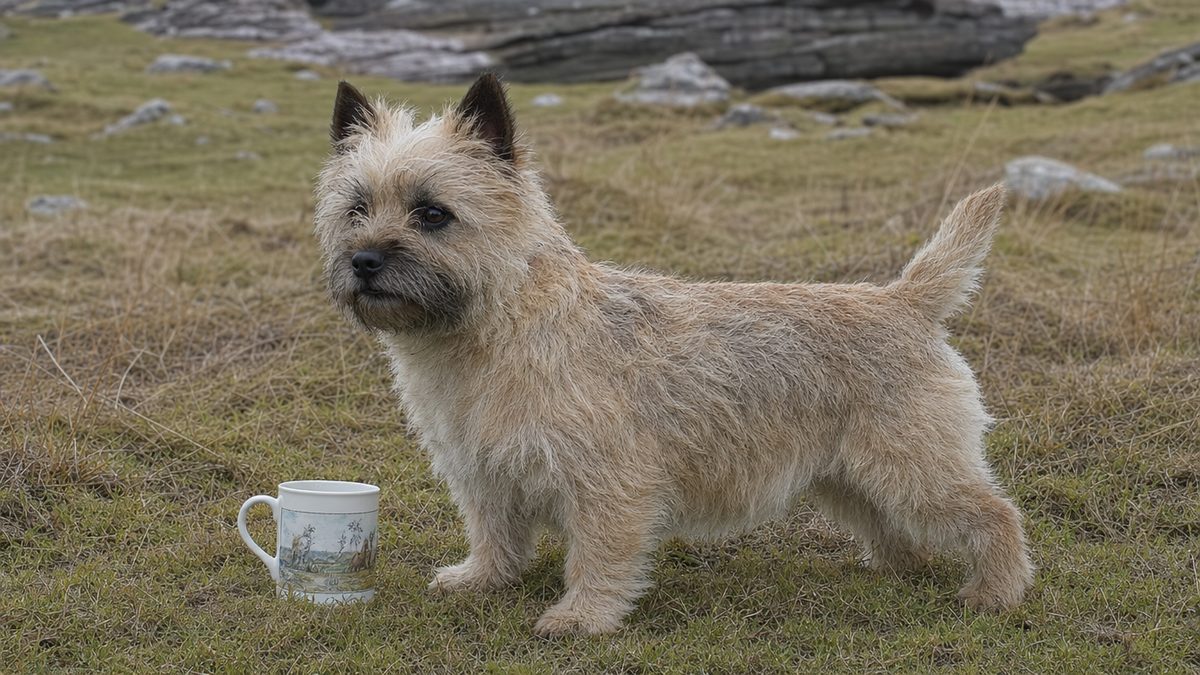
The Cairn Terrier is a small, harsh-coated Scottish earth terrier of 6 to 7.5 kg, recognised by the Fédération Cynologique Internationale as standard number 4 in Group 3, Section 2, small-sized terriers, and accepted on a definitive basis on 4 June 1963. It was bred to go to ground after fox and vermin in the rock piles, or cairns, of the Scottish Highlands and Skye, and it still behaves like it.
FCI-4 opens with four words that tell you most of what you need: "Agile, alert, of workmanlike, natural appearance." It goes on to require the dog to stand well forward on its forepaws, be deep in rib, very free in movement, and carry a weather-resistant coat. On temperament it asks for a dog that "should impress as being active, game and hardy", with a "fearless and gay disposition; assertive but not aggressive";.
The word doing the real work there is workmanlike. This is not a decorative small dog that happens to be scruffy. The shaggy outline, the harsh jacket, the broad skull and the short strong legs are all functional, and the standard penalises any drift toward prettiness. A Cairn that has been scissored into neat square outlines has been groomed into the wrong breed.
The measurements, straight from the standard
FCI-4 gives approximately 28 to 31 cm (11 to 12 inches) at the withers, in proportion to weight, ideally 6 to 7.5 kg (14 to 16 lb). The coat is "very important": weather-resistant and double, with a profuse, harsh but not coarse outer coat over a short, soft, close undercoat, and open coats are called objectionable. A slight wave is permissible.
Colour under FCI-4 is cream, wheaten, red, grey or nearly black, with brindling acceptable in all of those, and explicitly not solid black, white, or black and tan. Dark points such as ears and muzzle are called very typical. That colour clause is the reason a Cairn and a West Highland White Terrier look like the same dog in two colours: they are close relatives, and the white was selected out of the Cairn and into the Westie.
The head is the identifying feature
The AKC standard puts the point more bluntly than the FCI does: the Cairn's head is "shorter and wider than any other terrier", well furnished with hair, giving a general foxy expression. FCI-4 asks for a broad skull with a decided indentation between the eyes and a definite stop, eyes set wide apart, medium in size, dark hazel, slightly sunk, under shaggy eyebrows, and small pointed ears carried erect and not heavily coated.
Those shaggy eyebrows are not cosmetic. On a dog whose job was to push into a rock crevice after something with teeth, they screen the eyes. Indian owners who trim them flat for tidiness remove the only shade this breed came with.
| Attribute | FCI standard 4 | AKC standard, approved 10 May 1938 |
|---|---|---|
| Height at withers | 28 to 31 cm (11 to 12 in) | Dogs 10 in, bitches 9.5 in |
| Weight | Ideally 6 to 7.5 kg (14 to 16 lb) | Dogs 14 lb, bitches 13 lb |
| Body length | Back level, medium length | 14.25 to 15 in, chest to hindquarters |
| Coat | Double, profuse harsh outer, short soft close undercoat | Hard and weather-resistant, must be double-coated |
| Colour | Cream, wheaten, red, grey, nearly black; brindle allowed; not black, white or black and tan | Any colour except white |
| Ears | Small, pointed, erect, not heavily coated | Small, pointed, carried erectly, free from long hairs |
| Tail | Short, well furnished, carried gaily, never over the back | In proportion to head, set on at back level |
| Group | Group 3 Terriers, Section 2 small-sized | Terrier Group |
Two things in that table matter for an Indian buyer. The height figures do not overlap, which the next section takes apart. And the colour clauses flatly disagree, because the AKC allows any colour except white while the FCI excludes solid black and black and tan outright Fédération Cynologique Internationale. A black Cairn is a normal dog in Chicago and a disqualified one in a KCI ring.
India is a full member of the FCI, represented by the Kennel Club of India in Chennai. That means the standard governing a KCI-registered Cairn Terrier here is FCI-4, not the AKC's. Every Indian page we read quotes AKC-derived measurements instead.
Three breed standards, and the one that is the odd one out
Two of the three governing standards for this breed give a height of 11 to 12 inches, and the AKC gives 9.5 to 10. FCI-4 asks for approximately 28 to 31 cm, which is 11 to 12 inches. The United Kennel Club asks for "11 to 12 inches in height" and "14 to 16 pounds in weight";. The AKC asks for 10 inches in dogs and 9.5 in bitches.
So this is not a two-way argument in which India could reasonably follow either side. The FCI minimum of 28 cm sits 2.6 cm above the AKC maximum of 25.4 cm, the UKC matches the FCI exactly on both height and weight, and the AKC stands alone American Kennel Club.
India is bound to the majority position anyway. The Fédération Cynologique Internationale lists INDIA as a Full member, represented by the Kennel Club of India at Anna Nagar, Chennai. A Cairn Terrier judged in a KCI ring is judged against FCI-4. Yet every Indian source we opened quotes the AKC figures instead.
Colour splits the same way
The AKC allows "any color except white";. FCI-4 lists cream, wheaten, red, grey or nearly black with brindling acceptable, and excludes solid black, white, and black and tan. The UKC lists exactly the FCI colours, "Cream, wheaten, red, gray or nearly black. Brindling in these colors acceptable", and adds that dark ears, muzzle and tail tip are typical.
Two standards out of three therefore bar a solid black Cairn Terrier, and the one that permits it is the one Indian pages copy. Purina India reprints the AKC line word for word, "Any colour except white";, and so does the Indian retailer PetIndiaOnline.
Six Indian sources, six different Cairn Terriers
| Source | Height at withers | Weight | Agrees with FCI-4? |
|---|---|---|---|
| FCI standard 4 (applies in India via KCI) | 28 to 31 cm | 6 to 7.5 kg | Reference |
| UKC standard, revised 2007 | 11 to 12 in (28 to 30.5 cm) | 14 to 16 lb (6.4 to 7.3 kg) | Yes, on both |
| AKC official standard, 1938 | 24.1 to 25.4 cm | 5.9 to 6.4 kg | No, 2.6 cm shorter at the top |
| Purina India | 24 cm female, 25 cm male | 5.5 kg female, 6 kg male | No, matches the AKC |
| PetIndiaOnline | 9.5 to 10 in | 13 to 14 lb | No, reproduces the AKC |
| Puppiezo | 9 to 10 in (22.9 to 25.4 cm) | 6 to 8 kg | No, AKC height with a heavier weight |
| Tailsbuddy | Above 9 inches | 6 to 7 kg | No, and the range has no upper bound |
| Asia Pets | 23 to 33 cm | 6 to 8 kg | No, a 10 cm band wider than any standard |
| Dogs India | 25 to 35 cm | 6 to 7 kg | No, a 10 cm band running 4 cm above FCI-4 |
Read down the height column. Asia Pets and Dogs India print bands roughly ten centimetres wide, which covers everything from a Norfolk Terrier to a small Schnauzer Dogs India, Cairn Terrier breed page…. Puppiezo pairs an AKC height with a weight range topping out at 8 kg, half a kilogram above the FCI ideal maximum on a dog two and a half centimetres shorter.
That last combination is the one an Indian buyer is most likely to be sold, and it is not any standard's dog. FCI-4 explicitly ties the two figures together, asking for height "in proportion to weight";. Squat and heavy is a different animal from small and workmanlike.
What to do with a tape measure
- Measure at the withers, the ridge between the shoulder blades, with the dog standing square on a hard floor.
- Expect 28 to 31 cm on an adult bred to the standard that applies in India, and treat anything under 25 cm as a reason to ask more questions about parentage.
- Weigh on the same day and read the pair together, because 7.5 kg on a 30 cm frame is correct and 7.5 kg on a 24 cm frame is not.
- Ask to see the KCI paperwork and both parents, since a standard is only enforceable through the registry that applies it.
An Indian buyer reading Purina India could reasonably buy a solid black Cairn Terrier and then find it cannot be shown under the standard the Kennel Club of India actually follows Fédération Cynologique Internationale. The same reader, measuring against Purina India's 25 cm, would judge a correct 30 cm Cairn Terrier oversized.
Where the Cairn Terrier came from, and what it was for
The Cairn Terrier is named after the rock dens it was bred to enter. Purina India records the point plainly: the breed is named for the rock dens that foxes and badgers lived in throughout the Scottish countryside, and these terriers would squeeze down the cairns and bark to alert the farmer when they found game.
Asia Pets tells the same origin story on its Indian listing page, describing a dog bred in the Scottish Highlands to root vermin out of cairns, brave and independent. The two accounts agree, and they agree with the standards. FCI-4 lists the breed's utilisation as, simply, "Terrier", with country of origin Great Britain and no working trial required Fédération Cynologique Internationale.
The work explains the dog. A terrier that goes to ground alone, out of sight and earshot of its handler, has to decide for itself. That is why the standard asks for a fearless and gay disposition, assertive but not aggressive, and why every honest description of the breed uses the word independent. Independence is not a training flaw here. It is the trait the breed was selected for, and it is the trait that frustrates owners who expected a small Labrador.
One rough-coated Highland terrier, split into four breeds
The United Kennel Club's standard states the history in one sentence: "The Scottish, West Highland White and Cairn terriers were developed from the same stock, first called Scotch terriers and later Skye terriers. The three were often found in the same litter, distinguished only by color";. Purina India preserves the same fossil name, recording "Short-haired Skye terriers" as an alternative label for the Cairn.
The clearest evidence that the split is recent is genetic rather than historical. The Cairn Terrier and the West Highland White Terrier share the same disease-causing GALC mutation, an A to C transversion at cDNA position 473, identified in both breeds in the same 1996 paper.
Two breeds do not share one point mutation by coincidence. They share it because they were one breeding population recently enough for a single founder variant to sit in both, exactly as the UKC standard describes.
The separation dates are recorded. The Cairn first competed for challenge certificates in England in 1912, and the United Kennel Club recognised the breed in 1959, four years before the FCI accepted it on a definitive basis.
Toto, and the one fact every Indian page repeats
The best-known Cairn Terrier is Toto from The Wizard of Oz, and Purina India adds the detail most pages leave out: the dog's real name was Terry, and although Terry played a male role, Terry was a female. Asia Pets leads its Indian page with the same Toto reference.
That is genuinely the whole of the Indian market's cultural footprint for this breed. It is a film reference from 1939. Nothing on any Indian page describes a living Indian Cairn Terrier, a working line, a kennel, or a show result.
| Date | Event | Source |
|---|---|---|
| 10 May 1938 | AKC official breed standard approved, still current | AKC standard document |
| 4 June 1963 | FCI accepts the breed on a definitive basis | FCI nomenclature entry |
| 24 June 1987 | Official valid FCI standard published | FCI-Standard N° 4 |
| 12 March 1998 | Date on the current FCI standard document | FCI-Standard N° 4 |
| 1 May 1996 | Canine GALC cDNA cloned, Cairn and Westie mutation identified | Genomics 33(3):457-62 |
| 2 March 2023 | Cairn Terrier Club of America health testing guidelines approved | CTCA Board of Governors |
Every trait Indian buyers complain about later is in the job description. The digging, the alert barking at the corridor, the refusal to recall off a squirrel, the willingness to argue with a much larger dog. FCI-4 asks for a dog that is "active, game and hardy";. Buy the dog the standard describes, not the one the film suggests.
The Cairn Terrier is on The Kennel Club's At Watch list
The Cairn Terrier appears on The Kennel Club's At Watch table, not on its Vulnerable Native Breeds table, and the distinction is precise rather than decorative. The At Watch table records ten years of registrations for the breed: 683 in 2016, then 589, 567, 464, 443, 498, 492, 437, 467 and 447 in 2025.
That is a fall of 236 registrations, or 34.6 percent, across a decade. It is a decline, but it is a shallow one by the standards of the same document. On the Vulnerable Native Breeds table alongside it, the Bearded Collie fell from 284 to 158, the Bedlington Terrier from 411 to 188, and the Bullmastiff from 493 to 143 over the same ten years.
The Cairn's own curve is flatter than any of those. It dropped hard between 2016 and 2020, from 683 to 443, and has since held between 437 and 498 for six straight years. A breed that stops falling is a different problem from a breed that keeps falling.
Where it sits among the terriers
The Kennel Club's ten-year terrier table gives the full comparison. In 2025 the Cairn Terrier's 447 registrations placed it sixth of 27 terrier breeds, behind the Staffordshire Bull Terrier on 5,375, the Border Terrier on 3,181, the West Highland White Terrier on 1,083, the Bull Terrier on 943 and the Jack Russell Terrier on 503.
Dogs India's breed page still describes the Cairn as "Great Britain's most popular terrier" until recently. Against the registry data that is now five breeds out of date. The Westie, its closest relative, was registered 2.4 times as often in 2025.
America tells a similar story with less decline. The American Kennel Club's own breed page places the Cairn Terrier at 71 of 210 for breed popularity, which is the upper third of a much larger roster. So this is not a rare breed anywhere it is genuinely bred. It is a mid-table breed in the United States, a watched one in Britain, and effectively absent from India.
| Breed | 2016 | 2020 | 2025 | Change 2016 to 2025 |
|---|---|---|---|---|
| Cairn Terrier | 683 | 443 | 447 | down 34.6 percent |
| West Highland White Terrier | 2,414 | 1,460 | 1,083 | down 55.1 percent |
| Scottish Terrier | 454 | 466 | 312 | down 31.3 percent |
| Border Terrier | 5,150 | 4,587 | 3,181 | down 38.2 percent |
| Norfolk Terrier | 600 | 358 | 365 | down 39.2 percent |
| Jack Russell Terrier | 150 | 391 | 503 | up 235 percent |
| All terriers (group total) | 19,436 | 18,259 | 14,963 | down 23.0 percent |
The Jack Russell row is the outlier that explains the rest. It is the only terrier in the table growing, and it is growing hard, from 150 registrations in 2016 to 503 in 2025. Buyers have not stopped wanting a small terrier. They have moved to a smooth-coated one that needs no stripping.
The most recent quarterly figures show the breed steady rather than recovering: 121, 98, 109 and 119 across the four quarters of 2025 for a year of 447, then 73 in the first quarter of 2026 and 104 in the second. All four datasets used here, the ten-yearly comparative tables, the quarterly returns, the export register and the vulnerable-breed series, are published together on one Kennel Club index page and can be checked against each other.
We added the group totals from all seven Kennel Club export tables for 2025 and got 990 export pedigrees across roughly 60 destination countries. Four of those were Cairn Terriers, within a Terrier Group total of 101 that sums exactly to the figure printed on the table. India appears in none of the seven tables. The control matters: Pakistan, Singapore, Malaysia, Thailand, Kenya, Bahrain, Hong Kong, China, Japan and South Korea all do appear The Kennel Club, Terrier Group export…. The format records Asian and South Asian destinations perfectly well. It simply did not record one going to India.
The gene pool, measured: an effective population size of 70.3
The Cairn Terrier's effective population size is 70.3, estimated by the Kennel Club in its 2015 population analysis from the rate of inbreeding over 1980 to 2014. Effective population size is the number of breeding animals an idealised population would need to lose genetic diversity at the same rate, and it is the cleanest single measure of how large a breed's gene pool really is.
The plan sets that figure against two published thresholds from the Food and Agriculture Organisation of the United Nations. An effective population size below 100, equivalent to an inbreeding rate of 0.50 percent per generation, leads to a dramatic increase in the rate of loss of genetic diversity. An effective population size below 50, equivalent to 1.0 percent per generation, indicates the future of the breed may be considered at risk.
At 70.3 the Cairn Terrier sits between those two lines. It is losing diversity faster than is comfortable, and it is not in the category the FAO describes as at risk. That is a more useful answer than either "the breed is fine" or "the breed is doomed", and it is the kind of number no marketplace page will ever print.
The direction of travel is the good news
The plan reports that the observed inbreeding coefficient rose until a peak around 2002 and has been decreasing since. A falling inbreeding coefficient in a breed with falling registrations is not automatic; it is the result of breeders deliberately widening matings while the population shrinks.
The registration decline it happened against is steep. Across year of birth from 1990 to 2020 the trend was -92.5 registrations per year, with a 95 percent confidence interval of -103.3 to -81.7, and the plan attributes the breed's place on the At Watch list directly to concern over the dwindling number of dogs registered per year.
Litters, and the caesarean rate
| Year | Litters registered | C-sections | Percentage in this breed | All KC breeds |
|---|---|---|---|---|
| 2010 | 323 | 0 | 0.00 percent | 0.35 percent |
| 2012 | 227 | 9 | 3.96 percent | 8.69 percent |
| 2014 | 196 | 13 | 6.63 percent | 10.63 percent |
| 2016 | 147 | 8 | 5.44 percent | 13.89 percent |
| 2018 | 136 | 10 | 7.35 percent | 17.21 percent |
| 2020 | 109 | 7 | 6.42 percent | 14.41 percent |
Two things are visible in that table. Litters registered fell from 323 in 2010 to 109 in 2020, a fall of two thirds in a decade. And the caesarean rate in this breed sits consistently at roughly a third to a half of the all-breed Kennel Club figure, 6.42 percent against 14.41 percent in 2020.
The plan is careful about the caesarean numbers, noting that not all sections are likely to be reported, that the data do not distinguish emergency from elective, and that reporting rose across all breeds from 2012 as the Kennel Club publicised the procedure to vets. Even allowing for all three caveats, a breed whelping naturally most of the time is a real welfare advantage over the brachycephalic and heavy-headed breeds sitting near the top of that all-breed column.
A small gene pool is manageable when a breeder can reach the whole population. In India, where no lawful breeding import route exists and no Kennel Club export pedigree was recorded to India in 2025, any domestic Cairn Terrier breeding would start from a handful of dogs. That is precisely the situation in which Second Schedule Part II paragraph 6(3) of the Indian Rules matters, because in-breeding within four generations and incest breeding are prohibited outright. A breeder with three related dogs and no import route cannot lawfully breed Cairn Terriers in India.
It notes that dogs imported from overseas may appear completely unrelated when they are not, because the pedigree available to the Kennel Club is often limited in generations, hampering detection of true but distant relationships. Read that as a warning about any imported dog's paperwork, including one arriving in India.
Cairn Terrier price in India, and what the sellers are actually offering
No verified cairn terrier price in india exists, because on 24 August 2026 not one of the ten pages ranking for the query had a Cairn Terrier for sale. They print bands from ₹6,000 to ₹45,000 over inventory of zero. Below is what each one actually shows when you open it.
Google's own AI Overview for the query answers with "₹35,000 to ₹45,000", attributing it to Puppiezo. Puppiezo's product page does say that: "Cairn Terrier Prices in India can range from ₹35,000 to ₹45,000 or more, depending on factors like pedigree and breed". What it does not say is how many Cairn Terriers it has. The answer is none.
| Source | Price it prints | Cairn Terriers actually listed | What it offers instead |
|---|---|---|---|
| Puppiezo (product page) | ₹35,000 to ₹45,000 or more | 0 | Other Available Pets carousel |
| Puppiezo (breed page) | No breed price shown | 0 | Maltipoo Fizey at ₹98,999, plus ₹92,599, ₹94,999, ₹76,499, ₹1,20,000 |
| Asia Pets | None printed | "Showing 0 results" | A Chihuahua, a Yorkshire Terrier and a Toy Pom |
| Mr n Mrs Pet | None shown before sign-up | "3 Result Found", none of them Cairns | French Bulldog (Chennai), Border Collie (Lucknow), Cavalier King Charles Spaniel (Ahmedabad) |
| PetBuy | ₹6,000 to ₹25,000 | "Listings 0" | Explore Similar Breeds |
| Tailsbuddy | ₹25,000 to ₹35,000 basic; ₹35,000 to ₹45,000 KCI registered | No listings module | Breed facts only |
| Dogs India | None printed | 1 breeder entry, litter born 14-2-2006 | Nothing current |
| Supertails | Zero mentions of the breed | Not covered | 40 other breeds |
The Mr n Mrs Pet result, opened and counted
Mr n Mrs Pet prints "3 Result Found" under an H1 reading Cairn terrier Puppies For Sale. The three cards rendered on 24 August 2026 sat under a heading that gives the game away, "Similar breeds at other locations", and they were a French Bulldog named Raj in Chennai, a Border Collie named Daisy in Lucknow, and a Cavalier King Charles Spaniel named tupy in Ahmedabad.
The control is on the same page. Its Most Popular Breeds panel counts 650 Shih Tzu, 549 Siberian Husky, 487 Golden Retriever, 454 Labrador Retriever and 412 German Shepherd listings. The platform holds thousands of dogs. It holds no Cairn Terriers, and it fills the gap with three unrelated breeds rather than saying so.
Asia Pets contradicts itself in two paragraphs
Asia Pets opens its Cairn Terrier page with "We've been helping families across India find their perfect Cairn Terrier companion for years now. Every Cairn Terrier pup you see here comes with proper vaccination papers, a vet health certificate, and genuine pedigree." Four lines below that, the listing module prints "Showing 0 results", then offers a Chihuahua, a Yorkshire Terrier and a Toy Pom as "available pets of the same breed from other locations";.
A Chihuahua is not the same breed as a Cairn Terrier. Neither is a Toy Pom.
Dogs India has run a breeder noticeboard since long before any of these marketplaces existed. Its Cairn Terrier page carries exactly one entry, from Stone Haven Kennels in Coimbatore, offering four male puppies from a litter born on 14 February 2006. That advertisement is more than twenty years old and it is still the only Cairn Terrier offer on the page. The control is the same site's Beagle page, fetched the same way in the same session, which lists several kennels with 2024 litter dates and renewal notes. The noticeboard works. Nobody has posted a Cairn Terrier litter to it in two decades.
Testing the Indian price figures: the house default and the charm price
Two of the Indian rupee figures for this breed fail on inspection, and for different reasons. PetBuy's ₹6,000 to ₹25,000 is a house default it prints for several breeds it does not stock. Puppiezo's ₹98,999 belongs to a Maltipoo. Both are checkable in about five minutes, and we show the working.
Test one: does the band change when the breed changes?
PetBuy prints a Typical Price in India of ₹6,000 to ₹25,000 on its Cairn Terrier page, directly above the words "Listings 0";. We then opened seven more PetBuy breed pages the same way in the same session and read the same two fields off each.
| Breed page | Typical Price in India | Listings |
|---|---|---|
| Cairn Terrier | ₹6,000 to ₹25,000 | 0 |
| West Highland White Terrier | ₹6,000 to ₹25,000 | 0 |
| Scottish Terrier | ₹6,000 to ₹25,000 | 0 |
| Norwich Terrier | ₹6,000 to ₹25,000 | 0 |
| Pug | ₹6,000 to ₹22,000 | 0 |
| Beagle | ₹10,000 to ₹28,000 | 30 |
| Golden Retriever | ₹15,000 to ₹45,000 | 30 |
| German Shepherd | ₹12,000 to ₹40,000 | 216 |
The pattern is exact. Four different terrier breeds carry the identical ₹6,000 to ₹25,000 band, and all four have zero listings. Every breed with real stock gets its own band and a real count, up to 216 for the German Shepherd. The ₹6,000 to ₹25,000 figure is therefore not a Cairn Terrier price. It is a small-breed placeholder attached to pages with nothing behind them.
Test two: does the rupee figure divide into a dollar figure?
Indian pages routinely publish a United States price list run through one exchange rate and printed in rupees. The check is arithmetic. Divide by 84.38, then by 74, and look for a clean dollar quotient.
| Rupee figure | Source | Divided by 84.38 | Divided by 74 | Verdict |
|---|---|---|---|---|
| ₹6,000 | PetBuy floor | 71.11 | 81.08 | Not a conversion |
| ₹25,000 | PetBuy ceiling, Tailsbuddy floor | 296.28 | 337.84 | Not a conversion |
| ₹35,000 | Tailsbuddy, Puppiezo | 414.79 | 472.97 | Not a conversion |
| ₹45,000 | Tailsbuddy, Puppiezo | 533.30 | 608.11 | Not a conversion |
| ₹98,999 | Puppiezo carousel | 1,173.25 | 1,337.82 | Not a conversion, a charm price |
Not one quotient is clean. Unlike the Airedale Terrier and the Ariegeois, whose Indian bands resolved to round dollar amounts, the Cairn Terrier's Indian figures are rupee-native. They were typed by somebody in India, not converted. That makes them honest in origin and still useless as prices, because there is no transaction behind them.
The comparison also runs the other way. Two of the pages ranking in India for this Indian query are American cost guides quoting dollars: DogBreedsList puts a Cairn Terrier puppy from decent breeders at approximately 1,200 to 2,000 dollars and a show-quality puppy higher, and A-Z Animals runs a full United States breakdown of purchase cost, vaccination, food and supplies, insurance and training with nothing Indian in it at all. At 84.38 rupees to the dollar, 1,200 dollars is ₹1,01,256, which is more than double the highest Indian band anyone prints for this breed. Nobody has reconciled those two worlds, because no transaction exists in India to reconcile them against.
Test three: whose price is ₹98,999?
Puppiezo's Cairn Terrier breed page carries an "Other Available Pets" carousel, and the largest figure on it is ₹98,999. That price is attached to a Maltipoo named Fizey, listed at 8 weeks and badged Platinum. The same carousel prints ₹92,599, ₹94,999, ₹76,499 and ₹1,20,000 beside it.
₹98,999 is a house price point on that site, not a breed price, and Fizey the Maltipoo is the animal it is usually attached to. A buyer who lands on the Cairn Terrier page and remembers a number close to a lakh has remembered a Maltipoo.
It would name a breeder, a KCI litter registration, a date of birth and a city, the way the Dogs India entry from 2006 does. Every current Indian band we tested is a number printed beside an empty inventory. If a seller quotes you ₹35,000, ask which litter, whelped when, out of which registered sire and dam, and ask to see the parents.
Importing a Cairn Terrier into India, and the door that is closed
You cannot lawfully import a Cairn Terrier into India to breed from or to sell. DGFT Trade Notice No. 22/2022-23 of 19 December 2022 classes mammals under ITC (HS) 01061900 as Restricted, and Policy Condition (7) permits the import of dogs only for three purposes.
The three permitted routes, quoted from the notice itself, are a pet dog with a valid pet book and relevant records in the name of the importer; dogs imported by R&D organisations for research with the recommendation of the CPCSEA; and dogs for internal security by the Defence and Police Force. Policy Condition (8) then states that the import of commercial dogs for breeding or any other commercial activities other than those purposes is not permitted.
Paragraph 6 removes the ambiguity: "any applications for trading/breeding purposes, or applications made on behalf of some another person/entity shall be duly rejected";.
What is left is the personal-pet route
A returning resident can bring a Cairn Terrier home. The notice allows permanent import of up to two pets as passenger baggage without any DGFT import authorisation, but only for a person transferring residence to India after two years of continuous stay abroad, and only cats and dogs qualify under the baggage rules.
- Fewer than two years abroad: an import authorisation from DGFT is required, applied for on form ANF-2M.
- More than two pets: an import authorisation is required in every case, examined by the Department of Animal Husbandry and Dairying.
- Temporary import: an import authorisation is required regardless of numbers, plus a return ticket and a local host undertaking.
- No IEC of your own: apply against the permanent code IIHIE0153E, for persons importing goods for personal use not connected with trade.
- Timing: the notice advises starting the application at least two months before travel.
Entry is restricted to seven places. Import of pet animals is allowed only through the airports and seaports of Delhi, Mumbai, Chennai, Hyderabad, Bengaluru and Kolkata and, since October 2024, Kochi airport, and animals may be quarantined at the government quarantine station of those ports Department of Animal Husbandry…. An Advance No Objection Certificate from the Regional or Quarantine Officer of the relevant port is also required. The full route is set out in how to import a dog to India.
Why that closes the supply chain
Put the trade notice next to the export data and the position is unambiguous. India cannot lawfully import this breed for breeding. The Kennel Club issued 990 export pedigrees across all seven groups in 2025 and recorded no Indian destination in any of them, while recording Pakistan, Singapore, Malaysia, Thailand, Kenya and Bahrain. Dogs India's noticeboard has carried one Cairn Terrier litter since 2006.
Three independent sources, three different countries, one conclusion. There is no visible pipeline putting Cairn Terrier puppies into the Indian market, which is exactly why every marketplace ranking for the price query shows a listing count of zero.
If an Indian seller quotes a Cairn Terrier at ₹35,000 with delivery in a week, ask for the KCI litter registration number and the parents' registration numbers, and ask to see the dam. A dog with no lawful import route and no visible domestic breeding population is the classic setup for a similar-looking substitute. A wheaten Indian street-dog cross, a scruffy Terrier mix, or a Norwich or Norfolk Terrier will all pass a photograph.
What a Cairn Terrier costs every month in India
Budget ₹4,000 to ₹8,000 a month for a small dog in India before anything breed-specific, then add the coat. Supertails publishes the only Indian monthly breakdown by breed size we found, and its small-breed column totals ₹4,000 to ₹8,000. For a Cairn Terrier the grooming line is the one that moves.
| Cost line | Published small-breed figure | Cairn Terrier note |
|---|---|---|
| Dry or wet food | ₹1,500 to ₹2,500 | At 6 to 7.5 kg this sits at the lower end |
| Routine vet visits | ₹500 to ₹1,000 | Add a bile acid test in the first year |
| Vaccinations | ₹1,200 per year | Course starts at seven to eight weeks under Indian rules |
| Grooming | ₹1,500 to ₹3,000 | The line that changes; see the stripping cost below |
| Training, first six months | ₹0 to ₹3,000 | Budget the upper end, this is an independent breed |
| Treats and toys | ₹300 to ₹800 | Add a dig pit or sandbox |
| Flea, tick and deworming | ₹300 to ₹600 | Do not economise here; see the tick-borne data |
| Published monthly total | ₹4,000 to ₹8,000 | Realistic Cairn range ₹4,500 to ₹9,500 |
The published small-breed grooming line, ₹1,500 to ₹3,000 a month, already assumes a dog going to a salon. A Cairn Terrier does not need monthly salon visits. It needs a different service, less often, that most salons do not sell.
The coat line, priced from Indian menus
ThePetNest's Delhi grooming price guide lists "Breed-specific hand-stripping: ₹800 to ₹1,500 (Terriers, Schnauzers)" as a specialised service, alongside a full groom at ₹1,500 to ₹2,500, an express groom at ₹800 to ₹1,500, a deshedding treatment at ₹500 to ₹1,200 and a medicated bath at ₹1,000 to ₹1,800. Supertails quotes a very different number for the same service, "Optional: Show-quality hand stripping (₹3,000 to ₹6,000 additional; not needed for pet dogs)";.
Those two Indian prices differ by roughly four times. Both are real, published, rupee-native figures, and we are not going to average them. The gap is the finding: hand stripping is priced as a cheap add-on by a city salon guide and as a premium show service by a national retailer, which is what a market looks like before it has settled.
| Approach | Per session | Sessions per year | Annual cost |
|---|---|---|---|
| Salon hand strip, Delhi guide rate | ₹800 to ₹1,500 | 5 to 6 | ₹4,000 to ₹9,000 |
| Show-quality hand strip, retailer rate | ₹3,000 to ₹6,000 | 5 to 6 | ₹15,000 to ₹36,000 |
| Owner strips at home | ₹0 after tools | Rolling, every 6 to 10 weeks | ₹2,000 to ₹4,000 in tools, once |
| Clipper cut (do not do this) | ₹1,500 to ₹2,500 | 6 to 8 | ₹9,000 to ₹20,000 and a ruined coat |
The cheapest correct option is the third one, and it is also the only one available in most Indian cities. Buying a stripping knife and a stripping stone and learning to roll the coat yourself costs a couple of thousand rupees once, and then nothing.
A Cairn Terrier's first year carries costs a Labrador's does not. A bile acid test at 12 to 16 weeks, recommended by the breed's own parent club for every puppy, is not a routine Indian puppy test and you will have to ask for it. Add a dilated eye examination by a veterinary ophthalmologist from two years of age, which in India means travelling to a metro referral clinic. Neither appears on any Indian cost list for this breed.
Can a Cairn Terrier handle the Indian climate?
A Cairn Terrier can live in India, and it will be permanently warmer than the place its coat was built for. NASA's POWER climatology, queried by explicit coordinates for Portree on the Isle of Skye (57.4125 N, -6.1950 E, returned as -6.195, 57.413 at 59.58 m), gives an annual mean 2 m air temperature of 9.25 °C. Bengaluru's coolest month is 20.22 °C.
Put another way, the coldest month in the mildest Indian metro on this list is nearly eleven degrees warmer than Skye's annual average, and 6.8 degrees warmer than Skye's warmest month.
| Location | Annual mean 2 m temp | Warmest month mean | Record 2 m maximum | Annual mean relative humidity |
|---|---|---|---|---|
| Portree, Isle of Skye | 9.25 °C | 13.42 °C (July) | 23.13 °C | 85.72 percent |
| Bengaluru | 23.74 °C | 28.37 °C (April) | 40.38 °C | 67.94 percent |
| Pune | 23.86 °C | 28.93 °C (April) | 43.20 °C | 66.80 percent |
| Delhi | 25.60 °C | 35.88 °C (June) | 48.79 °C | 45.56 percent |
| Kolkata | 25.81 °C | 31.53 °C (May) | 46.81 °C | 73.93 percent |
| Mumbai | 26.77 °C | 31.19 °C (May) | 44.91 °C | 67.39 percent |
| Chennai | 27.95 °C | 31.51 °C (May) | 42.70 °C | 72.39 percent |
The record-maximum column is the one to read twice. The hottest 2 m air temperature in NASA's record for the Cairn Terrier's home island is 23.13 °C. That is cooler than the annual mean of every Indian city in the table, and it is 25.66 degrees below Delhi's record of 48.79 °C NASA Langley Research Center.
Humidity is not the problem people assume
Skye is wetter than India. Its annual mean relative humidity is 85.72 percent, higher than any Indian city here, and its July and August figures reach 86.49 and 86.76 percent. FCI-4 calls the coat weather-resistant for exactly that reason.
So a Cairn Terrier's double coat is not naive about damp. What it has never met is damp and heat together. Mumbai in July runs 26.63 °C at 89.56 percent humidity, and Pune in August runs 90.80 percent. At those numbers evaporative cooling from panting is blunted, and a dog carrying a short soft close undercoat under a profuse harsh jacket has no other cooling route.
City by city, honestly
- Bengaluru and Pune: the two workable cities. Annual means near 23.8 °C and cooler nights make dawn and dusk walking genuinely comfortable for eight or nine months of the year.
- Delhi: the widest swing. January at 13.61 °C suits this dog well and June at 35.88 °C does not. Plan two very different seasons rather than one routine.
- Mumbai and Chennai: the hardest. High heat with high humidity for most of the year, and Chennai never drops below a monthly mean of 24.09 °C.
- Kolkata: a January mean of 17.31 °C gives a real cool season, then a monsoon at 86.95 percent humidity in July that demands active drying.
- Hill stations and the Nilgiris: the only Indian conditions that approach the breed's origin, and the only places a Cairn Terrier will be comfortable year round.
A 6 to 7.5 kg dog sheds heat better than a 50 kg one, and the Cairn has a normal, non-brachycephalic muzzle, so its airway works. Those two facts are why this breed rates 2 out of 5 for heat tolerance rather than 1. Nothing else about it is heat-adapted, and a dog bred in a place whose record high is 23.13 °C should never be walked on Indian afternoon pavement.
Managing a harsh double coat through an Indian summer
Never shave a Cairn Terrier to cool it down. FCI-4 requires a double coat with a profuse harsh outer layer over a short, soft, close undercoat, and calls open coats objectionable. That structure is a heat shield as well as a rain shield, and clipping it off removes the shade while leaving the undercoat to mat and trap moisture against the skin.
The instinct is understandable and it is wrong in the same way for every double-coated breed. A shaved Cairn is not a cooler Cairn. It is a Cairn with sunburn risk on thin Indian-summer skin and no insulating air layer between that skin and 40 °C air.
What actually works, in order of effect
- Move the walks. Pre-dawn and after dark, not morning and evening. Bengaluru peaks in April at 28.37 °C and Delhi in June at 35.88 °C, and daytime pavement runs far above air temperature.
- Test the pavement with the back of your hand for five seconds. If you cannot hold it, a 28 cm dog carrying its chest that close to the surface certainly cannot.
- Keep the coat stripped, not clipped. A properly rolled harsh jacket lies flat and lets air move. A clipped one grows back soft, dense and heat-trapping.
- Brush out the undercoat weekly. Purina India specifies weekly grooming for this breed, and dead undercoat is what turns a working coat into felt.
- Wet the belly and paws, not the coat. Water sitting in a double coat in 90 percent humidity does not evaporate; it ferments.
- Give a floor to lie on. A stone or tile surface, a cooling mat, or shade with moving air beats air conditioning the dog will not always have.
Where the breed club's advice does not transfer
The Cairn Terrier Club of America tells owners: "You only need to bathe this breed rarely because of their waterproof double-coat, you don't want to chance robbing their coat of its natural protective oils";. Purina India tells Indian owners the coat needs "monthly bathing";. Both are published, and they point in opposite directions.
The American advice is right about the coat and written for a climate where a dog is not carrying ticks nine months of the year. The Indian evidence changes the calculation. A cross-sectional study of 442 clinically suspected dogs across 90 veterinary dispensaries in Andhra Pradesh found Ehrlichia canis by PCR in 51 of them, 11.54 percent, with tick infestation among the significant risk factors and prior tick-control measures associated with lower odds.
So the resolution is not more bathing. It is targeted parasite control, which does the job that frequent washing would only pretend to do while stripping the coat oils the club is protecting.
The one thing an Indian owner must add to the club's advice is active drying. A profuse harsh outer coat over a close undercoat holds water at skin level for hours. Towel hard, then use a stand dryer or a fan on cool until the undercoat is dry to the touch at the lumbosacral region, behind the ears and in the armpits. Indian dermatophyte pressure is real: an Indian Veterinary Research Institute study screened 386 canine and 56 feline samples and recovered ten Trichophyton isolates.
This page rates the Cairn Terrier 2 out of 5 for heat tolerance. Against it: a double coat evolved where the record high is 23.13 °C. For it: a body of 6 to 7.5 kg, which loses heat far more readily than a large dog, and a normal muzzle with no brachycephalic airway compromise. Manageable in Bengaluru and Pune with disciplined timing. Genuinely hard in Chennai and Mumbai.
Temperament, and who should not buy this breed
The Cairn Terrier is an assertive, vocal, independent small dog that Purina India classes as "suitable for experienced owners";. FCI-4 asks for a dog that impresses as active, game and hardy, with a fearless and gay disposition, assertive but not aggressive. Read "assertive" literally.
Purina India's own summary of the breed is unusually frank for a brand page. It lists the Cairn as a "Chatty and vocal dog", a "Guard dog. Barks and alerts", needing "Some training required", and adds that it "May require training to live with other pets" and "May require training to live with kids";. Its Living Considerations line reads "Good with older children, not hypoallergenic, suitable for apartment living if sufficiently exercised".
Every one of those clauses is a condition. Good with older children. Suitable for apartments if sufficiently exercised. May need training to live with other pets. This is not a dog that arrives compatible.
The good side is genuinely good
Purina India describes the breed as cheerful, alert, lively and extrovert, trainable to live happily with children and, thanks to its history as a pack terrier, with other dogs too. It calls them affectionate and bonded to their owners, enjoying being part of everything. Asia Pets, on the Indian side, calls them brave, independent and always ready for adventure.
A well-socialised Cairn Terrier in an Indian flat is excellent company: small enough to travel, hardy enough not to fuss, and interested in everything you do. The failure modes are specific and predictable.
Four honest disqualifiers
- You need a quiet dog. This breed was bred to bark underground so a farmer could find it. In a shared-wall Indian apartment with a busy corridor, the alert bark is the single commonest reason a Cairn Terrier is rehomed.
- You have free-roaming cats, rabbits or poultry. Purina India warns that like most terriers they may not be safe with small furry animals or strange cats. Indian building compounds are full of both.
- You want a dog that walks off lead. An earth terrier that follows scent to ground does not recall reliably off a squirrel, a mongoose or a street cat, and no amount of training makes that safe beside Indian traffic.
- You want a garden that stays intact. Digging is not misbehaviour in this breed, it is the job. Give it a sanctioned pit or accept the holes.
| Situation | Verdict | Why |
|---|---|---|
| 2BHK flat, working couple, dog alone 9 hours | Poor | Vocal, needs company, will bark at every corridor sound |
| 2BHK flat, someone home most days | Good | Small footprint, high engagement, thrives on being included |
| House with a compound wall | Very good | Sanctioned digging, safe patrolling, exercise on demand |
| Family with children under six | Cautious | Purina India specifies good with older children |
| Home with a resident cat raised together | Workable | Possible with early socialisation, never assume it |
| Home with rabbits, birds or a rooftop coop | No | Prey drive is the trait the breed was selected for |
| First dog for an inexperienced owner | Cautious | Purina India rates the breed for experienced owners |
Puppiezo's Indian page summarises the breed as "Playful/Charming/Gentle";. Gentle is not a word either governing standard uses. FCI-4 uses fearless, game, hardy and assertive. Buy the standard's dog.
Training a Cairn Terrier, and the three things it will resist
Train a Cairn Terrier by making the behaviour you want more interesting than the behaviour it was bred for, because compliance for its own sake is not in this dog. Purina India rates the breed as needing "Some training required" and classes it as suitable for experienced owners. Dogs India calls it easy to train. Both are true of different things.
The reconciliation is simple. A Cairn Terrier learns fast, because an earth terrier that could not solve problems underground did not come back. What it does not do is comply out of deference. Repetition drills that work on a biddable gundog produce a Cairn that has understood you perfectly and decided against it.
What works
- Short sessions. Three to five minutes, several times a day, ending while the dog still wants more.
- High-value food. Boiled chicken or paneer, not kibble, for anything you actually need under distraction.
- Games over drills. Scent work, a dig pit with buried toys, and find-it games use the breed's own wiring instead of fighting it.
- Marker training. A clicker or a consistent word marks the instant of the right choice, which suits a dog that thinks fast.
- Management first, obedience second. A closed gate beats a recall on a terrier that has seen a mongoose.
What it will resist, and realistic timelines
| Skill | Realistic timeline | Honest ceiling |
|---|---|---|
| Toilet training in a flat | 3 to 6 weeks with a fixed routine | Reliable, with monsoon regressions |
| Sit, down, stay indoors | 2 to 3 weeks | Solid |
| Walking on a loose lead | 2 to 4 months | Good, until a squirrel |
| Coming when called in the house | 3 to 4 weeks | Reliable |
| Coming when called outdoors, no distraction | 4 to 8 months | Usually reliable |
| Coming when called off live prey | Never treat as trained | Assume it will fail; keep the lead on |
| Quiet on cue | 3 to 6 months of daily work | Reduces frequency, does not remove the alert |
| Tolerating a stranger handling the coat | Start week 9, expect 6 months | Essential before any stripping |
The last row is the one Indian owners skip and then regret. A dog that has never been taught to stand still on a table for twenty minutes cannot be hand stripped, and a groomer meeting an adult Cairn for the first time will reach for clippers instead. Handling practice is coat training.
The socialisation window, and what to fill it with
The socialisation window closes around 12 to 14 weeks, and in India it collides with a vaccination schedule. The Prevention of Cruelty to Animals (Dog Breeding and Marketing) Rules 2017 state that all pups shall be vaccinated starting at seven to eight weeks and usually completed at eighteen weeks. Waiting for the final shot before the puppy meets anything wastes the entire window.
Fill it safely instead. Carry the puppy through a market, a lift, a Metro station concourse and a busy street. Let it see autorickshaws, cows, cats, cricket, firecrackers on a recording, and men in helmets. Meet vaccinated adult dogs at home rather than unknown dogs in a park.
Alert barking is a selected trait in a breed that was expected to bark underground so a farmer could locate it. Punishing it produces a dog that is anxious and still barks. Teach an incompatible behaviour instead: the bark earns a look at you, the look earns the reward, and the dog learns that reporting is a two-step job rather than a siren.
How much exercise a Cairn Terrier actually needs
Give a Cairn Terrier about an hour of walking a day, split across the cool ends of an Indian day, plus real mental work. Purina India specifies that the breed "Enjoys active walks" and "Enjoys walking an hour a day";. Puppiezo's Indian spec card claims 30 minutes daily. The hour is the honest figure.
The gap between those two numbers is the difference between a dog that settles and a dog that redecorates. A half-hour Cairn Terrier is a Cairn Terrier with a spare half hour, and it will spend it digging up a planter, excavating a sofa cushion or barking at the lift.
The Indian schedule, split by season
| Season | Morning | Evening | Indoor top-up |
|---|---|---|---|
| Cool season, roughly November to February | 30 to 40 minutes after sunrise | 25 to 30 minutes at dusk | 10 minutes of scent work |
| Summer, March to June | 20 to 25 minutes pre-dawn | 20 to 25 minutes well after dark | 20 to 30 minutes indoors, split |
| Monsoon | 20 minutes between showers, dry the coat after | 20 minutes, same rule | 20 to 30 minutes, plus a dig box |
| Delhi June, mean 35.88 °C | 15 minutes pre-dawn only | 15 to 20 minutes late | Most of the hour moves indoors |
In Delhi's June, with a monthly mean of 35.88 °C, and in Chennai where no month averages below 24.09 °C, the outdoor hour simply is not available. Move it indoors rather than cutting it.
Mental work is not optional for this breed
- Scent games. Hide five treats in a room, send the dog to find them. Ten minutes tires a terrier more than a kilometre of pavement.
- A sanctioned dig pit. A plastic crate of sand or shredded paper with toys buried in it. The digging happens either way; you choose where.
- Food puzzles. Feed at least one meal a day out of a snuffle mat or a rolled towel rather than a bowl.
- Flirt pole, indoors, on a mat. Two minutes on, thirty seconds of sit, repeat. It satisfies chase drive without a chase.
- Earthdog-style tunnels. A row of cardboard boxes with a toy at the end is closer to the breed's original job than any walk.
What under-exercise looks like
The signs are specific in this breed and Indian owners often misread them as bad temperament. Escalating alert barking at corridor noise. Digging at the corners of rugs and the edges of mattresses. Redirected mouthing during play. Fence-line or balcony-grille patrolling with a rising pitch. Refusal to settle in the evening. None of those is dominance and none responds to correction; all of them respond to more work.
Off-lead running in an unfenced Indian space. This is an earth terrier with a working prey drive, and Indian streets carry cats, monkeys, mongoose, squirrels and traffic in the same hundred metres. Purina India warns the breed may not be safe with small furry animals or strange cats. Use a long line of 5 to 10 metres in open ground and treat off-lead freedom as something this dog never gets outside a walled compound.
Grooming a Cairn Terrier: strip the coat, never clip it
Hand strip a Cairn Terrier's coat and brush it weekly; do not put clippers through it. The breed's own parent club states the rule plainly: "A periodic hand-stripping is recommended for your Cairn to keep their coat texture harsh and dirt-proof";. FCI-4 makes the same point structurally by calling the coat "very important" and requiring it to be harsh, double and weather-resistant.
Stripping means pulling the dead outer hairs out at the root, by hand or with a stripping knife, so a new harsh coat grows in behind them. Clipping cuts the same hairs off partway down. The root stays, the follicle keeps producing soft undercoat, and within two or three clips the jacket goes woolly, pale and matted. On a working terrier that change is permanent in practice, because the harsh coat does not come back without months of stripping the soft growth out again.
The weekly routine
The Cairn Terrier Club of America's own instructions run as follows. Use a pin brush weekly, because it reaches through the thick undercoat while grooming the rough topcoat, though some owners prefer a comb to work through tangles. Bathe rarely, because of the waterproof double coat, and choose a shampoo made for "hard coats". Trim nails regularly. Keep the hair around the eyes trimmed. Keep the feet trimmed and well maintained.
Purina India adds the Indian-facing version: the shaggy, medium-long coat needs weekly brushing and some trimming or stripping, plus monthly bathing, and the breed "Requires grooming once a week";.
| Task | Frequency | Tool | What goes wrong if skipped |
|---|---|---|---|
| Brush through to the undercoat | Weekly | Pin brush, then a comb | Felted undercoat, hot spots in humid months |
| Roll or hand strip the jacket | Every 6 to 10 weeks | Stripping knife, finger chalk, stone | Blown coat, then a groomer reaches for clippers |
| Full strip | Twice a year | Knife plus fingers | Dull, open, soft coat that fails the standard |
| Nails | Every 3 to 4 weeks | Clipper or grinder | Splayed feet, which FCI-4 calls objectionable |
| Eyebrow and face tidy | Every 6 to 8 weeks | Scissors, tips blunted | Hair in the eye, and it screens Indian sun |
| Feet and pad hair | Monthly | Small scissors | Grit and tar packed between the pads |
| Ear check and dry | After every wet walk | Cotton, dry only | Moisture trapped at the canal in monsoon |
Rolling the coat is the practical Indian answer
Rolling means taking a small amount of the longest, deadest hair out every week or two rather than stripping the whole dog twice a year. It keeps the jacket in continuous condition, spreads the work across the year, requires no salon, and takes about fifteen minutes at a time once the dog tolerates handling.
It is also the only version of the job an Indian owner can rely on getting done, for reasons the next section sets out.
Tailsbuddy's Cairn Terrier page prints "HYPOALLERGENIC Yes"; and repeats the same claim on its Scottish Terrier page. Purina India's page for the same breed says "Non hypoallergenic breed" and repeats "not hypoallergenic" under Living Considerations. Puppiezo's spec card prints "Shedding: Yes" on a page selling the dog. The underlying evidence is settled: Vredegoor and colleagues measured the major dog allergen Can f 1 across 196 dogs of so-called hypoallergenic breeds against 160 controls and found the hypoallergenic group carried more allergen, 2.26 against 0.77 micrograms per gram of hair and 27.04 against 12.98 in coat samples, with no difference in airborne levels. Their conclusion is one sentence: "There is no evidence for the classification of certain dog breeds as being hypoallergenic";. Neither FCI-4 nor the AKC standard says anything at all about shedding American Kennel Club.
Can you get a Cairn Terrier hand stripped in India? We tested it
Yes, three Indian grooming providers now advertise hand stripping, and two of them price it, but not one Indian page selling the Cairn Terrier mentions grooming at all. We searched seven Indian pages totalling more than 159,000 characters of service and breed copy and counted every occurrence of "strip" and "hand strip" in each.
| Indian source | Characters of copy | "hand strip" | "strip" (any) | Price given |
|---|---|---|---|---|
| ThePetNest, Model Town grooming guide | 21,706 | 2 | 3 | ₹800 to ₹1,500 |
| Supertails, Pomeranian grooming menu | 46,749 | 1 | 1 | ₹3,000 to ₹6,000 |
| PatMyPets, Gurgaon at-home grooming | 20,279 | 1 | 1 | None |
| Supertails, Dog Price List in India | 45,892 | 0 | 0 | No stripping line at all |
| Purina India, Cairn Terrier page | 7,600 | 0 | 1 | None, advice only |
| Puppiezo, Cairn Terrier breed page | 8,805 | 0 | 0 | The word groom does not appear |
| Tailsbuddy, Cairn Terrier price page | 8,670 | 0 | 0 | The word groom does not appear |
The control is inside the table. The same expression, run the same way in the same session, returned two hits on ThePetNest and one each on Supertails and PatMyPets Supertails, Pomeranian Dog Price in India… PatMyPets, Pet Grooming Service at Home…. It catches the term when the term is there. Its zeroes on the two pages actually selling this breed are real zeroes.
This corrects our own earlier finding
Bonbeno's Border Terrier guide reported that no Indian grooming salon it could find advertised hand stripping. On this breed, searching again, that is no longer the whole picture. Hand stripping is now a named, priced line item on an Indian city grooming guide, and it is offered as an at-home service in Gurgaon. We are publishing the disagreement rather than repeating the house line.
What has not changed is the harder problem. The service exists on three menus and on none of the pages an Indian Cairn Terrier buyer will actually read. Puppiezo and Tailsbuddy both sell the breed and neither uses the word groom once Tailsbuddy, Cairn Terrier Dog and Puppy…. A buyer arriving from the price query is told nothing about the single recurring cost that distinguishes this dog.
The price gap, and the breed it is offered for
The two Indian prices differ by roughly four times, ₹800 to ₹1,500 against ₹3,000 to ₹6,000 Supertails, Pomeranian Dog Price in India…. Neither divides cleanly by 84.38 or by 74, so neither is a converted foreign figure.
There is a sharper problem with the more expensive one. Supertails offers show-quality hand stripping on its Pomeranian page. A Pomeranian is a soft-coated spitz whose coat is never hand stripped. Meanwhile the Cairn Terrier, whose parent club specifically recommends periodic hand stripping, has no Indian page offering it the service at all.
What to do about it
- Learn to roll the coat yourself. A stripping knife, a stripping stone and finger chalk cost a couple of thousand rupees once, and rolling takes fifteen minutes every week or two.
- Teach table manners from week nine. A dog that stands still is a dog a groomer will strip; a wriggling adult gets clipped.
- Say the words on the phone. Ask a salon directly whether it hand strips terrier coats, and ask what it charges. Two of the three providers we found only mention it in blog copy, not on a booking page.
- Write "do not clip" on the booking. The default in India is a clipper cut, and it is applied by kindness, not carelessness.
- Accept a tidy dog over a perfect one if no stripper is available near you, and never let the coat be shaved for summer.
Active drying after every wet walk and every bath. ThePetNest's Delhi guide already flags ear infections as "a frequent issue in Model Town's humid monsoon season" and prices a medicated bath for skin issues at ₹1,000 to ₹1,800. A profuse harsh outer coat over a close undercoat holds water at skin level, and Indian humidity keeps it there.
Cairn Terrier health: what the screening registry actually shows
The Cairn Terrier is a long-lived small breed with four named screening requirements and a short list of specific inherited problems. The Orthopedic Foundation for Animals lists the breed under registry code CT, and its CHIC panel requires four tests: patellar luxation, an ACVO eye examination, a cardiac evaluation, and a DNA test for globoid cell leukodystrophy.
That fourth requirement is unusual and it is the reason this page spends three sections on one disease. Very few breeds carry a named DNA test inside their CHIC minimum, and the Cairn Terrier's is for the canine form of Krabbe disease.
| Test or registry | Total tested | Normal or clear | Abnormal | Carrier | OFA rank |
|---|---|---|---|---|---|
| Eyes (ACVO) | 2,118 | 1,924 (90.8%) | 194 (9.2%) | - | 26 |
| Patella | 432 | 408 (94.4%) | 24 (5.6%) | - | 29 |
| Hips | 222 | 203 (91.4%) | 18 (8.1%) | 1 equivocal (0.5%) | 151 |
| Congenital cardiac | 196 | 196 (100.0%) | 0 | - | 89 |
| Basic cardiac | 141 | 141 (100.0%) | 0 | - | 121 |
| Globoid cell leukodystrophy | 134 | 133 (99.3%) | 0 | 1 (0.7%) | 1 |
| Advanced cardiac | 108 | 90 (83.3%) | 14 (13.0%) | 4 equivocal (3.7%) | 8 |
| Legg-Calve-Perthes | 90 | 89 (98.9%) | 1 (1.1%) | - | 7 |
| Elbow | 71 | 70 (98.6%) | 0 | 1 equivocal (1.4%) | - |
| Thyroid | 61 | 59 (96.7%) | 1 (1.6%) | 1 equivocal (1.6%) | 93 |
| Craniomandibular osteopathy | 51 | 47 (92.2%) | 0 | 4 (7.8%) | 3 |
Every percentage above divides out correctly against its own denominator, and the components sum: the hip row's 203 normal plus 18 dysplastic plus 1 equivocal makes exactly 222, and within the normals 20 excellent plus 125 good plus 58 fair also makes 203.
Three things the table says that no ranking page mentions
Eyes are the volume test and they are improving fast. With 2,118 evaluations the eye registry is by far the deepest dataset on this breed, and the by-birth-year trend runs 50.0 percent normal for dogs born 1996 to 2000, 74.1 percent for 2001 to 2005, 87.7 percent for 2006 to 2010, 92.0 percent for 2011 to 2015, 96.2 percent for 2016 to 2020 and 95.7 percent for 2021 onward. That is what forty years of screening looks like when a parent club takes an eye disease seriously.
Patellas are going the other way. The same trend column for patella runs 97.3 percent normal for dogs born 2006 to 2010, then 95.6, then 92.3, then 90.9 percent for those born 2021 onward. On a 432-dog register that is a small absolute movement, but it is a consistent one and it runs opposite to the eye result.
Hips are barely screened and the breed is ranked 151st. Only 222 Cairn Terriers have hip evaluations on record, against 2,118 eye examinations. On a 6 to 7.5 kg dog that is a defensible priority, but it means the 8.1 percent dysplastic figure rests on a thin base.
The Cairn Terrier ranks first of all breeds on OFA's globoid cell leukodystrophy register. That is not a health warning, it is the opposite. It means more Cairn Terriers have been DNA tested for this disease than any other breed, because the mutation was found here and the breed's owners went and tested for it. The breed also ranks 3rd for craniomandibular osteopathy testing and 7th for Legg-Calve-Perthes.
OFA's own page for this breed states: "The parent club has not initiated a health survey for this breed";. So there is no owner-reported prevalence dataset to set beside the screening figures, and every prevalence number on this page comes from a published study or a registry rather than from a breed survey.
What the breed's own health plan puts first
The Kennel Club publishes a Breed Health and Conservation Plan for the Cairn Terrier, and its Breed Health Co-ordinator ranked the breed's six most important health and welfare concerns in the 2022 Annual Health Report as: 1. Liver shunt, 2. Ocular melanosis, 3. Diabetes, 4. Luxating patella, 5. Cancers, 6. Sudden acquired retinal degeneration.
That list is the strongest independent confirmation this page has. The two conditions the breed's own community puts first are the two that no Indian page for this breed mentions at all, and they are the two with the best published denominators: liver shunt at roughly 0.9 percent of 6,367 screened dogs and ocular melanosis at 9 of 93 adult UK dogs.
Two entries on it are not covered elsewhere on this page because the published evidence is thinner. Diabetes ranks third and sudden acquired retinal degeneration sixth, and both are worth knowing by name so that an Indian owner recognises them: excessive drinking and urinating with weight loss for the first, and abrupt blindness over days to weeks with dilated pupils for the second.
The insurance data, from a country that insures nearly everything
The plan includes Swedish Agria morbidity data for the Cairn Terrier covering 2011 to 2016, with between 10,000 and 15,000 dog-years at risk, where one dog-year equals one full year of insurance. The top five specific causes of veterinary care episodes were vomiting, diarrhoea or gastroenteritis; skin tumour; pain during locomotion; polyuria and polydipsia, meaning excessive urination and drinking; and mammary tumour.
Read the fourth entry next to the health report's third-ranked concern. Excessive drinking and urinating appearing in the top five reasons an insured Cairn Terrier sees a vet, on a breed whose own co-ordinator ranks diabetes third, is a signal worth acting on rather than watching.
The eye scheme results, and a warning inside them
The plan also reports BVA/KC/ISDS eye scheme results across two periods, 1991 to 2014 with 3,661 dogs and 2015 to 2019 with 893 dogs. Several findings rose between the periods: persistent pupillary membranes iris to iris from 8.1 to 15.2 percent, the lens pigment foci form from 0.5 to 3.6 percent, significant cataract from 7.2 to 9.0 percent, persistent hyaloid artery or remnant from 0.8 to 2.9 percent, and vitreal degeneration from 1.1 to 2.1 percent.
Rising percentages in a screening scheme do not automatically mean rising disease. As more owners screen and as examiners record more minor findings, recorded prevalence can climb while the population improves. The honest reading is that these are recorded findings in a screened subset, and the doubling of persistent pupillary membranes across two periods is large enough to be worth watching either way.
Where to get the examination
The Kennel Club's Assured Breeders Scheme sets no requirements for this breed, but makes two recommendations: eye screening under the BVA/KC/ISDS Eye Scheme, and bile acid testing of puppies. The British Veterinary Association runs that eye scheme through a panel of 42 veterinary ophthalmologists across the United Kingdom, examined over 14,000 dogs in 2025, is open to crossbreeds as well as pedigrees, and offers litter screening for congenital hereditary conditions at 5 to 12 weeks of age.
Neither service has an Indian equivalent with that reach. An Indian owner is looking for a private veterinary ophthalmologist in a metro, not a national scheme.
The Kennel Club's plan states flatly: "There are currently no recognised DNA tests for this breed";. The Orthopedic Foundation for Animals makes a globoid cell leukodystrophy DNA test one of only four CHIC requirements for the same breed, and holds 134 results on its register. Both statements are accurate in their own terms: recognition is a formal registry status, not a statement about whether a test exists. But an Indian buyer reading only the British document would conclude no DNA test is available for a Cairn Terrier, and that would be wrong.
The Cairn Terrier is a Breed Watch category one breed, meaning judges are not required to complete monitoring forms after a championship-level appointment, and the plan records that no optional reports have been received for the breed to date. In a document that flags exaggeration in many breeds, this one has nothing recorded against its physical type.
Globoid cell leukodystrophy: the disease this breed gave human medicine
Globoid cell leukodystrophy, known in people as Krabbe disease, is a severe autosomal recessive disorder caused by deficient galactocerebrosidase (GALC) activity, and the Cairn Terrier is one of the classic naturally occurring animal models for it. GALC breaks down certain galactolipids including galactosylceramide and psychosine; without it, myelin fails.
This is the rare case where a dog breed's inherited disease has a research base larger in human medicine than in veterinary medicine. The 1999 review that describes the canine work states the human picture directly: the defective lysosomal hydrolysis of galactolipids found primarily in myelin leads to severe neurological symptoms including seizures, hypotonia, blindness, and death, usually before 2 years of age in human patients.
The same paper notes that besides human patients, several animals including dog, mouse and monkey have the same disease caused by GALC deficiency. The dog in that sentence is largely this dog.
The mutation, named and located
Victoria, Rafi and Wenger cloned the canine GALC cDNA in 1996 and identified the disease-causing mutation in both the West Highland White Terrier and the Cairn Terrier. The open reading frame is 2,007 base pairs and is 88 percent identical to the human sequence, with a deduced amino acid sequence about 90 percent identical.
Two nucleotide changes were found in affected dogs: an A to C transversion at cDNA position 473, producing the amino acid change Y158S, and a C to T transition at position 1915, producing P639S. Expression studies in COS-1 cells demonstrated that the A to C change at 473 is the disease-causing mutation, and the other is not.
That is a level of precision most breed pages never approach, and it dates from 1996. A DNA test for this disease has existed in dogs for thirty years.
| Fact | Value | Source |
|---|---|---|
| Inheritance | Autosomal recessive | Genomics 1996; J Hered 1999 |
| Gene | GALC, galactocerebrosidase | Genomics 1996 |
| Canine open reading frame | 2,007 bp, 88 percent identical to human | Genomics 1996 |
| Disease-causing variant | A to C at cDNA 473 (Y158S) | Genomics 1996, confirmed in COS-1 cells |
| Second variant, not causal | C to T at 1915 (P639S) | Genomics 1996 |
| Breeds sharing the variant | Cairn Terrier and West Highland White Terrier | Genomics 1996 |
| Dogs screened by 1996 paper | Over 100 WHWT and Cairn Terriers | Genomics 1996 |
| Cairn carriers identified by 1999 | Over 50 | J Hered 1999 |
What an affected dog looks like
The 1999 paper describes an affected West Highland White Terrier evaluated by magnetic resonance imaging at 6 and 11 months of age, with pronounced changes on T2-weighted fast spin-echo images. Biochemical and pathological evaluation after euthanasia at 12 months showed a large accumulation of psychosine in the brain and white matter filled with globoid cells.
Onset is in the first year, the course is progressive, and there is no treatment. That is the whole reason the DNA test exists.
Because the dogs were used to develop the therapy. The 1999 paper reports successful transduction of cultured skin fibroblasts from an affected dog and normal canine bone marrow using a retroviral vector containing the human GALC cDNA, with the stated aim that successful treatment of the canine model would lead to studies in humans with the disease. The 1996 paper's closing sentence says the rapid genotype test "will allow breeders to mate their dogs selectively and will permit the establishment of a colony of dogs for use in therapy trials";.
The Krabbe gene test, and what an Indian buyer should ask for
Ask for the sire's and dam's globoid cell leukodystrophy DNA results before you pay a deposit, because this is a recessive disease and two carriers can produce affected puppies while both look perfectly healthy. The OFA lists the test as one of only four CHIC requirements for the breed: "Globoid Cell Leukodystrophy - DNA Based Test from an approved lab";.
The Cairn Terrier Club of America's testing guidelines, approved by its Board of Governors on 2 March 2023, say who to test and how: any adult Cairn, dog or bitch, prior to breeding, who has not previously been cleared by test or by parentage; performed by a veterinarian or by the breeder or owner using a purchased DNA swab; and it can be run as an individual test or inside a genetic panel.
That last clause matters in India. A cheek-swab DNA panel does not need a specialist clinic, does not need the dog to travel, and is the single highest-value health question an Indian buyer can ask.
What "cleared by parentage" means, and why it saves money
If both parents are DNA-tested clear, their puppies cannot be affected and cannot be carriers, so they never need testing themselves. That is why the OFA carrier count for this breed is so low: 134 Cairn Terriers on the register, 133 clear at 99.3 percent and exactly one recorded carrier at 0.7 percent.
Do not read that 0.7 percent as the carrier rate in the breed. It is the carrier rate among dogs whose owners chose to test and to publish, which is a screened population by definition, and OFA's own by-birth-year trend for this test runs 50.0 percent clear for dogs born 1991 to 1995 rising to 100 percent for those born 2021 onward. The earlier figure is what the population looked like before selection; the later one is what selection did.
| Test | OFA CHIC requirement | CTCA recommendation | When |
|---|---|---|---|
| Globoid cell leukodystrophy DNA | Required | Recommended | Any adult before breeding |
| Patellar luxation | Required | Recommended | Puppies 12 to 16 weeks and adults before breeding |
| ACVO or CAER eye examination | Required | Recommended | All Cairns from 2 years, repeated through life |
| Cardiac evaluation | Required | Recommended | Puppies 12 to 16 weeks and adults before breeding |
| Bile acid test for PSVA and MVD | Not required | Recommended | Puppies 12 to 16 weeks and adults before breeding |
| Kidney ultrasound for aplasia or dysplasia | Not required | Recommended | Puppies at 12 to 15 weeks |
| Craniomandibular osteopathy DNA | Not required | Recommended | Any adult before breeding |
The parent club asks for seven tests where CHIC requires four Cairn Terrier Club of America. The three extras are all cheap, all early, and all specific to this breed's real problems: liver, kidney and jaw.
Indian law asks for none of them
The Prevention of Cruelty to Animals (Dog Breeding and Marketing) Rules 2017 do mandate genetic testing. Second Schedule Part III paragraph 8(10) states that dogs "shall have been tested for genetic defects, including hip dysplasia, progressive retinal atrophy, night blindness, hypothyroidism, entropion, ectropion, overshot, undershot jaw..., wry mouth, two or more missing teeth, unilateral cryptorchid or full cryptorchid males";.
We searched the full 51,953-character gazette text ourselves. It contains zero occurrences of "leukodystrophy", zero of "patella", zero of "luxation", zero of "melanosis", zero of "portosystemic", zero of "shunt", zero of "Legg" and zero of "craniomandibular";.
The mandated list is a general-purpose one built around hip dysplasia and eye disease in large breeds. Not one of the four OFA CHIC requirements for the Cairn Terrier appears in it, and neither do any of the three extra tests the parent club recommends Orthopedic Foundation for Animals Cairn Terrier Club of America. Compliance with Indian law is not a health guarantee for this breed. Ask for the DNA certificate itself.
Portosystemic shunt: the real prevalence, with a real denominator
Congenital portosystemic shunt occurs in roughly 0.9 percent of Cairn Terriers, from the only screening programme large enough to say so. Between July 1990 and July 2001, six-week-old pups of the Dutch Cairn Terrier population were screened by venous ammonia measurement, with ultrasonography, autopsy, portal vein angiography or exploratory celiotomy where hyperammonaemia was found. In total 6,367 Cairn Terriers were screened; 32 males and 26 females had congenital portosystemic shunt.
Fifty-eight affected dogs out of 6,367 is 0.91 percent. That is a genuine population prevalence with a named cohort, an eleven-year window and a stated screening method, and it is the number every Indian page describing this breed's liver risk should be using and none of them does.
The study also proved it is inherited
Van Straten and colleagues ran test matings. The same successfully operated female was used three times, with an unrelated affected male, with her own unaffected sire, and with an affected offspring. Prevalence in the offspring of those test matings was significantly higher than in the general population at P < .002, and three large family groups also showed significantly higher prevalences at P < .0001, P < .0001 and P < .044.
Their conclusion: congenital portosystemic shunt in Cairn Terriers is a genetic disease, the inheritance is autosomal, and it is most likely polygenic or monogenic with variable expression. No sex predisposition occurred among the affected dogs.
Polygenic matters practically. There is no single-gene DNA test, so screening is done on the puppy, not on the pedigree.
The related condition, and the reason bile acids are the test
A separate American study characterised hepatoportal microvascular dysplasia in a kindred of Cairn Terriers. 165 Cairn Terriers were evaluated using the serum bile acid test. Group 1, 147 dogs, was used for pedigree analysis. Group 2, 18 dogs, was characterised in detail and contained 2 controls, 11 dogs with microvascular dysplasia and 5 with macroscopic portosystemic vascular anomalies.
The finding that matters to an owner is how invisible it is. Apart from high serum bile acid concentrations, dogs with hepatoportal microvascular dysplasia were indistinguishable from control dogs on history, physical examination, clinicopathologic findings, survey abdominal radiography, abdominal ultrasound or transcolonic scintigraphy.
Contrast portography in those dogs showed abnormalities of the terminal twigs of the portal vasculature without large intrahepatic or extrahepatic shunting vessels, and pedigree analysis suggested autosomal inheritance.
| Study | Population | Method | Result |
|---|---|---|---|
| van Straten 2005, Utrecht | 6,367 Dutch Cairn Terriers, 1990-2001 | Venous ammonia at 6 weeks, then imaging | 58 affected, 32 male and 26 female, 0.91 percent |
| van Straten 2005, test matings | Offspring of three planned matings | Same screening protocol | Prevalence significantly higher, P < .002 |
| Schermerhorn 1996, Cornell | 165 Cairn Terriers in one kindred | Serum bile acid test | 11 with MVD, 5 with PSVA, in the 18 fully worked up |
The Cairn Terrier Club of America recommends a bile acid test on puppies at 12 to 16 weeks, and on any adult before breeding, adding that a specialist may need to be consulted if abnormalities are found. In India a paired fasting and post-prandial bile acid test is a routine biochemistry panel at any well-equipped urban clinic and costs a fraction of a shunt surgery. It is not on any Indian puppy checklist we found. Ask for it by name, and ask before the puppy is six months old.
A puppy that is small for the litter, dull or disoriented after meals, hypersalivating, circling, head-pressing, seizing, or repeatedly vomiting has a liver until proven otherwise. Jaundice, orange-brown urine or ammonium biurate crystals in urine are urgent. None of these is normal puppy behaviour and none should be waited out.
Ocular melanosis, the disorder that is almost this breed's signature
Ocular melanosis appears in roughly one in ten adult Cairn Terriers. A prospective 2025 study examined 93 adult UK Cairn Terriers recruited from various geographic locations, all assessed by a single examiner using gonioscopy, rebound tonometry, slit lamp biomicroscopy and indirect ophthalmoscopy. Nine of the 93 dogs, 9.6 percent, showed changes consistent with ocular melanosis.
That study is the best prevalence figure this breed has for any eye condition, and it is recent. Of the 93 dogs, 52 were female and 41 male, aged between 15 months and 16 years 4 months, and 60 of 93, or 64.5 percent, were over 7 years old.
Of the nine affected, four had Stage 1 disease and five had Stage 2. Stages 3 and 4 were not identified in any dog. Mean intraocular pressure was 14.7 mmHg in affected dogs, range 12 to 17, against 12.8 mmHg in unaffected dogs, range 5 to 21. Incomplete pupil dilation was noted in affected dogs after pharmacologic mydriasis.
What the disease actually does
The four-stage grading system came out of a 2007 study of 114 Cairn Terriers diagnosed with ocular melanosis, in which 44 dogs (38.6 percent) were male, 67 (58.7 percent) female and the sex of three (2.6 percent) was not provided.
That paper describes the progression precisely. The age of onset is variable, and the earliest change is a dark-coloured thickening of the iris root. This is followed by the development of episcleral and scleral pigment plaques, then release of pigment into the aqueous and deposition in the drainage apparatus, particularly ventrally. Secondary glaucoma develops in the most severely affected dogs. A slow progression of pigmentation in the tapetal fundus was observed, and in some dogs pigment appeared on the surface of the optic nerve head. Three dogs developed uveal melanocytic neoplasms.
Pedigree analysis in that study suggested a possible autosomal dominant mode of inheritance. Dominant inheritance is a different problem from a recessive one: a single affected parent can pass it on, and there is no silent carrier to screen out.
The glaucoma end of it, with a denominator
The Veterinary Medical Data Base study of breed-related glaucoma across North American teaching hospitals from 1964 to 2002 placed the Cairn Terrier ninth of all breeds for the 1994 to 2002 period, at 1.82 percent prevalence of primary glaucoma. The list above it ran American Cocker Spaniel 5.52 percent, Basset Hound 5.44, Chow Chow 4.70, Shar-Pei 4.40, Boston Terrier 2.88, Wire Fox Terrier 2.28, Norwegian Elkhound 1.98 and Siberian Husky 1.88.
That study also recorded a predominance of females among affected dogs in the Cairn Terrier, alongside the American Cocker Spaniel, Basset Hound, Chow Chow, English Cocker Spaniel and Samoyed. In most breeds studied, glaucoma was first diagnosed between 4 and 10 years of age.
| Study | Dogs | Finding |
|---|---|---|
| Margetts 2025, UK prospective | 93 adults | 9 affected (9.6 percent), 4 Stage 1 and 5 Stage 2, no Stage 3 or 4 |
| Petersen-Jones 2007, clinical series | 114 affected | Four-stage grading defined, autosomal dominant suggested |
| Gelatt 2004, VMDB 1994-2002 | All breeds presented | Cairn Terrier 1.82 percent primary glaucoma, 9th highest breed |
| OFA eye register, code CT | 2,118 evaluations | 194 abnormal (9.2 percent), improving by birth year |
The UK prospective study found 9.6 percent of 93 dogs affected with ocular melanosis, and the OFA eye register shows 9.2 percent abnormal across 2,118 evaluations under code CT. Those are different populations measured different ways, and they land within half a percentage point of each other.
Where the ocular melanosis gene hunt has got to, and what to do meanwhile
The ocular melanosis locus has been mapped to a 1.49 Mb region of canine chromosome 11, but the causal variant has not been found, so there is still no DNA test. A 2026 genome-wide association study used 63 ocular melanosis-affected and 31 control Cairn Terriers, followed by haplotype analysis, and a significantly associated single-nucleotide polymorphism was then genotyped in a larger group.
The mapping went in two steps. A roughly 9.2 Mb region of chromosome 11 was significantly associated with the disease, and haplotype analysis narrowed that to 1.49 Mb. Genotyping the SNP inside that region showed 86 percent of affected dogs were homozygous or heterozygous for the risk allele, while 78 percent of unaffected dogs were homozygous for the non-risk allele.
The authors then sequenced the coding regions and splice sites of four genes mapping within the confidence interval, c9orf72, IFNK, the 5' end of MOB3B and the 3' end of LINGO2, plus a microRNA, MIR876. No genetic variants unique to affected dogs were detected.
Their conclusion is careful and worth quoting in substance: the locus accounts for 86 percent of ocular melanosis cases in their DNA bank, a second locus may account for the remaining 14 percent, and further studies are required to identify the causal variant and understand the disease mechanism.
An earlier study that ruled things out
Progress on this disease has been incremental and honest, and the same first author did both halves. In 2013 Winkler and colleagues published the exclusion of eleven candidate genes in a journal dedicated to negative results. They genotyped at least ten affected Cairn Terriers against two polymorphic markers in or near each of ASIP, COMT, GPNMB, GSK3B, LYST, MC1R, MITF, SILV, TYR, TYRP1 and TYRP2, found no single shared allele in any of them, and calculated the probability of a false exclusion at between 1.59 x 10⁻⁴ and 1 x 10⁻⁹ per gene. Eleven dead ends, published, and the 2026 mapping stands on them.
The cellular picture was settled earlier still. A 2008 study examined 49 globes removed from 45 Cairn Terriers with ocular melanosis, plus three control globes, and found large round pigment-laden cells infiltrating the anterior uvea, obscuring the drainage angle and present within the sclera and episclera. Most were melanocytes and a variable proportion were pigment-laden melanophages. Blocking the drainage angle is how a pigment disorder turns into glaucoma.
The research is ongoing and funded through the breed's own institutions. The Cairn Terrier Health organisation lists continuing ocular melanosis research under Dr Simon Petersen-Jones at Michigan State University, with a November 2024 update and a report titled "DNA marker identified", alongside continuing renal dysplasia research under Dr Margret Casal at the University of Pennsylvania with AKC Canine Health Foundation support, and a Legg-Calve-Perthes disease study at Cornell University aimed at developing a genetic test, specifically recruiting Cairns and Westies.
Until there is a test, screening is the whole answer
The Cairn Terrier Club of America is explicit that eye examination is the only tool available: "Formal eye examination, performed with dilation, is the only test currently available for this condition." It recommends testing all Cairns from 2 years of age to screen for eye problems before breeding, by a veterinary ophthalmologist, with follow-up examinations periodically through life because ocular melanosis may present as a new problem in older dogs.
The 2025 UK study goes further and gives a specific protocol change. Because Stage 1 disease could go undetected before obvious scleral pigment accumulates, its authors recommend that dogs undergoing pre-breeding screening have pre-dilation assessment of the anterior segment using slit lamp biomicroscopy, with subsequent gonioscopy, to look for circumferential thickening of the iris base that might otherwise be missed. They add that regular reassessment of breeding dogs is advised because progression can be rapid.
A dilated examination by a veterinary ophthalmologist, with gonioscopy, is not available in most Indian cities. It is available in the metros. If you own a Cairn Terrier here, find the nearest veterinary ophthalmologist before the dog turns two and book an annual examination, and treat any painful, red or cloudy eye, any change in pupil size, or any sudden reluctance to be touched near the head as an emergency rather than something to watch. Secondary glaucoma is painful and it takes sight.
OFA's eye register under code CT shows the proportion of normal examinations rising from 50.0 percent for dogs born 1996 to 2000 to 96.2 percent for those born 2016 to 2020, across 2,118 evaluations. That is a breed community that found a problem, tested for it and shifted the curve.
Kneecaps, hip joints and the jaw disease terriers get
Three orthopaedic problems matter in this breed and all three are screened. Patellar luxation is an OFA CHIC requirement, with 24 abnormal results in 432 evaluations, 5.6 percent. Legg-Calve-Perthes disease shows 1 abnormal in 90 evaluations, 1.1 percent. Craniomandibular osteopathy shows 4 carriers in 51 DNA tests, 7.8 percent.
Patellar luxation, and the trend nobody flags
The kneecap slipping out of its groove is the commonest orthopaedic problem in small dogs, and it is one of the four tests OFA requires for a Cairn Terrier CHIC number. The Cairn Terrier Club of America asks for the examination on puppies at 12 to 16 weeks and on any adult before breeding, adding that a veterinary orthopedist should be consulted if abnormalities are found.
The headline figure looks good, 94.4 percent normal across 432 evaluations. The trend column does not. Broken out by birth year, normal results run 95.5 percent for dogs born 1996 to 2000, 96.8 percent for 2001 to 2005, 97.3 percent for 2006 to 2010, then 95.6, then 92.3, then 90.9 percent for dogs born 2021 onward.
That is a 6.4 percentage-point slide across three cohorts, on a register whose eye results moved sharply the other way over the same period. Small numbers make any single cohort unreliable, but the direction is consistent and it is the one screening result in this breed currently going backwards.
Legg-Calve-Perthes disease, and the study recruiting now
Legg-Calve-Perthes disease is avascular necrosis of the femoral head in a young small dog, presenting as a limp between about four and twelve months of age that does not resolve. The OFA register shows 89 of 90 Cairn Terriers normal, one abnormal, and ranks the breed 7th of all breeds for testing volume.
There is no DNA test yet. The Foundation of the Cairn Terrier Club of America has been recruiting since 2022 for a Cornell University study whose stated goal is to develop a genetic test for informed breeding decisions, specifically seeking Cairns and Westies both with and without the disease.
Craniomandibular osteopathy, the terrier jaw disease
Craniomandibular osteopathy is a proliferative, self-limiting, non-neoplastic disease of growing dogs, characterised by excessive new bone formation on the skull and mandible. A 2024 multicentre CT study of 20 cases found ages at presentation ranging from 6 weeks to 12 months with no sex predisposition. Scottish Terriers were overrepresented at 65 percent, and the other breeds included one Cairn Terrier. Terrier breeds made up 80 percent, 16 of 20, of the cohort.
The findings in that cohort explain why the disease hurts so much. Mandibular bone proliferation was present in all 20 patients, marked in 80 percent and bilateral in 95 percent. Tympanic bulla proliferation was present in 60 percent, and every one of those 12 dogs had nasopharyngeal narrowing, near-complete in two of them. External ear canal stenosis appeared in 55 percent, and temporomandibular joint impingement was suspected in 10 of the 12 with marked bulla changes.
A DNA test does exist for this one, and the Cairn Terrier Club of America recommends it for any adult before breeding. The OFA register records 47 clear and 4 carriers in 51 tests, ranking the breed 3rd of all breeds for testing volume.
A puppy that cries when it yawns, drops food, refuses a chew it liked last week, runs a fever that comes and goes, or develops a firm swelling along the lower jaw needs radiographs, not painkillers and a wait. The disease is self-limiting, meaning it usually stops progressing as growth finishes, but the pain during the active phase is real and the ear-canal and airway consequences are not trivial.
Only 222 Cairn Terriers have hip evaluations on record and the breed ranks 151st for hip testing volume, which tells you the community does not consider it a priority. Of those 222, 203 were normal (91.4 percent), 18 dysplastic (8.1 percent) with 17 of those mild, one moderate and none severe, and one equivocal. On a 7 kg dog, mild dysplasia is usually a management problem rather than a surgical one.
How long a Cairn Terrier lives, measured rather than claimed
The measured median lifespan of the Cairn Terrier is 14.0 years, with a 95 percent confidence interval of 13.8 to 14.3, from 1,139 recorded deaths inside a dataset of 584,734 unique UK dogs including 284,734 deceased, drawn from 18 data sources and covering 155 breeds McMillan KM et al..
That is not an estimate from a breed club or a marketplace. It is a Kaplan-Meier median with a confidence interval, and it comes with a hazard ratio: 0.60, with a 95 percent confidence interval of 0.57 to 0.64, against the crossbred reference group, at P < 0.001. The crossbred median in the same dataset is 12 years.
In plain terms, a Cairn Terrier in that dataset had about 40 percent lower hazard of death at any given age than a crossbred dog, and lived two years longer at the median. Supplementary Table S6 records the breed's sample as 1,139 deceased within a total of 2,560 individuals.
Against the breeds an Indian buyer cross-shops
| Breed | Median survival | 95 percent CI | Hazard ratio vs crossbred | Deaths in sample |
|---|---|---|---|---|
| Border Terrier | 14.2 years | 14.1 to 14.3 | 0.53 (0.51 to 0.55) | 2,427 |
| Cairn Terrier | 14.0 years | 13.8 to 14.3 | 0.60 (0.57 to 0.64) | 1,139 |
| West Highland White Terrier | 13.4 years | 13.3 to 13.5 | 0.73 (0.72 to 0.75) | 6,730 |
| Crossbred reference group | 12 years | - | 1.00 | 72,445 |
| Bullmastiff | 10.2 years | 9.9 to 10.5 | 1.31 (1.24 to 1.39) | 1,169 |
The Westie row is the one worth dwelling on. The Cairn Terrier outlives its closest relative, the breed with which it shares an identical GALC mutation, by 0.6 years, and the confidence intervals do not overlap Victoria T, Rafi MA.
For a wider anchor, a VetCompass life-table study of 30,563 UK dogs that died between 1 January 2016 and 31 July 2020 put life expectancy at age 0 for all dogs at 11.23 years, with the Jack Russell Terrier longest at 12.72 years and the French Bulldog shortest at 4.53. A 14.0-year median puts the Cairn Terrier well above the population.
Six published lifespans, all different
| Source | Claimed lifespan | Basis |
|---|---|---|
| McMillan 2024, 584,734 UK dogs | 14.0 years median, CI 13.8 to 14.3 | Kaplan-Meier on 1,139 deaths |
| Cairn Terrier Club of America | 13 to 16 years average | Parent club statement, no cohort given |
| American Kennel Club | 13 to 15 years | Breed page, no cohort given |
| Asia Pets (India) | 13 to 15 years | Marketplace spec card |
| Puppiezo and Tailsbuddy (India) | 12 to 15 years | Marketplace spec cards |
| PetBuy (India) | 10 to 13 years | Marketplace spec card, the lowest published |
PetBuy's 10 to 13 years is four years below the measured median at the top end and is the outlier in the set. It sits on the same page as the ₹6,000 to ₹25,000 house default, which is worth remembering when weighing it.
The McMillan dataset is UK dogs. Its authors state directly that the results are representative of the UK canine population only and should not be used to make assessments elsewhere. An Indian Cairn Terrier faces different heat load, different parasite pressure and different veterinary access. Treat 14.0 years as the ceiling this breed's genetics allow, not as a promise for Chennai.
The Indian health problems this breed will actually meet
The conditions that will send an Indian Cairn Terrier to a veterinary clinic are not the inherited ones. They are ticks, skin and heat. Recent Indian studies put real denominators on the first two, and they are large enough that a small shaggy dog walking at grass height should be treated as continuously exposed.
Tick-borne disease, two Indian cohorts
A 2026 cross-sectional study in Andhra Pradesh collected peripheral blood from 442 clinically suspected dogs presented to 90 veterinary dispensaries across the state. Giemsa-stained blood smear microscopy detected Ehrlichia canis in 37 of 442 dogs, 8.37 percent, while PCR detected infection in 51 of 442, 11.54 percent.
The risk factors matter for an owner. Logistic regression showed that female dogs, mongrels, kennel dogs and dogs with tick infestation had significantly higher odds of infection, while dogs with a history of tick-control measures had lower odds. The study also concluded that PCR is a more reliable confirmatory method than microscopy, which is worth knowing when an Indian clinic reports a negative smear.
Northern India tells a similar story with a different parasite. A 2026 study of 216 dogs in Haryana found canine babesiosis in 27 by microscopy, 12.5 percent, and in 60 by PCR, 27.78 percent. Babesia vogeli was predominant at 22.22 percent against Babesia gibsoni at 5.55 percent.
Affected dogs showed significantly decreased haemoglobin, total erythrocyte count, packed cell volume and platelet count, with raised ALT, total and direct bilirubin and blood urea nitrogen, and decreased albumin.
Why that combination is dangerous in this breed specifically
Read those liver values next to the shunt section. A Cairn Terrier is a breed in which a portosystemic vascular anomaly is present in roughly 0.9 percent of the population and hepatoportal microvascular dysplasia is documented in a whole kindred. Babesiosis raises ALT and bilirubin. An Indian veterinarian seeing raised liver enzymes in a young Cairn Terrier has two very different explanations to separate, and the bile acid test is what separates them.
That is a genuinely breed-specific Indian risk and it appears on no Indian page for this breed.
Skin, coat and the monsoon
Dermatophytosis is present in the Indian dog population. A study at the Indian Veterinary Research Institute, Izatnagar, screened 386 canine and 56 feline samples and recovered ten Trichophyton isolates. A profuse harsh double coat that is not dried after a monsoon walk is a good environment for exactly that.
ThePetNest's Delhi grooming guide flags ear infections as a frequent issue in humid monsoon months and prices a medicated bath for skin issues at ₹1,000 to ₹1,800.
| Risk | Indian evidence | What to do |
|---|---|---|
| Ehrlichia canis | 51 of 442 clinically suspected dogs by PCR, Andhra Pradesh | Year-round acaricide, monthly tick check through the coat |
| Babesia vogeli and gibsoni | 60 of 216 dogs by PCR, Haryana | Same, plus PCV and platelets on any lethargic dog |
| Dermatophytes | 10 Trichophyton isolates from 386 canine samples | Dry the undercoat actively after every soaking |
| Heat load | Origin record maximum 23.13 °C against Delhi's 48.79 °C | Walk pre-dawn and after dark; never shave the coat |
| Ear moisture | Named as a frequent monsoon issue by a Delhi grooming guide | Dry the ears after every bath and wet walk |
A spot-on acaricide parts the coat at one point and does not affect texture. A tick collar sits under a harsh jacket and needs checking for rubbing. What actually damages a working coat is repeated shampooing, which is why the parent club advises bathing rarely. Use the drug, not the bath. The Indian PCR data show tick-control history is associated with lower infection odds.
Feeding a Cairn Terrier in India
Feed a Cairn Terrier by body condition rather than by the bag, because a 6 to 7.5 kg working frame carries almost no margin for error. FCI-4 asks for ideally 6 to 7.5 kg in proportion to a height of 28 to 31 cm. On a dog that small, half a kilogram is seven percent of its body weight.
Supertails' Indian cost table puts small-breed food at ₹1,500 to ₹2,500 a month. At the Cairn Terrier's weight the lower half of that range is realistic, and the money is better spent on quality than quantity.
Life-stage feeding, month by month
| Life stage | Meals per day | Focus | Indian note |
|---|---|---|---|
| 8 to 12 weeks | 4 | Small-breed puppy food, soaked | Blood sugar drops fast at this size; never skip a meal |
| 3 to 6 months | 3 | Steady growth, no rapid gain | Heat suppresses appetite; feed at the cool ends of the day |
| 6 to 12 months | 2 to 3 | Transition toward adult | Watch the ribs weekly as the coat hides the outline |
| 1 to 8 years | 2 | Maintenance, body condition score 4 or 5 of 9 | Add water to dry food in summer |
| 8 years and older | 2 | Joint and kidney support, same calories minus activity | Annual bloods including liver values |
The coat hides the waistline, so use your hands
A profuse harsh double coat conceals body shape completely. You cannot assess a Cairn Terrier's condition by looking at it. Run both hands along the ribcage: you should feel the ribs easily under a thin fat cover, and see a waist from above and a tuck from the side once the coat is parted.
This is the single commonest feeding error in coated small breeds in India, because the dog looks the same at 6.5 kg and 8.5 kg. Weigh monthly on a kitchen or bathroom scale and write it down.
What Indian availability actually looks like
- Small-breed dry food is widely stocked in Indian metros and online, and the kibble size matters on a dog with a short strong jaw.
- Fresh toppers such as boiled chicken, egg or curd work well and are cheap here, but keep them under ten percent of calories unless a veterinarian has balanced the diet.
- Avoid the Indian household default of roti and milk. It is not a diet for a 7 kg terrier and it produces exactly the dull, sparse coat owners then blame on the climate.
- Water is the summer priority. Two bowls, refreshed twice daily, and a third on any walk longer than twenty minutes.
- Never feed almonds, avocado, cherries, grapes, lemon, onions, salt or sugar, the list Puppiezo itself prints on the breed page.
A Cairn Terrier puppy that tests abnormal on bile acids may need a protein-modified diet, and that decision belongs to a veterinarian, not to a bag. The breed's parent club recommends bile acid testing at 12 to 16 weeks precisely so this is known before a growth diet is chosen. Do not restrict protein in a growing puppy on your own initiative.
The Cairn Terrier Club of America's health page reports a preliminary Dog Aging Project finding that dogs fed once a day "are smarter, healthier, and may live longer";. It is described as preliminary by the club itself, it is an association rather than a trial result, and it should not be applied to a puppy at any age. Adult feeding frequency is a conversation to have with your veterinarian, not a change to make from a breed page.
Indian law on buying and breeding this dog
Indian law sets the rules for every Cairn Terrier sale in the country, and it is more specific than most buyers realise. The Prevention of Cruelty to Animals (Dog Breeding and Marketing) Rules 2017, notified as G.S.R. 496(E), govern who may breed, at what age puppies may be sold, and what may never be done to a dog's body.
We read the gazette text ourselves rather than a summary of it, because summaries of this document have a history of inventing tidy rule numbers. The clauses below are quoted from the 51,953 characters we extracted.
The age rule, and where it lives
Rule 8, Conditions for sale, sub-rule 8(1)(a) states that every breeder shall ensure that "pups less than eight weeks in age are not sold". Sub-rule 8(1)(b) adds that dogs over six months in age are not sold without first being sterilised, unless they are being sold to another licensed breeder.
The document numbers clauses twice, so be precise about which one you are quoting. There is a Rule 8 on conditions for sale and a separate Second Schedule paragraph 8 on veterinary care. The eight-week rule is in Rule 8(1)(a).
What may never be done to the dog
Second Schedule Part II paragraph 6(8) states: "There shall be no tail docking, ear cropping de-barking, de-clawing, branding, dyeing, injecting substances to enhance visual appeal, performing a surgery or procedure to camouflage or hide any defect or infirmity or any other kind of mutilation of any body part of the pup and any change of appearance by artificial means is strictly forbidden".
Paragraph 6(9) adds that breeding to create new breeds of dogs or unusual looks shall be strictly prohibited.
For this breed the docking clause is a non-issue in principle, because FCI-4 describes a natural tail, short and well furnished, carried gaily. It matters anyway, because the de-barking prohibition is directly relevant to a vocal alert terrier in an apartment. If a seller or a trainer suggests a surgical fix for barking, that is a prohibited mutilation under Indian law.
The dyeing clause is worth flagging too. A Cairn Terrier's colour changes as it matures, and brindle in particular darkens and lightens with each coat cycle. Any seller offering a colour that looks too even should be asked directly.
Breeding rules a buyer can use as a test
Second Schedule Part II paragraph 6(3) prohibits two mating techniques by name. In-breeding is defined as mating between dogs that are related, meaning at least one ancestor of either is present on the side of both sire and dam, covering relatives of the 2nd to 4th grade in straight or side line within the first four generations, for example uncle to niece, nephew to aunt, cousin to cousin and grandparents to grandchildren. Incest breeding is defined as mating between parents and children or between brother and sister.
Second Schedule Part II para 6(4) states that female dogs shall not be mated after the age of eight years, and 6(5) requires the breeder to furnish proof of age of breeding females certified by a veterinary practitioner.
Those clauses are a practical test for a buyer. Ask for the four-generation pedigree and read it. On a breed with a small population, close matings are exactly the shortcut a breeder under supply pressure would take, and the law says they cannot.
| Provision | Clause | What it means for you |
|---|---|---|
| Puppies under eight weeks may not be sold | Rule 8(1)(a) | Walk away from any six-week-old puppy |
| Dogs over six months sold only if sterilised | Rule 8(1)(b) | Unless the buyer is a licensed breeder |
| Docking, cropping, de-barking, de-clawing, dyeing forbidden | Second Schedule Part II, para 6(8) | No surgical fix for barking, no colour enhancement |
| Breeding for new breeds or unusual looks prohibited | Second Schedule Part II, para 6(9) | No designer crosses marketed as Cairn types |
| In-breeding and incest breeding prohibited | Second Schedule Part II paragraph 6(3) | Read the four-generation pedigree |
| Females not mated after eight years | Second Schedule Part II para 6(4) | Ask the dam's age and for the vet certificate |
| Genetic-defect testing required | Second Schedule Part III, para 8(10) | Names none of this breed's actual conditions |
| Vaccination from seven to eight weeks | Second Schedule Part III, para 8(9) | Usually completed by eighteen weeks |
Supertails' own buying guide makes the point cleanly in its price-tier explainer: what Kennel Club of India registration does not guarantee is freedom from genetic disease. KCI paperwork proves parentage. The DNA certificate proves the dog is not affected. Ask for both. Verifying the registry itself is currently harder than it should be: on 24 August 2026 the Kennel Club of India's website carried only a notice that it was a temporary arrangement while a new site was deployed, plus a Chennai postal address, two enquiry numbers and an email, with no public breed register or breed list to check a certificate against.
The first year, month by month
A Cairn Terrier's first year has three deadlines an Indian owner must not miss: the socialisation window closing near 14 weeks, the bile acid test at 12 to 16 weeks, and the first coat work before the puppy coat blows. Everything else can slip; those three cannot.
| Age | What is happening | What you do |
|---|---|---|
| Under 8 weeks | Still with the litter; Indian law forbids sale below eight weeks | Visit, meet the dam, ask for the parents' DNA results |
| 8 to 9 weeks | Home. Vaccination course begins at seven to eight weeks under the Rules | Four meals a day, crate and toilet routine, start table handling |
| 9 to 12 weeks | Socialisation window wide open | Carry the puppy to markets, lifts, traffic, cows, autos; no ground contact yet |
| 12 to 16 weeks | Parent-club screening window | Bile acid test, patella examination, cardiac check, kidney ultrasound at 12 to 15 weeks |
| 14 to 18 weeks | Window closing; vaccination usually completed by eighteen weeks | Meet vaccinated adult dogs; start short lead walks at cool hours |
| 4 to 6 months | Teething, puppy coat still soft | Chew management, first gentle rolling of the longest hairs |
| 6 to 9 months | Adolescence, recall collapses, prey drive switches on | Long line only outdoors, three short training sessions daily |
| 9 to 12 months | Adult harsh coat coming through | First proper hand strip, or start a rolling routine every 6 to 10 weeks |
| 12 months | Adult frame, 6 to 7.5 kg on 28 to 31 cm | Move to two meals, weigh monthly, book the two-year eye exam |
The coat calendar, which nobody tells Indian owners
A Cairn Terrier puppy's coat is soft. The harsh adult jacket comes through underneath it between roughly six and twelve months, and what you do in that window sets the coat for life.
Start taking the longest, deadest hairs out by hand from about four months, a few at a time, while the puppy is learning to stand on a table. It should be boring rather than a procedure. By nine months you are removing a real quantity, and by twelve months you have either a harsh weather-resistant jacket or a soft one that somebody clipped Cairn Terrier Club of America.
Indian-specific first-year notes
- Tick control starts at the vet's first visit, not at the first tick. Indian PCR data show tick-control history associated with lower infection odds.
- A monsoon puppy needs a drying routine from week nine. Towel, then cool air, until the undercoat is dry at the skin.
- Summer puppies lose the morning walk. In a Delhi June at 35.88 °C mean, all outdoor work moves to pre-dawn and after dark.
- Book the eye examination before the second birthday. The parent club asks for a dilated examination from two years, repeated periodically for life.
- Find a groomer who strips before you need one. Two of the three Indian providers we found mention it only in blog copy, not on a booking page.
An unnoticed liver problem. Congenital portosystemic shunt occurs in roughly 0.9 percent of the breed, and the Dutch programme that measured it screened puppies at six weeks by venous ammonia. Microvascular dysplasia is even quieter: apart from raised bile acids, affected dogs were indistinguishable from controls on history, physical examination, radiography, ultrasound and scintigraphy. A puppy that is small for its litter, dull after meals or slow to house-train needs a bile acid test, not patience.
Cairn Terrier against the breeds Indian buyers actually choose between
Every breed a Cairn Terrier buyer cross-shops in India is easier to get, and two of them are easier to keep. The comparison below uses measured lifespans from the same 584,734-dog UK dataset, Kennel Club registration counts from the same table, and Indian availability checked on the same day, so the columns are like for like.
| Breed | Median lifespan | UK registrations 2025 | Coat work | Indian availability |
|---|---|---|---|---|
| Cairn Terrier | 14.0 years | 447, on the At Watch list | Hand strip every 6 to 10 weeks | Zero listings across nine ranking pages |
| West Highland White Terrier | 13.4 years | 1,083 | Hand strip, same problem, plus white coat in dust | Listed on Indian sites, PetBuy shows Listings 0 |
| Border Terrier | 14.2 years | 3,181 | Hand strip, same problem | No verified Indian listings |
| Scottish Terrier | Not separately reported here | 312, also on the At Watch list | Hand strip plus a shaped skirt | PetBuy shows Listings 0 |
| Jack Russell Terrier | 12.7 years (VetCompass) | 503, the only terrier growing | Smooth coat, brush and go | Widely available in India |
| Beagle | Not reported here | Hound group | Smooth coat, heavy shedding | ₹15,000 to ₹60,000, real Indian stock |
| Indian Spitz | Not reported here | Not a UK breed | Brush out the shedding coat | ₹4,000 to ₹10,000, widely available |
| Indian Pariah dog | Not reported here | Not a UK breed | Almost none | ₹0 to ₹3,000 adoption fee |
The lifespan column is measured for four of those breeds and blank for the rest, and we have left the blanks rather than filling them from a marketplace Teng KT, Brodbelt DC, Pegram C, Church DB. The registration column comes from one Kennel Club table The Kennel Club, 10 Year Vulnerable Breed…. The Indian price figures are Supertails' own.
Cairn Terrier or West Highland White Terrier
These two are the same dog in different colours, and they share a mutation to prove it: the identical A to C change at GALC position 473 causes globoid cell leukodystrophy in both. Choose on three grounds. The Cairn lives 0.6 years longer at the median with non-overlapping confidence intervals. The Westie is 2.4 times more common in the UK registry and correspondingly easier to find. And a white coat in Indian dust, on a breed that must not be bathed often, is a maintenance decision most owners underestimate.
Cairn Terrier or Jack Russell Terrier
This is the honest comparison for most Indian buyers, and the Jack Russell usually wins on practicality. It is available here, it lives 12.72 years at the median in the VetCompass life tables, and its smooth coat needs a brush rather than a stripping knife. It is also the only terrier whose UK registrations rose over the decade, from 150 in 2016 to 503 in 2025.
The Cairn wins on two things: 1.3 years more median life, and a coat that is genuinely weather-resistant rather than merely short Fédération Cynologique Internationale.
Cairn Terrier or an Indian breed
Supertails describes the Indian Spitz as "very well-adapted to our local weather", available at ₹4,000 to ₹10,000, and the Indian Pariah as generally healthier than heavily inbred pedigree dogs, already adapted to the Indian climate and food, at ₹0 to ₹3,000 in adoption fees.
Set that against a Cairn Terrier: 14.0 measured years, a documented gene test, a coat that needs skilled work India barely sells, no lawful breeding import route, and no verified seller Directorate General of Foreign Trade. If the appeal is a small, hardy, alert dog for an Indian flat, an Indie or an Indian Spitz delivers most of it immediately.
It carries a completed DNA test for its worst disease, and a parent club that publishes a seven-test panel Cairn Terrier Club of America. If you can find a genuine one from tested parents, you are buying an unusually well-documented dog. That is a big if in India.
Nine mistakes Indian owners make with this breed
The mistakes below are specific to the Cairn Terrier in India, and each one traces to a document rather than to opinion. Most of them are made kindly, which is why they are so common.
1. Shaving the coat for summer
The double coat is a heat shield as well as a rain shield, and FCI-4 calls open coats objectionable. Shaving removes shade, exposes thin skin to Indian sun, and produces a soft regrowth that mats. Strip it, thin the undercoat by brushing, and move the walks instead.
2. Accepting a clipper cut because no groomer strips
Only three Indian providers we found mention hand stripping at all, and neither Indian page selling this breed uses the word groom Puppiezo, Cairn Terrier breed page Tailsbuddy, Cairn Terrier Dog and Puppy…. Learn to roll the coat yourself. It takes fifteen minutes every week or two.
3. Believing the hypoallergenic claim
Two Indian pages print it Tailsbuddy, Scottish Terrier Price…. Purina India's page for the same breed says "Non hypoallergenic breed";, Puppiezo's spec card prints Shedding Yes, and the measured evidence found more allergen on so-called hypoallergenic dogs, not less. Do not buy this dog for an allergic child.
4. Skipping the bile acid test
It is not on any Indian puppy checklist and the breed's parent club asks for it at 12 to 16 weeks. Congenital portosystemic shunt runs at roughly 0.9 percent in this breed, measured across 6,367 screened dogs, and microvascular dysplasia is invisible on every other test.
5. Assuming KCI papers mean the dog is healthy
Supertails says it plainly in its own buying guide: what KCI registration does not guarantee is freedom from genetic disease. Indian law's mandated genetic-defect list names none of this breed's real conditions. Ask for the globoid cell leukodystrophy DNA certificate by name.
6. Paying a quoted price for a dog nobody has
Every Indian band we tested sits beside an empty inventory: Puppiezo's ₹35,000 to ₹45,000, PetBuy's ₹6,000 to ₹25,000 with Listings 0, Tailsbuddy's ₹25,000 to ₹35,000 PetBuy.in, Cairn Terrier breed page Tailsbuddy, Cairn Terrier Dog and Puppy…. A price with no dog behind it is a lead-capture number.
7. Letting the dog off lead in an unfenced space
Purina India warns the breed may not be safe with small furry animals or strange cats. This is an earth terrier bred to follow prey underground. Indian streets carry cats, monkeys, mongoose, squirrels and traffic in the same hundred metres. Use a long line.
8. Trying to punish the barking out
The alert bark is the trait the breed was selected for, because a dog underground had to be located by sound. Punishment produces an anxious dog that still barks. Note also that de-barking is a prohibited mutilation under Indian law.
9. Under-exercising and then calling it temperament
Purina India specifies an hour of walking a day; one Indian marketplace claims thirty minutes Puppiezo, Cairn Terrier breed page. Digging at rug corners, escalating corridor barking and refusal to settle are all under-work signs, and all of them respond to scent games and a sanctioned dig pit rather than to correction.
Buying from a seller who cannot produce a KCI litter registration, the parents' registration numbers and a DNA certificate. There is no lawful breeding import route into India for this breed, no Kennel Club export pedigree was recorded to India in 2025, and the country's oldest breeder noticeboard has carried one Cairn Terrier litter since 2006. Anyone offering same-week delivery of a Cairn Terrier puppy should be asked to prove where it came from.
Adoption and responsible sourcing
Adopt first, and if you buy, verify before you pay. In a country where no Cairn Terrier appears in any ranking marketplace's inventory, where no lawful breeding import route exists and where the oldest breeder noticeboard has carried one litter since 2006, adoption is not the consolation option. It is the honest starting point.
What adoption looks like in India
Supertails lists the Indian adoption route in concrete terms: adoption fees of ₹0 to ₹3,000 covering vaccinations, deworming and microchipping, through organisations including SPCA India, World for All, Animal Aid Unlimited and hundreds of city-level rescues.
You will not find a Cairn Terrier through them, and that is worth saying plainly rather than dressing up. What you will find is a small, hardy, alert dog already adapted to the Indian climate, food and conditions, which is most of what draws people to this breed in the first place.
Breed rescue exists, and it is not in India
The Cairn Terrier Club of America maintains a Cairn Rescues section within its own site structure, alongside its breeder listings and education pages. The Cairn Terrier Club in the United Kingdom runs its own resources and health index. Neither has an Indian arm, and importing a rescue dog would run into the same trade notice as importing any other.
The DGFT route does permit a returning resident to bring their own dog home, with a valid pet book in the importer's name, after two years of continuous stay abroad. If you are moving back from the UK or the US and already have a Cairn Terrier, that is a real and lawful path. It is not a way to acquire one.
If you buy, this is the verification list
- See the dam with the litter, in person. Not a video call, not a photograph. A seller who will not show you the mother does not have her.
- Ask for the KCI litter registration number and the sire's and dam's registration numbers, and check that the Kennel Club of India is the body named.
- Ask for the globoid cell leukodystrophy DNA result for both parents. This is a cheek swab, it is one of only four OFA CHIC requirements for the breed, and there is no excuse for its absence.
- Ask for the parents' eye examination certificates, dated, from a veterinary ophthalmologist, and repeated within the last twelve months.
- Ask for a four-generation pedigree and read it. Second Schedule Part II paragraph 6(3) prohibits in-breeding within four generations and incest breeding outright.
- Check the puppy's age. Rule 8(1)(a) forbids the sale of pups under eight weeks.
- Book your own bile acid test for 12 to 16 weeks before you commit, and agree in writing what happens if it comes back abnormal.
- Measure and weigh the parents. FCI-4 is the standard that applies in India: 28 to 31 cm and 6 to 7.5 kg Fédération Cynologique Internationale.
Red flags, drawn from the pages we opened
| What the page does | What it means |
|---|---|
| Prints a price beside "Listings 0" | The number is a placeholder, not an offer |
| Offers a Chihuahua as the same breed | The inventory module has nothing to show |
| Prints "3 Result Found" and shows three other breeds | Same, with the substitution made silently |
| Prints ₹98,999 next to a Maltipoo on a Cairn page | A house price point, attached to whatever is in stock |
| Claims the coat is hypoallergenic | Contradicted by Purina India and by the measured evidence |
| Quotes a height of 23 to 33 cm | Copied from nowhere; neither standard says that |
| Offers delivery in a week | Ask where the dog came from, and expect no answer |
We report published price ranges as editorial content. We do not link puppy listings, recommend breeders or take payment for placement. If you want a small, hardy, alert companion for an Indian home this month, the fastest honest route is a rescue, and it costs ₹0 to ₹3,000. If you specifically want this breed, expect a long wait, a lot of verification, and a coat routine you will mostly do yourself.
Cairn Terrier questions Indian buyers actually ask
What is the price of a Cairn Terrier in India?
No verified Cairn Terrier price in India exists. Puppiezo prints ₹35,000 to ₹45,000, Tailsbuddy ₹25,000 to ₹35,000 basic, and PetBuy ₹6,000 to ₹25,000, and every one of those numbers sits beside an empty inventory. PetBuy's band is a house default it also prints for the West Highland White, Scottish and Norwich Terriers, all with Listings 0.
Which dog is best under 5000 in India?
Not a Cairn Terrier. Nothing in this breed's Indian market sits under ₹5,000, and no seller has one at any price. Under ₹5,000 the honest Indian answer is an adopted Indian Pariah dog at ₹0 to ₹3,000 in fees covering vaccination, deworming and microchipping, or an Indian Spitz at ₹4,000 to ₹10,000, both already adapted to the climate.
What is the no. 1 costly dog?
It is not a terrier, and no figure of that kind attaches to this breed anywhere we looked. The highest rupee figure we found on any Indian Cairn Terrier page was ₹98,999, and it was attached to a Maltipoo named Fizey inside a carousel of pets the site actually had in stock, not to a Cairn Terrier at all.
Which dog is 20 crore price in India?
No dog on any page in this research carries a figure remotely like that, and the Cairn Terrier has no connection to it. The published Indian bands for this breed run from ₹6,000 to ₹45,000, all of them printed beside zero listings, and the highest single figure we saw on a Cairn Terrier page was ₹98,999 for a different breed.
Which dog is best under 20,000?
Under ₹20,000 in India the realistic options are an adopted Indian Pariah dog at ₹0 to ₹3,000, an Indian Spitz at ₹4,000 to ₹10,000, or a Beagle at the lower end of its ₹15,000 to ₹60,000 band. A Cairn Terrier is not among them, because no Indian seller has one in stock at any price.
Is a Cairn Terrier hypoallergenic?
No. Purina India's own page for the breed says "Non hypoallergenic breed" and repeats "not hypoallergenic", and Puppiezo prints "Shedding: Yes" on the spec card of the dog it is selling. Measured evidence across 196 so-called hypoallergenic dogs against 160 controls found more allergen on the hypoallergenic group, not less.
How long does a Cairn Terrier live?
The measured median is 14.0 years, with a 95 percent confidence interval of 13.8 to 14.3, from 1,139 recorded deaths inside a dataset of 584,734 UK dogs. That places it above the West Highland White Terrier at 13.4 years and just below the Border Terrier at 14.2 years, and two years above the crossbred median of 12.
Does a Cairn Terrier need to be hand stripped?
Yes. The breed's own parent club states that periodic hand stripping is recommended to keep the coat texture harsh and dirt-proof, and the FCI standard calls the coat very important and requires a profuse harsh outer layer. Clipping cuts the harsh hair off and leaves a soft, dense regrowth that mats and traps heat.
Can you get a Cairn Terrier hand stripped in India?
Sometimes. Three Indian providers advertise hand stripping and two price it, at ₹800 to ₹1,500 on a Delhi salon guide and ₹3,000 to ₹6,000 from a national retailer. Neither Indian page that actually sells the breed uses the word groom even once, so assume you will be learning to roll the coat yourself.
Can a Cairn Terrier survive the Indian climate?
Yes in Bengaluru and Pune with disciplined timing, and with difficulty in Chennai and Mumbai. Its home island has an annual mean of 9.25 °C and a record 2 m maximum of 23.13 °C, cooler than the annual average of every Indian metro. Walk pre-dawn and after dark, and never shave the double coat.
What health tests should a Cairn Terrier puppy's parents have?
Four are required for an OFA CHIC number: patellar luxation, an ACVO eye examination, a cardiac evaluation and a DNA test for globoid cell leukodystrophy. The parent club adds three more: a bile acid test for liver shunt and microvascular dysplasia, a kidney ultrasound, and a craniomandibular osteopathy DNA test.
What is globoid cell leukodystrophy in Cairn Terriers?
It is the canine form of Krabbe disease, an autosomal recessive disorder caused by deficient galactocerebrosidase activity that destroys myelin. The Cairn Terrier and the West Highland White Terrier share the causal mutation, an A to C change at GALC cDNA position 473, identified in 1996, and a DNA test has existed ever since.
Is the Cairn Terrier a rare breed?
It is uncommon and being watched. The Kennel Club places it on the At Watch list with 447 registrations in 2025, down from 683 in 2016, a fall of 34.6 percent, though the figure has held between 437 and 498 for six straight years. In India it is effectively absent from the market.
How tall should a Cairn Terrier be?
Under FCI standard 4, which applies in India through the Kennel Club of India, roughly 28 to 31 cm at the withers at 6 to 7.5 kg. The AKC standard says 10 inches for dogs and 9.5 for bitches, which is 25.4 and 24.1 cm, so the two ranges do not overlap and every Indian page quotes the shorter one.
Can I import a Cairn Terrier into India?
Only as your own pet. DGFT Trade Notice 22/2022-23 classes dogs as Restricted and permits import only for a pet dog with a valid pet book in the importer's name, for R&D with CPCSEA recommendation, or for Defence and Police use. Applications for trading or breeding purposes shall be duly rejected.
Is a Cairn Terrier good for a first-time owner in India?
Purina India classes the breed as suitable for experienced owners, and lists it as a chatty and vocal guard dog that may require training to live with other pets and with kids. A first-time owner in a shared-wall Indian flat, with no access to a groomer who strips, should think carefully before choosing this breed.
Compare with similar breeds
Cairn Terrier sits in 2 Bonbeno groups. Each one compares it directly against the breeds it is genuinely an alternative to, on the same figures.