
Dog breed profile
Skye Terrier Price in India, Health and Full Breed Guide
A 25 cm Hebridean earth terrier that is twice as long as it is high, carries 16 to 20 kg on those short legs, appears exactly once in the whole OFA statistics database, and is the only one of the six British terriers whose measured hazard ratio cannot be told apart from a crossbred dog's.
Quick answer
No verified skye terrier price in india exists. The Indian pages ranking for the query show zero Skye Terriers: Mr n Mrs Pet's Mumbai page returns three dogs, none of them this breed, and Flipkart's page titled Skye Terrier Price in India is an out-of-stock ebook with no price at all. Britain registered 45 Skye Terriers in 2025, and none in the third quarter.
This guide summarises published registry data, breed standards, peer-reviewed veterinary literature and Indian government texts as general information for Indian pet owners. It is not a diagnosis and it is not treatment advice. Consult your nearby veterinarian before acting on anything you read here, and treat sudden hind limb weakness, a change in gait, jaundice, seizures or a swollen abdomen in this breed as an emergency.
Skye Terrier at a glance
What a Skye Terrier actually is
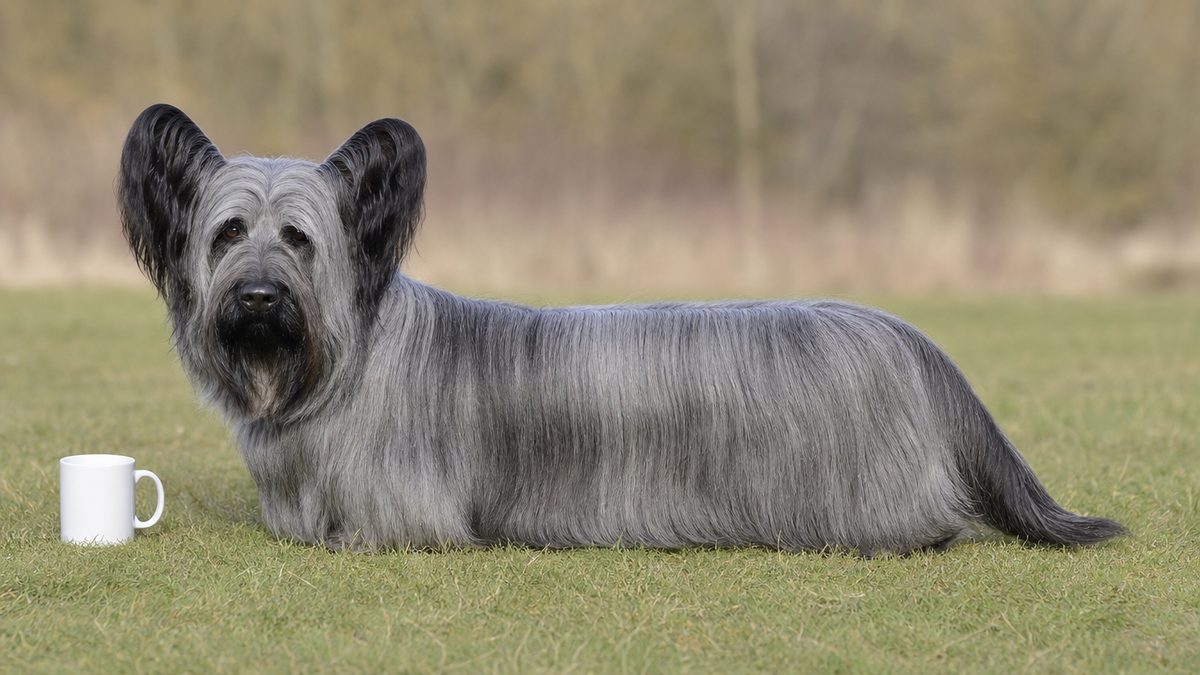
A Skye Terrier is a long, low Hebridean earth terrier that is twice as long as it is high, standing 25 to 26 cm at the withers, measuring 105 cm from nose to tail tip, and carrying 16 to 20 kg on those short legs under a flat-lying double coat.
The Royal Kennel Club's standard opens with the proportion and nothing else: "Long, low, with coat of good length, twice as long as high. Moves with seemingly effortless gait. Strong in quarters, body and jaw". Its size clause gives an ideal height of 25 to 26 cms and a length from tip of nose to tip of tail of 105 cms, and it gives no weight at all.
That omission matters, because the mass is the surprising part. The American Kennel Club puts a male at 35 to 45 pounds, which is 16 to 20 kg. A dog 25 cm tall carrying 20 kg is not a small dog in any sense except height, and every practical decision about lifting it, dosing it and getting it up a staircase follows from that.
The measurable facts, in one place
| Attribute | Royal Kennel Club standard | American Kennel Club | Measured or observed |
|---|---|---|---|
| Height | Ideal 25 to 26 cm (10 ins) | 10 inches male, 9.5 female | The two agree |
| Length | 105 cm nose to tail tip; twice as long as high | Twice as long as they are high | The defining proportion |
| Weight | not stated | 35 to 45 lb male, slightly lighter female | PetBuy prints 4 to 10 kg, which is two to four times too light |
| Coat | Double; undercoat short, close, soft, woolly; outer coat hard, straight, flat, free from curl | Long, flat-lying double coat | Registry prints Sheds: Yes |
| Ears | Prick or drop, both permitted | Prick like bat wings, or drop | Unusual: the standard allows either |
| Colour | Black, dark or light grey, fawn, cream, all with black points | Same | Small white chest spot permitted |
| Life expectancy | Over 12 years (breed page) | 12 to 14 years | Median 12.4 years, 39 deaths |
| UK status | Vulnerable native breed: Yes | not tracked | 45 registrations in 2025 |
Two rows are worth pausing on. The ears row is genuinely unusual: most standards specify one ear carriage, and this one permits both prick and drop in the same breed, describing each in detail. The weight row is where Indian pages go wrong, and it is not a small error: PetBuy prints 4 to 10 kg for a dog its own American registry puts at 16 to 20American Kennel Club.
A reserved, hardy, long and low 16 to 20 kg earth terrier with a flat-lying double coat that needs brushing but never clipping, the lowest exercise demand of any breed on this site, a serious front-limb and elbow problem, a named breed-specific copper hepatitis, and a British register that produced 45 puppies last year.
The Skye Terrier is the rarest terrier in Britain, and one quarter of 2025 produced none
The Royal Kennel Club registered 45 Skye Terriers in 2025 and zero in the third quarter of that year, and the breed's ten-year total of 502 is the lowest of any terrier in the club's own vulnerable-breeds document.
The Royal Kennel Club counts a native breed as Vulnerable below 300 annual registrations and At Watch between 300 and 450. The Skye has never come close to either line from above. Its own breed page prints Vulnerable native breed: Yes.
| Year | Skye | Sealyham | Welsh Terrier | Scottish Terrier | Border Terrier |
|---|---|---|---|---|---|
| 2016 | 28 | 113 | 401 | 454 | 5,150 |
| 2017 | 40 | 167 | 388 | 453 | 5,130 |
| 2018 | 50 | 107 | 325 | 438 | 5,245 |
| 2019 | 59 | 131 | 376 | 468 | 4,353 |
| 2020 | 27 | 153 | 412 | 466 | 4,587 |
| 2021 | 75 | 184 | 417 | 656 | 5,930 |
| 2022 | 71 | 138 | 397 | 584 | 4,494 |
| 2023 | 36 | 136 | 331 | 406 | 4,018 |
| 2024 | 71 | 100 | 218 | 387 | 3,675 |
| 2025 | 45 | 111 | 190 | 312 | 3,181 |
Put the Skye column beside the Border Terrier column and the scale of the rarity becomes visible in the registration figures themselves. The Border Terrier registered 3,181 dogs in 2025. The Skye registered 45. In the same year, one breed produced seventy times as many puppies as the other, inside the same group of the same register.
The quarter with nothing in it
The quarterly sheet gives a third independent document on 2025 and it reconciles exactly: 19, 10, 0 and 16, summing to 45. The third quarter figure is not a rounding or a suppression. Across three months, in the country that created the breed, no Skye Terrier puppy was registered at all.
The same sheet carries 2026 to date, and there the news is better: 18 in the first quarter and 26 in the second, or 44 across the half year against 29 in the same half of 2025. One half year is not a trend and the numbers are small enough that a single large litter moves them. It is still the right direction.
The Royal Kennel Club's Terrier group is one of two groups where its own documents are known to disagree with each other. Comparing the two PDFs cell by cell found exactly two disagreements, both in 2021, and neither is in the Skye row: Dandie Dinmont 123 against 124, and Soft Coated Wheaten Terrier 277 against 227. The group's 2023 column also sums to 18,209 against a printed total of 18,211, which reproduces independently here. The Skye's ten cells match in both documents.
Where the Skye Terrier came from, and the two stories attached to it
The Skye Terrier is one of the original terriers of the Hebrides, described in print in 1570, taken up by Queen Victoria in 1842, and attached ever since to the story of Greyfriars Bobby.
The Royal Kennel Club dates the written record precisely: the Skye "was described by Dr John Caius, Court physician to Elizabeth I in his book 'of English Dogges' in 1570", and it "plays a part in the development in all the terrier breeds of Scotland";. That places it near the root of the Scottish terrier family rather than as one branch of it.
The work was the same as its cousins': "He was used to hunt fox and badger so needed to be game and fearless";. What separates the Skye is what happened next. The registry continues: "Despite these qualities in the field, it is the most loyal and devoted of companions, a quality made legendary in the story of Greyfriars Bobby, a dog owned by a Scottish shepherd. When his master died Bobby returned daily to the grave for 14 years and was fed by local residents. When Bobby died in 1872 a monument was erected in Greyfriars churchyard in Edinburgh";.
Queen Victoria acquired a Skye in 1842, and the registry credits that with widening the breed's popularity. The Skye was a fashionable dog in the nineteenth century and the American Kennel Club recognised it as early as 1887, which makes it one of the older registered breeds in the United States.
The breed changed shape, and the registry says so
One sentence in the Kennel Club's own account is easy to miss and worth quoting because it explains the health section below. "The modern Skye is larger and longer and more heavily coated than its ancestors";.
That is a registry stating that its own breed has been selected away from its working form. A dog that is longer, lower and heavier than the animal that went down badger setts on Skye is a dog carrying more leverage on the same spine and the same front legs. The elbow and disc findings later on this page are what that sentence looks like in a radiograph.
Breed histories are written by enthusiasts and are usually the most optimistic part of a registry's page. This one is unusually candid: it names the date of the first description, names the source, and admits that the modern dog has drifted from the original. Where a registry volunteers a fact against its own interest, it is worth more than the rest of the page.
Skye Terrier price in India, and the pages that answer with other breeds
No skye terrier price in india exists. The Indian pages ranking for the query return Cavaliers, French Bulldogs and Border Collies, and the page whose title tag literally reads Skye Terrier Price in India is an out-of-stock ebook from 2012 with the price field empty.
This is the clearest example on this site of a query being served entirely by pages that do not contain the thing being searched for. Every Indian result was fetched and read.
| Rank | Page | What it shows |
|---|---|---|
| 1 | Mr n Mrs Pet, Skye Terrier Puppies for sale in Mumbai | 3 Result Found: a Cavalier King Charles Spaniel and two French Bulldogs, one advertised in Ramgarh Cantonment, Jharkhand |
| 2 | Puppiezo, Skye Terrier | No figure. Invites you to call 9211058928 to know more about puppies' prices |
| 3 | Lancaster Puppies (USA) | USD 1,000 to 2,500, plus a monthly upkeep averaging USD 65 |
| 4 | Flipkart, titled Skye Terrier Price in India | An out-of-stock digital book from 2012. Notify Me button, no seller, no price |
| 5 | Mr n Mrs Pet, Skye Terrier Puppies for sale in Nirmal | The Mumbai copy with the city swapped. 3 Result Found: two French Bulldogs and a Border Collie |
| 7 | Supertails, Dog Price List in India 2026 | A 40-breed Indian price table containing no Skye Terrier |
| - | PetBuy.in | Rs 6,000 to Rs 25,000, Listings 0, and a weight of 4 to 10 kg for a 16 to 20 kg dog |
The generated city page, demonstrated
Mr n Mrs Pet holds positions 1 and 5 with two pages that are the same page. The Mumbai version reads "Skye Terrier dog price in Mumbai: Mr n Mrs Pet is India's most ethical place to buy, sell and adopt Skye Terrier Puppies online in Mumbai"; the Nirmal version reads the same sentence with Nirmal substitutedMr n Mrs Pet, Skye Terrier Puppies for sale…. Both print 3 Result Found. Neither result set contains a Skye Terrier.
Nirmal is a town of about a hundred thousand people in Telangana. A generated page promising Skye Terrier puppies there, for a breed that produced 45 registered puppies in the whole of Britain last year, is not a listing. It is a template crossed with a place name.
The Flipkart page, which is the sharpest example
Position 4 belongs to a page whose HTML title is "Skye Terrier Price in India - Buy Skye Terrier online at Flipkart.com" and whose meta description reads "Buy Skye Terrier for Rs. online"; with the number missing. The product is a digital book from i5 Publishing, ISBN 9781621870548, published 25 September 2012, file size 6.23 MB. It is out of stock, has no seller and shows a Notify Me button where a price would be.
An answer engine looking for a Skye Terrier price in India finds a page that says Skye Terrier Price in India in its title and Buy Skye Terrier for Rs. in its description. There is no number to take, which is the only reason nothing was invented here. On other breeds, where a merchandise listing does carry a figure, exactly this pattern is how a book's price becomes a dog's price.
Testing the one Indian price band: it is a template row, and the weight proves it
PetBuy's Rs 6,000 to Rs 25,000 band is not a Skye Terrier price. The same site prints the identical band, the identical weight of 4 to 10 kg and the identical height of 20 to 35 cm for eight small terriers, and for this breed the weight is wrong by a factor of two to four.
Thirteen PetBuy breed pages were pulled in one session, six of them breeds this guide covers and the rest controls.
| Breed page | Price band printed | Weight | Height | Live listings |
|---|---|---|---|---|
| Skye Terrier | Rs 6,000 to Rs 25,000 | 4 to 10 kg | 20 to 35 cm | 0 |
| Scottish Terrier | Rs 6,000 to Rs 25,000 | 4 to 10 kg | 20 to 35 cm | 0 |
| Welsh Terrier | Rs 6,000 to Rs 25,000 | 4 to 10 kg | 20 to 35 cm | 0 |
| West Highland White Terrier | Rs 6,000 to Rs 25,000 | 4 to 10 kg | 20 to 35 cm | 0 |
| Soft Coated Wheaten Terrier | Rs 6,000 to Rs 25,000 | 4 to 10 kg | 20 to 35 cm | 0 |
| Cairn Terrier | Rs 6,000 to Rs 25,000 | 4 to 10 kg | 20 to 35 cm | 0 |
| Norwich Terrier | Rs 6,000 to Rs 25,000 | 4 to 10 kg | 20 to 35 cm | 0 |
| Border Terrier | Rs 6,000 to Rs 25,000 | 4 to 10 kg | 20 to 35 cm | 0 |
| Golden Retriever (control) | Rs 15,000 to Rs 45,000 | 25 to 34 kg | 51 to 61 cm | 30 |
| Beagle (control) | Rs 10,000 to Rs 28,000 | 9 to 14 kg | 33 to 41 cm | 30 |
| Shih Tzu (control) | Rs 15,000 to Rs 45,000 | 4 to 8 kg | 20 to 28 cm | 30 |
Every breed the site stocks gets a distinct band, a distinct weight and thirty live listings. Every breed it does not stock gets the same band, the same weight and zero. The Skye Terrier row is the one that exposes the mechanism most cleanly, because a breed the American Kennel Club puts at 16 to 20 kg has been given the weight of a Norwich Terrier.
It is not a converted dollar price either
Run the standard division tests and none of them lands. Rs 6,000 divided by 84.38 is 71.11 and Rs 25,000 is 296.28. At 74 it gives 81.08 and 337.84. At a flat 80 it gives 75 and 312.50, and no seller anywhere prices a puppy at 312 dollars and 50 cents. The figures are rupee-native and arbitrary, which is a different problem from a converted list: nobody converted anything, somebody typed two numbers into a template.
The history paragraph confirms it from a second direction. PetBuy's Skye Terrier history reads "Like most established breeds, the Skye Terrier was shaped by the needs of the people who first kept it, from work and protection to companionship", and the identical sentence appears on its Scottish, Welsh, West Highland White, Norwich and Border Terrier pages with only the breed name swapped. Its Golden Retriever page names Scottish shooting estates. The site can write a real history; it writes one for breeds it sells.
PetBuy's lifespan field is not a constant: it gives the Skye 11 to 14 years, the Scottish Terrier 9 to 12 and the Soft Coated Wheaten 10 to 13. A single varying field in an otherwise identical row is weak evidence of research, not strong evidence. Compare the whole row before deciding a page has measured anything.
Importing a Skye Terrier into India, and why no supply chain can form
You can import a Skye Terrier into India as your own pet and you cannot import one to breed from or to sell, and with 45 puppies registered in Britain in a year there is no surplus to export in any case.
Dogs enter India under ITC(HS) 01061900 as a Restricted import. Trade Notice 22/2022-23 of 19 December 2022 permits three routes only: a pet accompanying its owner with a valid pet book in the importer's name, research with a CPCSEA recommendation, and Defence or Police use. It states that applications for trading or breeding purposes shall be duly rejected, and limits entry to a short list of named ports.
Put that beside the supply. Britain, the breed's home register, produced 45 Skye Terriers in the whole of 2025 and none at all in one quarterThe Royal Kennel Club. There is no commercial surplus anywhere in the world for this breed, and Indian law would reject the paperwork if there were.
KCI registration and what to ask for
India is a full member of the Federation Cynologique Internationale, represented by the Kennel Club of India in Chennai, so a KCI registration is a real pedigree document issued against international nomenclature. For this breed the only realistic Indian route is an owner relocating with a pet and registering it here afterwards.
- Ask for elbow radiographs on both parents. Half of one radiographed cohort had moderate or severe incongruity, and there is no formal scheme for it, so the images themselves are the evidence.
- Ask for liver enzymes and, if available, a liver copper result on both parents, because this breed has its own named hepatitis.
- Ask the age. Rule 8(1)(a) of the 2017 Rules requires that pups less than eight weeks in age are not sold, and that is law rather than etiquette.
- Verify the papers with the Kennel Club of India directly, not against a photograph of a certificate.
If you want a Skye Terrier in India, plan in years and plan to import one yourself. Any Indian seller who can produce a Skye Terrier puppy on demand deserves a great deal of scepticism, because the world's largest register for the breed produced 45 of them last year and none in one three-month stretch.
What a Skye Terrier costs every month in India
Budget Rs 6,500 to Rs 11,000 a month for a Skye Terrier in an Indian metro, which is more than the small terriers because a 25 cm dog carrying 16 to 20 kg feeds and doses like a medium-sized one.
This is the line most Indian budgets get wrong for this breed, and the reason is the height. Every figure below was read live from an Indian provider's own page on 8 September 2026.
| Line | Basis | Per month |
|---|---|---|
| Dry food | A medium-breed adult kibble at roughly 250 to 300 g a day for a 16 to 20 kg dog | Rs 3,400 to Rs 4,600 |
| Tick and flea control | One monthly chewable in the 15 to 30 kg weight band rather than the small-dog band | Rs 1,000 to Rs 1,300 |
| Deworming | Drontal Plus at Rs 754 for 6 tablets, dosed 1 tablet per 10 kg, so 2 tablets quarterly | Rs 84 |
| Vaccination, amortised | Vetic annual booster from Rs 3,199 spread over 12 months | Rs 267 |
| Grooming | Weekly home brushing plus an occasional bath. No clipping, which the AKC says the coat does not need | Rs 300 to Rs 1,200 |
| Joint support and vet reserve | A chondrodysplastic breed with a 49 percent elbow incongruity finding needs a real contingency | Rs 1,000 to Rs 2,500 |
| Consultation | Two routine visits a year plus the annual liver panel this breed warrants | Rs 600 to Rs 1,600 |
| Total | Rs 6,650 to Rs 11,550 |
Two lines differ from every other terrier on this site. Food and parasite dosing sit a weight band higher, because the dog is genuinely 16 to 20 kg. And grooming is cheaper, because the American Kennel Club states the breed requires no trimming in the form of clippering or scissoring, so the salon bill that dominates the harsh-coated terriers barely applies here.
The vaccination spread, which is a delivery-model problem
- Government route. Greater Chennai Corporation's pet clinics provide all treatment and anti-rabies vaccination free of cost, and it issued 9,115 pet animal licences during 2024 at Rs 50 each.
- Private clinic route. Vetic lists anti-rabies from Rs 699, the 9-in-1 DHPPiL from Rs 899 and the full puppy course from Rs 6,499 against a struck-through Rs 8,111.
- Registration. Rs 500 for a new Municipal Corporation of Delhi pet dog registration and Rs 500 to renew, with a Rs 100 a month late fee.
- Microchipping. Rs 1,250 as a Chennai clinic's own transacted price.
For comparison, a small-terrier owner budgeting from the Royal Canin Mini Adult range, stated on its own page as being for dogs up to 10 kg, would under-buy food for this breed by roughly half. Buy for the weight, not the height.
Can a Skye Terrier handle the Indian climate?
A Skye Terrier manages the Indian climate in Bengaluru and Pune and struggles everywhere hotter, and its one genuine advantage is that it does not need the long walk that overheats most breeds.
Every figure below comes from NASA POWER's 2001 to 2020 climatology, queried by explicit latitude and longitude, with the grid-cell elevation echoed back and checked. The Portree cell reads 59.58 m against a real elevation near 20 m, and every Indian cell used sits within 83 m of the town, so none of these is a terrain artefact.
| Place | Cell elevation | Warmest month mean | Coolest month mean | Annual RH2M | Peak wet bulb |
|---|---|---|---|---|---|
| Portree, Isle of Skye | 59.58 m | 13.53 C (Aug) | 5.39 C (Feb) | 85.72 percent | 12.05 C (Aug) |
| Bengaluru | 841.72 m | 28.37 C (Apr) | 20.22 C (Dec) | 67.84 percent | 21.86 C (May) |
| Pune | 635.99 m | 28.93 C (Apr) | 19.62 C (Dec) | 66.68 percent | 22.97 C (Jun) |
| Mumbai | 97.15 m | 31.19 C (May) | 23.19 C (Jan) | 67.28 percent | 25.77 C (Jun) |
| Chennai | 48.95 m | 31.51 C (May) | 24.09 C (Jan) | 72.39 percent | 26.11 C (May) |
| Kolkata | 7.35 m | 31.53 C (May) | 17.31 C (Jan) | 73.84 percent | 27.09 C (Jun) |
| Delhi | 206.37 m | 35.88 C (Jun) | 13.61 C (Jan) | 45.51 percent | 26.50 C (Jul) |
The comparison that settles it is not the average. The hottest single value NASA POWER recorded at Portree across twenty years is 23.13 degrees C, in July. Chennai's coolest month averages 24.09 degrees C. A Chennai January is warmer, on average, than the hottest hour this breed's home island produced this century.
Humidity is not the problem
The reflex claim about a Hebridean breed in India is that the humidity will finish it. The measurement says otherwise. Portree runs 85.72 percent annual relative humidity, higher than Chennai's 72.39, Kolkata's 73.84, Mumbai's 67.28 and far higher than Delhi's 45.51. The Isle of Skye is genuinely wet and this dog is built for wet.
What is new is heat, and heat plus humidity together, which is what the wet-bulb column measures because it is what limits a panting animal. Humid air does not stop a dog panting; humid air at 31 degrees does. Portree peaks at 12.05 degrees C. Kolkata peaks at 27.09. That gap of 15.04 degrees is the largest homeland-to-India wet-bulb gap of the six British terriers on this site.
The Skye Terrier's minimal exercise requirement is a genuine Indian asset. Exertional heat illness accounted for 652 of the 879 UK events with a recorded trigger, and the dog most at risk is the one being walked far in the heat. A breed the American Kennel Club describes as content with whatever level of activity suits its owner is a breed you can honestly keep on two short dawn-and-dusk outings through an Indian April.
City by city: Bengaluru and Pune are workable at April means near 28 to 29 degrees C. Mumbai, Chennai and Kolkata are hard, with wet bulbs between 25.8 and 27.1 for months. Delhi splits, brutal from May to July and genuinely comfortable in January at a 13.61 degrees C mean, which is warmer than a Skye August.
Managing a long flat coat through an Indian summer
Manage the heat by moving both short outings outside the heat window, wetting the belly rather than the coat, and never clipping, because a coat the American Kennel Club says should be kept in a natural condition is also the coat that reflects Indian sun.
The largest study available followed 905,543 UK dogs in primary veterinary care during 2016 and recorded 1,259 heat-related illness events from 1,222 dogs. Of the 879 events with a recorded trigger, 652, or 74.2 percent, were exertional, 113 environmental and 46 vehicular. The companion paper puts fatality among confirmed events at 14.18 percent.
This breed is unusually well placed against that finding, and it is worth saying so plainly. The dog most at risk of exertional heat illness is the one being walked far and fast in the heat, and the Skye Terrier is a breed with minimal exercise needs that is content with whatever level of activity suits its owner. You can meet its requirement entirely inside the cool hours.
- Move both outings outside the heat window. Before 06:30 and after 20:00 from March to June in Chennai, Mumbai and Kolkata, and April to June in Delhi. Test the pavement with the back of your hand for five seconds first.
- Wet the belly, groin and feet, not the back. A flat hard outer coat sheds water, so pouring it over the jacket accomplishes little.
- Do not clip the coat to cool the dog. The American Kennel Club states the breed requires no trimming in the form of clippering or scissoring and that the coat should be kept in a natural condition. A clipped Skye loses its sun barrier and gains nothing.
- Do not scrub in the bath. The AKC's specific warning is that scrubbing the coat during shampooing can cause it to mat, and a matted coat traps heat against the skin.
- Keep the dog off hot stairs and hot floors. A long-backed chondrodysplastic dog that is also overheated is a dog making bad decisions with a spine that cannot afford them.
Second Schedule Part IV paragraph 21(1) of the Prevention of Cruelty to Animals (Dog Breeding and Marketing) Rules 2017 bars keeping in outdoor facilities, without the attending veterinary practitioner's written approval, dogs not accustomed to local temperatures and, in the gazette's own words, dog breeds that cannot tolerate the temperatures prevalent in the area or region in question, such as long-haired breeds in high temperature locations. A long-coated Skye Terrier in an outdoor run through an Indian summer is exactly the case described.
One more compounding factor to plan around. Bodyweight at or above the breed and sex mean carried an odds ratio of 1.42 for heat-related illness in the UK cohort study. A 20 kg Skye that has become a 23 kg Skye is carrying that risk on top of a long coat in an Indian May.
Temperament, and who should not buy this breed
The Skye Terrier is a one-man dog that is distrustful of strangers by written standard, calmer indoors than most terriers, and sensitive enough that harsh handling makes it withdraw rather than argue.
The breed standard states the temperament in nine words: "A 'one-man' dog, distrustful of strangers, never vicious";. Its characteristics clause is two words, "Elegant and dignified". That is a written specification for reserve, not a behavioural problem someone failed to fix.
The breed club's own description agrees from the warm side: "Loyal, loving and intelligent the Skye Terrier is a breed that stands alone... Famed for having a strong bond with its humans a Skye is a highly person orientated dog";. Both descriptions are of the same animal seen from inside and outside the household: affectionate and demonstrative with its own two or three people, alert to everything at the door, and flatly uninterested in the person on the other side of it.
What that means in an Indian flat
It means a dog that is genuinely calm indoors, genuinely devoted to one or two people, and genuinely uninterested in your guests. In a country where domestic help, delivery riders and neighbours come and go constantly, a breed whose standard says distrustful of strangers needs a management plan rather than an optimistic hope.
- Give the dog a place to go when the doorbell rings, and use it every time rather than only when the dog is worried.
- Brief visitors to ignore the dog. A reserved breed that is approached greets worse, not better.
- Socialise early and hard, because the American Kennel Club says the Skye is reserved by nature and should be well socialised from a very young age to ensure a happy and outgoing personality.
- Do not correct harshly. The AKC's specific warning is that the breed is sensitive to correction and will withdraw from harsh or negative training methods.
Prey drive, in an Indian street
This is an earth terrier bred to hunt fox and badger on a Hebridean island, and the Royal Kennel Club's own group description calls the terriers extremely brave and tough. Street cats, rats and mongoose all trigger it. A Skye Terrier does not go off lead in any unfenced Indian space, at any age, and with this breed there is a second reason: a long-backed dog accelerating hard after prey is a long-backed dog risking a disc.
A quiet adult household in Bengaluru or Pune, with one or two people the dog can attach to, no small children, no repeated staircases, a tolerance for a dog that ignores visitors, and the patience to spend years finding one. It is an outstanding companion for the right person and a poor fit for a busy family flat.
Training a Skye Terrier, and the three things it will resist
To train a Skye Terrier, be consistent, be positive and be gentle, because the breed is intelligent, strong-willed and specifically documented to withdraw from harsh correction rather than push back against it.
The American Kennel Club's guidance is unusually precise about method: "The Skye is a very intelligent but strong-willed breed, calmer than many of the terrier breeds. They are amenable to training, provided it is consistent and done in a positive manner. They are sensitive to correction and will withdraw from harsh or negative training methods";.
Sensitive to correction is the operative phrase. A Jack Russell that is told off argues. A Skye Terrier that is told off stops offering behaviour, and getting it back takes longer than the original training would have done.
The three things it will resist, and what to do instead
- Meeting strangers on cue. Do not make the dog greet anyone. Pay it for being calm at a distance and let the distance close on the dog's own schedule.
- Recall away from prey. Do not train against a chase, especially with a spine like this one. Train a stop-and-look on a long line and manage the environment so the chase never starts.
- Repetition after the point of boredom. Five correct repetitions and stop. A calm dignified breed that disengages does not re-engage quickly.
What to socialise, on an Indian timetable
Use the socialisation window deliberately, and for this breed treat it as the single highest-value month of the year. Between about three and sixteen weeks, and continuing well past it, arrange short calm positive exposures to auto-rickshaw horns, temple bells, firecrackers at low volume, lift doors, marble floors, monsoon rain on a tin roof, cattle, street dogs seen at a distance, and men in helmets. Feed through each one, and never force an approach.
Add two exposures this breed specifically needs. The grooming session, because a 20 kg dog that will not lie still to be combed is a real problem. And being lifted, because a long-backed dog in a first-floor Indian flat will be carried up and down stairs for its whole life, and it should learn early that being picked up with two hands under the chest and hindquarters is normal.
Teach a reliable leave it before anything else. In an Indian street the objects this dog wants include chicken bones, discarded food and a dead rat, and a terrier that will trade an object for a treat is far safer than one that guards it.
How much exercise a Skye Terrier actually needs
A Skye Terrier needs less exercise than any other breed on this site, and the American Kennel Club says so outright: the breed has minimal exercise needs and will usually be content with whatever level of activity is comfortable for its owner.
The Royal Kennel Club rates the requirement at up to 1 hour per day and the home size need at a small house. The American Kennel Club goes further, describing minimal exercise needs and adding that even a short daily outing will benefit him both physically and mentally.
Take both at face value. This is not a dog that unravels without a run. It is a dog whose structure argues against one.
What the exercise should and should not contain
- Two walks of 15 to 20 minutes, on lead, at the dog's pace. That is genuinely enough for an adult Skye.
- Ten minutes of scent work indoors, which tires an earth terrier more than distance does. Hide food in a rolled towel or scatter it in a cardboard box.
- A sanctioned place to dig, because the drive is there whatever the legs are like. A tray of sand with a buried toy works.
- No repeated stairs and no jumping down from furniture. The American Kennel Club's own health guidance says Skye puppies should never be allowed to go up and down stairs excessively or jump onto hard surfaces from any height.
- No forced running, ever. A chondrodysplastic dog with a 49 percent elbow incongruity finding in its own literature should not be jogging beside a bicycle.
It is not floor area. A 25 cm dog needs none. It is the staircase and the balcony step, repeated four times a day for twelve years, on a spine that is twice as long as the dog is high. Fit a ramp, carry the dog, or choose a ground-floor flat, and start that habit on day one rather than after the first back episode.
Grooming a Skye Terrier: brush it, never clip it
Groom a Skye Terrier by brushing and combing the whole coat to the skin more than once a week with a pin brush and a long-toothed comb, and never clip or scissor it, because the American Kennel Club states the coat should be kept in a natural condition.
This is the easiest coat of the six British terriers on this site, and the one most often described as the hardest. The Royal Kennel Club prints Grooming: More than once a week rather than the Every day it prints for the Scottish and Sealyham Terriers, and it prints Sheds: Yes.
The American Kennel Club is blunter: "The Skye's long, luxurious double coat appears more challenging to maintain than it actually is. It does require weekly brushing and combing with a soft or pin brush and a long-toothed comb to keep it free of tangles, but the breed requires no trimming in the form of clippering or scissoring, and the coat should be kept in a natural condition".
What the standard is actually describing
The coat is double: undercoat short, close, soft and woolly; outer coat of reasonable length, hard, straight, flat and free from curl, never impeding action. The head hair is shorter and softer, veiling the forehead and eyes but not obscuring vision, and mingles with side locks that surround the ears like a fringe. Flat and free from curl is the test. A wavy or fluffy Skye is either poorly bred or badly groomed.
| Task | Frequency | Why |
|---|---|---|
| Brush and comb the whole coat to the skin | Two or three times a week | The registry's own figure is more than once a week. Long flat hair mats at the elbows, behind the ears and under the belly |
| Part the coat along the back as you work | Every session | The only way to reach the skin under a coat that falls straight down both sides |
| Check the veil over the eyes | Weekly | It should veil, not obscure. Trim nothing, but check for debris caught in it |
| Bath | About once a month | The AKC's figure. Do NOT scrub during shampooing, which the AKC says can cause the coat to mat |
| Towel and fan-dry after any wet walk | Every time | A woolly undercoat under a flat topcoat holds monsoon water against the skin for hours |
| Ears | At least weekly | The AKC asks for weekly checks and cleaning of excess wax to avoid ear infections |
| Nails | Every two to four weeks | The AKC's figure. Short legs and hard Indian pavements still do not wear them down |
You do not need a hand stripper, and that matters enormously in India, where hand stripping is not on any mainstream salon menu. Vetic's Delhi and Bengaluru menus, read live on the same day, list a haircut from Rs 1,359, bathing from Rs 934 and complete bath and styling from Rs 1,869, and nothing else. A Skye Terrier owner can skip all of it and buy a pin brush and a long-toothed comb instead.
Grooming a Skye Terrier in India, and why this breed is the easy one
Grooming a Skye Terrier in India needs a pin brush, a long-toothed comb and a fan, and nothing you have to buy from a salon, which makes it the cheapest coat of the six British terriers on this site to maintain here.
Vetic runs one of the largest clinic-grooming networks in urban India. Its Delhi and Bengaluru menus, read live on the same day, are identical: haircut from Rs 1,359 against a struck-through Rs 1,599, pet bathing from Rs 934 against Rs 1,099, and complete bath and styling from Rs 1,869 against Rs 2,199, with add-ons from Rs 99Vetic, Pet Grooming In Bengaluru. Hand stripping appears on neither menu at any price.
For the Scottish Terrier and the Sealyham that absence is a real problem, because both have harsh jackets that must be stripped. For the Skye Terrier it does not matter at all, because the American Kennel Club states the breed requires no trimming in the form of clippering or scissoring and that the coat should be kept in a natural condition. You are not missing a service you cannot buy; you never needed it.
One coat-vocabulary point worth being precise about
The Sealyham Terrier's standard describes a weather-resistant undercoat and the Scottish Terrier's describes a weather-resisting covering. The Skye Terrier's standard does not use that language at all: it asks for an outer coat of reasonable length that is hard, straight, flat and free from curl, over a short, close, soft and woolly undercoat. That is a coat built to shed rain off a flat surface rather than one described as armour, and in Indian terms it means the topcoat sheds a monsoon shower well and the woolly layer beneath holds what gets through.
The humid-weather routine
- Brush and comb to the skin two or three times a week, parting the coat along the back and working down both sides.
- Dry actively after every wet walk. A woolly undercoat under a flat topcoat stays damp for hours in humid air, and that is where hot spots begin.
- Bath about monthly and do not scrub, because the AKC warns that scrubbing during shampooing can cause the coat to mat.
- Check the ears weekly, which the AKC asks for explicitly to avoid ear infections.
- Do not shave for the summer. You would remove a sun barrier and gain nothing, and the coat is not designed to be cut.
A Scottish Terrier or Sealyham owner in India is looking at roughly Rs 900 to Rs 2,300 a month in salon bills, plus a coat that will end up clipped and softened anyway. A Skye Terrier owner buys a pin brush and a long-toothed comb once and spends twenty minutes twice a week. On coat alone, this is the least expensive of the six breeds to keep here.
Skye Terrier health: one OFA row, one named liver disease and a shape that costs it
The Skye Terrier's health picture is dominated by its structure. It appears exactly once in the whole OFA statistics database, at second worst of 173 breeds for patellar luxation, and half of one radiographed cohort had moderate or severe elbow incongruity.
Start with what the registries do and do not hold, because for a breed this rare that absence is the first fact.
| Database | Rank | Evaluations | Normal | Abnormal | Grade 1 / 2 / 3 |
|---|---|---|---|---|---|
| Patella | 2 of 173 | 70 | 78.6 percent | 21.4 percent | 18.6 / 2.9 / 0.0 |
| ALL BREEDS, patella | 226,087 | 96.5 percent | 3.5 percent | 2.5 / 0.8 / 0.2 | |
| Hips | no row | ||||
| Elbows | no row | ||||
| Eyes | no row | ||||
| Cardiac | no row | ||||
| Thyroid | no row |
One row, in the whole database. OFA publishes a breed only once it holds 100 hip evaluations, or 50 for its other databases, and the Skye Terrier has never reached those thresholds for anything except patellas. Read the blanks as a gap in the evidence, not as evidence of health.
Read the row that does exist carefully too. 21.4 percent abnormal against an all-breed figure of 3.5 percent is a rate 6.1 times higher, and only the Pomeranian, at 29.0 percent of 3,519 evaluations, ranks worse of 173 breeds. The denominator is small at 70 dogs, and the arithmetic checks: 18.6 plus 2.9 plus 0.0 is 21.5, which rounds to the 21.4 printed.
Everything in this health block is general information drawn from registry data and published studies. It is not a diagnosis. Take any Skye Terrier that changes gait, drags a hind foot, cries when lifted, becomes jaundiced, develops a swollen abdomen or has a seizure to your nearby veterinarian the same day.
The front legs: this is a chondrodysplastic breed and the measurements are unflattering
Half of one radiographed cohort of Skye Terriers had moderate or severe elbow incongruity, a third had been lame before their first birthday, and in a direct comparison of three chondrodysplastic breeds the Skye had the worst front-limb conformation on every measure.
Chondrodysplasia is the disproportionate dwarfism that gives this breed and the Dachshund their short curved legs. It is the breed's defining feature and its principal health cost, and unusually there are two Finnish studies that measured exactly that.
The 45-dog radiographic study
Forty-five Skye Terriers had mediolateral and 90-degree-flexed elbow radiographs taken, with incongruity graded by measuring the width of the humeroulnar joint space, and their owners completed a lameness questionnaire. The results, in the authors' own figures:
- 22 of 45 dogs, or 49 percent, had moderate or severe elbow joint incongruity, and the incongruity was associated with lameness.
- 15 of 45, or 33 percent, had been lame when less than one year old.
- 6 of 45, or 14 percent, had been lame at an older age.
- Every dog presenting with lameness after one year of age had also been lame in adolescence, which is the most useful sentence in the paper for a buyer.
- The authors proposed a novel radiographic screening protocol for elbow incongruity in chondrodystrophic breeds, which tells you no formal scheme existed.
The three-breed comparison
A 2022 study measured 224 front limbs from 112 dogs: 30 Standard Dachshunds, 29 Skye terriers and 53 Glen of Imaal terriers. It measured carpal valgus and front limb rotation with a goniometer, graded elbow incongruity from radiographs, and measured the humeroradial angle to quantify lateral radial head subluxation.
The breeds differed significantly, and the Skye came out worst on the measures that matter. The Skye terrier had the most carpal valgus, the most radial head subluxation, and the largest prevalence of moderate and severe elbow incongruity of the three. The Dachshund had the least rotation and the least radial head subluxation; the Glen of Imaal had the most rotation.
The paper also found that incongruity, rotation, valgus and humeroradial angle were independent of each other and each associated with measurable clinical abnormalities including pain, lameness, limited range of motion and elbow osteoarthritis. A dog can therefore look straight and still have a bad elbow, or the reverse.
There is no formal elbow scheme for this breed, so the only evidence available is the radiographs themselves. Ask the breeder for the parents' elbow films, not a verbal assurance, and ask specifically whether either parent was lame as a youngster, because the 45-dog study found that adolescent lameness predicted adult lameness in every case. If nobody has ever radiographed the line, you are buying blind into a breed where half of one cohort was affected.
The back: what twice-as-long-as-high costs, and how to manage it
A Skye Terrier's spine carries 16 to 20 kg over a body twice as long as it is high, which is why its own registry warns against stairs and jumping, and why an Indian first-floor flat is a real decision rather than a detail.
The American Kennel Club's health guidance for the breed opens with the structure and not with a disease: "Because of their long and low structure, Skye Terriers can experience disk injuries, and Skye puppies should never be allowed to go up and down stairs excessively or jump onto hard surfaces from any height";.
That is a registry telling prospective owners to change their architecture. It is the same advice given for Dachshunds, and for the same reason: a long spine between short legs is a long lever, and every landing from a height loads it. The condition being described is intervertebral disc disease, in which the cushioning disc between two vertebrae herniates and presses on the spinal cord, and among the health issues on this page it is the one an owner's own decisions most directly control.
The Indian version of that instruction
- Decide about stairs before you buy. A Skye in a third-floor walk-up will be carried for twelve years or will use the stairs. Choose which now.
- Fit ramps to the sofa and the bed, or make both off limits, because the jump down is worse than the jump up.
- Teach two-handed lifting from week one, one hand under the chest and one under the hindquarters, so the spine stays level.
- Keep the dog lean. Bodyweight at or above the breed mean carried an odds ratio of 1.42 for heat illness, and it loads the back at the same time.
- Use a harness, never a collar and lead alone, on a dog with this neck-to-back geometry.
The other conditions the registry names
Beyond the structure, the American Kennel Club asks owners to watch for signs of cancer, naming mammary cancer and haemangiosarcoma specifically, and lists autoimmune disease, skin allergies, hip dysplasia and luxating patellas among the conditions responsible breeders screen for. The patella item is the one with a published number attached, and it is the OFA row above.
Naming mammary cancer and haemangiosarcoma is a registry asking owners to be vigilant, not a measured breed prevalence. No published study gives a Skye Terrier incidence for either, and this page will not invent one. Watch for lumps, get them looked at, and treat the absence of a number as an absence of a number.
Skye terrier hepatitis: a named breed disease with a copper problem
Skye terrier hepatitis is a distinct breed-specific liver disease in which copper accumulates alongside cholestasis, first characterised in nine related dogs whose hepatic copper ran from 801 to 2,257 micrograms per gram.
The defining study examined the livers of nine related Skye terriers with liver disease for histological change and copper content. The lesions ranged from hepatocellular degeneration and necrosis with intracanalicular cholestasis and mild inflammation, through to chronic hepatitis with cholangioplasia and cirrhosis.
The copper figures are the part to remember: 801 to 2,257 micrograms per gram, and the excess copper was related to the severity of the cholestasis rather than preceding it. That ordering is why the authors concluded that Skye terrier hepatitis is a distinct disease entity, and that it "may be derived from a disorder of intracellular bile metabolism culminating in disturbed bile secretion and the accumulation of copper".
Why the direction of causation matters to an owner
In the Bedlington Terrier, copper accumulates first and damages the liver. In the Skye Terrier, on this evidence, the bile flow fails first and the copper follows. That is not a distinction for a textbook; it changes what treatment is aimed at. A dog whose primary problem is cholestasis needs the bile addressed, not only the copper chelated.
The one published case of successful management reflects that. A one-year-old neutered female Skye terrier presented with anorexia, vomiting, seizures and ascites. Portal venography showed multiple acquired portosystemic shunts, and hepatic biopsy confirmed copper accumulation and fibrosis. Treatment was ursodeoxycholic acid, colchicine and oral zinc, and the authors describe it as the first case report detailing successful management of Skye terrier hepatopathy.
Anorexia, vomiting, a swollen abdomen, jaundice, or seizures in a young Skye Terrier are not a stomach upset. That combination in a one-year-old is exactly the presentation of the published case. Take the dog to your nearby veterinarian the same day and ask for liver enzymes and bile acids rather than a symptomatic treatment.
What a buyer can reasonably ask
There is no DNA test for this disease and no formal screening scheme. What exists is a blood panel. Ask a breeder for liver enzymes on both parents with the actual numbers and the laboratory reference range, not a verbal assurance, and ask whether any dog in the line has ever had a liver biopsy or been investigated for jaundice. Two related dogs in the defining study is not a coincidence; it is a family.
What to screen for, and what the registries actually recommend
The Royal Kennel Club recommends no named pre-breeding test for the Skye Terrier, which leaves a buyer with radiographs and a blood panel as the only screening that exists for this breed's real health issues.
The February 2026 Royal Kennel Club Health Standard is a 33-page document listing recommended pre-breeding tests breed by breed in two columns, Good Practice and Best Practice. Read in layout-preserving mode so the columns stay apart, the Skye Terrier's row is blank in both.
The registry's own breed page is slightly softer in presentation and identical in substance: it prints a Good Practice heading whose only entry is the generic line about prioritising genetic diversity, and it names no test.
| Breed | Good Practice | Best Practice |
|---|---|---|
| Skye Terrier | none | none |
| Scottish Terrier | none | none |
| West Highland White Terrier | none | none |
| Sealyham Terrier | DNA test for primary lens luxation | Eye testing, BVA/RKC/ISDS scheme |
| Welsh Terrier | DNA test for primary lens luxation | none |
| Soft Coated Wheaten Terrier | none | Eye testing and hip testing, plus a breed club kidney scheme |
The Skye Terrier has the second-worst patella rate of 173 breeds in OFA's table, a 49 percent moderate-or-severe elbow incongruity finding in its own radiographic literature, a named breed-specific hepatitis, and a registry warning about intervertebral disc disease from its long and low structure. None of those has a recommended pre-breeding test, and for two of them no test exists. Do not read the blank row as reassurance.
What a buyer can actually ask for
- Elbow radiographs on both parents. No formal scheme exists, so the films are the screening. The 45-dog study proposed a protocol precisely because there was none.
- A direct question about adolescent lameness in the line, because every dog lame after one year in that study had been lame as a youngster.
- Liver enzymes on both parents, with the numbers and the reference range.
- Patella palpation on both parents, recorded, since the one OFA row that exists for this breed is the patella row.
- A conversation about intervertebral disc disease and how the breeder houses its dogs, because stairs and jumping are the modifiable part.
One claim you can safely discount while you are asking. Google's knowledge panel prints Hypoallergenic: No for this breed, which happens to be right, but the general claim is worth understanding because it is attached to almost every terrier. Across 196 dogs of so-called hypoallergenic breeds against 160 controls, the hypoallergenic group carried more Can f 1 in hair and coat, not less, and the authors concluded there is no evidence for the classification of any breed as hypoallergenic. A long-coated shedding breed makes no such claim in the first place.
How long a Skye Terrier lives, and the statistic nobody quotes
A Skye Terrier's measured median lifespan is 12.4 years, and its hazard ratio against a crossbred dog is 0.93 at p equals 0.64, which means the difference is not statistically detectable. It is one of only 43 breeds of 155 in that position.
The figures come from the Dogs Trust life-table study, the largest breed-level survival dataset published. The Skye Terrier's row in Supplementary Table S3 reads 91 dogs, 39 deaths, median 12.4, lower 95 percent CI 11.6, upper 13.9, hazard ratio 0.93 (0.68, 1.27), p equals 0.64. Table S5 confirms the breed was analysed in its own right, with NA in the reclassification column, so this is a Skye figure and not a merged one.
The p value is the part every other page drops, and it is the most honest number on this section. A hazard ratio of 0.93 with a confidence interval running from 0.68 to 1.27 crosses 1. In plain terms: on the evidence available, a Skye Terrier's risk of death at any point cannot be told apart from a crossbred dog's.
| Breed | Median | 95 percent CI | Hazard ratio | p | Deaths |
|---|---|---|---|---|---|
| Border Terrier | 14.2 | 14.1 to 14.3 | 0.53 | <0.001 | 2,427 |
| Cairn Terrier | 14.0 | 13.8 to 14.3 | 0.60 | <0.001 | 1,139 |
| Welsh Terrier | 13.8 | 13.5 to 14.6 | 0.54 | <0.001 | 146 |
| West Highland White Terrier | 13.4 | 13.3 to 13.5 | 0.73 | <0.001 | 6,730 |
| Sealyham Terrier | 13.1 | 12.3 to 16.0 | 0.58 | <0.01 | 33 |
| Scottish Terrier | 12.7 | 12.5 to 12.9 | 0.84 | <0.001 | 869 |
| Kerry Blue Terrier | 12.4 | 11.9 to 13.0 | 0.93 | 0.31 | 168 |
| Skye Terrier | 12.4 | 11.6 to 13.9 | 0.93 | 0.64 | 39 |
| Staffordshire Bull Terrier | 12.0 | 12.0 to 12.1 | 1.13 | <0.001 | 25,332 |
Two things fall out of that table. The Skye is second-shortest-lived of the small British terriers on measured median, ahead only of the bull types. And its p value of 0.64 is the highest of any terrier in the group except the Miniature Bull Terrier, which is a direct statement about how few dogs the estimate rests on.
The two tables of the same paper disagree on cohort size
Table S3 gives 91 dogs. Table S6 of the same paper gives 43 alive plus 39 deceased, a total of 82. That nine-dog discrepancy appears across many breeds in the study and has no published explanation. The death count is identical in both tables, which is why every claim here is built on 39 deaths and the median with its interval rather than on either cohort figure.
Do not read p equals 0.64 as proof the breed is no healthier than a mixed-breed dog. Read it as: with 39 deaths, nobody can tell. The honest position is that the Skye Terrier's survival is unmeasured to the precision the other terriers enjoy, and that a buyer should weight the things that ARE measured, which are the elbows, the patellas and the liver.
The Indian health problems this breed will actually meet
In India a Skye Terrier's day-to-day risks are tick-borne disease, heat, and skin trouble under a long damp coat, on top of a structure that Indian flats and Indian stairs make harder.
The inherited and structural conditions above are what the breed brings. These are what India adds.
Tick-borne disease, with the denominators stated
Indian surveys of dogs presented to veterinary clinics find tick-borne infection at rates a British owner would not recognise. A West Bengal study screened 584 dogs and reported *Babesia gibsoni* in 76.54 percent, *Anaplasma* in 55.75 percent, and two or more pathogens in 72.9 percent of the 584 dogs screened. A Kerala study of 120 dogs found *Babesia* in 66.7 percent, or 80 of 120, with a pre-monsoon peak from March to May.
Both studies sampled dogs brought to veterinary clinics, which are sicker on average than the general dog population. Say among dogs tested at veterinary clinics, never among Indian dogs. The figures still make the point: a monthly tick preventive is not optional in India, and the 72.9 percent co-infection figure is of the 584 screened, not of the infected.
The Skye Terrier is close to a worst case for tick exposure. It stands 25 cm, so its whole body sweeps vegetation, and it carries a long flat coat over a woolly undercoat that hides attachment sites completely. Dose for 16 to 20 kg, not for a small terrier, and part the coat to the skin along both sides after any walk in grass.
Skin and ears in an Indian monsoon
The undercoat is short, close, soft and woolly, and it holds water against the skin under a flat topcoat that sheds it from above. That is the ideal geometry for a hot spot. Towel and fan-dry after every wet walk, and part the coat to check the skin rather than judging by the surface.
Ears need weekly attention whichever carriage the dog has. The American Kennel Club asks for at least weekly checks and cleaning of excess wax or debris to avoid ear infections, and a drop-eared Skye in a Mumbai July needs that check to be real rather than a glance.
Heat, restated as a clinical risk
Exertional heat illness accounted for 652 of the 879 UK events with a recorded trigger, and 14.18 percent of confirmed heat events in the companion study were fatal. Neither study modelled Indian conditions, and both were run in a country whose peak wet bulb is 15 degrees below Kolkata's. This breed's low exercise requirement is the one thing working in its favour.
Feeding a Skye Terrier in India
Feed a Skye Terrier for its weight and not its height: 250 to 300 g a day of a medium-breed adult dry food for a 16 to 20 kg dog, split into two meals, with the body condition checked by hand because the coat hides everything.
This is the single most common feeding error with this breed, and it comes from the specification card rather than the dog. A Skye stands 25 cm, so Indian pages file it as a small breed. The American Kennel Club puts a male at 35 to 45 pounds. Royal Canin Mini Adult, one of the most widely stocked Indian options, is stated on its own product page as being for dogs up to 10 kg, which is half this dog.
Life stage by life stage
- 8 to 16 weeks. Four meals a day of a medium-breed puppy food. Keep the puppy lean; a heavy chondrodysplastic puppy is loading joints that are already the breed's weak point.
- 4 to 6 months. Three meals a day. This is when Indian owners most often over-supplement calcium, which does not help a growing skeleton and can harm it.
- 6 to 12 months. Two meals a day, moving to adult food at around twelve months for a medium breed.
- Adult. Two meals a day, roughly 250 to 300 g of a medium-breed dry food, adjusted to the dog rather than to the bag.
- Senior, from about 8 years. Keep the protein, cut the calories, weigh monthly, and add an annual liver panel to the same visit.
Body condition under a coat you cannot see through
You cannot assess this dog by looking at it. The coat falls straight down both sides and hides the waist entirely. Run your hands along the ribs: each rib should be findable under light pressure, like your own knuckles through the back of your hand. If you have to press, the dog is overweight.
Weight matters more here than in almost any breed on this site, for two independent reasons. It loads a spine twice as long as the dog is high, and bodyweight at or above the breed and sex mean carried an odds ratio of 1.42 for heat-related illness in the UK cohort study.
Feed the second meal after the evening outing rather than before. Change the water twice a day in summer, because a bowl standing in a Chennai flat is warm by afternoon and dogs drink less warm water. Skip milk entirely; adult dogs handle it poorly and Indian households offer it reflexively. And weigh the dog monthly on a bathroom scale, because you will not see the gain.
Indian law on buying, breeding and keeping this dog
Five provisions of the Prevention of Cruelty to Animals (Dog Breeding and Marketing) Rules 2017 apply directly to a Skye Terrier in India, and the dewclaw clause collides head-on with the breed standard.
The Rules run 1 to 13 and are followed by a Second Schedule whose paragraphs are numbered continuously 1 to 30 across four Parts. Anything numbered above 13 that people call a Rule is a Second Schedule paragraph, which matters because a reader who looks up the wrong number finds nothing. Every clause below was read from the gazette itself.
| Provision | What it says | Why it applies here |
|---|---|---|
| Rule 8(1)(a) | Every breeder shall ensure that pups less than eight weeks in age are not sold | The floor under any purchase, and law rather than etiquette |
| Rule 8(1)(b) | Dogs over six months in age are not sold without first being sterilised, unless sold to another licensed breeder | Rarely quoted, and directly relevant to a rehomed adult, which for this breed is the likeliest route |
| Second Schedule Part II para 6(3) | In breeding and incest breeding are prohibited, naming uncle to niece, nephew to aunt, cousin to cousin, grandparents to grandchildren, parents to children and brother to sister | A breed registering 45 dogs a year has an extremely small gene pool, and this is the clause that limits how a breeder may manage it |
| Second Schedule Part II para 6(8) | There shall be no tail docking, ear cropping, de-barking, DE-CLAWING, branding, dyeing, injecting substances to enhance visual appeal, and any change of appearance by artificial means is strictly forbidden | The breed standard's hindquarters clause ends with the words No dewclaws. In India that preference cannot lawfully be produced |
| Second Schedule Part IV para 21(1) | Dogs not accustomed to local temperatures, and breeds that cannot tolerate them such as long-haired breeds in high temperature locations, shall not be kept in outdoor facilities without the attending veterinary practitioner's written approval | A long-coated Skye Terrier in an outdoor run through an Indian summer is exactly the case described |
The dewclaw collision, in detail
The Royal Kennel Club's standard ends its hindquarters clause with two words: "No dewclaws";. Read as a description, that is a statement that the breed's hind legs typically carry none. Read as a requirement, it is an instruction some breeders satisfy surgically.
In India the surgical reading is unlawful. Second Schedule Part II paragraph 6(8) names de-clawing explicitly among the prohibited procedures, alongside tail docking, ear cropping and de-barking, and closes with the sentence that any change of appearance by artificial means is strictly forbidden. An Indian breeder removing a hind dewclaw to match the standard is breaking that clause.
This is the same collision documented on other breed pages where a standard mandates what Indian law forbids, and the resolution is the same: the law wins, and a dog with hind dewclaws is a lawful Indian dog whatever a show judge thinks.
What the Rules do not contain
Searching the whole 51,953-character gazette with a whitespace-tolerant pattern returns zero occurrences of patella, zero of BAER and zero of deaf. There is no Indian legal requirement for a patella grade, which is a real gap for a breed that ranks second worst of 173 in OFA's patella table. Indian law mandates hip dysplasia, progressive retinal atrophy, night blindness, hypothyroidism, entropion, ectropion and jaw testing before breeding under Second Schedule Part III paragraph 8(10), and none of those is this breed's problem.
The first year with a Skye Terrier puppy, month by month
Plan the first year around four fixed points: the socialisation window closing at about sixteen weeks in a breed whose standard says distrustful of strangers, the no-stairs rule that starts on day one, the grooming habit, and the first lameness watch through adolescence.
| Age | What is happening | What you do |
|---|---|---|
| Before 8 weeks | Legally not for sale in India under Rule 8(1)(a) | Walk away from any seller offering a younger puppy |
| 8 to 10 weeks | Puppy comes home; vaccination course starts or continues | Four meals a day of a medium-breed puppy food. Start the Vetic course or its equivalent, from Rs 6,499. Carry the puppy on every staircase, from day one |
| 10 to 16 weeks | The socialisation window is open and closing, in a breed written as distrustful of strangers | Short calm exposures to horns, lifts, marble, monsoon rain on tin, cattle and helmets. Feed through each. Never force an approach. Highest-value month of the year for this breed in particular |
| 4 to 5 months | Teething; digging drive appears | Provide a sand tray. Teach leave it. Three meals a day. Begin two-handed lifting practice |
| 5 to 8 months | Adolescence, and the window in which a third of one cohort first went lame | Watch the gait weekly. Any limp, bunny-hopping, or reluctance to rise is a vet visit, not a wait-and-see |
| 6 to 8 months | Prey drive switches on properly; adult coat starting | The long line goes on and never comes off in an unfenced space. Brushing moves to two or three times a week |
| 8 to 12 months | Sexual maturity; adult coat lengthening | Discuss neutering timing with your nearby vet rather than defaulting to six months, and raise the breed's structure when you do |
| 12 months | Adult food; adult coat | Two meals a day at 250 to 300 g. Establish the ramp or carry habit permanently, because this is a twelve-year commitment not a puppy phase |
The three mistakes that happen in this breed's first year
The first is letting the puppy use stairs because it seems fine. The American Kennel Club's instruction is that Skye puppies should never be allowed to go up and down stairs excessively or jump onto hard surfaces from any height, and a puppy that learns the habit keeps it.
The second is treating adolescent lameness as a growth phase. In the 45-dog radiographic study, every dog that was lame after one year of age had also been lame in adolescence. A limp at seven months is information, not a stage.
The third is stopping socialisation when the vaccination course finishes, by which point the window has effectively closed, in a breed whose written temperament is distrustful of strangers. Carry the puppy through busy places before it can walk them. One breeding fact worth knowing if you are choosing a breeder rather than a puppy: the UK survey of caesarean rates across purebred litters gives a per-breed picture of how much intervention a breed's whelping normally needs, and it is a fair question to ask of a breed with this body shape.
Ask to see elbow radiographs of both parents, and ask directly whether either was lame as a youngster. There is no formal elbow scheme for this breed, so the films and the honest answer are the only screening that exists, and half of one radiographed cohort had moderate or severe incongruity.
Skye Terrier against the breeds Indian buyers actually choose between
A buyer drawn to a Skye Terrier is usually choosing between long-and-low dogs and Scottish terriers, and the two comparisons pull in opposite directions: on structure the Dachshund is the fair benchmark, on availability nothing British competes with a Beagle.
| Skye Terrier | Dachshund (standard) | Scottish Terrier | Beagle | |
|---|---|---|---|---|
| Height | 25 to 26 cm | About 20 to 27 cm | 25 to 28 cm | 33 to 41 cm |
| Weight | 16 to 20 kg (AKC) | About 9 to 12 kg | 8.5 to 10.5 kg | 9 to 14 kg |
| Proportion | Twice as long as high | Long-backed | Short-backed | Normal |
| Median lifespan measured | 12.4 years | not compared here | 12.7 years | 12.5 years |
| Hazard ratio vs crossbred | 0.93, p equals 0.64 | not compared here | 0.84, p<0.001 | 0.95, p equals 0.07 |
| Deaths behind the figure | 39 | not compared here | 869 | 1,552 |
| UK registrations 2025 | 45 (Vulnerable) | not on either list | 312 (At Watch) | not on either list |
| Front-limb conformation | Worst of three chondrodysplastic breeds measured | Least rotation, least radial subluxation | Not chondrodysplastic | Not chondrodysplastic |
| Coat work | Brush 2 to 3 times a week, never clip | Minimal (smooth) | Hand strip every 6 to 10 weeks | Weekly brush |
| Exercise need | Minimal | Moderate | Up to 1 hour | High |
| Live Indian listings on the largest marketplace | 0 | listed | 0 | 274 |
Read that as a buyer. On structure the Dachshund is the honest comparison and the Skye loses it. In the only study to measure the two side by side, along with the Glen of Imaal, the Dachshund had the least front limb rotation and the least radial head subluxation while the Skye had the most carpal valgus, the most radial head subluxation and the most moderate-to-severe elbow incongruity.
On availability the comparison is not close. India's largest puppy marketplace lists 274 Beagles and zero Skye Terriers, and the pages that claim to sell Skyes return Cavaliers and French BulldogsMr n Mrs Pet, Skye Terrier Puppies for sale….
On coat the Skye is the easiest of the Scottish terriers, which is the opposite of what its appearance suggests. It needs brushing and no clipping, while the Scottish Terrier needs hand stripping every six to ten weeks in a country where nobody sells the service.
If you want a long, low, devoted, quiet dog for a ground-floor Bengaluru or Pune flat, and you can wait years or import one, the Skye Terrier is a remarkable companion with a real orthopaedic caveat. If you want the shape without the wait, a standard Dachshund is obtainable in India, measured better on front-limb conformation, and comes with the same stairs rule. If you want a dog this year, the Beagle is the one actually for sale.
Eight mistakes Indian owners make with this breed
Eight mistakes come up repeatedly with long, low, heavy-coated dogs in India, and seven of them are avoidable with information that is not on any page currently ranking for this breed.
- Buying for the height and feeding for the height. This is a 16 to 20 kg dog on 25 cm legs. Food, parasite dosing and lifting all belong to a medium breed.
- Believing an Indian listing. Every Indian page ranking for the breed shows other breeds: a Cavalier, French Bulldogs, a Border Collie, and an out-of-stock ebook.
- Letting the dog do stairs. The registry's own instruction is that Skye puppies should never go up and down stairs excessively or jump onto hard surfaces from any height.
- Treating adolescent lameness as growing pains. Every dog lame after one year in the 45-dog study had also been lame in adolescence.
- Clipping the coat for the summer. The American Kennel Club states the breed requires no trimming in the form of clippering or scissoring and that the coat should be kept in a natural condition.
- Scrubbing the coat in the bath. The same guidance warns that scrubbing during shampooing can cause the coat to mat, and a matted coat traps heat against the skin in an Indian summer.
- Correcting harshly. This breed withdraws rather than argues, and a withdrawn Skye is much harder to train than a stubborn one.
- Missing the liver. Anorexia, vomiting, ascites and seizures in a young Skye is the published presentation of Skye terrier hepatopathy, not a stomach upset.
Every Indian source an owner is likely to consult files this breed as a small dog, because it is 25 cm tall. PetBuy prints 4 to 10 kg. The American Kennel Club prints 35 to 45 pounds. An owner who buys a small-dog tick preventive and a small-breed kibble on the strength of the Indian page is under-dosing and under-feeding a medium dog, and nothing on the page they read would have told them.
Adoption and responsible sourcing
Adopt a Skye Terrier if you can find one, and accept that in India you almost certainly cannot, because a breed that produced 45 registered puppies in Britain last year has no Indian population to surrender.
This breed effectively does not reach Indian rescue. What does turn up in metro shelters is a long-backed, long-coated dog of uncertain parentage, sometimes labelled a Skye because of the shape. Those dogs are usually excellent pets, are almost never Skye Terriers, and share the same stairs rule.
The adoption route, in order
- Ask the breed community first. A breed registering 45 dogs a year has a tiny owner network, and rehomed adults move inside it rather than through public listings.
- Register with metro shelters in Bengaluru, Pune, Delhi, Mumbai and Chennai, and describe the dog by shape and coat rather than by breed name.
- Consider the adult rather than the puppy. For this breed an adult is far more likely to become available, and an adult's gait, coat and temperament are all already visible, which matters more here than in most breeds.
- Take the long-backed mixed breed seriously. A shelter dog with this shape needs the same ramps and the same lifting technique, and it is already adapted to the Indian climate.
If you buy, verify these five things
- The puppy is at least eight weeks old, which is Rule 8(1)(a) of the 2017 Rules and not a preference.
- Elbow radiographs on both parents, and a direct question about adolescent lameness in the line.
- Liver enzymes on both parents with the actual numbers and the laboratory reference range.
- KCI papers verified with the club, not a photograph of a certificate.
- Hind dewclaws present or genuinely absent from birth. A surgically de-clawed Indian-bred puppy breaches Second Schedule Part II paragraph 6(8).
The Indian pages that rank for this breed return Cavaliers, French Bulldogs, a Border Collie and an out-of-stock ebook from 2012. PetBuy prints a template band with Listings 0 and a weight two to four times too light. Supertails' 40-breed Indian price table omits the breed entirely. If an Indian seller offers you a Skye Terrier puppy on demand, ask to see the import paperwork, because Britain registered 45 in the whole of 2025 and none at all in one quarter.
Bonbeno does not broker puppy sales, does not recommend individual breeders and does not link to listings. Everything above is reported from published sources as editorial content. For this breed in this country, adopting a different dog is a genuinely reasonable outcome, and saying so is more useful than pretending a market exists.
Skye Terrier questions Indian buyers actually ask
Are Skye Terriers good dogs?
Skye Terriers are good dogs for one household and hard work for another, and the breed standard says which in five words: a one-man dog, distrustful of strangers, never vicious. The breed club calls it loyal, loving, intelligent and highly person-orientated. If you want a dog that greets visitors, this is not it, and no amount of socialisation will make it that.
Why are Skye Terriers so rare?
The Skye Terrier is rare because almost nobody breeds it. The Royal Kennel Club registered 45 in 2025 and none at all in the third quarter, and its ten-year total of 502 is the lowest of any terrier in the club's vulnerable-breeds document. Wikipedia's description of it as among the most endangered breeds of the United Kingdom is accurate rather than dramatic.
How many Skye Terriers are left?
Nobody counts living Skye Terriers, so the honest answer is a registration figure rather than a population. Great Britain registered 45 in 2025, 71 in 2024 and 502 across the decade from 2016 to 2025. On a 12.4-year median lifespan, a decade of registrations at that rate implies a British population in the hundreds rather than the thousands.
How much is a Skye Terrier puppy?
In India, nobody is selling one. The pages ranking for the query return other breeds: Mr n Mrs Pet's Mumbai page shows a Cavalier and two French Bulldogs, and Flipkart's page titled Skye Terrier Price in India is an out-of-stock ebook. The only real figures are American, at 1,000 to 2,500 US dollars from a Pennsylvania classifieds site, and India's most comprehensive published dog price table, covering 40 breeds and claiming to draw on Kennel Club of India registration data, does not list the breed at all.
How long does a Skye Terrier live?
The measured median is 12.4 years, with a 95 percent confidence interval of 11.6 to 13.9, from 39 recorded deaths among 91 UK dogs. Its hazard ratio against crossbred dogs is 0.93 at p equals 0.64, which means the difference is not statistically detectable. The Skye is one of only 43 breeds of 155 whose survival cannot be told apart from a crossbred's.
What is the biggest health risk in a Skye Terrier?
The front legs and the elbows. This is a chondrodysplastic breed, and in a radiographic study of 45 Skye Terriers 22 of them, or 49 percent, had moderate or severe elbow joint incongruity, which was associated with lameness. A third of the dogs had been lame before their first birthday. Consult your nearby vet about any Skye that changes gait.
What is Skye terrier hepatitis?
Skye terrier hepatitis is a breed-specific liver disease in which copper accumulates in the liver alongside cholestasis. In the defining study of nine related dogs, hepatic copper ran from 801 to 2,257 micrograms per gram and the excess was related to the severity of the cholestasis. The authors concluded it is a distinct disease entity rather than ordinary copper toxicosis.
How heavy is a Skye Terrier?
Heavier than it looks and heavier than most Indian pages say. The American Kennel Club gives 35 to 45 pounds for a male, which is 16 to 20 kg on 25 cm legs. The Royal Kennel Club standard gives no weight at all, only a height of 25 to 26 cm and a nose-to-tail length of 105 cm. PetBuy's Indian page prints 4 to 10 kg, which is two to four times too light.
Can a Skye Terrier live in Chennai or Mumbai?
A Skye Terrier can live in Chennai or Mumbai on a strict heat routine, and it will never be comfortable there. Chennai's coolest month averages 24.09 degrees C, which is above the hottest single value recorded at Portree on the Isle of Skye across twenty years. Bengaluru and Pune, peaking in April at 28.37 and 28.93 degrees C, are the realistic Indian cities.
Do Skye Terriers need a lot of exercise?
No, and this is the breed's one clear advantage in an Indian summer. The American Kennel Club states that the Skye Terrier has minimal exercise needs and will usually be content with whatever level of activity is comfortable for its owner. Two short outings before dawn and after dusk genuinely suffice, which is exactly what an Indian April allows.
How much does a Skye Terrier cost per month in India?
Budget roughly Rs 6,500 to Rs 11,000 a month for a 16 to 20 kg Skye Terrier in an Indian metro. That is higher than the small terriers because the dog is genuinely medium-sized despite its height, so food and parasite dosing move up a weight band, at Vetic's published Rs 3,199 annual booster and a heavier tick preventive.
Should a Skye Terrier use stairs?
Not repeatedly, and not as a puppy. The American Kennel Club's own health guidance is that because of their long and low structure Skye Terriers can experience disk injuries, and that Skye puppies should never be allowed to go up and down stairs excessively or jump onto hard surfaces from any height. In an Indian flat that means carrying the dog or fitting a ramp.
Can you import a Skye Terrier into India?
Only as your own pet. Dogs sit under ITC(HS) 01061900 as a Restricted import, and the Directorate General of Foreign Trade's Trade Notice 22/2022-23 states that applications for trading or breeding purposes shall be duly rejected. With 45 puppies registered in Britain in a year, there is no surplus to export commercially in any case.
Should a Skye Terrier's dewclaws be removed?
Not in India, where removing them is unlawful. The Royal Kennel Club standard ends its hindquarters clause with the two words No dewclaws, but Second Schedule Part II paragraph 6(8) of the Prevention of Cruelty to Animals (Dog Breeding and Marketing) Rules 2017 forbids de-clawing by name and adds that any change of appearance by artificial means is strictly forbidden. The standard's preference cannot lawfully be produced here.
Compare with similar breeds
Skye Terrier sits in 4 Bonbeno groups. Each one compares it directly against the breeds it is genuinely an alternative to, on the same figures.