
Breed profile
Norwich Terrier: The Vulnerable Half of a Breed Split in 1964
One of the smallest working terriers, on the Royal Kennel Club's vulnerable list at 116 registrations, and carrying an airway syndrome named after it.
Quick answer
No Indian seller currently prices a Norwich Terrier. The four Indian pages ranking for the price term either show dogs of other breeds, quote US dollars, or print nothing at all. What is real is the running cost, roughly Rs 2,200 to Rs 3,750 a month, and the breed's defining health problem, an upper airway syndrome that its own kennel club asks show judges to watch for.
This page reports published veterinary research and registry data for general information. It is not veterinary advice and cannot diagnose your dog. Noisy breathing, exercise intolerance, collapse or any suspected airway problem in a Norwich Terrier needs a veterinarian who can examine the dog, and anaesthesia in this breed needs one who has read the airway literature first.
Norwich Terrier at a glance
What a Norwich Terrier is, in one measurement and one date
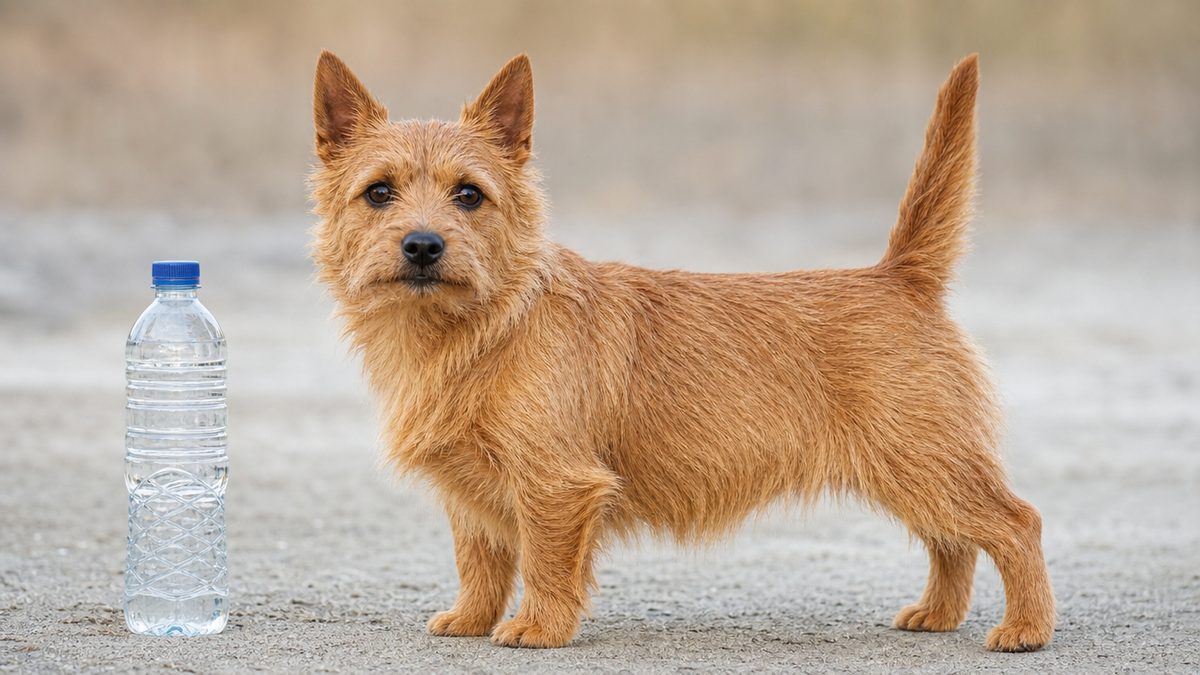
A Norwich Terrier is a small British working terrier standing an ideal 25 cm at the withers, with prick ears, a hard wiry red or wheaten coat, and a working history of bolting vermin from underground on the farms of East Anglia. The date that matters is 1964.
Both the Royal Kennel Club and the American Kennel Club give the same ideal height, 25 cm or 10 inches American Kennel Club. They part company on weight. The American standard says approximately 12 pounds, about 5.4 kg, while the British standard and the FCI standard give no weight at all. An Indian retail listing for the breed prints 10 to 11 inches and 5 to 6 kg, which is consistent with both.
The breed standard describes a compact, short-legged dog with good bone and substance, small dark oval eyes, a wedge-shaped muzzle, and what the American text calls a slightly foxy expression. The FCI standard specifies ears 'Erect, set well apart on top of skull. Medium size with pointed tips';. Those prick ears are the whole identity of the breed, and they are what a buyer in India has to look at first.
The 1964 split, and why it still decides which dog you are looking at
Until 1964 the Norwich Terrier and the Norfolk Terrier were one breed with two permitted ear carriages. The Royal Kennel Club's own breed history says the breed was recognised in 1932 with two permissible types of ear, and that the drop eared variety is now the Norfolk and the prick eared variety is now the Norwich. The Kennel Club made the separation in 1964; the American, United and Canadian kennel clubs followed in 1979, and until then the AKC filed them as Norwich Terriers, P.E. and Norwich Terriers, D.E..
That history is not trivia in India, where almost nobody has seen either breed. The ear test is the only field test a buyer can apply. Ears standing fully upright with pointed tips means Norwich. Ears folding forward over the skull means Norfolk. Anything in between on an adult dog means ask more questions, because the two breeds have diverged in health since 1964 and the wrong answer sends you to the wrong screening.
Look at the ears on an adult dog, in a photograph you took yourself rather than one you were sent. Prick ears are the Norwich. If a seller in India cannot show you an adult with clearly erect, pointed ears, you are not looking at a verified Norwich Terrier, whatever the paperwork says.
Where the breed came from
The FCI standard's own historical summary is unusually specific about ancestry. It states that 'Glen of Imaals, red Cairn Terriers and Dandie Dinmonts are among the breeds behind these East Anglian terriers', and that the two breeds take their names from the county and the city. All three of those ancestors are themselves small working terriers, and two of them, the Dandie Dinmont and the Glen of Imaal, sit on the same Royal Kennel Club vulnerable list as the Norwich today.
The FCI recognised the breed on a definitive basis on 16 October 1954, filing it in Group 3 Terriers, Section 2 Small-sized Terriers, without working trial. The date format on that register is proved by its own rows, several of which carry a first field above 12, so the first field is the month. The authentic language of the standard is English, which the French translation states explicitly on its own face, so where the two texts differ the English governs.
Coat colour under the British standard is 'All shades of red, wheaten, black and tan or grizzle', with white marks or patches tolerated and any other colour unacceptable. Red is the shade most Indian buyers will picture, and it is the one most often photographed.
Is the Norwich Terrier a vulnerable breed? Yes, and it is the more fragile of the pair
Yes. The Royal Kennel Club registered 116 Norwich Terriers in 2025 and files the breed on its vulnerable native breeds list, which covers native breeds registering fewer than 300 dogs a year. This is the half of the 1964 split that is genuinely rare, and Indian pages routinely get the pair the wrong way round.
The Royal Kennel Club maintains two lists. A vulnerable native breed registers fewer than 300 dogs a year. An at watch breed registers between 300 and 450. The Norwich Terrier's row sits inside the VULNERABLE block of the club's own ten-year statistics document and reads 145, 91, 81, 128, 81, 140, 107, 150, 140 and 116 for 2016 to 2025. The Norfolk Terrier's row sits after the AT WATCH heading and reads 600, 521, 542, 482, 358, 490, 423, 365, 382 and 365.
Two other Royal Kennel Club documents agree. The Terrier group's ten-year comparative table carries an identical Norwich row in all ten years, and the quarterly statistics break 2025 into 41, 22, 14 and 39, which sum to exactly 116, then give 47 and 44 for the first two quarters of 2026. Three documents, one number. That is what a verified figure looks like.
The Norfolk page says 'Vulnerable native breed: No', and it is right
Bonbeno checked whether the Royal Kennel Club contradicts itself here, because it does elsewhere. It does not. The Norfolk Terrier's own Breeds A to Z page prints 'Vulnerable native breed No' and 'Breed watch Category 1';, and that agrees with the statistics document, which files the Norfolk under AT WATCH rather than VULNERABLE. At 365 registrations the Norfolk sits inside the 300 to 450 band, so it is watched, not vulnerable. The Norwich page prints 'Vulnerable native breed Yes' and 'Breed watch Category 2';.
The practical consequence for an Indian reader is supply. A breed producing 116 registered puppies a year in its home country is not exporting them in volume to a market with no breed club, and any Indian listing that claims routine availability is describing something else.
American numbers run the other way
In the United States the ranking flips. The American Kennel Club puts the Norwich at 104 of 210 breeds, with a per-year series of 109 in 2025, 104 in 2024, 105 in 2023, 109 in 2022 and 111 in 2021. That is a stable mid-table breed, not a disappearing one. So 'rare' is a claim about Britain, and a page that says the Norwich Terrier is rare worldwide has over-read a British registration table.
| Measure | Norwich Terrier | Norfolk Terrier |
|---|---|---|
| UK registrations, 2025 | 116 | 365 |
| Royal Kennel Club list | Vulnerable | At watch |
| Breed Watch category | 2 | 1 |
| Points of concern for judges | 1, respiratory | None breed-specific |
| AKC popularity rank | 104 of 210 | Outside the Norwich's rank |
| FCI standard number | 72 | 272 |
One more registry fact matters for anyone thinking about paperwork. India is an FCI member country represented by the Kennel Club of India in Chennai, so FCI recognition effectively settles the Indian recognition question for an imported breed. The Norwich Terrier is FCI standard 72 and has been definitively recognised since 1954, which means a KCI pedigree is possible in principle. What is missing is not recognition. It is dogs.
Norwich Terrier price in India: nobody ranking for that query is selling one
There is no Norwich Terrier price in India, because there is no Norwich Terrier supply in India. Bonbeno pulled the Indian organic top ten for the price term on 2 September 2026 and opened every page. Not one of them shows a Norwich Terrier for sale, and the only rupee figures on the two highest-ranking sellers belong to other breeds.
Start with what a puppy price would have to be built from. A purchase price needs a seller, a dog and a number. The Indian pages ranking for this query supply at most one of the three at a time.
- Puppiezo, position 1, carries eight rupee figures in its raw markup. Every one sits inside an enquiry popup in an 'Other Available Pets' carousel holding two Maltipoos named Fizey and Samy, two Poodles named Kuzo and Dugu, a Cane Corso, a Goldendoodle, a Rottweiler and a Doxiepoo named Yoki. None is a Norwich Terrier, and the word Maltipoo appears 26 times on the page.
- Mr n Mrs Pet, position 2, prints '3 Result Found' under a Norwich Terrier heading, then files those three under 'Similar breeds at other locations' behind a sign-up wall. Its only two rupee figures, INR 95,000 and INR 1,30,000, sit in a blog teaser about Teacup Pomeranian prices.
- Dog Breeds List, position 3, prices the breed only in US dollars: 'Puppy Prices Average $2000 - $4000 USD', then $1,500 to $2,500 generally.
- Mr n Mrs Pet's Margao page, position 7, is titled 'Norwich Terrier Price in Margao' and contains no rupee figure and no Norwich Terrier. Its three dog cards are a Border Collie, an English Bulldog and a Cavalier King Charles Spaniel.
- Breed n Breeder, position 10, misspells the breed as 'Norwich Trrier' in its URL, its title and eleven places in its body, and offers a callback from 'Mr. Vansh';.
The one Indian rupee price for the breed, and what it is worth
One Indian page does print a rupee purchase price. HappyPet gives a cost of buying of Rs 60,000 to Rs 1,00,000 for the Norwich Terrier. Treat it as a published estimate rather than an offer, because nothing on the page is a listing and no dog is attached to it. Run the standard conversion tests and the picture is ambiguous rather than damning. Rs 60,000 divided by 84.38 is 711 dollars and by 74 is 811, neither of them a price a seller would print. At a flat 80 the quotients are 750 and 1,250, which are plausible dollar prices, but any rupee figure ending in three zeros divides cleanly at 80 by construction, so that proves nothing on its own.
The comparison that does say something is the neighbouring breed. The same site prints Rs 50,000 to Rs 1,00,000 for the Norfolk Terrier, Rs 80,000 to Rs 1,20,000 for the Lakeland Terrier, Rs 2,00,000 to Rs 4,00,000 for the Lancashire Heeler and Rs 10,000 to Rs 50,000 for the Pug HappyPet India control pull. Those vary per breed, which is what you would expect of hand-entered editorial estimates. The monthly cost line beside them does not vary at all, which is the subject of the next section.
Bing India's own AI summary for this query lists the factors that would affect a Norwich Terrier price in India, then states plainly that on the listing sites it cites 'specific prices are not provided'. When the answer engine and the seller both decline to name a number, a page that names one is inventing it.
Two other Indian listing sites, checked because they were cited
PetBuy.in prints 'Listings 0' and replaces a price with prose: 'In India, Norwich Terrier prices depend on the breeder's reputation, the puppy's age and lineage, your city, and whether health checks and KCI papers are included';. Asia Pets prints 'Showing 0 results' and then offers, under the heading 'Here are available pets of the same breed from other locations', a Chihuahua, a Yorkshire Terrier and a Toy Pom. Neither is a Norwich Terrier and none of the three is even a terrier.
So the honest answer to the price question is a description of the market rather than a number. If you are being offered a Norwich Terrier in India today, the first thing to establish is not the price. It is whether the animal is the breed.
Where the numbers on those pages actually come from
Every rupee figure a reader will meet while searching this breed traces to one of three things: another breed's dog, a template constant shared across unrelated breeds, or a US dollar price. None of them is a Norwich Terrier price, and all three are checkable in a few minutes.
One, the carousel that follows the buyer around
The eight rupee figures on the top-ranking page read 98,999 three times, 92,599 twice, then 94,999, 1,20,000 and 76,499. Bonbeno has now recorded that exact set of price points on this seller's pages for breeds it does not stock at all, across more than ten breed guides. Rs 98,999 in particular behaves as a house charm price attached to whichever puppy is in stock, not as any breed's valuation. Treat it as furniture.
A related discipline is worth stating because it caught a false positive here. The same page's markup contains 88,208, 74,234, 40,116 and 51,167, which look like prices and are not. All four are RGB components inside CSS gradient definitions. A regular expression that harvests five-digit strings will pick them up. Read the surrounding characters before you believe a number.
Two, the monthly cost that is the same on seven different breeds
The single Indian page with a structured cost table gives Rs 2,200 basic and Rs 3,750 premium for a Norwich Terrier, built from food Rs 1,200 or Rs 1,800, veterinary Rs 300 or Rs 750, and grooming Rs 700 or Rs 1,200. Bonbeno fetched ten breed pages on the same site and re-read the raw markup for each. Seven print that identical set to the rupee: the Norwich Terrier, the Norfolk Terrier, the Lakeland Terrier, the Pug, the Beagle, the Lancashire Heeler and the Toy Fox Terrier.
The clinching detail is grooming. A Pug and a hand-stripped wire terrier are given the identical Rs 700 to Rs 1,200 grooming line. That is the one cost that cannot possibly be the same, because one dog needs a bath and the other needs a coat pulled out by hand two or three times a year. Elsewhere on the same site the Whippet prints Rs 3,550 to Rs 5,400 and the Great Dane and Labrador Retriever both print Rs 4,900 to Rs 7,650 while carrying different size labels, so the tiers are assigned per breed from a preset table rather than calculated.
Buying price and ideal weather do change between these pages. The Norwich reads Rs 60,000 to Rs 1,00,000 and 10 to 25 C; the Norfolk reads Rs 50,000 to Rs 1,00,000 and 15 to 25 C. So a page can look breed-specific at a glance while its cost table is boilerplate. Check the running-cost row against one unrelated breed on the same site before quoting it.
Three, the dollar price wearing a rupee sign
Dog Breeds List, ranking third in India, is honest about its currency and quotes only dollars. That honesty is the exception. Where an Indian page does print a rupee figure for a breed with no Indian supply, the cheap tests are worth running: divide by 84.38, by 80 and by 74, and look at the quotients rather than at whether the division was clean. A converted list yields prices a shop would actually print, like 500, 800 or 1,500. Quotients like 6,875 or 1,173 mean the number was typed in rupees and invented.
| Source | Rupee figures on the page | Do any belong to a Norwich Terrier? |
|---|---|---|
| Puppiezo, position 1 | Eight, in a stock carousel | No. Two Maltipoos, two Poodles, a Cane Corso, a Goldendoodle, a Rottweiler, a Doxiepoo |
| Mr n Mrs Pet, position 2 | Two, INR 95,000 and INR 1,30,000 | No. Both are in a Teacup Pomeranian blog teaser |
| Dog Breeds List, position 3 | None. All prices in US dollars | Not applicable |
| HappyPet, breed guide | Rs 60,000 to Rs 1,00,000 buying, Rs 2,200 to Rs 3,750 monthly | The buying price is breed-specific editorial. The monthly figure is shared with six other breeds |
Monthly cost of ownership in India, built from rates somebody actually quotes
Budget roughly Rs 3,000 to Rs 6,500 a month for a 5 kg Norwich Terrier in an Indian metro, before boarding and before any airway problem. That figure is assembled here from published rate cards rather than copied from the one Indian page that prints a monthly cost, because that page prints the same monthly cost for seven different breeds.
Every line below comes from a seller or a municipal body that publishes the number itself. None of it is breed-specific, because running costs are a function of the dog's weight and your city, not of its pedigree. At about 5 kg the Norwich sits at the cheap end of almost every line.
One caveat applies to the parasite row before you read the table. The tick and flea product priced there is the 15 to 30 kg pack, which is four to six times a Norwich Terrier's bodyweight. It is quoted because it is a published Indian price for a named product with a named active ingredient, not because it is this dog's dose. Ask a veterinarian for the small-dog pack size and expect to pay less.
| Item | Quoted rate | Source and note |
|---|---|---|
| Puppy core vaccination course | From Rs 6,499 for the whole course | Vetic clinic chain, days 45 to 120, against a struck-through Rs 8,111. A promotional floor, not a market average |
| Annual booster | From Rs 3,199 | Vetic, against a struck-through Rs 3,806 |
| Anti-rabies, single dose | Rs 699 | Vetic |
| 9-in-1 DHPPiL | Rs 899 | Vetic |
| Kennel cough | Rs 1,349 | Vetic |
| Tick and flea plus worming, combined | Rs 3,308 for three tablets of the 15 to 30 kg pack | Supertails NexGard Spectra, MRP Rs 3,375. This pack is four to six times a Norwich's weight, so it bounds the product family rather than giving this dog's dose price |
| Boarding, overnight | Rs 899 up to 24 hours | PawSpace Bengaluru, with festive rates 25 to 30 percent higher by its own note |
| Daycare, up to 10 hours | Rs 799 | PawSpace Bengaluru |
| Pet dog registration, Delhi | Rs 500 a year | Municipal Corporation of Delhi, renewal also Rs 500, late fee Rs 100 a month |
| Pet licence, Chennai | Rs 50 | Greater Chennai Corporation, which issued 9,115 pet animal licences in 2024 |
Building the monthly number honestly
Spread across a year, a healthy adult Norwich Terrier in Delhi or Chennai runs to a food line, a parasite line, an annual booster amortised monthly, and a municipal fee that is trivial. The vaccination course is a first-year cost of at least Rs 6,499, the booster from Rs 3,199 a year afterwards, and the registration Rs 500 in Delhi or Rs 50 in Chennai. Grooming is the line that genuinely differs for this breed and is covered in its own section, because a hand-stripped coat is not a bath.
Two costs that Indian pages leave out are the ones most likely to matter here. The first is boarding, at Rs 899 a night in Bengaluru and 25 to 30 percent more in festival season, which is real money for a family that travels. The second is the airway. A dog that needs a laryngeal examination, and possibly surgery, is a four-figure or five-figure veterinary event that no monthly average captures, and the outcome data are sobering enough to justify budgeting for it.
Rs 2,200 to Rs 3,750 is printed on the Norwich Terrier page, and on the Norfolk Terrier, Lakeland Terrier, Pug, Beagle, Lancashire Heeler and Toy Fox Terrier pages of the same site, to the rupee. A number that does not change between a Pug and a hand-stripped wire terrier is a template value, not an observation. Use it as a floor if you like, but do not use it as evidence.
One further Indian cost is invisible until it happens. Tick-borne disease is common enough in clinic caseloads that a small dog walked daily in an Indian city will meet it. Among 120 dogs sampled in Kerala, Babesia was found in 66.7 percent, and among 584 dogs in West Bengal, Babesia gibsoni was detected in 76.54 percent with 72.9 percent carrying two or more pathogens. Those denominators are dogs presented to veterinary clinics, not random pets, so they overstate population prevalence. They still justify treating year-round parasite control as a fixed cost rather than a seasonal one.
Can a Norwich Terrier handle the Indian climate? The heat tolerance answer
A Norwich Terrier tolerates Indian heat poorly, and worse than a 5 kg dog normally would, because the same narrow upper airway that defines the breed also makes panting less efficient. Its home county is colder in its warmest month than Chennai is in its coldest.
Bonbeno queried NASA POWER by explicit latitude and longitude rather than by place name, and checked the elevation the model returned against the real one for every point, because a grid cell can silently describe a different altitude. Norwich in Norfolk came back at a cell elevation of 30.68 m against a real city elevation near 21 m, so the cell is the town. Every Indian city checked was a plains city and every cell landed within 90 m of the real elevation.
| Place | Annual mean, C | Warmest month mean, C | Annual mean maximum, C | Annual humidity, % |
|---|---|---|---|---|
| Norwich, Norfolk, England | 10.11 | 17.13 (July) | 30.18 | 85.4 |
| Bengaluru | 23.74 | 28.37 (April) | 40.38 | 67.9 |
| Pune | 23.86 | 28.93 (April) | 43.20 | 66.8 |
| Delhi | 25.60 | 35.88 (June) | 48.79 | 45.6 |
| Kolkata | 25.81 | 31.53 (May) | 46.81 | 73.9 |
| Mumbai | 26.77 | 31.19 (May) | 44.91 | 67.4 |
| Chennai | 27.95 | 31.51 (May) | 42.70 | 72.4 |
Read the top row against the bottom one. The warmest month in the breed's home city averages 17.13 C. The coolest month in Chennai averages 24.09 C, which is 6.96 C warmer than the hottest thing this breed's ancestors ever had to work through. There is no Indian city where a Norwich Terrier experiences its native summer.
Why the airway makes this worse than the size suggests
Dogs cool by panting, and panting moves air through the upper airway. A Swiss study measured 23 Norwich Terriers by rhinomanometry and found nasal resistance matching brachycephalic dogs, with a facial-to-cranial length ratio sitting in the brachycephalic sector, and concluded the breed 'is in transition towards brachycephaly';. A 2013 case series found an abnormal larynx in 11 of 12 symptomatic dogs and warned that the small laryngeal opening needs care under anaesthesia. A cooling system with a partially obstructed inlet is the practical way to think about it.
Across 905,543 UK dogs, 652 of the 879 heat-related illness events with a recorded trigger were exertional, which is 74.2 percent, against 113 environmental and 46 from confinement in a vehicle. The message for an Indian owner is that the dangerous decision is the afternoon walk, not the car.
What this means city by city
- Bengaluru and Pune are the workable cities. Both sit near a 23.7 to 23.9 C annual mean with a cool season, and Bengaluru's coolest month averages 20.22 C, which is the closest any large Indian city gets to this breed's normal.
- Delhi is a two-season problem. June averages 35.88 C with an annual mean maximum of 48.79 C, so summer becomes indoor management, while winter at 13.61 C in January is the easiest period of the year for the dog.
- Mumbai, Chennai and Kolkata combine heat with humidity above 70 percent for much of the year, and Mumbai and Pune both exceed 90 percent relative humidity in August. High humidity blocks evaporative cooling, which is exactly the mechanism this breed is worst at.
- Any hill station is the exception, but verify the altitude rather than assuming it, because the same climate model that is accurate on the plains is unreliable in mountains.
Indian law provides a hook here that Indian pages rarely cite. Second Schedule Part IV paragraph 21(1) of the Prevention of Cruelty to Animals (Dog Breeding and Marketing) Rules 2017 bars keeping in outdoor facilities, without the attending veterinary practitioner's written approval, dogs not accustomed to local temperatures and breeds that cannot tolerate them, naming long-haired breeds in high-temperature locations. A hard double-coated northern-European terrier in Chennai is squarely the situation that clause describes.
Temperament and household fit: a fearless 5 kg dog with a working brain
A Norwich Terrier suits a household that wants a small, hardy, affectionate dog and can live with noise and a prey drive. It does not suit a home with free-roaming rabbits, hamsters or birds, and it does not suit an owner who wants a quiet dog.
The standards describe the temperament in working terms rather than pet terms. The American standard opens with a dog 'spirited and stocky', calls it one of the smallest working terriers, and accepts 'honorable scars from fair wear and tear';. That is a description of an animal expected to go underground after something that bites back. Nothing in 160 years of selection has removed that.
The Royal Kennel Club's own breed characteristics are the most useful practical summary an Indian buyer will find. It lists size small, exercise up to one hour a day, size of home flat or apartment, grooming more than once a week, coat length medium, sheds yes, and lifespan over 10 years. The ideal space entry, flat or apartment, is the one that matters most in an Indian city and it is a point in the breed's favour.
Who this breed genuinely suits
- Apartment households in Bengaluru or Pune, where the climate is workable and a one-hour daily requirement fits a working week.
- Owners who want a dog small enough to carry and hardy enough to walk properly, rather than a decorative toy breed.
- People who will hand strip a coat, or pay somebody to, two or three times a year.
- Families with older children who understand that a terrier is not a soft toy.
Who should not buy one
- Anyone in a building with a strict noise culture. This is a noisy breed by design and alert barking is the trait that made it useful.
- Households with rabbits, guinea pigs, hamsters or free-flying birds. A dog bred to bolt vermin does not distinguish between vermin and a pet.
- Buyers in Chennai, Mumbai or Kolkata who cannot commit to indoor air conditioning through the hot months.
- Anyone who wants a first dog that will be easy. The airway question alone makes this a breed for an owner willing to read.
On other dogs the picture is better than most terriers. The breed was worked in packs alongside foot followers, and the standards do not describe dog aggression as typical. On strangers it is friendly rather than suspicious, which is why it makes an alert but useless guard. It will announce a visitor, and that is where its usefulness as a watchdog ends.
If you live in a flat where a barking dog will cause a complaint, do not buy a working terrier and expect to train the barking out. You can reduce it with exercise, structure and management. You cannot remove a trait that was selected for over a century.
Training a Norwich Terrier: what works, what it resists, and how long it takes
To train a Norwich Terrier, work in short food-paid sessions and accept that recall around a moving small animal will never be reliable. The breed is trainable and quick, but it was bred to make decisions alone underground, so it treats a command as an opening offer.
Start with the honest limit. A terrier bred to bolt quarry has been selected for independent judgement at a distance from its handler. That is the opposite of the biddability a retriever was bred for. Expect a dog that learns fast, offers behaviour readily for food, and then ignores you completely the moment a squirrel crosses the compound wall.
The first sixteen weeks decide most of it
Socialise deliberately and early. In an Indian city that means lifts, generators, horns, cattle, street dogs behind gates, delivery riders, cleaning staff, festival crackers and monsoon thunder, all introduced at a distance the puppy can cope with and paired with food. A small dog that finds the street frightening becomes a small dog that barks at the street, and in a flat that is the problem that ends the relationship.
One breed-specific caution belongs in this section rather than the health section. Paroxysmal dyskinesia in this breed is triggered, in the reported cases, by stress, anxiety, excitement and a change of daily routine, which were the triggers in 13 of the affected dogs in a 198-dog questionnaire study. That is an argument for calm, gradual socialisation rather than flooding, and for keeping a stable routine in a puppy's first year.
A realistic timeline
| Age | Realistic target | What usually goes wrong |
|---|---|---|
| 8 to 16 weeks | Name, food lure, crate, and 40 or more calm novel experiences | Owners keep the puppy indoors until vaccination is complete and lose the window |
| 4 to 6 months | Sit, down, a hand-touch, loose lead in a quiet corridor, and grooming handled daily | Lead work is attempted on a busy street where the dog cannot think |
| 6 to 12 months | Recall in an enclosed space, settle on a mat, tolerance of ear and mouth handling | Recall is tested off lead outdoors and permanently poisoned |
| 12 months and after | Reliable indoors, managed outdoors, barking on cue and off cue | The owner expects off-lead reliability the breed cannot give |
Two training targets on this breed are medical rather than behavioural, and they pay for themselves. Teach the dog to accept its mouth being opened and its teeth brushed, because OFA ranks the breed third of all breeds for abnormal dentition at 45.7 percent of 105 evaluations and the AKC's own copy says daily brushing is advised. Teach it to be handled and restrained calmly, because a breed with a documented laryngeal narrowing will need veterinary examinations it cannot be sedated casually for.
Do not use aversive methods with a dog whose airway may already be compromised. A slip lead or a check chain on a Norwich Terrier applies force directly over the larynx. Use a well-fitted harness, and if the dog is a puller, train the pulling rather than adding pressure to the neck.
Daily exercise requirement, and what an Indian flat does without it
A Norwich Terrier needs up to one hour of exercise a day, which is the Royal Kennel Club's own figure, split across two or more sessions and timed around the heat. An Indian retail listing quotes 30 minutes, which is the floor rather than the requirement.
The Royal Kennel Club lists exercise for this breed as up to one hour per day and size of home as flat or apartment. The Indian seller ranking first for the price term gives an exercise routine of 30 minutes per day and an energy level of medium. Take the higher figure as the target and the lower one as the minimum on a bad-weather day, and understand that both are about a dog's body rather than its mind.
Timing matters more than duration in India
Walk before sunrise and after sunset for most of the Indian year. In Delhi, June averages 35.88 C with an annual mean maximum of 48.79 C, and in Chennai even January averages 24.09 C. The evidence that this timing is the right lever is that exertional heat illness, not confinement, accounted for 652 of the 879 UK heat events with a recorded trigger. Heat illness in dogs is overwhelmingly something an owner walks a dog into.
- Put the back of your hand on the pavement for five seconds. If you cannot hold it there, the dog cannot walk on it.
- Split the hour into two or three short outings rather than one long one, which suits a small dog with a compromised airway better anyway.
- Stop at the first change in breathing noise, not at the first sign of collapse. In this breed noisy breathing is a symptom, not a personality.
- Replace outdoor time with indoor scent work during the hot months. A terrier bred to hunt underground will happily find food hidden in a room for twenty minutes.
What under-exercise looks like
An under-exercised Norwich Terrier does not become calm. It becomes noisy, destructive at skirting boards and door frames, and reactive to every sound in the corridor. The behaviours people describe as terrier problems are mostly a working dog with nothing to do. Digging is the clearest tell, because the breed digs when it is bored and there is nothing else to hunt.
Feed one meal a day out of a snuffle mat or scattered across a room instead of a bowl. It takes a dog bred to hunt vermin ten to twenty minutes of real work, costs nothing, happens indoors, and does not put a compromised airway under load in 35 C heat.
Grooming a hard wire coat in Indian humidity, and the clipping mistake
Groom a Norwich Terrier by hand stripping the hard outer coat two or three times a year and brushing it through weekly, and do not clip it. The American standard settles the argument by saying the coat must be shown as naturally as possible and that shaping should be heavily penalised.
The coat is the point of the dog. The FCI standard calls for a hard, wiry, straight coat lying close to the body with a longer, harsher ruff at the neck, and the American standard adds that 'This breed should be shown with as natural a coat as possible. A minimum of tidying is permissible but shaping should be heavily penalized';. The Royal Kennel Club lists grooming for the breed as more than once a week and coat length as medium.
Why clipping is the wrong answer in a hot country
Clipping a hard wire coat cuts the guard hairs rather than removing them, and the coat that regrows is softer, paler and denser. Owners in hot countries reach for the clippers precisely because they believe a shorter coat is cooler, and the result is a dog with a woolly undercoat that traps moisture and no weatherproof outer layer to shed it. Hand stripping pulls the dead outer hairs from the follicle so the correct hard coat grows back.
The practical Indian problem is that hand stripping is a skill, and finding a groomer who has it in an Indian city is genuinely hard. Vetic's own Delhi grooming rates list a haircut from Rs 1,359 and a complete bath and styling from Rs 1,869, but those are clipper-based services and are not the same procedure. Budget instead for learning to strip the coat yourself with a stripping knife and finger work, which for a 5 kg dog is one or two evenings, two or three times a year.
What Indian humidity actually changes
- Dry the ears properly after every bath and after monsoon walks. Water left in a small ear canal in 90 percent August humidity is the commonest preventable skin and ear problem in an Indian summer.
- Bath less than you think. A hard coat repels dirt, and over-bathing softens it, which is the same damage clipping does more slowly.
- Check between the toes and under the chin after every walk during monsoon, because that is where damp sits on a low-slung dog.
- Brush weekly with a slicker and a comb rather than daily, and strip seasonally rather than on a fixed calendar.
The hypoallergenic claim, settled
A Norwich Terrier is not hypoallergenic. The page ranking third in India for the price term states 'Hypoallergenic: Yes'; while the seller ranking first prints 'Shedding YES' on its own spec card for the same breed, and the Royal Kennel Club also records that the breed sheds. The underlying evidence is stronger than any of them: Can f 1 was measured across 196 dogs of so-called hypoallergenic breeds against 160 controls and came back higher in the hypoallergenic group, 2.26 against 0.77 micrograms per gram of hair, with no difference in airborne allergen.
They are either repeating a marketing line without checking it or they know better. There is no non-allergenic dog. An Indian buyer paying a premium for an allergy-safe terrier is paying for a claim that the measured evidence contradicts.
Health issues: the airway is the breed's defining problem, and its own kennel club says so
The Norwich Terrier's central health issue is an upper airway syndrome named after the breed. The Royal Kennel Club places the breed in Breed Watch Category 2 and lists exactly one point of concern for show judges: signs of respiratory difficulty or distress. The Norfolk Terrier, the same dog until 1964, is Category 1 with no breed-specific concern at all.
Quoted in full, the Royal Kennel Club's point of concern for this breed reads 'Signs of respiratory difficulty or distress (laboured or rapid breathing, excessive respiratory effort, respiratory noise)';. That is a national registry instructing judges to watch a dog breathe. It is the strongest single statement about this breed's health that exists, and no Indian page reports it.
What the literature actually found
Four studies define Norwich Terrier upper airway syndrome, usually abbreviated NTUAS, and they build on each other.
- A 2013 case series examined 16 Norwich Terriers, 12 with respiratory signs and 4 without, median age 3.0 years. Laryngoscopy was abnormal in 11 of the 12 symptomatic dogs, and 3 of the 4 dogs with no clinical signs at all had a larynx resembling the affected ones. Response to surgery was minimal to moderate in every dog, and the authors warn that the small laryngeal opening demands care under anaesthesia.
- A 2014 Swiss study compared 23 Norwich Terriers against brachycephalic and mesaticephalic dogs using laryngoscopy, rhinomanometry and skull radiography. Nasal resistance matched the brachycephalic group, and the facial-to-cranial length ratio sat in the brachycephalic sector at an S-index of 0.65, while other skull measures read mesaticephalic. The authors concluded the breed 'is in transition towards brachycephaly' and asked breeders to introduce counter measures.
- A 2019 genetics study scored the airways of 401 Norwich Terriers by laryngoscopy at a health screening clinic and ran a genome-wide association. The signal on canine chromosome 13 at rs9043975 reached p = 7.79x10⁻¹⁶ and resolved to a c.2786G>A missense variant in exon 20 of ADAMTS3, whose risk allele is also enriched in BOAS-susceptible French and English Bulldogs.
- A 2021 follow-up collected owner questionnaires on 34 dogs scored on a prospective NTUAS scale of 0 to 25, with a median score of 13. Of five possible laryngeal abnormalities, 7 dogs had one or two, 10 had three and 17 had four or five. Over a median follow-up of 4.2 years, owners reported quality-of-life scores of 3 or better in 25 of 31 dogs, 81 percent, with worse scores in the 15 dogs that had surgery.
Read those four together and two things follow. The problem is common enough that dogs with no symptoms carry the anatomy, and surgery is not a fix. That combination is why the useful action for an Indian owner is not screening for a cure but planning around the airway.
There is no Norfolk equivalent, and that is checkable
Bonbeno searched PubMed through NCBI's own interface and read the query translation for every search. "Norwich Terrier"[tiab] returns 15 records, "Norwich Terriers"[tiab] returns 9, and the airway isolate returns 4. Both matching Norfolk airway queries return zero. Two controls run in the same session came back sane, 126 records for Labrador Retriever hip dysplasia and 19 for "Norfolk Terrier"[tiab]. So the Norfolk has a literature; it just has no airway literature. The absence belongs to the breed rather than to the query.
The gap between what is known and what is recommended
The Norwich Terrier Club of America's formal health-testing statement, dated 3 November 2014 and linked from the AKC's own breed page as the parent club statement, recommends three tests and only three: a CERF eye evaluation, an OFA or PennHIP hip evaluation, and an OFA patellar luxation evaluation. The words larynx, airway and respiratory appear zero times in it.
The club has plainly not ignored the problem. Its own website carries a dedicated panel headed 'Norwich Terrier Upper Airway Syndrome (NTUAS)' offering resources for owners and veterinarians, and its health-articles page files the 2021 outcome study first under Respiratory Disorders. The AKC's own breed copy goes further and says responsible breeders screen for 'hip dysplasia, epilepsy, degenerative myelopathy, and upper airway syndrome';.
So the honest statement is narrower and more useful than 'the club ignores it'. The breed's defining disease has no standardised pass-or-fail screening test in the formal recommendation that a buyer will be shown, while the same club, the same registry and the same national kennel club all treat it as the breed's central problem. A buyer asking for health certificates will be handed eyes, hips and patellae, and will have to ask about the airway separately.
Has this puppy's sire and dam had a laryngeal examination, and what were the findings? A hip and patella certificate does not answer the airway question, and in this breed the airway question is the one that decides how the dog lives.
What the OFA registry holds, including the figure nobody quotes
The Orthopedic Foundation for Animals holds ten statistics tables for the Norwich Terrier, and the most striking is not the hips. The breed ranks third of all breeds for abnormal dentition, at 45.7 percent of 105 evaluations against 7.1 percent across all breeds, and no Indian page mentions teeth at all.
Every figure below was read from OFA's own disease-statistics dump, matched to its printed table caption and column header rather than to a column position, with a Labrador control returning the expected 109 rows in the same pass. The breed codes were read out of OFA's own markup, where the Norwich Terrier is NT and the Norfolk Terrier is NFT, so guessing NT for the Norfolk quietly serves the Norwich.
| Test | Evaluations | Norwich result | All breeds | Rank |
|---|---|---|---|---|
| Dentition | 105 | 45.7% abnormal | 7.1% abnormal | 3 of all breeds listed |
| Hips | 1,885 | 13.8% dysplastic, 6.8% excellent | 14.2% dysplastic | 91 |
| Patella | 1,728 | 6.6% abnormal | 3.5% abnormal | 21 |
| Eyes | 1,755 | 97.5% normal | 93.4% normal | 195 |
| Primary lens luxation | 238 | 4.2% carrier | 27.9% carrier | 13 |
| Elbow | 267 | 2.2% abnormal | 12.0% abnormal | 123 |
| Degenerative myelopathy | 78 | 3.8% carrier | 21.3% carrier | 101 |
| Congenital cardiac | 418 | 0.0% abnormal | 0.5% abnormal | 107 |
| Advanced cardiac | 53 | 0.0% abnormal | 5.4% abnormal | 112 |
The dentition figure, and why it is not a curiosity
Nearly half of every Norwich Terrier submitted for a dentition evaluation came back abnormal, against about one in fourteen across all breeds. That is a rank of 3 among every breed OFA lists. The AKC's own breed copy says the same thing in softer words, that dental issues are a problem common to small terriers and toy breeds and that daily brushing is advised. Missing or crowded teeth in a 25 cm dog are a lifelong dental-disease risk, and dental disease in India is expensive because it ends in anaesthesia.
The anaesthesia point is where the dentition figure and the airway problem meet, and it is the most useful thing on this page for a practising Indian owner. A breed with a documented small laryngeal opening that also needs frequent dental work under general anaesthetic is a breed whose two commonest problems compound each other. Brush the teeth from puppyhood and the compounding may never happen.
How the two halves of the 1964 split have diverged
Reading the Norwich and Norfolk rows out of the same dump in the same pass produces a comparison nobody publishes.
| Test | Norwich Terrier | Norfolk Terrier |
|---|---|---|
| Hip dysplasia | 13.8% of 1,885 | 35.3% of 419 |
| Hips rated excellent | 6.8% | 0.5% |
| Congenital cardiac, abnormal | 0.0% of 418 | 5.1% of 592, rank 1 of all breeds listed |
| Advanced cardiac, abnormal | 0.0% of 53 | 17.5% of 361, rank 2 |
| Persistent pupillary membranes, iris to iris | 2.2% of 1,756 | 21.3% of 981 |
| Dentition | 45.7% of 105, rank 3 | No row in the dump |
| Primary lens luxation | 4.2% carrier of 238 | No row in the dump |
| Upper airway literature | Four papers | None |
Two dogs that were one breed sixty years ago now have opposite problems. The Norfolk's are cardiac and orthopaedic; the Norwich's are respiratory and dental. If you are cross-shopping the pair, that table is the decision, and it is worth reading alongside the fuller Norfolk Terrier guide.
These are voluntary submissions by breeders who chose to test and chose to publish, so they are not population prevalence and they carry a selection bias in both directions. They are still the largest structured dataset anyone has on either breed, and the gap between 13.8 and 35.3 percent is far too wide to be an artefact of who volunteered.
The other four things to know before you buy
Beyond the airway, four conditions have real Norwich Terrier evidence behind them: paroxysmal dyskinesia, a naturally large heart shadow that is normal for the breed, primary lens luxation, and patellar luxation. Three of the four matter mostly because a vet unfamiliar with the breed can misread them.
Paroxysmal dyskinesia, which looks like a seizure and is not
A questionnaire study collected data on 198 Norwich Terriers born since 1 January 2000 and classified 26 of them, 13 percent, as affected after reviewing video, medical records and telephone interviews. Mean age at the first episode was 3 years, episodes generally lasted 2 to 5 minutes with a range from under 2 minutes to 30, and stress, anxiety, excitement and a change of daily routine were triggers in 13 dogs. A preliminary genome-wide association study followed in 2024.
The clinical point is that the dog stays conscious. A paroxysmal dyskinesia episode involves involuntary movement without loss of awareness, and it is not epilepsy, so anticonvulsants are not automatically the answer. An Indian vet who has never seen the breed may reasonably reach for a seizure diagnosis. Film the episode on your phone before the appointment, because that is what the study itself used to classify cases.
A big heart shadow that is normal in this breed
Sixty-one client-owned Norwich Terriers with no clinical or radiographic evidence of cardiopulmonary disease gave a vertebral heart scale of 10.6 plus or minus 0.6, against the canine reference value of 9.7 plus or minus 0.5. A 2026 study of breed-specific reference intervals puts the Norwich Terrier range at 9.6v to 11.7v for vertebral heart size and 1.7v to 2.3v for vertebral left atrial size.
That matters because a chest radiograph read against the all-breed reference will make a perfectly healthy Norwich Terrier look like a dog in early heart failure. The same study noted that dogs with a body condition score of 6 or more scored higher still, so an overweight Norwich compounds the misreading. Print the breed-specific interval and take it to the appointment.
Primary lens luxation and patellar luxation
OFA records 4.2 percent carriers among 238 Norwich Terriers tested for primary lens luxation, which is a genetic test rather than a physical examination, and the breed ranks 13 of all breeds listed. Patellar luxation runs at 6.6 percent abnormal across 1,728 evaluations against 3.5 percent across all breeds. Patellar luxation is one of the three tests the parent club does formally recommend, so a certificate for it should exist for any well-bred puppy.
Life expectancy, and the sources that disagree
Sources disagree on life expectancy and Bonbeno prints the disagreement rather than averaging it. The AKC's breed page gives 12 to 15 years in its specification block and 12 to 14 years in its own marketplace health text, on the same page. The Royal Kennel Club says only 'Over 10 years';. Two Indian retail pages give 12 to 15 HappyPet India, Norwich Terrier breed….
The strongest figure is none of those. The UK life tables built from 584,734 dogs give the Norwich Terrier a median lifespan of 14.0 years, with a 95 percent confidence interval of 13.5 to 15.1 on 45 recorded deaths among 190 dogs, and a hazard ratio of 0.56 against the reference group. The Norfolk Terrier on the same table reads 13.5 years on a far larger 297 deaths. So the Norwich outlives its sibling breed slightly on the best available data, and both outlive a crossbred dog, but the Norwich figure rests on 45 deaths and should be read with that in mind.
One methodological point belongs here because it nearly cost this page the figure. The supplementary file carrying those per-breed medians returns a publisher challenge page of about 3,000 bytes at HTTP 200 to a plain request, which looks exactly like a successful download and is not. It had to be fetched with full browser headers and unzipped before the table could be read. Any page quoting this study without noticing that has quoted something nobody opened.
Ask for a CERF or equivalent eye evaluation, an OFA or PennHIP hip evaluation, and an OFA patellar luxation evaluation, which are the three the parent club formally recommends. Then ask separately about the parents' larynxes, and expect a description rather than a certificate.
Feeding a 5 kg terrier in India, and why the weight matters more here than usual
Feed a Norwich Terrier a measured, weighed ration and keep it lean, because in this breed body condition is a respiratory and cardiac variable rather than a cosmetic one. The AKC's own advice is that food should be carefully measured and rationed to avoid obesity.
Start with the target weight. The American standard gives approximately 12 pounds, about 5.4 kg, and an Indian retail listing gives 5 to 6 kg. The British and FCI standards give no weight at all, only the 25 cm height, so weight is a guide rather than a rule. Body condition score, felt with your hands over the ribs, is the measure that actually matters.
Two breed-specific reasons to keep this dog lean
- Fat narrows an already narrow airway. A breed with a documented small laryngeal opening and nasal resistance in the brachycephalic range has no spare capacity to give away.
- Body condition changes the heart measurement. In the vertebral heart scale study, Norwich Terriers with a body condition score of 6 or more scored higher than those at 5 or less, which pushes an already large breed-normal shadow further from the all-breed reference.
- The AKC's own health text for the breed puts it plainly, that food should be carefully measured and rationed to avoid obesity, and notes that the breed jumps well and should be guarded against leaps from height.
- Dental disease compounds with weight, because a dog that will need repeat anaesthesia for its teeth is a dog whose anaesthetic risk you want to keep as low as possible.
Life-stage feeding
Feed a puppy four meals a day to about four months, three to six months, and two thereafter, which is standard for a small breed and not breed-specific. Do not free-feed. A 5 kg dog's daily ration is small enough that a handful of extra treats is a meaningful percentage of its intake, so subtract training food from the bowl rather than adding it on top.
Indian availability is genuinely good at this size. Small-breed complete diets from the major imported and Indian brands are widely stocked, and a 5 kg dog eats slowly enough through a bag that a premium food stays affordable in a way it never is for a large breed. That is one of the few economic advantages of the breed in India and it is worth stating, because it partly offsets the grooming and veterinary lines.
Dental-led feeding decisions
Given the dentition record, feed in a way that supports the teeth rather than assuming kibble cleans them. Daily brushing is what the AKC advises and nothing in a bowl replaces it. Dental chews are a supplement, not a substitute, and a hard chew on a mouth with crowded or missing teeth can fracture one. Ask a veterinarian which chews suit your particular dog's mouth rather than buying by breed size.
Dry food stored in Indian monsoon humidity goes rancid and grows mould faster than the bag suggests. Buy the small pack for a small dog, decant into an airtight container, and do not keep an opened bag for more than about a month in July and August. This is a real cost of the small-breed advantage above.
The first year with a Norwich Terrier in India, month by month
Plan the first year around three things: the vaccination course in months two to four, socialisation before sixteen weeks, and getting the dog's mouth and airway examined by a vet who has read about the breed. Everything else follows normal small-breed puppy care.
| Age | What happens | Cost or checkpoint |
|---|---|---|
| Before 8 weeks | The puppy stays with its litter. Selling below eight weeks is prohibited in India | Rule 8(1)(a) of the 2017 Rules. Walk away from any seller offering a younger puppy |
| 8 to 10 weeks | Home, crate, house training, first vet visit and a baseline weight | Core vaccination course from Rs 6,499 across days 45 to 120 |
| 10 to 16 weeks | Socialisation window. Lifts, horns, traffic, cattle, crackers, monsoon thunder, other dogs at a distance | Free, and the highest-value work of the whole year |
| 3 to 4 months | Daily tooth brushing established as a routine, not a fight | A toothbrush. This is the cheapest intervention on the page |
| 4 to 6 months | Adult teeth erupt. Ask the vet to check for retained deciduous teeth and crowding | The breed ranks 3 of all breeds for abnormal dentition |
| 6 months | Sterilisation discussion. Indian breeding rules address sterilisation over six months | Rule 8(1)(b) of the 2017 Rules |
| 6 to 9 months | Baseline recording of the dog's normal breathing sound at rest and after exercise | Free. It is the reference you will need if the airway changes |
| 9 to 12 months | Coat matures. First proper hand strip rather than a clip | Learn it yourself or find a groomer who strips |
| 12 months | Annual booster, weight check, and a municipal licence | Booster from Rs 3,199. Registration Rs 500 in Delhi or Rs 50 in Chennai |
The airway baseline, which costs nothing and is worth the most
Record a ten-second video of your puppy breathing at rest and another after two minutes of play, at around six months, and keep both. The Royal Kennel Club's own point of concern is 'respiratory noise';, and noise is a thing owners normalise gradually. A dog whose breathing has become loud over two years sounds normal to the person who lives with it and obviously abnormal against its own six-month recording.
The reason this matters more than a screening certificate is what the outcome data show. In the 2013 series, 3 of 4 dogs with no clinical signs already had a larynx resembling the affected dogs, and in the 2021 follow-up, response to surgery was mixed and quality of life was worse in the dogs that had been operated on. Early recognition and management beat late intervention in this breed.
First-year budget, honestly bounded
A realistic Indian first year for a healthy Norwich Terrier runs to the vaccination course from Rs 6,499, a municipal registration at Rs 500 or Rs 50 depending on your city, year-round parasite control, food, and one or two grooming events. Boarding, at Rs 899 a night in Bengaluru and 25 to 30 percent more in festival season, is the line most first-time owners forget entirely.
Rule 8(1)(a) of the Prevention of Cruelty to Animals (Dog Breeding and Marketing) Rules 2017 requires that pups less than eight weeks in age are not sold. A seller who offers a six-week-old puppy is breaking the law and telling you exactly what standard of care to expect from everything else they do.
Three things that behave differently in India
Three of this breed's problems change shape in India: the airway gets worse in heat and humidity, tick-borne disease is a year-round cost rather than a seasonal scare, and the ear and skin load rises sharply in monsoon. None of the three is reported on any Indian page for this breed.
One, the airway and the heat compound each other
A dog cools by moving air. This breed has measured nasal resistance in the brachycephalic range and a documented small laryngeal opening Johnson LR, Mayhew PD, Steffey MA, Hunt GB, so the cooling system is the same system that is already narrowed. In Norwich the warmest month averages 17.13 C; in Chennai the coolest month averages 24.09 C NASA POWER climatology. The practical outcome is that a Norwich Terrier in India spends much of the year working its airway harder than the breed was ever asked to.
The management is unglamorous and it works. Walk in the dark hours, use a harness rather than anything around the neck, keep the dog lean, and treat any new or louder breathing sound as a veterinary appointment rather than a personality change. The Royal Kennel Club's own point of concern for judges is respiratory noise, which tells you the profession considers audible breathing abnormal in this breed rather than charming.
Two, tick-borne disease is a running cost
Indian veterinary studies find high rates of tick-borne infection in dogs presented to clinics. Among 120 dogs in Kerala, Babesia was found in 80, which is 66.7 percent, with Ehrlichia canis at 5.0 percent and a pre-monsoon March to May peak. Among 584 dogs in West Bengal, Babesia gibsoni was detected in 76.54 percent, Anaplasma in 55.75 percent, and 72.9 percent carried two or more pathogens.
Both studies sampled dogs already at a veterinary clinic, many of them clinically suspected cases, so the percentages describe caseload rather than the pet population. Quoting 76.54 percent as the chance your dog gets babesiosis would be badly wrong. What the figures do justify is treating year-round tick control as a fixed line in the budget rather than a monsoon reaction.
A low-slung 25 cm dog walking through Indian grass carries its whole body through the height at which ticks wait. That is a size argument rather than a breed argument, and it applies equally to a Cairn Terrier or a Border Terrier, but it lands on this breed harder because the same dog also has the least respiratory reserve if it becomes anaemic.
Three, monsoon and a hard coat
Mumbai and Pune both pass 90 percent mean relative humidity in August, Kolkata reaches 89 percent in September, and Chennai sits above 79 percent from September to November. A hard wire coat is weatherproof against rain and slow to dry through, which is the wrong combination for that humidity. Dry the dog properly rather than letting it air dry, and pay particular attention to the ears, the chin and between the toes.
This is a case where overseas breed-club care advice does not transfer. Guidance written for an English or American climate assumes a dog dries in hours; in an Indian August it does not. Nothing in the breed standards addresses drying at all, so the sensible instruction is the Indian one rather than the imported one.
Indian law, applied to this breed's own traits
Second Schedule Part IV paragraph 21(1) of the 2017 Rules bars keeping in outdoor facilities, without an attending veterinary practitioner's written approval, dogs not accustomed to local temperatures and breeds that cannot tolerate them, and it names long-haired breeds in high-temperature locations as an example. A double-coated East Anglian terrier in Chennai is exactly that situation. This dog lives indoors in India, and that is a legal position as well as a welfare one.
Indian law: the breed standard describes a tail this country forbids
Both the British and American Norwich Terrier standards still describe a medium docked tail. Indian law prohibits tail docking outright. Any Norwich Terrier lawfully bred in India carries a full natural tail, and a docked puppy offered here is evidence of an offence rather than of quality.
The Royal Kennel Club standard reads 'Docking previously optional. Medium docked. Set high, completing perfectly level topline. Carried erect', and then gives an undocked description alongside it. The American standard is blunter: 'Tail medium docked. The terrier's working origin requires that the tail be of sufficient length to grasp';. The FCI standard also records docking as previously optional.
Indian law overrides all three. Second Schedule Part II paragraph 6(8) of the Prevention of Cruelty to Animals (Dog Breeding and Marketing) Rules 2017 states that there shall be no tail docking, ear cropping, de-barking, de-clawing, branding, dyeing or injecting substances to enhance visual appeal, and that 'any change of appearance by artificial means is strictly forbidden';. There is no show exemption and no working exemption.
What else in the 2017 Rules touches this breed
- Rule 8(1)(a) requires that pups less than eight weeks in age are not sold. This is a Rule, numbered 1 to 13 in the main body of the instrument.
- Second Schedule Part III paragraph 8(10) requires breeding dogs to have been tested for genetic defects including hip dysplasia, progressive retinal atrophy, night blindness, hypothyroidism, entropion, ectropion, overshot and undershot jaw, wry mouth, two or more missing teeth and cryptorchidism. The word is 'including', so the list is illustrative rather than closed.
- Second Schedule Part IV paragraph 21(1) restricts outdoor housing for breeds that cannot tolerate local temperatures.
- Second Schedule Part II paragraph 6(3) prohibits in-breeding within four generations and incest breeding, which is worth knowing for a breed with a small global gene pool.
The dentition clause bites this breed specifically
Paragraph 8(10) names 'two or more missing teeth' as a genetic defect a breeding dog must have been tested for. OFA records 45.7 percent of Norwich Terrier dentition evaluations as abnormal, the third highest rate of any breed it lists. An Indian breeder complying with paragraph 8(10) on this breed would be checking exactly the thing the international registry data says goes wrong most often, which is an unusually neat alignment between a legal requirement and a real risk.
What the Rules do not contain is equally citable. Searched with a whitespace and hyphen tolerant pattern and each hit read in context, the strings larynx, airway, brachycephalic, patella, luxation, BAER and deaf occur zero times in the gazette. So there is no Indian legal requirement to screen a breeding dog's airway, which is this breed's defining problem, and no Indian patella requirement either.
Importing one, and why the law makes commercial supply impossible
Import of dogs into India runs on DGFT Trade Notice 22/2022-23. Dogs sit under ITC(HS) 01061900 as a Restricted import. Policy Condition (7) allows entry only for a pet dog with a valid pet book in the importer's own name, for research by an R&D organisation with a CPCSEA recommendation, or for internal security by the Defence and Police Force. Policy Condition (8) states that import of commercial dogs for breeding or any other commercial activity is not permitted, and paragraph 6 states that applications for trading or breeding purposes 'shall be duly rejected';.
Two further constraints follow from the same notice. Entry is limited to the airports and seaports of Delhi, Mumbai, Chennai, Hyderabad, Bengaluru and Kolkata and, since October 2024, Kochi airport. Permanent import as passenger baggage without a DGFT authorisation is available only to a person transferring residence to India after two years of continuous stay abroad, for up to two pets, and applicants are advised to start at least two months before travel. The Kennel Club of India's own import checklist then requires the export pedigree in original, the airway bill, the air ticket, boarding passes, a DGFT licence, customs clearance, quarantine clearance, a pet passport and a notarised affidavit. The full route is set out in how to import a dog to India.
Commercial import for breeding is prohibited outright, and the only lawful route brings in one or two pets belonging to a returning resident, so no breeding population can form from imports. That is the structural reason every Indian page selling this breed is showing you a different dog.
Norwich Terrier against the four breeds Indian buyers confuse it with
Compare the Norwich Terrier against the Norfolk Terrier first, because they were one breed until 1964 and an Indian seller may not know the difference. Then compare it against the Cairn, the Border Terrier and the Indian Pariah, which are the realistic alternatives at this size and budget.
Every figure in the table below comes from a registry, a standard or a published study rather than from a seller. Where a cell is empty it is because no comparable figure exists, and Bonbeno leaves it empty rather than filling it with a plausible one.
| Norwich Terrier | Norfolk Terrier | Cairn Terrier | Indian Pariah Dog | |
|---|---|---|---|---|
| Ears | Prick, erect, pointed | Drop, folded forward | Small, pointed, erect | Erect, varies |
| Ideal height | 25 cm | 25 cm | About 28 to 31 cm | Around 46 to 64 cm |
| UK registrations, 2025 | 116, vulnerable | 365, at watch | 447, at watch | Not applicable |
| Median lifespan, UK life tables | 14.0 years on 45 deaths | 13.5 years on 297 deaths | ||
| OFA hip dysplasia | 13.8% of 1,885 | 35.3% of 419 | ||
| Breed-specific airway literature | Four papers | None | None | None |
| Royal Kennel Club Breed Watch | Category 2, respiratory | Category 1 | ||
| Available in India | No verified listings | No verified listings | Occasionally | Free, everywhere |
| Heat suitability | Poor | Poor | Poor | Native |
Against the Norfolk Terrier
Choose on health rather than on ears. The Norwich carries the airway problem and the dentition record; the Norfolk carries the cardiac and hip records, ranking 1 and 2 of all breeds OFA lists for congenital and advanced cardiac abnormality and running 35.3 percent hip dysplasia against the Norwich's 13.8. Lifespan slightly favours the Norwich at 14.0 years against 13.5, though on a far smaller sample. Neither is available in India, so in practice this comparison matters when someone offers you one and calls it the other.
Against the Cairn Terrier and the Border Terrier
Both are small British working terriers with harsh coats and similar temperaments, both are considerably easier to find outside India, and neither carries a breed-specific airway syndrome. The Cairn appears on the Royal Kennel Club's at watch list rather than the vulnerable one, so it is the less fragile population. The AKC's own page for the Norwich lists the Border Terrier first among related breeds, followed by the Norfolk, the Australian Terrier, the West Highland White and the Cairn American Kennel Club. If what you want is the terrier character in a small package, those are the same dog with less medical baggage.
Against the Indian Pariah Dog
The honest comparison for an Indian buyer is against the dog already outside the gate. An Indian Pariah is heat-adapted, needs no coat management, costs nothing to acquire, and carries none of this breed's inherited risks. It is bigger, so it is a different dog for a small flat, and it will not do the things a terrier does. But a buyer whose real requirement is a hardy, affordable, low-maintenance companion in an Indian city is describing a Pariah, not a Norwich Terrier.
Look at an adult dog's ears from the front. Fully erect with pointed tips is Norwich. Folded forward at the tip is Norfolk. Every other difference between them, including the very different health profiles, follows from a decision The Kennel Club made in 1964 to split the breed on that single feature.
The mistakes Indian owners make with this breed, in order of cost
The most expensive mistake with a Norwich Terrier in India is buying one at all without verifying the animal is the breed. The next four are anaesthetic risk, clipping the coat, ignoring the teeth, and walking the dog in the afternoon.
One, paying for a Norwich Terrier and receiving something else
Every Indian page that ranks for this breed's price term shows a dog of another breed or no dog at all Mr n Mrs Pet, 'Norwich Terrier Puppies… Asia Pets, 'Norwich Terrier Puppies… PetBuy.in, 'Norwich Terrier Dog Breed -…. The parent club in the United States runs a page on its own site titled 'Faux Norwich - Buyer Beware';, which tells you the substitution problem is not unique to India. Verify the ears on an adult in a photograph you took, ask for the parents' registration numbers, and check them.
Two, letting an unfamiliar vet anaesthetise the dog casually
A 2013 case series specifically warns that care is needed when anaesthetising Norwich Terriers because of the small laryngeal opening. In a country where almost no vet will have seen the breed, this is the sentence to carry to the clinic. It matters most for the routine procedures, dental cleaning and neutering, that owners think of as trivial.
Three, clipping the coat because India is hot
Clipping a hard wire coat leaves a soft, dense undercoat that holds moisture and no weatherproof outer layer, which makes the dog hotter and wetter rather than cooler. The American standard says the breed should be shown with as natural a coat as possible and that shaping should be heavily penalised. Hand strip instead, and shorten walks rather than the coat.
Four, ignoring the teeth until they cost money
OFA ranks the breed third of all breeds for abnormal dentition, at 45.7 percent of 105 evaluations against 7.1 percent across all breeds, and the AKC's own copy advises daily brushing. Dental disease in a small dog ends in a general anaesthetic, and a general anaesthetic in this breed is the risk described above. Brushing daily from twelve weeks is the cheapest insurance available on this page.
Five, the afternoon walk
Across 905,543 UK dogs, 652 of the 879 heat-related illness events with a recorded trigger were exertional, 74.2 percent, against 46 from confinement in a vehicle. In Delhi, June averages 35.88 C. Walk in the dark.
Three cheaper mistakes worth naming
- Using a slip lead or check chain on a breed with a documented laryngeal narrowing. Use a harness.
- Reading a chest radiograph against the all-breed reference and panicking. Healthy Norwich Terriers average a vertebral heart scale of 10.6 against a 9.7 canine reference, and the breed-specific interval runs to 11.7v Rowland AJ, Zepeda CI, Murphy LA, Tansey C.
- Treating a paroxysmal dyskinesia episode as epilepsy. The dog stays conscious, episodes last 2 to 5 minutes, and stress and routine changes were triggers in 13 of the affected dogs in a 198-dog survey. Film it.
Adoption and responsible sourcing, when the breed has no Indian supply chain
You will not adopt a Norwich Terrier in India, because there is no Indian population to surrender from. What you can do is verify any dog offered as one, understand the only lawful import route, and consider whether the requirement that brought you here is better met by a dog already needing a home.
Start with the structural fact. Commercial import of dogs into India for breeding or any other commercial activity is not permitted, and applications for trading or breeding purposes are to be duly rejected. The only lawful entry is a personal pet accompanying a returning resident, capped at two animals as passenger baggage and requiring two years of continuous stay abroad. A breeding population cannot form from that, which is why 116 registered puppies a year in Britain never becomes an Indian supply.
If you are offered one anyway, verify in this order
- See the adult dog, in person or in a photograph you asked for on the day, and check the ears are fully erect with pointed tips.
- Ask for the sire's and dam's registration numbers and the registering body, then verify them with that body rather than accepting a photograph of a certificate.
- Ask for the three tests the parent club actually recommends: a CERF or equivalent eye evaluation, an OFA or PennHIP hip evaluation, and an OFA patellar luxation evaluation.
- Ask separately what the parents' larynxes look like, and expect a description rather than a certificate, because no standardised airway screening test appears in the formal recommendation.
- Confirm the puppy is at least eight weeks old, which Rule 8(1)(a) requires, and that its tail is natural, which paragraph 6(8) requires.
- Walk away if any of the five above is refused. A seller with nothing to hide has nothing to refuse.
The adoption route that is actually open
Indian shelters and rescues are full of small, hardy, heat-adapted dogs, and municipal systems already handle them. Greater Chennai Corporation issued 9,115 pet animal licences in 2024 and runs five animal birth control centres; Delhi registers pet dogs for Rs 500 a year through its own portal. Registering an adopted dog is the same process as registering an imported one and costs the same.
If what drew you to this breed was its size, an Indian shelter has small dogs. If it was the terrier character, working-type street dogs and small mixed-breeds carry plenty of it. If it was the look, understand that you would be paying an unverifiable premium for prick ears on a dog with a documented airway syndrome, a 45.7 percent abnormal dentition rate and no Indian veterinary experience behind it.
If you already own a Norwich Terrier in India, this page's health, climate and grooming sections are the useful part and there is a lot you can do well. If you are thinking of buying one, the honest advice is that nobody in India is currently selling this breed, that the pages saying otherwise are showing you other dogs, and that a shelter dog will cost less, live better in the heat, and need no import licence.
Why searching for this breed gives you a different answer depending on how you search
Searching 'norwich terrier price in india' returns two completely different result sets depending on whether the search engine's JavaScript runs. One is a page of Norwich Terrier listings; the other is a page about the English city of Norwich. Bonbeno recorded both, because a reader will hit one of them and no page explains why.
Fetched as plain HTML with no JavaScript, Bing India printed 'About 42,800 results' and returned ten organic results about the city: Wikipedia's Norwich article, VisitNorwich, Britannica, Tripadvisor and the rest. It printed the identical 42,800 count for 'norwich terrier dog breed' and for 'norwich terrier upper airway syndrome', which means the endpoint was not distinguishing between three different questions.
Rendered through a headless browser, the same URL printed 'About 1,020 results' and returned genuine Norwich Terrier pages, led by Mr n Mrs Pet, PetBuy, Puppiezo and Asia Pets. Same query, same country parameter, same day, two different worlds. The non-rendered endpoint also carried no People also ask module for any query, including a labrador retriever control, so a zero from it says nothing about the breed.
What the People also ask box actually asks
The rendered results do carry a People also ask module, and Bonbeno reproduces the questions exactly as the engine printed them rather than tidying the grammar. On the price term it asked whether Norwich Terrier puppies are available, whether Norwich Terrier dogs are the same as Norfolk Terriers, whether Norwich Terriers are Happiest Dogs, and whether they are good watchdogs. On the bare breed name it asked whether they are rare, how big they are, whether they are a big dog in a small package, and whether they are good dogs. All eight are answered on this page in the engine's own words.
A third instrument was tried and produced nothing usable. The DuckDuckGo HTML endpoint returned HTTP 202 and a challenge page for both the breed query and the control, so no conclusion of any kind was drawn from it. Recording that is the point: a search that never ran is not evidence of absence.
What the ten ranking pages have in common
Bonbeno fetched all ten Indian organic results page by page and read the H1 to H4 headings out of each document. Nine returned HTTP 200 and one returned 403. Across every heading on every page, not one mentions health, disease, screening or veterinary care. The commonest headings are Height, Weight, Life Expectancy, Shedding, Origin, Ideal Space, Energy Level and Exercise Routine, which is a specification card rather than a guide.
The largest of the ten by far is a 40-breed Indian price list with city-wise comparison and a monthly budget section, and the strings Norwich and Norfolk each appear zero times in it. That is the honest behaviour of a mainstream Indian publisher: it covers the breeds Indians actually buy and leaves this one out. The pages that do rank for the term are the ones willing to generate a page for a breed they do not have.
When you search a rare breed's price, check whether the page you landed on names a specific dog with a specific price, or only explains what a price would depend on. The second kind is a template. On this breed, every Indian page Bonbeno opened was the second kind.
Norwich Terrier questions Indian buyers actually ask
What is the Norwich Terrier price in India?
No Indian seller publishes a Norwich Terrier price. The page ranking first for the term carries eight rupee figures and every one belongs to a different dog, the second prints three results that are not Norwich Terriers, and the third quotes only US dollars. The one Indian page with a rupee price for the breed, Rs 60,000 to Rs 1,00,000, sits beside a monthly cost table that is identical to the rupee on six other breeds.
Are Norwich Terrier puppies available?
Not in India, on the evidence of the pages that rank for the term. Asia Pets prints 'Showing 0 results' and offers a Chihuahua, a Yorkshire Terrier and a Toy Pom instead. Mr n Mrs Pet prints '3 Result Found' over a Border Collie and two French Bulldogs. PetBuy prints 'Listings 0'. In the United Kingdom the whole breed registered 116 dogs in 2025.
Are Norwich Terrier dogs the same as Norfolk Terriers?
They were one breed until 1964, when The Kennel Club recognised the drop-eared variety as the Norfolk Terrier, and the American, United and Canadian kennel clubs followed in 1979. The Norwich is the prick-eared one. They have since diverged in health too: OFA records 35.3 percent hip dysplasia in the Norfolk against 13.8 percent in the Norwich, while the airway literature exists only for the Norwich.
Are Norwich Terriers rare?
Yes. The Royal Kennel Club registered 116 Norwich Terriers in the United Kingdom in 2025 and places the breed on its vulnerable native breeds list, which covers breeds registering fewer than 300 dogs a year. The Norfolk Terrier, at 365, sits on the gentler at watch list instead. In the United States the order reverses and the Norwich ranks 104 of 210.
How big is a Norwich Terrier?
The ideal height at the withers is 25 cm, or 10 inches, under both the Royal Kennel Club and American Kennel Club standards, and the AKC gives a weight of about 12 pounds, roughly 5.4 kg. The British standard gives no weight at all. An Indian retail listing prints 10 to 11 inches and 5 to 6 kg, which is consistent.
Are Norwich Terriers a big dog in a small package?
That is the marketing phrase, and the working half of it is true. The FCI standard describes a hardy hunt terrier of good bone and substance, and the American standard accepts honourable scars from fair wear and tear. The half that is not true is the assumption that a small dog is a low-maintenance one, because this breed carries a documented airway problem and the worst dentition record in the OFA tables.
Are Norwich Terriers good dogs?
For the right home, yes. The Royal Kennel Club itself lists the breed as suited to a flat or apartment and needing up to an hour of exercise a day, which fits Indian city living. The honest caveats are noise, a strong prey drive around small pets, and an airway that needs a veterinarian who knows the breed before any anaesthetic.
Are Norwich Terriers good watchdogs?
They alert loudly and early, which is what a watchdog does, but they are far too small to be guard dogs and were never bred for it. A dog of 5 kg bred to bolt vermin will announce a visitor, a lift door and a crow on the balcony with equal enthusiasm, so treat the barking as the cost rather than the feature.
Are Norwich Terriers Happiest Dogs?
No breed is measurably the happiest, and no study ranks breeds that way, so treat the claim as marketing. What is documented is temperament in the standards, which describe a gay, fearless, loyal and affectionate dog, and what is measurable is welfare: quality-of-life scores were 3 or better in 25 of 31 owner questionnaires for dogs with the breed's airway syndrome.
What is Norwich Terrier upper airway syndrome?
It is a breed-specific narrowing and collapse of the upper airway, abbreviated NTUAS, that produces noisy breathing, laboured effort and exercise intolerance. A 2013 case series found an abnormal larynx in 11 of 12 symptomatic dogs and in 3 of 4 dogs with no signs, and a 2019 study of 401 laryngoscoped dogs traced a strong association to a missense variant in the ADAMTS3 gene.
Can a Norwich Terrier handle Indian heat?
Poorly, and worse than its size suggests. Norwich in Norfolk averages 10.11 C over the year and 17.13 C in its warmest month, while Chennai's coolest month averages 24.09 C. A narrow larynx makes panting less efficient, and exertional heat illness accounted for 652 of the 879 UK heat events with a recorded trigger, 74.2 percent, so the risk is walks rather than parked cars.
Are Norwich Terriers hypoallergenic?
No. One ranking Indian page states 'Hypoallergenic: Yes' while the seller ranking above it prints 'Shedding YES' on its own spec card for the same breed. The Royal Kennel Club also lists the breed as shedding. Measured across 196 dogs of so-called hypoallergenic breeds, Can f 1 levels came back higher than in 160 control dogs, not lower.
How much does a Norwich Terrier cost per month in India?
The only published Indian figure is Rs 2,200 to Rs 3,750 a month, and it is not an observation of this breed. The same site prints that exact pair on the Norfolk Terrier, Lakeland Terrier, Pug, Beagle, Lancashire Heeler and Toy Fox Terrier. Build your own from real quoted rates instead: vaccination from Rs 6,499 for the puppy course, boarding at Rs 899 a night, and Rs 500 a year for a Delhi licence.
Is tail docking allowed for a Norwich Terrier in India?
No. Both the British and American breed standards still describe a medium docked tail, and the American one explains that the working origin requires enough tail to grasp. Indian law overrides both. Second Schedule Part II paragraph 6(8) of the Prevention of Cruelty to Animals (Dog Breeding and Marketing) Rules 2017 forbids tail docking outright, alongside ear cropping, de-barking and de-clawing.
Compare with similar breeds
Norwich Terrier sits in 2 Bonbeno groups. Each one compares it directly against the breeds it is genuinely an alternative to, on the same figures.