
Breed profile
Miniature Fox Terrier: The Australian Breed No Registry Will Name
An Australian working terrier with its own club, its own written standard and its own pedigree registry, and no place in any national kennel club's breed list.
Quick answer
No Indian seller lists a Miniature Fox Terrier, and nine of the ten Indian pages ranking for its price are about the Toy Fox Terrier or the Wire Fox Terrier instead. The Rs 25,000 to Rs 50,000 an answer engine quotes for it comes from a page about a different breed. What is real is an Australian club standard, a 1986 breed club, and a heat tolerance better than most imported terriers.
This page reports published veterinary research and registry data for general information. It is not veterinary advice and cannot diagnose your dog. Because this breed has no veterinary literature of its own, the health section reports findings from its closest relatives and says so; a veterinarian who can examine your individual dog is the only person who can tell you what applies to it.
Miniature Fox Terrier at a glance
What a Miniature Fox Terrier is, and who says so
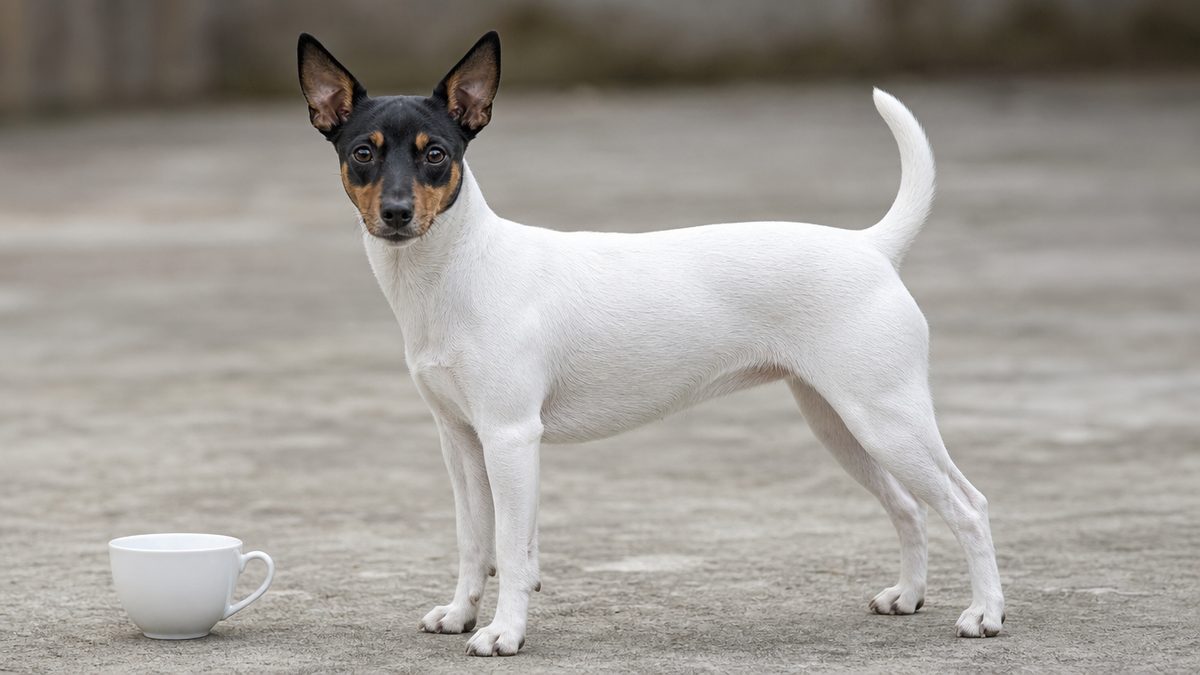
A Miniature Fox Terrier is a small, smooth-coated Australian working terrier standing 24 cm to 30.5 cm and weighing no more than 5.5 kg, with a predominantly white body, a coloured head and erect inverted-V ears. Its breed standard is published by its own club rather than by any national kennel club, and that single fact explains most of what follows.
The Mini Foxie Club of Australia's published breed standard is the governing document for this breed, and it is unusually specific for a club standard. Size is given as a mature height between 24 cm and 30.5 cm, with the height of the body equal to its length, and a weight that must 'not exceed 5.5 kilograms (12 pounds)';. An independent breed database gives males at 25 to 30 cm and 4 to 5 kg and females at 23 to 28 cm and 3 to 4 kg, which sits inside the standard.
Appearance, in the standard's own words
The standard opens with 'A small sized, smooth coated terrier - sleek, well balanced and of athletic appearance', and the breed characteristics section describes 'a predominantly white coat on the body and a well coloured head' on a dog that is 'alert, agile, inquisitive, intelligent and courageous - a swift natural hunter with the ability to spring';. Four details in that document do real work for a buyer in India.
- Coat is 'A single coat that is short, dense, glossy and of fine smooth texture', slightly longer on the ruff and less dense on the belly. There is no undercoat to manage, which is the single biggest practical advantage this breed has over a British wire terrier in an Indian climate.
- Colour permits only white with black and tan markings. 'No other colours are permitted', 'Full coloured coats are not permitted', and 'Brindling or merling of colours is not permitted'. Any white on the head must not touch the ears or the eyes.
- Ears are 'Inverted V shape with pointed tips... Carried erect and high on the skull when alert', and may be 'softly folded' with the tip falling forward. Both carriages are correct, which is why photographs of the breed look inconsistent.
- The mouth requires a regular scissor bite and 'Full dentition', which is a stricter dental requirement than most small-breed standards impose.
The tail entry matters more in India than anywhere else. The current standard describes only 'Smooth coated tail, gradually tapering... Carried at an angle away from the body', and adds that 'Bobtails can naturally occur and are acceptable';. Searched with a tolerant pattern, the word dock appears nowhere on that page. Wikipedia states that 'The breed standard has always allowed for the dog's tail to be docked or undocked';. Bonbeno cannot reconcile those two, so it publishes both and follows the club's own current document.
History: an English dog that became Australian
The breed was developed from crosses between smaller Fox Terriers and Fox Terrier types and Toy Manchester Terriers, later crossed to other toy breeds including the English Toy Terrier and the Whippet, by hunters wanting a faster small terrier for rats and rabbits. The origins are English; the breed is endemic to Australia. By the late 19th century the type was clearly identifiable on Australian farms, where the dogs worked against rabbits, rats and snakes and were known simply as 'the little foxies', and by the 1920s the breed was a fixture in Australian towns Wikipedia, Tenterfield Terrier.
Documented working postings include Sydney's North Head Quarantine Station, the Riverstone Meat Works and Brisbane City Council, all as vermin exterminators. That is an unusually concrete working record for a breed with no kennel club behind it, and it is the reason the breed survived long enough to have a club at all.
'Miniature Fox Terrier' is a problem as a name, because the Fox Terrier already exists in two recognised varieties and no all-breed registry wanted a third that was not descended from them in the registered sense. That naming objection, not the dog, is what kept the breed out of the Australian register.
Is the Miniature Fox Terrier a recognised breed? Not by any kennel club, and here is the proof
No national kennel club recognises the Miniature Fox Terrier. Bonbeno checked four registers with in-document controls in every case, and the breed is absent from all four. What it does have is a written standard, a breed club dating to 1986, a pedigree register and a list of registered breeders, which is more documentation than many recognised breeds can show.
Registry absence is a strong claim, and this site only makes it when the instrument has been proved on the same document. Dogs Australia is the body that would carry this breed if anyone did: it describes itself as 'Internationally recognised and established in 1958 as the Australian National Kennel Council (ANKC)', maintains the ORCHID heritable canine diseases database and files terriers as its Group 2. Each check below names the control that passed.
| Register | Miniature Fox Terrier | In-document control that was present |
|---|---|---|
| FCI definitive, Group 3 Terriers, 34 breeds | Absent | Fox Terrier (Smooth) 12, Fox Terrier (Wire) 169, Australian Terrier 8, Australian Silky Terrier 236 |
| FCI provisional list, 20 entries | Absent | Two terriers (371, 370) and an Australian breed, the Australian Stumpy Tail Cattle Dog 351 |
| FCI alphabetical M and F indexes | Absent | Miniature American Shepherd 367 and Miniature Bull Terrier 359 in M; both Fox Terriers in F |
| Dogs Australia breed listing, 18 March 2026 | Absent | 31 terriers listed including the Tenterfield Terrier and both Fox Terriers |
| OFA breed picker, 438 codes | Absent | Tenterfield Terrier TNT, Toy Fox Terrier TFT, Smooth Fox Terrier FT, Labrador Retriever LR |
One methodological warning belongs here because it fired during this research. The FCI's Group 3 list must be read at its own path, and the plausible-looking URL ending 'terriers-3.html' returns HTTP 200 and serves a complete Kerry Blue Terrier page, because 3 is the Kerry Blue's FCI number and the breed name in the URL is discarded. An agent reading an absence off that page would have concluded the right thing from entirely the wrong document.
What the breed does have
The Mini Foxie Club of Australia was formed in July 1986 by enthusiasts who met informally through the early 1980s, working with members of the Royal NSW Canine Council to write a breed standard and a constitution. It incorporated under its present name in 1992 to comply with New South Wales regulations for incorporated organisations. Its own site puts it plainly: 'The Mini Foxie Club of Australia was formed in 1986 and has been going strongly for more than 40 years', with a first-person history from its named founder, Gordon Grant.
The club publishes a full written breed standard, runs shows, holds the pedigree register, maintains a stud-dog register, and lists its registered breeders by kennel name and area across New South Wales, Queensland, the Australian Capital Territory and Tasmania. It also states that member breeders have their dogs 'vet checked and screened against relevant genetic issues within the breed by DNA health testing' and that 'Dogs are PLL tested and can be cleared by parentage';.
The 1993 split, and what it cost each side
In 1991 a South Australian breed club formed whose principal goal was Australian National Kennel Council recognition. Challenges to the name 'Miniature Fox Terrier' were being mounted at the time and threatened to preclude recognition by an all-breed club, so those members joined owners in Western Australia and reorganised in 1993 as the Tenterfield Terrier Club of Australia, taking a name first used by the television presenter Burke of Burke's Backyard.
That strategy worked. Dogs Australia's registration regulations carry a clause headed 'Tenterfield Terrier - Breed under Development (10/2006)', under which Tenterfield Terriers registered with the Tenterfield Terrier Club of Australia with five generations all registered with that club become eligible for re-registration on the Dogs Australia Main Register. The Tenterfield Terrier now has its own Dogs Australia breed standard, giving a height of 25.5 to 30.5 cm with an ideal of 28 cm.
The Mini Foxie stayed independent and kept its name. Wikipedia records that the ANKC subsequently placed a moratorium on registering any MFCA-registered Miniature Fox Terrier as a Tenterfield Terrier, so the two populations are now formally separate. The two standards have diverged in substance as well: the Tenterfield standard accepts brindle markings as 'acceptable but not preferred';, while the Mini Foxie standard states that brindling is not permitted at all.
This breed has a written standard with measurable tolerances, a named founder, an incorporated club, a pedigree register and a public breeder list. What it lacks is a national kennel club willing to carry the name. Those are different failures, and only the second one affects whether you can lawfully buy one in India.
Miniature Fox Terrier price in India: nine of the ten ranking pages are a different breed
There is no Miniature Fox Terrier price in India. Bonbeno pulled the Indian organic top ten for the price term on 3 September 2026 and opened every page. Two are about this breed and neither carries a rupee figure. The other eight are about the Toy Fox Terrier, the Wire Fox Terrier, the generic Fox Terrier, or no fox terrier at all.
Sort the ten results by what they are actually about and the picture is unambiguous.
| Position | Domain | Breed the page is actually about | Indian price on it |
|---|---|---|---|
| 1 | happypet.care | Toy Fox Terrier | Rs 20,000 to Rs 50,000 |
| 2 | mrnmrspet.com | Toy Fox Terrier | None visible, sign-up wall |
| 3 | davpetlovers.in | Wire Fox Terrier | None in the markup |
| 4 | en.wikipedia.org | Miniature Fox Terrier | None |
| 5 | breednbreeder.com | Toy Fox Terrier | None |
| 6 | mrnmrspet.com | Toy Fox Terrier, Mumbai city page | None |
| 7 | testifykennel.co.in | No fox terrier of any kind | Twenty bands, Rs 12,000 to Rs 28,000 |
| 8 | davpetlovers.in | Fox Terrier | None in the markup |
| 9 | petlur.com | Miniature Fox Terrier | US dollars only, 400 to 600 |
| 10 | tailsbuddy.com | Wire Fox Terrier | Rs 40,000 to Rs 90,000 |
The three largest Indian listing sites have no page for this breed at all
Mr n Mrs Pet returns a document titled '404 Page Not Found' at its Miniature Fox Terrier URL, built on exactly the pattern it uses for every breed it does carry, and its Toy Fox Terrier page exists and even has its own Mumbai city page. Puppiezo returns HTTP 404 at the equivalent product URL. HappyPet returns HTTP 404 too, while its Toy Fox Terrier guide is the first organic result in the country.
The fifth ranking seller does carry a page, and it is worth looking at what a page with no dog behind it looks like. Breed n Breeder's Toy Fox Terrier listing has an H1 reading 'Healthy Toy fox terrier Puppies for Sale Avaliable - Just Click.', with the misspelling in the original, no rupee figure anywhere, and an offer to have 'Mr. Vansh' call you back. The same site sells a 'Norwich Trrier', misspelled eleven times, so the template is the product.
Asia Pets is the interesting one, because it returns HTTP 200. The breed URL serves a document whose own title and H1 both read 'Puppies for Sale in India', in which the strings Miniature Fox Terrier, Toy Fox Terrier and Wire Fox Terrier each occur zero times, and which offers a Chihuahua, a Yorkshire Terrier, a Toy Pom, a Pembroke Welsh Corgi and a Saint Bernard. A status code alone would have recorded that as a breed page existing.
The only genuine breed page prices in dollars
Petlur is the one ranking page that is a real Miniature Fox Terrier profile. It gives origin Australia, popularity rank 232, litter size 2 to 3 puppies once a year, and a price of 'USD $400-$600', with the text 'According to a rough estimate, you will spend between $400 to $600 on your Miniature Fox Terrier if you purchase it from a reputable breeder'. The string India occurs zero times on the page. Under 'Recognized by' it states 'Not recognized by the American Kennel Club. And Not recognized by FCI.';.
That dollar figure is worth watching rather than converting. USD 400 to 600 at 84.38 is Rs 33,752 to Rs 50,628; at 74 it is Rs 29,600 to Rs 44,400. If an Indian page ever prints a Miniature Fox Terrier price near either band, it has almost certainly converted this one rather than observed a sale. Bonbeno publishes no conversion of its own, because a converted foreign price is not an Indian price.
A real puppy price needs a seller, a dog and a number in the same place. In India none of the three exists for this breed. Any figure you are quoted is therefore an estimate at best, and at worst it belongs to the Toy Fox Terrier or the Wire Fox Terrier.
Where the Rs 25,000 to Rs 50,000 figure actually comes from
Bing India's own AI summary states that 'The price of miniature fox terriers in India typically ranges from Rs 25,000 to Rs 50,000' and names its source. Bonbeno opened that source. It is a page titled 'Fox Terrier Price in India 2023' in which the strings 'Miniature Fox', 'Mini Fox' and 'Toy Fox' each occur zero times.
The summary breaks the range into two bands and attributes both to the same page: 'Rs 25,000 to Rs 35,000' for pet quality and 'Rs 40,000 to Rs 50,000' for show-quality KCI-certified dogs. Both bands are real. They are printed on the cited page, verbatim, in its own frequently asked questions: 'In India, the typical price range for Fox Terriers begins at 25,000 to 35,000 INR for pet or standard-quality breeds. However, for a show-quality, robustly built Fox Terrier with KCI certification, prices can range from 40,000 to 50,000 INR';.
The word missing from both sentences is Miniature. Searched across the whole document, 'Fox Terrier' occurs 142 times, 'Smooth Fox' four times and 'Wire Fox' four times, and no form of Miniature Fox Terrier occurs at all. So the citation is genuine, the figure is genuine, and the breed the figure is attached to is not. That is a different and subtler failure than a fabricated number, and it is harder to catch, because everything checks out except the subject.
The second cited source names a third breed
The same summary attributes its 'factors affecting price' sentence to a page at goodfurs.in with a toy-fox-terrier path. So one answer, presented as the price of a Miniature Fox Terrier in India, is assembled from a Fox Terrier page and a Toy Fox Terrier page. Neither is this breed, and the two are not the same breed as each other.
The other rupee figures a searcher will meet
- Rs 40,000 to Rs 50,000 basic, Rs 50,000 to Rs 60,000 KCI registered and Rs 60,000 to Rs 90,000 show quality, all printed for the Wire Fox Terrier, a 6 to 9 kg breed standing 13 to 16 inches, which is roughly double this dog.
- Rs 20,000 to Rs 50,000 as a cost of buying, printed for the Toy Fox Terrier, with the page's own body text conceding that 'Since there are few listings for the breed, it becomes difficult to find the exact prices' before estimating Rs 30,000 to Rs 40,000 anyway.
- Twenty rupee bands from Rs 12,000 to Rs 28,000 on a small-breed price list that ranks seventh for this query and in which no fox terrier of any kind appears.
One quality signal is worth recording about the tenth result, because it tells a reader how much care went into the page they are reading. Three of its own subheadings are untranslated filler: 'Defying the traditional and mainstream parties courtesy marc', 'Packing macron anddis insted about vote against chat bubbleo' and 'British military courts aginst protester business cultural p';. A page that has not proof-read its own headings is not a source for a price.
| Figure | Printed by | Breed it actually describes |
|---|---|---|
| Rs 25,000 to Rs 35,000 | Black Star Kennels, via an AI summary | Fox Terrier, pet quality |
| Rs 40,000 to Rs 50,000 | Black Star Kennels, via an AI summary | Fox Terrier, show quality with KCI papers |
| Rs 20,000 to Rs 50,000 | HappyPet | Toy Fox Terrier |
| Rs 30,000 to Rs 40,000 | HappyPet, as its own estimate | Toy Fox Terrier |
| Rs 40,000 to Rs 90,000 | Tailsbuddy | Wire Fox Terrier |
| USD 400 to 600 | Petlur | Miniature Fox Terrier, but not in India |
When a page or an answer engine gives you a price for a rare breed, open the cited source and search it for the breed's full name. If the name is not there, the price is not that breed's. On this breed that check fails on the very first source an answer engine offers.
Monthly cost of ownership in India, built from rates somebody actually quotes
Budget roughly Rs 2,800 to Rs 6,000 a month for a 4 kg Miniature Fox Terrier in an Indian metro, before boarding. No Indian page publishes a running cost for this breed, so every line below comes from a clinic, a boarding operator or a municipal body that publishes the number itself.
The one Indian monthly cost a searcher will meet for a fox terrier is Rs 2,200 to Rs 3,750, printed on the Toy Fox Terrier page that ranks first for this query. It is not an observation. Bonbeno fetched ten breed pages from the same site and re-read the raw markup: seven print that identical pair to the rupee, built from identical food, veterinary and grooming lines, across the Toy Fox Terrier, Norwich Terrier, Norfolk Terrier, Lakeland Terrier, Pug, Beagle and Lancashire Heeler.
One parasite-control caveat belongs before the table. The tick and flea product priced there is the 15 to 30 kg pack, which is three to six times this breed's bodyweight. It is quoted because it is a published Indian price for a named product with named active ingredients, not because it is this dog's dose. Ask a veterinarian for the small-dog pack and expect to pay considerably less.
The tell is the grooming line. A Pug and a Toy Fox Terrier are given the same Rs 700 to Rs 1,200 grooming cost, and a hand-stripped wire terrier is given it too. Those three coats cannot cost the same to maintain. What does vary per breed on that site is the cost of buying and the ideal weather band, which is how a template can look breed-specific at a glance.
| Item | Quoted rate | Source and note |
|---|---|---|
| Puppy core vaccination course | From Rs 6,499 for the course | Vetic clinic chain, days 45 to 120, against a struck-through Rs 8,111. A promotional floor, not a market average |
| Annual booster | From Rs 3,199 | Vetic, against a struck-through Rs 3,806 |
| Anti-rabies, single dose | Rs 699 | Vetic |
| 9-in-1 DHPPiL | Rs 899 | Vetic |
| Kennel cough | Rs 1,349 | Vetic |
| Tick, flea and worming combined | Rs 3,308 for three tablets of the 15 to 30 kg pack | Supertails NexGard Spectra, MRP Rs 3,375. This pack is three to six times this dog's weight, so it bounds the product family rather than giving this breed's dose price |
| Boarding, overnight | Rs 899 up to 24 hours | PawSpace Bengaluru, with festive rates 25 to 30 percent higher by its own note |
| Daycare, up to 10 hours | Rs 799 | PawSpace Bengaluru |
| Pet dog registration, Delhi | Rs 500 a year | Municipal Corporation of Delhi, renewal also Rs 500, late fee Rs 100 a month |
| Pet licence, Chennai | Rs 50 | Greater Chennai Corporation, which issued 9,115 pet animal licences in 2024 |
Where this breed is genuinely cheaper than its competitors
Two lines fall away almost entirely. Grooming is close to nothing, because the standard specifies 'A single coat that is short, dense, glossy and of fine smooth texture' with no undercoat to strip or clip. Food is small, because a dog of 3.5 to 5.5 kg eats a fraction of what a medium breed does, and a premium small-breed diet stays affordable at that volume. Against a hand-stripped wire terrier of the same height, this breed is materially cheaper to run in India.
Two costs stay. Year-round parasite control is not optional: among 120 dogs sampled in Kerala, Babesia was found in 66.7 percent, and among 584 dogs in West Bengal, Babesia gibsoni was detected in 76.54 percent with 72.9 percent carrying two or more pathogens. Those denominators are clinic caseloads rather than random pets, so they overstate population risk, but they justify a fixed monthly line rather than a monsoon reaction. Boarding at Rs 899 a night is the other cost people forget.
The vaccination course from Rs 6,499, a municipal licence at Rs 500 in Delhi or Rs 50 in Chennai, and setup equipment all land in the first twelve months. After that a small, short-coated dog is one of the cheapest animals to keep in an Indian city, which is a genuine argument for the breed if you can find one.
Can a Miniature Fox Terrier handle the Indian climate? Better than most, and still not native
A Miniature Fox Terrier handles Indian heat better than any British terrier, because it has a single short coat and an Australian origin. It is still not adapted to India. Sydney's hottest month averages 22.93 C, while Chennai's coolest month averages 24.09 C, so even an Indian winter is warmer than an Australian summer.
Bonbeno queried NASA POWER by explicit latitude and longitude rather than by place name, and checked the returned cell elevation against the real one at every point. Sydney came back at a cell elevation of 31.72 m against a real 19 m, and Brisbane at 61.50 m against 27 m, so both cells describe their cities. A fourth point, Riverstone in western Sydney, returned 330.34 m against a real elevation near 30 m and was discarded as unusable rather than published.
| Place | Annual mean, C | Hottest month mean, C | Coldest month mean, C | Annual humidity, % |
|---|---|---|---|---|
| Tenterfield, NSW | 16.29 | 22.69 (January) | 9.05 (July) | 68.0 |
| Sydney, NSW | 18.66 | 22.93 (January) | 14.00 (July) | 72.5 |
| Brisbane, QLD | 21.09 | 25.43 (January) | 15.98 (July) | 71.2 |
| Bengaluru | 23.74 | 28.37 (April) | 20.22 (December) | 67.9 |
| Pune | 23.86 | 28.93 (April) | 19.62 (December) | 66.8 |
| Delhi | 25.60 | 35.88 (June) | 13.61 (January) | 45.6 |
| Kolkata | 25.81 | 31.53 (May) | 17.31 (January) | 73.9 |
| Mumbai | 26.77 | 31.19 (May) | 23.19 (January) | 67.4 |
| Chennai | 27.95 | 31.51 (May) | 24.09 (January) | 72.4 |
Read Brisbane against Bengaluru and the honest verdict appears. Brisbane at 21.09 C annual is the warmest place this breed has genuinely adapted to, and Bengaluru at 23.74 C is 2.65 C warmer than that. Delhi in June, at 35.88 C mean and an annual mean maximum of 48.79 C, is more than 10 C beyond anything in the breed's history.
What the coat actually buys you
The heat advantage is real and it comes from one line in the standard. This is a single coat, short, dense, glossy and of fine smooth texture, with no undercoat. A double-coated or wire-coated terrier of the same height carries an insulating layer that traps warm air against the skin and slows drying after monsoon rain. This breed does not. In Chennai or Mumbai humidity that difference matters more than the two or three degrees of climate adaptation.
Across 905,543 UK dogs, 652 of the 879 heat-related illness events with a recorded trigger were exertional, which is 74.2 percent, against 113 environmental and 46 from confinement in a vehicle. For an energetic terrier with a high prey drive, the dangerous decision is a chase in the afternoon sun, not a parked car.
City by city
- Bengaluru and Pune are the best Indian fits, both near 23.8 C annual with a genuine cool season and December means near 20 C.
- Delhi is manageable in winter, when January averages 13.61 C, and is a summer confinement problem from April to July.
- Mumbai, Chennai and Kolkata combine heat with humidity, and Mumbai and Pune both exceed 90 percent mean relative humidity in August, which blocks evaporative cooling in any breed.
- Nowhere in urban India is cooler than the breed's home range, so plan around heat management rather than hoping a city will suit.
Indian law reaches this question directly. Second Schedule Part IV paragraph 21(1) of the Prevention of Cruelty to Animals (Dog Breeding and Marketing) Rules 2017 bars outdoor housing without a veterinary practitioner's written approval for dogs not accustomed to local temperatures and for breeds that cannot tolerate them. A short-coated dog fares better here than a long-coated one, but a 4 kg terrier from a temperate country still lives indoors in an Indian summer.
Temperament and household fit: a fearless 4 kg hunter that likes people
A Miniature Fox Terrier suits an active household that wants a small, loyal, energetic dog and can manage a serious prey drive. It does not suit a home with rabbits, hamsters, fancy rats or free-flying birds, and it was never a quiet dog.
The standard's own temperament clause is short and useful: 'Fearless and bold, confident and eager to learn, showing loyalty to owners. Adaptable to most domestic situations. Animated, entertaining and playful';. The breed characteristics clause above it calls the dog 'alert, agile, inquisitive, intelligent and courageous - a swift natural hunter with the ability to spring'. Read them together and you have a small dog with a working brain and an unusually people-focused disposition for a terrier.
The prey drive is the deal-breaker, not the barking
These dogs were bred to kill rats, mice, rabbits and snakes on Australian farms, and they worked as vermin exterminators at Sydney's North Head Quarantine Station, the Riverstone Meat Works and for Brisbane City Council. Like most working terriers they cannot distinguish between small pets, such as reptiles and fancy rats, and vermin, so they should not be left alone with such animals. That is a management fact rather than a training problem.
Who this breed genuinely suits
- Households in Bengaluru or Pune that want a small, low-grooming, hardy dog and will walk it properly twice a day.
- Owners who want a terrier that is genuinely people-oriented, because its own club describes handlers being able to get results with praise rather than only with treats.
- Families with children old enough to respect a small, fast, confident dog that will not back down.
- Anyone who wants the smallest possible amount of coat care, which is where this breed beats every wire-coated terrier.
Who should not buy one
- Homes with rabbits, guinea pigs, hamsters, reptiles or free-flying birds.
- Buyers who want a calm lap dog. The standard's own words are animated, entertaining and playful, which is a polite description of a dog that does not sit still.
- Anyone who cannot verify what they are buying, which in India is currently everybody, because no seller lists the breed.
- Owners who need a guard dog. A 4 kg terrier will alert and will then be entirely outmatched.
The club standard does not describe barking, so Bonbeno does not put a number on it. What the working history implies is a dog selected to alert and to pursue. Treat vocal behaviour as likely, plan for it with exercise and structure, and do not expect to train out a trait a century of farm work selected for.
Training a Miniature Fox Terrier: eager to learn, and hard to recall
To train a Miniature Fox Terrier, use short reward-based sessions and accept that recall around moving small animals will never be reliable. Its own breed standard describes a dog 'confident and eager to learn', which is a genuinely easier starting point than most earth terriers give you.
Two things about this breed help a first-time trainer. The standard selects for confidence and willingness rather than pure independence, and the breed's own club material reports that handlers do not have to rely on treats to get a result, which points at a dog that works for social reward. That is unusual in a working terrier and it is one of the breed's best arguments.
So this is a genuinely trainable terrier by the standards of the group, which is not a phrase this site uses often. Set against that, a dog bred to pursue and kill fast-moving small animals has been selected for exactly the behaviour that defeats recall.
One thing does not help. A dog bred to pursue and kill fast-moving small animals has been selected for exactly the behaviour that defeats recall. Train recall in enclosed spaces, keep a long line outdoors, and never test it on a street where a cat or a squirrel can appear.
The Indian socialisation list
Socialise deliberately before sixteen weeks and do it in the environment the dog will actually live in. In an Indian city that means lifts, generators, horns, cattle in the road, street dogs behind gates, delivery riders, festival crackers and monsoon thunder, all introduced at a distance the puppy can handle and paired with food. A confident small terrier that finds the street alarming becomes a reactive small terrier, and in a flat that is the behaviour that ends the relationship.
| Age | Realistic target | What usually goes wrong |
|---|---|---|
| 8 to 16 weeks | Name, food lure, crate, and 40 or more calm novel experiences | The puppy is kept indoors until the vaccination course finishes and the window closes |
| 4 to 6 months | Sit, down, hand-touch, loose lead indoors, mouth and ear handling accepted daily | Lead work is attempted on a busy road where the dog cannot think |
| 6 to 12 months | Recall in an enclosed space, settle on a mat, long line outdoors | Off-lead recall is tested near traffic and permanently poisoned |
| 12 months and after | Reliable indoors, managed outdoors, a solid leave-it around small animals | The owner expects a terrier to ignore a rat, which it will not |
Two training goals here are medical rather than behavioural. Teach the dog to accept its mouth being opened, because the standard requires full dentition and a small mouth with a full set of teeth crowds easily. Teach it to accept eye examination and handling, because the club's own health programme tests for primary lens luxation and an eye check is part of that picture.
A 4 kg dog on a slip lead or check chain takes the whole correction through its neck. Fit a harness, and if the dog pulls, train the pulling. This applies to every toy and small breed and it is worth saying on every page.
Daily exercise requirement, and what happens without it
Give a Miniature Fox Terrier at least an hour of exercise a day, split across two or three outings and timed around the heat. Its own club describes a swift natural hunter with the ability to spring, and its gait clause specifies a gallop 'somewhat reminiscent of a greyhound'. This is not a decorative small dog.
The standard's movement clause is the clearest statement of what this dog needs: 'Movement is smooth and flowing with good reach and strong drive from the hindquarters... May exhibit a light springing series of leaps, especially over obstacles, in the chase or at play. Gallop: somewhat reminiscent of a greyhound, legs tend to converge at full pelt. Able to change directions quickly at full speed';. A breed described that way needs to run.
Timing in India
Walk before sunrise and after sunset for most of the Indian year. Delhi averages 35.88 C in June, and even Bengaluru's hottest month averages 28.37 C. The evidence that timing is the right lever, rather than duration, is that exertional heat illness accounted for 652 of the 879 UK heat-related events with a recorded trigger. A dog that will chase at full pelt in 35 C heat has no self-preservation instinct to rely on.
- Test the pavement with the back of your hand for five seconds. If you cannot hold it, neither can the dog.
- Split the hour into two or three outings, which suits a small dog's stamina better than one long walk anyway.
- Use a long line in any open space, because this breed's recall will fail the first time something small moves.
- Replace outdoor time with indoor scent work in the hot months. A vermin dog will happily spend twenty minutes finding food hidden in a room.
What under-exercise looks like
An under-exercised Miniature Fox Terrier becomes noisy, destructive and reactive to every sound in the corridor. Digging and shredding are the classic tells, because a dog bred to work at speed and then go to ground will find something to work on. None of that is a character defect; it is an unemployed working animal.
Feed one meal a day scattered across a room or through a snuffle mat instead of from a bowl. It costs nothing, happens indoors at any hour, and gives a hunting terrier ten to twenty minutes of the work it was built for without putting it under load in the heat.
Grooming: the lowest-maintenance coat on any terrier this site covers
Groom a Miniature Fox Terrier with a weekly brush and nothing else. The standard specifies a single coat, short, dense, glossy and of fine smooth texture, with no undercoat, no stripping and no clipping. In an Indian climate that is the breed's strongest practical advantage.
The coat clause reads in full: 'A single coat that is short, dense, glossy and of fine smooth texture. Coat can be slightly longer on ruff of neck. Coat is less dense on belly';. There is no second layer. Compare that with a wire-coated terrier of the same height, which needs hand stripping two or three times a year plus weekly work, and the difference in an Indian summer is not cosmetic.
What Indian humidity still requires
- Dry the dog properly after monsoon walks and after any bath, paying attention to the ears, the chin and between the toes. A short coat dries fast, which is the point, but a wet dog in 90 percent August humidity still does not dry on its own.
- Brush weekly with a rubber curry or a soft slicker. That is genuinely the whole routine.
- Trim nails, clean teeth and deworm on a schedule, which is standard dog maintenance rather than breed care.
- Bath rarely. A short smooth coat sheds dirt, and over-bathing strips the oils that make it glossy.
The standard also notes 'Dewclaws, if present, must be kept trimmed';. That is worth reading against Indian law, because Second Schedule Part II paragraph 6(8) of the 2017 Rules prohibits de-clawing along with docking, cropping and de-barking. Trimming a dewclaw is care; removing one is prohibited.
The hypoallergenic claim, settled
A Miniature Fox Terrier is not hypoallergenic, and neither is any of the fox terriers Indian pages will sell you instead. Two of the ranking Indian pages carry a 'Hypoallergenic Dog' navigation section for fox terriers, and one prints 'HYPOALLERGENIC Yes' as a spec row for the Wire Fox Terrier Tailsbuddy, 'Wire Fox Terrier Dog and Puppy…. Can f 1 was measured across 196 dogs of so-called hypoallergenic breeds against 160 control dogs and came back higher in the hypoallergenic group, at 2.26 against 0.77 micrograms per gram of hair, with no difference in airborne allergen.
A single short coat is easy to groom and it still sheds. Fine white hairs on dark clothing are the usual complaint from owners of this breed. Low grooming and low allergen are different claims, and only the first one is true here.
Health issues: nobody has published on this breed, and that is the finding
There is no veterinary literature on the Miniature Fox Terrier. PubMed appears to return five records for the breed's name and every one of them is about something else. The breed is also absent from OFA's registry entirely, so no screening statistics exist. Everything useful about this breed's health has to be borrowed from named relatives, and this page labels every borrowed figure as borrowed.
The search was run properly rather than assumed, because a zero is a strong claim. Searching PubMed for the phrase 'Miniature Fox Terrier' returns a count of 5, which looks like coverage until you read the query translation. PubMed decomposed the phrase into miniature OR miniaturization AND fox AND terrier, and the five records are a transorbital craniectomy case report, a study of sex bias in show-ring wins, two North American breed-prevalence surveys of cataract and glaucoma, and a 1983 paper on congenital myasthenia gravis in Smooth Fox Terriers. None is about this breed.
The second search is the one that shows how the trap works. 'Mini Foxie' returns 97,629 records, because the translation collapses to mini[All Fields]. A page reporting that number as coverage would be reporting an arithmetic accident. Controls run in the same session returned 126 records for Labrador retriever hip dysplasia and 19 for primary lens luxation in dogs, so the instrument was working and the absence belongs to the breed.
The comparison that makes the absence meaningful
The Tenterfield Terrier, the breed that separated from this one in 1993 and took the recognition route, returns two PubMed records and both are genuine, breed-specific genetic disease studies. That is the clearest illustration on this site of what registry recognition actually buys a breed. A recognised population gets studied; an unrecognised one does not.
- Congenital hypothyroidism with goiter was traced in Tenterfield Terriers to a homozygous thyroid peroxidase missense mutation in exon 9, R593W. It was heterozygous in all obligate carriers and in 31 percent of other clinically normal Tenterfield Terriers among 114 genotyped dogs, and the same study included two affected Toy Fox Terriers. A carrier test was made available for breeding screening.
- A KCNJ10 mutation associated with hereditary ataxia in the Russell group of terriers was found homozygous in three Smooth-Haired Fox Terriers and two Toy Fox Terriers with the disease, and heterozygous in five clinically unaffected Tenterfield Terriers. The authors conclude it segregates in at least three more breeds descended from British hunting terriers.
Neither study tested a Miniature Fox Terrier, and neither can be transferred to it as a prevalence figure. What they do establish is that the closely related Australian and American small fox terriers carry two recessive genetic diseases with real carrier frequencies, which is a reason to ask a breeder about testing rather than a reason to assume this breed is affected.
The one health claim the breed club makes for itself
The Mini Foxie Club of Australia states that member breeders have their dogs 'vet checked and screened against relevant genetic issues within the breed by DNA health testing', and specifically that 'Dogs are PLL tested and can be cleared by parentage';. That is a concrete, checkable claim, and it points at exactly the disease the breed's relatives carry most heavily.
| Breed | Dogs tested | Carrier % | Affected % | OFA rank |
|---|---|---|---|---|
| Jack Russell Terrier | 1,972 | 34.7 | 1.2 | 6 |
| Rat Terrier | 1,630 | 30.6 | 2.1 | 3 |
| Toy Fox Terrier | 710 | 28.2 | 0.8 | 10 |
| Norwich Terrier, for scale | 238 | 4.2 | Not stated | 13 |
| Miniature Fox Terrier | No OFA entry exists |
Wikipedia names the Toy Fox Terrier, the Jack Russell Terrier, the Rat Terrier and the Tenterfield Terrier as this breed's related breeds. Three of those four sit in the top ten OFA breeds for primary lens luxation carrier frequency, at between 28.2 and 34.7 percent of tested dogs. Against that background, a club that tests for PLL and clears dogs by parentage is doing the single most relevant thing available to it.
Ask for a primary lens luxation DNA result on both parents, or a clear-by-parentage certificate from the club. Do not expect an OFA number, a hip score or a life-table figure, because the breed has no entry in any registry that produces them. A breeder who offers you an OFA certificate for a Miniature Fox Terrier is offering you something that cannot exist.
Three health questions that change shape in India
Three things behave differently for this breed in India: tick-borne disease is a running cost rather than a seasonal scare, the eyes matter more because the breed's relatives carry a lens disease, and heat management is easier than for a wire terrier but still not optional.
One, tick-borne disease
Indian veterinary studies find high infection rates in dogs presented to clinics. Among 120 dogs sampled in Kerala, Babesia was found in 80, which is 66.7 percent, with Ehrlichia canis at 5.0 percent and a pre-monsoon March to May peak. Among 584 dogs in West Bengal, Babesia gibsoni was detected in 76.54 percent and Anaplasma in 55.75 percent, with 72.9 percent carrying two or more pathogens.
Both studies sampled dogs already at a veterinary clinic, many of them clinically suspected cases, so the percentages describe caseload and not the pet population. Quoting 76.54 percent as your dog's chance of infection would be badly wrong. What they justify is a fixed year-round tick-control line in the budget.
A low-slung terrier hunting through grass carries its whole body at the height ticks wait at. That is a size argument rather than a breed argument, and it applies to any small dog worked outdoors in India.
Two, the eyes
Primary lens luxation is a painful, sight-threatening condition that usually presents in middle age, and in the breeds most closely related to this one between 28.2 and 34.7 percent of tested dogs are carriers. It is a recessive disease with a DNA test, which means a single confirmed clear parent removes the risk of an affected puppy. In India, where no local testing pathway for this breed exists, that certificate has to come with the dog from Australia or not at all.
Watch for a red, painful, cloudy eye in a middle-aged dog and treat it as an emergency rather than an infection. Lens luxation can raise intraocular pressure quickly, and the difference between a same-day appointment and a next-week one can be the eye.
Three, heat, and what the coat does and does not buy
A single short coat cools better and dries faster than a wire or double coat, which is a genuine advantage in Chennai or Mumbai. It does not make the dog heat-adapted. Sydney's hottest month averages 22.93 C and Brisbane's 25.43 C, against Chennai's 31.51 C in May and Delhi's 35.88 C in June NASA POWER climatology. Manage the walk times and the dog is comfortable; ignore them and the coat will not save it.
One further Indian factor is legal rather than clinical. Second Schedule Part III paragraph 8(10) of the 2017 Rules requires breeding dogs to have been tested for genetic defects 'including hip dysplasia, progressive retinal atrophy, night blindness, hypothyroidism, entropion, ectropion, overshot, undershot jaw... wry mouth, two or more missing teeth';. Hypothyroidism is on that list, and congenital hypothyroidism is one of the two documented genetic diseases in this breed's nearest relative. The clause and the evidence point the same way, which is unusual and worth acting on.
Feeding a 4 kg terrier in India
Feed a Miniature Fox Terrier a measured small-breed ration and keep it lean. At 3.5 to 5.5 kg the daily volume is small enough that a premium diet stays affordable, which is one of the few economic advantages this breed has in India.
Start from the standard rather than a chart. Weight must not exceed 5.5 kg and should be 'a healthy weight for the height of the dog', with bone 'substantive but not excessive, and in proportion to the size of the dog';. An independent database gives males at 4 to 5 kg and females at 3 to 4 kg. Body condition felt over the ribs is the measure that matters, not a number on a scale.
Life-stage feeding
Feed four meals a day to about four months, three to six months, and two thereafter. Do not free-feed. At this size a handful of training treats is a meaningful share of the daily intake, so subtract them from the bowl rather than adding them on top. Litter size for the breed is given as 2 to 3 puppies once a year, so a breeder feeding a small litter has no excuse for under-conditioned puppies.
Two breed-specific reasons to keep this dog lean
- Heat. Body fat is insulation, and a dog that is already at the edge of its climate range in an Indian summer has nothing to spare.
- Joints and speed. The standard describes a gallop reminiscent of a greyhound and a dog able to change direction at full speed, which is a lot of load through small joints. Extra weight multiplies it.
- Teeth. The standard requires full dentition, and a small mouth with a complete set of teeth crowds easily, which makes soft food residue a real dental-disease risk. Brush daily.
- Anaesthetic risk. Any small dog is a harder anaesthetic subject than a large one, and obesity makes it harder still.
Indian availability is genuinely good at this size. Small-breed complete diets from imported and Indian brands are widely stocked, and a 4 kg dog works through a bag slowly enough that the premium is bearable. Store the bag properly, because dry food in Indian monsoon humidity spoils faster than the packaging suggests. Buy the small pack, decant into an airtight container, and do not keep an opened bag more than about a month in July and August.
The first year, month by month, if you somehow have one in India
Plan the first year around the vaccination course, the socialisation window before sixteen weeks, and one document you will have to chase from Australia: a primary lens luxation result on both parents. Everything else is standard small-breed puppy care.
| Age | What happens | Cost or checkpoint |
|---|---|---|
| Before 8 weeks | The puppy stays with its litter. Selling below eight weeks is prohibited in India | Rule 8(1)(a) of the 2017 Rules. Walk away from any seller offering a younger puppy |
| 8 to 10 weeks | Home, crate, house training, first vet visit, baseline weight against a 5.5 kg adult ceiling | Core vaccination course from Rs 6,499 across days 45 to 120 |
| 10 to 16 weeks | Socialisation. Lifts, horns, traffic, cattle, crackers, monsoon thunder, other dogs at a distance | Free, and the highest-value work of the whole year |
| 3 to 4 months | Daily tooth brushing established, because the standard requires full dentition in a small mouth | A toothbrush |
| 4 to 6 months | Adult teeth erupt. Ask the vet to check for retained deciduous teeth and crowding | A routine dental check |
| 6 months | Sterilisation discussion. Indian breeding rules address sterilisation over six months | Rule 8(1)(b) of the 2017 Rules |
| 6 to 12 months | Long-line recall work outdoors. Never off lead near traffic or small animals | A 10 m long line |
| 9 to 12 months | Coat and colour settle. Confirm the dog matches the standard: white body, coloured head, no brindle | Free, and worth doing against the published standard |
| 12 months | Annual booster, weight check against 5.5 kg, and a municipal licence | Booster from Rs 3,199. Registration Rs 500 in Delhi or Rs 50 in Chennai |
The document to chase before the puppy arrives
Ask for the sire's and dam's primary lens luxation DNA results, or a clear-by-parentage record from the Mini Foxie Club of Australia, before money changes hands. The club states that its dogs are PLL tested and can be cleared by parentage, and in the breeds most closely related to this one between 28.2 and 34.7 percent of tested dogs are carriers. It is a recessive disease, so one confirmed clear parent is enough to rule out an affected puppy.
You will not get an OFA hip or patella number, because no OFA breed code exists for this breed, and you will not get a Dogs Australia pedigree, because the breed is not on the Dogs Australia register. What should exist is an MFCA pedigree, and the club's own site names its registered breeders individually.
First-year budget
A realistic Indian first year runs to the vaccination course from Rs 6,499, a municipal registration at Rs 500 or Rs 50, year-round parasite control, food and equipment Greater Chennai Corporation. Grooming is close to zero for this coat. Boarding, at Rs 899 a night in Bengaluru and 25 to 30 percent more in festival season, is the line first-time owners forget.
Miniature Fox Terrier against the four breeds you will actually be offered
Compare the Miniature Fox Terrier against the Toy Fox Terrier and the Tenterfield Terrier first, because those are the two breeds it is genuinely close to. Then compare it against the Wire Fox Terrier and the Indian Pariah, because those are the two an Indian seller is most likely to hand you instead.
Empty cells below are empty because no comparable figure exists. Bonbeno leaves them empty rather than filling them with a plausible number.
| Miniature Fox Terrier | Tenterfield Terrier | Toy Fox Terrier | Wire Fox Terrier | |
|---|---|---|---|---|
| Origin | Australia | Australia | United States | England |
| Height | 24 to 30.5 cm | 25.5 to 30.5 cm, ideal 28 cm | 13 to 16 inches per an Indian listing | |
| Maximum weight | 5.5 kg | In proportion to size | 6 to 9 kg per an Indian listing | |
| Brindle markings | Not permitted | Acceptable but not preferred | ||
| National kennel club recognition | None | Dogs Australia, Breed under Development since 10/2006 | Recognised, holds an OFA code | FCI standard 169 |
| OFA breed code | None exists | TNT | TFT | FT for the Smooth variety |
| Genuine PubMed records | Zero | Two | Six | |
| Primary lens luxation carriers | No data | No OFA data | 28.2% of 710 tested | |
| Indian price published | None | None | Rs 20,000 to Rs 50,000 | Rs 40,000 to Rs 90,000 |
Against the Tenterfield Terrier
These two were one population until 1993 and are now formally separate, with a Dogs Australia moratorium on re-registering an MFCA dog as a Tenterfield. The Tenterfield is the one you can get a recognised pedigree for, and it is the one with published health research, including a thyroid peroxidase mutation carried by 31 percent of clinically normal tested dogs. The Mini Foxie is the one that kept its name and its standard's stricter colour rules. On the evidence available, recognition has bought the Tenterfield knowledge rather than health.
Against the Toy Fox Terrier
This is the comparison the Indian search results collapse. The Toy Fox Terrier is American, is fully recognised, has an OFA code and six genuine PubMed records, and carries a documented 28.2 percent primary lens luxation carrier rate across 710 tested dogs PubMed, searched through NCBI eutils on 3…. It is also the breed four of the ten Indian results for this query are actually about. If you want a small smooth-coated fox terrier in India, this is the one you can realistically buy, and it is not the same breed.
Against the Wire Fox Terrier
A Wire Fox Terrier is roughly double the weight at 6 to 9 kg, needs hand stripping rather than a weekly brush, and is priced in India at Rs 40,000 to Rs 90,000. It is a fine dog and it is not a smaller substitute for anything. If you searched for a Miniature Fox Terrier and were shown a Fox Terrier, you were shown a bigger, higher-maintenance breed at a real price.
Against the Indian Pariah Dog
The honest comparison for an Indian buyer. An Indian Pariah is heat-adapted rather than heat-tolerant, needs no coat work at all, costs nothing to acquire, carries none of the imported inherited risks, and is available in every Indian city today. It is larger and it will not hunt rats in a wardrobe. But a buyer whose real requirement is a hardy, affordable, low-grooming dog in an Indian climate is describing a Pariah, not an Australian terrier they cannot obtain.
Indian law: two conditions, and this breed meets both
Two independent legal facts decide whether a breed can reach India through a lawful supply chain. The first is whether commercial import is permitted; it is not. The second is whether any FCI or Kennel Club of India pedigree route exists; for this breed it does not. Between them, no lawful Indian breeding population can form.
Condition one: commercial import is prohibited
Dogs enter India under ITC(HS) 01061900 as a Restricted import, subject to Policy Condition 6. Policy Condition (7) permits import of dogs only for a pet dog with a valid pet book and records in the importer's own name, for an R&D organisation conducting research with a CPCSEA recommendation, and for internal security by the Defence and Police Force. Policy Condition (8) states that 'Import of commercial dogs for breeding or any other commercial activities other than the purposes mentioned above is not permitted', and paragraph 6 adds that 'any applications for trading/breeding purposes, or applications made on behalf of some another person/ entity shall be duly rejected';.
Two further limits sit in the same notice. Entry is restricted to the airports and seaports of Delhi, Mumbai, Chennai, Hyderabad, Bengaluru and Kolkata and, since October 2024, Kochi airport. Permanent import as passenger baggage without a DGFT authorisation is available only to a person transferring residence to India after two years of continuous stay abroad, capped at two pets, and applicants are advised to start at least two months before travel. The full route is set out in how to import a dog to India.
Condition two: no pedigree route exists
India is an FCI member country represented by the Kennel Club of India in Chennai, so FCI nomenclature effectively answers the Indian recognition question for an imported breed. The Miniature Fox Terrier is absent from the FCI's definitive Group 3 list of 34 terriers, absent from the 20-entry provisional list, and absent from the alphabetical M and F indexes, in every case with in-document controls present Federation Cynologique Internationale.
The Australian end closes too. Australia is an FCI associate member represented by Dogs Australia, and the Miniature Fox Terrier does not appear on the Dogs Australia breed listing dated 18 March 2026 or anywhere in its 36-page registration regulations. There is therefore no Australian export pedigree to present to the Kennel Club of India, whose own import checklist demands the export pedigree in original alongside a DGFT licence, customs clearance, quarantine clearance and a notarised affidavit.
Condition one blocks anyone importing dogs to breed and sell them here. Condition two means that even a lawfully imported personal pet arrives with a club pedigree no Indian registry recognises. A breeding population cannot form and a registered puppy cannot be produced. That is the structural reason no Indian seller lists this breed, and it will not change until a national kennel club adopts the name.
What the 2017 Rules add
- Rule 8(1)(a) requires that pups less than eight weeks in age are not sold. This is a Rule, numbered 1 to 13 in the main body of the instrument.
- Second Schedule Part II paragraph 6(8) prohibits tail docking, ear cropping, de-barking, de-clawing and 'any change of appearance by artificial means'. The club's own standard describes only a natural tail, so on this breed the standard and Indian law agree.
- Second Schedule Part II paragraph 6(9) prohibits 'Breeding to create new breeds of dogs or unusual looks', which is worth reading beside any Indian offer of a 'miniature' version of a recognised breed.
- Second Schedule Part III paragraph 8(10) requires genetic-defect testing for breeding dogs, and the list it gives includes hypothyroidism and 'two or more missing teeth', both of which land on this breed's family.
Two absences in the same gazette are worth stating, because they are citable. Searched with a whitespace and hyphen tolerant pattern and each hit read in context, the strings patella, luxation, BAER and deaf each occur zero times in the Rules. So there is no Indian legal requirement to test for the lens disease this breed's relatives carry, and no patella requirement either. Whatever screening happens is the breeder's choice, not the law's.
The mistakes Indian buyers make with this breed, in order of cost
The most expensive mistake is paying a Miniature Fox Terrier price for a Toy Fox Terrier, a Wire Fox Terrier or a small crossbreed, because in India there is no supply of the actual breed to check the dog against. The next four are believing an AI price, expecting registry papers, ignoring the prey drive, and walking in the afternoon.
One, buying a different breed
Nine of the ten Indian pages ranking for this breed's price are about a different breed, and the three largest listing sites return HTTP 404 for it Mr n Mrs Pet, retrieved 3 September 2026.…. That means any Indian offer is unverifiable by comparison shopping. Check the dog against the published standard instead: predominantly white body, coloured head, single short glossy coat, inverted-V ears, no brindle, no merle, adult weight under 5.5 kg.
Two, believing the price an answer engine gives you
Bing India states a Rs 25,000 to Rs 50,000 range for this breed in India and cites a page titled 'Fox Terrier Price in India 2023' in which the breed's name never appears Black Star Kennels. The figure is real and belongs to another breed. Open the cited source and search it for the full breed name before you treat any quoted price as evidence.
Three, expecting papers that cannot exist
There is no OFA breed code for this breed, no FCI standard number, and no Dogs Australia registration Federation Cynologique Internationale Dogs Australia, 'Dogs Australia Breed…. A seller producing a KCI certificate for a Miniature Fox Terrier is producing something the registry has no basis to issue. The only genuine paperwork is a Mini Foxie Club of Australia pedigree, and that club names its registered breeders publicly.
Four, underestimating the prey drive
This is a dog selected to kill rats, mice, rabbits and snakes at speed. Owners who keep rabbits, hamsters, reptiles or birds and expect supervision to be enough are describing a management task that does not have a training solution. Separate the species properly or choose a different dog.
Five, the afternoon walk
Across 905,543 UK dogs, 652 of the 879 heat events with a recorded trigger were exertional, which is 74.2 percent. This breed's standard describes a gallop reminiscent of a greyhound and a dog that changes direction at full speed. A dog like that will run itself into heat stroke in Delhi in June without hesitating.
Three cheaper mistakes
- Assuming a short coat means low shedding or low allergen. Neither follows, and the measured evidence is against the allergy claim entirely.
- Reading a red, cloudy, painful eye in a middle-aged dog as conjunctivitis. In this family of breeds, lens luxation is the differential that needs same-day attention.
- Treating an HTTP 200 as proof a breed page exists. One Indian listing site serves a generic puppies page at the breed URL with the breed's name absent from the document.
Adoption and responsible sourcing, for a breed India does not have
You will not adopt a Miniature Fox Terrier in India, because no Indian population exists to surrender from. What you can do is verify anything offered as one against the club's published standard, understand the single lawful import route, and consider whether the dog you actually want is already in an Indian shelter.
The structural position is set out in the law section above and is worth restating in one sentence. Commercial import for breeding is prohibited outright and applications for trading or breeding purposes are to be duly rejected, and no FCI or Dogs Australia pedigree exists for this breed to arrive with Dogs Australia, 'Dogs Australia Breed…. A lawful Indian breeding population therefore cannot form.
If you are offered one, verify in this order
- See the adult dog, in a photograph you asked for on the day, and check it against the standard: predominantly white body with a coloured head, white on the head not touching ears or eyes, no brindle, no merle, no full-coloured coat.
- Check the coat is a single short, dense, glossy coat of fine smooth texture. A wiry coat means a Fox Terrier, not this breed.
- Weigh the adult. The standard's ceiling is 5.5 kg and a dog materially above it is not this breed.
- Ask for the Mini Foxie Club of Australia pedigree and the breeder's name, then check that name against the club's own published breeder list.
- Ask for primary lens luxation results on both parents, or a clear-by-parentage record.
- Confirm the puppy is at least eight weeks old, which Rule 8(1)(a) requires, and that its tail is natural, which paragraph 6(8) requires.
- Walk away if any of the six above is refused. On a breed with no Indian supply, a refusal is the answer.
The route that is actually open
Indian shelters hold small, hardy, heat-adapted dogs today, and municipal systems already register them. Delhi charges Rs 500 a year through its own portal, with renewal at Rs 500 and a Rs 100 monthly late fee. Greater Chennai Corporation charges Rs 50 and issued 9,115 pet animal licences in 2024. Registering an adopted dog costs the same as registering an imported one.
If what attracted you was the size and the low grooming, an Indian shelter has short-coated small dogs. If it was the working terrier character, Indian street and village dogs carry a great deal of it. If it was the specific look of a white dog with a coloured head, understand that you would be paying an unverifiable premium for an animal nobody in India can confirm the breed of.
If you live in Australia and want this breed, the Mini Foxie Club of Australia's breeder list is the place to start and the club's PLL testing policy is a genuine strength. If you live in India, nobody here is selling this breed, the pages that say otherwise are showing you a Toy Fox Terrier or a Wire Fox Terrier, and a shelter dog will cost less, suit the climate better and need no import licence.
Why searching for this breed returns somebody else's dog
Searching this breed's name in India returns Toy Fox Terriers, Wire Fox Terriers and generic Fox Terriers, because those breeds have Indian commercial pages and this one does not. The search engine is not broken. It is filling a vacuum with the nearest commercially available thing.
Two Bing India queries were rendered through a headless browser on 3 September 2026. The price term returned 1,580 results and the bare breed name returned 510 Bing India results page for the bare breed…. For scale, a Norwich Terrier price query on the same endpoint in the same session returned 1,020 results and a four-question People also ask module. This breed returned no People also ask module on either query.
The absence was proved, not assumed
A missing People also ask box is only evidence if the tool can produce one. In the same session, through the same proxy and the same endpoint, two Norwich Terrier queries each returned a four-question module, so the module renders when it exists. The raw HTML Bing endpoint was tested as well and carries no People also ask block for any query at all, including a labrador retriever control, so a zero from that route would have proved nothing. Bonbeno therefore records no PAA for this breed rather than inventing questions.
That absence is itself the finding. A People also ask module exists where enough people ask enough questions. For a breed with no Indian market, no national kennel club listing and no veterinary literature, there is no question volume to build one from.
What the ten ranking pages have in common
Bonbeno fetched every result and read the H1 to H4 headings out of each returned document. The commonest section headings across the set are price, colour, markings, health, grooming, exercise, training and nutrition, laid out as specification cards. Only two pages discuss the breed's registry position, and only one of those, Wikipedia, gets it right Wikipedia, Miniature Fox Terrier. The highest-ranking dedicated breed guide, at Dogster, contains the strings price, recognis and ANKC exactly zero times each.
Search 'Mini Foxie' rather than 'Miniature Fox Terrier' when you want Australian sources, because that is the name the club and its breeders use. Search the full name when you want to check what an Indian seller is offering, because that is the name they will misuse. The two searches return different internets.
Miniature Fox Terrier questions, answered from documents
What is the Miniature Fox Terrier price in India?
There is no Miniature Fox Terrier price in India, because no Indian seller lists the breed. Mr n Mrs Pet, Puppiezo and HappyPet all return HTTP 404 for it, and Asia Pets returns a generic puppies page. The Rs 25,000 to Rs 50,000 figure an answer engine gives comes from a page about the Fox Terrier that never mentions this breed.
Is the Miniature Fox Terrier a recognised breed?
Not by any national kennel club. It is absent from the FCI's 34-breed definitive Group 3 terrier list, from the FCI's 20-entry provisional list, and from the Dogs Australia breed listing dated 18 March 2026. It is recognised in a different sense: its own club has published a written standard since 1986 and holds the pedigree register.
What is the difference between a Miniature Fox Terrier and a Tenterfield Terrier?
They separated in 1993 over a name and a recognition strategy. South Australian fanciers who wanted Australian National Kennel Council recognition reorganised as the Tenterfield Terrier Club, and that breed is now on the Dogs Australia register as a Breed under Development. The Mini Foxie stayed independent. The two standards now differ, including on brindle markings, which the Tenterfield standard accepts and the Mini Foxie standard forbids.
How big does a mini fox terrier get?
The Mini Foxie Club of Australia's standard gives a mature height of 24 cm to 30.5 cm, which is 9.5 to 12 inches, with the height of the body equal to its length, and a weight not exceeding 5.5 kg or 12 pounds. An independent breed database gives males at 25 to 30 cm and 4 to 5 kg and females slightly smaller.
Can a Miniature Fox Terrier handle Indian heat?
Better than most imported terriers, and still not comfortably. It has a single short smooth coat and comes from Australia rather than northern Europe, which are real advantages. But Sydney's hottest month averages 22.93 C while Chennai's coolest averages 24.09 C, so even the coolest Indian month is hotter than an Australian summer.
Are Miniature Fox Terriers hypoallergenic?
No, and the pages selling you a fox terrier in India say otherwise. Two of the ranking Indian pages carry a 'Hypoallergenic Yes' row for fox terriers. Measured across 196 dogs of so-called hypoallergenic breeds against 160 controls, Can f 1 came back higher in the hypoallergenic group, not lower, at 2.26 against 0.77 micrograms per gram of hair.
What health problems does the Miniature Fox Terrier have?
Nobody has published on this breed, so the honest answer is borrowed and labelled. Its own club says its dogs are tested for primary lens luxation. OFA records primary lens luxation carrier rates of 34.7 percent in Jack Russell Terriers, 30.6 percent in Rat Terriers and 28.2 percent in Toy Fox Terriers, the three breeds named as its closest relatives.
How long do Miniature Fox Terriers live?
The Mini Foxie Club of Australia states a life expectancy of 10 to 14 years in its own frequently asked questions, and an independent breed database gives the same 10 to 14 years. No life-table study covers the breed, because no registry holds enough registered dogs to build one, so both figures are club and database estimates rather than measured medians.
Do Miniature Fox Terriers have their tails docked?
Not under the club's current published standard, which describes only a naturally tapering tail and states that bobtails can naturally occur and are acceptable. The word dock appears nowhere on that page, although Wikipedia states the standard has always allowed docking. In India the question is settled anyway, because tail docking is prohibited outright.
How much does it cost to keep a Miniature Fox Terrier per month in India?
No Indian page publishes a running cost for this breed, because no Indian page carries the breed at all. Built from quoted Indian rates, a 4 kg dog runs to a vaccination course from Rs 6,499 in the first year, boarding at Rs 899 a night, and Rs 500 a year for a Delhi licence. The Rs 2,200 to Rs 3,750 monthly figure on the Toy Fox Terrier page is a template shared with six other breeds.
Can I import a Miniature Fox Terrier into India?
Only as your own pet, and only under narrow conditions. Dogs are a Restricted import under DGFT Trade Notice 22/2022-23, commercial import for breeding is not permitted, and applications for trading or breeding purposes are to be duly rejected. Permanent import as baggage requires transferring residence after two years of continuous stay abroad, capped at two pets.
Is the Miniature Fox Terrier the same as a Toy Fox Terrier?
No, although the Indian search results treat them as interchangeable. The Toy Fox Terrier is an American breed with its own OFA records and a documented primary lens luxation carrier rate of 28.2 percent across 710 tested dogs. The Miniature Fox Terrier is Australian, has no OFA entry at all, and developed along a parallel line from similar ancestors.
Are miniature fox terriers good pets?
Yes for the right household, on the club standard's own words. The temperament clause reads 'Fearless and bold, confident and eager to learn, showing loyalty to owners. Adaptable to most domestic situations. Animated, entertaining and playful', and the characteristics clause adds alert, agile, inquisitive, intelligent and courageous. The deal-breaker is prey drive: bred to kill rats, rabbits and snakes, it cannot tell a pet reptile or fancy rat from vermin and must not be left alone with them.
Is a Fox Terrier a good family dog?
The Fox Terrier is a different, larger breed, so read the answer for the dog you are actually offered. A Wire Fox Terrier is roughly double this breed's weight at 6 to 9 kg, needs hand stripping rather than a weekly brush, and is priced in India at Rs 40,000 to Rs 90,000. The Miniature Fox Terrier standard calls its dog adaptable to most domestic situations, and Bonbeno places it with families whose children are old enough to respect a small, fast, confident dog that will not back down.
Do Mini Fox Terriers bark a lot?
Probably, although no source puts a number on it. The club standard does not describe barking at all, so Bonbeno does not either. What the working history implies is a dog selected to alert and to pursue, and the page's own household-fit list warns that a 4 kg terrier will alert and will then be entirely outmatched as a guard. Treat vocal behaviour as likely, plan for it with exercise and structure, and do not expect to train out a trait a century of farm work selected for.
Compare with similar breeds
Miniature Fox Terrier sits in 1 Bonbeno group. Each one compares it directly against the breeds it is genuinely an alternative to, on the same figures.