
Breed profile
Smooth Fox Terrier in India: Price, Hips and Heat
A 15.5 inch English working terrier with a hip dysplasia rate higher than the Labrador Retriever's, a parent club that does not screen for it, and one of the oldest genuine breeding populations of any imported terrier in India.
Quick answer
The Smooth Fox Terrier price in India runs about Rs 25,000 to Rs 50,000 from named Indian kennels, against a national price table that lists Rs 66,600 and divides by 74.00 into exactly USD 900. India has a genuine breeding population of this breed, unlike the toy terriers. Bonbeno rates it 2 of 5 for heat tolerance.
This page reports published veterinary research and registry screening data. It is not a diagnosis and it is not a treatment plan. Screening statistics describe populations, not the animal in front of you. Consult your nearby vet before acting on anything here, and treat these as same-day problems: a hind-limb lameness that does not resolve in a day, a cloudy or painful eye, unsteadiness or a wobbling gait in a young dog, and any dog in distress in the heat.
Smooth Fox Terrier at a glance
What a Smooth Fox Terrier is, and the one measurement everybody gets wrong
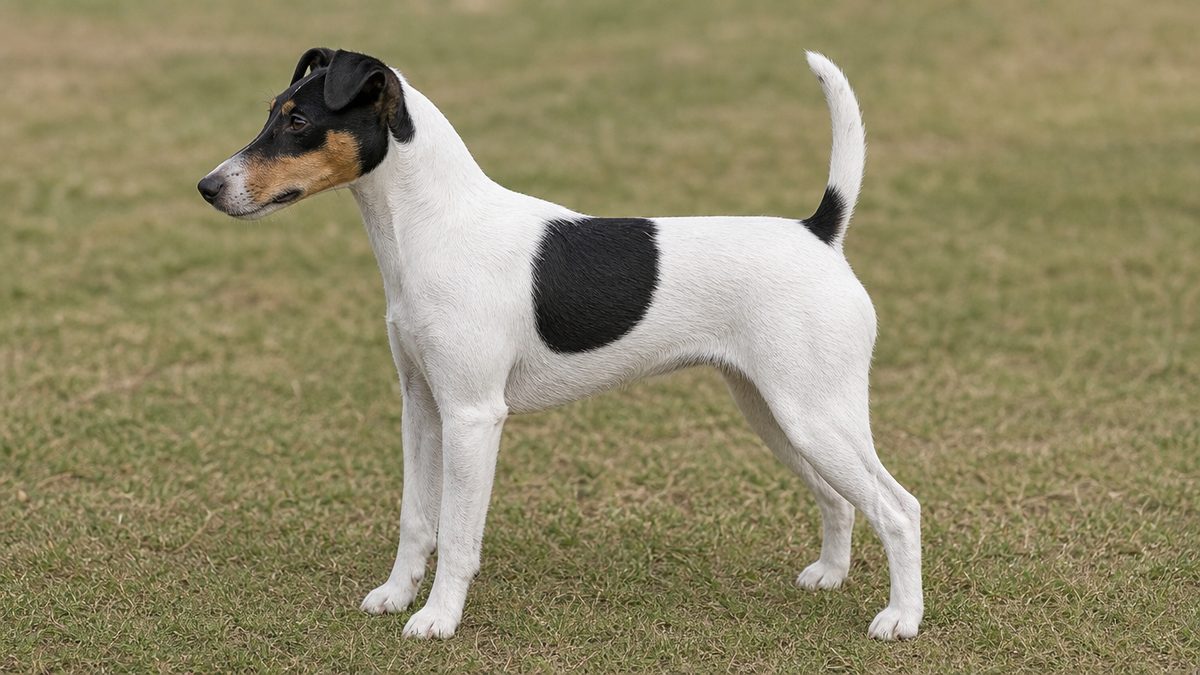
The Smooth Fox Terrier is a white-bodied English working terrier standing not more than 15.5 inches at the withers and scaling 18 pounds in show condition, with a bitch two pounds lighter and a margin of one pound either way. It is a square, short-backed dog built to gallop with horses and then follow a fox down a drain.
Read the standard's size clause carefully, because it is not a range. It says a full-sized, well balanced dog should not exceed 15.5 inches at the withers, that the length of back from withers to root of tail should not exceed 12 inches, and that the head should measure between 7 and 7.25 inches. It then gives one weight, 18 pounds, as what a dog with those measurements should scale.
That matters because the figures circulating in India are bigger. The ranking directory gives males 14 to 16 inches and 15 to 20 pounds, and 16 inches is above the standard's ceiling while 20 pounds is two pounds above its stated weight plus its stated margin. The standard's own words are a cap and a figure, and the popular ranges are neither. An Indian breeder's page describes the breed at 7 to 8 kg and about 39 cm, which is 15.4 inches and lands inside the standard.
| Point | AKC standard, 2002 | AKC breed page | Ranking directory |
|---|---|---|---|
| Height | Not exceeding 15.5 in | 15.5 in | Male 14 to 16 in, female 13 to 15 |
| Weight | 18 lb, bitch 2 lb less, margin 1 lb | 18 lb male, 15 to 17 female | Male 15 to 20 lb, female 13 to 18 |
| Life expectancy | Not stated | 12 to 15 years | 12 to 15, up to 19 |
| Undercoat | Not mentioned | Not mentioned | A short, fine undercoat |
| Tail | Docked to about three quarters | Not stated | Not stated |
The undercoat row is worth flagging rather than resolving. The AKC standard describes the coat as smooth, flat, but hard, dense and abundant, and says nothing about an undercoat at all, while the ranking directory states the coat is flat, hard and dense with a short, fine undercoat. For an Indian buyer that is not a trivia point, because an undercoat changes how a dog sheds and how it handles heat. The honest answer is that the standard does not settle it and the sources disagree.
The breed's own history explains its shape
The standard opens by naming the model: the symmetry of the Foxhound, with the terrier on no account leggy nor too short in the leg, standing like a cleverly made hunter, covering a lot of ground yet with a short back. That is a working specification rather than a description of looks, and it is why the AKC calls these dogs strong and sturdy but never coarse and clunky. A sturdy dog built that way can gallop beside horses all morning and still fit down a drain, which is exactly what it was kept for.
It also contains one of the more humane sentences in any breed standard. Old scars or injuries, the result of work or accident, should not be allowed to prejudice a terrier's chance in the show ring, unless they interfere with its movement or its utility for work or stud. A standard that expects its dogs to be marked by their job is telling you what the dog is for.
The Smooth Fox Terrier is FCI 12 and the Wire Fox Terrier is FCI 169, two separate breeds in the same section. The Toy Fox Terrier is a separate American breed in the Toy Group. The Miniature Fox Terrier is Australian. Our Fox Terrier page works through why no register anywhere holds a breed called simply Fox Terrier.
How rare this breed actually is, from the registers rather than from adjectives
The Smooth Fox Terrier is a Royal Kennel Club vulnerable native breed, a category the club defines as breeds with fewer than 300 registrations a year. It recorded 45 puppies in 2024 and 92 in 2025, and 45 is its lowest figure in the club's ten-year table.
Set that against its own cousin and the picture sharpens. The Royal Kennel Club puts the two fox terriers on two different conservation lists. The Smooth is vulnerable; the Wire sits on the separate at watch list, defined as 300 to 450 registrations a year, at 313 in 2025. Across the ten years in the club's own table the Wire outregistered the Smooth in every single year.
| Breed | 2016 | 2019 | 2021 | 2023 | 2024 | 2025 | List |
|---|---|---|---|---|---|---|---|
| Fox Terrier (Smooth) | 118 | 112 | 151 | 89 | 45 | 92 | Vulnerable |
| Fox Terrier (Wire) | 511 | 458 | 623 | 378 | 390 | 313 | At watch |
| Manchester Terrier | 191 | 243 | 155 | 110 | 89 | 74 | Vulnerable |
| English Toy Terrier (Black & Tan) | 102 | 98 | 101 | 93 | 66 | 52 | Vulnerable |
| Lakeland Terrier | 220 | 94 | 174 | 109 | 86 | 93 | Vulnerable |
Two things follow that matter to an Indian buyer. A breed at 45 British registrations in a year has a very small global gene pool, which raises the value of a breeder who can show you a pedigree and lowers the value of one who cannot. And any Indian page describing the Fox Terrier as rare without saying which one has silently chosen a row: the Wire outregisters the Smooth by roughly three to one at the 2025 figures and by 8.7 to one in 2024.
The American picture, which points the same way
The AKC's registration ranking put the Smooth Fox Terrier 144th of 202 breeds in 2025, with a directory tracking it from 122nd in 2015 to 141st in 2022. The Wire Fox Terrier sits at 107 and the Toy Fox Terrier at 106 on the same table. The oldest and most historically important of the three is now the least registered.
This breed is rare in Britain and uncommon in America, and it is genuinely present in India. That is an unusual combination and the price section explains why it exists.
Smooth Fox Terrier price in India, and the market that actually exists
Expect roughly Rs 25,000 to Rs 50,000 from a named Indian kennel, with KCI papers at the upper end. The national price table's Rs 66,600 is a converted American figure, exactly USD 900 at 74.00, and should not be your benchmark.
Unlike the toy terriers in this batch, this breed has a real and traceable Indian population, and that changes what a price means. India's oldest breed-listing site carries nine named Smooth Fox Terrier entries with contact details, in Bangalore, Coimbatore, Jaipur, Udaipur, Pune, Ooty and Chennai, each stamped with a first-posted date and a renewable-by date. On the day this page was researched, two of those nine were inside their renewal window and seven had expired.
| Source | Figure | What it actually is |
|---|---|---|
| Pet House NCR table | Rs 66,600, range Rs 37,000 to Rs 1,11,000 | USD 900, 500 and 1,500 converted at 74.00 |
| Dog Breeds List | USD 1,000 to 2,000 | An openly North American figure, honestly labelled |
| Named Indian kennels | No price published | Contact details only, prices given on enquiry |
| Mr n Mrs Pet | No price shown | Promises KCI Fox Terrier Smooth puppies, renders a Weimaraner, a Cavalier and a Shiba Inu |
Divide by 74 and the Indian table becomes an American one
The Pet House row divides into round dollars with no remainder. Rs 66,600 divided by 74.00 is exactly 900. Rs 37,000 is exactly 500. Rs 1,11,000 is exactly 1,500. Its neighbours behave the same way: the Wire Fox Terrier's Rs 1,33,200 is USD 1,800, the Toy Fox Terrier's Rs 59,200 is USD 800 and the Rat Terrier's Rs 51,800 is USD 700.
The rows that refuse to divide are the tell. Rajapalayam at Rs 15,000 gives 202.70, Indian Spitz at Rs 15,000 gives the same, and the Caravan Hound gives 148.65. The same table prints the Caravan Hound's floor as Rs 8,ooo with two letter o characters instead of zeros, which is a person typing rather than a script converting. A wholesale conversion plus hand-added Indian rows is the whole signature.
What the Indian listings actually tell you
Read the kennel listings themselves and they are more useful than any number. One offers Smooth Fox Terrier male puppies out of an imported sire and dam, with KCI certificate and microchip, vaccinated up to date, in Bangalore with transport available across India. Another, in Udaipur, states plainly that puppies are offered without KCI certificate and that the dam is not registered. A third names both parents as Indian Champions. A fourth describes a bitch imported from Sri Lanka.
That spread is the honest picture of an Indian market for a rare imported terrier. Papers, imported bloodlines and champion parents at one end; an unregistered dam and no certificate at the other; and a price gap between them that no page publishes. The oldest listing on that page offers two male puppies born on 4 February 2006, which tells you the breed has been bred in India for at least two decades.
Ask whether the dog is a Smooth or a Wire, and ask to see the KCI paperwork naming FCI standard 12 rather than 169. A seller who cannot answer the first question cannot honour the second. And check the listing's own renewal date before you dial: seven of the nine Indian entries on the main breed-listing site had passed theirs.
What an 8 kg Smooth Fox Terrier costs per month in India
Budget roughly Rs 3,500 to Rs 7,000 a month in monthly expenses for a Smooth Fox Terrier in an Indian metro, built from named clinic and retail prices rather than from a template. This breed's coat costs nothing to maintain, which makes it an affordable dog to keep, so the money goes into food, parasite control and the joint checks the parent club does not recommend.
| Line | Realistic monthly figure | Where it comes from |
|---|---|---|
| Food, small-breed dry | Rs 1,300 to Rs 2,000 | Royal Canin Mini Adult at Rs 84 per 100 g in a 4 kg bag |
| Vaccination, annualised | Rs 267 | Booster from Rs 3,199 a year, divided by 12 |
| Parasite control | Rs 400 to Rs 800 | Monthly tick, flea and worm cover for a dog of 8 kg |
| Grooming | Rs 0 to Rs 200 | A bath from Rs 934 at a Delhi clinic, about monthly at most |
| Vet consultation, annualised | Rs 300 to Rs 700 | Two to four routine visits, plus a cardiac check |
| Joint monitoring | Rs 200 to Rs 500 | The line the parent club's test list omits; see the health section |
| Municipal registration | Rs 4 to Rs 42 | Rs 500 a year in Delhi, Rs 50 in Chennai Greater Chennai Corporation |
| Realistic total | Rs 3,500 to Rs 7,000 | Excludes boarding, insurance and illness |
The exercise line has a hidden cost in an Indian city
This breed is rated at the maximum for exercise need, and the AKC's own guidance is that it should never be allowed off lead because it will take off after any small animal it perceives as prey. In an Indian metro that means either a securely fenced space you have access to or a long line and a park at a quiet hour. Budget for a long line and a well-fitted harness rather than for a collar and a short lead, because the failure mode here is a dog in traffic rather than a dog on a sofa.
The coat, by contrast, is genuinely free. The AKC recommends grooming weekly with a thick brush or hound glove and a bath every month or so, plus weekly ear checks and regular nail trimming. The Rs 1,359 haircut on a Delhi clinic's price list is a service this breed will never need, which is the single clearest cost advantage of the Smooth over the Wire.
- Buy the 4 kg food bag, not the 8 kg one. Unit prices run Rs 94, Rs 84 and Rs 73 per 100 g at 2 kg, 4 kg and 8 kg, and an 8 kg dog will not finish the biggest bag before an Indian summer degrades it.
- Vaccinate as a course in year one. One national chain prices the puppy course from Rs 6,499 against Rs 8,111 of components.
- Register the dog where registration exists. Delhi charges Rs 500 with a Rs 100 monthly late fee; Chennai charges Rs 50 and runs six free municipal pet clinics.
- Reserve for hips. A hip radiograph in a young adult costs less than managing dysplasia badly for a decade.
Heat tolerance in India, measured against English hunt country
The Smooth Fox Terrier scores 2 of 5 for heat tolerance in Indian plains cities. Melton Mowbray in Leicestershire, in the historic centre of English foxhunting, has a hottest month averaging 16.73 C. Chennai's coolest month averages 24.09 C, which is 7.4 degrees warmer than the hottest month in the country this dog was built for.
Every figure below comes from NASA POWER, queried by explicit latitude and longitude over the 2001 to 2020 window, with the returned cell elevation echoed and checked. The Melton Mowbray cell reads 46.23 m against a real town level near 90 m, an understatement of about 44 m worth roughly a quarter of a degree, so the real gap is slightly larger rather than smaller.
| Place | Annual mean C | Hottest month | Coolest month | Annual mean RH % |
|---|---|---|---|---|
| Melton Mowbray, Leicestershire | 9.77 | July, 16.73 | January, 3.73 | 85.9 |
| Delhi | 25.60 | June, 35.88 | January, 13.61 | 45.6 |
| Kolkata | 25.81 | May, 31.53 | January, 17.31 | 73.9 |
| Chennai | 27.95 | May, 31.51 | January, 24.09 | 72.4 |
| Mumbai | 26.77 | May, 31.19 | January, 23.19 | 67.4 |
| Pune | 23.86 | April, 28.93 | December, 19.62 | 66.8 |
| Bengaluru | 23.74 | April, 28.37 | December, 20.22 | 67.9 |
The humidity argument is the wrong argument
Indian damp is not what threatens this dog. English hunt country runs 85.9 percent annual relative humidity, higher than Chennai's 72.4, Kolkata's 73.9, Mumbai's 67.4, Bengaluru's 67.9, Pune's 66.8 and Delhi's 45.6. December there is 94.7 percent. What India adds is not moisture, it is about 18 degrees of heat on top of comparable moisture.
So the risk is heat, and specifically exertional heat, which matters more for this breed than for any other in this batch. The largest study available found 652 of the 879 events with a recorded trigger, 74.2 percent, were exertional, against 113 environmental and 46 from vehicular confinement, in a cohort of 905,543 UK dogs. A terrier rated 5 of 5 for exercise need, that digs tirelessly and takes off after prey, is the exact profile that study describes.
- Walk and run before 7 am and after 7 pm from March to October in Chennai, Mumbai and Kolkata, and from April to September in Delhi.
- Treat April as the peak in Bengaluru and Pune, not May, and June as the peak in Delhi.
- Cut the free-running session, not the lead walk, when the temperature rises, because the galloping is what generates the heat.
- Cool the neck, groin and paws with room-temperature water, never ice, if the dog will not settle after panting hard.
Digging is a heat behaviour too, and it is worth reading correctly
The AKC warns that the breed's innate sense to dig may affect the family yard or flowerbeds unless the dog is taught otherwise. In an Indian summer that instinct acquires a second meaning. A dog digging a shallow scrape in shade is thermoregulating, not misbehaving, and punishing it removes a coping strategy without removing the heat. Give the dog a cool tiled floor, a raised bed with airflow, or a shaded patch it is allowed to dig, and the garden problem usually shrinks on its own.
The Dog Breeding and Marketing Rules 2017, Second Schedule Part IV paragraph 21(1), bar keeping in outdoor housing facilities, without the attending veterinary practitioner's written approval, dogs not accustomed to local temperatures and breeds that cannot tolerate them. A short-coated terrier from a 16.73 C summer, kennelled outdoors in a Chennai May, is the case that clause describes.
Temperament, and the two households this dog is wrong for
The Smooth Fox Terrier is a bold, alert, intelligent, playful, energetic working terrier that the American Kennel Club calls the gentleman of the terrier world and describes as lively, cheerful and funny. It is also rated 1 of 5 for cat friendliness by the ranking directory, its lowest possible score.
The AKC is unusually blunt about the limits and it is worth quoting rather than paraphrasing. Smooth Fox Terriers are bold but not aggressive toward people, they make excellent watchdogs, and some can mature to become jealous or aggressive toward other dogs, cats, or other small pets. Its own guidance is that puppy training classes with a sensible, terrier-savvy trainer are highly recommended. That is a club telling you the dog needs work.
The two households
A home with cats, rabbits, hamsters or birds is the first one. Prey drive in a breed kept to dig vermin out of the ground is not a training problem and it does not fade. The AKC says the breed retains a strong prey drive and will dig tirelessly after any underground vermin, and it says never to allow the dog off lead because it is likely to take off after a small animal.
A home with no time is the second. This is the highest-exercise breed in this batch, rated 5 of 5, needing a long daily walk or jog plus free running in a safe area. An under-exercised working terrier in an Indian flat becomes a digging, barking, destructive dog, and the fault will not be the dog's.
- Suits an active household with a securely fenced space or reliable access to one at cool hours.
- Suits a family with school-age children, which is where one directory rates the breed 5 of 5.
- Suits an owner who wants a watchdog without wanting a guard dog, since the breed alerts and does not escalate to people.
- Does not suit a home with small pets, at a 1 of 5 cat-friendliness rating.
- Does not suit a first dog for a sedentary owner, because the exercise requirement is not negotiable.
- Does not suit a household that cannot tolerate barking, since alert barking is the job.
What the four questions Google gets asked reveal
Google's People also ask box for this breed on 8 September 2026 carried four questions: the pros and cons of ownership, whether fox terriers are aggressive to other dogs, whether they bark a lot, and which is the friendliest terrier. Three of the four are about whether the dog is difficult, which is a fair thing for people to be asking and a fairer thing for a breed page to answer directly. The answers are yes to barking, sometimes to dog aggression, and not this one to friendliest.
Everything that involves thinking and moving at once. One directory ranks the breed 40th for working intelligence and lists hunting, tracking, watchdog work, agility and trick performance among its talents. If you want a small dog that will learn a new behaviour in an evening and then hold you to a daily routine, this is a very good choice in the two Indian cities where the climate cooperates.
Training, and the one instruction that is not optional in India
To train a Smooth Fox Terrier, be consistent rather than firm, start in puppyhood, and treat recall as a safety system rather than a trick. One directory puts it plainly: the breed should be obedience trained as a puppy, requires a consistent approach, and may challenge authority on occasion.
The instruction that is not optional is the lead. The AKC says never to allow a Smooth Fox Terrier to run off lead, because it is likely to take off if it catches sight of a small animal it perceives as prey. In an Indian city that sentence has to be read as written, because the small animals are street cats, monkeys and squirrels, and they are everywhere. Use a long line in open ground, and treat a recall that works at home but not in a park as a recall that does not work.
The four things to teach first, in order
- Recall to a whistle, because a terrier locked onto prey will not hear its name and the whistle cuts through traffic noise.
- Settle on a mat, because it is the antidote to alert barking in a flat with shared walls.
- A permitted digging spot, because redirecting the instinct works and suppressing it does not.
- Handling tolerance, because you will need to check hips, knees and ears on this breed for fifteen years.
Socialise deliberately between eight and sixteen weeks and socialise to other dogs specifically. The AKC's warning that some mature into dog aggression is a warning about adolescence rather than puppyhood, so the work you do at ten weeks is what you are cashing in at fourteen months. Carry the puppy through markets and past building watchmen before its vaccination course finishes so it meets Indian noise without standing in it.
House training in an Indian monsoon needs its own plan, and this breed makes it easier than most. An 8 kg dog will tolerate wet ground better than a 4 kg one, but it will also come back caked in mud, which is why the monthly bath schedule exists. Feed on a fixed schedule, go out fifteen minutes after each meal, and reward outside rather than punishing inside.
You will not stop a Smooth Fox Terrier digging. The AKC says the innate sense to dig may affect the family yard or flowerbeds unless the dog is taught otherwise, and taught otherwise in practice means taught where. A sand pit with buried toys in a shaded corner solves this in about three weeks and costs less than one replanted flowerbed.
Daily exercise, which is the highest requirement in this batch
A Smooth Fox Terrier needs a long daily walk plus free running in a secure area, which is the maximum exercise rating the ranking directory gives to any breed. In practice that is 60 to 90 minutes a day in an Indian city, split across the two coolest windows.
Split the requirement into three parts rather than one walk. Forty minutes of brisk lead walking, twenty minutes of free running on a long line or in a fenced space, and fifteen minutes of scent or digging work covers a normal adult day. The scent and digging component is not optional for a breed kept to work underground, and it is the part Indian owners skip.
| Season | Morning | Evening | Indoors or shaded |
|---|---|---|---|
| Cool months, Nov to Feb | 40 min walk plus run from 7 am | 35 min walk plus play | 15 min scent work |
| Hot months, Mar to Jun | 35 min before 6.30 am, walk only | 30 min after 7.30 pm | 30 min scent, puzzle and sand pit |
| Monsoon, Jul to Sep | 25 min between showers | 25 min walk | 40 min indoor games and training |
Do not swap the free running for a longer lead walk in the hot months and think you have solved it. A galloping terrier generates far more heat than a walking one, so in March to June the correct move is to cut the galloping and add indoor work, not to walk further at the same hour. The dog will be less tired and better behaved than if you had walked it hard at 9 am.
Watch the hips while you do it, because this breed has a specific reason to. A dog that sits down after a short run, bunny-hops with both hind legs together, or is reluctant to jump into a car is showing hip signs. Report those to a vet rather than treating them as tiredness, and read the health section on why the parent club's own test list will not have prompted anyone to check.
Exertional heat illness accounted for 652 of the 879 triggered events in the largest study available, against 46 from vehicular confinement. The danger is the game you are enjoying, not the car you left. Stop when the tongue widens and spatulates, when the dog seeks shade unprompted, or when it lies down mid-game. Any dog still distressed after ten minutes in shade with water needs a vet the same hour.
Grooming, which is the cheapest job on any page in this batch
Grooming a Smooth Fox Terrier takes about ten minutes a week. The American Kennel Club's own instruction is to groom the short, hard, dense coat weekly with a thick brush or hound glove, with a bath every month or so, and to keep nails trimmed and ears checked weekly.
There is nothing to clip and nothing to strip, which is the whole practical case for the Smooth over the Wire. A wire coat needs hand-stripping several times a year or it blows out and mats; a smooth coat needs a rubber hound glove and five minutes. A ranking directory calls this breed definitively meant to be a no-fuss dog and rates grooming 2 of 5.
- Brush weekly with a hound glove or a thick brush to lift the loose hair a short coat still sheds.
- Bathe about monthly, or immediately after any dig that ends in mud, which the AKC calls bathe as needed.
- Check the ears weekly for excess wax or debris, which the AKC names as a cause of painful ear infections.
- Dry the ear canal after every bath and every soaking, because Indian humidity leaves a warm damp canal for days.
- Trim nails regularly, because an 8 kg dog on tiled floors wears them down slowly.
- Brush the teeth often, which the AKC specifies for this breed using a dog toothpaste.
The two Indian problems a short white coat does have
Sunburn is the first. The standard says white should predominate, which means thin, lightly pigmented skin across the back, flanks and muzzle. On an Indian terrace at midday that is a genuine burn risk on a dog that will lie in the sun because it feels good at first. Keep the dog off open roof space between 10 am and 4 pm, and speak to your nearby vet before applying any sunscreen, because several human formulations contain zinc oxide, which is toxic to dogs if licked.
Ear infection is the second, and it is where overseas grooming advice fails in India. Guidance written for a temperate climate routinely says to towel a dog and let it air dry. In an Indian monsoon that leaves a warm, damp canal for days, and this breed's small folded ear traps moisture better than an erect one does. Dry actively, every time, and treat head shaking, odour or brown discharge as a reason to see a vet rather than to buy a drop off a shelf.
A Delhi clinic chain prices a dog haircut from Rs 1,359 and a complete bath and styling from Rs 1,869. This breed needs neither. Over a fifteen-year life at one professional groom every eight weeks, that is well over Rs 1,00,000 you will not spend, and the honest place to put it is the hip and joint monitoring the next section explains.
Health risks, and the joint the parent club does not screen
The Smooth Fox Terrier's standout health issues are hip dysplasia at 13.7 percent of 722 OFA evaluations, which is higher than the Labrador Retriever's 11.3 percent across 324,905 evaluations on the same table, and an inherited ataxia covered in the next section. The American national breed club's recommended tests are a patella evaluation and a cardiac exam, and a hip evaluation is not among them. Read every OFA figure here against the breed's own code, FT rather than SFT, which was taken from OFA's own markup rather than guessed.
Set the two facts beside each other, because the mismatch is the finding. The breed's patella record is excellent at 1.4 percent abnormal across 625 evaluations, well below the all-breeds 3.5 percent. Its hip record is 13.7 percent dysplastic across 722 evaluations, worse than the Labrador's. The parent club recommends screening the joint that is fine.
| Test | Evaluations | Result | Comparison |
|---|---|---|---|
| Hips | 722 | 13.7% dysplastic, 85.9% normal | Labrador Retriever 11.3% of 324,905 |
| Patella | 625 | 1.4% abnormal | All breeds 3.5% abnormal |
| Elbows | 145 | 0.7% abnormal | All breeds 12.0% abnormal |
| Eyes, summary | 211 | 96.7% normal, 3.3% abnormal | All breeds 93.4% normal |
| BAER hearing | 139 | 2.2% abnormal, rank 10 | All breeds 4.0% abnormal |
| Advanced cardiac | 74 | 93.2% normal, 2.7% abnormal | All breeds 91.2% normal |
| Basic cardiac | 196 | 100% normal | All breeds 99.7% normal |
| Congenital cardiac | 176 | 99.4% normal | All breeds 98.9% normal |
Break the hip figure down and it is not a fluke of a small sample. Of the 722 evaluations, 9.4 percent were mild, 3.0 percent moderate and 1.2 percent severe, and the normal grades split 9.8 percent excellent, 56.6 percent good and 19.4 percent fair. Those components sum to the totals, which is the check that tells you the row is internally consistent. The fair share is the one to notice: 19.4 percent against the Labrador's 8.6 percent on the same table means a large group of dogs sitting just inside normal.
The knee, by contrast, needs no special worry. The largest study of patellar luxation in general practice covered 210,824 dogs at 119 English clinics and put the population prevalence at 1.30 percent, with a 95 percent confidence interval of 1.21 to 1.39, naming eleven predisposed breeds. The Smooth Fox Terrier is not among those eleven, so no odds ratio from that paper belongs on this page, and OFA's own 1.4 percent abnormal across 625 evaluations sits close to the general-population figure.
Do not use OFA's ALL BREEDS hip row as your comparator without checking it. That row prints 84.3 percent normal with Excellent 14.6, Good 0.0 and Fair 0.0, which cannot sum to the whole, while every individual breed row sums correctly. This page uses the Labrador Retriever as the comparator instead, because its own components do add up.
Why the club's test list matters more in India than in America
In America a breeder who does not run hips still faces a market that knows to ask. In India the parent club's list is the whole conversation, because it is what a seller will quote and what a buyer will search. A recommended-test list of two items, neither of them hips, on a breed with a 13.7 percent dysplasia rate, is how a buyer ends up with an unscreened dog while believing the opposite.
Indian law happens to point the other way here, which is worth knowing. The Dog Breeding and Marketing Rules 2017, Second Schedule Part III paragraph 8(10), names the defects a breeding dog must have been tested for and opens that list with hip dysplasia. So an Indian breeder of this dog has a statutory hip-testing obligation that the American parent club's own recommendations do not create.
Hearing, and a rank that deserves attention
OFA's BAER hearing table ranks the Smooth Fox Terrier 10th of the breeds it holds, at 2.2 percent abnormal across 139 tests. That is below the all-breeds figure of 4.0 percent, so the rank reads worse than the number. What it does tell you is that enough breeders test to produce a published row, which is more than most terriers manage. A predominantly white breed with a documented BAER row is a breed where asking for the result is reasonable.
The eye summary and the eye detail disagree, as usual
OFA's eye summary gives 96.7 percent normal across 211 examinations. Its detail rows, on the same denominator, record a normal finding in 171 of 211, which is 81.0 percent. The 15.7-point gap has the same explanation as on every other breed: persistent pupillary membranes iris to iris appear in 15 of 211, and a dozen more diagnoses appear once or twice each, while a dog can carry several findings and still certify. Publish both, quote neither as the rate, and ask a breeder for the examination report rather than a percentage.
Bunny-hopping with both hind legs together, sitting down after a short run, reluctance to jump into a car, or a hind-limb lameness that does not resolve within a day are hip signs in this breed and they deserve a radiograph rather than rest. An unsteady or wobbling gait in a young dog is a different problem and belongs in the next section. Take either to a veterinarian rather than to a forum.
Hereditary ataxia, the mutation this breed shares with the Russell terriers
Smooth Fox Terriers with hereditary ataxia carry a KCNJ10 mutation previously identified in the Russell group of terriers. A 2015 study found three affected Smooth-Haired Fox Terriers and two Toy Fox Terriers with a similar phenotype all homozygous for it.
The study set out to answer a specific question. Hereditary ataxias with similar phenotypes had been reported in the Smooth-Haired Fox Terrier, the Jack Russell Terrier and the Parson Russell Terrier, but segregation analyses had shown different inheritance modes, and molecular work had then found independent mutations in KCNJ10 and CAPN1 in the Russell group. The authors asked whether the Fox Terrier's ataxia was one of those two.
It was. Three Smooth-Haired Fox Terriers with hereditary ataxia and two Toy Fox Terriers with a similar phenotype were all homozygous for the KCNJ10 mutation, and the same mutation appeared heterozygous in five clinically unaffected Tenterfield Terriers and, as previously reported, in Jack Russell, Parson Russell and Russell Terriers. The conclusion was that this mutation segregates in at least three more breeds descended from British hunting terriers.
| Breed | Genotype found | Clinical status |
|---|---|---|
| Smooth-Haired Fox Terrier | Homozygous, n = 3 | Hereditary ataxia |
| Toy Fox Terrier | Homozygous, n = 2 | Similar phenotype |
| Tenterfield Terrier | Heterozygous, n = 5 | Clinically unaffected |
| Jack Russell, Parson Russell, Russell Terrier | Present, as previously reported | Spinocerebellar ataxia |
Three practical points follow. The mode is autosomal recessive, so a carrier is not at risk and two carriers are. A DNA test exists because the mutation is identified and the Russell breeds have used one for years. And the signs are neurological rather than orthopaedic: an unsteady, wobbling or high-stepping gait in a young dog is not a hip problem and should not be managed as one.
One honest limit belongs on this page. OFA publishes no spinocerebellar ataxia row for the Smooth Fox Terrier, though it does for the Toy Fox Terrier at 266 tests with 21.1 percent carriers. So there is no published Smooth Fox Terrier carrier frequency, and anybody who quotes one to you has invented it. Ask instead whether the individual dogs in front of you have been tested.
Ask for both parents' KCNJ10 results, both parents' hip scores, both parents' patella evaluations and both parents' cardiac exams. The last two are what the parent club recommends; the first two are what the evidence on this page says you also need. A breeder who has done all four is doing more than the club asks, which is exactly the breeder you want.
Lifespan, and the study row that merged this breed away
No research figure exists for the Smooth Fox Terrier alone. The largest UK longevity study has no Smooth Fox Terrier row, because its Supplementary Table S5 folded Fox Terrier (Smooth) and Fox Terrier (Wire) into a single Wire Fox Terrier row. Breed sources give 12 to 15 years.
Bonbeno downloaded both supplementary tables as the publisher's own .docx files, checked the magic bytes, and parsed them table by table rather than relying on a summary. Supplementary Table S3 runs to 157 rows comprising a header, a crossbred row and 155 purebreds, and none of them is the Smooth Fox Terrier. Supplementary Table S5 runs to 344 breeds, and the Wire Fox Terrier row is flagged for inclusion with a phylogeny reclassification column reading Fox Terrier (Smooth) and Fox Terrier (Wire) run together.
So the widely quoted 13.5-year median belongs to both breeds at once. The Wire Fox Terrier row gives 1,413 dogs, 521 deaths, a median of 13.5 years with a 95 percent confidence interval of 13.3 to 13.7, and a hazard ratio of 0.73 against crossbred dogs at p less than 0.001. That is a strong and statistically significant result, and it describes a population containing an unknown mixture of two separately recognised breeds.
| Source | Figure | Evidence behind it |
|---|---|---|
| McMillan et al. 2024 | No breed-specific figure | Merged into the Wire Fox Terrier row |
| McMillan Wire Fox Terrier row, both breeds | Median 13.5 yrs, CI 13.3 to 13.7 | 521 deaths in 1,413 dogs, HR 0.73, p less than 0.001 |
| American Kennel Club | 12 to 15 years | A breed-page range, no study cited |
| Dog Breeds List | 12 to 15 years, up to 19 | No study cited |
Why this matters more than it looks
The two breeds are not interchangeable and the same registry that supplied the study's data says so. The Royal Kennel Club lists the Smooth as vulnerable at 92 registrations in 2025 and the Wire as at watch at 313, which is a threefold difference in the population sizes being merged. A median dominated by Wire Fox Terriers is not a bad number; it is simply not this breed's number, and no page anywhere says so.
Bonbeno therefore publishes no breed-specific median for the Smooth Fox Terrier, and quotes the merged row with its merge named. That is the same treatment our Toy Fox Terrier and Toy Manchester Terrier pages give to a second reclassification in the same paper, where the English Toy Terrier was folded onto the Toy Fox Terrier row. One study, two merges, both inside the terrier group, and in both cases an American breed name absorbing a British registry breed.
Its supplementary tables S3 and S6 disagree on how many dogs each breed contributed while agreeing exactly on the death count, so any sentence built on it should rest on deaths and the median rather than on N. And its Author Correction changes one Miniature Dachshund value in a figure legend and touches no supplementary table, so reading S3 directly avoids it either way.
Feeding an 8 kg working terrier in India
Feed a Smooth Fox Terrier measured portions twice a day to a visible waist, at roughly 150 to 200 grams of a quality small-breed dry food for an active adult near 8 kg. The AKC's own note is that some dogs of this breed are prone to getting overweight, so watch calorie consumption rather than trusting the bag.
Weigh the food rather than scooping it, and adjust to the dog rather than to the chart. A working terrier that gets its full exercise burns noticeably more than one that does not, and the same dog needs materially less in a Chennai May than in a Delhi January, because the exercise itself has to shrink. Reassess the portion every time the season changes.
| Stage | Meals per day | Approximate daily food | Focus |
|---|---|---|---|
| 8 to 16 weeks | 4 | Puppy formula, fed to the pack chart | Steady growth, never a round belly |
| 4 to 8 months | 3 | Puppy formula, adjusted every fortnight | Lean growth, because hips are forming |
| 8 to 12 months | 2 | Transition to adult over ten days | Body condition over the number on the bag |
| Adult | 2 | About 150 to 200 g of small-breed dry food | A visible waist seen from above |
| Senior, 9 years and over | 2 | The same weight, lower calorie density | Muscle and joints |
Keeping a growing puppy lean is a joint decision, not a cosmetic one
This is the breed in this batch where growth-phase weight matters most, because of the hips. A heavy puppy loads a developing joint harder than a lean one, and the OFA figure of 13.7 percent dysplastic across 722 evaluations tells you the joint in question is already under pressure in this breed. Feed to a visible waist and a felt ribcage from four months, not from a target weight, and ask your nearby vet to body-score the puppy at every vaccination visit.
Buy the middle bag
Small bags cost more per kilogram and large bags go stale in Indian humidity. Royal Canin Mini Adult on 8 September 2026 ran at Rs 94 per 100 g in a 2 kg bag, Rs 84 in a 4 kg bag and Rs 73 in an 8 kg bag on the retailer's own unit labels. An 8 kg dog eating 175 grams a day finishes a 4 kg bag in 23 days and an 8 kg bag in 46, so the 8 kg bag is defensible for this breed where it was not for the toys, provided it is decanted into an airtight container.
Water deserves a line of its own for a working terrier in India. Keep two bowls in different rooms through the hot months, refill rather than top up, and add water to the evening meal from March to June. A dog that has been galloping is a dog that needs to drink before it is offered food, not after.
Inappetence for more than one meal in an Indian summer is a symptom rather than a preference, particularly in a dog that has been exercised that day. So is a dog that drinks unusually and eats normally. Take either to a veterinarian rather than adjusting the food.
Month by month through the first year in India
Plan a Smooth Fox Terrier puppy's first year around four fixed points: the vaccination course from about day 30 to day 120, the socialisation window closing near sixteen weeks, the growth phase in which the hips form, and the first Indian summer.
| Age | What happens | Indian cost or note |
|---|---|---|
| 8 weeks | The earliest lawful age to take a puppy home | Rule 8(1)(a) of the 2017 Rules bars sale below eight weeks |
| 8 to 12 weeks | Vaccinate on schedule while socialisation begins in a carrier | Course from Rs 6,499 across seven visits |
| 10 to 16 weeks | Dog-to-dog socialisation, which this breed needs most | The AKC recommends puppy classes with a terrier-savvy trainer |
| 12 to 16 weeks | Street walks begin once the vet clears them | Anti-rabies Rs 699, kennel cough Rs 1,349 |
| 4 to 10 months | The hips form | Keep the puppy lean and avoid repeated hard landings |
| 6 to 9 months | Recall to a whistle consolidates, digging spot established | Municipal registration due Greater Chennai Corporation |
| 9 to 14 months | Adolescence, when dog reactivity can appear | The AKC warns some mature into it |
| 12 months | Annual booster and adult baseline | Booster from Rs 3,199 |
The growth phase is the one to get right
Between about four and ten months this breed's hips are forming, and the two things you control are weight and impact. Keep the puppy lean, put a ramp at the sofa and the car, avoid repeated jumping down from height, and do not force-march a growing terrier on hard road surfaces. None of that guarantees a good hip, and all of it improves the odds on a breed running at 13.7 percent dysplastic.
Time the arrival if you can. A puppy that reaches an Indian metro in October has five cool months before its first March, and one arriving in April has none. If timing is out of your hands, keep the first summer's outdoor work short and early, and do the rest as indoor scent games.
- Book the vaccination course as a package, because one chain prices it from Rs 6,499 against Rs 8,111 of components.
- Prioritise dog-to-dog socialisation over every other kind, since adult dog reactivity is this breed's documented risk.
- Build the digging spot before the puppy finds one, which is cheaper than replanting.
- Photograph the puppy from above every month to build your own body-condition record, which matters more than a weight.
How the Smooth Fox Terrier compares against the terriers Indians cross-shop
Set the Smooth Fox Terrier beside the five terriers it is confused with and the pattern is clear: it has the best knees and the worst hips in the group. Every figure below was read from the same OFA tables and the same Indian price table in one session.
| Breed | AKC rank 2025 | Hips dysplastic | Patella abnormal | Indian list price |
|---|---|---|---|---|
| Smooth Fox Terrier | 144 | 13.7% of 722 | 1.4% of 625 | Rs 66,600 |
| Wire Fox Terrier | 107 | No published row | 0.8% of 120 | Rs 1,33,200 |
| Rat Terrier | 84 | 3.4% of 999 | 3.2% of 1,817 | Rs 51,800 |
| Manchester Terrier | 131 | 1.6% of 186 | 1.0% of 299 | Rs 1,18,400 |
| Toy Fox Terrier | 106 | No published row | 5.5% of 346 | Rs 59,200 |
| Labrador Retriever, for scale | 2 | 11.3% of 324,905 | 1.1% of 4,784 | Rs 59,200 |
Read the last row and the case makes itself. A 15.5 inch terrier has a higher published hip dysplasia rate than a 30 kg retriever, on samples of 722 and 324,905 respectively. Size does not predict joint risk, and a buyer choosing a small dog to avoid hip problems has chosen on a rule that does not hold.
Against the Wire Fox Terrier, which is the closest cross-shop
The Wire Fox Terrier is twice the price on the Indian list at Rs 1,33,200 against Rs 66,600, three times as numerous in Britain at 313 registrations against 92, and it needs hand-stripping several times a year while the Smooth needs a hound glove. The Smooth is the cheaper dog to buy and far the cheaper dog to keep. What the Wire has is a published patella row on a small sample and no published hip row at all, which is an absence rather than a clean bill.
Against an Indian street dog, which is the comparison nobody makes
An Indie of similar size costs nothing to acquire, is adapted to the climate it will live in, and carries no breed-specific mutation panel. What it cannot give you is predictability, which is the whole case for a purebred. For this breed there is a second real answer: India has a genuine Smooth Fox Terrier population with pedigrees and champion lines going back two decades, so buying one here is not the same act as importing a dog nobody in the country has ever bred.
Choose the Smooth Fox Terrier if you are active, you have a securely fenced space or reliable access to one, you have no cats or rabbits, you live in Bengaluru or Pune or can work around the heat elsewhere, and you will insist on hip radiographs the parent club does not ask for. Choose something else if the exercise requirement is aspirational rather than real.
Indian law, docking, and the import route
The American standard for this breed describes a docked tail, which India forbids. It says the stern should be docked to leave about three quarters of the original length of the tail, while Second Schedule Part II paragraph 6(8) of the Dog Breeding and Marketing Rules 2017 forbids tail docking outright.
The clause is short and not ambiguous. It reads that there shall be no tail docking, ear cropping, de-barking, de-clawing, branding, dyeing, injecting substances to enhance visual appeal, performing a surgery or procedure to camouflage or hide any defect or infirmity or any other kind of mutilation of any body part of the pup, and that any change of appearance by artificial means is strictly forbidden. Note the citation form: this is a Second Schedule paragraph and not a Rule, because the Rules run 1 to 13 with no gaps and everything above 13 is a Schedule paragraph.
| Point | AKC standard | Indian law | Verdict |
|---|---|---|---|
| Tail docking | Docked to about three quarters | Forbidden, Second Schedule Part II para 6(8) | Collision |
| Ear cropping | Not used; ears fold naturally | Forbidden, same clause | No conflict |
| Prick, tulip or rose ears | Disqualification | Not a procedure | No conflict |
| Much undershot or overshot mouth | Disqualification | Named as a defect to test for, Part III para 8(10) | Aligned |
| Hip dysplasia | Not in the club's test list | Named first in Part III para 8(10) | Law is stricter |
| Close breeding | Not addressed | In-breeding within four generations prohibited, para 6(3) | Law is stricter |
The hip row is the important one and it inverts the usual story. On most imported breeds Indian law is the weaker instrument and the breed club is the stricter one. Here it is the other way round. Paragraph 8(10) requires that breeding dogs have been tested for genetic defects including hip dysplasia, and it names hip dysplasia first in its list. The American parent club's recommended tests are a patella evaluation and a cardiac exam.
So an Indian breeder of Smooth Fox Terriers has a statutory duty the American parent club does not ask for, on precisely the joint the OFA data says matters. That is a genuinely useful thing for an Indian buyer to know, because it converts a polite request into a legal reference.
A lawful Smooth Fox Terrier in India carries a full tail
It would look slightly different from the show dogs in American photographs, and that is all. A docked tail on an Indian-bred puppy is direct evidence that paragraph 6(8) was broken, so ask, and be suspicious of a seller who has one to offer. The FCI's own standard 12 governs the KCI paperwork route in any case Federation Cynologique Internationale.
The import route, and why the Indian population matters
Live dogs are a Restricted import into India under ITC(HS) 01061900. DGFT Trade Notice 22/2022-23 permits entry only for a pet accompanied by a valid pet book in the importer's name, for research with a CPCSEA recommendation, or for Defence and Police use, and states that applications for trading or breeding purposes shall be duly rejected. That is exactly why the existence of Indian-bred litters matters so much for this breed: a domestic population is the only lawful way a rare imported terrier stays available here, and one Indian listing describes puppies out of an imported sire and dam with KCI certificate and microchip.
For an imported dog, the Kennel Club of India's own checklist requires the original export pedigree and the airway bill. For an Indian-bred dog, ask for the KCI registration naming FCI standard 12, the parents' hip scores, and a written statement that no tail was docked. A seller who can produce all three is doing the job properly.
Seven mistakes Indian Smooth Fox Terrier owners actually make
The seven mistakes below come from the gap between what Indian pages publish about this breed and what the primary documents say. Each is cheap to avoid and expensive to fix.
- Assuming a small terrier cannot have hip problems. OFA records 13.7 percent dysplastic across 722 evaluations, against the Labrador's 11.3 percent across 324,905.
- Treating the parent club's two-test list as complete. It names a patella evaluation and a cardiac exam and not a hip evaluation, while Indian law names hip dysplasia first.
- Quoting Rs 66,600 as an Indian price. It is USD 900 converted at 74.00, on a table whose four Indian breeds refuse to divide at any rate.
- Quoting a 13.5-year lifespan as this breed's. The study merged Smooth and Wire into one row and published no Smooth figure.
- Letting the dog off lead in an Indian park. The AKC says never to, because the dog will take off after prey, and Indian parks are full of it.
- Punishing the digging in an Indian summer. A scrape in shade is thermoregulation; redirect it to a permitted spot rather than suppressing it.
- Accepting a docked tail. Docking is forbidden under Second Schedule Part II paragraph 6(8), so a docked Indian-bred puppy is evidence of a breach.
The mistake behind the other six
All six start with reading a page rather than a document. The largest Indian breed-directory network does not even carry a Smooth Fox Terrier page, and the site that ranks for the sales query promises KCI registered Fox Terrier Smooth puppies and then renders a Weimaraner, a Cavalier King Charles Spaniel and a Shiba Inu. The most useful Indian source for this breed is the oldest and plainest one, a breeders' listing with dated entries and phone numbers.
One further check costs nothing and catches the stale ones. Every entry on that listing carries a first-posted date and a renewable-by date, and seven of the nine had passed theirs on the day this page was researched. Read the dates before you dial, because a 2019 listing renewable in 2020 is a historical record rather than an offer.
You cannot get the coat wrong. A short, hard, dense coat groomed weekly with a hound glove and bathed monthly is close to error-proof. Put the money and attention you would have spent on a groomer into hip radiographs and a long line, which is where this breed's real risks are.
Adoption and responsible sourcing
Adopt first where you can, then buy from a breeder who will show you hip scores the parent club never asked for. This breed differs from the toys in this batch in one important way: there is a real Indian breeding population, so a responsible domestic purchase is genuinely possible.
The realistic Indian adoption routes
- A small Indie from a city shelter, which matches this breed's working profile of small, short-coated, alert and already heat-adapted.
- A surrendered terrier or terrier cross, which turns up regularly in Indian rescue because people underestimate terrier exercise needs.
- A rehomed adult from a breed enquiry, since a rare breed's owners tend to know each other and an adult sometimes needs a new home.
- A retired show or breeding dog, which is the most likely way an adult Smooth Fox Terrier becomes available in India.
Most of what people buy this breed for does not require the breed. Small size, a short coat, near-zero grooming cost, alertness and heat-hardiness are available in Indian rescue this week, at no purchase price, from dogs born in the climate they will live in. What rescue cannot give you is a hip score, a KCNJ10 result and a pedigree, and on a breed with a 13.7 percent hip dysplasia rate those are real reasons to buy rather than false ones.
If you buy, ask for these five things
- Both parents' hip scores, because the parent club does not ask and the data says you should.
- Both parents' patella evaluations and cardiac exams, which are the two tests the club does recommend.
- Both parents' KCNJ10 ataxia results, given the 2015 finding in this breed.
- The KCI registration naming FCI standard 12, not 169, so you know which fox terrier you are buying.
- A written statement that no tail was docked, which Second Schedule Part II paragraph 6(8) requires of the breeder anyway.
Refuse a puppy under eight weeks. Rule 8(1)(a) of the 2017 Rules prohibits the sale of pups less than eight weeks in age, and that one is a genuine Rule rather than a Second Schedule paragraph. A seller offering a six-week-old terrier has told you what kind of operation it is.
A breeder worth buying from will show you the mother, produce hip radiographs without being asked, name the KCNJ10 test, tell you the dog needs an hour a day and cannot live with a cat, and say plainly that it is heat-sensitive in an Indian summer. One Indian listing already volunteers that its puppies come without a KCI certificate and that the dam is unregistered, which is honest and is exactly the kind of disclosure to reward with a question rather than a walkout. Bonbeno takes no commission from any breeder and recommends none.
Smooth Fox Terrier questions Indian buyers actually ask
What are the pros and cons of owning a Smooth Fox Terrier?
The pros are a near-zero grooming cost, high intelligence, a long life expectancy of 12 to 15 years, and a genuine Indian breeding population you can actually buy from. The cons are the highest exercise requirement in this batch, a hip dysplasia rate above the Labrador Retriever's, a prey drive that rules out cats and rabbits, and a homeland whose hottest month is cooler than an Indian winter.
Are Fox Terriers aggressive to other dogs?
Some are, and the American Kennel Club says so in its own words: some can mature to become jealous or aggressive toward other dogs, cats, or other small pets, and puppy classes with a terrier-savvy trainer are highly recommended. One directory rates the breed 2 of 5 for dog friendliness and 1 of 5 for cat friendliness, its lowest score.
Do Smooth Fox Terriers bark a lot?
Yes, enough that the AKC calls them excellent watchdogs twice on one page and describes a dog on the tiptoe of expectations. One directory rates barking as occasional at 3 of 5. Alert barking is what the breed was kept for, so training changes the duration rather than the first bark.
Which is the friendliest terrier?
Not this one, on the published ratings. A directory that scores every breed rates the Smooth Fox Terrier 5 of 5 with children and only 2 of 5 with other dogs and 1 of 5 with cats. Among the terriers in this batch the Toy Manchester is described as not a sparring breed and generally friendly with other dogs, which is the closest thing to an answer.
What is the real Smooth Fox Terrier price in India?
Roughly Rs 25,000 to Rs 50,000 from named Indian kennels, with KCI papers at the upper end. The national price table's Rs 66,600 is a converted figure, exactly USD 900 at 74.00, and should not be used as a benchmark. Unlike the toy terriers, this breed genuinely is bred in India, so an Indian price band means something here.
How long do Smooth Fox Terriers live?
The AKC and a breed directory both give 12 to 15 years, and one adds that the breed can live as long as 19. No research figure exists for this breed alone, because the largest UK longevity study folded the Smooth into the Wire Fox Terrier row and published one merged median of 13.5 years for both breeds together.
Does the Smooth Fox Terrier get hip dysplasia?
Yes, and more often than most people expect. OFA's hips table records 13.7 percent dysplastic across 722 evaluations, against the Labrador Retriever's 11.3 percent across 324,905 evaluations on the same table. The national breed club's recommended tests are a patella evaluation and a cardiac exam, and a hip evaluation is not among them.
Can a Smooth Fox Terrier be shown legally in India?
Not as the American standard describes it. That standard says the stern should be docked to leave about three quarters of the original length of the tail. India's Dog Breeding and Marketing Rules 2017, Second Schedule Part II paragraph 6(8), forbid tail docking outright and call any change of appearance by artificial means strictly forbidden.
Is the Smooth Fox Terrier rare?
In Britain, yes. The Royal Kennel Club lists it as a vulnerable native breed, meaning fewer than 300 registrations a year, and it recorded 45 puppies in 2024 and 92 in 2025. In India it is uncommon but genuinely present, with named kennels in Bangalore, Coimbatore, Jaipur, Pune, Ooty and Chennai listing litters over the past two decades.
What is the difference between a Smooth and a Wire Fox Terrier?
Coat and head shape, and they are separate breeds rather than coat varieties. The AKC says a Smooth's head is more V-shaped than a Wire's, and both stand no more than 15.5 inches. The Royal Kennel Club puts them on different conservation lists: the Smooth is vulnerable at 92 registrations in 2025 and the Wire is only at watch at 313.
Does this breed carry an inherited ataxia?
Yes. A 2015 study found three Smooth-Haired Fox Terriers with hereditary ataxia homozygous for a KCNJ10 mutation previously identified in the Russell group of terriers, and concluded the mutation segregates in at least three more breeds descended from British hunting terriers. Two Toy Fox Terriers with a similar phenotype were homozygous in the same study.
How much does a Smooth Fox Terrier cost per month in India?
Budget roughly Rs 3,500 to Rs 7,000 a month for an 8 kg dog in an Indian metro. A named Delhi clinic chain prices an annual booster from Rs 3,199 and a bath from Rs 934, and this breed never needs a haircut. The largest single variable is food, at about Rs 1,300 to Rs 2,000 for a quality small-breed dry diet.
Compare with similar breeds
Smooth Fox Terrier sits in 1 Bonbeno group. Each one compares it directly against the breeds it is genuinely an alternative to, on the same figures.