
Breed profile
Manchester Terrier: Price in India, Health and Care
A 41 cm smooth-coated ratting terrier that three registries cannot agree is one breed or two, sold in India as a 3 kg toy dog.
Quick answer
No verified Manchester Terrier price in India exists, because no Indian seller was found offering one. The two pages ranking first and fourth price zero Manchester Terriers and attach their rupee figures to Maltipoos and Poodles. Budget instead for care: a smooth, compact, alert 41 cm terrier costs roughly Rs 4,000 to Rs 8,000 a month in India, and its heat tolerance is moderate.
This page reports published veterinary research and registry data for general information. It is not a diagnosis and it is not treatment advice. Any decision about your own dog, including screening, vaccination, diet and any sign of illness, belongs with a registered veterinarian who has examined the animal.
Manchester Terrier at a glance
What a Manchester Terrier actually is
A Manchester Terrier is a smooth-coated black and tan ratting terrier from north-west England, standing an ideal 41 cm at the withers for males and 38 cm for females, built to kill vermin in a nineteenth-century industrial city.
The breed standard is short and unusually precise about colour. The FCI describes a close, smooth, short and glossy coat of firm texture, jet black with rich mahogany tan, and it spends more words on where the tan goes than on anything else. The Royal Kennel Club standard uses the same language almost word for word. Both close the colour clause the same way: black must not run into tan or tan into black, and the division between the two must be clearly defined.
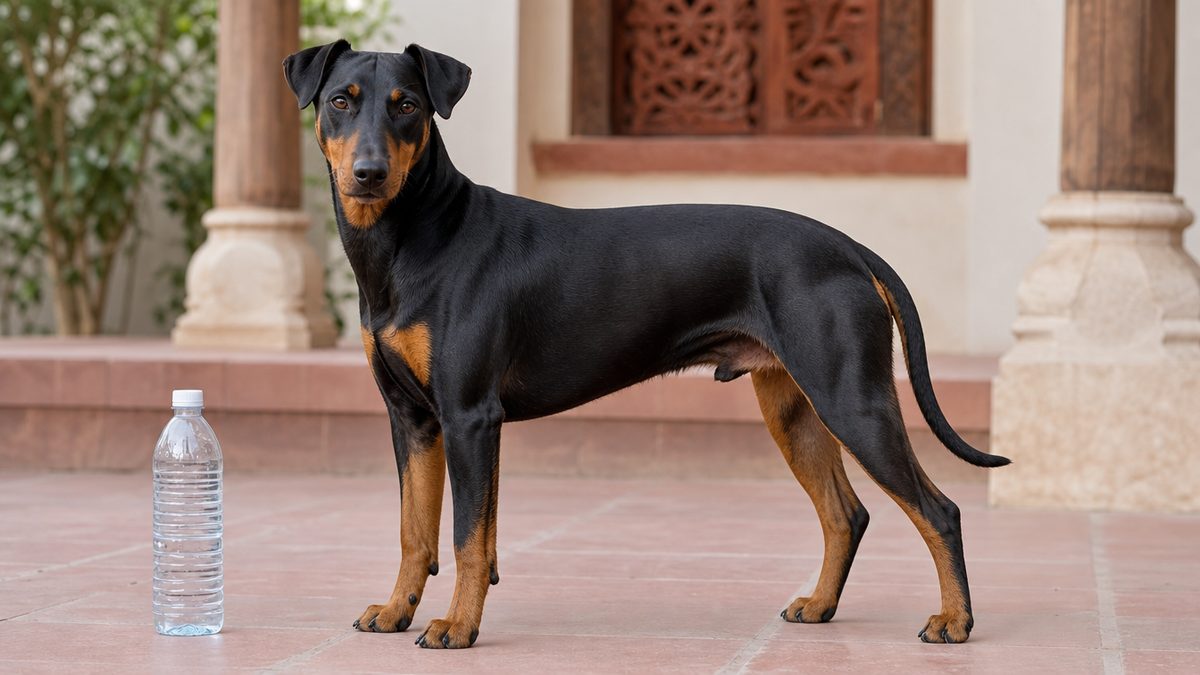
That precision is a buyer's tool, not show-ring fussiness. A genuine Manchester Terrier carries a distinct black thumb mark immediately above each front foot, black pencilling down the top of each toe, a small tan spot on each cheek and above each eye, and a distinct tan V under the jaw and throat. Tan on the outside of the hind legs, called breeching, is undesirable. A small black and tan dog offered in India with muddy colour boundaries, no pencilling and no thumb mark is not failing a beauty contest. It is probably a different dog.
The American standard adds the shape the British ones leave implicit. It opens by calling the breed "a small black short coated dog with distinctive rich mahogany markings and a taper style tail", and says that in structure the Manchester presents a sleek, sturdy yet elegant look with a wedge shaped long and clean head and a keen, bright, alert expression. Sleek is the right word: this is a whippety terrier, not a cobby one, and the American Kennel Club's own breed page groups it with the racier terriers for that reason.
Where the name comes from, and what it was for
The FCI standard says the origin plainly. "His name denotes his origin, and it is likely that there is some Whippet in his ancestry. Elegant and graceful, he was bred as a ratter and can still be relied upon to despatch vermin quickly and efficiently." It goes on to date the peak of rat killing to the mid 1800s, when dog shows were usually held in public houses and, in Manchester especially, became a weekly feature until this terrier had classes of its own.
The Royal Kennel Club adds the detail that matters most for an Indian reader, and it is a legal one. "In the early days the breed had its ears cropped to prevent injury from rats," it writes, and the 1898 ban on cropping "brought a decline in the breeds popularity: the pendant ears of the uncropped dogs were off-putting to those who had known the cropped version";. So this is a breed whose modern ear carriage is the direct result of a cruelty ban. India passed its own version of that ban in 2017, and the collision it creates with one registry's current standard is set out further down this page.
The two measurements that will not convert
Two registries define this breed by height and one defines it by weight, and there is no arithmetic that turns one into the other. The FCI gives an ideal height at the withers of 41 cm for males and 38 cm for females, and gives no weight at all. The Royal Kennel Club prints the identical figures, 41 cm (16 ins) for dogs and 38 cm (15 ins) for bitches, and likewise gives no weight. The American Kennel Club does the reverse: the Toy variety must not exceed 12 pounds, the Standard must be over 12 and not exceeding 22, and dogs over 22 pounds are disqualified, with no height stated anywhere in the document.
| Registry | Defines size by | The figures | Ears required |
|---|---|---|---|
| FCI Standard 71 | Height only | 41 cm males, 38 cm females (ideal) | Small and V-shaped, hanging close to head |
| Royal Kennel Club | Height only | 41 cm (16 ins) dogs, 38 cm (15 ins) bitches | Small and V-shaped, hanging close to head |
| AKC, Standard variety | Weight only | Over 12 lb, not exceeding 22 lb (5.4 to 10 kg) | Naturally erect, cropped or button, no preference |
| AKC, Toy variety | Weight only | Not exceeding 12 lb (5.4 kg) | Naturally erect only; cropped or button disqualifies |
Ask for the dog's height at the shoulder, not its weight. A Manchester Terrier under the standard that governs the breed in India, which is the FCI's, is a roughly 38 to 41 cm dog with small drop ears and a clean thumb mark above each front foot. If the answer comes back in kilograms only, ask again.
One breed or two? The registers answer it, and they disagree
The Manchester Terrier and the English Toy Terrier are one breed in two varieties to the American Kennel Club and two separate breeds to the FCI and the Royal Kennel Club. Both answers are correct inside their own system, and which one applies to you depends on where the dog is registered.
Start with the FCI, because the Kennel Club of India is India's FCI member and issues pedigrees against FCI nomenclature. Reading the FCI's own Group 3 index rather than guessing a URL, the Manchester Terrier sits at number 71, in Section 1, Large and medium sized Terriers, country of origin Great Britain, standard valid from 13 October 2010, without working trial. The English Toy Terrier sits at number 13, in Section 4, Toy Terriers, valid from 26 March 2009. Two numbers, two sections, two breeds.
The Royal Kennel Club does the same thing by a different route, filing the Manchester Terrier in the Terrier group and the English Toy Terrier (Black & Tan) in the Toy group, with a separate breed standard and a separate registration row for each The Royal Kennel Club.
The American standard settles the American position in one sentence
One check worth recording, because FCI standards do sometimes disagree between languages. Bonbeno extracted the French text of Standard 71 alongside the English and compared the figures. The French carries the line "TRADUCTION : Valerie Degeeter / Langue faisant foi : (EN)", which names English as the authentic language, and its size clause reads "Taille ideale au garrot : Males 41 cm. Femelles 38 cm";. That matches the English exactly, so there is no translation drift in this standard and either version can be quoted for the measurements.
The AKC's Official Standard of the Manchester Terrier opens its general appearance clause with a sentence that resolves the question entirely: except for size and ear options, there are no differences between the Standard and Toy varieties of the Manchester Terrier, and the Toy variety is a diminutive version of the Standard variety. On the American account this is one breed cut in half at twelve pounds.
The evidence that they are genuinely different dogs
One clause decides whether the two-breed view has anything physical behind it, and it is not the weight. The ears differ, and they differ in a way size cannot explain. FCI Standard 71 requires the Manchester Terrier's ears to be small and V-shaped, carried well above the top line of the head and hanging close to the head above the eyes. FCI Standard 13 requires the English Toy Terrier's candle-flame ears to be erect. Erect against dropped is not a difference of scale.
The heights are further apart than shared ancestry suggests, too. FCI 71 gives 41 cm and 38 cm; FCI 13 gives 25 to 30 cm Federation Cynologique Internationale. At the extremes that is a dog a third shorter.
Then the American standard contradicts both British documents on ears anyway. For the AKC's Standard variety the correct ears are the naturally erect ear, the cropped ear or the button ear, with no preference given to any of the ear types; for the Toy variety the naturally erect ear is the only correct one, and a cropped or button ear is a disqualification. So the drop ear that defines the breed under the standard India actually follows is not even listed as correct in America.
| Register or product | Treatment | Where it puts each dog |
|---|---|---|
| FCI nomenclature | Two breeds | Manchester Terrier (71), Group 3 Section 1; English Toy Terrier (13), Group 3 Section 4 |
| Royal Kennel Club The Royal Kennel Club | Two breeds | Manchester Terrier in the Terrier group; English Toy Terrier (Black & Tan) in the Toy group |
| AKC official standard | One breed, two varieties | A single document covering the Standard and Toy varieties |
| AKC popularity table 2025 | One undivided row | Manchester Terrier at 131 of 202, with no English Toy Terrier entry |
| OFA published statistics | One undivided label | MANCHESTER TERRIER, both varieties reported together |
| McMillan 2024 longevity study | Toy only | A Toy Manchester Terrier row and no Standard row anywhere in the paper |
Because the Indian search results mix the two, and the mixing runs one way. The page ranking fourth for this breed's price in India describes a dog of 12 to 14 inches and 3 to 5 kg. That is toy size. It is below the AKC Standard variety's 5.4 kg floor and far below a 41 cm dog. If you buy on the American view that these are one breed, you will accept a toy dog as a Manchester Terrier. On the standard that governs the breed in India, it is not one. Bonbeno's English Toy Terrier page covers the smaller dog on its own terms.
We diffed the Kennel Club's Manchester Terrier row across three of its own documents
The Royal Kennel Club publishes this breed's ten-year registration run three times, and nine of the ten cells agree exactly across all three. One does not. The 2019 figure reads 243 on the web table and 133 in both PDFs, a gap of 110 dogs on a breed that never exceeded 243 in the decade.
The method is deliberately boring and anyone can repeat it offline in about ten minutes. Bonbeno read the vulnerable native breeds web table live, downloaded the Terrier group's ten-yearly comparative registrations PDF and the current vulnerable-breeds PDF, extracted both with pypdf rather than a fetch tool's markdown, and compared the Manchester Terrier row cell by cell. We then pulled the previous year's vulnerable-breeds edition as a third check.
| Document | 2016 | 2017 | 2018 | 2019 | 2020 | 2021 | 2022 | 2023 | 2024 | 2025 |
|---|---|---|---|---|---|---|---|---|---|---|
| Web table, vulnerable native breeds | 191 | 160 | 172 | 243 | 155 | 155 | 153 | 110 | 89 | 74 |
| PDF, Terrier ten-yearly | 191 | 160 | 172 | 133 | 155 | 155 | 153 | 110 | 89 | 74 |
| PDF, vulnerable breeds 2025 | 191 | 160 | 172 | 133 | 155 | 155 | 153 | 110 | 89 | 74 |
| PDF, vulnerable breeds 2024 edition | 191 | 160 | 172 | 133 | 155 | 155 | 153 | 110 | 89 | - |
Three PDF publications say 133. One web table says 243. The web table is the outlier, and the 2024 edition matters because it is an independent, earlier publication that had no reason to agree with the 2025 one on a copied error. That edition also supplies a 2015 figure of 192.
It changes the story the numbers tell
On the web page's figure, 2019 was the breed's best year of the decade and the decline began in 2020. On the PDF figure there is no peak at all: registrations run 191, 160, 172, 133, 155, 155, 153, and then fall away to 110, 89 and 74. Anyone quoting a bare 2019 number without checking the other two documents is repeating a coin toss.
The two defects have different shapes, and that is the useful part
This is not the only cell where the Kennel Club's web table and its PDFs part company, and comparing the two known cases shows they are not the same kind of error. The Bullmastiff and Bull Terrier (Miniature) case is a clean transposition. The web table gives Bull Terrier (Miniature) 493 in 2016 and 143 in 2025, and Bullmastiff 172 and 185; both PDFs reverse every one of those four values The Royal Kennel Club The Royal Kennel Club. Two adjacent rows, two columns, values swapped in both directions.
The Manchester Terrier case is a substitution with no counterpart. The number 133 does not appear anywhere in the web table's 2019 column, so nothing received the value that left this cell. What did arrive, 243, is a real 2019 figure in that same column for two other breeds, the Gordon Setter and the Welsh Springer Spaniel. Bonbeno cannot say how the value moved and does not claim to. What we can say is that the two defects do not share a mechanism, so a single explanation for the web table's errors will not do.
What we found agreeing, which matters as much
Checking a table only for faults produces faults. Bonbeno therefore compared every Terrier breed that appears on both the web table and the Terrier PDF, not only this one. Eleven of the fourteen match in all ten years: Lakeland, Kerry Blue, Glen of Imaal, Sealyham, Skye, Norwich, Welsh, Fox Terrier (Smooth), Bedlington, Parson Russell and the English Toy Terrier. Only three differ, and two of those are single 2021 cells: Dandie Dinmont reads 124 on the web and in the vulnerable-breeds PDF against 123 in the Terrier PDF, and Soft Coated Wheaten reads 227 in both of those against 277 in the Terrier PDF. Those two are PDF against PDF, a different fault again.
We also added up the Terrier group's columns against its own printed totals. Nine of ten balance exactly. The 2023 column does not: its 27 breed rows sum to 18,209 against a printed total of 18,211, a shortfall of two dogs.
Bonbeno quotes the PDF figure of 133 for 2019, and every other Manchester Terrier figure on this page comes from the Terrier ten-yearly PDF. Where a registry's own documents disagree, the two that agree with each other are the better bet, and here three publications agree against one. We publish the disagreement rather than hiding it, because a registration count quoted as a bare number with no cross-check is exactly how a soft figure hardens into a fact.
How rare the Manchester Terrier really is, in published numbers
The Royal Kennel Club registered 74 Manchester Terriers in 2025, the lowest total of the decade and a fall of 61 percent from 191 in 2016. The breed is on the club's vulnerable native breed list, and the American Kennel Club ranks it 131st of 202.
The ten-year run reads 191, 160, 172, 133, 155, 155, 153, 110, 89, 74. Three things stand out. The breed has never once cleared 200 in the decade. It has fallen in each of the last four years without exception. And 74 registrations across an entire country is a number small enough that the breeding population is measured in dozens.
The Royal Kennel Club's own definition puts that in context. A vulnerable native breed is a breed of British or Irish origin with fewer than 300 registrations a year; the at watch list covers 300 to 450. The Manchester Terrier has been below the vulnerable threshold for the whole decade, and at 74 it is now at a quarter of that ceiling.
A registry that agrees with itself, for once
One cross-check is worth recording because Bonbeno has found this field unreliable on other breeds. The Manchester Terrier's own Royal Kennel Club breed page prints Vulnerable native breed: Yes, and the club's vulnerable-breeds table lists the breed. Those two agree. On the Foxhound and the Harrier they do not, so the agreement here is a finding rather than an assumption.
It has been here before, and worse
The breed has already come close to disappearing once. The Royal Kennel Club's own history says that modern methods of vermin control removed the dog's job, and that by the 1940s the breed was something of a rarity, with only 11 registered pedigree dogs in 1945. Set 74 against 11 and the current position looks less like an ending and more like the same cycle running again.
| Measure | Figure | Source |
|---|---|---|
| Royal Kennel Club registrations, 2025 | 74 | Terrier ten-yearly PDF |
| Change since 2016 | Down 61 percent from 191 | Terrier ten-yearly PDF |
| Vulnerable native breed threshold | Under 300 a year | Royal Kennel Club |
| Low point in living memory | 11 registered pedigree dogs in 1945 | Royal Kennel Club breed page |
| AKC popularity, 2025 | 131st of 202 breeds | American Kennel Club |
| Rows in India's largest 40-breed price index | Zero | Supertails |
The American figure deserves one caution. The AKC counts the Standard and Toy varieties as a single breed, so 131st of 202 is a combined position and no separate Standard ranking exists. It sits between the Wirehaired Vizsla at 130 and the Bluetick Coonhound at 132.
A breed producing roughly 74 puppies a year in its home country does not develop an export market, and it has not developed one here. That is the single most useful fact on this page. It explains why no Indian seller offers the dog, why the pages that rank for its price sell something else, and why the honest advice below is to compare it against breeds you can actually meet.
Manchester Terrier price in India: nobody is selling one
There is no verified Manchester Terrier price in India, because Bonbeno found no Indian seller offering the breed. The two pages ranking first and fourth for this query price zero Manchester Terriers between them, and the published figures that do exist come from pages with no dog behind them.
Say that first because it is the answer, and because every page competing for this query buries it. Here is what an India-located search actually returns, in order, and what each result contains when you open the raw markup rather than the snippet.
| Position | Page | Price shown | What is actually being sold |
|---|---|---|---|
| 1 | Puppiezo category page | No rupee figure anywhere in the raw markup | An empty listing grid. Zero priced animals of any breed. |
| 2 | Happy Pet breed guide | Rs 30,000 to Rs 60,000 | Nothing. It is an editorial template page with no seller and no listings. |
| 3 | Dog Breeds List | USD 500 to USD 1,000 | A US price, on a US site, not converted and not Indian. |
| 4 | Puppiezo product page | Rs 98,999, Rs 92,599, Rs 94,999, Rs 76,499 | Maltipoos, Poodles and a Dachshund. Not one Manchester Terrier. |
| 7 | Supertails 40-breed price index | No row for this breed | India's largest published breed price table has no Manchester Terrier entry. |
The fourth result, opened properly
The Puppiezo product page is the one that looks like a price and is not. Its own visible text runs a heading, "Available Manchester Terrier Puppies For Sale", then a "View More" link, then a second heading, "Other Available Pets";. Every priced animal on the page sits under the second heading. The first is empty.
The animals carrying those prices are named on the page. Rs 98,999 belongs to Fizey, a Maltipoo, eight weeks old. Rs 92,599 appears twice, on Kuzo and Dugu, both Poodles. Counting breed names in the raw markup gives Maltipoo 30 mentions, Poodle 30 and Dachshund 24, against 21 for the breed the page is named after. The page's own lead illustration is a stock file named `859_poster_manchester-terrierposter94281.jpg`.
Rs 98,999 is not this breed's price and is not any breed's price. Bonbeno has now recorded the identical figure across a dozen pages of the same site, attached to whichever puppy is in stock. It fails every conversion test: divide it by 84.38 and you get 1,173.25 dollars, by 74 and you get 1,337.82, by 80 and you get 1,237.49. None of those is a number a seller would print, so this is a rupee-native charm price rather than a converted one.
The first result contains no number at all
The Puppiezo category page ranks first and its raw markup contains zero rupee figures, confirmed by searching the saved HTML for the rupee sign, for "Rs", for "INR" and for the string 98,999. Any price attributed to that URL by a search summary or an AI answer was not read off the page, because there is nothing there to read. Check the page, and then check that the number is actually in it.
The dollar figure, and why it does not become a rupee one
The third result gives USD 500 to USD 1,000. Bonbeno does not convert it, and no reader should. A US puppy price is a function of a US breeding population, US veterinary costs and US demand, none of which exists here. Converting it would manufacture an Indian price out of an American one, which is precisely the fabrication this site keeps finding on other pages.
The dog described on the fourth-ranking page stands 12 to 14 inches and weighs 3 to 5 kg. A Manchester Terrier under the FCI standard that governs the breed in India is 38 to 41 cm at the withers, and the AKC's Standard variety starts at 5.4 kg American Kennel Club. The animal being described is a toy dog. If someone offers you one, you are being offered something closer to an English Toy Terrier, a Yorkshire Terrier cross, or an unidentified small black and tan dog.
The monthly cost quoted for this breed is a template constant, and we proved it
The second-ranking Indian page quotes Rs 2,200 to Rs 3,750 a month for a Manchester Terrier. Bonbeno pulled two unrelated breeds from the same site and got the identical figures to the rupee, line by line, including the grooming line that cannot possibly match.
The test is simple and anyone can repeat it. Take the cost table from the breed page you care about, then pull at least one unrelated breed from the same site and compare the lines to the rupee. If they match, the figure is a shared preset, not an observation about your breed.
| Line | Manchester Terrier | Lakeland Terrier | Beagle |
|---|---|---|---|
| Food | Rs 1,200 to Rs 1,800 | Rs 1,200 to Rs 1,800 | Rs 1,200 to Rs 1,800 |
| Veterinary | Rs 300 to Rs 750 | Rs 300 to Rs 750 | Rs 300 to Rs 750 |
| Grooming | Rs 700 to Rs 1,200 | Rs 700 to Rs 1,200 | Rs 700 to Rs 1,200 |
| Monthly total | Rs 2,200 to Rs 3,750 | Rs 2,200 to Rs 3,750 | Rs 2,200 to Rs 3,750 |
| Purchase price | Rs 30,000 to Rs 60,000 | Rs 80,000 to Rs 1,20,000 | Rs 15,000 to Rs 50,000 |
Every cost line is identical across all three breeds Happy Pet, Lakeland Terrier breed guide Happy Pet, Beagle breed guide. Only the purchase price moves, which is what lets a page look breed-specific while its cost table is boilerplate.
The grooming line is the clincher
One number kills the idea that these figures were ever measured. A Manchester Terrier has a close, smooth, short coat that its own kennel club says needs brushing once a week The Royal Kennel Club. A Lakeland Terrier has a dense, harsh wire coat that is traditionally hand-stripped, which is one of the most expensive grooming procedures a pet owner can buy. The two are given the identical Rs 700 to Rs 1,200 grooming line Happy Pet, Lakeland Terrier breed guide. That is the one cost that could not possibly match, and it does.
Bonbeno has recorded this Rs 2,200 to Rs 3,750 set on the same site for the Lakeland Terrier, the Lancashire Heeler, the Pug, the Beagle and the Norwich Terrier. The Manchester Terrier now joins that group. The grouping is not the size label and cannot be predicted, so the test has to be run empirically, breed by breed.
Running the division tests on the purchase price
The Rs 30,000 to Rs 60,000 band is worth testing too, because Indian breed pages routinely publish a US dollar figure run through one exchange rate. Here the result is inconclusive in a specific and reportable way.
| Rate | Rs 30,000 becomes | Rs 60,000 becomes | Verdict |
|---|---|---|---|
| 84.38 | USD 355.53 | USD 711.07 | Fails. Neither is a round figure. |
| 74.00 | USD 405.41 | USD 810.81 | Fails. |
| 80.00 | USD 375.00 | USD 750.00 | Divides, but proves nothing on its own. |
The 80 test is structurally weak and must never be run alone. Any rupee figure ending in three zeros divides cleanly by 80 by construction, because 1,000 divided by 80 is 12.5. What matters is whether the quotient is a price a human would print. USD 750 is plausible; USD 375 is not a figure any breeder quotes. So this band is most likely rupee-native and arbitrary rather than converted, which is a different problem from conversion and needs saying differently. Either way, no seller stands behind it.
Bonbeno did not average these figures, pick the most convenient one, or publish a single tidy Indian price. There is no Indian market for this breed to have a price. Reporting one would be the fabrication, not the service.
Monthly cost of ownership in India, bounded honestly
Budget Rs 4,000 to Rs 8,000 a month to keep a Manchester Terrier in an Indian city, and expect to land near the bottom of that band, because this is one of the few imported breeds with no grooming bill at all.
That range is Supertails's published small-breed band for India in 2026, and unlike the template figures examined above it is broken into components you can check against your own city.
Every Indian breed page publishes a monthly expenses figure and almost none of them explains where it came from. This section does the opposite: it gives you the components, names the source, and says which line does not apply to this breed. Treat any monthly expenses number without a component breakdown as unverified.
| Cost line | Small breed | Medium breed | Which applies to this dog |
|---|---|---|---|
| Dry or wet food | Rs 1,500 to Rs 2,500 | Rs 2,500 to Rs 4,000 | Small for a 5 to 7 kg dog, medium at the top of the Standard range |
| Routine veterinary visits | Rs 500 to Rs 1,000 | Rs 800 to Rs 1,500 | Small, but add dental work, see below |
| Vaccinations, annual | Rs 1,200 a year | Rs 1,500 a year | Small |
| Grooming | Rs 1,500 to Rs 3,000 | Rs 800 to Rs 1,500 | Near zero. This coat needs a rubber brush. |
| Training, six months | Rs 0 to Rs 3,000 | Rs 2,000 to Rs 5,000 | Budget it. Recall is this breed's weak point. |
| Treats and toys | Rs 300 to Rs 800 | Rs 500 to Rs 1,000 | Small |
| Flea, tick and deworming | Rs 300 to Rs 600 | Rs 400 to Rs 700 | Small |
| Monthly total | Rs 4,000 to Rs 8,000 | Rs 6,000 to Rs 10,000 | Small band, at the lower end |
The grooming line is where this breed saves you money
Look at what that table does with grooming. Supertails prices small-breed grooming higher than large-breed grooming, Rs 1,500 to Rs 3,000 against Rs 500 to Rs 1,200. That is not an error. Small dogs in India are overwhelmingly long-coated: Shih Tzus, Lhasa Apsos, Pomeranians, Yorkshire Terriers. Those coats need professional work every few weeks in Indian humidity.
A Manchester Terrier does not. The Royal Kennel Club rates its grooming need at once a week and its coat length as short, and the standard describes a close, smooth, glossy coat of firm texture. You will spend on a rubber curry brush once and nothing after that. Deduct Rs 1,500 to Rs 3,000 a month from the small-breed band and the realistic figure lands around Rs 3,000 to Rs 5,500.
The line you must add back, and it is not small
Put the grooming saving straight into dentistry. This breed leads the Orthopedic Foundation for Animals dentition table at 46.5 percent abnormal, and a scale and polish under general anaesthesia in an Indian metro is not a Rs 500 procedure. Budget for an annual dental check from the first year and daily brushing at home, which costs the price of a brush and five minutes.
A real, current Indian food price
For a working number rather than a band: Royal Canin Mini Adult dry food, 8 kg with two 85 g wet pouches, sells on Supertails at Rs 5,861. A 6 kg adult Manchester Terrier eats roughly 110 to 130 g a day of a food like that, so an 8 kg bag runs about nine to ten weeks. That works out near Rs 600 to Rs 650 a week, which sits inside the small-breed food line above rather than above it.
Rs 4,000 to Rs 8,000 is the published small-breed band. This breed sits at the bottom of it because it has no grooming cost, and the money saved should go to teeth. What Bonbeno will not do is give you a single tidy monthly figure for a breed nobody in India keeps, because there is no Indian owner base to average.
Can a Manchester Terrier live in the Indian climate?
Yes, in a city flat, with the walking hours moved. A smooth short coat and a small body make this one of the better-adapted imported breeds for India, but the gap between its homeland and Chennai is 18.83 degrees of annual mean temperature and it should be respected.
Bonbeno queried NASA POWER by explicit latitude and longitude rather than by place name, and checked the elevation the model returned against each town's real elevation, because a grid cell can sit a kilometre above the place you asked about. Every cell used here is a lowland cell within 90 m of its town, so the cell is the town.
| Place | Cell lat, lon | Cell elevation vs real | Annual mean C | Hottest month mean C | Annual wet bulb C |
|---|---|---|---|---|---|
| Manchester, England (homeland) | 53.481, -2.243 | 126.7 m vs ~38 m | 9.12 | 15.43 (Jul) | 8.16 |
| Chennai | 13.083, 80.271 | 48.9 m vs ~6 m | 27.95 | 31.51 (May) | 24.94 |
| Mumbai | 19.076, 72.878 | 97.2 m vs ~14 m | 26.77 | 31.19 (May) | 22.73 |
| Delhi | 28.614, 77.209 | 206.4 m vs ~216 m | 25.60 | 35.88 (June) | 18.03 |
| Pune | 18.520, 73.857 | 636.0 m vs ~560 m | 23.86 | 28.93 (April) | 19.66 |
| Bengaluru | 12.972, 77.595 | 841.7 m vs ~920 m | 23.74 | 28.37 (April) | 19.80 |
Read the last column, not the first. Air temperature tells you how hot it is; wet bulb temperature tells you whether a dog can cool itself, because a panting dog sheds heat by evaporation and evaporation stops working as humidity rises. Manchester's annual wet bulb is 8.16 C. Chennai's is 24.94 C, a gap of 16.78 degrees that never closes in any month of the year.
Where this breed does better than most imports
Three things work in its favour, and they are real rather than hopeful. The coat is close, smooth, short and glossy with no described undercoat, so there is no insulating layer trapping heat against the skin. The dog is small, and a small body sheds heat faster relative to its mass than a large one. And it is a city dog by origin, rated by its own kennel club as suited to a small house and suited to city life, so an air-conditioned Mumbai or Bengaluru flat is not a compromise for it.
Bengaluru is the easiest of the five on both measures, at 23.74 C annual mean and 19.80 C annual wet bulb. Chennai is the hardest. Delhi is the strangest: it has the highest recorded maximum of the five at 48.79 C, and yet the lowest annual wet bulb at 18.03 C, because its heat is dry for much of the year. A dry 40 C is more survivable for a panting dog than a humid 33 C.
The risk that is about behaviour, not coat
The largest UK study of heat-related illness found that dogs at or above their breed and sex mean bodyweight carried odds of 1.42 (95% CI 1.12 to 1.80) of heat-related illness. The companion paper on the same 905,543-dog cohort found that of the 879 events with a recorded trigger, 652, or 74.2 percent, were exertional rather than caused by hot cars or hot weather alone. Neither paper modelled the Manchester Terrier itself, which is too rare to have met the inclusion threshold, so treat the bodyweight factor as the transferable one and do not import a breed-specific odds ratio the authors never calculated.
That exertional finding is the one that matters here, because this is a terrier that will chase until it drops. The danger to a Manchester Terrier in Chennai is not lying in a flat at 33 C. It is a twenty-minute game of fetch at four in the afternoon.
Walk before sunrise and after dark. Carry water on every outing. Do not let the dog set the pace, because it will not stop. Watch for a wide flat tongue, thick ropey drool and a dog that lies down and will not get up, and treat any of those as an emergency: wet the coat with cool, not iced, water and get to a veterinarian. Indian law backs this up. Paragraph 21(1) of the Second Schedule Part IV of the 2017 Rules bars keeping dogs not accustomed to local temperatures in outdoor facilities without an attending veterinary practitioner's written approval.
The American standard contains an ear an Indian breeder cannot legally produce
Ear cropping is prohibited outright in India, and the American Kennel Club standard for this breed lists the cropped ear as one of three correct ears for the Standard variety, with no preference stated. Anyone breeding Manchester Terriers to the American standard in India would be breaking the law.
The Indian clause is not ambiguous. Bonbeno extracted the Animal Welfare Board of India's gazette copy of the Prevention of Cruelty to Animals (Dog Breeding and Marketing) Rules, 2017 with pypdf, confirmed a real text layer of 51,953 characters across 14 pages, and read the clause rather than summarising it. Second Schedule Part II paragraph 6(8) reads:
"There shall be no tail docking, ear cropping de-barking, de-clawing, branding, dyeing, injecting substances to enhance visual appeal, performing a surgery or procedure to camouflage or hide any defect or infirmity or any other kind of mutilation of any body part of the pup and any change of appearance by artificial means is strictly forbidden.";
Now the American clause. "Correct ears for the Standard variety are the naturally erect ear, the cropped ear or the button ear. No preference is given to any of the ear types." The FCI standard India actually follows requires neither: it specifies small V-shaped ears hanging close to the head, and so does the Royal Kennel Club.
A cropped Manchester Terrier photographed on an American breeder's site is showing you something that cannot lawfully be produced in India. Do not use such a photograph as your mental picture of the breed, and do not accept a cropped dog from anyone in India. This is a good reason to prefer the FCI and Royal Kennel Club description, which is also the one the Kennel Club of India's pedigrees are issued against.
History repeating, one century apart
There is a neat symmetry here that no other page on this breed mentions. Britain banned cropping in 1898, and the Royal Kennel Club's own history says that ban cost the breed its popularity, because "the pendant ears of the uncropped dogs were off-putting to those who had known the cropped version". India passed its equivalent 119 years later. The breed survived the first ban, in a changed shape. That shape is the one Indian law recognises.
The second clause, and it bites harder
Second Schedule Part III paragraph 8(10) lists the genetic defects a breeding dog must have been tested for. Read verbatim from the gazette: "The dogs shall have been tested for genetic defects, including hip dysplasia, progressive retinal atrophy, night blindness, hypothyroidism, entropion, ectropion, overshot, undershot jaw (when incisors do not touch or mesh), wry mouth, two or more missing teeth, unilateral cryptorchid or full cryptorchid males."
Hold that phrase against the OFA finding set out below: the Manchester Terrier is first of 74 breeds in the dentition table, at 46.5 percent abnormal. Indian law names missing teeth as a genetic defect that a breeding dog must be tested for, and this is the breed most likely to have them. The word in the clause is "including", so the list is illustrative rather than closed.
| Provision | What it says | Why it applies here |
|---|---|---|
| Second Schedule Part II para 6(8) | No tail docking, ear cropping, de-barking or de-clawing | The AKC standard permits a cropped ear for the Standard variety |
| Second Schedule Part III para 8(10) | Testing for genetic defects including two or more missing teeth | The breed leads OFA's dentition table at 46.5 percent abnormal |
| Second Schedule Part II para 6(3) | In-breeding within four generations and incest breeding prohibited | A population of 74 UK registrations a year makes close breeding tempting |
| Second Schedule Part II para 6(4) | Female dogs shall not be mated after the age of eight years | Applies to any breeder |
| Rule 8(1)(a) | Pups less than eight weeks in age are not sold | Applies to any seller |
| Second Schedule Part IV para 21(1) | No outdoor housing for dogs not accustomed to local temperatures without written veterinary approval | A temperate-origin breed in an Indian summer |
Bonbeno searched the whole gazette and records the absences, because they are citable. The words patella and luxation appear zero times, BAER and deaf appear zero times, and dentition appears zero times. So there is no Indian patella-testing requirement, no hearing-test requirement and no dental requirement as such. The only dentition hook in Indian law is the missing-teeth phrase inside paragraph 8(10). Note also that the Rules themselves stop at Rule 13, so any citation reading Rule 14 or higher is a Second Schedule paragraph, not a Rule.
Temperament: a rat-pit terrier in a well-mannered body
The Manchester Terrier is keen, alert, discerning and devoted in the words of its own standard, and unusually easy with other dogs for a terrier. What it is not is a dog that can be trusted off-lead around anything small and moving.
Two registries describe the character and they say almost the same thing. The FCI gives "Keen, alert, gay and sporting; discerning and devoted";. The American standard is longer and more useful: "The Manchester Terrier is neither aggressive nor shy. He is keenly observant, devoted yet discerning. Not being a sparring breed, the Manchester Terrier is generally friendly with other dogs. Excessive shyness or aggressiveness shall be considered a serious fault."
That sparring line is worth pausing on, because it separates this breed from most of the terrier group. Many terriers were selected to work alone and to settle disagreements themselves. This one was selected to kill rats in a pit surrounded by other dogs and shouting people. Dog-to-dog tolerance was a job requirement, and it shows.
The word that does the most work is discerning
Both standards use it, and it is not a compliment about intelligence. A discerning dog reserves judgement. This breed attaches hard to its own household and is reserved rather than effusive with strangers, which in an Indian flat with a doorbell, a delivery rider, a maid and a watchman means a dog that announces everyone and warms to few. Bonbeno rates its noise level accordingly. A Manchester Terrier is not a silent dog.
Who should buy this breed
- Apartment households who want a genuinely small dog with a real character and no grooming bill.
- Owners who like training, because this dog learns fast and gets bored faster.
- Households with older children who understand that a terrier is not a toy and will correct rough handling with its teeth.
- People already keeping another dog, since this is one of the few terriers described by its own standard as generally friendly with them.
Who should not
- Homes with a cat, rabbit or hamster. This is a vermin-killing terrier and the standard says so in its first paragraph.
- Anyone who wants an off-lead dog on an Indian street shared with cats, squirrels and free-roaming dogs.
- Households out twelve hours a day. A bored, athletic terrier redecorates.
- Buyers who want the dog this month, because no verified Indian seller exists and waiting is the only honest route.
Bonbeno rates this breed 5 out of 5 for prey drive, the highest score on the page alongside dental risk. That is not a warning about aggression toward people, which the standard treats as a serious fault. It is a warning about squirrels. A Manchester Terrier that sees one across a Bengaluru park will be gone, and no amount of recall training fully overrides four hundred generations of selection for exactly that behaviour.
How to train a Manchester Terrier, and the one thing it resists
Train this breed in short, fast, reward-led sessions and it will learn quicker than most dogs its size. The single command it genuinely resists is recall away from a moving small animal, and no method fixes that completely.
Start from what the standard says the dog is. Keen, alert, discerning and observant American Kennel Club describes an animal that watches you closely and works out contingencies fast. That cuts both ways: it learns "sit" in a morning, and it also learns exactly how long you will wait before repeating yourself.
What works
- Keep sessions to five minutes, three or four times a day. A terrier that gets bored stops offering behaviour and starts inventing it.
- Pay in food, early and often. This breed is greedy, which is a training advantage as long as you subtract the treats from the daily ration.
- Socialise deliberately from eight weeks, and in an Indian city that means lifts, autorickshaws, cattle, firecrackers, doorbells and the building watchman, not just other puppies.
- Train an emergency stop, not just a recall. A dog that will drop where it stands is safer near an Indian road than one you are calling back across it.
- Give the prey drive a legal outlet. A flirt pole, a ball on a rope or scent games satisfy the same instinct indoors and cost nothing.
What it resists, and the honest timeline
Recall around prey is the hard one. Expect a reliable indoor recall within a fortnight, a reliable garden recall within two months, and never to have a fully reliable recall on an open Indian street. Bonbeno says never rather than eventually because that is what selection for vermin killing produces, and pretending otherwise is how small dogs end up under cars.
House training is the other slow one and it is a climate problem, not a breed problem. A small short-coated dog dislikes rain, and in a Mumbai or Pune monsoon a puppy that has learned toileting happens outdoors will simply hold it and then fail indoors. Set up an indoor toileting option before June rather than during it.
| Skill | Realistic timeline | Note |
|---|---|---|
| Name response, sit, down | 1 to 2 weeks | Fast. This breed is not difficult to teach. |
| Indoor recall | 2 weeks | Reliable if paid in food. |
| Crate and alone-time tolerance | 4 to 8 weeks | Start before you need it, not after. |
| Loose-lead walking | 2 to 3 months | Terriers pull toward interest, not to dominate. |
| House training, dry season | 8 to 12 weeks of age onward | Straightforward. |
| House training through a monsoon | Add 4 to 6 weeks | Set up an indoor option in advance. |
| Recall away from a squirrel or cat | Never assume it | Manage with a long line instead. |
British and American training guides for this breed assume a securely fenced garden as the default off-lead space. Most Indian owners of a small imported dog have a flat, a shared compound and a public park. Plan for a five-metre long line and a harness as the permanent arrangement rather than as a training stage you will graduate from.
Daily exercise: up to an hour, split around the heat
The Royal Kennel Club prescribes up to one hour per day for a Manchester Terrier. In an Indian summer, split that hour into two cool sessions rather than one, because the exertional risk matters more here than the total does.
An hour is a real requirement and it is also a ceiling, which is the useful part. This is not a working gundog needing three hours on a hillside. It is a compact city terrier whose own kennel club rates it as suited to a small house with a small or medium garden. That combination, genuinely athletic but genuinely small, is why the breed fits Indian apartment life better than most imports.
How to split the hour by month
| Months | Morning | Evening | Why |
|---|---|---|---|
| November to February | 30 to 40 min | 20 to 30 min | Comfortable in every city on this page |
| March to June | Before sunrise, 25 min | After dark, 25 min | Chennai peaks in May at 31.51 C and Delhi in June at 35.88 C |
| July to September | 20 to 30 min | 20 to 30 min | Cooler air but Mumbai and Pune humidity reach 89 to 91 percent |
| October | 30 min | 30 min | The easiest month in most of India |
The July to September row is the one owners get wrong. Air temperature falls in the monsoon and people relax, but relative humidity in Mumbai and Pune runs 89 to 91 percent in July and August, and humidity is what stops a panting dog cooling. A 27 C monsoon afternoon can be harder on a dog than a dry 35 C morning.
What happens without the hour
An under-exercised terrier does not become calm. It becomes loud, destructive and difficult to settle, and in a flat those three things arrive together. The most common presentation is a dog that barks at every corridor noise, chews skirting boards and cannot lie down in the evening. All three usually resolve when the hour goes back in.
Mental work substitutes for perhaps a third of it, not more. Scatter-feeding the daily ration across a room, a snuffle mat, a flirt pole indoors and five minutes of trick training each tire this dog usefully. Bonbeno's Jack Russell Terrier page covers the same problem in a breed Indian owners meet more often.
Of the 879 UK heat-related illness events with a recorded trigger in Hall 2020, 652, or 74.2 percent, were exertional. Heat kills active dogs during activity far more often than it kills them lying still. A Manchester Terrier will not self-regulate. You set the pace, you carry the water, and you stop before the dog wants to.
Grooming in Indian humidity: ten minutes a week, and the ears are easy
A Manchester Terrier needs brushing once a week and nothing else, which makes it one of the cheapest coats to keep in India. The Royal Kennel Club rates grooming at once a week and coat length as short.
The coat is described identically by both British standards: close, smooth, short and glossy, of firm texture The Royal Kennel Club. The AKC adds one word that matters, calling it smooth, short, dense, tight and glossy. Dense and tight means the hair lies flat and does not trap moisture, which is exactly what you want in a Chennai August.
The whole routine
- Brush once a week with a rubber curry brush or a hound glove. Five to ten minutes. This lifts dead hair and spreads skin oil, which is what produces the glossy finish the standard asks for.
- Bathe rarely, roughly every six to eight weeks or when the dog is actually dirty. Over-bathing a smooth coat strips oil and produces the dull, flaky skin owners then blame on the climate.
- Dry the ears after every bath and every monsoon walk. This is the one step to add for India.
- Clip nails every three to four weeks. The standard calls for jet black toenails, which are harder to trim safely than white ones because the quick is invisible. Take less off, more often.
- Brush the teeth daily. Not weekly. See the dentition section below for why this breed is the exception.
Where overseas grooming advice does not transfer
Guides written for Britain routinely say to towel a smooth-coated dog and let it air dry. In a British autumn that is fine. In an Indian monsoon a damp ear canal is a fungal and bacterial incubator, and otitis externa is one of the commonest presentations in Indian small-animal practice during July and August. Dry inside the ear flap with a soft cloth after every wetting, and do not pour cleaner into a canal you cannot see the bottom of.
The good news is that this breed's ears are the easy case. The FCI and Royal Kennel Club standard specifies small V-shaped ears carried well above the top line of the head and hanging close to the head The Royal Kennel Club, and the AKC Standard variety may carry an erect ear. Neither is the long, heavy, sealed pendulous ear that gives spaniels and hounds their chronic otitis problem. Air still reaches the canal.
Shedding, stated honestly
This breed sheds. The Royal Kennel Club prints Sheds: Yes on its own breed page, and the top-ranking Indian seller page prints Shedding: YES on its spec card. Short black hairs on a light-coloured sofa are more visible than long ones, not less. Nobody should buy this dog expecting a non-shedding coat, and nobody should sell it as hypoallergenic. There is no such thing as a non-allergenic dog.
Supertails prices Indian small-breed grooming at Rs 1,500 to Rs 3,000 a month, higher than large-breed grooming, because Indian small dogs are mostly long-coated. A Manchester Terrier removes that line almost entirely. Over a thirteen-year life that is a materially different total cost of ownership from a Shih Tzu or a Lhasa Apso, and it is the strongest practical argument for the breed in an Indian climate.
Health: the four tests the Kennel Club actually asks for
Four pre-breeding health tests are named on the Royal Kennel Club's own Manchester Terrier page: a DNA test for von Willebrand disease type 1, eye testing under the BVA, Kennel Club and ISDS scheme, juvenile dilated cardiomyopathy, and xanthinuria type II. A breeder who cannot produce all four has not screened the breed's real risks.
What makes that list unusual is how well it matches the independent data. Bonbeno pulled every published Orthopedic Foundation for Animals table containing this breed, searching the name as a fragment and collecting all 39 rows rather than stopping at the first, and confirming a working instrument by checking that LABRADOR returned 109 matches in the same dump. OFA reports the breed under one undivided MANCHESTER TERRIER label, so Standard and Toy varieties are pooled and no separate figure for either exists.
| Registry | Rank | Evaluations | Normal % | Abnormal | All-breeds comparison |
|---|---|---|---|---|---|
| Dentition | 1 of 74 | 142 | 53.5 | 46.5% | 92.9% normal, 7.1% abnormal |
| Xanthinuria | 1 of 2 | 220 | 93.6 | 6.4% carriers, 0% affected | 94.3% normal of 245 total |
| Juvenile dilated cardiomyopathy | 1 of 3 | 219 | 97.7 | 2.3% carriers, 0% affected | 97.6% normal of 1,065 |
| von Willebrands | 4 of 23 | 406 | 80.3 | 19.2% carriers, 0.5% affected | 93.3% normal, 5.9% carriers |
| BAER hearing | 2 of 32 | 91 | 92.3 | 5.5% | 95.9% normal, 4.0% abnormal |
| Eyes (summary) | 72 of 238 | 490 | 94.3 | 5.7% | 93.4% normal, 6.5% abnormal |
| Thyroid | 61 of 129 | 347 | 89.3 | 2.6% comp. auto., 0.6% idiopathic | 84.8% normal |
| Patella | 113 of 174 | 299 | 99.0 | 1.0% | 96.5% normal, 3.5% abnormal |
| Hips | 215 | 186 | 97.8 | 1.6% dysplastic | Excellent 21.0, Good 70.4, Fair 6.5 |
| Basic cardiac | 11 of 144 | 178 | 99.4 | 0.6% | 99.7% normal |
| Congenital cardiac | 131 of 158 | 140 | 100.0 | 0% | 98.9% normal |
The hip row checks out arithmetically, which is worth doing on any table: Excellent 21.0 plus Good 70.4 plus Fair 6.5 is 97.9 against a printed Normal of 97.8, and Mild 1.6 plus Moderate 0 plus Severe 0 equals the printed Dysplastic 1.6.
The good news nobody prints
Two rows contradict what buyers assume about small dogs. The patella result is better than average, not worse: 99.0 percent normal across 299 evaluations, against 96.5 percent across all breeds and 70.9 percent for the Pomeranian at rank 1. Small dog does not mean bad knees, and the Royal Kennel Club does not list a patella test for this breed. Indian law does not require one either, since the words patella and luxation appear zero times in the 2017 Rules. The congenital cardiac row is 100 percent normal across 140 evaluations, which is a different thing from the juvenile cardiomyopathy discussed below.
The eye tables contradict each other, as they usually do
OFA's eye summary reports 94.3 percent normal across 490 evaluations. Its per-diagnosis detail rows, on a near-identical denominator of 489, report 386 normal, which is 78.9 percent. That is a gap of 15.4 percentage points on the same breed in the same registry. Bonbeno publishes both and quotes neither as the rate, because a summary and its own detail rows cannot both be right. The largest detail findings are persistent pupillary membranes iris to sheets at 27 of 489, iris to iris at 17 of 489, and cataract of unknown significance at 15 of 489.
Nobody, in any registry or any legal instrument, recommends a dentition test for this breed. The Royal Kennel Club's four tests do not include one, and the word dentition appears zero times in India's 2017 Rules. Yet dentition is the single worst row in this breed's OFA record by a wide margin. That gap is the subject of the next section.
The Manchester Terrier leads OFA's dentition table, and almost nobody says so
The Manchester Terrier ranks first of 74 breeds in the Orthopedic Foundation for Animals dentition table, with 46.5 percent of 142 evaluations abnormal against 7.1 percent across all breeds. That is 6.5 times the all-breed rate and it is the most important health fact on this page.
Here is the table as OFA prints it, with the two breeds immediately below to show it is not a rounding artefact.
| Rank | Breed | Evaluations | Normal % | Abnormal % |
|---|---|---|---|---|
| 1 | MANCHESTER TERRIER | 142 | 53.5 | 46.5 |
| 2 | Alaskan Klee Kai | 126 | 54.0 | 46.0 |
| 3 | Norwich Terrier | 105 | 54.3 | 45.7 |
| - | ALL BREEDS | 27,782 | 92.9 | 7.1 |
Read the denominator before the percentage. 142 evaluations is a real sample for a breed registering 74 dogs a year in Britain, and it clears OFA's own publication threshold of 50 evaluations for its non-hip databases. This is not one bad litter.
What abnormal dentition means
OFA's dentition database records missing teeth, supernumerary teeth and bite faults. The breed standards explain why the trait is under selection pressure in the first place. The AKC standard requires a true scissors bite, powerful jaws and full and proper dentition, with teeth white and strongly developed. The FCI and Royal Kennel Club require jaws level with a perfect, regular scissor bite The Royal Kennel Club. A breed selected for a long, narrow, wedge-shaped head has less jaw length to fit a full set of teeth into, and something has to give.
Why this matters more in India than in Britain
Two reasons, and neither is about the teeth themselves. First, Indian law names it. Second Schedule Part III paragraph 8(10) of the 2017 Rules lists the genetic defects a breeding dog must have been tested for, and the list includes "two or more missing teeth". So the single trait this breed is worst at is one of the few Indian law explicitly requires testing for, and no registry recommends a test for it.
Second, nobody will check. A buyer in India acquiring an unfamiliar breed from an unfamiliar source has no breed club to ask and no local specialist to consult. Counting a puppy's teeth is something you can do yourself in thirty seconds, and on this breed it is the highest-value thirty seconds in the whole purchase.
What to do about it
- Count the teeth before you commit. An adult dog should carry 42. Ask the seller to let you look, and treat a refusal as an answer.
- Ask for the parents' dentition results in writing. OFA issues them, and a breeder testing for the Kennel Club's four recommended screens can add this one cheaply.
- Brush daily from the day the puppy arrives, not weekly and not when you notice a smell. Start with a finger brush and food paste, before the adult teeth are through.
- Book an annual dental check from year one and budget for a scale and polish under anaesthesia in an Indian metro.
- Do not read a bad bite as a cosmetic issue. Malocclusion causes soft-tissue trauma, and missing teeth are a marker for other developmental problems.
The AKC standard demands full and proper dentition, Indian law lists two or more missing teeth as a genetic defect requiring testing, and OFA's own data puts this breed first of 74 for dentition abnormality. All three documents are current and all three are correct. What none of them does is require the test that would connect them.
The two diseases this breed is named in the literature for
Juvenile dilated cardiomyopathy and xanthine urolithiasis are the two conditions the Manchester Terrier appears in the veterinary literature for, and they are also the two the Royal Kennel Club asks breeders to test for. Both are autosomal recessive, and both have a DNA test.
The convergence is worth naming, because it is unusual. Bonbeno searched PubMed across every name the dog carries, with controls returning 54 records for Labrador plus hip dysplasia and 223 for the Cavalier King Charles Spaniel in the same session. The phrase "Manchester Terrier" returns six records with a clean query translation, and every one is genuinely about the breed. Nearly all of them are about these two diseases.
Juvenile dilated cardiomyopathy, and the gene
This is the condition that kills puppies. A 2013 pathology study characterised it in 14 juvenile Toy Manchester Terriers aged from 10 to 58.3 weeks, males and females equally affected, finding foci of myofibre degeneration and loss with fibrosis, and the right ventricle more severely affected than the left. Immunohistochemistry for canine parvovirus was negative in every heart sampled, and the authors concluded that the clustering among closely related dogs suggested a genetic cause.
It did. A 2023 genome-wide association study found the cause and describes the breed as offering "a naturally occurring model of sudden cardiac death in the young". An ABCC9 p.R1186Q variant was homozygous in all 26 affected dogs and in none of 398 controls, of which 69 were heterozygous carriers, giving autosomal recessive inheritance with complete penetrance at p = 4 x 10 to the minus 42. The same variant exists at low frequency in humans, where its clinical significance had been uncertain.
Set that against the OFA table. The whole juvenile dilated cardiomyopathy database holds three rows, and the Manchester Terrier is rank 1 with 219 of the 1,065 total evaluations, at 2.3 percent carriers and zero affected. The only other named breed is the Portuguese Water Dog. Note the two carrier rates differ, 2.3 percent at OFA against 69 of 398 in the research controls, and they are not measuring the same population: OFA reports dogs whose owners chose to test, which is breeding stock already under selection.
Xanthinuria, where this breed is almost the entire dataset
The second condition is a stone disease. Hereditary xanthinuria is an autosomal recessive failure to convert xanthine to uric acid, and the resulting xanthine crystals form urinary stones. A 2021 study identified the causal variants across several breeds; in Manchester Terriers it is a MOCOS c.232G>T splice site variant that causes skipping of exon 2, distinct from the variants found in Cavalier King Charles Spaniels, an English Cocker Spaniel and a Dachshund. Allele frequencies across the breed populations studied ran from 0 to 0.18.
The OFA table for this disease is the smallest on the whole site and the finding is striking. It holds two rows. The Manchester Terrier accounts for 220 of the 245 evaluations in the entire xanthinuria database, roughly 90 percent of every xanthinuria test OFA has published, with 6.4 percent carriers and zero affected. That is what a breed-specific disease looks like in a registry.
Three more findings, reported with their uncertainty
- von Willebrand disease type 1. OFA records 19.2 percent carriers across 406 evaluations against 5.9 percent across all breeds, with 0.5 percent affected. This is a bleeding disorder, it is the fourth-highest carrier rate of the 23 breeds in that table, and the Royal Kennel Club names the DNA test.
- Legg-Calve-Perthes disease. A 1989 test mating of two affected Manchester Terriers produced three affected males and two unaffected females; radiographic changes appeared two to three weeks before lameness, and the authors concluded high heritability. Bonbeno found this paper only under the plural search term, which is a reminder that one query is not a literature review.
- Lymphoma. The Swiss Canine Cancer Registry, covering 54,986 tumours from 2008 to 2020, names the Manchester Terrier among breeds with a novel predisposition, at an incidence rate of 302 per 100,000 dog-years, 95% CI 98 to 704. Read that interval before the point estimate: it spans a factor of seven, so the signal is real but the size of it is not established.
- Amyloidosis. A 2026 paper reports systemic fibrinogen A alpha-chain amyloidosis in Manchester Terrier dogs. Bonbeno read the PubMed record but no abstract is deposited, so we report the existence of the finding and none of its numbers.
Certificates for all four Royal Kennel Club screens on both parents: von Willebrand disease type 1 DNA, eye testing under the BVA, Kennel Club and ISDS scheme, juvenile dilated cardiomyopathy, and xanthinuria type II. Two of those four are DNA tests for autosomal recessive variants, which means a carrier-to-carrier mating is the only way to produce an affected puppy, and that is entirely avoidable.
Lifespan: 13 years, and a caveat the number hides
Median survival is 13.0 years with a 95 percent confidence interval of 12.0 to 13.6, from 138 recorded deaths in the largest UK longevity study. The caveat is that the study records only a Toy Manchester Terrier and has no row for the Standard variety at all.
McMillan 2024 analysed longevity across 155 recognised purebreds and the crossbred group, and Bonbeno read its supplementary tables directly rather than taking a figure from the abstract.
| Group | Deaths | Median survival | 95% CI | Hazard ratio | p |
|---|---|---|---|---|---|
| Toy Manchester Terrier | 138 | 13.0 years | 12.0 to 13.6 | 0.86 (0.73, 1.02) | 0.08 |
| Crossbreed (reference) | 72,445 | 12.0 years | 12.0 to 12.1 | - | - |
Read the hazard ratio before celebrating the median. At 0.86 with a confidence interval of 0.73 to 1.02 and p = 0.08, the interval crosses 1. So the apparent one-year advantage over crossbreeds is not statistically significant at the conventional threshold. A page that reports 13 years as a proven advantage over a mixed-breed dog has over-read its own source.
The naming problem, which no other page mentions
Bonbeno checked the study's Table S5, which lists every breed included and any phylogeny reclassification. There is one Manchester row in the entire paper and it reads Toy Manchester Terrier, with reclassification recorded as NA, filed under the Kennel Club group Terrier. There is no Standard Manchester Terrier row, and no other breed is reclassified into this one.
That combination is odd and worth stating. The Kennel Club has no breed called the Toy Manchester Terrier; that is the American name for what Britain calls the English Toy Terrier, which the Kennel Club files in the Toy group, not the Terrier group. The study does reclassify comparable American toy breeds elsewhere, folding the Toy Fox Terrier into the English Toy Terrier, and it did not do that here.
So the honest statement is this. The 13.0-year median is the best lifespan figure available for a Manchester Terrier, and it may describe the toy-sized dog rather than the 41 cm one. Bonbeno reports it with that caveat rather than presenting it as a clean breed figure, and rather than withholding it, because it is the only large-sample number that exists.
The sample sizes disagree with each other
One more thing a reader should know about this paper. Its two supplementary tables give different sample sizes for the same breed. Table S6 gives 194 alive and 138 deceased for a total of 332. Table S3 gives 339 and 138 McMillan et al. 2024. The death count is identical in both, which is why this page quotes deaths and the median rather than the population. Bonbeno has now seen this discrepancy on several breeds and it never touches the deaths.
Note also that McMillan 2024 carries an Author Correction, published in April 2024, which changes a single Miniature Dachshund figure in a figure legend and nothing else. It does not affect this breed.
What the registries say, for comparison
The Royal Kennel Club's own breed page gives lifespan as over 12 years, which is consistent. The top-ranking Indian seller page gives 12 to 14 years, which is also consistent, and is one of the few things on that page Bonbeno can corroborate. The wider UK life-table work for context puts overall dog life expectancy at birth near 11.2 years, so 13 years is genuinely above average whether or not the difference from crossbreeds reaches significance.
Not the breed. Heat handled carelessly, a road, and untreated dental disease are the three realistic causes, and all three are within an owner's control. The two inherited killers, juvenile dilated cardiomyopathy and xanthinuria, are both preventable by a DNA test the parents' breeder can produce.
Feeding a Manchester Terrier in India, and the one diet question that is breed-specific
Feed a small or medium breed complete food by body condition rather than by the bag's chart, roughly 110 to 130 g a day for a 6 kg adult. The one genuinely breed-specific question is purines, because this is the breed that carries a xanthine stone variant.
Start with the ordinary part. Nutrition for this dog is not exotic. A 6 kg adult on a good small-breed dry food needs roughly 110 to 130 g a day split into two meals; a 9 kg Standard-variety adult needs nearer 150 to 180 g. Royal Canin Mini Adult, an easily available Indian option, sells at Rs 5,861 for 8 kg plus two wet pouches on Supertails, which puts an 8 kg bag at roughly nine to ten weeks for a 6 kg dog.
| Stage | Meals per day | Focus | Indian note |
|---|---|---|---|
| 8 to 16 weeks | 4 | Small-breed puppy food, calcium and phosphorus balanced | Do not add calcium supplements. Start tooth brushing now. |
| 4 to 8 months | 3 | Steady growth, no rapid gain | Adult teeth arrive. Check the bite and count them. |
| 8 to 12 months | 2 | Transition to adult food | Move summer meals to early morning and late evening. |
| 1 to 8 years | 2 | Maintain lean body condition | Weigh monthly. Ribs should be easy to feel. |
| 8 years and over | 2 | Senior formula, joint and renal support if advised | Annual bloods and a dental check. |
The purine question, which is real but narrower than it sounds
This is the breed carrying a MOCOS splice-site variant that causes hereditary xanthinuria, an autosomal recessive failure of purine metabolism that leads to xanthine stones. Purines are concentrated in organ meats, some fish and yeast extracts. So does an Indian owner need a low-purine diet?
Only if the dog is affected, and almost none are. OFA's xanthinuria table records 6.4 percent carriers and zero affected across 220 evaluations, and the condition is recessive, so a carrier metabolises purines normally. Test first, then feed accordingly. A dog with two copies of the variant needs veterinary dietary management for life; a carrier or a clear dog needs an ordinary complete food.
What every Manchester Terrier owner in India should do regardless is keep water available constantly and in more than one bowl. Dilute urine is the single most useful defence against any urinary stone, and in a Chennai May a dog that drinks less concentrates its urine more.
Two ordinary Indian feeding mistakes that hit this breed harder
- Roti and rice as the base of the diet. A 6 kg dog has almost no margin for a poorly balanced ration, and a growing puppy has none at all. Home food can work but needs formulating, not improvising.
- Treats not subtracted from the ration. This breed is greedy and small. Ten biscuits is a meaningful fraction of a 120 g day, and an overweight terrier carries the Hall 2020 bodyweight risk factor of 1.42 for heat-related illness into every Indian summer.
Given this breed leads the OFA dentition table, owners reach for dental kibble and chews. Those help with plaque on the crowns of the teeth. They do nothing about missing teeth, a poor bite or disease below the gumline, which is what this breed actually presents with. Brush daily and keep the annual check.
The first year, month by month, in an Indian household
Plan the first year around three things: the socialisation window closing at sixteen weeks, the adult teeth arriving between four and seven months, and the first Indian summer. Everything else follows from those.
| Age | What is happening | What you do |
|---|---|---|
| Under 8 weeks | The puppy must still be with its mother. Indian law is explicit: Rule 8(1)(a) of the 2017 Rules provides that pups less than eight weeks in age are not sold | Refuse any earlier handover. Ask for the parents' four health certificates now. |
| 8 to 10 weeks | Arrival. Vaccination course under way; the Rules note vaccination can start at seven to eight weeks and usually completes by eighteen | Crate and toilet routine. Start the finger toothbrush from week one. Register the microchip. |
| 10 to 16 weeks | The socialisation window. It closes and does not reopen | Lifts, autos, traffic, cattle, the watchman, other vaccinated dogs, hard floors, stairs. Short and positive, several times a day. |
| 4 to 5 months | Adult teeth erupting. Chewing peaks | Count the teeth as they come. Photograph the bite. Provide legal chew targets. |
| 5 to 7 months | Teething finishes. Growth slows | Check the bite again with your vet. This is when a dentition problem becomes visible. |
| 6 to 9 months | Adolescence. Recall gets worse before it gets better | Long line becomes permanent kit. Do not test off-lead recall now. |
| First March to June | The first Indian summer | Move both walks outside daylight. Watch weight. Never leave the dog in a parked car or on a balcony. |
| First monsoon | Damp ears, damp coat, reluctance to toilet outside | Dry inside the ear flap after every walk. Have an indoor toileting option ready. |
| 9 to 12 months | Close to adult height. Food transition | Move to adult food. Book the first annual dental check. |
The two windows you cannot reopen
Socialisation closes at about sixteen weeks. A discerning, reserved breed that met nothing between eight and sixteen weeks becomes a reactive adult, and in an Indian apartment block with constant foot traffic that is a daily problem rather than an occasional one. Do the work in the window even if the vaccination course is incomplete, using carried outings and clean surfaces rather than dog parks.
Dentition is fixed by about seven months. Whatever teeth arrive are the teeth the dog has. Given this breed's OFA record you want to know the answer early, because a missing-teeth finding changes whether you would ever breed from the dog and tells your vet what to watch.
Juvenile dilated cardiomyopathy in this breed kills young. The pathology series covered dogs from 10 to 58.3 weeks of age, which is exactly the span of this table. It is autosomal recessive with a DNA test, so the way to be sure is the parents' certificates rather than watching the puppy. If both parents are clear, the puppy cannot be affected. If either result is missing, treat sudden collapse or exercise intolerance in a puppy as an emergency.
Manchester Terrier against the small black and tan dogs India actually offers
An Indian buyer drawn to this breed is almost always choosing between a dog they cannot get and three they can. This table compares the Manchester Terrier against the realistic alternatives on the measures that decide the purchase.
| Manchester Terrier | English Toy Terrier | Yorkshire Terrier | Jack Russell Terrier | |
|---|---|---|---|---|
| Available in India | No verified seller found | No verified seller found | Widely available | Widely available |
| Ideal size | 41 cm males, 38 cm females | 25 to 30 cm | Toy, roughly 20 to 23 cm | Small, roughly 25 to 30 cm |
| Coat and grooming load | Smooth, once a week | Smooth, once a week | Long, high maintenance | Smooth or broken, low |
| Indian monthly grooming cost | Near zero | Near zero | Rs 1,500 to Rs 3,000 | Near zero |
| Ears under the FCI standard | V-shaped, dropped | Erect, candle flame | Erect | Dropped |
| OFA patella, percent abnormal | 1.0 of 299 | No separate OFA row | 17.0 of 5,133 | See breed page |
| OFA dentition, percent abnormal | 46.5, rank 1 of 74 | No separate OFA row | Not in the table | Not in the table |
| Exercise | Up to 1 hour | Up to 30 minutes | Up to 30 minutes | More than 1 hour |
| Heat tolerance, Bonbeno rating | 3 of 5 | 2 of 5 | 2 of 5 | 3 of 5 |
| Median survival | 13.0 years, as Toy | 13.0 years, same row | See breed page | See breed page |
How to read that table
Three columns of it are decided before you get to temperament. Availability is the first: two of these four breeds cannot be bought in India from a verified seller, and no amount of enthusiasm changes that. Grooming cost is the second, and it is where the Manchester Terrier genuinely beats the Yorkshire Terrier over a thirteen-year life. The patella row is the third, and it destroys the assumption that drives many small-dog purchases here: this breed's knees are better than the all-breed average at 1.0 percent abnormal, while the Yorkshire Terrier's are 17.0 percent.
The row that goes the other way is dentition, and it goes badly. Nothing else in this table sits at rank 1 of 74 for anything.
The honest recommendation
If you want the Manchester Terrier's package, a smooth low-maintenance coat, a small athletic city dog, real terrier character and no grooming bill, and you want it this year, the Jack Russell Terrier is the closest thing you can actually get in India. It needs more exercise and it is louder. It is also present in the country in numbers, which the Manchester Terrier is not.
If your attachment is specifically to the black and tan colour and the thumb mark, understand that you are looking for a dog that produced 74 registrations in Britain last year and none recorded here. Bonbeno's English Toy Terrier page covers the smaller relative, which has the same colouring and the same availability problem.
What Indian buyers get wrong about this breed, in order of cost
Five mistakes account for almost every bad outcome with this breed in India, and the most expensive one happens before the dog arrives. They are listed here worst first.
1. Accepting a 3 kg dog as a Manchester Terrier
This is the costly one because it is unrecoverable. The page ranking fourth for this breed's Indian price describes a dog of 12 to 14 inches and 3 to 5 kg. The FCI standard that governs the breed in India specifies 41 cm for males and 38 cm for females, and the AKC's Standard variety starts at 5.4 kg. A 3 kg black and tan dog is a different animal. Ask for height at the shoulder, not weight, and look for the thumb mark and the toe pencilling.
2. Treating a carousel price as this breed's price
Rs 98,999 appears three times in the raw markup of the fourth-ranking page, and every occurrence is attached to a Maltipoo named Fizey, not to a Manchester Terrier. The first-ranking page contains no rupee figure at all. Trace any quoted figure to the page it came from, and then check that the number is actually in that page and attached to the right animal. A price repeated by a search summary or an AI answer gains no credibility from the repetition.
3. Skipping the teeth
Buyers screen for hips and knees because that is what breed guides discuss. On this breed those are the good rows: 1.6 percent dysplastic on hips, 1.0 percent abnormal on patellas. Dentition is the bad row, at 46.5 percent abnormal and rank 1 of 74, and Indian law names two or more missing teeth as a genetic defect requiring testing. Count the teeth. It takes thirty seconds.
4. Copying overseas care advice unedited
Two examples matter here. British grooming guidance for smooth coats says to towel the dog and let it air dry, which is fine in Manchester and wrong in a Pune monsoon where humidity runs near 89 percent in July; dry inside the ear flap. And American breeder photographs may show a cropped dog, because the AKC standard permits a cropped ear for the Standard variety with no preference stated. Cropping is prohibited in India under Second Schedule Part II paragraph 6(8) of the 2017 Rules, so that image is not a picture of a lawful Indian dog.
5. Trusting the monthly cost figure on the second-ranking page
Rs 2,200 to Rs 3,750 sounds precise and is a preset. Bonbeno pulled the Lakeland Terrier and the Beagle from the same site and got the identical food, veterinary, grooming and total lines to the rupee Happy Pet, Lakeland Terrier breed guide Happy Pet, Beagle breed guide. Run that test yourself on any Indian breed page quoting a monthly cost: pull one unrelated breed from the same site and compare the lines. If they match, you are reading a template, not a measurement.
Wanting a smooth-coated small dog for an Indian city is sound reasoning, and this breed is genuinely well suited to it: a close short coat, an hour of exercise, a small-house rating from its own kennel club, and no grooming bill. The problem is supply, not suitability. Take that reasoning to a breed you can actually meet.
Adoption and responsible sourcing: the honest route in India
You will not adopt a Manchester Terrier in India, because almost none were ever imported. What you can adopt, in large numbers and immediately, is the smooth, small, heat-hardy, high-prey-drive dog this breed is valued for, and that dog needs no import licence.
Take the supply question seriously first. Britain registered 74 Manchester Terriers in 2025. A breed producing that many puppies a year in its home country does not generate an export trade, and no verified Indian seller was found in this research. India's largest published 40-breed price index carries no row for the breed at all. So the realistic routes are two, and neither is quick.
Route one: import, and what it actually involves
To register an imported dog with the Kennel Club of India you must supply, on the KCI's own checklist, the export pedigree in original, the airway bill in original, the air ticket in original, the boarding pass with payment, a DGFT licence, customs clearance documents, quarantine clearance documents, a pet passport and a notarised affidavit. That is the paperwork for a dog you have already found, from a breeder in a country where roughly 74 puppies a year are born.
One honest limitation. Bonbeno intended to read the Directorate General of Foreign Trade's own trade notice on the import of pet animals and could not retrieve it in this session; the document returned HTTP 403 to a direct request and the copies that ranked were third-party mirrors. We therefore describe only what the KCI's own checklist requires, and make no claim about the current list of permitted ports or the exact scope of the commercial import restriction. Read that instrument yourself before acting on it.
Route two, and the one Bonbeno recommends
Indian shelters are full of small, smooth-coated, short-haired dogs with high prey drive, strong recall problems and a real terrier attitude. They are already acclimatised to Indian heat, they carry none of the four inherited risks screened for in this breed, and they cost an adoption fee rather than an import bill.
- Contact a municipal or registered shelter in your city and describe the dog you want by behaviour and coat rather than by breed name.
- Ask about a young adult rather than a puppy. Temperament is already visible, which removes the largest risk in adopting an unknown dog.
- Budget the same monthly figure. An adopted small dog costs the same Rs 4,000 to Rs 8,000 a month to keep well. Adoption saves the purchase price, not the upkeep.
- Do the dental work anyway. Daily brushing and an annual check are good practice for any small dog, not only for the breed that leads the OFA table.
If you buy, verify these five things
- All four Royal Kennel Club screens on both parents: von Willebrand disease type 1, eye testing, juvenile dilated cardiomyopathy and xanthinuria type II.
- Height at the shoulder, measured in front of you, against the 38 to 41 cm standard.
- Natural ears and a natural tail. Cropping and docking are prohibited under Second Schedule Part II paragraph 6(8).
- A full set of teeth and a correct scissor bite, counted by you.
- An age of at least eight weeks at handover, which Rule 8(1)(a) of the 2017 Rules requires.
We do not sell dogs, do not broker puppy sales and take no payment from breeders or sellers. We report published prices as editorial content, never as offers. On this breed the most useful thing we can tell an Indian reader is that the market they are searching does not exist, and that the pages ranking for it are selling something else.
Manchester Terrier questions Indian buyers actually ask
What is the Manchester Terrier price in India?
No verified Manchester Terrier price in India exists, because Bonbeno found no Indian seller offering one. The two Puppiezo pages ranking first and fourth price zero Manchester Terriers; every rupee figure on them is attached to a Maltipoo, a Poodle or a Dachshund. Happy Pet prints Rs 30,000 to Rs 60,000 with no seller behind it, and India's largest 40-breed price index carries no Manchester Terrier row at all.
Is the Manchester Terrier one breed or two?
It depends entirely on which register you open, and both answers are correct within their own system. The FCI lists the Manchester Terrier as standard 71 in Group 3 Section 1 and the English Toy Terrier separately as standard 13 in Section 4, so two breeds. The American Kennel Club runs a single standard covering a Standard and a Toy variety, so one breed. The Royal Kennel Club agrees with the FCI.
How big is a Manchester Terrier supposed to be?
The FCI and the Royal Kennel Club both give an ideal height of 41 cm for males and 38 cm for females, and neither gives any weight. The American Kennel Club gives weight instead and no height, capping the Toy variety at 12 pounds and the Standard at 22 pounds. A 3 to 5 kg dog is a toy dog on any of these definitions.
Can a Manchester Terrier handle Indian heat?
Yes, with sensible timing, and better than most imported breeds. The coat is close, smooth and short with no insulating undercoat, and the dog is small enough to shed heat in shade. Bonbeno rates its heat tolerance 3 out of 5. Walk it at dawn and after dark from March to June, and never let a terrier decide for itself when to stop running.
What health tests should a Manchester Terrier breeder have done?
Four, and the Royal Kennel Club names them on its own breed page: a DNA test for von Willebrand disease type 1, eye testing under the BVA, Kennel Club and ISDS Eye Scheme, juvenile dilated cardiomyopathy, and xanthinuria type II. A breeder who cannot produce all four certificates has not screened the breed's actual risks.
Do Manchester Terriers have bad teeth?
Yes, and this is the breed's most under-reported problem. The Manchester Terrier sits first of 74 breeds in the Orthopedic Foundation for Animals dentition table, with 46.5 percent of 142 evaluations abnormal against 7.1 percent across all breeds. Daily brushing from puppyhood is not optional, and Indian law's own list of genetic defects names two or more missing teeth.
How long does a Manchester Terrier live?
Median survival is 13.0 years with a 95 percent confidence interval of 12.0 to 13.6, from 138 recorded deaths, in the largest UK longevity study. Read that figure carefully: McMillan 2024 records the breed only as Toy Manchester Terrier and has no row for the Standard variety at all, so no separate Standard figure exists.
Is ear cropping legal for a Manchester Terrier in India?
No. Ear cropping is prohibited outright in India by the Prevention of Cruelty to Animals (Dog Breeding and Marketing) Rules, 2017, Second Schedule Part II paragraph 6(8), which forbids tail docking, ear cropping, de-barking and de-clawing. This matters because the American Kennel Club standard lists the cropped ear as one of three correct ears for the Standard variety, with no preference stated. An Indian breeder cannot follow that clause.
Why does searching for this breed return results about a city?
Because the breed's name is also the name of an English city of over half a million people. On an India-located search, four different Manchester Terrier queries returned the identical set of ten results about Manchester the city and the identical count of 132,000, while a Labrador control in the same session returned genuine Indian dog pages. Adding the words dog, breed and puppy did not fix it.
How much does a Manchester Terrier cost per month in India?
Roughly Rs 4,000 to Rs 8,000 a month on Supertails's small-breed band, and the true figure sits near the bottom of it because this breed has no grooming bill. Treat the Rs 2,200 to Rs 3,750 quoted by the second-ranking page with caution: Bonbeno found the identical figure, line by line, on that site's Lakeland Terrier and Beagle pages.
Is the Manchester Terrier a rare breed?
Yes, and the numbers are published. The Royal Kennel Club registered 74 Manchester Terriers in 2025, its lowest total of the decade, and lists the breed as a vulnerable native breed. The American Kennel Club ranks it 131st of 202 breeds for 2025. The breed nearly disappeared once already, falling to 11 registered pedigree dogs in 1945.
Should I adopt a Manchester Terrier in India instead of buying one?
You cannot realistically do either, and adoption is the more honest route to a similar dog. No Indian rescue is likely to hold a Manchester Terrier, because almost none were imported. What Indian shelters do hold in large numbers is the smooth-coated, heat-hardy, high-prey-drive small dog this breed is valued for, and that dog needs no import licence.
Is a Manchester Terrier a good family dog?
For a household that keeps it on a lead and gives it its hour, yes. The FCI standard calls it keen, alert, gay and sporting, discerning and devoted, and the American standard adds neither aggressive nor shy and, unusually for a terrier, not a sparring breed, because it was selected to kill rats in a pit surrounded by other dogs. It attaches hard to its own household, reserves judgement on strangers, and cannot be trusted off-lead around anything small and moving.
Do Manchester Terriers bark a lot?
It is not a silent dog. A discerning breed that is reserved with strangers announces everyone in an Indian flat, the delivery rider, the maid and the watchman included, and warms to few. An under-exercised one becomes loud, destructive and difficult to settle, barking at every corridor noise, and all three usually resolve when the Royal Kennel Club's prescribed hour a day goes back in, split into two cool sessions in an Indian summer.
What are Manchester Terriers used for?
Killing rats. The FCI standard states that the breed was bred as a ratter and can still be relied upon to despatch vermin quickly and efficiently, dates the peak of rat killing to the mid 1800s when dog shows were held in public houses, and notes that there is likely some Whippet in its ancestry. It was built for a nineteenth-century industrial city, and today the Royal Kennel Club rates it as a compact companion suited to a small house with a small or medium garden and up to an hour of exercise a day.
Compare with similar breeds
Manchester Terrier sits in 1 Bonbeno group. Each one compares it directly against the breeds it is genuinely an alternative to, on the same figures.