
Breed profile
Miniature American Shepherd: Price in India, Health and Care
A 35 to 46 cm American herding dog that carried a different name until 2011, sold in India under three names at once, and carrying a drug sensitivity that matters more here than anywhere.
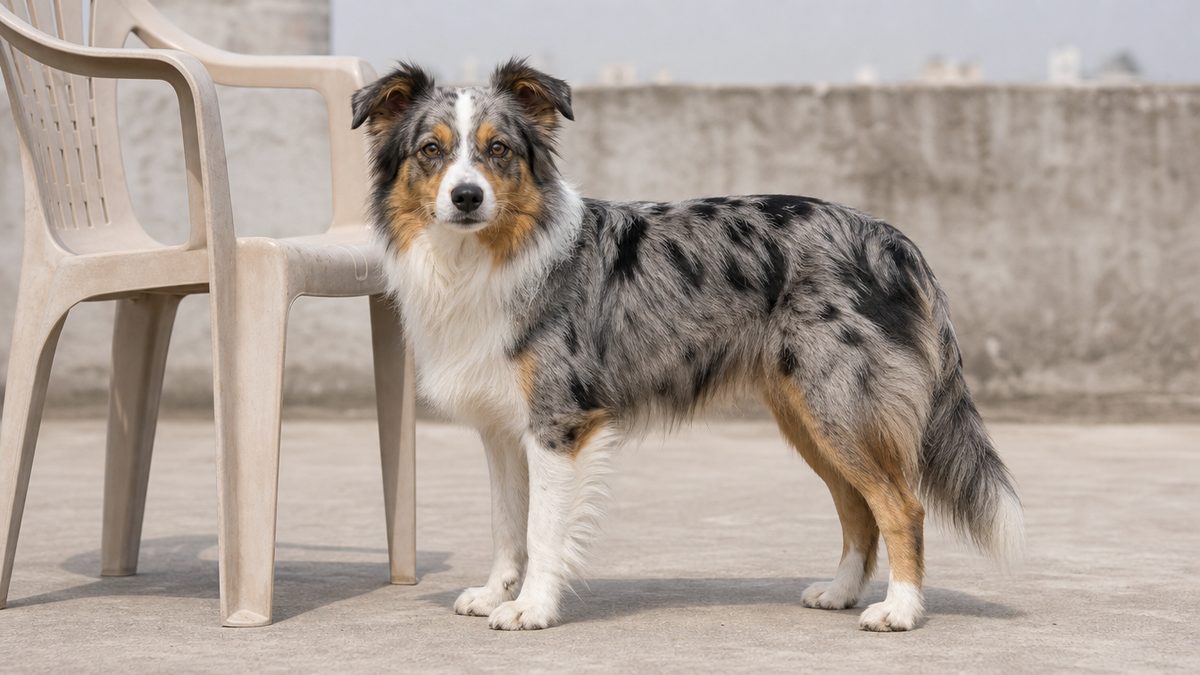
Quick answer
No verified Miniature American Shepherd price in India exists, because no Indian seller was found listing one. The largest Indian marketplace returns three French Bulldogs on this breed's own page, and the top result prices only Maltipoos and Poodles. Budget instead for care: an energetic, intelligent 35 to 46 cm herding dog costs roughly Rs 6,000 to Rs 10,000 a month in India, and its heat tolerance is moderate.
This page reports published veterinary research and registry data for general information. It is not a diagnosis and it is not treatment advice. The drug-sensitivity section in particular describes a genetic test, not a prescription. Every decision about your own dog, including any medicine, belongs with a registered veterinarian who has examined the animal.
Miniature American Shepherd at a glance
What a Miniature American Shepherd actually is
A Miniature American Shepherd is a small American herding dog standing 35.5 to 46 cm at the withers for males and 33 to 43.5 cm for females, bred down from Australian Shepherds in California in the late 1960s and carrying a working herding instinct in a body that fits a flat.
The FCI standard describes an intelligent, energetic, versatile dog that is slightly longer than tall, with moderate bone and no extremes, and a double coat of medium length and coarseness that may be solid or merled, with or without white and tan markings. Its stated purpose is unchanged from its parent breed: farm and ranch shepherd dog.
The temperament clause is worth quoting because it explains almost every training question later on this page. The breed is "intelligent, primarily a working dog of strong herding and guardian instincts. An exceptional companion, he is versatile and easily trained, performing his assigned tasks with great style and enthusiasm. Although reserved with strangers, he does not exhibit shyness. He is a resilient and persistent worker";. A biddable dog with a persistent working drive is easy to teach and hard to switch off.
The size clause, and why it is unusually strict
Most breed standards express height as a preference. This one does not. Males must measure 35.5 cm up to 46 cm at the top of the withers and females 33 cm up to and including 43.5 cm, and anything outside those limits is a disqualifying fault, with the minimum not applying under six months of age. The standard gives no weight at all, saying only that healthy weight varies with individual size, sex and substance.
That matters because everyone else does give a weight. The American Kennel Club's breed page prints 20 to 40 pounds, which is 9.1 to 18.1 kg, alongside 14 to 18 inches for males and 13 to 17 inches for females. A published Indian seller page reproduces exactly those figures, 14 to 18 inches and 9 to 18 kg, having copied the male height range and applied it to the breed. And a 2018 clinical case report describes a 12 kg adult Miniature American Shepherd, which is a real measured animal rather than a range.
| Source | Height | Weight | Enforced how |
|---|---|---|---|
| FCI Standard 367 | Males 35.5 to 46 cm; females 33 to 43.5 cm | None given | Disqualifying fault outside the range |
| American Kennel Club | Males 14 to 18 in; females 13 to 17 in | 20 to 40 lb (9.1 to 18.1 kg) | Breed-page guidance |
| Royal Kennel Club | Rated Medium size, no figure printed | None given | Breed-page guidance |
| Puppiezo, India | 14 to 18 in (male range only) | 9 to 18 kg | Seller spec card, copied from the AKC |
Colour, and the one word that carries a health consequence
The recognised colours are black, blue merle, red, liver, and red or liver merle, with the merle exhibiting marbling, flecks or blotches in any amount. Tan and white markings are permitted but not required, and white must not dominate, with the eyes fully surrounded by colour and pigment. A white body splash between the withers and the tail is a disqualifying fault.
Eyes may be brown, blue, hazel, amber or any combination, including flecks and marbling, in any coat colour. Blue eyes in this breed are normal and are not, by themselves, a warning sign. What is a warning sign is a merle-to-merle mating, and that is covered in its own section below.
A dog of this breed is a medium-framed herding animal in a 35 to 46 cm body, with a double coat, a real working drive, and a training ceiling higher than most owners will reach. The word miniature in its name describes its height and nothing else.
Why it was called the Miniature Australian Shepherd, and why that still matters
The Miniature American Shepherd was called the Miniature Australian Shepherd until 2011, and the FCI's own standard says so. The old name has not gone away: it still outnumbers the official one in the veterinary literature and it is still sold beside it in India as though the two were different dogs.
The primary source settles the history in four sentences. The FCI standard's Brief Historical Summary states that the breed "was developed in California during the late 1960's with the breeding of small Australian Shepherds", that it "was first registered with the National Stock Dog Registry in 1980 and was originally called the Miniature Australian Shepherd", that the parent club MASCUSA was formed in 1990 and incorporated in 1993, and that the breed entered the AKC Foundation Stock Service as the Miniature American Shepherd in May 2011.
So there is no mystery about the relationship. This is a size-selected line of Australian Shepherds that was given a new name on entering the American registry, and the FCI reproduces that account in the document that defines the breed.
The literature never adopted the new name
Fifteen years on, the retired name is still the more productive search term, and Bonbeno measured it. A PubMed phrase search returns 4 records for "Miniature American Shepherd" and 13 for "Miniature Australian Shepherd", with controls in the same session returning 128 for the Australian Shepherd and 6 for Border Collie plus collie eye anomaly, so the instrument was working.
The consequence is practical rather than academic. The most clinically useful recent paper on this dog was published in 2025 and establishes vertebral heart size and vertebral left atrial size reference intervals in Miniature Australian Shepherds, from 208 dogs analysed out of 1,052 identified in a telemedicine record set: VHS 9.4v to 11.5v and VLAS 1.7v to 2.5v. An Indian veterinarian searching the breed's official name would not find it.
The genetics treat all the names as one population
The strongest evidence that these are the same dog is not a registry document but a laboratory one. A 2018 study of the PMEL gene and merle analysed SINE insertion lengths in 175 dogs, made up of 99 Australian Shepherds, 45 miniature Australian Shepherds and 31 miniature American shepherds, and pooled them as one related group throughout. A separate 2018 report describes a TYRP1 coat-colour variant as "a recurrent mutation found in Australian Shepherd and Miniature American Shepherd dogs";.
The third name, and the trap it set for this page
There is a fourth label in circulation, North American Shepherd, and it produced the single most instructive research failure on this page. Searching OFA's published statistics for "Miniature American Shepherd" returns zero rows. Searching the fragment "American Shepherd" returns one, and it reads NORTH AMERICAN SHEPHERD, with 340 hip evaluations. Had Bonbeno searched only the official name, this page would have reported that no screening data of any kind exists.
The same name behaves in the opposite way on PubMed. A phrase search for "North American Shepherd" returns 308 records, and every one is noise: the database rewrote the query into a search for the MeSH heading north american people, returning papers on HIV histoplasmosis, smoking and prolapse surgery. A large result count for an obscure breed is evidence of a query rewrite, not of literature.
| Name | Status | PubMed phrase search | OFA statistics |
|---|---|---|---|
| Miniature American Shepherd | Current, since May 2011 | 4 records | Zero rows |
| Miniature Australian Shepherd | Retired 2011, still in clinical use | 13 records | Zero rows |
| North American Shepherd | Alternate label | 308, all noise from a query rewrite | 1 row, 340 hip evaluations |
| Australian Shepherd | The parent breed | 128 records (control) | 85 rows |
Say all three names. If your dog needs a cardiac reference interval, the paper is filed under Miniature Australian Shepherd. If your vet is looking for screening data, the hip figures sit under North American Shepherd. A name change made in an American registry in 2011 does not follow the dog into a Chennai consulting room.
Recognition status, established from each register rather than assumed
The FCI accepted the Miniature American Shepherd on a provisional basis as standard 367 on 4 September 2019, and it remains absent from the definitive Group 1 register. The Royal Kennel Club lists it in the Pastoral group as Miniature American Shepherd (Imp), and the American Kennel Club ranked it 28th of 202 in 2025.
Bonbeno read each register itself rather than trusting a summary, because recognition claims are the least reliable thing written about a new breed.
The FCI, and a date that is written two different ways
The FCI's provisional register, whose page title reads "Breeds recognised on a provisonal basis", carries the row MINIATURE AMERICAN SHEPHERD (367) with two dates, both printed as `9/4/2019`. That format is ambiguous to a reader outside the United States, so Bonbeno settled it from the table's own contents rather than from convention.
Seven rows in that table have a second field exceeding 12 (2/20/2019, 2/26/2020, 3/30/2022, 4/29/2019, 6/13/2018, 6/21/2022 and 9/17/2024) and no row has a first field exceeding 12. The field that can exceed twelve is the day, so the format is month first and `9/4/2019` is 4 September 2019.
The standard itself confirms it, and in the opposite notation. The PDF prints "DATE OF PUBLICATION OF THE OFFICIAL VALID STANDARD: 04/09/2019". So the FCI writes one date two ways across two of its own documents, American order on the web register and European order on the standard, and both mean 4 September 2019. A reader who assumes a single house style gets 9 April in one place and 4 September in the other.
The provisional status itself is confirmed by absence with a control. The FCI's definitive Group 1 nomenclature page loads correctly and contains the Australian Shepherd at number 342 and the Border Collie, but contains no occurrence of Miniature American at all Federation Cynologique Internationale. So the absence is a fact about the register rather than a failed page load.
One curiosity in the FCI record worth knowing
The standard records ORIGIN: United States of America and PATRONAGE: Hungary. That is not an error. The United States is not an FCI member, so an American breed needs a member country to sponsor it through the process, and Hungary did. It is a reminder that an FCI standard is a document about what the FCI has agreed, not a document written in the breed's homeland.
The Kennel Club, and a 404 that proved nothing
Bonbeno's first attempt at the Kennel Club returned HTTP 404 for the obvious URL, which would have supported a tidy conclusion that Britain does not recognise the breed. That conclusion would have been wrong. Reading the club's own Pastoral group index instead found the breed listed as Miniature American Shepherd (Imp), at a URL whose slug ends `-imp`. The suffix marks the Imported Breed Register. A 404 on a URL you assembled proves your guess was wrong and nothing else.
The American picture, where the breed is genuinely popular
This is the fact that makes the Indian absence strange. The American Kennel Club's 2025 popularity article records that the Miniature American Shepherd went from No. 24 to No. 28, on a list running to 202 breeds. Its own breed page still prints "Ranks 24 of 210";, so the two AKC documents disagree by four places, the breed page carrying the previous year's figure.
| Body | Status | Detail |
|---|---|---|
| FCI | Provisional only | Standard 367, accepted 4 September 2019, Group 1 Section 1, without working trial |
| FCI definitive register | Absent | Zero occurrences on the Group 1 page that lists the Australian Shepherd at 342 |
| Royal Kennel Club | Recognised | Pastoral group, as Miniature American Shepherd (Imp), Imported Breed Register |
| American Kennel Club | Fully recognised | 28th of 202 for 2025, down from 24th |
| Kennel Club of India | Follows FCI nomenclature | India is an FCI member represented by the KCI, so FCI status governs here |
It means a pedigree is possible but the breed cannot compete for the FCI's international beauty title in the ordinary way, and it means the standard may still change. It does not mean the breed is unrecognised, and it does not mean a dog offered in India as one is genuine. Those are separate questions, and the second one is answered in the price section.
Miniature American Shepherd against the Australian Shepherd, measured
The two breeds are separated by a single centimetre boundary and by their housing requirement, not by temperament. FCI heights abut at exactly 46 cm, and only the smaller breed disqualifies on height.
Put the two standards side by side and the boundary is startlingly narrow. FCI 367 allows males 35.5 cm up to 46 cm and females 33 to 43.5 cm, and disqualifies anything outside. FCI 342 gives the Australian Shepherd a preferred height of 51 to 58 cm for males and 46 to 53 cm for females.
So a 46 cm dog sits exactly on the ceiling of one breed and the floor of the other. And the enforcement is asymmetric: the smaller breed's limits are disqualifying faults, while the larger breed's are a stated preference with no disqualification attached. An oversized dog fails as a Miniature American Shepherd in a way that an undersized one does not fail as an Australian Shepherd.
The difference that actually decides your purchase
Temperament is not where these breeds part company. Both standards give the same utilization, farm and ranch shepherd dog, both sit in Group 1 Section 1, and both describe an intelligent, energetic, loyal working animal. The Royal Kennel Club, which rates every breed on the same nine axes, is where the real difference appears.
| Axis | Miniature American Shepherd (Imp) | Australian Shepherd | Same? |
|---|---|---|---|
| Size | Medium | Medium | Same |
| Exercise | Between 1-2 hours per day | More than 2 hours per day | Differs |
| Size of home | Small house | Large house | Differs |
| Grooming | More than once a week | More than once a week | Same |
| Coat length | Medium | Medium | Same |
| Sheds | Yes | Yes | Same |
| Lifespan | Over 12 years | Over 10 years | Differs |
| Town or country | Either | Country | Differs |
| Size of garden | Small/ medium garden | Large garden | Differs |
Read that table as a single finding. Of the nine axes, four differ and all four are about space and time The Royal Kennel Club. The miniaturisation did not change the coat, the shedding, the grooming load or the size class. It changed how much house, garden and daily exercise the dog needs, and it moved the breed from country-only to either.
That is the honest answer to the question an Indian buyer is really asking. A Miniature American Shepherd is the version of this dog that a Mumbai or Bengaluru flat can accommodate. An Australian Shepherd is not, on its own kennel club's assessment.
Where the data has to be borrowed, and the honest caveat
There is a cost to being the newer breed. OFA publishes no statistics row of any kind under this breed's name, while the Australian Shepherd has 85 rows in the same document. McMillan 2024 has no row for it either, under any name, while the Australian Shepherd has one. So every health figure on this page that is not about merle or MDR1 is borrowed from the parent breed, and Bonbeno labels it as borrowed each time rather than presenting it as this dog's own.
Measure the dog at the withers. Under 46 cm for a male and under 43.5 cm for a female is inside the standard; over it is a disqualifying fault and, at 46 cm and above for a female, is Australian Shepherd territory Federation Cynologique Internationale. Do not accept a weight instead: the FCI standard for this breed gives no weight at all, so a seller quoting only kilograms is not quoting the standard.
Miniature American Shepherd price in India: nobody is selling one
There is no verified Miniature American Shepherd price in India. Bonbeno opened every ranking result and found no Indian listing for the breed: the top result prices Maltipoos and Poodles, the largest marketplace returns three French Bulldogs, and the fifth result carries no price at all.
That is the answer, and it is buried on every page competing for this query. Here is what each result contains when you read the raw markup rather than the search snippet.
| Position | Page | Price shown | What is actually there |
|---|---|---|---|
| 1 | Puppiezo product page | Rs 98,999, Rs 92,599, Rs 94,999, Rs 76,499 | Maltipoos, Poodles and a Dachshund. No Miniature American Shepherd is priced. |
| 2 | Dog Breeds List | USD 800 to USD 1,500, and USD 2,500 to 3,500 for top lines | A US price on a US site, not Indian and not converted. |
| 3 | Mr n Mrs Pet, Australian Shepherd page | Quoted for a different breed | The Australian Shepherd page ranks for this query. The names are being mixed. |
| 5 | Breed n Breeder | No price anywhere in the raw markup | A lead form. The only long numbers on the page are a phone number. |
| 7 | Puppiezo category page | No rupee figure at all | An empty grid. Its H1 even drops the word Miniature. |
| 9 | Mr n Mrs Pet, this breed's page | Hidden behind a sign-up link | "3 Result Found", and all three are French Bulldogs. |
The ninth result, opened properly
Mr n Mrs Pet is the largest Indian pet marketplace in this result set and its Miniature American Shepherd page is the clearest single piece of evidence on this page. It prints the heading "Miniature american shepherd Puppies For Sale" and, beneath it, "3 Result Found". The three animals shown are Oliver, a French Bulldog in Pune; a French Bulldog in Lucknow; and Ceasar, a French Bulldog in Chandigarh. Every price sits behind a "View Price" link that goes to a sign-up form.
The same page's own "Most Popular Breeds" panel lists Shih Tzu at 650 listings, Siberian Husky 549, Golden Retriever 487, Labrador Retriever 454 and German Shepherd 412. That is what an Indian market with real supply looks like. This breed appears nowhere in it.
The first result is the same carousel this site has documented before
The Puppiezo product page carries the rupee figures 98,999 three times, 92,599 twice, 94,999 once and 76,499 once, and its raw markup names Maltipoo 30 times, Poodle 30 times and Dachshund 24 times. The recurring animals are Yoki, Kuzo, Dugu, Samy and Fizey.
Bonbeno built a page for a completely unrelated breed on the same day, the Manchester Terrier, and pulled that breed's Puppiezo page too. It carries the identical price points and the identical animals. Two unrelated breeds, one carousel, and in neither case is the breed on the page among the animals being priced. Rs 98,999 divides to 1,173.25 US dollars at 84.38 and 1,237.49 at 80, so it is not a converted figure either. It is a house price point attached to whatever puppy is in stock.
Why the dollar figure does not become a rupee one
The second result gives USD 800 to USD 1,500, rising to USD 2,500 to USD 3,500 for top bloodlines. Bonbeno publishes no conversion. A US price reflects a US breeding population and US costs, and this breed's American popularity, 28th of 202, has no Indian counterpart at all. Converting it would manufacture an Indian market that does not exist.
Mr n Mrs Pet's own breed dropdown lists Miniature American Shepherd, Miniature Australian Shepherd and Toy Australian Shepherd as three separate purchasable breeds. The FCI standard says the first two are the same dog under two names, the second retired in May 2011. If you are shown three options, you are being shown one breed, one retired name for it, and one label with no standard behind it at all.
Monthly cost of ownership in India, bounded honestly
Budget Rs 6,000 to Rs 10,000 a month for a Miniature American Shepherd in an Indian city. That is Supertails's published medium-breed band, and this breed sits in it because of coat and exercise rather than because of body weight.
Which band applies is a genuine question for a 35 to 46 cm dog, so here is the reasoning rather than a bare figure. Supertails's small-breed examples are the Pomeranian and Shih Tzu, and its medium examples are the Beagle and Cocker Spaniel. A 12 kg working herding dog with a double coat eats and is groomed like the second group, not the first.
| Cost line | Small breed | Medium breed | Why medium applies here |
|---|---|---|---|
| Dry or wet food | Rs 1,500 to Rs 2,500 | Rs 2,500 to Rs 4,000 | A 12 kg active dog, not a 4 kg toy |
| Routine veterinary visits | Rs 500 to Rs 1,000 | Rs 800 to Rs 1,500 | Add a one-off MDR1 DNA test, see below |
| Vaccinations, annual | Rs 1,200 a year | Rs 1,500 a year | Standard |
| Grooming | Rs 1,500 to Rs 3,000 | Rs 800 to Rs 1,500 | A double coat needs brushing, not clipping |
| Training, six months | Rs 0 to Rs 3,000 | Rs 2,000 to Rs 5,000 | Budget it. This dog is wasted untrained. |
| Treats and toys | Rs 300 to Rs 800 | Rs 500 to Rs 1,000 | Enrichment is not optional for a herding breed |
| Flea, tick and deworming | Rs 300 to Rs 600 | Rs 400 to Rs 700 | Ask about the drug, not just the price |
| Monthly total | Rs 4,000 to Rs 8,000 | Rs 6,000 to Rs 10,000 | The realistic Indian figure |
The two lines that are specific to this breed
Training is not discretionary here. The Supertails table treats it as an optional Rs 2,000 to Rs 5,000 over six months. For a breed the FCI standard calls a resilient and persistent worker with strong herding instinct, the cost of skipping it is a dog that herds children and two-wheelers instead. Treat it as a fixed cost.
Add a one-off DNA test. The MDR1 drug-sensitivity test is a single buccal swab done once in the dog's life, and it changes which parasite drugs are safe. Given how routinely ivermectin is used in Indian practice, it is the highest-value rupee this breed's owner will spend. The reasoning is set out in its own section below.
A real, current Indian food price
For a working number: Royal Canin Mini Adult dry food, 8 kg with two wet pouches, sells on Supertails at Rs 5,861. A 12 kg active adult eats roughly 190 to 230 g a day of a food of that type, so an 8 kg bag runs about five to six weeks. That is roughly Rs 1,000 a week, which sits at the upper end of the medium-breed food line rather than inside the small-breed one, and confirms the column choice above.
A single tidy purchase price. There is no Indian market for this breed to have one, and the published figures that exist are attached to other dogs Mr n Mrs Pet, Miniature American Shepherd…. The monthly cost figures above are different: Indian food, veterinary, vaccination and grooming prices are real and published, and they apply to any dog of this size living here.
Can a Miniature American Shepherd live in the Indian climate?
Yes in Bengaluru or Pune, with difficulty in Chennai and Delhi, and never without moving the walking hours. The homeland is dry California and the coat is a double coat, so the gap this breed faces in India is humidity as much as heat.
Start with an honest limitation. The FCI standard says the breed was developed in California and names no town, and California spans several climates, so there is no single homeland figure to quote. Bonbeno therefore queried three California reference points by explicit latitude and longitude and reports all three.
One of them failed the elevation check and is reported as failing. The Los Angeles cell came back at 395 m against a real city elevation near 87 m, a divergence of 308 m, which is enough to bias the temperature by roughly two degrees. Fresno (+47 m) and Sacramento (+119 m) are lowland cells that describe their towns, so the Central Valley figure is the one this page leans on.
| Place | Cell elevation vs real | Annual mean C | Hottest month C | Annual humidity % | Annual wet bulb C |
|---|---|---|---|---|---|
| Fresno, California | 141 m vs ~94 m (+47) | 18.70 | 30.24 (Jul) | 51.00 | 12.05 |
| Sacramento, California | 128 m vs ~9 m (+119) | 16.64 | 25.53 (Jul) | 58.74 | 11.50 |
| Los Angeles (cell unreliable) | 395 m vs ~87 m (+308) | 17.36 | 23.41 (Jul) | 56.69 | 12.07 |
| Bengaluru | 842 m vs ~920 m (-78) | 23.74 | 28.37 (April) | 67.94 | 19.80 |
| Pune | 636 m vs ~560 m (+76) | 23.86 | 28.93 (April) | 66.80 | 19.66 |
| Delhi | 206 m vs ~216 m (-10) | 25.60 | 35.88 (June) | 45.56 | 18.03 |
| Mumbai | 97 m vs ~14 m (+83) | 26.77 | 31.19 (May) | 67.39 | 22.73 |
| Chennai | 49 m vs ~6 m (+43) | 27.95 | 31.51 (May) | 72.39 | 24.94 |
Humidity is the number that matters, not temperature
Fresno reaches a July mean of 30.24 C, which is hotter than Bengaluru gets in any month. So this is not a cold-climate breed and heat alone is not the problem. The problem is the last column. California's annual wet bulb temperature is about 12 C at all three reference points. Chennai's is 24.94 C and Mumbai's 22.73 C.
A panting dog cools by evaporating water from its airways, and evaporation slows as the air fills with moisture. A dry Fresno afternoon at 30 C is a cooling environment. A humid Chennai afternoon at 31 C is not. That 12 to 13 degree wet-bulb gap, which never closes in any month, is the honest measure of what this breed is being asked to adapt to.
The coat, and why the size misleads
Indian buyers read "miniature" as a promise about heat tolerance. The standard does not support that. This is a double coat of medium length and medium texture, weather resistant, with a moderate mane and frill, and the standard notes that "the undercoat varies in quantity with variations in climate". An undercoat is an insulating layer. A small dog carrying one is not equivalent to a small dog with a smooth coat.
Bonbeno rates this breed 2 out of 5 for heat tolerance, lower than most owners expect and lower than the smooth-coated small breeds this site covers.
The risk is exertional, and this breed volunteers for exertion
The largest UK study of heat-related illness found that of 879 events with a recorded trigger, 652, or 74.2 percent, were exertional rather than caused by hot weather or hot cars. Its companion paper on the same cohort found dogs at or above their breed and sex mean bodyweight carried odds of 1.42. Neither paper modelled this breed, which is too rare in the UK to have met the inclusion threshold, so the transferable finding is the exertional one rather than any breed-specific odds ratio.
That finding is exactly the wrong one for a dog the standard calls "a resilient and persistent worker";. A herding breed given a ball at four in the afternoon in Chennai will keep working until it collapses. The owner has to stop the game.
Bengaluru and Pune are workable year-round with morning and evening walks. Delhi is dry, which helps, but its June mean of 35.88 C means indoor exercise for six weeks. Mumbai and Chennai need air conditioning and both walks outside daylight from March to June. Indian law supports this: Second Schedule Part IV paragraph 21(1) of the 2017 Rules bars keeping dogs not accustomed to local temperatures in outdoor facilities without the attending veterinary practitioner's written approval.
The breed standard asks for two things Indian law forbids, and says so itself
FCI Standard 367 prefers a docked tail and says dewclaws should be removed. Both procedures are prohibited outright in India. The standard anticipates exactly this conflict, qualifying both clauses with the phrase in countries where it is not forbidden by law.
Take the standard first. Its general appearance clause says the breed "traditionally has a docked or natural bobtail", and its tail clause says "A docked or natural bobtail is preferred. A docked tail is straight, not to exceed three (3) inches (in countries where it is not forbidden by law)". On the feet it says front "Dewclaws should be removed (except where it is forbidden by law)" and "Rear dewclaws should be removed (in countries where it is not forbidden by law)".
Now the Indian clause, read from the gazette itself rather than a summary. Second Schedule Part II paragraph 6(8) of the Prevention of Cruelty to Animals (Dog Breeding and Marketing) Rules, 2017 states: "There shall be no tail docking, ear cropping de-barking, de-clawing, branding, dyeing, injecting substances to enhance visual appeal, performing a surgery or procedure to camouflage or hide any defect or infirmity or any other kind of mutilation of any body part of the pup and any change of appearance by artificial means is strictly forbidden."
India is one of the countries the standard's own carve-out is written for. A Miniature American Shepherd bred in India must have a natural undocked tail and its dewclaws intact, and a dog offered here with a docked tail was either imported already docked or was mutilated in breach of the Rules. The standard's own words permit the natural tail: it says the undocked tail "when at rest may hang in a slight curve" and may be carried raised in motion. A natural tail is not a fault. It is the only lawful option here.
The merle clause, which is subtler and matters more
A second Indian provision bears on this breed and almost nobody connects it. Second Schedule Part II paragraph 6(9) provides that "Breeding to create new breeds of dogs or unusual looks shall be strictly prohibited". Merle is a permitted colour under the standard and there is nothing unlawful about a merle dog. What paragraph 6(9) speaks to is breeding for a look, and the specific danger in this breed is merle-to-merle mating, which produces double merle puppies at elevated risk of deafness and eye defects. The evidence is in its own section below.
Every Indian clause that touches this breed
| Provision | What it says | Why it applies here |
|---|---|---|
| Second Schedule Part II para 6(8) | No tail docking, ear cropping, de-barking or de-clawing | The standard prefers a docked tail and removed dewclaws |
| Second Schedule Part II para 6(9) | Breeding for new breeds or unusual looks prohibited | Bears on merle-to-merle breeding for coat pattern |
| Second Schedule Part II para 6(3) | In-breeding within four generations and incest breeding prohibited | A provisional breed with a small founder base |
| Second Schedule Part III para 8(10) | Testing for genetic defects including hip dysplasia and progressive retinal atrophy | Both are screened in the parent breed |
| Rule 8(1)(a) | Pups less than eight weeks in age are not sold | Applies to any seller |
| Second Schedule Part IV para 21(1) | No outdoor housing for dogs unaccustomed to local temperatures without written veterinary approval | A dry-climate double-coated breed in an Indian summer |
Two absences are worth recording because they are citable. Bonbeno searched the whole gazette: the words BAER and deaf appear zero times, and patella and luxation appear zero times. So Indian law imposes no hearing-test requirement, which is a real gap for a breed in which merle is a recognised colour, and no patella requirement. Note also that the Rules themselves stop at Rule 13, so any citation reading Rule 14 or above is a Second Schedule paragraph rather than a Rule.
Paragraph 8(10) lists progressive retinal atrophy and night blindness among the genetic defects a breeding dog must have been tested for, but names no hearing test at all. For a merle breed that is the wrong omission, and it means the burden falls on the buyer. Ask for a BAER hearing result on any merle puppy, because Indian law will not ask for you.
Temperament: a full-sized working brain in a flat-sized dog
The Miniature American Shepherd is intelligent, versatile, easily trained and reserved with strangers without being shy, in the words of its own standard. The trait that decides whether it suits your household is not friendliness. It is that it needs a job.
The FCI standard is unusually direct about character, and every sentence has a household consequence:
- "Intelligent, primarily a working dog of strong herding and guardian instincts." A guardian instinct in a flat means a dog that reports the lift.
- "Versatile and easily trained, performing his assigned tasks with great style and enthusiasm." Assigned is the operative word. Unassigned, it invents tasks.
- "Although reserved with strangers, he does not exhibit shyness." Expect polite distance from your guests, not enthusiasm, and do not mistake it for fear.
- "A resilient and persistent worker, who adjusts his demeanor and arousal appropriately to the task at hand." This is the sentence that makes it liveable indoors.
- "With his family he is protective, good natured, devoted and loyal." A one-household dog rather than a universal greeter.
The herding instinct in an Indian home
A herding dog does not want to kill things. It wants to move them and then control where they go, and it does that by circling, staring and nipping at heels. In a farm that is useful. In an Indian household it presents as a dog that circles running children, nips at ankles during play, and chases two-wheelers and autorickshaws along a compound wall.
None of that is aggression and none of it responds to punishment, because the dog is doing the thing it was selected to do. It responds to redirection: give the instinct a legitimate target and the illegitimate ones lose their appeal.
Who should buy this breed
- Households that enjoy training, because this dog will out-learn a casual owner within months.
- Apartment owners who walk, given the Royal Kennel Club rates it for a small house and small or medium garden but between one and two hours of daily exercise.
- Families with school-age or older children who can be taught not to run and shriek around a herding dog.
- Owners in Bengaluru, Pune or a hill station, where the climate section shows the coat is manageable year-round.
Who should not
- Anyone out of the house twelve hours a day. An unemployed herding dog is a destructive one.
- Households with toddlers who cannot yet be taught to stand still, because heel-nipping lands on the smallest person.
- First-time owners who wanted a small easy dog. The word miniature describes height, not effort.
- Buyers in Chennai or Mumbai without air conditioning, on the wet-bulb figures above.
- Anyone who needs the dog this month, because no verified Indian seller exists.
Not garden size. Whether someone in the household actively enjoys teaching the dog things. A Miniature American Shepherd with twenty minutes of daily training and an hour of walking is a superb flat dog. The same animal with two hours of walking and no mental work is a problem, and the second owner usually blames the breed.
Training: the easiest dog on this site to teach, and the easiest to spoil
Train this breed early, in short reward-led sessions, and give the herding instinct a legal outlet from week one. It learns faster than almost any breed Bonbeno covers, which means it learns your mistakes just as fast.
The standard's phrase is "easily trained, performing his assigned tasks with great style and enthusiasm";. Take that literally. A Miniature American Shepherd puppy will have sit, down and a recall inside a fortnight, and will have worked out which of your instructions carry consequences inside three.
What works
- Keep sessions to five minutes and run three or four a day. Long sessions produce a bored dog offering random behaviour.
- Socialise deliberately from eight weeks to sixteen. In an Indian city that means lifts, stairs, autorickshaws, cattle, firecrackers, the watchman and the delivery rider, not just other puppies. A reserved breed that met nothing becomes a reactive adult.
- Give the herding instinct a target on day one. A flirt pole, a herding ball, or formal scentwork. Twenty minutes of that is worth an hour of walking.
- Teach an emergency stop before you teach a recall. A dog that drops where it stands is safer near an Indian road than one crossing it to reach you.
- Train the family, not just the dog. Children who run and squeal are, to this breed, livestock behaving badly. Teach them to stand still.
What this breed resists, and the honest timeline
Very little, and that is the trap. The resistance is not to commands but to inactivity: a Miniature American Shepherd that has learned everything you have bothered to teach will start generating its own curriculum, and the syllabus is usually barking at corridor noise, herding the cat, and dismantling something.
The one genuinely slow skill is settling. A working breed has to be taught that lying down and doing nothing is itself a rewardable behaviour, and that takes months rather than weeks. Start it on day one with a mat and food scattered on it, before you need it.
| Skill | Realistic timeline | Note |
|---|---|---|
| Name, sit, down, touch | 1 to 2 weeks | Genuinely this fast |
| Reliable indoor recall | 2 to 3 weeks | Pay in food, every time, for a year |
| Crate and alone-time tolerance | 4 to 8 weeks | Start before you need it |
| Loose-lead walking | 6 to 10 weeks | Herding dogs forge ahead to gather |
| Settle on a mat | 3 to 6 months | The hardest skill and the most valuable in a flat |
| Emergency stop | 2 to 3 months | Proof it near traffic before you rely on it |
| Not herding running children | Ongoing management | Redirect, do not punish |
American and British guides for this breed assume access to herding trials, agility clubs and a fenced garden. Most Indian owners have none of the three. The workable substitute is indoor scentwork and a flirt pole on a terrace, both of which satisfy the same instinct in ten square feet, and neither of which needs a club membership.
Daily exercise: one to two hours, and why the miniature name misleads
The Royal Kennel Club prescribes between one and two hours a day for a Miniature American Shepherd, against more than two hours for the Australian Shepherd The Royal Kennel Club. That is a real reduction, and it is still more than most Indian buyers expect from a dog called miniature.
Compare that with the small breeds Indian owners usually cross-shop. This is not a thirty-minute dog. It is a working herding animal whose exercise requirement was reduced by miniaturisation, not eliminated by it, and the Kennel Club's own axis ratings show exactly which requirements changed and which did not The Royal Kennel Club.
Splitting the requirement across an Indian year
| Months | Morning | Evening | Indoor work | Why |
|---|---|---|---|---|
| November to February | 45 to 60 min | 30 to 45 min | 15 min | Comfortable in every city on this page |
| March to June | Before sunrise, 35 min | After dark, 35 min | 30 min | Chennai May mean 31.51 C, Delhi June mean 35.88 C |
| July to September | 30 to 40 min | 30 to 40 min | 20 min | Cooler air, but Mumbai and Chennai humidity stay high |
| October | 45 min | 45 min | 15 min | The easiest month across most of India |
Note the indoor column. For this breed it is not padding, it is a third of the requirement. Twenty to thirty minutes of scentwork, trick training or a flirt pole substitutes for a meaningful share of the walking, which is what makes an Indian summer survivable without an under-exercised dog.
What happens without it
An under-exercised herding dog does not become calm. It becomes vigilant, vocal and busy. The classic Indian flat presentation is a dog that barks at every corridor footfall, herds the family from room to room, chews furniture edges, and cannot settle in the evening. All four usually resolve within a fortnight of the hour going back in, which is the useful diagnostic.
Bonbeno's Border Collie page and Australian Kelpie page describe the same failure mode in breeds Indian owners meet more often, and the pattern is identical.
Of the 879 UK heat-related illness events with a recorded trigger in Hall 2020, 652, or 74.2 percent, were exertional. Heat kills active dogs during activity, not lying still. A breed the standard calls a persistent worker will not stop on its own. You set the pace, you carry water, and in an Indian May you finish the walk before the dog wants to.
Grooming a double coat in Indian humidity
Brush a Miniature American Shepherd more than once a week and never shave it. The Royal Kennel Club rates grooming at more than once a week on a medium-length coat that sheds, and in Indian humidity the undercoat is the part that needs the work.
The standard describes the coat precisely: "Moderation is the overall impression. Hair is of medium texture, straight to wavy, weather resistant, and of medium length. The undercoat varies in quantity with variations in climate." Hair is short and smooth on the head and front of the legs, with moderate feathering on the backs of the forelegs and breeches, and a moderate mane and frill that is more pronounced in males.
That last clause about the undercoat is the one that matters here. A dog living in Chennai will carry less undercoat than the same dog in Sacramento, which helps. What it will not do is carry none, and the undercoat it does carry traps moisture in a monsoon.
The routine
- Brush twice a week minimum, with an undercoat rake and a slicker. Ten to fifteen minutes. During a coat blow, daily.
- Work down to the skin, not across the top. A double coat can look groomed while holding a mat against the skin, and behind the ears and in the breeches is where mats form.
- Bathe every six to eight weeks, and dry the dog properly afterwards rather than letting it air dry.
- Dry inside the ear flap after every bath and every wet walk. This is the step overseas guides omit and Indian conditions punish.
- Trim only where the standard permits: ears, feet, backs of hocks, pasterns and tail. Untrimmed whiskers are preferred, and non-typical coats are a severe fault.
Never shave a double coat, and here is why
The most common Indian grooming mistake with a double-coated breed is shaving it for summer. It feels compassionate and it is counterproductive. The undercoat insulates in both directions, and the guard coat reflects sun and protects skin from ultraviolet exposure and insect bites. Shaving removes both, exposes pale skin to Indian sun, and the coat frequently grows back patchy in texture. Brush the undercoat out instead, which achieves the cooling that shaving is meant to and does no damage.
Shedding, stated honestly
This breed sheds, and the Royal Kennel Club prints Sheds: Yes on its own breed record. So does the Indian seller page, which prints Shedding: Yes on its spec card. There will be hair on your furniture, twice a year in quantity. Nobody should sell this dog as low-shedding or hypoallergenic, because there is no such thing as a non-allergenic dog.
Three things, none expensive. Dry inside the ear flap after every wetting. Check between the toes for damp and grass seed after walks. And run your fingers to the skin behind the ears and in the breeches once a week, because a mat you can feel but not see is the one that becomes a hot spot in July.
Health: what is known, what is borrowed, and what is missing
No screening statistics exist under this breed's own name. OFA publishes zero rows for the Miniature American Shepherd, one hip row under North American Shepherd, and 85 rows for the Australian Shepherd, so most of what follows is the parent breed's data and is labelled as such.
Bonbeno searched OFA's published statistics as a fragment rather than by exact name, which is what turned a false absence into a real finding. Miniature American Shepherd returns zero. North American Shepherd returns one row, hips only, with 340 evaluations at 92.9 percent normal and 5.9 percent dysplastic; that row's arithmetic checks out, with Excellent 16.5 plus Good 65.9 plus Fair 10.6 giving 93.0 against a printed 92.9. Controls in the same document returned 109 for Labrador and 197 for Australian Shepherd, so the instrument was working.
Set expectations before the tables start. The health issues this breed is actually screened for are inherited from the population it was bred down from, so the useful question is not what has been measured in Miniature American Shepherds, which is very little, but which health issues run in Australian Shepherd lines and therefore travel with this dog. Two of them, merle-linked deafness and MDR1 drug sensitivity, get their own sections below because they change what an Indian owner should do.
OFA requires 100 hip evaluations, or 50 for its other databases, before publishing a breed. The correct statement is therefore that this breed has no row in OFA's published statistics tables, not that it is absent from the OFA database.
The parent breed's record, borrowed and labelled
| Registry | Evaluations | Normal % | Notable | All breeds |
|---|---|---|---|---|
| MDR1 drug sensitivity | 283 | 75.3 | 21.6% carriers, 3.2% affected | 83.0 normal, 12.3 carrier, 4.7 affected |
| Degenerative myelopathy | 386 | 67.4 | 18.9% carriers, 13.7% affected | 65.5 / 21.3 / 13.2 |
| Collie eye anomaly | 216 | 95.8 | 3.7% carriers, 0.5% affected | 82.9 / 13.8 / 3.3 |
| Cataracts | 180 | 93.9 | 4.4% carriers, 1.7% affected | 98.1 / 1.9 / 0.1 |
| Hips | 50,330 | 93.1 | 6.3% dysplastic | See the caution below |
| Elbow | 21,756 | 95.0 | 4.8% abnormal | 87.8 normal, 12.0 abnormal |
| Eyes | 58,707 | 96.9 | 3.0% abnormal | 93.4 normal, 6.5 abnormal |
| Patella | 1,960 | 99.2 | 0.8% abnormal | 96.5 normal, 3.5 abnormal |
| Dentition | 1,171 | 95.0 | 5.0% abnormal | 92.9 normal, 7.1 abnormal |
| Thyroid | 527 | 93.4 | 2.8% compensative autoimmune | 84.8 normal |
One caution about that hips comparison. OFA's own ALL BREEDS hip row does not add up: it prints 84.3 percent normal with Excellent 14.6, Good 0.0 and Fair 0.0, components that cannot sum to the whole, while every individual breed row sums correctly. So the all-breed hip baseline is less trustworthy than the per-breed rows beneath it, and this page does not lean on it.
The breed's own literature, small but real
Four PubMed records return for the current name and thirteen for the retired one, with controls passing in the same session. Three findings belong to this breed specifically.
- Cardiac reference intervals. A 2025 study of 208 dogs established vertebral heart size of 9.4v to 11.5v and vertebral left atrial size of 1.7v to 2.5v, published under the name Miniature Australian Shepherd. These are the numbers an Indian vet needs to read a chest radiograph correctly.
- Atherosclerosis and hyperlipidaemia. A 2018 case report describes a 2.5-year-old 12 kg Miniature American Shepherd with severe hypercholesterolaemia and hypertriglyceridaemia and widespread intimal atherosclerosis, euthanised after a poor response to treatment. The authors state it was, to their knowledge, the first report of skin necrosis secondary to atherosclerosis in a dog, and that primary hyperlipidaemia had not previously been described in the breed. One case is not a prevalence, and this page does not present it as one.
- A shared coat-colour variant. A 2018 report describes TYRP1:c.555T>G as a recurrent mutation found in both Australian Shepherd and Miniature American Shepherd dogs. Bonbeno read the PubMed record; no abstract is deposited, so we report the title's claim and none of its numbers.
Because no breed-specific screening scheme exists, ask for the parent breed's panel on both parents: MDR1 (ABCB1-1delta), hip and elbow scores, an eye examination, collie eye anomaly, degenerative myelopathy, and a BAER hearing test on any merle puppy. Two of those, MDR1 and BAER, are the ones that change what happens to your dog in an Indian clinic, and they are covered next.
Merle: a normal colour, and one mating that must never happen
A single merle Miniature American Shepherd is a normal dog with a recognised colour. A double merle, produced by mating two merles together, runs at 10 percent unilateral and 15 percent bilateral deafness against 2.7 and 0.9 percent for single merles.
Merle is not a defect. FCI Standard 367 lists blue merle and red or liver merle among the recognised colours with no order of preference, and permits blue eyes in any coat colour. The problem is arithmetic, not colour.
Merle is caused by an insertion in the PMEL gene. A dog with one copy is a normal merle. A dog with two copies, a double merle, has the pigment disruption doubled, and pigment cells are what build the inner ear and parts of the eye. Mating merle to merle gives each puppy a one-in-four chance of inheriting two copies.
The numbers, from the largest study of merle dogs
A study of 153 privately owned merle dogs, hearing tested by brainstem auditory evoked response and genotyped for the merle allele, found deafness overall at 4.6 percent unilateral and 4.6 percent bilateral. Split by genotype the picture changes completely:
| Genotype | Unilaterally deaf | Bilaterally deaf | Deaf in one or both ears |
|---|---|---|---|
| Single merle (Mm) | 2.7% | 0.9% | 3.6% |
| Double merle (MM) | 10% | 15% | 25% |
| All merles pooled | 4.6% | 4.6% | 9.2% |
The association between hearing status and genotype was statistically significant, and there was no significant association with eye colour or sex. That second finding is worth stating loudly in India, because the folk rule is that blue eyes mean deafness. They do not. Genotype does.
Why you cannot tell by looking, and this breed is the proof
A 2018 study analysed merle insertion lengths in 175 dogs, made up of 99 Australian Shepherds, 45 miniature Australian Shepherds and 31 miniature American shepherds, and found insertion lengths ranging continuously from 201 to 277 base pairs, producing at least four phenotypic clusters described as cryptic, atypical, classic and harlequin merle.
Two of its findings matter to a buyer. It identified 25 dogs carrying two insertions and 24 carrying more than two alleles, indicating mosaicism. And it found the insertion expanding and contracting between generations. A cryptic merle can look like a solid dog and still pass on a merle allele, so two apparently non-merle parents can produce a double merle puppy. The authors say so directly, noting the implications "for breeding practices and determining mating pairs to avoid producing double merle dogs".
Three things. Ask whether both parents were DNA tested for merle, not whether they look merle, because a cryptic merle is invisible. Ask for a BAER hearing test on any merle puppy, since Indian law requires no hearing test at all and the word deaf appears zero times in the 2017 Rules. And walk away from a litter advertised as double merle, or from any seller who cannot tell you the parents' merle status, however striking the puppy looks.
MDR1: the one health fact that matters more in India than anywhere else
Herding breeds commonly carry a mutation that lets ordinary veterinary drugs cross into the brain, and ivermectin is the best-known of them. In the parent breed, OFA records 21.6 percent carriers and 3.2 percent affected. Ivermectin is cheap and ubiquitous in Indian practice, which is exactly why this matters here.
The gene is ABCB1, which codes for P-glycoprotein, a pump that sits in the blood-brain barrier and pushes certain drug molecules back out. The ABCB1-1delta mutation, universally called MDR1, produces a less functional pump. Drugs that should stay out of the brain get in, and the result can be severe neurological toxicity from a normal dose of a normal medicine.
An Australian study tested 4,842 dogs across 27 breeds and found the mutation in nine of them. The most commonly affected were collies, Australian shepherds, white Swiss shepherds and Shetland sheepdogs. Of 32 dogs across 18 non-herding breeds, only a cocker spaniel and a labradoodle carried it, both heterozygous. The authors' conclusion is the operative one: veterinarians need to know which breeds are at risk and consider testing before administering these medications.
| Group | Evaluations | Normal % | Carrier % | Affected % |
|---|---|---|---|---|
| Australian Shepherd | 283 | 75.3 | 21.6 | 3.2 |
| All breeds tested | 6,094 | 83.0 | 12.3 | 4.7 |
That table is the parent breed, not this one, and Bonbeno flags it as borrowed because OFA publishes no row under any of this breed's names. But the mutation is inherited from exactly the population this breed was drawn from, so a Miniature American Shepherd should be treated as at risk until a test says otherwise.
Why the Indian context sharpens this
In most countries an MDR1 dog meets ivermectin once, in a heartworm preventive at a dose low enough to be safe even for affected dogs. In India the drug turns up far more often and at much higher doses, because ivermectin is inexpensive, widely stocked and routinely used for sarcoptic mange, which is common here. A dose calculated for mange is not a heartworm-preventive dose.
The practical consequence is a single sentence you should be able to say in any Indian clinic: this is a herding breed, it may carry the MDR1 mutation, please check before prescribing ivermectin or a related drug. If the dog has been tested, carry the result.
The drugs the mutation touches
The affected drugs are those that are substrates of P-glycoprotein. Beyond ivermectin and the related macrocyclic lactones, published reviews of canine P-glycoprotein deficiency describe adverse reactions across several common drug classes, and a 2019 case report documents an adverse reaction to a routine emodepside and praziquantel wormer in an MDR1-mutant dog. This page names no doses and no alternatives, because that is a prescribing decision and belongs with your veterinarian.
One buccal swab, once in the dog's life, and the result never changes. It tells your veterinarian which parasite treatments are safe before there is an emergency rather than after. For an Indian owner of any herding-type dog, including a rescue that merely looks like one, this is the highest-value single test available, and it costs a fraction of one month of the ownership budget above.
Lifespan: 12 to 13 years, with no large study behind it
The American Kennel Club gives 12 to 13 years and the Royal Kennel Club says over 12 years. No large longevity study contains this breed at all, so those two registry figures are the best available and neither rests on a published sample.
Bonbeno checked the obvious source properly rather than assuming. McMillan 2024 analysed longevity across 155 recognised purebred groups, and its supplementary tables were read directly. There is no row for Miniature American Shepherd, Miniature Australian Shepherd or North American Shepherd in Table S3, Table S5 or Table S6 McMillan et al. 2024 McMillan et al. 2024. The breed is absent, and no other breed is reclassified into it.
The study is McMillan 2024, the largest analysis of companion-dog longevity yet published in the United Kingdom, covering 155 recognised purebred groups against a crossbred reference.
That is a real absence rather than a search failure: the same tables were queried in the same pass and returned the Australian Shepherd every time.
| Source | Figure | Basis |
|---|---|---|
| American Kennel Club | 12 to 13 years | Breed-page guidance, no sample stated |
| Royal Kennel Club | Over 12 years | Breed-page banding, no sample stated |
| Puppiezo, India | 12 to 15 years | Seller spec card |
| McMillan 2024, this breed | No row at all | Absent from the study under every name |
| McMillan 2024, Australian Shepherd | 13.7 years, 95% CI 12.8 to 14.6 | 62 recorded deaths, HR 0.69 (0.54, 0.88), p < 0.01 |
How to read the parent breed's figure
The Australian Shepherd's median of 13.7 years is genuinely good and, unlike some breeds, statistically robust: its hazard ratio against the crossbred reference group is 0.69 with a confidence interval of 0.54 to 0.88 and p below 0.01, so the interval does not cross 1. For context, UK life-table work puts overall dog life expectancy at birth near 11.2 years.
Whether that transfers to the smaller breed is unknown. Smaller dogs generally live longer than larger ones, which would argue for at least as good a figure, but nobody has measured it and Bonbeno will not manufacture a number by inference.
A caution about the study's own arithmetic
One thing worth knowing if you check the source yourself. McMillan's two supplementary tables disagree on sample size for the Australian Shepherd: Table S6 gives 183 alive plus 62 deceased for a total of 245, while Table S3 gives 224 alongside the same 62 McMillan et al. 2024. The death count is identical in both, which is why this page quotes deaths and the median rather than the population. Bonbeno saw the same disagreement on a different breed in the same research pass, so it is a property of the tables rather than an error about this dog. The paper also carries an Author Correction that changes only a Miniature Dachshund figure in a figure legend and does not affect this breed.
On the evidence assembled here, three things, and all three are within an owner's control: heat handled carelessly during exercise, a drug reaction in an untested MDR1 dog, and a road reached by a dog with a herding instinct and no emergency stop. None of them is a property of the breed.
Feeding a Miniature American Shepherd in India
Feed a medium-breed complete food by body condition rather than by the bag chart, roughly 190 to 230 g a day for a 12 kg active adult, split into two meals. The one breed-specific caution is lipids, and it comes from a single case report.
The ordinary part first. A 12 kg working-bred dog on a good medium-breed dry food needs roughly 190 to 230 g a day, and a smaller 9 kg female nearer 150 to 180 g. Royal Canin Mini Adult sells on Supertails at Rs 5,861 for 8 kg with two wet pouches, which runs about five to six weeks for a 12 kg dog and confirms the medium-breed food line used in the cost section.
| Stage | Meals per day | Focus | Indian note |
|---|---|---|---|
| 8 to 16 weeks | 4 | Medium-breed puppy food, controlled growth | Do not add calcium. Use meals as training currency. |
| 4 to 8 months | 3 | Steady growth, lean condition | Heat rises. Move meals away from the middle of the day. |
| 8 to 12 months | 2 | Transition to adult food | Weigh monthly through the first summer. |
| 1 to 7 years | 2 | Maintain lean body condition | Ribs easy to feel. Subtract training treats from the ration. |
| 7 years and over | 2 | Senior formula, joint support if advised | Annual bloods, including a lipid panel, see below. |
The lipid question, reported with its uncertainty
A 2018 case report describes a 2.5-year-old, 12 kg Miniature American Shepherd with severe hypercholesterolaemia and hypertriglyceridaemia and widespread atherosclerosis, and states that primary hyperlipidaemia had not previously been described in the breed. Treatment included a low-fat diet, omega-3 fatty acids and a statin, and the outcome was poor.
Read that carefully, because it is one dog. It is not a prevalence, it does not establish that this breed is predisposed, and it must not be turned into a dietary rule. What it reasonably supports is a cheap precaution: ask for a lipid panel to be included in the routine senior bloodwork, and take unexplained skin lesions on the feet seriously rather than treating them as a simple infection.
Two ordinary Indian feeding mistakes
- Roti and rice as the base of the diet. A growing herding dog has real protein and mineral requirements, and an improvised home diet usually misses them. Home food can work but has to be formulated with a veterinarian.
- Treats not subtracted from the ration. This breed is trained with food and should be. Ten to fifteen percent of the daily calories going in as treats is fine, provided the same amount comes out of the bowl. An overweight dog carries the Hall 2020 bodyweight risk factor of 1.42 into every Indian summer.
Two bowls, refilled twice a day, in different rooms. A double-coated dog in an Indian summer loses more water than its owner expects, and a dog that has to go looking for water drinks less. It is the cheapest heat-management measure there is and it costs the price of a second bowl.
The first year, month by month, in an Indian household
Plan year one around four fixed points: the eight-week legal minimum, the socialisation window closing at sixteen weeks, the first Indian summer, and the adolescent collapse of recall between six and nine months.
| Age | What is happening | What you do |
|---|---|---|
| Under 8 weeks | The puppy stays with its mother. Rule 8(1)(a) of the 2017 Rules provides that pups less than eight weeks in age are not sold | Refuse an earlier handover. Ask now for the MDR1 result and, on a merle puppy, a BAER hearing test. |
| 8 to 10 weeks | Arrival. Vaccination course under way; the Rules note it can start at seven to eight weeks and usually completes by eighteen | Crate, mat and toilet routine. Register the microchip. Start settle training on day one. |
| 10 to 16 weeks | The socialisation window, which closes and does not reopen | Lifts, stairs, autos, traffic, cattle, firecrackers, the watchman. Short, positive, several times daily. |
| 4 to 6 months | Herding behaviour appears. Heel-nipping starts | Redirect onto a flirt pole or herding ball. Teach children to stand still. |
| First March to June | The first Indian summer on a double coat | Both walks outside daylight. Brush the undercoat out; never shave. Watch weight. |
| 6 to 9 months | Adolescence. Recall degrades | Long line becomes standard kit. Do not test off-lead recall now. |
| First monsoon | Damp undercoat, ear moisture, mats behind the ears | Dry inside the ear flap after every walk. Weekly check to the skin. |
| 9 to 12 months | Near adult height. Food transition | Move to adult food. Measure the withers against the standard's limits. |
The two windows you cannot reopen
Socialisation closes at about sixteen weeks. The standard describes a breed "reserved with strangers" that "does not exhibit shyness", and the difference between those two states is almost entirely made in this window. A reserved dog that met an Indian apartment block early is fine. A reserved dog that met nothing becomes a reactive adult in a building with constant corridor traffic.
Height is settled by about twelve months. Because the FCI limits are disqualifying rather than preferential, measuring matters if you ever intend to show or breed. Measure at the withers with the dog standing square, not at the head.
Get the MDR1 status on file, either from the breeder's certificate or from a swab. An Indian first-year puppy is very likely to be treated for parasites at some point, and this is a breed where the choice of drug can matter. Knowing before the appointment is worth more than knowing after it.
Head to head against the herding dogs India actually offers
An Indian buyer drawn to this breed is choosing between one dog they cannot get and three they can. This table compares them on the measures that decide the purchase in an Indian flat.
| Miniature American Shepherd | Australian Shepherd | Border Collie | German Shepherd | |
|---|---|---|---|---|
| Available in India | No verified seller found | Listed, at a high asking price | Widely available | Very widely available |
| Height | 35.5 to 46 cm (M) | 51 to 58 cm (M) | Roughly 48 to 53 cm | Roughly 60 to 65 cm |
| Kennel Club exercise rating | 1 to 2 hours | More than 2 hours | More than 2 hours | See breed page |
| Kennel Club home rating | Small house | Large house | Small house | See breed page |
| Kennel Club garden rating | Small/medium | Large garden | Large garden | See breed page |
| Town or country | Either | Country | Either | See breed page |
| Coat | Medium double coat | Medium double coat | Medium double coat | Double coat |
| MDR1 risk | Inherited from the parent breed | 21.6% carriers at OFA | Lower but present | Low |
| Merle in the breed | Yes, recognised | Yes, recognised | Yes | No |
| Heat tolerance, Bonbeno rating | 2 of 5 | 2 of 5 | 2 of 5 | 2 of 5 |
| Published median survival | None exists | 13.7 years | See breed page | See breed page |
How to read that table
Two columns decide it before temperament enters the argument. Availability is the first: only one of these four cannot be bought in India from a verified seller, and it is the one at the top. The three Kennel Club housing rows are the second, and they are the reason someone wants this breed rather than its parent: it is the only dog in this table rated for a small house, a small or medium garden and either town or country.
Everything else is close. All four are double-coated, all four rate 2 of 5 on heat tolerance, and all four need real work. The compact housing footprint is genuinely what this breed offers, and it is a real advantage, but it is not available to an Indian buyer at present.
The honest recommendation
If what you want is a highly trainable herding dog small enough for an Indian flat, and you want it this year, the Border Collie is the closest thing you can actually get, with the caveat that its exercise rating is higher. If your priority is a dog that fits a flat with less work, this breed's advantage over the Australian Shepherd is real but you cannot buy it here. And if you are being offered an Australian Shepherd at an Indian price, read that page before you commit, because the housing requirement is not the same dog's.
What Indian buyers get wrong about this breed, in order of cost
Five mistakes account for nearly every bad outcome, and the most expensive two happen before the dog arrives.
1. Buying three breeds by mistake
India's largest pet marketplace lists Miniature American Shepherd, Miniature Australian Shepherd and Toy Australian Shepherd as three separate purchasable breeds in its own dropdown. The FCI standard says the first two are the same dog and that the second name was retired in May 2011. The third has no standard behind it at all. If a seller offers you a choice between them, they are not describing three breeds.
2. Reading a carousel price as this breed's price
The first-ranking Indian result prints Rs 98,999, Rs 92,599, Rs 94,999 and Rs 76,499, and every one is attached to a Maltipoo, a Poodle or a Dachshund. The largest marketplace's page for this breed returns three French Bulldogs. The fifth result has no price in its markup at all. Open the page and check what animal the number is attached to.
3. Reading miniature as a promise about energy
It is a statement about height and nothing else. The Royal Kennel Club rates this breed at between one and two hours of daily exercise, which is more than many large breeds. A buyer who wanted a small low-effort dog has bought the wrong animal, and the dog pays for it.
4. Shaving the coat for the Indian summer
The single most common double-coat mistake in India. The undercoat insulates in both directions and the guard coat blocks sun; removing both exposes pale skin and often produces a patchy regrowth. The standard itself notes the undercoat "varies in quantity with variations in climate";, meaning the dog adjusts on its own. Brush the undercoat out instead of cutting it off.
5. Treating for mange without asking about MDR1
This is the mistake that can kill. Ivermectin is cheap and widely used in India for sarcoptic mange, at doses far above heartworm-preventive levels, and herding breeds carry the ABCB1-1delta mutation at rates well above the general population Orthopedic Foundation for Animals. Tell every vet that this is a herding breed, and get the DNA test on file before you need it.
Wanting an intelligent, trainable, medium herding dog that fits an Indian flat is entirely sound, and this breed is genuinely built for it: the Royal Kennel Club rates it small house, small or medium garden, town or country either. The problem is supply, not suitability. Take the reasoning to a breed you can actually meet.
Adoption and responsible sourcing in India
You will not adopt a Miniature American Shepherd in India, because almost none were imported. What Indian shelters do hold, in large numbers, is the intelligent, medium, high-energy dog this breed is wanted for, already acclimatised and with no merle or MDR1 lottery attached.
Take the supply question seriously. No verified Indian seller for this breed was found in this research: the marketplace page returns French Bulldogs, the top seller page prices other breeds, and India's largest published 40-breed price index carries no row for it. That leaves two realistic routes and neither is quick.
Route one: import, and what it actually takes
To register an imported dog with the Kennel Club of India you must supply, on the KCI's own checklist, the export pedigree in original, the airway bill in original, the air ticket in original, the boarding pass with payment, a DGFT licence, customs clearance, quarantine clearance, a pet passport and a notarised affidavit. India is an FCI member represented by the KCI, so the breed's provisional FCI status governs what that pedigree can say.
One limitation stated plainly. Bonbeno intended to read the Directorate General of Foreign Trade's own trade notice on importing pet animals and could not retrieve it in this session; a direct request returned HTTP 403 and the copies that ranked were third-party mirrors. We therefore describe only the KCI's own checklist and make no claim about permitted ports or the scope of the commercial import restriction. Read that instrument yourself before acting.
Route two, and the one the evidence supports
Indian shelters hold medium, intelligent, high-drive dogs in large numbers. They are already adapted to Indian heat, they carry no merle allele to worry about, and they cost an adoption fee rather than an import bill.
- Describe the dog by behaviour, not by breed name. Tell a shelter you want a medium, active, trainable dog that will work for food, and they will know exactly which animals to show you.
- Ask for a young adult rather than a puppy. Energy level and sociability are already visible, which removes the biggest unknown in adopting.
- Budget the same monthly figure, roughly Rs 6,000 to Rs 10,000. Adoption saves the purchase price, not the upkeep.
- Still consider the MDR1 test if the dog looks collie-like or shepherd-like at all, because Indian street dog ancestry is unknown and the test is cheap.
If you import or buy, verify these six things
- MDR1 (ABCB1-1delta) result on both parents, in writing.
- Merle status of both parents by DNA, not by appearance, because cryptic merles look solid.
- A BAER hearing test on the puppy if either parent is merle.
- Hip, elbow and eye results on both parents, the parent breed's standard panel.
- A natural undocked tail and intact dewclaws, which is the only lawful configuration in India under Second Schedule Part II paragraph 6(8).
- An age of at least eight weeks at handover, per Rule 8(1)(a).
We do not sell dogs, do not broker puppy sales and take no payment from breeders or sellers. We report published prices as editorial content, never as offers. On this breed the most useful thing we can tell an Indian reader is that the market they are searching does not exist yet, that the pages ranking for it are selling other animals, and that the two health facts worth carrying, merle and MDR1, are both cheap to check and expensive to ignore.
Miniature American Shepherd questions Indian buyers actually ask
What is the Miniature American Shepherd price in India?
No verified Miniature American Shepherd price in India exists, because Bonbeno found no Indian seller listing one. The largest Indian marketplace shows three results on this breed's own page and all three are French Bulldogs. The first-ranking page prices Maltipoos, Poodles and a Dachshund, and the fifth-ranking result carries no price at all, only a phone number.
Is a mini American Shepherd the same as a Mini Aussie?
Yes, and the FCI's own standard says so. Its history records that the breed was developed in California in the late 1960s from small Australian Shepherds, was first registered in 1980, and was originally called the Miniature Australian Shepherd until it entered the American Kennel Club Foundation Stock Service under the present name in May 2011.
Is it just a small Australian Shepherd?
It began as one and is now a separate registered breed with its own standard and its own height limits. The practical difference is not temperament but housing: the Royal Kennel Club rates this breed for a small house, a small or medium garden and either town or country, against a large house, a large garden and country for the Australian Shepherd.
How big do mini American Shepherd dogs get?
Males stand 35.5 cm up to 46 cm at the withers and females 33 cm up to and including 43.5 cm, under FCI Standard 367, and anything outside those limits is a disqualifying fault. The standard gives no weight figure at all, saying only that healthy weight varies with individual size, sex and substance.
Can a Miniature American Shepherd handle Indian heat?
Only with real management, and less easily than its size suggests. This is a double coat of medium length on a working herding dog, and Bonbeno rates its heat tolerance 2 out of 5. Bengaluru and Pune are workable. Chennai and Delhi in May need air conditioning, dawn and post-sunset walks, and an owner who stops the dog before the dog stops itself.
What is the MDR1 problem and why does it matter in India?
MDR1, properly the ABCB1-1delta mutation, disables a pump that keeps certain drugs out of the brain, and affected dogs can react severely to ordinary veterinary medicines including ivermectin. It matters more in India than almost anywhere because ivermectin is cheap and widely used here for mange and parasite control. Test before you treat.
Are merle Miniature American Shepherds deaf?
Single merles usually are not; double merles often are. In the largest study of merle dogs, 2.7 percent of single merles were unilaterally deaf and 0.9 percent bilaterally deaf, while double merles ran at 10 percent unilaterally and 15 percent bilaterally deaf. The way to avoid it is simple: never breed merle to merle.
Is tail docking legal for this breed in India?
No. FCI Standard 367 says a docked or natural bobtail is preferred and that dewclaws should be removed, but it qualifies both with the phrase in countries where it is not forbidden by law. India is such a country: Second Schedule Part II paragraph 6(8) of the 2017 Rules prohibits tail docking and de-clawing outright.
Is the breed recognised by the FCI and the Kennel Club?
Both, in different ways. The FCI accepted it on a provisional basis as standard 367 on 4 September 2019 and it is still absent from the definitive Group 1 register. The Royal Kennel Club lists it in the Pastoral group as Miniature American Shepherd (Imp), the suffix marking the Imported Breed Register.
How long does a Miniature American Shepherd live?
No large study gives a figure for this breed. McMillan 2024, the largest UK longevity analysis, has no row for it under any of its names. The American Kennel Club gives 12 to 13 years and the Royal Kennel Club says over 12 years. For context, the Australian Shepherd's median in that study is 13.7 years from 62 recorded deaths.
Why does searching this breed return dollhouse miniatures?
Because the word miniature is an ordinary English noun with a large shopping market behind it. Four India-located searches containing the breed name returned the identical ten results about scale models, dollhouse furniture and a childrenswear brand, under an identical result count, while a Labrador control in the same session returned genuine Indian dog pages.
Should I adopt instead of importing one?
Yes, on the evidence. Importing means an export pedigree, an airway bill, an air ticket, a DGFT licence, customs and quarantine clearance, a pet passport and a notarised affidavit, all for a breed no Indian seller stocks. Indian shelters hold medium, intelligent, high-energy dogs in numbers, already acclimatised, and with no merle or MDR1 risk to screen for.
Are Miniature American Shepherds good dogs?
Yes, for a household that gives it a job. FCI Standard 367 describes the breed as intelligent, versatile, easily trained and reserved with strangers without being shy, and it is one of the easiest dogs on this site to teach. What decides household fit is not friendliness but work: it needs one to two hours a day, and in India that means a medium double coat managed around the heat, an MDR1 genotype before any drug is prescribed, and a merle-to-merle mating never bought from.
Do Miniature American Shepherds bark a lot?
An under-exercised one does. A herding dog denied its one to two hours does not become calm, it becomes vigilant, vocal and busy, and the classic Indian flat presentation is a dog that barks at every corridor footfall, herds the family from room to room, chews furniture edges and cannot settle in the evening. All four usually resolve within a fortnight of the hour going back in, which is the useful diagnostic. A dog that has learned everything you taught it will otherwise write its own curriculum, and barking at corridor noise is the first lesson.
Compare with similar breeds
Miniature American Shepherd sits in 3 Bonbeno groups. Each one compares it directly against the breeds it is genuinely an alternative to, on the same figures.