
Breed profile
Toy Fox Terrier in India: Price, Heat and Health
An American toy terrier with two breed standards that disagree, one Indian price that is a US price in disguise, and a coat that gives it no protection from a Chennai afternoon.
Quick answer
No Toy Fox Terrier price in India survives checking. The largest Indian price table lists the breed at Rs 59,200 with a range of Rs 37,000 to Rs 1,11,000, and every one of those figures divides by 74.00 into a round US dollar sum of 800, 500 and 1,500. Bonbeno rates the breed 2 of 5 for heat tolerance in Indian conditions.
This page reports published veterinary research and registry screening data. It is not a diagnosis and it is not a treatment plan. Every dog is different, and screening statistics describe populations rather than the animal in front of you. Consult your nearby vet before acting on anything here, especially for a limping puppy, a swelling in the throat, a cloudy or painful eye, or any dog that has collapsed in the heat.
Toy Fox Terrier at a glance
What the Toy Fox Terrier is, and what two registries disagree about
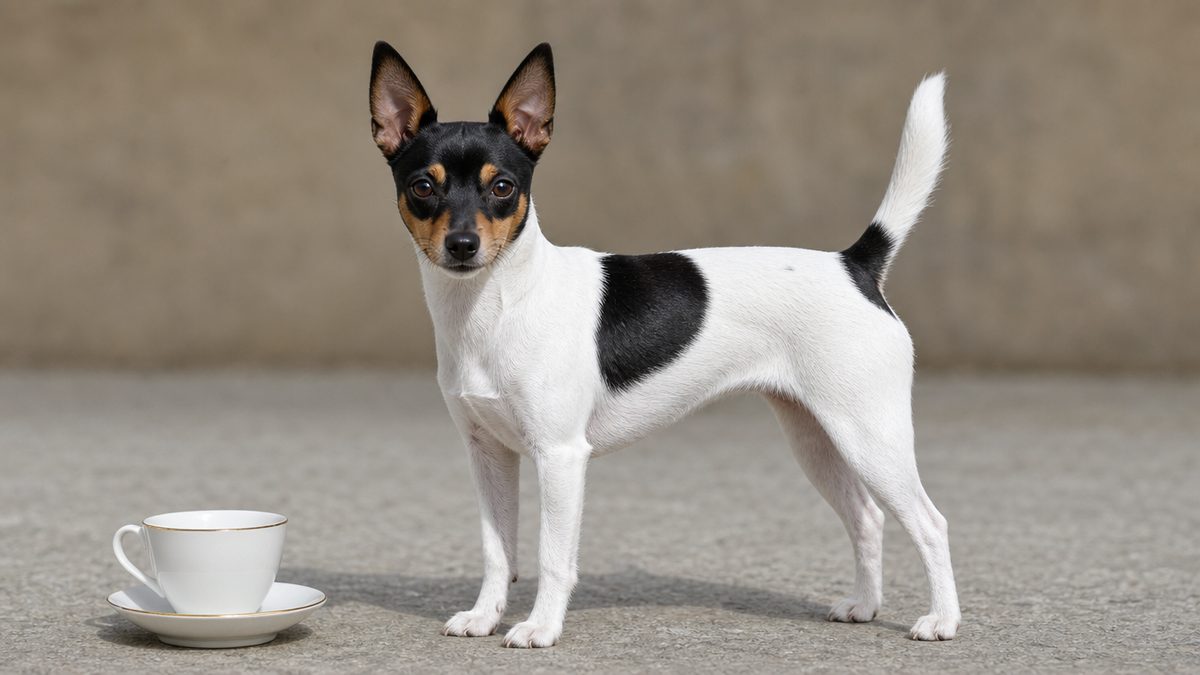
The Toy Fox Terrier is an American toy terrier bred down from the Smooth Fox Terrier, standing 8.5 to 11.5 inches at the withers and weighing roughly 4 to 9 pounds. It is a small, short-coated, predominantly white dog with erect V-shaped ears, and it holds two separate breed standards that do not agree with each other.
Start with the size, because that is where the two standards split. The American Kennel Club disqualifies any dog under 8.5 inches or over 11.5 inches and prefers 9 to 11. The United Kennel Club calls adult height under 8.5 inches or any height over 11 inches an eliminating fault. A Toy Fox Terrier measuring 11.25 inches is a perfectly showable dog under one standard and cannot be placed under the other, and no page ranking in India mentions it.
The weight disagreement is larger and stranger. The AKC standard gives no weight at all, only height and proportion, and says bone must be strong but not excessive and always in proportion to size. The UKC standard gives up to 8 pounds with 4.5 to 7.5 preferred. The AKC's own breed page then prints 4 to 9 pounds, which its own standard does not contain, and the ranking Indian-facing profile prints 3.5 to 7 pounds. Three numbers, one of them from a standard.
| Point | AKC standard, 2003 | UKC standard, revised 2024 |
|---|---|---|
| Height | 8.5 to 11.5 in, 9 to 11 preferred | 8.5 to 11 in |
| Out of size | Disqualification | Eliminating fault |
| Weight | Not stated anywhere | Up to 8 lb, 4.5 to 7.5 preferred |
| Group | Toy | Terrier |
| Tail | Docked to the third or fourth joint | Docked to about two fifths, one to three inches |
| Hind dewclaws | Should be removed if present | Removal optional but recommended |
| Ears | Erect; not erect after six months disqualifies | Erect; flop ears a serious fault, not erect after six months disqualifies |
The history, and the date that is actually documented
The breed was made by American farmers shrinking the Smooth Fox Terrier for rat work, and the United Kennel Club records the sequence with dates. UKC began registering the Smooth Fox Terrier in 1912, small dogs were bred down through the 1920s while still being registered as Fox Terrier (Smooth), and on 24 February 1936 UKC began registering the Toy Fox Terrier under its own name. The AKC did not recognise the breed until 2003, a 67-year gap between the two American registries.
The original English Fox Terrier standard of 1876 set the breed at 18 to 20 pounds, and the smallest dogs were called runts and prized for temperament rather than size. Crosses to the Chihuahua and the Manchester Terrier are credited with pulling the size down further and taking some of the edge off. That ancestry matters later, because it is why this breed shares an eye mutation with the Smooth Fox Terrier and a thyroid mutation with the Rat Terrier.
Four different small terriers get sold under overlapping names in India. The Toy Fox Terrier is American and predominantly white. The English Toy Terrier is British and black and tan only. The Miniature Fox Terrier is Australian. The Rat Terrier is a separate American breed that is usually larger. Check the colour and the country before you check the price.
Registry status, and why the FCI answer decides the Indian one
The Toy Fox Terrier is recognised by the American Kennel Club in the Toy Group and by the United Kennel Club in the Terrier Group, and it is not recognised by the Federation Cynologique Internationale at all United Kennel Club Federation Cynologique Internationale. That last fact is the one that governs what an Indian buyer can actually register.
Read FCI Group 3 in full and the absence is unambiguous. All four sections were pulled on 8 September 2026, and Section 4, Toy Terriers, holds exactly three breeds: the Australian Silky Terrier 236, the English Toy Terrier 13 and the Yorkshire Terrier 86. The only United States breed anywhere in Group 3 is the American Staffordshire Terrier 286. The letter-T index returned ten breeds on the same day and none of them was this one, though that index is recorded here as supporting rather than decisive evidence because it renders breed names in mixed languages between fetches.
The Indian consequence follows directly. The Kennel Club of India is the FCI's full member national canine organisation for India, which means it issues pedigrees against FCI nomenclature. A breed the FCI does not hold has no ordinary KCI pedigree route. Any Indian seller advertising a KCI-registered Toy Fox Terrier is making a claim you should ask to see in writing, because the KCI's own checklist for an imported dog requires the original export pedigree and the airway bill before an imported animal goes on the Indian register.
| Body | Status | Group it sits in |
|---|---|---|
| United Kennel Club | Recognised since 24 Feb 1936 | Terrier Group |
| American Kennel Club | Recognised 2003 | Toy Group |
| Canadian Kennel Club | Recognised | Toy Group |
| FCI | Not recognised | Absent from all four sections of Group 3 |
The group split is not a technicality, and OFA's own breed markup records it plainly. The Toy Fox Terrier's entry carries the code TFT and a groups field reading AKC Toy Group, CKC Toy Group, UKC Terrier Group. One dog, filed as a toy in two countries and as a terrier in the third, which tells you more about the temperament argument in this breed than any adjective does.
How popular it actually is where it is registered
The AKC's 2025 registration ranking puts the Toy Fox Terrier 106th of 202 breeds, one place above the Wire Fox Terrier at 107 and well below the Rat Terrier at 84. An earlier series from a breed directory tracks it at 116th in 2016 rising to 108th in 2022, so the breed is stable in the middle of the American pack rather than fading. Middle of the pack in the United States is still an intelligent, alert, uncommon dog almost nowhere else.
Toy Fox Terrier price in India, and why no figure survives checking
No verified Toy Fox Terrier price in India exists. The two figures a buyer will meet are Rs 59,200 from the largest Indian price table and a band of Rs 20,000 to Rs 50,000 from the page that ranks first for the query, and neither one is an observation of an Indian sale.
Take the ranking page first, because its own two numbers disagree. Its spec card gives cost of buying as Rs 20,000 to Rs 50,000, and four paragraphs later its prose says the puppy would likely be sold at a price between Rs 30,000 and Rs 40,000. The same page also concedes the reason, in writing: the breed is quite rare in India, there are few listings, and it is difficult to find exact prices in individual Indian cities. A page that says it cannot find prices and then prints two different ranges has told you what its numbers are worth.
| Source | Figure | What it actually is |
|---|---|---|
| Pet House NCR price table | Rs 59,200, range Rs 37,000 to Rs 1,11,000 | USD 800, 500 and 1,500 converted at 74.00 |
| HappyPet spec card | Rs 20,000 to Rs 50,000 | Contradicted by the same page's own prose |
| HappyPet prose | Rs 30,000 to Rs 40,000 | Stated on a page that says exact prices are unavailable |
| Dog Breeds List | USD 1,000 to 1,800 | An openly American figure, honestly labelled |
| Mr n Mrs Pet | No price shown | Announces 3 results, renders three French Bulldogs |
Divide by 74 and the Indian price becomes an American one
The Pet House table's Toy Fox Terrier row divides into round dollars with no remainder. Rs 59,200 divided by 74.00 is exactly 800. Rs 37,000 is exactly 500. Rs 1,11,000 is exactly 1,500. Those quotients are not just round, they are prices a real American breeder would print, and the band 500 to 1,500 sits inside the USD 1,000 to 1,800 that a US breed directory gives for the same dog.
Run the same test across that table's neighbours and the pattern holds. The Smooth Fox Terrier's Rs 66,600 is USD 900, the Wire Fox Terrier's Rs 1,33,200 is USD 1,800, the Rat Terrier's Rs 51,800 is USD 700 and the Manchester Terrier's Rs 1,18,400 is USD 1,600. The rows that refuse to divide are the Indian breeds. Rajapalayam at Rs 15,000 gives 202.70, Indian Spitz at Rs 15,000 gives the same, and the Caravan Hound gives 148.65. The same table prints the Caravan Hound's floor as Rs 8,ooo, with two letter o characters instead of zeros, which is a human typing rather than a script converting.
Do not walk into a negotiation carrying Rs 59,200 as a benchmark. It is a US dollar figure in rupee clothing, it describes an American market with hundreds of breeders and an active parent club, and there is no Indian supply for it to describe. If somebody quotes you that number, ask what Indian sale it is based on.
What the Indian search results are actually selling
The page that ranks for Toy Fox Terrier puppies for sale in India announced 3 Result Found on 8 September 2026 and rendered three French Bulldogs under a heading reading Similar breeds at other locations. Its meta description promises KCI-certified Toy Fox Terrier puppies. A separate directory generates one page per breed per city and produces titles such as Top Pet Shops For Toy Fox Terrier Dog in Guwahati, a page shape that exists identically for every breed and every city in India.
None of this is evidence that the breed is unobtainable in India. It is evidence that the pages ranking for the query have nothing to sell and generate a page anyway, which is a different and more useful finding. If you want one of these dogs in India, the honest route is a lawful personal import, and the next section explains why that is narrower than it sounds.
What a 4 kg Toy Fox Terrier actually costs per month in India
Budget roughly Rs 3,000 to Rs 6,000 a month for a Toy Fox Terrier in an Indian metro, built from named clinic and retail prices rather than from a template. The Rs 2,200 to Rs 3,750 figure printed by the ranking Indian page is a preset shared with unrelated breeds and should not be used as a plan.
Prove the preset first, because it changes how you read every Indian breed page. HappyPet's Toy Fox Terrier row gives monthly expenses of Rs 2,200 to Rs 3,750, made of food Rs 1,200 to Rs 1,800, healthcare Rs 300 to Rs 750 and grooming Rs 700 to Rs 1,200. Its Norfolk Terrier page, pulled in the same session, gives the identical four lines to the rupee, plus the same ideal weather band of 15 to 25 C. A Norfolk Terrier is a hand-stripped wire-coated English earth dog. A Toy Fox Terrier is a smooth-coated American toy. They cannot possibly share a grooming cost, and the totals sum exactly from the three component lines, which is what a preset table looks like.
| Line | Realistic monthly figure | Where it comes from |
|---|---|---|
| Food, small-breed dry | Rs 900 to Rs 1,400 | Royal Canin Mini Adult at Rs 94 per 100 g in a 2 kg bag |
| Vaccination, annualised | Rs 267 | Booster from Rs 3,199 a year, divided by 12 |
| Parasite control | Rs 300 to Rs 600 | Monthly tick, flea and worm cover for a dog under 5 kg |
| Grooming | Rs 0 to Rs 300 | A bath from Rs 934 at a Delhi clinic, needed a few times a year at most |
| Vet consultation, annualised | Rs 200 to Rs 500 | Two to four routine visits a year |
| Municipal registration | Rs 4 to Rs 42 | Rs 500 a year in Delhi, Rs 50 in Chennai Greater Chennai Corporation |
| Realistic total | Rs 3,000 to Rs 6,000 | Excludes boarding, insurance and illness |
The small-dog food trap that nobody prices correctly
A toy dog costs more per kilogram of food than a Labrador does, because you buy small bags. Royal Canin Mini Adult on 8 September 2026 was Rs 1,883 for 2 kg, Rs 3,388 for 4 kg and Rs 5,861 for 8 kg, which the retailer's own unit labels give as Rs 94, Rs 84 and Rs 73 per 100 grams. Buying the 2 kg bag costs 29 percent more per kilogram than the 8 kg bag. A 4 kg dog eating about 80 grams a day will not finish an 8 kg bag inside 100 days, so the practical answer is the 4 kg pack and a sealed container, not the cheapest unit price.
The rest of the budget is genuinely small, which makes this an affordable dog to keep even though it is not an affordable dog to buy. Grooming is close to free for this breed, because the coat is short, glossy and needs no clipping or stripping, so the Rs 1,359 haircut on a Delhi clinic's price list is a service you will never buy. That is a real advantage over almost every other small dog sold in India, and it is worth around Rs 800 a month against a Shih Tzu or a Lhasa Apso.
- Budget for the vaccination course, not the booster. A puppy course starts at Rs 6,499 against a Rs 8,111 list price at one national chain, spread across seven visits from day 30.
- Price the individual vaccines when you split them. Anti-rabies Rs 699, puppy DP Rs 849, nine-in-one DHPPiL Rs 899, canine corona Rs 899 and kennel cough Rs 1,349 at the same chain.
- Register the dog where registration exists. Delhi charges Rs 500 with a Rs 100 monthly late fee; Chennai charges Rs 50 and runs six municipal pet clinics that give treatment and anti-rabies vaccination free of cost.
- Reserve for the eye. Primary lens luxation is a surgical emergency and this breed's carrier rate is high, which the health section quantifies.
Vetic quotes different course prices on different city pages on the same day while its per-vaccine prices stay identical, so record which city page a figure came from. The national page gave Rs 6,499 and Rs 3,199 on 8 September 2026. Treat a course price as a promotional floor from one chain, not a market average.
Heat tolerance in India, measured against the breed's own homeland
The Toy Fox Terrier scores 2 of 5 for heat tolerance in Indian plains cities, and the cleanest way to show why is a single comparison. Chennai's coolest month averages 24.09 C. The hottest month at Kalamazoo, Michigan, where the United Kennel Club first registered this breed under its own name, averages 22.49 C United Kennel Club.
Every figure below comes from NASA POWER, queried by explicit latitude and longitude over the 2001 to 2020 window, with the cell elevation echoed and checked. The Kalamazoo cell reads 247.44 m against a real ground level near 230 m, and all the Indian cells sit within 90 m of the truth, so none of these is a mountain-cell artefact.
| Place | Annual mean C | Hottest month | Annual mean RH % | Peak wet bulb C |
|---|---|---|---|---|
| Kalamazoo, Michigan | 9.18 | July, 22.49 | 79.4 | 18.9 (Jul) |
| Delhi | 25.60 | June, 35.88 | 45.6 | 26.5 (Jul) |
| Kolkata | 25.81 | May, 31.53 | 73.9 | 27.1 (Jun) |
| Chennai | 27.95 | May, 31.51 | 72.4 | 26.1 (May) |
| Mumbai | 26.77 | May, 31.19 | 67.4 | 25.8 (Jun) |
| Pune | 23.86 | April, 28.93 | 66.8 | 23.0 (Jun) |
| Bengaluru | 23.74 | April, 28.37 | 67.9 | 21.9 (May) |
The humidity argument is the wrong argument
Indian humidity is not what threatens this dog, and the numbers say so plainly. Kalamazoo runs 79.4 percent annual relative humidity, higher than Chennai's 72.4, Mumbai's 67.4, Bengaluru's 67.9, Pune's 66.8 and Delhi's 45.6. The American Midwest is a damp place. What India adds is not moisture, it is about 18 degrees of heat on top of that moisture, and heat combined with humidity is what raises wet-bulb load.
So frame the risk as heat, and specifically as exertional heat. The largest study of heat-related illness in dogs found 652 of the 879 events with a recorded trigger, 74.2 percent, were exertional, against 113 environmental and 46 from vehicular confinement, in a cohort of 905,543 UK dogs. Dogs are not mainly dying in hot cars. They are collapsing because somebody walked or played with them in the heat. A terrier that will chase a ball until it drops is exactly the temperament that study describes.
- Walk before 7 am and after 7 pm from March to October in Chennai, Mumbai, Kolkata, Hyderabad and Ahmedabad, and from April to September in Delhi.
- Check the pavement with the back of your hand. A 25 cm dog carries its whole body in the layer of air closest to hot concrete.
- Cool the neck, groin and paws with room-temperature water, never ice, if the dog is panting hard and will not settle.
- Treat April as the peak in Bengaluru and Pune, which is not May, and June as the peak in Delhi, which is also not May.
Bengaluru and Pune are the two Indian metros where a Toy Fox Terrier is a reasonable choice rather than a compromise. Both peak in April at under 29 C, both sit above 630 m, and both have peak wet-bulb loads of 21.9 and 23.0 C against Kolkata's 27.1. Combine that with the fact that this is a genuinely apartment-scaled dog and the case in those two cities is real.
Indian law reaches this directly, which is unusual. The Dog Breeding and Marketing Rules 2017, Second Schedule Part IV paragraph 21(1), bar keeping in outdoor housing facilities, without the attending veterinary practitioner's written approval, dogs not accustomed to local temperatures and breeds that cannot tolerate them. A single-coated 4 kg American toy terrier in a Chennai courtyard in May is the case that clause describes.
Temperament, and the household this dog is wrong for
The Toy Fox Terrier is an alert, intelligent, playful, energetic small dog that is loyal to one or two people and does not warm to strangers quickly. The AKC standard calls it self-possessed, spirited, determined and not easily intimidated, and says any individual lacking good terrier attitude is to be faulted.
Read that standard sentence carefully, because it is doing real work. The breed standard requires terrier attitude and penalises its absence. That is not marketing copy, it is a judging instruction, and it tells you that a soft, biddable, unreactive Toy Fox Terrier is a dog that would lose in the ring. Buyers who want a calm lap dog and read only the word toy are reading the wrong half of the name.
What the four questions Google gets asked reveal
Google's People also ask box for this breed on 8 September 2026 carried four questions, all of them on-breed: whether Toy Fox Terriers make good pets, whether they bark a lot, what the lifespan is, and whether they like to cuddle. Two of those four are about noise and affection, which is exactly the tension in the breed. It plays hard, it announces every visitor, and then it wants to be under a blanket on your lap. Owners who only expected the second half find the first half difficult.
- Suits a working adult in an apartment who is home mornings and evenings and wants a dog that is genuinely portable.
- Suits a household with older children who have been shown how to lift and put down a 4 kg dog.
- Suits a first-time owner who accepts that training is the price of a quiet flat.
- Does not suit a home with a toddler, because the dog is fragile and quick to react to rough handling.
- Does not suit a household with hamsters, rabbits or small birds, because prey drive in a ratting terrier is not a training problem.
- Does not suit an owner who is out twelve hours a day, because a bored terrier finds a project and you will not like it.
The prey drive point deserves a specific Indian warning. This is a breed made to kill rats on American farms, and it kept the reflex. In an Indian apartment building with open stairwells, service ducts and street cats, a Toy Fox Terrier off lead is a dog that will chase something into traffic. Use a harness and a lead in every shared space, and treat a balcony without a full grille as an open door.
Toy Fox Terriers bark more than most toy breeds, and one ranking Indian page rates barking as only occasional while the same page's standard-derived description calls the dog alert and fearless. Believe the standard. What training changes is duration, not the first bark. If your building has thin walls and an unforgiving neighbour, budget real time for a settle cue in the first six months.
Training a Toy Fox Terrier, and the two things it resists
To train a Toy Fox Terrier, keep sessions to five minutes, pay well and stop while the dog still wants more. The breed learns quickly and is described in both standards as eager and adaptable United Kennel Club, and it resists two specific things: repetition and correction.
Repetition first. A terrier that has understood a cue after four repetitions will disengage on the eighth, and the disengagement looks like stubbornness rather than boredom. Three short sessions of four minutes beat one session of fifteen, and the difference is visible within a fortnight. The Indian practical version of that rule is to train indoors during the day and use the cool early morning walk for the recall work that needs space.
Correction is the second. This is a small, reactive, self-possessed dog, and a harsh correction produces either shutdown or escalation, neither of which is training. Positive reinforcement with a high-value food reward is what every source describes working, and one ranking page rates the breed 5 stars for trainability on exactly that basis.
The four things to teach first, in order
- Settle on a mat, because it is the antidote to the barking problem and it takes six weeks.
- Recall to a whistle, because a terrier that has locked onto a cat will not hear its name.
- Handling tolerance, because you will need to check a 4 kg dog's knees, eyes and teeth for fifteen years.
- Crate comfort, because an Indian flight, a vet stay and a power cut all go better with it.
Socialise the puppy deliberately between eight and sixteen weeks, and socialise it to Indian noise specifically. A Toy Fox Terrier raised without exposure to horns, firecrackers, construction and building watchmen becomes a dog that barks at all four. Take the puppy out in a carrier before its vaccination course finishes so it sees the street without standing on it, then progress to short lead walks once the vet clears it.
House training in an Indian monsoon needs its own plan. A 4 kg dog will refuse to squat on wet concrete, so set up an indoor tray or a covered balcony patch in June rather than in September. Feed on a fixed schedule, take the dog out fifteen minutes after each meal, and reward outside rather than punishing inside.
Trick training. The Toy Fox Terrier's combination of intelligence, speed and showing off made it a circus dog historically, and the AKC standard describes a dog that learns new tasks quickly and adapts to almost any situation. If you want a small dog that will genuinely enjoy fifteen minutes of shaping every evening, this is one of the better choices available.
Daily exercise, and what happens without it
A Toy Fox Terrier needs 30 to 60 minutes of real activity a day, split into two sessions and kept out of the Indian afternoon. Without it the breed does not become calm, it becomes noisy, destructive and difficult to live with in an apartment.
Split the requirement into three parts rather than treating it as one walk. Twenty minutes of lead walking, ten minutes of chase or fetch indoors, and ten minutes of scent or puzzle work covers a normal day for an adult. The scent work matters more than the distance for a ratting terrier, and it is the part Indian owners skip.
| Season | Morning | Evening | Indoors |
|---|---|---|---|
| Cool months, Nov to Feb | 25 min walk from 7 am | 25 min walk plus play | 10 min puzzle |
| Hot months, Mar to Jun | 20 min walk before 6.30 am | 20 min walk after 7.30 pm | 20 min play and scent work |
| Monsoon, Jul to Sep | 15 min walk between showers | 15 min walk | 30 min indoor games |
Do not substitute a longer walk for the missing mental work. A terrier that has walked five kilometres and solved nothing is a fit dog with the same unspent brain, and the fitness makes the next day harder. Puzzle feeders, a snuffle mat and a five-minute shaping session do more for apartment peace than an extra kilometre.
Watch the joints while you do it. This is a small dog with a documented patella problem, and repeated hard landings from furniture are a genuine risk. Put a ramp or a step at the sofa and the bed, keep the flooring non-slip where the dog turns at speed, and stop fetch on tile.
Exertional heat illness accounted for 652 of the 879 triggered events in the largest study available, against 46 from vehicular confinement. In practice that means the danger is the game you are enjoying, not the car you left. Stop when the tongue widens and spatulates, when the dog seeks shade unprompted, or when it lies down mid-game. Any dog that stays distressed after ten minutes in the shade with water needs a vet the same hour.
Grooming in Indian humidity, which is the easiest job on this page
Grooming a Toy Fox Terrier takes about five minutes a week. The coat is short, satiny, fine in texture and smooth to the touch, slightly longer only at the ruff, and it needs no clipping, no stripping and no professional appointment.
Run a rubber curry or a soft bristle brush over the dog once or twice a week and that is the coat handled. Bathe when the dog is genuinely dirty, which in an Indian city means roughly every four to six weeks in the dry season and more often through the monsoon. Use a mild dog shampoo, rinse completely, and dry the ears with a soft cloth every single time, because an erect-eared dog still gets water into the canal.
- Brush twice a week with a rubber curry to lift the loose hair a short coat still sheds.
- Bathe every four to six weeks, or after any monsoon walk that leaves the dog muddy.
- Dry the ear canal after every bath and every soaking, using a cloth rather than a cotton bud.
- Trim nails every three weeks, because a 4 kg dog on tiled floors wears them down slowly.
- Brush teeth three times a week, because small dogs accumulate calculus faster than large ones.
- Check the skin in the monsoon for the hot, itchy patches that Indian humidity produces on any short coat.
The two Indian problems a short coat does have
Sunburn is the first, and it is real on a predominantly white dog. The standard requires a body that is over fifty percent white, which means thin, lightly pigmented skin across the back and flanks. On a north-facing Indian terrace at midday that is a genuine burn risk. Keep the dog off open roof space between 10 am and 4 pm, and speak to your nearby vet before applying any sunscreen, because several human formulations contain zinc oxide, which is toxic to dogs if licked.
Ear infection is the second, and it is where overseas grooming advice fails in India. Guidance written for a temperate climate routinely says to towel a dog and let it air dry. In an Indian monsoon that leaves a warm, damp canal for days. Dry the ears actively, every time, and treat any head shaking, odour or brown discharge as a reason to see a vet rather than to buy an over-the-counter drop.
A Delhi clinic chain prices a dog haircut from Rs 1,359 and a complete bath and styling from Rs 1,869. A Toy Fox Terrier needs neither. Over a fifteen-year life at one professional groom every six weeks, that is well over Rs 1,50,000 you will not spend, which is the single strongest practical argument for this breed over the small long-coated dogs that dominate Indian toy-dog sales.
Health risks, with the screening numbers no Indian page carries
The Toy Fox Terrier's two measured health issues are patellar luxation, at 5.5 percent abnormal across 346 OFA evaluations, and a high carrier rate for primary lens luxation, at 28.2 percent across 710 DNA tests. Not one page ranking in India for this breed prints a single screening figure, and the health issues its pages do list are infectious diseases every dog can catch.
Take the knee first, because it is the one an owner will meet. OFA's patella table ranks the Toy Fox Terrier 31st worst of the breeds it holds, at 94.5 percent normal and 5.5 percent abnormal across 346 evaluations, split into Grade 1 at 4.0 percent, Grade 2 at 0.9 percent and Grade 3 at 0.6 percent. The all-breeds figure on the same table is 3.5 percent abnormal across 226,087 evaluations, so this breed runs above average but nowhere near the worst.
| Test | Evaluations | Result | All-breeds comparison |
|---|---|---|---|
| Patella | 346 | 5.5% abnormal | 3.5% abnormal |
| Eyes, summary | 97 | 91.8% normal, 8.2% abnormal | 93.4% normal |
| Primary lens luxation, DNA | 710 | 28.2% carriers, 0.8% at risk | 27.9% carriers |
| Spinocerebellar ataxia, DNA | 266 | 21.1% carriers, 1.1% at risk | 15.1% carriers |
| Congenital hypothyroidism with goiter, DNA | 51 | 3.9% carriers, none affected | 0.9% carriers |
| Congenital cardiac | 66 | 100% normal | 98.9% normal |
| Hips | No published row | Below OFA's 100-evaluation threshold | 84.3% normal |
| Elbows | No published row | Below OFA's threshold | 87.8% normal |
Two of those rows are absences and they should be read as absences rather than as clean bills. OFA publishes a breed's hip and elbow statistics only once it holds 100 evaluations, so no row means nobody has submitted enough radiographs, not that no dog has ever been dysplastic. Say that to a breeder who tells you the breed has no hip problem.
OFA's eye tables contradict themselves, and here is the arithmetic
The eye summary says 91.8 percent of 97 examinations were normal. The detail rows on the same registry, on a denominator of 97, record a normal finding in only 67 examinations, which is 69.1 percent. That is a gap of 22.7 points, and it is not rounding.
The explanation is visible in the detail rows themselves. Persistent pupillary membranes running iris to iris were recorded in 10 of 97 examinations, 10.3 percent, and eleven more diagnoses appear once or twice each. A single dog can carry several findings, and several findings are minor enough that the eye still certifies. So the summary counts certificates and the detail counts diagnoses, and neither is the whole truth. Quote both, never one as the rate, and ask a breeder for the actual examination report rather than a percentage.
What the general literature does and does not say about this breed
The largest study of patellar luxation in general practice covered 210,824 dogs at 119 English clinics and put overall prevalence at 1.30 percent, with a 95 percent confidence interval of 1.21 to 1.39. Of 751 incident cases, 293 received medical management, 99 had surgery and 28 were referred. The Toy Fox Terrier is not among the eleven breeds that study names as predisposed, which include the Pomeranian at odds ratio 6.5 and the Chihuahua at 5.9, so no odds ratio from that paper belongs on this page.
One finding from it does transfer, and it is directly actionable. Dogs whose bodyweight sat below the mean for their breed and sex carried 1.4 times the odds of a patellar luxation diagnosis. The Indian market rewards the smallest puppy in the litter and the word teacup carries a premium. That preference is pushing buyers toward exactly the body type the evidence flags.
A Toy Fox Terrier that skips on a hind leg for a few strides and then runs normally is showing the classic sign of an intermittently luxating patella, and it is easy to dismiss because the dog seems fine. A cloudy, painful or suddenly hazy eye in this breed is different: primary lens luxation is a surgical emergency and delay costs the eye. Take either sign to a veterinarian the same day rather than watching it for a week.
The three inherited mutations this breed actually carries
Three specific mutations are documented in the Toy Fox Terrier by name, and all three have DNA tests. They are a thyroid peroxidase mutation causing congenital hypothyroidism with goiter, a KCNJ10 mutation causing spinocerebellar ataxia, and the ADAMTS17-associated primary lens luxation allele that OFA tests for Rohdin C, Gilliam D, O'Leary CA Orthopedic Foundation for Animals.
Congenital hypothyroidism with goiter, which was described in this breed
This one was first characterised in Toy Fox Terriers, which is unusual for a breed of this size. A 2003 paper in the Journal of Veterinary Internal Medicine reported it segregating as a simple autosomal recessive trait, with affected newborn puppies showing inactivity, abnormal hair coat, stenotic ear canals and delayed eye opening, and palpable swellings on the underside of the neck by one week of age. Serum thyroid hormone was low and thyroid-stimulating hormone was high. Oral thyroid hormone replacement restored near-normal growth and development.
The mechanism was worked out in the same paper and it matters for the test. Radioiodine uptake and perchlorate discharge testing at eight weeks showed an iodine organification defect, biochemical analysis showed an enzymatic iodine oxidation deficiency, a nonsense mutation in the thyroid peroxidase gene was found and shown to segregate with the disease, and a DNA carrier test was developed and is used by breeders. OFA's own table records 51 Toy Fox Terriers tested, 3.9 percent carriers and no affected animals, which is what a working carrier test looks like after two decades of use.
A 2007 veterinary pathology study found the identical thyroid peroxidase nonsense mutation in Rat Terrier puppies, with three of five affected at nine weeks, CNS hypomyelination at necropsy and simple autosomal recessive inheritance confirmed from the dam and a normal littermate. Its authors wrote that, given the ongoing practice of introducing Toy Fox Terrier stock into some Rat Terrier breeding programmes to obtain a smaller stature, the mutation had probably crossed into the Rat Terrier from Toy Fox Terriers fairly recently. Two breeds, one mutation, and a documented direction of travel.
Spinocerebellar ataxia, shared with the Smooth Fox Terrier
A 2015 study in Acta Veterinaria Scandinavica tested whether Smooth-Haired Fox Terriers with hereditary ataxia carried either of the two mutations already known in the Russell group of terriers. Three Smooth-Haired Fox Terriers with hereditary ataxia and two Toy Fox Terriers with a similar phenotype were all homozygous for the KCNJ10 mutation. The same mutation turned up heterozygous in five clinically unaffected Tenterfield Terriers and, as earlier work had shown, in Jack Russell, Parson Russell and Russell Terriers.
The authors concluded that a KCNJ10 mutation previously associated with an autosomal recessive spinocerebellar ataxia segregates in at least three more breeds descended from British hunting terriers. OFA's spinocerebellar ataxia table then gives the population picture: 266 Toy Fox Terriers tested, 77.8 percent normal, 21.1 percent carriers and 1.1 percent at risk, ranking the breed fourth in that table. One dog in five is a carrier.
Primary lens luxation, the one that costs an eye
Primary lens luxation is the highest-frequency finding in this breed and the one with the shortest fuse. OFA holds 710 Toy Fox Terrier tests: 71.0 percent normal, 28.2 percent carriers and 0.8 percent at risk. The all-breeds figure is 27.9 percent carriers, so the breed is not an outlier against the tested population, but that tested population is dominated by terriers precisely because terriers carry it.
What makes it urgent is the clinical course rather than the frequency. The lens detaches from its suspensory fibres and moves, which raises pressure inside the eye and causes pain and vision loss quickly. A carrier is not at risk and does not need treatment. Two carriers bred together produce at-risk puppies, which is why the test result on both parents is the only number that matters when you are choosing a litter.
- Ask for the sire's and the dam's DNA results, not the puppy's, for primary lens luxation and for congenital hypothyroidism with goiter.
- Ask for a patella evaluation on both parents, because 5.5 percent of tested Toy Fox Terriers are abnormal.
- Ask for a recent eye examination report, the document rather than a summary percentage.
- Ask what the breeder does with carriers, because breeding carrier to clear is legitimate and breeding carrier to carrier is not.
Lifespan, and the study row that is not quite this breed
The only research figure for the Toy Fox Terrier gives a median survival of 12.9 years, with a 95 percent confidence interval of 12.3 to 13.8, from 52 recorded deaths and a hazard ratio of 0.83 against crossbred dogs, which does not reach statistical significance at p 0.17. Breed sources give 13 to 15 years. The research figure carries a complication that no other page reports.
| Source | Figure | Evidence behind it |
|---|---|---|
| McMillan et al. 2024, Toy Fox Terrier row | Median 12.9 years, 95% CI 12.3 to 13.8 | Kaplan-Meier estimate from 52 recorded deaths in 163 dogs |
| American Kennel Club | 13 to 15 years | A breed-page range, no study cited |
| HappyPet | 13 to 15 years | No study cited |
| Dog Breeds List | 13 to 14 years | No study cited |
The paper is not consistent with itself about which dogs are in this row
McMillan and colleagues analysed 155 recognised purebred breeds against a crossbred group, and Supplementary Table S5 records for each analysed breed which registry breeds were folded into it. The Toy Fox Terrier row in S5 is flagged for inclusion and its phylogeny reclassification column reads English Toy Terrier, with abbreviation TYFX, Kennel Club group Toy, FCI group Terriers, size Small and skull shape Mesocephalic. So the 12.9-year figure is a merged row covering more than one registry breed, and the dogs in it are drawn from a UK veterinary population where the English Toy Terrier is the commoner of the two.
Toy Manchester Terrier is a separate row in the same table, flagged for inclusion, abbreviation MNTY, Kennel Club group Terrier, Dolichocephalic, and its reclassification column reads NA. Its S3 figures are a median of 13.0 years, 95 percent CI 12.0 to 13.6, from 138 deaths in 339 dogs, hazard ratio 0.86 with a CI of 0.73 to 1.02 at p 0.08.
Bonbeno prints both rows and names the problem rather than choosing. The paper's reclassification column maps the English Toy Terrier onto the Toy Fox Terrier row, and ordinary breed taxonomy does not. The Toy Fox Terrier is American, predominantly white, and made from the Smooth Fox Terrier; the English Toy Terrier is British and black and tan; the Toy Manchester Terrier is the American name for the English Toy Terrier's own family. Three names, two rows, and a mapping that does not correspond to how any registry files these dogs. Our English Toy Terrier page prints the same two rows for the same reason.
| S5 row | Reclassification column | Median | Deaths | Hazard ratio |
|---|---|---|---|---|
| Toy Fox Terrier (TYFX) | English Toy Terrier | 12.9 yrs (12.3 to 13.8) | 52 | 0.83 (0.63, 1.09), p 0.17 |
| Toy Manchester Terrier (MNTY) | NA | 13.0 yrs (12.0 to 13.6) | 138 | 0.86 (0.73, 1.02), p 0.08 |
The practical answer barely moves, which is worth saying plainly. Both rows land within a tenth of a year of each other, and neither hazard ratio clears significance, so the honest reading is that a dog of this type lives about as long as a crossbred dog and probably slightly longer, against a crossbred median of 12.0 years in the same table. What should not happen is a page quoting one figure as though it were a clean measurement of this breed alone.
Its supplementary tables S3 and S6 disagree on how many dogs each breed contributed while agreeing exactly on the death count, so every sentence here is built on deaths and the median rather than on N. And the paper carries an Author Correction that changes one Miniature Dachshund value in a figure legend and touches no supplementary table, so reading S3 directly avoids it either way.
Feeding a 4 kg dog in India, and the two ways owners get it wrong
Feed a Toy Fox Terrier measured portions twice a day to a visible waist, because on a 4 kg frame a 400 gram gain is a tenth of the whole dog. The ranking Indian page gives an adult requirement of about 450 kcal a day and 600 kcal for a growing puppy, which for a quality small-breed dry food works out near 80 to 110 grams daily.
Weigh the food rather than scooping it. A kitchen scale costs less than one bag of kibble and it is the single most effective thing an owner of a toy breed can buy, because the difference between 80 and 110 grams is invisible in a bowl and is 37 percent more calories. Split the daily amount into two meals for an adult and three or four for a puppy under six months, since small dogs are prone to low blood sugar when meals are far apart.
| Stage | Meals per day | Approximate daily food | Focus |
|---|---|---|---|
| 8 to 16 weeks | 4 | Puppy formula, fed to the pack chart | Never let the stomach empty for long |
| 4 to 8 months | 3 | Puppy formula, adjusted every fortnight | Growth without a round belly |
| 8 to 12 months | 2 | Transition to adult over ten days | Body condition, not the number on the bag |
| Adult | 2 | About 80 to 110 g of small-breed dry food | A visible waist from above |
| Senior, 9 years and over | 2 | The same amount, lower calorie density | Muscle and teeth |
Mistake one, buying the cheapest unit price
Small bags cost more per kilogram and large bags go stale. Royal Canin Mini Adult on 8 September 2026 ran at Rs 94 per 100 g in a 2 kg bag, Rs 84 in a 4 kg bag and Rs 73 in an 8 kg bag on the retailer's own unit labels. That looks like an argument for the 8 kg bag until you divide: a 4 kg dog eating 90 grams a day takes 89 days to finish it, and a dry food opened in a Mumbai July is not the same food in October. The 4 kg pack plus an airtight container is the right answer for this breed, and it costs about Rs 15 more a month than the biggest bag.
Mistake two, treats that are a quarter of the diet
A 450 kcal daily allowance is very small, and Indian training treats are not sized for it. Two biscuits and a piece of chicken can be 120 kcal, which is 27 percent of the day's food. Take training treats out of the measured ration rather than adding them, use the kibble itself for most repetitions, and keep human food out entirely. The list of foods to avoid is the ordinary one and it applies with more force at this body weight, because the toxic dose of chocolate, grapes, onion or xylitol scales with the dog.
A 4 kg dog dehydrates fast. Keep two bowls in different rooms during the hot months, refill them twice a day rather than topping up, and add water to the evening meal from March to June. Consult your nearby vet if the dog goes off food for more than one meal in the heat, because inappetence in a toy breed in an Indian summer is a symptom rather than a preference.
Month by month through the first year in India
Plan a Toy Fox Terrier puppy's first year around three fixed points: the vaccination course from about day 30 to day 120, the socialisation window that closes near sixteen weeks, and the first Indian summer. Everything else is negotiable and those three are not.
| Age | What happens | Indian cost or note |
|---|---|---|
| 8 weeks | The earliest lawful age to take a puppy home | Rule 8(1)(a) of the 2017 Rules bars sale below eight weeks |
| 8 to 12 weeks | Vaccinate on schedule while socialisation begins in a carrier | Course from Rs 6,499 across seven visits |
| 12 to 16 weeks | Street walks begin once the vet clears them, settle training starts | Anti-rabies Rs 699, kennel cough Rs 1,349 |
| 4 to 6 months | Adult teeth erupt, retained puppy teeth get checked | A retained canine at one year is a UKC fault and a real problem |
| 6 months | Ears must be fully erect or both standards disqualify | Nothing to do about it; it is a conformation point, not a health one |
| 6 to 9 months | Growth slows, recall and lead manners consolidate | Municipal registration due in Delhi and Chennai Greater Chennai Corporation |
| 9 to 12 months | Transition to adult food, first patella check | Ask the vet to grade both knees at the annual visit |
| 12 months | Annual booster, first adult body-condition baseline | Booster from Rs 3,199 |
The first summer decides how the dog handles heat for life
Time the arrival if you can. A puppy that reaches an Indian metro in October has five cool months to acclimatise before its first March, and one that arrives in April has none. If the timing is out of your hands, keep the first summer's outdoor work to two short sessions at the coolest ends of the day and do the rest indoors. Heat exposure is not conditioning at this size.
Watch the knees through the growth phase specifically. Skipping on a hind leg, sitting with one leg out to the side, or a reluctance to jump up are the signs worth reporting. Put a ramp at the sofa before the puppy learns to jump off it, because habit forms faster than the joint does.
- Book the vaccination course as a package rather than visit by visit, because one chain prices the course from Rs 6,499 against Rs 8,111 of components.
- Carry the puppy through the market before it is cleared to walk there, so the noise becomes normal without the disease risk.
- Teach a settle on a mat by twelve weeks, because retrofitting it at ten months is four times the work.
- Photograph the dog from above every month to build your own body-condition record, which matters more than a weight on a toy breed.
How the Toy Fox Terrier compares against the terriers Indian buyers cross-shop
Set the Toy Fox Terrier beside the five terriers it gets confused with and one difference dominates: it is the smallest, the cheapest to groom, and the one with the highest patella risk. Every figure below was read from the same OFA tables and the same Indian price table in one session Pet House NCR, Dog Price List In India.
| Breed | AKC rank 2025 | OFA patella abnormal | OFA hips dysplastic | Indian list price |
|---|---|---|---|---|
| Toy Fox Terrier | 106 | 5.5% of 346 | No row | Rs 59,200 |
| Rat Terrier | 84 | 3.2% of 1,817 | 3.4% of 999 | Rs 51,800 |
| Smooth Fox Terrier | 144 | 1.4% of 625 | 13.7% of 722 | Rs 66,600 |
| Wire Fox Terrier | 107 | 0.8% of 120 | No row | Rs 1,33,200 |
| Manchester Terrier | 131 | 1.0% of 299 | 1.6% of 186 | Rs 1,18,400 |
| Teddy Roosevelt Terrier | Not ranked, FSS | 0.0% of 238 | No row | No row |
Read the patella column against the hips column and the picture inverts. The Toy Fox Terrier has the worst knee record and no hip record; the Smooth Fox Terrier has an excellent knee record and a hip dysplasia rate of 13.7 percent, which is worse than the Labrador Retriever's 11.3 percent on 324,905 evaluations. Size does not predict which joint fails. A buyer choosing between the two on the assumption that the smaller dog has the smaller orthopaedic problem is choosing backwards.
Against the Rat Terrier, which is the closest real alternative
The Rat Terrier is the sensible comparison and it wins on availability. It ranks 84th in the AKC's 2025 registrations against this breed's 106th, it has a far deeper OFA record with 1,817 patella evaluations against 346, and it carries a lower patella abnormal rate at 3.2 percent. It is also a bigger dog, which in Indian heat is a disadvantage rather than an advantage, and it carries the same two eye and thyroid problems for the documented reason that Toy Fox Terrier stock was bred into it.
Against an Indian street dog, which is the comparison nobody makes
An Indie of similar size costs nothing to acquire, is already adapted to the climate, and carries no breed-specific mutation panel at all. What it does not give you is predictability, and that is the whole of the argument for a purebred. If a buyer's real requirement is a small, short-coated, low-grooming, apartment-scaled dog for an Indian city, a young Indie meets it on every count except the pedigree, at a fraction of the cost and with a better heat record. That is a fair thing for an encyclopedia to say and most breed pages will not say it.
Choose the Toy Fox Terrier if you want the smallest, cleanest, cheapest-to-groom terrier available and you are in Bengaluru or Pune, and you accept a knee risk above the all-breeds average and a supply problem that has no lawful commercial solution in India. Choose almost anything else if your priority is finding one this year.
What Indian law says about this breed's own standard
Both Toy Fox Terrier breed standards describe a dog that cannot lawfully be produced in India. The AKC standard says the tail is docked to the third or fourth joint and that hind dewclaws should be removed; the UKC standard specifies a docked tail of about two fifths, one to three inches. India's Dog Breeding and Marketing Rules 2017 forbid both procedures outright.
The clause is short and it is not ambiguous. Second Schedule Part II paragraph 6(8) reads that there shall be no tail docking, ear cropping, de-barking, de-clawing, branding, dyeing, injecting substances to enhance visual appeal, performing a surgery or procedure to camouflage or hide any defect or infirmity or any other kind of mutilation of any body part of the pup, and that any change of appearance by artificial means is strictly forbidden. Note that it is a Second Schedule paragraph rather than a Rule; the Rules themselves run 1 to 13 and there is no Rule 21 or Rule 6(8).
| Point | Breed standard | Indian law | Verdict |
|---|---|---|---|
| Tail docking | Required by both standards | Forbidden, Second Schedule Part II para 6(8) | Collision |
| Hind dewclaw removal | AKC says should be removed | De-clawing forbidden, same clause | Collision |
| Ear cropping | Not used; ears are naturally erect | Forbidden, same clause | No conflict |
| Undershot or wry mouth | Disqualified by the AKC standard | Named as a defect to test for, Part III para 8(10) | Aligned |
| Close breeding | Not addressed | In-breeding within four generations and incest breeding prohibited, para 6(3) | Law is stricter |
| Patellar luxation | Not addressed | Not mentioned anywhere in the Rules | Neither covers it |
The last row is the one worth dwelling on. The words patella, patellar and luxation appear zero times in the whole gazette, and so do BAER and deaf. The mandatory genetic-defect testing clause, Second Schedule Part III paragraph 8(10), names hip dysplasia, progressive retinal atrophy, night blindness, hypothyroidism, entropion, ectropion, overshot and undershot jaw, wry mouth, two or more missing teeth and cryptorchidism, and its list opens with the word including, so it is illustrative rather than closed. The two conditions that actually matter in this breed, the knee and the lens, are the two Indian law does not name. Do not let a breeder tell you a legal test list covers them.
What a lawful Toy Fox Terrier in India would look like
It would carry a natural, undocked tail and its hind dewclaws if it had them, which means it could not be shown to either American standard as written. That is not a reason to avoid the breed. It is a reason to insist on a natural tail and to be suspicious of any Indian puppy that arrives with a docked one, because a docked tail on an Indian-bred puppy is direct evidence that paragraph 6(8) was broken.
The import route, and why it is narrow
Live dogs are a Restricted import into India under ITC(HS) 01061900. DGFT Trade Notice 22/2022-23 permits entry only for a pet accompanied by a valid pet book in the importer's name, for research with a CPCSEA recommendation, or for Defence and Police use, and states that applications for trading or breeding purposes shall be duly rejected. So there is no lawful commercial route by which Toy Fox Terriers could arrive in India in saleable numbers.
Combine the DGFT restriction with the FCI absence and there is no ordinary lawful pipeline for this breed into India. The Kennel Club of India's own checklist for registering an imported dog requires the original export pedigree and the airway bill. A seller who cannot produce those documents has not imported anything, which means the small white terrier in front of you is probably something else.
Seven mistakes Indian Toy Fox Terrier owners actually make
The seven mistakes below all come from the specific gap between what Indian pages publish about this breed and what the primary sources say. Each one is cheap to avoid and expensive to fix.
- Treating Rs 59,200 as a market price. It is USD 800 converted at 74.00, and the same table's Indian breeds refuse to divide at any rate.
- Budgeting Rs 2,200 a month from a spec card. That figure is a preset shared to the rupee with the Norfolk Terrier, a hand-stripped wire-coated breed with a completely different grooming cost.
- Buying the smallest puppy in the litter. Dogs below the mean bodyweight for their breed and sex carried 1.4 times the odds of a patellar luxation diagnosis across 210,824 dogs.
- Accepting a docked tail. Docking is forbidden in India under Second Schedule Part II paragraph 6(8), so a docked Indian-bred puppy is evidence of a breach.
- Skipping the parents' DNA results. 28.2 percent of tested Toy Fox Terriers carry the primary lens luxation allele and 21.1 percent carry the ataxia allele.
- Walking the dog at 5 pm in May. Exertional heat illness accounted for 652 of 879 triggered events in the largest study available, far more than heat left in a car.
- Letting the ears stay damp after a monsoon bath. Advice written for a temperate climate says to let a dog air dry; in Indian humidity that leaves a warm wet canal for days.
The mistake behind the other six
Every one of those errors starts with the same habit, which is reading an Indian breed page as though it were reporting on this breed. The page ranking first for the query concedes in its own prose that exact Indian prices are unavailable and prints two different ranges anyway. Its health section lists canine distemper, kennel cough and parvovirus, which are infectious diseases every dog can get, and names none of the three inherited mutations documented in this breed by name in the veterinary literature Rohdin C, Gilliam D, O'Leary CA.
The control that proves the point took one extra page load. Pull an unrelated breed from the same site and compare the cost lines to the rupee. If they match, the number is a template constant rather than an observation, and you have just learned more about the page than about the dog.
You cannot get the grooming wrong. A short satiny coat that needs no clipping and no stripping is close to error-proof, and it is the reason this breed suits a first-time Indian owner better than the long-coated toys that dominate the market. Weekly brushing, an occasional bath, and dry the ears. That is all of it.
Adoption and responsible sourcing, in that order
Adopt first, because the Toy Fox Terrier has no lawful commercial supply chain into India and the alternatives are genuinely good. If you go on to buy, buy from a breeder who will hand you four documents before you meet a puppy.
The realistic Indian adoption routes
- A small Indie from a city shelter, which is the closest thing to this breed's actual working profile: small, short-coated, alert, and already adapted to the heat.
- A surrendered small terrier or terrier cross, which turns up regularly in Indian rescue because people underestimate terrier energy.
- A retired or rehomed imported dog, which is rare and is the only realistic way an actual Toy Fox Terrier reaches an Indian home without a purchase.
- A Miniature Pinscher or a small mixed terrier from rescue, which meets the same brief of a small, short-coated, low-grooming apartment dog.
Six of the seven advantages people buy this breed for do not require the breed at all. Small size, a short coat, low grooming cost, alertness, portability and trainability are available in Indian rescue this week, at no purchase price, from dogs that were born in the climate they will live in. The one thing rescue cannot give you is a known pedigree and a known screening history, and that is a real reason to buy rather than a false one.
If you buy, ask for these four documents
- Both parents' primary lens luxation DNA results, because carrier to carrier is the mating that produces an at-risk puppy.
- Both parents' patella evaluations, because 5.5 percent of tested Toy Fox Terriers are abnormal and the grade matters.
- The import paperwork, meaning the original export pedigree and the airway bill that the Kennel Club of India requires.
- A written undertaking that no tail was docked and no dewclaw removed, which is what Second Schedule Part II paragraph 6(8) requires of the breeder anyway.
Refuse to take a puppy under eight weeks. Rule 8(1)(a) of the 2017 Rules prohibits the sale of pups less than eight weeks in age, and that one is a genuine Rule rather than a Second Schedule paragraph. A seller who offers a six-week-old Toy Fox Terrier has told you what kind of operation it is.
A breeder worth buying from will show you the mother, name the two DNA tests without being asked, hand over an eye examination report rather than a percentage, and tell you frankly that the dog is heat-sensitive in an Indian summer. Nobody selling a Rs 59,200 puppy from a converted price list will do any of that. Bonbeno takes no commission from any breeder and recommends none.
Toy Fox Terrier questions Indian buyers actually ask
Do Toy Fox Terriers make good pets?
Toy Fox Terriers make good pets for an adult household in an apartment, and poor pets for a family with a toddler or a house with no cooling. The breed is small, clean, quick to train and cheap to groom, and it is also fragile at 4 kg, vocal, and built for a climate whose hottest month is cooler than Chennai's coolest month.
Do Toy Fox Terriers bark a lot?
Yes, Toy Fox Terriers bark more than most toy breeds, because alert barking is what the standard describes and what owners report. The United Kennel Club standard calls the breed self-possessed, spirited and determined and says it is not easily intimidated by other pets, which is the temperament that produces a doorbell dog. Training reduces it; breeding it out is not on offer.
What is the lifespan of a Toy Fox Terrier?
The only research figure gives a median survival of 12.9 years, with a 95 percent confidence interval of 12.3 to 13.8, from 52 recorded deaths in a UK study of 155 breeds. Breed sources give longer: the American Kennel Club says 13 to 15 years and one Indian ranking page says 13 to 15. The research figure is the one built on counted deaths.
Do Toy Fox Terriers like to cuddle?
Yes, Toy Fox Terriers seek lap contact once their exercise need is met, which is the pattern every breed source describes. The American Kennel Club standard calls the breed devoted with an endless abiding love for his master. What that means practically is a dog that will not settle until it has been worked, then will not leave you alone.
What is the real Toy Fox Terrier price in India?
No verified Indian price exists. The largest Indian dog price table lists Rs 59,200 with a range of Rs 37,000 to Rs 1,11,000, and all three figures divide by 74.00 into exactly USD 800, 500 and 1,500. The one ranking Indian breed page gives a spec card of Rs 20,000 to Rs 50,000 and then contradicts itself in its own prose with Rs 30,000 to Rs 40,000.
Is the Toy Fox Terrier recognised in India?
Not through the FCI route, and that matters because India's Kennel Club of India is a full FCI member and issues pedigrees against FCI nomenclature. The Toy Fox Terrier appears in none of the four sections of FCI Group 3, and Section 4, Toy Terriers, holds only the Australian Silky Terrier, the English Toy Terrier and the Yorkshire Terrier.
Can a Toy Fox Terrier be shown legally in India?
Not as both breed standards describe it. The American Kennel Club standard says the tail is docked to the third or fourth joint and that hind dewclaws should be removed. India's Dog Breeding and Marketing Rules 2017, Second Schedule Part II paragraph 6(8), forbid tail docking and de-clawing outright and call any change of appearance by artificial means strictly forbidden.
How much does a Toy Fox Terrier cost per month in India?
Budget roughly Rs 3,000 to Rs 6,000 a month for a 4 kg dog, built from figures you can check rather than from a template. A named Delhi clinic chain prices a puppy vaccination course from Rs 6,499 and an annual booster from Rs 3,199, and grooming from Rs 934 for a bath. The Rs 2,200 to Rs 3,750 figure on the ranking Indian page is a preset shared with unrelated breeds.
What health tests should a Toy Fox Terrier breeder show me?
Ask for four: a patella evaluation, an eye examination, and DNA results for primary lens luxation and for congenital hypothyroidism with goiter. OFA's own tables record 28.2 percent carriers for primary lens luxation across 710 tests and 21.1 percent carriers for spinocerebellar ataxia across 266, so carrier status is common rather than exotic in this breed.
Is a Toy Fox Terrier the same as a Miniature Fox Terrier or a Rat Terrier?
No, they are three separate breeds with separate registers, and the confusion has a documented genetic consequence. A 2007 veterinary pathology paper found the Toy Fox Terrier thyroid peroxidase mutation in Rat Terrier puppies and concluded it had crossed into the Rat Terrier recently, through breeders introducing Toy Fox Terrier stock to get a smaller dog.
Does the Toy Fox Terrier need a coat in an Indian winter?
Only in the north, and only for a few weeks. Delhi's coolest month averages 13.61 C and Jaipur's 14.51 C, which is cold enough for a single-coated 4 kg dog on an early morning walk. Chennai never drops below a monthly mean of 24.09 C and Mumbai never below 23.19 C, so a coat there is decoration.
Why do Indian search results for this breed show other dogs?
Because Indian sellers have no Toy Fox Terrier inventory and the pages are generated anyway. The page that ranks for Toy Fox Terrier puppies for sale in India announced three results on 8 September 2026 and rendered three French Bulldogs. A separate directory generates one page per breed per city, including Pet Shops For Toy Fox Terrier Dog in Guwahati.
Compare with similar breeds
Toy Fox Terrier sits in 2 Bonbeno groups. Each one compares it directly against the breeds it is genuinely an alternative to, on the same figures.