
Breed profile
Rat Terrier in India: Price, Health and Heat
An American farm ratter in two size varieties, with the deepest screening record of any breed in this batch, the third-highest lens luxation carrier rate in OFA's tables, and two Indian price bands that differ by two and a half times.
Quick answer
The Rat Terrier price in India is quoted two ways and they differ by two and a half times. One Indian breed page gives Rs 20,000 to Rs 50,000 and the largest national price table gives Rs 51,800, which divides by 74.00 into exactly USD 700. Bonbeno rates the breed 2 of 5 for heat tolerance in Indian plains cities.
This page reports published veterinary research and registry screening data. It is not a diagnosis and it is not a treatment plan. Screening statistics describe populations, not the animal in front of you. Consult your nearby vet before acting on anything here, and treat these as same-day problems: a cloudy, red or painful eye, a puppy with a swelling in the throat or that fails to thrive, a hind-limb lameness that does not resolve within a day, and any dog in distress in the heat.
Rat Terrier at a glance
Rat Terrier overview, an American farm ratter in two size varieties
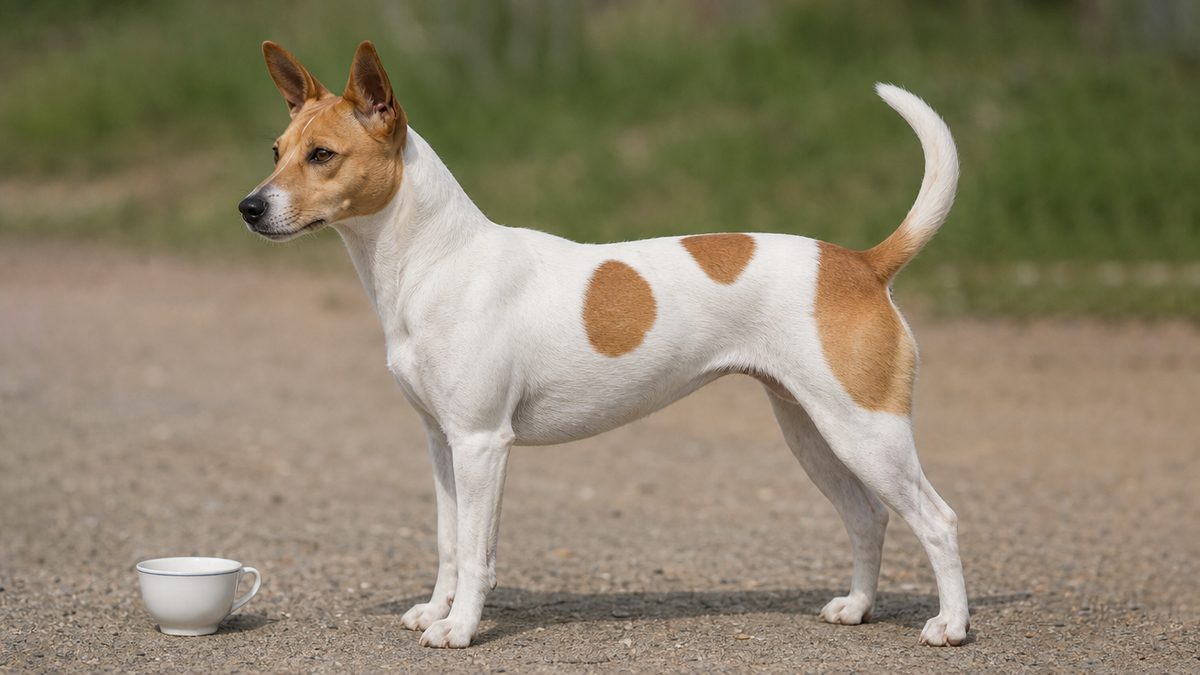
The Rat Terrier is a small, smooth-coated American hunting terrier built to kill vermin on a farm, bred in two size varieties and recognised by two registries on two different dates. The United Kennel Club recognised it on 1 January 1999 and the American Kennel Club in 2013 American Kennel Club. The Federation Cynologique Internationale does not recognise it at all.
Start with what the breed is for, because every other fact follows from it. This is a working ratter, and the standard that governs it is written around a hunting job rather than a look. The United Kennel Club standard opens by recording that the breed descends from terriers brought to the United States by English miners and other working class immigrants, and that those dogs probably included crosses between the Smooth Fox Terrier, the Manchester Terrier and the now extinct white English Terrier.
Two later crosses shaped the modern dog and the standard names both. Some Rat Terriers were crossed with Whippets or Italian Greyhounds for speed, and with Beagles for hunting ability. That is an unusually candid ancestry note for a breed standard, and it explains a body that is longer than tall and a dog that hunts by sight as readily as by nose.
The two size varieties, and where the line falls
Both registries agree on the split. The United Kennel Club divides the breed into Miniature, not exceeding 13 inches at the withers, and Standard, over 13 inches but not exceeding 18 inches, and faults any height over 19 inches. The American Kennel Club gives 10 to 13 inches for miniatures and 13 to 18 inches for standards, with a weight range of 10 to 25 pounds across both.
| Attribute | United Kennel Club | American Kennel Club |
|---|---|---|
| Group | Terrier Group | Terrier Group |
| Recognised | 1 January 1999 | 2013 |
| Size varieties | Miniature to 13 in, Standard over 13 to 18 in | Miniature 10 to 13 in, Standard 13 to 18 in |
| Weight | Not specified by number | 10 to 25 lb |
| Body proportion | 10:9 length to height, front leg about half the height | Not specified by number |
| Coat | Short, dense and smooth, with a sheen | Short and smooth |
| Life expectancy | Not stated | 12 to 18 years |
| Popularity 2025 | Not published | 84th of 202 breeds |
The proportion that defines the breed, and disqualifies another one
One number in this breed standard does more work than any other. The standard requires a body-to-height ratio of about 10:9 and a front leg length that approximately equals one half of the dog's height, and then disqualifies a short-legged dog whose proportions vary significantly from the 10:9 ratio on the ground that it lacks breed type. That is the registry stating in its own words that a short-legged dog of this stock is a different breed.
The dog that clause excludes has its own page. The Teddy Roosevelt Terrier standard, a separate document, sets that breed's front leg at approximately 40 percent of wither height and makes a front leg of 50 percent or more a serious fault United Kennel Club. Read the two standards together and they are mirror images: each treats the other breed's correct proportion as a disqualifying or serious fault. Both were recognised by the same registry on the same day, 1 January 1999, and the cleanest way to tell them apart is to look at the legs rather than the markings.
The breed name has a presidential story attached and the standard repeats it carefully. The standard says the breed was popularized by President Teddy Roosevelt, who frequently hunted with his Rat Terriers, and the American Kennel Club says the name is said to have been coined by him. Bonbeno reports that as the registries report it, an attribution rather than a documented event.
In parts of the United States the dog never took a registry name at all. The standard records that many Rat Terriers are still used as ratters and squirrel hunters, particularly in the South, where they are sometimes known as Feists. That tells an Indian buyer one useful thing: this is a working landrace with a recent formal standard, not an ancient closed breed.
Nowhere, formally. Bonbeno read all four sections of the FCI Group 3 Terriers nomenclature in full, and the only United States breed anywhere in FCI Group 3 is the American Staffordshire Terrier, number 286. The Rat Terrier is absent, as is the Teddy Roosevelt Terrier. Since the Kennel Club of India is the FCI's full member national canine organisation for India, that absence has practical consequences for anyone hoping to show or register one here.
Which registries recognise the Rat Terrier, and which do not
Three registry facts decide what an Indian owner can and cannot do with this breed. The UKC holds a full breed standard, the AKC recognised it in 2013 and ranks it 84th of 202 breeds, and the FCI does not list it in any section of Group 3 American Kennel Club American Kennel Club Federation Cynologique Internationale.
Apply the two-condition test that Bonbeno uses on every breed with a contested registry position. A breed is properly recognised by a body when that body publishes a written standard for it and maintains a register for it. One without the other is a weaker claim, and a register without a standard is the weakest of all. The Rat Terrier passes both conditions at the United Kennel Club, which publishes a full breed standard, revised 1 January 2004 and copyrighted 1998, and places the breed in its Terrier Group with a recognition date of 1 January 1999.
That is worth stating plainly because a nearby case fails the test. A breed listed only in a registry's non-standard listing service has a register without a standard, which is a register of pedigrees rather than a recognition of type. The Rat Terrier is not in that position and neither is the Teddy Roosevelt Terrier. Both hold full official standards from the same body on the same date, so anyone describing either as a merely listed breed has the situation wrong.
| Breed | UKC standard | AKC status | FCI Group 3 |
|---|---|---|---|
| Rat Terrier | Yes, 1 January 1999 | Recognised 2013, rank 84 | Absent |
| Teddy Roosevelt Terrier | Yes, 1 January 1999 | Recognised, not yet in the popularity table | Absent |
| Toy Fox Terrier | Yes | Recognised, rank 106 | Absent |
| Smooth Fox Terrier | Yes | Recognised, rank 144 | Present as a British breed |
| American Hairless Terrier | Yes | Recognised | Absent |
| American Staffordshire Terrier | Yes | Recognised | Present, number 286, the only US breed in the group |
What the FCI absence means for an Indian owner
It means no domestic show career and a paperwork problem. The Kennel Club of India is the FCI's full member national canine organisation for India, and a breed with no FCI nomenclature entry has no FCI breed number for a pedigree to reference. The Kennel Club of India's own checklist for registering an imported dog requires the original export pedigree and the airway bill among other documents, and an American registry pedigree does not convert into an FCI one on arrival.
This is not a reason to avoid the breed. It is a reason to buy one as a companion rather than as a show or breeding prospect, and to disbelieve any Indian seller who offers KCI papers for a Rat Terrier. Ask which registry issued the pedigree, then check that registry's own breed list.
Two identifiers make that check quick. The breed's OFA code is RAT, and its groups field reads AKC Terrier Group, CKC Terrier Group and UKC Terrier Group, which is three registries agreeing in one machine-readable line. The UKC standard then refers readers to the American Rat Terrier Association, which describes itself as the national parent breed club for Rat Terriers at UKC American Rat Terrier Association.
That referral carries a warning Bonbeno verified directly. The club's site runs WordPress 4.7.21, long out of support, and its footer carries roughly forty injected links to Indonesian gambling domains under the heading Our Partner. The club and its breed description are genuine. The outbound links are not the club's doing and should not be followed.
One more caution belongs here. Searching for this breed's short-legged relative alongside the letters KCI returns American breeders offering to meet buyers at KCI, which in that context is Kansas City International Airport rather than the Kennel Club of India. A homonym is not a recognition.
The Rat Terrier is the most popular breed in this family by a wide margin. The AKC's 2025 ranking of 202 breeds places it 84th, against the Toy Fox Terrier at 106, the Wire Fox Terrier at 107, the Manchester Terrier at 131 and the Smooth Fox Terrier at 144 American Kennel Club. That popularity is the reason its screening samples are the largest in this group, which in turn is why its health data is the most trustworthy of the six.
Rat Terrier price in India, two published bands that differ by 2.5 times
Two Rat Terrier price in India figures are published and they do not agree. One Indian breed page gives Rs 20,000 to Rs 50,000. The largest Indian price table gives Rs 51,800, with a range of Rs 37,000 to Rs 81,400 Pet House NCR, Dog Price List In India. The gap between the floors is two and a half times, and one of the two is not an Indian observation.
Test the higher figure before you use it. Rs 51,800 divided by 74.00 is exactly 700. Rs 37,000 divided by 74.00 is exactly 500. Rs 81,400 divided by 74.00 is exactly 1,100. Three round US dollar figures from one division is not a coincidence, it is a currency conversion presented as an Indian market price.
| Breed row | Rupee figure | Divided by 74.00 | Reading |
|---|---|---|---|
| Rat Terrier | Rs 51,800 | USD 700 | Converted |
| Rat Terrier, floor | Rs 37,000 | USD 500 | Converted |
| Rat Terrier, ceiling | Rs 81,400 | USD 1,100 | Converted |
| Toy Fox Terrier | Rs 59,200 | USD 800 | Converted |
| Smooth Fox Terrier | Rs 66,600 | USD 900 | Converted |
| Wire Fox Terrier | Rs 1,33,200 | USD 1,800 | Converted |
| American Hairless Terrier | Rs 1,11,000 | USD 1,500 | Converted |
| Caravan Hound, floor | Rs 8,ooo | Does not divide | Typed by a person |
| Teddy Roosevelt Terrier | No row exists | Not applicable | Never converted |
The same table gives itself away twice more. Its Indian breed rows refuse to divide at 74.00 or at any other rate, which is what genuine local observation looks like, and it prints the Caravan Hound's floor as Rs 8,ooo with two lowercase letter o characters where the zeros should be. A script converting dollars does not typo a letter o. A person typing a number does.
So what should an Indian buyer expect to pay
Treat Rs 20,000 to Rs 50,000 as the realistic Indian band and treat Rs 51,800 as an American figure wearing a rupee sign. The lower band comes from an Indian breed page that also carries Indian-specific fields, including an ideal weather range of 15 to 25 C and an ideal space of independent house. It is not a strong source, and its cost table is a template as shown in the next section, but its purchase band at least sits in the range Indian small-terrier litters actually change hands at.
The honest answer is that this breed is thinly traded here. The Rat Terrier is common in the United States, ranked 84th of 202 AKC breeds in 2025, and it is rare enough in India that no consistent domestic price has formed. A wide quoted range in a thin market usually reflects seller confidence rather than dog quality.
The import route, and why it is narrower than sellers imply
Importing is legal only in a narrow set of circumstances. Live dogs are a Restricted import into India under ITC(HS) 01061900, and DGFT Trade Notice 22/2022-23 permits entry only for a pet accompanied by a valid pet book in the importer's own name, for research with a CPCSEA recommendation, or for Defence and Police use. It states that applications for trading or breeding purposes shall be duly rejected. A commercial import pipeline for this breed cannot lawfully form.
That constrains what any Indian seller can honestly be offering. Either the dog was bred here from stock already in the country, or it arrived with a returning owner under the pet-book route. Ask which, and ask to see the paperwork that goes with the answer. A seller who cannot name the route is a seller whose dog has no verifiable origin.
Ask for the primary lens luxation DNA test result on both parents, which is one of the four tests the breed's own national club recommends, and ask for the hip evaluation that the same club recommends. OFA records 30.4 percent of 1,640 tested Rat Terriers as carriers of the lens luxation allele. A puppy from two untested parents is not affordable at any price, and a puppy from two tested parents is worth the top of the band.
Monthly expenses for a Rat Terrier in India, and the preset table to ignore
Budget Rs 3,000 to Rs 6,200 a month for a Rat Terrier in an Indian metro. One Indian page publishes monthly expenses of Rs 3,550 to Rs 5,400 for this breed, and that figure is a template rather than an observation, which the arithmetic below proves.
Check the published figure before you copy it. The page gives food at Rs 2,250 to Rs 3,000, grooming at Rs 700 to Rs 1,200 and health at Rs 600 to Rs 1,200, and a monthly total of Rs 3,550 to Rs 5,400. Add the three floors and you get exactly 3,550. Add the three ceilings and you get exactly 5,400. A total that reconciles to the digit in both directions is a spreadsheet formula, not a survey of Indian owners.
| Line | Published preset | Traced Indian figure | Source |
|---|---|---|---|
| Food | Rs 2,250 to Rs 3,000 | Rs 1,300 to Rs 2,000 | Royal Canin Mini Adult at Rs 84 per 100 g in a 4 kg bag |
| Grooming | Rs 700 to Rs 1,200 | Rs 0 to Rs 200 | A short coat needs a bath, not a groomer |
| Health | Rs 600 to Rs 1,200 | Rs 517 to Rs 900 | Booster from Rs 3,199 a year plus routine visits |
| Parasite control | Not listed | Rs 350 to Rs 700 | Monthly tick, flea and worm cover for a 7 kg dog |
| Eye monitoring | Not listed | Rs 250 to Rs 600 | An annual check given the lens luxation carrier rate |
| Municipal registration | Not listed | Rs 4 to Rs 42 | Rs 500 a year in Delhi, Rs 50 in Chennai Greater Chennai Corporation |
| Realistic total | Rs 3,550 to Rs 5,400 | Rs 3,000 to Rs 6,200 | Excludes boarding, insurance and illness |
Two lines are wrong in opposite directions and they nearly cancel. The preset overstates grooming by roughly Rs 1,000 a month for a dog with a short coat, and it omits parasite control and eye monitoring entirely. So the headline total is close to right by accident. Copy the total if you like, but do not copy the composition, because the composition is what tells you where the money should actually go.
Where the grooming money should go instead
Put it into the eyes. OFA ranks the Rat Terrier third of all breeds for primary lens luxation carrier frequency at 30.4 percent of 1,640 tests, with 2.1 percent at risk, and lens luxation is a same-day surgical emergency when a lens moves. An annual ophthalmic check at Rs 250 to Rs 600 a month annualised is the highest-value recurring spend on this breed, and the Delhi haircut at Rs 1,359 and the complete bath and styling at Rs 1,869 are services this dog will never need.
- Buy the 4 kg food bag. Unit prices run Rs 94, Rs 84 and Rs 73 per 100 g at 2 kg, 4 kg and 8 kg, and a 7 kg dog will not finish an 8 kg bag before an Indian summer degrades it.
- Book the puppy course as a package, from Rs 6,499 against Rs 8,111 of separately priced components at one national chain.
- Register the dog where registration exists. Delhi charges Rs 500 with a Rs 100 per month late fee; Chennai charges Rs 50, issued 9,115 licences in 2024 and runs six municipal pet clinics that treat and vaccinate free of cost.
- Budget an eye check every year for life, not a groomer every month.
One further oddity on that Indian page is worth flagging, because it affects the feeding advice further down. Its at-a-glance box gives calories as 700 and 600 kcal while its diet text says adults need only about 600 calories, and its macro breakdown assigns vitamins 5 percent and minerals 5 percent of the diet alongside protein 30, fats 15, carbohydrates 40 and fibre 5. Micronutrients are not 10 percent of any dog's food by weight. Treat that page as a price reference and nothing else.
Nothing on this breed needs clipping, stripping or professional shaping. The standard describes a short, dense, smooth coat with a sheen, and adds that whiskers are not removed. Over a 15-year life, avoiding a monthly Rs 1,000 groomer is roughly Rs 1,80,000 that stays in the household. Very few breeds in India are this cheap to maintain.
Heat tolerance in India, measured against the registry town that recognised the breed
The Rat Terrier scores 2 of 5 for heat tolerance in Indian plains cities. Kalamazoo, Michigan, where the United Kennel Club is based and recognised this breed in 1999, has a hottest month averaging 22.49 C. Chennai's coolest month averages 24.09 C, which is 1.6 degrees warmer than the American town's annual peak United Kennel Club.
Every figure below comes from NASA POWER, queried by explicit latitude and longitude over the 2001 to 2020 window, with the returned cell elevation echoed and checked against real ground level. The Kalamazoo cell reads 247.44 m against a real elevation near 230 m, and all the Indian cells sit within 90 m of the truth, so none of these numbers is a mountain-cell artefact.
| Place | Annual mean C | Hottest month | Coolest month | Annual mean RH % |
|---|---|---|---|---|
| Kalamazoo, Michigan | 9.18 | July, 22.49 | January, minus 4.61 | 79.4 |
| Delhi | 25.60 | June, 35.88 | January, 13.61 | 45.6 |
| Kolkata | 25.81 | May, 31.53 | January, 17.31 | 73.9 |
| Chennai | 27.95 | May, 31.51 | January, 24.09 | 72.4 |
| Mumbai | 26.77 | May, 31.19 | January, 23.19 | 67.4 |
| Pune | 23.86 | April, 28.93 | December, 19.62 | 66.8 |
| Bengaluru | 23.74 | April, 28.37 | December, 20.22 | 67.9 |
Humidity is not the problem, heat is
Indian damp is the argument people reach for and it is the wrong one. The American Midwest runs 79.4 percent annual relative humidity, higher than Chennai's 72.4, Kolkata's 73.9, Bengaluru's 67.9, Mumbai's 67.4, Pune's 66.8 and Delhi's 45.6. What India adds to this breed's ancestral conditions is not moisture. It is roughly 17 degrees of annual mean heat on top of moisture the dog's homeland already had.
The published Indian guidance happens to agree, though it puts it loosely. One Indian breed page gives the ideal weather range for this breed as 15 to 25 C. Delhi exceeds the top of that range as a monthly mean for most of the year, and Chennai never falls below it in any month. That is worth knowing before you commit, and it is not a reason to rule the breed out if you can manage the walk timing.
Frame the risk as exertion, not as sunshine
The largest study of canine heat illness available makes the mechanism clear. Among 905,543 UK dogs under primary veterinary care in 2016, there were 1,259 heat-related illness events from 1,222 dogs, and of the 879 events with a recorded trigger, 652 were exertional, 113 environmental and only 46 from vehicular confinement. Exertion caused 74.2 percent of triggered events. A terrier that will chase until it drops is precisely the temperament that study describes.
The short coat helps less than owners assume. A smooth coat sheds heat better than a double coat, and it also offers no protection from direct sun on the skin. A white or predominantly white dog, which this breed usually is because absence of white is a disqualification, burns on the nose, ear tips and belly in Indian summer sun. Shade is not optional for a mostly white dog here.
- Walk before 7 am and after 7 pm from March to October in Chennai, Mumbai and Kolkata, and from April to September in Delhi.
- Treat April as the peak in Bengaluru and Pune, not May, because both cities cool slightly once the monsoon approaches.
- Test the pavement with the back of your hand for five seconds before every hot-weather walk. A small dog's body sits close to the ground and in the hottest layer of air.
- Cool the neck, groin and paws with room-temperature water, never ice, if the dog will not settle after panting hard, and go to a vet if panting continues.
- Move the day's hard exercise indoors in summer. A recall game along a corridor tires this breed as effectively as a walk and carries none of the heat risk.
Second Schedule Part IV paragraph 21(1) of the 2017 Rules bars keeping in outdoor housing facilities, without the attending veterinary practitioner's written approval, dogs that are not accustomed to local temperatures and breeds that cannot tolerate them. A heat-sensitive American farm terrier in a Delhi June, where the monthly mean is 35.88 C, is the case that clause was written for. Consult your nearby vet before making any outdoor-housing decision for this breed.
Rat Terrier temperament, the dual personality its own standard describes
The Rat Terrier has two settings and its registry says so in the standard. The United Kennel Club describes a dual personality: a fearless and tenacious hunter with seemingly unlimited energy, who when not hunting is an exceptionally friendly companion. Both halves are real and an owner gets both.
Take the friendly half first, because it is unusual for a terrier. The standard says the Rat Terrier gets along well with children, other dogs and even cats, and that Rat Terriers enjoy human companionship immensely and love to be with their people at all times. It goes further and instructs judges that Rat Terriers should not be sparred during conformation judging, which is a registry telling its own ring officials that this breed is not meant to square up to another dog.
The American Kennel Club puts the same trait in owner language. It calls the breed patient and tolerant of children, alert and reserved with strangers, and one of the calmest of the terrier breeds, while insisting in the same breath that it is nevertheless a high-energy dog. Reserved with strangers is not the same as aggressive, and it is why early socialisation pays here.
Do Rat Terriers pick one person
Less than most terriers, on the published descriptions. A breed whose own standard records that it gets along well with children, other dogs and even cats is not a one-person dog by design. In practice many Rat Terriers do form a strongest bond with whoever handles the food, the walks and the training, which is true of most intelligent dogs and is not a breed-specific trait. Spread those three jobs across the household if a single-person bond would be a problem.
Do Rat Terriers ever calm down
Partly, and the standard explains why they never fully do. The dual personality is the point: a dog with seemingly unlimited energy when working and an exceptionally friendly companion when not. Maturity brings a longer off switch rather than a lower ceiling. Expect a settled adult that still goes from asleep to full sprint in under a second when something moves.
Do Rat Terriers bark a lot
Yes, because barking was the job. A farm ratter that found vermin silently would be useless, so the breed was selected to announce. Training changes the duration of a bark rather than removing the first one, so teach a settle cue early and reward silence rather than punishing noise. Boredom barking is a separate and entirely preventable problem that comes from an under-exercised dog, and it is the version that annoys neighbours in an Indian apartment with shared walls.
| Trait | United Kennel Club | American Kennel Club |
|---|---|---|
| Core description | Dual personality, fearless tenacious hunter and exceptionally friendly companion | One of the calmest terrier breeds, and still high-energy |
| With children | Gets along well with children | Patient and tolerant |
| With other dogs | Gets along well with other dogs | Generally good |
| With cats | Gets along well with even cats | Not addressed |
| With strangers | Not addressed | Alert and reserved |
| Off lead | Not addressed | Should never be allowed off lead |
| In the show ring | Should not be sparred | Not addressed |
One temperament fault is a disqualification and it deserves emphasis. Viciousness or extreme shyness disqualifies under the UKC standard, alongside unilateral or bilateral deafness. Extreme shyness in a puppy is not a phase to be waited out in this breed, it is a fault the registry itself names. A puppy that will not approach a calm stranger after several minutes is telling you something.
The prey drive sits underneath all of it. The AKC states that the breed has a strong prey drive and should never be allowed off lead, which is a plain instruction rather than a suggestion. In an Indian city that also means a secure balcony, because a small alert terrier that sees a squirrel or a crow will go after it without reference to the drop.
The standard says a Rat Terrier gets along well with even cats, and the same standard calls the dog a fearless and tenacious hunter of vermin. Both can be true, because a dog raised with a particular cat learns that cat is family while a strange cat outside remains prey. Do not read the standard as a guarantee about the neighbour's cat, and never leave a new cat and an adult Rat Terrier unsupervised on the strength of a sentence in a breed standard.
Training a Rat Terrier, and the one command that is non-negotiable
Train the recall first and train it for two years. The American Kennel Club describes an extremely intelligent and trainable breed that is unusually sensitive and intuitive, thrives on praise and responds quickly to positive training methods, and states plainly that these dogs should never be allowed off lead. Those two facts define the whole training plan.
Start with what works, because this breed makes it easy. Positive, reward-based methods get fast results with a dog that reads its handler closely. The AKC notes that Rat Terriers are unusually sensitive and intuitive and that some can be stubborn and determined, which means a harsh correction costs you more than it buys. A dog that shuts down is a dog that stops offering behaviour, and this breed offers a lot of behaviour.
- Teach a name response first. Reward eye contact on the name before you attach any command to it, in a quiet room, twenty times a day for a week.
- Build recall on a long line, never off it. Ten metres of line in a park lets you reward a real recall without ever risking the failure that teaches the dog recall is optional.
- Add a whistle. A whistle carries further than a voice, sounds identical whoever blows it, and does not leak your frustration to the dog.
- Proof the recall against movement. A rolling ball, then a running child, then a bird, in that order, over months. A recall that only works in a still room is not a recall.
- Train a settle on a mat, which is the cue that solves apartment barking better than any correction.
- Keep sessions to five minutes. Three short sessions beat one long one with a dog that learns this fast.
Why the off-lead rule is absolute
Recall competes with instinct, and instinct in this breed was selected over generations. The AKC's instruction that these dogs should never be allowed off lead is a consequence of a strong prey drive that predates any training you will do. In Indian conditions the stakes are higher than in an American suburb, because Indian streets carry traffic, free-roaming dogs and open drains within a few seconds of a bolt.
The breed's own history explains the drive rather than excusing it. This is a dog crossed with Whippets or Italian Greyhounds for speed and Beagles for hunting ability. Sighthound speed and scenthound persistence in one small body is a recall problem by construction. Use a long line for life in unfenced spaces and stop treating that as a failure of training.
Socialise early and socialise wide
Socialisation matters more here than obedience does. The breed is alert and reserved with strangers by the AKC's description, and extreme shyness is an outright disqualification under the UKC standard United Kennel Club. Between eight and sixteen weeks, expose the puppy to Indian street noise, autorickshaws, lifts, tiled floors, umbrellas, children and calm adult dogs, in short, positive, low-intensity doses.
Do that safely while the vaccination course is still running. Carry the puppy, or work from a mat on a balcony overlooking a busy road, until your vet clears street contact. Sixteen weeks arrives whether or not the socialisation happened, and a dog that missed the window is much harder work at three years old.
One training target is specific to this breed and often neglected. Teach the dog to accept eye handling from the first week. Given a lens luxation carrier rate of 30.4 percent on 1,640 tests, this dog will have its eyes examined many times over its life, and a dog that tolerates a light and a hand near its face makes each of those examinations quicker and more accurate.
This breed will dig, because a ratter that would not go to ground was culled from the working population. Do not try to eliminate digging, redirect it. A sand tray or a large planter on a balcony, with a toy buried in it twice a week, gives the behaviour somewhere to live. An Indian apartment owner who ignores this gets a dug-out potted plant instead.
Daily exercise for a Rat Terrier in an Indian city
Give a Rat Terrier 45 to 60 minutes a day in two sessions, plus a training game indoors. The American Kennel Club calls this a high-energy dog that needs daily exercise, notes that some get enough indoors while most need daily walks and fenced play, and adds that these dogs need lots of companionship.
Split the day rather than bunching it. Two 20 to 30 minute walks at either end of the day beat one long midday outing in every Indian plains city, on both heat grounds and behaviour grounds. A dog walked once is a dog with fourteen waking hours to fill with something you did not choose.
| Slot | Duration | What it is for |
|---|---|---|
| Early morning walk | 20 to 30 min | The main aerobic session, before the pavement heats |
| Midday indoor game | 5 to 10 min | Scent work or a find-it game, which tires the brain |
| Evening walk | 20 to 30 min | Sniffing time and street exposure on a lead |
| Twice weekly | 20 min | Long-line recall work in a park or on a terrace |
| Weekly | 10 min | Digging tray or a sand box, so the instinct has somewhere to go |
| Daily, throughout | Ongoing | Companionship, which the AKC lists as a need rather than a nicety |
Apartment living with this breed, honestly assessed
Apartment living works if the walks happen. One Indian breed page gives ideal space as independent house for this breed, and the AKC's own position is softer, that some Rat Terriers get enough exercise indoors while most need daily walks and fenced play. A 7 kg dog does not need square footage, it needs a handler who leaves the flat twice a day in every season.
Two apartment-specific problems are predictable and both have fixes. The first is barking at corridor noise, solved by a settle cue on a mat and by not rewarding the dog with attention when it announces the lift. The second is a balcony with a gap, which a small dog with a strong prey drive will use if a bird lands on the railing. Mesh the balcony before the dog arrives, not after the first scare.
What to do through an Indian summer
Move the load indoors and keep the outings functional. From March to October in the coastal metros, use the early and late slots for toileting and sniffing, and do the tiring work inside. Scent games work well here because a ratter's nose is its main tool. Hide five pieces of kibble around a room, send the dog to find them, and repeat with progressively harder placements.
Remember what the heat research actually found. Exertional triggers caused 652 of the 879 heat-related illness events with a recorded cause in a cohort of 905,543 dogs, against 46 from being shut in a vehicle. The danger is not the parked car alone, it is the enthusiastic game of fetch at four in the afternoon in May. Cancel that game rather than shortening it.
The UKC standard calls for a dog whose gait shows good reach in front and strong rear drive, and describes an animal built for endurance in the field. A dog built to work a farm all day will not be satisfied by two toilet breaks. If your schedule genuinely cannot support 45 minutes a day plus companionship, this is the wrong breed and the honest time to discover that is before the purchase.
Grooming a Rat Terrier, the cheapest coat in this family
Groom a Rat Terrier in five minutes a week. The standard describes a short, dense, smooth coat with a sheen and states that whiskers are not removed, and the breed needs nothing clipped, stripped or shaped. A rubber curry mitt and a monthly bath cover the entire routine.
This is the single largest cost advantage the breed has in India. A Delhi clinic prices a haircut from Rs 1,359 and a complete bath and styling from Rs 1,869, and this dog needs neither. Compare that with the Wire Fox Terrier, whose coat requires hand stripping several times a year by someone who knows how, and the difference over a fifteen-year life runs into lakhs.
- Brush once a week with a rubber curry mitt or a soft bristle brush, which lifts dead hair and spreads coat oil.
- Brush daily during a seasonal shed, which in Indian conditions tends to arrive twice a year rather than on a northern schedule.
- Bathe about monthly, or from Rs 934 at a Delhi clinic if you would rather not do it at home.
- Clip nails every two to three weeks, with add-on services from Rs 99 if you are not confident.
- Check ears weekly, because erect ears collect Indian dust rather than trapping moisture.
- Brush teeth daily if possible, which is the AKC's own wording for this breed.
The whisker rule, and why it matters
A grooming instruction sits in the standard itself. Whiskers are not removed. That single sentence separates this breed from the show terriers whose faces are trimmed to shape, and it reflects a working dog whose vibrissae do a job underground. An Indian groomer accustomed to Shih Tzus and Pomeranians may trim them by habit. Say so before the dog goes on the table.
White skin needs sun management, not sunscreen theatre
Coat colour creates one real Indian grooming task. Absence of white is a disqualification under the standard, so essentially every Rat Terrier carries white, usually across the chest, face and legs. Pink skin under white hair burns, most often on the nose, the ear tips and the thinly covered belly. Manage it with shade and timing rather than with products, and ask your vet before applying anything to a dog that will lick it off.
Two colour patterns are disqualified outright and a buyer should know why. Brindle and merle both disqualify under the standard. Merle in particular is worth checking, because it is associated with deafness and eye defects in several breeds, and deafness is itself a disqualification in this one. A seller offering a merle Rat Terrier at a premium is selling a dog the registry will not accept, at a higher price than a correct one.
A weekly grooming session is the cheapest health screen available to an owner. Running your hands over a short-coated dog finds ticks, lumps, hot spots and sore feet weeks before they become visits. In India, where tick burden is high through most of the year, this matters more than the coat itself. Consult your nearby vet about any lump that was not there last week.
Rat Terrier health issues, led by an eye problem the club names
One health risk dominates this breed's screening record. OFA ranks the Rat Terrier third of all breeds for primary lens luxation carrier frequency, at 30.4 percent of 1,640 tests, with 2.1 percent recorded at risk. That is also the largest tested sample of any breed in this family, which makes it the most reliable number on this page.
Read the number correctly before acting on it. A carrier has one copy of the allele and a dog recorded at risk has two. So 30.4 percent carriers describes the breeding population's genetic load rather than how many dogs go blind. Two untested parents drawn at random from this population have a real chance of both being carriers, and a carrier-to-carrier mating puts a quarter of the litter in the at-risk group.
One widely repeated claim about carriers is wrong, and the correction matters here. Carriers are commonly described as unaffected, but the largest cross-breed screening study of this mutation identified an increased risk of primary lens luxation associated with heterozygosity, and concluded that carriers carry a low risk of developing the disease. In a breed where 30.4 percent of tested dogs are carriers, a low individual risk across a large fraction of the population is not a footnote. Treat a carrier Rat Terrier as a dog needing annual eye checks, not as a dog in the clear.
What the test actually detects
The DNA test looks for one specific change. Mapping work across several terrier breeds first showed that a single locus underlies primary lens luxation rather than a separate mutation arising in each breed, and the causal variant was then identified as a GT to AT splice donor site mutation at the 5 prime end of intron 10 of ADAMTS17, in a 664 kb region of canine chromosome 3. The predicted exon 10 skipping and resulting frame shift were confirmed in RNA from affected dogs, and the mutation was significantly associated with clinical disease in three breeds.
The mutation then turned out to be far from rare. A screen of affected dogs across 30 breeds found the same c.1473+1 G>A variant in 14 additional breeds, many of them terriers or breeds with terrier co-ancestry, and found it present at high frequency within most breeds in which it segregates. That is precisely the population the Rat Terrier belongs to, and it explains why this breed's carrier rate sits third of all breeds rather than being a local quirk of one kennel.
One caveat keeps the test honest. Affected Shar Pei and Brittany Spaniels in that study did not carry the ADAMTS17 variant, which means those breeds have a genetically distinct form of the same disease. A clear DNA result therefore rules out this mutation rather than ruling out lens luxation altogether. It is strong evidence and not a guarantee, which is another reason the annual eye examination stays on the calendar.
| Screen | Dogs tested | Result | Note |
|---|---|---|---|
| Primary lens luxation | 1,640 | 67.5% normal, 30.4% carrier, 2.1% at risk | Rank 3 of all breeds |
| Patella | 1,817 | 96.8% normal, 3.2% abnormal | Better than the small-dog norm |
| Hips | 999 | 95.8% normal, 3.4% dysplastic | 19.5% excellent, 66.6% good, 9.7% fair |
| Elbows | 642 | 97.4% normal, 2.5% abnormal | Unremarkable |
| Eyes, summary | 256 | 96.9% normal | Against an eye detail normal row of 210 of 254 |
| Progressive retinal atrophy | 174 | 89.1% normal, 10.9% carrier | A second eye locus worth testing |
| Congenital hypothyroidism with goiter | 78 | 100% normal | The disease named in the 2007 paper below |
| Degenerative myelopathy | 110 | 100% normal | No at-risk genotype recorded |
| Congenital cardiac | 1,052 | Screened | One of the club's four recommended tests |
| Advanced cardiac | 74 | Screened | A small sample, read with caution |
The four tests the breed's own club asks for
The national breed club names them and a buyer should recite them. A Patella Evaluation, a Hip Evaluation, a Cardiac Exam and a Primary Lens Luxation DNA Test. That list is worth comparing with a sibling breed, because the comparison is instructive. The Smooth Fox Terrier's parent club recommends only a patella evaluation and a cardiac exam, no hip evaluation, while OFA records 13.7 percent of 722 evaluated Smooth Fox Terriers as dysplastic. The Rat Terrier club asks for the hip test its dogs mostly pass, and the Smooth Fox Terrier club does not ask for the one its dogs often fail.
The AKC adds a wider list in prose. It states that responsible breeders screen their stock for conditions including hip dysplasia, patellar luxation, Legg-Calve-Perthes disease, and cardiac and eye disorders. Legg-Calve-Perthes is a small-breed hip problem distinct from dysplasia, in which the femoral head loses its blood supply in a young dog, and it typically shows as a hind-limb lameness between five and eight months of age.
What a lens luxation emergency looks like
Learn the signs, because time decides the outcome. A luxated lens presents as a suddenly cloudy or bluish eye, redness, obvious pain, squinting and a dog that resents the eye being touched. This is a same-day veterinary problem rather than a wait-and-see one. Consult your nearby vet immediately if any of that appears, and say the words primary lens luxation, because in a Rat Terrier that phrase changes the urgency of the appointment.
Ask a breeder for the paperwork, not for reassurance. Both parents should have a primary lens luxation DNA result on file, and a carrier bred to a clear parent produces no at-risk puppies, which is the whole reason the test exists. A breeder who says the line has never had a problem is describing luck rather than a test result.
Unilateral or bilateral deafness disqualifies under the UKC standard. Unilateral deafness is invisible in a puppy pen, because a dog hearing on one side turns, responds and plays normally. The only way to know is a BAER test. Ask whether the litter was BAER tested, and treat a breeder who has not heard of it as a breeder who has not read the standard governing the breed they sell.
The thyroid mutation this breed inherited, and the paper that names the source
One inherited disease in the Rat Terrier has a documented direction of travel. A 2007 veterinary pathology study found a homozygous nonsense mutation in the thyroid peroxidase gene in Rat Terrier puppies with congenital goiter and CNS hypomyelination, and concluded that the mutation had probably crossed into the Rat Terrier from Toy Fox Terriers fairly recently.
The clinical picture in that paper is specific and grim. Three of five Rat Terrier puppies showed arrested physical development and neurologic abnormalities at nine weeks of age, with bilaterally firm symmetrical masses palpable at the thyroid glands, low total and free thyroxine, and markedly elevated thyroid stimulating hormone. At necropsy the thyroid was grossly enlarged with severe diffuse follicular hyperplasia, and myelin deficiency was most evident in the corpus callosum.
The genetics were settled in the same study. The affected puppies were homozygous for a nonsense mutation in the thyroid peroxidase gene, and the dam and a clinically normal littermate were heterozygous, confirming simple autosomal recessive inheritance. Simple recessive inheritance is good news for a breeder, because a DNA test on both parents removes the risk entirely.
Where the mutation came from, in the authors' own words
The paper does not leave the origin to speculation. Its authors state that given the ongoing practice of introducing the Toy Fox Terrier genetic background into some Rat Terrier breeding programmes to obtain a smaller stature, the mutation had probably crossed into the Rat Terrier from Toy Fox Terriers fairly recently. That is a rare thing to have documented, a named disease allele with a named donor breed and a named breeding practice that carried it.
The disease was described in the donor breed first. A 2003 study described congenital hypothyroidism with goiter in Toy Fox Terriers as a simple autosomal recessive trait, with palpable ventrolateral cervical swellings evident by one week of age, identified the same nonsense mutation in thyroid peroxidase, and reported a DNA-based carrier test developed and in use by breeders. Four years separate the description in one breed from its appearance in the other.
| Item | Toy Fox Terrier, 2003 | Rat Terrier, 2007 |
|---|---|---|
| Study | Fyfe et al. | Pettigrew et al. |
| Gene | Thyroid peroxidase | Thyroid peroxidase |
| Mutation | Nonsense | The same nonsense mutation |
| Inheritance | Simple autosomal recessive | Simple autosomal recessive |
| First sign | Cervical swelling by one week | Arrested development by nine weeks |
| Carrier test | Developed and in use by breeders | Applies directly, same gene |
| Direction of travel | Not applicable | Probably from Toy Fox Terriers, per the authors |
OFA's own record for this breed is reassuring on the same disease. Congenital hypothyroidism with goiter shows 78 tested Rat Terriers at 100 percent normal. That is a small sample and it does not prove absence, but it does suggest that breeders who test are managing the allele. It also shows the test is being used, which is what the 2003 paper set out to make possible.
What an Indian buyer should do with this
Ask one extra question. If the breeder has ever crossed to a Toy Fox Terrier to reduce size, ask for the thyroid peroxidase carrier test on both parents. The 2007 paper names that exact practice as the route the mutation took. Most Indian sellers will not have heard of the test. A breeder who has heard of it is a breeder who reads the literature on their own breed.
A puppy that fails to thrive, stays smaller than its littermates, moves oddly, and has a firm symmetrical swelling in the throat is the presentation the 2007 paper describes at nine weeks. That is a same-day veterinary problem, not a slow-growing puppy to be waited out. Consult your nearby vet and mention congenital hypothyroidism with goiter by name, because thyroid hormone levels are a simple blood test and the diagnosis is straightforward once someone thinks of it.
Joints and legs, where this breed does better than its relatives
The Rat Terrier's joint record is the best in this family. OFA records 3.4 percent hip dysplasia across 999 evaluations and 3.2 percent abnormal patellas across 1,817 evaluations. Both figures come from the largest samples of any breed in this batch, and both are unusually low for a small terrier.
Put the hip number beside its closest relative to see the size of the difference. The Smooth Fox Terrier shows 13.7 percent dysplastic across 722 evaluations, four times the Rat Terrier rate Orthopedic Foundation for Animals, and the Smooth Fox Terrier is named in the Rat Terrier's own standard as one of the breeds behind it. Shared ancestry did not produce shared hip outcomes, which is what selection over a working population tends to look like.
| Breed | Hips evaluated | Dysplastic | Patellas evaluated | Abnormal |
|---|---|---|---|---|
| Rat Terrier | 999 | 3.4% | 1,817 | 3.2% |
| Smooth Fox Terrier | 722 | 13.7% | Fewer | Higher |
| Toy Fox Terrier | Fewer | Lower sample | Substantial | Higher |
| Teddy Roosevelt Terrier | Fewer | Lower sample | Substantial | Higher |
| Labrador Retriever, for scale | 324,905 | 11.3% | Not comparable | Not comparable |
The hip breakdown is worth reading in detail rather than as a headline. Of 999 Rat Terrier hip evaluations, 19.5 percent were excellent, 66.6 percent good and 9.7 percent fair, against 2.8 percent mild, 0.5 percent moderate and 0.1 percent severe dysplasia. A single severe result in roughly a thousand dogs is a genuinely sound population by the standards of pedigree screening.
Patellar luxation in context
Small dogs slip kneecaps and this one mostly does not. The largest primary-care study available found patellar luxation in 1.30 percent of 210,824 dogs across 119 UK clinics, with a 95 percent confidence interval of 1.21 to 1.39 percent, and named eleven predisposed breeds. The Rat Terrier is not among those eleven. Its OFA abnormal rate of 3.2 percent is higher than the whole-population primary-care figure, as screening rates usually are, and low for a terrier under 10 kg.
That study also found a detail every Indian owner can act on. Dogs below their breed and sex mean bodyweight carried 1.4 times the odds of patellar luxation. Under-weight is a risk factor, not a safety margin. A Rat Terrier kept deliberately thin because a seller called it a teacup is being set up for a joint problem, and teacup is not a size variety this breed has.
The size varieties are not a licence to breed smaller
The registry recognises two sizes and stops there. Miniature means not exceeding 13 inches at the withers, and Standard means over 13 inches but not exceeding 18 inches, with height over 19 inches a fault. There is no third smaller category and no registry anywhere recognises one. A seller offering a teacup, micro or pocket Rat Terrier is selling either a runt, a cross or an undersized dog with a joint problem waiting to happen.
Elbows round out a sound picture. OFA records 97.4 percent normal across 642 Rat Terrier elbow evaluations, with 2.5 percent abnormal. Elbow dysplasia is largely a large-breed problem and this sample confirms it is not a concern here. It is included because a buyer who sees an elbow result on a breeder's paperwork should know what a normal number looks like.
Every OFA sample on this page is larger than the equivalent sample for the other five breeds in this family, because the Rat Terrier ranks 84th of 202 AKC breeds while the others sit between 106th and 144th Orthopedic Foundation for Animals. A percentage from 1,817 patella evaluations is worth more than the same percentage from 200. Where this page reports a small sample, such as 74 advanced cardiac results, it says so.
Rat Terrier life expectancy, and the study that has no row for it
No research figure exists for Rat Terrier life expectancy. The American Kennel Club gives 12 to 18 years and one Indian breed page gives 12 to 16 Poodles Petcare, Rat Terrier Price…. The largest study of dog longevity by breed covers 344 breeds and contains no Rat Terrier row of any kind, neither included nor excluded.
That absence is worth stating carefully, because it is easy to get wrong. Bonbeno downloaded the study's Supplementary Table S5 as the publisher's own document, checked its magic bytes, and parsed all 345 rows, comprising a header and 344 breeds each flagged Y or N for inclusion in the survival analysis. Searching that roster for Rat, Teddy, Roosevelt and Feist returns nothing at all. The parse is demonstrably faithful, because it reproduces the source's own misspelling of Japenese Terrier, flagged N.
The companion table tells the same story from the other end. Supplementary Table S3 carries a header, a crossbred row and 155 purebred rows, and has no Rat Terrier row. So there is no median, no confidence interval and no hazard ratio to report for this breed, and any page that prints one has invented it.
| Breed | Median lifespan, years | Deaths in sample |
|---|---|---|
| Border Terrier | 14.2 | 2,427 |
| Lakeland Terrier | 14.2 | 601 |
| Parson Russell Terrier | 13.8 | 1,176 |
| Jack Russell Terrier | 13.3 | 13,497 |
| Toy Fox Terrier | 12.9 | 52 |
| Toy Manchester Terrier | 13.0 | 138 |
| Crossbred, for reference | 12.0 | Large |
| Rat Terrier | No row exists | Not in the study |
What to do with a range of 12 to 18 years
Treat the top of the AKC's range as achievable rather than typical. A six-year spread is what a breed source publishes when it has no dataset, and the small working terriers that do appear in the research cluster between 13 and 14 years. Planning around 13 to 15 years is realistic for a well-bred, correctly fed Rat Terrier in India, and anything beyond that is a bonus rather than an expectation.
One structural point supports the optimistic end. This breed has no exaggerated feature to shorten its life. It is not brachycephalic, not chondrodystrophic, not oversized and not extreme in coat. The 2024 longevity study's central finding across the breeds it did cover is that flat-faced and very small breeds fare worst, and this dog is neither.
What actually shortens a Rat Terrier's life in India
Three things, and none of them are genetic. Traffic, heat and obesity. A dog the AKC says should never be allowed off lead that gets off lead near an Indian road has a short life expectancy regardless of its pedigree. Exertional heat illness accounted for 652 of 879 triggered events in the largest available cohort. Obesity is the slowest of the three and the easiest to prevent.
A breed with no research row gets no invented one. Where a figure exists, this site prints it with the sample size attached. Where it does not, this site says so and names the study it checked. That is why this page carries a life expectancy range from a breed registry, labelled as such, rather than a false precision that would read better and mean less.
Feeding a Rat Terrier in India, and the calorie figure that does not add up
Feed a 7 kg adult Rat Terrier roughly 380 to 450 kcal a day, split across two meals. One Indian page gives conflicting calorie figures for this breed in two places on the same page, which is the clearest sign yet that its numbers are a template.
Look at the contradiction directly. The page's at-a-glance box gives calories as 700 and 600 kcal, while its diet text says adults need only about 600 calories. Both figures are high for a dog of 10 to 25 pounds. A 7 kg moderately active adult dog sits nearer 400 kcal a day, and feeding 600 to a dog that needs 400 produces the obesity that shortens small-dog lives.
The same page's macro breakdown fails a simpler test. It assigns protein 30 percent, fats 15, carbohydrates 40, fibre 5, vitamins 5 and minerals 5. Vitamins and minerals are not 5 percent each of a dog's diet by weight, they are trace and micro components measured in milligrams. That is a template filling six slots to reach 100, and it is why this page's feeding advice comes from the food labels instead.
| Stage | Meals per day | Rough daily intake | Monthly cost |
|---|---|---|---|
| 8 to 16 weeks | 4 | Per the bag, by weight | Rs 1,000 to Rs 1,500 |
| 4 to 6 months | 3 | Growing, adjust monthly | Rs 1,200 to Rs 1,700 |
| 6 to 12 months | 2 | Approaching adult | Rs 1,300 to Rs 1,900 |
| Adult, 7 kg | 2 | 380 to 450 kcal | Rs 1,300 to Rs 2,000 |
| Adult, working or very active | 2 | Up to 500 kcal | Rs 1,500 to Rs 2,200 |
| Senior, past 10 years | 2 | Reduce by 10 to 15% | Rs 1,200 to Rs 1,800 |
Buy the middle-sized bag in India
Bag size is a real decision here and the unit prices make it look obvious. A named Indian retailer lists Royal Canin Mini Adult at Rs 1,883 for 2 kg, Rs 3,388 for 4 kg and Rs 5,861 for 8 kg, which its own unit labels give as Rs 94, Rs 84 and Rs 73 per 100 g. The 8 kg bag looks cheapest and is the wrong buy. A 7 kg dog eating around 120 g a day takes over two months to finish 8 kg, and kibble fats oxidise fast in Indian heat and humidity once the bag is opened.
- Feed twice a day as an adult, which steadies energy in a dog with an energetic temperament.
- Weigh the food rather than scooping it. A cup varies by 30 percent between people and that is the whole margin between lean and overweight in a 7 kg dog.
- Score the body monthly by hand. Ribs easily felt under a thin fat cover, a visible waist from above, and a tucked abdomen from the side.
- Keep the dog lean, not thin. Below-average bodyweight carried 1.4 times the odds of patellar luxation in a study of 210,824 dogs.
- Store kibble in an airtight container away from the kitchen heat, and decant rather than rolling the bag shut.
- Use part of the daily ration as training rewards rather than adding treats on top.
One breed-specific feeding note follows from the thyroid history. A puppy that is not growing at the rate of its littermates needs a veterinary opinion rather than more food, given the congenital hypothyroidism documented in this breed. Arrested physical development was the first sign in the 2007 case series, and an owner who responds by increasing the portion delays the diagnosis. Consult your nearby vet if growth stalls.
The American Kennel Club says teeth should be brushed daily if possible for this breed. Small breeds accumulate dental disease faster than large ones because their teeth are crowded in a short jaw. Daily brushing is free, and an Indian dental scaling under anaesthesia is not. Start in the first week the puppy is home, with a finger and no brush, and build from there.
Month by month through a Rat Terrier's first year in India
Plan the first year around four fixed points. The eight-week legal minimum for sale, the vaccination course, the socialisation window closing near sixteen weeks, and the first Indian summer Vetic Pet Clinic, dog vaccination pricing.
| Age | What happens | Indian cost or note |
|---|---|---|
| 8 weeks | The earliest lawful age to take a puppy home | Rule 8(1)(a) of the 2017 Rules bars sale below eight weeks |
| 8 to 12 weeks | Vaccination course begins, socialisation starts in arms | From Rs 6,499 across seven visits from day 30 |
| 8 to 10 weeks | Ask whether the litter was BAER tested | Deafness is a UKC disqualification in this breed |
| 9 weeks | Watch growth rate and throat | The age at which the 2007 thyroid cases presented |
| 12 to 16 weeks | Street walks begin once the vet clears them | Anti-rabies Rs 699, kennel cough Rs 1,349 |
| 4 to 6 months | Long-line recall work starts in earnest | No off-lead work, ever |
| 5 to 8 months | Watch for hind-limb lameness | The window for Legg-Calve-Perthes disease |
| 6 to 9 months | Municipal registration | Rs 500 in Delhi, Rs 50 in Chennai Greater Chennai Corporation |
| 12 months | Annual booster and first adult eye examination | Booster from Rs 3,199 |
The eight-week rule, and what breaking it looks like
Indian law sets a floor and sellers do break it. Rule 8(1)(a) of the 2017 Rules bars the sale of pups under eight weeks of age. Bonbeno has seen live Indian advertisements for small terriers stating a puppy's age in days, well under that floor. Convert any age given in days before you read past it. A 46-day-old puppy is ten days under the legal minimum, and a seller quoting days rather than weeks may be counting on the buyer not doing the arithmetic.
Time the arrival against the Indian calendar if you can
Season matters more than most buyers expect. A puppy that reaches an Indian metro in October has five cool months before its first March, and one arriving in April has none. The socialisation window does not pause for the weather, so a summer puppy needs its exposure work done indoors, in lifts, in car parks and on shaded terraces at dawn.
Two puppy-specific health watches belong on the calendar. Watch the throat and growth rate at around nine weeks, which is when the 2007 thyroid cases presented, and watch for hind-limb lameness between five and eight months, which is the window for Legg-Calve-Perthes disease. Neither is common. Both are far cheaper to catch early, and either warrants a same-week veterinary appointment.
- Book the vaccination course as a package, priced from Rs 6,499 against Rs 8,111 of separately listed components.
- Mesh the balcony before the puppy arrives, given a strong prey drive and no off-lead judgement.
- Start daily tooth handling in week one, because the AKC asks for daily brushing in this breed.
- Photograph the puppy from above and from the side every month, which builds a body-condition record more useful than a weight alone.
- Introduce the digging tray by four months, before a potted plant becomes the default.
The UKC standard says front dewclaws may be removed and rear dewclaws must be removed, and lists rear dewclaws present as a fault. Indian law takes the opposite position: Second Schedule Part II paragraph 6(8) of the 2017 Rules forbids de-clawing and any change of appearance by artificial means. An Indian-bred Rat Terrier should therefore keep its rear dewclaws, and a breeder who removed them has followed an American standard over Indian law. Discuss this with your nearby vet rather than acting on a breed standard.
Rat Terrier against the breeds Indian buyers cross-shop
Four small terriers get confused with this one and the differences are checkable. Legs separate it from the Teddy Roosevelt Terrier, size separates it from the Toy Fox Terrier, origin separates it from the Smooth Fox Terrier, and coat separates it from the Wire Fox Terrier American Kennel Club.
| Measure | Rat Terrier | Teddy Roosevelt Terrier | Toy Fox Terrier | Smooth Fox Terrier |
|---|---|---|---|---|
| Front leg to height | About 50% | About 40% | Not specified | Not specified |
| UKC recognition | 1 January 1999 | 1 January 1999 | Earlier | Earlier |
| AKC recognition | 2013 | Recognised | Recognised | Recognised |
| AKC popularity 2025 | 84 of 202 | Not yet in the table | 106 | 144 |
| Lens luxation carriers | 30.4% of 1,640 | 17.0% of 306 | 28.2% of 710 | Not a lead risk |
| Hips dysplastic | 3.4% of 999 | Smaller sample | Smaller sample | 13.7% of 722 |
| Indian price published | Rs 20,000 to Rs 51,800 | None at all | Rs 59,200 | Rs 66,600 Poodles Petcare, Rat Terrier Price… |
| Grooming | Weekly mitt | Weekly mitt | Weekly mitt | Weekly mitt |
Against the Teddy Roosevelt Terrier, measure the legs
One measurement settles it and it takes ten seconds. Measure from the point of the elbow to the ground, then from the withers to the ground. In a mature Rat Terrier the first is about half the second, and in a Teddy Roosevelt Terrier it is about 40 percent, with 50 percent or more a serious fault in that breed. The Rat Terrier standard then disqualifies a short-legged dog whose proportions vary significantly from the 10:9 ratio, so the two breeds are not interchangeable even inside the registry that recognises both.
The practical warning follows from the Indian market. The Teddy Roosevelt Terrier has no Indian price at all, with no row in the largest Indian price table that carries roughly 155 breeds. A seller asked for one will reach for the Rat Terrier, which is genuinely listed. Measure the legs rather than trusting the name on the receipt.
Against the Toy Fox Terrier, mind the shared mutation
These two breeds share more than a look. A 2007 paper concluded that the thyroid peroxidase mutation crossed into the Rat Terrier from Toy Fox Terriers, through the practice of introducing Toy Fox Terrier background to reduce size. If a breeder tells you their Rat Terriers are on the small side because of a Toy Fox Terrier cross, that is exactly the history the paper describes, and the thyroid test becomes relevant rather than optional.
Against the fox terriers, look at hips and coat
The Smooth Fox Terrier is a British breed named in the Rat Terrier's own ancestry, and their screening records have diverged sharply. Smooth Fox Terrier hips run 13.7 percent dysplastic across 722 evaluations against the Rat Terrier's 3.4 percent across 999. The Wire Fox Terrier differs on coat above all, needing hand stripping that this breed never needs, and it carries its own eye and neurological profile that a buyer should read separately.
One more relative belongs in the frame. The American Hairless Terrier came out of this same Rat Terrier population and is a separate breed today, and the Australian Miniature Fox Terrier is a parallel small ratting terrier with its own register and no connection to the American line. Neither is a Rat Terrier, and both are occasionally offered as one.
For most Indian households wanting a small, alert, low-grooming terrier, the Rat Terrier is the better buy of these breeds. It has the largest screening samples, the soundest joints, a published Indian price, the highest popularity and therefore the deepest data. Its one significant weakness is the lens luxation carrier rate, and that weakness is entirely manageable with a DNA test on both parents.
Indian law, tail docking and the rear dewclaw collision
Indian law and this breed's American standard disagree on two points. Second Schedule Part II paragraph 6(8) of the 2017 Rules forbids tail docking, ear cropping, de-barking, de-clawing and any change of appearance by artificial means. The UKC standard prefers a docked or natural bob tail and says rear dewclaws must be removed United Kennel Club.
Take the tail first, because the standard resolves it in the owner's favour. The standard prefers a docked or natural bob tail, and then says plainly that a natural tail is not a fault. It also carries the registry's general accommodation, that the UKC feels no dog in any UKC event, including conformation, shall be penalised for a full tail or natural ears. An Indian Rat Terrier with an undocked tail is therefore both lawful and showable in the registry that governs the breed.
The dewclaw clause is the harder collision. The standard states that rear dewclaws must be removed and lists rear dewclaws present as a fault, while Indian law forbids de-clawing outright. There is no reading that reconciles the two. Indian law governs a dog in India, so an Indian-bred Rat Terrier keeps its rear dewclaws and accepts the fault in an American ring it will never enter.
| Provision | What it requires | Relevance here |
|---|---|---|
| Second Schedule Part II para 6(8) | No docking, cropping, de-barking, de-clawing or artificial change of appearance | Directly contradicts the rear dewclaw clause |
| Second Schedule Part II para 6(3) | No in-breeding within four generations, no incest breeding | Relevant in a thinly traded breed with few Indian bloodlines |
| Part III para 8(10) | Breeding dogs tested for listed genetic defects, a list opening with the word including | Names hip dysplasia and hypothyroidism, both live issues here Pettigrew R, Fyfe JC, Gregory BL |
| Part IV para 21(1) | No outdoor housing for dogs unaccustomed to local temperatures without written veterinary approval | A heat-sensitive American terrier in a Delhi June |
| Rule 8(1)(a) | No sale of pups under eight weeks | Check any age quoted in days |
| ITC(HS) 01061900 and DGFT Trade Notice 22/2022-23 | Live dogs Restricted; trading and breeding applications duly rejected | No lawful commercial import route |
The genetic testing clause reaches this breed by name
Read paragraph 8(10) carefully, because its wording is broader than its list. It requires that a breeding dog has been tested for listed genetic defects, and the list opens with the word including, which makes it illustrative rather than exhaustive. It names hip dysplasia and hypothyroidism among them. Both land on this breed directly: hips are one of the four tests its own national club recommends, and hypothyroidism is the disease documented in the 2007 case series.
One word does not appear anywhere in that gazette. Patella, patellar and luxation appear nowhere in the 2017 Rules. So the legal testing requirement does not reach the lens luxation test that matters most in this breed. That gap is a reason for a buyer to ask for the test privately, not a reason to assume it is unnecessary.
Registration and paperwork in practice
Municipal registration is a city-level obligation and the fees are small. Delhi charges Rs 500 with a late fee of Rs 100 per month, and Chennai charges Rs 50, having issued 9,115 licences in 2024 while running six municipal pet clinics that provide treatment and anti-rabies vaccination free of cost Greater Chennai Corporation. Neither city asks about breed recognition, so the FCI absence creates no problem at this level.
Kennel registration is where the absence bites. The Kennel Club of India is the FCI's full member for India and its checklist for an imported dog requires the original export pedigree and the airway bill among other documents. A UKC or AKC pedigree for a breed with no FCI nomenclature entry does not convert into an Indian show registration. Buy this dog to live with, not to campaign.
Registered with the State Animal Welfare Board, selling no puppy under eight weeks, breeding no bitch in-bred within four generations, testing breeding stock for the defects paragraph 8(10) lists, and housing dogs indoors in Indian summer. Ask to see the registration certificate. A breeder who cannot produce one is operating outside the 2017 Rules regardless of how good the puppies look.
Mistakes Indian Rat Terrier owners actually make
Seven mistakes recur and every one of them is avoidable. The most expensive is skipping the primary lens luxation DNA test on both parents, in a breed OFA ranks third of all breeds for carrier frequency at 30.4 percent of 1,640 tests.
- Paying Rs 51,800 because a price table said so. That figure divides by 74.00 into exactly USD 700, as do the same table's Rs 37,000 and Rs 81,400 into 500 and 1,100. It is a converted American price, not an Indian market observation.
- Budgeting Rs 700 to Rs 1,200 a month for grooming. That line comes from a preset whose three components sum exactly to its own total in both directions, and a short-coated dog needs a mitt and a bath, not a groomer.
- Skipping the eye test. Four tests are recommended by the breed's own national club, and the primary lens luxation DNA test is the one that prevents an emergency.
- Letting the dog off lead. The AKC states plainly that these dogs should never be allowed off lead, because of a prey drive that no recall reliably beats near an Indian road.
- Buying a teacup or micro Rat Terrier. The registry recognises exactly two size varieties, Miniature to 13 inches and Standard to 18, and dogs below their breed mean bodyweight carried 1.4 times the odds of patellar luxation in a study of 210,824 dogs.
- Exercising hard in the afternoon. Exertion triggered 652 of the 879 heat-related illness events with a recorded cause among 905,543 dogs, against 46 from vehicular confinement.
- Removing the rear dewclaws to match the standard. Indian law forbids de-clawing under Second Schedule Part II paragraph 6(8), and Indian law governs a dog in India.
An eighth mistake belongs to buyers rather than owners. Accepting a substitute because the seller says it is close enough. Bonbeno has watched Indian sales pages for small terriers render entirely different breeds under the terrier's name, including one announcing three results and displaying three French Bulldogs.
One more is specific to this breed's ancestry. Assuming a small Rat Terrier is simply a Miniature. If the size came from a Toy Fox Terrier cross, the 2007 paper names that exact practice as the route the thyroid peroxidase mutation travelled. Ask how the small size was achieved, and ask for the thyroid carrier test if the answer involves a cross.
Ask to see the primary lens luxation DNA results for both parents, on paper, with the dogs' registered names on them. A breeder who has them will produce them in minutes. A breeder who has not tested will change the subject to how healthy the line has always been. That answer is a description of luck, and luck is not a screening programme.
Adoption and responsible sourcing in India
Adopt if you can and screen hard if you cannot. A purebred Rat Terrier is rare in Indian shelters, but a small, alert, smooth-coated terrier type is not, and that dog needs the same walks, the same recall work and the same heat management as a registered one.
Start with the realistic options. Indian rescues rarely label a dog as a Rat Terrier, because the breed is thinly traded here and few intake staff would recognise it. Search instead for a small smooth-coated terrier or terrier cross of 6 to 10 kg, and judge the individual dog rather than the label. What you lose is a pedigree. What you gain is a known adult temperament, which a puppy never offers.
| Factor | Adopting a terrier type | Buying a registered puppy |
|---|---|---|
| Cost | Usually free or a nominal fee | Rs 20,000 to Rs 50,000 published; the Rs 51,800 table figure is a converted USD 700 Pet House NCR, Dog Price List In India |
| Temperament | Known, as an adult | Predicted from the breed standard |
| Health screening | Rarely available | Four tests if the breeder followed the club |
| Lens luxation status | Unknown unless tested | Testable on both parents |
| Heat acclimatisation | Already acclimatised to India | Not acclimatised |
| Legal position | Straightforward | Governed by the 2017 Rules |
How to screen a breeder in ten minutes
Six questions do the work, and the answers are checkable. Ask which registry issued the pedigree, and check that registry's own breed list rather than accepting a logo. The Rat Terrier is in the UKC's Terrier Group with a standard revised 1 January 2004 and in the AKC's roster since 2013, and it is in no FCI section at all.
- Which registry issued the pedigree, and can you see the certificate rather than a logo on a website.
- May I see the primary lens luxation DNA result for both parents, given a 30.4 percent carrier rate across 1,640 tests.
- May I see the hip and patella evaluations, which the breed's own club recommends.
- Was the litter BAER tested, since deafness is an outright disqualification in this breed.
- Has any Toy Fox Terrier been used to reduce size, and if so where is the thyroid peroxidase carrier test.
- Are you registered with the State Animal Welfare Board, as the 2017 Rules require.
The paperwork trail for an imported dog
Import is narrow and the documents are specific. DGFT Trade Notice 22/2022-23 permits a live dog only as a pet with a valid pet book in the importer's own name, for research with a CPCSEA recommendation, or for Defence and Police use, and states that applications for trading or breeding purposes shall be duly rejected. If an Indian seller offers an imported Rat Terrier for sale, ask under which of those three heads it entered the country.
The kennel-club side has its own list. The Kennel Club of India's checklist for registering an imported dog requires the original export pedigree and the airway bill among other documents. Both documents name the dog and the route. A seller who has neither is a seller whose dog has no verifiable origin, and a dog with no verifiable origin has no verifiable health screening either.
The Rat Terrier is a small, sturdy, intelligent, playful and loyal working terrier that is cheap to keep, sound in the joints, easy to groom and genuinely good with a family. Its two real constraints in India are heat and a lens luxation carrier rate that a DNA test removes from the equation. Consult your nearby vet before acting on any health information on this page, and take an annual eye examination as the one appointment that should never be skipped.
Rat Terrier questions Indian buyers actually ask
What are the cons of a Rat Terrier?
Four, and each is documented rather than opinion. A strong prey drive that means the dog should never be allowed off lead. The third-highest primary lens luxation carrier rate in OFA's tables at 30.4 percent of 1,640 tests. A high energy level despite being one of the calmest terrier breeds. And a homeland whose hottest month is cooler than Chennai's coolest.
Do Rat Terriers pick one person?
Less than most terriers, on the published descriptions. The United Kennel Club standard says the Rat Terrier is an exceptionally friendly companion when not hunting, getting along well with children, other dogs and even cats, and that Rat Terriers enjoy human companionship immensely. The AKC calls them patient and tolerant of children but reserved with strangers.
Do Rat Terriers ever calm down?
Partly, and the breed's own registry describes why they never fully do. The UKC standard calls this a dual personality: a fearless, tenacious hunter with seemingly unlimited energy, who when not hunting is an exceptionally friendly companion. The AKC calls it one of the calmest terrier breeds while insisting it is nevertheless a high-energy dog requiring daily exercise.
Do Rat Terriers bark a lot?
Yes, as an alert farm ratter. The breed was kept to find and announce vermin and it retained the announcing. Training reduces the duration rather than removing the first bark, so a settle cue matters in an Indian apartment with shared walls. Boredom barking is a separate and preventable problem that comes from insufficient exercise.
What is the real Rat Terrier price in India?
Two bands are published and they differ by two and a half times. One Indian breed page gives Rs 20,000 to Rs 50,000. The largest national price table gives Rs 51,800 with a range of Rs 37,000 to Rs 81,400, and all three of those divide by 74.00 into exactly USD 700, 500 and 1,100. Treat the second as a converted American figure rather than an Indian observation.
What is the difference between a Rat Terrier and a Teddy Roosevelt Terrier?
Leg length, and the Rat Terrier standard settles it with a disqualification. That standard requires a body-to-height ratio of 10:9 and a front leg approximately half the dog's height, and states that a short-legged dog whose proportions vary significantly from the 10:9 ratio lacks breed type and must be disqualified. The Teddy Roosevelt Terrier standard sets its front leg at 40 percent of wither height.
How many size varieties does this breed have?
Two, and both registries agree on where the line falls. The United Kennel Club divides the breed into Miniature, not exceeding 13 inches at the withers, and Standard, over 13 inches but not exceeding 18. The American Kennel Club gives 10 to 13 inches for miniatures and 13 to 18 for standards. The UKC faults any height over 19 inches.
Does this breed carry an inherited thyroid problem?
Yes, and the paper that found it says where it came from. A 2007 veterinary pathology study found a homozygous nonsense mutation in the thyroid peroxidase gene in Rat Terrier puppies with congenital goiter and CNS hypomyelination, three of five affected at nine weeks. Its authors concluded the mutation had probably crossed into the Rat Terrier from Toy Fox Terriers fairly recently.
How long do Rat Terriers live?
The American Kennel Club gives 12 to 18 years and an Indian breed page gives 12 to 16. No research figure exists. The largest UK longevity study covers 344 breeds and contains no Rat Terrier row of any kind, included or excluded, so every published figure for this breed is a breed-source estimate rather than a measurement.
What health tests should a Rat Terrier breeder show me?
Four, and the national breed club names all of them: a patella evaluation, a hip evaluation, a cardiac exam and a primary lens luxation DNA test. The eye test matters most, because OFA records 30.4 percent of 1,640 tested Rat Terriers as carriers and 2.1 percent at risk, which is rank 3 across every breed in that table.
Can a Rat Terrier be shown legally in India?
Its tail can be natural and its rear dewclaws cannot be removed. The UKC standard prefers a docked or natural bob tail but says a natural tail is not a fault, and the UKC adds that no dog in any UKC event shall be penalised for a full tail or natural ears. The same standard says rear dewclaws must be removed, which Indian law forbids under Second Schedule Part II paragraph 6(8).
Why do two Indian pages give completely different monthly costs?
Because one of them is a template. An Indian breed page gives monthly care of Rs 3,550 to Rs 5,400, built from food Rs 2,250 to Rs 3,000, grooming Rs 700 to Rs 1,200 and health Rs 600 to Rs 1,200. Those three lines sum exactly to the total in both directions, which is what a preset table looks like rather than an observation of this breed.
Compare with similar breeds
Rat Terrier sits in 2 Bonbeno groups. Each one compares it directly against the breeds it is genuinely an alternative to, on the same figures.