
Dog breed profile
Yorkshire Terrier in India: Price, Health Risks and Full Breed Guide
What a Yorkshire Terrier costs in India, why the published prices disagree ninefold, what a 2026 study of 11,061 Yorkies found about liver shunts and tracheal collapse, and the one blood test to book at six months.
Quick answer
The Yorkshire Terrier price in India runs Rs 12,000 to Rs 1,40,000 in 2026, with published sources disagreeing by a factor of nine for the same puppy. Grooming, not food, is the largest running cost, at Rs 1,200 to Rs 3,500 every four to six weeks. The Yorkie lives a median 13.3 years and carries documented risks of liver shunt, tracheal collapse and patellar luxation.
This guide is general information for Indian pet owners and is not a diagnosis. Always consult a registered veterinarian near you before acting on anything you read here, and treat any sudden change in your dog's condition as urgent.
Yorkshire Terrier at a glance
What a Yorkshire Terrier is
The Yorkshire Terrier is a long-coated toy terrier of no more than seven pounds, bred in the mills and mines of northern England in the 1850s to kill rats, and carrying that terrier temperament inside a three-kilogram body. The Yorkie you meet in an Indian flat is a working ratter that was miniaturised twice, first by Victorian fashion and now by Indian sellers, and almost everything that goes wrong with the breed traces back to that.
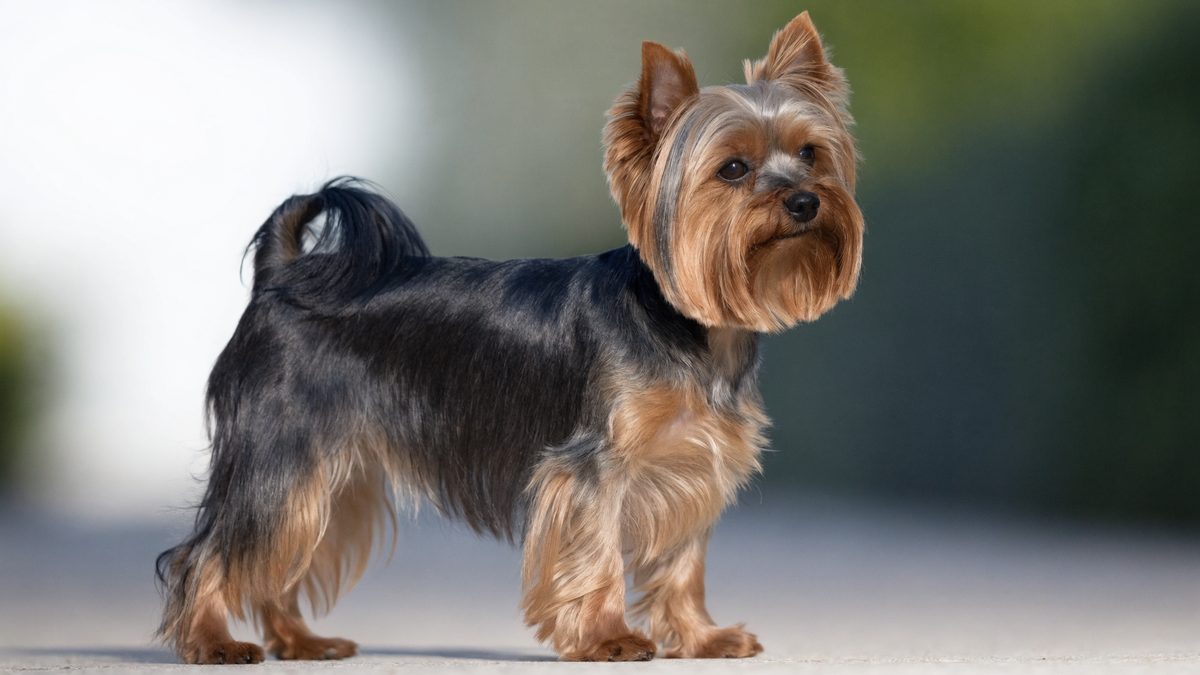
Under the American Kennel Club standard approved on 10 July 2007, the Yorkshire Terrier is described as a long-haired toy terrier whose blue and tan coat is parted on the face and from the base of the skull to the end of the tail, hanging evenly and quite straight down each side of the body. The body is neat, compact and well proportioned, and the standard asks for a high head carriage and a confident manner conveying vigour and self-importance.
The single hard number in that standard is weight. Weight must not exceed seven pounds, which is 3.17 kg. The Federation Cynologique Internationale, whose standards govern Kennel Club of India registration, puts it as up to 3.2 kg in FCI-Standard No 86, valid from 10 November 2011. The Royal Kennel Club says the same, up to 3.2 kg or 7 lb, in a standard last updated in April 2025.
No breed standard anywhere sets a height for this breed
None of the three governing standards specifies a height at the withers. The AKC standard, the FCI standard and the Royal Kennel Club standard all describe the Yorkshire Terrier without a single height figure Federation Cynologique Internationale The Royal Kennel Club. That matters, because the Indian pages selling this breed quote heights confidently and disagree with each other by more than a factor of one and a half.
| Source | Height quoted | Weight quoted |
|---|---|---|
| AKC official breed standard | Not specified anywhere in the standard | Must not exceed 7 lb |
| FCI-Standard No 86 | Not specified anywhere in the standard | Up to 3.2 kg |
| Royal Kennel Club | Not specified anywhere in the standard | Up to 3.2 kg (7 lb) |
| AKC breed page, not the standard | 7 to 8 inches | 7 pounds |
| Premium Pet House | 8 to 9 inches | Male 3 to 4.6 kg, female 2.8 to 4.3 kg |
| Mr n Mrs Pet | 7 to 9 inches | 2 to 3.5 kg |
| WhatsTheCost | 17 to 20 cm | 2 to 3.2 kg |
| PawsIndia | 27 to 33 cm | 2.8 to 4.6 kg |
Read that table before you pay a premium for a 'small' Yorkie. Two Indian pages quote adult weights above the ceiling that every recognised standard sets, and one quotes a height nearly double another's. The Royal Kennel Club adds the honest caveat that the standard is a description of the ideal and a real dog may be larger or smaller than the figure given.
A 2026 cross-sectional study of 11,061 Yorkshire Terriers at the Schwarzman Animal Medical Center in New York recorded a median bodyweight of 3.3 kg, with an interquartile range of 2.4 to 4.6 kg. The FCI ceiling is 3.2 kg. In other words, in the largest published population of this breed, more than half the dogs weigh more than the standard allows. A Yorkie that grows to 4 kg is normal, not defective, and no seller should charge you extra for one that stays under 2.5 kg.
The coat is the breed, and it is one coat, not two
The AKC standard states that quality, texture and quantity of coat are of prime importance. The hair is glossy, fine and silky, moderately long on the body and perfectly straight rather than wavy, and it may be trimmed to floor length for ease of movement. This is a single long coat that grows continuously, not a shedding double coat like the one on a Siberian Husky. That single fact drives the grooming bill, the matting risk in Indian humidity and the near-universal puppy clip you see on Indian Yorkies.
Colour is tightly specified and it changes with age. Puppies are born black and tan and are normally darker in body colour, showing an intermingling of black hair in the tan until they mature. The adult blue must be a dark steel blue, not a silver blue, and never mingled with fawn, bronzy or black hairs. The tan is darker at the roots than in the middle, shading lighter at the tips. Anyone selling you a 'rare' colour Yorkie is selling you a disqualification: under the AKC standard, any solid colour or combination of colours other than blue and tan disqualifies, as does any white marking other than a single spot on the forechest not exceeding one inch. The Royal Kennel Club states it more bluntly still, that any other colour or combination of colours is unacceptable.
Where the breed came from
The Yorkshire Terrier was first seen around the 1850s in the northern English counties of Yorkshire and Lancashire, and the current name was accepted in 1870. Scottish weavers who migrated to the English north country brought their terriers with them, and the old Black and Tan Terrier sits behind the breed along with the Skye Terrier and, by several accounts, the Maltese Federation Cynologique Internationale PawsIndia, Yorkshire Terrier breed page. The dogs were bred small enough to work the nooks of textile mills after rats, and many were employed in coal mines as exterminators. The American Kennel Club recognised the breed in 1885.
The FCI standard preserves the working temperament in one line worth memorising before you buy: the breed's terrier-like qualities include the hunting instinct, whether for a toy in the house or a rodent in the garden. The standard's stated temperament is an alert, intelligent toy terrier, spirited with an even disposition The Royal Kennel Club. Spirited is the operative word. The AKC's own description is blunter still, calling the Yorkie tenacious, feisty, brave and sometimes bossy, with all the traits of a true terrier under the dainty coat.
The Yorkshire Terrier is classified by the FCI in Group 3, Terriers, Section 4, Toy Terriers. The AKC places it in the Toy Group. Both classifications are correct and the tension between them is the breed in a sentence: a terrier's brain in a toy dog's body.
Yorkshire Terrier price in India
A Yorkshire Terrier puppy costs Rs 12,000 to Rs 1,40,000 in India in 2026, and the most useful thing on this page is that the published sources disagree by a factor of nine for the same dog. One of them disagrees with itself inside a single page. Nobody who sells Yorkies in India appears to be reading anyone else's numbers.
Bonbeno compared every Indian page currently ranking for this query, took the price bands off the raw pages, and put them side by side. We have not averaged them, because averaging a nine-fold spread produces a number that describes nothing.
| Source | Headline range | Pet or basic quality | KCI registered | Show or champion line |
|---|---|---|---|---|
| Mr n Mrs Pet | Rs 70,000 to Rs 1,40,000+ | Rs 70,000 to Rs 90,000 | Rs 90,000 to Rs 1,20,000 | Rs 1,20,000 to Rs 1,40,000 |
| Premium Pet House, headline | Rs 15,000 to Rs 50,000 | Not broken out | Not broken out | Not broken out |
| Premium Pet House, city table | Rs 70,000 to Rs 95,000 | Not broken out | Not broken out | Not broken out |
| WhatsTheCost | Rs 15,000 to Rs 40,000 | Rs 15,000 to Rs 40,000 | Rs 32,000 to Rs 60,000 | Rs 50,000 to Rs 1,00,000 |
| Supertails all-breed price list | Breed not listed | Breed not listed | Breed not listed | Breed not listed |
Premium Pet House prints the sentence 'On average, the Yorkshire Terrier price in India ranges from Rs 15,000 to Rs 50,000' and then, a few hundred words later on the same page, publishes a city-wise table where the cheapest city is Rs 70,000 to Rs 90,000 and Chennai runs to Rs 95,000. Both numbers cannot be true. The page also tells you a Yorkie can be bought 'for a price as low as Rs 15,000' while its own table never goes below Rs 70,000. Treat a page that cannot reconcile its own two tables as a price advertisement, not as market data.
What actually explains the nine-fold spread
Four things move the Yorkshire Terrier price in India, and only one of them is about the dog.
- Registration. A Kennel Club of India pedigree is the only paperwork with a verifiable cost behind it. The KCI's tariff sheet, effective 1 April 2024, charges the breeder Rs 750 per puppy for litter registration inside 60 days, rising to Rs 1,200 between 61 and 120 days and Rs 2,000 between 121 and 180 days. Transfer of ownership within twelve months of the puppy's birth costs Rs 500. The registration itself therefore adds roughly Rs 1,250 of real cost, not the Rs 20,000 to Rs 30,000 premium the tiered price tables imply.
- Whether the seller is a broker. Two of the three informational pages ranking for this query also sell puppies, and the two brokerage pages quote the highest bands. The page with no puppies to sell quotes the lowest.
- Market thinness. Supertails' Dog Price List in India 2026 covers forty-plus breeds, including the Maltese, Chihuahua, Pomeranian, Bichon Frise and Scottish Terrier, and does not list the Yorkshire Terrier at all. A breed missing from the largest published Indian price list is a breed with too few transactions to have a settled market price. Thin markets produce wide spreads.
- Claimed miniature size. Sellers charge more for smaller. That premium is the one you should refuse outright, for reasons set out in the health section below.
City prices, and why you should distrust them
Two ranking pages publish city-wise Yorkshire Terrier prices and their city tables do not overlap at any point. Premium Pet House puts Mumbai at Rs 70,000 to Rs 90,000; WhatsTheCost puts Mumbai at Rs 18,000 to Rs 48,000 WhatsTheCost, Yorkshire Terrier Price…. That is not a variation in the market, it is two publishers describing different things and labelling both 'Mumbai'.
| City | Premium Pet House | WhatsTheCost |
|---|---|---|
| Mumbai | Rs 70,000 to Rs 90,000 | Rs 18,000 to Rs 48,000 |
| Delhi NCR | Rs 72,000 to Rs 90,000 | Rs 17,000 to Rs 46,000 |
| Bangalore | Rs 75,000 to Rs 90,000 | Rs 16,000 to Rs 44,000 |
| Chennai | Rs 70,000 to Rs 95,000 | Rs 15,000 to Rs 40,000 |
| Hyderabad | Rs 74,000 to Rs 90,000 | Rs 13,000 to Rs 36,000 |
| Kolkata | Rs 73,000 to Rs 90,000 | Rs 12,000 to Rs 34,000 |
| Pune | Rs 70,000 to Rs 80,000 | Rs 15,000 to Rs 42,000 |
| Ahmedabad | Rs 70,000 to Rs 90,000 | Rs 12,000 to Rs 34,000 |
The honest reading of that table is that the Yorkshire Terrier has no settled city price in India. Use it to know the range you will be quoted in, not to know what the dog is worth.
What the price should buy you, in writing
India regulates this transaction, and most Indian buyers do not know it. Under the Prevention of Cruelty to Animals (Dog Breeding and Marketing) Rules, 2017, notified as G.S.R. 496(E) on 23 May 2017, no breeder may carry on any breeding activity without a certificate of registration from the State Animal Welfare Board, and the application fee alone is Rs 5,000, with the certificate valid for two years. The rules then set out exactly what a lawful sale looks like.
- Puppies less than eight weeks in age must not be sold.
- Every puppy sold must be micro-chipped, with a complete record of treatment and vaccination maintained.
- A receipt must be provided to each purchaser, and the breeder must retain a copy carrying the micro-chip number and your name, address and phone number.
- The breeder must furnish you, in writing, with feeding details, dates of inoculations and deworming, and the name and address of the attending veterinary practitioner.
- Puppies must not be displayed in public places for the purpose of immediate sale.
- The breeder is required to screen you, to check that you can care for the breed and bear the expense of its upkeep.
Ask for the micro-chip number and the written vaccination record before you pay anything. A seller who cannot produce them is not offering a discount, they are operating outside the rules, and the paperwork you do not get on day one is the paperwork you cannot get later.
The AKC breed standard for the Yorkshire Terrier still describes the tail as 'docked to a medium length';. In India that is not an option. The 2017 rules state that there shall be no tail docking, ear cropping, de-barking, de-clawing, branding, dyeing, injecting substances to enhance visual appeal, or any other kind of mutilation, and that any change of appearance by artificial means is strictly forbidden. The FCI and Royal Kennel Club standards both now describe an undocked tail as correct, carried a little higher than the level of the back The Royal Kennel Club. A docked Indian-bred Yorkie puppy is evidence of an unlawful practice, not of show quality.
Bonbeno does not recommend breeders, link puppy listings or broker sales. The bands above are reported from published pages and are editorial content, not offers.
The real monthly cost of a Yorkie in India
Budget Rs 3,500 to Rs 7,500 a month for a Yorkshire Terrier in an Indian metro, and understand that grooming, not food, is the largest recurring line. A long-coated toy dog in Mumbai costs more to maintain per kilogram than a Labrador does, and the Indian pages selling this breed understate the grooming bill by roughly half.
Start with what the ranking pages claim. Premium Pet House puts Yorkie grooming at Rs 700 to Rs 1,200 a month and feeding at Rs 1,500 to Rs 3,000. WhatsTheCost puts grooming at Rs 1,000 to Rs 2,500 and total monthly maintenance at Rs 2,500 to Rs 6,000. Supertails, working from a small-breed category rather than this breed, puts small-dog grooming at Rs 1,500 to Rs 3,000 a month and the small-breed monthly total at Rs 4,000 to Rs 8,000.
Now price the grooming from a groomer's rate card instead of a seller's blog. ThePetNest's 2026 city-wise pricing survey puts a full groom for a long-coated dog at Rs 1,800 to Rs 3,500 in Mumbai, Rs 1,500 to Rs 3,000 in Bangalore, Rs 1,400 to Rs 2,500 in Pune and Rs 1,200 to Rs 2,500 in Hyderabad, at a recommended frequency of every four to six weeks. A Yorkshire Terrier in coat is exactly that dog.
| City | Per full groom | Nine sessions a year | Monthly equivalent |
|---|---|---|---|
| Mumbai | Rs 1,800 to Rs 3,500 | Rs 16,200 to Rs 31,500 | Rs 1,350 to Rs 2,625 |
| Bangalore | Rs 1,500 to Rs 3,000 | Rs 13,500 to Rs 27,000 | Rs 1,125 to Rs 2,250 |
| Pune | Rs 1,400 to Rs 2,500 | Rs 12,600 to Rs 22,500 | Rs 1,050 to Rs 1,875 |
| Hyderabad | Rs 1,200 to Rs 2,500 | Rs 10,800 to Rs 22,500 | Rs 900 to Rs 1,875 |
Nine sessions a year is the arithmetic of a five-week interval, which sits in the middle of the recommended four-to-six-week band. Two things push it higher. Dematting is billed separately at Rs 500 to Rs 1,500 extra, and it is charged the moment a coat has gone past brushing. And ThePetNest advises increasing grooming frequency by 25 to 30 percent from June to September, because a matted coat in monsoon humidity becomes a skin problem rather than a cosmetic one.
Premium Pet House's Rs 700 to Rs 1,200 a month works out to Rs 8,400 to Rs 14,400 a year. The bottom of the Mumbai professional range for a long-coated dog on a five-week cycle is Rs 16,200. The seller's figure does not cover a single year of correct grooming in Mumbai even at the cheapest studio, and that gap is the single most common reason Indian Yorkies end up permanently in a puppy clip.
A full annual budget, built from priced components
| Line | Low | High | Source |
|---|---|---|---|
| Food, small-breed formula | Rs 9,600 | Rs 24,000 | WhatsTheCost, Yorkshire Terrier Price… |
| Professional grooming, nine long-coat sessions | Rs 10,800 | Rs 31,500 | ThePetNest, Ultimate Guide to Pet Grooming… |
| Routine veterinary care and deworming | Rs 3,000 | Rs 8,000 | WhatsTheCost, Yorkshire Terrier Price… |
| Annual boosters, DHPPi plus rabies | Rs 1,000 | Rs 2,000 | WhatsTheCost, Yorkshire Terrier Price… |
| Monthly tick and flea prevention | Rs 2,400 | Rs 6,000 | WhatsTheCost, Yorkshire Terrier Price… |
| Treats, dental chews and toys | Rs 6,000 | Rs 15,600 | WhatsTheCost, Yorkshire Terrier Price… |
| Annual total, healthy adult dog | Rs 32,800 | Rs 87,100 |
That is a healthy dog with no dental work and no orthopaedic event. Divide it and you get Rs 2,700 to Rs 7,250 a month, which brackets the Supertails small-breed estimate of Rs 4,000 to Rs 8,000 and sits well above the WhatsTheCost floor of Rs 2,500 WhatsTheCost, Yorkshire Terrier Price….
The line nobody budgets for is anaesthesia
Dental disease is the recurring surgical cost in a toy breed, and it arrives on a schedule most Indian buyers never plan for. WhatsTheCost puts a dental cleaning or extraction at Rs 3,000 to Rs 15,000 per episode. Every one of those episodes is a general anaesthetic, and Royal Canin's veterinary review of small-breed medicine notes that toy breeds may have more susceptibility to anaesthetic complications such as hypothermia and can be harder to monitor accurately while under. The same review notes that the smaller, more delicate jaws of these dogs carry less bone, making them more susceptible to loose teeth, pathologic bone loss and even mandibular fracture during a dental procedure.
Assume a dental under anaesthetic every 18 to 24 months from middle age. Across a 13-year life that is five to seven procedures, or roughly Rs 15,000 to Rs 1,05,000 over the dog's lifetime on dentals alone, before you price a single luxating patella.
What one-off events actually cost
Bonbeno does not publish surgical price estimates for India, because no reliable published figure exists and quoting one would be an invention. What we can tell you is which procedures the evidence says you are likelier than average to face, and their published incidence. In the 11,061-dog Schwarzman Animal Medical Center cohort, 6.7 percent of Yorkshire Terriers had confirmed severe tracheal collapse and 0.8 percent had a confirmed congenital portosystemic shunt. In OFA's patella database, 17.0 percent of 3,177 evaluated Yorkshire Terriers were abnormal. Take those three numbers to your vet and ask what each costs to manage in your city. That is a more honest conversation than any national average.
In a 110-dog Korean tracheal collapse series, 97.2 percent of affected dogs had a body condition score of 4 or above, and clinical signs improved in 86.6 percent of cases after weight reduction, environmental changes and medication. Keeping a Yorkie lean is free, and it is the intervention with the best published response rate in this breed's most expensive chronic disease.
Yorkshire Terriers in the Indian climate
A Yorkshire Terrier handles Indian heat better than a double-coated northern breed and worse than the ranking pages claim, and the reason is the windpipe rather than the coat. Bonbeno rates heat tolerance 3 of 5 for this breed, because a single silky coat sheds heat reasonably well but 6.7 percent of Yorkies carry a documented airway disease that heat and humidity make worse.
Two ranking pages tell you the Yorkshire Terrier is fine in India. WhatsTheCost rates Indian climate suitability as 'Good (small, single coat)' and answers its own FAQ with 'The Yorkshire Terrier handles Indian climate reasonably well with basic precautions like shade and water';. Premium Pet House says a Yorkie can survive in India provided you avoid taking it out when the temperature is too high. Neither cites anything.
Here is what the sourced position looks like. Purina India's heat stroke guidance names two categories of breed at particular risk, short-faced breeds such as Boxers, Bulldogs, Pugs and Pekingese, and heavy-coated breeds such as Huskies and Newfoundlands. The Yorkshire Terrier is in neither category, and Bonbeno will not pretend otherwise. But the same guidance lists the general risk factors, and two of them apply to this breed directly: excessive humidity and respiratory disease.
The airway is the reason to be careful, not the coat
Cornell's Riney Canine Health Center states plainly that stress, excitement, physical activity, heat and humidity, inhaled irritants and pressure on the neck all exacerbate the coughing of tracheal collapse, and it names the Yorkshire Terrier first among the toy and small breeds affected. Set that against the 2026 prevalence figure. In 11,061 Yorkshire Terriers, 739 dogs, or 6.7 percent, had confirmed severe tracheal collapse, defined as at least a 50 percent compromise of the tracheal lumen.
So roughly one Yorkie in fifteen has a diagnosed airway disease that Indian summer air makes symptomatically worse. That is the climate risk on this page, and no competing page states it.
Purina India lists the signs as severe panting, difficulty breathing, severe salivating, vomiting, diarrhoea, a raised temperature of 40.5 C or above, blood in the urine, nose bleeds, and ultimately collapse and coma. Vigorous exercise in hot weather can produce heat stroke in as little as 30 minutes. Move the dog into shade or air conditioning, sponge cool but not cold water onto the skin of the belly and inside the legs, use a fan, never plunge the dog into an ice bath, stop cooling at 39.4 C, and get to a vet.
City by city, what actually changes
| Setting | Dominant risk | What to change |
|---|---|---|
| Delhi NCR, Jaipur, Ahmedabad, dry summer heat | Peak afternoon temperature and hot pavement on a dog whose chest sits 20 cm off the ground | Walk before 7 am and after 8 pm from March to June. A dog this low to the ground absorbs radiated road heat that you cannot feel standing up. |
| Mumbai, Chennai, Kochi, high humidity year round | Humidity as a heat-stroke risk factor, plus coat drying time after every bath | Run a fan or air conditioning at rest, and never leave the coat half dry. ThePetNest is explicit that a damp coat in Indian humidity can turn fungal within hours. |
| Bangalore, Pune, mild but with a long monsoon | Monsoon skin and ear disease rather than heat | Increase grooming frequency 25 to 30 percent from June to September, dry paws after every walk, clean and dry ears after wet walks. |
| Kolkata, hot plus humid plus a long monsoon | Both of the above at once | Shorten the coat in June. A shorter coat dries roughly three times faster, which is the single change that prevents most monsoon skin problems. |
| Hill stations and northern winters | Cold, not heat | A single-coated toy dog has almost no insulation. PawsIndia notes Yorkies do not tolerate extreme hot or cold and may need a coat in winter. |
One Indian veterinary dermatologist quoted in ThePetNest's survey reports a 40 percent spike in skin-related consultations during monsoon, and attributes almost all of it to owners treating 'mostly dry' as dry enough. For a floor-length single coat, mostly dry is never dry enough.
The car rule, in Indian numbers
Purina India's own figures make the point without exaggeration. When the outside temperature is 26 C, the inside of a car reaches 32 C in five minutes and 43 C in twenty-five minutes. Indian summer afternoons start well above 26 C. A Yorkie left in a parked car in Nagpur in May while you 'just run in' is a fatality, not a risk.
Cornell lists switching from neck collars to harnesses as a standard lifestyle adjustment for tracheal collapse, alongside avoiding respiratory irritants and avoiding hot and humid environments. Given that 6.7 percent of the breed has confirmed severe collapse and the median age at diagnosis is 10 years, a harness from puppyhood costs you nothing and removes one known aggravating factor from a dog that may develop the disease a decade later.
Yorkshire Terrier temperament and who should buy one
Buy a Yorkshire Terrier if you want an alert, affectionate, opinionated terrier that fits an apartment, and skip it if you want a quiet dog or one that tolerates rough handling. The breed standard calls it spirited with an even disposition. The AKC calls it tenacious, feisty, brave and sometimes bossy. Both describe the same dog.
The FCI and Royal Kennel Club standards give the temperament in six words: an alert, intelligent toy terrier, spirited with an even disposition The Royal Kennel Club. The FCI adds the line that matters most for an Indian flat, that the breed's terrier qualities include the hunting instinct, whether for a toy in the house or a rodent in the garden. A Yorkie will chase a squirrel along a balcony ledge if you let it.
The AKC is franker still. Beneath the coat, it says, beats the heart of a feisty old-time terrier, and it describes the breed as tenacious, brave and sometimes bossy, packing big-town attitude into a small and self-important package. It also calls the Yorkie a true personality breed and a fine little watchdog. If you want a dog that announces every delivery, this one will.
The honest cons list, from a source with nothing to sell you
PawsIndia's breed reference publishes a cons list the puppy-selling pages do not. It names the Yorkie as physically fragile, requiring a great deal of supervision and monitoring, prone to notorious housebreaking difficulties, prone to barking, and prone to suspiciousness, shrillness and nastiness when babied, spoiled, under-socialised or not made to behave. Its pros list is equally specific: fine-boned, easy to carry, sheds very lightly, lively and inquisitive, does not need a lot of exercise, a keen watchdog, and peaceful with other pets.
That last phrase needs a caveat. Premium Pet House reports the same breed as having low tolerance for dogs outside its own breed, and describes a 'big dog syndrome' in which a Yorkie will take on a dog many times its size. Both can be true of different individuals. Assume the bold terrier version and socialise accordingly.
Small dogs really do have more behaviour problems, and it is partly your fault
Royal Canin's veterinary review of small-breed medicine cites a study that set 14 categories of undesirable behaviour against height and weight, and reports that the regression coefficients were negative for all 14 except trainability and stranger-directed fear. In plain terms, the smaller the dog, the more problem behaviours, across stranger-directed aggression, dog rivalry, fear, touch sensitivity, separation-related behaviour, attention seeking and excitability. The review then asks the right question. Is that genetic, or is it how we treat small dogs?
Its answer is mostly the second. Owners tolerate behaviours in a small dog they would never accept from a large one. A small dog may not be required to respond to commands, may be carried rather than expected to walk, and may be overprotected in a way that interferes with its socialisation with other people and dogs. Every one of those is a choice an Indian owner makes daily with a 3 kg dog in a crowded lift lobby.
Behaviour issues are one of the most common reasons dogs are relinquished to shelters. The Yorkshire Terrier's reputation for being difficult is largely a reputation for being under-trained, and a dog that is carried everywhere never learns the thing that would have kept it in its home.
Apartment fit, children and being left alone
The Yorkshire Terrier suits an Indian apartment genuinely well. It is small, it needs a short walk twice a day rather than a run, and it adapts to urban life. The constraint is noise, not floor area. In a building with shared walls, a keen watchdog that barks at the lift becomes a neighbour problem within a week unless you train an early quiet cue.
On children, treat the standard advice carefully. WhatsTheCost rates the breed 'Moderate (fragile)' with children and says it needs supervision with young children. PawsIndia is blunter, listing physical fragility as a con requiring constant supervision. A 2.5 kg dog dropped from a child's arms or sat on is an emergency. Royal Canin notes that in the smallest toy dogs, fractures occur after a short fall or jump, from being stepped or sat on, or even from rough play. Households with children under seven should choose a sturdier breed.
Separation is the other constraint. PawsIndia records that Yorkies do not enjoy being left alone for long periods and can be prone to separation anxiety that may require additional training. A dog left alone for a ten-hour Indian office day is a poor match unless a second person is home or the day is broken up.
| Good fit | Poor fit |
|---|---|
| Apartment households with someone home most of the day | Homes empty for ten hours a day |
| Owners who will actually train and socialise a small dog | Owners who plan to carry the dog everywhere |
| Adults, teenagers and calm older children | Homes with toddlers or children under seven |
| Buyers who have budgeted the grooming bill honestly | Buyers choosing the breed because it looks cheap to keep |
| Buyers willing to read up on portosystemic shunt and patellar luxation | Buyers who want a guard dog or a jogging partner |
One more thing the ranking pages get wrong. Mr n Mrs Pet lists 'Intelligent & Easy to Train' as a reason the breed is right for you. Intelligent, yes. Easy, only if you actually do the work, which for this breed means daily coat handling, a strict toilet routine and real socialisation before four months of age.
Training a Yorkshire Terrier in India
To train a Yorkshire Terrier, run short reward-based sessions from eight weeks, socialise hard through the first four months, and expect house training to take longer than it would with a larger dog. The breed is intelligent and eager to please, and it responds far better to effusive praise and treats than to harsh corrections.
The AKC guidance for this breed is specific and worth following exactly. Yorkies love their owners, are very intelligent and are eager to please. Effusive praise and treats for good behaviour work far better than harsh corrections. From an early age the Yorkie should be socialised to strange situations, people and other dogs, taken into new situations slowly and always in a calm, happy atmosphere. PawsIndia gives the same advice almost word for word.
This is not a stupid dog and it is not an untrainable one. Despite their size, Yorkies participate in and excel at rally, agility and obedience, and many work as therapy dogs alongside their handlers PawsIndia, Yorkshire Terrier breed page. If your Yorkie behaves badly, the training is the variable.
House training is genuinely harder, and there is a physical reason
PawsIndia lists notorious housebreaking difficulties as a con of the breed. Royal Canin supplies the mechanism: toilet training can be difficult in tiny dogs because of the minute capacity of the bladder, so these dogs need to be taken outside more frequently than their larger relatives. That is anatomy, not disobedience.
- Take the puppy out on a fixed schedule rather than on request, every 60 to 90 minutes awake at 8 to 12 weeks, stretching as the bladder grows.
- Reward at the spot, within two seconds, every single time for the first month.
- Use an indoor toilet area alongside outdoor trips if you live above the eighth floor, because a lift ride is longer than a ten-week-old toy puppy's bladder allows.
- Avoid punishing an accident. In a breed already prone to shrillness under harsh handling, punishment produces hiding rather than continence.
- Expect four to six months to reliability rather than the six to eight weeks a Labrador owner reports.
Socialisation, and the Indian timing problem
Under India's 2017 breeding rules a puppy cannot lawfully be sold before eight weeks of age. You therefore take delivery of your Yorkie with roughly six to eight weeks of the primary socialisation window left, and you spend part of it finishing the vaccination course. Do not waste it. Carry the puppy out to see traffic, lifts, tiled floors, delivery riders, autorickshaw horns, cattle, temple bells and other dogs before it can safely walk on the ground.
Royal Canin notes that overprotected small dogs miss exactly this, because owners carry them instead of letting them experience the world. Carrying a puppy to a new place is socialisation. Carrying an adult dog past every dog it meets is avoidance. You need to socialise the dog deliberately in the first case and stop doing it in the second.
Cornell lists pressure on the neck among the factors that exacerbate tracheal collapse coughing, and recommends switching from neck collars to harnesses. With 6.7 percent of the breed carrying confirmed severe collapse and a median diagnosis age of 10 years, the sensible order is to start on a harness and never introduce a neck collar for lead work at all.
What training costs in India
Published Indian figures agree for once. Premium Pet House puts basic obedience with a dedicated trainer at Rs 2,000 to Rs 5,000. WhatsTheCost puts professional group classes at Rs 3,000 to Rs 8,000 for a six to eight week course, private sessions at Rs 500 to Rs 1,500 each, and recommends starting basic obedience at 8 to 10 weeks. Either figure is small against the grooming bill and buys more.
The three behaviours to train before anything else
- Quiet on cue. The breed is prone to barking and is a keen watchdog that will not fail to announce strangers. In an Indian apartment block this single behaviour decides whether your neighbours tolerate the dog.
- Four on the floor. The AKC advises limiting a Yorkie's jumping height, especially as a puppy, specifically to help avoid luxating patella. Teach the dog to be lifted down rather than to leap off sofas and beds.
- Handling tolerance. You will brush this coat daily and clean these teeth for thirteen years. A puppy taught at ten weeks to accept a comb, a toothbrush and a nail clipper saves you a decade of fighting, and PawsIndia warns that Yorkies respond badly to rough handling.
How much exercise a Yorkshire Terrier needs
A Yorkshire Terrier needs two short walks a day plus occasional short bursts of play, roughly 30 to 45 minutes of activity in total. The AKC's own guidance is that a short walk twice a day is likely enough. The real risk in India is not under-exercising this breed but exercising it at the wrong hour.
The AKC states that even small dogs require exercise for mental and physical health, that Yorkies benefit from moderate exercise such as a walk at a steady pace plus occasional short bursts like chasing a ball, and that a short walk twice a day is likely enough to see new scenery and burn off energy. PawsIndia repeats the advice and adds that the breed does not need a lot of exercise. WhatsTheCost puts the requirement at low, roughly 30 minutes.
Those three agree, and Bonbeno agrees with them. This is one of the few imported breeds whose activity requirement genuinely fits an Indian working week.
Mental work matters more than distance
A terrier bred to hunt rodents in a mill needs something to do with its brain. The AKC notes that dog sports such as obedience or agility provide beneficial activity while challenging the mind, and PawsIndia lists rally, agility and obedience among the activities Yorkies excel at despite their size. Fifteen minutes of scent games, a food puzzle or a new trick settles this dog more reliably than an extra kilometre of pavement.
Three Indian constraints on when and how you exercise
- Heat. Purina India warns that vigorous exercise in hot weather can produce heat stroke in as little as 30 minutes, and advises exercising in the morning or the evening while avoiding the hottest part of the day. From March to June in most Indian cities that means before 7 am and after 8 pm.
- Airway. Cornell lists physical activity, excitement, heat and humidity among the factors that exacerbate the cough of tracheal collapse. If your Yorkie develops a harsh, dry, goose-honking cough on walks, shorten them and see a vet rather than pushing through.
- Knees. The AKC advises limiting the Yorkie's jumping height, especially as a puppy, to help avoid luxating patella. Stairs, sofa jumps and repetitive fetch on tile are the everyday loads on a joint that is abnormal in 17.0 percent of OFA-evaluated dogs of this breed.
In the 110-dog tracheal collapse series, the fluoroscopic grade of collapse tracked with a high body condition score, and 97.2 percent of the affected dogs scored 4 or above. A lean Yorkie walks further, coughs less and needs less medication. Royal Canin frames the portion problem in a way Indian households will recognise: for a toy dog an occasional bite of people food is the equivalent of feeding a large dog an entire cheeseburger, and treats plus human food should stay under 10 percent of total daily calories.
One practical note for Indian summers. A Yorkshire Terrier's chest sits roughly 20 cm off the ground, inside the layer of radiated heat coming off asphalt that you cannot feel standing upright. Press the back of your hand to the pavement for five seconds before a walk. If you cannot hold it there, neither can your dog's feet or its chest.
Grooming a Yorkshire Terrier in Indian humidity
Brush a Yorkshire Terrier's coat every single day if you keep it long, and book a professional groom every four to six weeks. The coat is a single continuously growing silky coat closer to human hair than to animal fur, which is why almost every Indian Yorkie ends up in a puppy clip, and why the grooming bill is the largest recurring line in the budget.
The AKC puts it precisely. The Yorkshire Terrier's coat is very similar to human hair and should be treated accordingly. Kept long, it needs to be brushed daily. The hair on the upper part of the head should be trimmed short or pulled up into a topknot to avoid eye irritation. The dog needs a bath every week or so, and the ears should be checked weekly for debris or signs of infection.
The breed standard describes what you are maintaining. Quality, texture and quantity of coat are of prime importance. The hair is glossy, fine and silky, moderately long on the body and perfectly straight rather than wavy, and it may be trimmed to floor length for ease of movement and a neater appearance. Hair should be trimmed short on the tips of the ears, and may be trimmed on the feet. The FCI adds the welfare clause that matters: the coat must never impede movement.
The puppy clip is the right answer in India, and nobody says so
PawsIndia states plainly that most pet owners opt for a puppy clip, with the facial hair left a bit longer than the body hair, and that regular trips to a professional groomer are a must along with weekly baths. Bonbeno goes further for Indian conditions. Unless you are showing the dog, clip the coat short and keep it short.
- A shorter coat dries roughly three times faster, and ThePetNest names keeping long coats trimmed shorter from June as the single change that prevents most monsoon skin problems.
- A half-dry coat in Indian humidity can develop a fungal infection within hours, with Malassezia and ringworm the usual culprits.
- Dematting is billed on top of the groom at Rs 500 to Rs 1,500, and a matted coat is the default outcome of a floor-length coat brushed twice a week instead of daily.
- Water tightens knots into concrete, so a matted dog must never be bathed before it is brushed out.
Premium Pet House puts the daily routine at 10 to 15 minutes and notes that it does not take much for a Yorkie's coat to form knots. That is the honest number. Ten minutes a day with a slicker brush followed by a steel comb, plus a weekly bath, plus weekly ear checks and nail trims every one to two weeks PawsIndia, Yorkshire Terrier breed page. Skip a week in Mumbai in July and you are paying a dematting surcharge.
Shedding, and the hypoallergenic claim every Indian page repeats
Shedding in this breed is genuinely low. PawsIndia records that Yorkies do not shed much, and the standard's single silky coat has no seasonal undercoat blow of the kind a northern breed has. That part of the marketing is true.
The hypoallergenic claim is not. Mr n Mrs Pet headlines 'Hypoallergenic & Low-Shedding'. Premium Pet House states that Yorkies have 'hypoallergic coats' and answers a dedicated FAQ on why the breed is the best choice for people with dog hair allergies. WhatsTheCost lists shedding as 'Very Low (hypoallergenic)';. Even the AKC calls the breed hypoallergenic on its own breed page.
The only controlled measurement of the question found the opposite. Vredegoor and colleagues measured Can f 1, the major dog allergen, in hair and coat samples from 196 dogs of breeds marketed as hypoallergenic and 160 control dogs, and in settled and airborne dust from their homes. Hair samples from the so-called hypoallergenic dogs carried a geometric mean of 2.26 micrograms per gram against 0.77 in the controls, and coat samples 27.04 against 12.98. Differences between breeds were small relative to the variability within a breed, and there were no differences in airborne levels between breeds. The authors concluded that there is no evidence for the classification of certain dog breeds as being hypoallergenic.
The Vredegoor study did not include Yorkshire Terriers among the breeds sampled, so Bonbeno will not claim it measured this breed. Its conclusion was about the category, not one breed. PawsIndia, which sells nothing, says the same thing in plainer words: shedding varies from dog to dog, so do not believe anyone who tells you that Yorkies are non-allergenic. If someone in your household has a diagnosed dog allergy, spend an hour with an adult Yorkie before you commit, and treat any seller's allergy promise as marketing.
What to ask a groomer in India
- Ask how tools are sterilised between pets. ThePetNest names UV-C sterilisation units as the 2026 professional benchmark and says alcohol wipes alone are not sufficient, because clippers and combs carry bacteria, yeast and ringworm spores between dogs.
- Ask what shampoo is used. Dog skin sits at pH 6.5 to 7.5 against human skin at 4.5 to 5.5, and any groomer using human shampoo is cutting corners at your dog's expense.
- Ask about clipper noise. Conventional clippers run at 70 to 80 dB; low-noise cordless units run under 50 dB, which matters for a small, noise-sensitive dog.
- Ask for a post-groom health note. A trained groomer spots ear odour, redness, lumps and dry patches before you do.
Teeth are part of grooming for this breed
The AKC and PawsIndia both list tooth brushing in the routine care for a Yorkshire Terrier rather than as an optional extra PawsIndia, Yorkshire Terrier breed page. Take that literally. Royal Canin's small-breed review notes that small dogs are more likely to suffer retained deciduous teeth and periodontal disease than larger dogs, hypothesised to follow from small mouths and crowded teeth. A daily thirty seconds with a dog toothbrush is the cheapest veterinary intervention available to you, and the health section below prices the alternative.
Yorkshire Terrier health issues and lifespan
The Yorkshire Terrier lives a median 13.3 years and carries four documented over-representations that matter more than the generic small-dog list: congenital portosystemic shunt, tracheal collapse, patellar luxation and protein-losing enteropathy. A 2026 study of 11,061 Yorkies is the largest dataset that exists for this breed, and no Indian page cites it.
Start with the good news, because it is real. In the Dogs Trust breed longevity table covering 155 breeds, the Yorkshire Terrier's median life expectancy is 13.3 years, with a 95 percent confidence interval of 13.3 to 13.4, from a sample of 14,579 dogs of which 9,509 were deceased. That is one of the largest single-breed samples in the whole table, so the estimate is tight. It puts the breed above the crossbred group at 12.0 years, above the Chihuahua at 11.8 and above the Maltese at 13.1, and below the Poodle at 14.0. The AKC quotes a lifespan of 11 to 15 years, which brackets the same figure.
| Breed | Median life expectancy | Dogs in sample |
|---|---|---|
| Poodle | 14.0 years | 6,427 |
| Lhasa Apso | 14.0 years | 7,216 |
| Yorkshire Terrier | 13.3 years | 14,579 |
| Maltese | 13.1 years | 2,021 |
| Shih Tzu | 12.8 years | 12,007 |
| Pomeranian | 12.2 years | 2,941 |
| Crossbred group | 12.0 years | 111,053 |
| Chihuahua | 11.8 years | 10,788 |
The 2026 study nobody in India is citing
In May 2026 the Journal of Veterinary Internal Medicine published a cross-sectional study of every Yorkshire Terrier seen at the Schwarzman Animal Medical Center in New York, run with Weill Cornell Medicine. It reviewed 11,061 Yorkshire Terriers and confirmed diagnoses against imaging rather than accepting record keywords. The headline numbers are these.
| Finding | Dogs | Prevalence | Median age at diagnosis |
|---|---|---|---|
| Severe tracheal collapse, 50 percent or more lumen loss | 739 | 6.7 percent | 10.0 years (IQR 8.0 to 13.0) |
| Congenital portosystemic shunt | 93 | 0.8 percent | 2.7 years (IQR 1.0 to 5.7) |
| Both conditions in the same dog | 6 | 0.05 percent | Shunt diagnosed first in all six |
Two details from that paper are worth carrying to your vet. The authors note that Yorkshire Terriers are the only breed routinely listed in the top five breeds affected by either condition, which is why the breed was chosen for the study. And they state that their own figures likely underestimate true prevalence, because many of the 11,061 dogs came in for unrelated reasons and never received a full workup. Treat 6.7 percent as a floor, not a ceiling.
Portosystemic shunt, where this breed leads almost every list
A congenital portosystemic shunt is an abnormal vessel that lets blood from the gut bypass the liver, so toxins that the liver should strip out reach the brain instead. The Yorkshire Terrier's association with it is among the strongest published for any breed.
- In a study of 2,400 dogs from the Veterinary Medical Database over 22 years, congenital portosystemic shunts were reported in 0.18 percent of all dogs and 0.05 percent of mixed-breed dogs. Yorkshire Terriers had the greatest total number of diagnoses of any breed, and the greatest proportions were Havanese at 3.2 percent, Yorkshire Terriers at 2.9 percent, Maltese at 1.6 percent, Dandie Dinmont Terriers at 1.6 percent and Pugs at 1.3 percent.
- A separate record, pedigree and breeding-trial analysis put the odds ratio for portosystemic shunt in Yorkshire Terriers at 35.9 times that of all other breeds combined, and found Wright's coefficient of inbreeding roughly twice as high in affected dogs as in normal members of the breed. The condition appears hereditary, though the mechanism of inheritance has not been established.
- The MSD Veterinary Manual lists Yorkshire Terriers first among the small terrier-type breeds predisposed to extrahepatic shunts, the type that predominates in small dogs MSD Veterinary Manual.
Signs usually appear before one year of age in dogs, and 10 to 20 percent of affected animals are clinically normal. Watch for a puppy that fails to thrive, vomiting, diarrhoea, pica, excessive drinking and urination, unexplained blindness, excessive vocalisation, apparent neck pain, or straining to urinate from ammonium biurate stones. Blood work may show microcytic red cells, low blood urea nitrogen, low cholesterol and low albumin.
MSD states that animals with portosystemic vascular anomalies are often smaller than littermates and fail to thrive. The Royal Kennel Club states that teacup breeders often use the very smallest dogs for breeding, which frequently means breeding from the runts of the litter, and names Yorkshire Terriers as one of the two breeds most often used. Put those two sentences together. The undersized Yorkie puppy an Indian seller is charging you a premium for as a teacup yorkie may be undersized because it has a liver shunt. You are being asked to pay extra for a symptom.
The bile acid test to ask for at six months
This is the single most useful action on this page, and it is not on any competing page. Microvascular dysplasia is the most common circulatory anomaly of the canine liver, it affects small breeds predisposed to shunts, it appears to share polygenic inheritance factors with shunts in small terrier-type dogs, and MSD names Yorkshire Terriers first on its list of commonly affected breeds.
Dogs with microvascular dysplasia typically show no clinical signs at all. The condition is usually recognised only on the discovery of increased total serum bile acid concentrations. MSD's recommendation is explicit: because microvascular dysplasia is characterised by increased total serum bile acids, this test should be administered to all puppies of predisposed breeds at 6 months old, so that a high reading found during an illness later in life does not trigger inappropriate, invasive and expensive diagnostic testing.
A normal lifespan should be expected in a dog with microvascular dysplasia, and the diagnosis does not warrant a special diet or liver medication. But dogs with the condition may have trouble metabolising drugs that require rapid hepatic delivery and extraction, so care is warranted when prescribing certain medications. MSD gives the example of butorphanol, where a sedation dose in a dog with microvascular dysplasia may be as low as 0.05 mg/kg intravenously. Now recall that this breed needs repeated dental procedures under general anaesthetic across a 13-year life. One bile acid test at six months tells every vet who ever sedates your dog how to dose it. In a country where you may see four different vets in four cities, that result belongs in writing in the dog's file.
Patellar luxation, where the breed ranks fourth of all breeds
Patellar luxation is the kneecap slipping out of its groove, and the Orthopedic Foundation for Animals publishes the breed-by-breed numbers. In OFA's patella table the Yorkshire Terrier ranks 4th of all breeds, with 3,177 evaluations, 83.0 percent normal and 17.0 percent abnormal, broken down as Grade 1 in 11.1 percent, Grade 2 in 4.5 percent and Grade 3 in 1.2 percent.
That is close to one evaluated Yorkie in six. The AKC's own advice follows directly: responsible breeders screen their stock for eye anomalies and luxating patella, and owners should limit the Yorkie's jumping height, especially as a puppy, specifically to help avoid it. The Yorkshire Terrier Club of America's CHIC requirements are a patella evaluation and an ophthalmologist evaluation, both with a minimum age of one year American Kennel Club.
| Screening test | Evaluations | Result | Breed rank |
|---|---|---|---|
| Patella | 3,177 | 17.0 percent abnormal | 4th of all breeds |
| Eyes | 2,168 | 6.1 percent abnormal | 70th |
| Hips | 503 | 7.2 percent dysplastic | 159th |
| Dentition | 70 | 2.9 percent abnormal | 55th |
| Primary lens luxation, DNA | 111 | 100.0 percent normal, no carriers found | 16th |
| Progressive retinal atrophy, DNA | 110 | 6.4 percent carriers, no affected dogs | 17th |
Read the bottom two rows carefully, because they are a correction. The ADAMTS17 DNA test for primary lens luxation is offered for this breed, and in the 111 Yorkshire Terriers OFA has on file, none carried the mutation. Progressive retinal atrophy appears on every Indian Yorkie health list, including Premium Pet House's, and in OFA's DNA data 6.4 percent of 110 tested Yorkies were carriers with no affected dogs recorded. Both are real screening items for a breeder. Neither is a common clinical problem in the way Indian pages imply.
Note also the dentition row. OFA holds just 70 dentition evaluations for the entire breed. Nobody screens toy-dog teeth, which is exactly why toy-dog dental disease arrives as a surprise bill.
Protein-losing enteropathy, the one that is specific to this breed
Protein-losing enteropathy is a syndrome in which protein leaks out through the intestinal wall, and the Yorkshire Terrier is one of the few breeds with a named, studied form of it. The Yorkshire Terrier Club of America runs a dedicated research programme on it, funded through the AKC Canine Health Foundation, and issues a standing call for samples from affected dogs.
The scale of the over-representation is on the record. The AKC Canine Health Foundation puts the syndrome as most common in Yorkshire Terriers at a 4.2 to 10-fold relative risk, notes that the microscopic appearance of the small intestine in affected Yorkies is distinct from protein-losing enteropathy in other breeds and therefore suggests a breed-specific genetic abnormality, and states that recent studies indicate treatment failure in approximately 50 percent of affected Yorkshire Terriers.
The reference case series describes 30 client-owned Yorkshire Terriers with the condition. Females outnumbered males 20 to 10, and the median age was 7 years, with a range of 1 to 12. Diarrhoea appeared in 20 of 30 dogs, vomiting in 11, ascites and abdominal distension in 11, and respiratory difficulty in 8. Every dog was treated with glucocorticoids. Of the 23 dogs with long-term follow-up, 9 had complete resolution of signs, 3 partial, and 11 failed to respond. Median survival was 44 months in responders and 12 months in non-responders, with four dogs dying peracutely.
Vomiting, monocytosis, the severity of low albumin, a low blood urea nitrogen and villous blunting on biopsy all predicted survival under four months. In practice: a middle-aged Yorkie with chronic diarrhoea and a swollen abdomen is not a dietary problem, it is a blood-albumin test the same week.
Tracheal collapse, the disease of the second half of life
Tracheal collapse is progressive, has no cure, and Cornell names the Yorkshire Terrier first among the toy and small breeds affected. The classic sign is a persistent, harsh, dry cough often described as goose-honking, progressing to wheezing on inhalation, and in severe cases to difficulty breathing, blue gums or fainting, which is a veterinary emergency.
The Indian angle is management rather than surgery. In a 110-dog series from Seoul National University the Yorkshire Terrier was the fifth most common breed at 6 dogs or 5.4 percent, behind Maltese at 30.9 percent, Pomeranian at 22.7 percent, Poodle at 15.4 percent and Chihuahua at 7.2 percent. Mean age was 11.37 years and 91.8 percent of affected dogs were over eight years old. Two findings from that series should change what you do.
- 97.2 percent of affected dogs carried a body condition score of 4 or above, and the grade of collapse tracked with high body condition score and low bodyweight.
- Clinical signs improved in 86.6 percent of cases after weight reduction, environmental changes and medication. Cornell adds the specific environmental changes: switch from a neck collar to a harness, avoid respiratory irritants such as cigarette smoke, and avoid hot and humid environments.
One diagnostic caution for Indian owners, because it will save you a wasted visit. In that same series only 64.1 percent of dogs had tracheal collapse confirmed on plain radiography, because a static X-ray is a snapshot while the trachea collapses during a breathing cycle. Cornell recommends fluoroscopy, moving X-rays, or bronchoscopy where the diagnosis matters. A normal chest X-ray does not rule this out.
Dental disease, the recurring cost
Periodontal disease was diagnosed in 12.52 percent of a random sample of 22,333 UK dogs in a single year, and the study found that increasing adult bodyweight was associated with progressively decreasing odds of it. The Yorkshire Terrier was not among the breeds named with the highest odds in that analysis, and Bonbeno will not claim it was. What the bodyweight gradient means is that a 3 kg dog sits at the wrong end of the curve.
Royal Canin's review gives the anatomy. Small dogs are more likely to suffer retained deciduous teeth and periodontal disease, hypothesised to follow from small mouths and crowded teeth, and their smaller, more delicate jaws carry less bone, making them more susceptible to loose teeth, pathologic bone loss and even mandibular fracture during a dental procedure. Premium Pet House, to its credit, notes that Yorkies retain their puppy teeth and are vulnerable to oral health problems.
The rest of the list, kept honest
| Condition | What is established | Source |
|---|---|---|
| Legg-Calve-Perthes disease | Loss of blood supply to the femoral head, most often seen in miniature and toy breeds between 4 months and a year. The Yorkshire Terrier is on OFA's at-risk list. Believed inherited, mode unknown, so affected dogs should not be bred. Severe cases are treated by excision of the femoral head and neck, or hip replacement. | Orthopedic Foundation for Animals |
| Juvenile hypoglycaemia | Toy and teacup dogs may need feeding multiple times a day because of a propensity toward low blood sugar. Hypoglycaemia is also recorded, though rarely, in young very small toy-breed dogs with portosystemic shunts. | Freyer JL. The small dog trend MSD Veterinary Manual |
| Eye conditions on the OFA register | Of 2,166 Yorkshire Terriers examined, distichiasis appeared in 34 dogs (1.6 percent), cataract of unknown significance in 37 (1.7 percent), vitreous degeneration with syneresis in 17 (0.8 percent) and retinal dysplasia with folds in 7 (0.3 percent). | Orthopedic Foundation for Animals |
| Atopy and skin disease | Skin and coat, specifically atopy, is one of the YTCA's own listed breed health topics. Indian monsoon conditions add fungal and hot-spot risk on top. | Yorkshire Terrier Club of America ThePetNest, Ultimate Guide to Pet Grooming… |
| Mitral valve disease | Myxomatous mitral valve disease, one of the most common causes of canine heart disease, is much more common in small breeds than large ones. | Freyer JL. The small dog trend |
| Hip dysplasia | Present but not a headline risk for this breed. 7.2 percent of 503 OFA-evaluated Yorkshire Terriers were dysplastic, ranking the breed 159th. | Orthopedic Foundation for Animals |
Ask for an OFA or equivalent patella evaluation and an ophthalmologist evaluation on both parents, minimum age one year, which are the Yorkshire Terrier Club of America's own CHIC requirements. India's 2017 breeding rules separately require that breeding dogs be tested for inherited genetic defects including hip dysplasia and progressive retinal atrophy, that no dog be bred before 18 months, that no female produce more than five litters in her lifetime or be mated after the age of eight, and that inbreeding and incest breeding be prohibited outright.
Feeding a Yorkshire Terrier in India
Feed an adult Yorkshire Terrier two measured meals a day of a small-breed formula totalling roughly 200 to 400 calories, and feed a puppy three to four small meals because toy breeds are prone to low blood sugar. The whole feeding problem in this breed is portion size, and Indian households get it wrong in one specific way.
WhatsTheCost puts the daily requirement at 200 to 400 calories, fed as a high-quality small-breed formula twice daily, with puppies on three to four small meals, and warns against overfeeding because small breeds are prone to obesity. The AKC agrees in principle, saying any diet should be appropriate to the dog's age, that some dogs are prone to getting overweight, and that treats can be an important training aid but too many cause obesity.
Life-stage feeding, from the Indian pages that get it right
- Up to 3 months. Free-feed or offer very frequent small meals. Royal Canin notes that toy and teacup dogs may need feeding multiple times a day because of their propensity toward hypoglycaemia. Premium Pet House recommends food available at all times at this age.
- 3 months to 1 year. Three to four structured meals a day, morning, midday, early evening and late evening. Structure also makes house training possible.
- 1 year and older. Two measured meals a day with treats counted in.
- Water. Clean, fresh water available at all times, which the AKC lists as a non-negotiable.
Royal Canin puts it better than we can. For a toy dog, an occasional bite of people food is the equivalent of a large-breed dog being fed an entire cheeseburger, which makes obesity and nutrient imbalance a very real concern, and treats plus human food should not exceed 10 percent of total daily calories. In a household where the dog gets a corner of roti at every meal from four different people, that ceiling is breached before lunch. This is not a small point: 97.2 percent of the dogs in a tracheal collapse series carried a body condition score of 4 or above.
What it costs to feed a Yorkie in India
| Food type | Monthly cost |
|---|---|
| Budget dry food | Rs 800 to Rs 1,040 |
| Premium small-breed dry food | Rs 1,400 to Rs 2,000 |
| Super premium dry food | Rs 2,000 to Rs 3,000 |
| Home-cooked plus dry food mix | Rs 960 to Rs 1,600 |
Two other Indian sources bracket the same range. Premium Pet House puts feeding at Rs 1,500 to Rs 3,000 a month, and Supertails puts small-breed dry and wet food at Rs 1,500 to Rs 2,500 Supertails, Dog Price List in India 2026. Food is not where this breed costs you money. Grooming is.
Home-cooked food, and when the diet becomes medical
The AKC accepts home-prepared food, with the qualifier that it should be prepared with your veterinarian's supervision and approval. Take the qualifier seriously in a 3 kg dog, where a calcium or protein error is proportionally four times what it would be in a Labrador.
Two situations turn the diet into treatment. A dog with a portosystemic shunt needs a prescription hepatic diet: soy and dairy-quality proteins starting at 2.5 g/kg per day, with red meat, fish and organ meats avoided altogether, plus lactulose and low-dose metronidazole. A dog with protein-losing enteropathy needs veterinary management, and in the reference case series every one of the 30 Yorkshire Terriers was treated with glucocorticoids. Neither of these is a diet you assemble from a blog.
Royal Canin notes that tiny dogs are more likely to suffer severe dehydration secondary to diarrhoeal disease than large dogs, which makes veterinary care more urgent than it would be for the same illness in a Labrador. In an Indian summer, a Yorkie with a day of diarrhoea goes to the vet, not on a rice-and-curd diet at home.
Foods to keep away from a Yorkshire Terrier are the standard canine list, and worth repeating because a toxic dose is proportionally tiny in a 3 kg dog: chocolate, onions, grapes and cooked chicken bones.
Yorkshire Terrier puppy timeline, month by month
Plan a Yorkshire Terrier puppy's first year around four fixed dates: collection at eight weeks, the vaccination course finishing near sixteen to twenty weeks, a total serum bile acid test at six months, and patella plus eye screening at twelve months. Everything else moves. Those four do not.
| Age | What is happening | What you do |
|---|---|---|
| 6 to 8 weeks | Still with the breeder. Under Indian law a puppy cannot be sold before eight weeks. First DHPPi and Corona vaccination falls due at 6 to 8 weeks, Rs 500 to Rs 1,000. | Visit, meet the dam, and ask for the micro-chip number and written vaccination record the rules require. |
| 8 to 12 weeks | Collection. Booster due at 10 to 12 weeks. Coat is black and tan and will stay darker until the dog matures. | Start toilet training on a 60 to 90 minute schedule, begin basic obedience from 8 to 10 weeks, and start daily coat and tooth handling. |
| 12 to 16 weeks | Second booster at 14 to 16 weeks, anti-rabies at 16 weeks at Rs 300 to Rs 800. The socialisation window is closing. | Carry the puppy out to traffic, lifts, markets and other dogs. Feed three to four small meals a day. |
| 16 to 20 weeks | Kennel cough vaccine, Rs 500 to Rs 1,000. Legg-Calve-Perthes disease most often appears in toy breeds between 4 months and a year. | Watch for any hind-limb lameness or reluctance to bear weight and report it the same week. |
| 5 to 6 months | Adult coat texture starting to come in. Shunt signs, where present, are usually evident before one year, and 10 to 20 percent of affected dogs show none. | Book the total serum bile acid test at 6 months. MSD recommends it for all puppies of predisposed breeds, and Yorkshire Terriers head that list. |
| 6 to 9 months | First professional groom cycle established. Deciduous teeth should have gone; small breeds commonly retain them. | Ask your vet to check for retained puppy teeth at the same visit. Move to two meals a day at around twelve months. |
| 9 to 12 months | Adult weight reached. The median adult in the largest published cohort is 3.3 kg, above the 3.2 kg standard ceiling Federation Cynologique Internationale. | Weigh the dog monthly and keep it lean. Body condition is the cheapest control you have over this breed's worst chronic disease. |
| 12 months | CHIC screening age. The Yorkshire Terrier Club of America sets a minimum age of one year for its required evaluations. | Patella evaluation and ophthalmologist evaluation, both registered American Kennel Club. Essential if you ever intend to breed, useful either way. |
Fit a harness, never a neck collar, because pressure on the neck is a listed aggravating factor for the tracheal collapse that 6.7 percent of this breed develops Weisse C, Kwok SY, Berent. Block the sofa and the stairs, because the AKC advises limiting jumping height specifically as a puppy to help avoid the patellar luxation that affects 17.0 percent of OFA-evaluated Yorkies Orthopedic Foundation for Animals. Get the paperwork in a folder, because the breeder is legally required to hand over the micro-chip number, the vaccination and deworming dates and the attending vet's name and address.
One note on registration timing if you bought a KCI-papered puppy. The Kennel Club of India charges the breeder Rs 750 per puppy to register a litter within 60 days, Rs 1,200 between 61 and 120 days and Rs 2,000 between 121 and 180 days, and transfer of ownership within twelve months costs Rs 500. If the papers have not arrived by the time your puppy is four months old, the breeder has probably not filed. Chase it then, not at a year.
Yorkshire Terrier compared with the toy breeds Indians cross-shop
Choose a Yorkshire Terrier over a Maltese, Shih Tzu, Chihuahua or Pomeranian if you want a bold terrier personality and you will actually do the daily coat work. Choose against it if you want a cheaper grooming bill or a lower liver-shunt risk, because on both of those the Yorkie is the worst of the five.
| Breed | Median lifespan | Published Indian price | Coat work | Signature inherited risk |
|---|---|---|---|---|
| Yorkshire Terrier | 13.3 years | Rs 12,000 to Rs 1,40,000, sources disagree ninefold | Highest. Daily brushing, professional groom every 4 to 6 weeks ThePetNest, Ultimate Guide to Pet Grooming… | Portosystemic shunt, 2.9 percent of the breed and the greatest total number of diagnoses of any breed |
| Maltese | 13.1 years | Rs 25,000 to Rs 80,000 | Equally high. Same single long coat problem | Tracheal collapse, 30.9 percent of a 110-dog series, the largest single breed in it |
| Shih Tzu | 12.8 years | Rs 20,000 to Rs 80,000 | High, plus a brachycephalic face to keep clean | Also a named extrahepatic shunt breed |
| Chihuahua | 11.8 years | Rs 15,000 to Rs 50,000 | Lowest of the five in smooth coat | Also on the microvascular dysplasia breed list |
| Pomeranian | 12.2 years | Rs 8,000 to Rs 80,000 | High volume shedding rather than matting | Tracheal collapse, 22.7 percent of the same 110-dog series |
Three things fall out of that table that no ranking page states.
- The Yorkie is the longest-lived of the five, at 13.3 years against 11.8 for the Chihuahua, and its sample of 14,579 dogs is the largest of the group, so the estimate is the most reliable.
- It is also the only one of the five missing from the biggest Indian price list. Supertails prices the other four and does not list the Yorkshire Terrier at all in its 40-breed table. That is why the spread on this breed is so wide.
- Every one of the five is on a shunt or microvascular dysplasia breed list. This is a toy-breed problem, not a Yorkshire Terrier problem, but the Yorkie sits at the top of it.
The comparison Indian buyers should make and usually do not
Set the Yorkshire Terrier against an Indian Pariah Dog or an Indian Spitz before you decide. Supertails prices an adopted indie at Rs 0 to Rs 3,000 and rates the health profile 'Excellent, hybrid vigour'. An indie dog costs nothing to acquire, needs no professional groom every five weeks, is not on any portosystemic shunt breed list, and is adapted to the climate it lives in.
That is not an argument against the Yorkshire Terrier. It is an argument for buying one because you want this specific dog, an affectionate, opinionated, high-maintenance terrier in a 3 kg frame, rather than because you think a small dog is a cheap or low-effort dog. On the evidence above it is neither.
A long-coated dog needs a full groom every four to six weeks at Rs 1,200 to Rs 3,500 a session depending on your city, plus dematting surcharges of Rs 500 to Rs 1,500 when the coat gets away from you. A short-coated toy dog does not. Be honest about which household you are before you commit thirteen years.
Seven mistakes Indian Yorkie owners actually make
The seven errors below cost Indian Yorkshire Terrier owners the most money and the most dog. Every one is avoidable, and six of them are decisions you make before the dog turns one.
1. Paying a premium for a teacup
The Royal Kennel Club does not recognise or register any teacup breed, and names Yorkshire Terriers as one of the two breeds most often used to produce them. It states that teacup breeders often use the very smallest dogs for breeding, which frequently means breeding from the runts of a litter, and that others use unethical techniques to stunt growth or sell puppies younger than eight weeks to pass them off as smaller. The listed health consequences are breathing problems, fragile bones, joint problems, heart issues and stomach problems, on top of a significantly shorter life.
The breed's own parent club says it plainly. The Yorkshire Terrier Club of America's Code of Ethics states that a member's advertising shall not use terms such as 'teacup', 'tiny specialists', 'doll faced', or similar terminology. In India this is not merely unethical. Breeding to create new breeds of dogs or unusual looks is strictly prohibited under the 2017 rules.
An Indian source says the same. Voice of Stray Dogs states that teacup is not an official breed classification recognised by any major kennel club but a marketing term, that such dogs are created by selectively breeding the runts of toy breeds over multiple generations, and it lists the teacup Yorkshire Terrier among the breeds most often produced this way. Its listed health consequences include hypoglycaemia, respiratory problems, heart defects, luxating patella, dental overcrowding and liver shunts, with a typical lifespan of 7 to 12 years against 12 to 16 for standard toy breeds.
2. Treating grooming as optional until the coat mats
Daily brushing is the price of this coat, and a felted coat cannot simply be bathed clean, because water tightens knots into concrete. The result is a dematting surcharge of Rs 500 to Rs 1,500, or a shave-down. Decide in the first month whether you are keeping a long coat or a puppy clip, then hold to it.
3. Walking the dog on a neck collar
Pressure on the neck is a listed factor that exacerbates the cough of tracheal collapse, which Cornell names the Yorkshire Terrier first for and which affects 6.7 percent of the breed Weisse C, Kwok SY, Berent. A harness costs a few hundred rupees. Start on one and never move to a collar for lead work.
4. Letting the dog get fat because it is small
In the 110-dog tracheal collapse series, 97.2 percent of affected dogs carried a body condition score of 4 or above. For a 3 kg dog a shared corner of roti at four meals a day is an enormous calorie load, and treats plus human food should stay under 10 percent of the daily total.
5. Skipping the bile acid test at six months
This is the most expensive omission on the list. Microvascular dysplasia is usually silent and is recognised only on a raised total serum bile acid reading, and MSD recommends testing every puppy of a predisposed breed at six months precisely so that a high reading found during a later illness does not trigger inappropriate, invasive and expensive diagnostics. Yorkshire Terriers head that predisposed list, and the same result tells any future vet to adjust sedation dosing.
6. Believing the hypoallergenic claim
Four of the pages ranking for this query call the breed hypoallergenic Premium Pet House WhatsTheCost, Yorkshire Terrier Price… American Kennel Club. The controlled measurement of dog allergen by breed concluded there is no evidence for the classification of any dog breed as hypoallergenic. Low shedding is real. Allergy safety is not a promise anyone can make.
7. Buying with no paperwork because the seller offered a discount
Under Indian law you are entitled to a micro-chipped puppy of at least eight weeks, a receipt carrying that micro-chip number, and a written record of feeding, inoculation and deworming dates plus the attending vet's name and address. A discount for skipping the paperwork is not a discount. It removes your only proof of the dog's age, health history and origin.
Fit a harness. Brush daily. Keep the dog lean. Book the bile acid test at six months and the patella and eye evaluations at twelve. Get the micro-chip number in writing before you pay. Those five habits address the breed's four documented over-representations and cost almost nothing Kim MR, Kim SH, Ryu MO, Youn HY, Choi JH MSD Veterinary Manual Yorkshire Terrier Club of America Ministry of Environment.
Adopting a Yorkshire Terrier in India, and how to verify a breeder
Adopt a Yorkshire Terrier if you can find one, because adult Yorkies do reach Indian rescues and an adoption fee of Rs 0 to Rs 5,000 replaces a purchase price of up to Rs 1,40,000. If you buy instead, the checklist below is drawn from Indian law and the breed club rather than from a seller's blog.
WhatsTheCost records that adult Yorkshire Terriers are sometimes available through breed-specific rescues in India, with an adoption fee of Rs 0 to Rs 5,000 covering vaccination and neutering, and that rescue dogs are often already house-trained. That last point matters more in this breed than in most, given its documented housebreaking difficulties.
Supply is thin, and Bonbeno will not pretend otherwise. India publishes no breed-wise shelter data, so nobody knows how many Yorkshire Terriers are in rescue at any moment, and any page quoting a figure is guessing. Register your interest with metro rescue groups and wait rather than assuming a Yorkie will appear on demand.
Supertails prices an adopted indie dog at Rs 0 to Rs 3,000 and rates the health profile 'Excellent, hybrid vigour'. An Indian Pariah Dog is not on any portosystemic shunt breed list, needs no professional groom every five weeks, and is adapted to the climate it already lives in. If what you want is a dog rather than this specific dog, that is the better buy in every measurable sense.
How to verify a breeder, using Indian law as the checklist
You do not need to judge a breeder on how the kennel looks. India's 2017 rules give you a list of things a lawful breeder must be able to produce, and you can verify each of them in a single visit.
- Ask to see the certificate of registration. No breeder may carry on breeding without one from the State Animal Welfare Board, and every breeder is required to display it prominently in the establishment.
- Check the puppy's age. Sale under eight weeks is prohibited.
- Get the micro-chip number. Every puppy sold must be micro-chipped, and the receipt must carry that number.
- Take the written records. Feeding details, inoculation and deworming dates, and the name and address of the attending veterinary practitioner, all in writing.
- Ask about the dam's breeding history. No female may be bred before 18 months, produce more than one litter a year, produce more than five litters in her lifetime, or be mated after the age of eight.
- Ask for the health screening. The Yorkshire Terrier Club of America's CHIC requirements are a patella evaluation and an ophthalmologist evaluation on breeding stock, minimum age one year. India's rules separately require testing for inherited defects including hip dysplasia and progressive retinal atrophy.
- Expect to be questioned. A lawful breeder is required to screen you on your ability to care for the breed and bear the cost of its upkeep. A seller who asks you nothing is a warning sign.
A docked tail on an Indian-bred puppy is evidence of a prohibited practice, because tail docking and any change of appearance by artificial means are strictly forbidden. And a puppy advertised as teacup, tiny or doll-faced is being sold against the breed club's own Code of Ethics and against the Indian prohibition on breeding for unusual looks Ministry of Environment. Walk away from either.
What KCI papers do and do not tell you
A Kennel Club of India pedigree records parentage. It does not record health screening. The KCI tariff sheet shows what registration actually costs the breeder, Rs 750 per puppy for a litter registered within 60 days and Rs 500 to transfer ownership within twelve months. Treat papers as a verified record of ancestry and nothing more, and ask separately for the patella and eye evaluations.
Rehoming an adult Yorkie
Behaviour issues are one of the most common reasons dogs are relinquished, and in small dogs those issues are frequently the product of how the dog was raised rather than what it is. An adult Yorkshire Terrier coming out of a home that carried it everywhere will need real socialisation work, not sympathy. Budget for a trainer at Rs 500 to Rs 1,500 a session and give the dog three months.
Two practical checks before you adopt an adult of this breed. Ask whether the dog has ever had a total serum bile acid measurement, because a known result saves money and risk at every future anaesthetic. And listen for a harsh, dry, goose-honking cough, which in a middle-aged Yorkie is tracheal collapse until proven otherwise and is diagnosed on fluoroscopy rather than a plain X-ray Kim MR, Kim SH, Ryu MO, Youn HY, Choi JH.
Bonbeno is an independent reference. We do not sell animals, we do not broker puppy sales, and we do not recommend individual breeders or rescues. Use the legal checklist above and your own eyes.
Yorkshire Terrier questions Indian buyers actually ask
How much does a Yorkie cost in India?
Published Indian prices run from Rs 12,000 to Rs 1,40,000 and the sources disagree by a factor of nine. Mr n Mrs Pet quotes Rs 70,000 to Rs 1,40,000 while WhatsTheCost quotes Rs 15,000 to Rs 40,000 for the same pet-quality dog. Treat any single figure as one seller's price, not the market rate.
What is the monthly cost of owning a Yorkshire Terrier?
Budget Rs 2,700 to Rs 7,250 a month in an Indian metro. Grooming is the largest line, not food, because a long-coated dog needs a full groom every four to six weeks at Rs 1,200 to Rs 3,500 a session depending on your city. Supertails puts small-breed monthly upkeep at Rs 4,000 to Rs 8,000.
Can a Yorkshire Terrier survive in India?
Yes, with sensible management. A single silky coat sheds heat better than a double coat, and the breed is on neither of Purina India's named heat-risk lists, which cover short-faced and heavy-coated breeds. The real caution is the airway, because heat and humidity worsen the tracheal collapse that 6.7 percent of Yorkies develop.
Is a Yorkshire Terrier a good house dog?
Yes. The breed is small, needs only a short walk twice a day and adapts well to urban living. The constraint in an Indian apartment block is noise rather than floor area, because a Yorkie is a keen watchdog that will announce every visitor unless you train a quiet cue early.
What is the lifespan of a Yorkshire Terrier?
The median is 13.3 years, from a Dogs Trust sample of 14,579 Yorkshire Terriers with a 95 percent confidence interval of 13.3 to 13.4 years. That is above the crossbred group at 12.0 years and above the Chihuahua at 11.8. The AKC quotes a range of 11 to 15 years.
Does Yorkshire Terrier shed a lot?
No. Shedding is genuinely low because the breed has a single continuously growing coat rather than a shedding double coat. That means less hair on your sofa, but it also means the coat mats instead of dropping, which is why daily brushing and a professional groom every four to six weeks are not optional.
Can I get a Yorkshire Terrier if I am allergic to dog hair?
Do not rely on the hypoallergenic claim. The only controlled study of dog allergen by breed found hypoallergenic-marketed breeds carried more Can f 1 in hair than controls, at 2.26 against 0.77 micrograms per gram, and concluded there is no evidence for classifying any breed as hypoallergenic. Spend time with an adult Yorkie first.
Are Yorkshire Terriers more susceptible to dental problems?
Yes. Small dogs are more likely to suffer retained deciduous teeth and periodontal disease because of small mouths and crowded teeth, and their lighter jaws are more prone to loose teeth, bone loss and even fracture during dental work. Increasing bodyweight is associated with progressively decreasing odds of periodontal disease.
What health problems do Yorkies commonly face?
Four are documented over-representations: congenital portosystemic shunt at 2.9 percent of the breed, severe tracheal collapse at 6.7 percent, patellar luxation abnormal in 17.0 percent of OFA-evaluated dogs, and protein-losing enteropathy at a 4.2 to 10-fold relative risk. Ask your vet about a total serum bile acid test at six months.
Do Yorkshire Terriers bark a lot?
Yes, by design. The breed is a keen watchdog that will not fail to announce strangers, and barking appears on PawsIndia's published cons list alongside shrillness when the dog is spoiled or under-socialised. Train a quiet cue from eight weeks, which matters more in a shared-wall Indian building than almost anything else.
Can a Yorkshire Terrier develop separation anxiety?
Yes. Yorkies do not enjoy being left alone for long periods and can develop separation anxiety that needs specific training to resolve. A household empty for a ten-hour Indian office day suits this breed poorly unless a second person is home or a daytime routine breaks the day up.
Where can I buy a Yorkshire Terrier in India?
Bonbeno does not recommend breeders. Use India's 2017 rules as your checklist instead: the breeder must hold a State Animal Welfare Board registration displayed on site, must not sell a puppy under eight weeks, must micro-chip every puppy, and must give you written vaccination and deworming records. Adoption fees run Rs 0 to Rs 5,000.
Is a Yorkie a high maintenance dog?
Yes, on the coat, and the grooming bill is the largest recurring line in the budget. The AKC says the coat is very similar to human hair and, kept long, needs brushing every day, a bath every week or so and weekly ear checks. Premium Pet House puts the daily routine at 10 to 15 minutes, and a professional groom every four to six weeks costs Rs 1,200 to Rs 3,500 a session, with dematting billed on top at Rs 500 to Rs 1,500. In Indian humidity a half-dry coat can grow a fungal infection within hours, which is why the puppy clip is the right answer unless you are showing the dog.
Is a Yorkie an expensive dog?
It depends entirely on which seller you read, because published Indian prices disagree by a factor of nine. WhatsTheCost, which has no puppies to sell, quotes Rs 15,000 to Rs 40,000 for a pet-quality dog, while the brokerage pages quote Rs 70,000 to Rs 1,40,000 and above, and one page contradicts itself between its headline and its city table. The breed is missing from Supertails' 40-breed national price list, which means too few transactions for a settled price. The real cost is grooming at Rs 1,200 to Rs 3,500 every four to six weeks, and a KCI pedigree adds roughly Rs 1,250 of real registration cost, not the Rs 20,000 to Rs 30,000 premium the tiered tables imply.
Compare with similar breeds
Yorkshire Terrier sits in 3 Bonbeno groups. Each one compares it directly against the breeds it is genuinely an alternative to, on the same figures.