
Breed profile
Biewer Terrier Price in India, and Whether It Is Even a Breed
A 2 to 3.5 kg German toy dog that four registries classify four different ways, and that India has almost no lawful route to supply.
Quick answer
No verifiable Biewer Terrier price in India exists. India's largest puppy marketplace returns one Biewer Terrier listing with the price hidden behind a login, no city and no age, against 49 Yorkshire Terriers priced at Rs 70,000 to Rs 1,40,000. Registries also disagree on whether the Biewer is a breed or a mismarked Yorkshire Terrier.
This page reports published veterinary research and registry screening data. It is not a diagnosis and it is not a treatment plan. Consult a registered veterinary practitioner before acting on anything here, especially on a dog under 3 kg, where drug doses, anaesthesia and blood-sugar management differ sharply from those for a normal-sized dog.
Biewer Terrier at a glance
What a Biewer Terrier actually is
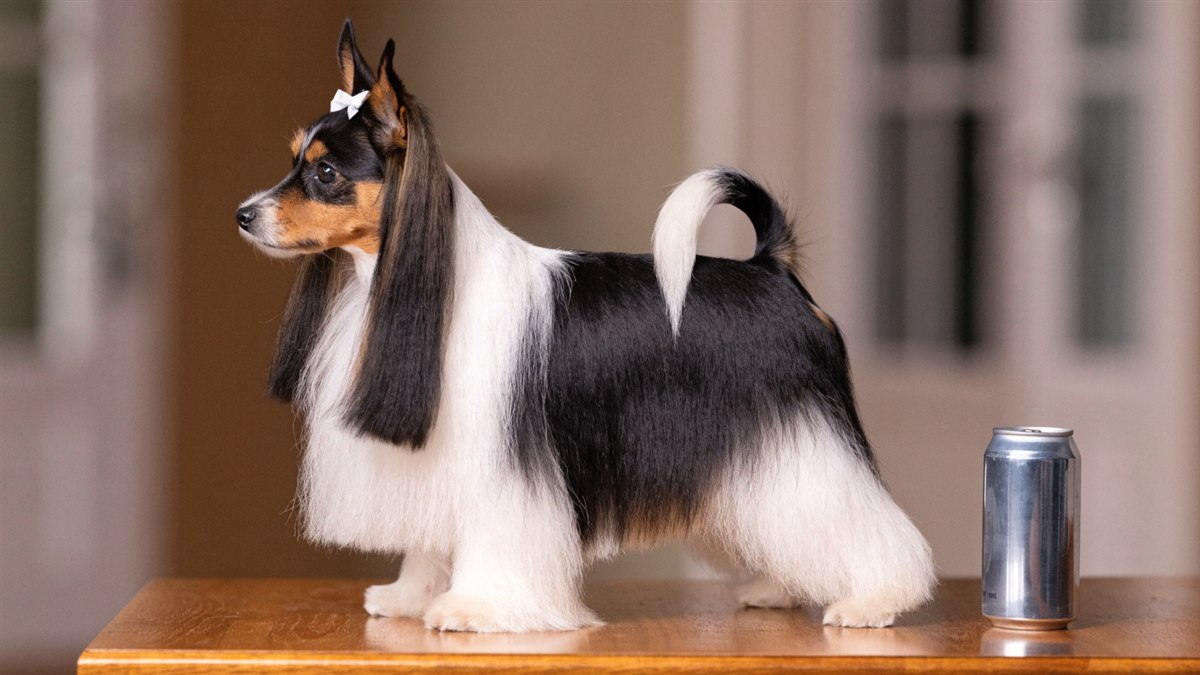
The Biewer Terrier is a German toy dog of 21 to 26 cm and 2.2 to 3.8 kg, carrying a floor-length silky coat parted down the spine, and it exists because one German couple selected for a colour fault that the Yorkshire Terrier standard rejects. Everything contested about the breed follows from that single sentence.
The origin is not disputed by anyone, including the registries that decline to recognise the dog. In 1984, in the kennel of experienced Yorkshire Terrier breeders Werner and Gertrude Biewer, two puppies were born carrying white markings. The German kennel club's own published standard states the position with unusual bluntness: white markings in the Yorkshire Terrier are, under the FCI standard, a breeding-disqualifying standard fault, and the Biewers deliberately selected for that trait. A veterinarian friend suggested the name Biewer Yorkshire Terrier, and the German singer Margot Eskens, who bought a pair, added the tag 'a la Pom Pon';.
Read the Yorkshire Terrier standard yourself and the point becomes concrete. FCI-Standard No. 86 describes a dog that is 'Dark steel blue (not silver blue), extending from occiput to root of tail, never mingled with fawn, bronze or dark hairs' with 'Hair on chest rich, bright tan', at a weight of up to 3.2 kg. White appears nowhere in that colour clause. A Yorkshire Terrier with a white chest, white legs and a white tail tip is not described by its own standard.
What the standard in force actually says
The standard that governs the breed in the United States was approved on 5 February 2026 and took effect on 30 April 2026, so it is the current document rather than the 2019 version most pages still link. It gives a height of 8 to 10 inches at the withers, makes height over 11 inches a serious fault, and states no weight at all. The coat clause is the one that matters most for an Indian reader: 'The coat is long and flowing with a silky, smooth texture. It is straight, without an undercoat, and hangs close to the ground, if not touching it';. A single silky coat with no undercoat, hanging to the floor, on a dog weighing between two and four kilograms.
Colour is defined by placement rather than by shade. The head must carry tan, and a head lacking tan is a disqualification. The body must be black or blue with white, with the chest, legs and tail tip white, the white on the chest running up the neck to the chin, and the legs white from elbow and stifle to the feet. Any colour other than that tri-coloured pattern is a disqualification. So the breed is defined, at the level of its own rulebook, almost entirely by where the white sits.
| Body | Height | Weight | Group placed in |
|---|---|---|---|
| Biewer Terrier Club of America standard, effective 30 Apr 2026 | 8 to 10 in, over 11 in a serious fault | Not stated | Toy (AKC) |
| AKC breed page | 7 to 11 in | 4 to 8 lb (1.8 to 3.6 kg) | Toy |
| VDH standard 990, 19 Feb 2024 | 21 to 26 cm | 2.2 to 3.8 kg, over 3.8 kg a serious fault | FCI Group 3 Terriers, section 4 |
| UKC standard, recognised 1 Jan 2016 | Not stated | 4 to 8 lb preferred | Companion Dog |
Notice what that table does. The AKC's own breed page prints a height range, 7 to 11 inches, whose upper end the AKC's own breed standard calls a serious fault Biewer Terrier Club of America. The German standard is the only one that fixes a weight and makes exceeding it a fault. And the UKC files the dog under Companion Dog rather than any terrier group, while Germany files it in FCI Group 3, Terriers, section 4, Toy Terriers Verband fuer das Deutsche Hundewesen (VDH). Four bodies, four descriptions, one dog.
Nothing in any of the four standards describes earth work, quarry, gameness or a working test. The VDH standard gives the breed's use as Gesellschaftshund, companion dog. Buy this dog expecting a terrier temperament and you will be reasoning from the name rather than from the breed.
Which registries call it a breed, and on what basis
Four registries recognise the Biewer Terrier as a breed in its own right, and they did so on four different dates, in three different groups, using two different rulebooks. Recognition is real, but it is not the single global fact the marketing implies.
The United Kennel Club moved first. Its own standard states 'The Biewer Terrier was recognized by the United Kennel Club January 1, 2016', and files the dog in the Companion Dog Group rather than with terriers. The UKC standard is weight-led, giving a preferred range of four to eight pounds and no height at all, and it makes patches of brown, gold or tan hair anywhere on the body or legs an eliminating fault.
The American Kennel Club followed in 2021. The breed entered the AKC Foundation Stock Service in 2014, moved to the Miscellaneous Class in July 2019 and became the AKC's 197th fully recognised breed, placed in the Toy Group. The Biewer Terrier Club of America is the designated AKC parent club. Registrable colours are printed as three codes: Chocolate Tan and White (270), Black Tan and White (030) and Blue Tan and White (291).
The Canadian Kennel Club took a narrower step. It made the Biewer Terrier a CKC Listed Breed, and the CKC's own account explains the mechanism, which is worth reading closely: 'An applicant for recognition of a new breed in Canada must own a dog from a country whose national registry has (a) a reciprocal agreement with CKC and (b) already fully recognized the breed'. In other words Canada's step was made possible by the AKC's, not by an independent Canadian assessment of whether the dog is a distinct breed. The CKC files it under Toy Dogs and uses the breed code BET.
Germany, the country of origin, recognised it in 2024 and said plainly that the FCI has not. The VDH published standard number 990 on 19 February 2024, and the header printed at the top of that document is the most useful single line on this subject anywhere: 'National durch den VDH anerkannte Rasse FCI-Gruppe 3 (Rasse nicht FCI-anerkannt)'. A breed recognised nationally by the VDH, placed in FCI Group 3, and not FCI-recognised. The VDH breed lexicon repeats the same line on the public page.
| Registry | Position | Date | Document read |
|---|---|---|---|
| United Kennel Club (US) | Recognised as a breed, Companion Dog Group | 1 January 2016 | UKC official breed standard page |
| American Kennel Club (US) | Fully recognised, Toy Group, 197th breed | 1 January 2021 | AKC breed page and BTCA history |
| Canadian Kennel Club | Listed Breed, filed under Toy Dogs | Listed since 2023 | CKC 'Meet the Biewer Terrier', May 2023 |
| VDH (Germany) | Nationally recognised, standard 990, expressly not FCI-recognised | Standard published 19 February 2024 | VDH standard PDF and breed lexicon |
| FCI | Not listed, definitive or provisional | Checked 21 August 2026 | FCI nomenclature letter B and provisional list |
| The Royal Kennel Club (UK) | Not listed in any group, including the Imported Breed Register | Checked 21 August 2026 | Royal Kennel Club breed standards index |
Why the group placement disagreement matters more than it looks
Group placement is not decoration. It tells a judge and a buyer what the dog is for. The UKC says companion, Germany says terrier, the AKC and CKC say toy Verband fuer das Deutsche Hundewesen (VDH) American Kennel Club Canadian Kennel Club. A buyer in Pune reading three of those four pages will form three different expectations of the same animal. On this site's reading the UKC placement is the honest one, because no standard for this breed describes any working function.
Bonbeno does not resolve this. The disagreement is the finding, and it is the thing an Indian buyer most needs to know before paying a rare-breed premium for a dog whose breed status two of the world's most-cited registries have not accepted.
Which registries do not list it, and what that means in India
The FCI and the Royal Kennel Club do not list the Biewer Terrier at all, and that absence is the finding an Indian buyer needs, because the Kennel Club of India is an FCI member. Both absences below were checked against a control in the same session, so neither is a broken search reported as a fact.
The FCI does not recognise the breed on any basis. Bonbeno read the FCI's own nomenclature for the letter B on 21 August 2026. It runs from BARBET to BULLMASTIFF across 48 entries, and there is no Biewer. The control is built into the list: it correctly carries BEDLINGTON TERRIER (9), BILLY (25), BASENJI (43) and BICHON A POIL FRISE (215), all breeds this site has already documented as FCI-recognised. A list that returns those and not the Biewer is working.
The second check matters more, because a breed can be recognised provisionally without appearing in the main nomenclature. The FCI's provisional list, read at its correct address and confirmed by the page's own heading 'Breeds recognised on a provisonal basis', carries 21 breeds. The most recent four were recognised on 11 February 2026. It includes the Ratonero Bodeguero Andaluz (371) and the Gos Rater Valencia (370), so the list is current and complete. It does not include the Biewer Terrier.
There is a URL on the FCI site that returns HTTP 200 and serves a complete English Setter page instead of the provisional list. An agent checking a rare breed's provisional status there would read a real, correctly formatted document about the wrong dog and report a correct-sounding absence from entirely the wrong page. The figures above come from the page whose own printed heading says it is the provisional list.
The Royal Kennel Club does not list it either
The Royal Kennel Club's breed standards index was read in full on 21 August 2026. It carries every breed the RKC recognises across all seven groups, and it explicitly includes breeds sitting on the Imported Breed Register, which are marked '(Imp)';. The Toy group carries 24 breeds, among them the Yorkshire Terrier, the Australian Silky Terrier, the Havanese, the Maltese and the Russian Toy (Imp). There is no Biewer Terrier in the Toy group, in the Terrier group, or anywhere else on the page. That the imported register is included on the same page is what makes the absence meaningful: the breed is not merely awaiting promotion, it is not on the list at all.
Why FCI silence lands hardest in India
The Kennel Club of India is the FCI's Indian member body, and the FCI publishes the KCI's registration statistics itself: 88,261 puppies registered in 2021, falling year on year to 32,219 in 2025, with just two CACIB all-breed shows held in 2025. A breed the FCI does not list has no FCI studbook, no FCI pedigree and no CACIB class. That does not automatically prove the KCI will refuse to register one, and Bonbeno could not reach a published KCI breed list to confirm the point either way, so no claim is made about KCI policy here.
What can be checked is the paperwork. The KCI's own checklist for registering an imported dog demands, in writing and by name, the export pedigree in original, the airway bill in original, the air ticket in original, the boarding pass, a DGFT licence, a customs clearance document, a quarantine clearance document, a pet passport and a notarised affidavit. That is the document set a genuine imported Biewer Terrier in India must have behind it. India's biggest puppy marketplace advertises 'purebred KCI-certified Biewer Terrier Puppies in India' on a page carrying exactly one listing whose price is hidden behind a login. Ask any seller making that claim for the nine items on the KCI's list, by name, before any money moves.
- Ask which registry issued the pedigree, and get the registry name in writing. AKC, UKC, CKC and VDH papers are all real; an FCI pedigree for this breed cannot exist.
- Ask for the DGFT licence number for the import, then check it against the import route the seller describes.
- Ask for the export pedigree in original, not a photograph, because the KCI checklist demands the original.
- Ask which of the seven permitted ports the dog entered through, since import is allowed only at Delhi, Mumbai, Chennai, Hyderabad, Bengaluru, Kolkata and, from October 2024, Kochi.
- Walk away from any seller who supplies none of the above and still calls the dog KCI-certified.
The genetics of the white markings, stated at the strength the evidence supports
No published study has genotyped a Biewer Terrier at the canine white spotting locus. The piebald explanation you will read everywhere is an inference from what the pattern looks like, not a measurement, and the breed club's own document says the two laboratory experiments meant to settle it both failed.
Start with what is genuinely established about white markings in dogs generally, because it is solid and it is not about this breed. The white spotting locus S sits at the MITF gene, and the four alleles run from solid colour to extreme white. Baranowska Koerberg and colleagues investigated four candidate mutations there: a SINE insertion, a conserved-site SNP, a simple repeat length polymorphism in the MITF-M promoter and a 12 base pair deletion in exon 1B. Their conclusion is the important part, and it is more cautious than the internet version: 'The variants associated with white spotting at all four loci were also found among wolves and we conclude that none of these could be a sole causal mutation, at least not for extreme white spotting.' The three white-spotting alleles, they propose, 'are not caused by three independent mutations but represent haplotype effects'.
A luciferase assay in the same paper did give 'conclusive evidence that the simple repeat polymorphism affects promoter activity', with the three white-spotting alleles producing consistently lower promoter activity than the solid-colour allele. So the mechanism is real and partly understood. The sample sizes are named in the text: 60 wolves, 206 dogs from 17 breeds screened for the SNP, and a prior study of 324 dogs from 45 breeds confirming the SINE association.
The Biewer Terrier is not named anywhere in the Koerberg article body as retrieved, and neither is the Yorkshire Terrier. A paper that does not include your breed cannot tell you your breed's genotype, however well it explains the biology.
The breed club tried to close the gap and reported that it could not
This is the sentence almost nobody quotes. The Biewer Terrier Club of America's own published account of the Mars Veterinary analysis identifies MITF as the gene most relevant to the breed's coat, explains exactly how it planned to test for the SINE insertion and to sequence the length polymorphism, and then states: 'As of date, both experiments we have attempted to look at these variants in the laboratory have failed';. The document notes that a different set of primers might resolve it. Nothing on the page reports a result.
That is an honest disclosure by the club, and it deserves to be read as one. It also means the widely repeated claim that the Biewer's colour 'is explained by MITF' describes a hypothesis the club itself has not been able to confirm in a laboratory.
Follow the piebald claim back and it thins out
Wikipedia states that the breed 'is the result of two Yorkshire Terriers with a recessive piebald gene breeding' and that 'The coloration is a result of the pre-existing recessive piebald gene';. Open the two footnotes on that sentence and you reach a general German breed handbook and a Yorkshire Terrier hobby website. Neither is a genotyping study, and neither reports a locus, an allele or a sample.
The description is probably right in the loose sense. A dog with symmetrical white on chest, belly, legs and tail tip, and pigment retained on the head and back, is what a piebald pattern looks like. But there is a real difference between 'this looks like piebald' and 'this dog carries the sp allele', and every page that ranks for this breed collapses that difference.
| Claim | Evidence behind it | How strong |
|---|---|---|
| The MITF-M promoter repeat polymorphism regulates white spotting in dogs | Genetic association plus a luciferase functional assay, 60 wolves and 206 dogs from 17 breeds | Strong, peer reviewed, and not about this breed |
| No single MITF variant is the sole cause of extreme white | Same paper; the variants also occur in wolves | Strong, and it directly undercuts single-gene explanations |
| The Biewer's chromosome 20 differs from the Yorkshire Terrier near MITF | Breed-club haplotype analysis on 162 SNPs across nine breeds | Suggestive, club-published, not peer reviewed |
| The Biewer carries a specific MITF variant | Two laboratory experiments, both reported as failed | No evidence either way |
| The colour is a recessive piebald gene | A German breed handbook and a hobby website | Plausible description, no genotyping behind it |
Bonbeno's position is the boring one. The pattern is consistent with piebald white spotting, the underlying genetics of white spotting in dogs are partly understood, and nobody has published the genotype of a Biewer Terrier at that locus. If a seller in Delhi tells you the colour is 'a proven recessive gene', ask which allele and which paper.
Is it genetically a separate breed? One peer-reviewed study says the closest thing to no
One peer-reviewed study has ever measured the Biewer Terrier against the Yorkshire Terrier, and it found them the closest pair of the eight breeds it examined. The claim that DNA proved the Biewer a separate breed comes from a breeder club's own document, not from that study, and the two point in different directions.
Radko and Podbielska genotyped 903 dogs from eight popular Polish breeds at 21 ISAG microsatellite loci, including 131 Biewer Yorkshire Terriers and 77 Yorkshire Terriers, and published the result in Genes in 2021. Those are the sample sizes, printed in the Materials and Methods, and 131 is a genuinely usable number for a rare breed.
The headline finding for our purposes is a single sentence: 'The genetic distance was the greatest between GS and IW (0.634), and the smallest between BYT and YT (0.260)';. Of all 28 pairwise comparisons available among eight breeds, the Biewer and the Yorkshire Terrier were the closest pair in the study. Divide it out. The widest pair sits at 2.44 times the distance of the Biewer to Yorkshire pair. The next closest pair involving either breed, Yorkshire Terrier to Maltese at 0.364, is 40 percent further apart than Biewer to Yorkshire.
The clustering agrees. 'The UPGMA dendrogram revealed that the YT and BYT were grouped together';. And when STRUCTURE assigned individual dogs to their own breed cluster, five of the eight breeds came in above 90 percent, led by the German Shepherd at 98 percent, while 'A lower assignment value was found in the BYT breed (88%) and the lowest in the LR and YT (85%)'.
The paper's own abstract states 'STRUCTURE analysis showed breed distinctiveness among all the dog breeds under study', and the Biewer Yorkshire Terrier carried the greatest allele count of any breed examined, 138 alleles, with the highest mean of 6.6 alleles per locus. It is a genetically diverse population that clusters as its own group. It is also the nearest neighbour the Yorkshire Terrier has in that dataset, by a clear margin.
Now the club's evidence, with its sample sizes
The origin of the famous claim is 2007. The Biewer Terrier Club of America approached Mars Veterinary and, in its own words, 'By September 2007, the lab was ready with DNA testing for this purpose and 10 blood samples from Biewer Terriers were submitted to begin the analysis'. Ten dogs is twenty chromosomes. The club is clear that this was a beginning and that the result 'prompt[ed] the submission of further, more varied, samples'.
The fuller analysis the club later published is more substantial and also more equivocal than its reputation. Method: principal component analysis and PHASE haplotype analysis on Wisdom Panel MX SNP data, narrowed to nine breeds, with '162 SNPs for further analysis' surviving quality control and 17 Havanese samples in the chromosome 20 window. Its stated conclusions open with 'Biewer Terriers share the majority of their haplotypes with Yorkshire Terriers'. Chromosome 20 is the exception, and the closest breed there is the Havanese.
Then read the caption on its own Chart 10. When the club equalised the sample sizes by drawing ten dogs per breed at random, the plot resolved into three clusters, one of which was 'a Biewer terrier / Yorkshire Terrier / Silky Terrier cluster';. The club's own document notes that the earlier plot which separated Biewer from Yorkshire did so with 'a disparate amount of samples'.
| Radko and Podbielska 2021 | BTCA and Mars Veterinary | |
|---|---|---|
| Peer reviewed | Yes, Genes 12(4):485 | No, published on the breed club's website |
| Biewer sample size | 131 dogs | 10 dogs in 2007; no sample size printed for the later analysis |
| Markers | 21 ISAG microsatellites | 162 SNPs from a commercial panel after quality control |
| Comparison breeds | 7 others, 903 dogs total | 8 others |
| Biewer to Yorkshire finding | Closest pair in the study, 0.260, and grouped together on the dendrogram | 'Biewer Terriers share the majority of their haplotypes with Yorkshire Terriers' |
| Where they differ | 88 percent self-assignment, lower than five of eight breeds | Chromosome 20 near MITF, closest to Havanese |
Both can be true at once, and on this site's reading both are. The Biewer Terrier is a real, closed, genetically diverse population that clusters as itself. It is also, on the only peer-reviewed measurement available, the Yorkshire Terrier's nearest relative by a wide margin, and the German standard's flat assertion that the breed 'has by now diverged genetically so far from the original breed' that it counts as independent is printed without any citation at all. A buyer in Bengaluru paying a rare-breed premium is entitled to know that the strongest independent evidence puts these two dogs closer together than any other pair in its dataset.
Biewer Terrier price in India: there isn't one
No published, checkable Biewer Terrier price in India exists. India's largest puppy marketplace returns exactly one Biewer Terrier listing, with the price hidden behind a login, no city and no age, on a page that carries none of the price furniture the same site publishes for every real breed it sells.
Bonbeno read the Mr n Mrs Pet Biewer Terrier page on 21 August 2026 with caching disabled, and took the figures from the raw page text rather than from any extraction. The listing grid prints '1 Result Found' and 'Page 1 of 1'. The single card is captioned 'Biewer Terrier For Sale In Mumbai' and is marked 'Pet Quality'. Its Age field prints the word 'Weeks' with no number in front of it. Its City field is blank. Where the price should be there is a 'View Price' button that routes to a sign-up wall.
That page is missing three things the same site publishes for every breed with a real Indian market. There is no quality-and-pricing breakdown. There is no city price table. There is no breed spec card. Compare the Yorkshire Terrier page on the same domain, read the same day: three published price bands, a city table covering eight metros, a full spec card, and a listing grid running to 'Page 1 of 6';.
| Biewer Terrier | Yorkshire Terrier | |
|---|---|---|
| Listings returned | 1 | Six pages of results |
| Published price bands | None | Basic Rs 70,000 to Rs 90,000; KCI Registered Rs 90,000 to Rs 1,20,000; Champion Bloodline Rs 1,20,000 to Rs 1,40,000 |
| City price table | Absent | Eight cities, Rs 70,000 or 75,000 up to Rs 1,40,000 |
| Breed spec card | Absent | Height 7 to 9 in, weight 2 to 3.5 kg, lifespan 12 to 15 years |
| Price on the one listing | Hidden behind a login | Shown |
| City on the one listing | Blank | Shown |
| Age on the one listing | The word 'Weeks', no number | Shown |
How thin the Indian market for this dog really is
Put the single Biewer listing next to the same site's own most-popular counters, printed on the same page: Shih Tzu 650, Siberian Husky 549, Golden Retriever 487, Labrador Retriever 454, German Shepherd 412, Beagle 274, Poodle 263, Rottweiler 162, Pomeranian 136 and Cane Corso 134. One listing against 650 means India's most-listed small breed is on offer 650 times over for every single Biewer Terrier advertised.
The search engines agree. Bing India, queried for the exact term on 21 August 2026, reported 'About 295 results' for the entire query and served no question box, only a related-phrase block. No People Also Ask box could be captured on the day this page was built. A rendered Google India result on 18 September 2026 did carry one, 4 questions, and the FAQ below answers 3 of them verbatim.
The one rupee figure anyone publishes, and where it comes from
Exactly one page in the Indian top ten prints a rupee number for this breed: Rs 30,500 to Rs 40,000, attributed to a named Delhi NCR kennel. It appears on an auto-generated Instagram aggregation page, not a profile and not a breeder site. The same body text on the same page states that the first Biewer puppies were born 'in the late 19th century', that the breed 'gained official recognition in 2019' and that 'The American Kennel Club (AKC) categorized it in a mixed group'.
All three are wrong, and the AKC's own records say so. The origin litter was 1984. AKC full recognition was 2021, with 2019 being the year the breed entered the Miscellaneous Class. And the AKC places the breed in the Toy Group, which is not a mixed group. Three verifiable errors in three consecutive sentences, on the only Indian-facing page that carries the number buyers repeat.
A search shaped to find Indian classified listings for this breed returned zero. Run in the same tool and the same session with the word Labrador substituted, the identical query returned four results, so the search ran and the zero is not a blocked page wearing a result. The honest claim is therefore narrow: no Indian classified listing for this breed surfaced. It is not proof that none exists anywhere.
Run the arithmetic on the one Indian price claim
Divide the single published Indian figure by 84.38 and it does not resolve to a round dollar amount, so it is not a US price run through an exchange rate. It fails a different and more damning test instead: at Rs 30,500 the dog costs less than half what the same Indian market charges for a plain Yorkshire Terrier.
Indian breed pages routinely publish 'prices' that are an American dollar figure quietly converted at one rate, and this site has caught it three times at exactly 84.38 rupees to the dollar. So the first thing to do with any rupee claim is to divide it out and see whether a tidy dollar number falls out the other side.
| Rupee figure published | Source | Divided by 84.38 | Round dollar amount? |
|---|---|---|---|
| Rs 30,500 | Instagram aggregation page, Biewer Terrier floor | USD 361.46 | No |
| Rs 40,000 | Instagram aggregation page, Biewer Terrier ceiling | USD 474.05 | No |
| Rs 70,000 | Mr n Mrs Pet, Yorkshire Terrier basic floor | USD 829.58 | No |
| Rs 90,000 | Mr n Mrs Pet, Yorkshire Terrier KCI floor | USD 1,066.60 | No |
| Rs 1,20,000 | Mr n Mrs Pet, Yorkshire Terrier champion floor | USD 1,422.14 | No |
| Rs 1,40,000 | Mr n Mrs Pet, Yorkshire Terrier ceiling | USD 1,659.16 | No |
Every one of the six fails to resolve. These are genuine rupee bands set in rupees, not converted dollar figures, and the page says so rather than forcing a finding that is not there Instagram aggregated topic page.
Now run the conversion the other way
Two American sources publish a Biewer Terrier price, and they disagree sharply. Dog Breeds List gives 'Average $2500 - $4500 USD', adding that the puppy 'will cost at least $2,500 from a decent breeder'. Lancaster Puppies gives 'Prices for puppies from reputable breeders typically range from $1,000 to $2,500';. The two floors differ by a factor of 2.5 and the ranges meet only at a single point. Publish that disagreement rather than averaging it.
Convert both at 84.38 and you get the rupee equivalent of what an American buyer actually pays. The Lancaster range becomes Rs 84,380 to Rs 2,10,950. The Dog Breeds List range becomes Rs 2,10,950 to Rs 3,79,710.
| Comparison | Arithmetic | Result |
|---|---|---|
| Indian Biewer floor against the cheapest Indian Yorkshire band | 30,500 divided by 70,000 | 43.6 percent |
| Indian Biewer ceiling against the cheapest Indian Yorkshire band | 40,000 divided by 70,000 | 57.1 percent |
| Indian Biewer floor against the cheapest US Biewer price | 30,500 divided by 84,380 | 36.2 percent |
| Indian Biewer floor against the Dog Breeds List US floor | 30,500 divided by 2,10,950 | 14.5 percent |
The only Biewer Terrier price published for India is 43.6 percent of what the same Indian market charges for the cheapest grade of ordinary Yorkshire Terrier. A rarer breed, with no FCI pedigree route, no lawful commercial import channel and one listing on the country's biggest marketplace, does not sell for less than half the price of its common parent breed. Something in that transaction is not what it is being called.
What the reader is probably being offered instead
The most likely explanation is the simplest. A white-marked Yorkshire Terrier is a real, regularly occurring animal in any Yorkshire Terrier breeding population, because the colour arose in one in the first place. Under the FCI Yorkshire Terrier standard those white markings are a fault, so such a puppy is worth less to a Yorkshire breeder, not more. Selling it as a Biewer Terrier at Rs 30,500 turns a discounted mismark into a rare foreign breed, and the price band sits exactly where you would expect a discounted Yorkshire Terrier to sit.
That is an inference, and this page labels it as one. It is also the only explanation Bonbeno found that fits every number on the page: the missing pedigree route, the single hidden-price listing, the absent city and age, and a rare-breed price below the common-breed floor. Ask for the papers named in the section above, and let the answer decide it.
Indian law on this breed: the eight-week rule, and the clause that forbids inventing breeds
Rule 8(1)(a) of the Prevention of Cruelty to Animals (Dog Breeding and Marketing) Rules, 2017 states that 'pups less than eight weeks in age are not sold', and Indian classified listings openly advertise handovers two weeks earlier than that. A second clause in the same Rules prohibits the exact act that created this breed.
Bonbeno downloaded the gazette copy of these Rules, notification G.S.R.496(E) of 23 May 2017, and extracted its text directly rather than relying on any summary. The file is machine readable: 14 pages and 51,953 extractable characters. Every clause below was read in that extraction and is quoted from it.
This document numbers clauses twice, and the confusion has misled readers before. There is a Rule 8, Conditions for sale, in the body of the Rules, and there is a separate Second Schedule Part III paragraph 8, Veterinary care. The eight-week sale prohibition is in Rule 8, sub-rule (1), clause (a). The vaccination timetable and the genetic-defect testing list are in the Second Schedule paragraph 8. Quoting one and calling it the other is how a real provision gets reported as absent.
Rule 8(1) reads, in the gazette text: 'Every breeder shall ensure that - (a) pups less than eight weeks in age are not sold; (b) dogs over six months in age are not sold without first being sterilised, unless they are being sold to another licensed breeder; ... (e) each pup sold is micro-chipped and complete record of treatment and vaccination is maintained; (f) pups are not displayed in public places for the purpose of immediate sale; and (g) receipt for sale is provided to each purchaser';. Micro-chipping and a receipt are not optional extras. They are conditions of a lawful sale.
Do Indian listings advertise puppies younger than eight weeks? Yes, on the same page as compliant ones
Bonbeno read India's long-running breeder classifieds page on 21 August 2026 and pulled every age statement on it. They straddle the legal line. One advertiser states 'Puppies will be handed over only after they are 6 weeks old and Vaccinated'. Six weeks is 42 days, which is 14 days short of the 56 days Rule 8(1)(a) requires, so that handover policy as advertised is unlawful.
Others on the same page are compliant and say so precisely: 'after 56 Days', 'they are ready to go to their new homes at 8 weeks of age', and one listing giving a 'Recommended Adoption Date... (at 65 days)'. A separate Indian seller advertises 'We only take puppies over 35 days old for sale', a caption Bonbeno saw in the search index but could not open on the platform itself, so it is reported here as observed rather than verified in place.
The Rules were written against exactly this trade. Indian reporting on their introduction described thousands of puppies being sold through Quikr, OLX and IndiaMART with no oversight, which is the market the eight-week rule and the micro-chipping requirement were meant to reach.
For a dog this small the fortnight is not a technicality. A Biewer Terrier puppy leaving at 42 days weighs a few hundred grams, has no reliable glycogen reserve, and is being separated during the socialisation window the Rules themselves treat as protected Verband fuer das Deutsche Hundewesen (VDH).
The clause that makes this breed's own origin story unlawful in India
Second Schedule Part II paragraph 6(9) of the same Rules reads, in full: 'Breeding to create new breeds of dogs or unusual looks shall be strictly prohibited';. Set that against the German kennel club's own account of how the Biewer Terrier came to exist: white markings are a breeding-disqualifying fault in the Yorkshire Terrier under the FCI standard, and 'Das Ehepaar Biewer selektierte gezielt auf dieses Merkmal', the Biewers deliberately selected for that trait.
Owning a Biewer Terrier in India is lawful. Doing in India in 2026 what the Biewers did in Germany in 1984 is not.
| Clause | What it says | Why it matters here |
|---|---|---|
| Rule 8(1)(a) | 'pups less than eight weeks in age are not sold' | Indian listings advertise six-week handovers; a 2 kg toy puppy is the worst case for it |
| Rule 8(1)(e) | Each pup sold is micro-chipped, with a full treatment and vaccination record | The microchip number is the only thing tying a specific puppy to a specific pedigree |
| Second Schedule Part II, 6(3) | In breeding and incest breeding prohibited; in breeding defined as relatives of the 2nd to 4th grade within four generations | A breed founded on one 1984 litter has a narrow gene pool and a standing temptation here |
| Second Schedule Part II, 6(8) | No tail docking, ear cropping, de-barking, de-clawing or 'any other kind of mutilation' | The AKC and UKC standards both permit dewclaw removal; that permission does not travel to India |
| Second Schedule Part II, 6(9) | 'Breeding to create new breeds of dogs or unusual looks shall be strictly prohibited' | This is the clause the breed's own founding act would fall under |
| Second Schedule Part III, 8(10) | Mandatory testing for genetic defects including progressive retinal atrophy, hypothyroidism, entropion, ectropion and cryptorchidism | PRA is on the breed club's own recommended list, so this one is easy to comply with |
Both the AKC-approved standard and the UKC standard say dewclaws may be removed United Kennel Club. Second Schedule Part II paragraph 6(8) forbids de-clawing and 'any other kind of mutilation of any body part of the pup' outright. The German standard, notably, says only that dewclaws may be present. An Indian breeder following the American standard on this point would be breaking Indian law, and no ranking page mentions it.
How a real Biewer Terrier could lawfully reach India, and why so few do
One lawful route exists: a returning resident carries their own dog home. Commercial import of this dog for breeding or sale is prohibited outright, so no legal Indian supply chain can form, and that single fact explains the empty marketplace better than anything about the breed itself.
Bonbeno downloaded DGFT Trade Notice No. 22/2022-23 of 19 December 2022 and extracted its text directly. Under ITC (HS) 01061900, Mammals: Other, the import policy for dogs is 'Restricted'. Policy Condition (7) lists the only three purposes for which a dog may be imported at all: 'i. Pet dog with valid pet book and relevant records/documents in the name of importer. ii. Dogs imported by the R&D Organisations for conducting research with the recommendation of CPCSEA. iii. For the internal security by the Defence and Police Force.'
Policy Condition (8) closes the door on everything else: 'Import of commercial dogs for breeding or any other commercial activities other than the purposes mentioned above is not permitted';. Paragraph 6 of the same notice says what happens to anyone who tries: 'any applications for trading/breeding purposes, or applications made on behalf of some another person/entity shall be duly rejected.'
- Two pets maximum without a DGFT authorisation, and only for a person 'transferring their residence to India after two years of continuous stay abroad'.
- Six ports in the notice, seven today. 'Import of pet animals is allowed only through airports and seaports of Delhi, Mumbai, Chennai, Hyderabad, Bangalore and Kolkata.' DAHD added Cochin International Airport, Kochi, for pets arriving under the baggage rules in October 2024.
- An Advance No Objection Certificate from the Regional or Quarantine Officer (AQCS), obtained seven days before travel, relaxable to three.
- Documents at application: vaccination book or pet passport or pet book, certificate for emotional support, and the pet's passport.
- Start two months early. The notice advises owners to begin the authorisation process 'at least 2 months in advance of the travel dates'.
Stack the three rules and the market disappears
Take the three findings together and the arithmetic of supply is obvious. The FCI does not list the breed, so no FCI pedigree exists and India's FCI member body has no FCI studbook entry to work from Federation Cynologique Internationale. The DGFT prohibits importing the dog for breeding or any commercial purpose, and will reject the application. And the 2017 Rules prohibit breeding to create new breeds or unusual looks.
Between them those three leave one lawful path: a family returning from the United States, Canada or Germany after two years abroad, bringing their own registered Biewer Terrier with a valid pet book in their own name. That path produces a handful of dogs across the whole country. It does not produce a marketplace, and the marketplace duly does not exist: one hidden-price listing on the biggest site and no entry at all among 46 breeds on India's long-running breeder classifieds.
Both absences carry controls. The classifieds page that lists no Biewer Terrier does list the Yorkshire Terrier, the Maltese, the Toy Poodle, the Chihuahua and 42 other breeds, so the page is populated and current. The marketplace that returns one Biewer Terrier returns six pages of Yorkshire Terriers on the same day. Neither zero is a broken query.
What this means for the reader in practice
If you want this exact dog in India, you are looking at a private import you carry yourself, or at waiting for a rehoming from one of the few families who already did. If you are being offered one for delivery next week by a seller with a WhatsApp number, the dog is not arriving through any of the routes above. The most useful question you can ask is not about the price. It is which of the seven ports the dog entered through, and on whose DGFT licence The Kennel Club of India Department of Animal Husbandry…. The full route is set out in how to import a dog to India.
Monthly cost of keeping a Biewer Terrier in India
Budget Rs 3,000 to Rs 7,000 a month, the published Indian range for a Yorkshire Terrier, and treat that as a floor rather than an estimate. No Indian source publishes a cost of ownership for the Biewer Terrier specifically, so the figures below are borrowed from the breed it is physically identical to, and the page says so plainly.
India's largest puppy marketplace publishes one usable monthly figure for a dog of this size and coat: 'On average, monthly expenses for a Yorkshire Terrier range from INR 3,000-INR 7,000';. Two dogs of 2 to 3.5 kg with a straight silky floor-length single coat eat the same food and need the same clipping, so the transfer is reasonable here in a way it is not for health figures. Where a number does not transfer, this page will say so.
The one Western cost breakdown for the breed lands close enough to be reassuring. Lancaster Puppies gives monthly ongoing costs of '$40 and $80' covering premium food, routine vet care and grooming. Convert at 84.38 and that is Rs 3,375 to Rs 6,750 a month, which sits almost exactly inside the Indian Yorkshire Terrier band. Two independent sources on two continents landing in the same range is worth more than either alone.
| Line | Figure | Where it comes from |
|---|---|---|
| Monthly total, all in | Rs 3,000 to Rs 7,000 | Indian published range for a Yorkshire Terrier |
| Monthly total, converted from the US | Rs 3,375 to Rs 6,750 | USD 40 to 80 at 84.38 |
| Setup: bed, crate, bowls, grooming tools | Rs 16,876 to Rs 29,533 | USD 200 to 350 at 84.38 |
| Annual routine veterinary care | About Rs 67,504 | USD 800 at 84.38, a US figure and probably high for India |
| Pet insurance, if bought | Rs 2,110 to Rs 4,219 a month | USD 25 to 50 at 84.38, US market |
| Professional clipping frequency | Every 4 to 6 weeks | Indian marketplace guidance for the same coat type |
Rs 67,504 a year for routine veterinary care is an American number converted, not an Indian observation. Indian routine consult and vaccination costs are materially lower in most metros. Bonbeno could not find a published Indian annual veterinary figure for a toy breed and does not invent one, so the row above is labelled for what it is.
The grooming line is the one that will surprise you
A coat clipped every four weeks is 13 sessions a year. Clipped every six weeks it is 8.7. That is the range the same Indian source gives for this coat type, and the difference between the two ends of it is more than four paid appointments a year, every year, for sixteen years. Learn to do the body clip yourself and pay a groomer only for the head, and you move from the top of the range to the bottom.
The purchase price is the small number
Do the multiplication that no seller does for you. At the published Indian monthly range, over the 16-year life expectancy both the AKC and the CKC print for this breed Canadian Kennel Club, the running cost is 192 months at Rs 3,000 to Rs 7,000, which is Rs 5,76,000 to Rs 13,44,000.
Now set that against the only Indian purchase price anyone publishes, Rs 30,500. The lifetime running cost is between 18.9 and 44.1 times the purchase price. Whatever you save by buying the cheapest dog on offer is recovered by the running cost inside the first year, and a dog bought cheaply from an unverified seller is far more likely to arrive with the conditions that push you toward the top of that range.
One cost sits outside every table above and cannot be estimated: surgery. A tracheal stent or a portosystemic shunt repair is specialist work, and Bonbeno found no published Indian rupee price for either. Where a figure does not exist, this page prints no figure.
Heat tolerance, argued from the standard and the thermometer
Chennai's coolest month runs 4.5 degrees C hotter than Berlin's hottest month, so a coat designed for a German winter is being asked to work in conditions its origin country never produces. Every figure below comes from one source on one methodology, the 1991 to 2021 series, so the cities are genuinely comparable.
Start with the dog, not the weather. Three separate standards, written by three registries that disagree about almost everything else, describe the same coat in almost the same words. The AKC-approved standard: 'long and flowing with a silky, smooth texture. It is straight, without an undercoat, and hangs close to the ground, if not touching it';. The German standard: 'lang und fliessend von weicher, seidiger Textur. Das Haar ist glatt ohne Unterwolle';. The UKC: 'straight, without an undercoat and should be at least three-quarters of the way to the ground';.
The absence of an undercoat is the one piece of good news, and it is real. A dog with no insulating woolly layer sheds heat more readily than a double-coated breed of the same size, and nothing here should be read as putting this dog in the same category as a Husky. The length is the problem. A coat that reaches the floor is a full-length barrier over the flanks, belly and legs, and on a dog standing 21 to 26 cm tall it drags on pavement that is far hotter than the air temperature any weather station reports.
The muzzle is the second half of the mechanism
Dogs cool by evaporating water across the airway, so the length of that airway sets the ceiling on how fast heat can leave. Both the AKC-approved and the German standards specify a muzzle 'one-third the length of the head'; Verband fuer das Deutsche Hundewesen (VDH). That is a moderate muzzle, not a long one. It is not brachycephalic and this dog does not carry a bulldog's risk, but it does not have a sighthound's evaporative surface either, and at 2.2 to 3.8 kg the absolute airway is very small.
Then add thermal mass. A 3 kg dog has almost none. A Labrador absorbs a twenty-minute heat spike and buffers it. A dog this size tracks the ambient temperature almost in real time, which is why toy dogs go from apparently fine to in trouble inside a single walk.
| City | Annual mean | Warmest month, average | Hottest month, mean daily max | Months averaging above Berlin's hottest month |
|---|---|---|---|---|
| Berlin, Germany (origin country) | 10.1 C | 19.8 C (July) | 24.0 C (July) | 0 of 12 |
| Bengaluru | 22.9 C | 26.6 C (April) | 32.8 C (April) | 12 of 12 |
| New Delhi | 24.6 C | 33.0 C (June) | 39.6 C (May) | 9 of 12 |
| Mumbai | 26.4 C | 29.0 C (May) | 32.8 C (April) | 12 of 12 |
| Chennai | 27.9 C | 31.3 C (May) | 36.3 C (May) | 12 of 12 |
Three of those four Indian cities are above Berlin's hottest month in all twelve months of the year Climate-Data.org Climate-Data.org. Chennai's annual mean of 27.9 degrees C sits 8.0 degrees above Berlin's July average, and its coolest month, January at 24.3 degrees, is still 4.5 degrees hotter than the hottest month the breed's origin country produces. New Delhi's May mean daily maximum of 39.6 degrees is 15.6 degrees above Berlin's July mean daily maximum.
The standard describes a single coat with no undercoat, which means there is no protective layer underneath and the skin is directly exposed once the hair is removed. A shaved dog in Chennai or Nagpur gains sunburn risk without gaining much cooling, because a single silky coat is a poor insulator to begin with. Clip it short for the summer, keep the belly and flanks covered, and never take it to the skin.
The honest city-by-city verdict
Bengaluru and the hill stations are the only comfortable answer. Bengaluru's annual mean is 22.9 degrees C and its warmest month averages 26.6, so a clipped dog walked at dawn and after dark is genuinely fine there most of the year. Pune and Delhi are seasonal. Delhi is workable from November to February, when the average sits between 13.5 and 20.5 degrees, and unfair on the dog in May and June. Chennai and Mumbai are the hard cases, not because of the peak but because there is no cool season to recover in.
The monsoon problem, and what a 3 kg dog faces on an Indian street
Humidity, not temperature, is what breaks a panting dog, and Mumbai spends July and August at 89 percent relative humidity while Berlin's July sits at 65 percent. A floor-length coat in that air does not dry, and a 3 kg dog on an Indian street is exposed to hazards no European care guide is written for.
The mechanism is simple physics. A dog cools by evaporating water off the tongue and airway, and evaporation slows as the surrounding air approaches saturation. So the pairing that matters is temperature and humidity together, not either alone.
| City and month | Average temperature | Humidity | Rainy days |
|---|---|---|---|
| Berlin, July | 19.8 C | 65 percent | 9 |
| Mumbai, July | 25.9 C | 89 percent | 22 |
| Mumbai, August | 25.6 C | 89 percent | 22 |
| Chennai, October | 27.3 C | 80 percent | 14 |
| Chennai, November | 25.7 C | 80 percent | 13 |
| Bengaluru, August | 22.2 C | 79 percent | 15 |
| New Delhi, August | 28.7 C | 77 percent | 15 |
Berlin is a humid city on paper. It reaches 86 percent humidity in November, at an average of 5.6 degrees C. Humidity at 5.6 degrees is a comfort question. Humidity at 25.9 degrees, which is Mumbai in July, is a cooling question, and it is throttling the dog's only real cooling channel for two consecutive months.
A coat that reaches the ground in 661 mm of rain
Mumbai receives 661 mm of rain in July across 22 rainy days, and 459 mm in August across another 22. The standard describes hair that 'hangs close to the ground, if not touching it';. Put those two facts in the same sentence and the practical consequence is obvious: for roughly six weeks the belly, flanks and leg feathering are wet, muddy or damp more often than they are dry.
- Clip the coat short before the monsoon, not during it. A short coat dries; a floor-length one does not.
- Towel and blow dry to the skin after every wet walk, and do not leave the dog to air dry. Overseas breed guides written for temperate climates routinely say to let a dog air dry, and that instruction does not transfer to an Indian monsoon.
- Dry inside the ears specifically, because a small erect-eared dog still traps water in the canal after a soaking.
- Comb the leg and belly feathering daily in the wet months. A wet mat tightens against the skin and becomes a sore inside two days.
- Keep the feet trimmed neat, which the standard already asks for on appearance grounds and which matters far more here on hygiene grounds.
The street, honestly
A dog of 2.2 to 3.8 kg standing 21 to 26 cm tall faces a set of Indian conditions no German or American care sheet addresses. Its head sits in the layer of air immediately above the road surface, which is the hottest air anywhere on the walk. Its feet are on that surface. It is small enough to be genuinely at risk from free-roaming dogs, from a two-wheeler on a crowded footpath, and from an open storm drain in the monsoon.
Bonbeno found no published Indian dataset on injuries to toy-breed dogs from free-roaming dogs or from traffic, and prints no number rather than inventing one. The practical guidance stands without a statistic: this is a carried-in-crowds, harness-not-collar, never-off-lead-outdoors dog in an Indian metro, and an owner who treats it like a Labrador that happens to be small will eventually be unlucky.
A dog this size is genuinely an apartment dog, and an Indian flat with fans and a shaded room is a better environment for it than a house with a hot terrace. Indoor life is not a compromise for this breed. It is the correct answer, and it removes most of the heat problem outright, leaving only the two daily walks to schedule around the sun.
Temperament and who should not buy one
Every standard describes the same temperament in the same three words: intelligent, loyal and playful, with an unusual emphasis on childlike cheerfulness. What none of them describes is a terrier temperament, and buyers who expect one will be surprised in the opposite direction.
The AKC-approved standard's temperament clause is one sentence: 'Intelligent and loyal, they are affectionate and playful, making them excellent companions and family dogs';. The German standard adds a warning the American one leaves out: 'Obwohl er manchmal stoerrisch sein kann', although he can sometimes be stubborn. The UKC adds the same childlike framing: 'They have a fun-loving, child-like attitude that makes them a great companion for all ages';.
The AKC breed page goes further than any standard: 'A large percentage of the Biewer Terriers are happy-go-lucky dogs, smiling when asked if they are happy... He is quick to alert you to company, but is not a constant barker';. That last clause is the one to test rather than trust. A quick-to-alert toy dog in an Indian apartment block, with a corridor of neighbours and a doorbell that rings for deliveries several times a day, will bark unless the alerting is trained early.
Who this dog suits in India
- Apartment households, where a 3 kg dog is not a compromise. The Biewer Terrier Club of Canada calls them 'perfect for apartment living' and notes they take readily to pad training.
- Adults and older children, especially households where somebody is home most of the day.
- Owners in Bengaluru, Pune or the hill stations, where the climate does not fight the coat for eight months of the year.
- People who genuinely enjoy grooming, because this coat is a daily relationship rather than a chore you can defer.
- Buyers who will verify papers before paying, since the whole Indian market for this breed rests on trust that nothing on the seller's side supports.
Who should not buy one
- Households with toddlers. A 2.2 kg dog is genuinely breakable, and the risk runs from the child to the dog rather than the other way round.
- Anyone who wants a dog that can be left alone all day. The standards describe a companion animal bred for attachment, not independence.
- Anyone in Chennai or coastal Gujarat without air conditioning, where the dog would spend twelve months of the year above its origin climate's hottest month.
- Owners who want a low-maintenance coat. Clipping short reduces the work; it does not remove it.
- Buyers chasing a bargain. The one Indian price on offer is below the floor for a plain Yorkshire Terrier, which is a warning rather than a saving.
The AKC page describes the breed as 'an excellent hunter of vermin';. No standard for the breed describes any working test, quarry or earth work, and the VDH gives the breed's use as companion dog. Treat vermin-hunting as a marketing echo of the word terrier, and choose the dog for the temperament the standards actually describe.
One practical Indian consequence follows from the size and the friendliness together. A dog that is quick to make friends with people and with other animals, and that weighs three kilograms, will approach a free-roaming dog on a Pune footpath with no sense of the mismatch. Socialise deliberately, but socialise with known dogs in controlled settings, and do not treat street encounters as socialisation.
Training a Biewer Terrier, and the two things it resists
To train a Biewer Terrier, work in three to five minute blocks, pay in food, and start house training on the day the puppy arrives rather than the week after. The breed is described as intelligent and biddable by every registry, and the two genuine obstacles are house training and the stubbornness the German standard admits to.
Every published temperament clause points the same way. The German standard calls the breed 'Intelligent, treu und ihren Besitzern sehr ergeben', intelligent, loyal and very devoted to its owners, while flagging that it can sometimes be stubborn. The Canadian club reports Biewer Terriers earning CKC Rally Master titles and Trick Dog Champion titles, which is not something a difficult breed does.
House training is the real work, and India makes it harder
A dog with a bladder the size of a walnut cannot hold on for six hours, and no amount of intelligence changes the plumbing. The Canadian club notes the breed can be 'easily trained to use puppy pads for their potty needs';, and in an Indian apartment that is often the sensible primary system rather than a fallback, particularly in the monsoon, when a floor-length coat and a wet compound make four outdoor trips a day genuinely unpleasant for both of you.
- Set the pad or tray before the puppy arrives, in a fixed spot the dog can reach in under ten seconds from wherever it sleeps.
- Take the puppy to it after every sleep, meal and play bout, which for an eight-week-old is roughly every 45 to 60 minutes while awake.
- Pay the correct choice within two seconds, with food, every single time, for the first three weeks.
- Clean accidents with an enzymatic cleaner, never with a phenyl-based floor cleaner, whose residual smell can mark the spot as a toilet.
- Add the outdoor location second, once the indoor habit is solid, rather than trying to teach both at once.
What the breed resists
Repetition without reward. A dog bred purely as a companion has no working drive to fall back on when the training gets dull. Keep sessions to three to five minutes, end while the dog still wants more, and pay in food rather than praise for anything new.
Being handled roughly, including in grooming. This is the resistance that costs owners the most, because a dog that dislikes the comb turns a daily job into a daily fight for sixteen years. Start grooming handling in week one as a training exercise with treats, long before the coat needs any real work.
Small dogs get away with behaviour that would never be tolerated in a Labrador, and that is how toy breeds acquire their reputation. A Biewer Terrier that growls when lifted, snaps at the brush or barks at every corridor footstep has been permitted to, not born to. Train the recall, the settle and the handling with the same seriousness you would give a 30 kg dog.
Realistic timelines
| Skill | Start | Reliable by |
|---|---|---|
| Name response and hand target | Week 1 at home | 2 to 3 weeks |
| Pad or tray training, indoors | Day 1 | 6 to 10 weeks of consistent work |
| Sleeping through the night | Week 1 | 3 to 6 weeks |
| Accepting full-body grooming handling | Week 1 | 8 to 12 weeks, then maintained for life |
| Settle on a mat while you work | Week 3 | 8 to 12 weeks |
| Recall in a fenced or enclosed space | Week 4 | 3 to 6 months, and never trusted on an open Indian street |
| Quiet on the doorbell | Week 2 | 3 to 6 months, and the hardest thing on this list |
Socialise the puppy to the specific Indian soundscape it will live in: pressure horns, the doorbell, the lift, the building's watchman, delivery riders and the cook. A dog that never meets those calmly before sixteen weeks will react to them for years.
Daily exercise requirement, and how to schedule it in an Indian summer
Two short walks of 15 to 20 minutes plus indoor play meets this breed's needs, and in most Indian metros both walks belong before sunrise and after dark for four to six months of the year. The registries are unusually consistent that a large part of the requirement is met indoors.
The AKC describes 'a rather mellow, easy-going dog' whose 'playful attitudes provide them with a natural means of self-exercising, along with the time spent playing with their human families', and adds a line written for exactly this reader: 'If you live in an apartment, even short walks in the hallways can give your dog some exercise';. The Canadian club agrees that Biewer Terriers 'can fulfil their exercise requirements by daily living and playing within the household', while noting that they can hike with conditioning and compete in sports.
Take both at face value and the practical requirement is modest: roughly 30 to 40 minutes of outdoor walking split across two sessions, plus indoor play. That is a genuinely achievable target in a Mumbai two-bedroom flat, which is more than can be said for most breeds Indian buyers cross-shop.
| City | Months to walk any time of day | Months for dawn and after dark only | Months to stay largely indoors |
|---|---|---|---|
| Bengaluru | November to January | February to October | None, if walks are timed |
| Pune and Delhi | November to February | March, April, September, October | May and June |
| Mumbai | December to February | March to November | None, but June to September is a monsoon problem, not a heat one |
| Chennai | December to January | February to November | April to June afternoons |
The pavement test, which matters more here than the air temperature
New Delhi's May mean daily maximum is 39.6 degrees C, and Chennai's is 36.3 degrees in the same month Climate-Data.org. Road and paving surfaces in direct sun run well above the air temperature, and this dog's feet, belly and head are all within 26 cm of that surface. Press the back of your hand flat on the pavement for five seconds before every daytime walk between March and June. If you cannot hold it there, neither can the dog.
What happens without enough exercise
The German standard makes weight over 3.8 kg a serious fault, which tells you the breed is not expected to carry spare condition. A sedentary Biewer Terrier at 4.5 kg is carrying nearly a fifth more than the top of its own standard, on stifles that the OFA's own register already shows failing in 10.7 percent of 540 evaluated dogs of this breed. Weight is the one risk factor on this page an owner controls completely.
The second consequence is behavioural. An under-exercised companion breed with no job becomes a barker, and a barker in an Indian apartment block becomes a neighbour problem within weeks. Indoor work counts here: five minutes of nose games, a food puzzle at each meal and two short training sessions a day do more for a dog of this size than a longer walk would.
The Canadian club reports Biewer Terriers earning agility placings, a CKC Rally Master title and the first Trick Dog Champion title in the breed. In an Indian city where outdoor time is weather-limited for half the year, indoor rally, trick training and scent games are not consolation prizes. They are the main event.
Grooming a floor-length silky coat in Indian humidity
Brush and comb to the skin every day if the coat is kept long, or clip it short and comb twice a week. This is the single largest recurring commitment the breed carries, and in an Indian monsoon the drying routine matters more than the brushing does.
The coat the standards describe is not a difficult coat by nature. It is long, straight, silky and single, with no undercoat to felt against itself Verband fuer das Deutsche Hundewesen (VDH). The AKC's own guidance is that the breed 'has a long coat that requires daily brushing. There is minimal matting with the silkier coat, but the soft coats may get some mats';. The Canadian club is more specific: kept in a flowing drop coat, the dog 'must be brushed and combed every day or two to prevent tangles and mats';.
The difficulty is length rather than texture. A coat that reaches the ground on a dog 21 to 26 cm tall spends its life in contact with the floor, and in an Indian city that floor is dusty for eight months and wet for four.
The Indian routine, in order
- Comb to the skin, not through the surface. A surface brush leaves the mat forming underneath, which is how owners discover felting only when it is already tight against the skin.
- Do the four friction points every session: behind the ears, the armpits, the groin and the base of the tail. Everything else can wait a day; these cannot.
- Bathe weekly, which the Canadian club recommends and Indian dust justifies. Weekly is more often than a temperate-climate schedule and it is the right frequency here.
- Dry to the skin every single time, with a dryer and a comb. Never air dry, and never leave the belly and leg feathering damp overnight in the monsoon.
- Trim the feet and the hair around the anus, both of which the standard already requires on appearance grounds and both of which matter far more on hygiene grounds in India.
- Shave the ear tips only, as the standard describes, and leave the rest of the ear coated.
Long coat or short: choose deliberately
The AKC states the trade-off plainly: 'If you choose to keep your Biewer in a short coat, minimal grooming is needed';. For most Indian pet homes that is the right call, and the standard itself permits trimming to floor length for ease of movement. A short pet clip every four to six weeks, which is the interval the Indian market quotes for this coat type, means eight to thirteen professional sessions a year. Learn the body clip yourself and pay for the head only, and the bill and the stress both fall.
The standard singles out show-ring over-grooming for unusual severity: 'Excessive grooming on the head, such as ratting, teasing, or roll-overs common to other breeds, shall be so severely penalized as to be eliminated from competition';. The headfall is to be tied in a single fall, finished simply, with one bow. If an Indian groomer offers to style the head like a show Yorkshire Terrier, that is the wrong breed's presentation.
Hypoallergenic: the claim is unsupported, and here is the study
India's largest puppy marketplace prints the single word 'Yes' in the HYPOALLERGENIC row of its Yorkshire Terrier spec card, and the same framing follows this breed everywhere. The Canadian club's version is gentler but points the same way: 'Because they have hair rather than fur, they shed very little';.
The evidence does not support the allergy claim for any breed. Vredegoor and colleagues measured the major dog allergen Can f 1 in hair, coat, settled floor dust and airborne dust across breeds marketed as hypoallergenic and against control dogs. The hypoallergenic group came back higher, not lower: 'Hypoallergenic dog breeds showed significantly higher Can f 1 in hair and coat samples than control breeds', with no difference in airborne allergen at all. The authors conclude 'There is no evidence for the classification of certain dog breeds as being hypoallergenic';.
Shedding less is not the same as producing less allergen, and an allergic buyer in Mumbai paying a premium for a supposedly safe dog is being sold something the literature does not support. Test the actual dog with the actual person before any money changes hands.
Health risks with real breed-specific numbers
Genuine Biewer Terrier health data exists, and almost no page reports it. The OFA register carries the breed under its own name across seven screening databases, and the headline finding is that 10.7 percent of 540 evaluated Biewer Terriers had an abnormal patella, which is the eighth worst rate of any breed on that table.
Every figure in this section was read directly from the OFA's own published statistics tables on 21 August 2026, with the breed name printed in each row confirmed as BIEWER TERRIER before any number was taken. These are live registers and they move as evaluations are added, so the sample size is printed beside every percentage.
| Database | Dogs evaluated | Result | What it means |
|---|---|---|---|
| Patella | 540 | 89.3 percent normal, 10.7 percent abnormal; Grade 1 7.4, Grade 2 3.0, Grade 3 0.4 | About 58 dogs of 540 affected; breed ranks 8th worst on the table |
| Eyes (ACVO exam) | 818 | 97.8 percent normal, 2.2 percent abnormal | About 18 dogs of 818 |
| Basic cardiac | 109 | 99.1 percent normal, 0.9 percent equivocal, 0.0 percent abnormal | One equivocal dog; no abnormal finding at all |
| Degenerative myelopathy DNA | 219 | 83.6 normal, 16.0 carrier, 0.5 at risk | About 35 carriers and roughly one at-risk dog |
| Progressive retinal atrophy prcd DNA | 293 | 96.9 normal, 3.1 carrier, 0.0 affected | About 9 carriers, no affected dog found |
| Primary lens luxation DNA | 296 | 100.0 percent normal | No carrier found in 296 tests |
| Hyperuricosuria DNA | 174 | 100.0 percent normal | No carrier found |
Check the arithmetic before trusting the table. The three patella grades sum to 10.8 percent against a reported abnormal rate of 10.7, which is rounding rather than an error, and 89.3 plus 10.7 makes exactly 100. That is what a sound percentage set looks like.
The two pieces of genuinely good news
The breed club's recommended pre-breeding tests are an ACVO eye examination, a patellar luxation evaluation, a Primary Lens Luxation DNA test and a Progressive Retinal Atrophy prcd DNA test. Two of those four have now been run several hundred times and found nothing. Across 296 PLL tests and 293 PRA-prcd tests, a combined 589 tests, the register shows zero affected dogs and zero PLL carriers. That is a real result, and buyers should be told it as clearly as they are told the risks.
The cardiac picture is similarly quiet. Across 109 basic cardiac evaluations there is not one abnormal finding. The sample is small and the conclusion should be held loosely, but it is what the register says.
The eye examination detail, which is where the picture gets more interesting
OFA also publishes what the 817 examined Biewer Terrier eyes actually showed. Persistent pupillary membranes running iris to iris were recorded in 100 dogs, which is 12.2 percent. Distichiasis appeared in 22, or 2.7 percent. Cataract of unknown significance in 13, or 1.6 percent. Keratoconjunctivitis sicca in 3, or 0.4 percent. The overall normal rate on that detailed table is 631 of 817, which works out at 77.2 percent.
Read that against the headline eye figure of 97.8 percent normal and the difference is instructive: most of what the detailed table records is minor and does not make a dog abnormal overall. Persistent pupillary membranes in particular are common and frequently of no clinical consequence.
These are voluntary submissions from breeders who chose to screen and, in the radiographic databases, chose to publish. That biases the sample toward dogs whose owners expected a good result, so the true population rate for a condition like patellar luxation is likely higher than 10.7 percent, not lower. OFA also requires 100 hip evaluations, or 50 for other databases, before a breed appears at all. There is no hip dysplasia row for the Biewer Terrier, which means fewer than 100 hip evaluations exist for the entire breed.
One Indian legal note lands neatly here. Second Schedule Part III paragraph 8(10) of the 2017 Rules requires breeding dogs in India to be tested for genetic defects including progressive retinal atrophy and hypothyroidism. PRA is already on the breed club's own recommended list, so an Indian breeder of this dog would be complying with Indian law by doing what the parent club already asks. Hypothyroidism is not on the club's list, and Indian law requires it anyway.
The figures that are Yorkshire Terrier data, and whether they transfer
Every number in this section is a Yorkshire Terrier figure, not a Biewer Terrier figure, and the page says so on every line. The transfer is reasonable in direction and unreliable in magnitude, and there is one place where breed-specific data proves it overstates the risk.
The Biewer Terrier has no published lifespan study, no published portosystemic shunt prevalence and no published tracheal collapse prevalence. What the Yorkshire Terrier has is unusually good data on exactly those three things, so the temptation to copy it across is strong. Here is that data, labelled, followed by the argument for and against using it.
| Condition | Figure | Population and year |
|---|---|---|
| Congenital portosystemic shunt, proportion of diagnoses | Yorkshire Terrier 2.9 percent; Havanese 3.2; Maltese 1.6; Pug 1.3; all dogs 0.18; mixed-breed 0.05 | 2,400 cases across 1980 to 2002, JAVMA |
| Congenital portosystemic shunt, odds ratio | 35.9 times greater than all other breeds combined | Pedigree and record analysis, JAAHA 2003 |
| Congenital portosystemic shunt, hospital prevalence | 0.8 percent, 93 dogs | 11,061 Yorkshire Terriers at one hospital, JVIM 2026 |
| Severe tracheal collapse, hospital prevalence | 6.7 percent, 739 dogs | Same 11,061 dogs |
| Both conditions in one dog | 0.05 percent, 6 dogs | Same 11,061 dogs |
| Median age at diagnosis | 2.7 years for shunt; 10.0 years for tracheal collapse | Same 11,061 dogs |
| Patellar luxation, primary-care prevalence | 5.4 percent (95 percent CI 4.4 to 6.3), odds ratio 5.5 | 210,824 dogs, 119 English clinics, VetCompass 2016 |
Divide those out and the scale becomes clear. A Yorkshire Terrier proportion of 2.9 percent against a mixed-breed proportion of 0.05 percent is 58 times higher, and against the all-dog figure of 0.18 percent it is 16.1 times higher. A separate pedigree analysis put the odds ratio at 35.9 times that of all other breeds combined and concluded that the condition 'appears to be hereditary in Yorkshire terriers', while stating plainly that the mechanism of inheritance has not been established. So the inherited component is real in the parent breed and its mode is unknown. In primary care the breed's patellar luxation prevalence of 5.4 percent is 4.15 times the all-breed rate of 1.30 percent, and Yorkshire Terriers alone accounted for 116 of the cases, 13.6 percent of every diagnosis in a cohort of 210,824 dogs. The hospital figures check out too: 93 of 11,061 is 0.84 percent, 739 of 11,061 is 6.68 percent and 6 of 11,061 is 0.054 percent, all consistent with what the authors report.
Why the transfer is reasonable in direction
- The founding stock was entirely Yorkshire Terrier. Every registry, including Germany's, describes an origin litter born to two purebred Yorkshire Terriers in 1984 Biewer Terrier Club of America.
- The only peer-reviewed genetic comparison puts them closest. Reynolds distance of 0.260 was the smallest of every pair among eight breeds, and the two grouped together on the dendrogram.
- The breed club's own analysis agrees. 'Biewer Terriers share the majority of their haplotypes with Yorkshire Terriers'.
- The body is the same. 2.2 to 3.8 kg against a Yorkshire Terrier standard of up to 3.2 kg, at roughly the same height, with the same coat type.
Why the numbers themselves should not be copied across
A founder bottleneck moves allele frequencies in both directions. A breed built from a small selected group can end up with more of a recessive disease than its parent population or with much less, and which of those happened is an empirical question no one has answered for this breed.
Where breed-specific data does exist, it contradicts the transfer. On the same OFA patella table, read the same day, the Biewer Terrier shows 10.7 percent abnormal of 540 evaluations and the Yorkshire Terrier shows 17.0 percent of 3,177. The Biewer rate is 62.9 percent of the Yorkshire rate. Copying the Yorkshire figure across would have overstated this breed's screened patella risk by more than half again.
The oldest dataset cannot contain a single Biewer Terrier. Tobias and Rohrbach cover 1980 to 2002, and American fanciers only began importing the breed from Germany in 2002. Whatever that study measured, it did not measure this dog.
The breed club's own genetic work names the Havanese as the closest breed to the Biewer at the one chromosome where it differs most from the Yorkshire Terrier. In Tobias and Rohrbach's data the Havanese carries the highest published proportion of congenital portosystemic shunt diagnoses of any breed at 3.2 percent, with the Yorkshire Terrier second at 2.9. If the club's ancestry inference is right, this breed sits between the two breeds with the highest published shunt proportions. That is an argument from two separate sources, not a measurement of Biewer Terriers, and it should raise the priority of liver bloods in a young dog rather than be quoted as a prevalence.
Lifespan is the cleanest example of an honest gap. McMillan and colleagues measured 584,734 UK dogs across 155 breeds and reported a purebred median survival of 12.7 years. The Biewer Terrier is not among those 155 breeds. The AKC and the Canadian club both print 16 years Canadian Kennel Club, and Lancaster Puppies prints 12 to 15. Those are estimates from interested parties, not survival data, and Bonbeno reports the disagreement rather than picking one.
The toy-breed realities: teeth, blood sugar and being 3 kg
Dental disease is the risk this dog will almost certainly face, because periodontal odds rise as bodyweight falls, and a 2.2 kg mouth holds a full set of teeth in a jaw built for a fraction of them. Hypoglycaemia in toy puppies is the risk everyone repeats and almost nobody can source.
The dental evidence is strong and it points the wrong way for a dog this size. O'Neill and colleagues examined 22,333 dogs under primary veterinary care and found a one-year period prevalence of periodontal disease of 12.52 percent, with eighteen breeds showing raised odds against crossbreds, led by the Toy Poodle at an odds ratio of 3.97. The sentence that matters most for a Biewer Terrier owner is the one about size: 'Increasing adult bodyweight was associated with progressively decreasing odds of periodontal disease.'
Wallis and Holcombe's review makes the same point from a different angle and adds the number that should change your routine. Primary-care practices, where diagnosis rests on looking in the mouth of a conscious dog, report an average prevalence of 9.3 to 18.2 percent. 'Detailed examinations of anaesthetised dogs report much higher prevalence of between 44 and 100%';. Both clinical and record-based surveys show risk rising 'as age increases and with bodyweight decreases'.
The Canadian breed club says the same thing in plainer language about this specific dog: 'Being a smaller breed, it does suffer from some dental issues, such as retained baby teeth and tartar build-up';. Retained deciduous teeth in a toy mouth crowd the adult teeth and trap food against the gum, which is exactly the mechanism the studies above describe.
- Brush daily from week one, using the grooming handling you are already teaching. Weekly brushing is not a plan for a mouth in this risk band.
- Have retained baby teeth checked at four to six months. A deciduous canine still present alongside the adult one needs extraction, not patience.
- Expect an anaesthetised scale and polish to be a periodic cost, because the gap between 12.5 percent seen awake and up to 100 percent seen under anaesthesia is the disease your vet cannot see at a routine consult.
- Do not feed a diet built on soft food alone, and do not use bones hard enough to fracture a toy-breed tooth.
- Raise dental care with your vet before any anaesthetic event, so scaling can be combined rather than repeated.
Hypoglycaemia in toy puppies: what is actually published
Every breed page lists hypoglycaemia among this dog's risks, and the sourcing behind that is thinner than the repetition suggests. Wikipedia's health section for the breed names tracheal collapse, bladder stones, patellar luxation, congenital portosystemic shunt and hypoglycaemia, footnoted to a single commercial pet-health website rather than to any study.
Bonbeno searched PubMed for hypoglycaemia in toy-breed or small-breed puppies on 21 August 2026 and got three records in total. One is about hypoglycaemia in canine babesiosis. One is a 2014 review of neonatal puppy disease. The third, and the only paper devoted to the subject, is Fiebiger's 1986 German-language article titled, in translation, 'Hypoglycemia in puppies and young dogs, especially in toy breeds';. PubMed passed its control in the same session, returning 311 records for the exact phrase Yorkshire Terrier, so the near-empty result is a finding about the literature rather than a broken search.
The practical guidance survives the thin literature. A toy puppy has very little glycogen reserve and very little body mass to buffer a missed meal, which is one of the reasons Rule 8(1)(a) sets eight weeks as the minimum sale age. An Indian seller advertising handover at six weeks is selling a dog at the age when this risk is highest. Feed a young Biewer Terrier four small meals a day until at least four months, never leave it more than six hours without food, and keep glucose gel in the house.
One further note from the AKC breed page, which is the only registry source to raise it: 'Sensitive GI systems are common in the Biewer Terrier, so they may have an occasional soft or discolored stool', with the instruction to see a vet if it persists. In Indian conditions, where a soft stool is as likely to be a parasite or a water problem as a breed trait, that advice is worth taking literally rather than dismissing as breed sensitivity.
Feeding a 3 kg dog accurately in Indian conditions
Weigh the food on a kitchen scale and feed four meals a day until four months, because a dog whose whole standard tops out at 3.8 kg cannot absorb a portion error the way a Labrador can. The daily ration is a tiny quantity, and precision rather than brand is what matters at this size.
Start from the number the German standard fixes: 2.2 to 3.8 kg, with anything above 3.8 kg a serious fault. That is the tightest weight window of any breed this site covers, and it means a 300 gram gain is roughly a tenth of the dog. On a Labrador the same absolute gain is invisible. Here it moves the dog out of its own standard.
| Age | Meals per day | What to watch |
|---|---|---|
| 8 to 16 weeks | 4 | Blood sugar. Never more than six waking hours without food |
| 4 to 6 months | 3 | Retained deciduous teeth appearing alongside adult teeth |
| 6 to 12 months | 2 to 3 | Growth plateauing; adult weight is largely set by 10 to 12 months |
| Adult | 2 | Body condition, and the 3.8 kg ceiling in the standard |
| Senior, from about 8 years | 2 | Dental comfort, and whether hard kibble is still being chewed rather than swallowed |
The Indian specifics that actually change the plan
Water first, in every hot month. A dog with a small absolute body-water reserve, panting through a moderate muzzle in Chennai in May, dehydrates faster than its owner expects. Two water points in the flat, refreshed twice daily, is not fussiness.
Store food against Indian humidity. Mumbai spends July and August at 89 percent relative humidity. An opened kibble bag in that air goes stale and can go mouldy. Buy the smallest pack size the household will finish in three to four weeks, decant into an airtight container, and do not buy the value pack.
Take the sensitive-gut warning seriously. The AKC states that 'Sensitive GI systems are common in the Biewer Terrier', with the instruction to see a vet if diarrhoea or discoloured stools persist. Change food over seven to ten days rather than overnight, and resist the Indian household habit of table scraps, which for a 3 kg dog is a substantial proportion of the day's intake.
Budget realistically. The published Indian monthly range for a dog of this size and coat, covering food alongside everything else, is Rs 3,000 to Rs 7,000. Food is the smaller share of that for a toy breed; grooming is the larger one.
Body condition, checked by hand
- Feel the ribs through the coat, weekly. A floor-length coat hides a fat dog completely, which is precisely why owners of long-coated toys are the last to notice weight gain.
- Look for the tuck-up the standard describes. Both the AKC-approved and the German standards specify an underline that is slightly tucked up; if the belly line runs straight, the dog is carrying weight.
- Weigh on the same scale monthly and write it down. At this size a kitchen scale with the dog in a basket is more accurate than a bathroom scale.
- Treat treats as food, not as extras. Ten small training treats can be a tenth of a toy dog's daily intake.
A bowl left down all day is the standard Indian arrangement and it is the wrong one here. It hides how much the puppy is actually eating, which is the single thing you most need to know in a breed where a missed meal at nine weeks is a genuine emergency. Measured meals at fixed times give you an early warning that a full bowl never will.
Month by month through the first year
Nothing legally happens before week eight, because Rule 8(1)(a) states that 'pups less than eight weeks in age are not sold'. Every milestone below is anchored either to that rule, to the vaccination window the same Rules set out, or to a screening test the breed club recommends.
Weeks 0 to 8, before the puppy is yours
The puppy stays with its dam. Indian law is explicit: 'pups less than eight weeks in age are not sold';. The same Rules set the vaccination window: 'All pups shall be vaccinated which can start at the age of seven-eight weeks, and are usually completed at the age of eighteen weeks.' Ask the breeder for the microchip number and the treatment record now, both of which Rule 8(1)(e) requires them to maintain.
Month 2, weeks 8 to 12
The puppy arrives at 2.2 kg or less. Four meals a day, never more than six waking hours without food. Start pad training on day one and grooming handling in week one, both as short paid training sessions rather than as chores. Begin socialisation to the Indian soundscape: the doorbell, the lift, the watchman, delivery riders, pressure horns. This window closes at about sixteen weeks and does not reopen.
Month 3 to 4, weeks 12 to 18
Vaccinations complete around eighteen weeks under the schedule the Rules describe. Outdoor walks begin, timed to the city: in Delhi that is comfortable from November to February and dawn-and-dusk only from March. Move to three meals a day at four months. First proper coat work starts as the puppy fluff gives way to adult hair, and the friction points behind the ears and in the armpits become real for the first time.
Month 4 to 6
Ask the vet to check for retained deciduous teeth. This is the highest-value single appointment of the first year in a breed whose own national club names 'retained baby teeth and tartar build-up' as a known problem, and where periodontal odds rise as adult bodyweight falls. Establish daily tooth brushing now, while the mouth is still comfortable.
Month 6 to 9
Growth slows and the adult coat comes in properly. Decide now whether you are keeping a floor-length coat or a short pet clip, because the routine you set here is the one you will keep for sixteen years. If the dog is not being bred from, this is when Rule 8(1)(b) becomes relevant to any onward sale: 'dogs over six months in age are not sold without first being sterilised';.
Month 9 to 12
Adult weight is largely set. Weigh against the standard's 2.2 to 3.8 kg window and act on the answer. If the dog is a breeding prospect, this is the year for the club's recommended screens: an ACVO eye examination, a patellar luxation evaluation, and the PLL and PRA-prcd DNA tests. Indian law additionally requires progressive retinal atrophy and hypothyroidism testing before breeding.
| When | Do | Why |
|---|---|---|
| Before purchase | Get the microchip number and treatment record | Required of the breeder by Rule 8(1)(e) |
| Before purchase | Confirm the puppy is at least eight weeks | Rule 8(1)(a); Indian listings advertise six-week handovers |
| Week 8 to 18 | Complete the vaccination course | Second Schedule Part III paragraph 8(9) |
| Week 8 to 16 | Socialise to the specific Indian soundscape | The window closes and does not reopen |
| Month 4 to 6 | Check for retained deciduous teeth | Named by the breed's own national club |
| Month 6 | Discuss neutering timing with your vet | Rule 8(1)(b) applies to any onward sale |
| Month 9 to 12 | Patella evaluation | 10.7 percent of 540 screened Biewer Terriers were abnormal |
| Month 12 | Weigh against 2.2 to 3.8 kg | The German standard makes over 3.8 kg a serious fault |
If a seller offers you a Biewer Terrier puppy at six or seven weeks, the sale is prohibited by Rule 8(1)(a) and the dog is being separated at the age when its blood sugar is least stable. Both problems are the seller's doing and both become yours the moment you accept the puppy.
Biewer Terrier against the dogs Indian buyers actually cross-shop
The honest comparison is with the Yorkshire Terrier, because on the only peer-reviewed genetic measurement the two are the closest pair of eight breeds examined. On availability the comparison is with the Shih Tzu, which India's biggest marketplace lists 650 times over for every single Biewer Terrier.
| Biewer Terrier | Yorkshire Terrier | Shih Tzu | |
|---|---|---|---|
| FCI status | Not listed, definitive or provisional | Recognised definitively since 30 October 1954, standard 86 | Not read for this page |
| Royal Kennel Club status | Not listed in any group | Toy group | Utility group |
| Listings on India's largest marketplace | 1 | Six pages of results | 650 |
| Published Indian price | None. One aggregator claim of Rs 30,500 to Rs 40,000 | Rs 70,000 to Rs 1,40,000 across three quality bands | Not read for this page |
| Weight in the governing standard | 2.2 to 3.8 kg (VDH) | Up to 3.2 kg (FCI 86) | Not read for this page |
| OFA patella, abnormal rate | 10.7 percent of 540 evaluations | 17.0 percent of 3,177 evaluations | Not read for this page |
| Coat | Long, straight, silky, no undercoat, to the floor | Long, perfectly straight, glossy, fine silky texture | Not read for this page |
| Included in the 155-breed UK lifespan study | No | Yes, 3.05 percent of the purebred dataset | Yes |
Read the first two rows together and the practical consequence is simple. Buy a Yorkshire Terrier in India and there is an FCI standard, an FCI studbook route through the country's own member body, three published price bands and a market with hundreds of dogs in it Mr n Mrs Pet, 'Yorkshire Terrier Puppies… Federation Cynologique Internationale. Buy a Biewer Terrier and none of those exist Mr n Mrs Pet, 'Biewer Terrier Puppies….
Where the Biewer genuinely wins
On the one health axis where both breeds have breed-specific screening data, the Biewer Terrier does better. Its OFA patella abnormal rate of 10.7 percent across 540 evaluations is 62.9 percent of the Yorkshire Terrier's 17.0 percent across 3,177. Screening populations differ and both figures are voluntary submissions, so this is a real but qualified advantage.
The coat is also easier in one specific respect. India's largest marketplace describes the Yorkshire Terrier as having 'dense, curly coats that need trimming every 4-6 weeks', which contradicts the FCI standard's requirement for hair 'perfectly straight (not wavy), glossy; fine silky texture, not woolly'; Federation Cynologique Internationale. Both breeds in fact carry a straight silky single coat, and both are easier to comb than the marketing implies. Neither is low maintenance.
The comparison this site would actually make
For an Indian buyer who wants a small, affectionate, apartment-suited dog and is not committed to this exact appearance, three alternatives are worth reading before spending anything. The Indian Spitz is small, widely available, and built for this climate rather than for a German one. The Indian Pariah Dog is the honest answer to almost every question this page raises about heat, availability and cost, and it is free to adopt. The Maltese offers a comparable silky white coat with an FCI standard and a real Indian market behind it.
If it is specifically the tri-colour long coat you want, the Havanese is worth a look too, and not only on appearance: the breed club's own genetic work names the Havanese as the closest breed to the Biewer at the chromosome region where it differs most from the Yorkshire Terrier.
A white-marked Yorkshire Terrier and a Biewer Terrier can be visually indistinguishable to a buyer, are the closest pair of eight breeds on the only peer-reviewed genetic measurement available, and differ in Indian price by more than a factor of two in the wrong direction Instagram aggregated topic page. If you cannot tell them apart and the papers cannot either, you are not buying a rare breed. You are buying a claim.
What Indian buyers and owners get wrong with this breed
The most expensive mistake is accepting the word Biewer without asking which registry issued the pedigree, because no FCI pedigree for this breed can exist and India's kennel club is an FCI member. Every other mistake on this list follows from treating a 3 kg German companion dog like a small version of a normal dog.
Mistakes made before the money moves
- Taking 'KCI-certified Biewer Terrier' at face value. The FCI does not list this breed on its definitive or provisional nomenclature. Ask which registry issued the pedigree and get the answer in writing.
- Treating a low price as a bargain. The one Indian figure published, Rs 30,500, is 43.6 percent of the cheapest Indian Yorkshire Terrier band. A rarer dog priced below a commoner one is a warning.
- Trusting a recognition date from a ranking page. Two of the pages ranking in India for this term state a recognition date, and both are wrong. One says 2019, one says 1 January 2016, and the AKC's own records say 2021.
- Accepting a puppy under eight weeks. Rule 8(1)(a) prohibits the sale, and Indian classifieds openly advertise six-week handovers Dogs India, 'Puppies Available'.
- Not asking for the microchip number. Rule 8(1)(e) requires every pup sold to be micro-chipped with a full treatment record. It is also the only thing tying the dog in front of you to the pedigree you were shown.
- Buying on the hypoallergenic claim. The evidence does not support it for any breed.
Mistakes made after the dog is home
- Shaving the coat to the skin for the summer. There is no undercoat underneath, so shaving exposes skin without delivering much cooling. Clip short and leave a protective length.
- Letting the dog air dry after a monsoon walk. Overseas guides written for temperate climates say to towel off and let the dog dry; a floor-length coat in 89 percent humidity does not dry.
- Brushing the surface instead of combing to the skin. The mat forms underneath and is found only when it has already tightened against the skin.
- Weekly tooth brushing instead of daily. Periodontal odds rise as bodyweight falls, and conscious examination misses most of the disease that an anaesthetised examination finds.
- Free-feeding a young puppy. A full bowl hides the missed meal that matters most at nine weeks.
- Letting the dog gain 500 grams. At a standard ceiling of 3.8 kg, that is more than a tenth of the dog, sitting on stifles that fail in about one screened Biewer Terrier in nine Orthopedic Foundation for Animals.
Mistakes made in the street
Walking on hot pavement. New Delhi's May mean daily maximum is 39.6 degrees C, and the road surface is hotter still. The dog's head, belly and feet are all within 26 cm of it.
Using a collar rather than a harness. The one Yorkshire Terrier figure that transfers most plausibly to this dog is the tracheal collapse prevalence of 6.7 percent in 11,061 dogs at one hospital. It is a Yorkshire Terrier number, and it is not proof of anything about the Biewer Terrier, but a harness costs nothing and a collar on a toy-breed windpipe has no upside.
Treating street encounters as socialisation. A 3 kg dog that is friendly toward every animal it meets, in a country with a large free-roaming dog population, needs the owner to make the judgement it will not make for itself.
Two of this breed's four standards permit dewclaw removal United Kennel Club. Second Schedule Part II paragraph 6(8) of the 2017 Rules forbids de-clawing and 'any other kind of mutilation of any body part of the pup'. And paragraph 6(9) prohibits 'Breeding to create new breeds of dogs or unusual looks' outright, which is the exact act that produced this breed in 1984. Following an overseas standard clause by clause in India is not a safe default.
Adoption, and how to verify a seller who says the dog is real
Adopt rather than buy, because in India the odds of finding a genuine Biewer Terrier for sale are close to zero and the odds of finding a small long-coated dog that needs a home are close to one. If you do buy, verify the paperwork against the KCI's own import checklist before any money moves.
The supply position is settled by three documents rather than by opinion. The FCI does not list the breed, so no FCI pedigree exists Federation Cynologique Internationale. The DGFT prohibits importing dogs for breeding or any commercial purpose and will reject the application. And the 2017 Rules prohibit breeding to create new breeds. There is no lawful path by which a supply of Biewer Terrier puppies can form in India.
The adoption route, which is the realistic one
Indian shelters and rescues rehome small long-coated dogs constantly, most often surrendered Shih Tzus, Yorkshire Terriers, Lhasa Apsos and their crosses. A dog of that description in a rescue is the same daily commitment as the dog on this page: the same comb, the same clip, the same heat management, the same dental routine. It arrives without a pedigree question, without an import question, and without a price.
- Start with the city rescue networks and the vets. Municipal and volunteer rescues in Mumbai, Delhi, Bengaluru, Chennai and Pune handle small-breed surrenders regularly, and clinic noticeboards carry rehoming notices the internet never sees.
- Ask specifically for surrendered long-coated toys, and be willing to take an adult. A four-year-old dog already tells you its temperature tolerance, its temperament and its coat.
- Budget the grooming before you commit, at Rs 3,000 to Rs 7,000 a month all in. Adoption removes the purchase price, not the running cost.
- Have the teeth assessed in the first month. An adopted toy-breed adult is likely to arrive with periodontal disease, given how the odds rise as bodyweight falls.
- Read the Indian Pariah Dog page before deciding. For heat, cost and availability it answers every problem this page has raised.
If you are buying anyway, here is the verification script
Ask for these nine items by name, because they are the ones the Kennel Club of India itself demands when registering an imported dog. A seller with a genuine imported Biewer Terrier can produce them. A seller with a white-marked Yorkshire Terrier cannot.
| Ask for | A real answer | A warning sign |
|---|---|---|
| The issuing registry of the pedigree | AKC, UKC, CKC or VDH, named in writing | 'KCI-certified' with no other registry named |
| Export pedigree in original | The physical document, in the dog's registered name | A photograph, or 'papers will follow' |
| DGFT licence for the import | A licence number you can quote back | 'The breeder handled all that' |
| Port of entry | One of Delhi, Mumbai, Chennai, Hyderabad, Bengaluru, Kolkata or, since October 2024, Kochi | Any other city, or no answer |
| Quarantine and customs clearance | Both documents, dated | Neither |
| The microchip number | A number that matches the pedigree and the dog | No chip, which also breaches Rule 8(1)(e) |
| Date of birth and the puppy's age today | Eight weeks or more | Six or seven weeks, which Rule 8(1)(a) prohibits |
| Health screening results | ACVO eye exam, patella evaluation, PLL and PRA-prcd DNA | 'The parents are healthy' |
| A receipt for the sale | Issued as Rule 8(1)(g) requires | Cash with no paperwork |
This page names no breeder, links to no listing and quotes no live price as an offer. The rupee figures on it are reported as published editorial fact so that a reader can check them, and the verification script above exists to protect the buyer, not to route them anywhere. If a seller cannot answer the nine questions, walk away and consider a rescue instead.
One last thing worth saying plainly. A dog does not become a different animal because a registry gave it a name, and it does not become a worse animal because two registries declined. Whatever the papers say, the dog in front of you is a small, cheerful, silky-coated companion that will need combing every day for sixteen years in a climate its coat was never designed for. Decide on that, and the recognition argument stops mattering.
Biewer Terrier questions Indian buyers actually ask
Are Biewer Terriers rare?
Yes, and in India they are effectively absent. India's largest puppy marketplace returns exactly one Biewer Terrier listing, with the price hidden behind a login, while returning six pages of Yorkshire Terriers and 650 Shih Tzus. India's long-running breeder classifieds list 46 breeds and none of them is this one.
What is the Biewer Terrier price in India?
No verifiable puppy price exists. The only rupee figure published anywhere in the Indian result set is Rs 30,500 to Rs 40,000, and it appears on an auto-generated aggregation page that also dates the breed to the late 19th century and places it in an AKC group that does not exist. Treat it as unverified.
Is the Biewer Terrier a real breed or just a Yorkshire Terrier?
The registries genuinely disagree, and this page reports the disagreement rather than resolving it. The AKC, UKC, CKC and Germany's VDH all recognise it as a breed. The FCI and the Royal Kennel Club do not list it at all. The only peer-reviewed genetic study found the Biewer and the Yorkshire Terrier to be the closest pair of eight breeds examined.
Is the Biewer Terrier recognised by the Kennel Club of India?
Bonbeno could not reach a published KCI breed list and makes no claim about KCI policy. What is checkable is that the KCI is an FCI member body and the FCI does not list this breed on either its definitive or its provisional nomenclature, so no FCI pedigree for a Biewer Terrier can exist.
Can a Biewer Terrier survive Indian summers?
In Bengaluru or a hill station, comfortably. In Delhi it is seasonal, workable from November to February and unfair on the dog in May and June. Chennai and Mumbai are the hard cases, because all twelve months average hotter than the warmest month its origin country produces, so there is no cool season to recover in.
How much does a Biewer Terrier cost per month in India?
Budget Rs 3,000 to Rs 7,000 a month, which is the published Indian range for a Yorkshire Terrier of the same size and coat type. Independently, the US figure of 40 to 80 dollars a month converts at 84.38 to Rs 3,375 to Rs 6,750, landing in the same band.
Are Biewer Terriers hypoallergenic?
No, and the claim is unsupported for every breed. Vredegoor and colleagues measured the major dog allergen Can f 1 and found that so-called hypoallergenic breeds showed significantly higher levels in hair and coat than control dogs, with no difference in airborne allergen. Their conclusion was that no evidence supports classifying any breed as hypoallergenic.
What is the Biewer Terrier life expectancy?
Sixteen years is what the AKC and the Canadian Kennel Club both print, while Lancaster Puppies prints 12 to 15. None of those is a survival study. The 155-breed UK dataset covering 584,734 dogs, which reported a purebred median of 12.7 years, does not include the breed at all.
At what age can a Biewer Terrier puppy be sold in India?
Eight weeks at the earliest. Rule 8(1)(a) of the Prevention of Cruelty to Animals (Dog Breeding and Marketing) Rules, 2017 states that every breeder shall ensure that pups less than eight weeks in age are not sold. Indian classified listings openly advertise handovers at six weeks, which is two weeks early and unlawful.
What are the Biewer Terrier pros and cons?
For an Indian buyer the pros are apartment suitability, a modest exercise need, a friendly trainable temperament and better screened patella figures than the Yorkshire Terrier. The cons are a demanding coat, poor heat tolerance in coastal metros, no lawful Indian supply chain, no published puppy price and a contested breed status.
Do Biewer Terriers have health problems?
The breed-specific health issues on record are milder than its reputation. OFA data show 10.7 percent of 540 screened dogs with an abnormal patella, no carriers in 296 primary lens luxation tests and no abnormal finding in 109 cardiac evaluations. Dental disease is the near-certain problem in any dog this small.
Why do Biewer Terriers cost so much abroad but so little in India?
Because the Indian figure almost certainly is not describing the same dog. Two US sources price the breed at 1,000 to 4,500 dollars, which converts to Rs 84,380 to Rs 3,79,710 at 84.38. The one Indian claim of Rs 30,500 sits below the cheapest Indian Yorkshire Terrier band, which is the wrong direction for a rarer breed.
Is a Biewer Terrier a good dog?
Yes for an apartment household of adults or older children. The AKC-approved standard describes an intelligent, loyal, affectionate and playful dog that makes an excellent companion and family dog, the German standard adds that it can sometimes be stubborn, and the AKC page says it is quick to alert you to company but not a constant barker. At 2.2 to 3.8 kg it is genuinely breakable around toddlers, it is bred for attachment rather than being left alone all day, and the floor-length single coat is a daily job.
What is the cost of a Biewer Terrier?
Abroad, two US sources price the breed at 1,000 to 4,500 dollars, which converts to Rs 84,380 to Rs 3,79,710 at 84.38 rupees to the dollar. In India no verifiable puppy price exists: the only rupee figure in the Indian result set is Rs 30,500 to Rs 40,000 on an auto-generated aggregation page, which sits below the cheapest Indian Yorkshire Terrier band, the wrong direction for a rarer breed. Running costs are Rs 3,000 to Rs 7,000 a month, the published Indian range for a Yorkshire Terrier of the same size and coat.
What is the difference between a Yorkie and a Biewer?
Colour placement, and the registries that accept it. The Biewer exists because Werner and Gertrude Biewer selected in 1984 for white markings that the Yorkshire Terrier standard treats as a breeding-disqualifying fault, so the Biewer must carry tan on the head and a black or blue body with white chest, legs and tail tip, while FCI-Standard No. 86 gives the Yorkshire Terrier a dark steel blue body with rich tan and no white at all. The AKC, UKC, CKC and VDH recognise the Biewer as a breed; the FCI and Royal Kennel Club do not; and the only peer-reviewed genetic study found the two the closest pair of eight breeds examined.
Compare with similar breeds
Biewer Terrier sits in 2 Bonbeno groups. Each one compares it directly against the breeds it is genuinely an alternative to, on the same figures.