
Breed profile
Rize Koyun Dog: Price in India, Real Size and Type Status
A Black Sea flock guardian that the only scientists who ever measured it call a local type, from a province that gets 2,291.7 mm of rain a year and whose hottest month is cooler than Chennai's coolest.
Quick answer
The Rize Koyun has no breed standard anywhere, no studbook anywhere and no price in India. Turkish animal science measured it once, at 69.8 cm at the withers in males and 68.6 cm in females, and calls it a local type rather than a breed. Turkey's national kennel federation lists 33 breeds it says the FCI does not recognise, and this is not one of them.
This page reports published animal-science literature, national registry records, state meteorological data and Indian law. It is not a diagnosis and it is not a treatment plan. Consult your nearby vet, a registered veterinary practitioner, before acting on anything here, and particularly before making decisions about heat management, feeding a large breed puppy or anaesthesia.
Rize Koyun at a glance
What the Rize Koyun is, and the name problem in the primary source
The Rize Koyun is a large long-coated flock guardian of Turkey's eastern Black Sea region, measured once at 69.8 cm at the withers in males, and the Turkish paper that first described it calls it simply the Koyun Kopegi, the sheep dog.
Begin with the source, because on this breed the whole page depends on one document that nobody writing in English has opened. Yilmaz and Ertugrul's review, Turkiye Yerli Kopek Irk ve Tipleri, published in the Igdir University science journal, surveys eleven Turkish native dog breeds and types and gives each a short section. We downloaded it and extracted it with pypdf: eight pages, 24,574 characters, a real text layer.
In eight pages the string Rize occurs exactly once, in the reference list, citing the same authors' 2012 Canadian Journal of Applied Sciences paper titled Determination of the Rize Koyun (sheep) dog in Turkey. In the body of the review the animal's section is headed simply Koyun Kopegi, sheep dog. So the name this breed is known by in English comes from a paper title, and the Turkish scientific description of it uses a different name entirely. That matters for anyone searching, because Koyun means sheep and it is one of the commonest words in the Turkish language.
The measurements, which exist and are precise
Unlike most breeds with no standard, this one has real numbers, because somebody went and measured the dogs.
| Dog | Males, withers height | Females, withers height | Body weight published |
|---|---|---|---|
| Koyun (Rize Koyun) | 69.8 plus or minus 0.77 cm | 68.6 plus or minus 0.92 cm | No |
| Kars (Kafkas) shepherd | 72.6 plus or minus 0.78 cm | 71.9 plus or minus 1.55 cm | Yes, 45.3 and 43.3 kg |
| Wikipedia's figure for this breed | Approximately 70 cm | Approximately 68 cm | No |
Two things follow from that table. Wikipedia's approximately 70 cm and approximately 68 cm are simply these figures rounded, which is unusually honest for a breed stub and means the encyclopedia chain here is clean rather than corrupted. And no body weight has ever been published for this dog, in either sex, on a page where the authors do publish weights for the Kars measured in the same programme. That is not an oversight you can fill in. It means any weight you read for a Rize Koyun was invented by whoever wrote it down.
What the dog is like, in the primary source's own description
The Turkish text is short and every clause in it is load-bearing, so here is what it actually says. It is a local type used as a flock guardian, also used to guard its owner's property and possessions. It is generally raised in the eastern Black Sea region, in the high places where sheep, goats and cattle are kept. In body structure it is large. All coat colours occur and bi-coloured dogs are known, but darker colours are commoner. In coat colour and other morphological features it resembles the Kars (Kafkas) shepherd dog, and whether there is a blood relationship between them needs to be investigated. When moving and on alert it curls its tail up towards its back. It has a strong leg and body structure suited to walking easily on rough and steep ground. It has quite a nervous character and can be dangerous to strangers. When a strange animal or person enters the area it is guarding, it first frightens the intruder with strong barking, thereby also warning its owner.
The authors say in terms that the relationship between this dog and the Kars shepherd needs to be investigated. Fourteen years later nobody has investigated it. There is no genetic study of this population at all, so nothing is known about its genetic diversity, its effective population size or its relationship to any neighbouring type, so whether the Koyun and the Kars are one thing under two names, two closely related things, or a continuum across the north-east, is genuinely open. Every English page that asserts a relationship either way is asserting more than the evidence carries.
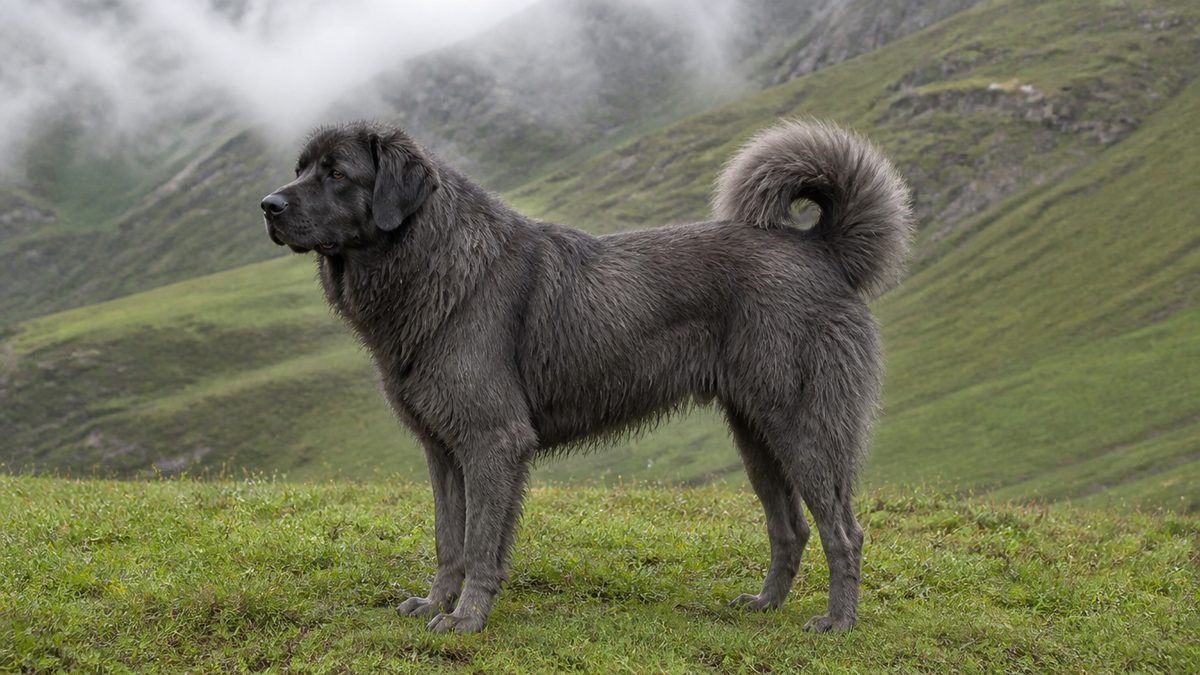
The coat is described as long in the only photograph attributable to the researchers, captioned by ResearchGate as a long-coated grey Rize Koyun dog photographed by Orhan Yilmaz. Combined with the paper's note that darker colours predominate, a dark grey long-coated dog is the type specimen as far as one exists.
Registry status, and the register that files a dog as unspecified and still not this one
The Rize Koyun fails both halves of the two-condition test, because no written standard for it exists anywhere and no studbook holds it, which makes the correct verdict a type.
This site applies a two-condition test. A breed needs a written standard somewhere and a studbook somewhere, and the two can be met by different bodies. Each is checked separately, and on this dog both come back empty.
Condition one, a written standard: none
- FCI: absent from the register of breeds recognised on a provisional basis, read in full at twenty entries with the Romanian Raven Shepherd Dog 373 as an in-document control.
- FCI definitive: the nomenclature is organised by country of origin within each group, and no Turkish entry corresponds to this dog.
- KIF, Turkey's own federation: no standard published, and no entry for the breed in any of its eleven groups.
- Turkish Standards Institute: the Kangal was registered as a breed on 27 November 2002 and no comparable registration exists for this dog.
- Wikipedia's own summary agrees, recording breed status as not recognised as a breed by any major kennel club.
Condition two, a studbook: none, and this is the decisive part
Turkey is not a marginal cynological country. It is a full member of the FCI, represented by the Kopek Irklari ve Kinoloji Federasyonu of Istanbul, which is a higher tier than the contract-partner status held by, for example, Iran. Its national register runs to 460 breeds across eleven groups, and the eleventh group exists specifically for breeds the FCI does not recognise.
| Turkish native breeds and types held | Foreign breeds held | Generic and catch-all entries held |
|---|---|---|
| Akbas Coban Kopegi | American Bulldog | Belirtilmemis (Unspecified) |
| Aksaray Malaklisi | American Hairless Terrier | Karisik Kopoy (Mixed hound) |
| Anadolu Sultan Tazisi | Biewer Yorkshire Terrier | Kopoy (Hound) |
| Kars Coban Kopegi | Deltari Ilir | Kopoy (Arap), (Barak), (Macar), (Sariger) |
| Deli Orman Kopoyu | East European Shepherd Dog | Kopoy (Dag Tipi), (Dag Tipi Karisik) |
| Trakya Kopoyu | Mittelschnauzer, Mongol Bankhar | Sari Kopek (Yellow dog) |
| Pulot Kopoy | Moscow Watchdog, North American Indian Dog | Sari Kopoy (Yellow hound) |
| Tonyo Finosu | Russian Salon Dog, South African Boerboel | |
| Zerdeva | Taigan, Toy Fox Terrier |
Turkey's national federation maintains a group for breeds the FCI does not recognise, and it will file a dog in that group as Belirtilmemis, unspecified, as Sari Kopek, yellow dog, and as Karisik Kopoy, mixed hound. It holds the Zerdava and the Tonya Finosu, two of the most obscure local dogs in the eastern Black Sea region. It holds nine separate varieties of kopoy. It does not hold the Rize Koyun. A register with categories that loose is not failing to notice a breed; it has simply not been asked to hold this one, or has decided not to.
The state, checked as well as the cynological body
Turkey does conserve native animal genetic resources at state level, and the same review names the programme. TURKHAYGEN-I, prepared by the Marmara Research Centre's Genetic Engineering and Biotechnology Institute, ran from 2005 to 2011 and carried out work on five horse, five goat, thirteen sheep, one buffalo and six cattle breeds. It included no dog at all. The authors close their review by arguing that endangered native shepherd dog breeds should definitely be included in a planned TURKHAYGEN-II.
That is the answer to the question of whether Turkey's state has an opinion about this dog where its kennel federation does not. It does not. Turkey's national genetic-resources conservation programme has never covered a dog of any breed, and the people best placed to know were still asking for that to change in 2012.
Type. No written standard exists anywhere, no studbook anywhere holds it, and the only researchers who have ever described it call it yoresel bir tip, a local type, using the same words for it as for the Karaman and in deliberate contrast to the Kangal, which they record as registered by the Turkish Standards Institute. This is not a breed in formation, because no standard is being drafted that we could find. It is not a register without a standard, because there is no register. It is a working population of local dogs that three papers have described and nobody has written down.
One caution about the strength of that verdict. A Turkish-language document we could not reach would not appear in our searches, and we normalised the breed's name forms and stripped diacritics before concluding anything was absent. What we can say is that it is absent from the FCI's registers, from Turkey's own 460-breed national register including its group for unrecognised breeds, and from the state genetic-resources programme, and that its own describers call it a type.
History, and how short the documented record actually is
The documented history of the Rize Koyun begins in 2012, when two Turkish animal scientists measured a sample of these dogs and published the first description of them.
There is no ancient-breed story here, and the absence of one is refreshing. The academic abstract puts it plainly: this study is the first to document the Turkish Rize Koyun dog. Before that paper, the population existed and worked and nobody had written it down.
| Date | Event | Document |
|---|---|---|
| 27 November 2002 | The Kangal, not this dog, is registered as a breed by the Turkish Standards Institute | Recorded in the 2012 review |
| 2005 to 2011 | TURKHAYGEN-I conserves horse, goat, sheep, buffalo and cattle breeds, and no dogs | Recorded in the 2012 review |
| 2012 | First documentation, Determination of the Rize Koyun (sheep) dog in Turkey | Canadian Journal of Applied Sciences 2(1):216-221 |
| 2012 | Included in a Turkish review of eleven native breeds and types, as Koyun Kopegi | Igdir University journal, extracted for this page |
| 2012 | Included in a conference paper on Turkish guard and hunting dogs | 63rd EAAP Annual Meeting |
| 2020 to present | The English-language web reproduces a Wikipedia stub built on those three papers | Wikipedia and its downstream copies |
Wikipedia's three references are all Yilmaz and Ertugrul, in one case with Wilson as a third author. Animalia, creatures.com, Hepper and the dog-scanner apps are all downstream of Wikipedia. So the entire world's published knowledge of this dog is one research programme by two people, and the apparent breadth of coverage online is a single source reflected in a dozen mirrors. That is not a criticism of the researchers, who did the only work anybody has done. It is a warning against reading agreement across websites as corroboration.
The conservation position, which is the historically important part
The review's conclusion is stark and it applies directly here. Except for the Turkish Kangal shepherd dog, all Turkish shepherd dog breeds can be said to be in danger of extinction or under severe threat, and the authors recommend that endangered or nearly extinct dog breeds should in future be preserved by the state or by universities. That conservation status is the single most important fact about this population and it is the one no ranking page mentions.
It also explains the register absence in a way that is more sympathetic than it first appears. A dog with no breed club, no show entry, no export trade and a shrinking working role does not generate the paperwork a national register runs on. The Kangal has all four; the Koyun has none of them. The gap between them is institutional rather than canine.
Where the dog is, and a geographical loose end
The Turkish review places the dog in the eastern Black Sea region, in the high country where sheep, goats and cattle are raised. Wikipedia and its downstream copies place it in Rize and Ordu provinces, and describe its working ground as the Canik Mountains. Those two statements sit awkwardly together, because the Canik range lies towards the western end of that coast, nearer Ordu and Samsun than Rize. A dog-scanner page adds a third local name, Bayburt Kelpi, which we could not confirm in any academic source. We record all three rather than choosing, because a population named for one province, described in another's mountains and locally called after a third is exactly what an undocumented regional type looks like.
Rize Koyun price in india, and the one time an answer engine got it right
There is no Rize Koyun price in india, no Indian listing and no Indian breeder, and on this breed Google's own answer says so instead of inventing a rupee band.
The commercial search for this breed returns no seller of any kind. Not a classifieds page, not a kennel, not a marketplace, not even the merchandise and stock-photo results that stand in for supply on other rare breeds. The control passed in the same session, so the emptiness is about this dog rather than about the instrument.
What the answer engine did, which is worth recording
Google's AI Mode for this query opens: the Rize Koyun dog is not commercially available in India, meaning there is no official or standard price for this breed in the Indian market, and correctly adds that it has not been recognised as an official breed by major international kennel clubs such as the FCI or the Kennel Club of India.
This site has repeatedly documented the same engine saying no Indian price exists and then printing a rupee band derived by dividing a foreign asking price. On the Sarabi it printed a band from one retailer's blog; on the South Russian Ovcharka it printed a dollar band divided at exactly 83.33 at both ends. On this breed it declined to do either. An accurate machine answer deserves recording as carefully as an inaccurate one, because the difference tells you something about when the failure fires: it fires when a plausible number is available to convert, and here there was none.
What it did instead, which is a milder trap with the same shape
Having declined to invent a price, the answer substitutes a different breed's. It states that importing a similar, more popular Turkish breed like the Kangal generally costs between Rs 1,50,000 and Rs 3,00,000 or more, citing Supertails, and reasons that for a Rize Koyun costs would likely sit at the higher end due to its rarity.
| Result | What it is | Relevance to this breed |
|---|---|---|
| Wikipedia | The breed stub | On-breed, no price |
| Animalia | A database profile | On-breed, no price |
| ResearchGate | The 2012 academic paper | On-breed, no price |
| Supertails | A Kangal price page | Different breed |
| Wrapinfur | A general Indian dog price list | Does not contain this breed |
| wagNbush | General Indian puppy price bands | Does not contain this breed |
| Listings for a live animal | None found | Zero, against a passing control |
So the reasoning chain a reader is offered runs: this breed has no Indian price, therefore use the Kangal's, therefore assume higher. Every step after the first is analogy rather than evidence, and the Kangal figure itself comes from an Indian retailer's blog rather than from a transaction record. A number produced that way should not be treated as a price for either breed.
The commercial query printed About 2,650 results, the bare informational form printed About 130, and the Labrador Retriever control, the thickest commercial dog query in India, printed About 184 on the same instrument in the same session In-session control query labrador retriever…. A dog with no Indian presence whatsoever printed fourteen times the Labrador's count. Judge a market by what the results contain, never by the number above them.
The honest practical summary is short. Nobody in India is selling this dog, nobody is importing it, and nobody is being offered a substitute under its name, which is unusual and mildly to the market's credit. If you searched for it because you want a large Turkish guardian, the Kangal Shepherd Dog is the breed with an actual Indian presence, and the Kangal is entry 8 on India's 2024 customs circular.
Cost of ownership for a large long-coated guardian in India
Running costs for a dog of this size in India are dominated by food, grooming and parasite control, and the complication specific to this breed is that no published body weight exists to build a feeding budget from.
Every figure below is a real Indian price for a large dog, sourced and dated. None of it is specific to this breed, because no Indian population exists to survey, and that distinction is kept visible throughout.
| Item | Price | Source and scope |
|---|---|---|
| Puppy vaccination course | From Rs 6,499 | Vetic, seven visits from day 30, list price Rs 8,111 |
| Annual booster course | From Rs 3,199 | Vetic, list price Rs 3,806 |
| Anti-rabies, single dose | Rs 699 | Vetic clinic price |
| 9-in-1 DHPPiL, single dose | Rs 899 | Vetic clinic price |
| Canine corona | Rs 899 | Vetic clinic price |
| Kennel cough | Rs 1,349 | Vetic clinic price |
| Pet dog registration, Delhi | Rs 500 | MCD, new and renewal, Rs 100 per month late fee |
| Pet licence, Chennai | Rs 50 | Greater Chennai Corporation |
The budget you cannot build from the breed name
A feeding chart is keyed to adult body weight, and no body weight has ever been published for this dog. What the literature does give is a comparator: the Kars shepherd, which the same authors say this dog resembles, was measured at 45.3 plus or minus 1.17 kg in males and 43.3 plus or minus 2.00 kg in females, at a withers height about 3 cm greater than the Koyun's. Reasoning from that, a Koyun in the low forties of kilograms is plausible, and we label that a plausible inference rather than a measurement, because that is what it is.
At Indian large-breed kibble prices of roughly Rs 600 to 650 per kilogram, a 40 to 45 kg dog eating 400 to 480 g a day costs about Rs 7,200 to Rs 9,400 a month for food alone. Re-price before you budget, because Indian retail food prices have moved within days on this site's own checks, and weigh the dog rather than trusting any inference including ours.
The cost this breed adds that others do not
- Budget for professional grooming through the monsoon, because a long coat evolved for Rize's 171.6 rainy days behaves very differently in Indian humidity, where the moisture does not clear.
- Budget for cooling from March to June, which for a long-coated 40 kg dog in an Indian plains city is an electricity cost rather than a pet cost.
- Budget for monthly ectoparasite cover at a four-figure rupee sum, which is not optional given the Indian clinic data below.
- Budget for a trainer with genuine livestock-guardian experience from week eight, because the socialisation window is short and cannot be reopened.
A West Bengal series of 584 dogs screened reported Babesia gibsoni in 76.54 percent and Anaplasma in 55.75 percent, with 72.9 percent of the 584 dogs screened carrying two or more pathogens. A southern Indian series of 120 found Babesia in 66.7 percent. An eastern Indian series of 178 found Ehrlichia canis in 31.46 percent, with 75 percent of infected dogs weighing over 20 kg and 79 percent having a tick history. Those denominators are clinic caseloads, so read them as among dogs tested at veterinary clinics rather than as population prevalence. On a long coat you will not see a tick by looking, which is why the inspection has to be done by hand.
The one genuinely useful Indian cost fact is a spread rather than a price. The same 9-in-1 vaccine is Rs 899 at a private clinic, while Greater Chennai Corporation's six municipal pet clinics provide treatment and anti-rabies vaccination free of cost Greater Chennai Corporation. Veterinary cost in India is a function of the delivery model far more than of the drug.
Indian climate suitability, measured by Turkey's own weather service
The Rize Koyun's homeland averages 14.5 C across the year with a hottest month of 23.3 C, which is cooler than Chennai's coolest month, and it receives 2,291.7 mm of rain a year, which means Indian humidity is not the problem and Indian heat is.
This section is unusual for this site because the grid model fails here badly enough to be useless, and a better instrument exists. Both are shown.
Why NASA POWER cannot describe this coast
| Point | Cell elevation | Real elevation | Error | Usable |
|---|---|---|---|---|
| Rize town | 936.23 m | about 5 m | +931.23 m | No |
| Ikizdere highland, 27 km inland | 936.23 m | about 700 m | +236.23 m | No, same cell |
| Ordu town | 240.98 m | about 10 m | +230.98 m | No |
| Camlihemsin yayla | 1,622.83 m | about 1,200 m | +422.83 m | No |
| Chennai | 48.95 m | about 6 m | +42.95 m | Yes |
| Delhi | 206.37 m | about 216 m | -9.63 m | Yes |
| Bengaluru | 841.72 m | about 920 m | -78.28 m | Yes |
Rize town at about 5 m above the sea and the Ikizdere highland at about 700 m, 27 km apart, return a byte-identical series from one cell at 936.23 m. The model has flattened the entire Pontic escarpment into a single 936 m plateau. That makes the coastal error +931 m, among the largest this site has recorded anywhere. Two nearby points agreeing is not a check, it is the symptom, and the correct response is to stop using the model here rather than to publish its output with a caveat.
The instrument that does work is the Turkish state's own
The Turkish State Meteorological Service publishes official climate statistics by province, and for Rize the measurement period runs from 1927 to 2025, which is a 98-year record against the model's 20-year reanalysis.
| Place | Annual mean | Hottest month | Coolest month | Annual rainfall | Rainy days |
|---|---|---|---|---|---|
| Rize (MGM, 1927-2025) | 14.5 C | 23.3 C (Aug) | 6.8 C (Feb) | 2,291.7 mm | 171.6 |
| Ordu (MGM, 1959-2025) | 14.6 C | 23.6 C (Aug) | 7.1 C (Jan/Feb) | 1,049.2 mm | 152.7 |
| Chennai | 27.95 C | 31.51 C (May) | 24.09 C (Jan) | not compared | not compared |
| Delhi | 25.60 C | 35.88 C (Jun) | 13.61 C (Jan) | not compared | not compared |
| Bengaluru | 23.74 C | 28.37 C (Apr) | 20.22 C (Dec) | not compared | not compared |
| Kolkata | 25.81 C | 31.53 C (May) | 17.31 C (Jan) | not compared | not compared |
| Mumbai | 26.77 C | 31.19 C (May) | 23.19 C (Jan) | not compared | not compared |
Rize's hottest month, August at 23.3 C, is cooler than Chennai's coolest month, January at 24.09 C NASA POWER climatology 2001-2020…. That single comparison settles the question. The annual gap to Chennai is 13.45 C, and every Indian plains city sits above the top of this dog's year.
The 936.23 m cell returned an annual mean of 10.71 C for Rize and an August mean of 20.49 C. The Turkish service's measured values are 14.5 C and 23.3 C NASA POWER climatology 2001-2020. So the model ran 3.79 C too cold on the year and 2.81 C too cold in August, in the direction its 931 m elevation error predicts. That is a rare chance to quantify the grid-cell problem against a national meteorological record, and it is worth publishing for anyone using the same model on mountainous coasts.
The humidity argument is wrong here, and this breed is the clearest proof of it
The reflex with a mountain guardian is to say Indian humidity will finish it. On this dog that is emphatically false. Rize records 2,291.7 mm of rain a year across 171.6 rainy days, which is more than double Ordu's 1,049.2 mm and puts it among the wettest inhabited places in Turkey Turkish State Meteorological Service. This dog's long coat evolved to work in near-constant rain. Damp air is its native condition.
So the honest framing is wet-bulb load, which combines heat and moisture and determines whether a panting dog can shed heat at all. Indian plains cities peak between about 21.9 C wet bulb in Bengaluru and 27.09 C in Kolkata, with Chennai and Ahmedabad at 26.11 C and Delhi at 26.50 C. Rize never approaches those figures because its air, however wet, is 9 to 13 degrees cooler. Rain is not the enemy. Warm rain is.
The largest study of canine heat-related illness examined 905,543 UK dogs under primary veterinary care in 2016 and found 395 confirmed events, with significantly raised odds for dogs at or above their breed and sex mean bodyweight at 1.42 (1.12 to 1.80). A companion paper from the same cohort found 652 of 879 events with a recorded trigger, 74.2 percent, were exertional. This breed was in neither study and has no odds ratio of its own, so only the transferable factors are quoted, and the over-50 kg band cannot be applied because no weight for this dog has ever been published. Indian law reaches the same ground from the housing side: Second Schedule Part IV paragraph 21(1) bars outdoor housing without written veterinary approval for breeds that cannot tolerate local temperatures, naming long-haired breeds in high temperature locations as its example.
Temperament, in the words of the only people who studied it
The Rize Koyun is described in its one primary source as having quite a nervous character, as potentially dangerous to strangers, and as guarding by barking strongly first, which is a vocal rather than a silent guardian.
Because there is only one real description of this dog's temperament, quoting it accurately matters more than usual. The Turkish review says the Koyun dog has quite a nervous character and can be dangerous to strangers, and that when a strange animal or person enters the area it guards, it first frightens the intruder by barking strongly, thereby also warning its owner.
Two details in one sentence tell you what living with this dog is like. First, barking is the primary method, not a prelude to it. This is a vocal guardian by design, and the barking is the working behaviour rather than a training failure. Second, the source's word is nervous rather than confident, which is a different temperament from the calm, unshakeable guardian that marketing copy describes. A nervous vocal territorial dog in an Indian residential street, with foot traffic and delivery riders all day, is a specific and predictable problem.
Everything else in circulation is downstream inference. Google's own answer describes the breed as fierce, vocal, and highly territorial working flock-guardians requiring vast open territories and a job to do, citing Animalia rather than the academic literature. That is a reasonable reading of the primary source, but it is a reading, and no behavioural study of this population exists.
Who should not consider this dog
- Anyone in an Indian apartment or a shared building. The guardian instinct here expresses as sustained barking at anything unfamiliar, which is a neighbour complaint before it is anything else.
- Anyone buying a first large dog. This is an independent working animal whose describers call its character nervous.
- Anyone who needs a predictable adult. With no standard, no register and no temperament testing, the individual dog is the only evidence available.
- Anyone who cannot socialise intensively from week eight, because a nervous guardian that has not met the world will treat the world as a threat.
- Anyone expecting the long coat to be low-maintenance in Indian monsoon conditions, where it holds water that Rize's cool air would have carried away.
If a calm large guardian is what you want, this is not the type to pursue even leaving availability aside. The primary source's own comparison, the Kars dog, is described in the same paper as not very friendly towards its surroundings and quite hard in structure, so the family resemblance runs to temperament as well as to appearance.
Training a vocal guardian with no breed knowledge behind it
To train a Rize Koyun you work on the barking and the stranger response from week eight, because those are the two behaviours its one description identifies, and you do it without any breed-specific guidance because none has been written.
Two problems compound here. The first is the ordinary guardian problem: a dog selected to patrol and decide alone does not work for the pleasure of being instructed. The second is specific to a type rather than a breed: there is no accumulated body of handling advice written by people who have worked with hundreds of these dogs under a common standard, because there is no common standard.
The order the work has to happen in
- Socialise from week eight through week sixteen, daily and deliberately, with particular attention to people arriving at doorways, because that is the exact scenario the primary description names.
- Train an interrupt and a settle for the barking early, while the dog is small enough that a rehearsal costs nothing, rather than after it has become a 40 kg habit.
- Establish a recall before the guarding behaviour matures, which in a large slow-maturing dog is usually after twelve months.
- Manage the environment rather than relying on obedience at a gate. Physical separation beats any command when a stranger arrives.
- Verify that any trainer has real livestock-guardian experience rather than sport or gundog experience, because the methods differ and the wrong method makes a nervous dog worse.
What this dog will refuse
It will refuse to stop assessing strangers, and it will refuse to stop announcing them, because both are the working behaviour the population was kept for. A realistic goal is a dog that barks once and then defers to you, not a dog that has stopped noticing. Trying to punish the barking out of a nervous guardian produces a dog that skips the warning, which is considerably more dangerous.
The 2017 Rules provide at Second Schedule Part IV paragraph 23(5) that dogs with a vicious or aggressive disposition shall be housed separately from other dogs and that sedation shall not be used to control behavior of such dogs. Separately, paragraph 6(8) forbids de-barking by name, alongside tail docking, ear cropping, de-clawing and any change of appearance by artificial means. On a breed whose guarding method is barking, both clauses close off the shortcuts an exasperated owner might reach for. The lawful route is a behaviourist and a management plan, and your nearby vet is the right first call.
Daily exercise, and the Indian hours that are actually available
A Rize Koyun needs long, steady, low-intensity work on varied ground, and in India the binding constraint is that a long-coated dog from a 14.5 C homeland can safely move for only a few hours a day for much of the year.
The primary source describes a dog with a strong leg and body structure suited to walking easily on rough and steep terrain, working the high pastures where sheep, goats and cattle are kept. That is a patrolling animal rather than a sprinting one, powerful over rough ground and aloof with anything it does not know, and the requirement is measured in hours of low-intensity movement rather than kilometres of hard work.
- Walk before sunrise and after dark, and write off the middle of the day from March to June in every Indian plains city.
- Watch the wet bulb rather than the air temperature, because a coated dog in Kolkata at a 27.09 C wet bulb has almost no evaporative headroom left.
- Split the requirement into two or three shorter outings so the dog is never far from shade and water.
- Avoid hard running in heat entirely, because exertional heat illness is the dominant mechanism at 652 of 879 events with a recorded trigger in the largest study available.
- Give the dog varied ground to patrol rather than a sport, because rough terrain is what its build is described as being for.
Denied that, a guardian does not become destructive in the way an under-worked retriever does. It becomes reactive, patrolling a boundary it cannot leave and escalating at everything that crosses it. On a dog whose primary guarding behaviour is already barking, that failure mode is loud, continuous and very hard to reverse once rehearsed.
In most Indian cities, for most of the year, the hours when this dog can safely exercise are not the hours a working household is free to provide them. That is a reason the type does not belong here rather than a scheduling problem to be solved by discipline. Its homeland gives it a year in which the hottest month averages 23.3 C and it rains on 171.6 days. There is nowhere in the Indian plains that resembles that.
Grooming a long coat built for cold rain, in warm rain
To groom a Rize Koyun you brush right through the coat several times a week and dry it actively after every wetting, because a coat evolved for 171.6 cool rainy days a year does not clear moisture in an Indian monsoon.
The coat is long, and the only photograph attributable to the researchers is captioned a long-coated grey Rize Koyun dog. The Turkish description records that all colours and bi-coloured dogs occur but that darker colours predominate. There is no standard specifying length, texture or undercoat, so what follows is reasoning from the coat type rather than from a document, and it is labelled as such.
The routine, and why the monsoon changes it
- Brush to the skin in sections, three or four times a week, using a slicker and then a long-toothed comb to confirm you have reached the base rather than skimming the surface.
- Dry the dog actively after every bath and every soaking, rather than letting it air dry. This is the single most important change from how the same coat is managed in Turkey.
- Part the coat weekly over the neck, behind the elbows and between the hind legs to check for ticks by hand, because on a long coat you will not see one by looking.
- Check the ears and the skin folds through July and August, when Indian humidity keeps the coat damp for far longer than Rize's cooler air would.
- Refuse to shave the dog. The coat insulates in both directions, and removing it exposes skin to solar load without improving heat loss.
Guidance written for a wet temperate climate routinely says to towel a heavy-coated dog and let it dry naturally. In Rize that works: the air is wet but it is 14.5 C on average and the coat has been selected for exactly those conditions across generations. In an Indian monsoon the same instruction leaves a warm damp coat against skin for hours, which is how hot spots and ear infections start. Ask what temperature a grooming instruction assumes, not just what humidity, and on this breed the temperature is the part that does not carry across.
One thing the long coat does give you, and it is worth saying because it is the only advantage on this page. A dark long coat on a working guardian is designed to shed water and resist weather, so an Indian owner who keeps up the brushing will find the coat itself robust. What it will not do is keep the dog cool, and no amount of grooming changes that.
Health, and a literature that consists of three papers by two people
No health data of any kind exists for the Rize Koyun, no screening scheme covers it, no lifespan has been measured, and the entire literature is three descriptive papers by the same two authors.
This is the shortest health section on this site, and its shortness is the finding rather than a gap in our research.
The literature search, in full
| Query | Records | What they actually are |
|---|---|---|
| "Rize Koyun"[tiab] | 0 | Exact phrase not in the index |
| Koyun[tiab] | 3 | A monogenean parasite paper, a Turkish human parasitology paper and a medicinal plants paper. None about dogs |
| "Rize"[tiab] AND dog[tiab] | 0 | No warning line, a clean zero |
| Koyun kopegi | 0 | The Turkish name for the dog |
| "Kars dog"[tiab] | 0 | Its closest relative by description |
| "Zerdava"[tiab] | 0 | A Turkish breed KIF does register |
| "Aksaray Malaklisi"[tiab] | 0 | Another Turkish breed KIF does register |
| "Kangal"[tiab] | 42 | Mostly the Sivas district and a Turkish surname, not all on-breed |
| "Akbash"[tiab] | 4 | Genuine, including a Turkish native-breed blood-typing study |
| Labrador retriever hip dysplasia | 126 | Control, passed |
| "Kuvasz"[tiab] | 3 | Control on a rare guardian, passed |
The controls passed, so the zeros are about the literature rather than about the query. The screening registries were checked as well. The Orthopedic Foundation for Animals holds no Rize Koyun and no Koyun entry of any kind, confirmed on two separate retrievals of its Browse By Breed list with Labrador Retriever, Bulldog and Beagle present as in-document controls. That same list does hold Kangal Dog, Akbash Dog, Anatolian Shepherd and Turkish Boz Shepherd, so four Turkish guardians are in it and this one is not, which is the same shape as its absence from Turkey's own national register. Note also what the Turkish rows show: five of Turkey's named native dogs return zero clinical papers between them, and the two that return anything, the Kangal and the Akbash, do so partly because their names collide with a district and a surname. Turkish native dogs are barely present in the clinical literature at all.
There is a genuine veterinary study of Turkish native dogs, and it does not include this one. Ergul Ekiz and colleagues measured the frequency of dog erythrocyte antigen 1.1 in four breeds native to different areas of Turkey. Blood typing matters clinically because a DEA 1.1 mismatch drives transfusion reactions, and breed-level frequencies are exactly the kind of practical data a working guardian population needs. The Koyun dog was not among the four breeds studied, which is one more instance of the pattern this page keeps meeting: the research that exists went to the breeds somebody had written down.
Lifespan, and why we publish none
We checked the table that adjudicates inclusion in the largest UK longevity study, parsing 3,339 cells of its supplementary material, and Koyun appears zero times. The Turkish Kangal Dog does appear, flagged N, meaning considered and excluded. So this dog was never considered, which is what you would expect for a population with no presence outside two Turkish provinces. There is no median survival figure and no basis for constructing one, and we publish no lifespan.
What transfers, and what does not
The heat evidence transfers because it is keyed to bodyweight rather than to breed, though only partly here: the 1.42 odds ratio for a dog at or above its breed and sex mean bodyweight applies, while the over-50 kg band cannot be used because no weight for this dog has ever been published Yilmaz O, Ertugrul M. Turkiye Yerli Kopek…. The Indian tick-borne disease evidence transfers because it is about where the dog lives Venugopal V, Deepa PM, Muhasin Asaf VN.
The anaesthetic evidence does not transfer. The largest breed-specific anaesthetic mortality study, covering 54,542 anaesthetics after exclusions, reported overall mortality of 0.69 percent and found that after adjusting for ASA physical status only two breeds retained excess risk, the Chihuahua and the Spanish Water Dog, concluding that between-breed differences largely reflected case severity rather than breed. This dog was not in that study, and importing an odds ratio onto a population the authors never examined is fabrication wearing a citation.
Tell them the dog is a large Turkish flock guardian type with no published health data, no breed standard and no published weight range, and give them the animal's measured weight on the day. Ask them to screen and dose as a large-breed dog of that weight rather than of any breed average, and to blood-type before any procedure that might need a transfusion, since no breed-level DEA 1.1 frequency exists for this population. Consult your nearby vet before any anaesthetic procedure and ask specifically about recovery-phase heat management in a long coat. Where there is no literature, your vet's judgement is the evidence base.
Feeding a large dog whose weight nobody has published
To feed a Rize Koyun you weigh the dog and feed to the measured weight, because no body weight for this population has ever been published in either sex.
The situation is unusual and it changes the practical advice. The one paper that measured these dogs published withers heights with standard errors and no weights at all, on a page where the same authors publish weights for the Kars shepherd measured in the same programme. So there is no adult weight to plan against, and there is a nearby comparator that must be labelled as a comparator rather than used as a figure.
The approach, in order
- Feed a large-breed puppy food with controlled calcium through growth rather than an all-life-stages food, because rapid growth on unbalanced minerals is the established orthopaedic risk in large breeds.
- Measure the dog's weight monthly through the first two years and feed to the trend, not to a chart keyed to an adult weight nobody has recorded.
- Split the daily ration into three meals until six months and two thereafter, never immediately before or after exercise.
- Score body condition by hand every fortnight, because a long coat hides two or three kilograms in either direction.
- Delay the switch to adult food until the weight trend genuinely flattens rather than switching on a calendar date.
Indian availability and cost
Large-breed dry foods are widely stocked in Indian metros. Using the Kars comparator of roughly 43 to 45 kg as an explicit inference rather than a measurement, a dog in that band eating 430 to 500 g a day at Rs 600 to 650 per kilogram costs about Rs 7,700 to Rs 9,800 a month for food alone, with one 15 kg bag lasting 30 to 35 days. Re-price before budgeting and weigh the animal rather than trusting the inference.
Deep-chested large breeds carry a raised risk of gastric dilatation and volvulus. Whether this population is deep-chested is not recorded anywhere, because the one description of it gives height, colour, temperament and terrain and nothing about chest depth. So the advice is the general large-breed advice, split meals and no exercise around feeding, and the honest framing is that nobody has described the relevant anatomy in this dog, let alone measured the risk. Discuss prophylactic gastropexy with your nearby vet if the animal is going under anaesthesia for another reason.
One India-specific point. Water intake rises steeply with heat load in a coated dog, and a long-coated guardian drinking less than usual in an Indian April is a dog to take seriously the same day. Provide fresh water in more than one place, changed rather than topped up.
Month by month through the first year
The first year of a vocal guardian puppy is front-loaded, because the socialisation window closes at about sixteen weeks while the barking and stranger response that need shaping do not fully appear until after twelve months.
Weeks 8 to 16, the window that does not reopen
Indian law sets the floor: Rule 8(1)(a) of the 2017 Rules requires that pups less than eight weeks in age are not sold. From arrival, socialisation is the job, and on a dog whose one description calls its character nervous it is the only lever that matters. Prioritise doorways, deliveries, lifts and stairwells, because the primary source names the arrival of a stranger in a guarded space as the trigger behaviour.
Vaccination runs alongside. An Indian clinic course currently starts at Rs 6,499 across a seven-visit schedule from day 30, with anti-rabies at Rs 699 and the 9-in-1 at Rs 899 individually. Do not postpone socialisation until the course finishes, because the window closes first.
Months 4 to 8, growth against the Indian calendar
A puppy born in November reaches four months in March, which is when Indian plains cities become unusable in the middle of the day. Growth continues regardless. Find the exercise before sunrise and after dark, keep sessions short and on soft ground, and weigh monthly. The adult coat begins coming through in this window and the grooming routine has to be established before it does.
Months 8 to 14, the barking arrives
This is when the guarding behaviour typically appears, and on this type it appears as sustained barking at boundaries and approaching strangers. How the first instances are handled sets the pattern for years. Interrupt and redirect, reward the settle after one bark, and never let the dog rehearse a fence-line escalation. Do not attempt to suppress the warning bark entirely; a guardian that has learned barking is punished may skip straight past it next time.
Months 14 to 24, maturity
Large guardians mature slowly and this one has no published maturity age because it has no published anything. Keep feeding a growth-appropriate diet until the weight trend flattens rather than switching on a date, keep socialising rather than treating it as finished, and expect the dog's judgement about strangers to settle into its adult form in this period.
Register the dog. Delhi charges Rs 500 for a new pet dog registration and the same for renewal, with a Rs 100 per month late fee. Greater Chennai Corporation charges Rs 50 for a pet licence and runs six clinics giving treatment and anti-rabies vaccination free of cost. On an unregistered type with no pedigree available anywhere in the world, municipal registration is the only document that will ever attach to this animal, and it is worth having.
Indian legal status, and the rare case where no category word reaches the breed
The Rize Koyun is not named in India's March 2024 customs circular and none of its four undefined category words plainly reaches this breed, which is unusual for a large livestock guardian and is stated here as a finding rather than as an all-clear.
CBIC Instruction No. 05/2024-Customs of 14 March 2024 reproduces a Department of Animal Husbandry and Dairying letter identifying 24 comma-separated entries as breeds that are ferocious and dangerous for human life and that shall be prohibited for import, breeding, selling as pet dogs and other purposes. We read it from two independent reproductions carrying identical transcription defects, which is the strongest available evidence that both transcribe the same document rather than copying a summary.
Checking the four undefined category words, not just the names
Four of the 24 entries are bare words the instrument never defines: Mastiffs (boerbulls) at 15, Terriers at 17, Wolf dogs at 19 and Canario at 20. Because they are undefined they reach breeds by description rather than by name, and clearing a breed by checking proper names alone is how this is usually got wrong.
| Category word | Reaches this breed? | Reasoning |
|---|---|---|
| Mastiffs (boerbulls), entry 15 | No, on the primary source | The Turkish scientific description calls it a koyun kopegi, a sheep dog, and a yoresel tip resembling the Kars shepherd. It never uses mastiff or molosser. One secondary English page calls it a Turkish variant of the Molosser dog, and we flag that page rather than adopt its classification |
| Terriers, entry 17 | No | Nothing in any source relates this type to a terrier |
| Wolf dogs, entry 19 | No | No source claims wolf content in this population, and unlike some guardian breeds no registry text describes it as descended from the wolf |
| Canario, entry 20 | No | A Canary Islands reference with no relationship to a Black Sea type |
This is one of the few livestock guardians on this site that neither a proper name nor a category word in the 2024 circular reaches. Two cautions go with that. The two Turkish breeds the circular does name are this dog's near neighbours, the Kangal at entry 8 and the Akbash dog at entry 21. And the Kangal's entry is inherited rather than assessed: entries 1 to 13 of India's list are the thirteen breeds prohibited by Denmark's Hundeloven section 1 a, in the same order, with Kangal at position 8 in both documents. A list assembled that way clears this dog by accident rather than on the merits, so the clearance says nothing about the animal.
What the instrument is, and where the litigation left it
The document is weaker than the word ban implies. It is a D.O. letter from a Joint Secretary, reproduced inside a customs instruction asking Principal Chief Commissioners to sensitise officers under their jurisdiction, and it is not an Act, a rule or a notification. The Karnataka High Court quashed the underlying circular in April 2024, finding that no stakeholder had been heard, that the committee's composition was not in consonance with the Rules, and that the circular travelled beyond what is found in the Rules. The Union has since told a High Court that the quashed circular has lost its effect entirely. No Indian law in force today bans owning, breeding or selling any of these breeds, and the court expressly left open a Rules amendment after due process.
The 2017 Rules, which are in force and do reach this dog
- Second Schedule Part IV paragraph 21(1) bars keeping in outdoor facilities, without the attending veterinary practitioner's written approval, dogs not accustomed to local temperatures and breeds that cannot tolerate them, such as long-haired breeds in high temperature locations. A long-coated dog from a 14.5 C homeland is the clause's own example.
- Second Schedule Part IV paragraph 23(5) requires separate housing for a dog with a vicious or aggressive disposition and forbids using sedation to control its behaviour.
- Second Schedule Part II paragraph 6(8) forbids tail docking, ear cropping, de-barking, de-clawing and any change of appearance by artificial means, which matters unusually much for a guardian whose working method is barking.
- Second Schedule Part II paragraph 6(9) provides that breeding to create new breeds of dogs or unusual looks shall be strictly prohibited, which would reach anyone proposing to cross this type into something new in India.
The separate and decisive point is the import restriction. Commercial import of dogs into India is restricted regardless of breed, and dogs enter only as accompanied pets rather than for trading or breeding. For a type with no pedigree, no register and no exporter anywhere, that is the end of the question well before any breed list is consulted.
Head to head against the guardians this dog is confused with
The Rize Koyun sits at the bottom of the documentation ladder among Turkish guardians, and the column that separates it from the others is not size or temperament but whether anybody wrote it down.
| Dog | Written standard | In KIF's register | Named on India's 2024 circular | Male withers height |
|---|---|---|---|---|
| Rize Koyun | None | No, in any group | No | 69.8 cm, measured once |
| Kars dog | None | Yes, Grup 11 | No | 72.6 cm, measured once |
| Zerdava | None | Yes, Grup 11 | No | Not compared here |
| Tonya Finosu | None | Yes, Grup 11 | No | Not compared here |
| Akbash | None at FCI | Yes, Grup 11 | Yes, entry 21 | Not compared here |
| Aksaray Malaklisi | None at FCI | Yes, Grup 11 | No | Not compared here |
| Kangal Shepherd Dog | FCI standard, plus a Turkish Standards Institute registration of 27 November 2002 | Yes, main groups | Yes, entry 8 | Not compared here |
| Caucasian Shepherd Dog | FCI standard | Yes, main groups | Yes, entry 10 | Not compared here |
Read down the third column and the point is unmistakable. Every other Turkish native dog in that table is in Turkey's national register and this one is not Kopek Irklari ve Kinoloji Federasyonu. Including the Kars, which the primary source says this dog resembles closely enough that the blood relationship between them needs investigating. Two populations described as looking alike, one registered and one not, with nobody having tested whether they are the same thing, is the clearest statement of this breed's situation available.
If you want a documented large Turkish guardian, the Kangal Shepherd Dog has an FCI standard, a Turkish Standards Institute registration and a real Indian presence, and it is entry 8 on India's 2024 circular so the legal position is worse rather than better. If the priority is a dog actually adapted to Indian conditions and obtainable from Indian sources, an Indian livestock guardian such as the Bakharwal dog has no standard either and has the enormous advantage of already living here.
Two things this table deliberately does not compare. It does not compare lifespans, because none of these dogs has one published and inventing a column would be worse than leaving it out. And it does not compare temperament scores, because for most of these breeds that would mean scoring one paragraph of description against another.
Mistakes readers make with an undocumented type
The five mistakes below are specific to a dog that many websites describe and no institution has recorded, which produces confident agreement rather than obvious gaps.
Reading agreement across websites as corroboration
A dozen sites describe this dog in similar terms. All of them descend from one Wikipedia stub, which descends from three papers by the same two authors. That is one source reflected in mirrors, not twelve sources agreeing. The tell is available in seconds: check whether the pages cite anything other than each other, and here they do not.
Assuming a weight exists
No body weight has ever been published for this dog, in either sex. Any figure you meet is unverified and was estimated by whoever typed it. That matters more than it sounds, because weight drives food quantity, crate size and, most seriously, drug dosing. Weigh the animal and dose from the scale.
Calling it a molosser because it is big
One English page classifies it as a Turkish variant of the Molosser dog. The Turkish scientific description calls it a koyun kopegi, a sheep dog, and a local type resembling the Kars shepherd, and uses neither mastiff nor molosser. That classification is not merely cosmetic in India: the 2024 circular carries the bare undefined word Mastiffs (boerbulls) at entry 15, so a wrong classification imports a legal exposure the primary source does not support.
Expecting the long coat to be the main heat problem
The coat is a real problem in India and it is the second one. The first is that this dog's homeland has a hottest month of 23.3 C, which is below Chennai's coolest month NASA POWER climatology 2001-2020…. Clipping does not move that number, and shaving a weather coat removes protection from solar load without improving evaporative loss. The heat, not the hair, is what does not transfer.
Trusting a climate model on this coast
NASA POWER returns a single cell at 936.23 m for both Rize town at about 5 m and a highland 27 km inland at about 700 m, and it runs 3.79 C too cold on the annual mean against Turkey's own 98-year record Turkish State Meteorological Service. If you are checking a homeland climate for any breed from a steep coast, verify the cell elevation against the real one before quoting a figure, and prefer the national meteorological service where one publishes normals.
Trying to acquire this dog at all, in India or anywhere outside north-eastern Turkey. There is no register, no pedigree, no breeder network, no exporter and no lawful Indian commercial import route. If somebody offers you one, the question is not the price. It is which document says this dog is a Rize Koyun, and on current evidence no such document exists anywhere in the world.
Adoption, and the conservation question that matters more
Adopting a Rize Koyun in India is not possible, because no population exists outside two Turkish provinces, and the more useful question is what happens to a working type that no institution has recorded.
The adoption answer is short. There is nothing to adopt. No Indian population, no surrenders, no rescue intake, no listings for a live animal against a passing control, and no pedigree anywhere in the world that could identify one.
What to do instead, if this kind of dog is what you want
Indian shelters carry large guardian-type dogs continuously, most of them mixed, many with real protective behaviour, and all of them already adapted to Indian heat. A shelter dog offers what no imported animal can: an observed adult temperament. On a type whose one description calls its character nervous and warns that it can be dangerous to strangers, being able to watch the actual dog before committing is not a convenience, it is the whole decision.
- Verify the shelter's assessment process and meet the dog more than once, at different times of day.
- Ask specifically how the dog behaves when a stranger arrives at a doorway, which is the exact scenario this type is described as reacting to.
- Screen for tick-borne disease at intake rather than waiting for clinical signs, given the Indian clinic series.
- Confirm vaccination and sterilisation in writing, then register the dog with your municipality.
- Adopt only if the household genuinely suits a large protective dog, because returning one is worse for the animal than never taking it.
The conservation point, which is the real story here
The authors who described this dog also wrote the sentence that should end this page. Except for the Turkish Kangal shepherd dog, all Turkish shepherd dog breeds can be said to be in danger of extinction or under severe threat, and endangered breeds should in future be preserved by the state or by universities. They wrote that in 2012, having just noted that Turkey's national genetic-resources programme had covered horses, goats, sheep, buffalo and cattle and no dogs at all.
Not much, honestly, except get the record straight. This page exists because the only accurate description of this dog is in a Turkish-language journal that nothing downstream has read, and because a reader searching in English currently finds twelve copies of a stub. Setting out what was actually measured, what the national register does and does not hold, and what the state programme covered is the whole contribution. Bonbeno does not broker sales, and on this dog there is nothing to broker in any case.
If you came here wanting a guardian, start at an Indian shelter and consult your nearby vet about what a large coated dog needs through the hot months. If you came here wanting to know whether the Rize Koyun is real, the answer is that the dogs are certainly real, the measurements are real, and the breed, in the sense of a written standard and a studbook, has never been made.
Questions people actually ask, answered as they were asked
What is the biggest Turkish dog breed?
The biggest Turkish dog breed by published measurements is not this one. Turkish animal science records the Kars shepherd dog at 72.6 plus or minus 0.78 cm at the withers in males, against 69.8 plus or minus 0.77 cm for the Koyun dog, and the Kars is also the one with a published body weight, at 45.3 plus or minus 1.17 kg. The Kangal and the Aksaray Malaklisi are the Turkish breeds usually described as largest in popular writing, and unlike this dog they have registry documents behind them.
What is the price of Turkish Kangal dog?
Google asks this on a Rize Koyun query, which is itself the answer to the question people are really asking. The Kangal is the Turkish guardian with an Indian market, and Google's own AI Mode uses the Kangal's Indian band of about Rs 1,50,000 to Rs 3,00,000 as a stand-in when asked about the Rize Koyun. Note that the Kangal is entry 8 on India's March 2024 customs circular, so the Indian legal position on it is worse rather than better. Read the Kangal Shepherd Dog page rather than buying one under another name.
What breed of dog is on dogecoin?
The Dogecoin dog is a Shiba Inu, and the fact that Google offers this question on a Rize Koyun search is a finding about the breed rather than about cryptocurrency. There is so little search demand attached to this dog that the People also ask box fills with a meme. When an engine has nothing on-topic to offer, it substitutes whatever shares a loose association, and a reader should treat everything else that box says with the same caution.
Which dog costs 20 crore?
The Rs 20 crore dog in Indian coverage is Cadabom Hayder, a Caucasian Shepherd in Bengaluru owned by S. Satish of the Indian Dog Breeders Association, reported as bought from a Hyderabad breeder. It is not a Rize Koyun and it is not a market price for any breed. It is one transaction involving one named animal, and it appears in the People also ask box for almost every guardian breed searched from India, which is why it is worth naming once and setting aside.
How much is a Rize Koyun in India?
There is no Rize Koyun price in india, no Indian listing and no Indian breeder, and on this breed Google's own answer says so plainly rather than inventing a figure. What it then does instead is worth knowing: it substitutes the Kangal's Indian price band and reasons that this breed would cost more. That is a different breed's number applied by analogy, and it is not a price for this dog.
Is the Rize Koyun a real breed?
The Rize Koyun is best described as a local type rather than a breed, and that is the primary source's own word. The Turkish review that first described it calls it yoresel bir tip, a local type, exactly as it describes the Karaman dog, and in explicit contrast to the Kangal, which it records as registered as a breed by the Turkish Standards Institute on 27 November 2002. There is no written standard for it anywhere and no studbook holds it, so it fails both halves of the test this site uses.
Why is the Rize Koyun not in Turkey's own kennel register?
Nobody has published a reason, and the absence is what makes it interesting. Turkey is a full member of the FCI through the Kopek Irklari ve Kinoloji Federasyonu, whose register holds 460 breeds including a Group 11 created specifically for breeds the FCI does not recognise. That group holds 33 entries, among them the Zerdava, the Tonya Finosu, the Kars shepherd, nine varieties of kopoy hound, an entry meaning yellow dog and an entry meaning unspecified. A register willing to file a dog as unspecified and still not filing this one is making a choice, not an oversight.
How big does a Rize Koyun get?
A Rize Koyun stands 69.8 plus or minus 0.77 cm at the withers in males and 68.6 plus or minus 0.92 cm in females, and those are the only measurements ever published for it. Wikipedia's approximately 70 cm and approximately 68 cm are roundings of exactly those figures. No body weight has ever been published for this dog, in either sex, even though the same paper gives weights for the Kars shepherd on the same page. Any weight you meet for it is somebody's estimate.
How long does a Rize Koyun live?
Nobody has measured it and we publish no figure. The breed appears zero times across the 3,339 cells of the supplementary table that adjudicates inclusion in the largest UK longevity study, so it was never considered there, and the Turkish Kangal Dog appears in the same table flagged N. PubMed returns nothing for the breed across every name form we tried, against controls that passed in the same session. A lifespan for this dog would be an invention.
Can a Rize Koyun cope with Indian heat?
No, and Turkey's own weather service gives the reason precisely. Rize province has an annual mean of 14.5 C and a hottest month, August, averaging 23.3 C over a measurement period running from 1927 to 2025. Chennai's coolest month, January, averages 24.09 C. So the hottest month this dog's homeland has ever averaged is cooler than the mildest month Chennai gets, and the dog carries a long coat on top of that.
Is Indian humidity the problem for this breed?
Humidity alone is not the problem, and this breed is the clearest case of that on the whole site. Rize records 2,291.7 mm of rain a year across 171.6 rainy days, which is wetter than Mumbai and comparable to India's wettest coastal cities. This dog evolved in constant rain. What it has never met is heat, and the measure that combines the two, wet-bulb temperature, is where the gap opens: Indian plains cities peak near 26 to 27 C wet bulb.
Is the Rize Koyun banned in India?
The Rize Koyun is not named in India's March 2024 customs circular, and none of the four undefined category words in it plainly reaches this breed either. That is unusual for a livestock guardian and it is worth stating carefully rather than as an all-clear, because the two Turkish breeds the circular does name, the Kangal at entry 8 and the Akbash dog at entry 21, are this dog's near neighbours. In any case the Karnataka High Court quashed the underlying circular in April 2024, and commercial import of dogs into India is restricted regardless of breed.
Compare with similar breeds
Rize Koyun sits in 2 Bonbeno groups. Each one compares it directly against the breeds it is genuinely an alternative to, on the same figures.