
Breed profile
Armenian Gampr: the registry position, and why India has no market
An Armenian livestock guardian that no international registry outside Moscow recognises, that Indian import law gives no lawful supply route, and that carries a mandatory undercoat into a country with a five-month hot season.
Quick answer
The armenian gampr is an aboriginal Armenian livestock guardian landrace that the FCI does not recognise, whose letter A nomenclature runs from Affenpinscher to Azawakh with no Armenian entry. Only the Moscow-based International Kennel Union registered it, in 2011. In India it is unavailable, no rupee price exists, and import law bars any breeding import. Bonbeno rates heat tolerance 2 of 5.
This guide is general information for Indian pet owners and is not a diagnosis. Always consult a registered veterinarian near you before acting on anything you read here, and treat any sudden collapse, laboured panting or change in your dog's condition as a veterinary emergency.
Armenian Gampr traits, rated for Indian conditions
What the Armenian Gampr is, and what it is not
The Armenian Gampr is an aboriginal livestock guardian landrace of the Armenian Highland, and the word landrace is doing most of the work in that sentence. It is not a standardised breed with a closed studbook and a prescriptive show standard. Its own parent club states the position plainly, that the Gampr is not a standardized breed conforming to a specific look, colour or type, and that any attempt to standardise it would narrow the gene pool and create the conditions for genetic illness.
Read that against how every competing page opens and the difference is immediate. A standardised breed is defined by a document. A landrace breed is defined by a job, a place and a population, and it is judged on whether it does the job. The Armenian club's standard makes the same point from the Armenian side, describing the Gampr as a working breed used as a herding dog, guard dog, hunting dog, war dog, rescue dog and family member, and stating that its appearance, size, proportions, substance and colour may not be uniform and vary from region to region.
A Gampr is a working Armenian flock guardian that comes in three regional types and any colour except merle or blue. It is not a Caucasian Shepherd, not a Kangal, not a Central Asian Shepherd, and it is not sold anywhere in India.
Where the breed comes from, and how far back the claims run
The Gampr's homeland is the Armenian Highland and the southern Caucasus, and the two main clubs date the breed differently by roughly eleven thousand years. The Armenian Gampr Club of America describes a rare and ancient native aboriginal landrace livestock and family guardian dating back to at least 12,000 BCE, with over 14,000 years of hardwired instinct. The Armenian-authored standard is far more conservative, concluding from petroglyphs in the Geghama and Syuniq mountains and from dog skulls excavated in tombs in the Lake Sevan basin that the breed as we know it emerged in the first millennium BC, approximately three thousand years ago.
Both figures are published by bodies that champion the breed, and they differ by a factor of four. Bonbeno reports the disagreement rather than picking the more impressive number. The archaeological evidence both sides cite, petroglyphs dating from the 7th to the 3rd millennia BC containing large numbers of dog images, supports antiquity in the region without fixing a date for this population.
The FCI's own Caucasian Shepherd Dog standard, which is a document written in Russia and published in Belgium, opens its historical summary with an Armenian reference. It states that the first mention of large molossoid dogs used by the army of Armenian Tsar Tigran the II dates from the 1st century BC. That single sentence, printed inside an FCI standard, is the strongest neutral evidence available that a large Armenian guardian dog is genuinely ancient, and no page ranking for this breed quotes it.
Three published standards, and they do not agree
Three bodies publish a written Gampr standard, and comparing them line by line is the fastest way to understand why this breed resists a simple description. The Armenian standard hosted at gampr.net was last edited on 18 May 2003 and translated into English on 10 January 2010. The Armenian Gampr Club of America publishes a descriptive standard rather than a prescriptive one. The Armenian Gampr Club of Canada publishes a third, which splits the breed into Northern, Eastern and Western size frames.
| Point | Armenian standard (2003) | Armenian Gampr Club of America | Armenian Gampr Club of Canada |
|---|---|---|---|
| Male height | 65 cm at the withers | No figure published, by design | Minimum 25 to 26 in, about 63 to 66 cm, by regional type |
| Male weight | At least 45 to 50 kg, 60 kg on average | No figure published | At least 90 to 100 lb, about 41 to 45 kg, averaging 115 to 120 lb or 52 to 54 kg |
| Body index | 108 to 110 percent | 103 to 112 percent | 103 to 112 percent |
| Colour | Brown colour or spots are not desirable | Any colour permissible except merle or blue, and liver actively defended | Any colour permissible except merle or blue |
| Genetic disease | The Gampr does not have hereditary or genetic diseases | Degenerative myelopathy carried by 4 of 10 dogs sampled in Armenia in 2018 | Defers to the club DNA panel |
| Age of the breed | About 3,000 years | At least 12,000 BCE, over 14,000 years | Several thousand years, no figure |
The colour row and the health row are the two that matter. A brown or liver Gampr is undesirable under the Armenian standard and explicitly fine under the American one, and the American club settled the argument with a DNA panel rather than an opinion, testing a young liver female in Armenia who came back free of all 167 or more genetic conditions screened. The health row is starker still. One standard states flatly that the breed has no hereditary or genetic diseases, and the other club's own sampling found a degenerative myelopathy carrier rate of 40 percent in ten dogs. Both cannot be right.
What the dog physically is
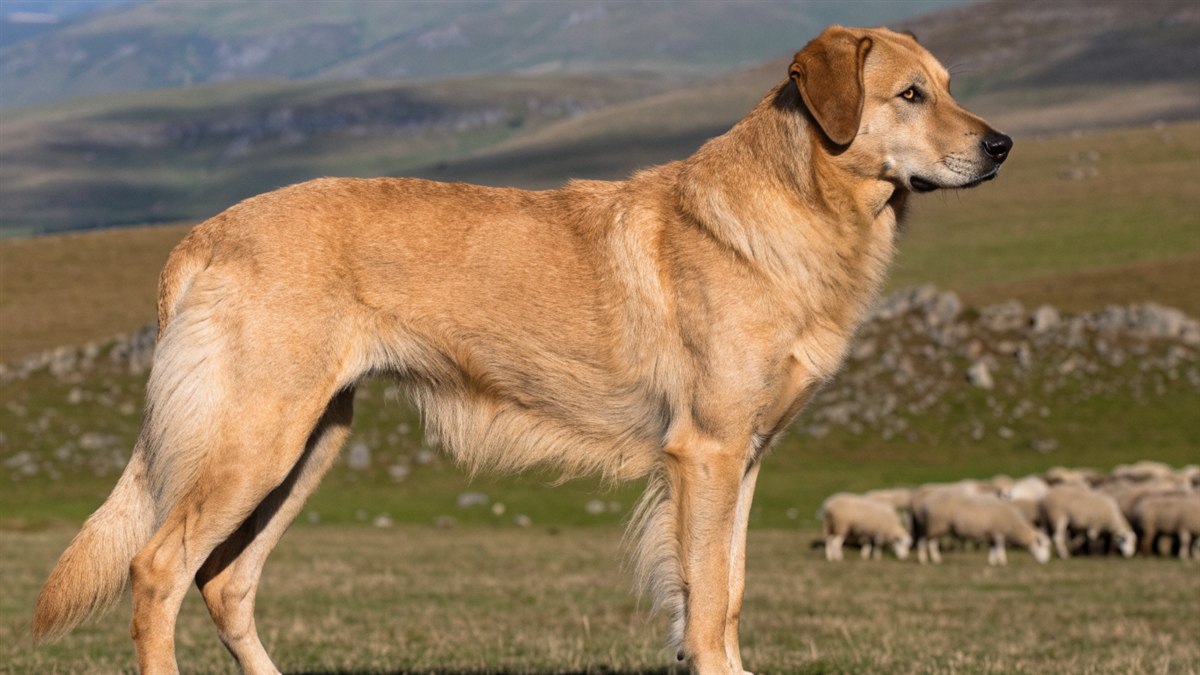
A Gampr is a large, lean, heavily boned guardian with a mandatory double coat and a mane. The Canadian standard describes it as lean with flat elastic muscles, built for power, agility and endurance at a trot, with a coat that may be short, medium or long but always shows some evidence of a mane. An even-length tight coat with no mane and no hindquarter feathering is an eliminating fault, and so is the absence of undercoat between December and April. Hold onto that last clause, because it decides how this breed handles an Indian summer.
Published adult weights span a factor of two, which is unusual even for a landrace. The Armenian standard averages males at 60 kg, the Canadian club averages Northern and Western males at 120 lb or about 54 kg, Embark publishes 130 to 180 lb for males, about 59 to 82 kg, and Dog Breed Info Center publishes 85 to 185 lb across both sexes, about 38 to 84 kg. Wikipedia, drawing on Janet Dohner's 2016 breed guide, gives a male average of 120 lb and a minimum height of 25 in.
In a temperate country a 20 kg disagreement about adult weight is a trivia question. In India it decides risk. A UK study of 905,543 dogs found that dogs of 50 kg and over carried 3.42 times the odds of heat-related illness compared with dogs under 10 kg, with a 95 percent confidence interval of 1.54 to 7.57. Every published average adult male Gampr weight, from 52 kg to 82 kg, sits at or above that threshold.
The four working types the breed used to be sorted into
Gamprs of the past fell into five named working categories, and the names still explain the breed's temperament range. The American club records them as hovvashoon, the shepherd's livestock dog, gelkheght, the wolf choker, archashoon, the bear hunter, potorkashoon, the search and rescue avalanche dog, and the palace guardian. Most modern Gamprs blend the types and the terms are rarely used now. The Canadian club still separates two of them geographically, placing the hovashoon as the primary shepherd's guard dog in the northern half of the historical range and the wolfhound type as the family and flock guardian in the southern half.
For a reader comparing this breed against the ones Bonbeno has already covered, the useful frame is that the Gampr is the population all of them were drawn from rather than a variation on any of them. The Caucasian Shepherd Dog is the Soviet standardised breed built partly from these dogs, the Akbash and the Aksaray Malaklisi are Anatolian guardians from the western end of the same historical range, and the Tibetan Mastiff is a separate Himalayan lineage that Indian buyers cross-shop for the same reasons.
Registry recognition: which bodies register the Armenian Gampr, and which fold it into the Caucasian Shepherd
The Armenian Gampr is recognised by one international registry, the Moscow-based International Kennel Union, which accepted it in 2011 under the guidance of the Armenian Kennel Club. It is absent from the Fédération Cynologique Internationale nomenclature, absent from the American Kennel Club, and absent from the Kennel Club of India's published record. Every claim below is read from the body's own document rather than from another breed page.
We opened the FCI nomenclature ourselves rather than repeating a summary. The letter A contains 23 recognised breeds and runs from Affenpinscher to Azawakh, with no Armenian Gampr and no Armenian anything. The letter G contains 24 breeds and runs from Galgo Español to Grosser Schweizer Sennenhund, with no Gampr entry. The letter K carries both of the breeds this one is most often confused with, Kangal Çoban Köpegi and Kavkazskaïa Ovtcharka.
| Body | Position on the Armenian Gampr | Source read |
|---|---|---|
| International Kennel Union, Moscow | Recognised in 2011, under the guidance of the Armenian Kennel Club, which had drawn up the first breed standard in the 1990s | Wikipedia, citing Janet Dohner's Farm Dogs, and the IKU's own organisation page |
| Fédération Cynologique Internationale | Not listed anywhere in the nomenclature. Letter A runs Affenpinscher to Azawakh; letter G runs Galgo Español to Grosser Schweizer Sennenhund | FCI breeds nomenclature, letters A and G Fédération Cynologique Internationale |
| Armenian Dog-Lovers' Association, Yerevan | Armenia's national canine organisation, and an FCI ASSOCIATE member rather than a full member | FCI member record for Armenia |
| Armenian Kennel Club | Published the first Gampr breed standard in the 1990s and guided the 2011 IKU recognition | Wikipedia's sourcing to Dohner; the standard text itself |
| Armenian Gampr Club of America | Describes itself as the official Gampr registry since 2007 and runs the studbook, evaluations and litter certificates | AGCA breed description masthead |
| Armenian Gampr Club of Canada | Publishes a separate descriptive standard with three regional size frames | AGCC breed description |
| Orthopedic Foundation for Animals | Runs a CHIC health programme for the breed, agreed with the American club in 2021, under breed code AG | AGCA CHIC page and its OFA links |
| American Kennel Club | Not recognised. No Gampr breed and no AKC parent club | Stated on the India-facing Petlur record, which correctly reports non-recognition by both the AKC and the FCI, and consistent with the AGCA's own registry claim |
| Kennel Club of India | No published breed register to check. The site currently serves a temporary forms-and-contact page while a new one is deployed | Kennel Club of India official website, read 20 August 2026 |
Armenia is an FCI associate member, and every one of its neighbours is a full one
The FCI's own members page settles a question nobody else asks. Armenia's national canine organisation, the Armenian Dog-Lovers' Association of Yerevan, is listed as an ASSOCIATE member, not a full member. Its neighbours are not. Azerbaijan, Georgia, the Russian Federation, Turkey and India are all full members. Iran is a contract partner.
That distinction is worth knowing, and it is worth being careful about what it does and does not explain. A breed reaches the FCI nomenclature through its country of origin's national canine organisation, so a country with a smaller share of voice inside the federation starts further back. It is not by itself the barrier, though: the FCI's recognition procedure asks an applicant for a long studbook history and documented unrelated family groups, which is a demanding ask for any landrace whose keepers deliberately maintain open gene flow. Bonbeno has not verified those requirements against the FCI procedure text, so this page reports the membership tier as the fact it is and does not claim it as the cause. Armenia sits one rung below every one of its neighbours in the body that decides which breeds exist internationally, and the Armenian Gampr is the breed that fact is about. No page ranking for this term mentions it.
The FCI's Caucasian Shepherd standard files an Armenian dog under Russia
FCI-Standard N° 328 covers the Kavkazskaïa Ovtcharka, or Caucasian Shepherd Dog, and reading it is the fastest way to see what happened to the Armenian population. The nomenclature entry records the breed as accepted on a definitive basis on 23 August 1984, with the currently valid standard published on 13 October 2010, in Group 2, Section 2, Molossian, subsection Mountain type, and the country of origin given as the Russian Federation. The standard document itself puts it more precisely still, giving origin as USSR and patronage as Russia.
Then the same document's historical summary states that the first mention of large molossoid dogs used by the army of Armenian Tsar Tigran the II dates from the 1st century BC, and that selection work with the breed started in the USSR in the 1920s. An FCI standard filed under Russian origin opens its own history with an Armenian king and dates the actual breed-making to a Soviet programme of the 1920s. That is the disagreement in a single paragraph, printed by the neutral party.
What the two sides actually claim
Bonbeno's job here is to lay out both positions from their own documents, not to declare a winner. Neither side has produced the study that would settle it.
| Question | The Armenian and club position | The FCI and Russian position |
|---|---|---|
| Is the Gampr a distinct breed? | Yes. A landrace Gampr is not an Alabai, Caucasian Ovcharka, Kangal, Anatolian, Kars, Karakatchan, Central Asian Shepherd, Sage Kuchi, Sharplaninatz or Akbash, nor a cross of any of them | The question is not asked. There is no Gampr entry in the nomenclature at all Fédération Cynologique Internationale |
| Who made the Caucasian Shepherd? | Soviet breeders, from the 1920s, joining all varieties into one group and calling the result a Caucasian Ovcharka, after a great number of Gamprs were exported from Armenia | Selection work with the breed started in the USSR in the 1920s, on a breed taking its origin from ancient Caucasian dogs |
| Where is the Caucasian Shepherd from? | Primarily Dagestani, Ossetian and South Russian dogs north of the Transcaucasia, a modern aboriginal rather than the native gampr | Origin USSR, patronage Russia, expansion covering the Caucasian Range and the steppe regions of Southern Russia |
| Does Armenia count as a home region? | Historical Armenia is the homeland and the other breeds descend from it | Wikipedia's summary of Mazover's original description names Georgia, Azerbaijan, Armenia and Dagestan as the centre of distribution, with Georgia holding the best examples |
| What is the practical test? | A three-way evaluation of behaviour, physique and health, plus the history of the individual and its ancestors | Conformity to a written standard, judged in a ring |
Two things follow from that table and both are useful. First, the Armenian side and the Russian side agree on the historical mechanism, that a Soviet programme starting in the 1920s assembled a standardised breed from Caucasian material. They disagree about how much of that material was Armenian and about whether the source population survives as a separate thing. Second, the disagreement is empirical and nobody has run the experiment.
The genetics that exist, and the study that has never been done
The tools to settle this argument exist and have already been used on the neighbouring breeds. A 2018 study in Animal genotyped 179 dogs unrelated at the second generation across six livestock guardian breeds, including the Central Asian Shepherd Dog and the Caucasian Shepherd Dog, at 18 autosomal microsatellite markers, and reported clear breed differentiation with reasonable genetic variability despite small population sizes. The Armenian Gampr was not in that study, and it has not been in any comparable one.
What does exist on the Gampr side is a club DNA panel rather than a peer-reviewed comparison. In 2018 the American club's founder travelled to Armenia and collected samples from 12 dogs at sheep camps. One sample could not be processed, one dog tested as a mix of mutt and Rottweiler, and ten gave clean consistent results. That is a genuine, honestly reported dataset and it is also ten dogs. It cannot answer a question that needs hundreds.
One peer-reviewed finding does bear directly on the whole dispute, and it comes from the Georgian side of the border. A 2014 study in the Journal of Heredity examined mitochondrial haplotypes and microsatellite genotypes at 8 loci in 102 grey wolves, 57 livestock guarding dogs and 9 mongrel dogs from Georgia. It found that 20 percent of wolves and 37 percent of dogs shared the same mitochondrial haplotypes, that more than 13 percent of wolves had detectable dog ancestry, that more than 10 percent of the dogs had detectable wolf ancestry, and that about 2 to 3 percent of the sampled animals were first-generation hybrids.
A traditionally kept Caucasian flock guardian population is porous enough that one dog in ten carries detectable wolf ancestry. A population that porous to a different species is certainly porous to the dog populations on the other side of a mountain pass. Any claim that one Caucasian guardian lineage has been genetically sealed for three thousand years, from any side of this argument, is asking you to believe something the field data does not support.
The one registry that does recognise it has an Indian member and no Armenian one
The International Kennel Union is a separate international body from the FCI, established in 1990, with its head office in Moscow. It is the organisation that recognised the Gampr in 2011. Its published country directory is worth reading carefully, because it lists an Indian member, United Kennel Club India of Sector 35-C, Chandigarh, alongside members in Russia, Belarus, Bulgaria, Kyrgyzstan, Kazakhstan, Uzbekistan, Iran, Sri Lanka, Pakistan and others.
As of 20 August 2026 that directory lists no Armenian member organisation at all. We are reporting what the page shows on the date we read it, and a live directory can change. Read it yourself before relying on it. The practical point for an Indian buyer stands either way. An IKU pedigree is not an FCI pedigree, the Kennel Club of India is the FCI full member here, and a certificate from an IKU-affiliated Indian club naming a breed the FCI does not recognise will not convert into a KCI registration.
The IKU directory lists a Kennel Club of Iran that abbreviates to KCI. So does the Kennel Club of India. If a seller shows you a KCI document for a Gampr, read the full name of the issuing body and its address, not the three letters. Then remember that the Kennel Club of India publishes no breed register on its own site to check a rare breed against.
One methodological warning from our own research, because it applies to anyone verifying a claim about a Caucasian or Anatolian guardian. A page can load correctly, return a valid document, and simply be about a different dog. We checked the breed name printed at the top of every standard before taking a single figure off it, including confirming that FCI-Standard N° 328 prints KAVKAZSKAÏA OVTCHARKA and not something else. Apply the same discipline to any registry document a seller shows you.
Armenian Gampr price in India: there is no price, and here is the evidence
There is no Armenian Gampr price in India, and Bonbeno will not publish one. No Indian breeder, no Indian registry listing and no rupee figure for this breed survives contact with a source. The one place a real transactional number exists is the American club's import programme, and it ships to farms in the United States and Canada and nowhere else.
This is the section where a directory is most tempted to invent a number. A band like Rs 2,00,000 to Rs 6,00,000 would look plausible, would rank, and would be entirely fabricated. So here is what an India-facing search for this breed actually returns, checked result by result on 20 August 2026.
| Result | What it actually offers | A live Gampr in India? |
|---|---|---|
| Petlur, an India-facing pet marketplace | A template breed page quoting USD 1600 to 1900, not rupees, with no seller, no listing and no location | No |
| DogTime, position 1 | A US care profile that closes by telling readers a Gampr is unlikely to be found and to consider a Bernese Mountain Dog or Great Pyrenees instead | No |
| PetGuide, position 2 | A 2017 US profile with no price at all | No |
| Dog Breed Info Center | A US breed page using photographs credited to the American club | No |
| Armenian Gampr Club of America | A real, priced import route, restricted to homesteads and farms in the United States and Canada | No |
| Kennel Club of India | A temporary forms-and-contact page with no breed register and no breeder directory | No |
The Petlur page is a template, not a market
The most convincing-looking India-facing result is Petlur's Armenian Gampr dog page, and taking it apart is more useful than any price. It presents itself as part of a worldwide online marketplace for pet people, and it lists the breed's price as USD 1600 to 1900 with the note that you can expect to pay that if you purchase from a reputable breeder. It names no breeder, quotes no rupees, and links to no listing.
Its data fields are worse than empty, they are wrong. It gives the lifespan as 14 to 16 years, which is the highest claim anywhere on the internet for a giant guardian. It gives the weight as 60 to 100 lb, about 27 to 45 kg, on a dog it simultaneously describes as 25 to 35 inches tall. A 63 to 89 cm dog weighing 27 kg does not exist. It lists blue and green among the possible eye colours and pink among the possible nose colours, when both club standards treat blue eyes and a pink nose as undesirable Armenian Gampr Club of Canada. And it tells the reader that most Armenian Gampr dogs can be adopted through a shelter for a lower fee, when the American club records that in its entire history there have been zero club-affiliated Armenian Gamprs in shelters.
Look for a price in a foreign currency on an Indian site, a lifespan longer than any giant breed achieves, height and weight fields that contradict each other, and a colour list that includes traits the breed standard rejects. Petlur's Gampr page fails all four. A page carrying a breed name is not evidence that the breed is sold there.
The only real transaction figure in the world, and it is not in rupees
The Armenian Gampr Club of America runs what it calls a Special Genetics Program, sourcing puppies directly from working shepherds in Armenia to stabilise a gene pool it describes as at risk of extinction. As of its 30 April 2026 update, the club states the amount sent to Armenia for an import puppy is USD 3,800, covering the puppy, its care, food, vetting, blood testing, travel, crate, microchip and flight. That is explicitly not the total. Arrival-side broker, customs, reservation, kennel and vetting fees add a further USD 2,000 to 3,000, and the deposit to secure a puppy is USD 600.
| Component | Amount | Paid to |
|---|---|---|
| Amount sent to Armenia, all-inclusive of the puppy and its flight | USD 3,800 | AGCA handler in Armenia |
| Deposit to secure a puppy, part of the above | USD 600 | AGCA handler in Armenia |
| Arrival fees: broker, customs, reservation, kennel, arrival vetting | USD 2,000 to 3,000 | Service providers at the arrival airport |
| Realistic total before the dog is home | USD 5,800 to 6,800 | Split across both |
| Age at which the puppy flies | 6 to 7 months | Not a cost, but it changes everything |
Two details in that table matter more than the money. The route runs Yerevan to Doha and then to Los Angeles, Philadelphia, Washington DC, Atlanta, New York, Miami or Montreal, and puppies must be collected in person at those airports because they cannot connect onward. India is not on the list, and no equivalent Indian route exists. And puppies fly at six to seven months old rather than at eight to twelve weeks, which means the animal arriving has already formed most of its bonds and its guarding habits somewhere else.
Why a rupee price cannot form, even in principle
Three separate facts, each from a primary document, close off every route by which an Indian market could develop. Take them together rather than separately.
- Import law bars the only channel that would create supply. Live dogs sit under ITC (HS) 01061900 as Restricted, and the DGFT states that import of commercial dogs for breeding or any other commercial activity is not permitted.
- No FCI or Kennel Club of India route exists to register the offspring. The breed is absent from the FCI nomenclature, and the Kennel Club of India publishes no breed register on its own website to check against.
- The world's only organised source restricts buyers to United States and Canadian farms. Puppies from the club programme go to approved homesteads and farms in those two countries, and only to members who will carry the genetics forward in a sound breeding programme.
Between them those three facts mean no lawful supply chain can form in India. A single pet dog could in principle arrive with an owner transferring residence, which the next section covers in detail, but one imported pet is not a market and cannot become one.
If someone offers you an Armenian Gampr puppy in India
Treat it as a misdescribed dog until proven otherwise, and understand that the American club says the same thing about its own home market. The club states that most of the dogs labelled as Armenian Gampr are not, that very few of the dogs posted to social media or seen in Armenian villages are unmixed, and that all well-known breeders who have historically supplied puppies to the United States are active dog fighters. It maintains a whole page on false labelling, describing how Eurasian gladiator fighting types imported to the Los Angeles area have been sold and rehomed as Gamprs for two decades.
A large Indian pariah cross, a Caucasian Shepherd, a Central Asian Shepherd, a Tibetan Mastiff cross, or an unregistered farm dog with cropped ears. Ask which registry issued the papers, read the breed name printed on them, and remember that neither the FCI nor the Kennel Club of India can issue a document that says Armenian Gampr, because neither recognises the breed The Kennel Club of India, official website.
We would rather publish a gap than a guess. If a verified Indian transaction is ever documented, with an import authorisation number, a quarantine clearance and a traceable registry record, we will add it here and date it. Until then the honest answer to the armenian gampr price in india question is that no reliable figure exists, and any site quoting one in rupees has made it up.
The legal position in India: import law, and the ear-cropping clause nobody translates
To bring an Armenian Gampr into India lawfully, you must qualify under one of three narrow purposes, because live dogs are a Restricted import under ITC (HS) 01061900 and Policy Condition 7 allows entry only for a pet dog with a valid pet book in the importer's name, for research by an R&D organisation with a CPCSEA recommendation, or for internal security by the Defence and Police Force. There is no fourth door.
We read DGFT Trade Notice No. 22/2022-23 of 19 December 2022 in full rather than citing a summary of it, and the operative language is blunter than most reporting suggests. Policy Condition 8 states that import of commercial dogs for breeding or any other commercial activities other than the purposes mentioned above is not permitted. Paragraph 6 goes further, stating that any applications for trading or breeding purposes, or applications made on behalf of some another person or entity, shall be duly rejected.
| Scenario | Position under the trade notice |
|---|---|
| Up to two pets, permanent import, owner transferring residence after two years of continuous stay abroad | Allowed as passenger baggage without DGFT authorisation. Only cats and dogs qualify under the baggage rules |
| Up to two pets, owner abroad less than two years, or pet not travelling as baggage | Import authorisation from DGFT required |
| More than two pets, permanent import | Import authorisation from DGFT required, with the application examined by the Department of Animal Husbandry and Dairying on its justification |
| Any temporary import | Import authorisation from DGFT required, with the same departmental examination |
| Import for trading or breeding | Applications shall be duly rejected |
| Application made on behalf of another person or entity | Applications shall be duly rejected |
| Ports of entry | Airports and seaports of Delhi, Mumbai, Chennai, Hyderabad, Bangalore and Kolkata only, with quarantine where required; DAHD added Kochi for pets arriving under the baggage rules in October 2024 |
The procedural detail is worth knowing because it is where most private imports fail. An application goes in on form ANF-2M against the importer's own IEC, or against the permanent IEC number IIHIE0153E reserved for personal, non-trade imports. The notice advises starting at least two months before travel. An advance No Objection Certificate must then be obtained from the Regional or Quarantine Officer of the Animal Quarantine and Certification Service at the port of entry, seven days before travel, relaxable to three days in specific circumstances, on the strength of the DGFT licence and a health certificate from a veterinarian in the exporting country. All disease testing prescribed in the health certificate must be done in the exporting country, with the reports travelling with the animal.
An Indian family returning home after more than two years abroad, who already owns a Gampr with a pet book in their own name, can bring it in as baggage through one of seven ports Department of Animal Husbandry…. That is the whole of the lawful route. It cannot be used to found a breeding population, and it is the reason a Gampr market has never formed here. The full route is set out in how to import a dog to India.
Ear cropping is traditional in the standard and strictly forbidden in India
This is the sharpest example on the site of breed-club guidance that does not transfer, and it is a legal problem rather than a stylistic one. Both the American and Canadian Gampr standards describe ear trimming at three days after birth as traditional and preferable for working dogs, on the reasoning that it denies a wolf an easy hold during a fight Armenian Gampr Club of Canada. Both also note that some Gampr tails are cropped at the same sitting. Dog Breed Info Center repeats the practice for an international audience without qualification, stating that often the ears are cropped shortly after birth and occasionally the tail is also cropped.
In India that procedure is prohibited outright. Rule 7(8) of the Prevention of Cruelty to Animals (Dog Breeding and Marketing) Rules 2017, notified as G.S.R.496(E) on 23 May 2017, states that there shall be no tail docking, ear cropping, de-barking, de-clawing, branding, dyeing, injecting substances to enhance visual appeal, performing a surgery or procedure to camouflage or hide any defect or infirmity or any other kind of mutilation of any body part of the pup, and that any change of appearance by artificial means is strictly forbidden.
A Gampr kept lawfully in India is a natural-eared, natural-tailed dog. The Canadian standard already contemplates this, requiring that if uncropped, ears should be hanging, not overly long and triangular, and treating prick ears in an uncropped dog as a fault. So the lawful Indian appearance is provided for in the standard. Anyone showing you a cropped-eared Gampr puppy in India is showing you evidence of an offence, not a pedigree feature.
The same Rules carry three more clauses an Indian buyer of any large guardian should know. Pups less than eight weeks in age may not be sold. Dogs over six months may not be sold without first being sterilised, unless the sale is to another licensed breeder. And every breeder must screen prospective purchasers to establish their capacity to care for the breed, especially if it is a large one, covering grooming, socialising, spatial and veterinary needs and the expense of upkeep.
That last clause is the one that should be read aloud to anyone considering this breed in a city. An Indian rule of law already says that a large guardian breed places a screening duty on the seller, and a Gampr is a large guardian by every published standard. A seller who does not ask you about your space, your fencing and your budget is already outside the rules before the dog changes hands.
Housing standards you are being measured against
The Rules also set out what adequate housing looks like, and the outdoor clauses read as though written for exactly this problem. Outdoor facilities must include shelters with a roof, four sides and a floor, must provide protection from extreme temperatures and weather conditions hazardous to the animals, and must include one or more separate outside areas of shade large enough to contain all the animals at once and protect them from the direct rays of the sun. Indoor temperature must be ambient and comfortable depending on the breeds housed, and such as provides for their health and well-being.
Those are breeder-establishment rules rather than pet-owner rules, but they set the standard of care a court would recognise. For a double-coated 55 kg guardian in Chennai or Nagpur, meeting them without mechanical cooling is not realistic, which the climate section takes apart in detail.
Monthly cost of ownership, calculated from Indian shelf prices rather than guessed
Food alone runs Rs 8,700 to Rs 16,900 a month for an adult Armenian Gampr in India, and that single line item is the only part of the budget we can price honestly. There is no Indian cost dataset for this breed, because there are no Indian Gamprs. So we have done the arithmetic from two verifiable numbers, the manufacturer's daily ration table and the Indian retail price of the bag.
Royal Canin India publishes daily feeding recommendations for its Giant Adult formula, which is built for dogs of 45 kg and over, by bodyweight and activity level. Supertails lists that formula in India at Rs 11,086 for the 15 kg pack, Rs 6,142 for 8 kg and Rs 3,084 for 4 kg as of 20 August 2026. The 15 kg pack works out at Rs 739 per kilogram, and everything below follows from those two published figures.
| Adult weight | Activity | Daily ration | Monthly food | Monthly cost |
|---|---|---|---|---|
| 45 kg | Low | 394 g | 11.8 kg | About Rs 8,700 |
| 55 kg | Medium | 531 g | 15.9 kg | About Rs 11,800 |
| 65 kg | Medium | 602 g | 18.1 kg | About Rs 13,400 |
| 75 kg | High | 761 g | 22.8 kg | About Rs 16,900 |
Pick your row by the standard you believe. The Canadian club averages Northern and Western males at about 54 kg, the Armenian standard averages 60 kg, and Embark publishes a male range topping out at about 82 kg. The disagreement between the published standards is a Rs 8,000 a month disagreement about your grocery bill, which is a better reason to care about breed standards than most.
The costs we will not put a number on, and why
Four recurring line items scale with bodyweight, and Bonbeno has no verified Indian figure for any of them on this breed. We would rather say so than print a plausible table.
- Parasite prevention. Tick and flea preventives are dosed by weight band and a 55 kg dog sits in the most expensive band of every product sold in India. Half of Indian dogs in a 525-dog survey across four cities carried at least one tick-borne pathogen, so this is not an optional line.
- Veterinary consultation and diagnostics. Giant-breed anaesthesia, radiography and orthopaedic work cost more because the dog is bigger, and Indian pricing varies enormously by city and clinic.
- Cooling. A dog whose standard makes the absence of undercoat an eliminating fault will need mechanical cooling through an Indian summer, which is an electricity bill rather than a pet bill.
- Containment. A territorial guardian needs real fencing rather than a gate, and fencing is a property cost that has nothing to do with the dog's price.
Two costs that are specific to this breed and easy to miss
Screening is the first. The American club agreed a CHIC health panel with the Orthopedic Foundation for Animals in 2021, requiring hips, elbows and patellar luxation, each at a minimum age of 24 months, plus a permanent identification such as a microchip. Five further tests are optional, covering cardiac evaluation, dentition, autoimmune thyroiditis, degenerative myelopathy and GM2 gangliosidosis. Every one of those three required screens has to wait until the dog is two years old, which means you carry two years of feeding cost before you know what you have.
Sterilisation timing is the second, and it interacts with Indian law. The 2017 Rules bar the sale of a dog over six months without prior sterilisation unless the buyer is another licensed breeder, while the American club's import puppies fly at six to seven months old. Those two facts sit awkwardly together for anyone imagining a resale, which is one more reason this breed does not behave like a tradeable asset in India.
Budget Rs 12,000 a month for food for a typical adult male, then accept that every other line is unpriced because no Indian owner base exists to price it from. A directory that hands you a tidy total for a breed with zero Indian population is showing you arithmetic, not evidence.
Suitability for the Indian climate, and why Bonbeno rates heat tolerance 2 of 5
Bonbeno rates the Armenian Gampr 2 of 5 for heat tolerance in Indian conditions. That is one point above the Caucasian Shepherd Dog and the Tibetan Mastiff, and the extra point is earned by two specific mechanical facts rather than by sentiment. Below 2 is impossible to defend and above 2 is impossible to defend, and the reasoning runs entirely through the coat description and the breed's mass.
The coat, read as a thermal object
A Gampr's coat is a mandatory double coat, and the standards make that mandatory in the strongest way a standard can. The Armenian standard lists lack of double coat and lack of undercoat as disqualifying features. The Canadian standard lists a tight hair coat as an eliminating fault, along with lack of mane or hindquarter feathering and, most tellingly, lack of undercoat between December and April. The American club describes a thick coat shed dramatically twice a year, with the undercoat coming out in large patches like a wild animal's and the longer guard hairs shedding far less.
So a lawful, in-standard Gampr carries an insulating undercoat layer under a wind-and-water-shedding guard layer, and it cannot be bred out. That is the same architecture as the Caucasian Shepherd's and it is the reason both breeds struggle here. The point of difference is quantity. FCI-Standard 328 sets a hard floor for the Caucasian Shepherd, requiring the guard coat and the undercoat each to be not less than 5 cm. No Gampr standard sets a minimum length at all, and the Canadian one explicitly permits a short coat provided there is some evidence of a mane. The Armenian standard adds that in mountainous regions the prevailing type is a large dog with a long coat, while in the lowlands dogs of lighter build and shorter coat are more common.
The Gampr standards recognise a shorter-coated, lighter-built lowland type as correct Armenian Gampr Club of Canada. The FCI Caucasian Shepherd standard has no such provision and imposes a 5 cm minimum on both coat layers. That is a real, checkable difference, and it is worth exactly one point on a five-point scale, not three.
The mass, read against the only large study that measures it
Size is the second half of the mechanism, and here the evidence is unusually good. A UK VetCompass study reviewed the clinical records of 905,543 dogs under primary veterinary care in 2016 and identified 395 confirmed heat-related illness events, an incidence of 0.04 percent with an event fatality rate of 14.18 percent, 95 percent confidence interval 11.08 to 17.96. Its multivariable analysis found that dogs weighing 50 kg and over carried 3.42 times the odds of heat-related illness compared with dogs under 10 kg, 95 percent confidence interval 1.54 to 7.57.
| Source | Published adult male weight | Above the 50 kg threshold? |
|---|---|---|
| Armenian standard, 2003 | At least 45 to 50 kg, 60 kg on average | Average yes, minimum borderline |
| Armenian Gampr Club of Canada, Northern and Western | At least 45 kg, averaging about 54 kg | Average yes, minimum no |
| Armenian Gampr Club of Canada, Eastern | At least about 41 kg, averaging about 52 kg | Average yes, minimum no |
| Embark | 130 to 180 lb, about 59 to 82 kg | Entirely above |
| Dog Breed Info Center, both sexes | 85 to 185 lb, about 38 to 84 kg | Top half only |
| Wikipedia, from Dohner 2016 | Male average 120 lb, about 54 kg | Yes |
| FCI Caucasian Shepherd Dog, for contrast | Minimum 50 kg for males, no maximum stated | Entirely above, by standard |
Every published average sits in the high-risk band, and only the Gampr's minimums fall below it. The Caucasian Shepherd cannot fall below it at all, because 50 kg is its standard's floor. That is point two, and it is the other half of the extra point.
Why the walk is more dangerous than the weather
The most useful finding for an Indian owner is about triggers rather than temperature. The companion VetCompass paper reviewed 1,259 heat-related illness events from 1,222 dogs and found that exertional heat-related illness was the predominant trigger at 74.2 percent of the 879 events where a cause was recorded, ahead of environmental heat at 12.9 percent and vehicular confinement at 5.2 percent. Young male dogs had greater odds of the exertional type.
A Gampr is a young male dog for its first three years and it is a patrolling breed by design. The American club describes an urge to patrol that cannot be trained out and that becomes neurotic if it has no outlet. Put that dog on a Chennai pavement at four in the afternoon and you have assembled the exact profile the study describes. The heat does not kill this breed. The walk in the heat does.
City by city, using the criteria India actually declares heat by
India does not have one heat threshold, and that is exactly the information a Gampr owner needs. The India Meteorological Department declares a heat wave when a plains station reaches at least 40 degrees Celsius, when a hilly station reaches at least 30 degrees, and, for coastal stations, when the maximum departs from normal by 4.5 degrees or more provided the actual maximum is 37 degrees or more. A heat wave is a departure from normal of 4.5 to 6.4 degrees and a severe heat wave is a departure above 6.4 degrees. Heat waves typically run from March to June and occasionally into July, the peak month is May, and northern India averages five to six heat wave events a year.
| Station type | Heat wave threshold | Indian examples | What it means for this breed |
|---|---|---|---|
| Plains | 40 degrees Celsius or above | Delhi, Jaipur, Nagpur, Lucknow, Ahmedabad | Five to six declared events a year in the north. Dry heat, so panting still works, but the season runs March to June |
| Coastal | 4.5 degree departure with actual maximum 37 degrees or above | Mumbai, Chennai, Kolkata, Kochi, Visakhapatnam | The lower threshold exists because humid air defeats evaporative cooling. This is the worst band for a double-coated dog |
| Hilly | 30 degrees Celsius or above | Shimla, Manali, Leh, Gangtok, Darjeeling | The only Indian band where this coat is not fighting the climate. Closest analogue to the Armenian Highland |
Read that table as a single sentence and it says something no other page about this breed says. India declares a coastal heat wave at 37 degrees and a plains heat wave at 40, and the gap between those two numbers is exactly the reason a humid coastal city is harder on a Gampr than a hotter dry one. A dog cools by moving water from its respiratory tract into the air. Humid air already holds that water, so each pant delivers less cooling, and the dog compensates by panting harder, which generates more heat. In Chennai in May the animal is running a losing loop.
Where the breed-club advice was written for, and what transfers
The Canadian club states its position on climate openly, and it is not India. It says the Gampr is ideally built for harsh Canadian winters and the intense physical demands of working farmsteads in high predator areas, naming bear, cougar, foxes, coyotes, wolves and fishers. The Armenian standard adds that the Gampr almost never suffers from the cold. Neither document contains a single sentence about heat management, because neither had to.
One piece of club advice does transfer, and it transfers perfectly by accident. The American club tells urban owners that a Gampr in a city setting needs to walk around the neighbourhood early in the morning and again in the evening, because the urge to patrol is strongest at dawn and dusk. That is also the only safe walking window in an Indian summer. Follow the club's schedule for the club's reason and you get the Indian answer for free.
Never shave a Gampr to cool it down. The guard coat reflects radiant heat and the undercoat insulates in both directions, so removing them exposes skin to direct sun and destroys the air layer the dog cools against. Both club standards treat an even, tight coat as an eliminating fault for good structural reasons. Brush the dead undercoat out instead, twice a year and hard, and let the coat do its job.
The apartment question, answered mechanically
A Gampr in an Indian apartment fails on containment before it fails on heat, and it fails on both. The breed needs ample open space and a perimeter to patrol, and a dog with a strong patrol urge and no opportunity may become slightly neurotic. A flat gives a territorial guardian no perimeter and does not stop it trying to hold one, which usually means holding the front door against your neighbours. Then add the thermal problem. A closed Indian flat without air conditioning in May sits well above the temperature at which a 55 kg double-coated dog can offload heat by panting, and the 2017 Rules already require indoor temperature to be ambient and comfortable depending on the breeds housed.
This is a heat-sensitive giant guardian in a country with a five-month hot season, and the honest summary is that it belongs on upland acreage or nowhere. If you live in Shimla or Gangtok with land and predator pressure, the climate argument against this breed largely disappears. If you live anywhere on the plains or the coast, it does not.
Temperament and household fit: who should keep this breed and who should not
An Armenian Gampr is an independent decision-maker that protects what it has decided is its own, and that single sentence disqualifies most Indian households. The American club states the position without softening it, that Gamprs are not a breed one commands, that a Gampr is not looking to its owner waiting on a command, and that if it decides you need protection it will protect you.
The Armenian standard describes the same animal from the inside. It calls the character the most defining feature of the breed, credits it with simple instincts more typical of a wild animal, a sound nervous system that nothing surprises, and independent decision making learned across centuries in which the master was often not there. It adds that the Gampr is smart and finds it difficult to obey unreasonable commands.
This is not an aggressive breed by design. The Armenian standard says that while endowed with sophisticated guarding instincts the Gampr is not an aggressive dog, that even the most ferocious Gampr will try to determine whether danger is imminent before eliminating an intruder, and that there is no Gampr in rage, because rage makes one vulnerable. The American club calls the essential character gentle, discerning, courageous and rational.
How it behaves at home
A Gampr bonds hard and slowly, and it audits the relationship. The American club describes a powerful desire to belong to a family, and then the qualification that matters, that unlike more domesticated breeds who devote themselves without question, these dogs will think about it, and that if the owner ignores the dog the dog will begin to forget the owner. The Canadian club adds that Gamprs tend to bond with children and women first, and with lambs and kids first among livestock.
Off its own property it is a different animal. Dog Breed Info Center records that a typical Gampr will guard its own home or farm but is more congenial off its own territory, and that adult dogs should greet newcomers off-territory with body language monitored, reading a stiff posture with a high tail as intended dominance and a relaxed posture with a lowered, tilted head as friendliness. That is genuinely practical advice and it is the most useful sentence on any ranking page.
Noise, which decides more urban placements than temperament does
The Armenian standard makes an unusual claim here and it is worth reporting because it cuts against the guardian stereotype. It states the Gampr is not a very loud dog to start with and would never bark without an obvious reason, and that its growl is more like a roar and impossible to mistake for another dog's. Compare the Akbash, rated five of five for barking with alarm barking sometimes to excess. If the Armenian description holds, this breed is quieter than its neighbours, though nobody has measured it and no Indian owner base exists to test it against.
Who should not keep one
Five household profiles are wrong for this breed, and Indian buyers fall into the first three more often than the last two.
- Apartment households. A territorial guardian with no perimeter tries to invent one, usually at the lift lobby.
- First-time dog owners. Dog Breed Info Center states plainly that this breed is not recommended for first-time owners or for people who do not want a serious guard dog.
- Households in coastal or plains cities without acreage. The climate section sets out why, and the IMD's own 37 degree coastal threshold is the shortest version of the argument.
- Homes wanting an obedient dog. Obedience is not what this breed was selected for, and the standards say so in three different documents Armenian Gampr Club of Canada.
- Anyone buying for status. The one thing an unrecognised landrace cannot give you is a pedigree anyone will accept, because no Indian or FCI registry issues one.
Who it does suit is narrow and specific. A working homestead or hill farm with livestock, real fencing, predator pressure, land to patrol and an owner who wants a colleague rather than a pet. That is the household every club document describes, and there are not many of them in India.
Training approach, and what this breed will simply refuse
To train an Armenian Gampr, teach it what is normal rather than teaching it commands, because the breed learns by observation and habit rather than by instruction. The American club states that Gamprs learn what is normal or not by observation and habit, and that the instinct to patrol, protect and understand its surroundings cannot be trained out of existence. Work with that mechanism and the dog is manageable. Work against it and you lose.
Start from what the breed was selected for. Livestock guardians were bred to make decisions alone, sometimes for days, without a human present. Selection for that produces a dog that evaluates an instruction before executing it, which reads as disobedience and is actually the trait the breed exists for. The Armenian standard puts it as finding it difficult to obey unreasonable commands, and the American club as being brilliant and confident enough to make its own decisions.
What actually works
- Build the relationship first. The club is explicit that the owner creates the relationship consistently, and that a neglected Gampr will find new, better friends.
- Socialise on neutral ground. Greet newcomers off-territory rather than at your gate, and read the posture before the meeting rather than after.
- Teach normality, not obedience. Walk the perimeter with the dog so it learns what belongs where, because that is how it forms its map.
- Give the patrol an outlet. Two neighbourhood walks a day, at dawn and dusk, when the urge is strongest.
- Keep every session short and cool. Exertional heat illness was the trigger in 74.2 percent of UK heat-related illness events, and a training session in Indian afternoon sun is exertion.
What it will refuse
Recall off territory, competitive obedience and dog-park sociability are the three things to stop expecting. The breed also refuses coercion in a way that is permanent rather than temporary. The Armenian standard warns that a Gampr should be treated with respect, and that if abused it will withdraw into itself, assume an aloof demeanour, and be extremely difficult to win back. That is not a training setback, it is a one-way door, and it is the single strongest argument against aversive methods with this breed.
The socialisation window, and the import timing problem
Puppies imported through the American club's programme fly at six to seven months old. Anyone acquiring a Gampr that way is receiving a dog whose early socialisation window has already closed somewhere else, on a sheep camp, in another language, with a different set of normal. Dog Breed Info Center records the consequence, that a relocated Gampr will often be shy and refrain from eating until it is sure it is where it should be.
Plan for that rather than being surprised by it. Expect several weeks of withdrawal, feed on a fixed schedule in a fixed place, do not force interaction, and let the dog choose when to re-engage. If you were sold on a photograph of an eight-week-old puppy, you are not being offered this breed's real acquisition route.
The three screens the breed's own CHIC panel requires, hips, elbows and patellar luxation, all have a minimum age of 24 months. Guardian temperament matures on a similar clock. Judge the adult you have at two years, not the puppy you had at six months.
Daily exercise requirement, and what happens without it
An Armenian Gampr needs two patrol walks a day, at dawn and at dusk, and space to hold a perimeter in between. The American club sets the requirement precisely for an urban dog, that it will need to walk around the neighbourhood early in the morning and again in the evening, because the urge to patrol is strongest at dawn and dusk. DogTime puts the figure at at least an hour-long walk daily.
Understand what kind of exercise this is, because getting it wrong is the commonest mistake. A Gampr is not a running breed and it is not a fetch breed. The Armenian standard describes the correct working gait as fluid, stealthy and silent, with the dog following its master at a distance, going in wide circles and guarding the perimeter. The American club describes the same movement as an easy trot that is economical, graceful and structurally sustainable. Dog Breed Info Center notes that the Gampr often does not play games and prefers to observe from a vantage point.
DogTime describes the Gampr as needing harder work than most breeds and suggests flyball or daily agility practice. That advice is written for a temperate climate and a different kind of dog. Sustained high-intensity work on a 55 kg double-coated guardian in Indian heat is the exact exertional profile behind 74.2 percent of UK heat-related illness events. Take the patrol walk and leave the agility course alone.
The Indian schedule, hour by hour
Two windows work and the rest of the day does not, from March through June across most of the country.
| Window | Activity | Why |
|---|---|---|
| Before sunrise, 30 to 45 minutes | Perimeter or neighbourhood patrol walk on lead | Coolest ground temperature of the day, and the dawn peak of the patrol urge |
| Mid-morning to late afternoon | Rest in shade or air conditioning, nothing else | Plains heat wave threshold is 40 degrees and the coastal threshold is 37 |
| After full dark, 30 to 45 minutes | Second patrol walk, slower, plus a scent-work or perimeter task | The dusk peak of the patrol urge, and the only other cool window |
| Any time | Never a hot pavement, never a car, never a sustained run | Vehicular confinement still accounted for 5.2 percent of UK heat-related illness events |
What happens if you skip it
A Gampr denied its patrol becomes anxious rather than destructive, which is easy to miss. The club warns that a dog with a powerful urge to patrol may become slightly neurotic if there is no opportunity. On a flat that usually shows as door-guarding, escalating alarm response to lift noise and corridor traffic, and an increasingly narrow definition of who is allowed near the family. None of that is fixable by more walking once it has set, which is why the space question has to be answered before the dog arrives rather than after.
One physical note worth carrying into the exercise plan. The club's own structural argument is that a very wide chest makes movement more tiring and rocks the weight side to side, straining the whole front assembly, and that a moderate chest width nearly matching the hips is most desirable. If you are offered a Gampr built like a fighting molosser, wide-chested and rounded, you are being offered a different dog and one that will overheat faster.
Grooming and coat care in Indian humidity
Brush an Armenian Gampr at least weekly and daily through both annual sheds, and treat every brush-out in India as a tick inspection rather than a tidy-up. The undercoat comes out in large patches twice a year, like a wild animal's, while the longer guard hairs shed far less. DogTime's advice to brush at least once a week and bathe as needed is the minimum, not the target.
The coat is two separate materials doing two separate jobs, and grooming has to respect the difference. The guard layer is the longer, coarser, weather-facing hair that forms the mane over the neck and chest and the feathering on the thighs. The undercoat is the dense downy insulating layer that the standards make mandatory, listing its absence between December and April as an eliminating fault and lack of undercoat as disqualifying.
Shaving removes the radiant-heat shield and the insulating air layer at once, exposing skin to direct Indian sun. The correct summer intervention is to strip the dead undercoat out completely with an undercoat rake so air can move against the skin, then leave the guard coat alone. A double-coated dog cools better with a clean intact coat than with a clipped one.
The monsoon problem the club standards never had to solve
Both club standards were written for climates with a dry summer and a cold winter, so neither addresses what a dense double coat does in 90 percent humidity for four months. Indian veterinary series do address it. A Jabalpur hospital study screened 651 dogs presenting with visible dermatological signs and found 92 positive for otitis externa, an occurrence of 14.13 percent, with the highest number of cases recorded during the monsoon season in July and August. Bilateral disease accounted for 61.04 percent of cases and unilateral for 38.06 percent.
That matters more for a Gampr than for most breeds, because a lawful Indian Gampr has hanging ears. The Canadian standard specifies that if uncropped, ears should be hanging, not overly long and triangular, and treats prick ears in an uncropped dog as a fault. Since ear cropping is strictly forbidden in India, every Indian Gampr carries a pendant ear over a warm humid canal through a four-month monsoon. The cropping the standards call traditional was, among other things, a ventilation solution, and India has removed it.
- Dry the ears after every bath and every rain, rather than towelling the body and letting the head air dry.
- Check both canals weekly in the monsoon, looking for odour, head shaking, head tilt and dark exudate, which were among the clinical signs recorded in the Jabalpur series.
- Part the mane to the skin when you brush, because a dense neck ruff hides ticks completely and half of Indian dogs surveyed carried a tick-borne pathogen.
- Brush before the shed, not during, so the loose undercoat leaves in sheets instead of matting against the skin in humid air.
- Bathe less often than you think, because a wet double coat in humid air stays wet for hours and that is where hot spots start.
The tick inspection is the real grooming job in India
Ticks were found on 278 of the dogs examined in a four-city Indian survey, 53 percent of the sample, most commonly of the genus Rhipicephalus. On a short-coated dog you see them. On a Gampr's mane and thigh feathering you do not, unless you are working systematically to the skin. Build the tick check into the weekly brush rather than treating it as a separate task, and work the neck, the ear bases, the armpits, the groin and between the toes, which is where they concentrate.
One more coat note that is really an identification note. The American club records that puppies are often born slightly darker than they grow to be, and that the longer shiny guard hairs come in more slowly than the downy undercoat, which usually pales with age. A puppy's adult colour is therefore not readable at eight weeks, which is one more reason colour claims from a seller mean nothing.
Health risks, screening and lifespan: what is actually known, and what is not
There is no published lifespan study for the Armenian Gampr, no prevalence survey, and no OFA statistics table. The entire PubMed index contains one record naming this breed, and it is a surgical-instrument trial in which a single Gampr was one of 17 dogs Gibson, E.A., Culp, W.T.N., Balsa, I.M.. Everything below is either the breed's own club data, honestly bounded, or a clearly labelled contrast from a different breed.
We searched PubMed ourselves on 20 August 2026 rather than assuming. The term gampr returns one record. The term Armenian wolfhound returns the same single record. The phrase livestock guardian combined with Armenia returns none. For contrast, and only as a contrast, Caucasian shepherd dog returns nine records. A breed with one indexed paper does not have a health literature, and no honest page can pretend otherwise.
This section reports what the published record contains and what it does not. It is not a diagnosis and it is not a screening plan for your dog. Take any lameness, laboured breathing, sudden abdominal distension, retching without producing vomit or change in gait to a registered veterinarian near you, and treat a suspected bloat or a suspected heatstroke as an emergency rather than a next-morning appointment.
The one paper, and what it accidentally tells you
The single indexed record is a 2026 Veterinary Surgery prospective clinical trial comparing a laparoscopic articulating needle driver with standard instrumentation for total laparoscopic gastropexy in dogs. It enrolled 17 client-owned dogs with a median weight of 38 kg and a range of 17.9 to 66 kg, comprising four Standard Poodles, four German Shepherds, two Bernese Mountain Dogs and one each of the Airedale, Armenian Gampr, Great Dane, Doberman Pinscher, Anatolian Shepherd, Irish Wolfhound and a mixed breed.
The paper says nothing about the breed. What it tells you is the company the breed keeps in a surgical theatre. Gastropexy is the preventive operation for gastric dilatation-volvulus, and the one time an Armenian Gampr appears in the indexed literature, it is having its stomach tacked prophylactically alongside Great Danes and Irish Wolfhounds. Treat that as a signal about how the breed's owners and their surgeons classify it, not as evidence of prevalence, because a single dog is not evidence of prevalence.
Bloat, which is the risk the breed's shape implies
Gastric dilatation-volvulus deserves space here for structural reasons rather than breed-specific ones, and we are labelling that clearly. A prospective cohort of 1,637 large and giant breed dogs found a cumulative GDV incidence of 6 percent over the study, with risk rising with age, with a first-degree relative having a history of GDV, with faster eating, and with a raised feeding bowl. Approximately 52 percent of GDV cases among the giant breeds in that study were attributed to having a raised feed bowl.
A Gampr is a deep-chested dog by every standard, required to have a chest that descends to or below the elbow. That is the anatomy the Glickman cohort was studying. The single practical instruction that follows is free and takes ten seconds. Feed a Gampr from a bowl on the floor, not on a stand.
The club DNA panel, reported at its real sample size
The best breed-specific health data that exists is a 2018 club sampling trip, and it is ten dogs. The American club's founder collected DNA in Armenia from 12 dogs. One sample could not be processed, one dog tested as part mutt and part Rottweiler, and ten produced clean consistent results.
| Finding | Count | What it means |
|---|---|---|
| Dogs sampled in Armenia | 12 | One unprocessable, one part mutt and part Rottweiler |
| Clean consistent results | 10 | The real denominator for everything below |
| Carrying one copy of degenerative myelopathy | 3 | Carriers, who do not develop the disease themselves |
| Carrying two copies of degenerative myelopathy | 1 | At risk of developing the disease |
| Total carrying the DM gene | 4 of 10, or 40 percent | The club's stated reason for requiring DNA testing before breeding |
| Carrying one copy of HEXB Sandhoff disease | 1 | Described by the club as very rare |
| Free of all 167 or more conditions screened | Several, including a liver female and a long-haired male | The basis for the club's claim of general genetic health |
Two honest caveats belong with that table. Ten dogs is a small sample from one country in one summer, and a 40 percent carrier rate estimated from ten animals carries a wide margin either side. And the panel screens for known mutations, so a clean result means clean of 167 named conditions rather than clean in general.
What degenerative myelopathy actually is, from the peer-reviewed side
Canine degenerative myelopathy is a spontaneous neurodegenerative disease, genetically an autosomal recessive condition with incomplete penetrance, most commonly caused by a mutation in exon 2 of the SOD1 gene, c.118G>A. A Romanian survey genotyped 230 dogs from 26 breeds, finding 204 homozygous for the wild-type allele, 16 heterozygous and 10 homozygous for the mutant allele, with a mutant allele frequency of 0.0783 in the tested population. The mutant allele appeared in the Wire Fox Terrier, Romanian Mioritic Shepherd, German Shepherd, Rottweiler, Belgian Shepherd and Czechoslovakian Wolfdog.
That study also carried out a first screening of the Caucasian Shepherd, and we are naming that as a contrast rather than as Gampr data. The two useful takeaways for a Gampr owner are that incomplete penetrance means a dog with two copies may never show signs, and that carrier-to-carrier matings are the only way the disease spreads, which is exactly why the club made DNA testing before breeding its stated response to the 2018 result.
The screening panel the breed's own club settled on
The American club partnered with the Canine Health Information Center in 2021 and designated three required screens and five optional ones. A dog does not have to pass to be certified, but the owner must agree to publish non-normal results by ticking the release box on each submission form.
| Screen | Status | Minimum age |
|---|---|---|
| Hips | Required | 24 months |
| Elbows | Required | 24 months |
| Patellar luxation | Required | 24 months |
| Cardiac evaluation, basic or advanced | Optional | Not stated |
| Dentition | Optional | Not stated |
| Autoimmune thyroiditis | Optional | Not stated |
| Degenerative myelopathy | Optional | Not stated |
| GM2 gangliosidosis | Optional | Not stated |
| Permanent identification such as a microchip | Required | Any |
The panel is a fair map of what the breed's own experts worry about, and hips, elbows and patellae are exactly what you would screen in a heavy, fast-growing guardian. Note what is required and what is not. Hip dysplasia screening is mandatory in this breed's own programme, which sits awkwardly beside the Armenian standard's flat claim that the Gampr does not have hereditary or genetic diseases.
Why there is no OFA percentage on this page
We looked for one and we are publishing the absence rather than a guess. The breed's OFA code, taken from the club's own links rather than guessed, is AG. OFA states its own inclusion rule plainly, that breeds are not included in the OFA statistics tables until a minimum number of individuals have been evaluated, requiring at least 100 evaluations for hips and at least 50 for all other databases.
The club names Andranik as the first CHIC-certified Armenian Gampr, which tells you how recently the counter started. A breed whose first certified dog is still named on the club website has not accumulated 100 hip evaluations. So no OFA dysplasia percentage for the Armenian Gampr is published, and Bonbeno will not print one. Absent is a finding. A borrowed number from a neighbouring breed would be a fabrication.
Lifespan, where four sources disagree and none cites anything
No peer-reviewed lifespan estimate exists for this breed. The largest study of its kind analysed 584,734 UK dogs including 284,734 deceased across 155 breeds, and the Armenian Gampr is not among them. What the SERP offers instead is four uncited numbers.
| Source | Claimed lifespan | Evidence offered |
|---|---|---|
| DogTime | 10 to 12 years | None |
| PetGuide | 14 to 15 years | None |
| Petlur | 14 to 16 years | None |
| Peer-reviewed literature | No figure exists | PubMed holds one record naming the breed, and it is a surgical trial |
| Caucasian Shepherd Dog, as a labelled contrast only | Median 5.4 years in the 2024 UK dataset, on a sample of just 22 dogs | The lowest figure in that study, on a sample too small to generalise |
The spread on the SERP is 10 to 16 years and the sourcing is zero. A 14 to 16 year claim for a 55 kg guardian should be treated as marketing, because giant breeds do not generally reach it and nobody has counted these dogs. The Caucasian Shepherd row is on this table purely to show what a real dataset looks like when it is thin, and it is not a Gampr figure.
The two claims about this breed's health that contradict each other
DogTime, the top-ranking page, states that due to low genetic diversity this now-endangered breed may face more health issues in the future. Every primary source says the opposite. Embark describes the Gampr as genetically diverse with an emphasis on function rather than form. The American club describes a landrace with a healthy heterozygous genotype in which most double-recessive mutations have not yet appeared. The Armenian standard credits the breed's diversity to regional exchange across a large area.
The endangered part of DogTime's sentence is defensible and the low-diversity part is not. The club itself describes numbers that have plummeted dangerously and a gene pool it is trying to save from extinction. A small population and a diverse one are different things, and conflating them is the single commonest error on this term.
Dog Breed Info Center makes a narrower and more credible claim, that new practices of line-breeding and crossing related breeds into the Gampr gene pool have produced an increase in some hip joint malformation and overly straight hocks. That is consistent with the club's own account of fighting-dog crosses being bred back into the Armenian population, and it is the mechanism to watch rather than inbreeding depression.
The two health risks that are certain in India, and are not about the breed
Heat-related illness is the first and it is quantified. In a UK population of 905,543 dogs the event fatality rate for confirmed heat-related illness was 14.18 percent, and dogs of 50 kg and over carried 3.42 times the odds of an event. Exertional heat illness, meaning heat generated by the dog's own activity, accounted for 74.2 percent of events. Both apply to a Gampr in India with more force than they did in the UK sample.
Tick-borne disease is the second. A survey of 525 dogs across four Indian cities found 261, or 49.7 percent, infected with at least one tick-borne pathogen by PCR. Hepatozoon canis was commonest at 30 percent, followed by Ehrlichia canis at 20.6 percent, Mycoplasma haemocanis at 12.2 percent, Anaplasma platys at 6.5 percent, Babesia vogeli at 5.5 percent and Babesia gibsoni at 0.2 percent. Concurrent infection with more than one pathogen occurred in 39 percent of cases, and ticks were found on 53 percent of dogs examined.
Screen for tick-borne disease when your dog is unwell rather than treating for one pathogen and stopping, because 39 percent of positive Indian cases carried more than one. And treat any collapse during or after exercise in the hot season as a possible heatstroke, because one in seven confirmed events was fatal. Speak to your nearby vet about a year-round tick preventive dosed for your dog's actual weight.
Feeding and nutrition, from the manufacturer's table rather than a rule of thumb
Feed an adult Armenian Gampr 394 to 761 grams of a giant-breed dry food a day, from a bowl on the floor, split into two meals. Royal Canin India's Giant Adult table gives 531 g a day for a 55 kg dog at medium activity, rising to 602 g at 65 kg and falling to 394 g for a 45 kg dog at low activity. Those are the numbers to start from, then adjust by body condition rather than by the bag.
| Adult weight | Low activity | Medium activity | High activity |
|---|---|---|---|
| 45 kg | 394 g | 457 g | 519 g |
| 55 kg | 459 g | 531 g | 603 g |
| 65 kg | 520 g | 602 g | 684 g |
| 75 kg | 579 g | 670 g | 761 g |
Pick the low-activity column for most Indian months, and mean it. A Gampr is not a high-energy breed, it is an endurance breed at a walk, and in the Indian hot season it should be doing almost nothing between the two cool walking windows. Feeding a high-activity ration to a dog that is resting in the shade until dusk produces a heavier dog, and every extra kilogram pushes it further into the weight band the UK study associated with 3.42 times the odds of heat-related illness.
The four rules that matter more than the brand
- Feed from the floor. Roughly 52 percent of GDV cases among giant breeds in a 1,637-dog cohort were attributed to a raised feed bowl.
- Split the day's ration into two meals and slow the dog down, because a faster speed of eating was among the factors significantly associated with increased GDV risk in the same cohort.
- Never feed immediately before or after the patrol walk, and in India schedule the walk in the cool windows and the meal well clear of it.
- Judge by body condition, not by the scoop, because published adult weights for this breed disagree by a factor of two and the table cannot know which type of dog you have.
Growth, which is where giant breeds are made or ruined
A Gampr grows for a long time and grows heavy, and its own club sets the screening clock at 24 months for hips, elbows and patellae. That is a direct statement that the skeleton is still settling at two years. Feed a giant-breed growth formula rather than an adult one, resist the urge to push weight onto a rangy adolescent, and remember that the Canadian standard tolerates a young dog being higher in the hips than the withers, though preferably not past 20 months.
Straight hocks and hip joint malformation are the two structural faults Dog Breed Info Center records as increasing in the breed, and it attributes them to line-breeding and crossing rather than to feeding. Feeding cannot fix a bad hip, but overfeeding a growing giant makes a marginal one worse, which is why the growth phase is the cheapest place to protect a dog you have already spent two years waiting to screen.
Water, which is a heat intervention rather than a nutrition one
A double-coated 55 kg dog panting through an Indian May loses a great deal of water through its respiratory tract, and panting is its only meaningful cooling route. The 2017 Rules already require adequate potable running water for animals' drinking needs in any registered establishment, and the sensible domestic version is more bowls than you think you need, refilled through the day, in shade, in more than one room.
Giant-breed formulas are stocked in India and priced accordingly, at Rs 11,086 for a 15 kg pack of one common giant formula as of 20 August 2026. Availability is not the constraint on keeping this breed here. Import law and the climate are.
Month by month through the first year, and why this breed's timeline starts late
An Armenian Gampr puppy acquired through the only documented import route arrives at six to seven months old, not at eight weeks. That single fact rewrites the whole first-year plan, because the socialisation window most puppy timelines are built around has already closed in a sheep camp in Armenia. The timeline below is written for the dog that actually arrives.
| Age | What is happening | What you do |
|---|---|---|
| 0 to 8 weeks, in Armenia | The puppy is with working parents at a sheep camp. The club programme commits each shepherd to regular deworming, medical documents and full vaccinations including rabies | Nothing. This phase is not yours, and that is the central fact of this breed's timeline |
| 8 weeks to 6 months, in Armenia | Early socialisation happens around livestock, shepherds and other camp dogs. Ears are traditionally trimmed at three days in the source country | Confirm the dog you are being offered is uncropped, because cropping is strictly forbidden in India |
| 6 to 7 months, arrival | The puppy flies, microchipped with an ISO chip, with a passport listing full vaccinations including rabies | Collect in person. Expect shyness and refusal to eat until the dog is sure of its place |
| Month 1 after arrival | Withdrawal and re-bonding. The dog is deciding whether this is its family | Fixed feeding place and time, no forced interaction, walk the perimeter together daily |
| Months 2 to 4 after arrival | The patrol map forms. The dog learns what is normal by observation and habit | Two cool-window walks a day. Introduce visitors on neutral ground, never at your gate |
| 9 to 12 months | Rapid frame growth. Young dogs may be higher in the hips than the withers | Giant-breed growth food, floor-level bowl, no forced running, no stairs work |
| 12 to 20 months | Adolescent guarding drive appears. Topline should level out by about 20 months | Hold the routine. Do not test the dog against strangers to see what it does |
| 24 months | Screening age for all three required CHIC tests | Hips, elbows and patellae, and reassess temperament on the adult rather than the adolescent |
What an eight-week-old Gampr puppy offer in India actually means
It means the dog is not what you are being told it is. The world's only organised export programme ships at six to seven months, to approved farms in two countries, to club members who will carry the genetics forward. Indian import policy allows a live dog in only as a pet with a valid pet book in the importer's name, for CPCSEA-recommended research, or for Defence and Police use, and rejects breeding and trading applications outright.
So there is no lawful path by which an eight-week-old Armenian Gampr puppy is standing in an Indian kennel. If one is being offered, the realistic explanations are a locally bred large guardian cross, a Caucasian Shepherd or Central Asian Shepherd sold under a rarer name, or an outright fabrication. The club's own false-labelling page documents exactly this pattern happening in the United States for two decades, where fighting-type imports have been sold and rehomed as Gamprs.
Ask for the DGFT import authorisation number or the pet-book entry showing the dog entered India lawfully through one of the seven permitted ports Department of Animal Husbandry…. Ask which registry issued the papers and read the breed name printed on them. Ask why the puppy's ears are cropped, if they are, given that the procedure is strictly forbidden here. A genuine seller can answer all three.
For anyone who does end up with this breed lawfully in India, the first year is mostly about temperature discipline and relationship building rather than obedience milestones. Get the two cool walks right, get the floor-level bowl right, get the tick prevention right, and let the guarding brain assemble itself on its own schedule.
Head to head against the guardians Indian buyers actually cross-shop
The Armenian Gampr loses on availability to every breed it is compared with, and it is the only one of the group that no Indian buyer can lawfully acquire through a breeder. On registry status, coat load and heat risk it sits between the Caucasian Shepherd Dog and the Anatolian guardians, and well behind India's own short-coated breeds.
| Breed | FCI status | Coat requirement | Male size floor | Available in India? | Bonbeno heat rating |
|---|---|---|---|---|---|
| Armenian Gampr | Not listed. IKU recognised 2011 Wikipedia, Armenian Gampr | Double coat mandatory, no minimum length, mane required | About 41 to 45 kg by club standard | No. No lawful breeding import route | 2 of 5 |
| Caucasian Shepherd Dog | FCI 328, accepted 1984, origin USSR, patronage Russia | Guard coat and undercoat each not less than 5 cm | Minimum 50 kg by standard | Yes, and sold at wildly disputed prices | 1 of 5 |
| Kangal Shepherd Dog | Listed in the FCI nomenclature under letter K as Kangal Çoban Köpegi | Standard not opened for this page | Standard not opened for this page | Not covered by Bonbeno yet | Not yet rated |
| Akbash | Not listed by the FCI. See Akbash | Double coat, lean build. See Akbash | See Akbash | No verified Indian source. See Akbash | 2 of 5 |
| Aksaray Malaklisi | Recognised by no kennel club. See Aksaray Malaklisi | Short coat, very heavy build. See Aksaray Malaklisi | See Aksaray Malaklisi | No | 1 of 5 |
| Tibetan Mastiff | FCI recognised. See Tibetan Mastiff | Very heavy double coat. See Tibetan Mastiff | See Tibetan Mastiff | Yes, and heavily price-inflated | 1 of 5 |
| Indian Pariah Dog | Not an FCI breed. See Indian Pariah Dog | Single short coat | Medium | Yes, free to adopt | 5 of 5 |
Gampr against Caucasian Shepherd, which is the comparison that matters
These two are the same argument seen from two ends, so compare them on documents rather than on photographs. The Caucasian Shepherd Dog has an FCI standard, a definitive acceptance date of 23 August 1984, a country of origin recorded as the Russian Federation and a patronage recorded as Russia. The Armenian Gampr has three club standards that disagree with each other and no FCI entry at all Armenian Gampr Breed Standard Armenian Gampr Club of Canada.
Four practical differences follow from the paperwork, and each is checkable.
- Colour. FCI-328 excludes solid black, diluted black, black in any combination, genetic blue and liver brown. The American Gampr standard permits any colour except merle or blue and actively defends liver. A liver Gampr is structurally excluded from the Caucasian Shepherd standard.
- Coat quantity. FCI-328 sets a 5 cm floor on both layers. No Gampr standard sets a minimum, and a shorter-coated lowland type is recognised as correct.
- Size floor. FCI-328 sets a 50 kg minimum for males. The Canadian Gampr standard's Eastern type floor is roughly 41 kg.
- Registrability. A Caucasian Shepherd can be registered with the Kennel Club of India through the FCI system, because the KCI is an FCI full member. An Armenian Gampr cannot, because the FCI has no such breed.
That fourth point is the one to hold onto if you are cross-shopping. Whatever the historical truth of the dispute, the practical outcome in India is that one of these dogs has a registry and the other does not.
Gampr against the Anatolian guardians
The Akbash and the Aksaray Malaklisi sit at the western end of the same historical range, and the American Gampr club claims some of them outright, arguing that some Kangals, Anatolians, Kars and Akbash dogs of eastern Turkey may on investigation be accepted as natural landrace Gamprs regardless of what they are now called. Turkey's own registry disagrees, and Bonbeno's Akbash page sets out the Turkish government documents that treat those as separate native breeds.
For an Indian buyer the three breeds land in the same place. None has a lawful Indian supply route, all are heavy double-coated guardians, and all are rated 1 or 2 of 5 for heat here. The differences between them are of interest to a historian and of no use to a buyer.
The comparison nobody makes, and should
Compare the Gampr against the Indian Pariah Dog rather than against another import, because that is the real decision. A pariah is single-coated, evolved in this climate, rated 5 of 5 for heat, free to adopt and legally uncomplicated. It will not guard livestock against wolves, because it was not selected to. Ask yourself honestly whether you need a wolf-choker or whether you need a dog, and if the answer is a dog, the Gampr comparison was never the right one.
For owners who genuinely need a working guardian in an Indian upland setting, the Himalayan Sheepdog does the same job in the same altitude band without an import problem, and the Bully Kutta is the subcontinental guardian most often cross-shopped against imported molossers.
Mistakes Indian buyers actually make with this breed
The commonest Indian mistake with an Armenian Gampr is buying a different dog, and the second commonest is believing a rupee price. Both come from the same root, which is that a breed with no Indian population still generates Indian-looking search results. Here are the six errors, in the order they cost the most.
- Believing an Indian price page. Petlur's India-facing page quotes USD 1600 to 1900 with no seller, a lifespan of 14 to 16 years, and a weight and height combination that cannot describe a real dog. A price without a seller is a template field, not a market.
- Accepting a cropped-eared puppy as correct. Both club standards call ear trimming at three days traditional, and Indian law calls it strictly forbidden. In India a cropped Gampr is evidence of an offence.
- Assuming an IKU or overseas certificate converts. The Gampr's only international recognition comes from a Moscow body that is not the FCI, and the Kennel Club of India works through the FCI system. No conversion exists.
- Buying a Caucasian Shepherd or Central Asian Shepherd under the name. The American club identifies the Central Asian as the commonest cause of mistaken identity, while estimating that perhaps 60 percent of the modern Central Asian's genetics is of Gampr origin. Similar ancestry is not the same breed.
- Treating it as a high-energy sport dog. DogTime suggests flyball and daily agility, which is temperate-climate advice for a dog that exercises at a trot. Exertion caused 74.2 percent of UK heat-related illness events.
- Shaving the coat in summer. The guard layer is the sun shield and the undercoat is the air layer, and both club standards make their absence an eliminating or disqualifying fault for structural reasons.
The mistake the ranking pages cause
Two errors on the SERP are worth naming because readers inherit them directly. DogTime tells readers the breed suffers from low genetic diversity, when every primary source, including a DNA panel, describes a diverse heterozygous landrace with a shrinking population Armenian Gampr Club of America Embark Veterinary. And PetGuide states that the Gampr's genetic variation was spontaneously promoted by periodic mating with wolves indigenous to the region. The peer-reviewed Georgian work does show real wolf-dog gene flow in traditionally kept Caucasian guardian populations, with more than 10 percent of sampled dogs carrying detectable wolf ancestry, but that study is about Georgia and about livestock guarding dogs generally, not about the Gampr specifically.
A real source names its evidence. The American club publishes the DNA results dog by dog with links, the Armenian standard names eleven contributors by name and dates its last edit to 18 May 2003, and the FCI prints its acceptance date and patronage on the standard. A generated page gives you a lifespan, a price and a star rating, and cites nothing.
The mistake we nearly made ourselves
Researching Caucasian and Anatolian guardians reliably produces documents that load correctly and describe a different dog. Bonbeno's Akbash work found the Turkish kennel club serving a complete, correctly formatted Kangal standard at a URL naming the Akbash. We treated this page the same way, confirming that the FCI standard we read prints KAVKAZSKAÏA OVTCHARKA at the top, that the letter A nomenclature we counted really runs Affenpinscher to Azawakh, and that the OFA breed code we quote came from the club's own link rather than from a guess.
Apply the same rule to anything a seller shows you. A page that loads is not the same thing as a page about the dog you asked for.
Adoption and responsible sourcing: what to do instead
You cannot adopt an Armenian Gampr in India, because there is no Indian population to surrender from. The American club records that in its entire history since 2007 there have been zero club-affiliated Armenian Gamprs in shelters that it has ever heard of. In India the number is zero for a simpler reason, which is that the dogs were never here.
The club's rescue experience is worth reading before anyone romanticises the idea. It reports that dogs labelled Gampr in Los Angeles-area shelters are usually Eurasian gladiator fighting types, that its founder's early rescue work produced terrible results with those dogs, and that one animal pulled sight unseen on a shelter's assurance turned out to look like a Malinois and retriever mix, attacked her new owner twice, and was euthanised. A mislabelled guardian is not a rescue opportunity, it is a placement risk, and the club says so in its own words.
If you want to help this breed specifically
Support the preservation work rather than the trade. The club's Special Genetics Program pays working Armenian shepherds to breed correct dogs, provides anthelmintics, anti-parasitics and vaccinations to dogs that would otherwise receive none, and places aboriginal Gamprs into breeding homes in two countries. It states plainly that it is not the seller of puppies but a facilitator, and that the service is funded by donations and memberships. That is a route open to an Indian reader who cares about the breed and cannot lawfully own one.
The club states that all well-known breeders who have supplied puppies to the United States in the past are active dog fighters, that most dogs labelled Armenian Gampr are not, and that it severs ties immediately with anyone caught fighting or breeding for fighting. If a breed's own parent club describes its commercial supply that way, an unverifiable Indian offer deserves no benefit of the doubt.
What to adopt instead, in India
Three routes give an Indian household the thing it actually wanted from this breed, and all three are lawful, available and cheaper.
- For a heat-adapted family dog, adopt an Indian Pariah Dog. Single-coated, rated 5 of 5 for heat, free, and already suited to the climate you live in.
- For a working guardian in the hills, look at the Himalayan Sheepdog, which does the Gampr's job in the Indian altitude band without an import authorisation.
- For a short-coated Indian guarding breed, consider the Kombai or the Rajapalayam, both of which carry guarding drive without the coat problem.
The verification checklist, if you are offered one anyway
| Check | What a genuine answer looks like | What it means if it is missing |
|---|---|---|
| Import authorisation or pet-book entry | A DGFT authorisation number, or a pet book in the original importer's name, with entry through Delhi, Mumbai, Chennai, Hyderabad, Bengaluru, Kolkata or, since October 2024, Kochi Department of Animal Husbandry… | The dog did not lawfully enter India as this breed |
| Quarantine clearance | An AQCS No Objection Certificate from the port of entry | No verifiable entry record exists |
| Registry document | A named issuing body, an address, and the breed name printed on the certificate | Neither the FCI nor the KCI can issue a Gampr paper The Kennel Club of India, official website |
| Ears and tail | Natural, uncropped and undocked | Cropping is strictly forbidden in India |
| Breeder screening of you | Questions about your land, fencing, livestock and budget, which the 2017 Rules require for a large breed | The seller is outside the Rules before the sale even happens |
Bonbeno does not recommend breeders, does not link puppy listings and does not broker sales. We report published prices as editorial content, and on this breed the published record contains no Indian price to report. If that changes, with a documented import authorisation and a traceable registry record behind it, we will add it here and date it. Until then the most useful thing this page can tell an Indian reader is that the Armenian Gampr is a real, rare, endangered aboriginal breed that belongs on Armenian hillsides, and that nobody in India can sell you one.
Armenian Gampr, common questions answered
Is the Armenian Gampr recognised by the FCI?
No. We opened the FCI nomenclature ourselves and the letter A contains 23 breeds running from Affenpinscher to Azawakh with no Armenian entry, while the letter G runs from Galgo Español to Grosser Schweizer Sennenhund with no Gampr. The only international body that recognises the breed is the Moscow-based International Kennel Union, which accepted it in 2011.
What is the Armenian Gampr price in India?
No credible Armenian Gampr price in India exists, and Bonbeno will not publish one. No Indian breeder, registry listing or rupee figure survives contact with a source. The only real transactional number in the world is the American club's import programme, which sends USD 3,800 to Armenia plus USD 2,000 to 3,000 in arrival fees, and which ships only to farms in the United States and Canada.
Is the Armenian Gampr the same as a Caucasian Shepherd?
The two sides disagree and neither has run the study that would settle it. Armenian sources say Soviet breeders assembled the Caucasian Ovcharka from the 1920s using exported Gamprs, so the Gampr is the source rather than a variant. The FCI files the Caucasian Shepherd under origin USSR with patronage Russia, while its own history opens with an Armenian king. Report the disagreement rather than resolving it.
How much does an Armenian Gampr weigh?
Published adult male weights disagree by a factor of two, which is unusual even for a landrace. The Armenian standard averages 60 kg, the Canadian club averages about 52 to 54 kg with a floor near 41 kg, Embark publishes 59 to 82 kg, and Dog Breed Info Center publishes 38 to 84 kg across both sexes. Every average sits at or above the 50 kg heat-risk threshold.
Can Armenian Gamprs handle Indian heat?
Poorly, and Bonbeno rates heat tolerance 2 of 5. The breed carries a mandatory double coat whose absence is an eliminating fault, and every published average adult male weight sits at or above 50 kg, the band where a study of 905,543 UK dogs found 3.42 times the odds of heat-related illness. It scores 2 rather than 1 only because a shorter-coated lowland type is recognised as correct.
How long do Armenian Gamprs live?
Nobody knows, and no peer-reviewed lifespan estimate exists. DogTime says 10 to 12 years, PetGuide says 14 to 15, and Petlur says 14 to 16, and not one of those three figures carries a source. The largest UK longevity study covered 584,734 dogs across 155 breeds and the Armenian Gampr is not among them.
What health problems does the Armenian Gampr have?
The evidence base is one club DNA panel of ten dogs, in which four carried the degenerative myelopathy gene and one carried HEXB Sandhoff disease. The breed's own CHIC programme requires hips, elbows and patellar luxation screening from 24 months. No OFA statistics table exists because OFA requires 100 hip evaluations before publishing one. Always consult your nearby vet rather than acting on breed generalisations.
Can I import an Armenian Gampr into India?
Only as a personal pet, and only in narrow circumstances. Live dogs are Restricted under ITC (HS) 01061900, entry is allowed for a pet dog with a valid pet book in the importer's name, for CPCSEA-recommended research, or for Defence and Police use, and any application for trading or breeding purposes shall be duly rejected. Entry is limited to seven ports.
Are Armenian Gampr ears cropped?
Traditionally yes, and in India that is unlawful. Both the American and Canadian club standards describe ear trimming at three days after birth as traditional and preferable for working dogs. In India, Rule 7(8) of the Prevention of Cruelty to Animals (Dog Breeding and Marketing) Rules 2017 states there shall be no tail docking or ear cropping and that any change of appearance by artificial means is strictly forbidden.
Are Armenian Gamprs good family dogs?
It is unusually good with children and unusually unsuited to Indian urban households, which are two different questions. The American club describes a breed renowned for its natural love and connection to children, while also stating that Gamprs are not a breed one commands and need ample open space. Bonbeno rates apartment suitability 1 of 5 and heat tolerance 2 of 5.
Are Armenian Gamprs rare?
Yes, and its own parent club describes the gene pool as at risk of extinction after wars, genocide, Soviet removals, poverty and the fighting-dog trade. The club states that most dogs labelled Armenian Gampr are not, that very few dogs seen in Armenian villages are unmixed, and that its import programme exists specifically to stabilise the remaining aboriginal population.
Can the Kennel Club of India register an Armenian Gampr?
No route exists. The Kennel Club of India is an FCI full member and the FCI has no Armenian Gampr breed, so there is nothing to register against. The KCI's own website currently serves a temporary forms-and-contact page with no published breed register at all, which means a rare-breed claim cannot even be checked there.
Are Kangal and Gampr the same?
No. The Kangal is a recognised FCI breed, listed in the nomenclature under the letter K as Kangal Coban Kopegi, while the Armenian Gampr appears nowhere in the FCI nomenclature. The American Gampr club states in writing that a landrace Gampr is not an Alabai, Caucasian Ovcharka, Kangal, Anatolian, Kars, Karakatchan, Central Asian Shepherd, Sage Kuchi, Sharplaninatz or Akbash, nor a cross of any of them, though the same club argues that some Kangals, Anatolians, Kars and Akbash dogs of eastern Turkey may on investigation prove to be natural landrace Gamprs. A black mask on fawn reads as Kangal rather than Gampr.
How much does an Armenian Gampr puppy cost?
The only real transactional figure in the world is the American club's import programme. As of its 30 April 2026 update, the amount sent to Armenia for an import puppy is USD 3,800, covering the puppy, its care, food, vetting, blood testing, travel, crate, microchip and flight, with arrival-side broker, customs, kennel and vetting fees adding USD 2,000 to 3,000 and a USD 600 deposit to secure a puppy. That programme ships only to farms in the United States and Canada. No credible Indian rupee price exists; the one India-facing page quotes USD 1,600 to 1,900 with no seller, listing or location.
Compare with similar breeds
Armenian Gampr sits in 2 Bonbeno groups. Each one compares it directly against the breeds it is genuinely an alternative to, on the same figures.