
Dog breed profile
Bankhar Dog: Mongolia's Landrace Guardian, and Why It Is Not a Tibetan Mastiff
Mongolia's landrace guardian dog, the one Indian buyers meet as a Tibetan Mastiff and Mongolian herders are losing to Tibetan Mastiff crosses. It has a real restoration project behind it, exactly one peer-reviewed paper to its name, no kennel club anywhere, and no Indian market at all.
Quick answer
The bankhar dog is a Mongolian landrace livestock guardian dog, not a standardised breed, and the Mongolian Bankhar Dog Project's own genetic work groups it apart from the Tibetan Mastiff it is constantly confused with. No kennel club recognises it, the FCI nomenclature contains no Mongolian breed at all, and India has no bankhar market and no lawful import route. Bonbeno rates heat tolerance 1 of 5.
This guide is general information for Indian pet owners and is not a diagnosis. No breed-specific veterinary dataset exists for the Bankhar, so every health figure here is either a clearly labelled contrast from another breed or a general canine finding. Consult your nearby vet, a registered veterinarian who has examined your dog, before acting on anything you read here, and treat any sudden change in your dog's condition as urgent.
Bankhar dog at a glance, rated for Indian conditions
What a Bankhar dog actually is
A Bankhar dog is an aboriginal livestock guardian dog of the Mongolian steppe, kept as a landrace rather than as a breed. Its own restoration project states the position without softening it, that Bankhar dogs are an ancient landrace, not a breed but a type of dog shaped through thousands of years of coevolution with humans. There is no closed studbook, no show standard and no kennel club behind it. That absence is not a gap in the record. It is the animal itself.
The name travels in three languages. In Buryat the dog is хотошо банхар, in Mongolian хоточ банхар, and in Russian Бурят-монгольский волкодав, the Buryat-Mongolian wolfhound. The Buryat word hotosho means yard wolf, which is a more useful description of the job than any standard would be. It was originally bred by the Buryat-Mongol people and spread across Buryatia and Mongolia from there.
The project's own home page puts the definition in one line, that Bankhar are a unique landrace of livestock protection dogs native to the Mongolian Steppe. This is a flock guardian and not a herding dog. It does not gather, drive or move stock. It lives with the animals, decides for itself what counts as a threat, and stands between the two. On the Mongolian steppe the threats are wolves, snow leopards, bears and birds of prey.
How a Bankhar actually deters a predator
The project's annual report sets out the deterrence sequence in nine steps, drawn from the livestock guardian dog literature and its own field observation. It is worth reading in full, because it explains why a working guardian is rarely a fighting dog.
- Territory exclusion. Scent marking that announces the ground is held.
- Auditory warning. Barking at distance when a threat is sensed.
- Close-range sound. Barking and growling as the threat nears.
- Physical positioning. Moving between the livestock and the threat.
- Posturing. Standing in profile, raising hackles, showing teeth and tail carriage.
- Threat charge. Charging, barking and false-chasing.
- Offensive chase. Pursuing the threat off the ground.
- Physical contact. Close posturing and olfactory examination between two bodies.
- Attack. Direct engagement, when everything before it has failed.
The report's own summary of that ladder is the most useful sentence written about this dog anywhere, that 95 percent of encounters rarely go past step four, and physical contact is very rare. A working Bankhar is a deterrent, not a weapon. That is also why the same dog inside a crowded Indian apartment block is a problem rather than an asset, because steps one through five are all it has, and all of them are aimed at people who live there.
The published sizes do not agree
Two sources give the Bankhar's dimensions and they disagree by roughly 9 cm at the top of the height range and by 14 kg at the bottom of the weight range. Bonbeno publishes the spread rather than picking one.
| Source | Male height | Female height | Male weight | Female weight |
|---|---|---|---|---|
| Mongolian Bankhar Dog Project | 28 to 33 in (71 to 84 cm) | 26 to 29 in (66 to 74 cm) | 85 to 125 lb (39 to 57 kg) | 80 to 90 lb (36 to 41 kg) |
| Wikipedia | Up to 75 cm | Up to 75 cm | 50 to 60 kg | 50 to 60 kg |
| Project field survey, 2003 to 2005 | Up to 32 in (81 cm) | Not separately stated | Up to 55 kg | Not separately stated |
| Basepaws, copied from the project | 28 to 33 in | 26 to 29 in | 85 to 125 lb | 80 to 90 lb |
The disagreement is not sloppiness. It is what a landrace looks like when you try to write it down. A population that spans a country the size of Mongolia, with regional types shading into one another, does not have one height. The project describes exactly this, that the dogs are lighter in build and more athletic than their nearby relatives the Tibetan Mastiff or Central Asian Ovcharka. Note that Basepaws reproduces the project's figures without adding anything, so the SERP's apparent agreement on size is one source counted twice.
The coat, and why it decides everything on this page
The coat of the Bankhar tends to be very full and long, 3 to 4 inches or about 9 centimetres, in the winter, with a very heavy undercoat. That single sentence drives the heat rating, the grooming section and most of the argument against keeping this dog in India, so it is worth holding onto.
The project adds one genuinely interesting qualification. Because Mongolia is vast and its climate varies, the Bankhar seems to have a plastic response to climate conditions and does not grow such a heavy coat in warmer regions. That is a real observation and it is treated seriously in the climate section below. It is also an unmeasured field impression about dogs living in warmer parts of Mongolia, which is not the same claim as coping with Chennai.
The Mongolian Four Eye Dog
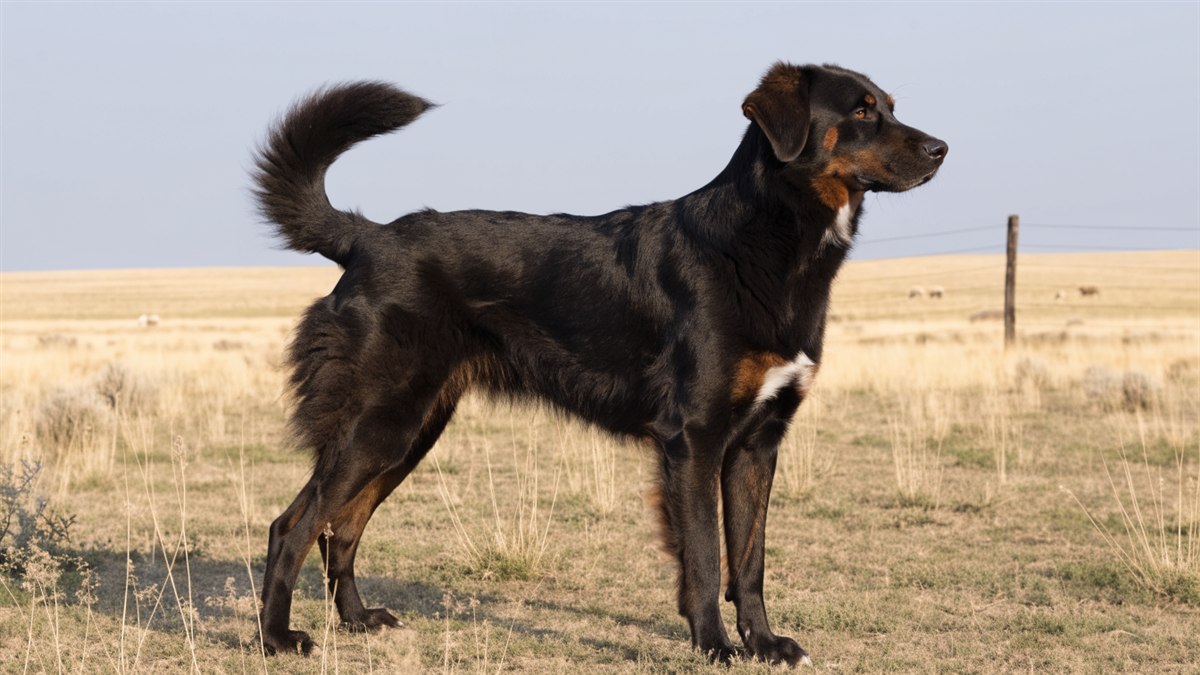
All coat colours occur and white is rare. The most common pattern is black and mahogany with mahogany eye spots over the eyes and a white patch on the chest, and a dog marked this way is known as the Mongolian Four Eye Dog. The extra eyes are also thought to see into the spirit world. Wikipedia records the colours more loosely as red, black, and black and tan, with either a short or a long coat.
Indian readers arriving from breed directories often read landrace as a polite word for mongrel, or as a breed that has not got around to being standardised yet. It is neither. A landrace is a population shaped by the job and the country rather than by a ring, and standardising it would mean closing the studbook and narrowing the gene pool, which is the opposite of what its own conservation project is trying to do.
How the population collapsed
The Bankhar nearly disappeared inside one human lifetime, and the mechanism is documented rather than mythological. During the Communist era of Mongolia, Bankhar dogs were let loose or exterminated to forcibly relocate nomadic groups into socialist-style settlements, and by the 1980s the breed had almost disappeared. Agence France-Presse adds a second driver, that a belief the dog spread the plague resulted in widespread culls in the 1960s, while the dog's herding value and its place in Mongolian spiritual custom were slowly forgotten.
The project's own account matches. Its founder's field notes from 2003 to 2005 record that Bankhar were rare but did exist, especially in isolated areas of the Gobi, that the vast majority of dogs encountered were village mixes rather than Bankhar, and that most people thought the Bankhar of old was almost gone. Of roughly 50 families encountered, only three were breeding the dogs carefully and keeping their females away from village dogs.
Which registries recognise the Bankhar dog, and why none of them does
No kennel club anywhere recognises the Bankhar dog. The Fédération Cynologique Internationale nomenclature carries no Mongolian breed at all, the FCI provisional list carries none either, and the Kennel Club of India publishes no browsable breed register to check against. Every claim below comes from the registry's own document, opened and read, rather than from another breed page.
We checked the FCI nomenclature under both letters a Mongolian guardian could plausibly sit under. The letter B list runs from BARBET to BULLMASTIFF with no entry beginning Ban. The letter M list runs from MACEDONIAN SHEPHERD DOG KARAMAN to MUDI with nothing Mongolian in it. We also checked the letter H, because the dog's Buryat name is hotosho, and that list runs from HALDENSTØVER to HYGENHUND with no entry between HOLLANDSE SMOUSHOND and HOVAWART that could be it. The list of breeds recognised on a provisional basis carries 20 entries and no Mongolian one.
Mongolia is inside the FCI, and that makes this more interesting rather than less
Mongolia is an FCI member. The FCI's own member record lists the Mongolian Kynological Federation, based in Ulaanbaatar, as an associate member. The FCI runs three categories, which are full member, associate member and contract partner.
That matters because Bonbeno's Armenian Gampr page established that a country's FCI membership tier tracks whether its native landrace ever gets recognised, with Armenia an associate member and no Armenian breed in the nomenclature. Mongolia is the same tier with the same outcome. The regional counterexample is next door and it is exact. Kazakhstan's Union of Cynologists of Kazakhstan is a full member, and Kazakhstan's aboriginal sighthound landrace, the KAZAKH TAZY, sits on the FCI provisional list at number 372.
The Gampr page's finding survives that comparison, but this page can sharpen it, because the FCI's own recognition procedure does not actually bar an associate member from applying.
What the FCI actually requires, read from its own rulebook
The FCI's procedure for the international recognition of a new breed sets out who may apply and on what evidence. It states that the application must be directed to the FCI Secretariat by the national canine organization affiliated to the FCI of the country of origin of the breed, and that if the country of origin has no member affiliated to the FCI, the application can be filed by an FCI member. Mongolia has an affiliated body, so the door is not closed at that step. The conditions behind the door are where the Bankhar stops.
- Fifteen years of studbook history. The conditions must be met after a minimum of fifteen-year registration with a national kennel club.
- Eight independent family groups. The population must consist of a minimum of eight family groups, each with at least two males and six females, from two different litters in each family group, born over a period of five years.
- No shared ancestors. There must be no ancestors in common throughout three generations.
- A DNA test to prove genuineness as a breed.
- An on-the-spot inspection. A delegation assesses a minimum of 60 dogs representing all sizes, colours and coat textures, with the costs covered by the national canine organisation of the applying member.
- A written provisional standard in English, French, German or Spanish, to the FCI's model, with an illustration of the dog on the first page.
Read that list against what the Bankhar is. A recognition file asks a population to prove it is closed, uniform enough to judge against a written standard, and documented in a national studbook for fifteen years. The Bankhar's own restoration project is doing the opposite on purpose. Its stated breeding plan, which it calls Biogeographic Breeding Mimicry, deliberately introduces genes from geographically neighbouring landraces such as the Central Asian Shepherd and the Tibetan Bhotia at a level that mimics historical gene flow, precisely so that genetic diversity is retained or increased rather than narrowed.
Mongolia's associate membership is real and it matches the Armenian pattern, but it is not the binding constraint here. The binding constraint is that FCI breed recognition and landrace conservation are asking for opposite things. One wants a closed population with no common ancestors over three generations; the other wants gene flow kept open across regional types. A Bankhar that could satisfy the FCI file would no longer be the dog the project is trying to save. No page ranking for this breed says that, and it is the single most useful thing an owner or a breeder can understand about why 2025 came and went.
The registration attempt is nine years old and still open
The intent has been public since at least 2017, when News.MN reported that the Mongolian Bankhar Dog Project had been launched in order for the dog to be officially registered as a breed by the Belgium-based Fédération Cynologique Internationale, and noted that there were nearly forty Bankhar breeding centres in Mongolia running an annual promotional competition.
The most detailed public account of progress is Mongolia's state news agency in May 2024. Three Mongolian national champion Bankhars, named Khangardi, Toligor and Guyen, travelled to the World Dog Show 2024 in Zagreb, an event the report describes as drawing 18,350 dogs of 376 breeds from 98 countries. According to that report the FCI classifies breeds into ten groups by purpose and shows breeds that are not yet registered, but are planned to be, in an eleventh group, where Khangardi won among 18 breeds.
The same report quotes the president of the Mongolian Kynological Federation, B. Enkhbayar, saying the federation joined the FCI in 2009 and became an official member in 2023, that it had met the requirements set by the FCI, and that it would introduce the Mongolian Bankhar as an official breed at an international conference in Helsinki in 2025.
The federation's president describes becoming an official FCI member in 2023. The FCI's own member record for Mongolia, checked on 20 August 2026, still shows the Mongolian Kynological Federation as an associate member. Bonbeno does not know which reading of official is intended and will not guess. What we can state is the outcome, which is that as of 20 August 2026 no Mongolian breed appears in the FCI nomenclature under B or M and none appears on the provisional list Fédération Cynologique Internationale.
There is a national register, and its numbers raise a question
Mongolia does keep its own record. The same 2024 report states that of 12,000 purebred dogs registered with the Mongolian Kynological Federation, 8,000 are Mongolian Bankhars. That is a national registry figure and it is not an international recognition, but it is also worth holding next to the conservation picture, because Agence France-Presse reported in 2017 that no reliable numbers exist on how many of these dogs remain.
Both can be true. A show and pedigree register counts the dogs people bring to it, and a conservation project counts working guardians living with livestock. They are not the same population, and the gap between 8,000 registered animals and a landrace described as endangered is the most important unresolved question about this dog. Nobody ranking for the term asks it.
The Indian registry position
There is no Indian registration route. The Kennel Club of India's own website publishes downloadable forms and contact details but no browsable list or register of recognised breeds that a buyer could check a Bankhar against. An Indian seller who offers you Kennel Club of India papers for a Bankhar is offering you something that cannot exist, because the parent registry the KCI is affiliated to does not list the breed at all Fédération Cynologique Internationale.
What the Bankhar restoration project has actually published
The Mongolian Bankhar Dog Project has published exactly one peer-reviewed paper about the effect of its dogs, and everything else it circulates is its own project material. Both are worth reading. They are not the same grade of evidence, and no page ranking for this breed tells you which figure came from which. This section separates them.
The peer-reviewed paper
Lieb, Tumurbaatar, Elfström and Bull published Impact of livestock guardian dogs on livestock predation in rural Mongolia in Conservation Science and Practice in 2021. The first author was the project's in-country manager and the third is its founder, which is disclosed by the author list rather than hidden, but a reader should know it.
The method was longitudinal structured interview-based surveys. Sixteen herders in Nomgon in Ömnögovi, Undur-Ulaan in Arkhangai, the Khustain Nuruu National Park area and the Gorkhi Terelj National Park area were surveyed between 2015 and 2019, throughout the process of receiving and training the dogs.
The result was a significant reduction in the annual losses of livestock to predation after receiving livestock guardian dogs, reported as a Wilcoxon signed-rank test with Z = -3.329 and p = .001 at n = 16, and stated to hold when accounting for background predation rates. The authors concluded that the dogs are likely to be a viable method for livestock protection alongside the conservation of predators in Mongolia, and potentially elsewhere in Asia.
Bonbeno retrieved and read the paper's title, journal, full author list and complete abstract, and every figure quoted above comes from that abstract. The publisher's full-text page returned HTTP 403 to us and the university repository copy failed on a certificate error, so we have not read the Results section. We therefore quote nothing beyond the abstract and we do not reproduce any percentage attributed to this paper elsewhere. If you see a livestock-loss percentage credited to Lieb et al. 2021, ask where in the paper it appears.
Read the design honestly. This is a before-and-after comparison within the same sixteen herders, built on what those herders reported in interviews, with no randomised control group and no independent carcass verification described in the abstract. That is a normal and often unavoidable design for conservation fieldwork on a nomadic steppe. It is also a long way from proof, and n = 16 is a small number to carry the weight the internet puts on it.
Where the 80 to 100 percent figure actually comes from
Almost every page about this dog repeats that a Bankhar reduces livestock losses by 80 to 100 percent. That figure is not from the peer-reviewed paper. It appears in the project's own annual report for 2002 to 2017, in the entry for the year 2016, described there as preliminary data from the Gobi dogs confirming a reduction in losses to predators of 80 to 100 percent. The word preliminary is in the source and is dropped by everyone who repeats the number.
A partner lodge quotes a more careful version of the same claim, that Bankhar dogs can minimize threats from predators to livestock by more than 80 percent. Bonbeno reports the figure with its provenance attached rather than dropping it, because a preliminary in-house observation from a small number of herders is genuinely informative and genuinely not a measured national effect.
The project's own per-herder data, which nobody reproduces
The annual report contains something better than the headline percentage, which is a per-herder livestock loss table covering 2015 to 2017 for eleven named herders in South Gobi, Nomgon, Terelj and Khustai. Averaged across those eleven herders, losses to predators fell as follows.
| Period | Mean head lost | Mean loss as share of holding |
|---|---|---|
| Year zero, before the dogs | 16.5 | 2.6% |
| Year one, with dogs | 2.4 | 0.3% |
| Year two | 1.5 | 0.2% |
| Year three | 1.8 | 0.2% |
Two things stand out. The largest fall happens in year one and then flattens rather than continuing to zero, which is what a real effect usually looks like and what a marketing number usually does not. And the mean herd size across the same eleven herders grew from 761 head to 928 over the period, so the falling percentage is not an artefact of shrinking herds.
The genetics claim, and exactly how far it is evidenced
The project states that its dogs were sampled and analysed via single nucleotide polymorphisms, that the analysis showed a traditional native landrace that grouped genetically into a unique population, and that the Bankhar carried four unique haplotypes and differed from other livestock guardian dogs such as the Tibetan mastiff and the Central Asian shepherd's dog. Its public page puts it more simply, that DNA analysis by Cornell University indicates the Bankhar has very high genetic diversity.
That is the strongest and most-repeated claim about this dog, so here is precisely what stands behind it. The report cites its own internal section, Genetic Grouping of Bankhar - SNPs, labelled as a dataset from the Cornell University Boyko Lab. When Bonbeno extracted the text of that report, the page carrying that heading contained the title and the dataset label and no extractable figures, because the genetic parameters are presented as an image rather than as text. There is no published paper reporting a Bankhar-versus-Tibetan-Mastiff comparison that we could find in any index we searched.
The published paper the project does point to is Shannon and colleagues in the Proceedings of the National Academy of Sciences in 2015, and the project's employee Douglas Lally is a co-author on it NCBI PubMed record 26483491. That paper surveyed autosomal, mitochondrial and Y chromosome diversity in 4,676 purebred dogs from 161 breeds and 549 village dogs from 38 countries on a 185,805-marker genotyping array, and concluded that the pattern was consistent with a Central Asian domestication origin.
Neither the word Mongolia nor the word bankhar appears in the abstract of Shannon et al. 2015, which is a study of village dogs rather than of guardian landraces. Cornell's own write-up of it says village dogs from present-day Nepal and Mongolia are direct descendants of the first domesticated dogs and never mentions the Bankhar. So the sentence you will read everywhere, that Cornell proved the Bankhar is one of the oldest and most diverse dog populations on earth, rests on an unpublished in-house dataset plus a published paper about a different question. That is not the same as false. It is the difference between a promising finding and a demonstrated one, and it is a difference readers are entitled to.
There is a further wrinkle worth publishing. The Central Asian conclusion itself is contested. Wang, Peng, Yang, Savolainen and Zhang published a letter in the same journal the following year titled Questioning the evidence for a Central Asian domestication origin of dogs. So the strongest scientific claim attached to the Bankhar's story sits on a paper whose central conclusion has been formally challenged in the journal that published it. Anyone selling you a Bankhar on the strength of the world's oldest dog lineage is several steps removed from anything anyone has actually established.
The project's scale, in numbers it published itself
This is a small operation, and its own report is unusually frank about that. Its total 2017 budget was USD 62,860, of which staff costs were USD 30,290 and dog costs USD 23,140, the latter including USD 17,000 of annual dog food and USD 5,000 to raise eleven pups at USD 450 each. The breeding facility housed 15 to 19 adult dogs under a full-time caretaker, all collected from different areas of Mongolia, unrelated, and taken from working rather than show parents.
Placement grew slowly and honestly. The report records over 50 individual Bankhar placed with selected herders in Nomgon, Noyon and Gurvantes soums and in the Terelj and Hustai National Park buffer zones. The Institute of Canine Biology reported a first generation of nineteen puppies in 2015. By February 2026 a partner lodge recorded that the project has gifted Bankhar dogs to more than 80 nomadic families across more than a decade.
The report is also willing to publish its failures, which is the clearest signal that it is a field record and not a brochure. It records crashing and writing off the project vehicle while transporting pups to the Gobi, a forced move out of its original facilities, a breeding season in which one female lost eight of nine pups to illness, staffing errors that produced the wrong breeding pairings, and herders returning two dogs because they objected to the colour.
This is one of the very few landrace guardian dogs on Bonbeno where somebody did the work. There is a real breeding programme with a documented protocol, a real placement pipeline with contracts and follow-up visits, real per-herder loss data, a published budget, and one peer-reviewed paper in a conservation journal. That is more than exists for the Armenian Gampr, the Akbash or the Himalayan Sheepdog. It is still one small study at n = 16, one in-house dataset presented as an image, and no veterinary data whatsoever.
Bankhar dog price in India: there is no price, and here is the evidence
There is no Bankhar dog price in india and Bonbeno will not publish one. We ran India-facing searches on 20 August 2026 and opened every result that appeared to offer the breed. Not one offered a Bankhar. The market that Indian search results seem to describe does not exist, and proving that is more useful than any invented rupee range.
Start with the two largest published Indian dog price lists, because if a breed is sold in India at all it appears in these.
| Source | Breeds covered | Bankhar entry | What it lists instead |
|---|---|---|---|
| Supertails | Top 40 breeds | None. The words Bankhar and Mongolian do not appear | Range of Rs 2,000 for an indie to over Rs 1,50,000 for a KCI-registered show dog |
| Wrapinfur | 50-plus breeds | None | Bakharwal Dog at Rs 10,000 to Rs 35,000 and Gaddi Kutta at Rs 10,000 to Rs 35,000 |
| Wuuff international puppy marketplace | Breed-specific page exists | Zero listings worldwide, checked 20 August 2026 | The empty-state text, Sorry, there is no result |
| Premium Pet House | Indian puppy sales site | The words Bankhar and Mongolian do not appear | Bakharwal at Rs 50,000 to Rs 70,000 |
What an Indian buyer is actually being offered
Two substitutions run in Indian search results and both are worth naming, because a buyer who does not know about them will pay for one dog and receive another.
- The Bakharwal substitution. An Indian bankhar price query returns Bakharwal sales pages. The Bakharwal is a livestock guardian of Jammu and Kashmir, a different dog from a different country, and the two names are one letter apart in a hurried search box. One Indian site prices it at Rs 50,000 to Rs 70,000 while another prices the same breed at Rs 10,000 to Rs 35,000, so the substitute breed's own published price disagrees by Rs 35,000 at the ceiling.
- The Tibetan Mastiff substitution. Anything large, dark and long-coated offered as a rare Mongolian guardian in an Indian metro is far more likely to be a Tibetan Mastiff or a Tibetan Mastiff cross, because that is the dog Indian sellers actually have and the one with a price story attached.
- The auto-generated shell page. The international marketplace page for Mongolian Shepherd Dog Bankhar puppies exists, ranks, and contains no dogs. Its own text reads that currently there are no available Mongolian Shepherd Dog Bankhar puppies here. Pages like this exist identically for every breed name and are evidence of a template, not of a trade.
In India the Tibetan Mastiff is what you get when you ask for a Bankhar. In Mongolia the Tibetan Mastiff is the problem. News.MN reported in 2017 that interbreeding with the fashionable Tibetan Mastiff had become popular, that mastiffs are genetically distinct from the Bankhar and are not working dogs, and that mixed mastiff genes in the Bankhar gene pool have degraded the genetic characteristics of the Mongolian dog. The same fashion that would sell you a Tibetan Mastiff as a Bankhar in Delhi is diluting the real thing on the steppe.
The one real transactional number anywhere
The only genuine money figure attached to acquiring a Bankhar is not a price at all. The restoration project does not sell dogs. It places them with selected herders under a contract, and requires a deposit of 40,000 Mongolian tugrik on delivery, which is returned a year later if the herder has actually been using the dog as a livestock guardian. The report is explicit that this is not a payment for the dog, and that it exists to encourage participation through the first year and to stop placed pups drifting into being ger dogs.
That is the whole market. A conservation programme that gives working dogs to herders under a returnable performance deposit, and a fashion trade in Mongolia and in Indian metros that sells something else under the name. Bonbeno does not broker puppy sales and publishes no breeder listings, and on this breed there is nothing to list.
The legal position in India, read from the trade notice itself
To bring a Bankhar dog into India lawfully you must qualify under one of three narrow purposes, because live dogs are a Restricted import under ITC (HS) 01061900 and the governing import policy allows entry only for a pet dog with a valid pet book in the importer's name, for research by an R&D organisation with a CPCSEA recommendation, or for internal security by the Defence and Police Force. There is no fourth door, and none of the three founds a breeding population.
The document is DGFT Trade Notice No. 22/2022-23, dated 19 December 2022, issued by the Directorate General of Foreign Trade under the Ministry of Commerce and Industry, and addressed to all international airlines, all Indian embassies and consulates abroad, and pet owners. Bonbeno opened and read it rather than summarising somebody's summary of it.
| Provision | What the text states |
|---|---|
| Tariff line | ITC (HS) 01061900, Mammals: Other |
| Import policy | Restricted, subject to Policy Condition 6 of the chapter |
| Policy Condition 7 | Import of dogs allowed only for a pet dog with valid pet book in the importer's name, R&D organisations with CPCSEA recommendation, or internal security by Defence and Police Force |
| Policy Condition 8 | Import of commercial dogs for breeding or any other commercial activities other than the purposes mentioned above is not permitted |
| Applications refused | Any applications for trading or breeding purposes, or made on behalf of another person or entity, shall be duly rejected |
| Baggage route | Up to two pets without DGFT authorisation, only for persons transferring residence to India after two years of continuous stay abroad |
| Entry points | Six only: Delhi, Mumbai, Chennai, Hyderabad, Bangalore and Kolkata, with quarantine where required; DAHD added Kochi for pets arriving under the baggage rules in October 2024 |
| Lead time | Owners advised to start the authorisation process at least two months before travel |
Now do the arithmetic that no page ranking for this breed does. A lawful Indian Bankhar could only arrive as the personal pet of somebody moving home to India after two years abroad, carrying a pet book in their own name, through one of seven ports. That is not a supply chain. It is an individual accident. And because the breed appears in no FCI list Fédération Cynologique Internationale Fédération Cynologique Internationale and on no Kennel Club of India register, even that individual animal could never be registered, bred from lawfully as a commercial venture, or verified by paperwork on resale. The full route is set out in how to import a dog to India.
Either fact on its own would leave a gap. Together they close it. Import law forbids the breeding import, and no registry anywhere issues papers for the breed. That is why the Indian search results promising Bankhar puppies resolve to Bakharwal sales pages and empty marketplace templates rather than to dogs Wuuff, Mongolian Shepherd Dog Bankhar….
If a Bankhar did somehow reach India, what Indian breeding law requires
The governing text is the Prevention of Cruelty to Animals (Dog Breeding and Marketing) Rules, 2017, notified as G.S.R.496(E) on 23 May 2017 by the Ministry of Environment, Forest and Climate Change. It numbers its clauses twice, once in the Rules and again in the Second Schedule, so we state which one each quotation comes from.
- Rule 8(1)(a), in the Rules themselves. Every breeder shall ensure that pups less than eight weeks in age are not sold.
- Rule 8(1)(b), in the Rules themselves. Dogs over six months in age are not sold without first being sterilised, unless they are being sold to another licensed breeder.
- Second Schedule, Part II, paragraph 6(3). In breeding and incest breeding are prohibited, in breeding being defined as breeding between relatives of the second to fourth grade in straight or side line within the first four generations, and incest breeding as mating between parents and children or between brother and sister.
- Second Schedule, Part II, paragraph 6(8). There shall be no tail docking, ear cropping, de-barking, de-clawing, branding, dyeing or injecting substances to enhance visual appeal, and any change of appearance by artificial means is strictly forbidden.
- Second Schedule, Part II, paragraph 6(9). Breeding to create new breeds of dogs or unusual looks shall be strictly prohibited.
Bonbeno's usual finding on an imported breed is that the parent club's guidance would be unlawful in India, and on the Ariege Pointer that was exactly the case. Not here. The FCI's recognition file demands no ancestors in common throughout three generations, and India's Second Schedule prohibits matings between relatives within four generations. Those point the same way. The Bankhar's restoration project also breeds from the most unrelated DNA available and pairs deliberately to keep diversity high, which is compliant with both. On this breed the conflict is between the FCI and conservation, not between conservation and Indian law.
What a Bankhar would actually cost to keep in India
We cannot give you a verified monthly rupee figure for a Bankhar in India, because there is no Indian owner base to derive one from and we will not invent one. What we can do is price the single largest line honestly from a manufacturer's own table, show what the restoration project spends per dog, and name the India-specific cost that new owners of any heavy-coated guardian consistently underestimate.
Food, priced from the ration rather than from a guess
Royal Canin India's Giant Adult feeding guide gives 457 g a day for a 45 kg dog at medium activity, rising to 531 g at 55 kg and 602 g at 65 kg, with low-activity figures of 394 g and 459 g at 45 kg and 55 kg respectively. A Bankhar sitting in the middle of its published weight range therefore eats somewhere around half a kilo of dry food a day.
The bag sizes offered on that page are 4 kg and 15 kg. Divide the ration into the bag and a 15 kg bag lasts roughly 28 days at 531 g a day and roughly 33 days at 457 g. So the honest food line for an adult Bankhar in India is close to one 15 kg giant-breed bag a month, and any reader can price that at their own local shelf rate in thirty seconds.
We tried. Two Indian retailer product pages for this exact food were opened and neither rendered a price we could read, so we have no verified shelf price to quote and we are not going to reproduce one from memory or from a competitor's page. A ration in grams and a bag size are things we checked on the manufacturer's Indian site. Multiply them by the price you can see today.
What the restoration project spends per dog, in its own numbers
The project's 2017 budget lists dog food at USD 17,000 for the year across a facility housing 15 to 19 adult dogs plus that season's pups. Divide the line by the dog count and you get roughly USD 895 to USD 1,133 per adult dog per year, before veterinary care, which the same budget lists separately at USD 175 for adult vaccinations every other year and USD 115 for dewormer. Raising eleven pups was budgeted at USD 450 each.
Treat that as a scale reference and not as an Indian cost. Those dogs are fed in Mongolia, partly on what a nomad herder would feed, which the report describes as sheep innards with noodle or rice, all boiled together with water, plus large fresh raw sheep, goat or cow bones twice a month. An Indian owner cannot replicate that diet safely or economically, and should not try.
The line Indian owners underestimate
- Cooling. For a dog carrying a 9 cm winter coat over a very heavy undercoat in a country whose plains cross 40 C from March to June, climate control is not comfort spending. It is the difference between a manageable animal and a heat stroke emergency.
- Grooming. A coat this dense needs frequent professional attention through the annual blow, and in Indian humidity the schedule is heavier than in a temperate climate rather than lighter.
- Veterinary care with no screening scheme behind it. With no breed health data, no CHIC-style panel and no parent-club guidance to follow, budgeting is guesswork rather than planning.
- Space. The project houses one breeding pair in an enclosure of 45 m by 22.5 m. Anything an Indian city offers is a rounding error against that, and the cost of the mismatch is paid in behaviour rather than in rupees.
- Boarding. Very few Indian facilities will take a large territorial guardian of an unrecognised breed, and the ones that will charge accordingly.
When we publish a cost figure we state the sample size, the cities covered and the collection date. On this breed there is no sample and no cities, so we publish the cost structure, the ration, the bag size and the project's own budget lines instead. That is the whole honest answer.
Heat tolerance: why Bonbeno rates the Bankhar dog 1 of 5 for Indian conditions
Bonbeno rates the Bankhar dog 1 of 5 for heat tolerance in India, the lowest rating on this site. Two mechanical facts decide it, the coat and the mass, and a third fact frames both, which is that this dog's homeland never gets as hot as the temperature at which India declares a heat wave. The reasoning below is arithmetic on published measurements rather than sentiment about a fluffy dog.
Fact one, the coat is the longest of any guardian on this site
The Bankhar's winter coat is very full and long, 3 to 4 inches or about 9 centimetres, over a very heavy undercoat. Bonbeno rates several guardian breeds and we can put that number against theirs.
| Breed | Published coat length | Bonbeno heat rating |
|---|---|---|
| Bankhar dog | About 9 cm in winter, very heavy undercoat | 1 of 5 |
| Caucasian Shepherd Dog | FCI-Standard 328 states the guard coat and the undercoat should not be less than 5 cm | 1 of 5 |
| Akbash | 4 to 7 cm over a dense undercoat, as recorded on Bonbeno's Akbash page | 2 of 5 |
| Armenian Gampr | No standard sets a minimum length; a shorter lowland type is correct | 2 of 5 |
| Tibetan Mastiff | FCI-Standard 230 calls for a harsh, thick coat with the top coat not too long over a dense and rather woolly undercoat, with no length specified | 1 of 5 |
The Bankhar's guard coat is roughly double the minimum FCI-Standard 328 demands of the Caucasian Shepherd Dog and sits above the top of the range Bonbeno records for the Akbash. We could not re-open the Akbash's own registry standard today, so that comparison is flagged as coming from our Akbash page rather than from a document we read this week. The Akbash earns its extra point partly on a shorter coat and a leaner build. The Bankhar has neither advantage at the top of its size range, so it cannot inherit that point.
Fact two, the males sit inside the risk band
Published adult male weights run to 125 lb, about 57 kg, on the project's own page, and Wikipedia gives 50 to 60 kg for the breed generally. The founder's field survey measured working dogs at up to 55 kg.
That matters because the largest primary-care study of heat-related illness in dogs, covering 905,543 dogs under UK veterinary care in 2016 and identifying 395 confirmed heat-related illness events, reported an event fatality rate of 14.18 percent with a 95 percent confidence interval of 11.08 to 17.96 percent, and identified dogs weighing over 50 kg as being at greater risk. Two honest caveats belong with that. It is a UK dataset in a temperate country, and Bonbeno retrieved and read only the paper's abstract, so we quote nothing beyond what the abstract states and we do not reproduce any odds ratio.
Females are a different case. At 80 to 90 lb, roughly 36 to 41 kg, a female Bankhar sits below that 50 kg threshold, which is the same argument that earns the Armenian Gampr its second point. The Gampr, however, has no measured 9 cm coat. On this breed the coat overrides the weight.
Fact three, the homeland never reaches Indian heat
This is the comparison that settles the rating, and it is one no ranking page makes. Mongolia has an extreme continental climate with long, very cold winters and short summers. Average temperatures over most of the country are below freezing from November through March, winter nights drop to -40 C in most years, and Ulaanbaatar's average annual temperature is -2.9 C. Summer extremes reach as high as 38 C in the southern Gobi and 33 C in Ulaanbaatar.
Now set that against India. The World Health Organization records that a heat wave is considered in India when a station's maximum temperature reaches at least 40 C in the plains, that heat waves typically occur from March to June and in rare cases extend into July, that five to six heat wave events occur every year on average over northern India, and that the peak month is May.
The hottest regional summer extreme anywhere in the Bankhar's homeland, 38 C in the southern Gobi, is below the 40 C at which India starts calling the weather a heat wave in the plains. Mongolia touches that ceiling for a few weeks. Much of India lives above it for parts of four months every year. This is not a dog being asked to cope with a hot summer. It is a dog being asked to live permanently above the top of the temperature range its ancestors were ever selected in.
There is a second half to it that matters on the coasts. Gobi heat is dry heat. Panting is evaporative cooling, and evaporative cooling works badly in humid air. A Bankhar in Mumbai or Chennai is therefore worse off than the raw temperature suggests, and worse off than the same dog in Jaipur at the same reading on the thermometer.
The one point in the breed's favour, and why it does not move the rating
The project makes a genuinely interesting claim that deserves a fair hearing. Because Mongolia is vast and its climate varies, the Bankhar seems to have a plastic response to climate conditions and does not grow such a heavy coat in warmer regions. If true and if it transferred, that would be a real advantage over a breed whose standard imposes a minimum coat length.
Three reasons it does not lift the rating above 1. It is a field impression rather than a measurement, with no coat-length data at any temperature published anywhere. The warmer regions in question are warmer parts of Mongolia, whose ceiling is 38 C and whose hot season is weeks rather than months. And nothing about a thinner coat addresses the body mass, which is the other half of the problem. A plastic coat response is a reason to expect a Bankhar to cope better than a Tibetan Mastiff in Shimla. It is not a reason to expect it to cope in Nagpur.
City by city, if one somehow ends up here
| Where | The problem | Verdict |
|---|---|---|
| Delhi, Jaipur, Nagpur, Ahmedabad | Dry extreme heat well past 40 C for weeks, plus a cold enough winter to trigger a full coat | Worst possible match. The dog grows the coat and then has to survive May in it |
| Mumbai, Chennai, Kochi | Sustained heat plus humidity that defeats panting | Unmanageable without full-time climate control |
| Bengaluru, Pune | Milder, but still a four-month hot season and a monsoon season that soaks a very heavy undercoat | Poor. Better than the plains, not good |
| Kolkata, Guwahati | Humidity and a long monsoon | Poor, with the added skin and ear load |
| Shimla, Manali, Leh, Gangtok | Genuinely cold winters and mild summers | The only honest fit in India, and the Himalayan Sheepdog already does that job there with no import problem |
What actually reduces the risk
- Restrict all exercise to before sunrise and after dark. The middle of the Indian day is unusable for this coat from roughly March to June.
- Never shave the guard coat. Shaving a double-coated dog removes the insulation that protects skin from direct heat and sunburn, and the coat regrows unevenly in many dogs.
- Keep constant access to cool water and shade, and treat a refusal to drink as a warning rather than a preference.
- Watch for the signs and act immediately. Purina India lists severe panting, difficulty breathing, severe salivating, vomiting, diarrhoea, a raised temperature of 40.5 C or above, blood in the urine, nose bleeds, and ultimately collapse and coma.
- Cool correctly. Move the dog into shade or air conditioning, then spray or sponge with cool but not cold water, making sure the water reaches the skin rather than running off the coat, wetting the belly and inside the legs, with a fan running. On a 9 cm coat the phrase reaching the skin is the whole instruction.
- Know that your breed is on the named list. Purina India names dogs with heavy coats, such as Huskies or Newfoundlands, as being at particular risk of heat stroke. A Bankhar carries more coat than either.
Heat stroke is a veterinary emergency and it moves fast in a heavy-coated dog. Find and save the number of a registered veterinarian near you who is open at the hours you exercise the dog, before the first hot week rather than during it, and agree a plan with them for what you will do on the way to the clinic.
Temperament and household fit, and who should not consider this dog
A Bankhar dog decides for itself what is a threat and acts without waiting for a person, which is the trait it was selected for and the trait that disqualifies almost every Indian household. Bankhar, like most livestock guardian dogs, have an independent nature and tend to think for themselves, and are very loyal to their charges and protect them with their lives.
The clearest single indicator of what this dog does with a stranger is a piece of Mongolian etiquette rather than a temperament chart. The traditional greeting on approaching a ger is to call out and ask the household to hold your dog, and it is a practical request rather than a courtesy.
The other defining trait runs the other way. These dogs are by nature and coevolution with humans very nurturing animals with very low prey drive. That is why a guardian can live inside a flock of lambs without harming them, and it is a real and unusual quality. It does not transfer to strangers at a gate.
The dog is deliberately not raised to be companionable
This is the part no breed directory explains, and it changes everything about what an Indian buyer would actually receive. The restoration project's raising protocol is designed to bond the pup to livestock and specifically to limit its attachment to people.
- Constant livestock contact. Pups are housed with a small group of fenced-in livestock at all times until 13 weeks, which is the critical bonding age.
- Limited human interaction. The protocol restricts contact between the herder and the pup, deliberately.
- Feeding with the flock. Pups are fed and watered only with the livestock, and the project records that failure to do this was the commonest herder error.
- No time near the ger. Pups are kept away from the household and sleep in the livestock enclosure, because a pup that drifts to the ger becomes a ger dog and stops guarding.
- Enough handling and no more. Pups are socialised to people only to the level required, which is a much narrower brief than a pet puppy's.
Every temperament description of this dog in existence describes a working guardian raised on that protocol. Nobody has documented what a Bankhar raised as a family companion in a city is like, because the population that would tell you does not exist. So a page claiming this breed is gentle with children in a flat is not reporting evidence, it is guessing. Bonbeno rates good with children 3 of 5 and marks it provisional for exactly that reason.
Two herder beliefs the project's own data contradicts
The report is unusually candid about disagreeing with the people it works for, and both disagreements are useful to an owner.
- Coat colour does not affect working ability. Several herders refused lighter-coloured dogs in 2015, believing livestock would confuse them with wolves and fail to run. Two dogs were returned over it. The project records that literature and research show colour is not a variable in a dog's effectiveness, and that selecting for one colour would narrow genetic diversity and amount to inadvertent artificial selection.
- Neutered males are not less effective. Herders objected to neutering on the grounds that it weakens the dog. The project requires it anyway, and states plainly that no evidence has been shown for the herders' view and that the opposite may very well be the case. It places only spayed females.
Who this dog suits, and who it does not
- Genuinely suits. A working livestock operation at altitude with land, a real predator problem, and an owner who wants a guardian rather than a companion.
- Does not suit. Any Indian apartment, any gated society, any household with a stream of visitors, any first-time owner, any buyer who wants a dog that greets people.
- Does not suit, second category. Anyone buying for status. This is a landrace with no papers, no show career available and no resale market, and the animal being sold to you under the name is almost certainly something else.
- Should look elsewhere entirely. Indian buyers drawn to the size and the guarding drive are far better served by the Bully Kutta, the Kombai or the Rajapalayam, all of which are available, legal to acquire and built for the climate.
Training a Bankhar dog, and what the working protocol actually is
To train a Bankhar dog you train the bond rather than the obedience, and you do it inside a fixed developmental window that closes at about 13 weeks. The restoration project describes its own protocol as very strict and precise, running from the ages of one day to three years old. That is the only documented training method for this landrace anywhere, and it is a livestock-bonding programme rather than an obedience one.
The protocol, in the project's own terms
Adults and pups live at all times with sheep. They sleep with, eat next to, and play around sheep, and a playpen places the pups for play or feeding right next to the sheep to help the bonding process. The bonding period the project treats as critical runs from 5 to 13 weeks, and its solution to a country with no fences was to house a small group of livestock fenced in with the pups until 13 weeks.
The corrections are as instructive as the setup. Interaction between herder and pup is deliberately limited, pups are fed and watered with livestock only, pups are kept away from the ger and sleep in the livestock enclosure, and a pup that leaves the herd is redirected with a rock-filled can used as a noise maker rather than with the handler's voice. The whole design points the dog's attention at the flock and away from the person.
Every published behaviour claim about this landrace describes dogs raised on that protocol. If you raise a Bankhar as a household dog you are running an undocumented experiment, because the animal the literature describes was made by 13 weeks of deliberate livestock bonding and deliberate human distance. Nobody has published what the same genetics produce when you do the opposite.
What imported guardian-dog training advice gets wrong here
The project found that protocols written for livestock guardian dogs elsewhere had aspects ill suited to Mongolia, and the specific mismatch is worth naming because the same class of error runs through every Indian page that copies a Western breed club. Much of the guardian-dog literature and research was done on farms that use fences to hold livestock, and Mongolia does not use fences, so the bonding step that Western protocols take for granted had to be rebuilt from scratch.
A second mismatch came from the herders rather than the books. Mongolian herding techniques vary, with some herders staying with the herd and others letting it graze alone and checking periodically, and those differences change how a pup develops, because the dog is at risk of bonding more strongly to humans than to livestock. An Indian owner has that risk at maximum, since there are no livestock at all.
Realistic timelines
| Stage | What happens | Source |
|---|---|---|
| Day 1 | Visual check of the litter as soon as the mother allows; count and sex the pups | Project whelping protocol |
| Day 2 to 3 | Puppy measurements begin: head circumference, nose to head length, body length, weight | Project whelping protocol |
| 3 weeks | Stimulation introduced, using toys and obstacles | Project whelping protocol |
| 5 weeks | First vaccination round | Project whelping protocol |
| 5 to 13 weeks | The critical livestock bonding window; pup housed with fenced livestock at all times | Project protocol, after the guardian-dog literature |
| 13 weeks onward | Pup follows the herd; herder contact stays limited | Project protocol |
| 3 to 6 months | Placement trips run March to April, and pups are placed in pairs | Project placement records |
| Year 1 to 3 | Protocol continues; the project rates true working ability only once dogs reach maturity | Project findings, 2016 entry |
Note the last row, because it is the honest answer to how long this takes. The project's own 2016 summary records that formerly placed dogs had only then reached an age to show true working ability. You are judging this dog at two to three years, not at six months.
What this breed will simply refuse
- Deferring on a judgement call. The dog was selected to act correctly without a person present. It will evaluate your instruction against what it thinks is happening.
- Reliable off-lead recall around a perceived threat. Recall competes directly with the instinct the breed exists for, and the instinct wins.
- Accepting a stranger on its own ground. Introductions belong on neutral territory, and even then the dog is assessing rather than welcoming.
- Being trained out of patrolling. The urge to hold a perimeter is what you bought. It does not switch off because the perimeter is a balcony.
The one thing that reliably breaks a guardian is coercion. Train with reward and structure, keep sessions short, and accept a ceiling of reliable manners in a managed environment rather than obedience. Anyone who tells you a firm hand fixes an independent guardian is describing a way to produce a frightened 50 kg dog.
How much exercise a Bankhar dog actually needs
No published daily exercise figure exists for the Bankhar dog, because there is no breed club and no kennel club to publish one. What does exist is a documented picture of the working day, and it describes an endurance patrol animal rather than a sport dog. Bonbeno rates exercise needs 3 of 5 and explains below what that means in practice.
Start with the working ratio, which is the most concrete figure available. The project places one dog with each 150 to 200 sheep or goats. That dog moves with the herd across open steppe all day, at a walk and a trot rather than a run, and it is active at night when predators are.
The scale of movement is larger than most Indian readers will picture. Some nomadic families move 10 to 15 times per year until they find good pasture for their animals, and the dogs move with them. A working Bankhar's daily distance is not a walk. It is a job.
Housing gives the second reference point. The project's breeding enclosures are 45 m by 22.5 m, about 1,012 square metres, for a pair or for a mother with pups. That is the space a rare landrace guardian is given when it is not working, and it is roughly the floor area of ten large Indian flats laid side by side.
What that translates to for an owner
- Two long patrol sessions a day, one before sunrise and one after dark, at a walk rather than at speed. Sustained hard exercise in Indian heat is the single most avoidable cause of a heat stroke emergency in a heavy-coated dog.
- A boundary the dog can hold. A guardian without a perimeter invents one, and the invented perimeter is usually the front door, the lift lobby or the boundary wall of a housing society.
- Work that occupies judgement, not just legs. Scent games and structured problem-solving tire a thinking dog faster than distance does, and they can be run indoors during a heatwave.
- No midday exercise from March to June. Skip it entirely. Two cool sessions beat three that include one dangerous one.
A dog that reaches 50 kg or more grows slowly and its growth plates stay open well past the first birthday. Forced distance work, stair repetitions and jogging alongside a bicycle before then risk permanent orthopaedic damage in any giant breed. There is no Bankhar-specific orthopaedic research to quantify that risk for this landrace, which is a reason for more caution rather than less. Set the puppy's exercise plan with your nearby vet, not from a chart written for a Labrador.
What happens without it
An under-exercised guardian does not become destructive in the way an under-exercised gundog does. It becomes vigilant, and vigilance in a dense Indian neighbourhood means barking at every sound, patrolling the boundary at night, and escalating with visitors. The project's own deterrence ladder tells you why. A guardian with nothing to guard runs steps one to five on whatever is nearest, and in a city that is people.
Grooming a Bankhar double coat through Indian humidity
Groom a Bankhar dog at least weekly year-round, daily through the annual coat blow, and never shave the guard coat. The coat is very full and long, about 9 centimetres in winter, over a very heavy undercoat, which makes this the heaviest double coat Bonbeno has rated on a guardian breed and the hardest one to keep in Indian air.
No breed club publishes grooming guidance for this landrace, because no breed club exists. That absence is itself useful information, because it means every Indian page you will read on Bankhar grooming is generic double-coat advice written for a temperate country and pasted under a Mongolian name. Here is what does and does not transfer.
What transfers from generic double-coat advice
- Brush to the skin, not the surface. Surface brushing leaves dead undercoat trapped underneath, which is where matting starts.
- Use an undercoat rake, not a slicker alone. On a 9 cm guard coat a slicker never reaches the layer that matters.
- Never clip or shave. The coat is part of the dog's thermal management. Removing it exposes skin to direct sun and it regrows unevenly.
- Expect a heavy annual moult and increase brushing to daily through it.
What does not transfer, and what replaces it
Overseas guidance for a heavy-coated working dog assumes the dog dries in cool dry air and that its coat is a barrier against cold. In India both assumptions fail, and the coat becomes a humid microclimate held against the skin. Three Indian-specific jobs replace the temperate routine.
- Dry the dog completely after every bath and every soaking. Damp undercoat in humid weather is the main driver of hot spots. Air drying is correct in Ulaanbaatar and wrong in a Mumbai monsoon season.
- Treat every brush-out as a skin and parasite inspection. A coat this dense hides ticks, fleas and lesions completely, and an owner who only brushes the top layer will find a problem weeks after it started.
- Check the ears every single time. This is the highest-value five seconds in the whole routine, for the reason set out below.
The monsoon ear problem, with Indian evidence
An Indian epidemiological study of otitis externa screened 651 dogs presenting with visible dermatological signs in Jabalpur and found 92 positive for otitis externa, an overall occurrence of 14.13 percent, with the highest number of cases recorded during the monsoon season in July and August, the highest occurrence in dogs of three to six years of age, and the breed-wise peak in Labrador Retrievers.
That study is not about the Bankhar and Bonbeno will not pretend it is. What it establishes is the Indian seasonal pattern, which applies to any dog whose ear canal spends the monsoon damp. A Bankhar carries drop ears under a very heavy coat, so it holds moisture around the ear better than most breeds in the study did. Plug the ears before bathing, dry them afterwards, and monitor for head shaking, odour, discharge and scratching through July and August.
Indian owners of every double-coated breed reach the same conclusion in their first May, which is that the coat must be the problem so the coat should come off. It is the wrong answer here for the same reason it is wrong for the Siberian Husky and the Samoyed. Correct hot-weather grooming removes dead undercoat so air can move through the coat. It does not remove the coat. If the honest conclusion is that the dog cannot cope with your city in its own coat, the answer is that the dog should not be in your city.
Health, lifespan and screening: what is genuinely known, which is very little
There is no published lifespan study for the Bankhar dog, no prevalence survey, no screening scheme, no breed health register and no OFA statistics table. This is the weakest veterinary evidence base of any breed profiled on Bonbeno, and the honest thing to do is say so three times rather than borrow another breed's numbers once. Always consult your nearby vet, a registered veterinarian who has examined your dog, before acting on anything in this section.
The lifespan claim, and exactly what it rests on
The figure circulating for this dog is 15 to 18 years, and the project states that Bankhar are comparatively long-lived and that examples of 15 to 18 year old dogs working with nomads in the field are not uncommon. That would be extraordinary for a dog of this size, so it is worth tracing.
The project's own annual report supplies the provenance. It says the high genetic diversity of the landrace is thought to be part of the extremely robust longevity of the Bankhar, and it attributes that directly to personal communication with a herder in Noyon, Gobi, Byangovi. So the most striking health claim about this breed is a field conversation, honestly labelled as one by the people who made it, and stripped of that label by everyone who repeats it.
The claim may well be true. Working landraces under natural selection often do outlive closed-studbook breeds. But no cohort has been followed, no ages at death have been recorded systematically, and a working steppe dog's age is usually estimated rather than known. Bonbeno publishes the claim with its source attached and publishes no lifespan number of its own for this breed.
The health conditions the SERP asserts, audited
The DNA-test vendor page ranking for this breed lists degenerative myelopathy, hip dysplasia and progressive rod-cone degeneration as genetic predispositions of the Mongolian Bankhar Dog, and it lists three references, which are the Institute of Canine Biology, the project's own site and a general pet-health site.
We opened the first of those. The Institute of Canine Biology's page on the project contains no sentences about the Bankhar's genetics, genetic diversity, DNA testing, relationship to other breeds, or any numbers on those topics at all. The project's own pages carry no disease prevalence data either Mongolian Bankhar Dog Project, The Program. So the predisposition list has no visible Bankhar-specific evidence behind it in its own citations.
| Condition asserted | Evidence found for this landrace | How to read it |
|---|---|---|
| Degenerative myelopathy | None located in any source we opened | A widely tested canine condition. No Bankhar prevalence figure exists |
| Hip dysplasia | None located for this landrace. India's own breeding rules name it among the genetic defects breeding dogs must be tested for | Plausible in any large breed. Unmeasured here |
| Progressive rod-cone degeneration | None located for this landrace | A form of inherited retinal degeneration. Unmeasured here |
| Gastric dilatation-volvulus | No Bankhar data of any kind | A standing concern in deep-chested giant dogs generally. No breed figure exists to quote |
| Heat-related illness | General canine evidence only, and it is the risk that actually applies in India | The one evidenced hazard on this list for an Indian owner |
That table is the honest state of knowledge. Two of the three asserted conditions are exactly the ones a general canine DNA panel screens for in every large breed, which is what you would expect a DNA-test vendor's page to list whether or not anyone had studied this dog.
What the project actually does about health
The restoration project runs real veterinary practice even though no breed-level research exists, and its protocol is the closest thing to a health standard this landrace has.
- A veterinarian-approved protocol of pre-natal and puppy care, with litters typically born November to March.
- A vaccination schedule for all dogs, set under the advisement of veterinarians in both Mongolia and the United States, with the first puppy round at 5 weeks.
- Adult vaccination every other year plus routine deworming, both carried as budget lines.
- Two health checks a year after placement, conducted on site during follow-up visits, alongside behavioural observation and a herder interview.
- Mandatory neutering and spaying of placed dogs, against herder resistance and on the project's stated reading of the evidence.
For an Indian reader the relevant law sits alongside that. India's breeding rules require that all pups shall be vaccinated starting at the age of seven to eight weeks, usually completed at the age of eighteen weeks, and that breeding dogs be tested for genetic defects including hip dysplasia and progressive retinal atrophy.
The risk that actually applies in India
Heat-related illness is the one hazard on this page with real evidence behind it and real relevance to an Indian owner. The largest primary-care study of it examined 905,543 dogs under UK veterinary care in 2016, identified 395 confirmed heat-related illness events, and reported an event fatality rate of 14.18 percent with a 95 percent confidence interval of 11.08 to 17.96 percent, with dogs weighing over 50 kg among those at greater risk. A UK incidence rate tells you nothing about India. A one-in-seven fatality rate once an event happens tells you a great deal about why prevention is the whole strategy for this coat.
Alongside it sits the monsoon ear and skin load covered in the grooming section, where an Indian series found otitis externa cases peaking in July and August.
Ranking pages describe Bankhars as extremely hardy and resilient, and working landraces often are, because natural selection is unsentimental. But hardy in a Mongolian winter and hardy in a Chennai May are unrelated properties, and no evidence connects the first to the second. Treat every general robustness claim about this dog as describing the climate it was selected in. Ask your nearby vet what to screen and when, rather than assuming a landrace needs less monitoring than a breed does.
Feeding a Bankhar dog in India
Feed a Bankhar dog as a giant breed, weighed rather than scooped, split across two meals, and adjust to body condition rather than to a chart. Royal Canin India's Giant Adult table gives 457 g a day at 45 kg on medium activity and 531 g at 55 kg, with low-activity figures of 394 g and 459 g at the same weights. Start from those and correct by what you can feel over the ribs.
| Bodyweight | Low activity | Medium activity | High activity |
|---|---|---|---|
| 45 kg | 394 g | 457 g | 519 g |
| 55 kg | 459 g | 531 g | 603 g |
| 65 kg | 520 g | 602 g | 684 g |
Pick the row nearest your dog's actual weight, not its breed's headline weight, because the published Bankhar range spans 36 kg to 60 kg depending on which source you read. A 40 kg female and a 57 kg male are not the same feeding problem.
Do not copy the Mongolian diet
The project feeds its dogs what a typical nomad herder would feed, described as sheep innards with noodle or rice, all boiled together with water, plus large fresh raw sheep, goat or cow bones twice a month. It is a real diet and it works in context, where the ingredients are byproducts of the household's own livestock and the dog burns enormous energy in extreme cold.
It does not transfer. An Indian owner recreating it is guessing at calcium, phosphorus and micronutrient balance for a growing giant breed, sourcing offal of unverified provenance, and adding raw weight-bearing bones, which carry fracture and obstruction risk. Feed a complete giant-breed formulation and treat the Mongolian diet as ethnography rather than as instruction.
The rules that matter for a dog this size
- Split the daily ration across two meals rather than one, standard practice for deep-chested breeds.
- Feed from a bowl on the floor, and leave a clear gap between feeding and exercise.
- Use a large or giant-breed puppy formulation through growth rather than an all-life-stages food, and keep the puppy lean, because controlled growth is the one lever an owner has over a giant breed's joints.
- Weigh the food. A scoop error of ten percent a day on a 500 g ration is 18 kg of food a year.
- Score body condition weekly by feel rather than by eye, because a 9 cm coat hides a great deal of weight gain and a great deal of weight loss.
Reduced appetite in peak heat is common and is one of the earlier things owners notice in heavy-coated dogs. A mild dip on the hottest days is expected. Persistent inappetence, lethargy or a refusal to drink is a veterinary matter rather than a feeding preference, and in a dog carrying this coat it should be treated as urgent rather than watched. Consult your nearby vet the same day.
Every ration above comes from the manufacturer's own Indian feeding guide, opened and read. We publish no Bankhar-specific feeding recommendation, because none exists, and no monthly rupee food cost, because we could not verify a current Indian shelf price from any retailer page we were able to open. The bag sizes on that page are 4 kg and 15 kg, so a 15 kg bag covers roughly 28 to 33 days at these rations.
A Bankhar puppy's first year, month by month
The only documented first-year timeline for a Bankhar puppy is a working livestock guardian's timeline, and it is built around a livestock bonding window rather than a companion socialisation window. That difference is the single most important thing an owner needs to understand, because the two windows overlap in time and pull in opposite directions.
Two windows, one calendar
The project's protocol treats 5 to 13 weeks as the critical period for bonding a pup to livestock, and houses pups with fenced-in livestock at all times through it while deliberately limiting herder contact. In companion-dog terms that same stretch is the core of the socialisation window, the weeks in which a puppy learns what normal looks like among people, traffic, other dogs and household noise.
A working Bankhar spends that window learning that sheep are family and people are peripheral. A household Bankhar would need to spend it learning the reverse. Nobody has published a protocol for the second version, no population exists to have tested it on, and an owner attempting it is improvising during the most consequential eight weeks of the dog's life.
| Age | Project protocol | What Indian law or Indian conditions add |
|---|---|---|
| Day 1 | Visual check as soon as the mother allows; count and sex the litter | Nothing |
| Day 2 to 3 | Measurements begin: head circumference, nose to head length, body length, weight | Nothing |
| 3 weeks | Stimulation introduced with toys and obstacles | Nothing |
| 5 weeks | First vaccination round | Indian rules put the vaccination start at seven to eight weeks, usually completed at eighteen weeks |
| 5 to 13 weeks | Critical livestock bonding window; constant livestock contact, limited human contact | For a companion dog this is the socialisation window and needs the opposite handling. No protocol exists |
| 8 weeks | Not a project milestone | Legal floor for sale in India. Rule 8(1)(a) states pups less than eight weeks in age are not sold |
| 3 to 6 months | Placement trips run March to April; pups placed in pairs, because pairs work better | March to April is the start of the Indian hot season. A coat-growing pup arriving then meets 40 C weather within weeks |
| 6 to 12 months | Follow-up visits twice a year; health check, behaviour observation, herder interview | Growth-plate caution. No forced distance work, stairs repetitions or road running |
| Year 2 to 3 | True working ability is only assessed once dogs reach maturity | Adolescence in a large territorial guardian. Reassess temperament at 18 months, not at 6 |
Bonbeno publishes expected weight-by-age tables on breeds where somebody has measured them. Nobody has measured this one. The project records that it began taking puppy measurements from day two or three, but no growth curve has been published from that data. Any Bankhar puppy weight chart you find online is either invented or borrowed from another giant breed. Weigh your own dog fortnightly, plot it, and use the curve rather than a table.
Month by month, for the dog that actually arrives
- 8 to 12 weeks. Home, name, toilet routine, gentle handling of feet, ears and mouth, because a 50 kg dog that resents ear checks is a permanent problem. Vaccination course begins under Indian scheduling. Managed exposure to people starts now, since the guardian window is already running.
- 3 to 4 months. Teething and mouthing peak. Keep exercise short and low-impact. Start the daily ear and coat inspection habit that the monsoon will make essential.
- 4 to 6 months. Vaccination completes by about eighteen weeks. Loose-lead work in earnest, before the dog outweighs the handler. First full Indian hot season for a spring puppy, so heat management becomes real rather than theoretical.
- 6 to 9 months. Growth slows. Guarding behaviour begins to appear as territoriality rather than as play. Sterilisation timing is a conversation with your nearby vet, since in giant breeds it interacts with growth-plate closure.
- 9 to 14 months. Peak adolescence in a dog that may now weigh 40 kg. Hold the training line and do not switch to coercion. Still no jogging, stair repetitions or repetitive impact work.
- 14 to 18 months. Growth plates close in most giant breeds around here. Adult exercise load can be built gradually, still restricted to dawn and dusk from March to June.
- 18 months to 3 years. The dog's real temperament settles. The project judges working ability only in this band, and so should you.
Bankhar dog vs Tibetan Mastiff: what the relationship actually is
The Bankhar dog and the Tibetan Mastiff are distinct neighbouring landrace populations with documented historical and ongoing gene flow between them, and neither the claim that they are the same dog nor the claim that they are unrelated survives the sources. This section sets out exactly what is established, what is asserted, and by whom, because everything else written about this breed treats one of the two wrong answers as settled.
What every source agrees on
- They look alike and are built differently. The restoration project states that Bankhar dogs are lighter in build and more athletic than their nearby relatives the Tibetan Mastiff or Central Asian Ovcharka. Note the phrase nearby relatives, which is the project conceding relatedness in the same sentence in which it draws the distinction.
- They are described as only distantly related. Wikipedia states that despite their appearances, Bankhar dogs are only distantly related to the larger Tibetan Mastiff. That sentence's own source is the project's page.
- The project's SNP work separates them. The annual report states that dogs sampled and analysed via single nucleotide polymorphisms grouped genetically into a unique population, carried four unique haplotypes, and differed from other livestock guardian dogs such as the Tibetan mastiff and the Central Asian shepherd's dog.
- Mongolian coverage treats them as genetically distinct. News.MN reported that mastiffs are genetically distinct from the Bankhar and are not working dogs.
What none of that amounts to
Not one of those four statements is a published peer-reviewed comparison of the two populations. The SNP analysis is presented inside the project's own annual report, referencing an internal section and a Cornell Boyko Lab dataset, and the page carrying it contains no extractable figures because the results are rendered as an image. The Wikipedia sentence traces back to the project's own page Mongolian Bankhar Dog Project. The published paper the project points to, Shannon et al. in PNAS, is a survey of village dogs from 38 countries that mentions neither Mongolia nor the bankhar in its abstract, and its headline conclusion was formally questioned in the same journal a year later.
One difference that is documented, in the Tibetan Mastiff's own standard
Bonbeno opened FCI-Standard 230, the official standard for the Do-Khyi or Tibetan Mastiff, and confirmed the breed name printed inside the document before taking anything from it. Two clauses in it support the project's description of the Bankhar as the taller, lighter dog, and they are checkable in a way the SNP claim is not.
On coat, FCI-230 asks for hair that is harsh and thick with the top coat not too long, over a dense and rather woolly undercoat, and specifies no length in centimetres anywhere. The Bankhar's own project measures its winter guard coat at about 9 cm. On height, FCI-230 sets a minimum of 66 cm at the withers for males and 61 cm for females, with a 2 cm tolerance below. The Bankhar's published male range starts at 28 inches, about 71 cm, and runs to 33 inches, about 84 cm.
Read together, the recognised Tibetan Mastiff standard describes a shorter-coated dog with a lower height floor than the figures published for the Bankhar. That does not settle ancestry and it is not a genetic finding. It does mean an Indian buyer holding a tape measure has something real to work with, which is more than any ranking page offers.
So the correct statement is narrower than either side of the argument. Everyone who has looked at Bankhar DNA reports that it groups separately from the Tibetan Mastiff, and nobody has published that finding where it can be checked.
The relationship that is actually documented, and it runs one way
There is a live, current, well-sourced connection between the two, and it is not ancestry. It is fashion. News.MN reported in 2017 that a threat had arisen endangering the Bankhar's future, that interbreeding with the fashionable Tibetan Mastiff had become popular, and that mixed mastiff genes in the Bankhar gene pool have degraded the quality of the genetic characteristics of the Mongolian dog.
The traffic also runs deliberately in the other direction, and the project is open about it. Its Biogeographic Breeding Mimicry plan involves purposeful breeding of Bankhar with Central Asian Shepherd and Tibetan Bhotia lines, or rather with Bankhar found near the geographic boundary between those landraces, at a level intended to mimic historical gene flow and keep genetic diversity high. Its introduction names Central Asian Shepherds and Tibetan Bhotia or Gaddi as the geographically juxtaposed landraces it would draw genes from.
A Bankhar is not a Tibetan Mastiff and a Tibetan Mastiff is not a Bankhar. They are separate landraces from adjacent regions, they have exchanged genes historically, they are exchanging genes now through Mongolian crossbreeding, and the Bankhar's own conservation plan schedules further controlled exchange with Himalayan and Central Asian landraces. The only genetic analysis distinguishing them has not been published. If a seller in India tells you the two are the same breed, they are wrong. If a page tells you the two are unrelated, it is also wrong, and it is quoting a project page rather than a study.
The full guardian comparison, on the things that decide it in India
| Breed | Available in India | Registry status | Coat | Heat rating | Breed health data |
|---|---|---|---|---|---|
| Bankhar dog | No. Zero listings, absent from Indian price lists Supertails, Dog Price List in India | None anywhere. Absent from FCI nomenclature and provisional list Fédération Cynologique Internationale | About 9 cm winter, very heavy undercoat | 1 of 5 | None. No lifespan study, no prevalence survey, no screening scheme |
| Tibetan Mastiff | Yes, widely and expensively | FCI-recognised as the Do-Khyi, Standard 230 | Harsh and thick, top coat not too long, woolly undercoat | 1 of 5 | Large screened datasets exist |
| Himalayan Sheepdog | Yes, in the hills, through shepherd networks | Not recognised by any major kennel club | Long, thick, harsh double coat | 1 of 5 | None |
| Caucasian Shepherd Dog | Yes, in Indian metros | FCI-recognised, Standard 328 | Guard coat and undercoat not less than 5 cm | 1 of 5 | Limited |
| Akbash | No | UKC and Turkish national registration, no FCI | 4 to 7 cm over a dense undercoat, as recorded on Bonbeno's Akbash page | 2 of 5 | Limited |
| Armenian Gampr | No | International Kennel Union only, no FCI | No minimum length in any standard | 2 of 5 | Almost none |
| Indian Pariah Dog | Yes, free, everywhere | Landrace, no closed registry | Short single coat | 5 of 5 | Limited, but the climate match is decisive |
Read the table as a decision rather than as trivia. Every guardian in it is aloof with strangers by design and every one of them will hold a perimeter. What separates them for an Indian buyer is availability, legality and coat, and on all three the Bankhar finishes last of the seven. The dog that finishes first is free.
Mistakes Indian buyers actually make with this breed
Almost every Bankhar mistake in India happens before any dog changes hands, because the first error is believing there is a dog to buy. The nine below are ordered by how much they cost, and the first three cost the most.
- Buying a Tibetan Mastiff sold as a Bankhar. This is the commonest and most expensive error. India has a real Tibetan Mastiff trade and no Bankhar trade, so any large dark long-coated dog offered under a Mongolian name is far more likely to be the breed that is actually here. Compare the Tibetan Mastiff page before you pay anyone anything.
- Confusing Bankhar with Bakharwal. The names are one letter apart and Indian search results move freely between them. The Bakharwal is a Kashmiri guardian, not a Mongolian one, and one Indian site prices it at Rs 50,000 to Rs 70,000 while another prices the same breed at Rs 10,000 to Rs 35,000.
- Believing a rupee price exists. No Bankhar appears in either of India's two largest published dog price lists, covering 40 and 50-plus breeds Wrapinfur, Dog Price List in India 2026, and the international marketplace page for the breed carries zero listings. A quoted Indian Bankhar price is a quote for something else.
- Assuming an import can be arranged. It cannot, for breeding or trade. India's trade notice states that applications for trading or breeding purposes shall be duly rejected, and that import of commercial dogs for breeding or other commercial activity is not permitted.
- Treating the 80 to 100 percent figure as a study result. It is preliminary in-house observation from the project's Gobi dogs, described that way in the project's own report. The peer-reviewed result is a significance test on sixteen herders.
- Repeating the 15 to 18 year lifespan as fact. The project attributes the longevity claim to personal communication with a herder. No cohort has been followed and no ages at death have been recorded systematically.
- Expecting papers. The Kennel Club of India publishes no browsable breed register and the FCI nomenclature contains no Mongolian breed. Any certificate offered for a Bankhar in India documents nothing that any registry recognises.
- Shaving the coat in May. It removes the insulation protecting skin from direct heat and sun, and the correct summer job is removing dead undercoat so air moves through the coat. Purina India names heavy-coated dogs among those at particular risk of heat stroke, and a shaved dog is not a cooler dog.
- Raising a guardian pup as a pet and expecting the guardian temperament to arrive anyway. The documented protocol produces a working dog through eight weeks of deliberate livestock bonding and deliberate human distance. Skip that and you have an undocumented large territorial dog rather than a Bankhar.
Paying an import or rare-breed premium for a dog nobody can verify is the error with the largest financial cost, because there is no registry to check the claim against, no genetic test marketed for this landrace, and no Indian population to compare the animal to. The seller cannot prove the dog is a Bankhar and you cannot disprove it. That asymmetry is the entire business model of a rare-breed scam, and this breed is close to a perfect vehicle for one.
Adoption, responsible sourcing and what to do instead
You cannot adopt a Bankhar dog in India, because there is no Indian population to surrender from. That is the honest answer and it is not a disappointment, because the useful part of this section is what to do with the impulse that brought you here. This covers how to verify any claim that a dog is a Bankhar, what Indian law requires of anyone breeding or selling dogs, and which available dogs actually deliver what you wanted.
How to verify a claim, in four checks anyone can run
- Check the registry, not the certificate. The FCI nomenclature carries no Mongolian breed under B or M and none on the provisional list Fédération Cynologique Internationale. Any paper offered is issued by something other than a recognising registry.
- Ask for the import authorisation. A lawfully imported dog came in under DGFT Trade Notice 22/2022-23 through one of six ports, as a pet with a pet book in the importer's name, and there is documentation. DAHD added a seventh port, Cochin International Airport at Kochi, for pets arriving under the baggage rules in October 2024. Ask to see it. There is no polite version of this question and no honest seller will mind.
- Check the breeder's registration. India requires breeders to hold a certificate of registration from the State Board, and prohibits sale of pups under eight weeks under Rule 8(1)(a). A seller who cannot produce registration is operating outside the rules regardless of the breed.
- Ask what the dog was raised with. A genuine working Bankhar spent 5 to 13 weeks living with livestock. A seller who cannot describe that process is not describing a Bankhar.
Support the actual dog instead of buying an imitation
The Bankhar's future is being decided in Mongolia rather than in an Indian classified listing. The Mongolian Bankhar Dog Project breeds working dogs, places them with selected herders under contract, requires a returnable deposit of 40,000 Mongolian tugrik so that placed pups do not drift into being household dogs, visits placed dogs about twice a year for health checks and interviews, and intends to keep collecting data on placed dogs for a minimum of ten years, roughly a dog's working lifespan. It publishes its budgets and its failures and it has more than 80 herder families in the programme as of February 2026.
It also works alongside larger conservation bodies, including a partnership with the Wildlife Conservation Society through its cashmere cooperative programme in Nomgon Soum, and a relationship with Khustai National Park where its facility sits. The conservation logic is direct. Herders under predator pressure kill wolves and snow leopards in retaliation, and a guardian dog that cuts predation losses removes the reason to.
Buying an unverifiable dog in India helps nobody and probably funds a mislabelled Tibetan Mastiff litter. Supporting a restoration project that publishes its per-herder data, its budget and its mistakes puts the same enthusiasm behind the population that is genuinely endangered. Bonbeno has no relationship with the project and receives nothing for saying so.
What to adopt instead, if you wanted the dog rather than the label
Separate what attracted you, then match it to something you can lawfully and sensibly own in India.
- If you wanted a serious guardian for land, the Bully Kutta and the Kombai are subcontinental guarding breeds that are available here and built for this climate.
- If you wanted a large, imposing, short-coated dog, the Rajapalayam is India's own tall guardian and rates far better for heat.
- If you wanted a working mountain guardian in the Indian hills, the Himalayan Sheepdog does exactly the Bankhar's job in the Indian altitude band, with no import problem and no registry fiction.
- If you wanted a landrace, the Indian Pariah Dog is one, it is free to adopt from any Indian shelter, and it is the single best climate match available to you.
- If you wanted the heavy coat and the northern look, understand that the Siberian Husky and Alaskan Malamute pages document the same heat problem in breeds you can actually get, and neither is a good answer to an Indian summer either.
The shelter route, which is the real one
Large guardian-type crosses turn up in Indian shelters constantly, surrendered when families underestimate the size, the territorial behaviour or the coat. Adopting an adult removes the two largest unknowns in any puppy purchase, which are adult temperament and early health history, and on a breed with no health data at all that is worth more than usual. Ask the shelter for a behaviour assessment, meet the dog more than once, and take a trainer with you if guarding behaviour is part of what you are looking for.
Bankhar dog questions, answered from the sources
What are the differences between a Bankhar dog and a Tibetan Mastiff?
No. They are separate landraces from adjacent regions, and every source that has examined Bankhar DNA reports that it groups apart. The restoration project describes Bankhar as lighter in build and more athletic than their nearby relatives the Tibetan Mastiff, and states that its own SNP analysis found four unique haplotypes differing from the Tibetan mastiff and the Central Asian shepherd's dog. That analysis has not been published in a journal, so treat it as the best available evidence rather than as proof.
What is the price of a Bankhar dog in India?
There is no Bankhar dog price in India, because there is no Indian market. Neither of India's two largest published dog price lists, covering 40 and 50-plus breeds, contains a Bankhar entry, and the international puppy marketplace page for the breed carried zero listings when we checked it on 20 August 2026. Any rupee figure you are quoted is a price for a different dog.
Is the Bankhar dog recognised by any kennel club?
No kennel club anywhere recognises it. The FCI nomenclature carries no Mongolian breed under either B or M, the list of breeds recognised on a provisional basis carries 20 entries and none is Mongolian, and the Kennel Club of India publishes no browsable breed register at all. Mongolia's national body, the Mongolian Kynological Federation, is an FCI associate member and does maintain its own national register.
Can you buy a Bankhar dog in India?
No, and you cannot lawfully import one to breed from either. DGFT Trade Notice 22/2022-23 makes live dogs a Restricted import, allows entry only as a pet with a valid pet book in the importer's name, for CPCSEA-recommended research, or for Defence and Police use, and states that applications for trading or breeding purposes shall be duly rejected.
What is the lifespan of a bankhar dog?
Nobody knows. The widely repeated figure of 15 to 18 years comes from the restoration project's own page, and the project's annual report attributes the breed's robust longevity to personal communication with a herder in the Gobi. No cohort has been followed, no ages at death have been recorded systematically, and a working steppe dog's age is usually estimated rather than documented.
Do Bankhar dogs really reduce livestock losses by 80 to 100 percent?
That figure is preliminary in-house observation, not a study result. It appears in the project's own annual report describing preliminary data from the Gobi dogs. The peer-reviewed finding is different and more modest: Lieb and colleagues surveyed sixteen herders between 2015 and 2019 and reported a significant reduction in annual predation losses, with a Wilcoxon signed-rank result of Z equals minus 3.329 and p equals .001 at n equals 16.
Can a Bankhar dog survive in Indian heat?
Bonbeno rates its heat tolerance 1 of 5, the lowest on this site. The winter coat runs about 9 cm over a very heavy undercoat and adult males reach 57 kg, which sits inside the over-50 kg band flagged for greater heat-related illness risk. The hottest summer extreme in its Mongolian homeland, 38 C in the southern Gobi, is below the 40 C at which India declares a heat wave in the plains.
How big is a Bankhar dog?
Published sizes disagree. The restoration project gives males 28 to 33 inches at the shoulder and 85 to 125 pounds, with females 26 to 29 inches and 80 to 90 pounds. Wikipedia gives up to 75 cm and 50 to 60 kg for the breed generally. The project's own field survey in 2003 to 2005 measured working dogs at up to 32 inches and up to 55 kg.
Is the Bankhar dog endangered?
It is described as endangered and nobody has counted it. Wikipedia records that the breed had almost disappeared by the 1980s and remains endangered despite renewed interest. Agence France-Presse reported in 2017 that no reliable numbers exist on how many of these dogs remain. Mongolia's national kennel body separately reported 8,000 registered Bankhars out of 12,000 registered purebred dogs in 2024, which counts a different population.
Why is the Bankhar not an FCI breed yet?
Because FCI recognition asks for the opposite of what a landrace is. The FCI requires a minimum of fifteen years of registration with a national kennel club, eight independent family groups with no ancestors in common over three generations, a DNA test proving genuineness as a breed, and an on-the-spot inspection of at least 60 dogs. The Bankhar's own conservation plan deliberately keeps gene flow open with neighbouring landraces instead.
What is the difference between a Bankhar and a Bakharwal?
They are different breeds from different countries whose names are one letter apart. The Bankhar is a Mongolian steppe landrace guardian. The Bakharwal is a livestock guardian of Jammu and Kashmir, and it is what Indian search results actually return for a bankhar price query, priced at Rs 50,000 to Rs 70,000 on one Indian site and Rs 10,000 to Rs 35,000 on another.
Do Bankhar dogs make good family pets?
Nobody has established that, because the population that would answer it does not exist. Every temperament description in circulation describes working dogs raised on a protocol that bonds the puppy to livestock from 5 to 13 weeks while deliberately limiting human contact. A Bankhar raised as a household companion is an undocumented experiment, and Bonbeno rates it 1 of 5 for first-time owners.
Has the Mongolian Bankhar Dog Project published any real research?
Yes, one peer-reviewed paper. Lieb, Tumurbaatar, Elfström and Bull published in Conservation Science and Practice in 2021, using longitudinal structured interviews with sixteen herders across four Mongolian locations between 2015 and 2019. Everything else the project circulates, including its 53-page annual report with per-herder livestock loss tables and published budgets, is project material rather than peer-reviewed research.
Is the Bankhar dog a Mongolian wolfhound?
That is its Russian name, not its job. In Buryat the dog is hotosho bankhar, in Mongolian hotoch bankhar, and in Russian Buryat-mongolsky volkodav, the Buryat-Mongolian wolfhound. The Buryat word hotosho means yard wolf, which describes the work better than any standard would: it is an aboriginal livestock guardian landrace of the Mongolian steppe, originally bred by the Buryat-Mongol people and spread across Buryatia and Mongolia from there, not a sighthound built to course wolves. No kennel club anywhere, including the FCI, recognises it under any of those names.
Compare with similar breeds
Bankhar Dog sits in 3 Bonbeno groups. Each one compares it directly against the breeds it is genuinely an alternative to, on the same figures.