
Breed profile
Cane Paratore: the Italian herding dog no register recognises
A rare Abruzzese droving dog whose entire genetic record rests on two sampled animals, checked against the ENCI and FCI registers rather than against the pages that currently rank for it.
Quick answer
The cane paratore is a rare Italian herding dog from Abruzzo that no kennel club recognises, including Italy's own ENCI, which runs an open register built for exactly this kind of local population. It is effectively absent from India. No Indian breeder, listing or rupee price for the breed exists, and its entire published genetic record rests on two sampled dogs.
This page is general information, not veterinary advice. No published health study, screening scheme or lifespan dataset exists for this breed, so nothing here can stand in for examining your own dog. Talk to a registered veterinarian before acting on anything you read here about diet, parasite control, vaccination or inherited-disease risk.
Cane Paratore at a glance
What the Cane Paratore is
The Cane Paratore is a rare Italian droving dog from the Abruzzo region, also called the Cane Toccatore, bred to move sheep along transhumance routes by standing in their path and nipping fleece rather than by force.
Its name explains its job. In several central and southern Italian dialects, drawing on the Vulgar Latin of the late Middle Ages, paratore means to stand in front of, to push forward or to touch, and toccatore means the toucher. Both names describe a herding dog that works stock by blocking a lane and applying just enough pressure to turn a ewe, which is the opposite of the white Maremmano-Abruzzese livestock guardian that shares the same mountains and gets confused with it constantly.
The peer-reviewed literature places it in Abruzzo and describes it as a regional isolate rather than a breed with a following. Dreger and colleagues list it among the Italian regional varieties that exist as isolates surrounding their historic region of origin, not having gained popularity outside local breed enthusiasts. A separate study's breed table records its registry status in one phrase, Local to Abruzzo, under a footnote stating that where a population is not nationally recognised, the Italian region of popularity is given instead.
Physical characteristics, and why the published figures disagree
Only one independent published measurement exists, and it is not the one that ranks first. The authors of the herding-dog reference Stockdog Savvy record 19 to 21.5 inches at the shoulder, meaning 50 to 55 cm, and 33 to 55 pounds, meaning 15 to 25 kg, with a medium-length coat of varied texture, erect to semi-erect ears and a long tail. English Wikipedia instead gives 8 to 10 kg and a shoulder height of 30 to 35 cm, inside a sentence describing the dog as medium-sized, and sources those numbers to a commercial DNA-test retailer.
| Source | Height at shoulder | Weight | What kind of source it is |
|---|---|---|---|
| Stockdog Savvy (Hartnagle-Taylor and Taylor) | 50-55 cm | 15-25 kg | Authors of a herding-breed reference work |
| English Wikipedia | 30-35 cm | 8-10 kg | Encyclopaedia, citing the row below |
| Koko Genetics product page | 30-35 cm | 8-10 kg | Marketing page for a DNA test kit |
| Border Collie Museum survey | Described as small to medium | Not given | Herding-dog field survey with photographs |
| FCI or ENCI breed standard | No standard exists | No standard exists | Would be the primary source, if it existed |
Bonbeno publishes the disagreement rather than averaging it. A 30 cm dog cannot do the job every source describes, which is walking a flock across the Apennines for up to fifteen days, so on the balance of evidence the 50 to 55 cm figure is the usable one. It is still a single source, and it should be read as one.
Coat and colour
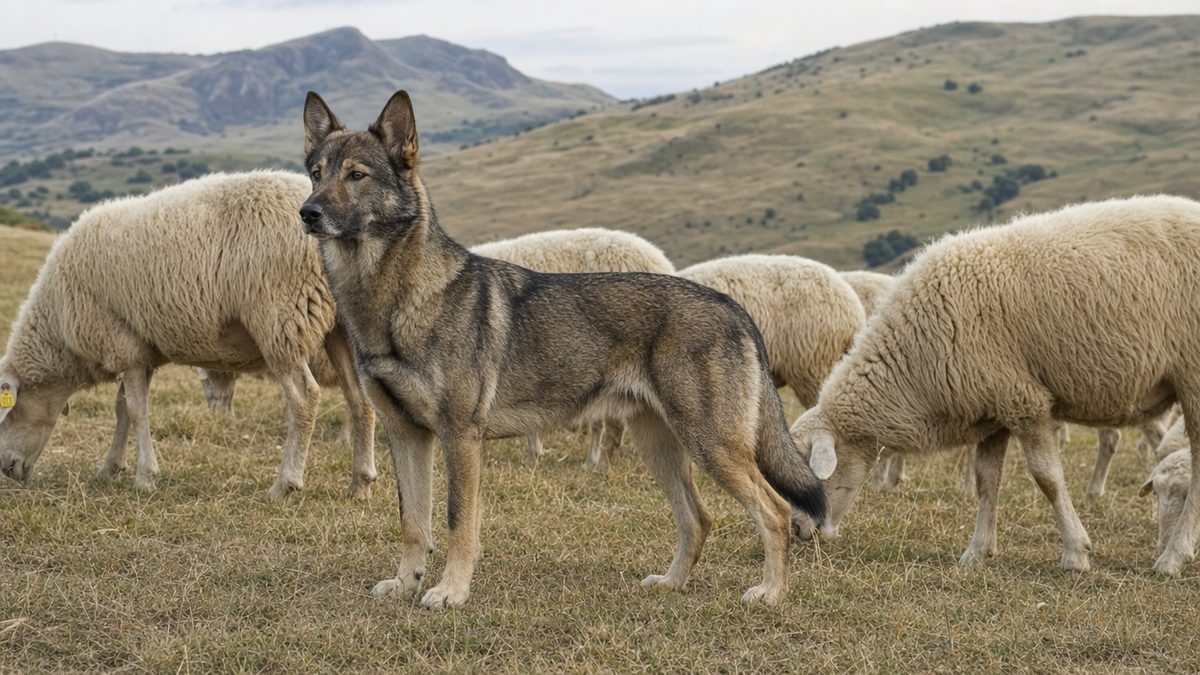
Two independent descriptions agree closely on the coat. The Border Collie Museum's Italian survey records a hard, medium rough coat, sometimes bearded, with a thick undercoat, and colours running through wolf grey or agouti with a black mask, grey brindle, leopard or merle, black, sable and tan. A breed feature published six years later gives the same colour set and describes the ears as erect or semi-erect and the skull as wolf-like. That double coat and that colour list both matter for an Indian reader, and both come back later on this page.
Almost every page you will find showing this breed, including the ranking ones, is using the same single Wikimedia Commons image. When a breed's entire visual record is one photograph, treat any confident description of its typical appearance with care.
Breed recognition: what the registers actually say
No kennel club anywhere recognises the Cane Paratore, and the finding that matters is not the FCI's absence but Italy's, because Italy runs an open register designed for precisely this kind of population and has not entered this one in it.
Start with the body that would hold it. The Ente Nazionale della Cinofilia Italiana keeps the Italian studbook under the supervision of the Ministry of Agriculture, Food Sovereignty and Forests. Alongside the main ROI register and the RSR supplementary register for recognised breeds, paragraph 4 of its own description sets out a third: a registro supplementare aperto, an open supplementary register, for the enrolment of subjects belonging to typical Italian populations in the recovery phase as breeds. Populations, not breeds. That is the exact category the Cane Paratore sits in.
It is not in it. ENCI's Group 1 list, covering sheepdogs and cattle dogs, was read in full and contains no Cane Paratore and no Cane Toccatore. A separate check of every breed ENCI lists under the letter C returns 66 entries, from Cairn Terrier to Curly Coated Retriever, and neither name is among them, while Cane Corso appears where it should as a control. Nor is the breed among the 18 Italian breeds on ENCI's dedicated Razze Italiane page.
The open register is being used, just not for this breed
ENCI's Group 1 list does hold four rustic Italian pastoral populations that took the RSA route: the Cane da Pastore della Sila, the Cane da Pastore d'Oropa, the Cane delle Alpi Apuane and the Pastore della Lessinia e del Lagorai. Two of those, Oropa and Lessinia e Lagorai, are named in the same 2018 genetic study as the Cane Paratore's sibling Italian herding populations. So the recovery route exists, it is open, it is being used, and two of this breed's closest relatives have walked through it while it has not.
| Population | In ENCI's register | Status there | Study's genomic verdict |
|---|---|---|---|
| Bergamasco Shepherd | Yes | Fully recognised Italian breed | Breed |
| Pastore d'Oropa | Yes | Open RSA register | Breed |
| Pastore della Lessinia e del Lagorai | Yes | Open RSA register | Variety |
| Cane Paratore | No | Absent entirely | Insufficient data |
| Lupino del Gigante | No | Absent entirely | Breed |
The FCI, checked on its own nomenclature
The Federation Cynologique Internationale does not recognise it either, and both halves of that register were checked. The Group 1 nomenclature page, confirmed by its own title as Sheepdogs and Cattledogs (except Swiss Cattledogs), carries no Paratore entry, with Bergamasco present as a control. The separate list of breeds recognised on a provisional basis holds 20 entries running up to standard number 378, including the Italian Segugio dell'Appennino at 375, and does not hold this breed. That control matters: Italian breeds do reach the provisional register, and ENCI announced the Segugio dell'Appennino's official recognition in March 2026. This one is absent because it has not been admitted, not because the door is shut.
Two peer-reviewed papers say the same thing in plain words. Dreger and colleagues note that a subset of the breeds they studied, naming the Mastino Abruzzese, the Cane Paratore and the Levriero Meridionale, is not officially recognized by any formal registry, while the remainder have received national or international recognition. The 2018 study records the same status in its own table.
There is no register anywhere that can issue a Cane Paratore pedigree, so any document offered as one is a document about a different breed or is not genuine. The Kennel Club of India registers FCI-recognised breeds, and a breed absent from the FCI cannot be registered through it either.
The evidence base: two dogs, and what that does to every claim
Every genetic statement made about this breed anywhere traces to two sampled dogs, and knowing that changes how you should read all of them, including the confident ones.
The number is printed in the papers. Dreger and colleagues list the Cane Paratore in their sample table under the abbreviation CPAT with an SNP sample size of 2. Talenti and colleagues, working with overlapping authors and the same Italian collection effort, give N as 2 in their table of genetic metrics for each Italian dog population. Two dogs is not a population sample. It is an anecdote with a genotype attached.
The 2018 paper is explicit about the consequence. It reports the breed's average SNP-based inbreeding coefficient as 0.081, printed in bold because it falls outside the range the authors had defined for purebred populations, which is 0.133 or above. Its single-dog length of homozygous runs is 1862.197 Mb. The shared-homozygosity and decay columns are blank, because those calculations need at least five and ten dogs respectively. Its phylogeny clustering entry reads No, and its status entry reads Insuff, under a footnote saying populations analysed with fewer than five individuals are insufficient to determine a status assignment.
Read that inbreeding figure carefully, because it is easy to get backwards. A value below the purebred floor implies more genetic diversity in those two dogs than a closed studbook breed typically carries, not less, which is exactly what you would expect of a working landrace population that has never had a closed register to narrow it. It is not evidence of a healthy breed. It is evidence that this is not a breed in the studbook sense at all, which is precisely the dispute the authors flag in the next paragraph.
The sentence the ranking pages leave out
In the same paper's discussion, the authors write that the classification of the Cane Paratore as a breed is highly disputed in Italy, before noting that the two dogs they had did group together, paraphyletic to the German Shepherd Dog and the Lupo Italiano, which suggests they are a distinct variety. That is a careful, hedged, honest sentence and it is the most important one written about this animal. Not one page ranking for the breed in India quotes it.
A third paper adds a different complication. Parker and colleagues found that four breeds in their analysis, listing Redbone Coonhound, Sloughi, Cane Paratore and Jack Russell Terrier, were split within single multi-breed clades rather than forming their own, and their figure legend flags Cane paratore among the small number of dogs that do not cluster with the rest of their breed.
How much literature exists, tested rather than assumed
PubMed holds zero records naming this breed, and that claim was earned rather than assumed. A phrase search for Cane Paratore returns 0, with the search engine's own query translation confirming it looked for cane and paratore together. Controls run in the same session behaved normally, with Labrador Retriever and hip dysplasia returning 54 records and Bergamasco with dog returning 13, so the search was working.
The reverse trap fired too, and it is worth naming because it is how an AI answer engine ends up confidently wrong here. A search for Cane Toccatore returns 12,199 records, but the query translation shows the word Toccatore was silently dropped and only cane was searched. Toccatore alone returns 0. Paratore alone returns 169, and the first three are papers on complex groin hernia, splenic shear wave elastography and cutaneous malignancies metastatic to the female genital tract, where Paratore is an author's surname.
There is no breed standard, no health survey, no lifespan study, no screening scheme and no registry dataset for the Cane Paratore. Any page giving you a confident lifespan, a disease prevalence or a temperament score for it has invented the number or copied someone who did.
History and origins: the dog of the moor
The Cane Paratore's history is a transhumance history, built around seasonal sheep migrations between the Puglian plains and the Apennine summer pastures that could take fifteen days on foot.
Southern Italian transhumance ran from the Tavoliere delle Puglie, a plain in the north-east of southern Italy, up into the Apennine pastures. The flocks travelled grassy drove roads that let them rest and graze on the way, and the journey could take as many as fifteen days. A small to medium-sized droving dog walked with them, and because of those long crossings it picked up the name the dog of the moor.
Two strains, which may explain the size argument
One breed feature reports two strains rather than one. Both were used by farmers to move herds from the Tavoliere to the montane Apennine pastures, and both work by nipping at stock. The smaller, milder Toccatore has less bite and is typically used with lop-eared Biellese sheep in mountain pastures, taking only as much fleece as it needs to turn a ewe in the right direction and never biting skin. If that is accurate, then Cane Paratore and Cane Toccatore are not simple synonyms, which is how Wikipedia and the Stockdog Savvy entry both treat them Hartnagle-Taylor JJ and Taylor T. It also offers one non-fabricated explanation for why published sizes vary, although it cannot rescue an 8 kg figure.
Where the breed is from, according to four different sources
Even the region is contested. The two peer-reviewed papers say Abruzzo Talenti A, Dreger DL, Frattini S. An Italian working-dog survey presents it among three ancient shepherd breeds of central Italy, unrecognised by the FCI but of very old heritage. A breed feature calls it an ancient breed that originated in southern Italy. Creatures.com places it in Calabria. Abruzzo is central Italy on the Adriatic side, the transhumance route ran through Puglia in the south, and Calabria is the toe of the peninsula and the home of a different dog. The peer-reviewed answer is Abruzzo, and the working range plainly extended south along the drove roads.
Why the population collapsed
Italian pastoralism industrialised after the Second World War and the old customs went with it. Transhumance in the Apennines is dying out, wool production has almost completely disappeared, and Italy now has a relatively low livestock density for an Alpine country. Most of the transhumance that survives is in the north, which is why this southern droving dog is not well known and is endangered. Where flocks are still herded, Border Collies now do most of the work, and Maremma Sheepdogs do most of the wolf protection. Its conservation status has never been formally assessed by any body, and it cannot be, because a status assessment needs a register and a census and this population has neither.
Conservation work does exist, and the serious version of it is documented. A project in the Parco dei Monti Aurunci, run with Regione Lazio, built a reference centre for the scientific, medical and historical study of the Mastino Abruzzese and other ancient Italian working breeds, naming the Cane Toccatore or Paratore among them. Its stated steps were to census the animals still living in working conditions, constitute an official register of rustic subjects, take DNA samples to study genetics and kinship, develop a controlled reproduction programme, and run behavioural tests to identify working aptitude. That is the shape of a genuine landrace recovery, and it is the work that would eventually produce an ENCI entry.
Both surveys report that local advocates trace the breed to the wolf and that bitches in heat are said to mate with wolves, which one preservation centre treats as a spontaneous restoration of bloodlines. The Border Collie Museum prints the claim and immediately notes that wolf researchers say wolves and dogs do not spontaneously breed, though people have been known to arrange it. No genetic study has tested it.
Cane Paratore price in India
There is no cane paratore price in india, because there is no Cane Paratore in India. No Indian breeder advertises the breed, no Indian listing exists for it, and no rupee figure for a puppy was found anywhere.
That absence was tested rather than assumed, because a zero result on a rare breed is exactly the answer you expect and therefore exactly the answer you should distrust. Searching the breed name plus price in india, from an India location, returned no Indian seller and no puppy listing. What it returned instead was an Etsy India page selling a dog-head walking cane at Rs 4,530, an embroidered Cane Paratore hat, a Scribd upload of a supplementary table from the 2018 genetics paper, and an AI-generated stock art listing captioning the breed as a livestock guardian.
The control confirms the search worked. The same tool, in the same session, asked for a Labrador Retriever price in india, returned a full Indian puppy marketplace with tiered rupee bands: Rs 30,000 to Rs 60,000 for basic quality, Rs 60,000 to Rs 90,000 for KCI registered and Rs 90,000 to Rs 1,20,000 for champion bloodline, listed city by city. The Indian price web was reachable and working. It simply has nothing on this breed.
The one genuine rupee figure attached to this breed
One Indian product does name the Cane Paratore, and it is not a dog. EasyDNA India sells a KnowYourDog Genetic and Breed Test at Rs 12,600, and the Cane Paratore sits in its reference panel of more than 400 breeds, listed between Canina and Cardigan Welsh Corgi. That panel exists because of the research samples described earlier on this page. The same panel also carries an entry called Village Dog India, which is what an Indian street dog will actually come back as.
| Result | What it sells | Price shown | Is it a dog |
|---|---|---|---|
| Etsy India, dog head cane | A walking stick | Rs 4,530 | No |
| Etsy India, Cane Paratore hat | An embroidered cap | Not shown | No |
| EasyDNA India KnowYourDog | A DNA test naming the breed in its panel | Rs 12,600 | No |
| Creatures.com breed page | Nothing. Zero listings, zero breeders | None | No |
| Scribd | A supplementary table from a 2018 genetics paper | None | No |
Why no affordable Indian price will ever appear
The reason is structural rather than commercial. Dogs are a Restricted import into India and commercial imports for breeding are not permitted, so no founding stock can lawfully enter. And there is no register anywhere that could issue a pedigree for the breed, so even a lawfully imported pet could not be sold on as a documented Cane Paratore Federation Cynologique Internationale. Those two facts together mean no lawful Indian supply chain can form. The next section walks through the import rules in detail.
Any rupee figure offered for a Cane Paratore puppy in India is for a different dog. Ask for the import authorisation and the register that issued the pedigree, in that order, and the conversation will end.
Import rules: why the lawful route closes
To import a dog into India you must fit one of three permitted purposes, and none of them lets you bring in a rare breed to start a line, which is why this breed has no Indian population.
The governing document is DGFT Trade Notice No. 22/2022-23, dated 19 December 2022, and it is short enough to read in full. Dogs fall under ITC (HS) 01061900, Mammals: Other, with an import policy of Restricted. Policy Condition 7 then lists the only three permitted purposes.
- Pet dog with valid pet book and relevant records or documents in the name of the importer.
- Dogs imported by research and development organisations for conducting research, with the recommendation of CPCSEA.
- For the internal security by the Defence and Police Force.
Policy Condition 8 closes the gap directly: import of commercial dogs for breeding or any other commercial activity, other than the purposes mentioned above, is not permitted. Paragraph 6 says the same thing procedurally, that any applications for trading or breeding purposes, or applications made on behalf of some another person or entity, shall be duly rejected.
What the pet route actually requires
The pet route is real but narrow. Up to two pets may enter as passenger baggage without a DGFT authorisation only where the owner is transferring residence to India after two years of continuous stay abroad. Anything else, including a shorter stay abroad, more than two animals, or an animal not travelling as baggage, needs an import authorisation from DGFT. Applications should be started at least two months before travel, and entry is permitted only through the airports and seaports of Delhi, Mumbai, Chennai, Hyderabad, Bengaluru and Kolkata and, since October 2024, Kochi airport, with quarantine at government stations where required Department of Animal Husbandry…. The full route is set out in how to import a dog to India.
An advance no-objection certificate from the regional or quarantine officer of those ports is also needed, obtained seven days before travel and relaxable to three, after submitting the DGFT import licence and a health certificate from a veterinarian in the exporting country, with all prescribed disease testing done abroad and the reports travelling with the animal.
The second door, and why it is also shut
Suppose someone did move back from Italy with a Cane Paratore in their own name. Breeding from it in India then runs into the 2017 Rules. Second Schedule Part II paragraph 6 permits only two mating techniques, out breeding, meaning the mating of dogs not at all related to one another, and line breeding, meaning mating between dogs that are marginally related. It prohibits in breeding, defined as mating between relatives of the second to fourth grade in straight or side line within the first four generations, and incest breeding between parents and children or brother and sister.
Those rules are fatal for founding a rare breed from a handful of animals, because founding a rare breed from a handful of animals is exactly in breeding. The study data underline the point: the entire genetic record for this population is two dogs, with the shared-homozygosity measures blank because there were not enough animals to compute them. Any Indian line would be inbred from generation two, and Second Schedule Part II para 6(3) forbids it.
These two documents together, the trade notice and the 2017 Rules, settle far more than this one breed. Whenever an Indian seller advertises a rare European breed, ask for the import authorisation number. There is no other lawful way the parents could have arrived.
Monthly cost of ownership for a dog of this size in India
Budget roughly Rs 6,000 to Rs 14,000 a month for a 15 to 25 kg working dog in an Indian metro, and treat any figure specific to this breed as invented, because no Indian owner cost data for it exists.
There is no honest breed-specific cost table to publish here, so this section prices the animal Stockdog Savvy describes, which is a 15 to 25 kg athletic double-coated dog with a very high activity level. The structure below is what that animal costs to keep well in an Indian city, and it is bounded rather than precise.
| Line item | Typical monthly range | What drives it |
|---|---|---|
| Food | Rs 3,000 - Rs 7,000 | Bodyweight and activity. A working-level dog eats more than a pet of the same size |
| Tick and flea control | Rs 500 - Rs 1,500 | Non-negotiable in India. Year-round in the south, seasonal peaks elsewhere |
| Deworming and preventives | Rs 200 - Rs 500 | Monthly or quarterly depending on protocol |
| Routine vet, amortised | Rs 500 - Rs 1,500 | Annual vaccination and one or two consultations spread across the year |
| Grooming supplies or salon | Rs 300 - Rs 2,000 | Undercoat rake and shampoo at home, or a monthly de-shed at a salon |
| Cooling and containment | Rs 500 - Rs 2,000 | Fan or air conditioning load, cooling mat, secure fencing for a dog that bolts at movement |
Two of those lines are larger for this type of dog than for an average Indian pet. Tick control is one, because a droving dog spends its life in vegetation and India's tick pressure is severe: one Chennai survey found 229 of 230 dogs infested, with a mean intensity of 5.65 ticks per dog. Cooling is the other, and the climate section explains why.
The one-off costs nobody budgets for
- Secure fencing, because a dog bred to react to movement will chase a scooter through an open gate.
- A brainstem auditory evoked response hearing test, if the dog is merle or of unknown parentage, since that is the only definitive way to diagnose deafness.
- A first-year vaccination course, which the 2017 Rules note can start at seven to eight weeks and is usually completed by eighteen weeks.
- Sterilisation, which the same Rules require before any dog over six months in age is sold onward by a breeder.
Note what is missing from this list compared with a mainstream breed page. There is no hip or elbow screening cost line, because no scheme exists for this breed to screen against, and no breed-club health levy, because no breed club exists. That is a saving on paper and a liability in practice: you are not paying for screening because there is nothing to buy.
Indian breed price and cost tables are frequently a single foreign price list converted at one exchange rate, which is why a whole column of unrelated breeds can share an identical rupee value. With no Indian owners of this breed to survey, publishing a precise monthly figure for it would be inventing one.
Heat tolerance and the Indian climate
The Cane Paratore has poor heat tolerance for Indian conditions, and the cleanest way to show it is that the coolest large Indian city Bonbeno covers is warmer all year than the hottest month in the dog's home range.
The origin figures come from NASA POWER's 20-year meteorological climatology for 2001 to 2020, queried by explicit latitude and longitude so the dataset cannot hand back a different place by accident. At 42.35 N, 13.399 E, in the L'Aquila province of Abruzzo at 950 metres, the annual mean temperature is 10.8 C and the warmest month, July, averages 21.5 C at 54.6 percent relative humidity.
The winter end of the transhumance route is warmer but still not Indian. At Foggia on the Tavoliere delle Puglie, at 41.462 N, 15.545 E and 128 metres, the annual mean is 16.8 C and July averages 27.5 C at 48.6 percent humidity. So across its whole working range this dog experiences a hot, dry Mediterranean summer of about six weeks and a long cool remainder, and it spends the hottest part of the year at altitude.
| Location | Annual mean temp | Hottest month mean | Humidity that month |
|---|---|---|---|
| L'Aquila, Abruzzo (origin, 950 m) | 10.8 C | 21.5 C (July) | 54.6% |
| Foggia, Puglia (winter pasture) | 16.8 C | 27.5 C (July) | 48.6% |
| Bengaluru | 23.7 C | 28.4 C (April) | 48.7% |
| Pune | 23.9 C | 28.9 C (April) | 42.1% |
| Delhi | 25.6 C | 35.9 C (June) | 36.4% |
| Mumbai | 26.8 C | 31.2 C (May) | 60.2% |
| Chennai | 27.9 C | 31.5 C (May) | 64.5% |
Read the first column, not the third. Bengaluru's annual mean of 23.7 C is higher than the 21.5 C that Abruzzo manages in its hottest month. Chennai's annual mean of 27.9 C exceeds it by 6.4 C. That is the whole argument: this dog's summer is India's winter, and India's summer has no equivalent in its evolutionary experience at all.
The coat makes it worse, and shaving makes it worse again
The coat is a hard, medium-length outer layer over a thick undercoat, described consistently across two independent field descriptions Szeremy S, The Dog of the Moor. A double coat is an insulating system that works in both directions, which is why the standing advice for every double-coated breed is never to shave it. Shaving removes the guard hair that reflects sun and blocks the coat from lofting, and it leaves the skin exposed in a country where the sun is the problem. Manage the undercoat instead, which the grooming section covers.
What a heat-sensitive working dog needs here
- Walk and work before 07:00 and after 19:00 from March to October in every city in the table above.
- Check the pavement with the back of your hand for five seconds before any daytime walk.
- Provide shade and moving air rather than a cold room, and wet the coat down to the skin rather than laying ice on top of it.
- Watch for heavy panting that does not settle within ten minutes of stopping, which is the point to cool the dog actively and call a vet.
- Cut the workload rather than the walk. A movement-hungry dog denied exercise in summer becomes a destructive one, so shift the work to scentwork and training indoors.
Bonbeno rates this breed 2 out of 5 for heat tolerance in India, and that rating is generous. It is a heat-sensitive dog from a 950 metre plateau, and the only Indian places where it would be genuinely comfortable year-round are hill stations, not metros.
Temperament and household fit
The Cane Paratore is an independent, movement-triggered working dog, not a family companion, and the honest household advice is that almost no Indian home is a fit for one.
The temperament descriptions available are functional rather than behavioural, and that distinction matters. Nobody has run a temperament survey on this breed, so what exists is what people who watched it work wrote down. The working literature describes exceptional toughness, agility, stamina and strength, a dog that matures earlier than most modern breeds and is fiercely protective of its young. One breed round-up calls it smart, very active and independent, with a high work ethic.
Independence is the load-bearing word. A droving dog on a fifteen-day transhumance is working out of sight of its handler for hours, deciding when to block a lane and how much pressure to apply to a ewe. Selection for that produces a dog that assesses instructions rather than executing them. In a home, that reads as a dog that is neither stupid nor disobedient but is plainly running its own risk assessment before it complies.
Who this dog would suit
- Handlers with real livestock and a real job for the dog to do daily.
- Households in cool hill country with secure fenced land, not a balcony.
- Owners who have already lived with an independent working breed and know what it takes.
- People who want a working partner rather than an affectionate companion.
Who it would not suit
- First-time owners, who will be outmanoeuvred inside a fortnight.
- Apartment households in any Indian metro, where the heat, the noise sensitivity and the exercise need all collide.
- Homes with small children and no fenced outdoor space, because a movement-triggered herding dog and running toddlers are a predictable problem.
- Anyone buying for the wolf-like look, which is the commonest reason people search this breed and the worst reason to own one.
The wolf question deserves a straight answer. This dog looks lupine, advocates trace it to the wolf, and one preservation group treats occasional wolf matings as a spontaneous restoration of bloodlines, though the survey that reports this immediately notes that wolf researchers say wolves and dogs do not spontaneously breed. No genetic study has tested wolf ancestry in this population, and the 2018 paper that sampled Apennine wolves alongside Italian dogs did not report the Paratore as a wolf hybrid; that label went to the Lupo Italiano, which was deliberately produced from an Apennine wolf and German Shepherd Dogs and is managed by the Italian state.
If the appeal is a hardy, independent, wolf-like dog with real working instinct and no interest in being carried around, that is a description of a well-socialised Indian street dog, and India has millions of them looking for homes.
Training a droving dog, and what it resists
To train a Cane Paratore type you buy the behaviour rather than command it, because a dog selected to make its own decisions at distance will negotiate every instruction it does not see the point of.
Nothing breed-specific has been published on training this dog, so this section applies what is known about the job it was bred for. It is a conducting dog rather than a guarding dog, one of two droving breeds in an Italian survey that sorts pastoral dogs by task into guard dogs, droving dogs and alarm dogs. Droving work rewards initiative, distance decision-making and self-restraint under pressure, and it punishes a dog that waits to be told.
What works
- Pay for choices, not for compliance. Reward the dog for choosing to check in rather than for holding a position it sees no reason to hold.
- Build a real recall before anything else, because a droving dog that fixes on movement at fifty metres is already gone.
- Give the drive an outlet daily. Treibball, herding balls, scentwork and structured fetch all substitute for stock work.
- Socialise early and deliberately, especially to traffic, cattle, scooters and children running, which are the four movement triggers an Indian street presents.
- Train in short sessions in the cool hours, because a heat-stressed dog cannot learn.
What it will resist
Expect resistance to repetition without purpose, to being handled by strangers, and to correction-based methods. A dog bred to apply measured pressure to a much larger animal does not fold when a human applies pressure to it; it escalates or disengages. Expect it to be vocal, expect it to herd anything that moves including your family, and expect adolescence to be genuinely difficult, since the working literature describes a breed that matures early physically and is fiercely protective of its young.
The Indian complication nobody writes about
Herding instinct in an Indian city is a management problem rather than a training problem. A dog that reacts to movement lives on a street with autos, bikes, free-roaming dogs, cattle and cricket. The training that matters most here is not a sit, it is a rock-solid settle, a muzzle conditioned as a neutral object, and a household routine that lets the dog work its brain indoors during the eight hours a day it is too hot to be outside. If you cannot commit to that, no amount of obedience training will make the dog comfortable.
This training profile fits every droving breed, so it applies just as well to a Border Collie or an Australian Shepherd in an Indian city, and those two you can actually meet, train with and get help for locally.
Daily exercise requirement
Plan for at least two hours of real work a day, split across the cool hours, because this is a dog bred to walk flocks along drove roads for up to fifteen consecutive days.
The exercise figure comes from the job rather than from a survey. Transhumant flocks moving between the Tavoliere delle Puglie and the Apennine pastures travelled for as many as fifteen days, and a droving dog walked the whole route working the flanks. Field descriptions credit the breed with exceptional stamina and endurance, and one round-up calls it very active with a high work ethic. That is an animal whose baseline is a full working day, not a 20 minute round of the block.
| Time | Activity | Duration | Why then |
|---|---|---|---|
| 05:30 - 07:00 | Long walk, off-lead work in a secure space, recall drills | 60-75 min | Coolest part of the Indian day in every city on this page |
| Mid-morning | Scentwork or a food puzzle indoors | 15-20 min | Mental load without heat load |
| Afternoon | Rest, indoors, with moving air | None | Pavement and air temperature both peak |
| 19:30 - 21:00 | Second walk plus training or a herding ball | 45-60 min | Surfaces have cooled, humidity is the remaining risk |
What happens without it
An under-exercised droving dog does not become calm, it becomes inventive. The predictable outcomes are compulsive chasing of vehicles and children, resource guarding, destructive chewing, barking at every passing sound, and nipping at heels, which is not aggression but the breed's actual job applied to the wrong species. None of this is fixable by training alone once it is established, because the underlying need has not been met.
Exercising safely in Indian heat
The controlling constraint here is not fitness, it is thermoregulation. A dog whose ancestors worked at 21.5 C in the hottest month cannot be conditioned into tolerating a Chennai afternoon. Carry water on every outing, stop at the first sign of a wide-mouthed frantic pant, wet the dog down to the skin rather than laying a wet towel on top of the coat, and cancel outright on high-humidity days when evaporative cooling stops working. In Mumbai and Pune the monsoon months are the trap, because the temperature drops while the humidity climbs above 89 percent and panting loses most of its effect.
If you cannot honestly commit to 90 minutes of outdoor work before breakfast, every day, in June, this is not the type of dog for your household. That is true of the Cane Paratore and equally true of the herding breeds you can actually buy in India.
Grooming a double coat in Indian humidity
Brush this coat two to three times a week in the dry season and near-daily through the monsoon, work the undercoat out with a rake rather than a slicker, and never shave it.
The coat is described consistently by the two field sources: a hard, medium rough outer coat over a thick undercoat, sometimes bearded, in wolf grey or agouti with a black mask, grey brindle, leopard or merle, black, sable and tan. A later feature gives the same colour set and adds that coat length runs short to semi-long. Stockdog Savvy records it simply as medium length with varied textures. A weather-resistant working double coat, in other words, built for rain and cold rather than for humidity.
The Indian monsoon problem
A dense undercoat that stays damp is the single biggest grooming risk in an Indian summer monsoon. Trapped moisture at skin level under a packed undercoat produces hot spots, and a dog that goes out in the rain twice a day and is towelled off on the surface is still wet underneath four hours later. The fix is mechanical: get the dead undercoat out so the coat can dry, rather than sealing it in.
- Rake the undercoat with an undercoat rake or a coat king, in sections, down to the skin, twice weekly in dry months.
- Blow the coat dry after every soaking, using a pet dryer or a cool hairdryer on low, lifting the coat as you go.
- Bathe sparingly, roughly every six to eight weeks, and only with a shampoo that rinses out completely.
- Check and dry the skin folds, armpits and groin daily during the monsoon, which is where hot spots start.
- Comb the beard and the ear fringes if the dog has them, because food and moisture collect there.
The ear advantage, and the one exception to house advice
This is one place where breed-club care advice from a cooler country happens to transfer. Erect and semi-erect ears ventilate well, so this type carries far less monsoon otitis risk than the drop-eared gundogs Bonbeno has covered elsewhere. That is a genuine advantage in India and it is worth saying plainly rather than repeating a generic warning. Still plug the ears before a bath, because water going in is water going in regardless of ear carriage.
Ticks, which for this coat is a grooming job
In India, brushing this dog is also a tick check. One Chennai survey found 229 of 230 dogs carrying ticks, at a mean intensity of 5.65 per dog, with Rhipicephalus sanguineus sensu lato on 98.3 percent of infested animals. A dense undercoat hides an engorging tick completely. Run your fingers through the coat at skin level over the ears, neck, armpits, groin and between the toes every single time you groom.
Shaving does not cool a double-coated dog. It removes the guard hairs that block sun and stops the coat lofting to trap moving air, and in India it exposes skin to a sun the dog has no pigment strategy for. Manage the undercoat instead.
Health risks and life expectancy
No health survey, screening scheme or lifespan study exists for the Cane Paratore, so this page publishes no life expectancy figure for it and explains instead what the one real risk in the breed's own colour list implies.
Start with what is not known, because that is the honest headline. There is no breed club running a health scheme, no orthopaedic registry entry, no published mortality dataset and no peer-reviewed paper on the health of this population. Two papers state that it is not recognised by any formal registry, which is also why no registry health data can exist Talenti A, Dreger DL, Frattini S.
The disease list on the ranking pages does not survive checking
English Wikipedia says the breed is prone to osteodystrophy, spinocerebellar ataxia and Legg-Calve-Perthes disease, and cites a commercial DNA-test retailer's product page for all three. That page carries the same list plus glenoid protrusion syndrome, and it also states that the breed weighs 8 to 10 kg, was created as a guard and defence dog, was used to hunt large animals, was trained by the Italian army during the Second World War to locate mines and other explosives, and is today one of the most popular dog breeds in Italy. ENCI's register refutes the last of those outright, since the breed does not appear in it at all.
Legg-Calve-Perthes is the tell. It is a small and toy-breed condition, and it fits a dog of 8 to 10 kg, which is the size the same page invented. A disease list generated around a wrong bodyweight is a disease list about a different animal. Bonbeno does not reproduce it.
The merle gene, which is a real and specific risk here
Leopard, meaning merle, appears in this breed's colour list in both independent field descriptions Szeremy S, The Dog of the Moor. That is not decorative information. Merle is caused by a retrotransposon insertion in the SILV or PMEL gene, and most congenital deafness in dogs is sensorineural hereditary deafness associated with the genes for white pigment, meaning piebald or merle.
The specific danger in an unregistered landrace population is hidden merle. A study of merle variants in the Mudi, another herding breed, genotyped 123 dogs from 11 countries and found classic merle in 61.8 percent, harlequin merle in 13.8 percent, atypical variants in 5.7 percent, double merle in 0.8 percent and mosaic profiles in 17.9 percent. Its practical conclusion is the one that matters here: dogs whose merle is fully covered by pheomelanin-dominated colouring still carry the insertion and can unintentionally produce homozygous double merle progeny with ophthalmologic, viability and auditory impairments.
So in a population with no studbook, no pedigrees, no colour records and no DNA testing, two apparently non-merle dogs can produce a double merle litter and nobody will know why. Definitive diagnosis of deafness requires brainstem auditory evoked response testing, not a hand clap.
What Indian law requires, and the gap in it
The 2017 Rules do impose genetic testing on Indian breeders. Second Schedule Part III paragraph 8(10) says dogs shall have been tested for genetic defects including hip dysplasia, progressive retinal atrophy, night blindness, hypothyroidism, entropion, ectropion, overshot and undershot jaw, wry mouth, two or more missing teeth, and unilateral or full cryptorchidism. Read that list against the paragraph above. It names two eye conditions and no hearing test at all, and it never mentions merle or BAER. For a merle-carrying breed, Indian law's mandatory screen misses the one thing you would most want screened.
Sources give 12 to 15 years, but that number comes from the same DNA-retailer page that invented the size and the disease list, so Bonbeno will not repeat it. There is no lifespan study for this breed. An absent figure honestly reported is worth more than a confident one that cannot be traced.
The Indian health risks that would actually matter
In India the realistic threats to a working dog of this type are tick-borne disease, heat injury and the tropical parasite load, none of which appear on any page currently ranking for this breed.
Tick-borne disease is the first and largest. A survey of 230 dogs in Tamil Nadu found 229 of them, or 99.6 percent, infested with ticks at a mean intensity of 5.65 per dog, with Rhipicephalus sanguineus sensu lato on 98.3 percent of infested animals. Overall, 67.8 percent of the dogs were positive for at least one vector-borne pathogen, led by Hepatozoon canis at 37.8 percent, Anaplasma platys at 22.6 percent, Ehrlichia canis at 16.1 percent and Babesia vogeli at 10 percent.
Working dogs in India carry the same load. A two-year study of 225 suspected canine monocytic ehrlichiosis cases in organised kennels across different geo-climatic zones of India estimated prevalence at 1.3 percent by microscopy, 19.1 percent by commercial dot-ELISA and 5.8 percent by nested PCR, and the three methods differed significantly. Its most useful finding for an owner is that 24 of the 46 positive dogs were apparently healthy at the time, and that concurrent Ehrlichia canis and Babesia gibsoni infections were mostly fatal.
| Finding | Tamil Nadu, 230 dogs | Working dogs, 225 suspected cases |
|---|---|---|
| Dogs infested with ticks | 229 of 230 (99.6%) | Not reported |
| Positive for at least one pathogen | 156 of 230 (67.8%) | 46 positive overall |
| Ehrlichia canis | 16.1% | 19.1% by dot-ELISA, 5.8% by nested PCR |
| Hepatozoon canis | 37.8% | Not reported |
| Babesia vogeli | 10% | Not reported |
| Positive but apparently healthy | Not reported | 24 of 46 |
The two studies disagree on how big the Ehrlichia problem is, and that disagreement is worth publishing rather than smoothing away. The Tamil Nadu survey put E. canis at 16.1 percent in a general dog population, while the working-dog study concluded that widespread doxycycline use in the field means canine monocytic ehrlichiosis no longer poses the threat it once did. Different populations, different years, different methods. What both agree on is that the exposure is heavy and that a healthy-looking dog can be positive.
Heat injury, the risk this breed brings with it
A double-coated dog from a home range averaging 10.8 C a year is a heatstroke candidate in an Indian summer, and heatstroke is a rapidly fatal emergency rather than a discomfort. The practical protocol is prevention, since treatment is a race. Work only in the cool hours, never leave the dog in a parked vehicle, wet the coat down to the skin rather than laying something cold on top, move air across the dog, and go to a vet at the first sign of a frantic wide-mouthed pant that does not settle.
A screening plan for a dog with no screening scheme
- Book a BAER hearing test as a puppy if the dog is merle or of unknown parentage, because that is the only definitive diagnosis of deafness.
- Run a full ophthalmic examination, since merle is associated with ocular as well as auditory defects.
- Screen hips and elbows anyway, because Indian law lists hip dysplasia among the mandated genetic-defect tests and because no breed data exists to reassure you.
- Keep a year-round tick preventive and check the coat at skin level after every outing.
- Screen for vector-borne pathogens annually, including in a dog that looks entirely well.
This is the section where a rare-breed page usually invents reassurance. There is nothing to be reassured by here. A breed with no screening scheme is not a healthy breed, it is an unmeasured one, and those are different things.
Feeding and nutrition in India
Feed a working dog of this size to body condition rather than to a chart, because no breed-specific feeding data exists and the historical diet described for it would not meet a modern nutritional standard.
The traditional diet is on record and is worth knowing precisely because you should not copy it. Historically these dogs were fed on shepherds' leftovers, meaning bran, whey, stale bread and scraps from the meal. That is a survival ration for a dog doing heavy daily work on a mountain, and it is protein-poor, calcium-imbalanced and inadequate for a growing puppy. It tells you the dog is a thrifty feeder, not that the diet was good.
Feed to body condition, and how to read it
The only reliable feeding instrument for a breed with no published growth curves is the dog in front of you. On a nine-point body condition scale you want a 4 or 5: ribs easily felt under a thin fat cover, a visible waist behind the ribs when viewed from above, and an abdominal tuck seen from the side. Adjust the portion by 10 percent at a time and reassess after two weeks. An athletic droving dog carrying visible ribs is not necessarily thin, and one with no waist is overweight regardless of what the bag says.
| Stage | Meals per day | Priority | Watch for |
|---|---|---|---|
| 8-16 weeks | 4, then 3 | Complete growth diet, never adult food | Rapid growth on an over-rich diet stressing joints |
| 4-12 months | 3, then 2 | Steady growth, lean condition | Weight gain outpacing the skeleton |
| 1-7 years | 2 | Match calories to actual daily work | Summer appetite drop, which is normal |
| 7 years and over | 2 | Maintain muscle, protect joints | Muscle loss mistaken for healthy weight loss |
The Indian practicalities
- Split the ration across the cool hours. A dog that will not eat at 3 pm in May is thermoregulating, not fussy.
- Store kibble in an airtight container, because Indian humidity turns an opened bag rancid faster than the printed date implies.
- Provide constant fresh water and expect intake to roughly double between January and May.
- Introduce any diet change over seven days, because a working dog with loose stools in the monsoon is a dehydration risk.
- Avoid raw feeding unless you have a veterinarian supervising it, given India's parasite and Salmonella load.
One legal note applies to anyone acquiring a puppy in India rather than to the diet itself. The 2017 Rules require that pups less than eight weeks in age are not sold, under Rule 8(1)(a). A puppy taken off its dam before eight weeks arrives with both a nutritional and a behavioural deficit, and no feeding plan fixes either.
Any page giving you a daily gram figure for this specific breed has made it up. There is no published growth curve, no breed weight range agreed across sources and no feeding trial. Weigh the dog monthly, score its condition, and let those two numbers set the portion.
Month by month through the first year
A droving-type puppy's first year runs on two clocks, a socialisation clock that closes early and a growth clock that closes late, and in India a third clock runs alongside both, which is the summer.
No breed-specific development data exists, so this timeline applies what is documented about the type. The working literature reports that these dogs mature earlier than most modern breeds, which if accurate compresses the adolescent window rather than removing it. Treat the schedule below as the framework for any 15 to 25 kg herding-type puppy in an Indian household.
| Age | What is happening | What you do |
|---|---|---|
| 0-8 weeks | With the dam. Rule 8(1)(a) forbids sale below eight weeks | Do not accept a puppy earlier, whatever the reason offered |
| 8-12 weeks | Socialisation window closing fast | Traffic, cattle, scooters, children running, other dogs, indoors and in the cool hours |
| 7-18 weeks | Vaccination course, which the Rules note can start at seven to eight weeks and usually completes by eighteen | Follow your vet's schedule and start tick prevention |
| 3-6 months | Herding instinct emerging as chasing and heel-nipping | Redirect onto a herding ball, never punish the instinct itself |
| 6-9 months | Adolescence. Recall degrades sharply | Long line outdoors, rebuild recall daily, no off-lead near roads |
| 9-12 months | Physical maturity approaching, drive at its peak | Full workload in the cool hours, structured jobs indoors in the heat |
| First summer | Whichever month it falls in, the hardest test of the year | Shift everything before 07:00 and after 19:30, cut duration not frequency |
The three checks worth booking in the first year
- BAER hearing test before 12 weeks if the coat is merle or the parents are unknown.
- Ophthalmic examination at the same visit, because merle affects eyes as well as ears.
- Baseline hip and elbow radiographs at the age your veterinarian advises, since no breed screening scheme exists to compare against.
The Indian first-summer problem
A puppy born in October reaches its peak exercise need in April, and April is the hottest month of the year in Bengaluru and Pune at 28.4 C and 28.9 C respectively, with Delhi's June mean at 35.9 C ahead of it. A high-drive adolescent with nowhere to put its energy, in a season when it cannot safely be outdoors, is the exact recipe for the behaviour problems the exercise section describes. Plan the indoor work before the summer arrives rather than during it.
Weigh the puppy on the same scale every fortnight and keep the numbers. With no breed growth curve to compare against, your own graph is the only growth data that will ever exist for your dog.
Cane Paratore compared with the breeds an Indian buyer can actually get
Compared head to head, the cane paratore loses on every practical axis to breeds already available in India, and the comparison is worth printing because it shows what you would actually be buying if someone offered you one.
The honest framing is that this is not a purchase decision. It is a curiosity. Nobody in India can lawfully import a dog for breeding or trading, so no supply chain can form, and the comparison below exists to name what an Indian buyer would get instead if they went looking for a wolf-like, independent, hard-working herding dog.
| Breed | Register status | Published breed standard | Health screening scheme | Available in India |
|---|---|---|---|---|
| Cane Paratore | None. Absent from ENCI and FCI | None found | None | No |
| Bergamasco Shepherd | FCI Group 1, ENCI Italian breed | Yes | Breed club schemes abroad | Rarely, by import |
| Border Collie | FCI Group 1 | Yes | CEA, TNS, CL DNA tests widely offered | Yes |
| German Shepherd Dog | FCI Group 1 | Yes | Hip and elbow scoring worldwide | Yes, widely |
| Indian Pariah Dog | Landrace, no closed studbook | KCI standard exists | None, but a large open gene pool | Yes, free from any shelter |
The Bergamasco is the closest legitimate substitute for the look. It sits in the same 2018 genetic study as one of the Italian herding populations, it clusters cleanly as a breed on all four genomic measures, and unlike the Paratore it has an FCI standard and a national club. Read the Bergamasco Shepherd guide if the corded coat appeals; read the Cane di Oropa guide if what you liked was the rustic Italian droving type, because that one has at least reached Italy's open register.
The German Shepherd is the comparison the genetics keeps forcing. Parker and colleagues found that the German Shepherd Dog groups with the Cane Paratore in the same admixture analysis, and read that as a recent common ancestor, since the German Shepherd was itself derived from a herding dog of unknown ancestry in the late 1800s. If you want the ancestral working type in a dog with a standard, a studbook and hip scoring, that is the German Shepherd, and it is on every Indian street.
The comparison nobody makes, and the one that matters
The Indian Pariah Dog beats the Cane Paratore on the single measure this page keeps returning to, which is gene pool size. The Paratore's two sampled dogs returned an average inbreeding coefficient of 0.081, printed in bold by the authors because it falls outside the range they had defined for purebred populations, and the study could not assign the population a status at all on a sample that small. An Indian street dog carries an open, unmanaged, enormous gene pool by comparison. If your reason for wanting a Paratore is that you like a functional, wolf-shaped, weatherproof, low-maintenance working dog with no inherited-disease baggage, the Indian Pariah Dog is that dog, it is adapted to this climate rather than to a 950 metre Apennine plateau, and it is free.
Every quality attributed to the Cane Paratore in the ranking pages, meaning hardiness, endurance, independence, a weatherproof coat and a wolf-like head, describes the Indian Pariah Dog as well, and that one you can meet this afternoon.
Common mistakes Indian readers make about the Cane Paratore
The commonest mistake with this breed is believing the page you landed on, because five of the ten results ranking for it in India carry at least one claim that a primary document contradicts.
This section is unusual for a breed guide, because the mistakes here are informational rather than practical. Almost nobody in India owns one of these dogs, so nobody is over-feeding it. What people are doing is repeating things about it, and an AI answer engine reading the current ranking set will repeat them too.
Mistake 1: believing the size on Wikipedia
English Wikipedia gives the breed as 8 to 10 kg with a shoulder height of 30 to 35 cm, in the same sentence that calls it medium-sized. Those figures describe a Pug. The single independent published measurement, from the authors of the herding-dog reference work Stockdog Savvy, gives 50 to 55 cm at the shoulder and 15 to 25 kg. Wikipedia's figures trace to a commercial DNA-test retailer's product page, and the same page supplies Wikipedia's entire disease list. Publish nothing off that number.
Mistake 2: taking a colour list from an auto-generated page
Creatures.com ranks on page one in India with a title promising breed facts, prices and breeders. Its colour list runs to roughly fifty entries and includes albino, leucistic, harlequin, tuxedo, blue tick and red tick. That is a database dropdown, not a breed description. The same page places the dog in Calabria, which is where the Pastore della Sila lives, and shows zero listings, zero herdbook records, zero profiles and zero breeders under its own headings.
Mistake 3: assuming a wolf-like herding dog is a livestock guardian
Abruzzo's famous shepherd dog is the white Maremmano-Abruzzese, a livestock guardian that lives with the flock and fights predators. The Cane Paratore is a droving dog that moves stock and works with the shepherd. One Italian working-dog survey sets out the distinction explicitly, sorting Italian pastoral breeds into guard dogs, droving dogs and alarm dogs, and placing the Mastino Abruzzese in the first group and the Cane Paratore Italiano in the second. AI-generated stock art sold online routinely captions a white guardian dog as a Cane Paratore, and the two are not the same animal.
Mistake 4: reading a search result count as evidence
A PubMed search for the alternative name Cane Toccatore returns 12,199 records. Every one of them is noise, because the search engine silently discarded the word Toccatore and searched for cane alone, which its own query translation prints. Searching Paratore by itself returns 169 records, all of them Italian authors' surnames on papers about groin hernia repair, splenic elastography and cutaneous malignancy. Controls run in the same session behaved correctly, so the tool was working. The honest count of PubMed records naming this dog is zero.
Mistake 5: quoting the immune-system claim
The claim that this breed has an unusually strong immune system inherited from wolves appears on Wikipedia attributed to a Regione Lazio publication on Abruzzese flock dogs. That document has a full text layer, it runs to 24 pages, and the word for immune does not appear in it once. The claim actually originates in a herding-dog survey that offers it as local opinion, and the breed feature that popularised it flagged it in brackets as something for which no scientific proof had been found. Reproduce the hedge or drop the claim.
Ask for the ENCI or FCI paperwork before anything else. Neither register holds this breed, so no genuine pedigree for it can exist, and a document presented as one is either for a different breed or is not what it claims to be.
Adoption, responsible sourcing and what to do instead
To source this breed responsibly in India, accept first that you cannot, then apply the same three checks to whatever you are actually offered, because the offer will not be a Cane Paratore.
No lawful route exists to acquire a Cane Paratore in India, and that is a legal fact rather than a market observation. Dogs sit under ITC (HS) 01061900 as a Restricted import, entry is permitted only for a pet dog with a valid pet book in the importer's own name, for research organisations with a CPCSEA recommendation, or for Defence and Police use, and the trade notice states that applications for trading or breeding purposes shall be duly rejected. Nobody can lawfully import breeding stock, so no Indian population can form, so there is nothing to adopt.
The three checks that matter on any rare-breed offer
- Verify the register. Ask which body issued the pedigree and look the breed up on that body's own site. ENCI's Group 1 list does not contain it and the FCI nomenclature does not contain it, so no valid pedigree exists for this breed anywhere.
- Verify the import. Ask for the DGFT import authorisation number and the AQCS no-objection certificate, which every lawfully imported dog carries. Import is permitted only through the airports and seaports of Delhi, Mumbai, Chennai, Hyderabad, Bengaluru and Kolkata and, since October 2024, Kochi airport.
- Verify the age. Rule 8(1)(a) of the 2017 Rules says pups less than eight weeks in age are not sold, and a seller who will hand over a six-week puppy is telling you what the rest of the operation looks like.
The second check kills almost every offer on its own. An Indian seller advertising a rare European breed has no lawful way to have obtained breeding stock, which means the parents were either not imported or not that breed.
Adopt the dog this breed is actually like
Every Indian shelter holds dogs that do what a Paratore does. The functional description in the working literature is a medium, agile, weather-hardy, independent dog that moves stock by presence and light contact rather than by force. That is a working village dog, and India has millions. The Indian Pariah Dog is heat-adapted, carries an open gene pool rather than a two-dog one, and costs nothing. If you want the herding drive specifically, an Indian rescue Border Collie or Australian Shepherd surrendered by an owner who underestimated the exercise need turns up in metro rescue networks regularly.
If you are in Italy rather than India
One preservation centre is named in the working-dog literature as the contact point for this breed, Di Casa Marziali in Monte Vidon Combatte, which states that it breeds Cane Corso, Abruzzese shepherd dog, Cane Paratore and Volpino Italiano to preserve them in line with their history and ethology. Read its own news column before writing to it: the litters it announces are Cane Corso and Abruzzese, no Paratore litter is listed, and the site's footer copyright reads 2014. A Regione Lazio project in the Monti Aurunci describes the serious version of this work, which is to census the animals still living in working conditions, build an official register of rustic subjects, take DNA samples to study kinship, and run a controlled reproduction programme with behavioural testing. That is what recovering a landrace population looks like, and it is a decade-scale job.
Do not try to acquire this dog. Read about it, cite it accurately, and give a working Indian dog a home instead. If the wolf-like look is the draw, say so out loud and then look at the Indian Pariah Dog, which has the same erect ears, the same functional build and none of the legal, genetic or evidential problems.
Cane Paratore questions, answered against the documents
Is the Cane Paratore recognised by any kennel club?
No. The breed is absent from the Italian Kennel Club's Group 1 register, absent from ENCI's 18 Italian breeds, absent from the FCI Group 1 nomenclature and absent from the FCI's provisional register of 20 breeds. Two peer-reviewed papers state plainly that it is not officially recognized by any formal registry.
What is the Cane Paratore price in India?
There is no Cane Paratore price in India, because no Indian breeder, listing or puppy advertisement for the breed exists. A search from an India location returned a walking cane, an embroidered hat and a research supplementary table. The one genuine rupee figure attached to the name is a Rs 12,600 DNA test that lists it in a panel of over 400 breeds.
How big is a Cane Paratore?
Sources disagree sharply. The authors of a herding-breed reference work give 50 to 55 cm at the shoulder and 15 to 25 kg. English Wikipedia gives 30 to 35 cm and 8 to 10 kg, sourced to a DNA-test retailer's marketing page. A 30 cm dog could not do the droving work every description credits it with, so the larger figure is the usable one.
Is the Cane Paratore the same as the Cane Toccatore?
Most sources treat the two names as synonyms for one breed. One breed feature disagrees, reporting two strains, with the smaller and milder Toccatore used on lop-eared Biellese sheep in mountain pastures and taking only fleece rather than skin. That disagreement is unresolved and may explain part of the published size confusion.
Can I import a Cane Paratore into India?
Only as your own pet, and only under strict conditions. Dogs are a Restricted import, permitted for a pet with a valid pet book in the importer's name, for CPCSEA-recommended research, or for Defence and Police use. Applications for trading or breeding purposes are, in the trade notice's own words, duly rejected, and entry is limited to six named ports. DAHD added a seventh port, Cochin International Airport at Kochi, for pets arriving under the baggage rules in October 2024.
Is the Cane Paratore part wolf?
No study has tested it. Local advocates trace the breed to the wolf and one preservation group treats occasional wolf matings as restoring bloodlines, but the survey reporting this immediately notes that wolf researchers say wolves and dogs do not spontaneously breed. The 2018 study that sampled Apennine wolves alongside Italian dogs assigned the wolf-hybrid label to the Lupo Italiano, not to this breed.
What is the life expectancy of a Cane Paratore?
No reliable figure exists and this page publishes none. The 12 to 15 year figure circulating online traces to the same commercial DNA-test page that also gives the breed an impossible bodyweight and a small-breed disease list. There is no lifespan study, no mortality dataset and no registry data for this population to draw a figure from.
Can a Cane Paratore handle the Indian climate?
Poorly. Its home range in Abruzzo averages 10.8 C a year and its hottest month averages 21.5 C. Bengaluru, the coolest large Indian city on this page, averages 23.7 C across the whole year, so India's mildest metro is warmer year-round than Abruzzo's hottest month. This is a heat-sensitive double-coated dog here, not a hardy one.
What health problems does the Cane Paratore have?
Nobody knows, because no health survey or screening scheme exists for it. The one documented and specific risk comes from its own colour list, which includes merle, and merle carries an established association with congenital sensorineural deafness and with ocular defects, especially where two hidden carriers are bred together.
Is the Cane Paratore a good family dog?
For almost every Indian household, no. It is an independent droving dog selected to make decisions at distance, to react to movement and to apply pressure to livestock. In an apartment that becomes chasing, vocalising and heel-nipping at children. It needs real work, secure land and cool weather, and India offers few homes with all three.
Where is the Cane Paratore from, Abruzzo or Calabria?
Abruzzo. Two peer-reviewed papers record the breed's region as Abruzzo, and its historical working range extended south along the transhumance drove roads from the Tavoliere delle Puglie. The Calabria attribution comes from an auto-generated directory page that also shows zero breeders and zero listings under its own headings.
Which dog is similar to the Cane Paratore and available in India?
Three. The Indian Pariah Dog matches it functionally, with the same erect ears, hardy build and open gene pool, and it is free from any shelter. The Border Collie matches the droving instinct with real health testing behind it. The German Shepherd is the breed the genetics keeps pairing it with, and it is available everywhere in India.
Does the Cane Paratore shed?
Yes, and heavily. It carries a hard medium-length outer coat over a thick undercoat, which is a seasonal shedding system rather than a low-maintenance one. In Indian humidity the undercoat must be raked out rather than left to pack down, and the coat must never be shaved, because shaving removes the sun protection without adding any cooling.
What is an Italian guard dog breed?
The Maremmano-Abruzzese, the white livestock guardian that shares the Cane Paratore's mountains and is confused with it constantly. An Italian working-dog survey sorts the country's pastoral breeds into guard dogs, droving dogs and alarm dogs, placing the Mastino Abruzzese in the first group and the Cane Paratore Italiano in the second. The Paratore is a droving dog that moves stock by blocking a lane and applying pressure, not a guardian that lives with the flock and fights predators, and stock art that captions a white guardian as a Cane Paratore shows the wrong animal.
Compare with similar breeds
Cane Paratore sits in 2 Bonbeno groups. Each one compares it directly against the breeds it is genuinely an alternative to, on the same figures.