
Dog breed profile
Sloughi Price in India, Desert Heat Fitness and Care Guide
What a Sloughi costs in India, why two sites disagree by five times while sharing one cost table, and why the breed's normal blood work looks like disease on a standard Indian lab report.
Quick answer
The Sloughi price in India cannot be verified. poodles.in quotes Rs 50,000 to Rs 90,000 and happypet.care quotes Rs 3,00,000 to Rs 5,00,000 for the same breed, while both print an identical monthly cost table to the rupee, so neither headline figure was measured. What is verifiable is that the breed's normal thyroid values sit far below a standard canine reference range, and that its short coat suits dry heat rather than humid heat.
This guide is general information for Indian pet owners and is not a diagnosis. Consult your nearby veterinarian before acting on anything here, especially before any anaesthetic procedure and before any Sloughi is started on thyroid medication, and treat any sudden change in your dog's condition as urgent.
Sloughi at a glance, rated for India
What the Sloughi is, and how to tell one from a smooth Saluki
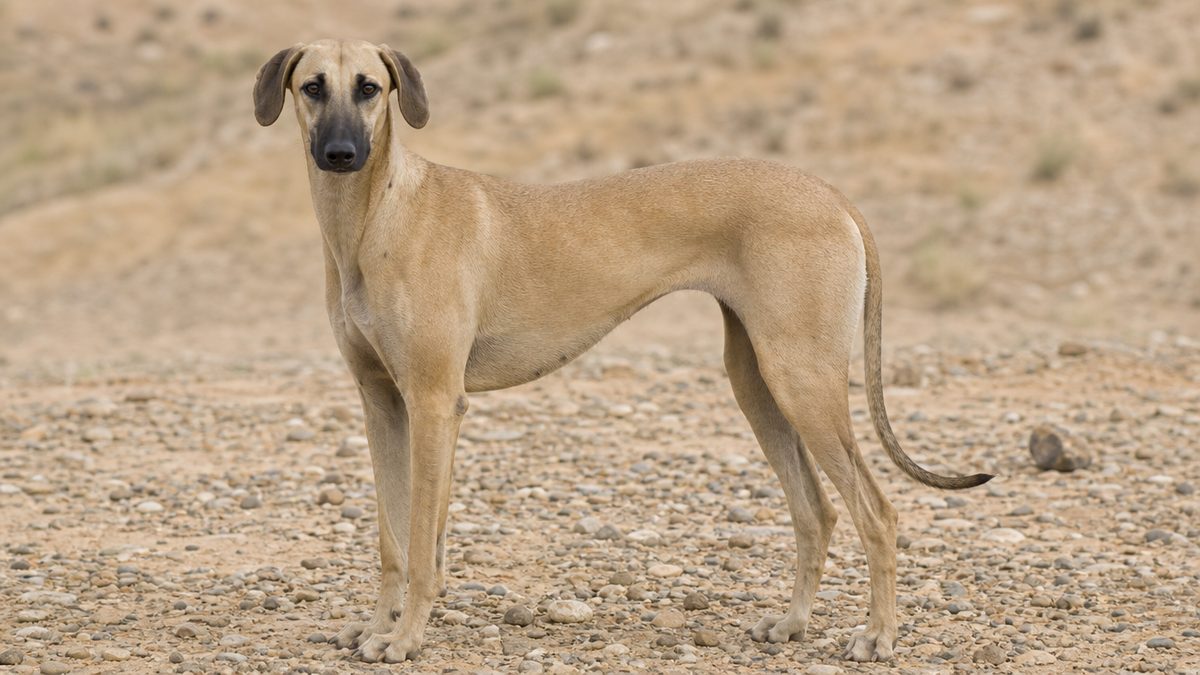
The Sloughi is a Moroccan short-coated coursing hound held by the FCI as standard 188, in Group 10, Section 3, short-haired sighthounds. Its origin is Morocco, which the standard names as the country responsible for it, and the currently valid text was published on 8 January 1998.
The single most useful line in the whole breed standard is short: the Sloughi exists only in a single short-haired variety. That one clause does more identification work than any photograph, because the breed most often confused with it, the Saluki, comes in a feathered and a smooth form. On a Sloughi, semi-long hair and fringes on the legs or tail are disqualifying faults, not variations.
Size and proportion, given as ratios rather than adjectives
FCI 188 is unusually mathematical. Height at the withers runs 66 to 72 cm for males and 61 to 68 cm for females. For an ideal male of 70 cm the body length from point of shoulder to point of buttock should be 67 to 68 cm; for an ideal female of 65 cm, 62 to 63 cm. The ratio of body length to height at withers is 0.96, the ratio of chest depth to height at withers is 0.4, and the ratio of foreface length to total head length is 0.5. The skull measures 12 to 14 cm from ear to ear.
Bonbeno checked the French text as well, because French is the authentic language for this standard and the English is a translation by Mrs Moreau-Sipiere and Prof. R. Triquet, brought up to date by Dr. Paschoud. The French prints exactly the same figures, 66 a 72 cm for males and 61 a 68 cm for females, so there is no translation drift here. That is a negative result worth recording, because FCI standards do sometimes disagree between languages on numbers.
| Sloughi | Saluki, smooth variety | |
|---|---|---|
| FCI standard | 188 | 269 |
| Origin | Morocco | Middle East, FCI patronage |
| FCI section | Group 10 Section 3, short-haired | Group 10 Section 1, long haired or fringed |
| Coat varieties | One only | Two, feathered and smooth |
| Fringes on legs or tail | Disqualifying fault | Correct in the feathered variety |
| Colour range | Light sand to red sand, with or without black mask, mantle, brindling or overlay | Any colour or combination, brindles undesirable |
| White markings | Small chest mark a fault, stockings disqualifying | Not restricted in the same way |
Colour is a narrow window, and that is a buying check
Colour runs from light sand through all shades to red sand or fawn, with or without a black mask, with or without a black mantle, with or without black brindling, with or without a black overlay. Anything outside that range is a disqualifying fault. So is a body clearly longer than it is high, depigmented mucous membranes, an over or undershot mouth, and erect or rose ears.
| Register | Status | What the record says |
|---|---|---|
| FCI | Fully recognised, standard 188 | Letter S index returns 41 breeds including SLOUGHI 188 |
| Kennel Club of India | Covered by FCI nomenclature | India is an FCI full member represented by the KCI, so Indian pedigrees run on FCI numbers |
| AKC | Fully recognised 2016, Hound Group | AKC code 435, popularity rank 201 of 210 in 2025 |
| UKC | Sighthound and Pariah group | Listed in the UKC breed-standards index |
The AKC's embedded breed data for the Sloughi gives the origin field as Arabian Greyhound. That is an alternative name for the breed, not a country. The FCI, which holds the standard, gives the origin as Morocco. Where a registry's data field disagrees with the standard, follow the standard.
Sloughi price in India, and a five-times disagreement over one cost table
Two Indian sites publish a Sloughi price and disagree by more than five times, while printing an identical monthly cost table to the rupee. Neither headline figure is an observation of an Indian transaction.
poodles.in quotes Rs 50,000 to Rs 90,000. happypet.care quotes Rs 3,00,000 to Rs 5,00,000. The distance between Rs 90,000 and Rs 5,00,000 is not a spread of opinion. It is two unrelated numbers.
The cost table underneath is shared, and it is built from parts
| Line | poodles.in | happypet.care |
|---|---|---|
| Food, monthly | Rs 3,000 to Rs 4,500 | Rs 3,000 to Rs 4,500 |
| Health, monthly | Rs 1,200 to Rs 1,950 | Rs 1,200 to Rs 1,950 |
| Grooming, monthly | Rs 700 to Rs 1,200 | Rs 700 to Rs 1,200 |
| Monthly total | Rs 4,900 to Rs 7,650 | Rs 4,900 to Rs 7,650 |
| Buying price | Rs 50,000 to Rs 90,000 | Rs 3,00,000 to Rs 5,00,000 |
The total sums exactly from its parts: 3,000 plus 1,200 plus 700 is 4,900, and 4,500 plus 1,950 plus 1,200 is 7,650. Better still, the parts can be traced. On the same site, the Scottish Deerhound carries the identical food line of Rs 3,000 to Rs 4,500 with a different health and grooming line, and the Saluki carries the identical grooming line of Rs 700 to Rs 1,200 with a different food and health line. So the cost table is assembled per breed from a small menu of preset lines, and a matching total tells you nothing about what a Sloughi costs in Chennai.
A grooming line that cannot possibly be right
The clearest single proof is the grooming figure. The Sloughi's coat is described by its own standard as very short, dense and fine, with no feathering anywhere and semi-long hair disqualifying. The Saluki has a feathered variety with long silky hair on the ears, legs, thighs and tail. Those two coats are given the same monthly grooming budget on the same website poodles.in, Saluki Price in India, Diet. No grooming business prices a bare-coated hound and a fringed one identically.
What the division tests show
Neither Indian band converts cleanly. Rs 50,000 and Rs 90,000 give 592.56 and 1,066.60 at 84.38, 625 and 1,125 at 80, and 675.68 and 1,216.22 at 74. Rs 3,00,000 and Rs 5,00,000 give 3,750 and 6,250 at 80, and 4,000 and 6,666.67 at 75. None of those pairs is a price band a seller would print at both ends, so the honest conclusion is not that a foreign figure was converted, but that the numbers are rupee-native and arbitrary happypet.care, Sloughi in India: Grooming.
Bing India substituted this breed's name in three different directions in one session while the Labrador control passed: sloughi price in india returned drawing tutorials, sloughi dog returned Chrome Web Store help pages, and sloughi breed returned YouTube. That is an engine failure rather than evidence about the Indian market, and it is recorded here so nobody mistakes it for one. What can be said is narrower and firmer: no Indian listing site carries a Sloughi with a price attached, and there is no lawful commercial import route for breeding or sale stock.
What a Sloughi actually costs to keep in India
Budget roughly Rs 4,000 to Rs 9,000 a month to keep a 25 to 30 kg Sloughi in an Indian metro. Unlike the purchase price, every line of the cost of ownership can be traced to a published Indian rate card.
This is the cheapest sighthound on Bonbeno to groom and among the more expensive to keep healthy, because everything the breed needs is veterinary rather than cosmetic.
| Item | Published figure | Source and caveat |
|---|---|---|
| Puppy core vaccination course | From Rs 6,499 | Vetic national page, a promotional floor from one chain |
| Annual booster | From Rs 3,199 | Vetic national page |
| Anti-rabies, single dose | Rs 699 privately, free at a Chennai municipal clinic | Vetic against Greater Chennai Corporation Greater Chennai Corporation |
| Consultation | Rs 500 to Rs 1,000 | VOSD, treated as one data point |
| Monthly tick, flea and worm cover | About Rs 1,103 | NexGard Spectra 15 to 30 kg, 3 tablets at Rs 3,308 |
| Boarding, per 24 hours | Rs 500 to Rs 2,000 | VOSD range |
| Municipal registration, Delhi | Rs 500 | MCD pet dog registration |
| Municipal licence, Chennai | Rs 50 | Greater Chennai Corporation, 9,115 licences issued in 2024 |
| Grooming | Near zero | A very short dense fine coat needs a rubber mitt, not a salon |
The three lines that genuinely matter for this breed
- Parasite control, all year. Among 584 client-owned dogs screened at a Kolkata animal health centre, 76.54 percent were positive for *Babesia gibsoni* and 72.9 percent of the dogs screened carried two or more pathogens at once. Those are clinic cases rather than a population sample, and they still make year-round cover a fixed cost on a thin-coated dog that lives outdoors by preference.
- Correct laboratory interpretation. A routine Indian blood panel on a healthy Sloughi will show a low T4 and a raised packed cell volume, because in 51 healthy Sloughis total T4 averaged 1.13 micrograms per decilitre against 2.9 in controls and haemoconcentration was present in 84.3 percent. A re-run panel, a specialist opinion or an unnecessary course of thyroid medication all cost money that better information prevents.
- Anaesthesia done to the sighthound protocol. Sedative premedication, no thiobarbiturates, isoflurane maintenance and close temperature monitoring, which may mean a clinic sourcing drugs it does not normally stock.
Ignore the Rs 700 to Rs 1,200 monthly grooming line the Indian breed pages give this breed. A Sloughi's coat needs a rubber mitt once a week and a nail trim once a fortnight. Put the money into tick prevention instead, where the published monthly cost for a dog of this size is about Rs 1,103.
Heat tolerance: built for the pre-Sahara, not for the Indian coast
A Sloughi is among the most genuinely heat-tolerant breeds on this site, and the tolerance is specifically for arid heat. Its home range runs below 30 percent relative humidity, less than half of any Indian coastal city.
Morocco turned out to be one of the harder places Bonbeno has tried to measure. NASA POWER returns a grid cell rather than a point, and in Atlas terrain the cell can sit hundreds of metres above the town. Of seven Moroccan points tested, six returned errors that make them unusable: Marrakesh 370.94 m, Ouarzazate 405.79 m, Agadir 333.42 m, Errachidia 247.60 m, Zagora 209.64 m and Casablanca 102.91 m above the real elevation. Only Tan-Tan, at 86.42 m against a real 60 m, an error of 26.42 m, is clean.
So this section uses Tan-Tan on the Saharan Atlantic coast as the verified point, and quotes Zagora in the pre-Sahara with its elevation error stated, because Zagora is where the breed actually works and the humidity figure there is the one that matters.
| Place | Cell elevation error | Annual mean temperature | Annual mean relative humidity | Hottest month mean |
|---|---|---|---|---|
| Tan-Tan, Morocco | plus 26.42 m, usable | 19.36 C | 74.72 percent | 22.52 C (Aug) |
| Zagora, Morocco | plus 209.64 m, stated | 21.45 C | 29.74 percent | 33.75 C (Jul) |
| Jaipur | minus 25.26 m | 25.58 C | 40.94 percent | 34.57 C (Jun) |
| Delhi | minus 9.63 m | 25.60 C | 45.56 percent | 35.88 C (Jun) |
| Pune | plus 75.99 m | 23.86 C | 66.80 percent | 28.93 C (Apr) |
| Mumbai | plus 83.15 m | 26.77 C | 67.39 percent | 31.19 C (May) |
| Chennai | plus 42.95 m | 27.95 C | 72.39 percent | 31.51 C (May) |
| Kolkata | minus 1.65 m | 25.81 C | 73.93 percent | 31.53 C (May) |
The comparison that decides where a Sloughi should live in India
Zagora runs 29.74 percent annual relative humidity. Chennai runs 72.39 percent and Kolkata 73.93 percent NASA POWER climatology API. Zagora's July mean of 33.75 degrees Celsius is hotter than any Indian month except a north Indian June, and the dog copes there because sweat and panting work in dry air. In Chennai, at a lower air temperature, they work far less well.
The interesting wrinkle is Tan-Tan. On the Moroccan Atlantic coast the breed's own country produces 74.72 percent humidity, essentially Chennai's figure, at an annual mean of 19.36 degrees. So Moroccan Sloughis do meet humid air. What they do not meet anywhere is humid air at 31 degrees, and that combination is what an Indian coastal summer supplies.
Where a Sloughi fits best in India
- Jaipur, inland Rajasthan and dry Gujarat. At 40.94 percent annual humidity, this is as close as India gets to the breed's working range.
- Delhi and the northern plains, dry for most of the year at 45.56 percent, with a hard June and a difficult monsoon.
- Pune and Bengaluru, cooler in absolute terms but around 67 percent humidity, so comfortable rather than native.
- Chennai, Kochi, Mumbai and Kolkata. A Sloughi lives here as a house dog and should not be worked here in daylight from March to October.
The sighthound with the most published data, the Greyhound, carried 4.26 times the odds of heat-related illness against Labrador Retrievers in a 905,543-dog UK cohort, at p = 0.001, and the authors attributed it to high lean muscle mass rather than to fat. The Sloughi was not separately modelled, because a breed type entered that model only with five or more cases and/or 5,000 or more dogs. The group finding transfers even though the breed number does not exist. Second Schedule Part IV paragraph 21(1) of the Dog Breeding and Marketing Rules 2017 also bars keeping outdoors, without written veterinary approval, dogs not accustomed to local temperatures.
Temperament: noble, haughty, and attached to exactly one household
FCI 188 describes the Sloughi in a single sentence that is worth quoting in full: although noble and haughty, he is very attached to his master and defends him in case of need, and with an instinct of hunter, capable of sustained effort, he also appreciates the home comforts.
That sentence contains three things Indian buyers should read carefully. The dog is aloof with the world, deeply bonded at home, and will defend. The AKC files its temperament as independent, loyal and deeply affectionate, which is the same description in warmer words.
What it means day to day in India
- A one-household dog. A Sloughi bonds hard to its own people and stays reserved with everyone else, including regular visitors. That is breed type rather than poor socialisation.
- It will defend. Unlike most sighthound standards, this one says the dog defends his master in case of need. That is not a licence to keep the breed as a guard dog, and it does mean a Sloughi is not the indiscriminately friendly hound the Deerhound standard describes.
- Prey drive is the practical risk. The standard calls it an instinct of hunter capable of sustained effort. Cats, poultry and small dogs moving fast will trigger a chase, and in an Indian street that chase ends badly.
- It genuinely likes comfort. The standard says so, and owners confirm it. A Sloughi will find the softest surface in the house and stay there.
- Thin-skinned in both senses. Very fine skin close to the body with no folds means grazes and pressure sores on hard floors, and a sensitive dog means harsh handling backfires.
Who should not buy this breed
Anyone who wants an outgoing family dog for a busy Indian household with constant visitors, anyone with cats or poultry, and anyone who cannot provide a fenced space to run. Anyone hoping for a guard dog should also look elsewhere: the standard's defence clause describes a dog that reacts for its own person, not one that patrols a compound.
The Sloughi standard lists aggressive or overly shy dogs among its disqualifying faults. A Sloughi that stands back and watches a stranger without engaging is showing breed type. One that cowers, shakes or snaps is showing a fault. If you are meeting a litter in India, judge the parents on this, and remember that a dog kept isolated on a terrace will look fearful whatever its breeding.
Training a Sloughi: short sessions, real rewards, no repetition
Train a Sloughi in three-minute sessions with food that is genuinely worth working for, and treat recall as a managed risk rather than a solved problem. A haughty, independent hunting hound learns quickly and repeats reluctantly.
Socialise early and widely. Between eight and sixteen weeks introduce lifts, stairs, traffic, motorbike noise, markets and handling by strangers. Indian law sets the practical timetable, because the Dog Breeding and Marketing Rules 2017 record that puppies are vaccinated from about seven to eight weeks with the course usually completed near eighteen weeks.
What works
- Very short sessions. Two to four minutes. Ask for the same behaviour ten times and a Sloughi disengages.
- High-value food. Boiled chicken or paneer, and never in the afternoon heat when the dog will not eat.
- A long line for two years. Fifteen metres of line gives you distance work without gambling on an untested recall.
- A stand for examination, taught early. A dog that will stand for a blood draw avoids sedation, and sedation is exactly what the sighthound literature says to minimise.
- A clear release cue so that running becomes something you grant rather than something the dog takes.
What does not work
Corrections, raised voices and long drills all fail with a sensitive, haughty dog, and afternoon training fails for a different reason in an Indian summer. Nor does any training method make recall reliable against live quarry. Manage the environment: a fence, a long line, and a lead everywhere else.
House training is usually settled by four months. A stand for examination and calm handling of feet and ears take about eight weeks of daily thirty-second sessions. Lead manners take two to three months. Recall inside a fenced field is achievable by twelve to eighteen months. Recall on an open Indian street with a cat in sight is not a goal to set for a coursing hound.
One legal note. The 2017 Rules strictly forbid tail docking, ear cropping, de-barking, de-clawing and any change of appearance by artificial means, under Second Schedule Part II paragraph 6(8). Nothing in FCI 188 calls for any of them, and the standard separately treats erect or rose ears as disqualifying, so a Sloughi with altered ears fails both the law and the standard.
Exercise: sustained effort, at the right hour
A Sloughi needs two long outings a day plus one safe weekly gallop, and its own standard describes an animal capable of sustained effort rather than a sprinter that recovers on the sofa. In India, almost all of that has to happen before sunrise or after dark.
FCI 188 gives the utilization simply as sighthound, permits a racing licence, and describes gait as walk, trot and gallop with supple, smooth, long strides covering plenty of ground. The behaviour clause adds capable of sustained effort. Together those describe a dog with more stamina than a Greyhound and the same need for speed.
A workable Indian week
- Two outings a day, 45 to 60 minutes, at the coolest hours available. Delhi's June mean alone is 35.88 degrees, so summer walks there are pre-dawn and post-sunset.
- One free gallop a week inside a fully fenced space, on soft ground, for fifteen to twenty minutes.
- Lure coursing or a flirt pole where fenced ground is unavailable, which satisfies the chase without an open street.
- Nothing hard within two hours of a meal, in either direction.
- Check the surface. Hold the back of your hand on the tarmac for five seconds; if you cannot, neither can the dog's pads.
Growth rules for the first eighteen months
Free movement on grass is fine at any age. Forced distance running, repeated jumping and stair work should wait until the growth plates close, which for a 70 cm sighthound is around 14 to 18 months. This matters more than it sounds for a breed whose standard specifies flat, dry, chiselled muscling rather than bulk: a Sloughi built up early looks impressive and is not what the standard describes.
Do not test how much dry-heat tolerance transfers. The one sighthound with a modelled figure carried 4.26 times the odds of heat-related illness against Labradors, attributed to lean muscle mass. Move the run to dawn or after dark from March to October, carry water, and stop at the first sign of a wide flat tongue and heavy open-mouthed panting. Consult your nearby veterinarian at once if a dog becomes unsteady after exertion.
Mental work is the substitute on days when the weather blocks the physical outlet. Scent games and short food-finding routines take real energy out of an intelligent hunting hound, and they can be run indoors on the two or three worst months of the Indian year.
Grooming a Sloughi: the lightest coat care on this site
Groom a Sloughi with a rubber mitt once a week and a nail clipper once a fortnight. The standard specifies hair that is very short, dense and fine, with no feathering anywhere, so there is almost nothing to maintain.
FCI 188 describes the coat in four words, very short, dense, fine, and its skin clause is equally brief: very fine, close fitting to the body, without folds or dewlap. Semi-long hair is a disqualifying fault, as are fringes on the legs or tail. There is no undercoat to blow and no furnishings to mat.
The weekly routine, which takes ten minutes
- A rubber curry mitt once a week to lift dead hair and stimulate the skin. That is the entire coat routine.
- A daily tick check in season, ears, toes, groin and tail base first. The 2017 Rules make regular de-ticking part of routine grooming rather than an optional extra, in Second Schedule Part IV paragraph 27.
- Skin inspection with every check. Very fine skin over a lean body grazes and tears easily, and small wounds turn septic quickly in an Indian monsoon.
- Nails every fortnight. Indian tile and stone floors give no natural wear, and a sighthound's gait deteriorates fast on long nails.
- Bathe rarely, every eight weeks or so, and only when actually dirty.
Sun is the real coat problem in India
A very short, fine coat over thin skin gives limited protection from direct Indian sun, and sand-coloured dogs with pale bellies and inner thighs are the most exposed. Manage this with shade and timing rather than with sunscreen, which most dogs lick off. Indian law asks the same of anyone housing dogs outdoors: Second Schedule Part IV paragraph 21(2) requires separate outside shade large enough to hold all the animals at once and to protect them from the direct rays of the sun.
Indian breed pages give the Sloughi a monthly grooming budget of Rs 700 to Rs 1,200, and the same site gives the identical figure to the Saluki. One of those dogs has a feathered variety with long silky hair on the ears, legs, thighs and tail underside; the other has a coat the standard calls very short with fringes disqualifying. Two coats that different cannot cost the same to maintain, and a page that says they do is filling in a preset rather than reporting a price.
Sloughi health: normal values that read as disease
The most important Sloughi health fact for an Indian owner is not a disease at all. The breed's most consequential health issues in India start with a laboratory report: a healthy Sloughi's routine blood panel looks abnormal on standard canine reference intervals, and acting on that appearance is the commonest avoidable harm the breed faces.
1. Thyroid values, measured in the breed
A study of 51 Sloughis with no evidence of disease, mean age 4 years with a range of 1 to 12, compared their thyroid profiles against normal dogs. Total T4 came in at 1.13 plus or minus 0.65 micrograms per decilitre against 2.9 plus or minus 0.8 in controls (P < .0001), and free T4 by chemiluminescence at 11 plus or minus 4.3 picomoles per litre against 16.7 plus or minus 5.2 (P < .0001). Free T4 after equilibrium dialysis ran the other way, 41.3 plus or minus 26.9 against 20.98 plus or minus 10.29 (P < .0001), and TSH was modestly higher at 0.22 plus or minus 0.15 against 0.15 plus or minus 0.13 (P = .0138). In eight dogs given a TSH stimulation test, T4 rose from a median of 1.5 to 2.7 micrograms per decilitre, and only three of the eight reached the recommended post-stimulation concentration.
The same study found haemoconcentration in 84.3 percent and hypoglobulinaemia in 80.3 percent of those healthy dogs. So a routine Indian panel on a well Sloughi will commonly show a low T4, a high packed cell volume and low globulins at once, and none of the three is a disease in this breed.
Second Schedule Part III paragraph 8(10) of the Dog Breeding and Marketing Rules 2017 requires that breeding dogs have been tested for genetic defects including hypothyroidism, alongside hip dysplasia and progressive retinal atrophy. Indian law therefore mandates a thyroid test on a breed whose normal T4 is well below the standard canine range. A breeder complying with the letter of the clause, on a standard reference interval, will over-diagnose. Ask for the TSH result and a breed-aware interpretation, and consult your nearby veterinarian before any Sloughi is started on lifelong thyroid medication.
2. Progressive retinal atrophy, with a known mutation
Generalised progressive retinal atrophy in Sloughi dogs is caused by an 8 base pair insertion in exon 21 of the PDE6B gene. That is an unusually precise answer for a rare breed, and it makes a specific question possible: ask a breeder for the parents' PDE6B results rather than for a general eye certificate. Two related papers rule out other candidates, excluding PDE6A across eleven breeds and evaluating and excluding RDS/Peripherin and ROM1 with digenic inheritance.
3. Coat colour dilution
A novel MLPH variant associated with coat colour dilution in dogs has been described in work that includes the Sloughi. Colour dilution matters here for a practical reason as well as a cosmetic one: the standard restricts acceptable colour to the sand-to-fawn range with black markings, so a diluted dog may fall outside it.
4. Blood values: this breed is in the eight-breed study, and the Greyhound profile still does not fit
The only study to compare sighthound breeds against one another tested 192 individuals across eight breeds, and the Sloughi is one of them, alongside the Whippet, Greyhound, Italian Greyhound, Saluki, Borzoi, Pharaoh Hound and Azawakh. Its conclusion is directly usable: significant differences exist between the breeds, the Whippet is closest to the Greyhound, and application of the Greyhound laboratory profile to other sighthounds is not recommended. A vet who reaches for Greyhound reference intervals for a Sloughi is using the wrong ones, and the study says so.
5. Anaesthesia, by group membership
The published sighthound review names four idiosyncrasies: a nervous demeanour with stress-induced complications including hyperthermia; a lean body with a high surface-area-to-volume ratio predisposing to hypothermia; a higher packed cell volume with lower serum protein, complicating pre-anaesthetic blood work; and impaired hepatic drug biotransformation with prolonged recovery, especially from thiopental. It instructs that thiopental, or any other thiobarbiturate, should not be used, that propofol, ketamine with diazepam and methohexital are the recommended alternatives, that isoflurane maintenance is preferred, and that core temperature must be monitored during anaesthesia and into recovery. Note that the third idiosyncrasy is exactly what the Sloughi thyroid study measured independently: haemoconcentration in 84.3 percent of healthy dogs.
What is genuinely unknown
- Lifespan. The largest UK longevity study named the Sloughi in supplementary Table S5 and flagged it N, excluded from the survival analysis, with the breed classified as Hound, Sighthounds, Medium and dolichocephalic. That is a documented exclusion, not an oversight, and it means no median survival exists. For scale, the Saluki row in the same paper reads 13.3 years on 169 deaths and the Whippet 13.4 years on 1,483 deaths McMillan KM, Bielby J, Williams CL. Neither figure belongs to the Sloughi, and this page will not lend it one.
- Bleeding risk. The 2025 SERPINF2 survey genotyped 16 sighthound breeds and the Sloughi is not among them. Its status is unknown rather than reassuring, which is worth saying out loud before any elective surgery.
- Heat-illness odds. Not separately modelled, because a breed type needed five or more cases and/or 5,000 or more dogs to enter the model.
The Indian health load, as everywhere on this site, is parasitic. Among 584 client-owned dogs screened at a Kolkata animal health centre, 76.54 percent were positive for *Babesia gibsoni*, 55.75 percent for *Anaplasma* species and 16.61 percent for *Ehrlichia canis*, with 72.9 percent of the dogs screened carrying two or more pathogens. Those are clinic cases rather than a random sample, and in a breed that already runs a high packed cell volume, an anaemia caused by babesiosis can be masked for longer than in an ordinary dog.
Feeding a Sloughi in India: dry muscle, not bulk
Feed a Sloughi to a lean, dry, flat-muscled body condition across two meals a day, away from exercise. The standard asks for muscular leanness and specifically faults round, protruding muscle, so a heavily built Sloughi is wrong on paper as well as unhealthy.
FCI 188's general appearance clause is built on this: by demeanour, by delicacy of tissue and by muscular leanness, the general appearance is of a very racy and elegant dog. Its fault list includes head and body slightly too heavy, a belly not enough tucked up, rounded ribs, and muscles round and protruding. That is a specification for a dry athlete, not a bulked one.
A practical Indian feeding plan
- Two meals a day for an adult, morning and evening, avoiding the hottest hours.
- Three to four meals a day for a puppy to six months, then three to nine months.
- No hard exercise for two hours either side of a meal. A deep-chested hound whose chest depth is 0.4 of its height is the wrong shape to take chances with.
- Do not feed for muscle. Extra protein and extra calories produce the rounded muscling the standard faults, and load joints built for speed.
- Weigh monthly and record it, because on a lean dog a change is hard to see.
Indian availability is straightforward for a 25 to 30 kg dog. Every national brand sells a medium or large adult formula, and a home diet of chicken, curd, rice and vegetables works if a vet balances calcium and phosphorus. What matters is measuring the quantity rather than filling a bowl.
Look for a body length to height ratio near 0.96, a marked tuck-up, flat rather than bulging muscle, and the last one or two ribs faintly visible in movement. If the tuck-up flattens or the muscle looks rounded, the dog is over-fed. Ask your veterinarian to record a body condition score at every visit, and remember that a healthy Sloughi's high packed cell volume can make a mild dehydration look normal on paper.
Two Indian adjustments. Appetite falls in April and May in most of the country, and a Sloughi eating less through the hot weeks is behaving normally. And because tick-borne disease is a routine clinic finding here, a sudden loss of appetite is a reason to test rather than to change the food.
Finally, disregard the published Indian food figure for this breed. Both Indian pages quote Rs 3,000 to Rs 4,500 a month, and the same site gives the identical food line to the Scottish Deerhound, a dog nearly twice the weight. Build the budget from the pack's own feeding guide and your dog's measured weight.
The first year with a Sloughi puppy in India
Plan a Sloughi puppy's first year around three fixed points: the socialisation window that closes near sixteen weeks, growth plates that stay open to about 14 to 18 months, and Indian heat that dictates when the puppy can be outdoors at all.
| Age | What is happening | What you do |
|---|---|---|
| Under 8 weeks | With the litter. Indian law prohibits sale under eight weeks | Refuse any younger puppy, under Rule 8(1)(a) |
| 8 to 12 weeks | Core vaccination course under way from about seven to eight weeks | Socialise safely and constantly, and handle feet, ears and mouth daily |
| 12 to 16 weeks | Socialisation window closing | Traffic, lifts, stairs, crowds, other dogs, strangers, and a stand for examination |
| 16 to 18 weeks | Vaccination course usually complete near eighteen weeks | Short cool-hour lead walks. Register with the municipality |
| 4 to 6 months | Fast height growth, very gangly | No forced running, no repeated jumping. Free movement on grass only |
| 6 to 9 months | Adolescence, recall degrades sharply | Long line goes on and stays on. Keep the dog lean |
| 9 to 14 months | Approaching adult height | Controlled straight-line galloping on soft ground inside a fence |
| 14 to 18 months | Growth plates closing | Only now build real distance and speed work |
Five checks before you collect a puppy
- Age at least eight weeks, and a microchip. Rule 8(1)(a) prohibits sale below eight weeks and Rule 8(1)(e) requires each pup sold to be micro-chipped with a full treatment and vaccination record maintained.
- PDE6B results on both parents, because the mutation behind progressive retinal atrophy in this breed is identified and testable.
- A pedigree you can read, FCI or KCI, recorded against standard 188.
- A coat and colour check. Any fringing on the legs or tail, semi-long hair, or white stockings would be a disqualifying fault under the breed's own standard.
- A truthful account of origin, since dogs are a Restricted import into India and applications for trading or breeding purposes are to be duly rejected.
Adult dry-heat tolerance does not arrive with the puppy. A growing Sloughi has a very large surface area for its mass, a thin coat and no judgement. From March to October in most of India, take a puppy out before 06:30 and after sunset only, keep sessions short, and stop at the first sign of heavy open-mouthed panting. Consult your nearby veterinarian at once if a puppy vomits, becomes unsteady or collapses after exertion.
Expect the adult to be far calmer than the puppy. Sloughis mature slowly in body, and most owners describe the demanding stretch as six to fourteen months, which is exactly when the long line and the fenced weekly gallop pay for themselves.
Sloughi against the sighthounds Indian buyers cross-shop
A buyer looking at a Sloughi in India is usually also looking at a Saluki, an Azawakh, a Whippet or an Indian sighthound. Data availability separates them more than looks do.
| Sloughi | Saluki | Whippet | Mudhol Hound | |
|---|---|---|---|---|
| Height at withers | 66 to 72 cm males | 58 to 71 cm average | Small by McMillan's classification | Large Indian sighthound |
| Coat | One short variety only, fringes disqualifying | Feathered or smooth | Short | Short |
| Median survival, UK cohort | None. Named in S5 and flagged N | 13.3 years on 169 deaths | 13.4 years on 1,483 deaths | No cohort study exists |
| Breed-specific lab data | Yes, thyroid and haematology Uhrikova I, Lacnakova A, Tandlerova K | Yes, thyroid and cardiac | Yes, closest to the Greyhound | None published |
| SERPINF2 bleeding allele | Not surveyed | 30 percent | 25 percent | Not surveyed |
| Heat fitness in India | Strong in dry heat | Strong in dry heat | Moderate | Bred in the Indian climate |
| Indian availability | Two sites, prices five times apart | No verifiable transaction price | Advertised widely | Genuine Indian breeders |
The Sloughi's real advantage over the Indian sighthounds is that it comes with numbers. A Sloughi owner can hand a vet a published thyroid profile measured in 51 dogs of the breed, an eight-breed haematology comparison that includes the Sloughi by name, and a named retinal mutation with a test attached. For a Mudhol Hound or a Rampur Greyhound, none of that exists.
Its disadvantage against the Saluki is narrower than it looks. Both breeds are effectively unavailable in India at a verifiable price, both are adapted to dry heat, and both carry the sighthound anaesthesia caution. Where they differ is that the Saluki has a median survival figure and a bleeding-risk genotype on record, and the Sloughi has neither Court MH, Hardy M, Forbes KR, Yang H.
If you want a short-coated coursing hound in India and you live in a dry city, a Mudhol Hound or a Rampur Greyhound from an Indian breeder is the more practical animal and the only one you can actually buy. Choose a Sloughi because you want that specific dog, can give it dry-season running space, and have a vet willing to read the breed's thyroid and haematology literature before interpreting a routine panel.
Six mistakes Indian Sloughi owners make
Most avoidable Sloughi problems in India trace to six errors, and the first two are the ones that harm the dog rather than the wallet.
1. Treating a normal blood panel as disease
In 51 healthy Sloughis, total T4 averaged 1.13 micrograms per decilitre against 2.9 in controls, haemoconcentration was present in 84.3 percent and hypoglobulinaemia in 80.3 percent. A well dog will look hypothyroid and dehydrated on a standard Indian report. Get a breed-aware interpretation before any treatment starts.
2. Allowing thiopental
Thiopental, or any other thiobarbiturate, should not be used in sighthounds, and isoflurane maintenance with sedative premedication and close core-temperature monitoring is the published alternative. Say it out loud before the dog is on the table, because this breed's bleeding-risk genotype has never been surveyed and there is nothing else to fall back on.
3. Believing a published price
Two Indian sites quote Rs 50,000 to Rs 90,000 and Rs 3,00,000 to Rs 5,00,000 for the same breed while sharing an identical monthly cost table. Neither is an observation. Ask for pedigree, PDE6B results and origin before you discuss a number.
4. Confusing the breed with a smooth Saluki
The Sloughi is FCI 188 from Morocco, in a single short-haired variety, with fringes on the legs or tail disqualifying. The Saluki is FCI 269 with a feathered variety. A dog sold in India as a Sloughi that carries leg fringing is either a Saluki, a cross, or something else entirely.
5. Letting the dog off lead
The standard describes an instinct of hunter capable of sustained effort. That is a description of a dog that will course a cat across an Indian road and keep going. Long line for two years, fenced ground thereafter.
6. Assuming a thin coat means heat proof
The one sighthound with a modelled figure carried 4.26 times the odds of heat-related illness against Labradors, attributed to lean muscle mass rather than fat. Dry-heat adaptation is real and it is specifically adaptation to air at 29.74 percent humidity, not to Chennai at 72.39 NASA POWER climatology API.
New owners think a correctly conditioned Sloughi looks starved and feed it up. The standard's own words are delicacy of tissue and muscular leanness, and it faults round protruding muscle. Lean is the breed, not a problem to fix. Ask your veterinarian for a body condition score at every visit so you are working from a number rather than an impression.
Adoption and responsible sourcing for a Sloughi in India
Adopt before you buy, and if you buy, verify the litter against Indian law and the breed's one testable mutation before money changes hands. This is a rare breed in India with no verifiable price, and there is no hurry.
Why adoption comes first
If what you want is a lean, short-coated, quiet, odourless dog that copes with Indian heat, an adopted Indian Pariah Dog gives you all of it, free, in every Indian city, with no thyroid confusion and no anaesthetic caveat. If you specifically want a large coursing hound, a Mudhol Hound or a Rampur Greyhound from an Indian breeder is available in a way a Sloughi is not. Breed rescue for imported sighthounds in India is small, so ask general shelters to flag sighthound-type arrivals.
If you are buying, verify these seven things
- A pedigree you can read, FCI or KCI, recorded against standard 188.
- A microchip number, which Rule 8(1)(e) makes mandatory on every pup sold.
- Age at least eight weeks, under Rule 8(1)(a).
- A vaccination record consistent with a course started at seven to eight weeks and completed near eighteen weeks.
- PDE6B results on both parents for progressive retinal atrophy, which is testable in this breed.
- No altered ears or tail, prohibited under Second Schedule Part II paragraph 6(8), and note that erect or rose ears are separately disqualifying in the standard.
- An honest account of how the founding stock entered India, since dogs are a Restricted import and applications for trading or breeding purposes are to be duly rejected.
A price quoted before you have asked a question. A price that matches neither published Indian band. A dog with leg or tail fringing sold as a Sloughi. White stockings or bold white markings, which the standard disqualifies. And a seller who cannot say whether the parents were tested for the PDE6B insertion, because that test exists specifically for this breed.
What you owe the dog if you go ahead
A fenced place to gallop weekly, walks at cool hours, year-round tick control in a country where 72.9 percent of dogs screened at one Kolkata centre carried two or more blood pathogens, a veterinarian who will read the breed's thyroid and haematology papers before interpreting a panel Uhrikova I, Lacnakova A, Tandlerova K, and a written note in the clinical file about the sighthound anaesthesia protocol.
Bonbeno does not sell animals, broker puppy sales or take breeder listings, and nothing here is an offer. Where sources disagree, this page prints the disagreement rather than averaging it into a number neither source supports.
Sloughi questions Indian buyers need answered
How much does a Sloughi puppy cost?
There is no reliable figure. The two Indian sites carrying a price disagree by more than five times, poodles.in quoting Rs 50,000 to Rs 90,000 and happypet.care quoting Rs 3,00,000 to Rs 5,00,000, while printing an identical monthly cost table to the rupee. A shared cost table under two irreconcilable prices means neither price was measured.
How long does a Sloughi live?
No breed-specific median survival exists. The largest UK longevity study named the Sloughi in its supplementary Table S5 and flagged it N for exclusion from the survival analysis, so it was considered and left out rather than overlooked. The AKC publishes a life expectancy of 10 to 15 years, which is a breed-club estimate rather than a cohort figure.
Is a Sloughi the same as a Saluki?
No. The Sloughi is FCI standard 188, origin Morocco, Section 3 short-haired, and its standard states the breed exists only in a single short-haired variety. The Saluki is FCI 269, origin Middle East, Section 1 long haired or fringed, and comes in feathered and smooth forms. On a Sloughi, fringes on the legs or tail are a disqualifying fault.
How big is a Sloughi?
FCI Standard 188 gives a height at the withers of 66 to 72 cm for males and 61 to 68 cm for females, with an ideal male at 70 cm and an ideal female at 65 cm. The French text, which is the authentic language for this standard, prints exactly the same figures, so there is no translation drift to worry about here.
Why does my healthy Sloughi's blood test look abnormal?
Because the breed's normal values are not the standard canine ones. In 51 Sloughis with no evidence of disease, total T4 averaged 1.13 micrograms per decilitre against 2.9 in control dogs, free T4 measured 11 against 16.7 picomoles per litre, haemoconcentration was present in 84.3 percent and hypoglobulinaemia in 80.3 percent. Discuss breed-specific interpretation with your nearby veterinarian.
Do Sloughis go blind?
Generalised progressive retinal atrophy occurs in the breed and its cause is known precisely: an 8 base pair insertion in exon 21 of the PDE6B gene. Because the mutation is identified, a DNA test is possible, and asking a breeder for the parents' PDE6B results is a concrete question rather than a general one.
Can a Sloughi handle Indian heat?
It handles dry heat well and humid heat much less well. Its home range around Zagora in southern Morocco runs 29.74 percent annual relative humidity, against 72.39 percent in Chennai and 73.93 percent in Kolkata, so the short dense coat and lean build are adaptations to arid heat rather than to Indian coastal conditions.
Does the sighthound anaesthesia warning apply to a Sloughi?
Yes, as a member of the group rather than from breed-specific data. The published review states that thiopental, or any other thiobarbiturate, should not be used in sighthounds, that propofol and ketamine with diazepam are the recommended alternatives, that isoflurane maintenance is preferred, and that core temperature must be monitored during anaesthesia and into recovery.
Is the Sloughi tested for the sighthound bleeding gene?
Not yet. The 2025 survey of the SERPINF2 bleeding-risk variant genotyped 16 sighthound breeds, including the Saluki at 30 percent and the Scottish Deerhound at 23 percent, and the Sloughi is not among them. Its status is therefore unknown rather than clear, and that is worth saying plainly before any elective surgery.
What white markings are allowed on a Sloughi?
Very few. The standard lists a small white mark on the chest as a fault, and white stockings or larger white markings as a disqualifying fault. Any Indian listing offering a boldly white-marked Sloughi is offering a dog that could not be shown under the breed's own standard, whatever else it may be.
What does a Sloughi cost per month in India?
Budget roughly Rs 4,000 to Rs 9,000 a month for food, year-round parasite control, routine veterinary care and minimal grooming, built from Indian rate cards rather than a template. Monthly parasite cover for a 15 to 30 kg dog runs about Rs 1,103, and a consultation is published at Rs 500 to Rs 1,000.
Can I import a Sloughi into India?
Only as an accompanied pet, never for breeding or sale. DGFT Trade Notice 22/2022-23 makes dogs a Restricted import under ITC(HS) 01061900, permits entry for a pet with a valid pet book in the importer's name, for research on CPCSEA recommendation, or for Defence and Police use, and states that applications for trading or breeding purposes shall be duly rejected.
Are Sloughis good family dogs?
For one quiet household, yes; for a busy Indian home with constant visitors, no. FCI 188 says it in a single sentence: although noble and haughty, he is very attached to his master and defends him in case of need, and with an instinct of hunter, capable of sustained effort, he also appreciates the home comforts. That is a dog aloof with the world, deeply bonded to its own people and reserved with everyone else, including regular visitors, which is breed type rather than poor socialisation. It is also the wrong dog for anyone with cats or poultry, anyone without a fenced space to run, and anyone hoping for a guard dog, because the defence clause describes a dog that reacts for its own person rather than one that patrols a compound.
Are Sloughis intelligent dogs?
Quick to learn and reluctant to repeat, which is a different thing from biddable. The AKC files the breed's temperament as independent, loyal and deeply affectionate, and the practical translation on this page is that a haughty, independent hunting hound learns in three-minute sessions with food that is genuinely worth working for, and switches off under corrections, raised voices and long drills. House training is usually settled by four months, lead manners take two to three months, and recall inside a fenced field is achievable by twelve to eighteen months. No training method makes recall reliable against live quarry, so intelligence here buys you cooperation, not a solved recall.
Compare with similar breeds
Sloughi sits in 1 Bonbeno group. Each one compares it directly against the breeds it is genuinely an alternative to, on the same figures.