
Breed profile
Liangshan Dog: the India guide
A Sichuan mountain hunting dog with 12 individuals in the genetic literature, no breed standard in any register on earth, and an English-language description whose every distinctive detail is missing from the source it cites.
Quick answer
The Liangshan dog is a lean mountain hunting and guarding landrace of southern Sichuan, kept by Yi communities, standing 35 to 50 cm and rarely over 20 kg. No kennel club anywhere recognises it and no written breed standard exists in any language we could open. Twelve individuals appear in a 2019 genome-wide SNP survey, which is its entire measured record. No Indian seller lists one and this page publishes no rupee price. Its homeland has zero months at or above a 25C mean; Chennai has ten.
This page summarises registry documents, government notifications and peer-reviewed veterinary research for general information. It is not a diagnosis and it is not a treatment plan. No screening scheme, no published life expectancy and no breed health survey exists for the Liangshan dog anywhere in the world, so no veterinarian has a breed baseline to measure your dog against. Consult a registered veterinarian who has examined your own animal before acting on anything here, and treat any collapsed or heat-distressed dog as an immediate emergency.
Liangshan Dog at a glance
What the Liangshan dog actually is
The Liangshan dog is a lean mountain hunting and guarding landrace from the Liangshan mountains of southern Sichuan, kept by Yi communities, standing 35 to 50 cm at the withers and rarely exceeding 20 kg. It is not a kennel club breed, it has no written standard in any language, and almost everything published about it in English traces to four sentences written by an American hobbyist about photographs somebody emailed him.
Two things make this dog worth a page rather than a paragraph. The first is that it is one of the very few Chinese landraces with real measured data behind it: 12 individuals were genotyped on a 170K SNP chip in a 2019 survey of Chinese indigenous dogs, under the code C_LSH, and a 2023 paper re-analysed the breed's runs of homozygosity against nine other Chinese populations. The second is that none of the English pages ranking for the breed mention either paper's actual contents, and the one that cites a paper cites it for something the paper does not say.
Size and weight, and a disagreement worth a factor of two
Three independent sources put this dog at 35 to 50 cm and under 20 kg, and one puts it at nearly double that. The China Working Dog Management Association, whose supervising government department is China's Ministry of Public Security, gives height 35 cm to 50 cm and weight generally not more than 20 kg. Baidu Baike's Sichuan Liangshan dog entry gives the same figures. Wisdom Panel, working in imperial units, gives 14 to 20 inches and 30 to 45 pounds, which converts to 35.6 to 50.8 cm and 13.6 to 20.4 kg and is the same animal.
BreedsPedia prints male height 61 to 71 cm and male weight 30 to 40 kg, labels the breed Large, and attaches no source to any of it. English Wikipedia's infobox gives a bare 15 kg and no height at all. Read together, the published record describes a dog somewhere between a Beagle and a Rottweiler, which is not a description at all.
| Source | Height | Weight | Source behind the figure |
|---|---|---|---|
| China Working Dog Management Association, 2022 | 35-50 cm | Not over 20 kg | The association's own magazine |
| Baidu Baike, 四川凉山犬 | 35-50 cm | Not over 20 kg | Same figures, no citation |
| Wisdom Panel | 14-20 in (35.6-50.8 cm) | 30-45 lb (13.6-20.4 kg) | A DNA-test company's library |
| English Wikipedia | Not given | 15 kg | No citation on the infobox |
| BreedsPedia | Male 61-71 cm, female 56-66 cm | Male 30-40 kg, female 25-35 kg | None |
Coat colours, and the one rule that identifies a real one
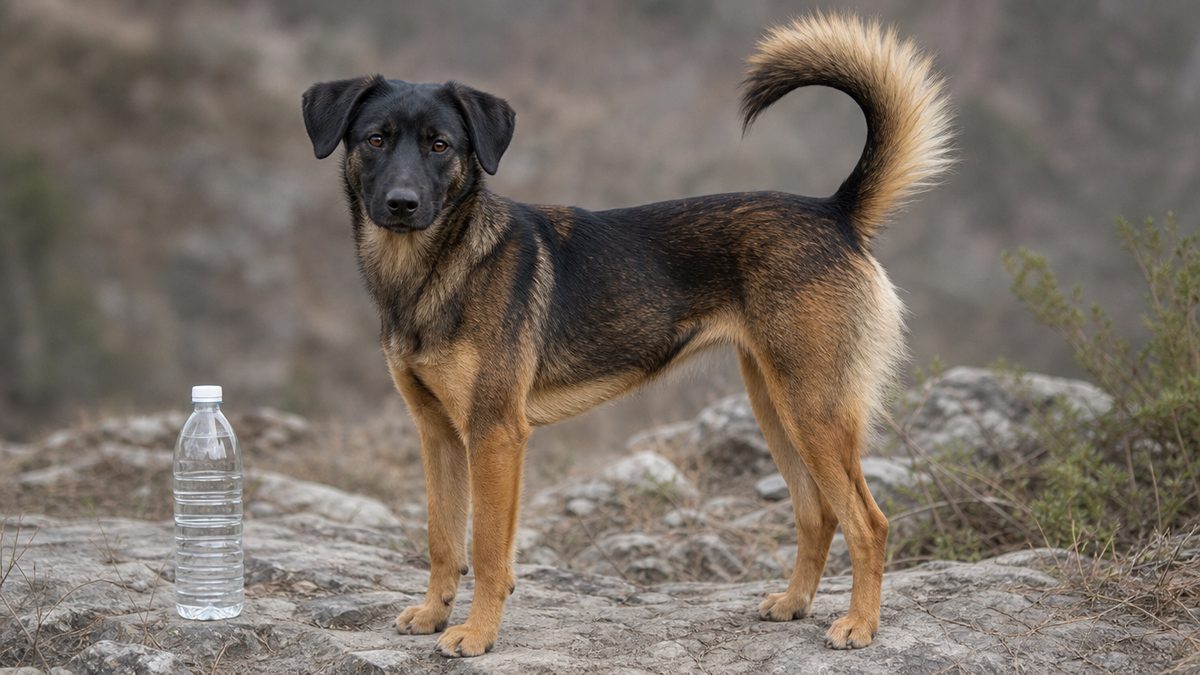
The Liangshan dog's coat colours are described in more detail in Chinese than any other part of the dog, and the description contains a usable test. The coat is medium-short, harsh and glossy, in black-cyan or black-yellow, with particolour rare. Almost every dog has a black head, called 火烧头, and every dog carries contrasting colour on the neck, forelegs, hindlegs and tail, a pattern called 披挂, which the source likens to wearing a waistcoat. A black dog with red 披挂 is called a 红青犬 and one with grey is a 铁青犬. The rule that follows is flat: a purebred Liangshan dog has no solid-colour coat.
The individual hairs are banded. Where most dogs' tail hair runs one or two colours from root to tip, a Liangshan dog's runs three: grey at the root, yellow-red in the middle and black at the tip. Wisdom Panel carries the same detail in English, in the same order. English Wikipedia says only that it is not unusual for the hairs to be banded, and attributes that to a source in which the word banded does not appear at all.
Ears, tail and feet
The head carries triangular brown eyes and high-set drop ears hanging as inverted triangles, above a black moist nose whose nasal cavity is described as proportionally large in the face. The tail is carried up in a sabre curve with hair longer than the body's, which is why it is called a broom tail. The tongue is flesh-coloured, and some dogs carry blue-black spots on it; the same source repeats a local belief that more spots mean a fiercer dog, which is folklore rather than a finding and we report it as folklore.
One structural detail matters for Indian owners specifically. The forelegs carry dewclaws and the hind legs do not. That is worth knowing because Bonbeno's page on the Laizhou Hong covers a Chinese breed whose own standard instructs breeders to remove dewclaws except where the law forbids it, and Indian law forbids it. Here the question never arises: there is nothing on the hind leg to remove.
Four names circulate and all four are the same dog. 凉山犬 or Liangshan dog is the encyclopedia name; 撵山狗, mountain-chasing dog, is what people in Liangshan actually call it; Liangshan hound is the form Wisdom Panel and the genetics literature use; and Hushan dog appears in the Wikipedia infobox and on Wisdom Panel. Baidu Baike holds two separate entries for it, 四川凉山犬 and 凉山猎犬, which is a fair signal of how unfixed the name is.
The two sources every English page rests on, read in full
Everything the English-speaking internet believes about this breed comes from two citations on one short Wikipedia article, and we opened both. One is a four-sentence hobbyist note that contains almost none of what is attributed to it. The other is a real genetics paper that says something genuinely interesting, and the interesting part is exactly what every downstream page drops.
English Wikipedia's Liangshan Dog article is 1,922 bytes long: four sentences of prose plus an infobox. Its first sentence says the breed was originally bred by the Yi people of Liangshan Yi Prefecture in Sichuan province and cites a 2011 article in the journal of the Primitive and Aboriginal Dog Society. Its second says the dogs are prized for their tracking ability, endurance and ferocity while hunting wild boar in mountainous terrain, and cites a 2019 genome-wide SNP paper. Its third sentence, which carries no citation at all, says the dogs are often deliberately underfed to improve drive. Its Description section attributes triangular eyes, rounded drop ears, a short double coat, bushy curved tails, black heads and banded hairs to the 2011 article.
Source one: four sentences about somebody else's photographs
We downloaded the 2011 PDF and extracted it with pypdf: 21 pages, 29,659 characters. The author writes from Buchanan, Virginia, and opens the article by explaining that an internet friend named Chen Chiaoxian, who teaches at an agricultural college in southern China, sent him pictures of aboriginal dogs along with information about them and allowed him to publish them with his comments. The Liangshan entry, in full, is four sentences: that it is a medium-sized scenthound; that it is very popular among hunters for its outstanding hunting ability; that, judging by the pictures, it combines scenthound features, rounded lop ears and body structure with a Laika's coat quality and colour and a bushy tail curving over the back; and that Sabaneev may possibly have written about this kind of dog under the name mahugou.
Searched character by character, that document contains Sichuan zero times, the phrase Yi people zero times, and the word province zero times. It contains banded zero times, underfed zero times and double coat zero times. Its single use of the word triangular sits inside a Sloughi breed standard in an entirely different article in the same issue. The word boar appears five times and every one of them belongs to the Guangxi and Jianmao entries, not to the Liangshan one.
So the sentence that defines this breed in English, the one naming the Yi people and Sichuan, is not in the source it cites. Neither are the triangular eyes, the double coat or the banded hair. What the source does say, which no English page repeats, is that the ears are lop rather than drop and that the coat resembles a Laika's.
Source two: a real paper, and the detail everyone drops
The 2019 SNP paper is genuine, it does cover the breed, and it is the best thing in this breed's bibliography. Under a heading reading Candidate Genes Related to Hunting Ability in Mountain Areas, it states that the Liangshan and Qingchuan hounds are mainly distributed in mountainous areas of western China's Sichuan province, and that the major characteristics of the two mountain hound breeds are their hunting abilities in mountainous areas, giving as examples enhanced ability to see at night, endurance, and aggression.
Compare that with the Wikipedia sentence it is cited for. Endurance survives. Aggression becomes ferocity. Tracking ability and wild boar are added from nowhere. And the night vision, the one specific and surprising claim the paper makes, is deleted. Read as raw text, the paper contains tracking zero times, ferocity zero times and boar zero times outside the publisher's own site navigation.
Google India's knowledge panel for this breed reproduces the Wikipedia sentence verbatim, wild boar included, and credits it to Wikipedia. An Emirati veterinary library page carries the same sentences word for word under two headings. This is how a claim that is in no source becomes the answer a search engine gives.
The third Wikipedia sentence, the uncited one about deliberate underfeeding, does have a Chinese ancestor, and the difference between them matters. Baidu Baike says that the Yi people's dogs are basically not fed anything and find their own food, so their hunting drive is strong, and adds in the same passage that the dogs often eat faeces and that this is a native breed in urgent need of rescue. That is a description of subsistence keeping in a poor mountain region. Wikipedia turns it into a training method applied on purpose. Wisdom Panel gets it right, writing only that many Liangshan hounds are free-roaming dogs that largely fend for themselves.
Is the Liangshan dog a recognised breed?
No kennel club anywhere in the world recognises the Liangshan dog, and no body of any kind publishes a written breed standard for it. We established that by opening the registers themselves rather than by reading breed pages, and by running a control on every document before reading an absence off it.
The Federation Cynologique Internationale letter L returns exactly eight definitively recognised breeds: Labrador Retriever (122), Lagotto Romagnolo (298), Lakeland Terrier (70), Lancashire Heeler (360), Landseer (226), Lapinporokoira (284), Leonberger (145) and Lhasa Apso (227). The Labrador heads that list and is the control, so the page loaded. Liangshan appears zero times on it. The letter C, where a breed published as Chinese Liangshan Dog would be filed, returns 44 breeds of which exactly two are Chinese, the Chinese Crested Dog (288) and the Chow Chow (205). The provisional register, read at the FCI's real register path rather than the decoy that serves an English Setter page, returns 20 breeds and not one Chinese entry.
The American Kennel Club's breed selector enumerates every fully recognised AKC breed and every Foundation Stock Service breed in one string. It carries Chinese Crested, Chinese Shar-Pei, Chow Chow, Pekingese, Shih Tzu, Lhasa Apso, Tibetan Mastiff, Tibetan Spaniel, Tibetan Terrier and the Taiwan Dog, with the Labrador Retriever, German Shepherd Dog and Tibetan Mastiff present as controls. Liangshan appears zero times.
What about the China Kennel Union?
The China Kennel Union is a full FCI member, and its China Native Dog Conservation Club is the body that would hold a Chinese landrace if anyone did. Its club index publishes standards for exactly five Chinese breeds: the Shaanxi Xian hound, the South China Tang dog, the Chongqing hound, the Laizhou Red dog and the Chuandong hound. Its news column records every event it held, and the breeds appraised between 2016 and 2018 were the Shaanxi Xian hound, the Laizhou Hong, the Xiasi dog, the Taicang dog, the Chongqing dog and the Chuandong hound. The Liangshan dog appears in neither list, and the club's last entry of any kind is dated 17 December 2018.
That is a striking absence, because the Chuandong hound, which the club did appraise, is the Liangshan dog's nearest neighbour in both genetics papers on this page. The two dogs sit side by side in the literature and on opposite sides of the club's programme.
Bonbeno's two-condition test, applied
Bonbeno's dog types that are not breeds page runs one published test on every name of this kind. A breed has a written standard and a studbook, so a puppy can be checked against a document; a type is a description, and many different dogs satisfy it at once, so there is nothing to check. Being a landrace does not put a dog on that page: the English Shepherd is a landrace and a standardised breed at once, and the Africanis is a landrace with an official emerging-breed standard.
The Liangshan dog fails both conditions. No written standard exists in Chinese, English or any other language we could open, and the one Chinese body that drafts standards for native breeds has drafted five and this is not among them. No studbook exists either: the China Working Dog Management Association runs a dog-registry database, but its Liangshan article is a knowledge-sharing piece and records no registration scheme for the breed. Creatures.com reaches the same conclusion independently, calling it better described as a local landrace or developing breed than as a uniformly fixed kennel-club breed.
No pedigree can exist under this name, in any country. Any paperwork offered with a Liangshan dog is either empty or belongs to a different dog. There is nothing to verify a claim against, which is exactly why the size figures on the internet span a factor of two without anyone being able to say which is wrong.
China's own state machinery gives no help either. Ministry of Agriculture Announcement No. 303 of 27 May 2020, the National Catalogue of Livestock and Poultry Genetic Resources, runs to 1,629 characters of visible text and contains the character for dog zero times in either of its common forms, while listing the raccoon dog, mink, silver fox and Arctic fox and marking each non-edible. Dogs were struck out of that catalogue deliberately, so no state count or state standard for any Chinese dog breed can exist under it.
One nuance is worth keeping, because Bonbeno's Kunming dog page establishes it: that exclusion is a change rather than a constant, and a Chinese dog breed did once hold a state new-breed certificate in the dog category. The Liangshan dog never did. It is unrecognised now and it was unrecognised then.
What twelve dogs and a SNP chip actually showed
Twelve Liangshan dogs have been genotyped, and what came back is the only hard evidence this breed has. A 2019 survey put 157 dogs from 15 Chinese indigenous breeds on 170K SNP chips, and the Liangshan hound row reads: Sichuan, 12 dogs, code C_LSH, 67,104 polymorphic SNPs.
That study is worth reading properly, because it is the only place the Liangshan dog is measured rather than described. Its design included 10 Rottweilers and 3 Papillons as Western controls and 3 Asian grey wolves, and it drew on 458 Western dogs from the LUPA consortium for comparison. Chinese indigenous dogs came out with higher genetic diversity and shorter-range linkage disequilibrium than Western breeds, which the authors attribute to earlier domestication and to less intensive selection, because there was no specific selection purpose during the formation of these populations.
The Liangshan row, in context
The genetic-diversity figures put this dog in the middle of the Chinese set and well clear of the Western breeds. Its proportion of polymorphic markers is 0.90, its allelic richness 1.91, its expected heterozygosity 0.31 and its observed heterozygosity 0.32. Linkage disequilibrium decays to an r-squared of 0.3 at 46.35 kb, and the inbreeding coefficient column reads 0.26.
| Population | Origin | Dogs | Polymorphic SNPs | LD decay (kb) | Inbreeding coefficient |
|---|---|---|---|---|---|
| Liangshan hound | Sichuan | 12 | 67,104 | 46.35 | 0.26 |
| Qingchuan hound | Sichuan | 12 | 75,664 | 27.54 | 0.20 |
| Chuandong hound | Chongqing | 12 | 64,219 | 45.51 | 0.31 |
| Xiasi hound | Guizhou | 12 | 74,280 | 18.95 | 0.21 |
| Tibetan mastiff | Tibet | 15 | 84,308 | 23.23 | 0.17 |
| Doberman Pinscher (Western) | Germany | 25 | 60,009 | 205.2 | 0.42 |
Read that table next to a Doberman and the point of the whole study becomes obvious. The Western breed's linkage disequilibrium runs more than four times further and its inbreeding coefficient is more than half again as high. A Chinese village hound is a genetically wider animal than a European show breed, and that is a real finding rather than romance about ancient dogs.
Where the paper contradicts itself, and it does
One line in the Discussion does not reconcile with the paper's own Table 1, and we publish the disagreement rather than picking a side. The Discussion states that the Shaanxi Xi dogs, coded C_SXX, showed the longest-range linkage disequilibrium and the highest inbreeding coefficient of all the Chinese breeds. The linkage-disequilibrium half checks out: 77.79 kb is the longest Chinese value in the table. The inbreeding half does not, because Table 1 gives C_SXX an inbreeding coefficient of 0.28 and the Chuandong hound 0.31. Table 1 also labels that population Shanxi Xi dog from Shanxi, while the Discussion calls it Shaanxi, and Shanxi and Shaanxi are two different provinces.
None of that touches the Liangshan row, which is why it is safe to quote. It is recorded because a reader checking our figures against the paper will hit the same inconsistency, and because this site's rule is to name a defect in a source rather than let a later editor think we misread it.
Two papers, five years apart, on the same gene
The 2019 study identified 518 SNP outliers under selection in the two Sichuan mountain hounds, sitting in 38 genomic regions across 19 chromosomes and containing 106 candidate genes, plus a selection signal at IGF1R, a gene associated with body size and with bone growth and density. Its Table 2 records the ear-size and ear-type gene MSRB3 under selection in the Liangshan hound among eight breeds.
A 2023 paper by an overlapping team returned to the question with runs-of-homozygosity analysis on the ten most representative Chinese indigenous breeds, coding the Liangshan dogs SCLSQ, and concluded that MSRB3 was likely to be the main gene causing the drop ear of domestic dogs. That is two independent analyses, five years apart, converging on one gene for the trait that most obviously distinguishes this dog from the prick-eared Chinese breeds around it. No ranking page mentions either.
The 2023 paper also settles a comparison. It reports that the Chuandong hound has the highest level of inbreeding among the ten breeds tested, that the Chuandong's inbreeding happened more recently than the Liangshan dogs' because of a greater number of long runs of homozygosity, and that the Chuandong also carries the higher inbreeding degree. In plain terms, the Liangshan dog's gene pool is the wider and older of the two, and its bottleneck, if it had one, was further back.
Twelve is a small sample and this page does not pretend otherwise. But 12 genotyped individuals on a 170K array, published in a peer-reviewed journal with Western controls and wolves in the design, is more measured evidence than most rare breeds on this site have, and it is infinitely more than the zero peer-reviewed papers behind the Laizhou Hong or the Chongqing dog.
History: what is documented, what is claimed, and who says which
The Liangshan dog's documented history is short and its claimed history is long, and the most useful thing about the Chinese material is that it tells you which is which. The China Working Dog Management Association reports that Liangshan dogs served with a Western Han army sent west in 111 BC, and labels that account 野史, unofficial history, in its own sentence.
That label is worth more than the story. Bonbeno's Chongqing dog page found fandom wikis repeating a 2,000-year Han Dynasty origin as plain fact, and a UK breed club conceding on its own history page that anything said about that breed before the 1980s is little more than speculation. Here a Ministry of Public Security-supervised association publishes the ancient claim and flags its own source type in the same breath. An English reader gets no such warning, because no English page carries the claim at all.
The Yi connection, and how to state it carefully
Every source that discusses this dog's origin ties it to the Yi people of the Liangshan mountains, and the sources differ on what kind of tie they mean. Baidu Baike says the breed originates in Liangshan prefecture and is the hunting dog commonly used by Yi people. The working-dog association says the same and adds that people across the Ganzi, Aba and Liangshan prefectures of western Sichuan have used this dog for generations. Wisdom Panel goes further and says experts believe Yi people brought the dogs with them when they migrated to the region hundreds of years ago, without naming the experts.
English Wikipedia compresses all of that into originally bred by the Yi people, and cites a source that mentions neither the Yi nor Sichuan Wikipedia, Liangshan Dog. The difference is not pedantry. Kept by is a description of a working relationship that the Chinese sources actually document. Originally bred by is a claim about who created a population, and nobody has evidence for it. This page uses the first and not the second, and it makes no claim about the Yi people beyond what a cited source says about their dogs.
What the record does support
Three things are supported well enough to state as fact. The dog is native to the Liangshan mountains of southern Sichuan and is not found as a distinct population outside them. Its keeping system is free-ranging: the dogs are largely left to find their own food, and the association attributes their working qualities directly to that pressure. And the population is shrinking, with the association stating that relatively pure Liangshan dogs are already uncommon locally and are becoming rarer, and Baidu attributing that to the arrival of foreign breeds and to indiscriminate crossing Baidu Baike, 四川凉山犬 (Sichuan Liangshan dog).
The genetics supports the third point indirectly rather than directly. A population with 12 sampled dogs, an inbreeding coefficient of 0.26 and linkage disequilibrium decaying at 46.35 kb is not a collapsed gene pool, but the survey sampled from several unrelated individuals specifically to cover broad consanguinity, so it describes the breeding population that existed in 2019 rather than the one that exists now.
The one lead nobody has followed
The 2011 article ends its Liangshan entry with a speculation that has never been checked: that Sabaneev, writing in Russian on sighthounds and scenthounds, may have described this kind of dog under the name mahugou. We could not test it. PubMed returns zero records for mahugou across all fields, which tells you only that it is not a veterinary term. We record the lead and claim nothing from it.
The same 2011 article closes with an observation nobody has picked up: that all authentic South China aboriginal dog types have a dual purpose, hunting and guarding, and that P. D. Boaz described exactly the same dual purpose in the aboriginal hounds of South India, in the same journal a year earlier. The only scholarly framing this breed has ever been given compares it to Indian dogs.
Liangshan dog price in India: none exists, and here is the proof
No Liangshan dog price in india exists, because no Indian seller lists the breed. Bonbeno publishes no rupee figure for it, and the only price attached to the name anywhere in our search is a euro band on a European aggregator with no seller, no country and no source behind it.
The India-located pull is the evidence, and the control is what makes it evidence. Searching liangshan dog with the country parameter set to India on 2 September 2026 returned Wisdom Panel, English Wikipedia, animalia.bio, a GPS collar vendor's blog, an Instagram topic page whose visible text is about the Tibetan Mastiff, creatures.com, milouchouchou.com, a Facebook group post, the Baidu Baike English mirror and a Tumblr post. Not one Indian domain appeared in the entire set, and not one page offered a dog for sale.
The same tool, in the same session, was asked labrador retriever price in india. It returned ten genuine Indian price pages including Mr n Mrs Pet's full eight-city table and Supertails' 40-breed list Mr n Mrs Pet, Labrador Retriever Puppies…. The instrument, the geotargeting and the index were all working. The zero belongs to the breed.
The one published price, and why we do not convert it
BreedsPedia prints an average puppy price of 600 to 1,500 euros and repeats it in its own FAQ. That figure names no breeder, no country, no currency source and no date. The same page prints heights and weights roughly double every Chinese figure for the breed, so its price carries exactly the credibility of its measurements.
This site converts no foreign price into rupees, and this is a good illustration of why. A euro band from a page that has the dog's weight wrong by a factor of two, run through an exchange rate, would produce a rupee number that looks like research and describes nothing. Bonbeno's breed pages have repeatedly caught Indian listings publishing dollar figures with the symbol swapped or divided at a single rate, and the result is always the same: a price that survives arithmetic and still refers to no transaction anybody made.
What an Indian buyer would actually be offered
Nobody in India is selling a Liangshan dog, so anyone offering one is offering something else. The likely candidates are worth naming, because each is checkable in a few minutes.
- An Indian pariah dog with a black head. The colour pattern the Chinese sources describe, a black 火烧头 with contrasting neck and leg markings, is common in Indian free-ranging dogs, and a lean drop-eared 20 kg hound is exactly what a healthy indie looks like.
- A generic imported hound. The DGFT bars importing a dog for sale or breeding outright, so any imported dog offered commercially has a paperwork problem before it has a breed problem.
- A shell listing. Creatures.com's Liangshan page is titled Breed Facts, Prices and Breeders, publishes no price, and shows four counters all reading zero: for sale 0, herdbook 0, profiles 0, breeders 0. That is what an empty marketplace looks like when it is dressed as a market.
- A different Chinese breed. The Chuandong hound, the Xiasi dog and the Chongqing dog all come from the same region and all have more commercial presence than this one.
Ask the seller for the breed standard. There is no correct answer, because none exists in any language, and a seller who produces one has produced a document for a different breed. Then ask which registry issued the pedigree. The FCI, the AKC and the China Kennel Union's own native-dog club all hold nothing under this name American Kennel Club China Kennel Union.
For comparison, the Indian breeds a buyer drawn to this type could actually register and verify are priced openly. Supertails puts the Rajapalayam at Rs 5,000 to Rs 20,000, the Mudhol Hound at Rs 3,000 to Rs 15,000 and an adopted indie at Rs 0 to Rs 3,000. Those numbers are real, they are Indian, and every one of those dogs is better suited to the climate than this one.
Cost of ownership in India for a 20 kg short-coated hound
Budget ₹6,000 to ₹10,000 a month to keep a dog of this size in India, and treat that as a size-band figure rather than a Liangshan dog figure. At 35 to 50 cm and under 20 kg this dog sits at the top of the medium band and the bottom of the large one, and no cost data specific to the breed exists in India because no Liangshan dog is known to live here.
Supertails publishes the only Indian running-cost table organised by size band rather than by breed, which is what makes it usable for a breed nobody stocks. Its medium column, illustrated with the Beagle and Cocker Spaniel, gives food ₹2,500 to ₹4,000, routine vet visits ₹800 to ₹1,500, vaccinations ₹1,500 a year, grooming ₹800 to ₹1,500, training ₹2,000 to ₹5,000 over six months, treats and toys ₹500 to ₹1,000, and flea and deworming ₹400 to ₹700, for a monthly total of ₹6,000 to ₹10,000.
| Line | Medium band (Supertails) | What this breed changes |
|---|---|---|
| Food | ₹2,500-4,000 | Top of the band. A working hound in real work eats more than a Beagle on a sofa |
| Routine vet visits | ₹800-1,500 | Higher in year one. No Indian vet has a breed baseline, so more is measured |
| Vaccinations | ₹1,500 a year | Unchanged. Core protocol, no breed adjustment |
| Grooming | ₹800-1,500 | Bottom of the band or below. A short harsh coat needs a mitt, not a groomer |
| Training | ₹2,000-5,000 over six months | Top of the band. An independent pack hunter is not a six-session dog |
| Flea, tick and deworming | ₹400-700 | The line to overspend on. See the tick section below |
| Monthly total | ₹6,000-10,000 | Realistically ₹8,000-10,000 for a working-type dog kept properly |
The first-year figure matters more than the monthly one for anyone budgeting honestly. Supertails puts a first year in India at ₹80,000 to ₹2,00,000 across the size bands, and notes that metropolitan cities carry a 20 to 35 percent premium over tier-2 cities on purchase prices, with Mumbai and Delhi the most expensive.
Where a Liangshan dog would cost less than the band suggests
Grooming is the obvious saving. The coat is medium-short, harsh and glossy with no heavy undercoat described anywhere in the Chinese material, and Wisdom Panel's whole grooming routine is weekly brushing and the occasional bath. A rubber mitt costs a few hundred rupees once. In a country where a Chow Chow or a Tibetan Mastiff needs a professional de-shedding appointment through the monsoon, that is a real and recurring difference.
Bodyweight saves money twice over. A 20 kg dog eats roughly half what a 40 kg guardian eats, and it sits well below the over-50 kg band that a 905,543-dog UK cohort identified as a significant heat-illness risk factor. Fewer emergency presentations is not a line item you can budget, but it is the largest single cost this dog avoids.
Where it would cost more
Two lines run above the band. Training is the first, because an independent free-ranging hunter is not the dog a standard six-session obedience package was priced for, and the honest budget is the top of the ₹2,000 to ₹5,000 range plus a second block. Parasite control is the second, and it is not optional: a 2026 Kolkata series of 584 dogs found 72.9 percent carrying two or more concurrent blood-borne pathogens. Year-round tick prevention on a dog that works in vegetation is the cheapest veterinary money you will ever spend.
There is no cost of ownership for a Liangshan dog in India, because there is no Liangshan dog in India. Everything above describes a 20 kg short-coated working dog in an Indian city, which is what you would actually be budgeting for.
Heat tolerance: a cool-mountain dog with a coat that helps
The Liangshan dog rates 3 out of 5 on this site for Indian heat, and both halves of that score are real. Its coat and its bodyweight are the best combination any Chinese breed on Bonbeno brings to an Indian summer. Its homeland gives it no preparation at all: four separate grid cells across the Liangshan mountains return zero months at or above a 25C monthly mean, against ten in Chennai.
We queried NASA POWER by explicit latitude and longitude rather than by place name, so no other town could be served by accident, and checked the returned coordinates and the returned cell elevation against every request. That check is what makes the Liangshan numbers usable, and it is also what makes them need correcting.
The grid cell over Xichang is a kilometre too high
Xichang, the seat of Liangshan Yi Autonomous Prefecture, sits near 1,510 m. The POWER cell over it reports an elevation of 2,488.68 m, an overstatement of about 979 m. Temperature falls with elevation at roughly 6.5C per 1,000 m, so the cell's annual mean of 11.09C reads about 6.4C too cold for the city underneath it. Corrected, Xichang's annual mean is nearer 17.5C, which is what a place locally known for mild year-round weather should read. We publish that correction as an estimate and label it one.
Three high county towns in the same prefecture returned much better cells and give the mountain climate directly. Zhaojue's cell sits at 2,367.71 m against a town near 2,100 m and returns an annual mean of 10.72C with a January mean of 1.84C. Butuo's cell sits at 2,321.37 m against a town near 2,385 m, the closest match of the four, and returns 12.45C annual with a January mean of 3.91C and a July mean of 18.83C. Meigu's cell sits at 2,299.93 m against about 2,100 m and returns 10.06C.
Four points across Liangshan returned four different elevations and four different temperature series. That is worth stating, because this project has repeatedly found NASA POWER collapsing an entire region into a single grid cell in mountainous terrain. It did not happen here, so the internal comparison between these towns is sound.
The gap that actually matters is wet-bulb
Dry-bulb temperature understates the problem, because a dog cools by evaporation and evaporation stops working as the air fills with water. Computed from the returned monthly means with the Stull formula, the peak monthly mean wet-bulb temperature is 15.30C at Xichang and 16.11C at Butuo, against 26.11C at Chennai, 27.09C at Kolkata and 26.50C at Delhi. That is a gap of ten to eleven points, and no amount of shade closes it.
| Place | Cell elevation | Annual mean | Coldest month | Months at or above 25C | Peak monthly wet-bulb |
|---|---|---|---|---|---|
| Xichang (cell 979 m too high) | 2,488.68 m | 11.09C | 2.50C | 0 | 15.30C |
| Butuo, Liangshan | 2,321.37 m | 12.45C | 3.91C | 0 | 16.11C |
| Zhaojue, Liangshan | 2,367.71 m | 10.72C | 1.84C | 0 | 15.61C |
| Chennai | 48.95 m | 27.95C | 24.09C | 10 | 26.11C |
| Mumbai | 97.15 m | 26.77C | 23.19C | 9 | 25.77C |
| Kolkata | 7.35 m | 25.81C | 17.31C | 8 | 27.09C |
| Delhi | 206.37 m | 25.60C | 13.61C | 7 | 26.50C |
| Bengaluru | 841.72 m | 23.74C | 20.22C | 3 | 21.86C |
Why the score is 3 and not 1
Two things save this dog from the bottom of the scale, and both are physical rather than climatic. The coat is short, harsh and close-lying with no thick undercoat in any Chinese description, which is the opposite of the plateau double coats that make Chinese working breeds so badly suited to India. And the dog is light. A 20 kg animal sits far below the over-50 kg bodyweight band that a 905,543-dog UK study flagged as a significant heat-illness risk factor, and it has a mesocephalic skull rather than the brachycephalic one that carried 4.21 times the odds of heat-related illness in a 167,751-dog emergency-care study.
What none of that fixes is that this dog has never experienced a hot season. Its homeland has no month above 25C in the mean, so nothing in its history selected for the thing an Indian summer demands. The honest verdict is that a Liangshan dog would cope better than a Tibetan Mastiff and worse than any Indian dog, and that a great deal of the difference would come down to how the owner manages the middle of the day.
One number frames the whole risk correctly. Across UK heat-illness events the median ambient temperature on the day was 16.9C. That is cooler than every Indian month in every city in the table above, and it is warmer than the annual mean of every Liangshan town in it.
City by city: where in India this dog would cope, and a correction that changes the answer
Two Indian hill stations match the Liangshan climate closely, and both of them are places NASA POWER describes worst. Read the raw grid cells and Ooty and Kodaikanal look no cooler than Bengaluru; correct them for elevation and they land within about two degrees of the Liangshan county towns. This is the one section where the honest answer and the naive answer point in opposite directions.
The plains cities need no correction and give a clean picture. POWER's cells over Delhi, Chennai, Kolkata, Mumbai, Pune, Bengaluru and Hyderabad all sit within about 80 m of the real town elevation, so the numbers are the towns. On those numbers, the ranking is unambiguous: Bengaluru at 23.74C annual with three months at or above 25C and a peak wet-bulb of 21.86C is the most survivable metro, Pune at 23.86C and four months is next, and Chennai at 27.95C with ten months and a coldest month of 24.09C is the hardest place in India to keep this dog.
The hill stations, and the correction that matters
Four Indian hill towns returned cells well below their real elevations, so their raw figures read far too warm. Ooty's cell sits at 784.64 m against a town near 2,240 m, a shortfall of 1,455 m. Kodaikanal's sits at 706.32 m against about 2,133 m, short by 1,427 m. Darjeeling's sits at 1,313.52 m against about 2,045 m, short by 731 m. Shillong's sits at 1,224.61 m against about 1,496 m, short by 271 m.
Apply the same 6.5C per 1,000 m lapse rate used to correct Xichang, and the picture inverts.
| Town | Cell elevation | Real elevation | Cell annual mean | Corrected estimate | Nearest Liangshan match |
|---|---|---|---|---|---|
| Ooty | 784.64 m | ~2,240 m | 23.50C | ~14.0C | Between Meigu and Butuo |
| Kodaikanal | 706.32 m | ~2,133 m | 23.77C | ~14.5C | Just above Butuo |
| Darjeeling | 1,313.52 m | ~2,045 m | 18.42C | ~13.7C | Butuo, 12.45C |
| Shillong | 1,224.61 m | ~1,496 m | 17.96C | ~16.2C | Corrected Xichang, ~17.5C |
| Bengaluru | 841.72 m | ~920 m | 23.74C | 23.74C, no correction needed | None. 12 degrees warmer |
Read naively, Ooty at 23.50C and Kodaikanal at 23.77C look no better than Bengaluru and the answer is that nowhere in India suits this dog. Read correctly, the two Nilgiri and Palani hill stations sit within about two degrees of the high Liangshan county towns, and corrected Shillong at roughly 16.2C is the closest Indian match to corrected Xichang at roughly 17.5C that exists. The naive reading rules out exactly the places that fit.
A lapse-rate correction is arithmetic applied to a model output, not a measurement. It reproduces each town's real climate to within a couple of degrees, which is enough to rank places and not enough to quote as a temperature. Where this page prints a corrected figure it says so and prints the raw cell beside it.
What each Indian city would actually demand
- Chennai and coastal Tamil Nadu. The hardest. Ten months at or above a 25C mean, a coldest month of 24.09C and a peak wet-bulb of 26.11C mean there is no recovery season at all. A dog from a place with zero such months would live indoors on air conditioning for most of the year, and would still need every walk moved to before dawn.
- Mumbai. Nine months above 25C, a coldest month of 23.19C and August relative humidity that makes evaporative cooling nearly useless. The dry-bulb figure is milder than Delhi's and the physiological load is worse.
- Kolkata. The highest peak wet-bulb in the table at 27.09C, with eight months above 25C. It also carries the heaviest documented tick-borne disease pressure in the Indian literature, which is covered below.
- Delhi. Seven months above 25C, a May mean of 35.0C and a highest monthly maximum of 48.79C, offset by a January mean of 13.61C and the lowest humidity of the metros at 45.56 percent annual. A hard summer and a real winter, which is closer to the Liangshan pattern than the coast is.
- Bengaluru and Pune. The only metros worth attempting. Three and four months at or above 25C respectively, annual means near 23.8C and December lows near 20C. Still roughly twelve degrees warmer year-round than the dog's homeland, and still the best India offers below the hill stations.
- Ooty, Kodaikanal, Darjeeling and Shillong. The genuine matches, on corrected figures. Anyone seriously proposing to keep a mountain hound from 2,300 m in India should be looking here and nowhere else.
One legal point closes the section, because in India climate suitability is not only a welfare question. Second Schedule Part IV paragraph 21(1) of the Dog Breeding and Marketing Rules 2017 bars keeping in outdoor facilities, without the attending veterinary practitioner's written approval, dogs that are not accustomed to the temperatures prevalent in the area and breeds that cannot tolerate them. A dog from a place with no month above 25C, kept outdoors in Chennai, is the case that clause was drafted for.
Temperament: a pack hunter that finds its own dinner
The Liangshan dog's temperament is described consistently across every Chinese and English source, and the descriptions add up to a working animal rather than a companion. It is gentle and obedient with its own household, strongly wary of and aggressive toward strangers, and unusually sociable with other dogs of its own kind.
No behavioural study of this breed exists. That has to be said before anything else in this section, because nothing below is a measurement. What follows comes from breed descriptions published by a Chinese working-dog association, an encyclopedia entry and a DNA-test company's library, and it is consistent enough to be useful while remaining description rather than data.
The trait that separates it from every guard breed on this site
The single most distinctive thing about this dog is that it does not fight other dogs. The association's description states that its greatest characteristic is sociability: the dogs like to live in groups, do not attack one another, and are therefore used mostly for pack hunting, with groups of them working the high mountains and grasslands together. That is the exact opposite of the Chinese guardian breeds Bonbeno has covered, where dog-to-dog aggression is the defining management problem.
For an Indian household the practical reading is specific. A dog selected for cooperating with other dogs is easier in a multi-dog home and around the free-ranging dogs on an Indian street than a Laizhou Hong or a Chongqing dog would be. It is not easier with strangers: the same source calls it highly alert with strong aggression toward people it does not know.
Prey drive is the deciding factor
This is a dog whose descriptions all centre on hunting. Wisdom Panel says the dogs can hunt bears, foxes, wild boars, otters and pheasants and are happy to hunt all day. The association describes a scenting ability that can follow a trail three days old, an intense hunting desire and a refusal to give up. The genetics paper's own framing of the mountain hounds is night vision, endurance and aggression.
In an Indian city that adds up to a dog that will chase. Cats, poultry, goats, monkeys and the neighbourhood's own dogs are all in range, and a lean 20 kg hound with real stamina is not a dog you recall by shouting. Secure fencing and a lead are not optional here, and the Rampur Greyhound page covers the same management problem in an Indian breed for anyone who wants the Indian version of it.
What the sources disagree about
One page describes a different dog entirely. BreedsPedia calls the breed calm and well-balanced, adapting well to different lifestyles, easy to train and suiting a wide range of lifestyles from active families to quieter households, and attaches no source to any of it. That is a template description, and it is the same page that doubles the dog's weight.
The careful version comes from an unexpected place. Creatures.com, a site this project has repeatedly caught fabricating breed content elsewhere, writes accurately here: that Liangshan dogs are expected to be practical, alert around the home and capable in rough country, that the background can make them unsuitable for casual apartment ownership unless exercise, training and socialisation are taken seriously, and that secure fencing and careful introductions to livestock, guests and other dogs matter. We flag that because a site-level verdict is not evidence about a page, and on this breed the known-bad domain is the one that got it right.
A household with land, other dogs, a job for it, and nobody who needs to walk past it unannounced. Not a first dog, not an apartment dog, and not a dog for a home where the front door opens onto a busy street.
Training: build the recall first and never trust it
To train a Liangshan dog, put every hour you have into recall and impulse control and treat the rest as optional. No measured trainability data exists for this breed at all, so what follows is reasoning from the working system it came out of rather than from a study, and this page says so wherever it matters.
The working system is the useful evidence. These are dogs that leave the house, find their own food, work ahead of a handler on steep ground and hunt in groups without being managed animal by animal China Working Dog Management Association. Nothing in that selects for a dog that checks in. It selects for one that makes its own decisions at distance and is right often enough to be fed.
What that means in practice
- Start recall in week one and never stop paying for it. A dog bred to work at distance will take a scent line over a command, and the only version of recall that survives that is one rehearsed thousands of times on a long line before it is ever tested off one.
- Socialise deliberately and early. The socialisation window closes near sixteen weeks. A breed described as highly alert with strong aggression toward strangers needs that window spent on calm exposure to Indian street noise, traffic, cattle, delivery riders and other people's dogs.
- Train in short sessions and reward with movement. An independent scenting dog will disengage from repetition. Scentwork, find-it games and tracking give this dog a job it already understands and are the cheapest way to tire it in a climate where a long walk is unsafe for eight months of the year.
- Manage rather than correct the prey drive. You cannot train out a chase response selected for over generations. Fencing, a lead and a muzzle-trained dog for vet visits are management, and management is what works.
- Budget for professional help. Supertails puts six months of training in the medium band at ₹2,000 to ₹5,000, and the honest expectation here is the top of that plus a second block.
The claim we are contradicting
BreedsPedia states that this breed is highly intelligent, responds excellently to positive reinforcement, and is easy to train, and lists easy to train among its Pros. No source is attached, no study exists, and the same page describes a dog twice the documented weight. This page rates trainability 2 out of 5 and says openly that the rating is inference from the breed's working system rather than a measurement.
Where the two views converge is on method rather than difficulty. Reward-based training is right for this dog whether it is easy or hard, because heavy-handed correction on an independent primitive-type hunter buys avoidance rather than compliance. Bonbeno's Indian Pariah Dog page makes the same argument about a dog with the same free-ranging history, and the training that works there is the training that would work here.
Exercise: the requirement nobody has measured, and the safe Indian default
No published source gives a daily exercise figure for the Liangshan dog, so this page gives no minute count as fact. What the record gives is the shape of the requirement, and the shape is a working hound that covers mountain ground all day rather than a pet that needs a walk.
The Chinese description is unusually concrete about the work. These dogs live in high mountains and walk rugged tracks and cliff edges with their owners every day, which is where the climbing and running ability comes from; and because household feeding does not meet their needs, survival pressure pushes them out to forage and hunt for themselves. That is not exercise in the pet sense. It is a full working day, self-directed, on the hardest ground available.
The Indian default, and why it has to be a default
For a 20 kg working-type hound in an Indian city, plan 60 to 90 minutes of real work a day, split across two sessions, both outside the heat. That figure is a size-and-type default rather than a breed figure, and it is stated as one. What makes it defensible is the alternative: an under-worked scenting hunter in a flat becomes a destructive, vocal, escape-prone dog, and the escape half is the one that gets dogs killed on Indian roads.
- Timing beats duration. The median ambient temperature on UK heat-illness days was 16.9C, which is cooler than any Indian month in any metro. Move work to before sunrise and after dark and the daily total matters far less than the hour.
- Exertional heat illness is the risk, not a hot car. In a 905,543-dog UK cohort, exertion was the trigger in 74.2 percent of the 879 events with a recorded cause, against 12.9 percent environmental and 5.2 percent vehicular. The danger to this dog is you, exercising it.
- Use the nose instead of the legs. Scentwork indoors, a scattered meal, a tracking line in a shaded compound. A dog that can follow a three-day-old trail does not need distance to be tired, and none of that costs a rupee.
- Give it a job with a shape. Free-ranging hunters cope badly with aimless activity and well with tasks that end. Retrieve, search, find-the-handler, anything with a finish.
Not hyperactivity. Fence-testing, gate-running, escalating reactivity to passers-by and independent hunting expeditions. A dog that has been finding its own food for generations does not sulk when it is bored; it leaves and gets on with it.
One published figure is worth quoting for contrast because it shows how thin the English record is. Neither Wisdom Panel nor BreedsPedia commits to a daily minute figure for this breed at all, where Bonbeno's Chongqing dog page found two English sources disagreeing by a factor of two on the same question. Here there is nothing to disagree with.
Grooming a short harsh coat in Indian humidity
Groom a Liangshan dog in about ten minutes a week and spend the time you save on skin, ears and ticks. The coat is medium-short, harsh and glossy, and Wisdom Panel's entire published routine is weekly brushing plus the occasional bath Wisdom Panel, Liangshan Hound Facts. This is the cheapest coat on the site to keep in an Indian city.
The coat is worth describing accurately because two sources describe it differently. The Chinese material gives a medium-short, hard, glossy coat and never uses the phrase double coat. English Wikipedia's Description section says short, double coat and attributes that to a source in which the phrase does not appear Beregovoy V. Aboriginal Dogs of Southern…. The 2011 article itself says only that the coat resembles a Laika's in quality and colour, which is a comparison rather than a specification.
The practical difference is real. A true double coat needs de-shedding through the moult and dries slowly after rain; a short harsh single or near-single coat needs a rubber mitt and dries quickly. Everything the Chinese sources describe, including a tail whose hair is visibly longer than the body's, points at the second. Until somebody publishes a standard, treat the coat as short and harsh and adjust if the dog in front of you says otherwise.
The weekly routine
- A rubber curry mitt, once or twice a week. Enough for a harsh close coat, and it doubles as a skin inspection.
- Ears every time. High-set drop ears trap moisture, and Indian monsoon humidity turns a damp ear canal into an infection. Check and dry after every bath and every wet walk.
- Nails and teeth on the normal schedule. Wisdom Panel flags dental disease as one of the commonest conditions in adult dogs and recommends home brushing alongside professional cleaning.
- Bath rarely. A harsh glossy coat is self-cleaning to a degree, and over-bathing in humid conditions strips it and irritates the skin.
The rule that is not about the coat
In India the grooming session is a tick check, and on this dog it is the most valuable ten minutes of the week. A working hound in vegetation collects ticks in the ears, between the toes, in the groin and under the tail, and the Indian data on what those ticks carry is covered in the next section. Run the mitt, then run your hands.
Supertails prices grooming in the medium band at ₹800 to ₹1,500 a month and in the large band at ₹500 to ₹1,200. For this coat a realistic figure is the bottom of either range or nothing at all, because there is no professional service a short harsh coat needs. That saving is one of the few genuine practical advantages this dog has over the other Chinese breeds on this site.
Health problems and life expectancy: an evidence base of almost nothing
No screening scheme covers the Liangshan dog anywhere in the world, no registry publishes statistics on it, no breed health survey exists and no study gives a life expectancy. That absence is the most important health fact on this page, because it means no veterinarian in India or in China has a breed baseline to compare your dog against.
The claim we have to deal with first is the optimistic one. The China Working Dog Management Association states that the Liangshan dog has strong disease resistance and basically none of the inherited diseases that some purebred dogs carry, and reports that dog lovers have promoted it as one of the four great Chinese hunting dogs partly on that basis. Baidu Baike repeats the same sentence.
That claim is untested rather than false, and the distinction matters. There is no dataset anywhere that could have tested it: no hip or elbow scheme has ever scored a Liangshan dog, no eye registry holds one, and the two peer-reviewed papers on the breed measure population genetics rather than disease Li Y, Huang M, Wang Z, Liu X, He S, Wang T. Bonbeno's Chongqing dog page met the identical claim on an English aggregator, phrased as no known major health problems exist, and reached the same verdict. An absence of published disease is not evidence of an absence of disease.
What the genetics does and does not tell you
The genetics offers one genuine reason for cautious optimism and one clear limit. The reason is that the 2019 survey found Chinese indigenous dogs carrying higher genetic diversity and shorter-range linkage disequilibrium than Western breeds, which the authors attribute to less intensive selection because there was no specific selection purpose during the formation of these populations. A wide, outbred population accumulates fewer fixed recessive defects than a closed studbook does. The Liangshan hound's inbreeding coefficient of 0.26 sits well below the Doberman's 0.42 in the same table.
The limit is that population-level diversity says nothing about any individual dog, and nothing at all about the specific conditions this breed might carry. A 2023 reanalysis found the Chuandong hound more inbred and more recently inbred than the Liangshan dogs, which ranks two Chinese populations against each other and still gives a buyer no disease list.
Life expectancy: two figures, neither sourced
Wisdom Panel prints a lifespan of 10 to 12 years. BreedsPedia prints 10 to 14. Neither carries a source, a sample or a method, and they do not agree. This page publishes no breed lifespan.
What can be said honestly is context. The largest UK life-table study puts life expectancy at age zero across all dogs at 11.23 years, 11.41 for females and 11.07 for males, from 30,563 deaths. A separate 584,734-dog analysis partitions longevity across 155 named breeds and the Liangshan dog is not among them, so no median from that work transfers here. That paper also carries an Author Correction that most citations omit, revising a figure in one figure legend.
Body size is the strongest single predictor of canine longevity, and larger dogs die younger. That is why BreedsPedia's 30 to 40 kg matters beyond pedantry: a page that doubles a dog's weight and then prints the longer of the two lifespans has produced two figures that cannot both be right BreedsPedia, Liangshan Dog.
The risks that are real for this dog in India
Three risks apply regardless of what the breed carries genetically, and all three come from the way it is kept rather than from its ancestry.
- Heat-related illness. Not because the dog is heavy or flat-faced, but because it is an exertional athlete from a climate with no hot season. Exertion triggered 74.2 percent of the events with a recorded cause in a 905,543-dog cohort, and the median ambient temperature on event days was 16.9C Hall EJ, Carter AJ, Chico G, Bradbury J.
- Tick-borne infection. Covered in full below, and the dominant health risk for any working dog in India.
- Coprophagy and its consequences. Baidu Baike states plainly that Liangshan dogs often eat faeces, in the same passage that explains they are not fed. A dog with that habit, imported into an Indian environment, is a helminth and protozoal reinfection risk on a monthly cycle. Note that Indian law is silent on it: the words faeces, faecal and coprophagia appear zero times in the Dog Breeding and Marketing Rules 2017.
One structural feature is worth a veterinarian's attention if you ever have this dog on a table. The hind legs carry no dewclaws, the toenails are described as grooved and hollow-looking, and the ears are high-set drops, which together mean the routine checks are the ear canal and the interdigital spaces rather than the dewclaw beds.
Indian disease pressure: ticks first, and the two best surveys disagree by a factor of eight
Budget for year-round tick control before anything else, because tick-borne infection is the dominant health risk for any dog in India and the two best recent Indian surveys differ about its scale by roughly a factor of eight. Publishing that disagreement is more useful than picking one number and calling it the rate.
A 2024 study at Guru Angad Dev Veterinary and Animal Sciences University in Ludhiana tested 719 canine blood samples by microscopy and by multiplex PCR. Molecular prevalence was Babesia gibsoni 8.9 percent, Babesia vogeli 1.1 percent, Ehrlichia canis 2.6 percent and Hepatozoon canis 5.1 percent, against microscopic prevalences of 5.0, 0.1, 1.4 and 1.0 percent respectively. Breed, sex and location were all significantly associated with Babesia gibsoni infection.
A 2026 study at the State Animal Health Centre in Salt Lake, Kolkata, tested 584 client-owned dogs between July 2024 and December 2025 with a five-target real-time PCR panel. It found Babesia gibsoni in 76.54 percent (447 of 584), Anaplasma species in 55.75 percent (325 of 583), Hepatozoon species in 28.94 percent (169 of 584), Babesia canis in 27.10 percent (158 of 583) and Ehrlichia canis in 16.61 percent (97 of 584).
| Pathogen | Punjab 2024, 719 dogs | West Bengal 2026, 584 dogs |
|---|---|---|
| Babesia gibsoni | 8.9% | 76.54% (447/584) |
| Babesia canis or vogeli | 1.1% (B. vogeli) | 27.10% (158/583, B. canis) |
| Ehrlichia canis | 2.6% | 16.61% (97/584) |
| Hepatozoon | 5.1% | 28.94% (169/584) |
| Anaplasma species | Not tested | 55.75% (325/583) |
| Two or more pathogens at once | Concurrent infections 0.1-0.4% | 72.9% of dogs |
Both are real studies with sound methods and they are not measuring the same thing. The Kolkata series drew from dogs presenting at an animal health centre in a hot, humid delta city, and the Punjab series from a university veterinary hospital in a drier northern state. Populations, seasons, climates and case mixes all differ. What a reader should take from the pair is a range, not an average: somewhere between one dog in eleven and three dogs in four carries Babesia gibsoni, depending where in India you are standing.
The finding that changes what you ask your vet for
The Kolkata study's most consequential result is about diagnosis rather than prevalence. Microscopy missed 130 of 158 Babesia canis positives, an 82.3 percent false-negative rate, and 146 of 169 Hepatozoon positives, 86.4 percent. Discordant samples had significantly higher cycle-threshold values, confirming failure at low parasitaemia. The authors conclude that real-time PCR should be adopted as the standard diagnostic approach for canine haemoprotozoa in West Bengal.
For an owner that translates into one sentence at the counter. A negative blood smear on a sick dog in an Indian city is weak evidence, and if the clinical picture fits a tick-borne infection, ask whether PCR is available before accepting the smear as an answer.
The Kolkata study found Ehrlichia canis to be the sole driver of acute multi-systemic illness in its cohort, producing significantly lower platelet counts, lower haemoglobin and raised ALT. A platelet count below 109 x 10^4 per cubic millimetre predicted E. canis infection with 54.6 percent sensitivity and 80.0 percent specificity, which makes a routine platelet count a practical prompt for molecular testing.
Why this hits a Liangshan dog harder than most
Nothing about this breed makes it more susceptible. What makes the risk higher is the way it would be kept. A scenting hound worked in vegetation, on rough ground, for an hour or more a day, collects far more tick exposure than a dog walked on pavement. Add the coprophagy the Chinese sources describe and the parasite load is not one problem but two, running on different cycles.
The Kolkata study's polyparasitism figure is the one to keep. Of 584 dogs, 72.9 percent carried two or more concurrent pathogens and 34.9 percent carried three or more. Whatever this breed's inherited disease list turns out to be, an Indian working dog's real health record will be written by ticks.
Feeding: the one place where copying the homeland would be cruelty
Feed a Liangshan dog to body condition on a complete diet split across two meals, and ignore everything the source material says about how these dogs eat at home. This is the only section on this page where the traditional practice is something an Indian owner must not reproduce, and the reason is that the practice is not a feeding method at all.
The Chinese material is blunt about it. Baidu Baike states that the Yi people's dogs are basically not fed anything and find their own food, that this is why the hunting drive is strong, and, in the next clause, that Liangshan dogs often eat faeces and that the breed urgently needs rescuing. The working-dog association puts it the same way with different emphasis: conditions in the Liangshan mountains are extremely hard, household feeding cannot meet the dogs' needs, and survival pressure forces them out to forage and hunt.
English Wikipedia renders this as dogs that are often deliberately underfed to improve drive, in a sentence carrying no citation at all. That reframing turns a description of poverty into a technique, and it is the version an English-speaking reader meets first. Wisdom Panel handles the same material correctly, writing only that many Liangshan hounds are free-roaming dogs that largely fend for themselves.
Underfeeding a working dog to sharpen it is not a training method, it is a welfare failure, and in India it also runs at the Dog Breeding and Marketing Rules 2017, whose Second Schedule sets out the feeding, veterinary care and housing standards a breeder must meet. Motivation in a scenting hound is built with the food, not by withholding it.
What to feed instead
- Feed to body condition, not to a chart. No breed-specific feeding data exists for this dog, and the published weight range spans 13.6 to 40 kg depending which page you read. Ribs easily felt and not seen, a visible waist from above and a tuck-up from the side is the target, and the Chinese description already says a real Liangshan dog has a slim waist and an obvious abdominal line.
- Two meals, not one. A deep-chested working dog eating a single large meal is the classic gastric-dilatation setup, and there is no reason to take that risk with a dog nobody has data on.
- Budget ₹2,500 to ₹4,000 a month at the top of the medium band. That is the Supertails figure for a medium-breed dog in India, and a working hound sits at the upper end of it.
- Weigh the treats into the daily total. Wisdom Panel's guidance is that treats should be no more than 10 percent of daily calories, which matters more on a dog you are training with food than on one you are not.
- Do not let bodyweight drift up. Bodyweight at or above the breed and sex mean was a significant heat-illness risk factor in a 905,543-dog UK cohort, and in an Indian summer that is the risk factor an owner controls directly.
The coprophagy problem, handled practically
If the source material is accurate, this is a population in which eating faeces is normal behaviour rather than a vice. An imported dog with that habit in an Indian environment is on a permanent reinfection cycle for helminths and protozoa, and no worming schedule outruns a dog that reinfects itself weekly. The management is unglamorous: feed enough, pick up immediately, supervise the garden, and put the deworming on a strict interval with your veterinarian rather than a casual one.
Indian law offers no help here and it is worth saying so plainly. The words faeces, faecal and coprophagia appear zero times across the 51,953 characters of the Dog Breeding and Marketing Rules 2017. This is a husbandry problem, not a regulatory one.
The first year, month by month
Plan a Liangshan dog's first year around three fixed dates that do not depend on the breed and one that does. The socialisation window closes near sixteen weeks, the core vaccination course finishes near eighteen weeks, Indian law bars the sale of any pup under eight weeks, and the first Indian summer will arrive before the dog is grown.
The breed-specific figures for the earliest weeks come from one source. Baidu Baike reports two heats a year, concentrated in early spring and summer, and litters of about three to seven puppies. There is no published birth weight, no published growth curve and no published weaning data, so everything from week nine onward below is a working-dog default rather than a breed observation.
| Age | What is happening | What you do |
|---|---|---|
| 0-8 weeks | With the dam. Rule 8(1)(a) bars the sale of any pup under eight weeks in India | Refuse any pup offered earlier, whatever the seller says |
| 8-12 weeks | Socialisation window wide open. Vaccination course starting | Calm exposure to Indian street noise, traffic, cattle, other dogs. Long-line recall from day one |
| 12-16 weeks | Window closing. Prey drive becoming visible | Finish socialisation. Start scentwork. Never let an off-lead chase succeed |
| 16-18 weeks | Core vaccination course completing | Confirm the schedule with your vet. Begin year-round tick prevention |
| 4-6 months | Rapid growth. First hot season likely | Move all exercise to dawn and after dark. Do not force distance on growing joints |
| 6-9 months | Adolescence. Recall degrades, boundary testing starts | Back to the long line. Audit the fencing before you need it |
| 9-12 months | Approaching adult size, 35-50 cm and under 20 kg | Full working load only once growth has finished. Body condition check monthly |
| 12 months+ | Adult. Females may have had two seasons | Breeding is a separate legal question, covered below |
The three months that decide the dog
Weeks eight to sixteen matter more on this breed than on almost any other on the site, for a specific reason. This is a population selected over generations for working independently, at distance, and being wary of strangers. Both of those traits harden with age, and both are cheapest to shape while the window is open. A Liangshan dog socialised properly is a reserved dog that tolerates people; one socialised late is a dog that does not.
The recall work in the same window is the other non-negotiable. Every week spent building a paid, rehearsed recall on a long line before the prey drive matures is a week you do not spend chasing the dog across a road later.
Second Schedule Part II paragraph 6(7) of the 2017 Rules sets eighteen months as the minimum age for a stud dog, and paragraph 6(6) bars any female dog being made to produce more than five litters in her lifetime. Both apply to any dog in India regardless of breed or registration status.
One thing this timeline cannot give you is a puppy. There is no Indian breeder, no Indian litter and no lawful import route for a dog bought to sell or breed from. The timeline above is written for the reader who has somehow acquired one legitimately, and for the far larger number who will apply it to an Indian dog of the same size and type.
Indian law, import, and a Chinese city that bans dogs like this one
Owning a Liangshan dog is lawful in India, importing one to sell or breed from is not, and the clause that bites hardest is about where the dog sleeps rather than what it is. Second Schedule Part IV paragraph 21(1) of the Dog Breeding and Marketing Rules 2017 bars keeping in outdoor facilities, without the attending veterinary practitioner's written approval, dogs not accustomed to local temperatures and breeds that cannot tolerate them.
That clause is worth quoting precisely because this site has repeatedly found it miscited. The provision is a Second Schedule paragraph, not a Rule: extracted with pypdf, the gazette runs 14 pages and 51,953 characters, the Rules themselves stop at Rule 13, and the string Rule 21 appears zero times in the whole instrument. A dog whose homeland records zero months at or above a 25C monthly mean, kept in an outdoor run in Chennai, is squarely inside categories (i) and (ii) of that paragraph.
Import: the route that exists and the one that does not
Dogs are a Restricted import into India at ITC HS 01061900 under DGFT Trade Notice 22/2022-23. A pet may come in with its owner on an import authorisation, applied for at least two months before travel, through the airports and seaports of Delhi, Mumbai, Chennai, Hyderabad, Bengaluru and Kolkata and, since October 2024, Kochi airport, with quarantine where required. Paragraph 6 is the one that closes the commercial route: any applications for trading or breeding purposes, or applications made on behalf of some another person or entity, shall be duly rejected. The full route is set out in how to import a dog to India.
Put that beside the recognition position and no lawful supply chain can form. There is no breed standard to breed to, no registry to record a litter with, no Indian population to draw from, and no legal route to import stock for the purpose Directorate General of Foreign Trade.
One vocabulary point saves arguments at the airport. What the DGFT issues is an import authorisation, and the import licence a seller advertises is not a separate document that exists: there is no import licence for a dog in India, only that authorisation, applied for against an Importer Exporter Code or against the permanent code the notice sets aside for persons importing goods for personal use. If somebody offers to arrange an import licence for a Liangshan dog, they are offering a thing with no legal existence, for a breed with no register behind it.
The clauses a breeder would run into
- Paragraph 6(9) prohibits breeding to create new breeds of dogs or unusual looks. Anyone proposing to fix a Liangshan type in India from imported or local stock is describing exactly that.
- Paragraph 6(3) prohibits in breeding between relatives of the second to fourth grade within the first four generations, and incest breeding between parents and children or brother and sister. A founder population of two or three dogs cannot avoid it.
- Paragraph 6(8) forbids tail docking, ear cropping, de-barking, de-clawing and any change of appearance by artificial means. Nothing in this breed's description calls for any of those, which is a point in its favour and worth stating.
- Part III paragraph 8(10) requires breeding dogs to have been tested for a list of genetic defects including hip dysplasia, progressive retinal atrophy, night blindness and hypothyroidism. For a breed with no screening scheme anywhere, satisfying that clause honestly means paying for tests nobody has a breed baseline to interpret.
The comparison nobody draws: China restricts dogs by breed and India currently does not
Indian readers are used to reading that Western countries ban breeds. The more instructive comparison for a Chinese dog is with China itself. Changsha's Dangerous Dog Catalogue, in force with the city's dog-keeping regulations from 1 May 2019, names 43 categories of dog that may not be kept in the strict management area without a police permit. Bringing one in draws an order to correct; refusal draws confiscation of the dog and a 1,000 yuan fine. Since the regulations took effect Changsha police have impounded, taken in or confiscated 2,300 dogs.
That catalogue was revised on 28 July 2025, effective from 1 September 2025 for five years, and the revision removed exactly one entry: the 中华田园犬, the Chinese rural dog, cutting 43 categories to 42. Every kind of mastiff, the Akita and the Chow Chow stayed. Shenzhen had removed the same native dog from a 27-breed list at the end of 2019, and Guangzhou did so in January 2025.
India's position runs the other way. A 2024 central circular naming a list of breeds was quashed by the Karnataka High Court on 10 April 2024 and set aside by the Delhi High Court on 16 April 2024, so no Indian law in force today bans owning, breeding or selling any dog breed. That is not a settled all-clear, because Karnataka expressly left the door open to a properly made Rules amendment, but as things stand an Indian owner faces no breed list and a Changsha owner faces one with 42 entries.
Four Chinese cities have now taken the native village dog off a dangerous-dog list, and the reasoning reported at Changsha's public hearing was that banning it pushed abandoned tugou into the streets and onto dinner tables while the dogs themselves are loyal, intelligent, healthy and adaptable. That is the case Bonbeno makes for the Indian Pariah Dog, being made in another country about its own native dog.
Liangshan dog compared with the dogs an Indian buyer can actually get
Every practical comparison for this breed ends in the same place: the dog it most resembles is already living on Indian streets and costs an adoption fee. The table below sets the Liangshan dog against the four dogs an Indian buyer drawn to this type would realistically be choosing between.
| Liangshan dog | Indian Pariah Dog | Rampur Greyhound | Mudhol Hound | Chongqing dog | |
|---|---|---|---|---|---|
| Published Indian price | None exists | ₹0-3,000 adoption | Regional, not on the 40-breed list | ₹3,000-15,000 | None exists |
| Height | 35-50 cm | Medium, variable | Tall sighthound | Large sighthound | 40-45 cm dogs |
| Weight | Under 20 kg | About 15-25 kg | Sighthound build | Lean, athletic | About 20-25 kg |
| Written breed standard | None in any language | Kennel Club of India | Recognised in India | Recognised in India | China Kennel Union only |
| Registry you can verify | None anywhere | KCI | KCI | KCI | CKU native-dog pedigree only |
| Bonbeno heat rating | 3 of 5 | 5 of 5 | See page | See page | 3 of 5 |
| Coat work in Indian humidity | Ten minutes a week | Minimal | Minimal | Minimal | Minimal |
| Available in India | No | Every city | Yes | Yes | No |
Against the Indian pariah dog
This is the comparison that decides the page. Read the Chinese description of the Liangshan dog with the name removed and it describes a lean, hardy, agile, short-coated free-ranging hunter of about 20 kg, with a strong nose, high prey drive, group tolerance, wariness of strangers, no professional grooming requirement and, its admirers claim, no inherited disease load. That is a description of the Indian pariah dog, written about a different mountain range.
The Indian version comes with advantages the Chinese one cannot match. It is genuinely adapted to a climate with ten months above 25C rather than none. Supertails puts adoption at ₹0 to ₹3,000 covering vaccination, deworming and microchipping, and names SPCA India, World for All and Animal Aid Unlimited as routes. And a Kennel Club of India registration is available, which is more paperwork than exists for the Liangshan dog anywhere on earth.
Against the other Chinese breeds on this site
The Liangshan dog is better documented than most of its neighbours and worse recognised than several. It has two peer-reviewed papers and 12 genotyped dogs; the Laizhou Hong has zero papers under any of its nine names, and the Chongqing dog has zero and no OFA statistics row. Against that, both of those breeds have a written China Kennel Union standard and this one does not.
The Kunming dog sits above all of them, with five PubMed-indexed papers, a state new-breed certificate and a state-published standard, and still no kennel club recognition anywhere. The Fu Quan sits below, with no register, no study and no state certificate at all. The Liangshan dog's position is specific: real measured genetics, no paperwork whatsoever.
If what draws you is a lean, tireless, nose-driven mountain hunter that gets on with other dogs and needs no grooming, adopt an Indian indie and give it a job. You will get the same dog, adapted to the right climate, with a vaccination record and a registry behind it, for less than the cost of one month's food.
Eight mistakes Indian readers make with the Liangshan dog
Almost every Liangshan dog mistake happens at the search box rather than with the dog, because there is no dog in India to make a mistake with. Eight recur, and each one is checkable in under five minutes with a browser.
- Believing the wild-boar sentence. It is in no source. The hobbyist article never mentions boar in the Liangshan entry, and the genetics paper contains the word zero times. The paper's actual claim is night vision, endurance and aggression, and the night vision is what every downstream page deletes.
- Treating Google's knowledge panel as a source. Google India's own description for this breed is the Wikipedia sentence, verbatim, wild boar included, credited to Wikipedia. An answer engine repeating a claim does not verify it, and this is that mechanism running live on a breed with almost no literature.
- Taking a size figure from the first page you land on. The published range runs from 15 kg to 40 kg and from no height at all to 71 cm. Three Chinese and Chinese-derived sources agree on 35 to 50 cm and under 20 kg; one European aggregator doubles it with no source BreedsPedia, Liangshan Dog.
- Assuming a Chinese breed page means a Chinese registry. The China Kennel Union's native-dog club published standards for five Chinese breeds and appraised six, and this dog is in neither list. There is no pedigree to buy.
- Reading a euro price as a market rate. The only published price anywhere is 600 to 1,500 euros on a page that names no seller and no country, and that gets the dog's weight wrong by a factor of two. Bonbeno converts no foreign price into rupees and neither should you.
- Trusting a zero from one spelling. Chinese Wikipedia's simplified title 凉山犬 returns a missing page; the traditional title 涼山犬 returns a full article. A single-form search would have reported the article absent, and the same trap is waiting on 撵山狗, Liangshan hound and Hushan dog.
- Believing the breed has no genetic disease. A Ministry of Public Security-supervised association says so, and no dataset anywhere could have tested it. No screening scheme has ever scored a Liangshan dog for hips, elbows or eyes.
- Copying the feeding practice. The Chinese sources describe dogs that are not fed and forage for themselves, and one of them says in the same breath that they eat faeces and that the breed needs rescuing. That is a description of hardship, not a method to reproduce in a flat in Pune.
The five-minute verification routine
If someone offers you a Liangshan dog in India, five checks settle it before any money moves.
- Ask for the breed standard. There is no correct answer. Any document produced belongs to a different breed.
- Ask which registry issued the pedigree. Open the FCI letter L, the AKC selector and the China Kennel Union native-dog index yourself. All three hold nothing China Kennel Union.
- Ask for the import authorisation. A dog imported to be sold has none, because the DGFT rejects those applications by rule.
- Weigh the dog. If it is over 25 kg it does not match any Chinese description of the breed.
- Look for the 披挂. A purebred Liangshan dog, on its own sources, has contrasting colour on neck, legs and tail and no solid coat at all. A solid-coloured dog offered under this name fails the only physical test the literature provides.
Creatures.com appears in this breed's search results, and this project has caught that domain publishing fabricated content on other breeds. On this one its prose is careful and correct, calling the dog a local landrace or developing breed rather than a fixed kennel-club breed. Its commerce furniture is still empty template, with four counters reading zero and a 55-colour list including albino and harlequin. Judge the page in front of you, not the domain.
One more thing to notice about the ranking set
Look at who is writing these pages. The fourth organic result for this breed in India is a blog post by a company that sells GPS hound-tracking collars, and each of its four breed paragraphs ends by recommending one. Its whole account of the Liangshan dog is that it lives in the mountains of Sichuan, that it is an excellent hunting and watchdog, that although Liangshan dogs are thin they are not as strong and robust as foreign gun dogs, and that they have an excellent sense of smell. That is four clauses of breed content wrapped around a product, and it currently outranks every Chinese source on this page.
Adoption and responsible sourcing
Adoption is not the consolation prize on this page, it is the only route to the dog being described. No Liangshan dog is known to live in India, no lawful supply chain can form, and the animal an Indian buyer is actually picturing is available in every city in the country for an adoption fee of ₹0 to ₹3,000.
Start with what the search evidence shows. An India-located pull for this breed returned no Indian domain at all, no seller, no breeder and no rescue, while the Labrador control returned ten genuine Indian price pages in the same session. There is no Indian population to surrender a dog from, which means there is also no Indian rescue holding one.
What to adopt instead, and why it is the same dog
The Chinese description of this breed, stripped of the name, is a specification: lean and agile with a marked tuck-up, 35 to 50 cm and under 20 kg, short harsh glossy coat needing no professional grooming, high-set drop ears, a strong nose, high prey drive, tolerance of other dogs, wariness of strangers, and a constitution shaped by finding its own food. Every line of that is satisfied by a healthy Indian pariah dog, and the pariah satisfies one more the Liangshan never can: it evolved in a climate with eight to ten months above a 25C mean rather than none.
Bonbeno's Indian Pariah Dog page covers the breed properly. For anyone who wants the sighthound end of the same idea, the Rampur Greyhound is an Indian hunting breed with the same lean build and the same prey drive, and Supertails prices the Mudhol Hound at ₹3,000 to ₹15,000 and the Rajapalayam at ₹5,000 to ₹20,000 with a Kennel Club of India route behind both.
How to source responsibly if you are somehow offered one
- Verify before you visit. Run the five checks in the previous section. If there is no standard and no registry, there is no breed claim to test, and the animal should be judged as an individual dog.
- See the dam, on the premises. Rule 8(1)(a) bars the sale of any pup under eight weeks in India, and a seller who cannot show you the mother cannot show you the pup's age either.
- Ask for the vaccination and deworming record. Every breeder in India is required to keep health and medical records with a separate vaccination record for every dog and every pup, and to give a copy to the purchaser.
- Refuse a mutilated dog. Docking, cropping, de-clawing and any change of appearance by artificial means are strictly forbidden under Second Schedule Part II paragraph 6(8). Nothing in this breed's description calls for any of them, so a cropped or docked dog offered under this name is doubly wrong.
- Do not pay for rarity. There is no register to be rare in. A rarity premium on an unregistered dog is a premium on the absence of evidence.
The conservation point, made honestly
The Chinese sources are worried about this breed and they say so. The working-dog association writes that relatively pure Liangshan dogs are already uncommon in their home area and are becoming rarer, and calls for their protection; Baidu attributes the decline to the arrival of foreign breeds and to indiscriminate crossing that is shrinking the native gene pool Baidu Baike, 四川凉山犬 (Sichuan Liangshan dog).
Nothing an Indian buyer does helps with that. A dog removed from the Liangshan mountains to an Indian city is one fewer dog in the breeding population it came from, and importing one for breeding is barred here in any case. If the argument that moves you is the conservation of a working landrace shaped by a hard environment, India has its own, on every street, and it is losing ground to imported breeds for exactly the same reasons.
The most useful thing Bonbeno can tell an Indian reader about the Liangshan dog is that you cannot get one, you would not enjoy the climate you kept it in, and the dog you actually want is at your nearest shelter. Everything above is the evidence for that sentence.
Liangshan dog: the questions Google actually shows, and the ones Indian readers ask
Who was China's favourite pet?
Google shows this question above the Liangshan dog results, and it is not about the Liangshan dog at all. The honest answer for this page is that the Liangshan dog has never been anyone's favourite pet: the Chinese sources describe a semi-wild working animal that finds its own food in the mountains of southern Sichuan, kept for hunting and guarding rather than companionship, and declining in numbers as its home villages change.
What is the most expensive dog breed in China?
Not this one, and no price for the Liangshan dog exists in China or anywhere else that we could open. The only figure attached to the breed anywhere in our search was 600 to 1,500 euros on a European aggregator page that names no seller, no country and no source, so we publish no price and no conversion of it.
Who is the heavenly dog in Chinese mythology?
That question belongs to Tiangou, a mythological creature, and not to this breed. The Liangshan dog does carry one historical claim of its own: the China Working Dog Management Association reports that Liangshan dogs served with a Western Han army sent west in 111 BC, and labels that account 野史, unofficial history, in its own text.
What is the most popular dog breed in China?
Google offers this question on the Liangshan results page and it has no bearing on the breed. What is measurable is the opposite of popularity: only 12 Liangshan dogs appear in the genetic literature, the association that published the fullest description says relatively pure examples are already uncommon and declining, and no register anywhere holds the name.
What is the Liangshan dog price in India?
No Liangshan dog price in india exists, because no Indian seller lists the breed. An India-located Google pull returned twelve results and not one Indian domain, while the same tool in the same session returned ten genuine Indian price pages for the Labrador control, so the zero belongs to the breed rather than to the search.
Is the Liangshan dog a recognised breed?
No kennel club anywhere recognises it. We read the FCI letter L live and it returns eight breeds with the Labrador first as a control and no Liangshan, the letter C returns 44 with exactly two Chinese entries, the provisional register returns 20 with no Chinese breed at all, and the AKC selector carries ten Chinese and Tibetan breeds and no Liangshan.
How big does a Liangshan dog get?
The Chinese sources agree on 35 to 50 cm at the withers and a weight generally not over 20 kg, and Wisdom Panel's 14 to 20 inches and 30 to 45 pounds converts to almost exactly the same animal. One European aggregator prints 61 to 71 cm and 30 to 40 kg for males, roughly double, with no source attached.
How long do Liangshan dogs live?
No study gives a life expectancy for this breed and this page publishes none as fact. Two aggregators print figures that do not agree, 10 to 12 years on one and 10 to 14 on the other, and neither carries a source. The largest UK life-table study puts dogs generally at 11.23 years at age zero, which is context rather than a breed figure.
Can a Liangshan dog handle Indian heat?
Less badly than most imported breeds and worse than any Indian one. Its homeland records zero months at or above a 25C monthly mean across four separate grid cells, against ten such months in Chennai, so nothing in its background prepares it for the Indian plains. The short harsh coat and the low bodyweight are what keep this from being a flat no.
What health problems does the Liangshan dog have?
Nobody knows, and that is the finding rather than a gap. No screening scheme covers the breed, no registry publishes statistics on it and no health survey exists. The Chinese association's claim that it has basically none of the inherited diseases some purebreds carry is untested, because there is no dataset anywhere that could have tested it.
Can you import a Liangshan dog into India?
Only as your own pet, and never to sell or breed from. The DGFT trade notice makes dogs a Restricted import at ITC HS 01061900, states that any application for trading or breeding purposes shall be duly rejected, and limits entry to the airports and seaports of Delhi, Mumbai, Chennai, Hyderabad, Bangalore and Kolkata. DAHD added a seventh port, Cochin International Airport at Kochi, for pets arriving under the baggage rules in October 2024.
Is the Liangshan dog the same as the Chongqing dog?
No, though both come from the Sichuan basin and both appear in the same genetic surveys. The Chongqing dog is a short-muzzled prick-eared guard dog with a bamboo tail and a written China Kennel Union standard; the Liangshan dog is a drop-eared scenting hunter with a broom tail and no standard at all. Its closest relative in those papers is the Chuandong hound.
What colours does a Liangshan dog come in?
Black-cyan and black-yellow, with particolour rare, and every purebred carries two patterns at once: a black head, called 火烧头, and a contrasting neck, leg and tail marking called 披挂. The Chinese description states plainly that a real Liangshan dog has no solid-colour coat, and that individual hairs run grey at the root, yellow-red in the middle and black at the tip.
Why does every page say Liangshan dogs hunt wild boar?
Because one Wikipedia sentence says so and everything else copies it. We read the two sources that sentence cites. The hobbyist journal article never mentions wild boar in the Liangshan entry, and the genetics paper contains the word zero times; what the paper actually lists is night vision, endurance and aggression, and the night vision is the part every downstream page drops.
Should an Indian family adopt instead of looking for a Liangshan dog?
Yes, and the substitute is close enough to be uncomfortable. What buyers describe wanting here is a lean, hardy, alert, free-ranging hunter with a strong nose and no inherited disease load, and that is a description of the Indian pariah dog, which is already adapted to this climate and available for an adoption fee of Rs 0 to Rs 3,000.
Compare with similar breeds
Liangshan Dog sits in 1 Bonbeno group. Each one compares it directly against the breeds it is genuinely an alternative to, on the same figures.