
Breed profile
Xiasi Dog: The Chinese Landrace With Two State Appraisals and No Studbook
A national body under China's Ministry of Public Security records that the Xiasi passed state appraisal in 2009 and 2019, that a 1999 survey found 271 purebred adults, that a 2002 survey found 98, and that no scientific breeding work has yet been carried out. English pages recycle the 271 as a current figure.
Quick answer
No verifiable xiasi dog price in india exists, and the Rs 15,000 to Rs 45,000 band Google India's AI Mode prints is not one. It attributes that band to Wikipedia, whose Xiasi article contains no price at all, and points buyers at a Flipkart listing that is a book. In China the animal holds two dated state appraisals and a provincial standard, and no kennel club anywhere recognises it.
This page reports what the published record contains. No veterinary literature studies the Xiasi dog's health, no screening scheme covers it, no life expectancy has been measured for it and no inherited condition has been described in it, so every health statement here is either a general one about medium landrace dogs or an explicitly sourced Chinese observation. Guidance written for registered breeds may not transfer. Nothing here is a diagnosis or a treatment plan. Consult your nearby vet before acting on anything on this page, and take any dog showing heat distress, collapse, pale gums or an unexplained fever to a veterinary surgeon the same day.
Xiasi Dog at a glance
What the Xiasi Dog is
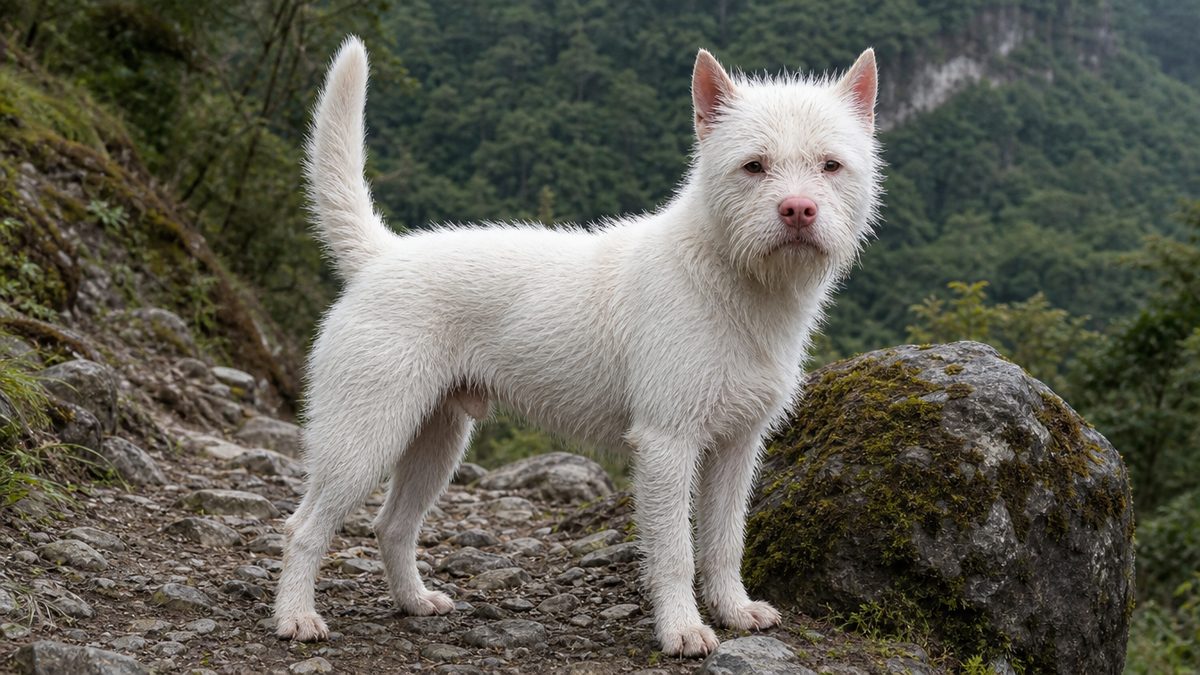
The Xiasi Dog is a white, wire-coated, boar-hunting landrace from Xiasi Town in Guizhou, bred by the Miao people, and it is the member of the Chinese tugou category that has gone furthest towards becoming a breed without arriving.
Start with the name, because it changed and the reason is a good story with a document behind it. The dog was originally the 白龙犬, the White Dragon Dog. A Chinese account preserved by the China Working Dog Management Association records that during the Qianlong reign a provincial inspector was given one at Xiasi, took it boar hunting with the emperor, and was asked what breed it was after it ran down a wounded boar. Because the emperor styled himself the 真龙天子, the True Dragon Son of Heaven, the official did not dare say White Dragon and answered instead that it was a Xiasi dog.
The place is worth pinning down, because the English and Chinese records differ. English Wikipedia puts the origin at Xiasi, Kaili City. The Chinese working-dog body gives it as 贵州省黔东南州麻江县下司镇, Xiasi Town, Majiang County, Qiandongnan Prefecture, and names the centre of production as five townships inside Majiang, with further distribution through Kaili, Huangping, Leishan, Danzhai and Sandu along the Qingshui and Duliu river valleys. Both are defensible, since the town has been administered from both, but a page that says only Kaili has lost the county the conservation programme actually runs in.
The one-line version
The Xiasi is a critically endangered hunting landrace with a breed standard issued by a Chinese province in 2007, two dated national appraisals in 2009 and 2019, and no recognition from any kennel club anywhere. Its Chinese-language infobox is blunter than any English one, reading 未經任何育犬協會的品種認證, not certified as a breed by any kennel association.
| Question | Answer | The document that settles it |
|---|---|---|
| Is there a written standard? | Yes, a Guizhou provincial standard published 2007 | China Working Dog Management Association |
| Is there state recognition? | Yes, twice. December 2009 and November 2019 | Same source, both dated |
| Is there a studbook of individuals? | No. A conservation farm exists, a register of animals does not | Same source |
| Is anyone breeding to the standard? | No. The work stopped at the survey stage | Same source, verbatim |
| Does a kennel club recognise it? | No, anywhere | English Wikipedia infobox and the Chinese equivalent |
| How many are there? | 271 in 1999, 98 in 2002. No later count published | Same source, both surveys |
| Is there veterinary literature? | One genomics paper names it. Nothing clinical | Controlled PubMed audit with three passing controls |
| Is there an Indian market? | No. Both Indian marketplace listings are books | Flipkart, checked directly |
What the dog looks like, from the source with the most detail
The Chinese working-dog account is far more specific than any English page, and it is worth having in full because it is the nearest thing to a standard a reader can read. The folk mnemonic Chinese sources quote is 虎头蛇腰鼠尾肘子脚,空鼻红眼耳直立, tiger head, snake waist, rat tail, hock feet, open nose, red eyes, ears erect.
- Coat: snow white, coarse and hard, in two layers, the outer called 剑杆毛 or sword-shaft hair, with stiff bristles standing erect on the face and muzzle like needles.
- Head: large and thick, forehead broad and flat, muzzle short, protruding and squared off.
- Ears: thin, triangular, erect, like a cat's ears, which is the source's own comparison.
- Nose and eyelids: pink, with the tongue pink and some dogs carrying dark spots on it.
- Body: chest round, loins level, croup well muscled, forelegs set wide apart, feet thick-soled and tight.
- Tail: carried erect, in a triangular cone or finger shape.
Size is agreed across every source that has one: 46 to 50 cm and 16 to 20 kg for dogs, 45 to 47 cm and 14 to 18 kg for bitches Chinese Wikipedia, 下司犬. Note that English Wikipedia's own body text gives the bitch floor as 46 cm while its infobox gives 45 cm, so the article disagrees with itself by a centimetre.
A commercial DNA-test reference page gives the Xiasi Hound as 44 to 66 lb and 18 to 22 in, which is 20 to 30 kg and 45.7 to 55.9 cm. Both ends sit above the Chinese figures, the top of the weight range by 10 kg. Where a Western aggregator and the country of origin disagree about an animal only the country of origin has ever measured, prefer the country of origin and say which you followed.
Breed, breed in formation or landrace? What the Chinese record supports
The Xiasi is a breed in formation that has stalled, because a standard and state appraisal exist while the breeding programme that would make a standard bite does not.
To count as a breed on this site an animal needs a written standard describing what it should be, and a register recording individual animals generation after generation so the standard is applied to real dogs. The Xiasi is the rare case where condition one is clearly met and condition two is clearly not, and the body best placed to know says so itself.
| Condition | Verdict | Evidence |
|---|---|---|
| A written breed standard | MET | Guizhou provincial standard drafted by the Guizhou Livestock and Poultry Genetic Resources Management Station and published by the provincial Quality and Technical Supervision Bureau in 2007 |
| National technical appraisal | MET, twice | December 2009, National Commission of Animal Genetic Resources of the former Ministry of Agriculture. November 2019, National Livestock and Poultry Standards Committee of MARA |
| A register of individual animals | NOT MET | A 原种场 or original-stock farm was established in 2005. No studbook, pedigree register or generational record is reported by any source |
| An active breeding programme | NOT MET, and stated so | Verbatim: at present this remains only at the survey stage, and no scientific selection or breeding work has yet been carried out |
| Kennel-club recognition | NOT MET | English Wikipedia infobox: Not recognized as a breed by any major kennel club. Chinese infobox: not certified as a breed by any kennel association |
| A current population count | NOT MET | Surveys in 1998, 2002 and 2006. The last published figure is 98 adults in 2002 |
The sentence that decides it
The China Working Dog Management Association writes, verbatim: 目前只停留在调研阶段,还没有进行科学的选种选育与育种工作. In English: at present this remains only at the survey stage, and no scientific selection, selective breeding or breeding work has yet been carried out.
That is a national body, under the Ministry of Public Security, saying that the thing which turns a standard into a breed has not happened. It is also a body actively trying to conserve the animal, which makes the admission more credible rather than less. The Tang Dog and Liangshan Dog pages cover two more members of the same Chinese category, neither of which has anything comparable. A standard nobody applies is a description. A conservation farm without a studbook preserves animals rather than a lineage. The verdict follows from that, not from the absence of a kennel club, and it is why this page files the Xiasi as a breed in formation rather than as a breed or as a bare landrace.
The timing problem nobody has noticed
Both national appraisals were granted under a legal framework that has since stopped covering dogs. On 29 May 2020 the Ministry of Agriculture and Rural Affairs published the National Catalogue of Livestock and Poultry Genetic Resources, naming 33 domestic species and excluding dogs, on the stated ground that dogs have specialised out of traditional livestock into companion animals and that China should not include them in livestock management.
So a breed appraised in December 2009 by the national animal genetic resources commission, and again in November 2019 by the national livestock standards committee, sits today outside the species list those bodies administer. Bonbeno makes no claim about whether that invalidates anything, because no source addresses it. What can be said is that the recognition is real, dated, and now orphaned, and that no English-language page mentions either half of it.
Check the state, not only the cynological body. On the kennel-club evidence alone the Xiasi looks like an unrecognised village dog with a folk tale attached. On the state evidence it holds a provincial standard and two national appraisals, which is more formal recognition than several FCI-provisional breeds can show. Ministries, agriculture departments and standards committees all recognise animals, and none of them appears in a kennel club's index.
How many are left, and why every English page has the wrong number
The last published count is 98 adult dogs in 2002, not the 271 from 1999 that English pages print as a current figure.
This is the correction that justifies the page. Every English source that gives a population gives a version of 270, and the Chinese source it ultimately traces to records two surveys, three years apart, with a fall of nearly two thirds between them.
| Year | What was counted | Result |
|---|---|---|
| 1998 | First Guizhou provincial survey of dogs in Majiang County | Conducted, figure not published in this source |
| 1999 | Breed resource census of Guizhou Xiasi dogs in Majiang County | 271 adult dogs meeting purebred appearance criteria |
| 2002 | Second survey, same county, same criteria | 98 adult dogs |
| 2006 | Third survey, under the national genetic-resources survey scheme | Conducted, figure not published in this source |
| 2026 | Any published national count | None found |
The Chinese text gives the reason for the fall in the same sentence as the number: 由于饲养管理粗放,忽视了保种和选育工作, because husbandry and management were extensive and conservation and selection work were neglected. That is a maintained record admitting a failure, which is a stronger source than a repeated figure.
English Wikipedia reports an estimate of only 270 purebred Xiasi left and separately notes the 1999 survey of 271. Chinese Wikipedia carries the same pair. Neither carries the 2002 figure. Social-media summaries have converged on less than 300 remaining, which is the same 1999 number with a rounding.
What the site will and will not say
Bonbeno publishes both surveys and no current estimate, because no current estimate exists in any source read for this page. The honest position is that the breed was measured twice at the turn of the century, fell by 64 percent between those two measurements, has been the subject of a conservation programme since 2005, and has not been publicly counted since. Anyone printing a 2026 population for this animal is printing a 1999 figure.
A rarity figure ages badly and quietly. When a source gives a count, look for the survey date attached to it, and look for a second survey. If the only date you can find is more than twenty years old, say the date rather than the number, because a population estimate without a year is not a measurement.
Xiasi dog price in india, and the answer engine that invents one
No verifiable xiasi dog price in india exists, and the Rs 15,000 to Rs 45,000 band Google India's AI Mode prints is attributed to a page that contains no price at all.
This section is unusual because the fabrication was caught live, in the same page render that produced this article's People-also-ask box, with the citation visible beside it. Here is what the engine printed on 9 September 2026, verbatim:
The price of a Xiasi dog typically ranges from Rs 15,000 to Rs 45,000 in India, though the breed is extremely rare and critically endangered worldwide, making genuine puppies very hard to find outside of China. The attribution printed beside that sentence reads Wikipedia (+1), and links to the English Xiasi Dog article.
Bonbeno read that Wikipedia article in full on the same day. It contains no rupee figure, no dollar figure and no price of any kind. The article's subject matter is a Qianlong legend, a Miao origin, a population survey, a physical description and a mitochondrial DNA study. There is nothing for a price to have come from.
That is fabrication from a page containing no number, not the laundering of somebody else's figure, and it is the more dangerous of the two because the citation resolves and looks correct.
Then it tells you where to buy one
The same answer continues: General Availability: You can check general availability or placeholder listings on platforms like Flipkart. Bonbeno opened Flipkart. Two listings carry the name Xiasi Dog and both are books.
| Listing title as printed | What it actually is | The tell |
|---|---|---|
| Buy Xiasi Dog by unknown at Low Price in India | Flipkart.com | A book | The words by unknown are Flipkart's AUTHOR field, left empty |
| Xiasi Dog Training Guide Xiasi Dog Training Book Features by Hill Tim | A book | It says Book in its own title, and names an author |
A page whose title contains the words Low Price in India and whose author field reads unknown is exactly the shape an automated price extractor is looking for, and it is a paperback. This is the merchandise trap this site has documented before, where the only rupee figure attached to a rare breed belongs to a poster or a mug, executed here by an answer engine rather than by a scraper.
The rest of the fabricated cost block
The same answer prints Monthly Food and Care: Rs 4,000 to Rs 7,500 with no source attached. That figure is not obviously wrong for a 16 to 20 kg dog in India, which is precisely what makes it dangerous: a plausible number with no provenance sitting beside a fabricated purchase price and a bookshop link. Bonbeno's own cost section below builds the same kind of figure from named, dated, live Indian sources so a reader can check every line.
| What you asked for | Available in India? | Realistic cost |
|---|---|---|
| A Xiasi Dog puppy with papers | No. No registry anywhere holds the breed | Not purchasable at any price |
| An imported Xiasi from Guizhou | No lawful pedigree route, and the population is under conservation | Not available |
| The Rs 15,000 to Rs 45,000 band Google prints | Nothing corresponds to it | Attributed to a page with no price |
| A book about the Xiasi Dog | Yes, two on Flipkart | Book pricing |
| A heat-adapted medium landrace | Yes, at any Indian shelter | Free to a nominal adoption charge |
Divide it by 84.38, then by 74, then by 80, and look at the QUOTIENT rather than at whether it divided. A genuine converted list yields prices a shop would print, like 500 or 1,500. Rs 15,000 divided by 74 is 202.7 and Rs 45,000 is 608.1, neither a price anybody quotes for a dog, so this band is not a conversion either. It is rupee-native and arbitrary, which is a different contamination mechanism and needs saying differently.
Monthly cost of keeping a medium hunting landrace in India
Budget Rs 3,000 to Rs 10,000 a month for a 16 to 20 kg dog in India, which is the range the Voice of Stray Dogs publishes and the band this animal would fall into.
The Xiasi cannot be bought in India, so this section prices the animal an Indian reader would actually keep if they wanted this kind of dog: a medium, short-to-wire-coated, high-drive working landrace. Every line is a live figure from a named source read on 9 September 2026.
| Line | Figure | Source and caveat |
|---|---|---|
| Acquisition | Rs 0 to Rs 2,000 | VOSD, shelter adoption. A pedigreed puppy is given as up to Rs 1,50,000 |
| Food, medium dog | Rs 1,500 to Rs 4,000 a month | VOSD. A working dog sits at the upper end of its band |
| Consultation | Rs 500 to Rs 1,000 | VOSD. Count as ONE data point; a general insurer publishes the identical range |
| Annual vaccination | Rs 1,500 to Rs 3,000 | VOSD, same caveat |
| Vetic anti-rabies, single | Rs 699 | One chain's Starts-at floor, not a market average |
| Vetic 9-in-1 DHPPiL | Rs 899 | Same |
| Vetic puppy course, 7 visits from day 30 | Rs 6,499, struck through from Rs 8,111 | Same. The schedule is now seven visits, not four |
| Vetic annual booster package | Rs 3,199, struck through from Rs 3,806 | Same |
| Grooming | Rs 300 to Rs 2,000 a session | VOSD. A wire coat needs almost none of this |
| Boarding | Rs 500 to Rs 2,000 a day | VOSD |
| Total monthly | Rs 3,000 to Rs 10,000 | VOSD |
| Total yearly | Rs 25,000 to Rs 80,000 | VOSD |
| Lifetime, 10 to 15 years | Rs 3 lakh to Rs 10 lakh | VOSD |
Set that beside the unsourced Rs 4,000 to Rs 7,500 monthly figure Google's AI Mode prints for this breed. The engine's band sits inside VOSD's, which is why it passes a casual reader. The difference is that every line above names a page you can open, and the engine's names nothing.
The two lines a high-drive working dog moves
Food goes up and containment costs appear. A 16 to 20 kg dog with the prey drive this one has is at the top of the medium food band rather than the middle, and the real Indian cost most owners forget is fencing, a long line and a secure gate. That is a one-off in the Rs 2,000 to Rs 5,000 range for a starter kit by VOSD's reckoning, and it is not optional for a boar dog in a residential colony.
Grooming goes down to nearly nothing. The coarse double coat needs a brush, not a salon. Over ten years at even the low end of VOSD's Rs 300 to Rs 2,000 a session, a coat-heavy breed spends a five-figure sum this dog does not.
VOSD gives the first year as Rs 30,000 to Rs 80,000 and prices real emergencies separately: a foreign-body endoscopy or surgery from Rs 15,000, an orthopaedic repair Rs 30,000 to Rs 80,000, a one to three day hospitalisation Rs 8,000 to Rs 30,000. A hunting dog that ranges is more exposed to the third of those than a sofa dog. Build the reserve fund first.
Heat tolerance, and why Guizhou does not prepare a dog for India
A Xiasi is poorly prepared for Indian heat, because Chennai's coolest month averages 24.09 C and Kaili's hottest averages 24.02 C.
That single comparison is the whole climate argument and it is worth stating before anything else. The hottest month this breed's home town has ever averaged is 0.07 C cooler than the coolest month Chennai manages. A Xiasi arriving in Chennai in January would be experiencing the hottest weather of its ancestral year, in the coolest week of the Indian one.
Bonbeno queries NASA POWER by explicit latitude and longitude and echoes back the grid-cell elevation, because POWER returns a cell rather than a point and in hill country the cell can miss the town badly. Kaili's cell sits 200.93 m above the town's real elevation of about 720 m, which is inside the usable band but should be read as a slightly-too-high mountain figure rather than the town exactly.
| Point | Cell elevation vs real | Annual mean | Hottest month | Coolest month | Annual RH | Peak wet bulb |
|---|---|---|---|---|---|---|
| Kaili, Guizhou | 920.93 m vs 720 m, +200.93 m | 15.25 C | Jul 24.02 C | Jan 3.80 C | 82.77 % | Jul 22.15 C |
| Guiyang, Guizhou | 1233.94 m vs 1100 m, +133.94 m | 14.66 C | Jul 22.68 C | Jan 4.06 C | 82.27 % | Jul 20.75 C |
| Chennai | 48.95 m vs 6 m, +42.95 m | 27.95 C | May 31.51 C | Jan 24.09 C | 72.39 % | May 26.11 C |
| Mumbai | 97.15 m vs 14 m, +83.15 m | 26.77 C | May 31.19 C | Jan 23.19 C | 67.39 % | Jun 25.77 C |
| Delhi | 206.37 m vs 216 m, -9.63 m | 25.60 C | Jun 35.88 C | Jan 13.61 C | 45.56 % | Jul 26.50 C |
| Bengaluru | 841.72 m vs 920 m, -78.28 m | 23.74 C | Apr 28.37 C | Dec 20.22 C | 67.94 % | May 21.86 C |
| Kolkata | 7.35 m vs 9 m, -1.65 m | 25.81 C | May 31.53 C | Jan 17.31 C | 73.93 % | Jun 27.09 C |
Kaili and Guiyang are separate cells, 133.94 m and 200.93 m off their towns and 313 m apart from each other, so this is not one cell queried twice. Both agree: Guizhou is a cool, extremely humid upland, at roughly 82 percent annual relative humidity and an annual mean below 16 C.
Humidity is not the problem. Heat is
An easy mistake here would be to say Indian humidity will finish a Guizhou dog. It will not, because Guizhou is more humid than every Indian city in the table, at 82.77 percent against Chennai's 72.39 and Delhi's 45.56. The animal is thoroughly adapted to damp air.
What it has no history of is heat, or heat combined with humidity. The right way to read that is as wet-bulb load rather than as temperature. Kaili's peak Stull wet bulb is 22.15 C in July. Kolkata's is 27.09 C in June, Delhi's 26.50 C and Chennai's 26.11 C. A gap of 4.94 C in peak wet bulb between the homeland and Kolkata is the number to weigh, and it is large.
The only Indian ground that resembles home
Bengaluru is the closest usable Indian city, at a 21.86 C peak wet bulb, which is 0.29 C below Kaili's, and an annual mean of 23.74 C against Kaili's 15.25 C. So the wet-bulb load in Bengaluru is genuinely comparable and the year-round warmth is not. Indian hill stations look like better analogues on paper and are not measurable with this instrument: POWER's cells for Manali, Ooty, Shimla and Darjeeling are wrong by 700 to 1,935 m, so Bonbeno publishes no hill-station figure.
- Walk before 07:00 and after 19:00 from March to June in every plains city.
- Watch wet bulb, not temperature. Kolkata's June load beats Delhi's despite Delhi being 4.35 C hotter, because Delhi is dry.
- Never exercise a working dog into the afternoon, because exertional heat illness is the commonest presentation in the largest study of it.
- Treat collapse as an emergency. Hall's 905,543-dog UK cohort recorded 395 confirmed heat-related illness events at an event fatality rate of 14.18 percent.
- Note the legal hook. Second Schedule Part IV paragraph 21(1) of the Indian Dog Breeding and Marketing Rules 2017 bars outdoor housing, without a vet's written approval, for dogs not accustomed to local temperatures.
This is not an Indian dog. Every other section on this page can be read as encouragement; this one should not be. A cool-climate mountain hunting landrace with a coarse double coat, imported into a plains Indian city, is being asked to live in weather it has no ancestral experience of. Consult your nearby vet about heat management before taking on any dog from a climate this much cooler than yours.
Temperament and household fit
A Xiasi is described by the Chinese body that trains working dogs as firm in character, friendly with people, quick to understand and obedient, with a very strong natural hunting drive that decides everything else.
Take the working assessment first, because it is the most authoritative description that exists. The China Working Dog Management Association writes that the breed is 性情坚定,与人友善,通晓人性,悟性极好,忠实听话, firm in temperament, friendly to people, understanding of human nature, of excellent comprehension, faithful and obedient, and lists its uses as 狩猎、搜索、看家护院、陪伴, hunting, searching, guarding the home and companionship.
That is unusually positive for a landrace, and it should be read as a working body's professional impression rather than as a measurement, because no behaviour study of this breed exists anywhere.
The trait that governs the household decision
Prey drive. The same source calls the dog 天生就有很强的捕猎能力, naturally possessed of very strong hunting ability, and 被誉为狩猎犬中的全能大师, hailed as the all-round master among hunting dogs, and its work is boar. Chinese video material circulating widely shows Xiasi dogs working wild boar in packs.
In an Indian residential context that translates into a specific set of problems: cats, poultry, goats, small dogs and free-ranging community dogs. Sacks and colleagues put the wider Southeast Asian village-dog population in a Neolithic expansion out of the region, which is the ancestry this hunting drive sits on. A dog bred across centuries to hold dangerous game in dense forest does not distinguish between quarry and a neighbour's animal, and no amount of socialisation removes the drive. It can only be managed.
| Situation | Verdict | Why |
|---|---|---|
| A rural or semi-rural Indian household with secure fencing | Workable in principle | The dog was built for exactly this, minus the heat |
| An Indian apartment | Poor fit | A ranging boar hound in a flat is a containment and noise problem |
| A home with cats, poultry or a rabbit | Do not | The drive is the breed's defining working quality |
| A first-time owner | Poor fit | High drive plus no standard means no predictability to fall back on |
| An experienced owner in a cool hill climate | The closest thing to a fit | Still constrained by there being no lawful way to obtain one |
One further consideration is cultural rather than behavioural, and it is worth stating because it explains what the dog is for. Chinese sources record that the Xiasi is prized today for bringing wealth to the family, which is a status role rather than a working one. A breed being kept partly as a good-luck object is a breed whose selection pressure has moved away from work, and that is usually where type starts to drift.
Yang and colleagues measured the genetic distance between individuals within Chinese indigenous breeds as larger than that within Western breeds, on 157 dogs across 15 breeds. A temperament paragraph about such a population describes a tendency, not the animal in front of you. With no closed studbook, the individual is the only evidence you have.
Training a high-drive hunting landrace
To train a Xiasi-type dog, build the recall on a long line for a year before trusting it, because everything else in the animal's history rewards independent pursuit.
The Chinese assessment is that the breed is obedient and quick to understand, which is encouraging but does not touch the hard part. Biddability at your feet and reliability at 200 metres behind a scent are different capacities, and a boar hound has been selected for the second one to override the first.
What works
- Start recall before the puppy can outrun you. Weeks 8 to 16, in a hallway, paid every time, so the behaviour is old before the drive arrives.
- Keep the long line on for twelve months. A 10 m line, on a harness, in every open space, until the recall holds against a squirrel three times in a row.
- Pay the recall with something better than the chase. For a high-drive dog that usually means meat, not kibble, and sometimes it means permission to go and sniff.
- Teach a stop rather than only a come. A dog that will lie down at distance is recoverable when a come is not.
- Give the drive a legal outlet daily. Scentwork, a flirt pole, a scattered meal. A hunting dog with nothing to hunt will select its own quarry.
What it resists
Expect resistance to repetition without purpose and to being asked to disengage from a scent. Correction-based methods are a poor fit for a landrace with no history of handler pressure, and they trade a training problem for an avoidance problem. If a dog will not come off a trail, the answer is a longer line and a better payment, not a harsher one.
There is one genuinely useful Chinese observation on the working side. The same body notes the breed's 速度与耐力, speed and endurance, with 爆发力, explosive power, in a compact frame. Endurance is what an Indian owner should plan around, because a dog that can keep going in 24 C mountain air will keep going in 31 C Chennai air and will not stop itself.
Second Schedule Part IV of the Dog Breeding and Marketing Rules 2017 requires separate housing for a vicious or aggressive dog and forbids sedation to control its behaviour. If a trainer proposes chemical restraint for a drive problem, that is the clause to quote. Ask your nearby vet to rule out pain first, then manage the environment.
Daily exercise needs for a boar hound
Give a Xiasi-type dog 90 to 120 minutes a day, split across two cool-hour outings, plus daily scentwork, because this is a hunting breed with recorded endurance rather than a companion landrace.
The requirement is at the top end for a 16 to 20 kg dog, and the reason is the job. A boar hound covers ground in mountains for hours. Chinese accounts single out 耐力和爆发力极强, extremely strong endurance and explosive power, as the breed's defining working qualities.
| Slot | Duration | Content |
|---|---|---|
| Daily, before 07:00 | 45 to 60 min | The long outing. Varied ground, on lead or long line |
| Daily, after 19:00 | 30 to 45 min | Sniffing walk rather than pace |
| Daily, indoors | 10 to 15 min | Scentwork. Scatter-feed, hide the meal, find-it games |
| Twice weekly | 20 min | Structured drive work: flirt pole, tug with rules, retrieve |
| Weekly | Longer | A safe enclosed space, only once the recall is proofed |
| March to June, plains cities | Reduce | Shift volume indoors. Chennai, Delhi and Kolkata peak in May or June |
Skipping this is not a cosmetic failure. An under-exercised hunting dog in an Indian colony finds its own work, and its own work is the neighbour's cat. The behaviour problems that follow are the reason high-drive breeds get surrendered, and VOSD names financial and effort unpreparedness as a leading driver of dog abandonment in India.
When the walk has to shrink, replace distance with nose work, not with a longer evening walk in worse air. Ten minutes of hunting for a scattered meal tires a scent-driven dog more than twenty minutes of pavement, costs nothing, and happens under a fan.
Grooming and coat care in Indian humidity
Brush a Xiasi-type coat weekly with a stiff brush, never clip it, and dry the ears after every soaking, because the coat is a coarse double coat built to shed water rather than a soft one.
The Chinese description is specific and unusual. The coat is 雪白, snow white, in 长短二层毛, two layers long and short, with the outer layer 毛质粗硬, coarse and hard, known as 剑杆毛, sword-shaft hair. Stiff bristles stand erect on the face and muzzle 犹如针状, like needles. Chinese Wikipedia files the coat simply as 剛毛, wire.
| Task | How often | Cost |
|---|---|---|
| Stiff-brush grooming | Weekly, twice weekly in a shedding month | Rs 0 after a Rs 200 to 400 brush |
| Bath | Every 6 to 8 weeks, or after a monsoon soaking | Rs 0 at home |
| Ear drying after every wetting | Every time | Rs 0, a cotton pad |
| Nail trim | Every 3 to 4 weeks | Rs 0 at home |
| Professional session | Rarely needed | Rs 300 to Rs 2,000 when used |
| Clipping the coat | Never | The double coat is the dog's heat and abrasion protection |
Three things a white wire coat does in India that it does not do in Guizhou
- It shows dust rather than hiding it. A snow-white dog on an Indian street is a visibly dirty dog within a day, and owners over-bathe in response, which strips the coat and irritates skin.
- It tempts the clippers. Do not clip a double coat in a hot country. Removing the outer layer removes the air gap and the sun barrier, and a pink-skinned white dog is exposed to sunburn once the guard hair is gone.
- It traps water at the ear. Overseas club advice routinely says to towel a dog and let it air dry, which is written for a temperate climate. In an Indian monsoon, plug the ears before a bath and dry them afterwards, every time.
On seasonality the Indian evidence disagrees with itself and Bonbeno publishes the disagreement. A southern Indian series of 120 clinically affected dogs recorded a peak in the pre-monsoon season, March to May, while an eastern Indian study of 178 dogs in Bhubaneswar found 55 percent of ehrlichiosis cases in the summer months. Those are tick-borne disease seasons rather than skin seasons, and the useful reading is that the high-risk window for an outdoor dog in India is the hot months rather than the rains.
Ticks. A coarse coat makes them easier to feel, which helps. Check the ears, neck, between the toes and under the tail after every walk in grass, because the West Bengal series found 72.9 percent of 584 dogs screened carrying two or more blood-borne pathogens at once. Ask your nearby vet which preventive suits your dog's weight and your city's tick season.
Health issues, life expectancy and what has never been measured
No life expectancy has ever been published for the Xiasi Dog, no screening scheme covers it, and the only health finding in the record is low genetic diversity.
State the absence first, because it is large. This breed has no OFA row, no kennel-club health survey, no longevity study and no described inherited condition. Bonbeno will not borrow a lifespan from a Western aggregator to fill the gap; a commercial DNA-test reference page gives 10 to 14 years for a Xiasi Hound, and that figure has no study behind it.
What the PubMed audit actually returns
The literature is one paper, and the name forms matter enormously here.
| Query | Count | What the records actually are |
|---|---|---|
| Xiasi[tiab] | 1 | PMID 37781284, a genuine on-breed genomics paper |
| 'Xiasi dog'[tiab] | 0 | Zero WITH PubMed's own quotedphrasesnotfound warning. A false zero |
| 'Xiasi Quan'[tiab] | 0 | Same, and this is the name the public actually searches |
| Xiashi[tiab] | 1 | A food-microbiology paper on acid congee from the Zuojiang River basin. Not the dog |
| 'Majiang'[tiab] AND dog[tiab] | 0 | The origin county returns nothing |
| 'Guizhou'[tiab] AND dog[tiab] | 19 | None about this breed |
| Controls in session | 1,109 / 126 / 169 | Labrador Retriever, Labrador plus hip dysplasia, Chow Chow. All returned |
Two of those rows are worth pausing on. The exact-phrase forms both return zero for a breed that is present in the index, which is the trap this site records elsewhere: a quoted phrase can return zero with a warning while the bare term finds the paper. And Xiashi, a plausible misspelling, returns a real paper about fermented rice porridge, so an agent searching the wrong transliteration would collect a food-science record and might not notice.
The one real finding: low genetic diversity
Chinese Wikipedia states, verbatim, 基因檢測顯示,下司犬的遺傳多樣性偏低,並可能與藏獒具有最接近的親緣關係, genetic testing shows the Xiasi's genetic diversity is on the low side and it may be most closely related to the Tibetan Mastiff. The Chinese working-dog body cites a mitochondrial D-loop study reaching a broader conclusion, that the breed is closely related to Asian dog breeds generally.
Low diversity in a population that fell from 271 to 98 adults in three years is exactly what would be expected, and it is the health finding that matters most. The wider Chinese picture is the same one the Tugou page describes: Yang and colleagues measured within-breed genetic distance in Chinese indigenous breeds as larger than in Western breeds, so an alert, athletic landrace can be genetically diverse as a population and still inbred as a local pocket. A small closed population accumulates recessive disease whether or not anybody is looking for it, and in this case nobody is: the same source says no scientific selection or breeding work has been carried out.
The one disease the conservation record names
Canine distemper. The Majiang County animal husbandry bureau's conservation work from 2005 is described as having 攻克了犬瘟热等犬病的防控技术, overcome the prevention and control techniques for distemper and other canine diseases. A conservation programme naming distemper as the problem it had to solve is telling you what killed dogs in that population, and it is a vaccine-preventable disease. The Vetic 9-in-1 DHPPiL that covers distemper is listed at Rs 899 in India.
What would actually threaten this dog in India
Infectious and parasitic disease, not inherited disease. The West Bengal series screened 584 client-owned dogs at a Kolkata state animal health centre and found Babesia gibsoni in 76.54 percent (447/584), Anaplasma species in 55.75 percent and Ehrlichia canis in 16.61 percent, with 72.9 percent of the 584 dogs screened carrying two or more pathogens. Those dogs presented at a clinic rather than being sampled at random, so read the figures as the burden among dogs brought in for testing.
One diagnostic point from that study is directly actionable. Microscopy missed 130 of 158 Babesia canis positives and 146 of 169 Hepatozoon positives, and the authors conclude that real-time PCR should be the standard. A hunting dog that ranges through grass is the highest-exposure animal in any Indian household.
Nothing here diagnoses anything. There is no breed-specific screening protocol to follow, because no scheme covers this breed. What applies is the general Indian programme: core vaccination on schedule, distemper included, year-round tick prevention, and same-day veterinary attention for fever, pale gums, lethargy, collapse or a nosebleed. OFA's own FAQ notes that it does not require dogs to be purebred or registered to accept an evaluation, and that a breed enters its published tables only at 100 hip evaluations, or 50 for other databases, so nothing but organisation stands between this breed and having data.
Feeding, by life stage, with the Chinese reproductive data
Feed a growing Xiasi-type puppy three to four meals a day to twelve weeks, then two, and budget Rs 1,500 to Rs 4,000 a month for a 16 to 20 kg adult.
There is no breed-specific nutrition research for this dog, so most of what follows is the general medium-working-dog case, said plainly rather than dressed up as breed knowledge. What is breed-specific, and unusually good, is the reproductive data the Chinese working-dog body publishes, which lets the first-year plan start from real numbers.
| Measure | Figure |
|---|---|
| Bitch first oestrus | 5 to 7 months |
| Bitch weight at sexual maturity | 10.1 kg |
| Oestrus cycles per year | 2 |
| Suitable breeding age, bitch | 8 to 10 months |
| Oestrus duration | 10 to 16 days |
| Gestation | 58 to 64 days |
| Newborn puppy weight | 0.32 kg |
| Litter size | 4 to 6 |
| Dog weight at sexual maturity | 12 kg |
| Suitable breeding age, dog | 10 to 12 months |
| Working breeding life, dog | 7 years |
A 0.32 kg birth weight growing to 16 to 20 kg is a fiftyfold increase, and it happens mostly in the first eight months. That is the window where an unbalanced home diet does permanent skeletal damage, and it is why the feeding rule below matters more than the brand.
| Stage | Meals a day | What matters most |
|---|---|---|
| 8 to 12 weeks | 4 | Small volumes, growth-appropriate food, water at every meal |
| 3 to 6 months | 3 | Body condition. Ribs easy to feel, not to see |
| 6 to 12 months | 2 | Do not push growth. Faster is worse for joints in a working dog |
| Adult, 1 to 7 years | 2 | Weight control, and never a heavy meal before exercise |
| Senior, 8 years and over | 2 | Smaller, more digestible meals, plus a vet check on kidneys and teeth |
Three Indian specifics
- Feed the larger meal at the cool end of the day, because a heavy meal followed by activity in an Indian May is a bloat and heat risk in a deep-chested working dog.
- Keep the dog lean through the hot months. Hall's 905,543-dog cohort found higher bodyweight relative to the breed and sex mean to be a significant risk factor for heat-related illness.
- Get a home diet checked rather than guessed. VOSD is direct that home cooking reduces the bill but that the cost in ingredients and time is still real; ask your nearby vet to check calcium and phosphorus balance for a growing working dog.
VOSD gives Rs 1,500 to Rs 4,000 a month as the food line for a medium dog, against Rs 5,000 and up for a large working breed. A 16 to 20 kg Xiasi-type sits in the upper half of the medium band because it works, not in the large band. Compare that with the Rs 4,000 to Rs 7,500 monthly figure Google India's AI Mode prints for this breed with no source attached.
Puppy timeline, month by month through the first year
To raise a high-drive landrace puppy in India, run vaccination and socialisation together from week eight, because Indian law puts the vaccination window at seven to eighteen weeks and the socialisation window closes inside it.
Two clauses of the Dog Breeding and Marketing Rules 2017 set the frame. Rule 8(1)(a) requires that pups less than eight weeks in age are not sold, and Second Schedule Part III paragraph 8(9) states that all pups shall be vaccinated which can start at the age of seven-eight weeks, and are usually completed at the age of eighteen weeks.
| Age | What happens | What it costs |
|---|---|---|
| Under 8 weeks | Stays with the litter. Indian law bars sale below this age | Nothing. Walk away from any seller offering younger |
| 8 to 10 weeks | Home, settling, first vaccines. Vetic starts Puppy DP at day 30 in a breeder setting | Puppy DP Rs 849, or the 7-visit course from Rs 6,499 |
| 10 to 14 weeks | Peak socialisation, and the start of recall in a hallway | Free, and the highest-value work you will do |
| 12 to 16 weeks | Anti-rabies and 9-in-1 completed, distemper cover in place by 18 weeks | Anti-rabies Rs 699, 9-in-1 Rs 899 |
| 4 to 6 months | Long-line work begins. Fencing and gate security finished before drive arrives | Starter kit Rs 2,000 to Rs 5,000 |
| 5 to 7 months | A bitch may have her first oestrus, which is early for the size | Sterilisation discussion with your nearby vet |
| 6 to 9 months | Adolescence and the prey drive switching on. Recall will get worse before better | Long line, harness, high-value food rewards |
| 9 to 12 months | Adult food, full exercise load, first annual booster planned | Annual booster package from Rs 3,199 |
The milestone this breed makes non-negotiable
Finish the fencing before the drive arrives. Chinese sources put the bitch's first oestrus at 5 to 7 months and sexual maturity weight at 10.1 kg, so this animal matures fast for its size. The hunting drive follows the same curve. An owner who leaves containment until the dog is already leaving the compound has left it too late.
The 2017 gazette forbids tail docking, ear cropping, de-barking, de-clawing, branding, dyeing, injecting substances to enhance visual appeal and any change of appearance by artificial means, at Second Schedule Part II paragraph 6(8), and prohibits breeding to create new breeds of dogs or unusual looks at paragraph 6(9). Rule 8(1)(b) separately bars the sale of a dog over six months without prior sterilisation, unless the sale is to another licensed breeder.
Head to head against the dogs an Indian buyer cross-shops
The Xiasi loses to every purchasable alternative on availability and heat, and beats all of them on documented state recognition per unit of kennel-club recognition, which is the oddity of this breed.
An Indian reader searching this term is usually choosing between an exotic hunting landrace and something they can actually get. The comparison below is built on figures each row can be checked against.
| Xiasi Dog | Indian Pariah Dog | Chow Chow | Taiwan Dog | |
|---|---|---|---|---|
| Kennel-club recognition | None, anywhere | Kennel Club of India holds the breed | FCI recognised | FCI standard 348 |
| State recognition | Guizhou standard 2007, national appraisals 2009 and 2019 | Indian breed | Not applicable | Taiwan |
| A register of individuals | None found | Yes | Yes | Yes |
| Available in India | No. Both marketplace listings are books | Yes, free at any shelter | Yes, imported-breed pricing | No Indian market |
| Homeland annual mean | 15.25 C at Kaili | Indian | Northern China | Subtropical Taiwan |
| Heat suitability for plains India | Poor. Chennai's coolest month beats Kaili's hottest | Excellent | Poor, and named in Hall 2020 | Good |
| Grooming load | Weekly brush, never clip | Weekly brush | Heavy double coat, the worst case in India | Low |
| Population | 98 adults at the last published count, 2002 | Millions | Common | Common in Taiwan |
| Prey drive | Very high. A boar hound | Moderate | Low to moderate | High |
The row that decides it for an Indian reader is heat. Kaili's hottest month averages 24.02 C and Chennai's coolest averages 24.09 C. Nothing in the rest of the table survives that.
The comparison that is genuinely interesting
Set the Xiasi beside the Taiwan Dog Price in India rather than beside a Western breed. Both are East Asian hunting landraces of similar size with a Miao or Austronesian indigenous history. One went through a cynological process and holds an FCI standard. The other went through a state process and holds a provincial standard and two national appraisals, and holds nothing cynological at all.
That is two different routes to the same destination, and only one of them produces a document a buyer anywhere in the world can act on. The Chow Chow Price in India page shows the third route, where an East Asian landrace was taken out of its country entirely and turned into a show breed, at a measurable health cost.
If the appeal is a hardy, low-maintenance, high-drive landrace with real hunting ancestry, India has one and it is free. Read the Indie Dog: Indian Pariah Dog Breed and Care Guide page. It is heat-adapted rather than cold-adapted, legally obtainable, and genotyped: Shannon and colleagues found Indian village dogs to show minimal European admixture on a 185,805-marker array across 549 village dogs from 38 countries.
The legal position in India
No Indian law names the Xiasi Dog, and no lawful import route exists for it, because no registry anywhere can issue the pedigree a pet import would travel with.
India regulates dog import as a restricted good, and the practical effect is that a dog may enter as a pet with a valid pet book in the importer's name, for research with a CPCSEA recommendation, or for Defence and Police use, while applications for trading or breeding purposes are rejected. That closes commercial import for every breed. For this one it closes twice, because no kennel club holds the name and China's own national genetic-resources catalogue of 29 May 2020 excludes dogs from livestock management, so no Chinese state pedigree exists either.
There is a third closure that no other breed page on this site can cite. The animal is under a conservation programme in its home county, with a state original-stock farm established in 2005 and a population last publicly counted at 98 adults. Removing breeding stock from a population that size, for export, is not something a conservation programme does.
The 2024 breed circular does not reach it
In March 2024 a letter from a Joint Secretary at the Department of Animal Husbandry and Dairying circulated a list of dog breeds proposed for import and breeding restrictions. It is not an Act, rule or notification, the Karnataka High Court quashed it on 10 April 2024, and the Union told the Madras High Court that the quashed circular had lost its effect entirely. No Indian law in force today bans owning, breeding or selling any dog breed.
Bonbeno reads that list by its wording rather than by name-matching, because it contains undefined category words that reach breeds their proper names do not appear on. On the Xiasi the answer is straightforward for a different reason: there is no Indian population, no import route and no supply chain for anything to attach to.
What applies to any dog you do own
- Sale below eight weeks is prohibited, at Rule 8(1)(a).
- Sale over six months without prior sterilisation is prohibited, unless to another licensed breeder, at Rule 8(1)(b).
- Docking, cropping, de-barking, de-clawing, branding and dyeing are strictly forbidden, at Second Schedule Part II paragraph 6(8).
- Breeding to create new breeds or unusual looks is strictly prohibited, at Second Schedule Part II paragraph 6(9).
- Outdoor housing is restricted for dogs not accustomed to local temperatures, at Second Schedule Part IV paragraph 21(1), which is the clause a cool-climate breed in India runs straight into.
The Rules run 1 to 13 and stop. Everything numbered above 13, and every 6(N) and 8(N) form on this page, is a Second Schedule paragraph, not a Rule, and the string Rule 21 appears zero times in the gazette. Rule 8(1)(a), the eight-week minimum, is a genuine Rule.
Mistakes Indian readers make with this breed
The commonest mistake is believing the rupee price an answer engine prints, and the next four all follow from taking secondary sources at face value.
- Believing the Rs 15,000 to Rs 45,000 band. Google India's AI Mode attributes it to Wikipedia, and Wikipedia's Xiasi article contains no price of any kind.
- Following the Flipkart link. Both Flipkart listings under this name are books, and the one the engine recommends carries the author field by unknown.
- Quoting 270 or 271 as the current population. That is the 1999 survey. The 2002 survey found 98, a fall of 64 percent, and no English page carries it.
- Assuming no kennel club means no recognition. This breed holds a Guizhou provincial standard from 2007 and two national Chinese appraisals from 2009 and 2019. Check the state, not only the cynological body.
- Assuming a mountain landrace is hardy everywhere. Hardiness is local. Kaili's hottest month is cooler than Chennai's coolest.
A sixth mistake, and it is the expensive one
Taking a Western aggregator's measurements over the country of origin's. A commercial DNA-test reference gives 44 to 66 lb and 18 to 22 in, which tops out 10 kg above the Chinese figures of 16 to 20 kg for dogs. A size bucket is not a cosmetic error, because it propagates into food quantity, drug dosing and crate sizing. Where a country of origin has measured an animal and an aggregator has estimated it, use the measurement and say which you followed.
Paying anybody in India for a Xiasi Dog. There is no lawful supply, the population is under conservation at a last-published 98 adults, and anything offered under this name in India is a different animal. If a seller shows you papers, ask which registry issued them, and then check that the registry holds the breed. None does.
Adoption, and the dog to get instead
Adopt an Indian landrace rather than pursuing a Xiasi, because the Xiasi cannot lawfully be obtained in India and is not built for the climate.
This is the practical close, and it is not a consolation. What draws a reader to this breed is usually the combination of a hardy working landrace, a low grooming load, real hunting ancestry and an interesting history. India has all four available at a shelter today.
How to do it
- Start with a registered shelter or rescue rather than a listing site. VOSD puts shelter adoption at around Rs 500 to Rs 2,000 against Rs 1,50,000 for a pedigreed puppy.
- Ask for the medical history. Sterilisation, deworming, first vaccines, distemper cover and any tick treatment, with records.
- Assess drive honestly. If you want a high-drive dog, say so and let the rescue match you. If you do not, say that instead, because a mismatched working dog is the animal that gets returned.
- Budget the first year at Rs 30,000 to Rs 80,000, which is VOSD's figure including setup, vaccination, food and routine vet visits.
- Register where your city requires it, and keep rabies vaccination current, which is a legal requirement rather than a preference.
What Bonbeno will not do
This site sells no dogs, brokers no puppy sales, recommends no breeder and links no listing. That matters more than usual here, because the only way anyone could offer an Indian buyer a Xiasi Dog is by mislabelling a different animal, and the search results an Indian reader will meet include a fabricated price and a bookshop.
If the interest is genuinely in this animal rather than in owning one, the useful thing to follow is the conservation story. A landrace that fell from 271 to 98 adults in three years, gained a provincial standard in 2007 and two national appraisals by 2019, and still has no studbook and no active breeding programme, is a live case study in what recognition does and does not achieve.
China appraised this breed twice at national level and published a provincial standard for it, and its own working-dog authority still writes that the work has stopped at the survey stage and no scientific breeding has been done. Recognition is a document. A breed is a practice. The gap between the two is this page's subject, and it is why the honest verdict here is breed in formation rather than breed.
Xiasi Dog questions people actually ask
How much does a Xiasi Quan dog cost?
No verifiable price exists for a Xiasi Quan dog in India, and the Rs 15,000 to Rs 45,000 band Google India's AI Mode prints is not one. That band is attributed to the English Wikipedia article, which contains no rupee figure, no dollar figure and no price of any kind. The same answer directs Indian buyers to Flipkart, where the two listings under this name are books, one carrying the author field by unknown and one credited to Hill Tim. In China the breed is under a conservation programme with a last-published count of 98 adult dogs, which is not a population anyone exports from.
Are Xiasi Quan dogs rare?
Yes, and rarer than the circulating figure suggests. A 1999 breed resource census in Majiang County, Guizhou found 271 adult dogs meeting purebred appearance criteria. A second survey in 2002, using the same criteria in the same county, found 98, a fall of 64 percent in three years, and the Chinese source attributes it to extensive husbandry and neglected conservation and selection work. English pages report an estimate of only 270 purebred Xiasi left, which is the 1999 number recycled. No count has been published since 2002.
What is the #1 most expensive dog?
No credible ranking of the most expensive dog breed exists, and the question is worth answering here because it is what Google associates with this breed. Headline prices reported for individual dogs are single transactions rather than market rates, and this site treats them as such. What can be said about the Xiasi specifically is the opposite of expensive: it has no market at all, no registry to certify a pedigree, and its home population was last counted at 98 adults under a state conservation programme.
Who bought the $2 million dollar dog?
Bonbeno publishes no figure for any headline dog sale, because a single reported transaction is not a price and this site could not verify one. The relevant point for a reader searching the Xiasi is structural. A rare breed with no registry has no mechanism for establishing a price at all, since there is no pedigree to authenticate and no studbook to check a claim against. Any large number attached to such an animal is an assertion rather than a market observation.
What is the Xiasi dog price in india?
There is no Xiasi dog price in india. No Indian breeder exists, no import route exists, and no kennel club anywhere holds the breed, so no Indian registry could issue papers for one. The only rupee band in circulation was generated by an answer engine and attributed to a page that carries no price. The affordable and lawful alternative is an Indian landrace from a shelter at Rs 500 to Rs 2,000, which is also the heat-adapted choice.
Is the Xiasi Dog recognised as a breed?
Not by any kennel club, and yes by the Chinese state, which is why this page files it as a breed in formation. English Wikipedia's infobox reads Not recognized as a breed by any major kennel club, and the Chinese article says it is not certified as a breed by any kennel association. Against that, a Guizhou provincial standard was published in 2007, the breed passed appraisal by the former Ministry of Agriculture's National Commission of Animal Genetic Resources in December 2009, and it passed the National Livestock and Poultry Standards Committee in November 2019. The condition that fails is the register: the same Chinese body writes that the work remains at the survey stage with no scientific selection or breeding carried out.
How big is a Xiasi Dog?
A Xiasi dog stands 46 to 50 cm at the withers and weighs 16 to 20 kg; a bitch stands 45 to 47 cm and weighs 14 to 18 kg. Those figures come from the Chinese working-dog authority and are reproduced by both Wikipedia language versions. Treat Western aggregator figures with care: one commercial DNA-test reference gives 44 to 66 lb and 18 to 22 in, which is 20 to 30 kg and up to 55.9 cm, topping the Chinese weight range by 10 kg. Note also that English Wikipedia's body text and its own infobox disagree on the bitch height floor, giving 46 cm and 45 cm respectively.
Can a Xiasi Dog live in India?
A Xiasi is poorly suited to plains India on the climate evidence. NASA POWER, queried by explicit latitude and longitude with the grid-cell elevation echoed back, gives Kaili in Guizhou an annual mean of 15.25 C and a hottest month of 24.02 C in July at 82.77 percent relative humidity. Chennai's coolest month averages 24.09 C. Humidity is not the problem, because Guizhou is more humid than every Indian city measured here. Heat is, and the gap in peak wet bulb between Kaili and Kolkata is 4.94 C. Bengaluru is the closest usable Indian analogue on wet-bulb load and is still far warmer year round.
What is a Xiasi Dog used for?
The Xiasi is a hunting dog, and the Chinese working-dog authority lists its uses as hunting, searching, guarding the home and companionship. Its historic quarry is wild boar in the mountains and forests of southeastern Guizhou, and the breed is credited with speed, endurance and explosive power in a compact athletic frame. That working history is the single most important thing for an Indian household to weigh, because a very high prey drive around cats, poultry and community dogs cannot be trained away and can only be contained and given an outlet.
Is there any genetic research on the Xiasi Dog?
One paper names the breed. Li and colleagues, publishing in Frontiers in Veterinary Science in 2023, ran runs of homozygosity and selection scans across ten representative Chinese indigenous breeds on a 170K SNP microarray, filing the Xiasi as XSGZ, and identified MC1R, KITLG, SOX5, RSPO2 and TBX15 in a comparison of coat colour between the Xiasi and the Chuandong hound. Separately, Chinese sources report that genetic testing shows the breed's diversity to be low and its closest relationship possibly to be with the Tibetan Mastiff. A PubMed search for the exact phrase Xiasi dog returns zero with a quoted-phrase-not-found warning, so the bare term is the one that finds the literature.
Is the Xiasi the same thing as a tugou?
The Xiasi is one member of the tugou category rather than a synonym for it. English Wikipedia opens its Xiasi article by calling the breed a breed of tugou, and its Tugou article lists the Chinese Pastoral Dog, Chongqing Dog, Chow Chow, Liangshan Hound, Shar Pei, Tang Dog and Xiasi Dog as members of that category. Tugou, written 土狗, is the Chinese word for an indigenous dog and names no specific breed, which Chinese Wikipedia states in its own opening line. What separates the Xiasi from the rest of the category is the paperwork: a provincial standard and two national appraisals that the category as a whole has nothing comparable to.
Does OFA hold any data on the Xiasi Dog?
No. OFA's own breed-code list, parsed from its markup, carries 474 breed rows and contains no Xiasi entry, while listing several other Asian landraces including the Taiwan Dog, the Phu Quoc Ridgeback and the Hmong Bobtail. OFA's FAQ states that it does not require dogs to be purebred or registered in order to perform an evaluation, and that a breed enters the published statistics tables only once it has at least 100 hip evaluations, or 50 for the other databases. So the absence reflects that nobody has submitted evaluations rather than any rule excluding the breed.
Compare with similar breeds
Xiasi Dog sits in 1 Bonbeno group. Each one compares it directly against the breeds it is genuinely an alternative to, on the same figures.