
Breed profile
Tang Dog: The Village Dog That Turns Out to Be the Oldest of All
Hong Kong's most ordinary dog, treated as the lowest-status animal in the city, belongs to the population whole-genome sequencing puts closest to the root of every dog on earth.
Quick answer
No tang dog price in india exists, and the name means two different things. In Hong Kong Cantonese, Tong Gau is the ordinary word for a village dog. On the mainland, the China Kennel Union publishes a Tang Gou standard and a native-dog pedigree register that the FCI does not hold, so no Indian pedigree route exists. India has the village dog already, and calls it the Indian pariah dog.
This page reports what the published record contains, and no veterinary literature names this animal specifically. No screening scheme covers it, no life expectancy has been measured and no inherited condition has been described in it. Nothing here is a diagnosis or a treatment plan, and guidance written for registered breeds may not transfer to a landrace population. Consult your nearby veterinarian before acting on anything on this page, and take any dog showing heat distress, collapse or an unexplained fever to a veterinary surgeon the same day.
Tang Dog at a glance
What the Tang Dog actually is
The Tang Dog, in Chinese 唐狗 and in Cantonese Tong Gau, is a southern Chinese and Hong Kong village dog, and the English encyclopedia entry concedes the ambiguity in its own opening sentence.
Read that sentence carefully, because it does the work of this entire page. Verbatim: 'The Tang Dog (唐狗) is an ancient medium-sized dog breed indigenous to southern China or in Cantonese Tong Gau refers to a Hong Kong village dog'.
The word 'or' in the middle is an encyclopedia telling you it is describing two different things. One is a claimed breed. The other is a Cantonese word for the ordinary dog you see on a Hong Kong street. Everything difficult about this name follows from the fact that both readings are in circulation, and this page checks both: the claimed breed turns out to be a China Kennel Union native-breed standard that the FCI does not hold, and the word turns out to mean exactly what it says.
The one-line version
Tang Dog is two things under one name. In Hong Kong Cantonese it is a category word for the ordinary village dog. On the mainland it is a China Kennel Union native-breed project with a written standard and a pedigree register of its own China Kennel Union. The FCI holds neither: the animal is absent from every FCI list checked, no peer-reviewed paper names it, no life expectancy has ever been measured for it, and the FCI Group 5 classification asserted for it comes from the header of CKU's own document rather than from the FCI.
| Question | Answer | Source that settles it |
|---|---|---|
| Do these dogs exist? | Yes. Village dogs across southern China and Hong Kong, in large numbers | Both encyclopedia entries, and the Hong Kong reporting |
| Is Tang Dog a breed name? | In Hong Kong usage a category word; on the mainland the name of a CKU native-breed standard | English Wikipedia, Tugou |
| Is it recognised by any kennel club? | Not by the FCI. The China Kennel Union publishes a standard and registers native dogs in its own Group 11 | Absent from FCI Groups 2, 3, 5, 8, 9 and the provisional register; present on CKU's native-dog site |
| Is it in FCI Group 5, as claimed? | No. Group 5 holds 46 breeds and none is a Tang dog | The FCI's own Group 5 list |
| Is there a published breed standard? | Yes, from the CKU's native-breed club, in FCI format, undated and not held by the FCI | CKU's 唐狗 / Tang Gou page, live and archived since 2018 |
| Is there veterinary literature? | None naming this animal. Zero on every name form against passing controls | Controlled PubMed audit |
| Is there a measured life expectancy? | No. Absent from all 345 rows of the largest UK longevity table | McMillan 2024 Table S5 |
| Is there an Indian market? | No. Neither Indian breed-price site carries a page | Direct HTTP test with a passing control |
What the two descriptions do agree on
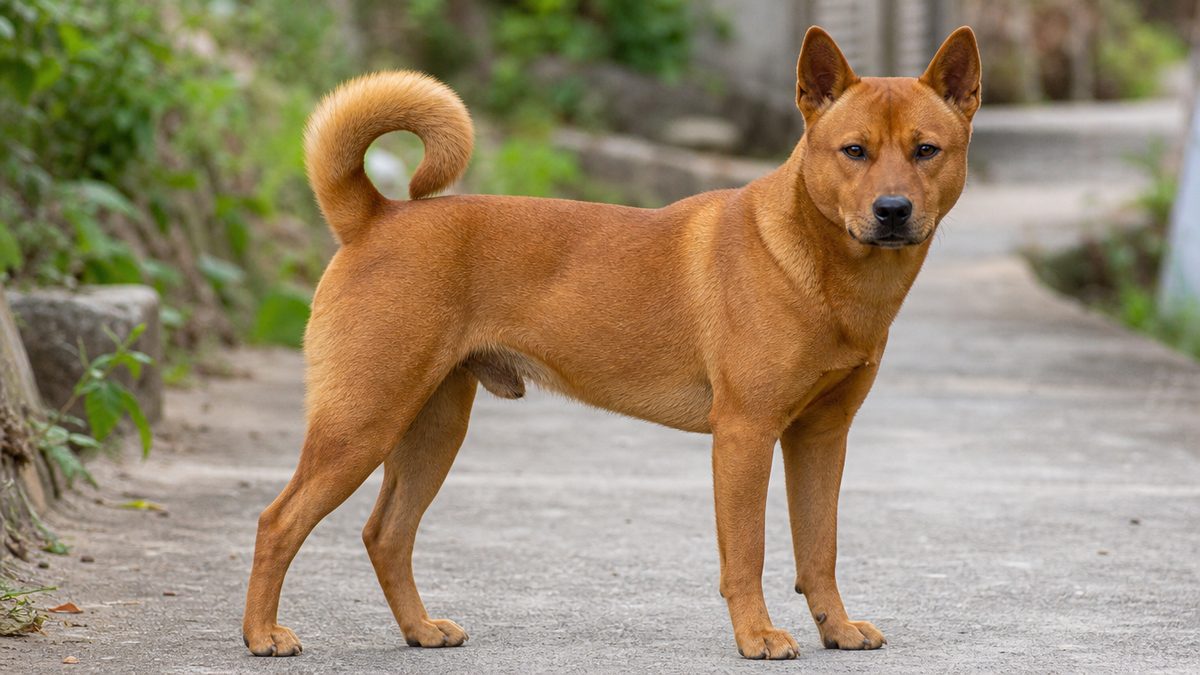
Where the English and Chinese entries agree, the description is worth having. Both give a medium dog with a rich coat, a compact and short body, a ratio of shoulder height to body length of 10:10, a bluish-black tongue, a large broad nose, long slightly sloping eyes, and a coat in a solid colour, with cream, red and black named on both. Both are summaries of one document, the CKU native-breed club's Tang Gou page, which adds what neither encyclopedia carries: small triangular firmly pricked ears, a high-set tail rolled forward over the back, a desirable height of 42 to 56 cm at the withers, and a coat that is not short at all but a harsh straight outer coat over a soft dense undercoat, with a long rich body coat, a thick mane and feathering, 'made to stand off by plentiful undercoat'. The Hong Kong village dog of the hiking blog is short-coated; the dog the CKU standard describes is not. One name, two coats.
That blue-black tongue is worth noticing. It is the signature feature of the Chow Chow and the Shar Pei, both of which are also filed as tugou. A description that gives a village dog the same tongue as two recognised southern Chinese breeds is describing a shared regional population, not a distinct one.
The English entry records that Tang dogs 'are prized as a companion and watch dog but are also occasionally used for hunting and as meat dogs'. That is in the published record and omitting it would be selecting evidence. It is also part of why the animal's social status in its own region is what the next sections describe.
Breed, type or category word? What the sources support
The Tang Dog is a category word in Hong Kong and a national breed project on the mainland: English Wikipedia's own Tugou article lists it as one member of a category that also contains the Chow Chow and the Shar Pei, and the China Kennel Union publishes a Tang Gou standard and a native-dog pedigree register that the FCI does not hold China Kennel Union.
Apply the two-condition test. A breed needs a written standard describing what the animal should be, and a register recording individual animals generation after generation so that the standard is applied to real dogs.
- Condition one, a written standard: met, by the China Kennel Union. The CKU's native-breed conservation club publishes a bilingual Tang Gou standard in FCI format, undated on its own face and headed with an FCI Group 5 classification the FCI has never granted. Both encyclopedia descriptions are summaries of it.
- Condition two, a register: met nationally, not internationally. The CKU registers native dogs after appraisal by its own judges, with a microchip and a DNA sample, and issues a CKU Chinese native dog pedigree certificate; since September 2018 it has shown them in a Group 11 of its own China Kennel Union, CKU原生犬新闻. The FCI holds no record: the animal is absent from every FCI group checked and from the provisional register Federation Cynologique Internationale.
The sentence that settles it
English Wikipedia's Tugou article reads, verbatim: 'Tugou (Chinese: 土狗; pinyin: tǔ gǒu; lit. indigenous dog) is a diverse group of dogs native to China... Several landraces as well as recognized breeds are considered tugou, including the Chinese Pastoral Dog, Chongqing Dog, Chow Chow, Liangshan Hound, Shar Pei, Tang Dog and Xiasi Dog'.
Read what that list is. It puts two recognised FCI breeds, the Chow Chow and the Shar Pei, and a third breed the FCI does not hold, the Chongqing Dog, in the same category as the Tang Dog. The Tang Dog sits where the Chongqing Dog sits: inside the category, held by the CKU, and absent from the FCI's register. So the honest verdict is the one this site gives the Chongqing Dog and Brazil's Grupo 11 breeds, a breed recognised by a national body and not by the FCI, with the added twist that in Hong Kong the same two characters are simply the word for a village dog.
So the relationship is one of containment rather than of parity. Tugou is the Mandarin category word, 唐狗 is the Cantonese one, and the animals inside the category range from a fully registered FCI breed to an unnamed street dog on Cheung Chau.
What the word actually means socially
The English entry says Tong Gau 'refers to a Hong Kong village dog'. The Chinese entry records that a 唐狗會, a Tang Dog Association, was founded in Hong Kong in the 2000s specifically to raise people's regard for these dogs, and cites a 2018 Hong Kong news feature whose own headline asks whether the Tang dog is 'smelly and vicious', quoting an owner who says Tang dogs are like the grassroots of society.
You do not found an association to raise regard for a breed people already want. The word carries a status, and the status is low. That is the strongest single indication that in Hong Kong it is a category rather than a pedigree.
English Wikipedia's first citation for this animal is a hiking blog whose own title reads 'Tong Gau: Should You Adopt Hong Kong's Most Iconic Dog "Breed"?'. The scare quotes around the word Breed are the source's own, and the verb in the title is adopt rather than buy. Even the pages that treat it affectionately do not treat it as a pedigree.
The registry claim that fails on the registry's own list
Chinese Wikipedia states that the Tang dog is classified by the Federation Cynologique Internationale in Group 5, Asian Spitz and related breeds. The FCI's own Group 5 list holds 46 breeds and contains no Tang dog Federation Cynologique Internationale. The claim was copied from the header of CKU's own Tang Gou standard, which prints 'FCI-CLASSIFICATION: Group 5' as CKU's filing.
This is the cleanest checkable error on any page in this batch, and it takes one retrieval to settle.
The Chinese entry's opening sentence reads: '唐狗是生活在中国南部的中型原生犬种,在世界犬业联盟的分类中属于“第五类:亚洲尖嘴犬和相关犬种”'. Translated: the Tang dog is a medium native breed living in southern China and, in the World Canine Organisation's classification, belongs to Group 5, Asian Spitz and related breeds.
The check, and what it returned
| Register checked | Entries returned | Tang dog present? |
|---|---|---|
| FCI Group 5, Spitz and primitive types | 46 | No |
| FCI Group 2, Molossoid and Swiss Mountain breeds | 53 | No |
| FCI Group 3, Terriers | 34 | No |
| FCI Group 8, Retrievers, Flushing Dogs, Water Dogs | 22 | No |
| FCI Group 9, Companion and Toy Dogs | 26 | No |
| FCI provisional register | 20 | No |
Six lists, 201 distinct breed records between them on a re-count of 17 September 2026 (the 9 September reading counted 196), and no Tang dog anywhere. Every one of those lists rendered its own page title correctly and returned its expected breeds, so the searches worked. No FCI letter index was used for any of these absences, because the FCI's letter pages returned zero breed entries without JavaScript in the 9 September session and would have manufactured a false negative rather than a finding.
Where the claim came from
The Chinese entry sources its breed description to old.cku.org.cn, a page belonging to the China Kennel Union, which the entry itself describes as the FCI's China branch. CKU's current site does carry a 原生犬 / 中国原生犬 section, native dogs and Chinese native dogs, as a heading distinct from its FCI犬种标准 section, FCI breed standards. That section leads to the CKU China Native Breed Conservation Club, which lists five breeds, the Xian Hound of Shaanxi, the Tang Gou of Guangdong, the Chongqing Hound, the Laizhou Red Dog and the Chuandong Hound, runs an appraisal-based pedigree register for them, and since September 2018 has shown them in a Group 11 of its own China Kennel Union China Kennel Union, CKU原生犬新闻. So CKU runs a native-breed programme of its own, separately from the FCI standards it also publishes, and files it in an eleventh group exactly as Brazil's CBKC, Spain's RSCE and Turkey's KIF do.
That is not a likely mechanism but a proven one, and it is a pattern this site has recorded on several continents: a national body's own filing of a breed, printed in FCI group language, read downstream as an FCI grant. A group number printed by anyone other than the FCI is that body's filing, not a recognition.
The CKU page itself was read on 17 September 2026, live at HTTP 200 through a rendering proxy and in 27 Wayback Machine captures from 22 June 2018 to 28 March 2025; an attempt on 9 September had recorded the address as serving a 2017 local-club page, which was wrong for the address Wikipedia cites. Its header reads 'FCI-CLASSIFICATION: Group 5 Spitz and primitive types. Section 5 Asian Spitz and related breeds', and its 'DATE OF PUBLICATION OF THE OFFICIAL VALID STANDARD' line is blank. That header is where Chinese Wikipedia's sentence comes from, and it is CKU's filing, not the FCI's grant. The string 唐狗 still appears zero times on CKU's main homepage, which reaches the native-dog site only through its 中国原生犬 link.
English Wikipedia's Tang Dog article makes NO registry classification claim at all. The Chinese version asserts FCI Group 5. Same subject, two encyclopedias, and the checkable claim exists in only one of them. Before treating two language versions of an article as two sources, check whether they actually say the same thing.
The village dog that is closer to the root than any pedigree breed
Whole-genome sequencing of 58 canids found that dogs from southern East Asia have significantly higher genetic diversity than any other population and are the most basal group relating to grey wolves, indicating an origin of domestic dogs in southern East Asia about 33,000 years ago.
This is the section that inverts everything the name's social status implies, and it rests on three papers with identifiers resolved individually.
Wang 2016: where dogs came from
The study sequenced whole genomes from 58 canids, comprising 12 grey wolves, 27 primitive dogs from Asia and Africa, and 19 diverse breeds from across the world. Its finding, verbatim: 'we find that dogs from southern East Asia have significantly higher genetic diversity compared to other populations, and are the most basal group relating to gray wolves, indicating an ancient origin of domestic dogs in southern East Asia 33 000 years ago. Around 15 000 years ago, a subset of ancestral dogs started migrating to the Middle East, Africa and Europe, arriving in Europe at about 10 000 years ago'.
Southern East Asia is where this animal lives. The Tang dog is described in both encyclopedia entries as a village dog of southern China. So the population that a Hong Kong headline treats as the city's least desirable dog is the population that this paper places closest to the root of every domestic dog alive.
Wang 2016 studies southern East Asian dogs as a population and does NOT name the Tang dog. Neither does Yang 2019, whose 15 Chinese indigenous breeds do not include it, nor Li 2023, whose 10 representative breeds do not either. What these papers establish is about the population this animal belongs to, and that is a weaker claim than a study of the animal itself. It is also the only claim available, because no paper anywhere names it.
Yang 2019: how much less inbred
The comparison most useful to a buyer comes from a 157-dog study on Canine 170K SNP chips, comparing 15 diverse Chinese indigenous breeds against Western dogs from the European LUPA canine genome database.
| Measure | What the study found | What it means |
|---|---|---|
| Linkage disequilibrium | Lower in Chinese indigenous dogs | Less of the genome inherited in long identical blocks |
| Runs of homozygosity | Shorter accumulative ROH | Less recent inbreeding |
| Within-breed genetic distance | Larger within each Chinese breed than within Western breeds | More variation between individuals of the same name |
| Population structure | Chinese and Western breeds form two clearly separate clades | Not a subset of Western dogs |
| Introgression | Historical Western introgression into Kazakhstan shepherd and Mongolia Xi dogs | Not all Chinese populations are unmixed |
| Lineages found in Western breeds | Greenland sledge dog, Papillon and European Eurasier carry Chinese lineages | The traffic ran both ways |
A third paper counts the field: China has more than 50 ancient indigenous dog breeds, and among the 10 most representative it found the Chuandong hound most inbred, with significant differences in inbreeding degree between subpopulations carrying the same breed name.
That last point matters for how to read a name like Tang Dog. On an indigenous Chinese population, two dogs with the same label from two provinces can be measurably different, which is exactly what a category word predicts and a breed standard does not.
Why an Indian reader should care about this specifically
Because the same argument applies here and the same prejudice exists here. India's indigenous village dog is treated as the least desirable animal in the country while imported pedigrees command five-figure prices. The genomics on southern East Asian dogs does not transfer directly to Indian dogs, and this page will not pretend it does. What transfers is the shape of the argument: an unselected village population is not a degraded version of a breed. It is the older thing that breeds were carved out of.
What the word costs a dog in Hong Kong
A Tang Dog Association was founded in Hong Kong in the 2000s specifically to raise regard for these dogs, and a 2018 Hong Kong news feature framed its own headline around whether the Tang dog is smelly and vicious.
The social history is short and it is the most human part of this page.
| Date | What happened | What it shows |
|---|---|---|
| 2000s | A Tang Dog Association is founded in Hong Kong to raise people's regard for these dogs | The regard needed raising |
| 2008 | A Hong Kong newspaper covers the association as a 'local dog grand alliance' | The framing is solidarity, not pedigree |
| 2017 | A Tang Dog wins a championship at a show held by the China Kennel Union | A CKU-registered native dog competing in CKU's own show system |
| 2018 | A feature asks whether Tang dogs are smelly and vicious, quoting an owner who calls them society's grassroots | The prejudice is named by the people answering it |
| 2018 | A separate feature, in MP Weekly in February, describes an owner on Cheung Chau, where low-density housing and green space let dogs move freely | The animal is at its best where the housing suits it |
Two details in that table are worth separating. The 2017 show win is the one most often quoted as evidence of breed status, and it is evidence of something narrower: a dog registered under CKU's native-dog programme winning at a show run by the CKU, a national body that opened a Group 11 of its own to native breeds China Kennel Union, CKU原生犬新闻. A show win is a national result and it is not an FCI recognition.
The Cheung Chau detail is the more useful one for an owner. A separate MP Weekly feature of February 2018 describes an outlying island where low-density building, green space and traffic-free lanes let dogs move around village halls and temples freely, and where the reporter's subject says local people largely accept dogs and there is less risk of abuse. That is a description of the housing this animal suits, and it is not a Hong Kong high-rise.
The transferable point
This animal's problem in its own city is not health, temperament or capability. It is a word. A dog that is called a village dog is valued as a village dog, and a dog with a registered pedigree is valued as a pedigree, and the two animals may be nearly identical.
India runs the identical system with a different vocabulary. That is the comparison the rest of this page is built on.
Everything above comes from the Chinese and English encyclopedia entries and from the Hong Kong news items they cite by headline, date and publication Wikipedia, Tang Dog, read 9 September 2026. The underlying articles were not opened in this session, so this page reports them as the encyclopedias carry them, with their dates and outlets intact, and quotes no figure from any of them.
Tang Dog price in India: there is nothing for a price to attach to
No tang dog price in india exists, because the name denotes a category rather than a registered breed, no Indian site carries a page for it, and no register exists anywhere that would make a pedigree verifiable Federation Cynologique Internationale.
Evidence the negative properly rather than asserting it from an empty search.
- Neither Indian breed-price site carries a page. poodles.in returns HTTP 200 with the title 'Dog Breed Not Found' for breeds it does not hold, which is a soft 404 that a status check passes, and happypet.care has no page either.
- The control passed in the same run. poodles.in returned full breed guides of 16,000 to 18,000 characters for the Lhasa Apso, Welsh Terrier, Tibetan Terrier and Tibetan Mastiff, so the site was working.
- No Indian pedigree route exists. Six FCI lists totalling 201 breed records contain no Tang dog, so the Kennel Club of India, which issues pedigrees against FCI nomenclature, has nothing to register it against; the only register that holds the name is CKU's own native-dog scheme Federation Cynologique Internationale China Kennel Union.
- The search engine cannot check. Bing India's control passed with ten genuine Indian Labrador price pages, then returned ten Hong Kong Economic Times lifestyle articles about a sports park for 'tang dog breed china' under 'About 50 results'.
The deeper reason there is no price
Not scarcity. Abundance. This is a word for a common dog, and common dogs in southern China and Hong Kong are adopted, taken in or simply lived alongside rather than bought. The Tang Dog Association founded in Hong Kong exists to raise the animal's standing, which is the opposite of a market problem.
So the honest answer to 'what is the Tang Dog price in India' is that the question does not have a subject here. There is no Indian supply, no Indian demand and no FCI record for the Kennel Club of India to paper a dog against: six FCI lists totalling 201 breed records hold no Tang dog. Anybody quoting you a puppy price is selling you a label that is unrecognised by the FCI, and the only register that label exists in is CKU's national native-dog scheme in China.
How Indian monthly figures are actually built, since we are here
It is worth showing the mechanism once, using the nearest Chinese-origin breed that does have an Indian market. On the Tibetan Mastiff, poodles.in prints monthly food Rs 3,000 to Rs 4,500, health Rs 1,500 to Rs 2,250 and grooming Rs 1,200 to Rs 1,800, while happypet.care prints headline monthly totals of Rs 5,700 and Rs 8,550 for the same breed.
Add the components. 3,000 plus 1,500 plus 1,200 is Rs 5,700. 4,500 plus 2,250 plus 1,800 is Rs 8,550. The headline total is the arithmetic sum of three preset lines rather than a measurement of any dog's cost. When you next meet an Indian monthly cost figure for any breed, that is what you are looking at.
An Indian street dog costs Rs 500 to adopt, against Rs 80,000 for a breeder puppy, and the ten to fifteen year commitment begins identically either way. If what draws you to the Tang Dog is a compact, short-coated, alert, heat-adapted village dog with a deep gene pool behind it, that description fits an animal available at every Indian shelter for Rs 500.
What a dog like this actually costs to keep in India
Budget roughly Rs 2,500 to Rs 5,500 a month for a medium short-coated village dog in an Indian metro, which is the cheapest category of dog to keep properly because the coat costs nothing and the size is moderate.
No cost figure exists for this animal, so everything below is built from named Indian providers read live on 9 September 2026 and applied to a medium dog. It is the most affordable category of dog to keep properly in India, because the coat needs no professional attention and the size sits in the middle band.
| Line | Published figure | Provider and scope |
|---|---|---|
| Puppy vaccination course | From Rs 6,499 (list Rs 8,111) | Vetic national page, a promotional floor from one chain |
| Annual booster | From Rs 3,199 (list Rs 3,806) | Vetic national page |
| Anti-rabies, single | Rs 699 | Vetic |
| 9-in-1 DHPPiL | Rs 899 | Vetic |
| Kennel cough | Rs 1,349 | Vetic |
| Anti-rabies at a municipal clinic | Free of cost | Greater Chennai Corporation's pet clinics |
| Food, medium dog | Rs 1,500 to Rs 4,000 per month | VOSD's medium-dog band |
| Bath with blow drying | From Rs 934 (list Rs 1,099) | Vetic Delhi; a haircut at Rs 1,359 is not needed |
| Consultation | Rs 500 to Rs 1,000 | VOSD, treated here as one data point |
| Boarding, overnight to 24 hours | Rs 899 | PawSpace Bengaluru, festive rates 25 to 30 percent higher |
| Municipal registration, Delhi | Rs 500 new, Rs 500 renewal | MCD, dogs only, late fee Rs 100 per month |
| Municipal licence, Chennai | Rs 50 | Greater Chennai Corporation, 9,115 issued in 2024 |
Three lines repay attention. Delhi's Municipal Corporation registers pet dogs only, ties the one-year certificate to the anti-rabies vaccination date and charges Rs 100 a month late after a one-month grace period. Greater Chennai Corporation licenses pet animals at Rs 50, issued 9,115 licences in 2024 and provides all treatment and anti-rabies vaccination free of cost at its pet clinics. And PawSpace publishes Rs 899 for an overnight dog stay with festive-season rates 25 to 30 percent higher.
The one line this animal genuinely adds
Year-round parasite control. Among dogs tested at Indian veterinary clinics, a West Bengal series of 584 screened dogs reported Babesia gibsoni in 76.54 percent and two or more pathogens in 72.9 percent of those screened, and a Kerala series of 120 found Babesia species in 66.7 percent with a pre-monsoon peak from March to May. The advantage of a short coat is that a two-minute hands-on tick check is genuinely possible.
- Budget Rs 1,200 to Rs 2,500 a month for food at the medium-dog band.
- Budget near zero for grooming, because a short village coat needs a brush rather than a groomer.
- Budget Rs 400 to Rs 700 a month amortised for vaccination, deworming and year-round parasite control.
- Budget Rs 500 to Rs 1,000 per consultation and assume at least two unplanned ones a year.
- Budget Rs 42 a month for the Delhi registration or Rs 4 for the Chennai licence, both legally required and both routinely skipped.
Greater Chennai Corporation's pet clinics provide all treatment and anti-rabies vaccination free of cost, and the licence is Rs 50. Against Vetic's Rs 699 for a single anti-rabies shot, that is the whole price of the vaccine saved, and the difference is a function of the delivery model rather than of the drug.
Can a Tang Dog handle the Indian climate?
A southern Chinese village dog would handle Indian humidity easily and Indian summer heat with difficulty, because southern China measures 22.61 to 23.49 C annual mean at 78 to 80 percent humidity, damper than any Indian city checked, while Delhi's June mean of 35.88 C is 7.13 C above southern China's hottest month.
Southern China is the one homeland in this batch that NASA POWER measures accurately, and that is worth saying because every other origin on these six pages failed the elevation check.
| Point | Cell elevation vs real | Annual mean | Hottest month | Annual humidity |
|---|---|---|---|---|
| Guangzhou | 22.07 m vs 21 m, an error of +1.07 m | 22.61 C | July, 28.33 C | 78.16 percent |
| Hong Kong | 53.17 m vs 9 m | 23.36 C | July, 28.54 C | 79.35 percent |
| Shenzhen | 17.55 m vs 20 m | 23.49 C | July, 28.75 C | 80.24 percent |
| Bengaluru | 841.72 m vs 920 m | 23.74 C | April, 28.37 C | 67.94 percent |
| Kolkata | 7.35 m vs 9 m | 25.81 C | May, 31.53 C | 73.93 percent |
| Delhi | 206.37 m vs 216 m | 25.60 C | June, 35.88 C | 45.56 percent |
| Mumbai | 97.15 m vs 14 m | 26.77 C | May, 31.19 C | 67.39 percent |
| Kochi | 47.32 m vs 0 m | 27.31 C | March, 29.42 C | 78.83 percent |
| Chennai | 48.95 m vs 6 m | 27.95 C | May, 31.51 C | 72.39 percent |
The Guangzhou cell is accurate to 1.07 metres, which is the closest match of any point queried across this entire batch of six breeds. On the Tibetan plateau the same instrument was out by 660 metres. Flat river delta terrain is where the model works.
Humidity is a relief, not a problem
Every southern Chinese point measures higher annual relative humidity than every Indian city listed: Shenzhen 80.24 percent, Hong Kong 79.35 and Guangzhou 78.16, against Kolkata's 73.93, Chennai's 72.39 and Mumbai's 67.39. The only Indian city that comes close is Kochi at 78.83 percent, which is also the closest Indian analogue by temperature.
So the reflex assumption about a tropical or subtropical dog in India, that the monsoon will be the problem, is wrong here for the second time in this batch. The village dog comes from somewhere wetter and carries a short coat; a dog bred to the CKU standard's stand-off double coat gives up that second advantage, which is why the standard itself warns against a coat that causes distress in hot weather.
Heat is the real limit, and the gap is measurable
The hottest monthly mean anywhere in southern China here is 28.75 C, at Shenzhen in July. Delhi's June mean is 35.88 C, which is 7.13 degrees higher. Delhi's January mean of 13.61 C is also 2.4 degrees below Hong Kong's coldest month at 16.00 C and within half a degree of Guangzhou's at 13.96 C, so a northern Indian year would present a heat this animal's population has no experience of and a winter at the cold edge of it.
- Kochi and Chennai are the closest Indian analogues, Kochi on humidity and temperature stability and Chennai on warmth without a cool season.
- Kolkata and Mumbai are workable on humidity and need shade and water management through May.
- Bengaluru is almost exactly southern China's annual mean at 23.74 C against Guangzhou's 22.61, and its April peak of 28.37 C is below Shenzhen's July, which makes it arguably the best Indian city on this page for this animal.
- Delhi and the northern plains present a June this animal's population has never met.
- Test the pavement with the back of your hand for five seconds before any walk, in any of them.
The largest UK study of canine heat-related illness covered 905,543 dogs and found bodyweight at or above the breed and sex mean carried 1.42 times the odds, and over 50 kg 3.42 times. This animal is absent from that study and is a medium dog, so neither figure is applied here. Second Schedule Part IV paragraph 21(1) of the Dog Breeding and Marketing Rules 2017 does apply generally, barring outdoor housing of dogs not accustomed to local temperatures without written veterinary approval.
Temperament, and how little is actually documented
Both published accounts describe a loyal watchdog and gatekeeper used for thousands of years in southern Chinese villages, and neither offers anything more specific, because no behavioural study of this animal exists Chinese Wikipedia, 唐狗.
Be honest about the evidence base. The temperament description across both entries amounts to: prized as a companion and watch dog, occasionally used for hunting, and used as loyal gatekeepers. There is no owner survey, no behavioural assessment and no published temperament study, and zero peer-reviewed papers name the animal at all.
What can honestly be inferred, labelled as inference
- Village dogs are socially competent with people. A population that has lived among households for thousands of years without being kennelled has been selected, informally but relentlessly, for tolerating human proximity.
- Village dogs are independent. They forage, patrol and make their own decisions, which usually shows up as a dog that is affectionate and not especially biddable.
- Alerting is likely. Both accounts describe a gatekeeping role, which implies a dog that announces arrivals.
- Individual variation is high. A 2023 genomics paper found significant differences in inbreeding degree between subpopulations sharing the same breed name, which is a general property of indigenous Chinese dog populations and predicts individual variation rather than breed uniformity.
Who should not go looking for one
Anyone who wants a predictable temperament from a label. On a category word, the individual animal is the only meaningful unit, and there is no breed standard, no register, no breed club and no published behavioural profile to set an expectation against.
That is not a criticism of the dogs. It is a statement about what a name can and cannot promise.
If what you want is a medium, short-coated, alert, independent, heat-adapted village dog that lives easily among people, that animal is in every Indian shelter and costs Rs 500 to adopt. You can meet it, watch it, and judge its actual temperament before committing, which is more information than any label about a Chinese village dog could ever give you.
How you would train a dog like this
To train a village-type dog you build the relationship and pay generously for recall, because no training research exists on this animal and its published role is independent gatekeeping rather than handler-directed work.
Nothing below is breed-specific research, because none exists. What follows is the general approach for an independent landrace in an Indian household, offered as inference and labelled as such.
| Age | Priority | Why now |
|---|---|---|
| 8 weeks | Earliest lawful sale age in India under Rule 8(1)(a) | Refuse any younger animal, whatever it is called |
| 8 to 12 weeks | Handling, restraint, mouth and foot handling | A dog nobody can examine is a dog nobody can treat |
| 10 to 16 weeks | Socialisation to lifts, traffic, gate guards, delivery riders, staff | The window closes early and an alert village dog rehearses suspicion fast |
| 3 to 6 months | Recall on a long line, paid at a rate you would call excessive | An independent type will not offer recall for free |
| 3 to 6 months | Alone-time in graded doses | A dog used to constant human proximity does badly with sudden solitude |
| 6 months | Legal note on sale | Rule 8(1)(b) bars sale of dogs over six months without prior sterilisation, except to another licensed breeder |
| 6 to 9 months | Registration and licensing | Delhi MCD Rs 500 or Chennai Rs 50, both tied to the rabies certificate |
| 6 to 12 months | Secure containment | A village dog treats a boundary as information rather than as a rule |
The two things that matter most
Recall, paid properly. A dog whose ancestors found their own food and patrolled their own ground has a strong independent sequence, and recall against that is expensive to build and never absolute. Keep a long line on for the first year and treat off-lead freedom in unfenced Indian space as a privilege the dog has not earned.
Containment, built before arrival. Not a gate that latches, a boundary the dog cannot pass. This is cheaper to solve in advance than after the first escape.
No paper names this animal, no screening scheme covers it and no baseline exists, which means everything gets found clinically at whatever stage the dog presents. A dog that tolerates handling, restraint, a car and a table is a dog whose problems get found early, and on an animal with no published health profile that is worth more than any obedience exercise.
Daily exercise, and the Indian timing rule
A medium village dog needs about an hour of daily activity split across two or three outings, taken before 7am and after 7pm through the Indian hot season, and it needs mental work as much as distance.
No measured exercise requirement exists for this animal, so the published role is the guide: a village dog that patrolled, gatekept and occasionally hunted was physically busy and mentally busier.
- Walk before 7am and after 7pm from April to July in Delhi, Ahmedabad, Hyderabad, Chennai and Kolkata.
- Give at least an hour a day for an adult, split across two or three outings rather than one long walk.
- Substitute scent work and food puzzles at midday, which suit a foraging background better than a treadmill would.
- Test the pavement with the back of your hand for five seconds before setting off.
- Watch for heavy panting with a wide flat tongue, stumbling or brick-red gums, and treat any of them as an emergency.
The arithmetic behind the timing rule
Delhi's June mean is 35.88 C and its afternoon runs above the mean, while the hottest month anywhere in southern China measured here is Shenzhen's July at 28.75 C. That is a 7.13 degree gap on a monthly mean before the afternoon peak is counted. A short coat helps and does not close a gap that size.
Bengaluru is the interesting case. Its annual mean of 23.74 C sits within about a degree of Hong Kong's 23.36 and Shenzhen's 23.49, and its April peak of 28.37 C is below Shenzhen's July. For this animal, Bengaluru is not merely tolerable but close to a match.
You can feel a tick. Among dogs tested at Indian veterinary clinics, an Odisha series of 178 found 79 percent of infected dogs had a tick history, and a West Bengal series of 584 screened dogs reported two or more pathogens in 72.9 percent of those screened. A two-minute hands-on check after every walk is possible on this coat and impossible on a heavily coated dog.
Grooming and coat care, which takes ten minutes a week
Grooming the short-coated village dog the name usually means takes a weekly brush, a bath when it is genuinely dirty and a daily tick check, while the CKU standard describes a long stand-off double coat that is a different job entirely China Kennel Union.
Both encyclopedia descriptions say only that the coat is rich and a solid colour of cream, red or black Chinese Wikipedia, 唐狗. The CKU standard they summarise says a great deal more, and none of it is short: a harsh straight outer coat over a soft dense undercoat, a long rich body coat, a thick mane on the neck and shoulders, feathering on the legs and a bushy tail, 'made to stand off by plentiful undercoat', with the standard's own warning that the dog 'must not have so much coat as to impede activity or cause distress in hot weather'. The Hong Kong village dog of the hiking blog is the short-coated animal, and the routine below is for that dog.
- Brush weekly with a rubber curry or soft bristle brush, which is enough for a short close coat.
- Bathe only when genuinely dirty, and towel the dog properly rather than leaving it damp in Indian humidity.
- Check for ticks by hand daily after exercise, working the ears, neck, armpits, groin and between the toes.
- Trim nails monthly.
- Skip the groomer's haircut, which at Vetic Delhi's Rs 1,359 is a service this coat has no use for.
The two Indian coat points that do apply
Sun. A short-coated dog is exposed rather than protected, and a thinly coated belly and a pale muzzle burn in Indian sun. Shade matters more than shampoo.
Drying. Even a short coat left damp at Kolkata's 73.93 percent annual humidity will support skin problems, and the fix costs a towel.
Compare it with the Tibetan Terrier in this same batch, whose registry rates grooming at Every day and whose Indian owners face a professional groom at Rs 1,359 every six weeks if the daily brushing does not happen. A short village coat removes that entire line from the budget and makes the tick check Indian conditions require actually feasible.
Health issues: nothing published, and one population-level argument
No peer-reviewed paper names this animal, no screening scheme covers it and no life expectancy has been measured, and the only health-relevant published finding is population-level: Chinese indigenous dogs carry lower linkage disequilibrium and shorter runs of homozygosity than Western breeds Yang Q, Chen H, Ye J, Liu C, Wei R, Chen C.
Prove the search before believing the result. Controls in the same session returned 126 records for 'Labrador retriever hip dysplasia' and 1,109 for 'Labrador Retriever'[tiab], both with sane query translations.
| Query | Records | Reading |
|---|---|---|
| 'Tang dog'[tiab] | 0 | Genuine zero, clean translation, phrase not in the index |
| 'Tang Quan'[tiab] | 0 | Genuine zero on the Mandarin romanisation |
| 'Chinese village dog'[tiab] | 0 | Genuine zero on the descriptive English name |
| 'village dogs'[tiab] AND China[tiab] | 0 | Genuine zero on a broadened search |
| Tang dog, unquoted | 1,282 | MEANINGLESS. Translated as 'Tang'[All Fields] AND dog; Tang is a common Chinese surname |
| Chinese script for Tang dog | 0 | NOT a zero. Blank translation line, so the query was voided |
| 'Chinese indigenous dog'[tiab] | 7 | The real neighbouring literature; none of the three used here names this animal |
Two rows there are traps of opposite kinds and both are worth understanding. The unquoted form returns 1,282 records because Tang is one of the commonest Chinese surnames, so a writer trusting that count would report a substantial literature that does not exist. And the Chinese-script query returns zero with a blank translation line, which means PubMed emptied the query rather than running it, so that zero measures nothing. This page therefore states plainly that the Chinese-script literature was not searched, rather than implying it was searched and empty.
Europe PMC was deliberately not used as a fallback for the Chinese-script search, because it splits CJK phrases into individual characters and returns unrelated Chinese-language biomedical papers matched character by character. A count from it would be noise rather than coverage.
The population-level finding, and its limits
What exists instead of a disease list is a comparison. A study of 157 unrelated dogs from 15 Chinese indigenous breeds on 170K SNP chips found that Chinese indigenous dogs carry lower linkage disequilibrium and shorter accumulative runs of homozygosity than Western dogs, with larger genetic distances between individuals within each Chinese breed than within Western breeds.
Runs of homozygosity are the standard genomic measure of inbreeding, so shorter runs mean less of it. That is a real and relevant finding about the population this animal belongs to, and the direct consequence is that recessive inherited disease should be rarer than in a closed pedigree population. It is not a promise about any individual dog, and it is not a substitute for a screening scheme.
- No lifespan figure exists. The animal is absent from all 345 rows of McMillan 2024's Table S5, so it was never considered rather than excluded.
- No inherited condition has been described, because no paper names this animal.
- No screening scheme covers it, so a seller cannot produce a certificate that does not exist.
- Indian tick-borne disease applies regardless of origin. Reported rates among dogs tested at Indian veterinary clinics are high, with a pre-monsoon peak from March to May in the Kerala series.
- Rabies vaccination is the non-negotiable, and in Chennai it is free at municipal pet clinics.
A population with shorter runs of homozygosity carries fewer recessive disorders, and it carries every acquired and infectious risk that any dog in its environment carries. In India that means tick-borne disease, parvovirus, distemper and rabies, none of which cares about a dog's inbreeding coefficient. Vaccinate, deworm and use parasite control year-round, exactly as you would for a pedigree dog.
Feeding a dog like this in India
Feed a medium village-type dog from the medium band, roughly Rs 1,200 to Rs 2,500 a month in India, and score body condition by hand every month, because there is no breed weight standard to feed towards.
No published weight exists for this animal. The encyclopedias give a proportion, shoulder height to body length of 10:10, and a medium build, and the CKU standard adds a desirable height of 42 to 56 cm at the withers and still no weight. So body condition scoring is not a refinement here, it is the only method.
- Feel the ribs with flat fingers; find them under a thin cover without pressing in.
- Look from above for a waist behind the ribs, which a short coat makes easy on this animal.
- Weigh monthly on the same scale and record the trend.
- Adjust by ten percent at a time and re-score after three weeks rather than switching food.
- Count treats, which are a larger share of daily calories than owners assume.
Two points from the published role
Make some of the food work. A village dog that foraged and occasionally hunted was solving problems for its calories. Scatter feeding, a snuffle mat and hidden food fill part of the mental requirement that a walk cannot, and they cost nothing.
Expect a good appetite and an efficient metabolism. Populations shaped by scarcity generally do well on less food than a pedigree dog of the same size, which makes overfeeding the likelier error in a comfortable Indian household.
- Split the adult ration into two meals rather than one.
- Store kibble airtight, because an opened bag in Indian humidity goes rancid faster than the date suggests.
- Avoid free-feeding, which hides the appetite drop that is often an illness's first sign.
- Add water to food in summer and check the bowl three times a day in April and May.
- Formulate any home-cooked diet once with a veterinary nutritionist and then keep it fixed, because an unformulated home diet is usually short on calcium and often on iodine and zinc.
Indian breed sites publish daily calorie figures inside cost rows that are the arithmetic sum of three preset lines, and the same two sites disagree about the same breed's ideal-weather floor by a sign. Any calorie number from such a page is a starting point rather than a ration, and on an animal with no published weight standard the dog's own body condition is the only thing worth trusting.
The first year, and why this puppy timeline is really about a different dog
A Tang Dog puppy timeline cannot honestly be written for India, because no Indian source exists and no register would verify one, so what follows is the timeline for the medium Indian village dog that answers the same want Voice of Stray Dogs, Dog Expenses in India.
| Age | What is happening | What you do |
|---|---|---|
| Before you take the dog | The moment your questions matter | If somebody is charging you, ask which register the pedigree is with. Only CKU's national native-dog register holds this name, and the FCI does not |
| 8 weeks | Earliest lawful sale age in India under Rule 8(1)(a) | Refuse any younger animal; begin vaccination on the vet's schedule |
| 8 to 10 weeks | Fear period; house training | Handle feet, ears and mouth daily so examinations are boring rather than frightening |
| 10 to 16 weeks | Socialisation window closing | Lifts, stairs, traffic, gate guards, delivery riders, vaccinated dogs |
| 3 months | Vaccination course running | From Rs 6,499 at one chain, or free anti-rabies at a Chennai municipal clinic |
| 3 to 6 months | Alone-time in graded doses | A dog bred for constant human proximity needs solitude taught rather than imposed |
| 4 to 6 months | Boundary testing begins | Secure the compound before the dog finds the gap |
| 6 months | Legal note on sale | Rule 8(1)(b) bars sale of dogs over six months without prior sterilisation, except to another licensed breeder |
| 6 to 9 months | Registration and licensing | Delhi MCD Rs 500 or Chennai Rs 50, both tied to the rabies certificate |
| 6 to 12 months | Recall practice on a long line | An independent type needs a year of paid practice, not a month |
| 12 months | Adult | Annual booster from Rs 3,199, a baseline weight, and year-round parasite control |
The one question that ends the transaction
Which register is the pedigree with. Six FCI lists totalling 201 breed records contain no Tang dog, and the one register that does hold the name is the China Kennel Union's native-dog scheme, which issues its own CKU Chinese native dog pedigree after appraisal, microchipping and a DNA sample Federation Cynologique Internationale China Kennel Union. A seller who answers honestly is offering you either an unregistered village dog, which somebody may legitimately want, or a CKU-papered dog with no FCI record behind it, which the Kennel Club of India cannot register. A seller who produces any other registration number is producing one from a body that does not hold the name.
Rule 8(1)(a) of the Dog Breeding and Marketing Rules 2017 requires that pups less than eight weeks in age are not sold. Second Schedule Part II paragraph 6(9) reads, in full, 'Breeding to create new breeds of dogs or unusual looks shall be strictly prohibited'. Note the citation form: both live in the Rules and the Schedule respectively, and the Rules stop at 13, so a citation reading Rule 21 or Rule 14 points at a provision that does not exist.
The Tang Dog and the Indian pariah dog: one argument, two countries
India already has the animal this name describes, calls it the Indian pariah dog, treats it with the same disregard Hong Kong shows the Tang dog, and offers it for a Rs 500 adoption fee Voice of Stray Dogs, Dog Expenses in India.
The structural parallel is close enough to be worth setting out plainly.
| Feature | Tang Dog, southern China and Hong Kong | Indian pariah dog |
|---|---|---|
| What the name is | A category word, 唐狗, Cantonese Tong Gau | A category name, not a registry breed |
| Kennel club recognition | CKU native-breed standard and register; none from the FCI | None from the FCI |
| How Wikipedia files it | As a member of the tugou category | As a landrace, in the same navigation list |
| Social status at home | Low. An association was founded to raise regard for them | Low. Routinely passed over for imported pedigrees |
| Coat | Short and close in the village dog, long and stand-off in the CKU standard, solid colour in both | Short, close, commonly fawn or brindle |
| Build | Medium, compact, 10:10 proportion, pricked ears, tail curled over the back | Medium, erect ears, curved tail |
| Climate adaptation | Southern China, 22.6 to 23.5 C annual, 78 to 80 percent humidity | Evolved in Indian conditions |
| Measured life expectancy | None | None |
| Cost | No market and no price | Rs 500 adoption fee |
| Available in India | No | Everywhere |
Where the parallel stops
Two honest limits. They are not the same population. Nobody has genotyped the Tang dog specifically, and no paper compares southern Chinese village dogs with Indian ones directly. And the genomics does not transfer. Wang 2016's finding is about southern East Asian dogs, and this page will not extend it to Indian dogs, because the paper did not.
What does transfer is the reasoning. An unselected village population is not a failed breed. It is what breeds were carved out of, and in southern East Asia specifically it is the population that whole-genome sequencing places closest to the wolf. A reader who finds that argument persuasive about a Chinese village dog should notice that the same argument is available, for Rs 500, at every shelter in India.
The registered alternative, for completeness
If what you want from this name is a compact Asian primitive dog with a register behind it, the Shiba Inu is the breed that answers it, at a 14.6-year median survival on 91 deaths in McMillan 2024 with a hazard ratio of 0.45 against crossbreds. It is not remotely heat-adapted for India, carries a double coat, and is expensive. It is included here so that the comparison is complete rather than rhetorical.
The framing from India's own dog-cost reference is the whole argument in one line: whether you buy a puppy from a breeder for Rs 80,000 or adopt a dog for Rs 500, a ten to fifteen year financial commitment begins the moment the dog crosses your threshold. On an animal with no register, no standard, no health data and no measured lifespan, the Rs 79,500 difference buys nothing anybody can check.
The Indian legal position
No Indian law bans this animal, it is named nowhere on the 2024 ferocious-breeds circular, and none of that circular's four bare undefined category words reaches a medium southern Chinese village dog High Court of Karnataka.
The 2024 instrument was a D.O. letter of 12 March 2024 from the Department of Animal Husbandry and Dairying, reproduced in full in CBIC Instruction No 05/2024-Customs of 14 March 2024. Its four bare undefined category words are Terriers, Mastiffs (boerbulls), Wolf dogs and Canario, and none reaches this animal.
One phrase in the instrument is worth reading carefully before concluding, because it is the only one that could touch a landrace. The list opens 'breeds (including mixed and cross breeds) like', which extends to the mixes and crosses of the listed breeds rather than to mixed-breed dogs generally. It does not sweep in village dogs.
The circular was quashed in any case. The Karnataka High Court's operative order of 10 April 2024 reads '(i) Writ Petition is allowed. (ii) Circular dated 12-03-2024, issued by the 1st respondent stands quashed', and on 14 June 2024 the Madras High Court recorded the Department's written statement that 'the quashed circular has lost its effect entirely' and that 'all actions will proceed afresh'.
What does apply, whatever the dog is called
| Provision | Correct citation form | What it requires |
|---|---|---|
| Minimum sale age | Rule 8(1)(a) | Pups less than eight weeks in age are not sold |
| Close breeding | Second Schedule Part II para 6(3) | In-breeding within four generations and incest breeding prohibited |
| Mutilation | Second Schedule Part II para 6(8) | No docking, cropping, de-barking, de-clawing or change of appearance by artificial means |
| New breeds | Second Schedule Part II para 6(9) | Breeding to create new breeds of dogs or unusual looks strictly prohibited |
| Genetic testing | Second Schedule Part III para 8(10) | Testing for named genetic defects, though no scheme exists for this animal |
| Outdoor housing | Second Schedule Part IV para 21(1) | Bars outdoor housing of dogs not accustomed to local temperatures without written veterinary approval |
| Municipal registration | Local, not the 2017 Rules | Delhi Rs 500, Chennai Rs 50 |
Paragraph 6(9) deserves a second look on this page specifically. Its full text is one sentence: 'Breeding to create new breeds of dogs or unusual looks shall be strictly prohibited'. Read beside a category word that a national kennel body appears to be converting into a breed, that provision is an interesting piece of Indian policy: India's own rules take the opposite view of breed creation.
The Rules run from 1 to 13 and there is no Rule 14, so the strings 'Rule 14' and 'Rule 21' each occur zero times in the whole gazette. Any Indian page citing 'Rule 21' for the outdoor-housing clause, or 'Rule 8(10)' for the genetic-testing clause, is pointing a reader at a provision that does not exist. Both live in the Second Schedule, whose four Parts are numbered continuously from 1 to 30.
Mistakes people make with this name
Five mistakes account for almost everything written wrongly about the Tang Dog, and the first is treating one name as one dog.
- Treating Tang Dog as one thing. In Cantonese the word simply means a Hong Kong village dog, and English Wikipedia's own Tugou article files it as one member of a category alongside the Chow Chow and the Shar Pei; on the mainland the China Kennel Union runs a Tang Gou standard and register that the FCI does not hold China Kennel Union.
- Repeating the FCI Group 5 claim. The FCI's Group 5 list holds 46 breeds and none is a Tang dog, and the animal is absent from four other groups and the provisional register. The claim is the header of CKU's own standard, read as a grant.
- Treating two language versions of an encyclopedia as two sources. The English version makes no registry claim and the Chinese version makes a false one, which is a disagreement rather than corroboration.
- Quoting a life expectancy. None exists. The animal is absent from all 345 rows of the largest UK longevity table.
- Reading a show win as FCI recognition. A dog won at a show run by the China Kennel Union in 2017, inside a national programme with its own register and its own Group 11. A national show result is not an FCI record China Kennel Union, CKU原生犬新闻.
The two research mistakes, which are opposite
Trusting a zero. The Chinese-script query returns zero with a blank translation line, which means PubMed emptied the query rather than running it. That zero measures nothing, and this page says so rather than counting it.
Trusting a count. The unquoted query 'Tang dog' returns 1,282 records, because Tang is one of the commonest Chinese surnames. A writer trusting that number would report a large literature on an animal that has none.
One animal, one database, one session, and both a meaningless zero and a meaningless four-figure count. Neither is evidence, and the only real answer came from opening the records that the neighbouring query returned.
The mistake this page had to avoid
Concluding anything from a search result. Bing India's control passed with ten genuine Indian Labrador price pages, and then returned ten Hong Kong Economic Times Chinese-language lifestyle articles about the Kai Tak Sports Park for 'tang dog breed china' under 'About 50 results'. Not one concerned any dog. Everything this page says about the Indian market rests on direct HTTP tests instead.
Filing this as a fabrication. It is not. Real dogs live across southern China and Hong Kong, a real association was founded to raise their standing, and the population they belong to is the best-evidenced ancient dog population on earth. What is doubtful is the breed label, not the animal, and keeping those two apart is the whole content of this page.
Adoption, and the dog this page has actually been describing
You cannot adopt a Tang Dog in India, and the animal that answers the same want is in every Indian shelter for a Rs 500 adoption fee Voice of Stray Dogs, Dog Expenses in India.
State the limits precisely. Bonbeno found no Indian population, register, rescue, breeder or count for this animal, and could not run a search that would have found one, because the only engine whose control passed substituted the query outright into Hong Kong lifestyle articles. What can be said from direct tests is that neither Indian breed-price site carries a page.
What to do instead, in order
- Go to an Indian shelter and look for the physical type this page has described: medium, compact, short close coat, erect ears, alert carriage, curved or sickle tail. That dog is there in numbers.
- Judge the individual, because on the village dog there is no standard, no register and no published temperament profile, and on the CKU-registered dog there is no health data at all, so the animal in front of you is the only unit that means anything.
- Ask the shelter about behaviour rather than about breed, and spend time with the dog before deciding.
- Register and licence the dog once it is home, at Rs 500 in Delhi or Rs 50 in Chennai, tied to the anti-rabies certificate.
- Use Greater Chennai Corporation's free anti-rabies vaccination if you are in that city, and vaccinate and use parasite control year-round wherever you are.
If somebody offers you a Tang Dog in India
Bonbeno does not recommend breeders, link puppy listings or quote a live price as an offer. On this name, two questions settle it.
- Which register is the pedigree with? The FCI holds no record, across six lists totalling 201 breed records, and the one register that does is the China Kennel Union's own native-dog scheme, which the Kennel Club of India cannot register against Federation Cynologique Internationale China Kennel Union.
- What is the dog, if not that? Almost certainly a medium short-coated dog of unrecorded breeding, which may be an excellent animal and is not what a breed price buys.
The last word
This page began with an encyclopedia sentence that could not decide whether it was describing a breed or a word, and the answer is that it was describing both: a China Kennel Union standard on the mainland and an ordinary dog in Hong Kong. And whole-genome sequencing of 58 canids found that the ordinary dogs of southern East Asia carry more genetic diversity than any other population on earth and sit closest to the grey wolf, from an origin about 33,000 years ago.
The least prestigious dog in Hong Kong belongs to the oldest and deepest lineage of dogs there is. India's shelters are full of the same argument, in a different language, at a price anybody can pay.
If you want a compact, short-coated, alert, independent, heat-tolerant medium dog with an enormous gene pool behind it and no inherited-disease load from a closed studbook, you do not need to import anything. You need to visit a shelter, spend an afternoon there, and pay Rs 500. That is not a second-best version of this page's subject. On the evidence, it is the same thing.
Tang Dog questions people actually ask
What is the Tang Dog price in India?
No tang dog price in india exists, and there is nothing for a price to attach to here. Tang Dog is a Cantonese word for a Hong Kong village dog and, on the mainland, a China Kennel Union standard the FCI does not hold, so the Kennel Club of India has nothing to register it against, and neither Indian breed-price site carries a page while both returned full guides for four control breeds in the same run.
Is the Tang Dog a real breed?
It depends where you ask. In Hong Kong Cantonese, Tong Gau simply refers to a village dog, and English Wikipedia's Tugou article lists the Tang Dog as one member of that category alongside the Chow Chow, the Shar Pei and the Chongqing Dog. On the mainland the China Kennel Union publishes a Tang Gou standard and registers the dogs in its own native-breed scheme, which no FCI register recognises.
Is the Tang Dog recognised by the FCI?
No, and the claim that it is fails on the register's own list. Chinese Wikipedia states the Tang dog is classified in FCI Group 5, Asian Spitz and related breeds, copying the header of the China Kennel Union's own standard. The FCI's Group 5 list returned 46 breed entries and contains no Tang dog, and the animal is also absent from Groups 2, 3, 8 and 9 and from the provisional register.
How long do Tang Dogs live?
Nobody has measured it. The animal is absent from all 345 rows of the breed table in the largest UK companion-dog longevity study, so it was never considered rather than excluded, and no peer-reviewed paper names it at all. Any page giving you a life expectancy for a Tang Dog has invented one.
Why does the Tang Dog matter genetically?
Because of the population it belongs to. Whole-genome sequencing of 58 canids found that dogs from southern East Asia have significantly higher genetic diversity than other populations and are the most basal group relating to grey wolves, indicating an origin about 33,000 years ago. A southern Chinese village dog sits inside that population.
Are Chinese village dogs less inbred than pedigree breeds?
The published comparison says yes. A study of 157 unrelated dogs from 15 Chinese indigenous breeds on 170K SNP chips found lower linkage disequilibrium and shorter accumulated runs of homozygosity than in Western dogs, with larger genetic distances between individuals within each Chinese breed than within Western breeds.
Is the Tang Dog the same as an Indian pariah dog?
They are different populations carrying the same social status. Both are indigenous village dogs, neither is held by the FCI, both are treated as low-status in their own cities, and only the southern East Asian one has been placed near the root of domestic dogs by whole-genome sequencing, which did not extend the finding to Indian dogs. They are not the same animal.
Can a Tang Dog handle the Indian climate?
Better than almost any imported dog. Southern China measures 22.61 to 23.49 C annual mean with 78 to 80 percent annual humidity, which is damper than every Indian city checked, so an Indian monsoon is no shock. Delhi's June mean of 35.88 C is 7.13 C above the hottest monthly mean measured in southern China, so heat is the real limit.
What health problems do Tang Dogs have?
There is no published answer, because no peer-reviewed paper names this animal. Every exact-phrase search returns zero against passing controls, no screening scheme covers it and no registry collects health data on it. What is published is population-level: Chinese indigenous dogs carry lower runs of homozygosity than Western breeds, which is an argument about inbreeding load rather than a disease list.
Is the Tang Dog banned in India?
No. It is named nowhere on the 2024 ferocious-breeds circular, none of that circular's four bare undefined category words reaches a medium village dog, and the circular was quashed by the Karnataka High Court on 10 April 2024. On 14 June 2024 the Union told the Madras High Court in writing that it has lost its effect entirely.
Why did searching for this breed return Hong Kong news articles?
Because the search engine substituted the query. Bing India's control passed in the same session with ten genuine Indian Labrador price pages, then returned ten Hong Kong Economic Times Chinese-language articles about the Kai Tak Sports Park for 'tang dog breed china'. Not one concerned any dog, so that result set is evidence about nothing.
Where can I adopt a Tang Dog in India?
You cannot, and you do not need to. No Indian population, register or rescue for this animal exists. What India has is its own indigenous village dog in every shelter in the country, available for a Rs 500 adoption fee, adapted to the Indian climate by evolution rather than by inference, and belonging to the same broad category.
Compare with similar breeds
Tang Dog sits in 1 Bonbeno group. Each one compares it directly against the breeds it is genuinely an alternative to, on the same figures.