
Breed profile
Telomian: The Malaysian Village Dog That Became a Laboratory Animal
Four dogs left the Malay Peninsula between 1963 and 1973 and every Telomian in the West descends from them. Six published papers exist and not one is about the dog's health.
Quick answer
No telomian price in india exists, and Malaysia's own kennel association is reported to have said there is no such breed at all, describing the animal as a pariah dog. Every Telomian in the West descends from four dogs sent to a behavioural laboratory in 1963 and 1973. Neither Indian breed-price site carries a page, and no kennel club anywhere recognises it.
This page reports what the published record contains, and for this animal that record is six behavioural and psychopharmacology papers with nothing at all about health. No screening scheme covers it, no lifespan has been measured and no disease has been described in it. Nothing here is a diagnosis or a treatment plan, and guidance written for recognised breeds may not transfer to a landrace. Consult your nearby veterinarian before acting on anything on this page, and take any dog showing heat distress, collapse or a suspected snake bite to a veterinary surgeon the same day.
Telomian at a glance
What the Telomian actually is
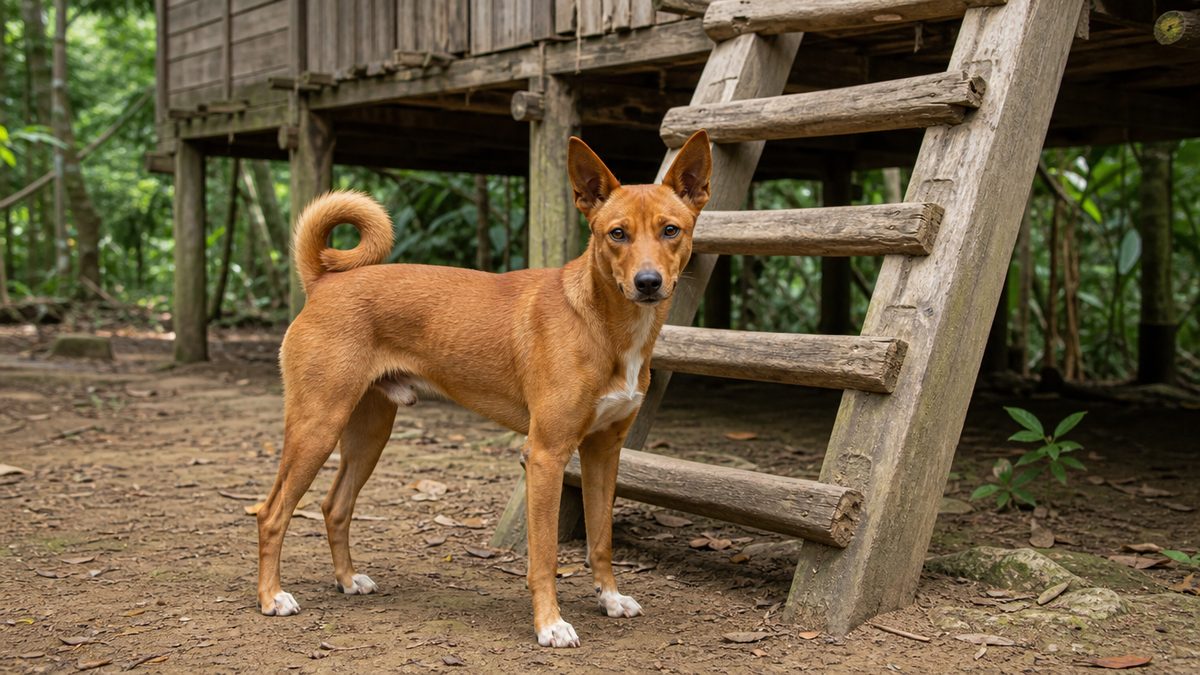
The Telomian is a landrace village dog from isolated settlements near the Telom River in the rainforests of the Malay Peninsula, kept by Orang Asli communities to hunt, to kill rats and snakes and to follow its household up a ladder into a raised hut, and recognised as a breed by no kennel club anywhere.
The name is geographic rather than descriptive. It comes from the Telom River, which runs through the uplands of the Malay Peninsula, and the animal is described as a type of dog found in isolated villages near it. That single sentence is doing a lot of work, because 'a type of dog found in villages near a river' is a description of a landrace, not of a breed.
Published measurements put it at 38 to 48 cm and 8.2 to 12.7 kg, with erect ears, a curled tail and a short coat that is red or yellow, sometimes piebald and occasionally carrying a black mask. There is no breed standard anywhere to check those against, because no body has ever written one.
The one-line version
A Telomian is a small tropical village dog from Malaysia, four of which went to an American behavioural laboratory between 1963 and 1973, and every Telomian in the West descends from those four. Its whole published literature is six papers about behaviour and none about health issues, its life expectancy has never been measured, and its country of origin's kennel association is reported to say it is not a breed at all.
| Question | Answer | Source that settles it |
|---|---|---|
| Is there a real population in Malaysia? | Yes, village dogs near the Telom River, kept by Orang Asli communities | Published descriptions in four reference works |
| Is it recognised by any kennel club? | No, anywhere | Absent from FCI Group 5's 46 breeds and the 19-entry provisional register |
| Is there a published breed standard? | No, none exists anywhere | No registry holds the animal, so nobody has written one |
| What does Malaysia say? | Reported in 2017: there is no such breed, it is just a pariah dog | Malaysian Kennel Association, as quoted in The Malaysian Insight |
| Is there a measured life expectancy? | No. Absent from all 345 rows of the largest UK longevity table | McMillan 2024 Table S5 |
| Is there veterinary literature? | None. Six behavioural papers, 1967 to 1980, and nothing on health | Controlled PubMed audit plus a Crossref resolution |
| Is there an Indian price? | No. Neither Indian breed-price site carries a page | Direct HTTP test with a passing control |
Most Bonbeno breed pages tell you how to keep an animal. This one has to establish what the animal is first, because the published record contains a specific and unusual claim: the country of origin's own kennel association is reported to have said the breed does not exist and that Americans invented it for profit. A reader who has been offered a Telomian puppy needs that before anything about grooming.
Breed, type or landrace? What the sources support
The Telomian is a landrace, and the two-condition test fails at both conditions, because no published breed standard exists anywhere and no register kept generation to generation exists either Wikipedia, Telomian, read 9 September 2026.
A breed needs two things at once: a written standard describing what the animal should be, and a register recording individual animals generation after generation so that the standard is applied to real dogs. Apply both.
- Condition one, a standard: not met. No kennel club anywhere holds this animal, so no standard exists to hold it to. The published height and weight come from a 1995 encyclopedia of dog breeds, not from a registry document.
- Condition two, a register: not met. The animal is absent from all four FCI groups checked and from the FCI's provisional register, which returned 19 entries in the same session Federation Cynologique Internationale. No national register anywhere holds it either.
What the country of origin is reported to say
The strongest evidence on this question comes from Malaysia. In July 2017, in response to US-based breeders selling these dogs as purebreds, the Malaysian Kennel Association was quoted as saying: 'The Telomian Malaysian dog is a myth by some Americans after profit. There is no such breed, it is just a pariah dog'.
That is a national kennel body denying the existence of a breed attributed to its own country, and specifically framing the attribution as a commercial invention. It is a rare and strong statement, and it is the reason this page leads with identity.
That quotation is carried here as Wikipedia carries it, with author, title, publication and date intact, and Bonbeno did not read the article itself. The Malaysian Insight's published address for it returns HTTP 404 titled 'Page Not Found', and the Internet Archive's three captures between June 2021 and March 2022 captured that 404 page rather than the article. Nor could the association's own position be checked directly: mka.org.my returned 215 bytes reading 'Welcome to mka.org.my Coming soon....' on 9 September 2026. So the statement is reported, sourced and dated, and it is not independently confirmed here.
Where that leaves the verdict
The honest reading is that both things are true at once, and neither cancels the other. There is a real population of village dogs near the Telom River, described consistently across reference works, studied by name in six published papers and kept by Orang Asli communities for hunting Compton JM, Scott JP. Allelomimetic…. And there is not a breed, because nothing is written down, nothing is registered and the country of origin's kennel body is reported to reject the idea outright.
The category that fits is landrace, which is exactly where Wikipedia's own navigation box files it: alongside the Africanis, the Canaan Dog, the Carolina Dog, the Indian pariah dog, the New Guinea Singing Dog, the Taiwan Dog and the Tugou. That is the right company, and the presence of the Indian pariah dog in the same list is the most useful thing on this page for an Indian reader.
Four dogs, one laboratory, and everything that followed
Every Telomian in the West descends from four dogs: a pair sent to the United States in 1963 by an anthropologist to be studied by a behavioural researcher, and a second pair received in 1973.
That sentence is the whole western history of this animal and it has consequences a buyer should understand.
| Year | What happened | Source |
|---|---|---|
| 1963 | An anthropologist sends a pair to the United States to be studied by a behavioural researcher | Wikipedia, from Morris 2001 |
| 1967 | 'Dogs for Behavioral Research' published, Institute of Laboratory Animal Resources | Cited by Wikipedia |
| 1971 | 'Distress Vocalization and Social Facilitation of Feeding in Telomian Dogs', The Journal of Psychology 78(2):165-179 | DOI resolved individually through Crossref in this session |
| 1973 | A second pair arrives. All western Telomians descend from these four dogs | Wikipedia, from Morris 2001 |
| 1977 | 'Interaction of separation distress with fear in infant dogs', Developmental Psychobiology 10:203-12 | PMID 863117 |
| 1978 | 'Environment and agonistic behavior in male Telomian dogs', Psychological Reports 42:1146 | PMID 566938 |
| 1979 | 'The effects of alcohol on agonistic behavior in the Telomian dog', Psychopharmacology 60:295-301 | PMID 108707 |
| 1979 | A Telomian-beagle hybrid studied as a model for the hyperkinetic syndrome in children | PMID 111287 |
| 1980 | 'Influence of living area space on agonistic interaction in Telomian dogs', Behavioral and Neural Biology 28:343-9 | PMID 7189118 |
| 2017 | Malaysia's kennel association is reported to reject the breed claim | The Malaysian Insight, article no longer retrievable |
Why four founders matters
Four founders is a smaller base than almost any recognised breed started from. It means the western population was genetically closed at the moment it began, and every subsequent animal is a descendant of two pairs. Combine that with a reproductive trait the published description records, that females have one heat per year instead of two, and the population's capacity to grow or to diversify was constrained from the start.
No inbreeding coefficient has ever been published for this population, because no register exists to calculate one from. That absence is itself the finding.
What the laboratory actually wanted
The research that brought this animal to the West was not about the dog. Reading the papers by title makes that clear: distress vocalisation and social facilitation of feeding, separation distress and fear in infant dogs, environment and agonistic behaviour, the effects of alcohol on agonistic behaviour, and living-area space and agonistic interaction Davis KL, Gurski JC Pettijohn TF. Environment and agonistic… Pettijohn TF. The effects of alcohol… Pettijohn TF, Davis KL.
The clearest case is the 1979 amphetamine study, which used a Telomian-beagle hybrid as a possible model for the hyperkinetic syndrome in children, reporting that hybrids exhibited hyperactivity, impulsiveness and impaired learning, that responders and non-responders to amphetamine could be differentiated, and that hybrids formed less of the active metabolite p-hydroxyamphetamine than beagles did. The Telomian was of interest as a genetically distinct comparison stock, not as a companion animal.
The most recent published paper on this animal is from 1980. Any care guidance you find dated after that is not built on new research, because no new research exists. That does not make the guidance wrong, but it does mean it is inference from other breeds, and it should be read as inference rather than as knowledge about this one.
Six papers, none about health, and the count that undercounts
The Telomian's entire published literature is six papers between 1967 and 1980, every one of them behavioural or psychopharmacological and none of them about health, and a controlled PubMed search finds only five of the six.
Prove the search worked before believing the result. In the same session, the control queries returned 126 records for 'Labrador retriever hip dysplasia' and 1,109 for 'Labrador Retriever'[tiab], both with sane query translations, so the instrument was healthy.
| Year | Paper | Journal | Identifier | In PubMed? |
|---|---|---|---|---|
| 1967 | Dogs for Behavioral Research | Institute of Laboratory Animal Resources | no DOI recorded | Not searched |
| 1971 | Allelomimetic Behavior System: Distress Vocalization and Social Facilitation of Feeding in Telomian Dogs | The Journal of Psychology 78(2):165-179 | DOI 10.1080/00223980.1971.9916900 | NO |
| 1977 | Interaction of separation distress with fear in infant dogs | Developmental Psychobiology 10:203-12 | PMID 863117 | Yes |
| 1978 | Environment and agonistic behavior in male Telomian dogs | Psychological Reports 42:1146 | PMID 566938 | Yes |
| 1979 | The effects of alcohol on agonistic behavior in the Telomian dog | Psychopharmacology 60:295-301 | PMID 108707 | Yes |
| 1979 | Paradoxical effect of amphetamine ... in a hybrid dog | Psychopharmacology 62:217-24 | PMID 111287 | Yes |
| 1980 | Influence of living area space on agonistic interaction in Telomian dogs | Behavioral and Neural Biology 28:343-9 | PMID 7189118 | Yes |
The audit that found its own limit
This is worth stating plainly because it is the kind of thing a research page should disclose about itself. A controlled PubMed search on this animal returns five records, and every one of the five was resolved individually and confirmed to be genuinely about Telomians. That looked like the complete literature.
It is not. The 1971 Journal of Psychology paper has a live DOI which resolves through Crossref to the exact title, authors, journal, volume 78, issue 2 and pages 165 to 179, and it is not in PubMed's Telomian set. Neither a journal-scoped query nor an author-plus-keyword query retrieves it there.
So the honest statement about this animal is six papers, not five, and the general lesson is that a controlled PubMed count on a 1970s behavioural literature is a floor rather than a total, because psychology journals of that era are incompletely indexed. A page that reported five and stopped would have been careful and still wrong.
What none of the six contains
- No lifespan. Nothing in the six papers measures survival, and the animal is absent from all 345 rows of the largest UK longevity table.
- No disease. Not one paper describes an inherited condition, a screening result or a clinical presentation.
- No population genetics. Nobody has genotyped this animal, so its relationship to other Southeast Asian village dogs is unestablished.
- No breed standard work. The papers use the animal as behavioural stock, not as a breed under development.
- No Indian material of any kind. Nothing connects this animal to India in any published source.
On a well-studied breed you can tell a buyer which certificates to demand. Here there is nothing to demand, because no screening scheme covers this animal, no registry collects health data on it and no paper has ever described a disease in one. A seller cannot produce a certificate that does not exist, which means there is no way to distinguish a careful breeding from a careless one. That is the strongest practical argument on this page.
The ladder, the stilt house and the single annual season
The Telomian's climbing ability is recorded as an adaptation to its owners' housing, because Orang Asli households in the published description live in huts raised from the forest floor reached by primitive ladders, and a village dog that could not climb could not follow its household indoors.
Three behavioural traits appear in the published description, and each has a practical reading rather than an exotic one.
- Climbing. The dogs are noted for climbing ability because their owners live in raised huts with primitive ladder access. This is architecture selecting for a behaviour, which is what a village landrace's traits usually are.
- Hunting rats and snakes. The dogs kill rats and snakes and are rewarded with food for it, and they also catch their own prey. That is a working relationship rather than feeding, and it is how a village dog earns its place.
- A unique call. The published description records a distinctive vocalisation rather than an ordinary bark. Several primitive landraces share this, and the published behavioural work on this animal studied distress vocalisation specifically.
One heat a year, and why it matters
The published description records that females have one heat per year instead of two, which is the pattern in the wolf and in several primitive landraces, and which most domestic dogs lost under selection.
For an Indian reader the practical consequences are two. It halves the rate at which a small closed population can produce litters, which compounds a founder base of four. And it means any seller claiming ready availability of puppies is describing something the reproductive biology does not easily support.
What the behavioural literature actually studied
It is worth being specific, because the papers are often cited as though they described the breed's temperament. They did not. They studied social organisation under experimental conditions: three social systems of two males and one female each, given graded doses of alcohol, with attacks and bone-possession time recorded by social rank. Another examined how living-area space influenced agonistic interaction. Another looked at separation distress interacting with fear in infant dogs.
What comes out of that is a picture of a socially organised dog with clear rank structures and strong distress responses to separation, studied in a laboratory. It is not a temperament assessment for a pet home, and this page will not pretend it is.
Living-area space influenced agonistic interaction between these dogs, which was the finding of the last paper published about them. Applied to an Indian household, that is a straightforward point: crowd this kind of animal and you will get conflict, and give it space and you will get less. It is one of very few things the published record supports saying about how to keep one.
Telomian price in India: there is no market and no register
No telomian price in india exists, because neither Indian breed-price site carries a page for the animal and no register exists anywhere that would make a pedigree verifiable at any price Federation Cynologique Internationale.
Evidence the negative properly rather than asserting it from an empty search.
- poodles.in/dog-breeds/telomian returns HTTP 200 with the page title 'Dog Breed Not Found' and 874 characters of text, which is a soft 404 a status check would pass.
- happypet.care has no Telomian page, and the same site returns a genuine 404 for the other unrecognised animals tested in this batch.
- The control passed in the same run. poodles.in returned full breed guides of 16,000 to 18,000 characters for the Lhasa Apso, Welsh Terrier, Tibetan Terrier and Tibetan Mastiff, so the site was working.
- dogbreedslist.info returns a genuine 404 for this animal, titled '404: Page Not Found'.
- The search engines cannot check. Bing India's control passed with ten genuine Indian Labrador price pages, then returned ten Microsoft Teams and Baidu pages for 'telomian dog breed' under 'About 61 results'.
Why a puppy price would be meaningless even if quoted
A breed price is meaningful when a register makes the label checkable. Here no register exists, no standard exists, and the country of origin's kennel association is reported to say the breed does not exist and that the purebred claim was made by Americans for profit. A price attached to that name is a price for a label with nothing behind it.
The reproductive arithmetic reinforces the point. Four founders, one oestrus a year, and no coordinating body between 1973 and now. Whatever is being offered under this name today, its provenance cannot be traced to those four dogs by any document a buyer can inspect.
The nearest real Indian numbers, and their mechanism
What an Indian reader can have is the cost structure of a comparable-sized dog, with the mechanism behind Indian cost rows exposed. On the Tibetan Mastiff, the one Tibetan-region breed with a genuine Indian market, poodles.in prints monthly food Rs 3,000 to Rs 4,500, monthly health Rs 1,500 to Rs 2,250 and monthly grooming Rs 1,200 to Rs 1,800, while happypet.care prints headline monthly totals of Rs 5,700 and Rs 8,550.
Add the component lines. 3,000 plus 1,500 plus 1,200 is Rs 5,700. 4,500 plus 2,250 plus 1,800 is Rs 8,550. The headline total is the arithmetic sum of three preset lines rather than an observation of what any dog costs, which is worth knowing before treating any Indian monthly figure as researched.
We will not invent a Telomian price in India and we will not convert a foreign asking price into rupees and present it as one. If somebody offers you this animal in India, the question is not how much. It is which register the pedigree is with, and there is no register anywhere that holds this breed.
What a dog like this would actually cost to keep in India
Budget roughly Rs 2,500 to Rs 5,500 a month for a 8.2 to 12.7 kg short-coated dog in an Indian metro, which is at the cheap end for any dog because the coat needs almost nothing and the animal is small.
No monthly cost figure specific to this animal exists anywhere, so everything below is built from named Indian providers read live on 9 September 2026, applied to a dog of the published size. This is the most affordable kind of dog to keep properly in India, because the coat costs nothing and the animal is small.
| Line | Published figure | Provider and scope |
|---|---|---|
| Puppy vaccination course | From Rs 6,499 (list Rs 8,111) | Vetic national page, a promotional floor from one chain |
| Annual booster | From Rs 3,199 (list Rs 3,806) | Vetic national page |
| Anti-rabies, single | Rs 699 | Vetic |
| 9-in-1 DHPPiL | Rs 899 | Vetic |
| Kennel cough | Rs 1,349 | Vetic |
| Anti-rabies at a municipal clinic | Free of cost | Greater Chennai Corporation's pet clinics |
| Food, small to medium dog | Rs 500 to Rs 1,500, or Rs 1,500 to Rs 4,000 | VOSD's small and medium bands; this animal sits between them |
| Bath with blow drying | From Rs 934 (list Rs 1,099) | Vetic Delhi; a haircut at Rs 1,359 is not needed on this coat |
| Consultation | Rs 500 to Rs 1,000 | VOSD, treated here as one data point |
| Boarding, overnight to 24 hours | Rs 899 | PawSpace Bengaluru, festive rates 25 to 30 percent higher |
| Municipal registration, Delhi | Rs 500 new, Rs 500 renewal | MCD, dogs only, late fee Rs 100 per month |
| Municipal licence, Chennai | Rs 50 | Greater Chennai Corporation, 9,115 issued in 2024 |
Three of those repay attention. Delhi's Municipal Corporation registers pet dogs only, ties the one-year certificate to the anti-rabies vaccination date and charges Rs 100 a month late after a one-month grace period. Greater Chennai Corporation licenses pet animals at Rs 50, issued 9,115 licences in 2024 and provides all treatment and anti-rabies vaccination free of cost at its pet clinics. And boarding moves seasonally: PawSpace publishes Rs 899 for an overnight stay and states on its own page that festive rates run 25 to 30 percent higher with food charged separately.
The one line this animal adds
Parasite control, year-round rather than seasonally. Among dogs tested at Indian veterinary clinics, a West Bengal series of 584 screened dogs reported Babesia gibsoni in 76.54 percent and two or more pathogens in 72.9 percent of those screened, and a Kerala series of 120 found Babesia species in 66.7 percent with a pre-monsoon peak from March to May. A short-coated dog is easy to check for ticks, which is the one genuine advantage this coat gives an Indian owner.
- Budget Rs 900 to Rs 1,800 a month for food, between the small and medium bands.
- Budget near zero for grooming, because a short village coat needs a brush and a bath rather than a groomer.
- Budget Rs 400 to Rs 700 a month amortised for vaccination, deworming and year-round parasite control.
- Budget Rs 500 to Rs 1,000 per consultation, and more than the usual number of them on an animal with no screening history behind it.
- Budget Rs 42 a month for the Delhi registration or Rs 4 for the Chennai licence, both legally required and both routinely skipped.
Greater Chennai Corporation's pet clinics give all treatment and anti-rabies vaccination free of cost, and the licence is Rs 50. Against Vetic's Rs 699 for a single anti-rabies shot, that is a 12x spread on one identical vaccine, and the spread is a function of the delivery model rather than of the drug.
Can a Telomian handle the Indian climate?
A Telomian would handle Indian humidity comfortably and Indian summer heat badly, because Malaysian lowland points measure 81.75 to 86.97 percent annual relative humidity against Chennai's 72.39, while Delhi's June mean of 35.88 C is 7.22 C above the hottest monthly mean measured anywhere in Malaysia in this session.
This is the one section where the answer genuinely favours the animal, and getting it right means separating two things that are usually run together.
| Point | Cell elevation vs real | Annual mean | Hottest month | Annual humidity |
|---|---|---|---|---|
| Kota Bharu, Malaysia | 30.82 m vs 8 m | 27.36 C | May, 28.66 C | 81.75 percent |
| Kuala Terengganu, Malaysia | 32.49 m vs 4 m | 27.39 C | May, 28.65 C | 81.87 percent |
| Malacca, Malaysia | 26.99 m vs 8 m | 27.49 C | May, 28.46 C | 81.89 percent |
| Temerloh, Pahang | 99.50 m vs 40 m | 26.34 C | May, 27.58 C | 85.69 percent |
| Johor Bahru, Malaysia | 25.80 m vs 34 m | 27.05 C | not quoted | 84.60 percent |
| Chennai, India | 48.95 m vs 6 m | 27.95 C | May, 31.51 C | 72.39 percent |
| Kolkata, India | 7.35 m vs 9 m | 25.81 C | May, 31.53 C | 73.93 percent |
| Mumbai, India | 97.15 m vs 14 m | 26.77 C | May, 31.19 C | 67.39 percent |
| Delhi, India | 206.37 m vs 216 m | 25.60 C | June, 35.88 C | 45.56 percent |
Humidity is not the problem, and this is where most pages get it backwards
Look at the humidity column. Every Malaysian point measures higher annual relative humidity than every Indian city listed. Temerloh in Pahang runs 85.69 percent and Johor Bahru 84.60, against Chennai's 72.39, Kolkata's 73.93 and Mumbai's 67.39. An animal from that environment is not going to be shocked by an Indian monsoon. It comes from somewhere wetter.
This is worth stating because the reflex assumption about a tropical breed in India is that the monsoon will be the problem. For this animal it is the reverse: Indian monsoon humidity is a relief compared with home, and the coat is short, so there is no dense undercoat to keep damp against the skin. On humidity alone this is the most heat-tolerant animal in this batch by a wide margin, and it is an athletic dog rather than a fragile one, which is a genuine and unusual advantage for an imported type in India.
Heat is the problem, and the gap is measurable
Now look at the temperature column. The hottest monthly mean measured anywhere in Malaysia in this session was 28.66 C, at Kota Bharu in May. Malaysia is warm and remarkably stable, with Kota Bharu ranging only from 25.71 C in January to 28.66 C in May, a swing of under three degrees across the year.
Delhi's June mean is 35.88 C, which is 7.22 C above the hottest month this animal's homeland has. Delhi's January mean of 13.61 C is also 12 degrees below Malaysia's coolest month. So an Indian northern plains year would present this animal with both a heat and a cold it has never experienced, on top of a 22-degree annual swing against a three-degree one.
- Chennai and Kochi are the closest Indian analogues by temperature stability, with Kochi's annual 27.31 C and 78.83 percent humidity being the nearest thing India has to Malaysian lowland conditions.
- Kolkata and Mumbai are workable on humidity and require shade and water management through May.
- Delhi and the northern plains present a June heat this animal has no evolutionary experience of, and a January cold it has none of either.
- Bengaluru and Pune are cooler than Malaysia year-round, which is a different mismatch rather than an obviously easier one.
- Test the pavement with the back of your hand for five seconds before any walk, whichever city you are in.
The homeland limit, stated honestly
One caveat on the Malaysian figures. This animal's own range is the upland Telom River country, not the coast, and NASA POWER cannot measure that: Kuala Lipis's cell reads 363.36 m against a real 60 m, Kuala Lumpur's 231.94 m against 56 m and Ipoh's 592.70 m against 40 m. Temerloh in Pahang, at +59.50 m, is the closest usable point to the range and is what this page uses. Upland forest is cooler and wetter than the lowland figures suggest, so the heat gap to Delhi is probably larger than the table shows rather than smaller.
The largest study of canine heat-related illness covered 905,543 UK dogs and found bodyweight at or above the breed and sex mean carried 1.42 times the odds, and bodyweight over 50 kg 3.42 times. This animal is absent from that study entirely and weighs 8 to 13 kg, so neither figure is applied here. Second Schedule Part IV paragraph 21(1) of the Dog Breeding and Marketing Rules 2017 does apply generally, barring outdoor housing of dogs not accustomed to local temperatures without written veterinary approval.
Temperament, and how little is actually known
The published description calls the Telomian an active dog, affectionate towards people, with a terrier-like temperament, and everything beyond that single sentence is inference rather than observation.
Be honest about the evidence. The temperament description in the literature amounts to one clause: 'an active dog that is affectionate towards people, and possess a terrier-like temperament'. There is no breed club survey, no owner questionnaire and no behavioural assessment designed for pet suitability.
What there is instead is six papers about how these dogs behaved in an experimental setting, and it is worth reading them for what they actually measured rather than for what they might imply.
- Social rank was real and measurable. The alcohol study organised dogs into three social systems of two males and one female each and recorded attacks and bone-possession time by rank, finding that top, middle and low-ranking dogs responded differently to the same dose.
- Space affected conflict. The last paper published on this animal examined how living-area space influenced agonistic interaction.
- Separation distress was studied specifically. Two papers examined distress vocalisation and separation distress interacting with fear in infant dogs.
- The hybrid work was about something else entirely. The Telomian-beagle hybrid was studied as a model for hyperkinetic syndrome in children, not as a description of the parent stock.
What can honestly be said for an Indian household
Three things transfer, and they are modest.
- This is a village dog, not a house dog. It was kept loose around raised huts, hunted rats and snakes, and caught its own prey. An Indian flat is not a version of that with less space; it is a different arrangement entirely.
- Separation matters. Two of the six papers studied distress on separation, which is a hint rather than a finding, but it points the same way as the animal's village role: this is a dog that lived among people constantly.
- Crowding produces conflict. Space influenced agonistic interaction in the published work, so a multi-dog Indian household in a small flat is the arrangement most likely to go wrong.
Who should not consider this animal
Almost everyone, and for a reason that has nothing to do with temperament. There is no verifiable source, no register, no health data and no Indian population. Even a reader for whom the described temperament sounds ideal cannot obtain the animal in a form anybody can stand behind.
If what you want is a small, short-coated, alert, independent, heat-adapted village dog that hunts rats, lives comfortably among people and has evolved in your own climate, that animal is the Indian pariah dog. Wikipedia's own navigation box files the two in the same category, and Malaysia's kennel association is reported to have described the Telomian using exactly that word.
How you would train a dog like this
To train a Telomian you would build the relationship and manage the environment, because no training research on this animal exists and its published role is that of an independent hunter rather than a handler-directed dog.
State the evidence base first. Nothing in the six published papers is about training. What follows is the general approach for an independent landrace, and it is offered as inference, clearly labelled.
| Age | Priority | Why now |
|---|---|---|
| 8 weeks | Earliest lawful sale age in India under Rule 8(1)(a) | Refuse any younger animal, whatever it is called |
| 8 to 12 weeks | Handling, restraint and mouth handling | A dog nobody can examine is a dog nobody can treat |
| 10 to 16 weeks | Socialisation to lifts, traffic, gate guards, delivery riders | The window closes early, and an alert village dog rehearses suspicion fast |
| 3 to 6 months | Recall on a long line, paid generously | An independent hunting type will not offer recall for free |
| 3 to 6 months | Alone-time in graded doses | Two of the six published papers studied separation distress in this animal |
| 6 months | Legal note on sale | Rule 8(1)(b) bars sale of dogs over six months without prior sterilisation, except to another licensed breeder |
| 6 to 9 months | Registration and licensing | Delhi MCD Rs 500 or Chennai Rs 50, both tied to the rabies certificate |
| 6 to 12 months | Secure containment | A dog described as a climber will treat an ordinary Indian compound wall as a suggestion |
The containment point is not a joke
The one behavioural trait the published record emphasises is climbing, and the reason given is that this animal's owners lived in raised huts reached by primitive ladders. A dog selected for that is a dog that will get over a boundary most Indian households consider secure. Plan containment before arrival rather than after the first escape.
What to expect from recall
An animal that catches its own prey and hunts rats and snakes for a food reward is an animal with a strong independent hunting sequence. Recall against that is expensive to train and never absolute. Treat off-lead freedom in unfenced Indian space as a privilege the dog has not earned rather than as a default.
This animal has no screening scheme, no registry health data and no published disease profile, which means the veterinary relationship carries more weight than usual: everything will be found clinically rather than predicted. A dog that tolerates handling, restraint, a muzzle and a car is a dog whose problems get found early. Start at eight weeks.
Daily exercise, and the Indian timing rule
A Telomian would need substantial daily exercise and mental work, because its published role involved hunting, climbing and catching its own prey, and in most Indian cities that exercise has to move to the cool hours NASA POWER climatology API.
There is no measured exercise requirement for this animal, so treat the published role as the guide. A village dog that killed rats and snakes, caught its own prey and climbed into raised huts was physically busy for much of the day and mentally busy for all of it.
- Exercise before 7am and after 7pm from April to July in Delhi, Ahmedabad, Hyderabad, Chennai and Kolkata.
- Give at least an hour of activity a day for an adult, split into two or three outings.
- Replace distance with problem-solving at midday: scent games, a food puzzle, hidden food around a room.
- Use the animal's own history: a dog selected to find and dispatch rodents will take enthusiastically to scent work.
- Watch for heavy panting with a wide flat tongue, stumbling or brick-red gums, and treat any of them as an emergency.
Why the timing rule is arithmetic rather than caution
Delhi's June mean is 35.88 C and the afternoon runs above the mean, while the hottest month this animal's homeland offers averages 28.66 C. That is a 7.22 degree gap on a monthly mean, before the afternoon peak is counted. A short coat helps and it does not close a gap that size.
Chennai is easier on peak temperature at a May mean of 31.51 C and harder on relief, because there is no cool season at all. Kolkata behaves similarly. Bengaluru and Pune are cooler than the homeland year-round, which removes the heat problem and introduces a different question about a tropical animal in a mild highland climate that nobody has studied.
You can see and feel a tick on this animal. Among dogs tested at Indian veterinary clinics, an Odisha series of 178 found that 79 percent of infected dogs had a tick history, and a West Bengal series of 584 screened dogs reported two or more pathogens in 72.9 percent of those screened. A daily hands-on check after exercise takes two minutes on a short-coated dog and is impossible on a heavily coated one.
Grooming and coat care, which is the shortest section on this page
Grooming a Telomian means a weekly brush, a bath when the dog is dirty and a daily tick check, because the published description records a short coat and no breed standard exists to groom towards.
The coat is described as short fur, red or yellow, with some variation, sometimes piebald and occasionally with a black mask. That is the entire published record of this animal's coat. There is no undercoat description, no shedding rating and no seasonal pattern, because nobody has ever documented one.
- Brush weekly with a rubber curry or a soft bristle brush, which is enough for a short village coat.
- Bathe only when the dog is genuinely dirty, using a mild shampoo, and dry properly rather than leaving a damp dog in Indian humidity.
- Check for ticks by hand daily after exercise, working the ears, the neck, the armpits, the groin and between the toes.
- Trim nails monthly, which matters more than usual on a climbing animal.
- Skip the groomer entirely. At Vetic Delhi's Rs 1,359 for a haircut, this is a service this coat has no use for.
The Indian coat-care point that does apply
A short-coated dog in India is exposed rather than protected. Sunburn on a thinly coated belly and on a pale muzzle is a real risk in Indian sun, and a dog with a black mask has protection on the face and none on the belly. Shade matters more than shampoo.
The second point is drying. Even a short coat left damp in Kolkata's 73.93 percent annual humidity will support skin problems, and the fix is trivial: towel the dog properly rather than leaving it to air dry.
Compare this with the Tibetan Terrier, whose registry rates grooming at Every day and whose Indian owners face a professional groom at Rs 1,359 every six weeks if the daily brushing does not happen. A short-coated village dog removes that entire line from the budget, and it makes the tick check that Indian conditions genuinely require possible rather than theoretical.
Health issues: what is known, which is nothing
Nothing is published about this animal's health issues, because all six papers on it are behavioural or psychopharmacological, no screening scheme covers it, no registry collects data on it and no life expectancy has ever been measured McMillan 2024 Supplementary Table S5.
That statement needs proving rather than asserting, and the proof is in the audit above: five PubMed records, every one resolved individually and every one behavioural, plus a sixth paper found through Crossref that PubMed does not index and that is also behavioural Compton JM, Scott JP. Allelomimetic….
On longevity, the animal is absent from all 345 rows of McMillan 2024's Table S5, which lists 155 breeds included in the survival analysis and 189 explicitly excluded. It was not excluded. It was never considered. So there is no life expectancy figure to quote, and any page giving you one has invented it.
What can honestly be inferred, labelled as inference
- Landrace populations generally carry lower inherited-disease loads than closed pedigree populations, because natural selection continues to operate. That is a general principle rather than a measurement of this animal.
- A four-founder western population inverts that advantage. Whatever the village population's diversity, a group founded on two pairs and closed since 1973 is not a landrace any more in the genetic sense.
- Size-related risk is low. At 8.2 to 12.7 kg this animal avoids the large-breed problems of gastric dilatation and volvulus and of rapid-growth joint disease.
- Tropical parasite exposure is its evolutionary normal, which is a reason for optimism about tolerance and not a reason to skip prevention.
- Indian tick-borne disease applies regardless of origin. Among dogs tested at Indian veterinary clinics the reported rates are high, and a Kerala series found a pre-monsoon peak from March to May.
Why an absent record is a practical problem, not an academic one
On a documented breed, a buyer demands certificates and a vet knows what to look for. Here neither is possible. There is no test to ask for, no baseline to compare a blood result against, no known breed predisposition to raise a clinician's index of suspicion, and no published lifespan to judge an animal's age against.
That is a genuine clinical disadvantage and it is worth weighing against any romance the name carries. It also means the veterinary relationship does more work than usual: everything gets found clinically, at whatever stage the dog presents.
The 1979 study that gave graded doses of alcohol to Telomians in three social groups is a piece of 1970s behavioural pharmacology, and it is cited on this page as history. It is not, in any sense, information about how to keep this animal, and nothing in it should be read as a tolerance, a dose or a safety finding. Alcohol is toxic to dogs.
Feeding a dog of this size in India
Feed a Telomian from the small-to-medium band, roughly Rs 900 to Rs 1,800 a month in India, and score body condition by hand every month, because at 8.2 to 12.7 kg a half-kilogram drift is a large proportion of the animal.
There is no feeding research on this animal, so the arithmetic is from the published size and from Indian retail figures read live.
VOSD puts quality food for a small dog at Rs 500 to Rs 1,500 a month and for a medium dog at Rs 1,500 to Rs 4,000. This animal sits between the two bands at 8.2 to 12.7 kg, so the working figure is roughly Rs 900 to Rs 1,800.
- Feel the ribs with flat fingers; find them under a thin cover without pressing.
- Look from above for a waist behind the ribs, which a short coat makes easy on this animal.
- Weigh monthly on the same scale, because on a 10 kg dog a 500 g gain is five percent.
- Adjust by ten percent at a time and re-score after three weeks.
- Count treats, which on a dog this size are a much larger share of daily calories than owners assume.
One thing the published record does say about feeding
The village diet was earned. The dogs killed rats and snakes and were rewarded with food for it, and they also caught their own prey. That is a working relationship rather than a bowl, and the transferable point for an Indian household is that this kind of animal does better when some of its food comes through work: a scatter feed, a puzzle, a snuffle mat, food hidden around a room.
- Split the adult ration into two meals rather than one.
- Store kibble airtight, because an opened bag in Indian humidity goes rancid faster than the best-before date suggests.
- Avoid free-feeding, which hides the appetite drop that is often an illness's first sign.
- Add water to food in summer and check the bowl three times a day in April and May.
- Formulate any home-cooked diet once with a veterinary nutritionist and then keep it fixed, because an unformulated home diet is usually short on calcium and often on iodine and zinc.
The single most useful feeding change for a village-type dog in an Indian flat is to stop putting food in a bowl. Scatter half of it, hide the rest, and make the animal find it. It costs nothing, it fills a large part of the mental requirement that the walk cannot, and it is the closest a flat can get to the arrangement this animal evolved under.
The first year, and why this puppy timeline comes with a warning
A Telomian puppy timeline cannot honestly be written for India, because there is no Indian source, no register to verify a puppy against and no health baseline to measure one by, so what follows is the timeline for a small independent village-type dog plus the checks that would have to pass first Federation Cynologique Internationale.
| Age | What is happening | What you do |
|---|---|---|
| Before purchase | The only moment your money has leverage | Ask which register the pedigree is with. No register anywhere holds this breed |
| 8 weeks | Earliest lawful sale age in India under Rule 8(1)(a) | Refuse any younger animal; begin vaccination on the vet's schedule |
| 8 to 10 weeks | Fear period; house training | Handle feet, ears and mouth daily so examinations are boring rather than frightening |
| 10 to 16 weeks | Socialisation window closing | Lifts, stairs, traffic, gate guards, delivery riders, vaccinated dogs |
| 3 months | Vaccination course running | From Rs 6,499 at one chain, or free anti-rabies at a Chennai municipal clinic |
| 3 to 6 months | Alone-time in graded doses | Two of the six published papers on this animal studied separation distress |
| 4 to 6 months | Climbing and boundary testing begins | Secure the compound before the dog finds the gap, not after |
| 6 months | Legal note on sale | Rule 8(1)(b) bars sale of dogs over six months without prior sterilisation, except to another licensed breeder |
| 6 to 9 months | Registration and licensing | Delhi MCD Rs 500 or Chennai Rs 50, both tied to the rabies certificate |
| 6 to 12 months | Recall practice on a long line | An independent hunting type needs a year of paid practice, not a month |
| 12 months | Adult | Annual booster from Rs 3,199, a baseline weight, and year-round parasite control |
The checks that would have to pass before you paid
- Ask which registry the pedigree is with, then check that registry's own index. No kennel club anywhere holds this breed.
- Ask what the country of origin's kennel association says, and know the answer: it is reported to have said there is no such breed and that the purebred claim was made by Americans for profit.
- Ask for the parents' health results, then note that no screening scheme exists for this animal, so any certificate offered is for a scheme designed around a different breed.
- Ask how the sire and dam are related, given a western founder base of four dogs, and note that Indian law prohibits in-breeding within four generations and incest breeding.
- Refuse any puppy under eight weeks, which Rule 8(1)(a) prohibits selling.
Second Schedule Part II paragraph 6(9) of the Dog Breeding and Marketing Rules 2017 reads, in full: 'Breeding to create new breeds of dogs or unusual looks shall be strictly prohibited'. That is a striking provision to read beside an animal whose country of origin's kennel body is reported to describe its breed status as a myth created for profit. Note the citation form: this is a Second Schedule paragraph, not a Rule. The Rules stop at 13, so there is no Rule 14 and no Rule 21.
Compared with the dogs an Indian buyer could actually get
An Indian reader drawn to the Telomian has one obvious alternative and it is already here: the Indian pariah dog, which Wikipedia's own navigation box files in the same landrace category and which Malaysia's kennel association is reported to have used as the very word for the Telomian Voice of Stray Dogs, Dog Expenses in India.
| Option | Recognised? | Available in India? | Indian price | Measured life expectancy | Climate fit |
|---|---|---|---|---|---|
| Telomian | By nobody, and denied by its country of origin | No page on either Indian site | None exists | Never measured | Humidity yes, Delhi heat no |
| Indian pariah dog | Not a breed, and not claimed to be | Everywhere | Rs 500 adoption fee | Never measured | Evolved in it |
| Shiba Inu | Yes, an FCI breed with a national register | Yes, imported | Not compared here | 14.6 years on 91 deaths | Poor; a northern double coat |
| Tibetan Spaniel | Yes, FCI 231 since 22 August 1961 | No page on either Indian site | None exists | 15.2 years on 137 deaths | Moderate |
Three points that fall out of that table
- Recognition is what makes a lifespan figure possible. The two recognised breeds in the table have medians measured on 91 and 137 deaths; the two unrecognised ones have nothing, because nobody counts dogs that no register holds.
- Only one of the four evolved in Indian conditions, and it is the one that costs Rs 500 to adopt rather than anything to buy.
- The Telomian is the only one whose country of origin denies it exists, which is a category of problem the other three do not have.
The honest recommendation
If what draws you to this animal is the idea of a small, short-coated, alert, independent, tropical village dog that hunts rodents and lives closely with people, then the animal you want is available at every Indian shelter and costs a Rs 500 adoption fee. It is heat-adapted by evolution rather than by inference, it needs no import, and its provenance is exactly as documented as the Telomian's, which is to say not at all, with the difference that nobody is charging you for the paperwork.
Wikipedia's own navigation box files the Telomian under Landrace dogs, in a list that includes the Indian pariah dog three entries above it. They are not the same population and nobody should claim they are. They are the same kind of animal, and one of them is in the next street.
The Indian legal position
No Indian law bans this animal, it is named nowhere on the 2024 ferocious-breeds circular, and none of that circular's four undefined category words reaches a small tropical village dog High Court of Karnataka.
The 2024 instrument was a D.O. letter of 12 March 2024 from the Department of Animal Husbandry and Dairying, reproduced in full in CBIC Instruction No 05/2024-Customs of 14 March 2024. Its four bare undefined words are Terriers, Mastiffs (boerbulls), Wolf dogs and Canario. None of them reaches an 8 to 13 kg Malaysian village dog on any reading, and the animal is not named.
The circular was quashed in any case. The Karnataka High Court's operative order of 10 April 2024 reads '(i) Writ Petition is allowed. (ii) Circular dated 12-03-2024, issued by the 1st respondent stands quashed', and on 14 June 2024 the Madras High Court recorded the Department's own written words that 'the quashed circular has lost its effect entirely' and that 'all actions will proceed afresh'.
The provisions that do apply
| Provision | Correct citation form | What it requires |
|---|---|---|
| Minimum sale age | Rule 8(1)(a) | Pups less than eight weeks in age are not sold |
| Close breeding | Second Schedule Part II para 6(3) | In-breeding within four generations and incest breeding prohibited |
| Mutilation | Second Schedule Part II para 6(8) | No docking, cropping, de-barking, de-clawing or change of appearance by artificial means |
| New breeds | Second Schedule Part II para 6(9) | Breeding to create new breeds of dogs or unusual looks strictly prohibited |
| Genetic testing | Second Schedule Part III para 8(10) | Testing for named genetic defects, though no scheme exists for this animal |
| Outdoor housing | Second Schedule Part IV para 21(1) | Bars outdoor housing of dogs not accustomed to local temperatures without written veterinary approval |
| Municipal registration | Local, not the 2017 Rules | Delhi Rs 500, Chennai Rs 50 |
Paragraph 6(9) is the one worth pausing on. Its full text is a single sentence: 'Breeding to create new breeds of dogs or unusual looks shall be strictly prohibited'. Applied to an animal whose breed status is reported by its own country's kennel association to be a commercial invention, that provision reads unusually directly.
The Rules run from 1 to 13 and there is no Rule 14, so the strings 'Rule 14' and 'Rule 21' each occur zero times in the whole gazette. Any Indian page citing 'Rule 21' for the outdoor-housing clause, or 'Rule 8(10)' for the genetic-testing clause, is pointing a reader at a provision that does not exist. Both live in the Second Schedule, whose four Parts are numbered continuously from 1 to 30.
Mistakes people make with this name
Five mistakes account for almost everything that goes wrong around the Telomian, and the first is treating a landrace label as a breed guarantee.
- Treating the name as checkable. No kennel club anywhere holds it, no standard exists and the country of origin's kennel association is reported to reject the breed claim outright.
- Repeating a life expectancy. None has ever been measured, and the animal is absent from all 345 rows of the largest UK longevity table.
- Quoting a health issues list. Not one of the six published papers describes a disease in this animal.
- Assuming Indian humidity will be the problem. It is the reverse. Malaysian lowland points measure 81.75 to 86.97 percent annual humidity against Chennai's 72.39.
- Confusing it with the Basenji. Both are short-coated primitive types with curled tails and unusual vocalisation, and they are different animals from different continents with different literatures.
The mistake a careful writer would still make
Reporting five papers instead of six. A controlled PubMed search on this animal returns exactly five records, every one of which resolves to a genuine Telomian paper, which looks like a complete literature and is not. The 1971 Journal of Psychology paper has a live DOI and is not indexed in PubMed PubMed search audit for this animal. A count is only as complete as the database, and on a 1970s behavioural literature one database is not enough.
The mistake this page had to avoid
Concluding anything from a search result. Bing India's control passed in this session with ten genuine Indian Labrador price pages, and then returned ten Microsoft Teams and Baidu pages for 'telomian dog breed' under 'About 61 results'. That result set is evidence about nothing, in either direction. Everything this page says about the Indian market rests on direct HTTP tests of named sites instead.
Filing this animal as a fabrication. It is not. Real village dogs live near the Telom River, were studied by name in six published papers between 1967 and 1980, and are kept by Orang Asli households for hunting. What is contested is the breed claim built on top of them, and the distinction between a real animal and a doubtful breed label is the whole content of this page.
Adoption, and the animal that answers the same want
You cannot adopt a Telomian in India, and the honest alternative is the Indian pariah dog, which occupies the same category, evolved in the Indian climate and costs a Rs 500 adoption fee Voice of Stray Dogs, Dog Expenses in India.
State the limits precisely. Bonbeno found no Indian rescue, register, breeder or count for this animal, and could not run a search that would have found one, because the only search engine whose control passed substituted the query outright into Microsoft Teams pages. What this page can say from direct tests is that neither Indian breed-price site carries a page for it.
If you want this kind of dog in India
- Adopt an Indian pariah dog, which is filed in the same landrace category as this animal and is available at every Indian shelter.
- Look for the physical type you actually want: short-coated, erect-eared, curl-tailed, 8 to 15 kg, alert. Indian shelters have that dog in numbers.
- Ask the shelter about temperament rather than about breed, because on a landrace the individual is the only unit that means anything.
- Register and licence the dog once you have it, at Rs 500 in Delhi or Rs 50 in Chennai Greater Chennai Corporation.
- Use Greater Chennai Corporation's free anti-rabies vaccination if you are in that city, which is the single cheapest genuine saving in Indian dog ownership.
If somebody offers you one anyway
Bonbeno does not recommend breeders, link puppy listings or quote a live price as an offer. On this name, three questions settle it.
- Which register is the pedigree with? No kennel club anywhere holds this breed.
- What does the Malaysian Kennel Association say? It is reported to have said there is no such breed and that the purebred claim was made by Americans for profit.
- What health testing was done? No scheme exists, so the honest answer is none.
A seller who answers all three straightforwardly is selling an unregistered dog of a disputed type, which somebody may legitimately want. A seller who produces a registration number is producing one from a body that does not hold the breed.
The comparison VOSD prints is the whole case in one line: whether you buy a puppy from a breeder for Rs 80,000 or adopt a dog for Rs 500, a ten to fifteen year financial commitment starts the moment the dog crosses your threshold. On an animal with no register, no standard, no health data and no measured lifespan, the Rs 79,500 difference buys you nothing that can be checked.
Telomian questions people actually ask
What is the Telomian price in India?
No telomian price in india exists. poodles.in returns HTTP 200 titled Dog Breed Not Found for this animal, which is a soft 404 a status check would pass, and happypet.care has no page at all, while both returned full guides for four control breeds in the same run. No kennel club anywhere recognises the animal, so no pedigree would be verifiable at any price.
Is the Telomian a real breed?
Malaysia's own kennel association is reported to have said it is not. As quoted in 2017, the association's response to Americans selling these dogs as purebreds was that the Telomian Malaysian dog is a myth by some Americans after profit, that there is no such breed and that it is just a pariah dog. No kennel club anywhere recognises it.
How many Telomians are there in the West?
All of them descend from four dogs. An anthropologist sent a pair to the United States in 1963 to be studied by a behavioural researcher, and received a second pair in 1973. Every Telomian in the United States descends from those four animals, which is a founder base small enough to make the population genetically closed by construction.
Can Telomians really climb ladders?
That is what the published description records, and the reason given is practical rather than exotic. Their owners live in huts raised from the forest floor with access by primitive ladders, so a village dog that could not climb could not follow its household indoors. The behaviour is reported as an adaptation to the housing rather than as a trick.
How long do Telomians live?
Nobody knows and no page should tell you. The animal is absent from all 345 rows of the breed table in the largest UK companion-dog longevity study, so it was never considered rather than excluded. Its entire published literature is six behavioural and psychopharmacology papers between 1967 and 1980, and not one of them measures lifespan.
What health problems do Telomians have?
There is no published answer. Every one of the six papers on this animal is behavioural or psychopharmacological, no screening scheme covers it, no registry collects health data and no disease has been described in it. A seller cannot produce a health certificate that does not exist, which is the practical consequence.
Can a Telomian handle the Indian climate?
The humidity, yes. The heat, less so. Malaysian lowland points measure 81.75 to 86.97 percent annual relative humidity against Chennai's 72.39 and Mumbai's 67.39, so an Indian monsoon is drier than home. But Delhi's June mean of 35.88 C is 7.22 C above the hottest monthly mean measured anywhere in Malaysia in this session.
Is the Telomian banned in India?
No. No Indian law in force today bans it, and it is named nowhere on the 2024 ferocious-breeds circular. None of that circular's four bare undefined category words, Terriers, Mastiffs, Wolf dogs and Canario, reaches a small tropical village dog on any reading, and the circular was quashed by the Karnataka High Court on 10 April 2024 in any case.
Is the Telomian the same as an Indian pariah dog?
They are different populations that occupy the same category. Malaysia's kennel association is reported to have called the Telomian a pariah dog, and Wikipedia's own navigation box files it as a landrace beside the Indian pariah dog, the Africanis and the Canaan Dog. They are not the same animal, and the useful point is that India already has its own.
Why do Telomian females only come into season once a year?
A single annual oestrus is a primitive trait shared with several landraces and with the wolf, and it is what most domestic dogs lost under selection for productivity. The published description records it for this animal. It matters practically because it halves the number of litters a population can produce, which compounds an already tiny founder base.
Should I buy a Telomian in India?
No, and there is nothing to buy. Neither Indian site carries a page, no register exists to verify a pedigree against, the last published research on the animal is 46 years old and the country of origin's kennel association is reported to deny the breed exists. An Indian street dog answers the same want for a Rs 500 adoption fee.
Where can I adopt a Telomian in India?
You cannot. No Indian rescue, register, breeder or count exists, and the search engines cannot even be used to check, because Bing India substituted the query outright into Microsoft Teams pages while its Labrador control passed. If you want a small, short-coated, heat-adapted independent village dog in India, the Indian pariah dog is that animal.
What is a Telomian dog?
The Telomian is a landrace village dog from isolated settlements near the Telom River in the rainforests of the Malay Peninsula, kept by Orang Asli communities to hunt, to kill rats and snakes and to follow its household up a ladder into a raised hut. No kennel club anywhere recognises it as a breed, and Malaysia's own kennel association is reported to have called it a pariah dog rather than a breed. Published height is 38 to 48 cm and weight 8.2 to 12.7 kg.
Is Telomian dog rare?
In the West, yes, in the strictest sense: every Telomian in the United States descends from four dogs, a pair sent to a behavioural laboratory in 1963 and a second pair received in 1973. In Malaysia it is not a rare breed but an ordinary village population near the Telom River, described consistently across reference works, which is why the country's own kennel association is reported to call it a pariah dog rather than a breed.
Compare with similar breeds
Telomian sits in 2 Bonbeno groups. Each one compares it directly against the breeds it is genuinely an alternative to, on the same figures.