
Breed profile
Tibetan Kyi Apso: A Breed That Was Made, and Then Unmade
Six dogs left Tibet in the 1990s and a club in the United States wrote them a standard. The club's own vice-president has since said on the record what that standard was for.
Quick answer
No tibetan kyi apso price in india exists, and no Tibetan Kyi Apso breed exists in the sense a buyer means. No kennel club anywhere recognises it, the private American club that wrote its standard collapsed in 1999 by its own vice-president's account, and neither Indian breed-price site carries a page for it. The animal behind the name is a real Tibetan bearded landrace.
This page reports what the published record contains and, for this animal, the published veterinary record is empty. No peer-reviewed study of this dog exists, no screening scheme covers it and no lifespan figure has been measured for it. Nothing here is a diagnosis or a treatment plan, and general guidance written for other livestock guardian breeds may not transfer. Consult your nearby vet before acting on anything on this page, and treat any large dog showing heat distress, a swollen abdomen or sudden collapse as a same-day emergency.
Tibetan Kyi Apso at a glance
What the Tibetan Kyi Apso actually is
The Tibetan Kyi Apso is a bearded livestock-guardian landrace from the Mount Kailash region of the Tibetan plateau that no kennel club anywhere recognises as a breed, and whose western breed club published a standard in the 1990s and then collapsed in 1999 National Purebred Dog Day.
Take the name apart first, because it does the work. In Tibetan, kyi means dog and apso means bearded or hairy, which the club's own page states plainly. The same syllable appears in Lhasa Apso, the bearded dog of Lhasa, and the same root appears in the Federation Cynologique Internationale's own name for the Tibetan Mastiff, which the FCI files not as Tibetan Mastiff but as Do-Khyi, standard 230. So the name means, quite literally, bearded dog, and it describes a coat rather than a lineage.
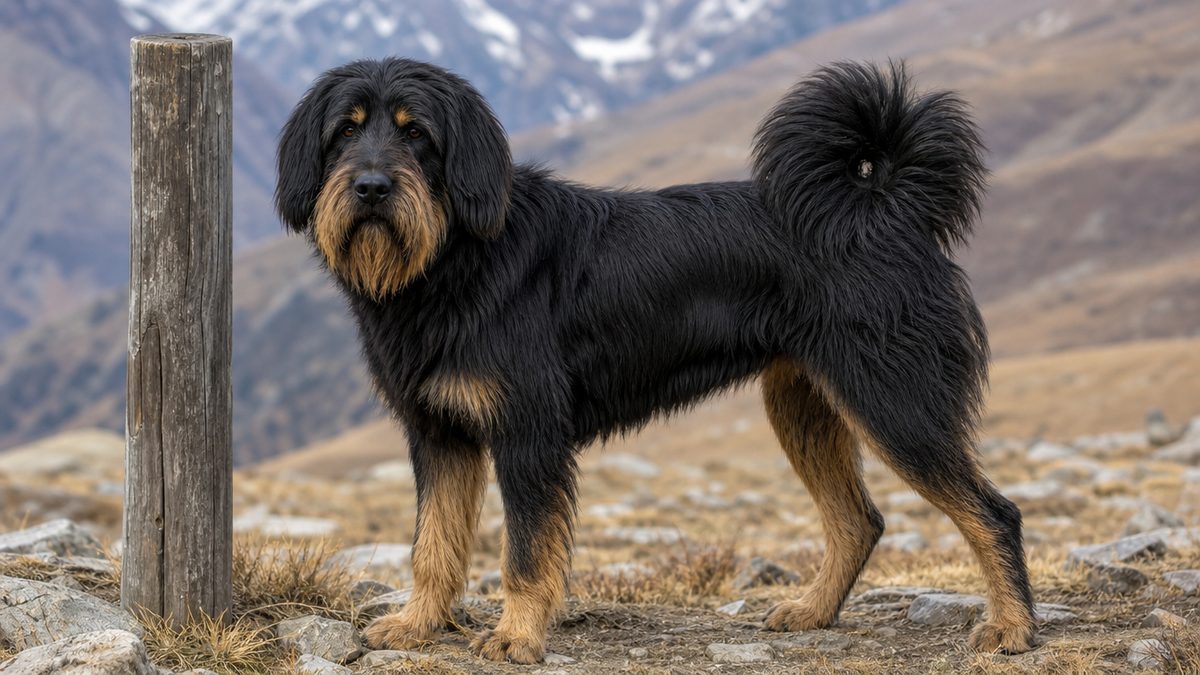
The animal behind it is real. Published descriptions put it at 63 to 71 cm and 32 to 41 kg, with a heavy double coat that is rough and wiry especially over the eyes, typically black with pale extremities, long hairy ears, comparatively long legs, a more slender body than a Tibetan Mastiff's, no sagging dewlap, no facial wrinkles and a fully curled tail. Its traditional range is the Tibetan plateau near Mount Kailash and it was kept to protect livestock and settlements.
The one-line version
A Tibetan Kyi Apso is a bearded Tibetan livestock guardian that a private American club tried to turn into a western breed from six imported dogs, and the attempt did not survive its own founders National Purebred Dog Day. There is no register, no recognition, no published life expectancy, no peer-reviewed literature on its health issues and no Indian market, so this page can give you a monthly cost but not a purchase price.
| Question | Answer | Source that settles it |
|---|---|---|
| Is there a real population in Tibet? | Yes, a bearded livestock-guardian landrace near Mount Kailash | Four reference books cited by Wikipedia, plus the club's own account |
| Is it recognised by any kennel club? | No, anywhere | Absent from FCI Group 2's 51 breeds and from the 19-entry provisional register |
| Is there a published breed standard? | Yes, a private club standard, still readable | Tibetan KyiApso Club Breed Standard |
| Is there a register kept generation to generation? | No. The registry site is discontinued and the club collapsed in 1999 | The club's former vice-president, on the record |
| Is there a measured lifespan? | No. Absent from all 345 rows of the largest UK longevity table | McMillan 2024 Table S5 |
| Is there any veterinary literature? | No. Zero on every name form, against 31 for the Tibetan Mastiff | Controlled PubMed audit |
| Is there an Indian price? | No. Neither Indian breed-price site carries a page | Direct HTTP test with a passing control |
Most Bonbeno breed pages tell you how to keep an animal. This one spends its first third telling you what the animal is, because on this name that is the genuinely useful information and because every page currently ranking for it skips the question entirely. If you have been offered a Tibetan Kyi Apso puppy in India, the sections below are the ones that will save you money.
Breed, type or landrace? Applying the two-condition test
The Tibetan Kyi Apso fails the two-condition test for a breed, because although a published standard exists, no register kept generation to generation exists anywhere, and the honest verdict the documents support is a landrace with an abandoned western breed project attached to it National Purebred Dog Day.
A breed, as distinct from a type or a landrace, needs two things at once: a written standard describing what the animal should be, and a register recording individual animals generation after generation so that the standard is applied to actual dogs. One without the other is not a breed. Apply both.
Condition one: a standard. Met, with a caveat that undoes it
The Tibetan KyiApso Club Breed Standard exists and is still readable in full. It is a real, detailed document: it specifies head proportions to a ratio, an ear length, a neck length as a percentage of head width, a body length as a percentage of height, a coat length in inches, and five separate disqualifications including an uncurled tail and any clipping or shaving.
But read what it says about size, verbatim: 'until the genetically-driven (as opposed to nutritionally-driven) size parameters stabilize over the next several generations, size standards are intentionally nebulous'. That is a breed standard declining to state the single most basic thing a standard exists to state, on the explicit ground that the population is not yet stable. The document is honest about its own status, and its own status is that of a project rather than a completed standard.
Condition two: a register. Not met
There was a Tibetan KyiApso Registry Information site and it has been discontinued. The club's own page was last updated in March 2000 and lists three officer email addresses on three internet service providers that no longer operate Tibetan KyiApso Club Breed Standard. And a dated public comment, signed with the name that the club's own standard page lists as its vice-president, states flatly: 'Yes, the club imploded in 1999'.
So there is no body applying the standard to dogs, no studbook a buyer can check, and no continuity. Condition two fails outright.
The verdict, and the sentence that decides it
The same comment goes further than the club's collapse. It records that the founder's claim that research showed the Kyi Apso to be a distinct and separate breed from the Tibetan Mastiff 'was more of a marketing angle than anything else', and that 'He did eventually admit that he had known all along that, in Tibet, they were one breed and that he had hoped to create a new breed in the West'.
That is not a sceptical outsider. It is a person the club's own published standard names as its vice-president, writing under that name on a dated public page, after living with 28 of these dogs over 22 years. Bonbeno reports it as a signed public statement rather than as verified identity, and notes that the name appears independently in two documents: the club's standard and the comment.
- Landrace: yes. A real bearded livestock-guardian population existed near Mount Kailash and is described consistently across four reference books.
- Type: yes, in the sense that bearded and non-bearded Tibetan guardians are visibly distinguishable, which is what the differences in ear length, bone and tail curl describe.
- Breed: no. No register, no recognition, and a standard that declines to fix size because the population has not stabilised.
- Brand: not quite, and this is worth being precise about. Nobody registered a trademark. What happened is nearer to an attempted breed creation that its own participants later described as a marketing angle.
'I've bred litters in 96, 99, 03, and 13 - and have kept most of the pups. I will not breed on from the pups born in 13; their dam was carrying 18 fetuses, 17 of which were full term. Without surgical intervention, she and all of the pups would have died. When the five survivors die, that will be the end of the great KyiApso experiment - as far as I know.' Written in January 2017. Those five dogs, if they lived, would now be around thirteen years old.
What the club's own standard says, including one claim that cannot be right
The Tibetan KyiApso Club standard describes a light-boned athletic guardian with a profuse bearded face, a curl-and-a-half tail and a marked bouncing trot, and it also contains a claim about replacement teeth that no mammal can meet.
Read the useful parts first, because they are genuinely specific and they are what an image or a purchase should be checked against.
| Point | What the standard requires | Disqualification |
|---|---|---|
| Head width | Base of head at least 2.25 times as wide between the ears as the muzzle | Head width exceeding 2.5 times the muzzle width |
| Lips and nose | Completely black; neither jaw pendant | Pendant lips; light pigment in eyes, lips or nose |
| Ears | Pendant, V-shaped, as long as the skull is wide, set at eye level | not stated |
| Bite | Strong, well-set, level bite | Undershot or overshot is a fault, not a disqualification |
| Body | Length about 10 percent greater than height; chest compact, not deep; brisket above the elbows | not stated |
| Tail | Forward plume of more than a full curl over one hip; a curl and a half preferred | Uncurled tail |
| Neck | 20 percent longer than the head width, flowing into chest and head | not stated |
| Coat | Weather-resistant double coat, 3 to 6 inches, never as long as a Lhasa Apso or Tibetan Terrier | Sprays, special clips, shaving or any artificial altering |
| Face | Profuse coat on face and muzzle giving the distinctive bearded appearance | not stated |
| Gait | Trot with a marked bounce and up-and-down topline movement | Awkwardness of movement or lack of surefootedness |
| Size | Intentionally nebulous; over 28 inches and 100 pounds not desired | Emaciation or obesity |
Three details worth carrying to any purchase
- Full physical maturity comes after five years, which the standard states outright. A two-year-old is not a finished dog, and any size or shape judgement made on one is premature.
- Trimming is a disqualification except to remove excess hair from inside the ears and between the pads. A dog kept to this standard in an Indian summer cannot be clipped without leaving the standard, which is a genuine conflict this page returns to below.
- Clipping aside, the coat is expected to vary. The standard says coat length and amount vary with season and geographic region, and that dogs with reduced coats due to climate should not be penalised. That is a standard written by people who knew the coat is environmental.
The claim that cannot be right
Under Bite, the standard reads: 'KyiApsos have been known to grow replacement teeth after their adult teeth have been lost due to injury; however, they grow in dark or black and should not be considered a fault'.
Dogs are diphyodont. They grow one set of deciduous teeth and one set of permanent teeth, and there is no third set. No peer-reviewed veterinary literature describes a canine population that regrows permanent teeth after loss, and there is no literature on this animal at all to describe it. What the clause most likely records is an observation of something else, perhaps discoloured retained roots or a late-erupting tooth, interpreted by breeders in good faith.
The point is not to mock a small club's document. It is that this standard was written by enthusiasts without veterinary review, which is exactly what distinguishes a private standard from a kennel club standard, and it is a reason to treat every other unusual claim in it as an observation rather than as an established breed characteristic.
The standard's distinguishing features from the Tibetan Mastiff are all subtractive and all checkable: no sagging dewlap, no facial wrinkles, no heavy bone, no deep chest, brisket above the elbows. Those are real, observable differences that a buyer can verify on a living dog in two minutes. Whatever the taxonomy, the description is usable.
How six dogs became a breed, and then stopped being one
The western Tibetan Kyi Apso descends from six dogs smuggled out of Tibet to the United States in the 1990s, after an expedition from Lhasa to Mount Kailash in June 1994, and the breed club formed around them collapsed within about five years Tibetan KyiApso Page National Purebred Dog Day.
| Date | What happened | Source |
|---|---|---|
| 1937 | A dog belonging to the 13th Dalai Lama is photographed by the wife of a British diplomat attached to the Lhasa mission | Wikipedia, citing Bailey in the American Kennel Gazette, March 1937 |
| 1970s | American field workers in north-west Nepal observe some in the possession of traders | Wikipedia, from the reference books |
| 1988 | The dogs are written up in Dog World's all-breed standards and buyer's guide and in two 1988 issues | National Purebred Dog Day's own source note |
| November 1993 | A Dog World Magazine article carries a quote from the woman later named as club president | National Purebred Dog Day |
| June 1994 | An expedition travels from Lhasa to Mount Kailash to find puppies, called The Search for the Tibetan KyiApso | The club's own page |
| 1990s | Six specimens are smuggled out of Tibet to the United States and a breed club is formed | Wikipedia |
| 1996 | A litter is bred | The club's former vice-president, on the record |
| 1999 | The club implodes; a litter is bred that year | The club's former vice-president |
| 2000 | An accidental father-daughter litter is bred 'back east' | The club's former vice-president |
| March 2000 | The club's own website is updated for the last time | The page's own footer |
| 2003 and 2013 | Two further litters. The 2013 dam carried 18 fetuses, 17 full term, and needed surgery | The club's former vice-president |
| January 2017 | 'When the five survivors die, that will be the end of the great KyiApso experiment' | The club's former vice-president |
Why the founding number matters
Six founders is a very small base for a closed population, and the recorded consequences are visible in the same account. An accidental father-daughter litter in 2000 is exactly what happens when a tiny closed population is bred without a functioning register. So is a single dam carrying 18 fetuses with 17 full term, which required surgical intervention to save the bitch and any of the puppies.
Neither of those is a criticism of the people involved, who by their own account kept most of the puppies rather than selling them. They are the predictable arithmetic of six founders, no studbook and no coordinating body.
Second Schedule Part II paragraph 6(3) of the Prevention of Cruelty to Animals (Dog Breeding and Marketing) Rules 2017 prohibits two named mating techniques, and defines the second as 'incest breeding - mating between parents and children or between brother and sister, i.e. 1st grade relatives'. A father-daughter litter falls squarely inside that definition. The same paragraph prohibits in-breeding between relatives of the second to fourth grade within the first four generations, naming uncle to niece, nephew to aunt, cousin to cousin and grandparent to grandchild. Note the citation form: this is a Second Schedule paragraph, not Rule 6(3). The Rules stop at 13.
One older thread worth recording
A bearded Tibetan mastiff is recorded as having been imported to Britain in the late nineteenth century by a cynologist and dog breeder as a 'Tibetan wolf-dog', contributing to the revival of the Irish Wolfhound. If that is right, this animal's genes reached the West a century before the 1990s imports and reached them inside a different breed entirely. Bonbeno records it as the reference books record it and does not build on it, because the primary sources behind that claim were not read here.
The Indian question: is this the Gaddi under another name?
The Tibetan Kyi Apso's published description overlaps closely with the Himalayan Sheepdog, the Indian and Nepali guardian also called the Gaddi Kutta, and Wikipedia lists Baan Gaddi among the Kyi Apso's own alternative names, but no genetic study exists to settle whether they are the same population.
This is the section an Indian reader should care about most, and no page ranking for either name attempts it. Put the two published descriptions side by side.
| Feature | Tibetan Kyi Apso | Himalayan Sheepdog / Gaddi Kutta |
|---|---|---|
| Height | 63 to 71 cm | Typically 51 to 75 cm |
| Weight | 32 to 41 kg | 23 to 41 kg |
| Coat | Heavy double coat, rough-wiry especially over the eyes | Long, thick and harsh double coat |
| Colour | Typically black with pale extremities | Black and tan or solid black with white on the extremities |
| Tail | Fully curled | Heavily plumed and curled over the back |
| Ears | Long and hairy, pendant | Small and drooped |
| Voice | Deep, resonant bark | Distinctive deep bark |
| Job | Livestock and settlement guardian | Livestock and property guardian, also herds and assists hunting |
| Range | Tibetan plateau near Mount Kailash | Himalayan foothills from Kashmir to eastern Nepal |
| Recognition | Not recognised by any major kennel club | Not recognised by any major kennel club |
| Alternative names | Bearded Tibetan Mastiff, Tibetan Collie, Apso Do Khyi, Baan Gaddi | Bhote Kukur, Gaddi Kutta, Bhotia, Bangara, Himalayan Mastiff |
The weight ranges share an upper bound to the kilogram. The coats, colours, tails, voices and jobs are described in nearly the same words. Both are unrecognised. And the name Baan Gaddi appears in one list while Gaddi Kutta appears in the other.
What that does and does not establish
It establishes that two encyclopedia entries describe animals that a reader could not tell apart from the descriptions alone, and that one name appears on both lists. It does not establish that they are the same population. Nobody has genotyped either. The one difference the descriptions do carry is the ears, long and hairy on one account and small and drooped on the other, and one difference in a list of ten agreements is thin evidence in either direction.
The honest position is that the question is open, and that it is a genuinely interesting open question, because it is the kind that a modest genetic study could close. Until somebody runs it, an Indian reader should treat a dog offered as a Tibetan Kyi Apso and a dog offered as a Gaddi as two names whose relationship is not established.
Why this matters commercially in India
Because one of them is free. The Himalayan Sheepdog lives in Himachal Pradesh, Uttarakhand, Kashmir and Nepal, has subtypes recorded in the Kumaon hills and in Chamba, and is kept by working shepherds rather than sold through a market. A buyer in India who wants a bearded Himalayan livestock guardian has one available locally, adapted to Indian altitude, and does not need an American breed project that ended in 2013.
Wikipedia records that the Kyi Apso's pashmina has traditionally been saved and used to weave small carpets. Pashmina is the undercoat fibre of Changthangi goats in Ladakh and Kashmir, and dog-hair weaving is documented elsewhere in the Himalaya. Bonbeno records the claim as the reference books record it and takes it no further, because the books behind it were not read here.
Tibetan Kyi Apso price in India: there is no market to have a price
No tibetan kyi apso price in india exists, because neither Indian breed-price site carries a page for the animal, no breed register exists to make a pedigree meaningful, and the last recorded litter anywhere was bred in 2013 National Purebred Dog Day.
Evidence the negative properly rather than asserting it from an empty search.
- poodles.in/dog-breeds/tibetan-kyi-apso returns HTTP 200 with the page title 'Dog Breed Not Found' and 874 characters of text. That is a soft 404 which a status check passes, and reading the title rather than the status code is what exposes it.
- happypet.care/dog-breeds/tibetan-kyi-apso returns a genuine HTTP 404 titled '404 - Page Not Found'.
- The control passed in the same run. Both sites returned full Tibetan Mastiff guides, of 17,531 and 7,479 characters, so the sites were working and the absence is real.
- The search engines cannot be used to check. Every query containing the token Tibetan returns the same ten results about Tibet the region, including for the Tibetan Mastiff, and 'kyi apso dog' is substituted outright into Microsoft corporate pages.
What a price would have to mean, and why it cannot
A breed price is meaningful when a register makes the label verifiable. Here there is none. The Tibetan KyiApso Registry Information site is discontinued, the club imploded in 1999, and the standard itself declines to fix a size because the population had not stabilised National Purebred Dog Day Tibetan KyiApso Club Breed Standard. So any puppy price you are quoted in India is a price for a label nobody can check against anything.
One published observation is worth carrying. Writing in January 2017, National Purebred Dog Day recorded that the club had collapsed and that one source said no litters were registered after 2000, 'and while one source writes that no litters were registered after 2000, we found puppies for sale on the Internet. Buyer beware'. That is a specialist purebred-dog publication warning about internet sales of this exact name, nine years ago.
The nearest real Indian figure, and its mechanism
What an Indian reader can have is the price of the recognised breed this one is compared with. Both Indian sites give the Tibetan Mastiff a buying price of Rs 50,000 to Rs 2,50,000, monthly food Rs 3,000 to Rs 4,500, monthly health Rs 1,500 to Rs 2,250 and monthly grooming Rs 1,200 to Rs 1,800.
Do the arithmetic. 3,000 plus 1,500 plus 1,200 is Rs 5,700. 4,500 plus 2,250 plus 1,800 is Rs 8,550. Those are exactly the headline monthly totals the second site prints. The total is the sum of three preset component lines rather than a measurement, which is worth knowing before you treat any Indian monthly figure as researched.
The same two pages also disagree with each other about the same breed's ideal weather by a sign: one prints 15 to 20 C and the other minus 15 to 20 C. A template that loses a minus sign is not a source of climate advice for a Himalayan dog.
We will not invent a Tibetan Kyi Apso price in India, and we will not reason one across from the Tibetan Mastiff's Rs 50,000 to Rs 2,50,000 band. They are different animals with different availability, and the second figure is itself attached to a template cost row. If you are offered this dog in India at any price, the question to ask is not how much. It is what the seller thinks the pedigree is registered with, and there is no answer that survives a follow-up question.
What a dog like this would actually cost to keep in India
Budget roughly Rs 6,000 to Rs 12,000 a month for a 32 to 41 kg double-coated guardian in an Indian metro, and expect air conditioning rather than food to be the line that decides whether the arrangement is fair to the dog.
No cost figure specific to this animal exists anywhere, so everything below is built from named Indian providers, read live on 9 September 2026, applied to a dog of the published size.
| Line | Published figure | Provider and scope |
|---|---|---|
| Puppy vaccination course | From Rs 6,499 (list Rs 8,111) | Vetic national page, a promotional floor from one chain |
| Annual booster | From Rs 3,199 (list Rs 3,806) | Vetic national page |
| Anti-rabies, single | Rs 699 | Vetic |
| 9-in-1 DHPPiL | Rs 899 | Vetic |
| Kennel cough | Rs 1,349 | Vetic |
| Anti-rabies at a municipal clinic | Free of cost | Greater Chennai Corporation's pet clinics |
| Food, large working breed | Rs 5,000 or more per month | VOSD's own large-breed band |
| Professional groom with dematting | From Rs 1,359 (list Rs 1,599) | Vetic Delhi |
| Consultation | Rs 500 to Rs 1,000 | VOSD, treated here as one data point |
| Boarding, overnight to 24 hours | Rs 899 | PawSpace Bengaluru, festive rates 25 to 30 percent higher |
| Municipal registration, Delhi | Rs 500 new, Rs 500 renewal | MCD, dogs only, late fee Rs 100 per month |
| Municipal licence, Chennai | Rs 50 | Greater Chennai Corporation, 9,115 issued in 2024 |
For scale, the Royal Kennel Club rates the recognised comparator, the Tibetan Mastiff, as Size Large, needing a Large house, a Large garden and grooming more than once a week, with a lifespan of over 10 years. Those are the housing requirements an Indian buyer should price before the food. A dog of this size is not an affordable animal in a city flat at any food budget, because the cost that decides it is space and cooling rather than kibble.
Three of those repay attention. Delhi's Municipal Corporation registers pet dogs only, ties the one-year certificate to the anti-rabies vaccination date and charges Rs 100 per month late after a one-month grace period. Greater Chennai Corporation licenses pet animals at Rs 50, issued 9,115 licences in 2024 and provides all treatment and anti-rabies vaccination free of cost at its pet clinics. And PawSpace publishes Rs 899 for an overnight stay with festive-season rates 25 to 30 percent higher and food charged separately.
The line nobody prices, and it is the largest
Air conditioning. A 32 to 41 kg dog with a 3 to 6 inch weather-resistant double coat, from a plateau above 4,000 metres, cannot be kept humanely through a Delhi June whose mean is 35.88 C without cooled indoor space for most of the day Tibetan KyiApso Club Breed Standard. That is a running electricity cost of thousands of rupees a month in the hot season and it is the honest largest line in this budget.
- Budget Rs 4,000 to Rs 6,000 a month for food, at the large working-breed band rather than the medium one.
- Budget Rs 900 to Rs 1,400 a month for grooming if you do not brush at home, and near zero if you do.
- Budget the summer electricity bill honestly, because it is the line that decides whether keeping this dog in an Indian plains city is defensible at all.
- Budget Rs 500 to Rs 1,000 for a consultation and assume more than two a year on a dog with no screening history behind it.
- Budget Rs 42 a month for the Delhi registration or Rs 4 for the Chennai licence, both legally required and both routinely skipped.
Greater Chennai Corporation's pet clinics give all treatment and anti-rabies vaccination free of cost, and the licence is Rs 50. Against Vetic's Rs 699 for a single anti-rabies shot, that is a 12x spread on one identical vaccine. The spread is a function of the delivery model, not the drug.
Can a Tibetan Kyi Apso handle the Indian climate?
A Tibetan Kyi Apso is unsuited to the Indian plains and the honest limit on this answer is that its homeland climate cannot be measured with the instrument available, because NASA POWER's Tibetan plateau cells miss the ground by hundreds of metres.
Say the limit first. NASA POWER returns a grid cell rather than a point, and on this animal's entire range it is unusable. Its Lhasa cell reads 4,316.71 m against a real 3,656 m, an error of +660.71 m. Shigatse is +910.18 m and Gyantse is +510.32 m. At roughly 6.5 C per 1,000 m those errors are worth four to six degrees, which is larger than most of the differences a homeland climate section would try to describe. This page therefore publishes no plateau temperature at all.
The same failure blocks the obvious workaround. Every Indian hill station an owner might propose as an analogue is also unusable: Manali's cell is +1,934.73 m against the real town, Gangtok +1,589.61 m, Leh +1,032.61 m, Shimla -1,302.35 m and Darjeeling -731.48 m. The errors run in both directions, so no rule of thumb corrects them. A page that prints a Shimla or Leh temperature for this dog has printed a grid cell, not a place.
The Indian plains are measurable, and they are the problem
| City | Cell elevation vs real | Annual mean | Hottest month | Annual humidity | Verdict |
|---|---|---|---|---|---|
| Delhi | 206.37 m vs 216 m | 25.60 C | June, 35.88 C | 45.56 percent | Indefensible without cooled indoor space from April to July |
| Chennai | 48.95 m vs 6 m | 27.95 C | May, 31.51 C | 72.39 percent | Warm all year with no cool season; the worst of the six |
| Kolkata | 7.35 m vs 9 m | 25.81 C | May, 31.53 C | 73.93 percent | Highest humidity; a dense undercoat will not dry |
| Mumbai | 97.15 m vs 14 m | 26.77 C | May, 31.19 C | 67.39 percent | Lower peak than Delhi, worse monsoon drying |
| Pune | 635.99 m vs 560 m | 23.86 C | April, 28.93 C | 66.80 percent | The least bad plains option, and still not good |
| Bengaluru | 841.72 m vs 920 m | 23.74 C | April, 28.37 C | 67.94 percent | The least bad plains option, and still not good |
Two of those rows contradict what most Indian pages print. Delhi peaks in June, not May, and Bengaluru and Pune peak in April, with their coolest month in December rather than January.
Monsoon humidity is a second and separate problem from heat. At Kolkata's 73.93 percent and Chennai's 72.39 percent annual relative humidity, a soft dense undercoat that is washed and left will stay damp against the skin for hours, and coat care in this animal's case therefore means drying rather than brushing. A professional dry and dematting at Vetic Delhi's published Rs 1,359 is the fallback for an owner who cannot dry a 40 kg double coat at home. This animal is heat-sensitive in the fullest sense: it carries an insulating coat, it comes from above 4,000 metres, and nothing in the published record measures it anywhere warm.
The conflict the standard creates
There is a direct clash between the club's standard and Indian conditions, and it is worth naming. The standard makes 'Sprays, special clips, shaving, or any artificial altering of the natural grooming' a disqualification. An owner in Chennai or Delhi who clips a 3 to 6 inch double coat to a workable summer length has, by the standard's own terms, disqualified the dog.
The resolution is straightforward for a pet and it is worth stating plainly. Clip the dog if the dog needs it, keep two to three centimetres rather than shaving to the skin, and accept that a show classification from a club that has not existed since 1999 is not a reason to leave a coat on a dog in an Indian summer. Where a breed-club instruction and animal welfare conflict, the dog wins.
Second Schedule Part IV paragraph 21(1) of the Dog Breeding and Marketing Rules 2017 bars keeping in outdoor facilities, without the attending veterinary practitioner's written approval, dogs not accustomed to local temperatures and 'dog breeds that cannot tolerate the temperatures prevalent in the area or region in question, such as long-haired breeds in high temperature locations'. Note also what this page does NOT claim: this animal is absent from Hall 2020's heat-illness study entirely, so no odds ratio from it is applied here. The transferable factor is bodyweight at or above the breed and sex mean, and on an animal with no established breed mean even that has to be applied by judgement rather than by number.
Temperament, and who should not consider this dog
A Tibetan Kyi Apso is territorial, independent, energetic and highly intelligent, and the published sources are unusually blunt that it is not a dog that wants to please you National Purebred Dog Day.
Two accounts exist and they agree, which is rare. The club's own standard says the dogs 'have traditionally been used as guardians of homes, monasteries and flocks' and 'perform their duties by barking and threatening', that 'because KyiApsos are so territorial, they should not be approached suddenly by either human or canine strangers without the consent of the handler', and that the dog 'may become destructive if confined alone for extended periods'.
The second account is harder. The person the club's standard names as vice-president wrote, after living with 28 of these dogs over 22 years: 'most of them simply are not interested in repeating behaviors just to make a human happy', 'these guys have strong boundaries', and 'they do not love unconditionally. They don't even like unconditionally'. She adds: 'Most people should stay far away from these dogs (and most Asian breeds).'
A second commenter on the same page disagreed from the experience of one dog, writing that hers did what she asked because she was the one asking, and was never food motivated. Both accounts are on the page and both are recorded here.
Who should not consider this dog in India
- Anyone in an apartment. The standard describes a dog that becomes destructive if confined alone, needs to run, and guards by barking and threatening. An Indian housing society is a continuous stream of strangers past a door.
- Anyone with delivery riders, guards, domestic staff or visiting children. A dog the standard says must not be approached suddenly by strangers is a liability in a household with daily unfamiliar footfall.
- Anyone who wants a dog that obeys. The most experienced published owner says most of them are not interested in repeating behaviours to please a human.
- Anyone in the plains. A 3 to 6 inch double coat on a 32 to 41 kg dog in a Delhi June is not a training problem, it is a physics problem.
- Anyone who wants a documented dog. There is no register, no screening scheme, no lifespan figure and no literature.
Who might, honestly
A working household at real altitude in Himachal Pradesh, Uttarakhand, Sikkim or Ladakh, with livestock to guard, land to guard it on, and no expectation that the dog will be a companion in the usual sense. That is the household the animal was made for. And that household, in India, already has the Himalayan Sheepdog available locally.
One long-term owner says these dogs do not love unconditionally. Another says hers did what she asked because she was the one asking. Both are on the same public page and both are recorded here rather than one being selected. What the disagreement shows is that this is a small population of individual dogs rather than a standardised breed with a predictable temperament, which is exactly what an absent register produces.
How to train a dog like this, and what it resists
To train a Tibetan Kyi Apso you build a relationship and manage the environment, because the published owner accounts describe a dog that evaluates every request and declines most of them, and no training research on this animal exists.
Be honest about the evidence base first. There is no literature on this animal at all, so nothing below is breed-specific research. What follows is the standard's own description of the dog, plus the general principles that apply to any independent livestock guardian.
| Age | Priority | Why now |
|---|---|---|
| 8 to 12 weeks | Handling, restraint, and being touched by strangers | Indian law bars sale below eight weeks under Rule 8(1)(a); a guardian that cannot be examined cannot be treated |
| 10 to 16 weeks | Socialisation to gate guards, delivery riders, staff and children | The window closes early, and this is the trait that determines whether the dog is safe in India |
| 3 to 6 months | Crate and confinement tolerance, in short paid doses | The standard warns of destructiveness when confined alone |
| 4 to 8 months | Muzzle conditioning as a normal, well-paid game | A 40 kg guardian that needs an emergency examination without one is a problem for everybody |
| 6 to 12 months | Boundaries: what is the dog's territory and what is not | A guardian decides this for itself if you do not decide it first |
| 6 to 18 months | Loose-lead walking, because pulling stops being manageable at 35 kg | Physical size makes this a safety issue rather than a manners issue |
| Through 5 years | Continued handling and vet-visit practice | The standard says full physical maturity comes only after five years |
What this dog resists
It resists repetition, it resists correction from a person it has not decided to respect, and it resists being told that a stranger is acceptable when its own judgement says otherwise. The published account is that it is not interested in performing to make a human happy. Owners of this type call the dogs stubborn, and that word is an accurate report and a poor explanation: a guardian doing the job it was selected for makes decisions without a handler present, which looks like refusal and is actually the working method.
The practical consequence is that management beats training on this animal. A secure boundary, a controlled introduction routine for visitors, and a dog that is never left to make its own decision about a stranger will achieve more than any amount of obedience work.
A 32 to 41 kg dog that the published standard says should not be approached suddenly by strangers will at some point need to be examined by a stranger, in pain, in an Indian clinic. A dog that finds a muzzle boring rather than frightening can be treated. One that does not may have to be sedated to be looked at, which is worse for the dog and dangerous for the staff. Start at four months and pay generously.
Daily exercise, and why the timing is the whole problem
A Tibetan Kyi Apso needs substantial daily exercise, and in most of India the hours in which it can safely take it are the hours most owners are asleep NASA POWER climatology API.
The standard describes 'an energetic dog that enjoys running and activity' with 'exceptional agility and fast start capability', tight-hocked hindquarters that assist extraordinary turns, and 'exceptional speed and agility in an open run, characteristics necessary in Tibet, where the dog hunts much of its own food'. That is not a dog that a courtyard satisfies.
The Indian arithmetic
Delhi's June mean is 35.88 C and its January mean is 13.61 C. An afternoon in June is well above the mean. A 32 to 41 kg dog carrying an insulating double coat cannot run in that, so the exercise has to move to before dawn and after dusk for four months of the year, and in Chennai, whose annual mean is 27.95 C with no cool season at all, the problem never fully goes away.
- Exercise before 6.30am and after 8pm from April to July across the northern plains.
- Test the pavement with the back of your hand for five seconds before walking on it at all.
- Replace distance with problem-solving at midday: scent work, food puzzles, a frozen enrichment toy.
- Watch for heavy panting with a wide flat tongue, stumbling or brick-red gums, and treat any of them as an emergency.
- Refuse the temptation to exercise a coated guardian hard on a humid monsoon evening, when the air will not take sweat off a human and will not help a dog at all.
What happens without it
The standard answers this directly: the dog 'may become destructive if confined alone for extended periods'. On a 40 kg dog, destructive is a different category of problem from destructive on a terrier. Combine that with the barking the standard describes as the working method, and an under-exercised guardian in an Indian apartment block produces a complaint within weeks.
The standard describes the dog in its off-duty mode as 'generally very laid back and mellow'. That is a common and genuine pattern in livestock guardians: enormous capacity for stillness, punctuated by sudden work. An owner who provides the work gets the stillness. An owner who provides neither gets the noise.
Grooming, and the conflict between the standard and Indian summer
Grooming a Tibetan Kyi Apso means brushing a 3 to 6 inch weather-resistant double coat and a profuse bearded face several times a week, and in India it means deciding whether to obey a breed standard that makes clipping a disqualification.
The standard is specific about the coat. It is a weather-resistant double coat of 3 to 6 inches, with the outer coat long, full and firm in winter or in cold climates over a soft dense undercoat. Coat on the front of the forelegs and rear of the metatarsus may be noticeably thicker and longer. Coat on the face and muzzle must be profuse, giving the distinctive bearded appearance.
The beard is a daily job in India, not a weekly one
A profuse bearded muzzle on a dog that drinks from a bowl in a humid country is a permanently damp structure. Beard hair holds water, food and saliva against skin, and in Kolkata's 73.93 percent annual humidity it does not dry between meals. Wipe and dry the beard after every meal and every drink, and check the skin under it weekly.
- Line-brush the body coat to the skin two or three times a week, parting the coat and working from the skin outward rather than over the top.
- Comb the friction points separately: behind the long pendant ears, the armpits, the groin and the tail plume.
- Dry the beard after every meal and drink, and dry the whole dog to the skin after every bath.
- Check between the pads, which the standard permits trimming for exactly this reason.
- Inspect for ticks weekly with fingers rather than eyes, because a 3 to 6 inch coat hides them completely.
The conflict, and how to resolve it
The standard makes 'Sprays, special clips, shaving, or any artificial altering of the natural grooming' a disqualification. In Chennai, whose annual mean is 27.95 C with no cool season, leaving a full 3 to 6 inch double coat on a 40 kg dog through the year is not a defensible welfare position.
Resolve it in the dog's favour. There is no show ring to be disqualified from, because the club that wrote the disqualification collapsed in 1999. Clip to a workable length, keep two to three centimetres rather than going to the skin, and keep the beard, which is the breed's identity and which shortens without shaving.
The standard itself provides the cover. It says coat length and amount vary with season and geographic region, and that 'dogs with reduced coats due to climate should not be penalized'. The people who wrote it understood that this coat is environmental.
Among dogs tested at Indian veterinary clinics, a West Bengal series of 584 screened dogs reported Babesia gibsoni in 76.54 percent and two or more pathogens in 72.9 percent of those screened, and an Odisha series of 178 found 75 percent of infected dogs were over 20 kg and 79 percent had a tick history. This animal is over 20 kg and carries a coat that makes a visual tick check impossible. Check by hand, weekly, and use veterinary parasite control year-round rather than seasonally.
Health: what is known, which is almost nothing
Nothing is known about this animal's health from the published record, because PubMed returns zero records on every name form tried and the largest UK longevity study never considered it, and any page giving you a lifespan or a disease list has invented one McMillan 2024 Supplementary Table S5.
That is an unusual thing for a health section to say, so it needs proving rather than asserting.
| Query | Records | Query translation PubMed actually ran | Reading |
|---|---|---|---|
| 'Kyi Apso'[tiab] | 0 | 'Kyi Apso'[tiab], phrase not found in index | Genuine zero |
| Kyi Apso, unquoted | 0 | 'Kyi'[All Fields] AND 'Apso'[All Fields] | Genuine zero on a broadened search |
| 'Kyiapso'[tiab] | 0 | 'Kyiapso'[tiab] | Genuine zero |
| 'Tibetan Kyi Apso'[tiab] | 0 | 'Tibetan Kyi Apso'[tiab] | Genuine zero |
| 'Do Khyi'[tiab] | 0 | 'Do Khyi'[tiab] | Genuine zero on the FCI's own name for the relative |
| Chinese script for Tibetan Mastiff | 0 | BLANK | NOT a zero. The query was voided and nothing was measured |
| 'Tibetan Mastiff'[tiab] (control) | 31 | 'Tibetan Mastiff'[Title/Abstract] | The neighbourhood IS indexed |
| 'Tibetan Mastiffs'[tiab] (control) | 13 | 'Tibetan Mastiffs'[Title/Abstract] | And the plural adds records |
| Labrador retriever hip dysplasia (control) | 126 | sane expansion | The instrument was working |
Read the sixth row carefully, because it is the one most pages would get wrong. A Chinese-script query returned zero with a blank query-translation line, which means PubMed emptied the query rather than running it. That zero measures nothing. Bonbeno therefore says plainly that the native-script literature for this animal was not searched, rather than implying it was searched and found empty.
A broadened query that returns zero is a stronger negative than a narrow one, and one of these is broadened: the unquoted search ran as 'Kyi' AND 'Apso' across all fields and still returned nothing, against a working instrument. That is a real absence.
The longevity table never considered it
McMillan 2024 analysed 584,734 UK dogs and its Table S5 lists 345 breeds, of which 155 were included in the survival analysis and 189 were explicitly excluded. This animal appears in neither list, under any of its four alternative names. Searching that parsed table for 'tibetan' returns exactly three rows: Tibetan Mastiff, Tibetan Spaniel and Tibetan Terrier. So the correct statement is not that the study excluded it. The study never encountered it.
The nearest figure is the Tibetan Mastiff's, and it is fragile. Table S3 gives it a 13.3-year median on 22 deaths, with a lower confidence bound of 10.9 and an upper bound that could not be estimated, and a hazard ratio of 0.95 at p = 0.83, which is not significantly different from the crossbred comparator. A figure on 22 deaths with an unestimable upper bound should not be transferred to a different animal.
What can honestly be said
- Size risk transfers. A 32 to 41 kg deep-bodied dog carries the ordinary large-breed risks of gastric dilatation and volvulus and of joint disease, and those apply on anatomy rather than on breed identity.
- Founder risk is real and documented. Six founders, no studbook and a recorded accidental father-daughter litter is the arithmetic of a closed population without coordination.
- One obstetric event is on the record. A dam carrying 18 fetuses with 17 full term required surgical intervention, without which she and all the puppies would have died.
- Heat risk is structural, and no odds ratio applies, because the animal is absent from the heat-illness study entirely.
- Indian tick-borne disease applies regardless of breed, and the Odisha finding that 75 percent of infected dogs were over 20 kg puts this animal in the exposed group.
On a well-studied breed you can tell a buyer which tests to demand. Here there is nothing to demand: no screening scheme covers this animal, no registry collects health data on it, and no paper has ever described one. A seller cannot produce a certificate that does not exist, which means there is no way to distinguish a careful breeding from a careless one. That is the single strongest practical argument on this page against buying the name.
Feeding a dog of this size in India
Feed a 32 to 41 kg double-coated guardian from the large working-breed band, which VOSD puts at Rs 5,000 or more a month in India, and score its body condition by hand because a 3 to 6 inch coat hides the waist entirely Tibetan KyiApso Club Breed Standard.
No feeding data specific to this animal exists. What follows is the arithmetic of a dog of the published size, plus the two things the club's own standard says about condition.
The standard makes 'Emaciation or obesity' a disqualification, and defines obesity usefully as 'unable to easily feel the backbone'. That is a practical hands-on test rather than a number, and it is exactly the right test for a coated dog. It also states that 'The KyiApso is traditionally an athletic dog and excess weight is definitely not part of that tradition'.
- Feel the backbone with flat fingers. If you cannot find it easily, the dog is overweight by its own standard's definition.
- Feel the ribs the same way, under a thin fat cover rather than under a pad.
- Weigh monthly on the same scale, because on a heavily coated dog the eye is useless.
- Adjust by ten percent and re-score after three weeks rather than switching food.
- Feed two meals rather than one, and rest the dog for an hour after eating.
Indian feeding realities
VOSD puts quality food for a large working breed at Rs 5,000 or more a month, against Rs 1,500 to Rs 4,000 for a medium dog. The nearest Indian template figure, for the Tibetan Mastiff, gives 2,000 kcal a day for puppies and 2,500 for adults with a monthly food cost of Rs 3,000 to Rs 4,500, and that figure should be treated with the same suspicion as the cost row it belongs to, since the row is the sum of three preset lines.
- Store kibble airtight, because an opened sack in Indian humidity goes rancid faster than the best-before date suggests.
- Add water to food in summer and check the bowl three times a day in April and May.
- Avoid free-feeding, which makes the appetite drop that signals illness invisible.
- Split the ration and rest after meals, which is standard practice for any deep-bodied large breed.
- Formulate a home-cooked diet once with a veterinary nutritionist if you cook, then keep it fixed.
The club's standard says full physical maturity comes after five years. If that holds, this is a slow-maturing large breed, and the ordinary large-breed caution applies with more force than usual: do not push growth in the first two years, keep a growing dog lean rather than well-covered, and get skeletal development past its risky window before the dog is doing hard work.
The first year, and why a puppy timeline is the wrong question here
A Tibetan Kyi Apso puppy timeline cannot honestly be written for India, because there is no Indian source of puppies, no register to verify one against, and the last recorded litter anywhere was bred in 2013 Absence of any Indian market page for this….
What follows is therefore two things. First, the timeline that would apply to a large independent guardian in India, because a reader who acquires a bearded Himalayan guardian by any name will need it. Second, the checks that would have to pass before any puppy sold under this name should be paid for.
| Age | What is happening | What you do |
|---|---|---|
| Before purchase | The only moment your money has leverage | Ask what register the pedigree is with. There is no answer that survives a follow-up question |
| 8 weeks | Earliest lawful sale age in India under Rule 8(1)(a) | Refuse any younger puppy; begin vaccination on the vet's schedule |
| 8 to 12 weeks | Fear period, and the guardian's threat map is forming | Handle daily. Introduce staff, guards and delivery riders as normal, boring events |
| 10 to 16 weeks | Socialisation window closing | This is the whole ballgame on a guardian breed in an Indian city |
| 3 months | Vaccination course running | From Rs 6,499 at one chain, or free anti-rabies at a Chennai municipal clinic |
| 4 months | Muzzle conditioning | Start now, while the dog is 12 kg rather than 35 |
| 6 months | Legal note on sale | Rule 8(1)(b) bars sale of dogs over six months without prior sterilisation, except to another licensed breeder |
| 6 to 9 months | Registration and licensing | Delhi MCD Rs 500, Chennai Rs 50, both tied to the rabies certificate |
| 9 to 18 months | Adolescence in a guardian breed | Territory decisions get made now. Decide them for the dog before it decides for you |
| 18 months to 5 years | Continued physical maturation | The standard says full maturity comes only after five years |
The checks that would have to pass
- Ask which registry the pedigree is with, and check that registry's own index for the breed name. No kennel club anywhere holds it.
- Ask for the parents' health test results, then note that no screening scheme exists for this animal, so any certificate offered is for a scheme designed around another breed.
- Ask how the sire and dam are related, because the recorded history of this population includes an accidental father-daughter litter and Indian law prohibits exactly that mating.
- Ask where the dog came from, given that the last recorded litter anywhere was in 2013 and the breeder said in 2017 that the five survivors would end the line.
- Refuse any puppy under eight weeks, which Rule 8(1)(a) prohibits selling.
In January 2017 a specialist purebred-dog publication wrote that the club had collapsed, that one source said no litters were registered after 2000, and that nonetheless 'we found puppies for sale on the Internet. Buyer beware'. That warning is nine years old and the situation has not improved. Anything sold under this name today is being sold against a register that has not existed for a quarter of a century.
Compared with the dogs an Indian buyer could actually get
An Indian buyer drawn to the Tibetan Kyi Apso has three real alternatives, and two of them are already in India: the Himalayan Sheepdog, the recognised Tibetan Mastiff and an Indian street dog Federation Cynologique Internationale Voice of Stray Dogs, Dog Expenses in India.
| Option | Recognised? | Available in India? | Indian price | Measured lifespan | Verdict |
|---|---|---|---|---|---|
| Tibetan Kyi Apso | By nobody | No page on either Indian site | None exists | Never measured | Not obtainable in a form anyone can verify |
| Himalayan Sheepdog / Gaddi Kutta | By no major kennel club | Yes, in Himachal, Uttarakhand, Kashmir and Nepal | Not a market breed; kept by working shepherds | Never measured | The realistic choice if you want this type of dog |
| Tibetan Mastiff | Yes, FCI 230 Do-Khyi, definitive since 22 August 1961 | Yes, on both Indian sites | Rs 50,000 to Rs 2,50,000 | 13.3 years on 22 deaths, upper CI not estimable | The verifiable option, at a real cost |
| Indian street dog | Not a breed | Everywhere | Rs 500 adoption | Not measured, but locally adapted | The option that solves the climate problem outright |
Three points that fall out of that table
- Recognition is the only thing that makes a price meaningful. The Tibetan Mastiff's Rs 50,000 to Rs 2,50,000 buys a dog whose pedigree can be checked against FCI 230, a register that has existed since 22 August 1961 poodles.in and happypet.care Tibetan…. Nothing comparable exists for the Kyi Apso.
- Even the recognised option has thin data. The Tibetan Mastiff's 13.3-year median rests on 22 deaths with an upper confidence bound that could not be estimated, and its hazard ratio of 0.95 at p = 0.83 is not significantly different from crossbreds. It is the best-evidenced of the four and it is still weak.
- The Indian option is the one nobody offers you. The Himalayan Sheepdog is a genuine Indian and Nepali livestock guardian with the same job, a similar coat and a similar size, adapted to Himalayan altitude, and recognised by nobody either. The difference is that it is here.
The comparison that matters most for the plains
None of the first three belongs in Delhi, Chennai, Mumbai or Kolkata. All three are high-altitude, heavily coated livestock guardians, and the arithmetic is the same for all of them: a Delhi June mean of 35.88 C and a Chennai annual mean of 27.95 C with no cool season. If you live in the plains and want a large dog, the honest comparison is not between these three. It is between all three and a locally adapted dog.
Three of the four rows read 'never measured' and that is not a criticism of the dogs. It reflects which populations reach UK primary-care practices in numbers large enough to study. An absent figure is an absent figure, and filling it in from a related breed would be exactly the substitution this page exists to warn against.
The Indian legal position, and one undefined word
No Indian law bans this animal, and the one provision that reaches it does so through the bare undefined word Mastiffs on a 2024 circular that the Karnataka High Court quashed on 10 April 2024 High Court of Karnataka.
The instrument was a D.O. letter of 12 March 2024 from the Department of Animal Husbandry and Dairying, reproduced in full in CBIC Instruction No 05/2024-Customs of 14 March 2024. It does not name the Tibetan Kyi Apso. It does contain four bare category words the instrument never defines: Terriers, Mastiffs (boerbulls), Wolf dogs and Canario.
The word Mastiffs matters here. This animal's commonest English name is the Bearded Tibetan Mastiff, and the FCI's own name for its closest recognised relative is Do-Khyi, published in English as Tibetan Mastiff. A customs officer reading the word on the page would have reached it. Whether the drafters meant that is unknowable from the document, and reasoning from the absence of a proper name would have cleared it wrongly.
What the courts did, from records read in full
| Date | Body | What the record says |
|---|---|---|
| 12 March 2024 | Dept of Animal Husbandry and Dairying | D.O. letter identifying the breeds and directing that dogs already kept as pets be sterilised |
| 14 March 2024 | CBIC | Instruction 05/2024-Customs reproduces the letter in full for customs officers |
| 10 April 2024 | Karnataka High Court | 'Circular dated 12-03-2024, issued by the 1st respondent stands quashed' |
| 16 April 2024 | Delhi High Court | Reported as setting the circular aside; the order itself was not reached in this session |
| 14 June 2024 | Madras High Court | Records the Union's own words that 'the quashed circular has lost its effect entirely' |
Two things are settled from documents read in full. The Karnataka High Court's operative order reads '(i) Writ Petition is allowed. (ii) Circular dated 12-03-2024, issued by the 1st respondent stands quashed', and its findings record that the committee's composition 'is not in consonance with the Rules framed under the Prevention of Cruelty to Animals Act, 1960' and that the circular 'travels beyond what is found in the Rules'. And on 14 June 2024 the Madras High Court recorded the Department's written clarification that 'the quashed circular has lost its effect entirely' and that 'all actions will proceed afresh'.
One thing is deliberately not characterised. The Delhi High Court's order was not reached in this session. It is reported as *Sikander Singh Thakur v Union of India*, 2024 SCC OnLine Del 2803, decided 16 April 2024 by a Division Bench, setting the circular aside and directing a public notice inviting objections. Bonbeno records the reporting and declines to summarise reasoning it did not read.
A caution about which reproduction you read
The Karnataka judgment reproduces the circular's own list, and its reproduction is abridged. It omits six entries that the customs instruction carries, including the word Mastiffs CBIC Instruction No 05/2024-Customs dated…. A page relying on the judgment alone would therefore clear a mastiff-type dog that the actual instrument reached. Read the customs instruction.
Rule 8(1)(a) bars sale of pups under eight weeks. Second Schedule Part II paragraph 6(3) prohibits in-breeding within four generations and incest breeding, which is the provision the recorded 2000 father-daughter litter would have offended. Paragraph 6(8) prohibits docking, cropping, de-barking and de-clawing. Paragraph 6(9) prohibits 'Breeding to create new breeds of dogs or unusual looks', which is a striking provision to read beside a documented attempt to create a new breed in the West. Second Schedule Part IV paragraph 21(1) bars outdoor housing of breeds that cannot tolerate local temperatures. None of these is a Rule above 13, because the Rules stop at 13.
Mistakes people make with this name
Five mistakes account for almost everything that goes wrong around the Tibetan Kyi Apso, and the first one is treating the name as though it denotes something a buyer can verify.
- Assuming the name is checkable. No kennel club anywhere holds it, the registry site is discontinued and the club collapsed in 1999, so a pedigree offered under this name refers to no register Federation Cynologique Internationale.
- Repeating a lifespan. No lifespan has ever been measured for this animal, which is absent from all 345 rows of the largest UK longevity table.
- Repeating a size as though the standard gave one. The standard says size parameters are intentionally nebulous until they stabilise, which is the opposite of a size specification.
- Treating the separate-breed claim as settled. The person the club's own standard names as vice-president wrote that it was a marketing angle and that the founder admitted the two were one breed in Tibet.
- Buying an imported answer to an Indian question. A bearded Himalayan livestock guardian already lives in Himachal Pradesh and Uttarakhand under the name Gaddi Kutta, is recognised by nobody either, and is adapted to Himalayan altitude.
The mistake this page had to avoid
Concluding anything from a search result. Bing India's control passed in this session, returning ten genuine Indian Labrador price pages, and then failed on this animal in two different ways: 'tibetan kyi apso' returned a byte-identical Tibet-the-region set that the Tibetan Mastiff also returns, and 'kyi apso dog' was substituted outright into Microsoft corporate pages. Neither result set is evidence in any direction. Everything this page says about the Indian market rests on direct HTTP tests of named sites instead.
The mistake that would have been easiest
Filing this animal as a fabrication. It is not. There is a real bearded livestock-guardian population near Mount Kailash, described consistently across four reference books, photographed in 1937 and written up in Dog World in 1988 National Purebred Dog Day. What failed was the attempt to convert that population into a western breed, and the distinction between a real animal and a failed breed project is the whole content of this page.
Wikipedia's reference list for this animal misspells the surname of one of its four book sources, giving Messerchmidt where the specialist account gives Messerschmidt, and two of its references carry page-needed tags. That does not make the references wrong. It does mean the encyclopedia entry for this animal rests on four books that nobody has checked page by page, which is worth knowing before treating any figure in it as verified.
Adoption, and the honest alternative
You cannot adopt a Tibetan Kyi Apso in India, because no Indian population exists, the last recorded litter anywhere was bred in 2013, and its breeder wrote in 2017 that the line would end with five surviving dogs.
State the limits precisely. Bonbeno found no Indian rescue, register, breeder or count for this animal, and could not run a search that would have found one, because the only search engine whose control passed collapses every Tibetan query onto results about Tibet and substitutes the alternative query outright. What this page can say from direct tests is that neither Indian breed-price site carries a page for it.
If you want this kind of dog in India, here is what to do
- Look at the Himalayan Sheepdog, also called the Gaddi Kutta, Bhotia, Bhote Kukur or Bangara, which lives from Kashmir to eastern Nepal and does the same job.
- Go to the region rather than to a listing. These are working dogs kept by shepherds in Chamba, Kumaon and the Nepali hills, not a market breed with a price.
- Ask about the local subtypes, because the published account records a brindle or golden Kumaon type and a smaller, longer-haired Chamba type.
- Accept that you are taking a working guardian into a pet home, and plan the socialisation accordingly rather than assuming a landrace is easier than a breed.
- Consider whether you want a livestock guardian at all, or whether you want a large shaggy dog, because those are different decisions.
If somebody offers you one anyway
Bonbeno does not recommend breeders, link puppy listings or quote a live price as an offer. On this name specifically, three questions settle it.
- Which register is the pedigree with? No kennel club anywhere holds this breed.
- Which litter, from which sire and dam, and how are they related? The recorded history of this population contains an accidental father-daughter litter, and Indian law prohibits that mating.
- What health testing was done? There is no scheme, no registry and no literature, so the honest answer is none.
A seller who answers all three straightforwardly is being honest about selling an unregistered dog of an unrecognised type, which is a legitimate thing to do. A seller who produces a registration number is producing one from a body that does not hold the breed.
If you want a large, shaggy, protective dog for an Indian home, an Indian street dog will give you all three for a Rs 500 adoption fee, with a documented adaptation to the local climate that no plateau breed can match. If you want a livestock guardian specifically, and you live at altitude and have livestock, the Himalayan Sheepdog is in the next valley. Neither of those is a consolation prize. They are the answers to the question this name only appears to answer.
Tibetan Kyi Apso questions people actually ask
What is the Tibetan Kyi Apso price in India?
No tibetan kyi apso price in india exists. Neither Indian breed-price site carries a page for the animal: one returns a soft 404 titled Dog Breed Not Found and the other a genuine HTTP 404, while both returned full Tibetan Mastiff guides in the same run, so the sites were working. There is also no register that would make a pedigree verifiable.
Is the Tibetan Kyi Apso a real breed?
It fails the two-condition test. A private American club published a breed standard in the 1990s, but no register kept generation to generation exists, no kennel club anywhere recognises it, and the club collapsed in 1999. The animal behind the name is a real bearded Tibetan livestock-guardian landrace, which is a different thing from a breed.
Is the Tibetan Kyi Apso the same as a Tibetan Mastiff?
In Tibet, according to the club's own founder as reported by its vice-president, they were one breed. The person the club's standard names as vice-president wrote that the separate-breed claim was more of a marketing angle than anything else, and that the founder eventually admitted he had known all along they were one breed and hoped to create a new breed in the West.
How long do Tibetan Kyi Apsos live?
Nobody knows and no page should tell you. The animal is absent from all 345 rows of the breed table in the largest UK companion-dog longevity study, so it was never even considered. The recognised comparator, the Tibetan Mastiff, has a 13.3-year median in that study on only 22 deaths, with an upper confidence bound that could not be estimated.
How big does a Tibetan Kyi Apso get?
The club's own standard refuses to say. It states that size standards are intentionally nebulous until the genetically-driven size parameters stabilise, and only rules out dogs over 28 inches and 100 pounds. Published descriptions elsewhere give 63 to 71 cm and 32 to 41 kg, which is a light build at Tibetan Mastiff height.
Is the Tibetan Kyi Apso banned in India?
No Indian law in force today bans it. The 2024 ferocious-breeds circular does not name it, but it does contain the bare undefined word Mastiffs, which reaches a dog whose commonest English name is Bearded Tibetan Mastiff on its face. That circular was quashed by the Karnataka High Court on 10 April 2024 in any case.
Can a Tibetan Kyi Apso live in an Indian apartment?
No. Its own breed standard says the dog may become destructive if confined alone for extended periods, that it performs its guarding duties by barking and threatening, and that it should not be approached suddenly by human or canine strangers without the handler's consent. An Indian housing society is a continuous stream of strangers past a door.
Is the Tibetan Kyi Apso the same as the Gaddi dog?
The question is open and genuinely interesting. Their published descriptions overlap on height, weight, coat, colour, tail, voice and job, both are unrecognised by any kennel club, and Baan Gaddi appears among the Kyi Apso's alternative names while Gaddi Kutta appears among the Himalayan Sheepdog's. Nobody has genotyped either, so nothing is settled.
What health problems does the Tibetan Kyi Apso have?
There is no published answer. PubMed returns zero records on every name form tried, with Tibetan Mastiff at 31 and Tibetan Mastiffs at 13 as passing controls in the same session, so the literature around it is indexed and this animal simply is not in it. No screening scheme covers it and no registry collects health data.
Should I clip a Tibetan Kyi Apso in Indian summer?
Clip it if it needs clipping, keep two to three centimetres and never shave to the skin. The club's standard makes any clipping or shaving a disqualification, but that classification comes from a club that has not existed since 1999, and a show rule is not a reason to leave a six-inch double coat on a dog through an Indian June.
How much exercise does a Tibetan Kyi Apso need?
A lot, and in most of India only before dawn and after dusk. Its own standard describes an energetic dog with exceptional agility and fast start capability that in Tibet hunts much of its own food, and warns it may become destructive if confined alone. Delhi's June mean of 35.88 C rules out afternoon exercise for four months.
Where can I adopt a Tibetan Kyi Apso in India?
You cannot, and you should not try. The last recorded litter anywhere was bred in 2013, its breeder said in 2017 that when those five dogs die the experiment ends, and no Indian rescue, register or count exists. If you want a bearded Himalayan livestock guardian in India, the Himalayan Sheepdog lives in Himachal Pradesh and Uttarakhand.
What is the rarest Tibetan dog breed?
No census ranks Tibetan breeds by numbers, but on the published record the Tibetan Kyi Apso is the closest to gone: the last recorded litter anywhere was bred in 2013, its breeder said in 2017 that when those five dogs die the experiment ends, the club that wrote its standard collapsed in 1999, and the largest UK longevity study never encountered it while listing the Tibetan Mastiff, Tibetan Spaniel and Tibetan Terrier.
What is the price of a Tibetan dog?
It depends which Tibetan dog, and for the Tibetan Kyi Apso there is no price at all: neither Indian breed-price site carries a page for it, no register makes a pedigree verifiable, and the last recorded litter anywhere was bred in 2013. The recognised Tibetan breed it is compared with, the Tibetan Mastiff, is listed by both Indian sites at Rs 50,000 to Rs 2,50,000, though that figure sits on a template cost row and should not be read across to this animal.
Compare with similar breeds
Tibetan Kyi Apso sits in 2 Bonbeno groups. Each one compares it directly against the breeds it is genuinely an alternative to, on the same figures.