
Breed profile
Tugou: The Chinese Village Dog That Is a Category, Not a Breed
Chinese Wikipedia says in its own opening line that tugou is not the name of any specific breed. A Warwick ethnographer who spent eleven months with these dogs says nobody breeds them and no pedigree standard exists. India has the same animal, the same prejudice and the same answer.
Quick answer
The tugou dog is not a breed and cannot be bought as one. Tugou, Chinese 土狗, is the category word for China's indigenous village dogs, and Chinese Wikipedia states in its opening line that it names no specific breed. The Chow Chow, Shar Pei and Xiasi Dog all sit inside the category. India keeps the same animal and calls it the Indian pariah dog.
This page reports what the published record contains. No veterinary literature studies the tugou as a population, no screening scheme covers it, and no life expectancy has been measured for it, so every health statement here is either about a named member breed of the category or about free-ranging dogs generally. Guidance written for registered breeds may not transfer to a landrace. Nothing here is a diagnosis or a treatment plan. Consult your nearby vet before acting on anything on this page, and take any dog showing heat distress, collapse, pale gums or an unexplained fever to a veterinary surgeon the same day.
Tugou at a glance
What tugou actually means
Tugou means indigenous dog, and it is a category word rather than a breed name, which Chinese Wikipedia states in the opening line of its own article.
The Chinese article's first sentence reads, verbatim: 土狗并不是某一种具体的犬种名稱,而是指中國本土原產的原生犬、"土著"狗. In English: tugou is not the name of any one specific dog breed, it refers to the native, indigenous dogs originating in China. Everything difficult about this name is settled in that sentence, and no English-language page carrying the word quotes it.
The word is written 土狗, tu gou, and it is built from the character for earth or soil plus the character for dog. English renders it as indigenous dog, earth dog or native dog. A softer replacement, 中华田园犬, zhonghua tianyuan quan, Chinese Pastoral Dog, was coined because tugou carries an insult in ordinary Chinese speech, and the Chinese article records that some animal-protection associations adopted the new name for exactly that reason.
The one-line version
Tugou names the whole population of Chinese village dogs, not one kind of dog inside it. English Wikipedia's own article says so in its lead, listing the Chinese Pastoral Dog, Chongqing Dog, Chow Chow, Liangshan Hound, Shar Pei, Tang Dog and Xiasi Dog as things that are considered tugou. Two of those, the Chow Chow and the Shar Pei, hold full international recognition and their own OFA breed codes. A word that contains two registered breeds and a street dog is not itself a breed.
| Question | Answer | The document that settles it |
|---|---|---|
| Do these dogs exist? | Yes, in very large numbers across China | Both encyclopedia entries, and eleven months of field observation in Yulin |
| Is tugou a breed name? | No. Chinese Wikipedia says it names no specific breed | Chinese Wikipedia, opening sentence |
| Does a breed standard exist? | No. A Warwick doctoral thesis states there is no pedigree standard for tugou | Liu 2020, University of Warwick |
| Does anybody breed them to a plan? | No. The same thesis states people do not breed tugou | Liu 2020, read as bytes and extracted with pypdf |
| Is it in a Chinese state register? | No, and no dog is. China's livestock catalogue excludes dogs entirely | National Catalogue of Livestock and Poultry Genetic Resources, 29 May 2020 |
| Is it recognised by a kennel club? | No, anywhere. Individual member breeds are | Absent from OFA's 474-row breed-code list, where Chow Chow and Chinese Shar-Pei both appear |
| Is there an Indian market? | None, and none can form for a category | No breed name means no import route and no pedigree |
| Does India have the same animal? | Yes, and it has a name: the Indian pariah dog | Shannon 2015, 549 village dogs from 38 countries |
What the dogs look like, as far as anybody can say
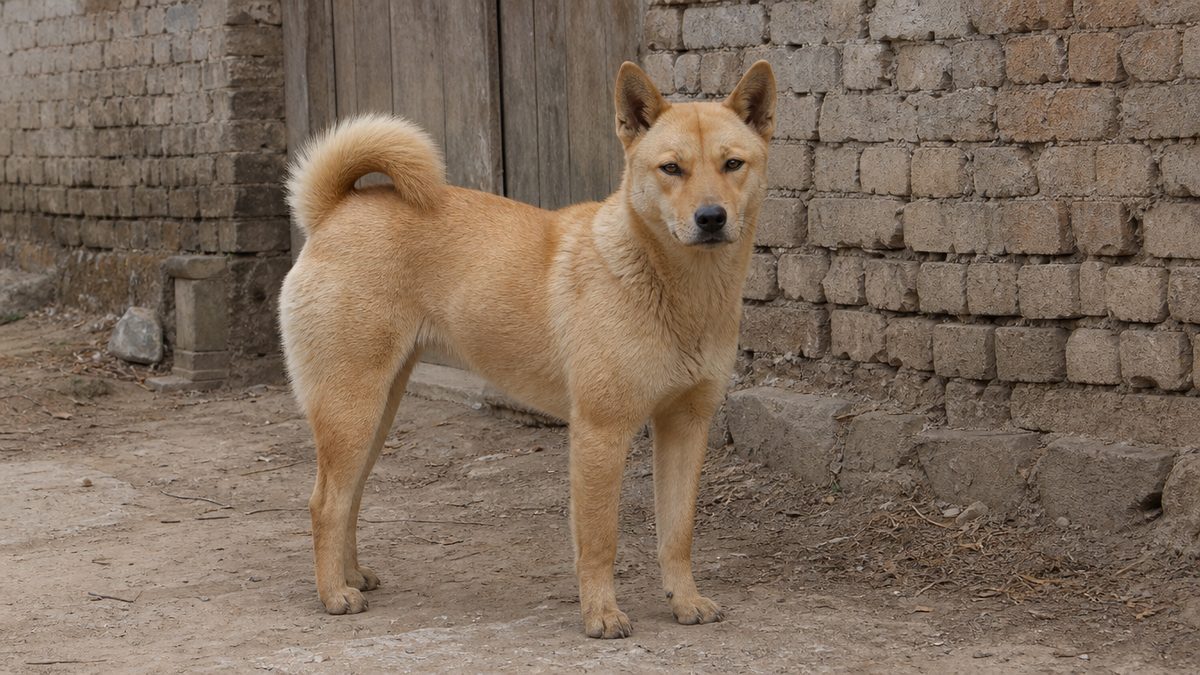
Where the two encyclopedias agree on appearance, they describe a medium, short-coated, plainly built dog. English Wikipedia gives a sturdy medium build, prick ears, almond-shaped eyes, a sickle tail and a keen hunting instinct, and says outright that the animal was developed as a landrace. Chinese Wikipedia records two coat types, smooth and long, and colours in brown, white and black. That is the whole physical specification that exists, and it describes a shape rather than a standard.
The commonest single colour has its own household word. A plain yellow-tan tugou is a 黄狗, a yellow dog, and 柴狗 is used for the same animal in parts of northern China. Those are the words an Indian reader should picture, because they describe the same lean, tan, prick-eared, sickle-tailed animal that walks past every Indian bus stand.
A reader who searches this term is usually trying to find out what a tugou dog costs and where to buy one. The honest answer is that neither question has an object. There is no breed to buy, no pedigree to check and no price to quote. What there is instead is a large, genetically important population of dogs that India already keeps, and a set of Chinese and Indian documents that explain why nobody sells them.
Breed, type or category word? Applying the two-condition test
Tugou is a type, and both conditions of the breed test fail against named documents rather than against silence.
To count as a breed on this site an animal needs two things: a written standard describing what the animal should be, and a register recording individual animals generation after generation so the standard is applied to real dogs. Most rare-breed pages fail this test by finding nothing. This one fails it by finding a source that says so explicitly.
| Condition | Verdict | Evidence |
|---|---|---|
| A written breed standard | Stated absent by a field researcher | Liu 2020, University of Warwick: 'there is no strict pedigree standard, based on appearance, for tugou' |
| A register of individuals | Stated absent by the same source | Liu 2020: 'People do not breed tugou' |
| A national genetic-resources listing | Structurally impossible | China's National Catalogue of Livestock and Poultry Genetic Resources, 29 May 2020, names 33 species and excludes dogs |
| A kennel-club register | None found, with a passing control | Absent from OFA's own 474-row breed-code markup, on which CHOW CHOW and CHINESE SHAR-PEI both return |
| Uniform appearance | Explicitly denied | Liu 2020: 'tugou in different parts of China look different' |
| What the word denotes | A type | Liu 2020, abstract: 'Tugou is the indigenous type of dog used traditionally for guarding, hunting, fighting, and as food' |
The sentence that settles it
The decisive source is a doctoral thesis, not an encyclopedia. Liu Ying spent eleven months doing multispecies ethnographic fieldwork in Yulin, Guangxi, and wrote it up as a PhD in sociology at the University of Warwick in June 2020. Her thesis states, verbatim: "People do not breed tugou and there is no strict pedigree standard, based on appearance, for tugou. According to my observations, tugou in different parts of China look different."
Read what that does. It denies condition one and condition two in a single sentence, and then adds the empirical observation that makes both denials plausible, which is that the animals are not uniform. A breed is a promise that the puppy will resemble the parents in specified ways. Nobody in China has made that promise about a tugou, so nobody can break it.
The Chinese state reached the same conclusion, for its own reasons
Chinese municipal governments spent years classifying the tugou as a 烈性犬, a fierce dog, and banned it in several cities. The published reasoning is the same finding arrived at from the opposite direction, quoted verbatim by China National Radio: 因为品种不纯,基因也不稳定,可能一代土狗很温顺,下一代的温顺程度就不好说了. In English: because the breed is not pure and the genes are not stable, one generation of tugou may be very gentle and the gentleness of the next is hard to say.
That is a state actor giving non-breedhood as the legal reason for treating an animal as dangerous. It is also, read carefully, a definition of what a landrace is rather than a finding about temperament, and the cities have since changed their minds.
Type is a real answer and several pages on this site carry it. It says the name denotes a shape and a way of living rather than a closed gene pool, and it puts tugou beside husky and laika, which is exactly where English Wikipedia's own navigation template files it, even while its infobox calls it a dog breed. The population is not less important for being a type. Wang 2016 found dogs from southern East Asia to carry significantly higher genetic diversity than any other population and to be the most basal group relating to grey wolves. The category is closer to the root of the dog than any breed inside it.
Two encyclopedias, one word, and measurements that cannot both be right
The English and Chinese articles give irreconcilable figures for the same word, and the gap is 11 to 14 kg of bodyweight and 15 cm of height.
This is the cheapest available proof that nobody is measuring a breed here. Both articles put a specification box at the top of the page. Neither cites a standard, because none exists. They simply disagree.
| Figure | English Wikipedia, Tugou | Chinese Wikipedia, 中华田园犬 | Gap |
|---|---|---|---|
| Height | 39 cm to 73 cm | 45 cm to 58 cm | 34 cm span against 13 cm |
| Weight | 25 kg to 32 kg | 14 kg to 18 kg | 11 kg to 14 kg apart, with no overlap |
| Colour | Brown, White, Black | 褐、白、黑等等 (brown, white, black and so on) | Agreed |
| Coat | Not specified | 光滑(硬毛),长毛(柔顺), smooth and long | Only the Chinese entry specifies |
| Infobox label | Dog breed | 家犬 (domestic dog) | Only the English entry asserts breedhood |
The weight ranges do not overlap at any point Chinese Wikipedia, 中华田园犬. A 25 kg floor and an 18 kg ceiling cannot describe one animal. The English height span of 34 cm is the more revealing number, because it runs from a dog smaller than a Beagle to one taller than a German Shepherd, which is what happens when somebody tries to put a whole country's village dogs inside one box.
The claim that is footnoted to a thesis that does not contain it
English Wikipedia's history section carries this sentence: "Chinese prophet Xiulan stated in 400 BC that Tugou was the dog of Mother earth." It is tagged citation needed and simultaneously footnoted to Liu Ying's Warwick thesis.
Bonbeno fetched that thesis as bytes, confirmed the magic number %PDF at 6,418,130 bytes, and extracted it with pypdf to 370 pages and 742,081 characters of real text. The counts are decisive.
- Xiulan: 0 occurrences.
- Mother earth: 0 occurrences.
- 400 BC: 0 occurrences.
- prophet: 0 occurrences.
- tugou: 923 occurrences, which is the in-document control that proves the search works.
A search that finds a term 923 times in the same document is not a broken search. The four load-bearing words of that sentence are simply not in the source it points at, and the source is a gender ethnography of the Yulin dog-meat trade, which has no plausible connection to a fourth-century-BC prophet. Bonbeno reports no view on where the sentence came from, only that the cited document does not support it.
A working link is not a supporting source. A citation can resolve to a real, findable, respectable academic document that contains none of the claim attached to it, and the footnote makes the claim look better rather than worse. Open the cited document and search it for the claim's own keywords before believing anything, and run a control term through the same search so you know the search itself is working.
The genetic diversity that makes the category matter more than the breeds inside it
Chinese village dogs carry higher genetic diversity than any breed population measured against them, and three separate teams disagree about what that means for where dogs came from.
This is where a category stops being a gap in the record and becomes the record. Wang and colleagues sequenced whole genomes from 58 canids, made up of 12 grey wolves, 27 primitive dogs from Asia and Africa and 19 diverse breeds, and concluded verbatim that dogs from southern East Asia have significantly higher genetic diversity compared to other populations, and are the most basal group relating to gray wolves, indicating an ancient origin of domestic dogs in southern East Asia 33 000 years ago.
That is the finding English Wikipedia's Tugou article cites, and it is the strongest thing anyone can say about these dogs. The animal a Chinese city was banning in 2019 belongs to the population sitting closest to the root of the whole domestic dog.
Three papers, three origins, and the honest answer is that it is unsettled
Bonbeno does not pick a winner here, because three well-resourced teams reach three different answers and the disagreement is itself the finding.
| Study | Data | Conclusion |
|---|---|---|
| Wang 2016, Cell Research | 58 canid whole genomes | Southern East Asia, about 33,000 years ago, with the highest genetic diversity in that population |
| Sacks 2013, Molecular Biology and Evolution | Y chromosomes from 338 dingoes, singing dogs and Island Southeast Asian village dogs | A massive Neolithic expansion out of Southeast Asia that largely replaced more primitive dogs to the west and north |
| Shannon 2015, PNAS | 4,676 purebred dogs from 161 breeds plus 549 village dogs from 38 countries on a 185,805-marker array | Central Asia, on a linkage-disequilibrium gradient, with Vietnam, India and Egypt showing minimal European admixture |
Shannon and colleagues name India explicitly. Their abstract reads, verbatim: many populations, including those of Vietnam, India, and Egypt, show minimal evidence of European admixture. These populations exhibit a clear gradient of short-range linkage disequilibrium consistent with a Central Asian domestication origin. An Indian reader looking at a Chinese village dog is looking at a close relative of the animal that study measured in India.
What within-category diversity does to every trait rating on this page
Yang and colleagues genotyped 157 unrelated dogs from 15 Chinese indigenous breeds on Canine 170K SNP chips and compared them against Western breeds from the LUPA database. The result verbatim: Chinese indigenous dogs had lower LD and shorter accumulative runs of homozygosity (ROH) in the genome. The genetic distances between individuals within each Chinese breed were larger than those within Western breeds.
Sit with that. Even inside a named Chinese breed, two individuals are further apart genetically than two individuals inside a Western breed. Li and colleagues found the same pattern one level down, reporting significant differences in the inbreeding degree among different subpopulations of the same breed, using the Thin dogs of Shaanxi against those of Shandong as their example. If that is true inside a named breed, a trait rating for the whole category can only ever be a rough average.
Where the recognised breeds came from
The direction of descent runs from the category to the breed and not the other way. Yang and colleagues RAD-sequenced nine Chow Chows in China against 37 published canid genomes and concluded that Chow Chows originated from the Chinese indigenous dog about 8300 years ago, and more broadly that dog breeds from East Asia originated from Chinese indigenous dogs very early in time. They also found the bottleneck leading to the Chow Chow was not strong.
So the Chow Chow Price in India page and this one are describing a parent and a child, dated to roughly 8,300 years apart, and the parent is the one with the diversity.
Li 2023 ran selection scans across ten representative Chinese breeds and reported MSRB3 as likely the main gene causing the drop ear of domestic dogs, alongside MC1R, KITLG, SOX5, RSPO2 and TBX15 for coat colour and hair follicle traits. These are named, published, checkable loci from a category with no standard at all, which is a reminder that a population can be scientifically valuable and commercially worthless at the same time.
What the Chinese state says, in two instruments
China's national livestock catalogue excludes dogs entirely, and three Chinese cities removed the tugou from their dangerous-dog lists between November 2024 and June 2025.
The rule this site keeps learning is to check the state and not only the cynological body, because ministries, agriculture departments and municipal governments all classify animals and none of them appears in a kennel club's index. On the tugou, the state is where the useful documents are.
Instrument one, the catalogue that leaves dogs out
The Ministry of Agriculture and Rural Affairs published the National Catalogue of Livestock and Poultry Genetic Resources on 29 May 2020, naming 33 domestic species for the first time, 17 traditional and 16 special. Pigs, ordinary cattle, zebu, water buffalo, yak, gayal, sheep, goats, horses, donkeys, camels, rabbits, chickens, ducks, geese, pigeons and quail make the traditional list. Dogs do not appear anywhere on it.
The Ministry's stated reason, quoted verbatim in Xinhua's report: 狗已从传统家畜"特化"为伴侣动物,国际上普遍不作为畜禽,中国不宜列入畜禽管理. In English: dogs have specialised out of traditional livestock into companion animals, internationally they are generally not treated as livestock, and China should not include them in livestock management. The same passage notes that the FAO's livestock statistics contain no dogs and that 韩国《畜产法》所列畜禽也不包括狗, the livestock listed in Korea's Livestock Industry Act likewise excludes dogs.
That matters here because the catalogue is a positive list operating under the Animal Husbandry Law, and a species outside it has no route into the state's breed-registration machinery at all. There is therefore no Chinese national register a tugou could enter even if somebody wrote a standard tomorrow.
| The Ministry's criterion | Tugou |
|---|---|
| Overcomes wildness and is suitable for group rearing | Met. These are village dogs living with people |
| Overcomes seasonal oestrus and breeds year round | Met, as for any domestic dog |
| Genetically stable performance, with a population able to reproduce independently of wild stock | The population is enormous and independent, but stability of performance is exactly what the Chinese municipal reasoning denied |
| Has mature breeds with markedly improved production and economic performance | Not met. No breed, no standard, no performance record |
Instrument two, three cities changing their minds
Chinese cities put the tugou on 禁养 lists of banned dogs, and between late 2024 and mid 2025 three of them took it off again. China National Radio, carrying a Qilu Evening News report of 1 July 2025, dates the three decisions precisely.
- November 2024, Shenzhen. 我国本土品种的中华田园犬在深圳被解除禁养, the ban on China's own native Chinese Pastoral Dog was lifted in Shenzhen.
- January 2025, Guangzhou. 广州发布通告,危险犬名录中取消了中华田园犬(土狗), Guangzhou issued a notice removing the Chinese Pastoral Dog, the tugou, from its dangerous-dog list.
- June 2025, Changsha. 可以将中华田园犬(土狗)移出《危险犬只目录》, agreement that the tugou could be moved out of the Dangerous Dog Catalogue.
The report's own framing is worth having, because it is a state broadcaster describing its national dog. It calls the animal 中华国犬, China's national dog, and 属于亟待拯救的本土犬种, a native dog type urgently in need of saving, and its headline reads 中华田园犬终获身份, the Chinese Pastoral Dog finally gets an identity. The piece closes by saying 童年"大黄"可以回家了, childhood's Big Yellow can come home.
An Indian reader has watched a version of this argument. A large, healthy, locally adapted, short-coated native dog is treated as low status precisely because it has no pedigree, while imported breeds with documented health problems carry the prestige. China spent a decade banning its own village dog as dangerous and has begun reversing it city by city. The Indie Dog: Indian Pariah Dog Breed and Care Guide page covers the Indian half of the same story.
Tugou price in india, and why no honest figure exists
No tugou price in india exists, because a category cannot be sold as a breed and nobody imports one.
Start with the shape of the problem rather than a number. To quote a price for an animal you need a thing being sold, a seller and a transaction. For the tugou, the first of those is missing. There is no breed, so there is no pedigree, so there is nothing for an Indian seller to price, advertise or certify.
Two structural facts close the question. First, dogs sit outside China's national livestock genetic-resources catalogue, so no Chinese state pedigree exists to accompany an export. Second, no kennel club anywhere holds a breed of this name, so the Kennel Club of India has no nomenclature entry to issue papers against. Between them those two facts mean no lawful pedigree supply chain can form, whatever a listing site says.
What an Indian search actually returns
Indian breed-price sites generate a page per breed name and fill the empty ones from a template. This site has repeatedly caught the mechanism: a shared cost table printed to the rupee across unrelated breeds, a size-bucket default price emitted for rows the database never populated, and a photo carousel of named puppies that contains none of the breed on the page. Treat any rupee figure attached to the word tugou as one of those, and check what the page is actually selling before believing it.
The tell to look for is a carousel or a spec card that is identical on a second breed's page. Pull any other breed from the same site and compare the cost lines to the rupee. If they match, the figure is a template constant shared with named other breeds and not an observation of anything.
The real number, and it is zero
A tugou-equivalent dog costs nothing to acquire in India, because the animal is the Indian pariah dog and Indian shelters rehome it free or for a nominal charge. That is not a workaround for a missing price. It is the correct answer to the question, and it is the same answer a Chinese buyer gets: the report above notes that these dogs were 广泛存在于中国汉族农村, widely present in rural Han Chinese areas, and are now increasingly kept as urban pets.
| What you asked for | Can you buy it in India? | Realistic cost |
|---|---|---|
| A tugou with papers | No. No registry holds the name | Not purchasable at any price |
| An imported Chinese village dog | No lawful pedigree route exists | Not available |
| A dog of the same type and genetics | Yes, at any Indian shelter | Free to a nominal adoption charge |
| A recognised breed from inside the category | Yes. The Chow Chow and Shar Pei are FCI breeds sold in India | See the Chow Chow and Shar Pei pages for their India price bands |
| A Chinese landrace with a state appraisal | No Indian supply | See the Xiasi Dog page for what state recognition looks like |
If a page quotes a rupee figure for a tugou, it has either priced a different breed, run a US or Chinese figure through an exchange rate, or emitted a default for an empty database row. Divide any suspicious rupee figure by 84.38, then by 74, then by 80, and look at the quotient rather than at whether it divided. A genuine converted list produces prices a shop would actually print, like 500 or 1,500. A quotient like 6,875 means the rupee figure was invented outright.
Monthly cost of keeping a village-type dog in India
Budget Rs 3,000 to Rs 10,000 a month for a medium Indian dog, which is the range the Voice of Stray Dogs publishes and the range a tugou-type animal falls into.
The acquisition price is zero and the recurring cost is ordinary. That combination is the strongest financial argument any dog on this site can make, and it is worth setting out line by line rather than as a single figure.
| Line | Figure | Source and caveat |
|---|---|---|
| Acquisition | Rs 0 to Rs 2,000 | VOSD gives shelter adoption from around Rs 500 to Rs 2,000 against Rs 1,50,000 for a pedigreed puppy |
| Food, medium dog | Rs 1,500 to Rs 4,000 a month | VOSD. Small dogs Rs 500 to 1,500, large dogs Rs 5,000 and up |
| Consultation | Rs 500 to Rs 1,000 | VOSD. Treat as ONE data point, because a general insurer publishes the identical range |
| Annual vaccination | Rs 1,500 to Rs 3,000 | VOSD, same caveat |
| Vetic anti-rabies, single | Rs 699 | One clinic chain's Starts-at floor, not a market average |
| Vetic 9-in-1 DHPPiL, single | Rs 899 | Same |
| Vetic puppy course, 7 visits from day 30 | Rs 6,499, was Rs 8,111 | Same. The schedule changed from four visits to seven |
| Vetic annual booster package | Rs 3,199, was Rs 3,806 | Same |
| Grooming | Rs 300 to Rs 2,000 a session | VOSD. A short-coated dog sits at the bottom of this and often needs none |
| Boarding | Rs 500 to Rs 2,000 a day | VOSD |
| Total monthly | Rs 3,000 to Rs 10,000 | VOSD |
| Total yearly | Rs 25,000 to Rs 80,000 | VOSD |
| Lifetime, 10 to 15 years | Rs 3 lakh to Rs 10 lakh | VOSD |
One line disappears entirely for this animal. Grooming on a short single coat is a brush and a towel, so the Rs 300 to Rs 2,000 per session that a Golden Retriever or a Shih Tzu incurs every four to six weeks does not arise. Over a decade at even the low end, that is roughly Rs 30,000 a coat-heavy breed spends and this one does not.
The comparison the shelter itself draws
The Voice of Stray Dogs answers the question directly in its own FAQ, verbatim: Indian breed dogs and smaller mixed breeds tend to have lower food and medical costs. They are also generally healthier and more resilient than pedigreed breeds with known structural or genetic vulnerabilities. That is a rescue organisation with 1,800-plus dogs in a seven-acre facility as of January 2026, and its own average upkeep figure is over Rs 5,000 per dog per month at that scale.
VOSD's first-year figure is Rs 30,000 to Rs 80,000, and its emergency examples are worse: a foreign-body endoscopy or surgery from Rs 15,000, an orthopaedic repair Rs 30,000 to Rs 80,000, a one to three day hospitalisation Rs 8,000 to Rs 30,000. A free dog does not mean a free decade. Build the reserve fund on day one, whatever the animal cost to acquire.
Heat tolerance and how a Chinese village dog handles Indian weather
A tugou-type dog handles Indian heat well, because its home range already includes a city whose wet-bulb peak sits within 0.39 C of Chennai's.
Bonbeno queries NASA POWER by explicit latitude and longitude and echoes back the grid-cell elevation the model reports, because POWER returns a cell rather than a point and in hill country the cell can miss the town by over a kilometre. Every figure below carries its cell error so a reader can judge it.
| Point | Cell elevation vs real | Annual mean | Hottest month | Annual RH | Peak wet bulb |
|---|---|---|---|---|---|
| Guangzhou, southern China | 22.07 m vs 21 m, +1.07 m | 22.61 C | Jul 28.33 C | 78.16 % | Jul 26.50 C |
| Kaili, Guizhou | 920.93 m vs 720 m, +200.93 m | 15.25 C | Jul 24.02 C | 82.77 % | Jul 22.15 C |
| Chennai | 48.95 m vs 6 m, +42.95 m | 27.95 C | May 31.51 C | 72.39 % | May 26.11 C |
| Mumbai | 97.15 m vs 14 m, +83.15 m | 26.77 C | May 31.19 C | 67.39 % | Jun 25.77 C |
| Kolkata | 7.35 m vs 9 m, -1.65 m | 25.81 C | May 31.53 C | 73.93 % | Jun 27.09 C |
| Delhi | 206.37 m vs 216 m, -9.63 m | 25.60 C | Jun 35.88 C | 45.56 % | Jul 26.50 C |
| Bengaluru | 841.72 m vs 920 m, -78.28 m | 23.74 C | Apr 28.37 C | 67.94 % | May 21.86 C |
Read the Guangzhou row twice. Its cell error of +1.07 m is the most accurate POWER cell this project has found anywhere on earth, so the figures are the city rather than a model artefact. And Guangzhou's peak wet bulb of 26.50 C in July is identical to Delhi's July figure and 0.39 C above Chennai's May peak of 26.11 C. Southern China is not a cool place, and a dog shaped there is not walking into anything new in Chennai.
The half of the range that does not transfer
Guizhou is the other half and it is genuinely cold. Kaili's annual mean is 15.25 C and its January mean is 3.80 C. The comparison that matters is sharper than any percentage: Chennai's coolest month averages 24.09 C and Kaili's hottest month averages 24.02 C, so Chennai's coldest is 0.07 C warmer than Guizhou's hottest. A dog from the Guizhou uplands has never in its life experienced a Chennai winter.
That is why a category rating is a rough average. Guangzhou and Kaili are both inside the tugou range and they are 7.36 C apart on annual mean. The individual animal in front of you was shaped by one of those places, not by the average of them.
What to do about it in an Indian city
- Walk before 07:00 and after 19:00 through April to June in Chennai, Delhi, Kolkata, Hyderabad and Ahmedabad, which all peak in May or June.
- Test the pavement with the back of your hand for five seconds before any daytime walk, because a short-coated dog carries its chest close to hot ground.
- Watch the wet bulb, not the temperature. Kolkata's June peak of 27.09 C wet bulb is the hardest number in the table, and it beats Delhi's despite Delhi being 4.35 C hotter, because Delhi is dry.
- Keep shade and water available all day, which Second Schedule Part IV paragraph 21(2) of the Indian Dog Breeding and Marketing Rules requires of a breeder and every owner should copy.
- Treat collapse as an emergency, because Hall's UK cohort recorded an event fatality rate of 14.18 percent among 395 confirmed heat-related illness events.
Second Schedule Part IV paragraph 21(1) of the Dog Breeding and Marketing Rules 2017 bars keeping in outdoor facilities, without the attending veterinary practitioner's written approval, dogs not accustomed to the temperatures prevalent in the area or region in question and breeds that cannot tolerate them, such as long-haired breeds in high temperature locations. A short-coated village-type dog is the animal that clause is not about, which is a real point in its favour.
Temperament, and why no single answer is honest
A tugou is typically alert, independent and territorial, and the genetics say plainly that no category-level temperament claim can be trusted for the individual dog.
Start with the caveat because it governs everything after it. Yang and colleagues found the genetic distance between individuals within each Chinese indigenous breed to exceed that within Western breeds. Li and colleagues then found significant inbreeding differences between subpopulations of the same breed. A temperament paragraph about a category containing all of that is a description of a tendency, not a prediction.
What the sources agree on is a working profile rather than a personality. English Wikipedia records a keen hunting instinct across the category. Liu's Yulin fieldwork describes dogs kept for guarding, hunting, fighting and food, tethered at gates, living through a dog hole beside the gate, and scavenging in the village and the marketplace. Those are the jobs that shaped the animal.
The status problem, which is a temperament problem in disguise
Liu names the phenomenon dog racism and develops it across her thesis, where the term appears 15 times. Her account is that Yulin residents sort dogs into pet dogs and tugou, attach different values to the two, and that this categorisation is a constructed social difference between people rather than a natural difference between dogs.
Chinese municipal governments then acted on the same sorting, banning the tugou as a fierce dog on the reasoning that its genes are not stable. Read that sequence carefully. A low-status dog was called dangerous, the danger was justified by the absence of a pedigree, and the ban was reversed once three cities revisited it. Nothing about the animals changed.
Who should and should not take one on
- Suits a household wanting an alert, low-maintenance, heat-adapted dog that will bark at the gate and cost little to keep.
- Suits a first-time Indian owner who wants a dog whose health risks are not concentrated by a closed gene pool.
- Does not suit a buyer who wants predictability, because the individual variation inside this population is the highest measured for any dog group.
- Does not suit a household that cannot socialise a puppy properly, since a territorial dog left unsocialised is the exact profile the Chinese bans were reacting to.
- Does not suit anyone who wants papers, a show career or a resale value, none of which can exist for a category.
The single most useful thing an adopter can do with a landrace is spend an hour with the specific animal before deciding. With a registered breed, the standard does some of that work for you. Here it does none, and the compensation is that the dog is in front of you and free to assess.
Training a landrace dog, and what it resists
To train a village-type dog, reward independently offered behaviour early and often, because these dogs were selected to make their own decisions at a gate rather than to take direction at a distance.
The training profile follows from the job history rather than from a standard. Guarding, scavenging and hunting all reward a dog that acts without instruction. Nothing in the population's history selected for the biddability that a retriever or a herding breed has been shaped for over two centuries of registered breeding.
What works
- Start the socialisation window early. Get the puppy meeting new people, surfaces and sounds from the moment vaccination allows, because a territorial dog that missed this becomes the dog the Chinese bans described.
- Reward offered behaviour. Mark and pay the sit the dog volunteers rather than drilling a sit you asked for, which suits a decision-making animal.
- Keep sessions short. Five minutes, several times a day, beats a twenty-minute block for a dog with no history of sustained handler focus.
- Train recall on a long line for months. A hunting instinct plus an unrecalled dog is how a village dog ends up on an Indian arterial road.
- Teach a settle at the gate. The dog will guard whether you train it or not, so decide now what guarding is allowed to look like.
What it resists
Expect resistance to repetition without purpose, to correction-based methods and to being asked to work at a distance from you. None of that is stubbornness. A dog whose ancestors were never paid for taking direction has no reason to find direction intrinsically rewarding, and punishing it teaches avoidance rather than obedience.
No study has measured trainability in Chinese village dogs, and this page will not borrow a figure from a breed the researchers did study. What can be said with a source is narrower and more useful: the population's within-group genetic distance is larger than any Western breed's, so two puppies from one litter can differ more in working style than two Labradors from different countries. Assess the dog, not the label, and give a slow starter more time rather than a harder method.
Second Schedule Part IV of the Dog Breeding and Marketing Rules 2017 requires separate housing for a vicious or aggressive dog and forbids sedation to control its behaviour. If a trainer proposes chemical restraint for a guarding problem, that is the clause to quote back. Behaviour problems in a territorial landrace are a socialisation and management job, and your nearby vet is the right person to rule out pain first.
Daily exercise needs, and what happens without them
Give a village-type dog 60 to 90 minutes a day across two outings, because the animal's entire history is unsupervised free movement around a settlement rather than confinement.
The requirement is moderate but non-negotiable, and the reason is structural. Liu's Yulin observations describe tugou scavenging in the village and the marketplace and moving through a dog hole beside the gate, which is a dog that covered ground all day on its own account. An Indian flat removes all of that at once.
A workable Indian schedule
- Morning, 30 to 45 minutes before 07:00. The long outing, on lead, covering varied ground.
- Evening, 30 to 45 minutes after 19:00. The second outing, with sniffing time rather than pace.
- Midday, five minutes of scentwork indoors. Scatter the meal or hide it, which substitutes for the scavenging the dog no longer does.
- Weekly, one longer walk or a safe off-lead space. Only where the recall is genuinely proofed on a long line first.
Skipping the exercise produces the classic under-stimulated pattern of barking, digging, chewing and gate-guarding that escalates. That last one matters more here than for most breeds, because a territorial dog with unspent energy directs it at the boundary, and a barking guard dog in an Indian apartment block becomes a legal and social problem long before it becomes a training problem.
Feed the dog from a scattered handful on the floor or a rolled towel instead of a bowl. It costs nothing, takes the same food, and gives a scavenging animal ten minutes of the work it was shaped for. On the hottest Indian weeks, when the walk has to shrink, this is what fills the gap.
Grooming and coat care in Indian humidity
Brush a short-coated village dog once a week and dry its ears after every bath and every monsoon soaking, which is the entire routine.
This is the cheapest coat in the encyclopedia. Both encyclopedia entries describe a short, close coat in a solid colour, with Chinese Wikipedia recording two coat types across the category, smooth and long Chinese Wikipedia, 中华田园犬. There is no undercoat to strip, no furnishings to mat and no clip pattern to maintain, because no standard exists that could specify one.
| Task | How often | Cost |
|---|---|---|
| Rubber-curry brushing | Weekly, more in a shedding month | Rs 0 after a Rs 200 to 400 brush |
| Bath | Every 4 to 8 weeks, or after a monsoon soaking | Rs 0 at home |
| Ear drying after every wetting | Every time | Rs 0, a cotton pad |
| Nail trim | Every 3 to 4 weeks | Rs 0 at home, or inside a salon session |
| Professional grooming session | Rarely needed | Rs 300 to Rs 2,000 when used |
The one thing Indian humidity actually changes
Overseas breed clubs routinely tell owners to towel a dog and let it air dry. That advice is written for a temperate climate and it does not transfer to an Indian monsoon, where a damp ear canal is an invitation. Plug the ears before a bath and dry them afterwards, every time.
The Indian evidence points the same way from two directions, and the two studies disagree about the season, which is itself worth knowing. A southern Indian series of 120 clinically affected dogs recorded a peak in the pre-monsoon season, March to May, while an eastern Indian study of 178 dogs in Bhubaneswar found 55 percent of ehrlichiosis cases in the summer months. Those are tick-borne disease seasons rather than ear seasons, but they mark the same months as the high-risk window for a dog living outdoors in India, and neither dataset supports the tidy assumption that everything peaks in the rains.
Ticks. A short coat makes them easier to find, which is an advantage, not an exemption. Check the ears, the neck, between the toes and under the tail after every walk in grass, because the West Bengal series found 72.9 percent of 584 dogs screened carrying two or more blood-borne pathogens at once. Ask your nearby vet which product suits your dog's weight and your city's tick season.
Health issues, life expectancy and what nobody has measured
No life expectancy has ever been published for the tugou as a population, and this page will not borrow one from a member breed.
State the absence plainly, because the absence is the finding. The largest UK longevity datasets work from kennel-club-registered breeds, and a category with no registration cannot appear in them. There is no median survival figure, no confidence interval and no hazard ratio for a tugou anywhere in the literature.
The PubMed picture is equally clean once the name forms are run properly. 'Chinese indigenous dog'[tiab] returns 7 records and 'Chinese indigenous dogs'[tiab] returns 7, overlapping by only 3, so the union is 11 distinct records and either query alone loses more than a third of the literature. tugou[tiab] returns 0 with PubMed reporting the phrase not found. 'Chinese village dog'[tiab] and its plural both return 0. Controls in the same session returned Labrador Retriever 1,109 and Chow Chow 169, so the instrument was working.
The 11 records that do exist are genomics, not clinical medicine. The four returned by 'Chinese rural dog'[tiab] are worth naming because they show what the phrase means in the literature: a chromium toxicity study, a prostate adenocarcinoma case report, a TLR5 characterisation and a left atrial appendage occluder trial. In biomedical writing, a Chinese village dog is usually an experimental animal rather than a breed being studied.
What the recognised members of the category tell you
Where the category has no data, the two breeds that came out of it have plenty, and their figures are a warning about registration rather than about village dogs.
| Breed and test | Evaluations | Normal | Dysplastic or abnormal | Does the row close? |
|---|---|---|---|---|
| Chow Chow, elbows | 1,782 | 47.3 % | 51.5 % | Yes. 29.8 + 16.4 + 5.3 = 51.5, and it is rank 1 of all breeds |
| Chow Chow, hips | 6,463 | 75.9 % | 21.6 % | Yes. 8.4 + 51.6 + 16.0 = 76.0 and 11.4 + 7.6 + 2.6 = 21.6 |
| Chinese Shar-Pei, hips | 11,049 | 82.0 % | 15.8 % | Yes. 9.8 + 58.3 + 13.9 = 82.0 |
| Chinese Shar-Pei, elbows | 1,296 | 74.1 % | 25.4 % | Yes. 14.4 + 8.6 + 2.4 = 25.4 |
| Labrador Retriever, hips (control) | 324,934 | 87.5 % | 11.3 % | Yes. Rank 121, and the control returned |
The Chow Chow holds rank 1 for elbow dysplasia across every breed OFA publishes, at 51.5 percent dysplastic on 1,782 evaluations. Its ancestor population, the one nobody registers, has no comparable figure because nobody screens it. The honest reading is not that village dogs are healthier, it is that a closed gene pool produces measurable inherited disease and an open one produces no measurements at all. Note that this is a choice rather than a rule. OFA's own FAQ states verbatim that it does not require dogs to be purebred or registered in order to perform an OFA evaluation, and that a breed enters the published statistics tables only once it has at least 100 hip evaluations, or 50 for all other databases. Nothing stops Indian owners screening village dogs. Nobody has organised it.
An internal contradiction inside OFA's own eye tables
Check a source's summary against its own detail rows. OFA's summary eye table for the Chow Chow reports 743 evaluations at 77.9 percent normal and 21.9 percent abnormal. Its detail rows, on a denominator of 742, record persistent pupillary membranes iris to iris in 211 dogs, which is 28.4 percent. A part cannot exceed its whole, so the two figures are not measuring the same thing and neither should be quoted as the rate. Bonbeno publishes both and the arithmetic.
What actually threatens a village dog in India
The real risks for a free-ranging or semi-free-ranging dog are infectious, parasitic and traffic-related rather than inherited. The Africanis Dog: Landrace Breed Guide for India and Carolina Dog Price in India, Heat and Health Guide pages describe the same pattern in two other landraces, and the Askal Dog: Filipino Street Dog Guide for India page covers the Southeast Asian version of it. The West Bengal series screened 584 client-owned dogs at a Kolkata state animal health centre between July 2024 and December 2025 and found Babesia gibsoni in 76.54 percent (447/584), Anaplasma species in 55.75 percent and Ehrlichia canis in 16.61 percent, with 72.9 percent of the 584 dogs screened carrying two or more pathogens. Those dogs were presenting at a clinic, not sampled at random, so read the figures as the burden among dogs brought in for testing rather than as a population prevalence.
One diagnostic finding from that study is worth acting on. Microscopy missed 130 of 158 Babesia canis positives and 146 of 169 Hepatozoon positives, and the authors conclude that real-time PCR should be the standard. Ask your nearby vet whether the tick-fever panel being run is a smear or a PCR, and take fever with pale gums, lethargy or a nosebleed as a same-day emergency.
Nothing on this page diagnoses anything. Screening advice written for registered breeds does not transfer to a landrace, no inherited condition has been described in this population, and the conditions that will actually put an Indian village-type dog in a clinic are tick-borne disease, parvovirus, distemper and road injury. Vaccinate on schedule, keep tick prevention current, and take heat distress, collapse, pale gums or an unexplained fever to a veterinary surgeon the same day.
Feeding an Indian village-type dog, by life stage
Feed a growing village-type puppy three to four meals a day to twelve weeks, then two, and budget Rs 1,500 to Rs 4,000 a month for a medium adult.
There is no breed-specific feeding research for this population, so the guidance below is the general medium-dog case plus the Indian specifics that actually differ. Say that plainly rather than dressing up a generic plan as breed knowledge.
| Stage | Meals a day | What matters most |
|---|---|---|
| 8 to 12 weeks | 4 | Small volumes, growth-appropriate food, fresh water at every meal |
| 3 to 6 months | 3 | Steady body condition. Ribs easy to feel, not to see |
| 6 to 12 months | 2 | Do not push growth. Faster is not better for joints |
| Adult, 1 to 7 years | 2 | Weight control. Higher bodyweight relative to the breed mean raises heat-illness odds |
| Senior, 8 years and over | 2 | Smaller, more digestible meals and a vet check on kidney and dental health |
Three Indian specifics
- Feed the larger meal at the cool end of the day. In Chennai, Delhi, Kolkata and Ahmedabad the May to June window makes a heavy midday meal followed by activity a genuine risk.
- Keep the dog lean through the hot months. Hall's UK cohort of 905,543 dogs found higher bodyweight relative to the breed and sex mean to be a significant risk factor for heat-related illness, and the event fatality rate in that study was 14.18 percent.
- Do not free-feed an ex-scavenger. A dog whose ancestors ate opportunistically will keep eating, and obesity is the one health problem you can hand a landrace that it did not arrive with.
Homemade feeding is common and workable in India, and VOSD is direct about the trade-off, noting that home cooking reduces the bill but that the cost in ingredients and time is still real. If you cook, get the calcium and phosphorus balance checked by your nearby vet rather than guessing, because a growing dog on an unbalanced home diet develops skeletal problems that no amount of good intent prevents.
VOSD gives Rs 1,500 to Rs 4,000 a month as the food line for a medium dog, against Rs 5,000 and up for a large working breed. A 14 to 18 kg village-type dog sits at the bottom of the medium band. Over ten years the difference between this animal and a 40 kg imported breed is a five-figure sum in food alone, before a single vet bill.
Puppy timeline, month by month through the first year
To raise a village-type puppy in India, run vaccination and socialisation together from week eight, because Indian law puts the vaccination window at seven to eighteen weeks and the socialisation window closes inside it.
Two clauses of the Dog Breeding and Marketing Rules 2017 set the frame, and both are worth quoting because a seller will not. Rule 8(1)(a) requires that pups less than eight weeks in age are not sold, and Second Schedule Part III paragraph 8(9) states that all pups shall be vaccinated which can start at the age of seven-eight weeks, and are usually completed at the age of eighteen weeks.
| Age | What happens | What it costs |
|---|---|---|
| Under 8 weeks | Stays with the litter. Indian law bars sale below this age | Nothing. Walk away from any seller offering younger |
| 8 to 10 weeks | Home, settling, first vaccines. Vetic's schedule starts Puppy DP at day 30 in a breeder setting | Puppy DP Rs 849, or the 7-visit course from Rs 6,499 |
| 10 to 14 weeks | Peak socialisation. New people, surfaces, traffic sound, handling of ears and paws | Free, and the highest-value thing you will ever do |
| 12 to 16 weeks | Anti-rabies and the 9-in-1 completed. Course completion by 18 weeks per the Rules | Anti-rabies Rs 699, 9-in-1 Rs 899 |
| 4 to 6 months | Lead manners, recall on a long line, crate or settle-place training | Rs 0 to Rs 15,000 if you use a professional course |
| 6 to 9 months | Adolescence. Guarding behaviour appears. Decide your gate rules now | Sterilisation, and Rule 8(1)(b) bars unsterilised sale over six months |
| 9 to 12 months | Adult food, adult exercise, first annual booster planning | Annual booster package from Rs 3,199 |
| Throughout | Municipal registration where required. Delhi registers pet dogs, Chennai licenses pet animals | See the adoption section |
The one milestone that matters more here than for a registered breed
Socialise hard between 8 and 16 weeks. A landrace selected for territorial alertness, raised without that exposure, becomes the dog the Chinese municipal bans were describing when they called it a fierce dog. A registered breed gives you some predictability to fall back on. This one gives you none, so the window is doing all the work.
The same gazette forbids tail docking, ear cropping, de-barking, de-clawing, branding, dyeing, injecting substances to enhance visual appeal and any change of appearance by artificial means, at Second Schedule Part II paragraph 6(8). Paragraph 6(9) separately prohibits breeding to create new breeds of dogs or unusual looks. If somebody offers you a tugou puppy that has been altered to look like something, both clauses are in play.
Head to head against the dogs an Indian buyer actually cross-shops
A village-type dog beats every imported breed on cost, heat and inherited-disease risk, and loses to all of them on predictability and paperwork.
The honest comparison is not tugou against Labrador. It is a category against three breeds an Indian buyer might genuinely be choosing between, one of which came out of this very category.
| Village-type dog (tugou or indie) | Chow Chow | Labrador Retriever | Shar Pei | |
|---|---|---|---|---|
| Is it a breed? | No. A category word | Yes, FCI recognised | Yes, FCI recognised | Yes, FCI recognised |
| Acquisition in India | Free to nominal | Imported-breed pricing | Imported-breed pricing | Imported-breed pricing |
| OFA hip dysplasia | No data. Nobody screens the population | 21.6 % of 6,463 | 11.3 % of 324,934 | 15.8 % of 11,049 |
| OFA elbow dysplasia | No data | 51.5 % of 1,782, rank 1 of all breeds | 9.9 % of 148,803 | 25.4 % of 1,296 |
| Heat-illness risk in Hall 2020 | Not modelled | Named among the raised-risk breeds | The comparator breed | Not separately named |
| Coat work in Indian humidity | Weekly brush | Heavy double coat, the worst case in India | Moderate shedding | Skin folds needing daily attention |
| Predictability of the individual | Lowest of any dog group measured | High | High | High |
| Papers and resale | None possible | Available | Available | Available |
The Chow Chow Price in India row is the argument in miniature. It came out of this category about 8,300 years ago, it acquired a standard, a register and a show ring, and it now holds rank 1 for elbow dysplasia across every breed OFA publishes Orthopedic Foundation for Animals. It is also one of the breeds Hall's UK study names among those at raised risk of heat-related illness. The ancestor population has none of those problems recorded, and none measured either.
Where the village-type dog genuinely loses
Predictability. Yang 2019 measured within-breed genetic distance in Chinese indigenous breeds as larger than within Western breeds, and Li 2023 found subpopulations of one breed differing significantly in inbreeding Li Y, Huang M, Wang Z, Liu X, He S, Wang T. If you need to know in advance how big the dog will be, how it will react to a stranger and what its coat will do, a registered breed answers that and this does not.
Everything else on the table favours the category. That is an unusual result for this site and it is worth saying plainly rather than hedging it.
Read the Indie Dog: Indian Pariah Dog Breed and Care Guide page beside this one. It covers the same animal in the market a reader can actually buy in, and the Chow Chow Price in India and Shar Pei Price in India pages carry the India price bands for the two recognised members of this category.
The legal position in India, and what a category means for import
No Indian law names the tugou, and no lawful pedigree import route can exist for a category, because there is no breed for a document to certify.
Two Indian instruments matter and neither of them mentions this animal, which is itself the finding.
Import
India regulates dog import through a restricted-goods route under ITC(HS) 01061900, and the practical effect is that a dog may enter as a pet with a valid pet book in the importer's name, for research with a CPCSEA recommendation, or for Defence and Police use, while applications for trading or breeding purposes are rejected. That closes commercial import for every breed, recognised or not. For a category word it closes twice over, since no registry anywhere could issue the pedigree that a pet import would normally travel with.
The 2024 breed circular, and why it does not reach this animal
In March 2024 a letter from a Joint Secretary at the Department of Animal Husbandry and Dairying circulated a list of dog breeds proposed for import and breeding restrictions, and it was reproduced in a customs instruction. The list is not an Act, rule or notification, and its legal life was short: the Karnataka High Court quashed it on 10 April 2024 and the Union told the Madras High Court that the quashed circular had lost its effect entirely. No Indian law in force today bans owning, breeding or selling any dog breed.
Bonbeno reads that list carefully rather than by name-matching, because it contains bare undefined category words. A page that checks only proper names and reports a clean bill has misread the instrument. On the tugou the answer is straightforward for a different reason: the animal is a Chinese village dog with no breed name, no import route and no Indian market, so nothing on any list reaches it.
The clauses that do apply to a dog you already own
- Sale below eight weeks is prohibited, at Rule 8(1)(a).
- Sale of a dog over six months without prior sterilisation is prohibited, unless the sale is to another licensed breeder, at Rule 8(1)(b).
- Docking, cropping, de-barking, de-clawing, branding and dyeing are strictly forbidden, at Second Schedule Part II paragraph 6(8).
- Breeding to create new breeds or unusual looks is strictly prohibited, at Second Schedule Part II paragraph 6(9).
- Outdoor housing is restricted for dogs not accustomed to local temperatures and for breeds that cannot tolerate them, at Second Schedule Part IV paragraph 21(1).
The Rules themselves run 1 to 13 and stop there. Everything numbered above 13, and every 6(N) and 8(N) reference on this page, is a Second Schedule paragraph, not a Rule. A citation reading Rule 21 or Rule 6(9) is wrong on its face, and the string Rule 21 appears zero times in the gazette. Rule 8(1)(a), the eight-week minimum, is a genuine Rule.
Mistakes Indian readers make with this name
The commonest mistake is treating tugou as a breed you can buy, and the next four all follow from it.
- Treating a rupee figure attached to the name as a price. No tugou has ever been sold in India. Any number you find was emitted by a template, converted from another currency, or lifted from a carousel selling a different dog. Divide it by 84.38, then 74, then 80, and look at the quotient.
- Reading English Wikipedia's height range as a specification. Its infobox gives 39 cm to 73 cm and 25 kg to 32 kg, while the Chinese article gives 45 cm to 58 cm and 14 kg to 18 kg, and the weight ranges do not overlap at any point.
- Believing the prophet Xiulan. That sentence's footnote points at a 370-page Warwick thesis containing the word tugou 923 times and the words Xiulan, Mother earth, 400 BC and prophet zero times each.
- Assuming a landrace is automatically healthy. Nobody has measured this population's lifespan, screening rates or disease prevalence. The absence of bad data is not good data, and a village dog in India still faces the tick-borne burden the West Bengal series recorded at 72.9 percent polyparasitism among 584 dogs screened.
- Skipping socialisation because the dog is hardy. Hardiness is physical. A territorial animal that never met strangers as a puppy becomes exactly the dog three Chinese cities banned.
The mistake that costs the most
Passing over an Indian shelter dog to import a problem. The Chow Chow is a tugou that acquired a pedigree and, with it, rank 1 for elbow dysplasia among every breed OFA publishes and a named place among the higher-risk breeds in a 905,543-dog heat-illness study Hall EJ, Carter AJ. The animal a reader can adopt for nothing carries neither of those recorded burdens.
Reading low status as low quality. Liu's Yulin fieldwork names the mechanism dog racism and describes the sorting of dogs into pet dogs and tugou as a constructed social difference between people, not a natural difference between dogs. Three Chinese cities have now unwound the legal version of that sorting. The Indian version is still running.
Adoption, and the only honest way to get this dog
Adopt an Indian pariah dog from a shelter, because it is the same animal, it is free or nominal, and no tugou can be lawfully imported into India at all.
This is not a consolation prize offered because the breed is unavailable. It is the correct answer to the question, and the genetics support it. Adopt, vaccinate and sterilise, in that order, and read the Indie Dog: Indian Pariah Dog Breed and Care Guide beside this page for the Indian half of the same animal. Shannon and colleagues genotyped 549 village dogs from 38 countries on a 185,805-marker array and found the Indian population, alongside Vietnam and Egypt, to show minimal evidence of European admixture. An Indian street dog is not a mongrel of imported breeds. It is an indigenous population in its own right.
How to do it
- Start with a registered shelter or rescue rather than a listing site. VOSD puts shelter adoption at around Rs 500 to Rs 2,000 against Rs 1,50,000 for a pedigreed puppy.
- Ask what has already been done. Sterilisation, deworming, first vaccines and any tick treatment. A good rescue will have records and will hand them over.
- Meet the individual, twice. With no standard to fall back on, the specific animal is the only information you have, and one visit is not enough to see it.
- Budget the first year properly. VOSD's figure is Rs 30,000 to Rs 80,000 including setup, vaccination, food and routine vet visits.
- Register the dog where your city requires it. Municipal registration for pet dogs exists in Delhi and a pet-animal licence in Chennai, and both are trivial sums against the cost of not having one.
What Bonbeno will not do
This site sells no dogs, brokers no puppy sales, recommends no breeder and links no listing. That matters more than usual on this page, because the only way anybody could offer you a tugou in India is by mislabelling a different animal. There is no pedigree to check, in a market where the pedigree is usually the pitch.
China spent a decade calling its own village dog dangerous because it was not a pure breed, and three cities have now reversed that between November 2024 and June 2025. India keeps the same animal, in enormous numbers, and a shelter will give you one today. The population it belongs to is the one whole-genome sequencing places closest to the root of every dog alive.
Tugou questions people actually ask
What is the very best family dog?
No single breed is the best family dog, and the honest answer for an Indian household is that the fit matters more than the label. What can be said with data is that a short-coated medium village-type dog handles Indian heat better than a heavy-coated import, costs Rs 3,000 to Rs 10,000 a month against a five-figure purchase price, and carries no recorded burden of inherited disease because no closed gene pool has concentrated one. What it cannot give you is predictability. Yang 2019 measured the genetic distance between individuals within Chinese indigenous breeds as larger than that within Western breeds, so meet the individual dog twice before deciding.
Are shar peis on the aggressive list?
The Shar Pei appeared on a list of dog breeds circulated in India in March 2024 for proposed import and breeding restrictions, and that list has no legal force today. The Karnataka High Court quashed it on 10 April 2024, and the Union told the Madras High Court that the quashed circular had lost its effect entirely. No Indian law in force bans owning, breeding or selling any dog breed. The question is worth answering on a tugou page because the Shar Pei is one of the breeds English Wikipedia's own Tugou article files inside this category, alongside the Chow Chow and the Xiasi Dog.
What is the no. 1 lazy dog?
No study ranks dog breeds by laziness, and a village-type dog is not a candidate for the title in any case. These animals were kept for guarding, hunting and scavenging, and Liu's eleven months of fieldwork in Yulin describe them working a gate, ranging through a village and foraging in a marketplace. Budget 60 to 90 minutes of exercise a day across two outings. An under-exercised territorial dog does not become lazy, it becomes a barking problem at the boundary.
What are the top 3 aggressive dogs?
No credible ranking of the three most aggressive dog breeds exists, and the tugou's own history shows why the question misleads. Chinese cities classified the Chinese Pastoral Dog as a fierce dog and banned it, and the published reasoning was not a bite statistic but a genetic one, quoted verbatim as because the breed is not pure and the genes are not stable. Three cities have since reversed it: Shenzhen in November 2024, Guangzhou in January 2025 and Changsha in June 2025. Aggression in a territorial landrace is a socialisation and management outcome, not a breed fact.
What is a tugou dog?
A tugou is not a breed of dog. Tugou, written 土狗 and meaning indigenous dog, is the Chinese category word for the native village dogs of China, and Chinese Wikipedia states in its opening sentence that it is not the name of any one specific breed. English Wikipedia's own Tugou article lists the Chow Chow, the Shar Pei, the Chongqing Dog, the Tang Dog and the Xiasi Dog as members of the category. A Warwick doctoral thesis based on eleven months of fieldwork puts it as plainly as anyone has: people do not breed tugou and there is no strict pedigree standard for them.
What is the tugou dog price in india?
No tugou dog price in india exists, and no honest one can. There is no breed, so there is no pedigree, no import route and nothing for a seller to certify. Dogs sit outside China's national livestock genetic-resources catalogue of 29 May 2020, so no Chinese state pedigree exists to travel with an export, and no kennel club anywhere holds the name. Any rupee figure attached to it came from a template, a currency conversion or a carousel selling a different animal. The same dog is available free at an Indian shelter under the name Indian pariah dog, which makes it the most affordable dog in this encyclopedia by a wide margin.
Is the tugou recognised by any kennel club?
No kennel club anywhere recognises the tugou, and none could, because a category is not a registrable unit. The animal is unrecognised in the strict sense rather than merely unlisted. OFA's own breed-code markup carries 474 rows and contains no tugou entry, while listing CHOW CHOW and CHINESE SHAR-PEI as separate breeds. The Chinese state route is closed too: the National Catalogue of Livestock and Poultry Genetic Resources names 33 domestic species and excludes dogs entirely, so no Chinese national breed register exists for any dog to join.
How long does a tugou live?
No life expectancy has ever been published for the tugou, and this page will not borrow one from a member breed. Longevity datasets are built from kennel-club-registered populations, and a category with no registration cannot appear in one. The literature is genomics rather than clinical medicine: Chinese indigenous dog and its plural return seven records each in PubMed, overlapping by only three, and tugou as a search term returns zero with the phrase not found. Ask your nearby vet about your individual dog rather than about the word.
Is a tugou heat-tolerant enough for an Indian city?
Yes, a village-type dog is genuinely heat-tolerant for Indian conditions, and the climate data says so rather than the marketing. Guangzhou, inside the category's home range, returns a NASA POWER annual mean of 22.61 C at 78.16 percent relative humidity, with a July peak Stull wet bulb of 26.50 C. That is identical to Delhi's July figure and 0.39 C above Chennai's May peak of 26.11 C. Southern China already delivers Indian monsoon humidity at Indian wet-bulb loads. The Guizhou half of the range is a different matter, since Chennai's coolest month is warmer than Kaili's hottest.
Is the Xiasi Dog the same thing as a tugou?
The Xiasi Dog is one member of the tugou category and not a synonym for it, and it is the member that went furthest towards becoming a breed. English Wikipedia opens its Xiasi article by calling it a breed of tugou while its infobox states, verbatim, that it is Not recognized as a breed by any major kennel club. What makes it the useful contrast is the Chinese state record: the China Working Dog Management Association reports that the Guizhou Xiasi dog passed appraisal by the national animal genetic resources commission in December 2009 and by the national livestock standards committee in November 2019, and that a Guizhou provincial standard was published in 2007. No such document exists for the category as a whole.
Where did Chinese village dogs come from?
Three well-resourced teams reach three different answers, and Bonbeno publishes the disagreement rather than picking one. Wang 2016 sequenced 58 canid whole genomes and placed the origin in southern East Asia about 33,000 years ago, finding those dogs to carry significantly higher genetic diversity than any other population. Shannon 2015 genotyped 4,676 purebred and 549 village dogs on a 185,805-marker array and concluded a Central Asian origin, naming India and Vietnam among the least European-admixed populations. Sacks 2013 used Y chromosomes from 338 dogs and argued instead for a Neolithic expansion out of Southeast Asia that replaced earlier dogs to the west and north. You can verify each for yourself from the identifiers on this page.
Compare with similar breeds
Tugou sits in 2 Bonbeno groups. Each one compares it directly against the breeds it is genuinely an alternative to, on the same figures.