
Breed profile
Hmong Bobtail Dog: Vietnam Wrote It a National Standard in 2024
A Ministry of Defence research centre drafted it, the Ministry of Agriculture proposed it and the Ministry of Science and Technology published it on the last day of 2024. Almost nothing in English mentions that Vietnam has given this dog a national standard, and no page anywhere notes that its kennel standard disqualifies a docked tail.
Quick answer
No hmong bobtail dog price in india exists, because Vietnam's own registry paperwork has no route into India and the breed is not FCI-recognised. What is new is the paperwork at home: Vietnam published national standard TCVN 14241-1:2024 for this breed on 31 December 2024, and the Vietnam Kennel Association standard 002/VN requires a congenital bobtail of not more than 15 cm and disqualifies any tail that is not naturally bobbed.
This page reports what the published record contains. No veterinary literature studies this breed's health, no screening scheme covers it, no life expectancy has been measured for it and its defining feature, the natural bobtail, has never been genotyped in it. Every tail-related health statement here is therefore an inference drawn from other breeds and is labelled as one. Guidance written for registered Western breeds may not transfer. Nothing here is a diagnosis or a treatment plan. Consult your nearby vet before acting on anything on this page, and take any dog showing heat distress, collapse, hind-limb weakness, pale gums or an unexplained fever to a veterinary surgeon the same day.
Hmong bobtail dog at a glance
What the Hmong bobtail dog is
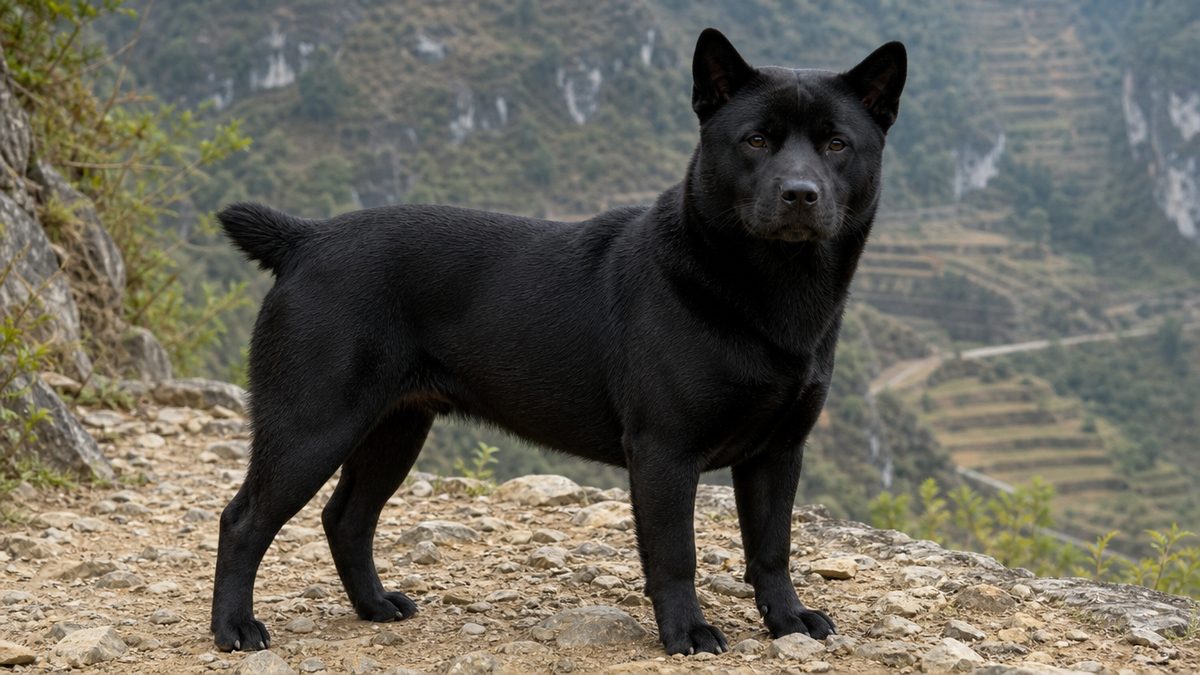
The Hmong bobtail dog is a medium, muscular, congenitally bobtailed guarding and hunting dog of the H'Mong people of northern Vietnam, and since 31 December 2024 it has had a Vietnamese national standard.
Start with the paperwork, because it is newer than anything in English and it changes the whole verdict. Vietnam has two written standards for this animal, one cynological and one national, and both are readable in full online.
| VKA standard | National standard | |
|---|---|---|
| Number | 002/VN/07.11.2020 | TCVN 14241-1:2024 |
| Title | Bang tieu chuan cho H'Mong coc duoi | Giong cho noi, Phan 1: Cho Hmong coc duoi. In English on the register, Indigenous breeding dogs Part 1: Dog of HMong with short tails |
| Issued by | Vietnam Kennel Association | Ministry of Science and Technology, by decision 3513/QD-BKHCN |
| Date | First issued 2009, revised 7 November 2020 | 31 December 2024 |
| Drafted by | Not stated on the 2020 revision | Vietnam-Russia Tropical Centre, Ministry of National Defence, with the Ministry of Agriculture and Rural Development |
| Length | A full conformation standard with ratios, faults and disqualifications | 22 pages |
| Status | In force | A, Con hieu luc, Active |
A national standard for a dog breed is a rare document. This one was drafted by a defence-ministry research centre, proposed by the agriculture ministry and published by the science ministry, and it is filed under animal husbandry on Vietnam's national standards register. Almost nothing in English mentions it.
The one-line version
The Hmong bobtail dog is a breed by any working definition: two written standards, a national register entry, a kennel association that registers individuals, and a state agency that has trained and deployed the dogs. What it does not have is FCI recognition, and the kennel club claim printed on its own standard turns out to be its association's filing rather than an FCI grant.
What the dog looks like, from the standard rather than from a blog
The VKA standard is unusually precise, and it gives ratios rather than adjectives.
- Proportions. Body length to shoulder height 1:1, so the dog is square. Chest depth to shoulder height 1:2. Muzzle length to skull length 4:6. Skull width to skull length 1:2.
- Size. Males 48 to 54 cm and 18 to 26 kg. Females 46 to 52 cm and 16 to 24 kg.
- Head. Trapezoid skull, flat broad forehead, protruding brow ridges, a groove down the centre of the forehead, moderate stop, slightly short muzzle with a slightly blunt tip.
- Ears. Thick, equilateral triangles with slightly rounded tips, set high and tipped forward.
- Eyes. Medium, almond-shaped and slightly slanted, set deep and symmetrically.
- Tongue. Usually spotted. Dogs without tongue spots are accepted but not rated highly.
- Coat. Double, with a coarse hard outer layer over a soft fine undercoat, at most 5 cm at the nape and 3 cm over the body.
- Colours. Black, brown (liver or chocolate), yellow (red) and brindle. Merle, chocolate brindle, piebald, white and black-and-tan are disqualifying, as is a pink nose.
The coat care implication of that last coat clause is worth flagging early: a maximum body length of 3 cm means this dog cannot mat, and a fluffy individual is outside type rather than a grooming problem.
A pigmented tongue is the signature feature of the Chow Chow and the Shar Pei, both of which sit inside the Chinese Tugou category. Finding it required-but-not-mandatory in a Vietnamese standard, in a dog bred by the same Miao and H'Mong peoples who bred the Xiasi Dog across the border in Guizhou, is a shared regional trait rather than evidence of a shared breed.
The tail: naturally short, and docking is disqualifying
The Hmong bobtail's tail is congenital, not cut, and the breed's own standard disqualifies a tail that is not naturally bobbed.
This is the single most misreported fact about the breed, and the correction is available in one sentence of a document anybody can open.
The VKA standard's tail clause reads, verbatim: DUOI: Duoi coc bam sinh. Do dai khong qua 15cm. In English: tail, congenital bobtail, length not more than 15 cm. Its disqualification list, under LOI CAN LOAI BO KHOI CUOC THI, faults to be eliminated from competition, includes verbatim: Duoi dai hon 15cm hoac khong coc tu nhien, a tail longer than 15 cm, or not naturally bobbed.
A dog whose short tail was produced surgically is therefore disqualified by the breed's own governing document. That is as clear as a breed standard ever gets, and it is contradicted on the first page of Google India's own results, where a live entry reads Hmong Docked Tail Dog. The Hmong docked tail dog, also known as the Hmong Bobtail, is a Vietnamese dog breed native to the mou....
What the genetics does and does not say
Here the honest answer is uncomfortable and worth stating plainly. Nobody has ever genotyped this breed for the natural-bobtail mutation, in any language. Every molecular study of Vietnamese dogs that Bonbeno could find is mitochondrial D-loop work, which is maternally inherited non-coding sequence and cannot address a nuclear tail locus at all.
The temptation is to assume the C189G variant in the T-box transcription factor gene, which causes the natural bobtail in the Pembroke Welsh Corgi and many others. That assumption is not safe, and the paper everyone cites says so itself. Hytonen and colleagues tested 23 breeds, 360 dogs, 156 of them natural short-tailed, and found the following.
| Finding | Figure | What it means for this breed |
|---|---|---|
| Breeds where C189G was found | 17 of 23 | In those, correlation with the short tail was perfect |
| Breeds carrying NO T-gene coding mutation | 6 of 23 | So a bobtail does not imply C189G. It cannot be assumed here |
| Dogs homozygous for C189G | 0 | The authors infer the homozygous condition is lethal |
| Litter-size fall, Swedish Vallhund, both parents short-tailed | 29 percent | The practical cost IF this breed's variant behaves the same way |
Read the last two rows together, because they matter to anybody breeding this dog. If the Hmong bobtail's variant behaves like C189G, then bobtail to bobtail matings lose roughly a quarter of the litter to embryonic death, and the standard's disqualification of long tails pushes breeders towards exactly those matings. Bonbeno labels that as an inference from other breeds and not a finding in this one, because the study to settle it has never been done.
One adjacent East Asian data point is worth having. Whole-genome sequencing of 32 native Korean dogs found the T-gene bobtail variant present in the DongGyeongi at an allele frequency of 0.20 and absent from the Sapsaree and Jindo. So a T-gene bobtail does occur in an East Asian native breed, which makes the assumption plausible without making it established.
A second health question nobody has asked here either
Berg and colleagues screened 1,679 dogs through the Norwegian Kennel Club's hip dysplasia programme and reported that in Brittany dogs, bobtailed individuals had 2.04 times the odds of carrying a lumbosacral transitional vertebra (95 percent CI 1.47 to 2.85, p less than 0.001), strongest in stump-tailed dogs. In Danish-Swedish Farmdogs the association was weaker at OR 1.66 and did not reach significance.
Again, those are other breeds. But a lumbosacral transitional vertebra is a spinal malformation with real clinical consequences, and it is exactly the kind of thing a tail-shortening mutation would be expected to bring with it. If you own a bobtailed dog of any breed and it shows hind-limb weakness, pain on the lower back or an odd gait, that is a same-day veterinary question rather than a wait-and-see one.
Vietnamese breeders classify these tails into three vernacular classes, roughly a stub with only a tuft of hair, a rabbit-length tail, and a half tail of some 8 to 15 cm. Those terms are breeder and journalistic vocabulary rather than standard text: the VKA standard specifies only congenital and not more than 15 cm, with nothing about classes. Treat the three-way split as a market vocabulary, not as a specification, and note that published descriptions of the class boundaries disagree with each other.
Breed, or breed in formation? What Vietnam's documents support
The Hmong bobtail dog is a breed, because both conditions of the test are met by named documents, and it is the only animal in this batch with a national technical standard.
To count as a breed on this site an animal needs a written standard describing what it should be, and a register recording individual animals generation after generation so the standard is applied to real dogs.
| Condition | Verdict | Evidence |
|---|---|---|
| A written breed standard | MET, twice | VKA standard 002/VN, revised 7 November 2020, with ratios, faults and a disqualification list. Plus national standard TCVN 14241-1:2024, 22 pages, active |
| A national technical standard | MET | Published by decision 3513/QD-BKHCN of 31 December 2024 by the Ministry of Science and Technology |
| A register of individuals | MET | The Vietnam Kennel Association issues pedigrees and numbers its breed standards in a series, of which this breed is 002/VN and the Phu Quoc Ridgeback is 001/VN |
| State use of the breed | MET | Trained Hmong bobtail dogs were handed to Vietnam's Ministry of Public Security for narcotics-detection work |
| FCI recognition | NOT MET | Group 5 Section 5 holds twelve breeds across China, Germany, Japan, Korea and Thailand. No Vietnamese breed appears anywhere in Group 5 |
| Genotyping of the defining trait | NOT DONE | No study in any language has typed this breed for C189G or any other tail locus |
The FCI row needs care, because the standard itself gets it wrong
The VKA standard prints an FCI classification at the top: Nhom 5: Nhom cho Spitzs, cho co xua. Phan nhom 5: Nhom cho Spitz chau A va cac giong lien quan. Group 5, Spitz and primitive types; Sub-group 5, Asian Spitz and related breeds.
Bonbeno checked that against the FCI's own group list rather than a letter index, because a letter index changes language between fetches and a Vietnamese breed would file under a Vietnamese name. FCI Group 5 Section 5 holds exactly twelve breeds, across China, Germany, Japan, Korea and Thailand, with the Chow Chow at 205, the Korea Jindo Dog at 334 and the Thai Bangkaew Dog at 358 among them. No Vietnamese breed appears in that section or anywhere else in Group 5.
That is not a criticism of the VKA. An FCI group printed by anyone other than the FCI is that body's own filing, using FCI vocabulary because that is the vocabulary of judging. The row tells you where the VKA files the breed for its own shows, not where the FCI holds it. Read it that way and there is no contradiction.
The Tugou fails both conditions and is a type. The Xiasi Dog has a standard and two state appraisals but its own national body writes that no breeding work has been done, so it is a breed in formation. This one has two standards, a register, a numbered series, state deployment and an active national technical specification published on the last day of 2024. Whatever the FCI has or has not done, that is a breed.
The dewclaw clause, and where this standard collides with Indian law
The Vietnamese standard requires dewclaw removal in puppyhood, and Indian law forbids de-clawing outright, so an Indian owner cannot lawfully breed to this standard.
This is the kind of collision this site looks for, and it is rare to find one this clean. Both documents are short, both are quotable, and they cannot both be complied with.
| Document | What it says | Effect |
|---|---|---|
| Vietnam Kennel Association standard 002/VN, rear pastern clause | Neu co mong treo (huyen de) can phai cat bo ngay tu khi con nho. If dewclaws are present they must be removed while the dog is still young | Removal is mandatory to conform |
| Prevention of Cruelty to Animals (Dog Breeding and Marketing) Rules 2017, Second Schedule Part II paragraph 6(8) | There shall be no tail docking, ear cropping, de-barking, de-clawing, branding, dyeing, injecting substances to enhance visual appeal ... or any other kind of mutilation of any body part of the pup and any change of appearance by artificial means is strictly forbidden | Removal is prohibited |
An Indian breeder following the Vietnamese standard would be breaking Indian law at paragraph 6(8). An Indian breeder following Indian law would be producing dogs that fail the Vietnamese standard on a named point. There is no way to satisfy both, and Bonbeno states that plainly rather than reproducing an overseas standard as though it were universal advice.
The practical answer for an Indian reader is simple: Indian law wins in India. Leave the dewclaws alone. A rear dewclaw that is loose or that catches is a veterinary question, and your nearby vet can advise on whether removal is medically indicated, which is a different matter entirely from removing it to meet a conformation standard.
The other clause that reaches this breed
Paragraph 6(8) also forbids tail docking, which matters here for the opposite reason to usual. The Vietnamese standard already disqualifies a tail that is not naturally bobbed, so on the tail the two documents agree: nobody should be cutting it. Anyone offering an Indian buyer a Hmong bobtail whose tail was shortened surgically has broken Indian law and produced a dog the breed's own standard would disqualify.
Import, and why the question is closed
India regulates dog import as a restricted good, with the practical route being a pet with a valid pet book in the importer's name and applications for trading or breeding purposes rejected. A pet book presupposes a pedigree that an Indian authority will accept, and the Vietnam Kennel Association's pedigrees are for a breed the FCI does not hold: Group 5 Section 5 contains twelve breeds and none is Vietnamese. No lawful commercial route exists.
The 2024 Indian breed circular does not reach it
In March 2024 a letter from a Joint Secretary at the Department of Animal Husbandry and Dairying circulated a list of dog breeds proposed for import and breeding restrictions. It is not an Act, rule or notification, the Karnataka High Court quashed it on 10 April 2024, and the Union told the Madras High Court that the quashed circular had lost its effect entirely. No Indian law in force today bans owning, breeding or selling any dog breed.
The Rules run 1 to 13 and stop. Everything numbered above 13, and every 6(N) and 8(N) form on this page, is a Second Schedule paragraph, not a Rule, and the string Rule 21 appears zero times in the gazette. Rule 8(1)(a), the eight-week minimum, is a genuine Rule.
Hmong bobtail dog price in india, and an unusually clean result
No Hmong bobtail dog price in india exists, and unusually for this batch, no fabricated one exists either.
Bonbeno records negatives as carefully as positives, and this one is worth stating because it runs against the pattern. Google India's results page for this breed carried no rupee band, no AI-generated price block and no marketplace recommendation. On several other breeds in this batch the same instrument produced a fabricated Indian price attributed to a page containing no price at all.
What the results did carry, and what an Indian reader should treat with care, is the docking misconception and a wolf-like framing, with GoofyTails describing the dog verbatim as a muscular, athletic, and agile mountain dog with a primitive and wolf-like appearance. Wolf-like appearance is a description; wolf ancestry is a claim, and no genetic study supports one for this breed.
| What you asked for | Available in India? | Realistic cost |
|---|---|---|
| A Hmong bobtail with FCI papers | No. The FCI holds no Vietnamese breed in Group 5 | Not purchasable at any price |
| A Hmong bobtail with VKA papers, imported | No lawful commercial import route | Not available |
| A naturally bobtailed dog of another breed | Occasionally, and check it is congenital | Varies |
| A medium hardy guarding landrace | Yes, free at any Indian shelter | Rs 500 to Rs 2,000 |
How to test any figure you do meet
If a rupee price appears for this breed, divide it by 84.38, then by 74, then by 80, and look at the quotient rather than at whether it divided. A genuine converted list yields prices a shop would print, like 500 or 1,500. An implausible quotient such as 6,875 means the figure is rupee-native and arbitrary, which is a different contamination mechanism from a conversion and needs saying differently.
The second test is the page test. Open whatever the figure is attributed to and confirm the number actually appears in that page's own text, because a citation can be real while the number is invented.
A 2026 survey of 312 Vietnamese adults using the 44-item Ideal Dog Scale found that among participants who owned a dog, most owned a non-desexed, mixed breed male dog. The four dimensions of an ideal dog in Vietnam came out as Calmness, Energy and Capability, Affection and Health, and Cleanliness, a different structure from the five factors found in Australia and Italy. Even in its home country, this is a minority breed in a mixed-breed market.
Monthly cost of keeping a medium guarding dog in India
Budget Rs 3,000 to Rs 10,000 a month for an 18 to 26 kg dog in India, sitting in the upper half of that band for food and near the bottom for grooming.
The Hmong bobtail cannot be bought in India, so this section prices the animal a reader would actually keep if they wanted this kind of dog: a medium, short double-coated, territorial guarding breed. Every line is a live figure from a named source read on 9 September 2026.
| Line | Figure | Source and caveat |
|---|---|---|
| Acquisition | Rs 0 to Rs 2,000 | VOSD, shelter adoption, against up to Rs 1,50,000 for a pedigreed puppy |
| Food, upper medium | Rs 2,500 to Rs 4,000 a month | VOSD gives medium Rs 1,500 to 4,000. A working-built dog sits at the top |
| Consultation | Rs 500 to Rs 1,000 | VOSD. Count as ONE data point; a general insurer publishes the identical range |
| Annual vaccination | Rs 1,500 to Rs 3,000 | VOSD, same caveat |
| Vetic anti-rabies, single | Rs 699 | One chain's Starts-at floor, not a market average |
| Vetic 9-in-1 DHPPiL | Rs 899 | Same |
| Vetic puppy course, 7 visits from day 30 | Rs 6,499, struck through from Rs 8,111 | Same |
| Vetic annual booster package | Rs 3,199, struck through from Rs 3,806 | Same |
| Grooming | Rs 0 to Rs 300 | A 3 cm coat needs a brush, not a salon |
| Professional training course | Rs 5,000 to Rs 15,000 | VOSD. Not optional for a territorial guarding breed in a city |
| Boarding | Rs 500 to Rs 2,000 a day | VOSD |
| Total monthly | Rs 3,000 to Rs 10,000 | VOSD |
| Lifetime, 10 to 15 years | Rs 3 lakh to Rs 10 lakh | VOSD |
The two lines a guarding breed moves
Containment goes up and grooming goes down. Secure fencing, a gate the dog cannot rush and a long line are the real one-off costs, inside VOSD's Rs 2,000 to Rs 5,000 starter-kit figure or above it. Against that, a coat capped at 3 cm over the body removes the professional grooming line almost entirely, which over a decade is a five-figure saving against a coated breed.
Training is a cost, not a luxury, for this profile. VOSD prices a basic professional course at Rs 5,000 to Rs 15,000 and a behaviourist assessment and programme at Rs 3,000 to Rs 10,000. A territorial dog in an Indian apartment block that has not been socialised becomes a legal and neighbourly problem long before it becomes a training one.
VOSD gives the first year as Rs 30,000 to Rs 80,000 including setup, vaccination, food, grooming, training and routine vet visits, and names financial and effort unpreparedness as a leading driver of dog abandonment in India. Build the reserve fund before the dog arrives.
Heat tolerance, and two climate cells this page will not publish
The Hmong bobtail's homeland cannot be measured with satellite climatology, because the Ha Giang cell sits 798.30 m above the town and the Sa Pa cell sits 564.47 m below it.
Bonbeno queries NASA POWER by explicit latitude and longitude and echoes back the grid-cell elevation the model reports. On northern Vietnam that check fails hard, in opposite directions, at two towns 90 km apart.
| Point | Cell elevation vs real | Usable? | Annual mean | Hottest month | Annual RH | Peak wet bulb |
|---|---|---|---|---|---|---|
| Ha Giang, Vietnam | 918.30 m vs 120 m, +798.30 m | NO | not published | not published | not published | not published |
| Sa Pa, Lao Cai, Vietnam | 935.53 m vs 1,500 m, -564.47 m | NO | not published | not published | not published | not published |
| Hanoi, Vietnam | 87.73 m vs 16 m, +71.73 m | Yes | 23.28 C | Jun 28.47 C | 82.08 % | Jul 26.21 C |
| Chennai | 48.95 m vs 6 m, +42.95 m | Yes | 27.95 C | May 31.51 C | 72.39 % | May 26.11 C |
| Kolkata | 7.35 m vs 9 m, -1.65 m | Yes | 25.81 C | May 31.53 C | 73.93 % | Jun 27.09 C |
| Delhi | 206.37 m vs 216 m, -9.63 m | Yes | 25.60 C | Jun 35.88 C | 45.56 % | Jul 26.50 C |
| Bengaluru | 841.72 m vs 920 m, -78.28 m | Yes | 23.74 C | Apr 28.37 C | 67.94 % | May 21.86 C |
Two cells wrong by 798 m and 564 m in opposite directions is exactly the terrain-flattening failure this site records for hill country. If the two had agreed with each other, that agreement would have been the symptom rather than the check. Bonbeno therefore publishes no figure for the breed's actual home districts and says so, which is more useful than a confident number that is wrong by five degrees.
What can be said, using the point that does work
Hanoi is usable at +71.73 m, and it is warmer and much wetter than most readers assume for a northern Vietnamese dog: an annual mean of 23.28 C at 82.08 percent relative humidity, with a June peak of 28.47 C and a July peak Stull wet bulb of 26.21 C.
Set that against India. Hanoi's wet-bulb peak of 26.21 C sits 0.10 C above Chennai's 26.11 C, 0.29 C below Delhi's 26.50 C and 0.88 C below Kolkata's 27.09 C. In wet-bulb terms, lowland northern Vietnam and eastern India are the same climate.
The altitude caveat that matters more than the country
The breed's own environment is what decides this, not the national average, and its standard says so. The VKA standard describes the breed as raised by the H'Mong people in the northern mountainous region of Vietnam, and its gait clause states that owing to the particular character of its living environment, the H'Mong dog is skilled at moving over hilly, rocky and steep terrain and at crossing obstacles. That is a mountain dog by specification. A dog from a high H'Mong village has lived its life several degrees cooler than Hanoi, and a dog from a lowland district has not. The individual animal's origin altitude matters more than its passport, and no Indian buyer will be told which they are getting.
- Walk before 07:00 and after 19:00 from March to June in every plains city.
- Test the pavement with the back of your hand for five seconds before any daytime walk.
- Watch wet bulb, not temperature. Kolkata's June load beats Delhi's despite Delhi being 4.35 C hotter, because Delhi is dry.
- Do not clip the double coat. Its outer layer is coarse and hard by specification and it is the dog's sun barrier.
- Treat collapse as an emergency. Hall's 905,543-dog UK cohort recorded 395 confirmed heat-related illness events at an event fatality rate of 14.18 percent.
This is the best-suited dog in this batch for Indian conditions, and that is a low bar rather than a recommendation. A lowland northern Vietnamese climate genuinely does resemble eastern India on wet-bulb load, and a short double coat is a workable coat for the tropics. What rules the dog out is availability, not weather. Consult your nearby vet about heat management for any dog you do take on.
Temperament and household fit
The standard opens the temperament clause with alertness to strangers and a territorial protective instinct, then adds loyal, calm and friendly with people.
That ordering is not accidental. The VKA standard's temperament clause reads, verbatim: Cho H'Mong coc duoi co tinh canh giac voi nguoi la, co ban nang bao ve lanh tho. Cho H'Mong coc duoi trung thanh, binh tinh va than thien voi con nguoi. The H'Mong bobtail is wary of strangers and has a territorial protective instinct; it is loyal, calm and friendly with people.
Read the two halves as one sentence. Friendly with people in a guarding breed usually means friendly with its own people, and the standard's own use clause is guard and house dog first, hunting dog second.
What the state has actually done with them
The strongest evidence of working temperament is institutional rather than anecdotal, and it is the national standard itself. TCVN 14241-1:2024 was drafted by the Vietnam-Russia Tropical Centre under the Ministry of National Defence, with the Ministry of Agriculture and Rural Development, and published by the Ministry of Science and Technology. A defence research institute does not write a 22-page technical specification for a dog it has no working interest in, and the standard's own use clause is guard and house dog plus hunting dog.
| Situation | Verdict | Why |
|---|---|---|
| A house with a compound wall and a gate | Good fit | This is what the standard's first use clause describes |
| An Indian apartment | Poor fit | A territorial dog that challenges every stranger in a shared corridor is a neighbour problem |
| A home with cats or poultry | Caution | The standard's second use clause is hunting |
| A first-time owner | Poor fit | Wariness of strangers needs experienced early socialisation, not good intentions |
| A household wanting a low-grooming working dog | The best fit in this batch | A 3 cm coat with a hard outer layer and no matting risk |
Two disqualifications in the standard bear directly on temperament and are worth quoting, because they show what the breed's own registry will not tolerate: cho hung du hoac qua nhut nhat, a dog that is aggressive or excessively timid, and bat ki cho nao co bieu hinh bat thuong ve the chat hoac hanh vi, any dog showing abnormal physical or behavioural expression. A registry that disqualifies both aggression and extreme shyness is selecting for a stable dog, whatever the guarding instinct.
A 2026 survey of 312 Vietnamese adults on the 44-item Ideal Dog Scale found four dimensions of the ideal dog in Vietnam: Calmness, Energy and Capability, Affection and Health, and Cleanliness. Calmness came first. That is a market that would reward exactly the second half of this breed's temperament clause.
Training a territorial mountain breed
To train a Hmong bobtail, spend the first sixteen weeks on strangers rather than on obedience, because a territorial guarding instinct that meets nobody becomes reactivity you cannot train out later.
The standard tells you where the work is. A dog described as wary of strangers with a territorial protective instinct will develop that instinct whether or not you shape it, so the only variable an owner controls is what the dog learns strangers mean.
What works
- Socialise to people, hard, from week eight to sixteen. New faces, uniforms, umbrellas, delivery riders, children at a distance, every day. This is the whole game for a guarding breed.
- Teach a gate protocol before there is a problem. Decide now what the dog is allowed to do when someone arrives, and pay that behaviour every time.
- Train a place and a settle. A dog with a job at the door is far easier than a dog inventing one.
- Build recall on a long line for a year. The standard's second use clause is hunting, and a mountain-bred dog that self-releases will range.
- Keep sessions short and cool, and never in the Indian afternoon.
What it resists
Expect resistance to being asked to ignore an approaching stranger, because that is the behaviour the breed exists for, and expect a real prey drive alongside it, since the standard's second use clause is hunting. Punishing an alert bark teaches the dog to skip the warning, which is the opposite of what an owner wants. Reward the alert, then reward the disengagement, and you get a dog that tells you and then stops.
Correction-based handling suits this breed particularly badly. A landrace with no history of handler pressure that is also wary of strangers will generalise a harsh trainer into a harsh world, and the standard itself disqualifies excessive timidity.
Second Schedule Part IV of the Dog Breeding and Marketing Rules 2017 requires separate housing for a vicious or aggressive dog and forbids sedation to control its behaviour. If anybody proposes chemical restraint for a guarding problem, that is the clause to quote. Ask your nearby vet to rule out pain first, then fix the management.
Daily exercise needs
Give a Hmong bobtail 75 to 105 minutes a day across two cool-hour outings, because the standard describes a dog specified for hill and rock work.
The gait clause is the evidence. It states that owing to its living environment the breed is skilled at moving over hilly, rocky, steep terrain and at crossing obstacles, and describes a short-striding trot in which the fore and hind legs move nearly parallel towards a central line, with the hind legs not lifted high. That is an efficient hill gait, built for distance rather than speed.
| Slot | Duration | Content |
|---|---|---|
| Daily, before 07:00 | 45 to 60 min | The long outing, varied and uneven ground where possible |
| Daily, after 19:00 | 30 to 45 min | Sniffing walk rather than pace |
| Daily, indoors | 10 min | Scentwork or training, under a fan |
| Twice weekly | 20 min | Structured work: retrieve, tug with rules, or a flirt pole |
| Weekly | Longer | A safe enclosed space, once recall is proofed on a long line |
| March to June, plains cities | Cut the volume | Chennai, Delhi and Kolkata peak in May or June |
The failure mode is a guarding dog with unspent energy directing it at the boundary. Barking at the gate escalates fastest in exactly the households that walk least, and in an Indian apartment block it becomes a social and legal problem before it becomes a training one.
A dog specified for rocky slopes gets more out of twenty minutes on broken ground than forty on flat pavement. Where an Indian city offers a park with slopes, steps or rubble, use it, and the dog will settle better on less total time.
Grooming and coat care in Indian humidity
Brush a Hmong bobtail weekly, dry the ears after every soaking, and never clip it, because the standard caps the coat at 3 cm over the body so it cannot mat.
This is the lowest-maintenance coat in this batch, and the standard is precise about why. It specifies a dense, straight, hard coat in two layers, the outer coarse and hard and the undercoat soft and fine, with a maximum length of 5 cm at the nape and 3 cm over the body. A coat lacking two layers, or too long, is a coat care disqualification rather than a grooming challenge.
| Task | How often | Cost |
|---|---|---|
| Brushing with a rubber curry or slicker | Weekly, twice weekly in a shedding month | Rs 0 after a Rs 200 to 400 brush |
| Bath | Every 6 to 8 weeks, or after a monsoon soaking | Rs 0 at home |
| Ear drying after every wetting | Every time | Rs 0, a cotton pad |
| Nail trim | Every 3 to 4 weeks | Rs 0 at home |
| Professional session | Rarely needed | Rs 300 to Rs 2,000 when used |
| Clipping the coat | Never | The double coat is the dog's sun and abrasion protection |
The Indian-specific parts
Dry the ears every time. Overseas breed guidance routinely says to towel a dog and let it air dry, which is written for a temperate climate. In an Indian monsoon a damp ear canal under a thick-based triangular ear is an invitation, and this breed's ears are specified as thick.
Watch the skin, which the standard describes as relatively thick and taut without wrinkles. A wrinkle-free tight skin is an advantage in a humid climate, because it has no folds to trap moisture, and it is worth knowing that any wrinkling on a dog offered as this breed is outside type.
On seasonality, the two Indian datasets disagree and this page publishes the disagreement. A southern Indian series of 120 clinically affected dogs recorded a peak in the pre-monsoon season, March to May, while an eastern Indian study of 178 dogs in Bhubaneswar found 55 percent of ehrlichiosis cases in the summer months. Both point at the hot months rather than the rains.
Ticks are easier to find. That is a real benefit in India, where the West Bengal series found 72.9 percent of 584 dogs screened carrying two or more blood-borne pathogens at once. Check the ears, neck, between the toes and under the tail after every walk in grass, and ask your nearby vet which preventive suits your dog's weight and your city's tick season.
Health issues, life expectancy and the study nobody has run
No life expectancy has been published for this breed, no health survey covers it, and its defining feature has never been genotyped.
State the absence precisely, because it is unusually complete. PubMed indexes zero papers on this breed. The exact phrase Hmong bobtail returns nothing with a quoted-phrase-not-found warning; Hmong plus dog returns nothing; Hmong alone returns 834 records, every one about the Hmong people in public-health and migration research.
The one hit, and it is a chicken
The apostrophised form H'Mong[tiab] returns exactly one record, PMID 39257460. Opening it shows the title is *Evaluating potential of H'mong chicken bone marrow-derived mesenchymal stem cells at different ages for primordial germ cells' feeder layer*. It is about the H'Mong black-boned chicken landrace, not the dog.
That is a textbook homonym capture. The search worked, the controls passed at Labrador Retriever 1,109 and Chow Chow 169, and the string simply means something else in the world. An agent that counted the hit without opening it would have reported that this breed has a literature. The practical consequence is that nothing at all is known about this breed's genetic diversity, inbreeding level or effective population size, where a comparable Korean breed has three published estimates.
What can honestly be said about the tail's health
Everything below is inference from other breeds, and Bonbeno labels it as such rather than presenting it as breed knowledge.
| Finding, in other breeds | Source | What it would mean for this breed |
|---|---|---|
| C189G absent in 6 of 23 short-tailed breeds tested | Hytonen 2009, 360 dogs | You cannot assume the mutation. It has never been tested here |
| No C189G homozygotes found in 360 dogs | Hytonen 2009 | The homozygous state is inferred lethal |
| 29 percent smaller litters when both Swedish Vallhund parents were short-tailed | Hytonen 2009 | IF the same variant applies, bobtail to bobtail matings lose about a quarter of the litter |
| Brittany bobtails had OR 2.04 for lumbosacral transitional vertebra | Berg 2026, 1,679 dogs | A possible spinal association, strongest in stump-tailed dogs, untested here |
| T-gene bobtail variant present in the DongGyeongi at 0.20 | Kang 2025, 32 Korean dogs | A T-gene bobtail does occur in East Asia, so the assumption is plausible |
The breeding implication is the one that matters, and it is uncomfortable. The VKA standard disqualifies a tail longer than 15 cm, which pushes breeders towards mating bobtail to bobtail. If this breed's variant behaves like C189G, that is precisely the mating that Hytonen and colleagues associate with a 29 percent litter-size reduction through presumed embryonic lethality. Nobody has checked. A single genotyping study on this breed would settle it, and would be worth more to the breed than any amount of publicity.
What would actually threaten this dog in India
Infectious and parasitic disease. The West Bengal series screened 584 client-owned dogs at a Kolkata state animal health centre and found Babesia gibsoni in 76.54 percent (447/584), Anaplasma species in 55.75 percent and Ehrlichia canis in 16.61 percent, with 72.9 percent of the 584 dogs screened carrying two or more pathogens. Those dogs presented at a clinic rather than being sampled at random.
One diagnostic point is directly actionable: microscopy missed 130 of 158 Babesia canis positives and 146 of 169 Hepatozoon positives in that study, and the authors conclude real-time PCR should be the standard. Ask your nearby vet whether the tick-fever panel being run is a smear or a PCR.
Nothing here diagnoses anything. There is no breed-specific screening protocol, because no scheme covers this breed and OFA's own 474-row breed-code list carries no Hmong entry. OFA's FAQ states that it does not require dogs to be purebred or registered to accept an evaluation and that a breed enters its published tables at 100 hip evaluations, or 50 for other databases Orthopedic Foundation for Animals…. Given a bobtail phenotype of unknown mechanism, hips and lower back are the things to watch, and hind-limb weakness or lower-back pain in any bobtailed dog is a same-day veterinary question.
Feeding, by life stage
Feed a growing Hmong-bobtail-type puppy three to four meals a day to twelve weeks, then two, and budget Rs 2,500 to Rs 4,000 a month for an 18 to 26 kg adult.
No breed-specific nutrition research exists, so what follows is the general medium-working-dog case plus the Indian specifics. Say that plainly rather than dressing a generic plan as breed knowledge.
| Stage | Meals a day | What matters most |
|---|---|---|
| 8 to 12 weeks | 4 | Small volumes, growth-appropriate food, water at every meal |
| 3 to 6 months | 3 | Body condition. Ribs easy to feel through a 3 cm coat, not to see |
| 6 to 12 months | 2 | Do not push growth. Slower is better for joints in a square, heavy-boned dog |
| Adult, 1 to 7 years | 2 | Weight control, and never a heavy meal before exercise |
| Senior, 8 years and over | 2 | Smaller, more digestible meals plus a vet check on kidneys, spine and teeth |
Three Indian specifics
- Feed the larger meal at the cool end of the day, because a heavy meal followed by activity in an Indian May is a heat and bloat risk in a deep-chested dog.
- Keep the dog lean through the hot months. Hall's 905,543-dog cohort found higher bodyweight relative to the breed and sex mean to be a significant risk factor for heat-related illness.
- Get a home diet checked rather than guessed. VOSD is direct that home cooking reduces the bill but that the cost in ingredients and time is still real. Ask your nearby vet to check calcium and phosphorus balance for a growing working dog.
One standard-derived point worth having: the VKA requires a full, strong, correctly meshing set of teeth, and disqualifies missing teeth other than a single P1 premolar, along with overshot and undershot bites. Dentition that strict is a reminder that this is a hunting and guarding dog rather than a companion breed, and that dental care is not cosmetic for it.
VOSD gives medium-dog food at Rs 1,500 to Rs 4,000 a month and large working breeds at Rs 5,000 and up. An 18 to 26 kg square-built working dog sits in the upper half of the medium band, not the large one, which over a decade is a substantial saving against a 40 kg imported breed.
Puppy timeline, month by month through the first year
To raise a guarding-breed puppy in India, run vaccination and stranger socialisation together from week eight, because Indian law puts the vaccination window at seven to eighteen weeks and the socialisation window closes inside it.
Two clauses of the Dog Breeding and Marketing Rules 2017 set the frame. Rule 8(1)(a) requires that pups less than eight weeks in age are not sold, and Second Schedule Part III paragraph 8(9) states that all pups shall be vaccinated which can start at the age of seven-eight weeks, and are usually completed at the age of eighteen weeks.
| Age | What happens | What it costs |
|---|---|---|
| Under 8 weeks | Stays with the litter. Indian law bars sale below this age | Nothing. Walk away from any seller offering younger |
| 8 to 10 weeks | Home, settling, first vaccines. Leave the dewclaws alone | Puppy DP Rs 849, or the 7-visit course from Rs 6,499 |
| 10 to 16 weeks | PEAK SOCIALISATION. New people every single day. This is the whole game | Free, and irreplaceable |
| 12 to 16 weeks | Anti-rabies and 9-in-1 completed by 18 weeks | Anti-rabies Rs 699, 9-in-1 Rs 899 |
| 4 to 6 months | Gate protocol established. Fencing finished before the guarding instinct arrives | Starter kit Rs 2,000 to Rs 5,000 |
| 6 to 9 months | Adolescence. Territorial behaviour switches on and recall gets worse | Long line, harness, high-value rewards |
| 6 months onwards | Sterilisation discussion, and Rule 8(1)(b) bars unsterilised sale over six months | Consult your nearby vet on timing |
| 9 to 12 months | Adult food, full exercise load, first annual booster planned | Booster package from Rs 3,199 |
The milestone this breed makes non-negotiable
Weeks ten to sixteen decide whether you have a guard dog or a reactive dog. The standard describes an adult that is wary of strangers and territorial, so the puppy's job in that window is to meet as many harmless strangers as possible and learn that arrivals are ordinary. There is no later opportunity that works as well, and a professional course at Rs 5,000 to Rs 15,000 later is a poor substitute for six free weeks now.
The gazette forbids tail docking, ear cropping, de-barking, de-clawing, branding, dyeing, injecting substances to enhance visual appeal and any change of appearance by artificial means, at Second Schedule Part II paragraph 6(8). On this breed that clause bites twice: it forbids the dewclaw removal the Vietnamese standard requires, and it forbids the tail docking that the Vietnamese standard also disqualifies. If a puppy is offered with a freshly shortened tail, both documents are against it.
Head to head against the dogs an Indian buyer cross-shops
The Hmong bobtail has the strongest paperwork of any unrecognised breed in this batch and the same availability as all of them, which is none.
| Hmong bobtail | Phu Quoc Ridgeback | Thai Ridgeback | Indian Pariah Dog | |
|---|---|---|---|---|
| Written breed standard | Two, VKA 002/VN and national TCVN 14241-1:2024 | VKA 001/VN | FCI 338 | None, but KCI holds the breed |
| National technical standard | Yes, 31 December 2024 | Not found | Not applicable | None |
| FCI recognition | No. Group 5 holds no Vietnamese breed | No | Yes, standard 338 | No |
| Obtainable in India | No | No | Occasionally | Yes, free |
| Coat work | Weekly brush, capped at 3 cm | Very low | Very low | Weekly brush |
| Heat suitability, plains India | Reasonable on wet-bulb terms | Good | Good | Excellent |
| Defining feature genotyped | No | Ridge not studied in it | Ridge studied in ridged breeds | Not applicable |
| Published papers naming the breed | 0 | 0 | 8 under Thai Ridgeback | Few |
The row worth pausing on is the second. A national technical standard for a dog breed is an unusual document, and this breed has one that the Phu Quoc Ridgeback does not, despite the Phu Quoc holding the lower VKA number and being far better known internationally.
The last row is the other one. Zero published papers, for a breed with two written standards and a defence-ministry drafting body. The Thai Ridgeback page shows what the same kind of Southeast Asian native breed looks like once the FCI has adopted it, and the difference is largely about who has done the paperwork rather than about the dogs.
For an Indian household wanting a hardy, low-grooming, alert medium dog, the Indian Pariah Dog is the answer and it is free. Shannon and colleagues genotyped 549 village dogs from 38 countries and found the Indian population among the least European-admixed anywhere, alongside Vietnam's. The two populations this page is about, Vietnamese village dogs and Indian ones, sit in the same finding. The wider Asian picture is a Neolithic expansion of dogs out of Southeast Asia that largely replaced earlier populations to the west and north, and on the Chinese side of that same border no dog can enter a state genetic-resources programme at all, because the national livestock catalogue of 29 May 2020 excludes dogs from livestock management.
Mistakes Indian readers make with this breed
The commonest mistake is believing the tail was cut, and the breed's own standard disqualifies exactly that.
- Calling it a docked-tail dog. The VKA standard requires a congenital bobtail of not more than 15 cm and disqualifies a tail that is not naturally bobbed, yet a live result on Google India's own first page reads Hmong Docked Tail Dog.
- Assuming the C189G mutation. Nobody has genotyped this breed for any tail locus, and Hytonen and colleagues found 6 of 23 short-tailed breeds carrying no T-gene coding mutation at all PubMed name-form audit for this breed.
- Counting the PubMed hit. H'Mong[tiab] returns exactly one record and it is about H'Mong chickens.
- Reading the FCI line on the standard as FCI recognition. Group 5 Section 5 holds twelve breeds across China, Germany, Japan, Korea and Thailand, and no Vietnamese breed appears anywhere in Group 5.
- Repeating a wolf-ancestry claim. Search results describe a wolf-like appearance, which is a description. Wolf ancestry is a claim, and no genetic study supports one.
A sixth mistake, and it is the one with legal consequences
Following the Vietnamese standard's dewclaw instruction in India. The standard requires dewclaws to be removed while the puppy is young. Second Schedule Part II paragraph 6(8) of the Dog Breeding and Marketing Rules 2017 forbids de-clawing and any other kind of mutilation of any body part of the pup. An overseas breed standard is not a permission, and Indian law is not optional.
Ask what climate a breed-club instruction assumes, and then ask what law it assumes. A standard written for one country can require something another country prohibits, and reproducing it verbatim as care advice is how a reader ends up breaking a law they did not know existed. Check any breeding, docking, cropping or minimum-age instruction against the 2017 Rules before repeating it.
Adoption, and the honest close
Adopt an Indian landrace rather than pursuing a Hmong bobtail, because no lawful route into India exists and the animal an Indian reader actually wants is already here.
This page has argued that the Hmong bobtail is a genuine breed with unusually good paperwork, and that remains true. It has also established that no FCI route exists, no commercial import route exists, and the breed's own standard contains an instruction Indian law forbids Vietnam Kennel Association (VKA) Prevention of Cruelty to Animals.
How to do it
- Start with a registered shelter or rescue rather than a listing site. VOSD puts shelter adoption at around Rs 500 to Rs 2,000 against Rs 1,50,000 for a pedigreed puppy, which makes an Indian landrace the most affordable dog in this whole comparison.
- Say what you want honestly. If you want an alert guarding dog, tell the rescue, because a mismatched working dog is the animal that gets returned.
- Ask for the medical history. Sterilisation, deworming, first vaccines and any tick treatment, with records.
- Budget the first year at Rs 30,000 to Rs 80,000, VOSD's figure including setup, vaccination, food, training and routine vet visits.
- Register where your city requires it, and keep rabies vaccination current, which is a legal requirement rather than a preference.
If you meet a naturally bobtailed Indian dog
It happens, and it is worth knowing what to do. A congenital bobtail in any dog carries two open questions that the literature raises in other breeds: whether the variant is homozygous lethal, which would matter only to a breeder, and whether it associates with a lumbosacral transitional vertebra, which matters to the owner Berg JA, Saevik BK, Lingaas F. Neither is a reason not to adopt the dog. Both are reasons to mention the tail to your nearby vet and to take hind-limb weakness or lower-back pain seriously rather than putting it down to age.
What Bonbeno will not do
This site sells no dogs, brokers no puppy sales, recommends no breeder and links no listing. On this breed that matters in one specific way: the search results an Indian reader will meet contain a factual error about the tail that the breed's own governing document contradicts, and correcting that costs nothing and helps every bobtailed dog.
On 31 December 2024 Vietnam's Ministry of Science and Technology published a 22-page national technical standard for a mountain village dog, drafted by a defence research centre and proposed by the agriculture ministry, and four days into 2025 the English-language internet was still describing that dog as having its tail cut off Vietnam Kennel Association (VKA). The document is public, free to read on a government register, and takes two minutes to find.
Hmong bobtail dog questions people actually ask
Are Hmong Bobtail dogs good pets?
A Hmong bobtail suits a house with a compound wall better than an Indian apartment. Its own breed standard opens the temperament clause with wariness of strangers and a territorial protective instinct, then adds loyal, calm and friendly with people, and lists its uses as guard and house dog first and hunting dog second. That combination rewards heavy stranger socialisation between weeks ten and sixteen and punishes households that skip it. The grooming side is genuinely easy: the standard caps the coat at 3 cm over the body, so it cannot mat. The practical obstacle is not temperament, it is that no lawful route brings one to India.
How much does a Hmong dog cost?
No Indian price exists for this breed, and unusually for a rare breed, no fabricated one appeared either. Google India's results page for this term carried no rupee band, no AI-generated price block and no marketplace recommendation, which is a better outcome than several other breeds in this batch produced. There is no Indian breeder, no import route and no FCI pedigree, because FCI Group 5 holds no Vietnamese breed at all. If you do meet a rupee figure, divide it by 84.38, then 74, then 80, and look at the quotient rather than at whether it divided.
What is the no. 1 lazy dog?
No study ranks dog breeds by laziness, and the Hmong bobtail is not a candidate in any case. Its standard describes a dog skilled at moving over hilly, rocky and steep terrain and at crossing obstacles, with a short-striding efficient trot built for distance rather than speed. Budget 75 to 105 minutes a day across two cool-hour outings in India, plus daily scentwork. An under-exercised territorial dog does not become lazy, it becomes a barking problem at the gate, which in an Indian apartment block escalates into a social and legal problem.
What dog is worth $2 million dollars?
Bonbeno publishes no figure for any headline dog sale, because a single reported transaction is not a price and this site could not verify one. The relevant point for a reader searching this breed is structural. A price requires a market, and this breed has none outside Vietnam: the FCI holds no Vietnamese breed in Group 5, so no internationally portable pedigree exists, and the Vietnam Kennel Association's papers have no route into India. Any large number attached to such an animal is an assertion rather than a market observation.
Is the Hmong bobtail dog's tail docked?
No. The tail is congenital, and the breed's own standard disqualifies a tail that is not naturally bobbed. Vietnam Kennel Association standard 002/VN specifies the tail as a congenital bobtail of not more than 15 cm, and its list of faults to be eliminated from competition includes a tail longer than 15 cm or not naturally bobbed. That is as clear as a breed standard gets. It is also contradicted on the first page of Google India's own results, where a live entry describes the animal as the Hmong docked tail dog.
Does the Hmong bobtail dog have a breed standard?
It has two. Vietnam Kennel Association standard 002/VN was first issued in 2009 and revised on 7 November 2020, and it is a full conformation standard with proportion ratios, faults and a disqualification list. Separately, national standard TCVN 14241-1:2024, titled in English on Vietnam's own register as Indigenous breeding dogs Part 1: Dog of HMong with short tails, was published by decision 3513/QD-BKHCN on 31 December 2024, runs to 22 pages, is recorded as active, and was drafted by the Vietnam-Russia Tropical Centre under the Ministry of National Defence with the Ministry of Agriculture and Rural Development.
Is the Hmong bobtail dog FCI recognised?
No. Its own VKA standard prints an FCI classification of Group 5, Sub-group 5, Asian Spitz and related breeds, but that row is the association's own filing rather than an FCI grant. Checked against the FCI's own complete Group 5 list rather than a letter index, Section 5 holds exactly twelve breeds across five countries: the Chow Chow, the Eurasier, eight Japanese breeds, the Korea Jindo Dog and the Thai Bangkaew Dog. No Vietnamese breed appears in that section or anywhere else in Group 5. Controls that returned in the same document included Chow Chow 205, Korea Jindo Dog 334 and Thai Ridgeback Dog 338.
How big is a Hmong bobtail dog?
The VKA standard gives males 48 to 54 cm at the withers and 18 to 26 kg, and females 46 to 52 cm and 16 to 24 kg. More usefully, it specifies proportions rather than adjectives: body length to shoulder height 1:1, so the dog is square; chest depth to shoulder height 1:2; muzzle length to skull length 4:6, so the muzzle is shorter than the skull; and skull width to skull length 1:2. The overall impression the standard describes is medium size with a muscular, solid body, a broad bone frame and a big head.
Has anyone studied the Hmong bobtail's genetics?
Not in PubMed, and not for the tail. PubMed indexes zero papers on this breed. The exact phrase Hmong bobtail returns nothing with a quoted-phrase-not-found warning, Hmong plus dog returns nothing, and Hmong alone returns 834 records about the Hmong people. The apostrophised form returns exactly one record, and opening it shows it is about H'Mong chickens. Most significantly, no study in any language has genotyped this breed for the T-box C189G variant or any other tail locus, so the mechanism behind its defining feature is genuinely unknown.
Is a natural bobtail bad for a dog's health?
The evidence is from other breeds and it raises two questions rather than settling them. Hytonen and colleagues tested 360 dogs across 23 short-tailed breeds and found no C189G homozygotes at all, inferring that the homozygous state is lethal, and recorded a 29 percent fall in litter size when both Swedish Vallhund parents were short-tailed. Separately, Berg and colleagues screened 1,679 dogs and found Brittany bobtails carried 2.04 times the odds of a lumbosacral transitional vertebra, strongest in stump-tailed individuals. Neither has been tested in the Hmong bobtail. Mention the tail to your nearby vet, and treat hind-limb weakness or lower-back pain in any bobtailed dog as a same-day question.
Can a Hmong bobtail dog handle Indian heat?
Better than most breeds in this batch, on the evidence that can be gathered. The homeland itself cannot be measured with satellite climatology, because NASA POWER's cell for Ha Giang sits 798.30 m above the town and its cell for Sa Pa sits 564.47 m below it, errors in opposite directions 90 km apart, so Bonbeno publishes no figure for either. Hanoi is usable at plus 71.73 m and returns an annual mean of 23.28 C at 82.08 percent humidity with a July peak Stull wet bulb of 26.21 C, which sits 0.10 C above Chennai's and 0.88 C below Kolkata's. In wet-bulb terms lowland northern Vietnam and eastern India are the same climate. The caveat is altitude: the standard describes a mountain dog, and a high-village animal has never lived in Hanoi conditions either.
Is the Hmong bobtail related to the Xiasi dog?
No source establishes a link, and Bonbeno will not invent one. Both breeds are associated with the same ethnic group, the Hmong in Vietnam and the Miao in Guizhou, who are the same people across a border. That is where the connection stops in the documents. The Chinese Xiasi is a white wire-coated hunting dog with a normal tail; the Hmong bobtail is a black or brindle short-double-coated guarding dog with a congenital stub. No genetic study has compared them, and any claim that the Hmong carried a bobtail tradition south from Guizhou is speculation rather than a finding.
Compare with similar breeds
Hmong bobtail dog sits in 1 Bonbeno group. Each one compares it directly against the breeds it is genuinely an alternative to, on the same figures.