
Breed profile
Korean Jindo Dog (진도개): The India Guide
South Korea's national dog, Natural Monument No. 53 since 1962, and the one breed on this site whose home country makes it a criminal-adjacent act to take off the island without a permit.
Quick answer
There is no honest jindo dog price in india, because there is no lawful Indian supply. South Korea protects the breed as Natural Monument No. 53 and its own statute bars taking a registered Jindo off Jindo Island without permission. Indian import law separately rejects any application to import a dog for trading or breeding. Budget instead for Indian care costs of roughly Rs 6,000 to Rs 10,000 a month.
This page summarises published breed-standard text, South Korean statutes and heritage records, kennel-club registry statistics and peer-reviewed veterinary research for general information. It is not a diagnosis and it is not treatment advice. Consult a registered veterinarian near you about your own dog before acting on anything here. Two things matter the same day rather than at the next check-up. Any double-coated dog that pants heavily, staggers, vomits or collapses after exercise in Indian heat is a heat-illness emergency: begin cooling with cool water at once and go to a veterinarian immediately, because the case fatality rate for heat-related illness in the largest published UK study was 14.18 percent. And because roughly a quarter of Jindo dogs tested carry a hereditary high-potassium red-cell phenotype that makes them markedly more vulnerable to onion, tell your veterinarian the breed before any potassium result is interpreted, and keep onion and garlic out of the dog's food entirely.
Jindo at a glance
What the Korean Jindo is, and what the breed standard actually says
The Korean Jindo is a medium hunting spitz from Jindo Island off the south-west tip of the Korean peninsula, recognised by the FCI on a definitive basis as the Korea Jindo Dog, standard 334, in Group 5, Section 5, Asian Spitz and related breeds.
The FCI accepted the breed provisionally on 10 March 1995 and definitively on 6 July 2005, publishing the current standard on 9 November 2004 with the English text dated 13 July 2005. English is the official authentic language, which matters because it means no translation layer sits between the standard's wording and an Indian reader. The utilisation line is one word long: hunting dog.
The measurements, in the standard's own numbers
The breed's ancestry has been sequenced rather than guessed. A whole-genome study of 205 canids placed the Jindo with the Southeast and East Asian ancestry group alongside the Donggyeongi, the Shiba and southern Chinese, Vietnamese and Indonesian indigenous dogs, and found southern Chinese indigenous dogs sharing more haplotypes with New Guinea singing dogs, Vietnamese dogs and the Jindo than with other Asian breeds. The predicted divergence of these East Asian populations from their common ancestor is roughly 2,000 to 11,000 years ago. That places the Jindo in a southern Asian lineage rather than a northern Siberian one, which fits the warm, wet island it comes from.
The standard gives males 50 to 55 cm at the withers with an ideal of 53 to 54 cm, and bitches 45 to 50 cm with an ideal of 48 to 49 cm, at 18 to 23 kg and 15 to 19 kg respectively. Body length runs to height at 10.5 to 10, so the dog is very slightly longer than tall. The coat is a double coat, with a soft dense undercoat light in colour and a stiff outer coat that stands somewhat off the body, longer over neck, withers, back and rump than over the head, legs and ears.
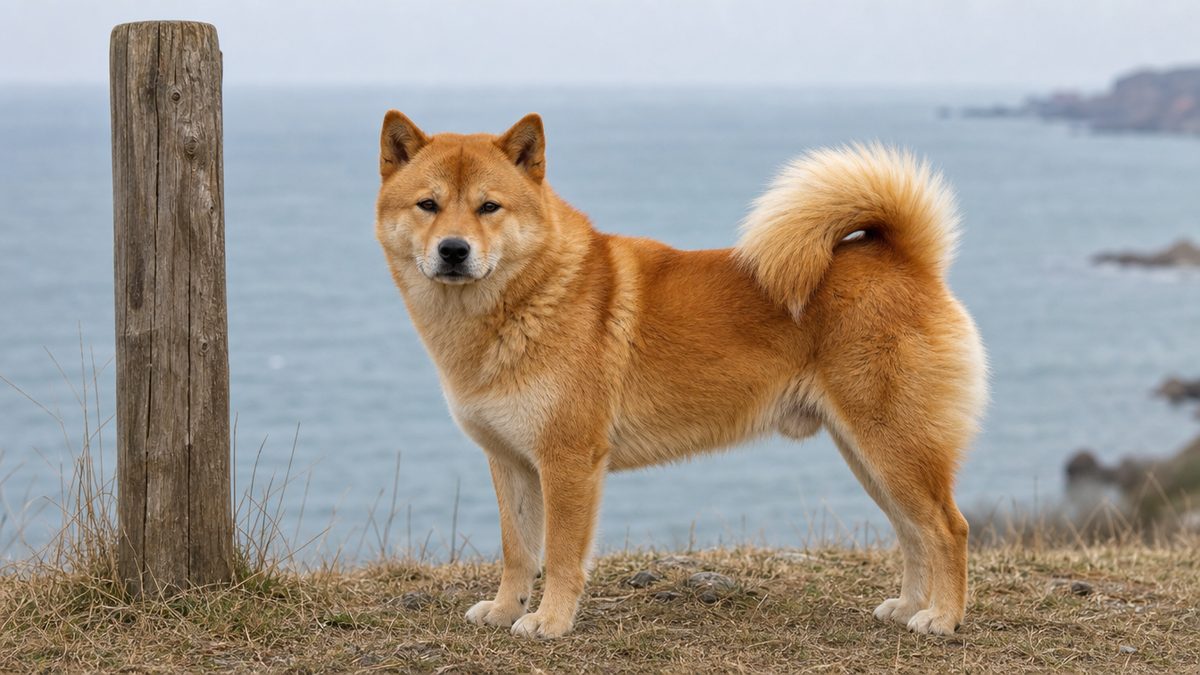
Six colours are admitted: red fawn, white, black, black and tan, wolf grey and brindle. The ears are of medium size, triangular, thick and perfectly erect, set neither high nor low and pointing slightly forward in line with the back of the neck. The tail sets on high, carries sickle-shaped or rolled with the tip touching the back or flank, and is profusely feathered.
What the standard says about the dog's mind
The temperament paragraph is unusually direct for a breed standard and it is worth quoting the substance rather than paraphrasing it. The Korea Jindo Dog has a very strong instinct for hunting, is bold, brave, alert and careful, is not tempted easily, and is above all extremely faithful to its master. On the whole it is not fond of other animals, especially males. It has a good sense of direction. It is a one-man dog that readily accepts a new master but never forgets its attachment to the one who raised it from puppyhood. It keeps itself clean and eats sparingly.
Read that as a specification rather than as flattery. A loyal, independent, alert dog with a strong prey drive and low tolerance of same-sex dogs is a demanding animal in a dense Indian city, and the standard is telling you so in advance.
| Item | What the source says | Source |
|---|---|---|
| FCI number and group | 334, Group 5 Spitz and primitive types, Section 5 Asian Spitz | FCI nomenclature |
| Definitive recognition | 6 July 2005, after provisional recognition on 10 March 1995 | FCI nomenclature |
| Height, male | 50-55 cm, ideal 53-54 cm | FCI standard 334 |
| Height, female | 45-50 cm, ideal 48-49 cm | FCI standard 334 |
| Weight | 18-23 kg male, 15-19 kg female | FCI standard 334 |
| Utilisation | Hunting dog, without working trial | FCI standard 334 |
| Life expectancy | 14-15 years (AKC), 12-15 years (Royal Canin), over 10 years (RKC) | Three registries, three answers |
The FCI standard's hindquarters paragraph says dewclaws should be removed except in countries where their removal is forbidden by law. India is such a country. Second Schedule Part II paragraph 6(8) of the Prevention of Cruelty to Animals (Dog Breeding and Marketing) Rules 2017 forbids de-clawing by name, alongside tail docking, ear cropping, de-barking and any change of appearance by artificial means. The standard anticipates exactly this case and defers to the local law, so an Indian breeder following it correctly leaves the dewclaws on.
Jindo, jindokkae, Jindo-kae, Chindo: the names and why the spelling matters
Use Jindo in English and 진도개 in Korean, because those are the forms the FCI standard and the Korean state register actually carry Korea Heritage Service. Every other spelling you will meet is a romanisation choice rather than a different dog.
The FCI standard records that in Korea the breed is called Jindo-kae or Jindo-kyon, and explains that kae and kyon are simply the Korean words for dog. Kae is the native Korean word; kyon is the Sino-Korean reading of the same character. Neither is more correct, and both mean the animal rather than the breed.
The Korean state register uses 진도의 진도개, which translates as 'the Jindo dog of Jindo', with the Chinese characters 珍島の 珍島犬 and the official English title 'Jindo Dog of Jindo Island';. The doubling is not a mistake. The first Jindo is the island and county; the second is the dog named after it. That is the same pattern as the Hokkaido, which took the name of its island when Japan designated it in 1937.
Why you will see Chindo in older sources
Chindo is the McCune-Reischauer romanisation, which was the standard in English-language writing about Korea until South Korea adopted Revised Romanisation in 2000. Jindo is the Revised form. Both point at the same place and the same dog, and the shift explains why mid-century references and some older veterinary papers spell it with a C. A PubMed phrase search for 'Chindo dog' returns zero records, while 'Jindo dog' returns 23 and 'Korean Jindo' returns 12, so the C spelling has effectively left the scientific literature even though it survives in books.
The one naming trap that costs you money
The single most common English error is calling the breed a Jindo Spitz or a Korean Spitz. Neither name exists in any register. It matters in India because a seller offering a 'Korean Spitz' is describing a dog that has no standard, no registry and no way to be verified, and the most likely animal behind that label is a locally bred white Indian Spitz, which is a real and useful dog that costs a fraction of what an imported one would.
Bonbeno keeps the native script alongside the romanisation, names the romanisation system when two are in circulation, and does not translate a name into something more comfortable in English. The same discipline is applied on the Fuegian dog and Hare Indian dog pages, where the naming carries far more weight than a spelling preference.
Natural Monument No. 53, taken from the Korean register rather than a breed standard
South Korea designated the Jindo Dog of Jindo Island as Natural Monument No. 53 on 7 December 1962, and that date comes from the designating body's own record rather than from a kennel club.
The record is entry 1363600530000 in the National Heritage Portal maintained by the Korea Heritage Service, which was the Cultural Heritage Administration until its 2024 renaming. It classifies the listing under natural heritage, natural monument, cultural-historical monument, living; gives the designation date as 1962.12.07; gives the registered head count as 500 animals, described as Jindo dogs kept within Jindo County and registered to the standard type; places it on the Jindo main island in Jindo-eup, Jindo-gun; and names Jindo County as the managing body.
Taking the date from the register rather than from a breed source is not pedantry on this site. The equivalent Japanese work found the FCI's Shiba standard dating that breed's designation to 1937 when the Agency for Cultural Affairs record says 16 December 1936, so a breed standard was wrong by a year against the designating government's own file. The Korean record and the Korean encyclopaedia agree on 7 December 1962, and a blog page giving 1962.12.03 does not. Prefer the register.
What being a natural monument does and does not mean
A Korean natural-monument designation is a heritage listing attached to a protected population, not a quality mark on every dog of the breed. Only dogs inside Jindo County that pass the county's bloodline and conformation examination are registered, and the registered figure on the record is 500. A Jindo living in Seoul, Los Angeles or Delhi is a Jindo; it is not a natural monument. Anyone selling you a puppy on the strength of the word monument is selling you a status the animal in front of them does not hold.
| Field on the record | Value |
|---|---|
| Name | 진도의 진도개 (珍島の 珍島犬), Jindo Dog of Jindo Island |
| Classification | Natural heritage / Natural monument / cultural-historical monument / living |
| Designation date | 7 December 1962 |
| Registered head count | 500 animals |
| Location | Jindo main island, Jindo-eup, Jindo-gun, South Jeolla |
| Managing body | Jindo County |
| Responsible department | Animal and Plant Heritage Division |
The same record carries two different male heights. Its newer signboard text gives males 48 to 53 cm and females 45 to 50 cm; its longer heritage description gives males 50 to 55 cm and females 45 to 50 cm. The lower pair matches the Royal Kennel Club standard and the higher pair matches the FCI standard, so the Korean state's own file has quietly absorbed both. Bonbeno prints both rather than choosing the tidier one, and the standards section below explains what the gap costs a show exhibitor.
The 1938 designation: history the ranking pages repeat without checking
The Jindo was first designated in 1938, by the Japanese Government-General of Korea, as Joseon Natural Monument No. 53, and the 1962 Korean designation succeeded to that number.
The Royal Kennel Club's breed page states that in 1938 the Jindo was declared to be a National Treasure and that the dogs were spared in the massacre of dogs by the Japanese in the Second World War. The first half has a real basis and the framing is missing the point. The 1938 act was not a Korean state honouring a Korean dog; Korea was under Japanese colonial rule and the designating authority was the Government-General.
Why the colonial authority designated it, in the words of a Korean academic source
The Encyclopedia of Korean Culture entry on this breed is written by Ha Ji-hong, Professor Emeritus of animal genetics at Kyungpook National University, and it gives the motive plainly. Japan had designated six dog breeds as Japanese natural monuments between 1931 and 1937. In 1937 Professor Mori of Keijo Imperial University recommended the Jindo on the ground that the colony's dog resembled the dogs of the Japanese mainland, that is, as a token of naisen ittai, the doctrine that Japan and Korea were one body, and the Government-General accepted the recommendation.
The same source adds a detail that explains a gap every writer on this breed runs into. The proper noun jindokkae was first used by Professor Mori, which is why there is essentially no folkloric or humanities material about the breed under that name predating the colonial period. The dogs are old; the breed name is not.
A disagreement with this site's own Japanese pages, published rather than smoothed over
The Korean encyclopaedia counts six dog breeds designated as Japanese natural monuments between 1931 and 1937. Bonbeno's Hokkaido guide, working from the Japanese Agency for Cultural Affairs register rather than from a Korean source, counts seven designations under the same criterion, because the Koshi dog was designated in 1934 and is now extinct. Both counts are defensible and they are measuring different things: seven designations were made, and six of the breeds survive. Bonbeno prints the two figures and the reason rather than averaging them.
After liberation the Korean government succeeded to the colonial listing and re-designated the breed as a Republic of Korea natural monument in 1962, at which point it became the only native dog the government recognised and, in the encyclopaedia's own phrase, a national dog receiving public affection.
The Encyclopedia of Korean Culture dates the Korean Jindo Dog Protection and Promotion Act to 1967. The version of the Act published on the Korea Law Information Center carries addenda running back only to Act No. 5347 of 22 August 1997, whose transitional provision refers to dogs examined under 'the previous provisions', which implies an earlier statute existed. Bonbeno could not open the pre-1997 text in this session, so it reports 1967 as the encyclopaedia's date and 1997 as the earliest text it read itself, and asserts neither as the enactment year.
The export restriction, taken from the statute rather than from repetition
Korean law restricts moving a Jindo, and the restriction operates at the island rather than at the national border. The Korean Jindo Dog Protection and Promotion Act makes the whole of Jindo County a protection zone and forbids taking a Jindo out of it without permission.
Almost every English page about this breed says something vague about export being restricted. The statute is specific and it is public. Article 4 designates the whole of Jindo County as the Jindo Dog Protection Zone. Article 11(1) says nobody may bring into the protection zone any dog other than a registered Jindo, with narrow exceptions by the county head's permission for research animals, sterilised or castrated dogs, and dogs needed for a Jindo show inside the zone. Article 11(2) says nobody may take a Jindo out of the protection zone, and then lists the four cases in which the county head may permit it.
- Approved supply plan. Removal is permitted where a supply plan built on the number of dogs kept inside the zone has been authorised by the Cultural Heritage Administration.
- Non-breeding or aged dogs. Removal is permitted for registered Jindo that cannot breed, or that through age no longer hold protection value as a natural monument.
- Offspring of a removed dog. Removal is permitted for dogs produced by an animal that was itself ordered out of the zone after failing examination.
- Shows and promotion. Removal is permitted for a limited period to take a registered Jindo to a show or promotional event held outside the zone.
The enforcement power is what makes this real
Article 12 lets county officials inspect ships and vehicles entering and leaving the protection zone, and require passengers and travellers to show the contents of their belongings, specifically to enforce the movement restriction. Jindo is an island connected to the mainland by bridge, so that power has a chokepoint to work at. Article 13 requires an inspecting officer to show a badge of authority.
Article 15 sets the penalties, and they are administrative fines rather than imprisonment. A fine of up to 1,000,000 won applies to bringing an unregistered dog into the zone, taking a Jindo out of it, refusing or obstructing an inspection, or breaching a castration, culling or removal order. A fine of up to 500,000 won applies to failing to submit a dog for examination or to artificially inseminating with semen from an unregistered dog.
Article 8(1) says that where a dog fails the bloodline and standard-conformation examination, the county head shall order the owner to have it castrated or culled, or to remove it from the protection zone, and Article 8(2) requires the ordered action to be carried out in the presence of a public official or police officer who then reports the result. The word in the Korean text translated as culled is 도태. Korean animal-welfare groups have criticised exactly this provision, and the state's answer has been to move toward direct county rearing. An Indian reader should understand that the protected population is managed as a conservation register with an exit clause, not as a breeder's waiting list.
Which register a Jindo pedigree comes from, and why it is not one register
Ask which body issued the paper, because four organisations register this breed and they hold different dogs. Jindo County holds the natural-monument register, the Korea Kennel Federation holds the FCI pedigree register, and the American and Royal Kennel Clubs hold their own.
- Jindo County. Registers only dogs inside the protection zone that pass a bloodline and conformation examination, and tags them so the registration can be verified on the animal. This is the natural-monument register and it is the smallest.
- Korea Kennel Federation. South Korea's FCI member body, at 6 Dobong-ro 169na-gil, Dobong-gu, Seoul, listed by the FCI as a full member. This is the register that issues an internationally portable pedigree.
- American Kennel Club. Publishes a Korean Jindo Dog breed page with height, weight and life expectancy, and names the Korean Jindo Association of America as the club contact.
- The Royal Kennel Club. Recognises the breed as Korean Jindo (Imp) in the Utility group, with a breed standard last updated in April 2025 and a Find a Puppy listing service The Royal Kennel Club.
The Korean pedigree register is shrinking fast
The FCI publishes each member body's own annual returns, and the Korea Kennel Federation's are falling steeply. Pure-bred dogs registered with the studbook ran 21,355 in 2017, 12,552 in 2022, 9,601 in 2023, 8,128 in 2024 and 8,206 in 2025. That is a fall of 62 percent from the 2017 peak across all breeds, in a country where individual KKF membership rose over the same period from 32,918 to 73,938. Fewer registered litters and more registered people is a pedigree market contracting while a pet market grows.
| Year | Pure-bred dogs registered | Puppies registered | Individual members |
|---|---|---|---|
| 2017 | 21,355 | 19,896 | not reported |
| 2020 | 17,050 | 16,665 | 41,765 |
| 2022 | 12,552 | 11,227 | 53,178 |
| 2023 | 9,601 | 7,644 | 60,175 |
| 2024 | 8,128 | 6,921 | 67,570 |
| 2025 | 8,206 | 6,882 | 73,938 |
How the Indian pedigree question actually resolves
India is a full FCI member, listed in the same Asia, Africa and Oceania table as Korea, and the Kennel Club of India issues pedigrees against FCI nomenclature. Because the FCI recognises the Korea Jindo Dog on a definitive basis, an Indian KCI pedigree for a lawfully imported Jindo is theoretically possible in a way it is not for an unrecognised breed. That is a statement about paperwork, not about supply.
The Kennel Club of India publishes no breed list for any breed, so a query there returns zero for the Jindo and zero for every control breed as well. That is a broken instrument rather than a finding, and Bonbeno does not report it as evidence about recognition in India. The FCI members register is the route that works.
The same FCI statistics page carries an approximate national dog-population row for Korea that reads 10,000,000 in 2018, 2,700,000 in 2019, 5,984,903 in 2020 and 2,300,000 in 2021, and a dog-owner row that reports 12,750,000 owners against 2,700,000 dogs in 2019 and 12,620,000 owners against 4,730,000 dogs in 2023. More owners than dogs is impossible, so those two rows are self-refuting and Bonbeno quotes neither. The studbook rows above are internally consistent and are the ones worth using.
Two breed standards, two different dogs on paper
The FCI and the Royal Kennel Club give different heights for the same breed, and the gap is wide enough that a dog ideal under one standard is oversize under the other.
The FCI standard puts males at 50 to 55 cm with an ideal of 53 to 54, and bitches at 45 to 50 with an ideal of 48 to 49. The Royal Kennel Club standard, last updated April 2025, puts dogs at 48 to 53 cm with an ideal of 51, and bitches at 46 to 51 with an ideal of 48. Both are current. Both describe the Korean Jindo.
| Measure | FCI standard 334 | Royal Kennel Club, April 2025 | Gap |
|---|---|---|---|
| Male height range | 50-55 cm | 48-53 cm | 2 cm lower at both ends |
| Male ideal | 53-54 cm | 51 cm | 2 to 3 cm lower |
| Female height range | 45-50 cm | 46-51 cm | 1 cm higher at both ends |
| Female ideal | 48-49 cm | 48 cm | Effectively the same |
| Weight | 18-23 kg male, 15-19 kg female | No weight given at all | One standard declines to say |
| Brindle | Admitted | Admitted in the standard, absent from the registration colour list | Internal contradiction |
The practical consequence is sharp. A male at the FCI ideal of 54 cm sits one centimetre above the Royal Kennel Club's maximum, and oversize is a disqualifying fault under the FCI standard. A breeder selecting to one standard is selecting away from the other. Nothing on any ranking page mentions this, and it is the sort of thing an Indian buyer paying for an imported show prospect ought to know before the money moves.
The Korean state register carries both figures
The Korea Heritage Service record for Natural Monument No. 53 prints males at 48 to 53 cm in its guide-board text and males at 50 to 55 cm in its longer heritage description, on the same page. Those are exactly the Royal Kennel Club and FCI ranges respectively. So the disagreement is not a foreign misreading of a Korean source; it is present inside the Korean source. Bonbeno reports both and asserts neither as the single truth.
A registry that contradicts its own standard on colour
The Royal Kennel Club breed standard admits red in various shades, white, black and tan, black, wolf grey and brindle, and says any other colour or combination is unacceptable. The same club's breed page lists the registrable breed-standard colours as Black, Black and Tan, Fawn, Red Fawn, White and Wolf Grey, and does not include brindle. A brindle Jindo is therefore standard on one page of the registry's own site and not on another. That is a cheap check anyone can repeat, and it is the kind of internal inconsistency this site looks for before quoting any registry as settled.
Ears perfectly erect, tail set high and carried curled or sickle-shaped, a harsh outer coat standing off a soft dense undercoat, cat feet with black nails preferred, and a scissor bite. Non-erect ears and a dropping or short tail are faults in the FCI text, and undershot or overshot mouths and more than three missing teeth are disqualifying The Royal Kennel Club. Judge a dog on those before you argue about two centimetres.
How many protected Jindo there are, and why the state keeps cutting the number
Registered natural-monument Jindo fell from 1,609 in 2021 to 1,208 in 2022 and 1,262 in 2023, and the Korean state is deliberately reducing the register further.
The Korea Heritage Service and Jindo County reported in July 2024 that 457 households on the island kept 1,603 dogs. Of those, 268 were unregistered because they were awaiting examination or had failed it, and 73 were not Jindo at all. Subtract both and 1,262 remain, which is exactly the registered figure for 2023. That arithmetic closing is why this source is usable; the numbers reconcile against each other.
| Year or step | Figure | What it is |
|---|---|---|
| 2021 | 1,609 | Registered natural-monument Jindo |
| 2022 | 1,208 | Registered natural-monument Jindo |
| 2023 | 1,262 | Registered natural-monument Jindo |
| 2023, households | 457 keeping 1,603 dogs | Of which 268 unregistered and 73 not Jindo |
| 2019 guideline | 10,000 target, minimum 4,000 registered | Cultural Heritage Administration Directive 520 |
| 2022 guideline | 500 registered | Notice 2022-29, integrated guideline |
| Planned | About 200 registered | Ahead of direct county rearing from 2027 |
The 2022 rewrite that no English page has noticed
Until 2022 each of Korea's three natural-monument dog breeds had its own management directive. Cultural Heritage Administration Notice No. 2022-29 of 21 March 2022 repealed all three, Directive 552 for the Sapsaree, Directive 553 for the Gyeongju Donggyeongi and Directive 554 for the Jindo, and replaced them with one integrated guideline for natural-monument bred animals. The same notice cut the registered head counts: the Jindo from 10,000 to 500, the Donggyeongi from 300 to 200, the Sapsaree unchanged at 200.
The superseded 2019 Jindo directive shows what the old regime looked like. It set the appropriate number of dogs kept in Jindo County at 10,000, required at least 4,000 to be registered to the bloodline and standard type, required the county to stop non-Jindo dogs entering, and required frozen genetic material to be preserved permanently at the Livestock Genetic Resources Center and the Jeju Livestock Promotion Institute. That directive is flagged on the Korean legal database as no longer current, and its own Article 13 gave it effect only until 26 December 2022.
Why the register is being shrunk
The stated reason is welfare, not scarcity. Civil-society groups had criticised the state for failing to manage natural-monument dogs properly and for harming their welfare, and the Korea Heritage Service response was to plan for Jindo County to rear every registered dog directly once the Jindo Dog Preservation and Management Centre is completed in 2027, cutting the register to about 200 so that housing and bloodline preservation can be done properly. The same report notes that a natural-monument Jindo was found on a dog-meat farm in Jindo County, which is the clearest possible illustration of what the old arrangement could not prevent.
Jindo County has run a Jindo Dog Medical Center since September 2023, with 350 treatment episodes recorded by July 2024, and supplies heartworm preventives, dewormers, collars and portable kennels free to every Jindo, plus a feed subsidy for dogs aged seven and over. That is a level of state support no Indian breed receives, and it is worth naming when comparing how two countries treat a native dog.
Jindo dog price in India: there is no Indian price, and here is the proof
There is no jindo dog price in india, because Bonbeno found no Indian breeder, listing site, marketplace or rescue offering the breed. Every rupee figure the Indian search results return for this term belongs to something other than a dog.
Say the negative first and then evidence it. An India-restricted search on 31 August 2026 for the target term returned, in order: an Etsy merchandise market, a book on Amazon India, a United States rehoming site, the American Kennel Club breed page, a US rescue, a Reddit thread about adopting from Korea, a Canadian breed page, a cryptocurrency price page, a US cost guide and Royal Canin India's breed page. A second query for 'korean jindo dog puppy for sale india price rupees' returned a European puppy broker, the AKC marketplace, two Facebook groups, Petfinder, the Royal Kennel Club and a German breed site. Not one Indian Jindo listing appeared in either.
That absence is earned rather than assumed. The control query 'labrador retriever puppy price in india', run on the same instrument in the same session, returned genuine Indian Labrador listing pages quoting rupee ranges city by city, including a KCI-registered tier at ₹60,000 to ₹90,000 and a champion-bloodline tier at ₹90,000 to ₹1,20,000. The search worked. What it found for the Jindo is what is there.
Position eight is a cryptocurrency
The most instructive result on that page is not a dog at all. Coinbase ranks in India for this query with a token called Jindo Dog 진도개, whose price it quotes in Indian rupees to four decimal places. That is the only rupee figure on the first page of Indian results that is attached to the words Jindo and price, and it describes a crypto asset. An answer engine reading this SERP for an Indian user has almost nothing else numeric to work with, which is precisely why this page exists.
| Source | Figure printed | What it actually is |
|---|---|---|
| Dogster | 500 to 1,500 US dollars from a breeder | A US estimate, described in the body text as the 2024 range |
| Adopt-a-Pet | 50 to 200 US dollars to adopt, 500 to 2,000 to buy | A US rehoming platform with no Indian coverage |
| HonestDog | 2,000 to 3,500 euros | A German site quoting a European puppy price |
| Royal Canin India | No price at all | An Indian page for the breed that declines to price it |
| Etsy India | ₹2,455, ₹300, ₹372 | Merchandise. Not dogs |
| Coinbase India | ₹0.0003107 | A cryptocurrency token named after the breed |
Do not convert the dollar figure
Converting 1,500 US dollars into rupees produces a number that looks like an Indian price and is not one. Bonbeno has repeatedly caught Indian breed pages doing exactly that, publishing rupee prices that divide cleanly back into round dollar amounts at a single exchange rate. The same trap runs in euros: a German breed site prints a Jindo puppy price of 2,000 to 3,500 euros, which converts to a number no Indian seller has ever asked for. A converted figure tells you what a foreign breeder charges, expressed in rupees. It tells you nothing about a market that does not exist, and quoting it would hand an Indian reader a budget for a purchase they cannot lawfully make.
Korean law says nobody may take a Jindo out of the protection zone except in four permitted cases requiring the county head's permission, and Indian law says any application to import a dog for trading or breeding purposes shall be duly rejected. A commercial supply chain cannot form between those two facts, so the price has nothing to converge on. The breed is not expensive in India and it is not cheap in India. It is unavailable in India, which is a different fact and a more useful one.
What a medium double-coated dog actually costs to keep in India
Budget ₹6,000 to ₹10,000 a month for a medium dog in an Indian city on the most widely cited Indian cost table, and treat the grooming line as a floor rather than a figure.
The purchase price of this breed is unknowable in India. The cost of ownership for a 18 to 23 kg double-coated dog in Chennai or Delhi is not, because it is the same as for any dog of that size and coat, and it is published. Supertails' 2026 Indian dog price list breaks running costs out by breed size, and its medium column gives food ₹2,500 to ₹4,000, routine vet visits ₹800 to ₹1,500, annual vaccination ₹1,500, grooming ₹800 to ₹1,500, six months of training ₹2,000 to ₹5,000, treats and toys ₹500 to ₹1,000, and flea and deworming ₹400 to ₹700, against a stated cost per month of ₹6,000 to ₹10,000.
That table does not add up, and you should know why before using it
Add the medium column's own rows and the printed total does not reproduce. Read every row as monthly and the low end reaches ₹8,500 and the high end ₹15,200, against a printed monthly total of ₹6,000 to ₹10,000. Read the vaccination row as ₹125 a month and the six-month training row as ₹333 a month and the low end falls to about ₹5,458, which undershoots ₹6,000. Neither reading works, because the column mixes monthly, annual and six-monthly rows under a heading that says monthly total. Use the individual rows and build your own total.
| Line | Published Indian figure | Bonbeno's note for this breed |
|---|---|---|
| Food | ₹2,500-₹4,000 | A working spitz that eats sparingly by the standard's own account, so mid-range is realistic |
| Routine veterinary | ₹800-₹1,500 | Ask for a breed note on the file before any potassium result is read |
| Vaccination | ₹1,500 a year | Roughly ₹125 a month once the puppy course is done |
| Grooming | ₹800-₹1,500 | A floor. A de-shedding session during the coat blow costs more than a routine groom |
| Flea, tick and deworming | ₹400-₹700 | Non-negotiable, and see the tick-borne disease note in the health section |
| Training | ₹2,000-₹5,000 for six months | The single highest-value line on this list for this breed |
| Cooling | Not a line item on any Indian table | Budget it anyway from March to October |
First-year costs sit above the run rate. The same source puts the whole first year at ₹80,000 to ₹2,00,000 including purchase, vaccinations, food, training and supplies, and separately recommends paying ₹800 to ₹1,500 for an independent pre-purchase veterinary consultation before completing any payment. That last piece of advice is the best thing on the page and it applies with double force to a breed nobody in India can lawfully supply.
What the overseas cost guides are actually telling you
Dogster puts the total monthly cost of a Jindo in the United States at 120 to 740 dollars, with health care 40 to 250, food 35 to 70, grooming 0 to 75, preventive medication 15 to 150, insurance 20 to 50, environment 10 to 80 and entertainment 0 to 65. Ignore the currency and read the structure: the two largest lines are veterinary care and preventive medication, not food. That shape holds in India too, and it is why the cheapest thing you can do for a dog of this breed is buy the tick and flea cover on time every month.
The same Supertails page opens by saying Indian dog prices run from ₹2,000 for an indie to over ₹1,50,000 for a KCI-registered show dog, and a few paragraphs later says the average price varies from ₹5,000 to ₹1,00,000 and up. Bonbeno prints both rather than picking the tidier one.
Heat tolerance: the gap between Jindo Island and an Indian city, measured
The Jindo handles Indian heat better than any other double-coated East Asian spitz, and it is still moving to a city 13.74 degrees warmer than home. Both halves of that sentence come from the same satellite dataset queried by explicit coordinates.
NASA POWER was queried on 31 August 2026 by latitude and longitude, with every query echoing back the coordinates and the grid elevation it served. The cell over Jindo-eup at 34.487 N, 126.263 E reports an elevation of 25.26 m, which matches a low coastal town, so no elevation correction is needed here. It returns an annual mean of 14.21 C, an annual maximum 2-metre temperature of 32.16 C, an annual minimum of minus 5.04 C and annual relative humidity of 80.19 percent.
| Place | Grid elevation | Annual mean | Annual maximum | Gap to Jindo |
|---|---|---|---|---|
| Jindo-eup, South Korea | 25 m | 14.21 C | 32.16 C | - |
| Chennai | 49 m | 27.95 C | 42.70 C | +13.74 C |
| Mumbai | 97 m | 26.77 C | 44.91 C | +12.56 C |
| Kolkata | 7 m | 25.81 C | 46.81 C | +11.60 C |
| Delhi | 206 m | 25.60 C | 48.79 C | +11.39 C |
| Pune | 636 m | 23.86 C | 43.20 C | +9.65 C |
| Bengaluru | 842 m | 23.74 C | 40.38 C | +9.53 C |
The humidity number is the surprising one
Jindo Island runs at 80.19 percent annual relative humidity, which is higher than Chennai's 72.39, Kolkata's 73.93 and Bengaluru's 67.94. This is a wet maritime island, not a dry continental one. So the Jindo arrives in India already adapted to air that will not take sweat off a surface, which is genuinely different from a Nordic breed and is why this page rates its heat tolerance 3 rather than the 2 Bonbeno gave the Hokkaido, whose Sapporo cell reads 6.17 C against this dog's 14.21.
That is a relative judgement and it should not be read as an all-clear. Thirteen and a half degrees of annual mean is a large step for any double coat, and Chennai's annual maximum of 42.70 C is more than ten degrees above anything the breed's homeland produces.
What the heat-illness evidence says about a dog this size
Read the rating as relative rather than absolute. A Jindo is a heat-sensitive dog in Chennai in May, and it is a less heat-sensitive dog than a Hokkaido, a Husky or an Akita would be in the same street. Both halves of that come from the same table above.
The largest published study of heat-related illness in dogs followed 905,543 UK dogs under primary veterinary care in 2016 and recorded 395 confirmed events with a case fatality rate of 14.18 percent. Bodyweight at or above the breed and sex mean carried an odds ratio of 1.42, and dogs over 50 kg carried 3.42. At 18 to 23 kg the Jindo sits nowhere near that heavy band, which is real good news. The transferable risk is the first one: a Jindo carrying more weight than the breed mean is at measurably higher risk, and that is entirely within an owner's control.
The companion paper on the same cohort found that of 879 heat-illness events with a recorded trigger, 652, or 74.2 percent, were exertional rather than environmental, against 113 environmental and 46 from confinement in a vehicle. For a hunting dog with real stamina in an Indian summer, that is the sentence that matters. The danger is not the parked car. It is the walk you took at four in the afternoon because the dog looked keen.
Second Schedule Part IV paragraph 21(1) of the Prevention of Cruelty to Animals (Dog Breeding and Marketing) Rules 2017 bars keeping in outdoor facilities, without the attending veterinary practitioner's written approval, dogs not accustomed to the temperatures prevalent in the area, breeds that cannot tolerate them 'such as long-haired breeds in high temperature locations', and sick, infirm, aged or young animals. A newly imported double-coated Jindo in an Indian summer is squarely inside the first category. Note the citation form: this is a Second Schedule paragraph, not a Rule. The string 'Rule 21' appears zero times in the gazette.
Indian import law: what blocks a Jindo, and what does not
Indian import law blocks the commercial route and leaves the personal-pet route open. Dogs are a Restricted import, and applications to import for trading or breeding are rejected by rule.
DGFT Trade Notice No. 22/2022-23, headed Guidelines for import of Pet Animals, sets out the position and was read here from the gazette PDF rather than from a summary. It records ITC (HS) 01061900, Mammals: Other, with an Import Policy of Restricted, subject to Policy Condition 6 of the Chapter. Policy Condition (6) concerns wild animals under the Wild Life (Protection) Act 1972 and CITES, which does not touch a domestic dog. Policy Condition (7) is the operative one.
- Import is allowed only for a pet dog with a valid pet book and relevant records in the name of the importer, for R&D organisations with the recommendation of CPCSEA, or for internal security by the Defence and Police Forces.
- Verify who the application names, because any application for trading or breeding purposes, or made on behalf of some other person or entity, shall be duly rejected.
- Register the route early: the notice advises beginning the import authorisation process at least two months before travel dates.
- Screen the port before booking, because import of pet animals is allowed only through the airports and seaports of Delhi, Mumbai, Chennai, Hyderabad, Bengaluru and Kolkata and, since October 2024, Kochi airport Department of Animal Husbandry….
The import licence is applied for online through the DGFT website under Import Authorisation of Restricted Items, and the notice tells personal importers to use the Importer Exporter Code reserved for persons and institutions importing goods for personal use not connected with trade.
The two doors have to close together
Put the Indian bar beside the Korean one and the commercial question closes. An Indian breeder cannot lawfully import breeding stock, and on the Korean side a registered natural-monument Jindo cannot leave the protection zone except under an approved supply plan or in three narrow personal cases, with ships and vehicles subject to inspection. Neither door alone would stop a determined trade. Both together mean no lawful supply chain can form, which is why this page carries no price rather than a very wide one.
Two things that do not block a Jindo
The natural-monument designation is not an export ban in itself. It is a heritage listing whose movement restrictions run through the Jindo Dog Act and the county's permission regime, and it applies to registered dogs inside the protection zone rather than to every Jindo in Korea Korean Jindo Dog Protection and Promotion…. Ordinary unregistered Jindo live throughout South Korea, and Korean rescue organisations regularly place them abroad, which is why American adoption threads about the breed exist at all.
The second non-blocker is the 2024 Indian breed circular. Circular D.O.V-11/1/2024-ANLM.DADF of 12 March 2024 listed a set of breeds for a proposed ban; press reports differ on whether it named 19, 23, 24 or 25, and Bonbeno has not seen the circular itself. The Karnataka High Court quashed it on 10 April 2024, the Delhi High Court set it aside on 16 April 2024, and the Centre told the Bombay High Court in January 2025 that it is not acting on it. No Indian law in force today bans owning, breeding or selling any of those breeds, and no reproduction of the list Bonbeno has read includes the Jindo.
S.O. 4396(E) of 10 October 2024 permits pet dogs and cats through Cochin International Airport under the Livestock Importation Act 1898, with jurisdiction to the Animal Quarantine and Certification Station at Chennai. That governs the personal pet route under a different Act. Bonbeno has not checked it against the DGFT notice's own six-port list and does not claim it amends that list. Read whichever instrument governs your route.
What the 2017 Rules require of anyone breeding or selling this dog in India
Anyone breeding or selling dogs in India works under the Prevention of Cruelty to Animals (Dog Breeding and Marketing) Rules 2017, and three of its clauses bite specifically on this breed.
The Rules were notified as G.S.R. 496(E) on 23 May 2017 by the Ministry of Environment, Forest and Climate Change. The Rules themselves run from 1 to 13; everything numbered above 13 is a Second Schedule paragraph rather than a Rule, and citing a Second Schedule paragraph as a Rule misdirects anyone who tries to look it up.
- Rule 8(1)(a), the eight-week floor. Every breeder shall ensure that pups less than eight weeks in age are not sold. This is a genuine Rule, not a Schedule paragraph.
- Second Schedule Part II paragraph 6(8), the mutilation ban. There shall be no tail docking, ear cropping, de-barking, de-clawing, branding, dyeing, injecting substances to enhance visual appeal, or any other kind of mutilation, and any change of appearance by artificial means is strictly forbidden.
- Second Schedule Part III paragraph 8(10), the genetic-defect testing clause. Breeding dogs shall have been tested for genetic defects including hip dysplasia, progressive retinal atrophy, night blindness, hypothyroidism, entropion, ectropion, overshot and undershot jaw, wry mouth, two or more missing teeth and cryptorchidism. The word is 'including', so the list is illustrative rather than closed.
Where the FCI standard and Indian law collide
The FCI standard for this breed says dewclaws should be removed except in countries where their removal is forbidden by law. India is such a country, because paragraph 6(8) names de-clawing among the prohibited procedures. The standard has been drafted to defer to local law and an Indian breeder following it correctly leaves the dewclaws alone. Anyone who tells you a Jindo puppy's dewclaws were removed 'to the standard' has either not read the standard's own proviso or has broken the Rules.
The 8(10) list also reaches this breed in two places that no breed page mentions. Hypothyroidism is on the Indian mandatory-testing list and it is one of only two conditions the American Kennel Club names for the Jindo Prevention of Cruelty to Animals. Overshot and undershot jaws are on the list, and both are disqualifying faults in the FCI standard, as is having more than three missing teeth. So on this breed Indian law and the breed standard point the same way, which is not always the case on this site.
There is no Indian patella-testing requirement and no dental requirement. Across all 14 pages of the gazette, the words patella, luxation, dental and BAER appear zero times, and the only dentition hook is the 'two or more missing teeth' item inside 8(10). Never let a seller tell you Indian law mandates a patella grade.
Temperament: what the standard promises, and what 189 Korean owners reported
The Jindo is a loyal, independent, alert one-person dog with a strong hunting drive, and the largest published owner survey found 79.9 percent of them showing at least one behaviour problem.
Start with the survey rather than the standard, because it is the only large body of evidence on how this breed actually behaves in homes. Seoul National University researchers collected 189 completed owner questionnaires on Jindo dogs. Of those, 151 dogs (79.9 percent) had a behaviour problem and 38 (20.1 percent) did not. Among the 151, 139 (92.1 percent) showed a single problem and 12 (7.9 percent) showed two concurrent problems.
| Problem | Share of the 151 affected dogs | What it looks like in an Indian flat |
|---|---|---|
| Excessive excitability | 46.8% | A dog that cannot settle when the door opens or a delivery arrives |
| Excessive vocalisation | 30.2% | The single hardest one in shared-wall housing |
| Inappropriate elimination | 17.3% | Usually a house-training or confinement failure, not a medical one |
| Destructive behaviour | 4.3% | Rare, and almost always an under-exercised dog |
| Aggressive behaviour | 1.4% | The rarest problem reported, against the breed's reputation |
Two things follow. Aggression toward people is the rarest reported problem in the breed's own homeland, at 1.4 percent, which is worth knowing against a reputation built on guarding stories. And the two commonest problems, excitability and vocalisation, are exactly the two that make a dog difficult in dense housing, which is the housing most Indian buyers have.
The authors' own conclusion is the useful one: relinquishment of Jindo dogs was not significantly associated with behaviour problems, and the likely causes of those problems were improper raising, lack of socialisation and insufficient access to training classes, so owner education is the lever.
What the standard adds
The FCI text describes a dog with a very strong hunting instinct that is bold, brave, alert and careful, not easily tempted, extremely faithful to its master, generally not fond of other animals and especially not of males, with a good sense of direction, and a one-man dog that accepts a new master but never forgets the first. The Royal Kennel Club condenses that to spirited, brave, with strong hunting instinct, loyal to their owner. Royal Canin India lists the temperament tags assertive, alert, loyal and confident.
Anyone who wants a dog that will greet visitors warmly, live comfortably with a resident male dog, be reliable off lead near cats or street animals, or be left alone in a flat for long days without a plan. The homing instinct the Korean heritage record celebrates, the story of the dog sold to Daejeon that walked 300 km back to Jindo, is the same trait that makes a recall failure into a genuine emergency.
Training a dog bred to make its own decisions
To train a Jindo, start socialisation early, keep sessions short and food-led, and accept that the published evidence says early socialisation does less than owners hope.
Most breed pages tell you to socialise a Jindo puppy heavily and leave it there. There is an actual experiment, and it is more interesting than the advice. Twelve Jindo puppies were split at seven weeks into a socialised group, which received a structured programme from week 7 to week 13, and a non-socialised group reared in a semi-isolated environment. Both groups then went to new families at 13 weeks and were tested at 7, 9, 11, 13 and 60 weeks.
The result was a single difference. At week 9 the socialised puppies showed more playful reactivity toward novel stimuli and toward another dog. There was no effect at all on social reactivity toward humans and a dog, and no effect on fearful reactivity toward social stimuli, at any test point including at 60 weeks. With twelve puppies the study is small and it cannot rule out a real effect it was too small to see, so read it as a caution rather than a verdict.
What Bonbeno takes from that
Socialise the puppy anyway, because there is no argument for the alternative and the study's non-socialised group was reared in semi-isolation, which nobody should replicate. But do not buy a Jindo on the theory that enough puppy classes will produce a biddable dog. Plan instead for management: a secure garden or a long line, a reliable crate, and a household that agrees on the rules before the dog arrives.
- Train in short sessions of five to ten minutes, several times a day, and stop while the dog is still interested.
- Feed the training. This is a breed the standard describes as eating sparingly, so use its actual meals as the currency rather than adding treats on top.
- Socialise to Indian street realities specifically: horns, two-wheelers, cattle, free-roaming dogs, festival noise and lifts.
- Screen every off-lead space before you use it. A dog with this prey drive and this homing instinct is not a candidate for an unfenced park.
- Verify progress with a written record. A recall that works in the garden is not a recall.
The coat-colour finding, which is real and easy to over-read
A study of 51 adult Jindo, 31 fawn and 20 white, ran nine behaviour tests and found that fawn dogs showed significantly lower fearful and submissive reactivity than white dogs and scent-marked significantly more often. That is a measured breed-specific difference and no ranking page carries it. It is not a buying rule. The effect is a group average across 51 dogs, the study is fifteen years old, and choosing a puppy by coat colour to get a temperament is exactly the kind of shortcut that produces disappointed owners.
There is a genetic reason the two colours might differ by more than pigment. Deep sequencing of 113 Korean indigenous Jindo across five colour patterns found that the alleles unique to black-and-tan dogs carry a pleiotropic effect that significantly reduces body size in carriers, so at least one colour locus in this breed is doing more than one job.
Six months of professional training costs ₹2,000 to ₹5,000 on the published Indian figures. For a breed whose own country's owner survey blames behaviour problems on insufficient training classes, that is the cheapest risk reduction available and it should be booked before the dog arrives, not after the first problem.
Exercise: a hunting dog on an Indian clock
Give a Jindo about an hour of real work a day, and in India take it before sunrise and after dark from March to October.
The Royal Kennel Club sets the requirement at up to one hour per day and describes the housing need as a small house with a small or medium garden. Royal Canin India, drawing its facts from the FCI, prints 'needs a lot of exercise' as one of three key facts. The American Kennel Club describes a high-energy hunting and guard dog developed to travel many miles and take small and large game, and says the breed enjoys lure coursing and agility and has run on sled teams.
One hour is the floor and it has to be the right hour. The constraint in an Indian city is not the dog's capacity but the window in which work is safe, and the heat-illness evidence says why: 652 of 879 heat-related illness events with a recorded trigger, or 74.2 percent, were exertional. A dog that wants to run is exactly the dog that gets into trouble.
- Walk before sunrise. In Chennai in May that means being back before 06:30, not starting then.
- Screen the surface with the back of your hand. If you cannot hold it there for five seconds, the dog should not be walking on it.
- Train the second session indoors on hot days. Scentwork with a few treats in a folded towel does more for a hunting dog's head than a hot walk does for its legs.
- Verify recovery. A dog still panting hard twenty minutes after coming in did too much.
- Feed at least an hour after exercise, not before it.
What happens without it
The Korean owner survey gives the answer in its own numbers. Destructive behaviour was reported in only 4.3 percent of affected dogs, but excessive excitability was reported in 46.8 percent and excessive vocalisation in 30.2 percent. An under-worked Jindo in a flat does not usually chew the sofa. It barks, and it cannot settle, and those are the two behaviours a neighbour complains about.
The AKC notes the breed's aptitude for lure coursing and agility, and the standard credits a powerful, steady gait with the head carried high at the trot and lower as speed increases. In India, a long-line tracking game on a cool morning uses more of that dog than an hour on a lead ever will.
Grooming a double coat in Indian humidity
Groom a Jindo's double coat weekly for most of the year and daily through the twice-yearly undercoat blow, and never take a clipper to it.
The FCI standard describes a soft, dense, light-coloured undercoat supporting a stiff outer coat that stands somewhat off the body, with longer hair on neck, withers, back and rump and on tail and back of thighs. The Royal Kennel Club records the breed as shedding and needing grooming more than once a week. The American Kennel Club describes a fastidious breed whose double coat repels dirt and water and normally produces no odour, needing weekly brushing with a slicker or pin brush for most of the year, and adds that twice a year the entire undercoat is shed over a month or more, requiring regular brushing and vacuuming.
The Indian problem overseas guides do not have
Overseas grooming advice is written for a climate where a dog can be towelled off and left to air dry. In an Indian monsoon that instruction is actively wrong. At high ambient humidity a dense undercoat stays damp for hours, and a warm damp undercoat held against skin is where hot spots and yeast start. Dry a Jindo to the skin with a forced-air dryer every time it is bathed or soaked, and plug the ears before bathing. This breed's home island runs at 80.19 percent annual humidity, so the coat is not naive to damp air, but Jindo Island is 13.74 degrees cooler than Chennai and warm damp is the combination that causes trouble.
- Groom weekly with an undercoat rake and a slicker, line-brushing to the skin rather than skimming the top coat.
- Shed season means daily brushing for two to four weeks, twice a year, on the AKC's own account of a month-long blow.
- Screen the ears every week during the monsoon, and dry the canal after every swim or bath.
- Verify the tick preventive date on a calendar rather than from memory, at ₹400 to ₹700 a month on the published Indian figures.
- Register the dog with a groomer who has handled a double coat before, and ask what dryer they use.
Why shaving is the wrong answer in a hot country
The Indian instinct with a heavy northern coat is to clip it off in April. Do not. The outer coat is a physical barrier against solar radiation and the undercoat insulates in both directions. Clipping removes the barrier, exposes skin that has never seen the sun, and does not stop the dog overheating, because dogs shed heat by panting rather than through the skin. Manage heat with shade, water, air movement and timing instead. A hardy coat is not a heat-proof coat, and a shaved one is neither.
The most cited Indian cost table prices grooming lower for large dogs than for small ones, which is backwards for a double coat. Treat its ₹800 to ₹1,500 medium-breed figure as a floor and expect a de-shedding session during the coat blow to cost more than a routine groom.
Health: an unusually good literature and an unusually thin screening record
The Jindo has more peer-reviewed literature than almost any rare breed on this site and almost no routine screening data, and those two facts have to be reported together.
PubMed searches run through NCBI on 31 August 2026 across every name form the breed carries returned 23 records for the phrase 'Jindo dog', 9 for the plural 'Jindo dogs', 12 for 'Korean Jindo', and zero for 'Jindo-kae', 'Jindo-kyon' and 'Chindo dog'. The union of the productive searches is 29 distinct records, and each title was read back. Controls in the same session returned 126 for Labrador Retriever with hip dysplasia and 74 for Shiba Inu with dog, so the instrument was working.
What that literature actually contains
| Finding | What was reported | Source |
|---|---|---|
| High-potassium red cells | 25.7 percent of 35 purebred Jindo tested in Korea | Yamato 1999, J Vet Med Sci |
| Canine granulocytic anaplasmosis | First clinical Korean case, in a 2-year-old male Jindo | Lee 2017, Ticks Tick Borne Dis |
| Splenic haemangiosarcoma | Case report, 14-year-old female Jindo with haemoperitoneum | Mun 2011, Lab Anim Res |
| Ebstein's anomaly with ASD | Case report, 7-month-old female Jindo, ascites and cyanosis | Choi 2009, Can Vet J |
| BTBD17 abortion-associated allele | Present in all three native Korean breeds at a pooled 0.33 | Kang 2025, J Vet Sci |
| Height and weight heritability | 0.33 for height and 0.28 for body weight in 757 dogs | Sheet 2021, Animals |
The three case reports are single animals and should be read that way. A 14-year-old dog with splenic haemangiosarcoma tells you the tumour occurs in the breed and tells you nothing about how often. A seven-month-old puppy with Ebstein's anomaly and an atrial septal defect is a rare congenital cardiac malformation in any breed. Neither is a screening priority.
The genetic screening picture, which is mostly reassuring
Whole-genome data from 32 Donggyeongi, Sapsaree and Jindo dogs were searched against the Online Mendelian Inheritance in Animals catalogue. Four disease-associated variants were found. The bobtail T variant and the SLC2A9 urolithiasis variant were specific to the Donggyeongi, at frequencies of 0.20 and 0.18. The MLPH coat-dilution variant was found only in Donggyeongi and Sapsaree. Only the BTBD17 allele, associated with abortion, was present in all three breeds, at a pooled frequency of 0.33. So on this panel the Jindo carries one of the four, and the two conditions a buyer would worry about most are not its problem.
The paper's title names SLC2A9, BTBD17 and NECAP1, while its own Results section names four variants in T, SLC2A9, BTBD17 and MLPH. NECAP1 appears in the title and not in the abstract's results; MLPH appears in the results and not in the title. Bonbeno reports what the Results say and flags the mismatch rather than quietly reconciling it.
What is missing, and it is the ordinary part
The Orthopedic Foundation for Animals publishes no statistics row for this breed. Its full statistics dump was retrieved and searched case-insensitively on 31 August 2026: 'JINDO' appears zero times and 'KOREA' zero times, against controls in the same retrieval of 109 occurrences for LABRADOR, 89 for AKITA, 80 for CHOW, 55 for SHIBA and 22 for HOKKAIDO. OFA publishes a breed only once it has 100 hip evaluations, or 50 for its other databases, so absence here means too few evaluations rather than a healthy breed.
The American Kennel Club says the same thing in plainer words. It calls the breed generally healthy and long-lived, names hypothyroidism and discoid lupus as issues to be aware of, and then states that systematic health testing has not been the norm until recently, so the true orthopedic and eye status of the breed has yet to be fully explored. That is a registry telling you it does not know, and it is more honest than most breed pages manage.
One case in that literature is worth an Indian reader's attention for a reason that has nothing to do with Korea. The first clinical case of canine granulocytic anaplasmosis reported in Korea was in a two-year-old male Jindo, presenting with anorexia, lethargy, oedema around the neck and vomiting, and confirmed on serology and PCR. Anaplasma is tick-borne, and India carries a heavier year-round tick burden than Korea does. A breed with a documented tick-borne case history moving into an Indian monsoon is an argument for never letting the ₹400 to ₹700 monthly preventive lapse.
The high-potassium red cell: the finding that matters most in an Indian kitchen
Roughly one Jindo in four carries a hereditary red-cell phenotype that makes it markedly more vulnerable to onion, and that can also make a routine blood test read as a medical emergency when the dog is fine.
Dog red cells normally hold high sodium and low potassium. A minority of dogs from a small group of East Asian breeds retain a working sodium-potassium pump in the mature red cell, giving high potassium, low sodium, high Na-K-ATPase activity and roughly five times the normal concentration of reduced glutathione. Veterinary literature calls these HK dogs.
The trait was first described in Japanese Shiba dogs: 11 of 24 Shiba tested carried it, while all 79 dogs of 24 other breeds tested were low-potassium, which led the authors to conclude the gene may be inherent in dogs indigenous to Japan. It is not confined to Japan. A survey of 35 purebred Jindo dogs in Korea found the HK phenotype in 25.7 percent, which is 9 of 35, with erythrocyte reduced glutathione in those dogs ranging from 2.45 to 12.38 mmol per litre of red cells. In Akita, 10 of 48 healthy adults, or 21 percent, were HK.
Consequence one: onion and garlic hit these dogs harder
Onion is toxic to every dog. It is worse in an HK dog, and the difference has been measured. Twelve hours after 200 g of boiled onion was given by mouth, haemoglobin fell to 84.4 percent of its starting value in HK dogs and only to 90.5 percent in clinically normal dogs. At the same twelve-hour point, the proportion of red cells containing Heinz bodies had risen to 24.4 percent in HK dogs against 1.2 percent in normal dogs, a twenty-fold difference. Oxidised glutathione rose about fivefold at ten hours in HK dogs and did not change at all in normal dogs.
Be precise about what that study did and did not test. It compared HK dogs against normal dogs; it did not use Jindo dogs specifically. The chain is that the risk factor is the phenotype, and the phenotype is documented in the Jindo at 25.7 percent. That is a legitimate inference and it is stated here rather than assumed.
Onion and garlic are in the base of most Indian home cooking, and feeding leftover roti, sabzi, dal or biryani to the family dog is normal in a great many households. For a breed in which roughly a quarter of individuals carry a phenotype that quadruples the haemoglobin drop and multiplies Heinz-body formation twentyfold after an onion dose, table scraps are not a minor indulgence. No page ranking in India for this breed mentions any of this.
Consequence two: the blood test can lie
In HK dogs, potassium leaks out of the red cells into the serum after the sample is drawn, so a delayed or poorly handled sample reports hyperkalaemia in a healthy animal. In the Akita study, plasma potassium in the HK group measured 6.6 mmol per litre against 4.4 in the low-potassium controls, and the HK dogs also showed significantly lower haemoglobin, packed cell volume, red cell count and MCHC, and a higher mean cell volume. The authors' conclusion is explicit: the HK phenotype should be considered when interpreting these variables in the breed.
Translate that into an instruction. Tell your veterinarian the breed before the bloods are run, ask for the sample to be separated promptly, and do not let a single raised potassium result on a well dog lead to treatment for a kidney or adrenal problem that is not there. This is the one piece of information on this page that could change a clinical decision, which is why it has a section of its own.
Feeding a medium working spitz in India
Feed a Jindo to a visible waist rather than to a bowl size, split the daily ration into two meals, and keep onion and garlic out of everything it eats.
The FCI standard notes that the breed keeps itself clean and eats sparingly. That is a useful warning in reverse: an owner used to a Labrador will read a Jindo's appetite as fussiness and start adding food to tempt it. Do not. Weigh the ration, feed it in two meals, and judge by body condition.
Body condition matters more here than on most pages because of a specific number. In the largest published heat-illness study, bodyweight at or above the breed and sex mean carried an odds ratio of 1.42 for heat-related illness. The FCI standard puts the breed at 18 to 23 kg for males and 15 to 19 kg for females. Keeping a Jindo in the lower half of its own range is one of the few heat-risk levers an Indian owner fully controls.
- Feed two measured meals a day for an adult, and three or four for a puppy under six months.
- Screen every ingredient list for onion powder and garlic powder, which appear in a great deal of human food and in some pet treats.
- Verify body condition monthly by feel: ribs easily felt under a thin fat cover, a visible waist from above, an abdominal tuck from the side.
- Adopt a no-table-scraps rule as a household policy rather than a personal one, because the person who breaks it is usually a guest.
- Register the dog's weight in a note on your phone every month. A 1 kg drift is invisible by eye on a coated dog.
Growth, and what the genetics say about it
A genome-wide association study of 757 Jindo dogs using 118,879 SNPs put the genomic heritability of height at 0.33 and of body weight at 0.28, implicating HHIP, LCORL and NCAPG for height and PTPN2, IGF1 and RASAL2 for weight. Heritability of 0.28 for weight means roughly seventy percent of the variation in how heavy these dogs get is not genetic. That is the argument for measuring the food.
No onion, no garlic, no shallot, no leek, in any quantity, cooked or raw, including as powder in a masala. Roughly a quarter of Jindo dogs carry a phenotype in which onion produces Heinz bodies in 24.4 percent of red cells against 1.2 percent in normal dogs Yamato O, Lee KW, Chang HS, Tajima M. You will not know which quarter your dog is in unless it has been tested.
The first year, month by month
Plan the Jindo's first year around three windows: socialisation to eight weeks and beyond, the adolescent independence that arrives around six to nine months, and the first Indian summer.
- Weeks 0 to 8. The pup stays with its mother and litter. Indian law is explicit: Rule 8(1)(a) of the 2017 Rules says pups less than eight weeks in age are not sold. Anyone offering a six-week puppy is breaking it.
- Weeks 8 to 13. The window the Korean socialisation experiment used, running a structured programme from week 7 to week 13. Handle the pup daily, meet vaccinated adult dogs, and introduce Indian street noise in small doses.
- Months 3 to 4. Complete the vaccination course, at roughly ₹1,500 a year on the published Indian figures. Start the crate and the long line now, while the dog still wants to be near you.
- Months 4 to 6. Adult coat begins to come through and the first real shed follows. Establish the weekly line-brushing habit before there is anything to brush out.
- Months 6 to 9. Independence arrives. Recall degrades, the prey drive switches on, and the standard's line about not being fond of other animals starts to mean something. Do not test an off-lead recall in this window.
- Months 9 to 12. Book the professional training if you have not, at ₹2,000 to ₹5,000 for six months, and take a full blood panel so you have a baseline potassium value on file before any illness makes one urgent.
The first Indian summer is the real test
Whenever the puppy was born, its first March to June in India is the event to plan for. A young dog is one of the categories Second Schedule Part IV paragraph 21(1) names as not to be kept in outdoor facilities without written veterinary approval, and a growing dog with a developing double coat handles heat worse than an adult with a finished one. Move walks to before sunrise, put a fan or air conditioning where the dog sleeps, and stop the walk on the dog's breathing rather than on the clock.
Ask the veterinarian to write the breed and the words 'possible HK erythrocyte phenotype, interpret potassium with care' on the front of the file. It costs nothing, it survives a change of vet, and it is the difference between a routine result and a wrong diagnosis on a bad day.
Jindo against the dogs Indian buyers actually cross-shop
Compare the Jindo against the breeds an Indian buyer can actually get, because on availability it loses to every one of them.
| Breed | Origin cell annual mean | Heat tolerance, Bonbeno | Available in India | Home-country legal status |
|---|---|---|---|---|
| Korean Jindo | 14.21 C (Jindo-eup) | 3 of 5 | No verified supply | Natural Monument No. 53, removal from the island restricted by statute |
| Hokkaido | 6.17 C (Sapporo) | 2 of 5 | No verified supply | Japanese natural monument, no export clause found |
| Indian Spitz | Indian | Higher | Widely available | None |
| Indian Pariah Dog | Indian | 5 of 5 | Free to adopt in every metro | None |
| Siberian Husky | Cold | Low | Widely available | None |
Against the other East Asian spitzes on this site
The Jindo is the warm-climate member of the group, and that is measurable rather than impressionistic. Its home cell reads 14.21 C against Sapporo's 6.17 C for the Hokkaido, a gap of 8.04 degrees, and it runs at 80.19 percent annual humidity, which is higher than Chennai's. Against the Shiba Inu it is a bigger dog with a stronger hunting drive and a much weaker Indian supply chain. Against the Akita it is half the weight and, on the same heat-illness evidence, correspondingly further from the risk band that carried an odds ratio of 3.42.
All three share the high-potassium red-cell trait to some degree, at 11 of 24 in Shiba, 10 of 48 in Akita and 9 of 35 in Jindo. The onion warning in this guide applies to all of them, which is a genuinely useful thing for an Indian owner of any East Asian spitz to know.
There is a fourth Korean native breed worth naming here, and it is the one that did not make it. The Jeju dog was rebuilt from three animals in 1986, is held today at a single provincial institute, and had its natural-monument application abandoned in 2022 after the Cultural Heritage Administration ruled designation not possible on evidentiary grounds. The National Institute of Animal Science measured genotypic diversity across the group on 16 microsatellite markers and put the Jindo at 61 percent, the Donggyeongi at 70 and the Jeju dog at 56. That places the Jindo in the middle of its own national group rather than at the top of it, which is not how any breed page presents it.
Against the other Korean natural monument on this site
The Donggyeongi is the closer legal comparison. Both are Korean natural monuments, both were governed by their own management directive until 21 March 2022, and both directives were repealed by the same integrated guideline, which set the Jindo's registered head count at 500 and the Donggyeongi's at 200. The genetics separate them: the Donggyeongi carries the bobtail T variant and the SLC2A9 urolithiasis variant at frequencies of 0.20 and 0.18, and the Jindo carries neither.
If what you want is an independent, alert, curl-tailed dog that suits Indian heat and can be sourced tomorrow, adopt an Indian Pariah Dog. If what you want is the white double-coated spitz look, the Indian Spitz is already here in numbers and is far easier to vet, train and insure. Neither answer is a consolation prize. Both are better dogs for an Indian flat than an imported Jindo would be.
Six mistakes Indian buyers make with this breed
Six errors account for almost every bad outcome around this breed in India, and five of them happen before the dog arrives.
- Paying a rupee price. There is no verified Indian price for this breed on a controlled search. A figure quoted in rupees is either a converted foreign price or invented, and paying it buys you no recourse.
- Believing the word monument. Natural Monument No. 53 attaches to registered dogs inside Jindo County, and the register held 1,262 dogs in 2023 NewsSpace (뉴스스페이스), Kim Hee-seon. A puppy offered to you outside that register is not a monument and no seller can make it one.
- Assuming an import licence solves it. The DGFT route permits a pet dog with a valid pet book in the importer's own name, and rejects any application made for trading or breeding or on behalf of another person. Someone importing 'for you' is applying in a category that gets refused.
- Feeding Indian home food. Roughly a quarter of Jindo carry a red-cell phenotype in which onion produces Heinz bodies in 24.4 percent of cells against 1.2 percent in normal dogs Yamato O, Lee KW, Chang HS, Tajima M. Onion and garlic are in most Indian home cooking.
- Shaving the coat in April. The double coat is a solar barrier as well as insulation, and dogs lose heat by panting rather than through the skin. Clipping removes the barrier and does not cool the dog.
- Buying on the guarding reputation. Aggressive behaviour was the rarest problem in the Korean owner survey at 1.4 percent; excessive excitability at 46.8 percent and excessive vocalisation at 30.2 percent were the common ones. The dog you actually get is noisy and hard to settle, not dangerous.
The seventh mistake, which is a veterinary one
Not telling the vet the breed before a blood test is run. A high potassium result in a well HK dog is an artefact of the red cells, not a kidney or adrenal emergency, and the published Akita comparison put plasma potassium at 6.6 against 4.4 mmol per litre in normal dogs of the same breed. An Indian clinic that has never seen a Jindo has no reason to suspect it. Say it out loud.
On an India-restricted search with a working control, no Indian breeder, listing site, marketplace or rescue carried the breed. Where a listing appears, ask three questions before anything else: which register issued the pedigree, which of the seven permitted ports the dog entered through, and whose name is on the DGFT import authorisation Department of Animal Husbandry…. A seller who cannot answer all three is not selling you a Jindo. The full route is set out in how to import a dog to India.
Adoption, and what to do instead of waiting for a Jindo
Adopt rather than wait, because the realistic routes to this breed run through overseas rescue and none of them ends in India, while the dogs that need homes in your own city are available today.
The one honest supply route that exists for this breed anywhere is rescue rather than breeding. Korean rescue organisations place unregistered Jindo and Jindo mixes abroad, mostly into North America, and the American search results for this breed are dominated by exactly that traffic: an adoption platform quoting 50 to 200 US dollars in fees, a dedicated Jindo rescue, and Reddit threads by people who have imported one Firecrawl web search restricted to India. Those organisations ship to countries with established transport and quarantine chains, and India is not currently one of them.
Why importing a rescue dog to India is harder than it looks
The DGFT route is built around a pet dog with a valid pet book and records in the name of the importer, applied for at least two months before travel, entering through one of six named airports and seaports. A rescue adoption in which a foreign organisation arranges the transport reads uncomfortably close to an application made on behalf of another person or entity, which the notice says shall be duly rejected. Anyone attempting this should get the authorisation in their own name before the dog is committed to, not afterwards.
What to adopt instead, and why it is not a downgrade
Every Indian metro has adoptable dogs today. The Indian Pariah Dog is independent, alert, hardy, often curl-tailed, rated 5 of 5 for heat tolerance where the Jindo rates 3, and free. The Indian Spitz gives the double-coated white spitz look with a supply chain, a local vet who has seen a hundred of them, and no import licence. Neither dog will be as rare as a Jindo and that is the entire point: rarity is a cost, not a feature.
- Adopt through a registered shelter or a recognised rescue rather than a marketplace, and ask to meet the dog twice before committing.
- Screen the adoption for fit rather than looks: a resident male dog, small children or a cat all matter more with an East Asian spitz than the coat colour does.
- Register the dog with your municipality where local rules require it, and microchip it whatever the rules say.
- Train from week one, and budget the ₹2,000 to ₹5,000 six-month course as part of the adoption rather than as an extra.
- Verify the vaccination and deworming record in writing before the dog goes home.
Jindo County runs a medical centre for the breed with 350 treatment episodes recorded in its first ten months, supplies heartworm preventives, dewormers, collars and kennels free to every registered dog, subsidises feed for dogs aged seven and over, and from 2027 will rear every registered natural-monument Jindo itself. That is what a state doing conservation properly looks like. It is also why the dog is not for sale, and why the right thing to do with the affection this breed inspires is to spend it on a dog that is.
Korean Jindo questions Indian buyers actually ask
What is the Jindo dog price in India?
There is no verifiable Jindo dog price in India. An India-restricted search on 31 August 2026 returned no Indian breeder, listing site, marketplace or rescue offering the breed, while the control query for Labrador puppies returned genuine Indian price pages in the same session. Any rupee figure you are quoted is either a converted foreign price or invented.
Can I legally import a Korean Jindo to India?
You can import one only as your own pet, and only if you are the named owner on a valid pet book with the supporting records. DGFT Trade Notice 22/2022-23 states that any application for trading or breeding purposes, or made on behalf of another person, shall be duly rejected, and limits entry to six named airports and seaports.
Is it illegal to take a Jindo out of Korea?
It is restricted rather than banned outright, and the restriction bites at the island rather than the border. Article 11(2) of the Korean Jindo Dog Protection and Promotion Act says nobody may take a Jindo out of the protection zone except in four permitted cases, each needing the county head's permission, and Article 12 lets officials inspect ships and vehicles leaving the island.
Why is the Jindo a natural monument?
The Korean state designated the Jindo Dog of Jindo Island as Natural Monument No. 53 on 7 December 1962 on the ground that it is a native Korean breed of large academic value whose bloodline stayed pure because the island is cut off from the mainland. The record classifies it as a cultural-historical monument under natural heritage.
How many Jindo dogs are left?
Registered natural-monument Jindo numbered 1,609 in 2021, 1,208 in 2022 and 1,262 in 2023, kept by 457 households. That is the protected register on the island, not the world population; ordinary Jindo live across South Korea in far larger numbers and are not natural monuments.
How big does a Korean Jindo get?
The FCI standard gives males 50 to 55 cm at the withers with an ideal of 53 to 54, and bitches 45 to 50 cm with an ideal of 48 to 49, at 18 to 23 kg and 15 to 19 kg. The Royal Kennel Club standard gives lower figures, 48 to 53 for dogs and 46 to 51 for bitches, and no weight at all.
Can a Jindo survive in Indian heat?
It handles Indian heat better than any other double-coated East Asian spitz and still needs managing. Its home cell on Jindo Island returns a 14.21 degree annual mean with 80 percent humidity and an annual maximum of 32.16 degrees, so the dog is humidity-adapted, but Chennai runs 13.74 degrees warmer on the year and peaks above 42 degrees.
Can Jindo dogs eat onion or garlic?
No dog should, and this breed has a specific reason. A survey of 35 purebred Jindo found 25.7 percent carrying the hereditary high-potassium red-cell phenotype, and dogs with that phenotype lost more haemoglobin and formed Heinz bodies in 24.4 percent of red cells after eating onion against 1.2 percent in normal dogs.
Are Jindo dogs healthy?
The American Kennel Club calls them generally healthy and long-lived at 14 to 15 years, names hypothyroidism and discoid lupus, and then adds the caveat that matters: systematic health testing has not been the norm until recently, so the true orthopedic and eye status of the breed has yet to be fully explored.
Is the Jindo recognised by the Kennel Club of India?
Indirectly, and the route is checkable. India is a full FCI member represented by the Kennel Club of India, so the KCI issues pedigrees against FCI nomenclature, and the FCI recognises the Korea Jindo Dog on a definitive basis as standard 334. That makes an Indian pedigree theoretically possible and does not mean an Indian dog exists to put on one.
Do Jindo dogs shed a lot?
Yes. The Royal Kennel Club records the breed as shedding and needing grooming more than once a week, and the FCI standard describes a stiff outer coat standing off the body over a soft dense undercoat. Expect a heavy undercoat blow twice a year on top of steady year-round shedding.
Is a Jindo a good first dog?
Rarely. An owner survey of 189 Jindo in Korea found 79.9 percent showing at least one behaviour problem, led by excessive excitability at 46.8 percent and excessive vocalisation at 30.2 percent, and the authors put the likely causes as improper raising, lack of socialisation and too few training classes.
Are Jindo dogs good pets?
For an experienced owner with space, yes; for a first-time owner in an Indian flat, rarely. The best evidence is a Korean survey of 189 Jindo owners, which found 79.9 percent of dogs showing at least one behaviour problem, led by excessive excitability at 46.8 percent and excessive vocalisation at 30.2 percent, with the authors putting the likely causes as improper raising, lack of socialisation and too few training classes. Those two commonest problems are exactly the ones that make a dog difficult in dense housing. On the plus side it handles Indian heat better than any other double-coated East Asian spitz.
Are Jindos aggressive dogs?
Not by the numbers from the breed's own homeland. In the Korean survey of 189 Jindo owners, aggression toward people was the rarest reported problem at 1.4 percent, against excessive excitability at 46.8 percent and excessive vocalisation at 30.2 percent. That is worth knowing against a reputation built on guarding stories: the dog an Indian buyer actually gets is noisy and hard to settle, not dangerous, and buying on the guarding reputation is one of the six mistakes this page lists.
Is a Jindo a shiba inu?
No. They are separate breeds with separate standards, the Jindo being FCI standard 334 from Korea, though they are relatives. A whole-genome study of 205 canids placed the Jindo in the Southeast and East Asian ancestry group alongside the Donggyeongi, the Shiba and southern Chinese, Vietnamese and Indonesian indigenous dogs, with a predicted divergence of roughly 2,000 to 11,000 years ago. Against the Shiba the Jindo is a bigger dog, 50 to 55 cm at the withers for males, with a stronger hunting drive and a much weaker Indian supply chain, and both breeds carry the high-potassium red-cell trait that makes onion more dangerous, at 11 of 24 Shiba and 9 of 35 Jindo tested.
Do Jindo dogs bark a lot?
Yes, and it is the breed's second commonest reported problem. In the Korean survey of 189 Jindo owners, excessive vocalisation was reported in 30.2 percent of dogs, behind only excessive excitability at 46.8 percent, while destructive behaviour was rare at 4.3 percent. An under-worked Jindo in a flat does not usually chew the sofa; it barks, and it cannot settle, which are the two behaviours a neighbour complains about. De-barking is forbidden by name under India's Dog Breeding and Marketing Rules 2017, so exercise and training are the only tools.
Compare with similar breeds
Jindo sits in 1 Bonbeno group. Each one compares it directly against the breeds it is genuinely an alternative to, on the same figures.