
Breed profile
Kintamani-Bali Dog (Anjing Kintamani): The India Guide
Bali's village dog, formalised into Indonesia's first internationally recognised breed in 2019, and genetically identical to the island's free-roaming street dogs at all but three of thirty-one loci.
Quick answer
There is no verifiable kintamani dog price in india, because no Indian breeder, listing site, marketplace or rescue offers the breed. The one Indian page quoting a price prints its own conversion, ₹50,000 to ₹1,50,000 'approximately $670 to $2,000', which divides at almost exactly 75 and is a dollar band in rupee clothing. In Bali the Indonesia Kennel Klub's chairman put the price at Rp 200,000. Budget instead for Indian care costs of ₹5,000 to ₹9,000 a month.
This page summarises published breed-standard text, registry records, peer-reviewed genetics and behavioural research, and government instruments. It is general information and it is not veterinary advice. No page can examine your dog. Discuss vaccination, rabies prophylaxis, parasite control, heat management and diet with a registered veterinary practitioner who has seen the animal, seek immediate medical attention for any bite or scratch from a dog of unknown vaccination status, and treat collapse or laboured panting that does not settle in Indian heat as an emergency requiring a veterinarian immediately.
Kintamani at a glance
What the Kintamani is, and what its breed standard actually says
The Kintamani is a medium Indonesian spitz-type companion dog from one named village in the Bali highlands, standing 49 to 57 cm and weighing 15 to 18 kg for males, and recognised by the FCI on a provisional basis as standard 362.
Start with the document rather than the tourist brochure. FCI-Standard N° 362, ANJING KINTAMANI-BALI, gives the origin with unusual precision: "Republic of Indonesia. Sukawana Village, District of Kintamani, Bangli Regency, Bali Province." Most standards name a country or a region. This one names a village.
The utilisation is one word, companion dog, which already separates this breed from almost every other Asian spitz in the same FCI section. The Kai, the Kishu, the Shiba and the Hokkaido are all hunting dogs on paper. The Kintamani is not.
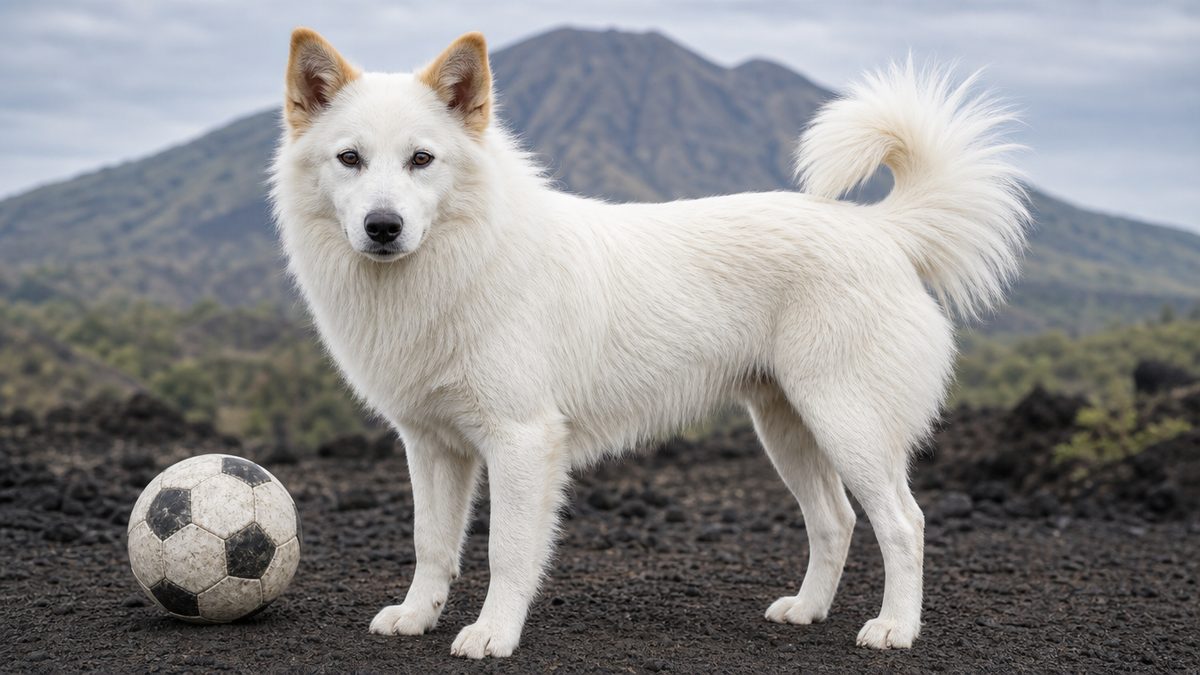
The standard describes a well balanced dog with a rectangular body and a level topline, a wedge-shaped head with a moderate stop, pricked ears and a sickle tail, carrying a double coat with a harsh outer coat of medium length on the body and shorter on the face. Length of body to height at withers is 11 to 10, so the dog is longer than it is tall. Depth of chest is half the height at withers, and length of head is a quarter of body length.
Two Balinese words the standard keeps in Balinese
The coat section is where this standard stops sounding like a translation and starts sounding like the people who wrote it. It defines a double coat with a relatively short soft undercoat and a harsh medium-length outer coat along the sides, then adds: "The neck and withers are surrounded with long harsh outer-coat... The longer length outer coat around the neck is called BADONG, and forms a ruff around the neck. The longer coat at withers which extend around the back is called BULU GUMBA", noting that both are more visible on males than females.
Those two words are the breed's identity. A Kintamani without a badong is a village dog with pricked ears, and the ruff is the single feature that separates a show-quality dog from the 800,000 free-roaming dogs it is otherwise nearly identical to.
| Field | What the standard says |
|---|---|
| Origin | Republic of Indonesia. Sukawana Village, Kintamani District, Bangli Regency, Bali |
| Utilisation | Companion dog |
| Classification | Group 5 Spitz and primitive type, Section 5 Asian Spitz and related breeds, without working trial |
| Height at withers | Males 49-57 cm, preferred 53 cm. Females 44-52 cm, preferred 48 cm |
| Weight | Males 15-18 kg, females 13-16 kg (this standard does state a weight) |
| Proportions | Body length to height 11:10, so longer than tall |
| Coat | Double, with the neck ruff BADONG and the withers coat BULU GUMBA |
| Colour | White, black, fawn, and brindle |
| Tail | Set low on the centre of croup, full feathered, curved upward moderately |
| Temperament | "Watchful, intelligent, alert, gentle, loyal and easy to train" |
The disqualifying faults, and the two an Indian buyer should check first
Seven things put a dog outside this breed: aggressive or overly shy temperament, any dog clearly showing physical or behavioural abnormalities, an overshot or undershot bite, a thin coat on the tail, ears not erect at 12 months and older, unpigmented eyelids, and any colour the standard does not list.
The ear clause is the useful one, because it comes with a deadline the standard states outright: "Full erected ears is a must after 12 months of age." A twelve-week puppy with soft ears is normal. A fourteen-month dog with soft ears is outside the standard, permanently. And the tail-coat clause matters because it is the fastest visual test there is: a Kintamani's tail should look plumed, not whippy.
One more thing worth saying plainly. The standard is young, written by a national breed club rather than by a century-old European federation, and it shows: it prints "vulcanos", "demorphism", "well layed back" and "Moderated angulated";. None of that affects what it requires. It is worth noticing only because it is a reminder that this document was written in 2018 by people formalising a living population, not inherited from a nineteenth-century studbook.
The Kintamani is a 53 cm, 15 to 18 kg white village dog from one Balinese highland village, with a thick neck ruff, erect round-tipped ears, a low-set plumed tail carried over the back, and a breed standard that is eight years old. If a seller describes it as a large dog, a Malamute cross, or a rare import with a long pedigree, they are describing something else.
Breed or landrace: the genetics settle it, and the answer is both
The Kintamani is a landrace by descent and a breed by paperwork, and the gap between the two is measurable: it differs from Bali's free-roaming street dogs at three of thirty-one genetic markers.
This is the question the breed actually poses and no ranking page answers. Bonbeno separates a breed from a type by a simple test used across this site: a breed has a written standard and a studbook, so a puppy can be checked against a document, while a type or landrace is a description that many different dogs satisfy at once. By that test the Kintamani is a breed. It has FCI-Standard 362 and an FCI-logo pedigree.
The genetics say the test is passing on a technicality.
Three loci out of thirty-one
Puja, Irion, Schaffer and Pedersen analysed 31 highly polymorphic short tandem repeat markers across Kintamani dogs, Bali street dogs, Australian dingoes and nine AKC-recognised breeds of Asian or European origin. Their finding is one sentence and it is decisive: "The Kintamani dog was identical to the Bali street dog at all but three loci."; They conclude that "the Kintamani dog has evolved from Balinese feral dogs with little loss of genetic diversity".
Read that carefully, because it cuts both ways. A conventional breed is defined by what it has lost: a closed studbook, a founder bottleneck, reduced heterozygosity. The Kintamani has not been through that. It is a village dog population with a standard written around it, and the standard has so far selected for coat, ear carriage and tail set rather than for genetic isolation.
The population it came out of is enormous and unusually diverse
Irion and colleagues measured the source population in the same year. "Approximately 800,000 primarily feral dogs live on the small island of Bali." Forty randomly collected samples around Denpasar, tested on the same 31 microsatellites against dingoes and 28 AKC breeds, made the Bali street dog the most heterogeneous group in the study: it carried 239 of the 366 total alleles observed across every group and breed, with an observed heterozygosity of 0.692 and 13 private alleles, plus three more shared only with the dingo.
| Measure | Value | What it means |
|---|---|---|
| Loci where Kintamani differs from Bali street dog | 3 of 31 | The breed is a subset of the landrace, not a separate lineage |
| Free-roaming dogs on Bali | ~800,000 | The source population is vast |
| Alleles held by Bali street dogs | 239 of 366 | More variation than any registered breed in the study |
| Observed heterozygosity | 0.692 | High. Registered breeds sit far below this |
| Private alleles | 13 | Found nowhere else in the study |
| Closest registered breed | Chow Chow, FST 0.088 | The folklore ancestor, independently recovered |
| Bali's genetic isolation | ~12,000 years | Little European dog influence since |
The folklore turned out to be half right
Balinese folklore holds that the breed descends from a Chinese Chow Chow brought to the island around 600 years ago, and Puja's paper records that story explicitly rather than dismissing it. The microsatellite analysis then found the Bali street dog "related most closely to the Chow Chow with a FST of 0.088";, with high bootstrap support also linking it to the Australian dingo and the Akita.
That is a striking convergence and it should be stated carefully. An FST of 0.088 to the Chow Chow in a study of 28 breeds does not prove a fifteenth-century Chinese import. What it shows is that the folklore points at the right corner of the dog family tree, East Asia rather than Europe, which is more than most breed legends manage.
The largest study of this breed is in Indonesian and PubMed cannot see it
Everything above comes from English-language journals, and stopping there would understate the evidence badly. The same lead author, I Ketut Puja of Udayana University, published a far larger study in an Indonesian journal that PubMed does not index at all.
Where the 2005 Journal of Heredity paper used 31 markers, the Indonesian paper analysed 425 Kintamani dogs across 116 microsatellite loci, with DNA from cheek swabs, PCR in twelve multiplexes and detection on an automated sequencer. It found 1,128 alleles in total, ranging from 3 at locus AHT136 to 41 at FH2138, a mean polymorphic information content of 0.68, and every one of the 116 loci polymorphic.
A mean PIC of 0.68 with no monomorphic locus in 116 is a highly informative marker set on a highly variable population. It is the strongest single statement of this breed's internal diversity anywhere, and it sits in a journal an English-language search never returns.
The same paper is candid about what is still unknown, stating that although the Kintamani is believed to come from Kintamani in Bangli, "asal usulnya sampai kini belum jelas";, its origins remain unclear to this day. The FCI standard says the same thing in English: "The beginning of Kintamani-Bali Dog is still unknown";. Two documents, two languages, one honest admission that the 600-year Chow Chow story is folklore rather than history.
PubMed returns three records for "Kintamani dog". The Indonesian research index Garuda and Indonesian university journals carry studies on morphometry, genetics, aggression, geriatric skin condition and a tick-borne disease case report, none of them in PubMed Amalia AR, Suatha IK. Bonbeno reports the PubMed count as what it is, a count of the English-indexed literature, and not as the total evidence on this breed.
A third dataset says the same thing from a different angle
Runstadler, Angles and Pedersen typed the dog leucocyte antigen class II loci in Bali street dogs, dingoes and New Guinea singing dogs. They found five novel DLA-DRB1 and two novel DLA-DQB1 allele sequences, and reported that 15 to 33 percent of Bali individuals carried indeterminate alleles the typing method could not resolve at all, implying still more undescribed variation. All three groups "possessed alleles that were relatively uncommon in conventional purebreds".
Their closing warning is the one that matters for this page: that diversity "needs to be identified and maintained in the face of progressive Westernization";. Formalising a landrace into a breed is exactly the Westernization they meant, and the FCI recognition arrived thirteen years after they wrote it.
How to say this accurately
The Kintamani is not a fake breed and it is not a street dog with a certificate. It is a landrace in the early stages of becoming a breed, and 2005 is the year somebody measured how early. A buyer should understand that a Kintamani pedigree certifies conformity to a 2018 standard, not descent from an isolated ancient line, and that the dog's genuine claim to interest is the opposite of the usual one: not purity, but the unusual amount of diversity it has kept.
Almost every rare-breed page online sells scarcity. Here the science says the opposite: the Kintamani comes from one of the most genetically diverse dog populations ever sampled, holding 239 of 366 alleles and 13 found nowhere else. That is a better argument for the breed than rarity would be, and it is the argument nobody is making.
FCI 362: provisional, dated 20 February 2019, and effective before it was granted
The FCI recognised the Kintamani on a provisional basis on 20 February 2019, with its standard in force from 13 June 2018, making it the first Indonesian breed ever recognised internationally and still one of only twenty breeds on the provisional register.
Bonbeno read this off the FCI's own provisional register rather than from a breed page, and read the raw table rather than a summary.
The entry is `ANJING KINTAMANI-BALI (362) (KINTAMANI-BALI DOG)`, with a date of provisional recognition of 2/20/2019 and a date of entry into force of 6/13/2018.
The dates are M/D/YYYY, and the table proves its own format
This matters because reading those two dates as day-first gives 20 February and 6 December, and one of those is wrong. The table settles it without any knowledge of FCI house style. Look down the same column and you find rows reading 9/17/2024, 6/21/2022, 2/26/2020, 4/29/2019 and 3/30/2022. Seventeen, twenty-one, twenty-six, twenty-nine and thirty cannot be months. The first field is the month, so the format is M/D/YYYY across the whole table.
The Kintamani's dates therefore read 20 February 2019 and 13 June 2018.
An independent source confirms the first of those exactly. The Jakarta Post, reporting the recognition from Denpasar on 14 April 2019, states that the FCI recognition letter "was officially submitted by the Belgium-based organization on Feb. 20, signed by its executive director Yves De Clercq". A newspaper in the breed's own country, writing eight weeks after the event, gives the same day the register does. And the second date is confirmed by the standard itself, whose front matter reads "DATE OF PUBLICATION OF THE OFFICIAL VALID STANDARD: 13.06.2018".
Why the effective date is earlier than the recognition date
That inversion looks like an error and is not. The "date en vigueur" column records when the standard took effect, and the recognition column records when the FCI granted the breed provisional status. The FCI adopted the standard document in June 2018 and granted the breed its status eight months later. The same pattern appears on other rows: the Bohemian Shepherd Dog and the Prague Ratter both show recognition on 4/29/2019 against an effective date of 2/20/2019, which is the Kintamani's own recognition day and evidently a batch date.
What provisional actually costs a dog
The register spells this out and it is worth quoting, because "FCI recognised" is sold to buyers as a single undifferentiated status. Provisional breeds "are not eligible for the CACIB until they are recognised on a definitive basis, but are eligible for the FCI titles (Winner of the World Dog Show, Winner of the Section Shows)", and "the pedigrees issued to the dogs of these breeds have to carry the FCI logo".
| Provisional (Kintamani, 362) | Definitive (Kishu, 318) | |
|---|---|---|
| Standard published by the FCI | Yes | Yes |
| Pedigree carries the FCI logo | Yes | Yes |
| Eligible for FCI titles | Yes | Yes |
| Eligible for the CACIB | No | Yes |
| Number of breeds at this tier | 20 when read | Several hundred |
So a Kintamani can be shown internationally and can win an FCI title, and cannot compete for the international beauty championship. That is a real restriction and it is the honest answer to "is it FCI recognised": yes, on the lower of the two tiers, and the breed has sat there for seven years.
The Indonesian side of the recognition
The proposal came from the Indonesia Kennel Klub, the FCI member for Indonesia, whose chairman Benny Kwok Wie Sioe told journalists that the Kintamani was the first Indonesian dog breed to be recognised internationally and that the IKK had proposed it years earlier. He handed the FCI letter to Bali Governor I Wayan Koster, who framed it as recognition that "Bali has high-quality native dog breeds".
Below the national level, the Bangli Regency authority runs an annual Kintamani Dog Exhibition and Contest, guides breeders and sets rules on breed standards. So there are three layers here: a regency government, a national kennel club, and the FCI, and the regency layer is the one that has been operating longest. The FCI standard itself credits the first Bali dog show to 1985, run by the Kintamani-Bali Dog Club with the Veterinary Medicine Study Program of Udayana University. Recognition took thirty-four years from that first show.
Indonesia recognised it five years before the FCI did, and in law
The FCI date is the one every page quotes, and it is the later of the two. Indonesia's own recognition came first, it came from a ministry rather than a kennel club, and it is written into binding law.
Keputusan Menteri Pertanian Republik Indonesia Nomor 581/Kpts/SR.120/4/2014 tentang Penetapan Rumpun Anjing Kintamani, the Minister of Agriculture's decree establishing the Kintamani as a recognised dog *rumpun*, dates from 2014. Bonbeno did not take that from a news report: it is recited in the opening of a certified copy of a Bangli regency by-law obtained from the Indonesian government's own legal database and extracted with pypdf.
That by-law is the second layer. Peraturan Daerah Kabupaten Bangli Nomor 2 Tahun 2010, amended by Nomor 4 Tahun 2015, establishes a *Kawasan Pelestarian Pemurnian Anjing Kintamani Bali*, a legally designated conservation and purification area for the breed. Pasal 2(1) names the villages it covers: Desa Sukawana, Desa Pinggan and Desa Siakin, in Kecamatan Kintamani, Kabupaten Bangli.
Note the discrepancy, because it is the kind that matters. The FCI standard gives the origin as one village, Sukawana. Indonesian law protects three. The international document has narrowed the breed's home to a third of what the home country's own instrument defines.
| Instrument | Level | Date | What it does |
|---|---|---|---|
| Perda Kabupaten Bangli No. 2/2010 | Regency | 2010 | Creates the conservation and purification area |
| Kepmentan 581/Kpts/SR.120/4/2014 | National | 2014 | Establishes the Kintamani as a recognised dog rumpun |
| Perda Kabupaten Bangli No. 4/2015 | Regency | 2015 | Amends the 2010 by-law to match the ministerial decree |
| FCI Standard 362, provisional | International | 2019 | Provisional recognition, no CACIB eligibility |
The Indonesian definition and the FCI definition are not the same dog
Reading the two primary documents side by side produces three disagreements, and Bonbeno publishes them rather than treating the FCI text as authoritative over the country the breed comes from.
| Perda Bangli 4/2015 | FCI Standard 362 | |
|---|---|---|
| Purpose of the dog | "jenis anjing penjaga", a guard dog type | "Companion dog" |
| Colours | putih, hitam dan coklat (white, black, brown) | White, black, fawn and brindle |
| Temperament | waspada dan mudah curiga, watchful and easily suspicious | gentle, loyal, easy to train |
| Home area | Three villages: Sukawana, Pinggan, Siakin | One village: Sukawana |
| Legal category | ternak, livestock, under the Ministry of Agriculture | A breed under a cynological federation |
The guard-dog line is the most consequential for a buyer. An Indian reader who takes "companion dog" from the FCI page and plans accordingly is planning for a different animal from the one Indonesian law describes, and this page's temperament section shows that the Indonesian description is the one the behavioural evidence supports.
One small pleasure from the same document. The Perda gives the neck coat as "bulu badong atau bulu suri", adding a synonym the FCI standard does not carry, and describes the tail as "berbulu terurai seperti ekor tupai";, flowing like a squirrel's tail. That is a better description of the feature than anything in the international standard.
The translation check, which this standard passes
Bonbeno extracted the French text of Standard 362 as well and compared it line by line against the English, specifically because it found a genuine discrepancy doing exactly this on FCI Standard 318, where the English prints a one-sided height tolerance and the French a symmetric one.
There is no drift here. The French gives "Mâles 49-57 cm. Hauteur conseillée : 53 cm" and "Poids : Mâles 15-18 kg", matching the English exactly, with the colour list "Blanc, noir, fauve, bringé" and the temperament "Attentif, intelligent, vigilant, doux, loyal et facile à dresser";. Even the Balinese coat terms survive: BADONG "forme une collerette" and BULU GUMBA is carried untranslated.
That is a negative finding and it is worth publishing, because a site that only reports the checks that fail is not running checks, it is collecting anecdotes. The one thing that does change across languages is the breed's name: the FCI's French title inverts it to CHIEN DE BALI - KINTAMANI.
What about the Kennel Club of India
Bonbeno cannot answer the KCI question from the KCI and says so rather than guessing. The Kennel Club of India publishes no breed list for any breed, so a query returns nothing for the Kintamani and nothing for a control breed either. A search that fails identically for every input is a broken instrument, not a finding.
The checkable route is indirect. India is a full FCI member represented by the Kennel Club of India, Chennai, so the KCI issues pedigrees against FCI nomenclature, and the Kintamani sits inside that nomenclature on the provisional tier. At least one other FCI member registers the breed directly: the Finnish Kennel Club's KoiraNet lists Kintamani-Bali Dog as a distinct Group 5 breed alongside the Kai, Kishu, Shiba and Taiwan Dog.
Bonbeno requested `fci.be/en/nomenclature/2-Spitz-and-primitive-types-5.html` while looking for the Group 5 list and received HTTP 200 with a complete, correct page for Group 2, the Pinschers and Molossoids, listing the Dobermann and the Tibetan Mastiff and no spitz at all. The leading number decides the document. Find the breed in the FCI's own index and read the name printed on the returned page before taking a figure off it.
Kintamani dog price in India: the one Indian page shows its own conversion
There is no verifiable Kintamani dog price in India, and the single Indian page quoting one prints the dollar figure it converted from, ₹50,000 to ₹1,50,000 given as "approximately $670 to $2,000", which divides at 74.63 and 75.00.
Say the negative first and then evidence it. A search restricted to India for the target term returned, in order: one Indian breed-content page, a paperback book on Amazon India, an American breed database, English Wikipedia, a stock-photo library, a Pinterest board, an Indonesian newspaper, an Etsy art print, a Facebook post from an adopt-Bali-pets group, and an American pet-care site.
Count what that leaves. A book at ₹1,195. Stock photography. A Pinterest board. A personalised art print at ₹744. One Indian page about the living animal, and it offers no listing, no breeder name and no dog, only a telephone number under a heading that reads "Kintamani Dog Puppies For Sale In India".
That absence is earned rather than assumed. The control query "labrador retriever puppy price in india", run on the same instrument in the same session, returned ten genuine Indian Labrador pricing pages including a marketplace with a city-by-city rupee table. The search worked.
The division test, which for once needs no arithmetic
Usually Bonbeno has to test whether an Indian rupee band is a converted dollar figure. Here the page does the work itself. It states: "On average, Kintamani dog price in India can range from Rs 50,000 to Rs 1,50,000 or more (approximately $670 to $2,000 or more)".
| Rupee figure | Dollar figure the page prints | Implied rate |
|---|---|---|
| ₹50,000 | $670 | 74.63 |
| ₹1,50,000 | $2,000 | 75.00 |
Both quotients land within half a point of 75, and 74 is a rate this site has repeatedly caught in use across Indian breed-price content. So the rupee band is not an Indian observation converted for readers' convenience. It is a dollar band converted into rupees, and the page never claims otherwise because it never claims to have seen a Kintamani in India.
Note also where that ₹50,000 to ₹1,50,000 band has appeared before. It is the identical band a different Indian site prints for the Kishu, an unrelated Japanese breed with no Indian market either. A range that shows up unchanged on two unrelated unavailable breeds is a house price point, not a market rate.
What the dog actually costs in Bali
This is the comparison no Indian page makes, and it is available in an Indonesian newspaper on the same results page.
Reporting the FCI recognition in April 2019, The Jakarta Post quoted Benny Kwok Wie Sioe, chairman of the Indonesia Kennel Klub, on what a Kintamani sells for at home: "Now, it is sold at around Rp 200,000 (US$14.20) or Rp 300,000." The dollar conversion is the paper's own. For context the article adds that a recognised breed with good lineage and a certificate, like a Golden Retriever, "can fetch Rp 5 million for a male pup and Rp 3 million for a female pup", and that Benny cited one exceptional case of a well-treated Kintamani selling for Rp 20 million.
| Source | Figure | What it describes |
|---|---|---|
| The Jakarta Post, quoting the IKK chairman | US$14.20 | A Kintamani sold in Bali in 2019 |
| The Jakarta Post | Rp 5 million | What a *Golden Retriever* pedigree fetches, cited as the aspiration |
| The Indian page's own conversion | $670 to $2,000 | What it claims a Kintamani costs in India |
Set the first and third side by side and the Indian claim is between 47 and 141 times the price the breed's own national kennel club chairman gave for it in its home country. Bonbeno makes that comparison in dollars because both sources printed dollars themselves; converting the Rupiah figure into rupees here would be manufacturing exactly the kind of number this page exists to warn about.
The honest reading is not that Indian sellers are overcharging, because there are no Indian sellers. It is that a content page took an American price band, divided it by 75, and published the result under an Indian headline.
What else that page gets wrong
The same page is worth checking against the standard, because its errors are the kind a buyer would act on. It calls the breed "medium to large-sized" with "a square-shaped body", when FCI 362 specifies a rectangular body at 11 to 10 and a 15 to 18 kg male. It says "the most common coat colors are white, cream, or a combination of these shades", when the standard permits white, black, fawn and brindle and disqualifies "any other colour not mentioned in this standard". It says the tail is "carried high", when the standard says "Set in low, on the center of croup";.
It also lists "certifications for hip dysplasia, eye conditions, and other health screenings" among the factors that raise the price of a Kintamani. No such scheme exists for this breed anywhere: it holds no OFA breed code at all.
DGFT Trade Notice 22/2022-23 states that applications for trading or breeding purposes shall be duly rejected, and the breed's own kennel club put its home price at about US$14.20 in 2019. Nothing can be lawfully imported to sell, and nothing about the source price would support an import trade if it could. The Kintamani is not expensive in India and it is not cheap in India. It is unavailable in India.
Heat tolerance: the satellite reports a 1,717 metre volcano as a 74 metre plain
A Kintamani is a highland dog, not a tropical lowland one, and the reason almost everybody gets this wrong is that the satellite climate record for its homeland is off by about 1,426 metres.
Heat tolerance is the one figure on a breed page that decides whether an Indian buyer should proceed, and this breed produces the most dramatic measurement error Bonbeno has recorded.
Bonbeno queried NASA POWER by explicit latitude and longitude, echoing back both the coordinates and the grid elevation returned, and queried three separate points in the Kintamani homeland: the town itself, Sukawana village which the standard names as the breed's origin, and the summit of Mount Batur, the volcano the caldera is built around.
All three returned a byte-identical series and an identical cell elevation of 74.30 metres.
| Place | Coordinates | Real elevation | Cell elevation | Error |
|---|---|---|---|---|
| Kintamani town | 8.250S 115.350E | ~1,500 m | 74.30 m | -1,426 m |
| Sukawana village | 8.233S 115.330E | ~1,400 m | 74.30 m | -1,326 m |
| Mount Batur summit | 8.242S 115.375E | 1,717 m | 74.30 m | -1,643 m |
Two tells fire at once here, and the playbook this site works from names both. The identical results for different places mean one cell was queried three times, so nothing in that series can distinguish the caldera rim from the volcano. And the impossible elevation is decisive on its own: a 74 metre reading for a 1,717 metre stratovolcano is not a small terrain smoothing error, it is the satellite model describing sea-level Bali and attaching the label to the highlands.
What happens if you believe the uncorrected figure
This is why it matters rather than being a technical footnote. Uncorrected, the cell reports an annual mean of 27.51 C for Kintamani, an hottest-month mean maximum of 31.47 C and a coldest-month mean of 26.44 C. Chennai's annual mean is 27.95 C.
Taken at face value, that says the Kintamani comes from a place 0.44 degrees cooler than Chennai and is therefore an almost perfect fit for the Indian plains. That conclusion is wrong, and any site building a heat rating from satellite data without an elevation check would publish it.
The corrected figure, published as an estimate
Correct for the 1,426 metre error at the standard atmospheric lapse rate of roughly 6.5 C per 1,000 metres and Kintamani's real annual mean comes out near 18.2 C rather than 27.51 C. Bonbeno publishes that as an estimate and never as a measurement.
Two independent things say the correction is right rather than convenient. First, Kintamani is locally famous for being cold: it is a coffee-growing highland where Balinese and visitors go for the chill, and English Wikipedia records that "breeders often confine the dogs to colder, dark caves near the Kintamani volcano, insisting it an essential step in developing the thick white coat";. A 27.5 C homeland does not produce that folklore.
Second, the same correction works in reverse on the lowland cell. Denpasar's cell came back at 313.73 m against a city near 4 m, so it is 310 metres too high, and correcting downward gives about 27.1 C against the raw 25.08 C, which is much closer to Denpasar's real climate. The method is not being tuned to get an answer; it fixes both cells in the directions their elevation errors predict.
A third check confirms the instrument rather than the place. Bonbeno ran an Indian hill control in the same session: Ooty came back at 784.64 m against a town near 2,240 m, an error of 1,455 m, reproducing a known figure exactly. POWER fails in mountains, in India and in Bali alike, and the Indian plains cells in the same run were all within about 80 metres.
The comparison, once corrected
| Place | Annual mean | Coldest month | Hottest month max | Humidity |
|---|---|---|---|---|
| Kintamani, corrected estimate | ~18.2 C | ~17 C est. | ~22 C est. | 77.85% |
| Kintamani, raw cell (do not use) | 27.51 C | 26.44 C | 31.47 C | 77.85% |
| Denpasar, Bali lowland | 25.08 C | 23.45 C | 34.49 C | 83.36% |
| Chennai | 27.95 C | 24.09 C | 42.70 C | 72.39% |
| Kochi | 27.31 C | 25.91 C | 37.58 C | 78.83% |
| Mumbai | 26.77 C | 23.19 C | 44.91 C | 67.39% |
| Delhi | 25.60 C | 13.61 C | 48.79 C | 45.56% |
| Pune | 23.86 C | 19.62 C | 43.20 C | 66.80% |
| Bengaluru | 23.74 C | 20.22 C | 40.38 C | 67.94% |
On the corrected figure the homeland is roughly ten degrees cooler than Chennai year round, and about 5.5 degrees cooler than Bengaluru, which is the closest Indian large city. The Kintamani is a cool-highland dog with a double coat, and the raw satellite figure hides that completely.
Indonesian researchers have already run the highland-against-lowland comparison
There is one study that bears directly on whether these dogs can move down off the mountain, and it is Indonesian.
Amalia, Suatha and Suartini measured 32 Kintamani aged 6 to 18 months, grouped by sex, age band, and whether they were kept in highland Kabupaten Bangli or in lowland Kota Denpasar, taking eight measurements each: body length, hind and front leg height, head length, nasale length, hip width, distance between the eye corners and chest girth, analysed by ANOVA.
The result is a clean negative. Morphometry did not differ significantly between the Bangli and Denpasar dogs (P>0.05). The only significant differences anywhere in the study were between males and females, on head length and body length.
Read that carefully, because it is easy to over-claim in either direction. It says that Kintamani raised at sea level in Denpasar grow to the same shape and size as those raised at 1,500 m, so the breed is not physically stunted or altered by a lowland tropical climate in its first eighteen months. It does not say the dogs are comfortable there, and it measured no welfare, behavioural or thermoregulatory outcome at all.
What it does establish is that the breed already lives at sea level in its own country in sufficient numbers to sample 32 of them, which is more than can be said for any Indian city. Denpasar's cell, corrected for its own 310 m elevation error, sits near 27 C, which is close to Chennai. So the honest position is that a Kintamani can live in tropical lowland conditions, that Balinese owners already do this, and that the homeland the coat evolved in is still the cool caldera.
Humidity is the half that does transfer
Bali is wet, and this the cell gets right because humidity does not vary with elevation the way temperature does. Kintamani returns 77.85 percent annual relative humidity and Denpasar 83.36 percent, against Chennai's 72.39, Kochi's 78.83 and Mumbai's 67.39. So a Kintamani is not a dry-climate dog meeting humidity for the first time. It is a humid-climate dog meeting heat, and it is genuinely hardy in wet conditions.
That points at a specific Indian shortlist. Bengaluru and Pune, at 23.7 and 23.9 C with two-thirds humidity, are the closest available match and are still five to six degrees warm. Kochi matches the humidity almost exactly and is nine degrees too warm. Delhi is the worst fit in the table despite a lower annual mean, because its 45 percent humidity and 48.79 C summer maximum are nothing this dog's ancestors ever met.
What the heat-illness literature lets us borrow
Two large United Kingdom studies are the best evidence available and neither includes this breed, so Bonbeno takes only what transfers. Hall and colleagues, in *Scientific Reports* on 905,543 dogs, found bodyweight at or above the breed and sex mean carried odds of 1.42 (1.12 to 1.80) for heat-related illness, and dogs over 50 kg carried odds of 3.42 (1.54 to 7.57). The companion paper in *Animals*, same cohort, different case definition, gave 1.30 (1.09 to 1.55) and 2.21 (1.02 to 4.79) for exertional illness.
Both sets are right and neither corrects the other. A 15 to 18 kg Kintamani sits nowhere near the over-50 kg band, so the biggest multiplier does not apply. Keeping the dog lean does.
Of the 879 UK heat-related illness events with a trigger recorded, 652, or 74.2 percent, were exertional. Combine that with a satellite record that makes a 1,500 m highland breed look sea-level tropical, and the failure mode writes itself: an owner concludes the dog is heat-adapted, walks it at midday in Chennai, and is wrong by about ten degrees of homeland climate. Echo the elevation back on every climate query, and check it against the town.
What a dog this size actually costs to keep in India, whatever the breed
Budget ₹5,100 to ₹9,000 a month to keep a medium dog in India before boarding or illness, which is roughly ₹61,000 to ₹1,08,000 a year, and treat that as the real number in this decision because the purchase price is fiction.
There is no Kintamani price in India, but there is an Indian cost of ownership and it is real, published and checkable. A 15 to 18 kg dog eats, is vaccinated, is dewormed and is groomed at Indian rates whatever its passport says.
Supertails publishes a size-banded monthly table for 2026. For a medium breed, the band a Kintamani sits in on the standard's own weights, it gives food at ₹2,500 to ₹4,000, routine vet visits at ₹800 to ₹1,500, vaccinations at ₹1,500 a year, grooming at ₹800 to ₹1,500, training over six months at ₹2,000 to ₹5,000, and treats and toys at ₹500 to ₹1,000.
| Item | Low | High | Note |
|---|---|---|---|
| Food | ₹2,500 | ₹4,000 | Dry or wet, medium band |
| Routine veterinary | ₹800 | ₹1,500 | Consultations, not treatment |
| Vaccination | ₹125 | ₹125 | ₹1,500 a year over 12 months |
| Grooming | ₹800 | ₹1,500 | Higher for a double coat in a humid city |
| Training | ₹333 | ₹833 | ₹2,000-₹5,000 over six months |
| Treats and toys | ₹500 | ₹1,000 | |
| Monthly total | ₹5,058 | ₹8,958 | Before boarding, illness or emergency |
The source contradicts itself three times, so use the itemised table
The same page gives three incompatible answers to one question. In one place: "Monthly upkeep costs ₹3,000-₹18,000 depending on breed size and grooming needs". In another: "The average monthly maintenance cost of a dog in India varies between ₹3,000 and ₹11,000". In a third, an annual figure of "₹30,000 to ₹1,00,000", which is ₹2,500 to ₹8,333 a month.
₹3,000 to ₹18,000 a month is ₹36,000 to ₹2,16,000 a year, against the same page's own ₹30,000 to ₹1,00,000. Bonbeno prints the disagreement rather than picking the convenient figure, and works from the itemised medium-breed table because it is the only number on the page built from components a reader can check line by line.
The costs specific to this dog
- A cooled room or air conditioning. A double-coated dog from a homeland near 18 C needs somewhere genuinely cool in an Indian summer, and that is an electricity bill rather than a pet bill.
- Secure outdoor access. The evidence on this breed says confinement makes behaviour worse, so a fenced terrace, yard or run is not a luxury here, it is the mitigation.
- Year-round tick and flea control. India has no winter break in the parasite cycle, so this is twelve months of spend.
- Coat drying equipment. A dense undercoat will not air dry at Indian monsoon humidity, and a forced-air dryer is cheaper than repeated skin treatment.
- An eye examination and a baseline blood panel. No breed screening scheme exists for the Kintamani anywhere, so the sensible substitute is a general baseline you can compare against later.
What the ranking page leaves out
The top Indian result devotes six subheadings to factors that raise the purchase price of a Kintamani, including breeder reputation, lineage and pedigree, health clearances, age and sex, location and demand, and training and show potential. It gives no monthly cost figure at all.
That is the wrong way round for a reader in India. The purchase price of this breed is unverifiable and the monthly cost is knowable, so the knowable one deserves the six subheadings.
Plan on ₹5,100 to ₹9,000 a month for a medium dog kept properly in an Indian city, or roughly ₹61,000 to ₹1,08,000 a year, with the first year higher for the puppy vaccination course and equipment. Over a ten-year life that is between ₹6 lakh and ₹10.8 lakh, which dwarfs any purchase price anyone will quote you for this breed, real or invented.
Temperament: the standard says gentle, the encyclopedia says aggressively territorial
The Kintamani's two main sources describe two different dogs, and rather than average them this page reports both, because the disagreement is real and an Indian buyer needs to know which conditions produce which dog.
FCI-Standard 362 gives the temperament in seven words: "Watchful, intelligent, alert, gentle, loyal and easy to train." Aggressive or overly shy dogs are a disqualifying fault.
English Wikipedia gives a different picture. "A fiercely independent breed, Kintamanis can be aggressively territorial while at the same time tender and affectionate with their own families." It adds that they climb, spending parts of the day "seated or sleeping atop a garden wall", and "will alert or bark when confronted with an unfamiliar sound or sight".
Both are describing a village dog and neither is wrong. A dog that lives loose around a compound is gentle with the household and hostile to intruders, and those are the same trait viewed from inside and outside the gate. What a buyer needs is not an average of the two but the conditions under which each appears, and for once there is a study.
Indonesian law breaks the tie, and it sides with the encyclopedia
There is a third description and almost nobody reads it, because it is in Indonesian and sits in a regency by-law. Peraturan Daerah Kabupaten Bangli 4/2015 sets out the breed's official characteristics for the conservation area, and on temperament it gives: "anjing pemberani yang tangkas, pandai dan mudah dilatih, memiliki sifat waspada dan mudah curiga", a brave and agile dog, clever and easy to train, watchful and easily suspicious.
The same instrument classifies the breed's general appearance as "jenis anjing penjaga";, a guard dog type, where the FCI standard gives the utilisation as companion dog.
So of three descriptions, two independently say guarding and suspicion and one says gentle companion, and the two that agree are the encyclopedia and the breed's own home-country legislation. Bonbeno takes the Indonesian text as the better guide to what an owner will actually live with, and reads the FCI's "gentle" as describing how the dog is with its own household, which the Indonesian text does not contradict.
The finding that should decide an Indian purchase
Corrieri, Adda, Miklósi and Kubinyi took advantage of an unusual natural experiment. On Bali a large expatriate community adopts local dogs and keeps them confined to houses and backyards in the modern Western way, while the rest of the population lives free-ranging. That allows a direct comparison of the same dogs under two lifestyles.
The result runs against intuition. "Free-ranging Bali dogs were rated as less active, less excitable, less aggressive towards animals, and less inclined to chase animals or humans than Bali dogs living as human companions."; The authors conclude that "a change in lifestyle, i.e. being adopted, and living in a confined environment has negative consequences on some canine personality traits, such as activity/excitability, aggression towards animals, and prey drive".
| Trait | Free-ranging | Kept as a confined companion |
|---|---|---|
| Activity | Lower | Higher |
| Excitability | Lower | Higher |
| Aggression towards animals | Lower | Higher |
| Inclination to chase animals or humans | Lower | Higher |
| Fearfulness of people (females, whole sample) | Higher in females across both groups | Higher in females across both groups |
Read that beside the two temperament descriptions and they stop conflicting. The standard's gentle dog and the encyclopedia's aggressively territorial dog may be the same animal under different housing, and the study says which housing produces which.
State the limits honestly. This is a preliminary study using owner-rated personality scales, on Bali dogs generally rather than on registered Kintamani specifically, and it shows association rather than causation: it is possible that people who confine dogs also rate them harshly. It is nonetheless the only direct evidence anyone has, and it points the opposite way from the assumption an Indian apartment buyer would make.
Who should not buy this breed
- Anyone in a flat with no secure outdoor access. This is the central point of this section and it rests on evidence rather than on preference.
- Households with cats, poultry or small dogs, given a chase inclination that confinement appears to raise rather than lower.
- Anyone who wants a dog that greets visitors warmly. Territorial alerting is what this dog was shaped by village life to do.
- First-time owners who expect the standard's "easy to train" to mean easy to live with. It means the dog learns quickly, not that it defers.
- Anyone planning to leave it alone all day. A dog that historically roamed an entire caldera does not do well shut in for nine hours.
Who this breed genuinely suits
A ground-floor home or an independent house with a securely fenced yard or terrace, in Bengaluru or Pune rather than Chennai, with somebody around for much of the day and no small pets. Give a Kintamani a high place to sit and watch its territory from and you have given it most of what it wants; the wall or the terrace parapet is not a behaviour problem, it is the breed doing its job.
With most working breeds the advice is to give the dog a job. With a Bali village dog the evidence says something different: give it space and freedom of movement, because confinement is what the one available study associates with more excitability, more aggression to animals and more chasing. That makes a fenced yard the single most important thing on the buying checklist, ahead of anything about pedigree.
Training a dog the standard calls easy to train, and the encyclopedia calls fiercely independent
Train recall, a settle and calm acceptance of strangers first, and lean on the fact that this breed's own standard rates it easy to train, which is a rarer compliment in FCI prose than it looks.
The standard's phrase is worth pausing on. FCI temperament lines are usually terse and hedged. Standard 362 says "Watchful, intelligent, alert, gentle, loyal and easy to train", which is the warmest trainability language in Group 5 Section 5. The Kishu's standard, by comparison, says only faithful, docile and very alert.
That is a real signal, but read it as village-dog trainability. A dog that has lived among people for three thousand years without being selected for a working task is socially fluent and food-motivated, and it is not biddable in the way a retriever bred for a century of handler focus is.
The four things to train, in order
- Recall to reflex, inside a fence. Chase inclination is the trait the one available study links to confinement, so build recall early and maintain it rather than assuming a calm puppy stays calm.
- Calm acceptance of people at a threshold. A territorial alerter needs a trained routine for the doorbell, the delivery rider and the building guard, or it will invent one.
- A settle on a mat, away from the window. A dog that watches its territory from a high point will do that all day in an Indian flat unless given an off switch.
- Handling for grooming and veterinary work. A thick double coat and no established breed health scheme means routine hands-on checks matter more here, not less.
Realistic timelines for an Indian household
| By | What should be solid | What will not be |
|---|---|---|
| 8 weeks | Name response, crate as a safe place | Nothing else |
| 16 weeks | House training, lead acceptance, handling | Calm with strangers at the door |
| 6 months | Recall inside a fence, settle on a mat | Recall around street cats |
| 12 months | Doorbell routine, lead manners, ears fully erect | Off-lead reliability in an open Indian park |
| 24 months | A steady territorial adult that alerts and then stops | Indifference to unfamiliar dogs on its own street |
Note the twelve-month row, because it is the only breed-standard deadline on this page. The standard requires that "Full erected ears is a must after 12 months of age", and ears not erect at twelve months and older is a disqualifying fault. That is a conformation clock rather than a training one, and it is worth knowing before somebody sells you an eighteen-month dog with soft ears as a Kintamani.
What does not work
Harsh correction fails here for the reason it fails with any territorial guarding type: it raises arousal at exactly the moments the dog is already aroused. The standard disqualifies aggressive dogs, so a Kintamani that has learned to escalate at the gate is a dog outside its own breed standard, and the fastest route there is punishing the alert bark rather than teaching what follows it.
Equally, long repetitive drills waste a village dog's attention. Short sessions, high-value food, and varying the location rather than the repetition count is what suits an animal shaped by an environment that never presented the same problem twice.
The Indian complication nobody mentions
In most Indian cities the two windows in which this dog can be safely worked, before sunrise and after dark, are the two windows in which free-roaming community dogs are most active. A territorial breed meeting unfamiliar dogs at exactly the hours you must walk it is the central training problem of owning one here, and no amount of obedience work substitutes for a fenced space to do the early work in.
Every account of this dog, from the standard's disqualification of overly shy animals to the encyclopedia's territorial description, points the same way: socialise the puppy widely and early. In India that means deliberate, calm, repeated exposure to lift lobbies, delivery riders, autorickshaws, festival noise and calm adult dogs before sixteen weeks, done at dawn in the hot season rather than skipped.
Exercise: space matters more than distance for this breed
Give a Kintamani two periods of varied outdoor time a day at cool hours plus permanent access to a secure outdoor space, because the evidence on Bali dogs says confinement rather than under-walking is what damages their behaviour.
Most breed pages convert exercise into minutes. For a village dog that framing misses the point, and here there is evidence for saying so.
The Kintamani was not selected for a task. It was selected, if that is even the word, by three thousand years of living loose around Balinese compounds and setting its own daily pattern. Wikipedia's description is of dogs that "live much of their lives out-of-doors, digging holes for shelter", with "some living in small caves among the boulders around Kintamani", and that spend parts of the day "seated or sleeping atop a garden wall";. That is not a dog that needs an hour of forced march. It is a dog that needs somewhere to be.
What the study implies for an exercise plan
Corrieri and colleagues found confined Bali dogs rated more active and more excitable than free-ranging ones, not less. Read naively that says confinement is energising, which is absurd. Read sensibly it says confinement produces a dog with nowhere to put its activity, and the owner-rated scales pick that up as excitability.
The practical translation is that the yard is the exercise and the walk is the supplement, which is the reverse of the advice for most breeds. An Indian owner who can give this dog a fenced terrace it can patrol, sun itself on and watch the street from has met more of its requirement than one who does two brisk kilometres and then shuts it in a bedroom.
The Indian timetable, worked from the temperature data
| City | Hottest month max | Morning window | Evening window | Verdict for this breed |
|---|---|---|---|---|
| Bengaluru | 40.38 C | Before 07:00 | After 19:00 | Closest Indian match, still ~5.5 C warm |
| Pune | 43.20 C | Before 07:00 | After 19:00 | Workable with a cooled room |
| Mumbai | 44.91 C | Before 06:30 | After 19:30 | Humidity matches, heat does not |
| Kochi | 37.58 C | Before 06:30 | After 19:30 | Humidity matches almost exactly, 9 C too warm |
| Chennai | 42.70 C | Before 06:30 | After 19:30 | Poor. No cool season at all |
| Delhi | 48.79 C | Before 06:00 | After 20:00 | Worst fit: dry air and extreme summer maxima |
What counts as exercise here
- Free movement in a secure space, which is the main event and not a substitute for anything.
- A raised vantage point. A terrace parapet, a low wall, a platform. This satisfies a real behavioural need rather than indulging a quirk.
- Scent work indoors during the hot hours, which converts a cooled room from a prison into an activity space.
- Varied lead walks at dawn and after dark, changing route rather than adding distance.
- Digging permitted somewhere. Both Kintamani and Bali street dogs "still whelp in burrows dug into the earth", so a sand pit is cheaper than a ruined garden.
What happens without it
An under-provisioned Kintamani does not become destructive in the chewing sense. It becomes a louder, more reactive version of itself at the boundary: more alerting, more fence patrolling, more intense responses to passing dogs and delivery riders. That is the trait cluster the Bali study associates with confinement, and once it is established in an Indian apartment building it becomes a neighbour problem rather than a training problem.
Of the 879 UK heat-related illness events that had a trigger recorded, 652, or 74.2 percent, were exertional rather than environmental or vehicular. For a dog whose corrected homeland runs near 18 C, a catch-up afternoon walk in an Indian summer is the single most dangerous thing a well-meaning owner can do. Skip the walk and do scent work in the cool room instead.
Grooming a badong in Indian humidity
Line-brush the double coat weekly and daily through a shed, dry it to the skin after every wetting, never clip it, and expect the neck ruff and a white coat to take more upkeep in India than the schedule suggests.
The standard describes the coat precisely: "Double-coat; soft under-coat is relatively short, harsh outer-coat is medium length along the sides of body. The neck and withers are surrounded with long harsh outer-coat. Full-feathered tail." The neck ruff is BADONG and the withers coat BULU GUMBA, both more pronounced on males.
Two of those features drive the whole grooming plan. The ruff is the densest area on the dog and the first place a mat forms. And the full-feathered tail is not optional: a thin coat on the tail is a disqualifying fault, which means damaging that feathering with over-bathing or clipping does visible, lasting harm.
| Task | Frequency | Why, in India specifically |
|---|---|---|
| Line-brushing to the skin | Weekly, daily during a shed | Removes the dead undercoat that traps heat and moisture |
| Extra attention to the badong | Every session | The ruff is the densest area and mats first |
| Bathing | Only when genuinely dirty | Over-bathing softens the harsh outer coat that sheds dirt on its own |
| Drying to the skin | After every bath and soaking | A dense undercoat will not air dry at 78 percent humidity |
| Ear check | Weekly | Monsoon is peak otitis season in Indian practice |
| Eye and muzzle wipe | Most days | A white coat stains where a fawn or brindle one hides it |
| Nail trim | Every 3 to 4 weeks | Indoor flooring does not wear nails down |
Never clip this coat, and there is a breed-specific reason
The general reason applies: a double coat insulates in both directions, the undercoat holds still air that slows heat gain as well as heat loss, and the harsh outer coat blocks direct sun. Clipping removes the sun barrier from a dog whose skin under a white coat is pale.
The breed-specific reason is stronger. Clip a Kintamani and you remove the badong and the tail feathering, which are the two features that distinguish it from the free-roaming Bali dogs it is otherwise genetically almost identical to. The coat regrows with altered texture in double-coated breeds, and a clipped Kintamani may never carry a correct ruff again.
Rake the dead undercoat out instead. A properly de-shedded double coat is cooler than a clipped one and it is the intervention that works.
The cave story, and what to make of it
English Wikipedia records that "breeders often confine the dogs to colder, dark caves near the Kintamani volcano, insisting it an essential step in developing the thick white coat";. Bonbeno cannot verify that practice and does not repeat it as fact, and it is worth reporting for one reason: it is folk evidence, from the breed's own home, that the coat is understood locally to be a response to cold.
That matters here because the raw satellite figure says the homeland is as warm as Chennai, and this page has shown that figure to be wrong by about 1,426 metres of elevation. A breeding folklore built on cold caves is a small independent check that the corrected 18 C estimate describes the place people actually live in.
How much does it shed
Bonbeno found no published shedding assessment for this breed from any registry, and does not invent one. What the standard supports is a double coat with a distinct undercoat, which in every comparable Asian spitz means seasonal heavy shed periods plus year-round background loss. In India the seasonal pattern is often blunted, because a dog that never experiences a true cold season may cycle less predictably.
Plan for the coat to come out in quantity twice a year and for a rake to be needed weekly in between, and adjust from what your own dog does rather than from a star rating nobody measured.
An undercoat rake, used in lines to the skin rather than skimmed over the top, with extra time spent on the ruff and behind the ears. A slicker brush alone moves the guard hairs and leaves the dead undercoat in place, and that layer is what causes heat retention and skin trouble in an Indian monsoon.
Health: no OFA code, no prevalence data, and six papers in total
Nothing is published about Kintamani health, and the absence is unusually complete: the breed holds no OFA breed code at all, appears in no orthopaedic statistics table, and has no clinical literature beyond a cryopreservation study on four dogs.
Bonbeno retrieved OFA's full published statistics dump on 31 August 2026, 5,887,106 characters, and searched it case-insensitively rather than reading it. KINTAMANI appears zero times and BALI zero times. Controls present in the same retrieval: LABRADOR 109, CHOW CHOW 40, AKITA 89, SHIBA 55, and the retrieval was verified against an independent pull by a Bergamasco row that matched to the decimal.
The breed-code list is the stronger finding. OFA's breed selector, read as raw markup, contains no Kintamani entry and no Bali entry of any kind, while the same file does list the TAIWAN DOG, the KISHU KEN, the KAI KEN and the CHOW CHOW. So this is not a list confined to common Western breeds. The Kintamani has simply never been enrolled.
The precise statement is therefore stronger than for most rare breeds. The Kishu at least holds a code and lacks a statistics row. The Kintamani has neither.
The literature is six papers and five are not about health
PubMed searches run across several name forms on 31 August 2026, with the query translation recorded for each, found nine records on the bare name Kintamani and three on "Kintamani dog" or its plural. The six extras on the bare name are Arabica coffee origin authentication, andaliman essential oils, Syzygium speciation, coffee fermentation metabolomics, a Sulawesi legume and pre-colonial Balinese irrigation, because Kintamani is a place name and a coffee region before it is a dog.
A caution on the wider search. "Bali dog" returns 347 records and "Bali dogs" 286, and both counts are worthless as literature on this breed: the translation line shows PubMed expanded bali to `"indonesia"[MeSH Terms]`, so those are papers about Indonesia. Quoting 347 as the breed's literature would be exactly the inflation this kind of rewrite produces.
| Year | Paper | What it is |
|---|---|---|
| 2005 | Irion et al., *BMC Genetics* 6:6 | Population genetics of the Bali street dog |
| 2005 | Puja et al., *J Hered* 96(7):854-9 | The Kintamani genetic profile |
| 2006 | Runstadler et al., *Tissue Antigens* 68(5):418-26 | DLA class II diversity across Bali, Australia, New Guinea |
| 2018 | Corrieri et al., *PLOS ONE* 13(6):e0197354 | Personality traits, confined against free-ranging |
| 2019 | Puja et al., *J Adv Vet Anim Res* 6(2):158-62 | The only clinical paper. Semen cryopreservation, four dogs |
| 2021 | Christopher et al., *Int Marit Health* 72(1):26-35 | Rabies knowledge survey in Songan, Kintamani district |
The one clinical study, and why it exists
Puja and colleagues froze semen from four mature Kintamani Bali dogs at Udayana University, comparing an egg yolk Tris extender against a coconut water-based extender at glycerol concentrations of 4, 6 and 8 percent. Six percent glycerol proved best on motility, and DNA fragmentation "was not influenced by the freezing procedure";.
That is a conservation paper, not a health paper, and the detail worth noticing is the author. I. K. Puja led the 2005 genetic profile that established what the breed was, and fourteen years later led the work on banking its genetics Puja IK, Sawitri NM, Maharani N. The scientific attention this breed has received is almost entirely Balinese and almost entirely about preserving the population rather than treating disease.
What a buyer should screen for anyway
With no breed data, the sensible approach is the general one plus whatever the standard's own conformation implies.
- An eye examination at twelve months and then periodically. Indian law lists entropion and ectropion among the genetic defects a breeding dog must have been tested for, and no breed-specific data exists to say this dog is exempt.
- Hips and elbows by radiograph if breeding, since no population baseline exists and somebody has to start one.
- A thyroid baseline in the first year, for the same reason: a later change is only readable against an earlier number.
- Skin, weekly and by hand. A dense ruff in Indian humidity hides early hot spots, and a white coat hides the redness that would otherwise warn you.
- Dentition. The standard faults any missing tooth except PM1 and M3, so a complete scissor bite is checkable at purchase.
Life expectancy: no figure exists, so this page prints none
The two large UK datasets that would settle it, Teng 2022 on annual life tables and McMillan 2024 on breed longevity, do not include this breed. Bonbeno found no published Indonesian survival study either. So Bonbeno publishes no life expectancy for the Kintamani rather than repeating an unsourced number, and a reader should treat any specific figure they see as invented.
The Finnish Kennel Club does hold a cause-of-death statistic set for the breed alongside hip, elbow, patella, eye examination and spondylosis data, and Bonbeno could not retrieve the tables, which are served behind a form postback. That is the one place a real figure may eventually come from.
A landrace-derived population with high heterozygosity has a genuine theoretical advantage over a heavily inbred breed, and Irion's 0.692 observed heterozygosity and 13 private alleles are real. That is a reason for optimism, not a health claim. Nobody has measured hip scores, eye disease or lifespan in this breed, and a seller who tells you it is exceptionally healthy is telling you what has not been looked at.
Rabies: the fact that shapes everything about moving this dog
Bali is rabies-endemic, and a 2019-2020 survey inside the Kintamani district found critical gaps in residents' knowledge of rabies, of prevention in dogs, and of the local rules, which is the context behind every health certificate an imported dog needs.
This section exists because no breed page mentions it and it is the single most consequential thing about a dog from Bali, both for anyone considering an import and for any Indian reader who meets one of these dogs on the island.
Christopher and colleagues surveyed 175 community members in Songan Village, Bangli District, inside the administrative area of the Public Health Centre of Kintamani V, between December 2019 and February 2020. This is not a study about Bali in general; it is a study in the district the breed is named after.
| Measure | Value |
|---|---|
| Respondents | 175 |
| Owned a dog | 53 (30.3%) |
| Hindu | 98.8% |
| Female | 56.0% |
| Working as farmers | 50.9% |
| Earning below the district minimum wage | 71.4% |
| Knowledge score (out of 10) | 6.93 ± 1.83 |
| Attitude and practice score (out of 10) | 8.04 ± 1.07 |
The authors' conclusion is direct: the study "revealed critical gaps in their fundamental knowledge of rabies, the prevention in dogs, and the local rules and regulations concerning rabies", and they call for comprehensive education, scheduled mass vaccination for dogs, and better practices under a One Health approach.
When rabies arrived, and what changed after
Bali was rabies-free until recently, and the date is precise. Utami and colleagues, reporting on a community dog-welfare and rabies project in Sanur, record that "The Indonesian island province of Bali experienced its first rabies incursion in 2008";, that mass vaccination of the dog population has proven effective, that cases in dogs and people have decreased, and that the virus is nonetheless still circulating.
The scale of the dog population that had to be reached is in the companion paper. A full census across three villages in Sanur recorded 6,009 dogs, and street surveys found a mean of 3.81 roaming dogs per kilometre of street along 28 sub-village routes.
The finding that corrects a claim this page has already made
Bonbeno has quoted Irion's description of "approximately 800,000 primarily feral dogs" on Bali, and the Sanur census complicates it usefully.
Of those 6,009 dogs counted, only 3.3 percent appeared to be unowned. Roaming and unowned are not the same thing. Bali's dogs are overwhelmingly owned dogs that are allowed to roam, which is exactly the village-dog pattern an Indian reader already recognises from Indian streets, and it is a materially different picture from a feral population.
Two other findings from that census bear directly on this page. Source of dogs, method of confinement and sterilisation status all differed between three breed types the study itself distinguishes: purebred dogs, mixed breed, and Bali dogs (native breed), so the local distinction between a registered Kintamani and a Bali dog is one people on the island are already making in practice. And three variables significantly affected the chance of a dog not being vaccinated: age, dog type, and confinement.
Two Indonesian surveys disagree, and where they disagree matters
The Sanur study reports that "knowledge of appropriate bite treatment and symptoms of rabies in dogs was good", that most people held positive attitudes towards dogs and vaccination, and that most did not agree with culling. The Songan study, in the Kintamani district, concluded the opposite: "critical gaps in their fundamental knowledge of rabies, the prevention in dogs, and the local rules and regulations";.
Bonbeno publishes the disagreement rather than averaging it, and notes the two things that most plausibly explain it. Sanur is a coastal tourist sub-district that had been the site of a sustained community intervention programme; Songan is a highland farming village where 71.4 percent of respondents earned below the district minimum wage. The better-resourced, intervened-upon area scored well and the breed's own home district scored poorly, which is the direction that matters for anyone assessing a dog originating there.
The 1926 quarantine, which is why the breed exists at all
There is a striking historical loop here. English Wikipedia records that "In 1926, a rabies-control measure banned all foreign dogs admission onto the island; thus the dogs on Bali have bred within their own unique gene pool, having been refined for nearly one-hundred years since the passing of these policies";.
So a rabies control measure is the reason Bali's dog population stayed genetically isolated long enough to be describable as a distinct thing at all, and rabies is now the reason moving those dogs is difficult. The isolation that produced Irion's 239 alleles and 13 private alleles has a public-health policy behind it.
Bonbeno notes one disagreement in passing. Wikipedia dates the arrival of Bali's dog ancestors to "around 3,000 years ago", while Irion and colleagues write of a population that existed "prior to its geographic isolation approximately 12,000 years ago";. Those are different claims about different events, the arrival of dogs against the island's separation from the mainland, and neither source reconciles them. This page reports both rather than choosing.
What this means for an Indian reader, in two directions
If you are importing. DGFT requires a Health Certificate issued by a veterinarian of the exporting country, with testing for the prescribed diseases conducted in the exporting country and all test reports accompanying the animal, plus an Advance No Objection Certificate from the AQCS seven days before travel and quarantine at the port of entry where required. Those requirements are not bureaucratic friction. For a dog originating in a rabies-endemic island they are the entire point.
If you are in Bali. India has its own substantial rabies burden, so an Indian traveller already knows the rules. Apply them: do not approach free-roaming dogs however friendly they look, treat any bite or scratch as needing immediate medical attention regardless of how minor it seems, and understand that the beautiful ruffed white dogs sitting on the walls in Kintamani are, on this survey's own numbers, mostly living in households where knowledge of rabies prevention has measurable gaps.
The Facebook result on the Indian results page
One of the ten Indian results is a post in an adopt-Bali-pets group offering two rescued Kintamani puppies found in a gutter, by somebody who had returned to Australia. That is the actual, honest picture of how these dogs move internationally: individual rescue and relocation by people already on the island, under a rabies-control regime, not a breeder pipeline.
It is also a reminder that Kintamani-type dogs in Bali are frequently street dogs in every practical sense, which the genetics already told us.
No dog should be moved from a rabies-endemic area without the full certification chain, and no Indian household should acquire a dog of unknown vaccination history from any country. This is not a Kintamani-specific caution; it is the reason India's import rules are written the way they are. Discuss rabies prophylaxis for the household with a veterinarian and a physician if you are seriously considering an import.
Indian law: what blocks a Kintamani, and what does not
No Indian law names or bans the Kintamani, and Indian law does close the only route by which a market could form, because dogs are a Restricted import and applications made for trading or breeding are rejected by rule.
Get the distinction right first. Nothing in Indian law prohibits owning a Kintamani. What Indian law does is make it impossible to lawfully import dogs in order to sell or breed them, which is different and more consequential.
DGFT Trade Notice No. 22/2022-23 of 19 December 2022 classifies dogs under ITC (HS) 01061900, "Mammals: Other", with an import policy of Restricted. Policy Condition (7) permits import of dogs only for three purposes: a pet dog with a valid pet book and records in the importer's name, dogs imported by research organisations with CPCSEA recommendation, and internal security use by Defence and Police forces. Policy Condition (8) states: "Import of commercial dogs for breeding or any other commercial activities other than the purposes mentioned above is not permitted."
Paragraph 6 puts it operationally: "any applications for trading/breeding purposes, or applications made on behalf of some another person/ entity shall be duly rejected".
The pet route, which is open
- Seven ports only. Import of pet animals is allowed through the airports and seaports of Delhi, Mumbai, Chennai, Hyderabad, Bengaluru and Kolkata and, since October 2024, Kochi airport, with quarantine at the government station of those ports where required Department of Animal Husbandry…. The full route is set out in how to import a dog to India.
- Transfer of residence. Up to two pets may enter as passenger baggage without a DGFT authorisation, but only for a person transferring residence to India after two years of continuous stay abroad.
- Anything else needs an import licence. A DGFT authorisation is required if the stay abroad was under two years, if the pet is not travelling as passenger baggage, or for a third animal.
- Health certificate and test reports. A Health Certificate from a veterinarian of the exporting country is required, with the prescribed disease testing done there and all reports accompanying the animal.
- Advance NOC, seven days ahead. From the AQCS Regional or Quarantine Officer at the port, relaxable to three days, with the whole process started at least two months before travel.
So a returning Indian resident who has lived in Indonesia for over two years and already owns a Kintamani can bring it home through Bengaluru. Nobody can lawfully import Kintamani to sell, and that is the whole explanation for why no Indian listing exists.
The 2017 Rules, which apply to anyone breeding here
Bonbeno extracted the Prevention of Cruelty to Animals (Dog Breeding and Marketing) Rules 2017 from the gazette PDF with pypdf rather than trusting a summary, because this document is routinely paraphrased into rule numbers that do not exist. The extraction runs to 14 pages and 51,953 characters with a real text layer, and the string "Rule 21" appears zero times across it.
Three provisions bear on this breed.
Second Schedule Part IV paragraph 21(1), "Outdoor housing facilities", bars keeping in outdoor facilities without the attending veterinary practitioner's written approval "(i) dogs that are not accustomed to the temperatures prevalent in the area or region in question; (ii) dog breeds that cannot tolerate the temperatures prevalent in the area or region in question, such as long-haired breeds in high temperature locations; and (iii) sick, infirm, aged or young animals". A double-coated dog from a corrected 18 C homeland, in the Indian plains, sits inside limb (i). That creates a genuine tension with this page's own advice that the breed needs outdoor space, and the resolution is the obvious one: outdoor access to shade and airflow is not the same as outdoor housing, and the clause targets the second.
Second Schedule Part III paragraph 8(10) requires that "The dogs shall have been tested for genetic defects, including hip dysplasia, progressive retinal atrophy, night blindness, hypothyroidism, entropion, ectropion, overshot, undershot jaw (when incisors do not touch or mesh), wry mouth, two or more missing teeth, unilateral cryptorchid or full cryptorchid males". Two items line up with this breed's own standard, which disqualifies an overshot or undershot bite and faults any missing tooth other than PM1 and M3.
Rule 8(1)(a) provides that "pups less than eight weeks in age are not sold", and Rule 8(1)(b) that "dogs over six months in age are not sold without first being sterilised, unless they are being sold to another licensed breeder". Anyone breeding or selling dogs in India must first register with the State Animal Welfare Board.
The heat clause is Second Schedule Part IV paragraph 21(1), not "Rule 21", which appears nowhere in the instrument. The genetic-defect clause is Second Schedule Part III paragraph 8(10), not "Rule 8(10)". The eight-week minimum genuinely is a Rule, Rule 8(1)(a). A reader who checks a citation and finds nothing stops trusting the page, so these are worth getting exactly right.
Feeding a medium village dog in India
Feed a Kintamani to body condition against a standard that does state a weight, 15 to 18 kg for males and 13 to 16 kg for females, and budget ₹2,500 to ₹4,000 a month for food at Indian medium-breed rates.
This breed is easier to feed correctly than most on this site for one reason: its standard gives a weight. FCI 362 states males 15 to 18 kg and females 13 to 16 kg. The Kishu's and Kai's standards give none at all, which leaves an owner nothing to weigh against. Here you have a target range from the recognising authority.
That matters because bodyweight relative to the breed mean is the one heat-illness risk factor that genuinely transfers to a dog this size. Hall and colleagues found dogs at or above the breed and sex mean carried odds of 1.42 (1.12 to 1.80) for heat-related illness, while the 3.42 figure belongs to dogs over 50 kg and does not apply here. A Kintamani kept at the lower half of its stated range is doing the one thing an owner can control.
Body condition, checked by hand not by eye
- Ribs. Easily felt under a thin covering, never visible at rest and never buried.
- Waist. A clear tuck behind the ribs seen from above, which is harder to see on a rectangular 11:10 dog than on a square one.
- Abdominal tuck. The standard's own "slightly tucked up" underline, visible from the side.
- Weekly hands-on check. A double coat with a heavy ruff hides two kilograms easily, and this breed carries more coat around the neck and shoulders than most.
Life-stage feeding
| Stage | Meals per day | What to watch |
|---|---|---|
| 8 to 16 weeks | 4 | Growth food, small frequent meals, never free-fed |
| 4 to 6 months | 3 | Steady growth. Do not push size on a 15-18 kg breed |
| 6 to 12 months | 2 | Adult food from about 10-12 months |
| 1 to 7 years | 2 | Appetite drops in Indian summer and that is normal |
| 7 years plus | 2 | Watch weight gain as activity falls, recheck if it climbs |
Indian availability and cost
Nothing about this breed needs a specialist diet, and Indian rates apply straightforwardly: the published medium-breed food band is ₹2,500 to ₹4,000 a month. A good Indian medium-breed dry food with a real protein first ingredient, plus a rotation of fresh protein, covers it.
Two India-specific points. Summer appetite genuinely falls in a double-coated dog, and chasing it with richer food puts on the weight that raises heat risk. And water is not a detail for a dog that wants to be outdoors: multiple bowls, refilled and repositioned into shade through the day, not one bowl by the door.
The village-dog caveat about diet history
A Kintamani in Bali is, in a great many cases, eating household scraps and rice within a compound rather than a formulated diet. That is worth knowing for one practical reason: a dog moving from that background to a rich commercial diet should transition slowly over ten to fourteen days, and a sudden switch is a predictable cause of digestive upset in an animal whose gut has never seen it.
It is not a reason to feed rice and scraps in India. It is a reason not to assume the dog's system is already adapted to what you plan to feed it.
Scatter-feed or puzzle-feed at least one meal a day outdoors in the secure space, where the dog can use its nose and move while it eats. For a breed the evidence links to worse outcomes under confinement, converting a two-minute bowl into twenty minutes of outdoor searching does more than an extra walk would.
The first year, month by month
Plan a Kintamani's first year around three deadlines: socialisation before sixteen weeks, the secure outdoor space ready before you collect the puppy, and fully erect ears by twelve months, which the breed standard treats as a disqualifying fault if missed.
This timeline assumes a puppy legally sold in India, which under Rule 8(1)(a) means one at least eight weeks old.
| Age | Focus | The India-specific part |
|---|---|---|
| Before collection | The fenced space. Not later | This is the one purchase that changes outcomes for this breed |
| 8 to 10 weeks | Settling, crate as a safe place, name response | Set up the cooled room now, not in April |
| 10 to 12 weeks | Vaccination course continuing, handling for grooming | Vaccination starts at 7-8 weeks under the 2017 Rules and usually completes by 18 weeks |
| 12 to 16 weeks | The socialisation window. Lifts, delivery riders, traffic, calm adult dogs | The highest-value month for a territorial breed, and it closes |
| 4 to 5 months | Lead work, doorbell routine, leave-it | Establish dawn and after-dark walking before the hot season |
| 5 to 6 months | Recall to reflex inside the fence | Chase inclination is developing. Do not test it in an open park |
| 6 to 7 months | Neutering discussion with your vet | Rule 8(1)(b): a dog over six months cannot lawfully be sold unsterilised except to a licensed breeder |
| 7 to 9 months | First real coat change, ruff starting to develop | The first Indian monsoon. Drying to the skin becomes non-negotiable |
| 9 to 12 months | Adolescent boundary testing at the gate | Do not escalate corrections at the fence line. Manage and redirect |
| 12 months | Ears must be fully erect | A disqualifying fault under the standard if they are not |
| 12 months | First eye examination and a baseline blood panel | Neither is on a standard Indian package. Ask for both by name |
The three deadlines, and why they are deadlines
The fence comes first. For most breeds outdoor space is a nice-to-have. Here the only direct evidence on the population says confinement is associated with more excitability, more aggression towards animals and more chasing. Buying the dog and then working out the space is the wrong order for this breed specifically.
Socialisation closes. A breed whose standard disqualifies overly shy dogs and whose owner-level description is territorial has a window, roughly three to sixteen weeks, and work done after it is remedial and slower.
The ears are a conformation clock. The standard states "Full erected ears is a must after 12 months of age" and lists ears not erect at twelve months and older among the disqualifying faults. Nothing can be done about it and it is not a training matter. It is simply the point at which an honest seller and a buyer both know what the dog is.
Two things not to do in the first year
Do not clip the puppy coat through the first Indian summer, however tempting. The adult ruff has not come in, and clipping a developing double coat is the version of this mistake with the worst long-term consequence for the badong the breed is defined by.
Do not treat the alert bark at the gate as disobedience. A territorial alerter that is punished for alerting learns to skip the warning, and a dog that goes straight from silence to action is a much harder animal to live with in an Indian residential street.
In most Indian cities the socialisation window falls partly inside the hot season, exactly when nobody wants to take a puppy outdoors. Do it at dawn, keep it short, and do it anyway. A territorial breed that misses this month becomes a fearful, reactive adult, and that is a much larger problem than a slightly rearranged vaccination schedule.
Kintamani against the dogs an Indian buyer can actually get
Every dog in this comparison except the Kintamani can be found in India today, and the closest match to what a Kintamani buyer usually wants is already living on Indian streets.
Two comparisons matter and they answer different questions. The first is where the Kintamani sits among formalised Asian spitz breeds. The second is what an Indian buyer should look at instead.
| Breed | FCI no. | Recognition tier | Weight in standard | Indian availability |
|---|---|---|---|---|
| Kintamani | 362 | Provisional, 2019 | 15-18 kg males | None found |
| Kishu | 318 | Definitive, 1982 | Not stated | None found |
| Kai | 317 | Definitive, 1982 | Not stated | None found |
| Shiba Inu | 257 | Definitive | Not stated | Real, widely sold |
| Korea Jindo Dog | 334 | Definitive | Stated | Occasional |
Two things stand out. The Kintamani is the only one of these on the provisional tier, so it cannot compete for the CACIB. And it is the only one of the three rare breeds whose standard actually states a weight, which makes it the easiest of them to buy against and to feed correctly.
The comparison that matters more: the Indian pariah dog
This is the honest recommendation and it is not a consolation prize. What a Kintamani buyer is usually attracted by is a medium, hardy, self-sufficient, prick-eared, curled-tailed landrace dog with a long unbroken history in its home region and unusual genetic diversity. India has exactly that animal, in very large numbers, needing homes.
| Kintamani | Indian Pariah Dog | |
|---|---|---|
| Origin | Bali village population, ~800,000 free-roaming | Indian subcontinent village population |
| Genetic basis | Landrace with a 2018 standard laid over it | Landrace |
| Distance from source population | 3 of 31 loci | Not applicable, it is the source population |
| Heat adaptation | Highland, corrected ~18 C homeland | Adapted to the exact climate you live in |
| Coat | Double, heavy ruff, high monsoon maintenance | Short, low maintenance |
| Availability in India | None found | Everywhere |
| Cost | Unverifiable | ₹0 to ₹3,000 adoption fee |
The decisive row is heat. A Kintamani comes from a homeland whose corrected annual mean is around 18 C, ten degrees below Chennai. An Indian pariah dog comes from your city. Every argument in favour of a landrace dog, diversity, hardiness, low inbreeding load, applies to both, and only one of them is already adapted to the place you will keep it.
Three other routes that work
- If you want the white spitz look: the Indian Spitz is white, medium, acclimatised, affordable and available everywhere.
- If you want an Asian spitz with real data behind it: the Shiba Inu has an actual Indian market, published health datasets and a support community.
- If you want a white native working dog: the Rajapalayam is Indian, heat-adapted and needs homes now.
What the ranking page compares it to
The top Indian result offers no comparison module at all, and instead spends six subheadings on factors that affect the purchase price of a dog nobody in India sells. Its one substantive comparison is embedded in prose, calling the Kintamani "also known as the Balinese Mountain Dog", a name that appears in no FCI document and implies a mastiff-type dog rather than a 15 kg village spitz.
If the Kintamani appeals because you want a hardy, diverse, self-sufficient landrace dog with genuine history, adopt an Indian Pariah Dog. It is the same argument, in the right climate, for an adoption fee of ₹0 to ₹3,000. If it appeals because you want the white coat and the ruff, the Indian Spitz gets you most of the way and is already here.
Seven mistakes Indian buyers make with this breed
The most expensive Kintamani mistake in India is not overpaying, it is believing the satellite data that says this highland dog is heat-adapted, and the six that follow are all avoidable with one PDF and one search.
1. Assuming it is a tropical dog because Bali is tropical
Bali is tropical at sea level. The Kintamani caldera is not. NASA POWER reports the whole caldera, including the 1,717 m summit of Mount Batur, as a single 74.30 metre cell, which is why every satellite-derived figure for this breed's homeland reads like Chennai. Corrected for a 1,426 metre elevation error, the homeland comes out near 18 C, ten degrees cooler than Chennai. This is a highland double-coated dog and it is genuinely heat-sensitive in the Indian plains.
2. Treating ₹50,000 to ₹1,50,000 as an Indian market rate
The single Indian page quoting that band prints its own dollar equivalent, "$670 to $2,000", which divides at 74.63 and 75.00. It is an American band converted into rupees. The same ₹50,000 to ₹1,50,000 range appears unchanged on a different Indian site for the unrelated Kishu, which is what a house price point looks like.
3. Not knowing what the dog costs in Bali
The chairman of the Indonesia Kennel Klub put it at Rp 200,000 to Rp 300,000, which The Jakarta Post converted itself to about US$14.20. Against the Indian page's own $670 to $2,000, that is a claimed Indian price between 47 and 141 times the home price of a dog that would have to be imported. Knowing the home figure is the fastest way to see that the Indian one describes nothing.
4. Buying a square dog with a high tail
The ranking Indian page describes "a square-shaped body" and a tail "carried high". FCI 362 specifies a rectangular body at 11 to 10 and a tail "Set in low, on the center of croup", with a curled tail that drops below the topline listed as a severe fault FCI-Standard N° 362. A buyer working from the ranking page would reject a correct dog and accept an incorrect one.
5. Accepting a cream dog, or any colour off the list
The same page names "cream" as one of the most common colours. The standard permits white, black, fawn and brindle, and its disqualifying faults include "Any other colour not mentioned in this standard". That is one of the strictest colour clauses in Group 5, and it is checkable before money changes hands.
6. Believing there are health clearances to buy
The ranking page lists "certifications for hip dysplasia, eye conditions, and other health screenings" among the factors that justify a higher price. No such scheme exists for this breed anywhere: the Kintamani holds no OFA breed code at all and appears zero times in a statistics dump that does list the Taiwan Dog and the Chow Chow. A seller charging a premium for clearances that do not exist is selling paperwork nobody issues.
7. Putting it in a flat because it is only 16 kg
This is the mistake with the worst outcome and the best evidence against it. Corrieri and colleagues found Bali dogs kept as confined companions rated more excitable, more aggressive towards animals and more inclined to chase than free-ranging ones. Size is not the constraint here. Confinement is, and it runs the opposite way to the intuition that a small dog suits a small home.
The bonus mistake: quoting 347 papers of literature
A researcher checking this breed's evidence base will find that "Bali dog" returns 347 PubMed records. Those are papers about Indonesia, because PubMed expands bali to `"indonesia"[MeSH Terms]`. The genuine literature naming these dogs is six papers. Reading the translation line rather than the count is what separates the two.
FCI-Standard N° 362, seven pages, free, in English, French, German and Spanish from the FCI's own site. Read it before you talk to any seller. It settles body proportion, colour, tail set, ear carriage and the twelve-month ear deadline, and those five together are the whole practical identity check for this breed.
Adoption, and the Indian dog this search is really describing
No Kintamani rescue exists in India and no Indian shelter Bonbeno could find has held one, so the honest advice is to redirect the impulse to the landrace dog already living in your city, which is what the Kintamani is.
Start with the arithmetic. A control-verified search found no Indian breeder, listing, marketplace or rescue carrying this breed. Indian law rejects any import application made to trade or breed. The dog's own kennel club put its home price at about US$14.20. There is no Indian population of Kintamani to rescue, and no economic route by which one would form.
That is not a disappointing answer. It is the answer that redirects a genuinely good instinct somewhere it can act.
The argument this page has been building
Follow what the evidence actually says about this breed. It is a village dog population of about 800,000 free-roaming animals, carrying 239 of 366 alleles observed across the whole study, 13 of them found nowhere else, with an observed heterozygosity of 0.692. The registered breed differs from that population at three of thirty-one loci. Its ancestors have lived alongside people, largely unmanaged, for thousands of years, and confining them makes their behaviour worse rather than better.
Now describe an Indian street dog using only those criteria. Every line fits. India has its own vast, ancient, genetically diverse, self-sufficient landrace population, and it is the Indian Pariah Dog. The difference is that the Balinese version has a 2018 breed standard and a governor's press conference, and the Indian version does not.
If what draws you to the Kintamani is the landrace story rather than the paperwork, the story is already on your street, adapted to your climate, and available for an adoption fee of ₹0 to ₹3,000 that covers vaccinations, deworming and microchipping.
The Indian adoption route, with real numbers
Named routes include SPCA branches, World for All and Animal Aid Unlimited, alongside hundreds of city-level rescues. Against a monthly cost of ownership of ₹5,100 to ₹9,000 for a medium dog, the adoption fee is the smallest number in the decision by two orders of magnitude.
How to verify any dog offered to you as a Kintamani
If somebody does offer you one, verify it in this order and stop at the first failure.
- Colour. White, black, fawn or brindle. Cream, sable, particolour or anything else is a disqualifying fault under the standard.
- Outline. Rectangular at 11 to 10, longer than tall, at 49 to 57 cm and 15 to 18 kg for a male. A square, large or Malamute-sized dog is not this breed.
- Ears and tail. Fully erect, triangular, round-tipped ears in any dog over twelve months, and a low-set, fully feathered tail curved over the back that does not drop below the topline.
- The ruff. Ask to see the badong. It is the feature that distinguishes a Kintamani from a Bali village dog, and a dog without one has nothing visible to distinguish it.
- The register, named. An FCI-member pedigree quoting standard 362, carrying the FCI logo, which provisional-tier pedigrees are required to do.
- The import trail. Ask which of the seven permitted ports the dog or its parents entered through and on what basis, since no lawful commercial import route exists.
- Rabies documentation. A Health Certificate from a veterinarian in the exporting country with all test reports, which for a dog from a rabies-endemic island is the non-negotiable item on this list.
A seller who cannot answer items five, six and seven is not offering you a Kintamani with a lawful history, whatever the puppy looks like.
If you are in Bali and thinking about it
One of the ten Indian search results is a post in an adopt-Bali-pets group offering two Kintamani-type puppies rescued from a gutter by somebody leaving for Australia. That is how these dogs genuinely move internationally, one at a time, through people already on the island. It is also a reminder that the boundary between a Kintamani and a Bali street dog is three genetic markers and a ruff.
If you are seriously considering it, work through a Bali-based rescue with veterinary oversight, budget for the full certification chain, plan the two-year residency requirement, and read this page's climate section again before you commit a highland dog to an Indian plains city.
There is no verifiable Kintamani dog price in india because there are no Kintamani in India, and the only rupee band on offer is a dollar figure divided by 75. Spend the research energy on the landrace dog already adapted to your climate, and spend the money on the ₹5,100 to ₹9,000 a month that keeping any medium dog here genuinely costs.
Kintamani questions Indian buyers actually ask
What is the Kintamani Dog?
The Kintamani is Indonesia's first internationally recognised dog breed, a medium spitz-type dog from Sukawana village in the Kintamani district of Bali, standing 49 to 57 cm and weighing 15 to 18 kg for males, developed from the island's free-roaming village dog population.
What is the Kintamani dog price in India?
No Indian price can be verified. The single Indian page quoting one gives ₹50,000 to ₹1,50,000 and prints its own dollar equivalent of $670 to $2,000, which divides at 74.63 and 75.00, so the rupee figure is a converted dollar band rather than anything observed in India.
What does a Kintamani cost in Bali?
Rp 200,000 to Rp 300,000 according to the chairman of the Indonesia Kennel Klub, quoted by The Jakarta Post in 2019 and converted by the paper itself to about US$14.20. He cited one exceptional case of a well-treated Kintamani selling for Rp 20 million.
Is the Kintamani a real breed or just a Bali street dog?
Both, and the genetics measure exactly how much. Puja and colleagues analysed 31 short tandem repeat markers and found the Kintamani 'identical to the Bali street dog at all but three loci', concluding it had evolved from Balinese feral dogs with little loss of genetic diversity.
Is the Kintamani recognised by the FCI?
Provisionally, not definitively. The FCI recognised it as standard 362 on 20 February 2019, with the standard in force from 13 June 2018. Provisional breeds cannot compete for the CACIB until definitive recognition, though they may win FCI titles and their pedigrees carry the FCI logo.
Can I import a Kintamani into India?
Only as your own pet, and never to breed or sell. DGFT Trade Notice 22/2022-23 makes dogs a Restricted import and states that applications for trading or breeding purposes shall be duly rejected, permitting entry only through six named airports and seaports with an advance quarantine clearance.
What colour is a Kintamani dog?
White, black, fawn or brindle, with white the most common and preferred, ideally with biscuit-coloured ear edges. The standard disqualifies 'any other colour not mentioned in this standard', so the 'cream' the top Indian result names as a common colour is not a recognised one.
Can a Kintamani handle Indian heat?
Less well than the satellite data suggests, because the satellite data is wrong. NASA POWER reports the Kintamani caldera as a 74 m cell at 27.51 C, but the same cell reports the 1,717 m Mount Batur summit, so the homeland's corrected annual mean is nearer 18 C, roughly ten degrees below Chennai.
Is a Kintamani good in an apartment?
The evidence says no, and unusually the evidence is direct. Corrieri and colleagues compared Bali dogs kept as confined companions against free-ranging ones and found the confined dogs rated more excitable, more aggressive towards animals and more inclined to chase animals or humans.
How long do Kintamani dogs live?
No measured life expectancy exists for this breed. The two large UK longevity datasets that would settle it, Teng 2022 and McMillan 2024, do not include it, and Bonbeno found no published Indonesian survival study, so this page prints no figure rather than repeating an unsourced one.
What health problems does the Kintamani have?
Nothing is published. The breed holds no OFA breed code at all and appears zero times in OFA's statistics dump, a file that does list the Taiwan Dog, the Kishu Ken and the Kai Ken, so this is a genuine absence rather than a narrow list, and no prevalence data exists anywhere.
Are Bali dogs related to the dingo?
Closely, on two independent datasets. Microsatellite analysis aligned the Bali street dog and Kintamani most closely with the Australian dingo, and DLA class II typing found alleles shared between them, though it also showed the dingo shares alleles with New Guinea singing dogs that Bali dogs lack.
Is Kintamani a good dog?
Good for its own household and suspicious of everyone else, on three descriptions that agree once housing is accounted for. FCI-Standard 362 gives the temperament as watchful, intelligent, alert, gentle, loyal and easy to train, the warmest trainability language in its FCI section, and disqualifies aggressive or overly shy dogs. The breed's own home-country by-law, Peraturan Daerah Kabupaten Bangli 4/2015, classifies it as a guard dog type, a brave and agile dog, clever and easy to train, watchful and easily suspicious, and Bonbeno takes that as the better guide to what an owner will live with. The one direct study found confined Bali dogs rated more excitable and more aggressive than free-ranging ones, which is why an Indian apartment is the wrong home and a fenced house with a trained doorbell routine is the right one.
Compare with similar breeds
Kintamani sits in 1 Bonbeno group. Each one compares it directly against the breeds it is genuinely an alternative to, on the same figures.