
Breed profile
African Village Dog: What the Genetics Actually Say, and What It Means in India
African village dog is a scientific category rather than a breed. This page settles what it covers, how it relates to the Africanis, and what any of it means for an Indian reader.
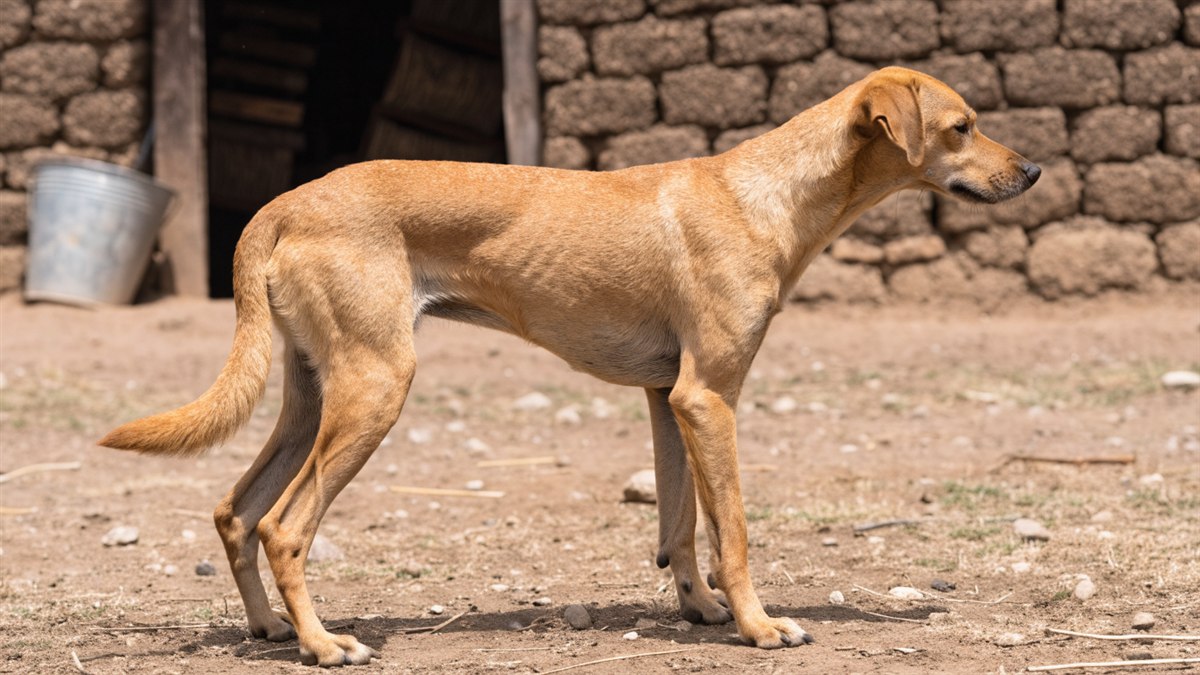
Quick answer
African village dog is a scientific category, not a breed. It names the free-ranging, human-commensal dogs of Africa, and the largest genetic study of them found several distinct regional populations rather than one. Africanis is a narrower southern African landrace name inside that category. No kennel club registers African village dogs, and India already has its own equivalent population.
This page reports published population-level research and is general information, not veterinary advice. Free-ranging dog populations are not a breed, so none of these figures predict what any individual dog will suffer from. Always consult a registered veterinarian about vaccination, parasite control, injury and any change in your own dog's health.
African village dog at a glance
What an African village dog actually is
An African village dog is a free-ranging dog that lives as a human commensal somewhere in Africa, and the phrase is a scientific study category rather than the name of a breed. Nothing about it is registered, standardised or bought.
The category comes out of population genetics, not out of dog fancy. The largest survey of these animals describes dogs today as two groups, a diverse set of nearly 400 pure breeds and a far more populous group of free-ranging animals adapted to a human commensal lifestyle, which it names village dogs. The earlier African study calls the same animals semiferal and treats them as a sampling frame rather than a breed. Neither paper offers a height, a weight or a colour, because neither is describing a breed.
The people who put the term into the literature also wrote the definition. Ryan and Adam Boyko define village dogs as dogs that live relatively free-breeding and oftentimes partially free-ranging existences as human commensals or mutualists, not usually undergoing strong programs of human-directed breeding, though people may preferentially feed, shelter or cull certain individuals. They add the distinction that matters most on this page. Compared to land races, village dogs have a much wider variety of physical appearances within a location.
That is the whole idea. A breed is a closed population judged against a written description. A landrace is an open population that nonetheless converged on a recognisable look. A village dog is an open population defined by how it lives, not by how it looks. African village dog sits in the third box, which is why no page on the internet can tell you how tall one is.
Where they came from, and when
African dogs arrived from Eurasia rather than evolving in Africa. Mummified dogs have been found in Egyptian tombs, sometimes sleeping curled at their master's feet, dating from around 4,500 years ago, and with deserts, dense forests and tsetse fly infested savanna to cross it took about 3,000 more years for dogs to make their way to South Africa. The KUSA standard tells the same story from the other end, tracing the line to sighthounds that came with Neolithic herders from the Middle East into the Nile valley, then into Southern Africa with Iron Age Bantu-speaking migrations, and dating arrival there to circa 570 AD.
Those two accounts are roughly a millennium and a half apart on when dogs reached the far south, and we are not going to average them. What they agree on is direction and mechanism, and the genetics agrees too, because Egyptian village dogs cluster with the Middle East rather than with sub-Saharan Africa. The Boykos draw the conclusion that follows: no southern African dog has a truly ancient distinctive genetic makeup in the context of the 15,000-plus year history of the dog, but the diseases and terrain that slowed the original advance later buffered these dogs against European intermixing.
How big is one, and why nobody will tell you
No ranking page in the top ten publishes a height, a weight or a lifespan for the African village dog, and that absence is the correct answer rather than a gap in their research. There is no breed standard to quote, because there is no breed. Embark, a commercial dog DNA company that will sell you a test naming this ancestry, publishes no measurements at all on its West African Village Dog page.
What does exist is a measured spread. Figure 8.2 of the Boyko chapter plots body-size variation in orders of magnitude across groups, and free-ranging village dogs come in at 1.0, against 2.2 for purebred dogs as a whole, 1.1 within Poodles alone, and 0.6 across all extant gray wolf subspecies. The caption spells out what the endpoints mean, noting that purebred size runs from Chihuahuas under 1 kg to Great Danes at 80 kg.
| Group | Orders of magnitude of body-size variation |
|---|---|
| Purebred dogs, all breeds | 2.2 |
| Horses | 1.3 |
| Cats | 1.2 |
| Purebred Poodles alone | 1.1 |
| Chickens | 1.0 |
| Free-ranging village dogs | 1.0 |
| Goats | 0.9 |
| Gray wolves | 0.6 |
Read that carefully, because it cuts against the usual assumption. Village dogs vary in size about as much as chickens or goats do, considerably less than the pedigree dog world does, and still more than wolves. They are a real population with a real central tendency and no number attached to it.
The one written description that does exist
One southern African subset has a published document, and it is worth reading because it is the only formal description anywhere near this animal. The Kennel Union of Southern Africa publishes an Official Breed Standard for the AfriCanis as an Emerging Breed, effective 01.01.2017, which opens by calling itself a written preliminary description of a Landrace and restricts the dog at KUSA licensed conformation events to Non-Championship Shows. It classifies the dog as a Primitive Hound, describes a medium-size, slender, well muscled animal up on legs whose ribs are just visible in good condition, and gives a size of usually 55 to 62 cm at the withers with individuals 2 to 3 cm either side occurring.
That document describes the Africanis, not the African village dog, and the difference between those two things is the subject of the next section. If you arrived here from an Indian search, the closest equivalent animal to everything described above is the Indian pariah dog, and it is standing outside your building.
Is an African village dog the same thing as an Africanis?
No, and the relationship is containment rather than equivalence. Africanis is the name for the southern African landrace that sits inside the continent-wide African village dog category, so every Africanis is an African village dog while most African village dogs are not Africanis. Four primary sources draw that line in the same place.
This is the question the page exists to settle, because the internet answers it wrongly. Wikipedia holds position one for this query in India and its infobox prints three other names for African village dog: Africanis for Southern Africa, Avuvi for Togo and Ghana, and Azawakh for the Sahel.
Azawakh is not another name for an unregistered population. It is FCI breed number 307, Group 10 Sighthounds, Section Short-haired Sighthounds, recognised on a definitive basis on 3 June 1980, country of origin Mali, country of patronage France. A pedigree sighthound with a studbook and a written standard cannot be a synonym for a category defined by the absence of both, and we keep a separate Azawakh page for exactly that reason. One demonstrably wrong entry in a three-item list is enough to stop treating the list as evidence and go to the primary sources instead.
The Africanis Society draws a tight geographic boundary
The conservation body that coined the name limits it by latitude. The Africanis Society of Southern Africa states that the AfriCanis is the traditional indigenous dog of subequatorial Africa, and lists where it is found in Southern Africa, namely isolated ancestral tribal homelands including Kwa-Zulu, Transkei, Venda, Gazankulu, KaNgwane, KwaNdebele, Lebowa, QwaQwa, Ciskei and Bophuthatswana, and with the San people in the Great Karoo.
Set that against where the science sampled. Boyko and colleagues drew their 318 African village dogs from seven regions in Egypt, Uganda and Namibia. Luxor sits at 25.7 degrees north. By the Africanis Society's own definition an Egyptian village dog cannot be an Africanis, because it is not subequatorial, yet it is unambiguously an African village dog and one of the populations the phrase was coined to describe.
The breed standard concedes the point in one line
The KUSA standard settles it in a sentence most writers skip. Under Regions Occurrence it reads, in full, Southern Africa, equivalent dog occur further north in the lacustrine region and beyond. The lacustrine region is the African Great Lakes, which is precisely where Boyko sampled his Ugandan dogs. So the document that defines the Africanis acknowledges an equivalent dog further north and declines to call it an Africanis. That is a registry telling you the two terms are not interchangeable.
The decisive evidence comes from the Africanis Society's own geneticists
The Society commissioned its own DNA study and publishes the report on its website, and that report closes the question from the Africanis side. Grobler, Ehlers and Kotze of the Department of Genetics at the University of the Free State open by writing that Boyko et al. (2009) described complex patterns of population structure in the indigenous dogs of Africa, also known as village dogs. They then state, plainly, that Boyko et al. (2009) included Africanis from northern Namibia in their study and described it as distinct from Western breeds.
That does two things at once. It has the Society's own geneticists using indigenous African dogs and village dogs as synonyms, and it has them identifying Boyko's northern Namibian village dogs as Africanis. Those are the dogs that came back 87 percent indigenous African ancestry. Africanis is therefore not a rival term to African village dog. It is one of the sampled populations inside it, named locally.
| African village dog | Africanis | |
|---|---|---|
| Type of thing | Population category used in genetics | Landrace name used in conservation |
| Geographic scope | Africa, sampled in Egypt, Uganda and Namibia | Subequatorial, specifically Southern Africa |
| Written description | None exists anywhere | KUSA Emerging Breed standard, 2017 |
| Registry status | None, no kennel club recognises it | KUSA emerging breed, non-championship only |
| Conservation body | None | The Africanis Society, founded 1998 |
| Includes urban strays? | Yes, Egyptian shelter dogs were sampled | No, township rescues and strays are explicitly not AfriCanis |
How much indigenous ancestry survives is contested, and the disagreement is worth seeing. The Boykos, who did the underlying genetic work, write in their terminology box that in most cases, giving the Africanis as their example, the original land races seem to have been mostly or completely genetically swamped by modern breed dogs brought to these areas. The Africanis Society's position is the opposite, stating that DNA research has proven there is a specific African dog genome. Its own commissioned report sits between the two, concluding that there is evidence of uniqueness in most Africanis populations while naming the Byrne and Okavango samples as showing comparatively high introgression from Western breeds. We are not going to resolve that for you. All three are on the record and the question is open.
The verdict is a containment relationship. If you want the conservation story, the breed standard and the southern African cultural history, read the Africanis page. This page is the scientific population guide that sits above it.
What the biggest study of African village dogs actually found
The defining study sampled 318 village dogs from seven regions in Egypt, Uganda and Namibia, and found that most of them are genuinely indigenous rather than a stray-dog mixture of imported breeds. It also found that they are not one population.
Boyko and colleagues published in PNAS in 2009 under a title that gives the answer away: Complex population structure in African village dogs and its implications for inferring dog domestication history. The sampling was done by field researchers and local veterinarians working with the Cornell-based Village Dog Genetic Diversity Project, who also collected photographs and data on weight, age, coat colour and body measurements.
- 318 village dogs sampled across seven regions in three countries
- More than 680 base pairs of the mitochondrial D-loop sequenced
- 300 SNP markers and 89 microsatellite markers typed
- 223 unrelated dogs genotyped on the marker panels, of which the African rows in Table 1 total 206
- 126 breeds analysed for comparison, including Afghan Hound, Basenji, Pharaoh Hound, Rhodesian Ridgeback and Saluki
Most of them are indigenous, and that was the surprise
The headline result is that African village dogs are not just street mongrels descended from colonial imports. Outside central Namibia, 152 of 181 dogs, which is 84.0 percent, showed an estimated admixture proportion below 25 percent, meaning little or no non-native ancestry. Central Namibia was the stark exception: not one dog there qualified as indigenous, and 24 of 25 carried more than 60 percent non-native ancestry. Divided out, that is 96.0 percent of the central Namibian sample.
The Cornell summary put the finding in plain language, that African village dogs have directly descended from an ancestral pool of indigenous dogs rather than being a mixture of modern breeds, and are more genetically diverse than breeds because they have not been subjected to strict breeding.
The Discussion states that only 7 percent of the African village dogs showed intermediate levels of African ancestry, citing Table 1. We added the uncertain column of Table 1 ourselves: 4 plus 0 plus 0 plus 4 plus 3 plus 1 plus 7 gives 19 dogs. Neither available denominator produces 7 percent. Against the African rows, which total 206 dogs, 19 divides out to 9.2 percent. Against the 223 unrelated genotyped dogs named in the table caption, it is 8.5 percent. The printed rows in fact sum to 221, because the two United States mixed-breed dogs in that total are not given a row. Nothing else in the analysis depends on the 7 percent, and the counts are the primary numbers, so we quote the counts. We flag it because dividing every quoted percentage back out is the cheapest way to catch an error.
A chain-link fence turned out to be a population boundary
The single most striking result in the paper is geographic. Namibia's Red Line veterinary cordon separates the north, whose colonial history resembles the rest of sub-Saharan Africa, from the centre and south, whose history resembles South Africa's. Dogs are not stopped by it, and dogs cross it. Even so, dogs north of the cordon averaged 87 percent indigenous African ancestry while those south of it were only 9 percent African.
Twenty to a hundred kilometres of porous fence produced a sharper genetic break than 2,900 kilometres of open country between mainland Uganda and northern Namibia, which showed only moderate differentiation at an Fst of 0.0237 to 0.0254. Deserts behaved the same way. The 230 km of desert between the Kharga oasis and Luxor produced an Fst of 0.084, while the 500 km Nile corridor between Luxor and Giza produced 0.0024, a difference of more than thirty-fold in the opposite direction to distance.
Which African breeds are actually African
Boyko also tested the pedigree breeds that claim African origin, and two of them failed. Both marker sets clustered Salukis and Afghan Hounds nearest to Egyptian village dogs and Basenjis nearest to indigenous Ugandan and Namibian dogs, as each breed's history predicts. Rhodesian Ridgebacks and Pharaoh Hounds instead clustered nearest to admixed dogs, which the authors read as evidence that those breeds were recreated from admixture with non-African dogs.
The Basenji is therefore the one African village dog population that genuinely became a registered breed and stayed genetically African. It is FCI breed 43, Group 5 Spitz and primitive types, Section Primitive type, recognised on a definitive basis on 26 March 1964, country of origin Central Africa, country of patronage Great Britain. Hold that thought, because the Basenji reappears in the health section as the cleanest possible demonstration of what a registry does to a population.
This page leans heavily on the Boyko papers and also cites Embark's West African Village Dog reference page, so the connection between them should be stated. In their own conflict of interest statement, Adam R. Boyko and Ryan H. Boyko declare that they are cofounders and officers of Embark Veterinary, Inc., a canine genetics testing company. The science is peer-reviewed and independently replicated in places, and the disclosure does not undermine it. It does mean the researchers who defined the village dog category also sell the ancestry test that reports it, and a reader deciding whether to buy that test should know.
Why African village dog is a plural, not a singular
Population structure inside Africa is deep enough that three separate studies each split their African village dog samples into multiple genetically distinct clusters. Treating the phrase as the name of one animal misrepresents every one of them.
Boyko's Bayesian clustering at K equals five consistently produced the same five groupings, four of them African: Egyptian dogs, Ugandan mainland dogs, Kome Island dogs and Northern Namibian dogs, with a fifth admixed group holding all the Puerto Rican and United States dogs and nearly all the central Namibian ones. Four African clusters from three countries. That is the population structure the paper's title is talking about.
Northern Kenya alone splits three ways
A separate Czech-led team went finer. Vychodilova and colleagues sampled dogs kept by semi-nomadic Samburu and Turkana pastoralists across three regions of Northern Kenya, 50 dogs from each of Mt Kulal, Mt Ngyiro and Lake Turkana, living in 11 villages with no veterinary care and no selective breeding. Those 150 dogs were typed on 27 microsatellites and 135 of them on three immunity-related DLA class II genes. At the most informative value of K, the entire Kenyan population resolved into three genetic clusters. One country, one northern region, three populations.
The same study quantified how much less inbred these dogs are. More loci departed from Hardy-Weinberg equilibrium through a deficiency of heterozygous genotypes in European dogs, at 21 of 27 loci or 77.7 percent, than in the village dogs, at 13 of 27 or 48.1 percent. Most Kenyan dogs carried less than 5 percent of the European genetic cluster, and admixture was lowest at Mt Ngyiro, the district furthest from the trading centre. Divide those out yourself: 21 over 27 is 77.8 percent and 13 over 27 is 48.1 percent, and both check.
Egypt does not group with sub-Saharan Africa
The largest village-dog survey to date makes the split explicit. Shannon and colleagues used a 185,805-marker genotyping array on 4,676 purebred dogs from 161 breeds and 549 village dogs from 38 countries. Their principal component analysis showed a clear divergence between East Asia, Central Asia, India, the Middle East, which they group as Egypt, Lebanon, Qatar, Turkey and Afghanistan, and sub-Saharan Africa.
Read that grouping again. Egyptian village dogs sit in the Middle East cluster, not the African one, which is consistent with the Middle East origin of African dogs and with Boyko's own finding that principal component one cleanly separates Egyptian from sub-Saharan populations. So the single phrase African village dog spans two of the study's continental clusters, which is about as strong a refutation of the singular as a dataset can produce.
What is genuinely, uniquely African
Africa still carries its own signature, and the same paper names it. African dogs exhibit high Y and mitochondrial haplotype diversity, geographically structured, including a high-frequency Y haplogroup found only in Africa and Mongolia and a cluster of closely related uniquely African mitochondrial haplotypes, which the authors read as significant diversification of dogs within Africa. African ancestry components reflect geography, and European admixture ran strongest in Katanga at 86 to 88 percent and Kinshasa at 74 to 75 percent.
That Y-chromosome point survived the argument intact. Answering a challenge about haplogroup counts, the authors noted that African village dogs still contain more Y haplogroups than Southeast Asian dogs, because haplogroup 9 is present in Africa, Central Asia and Siberia but not in Southeast Asia. Whatever the domestication argument settles on, Africa's own diversity is not in dispute.
| Region | mtDNA sample (N) | mtDNA heterozygosity (H) | Y sample (N) | Y heterozygosity (H) |
|---|---|---|---|---|
| Africa | 91 | 0.96 | 64 | 0.93 |
| India | 35 | 0.97 | 27 | 0.89 |
| East Asia | 118 | 0.99 | 24 | 0.92 |
| Central Asia | 26 | 0.95 | 17 | 0.84 |
| Southwest Asia | 80 | 0.96 | 46 | 0.94 |
| Europe | 18 | 0.96 | 14 | 0.93 |
| Arctic | 11 | 0.82 | 6 | 0.87 |
Shannon and colleagues concluded that a clear gradient of short-range linkage disequilibrium points to a Central Asian domestication origin. That drew a published rebuttal in the same journal. Wang and colleagues argued the grouping itself is wrong, since Mongolia and Nepal are ordinarily East and South Asia rather than Central Asia, and recalculating the two countries separately gave different patterns, so treating them as one population is not correct. They also noted that no southern Chinese dogs were included, and that adding published Ying Jiang data produced the lowest linkage disequilibrium of any population. Boyko's earlier work had separately found similar mtDNA haplotype diversity in African and East Asian village dogs. Shannon's group replied that they had computed separate scores for the two countries all along, that Nepal borders Central Asia, and that comparing array data against low-coverage sequencing data artificially depresses the sequencing curves. The exchange is unresolved. None of it changes anything on this page, because the structure findings hold regardless of where the first dog was domesticated.
The practical consequence for a reader is simple. When a page tells you what an African village dog is like, ask which of at least four documented clusters it is describing, and whether the answer is a Namibian dog that is 87 percent indigenous or a central Namibian dog that is 9 percent African.
African and Indian village dogs: what the genetics supports, and what it does not
The genetic literature supports one clear statement and refuses a second. African and Indian village dogs belong to the same category and show comparable genetic diversity, and they are separate regional populations that no study has shown to be closely related to each other.
Start with the definition, because it already includes India explicitly. The Boykos' own terminology box states that free-breeding city-dwelling dogs in Russia and India fit the village dog definition, as well as dogs living at the margins of Egyptian society or living in rural villages in Uganda and elsewhere. The same box names the Africanis as a land race and the Indog as a land race that may just be local village dogs which happen to comport to a certain physical appearance. So the two are placed in identical relationships to the same parent category. That is a statement about category membership, not about ancestry.
The sampling backs the definition up. Shannon and colleagues drew 549 village dogs from 38 countries and treated India as a region alongside Africa, reporting 35 Indian samples for mitochondrial markers and 27 for Y markers. The Indian samples came from the INDog Project, which collaborated on the study.
Comparable diversity, different clusters
On diversity the two are near-identical. Shannon and colleagues measured mitochondrial haplotype heterozygosity at 0.96 for Africa across 91 samples and 0.97 for India across 35, and Y haplotype heterozygosity at 0.93 for Africa across 64 and 0.89 for India across 27. Both regions sit near the top of the global range and far above the Arctic figure of 0.82.
On ancestry they are plainly distinct. The same study's principal component analysis showed clear divergence between India and sub-Saharan Africa, which appear as separate clusters alongside East Asia, Central Asia and the Middle East. No study has directly compared Africanis dogs with Indian pariah dogs, and none of the papers on this page claims the African and Indian populations are each other's closest relatives.
You will read that African village dogs and Indian pariah dogs are 'the same ancient dog'. The evidence does not support that. What the evidence supports is that both are unadmixed-ish descendants of the same very old commensal stock that spread out of Eurasia, that both retain far more diversity than pedigree breeds, and that they then diverged into regionally distinct populations that principal component analysis separates cleanly. Same category and similar mechanism is a strong, true claim. Same population is a false one, and it is exactly the overstatement that made us check.
The one thing India and Africa share that matters most
Both populations are least admixed where people are poorest and roads are worst, and both are most admixed in cities. Shannon and colleagues found that dogs near Beirut and Cairo carried more European ancestry than dogs from elsewhere in Lebanon and Egypt, and reported similar patterns in Port Moresby, Kathmandu and Mumbai, concluding that foreign dogs are more likely to be brought to, or to survive in, urban areas than in more remote regions.
That is the same shape as Boyko's Red Line finding in Namibia, where the indigenous dogs sat on the side of the cordon with the least European settlement. It is also exactly what the INDog Project reports from its own fieldwork. Village dogs in remote rural areas, including many villages in Odisha, were found to be indigenous, while urban free-ranging dogs from metro cities showed European ancestry components.
Two continents, one identical correction
The most useful parallel is not genetic at all. It is that both conservation bodies had to publish the same warning, in the same words, about the same mistake.
| Southern Africa | India | |
|---|---|---|
| Body | The Africanis Society of Southern Africa | The INDog Project |
| The landrace name | AfriCanis | INDog, formerly Indian Pariah Dog |
| The correction issued | Township dogs come from various backgrounds including purebred dogs, crossbreeds and mongrels, so rescues and strays from suburban areas are generally not AfriCanis | The entities INDog and free-ranging dog overlap but are not synonymous or interchangeable, and most free-ranging dogs today appear to be mix-breeds |
| Registry position | KUSA emerging breed, and the Society opposes turning it into a pure-bred breed | The Kennel Club of India has expressed interest and support for future efforts to standardise and register it, which have not happened |
The INDog Project also collaborated on the genetics directly. It appears as an author affiliation on the Shannon and Boyko paper, contributing the Indian village dog samples that the study's India cluster rests on, and it summarises its own conclusion bluntly: while indigenous dog populations have become admixed in cities, the original village dog is in fact less mixed than many modern pure European breeds. Our full guide to that population is the Indian pariah dog page.
Landrace, breed, village dog: what the words actually mean
A landrace is an indigenous population that emerged as an ecotype within a specific ecological niche, shaped mainly by natural selection and heterogeneous by definition. A breed is the opposite: a closed population selected by humans for looks against a written standard. No kennel club anywhere recognises a village dog population as a breed, and that is a category difference rather than a failing of the dogs.
The Africanis Society draws the line more sharply than most academic sources do, because it has to. Its own definition of a breed is a specific type of Canis familiaris obtained by human manipulation through strict selective breeding for a particular morphological trait, with those characteristics laid down in a prescriptive breed standard since the institution of modern dogdom in 1873. It then adds the sentence that explains why breed and landrace cannot be the same thing. Breeds, it writes, are sexually-isolated descendants of a tiny and select sample of individuals adopted from regional landrace populations, and they do not represent the genetic diversity of the original landrace population.
So a breed is a sample. A landrace is the population the sample was drawn from. A village dog category is wider still, because it is defined by a way of life rather than by a shared appearance, and it therefore contains landraces inside it.
| Defined by | Internal variation | Written standard | |
|---|---|---|---|
| Breed | A studbook and a standard | Deliberately minimised | Yes, prescriptive |
| Landrace | Region plus ecological niche | Heterogeneous but recognisable | Rarely, and descriptive |
| Village dog | A free-ranging commensal way of life | High, and geographically structured | None |
No registry recognises this population, and we checked the list itself
The Federation Cynologique Internationale nomenclature for the letter A runs from Affenpinscher to Azawakh across 23 recognised breeds, and contains no entry for Africanis and none for African village dog. We read the list rather than searching for the name, and the same page correctly returns Afghan Hound, Aidi and Azawakh, so the list loaded and the absence is real rather than a failed query.
Even the page that gets the naming wrong gets this part right. Wikipedia's own infobox records the breed status of the African village dog as not recognised as a breed by any major kennel club, and notes that of these dogs only the Basenji has been standardised, the rest remaining landraces rather than registered breeds.
The nearest thing to recognition is deliberately partial. KUSA lists the AfriCanis as an Emerging Breed and confines it to Non-Championship Shows, and the standard itself is labelled a written preliminary description of a Landrace rather than a breed standard proper. The conservation body that would have to drive full recognition refuses to. It states plainly that it is not intent on and does not support any moves towards transforming this aboriginal dog into a pure-bred dog breed, and that it accepts the many physical variations in the AfriCanis.
That refusal is a choice rather than a ceiling, and the same FCI list proves it. Reading down the letter A we found ANJING KINTAMANI-BALI, breed number 362, a Balinese landrace that did go through recognition. So a village-derived landrace can become an FCI breed. The Africanis has not, because the body that speaks for it does not want it to, and the wider African village dog category cannot, because there is no population boundary to draw a studbook around.
A breed standard is a description of how a dog should look, not of what it can do. The Africanis Society makes exactly this point, noting that breed standards are always a description of phenotype, not of functionality or genetic diversity. A population never put through that filter keeps the diversity the filter removes. Kenyan village dogs departed from Hardy-Weinberg equilibrium through a deficiency of heterozygotes at 13 of 27 microsatellite loci, against 21 of 27 in European dogs, which is 48.1 percent against 77.7 percent. Divide those out yourself: 13 over 27 is 48.1 and 21 over 27 is 77.8. The unregistered population is the less inbred one.
The word this page keeps away from is mongrel. A landrace is not a mongrel, and the distinction is not sentimental. A mongrel is the unstructured mixture of several breeds; a landrace is a population that predates breeds entirely and has been shaped by a place. The Africanis Society flags the confusion directly, noting that landraces are often mistaken by people as being mongrels, and that the word pariah is used mainly for dogs indigenous to Africa and India. That second half of the sentence is where this page starts to be about India.
African village dog price in India: there is no number, and that is the answer
There is no African village dog price in india, because there is no lawful import route, no exporter, no registry and no market. Anyone quoting you a rupee figure is selling you something else.
Take the legal position first, because it closes the question before the market ever gets a chance. Under Indian import policy, ITC (HS) code 01061900, mammals other, is Restricted. Policy Condition 7 permits the import of dogs for exactly three purposes, which are a pet dog with a valid pet book and records in the importer's name, dogs imported by research and development organisations with a CPCSEA recommendation, and dogs for internal security by the Defence and Police Force. Policy Condition 8 states that import of commercial dogs for breeding or any other commercial activities other than those purposes is not permitted, and the trade notice adds that any applications for trading or breeding purposes shall be duly rejected.
Import is also funnelled through seven entry points only, the airports and seaports of Delhi, Mumbai, Chennai, Hyderabad, Bengaluru and Kolkata and, since October 2024, Kochi airport, with quarantine at those ports where required Department of Animal Husbandry…. So a supply chain cannot legally form. The one personal route is narrow: up to two pets as passenger baggage without a DGFT authorisation, and only for a person transferring residence to India after two years of continuous stay abroad. That is the entire lawful pathway. The full route is set out in how to import a dog to India.
There is no seller at the other end either
Even ignoring Indian law, nobody is exporting these dogs commercially. The Africanis Society's guidelines for breeders bind members not to knowingly sell any AfriCanis directly to commercial dog wholesalers or retail pet dealers, and not to allow one to be given as a prize or donation in a contest of any kind. Its stated position is that it does not support any moves towards transforming this aboriginal dog into a pure-bred dog breed. A conservation body that refuses to create a breed is not going to build an export trade.
For the wider category there is not even a body to refuse. The Federation Cynologique Internationale nomenclature for the letter A runs from Affenpinscher to Azawakh across 23 recognised breeds and contains no entry for Africanis and none for African village dog. We checked the list itself rather than searching for the name, and the same page correctly returns Afghan Hound, Aidi and Azawakh, so the list loaded and the absence is real.
What we searched for, what came back instead, and the control
We ran an India-located search for African village dog price and puppy-for-sale listings on 23 August 2026, and re-ran it to confirm. It returned ten results and not one offered an African village dog. What it returned instead is the more useful finding, because Indian sellers answer this query with a different breed.
Two of the ten results were Indian commercial listings for South African Boerboels, and one was an Indian retailer's page headed Azawakh Price in India, offering African Hound puppies from KCI registered breeders. That is the substitution this whole page exists to catch. Azawakh is the exact name Wikipedia wrongly prints as an other name for African village dog, and it is in fact FCI breed 307 from Mali with a studbook and a published standard. A reader who searched for an unregistered African village population is being sold a registered sighthound on the strength of a Wikipedia synonym.
A zero can mean a blocked search rather than an empty market, so we ran labrador retriever price in india through the same tool, in the same session, with the same India location setting. It returned ten results, of which at least six were Indian puppy-sale or price pages quoting rupee bands by city and by quality tier, including bands of INR 30,000 to 1,20,000 and INR 15,000 to 40,000. The tool works, the India filter works, and Indian dog-price pages are trivially findable when they exist. The absence of African village dog pricing in India is therefore a finding rather than a failed query. We also had the arithmetic check ready, dividing any suspicious rupee figure by 84.38 to see whether it was a dollar price in disguise, and there was nothing to run it on.
What Google itself returns
Google's own People Also Ask box for this query asks How much does an Africanis puppy cost, which is a question about a narrower population than the one searched for. We are not reproducing figures from any generated SERP summary, because a generated summary is not a source. That the top of the results page silently swaps African village dog for Africanis is itself the strongest evidence that this page needed writing.
| Route | Status | Source |
|---|---|---|
| Commercial import for sale or breeding | Prohibited, applications duly rejected | DGFT Trade Notice 22/2022-23 |
| Import as your own pet on transfer of residence | Permitted with a pet book in your name, seven ports only | DGFT Trade Notice 22/2022-23 |
| Buy from a recognised breeder abroad | No commercial breeders exist; members are barred from wholesale and retail sale | Africanis Society code of ethics |
| Buy a registered pedigree | No FCI recognition exists for the name | FCI nomenclature, letter A |
| Buy from an Indian listing | No African village dog listed; sellers substitute Boerboel or Azawakh | Our India-located SERP pull, 23 August 2026, control passed |
| Adopt the same kind of animal in India | Free, legal, immediate | See the adoption section below |
The honest price in India is nothing at all, paid at a shelter, for a dog of the local population. That is not a consolation prize and the [adoption](#adoption) section explains why.
What it actually costs to keep this kind of dog in India
The recurring cost of a village-type dog in India is parasite control, vaccination and food, in that order of neglect, and the two most expensive interventions are the ones Indian municipalities are legally obliged to provide free.
We are not going to print a monthly rupee figure. No published Indian cost study exists for this animal, every number circulating online is a guess, and a fabricated budget is worse than no budget. What we can do is name the cost items, show which ones are already paid for by the state, and quantify what happens when each one is skipped, because that part is published.
The two big items are free, if you use the system
Sterilisation and rabies immunisation of street dogs are a local-authority duty in India, not an owner expense. Under the Animal Birth Control Rules 2023, in the case of street animals the local authority is responsible for deworming, immunisation and sterilisation, and may engage a recognised Animal Welfare Organisation to carry out the programme. Dogs caught under the programme are sterilised, vaccinated, kept for at least four days of post-operative care and released at the same place they were captured.
You can tell at a glance whether a street dog has already had both. A V-shaped notch is made in the right ear during the sterilisation surgery, and branding is not permitted, so the notch is the identification mark. If you adopt a notched dog, that dog is already sterilised and was immunised at the same time, and you have not paid for either.
Rule 7 of the ABC Rules splits animals into pet animals, meaning dogs owned and kept indoor by individuals, and street dogs or community owned Indian dogs or abandoned pedigreed dogs which are homeless. Rule 8(1) makes the owner of a pet animal responsible for deworming, immunisation and sterilisation. Take a community dog indoors and the bill legally becomes yours. That is the correct outcome and it is also the single most-missed fact in Indian adoption threads.
Parasite control is the cost you cannot skip
External and internal parasites are the dominant recurring veterinary cost for any free-ranging or recently free-ranging dog, and three independent surveys put numbers on it. A survey of 90 dogs across six Egyptian governorates found 58 infested with at least one ectoparasite species, which is 64.4 percent, the brown dog tick Rhipicephalus sanguineus being commonest at 26 of 90 or 28.9 percent. A study of free-roaming owned dogs in Chitwan, Nepal, identified endoparasites in 73 percent and ectoparasites in 40 percent of the dogs examined, with only 14 percent having received anthelmintics in the previous year. In India, PCR testing found 261 of 525 dogs, or 49.7 percent, infected with one or more canine tick-borne pathogen, against only 12 of 525 or 2.3 percent detected by blood smear.
That last pair of numbers is the useful one for a budget. Microscopy found under a twentieth of what PCR found, so cheap in-clinic screening substantially under-detects tick-borne disease in India, and the real cost of skipping monthly parasiticide is an infection you will not see until the dog is ill.
| Item | Who pays | Evidence that it matters |
|---|---|---|
| Sterilisation | Local authority, for street dogs | Marked by a right-ear V notch |
| Rabies vaccination | Local authority, for street dogs | 37,15,713 dog-bite cases reported in India in 2024 |
| Ongoing vaccination once owned | You, under Rule 8(1) | Only 27 percent of Nepali free-roaming dogs had measurable rabies antibody titres |
| Deworming | You, once owned | 73 percent endoparasite prevalence in the Nepal sample |
| Tick and flea control | You | 49.7 percent of 525 Indian dogs PCR-positive for a tick-borne pathogen |
| Food | You | Scale to body condition, not to a chart; see the feeding section |
| Grooming | Minimal | Short coat, no clipping, no professional grooming |
The comparison worth making is with a pedigree import. Nothing on this list involves a screening panel for inherited disease, a caesarean-prone dam, a brachycephalic airway, or a breeder premium, and that is the whole economic argument for a village-type dog. You still pay for the dog's actual biology, and you stop paying for a hundred and fifty years of selective breeding.
Heat tolerance: why dry heat suits this dog and coastal Indian humidity does not
An African village dog is adapted to dry heat rather than to humid heat, and that distinction decides how it copes in India. Every region these dogs were actually sampled from is either hot and dry or humid and mild. None combines the heat and the humidity that Chennai and Mumbai produce together, and that combination is the one that limits a panting dog.
The mechanism is evaporative, which is why humidity matters more than the thermometer. A dog sheds most of its heat load by panting, and panting works by evaporating water off the tongue and upper airway. Evaporation runs on the gap between how much water vapour the air is holding and how much it could hold at that temperature. Close that gap and panting keeps costing the dog energy while returning less and less cooling. So the honest way to rate heat tolerance is to compare origin climates on heat and humidity together, not on temperature alone.
Method, stated so you can check it
We took 20-year monthly climatologies of mean 2-metre air temperature and 2-metre relative humidity from NASA POWER's MERRA-2 climatology, querying each location by explicit latitude and longitude rather than by a place-name slug, and we confirmed the coordinates the API echoed back matched the ones we asked for. That precaution is not decorative. Place-name climate pages have repeatedly served this project a complete, correctly formatted document for an entirely different city, and a coordinate query cannot do that.
From each location's warmest month we then calculated the vapour pressure deficit ourselves, using the standard saturation-vapour-pressure relation. The deficit figures below are our calculation, not a NASA published value, and the temperature and humidity inputs are the cited ones. A larger deficit means drier air and more evaporative headroom for a panting dog.
| Location | Warmest month | Mean temp (C) | Relative humidity (%) | Vapour pressure deficit (kPa) |
|---|---|---|---|---|
| Luxor, Egypt (25.687 N, 32.640 E) | July | 32.50 | 19.86 | 3.92 |
| Oshakati, northern Namibia (17.783 S, 15.683 E) | November | 28.16 | 33.61 | 2.53 |
| Kampala, Uganda (0.348 N, 32.583 E) | February | 24.29 | 65.11 | 1.06 |
| Delhi (28.614 N, 77.209 E) | June | 35.88 | 36.42 | 3.75 |
| Mumbai (19.076 N, 72.878 E) | May | 31.19 | 60.19 | 1.81 |
| Chennai (13.083 N, 80.271 E) | May | 31.51 | 64.52 | 1.64 |
What the table actually says
Read the African rows first. Luxor is the hottest African origin at 32.5 degrees, and it is also the driest at under 20 percent humidity, giving a deficit of 3.92 kPa, the largest figure in the table. Kampala is the most humid African origin at 65 percent, and it is also the coolest at 24.3 degrees, so there is little heat to shed in the first place. Oshakati sits between them on both. No African sampling region is simultaneously hot and humid.
Now read the Indian rows. Delhi in June is hotter than anywhere in the African sample, at 35.9 degrees, but at 36 percent humidity its deficit of 3.75 kPa is close to Luxor's, so a panting dog still has room to work. Chennai in May is barely hotter than Luxor at 31.5 degrees, and yet its deficit is 1.64 kPa, less than half Luxor's, because the air is already three-quarters of the way to saturated. Mumbai is only marginally better at 1.81 kPa.
So the practical conclusion inverts the usual advice. Delhi's famous dry summer is the climate this dog's ancestry is best matched to, and Chennai's milder-sounding May is the harder one. A reader who assumes the hotter city is the more dangerous one has the physics backwards.
This is an argument from origin climate, not a measurement of these dogs. No study has measured thermoregulation, panting efficiency or heat-illness incidence in African village dogs specifically, and we found none while researching this page. What the phenotype does is remove the two risk factors that a large denominator-based study did identify. In UK dogs under primary veterinary care in 2016, heat-related illness had an incidence of 0.04 percent with an event fatality rate of 14.18 percent, and multivariable analysis found brachycephalic skull shape and a bodyweight over 50 kg among the significant risk factors. A lean, medium-sized dog with a long cone-shaped muzzle has neither. Not carrying the known risk factors is genuinely good news. It is not the same as a measured heat tolerance, and we are not going to present it as one.
Three things that follow for an Indian household
- Shade and water beat coat length. The short double coat described in the standard is not insulation you can remove, and shaving a double-coated dog removes sun protection without improving evaporation.
- Shift exercise to the humidity minimum, not the temperature minimum. In Chennai and Mumbai the two move together through the pre-monsoon months, so early morning is the only reliable window.
- Watch the nose, not just the dog. The standard itself warns that lack of pigmentation and pale noses are sensitive to sunburn and cancer, which matters more on an Indian roof terrace than on a Karoo farm.
The comparison that matters for an Indian reader is with the population next door. The Indian pariah dog has spent its entire history in exactly the hot-and-humid combination that no African sampling region provides, which is the strongest single argument for adopting locally rather than importing an idea.
Temperament: what a population can and cannot tell you about an individual
No temperament description of an African village dog predicts the dog in front of you, because this is an open population with no behavioural selection behind it. What the sources do describe is a consistent behavioural profile in the southern African landrace, and it is the profile of a watchful, independent, socially fluent dog that wants space and does not want to be handled.
Start with the caveat, because it is the whole point. A breed's temperament section works because generations of humans selected for a temperament. A village dog population has been shaped by surviving near people, which selects for something quite different, and it leaves far more variation between individuals than any breed carries. So treat everything below as the central tendency of a population, and assess the actual dog.
The one detailed behavioural description on record
The KUSA standard is unusually candid for a breed document and worth quoting closely. It says the AfriCanis combines a natural attachment to humans with a necessity for space, and notes that the traditional people to whom these dogs belong do not tend to make body contact with them. It describes watchful territorial behaviour, dogs that are well-disposed without being obtrusive, and adds that when pushed around the AfriCanis can demonstrate reactive aggression.
It also describes something most breed standards never mention. These dogs display unspoiled social canine behaviour with a high level of facial expressions and body language towards other dogs and humans, and the demanding conditions of their environment have induced an energy conserving life style. They have a steady nerve constitution but are cautious in their approach to new situations.
A dog whose people traditionally do not make body contact with it is not an unaffectionate dog, and it is not a damaged one. It is a dog whose normal relationship with humans is proximity and cooperation rather than handling. Indian households that expect a lap dog and get a dog that lies four feet away facing the door often read that as rejection. It is the species behaving normally, and the same complaint appears constantly in Indian threads about adopting street dogs.
Who this dog suits, and who it does not
- Suits a household with outdoor access. The standard describes a dog conditioned to life in the open air and used to wide spaces, and the conservation body lists that among the qualities it exists to preserve.
- Suits people who want a watchdog rather than a guard dog. Watchful territorial behaviour without obtrusiveness is an alert, not an attack.
- Suits multi-animal homes, with imprinting. These dogs live around livestock without harming it despite a swift chase response, which the standard attributes to environmental adaptation and imprinting rather than to training.
- Does not suit a household that handles a dog constantly. Reactive aggression when pushed around is in the standard, in plain words.
- Does not suit a small flat with no routine. A necessity for space is the one requirement the standard repeats.
Where the field studies agree
Two independent field descriptions match. In northern Kenya, Samburu and Turkana pastoralists keep these dogs as helpers and guards of settlements and livestock herds, and the majority are owned, named and belong to particular families even though the population lives with no veterinary care and no selective breeding. In West Bengal, Indian free-ranging dogs are described as facultatively social, with mothers and other group members showing cooperative behaviour towards newborn pups.
That is the same animal in two places: socially competent, loosely owned, working near people rather than for them. It is also, precisely, the animal an Indian reader can meet on the street this evening, which the Indian pariah dog page covers in full.
Training: the standard says this dog has never been trained the western way
Train an African village dog by giving it a reason to cooperate rather than a command to obey, because the only formal description of the type says outright that it has never been used to the western concept of dog obedience training. It also says the dog follows its handler naturally, which is the opening the trainer should use.
That pair of sentences is the most useful training guidance published about this animal, and almost nobody quotes it. The KUSA standard notes that the AfriCanis has never been used to the western concept of dog obedience training, then immediately adds that because of its innate subservience and a high sense of attachment to pack leader, it follows its handler in a natural way. Read together, they say the cooperation is already there and the drill is not.
Four things that follow, in order of importance
- Build on attachment, not on repetition. Follow-the-handler behaviour is described as natural, so reward it early and often instead of teaching a formal heel first.
- Socialise deliberately, because caution is the default. The standard describes a steady nerve constitution that is nonetheless cautious in its approach to new situations. A cautious dog that meets nothing becomes a fearful adult.
- Train recall against a chase response, not in the absence of one. The standard describes a hound with a swift chase response that still lives among livestock, and credits imprinting rather than obedience for it. In an Indian city the moving thing is a scooter, so the imprinting has to happen on traffic.
- Drop physical corrections entirely. Reactive aggression when pushed around is a documented response, so handling-based correction trains the wrong lesson.
Realistic timelines, and why nobody can give you exact ones
No published study reports training outcomes, learning rates or trainability scores for this population, and we found none. What is documented is the developmental window. Free-ranging pups in West Bengal begin weaning around 8 weeks, which also marks the onset of resource conflict with the mother. The Africanis Society's own breeder guidelines release no pup to a purchaser before 8 weeks and require it to be dewormed first.
The eight-week floor is not a southern African quirk. Indian law sets the same minimum. Rule 8, Conditions for sale, sub-rule (1)(a) of the Prevention of Cruelty to Animals (Dog Breeding and Marketing) Rules 2017 requires that pups less than eight weeks in age are not sold, and (1)(b) adds that dogs over six months are not sold without first being sterilised unless the buyer is another licensed breeder. So a conservation body in South Africa, a behavioural study in West Bengal and an Indian statute all land on the same number, which is a rare piece of agreement worth acting on.
The one training claim we will not make
You will read that village dogs are more intelligent, more trainable or more biddable than pedigree dogs because natural selection kept them sharp. There is no evidence for that comparison and we are not going to repeat it. What the genetics supports is diversity, not ability. Kenyan village dogs are more diverse at the DLA class II loci than any studied domestic breed, which is a statement about immune genes, not about learning. Anyone converting a heterozygosity figure into a claim about brains is guessing.
The fair summary is narrower and still useful. This is a dog selected to survive alongside people without being managed by them, so it arrives with intact social behaviour, real environmental caution and no history of formal handling. Train the relationship and the behaviours follow.
Exercise: high capacity, low spontaneous output, and why that matters
Give this dog roughly an hour a day of low-intensity movement with the option of much more, because the sources describe an animal with genuine endurance and a deliberately economical way of spending it. It is not a high-drive sport dog that unravels without a job, and treating it like one is the commonest mistake made with village-type dogs in Indian cities.
Two statements in the standard look contradictory until you put them together. The KUSA description says the demanding conditions imposed by its environment have induced the AfriCanis into an energy conserving life style. The same document says the dog should be able to trot or canter for long periods on rough terrain and in hillside environment, going into gallop when real speed is required, with a trot that is light and effortless. The Africanis Society adds that these dogs have great endurance and can thrive on very little.
That is a coherent animal, not a contradiction. Capacity is high and voluntary output is low, because a scavenging dog that burns energy for no return does not survive. The West Bengal work describes exactly that economy, characterising free-ranging dogs as scavengers dependent on human wastes for survival.
What that means for a daily routine
- Duration beats intensity. Long, slow, sniffing walks match a trot-and-canter animal better than fetch sprints.
- Terrain is the enrichment. The standard specifies rough terrain and hillsides, so varied ground does more than flat pavement.
- Expect the dog to switch off indoors. Energy conservation is the documented default, so a dog sleeping most of the afternoon is behaving correctly.
- Do not schedule the main session in the afternoon. In Chennai and Mumbai the evaporative headroom is at its worst in the pre-monsoon afternoons, at 1.64 and 1.81 kPa in the warmest month.
The two drives that need an outlet
The standard calls the AfriCanis a hunting hound combining sight and scent, and lists modern uses as tracker dog, search and rescue dog and flock guard dog. Those are the aptitudes to feed. Scent games cost nothing, work in a small flat, and use the faculty the dog actually has, whereas repetitive ball-throwing feeds a chase response you then have to manage around traffic.
With a genuinely high-drive breed, too little exercise produces a destructive, noisy dog. With a village-type dog the usual failure is quieter and slower to notice, because an energy-conserving animal will simply conserve. What shows up instead is weight gain and a dog that stops offering to move at all. Watch body condition rather than behaviour, because this dog will not tell you it is under-exercised.
The exercise requirement is also the cheapest thing about it. Nothing here needs equipment, a trainer, a treadmill or a climate-controlled room, which is a real part of the economic case made in the [cost of ownership](#cost-of-ownership) section.
Grooming in Indian humidity: this is parasite surveillance, not coat care
Grooming a short-coated village-type dog in India means running your hands over it for ticks, checking the ears and watching the skin, because the coat itself needs almost nothing. The published disease burden in these populations is overwhelmingly parasitic, and the brush is the cheapest detection tool you own.
The coat described in the standard is short, double coated, compact, harsh and thick, very short on the head and limbs, with the length and density of the undercoat varying by season, and wire-haired and ridged individuals occurring. There is no clipping, no stripping, no professional groomer and no seasonal trim. What there is, is a weekly physical check.
What you are actually looking for, with the numbers
Ectoparasites are not a minor nuisance in these populations. Of 90 dogs examined across Egyptian governorates, 58 were infested with at least one ectoparasite species, which is 64.4 percent. Fifty of those carried a single species and eight carried more than one, and 50 plus 8 is the 58. The brown dog tick Rhipicephalus sanguineus was commonest at 26 of 90, or 28.9 percent.
| Parasite | Dogs affected | Of 90 | Percent |
|---|---|---|---|
| Any ectoparasite | 58 | 90 | 64.4 |
| Rhipicephalus sanguineus (brown dog tick) | 26 | 90 | 28.9 |
| Fleas (three Ctenocephalides species) | 18 | 90 | 20.0 |
| Demodex canis | 18 | 90 | 20.0 |
| Sarcoptes scabiei var. canis | 5 | 90 | 5.6 |
| Otodectes cynotis (ear mite) | 2 | 90 | 2.2 |
| Chewing lice (two species) | 2 | 90 | 2.2 |
India's own figure is the same order. In a survey of 525 dogs in Delhi and Mumbai, potential tick vectors, most commonly Rhipicephalus, were found on 278 of the dogs examined, which is 53 percent. So on the published evidence roughly one dog in two carries ticks in the two Indian cities where this was measured.
The monsoon adjustment, and why it is individual here
Most breed pages can give one ear-care rule because a breed has one ear type. This population cannot. The standard records ears that may be carried erect, semi erect, drooping or asymmetrical, and says the important thing is only that they are mobile. A dropped-ear individual traps moisture through an Indian monsoon in a way an erect-eared littermate does not, so the ear-drying rule depends on your dog rather than on its type. Check weekly, dry after bathing, and do not plug or flush an ear on a schedule the dog does not need.
The standard describes the skin as dark, elastic and loose-fitting, and explains why in a bracket most readers skip: in the event of superficial injury, a loose-fitting skin ensures that the damage remains skin deep and the subcutaneous tissue and muscles stay intact. That is a functional adaptation, not a cosmetic point, and it is part of why these dogs recover from scraps and scrapes that would need stitching in a tight-skinned breed. It is not a reason to skip the vet on a wound that has broken the skin.
Skin condition is worth watching because it tracks parasite load rather than grooming effort. The Nepal survey of 60 free-roaming owned dogs found poor skin condition and parasite load associated with each other, alongside ectoparasites in 40 percent of the dogs and endoparasites in 73 percent. A dull, patchy or itchy coat on this dog is a parasite question first and a shampoo question a distant second.
Health: real numbers, real denominators, and what they are not
There is no inherited-disease profile for the African village dog, because there is no closed population to inherit within and no registry running health schemes over it. What does exist is population disease-burden data from free-ranging dogs, and it is good data. It describes an environment rather than a genome, and it stops describing your dog the day your dog stops living on the street.
Every number in this section is population data, not breed data. It was collected from dogs living free-ranging lives with little or no veterinary care, and it measures what that life does to a dog. None of it predicts what an individual adopted, vaccinated, dewormed and fed dog will suffer from, and none of it is comparable to the screening percentages published for pedigree breeds, which measure inherited defect in a closed gene pool. Mixing the two categories is the single commonest error on pages about street-dog populations, and we are not going to do it.
What actually kills these dogs, with the denominator
The best Indian dataset is a five-year census of free-ranging dogs across seven locations in West Bengal. Of 364 pups from 95 tracked litters, only 18.96 percent reached 7 months of age, and median survival was 82 days with a 95 percent confidence limit of 72 to 92 days. The single highest monthly mortality rate, 30.47 percent, fell in the fourth month, when juveniles start dispersing.
The cause matters more than the rate. 63 percent of total mortality was human influenced, covering poisoning, beating, malnutrition, road accidents and pups taken away from the population. Male pups had a median survival of 80.5 days against 112.5 days for females, because humans preferentially removed males. Nothing in that list is genetic, and every item on it is removed by a front door.
| Finding | Figure | Sample | Where |
|---|---|---|---|
| Pups reaching 7 months | 18.96% | 364 pups, 95 litters | West Bengal |
| Median pup survival | 82 days | 364 pups | West Bengal |
| Mortality that was human influenced | 63% | 364 pups | West Bengal |
| Positive by PCR for a tick-borne pathogen | 49.7% (261) | 525 dogs | Delhi and Mumbai |
| Same dogs positive on blood smear | 2.3% (12) | 525 dogs | Delhi and Mumbai |
| Carrying endoparasites | 73% | 60 dogs | Chitwan, Nepal |
| Carrying ectoparasites | 40% | 60 dogs | Chitwan, Nepal |
| Measurable rabies antibody titre | 27% | 60 dogs | Chitwan, Nepal |
| Any ectoparasite infestation | 64.4% (58) | 90 dogs | Egypt |
Nothing in that list is inherited, and none of it is what a pedigree-breed health page measures. The disease burden these dogs actually carry is parasitic, and it is covered in the next section.
The parasite burden, and the one Indian test result that misleads
Parasites, not inherited disease, are what the published data on these populations actually measures. The single most useful finding for an Indian owner is that routine blood-smear microscopy detects a small fraction of what PCR detects, so a clean slide is weak reassurance.
The Indian survey tested the same 525 dogs two ways and got wildly different answers. Microscopy of blood smears found Hepatozoon gamonts in 12 dogs, or 2.3 percent. PCR found 261 of the 525 dogs, or 49.7 percent, infected with one or more canine tick-borne pathogen. Hepatozoon canis led at 30 percent, followed by Ehrlichia canis at 20.6 percent, Mycoplasma haemocanis at 12.2 percent, Anaplasma platys at 6.5 percent, Babesia vogeli at 5.5 percent and Babesia gibsoni at 0.2 percent.
Divide the two headline figures against each other and the practical point appears: routine smear microscopy detected under one twentieth of what PCR detected. A clean in-clinic slide is therefore weak evidence of a clean dog in India, and monthly tick control is worth more than an annual test.
Two further molecular surveys in the region point the same way, and both are worth having because they report their denominators. In Kathmandu, 70 stray dogs tested by real-time PCR returned 81.43 percent positive for at least one vector-borne pathogen and 41.43 percent co-infected, led by Hepatozoon canis and Anaplasma platys at 31.43 percent each and Ehrlichia canis at 27.14 percent. In Kerala, the first Indian molecular characterisation of the organism found an overall prevalence of 18 percent for Mycoplasma haemocanis in community owned dogs, which is the same legal category Indian rules use for the animals this page is about.
Where the conservation body and the evidence pull apart
The Africanis Society lists, among the natural qualities it exists to preserve, a strong tolerance against sickness and internal and external parasites. That claim is not tested anywhere we could find, and the field data sits awkwardly beside it. In northern Kenya, infections, injuries and predation by leopards and hyenas are named as the major causes of mortality and of a fast population turnover, and only 21 dogs in the Mt Kulal population were older than three years, which the authors put at 13.13 percent of that entire population.
Tolerance and low mortality are not the same thing, so the two statements can both be partly true. A population under heavy parasite pressure that still functions may well be tolerant; it is also plainly not spared. We print both and draw no conclusion, because nobody has run the study that would settle it.
You will find 12 to 15 years quoted for African village dogs and for Africanis across the internet. We could not trace any of those numbers to a study, a registry dataset or a survey, and we are not going to repeat them. The survival data that does exist measures pups on the street, not household dogs, so an 82-day median is a statement about street life and emphatically not a lifespan. The honest position is that no lifespan for this population has been published, and a page that prints one is inventing it.
The rabies numbers belong here too, because they are the one health risk with national data. India reported 37,15,713 dog-bite cases in 2024 and 54 human rabies deaths, on Integrated Disease Surveillance Programme data placed before the Lok Sabha. Vaccination works and works fast: in the Nepal cohort only 27 percent had a measurable titre at the start, but 97 percent maintained an adequate titre for six months or more after being vaccinated.
Feeding: the standard tells you the target, and it is leaner than you think
Feed to a body condition where the ribs are just visible, because that is the condition the only written description of this dog defines as good. That target is leaner than most Indian households consider healthy, and overfeeding is the likeliest nutritional mistake with a scavenger-adapted, energy-conserving animal.
Most breed pages have to describe body condition in the abstract. This one does not, because the KUSA standard states it directly. Its general appearance clause describes a medium-size, slender built, well muscled dog, up on legs, giving the impression of a swift enduring and efficient animal, and then adds the operative line: when in good condition ribs are just visible.
A dog whose ribs are faintly visible reads as underfed to a lot of Indian families, and to a lot of neighbours who will say so. On this animal it is the documented correct condition. If you cannot see any rib outline at all on a lean, up-on-legs hound, the dog is carrying weight it was not built to carry. Judge by the standard, not by the doorstep opinion.
What the population evolved to eat, and why that is not a diet plan
Free-ranging dogs are described in the Indian literature as scavengers dependent on human wastes for survival. The Africanis Society lists no extravagant nutritional demands among the qualities it preserves, and says elsewhere that these dogs have great endurance and can thrive on very little. Those are real observations about metabolic economy, and they are not a recommendation to feed scraps.
The distinction matters. Thriving on very little describes what a population survives on, not what an individual does best on. The Nepal survey found owners who regularly fed their free-roaming dogs but provided minimal health care, and it still recorded endoparasites in 73 percent of them. Food was not the limiting factor there. Parasite load was.
A practical feeding frame
- Anchor on condition, not on a gram figure. No feeding trial exists for this population, so any precise daily quantity you read has been transferred from a pedigree breed of similar weight.
- Deworm before you blame the diet. A dog not gaining condition in India is a parasite question first, given 73 percent endoparasite prevalence in the nearest comparable surveyed population.
- Split feeding around the heat. In Chennai and Mumbai the warmest months combine 31 degrees with over 60 percent humidity, so a large midday meal lands on a dog already thermally loaded.
- Expect an efficient converter. An energy conserving life style plus a lean frame means these dogs need less than an equivalent-weight working breed.
One thing this page will not give you is an Indian brand recommendation or a rupee-per-month food figure. No published Indian cost study covers this animal, and inventing a budget is worse than admitting there is not one, which is the same position the [cost of ownership](#cost-of-ownership) section takes.
The first year, month by month, from the population data
Plan the first year around three documented markers: weaning at about 8 weeks, a dispersal-linked risk peak in the fourth month, and sexual maturity somewhere after seven months. Every figure below comes from studies of free-ranging populations rather than from breeder records, so it describes the biology accurately and the risks only if your pup is still on the street.
The survival percentages here were recorded on dogs living outdoors with no veterinary care. A pup that comes indoors at 8 weeks, is vaccinated and is kept off the road faces almost none of the causes that produce them, because 63 percent of the mortality measured was human influenced and most of that was traffic, poisoning, beating or removal. Use the developmental milestones. Do not read the mortality figures as your pup's odds.
Birth to 8 weeks
Litters are moderate and seasonal. In West Bengal the average litter at birth was 3.98 with a standard deviation of 2, a median of 4, across 108 litters, with no bias towards either sex at a male to female ratio of 1 to 1.04. Pups began appearing in October and peaked in December and January. The Nepal cohort was similar, with 74 percent of females producing a litter within the year at a mean litter size of 4.5, and births falling between September and February.
Weaning starts around 8 weeks and brings the first conflict, since that is also when resource competition with the mother begins. Eight weeks is the floor for separation on both continents and in Indian law, under Rule 8(1)(a) of the 2017 Rules and under the Africanis Society's own breeder guideline, which additionally requires the pup to be dewormed before release.
Months 2 to 4, the window that matters most
This is where the risk concentrates and where your socialisation has to happen. Median survival across 364 tracked pups was 82 days, with a confidence limit of 72 to 92 days, and the single highest monthly mortality rate, 30.47 percent, fell in the fourth month as juveniles became more mobile and began dispersing.
Two jobs fall in this window. Socialise hard, because the standard describes an adult that is cautious in its approach to new situations and a cautious dog that met nothing becomes a fearful one. And imprint on traffic, because the chase response the standard describes is the same one that ends under a scooter.
| Age | What is documented | Sample |
|---|---|---|
| 0 to 8 weeks | Litter of about 4, no sex bias | 108 litters, West Bengal |
| 8 weeks | Weaning begins; legal and ethical floor for separation | Statute |
| About 82 days | Median survival on the street | 364 pups |
| Month 4 | Peak mortality at 30.47 percent, dispersal begins | 364 pups |
| 6 months | Sterilisation required before sale in India | Statute |
| 7 months | Only 18.96 percent of street pups still alive | 364 pups |
| 12 months | Earliest age the Africanis Society permits breeding | Breeder guideline |
Months 5 to 12
Sexual maturity arrives during this stretch, which is why the seven-month cutoff in the West Bengal study was chosen as reproductive age. Indian law requires a dog over six months to be sterilised before sale unless the buyer is another licensed breeder, and the Africanis Society will not permit breeding below 12 months or above 8 years.
Growth ends earlier than in a giant breed and there is no published growth curve to follow, so track the standard's own condition marker instead: ribs just visible on a lean, up-on-legs frame. Anything more than that at a year old is fat, not frame.
African village dog compared with the four dogs it gets confused with
Four names collide around this query, and only one of them is a genuine alternative for an Indian reader. The Indian pariah dog is the same kind of animal and is available locally; the Africanis is a subset of this category; and the Basenji and Azawakh are registered breeds that are not interchangeable with it at all.
| African village dog | Africanis | Basenji | Indian pariah dog | |
|---|---|---|---|---|
| Category | Village dog population | Landrace | FCI breed 43 | Landrace |
| FCI status | None | None | Definitive, 26.03.1964 | None |
| Origin recorded | Africa-wide | Subequatorial Africa | Central Africa | Indian subcontinent |
| Height published | None | 55 to 62 cm | In the FCI standard | None standardised |
| Available in India | No lawful route | No lawful route | As a registered import | Free, everywhere |
| Suited to Indian humid heat | Origin climates are dry or mild | Origin climate is dry | Central African origin | Native to it |
Basenji, the one that made it through the gate
The Basenji is the cleanest demonstration of what a registry does to a village dog population. Boyko's analysis clustered Basenjis nearest to indigenous Ugandan and Namibian village dogs, exactly as the breed's history predicts, while Rhodesian Ridgebacks and Pharaoh Hounds clustered nearest to admixed dogs, which the authors read as evidence those two breeds were recreated from admixture with non-African dogs. So of the putatively African breeds tested, the Basenji is genuinely African and two others are not.
It is also FCI breed 43, Group 5 Spitz and primitive types, Section Primitive type, recognised on a definitive basis on 26 March 1964, country of origin Central Africa, country of patronage Great Britain. That is the trade. A slice of the population became a breed with a studbook, a standard and a country of patronage on the other side of the world, and the rest of the population stayed as it was. Our Basenji page covers what the closed studbook has since cost it.
Azawakh, which is not a synonym for anything
Azawakh appears in this comparison only because Wikipedia lists it as an other name for African village dog. It is FCI breed 307, Group 10 Sighthounds, Section Short-haired Sighthounds, recognised definitively on 3 June 1980, country of origin Mali, country of patronage France, with its current standard published on 15 October 2019. See the Azawakh page.
Look again at the last two rows of the table. Of these four, exactly one is lawfully and freely available in India and is native to Indian heat and humidity, and it is the Indian pariah dog. If what attracted you to the African village dog was the hardiness, the low grooming, the absence of engineered conformation defects and the intact genetic diversity, then the animal you actually want is already here.
Nine mistakes Indian readers make with this dog, in order of cost
The expensive mistakes here are category errors rather than care errors. Treating a scientific population label as a breed name, reading street-population statistics as inherited disease risk, and mistaking dry-heat ancestry for humid-heat tolerance each lead somewhere worse than a grooming slip.
- Treating Africanis and African village dog as the same thing. They are related as part to whole. Africanis is the subequatorial southern African landrace; African village dog is the continent-wide category that contains it, and the Africanis Society's own geneticists say Boyko's northern Namibian village dogs were Africanis.
- Trying to buy or import one. There is no lawful commercial route into India, because dogs are Restricted under import policy and applications for trading or breeding purposes are rejected. Anyone quoting a rupee price is selling a different animal.
- Reading street-population mortality as breed health risk. An 18.96 percent survival to seven months describes pups on West Bengal streets, where 63 percent of mortality was human influenced. It is not a prognosis for a dog living in your house.
- Assuming dry-heat ancestry means humid-heat tolerance. Luxor's warmest month offers 3.92 kPa of evaporative headroom and Chennai's offers 1.64 kPa, so a Chennai May is physiologically harder on a panting dog than an Egyptian July.
- Trusting a clean blood smear. In 525 Indian dogs, microscopy found tick-borne pathogens in 2.3 percent while PCR found 49.7 percent. A negative slide is weak reassurance.
- Confusing hardiness with immunity to parasites. The conservation body lists strong tolerance against parasites among the qualities it preserves, but 64.4 percent of 90 Egyptian dogs carried at least one ectoparasite and 73 percent of 60 Nepali dogs carried endoparasites.
- Overfeeding past the standard's own target. Good condition means the ribs are just visible on a lean, up-on-legs frame. Most Indian households feed well past that and call the result healthy.
- Handling a dog that has asked not to be handled. The standard records that when pushed around this dog can demonstrate reactive aggression, and that its traditional owners do not tend to make body contact with it.
- Calling it a mongrel. A landrace predates breeds; a mongrel is a mixture of them. The distinction is documented, and both the southern African and Indian conservation bodies had to publish it separately.
Under Rule 7 of the Animal Birth Control Rules 2023, a street dog or community owned Indian dog is one category and a pet animal, meaning a dog owned and kept indoor by an individual, is another. Rule 8(2) puts deworming, immunisation and sterilisation of street animals on the local authority, and Rule 8(1) puts exactly the same duties on the owner of a pet animal. The day you take a community dog indoors, the bill and the legal duty move to you. That is correct, and it is the single most-missed fact in Indian adoption threads.
The tenth mistake is not on the list because it is not really a mistake, it is a redirection. Wanting an African village dog is a coherent preference: a hardy, short-coated, medium, genetically diverse dog with no engineered conformation defects. Every one of those attributes is available locally, which the [adoption](#adoption) section takes up.
Adoption: the honest conclusion for an Indian reader
Adopt an Indian street or village dog, because for an Indian reader that is functionally the same kind of animal as the one this page describes, and it is the only one lawfully available. The evidence supports that conclusion directly rather than as a consolation, and the sources that would gain most from disagreeing are the ones that state it.
Take the legal position first, since it removes the alternative. Dogs enter India as a Restricted item, permitted only as a pet with a valid pet book in the importer's name, for research with a CPCSEA recommendation, or for Defence and Police use, with applications for trading or breeding purposes duly rejected and entry limited to seven ports Department of Animal Husbandry…. No commercial supply chain can lawfully form, and the Africanis Society separately bars its members from selling to wholesalers or retail pet dealers. There is no African village dog to acquire in India.
Why the substitute is not a substitute
The category the Boykos defined puts both animals inside it explicitly. Their terminology box states that free-breeding city-dwelling dogs in Russia and India fit the village dog definition, alongside dogs at the margins of Egyptian society and dogs in rural Ugandan villages. It names the Africanis as a land race and the Indog as a land race that may just be local village dogs which happen to comport to a certain physical appearance. Same category, same relationship, different continent.
The Indian conservation body agrees from its side, grouping the INDog with the Australian Dingo, the Canaan Dog, the New Guinea Singing Dog and the Central African village dog as primitive and aboriginal dogs distinct from modern breeds. What it does not claim, and neither do we, is that the two populations are closely related to each other. Principal component analysis separates India from sub-Saharan Africa cleanly. Same kind of animal, different lineage.
What adoption actually removes
The strongest argument is in the mortality data. Of the deaths recorded among 364 tracked pups in West Bengal, 63 percent were human influenced, covering poisoning, beating, malnutrition, road accidents and pups taken and abandoned. Those are not diseases and they are not genetic. They are the street. Median survival was 82 days. A front door removes most of that list on day one.
The people who research these dogs in India are firm that their work must not be used to romanticise street life. Their site states that the genetic profile and history of INDogs have no bearing on the management of street dog populations, that urban free-ranging dogs live extremely hazardous lives, and that it is in the worst interests of both dogs and humans to perpetuate such populations. They endorse high-reach vaccination and neutering instead. Admiring the landrace and leaving it on a highway are not the same act.
Practical steps, in order
- Check the right ear. A V-shaped notch on the right ear is made during sterilisation surgery and marks a dog already sterilised and immunised, and branding is not permitted as an alternative.
- Expect the duties to transfer. Once the dog is a pet animal kept indoors, deworming, immunisation and sterilisation become your responsibility under Rule 8(1).
- Vaccinate against rabies immediately, whatever the notch says. Only 27 percent of dogs in the Nepal cohort had measurable titres, but 97 percent held an adequate titre for six months or more after vaccination.
- Start parasite control before anything else. Roughly half of 525 dogs surveyed in Delhi and Mumbai were PCR-positive for a tick-borne pathogen.
- Adopt at eight weeks or later, the floor set by Indian law, by the Africanis Society's breeder guidelines and by the weaning biology alike.
What you are getting
The INDog Project puts it plainly, and it is the sentence to end on. Unlike the man-made Indian breeds, it writes, the INDog has never undergone selection for any specific function, and it has no inherited traits that make it unsuited to being an urban family pet, provided it gets sufficient outdoor exercise. Set that beside what a closed studbook does to a population, and the case makes itself.
So the answer to the query that brought you here is that the African village dog is a real and well-studied population, that it is not a breed and never will be, that Africanis is its southern African subset rather than its synonym, and that the version of it available to you is the Indian pariah dog waiting at your gate. If you want the southern African story in full, read the Africanis page; if you want the one African village dog population that did become a registered breed, read the Basenji.
African village dog: the questions people actually ask
What is the African dog breed called?
There is no single African dog breed. African village dog is a scientific category for the continent's free-ranging commensal dogs, not a breed name, and it contains several genetically distinct regional populations. The registered African breeds are separate things, including the Basenji, FCI breed 43 from Central Africa, and the Azawakh, FCI breed 307 from Mali.
How much does an Africanis puppy cost?
We will not quote a figure for India, because there is no lawful route to import one and no Indian seller offers one. Indian import policy permits dogs only as a personal pet with a pet book, for research with CPCSEA approval, or for Defence and Police use, and applications for trading or breeding purposes are rejected outright.
What is the lifespan of an Africanis dog?
No lifespan for this population has been published in any source we could verify, and the 12 to 15 years quoted across the internet traces back to nothing. The survival data that does exist measures street pups, where median survival was 82 days across 364 tracked pups, which is a statement about street life rather than a lifespan.
Can an African wild dog be a pet?
No, and it is a different species entirely. The African wild dog, Lycaon pictus, is a wild carnivore, not a domestic dog, and it is not the animal this page is about. African village dogs are domestic dogs, Canis familiaris, living as human commensals, and the two get confused only because both names contain Africa and dog.
Is an African village dog the same as an Africanis?
No, they relate as part to whole. Africanis names the subequatorial southern African landrace, while African village dog is the continent-wide category containing it. The Africanis Society's own commissioned genetics report states that Boyko and colleagues included Africanis from northern Namibia in their African village dog study.
Is the African village dog recognised by any kennel club?
No. We read the FCI nomenclature for the letter A directly and it lists 23 breeds from Affenpinscher to Azawakh with no entry for African village dog and none for Africanis. The closest thing to recognition is the KUSA AfriCanis standard, which labels itself a preliminary description of a landrace and confines the dog to non-championship shows.
Are African village dogs healthy?
There is no inherited-disease profile for them, because there is no closed population to inherit within. The published figures are population data from free-ranging dogs with little veterinary care, such as 64.4 percent of 90 Egyptian dogs carrying at least one ectoparasite, and they describe an environment rather than a genome.
How big does an African village dog get?
Nobody can tell you, because there is no breed standard and no measured range for the category. The only published height belongs to the Africanis subset, at usually 55 to 62 cm at the withers with individuals 2 to 3 cm either side. Body size across free-ranging village dogs varies by about one order of magnitude.
Are African village dogs and Indian pariah dogs related?
They belong to the same category and show comparable genetic diversity, but they are separate regional populations and no study shows them to be each other's closest relatives. Principal component analysis separates India from sub-Saharan Africa cleanly, while mitochondrial heterozygosity is near-identical at 0.96 for Africa and 0.97 for India.
Can I import an African village dog to India?
Not for sale or breeding. Dogs are Restricted under Indian import policy, entry is limited to six ports, and the trade notice states that applications for trading or breeding purposes shall be duly rejected. DAHD added a seventh port, Cochin International Airport at Kochi, for pets arriving under the baggage rules in October 2024. A returning resident may bring home one dog they already own with a valid pet book in their name.
Do African village dogs handle Indian heat well?
They handle dry heat very well and humid heat less well, because panting is evaporative and humidity closes the gap it works across. Delhi's June, at 35.9 degrees and 36 percent humidity, is closer to their origin climates than Chennai's milder-sounding May at 31.5 degrees and 64.5 percent humidity.
What should I do if I want a dog like this in India?
Adopt an Indian street or village dog, since it is functionally the same kind of animal and the only one lawfully available. Check the right ear for a V-shaped sterilisation notch, and remember that deworming, immunisation and sterilisation become your legal responsibility once the dog is kept indoors as a pet.
Compare with similar breeds
African village dog sits in 2 Bonbeno groups. Each one compares it directly against the breeds it is genuinely an alternative to, on the same figures.