
Breed profile
Abyssinian Sand Terrier: The Breed That May Never Have Been One
One female dog mounted in a glass case in Hertfordshire, with no recorded country, no year and no collector, is the entire physical basis for a breed that four kennel clubs have never heard of. Every height and weight you will read for it was typed into Wikipedia on 13 September 2010, had no source then, and was deleted years ago.
Quick answer
The Abyssinian Sand Terrier is not a distinct living breed. It is one of at least seven names for the African hairless dog, an animal Wikipedia files as extinct while conceding nobody has searched Africa to confirm it. No FCI, AKC, UKC or Royal Kennel Club register lists it, no breed standard exists in any language, no African hairless dog has ever been genotyped for the FOXI3 variant that causes hairlessness in the Xoloitzcuintle and Peruvian Hairless, and nobody in India sells one.
This guide is general information for Indian pet owners and is not a diagnosis. No breed-specific veterinary literature, screening scheme, health survey or lifespan study exists for the Abyssinian Sand Terrier, so nothing here should be read as a health profile for any individual dog. The hairless-phenotype risks described are documented in other breeds. Consult a registered veterinarian who has examined your dog before acting on anything you read here.
Trait ratings, and what each one is built on
What the Abyssinian Sand Terrier is, and what it is not
The Abyssinian Sand Terrier is a name, not a breed you can buy. It is one of at least seven English labels for the same idea, an African hairless dog, and the encyclopedia entry that ranks first in India for the name files that animal as extinct while admitting nobody has checked.
Wikipedia's article carries the title Abyssinian sand terrier, but the infobox inside it names the subject African hairless dog and lists the terrier version as one of six alternative names, beside Abyssinian sand dog, Abessijnse zandterrier, African elephant dog, African sand dog, Egyptian hairless dog and Zulu sand dog. Breed status reads Extinct. The body text is more careful than the infobox and says only "It is unknown if any examples still exist".
Both statements cannot be equally strong, and the difference matters to anyone typing this name into a search bar in India. Extinct is a conclusion. Unknown is the absence of one. The same article closes by conceding the point outright, saying the dogs "are believed to be extinct, although no thorough search has been conducted across Africa to confirm that they no longer exist";.
The three things that are actually established
Three claims about this animal survive contact with a primary source, and they are narrower than any page on the result set suggests.
- Hairless dogs were seen and imported into Britain from Africa around 1900. Charles Henry Lane, a working show judge, wrote that "The African Sand Dog is another breed occasionally seen" and that the dogs "would not continue to be imported and kept" if nobody wanted them.
- One preserved animal exists in a museum. The Natural History Museum holds NHMUK ZD 1972.854, a female registered as "Canis sp. domestic dog African hairless domestic dog queen of sheba" and displayed at Tring National Purebred Dog Day.
- One peer-reviewed paper names the label. Parker and colleagues list "Abyssinian Sand Terriers" among rare hairless dogs and add that "the latter are not recognized by any breed registry".
Everything past those three points is either inference or repetition. There is no breed standard in any language, no studbook, no breed club, no health survey, no lifespan study and no photograph of a documented living animal. The most-copied physical description of the dog, the one giving a height and a weight, was written by an anonymous editor in 2010 and has since been deleted from the page it was written on.
Why an Indian reader lands here
Indian search traffic for this name is curiosity traffic, not buying traffic, and the result set proves it. An India-located query for the breed name returns Wikipedia, a Fandom wiki, an Instagram tag, a stock-image search that describes the Abyssinian cat by mistake, two content-farm breed profiles and a YouTube video promising "Buying Cost, Diet, Care Sheet Guide for Beginners";. A second India-located query written as a purchase intent returns generic puppy portals and one American Hairless Terrier listing. Not one page on either set offers this dog.
No verifiable living population of African hairless dogs is documented anywhere, no registry lists the breed, no breeder can be located, and no lawful route exists to import one into India. If a seller offers you an Abyssinian Sand Terrier puppy, they are selling you a different dog under this name.
This guide does three things the ranking pages do not. It reads the registries and reports the absences with controls, so an absence means something. It traces the circulating figures back to the day and the minute they were invented. And it treats the one question an Indian buyer has, which is whether the animal exists and what happens if you keep a genuinely hairless dog in Chennai or Jodhpur, as the subject rather than a footnote.
The terrier in the name is a mistake, and here is where it came from
No terrier ancestry, terrier function or terrier registry placement has ever been claimed for this dog by a source that could check. The word most likely entered the name through a single comparison in an 1900 English show judge's book, where the African Sand Dog was described as resembling a black and tan terrier in shape.
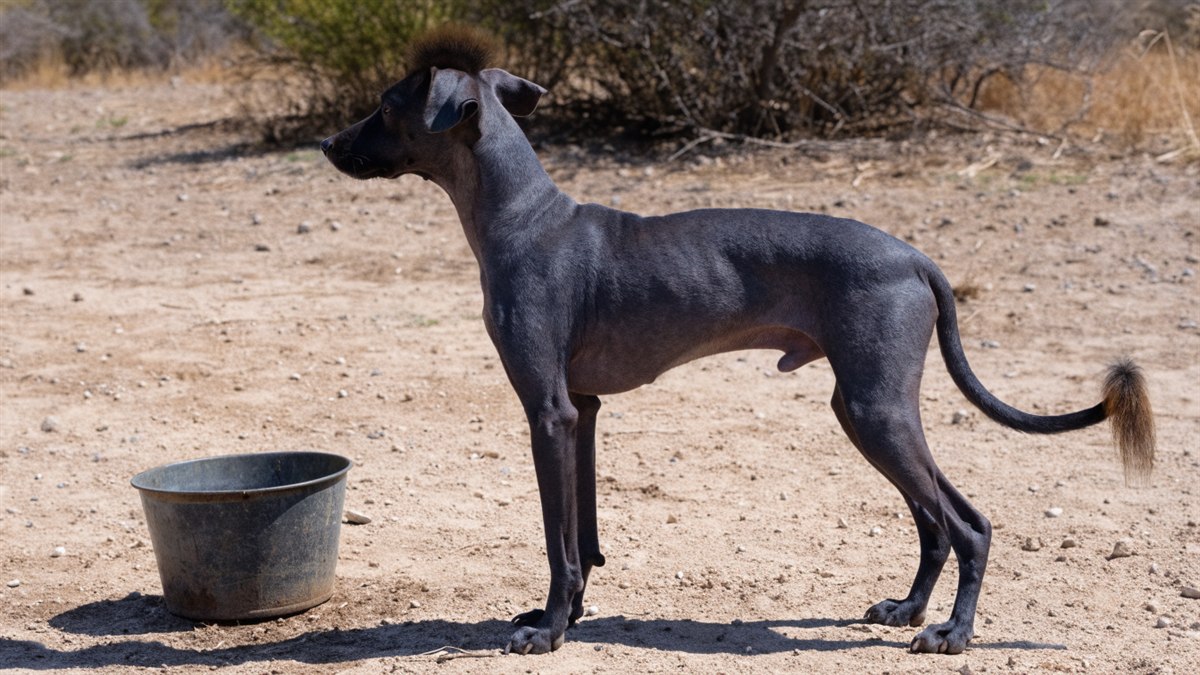
Charles Henry Lane judged foreign dogs at British shows for decades and devoted Chapter XVI of *All About Dogs* to them. His African Sand Dog paragraph runs in full: the dog is "remarkable for being almost entirely without hair, usually a sort of blue black in colour, and sometimes having a tuft of coarse bristle-like hair on the top of the head, and a similar tuft of the same colour and character at the end of the tail. In shape and appearance they slightly resemble a fat, and rather coarse, both in head and body, black and tan terrier";.
Read that carefully. Lane is not calling the dog a terrier. He is telling a British reader who has never seen one what silhouette to picture, and the reference breed he reaches for is the Black and Tan Terrier, then a familiar sight in English rat pits and show rings. The dog he is describing he calls the African Sand Dog throughout, and he never once uses the word Abyssinian.
The book does not contain the name at all
Lane's full text was downloaded from the Internet Archive and searched locally. The book contains zero occurrences of Abyssinian, zero of hairless, zero of Egyptian and zero of sand terrier. Wikipedia cites Lane as its fourth reference for the African hairless dog's description, and the citation is legitimate for the physical description, but it cannot be the source of the name, because the name is not in the book.
The registries settle the terrier question on their own paperwork
Kennel clubs group breeds by function and origin, and where they have placed the hairless dogs they do recognise is a direct answer. The United Kennel Club recognises over 300 breeds and puts 45 of them in its Terrier group, of which exactly one, the American Hairless Terrier, is hairless and it is an American rat terrier by descent. The two hairless breeds with a real African-or-elsewhere pedigree question, the Xoloitzcuintli and the Peruvian Inca Orchid, sit in the Sighthound and Pariah group instead.
| Breed | UKC group | Royal Kennel Club listing | Terrier? |
|---|---|---|---|
| American Hairless Terrier | Terrier, one of 45 | Not listed | Yes, by rat terrier descent |
| Xoloitzcuintli | Sighthound and Pariah | Xoloitzcuintle, three sizes | No |
| Peruvian Inca Orchid | Sighthound and Pariah | Not listed | No |
| Chinese Crested | Companion Dog | Chinese Crested | No |
| Abyssinian Sand Terrier | Absent from all groups | Absent | No claim by anyone |
The Royal Kennel Club, formerly The Kennel Club, lists 227 breeds including the Chinese Crested and three sizes of Xoloitzcuintle, and carries no Abyssinian, African or sand terrier entry anywhere on the list.
The name is unstable in a way real breed names are not
A landrace with a settled identity acquires one name and keeps it. This one has at least eight in English alone, and the pages using them cannot agree on which animal they mean. Wikipedia lists six alternatives. Worldly Dogs uses African Sand Dog as its headword and stacks four more beneath it. National Purebred Dog Day found a further one, the American Crested Sand Terrier, complete with a training guide and a novelty decal for a dog it could not locate alive. The page at position 7 on the India result set is filed under Abyssinian Sand Terrier and then describes the American Crested Sand Terrier for eight paragraphs without noticing the switch.
Treat Abyssinian Sand Terrier the way this site treats the Assyrian Mastiff, as a label attached to a type rather than a breed with a register behind it. The word terrier in it carries no information about the dog and should not be read as one.
The Tring mount: one object, and what its own record does not say
One physical animal underpins the entire breed, a mounted taxidermy specimen at the Natural History Museum at Tring, and the museum's own catalogue entry for it records no country, no locality, no year, no collection date and no collector. The single object that is supposed to prove an African hairless dog existed cannot itself be shown to have come from Africa.
The specimen is NHMUK ZD 1972.854, held in the Zoology collection, sub-department LS Mammals. It is a single female, individual count 1, determined as "Canis sp. domestic dog African hairless domestic dog queen of sheba" by Dr J Jewell. The record was created on 27 May 2007 and last modified on 2 October 2024.
The same occurrence is republished to the Global Biodiversity Information Facility as occurrence 1919747905. Pulling the raw record confirms what is present and what is not. Present: catalogue number, institution code NHMUK, basis of record PRESERVED_SPECIMEN, sex Female, identified by Dr J Jewell. Absent: country, countryCode, locality, year, eventDate and recordedBy.
A museum specimen with no locality and no collection date cannot be used as evidence of geographic origin. Its determination as an African hairless dog is a curatorial opinion recorded against the object, not a field record of where the animal was caught.
The dating does not line up either
Wikipedia says "a specimen dating from 1903 is preserved at the Natural History Museum at Tring";, and National Purebred Dog Day says the stuffed dog "went on display in 1903";. The museum's own accession number is 1972.854, which places its registration in 1972, sixty-nine years later. Both statements can be true, because a Rothschild-era mount displayed in 1903 could well have been formally accessioned into the national collection decades afterwards. But no source on the result set explains the gap, and the record itself carries no date at all to settle it.
A curator disagrees about what the animal even is
Two independent write-ups report a live doubt about the mount's identity. National Purebred Dog Day notes that "some people even doubt that the dog at the Rothschild Museum is an African Hairless, and not a Xoloitzcuintli";. Worldly Dogs goes further and states plainly that "the stuffed remnants of this breed are likely a dog brought from the Americas, such as the Xoloitzcuintli, or its offspring", adding that while there are records of hairless African dogs, "none exist prior to the discovery of the New World";.
That last clause is the sharpest claim on the whole result set, and it is testable in principle. If every European record of a hairless African dog postdates transatlantic contact, the simplest explanation for hairless dogs turning up in African ports is Mexican and Peruvian dogs arriving on ships, not an independent African origin. Parker and colleagues describe exactly that transport mechanism, noting hairless dogs were "prized by the early explorers and carried on ships to contain the rat population";.
The one photograph, and its conflicting sex
Every image of this dog circulating on the internet as a real specimen traces to one photograph. File:Africanhairless.jpg was taken by Sarah Hartwell at the Rothschild Zoological Museum, EXIF capture time 21:56 on 17 December 2005, uploaded to Wikimedia Commons on 30 July 2006. It is 280 by 360 pixels, 52 KB, shot on a Samsung Digimax A4 at ISO 100 with the flash off, and it is now in use on Wikipedia articles in at least fourteen languages.
The Commons structured data annotates the depicted animal as a male dog. The museum's catalogue record for the Tring mount says the specimen is female Global Biodiversity Information Facility. One of those is wrong, or the photograph and the catalogue record are not describing the same animal. Neither possibility improves the evidence. Bonbeno reports the disagreement rather than picking the convenient half of it.
A hairless dog was mounted, curated and displayed in England, and it is real. What it does not establish is a breed, a population, an African origin, a date, or a single measurement anyone can use.
Where the height and weight came from: a 2010 Wikipedia stub, since deleted
Every height, weight, colour and temperament figure circulating for the Abyssinian Sand Terrier in 2026 traces to one unsourced Wikipedia revision saved at 08:37 UTC on 13 September 2010. Wikipedia deleted the whole passage. The pages that copied it did not.
Revision 384546987 was the first version of the article, written by an editor with the username Alannah Harrison. It carries no references of any kind. Its opening two sentences read: "The Abyssinian Sand Terrier is also known as the African Hairless Dog. It can grow 15.5 - 20.5 inches tall and weigh 21 - 39 lbs";.
The revision then supplies what reads like a breed standard and is not one. It describes a broad skull with a long tapered muzzle, eyes "medium and almond shaped, but do not bulge", ears "either rose shaped or large and bat like", a nose "usually black", a scissor or level bite, a chest deep to the elbows, a level back, a round rump, a low-set tapering tail, and a dog that is "fearless, loyal, and willing to please".
Wikipedia tried to delete it the same day
The page history is short and instructive. Created 13 September 2010 at 08:37:40 UTC. Tagged for speedy deletion as an animal at 08:38:38, fifty-eight seconds later. Speedy declined at 08:47 on the ground that the subject looked like a kind of animal rather than an individual. Nominated for proposed deletion at 09:05, twenty-seven minutes after creation. The article survived, was rewritten over the following years, and its latest revision is 1312219500 of 19 September 2025. The move log is empty, so the title has never changed.
The numbers outlived their source
Read the current Wikipedia article and you will find no height, no weight, no lifespan, no colour list, no ear shape and no temperament claim. All of it was removed. Read the pages ranking beside it and the 2010 text is still there.
| Figure from the 2010 stub | Still published by | Present on Wikipedia today |
|---|---|---|
| 15.5 to 20.5 inches tall, 21 to 39 lbs | Fandom, as '15.5 to 20.5 in (39 to 52 cm)' and '21 to 39 lb'; | No |
| The same range converted to metric | Milouchouchou, as 'no more than 53.5 centimetres' and 'no more than 18 kilos'; | No |
| Bronze, elephant gray, grayish black, black, pale sandy, mottled | National Purebred Dog Day, as 'different shades of gray, sand, black or bronze'; | No |
| Ears rose shaped or large and bat like | National Purebred Dog Day, as 'rose-shaped or bat-like ears'; | No |
| Fearless, loyal, and willing to please | National Purebred Dog Day, verbatim | No |
Check the arithmetic on the metric version, because it identifies the source beyond argument. Twenty-one inches is 53.34 cm, which rounds to the 53.5 cm ceiling one page prints. Thirty-nine pounds is 17.69 kg, which rounds to the 18 kilos the same page prints. Those are not independent measurements of a dog. They are the 2010 stub's numbers run through a unit converter.
If a page gives you a height, a weight, a lifespan or a temperament for the Abyssinian Sand Terrier, it is quoting an anonymous 2010 Wikipedia edit that had no source when it was written and that Wikipedia itself has since removed. There is no measurement of this animal in any register, standard or study. Bonbeno publishes none, which is why this page has no size table.
This is the same failure the Assyrian Mastiff page found from the other direction, where a widely-repeated modern claim traced back to a forum article that declared itself machine-generated. A rare name attracts confident writing precisely because nothing contradicts it.
Registry recognition: four registries, four absences, four controls
No kennel club anywhere lists the Abyssinian Sand Terrier, definitively or provisionally, and each of those four absences was checked against a control in the same session so the absence means something. An unproven absence is a broken query, not evidence.
The rule this site works to is simple. Before reporting that a kennel club does not register a breed, retrieve the list, confirm from inside the returned document that it is the list you asked for, and confirm it contains breeds you know should be there. Only then does a missing name count.
Federation Cynologique Internationale
The FCI nomenclature index for the letter A returns 23 breeds, running Affenpinscher, Afghan Hound, Aidi, Airedale Terrier, Akita, Alaskan Malamute, Alpenlandische Dachsbracke, American Akita, American Cocker Spaniel, American Foxhound, American Staffordshire Terrier, American Water Spaniel, Anglo-Francais de Petite Venerie, Anjing Kintamani-Bali, Appenzeller Sennenhund, Ariegeois, five Australians and Azawakh. That is the control: 23 real breeds, correctly alphabetised, so the index works. No Abyssinian anything appears.
The provisional list needed extra care, because this project has already caught the FCI serving the wrong document at HTTP 200 on a URL that looked like the provisional list. The real page is at /nomenclature/provisoire.aspx and prints its own heading, "Breeds recognised on a provisonal basis", with the FCI's own spelling of provisional. It carries 20 breeds. No Abyssinian Sand Terrier, no African hairless dog, no sand dog.
The FCI prints its recognition dates month-first, in the American order. Four provisional breeds carry the date 2/11/2026, which is 11 February 2026, not 2 November 2026. The table also holds 9/17/2024 and 6/21/2022, dates that can only be month-first, which is how the format was confirmed. An earlier draft of this page read that date the British way and had it wrong by nearly nine months.
American Kennel Club, on both of its lists
The AKC keeps two registers and both were checked. The main Dog Breeds A to Z index opens with Affenpinscher, Afghan Hound, Airedale Terrier, Akita, Alaskan Klee Kai, Alaskan Malamute, American Bulldog, American English Coonhound, American Eskimo Dog, American Foxhound, American Hairless Terrier and American Leopard Hound. Alphabetically, any breed beginning Abyssinian would sort ahead of Affenpinscher and be the first entry on the page. It is not there.
The Foundation Stock Service is where the AKC parks breeds it is tracking towards recognition, and it is the obvious place a genuinely reviving rare breed would sit. The consolidated FSS standards document runs to 513 pages. It was downloaded and text-extracted locally with pypdf, giving 709,108 characters, and searched case-insensitively. Controls returned: Kai Ken 14 hits, Tornjak 6, Hovawart 6, Peruvian Inca Orchid 3, Thai Ridgeback 2, hairless 9. Abyssinian returned 0, African returned 0, sand terrier returned 0.
The UKC, the Royal Kennel Club and the Indian answer
The United Kennel Club and the Royal Kennel Club both return complete breed lists with no Abyssinian entry, and the Kennel Club of India needs no separate search, because it works to the FCI nomenclature that already has no such breed.
United Kennel Club and the Royal Kennel Club
The UKC recognises over 300 breeds across nine groups and publishes the whole list on one page. All nine groups render, from 36 Companion Dogs through 45 Terriers to the 10-breed Bloodlines Listing Service. No Abyssinian, African or sand entry appears in any group. The Royal Kennel Club's A to Z was parsed to 227 breeds, of which 11 begin with A, and the same absence holds.
Kennel Club of India, and why its answer is already decided
The Kennel Club of India is the FCI's member organisation for India, and the FCI publishes its returns. For 2025 the KCI reported 32,219 puppies and 33,880 pure-bred dogs registered with its studbook, 7,412 litters, 80 member clubs and 342 individual members, against 1,425,001 pure-bred dogs registered since the studbook began. A national body that works to the FCI nomenclature cannot register a breed the FCI does not list, so the absence from the FCI index settles the Indian question without a separate search.
Read that table with care, though. Its row for the approximate total number of dogs in India drops from 157,500,000 in 2017 to 15,794,584 in 2018, a factor of ten, which is a self-reported figure being corrected rather than a population collapsing. Registry statistics are useful and they are not audited.
| Registry | Abyssinian Sand Terrier | Control run in the same session | Control result |
|---|---|---|---|
| FCI, definitive, letter A | Absent | Breeds returned for the letter A | 23, Affenpinscher to Azawakh |
| FCI, provisional list | Absent | Breeds on the provisional list | 20, most recent 11 February 2026 |
| AKC, main breed index | Absent | First alphabetical page of AKC breeds | 12 breeds, Affenpinscher first |
| AKC Foundation Stock Service | 0 hits | Kai Ken / Tornjak / Hovawart / hairless | 14 / 6 / 6 / 9 hits |
| United Kennel Club | Absent | Terrier group size, and hairless breeds present | 45 terriers; Xolo and PIO in Sighthound and Pariah |
| Royal Kennel Club | Absent | Total breeds parsed, and A breeds | 227 total, 11 beginning with A |
Parker and colleagues reach the same conclusion from the literature side, writing of the Abyssinian Sand Terrier and the African hairless that "the latter are not recognized by any breed registry";. The page at position 7 on the India result set concedes it in a heading, "He is not recognized by the F.C.I.";. Six registry checks and one peer-reviewed sentence agree: the breed is unrecognised everywhere, and no Kennel Club of India route can exist for a breed no parent registry holds.
The hairless gene: sequenced in three breeds, never once in an African dog
No African hairless dog has ever been genotyped. The 7 base-pair duplication in exon 1 of FOXI3 that causes hairlessness has been sequenced in the Chinese Crested, the Xoloitzcuintle and the Peruvian Hairless Dog, and no study has sampled an African animal, a Tring specimen or anything carrying this name.
The mechanism itself is settled and worth stating plainly. Canine ectodermal dysplasia maps to canine chromosome 17 and is caused by a 7 bp duplication in the first exon of the *forkhead box I3* gene, producing a frameshift, a premature stop codon and the loss of 95 percent of the normal protein. FOXI3 is expressed in developing hair and teeth, which is why the same mutation costs the dog both. The Chinese Crested, the Xolo and the Peruvian Hairless Dog carry the identical mutation, and the absence of homozygotes in any of them suggests the variant is embryonic lethal in the double dose Drogemuller C, Karlsson EK, Hytonen MK.
What Parker 2017 actually says about this dog, and what it rests on
Parker and colleagues name the Abyssinian Sand Terrier exactly once, in a list sentence: "Other hairless breeds include the Argentine Pila dog, the Ecuadorian Hairless dog, Abyssinian Sand Terriers, the African hairless and the Hairless Khala also from Argentina. Many of these breeds are very rare and the latter are not recognized by any breed registry";.
Two details in that sentence get missed. First, it lists Abyssinian Sand Terriers and the African hairless as separate items, which means the paper's own authors did not treat the two names as obviously interchangeable. Second, the sentence cites references 28 and 29, and neither is a study. Reference 28 is *Hairless dogs, a complete anthology of the breeds 1850-1940*, a 2010 reprint collection from Vintage Dog Books credited to "Various". Reference 29 is *Hairless dog origins*, a 2013 booklet from Puppy Care Education in Sydney.
The only peer-reviewed mention of this breed in the world cites a reprint anthology of pre-war popular writing and a self-published booklet. That is not a criticism of Parker and colleagues, whose paper is about breeds they did sequence. It is a warning against reading a named appearance in a Royal Society journal as evidence that the animal was studied.
The 2017 ancient-DNA study did not sample one either
Kupczik and colleagues recovered the FOXI3 variant from historical museum skulls by ancient-DNA extraction, exactly the technique that could in principle be applied to the Tring mount. Their sample was pedigreed hairless dogs of the Chinese Crested, Peruvian and Mexican breeds. The paper contains zero occurrences of Abyssinian, and its single use of the word African refers to the African great ape and human clade in a discussion of molar cusps.
The literature is empty, and the search was controlled
PubMed was queried through the E-utilities interface on 23 August 2026 with controls in the same session. Basenji returned 150 records and "hairless dog" returned 26, so the surface works. "Abyssinian sand terrier" returned 0, with PubMed explicitly reporting the quoted phrase not found even after it loosened the query to Abyssinian AND sand AND terrier. "Abyssinian sand dog" returned 0 the same way.
The two non-zero results are the trap. "African hairless dog" returned 2 records, but only because PubMed silently exploded the phrase into African OR Africans OR black people AND hairless AND dog. Opening both showed a 2023 *Journal of Comparative Pathology* series on cutaneous apocrine gland neoplasia in 16 captive African wild dogs, *Lycaon pictus*, and a 2009 *BMC Evolutionary Biology* paper on hair-length candidate genes in elephants and the woolly mammoth. "African sand dog" returned 7, including rhino dehorning, tungiasis in Ugandan schoolchildren and melamine in nutritional supplements.
Say untested, not negative. Nobody has shown that an African hairless dog lacks the FOXI3 variant, because nobody has looked. The Tring mount is a physical object in a national collection and ancient-DNA extraction from museum skulls is a demonstrated technique, so the question is answerable. It has simply never been asked.
Bonbeno's Argentine Pila page covers the same evidentiary hole for a South American name, where hairlessness is assumed to be FOXI3 from the litter pattern and the teeth without a single molecular test. Two breeds, two continents, the same gap.
Is there a living population? No breeder, no studbook, no verified photograph
No verifiable living population exists. No breeder can be named, no studbook is kept, no registry holds a pedigree, and every photograph offered as proof of a living Abyssinian Sand Terrier is either the 2005 museum shot or a stock-library image whose only authority is its own caption.
Start with the page that tried hardest and failed most honestly. National Purebred Dog Day set out to write a straightforward profile, searched for the animal, and published this: "we never did find hard evidence of where one can find a breeder, let alone where one can see a living example of the breed". It ends with an open appeal, "we're all ears if a reader can provide more facts, or even writes to say they own one";. That post has been live since 3 September 2023.
The marketplace that would show a living dog shows nothing
Creatures.com runs a breed page for the Abyssinian Sand Terrier headed "Breed Facts, Prices & Breeders", with structural sections for listings, a herdbook, member profiles and breeders. Every one of those panels renders empty, and the for-sale panel prints "No active listings right now". Its own description gives up the game, calling the name "a historical name attached to a hairless or nearly hairless dog reported from northeastern Africa";. A marketplace with a herdbook slot and nothing in it is a stronger statement than an article saying the dog is rare.
The 1833 London Zoo dogs are the last dated living animals
Wikipedia records that three examples were brought to Britain in 1833 and shown at the London Zoo as Egyptian Hairless Dogs, sourced to Desmond Morris's 2001 breed dictionary. National Purebred Dog Day tried to follow that trail and reports flatly, "Unfortunately, we found no further references to those dogs";. Lane, judging in England seventy years after 1833, still called the African Sand Dog "occasionally seen", so live animals were present in Britain around 1900. After that the record simply stops.
| Offered as | What it is | Dated? |
|---|---|---|
| Three dogs at London Zoo | A secondhand report in a 2001 breed dictionary, untraceable further | 1833 |
| A show judge's eyewitness account | Real, first-hand, but describes imports into Britain, not a population | 1900 |
| The Tring mount | One dead female with no locality, no year and no collector | Undated |
| The famous photograph | That same mount, photographed 17 December 2005 | 2005 |
| Contemporary photos of a living dog | Stock-library images sold under the name National Purebred Dog Day | Undated |
| Breeders and listings | Empty panels on a marketplace page | None |
This site does not invent a living population and does not declare an extinction it cannot prove. The evidence supports one sentence: no living animal carrying this name has been documented anywhere since the museum specimen, and nobody has searched Africa to find out whether hairless village dogs still occur there.
The photographs: one museum shot, and a stock library selling furred dogs
Every picture of a living Abyssinian Sand Terrier comes from a stock library, and the library holds 19 results of which two explicitly describe fur on a breed defined by having none. The only image of a documented animal is a 2005 photograph of a mounted specimen.
The photographs are a stock library, not a population
Two of the most visible pages on the result set illustrate a living Abyssinian Sand Terrier, and both are using a stock photograph by the same photographer. Dogster's article is headed by an image filed as *abyssinian-sand-terrier-dog-standing-by-the-door_Linda-Hughes-Photography_Shutterstock.jpg*. National Purebred Dog Day's hero is an Adobe Stock image whose contributor page it links as *lindahughes*.
A stock-library caption is written by the contributor to make the image findable. It is a keyword, not a determination. National Purebred Dog Day describes its own hero image as "listed as an Abyssinian Sand Terrier Dog" and notes only that it "strongly resembles the stuffed dog" at Tring, which is an argument from resemblance to a taxidermy mount whose own identity is disputed Worldly Dogs, African Sand Dog breed page.….
Nineteen stock results, and two of them have fur
Searching the world's largest stock library for the breed name returns 19 results, and reading the captions dissolves the photographic evidence entirely. One is image 186374281, the 2018 file National Purebred Dog Day used. Six more carry IDs in the 1.26 to 1.32 billion range and share a single templated caption style: "standing tall with expressive eyes and sleek coat in sunlight", "with bright eyes and confident poised demeanor", "with perked ears and warm golden lighting", "with relaxed posture and attentive gaze outdoors". The remaining twelve are clip-art breed collections, African animal silhouettes and cartoon dog-face sets that matched on the word African.
One recent image is captioned "Abyssinian Sand Terrier with short smooth fur and focused gaze against neutral background" and another "standing tall with expressive eyes and sleek coat in sunlight";. The one thing every source agrees on about this animal is that it has no hair Lane CH. All About Dogs. A stock library selling pictures of furred dogs under the name of a hairless breed is not a photographic record of anything, and it is the pool the ranking pages illustrate themselves from.
The only image with a documented subject is the 2005 museum photograph, and it is of a dead, mounted animal in a display case in Hertfordshire. Every other picture of this dog on the internet is unverified, in the exact sense that no person, kennel or veterinary record stands behind the caption.
Those images then feed back into the record. The 2005 museum photograph is in use on Wikipedia in fourteen languages, and the stock images illustrate the two highest-profile breed profiles on the India result set, so a reader meets the same small set of pictures wherever they look and reasonably concludes the dog is photographed often Dogster, Abyssinian Sand Terrier Dog Breed National Purebred Dog Day.
Abyssinian Sand Terrier price in india: there is no price, and that is the answer
There is no Abyssinian Sand Terrier price in india, because nobody in India sells one and nobody anywhere can produce one to sell. The search proves it with a control, and the number an Indian buyer is most likely to be shown instead belongs to a Maltipoo.
An India-located commercial search was run on 23 August 2026 for "abyssinian sand terrier price in india puppy for sale". It returned twelve results. Six of them are live Indian for-sale surfaces: Supertails' 2026 dog price list, Puppiezo, DogsIndia, IndiaDogs, DogForSale and BreednBreeder. That is the control, and it is the important half of the finding, because it shows the query does reach Indian puppy commerce rather than returning nothing because it was blocked. Not one of the twelve offers this breed.
The closest thing on the whole result set is a Puppiezo product page for the American Hairless Terrier, an entirely different breed from Louisiana. Search a name nobody stocks and Indian retail returns the nearest thing it does stock, which is the honest signal here.
The one page on that result set that does carry real Indian numbers is a general price list, and it does not carry this breed. Supertails' 2026 guide puts the whole Indian market between Rs 2,000 for an indie or native breed and over Rs 1,50,000 for a KCI-registered show-quality dog, and adds that city-wise prices vary by 15 to 30 percent with Mumbai and Delhi the most expensive. That is the band a real Indian breed price sits in. Nothing for this name sits anywhere in it, because nothing for this name exists.
The recurring Rs 98,999, caught three times on one page
Bonbeno has now caught the figure Rs 98,999 on nine Indian breed pages, and this build caught it three times inside a single document. The Puppiezo American Hairless Terrier page carries no price for its own breed at all. Its "Other Available Pets" carousel prints Rs 98,999 for a Maltipoo called Fizey, Rs 98,999 for a second Maltipoo called Samy, and Rs 98,999 for a Doxiepoo called Yoki, alongside Rs 92,599 for two Poodles, Rs 94,999 for a Cane Corso, Rs 76,499 for a Rottweiler and Rs 1,20,000 for a Goldendoodle.
Three different animals of two different crossbreeds carry the identical figure on one page, and the breed the page is nominally about carries none. Rs 98,999 is what this retailer charges for whatever is in stock in its Platinum tier. If you see it attached to an Abyssinian Sand Terrier, a hairless dog, or any rare breed on an Indian site, it is a shelf price and tells you nothing about the animal.
What the number would have to survive to be real
A genuine Indian price for an imported rare breed has to clear three tests, and no figure for this name clears any of them.
- A dog to sell. No breeder, studbook or listing exists anywhere in the world.
- A pedigree route. No FCI, AKC, UKC or Royal Kennel Club registration exists, so no export pedigree can be issued and no Kennel Club of India equivalent can be raised United Kennel Club, Breed Standards index The Royal Kennel Club.
- A lawful import. Indian rules reject breeding and trading import applications outright, which the next section sets out in the government's own words.
Divide any rupee figure you are shown by 84.38
Indian pages routinely publish a "price" that is a US dollar figure run through one exchange rate, and this site has caught it repeatedly at exactly 84.38. If a page ever does quote an Abyssinian Sand Terrier price, do the division before you do anything else. Rs 50,628 divided by 84.38 is 600 dollars. Rs 1,26,570 divided by 84.38 is 1,500 dollars. A round dollar amount coming out the other side means the figure was never an Indian market observation.
Adopting an Indian street dog costs nothing but the vaccination, deworming and sterilisation you would pay for anyway, and the Indian Pariah Dog is genuinely heat-tolerant, genuinely local and genuinely available today. It is the only entry in this guide's comparison table with a verifiable supply.
Why no lawful route into India exists, even if a dog turned up
Indian law closes this off twice over. The Directorate General of Foreign Trade classifies dogs as a Restricted import and states that applications for trading or breeding purposes "shall be duly rejected", and the Dog Breeding and Marketing Rules 2017 prohibit breeding to create new breeds or unusual looks, which is exactly what reviving an extinct hairless type would be.
Trade Notice No. 22/2022-23 was downloaded from the DGFT's own content server and text-extracted locally with pypdf, five pages, so the wording below is read rather than summarised. Dogs and cats fall under ITC(HS) 01061900, "Mammals: Other", with Import Policy Restricted, subject to Policy Condition 6.
The three permitted purposes, and the one that is refused
Policy Condition 7 permits the import of dogs for three purposes only. A pet dog with a valid pet book and relevant records in the name of the importer. Dogs imported by R and D organisations for research with the recommendation of the CPCSEA. Dogs for internal security by the Defence and Police Force. Policy Condition 8 states that import of commercial dogs for breeding or any other commercial activity outside those purposes is not permitted.
Paragraph 6 of the trade notice puts it in the plainest available terms: "any applications for trading/breeding purposes, or applications made on behalf of some another person/entity shall be duly rejected";.
Seven ports, and an advance NOC
Paragraph 7 restricts entry: "Import of pet animals is allowed only through airports and seaports of Delhi, Mumbai, Chennai, Hyderabad, Bangalore and Kolkata", with quarantine at the government station of those ports where required. Paragraph 8 requires an Advance No Objection Certificate from the Regional Officer or Quarantine Officer of one of those six ports, and paragraph 5 advises applicants to start at least two months before travel. DAHD added a seventh port, Cochin International Airport at Kochi, for pets arriving under the baggage rules in October 2024. The full route is set out in how to import a dog to India.
A separate import authorisation from the DGFT is required in three further situations even for a pet moving with its owner: where the continuous stay abroad has been under two years, where the animal is not travelling as passenger baggage, or where it cannot come in under the baggage rules at all. More than two animals always needs one, and the application goes to the Department of Animal Husbandry and Dairying for examination against supporting documents before anything is granted.
The only door left open is the pet-book door, which requires a documented pet already owned by a person relocating to India. Since no registry issues papers for this breed and no breeder exists to sell one, there is no dog to hold a pet book. The commercial door, which is the one a puppy seller would need, is refused by name.
The 2017 Rules block a revival programme too
The Prevention of Cruelty to Animals (Dog Breeding and Marketing) Rules 2017, G.S.R. 496(E), were taken from the machine-readable gazette copy on the Animal Welfare Board of India's server and extracted locally, 14 pages and 51,953 characters, so every clause below was grepped before it was quoted.
- Second Schedule, Part II, paragraph 6(9): "Breeding to create new breeds of dogs or unusual looks shall be strictly prohibited".
- Second Schedule, Part II, paragraph 6(8): tail docking, ear cropping, de-barking, de-clawing, branding, dyeing, injecting substances to enhance visual appeal, surgery to hide a defect "or any other kind of mutilation" and "any change of appearance by artificial means is strictly forbidden".
- Rule 8(1)(a): "pups less than eight weeks in age are not sold", and Rule 8(1)(e) requires every pup sold to be micro-chipped.
- Second Schedule Part II paragraph 6(3): in-breeding within the first four generations and incest breeding are prohibited outright; only out breeding and line breeding are permitted.
Paragraph 6(9) is the one that bites here. Any Indian attempt to recreate an extinct hairless type would necessarily be breeding for an unusual look from a founder base too small to avoid the matings Second Schedule Part II paragraph 6(3) prohibits. A reconstruction project of the kind the Belgian Mastiff page documents in Europe could not lawfully be run in India under these Rules.
No parent registry means no export pedigree, and no export pedigree plus a rejected commercial application means no lawful supply chain can form. This is the same conclusion the Assyrian Mastiff page reached for a different absent breed, and it generalises: for a breed with no register, Indian import law is not an obstacle to overcome but a closed door.
Cost of ownership: what can honestly be costed, and what cannot
No purchase price can be costed for this breed, because no dog exists to buy. What can be costed honestly is the recurring bill for keeping any genuinely hairless dog in an Indian city, and it is different from a coated dog's bill in three specific line items.
Bonbeno will not publish an invented budget. What follows is the structure of the cost, not a total, and every item is tied to a documented consequence of hairlessness rather than to a figure lifted from a page about a different dog.
The three lines a hairless dog adds
- Sun protection, year-round, not seasonal. A dog with no haircoat has lost the stratum corneum's principal shield. The Kansas State veterinary diagnostic laboratory names haircoat, stratum corneum and melanin pigmentation as the three things that normally protect skin from ultraviolet radiation. In India that becomes a daily management cost, not a summer one.
- Dermatology visits rather than grooming visits. You do not pay a groomer to strip a coat that does not exist. You pay a vet to look at skin. The published progression runs erythema and scaling, then thickened wrinkled skin with comedones, then premalignant actinic keratosis, then skin cancer in the form of squamous cell carcinoma, haemangioma or cutaneous haemangiosarcoma.
- Dental work, and earlier than you expect. FOXI3 hairlessness costs teeth as well as hair. Hairless dogs in the ancient-DNA study lost permanent canines, premolars and some incisors, and their deciduous fourth premolars and permanent first and second molars consistently lacked distal and lingual cusps.
The lines that get smaller
Two costs genuinely fall. There is no coat to groom, no clipping, no de-shedding and no monsoon coat-drying problem, and a hairless dog is easier to inspect for ticks because every square centimetre is visible. Neither saving is large enough to offset a dermatology-led health budget in an Indian summer.
| Line item | Coated dog | Genuinely hairless dog | Why |
|---|---|---|---|
| Professional grooming | Recurring | Near zero | No coat to clip, strip or de-shed |
| Skin and sun management | Occasional | Daily, year-round | Haircoat is the primary UV shield |
| Dermatology consultations | As needed | Scheduled | Actinic damage is progressive and recurrent |
| Dental care | Routine | Elevated | FOXI3 removes teeth and simplifies cusps |
| Tick and flea checks | Harder | Easier | Bare skin is fully visible |
| Purchase price | Published widely | Cannot be costed | No dog exists to buy |
The MDPI review notes that UV-induced haemangiosarcoma and squamous cell carcinoma in dogs are slow to metastasise but cause significant local disease, recur frequently, and that new lesions often arise in sun-damaged areas. Recurrence is the expensive word in that sentence. This is not a one-off surgical bill.
If you are budgeting for a hairless dog in India, budget for a chronic dermatological condition you are managing rather than curing, and do it before you acquire the animal rather than after. The American Hairless Terrier page covers the same cost profile for a breed you can actually buy.
Heat tolerance: Abyssinia is a cold highland, and that breaks the usual story
The standard explanation for African hairlessness, that the coat was lost as a cooling system in high heat, does not fit the place the name points to. Addis Ababa, at the centre of historical Abyssinia, sits at 2,349.69 m and averages 16.09 C across the year, which is cooler than every Indian city a buyer would keep this dog in.
Wikipedia offers the heat explanation directly, saying the names Egyptian, Abyssinian and Zulu "simply suggests that the genes for hairlessness have appeared independently in multiple areas of the continent as a cooling system in high heat";. That sentence carries no citation, and the geography argues against it.
The numbers, queried by coordinate
NASA POWER was queried by explicit latitude and longitude on 23 August 2026, community AG, for T2M, T2M_MAX, RH2M and the all-sky surface UV index. Querying by coordinate rather than by place name matters, because this project has repeatedly been served the wrong city by slug-based climate sites at HTTP 200. Every response echoed its coordinates and elevation back, which is the check.
| Place | Coordinates | Elevation | Annual mean temp | Warmest month mean | Hottest T2M_MAX |
|---|---|---|---|---|---|
| Addis Ababa | 9.0300 N, 38.7400 E | 2,349.69 m | 16.09 C | 18.12 C, May | 31.21 C, May |
| Chennai | 13.0827 N, 80.2707 E | 48.95 m | 27.95 C | 31.51 C, May | 42.70 C, May |
| Mumbai | 19.0760 N, 72.8777 E | 97.15 m | 26.77 C | 31.19 C, May | 44.91 C, April |
| Jodhpur | 26.2389 N, 73.0243 E | 212.44 m | 26.74 C | 34.76 C, June | 48.11 C, May |
| Delhi | 28.6139 N, 77.2090 E | 206.37 m | 25.60 C | 35.88 C, June | 48.79 C, June |
Chennai runs 11.86 C hotter than Addis Ababa on the annual mean, and Delhi's warmest-month mean of 35.88 C is 17.76 C above Addis Ababa's 18.12 C. A dog selected for the Ethiopian highlands would not be pre-adapted to an Indian plain. It would be arriving somewhere fundamentally hotter.
Nobody knows where these dogs actually lived. The Tring specimen has no locality, and the reports Wikipedia summarises describe encounters "across the continent" rather than in one place. Addis Ababa is used here because it is the geographic anchor of the word Abyssinian in the breed's own name, not because any source places the dogs there. Egyptian and Zulu, the other two names, point at climates as different from each other as Cairo is from Durban.
Humidity is the axis nobody mentions
Raw temperature is the wrong worry for a hairless dog in India. Mumbai reaches a monthly mean relative humidity of 90.36 percent in August, Chennai 82.33 percent in November, while Jodhpur drops to 21.49 percent in April and Delhi to 23.38 percent in May. A dog with no coat loses heat by conduction and radiation from bare skin, which works well in dry air moving over the animal and works badly in a saturated, still monsoon room.
That produces a split rating rather than a single one. In a Jodhpur April at 21.49 percent humidity, bare skin is an advantage. In a Mumbai August at 90.36 percent, it is not, and the same skin is now permanently damp, which is its own dermatological problem in a humid climate.
What to do with this if you keep any hairless dog in India
- Walk before 07:00 and after 18:00 from March to June in Delhi and Jodhpur, where T2M_MAX climbs past 48 C.
- Watch the dew point, not the thermometer, from June to September in Mumbai and Chennai, where humidity is the limiting factor.
- Keep bare skin dry after monsoon walks rather than letting it air dry, because a hairless dog's skin folds hold water against itself.
- Treat shade as equipment, not as a nicety, for reasons the next section sets out.
Sunburn and skin cancer: the risk an Indian page has to raise
A genuinely hairless dog in India faces sunburn and ultraviolet-driven skin cancer, not merely heat, and the mechanism is documented in dogs rather than assumed from humans. India's UV load is high enough that shade has to be treated as a health intervention rather than a comfort.
Canine solar dermatitis, or chronic sunburn, is a recognised veterinary diagnosis. It presents on the medial legs, the ventrolateral abdomen and thorax, the lateral flank and the bridge of the nose, in non-pigmented skin. Lesions begin as erythema and scaling, then thicken into firm wrinkled skin with alopecia and comedones, with occasional raised red nodular masses.
The mechanism, and where it ends
Long-term exposure to UVA at 320 to 400 nm and UVB at 290 to 320 nm produces phototoxicity through three cellular events: oxidative damage and cell death, immune suppression, and inhibition of tumour suppression. Intermittent chronic exposure then causes keratinocyte proliferation, mutagenesis and premalignant actinic keratosis, which can evolve into sun-induced tumours, specifically squamous cell carcinoma, haemangioma and cutaneous haemangiosarcoma.
The Kansas State laboratory names the three natural defences explicitly: "The haircoat, stratum corneum, and melanin pigmentation usually protect against the harmful effects of UV radiation", and lists short-coated breeds such as Beagles, Boxers, Bull Terriers, Dalmatians and Whippets as more frequently affected. A FOXI3 hairless dog has lost the first of the three defences entirely, not partially.
A 2026 veterinary review reaches the same place and adds the prognosis. UV-induced haemangiosarcoma and squamous cell carcinoma in dogs are slow to metastasise but cause significant local disease, recur frequently, and new lesions often arise in sun-damaged areas. It states directly that animals with sparsely haired and lightly pigmented skin are at higher risk of solar damage including UV-associated cancers.
The Indian UV numbers, and an important limit on them
NASA POWER's all-sky surface UV index, queried by coordinate, gives annual climatological means of 2.41 at Addis Ababa, 1.95 at Chennai, 1.79 at Mumbai, 1.69 at Jodhpur and 1.36 at Delhi, with monthly peaks of 2.79 at Addis Ababa in March, 2.53 at Mumbai in May, 2.41 at Jodhpur in May and 2.40 at Chennai in April.
These are monthly climatological all-sky daily-average values, not the solar-noon UV index in the WHO 1 to 11-plus scale that a weather app shows. They are useful for ranking places against each other and useless for setting an exposure limit. On that ranking, the highest UV load of the five points is Addis Ababa, because of its 2,349.69 m altitude, and Mumbai and Jodhpur peak above Chennai and Delhi.
The interesting consequence is that the origin story flips. If African hairlessness was selected for anything in the Abyssinian highlands, the environmental pressure there is high ultraviolet at moderate temperature, which is the pressure a hairless coat is worst suited to, not heat, which it handles well. Whatever these dogs were, they were not a highland adaptation.
Practical protection, and one thing not to copy
- Minimise exposure first. The Kansas State laboratory's own line is "The best treatment option is to minimize the exposure to sunlight";.
- Check the ventral surfaces, because that is where canine solar dermatitis concentrates and where an owner never looks.
- Ask a vet before applying any sunscreen. Sunscreen safety in pets is explicitly described in the 2026 review as under-researched, so a product safe on a child is not automatically safe on a dog that licks it off.
- Do not copy the ranking page that tells you "A sunscreen designed for infants is usually sufficient to combat this problem" without naming an ingredient, a species safety study or a vet.
Temperament: every published trait traces to one unsourced sentence
No temperament assessment of this animal exists. Every personality claim in circulation, including fearless, loyal, willing to please, easygoing, relaxed and quiet, descends from a single 2010 Wikipedia sentence with no source, or from a nineteenth-century remark about the dogs being semi-wild.
The 2010 stub ended with nine words: "Abyssinian Sand Terriers are fearless, loyal, and willing to please";. National Purebred Dog Day repeats them in 2023 as "described as being fearless, loyal and willing to please";. That is the entire lineage of the breed's published personality.
The content farm then extrapolated
Dogster's article runs eight numbered facts, four of which are temperament claims and all four are hedged in a way that gives the game away: "They Are Thought to Be Very Easygoing and Got Along Well With Other Animals", "They Never Really Relied on Humans for Food", "They Are Thought to Be Very Relaxed", "They Are Thought to Be Intelligent and Easy to Train";. Thought by whom is never answered. A page at position 12 goes further and recommends the dog outright, telling readers that if they want "a canine exercise buddy with a quiet and calm temperament, the Abyssinian sand terrier is the dog for you";.
A temperament claim is a promise to a family about how an animal will behave around their children. Making one for a nominal breed, meaning a name with no living population behind it, on the authority of an anonymous 2010 edit, is the single most irresponsible thing on this result set.
What the older sources actually describe
The nineteenth and twentieth-century material describes behaviour, not personality, and the behaviour is not domestic. Wikipedia summarises the early European accounts as describing a small hairless dog "fast moving with a short, sharp bark";. It also calls the dogs semi-wild, meaning "they tend to follow rather than live with the cattle breeders; though they occasionally serve as valuable companions on hunting trips".
Lane, writing as a judge who had handled the dogs, offered no temperament assessment at all. His only evaluative sentence is that they "no doubt, have their admirers, or they would not continue to be imported and kept, but they are essentially one of the breeds that may be described as 'not everybody's money'";. That is a show judge saying the dog is an acquired taste, and it is the most reliable temperament note in the whole literature.
Semi-wild is a description of a relationship, not a personality
A dog that follows a herding camp at a distance rather than living inside it is a village dog, a landrace shaped by scavenging proximity rather than by selection for biddability. Bonbeno's African Village Dog and Africanis pages describe that pattern in animals that genuinely exist and can be observed. Those dogs are independent, environmentally competent and slow to bond, which is close to the opposite of "willing to please".
| Claim | First appeared | Evidence behind it |
|---|---|---|
| Fearless, loyal, willing to please | Wikipedia, 13 September 2010 | None. The revision has no references |
| Easygoing, relaxed, intelligent, easy to train | Content-farm expansion | Hedged as 'thought to be'; no source named |
| Quiet and calm, good exercise buddy | Hairless-breed listicle | None. Recommends an undocumented animal |
| Semi-wild, follows rather than lives with herders | Early European accounts via Wikipedia | Secondhand but consistent across reports |
| Fast moving, short sharp bark | Early European accounts via Wikipedia | Behavioural observation, not personality |
| An acquired taste, not everybody's money | Lane, 1900 | First-hand, from a judge who handled them |
If you are here because a page told you this dog is calm and family-friendly, that page invented it. If you want a genuinely calm hairless companion you can meet before you commit, read the American Hairless Terrier guide, which is built on a breed with a written standard and a temperament people have actually observed.
Training: nothing is published, and the type it belongs to resists the usual methods
No training material exists for this name that is not invented. What can be said honestly is that the dog described in the older sources is a semi-wild village type, and village types train differently from purpose-bred companion breeds in ways that matter in an Indian flat.
The claim to discard first is "They Are Thought to Be Intelligent and Easy to Train", which appears as a numbered fact on the longest page in the result set with no source attached. Nobody has trained one and written it down.
What the type implies, stated as an inference
A dog that follows cattle camps rather than living in them has been selected for independent decision-making at a distance from people. That produces three predictable training characteristics in every landrace this site has covered, and they are inferences from type rather than observations of this animal.
- Recall is the permanent weak point. A dog bred to keep its own counsel does not check in with a handler by default.
- Food motivation is high and handler motivation is lower. Scavenging selection rewards working for the resource, not for the person.
- Startle recovery is fast but trust is slow. Village dogs habituate to environments quickly and to individual humans slowly.
The one training constraint that is specific and physical
A FOXI3 hairless dog cannot be trained the way most Indian owners train a puppy, because the mouth is different. Hairless dogs in the ancient-DNA study showed loss of permanent canines, premolars and some incisors, with simplified cusps on the molars that remain. That is incomplete dentition, and it changes practical handling.
- Choose soft rewards. Hard biscuits and bone-hard chews are the wrong currency for a mouth missing premolars.
- Skip the tug games. Grip work loads teeth that may be conical, reduced or absent.
- Build mouth handling early. A dog whose dentition needs monitoring must accept having its lips lifted daily without a fight.
- Pair the vet visit with food. Dental examination will be routine for this dog's whole life, so make the table a good place from week nine.
Socialisation in an Indian city, done on the skin's terms
The standard advice to socialise a puppy heavily in its first four months collides with the sun problem. Take a hairless puppy out at 14:00 in a Jodhpur May, when T2M_MAX reaches 48.11 C and the UV index peaks for the year, and you are trading skin for confidence. The workable version is early-morning and evening exposure outdoors, and mid-day socialisation done indoors, in lifts, on tiled corridors, with visitors and with household noise.
Two training dates are set by rule rather than by preference. No pup may be sold below eight weeks under Rule 8(1)(a), and every pup sold must be micro-chipped under Rule 8(1)(e), with feeding details, inoculation and deworming dates and the attending vet's name furnished in writing. Those apply to every breed, and they are the one thing you can verify on the spot before money changes hands.
Bonbeno's Indian Pariah Dog page covers landrace training in Indian conditions properly, with observed behaviour rather than inference, and it is the closest honest substitute for a training guide to this animal.
Exercise: no requirement has ever been published, and the sun sets the schedule
No exercise requirement for this breed exists in any source that measured one. The only figure circulating comes from a page describing a different dog, and in India the binding constraint on a hairless dog's exercise is not stamina but ultraviolet exposure and surface temperature.
The single quantified claim on the result set belongs to the position 7 page, which says "The Sand Terrier is an active breed that needs plenty of exercise. If you're a motorcycle enthusiast or love to rollerblade, the Sand Terrier will be happy to tag along";. That page is describing the American Crested Sand Terrier, admits the dog "doesn't look like a terrier at all" and compares it to a German Shepherd with a Pit Bull's face, so it is not a description of anything you could plan a walk around.
Running a dog alongside a motorcycle in an Indian city is dangerous advice for any breed, and catastrophic for a hairless one on hot tarmac. Neither the surface temperature nor the sun exposure is survivable at the pace a motorcycle sets.
What the early accounts imply about capacity
The oldest behavioural description is "fast moving with a short, sharp bark", and the dogs are said to have followed cattle-herding camps and joined hunting trips. That describes an animal with real endurance built around trotting alongside moving livestock, which is a village dog's working pattern rather than a companion breed's twenty-minute round of the block.
It is also the pattern most incompatible with an Indian apartment. A dog selected to cover ground behind a herd all day, kept in a two-bedroom flat with two short walks, is the standard recipe for destructive behaviour, and this site sees it repeatedly with imported working types.
The Indian schedule a hairless dog can actually keep
Surface temperature and UV, not the dog's fitness, decide the timetable. Delhi's climatological T2M_MAX peaks at 48.79 C in June and Jodhpur's at 48.11 C in May, with the year's highest UV index in the same months. Tarmac and concrete run hotter than air.
| City | Hardest months | Limiting factor | Workable window |
|---|---|---|---|
| Delhi | May to June, T2M_MAX 48.08 to 48.79 C | Air and surface heat | Before 06:30, after 19:30 |
| Jodhpur | April to June, T2M_MAX 45.30 to 48.11 C, UV peak 2.41 in May | Heat and the year's highest UV | Before 06:30, after 19:30 |
| Chennai | April to June, T2M_MAX 41.40 to 42.70 C | Heat with 64 to 66 percent humidity | Before 06:30, after 18:30 |
| Mumbai | April to May, T2M_MAX 44.85 to 44.91 C, UV peak 2.53 in May | Peak UV of the four Indian points | Before 06:30, after 18:30 |
| Mumbai | July to August, humidity 89.56 to 90.36 percent | Evaporative cooling fails | Short outings, keep skin dry after |
Three rules that apply to any bare-skinned dog in India
- Test the ground with a hand. Five seconds of palm contact on the pavement is the whole test, and it is more reliable than any temperature forecast.
- Move exercise indoors at mid-day, not outdoors in shade. Shade reduces direct beam UV but not scattered UV, and minimising exposure is the published first-line management for solar damage.
- Watch the ventral surfaces after outdoor sessions. Canine solar dermatitis concentrates on the medial legs and the ventrolateral abdomen, precisely the surfaces that face reflected light off pavement.
Bonbeno publishes an exercise trait rating of 4 out of 5 for this entry, and it is an inference from the semi-wild village-dog type rather than a measurement, because no measurement exists. Treat it as a warning about the type, not a specification for the animal.
Grooming a hairless dog in Indian humidity: skin care, not coat care
You do not groom a hairless dog, you manage its skin, and the most-repeated instruction on the ranking set is self-contradictory. Bathing weekly to stop skin drying out is not how skin works, and in an Indian monsoon the advice is worse than useless.
The position 7 page tells readers "The lack of hair means little grooming, but this dog should be bathed at least once a week to prevent the skin from becoming too dry", then adds that "The skin is very sensitive and dries out easily, so frequent bathing and even moisturizing are highly recommended to keep the skin hydrated";.
Washing skin removes surface lipid. Removing surface lipid is what makes skin dry. Bathing weekly to prevent dryness is the mechanism it claims to prevent, and no source, standard or study is offered for the frequency. Do not adopt it because it appears on four pages.
The climate assumption inside overseas hairless-dog advice
Hairless-breed care guidance is written in temperate countries, where a dog is dry within twenty minutes and the ambient humidity is 50 to 60 percent. India is not that. Mumbai's monthly mean relative humidity reaches 90.36 percent in August and Chennai's 82.33 percent in November, so a humid Indian coastal city keeps bare skin damp for hours after any wash. Skin that stays wet in a warm environment is skin that will develop a surface infection.
The correction is not to bathe more or less on a schedule but to bathe on evidence and dry thoroughly afterwards. Towel the dog completely, get into every fold, and do not let a hairless dog air dry in a monsoon month.
What a hairless dog's skin routine in India actually contains
- Daily visual inspection of the medial legs, ventral abdomen, flanks and nose bridge, the four sites canine solar dermatitis targets.
- Bathing only when soiled or on veterinary instruction, with complete towel-drying afterwards, especially June to September.
- Comedone watch. Dilated hair follicles presenting as blackheads are an early sign of chronic sun damage, not an acne problem to squeeze.
- Escalation on any non-resolving lesion. Solar dermatitis initially resembles pyoderma, dermatophyte infection, cutaneous lymphoma or autoimmune disease, and non-responsiveness to standard care is one of the diagnostic clues.
The hypoallergenic claim, and why it is not true here either
Two pages on the result set sell hairlessness as an allergy benefit. One says the dog is "good for people with soft dog allergies" and "odorless";. The Indian retail page for the nearest hairless breed you can actually buy lists "hypoallergenic" among its top five traits and prints "Shedding NO" on the spec card.
The evidence is settled and it goes the other way. Vredegoor and colleagues measured Can f 1 across 196 dogs of so-called hypoallergenic breeds against 160 control dogs. The hypoallergenic group came back higher, at 2.26 against 0.77 micrograms per gram in hair and 27.04 against 12.98 in coat samples, with no difference in airborne allergen levels between breeds. Their conclusion is one sentence: "There is no evidence for the classification of certain dog breeds as being 'hypoallergenic.'";.
Vredegoor's four test breeds were the Labradoodle, Poodle, Spanish Waterdog and Airedale Terrier. No hairless breed was tested. So there is no study showing hairless dogs are hypoallergenic, and the one large study of the general claim found the opposite of what the marketing says. An Indian buyer paying a premium for an allergy-safe dog is buying an untested claim.
Health and life expectancy: no data exists, and Indian law names the defect
No health survey, screening scheme, mortality study or life expectancy figure exists for this name, and Bonbeno publishes none. What can be stated is what the FOXI3 hairless phenotype costs in every breed where it has been sequenced, and that Indian breeding law lists the defining feature of that phenotype as a genetic defect requiring a test.
Three absences, each checked rather than assumed. No breed club exists to publish screening guidance, because no registry recognises the breed United Kennel Club, Breed Standards index. No orthopaedic or ophthalmic register can hold data on a breed with no code. And PubMed holds zero genuine records under any of the four names, against controls of 150 for Basenji and 26 for "hairless dog" in the same session.
Every page that gives this dog a lifespan is extrapolating from a different breed or copying another page that did. Bonbeno's rule is that a breed with no lifespan study gets no lifespan figure, said once rather than softened into a range. There is no life expectancy for the Abyssinian Sand Terrier.
What hairlessness costs, where it has been measured
The FOXI3 variant is not a cosmetic switch. It is a frameshift that destroys 95 percent of a transcription factor expressed in developing hair and teeth, so the dentition goes with the coat. Kupczik and colleagues quantified the dental phenotype from museum skulls: hairless dogs showed loss of the permanent canines, premolars and to some extent incisors in both jaws, and their deciduous fourth premolars and permanent first and second molars consistently lacked the distal and lingual cusps, leaving a single enlarged cusp in the basin-like heel.
The variant also appears to be lethal in the double dose. No homozygotes have been found in any hairless breed, which means every hairless dog is a heterozygote and a hairless-to-hairless mating loses a quarter of the litter before birth. That is not an inherited disease to screen out. It is the mechanism of the trait people buy the dog for.
The Indian legal collision nobody has noticed
The Dog Breeding and Marketing Rules 2017 require, at Second Schedule Part III paragraph 8(10), that "The dogs shall have been tested for genetic defects, including hip dysplasia, progressive retinal atrophy, night blindness, hypothyroidism, entropion, ectropion, overshot, undershot jaw, wry mouth, two or more missing teeth, unilateral cryptorchid or full cryptorchid males".
Indian law lists two or more missing teeth as a genetic defect a breeding dog must be screened for. Missing teeth are the defining, unavoidable, universal feature of every FOXI3 hairless dog that has ever been sequenced. An Indian breeder producing hairless puppies is producing, by design, the exact defect paragraph 8(10) requires them to test for, and paragraph 6(9) separately prohibits breeding for unusual looks.
That is a genuinely new point for an Indian reader and it applies to every hairless breed sold here, not only to this one. Bonbeno's Argentine Pila page covers the same incomplete-dentition question for a South American hairless name, where the teeth are the strongest evidence that FOXI3 is involved precisely because nobody has run the test.
The health risks that are real for any hairless dog in India
| Risk | Evidence | Weight in India |
|---|---|---|
| Incomplete dentition, missing canines and premolars | Measured in museum skulls of three hairless breeds | High. Affects diet, chews and lifelong dental care |
| Solar dermatitis progressing to actinic keratosis | Documented canine diagnosis with a named progression | High. Year-round UV exposure |
| Squamous cell carcinoma and haemangiosarcoma | Recognised UV-induced canine tumours, frequently recurrent | High and cumulative over a lifetime |
| Embryonic lethality of the homozygous variant | No homozygotes found in any hairless breed | Relevant only to breeders, and breeding is prohibited here |
| Breed-specific inherited disease | No data exists for this name | Unknown, and stated as unknown |
Nothing above is a health profile for an individual dog, because there is no individual dog. It describes a phenotype documented in other breeds. Consult a registered veterinarian who has examined your animal before acting on any of it.
Feeding: judge by body condition, and plan around the teeth
No feeding guide for this breed exists, and any chart giving it a daily gram figure has invented one. Feed a hairless dog by body condition score rather than by a table, and plan the texture around a mouth that is likely missing its canines and premolars.
The reason no chart is possible is upstream of nutrition. A feeding table needs an adult weight, and the only adult weight published for this name is the 21 to 39 lbs an anonymous editor typed into Wikipedia in 2010 with no source, which Wikipedia has since removed. A ration calculated from that number is a ration calculated from nothing.
Body condition, not grams
The universal approach works for every dog and needs no breed data. Run both hands along the ribs weekly. Ribs easily felt under a thin fat cover, a visible waist from above and an abdominal tuck from the side is the target. Ribs visible at a distance is underweight, ribs not palpable is overweight. Adjust the ration by about 10 percent and reassess in two weeks. A hairless dog makes this easier than any coated breed, because the outline is fully visible.
The dentition changes the texture, not the nutrition
A FOXI3 hairless dog is missing the teeth that shear and hold. Loss of permanent canines and premolars, with simplified cusps on the molars that remain, is the measured pattern in the breeds where it has been sequenced. That has four practical consequences.
- Soak hard kibble or choose a smaller, softer kibble outright.
- Skip bone-hard chews, antlers and hooves, which load teeth that are conical or absent.
- Cut meat smaller than you would for a coated dog of the same weight, because the shearing teeth are gone.
- Book dental checks as routine, not as a response to a problem.
What is available in India, and what it costs to feed a mid-size dog
Nothing about a hairless dog's nutrition is exotic. A mid-size adult dog in an Indian city is fed on the same commercial dry food, wet food and home-cooked rotations as any other dog, and the brand availability question is identical for a Labrador and a Xoloitzcuintle. This page publishes no rupee figure for it, because the honest figure depends on the dog's adult weight and no adult weight for this breed exists.
A dog with no coat loses more water through the skin surface in dry heat than a coated dog does. In Jodhpur in April, at a monthly mean relative humidity of 21.49 percent, and in Delhi in May at 23.38 percent, water intake matters more than it does in Chennai at 64.52 percent in the same season. Refill, do not top up, and put a second bowl in the room the dog actually sleeps in.
The one seller claim to ignore
The Indian retail page for the nearest hairless breed to this one prints a "Never feed these foods" panel listing almonds, avocados, cherries, grapes, lemon, onions, salt and sugar. Grapes and onions belong on that list. Almonds, lemon, salt and sugar are on it as filler. Take toxicity lists from a veterinary poisons source, not from a page that also offers a replacement guarantee "if your pet perishes";.
The first year, anchored on the dates Indian law actually fixes
No breeder anywhere can supply an Abyssinian Sand Terrier puppy, so this timeline is written for whichever hairless dog you end up with, and it is anchored on the four dates Indian rules fix rather than on developmental claims nobody has observed in this animal.
The honest framing first. A puppy timeline for a breed with no living population is a timeline for a hairless dog in India, not for this name. Every date below comes either from Indian law or from the documented FOXI3 phenotype, and none of it is extrapolated from a breed profile.
| Age | What happens | Source |
|---|---|---|
| Birth to week 7 | Dentition is already diverging. Deciduous fourth premolars in a FOXI3 hairless dog lack their distal and lingual cusps from the start | Kupczik K et al. The dental phenotype… |
| Weeks 7 to 8 | Vaccination can begin, and the Rules note the course usually completes at about eighteen weeks | Prevention of Cruelty to Animals |
| Week 8 | The earliest lawful sale age in India. Rule 8(1)(a) forbids the sale of pups under eight weeks; Rule 8(1)(e) requires the pup to be micro-chipped, and the breeder must furnish feeding details, inoculation and deworming dates and the attending vet's name in writing | Prevention of Cruelty to Animals |
| Weeks 9 to 16 | Core socialisation window, run indoors at mid-day and outdoors only before 06:30 and after 18:30 in the hot months | NASA POWER climatology API Ganta C, Schneider S. Canine Solar… |
| Month 4 onward | Permanent dentition erupts, or fails to. Loss of permanent canines, premolars and some incisors is the measured pattern | Kupczik K et al. The dental phenotype… |
| Month 6 | Rule 8(1)(b) prohibits the sale of dogs over six months without prior sterilisation unless sold to another licensed breeder | Prevention of Cruelty to Animals |
| Month 6 to 12 | First full skin baseline. Photograph the ventral abdomen, medial legs and flanks so later change is measurable against something | Ganta C, Schneider S. Canine Solar… |
| Month 18 | The earliest age Indian rules permit a dog of either sex to be bred, and irrelevant here because breeding for unusual looks is prohibited | Prevention of Cruelty to Animals |
Three things to do in the first fortnight that are specific to bare skin
- Photograph the skin in daylight, from six angles. A baseline image set makes the difference between noticing a lesion and remembering one.
- Teach mouth handling before you need it. Lift the lips daily with food in the other hand, because dental examination is a lifelong routine for this phenotype.
- Fix the walk times before habits form. A puppy taught to expect a 15:00 walk in Delhi will demand one in June.
If a seller tells you the puppy is an Abyssinian Sand Terrier, ask which registry issued the pedigree. There is no answer, because no registry lists the breed American Kennel Club, FSS Breed Standards United Kennel Club, Breed Standards index The Royal Kennel Club. What you are being offered is a hairless dog of some other kind, most likely a Chinese Crested cross, and you are being asked to pay a rarity premium for a name.
Head to head: what an Indian buyer is actually being offered instead
Compare the Abyssinian Sand Terrier against the hairless dogs a person in India can genuinely acquire, and it loses on every axis that matters, because it loses the first one. The four alternatives all have a written standard, a registry and a living population. This name has none of the three.
The comparison an Indian buyer needs is not temperament against temperament. It is evidence against evidence: does the dog exist, is the gene sequenced, is there a standard, and is there a paperwork route into India.
| Name | Living population | Hairless gene sequenced | Written standard | Route into India |
|---|---|---|---|---|
| Abyssinian Sand Terrier | None documented. No breeder, no studbook, no listing Creatures.com, Abyssinian Sand Terrier Dog | Never genotyped. Named once in the literature, never sampled | None, in any language. Circulating figures are a deleted 2010 Wikipedia edit | None. No registry, and commercial import applications are rejected |
| Xoloitzcuintle | Yes, three sizes recognised by the Royal Kennel Club | Yes. The 7 bp FOXI3 duplication, sequenced in 2008 | Yes, FCI and Royal Kennel Club | Registry route exists; import still needs a pet book |
| Peruvian Inca Orchid | Yes. UKC Sighthound and Pariah group | Yes. Same variant, sampled in 2008 | Yes, and it appears in the AKC's 513-page FSS document | Registry route exists |
| Chinese Crested | Yes. Listed by the Royal Kennel Club and the UKC United Kennel Club, Breed Standards index | Yes. Same variant | Yes | Registry route exists, and the breed is present in India |
| American Hairless Terrier | Yes. AKC and UKC Terrier group United Kennel Club, Breed Standards index | A separate recessive mutation, not the FOXI3 variant | Yes | Offered by Indian retailers, though with no price printed |
The claim that this dog is the ancestor of the others
Dogster's second numbered fact reads "Abyssinian Sand Terriers Are the Likely Ancestor to All Current Hairless Breeds";. The genetics does not support that, and it does not refute it either. Parker and colleagues put the relationship as unresolved in both directions, writing that "the Chinese crested may have descended from African hairless dogs or vice versa", citing a 1998 AKC breed book and a two-page 1985 note in the Journal of Heredity.
Follow the second of those two citations and it thins further. Robinson's 1985 note runs to two pages and its abstract is entirely about the Chinese Crested's own genetics, establishing that hairlessness is a dominant hypotrichosis gene, that the HrHr homozygote is a prenatal lethal and that every Chinese Crested is therefore an obligate heterozygote. Africa does not appear in it. That note is also a useful reminder of how long the mechanism has been known: Robinson had the dominance and the embryonic lethality right in 1985, twenty-three years before FOXI3 was named Drogemuller C, Karlsson EK, Hytonen MK.
The paper also removes the reason the ancestry question felt important. Because all three sequenced hairless breeds share the exact same dominant mutation, and "as a dominant trait the novel hairless phenotype would have been easy to perpetuate in any breed in which it was crossed", the shared identity is unsurprising regardless of origin. A single mutation moving between ports on ships explains the pattern without needing an African founder.
If you want a hairless dog in India, the Chinese Crested is present here and the American Hairless Terrier is at least offered. Both have a standard, a sequenced or characterised mechanism, and dogs you can meet. If it is the African connection you want, the Basenji and the Azawakh are FCI-recognised African breeds with real studbooks, and the Africanis is the documented African landrace this name is often confused with.
What Indian readers get wrong about this breed
Seven mistakes recur, and six of them are made by the pages ranking for this name rather than by readers. Each one is listed with the correction and the source that settles it.
1. Treating a name in a Royal Society journal as proof the dog was studied
Parker and colleagues do name the Abyssinian Sand Terrier, in one list sentence, sourced to a 2010 reprint anthology of 1850 to 1940 popular writing and a 2013 self-published booklet. A named appearance in a peer-reviewed paper means the authors knew the label existed. It does not mean anyone sampled a dog.
2. Quoting the height and weight
The figures 15.5 to 20.5 inches and 21 to 39 lbs are not a breed standard. They were typed into Wikipedia on 13 September 2010 by an editor whose revision carried no references, and Wikipedia has since removed them entirely. Anyone printing them in 2026 is quoting a source that no longer says it.
3. Assuming terrier means terrier
The word entered the name through a nineteenth-century judge's comparison to a black and tan terrier's silhouette, and Lane never called the dog a terrier or used the name Abyssinian at all. The UKC files its two comparable hairless breeds in the Sighthound and Pariah group, not among its 45 terriers.
4. Believing a stock photograph is a living dog
The two most-visible profiles of this breed are illustrated with images by the same stock photographer, sold under the breed name on Shutterstock and Adobe Stock National Purebred Dog Day. A stock caption is a search keyword written by the contributor, not an identification. The only image of a documented animal is a 2005 photograph of a mounted specimen in a display case.
5. Reading the museum mount as proof of African origin
The Natural History Museum's record for NHMUK ZD 1972.854 has no country, no locality, no year, no event date and no collector. Two published sources doubt the animal is African at all and suggest a Xoloitzcuintli brought from the Americas Worldly Dogs, African Sand Dog breed page.….
6. Paying attention to Rs 98,999
The figure appears three times on one Indian retail page, attached to two Maltipoos and a Doxiepoo, while the hairless breed the page is nominally about carries no price at all. It is a shelf price for a service tier. Bonbeno has now caught it on nine Indian breed pages.
7. Buying hairlessness as an allergy solution
Two pages on the result set sell the allergy benefit, one calling the dog good for people with dog allergies and one listing hypoallergenic among its top five traits. Vredegoor and colleagues measured Can f 1 across 356 dogs and found the so-called hypoallergenic group higher, not lower, concluding there is no evidence for the classification at all.
A rare name attracts confident writing because nothing contradicts it. Every page in this result set is more certain about this dog than the evidence permits, and the most certain pages are the ones furthest from a primary source. When a breed has almost no literature, treat confidence itself as a warning sign.
The one mistake this page might be making
Bonbeno uses Addis Ababa as the climate anchor because Abyssinia is in the breed's name, and no source places these dogs there Wikipedia, Abyssinian sand terrier. If they were in fact Egyptian or Zulu dogs, as two of the other six names suggest, the origin climate is completely different and the comparison in the heat-tolerance section would need redoing. That is stated here rather than buried, because it is the weakest link in this guide's own argument.
Adoption and what to do instead
You cannot adopt an Abyssinian Sand Terrier, because no rescue anywhere holds one and no living animal carrying the name has been documented. What you can do is decide what you actually wanted from the search, and there is a real dog behind each of the three likely answers.
Three things send an Indian reader to this page. Curiosity about an extinct or vanished dog. A wish for a hairless dog. A wish for an African breed. Only the first is served by this animal, and it is served by reading rather than by acquiring.
If you wanted a hairless dog
The Chinese Crested is present in India, the American Hairless Terrier is offered by Indian retailers, and both have written standards and dogs you can meet before committing. Read the sun and skin section of this page first, because the Indian cost of hairlessness is real regardless of which hairless breed you choose Ultraviolet Light-Induced Skin Cancer….
If you wanted an African breed
Three African breeds have FCI standards, studbooks and living populations. The Azawakh is FCI 307 and the Aidi is FCI 247, both on the same alphabetical index that has no Abyssinian entry. The Basenji is on the UKC's Sighthound and Pariah list and holds 150 PubMed records against this breed's zero PubMed E-utilities esearch. Bonbeno covers all three, plus the Africanis, the documented southern African landrace that is the closest real thing to what this name gestures at.
If you wanted a dog, and the breed was secondary
The Indian Pariah Dog evolved in the climate it lives in, is available in every Indian city today, costs nothing to acquire, and is the only entry in this page's comparison table with a verifiable supply. It has the coat a bare-skinned dog wishes it had in a Jodhpur May and the humidity tolerance a hairless dog does not have in a Mumbai August.
How to verify any rare-breed seller, in four questions
- Which registry issued the pedigree, and what is the number? For this name there is no answer, because no registry lists it United Kennel Club, Breed Standards index The Royal Kennel Club.
- Is the pup at least eight weeks old and micro-chipped? Both are required by Rule 8(1)(a) and 8(1)(e), and both are checkable in the room.
- Where are the written feeding, inoculation and deworming records, and the vet's name and address? The breeder must furnish these in writing.
- If the dog was imported, which of the seven ports did it enter through and where is the authorisation? Entry is limited to Delhi, Mumbai, Chennai, Hyderabad, Bengaluru, Kolkata and, since October 2024, Kochi, and applications for trading or breeding purposes "shall be duly rejected"; Department of Animal Husbandry….
The Abyssinian Sand Terrier is a name attached to a museum specimen with no locality, a photograph from 2005, a deleted 2010 Wikipedia edit and one list sentence in a journal. No registry holds it, no gene has been sequenced from it, no breeder can be found, and nobody in India sells it. That is not a gap in this guide. It is the guide.
Bonbeno reaches the same verdict here that it reached on the Assyrian Mastiff: the name describes a type rather than a living breed, and saying so plainly is more useful to an Indian reader than any invented specification. Where a reconstruction can actually be checked, as on the Belgian Mastiff page, this site says so. Here it cannot be, and no revival programme could lawfully be run in India in any case.
Questions people actually ask about the Abyssinian Sand Terrier
Is the Abyssinian Sand Terrier extinct?
Probably, but nobody has proved it. Wikipedia's infobox reads Extinct while its body text says only "It is unknown if any examples still exist", and the same article concedes that no thorough search has been conducted across Africa to confirm the dogs are gone. No living animal carrying the name has been documented anywhere.
Is the Abyssinian Sand Terrier the same as the African hairless dog?
Yes, in most usage. Wikipedia's article is titled Abyssinian sand terrier but names its subject African hairless dog and lists six alternative names. The one peer-reviewed paper that mentions the label lists Abyssinian Sand Terriers and the African hairless as separate items in the same sentence, so even the specialists have not standardised it.
Is the Abyssinian Sand Terrier a real breed?
No, not in the sense a buyer means. A breed needs a written standard, a studbook and a registry, and this name has none of the three. No FCI, AKC, UKC or Royal Kennel Club list carries it, and the AKC's 513-page Foundation Stock Service document returns zero hits for Abyssinian, African and sand terrier.
Why is it called a terrier if it is not a terrier?
The word most likely came from a comparison, not a classification. Charles Henry Lane wrote in 1900 that the African Sand Dog "slightly resemble a fat, and rather coarse, both in head and body, black and tan terrier", meaning its outline. He called the dog the African Sand Dog throughout and never used the word Abyssinian.
How much does an Abyssinian Sand Terrier cost in India?
Nothing, because nobody sells one. An India-located commercial search returned twelve results including six live Indian puppy portals, which proves the query reaches Indian listings, and not one offered this breed. The recurring figure of Rs 98,999 on Indian sites is a house price point attached to whatever puppy is in stock.
Can I import an Abyssinian Sand Terrier to India?
No. Dogs are a Restricted import under ITC(HS) 01061900, and DGFT Trade Notice 22/2022-23 states that any applications for trading or breeding purposes shall be duly rejected. The only open route needs a valid pet book for a dog you already own, and no registry issues papers for this breed.
How big is an Abyssinian Sand Terrier?
Nobody knows, and the figures you will find are not measurements. The widely-copied 15.5 to 20.5 inches and 21 to 39 lbs come from the first revision of the Wikipedia article, saved on 13 September 2010 with no references at all, and Wikipedia removed those numbers years ago while other sites kept printing them.
Has the African hairless dog been DNA tested for the hairless gene?
No African hairless dog has ever been genotyped. The 7 base-pair duplication in exon 1 of FOXI3 was sequenced in the Chinese Crested, Mexican Hairless and Peruvian Hairless dogs, and the 2017 ancient-DNA study that recovered the variant from museum skulls used those same three breeds. The question is answerable and has never been asked.
Are hairless dogs hypoallergenic?
No. Vredegoor and colleagues measured the major dog allergen Can f 1 across 196 dogs of so-called hypoallergenic breeds and 160 controls, and the hypoallergenic group came back higher in both hair and coat samples, with no difference in airborne allergen. Their conclusion is that there is no evidence for the classification at all.
Do hairless dogs get sunburn and skin cancer?
Yes, and the progression is documented in dogs rather than borrowed from humans. Canine solar dermatitis begins as erythema and scaling, thickens into wrinkled skin with comedones, and can evolve through premalignant actinic keratosis into squamous cell carcinoma, haemangioma or cutaneous haemangiosarcoma. Haircoat is one of the three natural defences a hairless dog has lost.
Where can I see an Abyssinian Sand Terrier?
In one glass case in Hertfordshire. The Natural History Museum holds NHMUK ZD 1972.854, a female mount displayed at Tring, and the single photograph of it taken on 17 December 2005 is now used on Wikipedia in fourteen languages. Its museum record carries no country, locality, year or collector.
Is the Abyssinian Sand Terrier the ancestor of all hairless dog breeds?
That claim appears as a heading on a top-ranking page and the genetics does not support it. Parker and colleagues state only that the Chinese Crested "may have descended from African hairless dogs or vice versa", leaving the direction unresolved, and note that a dominant mutation spreads easily wherever it is crossed.
Which hairless dog can I actually buy in India?
The Chinese Crested is present in India and the American Hairless Terrier is offered by Indian retailers, though the listing carries no price for the breed itself. Both have written standards and living populations, unlike this name. Read the sun and skin section before deciding, because the Indian cost of hairlessness applies to all of them.
What is the life expectancy of an Abyssinian Sand Terrier?
There is none published, and Bonbeno gives no figure. No health survey, mortality study or lifespan study exists for this name, and PubMed holds zero genuine records for it against a Basenji control of 150 records in the same session. Any lifespan you see has been extrapolated from a different breed.
Compare with similar breeds
Abyssinian Sand Terrier sits in 3 Bonbeno groups. Each one compares it directly against the breeds it is genuinely an alternative to, on the same figures.