
Dog breed profile
Belgian Mastiff (Mâtin Belge): Extinct, Rebuilt, Not Sold in India
Belgium's cart dog hauled machine guns in 1914 and was completely gone by 1960. A programme in Flanders has been rebuilding it since 2000. Wikipedia says extinct, Belgium's kennel club publishes a standard, and no Indian buyer can obtain either version.
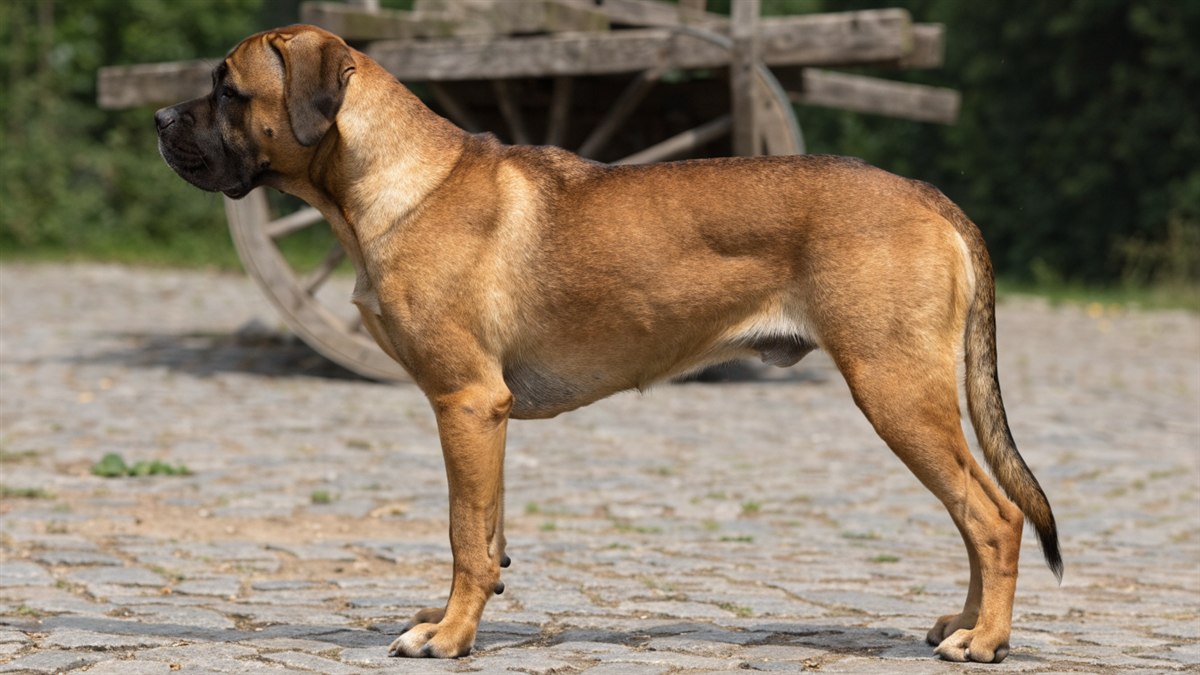
Quick answer
The Belgian Mastiff, or Mâtin Belge, is a large Belgian draught dog that went completely extinct at the start of the 1960s and has been rebuilt in Flanders since 2000 under a Belgian national standard approved in 2010. The FCI recognises it on no basis. Belgium's last published count was about sixty dogs. No Indian listing, price or population exists.
This guide is general information for Indian pet owners and is not a diagnosis. No breed-specific veterinary literature exists for the Belgian Mastiff, so nothing here should be read as a health profile for an individual dog. Consult a registered veterinarian who has examined your dog before acting on anything you read here.
Belgian Mastiff at a glance, rated for India
What the Belgian Mastiff was, and what carries the name now
The Belgian Mastiff is a large Belgian draught dog that Belgium's own kennel club records as completely extinct by the early 1960s, and that a small Flemish breeding programme has been rebuilding since 2000. Two different animals share the name. Knowing which one a page means settles almost every contradiction you will read about this breed.
Belgium's FCI member kennel club, the Société Royale Saint-Hubert, publishes the dog under three names. Mâtin Belge in French, Belgische Mastiff in Dutch, and the older Chien de Trait Belge, which simply means Belgian draught dog. A Flemish agricultural heritage collection records a fourth working name still used in the countryside, rekel. All four describe an animal bred to pull a dog cart, not to guard a gate.
The 1915 dog was not a breed yet
Wikipedia's article rests on three books, and one of them is readable in full. Walter Mason's *Dogs of All Nations*, published for the 1915 Panama-Pacific International Exposition, files the animal under Netherlands Breeds and heads the entry not 'Belgian Mastiff' but simply 'Draught Dog'. Its opening line is the one no ranking page quotes. 'This is more or less of a nondescript variety';. Mason gives a height of 24 to 32 inches, roughly 61 to 81 cm, a weight of about 100 lb or 45 kg, fawns and brindles as the commonest colours, and this detail: 'The tail is generally docked to about three inches.'
That is a description of a working type, selected out of a large and mixed population, rather than a fixed breed. The heritage record agrees. Various large strong breeds and crosses were harnessed, and breeders founded a federation around the turn of the century precisely because they wanted to fix one draught-dog type out of the mixture.
The 2010 dog is a breed, and it is a bigger one
The standard the Belgian kennel club publishes today was approved in 2010 and describes a considerably heavier animal. Set the two side by side and the reconstruction is not a like-for-like restoration by the numbers.
| Feature | Mason, 1915 | Belgian standard, 2010 |
|---|---|---|
| Status of the type | 'More or less of a nondescript variety' | A fixed breed standard with disqualifying faults |
| Height | 24 to 32 in (61-81 cm), sexes not split | Males 70-76 cm, females 64-70 cm |
| Weight | Around 100 lb (about 45 kg) | Males 50-60 kg, females 40-50 kg |
| Tail | 'Generally docked to about three inches' | Reaches the hock. A shortened tail disqualifies |
| Colour | Fawns and brindles commonest | Preferably shaded fawn with a black mask, any colour but white |
Read the weight row again. The 2010 breed starts where the 1915 dog finished. A hobbyist profile on the same result page reaches the same conclusion in words, calling the modern animal 'more massive than the original Chien de Trait';. The reconstruction's own stated aim is to approach the pre-1900 type as closely as possible, so this gap matters and nobody currently ranking has measured it.
What the standard actually asks for
- A rectangle, not a square. The body is longer than it is tall, and the muzzle is shorter than half the head.
- A short coat with an undercoat. Short or semi-short, dense, well laid, weather-resistant.
- A black mask on shaded fawn, preferred over every other colour. Black is allowed. White is not, and an all-white coat disqualifies.
- Thick, slightly loose skin, especially at the neck, with light head wrinkling permitted when the dog is alert.
- A natural tail and natural ears. Medium drop ears lying against the cheeks, and a tail reaching the hock.
The breed is a short-coated, heavy-boned, muscular molossoid built for a long steady pull rather than a sprint. The standard asks that it cover a long distance without showing signs of fatigue. Every care question later on this page follows from that one sentence, because a body designed to work all day in a Belgian drizzle is not the body you want in a Chennai May.
Is the Belgian Mastiff extinct? Both answers are sourced
The Belgian Mastiff went completely extinct at the start of the 1960s, and a reconstructed population of the same name has existed in Flanders since 2002. Wikipedia reports the first fact and stops. Belgium's kennel club reports both. Neither is lying, and the honest answer for a buyer is that you cannot obtain this dog, which is a different statement from saying no such dog is alive.
Bonbeno went to the organisations closest to the animal rather than to the English-language SERP, and the two accounts line up almost exactly.
The extinction, dated by the people who registered it
Dogs were used heavily as draught animals in Belgium until the 1930s. Mechanisation followed, the breed visibly deteriorated from the 1930s onward, and the Mâtin Belge was completely extinct at the beginning of the 1960sKoninklijke Maatschappij Sint-Hubertus. The reconstruction association adds the administrative fact that goes with it. When the last dogs were gone, the studbook number of the Mâtin Belge was suspended. Hold on to that sentence, because it is the origin of a claim that has since been garbled across the English internet.
The rebuild, dated the same way
| When | What is documented | Source |
|---|---|---|
| Around 1990 | A few enthusiasts begin trying to produce dogs matching the first draught-dog standard | Belgian kennel club |
| 2000 | The breeder Alfons Bertels decides to rebuild the breed to a planned programme | Belgian kennel club |
| 2002 | The male Bacon is born | Both |
| End of 2003 | Bacon is presented to the public at the Eurodogshow in Kortrijk | Association |
| 2006 | The vzw De Belgische Mastiff is founded | Both |
| 25 September 2010 | The standard is approved and the breed is given the status 'Belgian breed recognised in reconstruction' | Association |
| 19 December 2010 | The breed appears at the Brussels Dog Show for the first time in decades | Association |
| 1 May 2014 | About twenty dogs across several generations are assembled for assessment by the kennel bodies | Association |
| August 2016 | Around sixty dogs in Belgium and three breeders, all in Flanders | RTBF |
The population figure is the one an intending owner should hold on to. In August 2016 Belgium's public broadcaster reported about sixty Belgian Mastiffs in the whole of Belgium, bred by three breeders, all of them in Flanders. That number is a decade old now and Bonbeno could not find a newer published count from the association or the kennel club, so treat sixty as the last verifiable figure rather than as today's total.
A national population last counted at sixty dogs, bred by three families in one region of one country, is not a supply. The association describes its breeding as running in close consultation with the Belgian kennel bodies at every step, which is responsible practice and also the opposite of an export market. Add India's import rules, set out further down, and there is no lawful route by which a puppy reaches an Indian buyer.
Is the rebuilt dog the same breed?
The programme does not claim to have found survivors. It claims to have rebuilt the type, and the language everywhere is reconstruction, wederopbouw, heropbouwenDe Belgische Mastiff vzw, 'Over ons'. The status granted in 2010 says so in its own name, a breed recognised in reconstruction, which is a category that exists precisely because the answer is not a simple yes.
One ranking page goes further and states that the rebuild used rural dogs believed to descend from the original, crossed with English Mastiffs, Bullmastiffs, Briards and Belgian Sheepdogs. Bonbeno cannot confirm that. Neither the Belgian kennel club nor the association names any founding or outcross breed anywhere on its public pages, and the page making the claim cites nothing and also dates the programme to the late 1980s, which conflicts with the year 2000 both organisations give. Treat the outcross list as unverified. The useful and checkable point stands on its own: the 2010 dog is heavier than the 1915 dog, and it carries the natural tail the 1915 dog did not.
Recognition: the FCI does not list this breed, and here is the proof
The FCI recognises the Belgian Mastiff on no basis at all, definitive or provisional. Bonbeno read both FCI lists in full on 21 August 2026 and checked the breed names printed inside each document rather than trusting a search result. The breed's only recognition is national, granted by Belgium in 2010, and it does not travel.
The definitive list
FCI Group 2 covers Pinschers and Schnauzers, Molossoids and Swiss Mountain and Cattle Dogs, which is exactly where a Belgian molossoid would sit. The published group page lists 53 breeds and the Belgian Mastiff is not among them, under any of its four names. The control is the rest of the list, which reads correctly: Dobermann 143, Boxer 144, Great Dane 235, Mastiff 264, Bullmastiff 157, Tibetan Mastiff 230, Cane Corso 343 and St Bernard 61 are all present and correctly numbered. The document is the right document, and the breed is absent from it.
The provisional list
The FCI nomenclature index prints the provisional list inline, with 20 breeds and their dates of provisional recognition. The most recent four were added on 11 February 2026. The Belgian Mastiff is not there either. The control here is that the list correctly carries the Andalusian Terrier at 3 September 2024, which matches what Bonbeno established independently on that breed, so this is the genuine provisional register and not a lookalike page.
That distinction has teeth. The FCI states that pedigrees issued to dogs of provisionally recognised breeds have to carry the FCI logo. A Belgian Mastiff pedigree cannot, because the breed has not reached even that first rung.
What Belgium itself says
The Belgian kennel club is direct about the position. 'Given that the breed is currently only recognised nationally, there is not yet an official FCI standard';Koninklijke Maatschappij Sint-Hubertus. The Group 2, Section 2.1 classification printed on that same page is the classification the breed would take if it were recognised, not one the FCI has issued. The same page adds a detail worth weighing before anyone calls this an established breed. There is currently no breed club.
Where the 'FCI suspended it' claim actually comes from
Trace the sentence back and it shrinks at every step.
| Where it is said | The claim made | Status |
|---|---|---|
| De Belgische Mastiff vzw | The studbook number of the Mâtin Belge was suspended when the breed died out | The original claim, made by the association itself |
| dogbreedinfo.com, position 5 | 'The FCI placed the breed on the suspended list' | No FCI document cited |
| Wikipedia, position 1 | 'The FCI has placed the breed on its suspended breeds register' | The sentence's only citation is a Belgian kennel club page archived in 2019 |
| Bonbeno check of fci.be | Searched the FCI site for any breed-suspension register | None found. The only suspension directory on fci.be lists suspended judges |
Bonbeno also opened the 2019 archived page that Wikipedia cites for the quoted words 'may be extinct'. The capture renders only the site's boilerplate, so the quoted wording could not be verified from it. The live Belgian kennel club page says something materially different from what Wikipedia reports, and has done since at least 2022. A national studbook number being suspended is not the same event as an international federation suspending a breed, and the difference is the whole of the confusion.
Where this leaves an Indian registration
The Kennel Club of India published no breed list on its site when Bonbeno checked it on 21 August 2026, so no claim is made here about whether it would recognise the breed. What the KCI does publish is the checklist for registering an imported dog, and the first substantive line asks for an export pedigree in original, alongside the DGFT licence, customs clearance, quarantine clearance and pet passport. A dog whose only pedigree comes from a nationally recognised breed in reconstruction, issued without an FCI logo, walks into that requirement with nothing obvious to hand over. Nobody has tested it, because no such dog has arrived.
The dog cart economy that made the breed
The Belgian Mastiff exists because Belgium ran a national transport system on dogs. Around 1900 the country had more draught dogs than any other, and the trade that used them was small commerce: milk rounds, bread rounds, market gardens. The breed was engineered for that job, and it disappeared when the job did.
Draught dogs were harnessed across Europe from about 1800 to 1950, and no country counted as many as Belgium. Two independent sources put the figure at at least 150,000 dogs around 1900, one a Flemish agricultural heritage collection and one a Belgian military-history archive drawing on a 1992 bookDr P. Loodts, Médecins de la Grande Guerre.
A number worth disagreeing about
A contemporary source gives a very different count. Mason, writing in 1915 and citing the *Journal of the Royal Artillery*, reports '50,000 dogs available for this purpose in Belgium, of which 10,000 are in Brussels alone';. Bonbeno prints the disagreement rather than splitting it. The 150,000 estimate is modern and retrospective, the 50,000 is contemporary and specific to dogs available for traction work, and the two may simply be counting different things. Any page that gives you one confident number for this has not looked at the other.
The poor man's horse
The nickname the dogs earned explains the economics better than any figure. Draught dogs were called 'het paard van de armen';, the horse of the poor. They did comparable work far more cheaply, ate table scraps or slaughter waste, needed much less space and care, and their smaller carts were more manoeuvrable than a horse and cart in a village street.
- Milk rounds, with heavy churns taken door to door. This is the image that survives in photographs.
- Bread rounds and greengrocers, along with clog sellers, mussel sellers, petrol sellers and organ grinders.
- Farm traffic, to the mill, the market, the dairy and the town.
- Government work, including a spell delivering post, and in the First World War hauling machine guns to the front line.
The cart itself was a two-wheeled vehicle with two shafts, its load bed set on leaf springs and capable of several hundred kilos. Mason's numbers show what the dog contributed. A dog of 110 lb could draw a load of 880 lb on a good road, which is eight times its own bodyweight, while a horse of ten times the dog's weight could not draw much more than the equivalent increase. With an average load of 660 lb behind it, a dog held four to five miles an hour over long distances, and six to seven miles an hour over a few hundred yards.
The dates nobody agrees on
The breed's own origin story is not settled either, and the disagreements sit between sources that all have standing.
| Event | Belgian kennel club | Other sources |
|---|---|---|
| First draught-dog competition | 30 June 1895, at Merchtem | Not disputed |
| First published standard | 1899, by Prof. Ad. Reul in Chasse et Pêche | Molosser Dogs says the breed was 'standardized in 1895' |
| Club founded | 24 January 1900, in Brussels, under Count Jean de T'Serclaes | Loodts dates the club to 1899; Molosser Dogs to 1911 |
| Studbook | 350 dogs registered by 1911 | The association says 300; Loodts records a studbook published in 1908 |
One further wrinkle sits inside a single organisation. The Belgian kennel club's French page dates the club to 24 January 1900 and its Dutch page to 24 January 1990Koninklijke Maatschappij Sint-Hubertus. The Dutch date is plainly a typing slip for 1900, and Bonbeno notes it only because it shows how little editorial traffic these pages get. What is agreed is the scale: by 1911 the federation had 1,500 members and ran more than twenty competitions a year.
The machine-gun dogs of 1914, and what they prove about temperament
The Belgian Army harnessed these dogs to Maxim machine guns because trials showed a pair of them beat pack-horse transport. The record of that service is the best evidence anyone has about the original dog's working temperament, and it says calm and silent rather than fierce.
Two lieutenants of the Carabiniers, Blancgarin and Van de Putte, convinced the Belgian General Staff to move machine guns by dog traction. Blancgarin designed the cart, Van de Putte handled the dogs and their harness. Prototypes convinced the staff in early 1912 and a first series of carts was ordered from FN de Herstal.
Mason, writing from the other side of the decision in 1915, records what settled it. 'Exhaustive trials between this method and that of wheel traction by a pair of dogs of a breed known in that country as the Belgian Mastiff have resulted in favour of the latter, and the final adoption of this mode of transport for the Machine Gun Units of the Belgium Army';. That sentence is the single use of the words 'Belgian Mastiff' anywhere in a 268,000-character book about the dogs of the world.
The actual load
| Item | Figure |
|---|---|
| Maxim 1911 gun, water jacket filled | 21.65 kg |
| Tripod | 20.85 kg |
| Gun and tripod together | 42.5 kg, before the cart, ammunition and crew kit |
| Rate of fire | 400 rounds per minute |
| Machine guns in the Belgian Army, August 1914 | 120 |
| Machine guns in the German Army, August 1914 | 12,750 |
Those last two rows explain the urgency. A country with 120 machine guns against 12,750 needed every one of them to arrive where it was wanted, quickly and unseen.
Calm was the specification
At the summer 1913 manoeuvres the teams completed a 30 km march, crossed the Meuse by boat and climbed the far bank without a single bark or hesitation. An officer writing under the pen name Vilgum reported that in surveillance positions the dogs and gunners had stayed ten hours in the same place with no movement and no barking. The tactical value was near-total invisibility until short range.
A dog that lies silent beside a gun for ten hours is not an excitable animal. The breed specialist interviewed by Belgium's public broadcaster made the same point from the civilian side: a cart dog had to be calm and easy to handle and train, so the temperament follows logically from the work. The Belgian standard still asks for a very self-assured, balanced, sociable, approachable and docile dog, and disqualifies aggressive or fearful animals outright.
Mixed Brigades issued with dog sections at the last minute failed, and the reason recorded is precise. Their cadres had no experience of dogs, could not care for or direct them, and the dogs became quarrelsome, barky or fearful. The same animals, handled by people who did not know what they were doing, produced the opposite temperament. That is the oldest documented lesson about this breed and it applies to any large guarding dog in an Indian home today.
How it ended
At the Belgian training centre at Oye-Plage in the Pas-de-Calais there were not enough Belgian Mâtins, so a mixed kennel was assembled by requisitioning from the local dog population. Belgian dogs were also seized by the occupying army for their qualities. A few Blancgarin carts joined the final offensive along the Lys diversion canal in October 1918, and in September 1919 four of them travelled to the United States with King Albert and Queen Elisabeth. Commander Blancgarin himself did not see it. He was mortally wounded at Drie-Grachten on 8 April 1915 and died at Roulers on 29 April.
The law that ended dog carts arrived after the breed had already gone
Belgium's prohibition on using dogs as draught animals is real, but every date in circulation for it is different, and the earliest well-evidenced one is 1975, roughly fifteen years after the Belgian Mastiff was already extinct. The popular story that a ban killed the breed has the order backwards. Mechanisation killed it, and the law caught up afterwards.
Four dates are in circulation. Bonbeno could read the statute text for only two of them, and reports the rest as what they are.
| Date claimed | Source of the claim | What Bonbeno could verify |
|---|---|---|
| 1951 | A breed specialist quoted by RTBF in 2016 | No statute text found. Unverified |
| 1957 | A Belgian military-history article, 2010 | No statute text found. Unverified |
| 2 July 1975 | Two Flemish heritage sources, independently | The law of 2 July 1975 on animal protection definitely existed. The 1986 Act repeals it by name at Article 45 |
| 1 September 1995 | The consolidated statute itself | Verified verbatim. Article 36, 7° of the 1986 Act, inserted by the Law of 4 May 1995 |
The provision, quoted exactly
The current prohibition sits in the Belgian Law of 14 August 1986 on the protection and welfare of animals. Article 36, 7° makes it an offence to 'se sert de chiens comme bêtes de somme ou de trait', to use dogs as pack or draught animals, subject to derogations the responsible minister may grant on conditions fixed by the King. The clause was inserted by the Law of 4 May 1995 and came into force on 1 September 1995. Article 45 of the same Act repeals the Law of 2 July 1975, which is the instrument two Flemish heritage sources name as the one that officially ended dog carts.
The Royal Decree of 12 March 1999 sets the derogation conditions, and its own preamble cites Article 36, 7°, which independently confirms the clause number. Only two things can be authorised: sled-dog competitions with preparatory training, and demonstrations of dog teams. Applications go in by 31 May each year, must name the breeds and describe the harness, and need the burgomaster's prior authorisation. Dogs must be at least one year old. Demonstrations must be primarily educational, must not be competitive, and the load and route must suit the physiological capacities of the breeds used.
This is why the Belgian kennel club can say, on the same page as the standard, that although it is forbidden by law to let dogs pull, demonstrations are permitted with the right authorisations. The Walloon government publishes the same position and the same procedure.
The Dutch parallel, which is better documented
The Netherlands regulated before it banned. The Trekhondenwet of 1910 required owners of draught dogs to register, required a drinking trough on the cart, and set a floor on the dog itself: over one year old and at least sixty centimetres tall. An Anti-Trekhonden Bond formed in 1912, and the outright ban followed about fifty years later with the Animal Protection Act, taking effect in 1962. Belgium and the Netherlands shared the same dog and reached the same end point by different routes.
The Belgian kennel club dates extinction to the start of the 1960s and blames mechanisation from the 1930s onward. The heritage record agrees: rising prosperity and motorised delivery made the draught dog superfluous, and legal protection came alongside rather than first. Even the earliest corroborated statute, 1975, post-dates the extinction by about fifteen years. A page telling you the ban killed the breed has not checked a date.
Belgian Mastiff price in India: there is no price, and that is the finding
There is no Belgian Mastiff price in India. Not a high one, not a disputed one, none at all. Bonbeno ran three India-located searches on 21 August 2026, each beside a control query in the same session, and found no Indian listing, no Indian rupee figure and no Indian transaction for this breed. On a rare-breed page that absence is usually the most useful thing we can publish, and here it is unusually clean.
What the price query actually returns
Searching belgian mastiff price in india from an Indian location returns ten results, and not one of them is about this breed. Nine are the Belgian Malinois or Belgian Shepherd, including a government procurement listing for a police Malinois. The tenth is a general Indian dog price index, which lists the Belgian Malinois at Rs 30,000 to Rs 1,00,000 and a generic 'Mastiff mix' at Rs 30,000 to Rs 1,50,000 while carrying no Belgian Mastiff entry at all.
The query is not failing. It is being answered by the nearest breed whose name starts the same way, which is precisely what an Indian buyer typing this phrase will experience.
| Query | Result | Control run in the same session |
|---|---|---|
| belgian mastiff price in india | 9 of 10 results are Belgian Malinois or Belgian Shepherd. The tenth is a general Indian price index with no entry for this breed | Not needed. A non-zero, working result set |
| Belgian Mastiff / Matin Belge puppy for sale India | 0 Indian listings. Returned a Facebook history page, a 1915 book on Project Gutenberg, a stock photo library and breed-name copypasta | labrador retriever puppy for sale india returned 10 genuine Indian listings, with KCI-registered tiers and city-wise bands |
| Belgian Mastiff dog breed (India) | Wikipedia, Pinterest, YouTube, stock photos, and the AKC page for the Belgian Malinois | The same pull surfaced real breed pages for other breeds, so the index is intact |
The control matters. A zero can be a blocked search wearing a result page, so Bonbeno checked that an Indian for-sale query for a breed that genuinely trades here still works. It does, emphatically: the Labrador query returned Indian breeders quoting Rs 30,000 to Rs 1,20,000 with a separate KCI-registered band of Rs 60,000 to Rs 90,000. The tool was working. There was simply nothing to find.
The 84.38 test had nothing to run on
Bonbeno routinely divides suspicious Indian rupee figures by 84.38, because Indian pages for absent breeds often publish a United States dollar figure run through one exchange rate. On the Andalusian Terrier that test resolved four separate 'Indian' prices to round dollar amounts. Here the test could not be run, because not one Indian page publishes a rupee figure for this breed at all.
Auto-generated price pages exist for hundreds of breeds that have never entered India. That an Indian buyer cannot find even a fabricated Belgian Mastiff price tells you the breed is far outside the reach of the Indian pet trade. If somebody does quote you a figure, the question is not how much. It is which dog, from where, and under what import authorisation.
Why no lawful supply chain can form
India makes dogs a Restricted item under ITC (HS) 01061900. Policy Condition 7 allows import only for a pet dog with a valid pet book and records in the name of the importer, for R&D organisations with a CPCSEA recommendation, or for internal security by the Defence and Police Force. Policy Condition 8 states that import of commercial dogs for breeding or any other commercial activity is not permitted, and paragraph 6 says applications for trading or breeding purposes shall be duly rejected.
Set that against a world population last counted at sixty dogs in one Belgian region. The only lawful door is a returning resident bringing in up to two personally owned pets as baggage after two years of continuous stay abroad, through one of seven ports: Delhi, Mumbai, Chennai, Hyderabad, Bengaluru, Kolkata and, since October 2024, Kochi. A door that admits one family's own dog at a time does not build a market, and no commercial importer can register a breeding programme here at all. The full route is set out in how to import a dog to India.
Monthly cost of ownership: what can honestly be costed, and what cannot
Bonbeno publishes no monthly rupee figure for keeping a Belgian Mastiff in India, because there is no Indian population to observe and any number would be invented. What can be costed is the paperwork chain the import route imposes, and the way a 50-60 kg bodyweight drives every recurring line item upward.
Every competitor page that gives a breed like this a tidy monthly figure has produced it by analogy or by currency conversion. Neither is a measurement. The honest structure is to separate what is documented from what is guesswork.
The one-off costs that are documented
If the only lawful route is a returning resident bringing a personally owned dog, the cost is a document chain rather than a purchase price. The Kennel Club of India's checklist for registering an imported dog names what must be produced.
- Export pedigree in original. The hard one for this breed, because the pedigree comes from a nationally recognised breed in reconstruction and carries no FCI logo.
- DGFT licence, where the baggage exemption does not apply, applied for at least two months before travel.
- Airway bill and air ticket in original, from the country of import to the final destination, plus boarding passes.
- Customs clearance and quarantine clearance documents, with an Advance No Objection Certificate from the port quarantine officer obtained seven days before travel.
- Pet passport and a notarised affidavit, submitted with the single dog registration form.
The recurring costs that scale with size
A dog the Belgian standard puts at 50 to 60 kg for males and 40 to 50 kg for females sits at the top of every Indian cost curve. Food volume scales roughly with metabolic bodyweight, so a giant breed eats several times what a Beagle eats. Almost every veterinary drug is dosed per kilogram, so a single course of an antiparasitic, an antibiotic or an anaesthetic costs several times more for this dog than for a mid-sized one. Boarding, grooming, transport crates and orthopaedic bedding are all priced by size band, and the largest band is always the most expensive.
For a realistic Indian monthly cost structure at this bodyweight, read Bonbeno's Great Dane and St Bernard guides, which carry observed Indian figures for dogs in the same weight class. Those numbers describe those breeds, not this one. Bonbeno will not print them under a Belgian Mastiff heading, because a figure borrowed once becomes a figure quoted forever.
One recurring cost this breed avoids is grooming. The short coat needs almost nothing, which is covered further down. One it does not avoid is climate control, and in most Indian cities that is the largest hidden line on the bill for a dog of this build.
Indian climate: a 20°C working limit meets a 40°C heat wave threshold
The Belgian Mastiff is not heat-tolerant, and the cleanest way to show it is to put Belgium's own working-dog rules beside India's own heat definitions. Belgian law cancels a draught-breed competition when the ambient temperature passes 20°C. India does not classify a plains day as a heat wave until 40°C. That twenty-degree gap is the whole climate problem in one line.
The two thresholds, side by side
Belgium's Royal Decree of 12 March 1999 governs the only circumstances in which dogs may lawfully pull anything. For competitions with the permitted sled breeds it requires that if the ambient temperature is above 15°C each stage may not exceed 5 km, and if the ambient temperature is above 20°C the competition is cancelled. Those limits are written for the Siberian Husky, Alaskan Malamute, Samoyed and Greenland Dog rather than for this breed, so read them as a calibration of what Belgian regulators think a working dog can take, not as a rule about the Mâtin Belge.
Now the Indian side. A heat wave is not even considered in India until a station's maximum reaches at least 40°C in the plains, or 37°C at coastal stations with a departure of 4.5°C from normal. Heat waves run from March to June and sometimes into July, with May the peak month, and northern India averages five to six events a year.
What the veterinary evidence says about a dog this size
No study has ever examined this breed, so the honest move is to use the evidence about dogs of its weight and to label it as exactly that.
| Finding | Figure | Study |
|---|---|---|
| Dogs weighing over 50 kg were at greater risk of heat-related illness | Male standard weight is 50-60 kg | VetCompass, 905,543 UK dogs, 2016 |
| Fatality rate of confirmed heat-related illness events | 14.18% (95% CI 11.08-17.96%) of 395 events | VetCompass, 2020 |
| Higher bodyweight relative to the breed and sex mean raised risk | An overweight individual compounds the size risk | VetCompass, 2020 |
| Risk factors include hot and especially highly humid environments, and large (over 15 kg) bodyweight | This breed clears that threshold three times over | Bruchim et al., 2017 |
| Heatstroke means a core temperature above 41°C with CNS dysfunction; mortality around 50% | Roughly a coin flip once it happens | Bruchim et al., 2017 |
One line from the pathophysiology review deserves separate weight. Lack of acclimation to heat, and lack of physical fitness, decrease the survival of heat-stroked dogs. A dog flown from a Belgian winter into an Indian summer is by definition unacclimatised, and that is the worst possible starting condition.
The coat is not the protection people assume
The Belgian standard specifies a short or semi-short coat that is dense, well laid, weather-resistant, and carries an undercoat. That undercoat was insulation against Flemish winter rain on a dog working outdoors all day. In Indian humidity it traps heat against the skin. The coat is low-maintenance, which is not the same as cooling.
The living conditions that would make this dog viable here are climate-controlled indoor housing, exercise confined to genuine early morning and late night, shaded flooring rather than hot tile or concrete, and constant water. That is a description of a dog kept indoors nearly all day. Anyone reading this because they want an impressive guard dog for an Indian compound should read that sentence twice.
Temperament: the standard asks for docile, the old descriptions do not
The Belgian standard requires a very self-assured, balanced, sociable, approachable and docile dog, and disqualifies aggressive or fearful animals outright. Nineteenth and twentieth-century descriptions of the working draught dog say something noticeably sharper. Both can be true, because the reconstruction has been selecting for the first for twenty-five years.
Two temperaments, one name
| Source | Description |
|---|---|
| Belgian standard, 2010 | Very self-assured, balanced, sociable, approachable, docile. Aggressive or fearful dogs are a disqualifying fault |
| Breeder Geert De Doncker, RTBF 2016 | Calm, docile, but also very vigilant. Very good for a family, but sometimes difficult with another dog or with strangers |
| Belgian Army record, 1913-1918 | Silent and still for ten hours in a firing position. Completed a 30 km march without a bark |
| De Brisco 1990, via Wikipedia | A tireless worker with strong protective instincts, not known to be particularly friendly to anyone but their masters |
| Molosser Dogs, undated | Fairly aggressive towards strange people and dogs, with many cart dogs muzzled most of the time. The modern dog is 'less aggressive than its ancestors' |
The muzzling claim is worth flagging as unverified. It appears on a hobbyist page with no citation, and nothing in the Belgian kennel club record, the heritage record or the military record mentions routine muzzling. Bonbeno reports it because a reader will meet it, not because it is established.
Who this dog would suit, if it were obtainable
It is kept today mainly as a guard dog and a family dog while retaining the physical and mental make-up of a draught dog. That combination is specific. A dog bred to walk beside a cart in a busy market street had to tolerate crowds, noise and strangers passing within a metre without reacting, which is a far higher social threshold than most guarding breeds are asked to meet.
- Suits a household that wants a large, quiet, low-arousal dog and has genuine indoor space for a 50-60 kg animal.
- Suits an owner who understands that vigilance and aggression are different traits, and who wants the first without the second.
- Does not suit anyone buying size as a deterrent, because the standard actively penalises the temperament that would deliver it.
- Does not suit a multi-dog household without careful management, given the breeder's own note about other dogs.
- Does not suit an Indian apartment on the seventh floor, whatever a ranking page says about apartment living.
The breed page at position 5 in India states that the Belgian Mastiff 'will do okay in an apartment if it is sufficiently exercised' and that 'a small yard will do';. That advice was written for a temperate climate for a dog nobody on that page has kept. A 50-60 kg dog with an undercoat, in an Indian city, in May, is not an apartment animal in any meaningful sense.
Training: bred to be handled, and the oldest lesson is about the handler
Train this breed the way its original job demanded, which is calm repetition with early and heavy socialisation, and expect the handler to be the limiting factor rather than the dog. The single best-documented training lesson about the Belgian Mastiff is a century old and it is about people, not dogs.
The work selected the temperament. A cart dog had to be calm and easy to handle and train, because it walked in traffic beside a person carrying money and goods. The Belgian standard still asks for docility as a required trait rather than a bonus.
The 1914 experiment nobody designed
The Belgian Army ran an accidental controlled trial. The Carabiniers' sections, whose handlers were properly trained, performed. The Mixed Brigades issued with dog sections at the last minute failed, and the recorded reason is that their cadres had no experience of dogs, could not care for or direct them, and the dogs became quarrelsome, barky or fearful. Same breed, same year, same task. The variable was the handler.
That is the most useful training fact this page can give an Indian reader, because it generalises. A large guarding breed acquired for status and then handled by whoever is free that day will produce the second outcome, reliably.
What to do, and when
- Socialise before sixteen weeks. Deliberately expose the puppy to traffic, crowds, other dogs and strangers while it is still forming its defaults, which is exactly the environment the original dog worked in.
- Train in short calm sessions. The breed was selected for low arousal, so high-energy drill methods work against the temperament rather than with it.
- Teach loose-lead walking early and seriously. A 55 kg dog that pulls is not a nuisance, it is a hospital visit for whoever is holding the lead.
- Never build guarding behaviour deliberately. The standard disqualifies aggression, and a dog this size that has been encouraged to threaten is a liability under Indian law and in your own home.
- Screen the handler, not just the dog. Decide who in the household is actually going to do the daily work before the animal arrives.
The honest limits of this section
No published training study, breed club syllabus or behavioural survey exists for the Belgian Mastiff. There is no breed club at all, so there is no body producing that material. Everything above is drawn from the standard, from the documented working history and from the breeder interview, and Bonbeno says so rather than presenting inferences as breed data. Timelines quoted confidently elsewhere for this breed are borrowed from other molossoids.
Whatever the breed, a puppy cannot lawfully be sold in India below eight weeks of age. Rule 8(1)(a) of the Prevention of Cruelty to Animals (Dog Breeding and Marketing) Rules, 2017 requires that breeders ensure 'pups less than eight weeks in age are not sold';. Vaccination under the same Rules can start at seven to eight weeks and is usually completed by eighteen weeks, which is the window your socialisation plan has to work around.
Exercise: built for distance, legally barred from its own job
The Belgian Mastiff needs long, low-intensity movement rather than hard exercise, because the standard asks that it cover a long distance without showing signs of fatigue. In India that requirement collides directly with the heat, and the daily walk has to move to the two coolest hours of the day.
The standard describes regular, free movement of good amplitude, with walk and trot as the usual gaits, and sets endurance as the test. This is a dog engineered to plod for hours, not to sprint or jump.
What the original dog actually did
The 1915 figures give the scale of the job the body was designed around. A 110 lb dog could pull a load of 880 lb on a good road, and hold four to five miles an hour over long distances with 660 lb behind it. In 1913 the army teams covered 30 km in a day's manoeuvre and were still fit to work at the end of it.
Using a dog as a draught or pack animal is an offence in Belgium under Article 36, 7° of the 1986 Act, and demonstrations require a ministerial derogation applied for by 31 May, restricted to educational and non-competitive events, with the load and route matched to the breed's physiological capacityArrêté royal du 12 mars 1999 fixant les…. Belgium permits its own heritage breed to pull only under licence. Nobody should be improvising a weighted harness for a large dog in an Indian summer.
A realistic Indian routine
- Two long slow walks, taken before sunrise and well after dark, rather than one long walk in daylight.
- Surface check before every walk. Press the back of your hand to the pavement for five seconds. If you cannot hold it, the dog cannot walk on it.
- No running, no cycling alongside, no fetch sessions in the warm months. Sustained exertion in heat is a named risk factor for heatstroke.
- Controlled growth in the first year. Giant-breed puppies should not be doing forced distance work while the growth plates are open.
- Indoor enrichment as the substitute. Scentwork and slow puzzle feeding do the mental job without raising body temperature.
The blunt version is that in most Indian cities, for four to six months of the year, this dog's exercise requirement cannot be safely met outdoors at all except in the dark. That is a serious constraint on a breed whose entire physical design assumes a working day.
Grooming: almost nothing for the coat, real attention for the ears
Groom a Belgian Mastiff by brushing it through the moult and otherwise leaving the coat alone, because the standard describes a short, dense, well-laid jacket that a comb and brush handle completely. The maintenance that actually matters in India is the ears, and that is a matter of anatomy plus humidity rather than of this breed's reputation.
Belgium's kennel club is brief on the subject, and rightly so. The short coat is fairly rough and easy to maintain, and during the moult a regular comb and brush is sufficient. The coat is short or semi-short, dense, well laid, weather-resistant and carries an undercoat.
The undercoat changes the Indian answer
A short-coated dog with an undercoat sheds more than its coat length suggests, and it sheds heavily and continuously in a climate with no real winter. Brushing two or three times a week through the year is the practical Indian schedule, not the seasonal one a Belgian page implies.
The undercoat is the dog's own insulation against solar gain as well as cold, and shaving a double-coated dog removes the layer that keeps radiant heat off the skin while doing nothing about the real cooling bottleneck, which is panting. A shaved dog of this build is not a cooler dog. It is a sunburn risk that is still heat-sensitive.
Ears are the real job
The standard specifies medium-sized ears, set fairly high, hanging and lying against the cheeks. That is a closed, warm, poorly ventilated canal, and there is direct evidence about what that means. A retrospective study of 8,975 dogs across fifteen North American veterinary teaching hospitals found that dogs with pendulous ears and heavy ear canal hair had significantly more otitis externa than dogs with other ear types, at P less than 0.01. The same study reported, for the first time with direct evidence, that monthly variations in ambient temperature, rainfall and relative humidity largely explain the monthly variation in otitis externa prevalence across regions.
Read that against an Indian monsoon. Temperature, rainfall and humidity all peak together, and a drop-eared dog is in the higher-risk ear group before the weather is considered.
- Check the ears weekly, and daily through the monsoon, looking for odour, discharge, redness or head shaking.
- Dry the ears after every bath and every soaking. Do not let a wet drop ear sit closed against the cheek.
- Skip the air-dry advice that overseas breed guides print. It is written for a dry temperate climate and it does not transfer to Indian humidity.
- Clip nails and check the skin folds at the neck, where the standard's thick, slightly loose skin can trap moisture.
- Take a smell to the vet, not to the internet. Ear disease in a drop-eared dog escalates fast and is far cheaper to treat early.
No breed-specific grooming or dermatology data exists for the Belgian Mastiff. Everything above is derived from the published standard's anatomy and from evidence about ear type and climate, and Bonbeno flags that rather than dressing inference as breed knowledge.
Health and life expectancy: no data exists, and here is how that was established
No health data exists for the Belgian Mastiff. No prevalence study, no screening register, no lifespan survey and no peer-reviewed paper of any kind. Bonbeno publishes no life expectancy figure for this breed, and this section explains exactly how that conclusion was reached, because an absence claim has to be earned rather than assumed.
The literature search, with its controls
PubMed was queried through the E-utilities API on 21 August 2026 for all four names the breed goes by, alongside control queries in the same session. Counts alone would have been misleading in both directions, so the query translations were read and every non-zero record was opened.
| Query | Count | What the records actually are |
|---|---|---|
| "Belgian Mastiff" | 0 | Translated to (belgian OR belgians) AND (mastiff OR mastiffs). Even that loose translation returns nothing |
| "Chien de Trait Belge" | 0 | Translation mangled 'de' into the MeSH subheading 'drug effects' |
| "Matin Belge" | 1 | A 1971 paper on infrared transmission in the eye, in Bull Soc Belge Ophtalmol. Matched on the journal name |
| "Belgian Draught Dog" | 3 | Two studies of draft HORSES and one on Belgian Malinois trainability genetics. None about this breed |
| CONTROL: "Belgian Shepherd" AND dog | 65 | Clean phrase translation, genuine records. The database is working |
| CONTROL: canine hip dysplasia | 780 | Proper MeSH translation. The database is working |
Four records, opened one by one, and not one of them is about the Belgian Mastiff. Two are horses. One is the Belgian Malinois, which is the same breed the Indian price SERP keeps substituting. The genuine count is zero, and because the controls returned 65 and 780 in the same session, that zero is a finding rather than a broken query.
Why no register could help either
A population last publicly counted at about sixty dogs cannot generate usable health statistics, and this is arithmetic rather than opinion. A condition affecting one dog in ten would be expected in roughly six animals across the entire breed, and no prevalence estimate built on a handful of cases carries a confidence interval anyone should act on. There is also no breed club to collect the data. Bonbeno found the breed in no published screening database and states that as what it is, an absence of evidence rather than evidence of health.
The life expectancy figure Bonbeno will not repeat
The ranking page at position 5 gives a life expectancy of 'About 10-12 years' and a litter size of 'About 5 to 10 puppies'. Its Health Problems field contains nothing but two dashes, and the page cites no source for any of it. Wikipedia gives no lifespan at all. A number with no study behind it, on a breed with no literature, is not a number. This page therefore carries no life expectancy for the Belgian Mastiff, which is the honest outcome.
What can legitimately be said
- Weight-class heat risk is real and documented. Dogs over 50 kg were at greater risk of heat-related illness in a study of 905,543 UK dogs, and the standard puts males at 50-60 kg. That is a statement about the weight class, not about the breed.
- A closed founder population carries genetic risk. The documented foundation male, Bacon, was born in 2002, and breeding has run in a tightly controlled circle sinceRTBF (Belgian public broadcaster). Any reconstruction from few founders concentrates whatever those founders carried.
- Drop ears plus humidity is a known combination, covered in the grooming section.
- No inherited condition has ever been named for this breed by the kennel club, the association or any study. Bonbeno names none either.
Any breeder operating in India must screen breeding dogs for genetic defects. The Prevention of Cruelty to Animals (Dog Breeding and Marketing) Rules, 2017, Second Schedule Part III paragraph 8(10), requires that dogs 'shall have been tested for genetic defects, including hip dysplasia, progressive retinal atrophy, night blindness, hypothyroidism, entropion, ectropion, overshot, undershot jaw, wry mouth, two or more missing teeth, unilateral cryptorchid or full cryptorchid males'. For a breed with no baseline data, a clear test result tells you about the individual and nothing about the breed.
Feeding a 50-60 kg dog in India, judged by body condition not by a chart
Feed a Belgian Mastiff to a body condition score of 4 or 5 on the nine-point scale and adjust by what you can feel, because no breed-specific feeding data exists and a published gram figure for this breed would be invented. On a giant breed the cost of getting it wrong is measured in joints and in heat tolerance, not just in waistline.
The Belgian standard gives 50 to 60 kg for males and 40 to 50 kg for females. Nobody has ever published a feeding trial, a growth curve or a caloric requirement for this breed, so the only defensible method is the one that works on any dog: measure the animal in front of you.
The nine-point scale, and where to aim
The WSAVA body condition score runs from 1 to 9, and the ideal band is 4 to 5. At a score of 5, ribs are palpable without excess fat covering, the waist is observed behind the ribs when viewed from above, and the abdomen is tucked up when viewed from the side. At 4 the ribs are easily palpable with minimal fat covering. Learn the hand feel once and you never need a feeding chart again.
The largest primary-care study of canine heat-related illness found that higher bodyweight relative to the breed and sex mean was an independent risk factor, on top of the risk carried by being over 50 kg at all. Obesity is separately named as a heatstroke risk factor in the veterinary pathophysiology literature. In an Indian climate, an overweight dog of this build is carrying two stacked risks, and the second one kills quickly.
Growth in the first year
Giant-breed puppies grow for longer and finish later than medium breeds, and rapid growth on a calorie-dense diet is the classic route to orthopaedic trouble. Feed a large or giant-breed puppy formulation rather than an adult food, split the daily ration across three meals until about six months and two thereafter, and resist the urge to push growth. A puppy that looks slightly lean at eight months is the right shape.
- Weigh the food. A measuring cup with a heavy hand adds several hundred calories a day on a bowl this size.
- Score the body monthly and write the number down, because drift is invisible day to day.
- Feed at the coolest hours and leave a gap before and after exercise, given the size and depth of chest.
- Keep water available constantly, and more of it than you think, in every warm month.
- Change diets slowly, over seven to ten days, because a large dog's gastrointestinal upset is a large problem.
Indian availability
Large and giant-breed formulations from the major international manufacturers are widely stocked in Indian metros and available online nationally, so the food itself is not the constraint. The constraint is volume and therefore cost, which is covered in the cost section above. Bonbeno publishes no daily gram figure for this breed, because the only honest input to such a figure would be the individual dog's weight, age, neuter status and activity, and none of that is knowable from a page.
The first year, anchored on the dates Indian law actually fixes
Plan a Belgian Mastiff puppy's first year around the four dates Indian and Belgian rules genuinely fix, because no breed-specific developmental data exists to fill in the rest. Everything below is either a legal requirement or a documented observation, and the gaps are left as gaps.
Competitor pages present month-by-month puppy timelines for rare breeds as though they were measured. They are not. What follows separates the two kinds of milestone so you can see which is which.
| Age | Milestone | Authority |
|---|---|---|
| 7 to 8 weeks | Vaccination may begin | Dog Breeding and Marketing Rules 2017, Second Schedule Part III para 8(9) |
| 8 weeks | The earliest a pup may lawfully be sold in India | Rules 2017, Rule 8(1)(a). A hard floor |
| 8 to 16 weeks | The socialisation window. Traffic, crowds, strangers, other dogs | Inference from the breed's documented working role, not breed data |
| 18 weeks | Primary vaccination course usually completed | Rules 2017, Second Schedule Part III para 8(9) |
| 6 months | Dogs over six months may not be sold in India without first being sterilised, unless sold to another licensed breeder | Rules 2017, Rule 8(1)(b) |
| 8 months | One documented reconstruction dog, Ecco, a son of the foundation male Bacon, measured about 70 cm and 50 kg | A single photographed animal on a hobbyist page, not a growth standard |
| 12 months | The minimum age at which a dog may take part in a permitted draught demonstration in Belgium | Royal Decree of 12 March 1999, Article 3 |
| 12 to 24 months | Giant breeds are still filling out. Growth plates close later than in medium breeds | General giant-breed veterinary practice, not breed data |
The Ecco observation is worth pausing on, because it is the only published measurement of a living reconstruction dog Bonbeno could find. An eight-month-old already at 70 cm and 50 kg is at the bottom of the adult male standard before it has finished growing, and the page notes the dog will get taller and heavier still. Treat it as one animal rather than as a curve.
There is no published teething schedule, no coat-change description, no temperament-development study and no adolescent behaviour survey for the Belgian Mastiff. There is no breed club to have produced one. Any page that gives you a confident month-by-month account of this breed's first year has borrowed it from another molossoid and changed the name at the top.
One practical note applies regardless of breed. The Rules of 2017 prohibit tail docking, ear cropping, de-barking, de-clawing and any other mutilation or artificial change of appearance, at Second Schedule Part II paragraph 6(8). The historic draught dog was usually docked to about three inches. The modern Belgian standard disqualifies a shortened tail. On this one point Indian law, the current standard and modern welfare practice all agree, and only the 1915 dog is the outlier.
Head to head: what an Indian buyer is actually being offered instead
An Indian buyer searching for a Belgian Mastiff will be shown a Belgian Malinois roughly nine times out of ten, and the two dogs have almost nothing in common beyond the word Belgian. This table sets the breed against the dogs it is genuinely confused with and against the dogs that would actually deliver what most buyers are after.
The confusion is not the buyer's fault. On the India result set for the price query, nine of ten results were the Belgian Shepherd or Malinois, and the tenth, India's 2026 dog price index, lists the Malinois but has no entry for this breed. The AKC's Malinois page ranks at position 6 on the breed-information query itself.
| Belgian Mastiff | Belgian Malinois | Great Dane | Indian Pariah Dog | |
|---|---|---|---|---|
| Available in India | No. No listing, no price, no lawful supply | Yes, widely | Yes | Yes, free, everywhere |
| Adult male weight | 50-60 kg | About 25-30 kg | Giant | About 15-25 kg |
| Original job | Pulling a cart at walking pace | Herding, then police and military work | Boarhound, then companion | Village scavenger and watchdog |
| Energy and arousal | Low. Endurance without excitement | Very high. Needs a job daily | Moderate | Moderate, self-regulating |
| Heat suitability in India | Poor. Over 50 kg with an undercoat | Moderate with management | Poor | Excellent. Locally adapted over millennia |
| FCI recognition | None, on any basis | Yes, Group 1 | Yes, Group 2, number 235 | None, but the KCI recognises Indian breeds |
| Published health data | None at all | Extensive | Extensive | Growing |
If you were drawn to the history
The pull of this breed is the story: a working dog that hauled machine guns and milk churns and then vanished. That is a genuinely rare story and it deserves to be read. It is not a reason to acquire a 55 kg dog in a country with no population of them, no veterinary literature about them and a climate their coat was not built for.
If you were drawn to the temperament
The traits the standard actually specifies are calm, balanced, sociable and docile, in a big quiet dog that tolerates crowds. Several breeds available in India deliver that profile with a supply chain, a health record and a breed club behind them. The St Bernard and Great Dane guides cover the giant end honestly, including the parts Indian buyers regret.
If you were drawn to a dog that suits the climate
The Indian Pariah Dog is the only entry in this table that evolved in the climate it has to live in. It is the answer to the heat problem that no imported breed can solve, and it costs nothing.
Every row above except one describes a dog you can meet this week. The Belgian Mastiff column describes an animal whose entire documented world population was last counted at sixty, in Flanders, a decade ago. That is the comparison. Everything else is detail.
What Indian readers get wrong about this breed
The commonest mistake with the Belgian Mastiff is not a care mistake, because almost nobody in India has one to care for. It is a research mistake, made in the first thirty seconds, and it usually ends with somebody buying a completely different dog.
1. Reading 'Extinct' and stopping
Wikipedia holds position 1 in India and prints 'Breed status: Extinct';. That was accurate about the original population and it is incomplete about the situation today, because Belgium's own kennel club has published a standard for a reconstructed population since 2010. Readers who stop at the infobox miss the entire second half of the story.
2. Reading about a reconstruction and assuming a market
The opposite error is worse. A breed being rebuilt is not a breed being sold. Sixty dogs, three breeders, one region, no breed club and no FCI recognition is a conservation project, not a supply chainSociété Royale Saint-Hubert (SRSH/KMSH).
3. Buying the dog the search engine substitutes
This is the expensive one. Type the price query and you get the Belgian Malinois, at Rs 30,000 to Rs 1,00,000. The Malinois is a superb dog and it is the near-perfect opposite of what somebody attracted to a calm draught breed is looking for. It is a high-drive working dog that needs a job every day and is regularly rehomed in India by owners who did not know that.
4. Believing a rupee price if one ever appears
No Indian page currently publishes a price for this breed. If one appears, apply the arithmetic first. Divide the rupee figure by 84.38 and see whether it resolves to a round United States dollar amount, which is how these numbers are usually manufactured. Then ask which dog, from where, and under what import authorisation.
5. Repeating the docked tail
The historic dog was usually docked to about three inches, and both the current Belgian standard and Indian law now prohibit that. A shortened tail is a disqualifying fault under the 2010 standard, and Second Schedule Part II paragraph 6(8) of the 2017 Rules forbids tail docking outright. Any image of a bob-tailed 'Belgian Mastiff' presented as the breed's correct modern appearance is showing you something illegal in India.
6. Assuming a short coat means a heat-hardy dog
The coat is short, dense and carries an undercoat, and the dog weighs 50 to 60 kg. Both facts point the wrong way for India. Dogs over 50 kg were at higher risk of heat-related illness in the largest primary-care study of the question, and short hair does nothing about that.
Belgium prohibits using dogs as draught animals and licenses even educational demonstrations one event at a timeArrêté royal du 12 mars 1999 fixant les…. The idea of harnessing a large dog to a cart because the breed used to do it is a bad one anywhere, and in Indian heat it is dangerous. Sustained exertion in a hot, humid environment is a named heatstroke risk factor, and canine heatstroke carries mortality around 50 percent.
Adoption and responsible sourcing: what to do instead
You cannot adopt a Belgian Mastiff in India, because none is known to be here. What you can do is adopt a dog that needs a home today, and if you are ever offered a Belgian Mastiff, verify the claim with the four checks below before any money moves.
Bonbeno does not broker sales and does not recommend breeders. What follows is a sourcing framework, not an introduction.
If somebody offers you a Belgian Mastiff in India
- Ask for the export pedigree in original. The Kennel Club of India requires it to register any imported dog, alongside the DGFT licence, customs clearance, quarantine clearance and pet passport. A seller who cannot produce the whole set is not selling you an imported pedigree dog.
- Ask which registry issued it. The breed has no FCI recognition on any basis, so no FCI-logo pedigree for it can exist. A pedigree claiming FCI status for this breed is wrong on its face.
- Ask how it entered India. Commercial import for breeding is not permitted, and applications for trading or breeding purposes shall be duly rejected. There is one narrow lawful route and it does not involve a listing.
- Verify the dog against the standard. Body longer than tall, 70-76 cm for a male, a natural undocked tail reaching the hock, drop ears against the cheeks, no white head. A square heavy Bullmastiff-type dog, a bob-tailed dog, or a shepherd-type dog is not this breed.
On the balance of everything on this page, a dog advertised as a Belgian Mastiff in India is far more likely to be an imported mastiff of another breed, a large crossbreed, or a mislabelled Belgian Malinois than the animal described by the 2010 Belgian standard. That is not a cynical guess. It follows from a world population last counted at sixty dogs and an import regime that rejects commercial applications.
Adopt instead, and adopt well
India's shelters are full of dogs that are better suited to the climate, cost nothing to acquire and need a home now. The Indian Pariah Dog is the obvious starting point: locally adapted, robust, low-maintenance and genuinely available. If size is the draw, giant breeds are surrendered in Indian cities regularly, and breed-specific rescue exists for most of them.
- Contact municipal and NGO shelters directly in your city rather than working from listing sites.
- Meet the dog more than once before committing, and take everyone who lives in the house.
- Ask about medical history and temperament honestly, and expect an honest shelter to tell you the difficult parts.
- Budget for the whole life, not the acquisition. On any large dog the recurring cost dwarfs the one-off cost.
- Sterilise, and note that Indian rules already require dogs over six months to be sterilised before sale unless going to another licensed breeder.
Following this breed honestly
If the Belgian Mastiff interests you as history rather than as a purchase, the two organisations worth following are the Société Royale Saint-Hubert, which publishes the standard, and De Belgische Mastiff vzw, which runs the breeding programme with the Belgian kennel bodies. Both publish in French and Dutch. Neither sells into India, and neither claims to.
Belgian Mastiff questions, answered from the registries and the statutes
Are Belgian mastiffs extinct?
Both answers are sourced. The original Belgian Mastiff was completely extinct at the start of the 1960s, and its studbook number was suspended. Since 2000 a Flemish programme has been rebuilding the breed, and Belgium granted the result national recognition in reconstruction in 2010.
What is the Belgian Mastiff price in India?
There is no Belgian Mastiff price in India. No Indian marketplace, breeder or price index publishes a rupee figure for this breed. Searching the phrase returns Belgian Malinois results instead, priced at roughly Rs 30,000 to Rs 1,00,000, which is a different dog entirely.
Can I buy a Belgian Mastiff in India?
No. The breed's entire documented population was last counted at about sixty dogs in Belgium, and India permits dog imports only for a personally owned pet, for CPCSEA-approved research, or for Defence and Police use. Applications for trading or breeding purposes are rejected.
Is the Belgian Mastiff recognised by the FCI?
No, on any basis. Bonbeno read the FCI Group 2 definitive list and the provisional list in full on 21 August 2026 and the breed appears on neither. Belgium's own kennel club states plainly that no official FCI standard exists yet.
How many Belgian Mastiffs are there?
About sixty in Belgium, bred by three breeders all located in Flanders, according to the last published count from Belgium's public broadcaster in August 2016. Bonbeno could find no newer figure, so treat sixty as the last verifiable number rather than today's total.
Why did the Belgian Mastiff go extinct?
Mechanisation, not legislation. The Belgian kennel club dates the decline to the 1930s as motorised transport replaced dog carts, with extinction complete by the early 1960s. Every date offered for Belgium's draught-dog ban falls after the breed had already gone.
When did Belgium ban dog carts?
The current prohibition is Article 36, 7° of the Law of 14 August 1986, inserted by the Law of 4 May 1995 and in force from 1 September 1995. Two Flemish heritage sources credit the earlier Law of 2 July 1975. Claims of 1951 and 1957 could not be verified.
Did Belgian Mastiffs really pull machine guns?
Yes. Army trials found that a pair of these dogs beat pack-horse transport, and the Belgian Army adopted dog traction for its machine gun units. A Maxim 1911 gun weighed 21.65 kg filled and its tripod another 20.85 kg, before the cart and ammunition.
How big is a Belgian Mastiff?
The 2010 Belgian standard gives males 70 to 76 cm at the withers and 50 to 60 kg, and females 64 to 70 cm and 40 to 50 kg. The 1915 draught dog was lighter, described at around 45 kg, so the reconstructed breed is the heavier animal.
What is the Belgian Mastiff's life expectancy?
Nobody knows, and Bonbeno publishes no figure. No lifespan study, health survey or screening register exists for this breed. The commonly repeated ten to twelve years appears on a page whose health section is blank and which cites no source for it.
What is the difference between a Belgian Mastiff and a Belgian Malinois?
Almost everything except the word Belgian. The Mastiff is a 50 to 60 kg low-arousal cart dog with no FCI recognition and no Indian presence. The Malinois is a 25 to 30 kg high-drive herding and police breed, FCI Group 1, widely available in India.
Can a Belgian Mastiff handle Indian heat?
Poorly. It weighs over 50 kg, which is the band a study of 905,543 UK dogs flagged as higher risk for heat-related illness, and its short coat carries an undercoat. Canine heatstroke begins above a 41°C core temperature and carries mortality near 50 percent.
What is the temperament of a Belgian Mastiff?
Two temperaments carry one name. The 2010 Belgian standard requires a very self-assured, balanced, sociable, approachable and docile dog and disqualifies aggressive or fearful animals outright, and the breeder Geert De Doncker described the reconstructed dog in 2016 as calm, docile but very vigilant, very good for a family, sometimes difficult with another dog or with strangers. Nineteenth and twentieth-century descriptions of the working draught dog are sharper, because the reconstruction has been selecting for the standard's version for twenty-five years.
Are there Belgian Malinois in India?
Yes, widely, which is why an Indian buyer searching for a Belgian Mastiff is shown a Malinois nine times out of ten. On the India result page for the price query, nine of ten results were the Belgian Malinois or Belgian Shepherd, including a government procurement listing for a police Malinois, and India's 2026 dog price index lists the Belgian Malinois at Rs 30,000 to Rs 1,00,000 while carrying no Belgian Mastiff entry at all.
Is a Belgian Malinois a cross with a Mastiff?
No. The two dogs have almost nothing in common beyond the word Belgian. The Belgian Malinois is a herding breed of about 25 to 30 kg with full FCI recognition in Group 1, very high energy, extensive published health data and wide availability in India. The Belgian Mastiff is a 50 to 60 kg low-arousal draught dog bred to pull a cart at walking pace, with no FCI recognition on any basis, no published health data and no Indian presence.
Compare with similar breeds
Belgian Mastiff sits in 1 Bonbeno group. Each one compares it directly against the breeds it is genuinely an alternative to, on the same figures.