
Breed profile
Pungsan Dog (Phungsan, Poongsan): The India Guide
A North Korean state-protected hunting dog from a plateau that averages minus 12 degrees in January, whose two romanised spellings return two entirely different papers.
Quick answer
No pungsan dog price in india exists, and no Indian page even carries the breed. The Pungsan is a North Korean state-protected hunting dog from a plateau whose NASA POWER cell averages 4.40 C a year and minus 12.25 C in January, against Chennai's 27.95 C. It holds no FCI standard, no kennel-club recognition anywhere, and North Korea is not an FCI member, so no pedigree route into India exists.
This page summarises state heritage records, encyclopedia entries, registry documents, peer-reviewed veterinary research and Indian government instruments for general information. It is not a diagnosis and it is not treatment advice. Consult a registered veterinarian near you about your own dog before acting on anything here, and treat heat collapse in a heavy-coated dog in India as a same-day emergency rather than as something to raise at the next check-up.
Pungsan at a glance
What the Pungsan dog is, and which sources actually describe it
The Pungsan is a medium white spitz-type hunting dog from Kimhyonggwon county in Ryanggang province, North Korea, and no breed standard for it is publicly available in any language.
Everything below therefore comes from two South Korean state and state-affiliated sources rather than from a kennel-club document, and both say plainly where their own figures come from. That distinction matters more on this breed than on any other in this group.
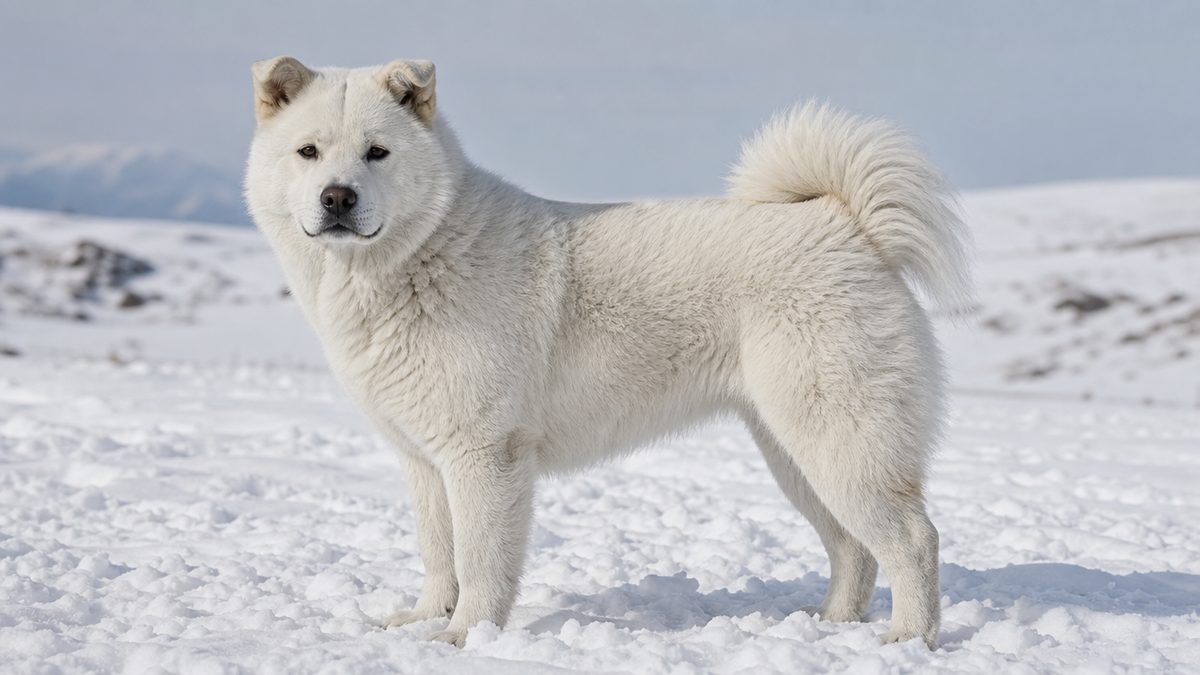
The Academy of Korean Studies, quoting North Korean material explicitly, gives a body height of 55 to 60 cm, a body length of 60 to 65 cm and a weight of 20 to 30 kg, describing a medium dog with a dense coat that is white, sometimes with a light ash-grey evenly blended through it. The head is round, the lower jaw slightly protruding, the nose flesh-coloured or black, and the muzzle broad and short.
The ears are triangular and erect with the tips bent slightly forward, and the tail is curled with long soft hair. The neck is short and thick, the forechest broad and deep, the back broad, the loin medium in length, and the hind legs set straight.
Two breed markers that appear nowhere else on this site
Both Korean sources record a bean-sized protuberance under the chin. The Korea Heritage Service adds the detail that three whisker-shaped hairs of 5 to 10 cm grow from it Encyclopedia of Korean Culture. That is an unusually specific morphological marker and it is not something an image model would invent.
The second is historical rather than physical. The Academy of Korean Studies records a colonial-era convention called the three blacks, under which a dog was treated as purebred only if its eyes, nose and muzzle were black. It is recorded as a story about how the breed used to be judged, not as a current requirement, and no current requirement is publicly available to compare it with.
| Source | Height | Weight | Basis |
|---|---|---|---|
| Academy of Korean Studies | 55 to 60 cm, body length 60 to 65 cm | 20 to 30 kg | Explicitly attributed to North Korean material |
| English Wikipedia | 60 to 65 cm male, 50 to 60 cm female | 20 to 30 kg | Infobox, no standard cited |
| Any kennel club | No figure | No figure | No kennel club recognises the breed |
The two published height ranges do not overlap at the bottom, and neither rests on a breed standard English Wikipedia, Pungsan dog. Bonbeno publishes both and follows neither silently.
Pungsan is the South Korean revised romanisation, Phungsan is described as the official English name in North Korea, and Poongsan and Pungsangae are also in use. The literature section shows that two of those spellings return two entirely different papers with no overlap at all.
The designation history, and the number the internet gets wrong
The Pungsan carries two separate state designations, one made in June 1942 under the Japanese Government-General and one made by North Korea from about 1965, and the monument number English sources quote appears in neither.
The Academy of Korean Studies records the colonial designation precisely. Professor Mori of Keijo Imperial University promoted it, the Government-General of Chosen accepted his recommendation, and in June 1942 designated the Pungsan dog Natural Monument No. 128, running a policy protection campaign for it as it did for the Jindo.
The Korea Heritage Service records the same 1942 designation, naming the dogs of Wonsan in Pungsan county, South Hamgyong province, and adds that North Korea has registered the breed as a state natural monument from about 1965.
How the North Korean system works
This is the part no English breed page carries. North Korea manages natural heritage as scenic sites and natural monuments under the Scenic Spots and Natural Monuments Protection Law of 1995 and the National Heritage Protection Law of 2015 and 2019. Data from the DPRK's own illustrated natural-monuments volume for 2005 to 2010 shows 488 designated natural monuments, of which 106 are animals.
The designation criterion for animals is specific: indigenous domestic animals or seed stock significant for preserving purebred status, and the Korea Heritage Service names the Pungsan as an example of exactly that category. So this is a state protecting a domestic animal as national heritage, which is the same instrument Japan uses for the Shikoku and Okinawa uses for the Ryukyu.
The number, and why this page does not print it
English coverage of this breed routinely attaches a specific North Korean natural monument number to it. That number appears in neither Korean source read for this page, and it does not appear in English Wikipedia's article on the breed either, whose only sourced designation claims are a national monument in April 1956 and national dog status in 2014, both attributed to North Korean magazines.
The one enumerated list of North Korean natural monuments reachable in English states that 469 entries have been designated between numbers 1 and 935, and its section covering 351 to 400 is explicitly tagged an incomplete list and carries exactly three rows. It therefore neither confirms nor denies any number for this breed, and a reader should treat its silence as a limit of the source rather than as evidence.
Monument numbers are per country and the two Koreas run separate systems, so the same number can belong to different animals north and south of the border. A page that prints a number without saying which country's register it comes from is inviting exactly that confusion, which is why this page prints the 1942 colonial number it could read and no other.
Recognition: a state, a breeding station, and no kennel club anywhere
No kennel club in the world recognises the Pungsan, because North Korea is not an FCI member and no other body has taken the breed on.
The FCI's own member list carries Korea (Republic of), Japan, Taiwan, Thailand and India in its Asia, Africa and Oceania section, and the Democratic People's Republic of Korea appears nowhere on it. Without a member body there is no route by which a DPRK breed can be sponsored into the FCI system.
The consequence is visible in the register. The FCI's complete Group 5 list runs to 46 entries and its Section 5 carries exactly one Korean breed, the Korea Jindo Dog at standard 334 under Korea (Republic of), accepted on 9 November 2004. The Pungsan is absent from that list and from the 20-entry provisional register. English Wikipedia's infobox likewise sets the breed to not recognised and carries no FCI field.
What exists instead of a studbook
A state breeding programme. The Korea Heritage Service records that collecting and raising Pungsan dogs began at Gwangdeok-ri in 1969 and that a specialist Pungsan dog ranch now exists there. The Academy of Korean Studies records that in 1975 Gwangdeok-ri in Gwangdong-myeon was designated a breeding station and state-run breeding began, with small numbers also kept at Pungsan Middle School, Pungsan High School, the Pyongyang Dog Research Institute and military units.
That is a real, funded, multi-site breeding programme run by a state, and it is not the same thing as a public studbook. Nobody outside the DPRK can inspect its records, and no pedigree it issues can be checked against anything.
Bonbeno's verdict, and the reasoning
This site normally applies a two-condition test: a written standard a population is bred toward, and a studbook recording individuals generation by generation. On the Pungsan neither condition can be tested, because neither document is publicly reachable, and that is a different answer from either condition being absent.
So the honest verdict is a state-recognised native breed whose standard and studbook are not publicly verifiable. What is documented is a national designation, a criterion under which it was designated, a state breeding station operating since the 1970s, and a total absence of kennel-club recognition. What cannot be documented is what the breed is bred toward or which dogs are recorded as being it.
| Body | Holds the Pungsan | Evidence |
|---|---|---|
| Government-General of Chosen, 1942 | Yes, Natural Monument No. 128 | Academy of Korean Studies entry |
| North Korean state, from about 1965 | Yes, state natural monument | Korea Heritage Service article |
| FCI, definitive register | No | Complete 46-entry Group 5 list |
| FCI, provisional register | No | Complete 20-entry register |
| FCI membership | Not possible | DPRK absent from the member list |
| Any major kennel club | No | English Wikipedia infobox, not recognised |
A breed can be legally protected by a government and unknown to every kennel club at once, and this is the clearest example of that on the site. Ministries, heritage agencies and postal authorities all recognise animals, and none of them appears in a kennel club's index.
Two spellings, two papers, and no overlap at all
The Pungsan's entire indexed veterinary literature is two papers, and each is found by a different romanisation of the breed's name.
A PubMed title and abstract search for Pungsan returns exactly one record. It is a 2025 study of blood types among 105 canine blood donors and recipients at a Seoul teaching hospital, and the breed appears in it as one animal: among breeds not previously associated with Dal-negative outcomes that nonetheless tested negative, the authors name nine Labrador Retrievers, five Golden Retrievers, a Shepherd, a Siberian Husky, an American Bully, a Miniature Poodle and a Pungsan dog.
A search for Poongsan returns exactly one record, and it is a completely different paper. A 2009 microsatellite study of five dog breeds in South Korea covered two Korean natives, the Poongsan and the Jindo, and three imported breeds. The two result sets share nothing.
Why that matters beyond this breed
This is the clearest demonstration on the site of a name-form false zero. Anyone searching only Pungsan would conclude the breed has one blood-typed dog and no genetics; anyone searching only Poongsan would conclude it has a genetics paper and no clinical record. Both conclusions are wrong, and each is produced by a spelling choice rather than by the literature.
Two further spellings return nothing at all. Phungsan, which English Wikipedia describes as the official English name in North Korea, and Punsan both return zero with clean, unrewritten query translations. And the Korean form 풍산개 returns zero with a blank translation line, meaning the query was emptied before it ran, so PubMed's silent voiding of non-Latin script covers Hangul as well as Cyrillic and Chinese.
What the 2009 paper actually found
It is worth reading rather than counting, because its finding is specific. Overall expected heterozygosity across the five breeds ranged from 0.71 to 0.85, and mean polymorphism information content was highest in Jindos at 0.82 and Poongsans at 0.81. A significant reduction of heterozygosity in the Poongsan was attributed to non-random mating and population substructure within the breed, the Wahlund effect.
That is a population with real diversity that is not mating at random across its whole range, which is exactly what a breed maintained in separate state facilities would look like.
The two modern Korean genomics programmes both exclude it
A 2023 whole-genome study analysed nucleotide variation in 205 canid individuals and covered the Sapsaree, the Jindo and the Donggyeongi among Korean breeds; the Pungsan is not among them. A 2025 mutation-typing study used whole-genome data from 32 individuals of the same three breeds and again did not include it.
Neither paper says why, and this page will not guess. What can be said is that the two largest genetic programmes on native Korean dogs both work from South Korean samples, and this breed's population is north of a closed border.
Run every romanisation separately and read what comes back, because the counts are not additive across an OR. Pungsan and Poongsan each return one paper and they are different papers. A zero on one spelling is a zero on one spelling, and on this breed that is true four times over.
Heat tolerance: a 23.55 degree gap, the widest on this site
The Pungsan's home county averages 4.40 C a year and minus 12.25 C in January, against Chennai's 27.95 C, which is the largest homeland-to-India climate gap any breed on this site faces.
NASA POWER, queried at 40.65 N 128.1833 E in Kimhyonggwon county, returns a cell at 982.00 m against a real elevation near 900 m, which is an unusually accurate cell for mountainous terrain and means the figures can be used. That cell gives an annual mean of 4.40 C, a July peak of 19.03 C, a January mean of minus 12.25 C, and annual relative humidity of 72.77 percent.
A second point at Hyesan returns a cell at 1,103.56 m against a real elevation near 714 m, an error of about 390 m, so this page does not use it. Naming which point was rejected and why is the discipline that makes the accepted one trustworthy.
| Place | Cell elevation | Annual mean | Hottest month | Coolest month |
|---|---|---|---|---|
| Kimhyonggwon, DPRK | 982.00 m | 4.40 C | July, 19.03 C | January, minus 12.25 C |
| Bengaluru | 841.72 m | 23.74 C | April, 28.37 C | December, 20.22 C |
| Pune | 635.99 m | 23.86 C | April, 28.93 C | December, 19.62 C |
| Delhi | 206.37 m | 25.60 C | June, 35.88 C | January, 13.61 C |
| Kolkata | 7.35 m | 25.81 C | May, 31.53 C | January, 17.31 C |
| Mumbai | 97.15 m | 26.77 C | May, 31.19 C | January, 23.19 C |
| Chennai | 48.95 m | 27.95 C | May, 31.51 C | January, 24.09 C |
Read the coldest month, not just the annual mean
The annual gap of 23.55 degrees understates the problem. Delhi's January mean of 13.61 C is the coldest month in the Indian table, and it is nearly 26 degrees above the Pungsan's January. There is no month anywhere in India that resembles a Ryanggang winter, and there is no month in Ryanggang that resembles an Indian summer.
The July peak of 19.03 C is the number to hold on to. That is the hottest month this breed's homeland offers, and it is below the coolest month of every Indian city in the table except Delhi's and Kolkata's Januaries.
What the heat evidence supports
Hall 2020 in Animals recorded 1,259 heat-related illness events from 1,222 UK dogs, of which 879 carried a recorded trigger, and 652 of those 879, or 74.2 percent, were exertional. The companion paper reports a case fatality of 14.18 percent across 395 confirmed events and an odds ratio of 1.42 for dogs at or above their breed and sex mean bodyweight.
The Pungsan was not modelled in either paper, so no breed-level odds ratio exists for it and none is borrowed here. For context on what a modelled northern breed looks like, the Siberian Husky came out at 1.18 with a confidence interval of 0.28 to 5.06 and p = 0.822, which is not significantly different from the Labrador comparator.
Bonbeno rates this breed 1 of 5 for heat tolerance, the lowest on the site. An Indian plains summer asks a dog bred for a minus 12 degree January to work at 30 degrees or more with a dense white coat. There is no walking schedule that makes that a good idea, and this page will not pretend otherwise.
Where in India this dog could live, and the honest answer
Nowhere in the Indian plains suits a Pungsan, and Bonbeno will not name a hill station as an answer because the satellite data for Indian hill stations is unreliable.
Bengaluru and Pune are the coolest large Indian cities in the table, at 23.74 C and 23.86 C annually. Against a 4.40 C homeland that is still a gap of more than nineteen degrees, so calling them suitable would be misleading even though they are the least bad.
Why this page gives no hill-station figures
The obvious answer to a cold-climate breed in India is a hill station, and Bonbeno does not publish satellite climate figures for Indian hill stations, because the model's grid cells for them are wrong by 700 to 1,935 metres and the error runs in both directions. This page's own Hyesan reading, rejected at 390 m of error, is the same failure in the breed's own country and is why the caution is applied consistently.
What can be said without a number is that a place holding below about 20 C through the hot months, with genuinely cold nights, is the only Indian environment in which this coat makes sense. Very little of India is that place, and none of the metros are.
The Indian legal position on keeping a dog like this outdoors
Second Schedule Part IV paragraph 21(1) of the 2017 Rules bars keeping a dog in outdoor housing, without the attending veterinary practitioner's written approval, where the dog is not accustomed to local temperatures, or where the breed cannot tolerate them, and it names long-haired breeds in high temperature locations explicitly. A dense-coated plateau dog in an Indian yard is precisely the case that clause describes.
That clause is not decorative. It means an Indian keeper who leaves such a dog outdoors without written veterinary approval is outside the Rules, and it gives an owner a concrete document to take to a landlord or a boarding kennel.
The parasite pressure a northern dog has never met
A West Bengal study of 584 client-owned dogs presenting at a Kolkata animal health centre found Babesia gibsoni in 76.54 percent, Anaplasma in 55.75 percent, and two or more concurrent pathogens in 72.9 percent of the 584 dogs screened. A southern Indian study of 120 clinically affected dogs found Babesia in 66.7 percent, peaking pre-monsoon between March and May.
Both are clinic caseloads of dogs already showing signs rather than random population samples, so they describe risk among dogs that get sick. A dog from a plateau with a four-month growing season has no exposure history to any of it, and a dense white coat hides a tick completely.
There is no Indian city where this breed belongs. That is not a failure of the page to find one; it is what a 23.55 degree homeland gap on a heavy-coated plateau hunting dog means, and saying so is more useful than a walking schedule that pretends otherwise.
Pungsan dog price in India: no market, no page, and no pedigree to buy
No pungsan dog price in india exists, and unlike most rare breeds this one does not even have an Indian page inventing a figure.
Five Indian breed and marketplace sites were probed by URL on 9 September 2026, each with a Labrador Retriever control. The control returned a complete page carrying 28 rupee figures, so the site and the URL pattern were both live, and the same site's Shikoku, Thai Ridgeback and Taiwan Dog pages all resolve with prices attached.
The Pungsan path on that site returns HTTP 200 with the title Dog Breed Not Found and zero rupee figures, exactly as the Ryukyu and Thai Bangkaew paths do. A status-code check passes all three, and only reading the returned title reveals that the page does not exist.
Why there is nothing to price
Four things have to hold before an Indian puppy price can exist: a population that can be exported from, a register that can identify a dog as the breed, a lawful import route, and a buyer. This breed fails the first three at once.
- The population sits inside North Korea, maintained through a state breeding station and named institutions rather than a commercial supply chain.
- No kennel club anywhere registers the breed, and the DPRK cannot join the FCI system because it is not a member Federation Cynologique Internationale.
- Indian import law rejects any application to import a dog for trading or breeding purposes.
- No breed standard is publicly available against which any dog offered as a Pungsan could be judged.
- No Indian veterinary practice will have seen the breed, so even a lawfully imported pet arrives without a local reference point.
What to distrust if a figure ever appears
Any rupee band that divides cleanly by 84.38, 80 or 74 into a round dollar figure is a converted foreign asking price rather than an Indian observation. Any monthly cost row identical to the rupee with another breed's row on the same site is a preset. Any page reached at HTTP 200 whose title says the breed was not found is not a listing. And any photograph showing a masked, parti-coloured or blue-eyed dog is showing a Siberian Husky, which is the comparison English coverage of this breed reaches for most often.
We will not convert a Korean figure into rupees and present it as an Indian price, and we will not estimate one from the Jindo or the Akita. Where no Indian market exists, the honest number is none, and the useful content is the running cost of a dog this size, which the next section gives.
The real cost of ownership in India for a 20 to 30 kg double-coated dog
Keeping a 20 to 30 kg double-coated dog in an Indian metro costs roughly Rs 6,000 to Rs 11,000 a month, before any cooling, and cooling is not optional for a coat like this.
The purchase price is unavailable and unverifiable; the running cost is neither. These are the figures an Indian reader actually needs, and every one comes from a page that was opened.
The lines you can price
- Parasite control at Rs 1,103 a month, from NexGard Spectra for 15 to 30 kg dogs at Rs 3,308 for three tablets, covering ticks, fleas, roundworm and hookworm together.
- Vaccination at Rs 699 for anti-rabies and Rs 899 for the 9-in-1, or an annual booster course from Rs 3,199.
- Grooming from Rs 934 for a bath and from Rs 1,869 for a complete bath and styling at a Delhi clinic chain, against a wider published Indian range of Rs 300 to Rs 2,000 Voice of Stray Dogs.
- Consultation at Rs 500 to Rs 1,000 a visit, and boarding at Rs 500 to Rs 2,000 a day.
- Municipal registration at Rs 500 in Delhi or Rs 50 in Chennai, which is a yearly line.
The spread on one identical vaccine
The same 9-in-1 vaccine costs Rs 600 at a Goa government veterinary hospital, from Rs 899 at a Vetic clinic, and from Rs 1,999 through a vet-at-home service that also charges a Rs 699 visit fee. A 3.3 times spread on one drug is a function of delivery model rather than of the medicine. Chennai residents can go further, since Greater Chennai Corporation runs six pet clinics giving treatment and anti-rabies vaccination free of cost.
| Line | Low | High | Note |
|---|---|---|---|
| Food | Rs 3,000 | Rs 5,500 | For a lean, active 20 to 30 kg dog |
| Parasite control | Rs 1,103 | Rs 1,103 | NexGard Spectra 15 to 30 kg, monthly |
| Vaccination, spread | Rs 150 | Rs 320 | Annual booster divided by twelve |
| Vet consultations | Rs 250 | Rs 1,000 | Two to twelve visits a year |
| Grooming | Rs 700 | Rs 2,000 | A dense white coat in a monsoon country |
| Contingency | Rs 1,200 | Rs 1,200 | The line that stops a Rs 20,000 bill becoming a crisis |
| Total | Rs 6,403 | Rs 11,123 | Before the cooling bill, which this coat needs |
Electricity. A dog bred for a minus 12 degree January needs a room that stays genuinely cool through an Indian summer, and a Bengaluru boarding directory now carries an explicit warning about generator backup for air conditioning during March to May load-shedding. Ask any kennel what happens when the power goes.
Temperament: tenacious in the field, gentle in the house
Korean state sources describe the Pungsan as a hunting dog whose defining quality is perseverance rather than aggression, and as a dog that is very gentle and well-mannered in daily life.
The Korea Heritage Service puts it directly: what made the Pungsan exceptional as a hunting dog was not its combat prowess but its tenacity, and it possessed remarkable perseverance and patience, waiting for the hunter to come and finish off the prey once it had been restrained from fleeing any further.
The same source describes the household side in equally specific terms. Unlike aggressive dogs that cannot conceal their aggression and may attack owners or passers-by indiscriminately, the Pungsan is generally very gentle and does not attack weaker individuals recklessly, and it is said that they rarely bark or engage in fights without reason.
The proverb, and how to read it
Both Korean sources record the saying that if you release three Pungsan dogs you can catch a tiger Encyclopedia of Korean Culture. The Korea Heritage Service says plainly that the claim is likely exaggerated and that a similar story attaches to the Jindo, which is the right way to handle it: a proverb about a breed's reputation rather than a description of what it does.
Who this breed would suit
- Owners in a genuinely cold climate with space, which describes nowhere in the Indian plains.
- Owners who want a quiet dog, since Korean sources emphasise that it rarely barks without reason.
- Owners comfortable with an independent hunting dog that holds rather than attacks.
- Owners who will commit to real coat care through two heavy annual sheds.
- Owners who accept that no local veterinarian will have seen the breed before.
Who should look elsewhere
- Anyone in India, on climate grounds alone, before any other consideration applies.
- First-time owners, because a tenacious hunting breed with no training literature is a demanding first dog.
- Anyone in a flat, given the coat, the exercise load and the shedding.
- Anyone who wants a documented breed, because no publicly available standard exists.
- Anyone hoping to verify a dog's identity, since no register outside North Korea holds the breed.
Both Korean sources describe the same animal: patient in the field, quiet at home, loyal to its owner, and not indiscriminately aggressive. That is a consistent picture from two independent state-affiliated bodies, and it is the most reliable thing this page can tell you about the dog's character.
Training a breed with no training literature at all
To train a Pungsan you would work from first principles, because no breed-club guidance, obedience tradition or behavioural study exists for it in any language this page could reach.
That is worth stating before any advice, because it is the honest position. What exists is two Korean state descriptions of temperament and nothing else: a tenacious hunter that holds prey and waits, and a gentle household dog that rarely barks or fights without reason.
Read together those describe an animal with a high threshold and a long fuse, which is usually easier to live with than a reactive dog and harder to motivate in a training session. Neither Korean source describes how the breed is actually trained.
The five things worth teaching first
- Name response, paid every time for six months, because a dog that voluntarily looks at you can be redirected out of anything.
- A hand-target, which moves the dog without a collar grab and is the calmest way off a scent.
- Crate and cool-floor settling, which on a heavy-coated dog in any warm climate is a welfare tool rather than a convenience.
- Loose-lead walking on a Y-front harness, taught before the puppy reaches 15 kg rather than after.
- Grooming and drying tolerance from week nine, because this coat will be brushed and dried for the next twelve years.
Off-lead recall is deliberately absent. A hunting breed whose defining quality is persistence in holding prey is not a breed to build a life around a recall with, and the honest plan is a long line in open ground and a properly fenced area for free running.
Socialisation
Every breed page on this site says the eight to sixteen week window decides the adult, and it is more true here because there is no breeder network, no breed club and no local expertise to fall back on if it goes wrong. Socialise the puppy on the assumption that nobody you meet will have seen the breed before, because a hardy plateau hunting dog that has not learned to read a crowded Indian street will not learn it later. A puppy that will live in a city has to meet traffic, lifts, delivery riders, cattle, cyclists and other dogs before sixteen weeks, at a distance it can cope with.
Compulsion is a poor fit for a dog Korean sources describe as gentle and not indiscriminately aggressive. Correcting such an animal hard tends to produce avoidance rather than compliance, and there is no published behavioural work to argue otherwise.
Expect name response and a hand-target inside three weeks. Expect settling and grooming tolerance to take four to six. Expect loose-lead walking to take three months and door manners to hold by six. Do not expect an off-lead park recall at any age, and treat every timeline here as inference from temperament descriptions rather than as breed-specific evidence.
Exercise: a plateau stamina dog on an Indian clock that does not fit
A Pungsan needs 60 to 90 minutes of real daily exercise, and in the Indian plains a dense-coated dog from a 4.40 C homeland has roughly two safe hours a day in the hot months.
Korean sources describe a dog bred in mountainous regions with strong physical endurance and high resistance to cold and disease, whose defining hunting quality is perseverance and patience rather than combat prowess. That is a stamina animal built to work all day in cold air.
The Indian constraint is not the dog's capacity. It is that Chennai's May mean is 31.51 C and Delhi's June mean is 35.88 C, against a homeland whose hottest month averages 19.03 C. There is no hour of an Indian May in which a dog like this can work hard safely, and the honest advice is that the plains are not a place to keep one.
What 60 to 90 minutes would contain in a suitable climate
- Forty-five to sixty minutes of continuous forward movement over varied ground.
- Fifteen minutes of scent work, which tires a patient hunting breed faster than distance does.
- Structured play with rules, so that arousal has a built-in off switch.
- Free running only inside a boundary the dog cannot clear or slip.
- A cool rest afterwards, which on this coat is part of the exercise rather than an afterthought.
Why exertion is the mechanism that matters
Hall 2020 in Animals recorded 1,259 heat-related illness events from 1,222 UK dogs, of which 879 carried a recorded trigger, and 652 of those 879, or 74.2 percent, were exertional rather than environmental or vehicular. Heat illness in dogs is overwhelmingly caused by exercise, and a stamina breed will keep working past the point where it should stop.
The companion paper reports a case fatality of 14.18 percent across 395 confirmed events, and 1.42 times the odds of an event for dogs at or above their breed and sex mean bodyweight, with a confidence interval of 1.12 to 1.80. Keeping the dog lean is the one modifiable factor with a published number behind it.
Stop if the tongue widens and flattens, if the dog seeks shade unprompted, if the pant does not settle within a minute of standing still, or if the stride shortens. Wet the belly, groin and paws rather than the back, offer water, and get to a veterinarian the same day if the dog does not normalise within ten minutes.
Grooming a dense white plateau coat in Indian humidity
The Pungsan carries a dense white double coat with long soft hair on a curled tail, which needs weekly line-brushing, daily work through two annual sheds, and drying to the skin after every bath.
Korean sources describe the coat as dense, white, sometimes with a light ash-grey evenly blended through it, with long soft hair on the curled tail. That is a plateau winter coat, and it is the single feature that most affects how such a dog would be kept in India.
Never clip this coat for the Indian summer
A double coat insulates in both directions. The undercoat traps air and the outer coat blocks direct sun on the skin. Clipping removes the sun barrier and exposes skin that has never met Indian ultraviolet, and it does not make the dog cooler. Brushing the dead undercoat out is what makes a dog cooler, and it takes fifteen minutes.
On a white coat the sun problem is sharper still, because pale skin under a thin clipped coat burns quickly at Indian latitudes.
The Indian complication is drying, not brushing
- Line-brush weekly with an undercoat rake and a slicker, in sections down to the skin, rather than skimming the top coat.
- Brush daily through each seasonal shed, and expect a very large volume of white undercoat.
- Bathe every six to eight weeks at most, because more often strips the coat of its oils.
- Dry to the skin every single time with a forced-air dryer or a stand fan and towels, and plug the ears before the water goes on.
- Check the chin, ears, throat, armpits, groin and between the toes weekly with fingers on skin, because a dense white coat hides a tick completely.
Ticks are the grooming job that actually matters here
A West Bengal clinic caseload of 584 dogs showed Babesia gibsoni in 76.54 percent and two or more concurrent pathogens in 72.9 percent of those screened, and a southern Indian series of 120 clinically affected dogs put Babesia at 66.7 percent with a pre-monsoon peak. Combine a weekly hands-on sweep with monthly NexGard Spectra at Rs 1,103 for a 15 to 30 kg dog and that is the prevention programme.
There is one breed-specific thing to check while you are there. Korean sources record a bean-sized protuberance under the chin from which three whisker-like hairs of 5 to 10 cm grow. It is a normal breed feature rather than a lesion, and an Indian veterinarian who has never seen the breed may reasonably ask about it.
Rake the ruff, the trousers and the tail, which is where undercoat packs first, then run both hands over the whole dog against the lie of the coat, checking chin, ears, throat, armpits, groin and between the toes. On a white coat in India that check is a disease measure rather than a cosmetic one.
Health: one dog in a blood-type study, one genetics paper, and nothing else
The Pungsan's entire indexed health literature is two papers found under two different spellings, and no screening scheme, prevalence figure or lifespan study exists for the breed.
Under the spelling Pungsan, PubMed returns a single record: a 2025 study of blood types among 105 canine blood donors and recipients at a Seoul teaching hospital, in which one Pungsan dog appears among the animals that tested Dal-negative. That study found DEA 1 in 70.48 percent of the 105 dogs, DEA 4 in 92.38 percent and Dal in 77.14 percent.
Under the spelling Poongsan it returns a different single record, a 2009 microsatellite study whose Pungsan finding is a significant reduction of heterozygosity caused by non-random mating and population substructure, the Wahlund effect. Mean polymorphism information content was 0.81 in Poongsans, second only to the Jindo's 0.82 among the five breeds studied.
What the modern Korean genomics programmes would have told us
Two exist and neither includes this breed. A 2023 whole-genome study of 205 canid individuals covered the Sapsaree, the Jindo and the Donggyeongi, and a 2025 study developing PCR typing methods for four disease-associated variants used whole-genome data from 32 individuals of those same three breeds.
The 2025 paper is the more frustrating absence, because it is exactly the work an owner would want. It identified a T gene variant associated with the bobtail phenotype, an SLC2A9 variant associated with urolithiasis, a BTBD17 insertion associated with abortion, and an MLPH variant associated with coat colour dilution, with the BTBD17 mutant allele present in all three breeds at a frequency of 0.33. None of those frequencies can be transferred to the Pungsan, and this page does not transfer them.
The absences, stated plainly
- No published life expectancy. McMillan 2024's Table S5 lists 345 breeds and the Pungsan appears in none of them under any spelling, while the Korean Jindo is listed and flagged N.
- No published hip or elbow screening statistics for the breed.
- No breed-club health survey, because no breed club outside the DPRK exists.
- No genetic test panel for the breed's own mutations, and no inclusion in the Korean panels that exist.
- No breed standard against which a veterinarian could judge conformation.
For scale rather than substitution, McMillan's nearest measured East Asian breed is the Akita at a median 11.4 years on 2,358 deaths with a hazard ratio of 1.29 against crossbreds, and the Shiba Inu at 14.6 years on 91 deaths. Neither figure belongs to the Pungsan.
One practical finding worth carrying to a vet
The blood-type study is small but it is the only clinical record that names the breed. A Pungsan dog in Seoul tested Dal-negative on agglutination, in a population where 77.14 percent of dogs were Dal-positive. That is one animal and it establishes nothing about the breed, but it is worth mentioning to a veterinarian planning a transfusion, because it is the only breed-linked haematology datum that exists.
There is no breed average to ask for. Ask for the individual dog's own hip score, eye certificate and blood type, and have your veterinarian record a weight, a height and a photograph. On a breed with two papers and no standard, the animal's own file is the only documentation it will ever have.
Feeding a 20 to 30 kg northern working dog in India
Feed a Pungsan to a visible waist and easily felt ribs, because bodyweight at or above the breed mean is the one heat risk factor with a published odds ratio and this is the least heat-tolerant breed on this site.
Hall 2020 in Scientific Reports found that dogs at or above their breed and sex mean bodyweight carried 1.42 times the odds of a heat-related illness event, with a confidence interval of 1.12 to 1.80. On a dense-coated dog from a 4.40 C homeland living anywhere in India, that is a safety question rather than a cosmetic one.
Korean sources give the adult weight as 20 to 30 kg, which is a usable target range, but no breed standard states a condition, so body condition scoring is the only honest guide.
Portion and life stage
- Puppies to four months, four meals a day on a large-breed or all-breed growth food with controlled calcium.
- Four to eight months, three meals, watching that growth stays steady rather than fast.
- Eight months onward, two meals a day, timed around the coolest hours available.
- Adults at 20 to 30 kg, roughly 350 to 480 g of a good dry food a day, adjusted weekly by feel rather than by the bag.
- Seniors from about eight years, the same weight held steady, with joint support discussed with your own veterinarian.
A dense coat hides weight gain
On a short-coated dog an owner watches the waist disappear. On a dense white double coat two kilograms are invisible, which is why a written weight series from a clinic matters more here than on any short-coated breed. Indian clinics will weigh a dog free of charge, and a quarterly entry is enough.
Raw meat, and a northern hunting dog
A hunting breed invites raw feeding, and in India the routes that carry parasite risk are raw river fish and raw offal from informal slaughter rather than wild game. Cook it, or do not feed it, and discuss any raw diet with your own veterinarian before starting rather than after.
Move the main meal to after the evening walk rather than before it, keep water available in at least two places, and do not exercise within an hour of a full meal. A deep-chested dog eating and then working in heat is a bloat risk and a heat risk stacked on top of each other.
The first year, month by month
A Pungsan puppy's first year would run from grooming conditioning in week nine to a second fear period around eight months and full coat and physical maturity near eighteen months.
- Weeks 8 to 10. Home, crate, name response, four meals a day, and the first grooming sessions before the coat needs them. Indian law prohibits the sale of pups under eight weeks, so a younger puppy is a red flag about the seller.
- Weeks 10 to 16. The socialisation window, and on a breed with no local expertise anywhere the most important eight weeks of the dog's life.
- Months 4 to 5. Adult teeth arrive and chewing peaks. Loose-lead walking is taught now, while the puppy is still under 15 kg.
- Months 5 to 6. The dryer becomes a normal weekly event rather than an emergency, which is the single most useful habit to build on this coat.
- Months 6 to 8. A second fear period is common in primitive breeds. Repeat easy versions of things the dog already knows rather than adding pressure.
- Months 8 to 12. The adult double coat comes in with the first proper shed, and the daily load can move toward the adult 60 to 90 minutes.
- Months 12 to 18. Physical and coat maturity complete. Hold off repetitive high-impact work until your veterinarian confirms the growth plates have closed.
The Indian calendar, if such a dog ever arrived
A puppy reaching four months in April anywhere in the Indian plains spends its most important learning weeks in conditions its breed has never met, with a homeland whose hottest month averages 19.03 C. If a lawfully imported pet arrived at all, a November to February arrival in Bengaluru or Pune would be the least damaging option available.
There is no Indian season that resembles this breed's home range, which is the difference between planning around a climate and planning against one.
The eight to sixteen week socialisation window and grooming tolerance. A dog first introduced to a forced-air dryer at three years old often will not accept one, and on this coat in this climate that becomes a health problem rather than an inconvenience.
Indian import law, and why it is academic for this breed
Indian law permits you to bring in a Pungsan as your own accompanying pet and rejects any application to import one to breed or to sell, and there is no pedigree document anywhere to present.
DGFT Trade Notice 22/2022-23 of 19 December 2022 places dogs under ITC (HS) 01061900 as a Restricted import. Three routes are permitted and the notice names them: a pet accompanying an owner with a valid pet book in the importer's name, research use with a CPCSEA recommendation, and Defence or Police use. Applications for trading or breeding purposes shall be duly rejected.
There is no import licence a would-be Indian breeder can apply for that changes this, and for this breed the barrier arrives even before that clause. There is no kennel club anywhere that can issue an exportable pedigree, because North Korea is not an FCI member and no other body holds the breed Federation Cynologique Internationale. Even the personal pet route needs documents, and no register outside the DPRK produces any.
What the 2017 Rules would require of an Indian keeper
- Get written veterinary approval before any outdoor housing arrangement. Second Schedule Part IV paragraph 21(1) bars outdoor housing without it where a breed cannot tolerate local temperatures, naming long-haired breeds in high temperature locations.
- Do not sell a pup under eight weeks old, which Rule 8(1)(a) prohibits outright.
- Test any breeding dog for the genetic defects Second Schedule Part III paragraph 8(10) names, including hip dysplasia and progressive retinal atrophy.
- Do not in-breed within four generations, which Second Schedule Part II paragraph 6(3) prohibits, and which matters on a breed whose only genetic study found population substructure Kang BT, Kim KS, Min MS, Chae YJ, Kang JW.
- Register the dog with your municipality, at Rs 500 in Delhi or Rs 50 in Chennai Greater Chennai Corporation.
Cite the paragraph, not a Rule number
The 2017 Rules run 1 to 13 and there is no Rule 14. Everything numbered above 13 is a Second Schedule paragraph, so a page citing the outdoor-housing heat clause as Rule 21 or the in-breeding clause as Rule 6(3) is citing provisions that do not exist under those names.
Two North Korean primary sources that English coverage of this breed cites could not be reached at all from this environment: both korean-books.com.kp addresses failed DNS resolution outright. That is why this page is built on South Korean state sources, and why it declines to print a monument number it could not read.
Pungsan against the breeds it is actually compared with
Against the Jindo the Pungsan lacks every piece of paperwork, and against the Siberian Husky it lacks the Indian supply chain that made the Husky's Indian problem visible.
| Breed | Heat tolerance | Kennel-club recognition | Measured lifespan | Available in India |
|---|---|---|---|---|
| Pungsan | 1 of 5 | None anywhere | None published | No |
| Jindo | 2 of 5 | FCI standard 334, definitive 2004 | None in McMillan S3 | Rarely, imported |
| Akita | 1 of 5 | FCI standard 255 | 11.4 years on 2,358 deaths | Yes |
| Siberian Husky | 1 of 5 | FCI standard 270 | Published elsewhere on this site | Yes, widely |
| Hokkaido | 2 of 5 | FCI standard 261 | None in McMillan S3 | No |
| Indian Pariah Dog | 5 of 5 | None | None published | Free to adopt |
| Indian Spitz | 4 of 5 | None | None published | Yes, widely |
Against the Jindo
These are the two Korean native breeds, and the difference is entirely institutional. The Jindo sits in the FCI's Group 5 at standard 334, accepted definitively on 9 November 2004 under Korea (Republic of), and appears in McMillan's Table S5 with an exclusion flag, meaning it was at least considered. The Pungsan has neither.
The 2009 microsatellite study measured both together and found them close on diversity, with polymorphism information content of 0.82 in Jindos and 0.81 in Poongsans. The gap between them is paperwork and a border, not biology.
Against the Siberian Husky
English coverage of this breed reaches for the Husky comparison constantly, and there is one useful thing in it. Hall 2020 modelled the Siberian Husky at an odds ratio of 1.18 for heat-related illness with a confidence interval of 0.28 to 5.06 and p = 0.822, which is not significantly different from the Labrador comparator. A northern coat alone did not predict heat illness in that dataset.
That does not make either breed suitable for India, because the mechanism is exertion and the Indian problem is the number of safe hours in a day. It does mean the comparison should be made on measured data rather than on how thick the coat looks.
Against an Indian breed
The honest comparison for an Indian reader is the Indian Pariah Dog or the Indian Spitz. Both are heat-adapted, both are locally available, both are familiar to Indian veterinarians, and neither requires an import route that does not exist. The Pungsan offers a state designation and a proverb, and nothing an Indian household can act on.
If the appeal is a white spitz-type dog, India already has one in the Indian Spitz, and it costs nothing to source. If the appeal is a Korean native breed with real paperwork, the Jindo holds an FCI standard and can in principle be imported as a pet. The Pungsan is neither available nor documented.
Six mistakes people make about this breed
The six recurring mistakes are quoting an unverifiable monument number, searching one romanisation, treating it as a Husky, assuming DPRK status implies a standard, borrowing Jindo or Sapsaree genetics, and believing an Indian listing.
- Quoting a North Korean monument number. It appears in neither South Korean state source read for this page nor in English Wikipedia's article, and the only enumerated DPRK list reachable in English is tagged incomplete in the relevant range Korea Heritage Service (국가유산청).
- Searching one romanisation. Pungsan and Poongsan each return exactly one PubMed record and they are different papers, while Phungsan and Punsan return zero and the Korean form returns a blank query translation.
- Treating it as a Siberian Husky variant. That framing comes from kennel-club commentary rather than from the Korean sources, which describe a white coat with an optional ash-grey blend, a round head and a short broad muzzle.
- Assuming state recognition implies a breed standard. North Korea designated the breed under a criterion for indigenous domestic animals significant for preserving purebred status, and that is a heritage designation rather than a published standard.
- Borrowing Jindo or Sapsaree genetics. The two modern Korean genomics programmes cover the Sapsaree, Jindo and Donggyeongi and exclude this breed entirely, so none of their allele frequencies transfer Kang M, Ahn B, Shin J.
- Believing any Indian page that appears to carry the breed. The one Indian site with a matching URL pattern returns HTTP 200 with the title Dog Breed Not Found, which a status-code check passes.
A seventh mistake, and it is about dates
English coverage gives April 1956 for the North Korean designation, sourced to a DPRK magazine, and 2014 for national dog status. The two South Korean state sources give 1942 for the colonial designation and about 1965 for the North Korean registration, with the national dog designation also in 1965 Korea Heritage Service (국가유산청).
Those are not reconcilable from the outside, and this page does not reconcile them. It reports what each source says, names which government published it, and lets the disagreement stand, because the DPRK documents that would settle it could not be reached.
Paying anything for a dog described as a Pungsan outside North Korea. There is no exporting register, no published standard, and no kennel club anywhere that recognises the breed, so there is no way to establish that any animal offered to you is this breed rather than a white spitz cross.
Adoption, and what an Indian reader should do instead
No Pungsan is available to adopt in India, and the useful answer is that India already has heat-adapted white and spitz-type dogs that meet the same want.
Rescue works on supply. A breed maintained inside a closed border through a state breeding programme produces no Indian rescues, and no Indian shelter network lists it poodles.in, breed directory.
What an Indian adopter can get that meets the same want
- An Indian Spitz, if the appeal is a white double-coated spitz. Widely available, familiar to every Indian veterinarian, and rated 4 of 5 for heat tolerance where this breed rates 1.
- An Indian Pariah Dog, if the appeal is an alert, independent medium dog that handles Indian heat. Free to adopt in every metro.
- A Rajapalayam, if the appeal is a large white Indian dog with a guarding presence, sourced regionally.
- A Jindo, if the appeal is specifically a Korean native breed, since it holds an FCI standard and can in principle be imported as a pet.
- A rescue spitz cross, which Indian shelters carry in numbers and which suits a first-time owner far better than any import.
How to check any dog offered to you as a Pungsan
- Ask which register issued the pedigree. There is no correct answer available outside North Korea.
- Check the head. Korean sources describe a round head with a slightly protruding lower jaw and a broad short muzzle, not a long fox muzzle.
- Check the colour. A masked, parti-coloured or blue-eyed dog is a Siberian Husky or a cross, not this breed.
- Look for the recorded chin protuberance with its three long whisker hairs, and do not treat its absence as proof either way.
- Ask what the dog's climate history is, because a dog bred anywhere warm is not a Pungsan whatever its coat looks like.
If you are considering an import at all
The personal pet route is the only lawful one, and it requires a pet book in the importer's own name that no register outside North Korea can issue. Before anything else, weigh the climate: a 23.55 degree gap between homeland and destination is the largest on this site, and no amount of air conditioning makes an Indian plains summer a reasonable place for this dog.
We report published figures as editorial content. We do not broker sales, recommend breeders, accept payment for placement, or link puppy listings, and we will not publish an Indian price for a breed with no Indian market and no exportable pedigree. Where adoption is the honest answer, we say so and name what is actually available.
Pungsan dog questions people actually ask
What is the Pungsan dog price in India?
No pungsan dog price in india exists, and no Indian page carries the breed at all. Five Indian breed and marketplace sites were probed by URL with a Labrador Retriever control that returned a full page with 28 rupee figures; the Pungsan path returned an HTTP 200 page titled Dog Breed Not Found. North Korea is not an FCI member and no kennel club anywhere registers the breed.
Is the Pungsan dog a North Korean natural monument?
Yes, though the number everyone quotes could not be verified here. The Korea Heritage Service records that North Korea has registered the Pungsan as a state natural monument from about 1965, within a system holding 488 designated monuments of which 106 are animals, under laws passed in 1995, 2015 and 2019.
Is the Pungsan dog Natural Monument No. 368?
Bonbeno cannot confirm that number and does not publish it. It appears in neither South Korean state source read for this page, nor in English Wikipedia's article on the breed. The only enumerated list of North Korean natural monuments reachable in English is explicitly tagged an incomplete list in the 351 to 400 range and carries just three entries there.
What monument number does the Pungsan actually have?
The one number that appears in a source read directly for this page is from the colonial period. The Academy of Korean Studies records that the Government-General of Chosen accepted a recommendation from Professor Mori of Keijo Imperial University and in June 1942 designated the Pungsan dog Natural Monument No. 128, running a protection campaign as it did for the Jindo.
Can a Pungsan dog live in India?
Not in the plains, and the gap is the largest on this site. The breed's home county returns a NASA POWER cell at 982 m with an annual mean of 4.40 C and a January mean of minus 12.25 C, against Chennai's 27.95 C annual mean. That is a 23.55 degree difference on a dog carrying a dense white plateau coat.
How big is a Pungsan dog?
The sources disagree and Bonbeno publishes both. The Academy of Korean Studies, quoting North Korean material, gives a body height of 55 to 60 cm, a body length of 60 to 65 cm and a weight of 20 to 30 kg. English Wikipedia gives males 60 to 65 cm and females 50 to 60 cm at the same weight range.
Why do Pungsan and Poongsan find different research?
Because PubMed indexes them as different words. A title and abstract search for Pungsan returns one record, a 2025 Seoul blood-typing study that names a single Pungsan dog, and a search for Poongsan returns one record, a 2009 microsatellite study of five Korean breeds. The two sets share no papers, and the Korean form returns a blank query translation.
Is there any genetic research on the Pungsan dog?
One 2009 paper, and two later Korean genomics programmes that exclude it. A 2009 microsatellite study found a significant reduction of heterozygosity in the Poongsan caused by non-random mating and population substructure. A 2023 whole-genome study of 205 canids and a 2025 mutation-typing study both cover the Sapsaree, Jindo and Donggyeongi and not this breed.
How long does a Pungsan dog live?
No figure exists and none should be quoted. McMillan 2024, the largest UK longevity study, lists 345 breeds in its Table S5 and the Pungsan appears in none of them under any spelling, not even with an exclusion flag, while the Korean Jindo is listed and flagged N. Its nearest measured relative is the Akita at 11.4 years on 2,358 deaths.
Can I import a Pungsan dog into India?
In practice, no. DGFT Trade Notice 22/2022-23 permits entry only for a pet with a valid pet book in the importer's name, for research with a CPCSEA recommendation, or for Defence and Police use, and rejects trading and breeding applications. There is no exporting kennel club and North Korea is not an FCI member, so no pedigree document exists to present.
What is the Pungsan dog's temperament like?
Korean state sources describe a tenacious hunter and a gentle household dog in the same breath. The Korea Heritage Service records a dog whose hunting quality is perseverance rather than combat prowess, that waits for the hunter to finish the prey, and that in daily life is very gentle, does not attack weaker individuals recklessly, and rarely barks or fights without reason.
Which South Korean presidents received Pungsan dogs?
Two. Kim Jong-il gave two Pungsan dogs to Kim Dae-jung at the 2000 inter-Korean summit; renamed Uri and Duri, they produced 15 puppies at Seoul Zoo and both died at 13. Kim Jong-un gave Songkang and Gomi to Moon Jae-in at the 2018 Pyongyang summit, and Gomi produced six puppies within two months.
What does a medium double-coated dog cost to keep in India?
Budget Rs 6,000 to Rs 11,000 a month for a 20 to 30 kg double-coated dog. That covers food, Rs 1,103 a month for NexGard Spectra at the 15 to 30 kg dose, an annual booster from Rs 3,199 spread across the year, Rs 500 to Rs 1,000 a consultation, and grooming, which on a dense coat in India is a real recurring line.
Are Pungsan dogs rare?
Outside North Korea, yes, and no page can count them. The breed is a state natural monument registered by North Korea from about 1965, kept in state facilities north of a closed border, and the two largest genetic programmes on native Korean dogs both work from South Korean samples and exclude it. The only 2009 microsatellite study found real diversity but a significant reduction of heterozygosity from non-random mating within the breed. In India there is no population, no register, no lawful import route and not even a page inventing a price.
Are Pungsan dogs good with children?
The Korean state description says gentle, and nothing else has been measured. The Korea Heritage Service records that, unlike aggressive dogs that cannot conceal their aggression, the Pungsan is generally very gentle, does not attack weaker individuals recklessly, and rarely barks or fights without reason. That is a description of household manners rather than a study of children, and no behavioural work on the breed exists anywhere, so treat it as the source's account and supervise as you would with any hunting dog holding a serious prey drive.
Compare with similar breeds
Pungsan sits in 1 Bonbeno group. Each one compares it directly against the breeds it is genuinely an alternative to, on the same figures.