
Breed profile
Shikoku Dog (Shikoku Ken): The India Guide
A Japanese boar hound that the national register still files under a name the breed dropped in 1939, and that no Indian seller has.
Quick answer
No verified shikoku dog price in india exists, because no Indian breeder, kennel-club register or listing site carries the breed. Japan's two registries recorded 303 Shikoku between them in 2025, 252 with NIPPO and 51 with the Japan Kennel Club. Indian import law rejects any application to bring a dog in to breed or sell. Budget Indian care costs of roughly Rs 6,000 to Rs 11,000 a month instead.
This page summarises published breed-standard text, registry statistics, Japanese and Indian government records and peer-reviewed veterinary research for general information. It is not a diagnosis and it is not treatment advice. Consult a registered veterinarian near you about your own dog before acting on anything here, and treat heat collapse and a suddenly clouded or non-responsive eye as same-day emergencies rather than as things to raise at the next check-up.
Shikoku at a glance
What the Shikoku is, and what the breed standard actually says
The Shikoku is a medium Japanese hunting spitz bred to track and hold wild boar in the mountains of Kochi Prefecture, and it is FCI standard 319.
The FCI classification places it in Group 5, Spitz and primitive types, Section 5, Asian Spitz and related breeds, accepted on a definitive basis on 1 February 1982 and not subject to a working trial. Its country of origin is Japan and its official authentic language is English, which matters later on this page because the English and French texts of its own standard disagree about how tall it is.
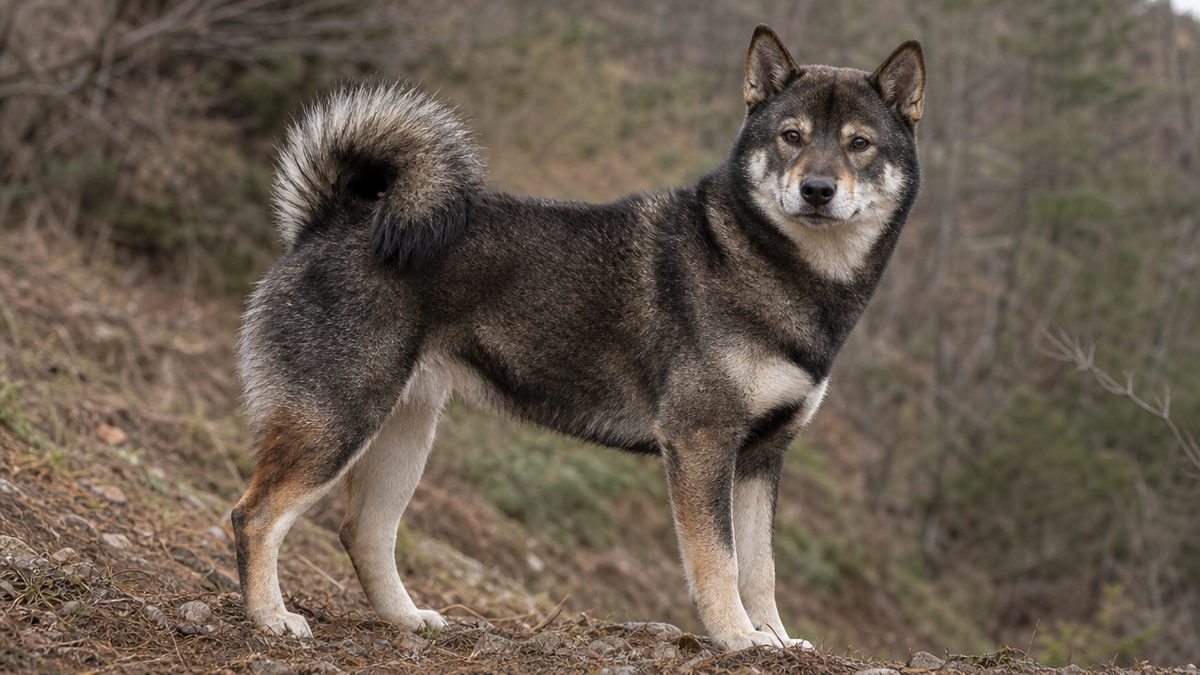
The standard describes a medium-sized dog with well balanced and well developed clean cut muscles, pricked ears, and a curled or sickle tail, built strong, well-boned and compact, with the ratio of height at withers to length of body set at 10:11. Its own history section calls these dogs tough and sufficiently agile to run through a mountainous region, which is the standard's way of saying hardy. That ratio is worth reading slowly. It means the correct Shikoku is slightly longer than it is tall, so a photograph of a square dog is a photograph of something else.
The parts of the standard a buyer can actually check
Four points in FCI 319 are visible in any photograph and settle most identification arguments. The ears are small, triangular, slightly inclining forward and firmly pricked. The eyes are nearly triangular, dark brown, with outer corners that turn slightly up. The tail is set on high, thick, and carried over the back vigorously curled or curved like a sickle, with the tip nearly reaching the hocks when let down. The nose is black.
Two of those are disqualifying rather than cosmetic. Ears that are not pricked and a hanging or short tail are both listed as disqualifying faults, alongside an extremely overshot or undershot mouth and any aggressive or overly shy temperament. Pinto colour and long hair are ordinary faults, not disqualifications, and so is a lack of sexual dimorphism.
Colour, and why sesame is the word that matters
The standard permits sesame, red, and black and tan, and defines sesame as a well mixture of black, red and white hairs through the whole coat. NIPPO, the Japanese preservation society, goes further and says sesame predominates in the breed, distinguishing red sesame from black sesame, and describes the contrast of black, red and white hairs as something not seen in other breeds.
That vocabulary is a practical filter. A seller offering a solid red dog with a black mask, or a white-and-red pinto, is offering something the standard treats as either a different colour or a fault. Sesame is not a saddle and it is not a mask, and no amount of marketing changes what the word means in this breed.
| Attribute | FCI Standard 319 | NIPPO, Japan |
|---|---|---|
| Height, male | 52 cm, tolerance of + 3 cm | 52 cm, within 49 to 55 cm |
| Height, female | 49 cm, tolerance of + 3 cm | 49 cm, within 46 to 52 cm |
| Weight, male | Not stated | 17 to 23 kg |
| Weight, female | Not stated | 15 to 18 kg |
| Coat | Harsh straight outer coat, soft dense undercoat | Sesame predominant, red sesame and black sesame |
| Job | Hunting dog and companion | Boar hunting in the Shikoku mountains |
The FCI files this breed as SHIKOKU, the AKC files it as Shikoku Ken, the Japanese cultural-property register files it as 土佐犬, and the standard's own history calls it Kochi-ken. Four names, four different result sets. The next section explains why.
Shikoku, Shikoku Ken, Kochi-ken and Tosa-ken: four names, one dog
This breed carries four names because it was renamed in about 1939, and Japan's national register was never updated to follow.
NIPPO states the sequence plainly. The breed was designated a national natural monument in June 1937 under the name 土佐犬, Tosa-ken, and came to be called 四国犬, Shikoku-ken, from about 1939, for two reasons: the old name was confusable with the 土佐闘犬, the Tosa fighting dog, and the breed was found in prefectures beyond Tosa. The FCI standard tells the same story from the other end, saying the breed took on the name of the region and was designated a natural monument in 1937.
The consequence is that the government document protecting this dog does not contain its modern name. Record 401/3113 of Japan's National Cultural Properties Database is headed 土佐犬, with the reading とさけん, designated 1937.06.15 under criterion four, domesticated animals peculiar to Japan. Search that register for 四国犬 and you will find nothing, which reads exactly like an absence and is not one.
Kochi-ken is a homonym, and it defeats searches
The FCI standard records that the breed is sometimes called Kochi-ken, meaning Kochi dog. In Japanese, 高知県 also means Kochi Prefecture, and the two are identical when romanised. A PubMed search for "Kochi-ken"[tiab] returns three records, and every one is about the prefecture rather than the dog, covering hepatitis B epidemiology, a landslide rescue and visiting services for the mentally handicapped.
The same trap runs through the English literature. Searching PubMed for "Shikoku Ken" is silently rewritten into "Shikoku" AND "Ken", which returns 51 records of personal-name noise, mostly Japanese cancer-survival papers. Only "Shikoku Inu"[tiab] isolates the breed, and it returns exactly two records.
The native script does not help either
A search for 四国犬 in PubMed returns zero with a blank query-translation line, which means the query was emptied rather than run. That zero is a limit of the tool and must never be reported as evidence that no Japanese-language literature exists. Bonbeno states the tool's behaviour and draws no conclusion from it.
Search Shikoku Inu for veterinary literature, 土佐犬 for the 1937 designation, 四国犬 for anything NIPPO publishes, and Shikoku Ken for the American record. A zero on one name is a zero on one name, and on this breed that has been true four times over.
Designated a natural monument on 15 June 1937, as record 401/3113
Japan designated this breed a national natural monument on 15 June 1937 under criterion four, domesticated animals peculiar to Japan, and the record is 401/3113.
The entry carries no prefecture, printing 地域を定めない, area not specified, so the protection follows the breed rather than a place. Its description reads that this is one of the medium-sized dogs kept since ancient times, with ears broad at the base, a large skull with well developed cheeks, a deep chest and well developed forelimbs, and that red and sesame coats predominate.
Those two details are what identify the record. A medium dog with red and sesame coats is the Shikoku; the Tosa fighting dog of the same province is a large Western-crossed mastiff and could not qualify under a criterion reserved for animals peculiar to Japan. The FCI standard independently gives 1937 as the designation year for this breed, and NIPPO independently names June 1937 and the old name.
Seven dogs, not six
Criterion four holds seven dog designations in total, and most English sources list six because they follow the six breeds NIPPO preserves today. The seventh is 越の犬, the Koshi dog of the Hokuriku region, designated 1934.12.28 and now extinct. Reading the register directly rather than a breed list is what recovers it.
| Record | Name in the register | Designated | Modern breed name |
|---|---|---|---|
| 401/3105 | 秋田犬 | 31 July 1931 | Akita |
| 401/3106 | 甲斐犬 | 22 January 1934 | Kai |
| 401/3108 | 紀州犬 | 1 May 1934 | Kishu |
| 401/3110 | 越の犬 | 28 December 1934 | Koshi dog, extinct |
| 401/3112 | 柴犬 | 16 December 1936 | Shiba |
| 401/3113 | 土佐犬 | 15 June 1937 | Shikoku |
| 401/3116 | 北海道犬 | 21 December 1937 | Hokkaido |
The neighbouring records are the control that the reading is right. Records 401/3111, 401/3114 and 401/3115 sit in the same date range under the same criterion and are all chickens, the Tōtenkō and two bantam breeds, so 401/3113 is the only dog designated on 15 June 1937. The Shiba record at 401/3112 was read in the same session and returned correctly, which is the in-document control.
A natural-monument designation is not a kennel-club opinion. It is a state protecting an animal as cultural property, and it is the reason Japan has kept a boar hound alive at three-figure registration numbers for ninety years. It is also the reason no export trade in the breed has ever developed.
How tall is a Shikoku? The FCI's two language versions disagree
The Shikoku stands 52 cm at the withers in a male and 49 cm in a female, and the size of the tolerance around those numbers depends on which language of the standard you read.
The authentic English text of FCI 319 reads: males 52 cm, females 49 cm, and "There is a tolerance of + 3 cm";. Read literally, that gives males 52 to 55 cm and females 49 to 52 cm, with no dog permitted below the ideal.
The French text of the same standard reads "Tolerance de plus ou moins 3 cm", which gives males 49 to 55 cm and females 46 to 52 cm. The French document names itself a translation, printing TRADUCTION with the translators' names and the line "Langue faisant foi (EN)", so the English governs.
The Japanese society sides with the translation
NIPPO, whose 1934 Japanese Dog Standard is the document the FCI text descends from, publishes males at 52 cm within a range of 49 to 55 cm and females at 49 cm within a range of 46 to 52 cm. That is the symmetric tolerance, exactly as the French translation renders it, and not what the authentic English says.
So the position is uncomfortable and worth stating rather than smoothing. The language the FCI declares authoritative carries a figure that the country of origin's own society does not use, and the version the FCI labels a mere translation matches it. Bonbeno publishes both and follows neither silently.
| Document | Male | Female | Weight |
|---|---|---|---|
| FCI 319, English, authentic | 52 to 55 cm | 49 to 52 cm | Not stated |
| FCI 319, French, translation | 49 to 55 cm | 46 to 52 cm | Not stated |
| NIPPO, Japan | 49 to 55 cm | 46 to 52 cm | 17 to 23 kg male, 15 to 18 kg female |
| AKC, Foundation Stock Service | 43.2 to 55.9 cm, both sexes | 43.2 to 55.9 cm | 15.9 to 24.9 kg |
The AKC row is the outlier in a different direction. Its Shikoku Ken page prints 17 to 22 inches and 35 to 55 pounds, which converts to 43.2 to 55.9 cm and 15.9 to 24.9 kg. The floor is 5.8 cm below the lowest figure any Japanese document permits, and the weight range exists at all only because the AKC supplies one where the FCI standard supplies none.
A size bucket drives food quantity, drug dosing and crate size. If an Indian vet doses a Shikoku off a range that starts at 43 cm, the dog in front of them may be a third heavier than the bucket assumes. Weigh the dog. Do not dose off a breed chart.
Two Japanese registries hold this breed, and they disagree by a factor of five
Japan registers the Shikoku twice, through NIPPO and through the Japan Kennel Club, and the two registers recorded 252 and 51 puppies respectively in 2025.
NIPPO, the Nihon Ken Hozonkai, established the Japanese Dog Standard in 1934 and classifies the six native breeds by size, with the Shiba small, the Kishu, Shikoku, Kai and Hokkaido medium, and the Akita large. It states on its own front page that of those six it is mainly the Shiba, the Kishu and the Shikoku that it registers in numbers. It is, in other words, this breed's principal studbook.
The Japan Kennel Club is the FCI member body and the register whose figures the English-language internet quotes. It recorded 51 Shikoku in 2025, ranking the breed 78th of 141 breeds in a year of 302,530 registrations. NIPPO recorded 252 in the same year.
Why a single-register figure is wrong by five times
Any page that quotes the Japan Kennel Club alone reports about a sixth of the Japanese picture. The two registers are not subsets of each other; they are separate studbooks serving different constituencies, one built around the preservation of natural-monument breeds and one built around FCI pedigrees and international shows.
The same split explains an oddity in the JKC table. The Kishu does not appear in the JKC's 2025 list at all, which reads as extinction and is nothing of the kind: NIPPO registered 132 Kishu that year. A breed can be absent from one Japanese register and healthy in the other.
What this means for a pedigree in India
India is a full FCI member represented by the Kennel Club of India, so the FCI's recognition of standard 319 is the mechanism by which an Indian pedigree for a Shikoku could exist. That recognition is definitive rather than provisional, which decides whether a dog can compete for the CACIB at all: the Shikoku sits in the FCI's Group 5 definitive list carrying a CACIB award and is absent from the 20-entry provisional register. A NIPPO pedigree is not an FCI pedigree, and a dog exported on NIPPO papers would need the receiving body to accept them. That is a real administrative fork and no Indian page mentions it.
The FCI holds the breed as standard 319 on a definitive basis. The AKC holds it in the Foundation Stock Service as Shikoku Ken, with no year of recognition, which means it can be recorded but not shown in the regular classes. NIPPO holds the largest studbook and publishes its numbers openly. The Shikoku is also the only one of the six natives with no single-breed society of its own, which is why NIPPO plus JKC comes closer to a complete count here than for any sibling breed.
The registration series: 1,031 in 1998, 252 in 2025
NIPPO's Shikoku registrations fell from 1,031 in 1998 to a low of 180 in 2024, then recovered to 252 in 2025, while the Japan Kennel Club's separate count rose from 5 in 2010 to 51 in 2025.
NIPPO publishes an annual studbook table with columns headed small, medium and large, and the Shikoku column runs 1,031 in 1998, 656 in 2005, 370 in 2010, 314 in 2015, 219 in 2020, 227 in 2023, 180 in 2024 and 252 in 2025. That is a 75 percent fall across 27 years, followed by a 40 percent single-year rise.
The Japan Kennel Club series moves the other way. It records 15 Shikoku in 1999, 5 in 2010, 13 in 2015, 20 in 2020, 38 in 2023, 26 in 2024 and 51 in 2025 Japan Kennel Club, registrations by breed Japan Kennel Club, registrations by breed Japan Kennel Club. The 2024 figure needs a note of method, because the JKC's archive link for 2024 lives at /registr-statistics/2024-3/ while /registr-statistics/2024/ serves the 2025 table under the 2025 title, so a year-over-year comparison built on the obvious URL compares 2025 against itself. A breed that ranked 127th of the JKC's list in 2010 ranked 78th in 2025 Japan Kennel Club.
| Year | NIPPO | Japan Kennel Club | Combined |
|---|---|---|---|
| 1998 to 1999 | 1,031 | 15 | about 1,046 |
| 2005 | 656 | 6 | 662 |
| 2010 | 370 | 5 | 375 |
| 2015 | 314 | 13 | 327 |
| 2020 | 219 | 20 | 239 |
| 2023 | 227 | 38 | 265 |
| 2024 | 180 | 26 | 206 |
| 2025 | 252 | 51 | 303 |
Read together, the two columns say something neither says alone. The breed's total annual output in its own country fell from roughly 1,046 to a floor near 206, and 2025's 303 is a recovery rather than growth. Any description of the Shikoku as a rising breed is reading the JKC column in isolation.
The context that makes the numbers mean something
NIPPO's whole register is shrinking, not just this column. Its Shiba count fell from 31,689 in 1998 to 13,722 in 2025, a 57 percent decline over the same window. So the Shikoku's fall is partly a fall in Japanese interest in native breeds generally, and partly its own.
For scale against a breed Indian readers know, the Japan Kennel Club registered 3,598 Shiba in 2025 and 263 Akita. This is a rare dog by any measure, and it is rare in the only country that has ever bred it in numbers.
A registration count is a count of puppies registered in one year with one body, not a population. Dogs live 10 to 15 years, so a decade of these numbers is closer to the living population than any single row. Neither register publishes a living-population figure and Bonbeno does not estimate one.
Shikoku dog price in India: there is no verified figure, and here is what is being quoted instead
No verified shikoku dog price in india exists, because no Indian breeder, kennel-club register, rescue or classifieds listing carries the breed.
One Indian page prints a number. poodles.in gives a buying price of Rs 55,000 to Rs 1,00,000 and a monthly care total of Rs 3,550 to Rs 5,400. Read on its own, that looks like market data. Read against the same site's Thai Ridgeback page, it is a template.
The same cost row, on two unrelated breeds
The Thai Ridgeback page on poodles.in prints the identical monthly total, Rs 3,550 to Rs 5,400, built from the identical three lines: food Rs 2,250 to Rs 3,000, grooming Rs 700 to Rs 1,200, and health Rs 600 to Rs 1,200. The three lines sum exactly to the total at both ends, so the total is assembled from preset components rather than observed.
Two things on those pages falsify the rows outright. The site states that the Shikoku eats about 1,000 calories a day and the Thai Ridgeback about 1,500, a 50 percent difference, and gives them the same food line. It also calls the Shikoku a dense double coat with moderate shedding and the Thai Ridgeback a short smooth coat with low shedding, and gives them the same grooming line.
Running the currency tests on the buying price
Indian pages routinely publish a dollar figure converted at one rate, so the buying price is worth dividing. Rs 55,000 divided by 84.38 is 651.81, by 74 is 743.24, and by 80 is 687.50. None is a price a seller would print. The Rs 1,00,000 ceiling divides by 80 to exactly 1,250, but any figure ending in four zeros does that by construction, and the same ceiling appears on the Thai Ridgeback page.
The conclusion is that these are rupee-native, arbitrary numbers rather than a converted list. That is a different defect from a conversion and it needs saying differently: nobody has priced a Shikoku in India, and the figure was generated to fill a field.
| Line | Shikoku | Thai Ridgeback | Identical |
|---|---|---|---|
| Buying price | Rs 55,000 to Rs 1,00,000 | Rs 60,000 to Rs 1,00,000 | Ceiling only |
| Monthly care | Rs 3,550 to Rs 5,400 | Rs 3,550 to Rs 5,400 | Yes |
| Food | Rs 2,250 to Rs 3,000 | Rs 2,250 to Rs 3,000 | Yes |
| Grooming | Rs 700 to Rs 1,200 | Rs 700 to Rs 1,200 | Yes |
| Health | Rs 600 to Rs 1,200 | Rs 600 to Rs 1,200 | Yes |
| Stated daily intake | About 1,000 calories | About 1,500 calories | No |
| Coat and shedding | Dense double coat, moderate | Short smooth coat, low | No |
We will not convert a Japanese asking price into rupees and present it as an Indian price. A converted foreign price is not an observation of an Indian market, and this site has documented answer engines doing exactly that on other breeds. Where no Indian price exists, the honest number is none.
The real cost of ownership in India for a 20 kg dog
Keeping a 17 to 23 kg dog in an Indian metro costs roughly Rs 6,000 to Rs 11,000 a month once parasite control, food, vaccination and consultations are counted honestly.
The point of this section is that the cost of ownership is real and sourceable even when the purchase price is not. An Indian reader planning for a medium hunting spitz needs these figures far more than a fabricated puppy price.
The lines you can actually price
- Parasite control at Rs 1,103 a month, from NexGard Spectra for 15 to 30 kg dogs at Rs 3,308 for three tablets, which covers ticks, fleas, roundworm and hookworm in one product.
- Vaccination at Rs 699 for anti-rabies and Rs 899 for the 9-in-1, or an annual booster course from Rs 3,199, which is roughly Rs 270 a month spread out.
- Consultation at Rs 500 to Rs 1,000 a visit, and grooming at Rs 300 to Rs 2,000 depending on what is done.
- Municipal registration at Rs 500 in Delhi, or Rs 50 in Chennai, which is a yearly line rather than a monthly one.
- Boarding at Rs 500 to Rs 2,000 a day when you travel, which is the line most first-time owners forget entirely.
The spread is the finding, not any single number
The same 9-in-1 vaccine costs Rs 600 at a Goa government veterinary hospital, from Rs 899 at a Vetic clinic, and from Rs 1,999 through a vet-at-home service that also charges a Rs 699 visit fee. That is a 3.3 times spread on one identical drug. Price is a function of delivery model, not of the medicine, and an Indian owner who understands that can cut a recurring cost by two thirds.
Chennai residents have a further option that is genuinely free. Greater Chennai Corporation runs six pet clinics that provide treatment and anti-rabies vaccination at no cost, and issued 9,115 pet licences in 2024 at Rs 50 each.
| Line | Low | High | Note |
|---|---|---|---|
| Food | Rs 3,000 | Rs 5,500 | Kibble for a lean, active 17 to 23 kg dog |
| Parasite control | Rs 1,103 | Rs 1,103 | NexGard Spectra 15 to 30 kg, monthly |
| Vaccination, spread | Rs 150 | Rs 320 | Annual booster divided by twelve |
| Vet consultations | Rs 250 | Rs 1,000 | Assumes two to twelve visits a year |
| Grooming | Rs 300 | Rs 2,000 | Bath and dry, more in the monsoon |
| Contingency | Rs 1,200 | Rs 1,200 | The line that stops a Rs 20,000 bill becoming a crisis |
| Total | Rs 6,003 | Rs 11,123 | Before any cooling or boarding |
A heat-sensitive double-coated dog in Chennai or Nagpur needs a room that stays cool through May, and a Bengaluru boarding directory now carries an explicit warning about generator backup for air conditioning during March to May load-shedding. Budget the electricity, and ask any boarding kennel what happens when the power goes.
Heat tolerance: the gap between Kochi and an Indian city is 11.88 degrees
The Shikoku's homeland runs 11.88 C cooler than Chennai on an annual mean, and it is already more humid, so the risk this breed faces in India is heat rather than damp.
NASA POWER, queried at 33.5597 N 133.5311 E, returns a cell for Kochi at 306.36 m with an annual mean of 16.07 C, an August peak of 26.27 C, a January mean of 5.75 C, and annual relative humidity of 79.38 percent. Chennai's cell, at 48.95 m, returns 27.95 C and 72.39 percent.
Note the cell elevation before using either figure. Kochi city sits near sea level and the cell returned 306.36 m, an error of about 296 m, because the grid square is picking up the Shikoku mountains behind the city. For this breed that is arguably the right ground, since the FCI standard places its work in the mountainous districts of Kochi Prefecture, but the figure is a mountain cell and not a city one and should be read that way.
The humidity argument is the wrong argument
This is a hardy dog in its own climate, and it is tempting to say Indian humidity will finish a Japanese double coat. The data says otherwise. Kochi runs 79.38 percent annual relative humidity, higher than Chennai at 72.39, Mumbai at 67.39 and Delhi at 45.56. A Shikoku has never met dry air. What it has never met is 30 C at that humidity.
| Place | Cell elevation | Annual mean | Hottest month | Annual humidity |
|---|---|---|---|---|
| Kochi, Japan | 306.36 m | 16.07 C | August, 26.27 C | 79.38 percent |
| Bengaluru | 841.72 m | 23.74 C | April, 28.37 C | 67.94 percent |
| Pune | 635.99 m | 23.86 C | April, 28.93 C | 66.80 percent |
| Delhi | 206.37 m | 25.60 C | June, 35.88 C | 45.56 percent |
| Kolkata | 7.35 m | 25.81 C | May, 31.53 C | 73.93 percent |
| Mumbai | 97.15 m | 26.77 C | May, 31.19 C | 67.39 percent |
| Chennai | 48.95 m | 27.95 C | May, 31.51 C | 72.39 percent |
What the heat evidence supports, and what it does not
Hall 2020 in Scientific Reports studied 905,543 UK dogs and found 395 confirmed heat-related illness events with a case fatality of 14.18 percent, and reported that a dog at or above its breed and sex mean bodyweight carried 1.42 times the odds (1.12 to 1.80). The Shikoku was not modelled in that paper, so no breed-level odds ratio exists for it and none should be borrowed.
The transferable finding is the trigger split. Hall 2020 in Animals recorded 1,259 events from 1,222 dogs, of which 879 had a recorded trigger, and 652 of those 879 were exertional, that is 74.2 percent. Heat-related illness in dogs is overwhelmingly caused by exercise, not by hot cars, and an owner walking a boar hound at 10 a.m. in May is running exactly that risk.
Walk before sunrise and after dark from March to June in the plains. Carry water. Stop at the first sign of a wide, flat-tongued pant that does not settle within a minute of stopping. And never clip the coat: a double coat insulates against heat as well as cold, and a clipped dog loses that and gains sunburn.
Where in India a Shikoku could actually live
Bengaluru and Pune are the two large Indian cities whose climate comes closest to what this breed evolved in, and neither is close.
Bengaluru runs an annual mean of 23.74 C and peaks in April at 28.37 C, and Pune runs 23.86 C peaking in April at 28.93 C. Against Kochi's 16.07 C that is still a gap of about 7.7 C, but it is 4 C better than Chennai and it comes with a cooler night, which is what actually lets a double-coated dog recover.
Note that both cities peak in April rather than May, and both are coolest in December rather than January. That matters for planning: the hardest six weeks for a Shikoku in Bengaluru are late March to early May, not the monsoon.
Hill stations, and why this page will not give you their numbers
The obvious answer to a cold-climate breed in India is a hill station, and Bonbeno does not publish satellite climate figures for Indian hill stations, because the model's grid cells for them are wrong by 700 to 1,935 metres and the error runs in both directions. Manali returns a cell almost 2 km above the town and Ooty returns one nearly 1.5 km below it. A number that confident and that wrong would be worse than none.
What can be said without a number is simple. A place that stays below about 25 C through the hot months, with a night that drops into the teens, is a place this breed can work in. Most of India is not that place for six months of the year.
The monsoon is a skin problem, not a heat problem
Indian veterinary clinic caseloads show what the wet season does to dogs rather than what heat does. A West Bengal study of 584 client-owned dogs presenting at a Kolkata animal health centre found Babesia gibsoni in 76.54 percent, Anaplasma in 55.75 percent, and two or more concurrent pathogens in 72.9 percent of the 584 dogs screened. A southern Indian study of 120 clinically affected dogs found Babesia in 66.7 percent, with cases peaking pre-monsoon between March and May.
Both figures come from dogs already brought to a clinic with signs, not from a random population, so they describe the risk among dogs that get sick rather than the risk to every dog. Read that way they are still the strongest argument on this page for year-round tick control on a dense-coated dog in India.
Look at the hottest month's mean, not the annual mean, and then look at the night. A city that averages 24 C annually but hits 29 C in April with 24 C nights gives a double-coated dog no window to unload heat. Bengaluru and Pune pass that test better than any other Indian metro.
Indian import law, and what it means for anyone trying to bring one in
Indian law permits you to bring in a Shikoku as your own accompanying pet and rejects any application to import one to breed or to sell.
DGFT Trade Notice 22/2022-23 of 19 December 2022 places dogs under ITC (HS) 01061900 as a Restricted import. Three routes are permitted, and the notice names them: a pet accompanying an owner with a valid pet book in the importer's name, research use with a CPCSEA recommendation, and Defence or Police use. It states that applications for trading or breeding purposes shall be duly rejected.
Read that alongside the registration numbers and the conclusion is structural rather than rhetorical. A breed registering about 303 puppies a year across both of Japan's published books, with no Indian breeding stock and no lawful import route for breeding stock, cannot form an Indian supply chain. There is no import licence a would-be Indian breeder can apply for that would change this.
If you are moving to India with your own dog
- Confirm the dog is entering under the personal pet route rather than the commercial one, because the two run on different instruments.
- Carry the pet book in the importer's own name, which is the document the trade notice specifically requires.
- Plan the arrival month around the heat, since a dog from a 16.07 C annual mean landing in Chennai in May is meeting a 12 degree step change on day one.
- Register the dog with your municipality on arrival, at Rs 500 in Delhi or Rs 50 in Chennai Greater Chennai Corporation.
- Book a first veterinary appointment before you need one, so the practice has a weight and a baseline on file.
What Indian breeding law would require if the breed ever arrived
The Prevention of Cruelty to Animals (Dog Breeding and Marketing) Rules 2017 bind anyone breeding or selling dogs in India. Second Schedule Part III paragraph 8(10) requires that breeding dogs have been tested for named genetic defects, including hip dysplasia, progressive retinal atrophy, night blindness and entropion. Rule 8(1)(a) prohibits selling pups under eight weeks old.
One clause bites this breed specifically. Second Schedule Part IV paragraph 21(1) bars keeping a dog in outdoor housing without the attending veterinary practitioner's written approval where the dog is not accustomed to local temperatures, or where the breed cannot tolerate them, naming long-haired breeds in high temperature locations. A dense-undercoated Japanese spitz in a Chennai yard is the case that clause describes.
The 2017 Rules run 1 to 13 and there is no Rule 14. Everything numbered above 13 is a Second Schedule paragraph. A page citing the outdoor-housing heat clause as "Rule 21" is citing something that does not exist, and the string Rule 21 appears zero times in the gazette.
Temperament: what the standard promises, and who should not buy one
The FCI standard describes a dog of marked endurance, keen in sense with a naive feeling, energetic and highly alert, an enthusiastic hunter, and docile towards his master.
Read that sentence carefully, because every clause is a warning as well as a description. Marked endurance means a dog that does not tire when you do. Highly alert means a dog that tells you about every sound in a stairwell. Enthusiastic hunter means a prey drive that does not switch off for a cat. And docile towards his master, rather than towards a household, is the phrase that decides whether this is the right dog for a family.
NIPPO's own description adds the working detail. It calls the breed 精悍, keen and fierce in bearing, with agile movement, wild springiness through the legs, and a deep sharp eye, and says the dog is generally intelligent and acts by reading its owner's feelings. That is a bold, independent dog that observes you closely, which is a very different thing from a biddable one.
Who this breed suits
- Owners who want an independent dog and are not offended by one.
- Owners with 60 to 90 minutes a day for real exercise, in the cool hours, every day.
- Owners in a house or a large flat with secure boundaries above chest height.
- Owners who will socialise a puppy hard between eight and sixteen weeks and keep going for a year.
- Owners who already live with a primitive breed and know what a poor recall costs.
Who should look elsewhere
- First-time dog owners, because the recall, the noise and the prey drive all arrive together.
- Households with a toddler, since the AKC files the breed as better with children under supervision.
- Households with cats, rabbits or free-ranging poultry, given what the breed was bred to do.
- Anyone in a small flat who is out for eleven hours, because an under-exercised boar hound rearranges the furniture.
- Anyone who wants a dog that will greet visitors warmly at the door.
The standard also disqualifies an aggressive or overly shy dog outright, and lists shyness as a fault in its own right. That combination is the tell of a breed with a genuine confidence problem when it is badly bred or badly socialised, and it is the single thing to test hardest when meeting a litter.
This is a working hunting dog that Japan protects as cultural property, not a companion spitz that happens to look wolfish. It bonds hard to one person, tolerates the rest, and needs a job. Wanting the look is not a reason to take one on.
Training a dog bred to make its own decisions
To train a Shikoku, work in short food-paid sessions with one handler, and accept that a reliable off-lead recall may never arrive.
The breed was bred to run ahead of a hunter through mountain forest, find a boar, and hold it until the hunter caught up. Every part of that job selects for independent judgement rather than for taking instructions. A dog that checked in with its handler every thirty seconds would have been useless at it.
So the training question is not how to make a Shikoku obedient. It is which behaviours are worth building and which are better managed by a long line and a good fence.
The five things worth teaching first
- Name response, paid every single time for the first six months, because a dog that looks at you can be redirected.
- A hand-target, which moves a dog without a collar grab and is the calmest way to get one off a scent.
- Crate settling, since a heat-sensitive dog needs a cool indoor place it chooses to use in April and May.
- Loose-lead walking on a Y-front harness, taught before the puppy reaches 15 kg rather than after.
- A reliable stationary wait at doors and gates, which is the behaviour that actually prevents an escape.
Notice what is not on that list. Off-lead recall is deliberately absent, not because it cannot be trained, but because on a high-prey-drive primitive breed the honest plan is a long line in open ground and a securely fenced area for free running. Building a life around a recall this breed may never fully offer is how dogs get lost.
The socialisation window is the part that cannot be redone
A puppy that is going to live in an Indian city needs to have met autorickshaw noise, temple loudspeakers, cattle, monkeys, cyclists, and free-ranging dogs before sixteen weeks, at a distance it can cope with. A breed whose standard lists shyness as a fault and disqualifies an overly shy dog is a breed where that window is not optional.
Compulsion training is the fastest way to break this dog. An independent hunting spitz that is corrected hard does not become obedient, it becomes evasive, and the behaviour you punished simply happens further away from you.
Expect name response and a hand-target inside three weeks. Expect loose-lead walking to take three months. Expect door and gate manners to hold by six months. Do not expect an off-lead recall in a park with squirrels, at any age, and build the fence instead.
Exercise: what this breed needs, and the hours India actually allows
A Shikoku needs 60 to 90 minutes of real daily exercise, and in an Indian summer that has to fit into roughly two safe hours a day.
The standard describes noteworthy endurance, a gait that is resilient and light, and an action that is quick, with turning possible. That is a description of a dog built for long days on steep, broken ground. It is not a description of a dog that is satisfied by two twenty-minute pavement walks.
The constraint in India is not the dog's capacity. It is the window. In Chennai in May the monthly mean is 31.51 C and in Delhi in June it is 35.88 C, which leaves the hour before sunrise and the hour after full dark as the only periods where a dense-coated 20 kg dog can work hard without risk.
What 60 to 90 minutes should contain
- Thirty to forty-five minutes of continuous forward movement, on a long line if the ground is open.
- Fifteen minutes of scent work, which tires a hunting dog faster than distance does and can be done indoors in May.
- Ten minutes of structured play with rules, so arousal has an off switch built into it.
- Free running only inside a fully fenced area, for the reasons the training section gives.
- A hard rest afterwards, on a cool floor, because recovery is part of the exercise and not an afterthought.
Why the exertional risk is the one that matters
Hall 2020 in Animals recorded 1,259 heat-related illness events from 1,222 UK dogs, of which 879 had a recorded trigger, and 652 of those 879, or 74.2 percent, were exertional rather than environmental or vehicular. Exercise is how dogs overheat. In a country where the ambient baseline is 12 degrees above this breed's homeland, that finding is the whole exercise policy.
The companion paper found a case fatality of 14.18 percent across 395 confirmed events, and that dogs at or above their breed and sex mean bodyweight carried 1.42 times the odds of an event. Keeping a Shikoku lean is not cosmetic; it is the one modifiable risk factor with a published odds ratio behind it.
Stop immediately if the tongue widens and flattens, if the dog seeks shade without being asked, if the pant does not settle within a minute of standing still, or if the gait shortens. Wet the belly, groin and paws rather than the back, offer water, and get to a veterinarian the same day if the dog does not normalise within ten minutes.
Grooming a double coat in Indian humidity
The Shikoku carries a harsh straight outer coat over a soft dense undercoat, which needs weekly line-brushing, daily work through two annual sheds, and thorough drying after every bath.
The standard's coat description is short and complete: outer coat rather harsh and straight, undercoat soft and dense, with rather long hair on the tail. That double coat is the reason the breed is comfortable at 5.75 C in a Kochi January, and it is the single feature that most affects how it is kept in India.
Why you never shave this dog
A double coat insulates in both directions. The undercoat traps air, and the harsh outer coat both sheds water and blocks direct sun on the skin. Clipping it removes the sun barrier, exposes skin that has never seen ultraviolet light at Indian intensity, and does not make the dog cooler. Brushing the dead undercoat out is what makes a dog cooler, and it takes fifteen minutes.
The Indian complication is drying, not brushing
A dense undercoat will not air dry in a Mumbai August at 90 percent relative humidity, and a coat that stays damp against the skin is how hot spots and yeast start. Every bath in the monsoon needs a forced-air dryer or a long session with a stand fan and towels, worked down to the skin rather than over the surface.
- Line-brush weekly with an undercoat rake and a slicker, in sections down to the skin, rather than skimming the top coat.
- Brush daily for the three to four weeks of each seasonal shed, and expect a great deal of coat.
- Bathe every six to eight weeks at most, or the coat loses its natural oils and the skin dries.
- Dry to the skin every single time, and plug the ears before the water goes on.
- Check between the toes and under the tail weekly through the monsoon, because that is where Indian skin trouble starts.
Ticks are the grooming job that actually matters here
In a country where a Kolkata clinic caseload of 584 dogs showed Babesia gibsoni in 76.54 percent and two or more concurrent pathogens in 72.9 percent of those screened, a weekly coat check is a disease-prevention task rather than a cosmetic one. A dense undercoat hides a tick completely, so the check has to be done with fingers on skin, not by looking.
Combine that with monthly NexGard Spectra at Rs 1,103 for a 15 to 30 kg dog and the risk drops sharply. Neither measure works alone on a coat like this.
Run both hands over the whole dog against the lie of the coat, checking ears, throat, armpits, groin and between the toes. Then rake the undercoat on the neck, trousers and tail, which is where it packs first. Ten minutes a week is the difference between a healthy coat in Chennai and a matted one.
Health: two papers, one dog, and no lifespan study at all
The Shikoku has almost no published health literature, and the honest summary is that a buyer must ask for the parents' test results because no breed average exists.
A properly scoped PubMed search on "Shikoku Inu"[tiab] returns two records. Both come from overlapping author groups, both were published within months of each other, and both describe a Shikoku Inu with neuronal ceroid lipofuscinosis. Treat them as one animal reported twice rather than as two independent cases.
The one documented case, in detail
Tamura and colleagues reported a two-year-eleven-month-old male Shikoku Inu referred for a progressive gait abnormality that had begun three months earlier. The dog showed ventral neck flexion, a wide-based hindlimb stance, tremor and hypermetria in all four limbs, proprioceptive deficits and postural vertical nystagmus, then developed behavioural and cognitive dysfunction, ataxia and visual deficits. MRI showed symmetrical progressive atrophy of the whole brain and cervical spinal cord.
Bilateral retinal degeneration followed, and both flush and flicker electroretinograms were bilaterally non-recordable at five years eight months, at which point the dog was euthanised. Post mortem showed light-brown pigment deposition in neurons throughout the cerebrum, cerebellum and brainstem nuclei, with autofluorescence and membranous material on electron microscopy, giving a diagnosis of adult-onset neuronal ceroid lipofuscinosis.
The second paper included the same Shikoku Inu among nine dogs with lysosomal storage disease, and recorded positioning head tilt in seven of the nine. That is a clinical sign worth knowing, because it is triggered by head movement and had not been described until 2016, so it is easy to miss.
What a single case report does and does not establish
It establishes that the disease occurs in this breed. It establishes nothing about how often. One dog is not a prevalence, and no page including this one can tell you the carrier rate, because no survey has ever been done. A breeder who tells you the breed is free of it is making a claim no published data supports in either direction.
The absences, stated plainly
- No published life expectancy. McMillan 2024's Table S5 lists the Shikoku with Included in Survival Analysis set to N, so the breed was considered and excluded rather than overlooked, and no median survival exists for it.
- No published hip or elbow screening statistics for the breed.
- No breed-club health survey in English.
- No genetic test panel marketed for the breed's own mutations.
- The AKC's 10 to 12 year figure, published without a named data source.
For scale rather than substitution, McMillan's nearest measured Japanese relatives are the Shiba Inu at a median 14.6 years on 91 deaths and a hazard ratio of 0.45 against crossbreds, and the Akita at 11.4 years on 2,358 deaths with a hazard ratio of 1.29. Neither number belongs to the Shikoku and neither should be quoted as if it did.
Ask for the sire's and dam's hip scores with the scheme named, an ophthalmologist's certificate dated within the last year, and a written note of any neurological signs in the line. Ask what happened to the oldest dog they bred and when. A breeder who cannot answer those three questions has no health programme, whatever the breed.
Feeding a medium working spitz in India
Feed a Shikoku to a visible waist and easily felt ribs rather than to a chart, because bodyweight at or above the breed mean is the one heat risk factor with a published odds ratio.
Hall 2020 in Scientific Reports found that dogs at or above their breed and sex mean bodyweight carried 1.42 times the odds of heat-related illness, with a confidence interval of 1.12 to 1.80. In an Indian climate that turns body condition from a cosmetic question into a safety one, and it is the single most useful feeding fact on this page.
Portion and life stage
- Puppies to four months, four meals a day, on a large-breed or all-breed growth food with controlled calcium.
- Four to eight months, three meals, watching that growth stays steady rather than fast.
- Eight months onward, two meals a day, split morning and evening around the cool exercise windows.
- Adults at 17 to 23 kg, roughly 300 to 400 g of a good dry food a day, adjusted weekly by feel rather than by the bag.
- Seniors from about eight years, the same weight held steady, with joint support discussed with your own veterinarian.
NIPPO gives the adult weight range as 17 to 23 kg in males and 15 to 18 kg in females, and the FCI standard gives no weight at all. Where a breed has no weight in its governing standard, the body condition score is the only honest target, and a dog whose ribs you can feel without pressing and whose waist you can see from above is correctly fed.
Raw meat, and one Japanese finding worth carrying
A study of 441 boar-hunting dogs in western Japan found 195, or 44.2 percent, seropositive for the lung fluke Paragonimus westermani on screening ELISA, and identified being fed raw wild boar meat by hunters as the risk factor, with an odds ratio of 3.35. The paper describes the dogs by their work rather than by breed, so it is not a Shikoku prevalence figure and is not offered as one.
What transfers is the mechanism. Feeding raw wild-caught meat to a hunting dog is a parasite route, and in India the same logic applies to raw river fish and to raw offal from informal slaughter. Cook it, or do not feed it.
Indian availability
Everything a medium active dog needs is available in India. Large-breed and all-breed adult formulas from the major brands are stocked in every metro, and the practical decision is usually price and consistency rather than formulation. Budget Rs 3,000 to Rs 5,500 a month for food for a dog this size, and change brands slowly over a week rather than overnight.
Move the main meal to after the evening walk rather than before it, keep water available in two places, and do not exercise within an hour of a full meal. A deep-chested dog eating and then working in heat is a bloat and heat risk stacked on top of each other.
The first year, month by month
A Shikoku puppy's first year runs from a hard socialisation push before sixteen weeks to a second fear period around eight months and full physical maturity near eighteen months.
- Weeks 8 to 10. Home, crate, name response, four meals a day, and the first vaccination discussion with your own veterinarian. Indian law prohibits the sale of pups under eight weeks, so a younger puppy is a red flag about the seller.
- Weeks 10 to 16. The socialisation window. Traffic, lifts, autorickshaws, cattle, other dogs at a distance, and being handled by strangers. Everything at a distance the puppy can cope with, nothing forced.
- Months 4 to 5. Adult teeth arrive, chewing peaks, and loose-lead walking is taught now while the puppy still weighs under 15 kg.
- Months 5 to 6. Prey drive switches on visibly. The long line becomes permanent equipment in open ground and the fence gets checked properly.
- Months 6 to 8. A second fear period is common in primitive breeds. Do not flood the dog. Repeat easy versions of things it already knows.
- Months 8 to 12. Growth slows, the adult coat comes in with the first real shed, and the daily exercise load can move toward the adult 60 to 90 minutes.
- Months 12 to 18. Physical maturity completes. Do not start repetitive high-impact work such as long road running until growth plates have closed, on your veterinarian's assessment.
The Indian calendar matters as much as the age
A puppy that turns four months old in April in Chennai spends its most important learning weeks in the hottest part of the year, when the safe outdoor window is about two hours a day. A puppy that turns four months in November has four cool months to work with. If you have any choice about arrival timing, choose the cool half of the year.
The monsoon has the opposite problem. The socialisation walks still have to happen, and a wet double-coated puppy has to be dried properly every time or the skin problems start early.
Everything on this list can be delayed except the eight to sixteen week window. A Shikoku that misses it in an Indian city becomes an adult that cannot cope with an Indian city, and the standard's disqualification of an overly shy dog is the breed telling you that this failure mode is real.
Shikoku against the breeds an Indian buyer would actually cross-shop
Against every breed an Indian buyer would consider alongside it, the Shikoku loses on availability and on heat, and wins only if you specifically want a medium Japanese hunting spitz.
| Breed | Size | Heat tolerance | Available in India | 2025 Japan registrations |
|---|---|---|---|---|
| Shikoku | 49 to 55 cm, 17 to 23 kg | 2 of 5 | No | 252 NIPPO, 51 JKC |
| Shiba Inu | Small, 8 to 11 kg | 2 of 5 | Yes, imported | 13,722 NIPPO, 3,598 JKC |
| Kai Ken | Medium, 45 to 53 cm | 2 of 5 | No | 78 NIPPO, 60 JKC |
| Hokkaido | Medium, 45.5 to 51.5 cm | 2 of 5 | No | 11 NIPPO, 24 JKC |
| Akita | Large, 64 to 70 cm | 1 of 5 | Yes | 5 NIPPO, 263 JKC |
| Indian Pariah Dog | Medium, 18 to 25 kg | 5 of 5 | Free to adopt | Not registered |
| Kombai | Medium boar hound | 5 of 5 | Yes, regionally | Not registered |
Against the Shiba Inu
The Shiba is the Japanese breed an Indian buyer can actually get, and it is a different animal. It is small rather than medium, at 8 to 11 kg against this breed's 17 to 23 kg, and it was bred for small game rather than boar. NIPPO registered 13,722 Shiba in 2025 against 252 Shikoku, a 54-fold difference in the same studbook. If you want a Japanese spitz and can accept a small one, this is the answer.
Against the Kai and the Hokkaido
These are the two breeds a Shikoku buyer is genuinely choosing between, and all three are equally unavailable in India. On numbers the Kai is comparable, at 78 NIPPO and 60 JKC registrations in 2025, while the Hokkaido reads 11 in NIPPO's book and 24 in the JKC's Japan Kennel Club. Do not rank the three on those figures. The Kai and the Hokkaido each have a single-breed society of their own that neither register counts, and the Shikoku does not, so its two-register total is close to complete while theirs are floors. The Hokkaido comes from a genuinely cold island and the Shikoku from a warm, wet one, which is the one climate distinction that matters for India.
The Akita shows how large that correction can be. NIPPO recorded 5 Akita in 2025 and the Japan Kennel Club 263, while the Akita Inu Hozonkai, the breed's own society, recorded 1,587 domestic and 637 overseas litter registrations in 2024 plus 140 single-dog registrations Nihon Ken Hozonkai (NIPPO). Those are litters rather than puppies. A rarity ranking built on one or two registries measures the registries, not the breeds.
Against an Indian boar hound
The honest comparison for an Indian buyer who wants what the Shikoku does is the Kombai, a South Indian boar hound that performs the same job in a climate it evolved in, and that can be sourced and vetted locally. A dog rated 5 of 5 for heat tolerance in Tamil Nadu does not need a two-hour exercise window in May.
If the appeal is a curled tail, a wolfish head and an independent temperament, an Indian Pariah Dog delivers all three, adopts free in every metro, and handles 35 C without a plan. If the appeal is specifically a Japanese natural-monument breed, accept that the only lawful route into India is bringing your own dog with you.
Six mistakes Indian buyers make with this breed
The six recurring mistakes are trusting a template price, searching the wrong name, shaving the coat, exercising at the wrong hour, borrowing another breed's health data, and buying the look instead of the job.
- Treating a printed Indian price as market data. The one Indian page carrying a Shikoku price prints a monthly cost row byte-identical to its own Thai Ridgeback row, on a page that says the two dogs eat 1,000 and 1,500 calories a day poodles.in, Thai Ridgeback Price in India.
- Searching one name and concluding there is nothing to find. The government record uses 土佐犬, the FCI uses Shikoku, the AKC uses Shikoku Ken, and the veterinary literature indexes under Shikoku Inu American Kennel Club PubMed name-form audit for this breed.
- Shaving the double coat for the Indian summer. The coat blocks sun and traps insulating air, and removing it makes a heat-sensitive dog hotter, not cooler, while exposing skin that has never met Indian ultraviolet light.
- Walking at the wrong time. Exertional heat illness accounted for 652 of the 879 heat-related events with a recorded trigger in Hall 2020, and an Indian owner walking a boar hound at 10 a.m. in May is choosing the highest-risk category available.
- Borrowing the Shiba's lifespan. The Shiba's measured median of 14.6 years belongs to the Shiba, and McMillan 2024 explicitly excluded the Shikoku from its survival analysis.
- Buying the wolfish look and getting a working hunting dog. The standard describes an enthusiastic hunter with marked endurance that is docile towards his master rather than towards a household, and that dog does not become a flat companion because you wanted one.
One mistake sellers make, and how to catch it
A soft 404 is the commonest way an Indian page fakes coverage of a rare breed. poodles.in serves HTTP 200 with the title "Dog Breed Not Found" for breeds it does not hold, and other Indian marketplaces return bot-challenge pages that an automated tool records as content. Read the page title and the body, not the status code, before believing any Indian listing exists.
The same discipline applies to any figure quoted by an AI answer. This site has documented answer engines converting foreign asking prices into rupees in the same sentence in which they say no Indian price exists. Trace every rupee figure to a page, then confirm the figure appears in that page's own markup.
Paying a premium for a dog described as a Shikoku with no verifiable pedigree. With no Indian register, no lawful breeding import route and about 303 puppies a year across Japan's two published registers, any Indian dog offered as this breed needs FCI or NIPPO papers you can check, or it is something else. Unlike its siblings, this breed has no third society whose papers you would also have to consider.
Adoption, and what to do instead of waiting for a Shikoku
No Shikoku is available to adopt in India, and the useful answer is to name what an Indian adopter can actually get that meets the same want.
Rescue works on supply. A breed with no Indian population produces no Indian rescues, and no Indian shelter network lists the Shikoku. That is not a gap in this page; it is the finding, and it follows directly from a breed that registers about 303 puppies a year across Japan's two published books and has no lawful breeding import route into India.
What an Indian adopter can get that meets the same want
- An Indian Pariah Dog, if the appeal is an independent medium dog with a curled tail and a wolfish head. Free to adopt in every metro, rated 5 of 5 for heat tolerance where this breed rates 2.
- A Kombai or a Chippiparai through a regional rescue, if the appeal is a hunting dog with drive and stamina in a climate it evolved for.
- An Indian Spitz, if the appeal is a double-coated spitz that India already keeps in numbers and that local vets already know.
- A Japanese Spitz, if the appeal is specifically a Japanese double-coated breed with real Indian availability.
- A rescue Shiba, rarely and usually through an owner surrender rather than a shelter, if the appeal is specifically a Japanese primitive breed.
How to verify any dog offered to you as a Shikoku
- Ask which register issued the pedigree, and expect the answer to be the FCI through a member body, or NIPPO. There is no third option.
- Check the dog against the two disqualifying faults in the standard, ears not pricked and a hanging or short tail, before anything else.
- Check the coat against the standard's own definition of sesame, a mixture of black, red and white hairs through the whole coat, and treat pinto patching as a listed fault.
- Measure the dog. The Japanese range is 49 to 55 cm in a male, and anything materially outside it needs explaining.
- Ask for the parents' health test results by name and scheme, since no breed-average data exists to fall back on.
If you are importing your own dog
The personal pet route is lawful and is the only one that is. Bring the pet book in your own name, plan the arrival for the cool half of the year, register with your municipality on arrival at Rs 500 in Delhi or Rs 50 in Chennai, and find a veterinarian who will weigh the dog rather than dose it off a breed chart Greater Chennai Corporation.
We report published price ranges as editorial content. We do not broker sales, recommend breeders, or link puppy listings, and we will not publish an Indian price for a breed with no Indian market. Where adoption is the honest answer, we say so and name what is actually available.
Shikoku dog questions Indian buyers actually ask
How much does a Shikoku dog cost?
No verified shikoku dog price in india exists. No Indian breeder, kennel-club register, rescue or classifieds listing carries the breed, and the single Indian page that prints a figure, poodles.in, quotes Rs 55,000 to Rs 1,00,000 alongside a monthly cost row that is byte-identical to the same site's Thai Ridgeback row. Treat that puppy price as a template value rather than an observation of an Indian sale.
Is the Shikoku recognised by the FCI?
Yes. The Shikoku is FCI standard 319, in Group 5 Spitz and primitive types, Section 5 Asian Spitz and related breeds, accepted on a definitive basis on 1 February 1982 and not subject to a working trial. Because India is a full FCI member represented by the Kennel Club of India, that recognition is the route by which an Indian pedigree could in principle be issued.
Why does the Japanese government record call this breed the Tosa dog?
Japan designated the breed a natural monument on 15 June 1937 under the name 土佐犬, Tosa-ken, and record 401/3113 still carries that name. The preservation society NIPPO records that the breed came to be called 四国犬 from about 1939, because the old name was confused with the Tosa fighting dog and because the dog was also found outside Kochi. The register was never renamed.
Are Shikoku dogs rare?
Japan's two registries recorded 303 Shikoku between them in 2025, 252 with NIPPO and 51 with the Japan Kennel Club. NIPPO's own series shows the breed falling from 1,031 registrations in 1998 to 180 in 2024 before recovering to 252 in 2025, so the honest description is a rare breed that has stopped shrinking rather than one that is growing.
How big is a Shikoku dog?
The two standards disagree. FCI 319 gives males 52 cm and females 49 cm at the withers with a tolerance of plus 3 cm and no weight at all, while NIPPO, the Japanese society whose 1934 standard the FCI text derives from, publishes males at 49 to 55 cm and 17 to 23 kg and females at 46 to 52 cm and 15 to 18 kg. Bonbeno quotes both rather than averaging them.
Can a Shikoku handle Indian heat?
Poorly in the plains, and the reason is heat rather than humidity. Its home cell at Kochi returns a 16.07 C annual mean against Chennai's 27.95 C, but a higher annual relative humidity, 79.38 percent against 72.39, so an Indian summer is a temperature shock and not a damp one for this heat-sensitive breed. Walk it before sunrise and after dark, and never shave the coat.
Can I import a Shikoku into India?
Only as your own accompanying pet. DGFT Trade Notice 22/2022-23 places dogs under ITC (HS) 01061900 as a Restricted import, permits entry for a pet with a valid pet book in the importer's name, for research with a CPCSEA recommendation, or for Defence and Police use, and states that applications for trading or breeding purposes shall be duly rejected.
What health problems does the Shikoku have?
Almost nothing is documented, and that is the honest answer. The breed's entire indexed literature is two papers describing one dog, a Shikoku Inu diagnosed with adult-onset neuronal ceroid lipofuscinosis and euthanised at five years eight months. No published screening scheme, no lifespan study and no prevalence figure exists for the breed, so a buyer should ask a breeder for the parents' hip and eye results rather than for a breed average.
How long does a Shikoku live?
No breed-specific life expectancy has been measured. The AKC publishes 10 to 12 years for the Shikoku Ken without naming a data source, and McMillan 2024, the largest UK longevity study, lists the Shikoku in its Table S5 with Included in Survival Analysis set to N, so the breed was considered and then excluded rather than overlooked. Its Shiba Inu row, 14.6 years on 91 deaths, is the nearest measured relative.
Is the Shikoku a good first dog?
No. It is an independent boar hound with marked endurance, a very high prey drive and a standard that describes it as docile towards his master rather than towards a household, and the AKC files it as better with children and with other dogs under supervision. A first-time owner in an Indian flat will struggle with the recall, the noise and the exercise load.
What does a Shikoku cost to keep in India each month?
Budget Rs 6,000 to Rs 11,000 a month for a 17 to 23 kg dog, before any cooling. That covers food, a monthly Rs 1,103 for NexGard Spectra at the 15 to 30 kg dose, an annual booster from Rs 3,199 spread across the year, and Rs 500 to Rs 1,000 a consultation. Municipal registration costs Rs 500 in Delhi and Rs 50 in Chennai.
Are there Shikoku dogs in India at all?
None that can be verified. Two Indian marketplaces returned bot-challenge pages rather than content, so nothing can be concluded from them either way, and the only Indian breed page that resolves is running a template. Bonbeno publishes no Indian population estimate because no register, rescue or importer record exists to build one from.
Are Shikoku dogs friendly?
To their own person, yes; to a household, conditionally. The FCI standard's exact phrase is docile towards his master, not towards a family, and the AKC files the breed as better with children and with other dogs under supervision. The standard also disqualifies any aggressive or overly shy temperament, so a well-bred Shikoku is neither, but it is an independent boar hound with a very high prey drive that does not switch off for a cat, and highly alert means it tells you about every sound in a stairwell. That combination is why this page says it is not a good first dog for an Indian flat.
What is the temperament of a Shikoku dog?
The FCI standard describes a dog of marked endurance, keen in sense with a naive feeling, energetic and highly alert, an enthusiastic hunter, and docile towards his master. Read every clause as a warning as well as a description: marked endurance means a dog that does not tire when you do, highly alert means a dog that reacts to every sound, enthusiastic hunter means a prey drive that does not switch off, and docile towards his master rather than towards a household is the phrase that decides whether it suits a family. Aggressive or overly shy temperament is a disqualifying fault under the same standard.
Compare with similar breeds
Shikoku sits in 2 Bonbeno groups. Each one compares it directly against the breeds it is genuinely an alternative to, on the same figures.