
Dog breed profile
Japanese Spitz in India: Price, Identity and Full Breed Guide
What a Japanese Spitz actually costs in India, how to tell one from an Indian Spitz, a Pomeranian, a Samoyed and an American Eskimo Dog before you pay, and what the breed clubs publish about its knees and its eyes.
Quick answer
The Japanese Spitz price in India runs Rs 15,000 to Rs 50,000 in 2026, but the harder question is whether the dog is the breed at all. A Japanese Spitz stands 30 to 38 cm at the withers and is pure white only, so measure the parents before you pay. Eight of the top ten Google India results for this query are about a different breed entirely.
This guide is general information for Indian pet owners and is not a diagnosis. Always consult a registered veterinarian near you before acting on anything you read here, and treat any sudden change in your dog's condition as urgent.
Japanese Spitz at a glance
What a Japanese Spitz actually is
The Japanese Spitz is a pure white companion spitz developed in Japan in the 1920s and 1930s, standing 30 to 38 cm at the withers under FCI-Standard No. 262. That single measurement settles most of the arguments on this page, because it is taller than any Pomeranian and shorter than any Samoyed, and it is the fastest way to tell whether the dog in front of you is the breed you were promised.
The breed's origin is documented rather than legendary. The FCI standard states that the Japanese Spitz descends from large-sized white German Spitz brought to Japan around 1920 via Siberia and north-eastern China, first exhibited at a Tokyo dog show in 1921. Between 1925 and 1936 further white spitz dogs were imported from Canada, the United States, Australia and China and crossed into the developing line. After the Second World War the Japan Kennel Club fixed the unified breed standard in 1948, and that standard is still the one in force.
The Kennel Club recognised the breed in 1977 and placed it in the Utility Group. The United Kennel Club recognised it in 2006. The American Kennel Club added the Japanese Spitz to its Foundation Stock Service in April 2019, which records a breed but does not yet grant full recognition American Kennel Club. The Japanese Spitz Club of America still describes itself as striving for AKC recognition, and lists the UKC, the American Rare Breeds Association and the Continental Kennel Club as the registries that will currently record the breed in the United States.
| Attribute | Detail |
|---|---|
| Origin | Japan, from imported white German Spitz stock |
| FCI classification | Group 5, Section 5, Asian Spitz and related breeds. Companion dog |
| Kennel Club group | Utility, recognised 1977 |
| Height, FCI | Dogs 30 to 38 cm. Bitches slightly smaller |
| Height, Kennel Club | Dogs 34 to 37 cm, bitches 30 to 34 cm |
| Weight, AKC | 10 to 25 pounds, roughly 4.5 to 11.3 kg |
| Colour | Pure white only. Any other colour or combination is unacceptable |
| Coat | Straight stand-off outer coat over a short, soft, dense undercoat |
| Ears | Small, triangular, set high and pricked. Drop ears are a disqualifying fault |
| Tail | Moderately long, well plumed, carried over the back |
| Proportion | Ratio of height to length 10:11 |
| Lifespan | Over 12 years. AKC and PetMD both say 10 to 14 years Diener M, DVM. Japanese Spitz Dog Breed… |
Four things in the standard that a seller will not tell you
- Pure white is the only colour. The Kennel Club standard says any other colour or combination of colours is unacceptable, and the FCI standard lists colour as pure white with no alternative. A cream, biscuit or parti-coloured puppy is not a Japanese Spitz, whatever the receipt says.
- Drop ears are a disqualification, not a fault. FCI-Standard No. 262 disqualifies drop ears outright, and the United Kennel Club disqualifies ears that are not prick United Kennel Club. Ears in a young puppy can still be rising, so judge the parents.
- A tail that does not lie over the back is a disqualification too. The FCI disqualifies a tail not carried on the back, and a strongly curled tail is listed as a fault. The UKC treats a tail not carried on the back as a serious fault.
- The standard bans noisiness. The FCI temperament clause reads intelligent, cheerful, keen in sense, noisy not permitted. That is unusual wording, and it matters in an Indian flat where a barking dog is a neighbour problem before it is a training problem.
Is it a small Samoyed? The breed club says no
Two authorities disagree about the breed's ancestry and Bonbeno prints both rather than picking one. The Kennel Club's own breed page says it is thought by some that the Samoyed and the White German Spitz were influential in the founding of the breed in the early years of the twentieth century. The Japanese Spitz Club states the opposite in plain words, that contrary to belief the Japanese Spitz is not a spin-off of the Samoyed. The FCI standard, which is the Japanese standard translated, names only white German Spitz and later white spitz imports, and does not mention the Samoyed at all.
The practical answer does not depend on resolving that. An adult Samoyed male stands 21 to 23.5 inches and weighs 45 to 65 pounds. An adult Japanese Spitz stands 12 to 15 inches and weighs 10 to 25 pounds. They are not confusable in the flesh, only in a photograph with nothing beside the dog for scale. Bonbeno's Samoyed profile covers the larger breed separately.
India has no Japanese Spitz breed club, no published Kennel Club of India registration count for the breed, and no import pipeline of the kind that supplies Labradors or German Shepherds. The Kennel Club of India registered 32,219 puppies across all breeds in 2025, down from a peak of 88,261 in 2021, and reports no breed-level breakdown to the FCI. That absence of data is not a detail. It means every published Indian price for this breed is an estimate built on a handful of transactions, most of which involved a dog nobody verified.
Japanese Spitz price in India
The Japanese Spitz price in India runs Rs 15,000 to Rs 50,000 in 2026, and only two published Indian sources give a figure at all. That thinness is the important part. A genuinely rare breed with two published price bands and no registry count behind them does not have a market price, it has two guesses, and the dogs actually changing hands under the name are frequently a cheaper breed.
Bonbeno compared every published Indian figure it could open, and then set them beside the prices for the two breeds this one is most often confused with. Read the table downwards rather than across, because the pattern in the last two rows is what a buyer is really up against.
| Source | Breed named | Published price |
|---|---|---|
| HappyPet Care | Japanese Spitz | Rs 15,000 to Rs 50,000 |
| Justdial, Delhi breeders | Japanese Spitz | Rs 20,000 to Rs 50,000 |
| PetMD, United States | Japanese Spitz | $1,000 to $2,500, not an Indian figure |
| Supertails | Indian Spitz | Rs 6,000 to Rs 15,000 |
| HubPages | Indian Spitz | Rs 4,000 to Rs 12,000 by coat and colour |
The two Japanese Spitz figures agree closely, at Rs 15,000 to Rs 50,000 and Rs 20,000 to Rs 50,000, which reads like consensus and is not. Neither source states how many transactions it is based on, neither cites a registry, and one of the two spends the rest of its page describing three size types the breed does not have. Treat the range as the going ask in a Delhi pet shop, not as a valuation.
Why the price in India is unreliable in a way the Labrador price is not
Price signals need volume, and this breed has almost none in India. The Kennel Club of India reported 32,219 puppy registrations across all breeds to the FCI in 2025, and publishes no breed-level split. There is no Indian Japanese Spitz breed club, no Indian health scheme, and no way to look up how many registered litters exist. In the United States the breed is not even fully recognised, sitting in the AKC Foundation Stock Service since April 2019 Japanese Spitz, Wikipedia. When a breed is that thin on the ground, every quoted price is set by whoever is selling.
The second problem is substitution. Search Google India for this breed's price and eight of the top ten results are about the Indian Spitz S Rai. Different Types of Indian Spitz…. A dog that costs Rs 6,000 as an Indian Spitz can be relabelled and sold at Rs 35,000, and the buyer has no easy way to check. Bonbeno's Indian Spitz profile covers that breed on its own terms, and it is a genuinely good dog for Indian conditions. It is simply not this one.
What the price is actually tracking
- Whether the dog is the breed at all. This is the single largest determinant of value in the Indian market and no seller prices it openly. Measure the height at withers against the standard before you discuss money.
- Registration paperwork. A Kennel Club of India pedigree documents parentage. It is not a health certificate and it does not mean either parent had its patellas screened.
- Import lineage. Dogs descended from recent imports cost more because the Indian gene pool for this breed is tiny. The Northern Japanese Spitz Club notes that even in the United Kingdom the breed exists in small numbers with a limited gene pool, and that breeders import specifically to widen it.
- Age at sale. Under the Prevention of Cruelty to Animals (Dog Breeding and Marketing) Rules 2017, no puppy may be sold before eight weeks of age and fully weaned, and every puppy sold must carry a vaccination certificate signed by a registered veterinary doctor. A seven-week-old puppy offered at a discount is an offence, not a bargain.
A public seller post sitting at position 4 in this page's own SERP capture offers a 'Japanese Spitz female' at Rs 4,500. That figure sits below even the cheapest published Indian Spitz band of Rs 4,000 to Rs 12,000, and under a third of the lowest published Japanese Spitz quote of Rs 15,000. Under the 2017 Rules all breeders of dogs must be registered with the Animal Welfare Board of India, and breeding without registration is an offence carrying confiscation of stock and a fine of up to Rs 5,000 per unsterilised bitch. A price that far below market usually means no registration, no vaccination certificate and no verified breed.
Bonbeno does not broker puppy sales, does not publish breeder listings and does not quote a live price as an offer. Every figure above is reported from a third party so you can see how thin the evidence is and price that thinness into your own decision.
Monthly cost of owning a Japanese Spitz in India
Budget Rs 3,300 a month at the basic end and Rs 5,400 at the premium end, which is the only published Indian monthly cost for this breed. Two line items that source leaves out will decide whether you actually stay inside that number, and both of them are Indian problems rather than breed problems.
The published breakdown splits almost evenly across three heads. Food runs Rs 1,200 to Rs 1,800 a month, veterinary care Rs 900 to Rs 1,800, and grooming Rs 1,200 to Rs 1,800. Grooming taking an equal share of the budget to food is unusual for a 5 to 10 kg dog and it is the honest signal in that table.
| Head | Japanese Spitz | Indian Spitz |
|---|---|---|
| Food | Rs 1,200 to Rs 1,800 | Rs 2,000 to Rs 4,000 |
| Veterinary | Rs 900 to Rs 1,800 | Rs 1,000 to Rs 2,000 |
| Grooming | Rs 1,200 to Rs 1,800 | Rs 500 to Rs 1,000 |
| Toys and training | Not itemised | Rs 1,000 to Rs 2,000 |
| Stated monthly total | Rs 3,300 to Rs 5,400 | Not stated as a total |
The two sources disagree in opposite directions on the two heads that matter, and Bonbeno prints both rather than averaging them. The Japanese Spitz page puts grooming at up to Rs 1,800 a month and food at up to Rs 1,800. The Indian Spitz page puts grooming at a third of that and food at more than double. Neither source explains its method. The direction of the difference is at least defensible, because a Greater Indian Spitz at 12 to 20 kg eats considerably more than a Japanese Spitz at 4.5 to 11.3 kg American Kennel Club.
Two costs no Indian page for this breed itemises
- Cooling through the Indian summer. Nobody publishes a rupee figure for keeping a double-coated dog comfortable in a Delhi or Nagpur May, and Bonbeno will not invent one. What is documented is that the only published Indian source for this breed gives its ideal weather as 15 to 25 degrees Celsius, a band that most Indian metros exceed for six months of the year. Whatever an extra fan, a cooling mat or a few daytime hours of air conditioning costs in your city, add it to the Rs 3,300 floor.
- Eye cleaning, every day, for life. The breed club warns that runny eyes and the resulting tear staining are a recurring issue, and its advice is to bathe each eye regularly with cooled boiled water. VCA is blunter about the shop-bought alternatives, warning that no remedy has proven 100 percent effective, that some over-the-counter products may be harmful to the eyes, and that low-dose antibiotics are no longer recommended because of resistance risk. Budget cotton and time rather than products.
One-off costs in the first year
| Item | What it is for |
|---|---|
| Core vaccination course | Mandatory before sale under the 2017 Rules, which require a certificate signed by a registered veterinary doctor covering distemper, parvovirus, adenovirus, canine influenza and leptospira |
| Sterilisation and microchipping | Any adult dog on a breeding premises that is not listed breeding stock must be sterilised and microchipped under the same Rules |
| Patella examination at 12 months | OFA will not issue a number before 12 months of age, and examinations on younger dogs are treated as consultations only |
| Ophthalmic examination | PRA-rcd4 has been confirmed in the breed by indirect ophthalmoscopy plus targeted DNA testing |
| Slicker brush and pin brush | The Kennel Club lists grooming for this breed as every day |
| A dryer you will actually use | Cornell advises that a dog with a long or double coat needs brushing and a blow dryer after getting wet, not just a towel |
On running cost this breed is cheap. A dog of 4.5 to 11.3 kg with no known predisposition to expensive chronic disease, a Breed Watch Category 1 rating from the Kennel Club and a lifespan over 12 years is close to the low-maintenance end of the imported-breed market. The expensive risks here are the purchase itself, where you may be paying Rs 35,000 for a Rs 8,000 dog, and one orthopaedic surgery if the patellas were never screened.
Climate suitability and heat tolerance in India
Bonbeno rates the Japanese Spitz 2 of 5 for heat tolerance. The only published Indian source for the breed gives its ideal weather as 15 to 25 degrees Celsius, a band that most of India sits above for a large part of the year, and the dog underneath that coat is a northern-type spitz with a short, soft, dense undercoat by standard.
Start with what is actually documented, because the honest position here is narrower than either the sellers or the alarmists suggest. Purina India names short-faced breeds such as Boxers, Bulldogs, Pugs and Pekingese, and dogs with heavy coats such as Huskies and Newfoundlands, as at particular risk of heat stroke. The Japanese Spitz is not on that list. No published Indian veterinary source Bonbeno could open names this breed as a heat-risk breed, and no study reports heat-related illness rates for it. Bonbeno says that plainly rather than borrowing the husky's evidence and attaching this breed's name to it.
What the breed does have is a genuine double coat. The FCI standard describes a straight, stand-off outer coat over a short, soft, dense undercoat, with abundant long coat over the neck, shoulders and forechest. It is a smaller and less dense coat than an Arctic sled breed carries, on a much smaller body, and the breed was developed as a companion dog rather than a working dog. That is why the rating here is 2 rather than the 1 Bonbeno gives the Siberian Husky.
Do not shave the coat, and here is the mechanism
Shaving a double coat makes an Indian summer worse, not better. The AKC's Chief Veterinary Officer Dr Jerry Klein puts it directly, that a dog's coat acts as an insulator, and that shaving it to reduce shedding or supposedly to keep the dog cool eliminates that insulating layer, makes the dog susceptible to heat stroke, and can result in improper hair growth and possible follicle damage. The AKC explains the physics too. As the undercoat sheds in warm weather, what remains captures air between the two coat layers, which is how the dog holds heat at bay, while the outer coat that stays behind protects against sunburn and insect bites.
Shaving also does lasting cosmetic damage on this breed specifically. When a double coat is clipped to the skin the undercoat regrows faster and can crowd out the slower guard hairs, changing the texture and appearance of the coat permanently. On a dog whose entire standard is a profuse, pure white, stand-off coat, that is not a small loss.
A workable Indian summer routine
- Move both walks outside the heat. Take the dog out before the sun is high and again after it has gone, and keep midday exercise indoors. The Kennel Club puts this breed's requirement at up to one hour a day, which splits comfortably into two cooler sessions.
- Brush more, not less, through summer. Removing dead undercoat keeps the insulating air layer working and stops mats forming, and matted areas hold moisture against the skin.
- Learn the heat-stroke signs before you need them. Purina India lists severe panting, difficulty breathing, severe salivating, vomiting, diarrhoea, a temperature of 40.5 degrees Celsius or above, blood in the urine, nose bleeds and ultimately collapse and coma.
- Cool correctly if it happens. Spray or sponge the body with cool but not cold water, making sure it reaches the skin rather than running off the coat, wet the belly and inside the legs thoroughly, use a fan, and never plunge the dog into an ice bath because that actually prevents core temperature falling. Stop cooling at 39.4 degrees Celsius and go straight to a vet.
The monsoon is the harder season, not the summer
Humidity is where a dense white double coat genuinely costs you. Cornell's Riney Canine Health Center reports that hot spots, technically moist dermatitis, are most common in dogs with long or thick coats, and that a dog out in warm rain is prone to developing them if a thick coat does not dry fully. Matted areas hold moisture next to the skin and turn into infection sites. In a Mumbai or Kochi monsoon that describes an ordinary evening walk.
The fix is mechanical and slightly tedious. Cornell advises that a towel may be enough for a short-coated dog, but a long or double coat needs brushing and a blow dryer, with any mats removed during grooming. Treat that as a rule for July and August rather than a suggestion. Check the skin under the ruff and behind the ears, because that is where a wet undercoat stays wet longest.
A hill station or a Bengaluru or Pune winter sits close to the 15 to 25 degrees Celsius band the published Indian source gives as ideal. A Chennai, Nagpur, Ahmedabad or Delhi summer does not, and an owner in those cities is committing to indoor daytime living for months at a stretch. Wikipedia's care note is consistent with that, describing a breed that tolerates cold but was bred as a companion and prefers to live inside with its family. This is a dog that can be kept well in most of India. It cannot be kept well outdoors in most of India.
Temperament and household fit
The Kennel Club standard describes the Japanese Spitz in six words, affectionate, companionable, alert, intelligent, bold and lively, and adds that the breed is slightly chary at first meeting with strangers. That last clause decides whether this dog suits your building, because a reserved dog announces visitors.
Both governing standards treat temperament as a hard requirement rather than a preference. The FCI describes the breed as intelligent, cheerful and keen in sense, adds the unusual instruction that noisy is not permitted, and disqualifies aggressive or overly shy dogs outright. The United Kennel Club disqualifies viciousness or extreme shyness in the same way. A Japanese Spitz that is either snappy or cowering is not a shy example of the breed. It is a dog that would be put out of the ring.
Away from the ring the description is consistent across sources. The breed is classified as a companion dog by the FCI and nothing else, thrives on human contact and prefers to be a full member of the family, and PetMD calls it a joyful, low-maintenance breed that makes a great family dog thanks to its petite stature and laid-back temperament. The published Indian profile lists its top traits as intelligent, playful, loyal, protective and energetic.
Barking is the trait that will decide your neighbours
Most Japanese Spitz are good watch dogs despite their size, and they have a tendency to bark to warn of arriving strangers. In a British semi-detached house that is a minor quirk. In an Indian apartment with a shared lift lobby, a security desk, several delivery riders an hour and a housekeeping round every morning, a dog that announces arrivals is announcing something dozens of times a day.
The standard is on your side here. The FCI's noisy not permitted clause makes excessive barking a fault in the breed rather than a feature of it, so a dog that cannot settle is either poorly bred, under-exercised or never taught an alternative. All three are fixable, and all three cost less to fix in the first six months than in the first six years.
| Household | Verdict |
|---|---|
| Flat or small house with someone usually home | Good fit. The Kennel Club puts the requirement at a small house with a small or medium garden |
| Family with school-age children | Good fit. Described as particularly excellent and loving toward children |
| First-time owner willing to groom daily | Good fit. PetMD describes an intelligent breed that is straightforward to train |
| Household out of the house ten hours a day | Poor fit. A companion breed that thrives on human contact does badly alone Japanese Spitz, Wikipedia |
| Buyer who wants a silent dog | Poor fit. The breed barks to warn of arriving strangers |
| Buyer who wants a guard dog | Poor fit. It is an alert 4.5 to 11.3 kg companion, not a deterrent |
| Owner who wants a low-grooming dog | Poor fit. The Kennel Club lists grooming for this breed as every day |
| Terrace or balcony-kept dog in a hot city | Poor fit. The breed prefers to live indoors with its family |
Separation, and why it bites harder in India
This is a breed built to be with people. The FCI gives it no working role to fall back on, listing utilisation simply as companion dog, and the temperament literature is unanimous that it prefers to be an active part of the family. The published Indian profile names excessive barking, pacing, reluctance to move and changes in appetite among the stress signs to watch for.
In an Indian household with domestic help, extended family and a steady flow of visitors, that need for company is often met by accident. In a two-person working household in Gurugram or Powai it is not. If nobody is home between nine and seven, choose a different breed or change the arrangement before the puppy arrives rather than after.
Every other argument on this page is settled by measurement. Temperament is not. Meet both parents, watch how they greet you, and walk away if either is snappy or genuinely frightened, because both are disqualifying faults under two separate standards United Kennel Club. In a market this thin, a seller who lets you meet the dam is telling you something the paperwork cannot.
Training a Japanese Spitz
Train this breed with short, reward-based sessions and one unusual physical restriction, that a growing puppy must not be allowed to jump. The Japanese Spitz Club states that restricting exercise and jumping while the dog is young is believed to reduce the risk or severity of patella luxation, which makes furniture management a training task rather than a housekeeping one.
The breed learns quickly. Every standard and profile describes an intelligent dog, with the Kennel Club listing alert, intelligent, bold and lively, the FCI listing intelligent, cheerful and keen in sense, and Wikipedia describing a dog that is intelligent, playful, alert and obedient Federation Cynologique Internationale Japanese Spitz, Wikipedia. PetMD calls it a joyful, low-maintenance companion, and its temperament makes basic obedience straightforward for a first-time owner.
The jumping rule, and why it is not optional
Patellar luxation is the breed's one recognised orthopaedic concern, and the timing of the damage matters. OFA notes that animals can be affected by the time they are eight weeks of age, and that although the luxation may not be present at birth the anatomical deformities causing it are present from that point. The breed club's guidance sits alongside that, recommending both that breeding parents are tested for patella sub-luxation and that exercise and jumping are restricted while the dog is young.
In practice that turns into four habits you build from week one. Lift the puppy down from the sofa rather than letting it leap. Put a ramp or a step at the bed if the dog sleeps with you. Skip stair repetitions and slippery-floor chase games, which are the two most common Indian flat problems given how many homes are floored in polished granite or vitrified tile. Leave agility, frisbee and jump work until the dog is past twelve months, which is also the earliest age at which OFA will certify patellas at all.
Teach quiet before you need it
The single most useful cue for an Indian flat is a reliable settle after one or two barks. The breed barks to warn of arriving strangers and most individuals are good watch dogs, so the goal is not silence, which the dog will not give you, but a short alert followed by a return to the mat. Reward the stopping, not the barking. Where a doorbell, a lift chime or a delivery call is the trigger, run the trigger deliberately at low intensity twenty times over a week rather than waiting for real visitors.
| Skill | Start | Realistic timeline |
|---|---|---|
| Name response | Week 1 home | Reliable indoors in 2 to 3 weeks |
| Sit, down, settle on a mat | Week 1 home | 3 to 6 weeks. This breed learns fast |
| Handling for daily grooming | Week 1 home | Start before the coat needs it. The Kennel Club lists grooming as every day |
| Eye wiping without a fuss | Week 1 home | 2 to 4 weeks. Tear staining is a recurring breed issue |
| Toilet training | Week 1 home | 8 to 16 weeks, slower through monsoon when the dog resists going out |
| Socialisation with people and traffic | From week 8, carried at first | Runs alongside the vaccination course, which starts at 6 to 8 weeks and finishes with a booster at 16 to 20 weeks |
| Quiet on cue after an alert bark | Week 2 home | Partial by 6 months, maintained for life |
| Loose-lead walking | Week 2 home | 2 to 4 months |
| Jumping, agility, stair work | Not before 12 months | Deliberately delayed on breed-club advice Orthopedic Foundation for Animals |
Working around Indian heat and the monsoon
Training sessions have to fit the same window as the walks. With an ideal weather band published at 15 to 25 degrees Celsius, outdoor work in a hot Indian city belongs in the early morning and after dark. Indoors, keep sessions to five or ten minutes and use them to burn mental energy, which matters because the Kennel Club's exercise figure of up to one hour a day is a ceiling rather than a target.
The socialisation window closes long before the vaccination course finishes, and the published Indian schedule runs from a first DHPP at 6 to 8 weeks through to a final booster at 16 to 20 weeks. Carry the puppy out, sit on a bench near a market, let it watch autos, cycles, cattle and crowds from your arms, and invite vaccinated adult dogs you know to visit. A dog that is slightly chary of strangers by standard needs that early exposure more than a naturally gregarious breed does.
How much exercise a Japanese Spitz actually needs
Give a Japanese Spitz 30 to 60 minutes of exercise a day, split across two sessions. Three independent sources land in the same place, with the Kennel Club listing up to one hour per day and both PetMD and the published Indian profile giving 30 to 60 minutes Diener M, DVM. Japanese Spitz Dog Breed… HappyPet Care, Japanese Spitz Breed Guide. This is one of the few figures on this breed where the sources agree.
The energy level is described as moderate rather than high, and the published Indian profile rates it medium. That is a manageable requirement for a working household, and it is roughly half what Bonbeno records for the Siberian Husky. The breed's gait is described as quick and active by the FCI, and as light, nimble, active, energetic and very smooth by the Kennel Club The Kennel Club, Japanese Spitz Breed…, which is a description of a dog that wants to move, not a dog that needs to work.
PetMD suggests a neighbourhood walk, playing fetch or running in a yard as the content of that half hour to hour. Wikipedia adds the one thing flats cannot supply, noting that although the breed can live in apartments it needs some time running around outside off lead in a safe environment. In an Indian city that means a gated society lawn, a fenced park corner or a friend's terrace at a cool hour, and it means it several times a week rather than once a month.
| Source | Stated requirement |
|---|---|
| The Kennel Club | Up to 1 hour per day |
| PetMD | About 30 to 60 minutes a day, moderate energy |
| HappyPet Care, India | 30 to 60 minutes, energy level medium |
The two Indian constraints that reshape the hour
- Heat moves the hour, it does not remove it. With a published ideal weather band of 15 to 25 degrees Celsius, the walk belongs before the sun is high and after it has gone. Skipping exercise because it is hot produces a bored, vocal dog in a flat, which is the exact failure mode the breed is prone to given its tendency to bark at arrivals.
- No jumping until the knees are done growing. The breed club advises restricting exercise and jumping while young because it is believed to increase the risk or severity of patella luxation. That rules out frisbee, repeated stair sprints and jumping in and out of vehicles for the first year, and OFA will not certify patellas before 12 months in any case.
Keeping the dog lean matters more than the distance
The Northern Japanese Spitz Club's summary of breed health is that these dogs are normally fit and active and, provided they are not allowed to become overweight, are usually free from ailments. Weight is also the clearest modifiable factor in the patellar luxation evidence. VetCompass found that dogs with an adult bodyweight under 10 kg had 2.4 times the odds of a patellar luxation diagnosis compared with dogs of 10.0 to 19.9 kg, across 210,824 dogs attending 119 English clinics.
Read that carefully before you cut rations, because the same study found the opposite risk at the other end. Dogs whose bodyweight sat below their own breed mean had 1.4 times the odds of diagnosis compared with dogs at or above it. Small size is a risk factor and being unusually small for your breed is a further one. The target is a normally built dog inside the AKC's 10 to 25 pound range, not the smallest example you can find.
An under-exercised Japanese Spitz in an Indian flat produces three predictable problems. It barks more, because an alert breed with nothing to do treats every lift chime as an event. It gains weight, which the breed club flags as the main thing standing between this dog and a largely ailment-free life. And it grooms worse, because a dog that resents handling after a day of confinement is harder to brush daily, which the Kennel Club says the coat requires.
Grooming a pure white double coat in Indian dust and humidity
Brush a Japanese Spitz every day, which is what the Kennel Club's own breed page specifies, and ignore the widely repeated claim that the coat needs almost nothing. The self-cleaning story is half true, it holds for mud, and it does not survive an Indian dry season or a Mumbai monsoon.
This is the one topic where the published sources contradict each other outright, so Bonbeno prints them side by side rather than picking the convenient one.
| Source | Stated grooming requirement | Stated coat behaviour |
|---|---|---|
| The Kennel Club | Every day | Medium coat length, sheds |
| Wikipedia | Twice a week with a pin brush | Dirt does not stick, non-stick texture likened to Teflon |
| PetMD | Not stated as a frequency | Coat stays clean, white fur repels dirt, dry mud brushes out |
| HappyPet Care, India | Low maintenance most of the year | Moderate shedding, with excessive shedding twice a year |
The gap between every day and twice a week is not a rounding error, and the sourcing is uneven. The daily figure comes from the registry that wrote the breed standard. The Teflon comparison is attributed in Wikipedia's own reference list to a pet website, and the twice-weekly figure to another pet site whose editorial oversight Wikipedia records as unknown. Weight those accordingly.
Why the coat sheds mud, and why that is not the same as staying clean
There is a real mechanism behind the claim. The FCI describes a straight, stand-off outer coat sitting over a short, soft, dense undercoat, with the face, ears, fronts of the forearms and area below the hocks short haired and the rest carrying abundant long coat. A stand-off outer coat holds particles away from the skin instead of trapping them at the base, which is exactly why dried mud brushes out cleanly.
That structure does nothing about three Indian problems. Fine road dust settles into a white coat and greys it without ever reaching the skin, and no published source tests this breed against it. Humidity defeats the dry-and-brush trick entirely, because the mud has to dry before it will come out. And a coat that is never brushed forms mats, and matted areas hold moisture next to the skin, which Cornell identifies as the setup for hot spots in thick and double-coated dogs.
A grooming routine that works in India
- Brush daily, through the coat rather than over it. Use a pin brush that reaches the undercoat, working in sections along the neck, shoulders and forechest where the mane is heaviest.
- Brush harder through the two annual coat blows. The published Indian profile describes moderate shedding most of the year with excessive shedding twice a year when the undercoat comes out. Removing that dead undercoat is also what keeps the insulating air layer working in the heat.
- Dry the dog properly after every wet walk. Cornell advises that a towel may be enough for a short-coated dog but a long or double coat needs brushing and a blow dryer, with mats removed while grooming. Treat this as compulsory in July and August.
- Wipe both eyes daily. The breed clubs recommend bathing each eye regularly with warm, ideally boiled and cooled, water to manage tear staining.
- Check the skin weekly under the ruff and behind the ears. These are the last places a wet undercoat dries, and hot spots start where moisture sits.
Tear staining, and what actually works on it
Tear staining is the breed's signature cosmetic problem and it shows more on this dog than on almost any other because the coat is pure white by standard. The clubs describe the mechanism the same way, that runny eyes dampen the fur below the eye and bacteria in the tears stain it brown, and list stress, a grass allergy, hormone changes around a season, diet, or in rarer cases tear ducts that are too small or blocked as the causes The Japanese Spitz Club.
The clubs then recommend bathing the eye or using products designed to reduce staining Northern Japanese Spitz Club. VCA is more cautious about that second half, warning that many remedies have been recommended and none has proven 100 percent effective, that some over-the-counter products have not been proven in research trials and some may be harmful or injurious to the eyes, and that low doses of some antibiotics are no longer recommended because of antibiotic resistance risk. What VCA does endorse is unglamorous, keeping the area as clean and dry as possible, removing any build-up, and trimming the fur short around the eyes.
Indian groomers offer a summer shave every year and it is the wrong answer for a double-coated dog. Dr Jerry Klein, the AKC's Chief Veterinary Officer, states that the coat acts as an insulator and that shaving it eliminates that layer, makes the dog susceptible to heat stroke, and can result in improper hair growth and possible follicle damage. On this breed there is a second cost. Clipped to the skin, the undercoat regrows faster and crowds out the slower guard hairs, permanently changing the texture and appearance of a coat whose entire standard is a profuse, pure white, stand-off coat The Kennel Club, Japanese Spitz Breed….
Most tear staining on this breed is cosmetic, and the clubs say plainly that it causes no harm. Epiphora is a symptom rather than a disease, though, and VCA lists conjunctivitis, allergies, eye injuries, abnormal eyelashes, corneal ulcers, entropion, ectropion and glaucoma among the causes of increased tearing. A stain that suddenly worsens, turns yellow or green, or comes with squinting or odour is a veterinary appointment, not a wipe.
Health risks, screening and lifespan
The Japanese Spitz is a healthy breed with one orthopaedic concern worth screening for, patellar luxation, and one cosmetic one, runny eyes The Japanese Spitz Club. The Kennel Club places it in Breed Watch Category 1, meaning no points of concern specific to the breed have been identified for special attention by judges beyond what the breed standard already covers.
Category 1 is a meaningful signal and very few popular imported breeds hold it. Bonbeno's Pomeranian profile covers a breed that carries a higher Breed Watch category and a far heavier documented disease load. The Kennel Club's pre-breeding screening advice for the Japanese Spitz is correspondingly short. Under good practice schemes and tests it lists only prioritising genetic diversity, and it states that no breed-specific DNA testing package is currently offered for the breed.
That short list is not the same as no risk. It reflects a numerically small breed with limited data behind it, which is exactly the situation the Northern Japanese Spitz Club describes when it notes that in the United Kingdom the breed exists in small numbers, the gene pool is not large, and responsible breeders import from abroad specifically to widen it.
Patellar luxation, the one thing to screen
Patellar luxation is the main health concern in the breed, named by both British breed clubs, by Wikipedia and by PetMD's veterinary author Northern Japanese Spitz Club Japanese Spitz, Wikipedia Diener M, DVM. Japanese Spitz Dog Breed…. It is a condition in which the kneecap luxates, or pops out of place, either medially or laterally. OFA is explicit that it should be considered an inherited disease, because although the luxation may not be present at birth the anatomical deformities that cause it are, and animals can be affected by the time they are eight weeks of age.
| Grade | What it means |
|---|---|
| Grade 0 | Normal. No luxation on manipulation |
| Grade 1 | The patella luxates easily at full extension but returns to the trochlea when released. No crepitation, minimal deviation of the tibial crest |
| Grade 2 | Frequent luxation, sometimes becoming near permanent. Weight bearing continues with the stifle slightly flexed. Repeated luxation erodes the joint surface over time |
| Grade 3 | Permanently luxated, with tibial torsion of 30 to 50 degrees. Many dogs still use the limb semi-flexed. The trochlea is very shallow or flattened |
| Grade 4 | Permanently luxated and not reducible. Tibial crest deviation of 50 to 90 degrees, trochlea absent or convex. The limb is carried or the dog moves crouched |
Lameness in Grades 1 and 2 shows only when the patella is out, and the leg may be touched down every third or fourth step at speed. Grade 3 and 4 dogs stand crouched and bowlegged with the feet turned in and most of the weight shifted forward. A published UK Japanese Spitz breeder states its own tolerance plainly, that no score higher than Grade 1 is permitted in its lines. Ask an Indian seller the same question and see whether they know what you are asking.
There is no OFA prevalence figure for this breed, and the obvious code is a trap
Bonbeno could not retrieve an Orthopedic Foundation for Animals patellar luxation prevalence figure for the Japanese Spitz, and says so rather than estimating one. Two things are worth recording. First, the breed does exist in OFA's system, listed under breed code JSP and grouped as AKC Foundation Group and TKC Utility Group. Second, the code an author would guess, JS, belongs to the Japanese Chin. Querying OFA with JS returns a complete, plausible, entirely wrong table. Any page quoting an OFA number for this breed should be asked which code it used.
In place of an invented figure, the closest defensible evidence is population data. VetCompass examined 210,824 dogs attending 119 primary-care clinics in England and put the overall prevalence of patellar luxation diagnosis at 1.30 percent, with a 95 percent confidence interval of 1.21 to 1.39. Breed-level prevalence was highest in the Pomeranian at 6.5 percent, the Yorkshire Terrier at 5.4 percent and the Chihuahua at 4.9 percent.
| Factor | Odds ratio | Relevance to a Japanese Spitz |
|---|---|---|
| Kennel Club Toy group vs non-recognised | 3.7 (95% CI 3.1 to 4.3) | Not this breed. This is the Pomeranian's group |
| Kennel Club Utility group vs non-recognised | 1.6 (95% CI 1.2 to 2.0) | This breed's group |
| Adult bodyweight under 10 kg vs 10.0 to 19.9 kg | 2.4 (95% CI 2.3 to 3.3) | Most Japanese Spitz sit under 10 kg |
| Bodyweight below breed mean vs at or above | 1.4 (95% CI 1.2 to 1.6) | An argument against buying the smallest puppy in the litter |
| Female vs male | 1.3 (95% CI 1.1 to 1.5) | Applies to the breed as to all dogs |
| Neutered vs entire | 2.4 (95% CI 1.8 to 3.2) | Association, not proof of cause. Discuss timing with your vet |
Read together, that places the Japanese Spitz in an elevated but not extreme band. It sits in the Utility group at 1.6 times the odds rather than the Toy group at 3.7, and most individuals fall under 10 kg, which carries 2.4 times the odds of a 10 to 20 kg dog American Kennel Club. That is a meaningful reason to screen and to restrict jumping, and it is not a reason to avoid the breed.
Eyes: tear staining is cosmetic, PRA is not
The clubs separate these two clearly and so should you. Runny eyes and the resulting brown tear staining are described as causing no harm, driven by stress, allergy, hormones or diet, and in rarer cases by tear ducts that are too small or blocked Northern Japanese Spitz Club. Progressive retinal atrophy is a different matter. A 2025 clinical and genetic study by the Japanese Spitz Foundation evaluated 15 Japanese Spitz by indirect ophthalmoscopy, had three confirmed as PRA affected by the European College of Veterinary Ophthalmologists, and identified the PRA-rcd4 mutation in those dogs, in the C17H2orf71 gene.
Fifteen dogs is a small study and Bonbeno reports it as such. It is also, as far as this research could establish, the only breed-specific PRA work published. Wikipedia additionally cites a Japanese Spitz Club of Sweden PRA-rcd4 register; that page returned a 404 when Bonbeno tried to open it on 16 August 2026, so no figure from it appears here.
What one Indian source gets wrong about this breed's health
The only detailed Indian profile for the breed lists its common health issues as bloat, hip dysplasia, parasites, heartworm, kennel cough, leptospirosis and panosteitis. Patellar luxation, the one condition both British breed clubs, Wikipedia and PetMD's veterinary author name as the breed's main concern, does not appear on that list at all Northern Japanese Spitz Club Japanese Spitz, Wikipedia Diener M, DVM. Japanese Spitz Dog Breed….
That matters practically. An Indian buyer working from that page will ask a seller about hips, which is not this breed's issue, and will not ask about knees, which is. PetMD's own list is the more useful one, naming patellar luxation, muscular dystrophy, Factor VII deficiency and dental disease.
Lifespan, and the repeated figure that turns out to be right
| Source | Stated lifespan |
|---|---|
| The Kennel Club | Over 12 years |
| American Kennel Club | 10 to 14 years |
| PetMD | 10 to 14 years on average |
| HappyPet Care, India | 12 to 16 years |
A widely repeated claim gives the breed a 13-year life expectancy from a 2024 UK study, and checked against the study itself it is right. McMillan 2024's Supplementary Table S3 gives the Japanese Spitz a median survival of 13.0 years, 95 per cent CI 12.3 to 13.7, from 117 recorded deaths, at a hazard ratio of 0.86 (0.72 to 1.03) against the crossbred group. That hazard ratio does not clear statistical significance at p = 0.10, so read it as a breed that lives about as long as a crossbred dog and probably a little longer. The study evaluated 584,734 pure and crossbred dogs from 18 organisations, including 284,734 deceased animals, and reported median survival of 12.5 years overall, 12.7 for purebreds and 12.0 for crossbreds. Every per-breed row sits in the supplementary tables rather than the article text, which is why this page previously carried the 13 years as a second-hand attribution instead of a sourced figure.
Ask to see a patella grading for both parents, and expect Grade 1 or better Orthopedic Foundation for Animals. Ask whether either parent has been eye tested, given that PRA-rcd4 is confirmed in the breed. Ask for the vaccination certificate signed by a registered veterinary doctor, which the 2017 Rules require for every puppy sold. And ask how closely related the parents are, because the gene pool for this breed is small everywhere and smaller in India.
Feeding a Japanese Spitz in India
Feed a Japanese Spitz to body condition rather than to a number, and treat the one published Indian calorie figure with caution. That source gives 1000 kcal a day for puppies and 700 kcal a day for adults, and puts monthly food spend at Rs 1,200 to Rs 1,800, which for a dog of 4.5 to 11.3 kg sits at the generous end.
Body condition is the metric that matters for this breed specifically, and the reason is orthopaedic rather than cosmetic. The Northern Japanese Spitz Club's whole summary of breed health rests on the proviso that these dogs are usually free from ailments provided they are not allowed to become overweight. Extra weight on a dog whose one inherited concern is a joint condition is not a neutral choice.
The published Indian macronutrient split for the breed is 30 percent protein, 15 percent fats, 40 percent carbohydrates and 5 percent each of fibre, vitamins and minerals, with dry food, fresh meat, home-cooked meals, vegetables, fruits and chicken listed as suitable inputs. That is a conventional profile and it works with Indian home cooking, which matters because many Indian households will not feed kibble exclusively.
| Stage | Published guidance | What to actually watch |
|---|---|---|
| 8 weeks to 4 months | Puppy figure of 1000 kcal a day | Four meals a day, and ribs you can feel but not see |
| 4 to 8 months | Transitioning down toward the adult figure | Three meals. This is the window where over-feeding shows up as a heavier frame on growing knees |
| 8 to 12 months | Adult figure of 700 kcal a day | Two meals. Patellas cannot be certified before 12 months, so keep the dog light through this period |
| Adult, 1 to 8 years | Rs 1,200 to Rs 1,800 a month on food | A waist visible from above, and weight inside the 10 to 25 pound band |
| Senior, 8 years and over | Not itemised separately | Lifespan is over 12 years, so this is a long stage. Reassess portions as activity drops |
Two supplements with a breed-specific reason behind them
PetMD's veterinary author makes a targeted point rather than a generic one. If a Japanese Spitz has a patellar luxation, the dog may benefit from a joint supplement and an omega-3 fatty acid supplement such as fish oil, to reduce joint inflammation. That is advice tied to the breed's actual diagnosis rather than a blanket recommendation, and it belongs in a conversation with your own vet before you buy anything.
Dental disease also appears on PetMD's list of Japanese Spitz health issues, which is worth knowing in a country where soft home-cooked diets are the norm. Small-breed mouths accumulate tartar quickly and the fix is daily brushing rather than a change of food.
Foods to keep off the plate
The published Indian profile lists alcohol, almonds, avocados, cherries, cinnamon, coffee and tea, dairy and milk products, fruit seeds, grapes, garlic, lemon, mushrooms, onions, salt and sugar as items to avoid. Two of those matter more in Indian kitchens than anywhere else. Onion and garlic are in almost every gravy, so a dog fed leftovers is eating them daily. Salt and sugar arrive the same way.
Indian sellers price small dogs at a premium, and some owners try to keep a Japanese Spitz below its natural size. The evidence points the other way. VetCompass found that dogs whose bodyweight sat below their own breed mean had 1.4 times the odds of a patellar luxation diagnosis compared with dogs at or above it, alongside 2.4 times the odds for dogs under 10 kg generally. Feed a normally built dog inside the standard's range and let the size be what the breeding produced.
Japanese Spitz puppy: the first year, month by month
Plan the first year around three fixed dates, the eight-week legal floor for taking the puppy home, the sixteen to twenty week end of the vaccination course, and the twelve-month mark when the knees can finally be certified HappyPet Care, Japanese Spitz Breed Guide Orthopedic Foundation for Animals. Everything else on this timeline hangs off those three.
One task on this list belongs only to this breed in India. Measure the puppy's height at the withers every month and plot it against the standard, because a dog sold to you as a Japanese Spitz that is heading for 24 cm is a Pomeranian or a Lesser Indian Spitz, and one heading past 40 cm with the weight to match is a Greater Indian Spitz Indian Spitz, Wikipedia Federation Cynologique Internationale. You will know by month six or seven, which is early enough to matter.
| Age | What happens | What you do |
|---|---|---|
| 6 to 8 weeks | First DHPP vaccination is given by the breeder | Do not accept the puppy yet. The 2017 Rules bar sale before 8 weeks and before full weaning |
| 8 weeks | Legal earliest collection. Patellar deformity can already be present at this age | Collect the vaccination certificate signed by a registered veterinary doctor. Ask for both parents' patella grades |
| Week 1 home | Settling, name response, mat training | Block furniture jumping from day one on breed-club advice. Start daily brushing before the coat needs it |
| 10 to 12 weeks | DHPP booster | Carry the puppy out to markets and traffic. The socialisation window does not wait for the course to finish |
| 3 months | Ears should be rising toward pricked | Drop ears are a disqualifying fault under the FCI and the UKC, so watch the carriage United Kennel Club |
| 14 to 16 weeks | Rabies vaccination | Begin short lead walks at cool hours. Ideal weather for the breed is published at 15 to 25 degrees Celsius |
| 16 to 20 weeks | Final DHPP booster completes the core course | Open up off-lead running in a safe enclosed space, which the breed needs even in a flat |
| 5 to 6 months | Growth is visible. Tear staining often shows for the first time | Measure height at withers and compare against 30 to 38 cm. Start the daily eye wipe |
| 6 to 8 months | Adult coat begins replacing puppy coat | Expect the first heavy shed. The breed sheds excessively twice a year |
| 8 to 10 months | Adult feeding portions settle | Move to two meals and hold weight inside the 10 to 25 pound band |
| 10 to 12 months | Skeletal growth completing | Still no agility, frisbee or stair sprints |
| 12 months | Patellas can now be formally graded. OFA will not issue a number earlier | Book the examination. Also discuss sterilisation timing, given the association VetCompass reports between neutering and patellar luxation diagnosis |
The monsoon a puppy meets first
A puppy that arrives in April meets its first monsoon at around five months, which is the same period the adult coat starts coming through. That combination is the highest-risk window for skin trouble, because a thick coat that does not dry fully after warm rain is Cornell's textbook setup for hot spots, and mats hold moisture next to the skin. Build the towel-then-brush-then-dryer habit before the rain starts rather than during it.
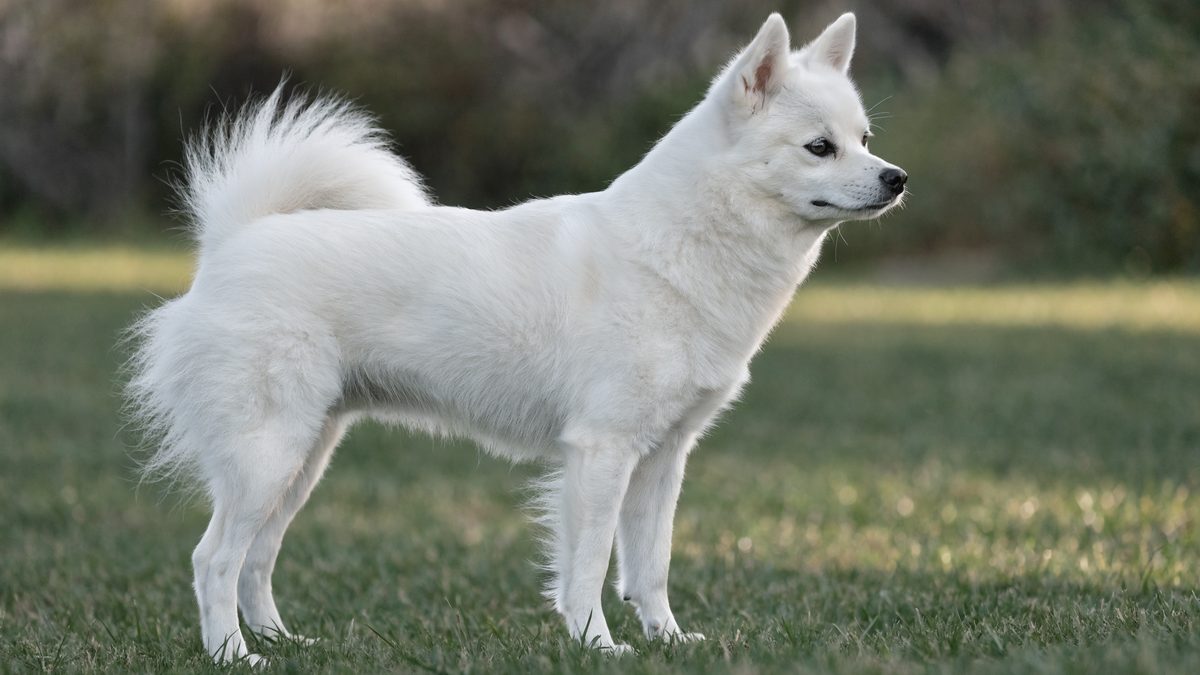
Pure white, with black nose, black lips and black eye rims, and dark almond to oval eyes set slightly obliquely The Kennel Club, Japanese Spitz Breed…. Small triangular ears set high, which may still be rising at eight weeks. A cat-like foot with black pads. A tail that already wants to lie over the back. A confident, cheerful puppy, since both aggression and extreme shyness are disqualifying under the FCI and the UKC United Kennel Club. Any cream, biscuit or coloured patch means the litter is not what you were told.
Japanese Spitz vs Indian Spitz vs Pomeranian
Tell these three apart with two measurements and one colour rule, taken in that order. Height at withers separates the Japanese Spitz from both the others, the FCI muzzle-to-skull ratio rules the Pomeranian in or out, and pure white with no other colour anywhere rules out most Indian Spitz Federation Cynologique Internationale The Kennel Club, Japanese Spitz Breed….
This confusion is not a Bonbeno theory, it is documented. Wikipedia's Indian Spitz entry states that in spite of the clear differences, in India most people refer to the Spitz as a Pomeranian. Eight of the top ten Google India results for this page's target query are about the Indian Spitz rather than the Japanese Spitz. And the only top-ten page actually about this breed sells three size tiers the breed does not have. Three breeds, one vocabulary, and a price spread of roughly eight times between the cheapest and dearest.
| Factor | Japanese Spitz | Indian Spitz | Pomeranian |
|---|---|---|---|
| Height at withers | 30 to 38 cm under FCI-Standard No. 262. Kennel Club gives dogs 34 to 37 cm, bitches 30 to 34 cm The Kennel Club, Japanese Spitz Breed… | Lesser 22 to 25 cm. Greater 35 to 45 cm | 21 cm plus or minus 3 cm under FCI-Standard No. 97 |
| Adult weight | 10 to 25 pounds, roughly 4.5 to 11.3 kg | Lesser 5 to 7 kg. Greater 12 to 20 kg | Should not exceed 3 to 4 kg |
| Muzzle to skull ratio | Not specified. The standard asks only for a pointed muzzle with a slightly rounded tip, well balanced | Descends from German Spitz stock, which runs 2 to 3, and shows a more conical snout than a Pomeranian Indian Spitz, Wikipedia | 2 to 4, so the muzzle is roughly half the skull length |
| Colour | Pure white only. Any other colour or combination is unacceptable Federation Cynologique Internationale | White, cream, reddish white, black, chocolate brown and spotted types are all sold | White, black, brown, orange, grey-shaded and other colours |
| Origin | Japan, from imported white German Spitz | India, from German Spitz stock, adapted to a warmer climate | The German Toy Spitz of FCI-Standard No. 97 |
| Published Indian price | Rs 15,000 to Rs 50,000 Justdial, Top Pet Shops For Japnese Spitz… | Rs 4,000 to Rs 15,000 S Rai. Different Types of Indian Spitz… | Covered on Bonbeno's Pomeranian profile, which compares nine published Indian sources |
| Patellar luxation risk signal | Utility group, odds ratio 1.6 against Kennel Club non-recognised dogs The Kennel Club, Japanese Spitz | Not a Kennel Club recognised breed, so no group figure applies | Highest breed prevalence in the study at 6.5 percent, and the Toy group carries an odds ratio of 3.7 |
| Indian climate | Published ideal weather 15 to 25 degrees Celsius | Adapted to a warmer climate and well suited to Indian conditions | Covered on Bonbeno's Pomeranian profile |
Use the muzzle test for what it can do, and no further
Bonbeno's Pomeranian profile publishes the FCI muzzle-to-skull ratio test, because it is the one proportion that is set by bone and visible at eight weeks. FCI-Standard No. 97 gives the ratio as approximately 2 to 4 for the German Toy Spitz, the Pomeranian, and approximately 2 to 3 for the Giant, Medium and Miniature Spitz. A Pomeranian's muzzle is about half its skull length. Any larger spitz variety shows a visibly longer nose.
That test is decisive against a Pomeranian and it does not separate a Japanese Spitz from an Indian Spitz. FCI-Standard No. 262 specifies no muzzle-to-skull ratio for the Japanese Spitz at all, asking only for a pointed muzzle with a slightly rounded tip, well balanced against a moderately broad, rounded skull. The Indian Spitz descends from the same German Spitz stock that runs 2 to 3 Federation Cynologique Internationale. Two long-muzzled white spitz dogs will look alike in the face. Say so, rather than pretending one test settles everything.
The four-step check to run before you pay
- Measure the muzzle against the skull first. If the muzzle is roughly half the skull length, you are looking at a Pomeranian or a Pomeranian cross, whatever the seller calls it. Stop there.
- Weigh and measure both parents, not the puppy. A Japanese Spitz sire stands 30 to 38 cm and weighs 4.5 to 11.3 kg American Kennel Club. A parent at 22 to 25 cm and 5 to 7 kg is a Lesser Indian Spitz. A parent at 35 to 45 cm and 12 to 20 kg is a Greater Indian Spitz.
- Check every hair for colour. Pure white is the only permitted colour, and the Kennel Club states that any other colour or combination of colours is unacceptable. Cream and biscuit shading are Samoyed colours, not this breed's.
- Reject the size vocabulary outright. There is no Toy, Miniature or Standard Japanese Spitz. FCI-Standard No. 262 and the Kennel Club standard each give the breed one size The Kennel Club, Japanese Spitz Breed…. A seller using those tiers is either uninformed or selling you a different breed.
The other two white fluffy dogs it gets called
| Breed | Height | Weight | Colours | How to tell it apart |
|---|---|---|---|---|
| Japanese Spitz The Kennel Club, Japanese Spitz Breed… | 12 to 15 inches | 10 to 25 pounds | Pure white only | The baseline on this page |
| Samoyed | 21 to 23.5 inches, male | 45 to 65 pounds, male | White, biscuit, cream, white and biscuit | Roughly four times the weight. Not confusable in person, only in a photo with no scale |
| American Eskimo Dog, toy | 9 to 12 inches | 6 to 10 pounds | Bred in three sizes | Too small. Below the Japanese Spitz range |
| American Eskimo Dog, miniature | 12 to 15 inches | 10 to 20 pounds | Bred in three sizes | The genuinely hard one. Identical measurements, so identify by pedigree and parentage rather than by eye |
| American Eskimo Dog, standard | 15 to 19 inches | 25 to 35 pounds | Bred in three sizes | Too large and too heavy |
The American Eskimo Dog is the one comparison where measurement genuinely fails. Its miniature variety stands 12 to 15 inches and weighs 10 to 20 pounds, sitting inside the Japanese Spitz's 12 to 15 inches and 10 to 25 pounds American Kennel Club. It is also a spitz of the Nordic family, was known as the American Spitz until 1917, and shares the same white coat. In India this breed is vanishingly rare, so the confusion is mostly theoretical, but if you are shown paperwork from a US registry, read which breed it names.
The American Eskimo Dog really is bred in three distinct sizes, toy, miniature and standard, each with its own published height and weight. The Japanese Spitz is not. The likeliest explanation for Justdial's Standard, Miniature and Toy Japanese Spitz tiers at 10 to 15 kg, 5 to 10 kg and under 5 kg is that a template built for one white spitz breed was applied to another. It is a small error with a large consequence, because it gives an Indian seller a legitimate-sounding name for a Pomeranian and for a Lesser Indian Spitz.
For most Indian households the Indian Spitz is the better buy, and Bonbeno says so on its own page. It costs a quarter to a third as much, it is adapted to a warmer climate, and it is not a rare breed whose Indian market is mostly relabelled dogs Supertails, Indian Spitz Dog Price. Choose the Japanese Spitz because you want this specific dog, verified against the standard, and because you can meet the daily grooming and the summer indoor commitment. Do not choose it because a seller told you it is the imported version of the Spitz you already knew.
Mistakes Indian Japanese Spitz owners actually make
Nine mistakes account for most of what goes wrong with this breed in India, and the first one happens before the dog comes home. Each is listed below with the source that contradicts it, so you can check the correction rather than take Bonbeno's word for it.
- Buying the name instead of measuring the dog. The single most expensive error in this market. A Japanese Spitz stands 30 to 38 cm and weighs 4.5 to 11.3 kg, an adult Pomeranian sits at 21 cm plus or minus 3, and a Lesser Indian Spitz at 22 to 25 cm American Kennel Club Federation Cynologique Internationale Indian Spitz, Wikipedia. Measure both parents before you pay, not the puppy.
- Believing in a Toy or Miniature Japanese Spitz. No breed standard recognises size varieties in this breed. The tiers a Delhi listing publishes, Standard at 10 to 15 kg, Miniature at 5 to 10 kg and Toy under 5 kg, do not exist, and the top tier alone is heavier than the AKC's stated ceiling for the whole breed.
- Shaving the coat for summer. The AKC's Chief Veterinary Officer states that the coat acts as an insulator and that shaving it makes the dog susceptible to heat stroke and can cause improper hair growth and follicle damage. On a breed defined by a profuse, pure white, stand-off coat, the regrowth damage is permanent American Kennel Club.
- Skipping the daily brush because the coat is self-cleaning. The dirt-repellent claim is real for dry mud and it is not a substitute for grooming. The Kennel Club lists grooming for this breed as every day, and mats hold moisture against the skin, which is how hot spots start in a thick coat.
- Asking the seller about hips instead of knees. The most detailed Indian profile for this breed lists bloat, hip dysplasia, parasites, heartworm, kennel cough, leptospirosis and panosteitis as its health issues, and omits patellar luxation entirely. Both British breed clubs, Wikipedia and PetMD's veterinary author all name patellar luxation as the breed's main concern Northern Japanese Spitz Club Japanese Spitz, Wikipedia Diener M, DVM. Japanese Spitz Dog Breed….
- Letting a young dog jump. The breed club advises restricting exercise and jumping while the dog is young because it is believed to increase the risk or severity of patella luxation. Polished granite floors, sofa leaps and stair sprints all count. OFA cannot certify the patellas before 12 months anyway.
- Treating tear stains out of a bottle. VCA warns that no remedy has proven fully effective, that some over-the-counter products are unproven and may be harmful to the eyes, and that low-dose antibiotics are no longer recommended because of resistance risk. Keeping the area clean and dry and trimming the fur short around the eyes is what is actually endorsed.
- Towel-drying after a monsoon walk and calling it done. Cornell is specific that a towel may suffice for a short-coated dog but a long or double coat needs brushing and a blow dryer, with mats removed during grooming. A wet undercoat under the ruff stays wet for hours.
- Choosing the smallest puppy in the litter. Small size is priced as premium in India and the evidence runs the other way. Dogs under 10 kg carried 2.4 times the odds of a patellar luxation diagnosis, and dogs below their own breed mean bodyweight carried 1.4 times the odds of those at or above it.
Two mistakes about paperwork
Buyers in India treat a Kennel Club of India certificate as proof of quality, and it is proof of parentage. It records pedigree, not health, and it does not mean either parent had its patellas graded or its eyes examined Malinina Y. Progressive retinal atrophy…. The Kennel Club of India also publishes no breed-level registration counts, reporting only totals to the FCI, so a certificate cannot tell you how many Japanese Spitz exist in the country.
The second paperwork mistake is accepting a puppy without the document the law actually requires. Under the Prevention of Cruelty to Animals (Dog Breeding and Marketing) Rules 2017, every puppy sold must carry a vaccination certificate signed by a registered veterinary doctor covering canine distemper virus, canine parvovirus, canine adenovirus, canine influenza and leptospira, no puppy may be sold before eight weeks of age and full weaning, and every breeder must be registered.
Keeping this dog outdoors or on a terrace through an Indian summer. The published ideal weather band for the breed is 15 to 25 degrees Celsius, and the care literature describes a companion dog that tolerates cold but prefers to live in the house with its family. Purina India's cooling instructions exist because heat stroke can be fatal and needs veterinary attention as soon as possible. If your home cannot keep a dog comfortable indoors from March to October, this is the wrong breed for it.
Buying responsibly, and the adoption route
Adopt if you can, and verify hard if you buy, because this is the Indian breed market where verification matters most. India has no Japanese Spitz breed club, no breed rescue and no published breed-level registration or shelter data, so nobody can tell you how many of these dogs are here or how many are given up.
Start with what adoption actually costs and covers. A Delhi listing for this breed states plainly that adoption fees are typically more affordable than purchasing a puppy and may cover initial vaccinations, microchipping and spaying or neutering. Supertails makes the same case for the Indian Spitz, noting that many shelters and rescue organisations have Spitz-type dogs waiting for homes, that these dogs are often already vaccinated and sometimes house-trained, and that adoption is both cost-effective and rewarding.
The realistic expectation is that a shelter dog described as a Spitz in India will be an Indian Spitz or a Spitz-type mix rather than a verified Japanese Spitz. That is not a reason to walk away. It is the same fluffy, alert, family-suited dog with better heat adaptation and a fraction of the purchase risk. Bonbeno's Indian Pariah Dog profile covers the other route, a free-to-adopt native breed built for exactly this climate.
What the law requires of anyone selling you a puppy
The Prevention of Cruelty to Animals (Dog Breeding and Marketing) Rules 2017 set a floor that most Indian sellers of this breed will not clear, and knowing the floor is the fastest way to filter them.
- Every breeder must be registered. Breeding without registration is an offence and can result in confiscation of breeding stock and puppies plus a fine of up to Rs 5,000 per unsterilised bitch.
- No sale before eight weeks. No puppy may be sold until it has reached eight weeks of age and is fully weaned.
- A signed vaccination certificate is mandatory. Every puppy sold must carry a certificate signed by a registered veterinary doctor covering canine distemper virus, canine parvovirus, canine adenovirus, canine influenza and leptospira.
- Records must exist. Stock registers must be maintained in the prescribed format, and if a bitch is sold a notarised copy of the register must be sent to the Animal Welfare Board of India with the new owner's details.
- Non-breeding adults must be sterilised and microchipped. Any adult dog on the premises that is not listed as breeding stock must be sterilised and microchipped, with a veterinary certificate available for inspection.
A verification checklist for this breed specifically
| Ask | A good answer |
|---|---|
| Can I measure both parents? | Yes, on the premises. Sire 30 to 38 cm at the withers, both parents pure white The Kennel Club, Japanese Spitz Breed… |
| What are the parents' patella grades? | A number, from a vet, Grade 1 or better. A UK breeder in this breed publishes exactly that tolerance |
| Have the parents been eye tested? | Yes, with a result. PRA-rcd4 is confirmed in the breed |
| How old is the litter? | Eight weeks or more and fully weaned, which is the legal minimum |
| Are you registered with the Animal Welfare Board of India? | Yes, with a registration to show |
| How closely related are the parents? | A straight answer. The gene pool in this breed is small even in the UK, where breeders import to widen it |
| Do you sell Toy or Miniature Japanese Spitz? | No, because they do not exist The Kennel Club, Japanese Spitz Breed… |
That last question is the cheapest test on the list. A seller who offers you a Toy Japanese Spitz has either copied a template or is about to sell you a Pomeranian Federation Cynologique Internationale. Either way you have learned what you needed to know before any money moves.
What Bonbeno cannot tell you, and will not pretend to
Three gaps are worth stating outright. India publishes no breed-wise shelter or abandonment data, so nobody knows how many Japanese Spitz are surrendered here. The Kennel Club of India reports only aggregate registrations to the FCI, 32,219 puppies across all breeds in 2025, with no breed split. And the breed has no Indian club, no Indian health scheme and no Indian screening register, which is why every verification step above has to be done by you rather than looked up.
Bonbeno is an independent pet reference. We do not recommend breeders, we do not link puppy listings, and every price on this page is reported from a published third party rather than offered. If you want the fluffy white spitz look and you want to spend your money where the evidence is strongest, adopt a Spitz-type dog from a shelter or read Bonbeno's Indian Spitz profile and buy the breed India built for this climate.
Japanese Spitz in India: common questions
What is the average price of a Japanese Spitz dog in India?
The Japanese Spitz price in India runs Rs 15,000 to Rs 50,000, and a Delhi listing quotes Rs 20,000 to Rs 50,000 from breeders. Only two Indian sources publish a figure at all, neither states how many sales it is based on, and neither cites a registry, so treat the range as the going ask rather than a market value.
Are Japanese Spitz expensive?
In the United States PetMD puts the breed at $1,000 to $2,500. In India the published band of Rs 15,000 to Rs 50,000 makes it roughly three to eight times the cost of an Indian Spitz, which is exactly why so many Indian Spitz are sold under the Japanese Spitz name.
Is my Japanese Spitz actually an Indian Spitz?
Measure the height at the withers on both parents. A Japanese Spitz stands 30 to 38 cm under FCI-Standard No. 262 and weighs 4.5 to 11.3 kg. A Lesser Indian Spitz is 22 to 25 cm and 5 to 7 kg, and a Greater Indian Spitz is 35 to 45 cm and 12 to 20 kg. Height and weight read together separate them.
Is there a Toy or Miniature Japanese Spitz?
No. FCI-Standard No. 262 and the Kennel Club standard each give the breed exactly one size, and no registry recognises varieties. A Delhi listing publishes Standard, Miniature and Toy tiers at 10 to 15 kg, 5 to 10 kg and under 5 kg, and the top tier alone is heavier than the AKC's stated ceiling for the whole breed.
Can a Japanese Spitz survive Indian summer?
Yes, indoors. The only published Indian source for the breed gives its ideal weather as 15 to 25 degrees Celsius, and the breed prefers to live in the house with its family. Move both walks to early morning and after dark, never shave the coat, and learn Purina India's heat stroke signs before you need them.
Do Japanese Spitz need a lot of grooming?
More than the internet says. The Kennel Club lists grooming for this breed as every day, while other sources claim twice a week and describe a dirt-repellent coat. Brush daily through to the undercoat, expect two heavy sheds a year, and dry the coat with a brush and dryer after monsoon walks rather than a towel.
Are Japanese Spitz suitable for apartments in India?
Yes, with one caveat. The Kennel Club rates the requirement as a small house with a small or medium garden, and the breed is small enough for a flat. The caveat is noise, because most Japanese Spitz are good watch dogs that bark to warn of arriving strangers, which in an Indian building means every delivery and every lift chime.
Does a Japanese Spitz coat really stay clean?
Partly. PetMD reports that the white fur repels dirt and that dry mud brushes out easily, and the stand-off outer coat over a dense undercoat is the reason. That does nothing about fine road dust, and nothing at all in humid weather when mud never dries, so daily brushing still applies.
What health problems do Japanese Spitz have?
Patellar luxation is the main concern, named by both British breed clubs, by Wikipedia and by PetMD's veterinary author, with runny eyes and tear staining as a minor recurring issue. PetMD also lists muscular dystrophy, Factor VII deficiency and dental disease. PRA-rcd4 has been confirmed in the breed in a 15-dog clinical and genetic study.
How common is patellar luxation in a Japanese Spitz?
No OFA prevalence figure for this breed could be retrieved, and Bonbeno will not estimate one. The closest evidence is VetCompass, which found patellar luxation in 1.30 percent of 210,824 UK primary-care dogs, with the Kennel Club Utility group that contains this breed carrying 1.6 times the odds of non-recognised dogs against the Toy group's 3.7.
How long does a Japanese Spitz live?
A median of 13.0 years, with a 95 per cent confidence interval of 12.3 to 13.7, from 117 recorded deaths in McMillan 2024's Supplementary Table S3. The widely repeated 13-year figure attributed to that study is therefore correct. The Kennel Club says over 12 years, the AKC and PetMD both say 10 to 14 years, and the Indian profile says 12 to 16, none of them citing a study.
Why do my Japanese Spitz's eyes run?
Runny eyes are a recognised breed issue, and the clubs list stress, a grass allergy, hormone changes, diet and, more rarely, tear ducts that are too small or blocked as causes. The brown stain comes from bacteria in the tears sitting on white fur. Bathe each eye with cooled boiled water rather than reaching for a product.
Is a Japanese Spitz the same as a Samoyed?
No, and the size gap settles it. A male Samoyed stands 21 to 23.5 inches and weighs 45 to 65 pounds against the Japanese Spitz at 12 to 15 inches and 10 to 25 pounds. The Japanese Spitz Club also states directly that the breed is not a spin-off of the Samoyed, although the Kennel Club records that some believe the Samoyed was influential.
Is the Japanese Spitz recognised by the American Kennel Club?
Not yet fully. The AKC added the breed to its Foundation Stock Service in April 2019, which records a breed without granting full recognition, and the Japanese Spitz Club of America is still campaigning for it. The Kennel Club recognised the breed in 1977 in the Utility Group and the United Kennel Club in 2006.
Can I adopt a Japanese Spitz in India instead of buying one?
Rarely as this exact breed, and often as a Spitz-type dog. India has no Japanese Spitz breed rescue and publishes no breed-wise shelter data. Shelters do hold Indian Spitz and Spitz crosses, adoption fees are lower than purchase and may already cover vaccination, microchipping and sterilisation.
Is Japanese Spitz a good pet?
Yes, for a household that is usually home. The Kennel Club standard describes the breed in six words, affectionate, companionable, alert, intelligent, bold and lively, the FCI classifies it as a companion dog and nothing else, and PetMD calls it a joyful, low-maintenance breed that makes a great family dog. It is a poor fit for a household out ten hours a day, for a buyer who wants a silent dog, because it barks to warn of arriving strangers, and for anyone unwilling to groom every day.
Is Japanese Spitz a Pomeranian?
No. A Japanese Spitz stands 30 to 38 cm at the withers under FCI-Standard No. 262 and weighs roughly 4.5 to 11.3 kg, while a Pomeranian stands 21 cm plus or minus 3 cm under FCI-Standard No. 97 and should not exceed 3 to 4 kg. The quickest test is the muzzle: a Pomeranian's muzzle is about half its skull length, a ratio of 2 to 4, and any larger spitz shows a visibly longer nose. The confusion is an Indian vocabulary habit, because most people in India call any Spitz a Pomeranian.
Compare with similar breeds
Japanese Spitz sits in 3 Bonbeno groups. Each one compares it directly against the breeds it is genuinely an alternative to, on the same figures.