
Breed profile
Japanese Chin (Chin, Japanese Spaniel): The India Guide
A 25 cm Japanese toy dog with the second-highest BOAS rate of fourteen flat-faced breeds, sold in India at prices five times apart.
Quick answer
The japanese chin price in india runs from Rs 20,000 to Rs 1,00,000 depending which page you read, a five-fold spread, and two of the biggest Indian listing sites carry no Chin at all. Before you compare prices, read the breathing data. Only 17.4 percent of Japanese Chin scored a clean BOAS grade in a 2026 study of fourteen flat-faced breeds, the second worst result in it.
This page summarises published breed-standard text, registry statistics, government records and peer-reviewed veterinary research for general information. It is not a diagnosis and it is not treatment advice. Consult a registered veterinarian near you about your own dog before acting on anything here. Three things matter the same day rather than at the next check-up. A Japanese Chin that pants noisily, gags, changes the colour of its gums or collapses in Indian heat is a heat-illness emergency: move it to shade or air conditioning, start cooling it with cool water and go to a veterinarian at once, because the case fatality rate for heat-related illness in the largest published UK study was 14.18 percent. A Chin that skips, holds up a hind leg or sits with a leg out sideways needs a patella examination, because 11.7 percent of Japanese Chin in the OFA patella database are graded abnormal. And any Chin puppy that becomes clumsy, dull or unsteady in its first two years needs a neurological work-up, because this breed carries a fatal inherited brain disease for which a DNA test exists.
Japanese Chin at a glance
What the Japanese Chin is, and what the breed standard actually says
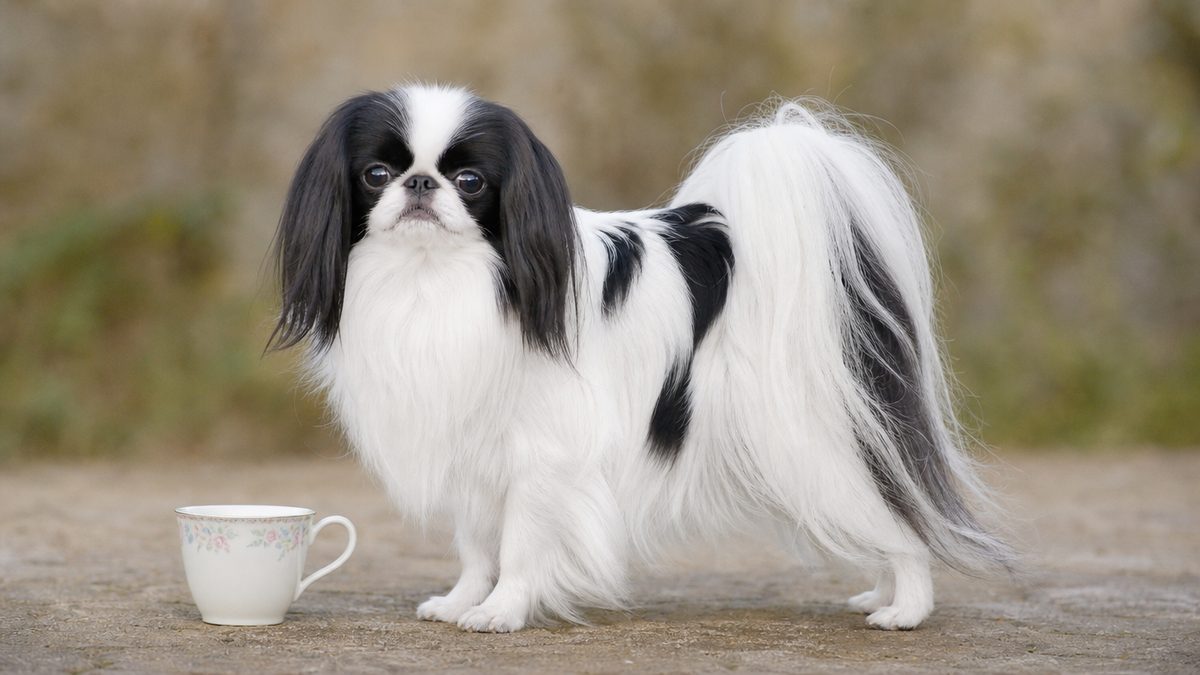
The Japanese Chin is a small Japanese toy dog of about 25 cm at the withers, with a broad rounded skull, a very short broad nasal bridge and a long silky coat, recognised by the FCI as standard 206 in Group 9, Section 8, Japan Chin and Pekingese.
Start with the document that defines the breed. The FCI accepted the Chin on a definitive basis on 2 December 1957 and its current standard was made valid on 4 April 2016, with the English text published on 3 June 2016. English is the official authentic language for this breed, so the English standard is the primary text rather than a translation of one. The nomenclature page prints its dates as month, day, year, which is provable from the same table: two of its rows read 1/24/2017 and 1/30/2020, and 24 and 30 cannot be months.
The standard describes a small sized dog with broad face, covered with profuse coat, with elegant and graceful figure, and asks for the height at withers to equal the length of the body, with females slightly longer. Temperament is given in three words, clever, mild and lovely, and the gait as elegant, light and proud. The head is where the breed's whole medical story sits: the skull is broad and rounded, the stop deep and indented, and the nasal bridge is very short and broad, with the nose set on a straight line with the eyes.
The one measurement in the standard, and the one that is not there
The standard gives exactly one size figure. Males stand approximately 25 cm at the withers and females are slightly smaller. It gives no weight at all. That matters because every Indian page for this breed prints a weight, and none of them is quoting the breed standard when it does.
| Source | Height | Weight | What the document is |
|---|---|---|---|
| FCI-Standard 206 | About 25 cm, males; females slightly smaller | Not stated | The breed standard |
| American Kennel Club | 8 to 11 inches (20 to 28 cm) | 7 to 11 pounds (3.2 to 5.0 kg) | A national registry's breed page |
| Purina India | 20 to 27 cm | 1.8 to 3.2 kg | A pet-food brand's Indian breed library |
| Puppiezo (India) | 8 to 9 inches (20 to 23 cm) | 2 to 4 kg | An Indian listing site's spec card |
| BarkJunction (India) | 7 to 11 inches (18 to 28 cm) | 2 to 6 kg | An Indian price blog |
| Call 4 Dog (India) | Withers 8 to 11 inches (20 to 28 cm) | 9 to 15 lb (4 to 7 kg) | An Indian listing site's spec card |
Read the weight column twice. The AKC's floor of 3.2 kg is Purina India's ceiling Purina India, Japanese Chin breed library…. The two ranges touch at a single point and overlap nowhere else, so a buyer told a healthy adult Chin weighs 1.8 kg and a buyer told it weighs 5 kg have both been given a published figure. Call 4 Dog's 4 to 7 kg sits entirely above Purina's range and its top is more than double Purina's top. Bonbeno's position is that the standard is silent on weight, that a Chin should be judged by condition rather than by a number, and that any seller quoting a weight is quoting a secondary source.
Colour, bite and the two disqualifying faults
The Chin is white with markings of black or red, and the standard wants those markings distributed symmetrically, with a wide white blaze running from muzzle to crown. Two things disqualify a dog outright: a wry lower jaw, and tricolour. A solid white coat with no markings, and a single marking on the face, are faults rather than disqualifications. Purina India states the same colour rule in plainer words, that tricolour is not permitted, nor is white flecking inside the coloured markings.
The bite is the surprising part. The standard says a level bite is desirable, but a scissor bite or an undershot mouth is permitted, while an overshot mouth is a fault. Hold on to that sentence. It collides directly with Indian breeding law, and the collision is set out later on this page.
One Indian page for this breed lists the colours available as 'White and Red, Tri-colored - white, tan and black, White and Black';. Tricolour is a disqualifying fault in the FCI standard and Purina India says plainly that it is not permitted Purina India, Japanese Chin breed library…. If a seller offers you a tricolour Chin as something special, they are offering you a dog that could not be shown.
The American Kennel Club recognised the breed in 1888 and knew it as the Japanese Spaniel until 1977, when the name was officially changed to Japanese Chin. That rename is not trivia. It hid half of the breed's medical literature for decades, which the next section explains.
Chin, Japanese Spaniel, Epagneul Japonais: the rename that hid half the medical literature
Search this breed under one name and you find eleven scientific papers; search it under three names and you find fourteen, including the two that first described its fatal inherited brain disease.
The breed answers to more names than most. The FCI's own nomenclature entry is headed simply CHIN, with the English name Japanese Chin, the French Epagneul Japonais, the German Japan-Chin and the Spanish Spaniel Japones. The American Kennel Club registered it as the Japanese Spaniel from 1888 until 1977, when the name was officially changed. Purina India still lists Japanese Spaniel as an alternative name today.
That is not a naming curiosity, it is a research trap, and Bonbeno walked into the edge of it. A PubMed phrase search for Japanese Chin returns 11 records. The plural form Japanese Chins returns 2, and one of those, a 2013 paper in the Journal of Veterinary Internal Medicine describing GM2 gangliosidosis in two Japanese Chins, appears in neither the singular phrase search nor the all-fields search Freeman AC, Platt SR, Vandenberg M. The former name Japanese Spaniel returns 2 more, and neither of those appears in any Chin search.
| Query | Records returned | Records unique to that query |
|---|---|---|
| "Japanese Chin" | 11 | 11 |
| "Japanese Chins" (plural) | 2 | 1 |
| "Japanese Spaniel" | 2 | 2 |
| Distinct total across all three | 14 |
The two records hiding under the old name are the important ones. Cummings and colleagues, 1985, in Acta Neuropathologica, described a storage disease in a two-year-old Japanese Spaniel and reported massive GM2 ganglioside storage with a paradoxical increase in total beta-hexosaminidase activity. Ishikawa and colleagues, 1987, in the Journal of Neurochemistry, worked out its biochemistry and called it the first animal form resembling the human Type AB activator deficiency. Those two papers are the origin of everything now known about the disease, and a search under the modern breed name returns neither.
The controls, so this counts as evidence
A search that returns nothing proves nothing unless a control returns something. In the same session, on the same instrument, Labrador Retriever with hip dysplasia returned 126 records and Shiba Inu with dog returned 73. The tool was working. Two further searches on this breed came back empty against those working controls: the breed name with patella or luxation returned zero, and the breed name with heart, mitral or murmur returned zero. So the kneecap and heart risks this page reports later rest on registry statistics and on the breed club's own testing recommendations, not on breed-specific published research, because none exists.
Bonbeno did not find the 2013 Journal of Veterinary Internal Medicine paper by searching. It was listed in the Japanese Chin Club of America's own reference list, and was then resolved from its DOI through NCBI and its title read back before it was cited here Freeman AC, Platt SR, Vandenberg M. A phrase search that misses a paper whose title contains the breed's plural name is a reminder that a count is not a literature. Read the records, and read a breed club's bibliography too.
One more small confirmation of the same point. When a Canadian journal published a study on tracheal dimensions in brachycephalic dogs, its English text called the single Chin in the sample a Japanese chin and its French abstract called the same dog l'epagneul japonais. Two names, one dog, one paper.
Where the Chin came from, and why the confident version is not the sourced one
Nobody knows where the Japanese Chin came from. The FCI standard's own account is hedged with the word assumed, and the popular Indian versions are far more certain than any source supports.
Read the standard's history section as it is actually written. It says "According to ancient documents it is assumed that the ancestors of the Chin were presented as a gift from the rulers of Korea (during the Silla Dynasty age 377-935) to the Japanese court in 732";, and adds that historical records also indicate that envoys sent to China during the Tung Dynasty and to North Korea during the Po H'ai Dynasty brought back dogs of this breed directly. The operative words are *assumed* and *indicate*. The FCI is not asserting a route; it is reporting what old documents suggest.
Purina India's breed library says the same thing more plainly: "Various theories exist as to their true origins, with suggestions they came from China, Korea or via traders from the West";. The American Kennel Club adds that depictions of a breed resembling the Chin appear on ancient Chinese temples, pottery and embroideries, which is suggestive and is not evidence of descent.
What the sources do agree on
- The breed was developed in Japan, whatever arrived there. During the shogunate of Tsunayoshi Tokugawa, 1680 to 1709, it was raised as an indoor toy dog in the Castle of Edo.
- It reached Britain early. In 1613 a British captain named Searles brought a Chin to England. Purina India instead credits Portuguese traders in the 17th century and says the breed was not shown in England until 1873.
- Commodore Perry carried it west in 1853. The FCI says Perry brought several to the United States, of which two were presented to Queen Victoria. Purina says he gave a pair to Queen Victoria and President Franklin Pierce. Both cannot be exactly right about the same two dogs.
- It became a lady's lapdog after 1868. Since that year the Chin has been favoured as a lapdog by women of the upper classes and is now kept as a companion.
Purina India's page states that the word Chin means cat-like. Neither the FCI standard nor the Agency for Cultural Affairs database says anything about the meaning of the name Agency for Cultural Affairs. The behavioural comparison itself is fair and widely reported, and the AKC frames the distinction differently, saying that in Japan there are Inu and there are Chin, with Inu the more common working dogs. Bonbeno reports the etymology as unsupported by the sources it opened, rather than repeating it.
Why does an Indian buyer care about a 1,300-year-old shipping route? Because the confident version, that this is an ancient purely Japanese breed, is the version used to justify a premium, and it is the version Japan's own cultural-property register declined to endorse when it designated seven other Japanese dogs and not this one. The honest description is a Japanese breed of contested foreign ancestry, refined in Japan over roughly twelve centuries, and that is a good enough story without the certainty.
Japan designated seven dog breeds a natural monument between 1931 and 1937, and the Chin was not one of them
Japan has never designated the Japanese Chin a natural monument. Its cultural-properties register lists seven dog designations, all made between 1931 and 1937, and the Chin appears in none of them.
The Agency for Cultural Affairs maintains the National Cultural Properties Database, which is the government record of every designation the state has made. A free-word search on the breed's Japanese name returns eight records, and not one is a natural-monument designation; the hits are an 1893 Takamura Koun wood sculpture and a set of registered tangible cultural property buildings whose descriptions happen to contain the character. In the same session the same search returned the correct designation records for the Hokkaido and the Shiba, so the instrument was working Agency for Cultural Affairs.
Reading the register forward settles it beyond a search. Records 401/3100 to 401/3145 were read one by one, and every designation made under criterion (4), domesticated animals peculiar to Japan, was enumerated. Seven of them are dogs. The series opens with the Akita on 31 July 1931, filed under criterion (4) with the prefecture field reading 'no area specified', and closes with the Hokkaido on 21 December 1937. All seven were designated inside a single seven-year window, and after December 1937 the state designated no further dog at all; the criterion continues with poultry breeds through to 1951.
| Breed | Database record | Designation date |
|---|---|---|
| Akita | 401/3105 | 31 July 1931 (Showa 6.07.31) |
| Kai | 401/3106 | 22 January 1934 (Showa 9.01.22) |
| Kishu | 401/3108 | 1 May 1934 (Showa 9.05.01) |
| Koshi no Inu, now extinct | 401/3110 | 28 December 1934 (Showa 9.12.28) |
| Shiba | 401/3112 | 16 December 1936 (Showa 11.12.16) |
| Tosa-ken, the Shikoku's designation name | 401/3113 | 15 June 1937 (Showa 12.06.15) |
| Hokkaido | 401/3116 | 21 December 1937 (Showa 12.12.21) |
| Japanese Chin | None | Never designated |
The criterion explains the absence, and it is worth stating plainly rather than treating as a slight. Criterion (4) covers domesticated animals peculiar to Japan. The Chin's own FCI standard opens by saying its ancestors are assumed to have arrived as a gift from the rulers of Korea in 732, with further dogs brought back by envoys sent to China. A breed the standard describes as arriving from the mainland is not, on the register's own test, peculiar to Japan. The Nihon Teria, created from Fox Terriers landed at Nagasaki by Dutch traders, is absent for the same reason and does not appear in the database at all.
The undesignated breed outnumbers five of the six designated ones
Here is the part no page prints. In the Japan Kennel Club's 2025 registration table the Chin recorded 386 dogs at rank 35 of 141, while the Akita recorded 263, the Kai 60, the Shikoku 51 and the Hokkaido 24, and the Kishu did not appear at all. Only the Shiba, at 3,598, outranks it in that book. So in the Japan Kennel Club's register, the breed the state did not protect is more numerous than five of the six surviving breeds it did.
Why that comparison needs a second register, and then a third
A registration count measures one registry, not a breed, and the six monument breeds are exactly the breeds one registry counts worst. The Chin is a Japan Kennel Club breed and the JKC is its register, so 386 is a fair figure for the Chin. The six native breeds are not, because each of them also sits in a preservation society's studbook that the JKC never sees.
Run the same year through the second published register and two rows move. NIPPO, the preservation society for the six natives, recorded 13,722 Shiba, 252 Shikoku, 132 Kishu, 78 Kai, 11 Hokkaido and 5 Akita in 2025, and it does not register the Chin at all. Adding both books, the Shikoku reaches 303 and the Shiba 17,320, so the Chin's 386 now outranks four of the six rather than five.
| Breed | JKC 2025 | NIPPO 2025 | Both books | Own society's own count |
|---|---|---|---|---|
| Japanese Chin | 386 | not registered | 386 | None, a JKC breed |
| Shiba | 3,598 | 13,722 | 17,320 | Not published |
| Shikoku | 51 | 252 | 303 | No separate society found |
| Akita | 263 | 5 | 268 | 2,224 litter registrations, 2024 |
| Kai | 60 | 78 | 138 | Not published |
| Kishu | none | 132 | 132 | Not published |
| Hokkaido | 24 | 11 | 35 | Not published |
Now the third register, which is where the comparison breaks outright. The Akita Inu Hozonkai, the Akita's own society, recorded 1,587 domestic and 637 overseas litter registrations in 2024, plus 140 single-dog registrations. Those 2,224 entries are litters, not puppies, and they stand against the 268 Akita the two public books show. The Akita is not outnumbered by the Chin. It never was, and only a single-registry comparison made it look that way.
So Bonbeno narrows the claim rather than repeating it. In the Japan Kennel Club's register the Chin outnumbers five of the six monument breeds, and that is a fact about the Japan Kennel Club. For the Akita and the Kai the breed's own society publishes or implies a larger figure than the Chin's. For the Kishu, the Shikoku and the Hokkaido, Bonbeno could not establish an own-society count in either direction and does not guess.
A natural-monument listing is a heritage designation under Japan's cultural-properties law. It is not an export ban, not a health guarantee and not a reason to pay more. Bonbeno's Hokkaido guide makes the same point from the other side, for a designated breed with 24 registrations a year. Being on the list and being off it turn out to say very little about whether you can get the dog.
One date on this table is worth flagging for anyone checking Japanese breed history elsewhere. The register gives the Shiba's designation as 16 December 1936, while the FCI standard for that breed dates it to 1937. Bonbeno's Shiba and Hokkaido pages already carry the corrected date from record 401/3112, and reading the record directly for this page confirmed it independently. Where a Japanese breed's designation date matters, take it from the Agency's database rather than from a breed standard.
How many Japanese Chin exist, and where the registration numbers come from
The Japan Kennel Club registered 386 Chin in 2025, ranking the breed 35th of 141, down from a peak of 955 in 2005. The AKC's own popularity chart puts it 103rd of 210.
Japan is where this breed is counted properly, so start there. The Japan Kennel Club publishes one table a year of new pedigree registrations by breed, and its 2025 table covers 141 breeds and 302,530 dogs. The 141 rows sum to exactly 302,530, matching the printed total, which is a cheap check worth doing on any registry table. These are registrations in one year, not a living population.
| Year | Chin | Chin rank | Shiba | Akita | Hokkaido | Total dogs registered |
|---|---|---|---|---|---|---|
| 1999 | 600 | 41 | 12,711 | 455 | 6 | 424,061 |
| 2005 | 955 | 34 | 11,604 | 293 | 4 | 554,141 |
| 2015 | 642 | 30 | 12,470 | 450 | 38 | 301,605 |
| 2024 | 271 | 39 | 4,582 | 251 | 20 | 306,642 |
| 2025 | 386 | 35 | 3,598 | 263 | 24 | 302,530 |
Two things stand out. The Chin's own peak in the published archive is 955 dogs in 2005, and by 2024 it had fallen to 271, a drop of 72 percent Japan Kennel Club. Then 2025 came back up to 386. One year is not a trend, and a single rise after two decades of decline should not be sold as a revival. The middle of the series is worth a glance too: in 2015 the Chin recorded 642 dogs at rank 30, its best rank anywhere in the published archive, out of 301,605 dogs across 134 breeds. The second point is that the Shiba fell further and faster over the same period, from 12,711 in 1999 to 3,598 in 2025 Japan Kennel Club, so the Chin's decline is partly a decline in Japanese pedigree registration generally rather than a collapse peculiar to this breed.
A registry trap worth knowing before you quote a year
The Japan Kennel Club's archive links its 2024 table at the slug 2024-3. The obvious address, the one ending in 2024, returns HTTP 200 and serves a byte-identical copy of the 2025 table under the 2025 title. Every other year slug matches its own title. So anyone who assembles that URL rather than following the archive's own link will publish 2025 figures as 2024 figures, with nothing on the page looking wrong. Bonbeno's figures above come from the links the archive itself provides.
Outside Japan
The American Kennel Club has recognised the breed since 1888 and places it in the Toy Group. Its breed page carries a popularity chart with a year axis running 2015 to 2025 and prints the value 103 of 210. Bonbeno reports that string as the page prints it rather than assigning it to a specific year, because the chart does not label the displayed value with one.
There is no Indian equivalent to quote. The Kennel Club of India publishes no breed-by-breed registration list, so a query there returns nothing for this breed and nothing for any control breed either, which is a broken instrument rather than a finding. What can be said about Indian recognition comes through the FCI: India is a full FCI member represented by the Kennel Club of India, and the Chin is FCI standard 206 recognised on a definitive basis, so a KCI pedigree for the breed is issued against FCI nomenclature.
It means the global breeding base is small and concentrated, and that a Chin offered in India is far more likely to be a locally bred dog of unverified parentage than an import. India's import rules make a commercial import of breeding stock impossible in any case, which the law section below sets out. Ask which register a seller's pedigree is on, and ask to see the paper.
Japanese Chin price in India: two published bands that disagree by a factor of five
The japanese chin price in india is quoted at Rs 20,000 to Rs 50,000 on one ranking page and Rs 60,000 to Rs 1,00,000 on another, a five-fold spread from floor to ceiling, and the two largest Indian listing sites that rank for the term publish no price for the breed at all.
Say the disagreement first, then show it. Two Indian pages that rank for this term print a puppy price, and they do not overlap.
| Source | Figure printed | What it actually is |
|---|---|---|
| Poodles Petcare (poodles.in) | Rs 20,000 to Rs 50,000 | A templated breed page that also calls the Chin's coat 'Short to Medium' |
| BarkJunction | Rs 60,000 to Rs 1,00,000, written 'Rs. 60.000 - Rs. 100.000' | A 2023 price blog whose only cited reference is Wikipedia |
| Mr n Mrs Pet | No price | A listing page reading '3 Result Found' that shows a Newfoundland, a French Bulldog and a Border Collie |
| Puppiezo | No price for a Chin | A product page whose availability block is empty and whose carousel holds eight other breeds |
| Call 4 Dog | No price | A Delhi page whose only price mechanism is a WhatsApp button reading 'Please Share Best Price' |
| Supertails 40-breed table | The breed is absent | India's most detailed published price list does not carry the Japanese Chin at all |
The absence in that last row is a finding, not an omission. Supertails' 2026 list covers 40 breeds, states its method as breeder networks, KCI registration data and marketplace surveys in the first quarter of 2026, and includes the Pug at Rs 8,000 to Rs 30,000, the Shih Tzu at Rs 20,000 to Rs 80,000 and the Maltese at Rs 25,000 to Rs 80,000. It carries neither the Japanese Chin nor the Pekingese. The most carefully sourced Indian price list published this year does not think this breed has a market worth listing.
Run the division tests, and report what they do and do not prove
Bonbeno tests every suspicious Indian rupee figure against the exchange rates that have produced fake Indian prices on this site before. Here is the full result for this breed, including the part that weakens the case.
| Rupee figure | At 84.38 | At 74.00 | At 80.00 |
|---|---|---|---|
| Rs 20,000 | 237.02, not whole | 270.27, not whole | 250.00 exactly |
| Rs 50,000 | 592.56, not whole | 675.68, not whole | 625.00 exactly |
| Rs 60,000 | 711.07, not whole | 810.81, not whole | 750.00 exactly |
| Rs 1,00,000 | 1,185.11, not whole | 1,351.35, not whole | 1,250.00 exactly |
Not one figure divides cleanly at 84.38 or at 74.00, the two rates that have exposed converted price lists on this site before. All four divide exactly at 80.00, and the quotients, 250, 625, 750 and 1,250 dollars, are all numbers a seller might actually print. But the 80 test proves nothing on its own, and saying so is more useful than the finding. One thousand divided by eighty is twelve and a half, so any rupee figure ending in three zeros divides cleanly at 80 by construction, and all four of these do. BarkJunction's annual vet-bill figures, Rs 32,000 to Rs 60,000, behave the same way, giving 400 and 750 dollars. Bonbeno's verdict is that the pattern is suggestive of a converted American figure and is not proof of one, and no price on this page rests on it.
BarkJunction prints its price as 'Rs. 60.000 - Rs. 100.000', with full stops where an Indian price uses commas and no lakh grouping. An Indian writer quoting an Indian market price writes Rs 1,00,000. Bonbeno treats a European thousands separator on an Indian price page the same way it treats a Rs 98,999 charm price: as evidence about where the number came from.
What to actually budget
Budget for the care rather than the purchase, because the care figures are real and Indian and the purchase figures are not verifiable. Supertails' small-breed table puts monthly upkeep at Rs 4,000 to Rs 8,000 for a dog of this size in India, and adds that Mumbai and Delhi command a 20 to 35 percent premium over tier-2 cities. Poodles Petcare puts the same monthly total at Rs 3,300 to Rs 5,400. The next section takes those apart line by line and explains why a flat-faced dog in India costs more than either figure suggests.
Cost of ownership: what a Japanese Chin actually costs to keep in India each month
Budget Rs 4,000 to Rs 8,000 a month for a small dog in India before anything breed-specific, and then add a cooling line and an eye-care line that no Indian price page prints for this breed.
Two Indian sources publish a monthly total for a dog this size and they disagree by roughly a third. Supertails' small-breed column gives Rs 4,000 to Rs 8,000 a month. Poodles Petcare's Japanese Chin page gives Rs 3,300 to Rs 5,400. Supertails is the more transparent of the two, because it publishes its line items and its method, and its own rows reconcile: the recurring lows sum to Rs 4,100 and the highs to Rs 7,900, which is the Rs 4,000 to Rs 8,000 band it prints, rounded.
| Line | Small breed, per month | Same line for a large breed |
|---|---|---|
| Dry and wet food | Rs 1,500 to Rs 2,500 | Rs 4,000 to Rs 6,000 |
| Routine vet visits | Rs 500 to Rs 1,000 | Rs 1,000 to Rs 2,000 |
| Grooming | Rs 1,500 to Rs 3,000 | Rs 500 to Rs 1,200 |
| Treats and toys | Rs 300 to Rs 800 | Rs 600 to Rs 1,200 |
| Flea control and deworming | Rs 300 to Rs 600 | Rs 500 to Rs 800 |
| Vaccinations, annual | Rs 1,200 a year | Rs 1,800 a year |
| Monthly total as printed | Rs 4,000 to Rs 8,000 | Rs 8,000 to Rs 14,000 |
Look at the grooming row before anything else. A small dog costs more to groom in India than a large one, Rs 1,500 to Rs 3,000 against Rs 500 to Rs 1,200. That is counterintuitive and it is correct: a groomer charges for coat work and time, not for kilograms. The Chin's standard asks for hair that is silky, straight and long over the whole body except the face, with profuse feathering on the ears, neck, thighs and tail, so this breed sits at the expensive end of that row rather than the cheap end.
Three lines an Indian Chin owner has to add
- Cooling. No Indian price page for this breed budgets for it. A brachycephalic dog cannot shed heat efficiently through its nose, and the largest UK study of heat-related illness found a brachycephalic skull shape to be a significant risk factor across 905,543 dogs. In Delhi, where the hottest month's mean maximum is 48.79 degrees Celsius, cooling is not a comfort purchase. Price a fan or an air conditioner running through the hot hours into the monthly figure honestly rather than pretending it is optional.
- Eye care. The standard asks for large, rounded, wide-set, prominent eyes, and the breed's national club puts an ophthalmologist evaluation among its four recommended tests. Daily wiping costs almost nothing; an emergency corneal ulcer does not.
- One-off genetic screening. The GM2 gangliosidosis DNA test is charged at 65 US dollars through OFA, a fee that covers the kit, the laboratory processing and registration in the database. Bonbeno does not convert that into rupees, because a converted foreign fee is not an Indian price. Ask an Indian veterinary laboratory what it charges to ship a cheek swab, and treat it as a one-time cost on a breeding dog rather than a recurring one.
Supertails advises budgeting Rs 80,000 to Rs 2,00,000 for the first year, covering purchase, vaccinations, food, training and supplies, and puts average monthly maintenance across all Indian dogs at Rs 3,000 to Rs 11,000. On the higher of the two published Indian purchase bands for this breed, Rs 60,000 to Rs 1,00,000, the purchase is roughly half of a first-year budget and the other half is the part that repeats every year for the next decade.
One cost is genuinely lower than for most breeds. The Chin needs about 20 to 40 minutes of activity a day on the Indian pages and roughly half an hour on Purina India's, so there is no daycare or dog-walker line unless you want one. That saving is real, and it is the only place where being a flat-faced toy dog makes ownership cheaper rather than dearer.
Heat tolerance: Tokyo is 12 degrees cooler than Chennai and more humid than it
Bonbeno rates the Japanese Chin 1 of 5 for heat tolerance, the lowest rating on the site, because it combines the second-worst airway of fourteen flat-faced breeds with an origin climate 12.34 degrees Celsius cooler than Chennai.
Take the origin climate from a source that cannot serve you the wrong city. NASA POWER was queried by explicit latitude and longitude, and every query echoed back both the coordinates and the elevation of the grid cell it served, so the figures below can be checked rather than trusted.
| Place | Grid-cell elevation | Annual mean air temperature | Hottest month's mean maximum | Annual mean relative humidity |
|---|---|---|---|---|
| Tokyo, 35.690N 139.692E | 38.67 m | 15.61 C | 36.74 C, August | 79.25 percent |
| Chennai, 13.083N 80.271E | 48.95 m | 27.95 C | 42.70 C, May | 72.39 percent |
| Delhi, 28.614N 77.209E | 206.37 m | 25.60 C | 48.79 C, June | 45.56 percent |
| Mumbai, 19.076N 72.877E | 97.15 m | 26.77 C | 44.91 C, April | 67.39 percent |
| Kolkata, 22.573N 88.364E | 7.35 m | 25.81 C | 46.81 C, May | 73.93 percent |
| Bengaluru, 12.972N 77.595E | 841.72 m | 23.74 C | 40.38 C, April | 67.94 percent |
The temperature gap does the work. Tokyo's annual mean is 15.61 degrees Celsius against Chennai's 27.95, a difference of 12.34 degrees, and Tokyo's hottest month peaks 12.05 degrees below Delhi's. A dog developed in the Castle of Edo has no evolutionary experience of a Delhi June.
The humidity finding, which runs the other way
Humidity is where the obvious story breaks, and it is worth publishing because it changes the advice. Tokyo's annual mean relative humidity is 79.25 percent, higher than Chennai's 72.39 percent and far higher than Delhi's 45.56 percent. The Chin is not a dry-climate dog meeting Indian humidity for the first time. Its home city is more humid than most of India. What it has never met is humidity at 28 degrees rather than at 15.
That distinction matters practically. The Chin's coat and skin problems in Indian coastal cities are the ordinary problems of a long silky coat in wet air, and are manageable with routine. Its breathing problem is not a humidity problem, it is a temperature problem, and no grooming routine touches it.
Do not trust a satellite figure for a hill station
Owners in Chennai and Mumbai frequently propose the hills as the answer, and the satellite data will mislead you there. NASA POWER returns a grid cell, not a point, and in mountains that cell can sit more than a kilometre from the town underneath it. Ooty's cell came back at 784.64 metres against a real town elevation of roughly 2,240 metres, and Shimla's at 897.65 metres against roughly 2,200 metres. Both cells are more than 1,300 metres too low, so both return temperatures far too warm. Correcting at the standard lapse rate of about 6.5 degrees per 1,000 metres puts Ooty near 14 degrees and Shimla near 13 degrees annual mean, which are estimates and are labelled as such here. The plains cities in the table above need no such correction: Chennai, Delhi, Mumbai and Kolkata all returned cells within about 90 metres of the real town.
What Indian law says about keeping this dog outdoors
Indian law has a clause for exactly this situation and almost nobody cites it correctly. Second Schedule Part IV paragraph 21(1) of the Prevention of Cruelty to Animals (Dog Breeding and Marketing) Rules 2017 bars keeping in outdoor facilities, without the attending veterinary practitioner's written approval, dogs that are not accustomed to the temperatures prevalent in the area, dog breeds that cannot tolerate them, such as long-haired breeds in high temperature locations, and sick, infirm, aged or young animals. The Chin is a long-haired breed by its own standard. In Bonbeno's own extraction of the gazette the string 'Rule 21' appears zero times, so anyone citing this clause as 'Rule 21' is citing a provision that does not exist; the Rules themselves stop at Rule 13.
Bonbeno rates this breed 1 of 5 for heat tolerance, the most heat-sensitive rating on the site. Brachycephalic dogs had greater odds of all three types of heat-related illness than mesocephalic dogs, and dogs with respiratory compromise had the greatest odds of environmental heat-related illness specifically. In India, environmental heat is not an event that happens on one bad afternoon. It is the condition the dog lives in from March to October.
The breathing evidence: second worst of fourteen flat-faced breeds
Only 17.4 percent of Japanese Chin reached a clean BOAS grade in a 2026 study of 898 dogs across fourteen brachycephalic breeds, the second worst result in it after the Pekingese, and a Swedish cohort of about 450,000 insured dogs put the breed among the five highest-risk of 327 for upper respiratory disease.
This is the section every other page for this breed is missing, so read the study first. The clinical name for the problem is brachycephalic airway obstruction, and the point of the studies below is that it is measured rather than guessed. Tomlinson, Liu, Sargan and Ladlow adapted the respiratory functional grading assessment for fourteen brachycephalic breeds that had not been studied in depth, noting respiratory characteristics for 898 dogs in the UK pet population, and reported that the Pekingese and Japanese Chin had the highest rates of BOAS, with only 10.9 percent and 17.4 percent being Grade 0 respectively. Grade 0 is the clean grade. On those figures roughly four Japanese Chin in five carried some detectable breathing abnormality.
Three factors were significantly correlated with BOAS across the whole study population: higher body condition score, nostril stenosis, and a lower craniofacial ratio, meaning more extreme facial shortening. Together they accounted for about 20 percent of the variation in BOAS status. Only the Maltese and the Pomeranian had no dogs with clinically significant disease, and the authors note that some extremely flat-faced breeds, the King Charles Spaniel among them, had lower rates than their conformation predicted, which is why they argue for a breed-specific rather than a blanket approach.
The insurance data agrees, on a much larger population
A second study reaches the same conclusion from a different direction. Dimopoulou and colleagues followed a cohort of approximately 450,000 insured Swedish dogs from 2011 to 2014 and calculated breed-specific relative risk for upper respiratory tract disorders. The overall incidence rate was 50.56 per 10,000 dog years at risk, with a 95 percent confidence interval of 49.14 to 52.01. Among 327 breeds, the English bulldog, Japanese chin, Pomeranian, Norwich terrier and pug had the highest relative risk, and eight of the thirteen highest-risk breeds were brachycephalic. Median age at first diagnosis across the cohort was 6.00 years, with an interquartile range of 2.59 to 9.78.
The anatomy, measured rather than asserted
The mechanism has been imaged in this exact breed. Wagner and Ruf micro-CT scanned macerated skulls of pug, Japanese chin, Pekingese, King Charles spaniel and Cavalier, one juvenile and 17 adults, and found that as snout length falls the turbinals decrease proportionally in surface area and in surface density, arranged more loosely inside a smaller nasal cavity, and that the turbinal skeleton of brachycephalic dogs arrests at an early ontogenetic stage. The turbinates are the scrolled bones a dog cools itself across when it pants. A smaller, sparser turbinal surface is the physical reason this dog struggles in Indian heat, and it is not something an owner can train, condition or groom away.
Surgery helps, and it does not fix everything
Airway surgery is a real option and it has real limits. A retrospective study of 24 surgically corrected brachycephalic dogs, made up of nine English bulldogs, nine French bulldogs, five pugs and one Japanese chin, compared tracheal measurements before and after surgery by two radiographic methods and found no significant difference on either, concluding that surgical correction for brachycephalic airway syndrome does not resolve or improve tracheal hypoplasia. Surgery can widen nostrils and shorten an elongated soft palate. It does not build a bigger windpipe.
A published case report describes a Japanese Chin that developed orbital and subcutaneous emphysema and respiratory distress after a routine eye enucleation. Anaesthesia, recovery and post-operative swelling all behave differently in a dog with a compromised airway. Say the word brachycephalic to your veterinarian before any procedure, including a dental.
The practical Indian rule that follows from all of this is short. Walk before sunrise and after dark, never in the middle of the day. Keep the dog lean, because body condition is the one BOAS correlate you control. Use a harness rather than a collar. And treat noisy breathing as a symptom to have graded by a veterinarian rather than as the sound the breed makes.
Temperament: clever, mild and lovely, and unable to be left alone
The FCI standard describes the Japanese Chin's temperament in three words, clever, mild and lovely, and the practical consequence for an Indian household is that this is an affectionate indoor dog that follows one person from room to room and copes badly with being left.
The standard is unusually brief here. Behaviour and temperament are given as clever, mild and lovely, the gait as elegant, light and proud, and shyness is listed as a fault while aggressive or overly shy dogs are a disqualifying fault. That last pair matters when you meet a litter. A Chin puppy that cowers is not showing breed character; it is showing a fault the standard names.
Purina India fills in the household picture. It describes a happy, intelligent and lively little dog, bred to be a companion, that thrives with human company and struggles to cope with separation from their family members, and that is affectionate, gentle and undemanding about exercise. Its need-to-know list marks the breed as a quiet dog, not a guard dog, great with other pets and suitable for a non-experienced owner, and warns that it does drool a little.
Who should not buy one
- Households where nobody is home during the day. Purina India is explicit that the breed does not do well left alone and needs to accompany its owner everywhere. In an Indian two-income flat, that is a real constraint, not a soft preference.
- Homes with toddlers. Purina describes the Chin as small, delicate and sensitive, and better suited to older families, child-free homes or households with older, sensible children. A 3 kg dog and a running four-year-old is an injury waiting to happen in either direction.
- Anyone who wants a guard dog. The breed is rated as not a guard dog and as a quiet dog, and its standard asks for a mild temperament. It will announce a visitor and that is the whole of its security contribution.
- Anyone buying on looks who has not read the breathing section above. The temperament is genuinely lovely. It is not a reason to accept an airway that only 17.4 percent of the breed clears cleanly.
The cat comparison is real behaviour rather than marketing. Purina India records the breed washing its face with its front paws, being remarkably silent, and being an agile jumper and deft climber. For an Indian flat that has practical consequences: a Chin will get onto a kitchen counter and onto a window ledge, and a balcony that is safe for a Labrador is not automatically safe for this dog.
Owners often read a Chin lying still through a Chennai afternoon as a placid temperament. Read it as thermoregulation instead. A brachycephalic dog reduces activity because moving generates heat it cannot shed efficiently. If your Chin is markedly quieter in April than in December, that is the climate talking, not the personality.
Training a Japanese Chin in India, in the two hours a day it is safe to work
Train a Japanese Chin in short positive sessions in the cool hours, because the breed learns quickly, resents harshness and physically cannot be worked in the middle of an Indian day.
Purina India's training guidance is the sound version and it is short. The Chin is perfectly capable of learning quickly, should be trained in the useful life skills, and many enjoy learning tricks; positive reinforcement with food, toys and the chance to perform enjoyable behaviours engages this dog, and good socialisation with other dogs, household pets and children is vital to give a very small dog the confidence to navigate a world that is giant to it. An Indian price blog adds the same point about method from the other side, warning owners to avoid a harsh voice with a sensitive breed.
Four things to teach this breed that a bigger dog does not need
- Accepting having its face handled. The eyes are large, rounded and wide-set by the standard, and the national breed club puts an ophthalmologist evaluation among its four recommended tests. A dog that tolerates daily eye wiping is a dog whose corneal problem gets caught early.
- Being picked up on cue rather than grabbed. A 3 kg dog gets lifted constantly in an Indian household. Teach it to be lifted from a signal, with support under the chest and hindquarters, and it stops being a startle each time.
- Settling on a mat in a cool room. This is a heat-management skill, not obedience. The dog needs a default place to go during the hours when it must not be outside.
- Walking on a harness. A brachycephalic dog on a neck collar is being asked to pull against the one part of its anatomy that is already the problem. Harness training takes a week and pays for the life of the dog.
The Indian timetable problem
The constraint is not the dog's willingness, it is the clock. In Delhi the hottest month's mean maximum is 48.79 degrees Celsius and in Chennai 42.70. From March to October the safe working window in most Indian cities is before sunrise and after dark, which for a breed that needs only 20 to 40 minutes of activity a day is workable, but it means training happens on the dog's schedule rather than yours. Indoor sessions of three to five minutes several times a day suit both the breed's attention span and the thermometer.
One thing not to do is push a Chin through heat to finish a session. Exertional heat-related illness was the predominant recorded trigger of heat illness in the largest published UK study, ahead of environmental exposure and far ahead of hot cars. The dog that collapses is more often the one being exercised than the one shut in a vehicle.
A dog this size will not want to go out into monsoon rain, and a Chin left to hold on is a Chin that has an accident indoors and gets scolded for it. Set up an indoor toilet area before the rains rather than during them, and treat it as a permanent fixture rather than a failure. Purina India notes that a secure garden is a must because these small dogs slip through the tiniest gaps, which in Indian flats means checking balcony railings and grille spacing too.
Exercise: half an hour a day, and none of it in the sun
A Japanese Chin needs roughly 20 to 40 minutes of activity a day, which is the least demanding requirement of any breed on this site, and every minute of it has to fall outside the Indian midday.
Two sources agree closely on the quantity. Purina India says the breed will not require much daily exercise but that around half an hour a day should be given, plus training and mental stimulation. An Indian breed page puts it at 20 to 40 minutes, and a Delhi listing site's spec card at 20 to 30 minutes. Take the middle of that and plan for two short walks totalling about half an hour, plus indoor play.
Purina India also states the limit in the same breath as the requirement: over-exertion and over-heating are to be avoided because of the flat face and the breathing problems it can cause. That is a pet-food brand's Indian breed library saying the quiet part out loud, and it is more useful than the enthusiasm on most listing pages.
What half an hour looks like in an Indian city
| City | Hottest month's mean maximum | Safe window, March to October | Cool season |
|---|---|---|---|
| Delhi | 48.79 C in June | Before 06:30 and after 20:00 | December to February is comfortable most of the day |
| Chennai | 42.70 C in May | Before 06:30 and after 20:00, year round | There is no genuinely cool season |
| Mumbai | 44.91 C in April | Before 07:00 and after 20:00 | December and January are workable mornings |
| Kolkata | 46.81 C in May | Before 06:30 and after 20:00 | December to February |
| Bengaluru | 40.38 C in April | Before 07:30 and after 19:00 | The mildest large Indian city for this breed |
Bengaluru is the outlier and it is worth saying why. Its cell sits at 841.72 metres, so its annual mean of 23.74 degrees is roughly four degrees below Chennai's and its hottest month peaks two degrees lower. That does not make it a cool climate for a dog from a city with a 15.61 degree annual mean, but among large Indian cities it is the least hostile.
Mental work replaces physical work here
A Chin that cannot be walked for eight months of the day still needs something to do, and this is a clever breed that likes to perform. Purina India notes that time should be spent on training and mental stimulation daily to keep this bright dog's mind active. Food puzzles, short trick sessions, scent games in a corridor and simple obedience all work indoors in air conditioning, and none of them raises core temperature the way a walk does.
Stop the moment breathing becomes noisier than it was at the start, or the dog's tongue widens and flattens, or it lags behind on a lead it was pulling on. In a dog where only 17.4 percent of the breed clears a clean respiratory grade, the reserve between comfortable and in trouble is much smaller than in a mesocephalic dog of the same size. Carry water on every walk, including the short ones.
Grooming a long silky single coat through an Indian monsoon
Brush a Japanese Chin at least every other day, dry it to the skin after every bath, and check the feathered ears and the hair between the toes through the monsoon, because those are the three places an Indian coat problem starts.
The standard sets the workload. The coat is silky, straight and long, covering the whole body except the face with profuse hair, with heavy feathering on the ears, neck, thighs and tail; the forefeet are small and hare-shaped and preferably feathered between the toes, and tufts of hair on the hind feet are desirable. Every one of those features is a place moisture sits in a humid Indian city.
How often to brush is where the sources disagree, and the disagreement is inside a single page. Purina India's summary says the feathered silky coat requires extensive grooming twice a week, while its own need-to-know list on the same page says the breed requires grooming every other day. Bonbeno takes the higher of the two for Indian conditions, because a long single coat mats faster in humidity, and because Mumbai and Pune both run above 89 percent mean relative humidity in July and August.
| Source | Coat description | Shedding |
|---|---|---|
| FCI-Standard 206 | Silky, straight and long, profuse, with heavy feathering | Not addressed |
| Purina India | Feathered, silky | Non hypoallergenic breed; some drool |
| Poodles Petcare (India) | 'Short to Medium Coat' | Moderate shedding |
| Puppiezo (India) | Not described | 'YES (minimal)' |
| BarkJunction (India) | Long, silky single coat | Moderate |
One of those rows is simply wrong. A breed whose standard calls for long silky hair with profuse feathering does not have a short to medium coat, and a page that gets the coat wrong is a page whose grooming budget you cannot use FCI-Standard No 206, CHIN (Japanese Chin). BarkJunction gets it right and adds the useful detail that this is a single coat rather than a double one, which is why the breed is easier to keep than a Spitz in the same humidity and why it has less insulation against the sun.
The four Indian jobs
- Dry to the skin after every bath and every rain walk. A long single coat left damp against skin in 85 percent humidity is how hot spots and yeast start. Towel, then a cool dryer, then check the armpits and the groin.
- Dry the ears specifically. The ears are long, triangular, hanging and covered with long hair, which is the classic set-up for a warm wet ear canal. Wipe the outer ear after every wash and never plug water into the canal.
- Clip the hair between the toes back in the monsoon. The standard prefers it feathered, and in a Mumbai July that feathering holds water and grit against the skin between the pads. A show dog and a pet dog can reasonably be groomed differently here.
- Wipe the face daily. The nasal bridge is very short and broad and the eyes are large and prominent, so tear staining and food residue collect where the muzzle would be on another dog.
The hypoallergenic question, which has a settled answer
The Japanese Chin is not hypoallergenic and no dog is. Purina India says so directly on its need-to-know list, and the evidence behind that is not in dispute: Vredegoor and colleagues measured Can f 1 across 196 dogs of so-called hypoallergenic breeds against 160 control dogs and found the hypoallergenic group higher, not lower, concluding that there is no evidence for classifying any dog breed as hypoallergenic. If an Indian seller offers a Chin as allergy-friendly because it has a single coat, that is a sales line and not a finding.
Owners in Chennai and Hyderabad routinely shave long-coated dogs in April. The Chin's coat is a single silky layer over skin that has no sun adaptation, and removing it exposes that skin rather than cooling the dog. The heat problem in this breed is an airway problem measured in the turbinates, not a coat problem, and no clipper reaches it.
Health issues: what the registries measure, and what nobody has studied
The Japanese Chin's documented health issues are an airway that fails a clean respiratory grade in four dogs out of five, a kneecap that is graded abnormal in 11.7 percent of 488 evaluations, and a fatal recessive brain disease with a DNA test. Its median life expectancy in the largest UK study is 12.5 years.
Start with how long these dogs live, because six sources give five different answers.
| Source | Life expectancy given | Basis |
|---|---|---|
| McMillan and colleagues, 2024 | Median survival 12.5 years, 95% CI 12.2 to 13.3 | Kaplan-Meier estimate from 142 recorded deaths in a UK dataset |
| American Kennel Club | 10 to 12 years | A registry breed page, basis not stated |
| Purina India | 12 to 14 years | A brand breed library, basis not stated |
| BarkJunction (India) | 12 to 14 years | A price blog citing Wikipedia |
| Poodles Petcare (India) | 10 to 14 years | A templated Indian breed page |
| Puppiezo (India) | 10 to 12 years | An Indian listing site spec card |
Only one of those rows is a measurement. McMillan and colleagues analysed a large UK companion-dog dataset, and Bonbeno downloaded the supplementary tables and read them rather than quoting a summary. Supplementary Table S3 gives the Japanese Chin a median survival of 12.5 years with a 95 percent confidence interval of 12.2 to 13.3, from 142 deaths, and a hazard ratio of 0.88 with a confidence interval of 0.75 to 1.04 at p = 0.13. That p value is the honest part: on this dataset the Chin's survival is not statistically distinguishable from the crossbred reference group.
Table S3 lists 373 dogs alive and 142 deaths for this breed. Table S6 lists 223 alive, 142 deceased and 365 in total. The death count is identical in both and the alive count differs by 150. One secondary site reports 'a median of 12.5 years from 515 breed records, including 142 deaths', which is Table S3's 373 plus 142 and does not match Table S6's total of 365. Bonbeno quotes the median, the confidence interval and the death count, names the disagreement, and does not pick an N. The paper also carries an Author Correction, which changes only a Miniature Dachshund value in a figure legend and touches no supplementary table.
Kneecaps: sixth worst of 173 breeds
The one orthopaedic number worth knowing is the patella table, and it is not flattering. In the Orthopedic Foundation for Animals patella statistics the Japanese Chin ranks 6 of 173 ranked breeds, with 488 evaluations, 88.3 percent normal and 11.7 percent abnormal, split into Grade 1 at 7.2 percent, Grade 2 at 3.7 percent and Grade 3 at 0.8 percent. Those three grades sum to exactly 11.7, which is the arithmetic check that tells you the row is internally consistent. The all-breed row on the same table is 96.5 percent normal and 3.5 percent abnormal across 225,794 evaluations, so this breed's abnormal rate is more than three times the all-breed rate. Only the Pomeranian, Skye Terrier, Australian Terrier, Yorkshire Terrier and English Toy Spaniel rank worse. Purina India names luxating patellas in its health section, and the national breed club puts a patella evaluation first among its recommended tests.
Eyes: the registry contradicts itself, so read both numbers
The OFA eye summary places the Japanese Chin 11th of 237 breeds, with 756 evaluations at 88.0 percent normal and 12.0 percent abnormal. In the same retrieval, the per-diagnosis detail tables carry a denominator of 755 for this breed and the largest single row reads 436 of 755, which is 57.7 percent. Those two cannot both be describing the same thing on near-identical denominators, and the retrieved page prints no disease label above the detail tables, so Bonbeno cannot say which diagnosis the 57.7 percent belongs to. Both figures are published here and neither is quoted as the breed's eye-disease rate. This is a known and repeated behaviour of that registry's eye data rather than a quirk of this breed.
The Japanese Chin's OFA breed code is JS, read directly from the registry's own search markup, where it appears as value="JS" data-name="JAPANESE CHIN";. The Japanese Spitz is JSP and the Japanese Terrier is JAT. A guessed code does not fail; it returns another breed's statistics, correctly formatted, and this particular code has been mistaken for the Japanese Spitz's before.
What has never been studied in this breed
Two of the four conditions the national breed club asks breeders to screen for have no breed-specific published literature at all. A PubMed search for the breed name with patella or luxation returned zero records, and a search for the breed name with heart, mitral or murmur returned zero, against controls in the same session returning 126 and 73. So the cardiac and kneecap advice on this page rests on registry statistics and on the breed club's own recommendations, and the honest statement is that nobody has published a study of either in this breed. The remaining literature is thin and case-based: a Chin that developed orbital and subcutaneous emphysema and respiratory distress after an eye enucleation, a Chin with a ten-month Dicrocoelium dendriticum infection that needed praziquantel at double the standard dose to clear, and a five-month-old Chin whose microchip migrated into the spinal canal.
The four recommended tests from the national breed club, worth asking any seller for, are a patella evaluation, a cardiac exam, an ophthalmologist evaluation and a GM2 gangliosidosis DNA test. The last of those has its own section below, because it is the one that kills.
GM2 gangliosidosis: the fatal disease this breed carries, and the 26 years it took to find the gene
The Japanese Chin carries a fatal recessive brain disease called GM2 gangliosidosis, caused by a HEXA mutation, and 7.9 percent of the 480 Chin in the OFA database are carriers. A DNA test has existed since December 2010 and prevents it completely.
This is the most serious thing in this guide and the easiest to avoid. GM2 gangliosidosis is a lysosomal storage disease: the cell's recycling centre cannot break down a molecule called a ganglioside, the ganglioside accumulates inside brain cells, and the cells progressively fail. It is recessive, so both parents can be entirely healthy carriers and still produce an affected puppy.
What an affected dog looks like, and when
Two authoritative sources give different ages of onset and both are published here. The University of Missouri's Comparative Neurology Program, which found the mutation, says affected dogs are normal at first and become mentally dull somewhere around one to one and a half years of age, may stop coming when called, develop a goose-stepping gait and balance problems and a head tremor when eating, and deteriorate until euthanasia must be considered. The Japanese Chin Club of America says severe symptoms usually develop between six and nine months of age and that affected dogs rarely live beyond two to three years. Bonbeno reports both rather than averaging them, and the practical instruction is the same either way: any Chin under two that becomes clumsy, dull or unsteady needs a neurological work-up, not a wait-and-see.
The 26-year correction, which is why the old name matters
- 1985. Cummings and colleagues describe a storage disease in a two-year-old Japanese Spaniel, with massive GM2 storage and a paradoxical increase in total beta-hexosaminidase activity, resembling a disease seen in a now-extinct line of German Shorthaired Pointers.
- 1987. Ishikawa and colleagues work out the biochemistry and conclude the cause is attenuated GM2 activator activity, describing it as the first animal form resembling the human Type AB activator deficiency.
- 2013. Sanders and colleagues sequence the canine GM2A gene in affected Chins and find only common neutral polymorphisms. Sequencing HEXA instead reveals a homozygous c.967G>A transition predicting a p.E323K substitution at a site essential to the enzyme's active site, and none of 128 normal Japanese Chins or 92 normal dogs of other breeds tested was homozygous for it.
- 2013, same year. Freeman and colleagues publish the clinical, MRI and pathological picture in two Japanese Chins, filed under the B variant, which is the variant a HEXA defect produces.
So the 1987 conclusion was superseded by the 2013 sequencing, and the two 1980s papers that started the whole line of work are filed under Japanese Spaniel, a name the AKC stopped using in 1977. A reader searching only the modern name finds the answer and misses the question.
The Japanese Chin Club of America's GM2 article credits the 1985 first description to the Journal of Inherited Metabolic Disease. The paper is in Acta Neuropathologica, volume 67, issue 3-4, pages 247 to 253, and its title names a Japanese spaniel rather than a Chin. Bonbeno flags this not to score a point but because the club's list is how most owners will try to find the paper, and the journal name in it will not take them there.
The test, and what the register shows
The DNA test opened through OFA on 10 December 2010 at a fee of 65 US dollars, covering the kit, the laboratory processing and registration in the database, and a puppy can be tested from about four weeks of age Orthopedic Foundation for Animals. OFA's GM2 statistics table is one of the shortest in the whole database and carries exactly two breeds.
| Breed | Rank | Evaluations | Normal | Carrier | Abnormal |
|---|---|---|---|---|---|
| Japanese Chin | 1 | 480 | 91.3 percent | 7.9 percent | 0.8 percent |
| Poodle | 2 | 1,272 | 100.0 percent | 0.0 percent | 0.0 percent |
| All breeds | 1,843 | 97.7 percent | 2.1 percent | 0.2 percent |
The Chin's three percentages sum to exactly 100.0, so the row is internally consistent. Read it as roughly one carrier in every thirteen tested dogs, in a population that is self-selected because the owners who test are the ones who care. Missouri's team recruited over 100 Chins in November 2010 and found carriers in that first survey. A carrier can be bred safely to a tested-clear dog and will never produce an affected puppy, which is why the recommendation is to test rather than to cull.
For an Indian buyer the instruction is one sentence. Ask for the GM2 result on both parents, in writing, before any money moves. No Indian laboratory is named by any source Bonbeno opened as offering this test locally, so ask your veterinarian what a cheek-swab submission costs and treat it as a one-off on breeding animals.
Feeding a 3 kg flat-faced dog in India, where weight is the one lever you control
Feed a Japanese Chin small measured meals several times a day on a small-breed kibble, and keep it lean, because higher body condition score was one of only three factors significantly correlated with airway disease across 898 flat-faced dogs.
Purina India sets out the physiology plainly. Toy dogs such as the Chin have a fast metabolism and burn energy at a high rate, but their small stomachs mean they must eat little and often, and small-breed foods are formulated with appropriate nutrient levels and smaller kibble to suit smaller mouths, which encourages chewing and improves digestion. For this breed the kibble size point is not marketing. The nasal bridge is very short and broad and the standard permits an undershot mouth, so a dog with a shortened jaw and a slightly offset bite handles a small piece far better than a large one.
How much, and why Bonbeno is not repeating the calorie figure
One Indian page prints a specific calorie target, roughly 250 kcal a day for an adult and around 400 for a puppy, with about 25 percent protein and a monthly food cost of Rs 1,200 to Rs 1,800. That page also describes the Chin's long silky coat as short to medium and lists kennel cough among the breed's hereditary conditions, so Bonbeno does not treat its numbers as reliable and reports the calorie figure only as what a ranking page says. Supertails, which publishes its method, puts small-breed food at Rs 1,500 to Rs 2,500 a month in India. Use a body-condition score and your own veterinarian's target weight rather than any published calorie number, because the standard gives no weight to work back from.
| Stage | Meals a day | Notes for an Indian household |
|---|---|---|
| 8 to 16 weeks | 4 | Small-breed puppy kibble, softened if needed. Watch for hypoglycaemia in a very small puppy that misses a meal. |
| 4 to 12 months | 3 | Move to three meals as the dog grows. Keep the ribs easy to feel through the coat. |
| Adult | 2 to 3 | Small stomach, fast metabolism. Two meals is the practical minimum, three suits many Chin. |
| Hot season, March to October | Same, timed differently | Feed in the cool hours. A large meal followed by activity in heat is the worst combination for this airway. |
| Senior, from about 8 years | 2 to 3 | Weight creeps up as activity falls. Re-weigh monthly, because the airway pays for every extra 200 g. |
The one number that changes outcomes
Body condition is not a cosmetic matter in this breed, it is the single modifiable risk factor for its two worst problems. Higher body condition score was one of three factors significantly correlated with BOAS across the 898-dog study, alongside nostril stenosis and craniofacial ratio, and it is the only one of the three that can change after you buy the dog. Separately, bodyweight at or above the breed and sex mean was a significant risk factor for heat-related illness in 905,543 UK dogs. A Chin carrying 500 extra grams in a Chennai May is carrying it on both counts.
- Measure the food with a cup or a scale, never by eye. On a 3 kg dog, a generous handful is a large percentage of the daily ration.
- Count treats as food. Training a clever breed generates a lot of treats, so subtract them from the meal rather than adding them to it.
- Weigh the dog monthly on a kitchen scale and write the figure down. A 200 g gain is 7 percent of bodyweight for a 3 kg dog and invisible under a long coat.
- Do not free-feed in Indian heat. Food left down in a humid kitchen spoils fast, and a dog that grazes is a dog whose intake you cannot measure.
- Keep water available in every room the dog uses. A brachycephalic dog panting through a hot afternoon loses water faster than it looks like it should.
A flat-faced dog swallows more air while eating than a long-nosed one, so a Chin that gulps its food may burp, gag or bring up foam afterwards. Slow the meal down with a flat plate or a slow-feeder rather than a deep bowl, feed before rather than after a walk, and mention any regular post-meal gagging to your veterinarian, because in this breed it belongs in the airway conversation rather than the digestion one.
The first year, month by month
Plan a Japanese Chin puppy's first year around three fixed dates: the eight-week legal minimum for sale, the DNA test that can be run from about four weeks, and the first Indian summer, which arrives before the dog is fully grown.
| Age | What is happening | What you do |
|---|---|---|
| 4 to 8 weeks | Still with the litter. The GM2 DNA test can already be run from about four weeks of age. | Ask the breeder for both parents' GM2 results in writing. If one parent is a carrier, ask for the puppy's own result. |
| 8 weeks | The earliest a puppy may lawfully be sold in India. Rule 8(1)(a) requires that pups less than eight weeks in age are not sold. | Walk away from any seller offering a younger puppy, whatever the reason given. |
| 8 to 12 weeks | Four small meals a day. Core vaccinations begin. Socialisation window is open and short. | Get the dog used to face handling, being lifted on cue, and a harness. Introduce the indoor toilet area before the monsoon, not during it. |
| 3 to 4 months | Growth is fast and the dog is still tiny. Microchipping usually happens here. | Watch the microchip site. A five-month-old Chin has been reported with a chip that migrated into the spinal canal at C7-T1 and needed surgery. |
| 4 to 6 months | Three meals a day. Baseline health checks become meaningful. | Book the first patella examination and an eye check. The breed's abnormal patella rate is 11.7 percent of 488 evaluations. |
| 6 to 9 months | The window in which the breed club says affected GM2 puppies usually show severe symptoms. | Any clumsiness, dullness or unsteadiness is a neurology referral, not a wait-and-see. |
| 9 to 12 months | Close to adult height, about 25 cm at the withers in a male. Adult coat coming in. | Move to two or three meals. Start monthly weighing, because the airway pays for every extra 200 g. |
| The first Indian summer | Whenever it falls, the dog meets 40 to 49 degree afternoons for the first time. | Fix the walking timetable to before sunrise and after dark, and set up the cool room the dog will live in from March to October. |
Two of those rows deserve expanding. The eight-week rule is a Rule of the 2017 Rules, not a Second Schedule paragraph, and it reads that every breeder shall ensure that pups less than eight weeks in age are not sold. It is the single most useful line of Indian law for a puppy buyer, and it is worth quoting to a seller.
The microchip row is not a scare story, it is a published case. A five-month-old male Japanese chin developed pelvic limb weakness and ataxia immediately after microchip placement, computed tomography showed the chip inside the spinal canal compressing the cord at the C7-T1 disc space, and surgical removal improved but did not fully resolve the deficits. Microchip your dog. Have it done by someone who does it often, and mention any immediate change in gait the same day.
On the vaccination schedule you will be shown
One Indian page for this breed prints a four-visit schedule: DHPP and Bordetella at 6 to 7 weeks, DHPP, Bordetella and Leptospirosis at 9 to 10 weeks, DHPP, Leptospirosis, Canine Influenza and Lyme Disease at 12 to 13 weeks, and DHPP, Rabies, Canine Influenza and Lyme Disease at 15 to 17 weeks. Bonbeno reproduces it as what a ranking Indian page publishes and not as advice. It includes Lyme disease and canine influenza, and the same page also describes this breed's coat as short to medium and lists kennel cough among its hereditary conditions. Take the schedule from your own veterinarian, who knows what is circulating in your city.
Write down the puppy's weight every week for the first year and keep the list. It is the cheapest diagnostic an Indian Chin owner has: body condition is one of only three factors significantly correlated with airway disease across 898 flat-faced dogs, and it is the only one you can still change after you have bought the dog.
Indian law: the clause that collides with this breed's own standard, and the one that blocks imports
Indian breeding law requires every breeding dog to have been tested for an undershot jaw and a wry mouth, and the Japanese Chin's own FCI standard expressly permits an undershot mouth. Anyone breeding this breed in India has to hold both documents at once.
Read the clause first. Second Schedule Part III paragraph 8(10) of the Prevention of Cruelty to Animals (Dog Breeding and Marketing) Rules 2017 states that dogs shall have been tested for genetic defects, including hip dysplasia, progressive retinal atrophy, night blindness, hypothyroidism, entropion, ectropion, overshot, undershot jaw (when incisors do not touch or mesh), wry mouth, two or more missing teeth, unilateral cryptorchid or full cryptorchid males. Bonbeno extracted that text from the gazette PDF directly rather than quoting a summary of it.
Now read the standard beside it. FCI-Standard 206 says a level bite is desirable but a scissor bite or undershot mouth is permitted, lists an overshot mouth as a fault, and disqualifies a wry lower jaw. So the two documents agree completely on wry mouth and on overshot, and collide directly on undershot: the breed standard permits the trait, and Indian law names it among the genetic defects a breeding dog must have been tested for.
| Trait | FCI-Standard 206 says | Second Schedule Part III para 8(10) says |
|---|---|---|
| Level bite | Desirable | Not named |
| Scissor bite | Permitted | Not named |
| Undershot mouth | Permitted | A genetic defect the dog must have been tested for |
| Overshot mouth | A fault | A genetic defect the dog must have been tested for |
| Wry lower jaw | A disqualifying fault | A genetic defect the dog must have been tested for |
| Two or more missing teeth | Not addressed | A genetic defect the dog must have been tested for |
The collision is narrower than it first looks and worth stating precisely. The clause requires testing, not exclusion. A breeder who has examined the bite, recorded it and can produce the record has complied, even if the dog is slightly undershot in the way the standard allows. What a breeder cannot do is treat the standard's permission as a reason to skip the examination. The clause is also introduced by the word including, so the list is illustrative rather than closed, and a breeder cannot argue that GM2 gangliosidosis falls outside it merely because it is unlisted.
Two open questions this page will not pretend are settled
- Does paragraph 6(9) reach conformation breeding? It states that breeding to create new breeds of dogs or unusual looks shall be strictly prohibited. A 2026 study found that a lower craniofacial ratio, meaning more extreme facial shortening, was one of three factors significantly correlated with airway disease. Whether selecting for a flatter face inside a long-established breed counts as breeding for unusual looks has not, so far as Bonbeno can find, been tested in an Indian court. Bonbeno raises it as a question, not as a legal position.
- Does paragraph 6(8) reach corrective airway surgery on a breeding animal? The same paragraph forbids, among much else, performing a surgery or procedure to camouflage or hide any defect or infirmity. Airway surgery on a pet is plainly therapeutic and is not what that clause is aimed at. Breeding from a surgically corrected dog without disclosing the surgery is a different question, and again an untested one.
Importing one is effectively impossible unless you are moving to India
The import rule is short and it is not ambiguous. DGFT Trade Notice 22/2022-23 places dogs under ITC (HS) 01061900 as a Restricted import. Policy Condition (7) allows import only for a pet dog with a valid pet book in the importer's name, for R&D organisations with a CPCSEA recommendation, or for internal security by the Defence and Police Force, and Policy Condition (8) states that import of commercial dogs for breeding or any other commercial activities is not permitted. The notice adds that applications for trading or breeding purposes, or made on behalf of another person or entity, shall be duly rejected, and limits entry to the airports and seaports of Delhi, Mumbai, Chennai, Hyderabad, Bangalore and Kolkata. DAHD added a seventh port, Cochin International Airport at Kochi, for pets arriving under the baggage rules in October 2024. The full route is set out in how to import a dog to India.
Two practical details from the same notice. Import as passenger baggage without a DGFT authorisation is available only to a person transferring residence to India after two years of continuous stay abroad, for up to two pets, and owners are advised to start the authorisation process at least two months before travel, with an advance No Objection Certificate from the quarantine officer obtained seven days before the date of travel. So there is no lawful route by which an Indian breeder imports Japanese Chin breeding stock and starts a line, which is the structural reason the Indian price bands have nothing to converge on.
In Bonbeno's own extraction of the 2017 gazette, the words patella, deaf and BAER each appear zero times, and the string Rule 21 appears zero times as well. There is no Indian patella-grading requirement and no hearing-test requirement, and the outdoor-housing heat clause that many pages cite as Rule 21 is in fact Second Schedule Part IV paragraph 21(1). The Rules themselves stop at Rule 13, so any citation reading Rule 14 or higher is wrong by construction.
Japanese Chin against the flat-faced toy dogs Indian buyers actually cross-shop
Cross-shop the Japanese Chin against the Pekingese, the Shih Tzu, the Pomeranian, the French Bulldog and the Indian Pariah Dog, because those are the five dogs an Indian buyer reaches this page from. On the axis that decides it, how well the dog breathes in Indian heat, the Chin finishes second last of the group.
| Breed | Indian price band | What the 14-breed BOAS study found | Heat tolerance, Bonbeno rating | Availability in India |
|---|---|---|---|---|
| Japanese Chin | Rs 20,000 to Rs 1,00,000 across two Indian pages | 17.4 percent Grade 0, second worst of the fourteen | 1 of 5 | Ranks for the term, but no live listing found on the two largest sites |
| Pekingese | Not in the Supertails 40-breed table | 10.9 percent Grade 0, the worst of the fourteen | 1 of 5 | Sold in India, including on the same Delhi listing site |
| Shih Tzu | Rs 20,000 to Rs 80,000 | In the study; the abstract gives no separate figure for it | 2 of 5 | Very widely sold; 650 live listings on one Indian site |
| Pomeranian | Rs 8,000 to Rs 80,000 | No dogs with clinically significant disease | 2 of 5 | Very widely sold |
| French Bulldog | Rs 50,000 to Rs 2,00,000 | Not in the fourteen, because it is one of the three already intensively studied | 1 of 5 | Widely sold and rising |
| Indian Pariah Dog | Rs 0 to Rs 2,500 to adopt | Not a flat-faced breed and not in the study | 5 of 5 | Free to adopt in every Indian metro |
Read the third column first. Tomlinson and colleagues respiratory-graded 898 pet dogs across fourteen flat-faced breeds and reported that the Pekingese and the Japanese Chin had the highest rates of BOAS, with only 10.9 percent and 17.4 percent respectively reaching Grade 0. Grade 0 means no detectable breathing abnormality. So roughly four Japanese Chin in five had something detectable, in the United Kingdom, at British temperatures. India is not the United Kingdom.
Japanese Chin against the Pekingese
Choose neither on breathing, because they are the two worst dogs in the study. The Chin and the Pekingese share an FCI section, Group 9 Section 8, which is literally named Japan Chin and Pekingese, and they share the anatomy that puts them at the bottom of the BOAS table. Where they differ is bulk. The Chin's standard asks for an elegant, graceful figure with fine bone, while the Pekingese is a heavier, lower dog. If you have already decided on this section of the nomenclature, read Bonbeno's Pekingese guide beside this one and compare the two airways rather than the two faces.
Japanese Chin against the Shih Tzu, which is the real Indian contest
Buy the Shih Tzu if availability decides it, because the gap is enormous. One Indian listing site's own most-popular-breeds counter shows 650 live Shih Tzu listings against a Japanese Chin page that returns three results, none of which is a Chin. The Shih Tzu is in the same fourteen-breed study, so it is not a flat-faced dog with no airway risk; the abstract simply does not print its separate figure. What can be said is that the Chin was measured and finished second worst, and that a Shih Tzu costs Rs 20,000 to Rs 80,000 in India from a source that publishes its method.
The honest recommendation, if you want the look
Buy a Pomeranian rather than a Chin if what you want is a small, silky, showy, affectionate lapdog for an Indian flat. It is the one breed in the fourteen where no dog had clinically significant disease, it is available in every Indian city, and Supertails puts it at Rs 8,000 to Rs 80,000. It is not the same dog and it does not have the Chin's cat-like poise, but it is the same size and it breathes.
Adopt an Indian Pariah Dog if the flat face was never the point. It costs nothing to adopt, Bonbeno rates it 5 of 5 for heat tolerance where the Chin rates 1, and it is the only dog on this table that evolved in the climate you are going to keep it in.
The BOAS column reports only what the study's own abstract prints. Tomlinson and colleagues give separate Grade 0 percentages for the Pekingese and the Japanese Chin and a qualitative statement about the Maltese and the Pomeranian; they do not print a per-breed figure for every one of the fourteen in the abstract. Bonbeno has not filled those cells with estimates. An empty cell is more useful than an invented number.
Seven mistakes Indian buyers make with the Japanese Chin
The commonest Japanese Chin mistake in India is buying the face. Six more follow from the same root, which is treating a heavily brachycephalic toy dog as a low-maintenance apartment ornament.
- Treating noisy breathing as breed character. Snorting, snuffling and a rattling sleep are not charm, they are the signs a respiratory functional grading assessment is designed to score. In the fourteen-breed study only 17.4 percent of Japanese Chin reached Grade 0, meaning no detectable abnormality. If your Chin is noisy, it is in the four-fifths, not the one-fifth.
- Letting the dog get heavy. Higher body condition score was one of only three factors significantly correlated with BOAS across that whole study population, alongside nostril stenosis and a lower craniofacial ratio. Bodyweight at or above the breed and sex mean was also a significant risk factor for heat-related illness in 905,543 UK dogs. Weight is the one variable an Indian owner fully controls.
- Assuming surgery fixes the airway. It does not fix all of it. A study of 24 surgically corrected brachycephalic dogs, including one Japanese chin, found no significant change in tracheal dimensions before and after surgery, and concluded that surgical correction does not resolve or improve tracheal hypoplasia.
- Skipping the kneecap check because the puppy runs fine. The Japanese Chin ranks 6 of 173 breeds in the OFA patella database, with 11.7 percent of 488 evaluations graded abnormal against an all-breed rate of 3.5 percent. The national breed club's recommended tests begin with a patella evaluation.
- Skipping the DNA test because the parents look healthy. Carriers of the GM2 mutation are healthy for life, which is the whole point of a recessive disease. Of 480 Japanese Chin in OFA's GM2 database, 7.9 percent are carriers and 0.8 percent are affected. Ask for the certificate, not the reassurance.
- Trusting a weight or a coat description from an Indian listing page. One ranking Indian guide describes the Chin's coat as 'Short to Medium Coat', when the standard calls for hair that is silky, straight and long, with profuse feathering on ears, neck, thighs and tail. The same page's health list names canine distemper, canine influenza, heartworm and kennel cough as the breed's concerns, which are infectious diseases every dog in India faces, and mentions no airway, kneecap or neurological problem at all.
- Paying a deposit against a photograph. Neither of the two largest Indian listing sites that rank for this breed had a Japanese Chin when Bonbeno checked. One returned three results that were a Newfoundland, a French Bulldog and a Border Collie. The other's Chin page showed eight animals, of which two were Maltipoos, two Poodles, one a Cane Corso, one a Goldendoodle, one a Rottweiler and one a Doxiepoo.
If an Indian listing quotes you Rs 98,999 for a Japanese Chin, close the tab. Bonbeno has now recorded that exact figure on eleven separate pages of one Indian listing site, attached to whichever puppy is in stock, including breeds the site does not stock at all. On this breed's page it is attached to two Maltipoos named Fizey and Samy and a Doxiepoo named Yoki, beside Rs 92,599, Rs 94,999, Rs 76,499 and Rs 1,20,000 for other dogs, and to no Japanese Chin whatsoever. It is a house price point, not a breed price.
Weigh the dog every month and write it down. Of the three factors that predicted BOAS across 898 dogs, body condition is the only one you can change after purchase, and it is also the heat-illness risk factor you control. A kitchen scale and a notebook are the cheapest veterinary intervention available to an Indian Chin owner.
Adoption, and how to verify a Japanese Chin you are offered
Adopt rather than order, because the Japanese Chin has no verified Indian supply chain and the dogs that are advertised under its name are frequently other breeds. If you still want this specific dog, four checks matter before money moves.
Start with what Bonbeno could and could not find. Searching the Indian web for this breed returns listing pages that rank, and those listing pages return other breeds. Mr n Mrs Pet's Japanese Chin page prints '3 Result Found' and shows a Newfoundland in Mumbai, a French Bulldog in Chennai and a Border Collie in Bangalore under the heading 'similar breeds at other locations';. Puppiezo's Japanese Chin product page has an empty availability block and a carousel of eight dogs, none of them a Chin. Call 4 Dog's page carries no price at all, only a WhatsApp button asking the seller to share one. Bonbeno therefore reports no verified live Indian listing for this breed, and reports it as what it is: a finding about the market, not a gap in this page.
Adopt one of these instead, and none of them is a consolation prize
- Adopt an Indian Pariah Dog if the point was a clever, affectionate, low-cost companion. It is free to adopt, it is available today in every Indian metro, and it has the airway the Chin does not.
- Adopt an Indian Spitz if you wanted a small, silky, showy dog that India already keeps in numbers and that local vets already know.
- Consider a Pomeranian if a toy breed is non-negotiable. It was one of only two breeds in the fourteen-breed study with no dogs showing clinically significant disease.
- Foster before you buy. A month of fostering tells you more about whether you can live with a dog that follows you into every room than any breed page can, and the Chin is emphatically that kind of dog.
If you are offered a Japanese Chin anyway, four checks before money moves
- Ask for the GM2 DNA certificate for both parents. The test has existed since 10 December 2010, costs 65 US dollars through OFA, and can be run on a puppy from about four weeks of age. A carrier bred to a tested-clear dog cannot produce an affected puppy, so a breeder who has done the work will have the paperwork.
- Ask for a patella grade on both parents, and watch the puppy move before you agree. The breed's abnormal rate in the OFA patella database is 11.7 percent, more than three times the all-breed rate.
- Watch the puppy breathe after two minutes of play, not at rest. Respiratory functional grading is done on exercise for a reason. Nostril stenosis was one of the three significant BOAS correlates in the fourteen-breed study, and it is visible from the front without any equipment.
- Check the colour and the jaw against the standard. A tricolour dog and a wry lower jaw are disqualifying faults. A slightly undershot bite is not, and you should not let a seller talk you out of a dog for it.
Never buy a puppy under eight weeks old, whoever is selling it. Rule 8(1)(a) of the Prevention of Cruelty to Animals (Dog Breeding and Marketing) Rules 2017 requires every breeder to ensure that pups less than eight weeks in age are not sold, and that is a Rule of the 2017 Rules rather than a Second Schedule paragraph.
We do not broker sales, recommend breeders or link puppy listings. Where a breed's Indian market is thin and its advertised listings are other breeds, we say so, and we do not manufacture a price to fill the space. On this breed the most useful thing this page can do for an Indian reader is move the decision off the price and onto the airway.
Japanese Chin questions Indian buyers actually ask
What is the price of a Japanese Chin in India?
Two ranking Indian pages disagree by a factor of five. Poodles Petcare prints Rs 20,000 to Rs 50,000 and BarkJunction prints Rs 60,000 to Rs 1,00,000, while Mr n Mrs Pet, Puppiezo and Call 4 Dog publish no price for the breed at all and Supertails leaves it out of its 40-breed Indian price list entirely.
Do Japanese Chin dogs have health problems?
Three are documented. Airway disease is the big one, with only 17.4 percent of the breed reaching a clean BOAS grade in a study of fourteen flat-faced breeds. Patellar luxation is graded abnormal in 11.7 percent of 488 OFA evaluations. And GM2 gangliosidosis is a fatal recessive brain disease carried by 7.9 percent of 480 tested dogs.
Is the Japanese Chin suited to the Indian climate?
No, not without air conditioning and a disciplined timetable. Tokyo's annual mean is 15.61 degrees Celsius against Chennai's 27.95, a gap of more than twelve degrees, and Delhi's hottest month averages a 48.79 degree maximum. Brachycephalic dogs carried greater odds of all three recorded types of heat-related illness than mesocephalic dogs.
Can I keep a Japanese Chin in an apartment?
Yes, and a flat suits this breed better than a house with a garden it cannot use for eight months of the year. It is quiet, compact and needs only about half an hour of activity a day. The real constraint is company, because Purina India states plainly that the breed struggles to cope with separation from its family.
Does the Japanese Chin shed a lot?
The Indian pages disagree. Puppiezo's spec card says shedding is minimal, while Poodles Petcare and BarkJunction both call it moderate. The FCI standard does not address shedding at all. What the standard does specify is a silky, straight, long coat with profuse feathering, which mats faster than it sheds in Indian humidity.
Is the Japanese Chin easy to train?
Yes, within limits. Purina India describes a dog perfectly capable of learning quickly that enjoys learning tricks, and recommends positive reinforcement with food, toys and enjoyable behaviours. It is a sensitive breed that resents a harsh voice, and in India the binding constraint is heat rather than willingness, so sessions belong in the cool hours.
What is the temperament of the Japanese Chin?
The FCI standard gives it in three words: clever, mild and lovely. Purina India adds that it is happy, intelligent and lively, thrives on human company, is quiet, is not a guard dog and is great with other pets. Shyness is a fault in the standard, and aggressive or overly shy dogs are a disqualifying fault.
How much activity does the Japanese Chin need?
Plan for roughly 20 to 40 minutes a day, which is the lightest requirement of any breed on this site. Purina India puts it at around half an hour plus training and mental stimulation, and warns in the same breath that over-exertion and over-heating are to be avoided because of the flat face.
How much do Japanese Chins cost to keep each month in India?
Budget Rs 4,000 to Rs 8,000 a month for a small dog in India on the most transparently sourced Indian figures, with grooming at Rs 1,500 to Rs 3,000 of that, which is more than a large breed costs to groom. Then add a cooling line and a daily eye-care line that no Indian page for this breed prints.
Is the Japanese Chin a Japanese natural monument like the Shiba and the Akita?
No. Japan's Agency for Cultural Affairs designated seven dog breeds a natural monument between July 1931 and December 1937, and the Chin is not among them. The criterion is domesticated animals peculiar to Japan, and this breed's own FCI standard says its ancestors are assumed to have arrived from Korea in 732.
How long does a Japanese Chin live?
The only measured figure is a median survival of 12.5 years, with a 95 percent confidence interval of 12.2 to 13.3, from 142 recorded deaths in a large UK dataset. Published guesses range from 10 to 12 years at the American Kennel Club to 12 to 14 years at Purina India, and none of those states a basis.
Is the Japanese Chin hypoallergenic?
No, and no dog breed is. Purina India lists the Chin as a non-hypoallergenic breed. The underlying evidence measured Can f 1 across 196 dogs of so-called hypoallergenic breeds against 160 controls and found the hypoallergenic group higher rather than lower, concluding there is no evidence for classifying any breed as hypoallergenic.
Are Japanese Chin dogs good pets?
Yes, for a household that is home most of the day. The FCI standard gives the temperament in three words, clever, mild and lovely, and Purina India describes a happy, intelligent and lively little dog bred to be a companion, affectionate, gentle, undemanding about exercise, great with other pets and suitable for a non-experienced owner. The one hard limit is company: the breed thrives with human company and struggles to cope with separation from its family. In India a flat suits it better than a garden it cannot use for eight months of the year, provided the flat is air-conditioned, because the flat face makes over-heating the real risk.
Do Japanese Chins bark a lot?
No. Purina India's need-to-know list marks the breed as a quiet dog and not a guard dog, and its standard asks for a mild temperament with aggressive or overly shy dogs a disqualifying fault. It will announce a visitor, and that is the whole of its security contribution, which is one reason the breed suits an Indian apartment block better than most. Anyone who wants a dog that guards should look elsewhere.
Are Japanese Chins yappy?
Not by the breed's own documents. Purina India rates the Chin a quiet dog, and the FCI standard's temperament clause is clever, mild and lovely, with shyness listed as a fault. One caution for Indian owners runs the other way: a Chin lying still and silent through a Chennai afternoon is not showing a placid temperament but regulating its temperature, because a brachycephalic dog reduces activity when moving generates heat it cannot shed. If your Chin is markedly quieter in April than in December, that is the climate talking.
Compare with similar breeds
Japanese Chin sits in 2 Bonbeno groups. Each one compares it directly against the breeds it is genuinely an alternative to, on the same figures.