
Breed profile
Japanese Terrier (Nihon Teria): The India Guide
Japan's only native terrier, built from Dutch Fox Terriers, never made a natural monument, and carrying a 2 mm coat into an Indian summer.
Quick answer
There is no verifiable japanese terrier price in india, because no Indian seller has one. The two Indian pages that rank for the term show zero Japanese Terriers between them: one prints 'Showing 0 Results' and the other offers two Border Collies and a French Bulldog. The Japan Kennel Club registered 58 of the breed in 2025, ranking it 73rd of 141.
This page summarises published breed-standard text, registry statistics, government records and veterinary literature searches for general information. It is not a diagnosis and it is not treatment advice. Consult a registered veterinarian near you about your own dog before acting on anything here. Two things matter the same day rather than at the next check-up. Any small dog that pants heavily, staggers, vomits or collapses after exercise in Indian heat is a heat-illness emergency: start cooling with cool water at once and go to a veterinarian, because the case fatality rate for heat-related illness in the largest published UK study was 14.18 percent. And because a coat about 2 mm long gives almost no protection, any persistent redness, crusting or hair loss on the back, ears or muzzle of a white-bodied dog kept in Indian sun needs veterinary assessment rather than a home remedy.
Japanese Terrier at a glance
What the Japanese Terrier is, and what the breed standard actually says
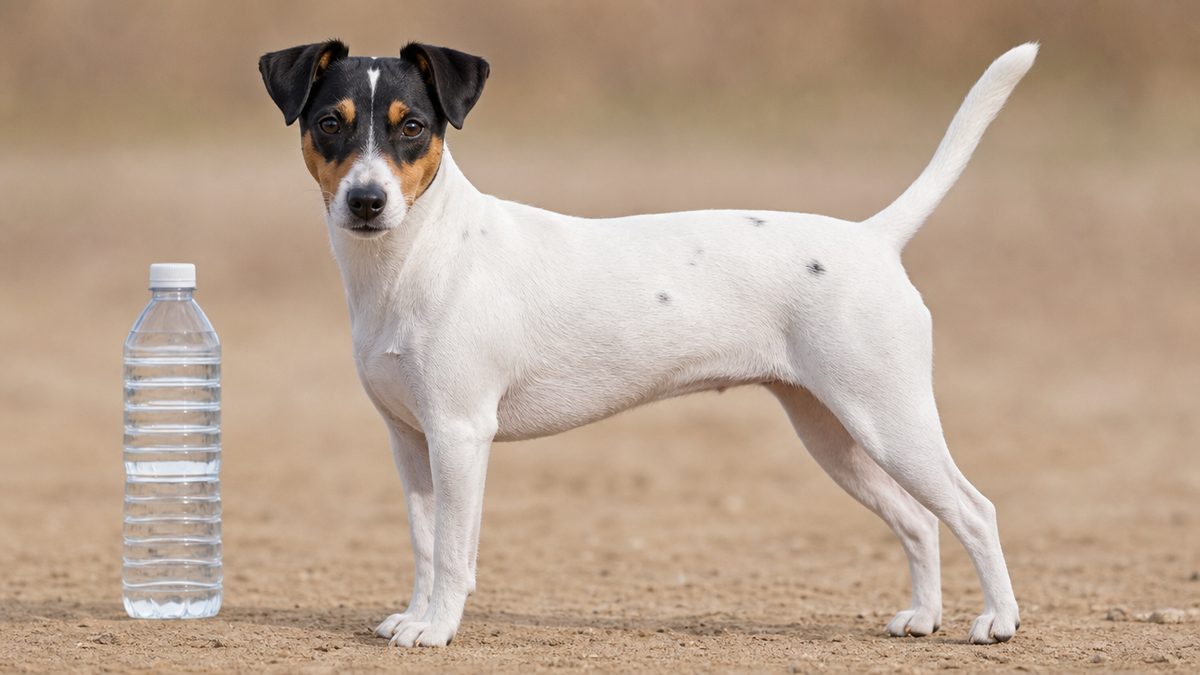
The Japanese Terrier is a small, lean, smooth-coated Japanese dog of about 30 to 33 cm at the withers, with a tricolour head over a white body and a coat roughly 2 mm long, recognised by the FCI as standard 259 in Group 3, Section 2, Small sized Terriers.
Start with the document that defines the breed. The FCI accepted the Nihon Teria on a definitive basis on 1 April 1964, and its current standard was made valid on 4 April 2016 with the English text published on 3 June 2016. English is the official authentic language, so the English standard is the primary text rather than a translation. The nomenclature table prints its dates as month, day, year, which the same page proves: the German row reads 1/31/2020, and 31 cannot be a month.
The standard asks for a small-sized dog of smart appearance with a clear-cut and compact outline, with the height at the withers equal to the length of the body at a ratio of 1 to 1, and the nasal bridge and the skull equal in length. Temperament is given in one line: the Japanese Terrier is swift and lively. The head is flat and moderately narrow with a stop that is not too defined, the eyes moderately sized, oval and dark, and the ears set on high, moderately small, thin, V-shaped and dropping forward, though carried folded and standing out from the skull is permitted.
Two numbers, and one that is missing
The standard gives a height of approximately 30 to 33 cm for both males and females, and a coat that is short, smooth, dense and glossy, about 2 mm in length. It gives no weight at all. That silence matters, because every secondary source prints a weight and none of them is quoting the standard.
| Source | Height | Weight | What the document is |
|---|---|---|---|
| FCI-Standard 259 | About 30 to 33 cm, both sexes | Not stated | The breed standard |
| American Kennel Club | 10 to 13 inches (25 to 33 cm) | 10 to 12 pounds (4.5 to 5.4 kg) | A registry breed page |
| Wikipedia | 8 to 13 inches (20 to 33 cm) | 5 to 10 pounds (2.2 to 4.5 kg) | A stub article citing the AKC page |
| Dog Breeds List | 8 to 13 inches (20 to 33 cm) | 5 to 9 pounds (2.3 to 4.1 kg) | An aggregator citing the FCI standard |
Read the weight column. The AKC's range of 10 to 12 pounds sits entirely above Wikipedia's 5 to 10 pounds and Dog Breeds List's 5 to 9 pounds, so the two most-copied figures on the internet do not overlap at all Dog Breeds List, Japanese Terrier. Worse, Wikipedia attributes its 8 to 13 inches and 5 to 10 pounds to the American Kennel Club breed page, and the AKC page prints 10 to 13 inches and 10 to 12 pounds. The citation is real, the link works, and the numbers are not on the page it points to.
Colour, and the two disqualifying faults
The colour is distinctive and easy to check. The standard wants a tricolour head, black, tan and white, over a body that is white with black spots, black markings or tan markings. Two things disqualify a dog outright besides aggression or overt shyness: long hair, and an extremely overshot or undershot bite. A Japanese Terrier with a coat you can sink your fingers into is not a rough-coated variety, it is a dog that could not be shown.
The oddest line in the document is the utilization field. FCI-Standard 259 sits in Group 3, Terriers, and gives the breed's utilization as Toy Dog. The standard's own history explains it: these dogs were kept mainly as lapdogs in ports such as Kobe and Yokohama, not as working ratters. The AKC calls it one of the calmest of the terrier breeds while still a high-energy dog. Both things are true, and a buyer should read the temperament section before assuming either.
Nihon Teria, Nippon Terrier, Kobe Terrier: six names and no literature under any of them
The Japanese Terrier answers to at least six names, and Bonbeno searched every one of them in PubMed before concluding that no breed-specific veterinary literature exists.
The FCI's own nomenclature entry is headed NIHON TERIA, with the English name Japanese Terrier, and the breed is listed under its Japanese name rather than its English one. That is unusual and it is a clue. An aggregator lists six English and romanised forms in current use: Nippon Terrier, Nihon Teria, Nihon Terrier, Kobe Terrier, Mikado Terrier and Oyuki (Snowy) Terrier, and Wikipedia's infobox gives Mikado Terrier and Oyuki (snowy) Terrier. The American Kennel Club's history section confirms where two of those come from: dogs seen in the Kobe streets by the 1900s were called Kobe Terriers, and the breed also went by Oyuki Terriers and Mikado Terriers.
A zero on one name is not a zero, so all of them were tested. Bonbeno ran nine query forms across two scripts through PubMed on 31 August 2026, reading the query translation and the warning list on every one.
| Query | Result | What PubMed did with it |
|---|---|---|
| "Japanese Terrier" | 11 records, all unrelated | Phrase not in the index; rewritten to Japanese AND terrier across all fields |
| "Japanese Terrier"[Title/Abstract] | 0 | Nothing |
| "Nihon Teria" | 0 | Nothing |
| "Nihon Terrier" | 5 records, all unrelated | Quoted phrase not found; rewritten |
| "Nippon Terrier" | 8 records, all unrelated | Quoted phrase not found; rewritten |
| "Kobe Terrier" | 5 records, all unrelated | Quoted phrase not found; rewritten |
| "Mikado Terrier" | 0 | Nothing |
| "Oyuki Terrier" | 0 | Nothing |
| The Japanese-script name | 0 | Nothing |
The controls make that table mean something. In the same session, on the same instrument, Labrador Retriever with hip dysplasia returned 126 records and Shiba Inu with dog returned 73. The tool was working. The eleven results the rewritten phrase search produced were opened and checked rather than counted: they include a Maltese terrier case report, a study of the SERPINF2 variant in Japanese dogs whose breed list runs Italian Greyhound, Whippet, Shiba Inu, Saluki, French Bulldog, Boston Terrier, Jack Russell Terrier and Chihuahua, and a retrospective of gastrointestinal tumours in Tokyo naming Shiba, Miniature Dachshund, Jack Russell Terrier, French Bulldog and Shih Tzu. None of them is about this breed.
A search for the breed's English name returns eleven records, which looks like a small literature. It is not one. PubMed could not match the phrase in its index and silently rewrote the query into a Japanese AND terrier all-fields search, and the eleven hits are what that catches. Read the query translation, then read the records. The honest finding for this breed is zero, and zero is publishable.
That absence is the single most useful thing this page can tell an Indian buyer, and it is why the health section below is short. Everything published about this breed's health comes from breed-registry guidance rather than from research, and any page that gives you a percentage for it has invented one.
History: two accounts of where this breed came from, three centuries apart
The FCI standard and the American Kennel Club give incompatible accounts of how the Japanese Terrier was made. One puts the founding cross in 17th-century Nagasaki and the other in Kobe in 1916, and Bonbeno publishes both rather than choosing.
The FCI's history section is the older account and the one most sources copy. It says the breed was created by mating smooth-haired Fox Terriers, exported to Nagasaki from the Netherlands in the 17th century, to small-sized pointers or small-sized native dogs, that the dogs were kept mainly as lapdogs in ports such as Kobe and Yokohama, that planned breeding started around 1920, and that the type was not fixed until about 1930. Wikipedia and Dog Breeds List both reproduce this version, and Dog Breeds List cites the FCI standard for it Dog Breeds List, Japanese Terrier.
The American Kennel Club tells a different story about the founding cross. It agrees that by the 1900s, at the end of the Meiji Era, dogs called Kobe Terriers were in the streets and looked like a mix of modern Smooth Fox Terriers and Japanese Terriers. Then it says that around 1916, in the Nada ward near Kobe, a dog named Kuro was born from an out-cross of English Toy Terriers and a Toy Bull Terrier, both imported from Western countries, and that selection from those offspring and the Kobe Terriers produced the very short-haired, slim, small terrier known today.
| Question | FCI-Standard 259 | American Kennel Club |
|---|---|---|
| When | 17th century, with planned breeding from about 1920 | Around 1916, from a dog named Kuro |
| Where | Nagasaki, then Kobe and Yokohama | The Nada ward near Kobe |
| Imported input | Smooth-haired Fox Terriers from Dutch ships | English Toy Terriers and a Toy Bull Terrier |
| Local input | Small-sized pointers or small native dogs | The existing Kobe Terriers |
| Type fixed | About 1930 | By 1930, when a standard was developed |
The two accounts are not simply contradictory, and it is worth saying how they might fit. The FCI is describing the deep origin of the population, the Dutch Fox Terriers that reached Nagasaki and mixed with local dogs over centuries. The AKC is describing the modern breeding programme that fixed the type, a specific 1916 out-cross onto that existing population. Both end at the same place, a standard and Japan Kennel Club recognition by 1930 FCI-Standard No 259. What no source Bonbeno opened does is reconcile them explicitly, so the honest description is that the breed has a contested founding cross and a settled fixing date.
One further detail from the AKC belongs on any page about this dog's rarity. The breed faced extinction twice, first during the Second World War and then around 1948, when Western breeds became fashionable in Japan. A population that passed through two bottlenecks inside a decade is a population with a narrow founding base, which is the context for the registration numbers in the next section.
This is the only terrier breed developed in Japan. The FCI's Group 3 contains no other Japanese entry, and Japan's own cultural-properties register, which designated seven native dogs between 1931 and 1937, contains no terrier at all. A breed built from European imports on Japanese soil is exactly the kind of dog that ends up in neither category.
Japan never made this breed a natural monument, and its own database says so
Japan has never designated the Japanese Terrier a natural monument. A search of the national cultural properties database for the breed's Japanese name returns zero records of any kind, against controls that returned the correct entries for the Hokkaido and the Shiba.
The Agency for Cultural Affairs maintains the National Cultural Properties Database, which is the government's own record of every designation the state has made. A free-word search on this breed's Japanese name returns zero records. That is a stronger result than it sounds, because the same search box, in the same session, returned record 401/3116 for the Hokkaido and record 401/3112 for the Shiba. The instrument was working, and the breed simply is not in the register in any capacity.
Reading the register forward confirms it. Records 401/3100 to 401/3145 were read one by one, and every designation made under criterion (4), domesticated animals peculiar to Japan, was enumerated. Seven of them are dogs, all designated between July 1931 and December 1937, and every one is a spitz-type native breed.
| Breed | Database record | Designation date |
|---|---|---|
| Akita | 401/3105 | 31 July 1931 |
| Kai | 401/3106 | 22 January 1934 |
| Kishu | 401/3108 | 1 May 1934 |
| Koshi no Inu, now extinct | 401/3110 | 28 December 1934 |
| Shiba | 401/3112 | 16 December 1936 |
| Tosa-ken, the Shikoku's designation name | 401/3113 | 15 June 1937 |
| Hokkaido | 401/3116 | 21 December 1937 |
| Japanese Terrier | None | Never designated |
The criterion explains the absence without any need for speculation. It covers domesticated animals peculiar to Japan, and this breed's own standard opens by describing it as created from smooth-haired Fox Terriers landed at Nagasaki by Dutch traders. A dog whose founding stock arrived on a European ship is not, on the register's test, peculiar to Japan. The Japanese Chin is absent from the same series for the same reason, its standard describing ancestors assumed to have arrived from Korea.
Where a Japanese breed does hold a designation, the date on the Agency's record is the one to use. The Shiba's record 401/3112 gives 16 December 1936, while the FCI standard for that breed dates the designation to 1937. The designating authority's own register is the primary source and the breed standard is not. Bonbeno's Shiba Inu and Hokkaido guides carry the corrected dates.
None of this makes the breed less Japanese, and it is not a criticism of it. It does mean that the heritage framing used to sell native Japanese dogs does not apply here, and that a seller invoking Japanese national-treasure status for a Japanese Terrier is describing a designation that does not exist.
How many Japanese Terriers exist, and which registers hold them
The Japan Kennel Club registered 58 Japanese Terriers in 2025, ranking the breed 73rd of 141, and its peak in the published archive is 156 dogs in 1999. The AKC has recorded it in the Foundation Stock Service since 13 October 2020.
Japan is where this breed is counted, so start there. The Japan Kennel Club publishes one table a year of new pedigree registrations by breed. Its 2025 table covers 141 breeds and 302,530 dogs, and the 141 rows sum to exactly 302,530, matching the printed total.
| Year | Japanese Terrier | Its rank | Shiba | Hokkaido | Chin | Total dogs registered |
|---|---|---|---|---|---|---|
| 1999 | 156 | 63 | 12,711 | 6 | 600 | 424,061 |
| 2010 | 54 | 76 | 12,105 | 8 | 805 | 392,958 |
| 2020 | 90 | 70 | 9,262 | 25 | 315 | 305,532 |
| 2024 | 59 | 72 | 4,582 | 20 | 271 | 306,642 |
| 2025 | 58 | 73 | 3,598 | 24 | 386 | 302,530 |
The series is flatter than most rare-breed histories. The breed peaked at 156 dogs in 1999, fell to 54 by 2010, recovered to 90 in 2020 and has settled just under 60 since Japan Kennel Club Japan Kennel Club Japan Kennel Club. Against the Shiba's collapse from 12,711 to 3,598 over the same period, a breed that holds a double-digit number for a quarter of a century is not obviously dying; it is simply small and stable.
Why the JKC number is the right one here and the wrong one next door
The Japan Kennel Club is this breed's register, so 58 is a fair figure for the Japanese Terrier. That is not true of the breeds it sits beside in the table. Japan's six natural-monument natives each have a preservation society of their own, and NIPPO, the six-breed society, publishes a separate annual studbook count that the JKC table does not contain.
The size of that gap decides whether a cross-breed comparison means anything. In 2025 NIPPO recorded 13,722 Shiba against the JKC's 3,598, 252 Shikoku against 51, 132 Kishu against none at all, 78 Kai against 60, 11 Hokkaido against 24 and 5 Akita against 263 Japan Kennel Club. NIPPO's own transfer-registration page then names eight further Japanese bodies whose pedigrees it accepts, including separate societies for the Akita, the Kishu, the Kai, the Shiba and the Hokkaido, so even both published columns together are floors.
So read the table above as what the Japan Kennel Club issued, and nothing more. A rarity ranking built on one registry measures the registry, not the breed. Bonbeno withdrew a line on this page on 9 September 2026 that called the Hokkaido the only Japanese breed the JKC registers in smaller numbers than this one. It was wrong twice over: the Shikoku's 51 is also below 58 in that very table, and the Hokkaido's real total is unknowable from either public register because its own society publishes none.
A registry trap worth knowing before you quote a year
The Japan Kennel Club's archive links its 2024 table at the slug 2024-3. The obvious address, the one ending in 2024, returns HTTP 200 and serves a byte-identical copy of the 2025 table under the 2025 title. Every other year slug matches its own title. Anyone assembling that URL rather than following the archive's own link will publish 2025 figures as 2024 figures with nothing on the page looking wrong.
Outside Japan
The American Kennel Club added the breed to its Foundation Stock Service on 13 October 2020, at the same October board meeting that admitted the Alaskan Klee Kai; the Japanese Akitainu had joined the same programme two months earlier. Foundation Stock Service is a recording service for breeds not yet eligible for full AKC registration, so the breed is tracked in the United States rather than fully recognised there. Its aggregator popularity rows for 2015 to 2022 are all blank, because there is no AKC popularity ranking to fill them with.
There is no Indian equivalent to quote. The Kennel Club of India publishes no breed-by-breed registration list, so a query there returns nothing for this breed and nothing for any control breed either, which is a broken instrument rather than a finding. What can be said about Indian recognition runs through the FCI: India is a full FCI member represented by the Kennel Club of India, and the Nihon Teria is FCI standard 259 recognised on a definitive basis, so a KCI pedigree for the breed would be issued against FCI nomenclature.
It means the entire annual output of the breed's home register would not fill a single Indian apartment block. A dog offered in India under this name is far more likely to be a small smooth-coated crossbreed than an imported Nihon Teria, and Indian import law makes a commercial import of breeding stock impossible in any case. Ask which register the pedigree is on, and ask to see the paper.
Japanese Terrier price in India: there is no Indian price, and here is the proof
There is no japanese terrier price in india, because no Indian seller has the dog. Both Indian pages that rank for the term show zero Japanese Terriers, and India's most carefully sourced 40-breed price list leaves the breed out altogether.
Say the negative first, then evidence it. A Firecrawl search restricted to India returned ten organic results for this breed. Two are Indian listing pages with no Japanese Terrier on them. The rest are Etsy merchandise, an Amazon.in decorative sculpture, an aggregator, a Japan travel article about Japanese breeds, a Facebook group post, a keyword-spam domain and an eBay figurine. The control query, 'labrador retriever price in india', run on the same instrument in the same session, returned genuine Indian Labrador listing pages with rupee bands by city and quality tier. So the search worked, and what it found for this breed is what is there.
| Source | What it says about price | What it actually shows |
|---|---|---|
| PetBuy.in, Noida | No figure for the breed | 'Showing 0 Results' and a heading reading 'No Japanese Terrier Listed in Noida Yet' |
| Mr n Mrs Pet | Advertises 'Japanese Terrier price in India' | Two Border Collies and a French Bulldog named barbara, under 'similar breeds at other locations' |
| Supertails 40-breed list | The breed is absent | India's most method-transparent price list does not carry it at all |
| Dog Breeds List | Average 600 to 800 US dollars | A US retail estimate, on a page whose fifteen trait ratings all read zero stars |
| Etsy India and Amazon.in | Rupee figures in the hundreds | Merchandise and a decorative sculpture. Not dogs |
PetBuy's page is the honest one and the dishonest one at the same time, which makes it worth reading closely. It prints 'Showing 0 Results' and states plainly that no Japanese Terrier is listed in Noida yet. Three paragraphs later the same page states that the Japanese Terrier is one of the most loved companion dogs among Indian families, admired for its temperament, loyalty and adaptability to our climate and homes. A breed with zero listings on the page cannot be one of India's most loved companion dogs, and that sentence is template text generated for the search term rather than a claim about the dog.
Do not convert the dollar figure
Dog Breeds List gives an average puppy price of 600 to 800 US dollars. Bonbeno does not convert it, and the reason is worth stating rather than assuming. Converting a foreign retail figure into rupees produces a number that looks like an Indian price and is not one; it tells you what an American breeder charges, in rupees. This site has repeatedly caught Indian breed pages publishing rupee prices that divide cleanly back into round dollar amounts at a single exchange rate. Here the situation is simpler and cleaner: no Indian page publishes a rupee figure for this dog at all, so there is nothing to test and nothing to convert.
Two facts close the question between them. The Japan Kennel Club registered 58 dogs of the breed in the whole of 2025, and DGFT Trade Notice 22/2022-23 states that import applications for trading or breeding purposes shall be duly rejected. No lawful supply chain can form between those two facts, so an Indian puppy price has nothing to converge on. The breed is not expensive in India and it is not cheap in India. It is unavailable in India, which is a different fact and a more useful one.
What an Indian reader can budget for is the keeping rather than the buying, and those figures are real, published and rupee-denominated. The next section takes them apart.
Cost of ownership: what a small short-coated dog actually costs to keep in India
Budget Rs 4,000 to Rs 8,000 a month for a small dog in India, and expect a Japanese Terrier to sit at the lower end of that, because the one line that dominates a small-breed budget is grooming and this breed barely needs any.
There is no Indian purchase price to work from, so the cost of ownership is the only Indian money figure this page can give you honestly. Supertails publishes a line-by-line monthly table for a small dog in India and states its method as breeder networks, KCI registration data and marketplace surveys conducted in the first quarter of 2026.
| Line | Small breed, per month | Where a Japanese Terrier sits |
|---|---|---|
| Dry and wet food | Rs 1,500 to Rs 2,500 | Lower half. A 5 kg lean terrier is at the small end of small |
| Routine vet visits | Rs 500 to Rs 1,000 | Mid-range, plus one extra visit a year for a skin check in summer |
| Grooming | Rs 1,500 to Rs 3,000 | Near zero. A weekly brush at home replaces the salon entirely |
| Treats and toys | Rs 300 to Rs 800 | Upper half. This is a busy dog that needs occupying indoors |
| Flea control and deworming | Rs 300 to Rs 600 | Mid-range |
| Vaccinations, annual | Rs 1,200 a year | Standard |
| Monthly total as printed | Rs 4,000 to Rs 8,000 | Realistically Rs 3,000 to Rs 5,500 once grooming falls away |
The grooming row is the whole story and it runs the opposite way to most small breeds. Supertails puts small-breed grooming at Rs 1,500 to Rs 3,000 a month, which is more than the Rs 500 to Rs 1,200 it gives for a large breed, because a groomer charges for coat work and time rather than for kilograms. A coat about 2 mm long has no coat work in it. The American Kennel Club describes the entire routine as a weekly brushing with a soft brush or hound glove and an occasional bath only as needed. That single difference takes roughly Rs 18,000 to Rs 36,000 a year off a small-dog budget.
Two lines an Indian owner has to add back
- Sun and skin. A 2 mm coat on a predominantly white body is close to no barrier at all. Budget for shade, for walking in the dark hours, and for at least one veterinary skin assessment in the hot season rather than treating redness at home.
- Containment. The AKC is explicit that this breed is best kept in a fenced yard or on a lead because it can eagerly run off. In an Indian flat that means a checked balcony grille and a harness, and in a house it means a gate somebody actually closes. It is a one-off cost and it is cheaper than a lost dog.
Two further figures put the monthly number in context. Supertails advises budgeting Rs 80,000 to Rs 2,00,000 for the first year across purchase, vaccinations, food, training and supplies, and notes that Mumbai and Delhi command a 20 to 35 percent premium over tier-2 cities. For this breed the purchase component of that first-year figure is unknowable, because no Indian purchase exists, so the recurring half is the whole of what you can plan.
Of every breed Bonbeno has costed for India, this is among the cheapest to keep. Small body, small appetite, no professional grooming, no cooling equipment needed beyond what any Indian household already runs, and no breed-specific screening test to pay for because none exists. The barrier here is supply, not cost.
Heat tolerance: a normal muzzle in a 2 mm coat, in a country that supplies too much sun
Bonbeno rates the Japanese Terrier 2 of 5 for heat tolerance. It pants efficiently through a normal muzzle, which puts it well ahead of any flat-faced toy breed in India, and its coat of about 2 mm offers a white-bodied dog almost no protection from direct sun.
Take the origin climate from a source that cannot serve you the wrong city. NASA POWER was queried by explicit latitude and longitude, and every query echoed back both the coordinates and the elevation of the grid cell it served, so the figures below can be checked rather than trusted.
| Place | Grid-cell elevation | Annual mean air temperature | Hottest month's mean maximum | Annual mean relative humidity |
|---|---|---|---|---|
| Nagasaki, 32.750N 129.878E | 115.92 m | 16.19 C | 37.85 C, August | 80.85 percent |
| Kobe, 34.690N 135.196E | 54.10 m | 16.53 C | 33.87 C, July | 78.59 percent |
| Chennai, 13.083N 80.271E | 48.95 m | 27.95 C | 42.70 C, May | 72.39 percent |
| Delhi, 28.614N 77.209E | 206.37 m | 25.60 C | 48.79 C, June | 45.56 percent |
| Mumbai, 19.076N 72.877E | 97.15 m | 26.77 C | 44.91 C, April | 67.39 percent |
| Bengaluru, 12.972N 77.595E | 841.72 m | 23.74 C | 40.38 C, April | 67.94 percent |
The gap is real but smaller than for a Nordic breed. Nagasaki's annual mean is 16.19 degrees Celsius against Chennai's 27.95, a difference of 11.76 degrees, and Kobe's is 16.53. What matters more is the peak: Nagasaki already reaches a mean August maximum of 37.85 degrees, which is hotter than Bengaluru's hottest month and only five degrees below Chennai's. This is not a cold-climate dog. Both of its home ports are subtropical, humid, southern Japanese cities.
The humidity finding, which runs the other way
Humidity is where the obvious story breaks. Nagasaki's annual mean relative humidity is 80.85 percent, higher than Chennai's 72.39 percent and far higher than Delhi's 45.56 percent. The Japanese Terrier is not a dry-climate dog meeting Indian humidity for the first time; its home port is more humid than any large Indian city on this table. What it has never met is that humidity at 28 degrees rather than at 16, and it has never met a Delhi June at all.
What actually limits this dog in India
The airway is not the problem here, and that is the honest difference between this breed and the Japanese Chin. A dog with a normal muzzle cools itself by panting across a full-sized turbinal surface. The limits are simpler and more manageable:
- Sun on skin. A coat of about 2 mm over a predominantly white body is the thinnest barrier of any breed on this site. Midday sun reaches skin.
- Exertional heat. Exertional illness was the predominant recorded trigger of heat-related illness in the largest published UK study, ahead of environmental exposure and far ahead of hot cars, and young dogs had greater odds of it. This is an energetic terrier that will keep going past the point of sense.
- Fatality when it goes wrong. The event fatality rate for heat-related illness in that cohort of 905,543 dogs was 14.18 percent, with a 95 percent confidence interval of 11.08 to 17.96. Roughly one heat-illness event in seven killed the dog.
Do not trust a satellite figure for a hill station
Owners in Chennai and Mumbai often propose the hills, and the satellite data will mislead you there. NASA POWER returns a grid cell rather than a point, and in mountains that cell can sit more than a kilometre below the town. Ooty's cell came back at 784.64 metres against a real town elevation of roughly 2,240 metres, and Shimla's at 897.65 metres against roughly 2,200 metres, so both return figures far too warm. Correcting at the standard lapse rate of about 6.5 degrees per 1,000 metres puts Ooty near 14 degrees and Shimla near 13 degrees annual mean, and those are estimates, labelled as such. The plains cities above need no correction; each returned a cell within about 90 metres of the real town.
Second Schedule Part IV paragraph 21(1) of the 2017 Rules bars keeping in outdoor facilities, without the attending veterinary practitioner's written approval, dogs not accustomed to the temperatures prevalent in the area, breeds that cannot tolerate them, and sick, infirm, aged or young animals. An imported Japanese Terrier is by definition not accustomed to Indian temperatures. Note also that the string 'Rule 21' appears zero times in the gazette, and the Rules themselves stop at Rule 13, so any page citing this clause as Rule 21 is citing a provision that does not exist.
Temperament: swift, lively and cheerful, and a one-person dog
The FCI standard describes the Japanese Terrier as swift and lively with a lively and cheerful character, and the American Kennel Club adds the part that decides household fit: this is a one-person dog, often reserved with strangers.
The standard is brief and consistent. Its history section calls the breed's character lively and cheerful, and its behaviour section says the Japanese Terrier is swift and lively in temperament. Aggressive or overly shy dogs are a disqualifying fault, so a Japanese Terrier that cowers or snaps is showing a fault the standard names rather than breed character.
The American Kennel Club fills in the household picture and its summary words are reserved, independent and curious. It describes a small, highly intelligent breed full of terrier temperaments, independent, active, crisp and lively; as one-person dogs, they are often reserved with strangers; keen and alert, they will hear the slightest noise and give warning; and they have no issue with respectful children and other dogs.
Who this dog suits in India
- A quieter adult household, because a one-person dog reserved with strangers is not the dog for a home with constant visitors.
- An owner who wants an alert dog rather than a guard dog. It will announce every arrival on the stairwell, which in an Indian apartment block is a feature for some neighbours and a complaint from others.
- Someone who has kept a terrier before, or is willing to learn. The AKC recommends a trainer who is terrier and primitive breed savvy, which is a specific ask in most Indian cities.
- A household with older, respectful children, and other pets that have been introduced properly. The AKC says the breed has no issue with respectful children and other dogs, and the emphasis belongs on the word respectful.
Who should not buy one
Anyone who wants a placid lapdog should read the utilization field and then read the temperament, because they point in different directions. The standard classes the breed as a Toy Dog, and the AKC calls it one of the calmest of the terrier breeds while adding in the same paragraph that these are nevertheless high-energy dogs who require mental and physical exercises. Calmest of the terriers is not the same as calm.
The other constraint is the door. The AKC notes that the breed is best kept in a fenced yard or on a lead because it can eagerly run off. In an Indian context, that means a housing society gate, a stairwell and a lift lobby are all failure points, and a harness with a lead is the default rather than a precaution.
A dog that lies still through a Chennai afternoon and then races around the flat after dark has not become lazy and then hyperactive. It is a lively terrier managing its own heat load. If your Japanese Terrier is markedly quieter in April than in December, read that as thermoregulation rather than personality, and move the activity to the cool hours rather than trying to coax it out at noon.
Training an independent terrier in the two hours a day India allows
Train a Japanese Terrier early, positively and on a lead, because the breed is extremely intelligent and highly independent, and because in India the safe working window falls before sunrise and after dark for eight months of the year.
The American Kennel Club's guidance is the fullest published account and it is worth quoting closely. The breed is extremely intelligent and trainable, although some can be stubborn and determined at times, and due to their high independence, training needs to be started early. It recommends early socialisation and puppy training classes with positive, reward-based training and gentle but firm corrections, and specifically recommends a trainer who is terrier and primitive breed savvy.
Socialise the puppy widely in its first four months rather than later. A one-person dog that is often reserved with strangers becomes a difficult dog in an Indian apartment block if it meets nobody in its first year, and the standard makes overly shy dogs a disqualifying fault. Lift doors, delivery riders, watchmen and stairwell neighbours are the socialisation curriculum in an Indian city, and none of them requires a training school.
Four things to teach this breed that a calmer dog does not need
- Recall, and then a lead anyway. The AKC states the breed is best kept in a fenced yard or on a lead because it can eagerly run off. Train recall properly and still use the lead, because a terrier that has committed to a chase does not hear you.
- A quiet cue. Keen and alert, this breed will hear the slightest noise and give warning to any stranger. In a shared Indian stairwell that is a neighbour problem within a fortnight unless the dog learns that one alert is enough.
- Harness acceptance. A lean 5 kg dog on a neck collar that lunges at a passing cat is putting all of that force through its throat. A week of harness training removes the problem for the life of the dog.
- Settling on a mat in a cool room. This is a heat-management skill rather than obedience. The dog needs a default place to be during the hours when it must not be outside.
The Indian timetable problem
The constraint is the clock, not the dog's willingness. Delhi's hottest month averages a 48.79 degree maximum and Chennai's 42.70, so from March to October the safe working window in most Indian cities runs before sunrise and after dark. For a breed with moderate exercise needs that is manageable, but it means training happens on the dog's schedule rather than yours. Three to five minute indoor sessions several times a day suit both a terrier's attention span and the thermometer.
One thing not to do is push through heat to finish a session. Exertional heat-related illness was the predominant recorded trigger in the largest published UK study, and young dogs carried greater odds of it. The dog that gets into trouble is more often the one being worked than the one shut in a vehicle.
The AKC notes that because of their high trainability and versatility, Japanese Terriers can do well in a wide range of canine activities such as obedience, rally and agility. All three are available in the larger Indian cities and all three can be run indoors or in the cool hours. For a clever dog that cannot be walked at midday for most of the year, a sport is not a luxury, it is the substitute for the walk you cannot take.
Exercise: moderate needs, and a hard rule about when
A Japanese Terrier needs a couple of good walks a day or equivalent time in a secure space, which is moderate by terrier standards, and in India every minute of it has to fall outside the middle of the day.
The published requirement is unusually plain. The American Kennel Club says Japanese Terriers have moderate exercise needs and require a couple of good walks or daily sessions in a fenced-in yard every day to maintain mental and physical health, adding that they enjoy activity but are also quite happy to curl up on the couch next to their owner. That is the profile of a dog that will take what you give it and settle when you stop, which suits an Indian working household better than a herding breed would.
Set against that is the other half of the same paragraph: these are high-energy dogs who require mental and physical exercises, and the breed is only one of the calmest of the terrier breeds rather than a calm dog. Plan for about an hour a day in total across two walks and some structured play, and expect the dog to ask for more rather than less.
| City | Hottest month's mean maximum | Safe window, March to October | Cool season |
|---|---|---|---|
| Delhi | 48.79 C in June | Before 06:30 and after 20:00 | December to February is comfortable most of the day |
| Chennai | 42.70 C in May | Before 06:30 and after 20:00, year round | There is no genuinely cool season |
| Mumbai | 44.91 C in April | Before 07:00 and after 20:00 | December and January are workable mornings |
| Kolkata | 46.81 C in May | Before 06:30 and after 20:00 | December to February |
| Bengaluru | 40.38 C in April | Before 07:30 and after 19:00 | The mildest large Indian city for this breed |
Bengaluru is the outlier and it is worth saying why. Its cell sits at 841.72 metres, so its annual mean of 23.74 degrees is roughly four degrees below Chennai's and its hottest month peaks two degrees lower. That still leaves a gap of more than seven degrees against Nagasaki's 16.19, but among large Indian cities it is the least hostile.
Surface temperature, not just air temperature
A 30 cm dog walks with its chest about 20 cm off the ground, and Indian pavement and concrete hold heat long after the air has cooled. Test the surface with the back of your hand for five seconds before an evening walk in May. If you cannot hold it there, neither can the dog's feet, and the air temperature reading on your phone will not have told you.
Stop when the panting deepens and does not settle within a minute of standing still, when the dog seeks shade rather than following you, or when it lags on a lead it was pulling on. The event fatality rate for heat-related illness in a cohort of 905,543 UK dogs was 14.18 percent, so the margin between a hot walk and an emergency is narrower than most owners assume. Carry water on every walk, including the short ones.
Grooming a 2 mm smooth coat, and the sun problem that replaces it
Groom a Japanese Terrier once a week with a soft brush or a hound glove and you are finished, because the smooth coat is about 2 mm long. The Indian work is not coat care, it is protecting the skin underneath it.
This is the lightest grooming load of any breed on this site. The standard specifies hair that is short, smooth, dense and glossy, with the general appearance section noting the coat is about 2 mm in length, and it makes long hair a disqualifying fault. The American Kennel Club describes the whole routine: a weekly brushing with a soft brush or hound glove keeps the coat healthy and glossy, with an occasional bath only as needed.
The rest of the AKC's routine is standard small-dog maintenance and worth doing on schedule. Ears should be regularly inspected for dirt or wax build-up and cleaned if needed with soft gauze and an ear-cleaning solution; nails should be trimmed often, because overly long nails cause discomfort; and teeth should be brushed daily if possible with a toothpaste formulated for dogs.
Three Indian adjustments
- Ears, because they fold forward. The standard describes ears set on high, moderately small, thin, V-shaped and dropping forward. A folded ear over a warm humid canal is the standard set-up for an ear problem in a coastal Indian city, where Mumbai runs above 89 percent mean relative humidity in July and August. Dry the outer ear after every wash and after monsoon walks, and never let water sit in the canal.
- Skin, because there is almost no coat over it. At 2 mm, this coat is a thin barrier over a predominantly white body. Watch the bridge of the nose, the ear tips and the topline for redness or crusting through the hot months, and take a persistent change to a veterinarian rather than treating it at home.
- Nails, because Indian flats are hard floors. Tile and concrete do not wear nails the way rough ground does, so a weekly check is more realistic than a monthly one.
The hypoallergenic question, which has a settled answer
The Japanese Terrier is not hypoallergenic, and neither is any other dog. Dog Breeds List records the breed as not hypoallergenic, and the underlying evidence is not in dispute: Vredegoor and colleagues measured Can f 1 across 196 dogs of so-called hypoallergenic breeds against 160 control dogs and found the hypoallergenic group higher, not lower, concluding that there is no evidence for classifying any dog breed as hypoallergenic. A very short coat sheds less visibly than a long one. It does not shed less allergen.
It saves the professional grooming line, which is the largest single item in a small-dog Indian budget at Rs 1,500 to Rs 3,000 a month. It does not save you the ear routine, the nails, the teeth or the skin checks, and in Indian sun it adds a job rather than removing one. Cheap to groom is not the same as low maintenance.
Health: two named risks, no published study, and no registry row
Nobody has published a study of health in the Japanese Terrier. Nine PubMed query forms across two scripts return zero breed-specific records against working controls, the breed has no row in any OFA statistics table, and it is absent from the largest UK longevity study, so every health claim you read about it comes from guidance rather than data.
Start with what is actually named, because two conditions are. The American Kennel Club states that Japanese Terriers are generally healthy dogs and responsible breeders test their stock for health conditions such as patellar luxation and Legg-Calve-Perthes disease. Both are the ordinary orthopaedic concerns of a small, light-boned dog: the first is a kneecap that slips out of its groove, the second is degeneration of the head of the femur in young small-breed dogs. That is breeder guidance, not prevalence, and the AKC does not attach a percentage to either.
Why there is no percentage to attach
| Source | What it holds for this breed | Control in the same session |
|---|---|---|
| PubMed, nine query forms across two scripts | Zero breed-specific records | Labrador with hip dysplasia 126; Shiba Inu with dog 73 |
| OFA published statistics tables | Zero rows anywhere in a 2.2 million character dump | Labrador Retriever 109 occurrences; Japanese Chin 56; Shiba Inu 55 |
| OFA breed register | Holds breed code JAT, Terrier group | Japanese Chin JS, Japanese Spitz JSP, Japanese Akitainu JAI |
| McMillan 2024 longevity study, Table S5 | Absent from all 345 breeds listed | Hokkaido and Kai both listed, flagged as not analysed |
Two of those rows need reading carefully, because the difference between them matters. Holding an OFA breed code is not the same as appearing in OFA's statistics. The registry's advanced-search markup carries value="JAT" data-name="JAPANESE TERRIER" in the Terrier group, so the breed exists in the database. It has no published statistics row because OFA requires 100 hip evaluations, or 50 for its other databases, before it publishes a breed at all. The correct statement is that the breed has no row in OFA's published statistics tables, not that it is absent from OFA.
The longevity absence is the same shape. McMillan and colleagues' Supplementary Table S5 lists 345 breeds with a flag for whether each was included in the survival analysis, and the Japanese Terrier is in it, spelled Japenese Terrier and flagged N for not included in the survival analysis, alongside the Hokkaido and the Kai. Searching that table for the correct spelling returns nothing, which is exactly how a page ends up reporting that a breed was never considered. It was considered and excluded, so there is no median survival estimate for this breed and the reason for that is on the record.
Life expectancy: two published guesses, no measurement
The American Kennel Club gives a life expectancy of 13 to 15 years and Dog Breeds List gives 12 to 15 years, and neither states a basis for the number. Bonbeno reports both as published guidance and neither as a measurement, because the study that would have measured it listed the breed and left it out of the analysis.
Wikipedia's article states that the breed 'can be prone to certain health issues, such as deafness and allergies'. That sentence sits in an unreferenced paragraph, and the article carries a stub notice. Deafness is a plausible concern in a predominantly white breed and Bonbeno is not saying it is wrong. It is saying nobody has published evidence for it in this breed, that the nine-query PubMed sweep found none, and that Indian law has no hearing-test requirement to fall back on either: in Bonbeno's own extraction of the 2017 gazette, 'deaf' and 'BAER' each appear zero times.
The practical instruction for an Indian owner is therefore short and unglamorous. Screen the knees and the hips of any dog you are offered, because those are the two things the breed's own registry names. Have your veterinarian check hearing on a predominantly white puppy as a matter of routine, and treat the result as information about your dog rather than about the breed. And accept that with no published prevalence data, an annual veterinary examination is doing more work here than any breed-specific test could.
One more absence is worth stating because Indian law makes it relevant. Second Schedule Part III paragraph 8(10) of the 2017 Rules requires breeding dogs to have been tested for genetic defects, and the list is introduced by the word including, so it is illustrative rather than closed. Patellar luxation is not on that list, and the word 'patella' appears zero times in the whole gazette. An Indian breeder therefore has no statutory patella requirement, and the AKC's screening guidance is the only standard there is.
Feeding a lean 5 kg terrier in India
Feed a Japanese Terrier a good small-breed diet in measured meals two or three times a day, and keep it lean, because a light-boned terrier with a 2 mm coat shows every gram and carries every gram into an Indian summer.
The published guidance is generic, and Bonbeno reports it as generic rather than dressing it up. The American Kennel Club says the breed should do well on high-quality dog food, whether commercially manufactured or home-prepared with veterinary supervision, that the diet should suit the dog's life stage, that some dogs are prone to getting overweight so calorie intake and weight level need watching, that treats are a useful training aid but too many cause obesity, and that clean fresh water should be available at all times. There is no breed-specific nutritional research to add to that, because there is no breed-specific research at all.
What can be made specific is the Indian cost and the Indian pattern. Supertails puts small-breed food in India at Rs 1,500 to Rs 2,500 a month, within a small-dog monthly total of Rs 4,000 to Rs 8,000. A 5 kg terrier sits at the lower end of that, so Rs 1,500 to Rs 1,800 is a realistic planning figure.
| Stage | Meals a day | Notes for an Indian household |
|---|---|---|
| 8 to 16 weeks | 4 | Small-breed puppy food. A very small puppy that misses a meal can drop its blood sugar, so keep the intervals short. |
| 4 to 12 months | 3 | Growth is fast and the frame is light. Keep the ribs easy to feel, which on a 2 mm coat means easy to see as well. |
| Adult | 2 to 3 | Measured meals rather than free feeding. Terriers are opportunists and Indian kitchens are generous. |
| Hot season, March to October | Same, timed differently | Feed in the cool hours. Food left down in a humid kitchen spoils fast and you cannot measure what the dog grazed. |
| Senior, from about 9 years | 2 to 3 | Activity falls before appetite does. Re-weigh monthly rather than judging by eye. |
Why weight matters more than it looks on a small dog
Bodyweight at or above the breed and sex mean was a significant risk factor for heat-related illness in a cohort of 905,543 UK dogs. On a 5 kg dog, 400 extra grams is 8 percent of bodyweight, and it is close to invisible under a coat you cannot sink a finger into. Weigh the dog on a kitchen scale once a month and write the number down; it is the cheapest health monitoring available for a breed with no published health data.
- Measure the food with a cup or a scale rather than by eye. A generous handful is a large fraction of a small terrier's day.
- Count training treats as food and subtract them from the meal. This is an intelligent breed that generates a lot of training, and therefore a lot of treats.
- Keep water in every room the dog uses, and refresh it twice a day in the hot months rather than topping it up.
- Do not switch food abruptly when a brand goes out of stock, which happens often in Indian retail. Keep a week's buffer and transition over five to seven days.
A 5 kg dog eats roughly a quarter of what a Labrador eats. Across a 13 to 15 year life expectancy, that is the single largest recurring saving of owning a small breed in India, and it is the reason the monthly total for this dog sits at the bottom of the small-breed band rather than the middle.
The first year, month by month
Plan a Japanese Terrier puppy's first year around three fixed points: the eight-week legal minimum for sale in India, the socialisation window that closes before four months, and the first Indian summer, which arrives before the dog is fully grown.
| Age | What is happening | What you do |
|---|---|---|
| Before 8 weeks | Still with the litter. Nothing about this stage is negotiable. | Verify the register and the pedigree paperwork now rather than at collection, and ask to see the dam with the litter. |
| 8 weeks | The earliest a puppy may lawfully be sold in India, under Rule 8(1)(a). | Walk away from any seller offering a younger puppy, whatever reason is given. |
| 8 to 12 weeks | Four small meals a day. Core vaccinations begin. The socialisation window is open and short. | Introduce the lift, the stairwell, the watchman, delivery riders and traffic noise. A one-person breed needs this more than most. |
| 3 to 4 months | Fast growth on a light frame. Adult teeth start coming through. | Start harness and lead work properly. Begin the daily tooth-brushing habit while the mouth is still easy to handle. |
| 4 to 6 months | Three meals a day. Orthopaedic screening becomes meaningful. | Ask your veterinarian to check the knees and hips, because patellar luxation and Legg-Calve-Perthes are the two conditions the breed registry names. |
| 6 to 9 months | Recall reliability collapses as the terrier drive matures. | Assume the lead is permanent outdoors. This is when dogs of this type run off, and the AKC says so plainly. |
| 9 to 12 months | Close to adult height, about 30 to 33 cm at the withers, with body length matching height. | Move to two or three meals. Start monthly weighing on a kitchen scale. |
| The first Indian summer | Whenever it falls, the dog meets 40 to 49 degree afternoons for the first time. | Fix the walking timetable to before sunrise and after dark, and check pavement temperature by hand before every evening walk. |
Two of those rows deserve expanding. The eight-week rule is a Rule of the 2017 Rules, not a Second Schedule paragraph, and it reads that every breeder shall ensure that pups less than eight weeks in age are not sold. It is the single most useful line of Indian law for a puppy buyer and it is worth quoting to a seller.
The socialisation row matters more in this breed than in most. The AKC describes a one-person dog that is often reserved with strangers and recommends early socialisation and puppy classes with a trainer who is terrier and primitive breed savvy, while the standard makes overly shy dogs a disqualifying fault. A Japanese Terrier that met nobody before four months is a dog that will bark at the lift for the next decade.
On the vaccination schedule you will be shown
Take the schedule from your own veterinarian rather than from any breed page, including this one. Indian cities differ in what circulates and Indian practice differs from the American schedules that most breed pages copy. What Bonbeno can say with a source is the cost: Supertails puts annual vaccinations for a small breed in India at Rs 1,200 a year, inside a monthly total of Rs 4,000 to Rs 8,000.
Write down the puppy's weight every week for the first year and keep the list. For a breed with no published prevalence data, no OFA statistics row and no entry in the largest longevity study McMillan KM, Bielby J, Williams CL, a weight curve and an annual veterinary examination are the entire evidence base you will ever have about your own dog. Start it early enough to be useful.
The docked tail, and why Indian law settles it before the standard does
Tail docking is prohibited in India, and the Japanese Terrier's own FCI standard supplies the natural-tail description for exactly this situation. An undocked Japanese Terrier in India is correct to the standard, not a compromise.
Read the tail clause in full, because it is unusually helpful. FCI-Standard 259 says the tail is moderately thin, traditionally docked in country of origin, and then adds, printed in bold as a latest amendment, that in countries where tail docking is prohibited the natural tail is slightly curved and tapering towards the tip, and in action it is carried moderately high. The standard has already answered the question an Indian buyer would otherwise have to guess at.
Indian law prohibits it in terms. Second Schedule Part II paragraph 6(8) of the Prevention of Cruelty to Animals (Dog Breeding and Marketing) Rules 2017 reads, verbatim, that 'There shall be no tail docking, ear cropping de-barking, de-clawing, branding, dyeing, injecting substances to enhance visual appeal, performing a surgery or procedure to camouflage or hide any defect or infirmity or any other kind of mutilation of any body part of the pup and any change of appearance by artificial means is strictly forbidden';. Bonbeno extracted that text from the gazette PDF directly rather than quoting a summary of it.
| Trait | FCI-Standard 259 says | The 2017 Rules say |
|---|---|---|
| Tail docking | Traditional in the country of origin; natural tail specified where docking is prohibited | Strictly forbidden, Second Schedule Part II para 6(8) |
| Ear cropping | Not mentioned; ears are naturally V-shaped and drop forward | Strictly forbidden, same paragraph |
| Extremely overshot or undershot bite | A disqualifying fault | Overshot and undershot jaw named among genetic defects to be tested for, Part III para 8(10) |
| Long hair | A disqualifying fault | Not addressed |
| Patellar luxation | Not addressed | Not addressed; the word patella appears zero times in the gazette |
The bite row is the one place the standard and the law point the same way, which is worth noting because on other breeds they collide. FCI-Standard 259 disqualifies an extremely overshot or undershot bite, and paragraph 8(10) names overshot and undershot jaw (when incisors do not touch or mesh) among the genetic defects a breeding dog must have been tested for. A breeder following the standard is already doing what the clause asks. Compare the Japanese Chin, whose standard expressly permits an undershot mouth and therefore sits directly across that clause.
Importing one, and why the route is narrow
The import rule is short and unambiguous. DGFT Trade Notice 22/2022-23 places dogs under ITC (HS) 01061900 as a Restricted import. Policy Condition (7) allows import only for a pet dog with a valid pet book in the importer's name, for R&D organisations with a CPCSEA recommendation, or for internal security by the Defence and Police Force, and Policy Condition (8) states that import of commercial dogs for breeding or any other commercial activities is not permitted. The notice adds that applications for trading or breeding purposes, or made on behalf of another person or entity, shall be duly rejected, and limits entry to the airports and seaports of Delhi, Mumbai, Chennai, Hyderabad, Bangalore and Kolkata. DAHD added a seventh port, Cochin International Airport at Kochi, for pets arriving under the baggage rules in October 2024. The full route is set out in how to import a dog to India.
Two practical details from the same notice. Permanent import as passenger baggage without a DGFT authorisation is available only to a person transferring residence to India after two years of continuous stay abroad, for up to two pets, and owners are advised to begin the authorisation process at least two months before travel. So there is no lawful route by which an Indian breeder imports Japanese Terrier breeding stock and starts a line, which is the structural reason this page has no Indian price to report.
In Bonbeno's own extraction of the 2017 gazette, the words patella, deaf and BAER each appear zero times, and the string Rule 21 appears zero times as well. There is no Indian patella-grading requirement and no hearing-test requirement for this or any breed, and the outdoor-housing heat clause that many pages cite as Rule 21 is in fact Second Schedule Part IV paragraph 21(1). The Rules themselves run 1 to 13, so any citation reading Rule 14 or higher is wrong by construction.
Japanese Terrier against the small dogs Indian buyers can actually get
Cross-shop the Japanese Terrier against the Pug, the Beagle, the Shih Tzu, the Japanese Chin and the Indian Pariah Dog, because those are the dogs an Indian buyer reaches this page from. On availability, the only axis that decides it, the Japanese Terrier loses to all five.
| Breed | Published Indian price | Availability in India | Heat tolerance, Bonbeno rating |
|---|---|---|---|
| Japanese Terrier | None published anywhere | Zero listings on both Indian pages that rank for it | 2 of 5 |
| Japanese Chin | Absent from the Supertails 40-breed table | Ranks for Indian terms, but no live listing found | 1 of 5 |
| Pug | Rs 8,000 to Rs 30,000, or Rs 6,000 to Rs 22,000 | Very widely sold, and the cheapest small breed on both Indian tables | 1 of 5 |
| Beagle | Rs 10,000 to Rs 28,000 | Very widely sold | 3 of 5 |
| Shih Tzu | Rs 15,000 to Rs 45,000 | Very widely sold | 2 of 5 |
| Indian Pariah Dog | Rs 0 to Rs 3,000 to adopt | Free to adopt in every Indian metro | 5 of 5 |
Read the availability column before the price column. Every breed on that table except this one has a published Indian price because every breed on that table except this one is actually sold in India PetBuy.in, 'Japanese Terrier Puppies…. A price band is a symptom of a market, and the absence of one here is the finding rather than a gap.
Japanese Terrier against the Japanese Chin
These are the two Japanese breeds Japan never designated a natural monument, and they fail in India for opposite reasons. The Japanese Chin is available in principle and dangerous in practice, because only 17.4 percent of the breed reaches a clean respiratory grade and Indian heat is the wrong environment for that airway. The Japanese Terrier has a normal muzzle and would cope far better with the climate, and simply does not exist in the Indian market. The Chin outnumbers it more than six to one even in Japan, at 386 registrations against 58.
Japanese Terrier against the Pug, which is the real Indian contest
Buy neither on impulse, but understand what the comparison is. The Pug is the small dog an Indian buyer is actually offered, at Rs 8,000 to Rs 30,000 on one published table and Rs 6,000 to Rs 22,000 on another PetBuy.in, 'Japanese Terrier Puppies…, which makes it the cheapest small breed in India by a wide margin. It is also flat-faced, and the largest UK study of heat-related illness identified a brachycephalic skull shape as a significant risk factor across 905,543 dogs. The Japanese Terrier's normal muzzle is a genuine advantage over it. That advantage is worth nothing to a buyer who cannot obtain the dog.
The honest recommendation
Adopt an Indian Pariah Dog if what you liked about the Japanese Terrier was the size, the alertness, the short easy coat and the independent, lively temperament. It costs between nothing and Rs 3,000 to adopt, it is available in every Indian city today, it has the same low grooming burden, and Bonbeno rates it 5 of 5 for heat tolerance where this breed rates 2. If you specifically want a Japanese dog that India actually keeps, the Japanese Spitz is the realistic answer.
The registration column in the previous section compares Japanese pedigree registrations only, and none of the Indian breeds on this table appears in it. That is not a comment on the Indian Pariah Dog, which has no pedigree register and needs none. It is a reminder that a Japanese registry number measures Japanese breeding activity and nothing else.
Six mistakes Indian buyers make with this breed
The commonest Japanese Terrier mistake in India is paying a deposit for a dog nobody has. Five more follow from the same root, which is treating a breed with 58 annual registrations worldwide as something an Indian seller can source.
- Paying a deposit against a template page. PetBuy's Noida page says 'No Japanese Terrier Listed in Noida Yet' and then calls the breed one of the most loved companion dogs among Indian families in the same document. Mr n Mrs Pet advertises a KCI-certified Japanese Terrier and shows two Border Collies and a French Bulldog. Any Indian seller quoting you a price is quoting a dog they do not have.
- Accepting a small smooth-coated crossbreed as the breed. The standard is specific and checkable: 30 to 33 cm at the withers, a coat about 2 mm long, a tricolour head of black, tan and white over a white body, and V-shaped ears dropping forward. A solid-headed white dog of the right size is not this breed, whatever the paperwork says.
- Asking for the tail to be docked. The standard notes docking as traditional in Japan and then supplies the natural-tail description for countries where docking is prohibited. India is one of those countries, and Second Schedule Part II paragraph 6(8) of the 2017 Rules forbids tail docking in terms. A docked Japanese Terrier in India is evidence of an offence, not of quality.
- Trusting a weight figure. The breed standard states no weight at all. The AKC prints 10 to 12 pounds, Wikipedia prints 5 to 10 pounds while citing the AKC page, and Dog Breeds List prints 5 to 9 pounds Wikipedia, Japanese Terrier Dog Breeds List, Japanese Terrier. The two most-copied figures do not overlap at all.
- Believing a health claim about the breed. Nine PubMed query forms across two scripts return zero breed-specific records against working controls, and the breed has no row in any OFA statistics table despite holding breed code JAT. Wikipedia's statement that the breed can be prone to deafness and allergies carries no reference at all.
- Planning to import one. Import for breeding or sale is prohibited outright, and applications made on behalf of another person or entity shall be duly rejected. A broker offering to import a Japanese Terrier for you is describing a transaction the notice specifically bars.
Of the ten Indian results for this breed, one is a domain full of scraped breed keywords and one is an eBay figurine whose own breed field reads Scottish Terrier while its title says Japanese Terrier. When a search for a live animal returns two listing pages with no animals, merchandise, a travel article and a spam domain, the search is telling you the market does not exist. Read the result set before reading any price on it.
Ask which register the pedigree is on and ask for the certificate number. A genuine Japanese Terrier traces to the Japan Kennel Club, which registered 58 of them in 2025, or to the AKC's Foundation Stock Service, which has recorded the breed since 13 October 2020. A seller who cannot name the register cannot supply the breed.
Adoption, and what to do instead of waiting for a Japanese Terrier
Adopt rather than wait, because the wait has no end date. There is no Indian Japanese Terrier rescue, no Indian breed club and no Indian waiting list, and the honest alternative is sitting in a shelter in your own city today.
Start with the fact that decides it. Bonbeno could not find a single verified Japanese Terrier in India, from a breeder, a listing site, a rescue or a show record, and the two Indian pages that rank for the term have none between them Mr n Mrs Pet, 'Japanese terrier Puppies…. That is the answer to the question this page is about, and it does not change with patience.
If you want this specific dog, the only lawful route is a personal import, and it is narrow
Import a Japanese Terrier only as your own pet, and only if you are moving to India yourself. DGFT Trade Notice 22/2022-23 lists dogs under ITC (HS) 01061900 as a Restricted import and permits entry only for a pet dog with a valid pet book in the importer's name, for R&D organisations with a CPCSEA recommendation, or for internal security by the Defence and Police Force. Import of commercial dogs for breeding or any other commercial activity is not permitted, and applications for trading or breeding purposes, or made on behalf of another person, shall be duly rejected. Entry is allowed only through the airports and seaports of Delhi, Mumbai, Chennai, Hyderabad, Bengaluru and Kolkata and, since October 2024, Kochi airport. Permanent import as passenger baggage without a DGFT authorisation is available only to a person transferring residence after two years of continuous stay abroad, for up to two pets, and the notice advises starting the process at least two months before travel.
What to adopt instead, and why it is not a consolation prize
- Adopt an Indian Pariah Dog if you wanted an alert, independent, short-coated dog that needs almost no grooming. It is the same brief, it is free, and it is adapted to the climate.
- Adopt an Indian Spitz if you want a small Indian-bred companion that local veterinarians already know how to treat.
- Consider a Japanese Spitz if the Japanese origin is the point. It is the one Japanese breed India keeps in real numbers.
- Foster first if you are unsure. Every Indian metro has a foster network, and a month of fostering tells you more about whether you want a lively, vocal, independent small dog than any breed page can.
If you are offered one anyway, four checks before money moves
- Ask which register, and ask to see the paper. Japan Kennel Club or AKC Foundation Stock Service are the two that exist for this breed.
- Measure the dog. The standard gives 30 to 33 cm at the withers for both sexes and a body length equal to the height. A tape measure settles more arguments than a photograph.
- Check the coat and the head. Long hair is a disqualifying fault, and the head should be tricolour over a predominantly white body.
- Check the tail is natural. A docked tail on a dog bred or sold in India points to a breach of Second Schedule Part II paragraph 6(8), and the standard itself describes the natural tail for countries like India FCI-Standard No 259.
Never buy a puppy under eight weeks old, whoever is selling it. Rule 8(1)(a) of the 2017 Rules requires every breeder to ensure that pups less than eight weeks in age are not sold, and that is a Rule of the Rules rather than a Second Schedule paragraph.
We do not broker sales, recommend breeders or link puppy listings. Where a breed has no Indian market we say so, and we do not manufacture a price to fill the space. The most useful thing this page can do for an Indian reader is close the question rather than keep it open, and then point at the dog in the shelter down the road that does exist.
Japanese Terrier questions Indian buyers actually ask
How much do Japanese Terriers cost?
There is no verifiable Indian price. The two Indian pages that rank for the term show no Japanese Terrier at all: PetBuy prints 'Showing 0 Results' for Noida and Mr n Mrs Pet offers two Border Collies and a French Bulldog instead. Supertails leaves the breed out of its 40-breed Indian price list entirely.
Can I import a Japanese Terrier into India?
Only as your own pet, and only if you are moving to India yourself. DGFT Trade Notice 22/2022-23 makes dogs a Restricted import, permits entry only for a pet with a valid pet book in the importer's name and states that applications for trading or breeding purposes shall be duly rejected. Entry is limited to seven named ports.
Is the Japanese Terrier a natural monument in Japan like the Shiba and the Akita?
No. A free-word search of Japan's national cultural properties database for the breed's Japanese name returns zero records of any kind, against controls that returned the correct entries for the Hokkaido and the Shiba. Japan designated seven dog breeds between 1931 and 1937, and every one of them is a spitz-type native dog.
How rare are Japanese Terriers?
The Japan Kennel Club registered 58 in the whole of 2025, ranking the breed 73rd of 141, and the JKC is this breed's register so that figure is close to complete. It sits above the Hokkaido's 24 and the Shikoku's 51 in the same table, but those two are natural-monument breeds whose preservation societies keep separate studbooks the JKC never sees, so they are not comparable numbers. Its own peak in the published archive was 156 dogs in 1999.
Does the Japanese Terrier need its tail docked?
Not in India, and the standard itself says so. The FCI standard records that the tail is traditionally docked in the country of origin, then specifies that in countries where docking is prohibited the natural tail is slightly curved and tapering. Indian law forbids tail docking outright, so the natural tail is the correct tail here.
What health problems does the Japanese Terrier have?
Nobody has published a study. Nine PubMed query forms across two scripts returned zero breed-specific records against working controls, and the breed has no row in any OFA statistics table. The American Kennel Club names patellar luxation and Legg-Calve-Perthes disease as what responsible breeders test for, which is guidance rather than prevalence data.
How long does a Japanese Terrier live?
No measured figure exists. The breed is absent from the 345-breed table of the largest UK longevity study, so it has no median survival estimate. The American Kennel Club gives 13 to 15 years and Dog Breeds List gives 12 to 15 years, and neither states a basis for the number.
Is the Japanese Terrier suited to the Indian climate?
It handles heat better than a flat-faced breed and worse than an Indian native. Nagasaki's annual mean is 16.19 degrees Celsius against Chennai's 27.95, a gap of nearly twelve degrees. The specific Indian risk is the coat: at about 2 mm it gives a white-bodied dog almost no protection from direct sun.
How much does it cost to keep a small dog like this in India each month?
Budget Rs 4,000 to Rs 8,000 a month on the most transparently sourced Indian figures, covering food at Rs 1,500 to Rs 2,500, routine vet visits, treats, and flea and deworming control. Grooming, which dominates that budget for most small breeds at Rs 1,500 to Rs 3,000, is the one line this breed genuinely reduces.
Why do Japanese Terrier searches in India return Border Collies and merchandise?
Because the pages are generated for the search term rather than for the dog. An Indian search set of ten results contained two listing pages with no Japanese Terrier, an Etsy market page, an Amazon sculpture, a Japan travel article, a Facebook post, a scraped spam domain and an eBay figurine. Not one published a price for a live dog.
Is the Japanese Terrier hypoallergenic?
No, and no dog breed is. Dog Breeds List records the breed as not hypoallergenic. The underlying evidence measured Can f 1 across 196 dogs of so-called hypoallergenic breeds against 160 controls and found the hypoallergenic group higher rather than lower, concluding there is no evidence for classifying any breed as hypoallergenic.
What is the difference between a Japanese Terrier and a Smooth Fox Terrier?
Size and coat, mainly. The Japanese Terrier stands about 30 to 33 cm with a coat of roughly 2 mm and a tricolour head over a white body, and its own standard names smooth-haired Fox Terriers landed at Nagasaki as one of its founding inputs. It is the smaller, shorter-coated, later-fixed descendant of that cross.
Are Japanese Terriers good dogs?
Good for one person, and reserved with everyone else. The FCI standard describes a swift and lively dog with a lively and cheerful character, and disqualifies aggressive or overly shy dogs. The American Kennel Club fills in the household picture: reserved, independent and curious, a small, highly intelligent breed full of terrier temperaments that, as a one-person dog, is often reserved with strangers, hears the slightest noise and gives warning, and has no issue with respectful children and other dogs. The AKC calls it one of the calmest of the terrier breeds and, in the same paragraph, a high-energy dog that needs mental and physical exercise, so calmest of the terriers is not the same as calm.
Compare with similar breeds
Japanese Terrier sits in 2 Bonbeno groups. Each one compares it directly against the breeds it is genuinely an alternative to, on the same figures.