
Breed profile
Danish Spitz (Dansk Spids): The India Guide
Denmark's rebuilt farm spitz, recognised at home and by the Nordic Kennel Union but not by the FCI, measured against Indian heat with real numbers.
Quick answer
The Danish Spitz, or Dansk Spids, is a medium Danish farm and family spitz standing 43-49 cm in males and 39-46 cm in females and weighing 10-18 kg. The Dansk Kennel Klub recognises it nationally with its own standard and X-register, and the Nordic Kennel Union recognises it regionally, but the FCI does not, so no Kennel Club of India pedigree can exist for it. Denmark registered just 51 in 2025, and no verified Danish Spitz is sold in India.
This guide is general information for Indian pet owners and is not a diagnosis. Consult a registered veterinarian near you before acting on anything you read here, ask which parasite prevention and ear care suit your district rather than relying on a national average, and treat collapse, disorientation, pale gums or laboured breathing after exercise in hot weather as an emergency rather than something to watch.
Danish Spitz at a glance
What the Danish Spitz is
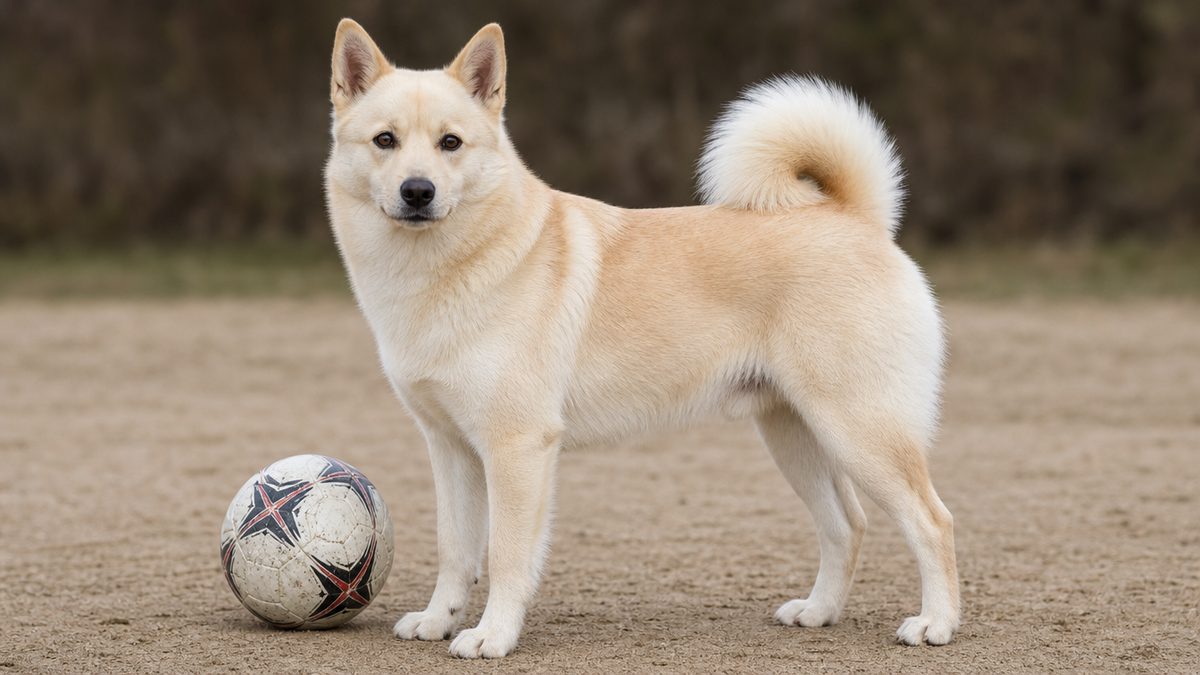
The Danish Spitz, or Dansk Spids, is a medium white-to-biscuit spitz from Denmark, rebuilt from near-extinction by the Dansk Kennel Klub from 1988 and carrying a DKK breed standard rather than an international one. Males stand 43-49 cm at the withers with an ideal of 46 cm, females 39-46 cm with an ideal of 41 cm, and the DKK gives a weight of 10-18 kg.
The breed's job description is unusually specific and it survives in the standard. DKK lists its utilisation as farm dog, guard dog and family dog, describes the temperament as "Lively, friendly, curious, and brave", calls it "An excellent guard dog", and then adds a line most spitz standards do not carry: "Must not show a strong hunting instinct";. A spitz bred deliberately away from hunting drive is a different animal from a Shiba Inu or a Finnish Spitz, and it is the reason the Danish literature calls it a stay-at-home dog.
Denmark's own registry expands on that. The DKK breed entry says the breed has functioned to this day as a combination of farm dog, watchdog and companion, that its hunting urge is very restrained, and that it is not inclined to roam on its own, keeping close to its area and its family. The Nordic Kennel Union repeats the point in English, saying its inclination to hunt is very contained and it is unlikely to stray.
Appearance, in the standard's own words
The head is wedge-shaped seen from above and in profile, of middle size, with a slightly rounded skull, well-marked superciliary arches and a clearly defined stop. The ears are pointed, rather big, triangular with a broad base, set high, supple and "always in movement". The eyes are dark brown, oval but reading rounder than almond, and must not protrude. The tail is set high and carried curled over the back or slightly to one side, and may hang when the dog is at ease.
The coat is the part that matters in India. The standard calls it moderate long, with a guard coat that is "a little rough" over a soft and thick underwool, longer beneath the ears, and it requires that the guard coat lies flat and "must not stick out from the body";. That is a true double coat with a dense insulating undercoat, which is the single fact that governs every heat, grooming and cost decision later on this page.
Colour is narrow, and pure white is a fault
Correct colour runs from off-white to biscuit and may look like a delicate pink, and the standard states it "must never give a light brown impression";. Two of the listed faults are the coat being light brown and the coat being pure white. A third fault is a "Samoyed expression". Those three faults together are a reconstruction committee drawing a boundary in public, and they are useful to an Indian buyer as a verification test, because the pure-white fluffy dog most Indian sellers picture when they hear "spitz" is precisely what this standard marks down.
The standard disqualifies aggressive or overly shy dogs, any dog clearly showing physical or behavioural abnormalities, and an overshot or undershot bite. The required bite is a well-developed scissor bite or a level bite on strong jaws.
History: a farm dog that nearly disappeared and was rebuilt
The breed existed in Denmark for generations without a name of its own, living under the labels samojedespids, ulvespids and groenlaenderspids, which translate as Samoyed spitz, wolf spitz and Greenland spitz. It was mostly a farm dog in Jutland and a townspeople's dog in the cities, and it was widely known as boernenes hund, the children's dog. Its high point was the 1930s, after which numbers fell far enough that the breed nearly went extinct.
In 1988 the Dansk Kennel Klub took the initiative to gather and muster as many surviving specimens as it could find, which produced a preliminary registration and a standard written from the dogs that passed assessment for breeding. The DKK's own English standard tells the same story in one sentence, saying that in 1988 the Danish Kennel Club together with well-known dog people began an investigation into whether a breeding programme was possible at all. The current standard was published by DKK in September 2022 and replaces the DKK standard of November 2013.
That word, reconstruction, is not decoration. DKK calls the Danish Spitz a rekonstruktionsrace, a reconstruction breed, and it is the reason the paperwork works the way the next section describes.
Danish Wikipedia places the breed in context, describing it as one of the country's few original breeds, "fem i alt (seks, hvis Groenlaenderhunden medregnes)", five in all, or six if the Greenland Dog is counted, and giving Gammel Dansk Spids, Old Danish Spitz, as an alternative correct name. In DKK's operational registry the breed carries the number 5110, its home country is listed as Denmark, its specialist club as Selskabet For Dansk Spids, and its only registered colour code is BI for Bisquit.
Recognition: nationally and Nordically recognised, not FCI recognised
The Danish Spitz holds full national recognition from the Dansk Kennel Klub and regional recognition from the Nordic Kennel Union, and it is not recognised by the FCI, not even provisionally. We established each of those three separately from the register itself rather than from any secondary summary.
Recognition claims about rare breeds are wrong often enough that the only acceptable method is to open the registers. Here is what each one says.
| Body | Status | What the register itself shows |
|---|---|---|
| Dansk Kennel Klub | Recognised nationally | Its own breed entry, its own standard published September 2022, and its own X-register |
| Nordic Kennel Union | Recognised | NKU Group 5, with the note that the breed is NKU-recognised but not FCI-recognised |
| FCI, definitive nomenclature | Absent | Letter D lists 25 breeds and runs Dandie Dinmont Terrier straight into Dansk-Svensk Gaardshund |
| FCI, provisional register | Absent | 20 breeds listed, the four newest dated 11 February 2026, none of them Danish |
| FCI, Group 5 Section 4 European Spitz | Absent | Two entries only, Germany's Deutscher Spitz 97 and Italy's Volpino Italiano 195 |
| Kennel Club of India | No route | KCI pedigrees are issued against FCI nomenclature, and this breed is not on it |
How we checked the FCI, and why the checks were done three ways
The FCI indexes its nomenclature by native name, so a Danish breed appears under its Danish spelling. Under D the register lists Dachshund, Dalmatinski Pas, Dandie Dinmont Terrier, Dansk-Svensk Gaardshund, Deerhound and onward through Deutscher Spitz and Dunker. Alphabetically, Dansk Spids would sit between Dandie Dinmont Terrier and Dansk-Svensk Gaardshund. It is not there, and the English form Danish Spitz would file under the same letter.
The provisional register was checked separately, because a breed can be provisionally accepted without appearing on the definitive list. The genuine provisional page carries 20 breeds, and its four most recent entries, the Macedonian Shepherd Dog Karaman at 378, the Sabueso Fino Colombiano at 376, the Segugio dell'Appennino at 375 and the Tatransky Duric at 377, all date from 11 February 2026. That confirms the copy we read was current rather than cached, which matters, since a stale provisional list is the easiest way to report a breed as unrecognised after it has been admitted. No Danish breed appears on it.
Finally we read the whole of Group 5, Spitz and primitive types, where a European spitz would have to live. Section 4, European Spitz, contains exactly two entries: Germany's Deutscher Spitz at standard 97 with its Keeshond, Giant, Medium, Miniature and Pomeranian varieties, and Italy's Volpino Italiano at 195. Denmark appears nowhere in Group 5 at all.
What the DKK says about its own breed
DKK states the position plainly and in two places. Its breed entry's international-name field reads "Racen er endnu ikke internationalt anerkendt", the breed is not yet internationally recognised, and its breeding-rules panel reads "Racen er ikke anerkendt af FCI og kan ikke benyttes til FCI-anerkendt avl. Afkom stambogsfoeres i DKK's X-register", meaning the breed is not recognised by FCI, cannot be used for FCI-recognised breeding, and its offspring are registered in DKK's X-register.
The standard itself carries the same statement on its own face rather than only in a covering note. Its header block reads "DANISH SPITZ (DANSK SPIDS), Country of origin: Denmark, Not officially recognized by the FCI", and its classification block reads "FCI Group 5 (Spitzes and breeds of primitive type), Section 6 (primitive breeds), Without working trial, Breed not officially recognized by the FCI". Note the internal oddity, which is genuine and worth flagging: DKK's website places the breed in Group 5 Spidshunde while its own standard document writes Section 6, primitive breeds. Neither placement has any FCI force, because the FCI has not classified this breed at all.
DKK's page listing which of its own standards it has translated into English names three breeds, the Old English Bulldog, the Dansk Spids and the Sort Spids, and closes with the line "De tre ovennaevnte racer er ikke godkendt af FCI", the three breeds named above are not approved by FCI.
The absence of an FCI number is therefore not an oversight in our reading; it is the settled position across three separate FCI documents and it is what the DKK itself publishes.
The X-register, the Nordic layer, and what national recognition buys you
National recognition means the Danish Spitz is a genuine, documented and governed breed with its own written standard and its own pedigree ledger, and it does not mean an international pedigree. The Nordic Kennel Union adds a regional layer on top, so the breed can be shown across four countries while remaining invisible to the FCI.
The Nordic Kennel Union layer, which most English pages miss
Regional recognition is real and it has practical effect. The Nordic Kennel Union lists the Dansk Spids among Denmark's national breeds in NKU Group 5 and states that "The breed is recognized by the Nordic Kennel Union, NKU, but not by the international kennel organization, FCI";. NKU covers Denmark, Finland, Norway and Sweden, so the breed can be exhibited across four countries despite having no FCI standing, which is why Danish and Nordic sources describe a show career for a dog the FCI has never heard of.
Recognition, then, is not a single yes or no. It is three answers: yes nationally, yes regionally, no internationally. Almost every English page on this breed collapses those into "not recognised", which is the least informative of the three.
The X-register is the mechanism, and it shows up in the statistics
DKK registers this breed in a separate ledger. The breed entry says the Danish Spitz is a reconstruction breed registered in DKK's X-register for Dansk Spids, and that only a Danish Spitz holding an X-register pedigree may be exhibited. That separation is visible in DKK's own published annual statistics, where the Dansk Spids row does not sit in the main breed table at all but in a distinct block headed X-registreringer, in every one of the eight annual PDFs we extracted from 2018 to 2025.
That is a useful thing for a buyer to understand, because it means the Danish registry itself keeps this breed's numbers in a different column from its FCI-pedigree breeds. The breed is inside the kennel club and outside the international system at the same time, and DKK's own statistics are laid out to show exactly that.
Breeding is gated by the specialist club, not by the show ring
The governance is stricter than most FCI-recognised breeds face. DKK states that offspring can only be registered if the dog was breeding-approved before mating at a moenstring held by Selskabet for Dansk Spids, that a Danish Spitz cannot be breeding-approved by a show award, and that all matings must be approved in writing in advance by that club. Dogs without a pedigree can be presented to the specialist club and can obtain registration that way, which is how a reconstruction breed keeps widening its founder base.
Selskabet for Dansk Spids describes itself as a specialist club under the Dansk Kennel Klub working to promote knowledge of the Danish Spitz and to preserve a breed with ancestry far back, and it publishes the moenstring and show dates as well as its own puppy list.
Because a Kennel Club of India pedigree is issued against FCI nomenclature and the Danish Spitz is not on that nomenclature, no lawful KCI pedigree for this breed can exist. The only genuine paperwork in the world for this dog is a DKK X-register pedigree issued in Denmark. Anyone in India showing you registration papers for a Danish Spitz is showing you papers for a different breed.
English Wikipedia dates the opening of the DKK route to 1 January 2013, saying that from that date it became possible to register dogs of the breed with DKK, and that the breed is still not recognised by FCI while being rebuilt and registered to the X-register. We could not confirm that specific date in any DKK document, so treat 2013 as Wikipedia's claim rather than the registry's. What DKK does date, in its own words, is the 1988 initiative that started the reconstruction.
How many Danish Spitz there actually are
Denmark registered 51 Danish Spitz in 2025, made up of 50 puppies born and one import, and 478 in total across the eight years from 2018 to 2025. Those are the Dansk Kennel Klub's own published figures, and they replace the word "rare" with a number a reader can check.
DKK publishes a breed-by-breed registration PDF every January covering puppies stambogsfoert in Denmark that year plus dogs imported and transferred in. We downloaded eight of those PDFs and extracted the tables ourselves rather than relying on a summary, then checked every year's rows against the grand total the document prints at its own foot. All eight reconciled exactly, so no rows were dropped in extraction.
| Year | Puppies | Imports | Total | All DKK registrations that year |
|---|---|---|---|---|
| 2018 | 28 | 2 | 30 | 20,687 |
| 2019 | 56 | 5 | 61 | 21,589 |
| 2020 | 68 | 5 | 73 | 23,742 |
| 2021 | 84 | 5 | 89 | 28,292 |
| 2022 | 62 | 2 | 64 | 22,481 |
| 2023 | 76 | 1 | 77 | 19,203 |
| 2024 | 33 | 0 | 33 | 19,280 |
| 2025 | 50 | 1 | 51 | 16,729 |
Read the shape rather than any single year. Registrations climbed from 30 in 2018 to 61 in 2019, rose again to 73 in 2020, reached a peak of 89 in 2021, dipped to 64 in 2022, recovered to 77 in 2023, fell to 33 in 2024 and part-recovered to 51 in 2025. The 2024 figure is a 63 percent fall from the 2021 peak and the lowest total in the series after 2018.
Danish registrations rose across the board into 2021, when DKK's own grand total hit 28,292, and have fallen every year since to 16,729 in 2025. So a breed falling after 2021 is partly riding a national curve. What is specific to the Danish Spitz is the depth of the 2024 trough, since the breed dropped 57 percent from 2023 to 2024 while DKK's overall total rose slightly.
Imports are almost nil, and that is the number an Indian buyer should look at
Across all eight years the breed recorded 21 imports into Denmark in total, and zero in 2024. This is a breed that barely crosses its own national border in the direction of the country that owns it, let alone in the direction of a country 6,000 km away with no registry route for it. Any claim of an Indian Danish Spitz has to survive that arithmetic first.
Where these numbers sit inside DKK's own accounts
In every one of the eight years, the Dansk Spids row appears not in the main breed table but in a separate block headed X-registreringer at the end of the document Dansk Kennel Klub. In the 2025 PDF that block holds 27 breeds totalling 211 puppies and 42 imports, so the Danish Spitz's 51 registrations were roughly a fifth of everything DKK X-registered that year. Against DKK's whole 2025 output of 16,729 dogs, the breed is 0.30 percent.
For scale in the same document, Labrador Retriever registrations in 2025 were 2,068 puppies plus 60 imports, giving 2,128. Denmark registers roughly 42 Labradors for every Danish Spitz.
How this changes the honest description
"Rare" is doing very little work as a description, and pages that stop there leave the reader with no way to reason. A breed producing between 33 and 89 puppies a year in one country, with a written mating-approval regime and near-zero import traffic, is not a small market. It is a conservation programme with a show entry attached. The right question for an Indian reader is not what one costs, it is whether a lawful specimen could exist here at all, and the previous sections answer that.
Go to DKK's Aarlige registreringstal page, open any year's Racestatistik PDF, and scroll past the main alphabetical breed table to the X-registreringer block near the end. Dansk Spids sits there. Each PDF prints its own grand total on the last line, so you can verify the extraction the same way we did.
Danish Spitz price in India: there is no price, and that is the finding
No verified Danish Spitz price exists in India, because no verified Danish Spitz is sold here. Every rupee figure returned by an India-located search for this breed on 27 August 2026 belonged to the Indian Spitz, the German Spitz or a generic dog-price listicle, so Bonbeno publishes no price band for the Danish Spitz rather than inventing one.
This is a supply question before it is a price question, and the supply side has three independent locks on it.
- Register: the breed is absent from FCI definitive and provisional nomenclature, so no Kennel Club of India pedigree can be issued for it.
- Population: Denmark registered 478 Danish Spitz in total over the eight years 2018 to 2025, imports included, which is fewer dogs than a single popular Indian breed registers in one Indian city in a month.
- Law: DGFT Trade Notice 22/2022-23 states that applications for trading or breeding purposes shall be duly rejected, so a commercial import route does not exist.
- Governance: every Danish Spitz mating must be approved in advance and in writing by Selskabet for Dansk Spids, and breeding approval comes only from a club moenstring, never from a show award.
Any one of those would make an Indian market thin. Together they make one impossible. A breed cannot form a supply chain in India when it has no registry route in, no lawful commercial import, and a home club that must countersign every litter at source.
What the rupee figures on the first page are actually attached to
We ran the India-located search and read the results rather than the counts. The query "danish spitz price in india" returned Indian Spitz price pages quoting ranges from about Rs 3,000 to Rs 30,000, a listing site quoting Rs 25,000 to over Rs 1,20,000 for the Indian Spitz, a Supertails guide putting the Indian Spitz between Rs 6,000 and Rs 15,000, and a German Spitz page quoting Rs 5,000 to Rs 40,000. Not one figure on the page belonged to the Danish Spitz.
Because an absence is a strong claim, we ran the control in the same session. "labrador retriever price in india" returned abundant genuine Indian results, including a listing site with a city-by-city table quoting INR 30,000 to INR 1,20,000 across Hyderabad, Bangalore, Delhi, Chennai, Lucknow, Mumbai, Jaipur and Pune, plus several independent 2026 price guides. The instrument was working. The Danish Spitz absence is real and not an artefact of a blocked or rewritten query.
Treat it as a claim about a different dog until the seller produces a pedigree naming the issuing registry. There is no FCI standard number to check against, so the only genuine paperwork in existence is a DKK X-register pedigree issued in Denmark, and that is not something an Indian pet shop holds. Bonbeno reports published price ranges as editorial content, does not broker sales, and links no listing.
The name is doing the selling, not the breed
Four unrelated breeds carry the word spitz into Indian search results, and only one of them is genuinely available here. The Indian Spitz was among India's most popular dogs through the 1980s and 1990s and remains cheap and common. The Pomeranian is what most Indian sellers mean by "spitz". The Japanese Spitz is the premium white one. The Danish Spitz is the one nobody has.
That collision is why this page exists. An Indian buyer typing the breed name is not usually shopping for a Danish farm dog; they have seen a white fluffy dog, been told it is a spitz, and are trying to work out which one. The answer is almost never this one.
Cost of keeping a Danish Spitz in India, honestly bounded
Budget for a 10-18 kg double-coated dog rather than for this breed specifically, because no Indian cost data for the Danish Spitz exists and none can, given that no verified individual lives here. The cost structure that does transfer is the one driven by coat and by heat, and both push spending upward in Indian cities.
Bonbeno will not publish an invented rupee table for a breed with no Indian population. What we can do is name the cost lines that a double-coated 10-18 kg northern dog imposes in an Indian climate, and say which of them are larger here than in Denmark. Use your own city's vet and grooming rates against this structure.
| Cost line | Why it moves in India | Direction |
|---|---|---|
| Grooming | Twice-yearly moult plus year-round humidity means more frequent professional de-shedding than the Danish once-a-week brushing assumes | Higher |
| Ear care | Indian otitis case series peak in the rains, and 25 of 81 cases in one Himachal series were erect-eared breeds | Higher |
| Cooling | Air conditioning or at minimum reliable fans through the hot months, which the origin climate never requires | Much higher |
| Skin and coat veterinary work | Warm humid conditions favour secondary bacterial and fungal overgrowth, which was present in all 81 otitis cases in that series | Higher |
| Parasite prevention | Tick and flea pressure runs year-round across most of India rather than seasonally | Higher |
| Feeding | Roughly in line with any 10-18 kg dog, and not breed-specific | Neutral |
| Purchase | No verifiable Indian price exists | Not publishable |
The cooling line is the one people underbudget
A dog carrying a soft thick underwool designed for Danish winters does not shed that insulation because it moved. The DKK describes a coat that "beskytter godt i al slags vejr", protects well in all kinds of weather, which in Denmark is a feature. In Chennai or Kolkata it is a permanent thermal load the dog cannot remove, and the mitigation is environmental rather than veterinary. Budget cooling as a fixed monthly cost across at least eight months of the year in most Indian metros, not as an occasional expense.
The screening line, if you were ever to breed one
DKK's breeding recommendations for this breed, introduced 1 July 2025 and applying to dogs born after 1 January 2022, ask for three joint results on both parents before a litter qualifies for a Basis+ pedigree: hip status A, B or C, elbow status 0 or 1, and patella luxation status 0 or 1, each registered with DKK, examined no earlier than 12 months of age and once only. Two of those three are not required anywhere in Indian law, so an Indian owner arranging them is paying for them as an elective, at Indian orthopaedic radiography rates, with no local registry that will record the result.
Several Indian sites publish confident rupee bands for breeds that have never been sold here, typically by converting a foreign figure. Bonbeno publishes no Danish Spitz price and no Danish Spitz monthly cost, because we could not verify a single one. Where no reliable figure exists, saying so is the honest answer.
Heat and humidity: what the numbers actually say
The Danish Spitz is poorly matched to almost every Indian city, and wet-bulb temperature is the measurement that shows it. Chennai's coolest month is wetter-bulb than Copenhagen's hottest month by 5.8 degrees Celsius, so the coldest week an Indian coastal dog experiences is still more thermally demanding than anything the breed's home climate produces.
We queried NASA POWER's climatology by explicit latitude and longitude rather than by place name, because a named-place climate service can silently return another city's document and a heat rating is the most original argument a breed page makes. Copenhagen was queried at 55.676 N, 12.568 E and Aarhus, in the Jutland countryside where this breed actually lived, at 56.163 N, 10.204 E.
| Place | Annual mean air temp (C) | Hottest month wet bulb (C) | Annual mean relative humidity (%) |
|---|---|---|---|
| Copenhagen (origin) | 9.0 | 16.0 (Jul and Aug) | 85.8 |
| Aarhus, Jutland (origin) | 8.5 | 15.2 (Jul) | 87.6 |
| Kolkata | 25.8 | 27.9 (Jun) | 73.9 |
| Delhi | 25.6 | 27.7 (Jul) | 45.6 |
| Chennai | 27.9 | 27.4 (May) | 72.4 |
| Mumbai | 26.8 | 26.6 (Jun) | 67.4 |
| Pune | 23.9 | 23.6 (Jun) | 66.8 |
| Bengaluru | 23.7 | 22.7 (May) | 67.9 |
Relative humidity is the wrong instrument, and Indian breed pages keep reaching for it
Copenhagen's annual mean relative humidity is 85.8 percent. Chennai's is 72.4 percent, Bengaluru's 67.9 percent and Mumbai's 67.4 percent. On relative humidity alone, the Danish Spitz comes from a wetter place than any Indian metro on this list, so the familiar line that a double coat cannot handle Indian humidity is measuring the wrong thing. This coat evolved in humidity. What it has never encountered is warm humidity.
Wet bulb separates them because it folds temperature and moisture into the single number that governs evaporative cooling. Copenhagen peaks at 16.0 C wet bulb in July and August. Kolkata peaks at 27.9 C, an 11.9 C gap. Even Bengaluru, the mildest large city here, peaks at 22.7 C, which is 6.7 C above the worst month the breed's homeland produces. There is no Indian metro on this list whose hottest month sits anywhere near Copenhagen's.
Chennai's coolest month for wet bulb is January at 21.8 C. Copenhagen's hottest is July and August at 16.0 C. A Danish Spitz in Chennai in January, the mildest week of its year, is already 5.8 C wetter-bulb above anything its ancestors met in a Danish August.
City by city, where the differences are real
Delhi and Bengaluru split in an instructive way. Delhi records the highest maximum air temperature in this set at 48.8 C, yet its annual mean relative humidity is only 45.6 percent, so its dry pre-monsoon heat is survivable with shade and water in a way its July wet bulb of 27.7 C is not. Bengaluru at 841 m has the lowest wet-bulb peak of any Indian city here at 22.7 C, which makes it the least bad Indian posting for this breed, not a good one.
Coastal cities are the hardest. Chennai, Mumbai and Kolkata combine high wet bulb with long seasons of it, and Chennai's wet bulb stays above 24 C for eight months of the year. A dog that cannot shed its undercoat has no behavioural escape from that.
NASA POWER works on a coarse grid, and its cell for Shimla returns an elevation of 897 m against the town's real elevation of roughly 2,200 m. That means POWER smooths hill stations and understates how cool they are. We therefore make no claim here about whether an Indian hill station would suit this breed. The grid is reliable for the plains and coastal cities above and unreliable for the hills, and pretending otherwise would be the same error we spent this section avoiding.
One practical consequence follows for anyone who ends up with a northern double-coated dog in India. Exercise in the coolest hour available, keep the dog indoors through the afternoon, and treat collapse, disorientation, pale gums or laboured breathing after activity as an emergency rather than something to watch, which is what the medical disclaimer on this page says and what the heat-illness evidence in the health section supports.
Temperament and household fit
The Danish Spitz is a friendly, watchful, close-ranging family dog that barks, and it suits a household that wants an alert companion rather than a silent one. DKK describes it as kind, tolerant and sociable with known people and animals, loving and devoted inside the family, and somewhat reserved, watchful and rather barky towards strangers.
Two registries describe the same dog in almost the same words, which is unusual and worth taking seriously. DKK writes that it is "venlig, tolerant og omgaengelig" towards known people and animals and "en smule reserveret, vagtsom og noget goeende", a little reserved, watchful and somewhat barking, towards strangers, and calls it an undemanding dog that settles well as a valued companion. The Nordic Kennel Union's English text repeats it: kind, tolerant, sociable, vigilant and somewhat prone to barking, a bit reserved towards strangers, unpretentious.
The standard's own summary is four words, "Lively, friendly, curious, and brave", followed by "An excellent guard dog" and the instruction that it must not show a strong hunting instinct.
The barking is the part Indian buyers should weigh hardest
Barking is not an incidental trait here, it is in the breed description at two registries, and it is the trait most likely to end a tenancy in an Indian apartment block. A watchful spitz in a building with a shared corridor, a lift, delivery riders and a security desk has a stimulus arriving every few minutes. The Danish description of a dog that stays near its territory and family is written about a Jutland farmyard, where the same alertness is useful and the nearest neighbour is a field away.
What the only Danish behavioural study says, and what it does not
One peer-reviewed study touches this breed's behaviour, and it does so at group level rather than breed level. Rugbjerg and colleagues surveyed 4,359 Danish Kennel Club member dog owners and found that, compared with Labrador Retrievers, spitz dogs as a group had higher odds of interdog dominance aggression, and that spitz dogs were also among the groups with higher odds of shooting phobia.
The study reports a grouped category of spitz dogs, not the Danish Spitz. It does not tell you that this breed is dog-aggressive. It tells you that among Danish pedigree owners, the spitz group reported more interdog dominance aggression than Labrador owners did. Treat it as a reason to socialise deliberately, not as a breed diagnosis. Bonbeno does not transfer a group result onto an individual breed and call it evidence.
The same study found several context effects that matter more to an Indian owner than the breed grouping does. Dogs owned by younger owners had higher odds of interdog dominance aggression, so did dogs living in the Copenhagen capital area compared with the rest of Denmark, and so did dogs whose owners had limited knowledge of the breed before acquiring it. Dogs attending obedience classes had reduced odds of shooting phobia. Dense-city living and buying a breed you have not researched are both risk factors, and both describe a large share of Indian first-time buyers.
Who this breed genuinely suits
- Households wanting a medium alert dog that stays close and does not roam, which is the breed's documented working profile.
- Families with children, given the breed's Danish nickname of boernenes hund and the DKK line calling it an always-willing playmate for children.
- Owners who can absorb a barky watchdog without a neighbour complaint ending the arrangement.
- Owners in a cool posting rather than a coastal Indian metro, on the wet-bulb evidence above.
Who should not buy one
Anyone in a shared-wall Indian apartment who needs a quiet dog should not, and anyone in Chennai, Mumbai or Kolkata should weigh the climate section before the temperament section. Anyone wanting a dog that can be left alone for long working days should also look elsewhere, because DKK notes the breed thrives on close social contact with people and only learns to be alone with training.
Training a Danish Spitz
Train early, kindly and with variety, because DKK reports that learning rarely causes problems in this breed when it starts early and is carried out with friendly, positive methods. The breed is described as quick-witted and happy to solve tasks, which makes it suitable for many dog sports rather than a one-trick obedience dog.
The Danish guidance is unusually direct on method. DKK writes that "Indlaering volder sjaeldent problemer, hvis den paabegyndes tidligt og gennemfoeres med venlig og positiv traening", that learning seldom causes problems if begun early and carried out with friendly and positive training, and that with varied training the breed suits many forms of dog sport. The Nordic Kennel Union phrases it as upbringing rarely causing challenges as long as it is initiated early and with kind consequences.
What this breed resists
It resists repetition and it resists harshness, in the ordinary way of an intelligent spitz. Neither registry claims biddability of the retriever sort; both emphasise variety and task-solving. Plan short varied sessions rather than long drills, and expect a dog that will disengage from a task it has already solved.
It does not resist recall in the way many spitz breeds do, and that is a genuine difference. Both registries state the hunting drive is very restrained and the dog is not inclined to roam, keeping near its family and territory Nordic Kennel Union. A Finnish Spitz or a Shiba is bred to work at distance and independently; this one is not. That said, no Indian city street is a Danish farmyard, and Bonbeno would not advise off-lead work in traffic on the strength of a breed description.
Three training priorities specific to India
- Teach a quiet cue from week one, because barking at strangers is in the breed description at two registries and Indian apartment corridors supply strangers continuously.
- Socialise deliberately with other dogs, because the one Danish study covering spitz dogs as a group reported higher odds of interdog dominance aggression than Labradors, and because obedience-class attendance was protective in the same dataset.
- Condition handling of ears and coat from puppyhood, because in an Indian climate this dog needs both examined far more often than a Danish owner would bother with.
Train around the heat, not through it
Move training to the coolest hour of the day and keep sessions short. This is not generic advice for a double-coated dog in India, it is the direct implication of the largest primary-care study of canine heat-related illness, which found exertional heat illness the dominant trigger by a wide margin and found that those events occurred year-round rather than only in summer. A training session in the afternoon is exertion, and exertion is the trigger the data points at.
The Danish positive-training guidance is one of the few pieces of overseas breed-club advice on this page that transfers to India without amendment. It costs nothing, it does not assume a Danish climate, and it is what the breed's own registry recommends. The grooming advice from the same sources does not transfer, and the grooming section says why.
How much exercise a Danish Spitz actually needs
Plan for moderate daily exercise plus mental work rather than heavy mileage, because both DKK and the Nordic Kennel Union describe a dog that appreciates exercise and activity without being genuinely demanding. In India the binding constraint is not the dog's requirement but the hours in which meeting it is safe.
DKK's phrasing is worth quoting because it is the opposite of the exaggeration Indian breed pages usually apply to spitz dogs. It says the breed "saetter stor pris paa motion og beskaeftigelse, men er ikke egentlig kraevende", that it greatly appreciates exercise and occupation but is not really demanding. NKU renders the same line as enjoying exercise and meaningful activities without being particularly demanding. DKK rates the breed's activity level as Mellem, medium.
That is a medium-energy 10-18 kg farm and companion dog, not a working sled or hunting spitz. Compare it with a Siberian Husky, where under-exercising produces a destructive animal, and the difference in owner burden is large.
The Indian problem is the window, not the volume
Meeting a moderate requirement is easy in Denmark, where the hottest month averages 17.9 C in Copenhagen. It is hard in an Indian city, because the safe hours are early morning and late night and the dog still needs the same activity. Chennai's May air temperature averages 31.5 C with a wet bulb of 27.4 C, and Delhi's June averages 35.9 C. The realistic Indian schedule is a walk before sunrise, indoor enrichment through the day and a second walk well after dark.
What happens without it
An under-exercised watchful spitz barks more, not less. Because barking is already in this breed's registry description, boredom compounds the single trait most likely to cause an Indian tenancy problem. Enrichment that uses the nose and the problem-solving DKK describes, scattered feeding, search games and short varied training sets, buys more calm per minute indoors than a longer walk in unsafe heat would.
In the largest primary-care study of canine heat-related illness, 1,259 events were identified from 1,222 dogs among 905,543 UK dogs under primary veterinary care in 2016. Of those events, 380 had no trigger recorded. Of the 879 events that did have a recorded trigger, 652 were exertional, which is 74.2 percent, against 113 environmental at 12.9 percent and 46 from vehicular confinement at 5.2 percent. Exercise, not a parked car, is what puts most dogs in the clinic.
A practical Indian exercise plan
- Walk before sunrise, when both air temperature and wet bulb are at their daily minimum.
- Keep the midday hours indoors and cool, with mental work substituting for physical work.
- Walk again after dark, checking pavement surface temperature with your own hand before setting off.
- Carry water on every outing and offer it before the dog asks.
- Stop at the first sign of laboured breathing rather than at the end of the planned route.
Coat care in Indian humidity, where the Danish advice stops working
Brush thoroughly at least weekly and bathe far more often than the Nordic guidance says, because the Nordic bathing schedule is written for a Danish climate and does not transfer to an Indian one. The Danish Spitz carries a flat guard coat over a soft thick underwool that moults heavily twice a year, and in India it also sits in warm damp air the rest of the time.
Start with what the registries actually say. DKK describes a glossy, medium-length coat with soft thick undercoat that protects well in all weather, needing thorough regular brushing to limit shedding in the spring and autumn transition periods, and calls the coat largely self-cleaning and washable as needed. The Nordic Kennel Union is more specific and says it must be brushed thoroughly once a week, and that "A bath two to three times annually works wonders";.
This is the clearest case on this page of overseas breed-club guidance that does not transfer. A bathing interval of four to six months is reasonable for a dog living through a Danish year at an annual mean of 9.0 C. It is not reasonable for a dog living through an Indian summer and monsoon, where the same coat traps sweat-damp air, dust and organic debris against skin for months. Do not follow the Nordic bathing schedule in India, and do not treat that as contradicting the Danish club, which was writing for Denmark.
The ear evidence, and why bathing method matters more than bathing frequency
Indian veterinary case series find otitis externa clustering in the rains. A cross-sectional study at CSK Himachal Pradesh Krishi Vishvavidyalaya, Palampur, screened 2,476 dogs presented between June 2022 and July 2023 and diagnosed otitis externa in 81, a hospital prevalence of 3.27 percent. Season-wise the peak was the rainy season at 48 of 81 cases, 59.25 percent, against 15 in summer, 10 in winter and 8 in autumn. Those four counts sum to 81 and the percentages sum to essentially 100, so the seasonal table is internally consistent.
Two details from that series matter for a spitz. Erect-eared breeds accounted for 25 of the 81 cases, so pricked ears reduce risk without removing it, and the Pomeranian, the small double-coated spitz that is India's closest common analogue to this breed, was the third most affected breed with 10 cases. Excessive moisture was recorded as a predisposing factor in 17 cases and all 81 showed secondary bacterial or fungal overgrowth on cytology.
The protective effect of a pricked ear has been quantified in a much larger dataset. O'Neill and colleagues studied a random sample of 22,333 dogs drawn from 905,554 under UK primary veterinary care in 2016 and reported a one-year period prevalence of otitis externa of 7.30 percent, with a 95 percent confidence interval of 6.97 to 7.65. Breed and ear carriage were the two highest-ranked risk factors, and breeds with pendulous ear carriage carried 1.76 times the odds of breeds with erect ear carriage, with a 95 percent confidence interval of 1.48 to 2.10. A prick-eared spitz therefore starts from the better conformation, which is a reason to protect that advantage with drying and ear checks rather than to assume the problem does not apply.
The same study reports pendulous-eared breeds as "69.13%" of cases while giving the count as 53 of 81, and 53 divided by 81 is 65.4 percent, not 69.13 percent. Its erect-eared figure of 25 of 81 does compute correctly at 30.9 percent. The two categories also sum to 78 rather than 81. Bonbeno therefore quotes the counts from this paper and the seasonal table, which check out, and does not reuse the 69.13 percent figure, which does not.
What to actually do with this coat in India
- Brush thoroughly to the skin at least weekly, and daily through the two moults, using a slicker followed by an undercoat rake.
- Bathe on need rather than on a Danish calendar, judging by odour, grease and debris rather than by months elapsed.
- Dry the dog completely to the skin after every bath and after every monsoon soaking, because a double coat that feels dry on the surface can stay damp underneath for hours.
- Plug or protect the ears before bathing and dry the ear canals afterwards, given how strongly Indian series link moisture and otitis.
- Check the ears weekly for odour, discharge and head-shaking, and act on the first sign rather than the third.
Never shave a double coat to cool the dog
Clipping the guard coat off a double-coated dog removes its shade layer and its insulation together, exposes skin unaccustomed to Indian sun, and can permanently change how the coat regrows. The standard describes a guard coat that lies flat and must not stand out from the body, over a soft thick underwool. Manage the undercoat by removing dead hair through brushing, which is what the Danish guidance means by limiting shedding, and leave the guard coat alone.
The hypoallergenic claim, settled
White fluffy breeds attract the hypoallergenic claim and this one is no exception. The evidence is settled and it points the other way. Vredegoor and colleagues measured the major dog allergen Can f 1 across 196 dogs of so-called hypoallergenic breeds against 160 control dogs and found the hypoallergenic group higher in both hair and coat samples, at geometric means of 2.26 against 0.77 micrograms per gram in hair and 27.04 against 12.98 in coat, with no difference in airborne allergen levels. The DKK standard makes no shedding claim for the Danish Spitz at all.
Health, screening and what no study has ever measured
No breed-specific health study, lifespan figure or disease-prevalence estimate exists for the Danish Spitz, so this page publishes none. What does exist is the DKK's own screening regime, one genetics paper covering eight dogs, and a documented absence in the veterinary literature that we verified rather than assumed.
Start with the honest position. We searched PubMed on 27 August 2026 and read the query-translation line rather than the result count, because that is where this particular trap hides. "Dansk Spids" returned 0 records, with the translation showing the phrase split into "Dansk"[All Fields] AND "Spids"[All Fields]. "Danish Spitz" returned 14, but its translation was also a loose conjunction rather than a phrase search, and we opened all 14.
| Category | Records | Example |
|---|---|---|
| Dermatology: Spitz naevi and Spitz-type nevus papers | 2 | T cell receptor expression in Spitz naevi and halo naevi, 1997 |
| Neurosurgery: the Spitz-Holter valve | 1 | Treatment of hydrocephalus with Spitz-Holter valve, 1959 |
| Danish human cohort and genetics papers | 8 | Chromosome X mosaicism; TERT-CLPTM1L cancer risk loci |
| Genuinely about Danish dogs | 2 | Pertoldi 2013 genetics; Rugbjerg 2003 behaviour |
| Breed-specific health, lifespan or screening studies | 0 | None exists |
Controls run in the same session confirmed the tool was working: "Labrador Retriever hip dysplasia" returned 126, "Norwegian Buhund" 7 and "Finnish Spitz" 15. So the zero is a real zero, not a broken query. There is no published lifespan for this breed and Bonbeno prints none.
The one genetics paper, and its surprising result
Pertoldi and colleagues genotyped five Danish breeds on the CanineHD BeadChip with 170,000 SNPs: Danish Spitz with just 8 dogs, Danish-Swedish Farm Dog with 18, Broholmer with 22, Old Danish Pointing Dog with 24 and Greenland Dog with 23. Both principal component analysis and Bayesian clustering separated the five breeds cleanly. Expected heterozygosity and degree of polymorphism ranked them Danish Spitz first, ahead of the Danish-Swedish Farmdog, the Broholmer, the Old Danish Pointing Dog and the Greenland Dog.
That is the opposite of what a reader expects from a breed rebuilt from a handful of survivors. The authors draw the wider lesson themselves, noting that the Greenland Dog had a tenfold higher census population than the others and yet the lowest within-breed genetic variation, which emphasises that census size is a poor predictor of genetic variation.
Eight dogs is a very small sample and the paper's own aim was characterisation rather than health surveillance. It says the Danish Spitz sample was genetically more variable than the other four Danish samples. It does not say the breed is healthy, and it measures no disease. Bonbeno reports it as a genetics result on eight dogs, which is exactly what it is.
The screening the breed's own registry now asks for
DKK introduced breeding recommendations for the Danish Spitz on 1 July 2025, applying to dogs born after 1 January 2022. To earn a Basis+ pedigree, both parents must before mating have hip dysplasia status A, B or C registered with DKK, elbow status 0 or 1, and patella luxation status 0 or 1. Each examination can be done no earlier than 12 months of age and is done once only. Parents born before 1 January 2022 cannot obtain breeding recommendations on their litters.
Three joints, then: hips, elbows and knees. Patella luxation screening on a spitz-type breed of this size is a sensible addition and its arrival in 2025 suggests the club saw a reason to add it, though DKK publishes no prevalence figure alongside the requirement and we found none.
Where Indian law lines up with that, and where it does not
It lines up on hips and nowhere else. Reading the 2017 Rules gazette end to end across all fourteen pages, "patella" appears zero times, "luxation" zero times, and the only dysplasia named anywhere is hip dysplasia, inside Second Schedule Part III paragraph 8(10). Elbow dysplasia is not named either. So two of the three joints the DKK asks for sit entirely outside Indian requirements.
It does not. Paragraph 8(10) requires that dogs "shall have been tested for genetic defects, including hip dysplasia, progressive retinal atrophy, night blindness, hypothyroidism, entropion, ectropion, overshot, undershot jaw (when incisors do not touch or mesh), wry mouth, two or more missing teeth, unilateral cryptorchid or full cryptorchid males". The word "including" makes that list illustrative rather than closed, so an unlisted defect is not automatically outside the clause. But no Indian rule names the patella, and a breeder who claims Indian law required their knee testing is mistaken.
The same gazette read confirms two further absences that are worth knowing because people assume otherwise: "BAER" appears zero times and "deaf" appears zero times across the whole document, so India has no hearing-test requirement for any breed.
Heat-related illness: what the evidence supports and what it cannot
Heat illness is the health risk that matters most for a double-coated northern breed in India, and the strongest available evidence never measured coat at all. That gap has to be stated rather than papered over, because the honest version is still a serious warning.
The reference study is Hall, Carter and O'Neill's analysis of the VetCompass primary-care dataset, the largest study worldwide to deconstruct heat-illness triggers in companion dogs. It reviewed de-identified records of 905,543 UK dogs under primary veterinary care in 2016 and identified 1,259 heat-related illness events from 1,222 dogs.
| Trigger | Events | Share of the 879 with a recorded trigger |
|---|---|---|
| Exertional | 652 | 74.2% |
| Environmental | 113 | 12.9% |
| Vehicular confinement | 46 | 5.2% |
| Under care of a vet clinic or groomer | 40 | 4.6% |
| Building confinement | 24 | 2.7% |
| No trigger recorded | 380 | excluded from the denominator |
The paper states it directly: there were 380 of 1,259 events, 30.2 percent, with no trigger recorded, and "Of the remaining 879 prevalent HRI events" exertional heat illness accounted for 652, which is 74.2 percent. Divide it yourself and it checks: 652 over 879 is 74.2 percent, 113 over 879 is 12.9 percent and 46 over 879 is 5.2 percent. Computed against 1,259 those same counts would give 51.8, 9.0 and 3.7 percent, which is not what the paper prints, so the 879 denominator is the correct one.
Exercise, not a parked car, is what sends most dogs to the clinic with heat illness. Vehicular confinement accounted for 46 events against 652 exertional ones. Exertional events also occurred year-round rather than only in the hottest months, with a 7.6 percent fatality rate.
The Danish Spitz was not in this study, and we will not pretend otherwise
The paper's breed analysis included only breed types with at least 5 heat-illness cases or at least 5,000 dogs in the overall study population. The Danish Spitz clears neither threshold in the UK, and the word "Spitz" does not appear anywhere in the paper. It is absent from the breed model entirely, so no odds ratio from this study belongs to it. Importing one onto this breed would be fabrication wearing a citation.
The coat gap, stated plainly
Hall 2020 contains no coat variable. The final exertional model retained four risk factors, which were breed type, age, bodyweight relative to breed and sex mean, and sex or neuter status. The word "coat" appears exactly once in the whole paper, and not as a variable: it sits inside the justification for the purebred category, which notes that purebred dogs are more likely to carry an exaggerated conformation such as brachycephaly, thick coat or giant body size.
Unquantified. Nobody has measured it in this dataset, because coat was never entered as a variable. It is entirely reasonable to expect a dense undercoat to impair heat loss, and the wet-bulb gap in the climate section is real and large. But there is a difference between a well-founded expectation and a measured effect size, and this page will not present the first as the second.
The nearest modelled comparator, labelled as what it is
The thick-coated breed the study did model is the Chow Chow, which came out with the highest odds of exertional heat illness of any breed in the final model at an odds ratio of 7.00 against the Labrador Retriever baseline, with a 95 percent confidence interval of 3.00 to 16.33. For environmental heat illness the Chow Chow's odds ratio was 8.41, but with a confidence interval running from 1.06 to 66.70, which is so wide that the estimate carries very little precision.
That is the Chow Chow's number, not this breed's, and the model contains no coat term that would let anyone transfer it. What it does show is that a heavily coated spitz-type breed sat at the top of the risk table in a large primary-care dataset, in a country whose hottest month is cooler than any Indian month on our climate table.
Feeding a Danish Spitz in India
Feed to body condition for a 10-18 kg moderately active dog and adjust downward in hot months, because no breed-specific feeding research exists for the Danish Spitz and none of the Indian availability problems are breed-specific either. DKK rates this breed's activity level as medium, which sets the energy baseline.
There is no published nutrient study, growth curve or feeding trial for this breed anywhere we could find, and this page will not invent gram figures to fill the gap. The two anchors that are real are the DKK weight range of 10-18 kg and the DKK activity rating of Mellem, medium. Everything else follows the ordinary rules for a medium dog.
Body condition beats a feeding chart, and here is why it matters more in India
Bodyweight relative to the breed and sex mean was one of only four risk factors retained in Hall 2020's final exertional heat-illness model. Bodyweight is therefore not a cosmetic question for a double-coated dog in an Indian climate; it is one of the small number of things an owner can actually change that the largest dataset on heat illness treats as relevant. Ribs should be easy to feel under the coat without pressing, and on this breed you have to use your hands rather than your eyes, because a thick guard coat over soft underwool hides body outline completely.
- Weigh the dog monthly on the same scale rather than judging by appearance through the coat.
- Score body condition by feel through the undercoat, checking ribs, waist and abdominal tuck.
- Reduce portions in the hot months, when activity drops but appetite often does not.
- Split the daily ration into two meals rather than one, and keep meals away from the hottest hours.
- Provide clean water continuously and refresh it more often in humid weather.
Life stages, in outline
A puppy of this size is fed a growth diet on a frequent schedule that tapers through the first year, an adult is fed to maintain condition, and a senior is fed to hold muscle while activity falls. DKK's requirement that joint screening be done no earlier than 12 months of age is a useful marker of when this breed is considered structurally mature enough to assess, which is a reasonable point to complete a transition to adult feeding.
What is actually available in India
Everything you need is available. A 10-18 kg medium dog is the single best-served size band in the Indian pet-food market, with medium-breed formulations from every major brand sold in every metro and online. Nothing about this breed requires an imported or specialist diet, and any Indian seller who tells you a Danish Spitz needs a special imported food is selling you something.
The 2017 Rules gazette contains no dental requirement, with "dental" and "tooth" appearing zero times across all fourteen pages. The only dentition hook anywhere in the Rules is inside paragraph 8(10)'s reference to "two or more missing teeth" as a genetic defect a breeding dog must have been tested for. Diet marketing that appeals to an Indian legal dental standard is appealing to something that does not exist.
Coat condition is where owners most often expect food to solve a problem it cannot. A double coat in Indian humidity needs mechanical management, meaning brushing, drying and ear care as set out in the grooming section, and no diet substitutes for that. Feed well, then groom properly.
The first year, month by month
Plan the first year around three fixed points: the eight-week legal floor on sale in India, the socialisation window that closes early, and the 12-month mark at which the breed's home registry allows joint screening. Everything else is ordinary puppy raising adapted to heat.
| Age | What happens | Why it is fixed or not |
|---|---|---|
| 0-8 weeks | Stays with the litter | Rule 8(1)(a) requires breeders ensure pups under eight weeks are not sold |
| 7-8 weeks | Vaccination can begin | Paragraph 8(10)'s neighbour, 8(9), notes vaccination can start at seven to eight weeks |
| 8-16 weeks | Core socialisation | The window closes early and does not reopen |
| Around 18 weeks | Primary vaccination course usually completed | Paragraph 8(9) puts usual completion at eighteen weeks |
| 4-8 months | Handling conditioning for coat and ears | Not fixed, but far easier now than later |
| Around 6 months | Sterilisation decision, discussed with your vet | Rule 8(1)(b) bars sale of an unsterilised dog over six months except to another licensed breeder |
| 9-12 months | First heavy moult typically arrives | Coat, not calendar; DKK describes spring and autumn transitions |
| 12 months | Earliest date for hip, elbow and patella screening | DKK: examination no earlier than 12 months, and done once only |
Months 0 to 2: the legal floor
Rule 8(1)(a) of the 2017 Rules requires every breeder to ensure that "pups less than eight weeks in age are not sold". Note that this one genuinely is a Rule in the main numbered Rules 1 to 13, unlike the Second Schedule paragraphs cited elsewhere on this page, and the distinction is worth keeping straight because the document numbers its clauses in two separate sequences. A seller offering a six-week puppy is breaking the law, and that fact tells you more about the operation than any pedigree they show you.
Months 2 to 4: socialisation, and the barking question
This is the window that decides whether you live with a watchful dog or a reactive one. Because both DKK and the Nordic Kennel Union describe a breed that is reserved with strangers and somewhat prone to barking Nordic Kennel Union, deliberate exposure to the ordinary traffic of an Indian building, meaning lifts, delivery riders, security staff, other dogs and street noise, is the highest-value work you will ever do with this dog. The Danish behavioural study found obedience-class attendance associated with reduced odds of shooting phobia, and found dogs of owners with limited prior breed knowledge at higher odds of interdog dominance aggression.
Months 4 to 8: build the handling habits the climate will demand
Condition ear handling and full-body brushing now, while the puppy coat is still light and the dog is small enough to manage. An adult double-coated dog that objects to having its ears examined is a genuine problem in a country where one Himachal case series found otitis externa peaking in the rains at 48 of 81 cases. Ten seconds of ear handling a day at four months costs nothing; retrofitting it at three years costs a lot.
Months 8 to 12: the coat arrives and the screening window opens
The adult double coat comes in and the first serious moult usually follows. DKK describes the shedding as concentrated in the spring and autumn transition periods and asks for thorough regular brushing to limit it, but an Indian year does not have Danish spring and autumn, so watch the dog rather than the calendar and increase brushing when the undercoat starts to loosen.
From 12 months the breed's home registry allows the joint examinations that feed its breeding recommendations, hip status A, B or C, elbow status 0 or 1 and patella luxation status 0 or 1, each done once. Even if you will never breed, a baseline joint assessment at a year is a reasonable thing to ask your vet about for a dog of this size.
Exertional heat illness accounted for 652 of the 879 heat-illness events with a recorded trigger in the largest primary-care study of the subject, and those events occurred year-round rather than only in summer. A growing puppy will overrun its own limits given the chance. Keep sessions short, keep them cool, and treat collapse, disorientation, pale gums or laboured breathing as an emergency.
Danish Spitz compared with the white spitz breeds Indian buyers actually see
Compare the Danish Spitz against the Indian Spitz, Japanese Spitz, Pomeranian and Samoyed on the four things that decide the outcome in India, which are availability, adult size, coat load and registry paperwork. On availability the Danish Spitz loses outright, because the other four are sold in Indian cities every week and it is not.
Four cream-to-white spitz breeds dominate Indian searches, and a buyer who types "danish spitz" is almost always shown one of the other three. The Indian Spitz is the default substitute, the Japanese Spitz is the premium substitute, and the Pomeranian is what most Indian sellers mean when they write "spitz" on a listing. Telling them apart on paper is easy. Telling them apart in a photograph on a classifieds app is not.
| Breed | Adult height | Registry status relevant to India | Sold in India | Coat load in humidity |
|---|---|---|---|---|
| Danish Spitz | Males 43-49 cm, females 39-46 cm | DKK national standard, NKU recognised, not FCI recognised | No verified listings found | Double coat, twice-yearly heavy moult |
| Indian Spitz | Roughly 25-45 cm depending on type | No FCI standard, bred in India for decades | Yes, widely and cheaply | Double coat, but acclimatised over generations |
| Japanese Spitz | Males 30-38 cm, females slightly smaller | FCI standard 262, definitive since 1987 | Yes, at a premium | Double coat, white, shows dirt fast |
| Pomeranian | Under 25 cm typically | FCI standard 97 as a German Spitz variety | Yes, the most common of all | Dense double coat on a tiny body |
| Samoyed | Males 54-60 cm, females 50-56 cm | FCI standard 212, definitive | Yes, uncommon and expensive | The heaviest coat of the five |
The Japanese Spitz and the Pomeranian sit on the FCI definitive nomenclature, at numbers 262 and 97, and the Samoyed at 212, all three inside Group 5. The Danish Spitz sits on none of them. That single difference decides everything downstream in India, because a Kennel Club of India pedigree is issued against FCI nomenclature, so the other three can be registered here and this one cannot.
The Samoyed confusion is written into the breed standard
The Danish Spitz standard actively penalises looking like a Samoyed. Its list of faults includes "Samoyed expression", alongside "the coat light brown or pure white" and ears that are not pointed. That is unusual and it tells you something useful. The breed spent generations being called samojedespids, ulvespids and groenlaenderspids, which translate as Samoyed spitz, wolf spitz and Greenland spitz, and the DKK reconstruction had to draw a line between it and the actual Samoyed Dansk Kennel Klub.
So a pure white dog is faulted, not rewarded. The correct colour runs from off-white to biscuit and may read as a delicate pink, and it must never give a light brown impression. Any Indian seller offering you a brilliant white "Danish Spitz" is describing a dog the standard would mark down, which is a fast and cheap way to test a claim.
Size sits between the two breeds it is confused with
The Danish Spitz is a medium dog, not a lap dog. At 43-49 cm for males it stands roughly 10 cm taller than a Japanese Spitz and roughly double the height of a Pomeranian, and the DKK breed entry gives a weight of 10-18 kg. That matters in an Indian flat, because the three breeds are marketed interchangeably and only one of them is a genuine medium dog needing genuine daily exercise.
The DKK breed entry gives 10-18 kg. The Nordic Kennel Union's page for the same breed gives 12-18 kg, and English Wikipedia's infobox repeats 12-18 kg. Bonbeno publishes both rather than averaging them. The 2 kg gap at the bottom of the range is not trivial on a dog this size, and no document we opened explains where it comes from.
On the heights the disagreement runs the other way, and here the primary document wins. DKK's own standard gives males 43-49 cm with an ideal of 46 cm and females 39-46 cm with an ideal of 41 cm. English Wikipedia's infobox prints "minimum 17-19in (43-48cm)" for males and "minimum 15-18in (38-46cm)" for females. Those upper bounds of 48 cm and the lower bound of 38 cm appear in no DKK document we could find, and the word "minimum" attached to a range is not how the standard is written. Use the standard.
What Indian buyers get wrong about the Danish Spitz
The commonest mistake is buying one at all, because almost every dog sold in India under this name is a different breed. The second commonest is treating a Danish import as a paperwork problem when it is a legal one.
Mistake 1: assuming the dog in the listing is the breed in the title
Searching "danish spitz price in india" returns no Danish Spitz. Every result on the first page of an India-located search on 27 August 2026 was about the Indian Spitz, the German Spitz or a general dog-price listicle, with prices quoted from Rs 3,000 to Rs 1,20,000 for those breeds and none for this one. We ran the control the same session: "labrador retriever price in india" returned page after page of genuine Indian listings with city-by-city price tables, so the search instrument was working. The absence is real.
The word doing the damage is "spitz". Four unrelated breeds carry it in India, and a seller writing "spitz puppy" almost always means an Indian Spitz or a Pomeranian. Ask for the pedigree number and the issuing registry before you ask for the price.
Mistake 2: reading an empty page as a market
An Indian pet-ecommerce site currently ranks on page one in India for this breed with a page that contains no breed content. Its title and social description carry a paragraph about the breed's history as a farm companion, and its rendered body is a product search that returns "No Results found";. A ranking page is not a supply chain. We checked one control path on the same site and it returned a 404, so this is not a template generated for every breed, but the effect on a buyer is identical: a page that looks like a shop and sells nothing.
The thinness is not confined to shops. The second-ranking result in India is an aggregator entry carrying four headings in total, Appearance, Origin, Temperament and Keeping conditions, with no price, no population figure, no registry citation and nothing about climate. Verify any claim you read about this breed against the DKK's own documents, because most of what ranks is a paraphrase of a paraphrase.
Mistake 3: planning an import without reading the import rules
Importing a Danish Spitz to breed or sell it is prohibited, not merely difficult. Dogs sit under ITC(HS) 01061900 as a Restricted import, and DGFT Trade Notice 22/2022-23 records Policy Condition (7), which allows import of dogs only for a pet dog with a valid pet book and records in the importer's name, for research organisations holding a CPCSEA recommendation, or for internal security by the Defence and Police Force. Paragraph 6 of the same notice states that "any applications for trading/breeding purposes, or applications made on behalf of some another person/entity shall be duly rejected";.
The personal-pet route is narrower than most Indian readers expect. Up to two pets may come in as passenger baggage without a DGFT authorisation only where the owner is transferring residence to India after two years of continuous stay abroad, and a DGFT authorisation becomes necessary if the stay was shorter, if the animal does not travel as passenger baggage, or if there are more than two animals. Nobody acquires a Danish Spitz in India by ordering one.
Mistake 4: assuming Indian law covers the screening the breed's own registry asks for
It does not, and the gap is specific. From 1 July 2025 the DKK asks for a patella luxation status of 0 or 1 on both parents of a Danish Spitz litter, alongside hip status A, B or C and elbow status 0 or 1, for dogs born after 1 January 2022. Reading the 2017 Rules gazette end to end, the words "patella" and "luxation" each appear zero times across all fourteen pages, and the only dysplasia named anywhere is hip dysplasia.
The clause that does exist is Second Schedule Part III paragraph 8(10), which reads that "The dogs shall have been tested for genetic defects, including hip dysplasia, progressive retinal atrophy, night blindness, hypothyroidism, entropion, ectropion, overshot, undershot jaw (when incisors do not touch or mesh), wry mouth, two or more missing teeth, unilateral cryptorchid or full cryptorchid males";. The word is "including", so the list is illustrative rather than closed, and a breeder cannot argue a defect is outside the clause merely because it is unnamed. But an Indian breeder complying with Indian law alone would still not run the one joint test this breed's home registry has newly added.
The genetic-defect clause is Second Schedule Part III paragraph 8(10), not "Rule 8(10)". The eight-week sale minimum genuinely is a Rule, Rule 8(1)(a), which reads that breeders shall ensure "pups less than eight weeks in age are not sold". The Rules number their clauses twice, so a citation that does not say which sequence it belongs to sends the reader to the wrong page.
Mistake 5: buying the hypoallergenic story
No dog is hypoallergenic, and a thick-coated white spitz attracts the claim more than most. Vredegoor and colleagues measured Can f 1 across 196 dogs of so-called hypoallergenic breeds against 160 control dogs and found the hypoallergenic group higher, not lower, at 2.26 against 0.77 micrograms per gram of hair and 27.04 against 12.98 in coat samples, with no difference in airborne allergen. The authors conclude that there is no evidence for classifying certain dog breeds as hypoallergenic. The DKK standard for the Danish Spitz says nothing about shedding being reduced. It says the opposite in effect, describing a soft thick underwool that moults in spring and autumn.
Adopting instead: what is actually available in India
Adopt an Indian Spitz or an Indian pariah dog rather than waiting for a Danish Spitz, because no Danish Spitz enters Indian rescue and the traits that attract buyers to this breed are available locally in dogs already suited to the climate. Shelters in every metro hold spitz-type dogs continuously.
The Danish Spitz does not appear in Indian rescue for a simple arithmetic reason. Denmark registered 478 of them in total across the eight years from 2018 to 2025, and 21 of those were imports into Denmark rather than exports out of it. A population that small, managed under a written mating-approval regime, does not leak animals into a rescue system 6,000 km away. Adoption of this specific breed is therefore not an option in India, and treating adoption as a route to it would waste months.
What to adopt instead, and why it is the better dog here
The Indian Spitz gives you the same silhouette, the same watchful temperament and a coat that generations of Indian summers have already filtered. It appears in Indian shelters and in owner-surrender listings constantly, and it costs nothing to adopt. If you want the Danish Spitz's specific job description, a medium alert farm and family dog that stays close to home and does not roam, the Indian pariah dog does it natively and is the single most heat-adapted dog available to you.
- Contact your city's registered shelters directly rather than a classifieds app, because a shelter can tell you a dog's medical history and a listing cannot.
- Ask for the intake date and the reason for surrender, which predicts the behaviour you will actually live with better than breed does.
- Request a written record of vaccination and deworming, and confirm the sterilisation status before you commit.
- Foster before adopting where the shelter allows it, because a two-week foster answers the apartment question that no breed page can.
- Budget for the first veterinary visit within 72 hours of taking the dog home, whatever the shelter's paperwork says.
If you still intend to buy a spitz-type dog in India
Verify the registry before the price, and verify the age before the registry. Rule 8(1)(a) of the 2017 Rules requires that breeders ensure "pups less than eight weeks in age are not sold", so a seller offering a six-week puppy is breaking the law and telling you what kind of operation you are dealing with. A Kennel Club of India pedigree is issued against FCI nomenclature, which means a genuine KCI pedigree can exist for a Japanese Spitz or a Pomeranian and cannot exist for a Danish Spitz.
Anyone genuinely determined to own a Danish Spitz has to work through the Danish system. Selskabet for Dansk Spids is the DKK specialist club, it runs the moenstring assessments at which breeding approval is granted, and every mating must be approved by it in writing in advance. Its own site lists the litters that exist. Bonbeno does not broker sales and links no listing; we are describing where the breed's own governance sits so that you can judge a claim made to you in India.
What the law prohibits your breeder from doing
Two clauses in the Second Schedule bear directly on any spitz breeder's practice. Part II paragraph 6(8) reads that "There shall be no tail docking, ear cropping de-barking, de-clawing, branding, dyeing, injecting substances to enhance visual appeal, performing a surgery or procedure to camouflage or hide any defect or infirmity or any other kind of mutilation of any body part of the pup and any change of appearance by artificial means is strictly forbidden";. Dyeing is named explicitly, which is worth knowing for a breed whose correct colour is a narrow off-white to biscuit band and whose standard faults pure white.
Part II paragraph 6(9) reads in full that "Breeding to create new breeds of dogs or unusual looks shall be strictly prohibited";. Anyone in India offering to create a Danish Spitz cross, or to reconstruct the breed locally the way the DKK did in Denmark from 1988, is proposing something the Rules forbid.
Paragraph 6(3) prohibits two named mating techniques. It defines in breeding as "breeding between relatives of the 2nd to 4th grade in straight or side line within the first four generations e.g. uncle to niece, nephew to aunt, cousin to cousin, grandparents to grandchildren", and incest breeding as "mating between parents and children or between brother and sister, i.e. 1st grade relatives";. That is directly relevant to a reconstructed breed, because reconstruction from a small founder base is exactly the situation in which close matings get proposed.
Danish Spitz questions Indian readers actually ask
Is the Danish Spitz recognised by the FCI?
No. The Danish Spitz appears on none of the three FCI registers we read on 27 August 2026: it is absent from the definitive nomenclature under D, absent from the provisional register, and absent from Group 5 Section 4 European Spitz, which holds only the German Spitz and the Volpino Italiano. The Dansk Kennel Klub says the same thing on its own breed page and prints it on the face of its standard.
So is the Danish Spitz a real breed?
Yes. It holds full national recognition from the Dansk Kennel Klub, which publishes a written breed standard for it, last revised September 2022, and registers it in a dedicated X-register. The Nordic Kennel Union also recognises it, which is why the breed can be exhibited in Denmark, Finland, Norway and Sweden despite having no FCI standing.
What is the danish spitz price in India?
There is no verifiable Danish Spitz price in India, because no verified Danish Spitz is sold here. Every rupee figure returned by an India-located search for this breed belonged to the Indian Spitz, the German Spitz or a generic dog-price listicle. Bonbeno publishes no price band rather than converting a foreign figure or repeating a listing we could not verify.
Can I get a KCI pedigree for a Danish Spitz in India?
No. The Kennel Club of India issues pedigrees against FCI nomenclature, and the Danish Spitz is not on that nomenclature, so no lawful KCI pedigree for this breed can exist. The only genuine paperwork anywhere in the world for this dog is a DKK X-register pedigree issued in Denmark.
How many Danish Spitz are there?
Denmark registered 51 in 2025, made up of 50 puppies and one import, and 478 across the eight years from 2018 to 2025. The peak year on record was 2021 at 89 registrations and the low was 2024 at 33. Those are the Dansk Kennel Klub's own published annual figures, and each year's rows reconcile exactly with the total printed in that year's PDF.
Can a Danish Spitz live in Indian heat?
It is a poor match for almost every Indian city. NASA POWER climatology queried by explicit coordinates puts Copenhagen's hottest-month wet-bulb temperature at 16.0 C, while Kolkata peaks at 27.9 C, Delhi at 27.7 C and Chennai at 27.4 C. Even Bengaluru, the mildest large Indian city in our set, peaks at 22.7 C, which is 6.7 C above anything the breed's home climate produces.
Does the double coat make heat illness worse?
Probably, but nobody has measured it. The largest primary-care study of canine heat-related illness contains no coat variable at all; its final exertional model retained breed type, age, bodyweight relative to breed and sex mean, and sex or neuter status. The word coat appears once in the whole paper and not as a variable, so the double coat's contribution is unquantified rather than established.
Is the Danish Spitz the same as the Indian Spitz?
No, they are unrelated breeds that share one word. The Indian Spitz was bred in India, is widely and cheaply available here, and is what most Indian sellers mean by spitz along with the Pomeranian. The Danish Spitz is a 43-49 cm Danish farm dog with no Indian presence at all. If a listing shows you a small white fluffy dog in an Indian city, it is almost certainly not this breed.
What is the danish spitz dog breed's temperament?
Friendly, watchful and barky. The DKK describes it as kind, tolerant and sociable with people and animals it knows, loving and devoted inside the family, and a little reserved, watchful and rather barking towards strangers. The breed standard summarises it as lively, friendly, curious and brave, calls it an excellent guard dog, and requires that it must not show a strong hunting instinct.
How big does a Danish Spitz get?
Males stand 43-49 cm at the withers with an ideal of 46 cm, and females 39-46 cm with an ideal of 41 cm, per the DKK standard of September 2022. On weight the sources disagree and we publish both: the DKK breed entry gives 10-18 kg while the Nordic Kennel Union gives 12-18 kg for the same breed.
Are Danish Spitz puppies available in India?
We found no verified Danish Spitz litter or listing in India. A commercial import route does not exist either, because DGFT Trade Notice 22/2022-23 states that applications for trading or breeding purposes shall be duly rejected and permits dog imports only for a pet with a valid pet book in the importer's name, for CPCSEA-recommended research, or for Defence and Police use.
Is the Danish Spitz hypoallergenic?
No dog breed is hypoallergenic and the DKK standard makes no such claim for this one. Vredegoor and colleagues measured the major dog allergen Can f 1 across 196 dogs of so-called hypoallergenic breeds against 160 controls and found the hypoallergenic group higher in both hair and coat samples, with no difference in airborne allergen, concluding there is no evidence for classifying any breed as hypoallergenic.
What is the old Danish Spitz breed?
It is the same breed under an older label. The Danish Spitz lived for generations under names including samojedespids, ulvespids and groenlaenderspids, meaning Samoyed spitz, wolf spitz and Greenland spitz, and Danish sources also call it Gammel Dansk Spids, Old Danish Spitz. The DKK gathered surviving specimens from 1988 and built the current standard from the dogs approved for breeding.
How often should you groom a Danish Spitz in India?
Brush thoroughly to the skin at least weekly and daily through the moults, and bathe far more often than Nordic guidance suggests. The Nordic Kennel Union recommends a bath two to three times annually, which suits a Danish year and does not suit an Indian one. Dry the coat completely to the skin after every bath and every monsoon soaking, and check the ears weekly.
Is Spitz an Indian breed?
The Indian Spitz is, and the Danish Spitz is not. Four unrelated breeds carry the word spitz into Indian search results: the Indian Spitz, bred in India and among the country's most popular dogs through the 1980s and 1990s, the Pomeranian, which is what most Indian sellers mean by spitz, the Japanese Spitz, and the Danish Spitz, a 43-49 cm Danish farm dog with no Indian presence at all.
Is a Spitz a husky?
No. Spitz names a type rather than one breed, and the FCI files spitz and primitive types together in Group 5, where the Pomeranian, Japanese Spitz and Samoyed sit. The Danish Spitz is a medium-energy 10-18 kg farm and companion dog, not a working sled or hunting spitz, and its owner burden is far smaller than a Siberian Husky's, where under-exercising produces a destructive animal.
Is there a Danish dog breed?
Yes, several. The Danish Spitz holds full national recognition from the Dansk Kennel Klub, with a written standard last revised September 2022 and its own X-register, and Nordic Kennel Union recognition, though no FCI standing. Danish Wikipedia counts five original Danish breeds, six with the Greenland Dog, and a 2013 genotyping study separated five of them cleanly: the Danish Spitz, Danish-Swedish Farmdog, Broholmer, Old Danish Pointing Dog and Greenland Dog.
Is Spitz a good dog?
The Danish Spitz is a good family dog for a household that wants an alert companion rather than a silent one. Its standard summarises it as lively, friendly, curious and brave, calls it an excellent guard dog and requires that it must not show a strong hunting instinct, and the DKK describes it as kind, tolerant and sociable with known people and animals, a little reserved and rather barky towards strangers, and an always-willing playmate for children. It is a poor match for almost every Indian city's heat.
Compare with similar breeds
Danish Spitz sits in 2 Bonbeno groups. Each one compares it directly against the breeds it is genuinely an alternative to, on the same figures.