
Breed profile
German Spitz: the breed three registries cannot agree on
One dog, three registries, three different size tables. Here is what the FCI, the Kennel Club and the AKC each actually say, and what any of it means for an Indian buyer.
Quick answer
The German Spitz is one breed to the FCI and several breeds to everyone else. FCI Standard 97 covers five size varieties in one document, from the 18 cm Toy Spitz to the 55 cm Wolfsspitz, and it counts the Keeshond and the Pomeranian among them. The Kennel Club splits off Klein and Mittel as its own breed, and the AKC keeps the German Spitz outside its full register entirely.
This page reports published veterinary research and registry screening data for general information. It is not a diagnosis and it is not treatment advice. Any lameness, eye change, seizure, skin change or heat collapse in your dog needs an in-person veterinarian, urgently, and no figure on this page substitutes for that examination.
German Spitz at a glance
What the German Spitz actually is
The German Spitz is a German companion and watch dog of spitz type, and under FCI Standard 97 it is one breed carried in five size varieties rather than five breeds. That single sentence is the whole argument of this page, because two of the three registries an Indian buyer will encounter do not organise the breed that way.
FCI Standard 97 is titled Deutsche Spitze, was published on 20 September 2024 against an official valid standard dated 3 September 2024, and places the breed in Group 5, Spitz and primitive types, Section 4, European Spitz, without working trial. The document runs to three internal parts. Part one is the Wolfsspitz, which the standard itself says is known as the Keeshond outside German-speaking countries. Part two covers the Giant, Medium Size and Miniature Spitz together. Part three is the Toy Spitz, which the same standard says is known abroad as the Pomeranian.
The breed standard's own history section is unusually specific for a companion dog. It traces German Spitz dogs to the stone-age Peat Dogs, Canis familiaris palustris Rutimeyer, and the later Lake Dwelling Spitz, and calls the German Spitz the oldest breed of dog in Central Europe from which numerous other breeds have been developed. The German parent club, the Verein fuer Deutsche Spitze e.V., was founded in 1899, states on its VDH profile that it writes the globally valid standard for the Deutsche Spitze, and has also looked after the Japanese Spitz since 1988 and the Volpino Italiano since 2006.
Appearance, in the standard's own words
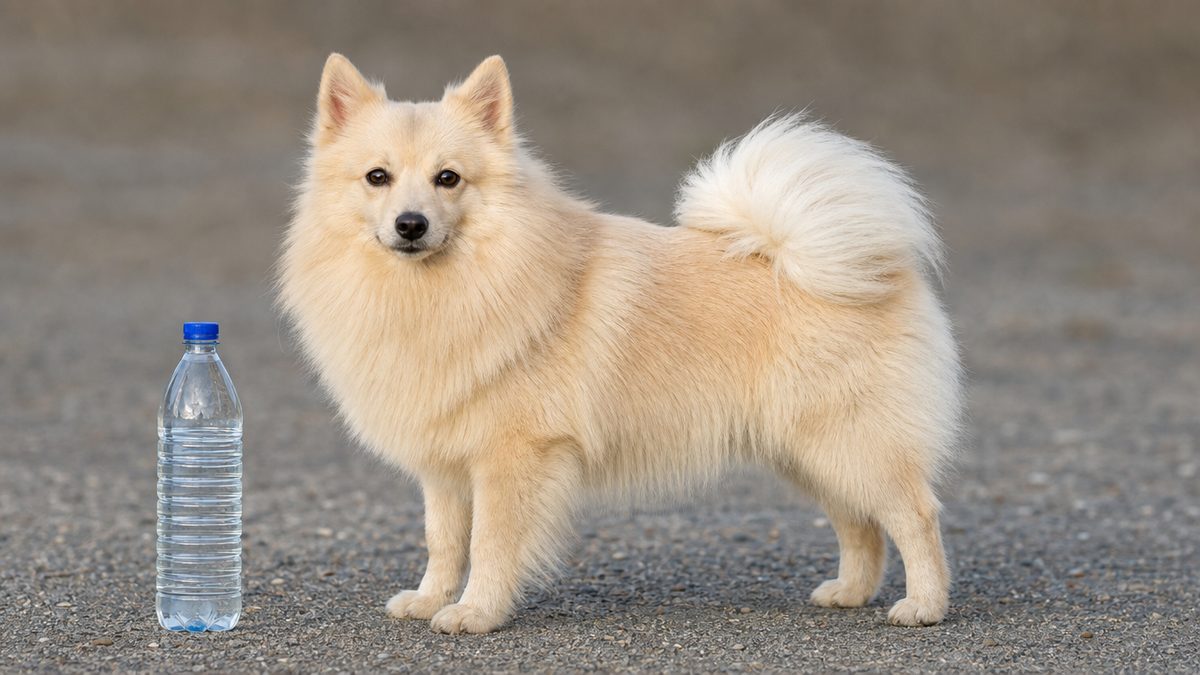
The look is a stand-off double coat, a foxy wedge head and a tail rolled onto the back. The standard specifies a long, straight, firm stand-off top coat over a short, thick, cotton-wool-like undercoat, with head, ears, the front of the legs and the paws covered in short velvety hair, and it explicitly rules out a wavy, curly or shaggy coat and any coat parted along the back. The small ears are set high, triangular and pointed, and must be carried erect and stiff at the tips. Ears not fully erected is a disqualifying fault, as are a gap in the fontanel, an overbite, underbite or crossbite, and ectropion or entropion.
Coat colour, and what changed in 2024
The colour list is closed, and any colour not mentioned in it disqualifies. The Giant Spitz is white, black or brown only. The Medium, Miniature and Toy varieties add orange, grey-shaded and a defined set of other colours, while the Wolfsspitz is grey-shaded and nothing else. Comparing the 2024 text against the 2019 edition shows what the FCI actually changed: the other colours list moved from cream, cream-sable, orange-sable, black and tan and particolour in 2019 to a 2024 list that adds black-and-silver and brown-and-tan, and widens the permitted patch colours to match. Both documents flag their own amendments in bold, which is how the change is datable at all.
Where the FCI publishes a closed list and disqualifies anything outside it, the Kennel Club's German Spitz standard says all colour varieties and markings are acceptable with the single exception of merle, which is unacceptable. A particoloured dog that is correct in a British ring may be outside the FCI list, and a merle is outside both.
Wikipedia, which ranks first in India for this query, states the position correctly in its opening line, describing the German Spitz as considered a single breed with five distinct varieties based on size and colour, and naming the Wolfsspitz or Keeshond and the Pomeranian or Zwergspitz among them. Purina goes further and calls the German Spitz the ancestor of most of the spitz-type breeds recognised today. Neither then prints the competing size tables, which is the gap this page fills.
One figure is missing from the standard entirely, and its absence explains most of the wrong numbers on the internet. FCI Standard 97 gives no weight for any size variety. It says only that each variety of the German Spitz should have a weight corresponding to its size. Every kilogram figure you will read for this breed therefore comes from somewhere other than the breed standard, and the sources that publish them do not agree with each other.
Three registries, three size tables, one dog
Measure a German Spitz against the FCI standard, the Kennel Club standard and the German parent club's own published ranges and you get three different answers for the same variety. The table below prints all three side by side, which no ranking page does.
| Variety | FCI Standard 97 | German parent club, via VDH | The Kennel Club |
|---|---|---|---|
| Wolfsspitz / Keeshond | 49 cm plus or minus 6, so 43-55 cm | 43-55 cm | Registered separately as the Keeshond |
| Grossspitz / Giant | 45 cm plus or minus 5, so 40-50 cm | 42-50 cm | Not registered |
| Mittelspitz / Medium | 35 cm plus or minus 5, so 30-40 cm | 30-38 cm | 30-38 cm |
| Kleinspitz / Miniature | 27 cm plus or minus 3, so 24-30 cm | 23-29 cm | 23-29 cm |
| Zwergspitz / Toy / Pomeranian | 21 cm plus or minus 3, so 18-24 cm | 18-22 cm | Registered separately as the Pomeranian |
Three of those five rows disagree with the FCI at both ends. The VDH's own Rasselexikon page for the Mittelspitz prints the varieties as Wolfsspitz 49 plus or minus 6, Grossspitz 46 plus or minus 4, Mittelspitz 34 plus or minus 4, Kleinspitz 26 plus or minus 3 and Zwergspitz 20 plus or minus 2, and labels that block with the words Std. Nummer 97 while linking the FCI standard PDF directly underneath. The FCI PDF that page links gives 45 plus or minus 5, 35 plus or minus 5, 27 plus or minus 3 and 21 plus or minus 3. The German national kennel club is publishing one set of figures under a standard number whose actual document says something else.
This is not a stale-standard story, and the archive proves it
The obvious explanation is that the FCI widened the bands in its 2024 revision and everyone else is behind. That explanation is wrong, and checking it took one fetch. The 12 November 2019 edition of Standard 97, pulled from an Internet Archive capture made on 10 January 2020, gives German Giant Spitz 45 cm plus or minus 5, German Medium Size Spitz 35 cm plus or minus 5, German Miniature Spitz 27 cm plus or minus 3 and German Toy Spitz 21 cm plus or minus 3. Those are identical to the 2024 figures. The FCI has not moved. The other published tables simply do not match it, and have not for at least seven years.
Club recognition, registry by registry
- FCI: one breed, Standard 97, five size varieties, explicitly including the Keeshond and the Pomeranian.
- VDH and the German parent club: the Rasselexikon carries Grossspitz, Kleinspitz, Mittelspitz, Wolfsspitz and Zwergspitz as five separate lexicon entries, all served by one club founded in 1899.
- The Kennel Club: German Spitz (Klein) and German Spitz (Mittel) share one breed standard in the Utility group, while the Keeshond and the Pomeranian are separate breeds.
- AKC: the German Spitz sits in the Miscellaneous Class, has been recorded in the Foundation Stock Service since 1996, has competed in AKC Companion Events since 1 January 2010, and has been assigned the Non-Sporting Group designation.
- KCI: India is a full FCI member represented by the Kennel Club of India in Chennai, so Indian pedigrees run on FCI nomenclature.
The AKC's own page is worth reading carefully, because it concedes the FCI's position while declining to follow it. It states that the FCI standard for the German Spitz also includes the Pomeranian and Keeshond, highlighting the extremely close link between the three breeds, and then keeps all three apart in its own register. It publishes three size bands rather than five varieties, at 8-11, 12-15 and 16-20 inches, with weights of 10-11, 15-25 and 30-50 pounds and a life expectancy of 13-15 years. Those weights exist nowhere in the FCI document, which is why quoting them as the breed's weight, as at least one ranking page has done, produces a 30 to 50 pound German Spitz.
German Spitz price in India, and why the search results are about another dog
The German Spitz price in india that Google shows you is mostly the Indian Spitz price, and the real German Spitz asking prices found in August 2026 ran from about Rs 2,999 to Rs 40,000 on social platforms only. No indexed Indian retail page published a defensible range for this breed.
Start with what the search engine actually returns. The top ten organic results for the phrase german spitz price in india, pulled with India as the location on 31 August 2026, contained six pages about the Indian Spitz, two Instagram tag pages, one Kolkata-area kennel video and one Facebook seller post. The Supertails article at position six is titled Indian Spitz Dog Price. The Mr n Mrs Pet page at position four sells Indian Spitz puppies. A buyer typing the exact phrase is reading another breed's market and will not be told so.
| Asking price | Where it appeared | Divided by 84.38 | Divided by 74 | Divided by 66.67 |
|---|---|---|---|---|
| Rs 2,999 | Howrah kennel video, Kolkata area | 35.54 | 40.53 | 44.98 |
| Rs 3,599 | Same kennel, second puppy | 42.65 | 48.64 | 53.98 |
| Rs 4,500 | Facebook group post, 38-day-old litter | 53.33 | 60.81 | 67.50 |
| Rs 6,000 | Dhanbad kennel reel | 71.11 | 81.08 | 90.00 |
| Rs 10,000 | Facebook seller, dual-coloured dog | 118.51 | 135.14 | 150.00 |
| Rs 15,000 | Instagram reel, female | 177.77 | 202.70 | 225.00 |
| Rs 20,000 | Instagram reel, male | 237.02 | 270.27 | 300.00 |
| Rs 40,000 | Instagram tag page, top of stated range | 474.05 | 540.54 | 600.00 |
Read the quotients rather than whether the division was clean. Not one figure resolves to a whole number of dollars at 84.38 or at 74, and the quotients that come out are 35.54, 42.65, 53.33, 71.11, 118.51, 177.77, 237.02 and 474.05. No seller anywhere prices a puppy at 35 dollars or at 474 dollars. The four round figures do divide neatly at 66.67, giving 150, 225, 300 and 600, but 66.67 is 200 divided by 3, so any multiple of 1,000 clears that test by construction and it carries no information at all. The conclusion is the opposite of the usual one for an imported breed: these are rupee-native prices a person typed, not a dollar list run through an exchange rate.
What the low end is probably buying you
A Rs 2,999 white spitz puppy in Howrah is far more likely to be an Indian Spitz than a Deutscher Kleinspitz with an FCI-nomenclature pedigree. That is not a slur on the seller, it is arithmetic: the Indian Spitz is a locally established, widely bred, genuinely affordable breed, while no indexed Indian retail listing for the German Spitz survived checking in this research. A price four to ten times below what the same seller charges for a Labrador is a signal about what is in the crate, and the correct response is to ask for the pedigree and measure the parents rather than to celebrate the bargain.
A Facebook group post found in this research advertised a Certified German Spitz litter with a date of birth of 18 December 2024, an age of 38 days and a price of Rs 4,500 each. Rule 8(1)(a) of the Prevention of Cruelty to Animals (Dog Breeding and Marketing) Rules 2017 states that every breeder shall ensure that pups less than eight weeks in age are not sold. Thirty-eight days is five weeks and three days. Walk away, and understand that a seller who breaks that rule in the advertisement is unlikely to have honoured the screening rules either.
For comparison at the other end of the Indian market, the same listing sites that publish no German Spitz range publish confident ones for the Labrador Retriever, from Rs 30,000 to Rs 1,20,000 across Hyderabad, Bangalore, Delhi, Chennai, Lucknow, Mumbai, Jaipur and Pune, with a KCI-registered band of Rs 60,000 to Rs 90,000. That contrast is the useful finding. The instrument works, Indian retail pricing for a common breed is dense and public, and the German Spitz is simply not in that market in any organised way.
Monthly cost of ownership, honestly bounded
No verified Indian cost dataset exists for the German Spitz, so this page publishes the cost structure and refuses to publish a rupee monthly total. What follows is what you will actually be paying for, in the order the money leaves.
The purchase price is the smallest number in this decision, and that holds even at the top of the observed Indian range. A dog bought at Rs 40,000 that lives twelve years costs about Rs 278 a month in purchase price alone, spread across its life. Everything else, which is food, parasite control, vaccination, grooming and the veterinary bills nobody plans for, runs every single month for those twelve years and is where the real total sits.
The only published lifetime figure, and why it is not an Indian figure
The nearest thing to an authoritative cost estimate for this breed is the PDSA's, and it is British. The PDSA publishes a minimum cost of GBP 70 per month for a German Spitz and lists the components of its lifetime estimate as purchase, neutering, first and booster vaccinations, microchipping, accessories, food, insurance, toys, grooming, worming and flea treatment, noting explicitly that the list excludes veterinary costs if the dog becomes sick or injured. Converting that to rupees would be exactly the error this site documents elsewhere, so Bonbeno does not. Use the component list, not the number.
Where an Indian owner's costs diverge from a British one's
- Parasite control runs year-round, not seasonally. Tick and flea pressure in Chennai, Mumbai, Hyderabad and Kolkata does not stop for a winter, so the monthly line item does not either.
- Grooming is a bigger line and a riskier one. A thick stand-off double coat in Indian humidity needs more brushing than it does in Britain, and the cheap local solution, a summer shave, is the one thing the Kennel Club standard rules out.
- Air conditioning is a dog cost here. For a heat-sensitive double-coated breed in Delhi, where the June mean is 35.88 C, the electricity bill for keeping one room cool through the afternoon is genuinely part of the cost of owning this dog.
- Insurance is thin. Indian pet insurance exists but is neither cheap nor comprehensive by British standards, and the PDSA's own caveat, that its estimate excludes illness and injury, bites harder where insurance uptake is low.
- Screening costs money once and saves it repeatedly. A patella grade and an eye examination on a puppy you are about to buy cost a consultation fee. A patellar luxation surgery does not, and complication rates as high as 18 to 29 percent have been reported after that surgery.
Bonbeno publishes an Indian monthly cost table when it has Indian sources for the components. For this breed it does not, and inventing one from a British total or a generic small-dog average would be a fabrication with a currency symbol on it. Ask three local vets for their consultation, vaccination and deworming rates in your own city and build the number yourself. It will be more accurate than anything published about this breed today.
Suitability for the Indian climate
The German Spitz is heat-sensitive in every Indian metro from March to October, and the reason is the coat rather than the size. The standard calls indifference to weather one of the breed's outstanding attributes, and the weather it has in mind is measurably not Indian weather.
| Location | Annual mean air temperature | Hottest month mean | 20-year maximum | Annual mean relative humidity |
|---|---|---|---|---|
| Chennai, Tamil Nadu | 27.95 C | 31.51 C in May | 42.70 C | 72.39 percent |
| Delhi | 25.60 C | 35.88 C in June | 48.79 C | 45.56 percent |
| Berlin, the breed's home range | 9.68 C | 20.47 C in July | 37.63 C | 79.79 percent |
The comparison that matters is not the peak, it is the floor. Chennai's coolest month, December, averages 24.41 C, which is 3.94 C warmer than Berlin's hottest month. A German Spitz in Chennai never experiences a month as cool as the warmest month its breed developed in. Delhi is the opposite shape of problem: a genuinely cool winter that lets the dog build a full coat, followed by a June mean of 35.88 C that it then has to survive wearing it.
Reasoning the heat rating instead of asserting it
This breed was not in the UK heat-illness study, so borrowing its odds ratios directly would be fabrication wearing a citation. The Scientific Reports analysis of 905,543 dogs under primary veterinary care in 2016 identified 395 confirmed heat-related illness events, an incidence of 0.04 percent and an event fatality rate of 14.18 percent, and its final model named nine breeds with raised odds against the Labrador Retriever. The German Spitz is not among them. Neither is the Keeshond. The companion Animals paper does model the Pomeranian, the FCI's smallest German Spitz variety, and returns an odds ratio of 1.08 with a confidence interval of 0.46 to 2.51, which is no signal at all.
What does transfer is the mechanism the authors themselves identify. The Chow Chow, described in the paper as another breed with a very thick coat, had the greatest risk of heat-related illness of all the study breeds at an odds ratio of 16.17, and the authors write plainly that coat type is potentially an important risk factor. The German Spitz carries the same coat architecture, a dense insulating undercoat under a stand-off top coat, in a smaller body. Small body mass helps with heat shedding. A thick double coat does not. Bonbeno rates heat tolerance at 2 out of 5 on that reasoning and shows the working rather than asserting a number.
The trigger Indian owners get wrong
Most heat collapse is not a hot car, it is a walk. Of the 879 heat-related illness events with a recorded trigger in the Animals study, 652, or 74.2 percent, were exertional, against 113 environmental and 46 from vehicular confinement, and exertional events occurred year-round with a 7.6 percent fatality rate. That reframes the Indian advice completely. The dangerous moment for a German Spitz in Bengaluru or Ahmedabad is not being left in a parked car, which most owners already avoid, it is a normal 5 pm walk in April.
Chennai's relative humidity peaks at 82.33 percent in November and Berlin's annual mean is actually higher at 79.79 percent, so humidity alone is not the differentiator. The differentiator is humidity at 28 C rather than at 9 C, which is what keeps a thick undercoat wet for hours and turns a monsoon walk into a skin problem. Dry the undercoat to the skin, not just the top coat.
Temperament and household fit
The German Spitz is an alert, affectionate, independent small watchdog that will bark, and the household it suits is one that wants exactly that. Every published source agrees on the shape of the temperament and they agree on the noise too.
The FCI standard describes the breed as always attentive, lively and extraordinarily attached to its owner, very teachable and easy to train, neither timid nor aggressive, and it names natural distrust of strangers and lack of hunting instinct as the traits that make it the ideal companion and family dog and watch dog for home and farm. The Toy Spitz section swaps in a companionable and cheerful character and shifts the setting from home and farm to house and apartment, which is the standard quietly acknowledging what the smallest variety is actually used for.
Independent secondary sources land in the same place. The PDSA calls the breed happy but independent, reasonably easy to train and more than happy to live with family members of any age, and flags a high tendency to bark that training should make manageable. Hill's describes an intelligent, lively, highly adaptable dog with a confident and assertive personality that makes an excellent watchdog because of its alertness.
Who should buy one
- Households that want a doorbell with legs. Alarm barking is the breed's job description, not a flaw to be trained away.
- Families with children of any age, given the PDSA's assessment, provided the children are taught not to chase a small dog that will defend its own space.
- Apartment owners in any Indian city, because the size fits a 2BHK comfortably and the exercise requirement is genuinely moderate.
- Owners who enjoy training, since a teachable but independent dog rewards structure and ignores nagging.
Who should not
- Anyone in a housing society with a noise complaint history, because this is the single most predictable failure mode of the breed in urban India.
- Anyone who will not brush twice a week, since the coat is the second most common reason these dogs end up in trouble here.
- Anyone wanting a dog that is friendly to every stranger on sight, because the standard specifies the opposite.
- Anyone buying for status, because almost nobody in India will recognise the breed and a great many will call it an Indian Spitz to your face.
One trait worth naming plainly is that this is a hardy breed by construction rather than by luck. The standard lists indifference to weather, robustness and longevity together as its outstanding attributes, and both the parent club framing and the AKC's 13-15 year life expectancy point the same way. That hardiness is real, and it is also the trap, because it makes owners assume the dog is coping with 40 C when it is only tolerating it.
Training a German Spitz, and the one thing you must start in the first twelve weeks
Train a German Spitz by rewarding quiet rather than by punishing noise, and start deliberate stranger exposure inside the socialisation window before sixteen weeks. The breed is genuinely trainable, which means it learns the wrong lesson just as quickly as the right one.
The FCI standard calls the German Spitz very teachable and easy to train, and it means it. The complication is the other half of the same sentence: natural distrust of strangers. A dog selected for centuries to announce arrivals will announce arrivals. Training does not remove that instinct, it puts a volume control and an off switch on it, and the difference between a German Spitz that is a pleasure in a Mumbai high-rise and one that gets a society notice is almost entirely whether that work was done before six months.
The socialisation window, in Indian conditions
Use the socialisation window between roughly three and sixteen weeks to make strangers boring. In practice that means a controlled introduction to lift doors, delivery riders in helmets, watchmen, house help arriving daily, the sound of a pressure cooker, other dogs on a leash and children running. Each one should end in food and nothing happening. The Indian complication is vaccination timing: the Dog Breeding and Marketing Rules note that puppy vaccination can start at seven to eight weeks and is usually completed at eighteen weeks, which lands the end of the course after the window closes. Socialise in carried arms, on clean surfaces and in low-density settings rather than waiting.
A four-step protocol for the barking
- Mark the first bark, not the tenth. Reward the dog for alerting once and then turning to you. You are training a report, not silence.
- Pay the quiet. Feed the second of silence after the alert, every time, for several weeks. A dog that is only ever told off for barking learns that barking gets attention.
- Manage the trigger. Move the crate away from the front door and off the corridor-facing wall. Most Indian apartment barking is a line-of-sight and line-of-sound problem before it is a behaviour problem.
- Give the brain a job. Ten minutes of scentwork or trick training in the afternoon, when it is too hot to walk anyway, reliably lowers the evening noise more than a longer walk does.
What this breed resists
It resists repetition without reason, and it resists correction-based handling. An independent dog that has already understood a cue will stop performing it if the tenth repetition pays nothing, and a small dog that is startled or punished for alarm barking frequently escalates rather than settles. Timelines are realistic rather than fast: expect reliable house training by twelve to sixteen weeks with strict scheduling, a solid recall indoors by four months, an outdoor recall that is never fully trustworthy off-leash near traffic, and genuine progress on doorbell noise by six to eight months of consistent work.
Daily exercise needs, and the published figures that disagree
Give an adult German Spitz about 45 minutes of real walking a day, split into two cool-hour sessions, plus indoor brain work. That number is a judgement, because the two most-cited sources publish figures that differ by a factor of two and one of them disagrees with itself on the same page.
| Source | Figure published | Where on the page |
|---|---|---|
| PDSA, body text | Around 30 minutes per day | Under the heading Exercise requirements |
| PDSA, sidebar table | Minimum exercise per day: 1 hour | In the breed-facts table on the same page |
| Hill's Pet Australia | 30 minutes a day minimum | In the Care panel |
| Bonbeno | About 45 minutes, split | Reasoned below |
The PDSA contradiction is real and it is on one page. Its prose says the German Spitz is a small dog who requires around 30 minutes exercise per day, while the breed-facts table lower on the same page gives a minimum exercise per day of 1 hour. Hill's independently gives 30 minutes a day minimum. Bonbeno publishes both rather than picking the convenient one, and lands at about 45 minutes for a reason specific to India: the useful walking window here is narrow, so a single 30-minute session in the only cool hour available tends to become the whole day's activity, and an active spitz-type dog does not settle on that.
How to split the day in an Indian city
- Before sunrise, 25 to 30 minutes. The longest walk of the day, on the coolest surface of the day. In Chennai in May this is the only comfortable hour there is.
- After dark, 15 to 20 minutes. Shorter, calmer, mostly sniffing. Tarmac that felt survivable at 6 pm is still holding heat at 8 pm, so test it with the back of your hand.
- Midday, indoors, 10 minutes. Scentwork, a snuffle mat, a food puzzle or five minutes of trick training. This replaces exercise on the days when it genuinely cannot happen outside.
- Never during 11 am to 5 pm from March to October, in Delhi, Ahmedabad, Hyderabad, Nagpur or anywhere else with a comparable summer.
What happens without it
An under-exercised German Spitz gets louder rather than destructive. The predictable sequence in an Indian flat is more alarm barking at corridor noise, more demand barking at the family, weight gain that a thick coat hides until it is significant, and then a patella that starts skipping because a heavier dog with less muscle is harder on the joint. That last link is not speculation: the largest primary-care study of patellar luxation found neutered dogs at 2.4 times the odds and lower bodyweight relative to the breed mean among the risk factors, and reported that fewer than 30 percent of cases were bilateral. Muscle and condition matter for this joint, and both come from walking.
Grooming a double coat in Indian humidity
Brush a German Spitz twice a week to the skin, daily during a moult, and never shave it. The coat is a stand-off double coat that manages heat by trapping still air, and a clipper removes exactly the structure that does the work.
The standard describes what you are maintaining: a long, straight, firm stand-off top coat over a short, thick, cotton-wool-like undercoat, with a thick mane over the neck and shoulders, feathering on the backs of the front legs and from croup to hocks behind, and a bushy tail. It adds that the hair must not look like being modelled. The Kennel Club puts it as an instruction: this is not a trimmed breed, and evidence of trimming and shaping other than tidying of the feet, anal area and legs below the hocks should be penalised.
Why the Indian summer shave is the wrong answer
A groomer offering a summer cut in Pune or Chennai is offering to remove the dog's insulation against radiant heat, not just its warmth. A stand-off coat holds a layer of air that slows heat transfer in both directions, and the undercoat is what holds the top coat off the skin. Clip it and you get direct sun on skin that has never seen it, a higher risk of sunburn on a pale dog, and regrowth that in humid conditions frequently comes back patchy or woolly. The correct summer intervention is to remove the dead undercoat, which is the thing actually trapping heat, and to leave the top coat alone.
A working routine for an Indian household
- Twice weekly, 15 minutes, line brushing. Part the coat in horizontal lines and brush from the skin outward with a slicker, then a wide comb through to check you actually reached the skin. Brushing the surface of a stand-off coat achieves very little.
- Daily during a moult. Hill's describes the breed as shedding its undercoat a few times a year. In Indian metros the temperature cue that produces a clean twice-yearly drop is weak, so shedding is often lower-grade and continuous instead.
- Bath rarely, dry completely. Dry to the skin with a stand dryer or a cool blower every time, not just towel and air. A double coat that stays damp at the skin in 28 C and 80 percent humidity is a hot spot waiting to happen.
- Plug the ears before any bath. Erect ears drain better than drop ears, which is a real advantage this breed has, but a wet ear canal in the monsoon is still the most common way an Indian owner turns a bath into a vet visit.
- Check the feet and the trousers weekly for ticks. Long feathering hides an engorging tick for days.
Tidying the hair between the pads is explicitly permitted by the Kennel Club standard and is genuinely useful in India, because matted pad hair traps grit and holds moisture after a monsoon walk. Trim the feet, the area below the hocks and around the anus. Leave everything else.
Health issues, screening and life expectancy
Screen a German Spitz for patellar luxation and eye disease, in that order, because those are the two conditions every independent source names for this breed. The published data behind them is thinner than for a common breed, and this section says exactly how thin.
Start with what is actually registered. The German Spitz holds the OFA breed code GRS, read directly from OFA's own markup rather than guessed, and OFA files it under the AKC Non-Sporting Group, the UKC Northern Group and the Kennel Club Utility Group. Searching OFA's full disease-statistics dump for that breed returns exactly one summary row: the eye registry, rank 90, 94 evaluations, 94.7 percent normal and 5.3 percent abnormal. There is no hip row, no elbow row, no patella row and no thyroid row, because OFA publishes a breed only once it reaches 100 hip evaluations or 50 in its other databases. That is a real finding about how little screening data exists, and it is not the same as saying the breed is absent from OFA.
| Breed | OFA code | Hip evaluations | Eye evaluations | Eye summary, normal | Largest eye detail row on the same denominator |
|---|---|---|---|---|---|
| German Spitz | GRS | No published row | 94 | 94.7 percent | 74 of 94, 78.7 percent |
| Keeshond | KE | 6,236, 6.4 percent dysplastic | 1,845 | 96.7 percent | 1,273 of 1,845, 69.0 percent |
| Pomeranian | PN | 411, 18.7 percent dysplastic | 2,836 | 98.2 percent | 2,166 of 2,834, 76.4 percent |
| American Eskimo Dog | AE | 1,469, 9.9 percent dysplastic | 669 | 93.6 percent | 530 of 669, 79.2 percent |
OFA's eye summary line and its per-diagnosis detail rows disagree on every one of these four breeds, in the same direction and by 15 to 28 percentage points. The German Spitz summary says 94.7 percent normal of 94 while a detail row on the same 94 evaluations reports 74 affected, which is 78.7 percent. Those two cannot both describe the same population. Bonbeno could not resolve which diagnosis the detail row is labelled with in this retrieval, so it publishes the arithmetic, names the inconsistency, and quotes neither figure as the breed's eye disease rate. Do not read the last column as a prevalence.
Patellar luxation, the condition with real numbers behind it
Patellar luxation is the best-evidenced orthopaedic risk in this family of dogs, and the evidence comes from the Pomeranian rather than from the German Spitz. In a VetCompass study of 210,824 dogs attending 119 primary-care clinics in England, overall prevalence of diagnosed patellar luxation was 1.30 percent, and the Pomeranian carried the highest breed odds of the eleven breeds identified, at 6.5 times crossbred dogs with a confidence interval of 4.0 to 10.7, on a breed prevalence of 6.5 percent. The PDSA names luxating patellas as the German Spitz's breed-related health problem, and the only one it lists.
OFA's own patella table puts the Pomeranian at rank 1 of all breeds, on 3,508 evaluations, 70.9 percent normal and 29.1 percent abnormal, split as 15.0 percent grade 1, 11.3 percent grade 2 and 2.5 percent grade 3. Those three grades sum to 28.8 rather than 29.1, so a small grade 4 fraction sits in the printed total without its own column. Note also that the 2016 study cites OFA as reporting 37.2 percent of Pomeranian submissions affected; the register today reads 29.1 percent on a larger denominator. Live registers move, which is why this page publishes the sample size beside every percentage.
Eyes, seizures and what the breed is said to carry
Hill's lists progressive retinal atrophy, retinal dysplasia, patellar luxation and idiopathic epilepsy as reported in the breed and recommends eye testing for the first two. None of those four carries a published German Spitz prevalence figure that Bonbeno could verify, and saying so is more useful than borrowing a Pomeranian number and calling it a German Spitz number. Ask for the certificates rather than the statistics.
Where Indian law and the breed standard collide
Indian law requires testing for two defects the breed's own standard treats in opposite ways. Second Schedule Part III paragraph 8(10) of the Dog Breeding and Marketing Rules 2017 states that dogs shall have been tested for genetic defects, including hip dysplasia, progressive retinal atrophy, night blindness, hypothyroidism, entropion, ectropion, overshot, undershot jaw, wry mouth, two or more missing teeth, and cryptorchidism. FCI Standard 97 disqualifies ectropion and entropion outright, so there the law and the standard agree. But the same standard says the lack of a few premolars shall be tolerated in the Medium Size, Miniature and Toy varieties, while the clause lists two or more missing teeth as a genetic defect a breeding dog must have been tested for. An Indian breeder is therefore required to test for something the breed standard explicitly forgives.
Life expectancy
The AKC publishes 13-15 years, Hill's publishes 13-15 years, and the PDSA publishes over 12 years, and none of the three cites a study PDSA (People's Dispensary for Sick…. The nearest measured evidence is a UK longevity analysis of 584,734 dogs including 284,734 deceased, which gives median survival of 12.5 years across all dogs, 12.7 years for purebreds against 12.0 for crossbreds, and 12.7 years for small and medium purebreds specifically. That paper's breed-level medians sit in a supplementary table rather than its published body, and it names no German Spitz row in the text Bonbeno could read, so no breed-specific median is quoted here. A separate UK life-table analysis puts life expectancy at age 0 for all UK companion dogs at 11.23 years.
Feeding and body condition
Feed a German Spitz to a visible waist rather than to a cup measurement, because a thick stand-off coat hides weight gain until it is severe. Body condition is the single most useful health metric an Indian owner of this breed can track at home.
Run your hands, not your eyes, over the ribs weekly. On a coated breed the visual body condition check that works on a Labrador fails completely, and owners routinely discover a two-kilogram gain only when a groomer mentions it. You should feel the ribs easily under a thin fat cover, see a waist behind the ribs when looking down from above, and see an abdominal tuck from the side. If you can see ribs, the dog is thin. If you have to press to find them, it is overweight.
Life-stage feeding, and why weight matters more here than for most small dogs
- 8 to 16 weeks: four meals a day of a complete puppy food, at a small-breed kibble size. Growth is fast and stomachs are tiny.
- 4 to 8 months: three meals a day. This is where most overfeeding starts, because a growing coat makes the puppy look fine at any weight.
- 8 months to adult: two meals a day, and start weighing the dog monthly on the same scale rather than estimating.
- Adult: two meals a day, portioned to hold condition through the seasons. Indian summers reduce activity, so the same portion that worked in January is usually too much in May.
- Senior, from about 8 years: two meals, watch for muscle loss over the topline, and reassess portions if walking distance drops.
Excess weight is not cosmetic for this breed, it is joint load on a joint that is already the breed family's weak point. The patellar luxation study found bodyweight relative to the breed mean to be a significant factor and reported that dogs weighing under 10 kg had 2.8 times the odds of dogs in the 10.0 to 19.9 kg band on univariable analysis. Small dogs carry this risk anyway. Adding fat to a small dog with a shallow trochlear groove is the avoidable half.
What is actually available in India
Small-breed complete diets from the major brands are widely stocked in Indian metros, and the practical question is not brand but kibble size and portion discipline. Home-cooked feeding is common in Indian households and can be done well, but a growing puppy on an unbalanced home diet is the fastest route to a skeletal problem, so use a formulated puppy food through the growth period at minimum. Fresh water needs to be available and genuinely cool through the summer, because a heat-sensitive dog under a thick coat drinks more than owners expect.
Published weight ranges for this breed disagree wildly, because the breed standard gives none. Hill's publishes 7-14 kg for both sexes, while the PDSA publishes 5-8 kg for the small size and 7-11 kg for the medium PDSA (People's Dispensary for Sick…. Neither figure comes from a standard, they do not agree with each other, and neither can tell you what your individual dog should weigh. Feed to condition, not to a published band.
The first year, month by month
Get the socialisation, the coat handling and the vaccination course right in the first four months and the rest of the year is maintenance. Here is what each stage actually requires.
| Age | What is happening | What you do |
|---|---|---|
| Under 8 weeks | Still with the litter. Selling below this age is prohibited under Rule 8(1)(a) | Visit, meet the dam, measure both parents, ask for eye and patella records. Do not take the puppy home |
| 8 to 12 weeks | Vaccination course starts, typically at seven to eight weeks. The socialisation window is open and closing | Carried outings daily. Lifts, watchmen, delivery riders, traffic noise, other calm dogs. Begin two-minute brushing sessions with food |
| 12 to 16 weeks | Window closes near sixteen weeks. Adult teeth begin | Highest-value socialisation weeks of the dog's life. Start the bark protocol now, not later. House training on a strict schedule |
| 4 to 6 months | Vaccination course usually completes near eighteen weeks. Puppy coat begins changing | First full grooming session with a dryer. Introduce the pad trim. Recall games indoors and in a safe enclosed space |
| 6 to 9 months | Adolescence. Alarm barking peaks. Coat thickens | Hold the training line. Book a veterinary patella check. Do not let summer collapse the walking routine |
| 9 to 12 months | Approaching adult size and coat | Move to two meals a day. Establish the twice-weekly line-brushing habit permanently. Baseline eye examination |
The three moments that matter most
Twelve to sixteen weeks is the one you cannot redo. The socialisation window shuts near sixteen weeks and the Indian vaccination schedule, which the Rules describe as usually completed at eighteen weeks, closes after it. Owners who wait for the last shot before taking the puppy out lose the entire window, and this is the breed where that costs the most, because an unsocialised watchdog in a shared corridor is a dog that barks at everything for the next twelve years.
The first hot season is the second. A puppy that arrives in December in Delhi meets 48 C-capable summer conditions with a full coat and no experience of them. Move the walking schedule before the heat arrives, not after the first bad day.
The first full moult is the third. Owners who have only ever brushed the surface of the coat discover the undercoat coming out in sheets and reach for a clipper. Book a professional groom instead, watch how they line brush, and copy it.
German Spitz compared with the breeds Indian buyers cross-shop
Compare a German Spitz against the four dogs it is confused with in India and the differences are registry facts, not opinions. The table below uses each breed's own governing document rather than a retail description.
| Breed | Governing standard | Height in the standard | Coat | Realistic Indian availability |
|---|---|---|---|---|
| German Spitz (Mittel) | FCI Standard 97, one document for five varieties | 35 cm plus or minus 5 per FCI, 30-38 cm per the Kennel Club | Long stand-off top coat over thick undercoat, not trimmed | Thin. Informal seller posts only, no indexed retail listing found |
| Pomeranian | FCI Standard 97 as German Toy Spitz, separate AKC and Kennel Club Toy standard | 21 cm plus or minus 3 | Same double coat, muzzle to skull about 2:4 rather than 2:3 | Wide. Sold in every Indian metro |
| Keeshond | FCI Standard 97 as Wolfsspitz, separate AKC and Kennel Club breed | 49 cm plus or minus 6 | Same double coat, grey-shaded only | Very thin in India |
| Indian Spitz | Not one of the five varieties in FCI Standard 97 | Not set by FCI Standard 97 | Double coat, similar look, established in India | Wide and cheap |
| Japanese Spitz | Separate FCI standard, looked after in Germany by the same parent club since 1988 | Not covered by Standard 97 | White only | Moderate in metros |
The single most useful line in that table is the muzzle proportion. FCI Standard 97 gives the ratio of muzzle length to skull length as approximately 2:3 for the Wolfsspitz, Giant, Medium and Miniature varieties, and approximately 2:4 for the Toy Spitz and Pomeranian. That is the standard quantifying its own drift toward a shorter face at the smallest size, in a single document, and it is the cleanest way to tell a small Kleinspitz from a large Pomeranian in a photograph. Measure the head, not the dog.
Why the Keeshond sits in the same standard as the Pomeranian
The Keeshond and the Pomeranian share a standard because the FCI treats them as size varieties of one German breed. FCI Standard 97 opens with the line that in non-German-speaking countries Wolfsspitz dogs are known as Keeshonds, and repeats the equivalent line for the Toy Spitz and the Pomeranian. The AKC agrees with the fact while disagreeing with the conclusion: its own German Spitz page states that the FCI standard also includes the Pomeranian and Keeshond, highlighting the extremely close link between the three breeds, and then registers all three separately.
A pedigree is only meaningful against the standard it was written under. A dog registered as a Keeshond in the United States and a dog registered as a Wolfsspitz in Germany are the same animal under two rulebooks, and a KCI pedigree issued against FCI nomenclature will use the German nomenclature. Ask which name appears on the paper.
The American Eskimo Dog, and a date two sources cannot agree on
The American Eskimo Dog is the German Spitz that emigrated, and the two have since diverged enough to be separate breeds. Wikipedia records that the breed's progenitors were German Spitz, that it was renamed because of anti-German sentiment during the First World War, and that although modern American Eskimo Dogs have been exported as German Spitz Gross or Mittel depending on height, the breeds have diverged and the standards are significantly different. The breed's own parent club tells the naming story in more detail and with different dates: the UKC registered it as Spitz in 1913, changed the name to American Spitz in 1924 amid anti-German feeling, changed it again to American Eskimo Spitz in 1925 after a kennel called American Eskimo Kennels, dropped Spitz in 1926, and saw AKC acceptance in 1995.
The AKC's own breed page gives a different date for the same event, stating that the breed was known as the American Spitz until 1917, when the name was changed to American Eskimo. That is seven years earlier than the parent club's account and it attaches the change to the First World War rather than to the 1920s. Bonbeno reports both and picks neither, because the parent club and the registry are both primary sources for their own records and there is no third document here to break the tie.
Where the Indian Spitz genuinely wins
The Indian Spitz beats the German Spitz on availability, price and heat adaptation, and that is not a consolation argument. India is a full FCI member through the Kennel Club of India in Chennai, so an FCI-standard breed is registrable here in principle, but principle does not create a supply chain. A buyer who wants a small, white, alert, double-coated dog that is actually obtainable, actually affordable and actually bred in this climate is describing the Indian Spitz, and the honest recommendation is to look at it first.
Mistakes Indian German Spitz owners actually make
Shaving the coat is the mistake that does lasting damage, and it is the one most often recommended by Indian groomers in May. Five more follow, in the order they cost owners money.
- Shaving the double coat for summer. The Kennel Club standard states that this is not a trimmed breed and that evidence of trimming and shaping, beyond tidying the feet, anal area and legs below the hocks, should be penalised. A shaved stand-off coat loses the air layer that keeps radiant heat off the skin, and the regrowth in a humid climate is frequently patchy. Brush the undercoat out instead.
- Buying on the word spitz alone. Six of the top ten Google India results for german spitz price in india describe the Indian Spitz, not the German Spitz, so an Indian buyer searching the exact phrase is reading another breed's prices. Confirm the pedigree and the standard, not the seller's label.
- Accepting a height claim without asking which registry. The FCI, the Kennel Club and the German parent club publish three different size tables for the same varieties Verband fuer das Deutsche Hundewesen. A puppy sold as an oversized Klein under one table is a correct Klein under another.
- Treating alarm barking as a training failure. The FCI standard names natural distrust of strangers as part of what makes the breed an ideal watch dog for home and farm. You can train the volume down. You cannot train the instinct out, and an owner who expects to should choose a different breed.
- Walking at the wrong hour. Delhi's June mean air temperature is 35.88 C and its 20-year maximum is 48.79 C. A small dog under a thick stand-off coat on afternoon tarmac is the exact combination the UK heat-illness data flags, where 652 of the 879 events with a recorded trigger, 74.2 percent, were exertional rather than caused by a hot car.
- Skipping the eye certificate. Progressive retinal atrophy and retinal dysplasia are both reported in this breed by Hill's Pet, and OFA's published statistics for the German Spitz consist of exactly one row, the eye registry. A breeder with no dated eye result has screened for nothing.
The mistake that is really the seller's
Publishing a weight the breed standard does not contain is a mistake made upstream of the buyer, and it propagates. FCI Standard 97 gives no weight figure for any of the five varieties, stating only that each should have a weight corresponding to its size. Hill's Pet Australia nonetheless publishes 7-14 kg for both sexes alongside a height band of 23-29 cm, while its own history section says the breed comes in both Mittel and Klein sizes. A Mittel cannot be 23-29 cm under any of the three size tables in circulation, so the page's own figures do not describe the breed it describes.
The Showsight Magazine entry that search engines still surface for this breed is a sharper version of the same problem. Its indexed description gives the German Spitz a weight ranging from 30 to 50 pounds, which is the AKC's Large band quoted as though it were the whole breed. Fetched live on 31 August 2026 that URL returns a Page not found body at HTTP 200 with a noindex directive, so the text search engines are showing is no longer served at the address they credit. Bonbeno reports the figure only as evidence of how the number travels, and does not adopt it.
There is a strong temptation to split the difference between 24-30, 23-29 and 26 plus or minus 3 and print a single tidy range. That range would appear in no document anywhere and would be wrong against every one of them. Print all three, name their sources, and let the buyer ask the seller which one applies.
Adopting a German Spitz in India, and how to verify what you are being offered
Adopt a spitz-type dog in India by starting with the Indian Spitz and spitz crosses in metro shelters, because a purebred German Spitz almost never reaches rescue here. Adoption is the honest first route, and the verification steps below apply whichever route you take.
Rescue supply for this breed in India is close to zero, so adoption of a German Spitz specifically is not a realistic plan, and saying so is more useful than pretending otherwise. What Indian shelters and city rescue groups do carry in volume is Indian Spitz and Indian Spitz crosses, which are small, white, double-coated, alert dogs with the same silhouette and which are bred and kept here in vastly larger numbers. A buyer whose actual want is that silhouette should search the shelter listings for spitz and see what comes back before paying anyone.
Five checks before money changes hands
- Ask which standard the pedigree is written against. India is an FCI full member through the Kennel Club of India in Chennai, so a KCI pedigree runs on FCI nomenclature and the dog should be described as a Kleinspitz, Mittelspitz, Grossspitz, Wolfsspitz or Zwergspitz, not as a generic German Spitz.
- Measure the puppy's parents at the withers. Height is the only variety marker that is objective, and the three published tables differ by up to 2 cm at each end. Measure, then compare against all three.
- Ask for a dated eye certificate on both parents. Progressive retinal atrophy and retinal dysplasia are the two conditions repeatedly named for this breed.
- Ask for a patella grade. Patellar luxation is the dominant orthopaedic risk across small spitz-type dogs, and the Pomeranian sits at 6.5 times the odds of crossbred dogs in the largest primary-care study of the condition.
- Refuse a puppy under eight weeks. Rule 8(1)(a) of the Prevention of Cruelty to Animals (Dog Breeding and Marketing) Rules 2017 requires that pups less than eight weeks in age are not sold. A seller offering a 38-day-old puppy, as one Indian Facebook group post did in this research, is offering an unlawful sale.
What the Indian listings actually contain
Every German Spitz offer found in India during this research sat on a social platform rather than an indexed retail page, and the asking prices ran from about Rs 2,999 to Rs 40,000. Those included a Kolkata-area kennel advertising puppies at Rs 2,999 and Rs 3,599 on video, a Facebook post pricing a dual-coloured dog at Rs 10,000 non-negotiable, an Instagram reel quoting Rs 20,000 for males and Rs 15,000 for females with all-India delivery, a Facebook group post at Rs 4,500 each for a 38-day-old litter, and a Dhanbad kennel reel quoting six thousand rupees. No single indexed Indian retail page published a German Spitz price range that survived checking.
None of these figures is a converted dollar price. Divide Rs 2,999 by 84.38 and you get 35.54; by 74 you get 40.53; by 66.67 you get 44.98. No seller anywhere prices a puppy at 35 dollars, 40 dollars or 45 dollars. The round figures do divide at 66.67, but 66.67 is 200 divided by 3, so every multiple of 1,000 passes that test by construction and it proves nothing. These are rupee-native asking prices typed by Indian sellers, which is unusual for an imported breed and worth saying.
German Spitz questions Indian buyers actually ask
Is a German Spitz a good family dog?
Yes, a German Spitz suits a family that wants a small, alert, trainable companion and can live with noise. The FCI standard describes a dog that is very teachable, extraordinarily attached to its owner, neither timid nor aggressive, and naturally distrustful of strangers. That last trait is what makes it a watchdog and also what makes it bark at every lift door, so a household with shared walls should treat barking as the main thing to train.
Is a German Spitz a Pomeranian?
To the FCI, yes. FCI Standard 97 is a single document covering five size varieties, and the smallest of them, the German Toy Spitz at 21 cm plus or minus 3, is the dog the standard itself says is known as the Pomeranian outside German-speaking countries. To the AKC and the Kennel Club, no: both register the Pomeranian as a separate Toy breed with its own standard. Both answers are correct inside their own rulebook.
Do German Spitz bark a lot?
Yes, and it is deliberate. The breed was kept as a watch dog for home and farm, and its natural distrust of strangers is written into the FCI standard as a desirable trait rather than a fault. Expect alarm barking at doors, lifts, corridors and delivery riders. It responds well to training because the breed is genuinely trainable, but you are managing a designed behaviour, not correcting a defect.
Do German Spitz shed a lot?
Yes. The standard specifies a double coat with a long, straight, firm stand-off top coat over a short, thick, cotton-wool-like undercoat, and that undercoat comes out in heavy seasonal moults. Hill's Pet describes the same pattern as shedding the undercoat a few times a year. In Indian metros the moult is often less seasonal and more continuous, because the temperature cue that triggers a clean twice-yearly drop never really arrives.
What is the German Spitz price in India?
No published Indian price list for this breed survives scrutiny, and the observed asking prices on Indian social platforms in August 2026 ran from about Rs 2,999 to Rs 40,000. Those are seller posts on Facebook, Instagram and YouTube rather than indexed retail pages, and the top ten Google India results for german spitz price in india are dominated by Indian Spitz prices instead. Treat any single number as one seller's ask, not a market rate.
How big does a German Spitz get?
It depends entirely on which registry your puppy was registered under. The FCI gives 27 cm plus or minus 3 for the Miniature Spitz and 35 cm plus or minus 5 for the Medium, while the Kennel Club gives 23-29 cm for Klein and 30-38 cm for Mittel, and the German parent club's own published ranges match the Kennel Club rather than the FCI. Ask the seller which standard the pedigree is written against before you accept any height claim.
Can a German Spitz handle Indian heat?
Not comfortably, and not without management. Chennai runs a 27.95 C annual mean air temperature against Berlin's 9.68 C, and Chennai's coolest month is still warmer than Berlin's hottest. The dog is small, which helps, but it carries the thickest coat category in the UK heat-illness study, where the very thick-coated Chow Chow had the highest odds of any breed modelled. Walk before sunrise and after dark from March to October.
Is the German Spitz recognised by the Kennel Club of India?
The Kennel Club of India is the FCI's full member for India and issues pedigrees against FCI nomenclature, so a breed carrying an FCI standard number is registrable in India in principle. The KCI publishes no breed list on its own site for any breed, so a search there returns nothing for the German Spitz and nothing for a Labrador either. That is a limit of the source, not evidence about the breed.
What health tests should a German Spitz breeder have done?
Eye screening and patella palpation are the two that matter most, and the German Spitz holds an OFA breed code with a single published statistics row, the eye registry, on 94 evaluations. Ask for a current eye certificate, a patella grade from a veterinarian, and the parents' own records. A breeder who cannot produce a dated eye result has not screened for the two conditions this breed is repeatedly reported to carry.
How long does a German Spitz live?
The AKC publishes 13-15 years and so does Hill's Pet, and neither cites a study. The nearest real evidence is the UK longevity dataset covering 584,734 dogs, which gives 12.7 years median survival for small and medium purebreds and 12.5 years across all dogs. No German-Spitz-specific median is published in that paper's main text, so treat 13-15 as a breeder-community figure rather than a measured one.
What is the difference between a German Spitz and an Indian Spitz?
They are different breeds, and Indian search results constantly merge them. The German Spitz carries FCI Standard 97 with five defined size varieties and a closed colour list, while the Indian Spitz is a separate, locally established breed that Standard 97 does not cover at all. The practical difference is supply: six of the top ten Google India results for german spitz price in india are about the Indian Spitz. If a seller in India is quoting Rs 4,000 for a white spitz puppy, the balance of probability is that you are looking at an Indian Spitz.
Is the German Spitz the same dog as the American Eskimo Dog?
No, although they share ancestry. The American Eskimo Dog Club of America records that the UKC registered the breed as Spitz in 1913, renamed it American Spitz in 1924 and American Eskimo Spitz in 1925, and dropped Spitz in 1926, with AKC acceptance following in 1995. The AKC's own breed page instead gives 1917 for the rename. The two accounts disagree, and Bonbeno reports both rather than picking one.
Compare with similar breeds
German Spitz sits in 3 Bonbeno groups. Each one compares it directly against the breeds it is genuinely an alternative to, on the same figures.