
Breed profile
Keeshond: the breed the FCI says does not exist
Search the FCI register for Keeshond and you get nothing. The dog is there, filed under a German name inside another breed's standard. Here is what that means for an Indian buyer, and what the registries actually measure.
Quick answer
The Keeshond is a separate breed to the AKC and the Kennel Club and not a breed at all to the FCI, which files the same dog as the Wolfsspitz, the largest of five size varieties inside German Spitz Standard 97. Search the FCI's own breed index under K and there is no Keeshond entry. That matters in India, because the Kennel Club of India issues pedigrees against FCI nomenclature, so an Indian paper should read Wolfsspitz.
This page reports published veterinary research and registry screening data for general information. It is not a diagnosis and it is not treatment advice. Primary hyperparathyroidism, epilepsy, diabetes and heat collapse are all emergencies or chronic diseases that need an in-person veterinarian, and a raised blood calcium reading in a Keeshond over eight years old needs one urgently. No figure on this page substitutes for that examination.
Keeshond at a glance
What the Keeshond actually is
The Keeshond is a medium-sized grey-shaded spitz bred as a watchdog on Dutch canal barges, and to the FCI it is not a breed at all. It is the Wolfsspitz, Part 1 of German Spitz Standard 97, and that single fact decides what an Indian pedigree should say.
Start with the document. FCI-Standard N 97 is titled Deutsche Spitze, was published on 20 September 2024 against an official valid standard dated 3 September 2024, and sits in Group 5, Spitz and primitive types, Section 4, European Spitz, without working trial. It runs in three parts. Part 1 is headed GERMAN WOLFSSPITZ / KEESHOND. Part 2 covers the Giant, Medium Size and Miniature Spitz together. Part 3 is the Toy Spitz, known abroad as the Pomeranian. The history section states it plainly: in non-German speaking countries Wolfsspitz dogs are known as Keeshonds.
The register agrees. The FCI's own breeds nomenclature under the letter K lists fourteen breeds, running Kai, Kangal Coban Kopegi, Karjalankarhukoira, Kavkazskaia Ovtcharka, Kazakh Tazy, Kerry Blue Terrier, King Charles Spaniel, Kishu, Kleiner Munsterlander, Komondor, Korea Jindo Dog, Kraski Ovcar, Kromfohrlander and Kuvasz. There is no Keeshond entry, and that absence is a filing decision rather than a gap, because the breed is fully recognised under its German name. India is an FCI full member represented by the Kennel Club of India in Chennai, which issues pedigrees against FCI nomenclature, so the correct name on an Indian paper is Wolfsspitz.
Appearance, in the standard's own words
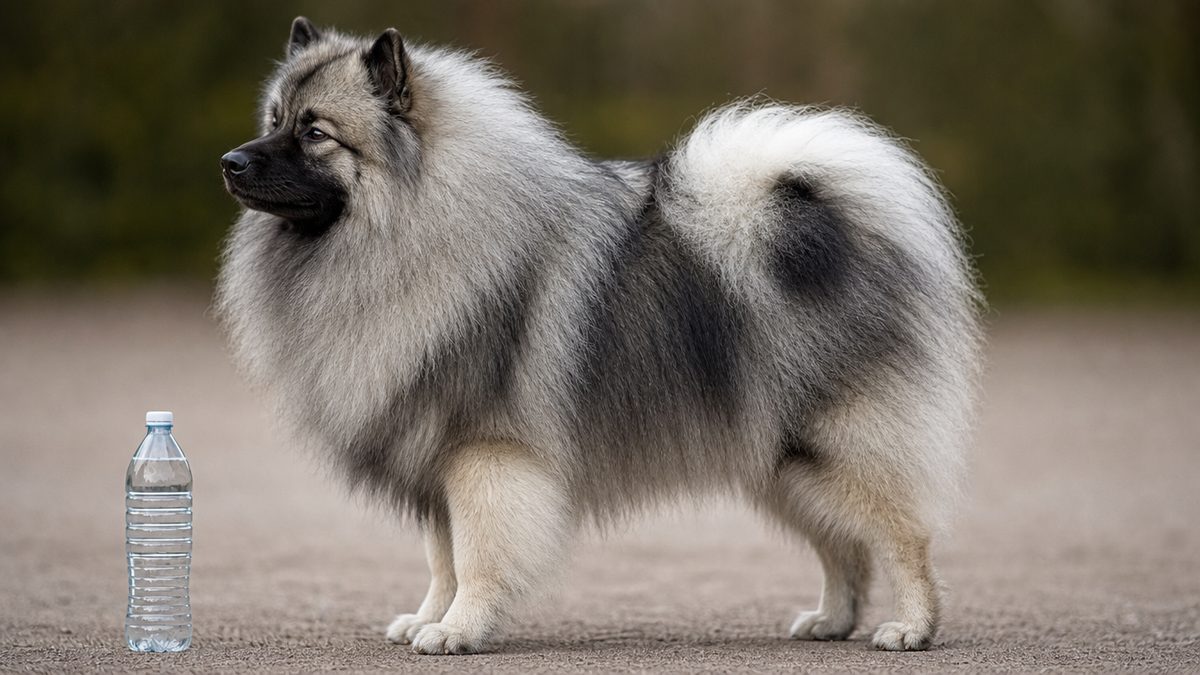
The breed standard describes a thick stand-off double coat, a foxy wedge head and a tail rolled onto the back. The FCI specifies a long, straight, firm standing-off top coat over a short, thick, cotton-wool-like undercoat, with head, ears, front of the legs and paws in short velvety hair, a thick mane over neck and shoulders, ample feathering from croup to hocks, and a bushy tail. Coat that is wavy, curly, shaggy or parted along the back is wrong, and the standard adds a line worth remembering before you book a groomer: the hair must not look like being modelled. The small, pointed ears are set high and must be carried erect.
The Kennel Club's version is shorter and sharper on the same points. It calls for a harsh, off-standing, straight coat with a dense ruff, profuse trousers, and a soft, thick, light-coloured undercoat that is never silky, wavy or woolly. It specifies dark, medium, almond-shaped, obliquely set eyes, dark small ivy-leaf-shaped ears carried erect, and a moderately long high-set tail tightly curled over the back with a double curl highly desirable and a black tip.
Coat colour is closed, and it is the variety marker
Grey-shaded is the only permitted coat colour, and that is what separates a Keeshond from the rest of Standard 97. The FCI defines it as a silver-grey with black hair tips, dark muzzle and ears, well-defined spectacles shown as a delicately pencilled black line slanting from the outer corner of the eye to the lower corner of the ear, a lighter mane and shoulder ring, silver-grey legs with no black markings below the elbows or stifles, a black tail tip and pale silver-grey trousers. Definite white markings or spots are a disqualifying fault, alongside a gap in the fontanel, an overbite, underbite or crossbite, ectropion or entropion, and ears not fully erected.
The Kennel Club puts it in four words: any other colour or combination of colours unacceptable. A white, cream, orange, black or parti-coloured spitz puppy being sold to you as a Keeshond is not one, whichever registry you ask. That test costs nothing and works from a photograph.
The origin is genuinely disputed and both sides are on record. The FCI files the breed as German, tracing German Spitz dogs to the stone-age Peat Dog, Canis familiaris palustris Rutimeyer, and the later Lake Dwelling Spitz, and calling it the oldest breed of dog in Central Europe. English-language sources file it as Dutch: the AKC calls it a fixture on the canal barges of his native Holland and a symbol of Dutch patriotism, and the name itself comes from Cornelis Kees de Gyselaer, leader of the Dutch Patriot faction, whose dog became the rebels' emblem. Both accounts are true of different things, and Bonbeno reports both rather than picking one.
Four registries, four heights, one dog
Measure a Keeshond against the FCI, the German parent club, the Kennel Club and the AKC and you get four different answers, and the Anglo-American ideal is a visibly smaller dog than the FCI's. No page ranking for this breed prints the four figures together, so here they are.
| Body | What it publishes | In centimetres | How it names the dog |
|---|---|---|---|
| FCI Standard 97 | 49 cm plus or minus 6, one figure for both sexes | 43-55 | German Wolfsspitz / Keeshond, Part 1 of five varieties |
| VDH Rasselexikon, German parent club | Wolfsspitz/Keeshond: 49 cm plus or minus 6 | 43-55 | Wolfsspitz, listed under Std. Nummer 97 |
| The Kennel Club | Ideal height: dogs 46 cms (18 ins); bitches 43 cms (17 ins) | 43-46 ideal | Keeshond, a separate Utility breed |
| American Kennel Club | 18 inches (male), 17 inches (female); 35-45 pounds | 43.2-45.7 ideal | Keeshond, a separate Non-Sporting breed |
Registration numbers put that split in proportion. The Kennel Club registered 61 Keeshonden in the United Kingdom in 2025, and its quarterly and ten-yearly documents agree on that figure exactly, both printing 61 for 2025 and both reconciling their column totals against the Utility group's own 23,188 The Royal Kennel Club. Over the ten years to 2025 the breed ran 109, 91, 80, 89, 82, 134, 51, 103, 51 and 61, so the population is small and flat rather than collapsing.
Read the last two rows against the first and the shape of the disagreement appears. The Kennel Club's ideal dog at 46 cm stands 3 cm below the FCI's ideal, and its ideal bitch at 43 cm sits exactly on the FCI's absolute lower limit, because 49 minus 6 is 43 Federation Cynologique Internationale. The AKC's 18 and 17 inches convert to 45.7 and 43.2 cm, so the two English-speaking registries agree with each other and both describe a smaller dog than the FCI's ideal. A correct 52 cm Keeshond in Germany is a large one in Britain, and a correct 43 cm bitch in Britain is scraping the floor of the FCI band.
Testing what this site said about the German Spitz, from the registers
Bonbeno's German Spitz page makes three claims about this arrangement, and all three were re-checked here from the primary documents rather than inherited. Two hold outright and the third holds with an important exception.
- Claim: the FCI and the VDH treat the Keeshond as a size variety of the German Spitz under Standard 97. Verified. The FCI PDF names Part 1 GERMAN WOLFSSPITZ / KEESHOND, and the VDH's Rasselexikon page for the Wolfsspitz prints Std. Nummer: 97 and links that exact PDF in German and English.
- Claim: the AKC and the Kennel Club register it as a separate breed. Verified. The AKC places the Keeshond in the Non-Sporting Group, recognised in 1930, ranked 85th of 210 for popularity, and maintains a separate German Spitz page alongside it. The Kennel Club publishes a standalone Keeshond breed standard in the Utility group, last updated April 2025.
- Claim: the VDH's Rasselexikon prints different measurements from the FCI PDF under the same standard number. Verified, but NOT for this variety. The VDH page gives Wolfsspitz 49 plus or minus 6, Grossspitz 46 plus or minus 4, Mittelspitz 34 plus or minus 4, Kleinspitz 26 plus or minus 3 and Zwergspitz 20 plus or minus 2. The FCI document gives 49 plus or minus 6, 45 plus or minus 5, 35 plus or minus 5, 27 plus or minus 3 and 21 plus or minus 3. Four rows differ. The Wolfsspitz row is the one row where the two agree exactly.
The Keeshond turns out to be the only German Spitz variety on which the FCI and the German national kennel club publish the same number. So the sibling page's warning is correct in general and does not apply to this dog in particular, and a reader measuring a Keeshond against the German figures will not be misled. Reporting the exception is more useful than repeating the rule.
Club recognition, registry by registry
- FCI: no Keeshond entry in the register. Recognised as the Wolfsspitz variety of Standard 97, Group 5 Section 4, without working trial Federation Cynologique Internationale.
- VDH and the German parent club: listed as Wolfsspitz in the Rasselexikon, with active litters advertised in Germany at the time of writing.
- The Kennel Club: a separate breed in the Utility group, with its own standard and its own registration row.
- AKC: a separate breed in the Non-Sporting Group since 1930, with the Keeshond Club of America founded in 1935 as its parent club.
- OFA: filed under code KE with cross-registry groups recorded as AKC Non-Sporting, CKC Non-Sporting, UKC Northern and TKC Utility.
- KCI: India is a full FCI member through the Kennel Club of India in Chennai, so an Indian pedigree is written against FCI nomenclature.
One number appears in none of these documents. FCI Standard 97 gives no weight for the Wolfsspitz, saying only that the dog should have a weight corresponding to its size, and the Kennel Club gives no weight either. The AKC's 35-45 pounds is therefore the only weight in any governing standard, which is why every other weight in circulation for this breed traces to somebody's estimate.
Keeshond price in india, and the number Google is repeating that nobody should
Published Indian asking prices for the Keeshond run from Rs 30,000 to Rs 60,000, and the Rs 98,999 figure Google's own AI answer quotes as the ceiling is not a Keeshond price at all. It is a listing site's house charm price, attached on that very page to eight puppies of seven other breeds.
Start with what a buyer actually sees. Searching keeshond price in india on Google India on 31 August 2026 returns About 187 results, which is a thin index by any standard, and the answer at the top is not a page but an AI Mode panel. That panel states that the average Keeshond puppy price in India ranges from Rs 30,000 to Rs 60,000, then breaks it into pet quality at Rs 30,000 to Rs 45,000, KCI-registered breeding quality at Rs 45,000 to Rs 70,000 and show quality at Rs 75,000 to Rs 1,00,000 and above. The lower band traces to a real page: Asia Pets publishes Rs 30,000 to Rs 60,000 in India for this breed.
Then it names its ceiling, and that is where it goes wrong. The panel writes that platforms like Puppiezo list show-quality puppies for up to Rs 98,999.
Fetched live on 31 August 2026, Puppiezo's Keeshond page carries a carousel of eight animals under Other Available Pets. They are Fizey, a Maltipoo, at Rs 98,999; Kuzo, a Poodle, at Rs 92,599; Dugu, a Poodle, at Rs 92,599; Kazuka, a Cane Corso, at Rs 94,999; Doir, a Goldendoodle, at Rs 1,20,000; Samy, a Maltipoo, at Rs 98,999; Tugi, a Rottweiler, at Rs 76,499; and Yoki, a Doxiepoo, at Rs 98,999. Every one is listed at 8 weeks. Not one of them is a Keeshond. The Rs 98,999 that Google is quoting as this breed's ceiling is attached to two Maltipoos and a Doxiepoo.
The same page fails a second, cheaper test. Its lead photograph and its Open Graph image are both a file named FINNISH-SPITZ-4.jpg, and a third copy of that file appears again lower down under the heading Find Keeshond Puppies. A page selling Keeshond puppies is illustrated with a picture the site itself filed under a different breed. Bonbeno cites Puppiezo only as evidence of how these pages are assembled, never for a fact about the dog.
Running the conversion tests on every figure
| Rupee figure | Where it appeared | Divided by 84.38 | Divided by 74.00 | Divided by 80.00 | Divided by 66.67 |
|---|---|---|---|---|---|
| Rs 30,000 | Asia Pets floor; AI Mode pet-quality floor | 355.53 | 405.41 | 375.00 | 449.98 |
| Rs 45,000 | AI Mode pet-quality ceiling | 533.30 | 608.11 | 562.50 | 674.97 |
| Rs 60,000 | Asia Pets ceiling | 711.07 | 810.81 | 750.00 | 899.96 |
| Rs 70,000 | AI Mode KCI-registered ceiling | 829.58 | 945.95 | 875.00 | 1049.95 |
| Rs 75,000 | AI Mode show-quality floor | 888.84 | 1013.51 | 937.50 | 1124.94 |
| Rs 98,999 | Puppiezo carousel, three separate puppies | 1173.25 | 1337.82 | 1237.49 | 1484.91 |
| Rs 1,00,000 | AI Mode show-quality ceiling | 1185.11 | 1351.35 | 1250.00 | 1499.93 |
Read the quotients, not whether the division was tidy. Nothing resolves to a whole number of US dollars at 84.38 or at 74. At a flat 80 the Asia Pets pair gives 375 and 750, but three of the seven rows produce quotients ending in .50, which no seller prints, and the 80 test is weak by construction because any figure ending in three zeros clears it automatically. So these are rupee-native numbers a person typed, not an American price list run through an exchange rate. That is unusual for an imported breed on this site and worth saying.
Rs 98,999 is the exception that proves the point, because it divides to nothing anywhere: 1,173.25 dollars at 84.38, 1,337.82 at 74, 1,237.49 at 80 and 1,484.91 at 66.67. No arithmetic produced it. It is a charm price ending in 999, and this site has now recorded it on eleven separate Puppiezo breed pages, including breeds the site does not stock at all.
What the Indian market actually holds
Supply is real but very thin. Mr n Mrs Pet, the largest Indian listing site and the first organic result for the price query, returned 3 Result Found for the Keeshond nationwide, and its Similar breeds at other locations panel then offered a Cavalier King Charles Spaniel and two French Bulldogs instead. For scale, the same site's own most-popular list on that page shows 650 Shih Tzus, 549 Siberian Huskies and 454 Labrador Retrievers. Three against six hundred and fifty is the honest measure of this breed's Indian availability, and it is why an affordable-looking quote deserves more suspicion than a high one.
Monthly cost of ownership, and the one line Indian owners never budget for
Budget for grooming and for an annual blood calcium test, because those are the two recurring costs this breed adds over an average dog of its size. Bonbeno publishes no single monthly rupee total, because no verified Indian cost dataset exists for the Keeshond and inventing one would be fabrication with a currency symbol attached.
The purchase price is the smallest number in this decision. A dog bought at Rs 60,000 that lives to the breed's measured median of 12.3 years costs about Rs 407 a month in purchase price alone, spread across its life. Everything after that runs every month for twelve years.
Where a Keeshond costs more than a similar-sized dog
- Professional grooming, not optional here. Google India's own AI answer for this breed puts Indian professional grooming at roughly Rs 1,500 to Rs 4,000 a session, citing an Indian pet-services page. Treat that as a marketplace estimate rather than a survey, but the direction is right: a coat this thick in this humidity is not a home-only job for most owners.
- A yearly blood calcium check from about six years old. This is the line nobody budgets for and it is the one that matters most. The age of onset in affected Keeshonden is typically later than 8 years, and the disease is silent until it is not, so an annual serum calcium is the cheapest surveillance available.
- A one-off DNA test, or proof the breeder did it. The variant test has been in use in the United States since 2008 and the causal SIRT6 variant was published in December 2025. A test on the parents is a cost the breeder should already have borne.
- Year-round parasite control. Tick and flea pressure in Chennai, Mumbai, Hyderabad and Kolkata does not pause for a winter, and a thick undercoat hides an engorging tick for days.
- Cooling, which is a genuine dog cost here. In Delhi, where the June mean is 35.88 C and the twenty-year maximum is 48.79 C, keeping one room cool through the afternoon is part of the cost of owning this coat.
The same AI Mode panel states that Keeshonds are prone to overheating in Indian summers and require 24/7 air conditioning. The first half is reasonable and this page argues it independently. The second half is an absolute requirement asserted with no citation of any kind, and it would put the breed out of reach of most Indian households on a claim nobody has measured. Cooling helps. Nobody has published a study saying a Keeshond needs air conditioning around the clock, and Bonbeno will not repeat one that does not exist.
Why there is no rupee table on this page
Bonbeno publishes an Indian monthly cost table when it has Indian sources for the components. For this breed it has a price band, a grooming estimate quoted by a search engine, and nothing else that survives checking. The useful instruction is to build the number yourself: ring three vets in your own city for consultation, vaccination and deworming rates, ring two groomers for a de-shedding session on a double coat, and add a food line for a 15 to 20 kg dog. That total will be more accurate than any figure published about this breed in India today.
Suitability for the Indian climate, reasoned rather than asserted
The Keeshond is the wrong dog for almost all of India, and the reason is arithmetic rather than opinion. Chennai's coolest month is 6.12 C warmer than Amsterdam's hottest, and this breed carries a coat built for the second of those places.
| Location | Cell elevation | Annual mean | Hottest month | Coolest month | 20-year maximum | Annual mean humidity |
|---|---|---|---|---|---|---|
| Amsterdam, the breed's namesake home | -0.95 m | 10.47 C | 17.97 C in August | 3.47 C in February | 32.08 C | 84.72 percent |
| Chennai, Tamil Nadu | 48.95 m | 27.95 C | 31.51 C in May | 24.09 C in January | 42.70 C | 72.39 percent |
| Mumbai | 97.15 m | 26.77 C | 31.19 C in May | 23.19 C in January | 44.91 C | 67.39 percent |
| Delhi | 206.37 m | 25.60 C | 35.88 C in June | 13.61 C in January | 48.79 C | 45.56 percent |
| Bengaluru | 841.72 m | 23.74 C | 28.37 C in April | 20.22 C in December | 40.38 C | 67.94 percent |
NASA POWER returns a grid cell rather than a point, and in hilly terrain the cell's mean elevation can miss the town beneath it by more than a kilometre, which corrupts the temperature by roughly 6.5 C per 1,000 m. Every cell above was checked against the real place, including the homeland. Amsterdam came back at -0.95 m for a city that genuinely sits at or below sea level, and the four Indian cells are plains cells within about 80 m of their towns. No correction was needed for any figure on this page.
The comparison that decides the question is the floor, not the peak. Chennai's coolest month, January, averages 24.09 C, which is 6.12 C warmer than Amsterdam's hottest month. A Keeshond in Chennai never experiences a single month as cool as the warmest month of the climate its coat was built in. Mumbai is the same problem with more water in the air, peaking at 90.36 percent humidity in August. Delhi is a different shape: a genuinely cool January at 13.61 C lets the dog grow a full winter coat, and then a June mean of 35.88 C asks it to survive wearing one.
Bengaluru is the least bad option and still not a good one
Bengaluru's 841.72 m cell gives an annual mean of 23.74 C and an April peak of 28.37 C, which is the mildest large-city figure in India. It is also still 10.40 C above Amsterdam's hottest month. So the honest framing is that a Keeshond is more manageable in Bengaluru, Pune or a hill station than in Chennai or Delhi, and that nowhere in urban India resembles the climate this breed was selected in. Owners who want the look and the temperament in a Chennai flat should read the Indian Spitz page first.
Reasoning the heat tolerance rating instead of borrowing an odds ratio
The largest study of canine heat-related illness never looked at this breed. Hall and colleagues analysed 905,543 UK dogs under primary veterinary care in 2016, identified 395 confirmed heat-related illness events, an incidence of 0.04 percent and an event fatality rate of 14.18 percent, and named nine breeds with raised odds against the Labrador Retriever: the Chow Chow, Bulldog, French Bulldog, Dogue de Bordeaux, Greyhound, Cavalier King Charles Spaniel, Pug, English Springer Spaniel and Golden Retriever. The word Keeshond appears zero times in that paper. Borrowing an odds ratio from it would be fabrication wearing a citation.
What does transfer is the mechanism, and the authors state it themselves. They report that the Chow Chow, another breed with a very thick coat, had the greatest risk of heat-related illness of all the study breeds at an odds ratio of 16.17, that the Golden Retriever carried 2.67 times the Labrador's odds despite similar size and purpose because it has a thicker coat, and then write the sentence that matters most here: other double coated breeds may also have increased risk, however the current study was under-powered to fully explore these pre-dispositions due to low numbers of these breeds. The people best placed to measure the risk to a Keeshond say plainly that they could not. Bonbeno rates heat tolerance at 1 out of 5 on that reasoning and shows the working.
Two findings from the same team do apply to any dog. Dogs at or above their breed and sex mean bodyweight carried 1.42 times the odds, 95 percent CI 1.12 to 1.80, and purebred dogs carried 1.86 times the odds of crossbreds, 95 percent CI 1.39 to 2.49. Keeping a Keeshond lean is therefore a heat intervention, not only a joint one.
Most heat collapse is a walk, not a parked car. In the companion study, 652 of the 879 events with a recorded trigger, or 74.2 percent, were exertional, against 113 environmental and 46 from vehicular confinement. The dangerous moment for a Keeshond in Hyderabad or Ahmedabad is a normal 5 pm walk in April, which is the walk almost every Indian owner takes.
Temperament and household fit
The Keeshond is an affectionate, alert, extremely people-attached watchdog that will bark and will follow you to the bathroom, and the household it suits is one that wants both. Every governing document and every independent source agrees on the shape of this temperament, including the noise.
The Kennel Club standard is unusually blunt for a temperament section. Under Characteristics it reads sturdy, intelligent and adaptable, an ideal companion, good watchdog; under Temperament it reads confident, alert and friendly, always ready to raise the alarm. That last clause is a breed standard describing barking as correct rather than as a fault, and an Indian buyer should read it as a specification rather than as a warning.
The FCI text for Part 1 says the same thing at more length. The German Wolfsspitz / Keeshond is always attentive, lively and extraordinarily attached to its owner, very teachable and easy to train, and its natural distrust of strangers and lack of hunting instinct make it the ideal companion and family dog and watch dog for home and farm, neither timid nor aggressive, with indifference to weather, robustness and longevity as its most outstanding attributes.
That phrase is the most quoted line in the standard and the most misread. The weather it describes is a place with a 10.47 C annual mean and a 17.97 C warmest month. A hardy dog is not a heatproof dog, and the trap with this breed is that a Keeshond genuinely will keep going in conditions it should not, because stoicism is part of what was selected for.
The clinginess is a real trait, not a cliche
Keeshonden are among the most owner-attached breeds kept as companions, and this shows up in the practical complaint. Wikipedia's article, drawing on a retailer's own description, records that they will sit waiting outside a closed door even with other people nearby, and that many owners call them velcro dogs. Google's own summary of community sources lists separation anxiety first among things to consider, noting the dog can become anxious or vocal if left alone for long hours. In an Indian household where both adults work full days out of the home, that combination produces the barking complaint rather than the boredom one.
Who should buy one
- Households in a cooler Indian city who want an alert, medium-sized companion and can accept a heavy coat as the price of it.
- Families with children, since the breed is consistently described as excellent with children and is used in therapy work by its own parent club's account.
- Owners who enjoy training, because this is a highly trainable dog that excels at obedience and agility and repays structure.
- Homes with someone in them most of the day, given how badly this breed handles being left.
Who should not
- Anyone in a housing society with a noise complaint history, because alarm barking is written into the standard and cannot be trained out, only managed.
- Anyone unwilling to brush twice a week for twelve years, since coat neglect in Indian humidity is the fastest route to a matted, hot, itchy dog.
- Anyone in coastal Tamil Nadu or Kerala without full-time cooling, on the climate arithmetic above.
- Anyone who wants a low-maintenance dog that will be alone eight hours a day, which describes the exact mismatch this breed fails at.
One temperament note contradicts the watchdog framing and is worth stating. The standard specifies natural distrust of strangers, but every independent account agrees the breed is not aggressive toward visitors and generally welcomes them affectionately once the family has. So you are buying an announcer, not a guard. A buyer in India looking for a genuine protection dog is looking at the wrong breed entirely.
Training a Keeshond, and the two things you must start before sixteen weeks
Train a Keeshond by paying quiet and by exposing it to strangers early, and start both inside the socialisation window before sixteen weeks. This is one of the most trainable breeds on this site, which means it learns the wrong lesson exactly as fast as the right one.
The raw material is unusually good. The FCI standard calls the breed very teachable and easy to train, the Keeshond ranks 18th in Stanley Coren's working and obedience intelligence list, and the AKC records that Kees excel at obedience, that some are nationally ranked, and that the first multiple MACH agility title holder was a Keeshond named Molly. The AKC's own caution is the useful half: the trainer has to keep up with them.
The socialisation window, in Indian conditions
Use the socialisation window between roughly three and sixteen weeks to make strangers boring. In practice that means controlled, food-paired introductions to lift doors, watchmen, delivery riders in helmets, house help arriving daily, the pressure cooker, other calm dogs on lead, and children running. The Indian complication is timing: the Dog Breeding and Marketing Rules 2017 note that puppy vaccination usually starts at seven to eight weeks and is normally completed at eighteen weeks, which lands the end of the course after the window has closed. Socialise in carried arms and on clean surfaces rather than waiting for the last shot, because waiting costs you the window and this is the breed where that costs the most.
A four-step protocol for the alarm barking
- Mark the first bark, not the tenth. Reward the dog for alerting once and then turning back to you. You are training a report, not silence, because silence is not what this breed was built for.
- Pay the quiet. Feed the second of silence after the alert, every time, for several weeks. A dog only ever told off for barking learns that barking produces attention.
- Move the line of sight. Take the crate off the corridor-facing wall and away from the front door. Most Indian apartment barking is a geometry problem before it is a behaviour problem.
- Give the brain a job in the afternoon. Ten minutes of scentwork or trick training at 2 pm, when it is too hot to walk anyway, reliably lowers the evening noise more than a longer walk does.
What this breed resists
It resists correction-based handling and it resists pointless repetition. A dog this quick to read a handler will shut down under harsh correction and will simply stop performing a cue that stopped paying, and punishing alarm barking in a naturally alert dog tends to escalate it rather than settle it. Timelines are realistic rather than fast: expect reliable house training by twelve to sixteen weeks on a strict schedule, a solid indoor recall by four months, genuine progress on doorbell noise by six to eight months of consistent work, and an adolescent regression somewhere between seven and eleven months that is normal and passes.
The single most valuable thing to teach a Keeshond puppy in India is to lie still on its side while you brush the undercoat out and while a dryer runs. Two-minute sessions with food from eight weeks turn a twelve-year chore into a routine. Owners who skip this end up with an adult dog that fights the line brushing, which is exactly how a coat gets shaved.
Daily exercise needs, and how to fit them into an Indian day
Give an adult Keeshond about 45 to 60 minutes of real walking a day, split into a pre-sunrise session and an after-dark session for eight months of the year. The published exercise needs figures for this breed disagree, and the Indian constraint is not the distance but the hours you are allowed to use.
The sources are vague where they should be specific. The AKC says only that Keeshonden need regular exercise, that a free run or a nice walk daily will benefit them physically and mentally, and notes that the breed historically adapted to homes ranging from farms with room to run to barges with very little. Puppiezo's Indian listing gives a flat 1 hour daily and a Moderate energy level. Bonbeno lands at 45 to 60 minutes for a reason specific to this country: the usable walking window here is narrow, so a single session tends to become the whole day's activity, and an alert spitz-type dog does not settle on that.
How to split the day
- Before sunrise, 30 to 40 minutes. The longest walk of the day on the coolest surface of the day. In Chennai in May this is the only comfortable hour that exists.
- After dark, 15 to 20 minutes. Shorter, calmer, mostly sniffing. Tarmac that felt survivable at 6 pm still holds heat at 8 pm, so test it with the back of your hand for five seconds before you set off.
- Midday, indoors, 10 minutes. A snuffle mat, a food puzzle, scentwork or five minutes of trick work. This replaces exercise on the days it genuinely cannot happen outside, and there are many of those.
- Never between 11 am and 5 pm from March to October in Delhi, Ahmedabad, Hyderabad, Nagpur, Chennai or anywhere with a comparable summer.
What happens without it
An under-exercised Keeshond gets louder rather than destructive, and the sequence in an Indian flat is predictable. More alarm barking at corridor noise, then demand barking at the family, then weight gain that a thick coat hides completely until a groomer mentions it. That last step is not cosmetic. Dogs at or above their breed and sex mean bodyweight carried 1.42 times the odds of heat-related illness in the UK VetCompass model, 95 percent CI 1.12 to 1.80, and this is a breed with a measurable joint burden waiting underneath: 10.1 percent of 2,375 OFA elbow evaluations came back abnormal.
Unlike most breeds of its size, the Keeshond genuinely adapts to a small space, because it spent its working life on canal boats. The AKC makes exactly that point about its historic range of homes. So a 2BHK is not the problem. The heat, the hours and the neighbours are the problem.
Grooming a double coat in Indian humidity, and why you must never shave it
Line brush a Keeshond to the skin twice a week, daily through a coat blow, and never clip it. The Kennel Club standard forbids the shortening, and this is one of the two breeds most associated with a condition where clipped coat does not grow back.
The standard tells you what you are maintaining and what you may not do to it. The Kennel Club calls for a harsh, off-standing, straight coat over a soft, thick, light-coloured undercoat, then adds the operative sentence: any shortening of the coat which alters the natural outline should be penalised, with the exception of feet and pasterns which may be lightly trimmed. The FCI adds that the hair must not look like being modelled. Both documents are describing a dog that is brushed, not cut.
The AKC's parent-club guidance is gentler than most Indian owners expect. Going through the coat once a week with a pin brush usually does the job, keeping the undercoat brushed out and shedding to a minimum, and the only trimming needed is tidying around the feet, pads and hocks, with a bath and blow-dry every four to six weeks. That advice was written for a temperate climate. In Indian humidity the brushing frequency needs doubling and the drying needs to be complete, which is the adjustment nobody makes.
Why the Indian summer shave is a medical risk here, not just a style one
A groomer offering a summer cut in Pune or Chennai is offering to remove the dog's insulation against radiant heat, not only its warmth, because a stand-off coat traps a layer of still air that slows heat transfer in both directions. Wikipedia states the same principle plainly, that a Keeshond should never be shaved because the undercoat provides a natural barrier against heat and cold. But there is a second, sharper reason specific to this breed.
Alopecia X, also called hair cycle arrest, is a non-inflammatory alopecia that veterinary dermatology describes as frustrating to diagnose and treat because the pathogenesis is not understood, and the published case literature is dominated by exactly two breeds. Candidate-gene work on PTCH2 and CTSL2 was carried out specifically in Pomeranians and Keeshonden, and a 2018 report describes deslorelin implant treatment in two intact male Keeshonden. Clipping a coat on a breed predisposed to a condition where hair stops cycling is a risk no Indian summer justifies. Remove the dead undercoat instead, which is the part actually trapping heat.
A working routine for an Indian household
- Twice weekly, 20 minutes, line brushing. Part the coat in horizontal lines and brush outward from the skin with a slicker, then comb through to confirm you reached the skin. Brushing the surface of a stand-off coat achieves almost nothing and is the commonest mistake here.
- Daily through a coat blow. Males typically drop the undercoat once a year and females twice, and each blow takes roughly two weeks to complete before the new undercoat starts back. In Indian metros the temperature cue that triggers a clean seasonal drop is weak, so shedding is often lower-grade and continuous instead.
- Bath rarely, dry completely, to the skin. Use a stand dryer or a cool blower every time. A double coat that stays damp at the skin in 28 C and 80 percent humidity is a hot spot waiting to happen, and Mumbai runs 90.36 percent humidity in August.
- Plug the ears before any bath. Erect ears drain far better than drop ears, which is a genuine advantage this breed has over a spaniel in the monsoon, but a wet canal is still the commonest way an Indian owner turns a bath into a vet visit.
- Trim only the feet, pads and hocks. That is explicitly permitted by both the Kennel Club standard and the AKC's guidance, and matted pad hair traps grit and holds monsoon water.
- Check the trousers and feathering weekly for ticks. Long feathering hides an engorging tick for days, and tick pressure here does not have an off season.
One practical warning about hired help. A groomer who has never handled a double coat will reach for clippers by default, because clipping is faster than de-shedding and the customer cannot tell the difference on the day. Say the word no in advance, ask specifically for a de-shed and blow-out, and if the salon does not own a high-velocity dryer, find one that does.
Health issues, screening and life expectancy
Screen a Keeshond for primary hyperparathyroidism by DNA test, then for hips, elbows, patellas and eyes, in that order. The parathyroid disease is the one that is genuinely this breed's own, and the elbow figure is the one owners never look at.
Start with the register. The Keeshond holds OFA breed code KE, read from OFA's own raw markup rather than guessed, filed under the AKC Non-Sporting Group, CKC Non-Sporting Group, UKC Northern Group and TKC Utility Group. Unlike most breeds on this site it has a full set of published statistics rows rather than one or two, which makes it genuinely measurable.
| Registry | Rank | Evaluations | Result |
|---|---|---|---|
| Hips | 166 | 6,236 | 92.8 percent normal; 6.4 percent dysplastic (4.5 mild, 1.6 moderate, 0.2 severe) |
| Elbow | 48 | 2,375 | 89.7 percent normal; 10.1 percent abnormal (7.2 grade 1, 2.1 grade 2, 0.8 grade 3) |
| Patella | 77 | 2,328 | 97.5 percent normal; 2.5 percent abnormal (2.2 grade 1, 0.3 grade 2) |
| Eyes | 156 | 1,845 | 96.7 percent normal; 3.3 percent abnormal |
| Thyroid | 45 | 560 | 86.3 percent normal; 3.9 percent compensative autoimmune thyroiditis; 9.5 percent equivocal |
| Congenital cardiac | 135 | 567 | 99.8 percent normal |
| Basic cardiac | 90 | 327 | 100.0 percent normal |
| Advanced cardiac | 103 | 76 | 96.1 percent normal; 2.6 equivocal; 1.3 abnormal |
| Primary hyperparathyroidism | 1 | 543 | 98.0 percent normal; 2.0 percent abnormal |
The elbow number is the one nobody quotes
Elbows fail more often than hips in this breed, and every Indian buyer's checklist asks about hip dysplasia instead. OFA records 6.4 percent dysplastic across 6,236 hip evaluations, against 10.1 percent abnormal across 2,375 elbow evaluations. Both figures check out arithmetically: the hip grades 10.3 excellent, 66.9 good and 15.6 fair sum to the printed 92.8 normal, and the elbow grades 7.2, 2.1 and 0.8 sum exactly to 10.1. So ask for the elbow certificate as well as the hip one, and note that at rank 48 of all breeds the Keeshond's elbow position is worse than its hip position at rank 166.
The eye summary line reports 96.7 percent normal across 1,845 evaluations. The detail row labelled NORMAL (OTHER .000), on the same 1,845 denominator, reports 1,273 dogs, which is 69.0 percent. Those two cannot both describe the same population, and the 27.7 point gap is far too large to be rounding. The largest named finding on the detail side is CATARACT-SIGNIFICANCE UNKNOWN at 193 of 1,845, or 10.5 percent, followed by punctate posterior sutures at 133, or 7.2 percent, and distichiasis at 90, or 4.9 percent. Bonbeno publishes both figures with the arithmetic and quotes neither as the breed's eye disease rate. Do not read the detail column as a prevalence.
Thyroid, and why an Indian lab report may mislead you
A Keeshond's normal thyroid range is not the general canine range. In a study of 693 healthy dogs across seven breeds, mean total T4 ranged from 19.7 nmol/L in English Setters to 29.0 nmol/L in Keeshonds, the highest of the seven, and the authors concluded that breed-specific reference intervals are warranted. That matters here because Indian laboratories report against a generic canine interval, so a Keeshond result read against the wrong scale can look normal when it has fallen for that dog. OFA's own thyroid row reads 86.3 percent normal on 560 evaluations with 9.5 percent equivocal, which is a high equivocal fraction and consistent with a breed whose true range sits off-centre.
Two inherited diseases the breed is a research model for
Idiopathic epilepsy in Keeshonden appears to follow a single autosomal recessive gene. Comparing the pedigrees of fifteen litters containing diagnosed epileptic dogs against thirty-four contemporary normal animals traced every affected dog back to a common ancestor on both the paternal and maternal sides, and across 120 progeny of known carrier by carrier matings the expected 90 to 30 ratio came back as an observed 91 to 29, which is not significantly different. A genetic counselling programme has run since 1989 and advised on 77 proposed matings, with the mean probability of producing carriers declining significantly over time.
Inherited diabetes mellitus in the breed is older and rarer but is the reason the Keeshond appears in human medical literature at all. A line of non-obese purebred Keeshond dogs was characterised with insulin-requiring diabetes of onset between 2 and 6 months of age, developing cataracts, ketosis and hyperglycaemia, with pancreatic islet B cells absent on immunocytochemistry while A cells remained. This is early-onset disease in puppies rather than the middle-aged diabetes most owners picture.
The breed is also the reference model for conotruncal heart defects. Work at Pennsylvania established that isolated conotruncal defects in the Keeshond form one genetically related group including sub-clinical conal septum defects, conal ventricular septal defects, tetralogy of Fallot and persistent truncus arteriosus, and a genome-wide scan of a Keeshond by beagle backcross pedigree in which 46 of 101 offspring had defects showed the trait is oligogenic, with linkage on CFA2, CFA9 and CFA15 and a corrected LOD score of 3.7 at the CFA9 locus. Today's OFA congenital cardiac row reads 99.8 percent normal on 567 evaluations, which suggests screening has done its job.
Life expectancy
The best measured figure is 12.3 years. The UK longevity analysis of 584,734 dogs, of which 284,734 were deceased, gives the Keeshond a median survival of 12.3 years with a 95 percent confidence interval of 11.6 to 13.8, on 55 recorded deaths, and a hazard ratio against crossbreds of 0.84 with a confidence interval of 0.65 to 1.1 and p equal to 0.21. Read that honestly: the breed is not measurably different from average, because the interval crosses 1. For context the same paper gives 12.5 years across all dogs, 12.7 for purebreds and 12.0 for crossbreds. The AKC's published 12-15 years cites no study at all, and a separate UK life-table analysis puts life expectancy at age zero for all UK companion dogs at 11.23 years.
The Keeshond has its own row in the longevity paper's phylogeny table, marked included, with reclassification NA and its own abbreviation KEES, so nothing was folded into it and it was not folded into anything. That check matters because the same table quietly merges other breeds into their close relatives, and a merged breed's absence looks identical to simple exclusion. The Keeshond figure is genuinely the Keeshond's. Note only that the paper's Tables S3 and S6 disagree on sample size for this breed, 171 against 168, while both record exactly 55 deaths, so the death count is the number to build on. The paper also carries an Author Correction that almost nobody cites, and it is narrow: it changes one Miniature Dachshund median in a figure legend and touches no supplementary table, so it does not affect the Keeshond figure at all.
Primary hyperparathyroidism, the disease that is this breed's own
Test for primary hyperparathyroidism before you buy, because no other breed carries it the way the Keeshond does. OFA's register for the condition holds 543 Keeshonden out of 544 dogs of every breed ever tested, which makes it a Keeshond register with one visitor.
Primary hyperparathyroidism is the inappropriate secretion of parathyroid hormone by neoplastic or hyperplastic parathyroid cells, which drives blood calcium up and, untreated, damages the kidneys. In Keeshonden it is inherited in a dominant Mendelian fashion with high age-related penetrance, and the age of onset is typically later than 8 years. A dog can therefore be bred from, sold, and living happily for years before the disease appears, which is exactly why the DNA test exists.
How the evidence was built, over eighteen years
- 2007, heritability established. Pedigrees of 1,647 Keeshonden including 219 with known phenotypes, 69 of them positive, with DNA from 176 dogs, showed the disease is genetically transmitted and ruled out the four genes implicated in the equivalent human disorder, MEN1, CASR, HRPT2 and RET.
- 2008, a test in practical use. A promoter variant in eukaryotic elongation factor 2 has been used for disorder testing in the United States since 2008.
- 2020, the outcome data. A retrospective review of dogs treated by curative parathyroidectomy found recurrence in 6 of 12 Keeshonden, 50 percent, against 1 of 15 dogs of other breeds, 7 percent, p equal to 0.024, with Keeshonden also significantly younger at first diagnosis, a median of 108 months against 126, p equal to 0.043, and recurrence arriving at a median of 35 months after treatment.
- December 2025, the causal variant. A genome-wide association study of 27 affected and 42 unaffected Keeshonden across 30,896 markers localised the disease to canine chromosome 20 and identified a missense and possible splice-site variant in exon 2 of SIRT6, absent from 1,987 other genotyped samples in the public domain and strongly concordant with the variant already used for testing.
Half the Keeshonden in that series had the disease come back after surgery that was described as curative, and it came back a median of 35 months later. The authors' own conclusion is that all dogs treated this way should be monitored lifelong, and that this is particularly pertinent in the Keeshond population, with earlier screening of younger, apparently healthy Keeshonden also advisable. In India, where a specialist parathyroid surgery is neither cheap nor widely available, the practical translation is simple: buy from tested parents, and run a serum calcium once a year from about six years old.
What to ask a seller, in plain words
The Keeshond Club of America recommends genetic screening for primary hyperparathyroidism alongside radiographs for hip and elbow dysplasia, a patellar luxation examination and a CERF eye examination, and the AKC lists the same four evaluations. Ask for all five results, on both parents, dated, in writing. A breeder who has never heard of the parathyroid test has not screened for the one disease that is specific to the dog they are selling, and no amount of enthusiasm substitutes for the certificate.
One caveat on the register itself. Holding 543 evaluations does not mean 543 Indian dogs, or any Indian dogs: OFA's data is overwhelmingly North American, and Bonbeno found no Indian veterinary publication mentioning this breed at all. A PubMed search for Keeshond AND India returned zero records against a working control of 88 for Indian canine tick-borne disease in the same session, so the absence is real and the honest statement is that nobody has published on this breed in this country.
Feeding and body condition
Feed a Keeshond to a visible waist rather than to a cup measurement, because a thick double coat hides two kilograms of gain completely. On this breed body condition is a heat intervention and a joint intervention at the same time.
Run your hands over the ribs weekly, not your eyes. The visual body condition check that works on a Labrador fails outright on a coated breed, and Indian owners routinely discover a significant gain only when a groomer mentions it during a de-shed. You should feel the ribs easily under a thin fat cover, see a waist behind the ribs from above, and see an abdominal tuck from the side. If the ribs are visible the dog is thin; if you have to press to find them it is overweight.
Life-stage feeding
- 8 to 16 weeks: four meals a day of a complete puppy food. Growth is fast and stomachs are small, and this is also when to establish that the food bowl is not a source of conflict.
- 4 to 8 months: three meals a day. Most overfeeding starts here, because a thickening puppy coat makes the dog look correct at any weight.
- 8 months to adult: two meals a day, and start weighing the dog monthly on the same scale rather than estimating. Write the numbers down.
- Adult: two meals a day, portioned to hold condition through the seasons. Indian summers cut activity sharply, so the portion that worked in January is usually too much by May.
- Senior, from about eight years: two meals, watch for muscle loss over the topline, and add an annual serum calcium to the same visit, because that is the age this breed's parathyroid disease typically appears.
Why weight matters more here than for an average dog
Two published risks compound. Dogs at or above their breed and sex mean bodyweight carried 1.42 times the odds of heat-related illness in the UK VetCompass model, 95 percent CI 1.12 to 1.80, so on a heat-sensitive coat every extra kilogram is a summer risk rather than a cosmetic one. Underneath that sits a joint load: OFA records 10.1 percent abnormal elbows across 2,375 evaluations and 6.4 percent dysplastic hips across 6,236, and neither joint is helped by carrying fat.
What is actually available in India
Medium-breed complete diets from the major brands are stocked widely in Indian metros, and the practical question is portion discipline rather than brand. Home-cooked feeding is common in Indian households and can be done well for an adult, but a growing puppy on an unbalanced home diet is the fastest route to a skeletal problem, so use a formulated puppy food through the growth period at minimum. The AKC notes the breed does well on a fish-based diet low in carbohydrate and flags that some individuals are prone to getting overweight.
FCI Standard 97 gives no weight for the Wolfsspitz at all, saying only that it should correspond to the dog's size, and the Kennel Club gives none either. So every kilogram figure you will read comes from somewhere else, and they disagree: the AKC publishes 35-45 pounds, roughly 15.9 to 20.4 kg; Asia Pets publishes 14-20 kg; Puppiezo publishes 16-23 kg; and Wikipedia's infobox publishes 15-20 kg. Feed to condition, not to a published band.
Fresh water needs to be genuinely cool and constantly available through the Indian summer. A heat-sensitive dog under this much coat drinks considerably more than owners expect, and in a household that refills a bowl twice a day rather than four times, mild chronic under-drinking is easy to miss.
The first year, month by month
Get the socialisation, the grooming habit and the vaccination course right in the first four months and the rest of the year is maintenance. Each stage below has one thing that cannot be done later.
| Age | What is happening | What you do |
|---|---|---|
| Under 8 weeks | Still with the litter. Selling below this age is prohibited by Rule 8(1)(a) of the Dog Breeding and Marketing Rules 2017 | Visit, meet the dam, measure both parents at the withers, and collect the parathyroid DNA result plus hip, elbow, patella and eye certificates. Do not take the puppy home |
| 8 to 12 weeks | Vaccination usually starts at seven to eight weeks. The socialisation window is open and already closing | Carried outings daily: lifts, watchmen, delivery riders, traffic noise, calm adult dogs. Begin two-minute brushing sessions paired with food |
| 12 to 16 weeks | The window shuts near sixteen weeks. Adult teeth begin coming through | The highest-value weeks of the dog's life. Start the bark protocol now rather than later. House training on a strict schedule |
| 4 to 6 months | Vaccination course usually completes near eighteen weeks. The puppy coat begins changing | First full grooming session with a high-velocity dryer, so the noise becomes normal early. Introduce the pad trim. Recall games indoors and in an enclosed space |
| 6 to 9 months | Adolescence. Alarm barking peaks and the adult coat thickens | Hold the training line through the regression. Book the veterinary patella check. Do not let the first hot season collapse the walking routine |
| 9 to 12 months | Approaching adult size and full coat | Move to two meals a day. Make twice-weekly line brushing permanent. Baseline eye examination and a first weight recorded on paper |
The three moments that cannot be redone
Twelve to sixteen weeks is the first and the only truly irreversible one. The socialisation window shuts near sixteen weeks while the Indian vaccination schedule, which the 2017 Rules describe as usually completed at eighteen weeks, finishes after it. Owners who wait for the final shot before taking the puppy out lose the window entirely, and on a breed whose standard specifies natural distrust of strangers that loss produces twelve years of corridor barking.
The first coat blow is the second. An owner who has only ever brushed the surface of the coat meets undercoat coming out in sheets, panics, and books a clipper. Book a professional de-shedding groom instead, watch how the line brushing is done, and copy it at home.
The first hot season is the third. A puppy that arrives in Delhi in December meets a June mean of 35.88 C and a twenty-year maximum of 48.79 C wearing a full coat and with no experience of either. Move the walking schedule to pre-dawn and post-dusk before the heat arrives, not after the first bad afternoon.
Keeshond compared with the breeds Indian buyers confuse it with
Compare a Keeshond against the four dogs it is mistaken for in India and the differences are registry facts, not opinions. The table below uses each breed's own governing document rather than a retail description.
| Breed | Governing standard | Height in that standard | Permitted colour | Realistic Indian availability |
|---|---|---|---|---|
| Keeshond | FCI Standard 97 Part 1, as German Wolfsspitz / Keeshond; separate AKC and Kennel Club standards | 49 cm plus or minus 6 per FCI; ideal 46 and 43 cm per the Kennel Club | Grey-shaded only; any other colour unacceptable | Very thin. 3 results nationwide on the largest listing site |
| German Spitz (Mittel) | FCI Standard 97 Part 2; a separate Kennel Club breed | 35 cm plus or minus 5 per FCI; 30-38 cm per the Kennel Club | White, black, brown, orange, grey-shaded and other colours | Thin, and mostly confused with the Indian Spitz |
| Pomeranian | FCI Standard 97 Part 3, as German Toy Spitz; separate AKC and Kennel Club Toy standards | 21 cm plus or minus 3 per FCI | The full open colour list | Wide. Sold in every Indian metro |
| Indian Spitz | Not covered by FCI Standard 97 at all | Not set by Standard 97 | Usually white, locally established | Wide and genuinely affordable |
| Finnish Spitz | A separate FCI standard, not part of 97 | Not covered by Standard 97 | Red-gold | Rare, but its photographs circulate on Indian Keeshond listings |
The colour column is the fastest test in that table. A Keeshond is grey-shaded and nothing else, under both the FCI and the Kennel Club The Kennel Club, Breed Standard: Keeshond, while its own siblings inside Standard 97 may be white, black, brown, orange or parti-coloured. So a white spitz is never a Keeshond, whatever the receipt says, and a buyer can rule the breed in or out from a photograph before asking a single question about pedigree.
Why the Keeshond and the Pomeranian share a standard number
They share it because the FCI treats them as size varieties of one German breed rather than as two breeds. Standard 97 covers all five in a single document, headed Deutsche Spitze, and says in its own history section that Wolfsspitz dogs are known as Keeshonds and Zwergspitz dogs as Pomeranians outside German-speaking countries. The gap in size is the striking part: 49 cm against 21 cm, a difference of 28 cm between two dogs sharing one rulebook, and one of the reasons every photograph on this page carries a scale object.
The Indian Spitz genuinely wins on three of five criteria
The Indian Spitz beats the Keeshond on availability, on price and on heat adaptation, and that is not a consolation argument. India is an FCI full member through the Kennel Club of India in Chennai, so an FCI-standard breed is registrable here in principle, but principle does not build a supply chain, and three listings nationwide is not one. A buyer who wants an alert, medium-sized, double-coated, foxy-faced dog that is actually obtainable, actually affordable and actually bred in this climate is describing the Indian Spitz, and looking at that page first is the honest recommendation.
Two things, and they are real. The temperament is exceptional, consistently described as gentle with children, deeply people-attached and highly trainable, and the breed is used in therapy work. And the health data behind it is unusually good: nine published OFA registry rows, a named DNA test for its own inherited disease, and a measured longevity figure with a confidence interval McMillan KM, Bielby J, Williams CL. Very few breeds on this site can be checked this thoroughly before you buy.
Mistakes Indian Keeshond owners actually make
Shaving the coat is the mistake that does lasting damage, and skipping the parathyroid test is the one that costs the most money later. Five more follow, in the order they hurt.
- Shaving the double coat for summer. The Kennel Club standard states that any shortening of the coat which alters the natural outline should be penalised, excepting only the feet and pasterns. Beyond the show ring, this is one of the two breeds that dominate the published literature on hair cycle arrest, where clipped coat regrows patchily or not at all. Brush the undercoat out instead.
- Buying without the parathyroid DNA result. OFA's primary hyperparathyroidism register holds 543 Keeshonden out of 544 dogs of all breeds, the inheritance is dominant with high age-related penetrance, and onset is typically after eight years. A breeder who cannot produce that result has not screened for the disease their own breed is defined by.
- Asking only about hips. The elbow figure is worse: 10.1 percent abnormal across 2,375 evaluations at rank 48, against 6.4 percent dysplastic hips at rank 166. Ask for both certificates by name.
- Reading a thyroid result against a generic Indian lab range. Keeshonds carried the highest mean total T4 of seven breeds studied, 29.0 nmol/L against 19.7 in English Setters, and the authors concluded breed-specific reference intervals are warranted. A number inside the general canine range can still be a fall for this dog.
- Believing the Rs 98,999 figure. Google India's AI Mode quotes it as this breed's ceiling, citing Puppiezo. On that page it is attached to two Maltipoos and a Doxiepoo, in a carousel of eight animals containing no Keeshond at all, on a listing illustrated with a file named FINNISH-SPITZ-4.jpg.
- Walking at the wrong hour. Delhi's June mean is 35.88 C with a twenty-year maximum of 48.79 C, and 652 of the 879 UK heat-illness events with a recorded trigger, 74.2 percent, were exertional rather than caused by a hot car.
The mistake that is really the publisher's
English Wikipedia's Keeshond infobox gives heights of 44 to 48 cm for males and 40 to 46 cm for females, and those figures appear in no breed standard anywhere. The FCI gives 49 plus or minus 6 for both sexes, the Kennel Club gives ideals of 46 and 43 cm, and the AKC gives 18 and 17 inches. None of the three produces a 40 cm female or a 44 to 48 cm male band. The same Wikipedia article's own body text states the AKC standard correctly as 17 to 18 inches and the FCI as 19.25 inches plus or minus 2.4, which converts precisely to 49 plus or minus 6 cm, so the article contradicts its own infobox. The article has carried a needs-more-citations banner since May 2007.
There is a strong temptation to split the difference between 43-55, 46/43 and 18/17 inches and print one tidy range. That range would appear in no document anywhere and would be wrong against all four. Print them separately, name each source, and let the buyer ask the seller which rulebook the pedigree was written under.
One more publisher-side error is worth naming because a buyer can catch it. Puppiezo's page prints a weight of 16-23 kg for the Keeshond, which reaches three kilograms above the AKC's ceiling of 45 pounds and sits above every other published band. No governing standard gives any weight at all, so a figure that specific has no source behind it, and a seller quoting a heavier dog than any registry describes is describing something else.
Adopting a Keeshond in India, and how to verify what you are offered
Adopt a spitz-type dog in India by starting with Indian Spitz and spitz crosses in metro shelters, because a purebred Keeshond almost never reaches rescue here. The verification checklist below applies whichever route you take.
Adoption of a purebred Keeshond in India is not a realistic plan, and saying so is more useful than pretending otherwise. Breed-specific Keeshond rescue exists in North America, where the Keeshond Club of America maintains a rescue network, but with 3 listings for sale nationwide there is no Indian population large enough to produce a rescue stream, so adoption here means adopting the silhouette rather than the breed. What Indian shelters and city rescue groups do carry in volume is Indian Spitz and Indian Spitz crosses, which are alert, double-coated, foxy-faced dogs bred and kept here in vastly larger numbers. A buyer whose actual want is that silhouette should search local shelter listings for spitz before paying anyone.
Six checks before money changes hands
- Ask which name is on the pedigree. India is an FCI full member through the Kennel Club of India in Chennai, so a KCI paper runs on FCI nomenclature and the breed should be written as Wolfsspitz. A document reading Keeshond may still be legitimate, but ask which registry issued it and check that the answer makes sense.
- Look at the colour first. Grey-shaded only, with a black tail tip, cream legs and no black below the wrist or hock, and definite white markings or spots are a disqualifying fault. This test costs nothing and works from a photograph before you travel.
- Measure both parents at the withers. Height is the only objective variety marker, and the four published tables differ by up to 6 cm at each end, so measure and then compare against all four rather than accepting a claim.
- Ask for the primary hyperparathyroidism DNA result on both parents. This is the non-negotiable one. The test has been in practical use since 2008 and the causal SIRT6 variant was published in December 2025.
- Ask for hip, elbow, patella and eye certificates. All four are what the breed's own parent club recommends, and the elbow one is the certificate most often missing.
- Refuse any puppy under eight weeks. Rule 8(1)(a) of the Prevention of Cruelty to Animals (Dog Breeding and Marketing) Rules 2017 requires that pups less than eight weeks in age are not sold. A seller who breaks that rule in the advertisement has not honoured the screening rules either.
How to read an Indian listing for this breed
Three tells separate a real Keeshond listing from an auto-generated one, and all three showed up in this research. First, check whether the photographs are of the breed: Puppiezo's Keeshond page leads with a file named FINNISH-SPITZ-4.jpg and uses it again lower down. Second, check what the price is attached to: a carousel of eight puppies at Rs 76,499 to Rs 1,20,000 containing two Maltipoos, two Poodles, a Cane Corso, a Goldendoodle, a Rottweiler and a Doxiepoo tells you the number is a site-wide price point rather than this breed's. Third, look at whether the spec figures match any standard: a 16-23 kg weight band exists in no governing document, because no governing document gives a weight.
None of the rupee bands published for this breed is a converted dollar list. Rs 30,000 divides to 355.53 dollars at 84.38, 405.41 at 74 and 449.98 at 66.67, and Rs 60,000 to 711.07, 810.81 and 899.96. No seller anywhere prices a puppy at 355 dollars or 711 dollars. These are rupee-native round numbers that an Indian seller typed, which is unusual for an imported breed on this site and worth saying plainly. The one figure that is fabricated is Rs 98,999, and it is fabricated in a different way: it divides to nothing at any rate, because it is a charm price rather than a conversion.
A closing word on the ethics of this particular purchase. This is a heat-sensitive, heavily coated, deeply people-attached dog with a dominant inherited disease, being sold into a country with almost no breed-specific veterinary experience of it, at a price similar to a Labrador. If you want one, buy from tested parents, plan for the coat and the cooling, and register the dog properly. If those conditions are not achievable in your household, the kindest version of this page's advice is to adopt a spitz cross instead.
Keeshond questions Indian buyers actually ask
Is a Keeshond a good family dog?
Yes, a Keeshond suits a family that wants a medium-sized, affectionate, highly trainable companion and can live with noise and hair. The Kennel Club standard calls it confident, alert and friendly, and an ideal companion and good watchdog, then adds that it is always ready to raise the alarm. The AKC's parent club adds that Keeshonden are used in therapy work. The realistic caution is not temperament, it is the coat and the barking.
How much do Keeshond dogs cost?
Published Indian asking prices run from Rs 30,000 to Rs 60,000 on Asia Pets, and Google India's own AI Mode extends that to Rs 1,00,000 for show quality while quoting Rs 98,999 from Puppiezo as the ceiling. That last figure is not a Keeshond price. It is a house price point Puppiezo attaches to whichever puppy is in stock, and on the Keeshond page it sits beside two Maltipoos, two Poodles, a Cane Corso, a Goldendoodle, a Rottweiler and a Doxiepoo, with no Keeshond in the carousel at all.
Is Keeshond a rare breed?
Yes in India, and uncommon rather than rare elsewhere. The Kennel Club registered 61 Keeshonden in the United Kingdom in 2025, and the AKC ranks the breed 85th of 210 for popularity. In India the whole search term returns About 187 Google results and the largest listing site showed 3 results nationwide, so supply is thin enough that verification matters more than price.
How expensive is a keeshond?
Two answers, and they are different questions. The purchase price in India runs roughly Rs 30,000 to Rs 60,000 on published listings. The cost that decides the decision is the twelve years afterwards, where a heavy double coat in Indian humidity means professional grooming, and a breed with a dominant inherited parathyroid disease means an annual blood calcium check from about six years old that most Indian owners never budget for.
Which dog's price is 1 crore?
No dog has a defensible price of one crore, and Bonbeno publishes no such figure. Questions like this one appear in Google India's People Also Ask box beside genuine Keeshond queries, and they are answered by pages recycling unverifiable claims. The most expensive real numbers in this breed's Indian market are the Rs 98,999 charm price a listing site attaches to unrelated puppies and the Rs 1,20,000 it prints beside it for a Goldendoodle.
Is the Keeshond recognised by the FCI?
No, not as a breed of its own. The FCI's breeds nomenclature under K runs Kai, Kangal, Karjalankarhukoira, Kavkazskaia Ovtcharka, Kazakh Tazy, Kerry Blue Terrier, King Charles Spaniel, Kishu, Kleiner Munsterlander, Komondor, Korea Jindo, Kraski Ovcar, Kromfohrlander and Kuvasz, with no Keeshond. The dog itself is fully recognised, as Part 1 of Standard 97, Deutsche Spitze, under the name German Wolfsspitz / Keeshond.
How tall should a Keeshond be?
It depends which rulebook the pedigree was written under, and the four bodies disagree. FCI Standard 97 gives 49 cm plus or minus 6 for both sexes, so 43 to 55 cm. The Kennel Club gives an ideal of 46 cm for dogs and 43 cm for bitches. The AKC gives 18 and 17 inches, which is the same pair converted. So the Kennel Club's ideal bitch sits exactly on the FCI's absolute floor.
What health test does a Keeshond specifically need?
The DNA test for primary hyperparathyroidism, and no other breed needs it in the same way. OFA's register for that disease holds 543 Keeshonden out of 544 dogs of all breeds ever tested, which makes it a Keeshond register in practice. The Keeshond Club of America recommends it alongside hip and elbow radiographs, a patella examination and an eye examination. Ask for the parents' results, in writing, dated.
How long does a Keeshond live?
The best measured figure is 12.3 years, with a 95 percent confidence interval of 11.6 to 13.8, from the UK longevity dataset of 584,734 dogs. That estimate rests on 55 recorded Keeshond deaths, which is a small sample, and the breed's hazard ratio against crossbreds was 0.84 with a confidence interval crossing 1 and p equal to 0.21, so the breed is not measurably shorter or longer lived than average. The AKC's published 12-15 years cites no study.
Can a Keeshond cope with Indian heat?
Not in most of India, and the honest answer is that this is the wrong climate for the coat. Chennai runs a 27.95 C annual mean against Amsterdam's 10.47 C, and Chennai's coolest month at 24.09 C is 6.12 C warmer than Amsterdam's hottest month. The breed was never modelled in the UK heat-illness study, whose authors say plainly that they were under-powered to test double-coated breeds, so nobody has measured the risk directly.
Should I shave my Keeshond in summer?
No. The Kennel Club standard states that any shortening of the coat which alters the natural outline should be penalised, with only the feet and pasterns lightly trimmed. The stand-off top coat holds a layer of still air that slows radiant heat gain, and the breed is one of the two most associated with hair cycle arrest, or alopecia X, where clipped coat regrows patchily or not at all. Brush the dead undercoat out instead.
What is the difference between a Keeshond and a German Spitz?
Under FCI rules there is no difference in kind, only in size and colour. Standard 97 covers five varieties in one document, and the Keeshond is the largest of them at 49 cm plus or minus 6, restricted to grey-shaded colour alone. The AKC and the Kennel Club split them into separate breeds with separate standards. So a dog can be a Keeshond in Delhi under a KCI pedigree written as Wolfsspitz and a German Spitz nowhere, all at once.
Compare with similar breeds
Keeshond sits in 2 Bonbeno groups. Each one compares it directly against the breeds it is genuinely an alternative to, on the same figures.