
Breed profile
Finnish Spitz: Price in India, Bark-Pointing and Health Data
Finland's national dog since 1979, bred to find a grouse in a tree and bark at it until the hunter arrives, measured against Indian heat and against 19,523 Finnish registrations of open health data.
Quick answer
Indian pages quote a Finnish Spitz price in India of Rs 18,000 to Rs 60,000, but that ladder traces to one unsourced 2020 article republished on two domains, and six of the eight results Google India returns for the query are about the Indian Spitz instead. No verified Finnish Spitz was found for sale in India. The breed is Finland's national dog since 1979, bred to hold a grouse in a tree by barking, and scored on that in four-hour trials.
This page summarises published breed-standard text, open kennel-club registry statistics, government notifications and peer-reviewed veterinary research for general information. It is not a diagnosis and it is not treatment advice. Consult a registered veterinarian near you about your own dog before acting on anything here. Two things in this breed are worth acting on the same day rather than watching. A first seizure needs veterinary assessment rather than a wait-and-see approach, because idiopathic epilepsy affects an estimated 5.36 percent of this breed in Finland and is usually well controlled once it is being treated. And a dog that pants heavily, staggers, vomits or collapses after exercise in Indian heat is a heat-illness emergency: start cooling with cool water at once and go to a veterinarian immediately, because the case fatality rate for heat-related illness in the largest published study was 14.18 percent.
Finnish Spitz at a glance
What a Finnish Spitz is, and what it was built to do
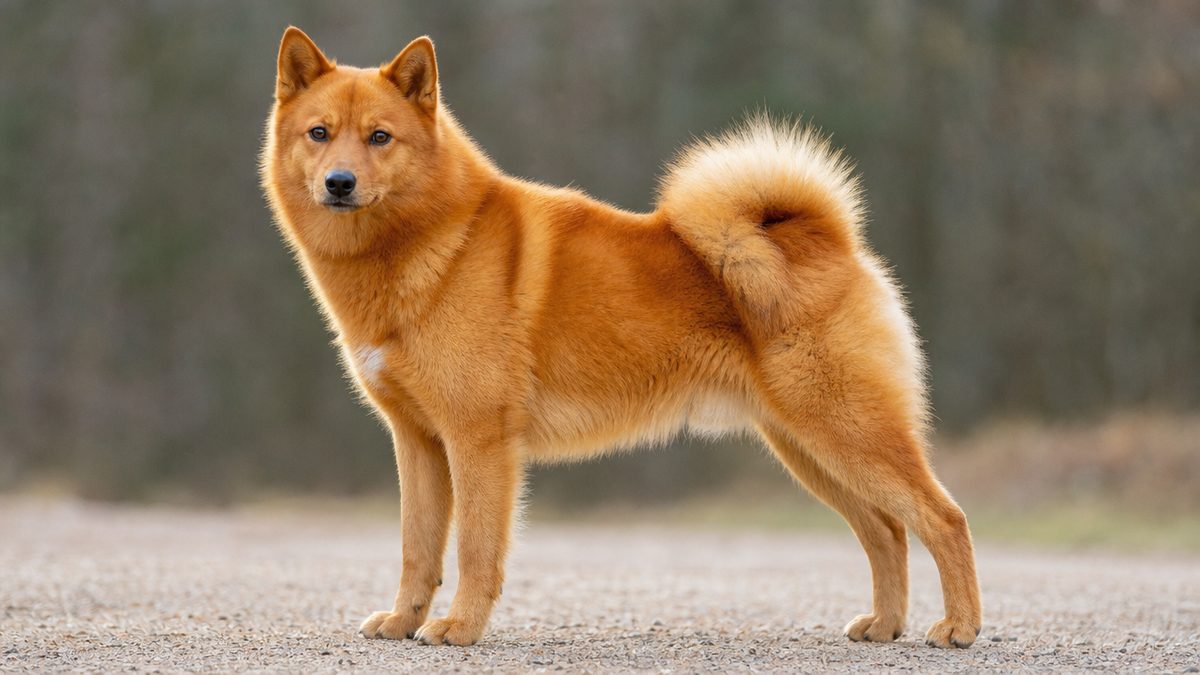
The Finnish Spitz is a small red hunting spitz that finds a game bird in a forest, sits under the tree and barks at it until the hunter arrives, and it has been the national dog of Finland since 1979.
The FCI register prints the breed as SUOMENPYSTYKORVA (49), with the English name Finnish Spitz, in Group 5 Spitz and primitive types, Section 2 Nordic Hunting Dogs, recognised on a definitive basis on 3 August 1954. Finland is the country of origin and English is the authentic language of the standard, so the English text is the original rather than a translation of one.
One line on that register entry separates this breed from almost every other dog an Indian buyer will read about. Under working trial it says: "Subject to a working trial only for the Nordic countries (Finland, Norway, Sweden)";. In Finland, Norway and Sweden, a Finnish Spitz cannot become a show champion on looks alone. It has to pass a hunting test first.
The utilization line, which is the whole breed in one sentence
The standard's utilization clause reads: "A hunting dog mainly for forest game birds, also predatory small game, waterfowl and elk. Eager hunter; rather independent, yet works co-operatively to game, marking game by barking". That last phrase is the job. This dog does not point, retrieve, flush or track a wounded animal to ground. It finds a bird that has flown into a tree, positions itself below, and barks.
Everything an owner experiences follows from that. The barking is not a nuisance behaviour that training failed to remove; it is the selected trait, refined across roughly 130 years of registered breeding and scored in trials since 1897 Kumpulainen M, Anderson H, Svevar T. Anyone buying this breed and hoping to train the barking out of it has misunderstood what they bought.
Size, and a disqualifying fault that most breeds do not have
The current standard, published on 11 February 2026, gives height at the withers as males 44 to 50 cm and females 39 to 45 cm, with an ideal of 47 cm for males and 42 cm for females. No weight is given anywhere in the standard. Any weight figure you read for this breed comes from a kennel club's own summary or from a seller, not from the document that defines the breed.
Unusually, height outside the standard is itself a disqualifying fault. Compare that with the Finnish Lapphund, whose standard says in terms that "The type is more important than the size". Two Finnish spitz breeds, two opposite positions on how much the tape matters, which is a useful reminder that a breed standard is a specific document and not a general convention.
| Fault | What it means for a buyer |
|---|---|
| Other than erect ears | A soft or dropped ear is not a variant. It is outside the breed |
| Other than black nose | The standard requires a jet-black nose, described as rather small |
| Eyes bright yellow or wall eye | Eyes must be medium-sized, almond-shaped and preferably dark |
| Overshot or undershot mouth | A close-fitting scissor bite is required, on 42 teeth |
| Several missing teeth | Dentition is taken seriously, and this connects to Indian law |
| Kinked tail | The tail curves forward tightly along the back and hangs down the thigh |
| Large white markings on the chest or a white sock | Only a small white chest spot and small white foot markings are permitted |
| Colours differing severely from the basic colour | The back must be bright red or golden red |
| Wavy or curled coat | The coat is a stand-off coat over a short, soft, dense, light undercoat |
| Height other than given in the standard | Outside 44 to 50 cm for males or 39 to 45 cm for females |
| Aggressive or overly shy dogs | Temperament faults are disqualifying, as in most modern FCI standards |
That list is longer and stricter than most, and it is worth using. A buyer in India who is shown a cream, white or sable dog with soft ears and a brown nose is not being shown a poor Finnish Spitz. They are being shown a different dog.
The eye clause adds the expression you should be looking for. The standard calls for eyes that are "Medium-sized, almond-shaped, slightly oblique and preferably dark", and says plainly that "The expression is lively and alert";. A dull, heavy or sleepy-looking spitz is not what this breed is meant to be, and an alert expression over a bright red coat is the two-second identification most Indian listings fail.
That list is used again in the sourcing section below, because in India it is the fastest way to tell whether the dog you are being shown is the breed you are being sold.
What the 2026 standard revision actually changed
The February 2026 republication of FCI-Standard 49 changed nothing about the Finnish Spitz's size, coat, colour or type, and the only substantive edits in the whole document are two lines about missing teeth.
FCI standards print amendments in bold and say so at the foot of the document: "The latest amendments are in bold characters";. In the 2026 Finnish Spitz standard exactly one word in the body carries that emphasis: tooth, in the faults line reading "Missing tooth (excluding PM1 and M3)". The SIZE, COAT, COLOUR and UTILIZATION sections carry no bold at all.
A current document can only tell you the present state, never what changed, so we pulled the previous standard from the Internet Archive and compared them. The superseded text is the standard valid from 04.04.2016, English text dated 03.06.2016. The entire substantive change set between the two is two lines, both about teeth.
| Clause | 2016 standard | 2026 standard |
|---|---|---|
| Faults | Missing teeth (1 or 2 missing teeth excluding PM1 and M3). | Missing tooth (excluding PM1 and M3). |
| Disqualifying faults | Several missing teeth (three or more). | Several missing teeth. |
| Size | Males 44-50 cm, females 39-45 cm. Ideal 47 and 42 cm | Word for word identical |
| Coat and colour | Stand-off coat over a short, soft, dense, light undercoat; bright red or golden red | Word for word identical |
So the 2026 republication changed nothing a buyer would notice. It removed the numeric qualifiers from the dentition clauses, which the 2016 revision had itself added. Any claim that the 2026 standard altered this breed's size, coat, colour or type is false, and the archive proves it rather than merely suggesting it.
Bark-pointing: what the barking bird dog trial actually measures
The Finnish Spitz hunts by finding a grouse that has flown into a tree, standing beneath it and barking to hold the bird's attention while the hunter closes the distance, and Finland has scored that behaviour in formal trials since 1897.
The mechanism is worth explaining properly, because English breed pages usually reduce it to "the barking dog" and stop. A capercaillie, black grouse or hazel grouse flushed from the forest floor does not run. It flies into a tree and freezes. A bird sitting motionless in a spruce is effectively invisible to a person on the ground and can wait out a hunter indefinitely.
The dog solves that. It quarters the forest independently, at some distance from the hunter, locates the bird, and then does the counter-intuitive thing: rather than staying silent, it plants itself beneath the tree and barks. The bird's attention fixes downward on the noisy, visible, apparently harmless animal below, and the hunter walks in from a direction the bird is no longer watching.
So the barking is a distraction display, not an alarm. It has to be sustained, rhythmic and interesting enough to hold a wild bird's attention for the minutes it takes a person to cross broken ground. That is a specific and demanding behaviour, and it is why the breed's vocalisation is not comparable to a terrier's or a guard dog's.
The trial is not ceremonial
Two facts establish that these are real, scored events rather than heritage theatre. First, the FCI's own register records the breed as subject to a working trial in Finland, Norway and Sweden, which is a formal status only a minority of breeds carry. Second, the standard dates the first bird-hunting trial to 1897, five years after the first breed standard in 1892 and the first breed show in the same year.
Read those dates in order and the breed's priorities are visible. The register opened in the 1890s, the standard and the show came first in 1892, and the hunting trial followed within five years. The Finnish Spitz has been simultaneously a show breed and a tested working breed for almost its entire registered existence, which is unusual and is why the two populations have not split the way they have in many gundog breeds.
What the standard says about how the dog works
The behavioural description in the standard is specific about the working style rather than generic. The dog is "Eager hunter; rather independent, yet works co-operatively to game";, which is the precise combination the job requires: enough independence to search out of sight of the handler, enough cooperation to stay with the bird rather than moving on.
The movement clause supports it. Gait is "Light, effortless and covering the ground. Changes easily from trot to gallop, the latter being the most natural style of movement... When rushing after game explosively fast gallop";. A dog whose most natural gait is a gallop is a dog that covers forest, not a dog that walks at heel.
- The dog searches independently, often well ahead of and out of sight of the hunter.
- A bird is flushed from the ground and takes refuge in a tree.
- The dog locates the tree and positions itself beneath it.
- The dog barks continuously, holding the bird's attention downward.
- The hunter approaches from outside the bird's field of attention.
- The dog must not leave before the hunter arrives, which is what separates a trained hunting dog from a dog that barks at squirrels.
Why this matters to somebody in Pune or Kochi
There is no capercaillie in India, no black grouse and no boreal forest, and there is no Indian equivalent of a Finnish bird-barking trial. So an Indian owner takes delivery of a dog carrying a fully intact, formally selected, competition-tested drive to bark at things in trees, and no legitimate outlet for it.
That is not a reason not to own one. It is a reason to plan. Scent games, find-it exercises, a taught quiet cue and a genuinely tiring daily routine are the substitutes. What does not work is buying a bark-selected breed into a shared-wall apartment and hoping.
The trial scored out of 100, and what each point is for
The Finnish bird-barking trial, linnunhaukkukoe or LINT, runs for exactly four hours and scores a dog out of 100 merit points across five categories, of which 25 points, the single largest block, are awarded for how long the dog can hold a bird in a tree by barking.
The rules are published by the Finnish Kennel Club as LINNUNHAUKKUKOKEIDEN SÄÄNNÖT JA OHJEET, a 33-page document approved by the Kennel Club council on 26 November 2022 and in force from 1 August 2023. The Kennel Club's own English name for the event is the Hunting Trial for Spitz. Dogs compete in a single class, abbreviated LINT, and must be at least nine months old; the eligible breeds are the Finnish Spitz, the Karelian Bear Dog, the Norrbottenspitz and the laikas.
| Category, as the rules name it | In English | Points |
|---|---|---|
| Hakutyöskentely | Search work | 0 to 35 |
| Haku | Ranging and searching | 0 to 10 |
| Löytökyky | Ability to find birds | 0 to 15 |
| Ensihaukkujen saaminen löydöistä | Getting a first bark from a find | 0 to 10 |
| Haukkutyöskentely | Barking work | 0 to 40 |
| Merkintä | Marking the bird's position | 0 to 10 |
| Äänenanto | Quality of the bark itself | 1 to 5 |
| Pysyttäminen | Holding the bird in the tree | 0 to 25 |
| Seuraaminen ja uusintahaukut | Following and re-barking | 0 to 20 |
| Seuraaminen | Following a bird that moves | 0 to 10 |
| Uusintahaukut | Renewed barks after a move | 0 to 10 |
| Puustalöytö | Finding a bird already in a tree | 0 to 3 |
| Lisäansiot | Additional merits | 0 to 2 |
| Yhteensä | Total | 0 to 100 |
The subtotals close exactly: 35 plus 40 plus 20 plus 3 plus 2 is 100. That is the first check any scoring table should pass and this one does.
Twenty-five points for one behaviour
Pysyttäminen is the largest single line on the sheet and it is worth 25 of the 100 points. The rules define it in one sentence: "Pysyttämisellä tarkoitetaan koiran kykyä saada lintu pysymään haukussa", the dog's ability to make the bird stay at the bark.
The measurement is unusually concrete. The dog must be given the opportunity to bark at the bird for ten minutes. Scoring takes the three longest barking sessions, adds their durations and divides by three to give a mean barking time. Barks shorter than one minute are excluded entirely, and a single session is credited for at most ten minutes. Continuous questioning barks count as barking "when the frequency exceeds 40 barks per minute";.
Read that back. A Finnish judge is timing how many minutes a dog will stand under a tree and bark, at a rate above forty barks a minute, and awarding a quarter of the total score for it. That is the behaviour being bred for, measured with a stopwatch. Anybody choosing this breed for an Indian apartment should sit with that sentence.
Faults, elimination and the prize classes
Fault points run to 30 and are subtracted from merit: over-sensitivity 0 to 10, abandoning the bark 0 to 10, and other work disruptive to the trial 0 to 10. The rules state that "Koiran lopullinen pistemäärä saadaan, kun ansiopisteiden summasta vähennetään virhepisteet", the final score is merit minus faults.
Two things eliminate a dog outright: zero merit points for either Haku or Seuraaminen, and any single fault worth the full ten points. So a dog that will not range, or will not follow, is excluded regardless of how well it barks.
| Parameter | Value |
|---|---|
| First prize, LINT 1 | 75 points |
| Second prize, LINT 2 | 65 points |
| Third prize, LINT 3 | 50 points |
| Trial duration | Exactly four hours, with one coffee break of about ten minutes permitted |
| Minimum age | Nine months |
| Quarry accepted for judging | Capercaillie, black grouse and hazel grouse, and the handler may decline to have hazel-grouse work judged |
| Typical ranging distance | 100 to 500 metres from the hunter, and often further |
| International awards | CACIT and reserve CACIT are awarded at international trials per FCI instruction |
The Finnish Kennel Club's own breed page describes the working picture, and adds a detail no English page carries: the dog "finds birds on the ground or in a tree with its very keen nose and can follow a bird that flushes for several hundred metres even in difficult terrain", and it holds the bird with its bark and its behaviour, including a pale tail that waves as the dog barks and mesmerises the bird in the tree.
How much of this actually happens, counted
Finland recorded 1,021 bird-barking trial results for the Finnish Spitz in 2025, against 609 puppies registered that year, so the breed produces more trial results in a year than it produces dogs.
It is easy to describe a working heritage and hard to prove one is still alive. For this breed it is countable, because KoiraNet publishes the number of trial results entered per breed per year.
| Year | LINT results recorded | Finnish registrations that year |
|---|---|---|
| 2022 | 949 | 679 |
| 2023 | 1,104 | 625 |
| 2024 | 977 | 589 |
| 2025 | 1,021 | 609 |
| 2026, to 27 August | 191 | 480 so far |
In every year from 2022 to 2025 the breed recorded more trial results than registrations Suomen Kennelliitto, KoiraNet. A dog can of course be entered more than once, so this is not one result per dog. What it does establish is that the trial is a live, well-attended, annually repeated event rather than a heritage footnote, at a scale of roughly a thousand judged runs a year in a breed of a few thousand living dogs.
Those runs are not cheap in time either. Each one is a four-hour trial period in forest, under a judge, with the dog working birds. A thousand results a year is four thousand judge-hours in the woods.
Why this matters more than a show record would
The FCI records the breed as subject to a working trial in Finland, Norway and Sweden, which means a Finnish Spitz cannot take a national show championship in those countries on conformation alone. Combined with the trial volume above, that is the mechanism which has kept this breed's show and working populations from separating, and it is unusual. Most gundog and hound breeds elsewhere have split into two types that no longer interbreed.
KoiraNet's statistics pages are addressed by breed code and do not print the breed name on their own face, so we did not take the identification on trust. The Finnish Kennel Club's official ROTUKOODIT list gives 49 as suomenpystykorva under FCI group 5, and probing a neighbouring code confirms the scoping behaves correctly: code 48, the Karelian Bear Dog, returns bear-barking trial results and zero LINT rows. The result counts above are figures KoiraNet prints itself in a Tuloksia column, so they are stronger evidence than the event counts, which had to be obtained by counting rows.
One thing an Indian reader should take from this section rather than the numbers themselves. This is a breed that is still being selected on behaviour, right now, in volume. Whatever dog reaches India carries the output of that selection, and a country with no birds, no forest and no trial has no way to give it back.
From a Karelian forest dog to the national dog of Finland
The Finnish Spitz was standardised in 1892 from dogs found mainly in eastern and northern Finland, named the national dog of Finland in 1979, and absorbed the Karelian-Finnish Laika as a single breed in 2006.
The standard's historical summary is unusually specific for an FCI document, and it dates everything. "When the register of the breed started in the 1890s, individuals similar in type and hunting purpose were found mainly in the eastern and northern parts of the country. The first breed standard was established in 1892. The first breed show was held the same year and the first bird-hunting trial in 1897".
The same passage carries the national-dog claim in its own words: the breed "has been developed from pure natural stock and is an essential part of the Finnish culture. The Finnish Spitz was named as the National Dog of Finland in 1979". That is the FCI's official standard saying it, which is a better source than the breed blogs that repeat it without a date.
The 2006 merger nobody mentions
One sentence in the standard changes how you should read any pre-2006 source about a related breed. "According to the agreement between the Finnish Kennel Club and the Russian Cynological Federation that was signed in 2006 the Karelian-Finnish Laika and the Finnish Spitz were combined as one breed under the breed standard of the Finnish Spitz".
So the Karelo-Finnish Laika is not a separate breed you can compare the Finnish Spitz against. It is the Finnish Spitz, under a Russian name, since 2006. If you find a Russian pedigree, a Russian health study or an Indian listing using that name, it is describing the same registered population. This is exactly the kind of fact that gets lost in translation and then gets sold as a rare alternative breed.
Where it sits among the northern breeds
Genomic work places the Finnish Spitz with the eastern rather than the Scandinavian group. A 2018 SNP analysis found that "Nordic hunting breeds Finnish Spitz, Nordic Spitz and the Karelian Bear Dog, as well as the reindeer herding Lapphund and Lapponian herder are all closely related and have common origins with the northeastern Eurasian Laika breeds, rather than with other Scandinavian Spitz breeds, such as Elkhounds and Swedish Vallhund". Given the 2006 merger with the Karelian-Finnish Laika, that result is less surprising than it first looks.
A long history is not the same as a wide gene pool
The breed's own club co-authored the study that says so, which is worth noting because breed clubs do not usually publish their own bottlenecks. Working from pedigree data on 28,119 Finnish Spitzes plus genome-wide SNP data from 135 of them, Kumpulainen and colleagues found that "the Finnish Spitz has undergone repeated male bottlenecks resulting in dramatic loss of genetic diversity, reflected by 20 effective founders and mean heterozygosity of 0.313".
Twenty effective founders for a breed 130 years old and registered in the tens of thousands is a very narrow base. For contrast, the same study found the much younger and much smaller Nordic Spitz had 27 effective founders and a mean heterozygosity of 0.409, "similar to mixed breed dogs", because it had not been through the same repeated male bottlenecks.
The historical inbreeding figure supports the picture. A 1997 analysis of registers covering 28,370 Finnish Spitzes reported a mean inbreeding coefficient of 7.16 percent, against 3.12 percent for the Finnish Hound over the same period, with paternal and maternal generation intervals of 5.7 and 4.5 years. The authors concluded that "linebreeding or mild inbreeding has been used as a breeding method", and noted that intense inbreeding had decreased in the years before the study, especially in the Spitz.
Whatever happened historically, the current register is moving the right way. The mean inbreeding coefficient of Finnish Spitz litters registered in Finland has fallen from 4.03 percent in 2000 to 1.67 percent in 2024 and 1.65 percent in 2025, which is among the lowest figures we have seen for any breed on this site. That is a different measure from the 7.16 percent population mean quoted above, so the two are not directly comparable, but the direction is unambiguous.
How rare is it, and is it a Vulnerable Native Breed? No
The Finnish Spitz is the twelfth most registered breed in Finland with 609 registrations in 2025, and it is not a Royal Kennel Club Vulnerable Native Breed, because that list covers only breeds of British and Irish origin.
Two very different pictures sit in the same breed, and both are worth having straight.
In Finland it is mainstream. KoiraNet's registration table gives 847 in 2021, 679 in 2022, 625 in 2023, 589 in 2024 and 609 in 2025, an increase of 20 dogs or 3.4 percent on the year. The Kennel Club's own press release for 2025 confirms it independently and verbatim: "Suomenpystykorva on 12. suosituin rotu (609)", the twelfth most popular breed. Both the rank and the figure match the database exactly.
In Britain it is almost absent. The Royal Kennel Club's ten-year comparative table for the Hound group gives the Finnish Spitz 14, 13, 16, 9, 5, 17, 17, 15, 1 and 4 for the years 2016 to 2025. Four registrations in 2025, against a Hound group total of 20,841.
| Year | Finland | United Kingdom |
|---|---|---|
| 2021 | 847 | 17 |
| 2022 | 679 | 17 |
| 2023 | 625 | 15 |
| 2024 | 589 | 1 |
| 2025 | 609 | 4 |
The Vulnerable Native Breed claim, corrected
Several sources describe this breed as a UK Kennel Club Vulnerable Native Breed. It is not, and it cannot be. The Royal Kennel Club's own page defines the list in one sentence: "Vulnerable native breeds are dog breeds of British and Irish origin that are considered to be vulnerable due to their declining registration numbers".
The numeric thresholds people quote are real. The same page states that the vulnerable list covers "breeds with fewer than 300 registrations a year" and the at-watch list "breeds with between 300 and 450 registrations a year". The Finnish Spitz clears the numeric bar by a mile at four registrations. It fails the origin gate that comes first, because Finland is neither Britain nor Ireland.
We checked rather than assumed. Both RKC tables were read in full: 39 breeds on the vulnerable list and eight on the at-watch list, every one of British or Irish origin, and the Finnish Spitz appears on neither. The RKC's own vulnerable-breeds PDF, headed "10 year VULNERABLE BREED STATS", does not contain the breed either.
The correct statement is the plain one: the Finnish Spitz is a numerically rare breed in Britain, registered in the Hound group, and it has no conservation status anywhere. In its own country it is one of the twelve most registered breeds.
For this breed the RKC's two Hound-group documents agree exactly. The quarterly PDF gives 2025 quarters of 1, 3, 0 and 0 against a printed year total of 4, which sums correctly, and the ten-yearly PDF independently gives 4 for 2025 The Royal Kennel Club. Every one of the 44 Hound rows in that quarterly PDF sums to its own printed total. Elsewhere in the RKC's publications the same cross-check fails: on the vulnerable-breeds tables the Bullmastiff and Bull Terrier (Miniature) rows are transposed between the web page and the PDF, and the Manchester Terrier's 2019 figure reads 243 on one and 133 on the other. So cross-check before quoting an RKC number. It is just that on this breed the numbers hold.
Finland's own long series shows where the decline actually happened, and it is not recent. The Kennel Club's breed page records a peak in the good bird years of the 1960s: 2,866 registered in 1968, 1,459 in 1994, 834 in 2004 and 612 in 2018. So the breed has fallen by roughly four fifths from its peak across sixty years, and has been broadly flat around 600 for the last decade.
Heat tolerance: Bengaluru's coolest month is warmer than a Karelian summer
No Indian city has a single month that falls inside the Finnish Spitz's home climate, and the clearest way to see it is that Bengaluru's coolest month runs warmer in wet-bulb terms than the hottest month in the eastern Finnish forests the breed came from.
We work this from NASA POWER 20-year monthly climatology (2001 to 2020), queried by explicit latitude and longitude so no city can be substituted for another, and convert air temperature and relative humidity to wet-bulb temperature using the Stull (2011) formula Stull R. Wet-Bulb Temperature from Relative…. Wet-bulb is the right measure because a dog sheds heat by evaporation, and wet-bulb temperature is what caps evaporation.
The origin points are chosen from the standard's own history, which says the founding dogs were found "mainly in the eastern and northern parts of the country";. So we query Joensuu in North Karelia and Kuopio in North Savo, rather than Lapland, because this is a forest hunting breed and not a reindeer-herding one.
| Place | Lat, lon queried | Annual mean air temp | Coldest month wet-bulb | Warmest month wet-bulb |
|---|---|---|---|---|
| Joensuu, North Karelia | 62.60, 29.76 | 2.69 C | -12.17 C (January) | 15.25 C (July) |
| Kuopio, North Savo | 62.89, 27.68 | 2.91 C | -11.67 C (January) | 15.18 C (July) |
| Helsinki | 60.17, 24.94 | 6.37 C | -4.56 C (February) | 15.29 C (July) |
| Bengaluru | 12.97, 77.59 | 23.74 C | 16.41 C (January) | 21.86 C (May) |
| Pune | 18.52, 73.86 | 23.86 C | 14.06 C (January) | 22.97 C (June) |
| Delhi | 28.61, 77.21 | 25.60 C | 7.58 C (January) | 26.50 C (July) |
| Kolkata | 22.57, 88.36 | 25.81 C | 13.21 C (January) | 27.09 C (June) |
| Mumbai | 19.08, 72.88 | 26.77 C | 16.62 C (January) | 25.77 C (June) |
| Chennai | 13.08, 80.27 | 27.95 C | 21.00 C (January) | 26.11 C (May) |
The single line to take away is this. Joensuu's hottest month sits at 15.25 C wet-bulb. Bengaluru's coldest month sits at 16.41 C. India's most temperate large city, at 841 metres of altitude, is warmer in its coolest month than the breed's homeland is at the peak of summer. Chennai's coolest month, at 21.00 C, is 5.75 C above the Finnish maximum.
The air-temperature gap is 25.3 C between Joensuu's annual mean of 2.69 C and Chennai's 27.95 C. That is a smaller gap than the Finnish Lapphund faces, because eastern Finland is not the Arctic Circle, but it is not a meaningfully different situation for a dog.
The two windows that do exist
Delhi in January is the best month for this breed anywhere in India. Its mean wet-bulb of 7.58 C falls comfortably inside Joensuu's annual range and is close to a Finnish October. For roughly eight to ten weeks a north Indian winter genuinely suits the coat.
Pune in January, at 14.06 C, is the only figure in the Indian half of the table that lands below the Finnish July maximum. It is 1.19 C cooler than Joensuu's hottest month. That is a real overlap and it is one month wide.
Everything else in the Indian column sits above the breed's home ceiling for the entire year. Delhi's own July, at 26.50 C, is 11.25 C above the Finnish maximum, so Delhi does not offer a milder year than Chennai. It offers a usable winter and a punishing summer, and the annual swing is 18.9 C of wet-bulb.
The one respect in which this breed does better than its Lapland cousin
The coat is genuinely lighter. FCI-Standard 49 describes the hair as "Moderately long on the body, stand-off coat", short and close-lying on the head and legs, with an undercoat that is "short, soft, dense and light in colour";. Compare the Finnish Lapphund standard, which requires a coat that is "Profuse", long and harsh, with an abundant mane in males.
This is a smaller dog with less coat, and a short undercoat rather than a dense long one. That is a real difference and it is worth stating, because it means the Finnish Spitz is a marginally better proposition in an Indian city than the Lapphund is. It is a difference of degree inside a category that does not suit India, not an escape from the category.
In Pune, Bengaluru or a Himalayan town, with reliable cooling and dawn-and-dusk exercise, a Finnish Spitz can live a normal life. In Delhi it will have a genuinely good winter and a dangerous summer. In Chennai, Kolkata, Mumbai or coastal Kerala the wet-bulb figures do not support keeping this breed at all. Note also the mortality data below: 360 of 4,132 recorded deaths in Finland were accidents or road traffic, at a mean age of 5 years 2 months, and that is a breed that runs.
What the heat-illness evidence covers, and what it never tested
The Finnish Spitz appears nowhere in either of the two largest studies of canine heat-related illness, and neither study tested coat type as a variable, so no measured statement about this breed's coat and heat risk can honestly be made.
The reference dataset is VetCompass. Hall, Carter and O'Neill reviewed the records of 905,543 UK dogs under primary veterinary care in 2016 and identified 1,259 heat-related illness events from 1,222 dogs, with a 2016 incidence of 0.04 percent and an event fatality rate of 14.18 percent Hall EJ, Carter AJ. Roughly one dog in seven that reaches a vet with heat illness does not survive it.
The trigger split is the most misquoted statistic in this field. The paper states that "There were 380/1259 (30.2%) prevalent HRI events with no trigger recorded", and of the remaining 879 the triggers were exertional 652, environmental 113 and vehicular confinement 46. The correct form is therefore that 652 of the 879 events with a recorded trigger, 74.2 percent, were exertional, alongside 12.9 percent environmental and 5.2 percent vehicular. It is not 74.2 percent of 1,259, which would be 934 rather than 652.
Of the 652 exertional events, the exercise type was unspecified for 101, and of the remaining 551, 372, or 67.5 percent, followed walking. Ordinary walks, not hunting, not sport. For a breed whose owners are told it needs a great deal of exercise, that is the number that should shape the daily schedule.
Searching for this breed in both papers returns nothing
Case-insensitive searches of the complete text of the Animals 2020 paper for spitz and for finnish each return zero hits. The same is true of the Scientific Reports companion. That is not an oversight: both papers give a breed its own category only where it has at least five heat-illness cases or at least 5,000 dogs in the study population, and the Finnish Spitz is far too rare in the UK to clear either bar. It sits inside the pooled "other purebred" group.
So there is no odds ratio for this breed, and borrowing one from a different spitz would be fabrication wearing a citation. The Pomeranian is in the model and the Siberian Husky is in the model; neither is the Finnish Spitz.
Coat was never a variable
The Scientific Reports paper lists the variables it tested: breed type, purebred status, skull shape, adult bodyweight, bodyweight relative to breed or sex mean, sex and neuter status, and age. Coat type and coat length are not among them. In the Animals companion the word coat appears once in the entire document, inside the justification prose for the purebred variable, noting that purebred dogs are more likely to carry "brachycephaly, thick coat, or giant body size".
The authors raise coat only in their discussion, writing that "Coat type is potentially an important risk factor for HRI in dogs";. That is a hypothesis. Every Indian page that tells you a fluffy breed is at measured heat risk because of its coat is quoting that sentence as though it were a result. The double coat's contribution to heat-illness risk has never been quantified, and this page will not pretend otherwise.
The factors that do transfer, and one that cannot be assigned
- Bodyweight at or above the breed and sex mean carries an odds ratio of 1.30 for exertional heat illness, confidence interval 1.09 to 1.55. This is the one risk an owner fully controls.
- Mesocephalic skull shape is the baseline. McMillan's classification table records the Finnish Spitz as mesocephalic, so it carries none of the brachycephalic penalty of 1.32.
- Older dogs have lower odds of exertional heat illness, at 0.48 for dogs aged 8 to 10 years against dogs under two, because young dogs get worked harder.
- Adult bodyweight band cannot be assigned honestly, and this is worth saying rather than fudging. Hall's bands are under 10 kg, 10 to under 20 kg and upward, with odds ratios of 2.52 for the 10 to 20 kg band against the under-10 baseline. FCI-Standard 49 gives no weight at all, so we cannot place this breed in a band without inventing a weight, and we will not.
That last point is not a technicality. A 39 cm bitch and a 50 cm dog are both correct Finnish Spitzes under the standard, and they will sit either side of 10 kg. If you want to know which Hall band your own dog falls into, weigh it. The breed does not have an answer.
Health screening: Finland tests this breed's knees, and almost never its hips
Only 118 Finnish Spitzes out of 19,523 registered between 2000 and 2026 have had an official hip evaluation, a screening rate of 0.6 percent, while 4,388 have had a patella examination, and that contrast tells you exactly what the breed's health programme prioritises.
Finland publishes per-breed screening results openly in the KoiraNet breeding database, which is what makes this section possible at all. Every figure below is from KoiraNet's own statistics for the suomenpystykorva, breed code 49, filtered by year of birth from 2000 to 2026, on database version v2026.4.29 Suomen Kennelliitto. These are denominators, not estimates.
| Screen | Finnish Spitz evaluated | Screening rate | Finnish Lapphund rate, for comparison |
|---|---|---|---|
| Hips | 118 of 19,523 | 0.6 percent | 34.0 percent |
| Elbows | 58 of 19,523 | 0.3 percent | 22.7 percent |
| Patella | 4,388 of 19,523 | 22.5 percent | 14.5 percent |
| Eyes | 4,327 of 19,523 | 22.2 percent | 32.1 percent |
| Spondylosis | 29 of 19,523 | 0.1 percent | 3.8 percent |
Read the hip row and the patella row together and the picture is unmistakable. The Finnish Spitz is a patella-screened breed, not a hip-screened one. Its patella rate is higher than the Lapphund's while its hip rate is fifty-six times lower. That is not laziness among Finnish Spitz owners; it is a health programme aimed at a small, light hunting dog rather than a medium herding one.
Patellar luxation, on a real sample
Of 4,388 dogs examined, 4,133 graded 0, or 94.2 percent, with 154 at grade 1, 71 at grade 2, 18 at grade 3, seven at grade 4 and five recorded as operated. The six categories sum exactly to 4,388, so the table is internally consistent. That gives 255 abnormal results, 5.8 percent.
For context, the Finnish Lapphund's figure on 4,437 examinations is 2.3 percent. So a Finnish Spitz is roughly two and a half times as likely to show some patellar luxation as a Lapphund, on samples of almost identical size. That is the finding that justifies the screening choice.
Note also what 5.8 percent means in practice. Grade 1 is a knee that can be luxated by manipulation but does not luxate on its own, and 154 of the 255 abnormal dogs are grade 1. The clinically serious grades, 2 and above, account for 96 dogs, or 2.2 percent of those examined.
Hips and elbows: a number too small to build on
The hip data exists and it should be read with great care. Of 118 dogs evaluated, 55 graded A (46.6 percent), 37 graded B (31.4 percent), 22 graded C (18.6 percent), three graded D (2.5 percent) and one graded E (0.8 percent), summing exactly to 118. Grouping C and worse gives 26 dogs, 22.0 percent; D and E give four dogs, 3.4 percent.
118 evaluations out of 19,523 registered dogs is a 0.6 percent sample, and it is not a random one. Owners who pay for a hip radiograph on a breed with no hip screening requirement usually have a reason, and that reason is often a limping dog. A self-selected 0.6 percent sample can be biased in either direction and there is no way to tell from the data which. Publish the figure with its denominator, as we have, and do not treat it as a breed prevalence. Contrast the Finnish Lapphund, where 10,399 evaluations on a 34 percent screening rate genuinely does support a breed-level statement.
Elbows are worse still as evidence: 58 evaluations, of which 53 graded 0 (91.4 percent), four at grade 1 and one at grade 2. Five dogs with any degree of elbow dysplasia out of 58 is 8.6 percent, and a denominator of 58 across a quarter-century of a breed with 19,523 registrations supports no conclusion at all. Spondylosis, at 29 evaluations, is the same problem again.
What to ask for in India
The practical translation is short. Ask an importing seller for the parents' official patella grades and eye certificates, because those are the two screens Finland actually performs on this breed at scale. Asking for hip scores is reasonable but you should expect the answer to be that they do not exist, and that is not evasion; it is what the register shows for 99.4 percent of the breed.
One thing Indian law does require of anyone breeding here, whatever Finland does. Second Schedule Part III paragraph 8(10) of the 2017 Rules states that "The dogs shall have been tested for genetic defects, including hip dysplasia, progressive retinal atrophy, night blindness, hypothyroidism, entropion, ectropion, overshot, undershot jaw (when incisors do not touch or mesh), wry mouth, two or more missing teeth, unilateral cryptorchid or full cryptorchid males".
The dentition item is the one that lands squarely on this breed. FCI-Standard 49 requires 42 teeth according to the dentition formula, makes a missing tooth other than PM1 or M3 a fault, and makes several missing teeth a disqualifying fault. Here the Indian clause and the breed standard agree rather than collide, which is unusual enough to be worth pointing out: a breeder meeting the standard on dentition is meeting the Indian requirement on the same point.
Eyes: 4,327 examinations, dominated by cataract and persistent fetal vasculature
Of 4,327 Finnish Spitzes given an official eye examination, 3,944 were clear at 91.1 percent, and the findings are led by cortical cataract and by persistent hyperplastic primary vitreous rather than by any progressive retinal disease.
KoiraNet records 4,327 official eye examinations against 19,523 dogs born between 2000 and 2026, a 22.2 percent screening rate, of which 3,944 were clear, 91.1 percent, leaving 383 not clear, 8.9 percent. One caution before the detail: the diagnosis table counts findings rather than dogs, and one dog can carry several, so do not add the rows.
| Finding as KoiraNet records it | Findings | What it is |
|---|---|---|
| Cortical cataract, confirmed | 103 | Lens opacity at the cortex, the commonest finding in this breed |
| PHTVL/PHPV, grade 1 | 50 | Persistent fetal vasculature, grade 1 is pigment dots and not sight-limiting |
| Posterior polar cataract, confirmed | 40 | The classic inherited canine cataract location |
| Distichiasis, confirmed | 40 | Extra lashes growing from the lid margin |
| PHTVL/PHPV, grade 2 to 6 | 35 | The grades that involve the lens and can affect vision |
| Severity of eye changes, mild | 31 | A grading applied to a finding, not a separate disease |
| Cataract extent, mild | 22 | A grading of cataract size |
| PHTVL/PHPV, diagnosis open | 17 | Recorded but not graded |
| Distichiasis or ectopic cilia, confirmed | 14 | The combined category |
| Retinal dysplasia, multifocal, confirmed | 11 | Folds in the retina, usually non-progressive |
| Persistent hyaloid remnant, confirmed | 11 | Another fetal vascular remnant |
| Retinal dysplasia, geographic, confirmed | 7 | The larger, more consequential form |
| Optic disc coloboma, confirmed | 6 | A developmental defect of the optic nerve head |
| Progressive retinal atrophy | 0 | Not recorded once in 4,327 examinations |
| Glaucoma or iridocorneal angle abnormality | 0 | Not recorded once in 4,327 examinations |
Two absences worth stating plainly
Progressive retinal atrophy does not appear in this dataset at all, and neither does glaucoma or any iridocorneal angle grading. That is a genuine and useful contrast with the Finnish Lapphund, where 48 PRA cases, ten raised-pressure findings and 160 graded gonioscopy results sit in the same database. Two Finnish spitz breeds, screened in the same system by the same ophthalmologists, with entirely different eye profiles.
An absence from a register is not proof of absence in the breed, and 4,327 examinations is a large but not exhaustive sample. What it does support is a statement about relative priority: if you are buying a Finnish Spitz, the eye condition to ask about is cataract, not PRA.
PHTVL/PHPV, the one with a real grade split
Persistent hyperplastic tunica vasculosa lentis and persistent hyperplastic primary vitreous, recorded together as PHTVL/PHPV, is a congenital failure of the fetal blood supply to the lens to regress. It is graded 1 to 6. Grade 1 is small pigment spots on the back of the lens and does not affect sight; grades 2 to 6 involve the lens itself and can.
KoiraNet records 50 findings at grade 1 and 35 at grades 2 to 6, with a further 17 recorded but not graded. That grade 2 to 6 count is the one that matters, and it is a higher share of the total than in most breeds. It is also congenital and non-progressive, which changes the advice: a puppy's eyes can be examined early and the answer will not change later, unlike a late-onset retinal disease.
Cataract is the commonest finding by volume. Adding the confirmed rows gives 167 confirmed cataract findings across the five recorded locations: 103 cortical, 40 posterior polar, ten of unspecified location, seven nuclear and seven at the anterior lens suture line. Set against 4,327 examinations that is a real but not alarming rate, and the mild-extent grading appears 22 times, so much of it is small.
Ask for an eye certificate on both parents and ask specifically what it says about cataract and PHTVL/PHPV. Because PHTVL/PHPV is congenital, an examination of the puppy itself at eight to twelve weeks is meaningful in a way it is not for a late-onset disease, and Finnish and other ECVO-standard examiners routinely check litters at that age.
Idiopathic epilepsy: 5.36 percent of Finnish Spitzes in Finland, and a benign course
Idiopathic epilepsy affects an estimated 5.36 percent of Finnish Spitzes in Finland, with a median onset at three years and a median of two seizures a year, and the largest study of it concluded that the disease runs a benign course in this breed.
This is the condition the Finnish Spitz is known for in the veterinary literature, and it has been studied more carefully in this breed than in almost any other. The reference study surveyed 2,141 Finnish Spitz dogs, from 5,960 questionnaires sent to all owners of one-to-ten-year-old Finnish Spitzes in Finland in 2003 and 2004, followed by telephone interviews one to two years later.
The headline figure is that "Estimated prevalence of IE was 5.36% (111/2,069 of FSDs that were still alive)". That reproduces exactly: 111 divided by 2,069 is 5.365 percent. Roughly one Finnish Spitz in nineteen in Finland has idiopathic epilepsy.
| Measure | Finding |
|---|---|
| Estimated prevalence | 5.36 percent, 111 of 2,069 dogs still alive |
| Sex | Males predisposed |
| Median age of onset | 3 years, range 0.6 to 10 years |
| Median seizure frequency | 2 seizures a year, range 0.5 to 48 |
| Median duration of a seizure episode | 11.75 minutes, range 1.5 to 90 minutes |
| Seizure type | 85 percent had a focal onset; 54 percent were characterised as generalised secondary |
| Response to treatment | Easily controlled by antiepileptic treatment in 78.9 percent of dogs |
| Heritability estimate | 0.22, best explained as a polygenic trait |
The authors' own conclusion is the reassuring part and it should be quoted rather than paraphrased: "complex focal seizures were the most common seizure type for FSDs with IE, and a generalized seizure phase was a risk factor for progression of the disease. Results suggested a benign course of epilepsy in FSDs".
One number in that abstract is impossible, and we are not repeating it
The published abstract states that "The seizures were not progressing in 678% of the dogs". A percentage cannot exceed 100, so that figure is wrong on its face, and it is almost certainly a typesetting error for 67.8 percent. Bonbeno does not print either version as fact. We report the 78.9 percent treatment-response figure, which is internally plausible, and we flag the other so that a reader who checks the abstract is not surprised.
The risk factors, including one an owner controls
The study identified the factors associated with a generalised seizure phase, which is what predicts progression: "the age of onset, duration of the seizure, number of feeding times per day, and whether the dog was used for hunting". Two of those four are fixed by the time you notice a problem. One of the other two, feeding frequency, is a routine you set yourself.
Be careful how much weight you put on that. This is an association identified in an observational questionnaire study, not a demonstrated cause, and the paper does not say which direction of feeding frequency carries the risk. What it justifies is a conversation with your veterinarian about meal timing in an epileptic dog, not a confident instruction from a breed page.
The genetics: a shared risk haplotype, not a breed-specific mutation
The Finnish Spitz's epilepsy is polygenic, with a heritability estimate of 0.22, so there is no single test that clears a dog. What exists is a shared risk region. A 2015 study replicated an epilepsy locus across Schipperke, Finnish Spitz and Beagle, then resequenced the region and validated 27 variants in 285 cases and 355 controls from four breeds, identifying a common 28 kilobase risk haplotype in the ADAM23 gene present at frequencies of 0.49 to 0.70.
The authors are explicit about what that does and does not mean: the haplotype is common enough in all four breeds that ADAM23 "is a low penetrance risk gene for canine epilepsy", and "the causative variant remains yet to be identified";. So a Finnish Spitz carrying the risk haplotype is not an epileptic dog, and there is no commercial test that would tell you anything useful if it existed.
The mortality register puts the whole thing in proportion. Across 4,132 recorded Finnish Spitz deaths, 46 were attributed to neurological disease, at a mean age of 7 years 9 months. That is 1.1 percent of deaths. Epilepsy is common in this breed and it is usually not what kills the dog, which is precisely what a benign course means.
Ask the breeder directly whether either parent, or any full sibling of either parent, has had a seizure. There is no test, so the pedigree is the only instrument you have. And find out before you need to which clinic near you stocks and monitors phenobarbitone or levetiracetam, because 78.9 percent of affected dogs in the Finnish study were easily controlled with treatment, and being easily controlled depends on treatment being available.
Three published effective population sizes, an order of magnitude apart
The Finnish Spitz has three different published estimates of its effective population size, 568, 168 and 57, and rather than pick one, this page prints all three and explains why they differ.
Effective population size is the number that tells you how much genetic variation a breed can hold and how fast it is losing it. For this breed three figures are in print, from two credible sources, and they disagree by a factor of ten. That is a real disagreement worth publishing rather than resolving by picking the most comfortable number.
| Estimate | Value | What it is actually measuring | Source |
|---|---|---|---|
| KoiraNet, per four-year generation | 568 in 2024, 541 in 2025 | Derived from the count of distinct sires and dams used across a generation, in the Finnish register | Finnish Kennel Club |
| Realised effective size from pedigree | 168 | Computed from the full pedigree of 28,119 dogs, accounting for unequal founder contributions | Kumpulainen 2017 |
| Genetic effective size from linkage disequilibrium | 57 | Computed from the decay of linkage disequilibrium in genome-wide SNP data from 135 dogs | Kumpulainen 2017 |
The differences are methodological rather than contradictory. The KoiraNet figure counts breeding animals in a window and is the most optimistic by construction, because two dogs that are cousins count as two. The pedigree-based realised figure of 168 discounts for the fact that a handful of sires produced a disproportionate share of the breed. The linkage-disequilibrium figure of 57 measures what the genome actually looks like today, which reflects every historical bottleneck at once.
The study's own framing is blunt about the mechanism: "the Finnish Spitz has undergone repeated male bottlenecks resulting in dramatic loss of genetic diversity, reflected by 20 effective founders and mean heterozygosity of 0.313";. Repeated male bottlenecks means popular sires, over and over, across 130 years.
The comparison that makes the point
The same paper studied the Nordic Spitz alongside it, deliberately, as a young breed against an old one. The Nordic Spitz has a smaller total population and "has once been near extinction", yet it has 27 effective founders against the Finnish Spitz's 20, and a mean heterozygosity of 0.409, "similar to mixed breed dogs", against the Finnish Spitz's 0.313.
So the older, far more numerous, nationally beloved breed is the genetically narrower one. The authors attribute the difference to the absence of comparable repeated bottlenecks in the younger breed, and they note that "the r2 data show that the effective population size has contracted dramatically since the establishment of the breed, emphasizing the role of breed standards as constrains for the breeding population".
What is being done about it, and what the register shows
The paper closes by discussing "the benefits of the open breed registry";, and the 2006 merger with the Karelian-Finnish Laika described earlier is exactly that kind of intervention: it added a Russian population to the breed at a stroke.
The register shows the direction of travel. The mean inbreeding coefficient of Finnish Spitz litters has fallen from 4.03 percent in 2000 to 1.67 percent in 2024 and 1.65 percent in 2025, while the number of distinct sires used per generation has held between roughly 294 and 351 across the whole period. Litters per generation, however, have fallen from 1,043 in 2000 to 612 in 2025, so the breed is shrinking even as it manages its inbreeding well.
Because a breed with a genetic effective population of 57 has very little room for a founder effect abroad. If a handful of Finnish Spitzes ever do reach India and are bred here, they will be a tiny, closed subset of an already narrow pool. That is the argument for importing as a pet under the DGFT route and not attempting to found an Indian line, quite apart from the fact that Indian law forbids importing a dog for breeding in the first place.
Lifespan: 10 years 4 months across 4,132 Finnish deaths, and no UK estimate at all
Finnish Spitzes recorded as dead in the Finnish Kennel Club's database averaged 10 years 4 months across 4,132 deaths, and the largest UK longevity study excluded the breed entirely, so no median survival figure exists for it.
Start with what does not exist, because most breed pages will quote a lifespan anyway. McMillan's 2024 UK longevity study covered 584,734 dogs and 155 breeds, and its breed classification table records the Finnish Spitz with "Included in Survival Analysis: N";. The breed is listed, classified into the Kennel Club Hound group, small body size, mesocephalic, and then excluded from the analysis for want of numbers. There is no UK median survival for this breed.
The Finnish Lapphund, by contrast, is in that analysis with a median survival of 13.8 years on 23 deaths. So a comparison between the two on UK survival data is impossible, and any page that offers you one has made it up.
What does exist is Finland's own mortality register, which is larger than the UK study's data for almost any breed. KoiraNet records 4,132 Finnish Spitz deaths at a mean age of 10 years 4 months.
| Cause as KoiraNet records it | Deaths | Share | Mean age at death |
|---|---|---|---|
| Old age, natural or euthanasia | 1,319 | 31.9 percent | 12 years 7 months |
| Cause of death not reported | 611 | 14.8 percent | 10 years 1 month |
| Euthanasia without a diagnosis | 454 | 11.0 percent | 10 years 9 months |
| Accident or road traffic | 360 | 8.7 percent | 5 years 2 months |
| Tumours and cancer | 303 | 7.3 percent | 11 years 2 months |
| Died without a diagnosis | 223 | 5.4 percent | 10 years 6 months |
| Other disease not on the list | 210 | 5.1 percent | 7 years 11 months |
| Heart disease | 97 | 2.3 percent | 11 years 4 months |
| Euthanasia for behaviour problems | 82 | 2.0 percent | 6 years 11 months |
| Bone and joint disease | 74 | 1.8 percent | 6 years 8 months |
| Respiratory disease | 72 | 1.7 percent | 11 years 9 months |
| Liver or digestive tract disease | 56 | 1.4 percent | 8 years 11 months |
| Neurological disease | 46 | 1.1 percent | 7 years 9 months |
| Lost | 34 | 0.8 percent | 6 years 5 months |
| Killed by a predator | 33 | 0.8 percent | 6 years 8 months |
| Working dog unsuited to its purpose | 23 | 0.6 percent | 5 years 5 months |
| All causes | 4,132 | 100 percent | 10 years 4 months |
The rows sum exactly to 4,132, which is the first check any table like this should pass. Four findings stand out, and three of them are about what this dog does for a living.
Accidents and road traffic take 360 dogs, 8.7 percent, at a mean of 5 years 2 months. That is the second-largest disease-free category and by far the youngest substantial one. Compare the Finnish Lapphund, where accidents account for 5.2 percent. A dog selected to search independently, out of sight of its handler, at a gallop, is a dog that gets hit by cars.
Thirty-three dogs were killed by a predator and 34 were simply lost. Those categories exist in the Finnish register because Finnish hunting dogs work in forests that contain wolves and bears. Neither risk transfers to an Indian city, but both tell you something about how far and how independently this breed ranges.
Twenty-three dogs are recorded under "working dog unsuited to its purpose", at a mean age of 5 years 5 months. That category does not appear in the Finnish Lapphund's mortality table at all. It is what happens to a hunting dog that will not do the job, in a country where the job is real and the trial is scored.
Old age accounts for 1,319 Finnish Spitz deaths at a mean of 12 years 7 months. The equivalent figure for the Finnish Lapphund is 1,332 deaths at 14 years 2 months. So a Finnish Spitz that reaches old age reaches it about nineteen months earlier than a Lapphund does. That is a genuine difference between the two breeds and it is visible in the same database, but note that both figures are means of recorded deaths and neither is a survival estimate. They tell you when Finnish owners report a dog dying of old age, not how long your dog will live.
Euthanasia for behaviour problems accounts for 82 deaths at a mean of 6 years 11 months, 2.0 percent of the total. For a breed selected to bark, in a country where barking is the point, that number should be read as a warning about what happens in a country where it is not.
Temperament: lively, brave, reserved with strangers, and loud by design
The FCI standard describes the Finnish Spitz as lively, vigorous, brave and determined, a little reserved towards strangers but never vicious, and the trait that decides whether it fits an Indian household is the barking it was bred to produce.
The behaviour clause is four adjectives and one qualification: "Lively, vigorous, brave and determined. Might be a little reserved towards strangers, but never vicious". Note what is not there. This is not described as biddable, gentle, docile or eager to please. Compare the Finnish Lapphund standard, which says "Intelligent, courageous, calm and docile. Friendly and faithful". Two Finnish spitz breeds, two very different temperaments on paper.
"Reserved towards strangers" is a permitted trait rather than a fault, and it is worth taking at face value. A dog bred to work independently in a forest is not selected for enthusiasm about a doorbell. What the standard does exclude is the extremes: aggressive or overly shy dogs are a disqualifying fault, so a Finnish Spitz that cowers or snaps is outside the breed, not at one end of it.
The barking, again, because it is the whole question
This is the most vocal breed Bonbeno has profiled and the vocality is not incidental. The standard's own utilization clause describes the dog as "marking game by barking", the FCI records the breed as subject to a working trial in three countries, and Finland has scored the barking in formal trials since 1897 Fédération Cynologique Internationale. A century and a quarter of deliberate selection for sustained, rhythmic, attention-holding barking has produced exactly what it was aimed at.
In an Indian apartment building, that is a serious proposition. A dog capable of barking steadily for the minutes it takes a hunter to cross broken ground is capable of barking steadily at a delivery rider, a lift, a crow on the parapet or a neighbour's cat. You can teach a quiet cue, you can meet the exercise requirement, and you can manage the triggers. You cannot remove the behaviour, and you should not try: de-barking is explicitly prohibited by Second Schedule Part II paragraph 6(8) of the 2017 Rules, in the same sentence as tail docking and ear cropping.
The Finnish mortality register shows what happens when this is not planned for. Eighty-two Finnish Spitzes were euthanised for behaviour problems, at a mean age of 6 years 11 months. In Finland, where barking is the breed's purpose and rural space is abundant. The number in a country where neither is true would not be lower.
Household fit
| Situation | Verdict |
|---|---|
| Pune, Bengaluru or a hill town, independent house, no shared walls, active adults | The best realistic case in India |
| Owner who enjoys scent work and training and will do it daily | Workable, because the brain is the part that needs the job |
| Air-conditioned flat in a shared-wall society | Do not. This is the breed most likely to end in a complaint |
| Chennai, Kolkata, Mumbai, coastal Kerala | Do not. No month falls inside the breed's home wet-bulb range |
| Household with cats, rabbits or a balcony full of birds | Poor. This is a hunting breed with an intact prey drive |
| First-time owner who wants a quiet, easy dog | Do not. Nothing about this breed is quiet or easy |
One trait that helps: this is a small dog. At 44 to 50 cm for males and 39 to 45 cm for females, a Finnish Spitz physically fits an Indian flat far better than a Husky or a Labrador does. Space is not the constraint here. Sound is.
On the allergy question, which comes up for every fluffy breed, the evidence is settled and does not need re-testing per breed. Measuring the major dog allergen Can f 1 across 196 dogs of so-called hypoallergenic breeds against 160 control dogs found higher levels in the hypoallergenic group's hair, 2.26 against 0.77 micrograms per gram, and the authors concluded there is no evidence for classifying any dog breed as hypoallergenic. A stand-off double coat over a dense undercoat was never a candidate.
Training a Finnish Spitz: recall first, quiet second, and never by force
Train a Finnish Spitz by building recall and a quiet cue before anything else, because the breed was selected to range independently out of sight and to bark, and both traits are working correctly when they cause you problems.
Front-load recall. The standard describes the dog as an "Eager hunter; rather independent, yet works co-operatively to game";, and the independence half of that sentence is what an Indian owner meets first. A dog bred to leave the handler, search, find and hold is not a dog that stays close because you would like it to.
The Finnish mortality register turns that into a number. Accidents and road traffic account for 360 of 4,132 recorded deaths, at a mean age of 5 years 2 months, and a further 34 dogs are recorded simply as lost. In Indian traffic, a recall that fails is not an inconvenience.
A realistic Indian timeline
- Weeks 8 to 16. Socialise hard, indoors and in the cool hours. Lifts, stairwells, doorbells, autorickshaws, the watchman, delivery riders, umbrellas, other vaccinated dogs. Everything novel later becomes a barking trigger.
- Weeks 10 to 20. Long-line recall in a walled space, paid every single time with food the dog genuinely values. Do this before you need it, not after.
- Months 4 to 8. Teach the quiet cue. The method that works is rewarding the pause after the bark, not suppressing the bark. You are shaping duration, not removing a behaviour.
- Months 6 to 12. Introduce scent games as the daily default, because this is the closest legitimate substitute for the job the dog was bred for.
- Months 9 to 18. Adolescence. Recall decays, independence increases, and the prey drive comes online properly. Re-drill from the beginning.
- Month 18 onwards. Maintain recall for life, and keep the dog on a lead near any road, permanently.
What this breed resists
Force. The standard permits a dog that is "a little reserved towards strangers" and describes it as brave and determined, and that combination responds badly to physical correction. An independent hunting spitz that decides you are unpredictable will simply stop offering behaviour, and a check chain in the hands of an Indian trainer defaulting to compulsion will produce a worse dog than the one that arrived.
Repetition without purpose is the other failure. Drill the same recall twenty times in a row and the dog switches off. Hide something, send the dog to find it, pay it, and change the picture. A breed that solves a forest search problem is bored by a corridor sit.
Two Indian adjustments
Move every session into the cool hours. This is not comfort, it is evidence: 372 of 551 exertional heat-illness events with a specified activity, 67.5 percent, followed ordinary walking, and the case fatality rate for heat-related illness was 14.18 percent. A long training session at 4 pm in May is a risk factor with a published number behind it.
Do the socialisation indoors when the weather forbids it outdoors. A puppy that misses its window because it arrived in April in Delhi is a barking adult by ten months, and this is the breed where that outcome is least forgivable.
Teach a settle on a mat in the coolest room, and pay it generously for six months. It gives you somewhere to send the dog when the doorbell goes, a place it will choose voluntarily in May, and a way to interrupt a barking chain without confrontation. For this breed in an Indian flat it does more work than any other behaviour you could teach.
Daily exercise: a forest search dog in a city that has no forest
A Finnish Spitz needs one to two hours of activity a day split around the Indian sun, and at least half of it should be scent and search work rather than distance, because the breed's requirement is mental as much as physical.
This is a small dog with a large engine. The standard's gait clause reads "Light, effortless and covering the ground. Changes easily from trot to gallop, the latter being the most natural style of movement... When rushing after game explosively fast gallop". A breed whose most natural gait is a gallop does not get tired by a road walk at heel.
It is also a dog whose job was cognitive. Finding a bird that has flown into a spruce and is sitting motionless is a search problem, not an endurance problem. So the exercise that actually satisfies a Finnish Spitz is the exercise that makes it search, and that is convenient in India, because searching can happen indoors at 2 pm.
| City | Coolest month wet-bulb | Hottest month wet-bulb | Practical window |
|---|---|---|---|
| Pune | 14.06 C (January) | 22.97 C (June) | The only Indian month below the Finnish July maximum. Dawn and after dark otherwise |
| Bengaluru | 16.41 C (January) | 21.86 C (May) | Before 8 am and after 7 pm year round, even in the cool season |
| Delhi | 7.58 C (January) | 26.50 C (July) | December to February is genuinely good. May to September, dawn only |
| Kolkata | 13.21 C (January) | 27.09 C (June) | A usable winter, then the worst summer figure in this table |
| Mumbai | 16.62 C (January) | 25.77 C (June) | Dawn only from March, and the monsoon humidity is the hard part |
| Chennai | 21.00 C (January) | 26.11 C (May) | No comfortable month exists. Dawn and late evening, all year |
Replacing distance with searching
- Scatter feed the entire daily ration across a room, a balcony or a lawn instead of using a bowl. This is the cheapest and most effective single change.
- Hide a scented toy and send the dog to find it, building to three identical boxes with one scented.
- Teach a find-it on a named object, then hide that object progressively further away and higher up. Higher up matters to this breed.
- Run a trick chain of five known behaviours together, which tires a thinking dog faster than a kilometre of pavement.
- Use a frozen stuffed toy or a snuffle mat in the hottest hours, which occupies the dog and cools it at the same time.
Note the third item. This is the one breed on this site where searching upward is worth building deliberately, because looking up into a tree is literally the behaviour the breed was made for. Hide a toy on a shelf or in a low branch and you are giving the dog the closest thing to its job that an Indian city can offer.
What happens without it
An under-exercised Finnish Spitz does not usually become destructive. It becomes louder, because barking is the outlet the breed already has and the one it was selected to use. That is the failure mode, it is predictable, and it is the reason the euthanasia-for-behaviour figure in the Finnish register sits at 82 dogs.
It will also gain weight, which is the one heat-illness risk factor with a published odds ratio attached to it, at 1.30 for dogs at or above the breed and sex mean bodyweight, confidence interval 1.09 to 1.55. On a breed whose standard specifies no weight at all, that means weighing your own dog and tracking it, because there is no published breed mean to compare against.
Grooming: a lighter coat than you expect, and an ear that helps
The Finnish Spitz carries a stand-off outer coat over a short undercoat, which needs brushing twice a week rather than daily, and its permanently erect ear ventilates the canal in a way that matters more in Indian humidity than most owners realise.
The coat is genuinely lighter than the breed's appearance suggests. The standard specifies hair "Moderately long on the body, stand-off coat, semi or fully, stiffer stand-off on the neck, shoulders and back", short and close-lying on the head and legs, long and dense on the trousers and tail, over an undercoat that is "short, soft, dense and light in colour".
Compare the Finnish Lapphund, whose standard demands a coat that is "Profuse", long and harsh, with an abundant mane, and requires an undercoat that is "soft and dense" without the qualifier short. The difference is real. A Finnish Spitz is a two-brushings-a-week dog where a Lapphund is an every-other-day dog.
- Brush twice a week with a slicker, working down to the skin rather than skimming the surface.
- Rake the undercoat daily during a moult, which in India tends to smear across the calendar rather than falling in two clean seasons.
- Check the ruff, the trousers and the tail weekly, because the standard describes the hair as long and dense in exactly those places and that is where mats start.
- Dry to the skin after every bath, not to the surface, and use a cool dryer rather than air drying.
- Trim nothing. A wavy or curled coat is a disqualifying fault and a clipped stand-off coat frequently regrows wrong.
Do not shave it, for the usual reason and one extra
The usual reason first. A double coat is an insulating system that works in both directions and also blocks direct solar load, so removing it in a hot country removes the shade the dog carries. A clipped double coat also often regrows woolly, because the undercoat returns faster than the guard hair, producing a coat that mats more and dries slower than the one you removed.
The extra reason is specific to this breed. The standard makes a wavy or curled coat a disqualifying fault, and a badly regrown clipped coat is exactly what that looks like. Rake out dead undercoat instead, which is the part that traps heat without doing useful work, and leave the guard coat alone.
The ear, and why it is on the right side of an Indian problem
The standard requires ears "Set rather high, always erect", rather small, pointed and very mobile, and makes other than erect ears a disqualifying fault. That is stricter than the Lapphund standard, which permits semi-erect and even one of each. An always-erect ear ventilates; a pendulous ear seals a warm, humid canal.
Indian data supports the distinction being worth something. A cross-sectional study at Palampur screened 2,476 dogs and diagnosed otitis externa in 81, a hospital prevalence of 3.27 percent, and recorded 25 erect-eared cases, 30.86 percent of the series, with the rest in pendulous-eared dogs. Erect-eared dogs are not immune, but they are the minority of a condition dominated by drop-eared breeds.
Palampur prints its pendulous-eared count as 53 with a percentage of 69.13, and those disagree: 53 of 81 is 65.43 percent, and 53 plus 25 is 78 rather than 81. The count consistent with the rest of the table is 56, because 56 of 81 is 69.13 percent and 56 plus 25 balances to 81. Note that 53 is exactly the paper's bacterial-infection total of 30 cocci plus 23 rods, so a figure appears to have been copied into the wrong row. We quote the erect-eared count of 25, which reproduces exactly, and flag the other.
Both Indian series we could open peak in the rainy season rather than the summer. Palampur records 48 of 81 cases in the rains, 59.25 percent, against 15 in summer, 18.51 percent, with the four seasonal counts summing correctly to 81. So the monsoon, not the peak of the heat, is when the coat and the ear canal need the most attention. Dry the dog properly after every wetting, because in a Mumbai July at 89.6 percent relative humidity, air drying is not drying.
The parasite the coat hides, and how badly it is under-detected
Ticks are the Indian problem a stand-off coat makes harder, because an attached tick sits under hair a hand passes straight over. A 2024 study of dogs in and around Hisar, Haryana, gives the scale and, more usefully, shows how often the routine test misses it.
On the same 120 dogs, Giemsa-stained blood smear examination found 15 infected, 12.5 percent, while PCR found 77, or 64.16 percent. Both reproduce from their own counts: 15 of 120 is exactly 12.5 percent, and 77 of 120 is 64.17 percent, printed as 64.16 after truncation. The four microscopy species counts of 7, 4, 3 and 1 sum exactly to 15, and 56 single infections plus 21 mixed infections sum exactly to 77.
By PCR, *Hepatozoon canis* was most abundant at 35 percent, then *Ehrlichia canis* at 25.8 percent, *Babesia vogeli* at 20 percent and *Babesia gibsoni* at 2.5 percent. A negative blood smear does not clear a dog. If a Finnish Spitz in India is lethargic, anaemic, feverish or losing weight and the smear is clean, ask about PCR. Run parasite prevention monthly and year-round rather than seasonally, and part the coat when you check, rather than running a hand over it.
Finnish Spitz price in India: the number exists, and it belongs to a different breed
Indian pages quote a Finnish Spitz price of Rs 18,000 to Rs 60,000, that ladder traces to a single 2020 article republished on two domains with no listing behind it, and six of the eight results Google India returns for the query are about the Indian Spitz instead.
This breed's Indian price problem is different from most, and more interesting. There is no shortage of rupee figures. The problem is that the query has been captured by another breed, and every figure attached to it is either one source repeated, a site-wide template, or somebody else's dog.
What Google India actually returns
Searching the target term on google.co.in with an Indian country code returns eight organic results, of which six are about the Indian Spitz rather than the Finnish Spitz. The top three are an Indian Spitz sale page, an Indian Spitz price video and an Indian Spitz price guide. A control search for labrador retriever price in india returned seven sane results in the same tool in the same session, so the substitution is a real property of the query and not a broken search.
The People Also Ask box tells the same story. For this query Google India asks: "What is the no. 1 costly dog?", "Which dog will come in 5000 rupees?", "How much does a Spitz dog cost in India?" and "Is a Finnish Spitz a good dog?" Only one names the breed, and the third has silently dropped the word Finnish. Google's own related-searches strip suggests "White finnish spitz price in india" and "Black finnish spitz price in india", which describe a dog that does not exist: FCI-Standard 49 permits only bright red or golden red, and makes "Colours differing severely from the basic colour" a disqualifying fault. White is an Indian Spitz colour.
The price ladder, and the fact that it is one source
| Figure | ÷ 84.38 | ÷ 80.00 | ÷ 74.00 | ÷ 66.67 | Verdict |
|---|---|---|---|---|---|
| Rs 18,000, basic | 213.32 | 225.00 | 243.24 | 269.99 | No plausible seller price. Rupee-native |
| Rs 22,000, KCI registered | 260.73 | 275.00 | 297.30 | 329.98 | No plausible seller price. Rupee-native |
| Rs 30,000, show quality | 355.54 | 375.00 | 405.41 | 449.98 | No plausible seller price. Rupee-native |
| Rs 60,000, show quality top | 711.07 | 750.00 | 810.81 | 899.96 | Marginal, and no source prints 750 or 900 |
| Rs 40,000, Asia Pets floor | 474.05 | 500.00 | 540.54 | 599.97 | Divides cleanly at 80 and 66.67 |
| Rs 80,000, Asia Pets ceiling | 948.09 | 1,000.00 | 1,081.08 | 1,199.94 | Divides cleanly at 80 and 66.67 |
| Rs 98,999, quoted by Google | 1,173.25 | 1,237.49 | 1,337.82 | 1,484.91 | No plausible seller price. A rupee charm price |
The 18,000 to 60,000 ladder is not a converted dollar list. No divisor produces a figure a seller would print, so the numbers are rupee-native. That does not make them true. Pet India Online publishes them as basic Rs 18,000 to 22,000, KCI registered Rs 22,000 to 30,000 and show quality Rs 30,000 to 60,000, over a piece dated 28 July 2020. Tailsbuddy publishes the identical four bands.
They are not two sources. The Pet India Online article ends by telling readers that "Tailsbuddy has visited the best Finnish Spitz breeders in your city and verified them"; and that "Tailsbuddy will guide you at every stage". One site is republishing the other's copy including the other's call to action. One unsourced 2020 price ladder, on two domains, with no listing behind either.
The Rs 40,000 to Rs 80,000 band, and why we did not call it a conversion
Asia Pets prints a different figure, Rs 40,000 to Rs 80,000, and both endpoints divide cleanly: exactly 500 and 1,000 dollars at a flat 80, or 600 and 1,200 at 66.67. That is the signature this site usually reports as a converted list.
We checked and we are not making that claim. No Western source we opened prints 500 to 1,000 dollars or 600 to 1,200 dollars for this breed. The published US and UK figures are 1,000 to 2,000 dollars, 1,000 to 2,500, 800 to 1,200, and 800 to 1,500 pounds. None matches. The better-supported explanation is a house template: the same site's Saluki page prints the identical Rs 40,000 floor. A clean division is evidence, not proof, and here the evidence points somewhere else.
One more figure, for completeness. DogExpress lists the Finnish Spitz at Rs 15,000 to Rs 30,000 in a price table whose title says 2024 and whose section header says 2023, but whose published and modified timestamps are both 16 February 2021. Neither divisor test flags it, so it is rupee-native like the others, and it is five years old.
What Google's own answer engine does with those numbers
Google India's AI Overview for this query builds a four-tier Finnish Spitz price structure and tops it with Rs 98,999 for imported champion bloodlines, a figure that belongs to an eight-week-old Maltipoo at a seller with no Finnish Spitzes.
This is worth its own section because it is the mechanism by which bad Indian pricing becomes an authoritative-looking answer, and it can be watched happening in real time.
Google India's AI Overview for the query prints, verbatim: "Imported / Champion Bloodlines: Up to Rs 98,999+ (Available through niche premium pet portals like Puppiezo)."
Rs 98,999 is the price of Fizey, an eight-week-old Maltipoo. The same Rs 98,999 tags Samy, another Maltipoo, and Yoki, a Doxiepoo, on the same carousel. Puppiezo's Finnish Spitz page has an inventory section headed "Available Finnish Spitz Puppies For Sale" that is empty, and its own footer lists what it actually sells, a list that does not include the Finnish Spitz. So an answer engine is telling Indian buyers that a champion-bloodline Finnish Spitz costs a Maltipoo's price, at a seller that has no Finnish Spitzes.
The same Overview also warns, in its own words, that "Because the Finnish Spitz is a rare, exotic Nordic breed in India, it is often confused with the much more common and affordable Indian Spitz (which typically costs Rs 5,000 to Rs 20,000)." That is correct, it is the central fact about this query, and it sits in the same answer as the Rs 98,999 Maltipoo price. Read answer engines the way you would read any other source: in parts, checking each one.
The rest of the Overview's structure is inherited rather than researched. Its Rs 18,000 floor and its Rs 22,000 to Rs 30,000 KCI-registered tier come from the 2020 Tailsbuddy ladder republished by Pet India Online. Its Rs 80,000 ceiling comes from the Asia Pets template band. Divide those endpoints and Rs 18,000 gives 213.32, 225.00, 243.24 and 269.99, none of which is a price a seller prints, while Rs 80,000 gives exactly 1,000 dollars at 80.
So the answer a buyer receives is assembled from a five-year-old unsourced article, a template band shared with the Saluki, and a Maltipoo. Not one of the three is a Finnish Spitz price, and the composite is presented as a market range with a confident four-tier structure.
The general lesson, which outlives this breed
Every check in this section is one an ordinary buyer can run in a few minutes, and they are worth learning because they apply to any breed you ever look up in India.
- Divide the rupee figure by 84.38, 80, 74 and 66.67 and look at the quotients. If one lands on a round dollar figure a seller would print, you are looking at a converted foreign price.
- Ask whether the quotient is plausible as a price at all. 1,173.25 dollars is nobody's price point, so Rs 98,999 is rupee-native rather than converted.
- Check whether two sites quoting the same ladder are actually one source. Here one site republished the other's copy including its call to action.
- Check whether the same number appears on an unrelated breed's page on the same site. Rs 40,000 appears as the floor on the Saluki page too.
- Open the listing the price is attached to and see what is actually in it. On this query the answer was zero results, a Chihuahua, a Yorkshire Terrier and a Toy Pom.
What an Indian buyer is actually shown, page by page
No verified Finnish Spitz was found for sale anywhere in India, and the pages that rank for the query offer an empty listing, a carousel of Maltipoos and Poodles, a veterinary clinic, a 404, and a photograph of a Pomeranian.
This is the section that does more for a buyer than any price could, so it is worth going through the ranking pages one at a time. Every one of these was opened and read.
| Page | What it promises | What it contains |
|---|---|---|
| Asia Pets, Finnish Spitz puppies for sale | Finnish Spitz puppies | "Showing 0 results", then "Here are available pets of the same breed from other locations", followed by a Chihuahua, a Yorkshire Terrier and a Toy Pom |
| Puppiezo, Finnish Spitz | "Available Finnish Spitz Puppies For Sale" | An empty inventory section, then a carousel of two Maltipoos, two Poodles, a Cane Corso, a Goldendoodle, a Rottweiler and a Doxiepoo |
| JustDial, pet shops for Finnish Spitz dog in Coimbatore | Pet shops stocking the breed | Ten generic local businesses including a veterinary poly clinic, no mention of the breed anywhere, and a heading rendered as "undefined in Coimbatore" |
| Mr n Mrs Pet, Finnish Spitz puppies for sale | Finnish Spitz puppies | A redirect to "Sorry, this page isn't available". The page that ranks instead is the Indian Spitz one |
| Dog Breeds List, position four on Google India | Finnish Spitz price | A United States page quoting United States dollars |
The Asia Pets line is the one to read twice. A page that returns zero results and then offers a Chihuahua, a Yorkshire Terrier and a Toy Pom as "pets of the same breed"; is not a marketplace with no stock. It is a template filling a slot.
The JustDial page is the same failure in a different shape. Its heading reads "Popular Pet Shops For Finnish Spitz Dog in Coimbatore", and the ten businesses it lists include a veterinary poly clinic and a boarding kennel, with no mention of the breed anywhere on the page. It also renders an unfilled template variable as a visible heading, printing "undefined in Coimbatore". That string is the software telling you it had nothing to put there.
How to prove a breed page is generated rather than written
There is a cheap test and this site fails it comprehensively. Enumerating the URLs under the same breed directory returns pages titled "Breed Information, Price and Care Guide" for /breed/pedigree, /breed/purina, /breed/sheba-rich-premium, /breed/sky-ec, /breed/worex and /breed/culture-pom. Those are dog-food brands and nonsense strings, rendered as dog breeds, each with its own care guide.
The prose gives it away too. The Asia Pets listing page contains the phrase "Finnish Spitzs included", with the broken plural you get when a template concatenates a variable and an s. A human writing about this breed would type Finnish Spitzes.
The photograph is a Pomeranian
The single strongest piece of evidence on this page is an image. Asia Pets' Finnish Spitz breed photograph, served from its own uploads directory and credited "Picture Courtesy: ASIA PETS", is a studio cutout of a cream and orange Pomeranian puppy: toy proportions, a profuse stand-off coat, a very short muzzle and small ears buried in the ruff.
A Finnish Spitz is none of those things. FCI-Standard 49 describes a smaller-than-medium, almost square dog of 44 to 50 cm, lean and firm, with a muzzle evenly tapering and "rather narrow", ears "set rather high, always erect", and a coat that is short and close-lying on the head. The page carrying that photograph is the same page printing Rs 40,000 to Rs 80,000.
Six of eight Google India results, five of eight related searches, and one of four People Also Ask questions silently swap the Indian Spitz for the Finnish Spitz. Google suggests colour variants, white and black, that the Finnish Spitz standard disqualifies. The best-ranked commercial page shows a Pomeranian. The price a buyer ends up with is either a 2020 figure from one unsourced article on two domains, a template band shared with the Saluki, or a Maltipoo's price laundered through an AI Overview. There is no Indian Finnish Spitz market to have a price.
Rescue is the same answer. Searching for Finnish Spitz adoption and rescue in India returned only United States and United Kingdom organisations, and the one Indian result was a Facebook post offering a rescued Indian Spitz. Even the American listing that surfaced was a Chow Chow and Finnish Spitz cross.
The only lawful route into India, and what Indian breeding law requires
A Finnish Spitz can enter India only as your own pet when you transfer residence after two continuous years abroad, because the Directorate General of Foreign Trade classes dogs as a Restricted import and rejects any application made for trading or breeding.
The instrument is DGFT Trade Notice No. 22/2022-23, dated 19 December 2022, which lists ITC (HS) 01061900 as Restricted and prints the conditions in full. Policy Condition 7 allows import of dogs "only for the following specific purposes": a pet dog with a valid pet book and records in the importer's name, dogs imported by R&D organisations with a CPCSEA recommendation, and dogs for internal security by the Defence and Police Force.
Policy Condition 8 shuts the commercial door: "Import of commercial dogs for breeding or any other commercial activities other than the purposes mentioned above is not permitted";. Paragraph 6 adds that "any applications for trading/breeding purposes, or applications made on behalf of some another person/ entity shall be duly rejected".
That is the structural reason the previous two sections found an empty market rather than a small one. No lawful Indian supply chain for this breed can form, so what fills the search results is templates, substituted breeds and a price nobody is charging.
- Complete two continuous years abroad before planning the move, because that is the gate that decides whether you need a DGFT authorisation at all.
- Carry the three mandatory documents for a permanent import: vaccination book or pet passport, certificate for emotional support, and the pet's own passport.
- Start the application at least two months before travel, which is the notice's own advice.
- Route the animal through Delhi, Mumbai, Chennai, Hyderabad, Bangalore or Kolkata, the six airports and seaports named in paragraph 7.
- Get an advance No Objection Certificate from the AQCS Regional or Quarantine Officer at that port, seven days before travel and relaxable to three.
- Expect quarantine at the government station of that port where required.
One point about a headline you may have seen. S.O. 4396(E) of 10 October 2024 permits pet dogs and cats through Cochin International Airport under the Livestock Importation Act 1898, with jurisdiction to the AQCS at Chennai. That is a different instrument governing a different route, and the DGFT notice still names six ports for its own licence route, so a pet arriving under the baggage rules can land at seven ports today and a licence-route import plans on the DGFT's six. Read whichever instrument governs your route; both are set out in how to import a dog to India.
If anyone breeds this dog in India
Three provisions of the Prevention of Cruelty to Animals (Dog Breeding and Marketing) Rules 2017 are the ones to know, quoted from the gazette rather than paraphrased.
Second Schedule Part II paragraph 6(3) prohibits two named techniques. "In breeding" is defined as "breeding between relatives of the 2nd to 4th grade in straight or side line within the first four generations e.g. uncle to niece, nephew to aunt, cousin to cousin, grandparents to grandchildren", and "incest breeding" as "mating between parents and children or between brother and sister, i.e. 1st grade relatives".
That clause matters more for this breed than for most. The Finnish Spitz's own genetics paper reports "repeated male bottlenecks resulting in dramatic loss of genetic diversity" and a genetic effective population size of 57. A breed already that narrow, bred from a handful of imported animals in a country with no other stock, would run straight into paragraph 6(3) within two generations.
Paragraph 6(4) states that "Female dogs shall not be mated after the age of eight years", and Rule 8(1)(a) of the main Rules requires that "pups less than eight weeks in age are not sold". Paragraph 6(8) prohibits tail docking, ear cropping, de-barking and de-clawing outright, which for a breed selected to bark is the provision most likely to be tested.
Across the whole 14-page gazette the words BAER and deaf appear zero times, and patella appears zero times. So there is no Indian hearing-test requirement and no Indian patella-testing requirement, even though patella is the one screen Finland actually performs on this breed at scale. If a seller tells you Indian law mandates a patella certificate, ask them to point at the clause.
What a Finnish Spitz costs to keep in India each month
A Finnish Spitz is one of the cheaper imported breeds to feed and groom in India because it is small and its undercoat is short, and the two lines that will actually cost you are cooling and the training you need to manage the barking.
We are not giving you a purchase price, for the reasons the price section sets out. Running costs are a different matter, and for once the news is comparatively good: this is a small dog at 44 to 50 cm for males and 39 to 45 cm for females, with a short undercoat rather than a long dense one, so the two biggest recurring lines on most imported-breed budgets are smaller than usual.
| Line | Why it applies to this breed | How to size it |
|---|---|---|
| Food | A small dog. The FCI standard gives no weight at all, so feed to your dog, not the breed | Weigh the dog, then use the daily gram figure on the bag for that weight |
| Cooling | No Indian city has a month inside the breed's home wet-bulb range | The largest line, and the one most owners underestimate. Cost the hours you will actually run it from March to June |
| Grooming | Twice-weekly brushing, short undercoat, no clipping ever | A slicker and an undercoat rake are one-time purchases. Salon visits are optional |
| Training | A barking breed in a shared-wall country. This is not a luxury line | Budget a competent reward-based trainer for the first year, and treat it as the cost of keeping the dog |
| Parasite prevention | Year-round tick pressure in most of India, hidden by the coat | Monthly, not seasonal |
| Patella and eye checks | The two screens Finland actually performs on this breed | A patella check is a routine part of an annual exam. The eye check is worth asking for by name |
| Epilepsy contingency | About one Finnish Spitz in nineteen in Finland has idiopathic epilepsy | Not a monthly cost until it is. Know where you would go and what it would cost before you need to |
Two of those lines deserve expanding because they are specific to this breed rather than generic.
Training is a cost line, not an optional extra
On most breed pages a trainer is a nice-to-have. On this one it is closer to insurance. The Finnish register records 82 Finnish Spitzes euthanised for behaviour problems at a mean age of 6 years 11 months, and that is in the breed's own country, where the barking is the point and space is plentiful. In an Indian apartment the pressure is higher, not lower.
Budget for a reward-based trainer through the first year and treat the quiet cue, the recall and the settle as the three deliverables. That is cheaper than rehoming a four-year-old dog, and far cheaper than the alternative the Finnish data describes.
The epilepsy contingency
Idiopathic epilepsy has an estimated prevalence of 5.36 percent in Finnish Spitzes in Finland, from 111 affected dogs among 2,069. That is roughly one dog in nineteen. It is not a monthly cost and most owners will never pay it, but it is a foreseeable one and it is worth knowing in advance where the nearest clinic is that can manage a dog on long-term antiepileptic medication.
The reassuring half of the same study is that the disease "was easily controlled by antiepileptic treatment in 78.9% of the dogs" and follows what the authors call a benign course in this breed. Controlled epilepsy is a maintenance cost, not a crisis.
Finally, two costs you can strike off. There is no docking or cropping to pay for, because the standard requires a natural erect ear and a natural tail and Indian law prohibits both procedures. And there is no hip certification to chase, because Finland has hip-scored only 118 dogs of 19,523 in a quarter century and no programme requires it.
Feeding: weigh your own dog, because the breed has no published weight
Feed a Finnish Spitz to a lean body condition scored against its own weight rather than a breed figure, because FCI-Standard 49 gives no weight at all and the only heat-illness risk factor an owner controls is bodyweight relative to the mean.
Start with the gap. FCI-Standard 49 contains no WEIGHT section, in either the 2026 text or the 2016 text it replaced FCI-Standard N° 49. Any weight figure you read for this breed came from a kennel club's summary or a seller, never from the document that defines it. That is unusual and it has a practical consequence: you cannot feed this dog to a breed standard, so you must feed it to a body condition score.
It also means the epilepsy and heat-illness literature cannot be applied by weight band without inventing a number. Hall's model gives dogs of 10 to under 20 kg an odds ratio of 2.52 for exertional heat illness against dogs under 10 kg, and a Finnish Spitz can plausibly sit on either side of that line depending on sex and size. Weigh the dog.
Body condition is the heat argument
The one modifiable risk factor with a published number is bodyweight relative to the breed and sex mean, with an odds ratio of 1.30 for exertional heat-related illness, confidence interval 1.09 to 1.55. That interval sits entirely above 1, so it is a real finding rather than a marginal one, and it is the only item on Hall's list an owner can change.
Score body condition monthly and feel for ribs through the coat rather than looking for a waist. A stand-off coat conceals gradual weight gain effectively, and this is a breed whose owners are often told it is small and therefore fine.
Feeding and epilepsy, handled carefully
The Finnish epilepsy study identified the factors associated with a generalised seizure phase, which is the phase that predicts progression, and one of the four was "number of feeding times per day";. The other three were age of onset, seizure duration and whether the dog was used for hunting.
Be careful with that. It is an association from an observational questionnaire study, the paper does not state which direction of feeding frequency carries the risk, and no causal mechanism is offered. What it justifies is raising meal timing with your veterinarian if your dog is epileptic. It does not justify a breed page telling you how many meals a day to feed, and this one will not.
- Feed to your dog's measured weight, not to a breed average that does not exist in the standard.
- Split the ration into two meals as the ordinary default for an adult dog.
- Move the main meal away from the exercise window in summer, because a full stomach and a hot walk pair badly.
- Keep training treats inside the daily ration, since training this breed properly involves a lot of food changing hands.
- Score body condition monthly and write it down, because the coat hides the trend.
- Use scatter feeding for part of the ration, which turns a meal into the search work this breed actually needs.
One practice worth adopting for its own sake. Scatter the daily ration rather than bowling it. For a breed whose job was locating hidden things in a forest, a bowl is a wasted opportunity, and a scattered meal in a room or on a balcony converts feeding time into the mental work that keeps this dog quiet. It costs nothing and it is the single most useful feeding change an Indian owner can make.
The first year, month by month, in an Indian household
Plan a Finnish Spitz's first year around three deadlines: the socialisation window closing at about sixteen weeks, the quiet cue established before six months, and an eye examination while the puppy is still young enough for the congenital findings to be worth catching.
This assumes a puppy arriving at eight weeks or later, which is law in India as well as good practice: Rule 8(1)(a) of the 2017 Rules requires that "pups less than eight weeks in age are not sold";.
| Age | What is happening | What you do |
|---|---|---|
| 8 to 10 weeks | Arrival, vaccination course, everything is novel | Book an eye examination now, because PHTVL/PHPV is congenital and visible early. Start the brush routine |
| 10 to 16 weeks | The socialisation window is open and closing | Lifts, doorbells, the watchman, delivery riders, autorickshaws, umbrellas, cats, other dogs. Indoors and at dawn if the weather forbids outdoors |
| 16 to 20 weeks | Recall foundations, teething | Long-line recall in a walled space, paid every time. Frozen chews, which also cool the puppy |
| 4 to 6 months | Barking shifts from random to purposeful | Teach the quiet cue now, before the habit sets. Reward the pause after the bark |
| 6 to 9 months | Coat changes to adult texture, prey drive strengthens | Move to a slicker and an undercoat rake. Start formal scent games as the daily default |
| 9 to 12 months | First real moult, adolescence begins | Daily raking through the moult. Expect recall to deteriorate and re-drill it |
| 12 months | Adult structure, growth plates closing | First adult veterinary check. Ask for a patella examination by name, because that is the screen Finland performs on this breed |
| 12 to 24 months | Independence fully online. Median epilepsy onset is 3 years, so this is still early | Maintain recall for life. Keep the dog leashed near any road, permanently |
The three deadlines, in order of consequence
The socialisation window cannot be repeated. Everything met calmly before roughly sixteen weeks becomes background; much of what is first met at eight months becomes a barking trigger for life. In a hot Indian city the temptation is to keep the puppy in until the weather turns, and for this breed above all others that is the expensive choice. Socialise indoors, in lifts, in the car and at 6 am.
The quiet cue has to be in place before six months. You are not removing a behaviour, which is not possible in a breed scored on barking duration in trials. You are teaching the dog that the bark ends when you say so, and that is far easier to install in a four-month-old than to retrofit into a two-year-old.
The early eye examination is the one nobody books. Unlike a late-onset retinal disease, persistent hyperplastic primary vitreous is congenital and non-progressive, so an examination at eight to twelve weeks gives an answer that will not change. It is the one eye finding in this breed where examining a puppy is genuinely more useful than examining an adult.
Weigh the puppy on the same scale every month and write the number down. For a breed whose standard gives no weight at all, your own record is the only body-condition baseline that will ever exist for your dog, and bodyweight relative to the mean is the one heat-illness risk factor with a published odds ratio that an owner can move.
Finnish Spitz compared with the breeds it gets confused with in India
The breed an Indian buyer is usually shown when they search for a Finnish Spitz is the Indian Spitz, and for most Indian households the Indian Spitz is also the better answer.
This comparison is not academic. Six of the eight results Google India returns for the target query are about a different breed, Google's own related searches suggest colours this breed does not come in, and the best-ranked commercial page illustrates it with a Pomeranian. So the first job is telling them apart.
| Finnish Spitz | Indian Spitz | Japanese Spitz | Pomeranian | |
|---|---|---|---|---|
| Colour | Bright red or golden red only. Other colours are a disqualifying fault | Usually white, also other colours | White | Many, including cream and orange |
| Height | Males 44 to 50 cm, females 39 to 45 cm | Smaller | Smaller | Toy |
| Muzzle | Evenly tapering, rather narrow, clearly defined lower jaw | Foxy | Pointed | Very short |
| Ears | Always erect, rather small, pointed. Anything else is disqualifying | Erect | Erect | Small, often buried in the ruff |
| Tail | Curved forward tightly along the back, hanging down the thigh | Curled over the back | Curled over the back | Plumed over the back |
| Availability in India | No verified listing found | Everywhere | Common | Very common |
The colour row settles most cases on its own. The standard permits only "bright red- or golden red" on the back and makes "Colours differing severely from the basic colour" a disqualifying fault. A white spitz is not a white Finnish Spitz. It is a different dog.
Against the Indian Spitz, which is the honest recommendation
The Indian Spitz is a smaller double-coated spitz kept across India for generations, available everywhere, costing a fraction of an import, and adapted to Indian conditions in a way no Finnish breed is. Google's own AI Overview puts its typical price at Rs 5,000 to Rs 20,000.
What you lose is the data. Finland publishes 4,388 patella examinations, 4,327 eye examinations, 4,132 recorded deaths with causes, and a hundred and thirty years of pedigree analysis for the Finnish Spitz Kumpulainen M, Anderson H, Svevar T. Nothing comparable exists for the Indian Spitz. That is a real loss and it should be said. It is still not enough to outweigh a climate the breed cannot use and a market that does not exist.
Against the Finnish Lapphund, the other Finnish option
The Finnish Lapphund is the comparison worth making if you are set on a Finnish breed, and the two differ more than their names suggest.
| Finnish Spitz | Finnish Lapphund | |
|---|---|---|
| Job | Bird hunting by barking, still trialled and scored | Reindeer herding, largely obsolete |
| Temperament in the standard | Lively, vigorous, brave and determined; a little reserved with strangers | Intelligent, courageous, calm and docile; friendly and faithful |
| Coat | Moderately long stand-off over a short undercoat | Profuse, long and harsh over a soft dense undercoat |
| Screening Finland performs | Patella 22.5 percent, eyes 22.2 percent, hips 0.6 percent | Hips 34.0 percent, eyes 32.1 percent, elbows 22.7 percent |
| Headline inherited risk | Idiopathic epilepsy, 5.36 percent in Finland | Progressive retinal atrophy and Pompe disease, both DNA-testable |
| Mean age at death, Finland | 10 years 4 months on 4,132 deaths | 11 years 2 months on 4,714 deaths |
| Old-age deaths, mean age | 12 years 7 months | 14 years 2 months |
| Registrations in Finland, 2025 | 609, twelfth most registered breed | 874, fifth |
On the numbers the Lapphund lives longer and is more thoroughly screened, and the Spitz is smaller, lighter-coated and more likely to be noisy. Neither has an Indian city inside its home wet-bulb range, and neither has an Indian market.
Two other spitz breeds are worth reading if you are shopping this category: the Japanese Spitz, which is far more common in Indian cities, and the Shiba Inu, which at 14.6 years has the longest median survival of any spitz breed in the UK dataset. Both carry the same coat problem.
Six mistakes Indian buyers make with this breed
The six recurring failures are buying an Indian Spitz by mistake, paying a price no seller set, underestimating the barking, shaving the coat, walking the dog in the afternoon, and skipping the puppy eye examination.
1. Buying a different breed
This is the commonest and it starts before the buyer does anything wrong, because the search results themselves substitute the breed. Six of the eight results Google India returns are about the Indian Spitz, one of the four People Also Ask questions has silently dropped the word Finnish, and the related searches suggest a white and a black Finnish Spitz, neither of which exists under a standard that permits only bright red or golden red.
The check is colour, then ears, then height. A white or cream spitz is not this breed. Ears must be always erect, since anything else is a disqualifying fault. Height must fall inside 44 to 50 cm for a male or 39 to 45 cm for a female, and here height outside the standard is itself disqualifying.
2. Paying a price that traces to one 2020 article
The Rs 18,000 to Rs 60,000 ladder every Indian page quotes comes from a single piece dated 28 July 2020, republished on a second domain complete with the original site's call to action. There is no listing behind it. The Rs 40,000 to Rs 80,000 alternative is a template band the same site also applies to the Saluki. And the Rs 98,999 that Google's AI Overview attaches to imported champion bloodlines belongs to a Maltipoo.
3. Assuming the barking can be trained away
It cannot, because it is the trait the breed exists to express. Finland scores it out of 25 points on a mean of the three longest barking sessions, with continuous barking counted "when the frequency exceeds 40 barks per minute", and the breed produced over a thousand judged trial results in 2025 Suomen Kennelliitto, KoiraNet. You can teach a quiet cue, meet the exercise requirement and manage triggers. You cannot delete the behaviour, and de-barking is prohibited outright under Indian law.
The Finnish mortality register shows the cost of getting this wrong: 82 Finnish Spitzes euthanised for behaviour problems at a mean age of 6 years 11 months, in the breed's own country.
4. Shaving the coat to cool the dog
A double coat insulates in both directions and blocks direct solar load, so clipping it removes the shade the dog carries in the country where midday sun is the problem. A clipped double coat also frequently regrows woolly, and on this breed that has an extra consequence: a wavy or curled coat is a disqualifying fault. Rake out dead undercoat and leave the guard coat alone.
5. Walking the dog in the afternoon
Of the exertional heat-illness events in the UK dataset with a specified activity, 372 of 551, or 67.5 percent, followed walking rather than sport, and the case fatality rate for heat-related illness was 14.18 percent Hall EJ, Carter AJ. Move every walk to before 8 am and after 7 pm, in every Indian city in our climate table.
6. Skipping the puppy eye examination
Persistent hyperplastic primary vitreous is congenital, appears 102 times in KoiraNet's Finnish Spitz eye records including 35 findings at the sight-affecting grades 2 to 6, and can be seen in an eight-week-old puppy. It will not change later. This is the one eye check where examining the puppy beats examining the adult, and almost nobody books it.
Ask to see the parents' registration numbers and look them up in KoiraNet yourself, which is free and public. Ask for official patella grades and dated eye certificates, because those are the two screens Finland actually performs on this breed. Do not accept a claim of KCI registration without the certificate. And open the listing page before you believe it: on this query the ranking pages contain zero results plus a Chihuahua, an empty inventory slot plus a Maltipoo carousel, a veterinary clinic, and a 404.
Adoption and responsible sourcing
No Finnish Spitz rescue exists in India and no verified Finnish Spitz was found for sale here, so the realistic routes are adopting a dog that needs a home, choosing the Indian Spitz, or importing your own pet lawfully after two years abroad.
The search result is unambiguous. Looking for Finnish Spitz adoption and rescue in India returned only United States and United Kingdom organisations. The single Indian result was a Facebook post offering a rescued Indian Spitz, a different breed, and even the American listing that surfaced was a Chow Chow and Finnish Spitz cross. A control query returned sane results in the same tool in the same session, so the absence is real.
One honest caveat on method, because this site reports its own limits. A domain-restricted search across ten Indian marketplaces returned zero for the Finnish Spitz and zero for the Labrador Retriever control, which is impossible. That filter was broken, we drew no conclusion from it, and the findings above come from searches whose controls passed.
The three honest routes
- Import your own dog lawfully. The only route that reliably produces a real Finnish Spitz in India. It requires two continuous years of residence abroad for the baggage route, or a DGFT authorisation otherwise, and it is open to you as a pet owner and never as a breeder.
- Adopt an Indian dog that needs a home. Climate-adapted, free or nearly so, and the only option here where a dog's life is materially better because you chose it.
- Choose the Indian Spitz, understanding that you are accepting a double coat with far better availability and no import problem.
If you are offered one anyway
Run the checks this page has already given you, in this order. Colour first, because bright red or golden red is the only permitted basic colour and a white dog settles the question immediately. Ears second, because anything other than erect is disqualifying. Height third, with a tape at the withers against 44 to 50 cm for a male or 39 to 45 cm for a female.
Then the paperwork. Ask for the registration number and look it up in KoiraNet yourself, which holds individual dogs' pedigrees, inbreeding coefficients, health results and trial results, free and public. Ask for both parents' official patella grades and eye certificates. Ask directly whether either parent, or any full sibling of either parent, has had a seizure, because idiopathic epilepsy in this breed is polygenic with a heritability estimate of 0.22 and there is no DNA test.
And run the price checks. Divide any rupee figure by 84.38, 80, 74 and 66.67 and look at the quotients. Ask whether the same number appears on an unrelated breed's page on the same site. Open the listing and see what is in it.
What we cannot tell you
Bonbeno does not recommend breeders, link puppy listings or quote a live price as an offer. On this breed there is a further limit worth stating plainly: we found no Indian source we would trust for a fact about this dog. The pages that rank are about a different breed, illustrated with a different breed, priced from a single 2020 article or a site-wide template, and topped by an answer engine quoting a Maltipoo.
Everything useful on this page comes from Finland, from the FCI, from the peer-reviewed literature and from NASA. That is not a coincidence, and it is the reason the page exists. If you find a genuine, verifiable Finnish Spitz in India with a traceable pedigree and screening results, that is a real finding and it changes this page. Until then, the honest answer to what a Finnish Spitz costs in India is that there is no Indian market to have a price.
Finnish Spitz questions Indian buyers actually ask
How much does a Finnish Spitz dog cost?
No Indian seller publishes a verified price and no listing was found in India on 27 August 2026. Indian pages quote Rs 18,000 for a basic puppy, Rs 22,000 to Rs 30,000 KCI registered and Rs 30,000 to Rs 60,000 show quality, but that whole ladder traces to a single article dated 28 July 2020 republished on a second domain, with no listing behind it.
How much does a Spitz dog cost in India?
That question is usually asked about the Indian Spitz rather than the Finnish Spitz, and Google's own AI Overview puts the Indian Spitz at Rs 5,000 to Rs 20,000. It is a different breed: the Finnish Spitz is bright red or golden red only, stands 44 to 50 cm for males, and has no Indian market at all.
Is a Finnish Spitz rare?
It depends entirely on the country. In Finland it is the twelfth most registered breed, with 609 registrations in 2025. In the United Kingdom it is very rare, with one registration in 2024 and four in 2025. In India no verified example was found. It has no conservation status anywhere.
Is a Finnish Spitz a good dog?
In the right home, yes. The FCI standard describes it as lively, vigorous, brave and determined, a little reserved with strangers but never vicious, and makes aggression and extreme shyness disqualifying faults. The question in India is not whether it is a good dog but whether your home can absorb a breed selected over 130 years to bark continuously.
Do Finnish Spitz bark a lot?
Yes, more than any other breed on this site, and it is the trait the breed exists for. Finland's bird-barking trial awards 25 of 100 points for how long a dog can hold a bird in a tree by barking, measured as the mean of its three longest barking sessions, with continuous barking counted when it exceeds 40 barks per minute.
Are Finnish Spitz good family dogs?
In a house with space and no shared walls, they can be. The standard permits a dog that is a little reserved towards strangers, and this is a hunting breed with an intact prey drive, so households with cats, rabbits or small pet birds should think carefully. The barking is the constraint in an Indian apartment, not the temperament.
What is the no. 1 costly dog?
Bonbeno does not rank dogs by price, and the crore-rupee figures Indian pages quote describe one-off publicity claims rather than prices anyone can pay. On this breed the useful answer is that every rupee figure attached to it belongs to something else: a 2020 article, a template band shared with the Saluki, or a Maltipoo priced at Rs 98,999.
Which dog will come in 5000 rupees?
Not this one. Google's own AI Overview places the Indian Spitz at Rs 5,000 to Rs 20,000, and that is the breed most Indian results for this query are actually about. No verified Finnish Spitz exists for sale in India at any price, and the lowest figure any Indian page quotes for it is Rs 15,000, in a table last updated in February 2021.
Can a Finnish Spitz survive in India?
It can live in Pune, Bengaluru or a hill town with reliable cooling and dawn and dusk exercise. It cannot do so comfortably anywhere. Joensuu in North Karelia has a warmest monthly mean wet-bulb temperature of 15.25 C, while Bengaluru's coolest month is 16.41 C, so India's most temperate large city is warmer in January than the homeland is in July.
Do Finnish Spitz have health problems?
Idiopathic epilepsy is the main one, affecting an estimated 5.36 percent of the breed in Finland, with a median onset at three years and control by medication in 78.9 percent of cases. Patellar luxation shows in 5.8 percent of 4,388 Finnish examinations. Progressive retinal atrophy does not appear once in 4,327 official eye examinations.
How long do Finnish Spitz live?
No UK median survival figure exists, because the largest longevity study lists the breed and then excludes it from its survival analysis for want of numbers. Finland's own register records 4,132 deaths at a mean age of 10 years 4 months, with old age accounting for 1,319 of them at a mean of 12 years 7 months.
Is the Finnish Spitz a Vulnerable Native Breed?
No. The Royal Kennel Club defines that list as covering dog breeds of British and Irish origin, and the Finnish Spitz is Finnish. It appears on neither the vulnerable list of 39 breeds nor the at-watch list of eight. Its UK registrations are far below the 300 threshold, but the origin gate applies first.
Is the Finnish Spitz the same as the Indian Spitz?
No, and confusing them is the single commonest error on this query. Six of the eight results Google India returns are about the Indian Spitz. The Finnish Spitz is bright red or golden red only, with other colours a disqualifying fault, stands 44 to 50 cm for males, and is a hunting breed trialled on barking at treed grouse.
Is the Finnish Spitz hypoallergenic?
No. Measuring the major dog allergen Can f 1 across 196 dogs of so-called hypoallergenic breeds against 160 control dogs found higher levels in the hypoallergenic group's hair, 2.26 against 0.77 micrograms per gram, with no difference in airborne allergen. The authors concluded there is no evidence for classifying any breed as hypoallergenic.
Can I import a Finnish Spitz into India?
Only as your own pet. DGFT Trade Notice 22/2022-23 classes dogs as a Restricted import and permits entry only for a pet dog with a valid pet book in the importer's name, for R&D with CPCSEA recommendation, or for Defence and Police use. Applications made for trading or breeding purposes shall be duly rejected, and entry is limited to seven named ports.
Compare with similar breeds
Finnish Spitz sits in 2 Bonbeno groups. Each one compares it directly against the breeds it is genuinely an alternative to, on the same figures.