
Breed profile
Karelo-Finnish Laika: One Breed or Two, and What That Means in India
A small red Karelian hunting spitz that the FCI counts as a Finnish Spitz and Russia registers as a separate national breed, with no Indian price, no Indian population and a live identity dispute running through every claim made about it.
Quick answer
No Karelo-Finnish Laika price in India exists, and no Indian breed guide even ranks for the term. The breed's status is genuinely disputed: the FCI's Finnish Spitz standard, reissued 11 February 2026, says a 2006 agreement combined the Karelo-Finnish Laika and the Finnish Spitz into one breed, while the Russian Cynological Federation has registered it separately since 11 December 2019 and Russia holds a state patent on it as the Karelian Laika. Which body you follow decides which health data applies to your dog.
This page reports registry documents, breed-club records and peer-reviewed veterinary research for general information. It is not a diagnosis, a treatment plan or a substitute for veterinary advice. Two points need a veterinarian rather than an article: idiopathic epilepsy, which is documented in this breed's Finnish population and needs proper neurological work-up rather than self-diagnosis, and heat-related illness, which in a double-coated northern dog in India is an emergency. If your dog seizes, or is panting uncontrollably, staggering or collapsing in heat, contact a registered veterinary practitioner immediately.
Karelo-Finnish Laika at a glance
What the Karelo-Finnish Laika is
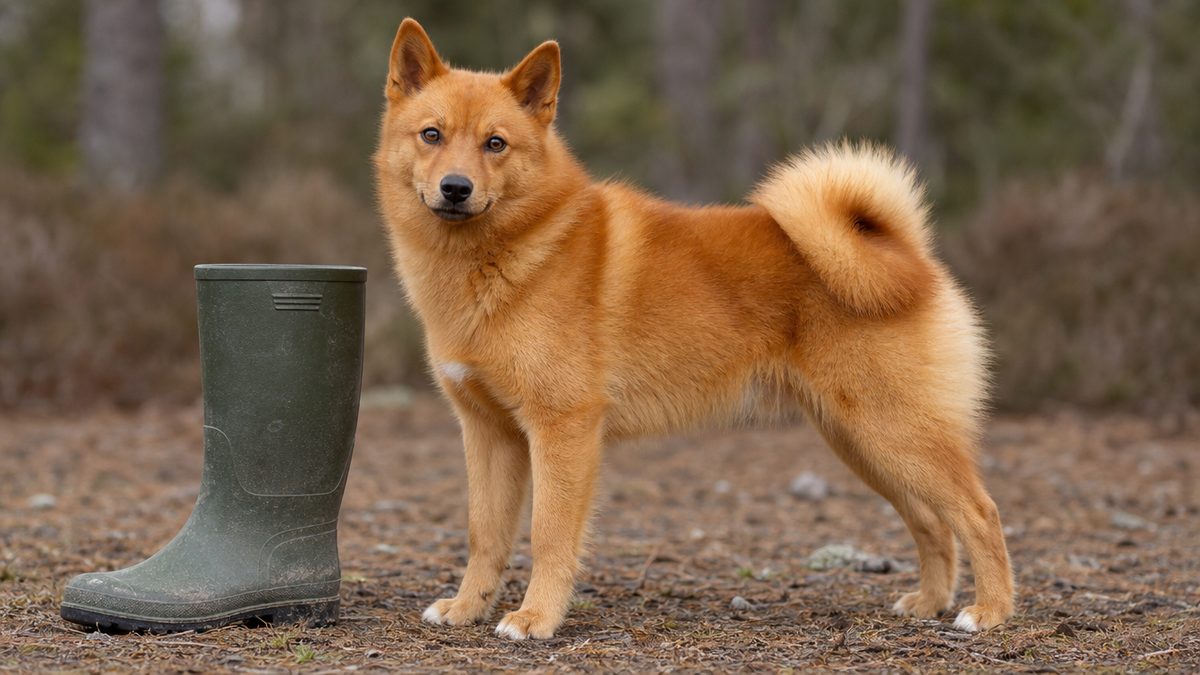
The Karelo-Finnish Laika is a small red hunting spitz from Karelia, standing 44 to 50 cm at the withers for a male, bred to find forest game birds and bark at them until the hunter arrives. Under FCI rules it is the Finnish Spitz.
The only published breed standard Bonbeno could read for this dog is the FCI's Finnish Spitz standard, number 49, because that is the standard the FCI says applies to it. The version in force is dated 11 February 2026 and was published on 20 March 2026. Everything in this section comes from that document unless flagged otherwise, and the identity section immediately below explains why that choice of document is itself contested.
| Point | Requirement |
|---|---|
| Height, males | 44-50 cm, ideal 47 cm |
| Height, females | 39-45 cm, ideal 42 cm |
| Weight | Not stated anywhere in the standard |
| Build | Smaller than medium-sized, almost square; body length equals height at withers |
| Colour | Bright red or golden red on the back, preferably a bright colour, with a lighter shade inside ears, on cheeks, throat, chest, belly, inside legs, back of thighs and tail |
| Coat | Moderately long stand-off coat on the body, stiffer on neck, shoulders and back; short and close-lying on head and legs; undercoat short, soft, dense and light in colour |
| Ears | Set rather high, always erect, rather small, pointed, very mobile |
| Nose | Rather small, jet-black |
| Tail | Curved forward from the set-on tightly along the back, then hanging down and pressed against the thigh, the tip reaching the middle of the thigh |
| Utilization | Hunting dog mainly for forest game birds, also predatory small game, waterfowl and elk |
| Temperament | Lively, vigorous, brave and determined; might be a little reserved towards strangers, but never vicious |
Two things in that table matter more than the rest. The red colour is what separates this dog from every other Karelian spitz at a glance, and large white markings on the chest or a white sock are a disqualifying fault rather than a cosmetic one. And the double coat, a stand-off outer layer over a short, soft, dense undercoat, is what makes the breed heat-sensitive in India.
A bark-pointer, not a retriever
The working method is the whole breed. This dog ranges ahead through forest, finds a capercaillie or a black grouse, and then stands under the tree barking to hold the bird's attention while the hunter walks in. The standard describes it as an eager hunter, rather independent, yet working co-operatively to game, marking game by barking. Finnish bird-hunting trials score that bark directly.
The history in the standard is precise about dates. Dogs of this type were used for all game hunting across Finland hundreds of years ago; when the register began in the 1890s, individuals similar in type and purpose were found mainly in the eastern and northern parts of the country. The first breed standard was established in 1892, the first breed show was held the same year, and the first bird-hunting trial in 1897. The breed was named the National Dog of Finland in 1979.
Where the Russian description differs
Russian and English-language sources describe a slightly wider dog than the FCI standard allows, and the difference is worth showing rather than smoothing over. The page ranking first in India gives a height of 38 to 50 cm and a weight of 14 to 16 kg, and says the breed can be solid red and also fawn or black, with white markings on the head, chest, legs and tail.
| Point | Top-ranked page | FCI standard 49 |
|---|---|---|
| Height | 38-50 cm | Males 44-50 cm, females 39-45 cm |
| Weight | 14-16 kg | No weight given at all |
| Colour | Solid red, occasionally fawn or black, with white markings | Bright red or golden red; large white markings disqualifying |
| Recognition | Not recognised by any major kennel club | Registrable as a Finnish Spitz; separately recognised by the RKF since 2019 |
The weight figure has no counterpart in the standard, which gives none. The fawn and black colours and the white markings are outside what standard 49 permits. Neither is necessarily wrong about the dogs actually living in Russian Karelia; both are wrong as descriptions of an FCI Finnish Spitz. That gap is precisely the thing this page exists to explain.
The top-ranked page's own infobox has two labels transposed: the row headed "Coat" reads "Solid red, occasionally fawn or black with some white markings", and the row headed "Colour" reads "Thick double coat";. The content is the right way round; the labels are swapped. It is a small thing, and it is the page the whole Indian first page of results is built on.
Is the Karelo-Finnish Laika a breed? Three bodies, three different answers
Three organisations answer this question differently, and all three answers are current. The FCI says it is the Finnish Spitz. The Russian Cynological Federation says it is a separate breed group the FCI does not recognise. The Russian hunters' association says it is a breed, and holds a state patent on it.
This is the question every other page about this dog either skips or gets wrong, so Bonbeno went to the four primary documents and read each one. They do not agree, they are all in force, and the disagreement is dated.
What the FCI says, as of 11 February 2026
The FCI does not list a Karelo-Finnish Laika anywhere. Group 5 Section 2, Nordic Hunting Dogs, contains exactly two Finnish entries: SUOMENPYSTYKORVA (49), the Finnish Spitz, and KARJALANKARHUKOIRA (48), the Karelian Bear Dog.
The reason is stated inside the Finnish Spitz standard itself, in the historical summary, and it survives verbatim into the version published on 20 March 2026 and valid from 11 February 2026:
"According to the agreement between the Finnish Kennel Club and the Russian Cynological Federation that was signed in 2006 the Karelian-Finnish Laika and the Finnish Spitz were combined as one breed under the breed standard of the Finnish Spitz.";
Two details make that quotation stronger than it looks. The standard carries the line "The latest amendments are in bold characters", and the only bold text in the document is the word "tooth" in a single fault, so the merger sentence was not newly added in 2026 but carried forward unchanged. And the FCI register confirms the date independently, listing standard 49 as valid from 2/11/2026 in a date column the same table proves is month-first, because other rows read 2/28/2018 and 9/17/2024. So the FCI's published position is unchanged: one breed, registered as the Finnish Spitz.
What the Russian Cynological Federation says, since 11 December 2019
The RKF signed that 2006 agreement. It has since taken a different position domestically, and it has published the rules. Its «Порядок регистрации в ВЕРК РКФ собак породной группы карельская лайка», the registration order for dogs of the Karelian Laika breed group, was approved by RKF Presidium decision of 20 July 2022.
Clause 1 states that the Karelian Laika as a breed is in the stage of breed formation and is classified as a breed group requiring systematic professional work within the rules of the RKF and FCI. Clause 2 states that registration of dogs of the Karelian Laika breed, recognised in the RKF system by decision of the SOKO RKF Presidium on 11 December 2019 and not recognised by the FCI, is carried out in the RKF stud book's register for unrecognised breeds.
The RKF is an FCI member. Both things are therefore true at once: it is party to an agreement treating the dogs as one breed internationally, and it maintains them as a separate national breed group domestically, in a register whose name concedes the FCI does not recognise them.
What the Russian hunters' association says
Росохотрыболовсоюз, the Russian association of hunting and fishing societies, runs its own stud books for working hunting dogs, entirely separately from the RKF. Its Реестр пород охотничьих собак, approved by Central Board resolution No. 121 of 25 February 2015 and amended through 22 May 2024, lists under Laikas: 3.1 West Siberian Laika, 3.2 Russo-European Laika, 3.3 Карельская лайка with breed code лк, 3.4 East Siberian Laika and 3.5 Norwegian Elkhound.
A footnote attached to entry 3.3 records that the breed's name was changed in accordance with Central Board resolution No. 106 of 23 September 2020. That is when Карело-финская лайка became Карельская лайка in the Russian working system.
And on 9 September 2022 the Russian state commission for the testing and protection of selection achievements registered patent No. 13047 on the selection achievement, the breed "Карельская лайка". That is not a kennel club opinion; it is a Russian intellectual-property registration treating the dog as a distinct breed.
| Body | Position | Instrument | Date |
|---|---|---|---|
| FCI | Not a separate breed; it is the Finnish Spitz | FCI-Standard N° 49, historical summary | In force from 11 February 2026 |
| Finnish Kennel Club | Party to the merger; registers these dogs as Finnish Spitz | The 2006 agreement, quoted in standard 49 | Signed 2006 |
| Russian Cynological Federation | Separate breed group, in breed formation, not FCI-recognised | Registration order for the Karelian Laika breed group | Recognised 11 Dec 2019; order approved 20 July 2022 |
| Росохотрыболовсоюз | A breed, in its own hunting register, renamed | Register of hunting dog breeds, entry 3.3; state patent 13047 | Renamed 23 Sept 2020; patent 9 Sept 2022 |
The Wikipedia article ranking first in India for this term states under Breed status: "Not recognised as a breed by any major kennel club." The page was last modified on 19 September 2025. That sentence stopped being accurate on 11 December 2019, when the Russian Cynological Federation recognised the breed in its own system, and it takes no account of the 2022 Russian state patent. The site ranking third in India cites that Wikipedia article as its only reference, so the error is reproduced rather than checked.
What Bonbeno concludes, and where the evidence stops
Bonbeno concludes that the Karelo-Finnish Laika is one breed internationally and two breeds inside Russia, and that this is a real institutional split rather than a mistake by anyone. What the evidence does not settle is whether the Russian population is now biologically distinct.
The temptation on a page like this is to pick a side and write confidently. The evidence does not support that, so here is exactly what it does and does not establish.
What is settled
- Internationally there is one breed. The FCI recognises no Karelo-Finnish Laika, and its Finnish Spitz standard valid from 11 February 2026 states the two were combined by the 2006 agreement Fédération Cynologique Internationale.
- Inside Russia there are two. The RKF registers the Karelian Laika separately from the Finnish Spitz, forbids matings between them, and forbids moving a dog from one to the other.
- The Russian position is recent and dated. Recognition in the RKF system dates from 11 December 2019, the rename from 23 September 2020, and the state patent from 9 September 2022 Ассоциация «Росохотрыболовсоюз» Ассоциация «Росохотрыболовсоюз».
- Russia itself concedes the international position. The RKF's own order describes the breed as not recognised by the FCI and files it in the register for unrecognised breeds.
That last point is the one that resolves most of the apparent contradiction. The RKF is not claiming the FCI agrees with it. It is running a domestic register alongside an international one and saying so in writing.
What is not settled
Whether the Russian dogs are now genetically distinct from Finnish Spitz is not established by anything Bonbeno could read. The RKF's own clause 1 says the Karelian Laika "as a breed is in the stage of breed formation", which is a statement that the work is unfinished rather than a claim that it is done.
The published genetics do not resolve it either, because no study Bonbeno found has compared a Russian Karelian Laika sample against a Finnish Spitz sample. The nearest relevant work analysed Finnish hunting spitzes and found the Finnish Spitz, the Nordic Spitz and the Karelian Bear Dog all closely related and sharing common origins with the northeastern Eurasian Laika breeds rather than with the Scandinavian elkhounds. That tells you the Finnish and Russian northern spitzes are one family. It does not tell you where inside that family a line should be drawn, or whether one exists.
Why this is not an academic question for a buyer
Which body you follow decides three practical things, and Bonbeno has not seen any other page say so.
| Question | Under the FCI | Under the RKF |
|---|---|---|
| What is the dog called on its papers? | Finnish Spitz, standard 49 | Карельская лайка, breed group, unrecognised-breeds register |
| Which health literature applies? | The Finnish Spitz literature, including the epilepsy studies | No breed-specific literature Bonbeno could find |
| Which breed standard governs? | FCI 49: red or golden red only, white markings disqualifying | A separate Russian standard Bonbeno could not obtain |
| Can it be bred to a Finnish Spitz? | Yes, it is a Finnish Spitz | No, matings between the two are not permitted |
| Can it win a conformation title? | Yes, ordinary FCI titles | No RKF or FCI conformation titles are awarded |
| Can it compete in hunting trials? | Yes, Nordic countries only for the working trial | Yes, without restriction in all laika disciplines |
The second row is the one that matters most for health. If you accept the FCI position, this dog inherits a substantial published epilepsy literature and a documented population-genetics problem. If you accept the Russian position, it inherits neither, because nobody has studied the Russian population. The same dog is either well documented or almost undocumented depending on which register you file it under, and no amount of reading resolves that for you.
This page treats the Karelo-Finnish Laika as the Finnish Spitz for all health, screening and lifespan purposes, because that is the only position with published data attached, and it says so every time it does. It treats the Russian registration as real, current and correctly documented, because it is. It does not claim the two populations are the same dogs, and it does not claim they are different ones, because Bonbeno found no evidence either way. Where a future study compares the two populations directly, this page should be rewritten.
Four names for one dog, and how a border created a breed
The Karelo-Finnish Laika got its name from a border, not from a breeder. The same population was split by the twentieth-century wars in Karelia, developed separately on each side, and now carries a different name in each system.
Anyone researching this dog will meet at least four names, and they are not synonyms in every context.
| Name | Script | Used by | Status |
|---|---|---|---|
| Finnish Spitz | English | FCI, Finnish Kennel Club, AKC | The FCI's official English name for standard 49 |
| Suomenpystykorva | Finnish | FCI, Finnish Kennel Club | The FCI's primary name for standard 49 |
| Карело-финская лайка (Karelo-Finnish Laika) | Russian | Historic Russian usage; still the common English name | Superseded in the Russian working register in 2020 |
| Карельская лайка (Karelian Laika) | Russian | RKF and Росохотрыболовсоюз since 2020 | The current Russian name |
The rename is documented and dated. Росохотрыболовсоюз's register of hunting dog breeds carries a footnote against entry 3.3 recording that the breed name was changed in accordance with Central Board resolution No. 106 of 23 September 2020. So most English-language pages, including the one ranking first in India, are using a name Russia retired six years ago.
The Finnish half of the history, from the standard
FCI standard 49 gives the Finnish timeline precisely. Dogs of this type were used for all game hunting across the whole country hundreds of years ago. When the register of the breed started in the 1890s, individuals similar in type and hunting purpose were found mainly in the eastern and northern parts of the country. The first breed standard was established in 1892, the first breed show was held the same year, and the first bird-hunting trial in 1897. The breed was named the National Dog of Finland in 1979.
Note the geography. "Mainly the eastern parts of the country" in the 1890s means Karelia, on both sides of a border that did not yet divide anything.
The Russian half, as the reference works tell it
The standard says nothing about what happened on the other side, so this comes from the general reference literature rather than from a registry document, and Bonbeno labels it accordingly. The account given by the page ranking first, sourced to Desmond Morris's breed dictionary and David Alderton's encyclopedia, is that prior to the early twentieth century the Finnish Spitz and the Karelo-Finnish Laika were one breed, common across eastern Finland and north-western Russia; that the Russian Revolution, the Russian Civil War and the Winter War left large parts of Karelia under Soviet control and much bitterness on both sides; and that Russian advocates of the breed altered it slightly by selective breeding and renamed the dogs on their side of the border.
The same account, sourced to Vladimir Beregovoy's book on Russian hunting laikas, says that in the 1950s Russian breeders imported two male and one female Finnish Spitz and crossed them with the red-coated spitzes of southern Karelia, the Olonets Laika and the Karelian Laika. The resulting dogs had a conformation very similar to the Finnish Spitz and hunted well, later imports followed, and the offspring were split into hunting dogs to be rebred and non-hunters kept for show.
In that 1950s account, one of the two local populations crossed into the developing breed was itself called the Karelian Laika. Since 23 September 2020 the whole breed carries that name. A reader meeting "Karelian Laika" in a Russian source therefore has to check the date before knowing whether it means one of the 1950s founding populations or the modern registered breed.
What the genetics say about the split
The one thing genetics settles is that the whole northern group is closely knit. Analysis of Finnish hunting spitzes found the Finnish Spitz, the Nordic Spitz and the Karelian Bear Dog, along with the reindeer-herding Lapphund and Lapponian Herder, all closely related and sharing common origins with the northeastern Eurasian Laika breeds, rather than with other Scandinavian spitz breeds such as the elkhounds and the Swedish Vallhund.
So the Finnish dogs are Laikas by descent, which is exactly why a Russian registry can call them laikas without straining anything, and why a Finnish registry can call the Russian dogs Finnish Spitz without straining anything either. The border decided the names. The dogs did not.
What the genetics also shows is a population under real pressure. Pedigree analysis of 28,119 Finnish Spitzes combined with SNP data from 135 of them found the breed had undergone repeated male bottlenecks with a dramatic loss of genetic diversity, leaving 20 effective founders and mean heterozygosity of 0.313. The realised effective population size from pedigrees was 168, while the genetic effective population size computed from linkage-disequilibrium decay was only 57 individuals. That paper closes by discussing the benefits of an open breed registry, which is the context in which the 2006 merger with the Russian population makes obvious genetic sense.
What the Russian registration order actually permits and forbids
The RKF's order for the Karelian Laika runs to fifteen clauses and is unusually specific. It permits full participation in hunting trials, forbids conformation titles, forbids crossing with the Finnish Spitz, and sets a ten-year window that closes on 11 December 2029.
Most pages that mention the Russian position do so in half a sentence. The document itself is short, numbered and public, so here is what it says. Every point below comes from «Порядок регистрации в ВЕРК РКФ собак породной группы карельская лайка», approved by RKF Presidium decision of 20 July 2022.
How a dog gets registered
- Dogs go into the ВЕРК РКФ register for unrecognised breeds, because the breed is recognised in the RKF system but not by the FCI.
- Dogs without documents of origin may be registered after a procedure determining breed membership under the RKF breeding regulations, as may their descendants lacking three full generations of ancestors.
- Dogs holding a Росохотрыболовсоюз hunting-dog certificate or origin certificate may be registered on the owner's application, provided the document is confirmed by a special letter from the RORS central board hunting-dog department.
- Those RORS documents must show no Finnish Spitz previously entered in the RKF stud book within three generations of ancestors.
- Puppies registered on a RORS litter card require both parents already registered in the RKF stud book.
The ten-year window
Clause 8 sets a deadline that is rarely mentioned: RORS certificates issued for Karelian Laikas are exchangeable for ten years beginning 11 December 2019. That window closes on 11 December 2029. It is the clearest sign that the RKF treats this as a defined breed-formation project with an end date rather than an open-ended parallel register.
The separation rules
Three clauses keep the two populations apart, and together they are the strongest evidence that the Russian position is serious rather than nominal.
| Clause | Rule |
|---|---|
| 3 | The two breeds are registered separately, and matings between them are not permitted |
| 10 | Dogs born before 11 December 2019 and already registered as Finnish Spitz cannot be transferred to Karelian Laika |
| 11 | Where both parents are Karelian Laikas, all puppies must be registered only as Karelian Laikas |
| 12 | Transfer from Karelian Laika to Finnish Spitz is not permitted |
Clause 10 is the interesting one. It closes the obvious loophole, which would be reclassifying existing Finnish Spitz stock as the new breed to inflate its numbers. The RKF explicitly forbade that, which means the Karelian Laika population had to be built from dogs that were not already in the FCI-recognised register.
What the dog can and cannot do
Clause 14: at RKF shows, Karelian Laikas receive only a grading and are awarded no RKF or FCI conformation titles. So the breed cannot become a champion in the ordinary sense anywhere.
Clause 15 is the opposite, and it is generous. At RKF hunting trials and competitions, Karelian Laikas may take part without restriction in every discipline provided for laikas, and the order lists them: squirrel, forest bird meaning capercaillie and black grouse, pheasant, mink, polecat, marten, sable, elk, free-ranging boar, tethered bear, penned bear, penned boar, penned badger, waterfowl and blood trail. Results are entered in the RKF stud book.
Read those two clauses together and the Russian position becomes legible. This is a working register. The breed is barred from the beauty ring and admitted to the entire working programme, which is exactly the priority order a hunters' organisation would set, and it matches the fact that the parallel Росохотрыболовсоюз register is a register of hunting breeds rather than of show breeds.
The list of quarry is a description of the dog
That clause 15 list is also the most useful temperament document available for this breed, because it says what Russian handlers actually hunt with these dogs. A 44 to 50 cm spitz expected to work squirrel and marten and also to bay a tethered bear is not a companion animal with hunting ancestry. It is a current working animal.
The order sets out registration procedure in detail and says nothing about conformation, health screening or genetic testing. Bonbeno could not obtain a published Russian breed standard for the Karelian Laika, and could find no health-screening requirement, no hip or eye programme and no published population figure for it. So the breed that Russia registers separately has, as far as Bonbeno can establish, no published health data of its own at all. That absence is the single strongest practical argument for reading this dog's health through the Finnish Spitz literature instead.
The veterinary literature: zero papers under this name, and a search result that lies about it
No veterinary paper exists under any Karelo-Finnish Laika name. A PubMed search for the phrase returns 27 records, and every one of them is an artefact of the search engine discarding the breed name and searching the bare word laika.
This section exists because the obvious search produces a confident, specific, entirely false answer, and anyone writing about this breed will hit it. Bonbeno ran the queries through PubMed's E-utilities on 31 August 2026 and recorded the query translation line for each, which is the part that gives the game away.
| Query | Records returned | What PubMed actually searched |
|---|---|---|
| "Karelo-Finnish Laika" | 27 | "laika"[All Fields] - the breed name was discarded |
| "Karelo-Finnish Laikas" | 1 | "laikas"[All Fields] |
| "Karelian-Finnish Laika" | 0 | "karelian finnish" AND "laika" |
| "Karelian Laika" | 1 | ("karelian" OR "karelians") AND "laika" |
| "Karelskaya laika" | 0 | "karelskaya" AND "laika" |
| Suomenpystykorva | 0 | Suomenpystykorva, phrase not found |
| "Finnish Spitz" | 10 | "Finnish Spitz"[All Fields] - indexed as a phrase |
Twenty-seven records looks like a literature. It is not. PubMed could not match the phrase, dropped it, and searched the single word laika, which returns papers about Laika the space dog and about people with that surname. The proof is next to it in the table: a search for "Russkoevropeiskaia laika", a completely different breed's Russian name, returned the identical 27 records with the identical translation. Two different breed names cannot have the same literature. Both queries were searching the same three-letter fragment.
The one record surfaced by "Karelian Laika" is genuine but not breed-specific: it is the 2018 analysis of Finnish hunting spitzes, which discusses the Laika group as a whole. The single record under the plural is a Hungarian study of canine pancreatitis in 80 cases, which has nothing to do with the breed.
The controls, because an absence has to be earned
A zero is only evidence if the instrument works. Bonbeno ran four control queries in the same session through the same interface: Labrador Retriever with hip dysplasia returned 126 records, Norwegian Elkhound 26, Bergamasco with dog 13, and Finnish Lapphund 9. All four are sane. The tool was working; the breed name simply is not in the index.
So the honest finding is that the Karelo-Finnish Laika has zero veterinary papers under any of its own names, tested across six name forms including the Finnish, the transliterated Russian, the hyphenated and unhyphenated English, and the plural.
Under the other name, there is a real literature
Search the name the FCI uses and the picture inverts completely. "Finnish Spitz" returns 10 records as a properly indexed phrase, including four studies of idiopathic epilepsy in the breed, a population-genetics analysis, and a canine epilepsy gene study.
The plural adds one more that the singular misses. "Finnish Spitzes" returns 5 records, one of which is a 1968 Acta Veterinaria Scandinavica statistical study of tumours in dogs that does not appear in the singular search at all. This is worth stating as a method point rather than only as a result: on this project a singular phrase search has now twice failed to surface papers that the plural found, so an absence claimed on one form of a name is not an absence.
| Study | Journal and year | Subject |
|---|---|---|
| Viitmaa et al. | JAVMA 2013 | Phenotype, inheritance and risk factors for idiopathic epilepsy |
| Viitmaa et al. | Vet Radiol Ultrasound 2014 | Cerebral glucose utilisation by PET in epileptic dogs |
| Jeserevics et al. | J Vet Intern Med 2007 | EEG findings in healthy and epileptic dogs |
| Viitmaa et al. | J Vet Intern Med 2006 | MRI findings in dogs with focal epilepsy |
| Koskinen et al. | BMC Genomics 2015 | ADAM23 risk haplotype for canine idiopathic epilepsy |
| Kumpulainen et al. | J Anim Breed Genet 2017 | Founder representation and effective population size |
| Pohjoismäki et al. | PLoS ONE 2018 | Origins and relationships of the Finnish hunting spitzes |
Accept the FCI position and this dog has seven relevant studies, four of them on a single neurological disease. Accept the Russian position and it has none, because nobody has published on the separately registered Russian population. Bonbeno reads the health of this breed through the Finnish Spitz literature for exactly that reason, and flags every time it is doing so. A page that quotes those epilepsy figures without telling you they come from a differently named register is hiding the most important thing about them.
Karelo-Finnish Laika price in India
There is no Karelo-Finnish Laika price in India, and unusually there is not even a fabricated one. No Indian breed guide ranks for the term, and the only rupee figure on the entire first page of Indian results is ₹322 for a paperback book.
Most breed pages on this site have to unpick an invented Indian price. This one does not, because nobody has bothered to invent one. That absence is worth describing precisely, because it tells an Indian reader more about availability than any number would.
| Position | Site | What it is |
|---|---|---|
| 1 | en.wikipedia.org | Encyclopedia article; no price |
| 2 | etsy.com | Merchandise market listing |
| 3 | animalia.bio | Breed page whose only cited reference is the Wikipedia article |
| 4 | amazon.in | A training-milestones paperback |
| 5 | wagwalking.com | US breed page; food costs quoted in US dollars |
| 6 | youtube.com | Russian-language video |
| 7 | flipkart.com | A blank selfie-milestone notebook |
| 8 | en.petglobals.com | Breed article; calls it a national breed of Finland |
| 9 | desertcart.in | A book, priced ₹322. The only rupee figure on the page |
| 10 | dogzone.com | UK breed directory |
Four of the ten results are merchandise. Two of the remaining six are the same text, because the site at position 3 cites the article at position 1 as its sole reference. Not one result is an Indian breed guide, an Indian breeder, an Indian listing site or an Indian price.
Why there is no Indian price
Two reasons, and both are documented rather than inferred.
First, no lawful commercial supply chain can form. Dogs sit in the Indian import schedule at ITC(HS) 01061900, Restricted. Under DGFT Trade Notice 22/2022-23, Policy Condition 7 permits importing dogs only as a pet with a valid pet book in the importer's name, for research organisations with CPCSEA recommendation, or for Defence and Police internal security. Policy Condition 8 states that import of commercial dogs for breeding or any other commercial activity is not permitted, and paragraph 6 adds that applications for trading or breeding purposes shall be duly rejected.
Second, the paperwork problem is worse for this breed than for most. A buyer cannot simply ask for a pedigree, because the two available registers disagree about what the dog is. An FCI pedigree would say Finnish Spitz. A Russian pedigree would say Карельская лайка and would come from the RKF's register for unrecognised breeds. India, as a full FCI member represented by the Kennel Club of India, works to FCI nomenclature, under which the second document describes a breed that does not exist.
What you would actually be buying
If someone in India offers you a Karelo-Finnish Laika, the realistic possibilities are these, in rough order of likelihood.
- An Indian Spitz or a spitz cross. Small, pointed-eared, curl-tailed and often reddish, widely available here, and adapted to the climate.
- A Finnish Spitz, correctly, since under FCI rules that is what a Karelo-Finnish Laika is. In that case ask for the FCI pedigree and read this page's health sections, which apply directly.
- A mislabelled dog of another northern breed. The name collides with the Karelian Bear Dog, which is a larger black-and-white breed with its own FCI number.
- Nothing at all. A listing for a breed nobody stocks is a lead-generation page, not an animal.
Bonbeno publishes no Karelo-Finnish Laika price for India, because none exists to publish and inventing one would be fabrication. What a reader can act on instead is the cost of keeping a 44 to 50 cm double-coated hunting spitz in India, which is real, sourced and set out in the next section.
What a Karelo-Finnish Laika costs to keep in India
Budget for a small-to-medium double-coated working dog of 44 to 50 cm, not for a toy spitz. Indian vaccination, consultation and parasite-prevention costs are published figures and they apply to this dog regardless of which register it came from.
There is no purchase price to quote, so this section deals only with the cost of ownership, which is real and sourceable. The FCI standard gives a height of 44 to 50 cm for males and 39 to 45 cm for females and, unusually, states no weight at all. The figure in circulation elsewhere, 14 to 16 kg, comes from general reference works rather than from any standard. Budget for a dog in that range and you will not be far out.
First-year veterinary costs, from published Indian figures
| Item | Published Indian range |
|---|---|
| Full puppy vaccination course, across all visits | ₹3,000 to ₹6,000 |
| DHPPi or 7-in-1, per dose | ₹500 to ₹1,200 |
| Anti-rabies, per dose | ₹300 to ₹600 |
| Consultation or injection charge, per visit | ₹300 to ₹800 |
| Annual booster afterwards | ₹1,000 to ₹2,000 |
Those are general Indian figures rather than breed-specific ones, and Bonbeno labels them so, because no Indian population of this breed exists to price separately.
The three recurring costs that matter most here
- Year-round tick and flea prevention. A West Bengal series of 584 client-owned dogs found 76.5 percent positive for *Babesia gibsoni* and 72.9 percent carrying two or more pathogens simultaneously. A dense undercoat is good tick habitat, so this is not a seasonal line item.
- Cooling. Shade, airflow and often air conditioning through the Indian summer for a dog whose undercoat the standard requires to be short, soft and dense. That is an electricity cost.
- Patella and eye screening, if you ever breed. Finland's PEVISA programme for this breed requires a patella statement and an eye statement on both parents before a litter can be registered, with a minimum examination age of 12 months. A responsible buyer wants to see both from the parents.
The costs an Indian owner will actually feel
Feeding a 15 kg dog is cheap by Indian standards. Two other things are not.
Containment. This is a bird dog with a very high prey drive, selected to leave the handler, find game and bark at it. In an Indian street that instinct meets cats, poultry and community dogs. Fencing, or a lifetime of long-line walking, is the real cost of owning this breed here.
Noise. The barking is the breed's function rather than a fault. In an Indian apartment block that can become a housing-society problem, and the resolution is usually rehoming rather than training.
One cost that does not apply
Grooming is genuinely cheap. There is no trimming, no stripping and no professional clip in the standard's description of the coat, so the recurring grooming bill for this breed is a brush and your own time. What it costs instead is drying time in humid months, which the grooming section covers.
Ask which register the parents are in before asking the price. An FCI pedigree naming Finnish Spitz brings with it the patella and eye screening requirements described above, and a published health literature. A Russian pedigree naming Карельская лайка brings neither, because Bonbeno could find no health-screening programme and no published health data for the separately registered Russian breed.
Heat tolerance: Karelia averages 3.8 °C and Chennai's coolest month is 24.1 °C
This breed has the lowest heat tolerance rating this site gives. Ladoga Karelia, the region the breed is named after, averages 3.8 °C across the year and 19.0 °C in July, while every large Indian city is warmer in its coolest month than Karelia is at midsummer.
Bonbeno queried NASA's POWER climatology by explicit latitude and longitude for the places this breed is actually named after, echoing back the grid-cell elevation the model reports so the figures can be checked against the real towns.
| Place | Annual mean °C | Warmest month, mean °C | Coolest month, mean °C |
|---|---|---|---|
| Sortavala, Ladoga Karelia, Russia | 3.8 | 19.0 (July) | −11.4 (January) |
| Petrozavodsk, Olonets Karelia, Russia | 2.7 | 18.0 (July) | −12.5 (January) |
| Joensuu, North Karelia, Finland | 2.7 | 17.6 (July) | −11.9 (January) |
| Delhi | 25.6 | 35.9 (June) | 13.6 (January) |
| Mumbai | 26.8 | 31.2 (May) | 23.2 (January) |
| Chennai | 27.9 | 31.5 (May) | 24.1 (January) |
| Bengaluru | 23.7 | 28.4 (April) | 20.2 (December) |
| Pune | 23.9 | 28.9 (April) | 19.6 (December) |
The place names are not decorative. Olonets and southern Karelia are where the 1950s Russian breeding programme drew its red-coated local spitzes from, and Ladoga Karelia is the heart of the region the breed takes its name from. All three northern sites sit between 2.7 °C and 3.8 °C annually, and none exceeds 19.0 °C in its warmest month.
Now the sentence that settles it. Chennai's coolest month averages 24.1 °C; the warmest month in Ladoga Karelia averages 19.0 °C. India's hottest large city is more than five degrees warmer in January than the breed's homeland is at the height of summer. Bengaluru, the most temperate large Indian city here, is 20.2 °C in its coolest month, still above a Karelian July.
The coat is smaller than a Karelian Bear Dog's, and it is still a northern coat
It is tempting to assume that a smaller dog copes better. The standard does not support that. FCI 49 requires a moderately long, semi-erect or erect stand-off coat on the body, stiffer on the neck, shoulders and back, over an undercoat that is short, soft, dense and light in colour, with long dense hair on the trousers and tail. That is a full insulating double coat built for a −11 °C January.
Body size cuts both ways in heat. A smaller dog has more surface area relative to its mass, which helps shed heat, but it also has less thermal inertia and a working spitz's willingness to keep going. The coat, not the kilogram count, is the limiting factor.
The breed club has no heat guidance, and that is itself informative
The Finnish Spitz breeding programme for 2022 to 2026 runs to 41 pages and contains no statement about heat, cold, climate or thermoregulation at all. Bonbeno searched it for the Finnish words for heat, temperature, climate, hot weather, cold, sweating and tropics and found none of them. The coat appears only in the conformation standard.
That is not an oversight by the club. It is a document written by people for whom the question does not arise. An Indian owner of this breed is therefore operating entirely without the breed's own guidance, which is exactly why this section is built from climate data rather than from breed literature.
What the heat-illness research contributes
The largest study of the problem analysed 905,543 UK dogs under primary veterinary care in 2016, recording 395 confirmed heat-related illness events with a case fatality of 14.18 percent. Its companion paper, on the same cohort, found 1,259 events from 1,222 dogs, of which 879 had a recorded trigger, and 652 of those 879, or 74.2 percent, were exertional.
Neither paper modelled this breed, which is far too rare in the United Kingdom to have met their inclusion thresholds, so Bonbeno quotes no breed-specific odds ratio for it. The transferable finding is the mechanism: most heat-related illness happens because a dog was exercising, not because it was shut in a car. For a bird dog that wants to range and bark for hours, in an Indian April, that is the entire risk profile.
Second Schedule Part IV paragraph 21(1) of the Prevention of Cruelty to Animals (Dog Breeding and Marketing) Rules 2017 bars keeping in outdoor facilities, without the attending veterinary practitioner's written approval, dogs not accustomed to local temperatures, breeds that cannot tolerate the temperatures prevalent in the area, such as long-haired breeds in high temperature locations, and sick, infirm, aged or young animals. Note the citation form: the Rules stop at Rule 13, and the string "Rule 21" appears zero times in the gazette. This is a Second Schedule paragraph.
Indian hill stations, and the satellite figures that would mislead you
Ladakh is the only place in India whose corrected climate approaches Karelia. Every other Indian hill station estimates to 12 to 14 °C annually, which is cooler than the plains and still warmer than the breed's homeland in every month.
Anyone concluding that this dog cannot live in Chennai will next ask about Shimla or Manali. The satellite data answers that badly unless one correction is applied first.
NASA POWER returns a grid cell, not a point. In mountains the cell's mean elevation can miss the town beneath it by well over a kilometre, and temperature falls with height at roughly 6.5 °C per 1,000 m. Bonbeno measured the error for every place on this page.
| Place | Cell elevation, m | Real elevation, m | Error, m |
|---|---|---|---|
| Sortavala (homeland reference) | 31.6 | 17 | +14.6 |
| Delhi | 206.4 | 216 | −9.6 |
| Bengaluru | 841.7 | 920 | −78.3 |
| Mumbai | 97.2 | 14 | +83.2 |
| Darjeeling | 1,313.5 | 2,045 | −731.5 |
| Leh | 4,532.6 | 3,500 | +1,032.6 |
| Shimla | 897.7 | 2,200 | −1,302.4 |
| Ooty | 784.6 | 2,240 | −1,455.4 |
| Gangtok | 3,239.6 | 1,650 | +1,589.6 |
| Manali | 3,984.7 | 2,050 | +1,934.7 |
The plains cities land within 84 m of the real town, so their figures stand as read. The six hill stations are wrong by between 731 m and 1,935 m, in both directions, so no single rule of thumb corrects them.
Corrected estimates, labelled as estimates
| Place | Raw cell annual °C | Correction °C | Corrected annual °C, estimate | Corrected warmest month °C, estimate |
|---|---|---|---|---|
| Leh | −2.8 | +6.7 | 4.0 | 16.9 (July) |
| Manali | −0.6 | +12.6 | 12.0 | 21.3 (July) |
| Shimla | 21.2 | −8.5 | 12.7 | 21.8 (June) |
| Darjeeling | 18.4 | −4.8 | 13.7 | 18.3 (June) |
| Ooty | 23.5 | −9.5 | 14.0 | 18.0 (April) |
| Gangtok | 7.5 | +10.3 | 17.8 | 23.9 (July) |
Read the raw column and Manali at −0.6 °C and Gangtok at 7.5 °C look like the coldest places in India and obvious homes for a Karelian dog. Both are artefacts of cells sitting far above the towns. Corrected, Gangtok becomes one of the warmest places on the table, at an estimated 17.8 °C annually with a July near 24 °C. An unchecked figure would have sent a northern dog to precisely the wrong hill station.
Only Ladakh matches
Corrected, Leh estimates to 4.0 °C annually with a July around 16.9 °C. Sortavala in Ladoga Karelia is 3.8 °C annually with a July of 19.0 °C. That is a genuine match, and Leh is the only place in India on this table that provides one.
The other hill stations cluster between 12.0 and 14.0 °C annually with warmest months of 18 to 22 °C. Those are pleasant temperate climates, and they are not Karelia: the hottest month in Shimla or Manali already equals or exceeds the hottest month in the breed's homeland.
Two checks Bonbeno ran
- Elevation echo. Every query returned its grid-cell elevation, compared above against the real town height. A coordinate echo alone proves only that the right latitude was requested, not that the model is standing at the right altitude.
- Duplicate-cell check. Two towns falling inside one grid cell return byte-identical series and cannot distinguish anything. All fifteen places queried returned distinct monthly series, so no comparison here rests on the same cell queried twice.
Even in Ladakh, the exercise requirement, the voice and the prey drive travel with the dog, and the supply problem is unchanged: Leh is not one of the seven ports through which pet animals may enter India, which are Delhi, Mumbai, Chennai, Hyderabad, Bengaluru, Kolkata and, since October 2024, Kochi Department of Animal Husbandry…. A dog would have to land at one of those and travel.
Indian law: import, housing and the screening rules that do not match
Indian law permits importing this dog as a personal pet and forbids importing one to breed or sell. Its mandatory genetic-defect list covers progressive retinal atrophy, which this breed screens for, and does not cover patellar luxation, which is the breed's actual screening requirement.
Import
Dogs sit at ITC(HS) 01061900, Mammals: Other, Restricted. Under DGFT Trade Notice No. 22/2022-23 of 19 December 2022, Policy Condition 7 permits importing dogs only as a pet with a valid pet book and records in the importer's name, by research organisations with CPCSEA recommendation, or for Defence and Police internal security. Policy Condition 8 prohibits import of commercial dogs for breeding or any other commercial activity.
Import as passenger baggage without a DGFT authorisation is allowed only to a person transferring residence to India after two years of continuous stay abroad, for up to two animals. Entry is limited to the airports and seaports of Delhi, Mumbai, Chennai, Hyderabad, Bengaluru and Kolkata and, since October 2024, Kochi airport, and an advance No Objection Certificate from the AQCS quarantine officer is required seven days before travel, relaxable to three. The full route is set out in how to import a dog to India.
Outdoor housing
Second Schedule Part IV paragraph 21(1) of the Prevention of Cruelty to Animals (Dog Breeding and Marketing) Rules 2017 bars keeping in outdoor facilities, without the attending veterinary practitioner's written approval, dogs not accustomed to local temperatures, breeds that cannot tolerate them, and sick, infirm, aged or young animals. Paragraph 21(2) requires roofed shelters plus separate shaded areas large enough for all the animals at once.
The screening mismatch, which is specific to this breed
Second Schedule Part III paragraph 8(10) requires that breeding dogs "shall have been tested for genetic defects, including hip dysplasia, progressive retinal atrophy, night blindness, hypothyroidism, entropion, ectropion, overshot, undershot jaw, wry mouth, two or more missing teeth, unilateral cryptorchid or full cryptorchid males".
Compare that against what Finland actually screens for in this breed, and the lists barely overlap.
| Condition | Named in Indian para 8(10)? | In the Finnish PEVISA for this breed? |
|---|---|---|
| Progressive retinal atrophy | Yes | Yes; offspring of affected dogs are not registered |
| Hereditary cataract | No | Yes; offspring of affected dogs are not registered |
| PHTVL/PHPV | No | Yes; grades 2 to 6 disqualify offspring from registration |
| Patellar luxation | No | Yes; this is the breed's principal orthopaedic screen |
| Hip dysplasia | Yes | No; hips are not screened in this breed at all |
| Two or more missing teeth | Yes | Not in PEVISA; several missing teeth are a disqualifying fault in the standard |
Two rows deserve emphasis. Indian law names hip dysplasia, and the Finnish Spitz breeding programme does not screen hips at all: across the whole 2022-2026 document the Finnish word for hip does not appear once. And Indian law does not name patellar luxation, which is precisely what this breed's PEVISA programme is built around.
Bonbeno extracted the gazette and counted. Across the entire Rules the words "patella" and "luxation" appear zero times, and so do "BAER" and "deaf";. India mandates no patella grade and no hearing test for any breed. Since patellar luxation is the one orthopaedic condition this breed is actually screened for in its home country, an Indian buyer has to ask for that certificate themselves; no Indian rule will produce it. Note also that paragraph 8(10)'s operative word is "including", so the list is illustrative rather than closed.
Breeding restrictions
Second Schedule Part II paragraph 6(3) prohibits in-breeding, defined as mating between relatives of the second to fourth grade within the first four generations, and incest breeding between parents and children or brother and sister.
Finland is stricter and puts a number on it. The PEVISA programme caps a litter's inbreeding coefficient at 6.25 percent calculated over seven generations, and the breed club's own stated target is to keep the breed average below 3 percent over seven generations, against an achieved average of 1.79 percent to 2020. It also caps a single dog at 40 registered offspring. Indian law sets no numeric ceiling on either.
Paragraph 6(8) forbids tail docking, ear cropping, de-barking, de-clawing and any change of appearance by artificial means. De-barking is worth naming for this breed specifically, because the barking is the loudest thing about it and it is the procedure a frustrated urban owner might be offered. It is prohibited in India.
Temperament and household fit
The Karelo-Finnish Laika is lively, vigorous, brave and determined, a little reserved towards strangers and never vicious. It is also one of the loudest breeds in existence, because barking is the job it was selected for.
FCI standard 49 gives the temperament in one sentence: lively, vigorous, brave and determined; might be a little reserved towards strangers, but never vicious. Aggressive or overly shy dogs are a disqualifying fault. The utilization clause adds the working character: an eager hunter, rather independent, yet working co-operatively to game, marking game by barking.
That last phrase is the whole personality in five words. This is a dog that goes out, finds something, and tells you about it at length.
The barking is not negotiable
Bonbeno rates this breed 5 out of 5 for vocalness, the maximum, and it is the single most important thing an Indian buyer needs to understand. In Finland the bark is scored competitively: bird-hunting trials have existed for this breed since 1897, and the whole discipline is built on a dog standing under a tree barking at a capercaillie.
The Russian working register makes the same point from the other side. The RKF's order permits Karelian Laikas to compete without restriction in every laika discipline, and lists them: squirrel, forest bird meaning capercaillie and black grouse, pheasant, mink, polecat, marten, sable, elk, free-ranging boar, tethered bear, penned bear, penned boar, penned badger, waterfowl and blood trail. Every one of those is a job that involves finding an animal and vocalising about it.
A dog bred for nine decades to bark at things will bark at things in a Mumbai apartment block. That is not a training failure and it is not fixable, and de-barking is prohibited in India.
With people
Reliable. The standard makes viciousness a disqualifying fault, and describes the reserve towards strangers as slight. The breed club's programme describes a dog that is healthy, long-lived and generally uncomplicated to live with, and its health survey found veterinary visits were most often for vaccinations and routine checks rather than for problems.
This is a noticeably easier temperament than its black-and-white cousin. The Karelian Bear Dog is described by its own working programme as not making a great pet; nothing comparable is said about this breed by anyone. What owners describe instead is a loyal, closely bonded and extremely vocal companion that attaches hard to its household.
With other animals
Here the picture reverses. A prey drive built to locate squirrel, marten, hare and fox does not distinguish those from a neighbour's cat or chickens. In Finland that instinct operates in forest; in an Indian street it operates on livestock, poultry and community dogs.
Bonbeno rates prey drive 5 out of 5 for exactly that reason, and it is the trait most likely to end an Indian ownership badly.
Who this breed suits in India
- A house with a securely fenced plot, in a hill station rather than the plains, with neighbours far enough away that barking is not a housing-society matter.
- An owner who wants an active, engaged, biddable-enough dog and is prepared to give it a daily job.
- Nobody living in an apartment. The size fits and the voice does not.
The corollary matters too. This is not a guard dog: the standard makes aggression a disqualifying fault, so what you get is a dog that announces visitors enthusiastically and then greets them.
The English-language descriptions in circulation, including the top-ranked page's "cheerful, energetic, and always eager to please", trace to general breed dictionaries rather than to any registry or behavioural study. They are consistent with the FCI standard, so Bonbeno reports them, but they are not evidence in the way a character-test distribution would be. No formal temperament-test dataset for this breed reached Bonbeno, and the Finnish breeding programme contains none.
Training: recall and noise are the two projects
Train recall and a quiet cue first, and treat everything else as secondary. This breed is more biddable than its bear-hunting cousin and is still an independent bird dog that leaves the handler by design.
Front-load the two things an Indian owner will actually struggle with. A Karelo-Finnish Laika will range away from you and it will bark. Both behaviours are the breed's function, both are heavily selected for, and neither can be removed. They can be managed, and the management has to start in the first months.
Why recall is hard here
The standard describes a dog that is rather independent, yet works co-operatively to game. Read that carefully: the cooperation is with the *game*, not with the handler. The dog's job is to leave, find, and then call you to it. A recall command competes directly with the behaviour the breed exists to perform.
In Finland that is fine, because the dog is recalled off nothing more contentious than a tree. In India the same dog leaving a handler is heading towards traffic, livestock or a community dog.
What works
- Socialise early and broadly. Get the puppy comfortable with Indian street noise, traffic, other dogs and handling before the socialisation window closes, working around the vaccination course rather than waiting for it to finish.
- Build recall as a paid habit, in a fenced space, before six months. This is the highest-value work of the first year and it gets harder every month after prey drive matures.
- Teach a quiet cue early, and reward silence rather than punishing noise. You are shaping when the dog barks, not whether.
- Give it a searching job. Scent games, hidden food and find-it work satisfy the actual instinct and tire the dog faster than walking does.
- Use a long line outdoors, permanently. For a bird dog in an Indian street this is not a training stage to be graduated from; it is standard equipment.
What this breed resists
- Silence. Barking is scored in trials in its home country. Expect to manage volume, not eliminate it.
- Off-lead reliability near small animals. A dog selected on squirrel and marten will not reliably ignore a cat.
- Repetitive drilling. A lively, determined spitz disengages from repetition faster than a retriever does.
- Being ignored. This is an active working dog in a small frame; under-stimulated, it gets louder rather than quieter.
Realistic timelines
| Goal | Realistic window | Note |
|---|---|---|
| Name response, handling, crate | 8 to 14 weeks | Do it indoors during the vaccination course |
| House training | 3 to 5 months | Slower through monsoon, when the dog resists going out |
| Recall in a fenced area | 4 to 8 months | Achievable and worth heavy investment |
| Quiet on cue, indoors, no trigger | 6 to 12 months | Realistic |
| Quiet with a trigger present | Partial at best | Manage the trigger instead |
| Recall past a cat or a bird | Often never | Long line and fencing, not training |
| Settling calmly for hours | 12 to 24 months | Only if the exercise need is genuinely met |
The two rows that say "often never" and "partial at best" are the honest ones, and most breed pages omit them. A page that tells an Indian buyer this dog can be trained out of barking and out of chasing is selling a dog that does not exist.
It is small. A 44 to 50 cm, roughly 15 kg dog that pulls towards a squirrel is manageable on a long line by an ordinary adult, which is not true of a 27 kg bear dog doing the same thing FCI-Standard N° 48. Where the Karelian Bear Dog needs an experienced handler for reasons of physical control, this breed mostly needs a patient one.
Health: epilepsy is the documented problem, and the data belongs to the other name
Idiopathic epilepsy is the best-documented health issue in this breed, with seizures beginning at an average age of three years and heritability estimated at 0.22. Every one of those figures comes from studies of Finnish Spitz, which is the point of this page.
Read the identity section before this one. Under the FCI position this dog is a Finnish Spitz and inherits a published health literature. Under the Russian position it is a separately registered breed with no published health data of its own at all. This section takes the FCI position because it is the only one with evidence attached, and says so throughout.
What the breed club says about epilepsy
The Finnish Spitz breeding programme for 2022 to 2026 devotes a subsection to it. Epilepsy is the dog's most common neurological disease, is apparently inherited through the combined effect of several genes, and has been encountered in Finnish Spitz since the 1980s. Diagnosis is difficult because other conditions causing similar signs must be excluded first.
Two specifics from that document are worth an Indian owner's attention. Seizures begin in Finnish Spitz at an average age of three years, which is well into adulthood and long after purchase. And the historical scale was serious: in the 1980s and 1990s epilepsy became common enough in the breed that a significant part of the population had to be removed from breeding use.
The club's stated current position is that long-term work brought it under control and that one can now speak of a marginal, though closely monitored, disease, with the proportion of affected dogs having decreased significantly over the last ten years.
The epi-luku, a management tool nobody outside Finland mentions
The breed club runs a calculated epi-number, the epi-luku, for Finnish Spitz. It is a mathematical score built from a database holding pedigree markings of epileptic dogs and their close relatives, designed to map the risk of epilepsy latent in a dog's pedigree, and it is used in breeding advice. The club credits it with reducing both the year-class average and the number of affected dogs.
Bonbeno reports two limits on it plainly. The document publishes no prevalence figure, no incidence count and no epi-luku threshold, and epilepsy is not part of the breed's PEVISA screening requirement, so reporting an epileptic dog is voluntary. The club explicitly hopes owners will report affected dogs. A management tool that depends on voluntary reporting is a real tool with a real weakness.
What the peer-reviewed studies found
| Finding | Figure | Source |
|---|---|---|
| Heritability of idiopathic epilepsy | 0.22, best explained as polygenic | Viitmaa 2013 |
| Seizures with a focal onset | 85 percent | Viitmaa 2013 |
| Of those, becoming generalised secondary | 54 percent | Viitmaa 2013 |
| Easily controlled by antiepileptic treatment | 78.9 percent | Viitmaa 2013 |
| EEG focal epileptic activity | 7 of 11 dogs, 64 percent | Viitmaa 2006 |
| EEG generalised epileptic activity | 4 of 11 dogs, 36 percent | Viitmaa 2006 |
| FDG-PET uptake abnormalities in epileptic dogs | 9 of 11, 82 percent | Viitmaa 2014 |
| Seizure duration range | 1.5 to 90 minutes | Viitmaa 2013 |
The clinically useful conclusions are that the disease in this breed is predominantly focal in origin, that MRI is usually normal so a clear scan does not exclude it, and that the course is generally benign with most dogs well controlled on medication. A related study identified a common risk haplotype in the ADAM23 gene associated with canine idiopathic epilepsy.
EEG is less decisive than an owner might hope. A study of 16 healthy and 15 epileptic Finnish Spitz found that benign epileptiform transients of sleep were frequent in both groups and could easily be misinterpreted as epileptiform activity, and that the epileptiform activity seen in affected dogs appeared to originate from a posterior-occipital location, consistent with the focal picture above. In other words, a diagnosis in this breed rests on history and on excluding other causes rather than on a single test.
Bonbeno checks the arithmetic of every figure it quotes, and two did not survive. First, the abstract of the 2013 JAVMA study states that "the seizures were not progressing in 678% of the dogs", which is impossible and appears that way on PubMed itself; it is presumably 67.8 percent, but Bonbeno will not publish a corrected figure it cannot verify against the full text, so that number is omitted from the table above. Second, the 2014 PET study's methods describe six healthy control dogs while its results report abnormalities in "4/8 healthy dogs (50%)";. Six and eight cannot both be the control group. Neither error affects the headline findings, and both are reasons to read the papers rather than the abstracts.
What is genuinely reassuring
The breed club describes the Finnish Spitz as one of the world's healthiest dog breeds and notes that veterinary visits are most often for vaccinations and routine checks. Bonbeno reports that as the club's characterisation rather than as a measurement, for reasons the lifespan section sets out.
Screening: Finland checks knees and eyes, America has hip data Finland never collects
The Finnish programme for this breed screens patellas and eyes and does not screen hips at all. OFA in the United States holds 361 hip evaluations on the same breed showing 6.1 percent dysplastic. Two countries, opposite decisions about what matters.
The PEVISA programme, the Finnish Kennel Club's mechanism for combating hereditary defects, is the binding rule for anyone breeding this dog under FCI papers. The version in the breed's 2022 to 2026 programme runs from 1 January 2021 to 31 December 2025.
What Finland requires
- Both parents must hold a valid patella statement and eye statement before the second mating for offspring to be registered. Minimum examination age is 12 months.
- Patellas. The registration cut-off is patellar luxation grade 1, and a grade 1 dog must be mated to a dog graded 0. A statement given under three years of age is valid two years; from age three it needs no renewal.
- Eyes. Offspring of a dog with hereditary cataract, PRA, or PHTVL/PHPV grades 2 to 6 are not registered. A grade 1 dog must be mated to a partner whose statement reads "no hereditary eye diseases found". Re-examination after 36 months is recommended for breeding dogs.
- Popular sires. A maximum of 40 offspring are registered per dog, though the litter that crosses the limit is registered in full.
- Inbreeding. A litter's coefficient may be at most 6.25 percent over seven generations.
Note what is absent. Hips are not screened in this breed at all. Across the whole 41-page programme the Finnish word for hip does not appear once. For a northern working breed that is a deliberate choice, not an oversight.
But OFA does hold hip data, and it is worth seeing
Bonbeno read the breed's OFA registry code from OFA's own markup rather than guessing it, where the attribute pairs `value="FNS"` with `data-name="FINNISH SPITZ"`. A guessed OFA code returns another breed's statistics with no error at all, so this step is not optional.
Searching OFA's full statistics dump, with Labrador at 109 rows and Norwegian Elkhound at 47 as working controls, returns a hip row whose column headers are unique to the hip table and therefore unambiguous.
| Measure | Value |
|---|---|
| Evaluations | 361 |
| Normal | 93.1% |
| of which Excellent | 16.6% |
| of which Good | 64.8% |
| of which Fair | 11.6% |
| Dysplastic | 6.1% |
| of which Mild | 4.2% |
| of which Moderate | 1.7% |
| of which Severe | 0.3% |
The arithmetic reconciles, which is why Bonbeno is willing to publish it: Excellent plus Good plus Fair is 16.6 + 64.8 + 11.6 = 93.0 against a printed Normal of 93.1, and Mild plus Moderate plus Severe is 4.2 + 1.7 + 0.3 = 6.2 against a printed Dysplastic of 6.1. Both differences are rounding.
So 6.1 percent of 361 American-screened Finnish Spitz were dysplastic, and Finland does not screen for it. Bonbeno does not adjudicate that. A 6.1 percent dysplasia rate is low for any breed, which is a defensible reason not to make screening compulsory, and 361 voluntarily submitted American radiographs are a self-selected sample. Both facts are worth an Indian buyer knowing, because a seller may show you either one and call it the whole picture.
One honest limitation on the OFA data
OFA's statistics dump carries no table captions at all, only print and download icons between tables. The hip row above is attributable with confidence because its column set, Excellent, Good, Fair, Mild, Moderate and Severe, appears in no other OFA table. Other Finnish Spitz rows in the same dump sit under generic graded headers that could belong to more than one registry, and Bonbeno does not publish those, because attributing a figure to the wrong disease is worse than publishing nothing.
Ask for both parents' patella statements and eye certificates, dated within their validity windows, because those are the two documents a Finnish litter cannot be registered without. If the seller offers a hip score instead, that is useful but it is not what this breed is screened on. If the seller offers nothing, the dog has not been screened to the standard of its home country.
Population genetics: three effective-population numbers that do not agree
The Finnish Spitz effective population size has been calculated three ways and the answers range from 57 to 559. All three are published, none is wrong, and the spread is the reason the 2006 merger with the Russian population mattered.
This section exists because the identity dispute has a genetic stake that no ranking page mentions, and because a reader who sees only one of these three numbers will draw the wrong conclusion from it.
| Estimate | Method | Source |
|---|---|---|
| 559 individuals in 2020 | Breed club calculation from Finnish breeding numbers | Breeding programme 2022-2026 |
| 168 individuals | Realised effective size from pedigree analysis of 28,119 dogs | Kumpulainen et al. 2017 |
| 57 individuals | Genetic effective size from decay of linkage disequilibrium, SNP data from 135 dogs | Kumpulainen et al. 2017 |
These are not three attempts at one measurement. They are three different quantities with confusingly similar names, and the peer-reviewed paper reports the lowest two itself, side by side, precisely to make the gap visible. The breed club's 559 is a straightforward calculation from the number of dogs actually used for breeding in Finland, and the club presents it as encouraging, noting that the figure has been rising even as registrations fell.
The 57 is the one that should worry a breeder. It is derived from the genome rather than the paper record, and it measures how much genetic diversity is actually left rather than how many dogs are in the stud book.
How the breed got here
The 2017 study analysed pedigree data from 28,119 Finnish Spitzes together with genome-wide SNP data from 135 of them. It found the breed had undergone repeated male bottlenecks resulting in a dramatic loss of genetic diversity, leaving 20 effective founders and mean heterozygosity of 0.313.
For context the same paper measured the Nordic Spitz, a much younger and smaller breed which had come close to extinction, and found it had 27 effective founders and mean heterozygosity of 0.409, similar to mixed-breed dogs, despite a smaller total population. In other words the older, more popular breed is the genetically narrower one.
The paper's own explanation for the contraction is worth quoting in substance: the effective population size has fallen dramatically since the breed was established, emphasising the role of breed standards as constraints on the breeding population. A closed stud book plus a written standard is itself the mechanism.
The trend inside Finland is genuinely improving
Set against that, the breed club's own inbreeding figures are good news and should be reported as such. The average inbreeding coefficient over seven generations to 2020 was 1.79 percent, down from between 6.25 and 4 percent before 2004, against a stated club target of staying below 3 percent. The PEVISA programme caps any individual litter at 6.25 percent over seven generations and any single dog at 40 registered offspring.
The club also notes that litter size began growing after 2004, which it links directly to the fall in inbreeding.
Why the identity dispute is a genetic question, not just a bureaucratic one
Put the pieces together. A breed with 20 effective founders and a linkage-disequilibrium effective size of 57 needs outside genes, and the 2017 paper closes by discussing the benefits of an open breed registry. The breed club's own programme says the same thing in general terms: if a breed's gene pool has already narrowed substantially, it cannot be widened again without bringing in genes from outside the breed.
The 2006 agreement did exactly that at a stroke, by making a whole Russian population part of the same breed. Russia's separate registration of the Karelian Laika since 11 December 2019, with matings between the two expressly not permitted, points the other way.
Bonbeno is not claiming that the Russian registration harms the Finnish population, and has found no study measuring gene flow between them in either direction. What the published figures establish is that the Finnish Spitz has a narrow gene pool, that its own researchers advocate an open registry, and that the two registries are currently moving in opposite directions on whether these dogs are one breed. Anyone writing that the identity question is merely a naming argument has not looked at the effective population size.
Exercise needs, and the two windows an Indian day allows
Give a Karelo-Finnish Laika 60 to 90 minutes of real activity daily, split between the hour after dawn and the hour after dusk for most of the Indian year. Without a job it does not become destructive so much as loud.
No trial has measured this breed's exercise requirement, so Bonbeno will not manufacture a number and present it as research. What can be said with confidence comes from the work the dog is bred to do: it ranges ahead through forest for hours locating game birds, and Finnish and Russian hunting trials both test that stamina directly Российская кинологическая федерация.
In practice, an active spitz of 44 to 50 cm needs meaningfully more than a suburban walk and meaningfully less than a Karelian Bear Dog. Bonbeno rates the exercise need 4 out of 5 rather than 5.
The Indian constraint is thermal, not motivational
The dog will happily work at midday in May. That is the problem. Delhi averages 35.9 °C in June and Chennai 31.5 °C in May, and tarmac runs far hotter than air. The relevant research finding is that in a UK cohort of 905,543 dogs, 652 of the 879 heat-related illness events with a recorded trigger, 74.2 percent, were exertional rather than caused by hot cars or ambient heat alone.
So the risk is not leaving the dog somewhere hot. It is taking a willing double-coated dog out and letting it work.
| Season | Morning window | Evening window | Midday |
|---|---|---|---|
| Winter, north India | 6:30 to 9:30 am | 4:30 to 7:30 pm | Short walk acceptable |
| Summer, plains | 5:00 to 6:30 am | After 8:00 pm | Indoors only |
| Monsoon | Whenever dry | Whenever dry | Indoor scent work; dry the coat after every outing |
| Hill stations, corrected 12-14 °C annually | Most of the morning | Most of the evening | Usually fine |
What to do inside those windows
- Scent and search games. This is a dog whose entire job is locating things. Hiding food around the house uses the right faculty, costs nothing, and works at any hour in any weather.
- Long-line ranging. A 10 to 15 m line in an open space at dawn lets the dog do its natural wide search safely.
- Puzzle feeders and shaped tasks. A working spitz tires faster mentally than physically.
- Climbing and varied terrain, where available. The breed works in forest, not on flat pavement.
What under-exercise looks like in this breed
Not chewed furniture, in the main. Noise. An under-stimulated bark-pointer barks, and in an Indian apartment block that escalates from an annoyance to a housing-society complaint faster than most behaviour problems.
The second failure mode is escaping. A bird dog with unmet drive and an open gate is gone, and in an Indian street that means traffic, community dogs and other people's animals.
At roughly 15 kg this looks like a dog whose needs a flat can absorb. Its size is the only thing about it that a flat can absorb. The prey drive rates 5 out of 5 and the voice rates 5 out of 5 on this site's scale, and neither scales down with the dog. If you cannot give it a fenced space and two real outings a day, the breed will not work for you regardless of how well it fits on the sofa.
Grooming and coat care in Indian humidity
Brush the coat out through every moult and dry it to the skin after any bath. Never shave it. The grooming bill for this breed is close to zero, and the drying discipline is the part Indian owners get wrong.
The coat is cheap to maintain and demanding to keep healthy in a humid climate. FCI standard 49 requires a moderately long, semi-erect or erect stand-off coat on the body, stiffer on the neck, shoulders and back, short and close-lying on the head and legs, long and dense on the trousers and tail, over an undercoat that is short, soft, dense and light in colour.
There is no trimming, no hand-stripping and no professional clip anywhere in that description. A slicker brush, an undercoat rake and twenty minutes a few times a week covers it, and more often during a moult.
Where northern advice stops working in India
Guidance written for a Finnish owner assumes Finnish air. Towel a stand-off coat and let it air dry where July averages 17.6 °C and it dries. Do the same in Mumbai in July and the undercoat stays damp against warm skin for hours.
- Dry actively, to the skin. Use a dryer or a long towel-and-fan routine and check the neck ruff, the trousers and behind the elbows, which are the thickest points and the last to dry.
- Bath less often than you think. Frequent bathing in humidity strips coat oils and lengthens drying time. Brushing removes more dirt from a stand-off coat than shampoo does.
- Dry the ears. The breed's ears are small, erect and very mobile, which ventilates far better than a drop ear, so it starts with an advantage. Do not lose it by leaving water in the canal after a bath.
Never shave the coat
The Indian summer tempts owners to clip northern breeds down and it is the wrong move. A double coat insulates in both directions and shades skin that has never been exposed. Removing it exposes that skin and produces a worse coat when it regrows, because the undercoat returns faster than the guard hair. Manage heat with shade, airflow, water and timing.
The colour is also worth protecting for identification reasons. A red or golden red coat with only small white markings is what distinguishes this dog on paper; large white markings on the chest or a white sock are a disqualifying fault under the standard, and a shaved coat regrowing unevenly can make an already contested identity harder to establish.
Ticks are the real coat problem in India
A dense undercoat is good tick habitat and Indian tick pressure is nothing like Karelia's. A West Bengal series of 584 client-owned dogs tested by real-time PCR found **76.5 percent positive for *Babesia gibsoni***, 55.8 percent for *Anaplasma* species, 28.9 percent for *Hepatozoon*, 27.1 percent for *Babesia canis* and 16.6 percent for *Ehrlichia canis*, with 72.9 percent carrying two or more pathogens at once and 34.9 percent carrying three or more.
A southern Indian series of 120 clinically affected dogs found a different pattern, and Bonbeno publishes the disagreement rather than averaging it: *Babesia* species in 66.7 percent but *Ehrlichia canis* in only 5.0 percent and *Hepatozoon canis* in 1.7 percent, with cases peaking in the pre-monsoon months of March to May.
The two studies sampled different populations, one taking client-owned dogs presenting at a state animal health centre and the other taking dogs already febrile and thrombocytopenic, so they should not be combined into a national figure. What both establish is that year-round prevention is the baseline in India, not a seasonal extra.
One practical detail from the West Bengal work: **microscopy missed 130 of 158 *Babesia canis* positives and 146 of 169 *Hepatozoon* positives** that PCR detected. A clear blood smear is not a clear dog, and in a thickly coated breed that matters.
Run your hands through the coat to the skin once a week: neck ruff, behind the ears, armpits, between the toes, around the tail base. You are checking for ticks and for damp matted undercoat, and both are found by touch rather than by looking. That habit does more for this breed in India than any grooming package.
Life expectancy: the breed club calls it long-lived and publishes no number
No sourced life expectancy figure exists for this breed. The Finnish breed club describes it as one of the world's healthiest and relatively long-lived, and attaches no survival figure, no sample size and no cause-of-death table to that claim.
Bonbeno went looking for a life expectancy and came back without one, which is the honest result and is worth setting out precisely.
What the breed club actually says
The Finnish Spitz breeding programme for 2022 to 2026 states that in the light of statistics the breed is one of the world's healthiest dog breeds, that veterinary visits are most often for vaccinations and health checks, and that the breed is relatively long-lived, adding that a dog over fifteen years old may still live a full life.
It names two sources for that: the Finnish Kennel Club's 2019 health survey and Agria's health study covering 2013 to 2019. Neither figure is reproduced. The document contains no median age at death, no survival curve and no sample size attached to the longevity claim, and the 2019 survey's respondent count appears elsewhere in the same document as 209 dogs.
What is missing, and why that is unusual
The absence is striking when you compare it to the sibling breed. The Karelian Bear Dog's breeding programme, produced by the same breed club, Suomen Pystykorvajärjestö, publishes a cause-of-death table covering 4,067 dogs from 1988 to 2023. The Finnish Spitz programme has no equivalent: searching the full 41-page document for the Finnish word for cause of death returns zero occurrences.
So the same organisation publishes detailed mortality data for one of its native breeds and none for the other. Bonbeno cannot explain that and does not speculate about it. It simply means that a lifespan claim for this breed rests on a sentence rather than on a table.
Why no UK median is quoted here
This site normally reaches for two large UK datasets when a breed lacks home-country mortality data: the VetCompass life tables and the Dogs Trust longevity study McMillan KM, Bielby J, Williams CL. Neither is quoted for this breed.
The reason is specific rather than general. The Dogs Trust study merges some closely related breeds into a single row, folding one setter into another, which means a median printed against one breed name can silently cover two separately recognised breeds. For a dog whose entire identity question is whether it is the same breed as something else, importing a median from a study that may itself have merged it into a neighbour would compound exactly the error this page exists to unpick. Bonbeno could not establish how either study treats the Finnish Spitz, so it publishes no figure from them.
What can be said
- Epilepsy onset averages three years, which is the one age-linked figure the breed club does publish, and it is a disease-onset age rather than a lifespan.
- The breed is small to medium, at 44 to 50 cm and roughly 15 kg, and smaller dogs generally outlive larger ones, which is consistent with the club's characterisation without confirming any number.
- Puppy mortality is low. The club's 2014 health survey reported 9 dead puppies across 68 litters, which the document rounds to about 3 percent; the arithmetic gives 9 of roughly 272 puppies, or 3.3 percent.
- No breed-wide figure should be quoted, including the ones on other websites, unless the site naming it also names its source and sample.
Everything above describes the Finnish Spitz population. For the separately registered Russian Карельская лайка, Bonbeno found no lifespan data, no health survey, no mortality table and no screening programme of any kind. If you are offered a dog on Russian breed-group papers, the honest position is that its expected lifespan is unknown and that the nearest available evidence is the Finnish data on a population the FCI considers the same breed and the RKF does not.
Feeding a Karelo-Finnish Laika in India
Feed to body condition rather than to a chart, because the FCI standard gives this breed no weight at all. Target the lean, almost square outline the standard describes, and cut portions when Indian heat cuts exercise.
Start with an unusual fact. FCI standard 49 specifies height for both sexes and states no weight whatsoever. The 14 to 16 kg figure in circulation comes from general reference works rather than from any registry document. So there is no authoritative target weight to feed towards, and body condition is not merely the better method here, it is the only one available.
The standard does describe the shape it wants: smaller than medium-sized, almost square, lean and firm in conformation, with the depth of chest slightly less than half the height at withers and the underline slightly tucked up. That is a lean dog by design, and a well-fed Indian pet spitz will drift away from it quietly.
Reading the dog instead of the bag
- Ribs easy to feel under a thin fat layer, not visible at rest.
- Waist clearly visible from above, behind the ribcage. On an almost-square dog this is obvious when it is right.
- Tuck-up visible from the side, which the standard requires, so it is breed-typical rather than thin.
- Weigh monthly and record it. On a 15 kg dog a 1.5 kg gain is 10 percent and invisible day to day under a stand-off coat.
The coat is the specific trap. A stand-off double coat hides weight gain better than a smooth coat does, so an owner who judges by eye alone will notice the problem late.
Why weight matters more in India than in Finland
In the UK heat-illness cohort of 905,543 dogs, being at or above the breed and sex mean bodyweight carried an odds ratio of 1.42, confidence interval 1.12 to 1.80, for heat-related illness. In a country where the coat is already the limiting factor, carrying extra weight adds a measured risk on top of an existing one.
There is a second, India-specific reason. Exercise here is confined to two narrow windows for much of the year, so calorie intake that was correct in a Finnish autumn is excessive in a Chennai May. Adjust portions seasonally rather than annually.
Life-stage feeding
| Stage | Meals per day | Focus |
|---|---|---|
| 8 weeks to 4 months | 4, then 3 | Steady growth. Small-to-medium breed puppy food |
| 4 to 12 months | 3, then 2 | Watch the growth curve; do not push size on an almost-square breed |
| 1 to 7 years | 2 | Adjust to actual exercise, which in India is seasonal |
| 7 years and over | 2 | Fewer calories, maintained protein; the club describes the breed as relatively long-lived, so this stage is long |
Practical Indian points
- Water constantly available, indoors and out. A dense undercoat raises the cost of thermoregulation.
- Feed at the cool ends of the day, aligned with the exercise windows, leaving a gap around exertion.
- Do not free-feed in humidity. Kibble left out through a monsoon day spoils, and a hungry working spitz will eat it regardless.
- Treat food as training currency. For a breed whose recall competes with a squirrel, high-value food is not indulgence, it is the tool that keeps the dog alive near Indian traffic.
Keep this dog lean. It reduces a quantified heat-illness risk factor, it protects the patellas that its home country screens for, and unlike the identity question, the register, the import rules and the climate, it is entirely within an Indian owner's control.
The first year, month by month, in Indian conditions
Spend the first year on three things: socialisation, recall, and teaching the dog when not to bark. Everything else about raising this breed is ordinary; those three decide whether it can live in an Indian household.
Indian law sets the earliest start date. Rule 8(1)(a) of the Prevention of Cruelty to Animals (Dog Breeding and Marketing) Rules 2017 requires that pups less than eight weeks in age are not sold. That is a genuine Rule, unlike several provisions commonly miscited as Rules on this topic.
| Age | Priority | Indian specifics |
|---|---|---|
| 8-10 weeks | Arrival, settling, first vaccinations | Lawful minimum age for sale is eight weeks. Budget ₹3,000 to ₹6,000 for the full course across all visits |
| 10-14 weeks | Socialisation, urgently | The window closes while the vaccination course is still running. Use carried outings, your terrace and controlled visitors rather than waiting |
| 3-4 months | House training, name, handling | Slower through monsoon. Dry the coat to the skin after every wet outing |
| 4-6 months | Recall, as the year's main project | Build it in a fenced space before prey drive matures. This is the highest-value month of the year |
| 5-9 months | Quiet cue and noise management | Shape when the dog barks. Start before the neighbours are already complaining |
| 9-12 months | Adolescence and prey drive | Chase behaviour sharpens. Long line becomes permanent equipment, not a training stage |
| 12 months | First annual booster; patella check | Booster roughly ₹1,000 to ₹2,000. Patella examination is possible from 12 months under Finnish rules |
The screening milestone at twelve months
Twelve months is not an arbitrary marker for this breed. Finland's PEVISA programme sets 12 months as the minimum age for both the patella examination and the eye examination, and a statement given before three years of age is valid for two years while one given from age three needs no renewal.
Even if you never intend to breed, getting a baseline patella grade and eye examination at a year old is the cheapest useful thing an Indian owner of this breed can do, because those are the two things its home country decided were worth screening.
The first summer
A puppy has less thermal reserve than an adult and no judgement about when to stop. Indian law recognises the category: Second Schedule Part IV paragraph 21(1)(iii) bars keeping young animals in outdoor facilities without written veterinary approval, alongside breeds that cannot tolerate local temperatures. A double-coated northern puppy in an Indian summer meets two limbs of that clause simultaneously.
Practically that means no midday outings from March to June in the plains, water always available, and the seasonal exercise windows applied from the first week rather than introduced later.
What to do in month one
- Establish which register the dog is in, and get the pedigree. This determines what the dog is called and which health literature applies to it, and it does not get easier later.
- Get the parents' patella and eye certificates if you did not before purchase.
- Start tick prevention immediately and keep it year round, given Indian prevalence.
- Fence the space before the puppy is fast enough to test it.
- Begin noise shaping in week one. Rewarding quiet is far easier before barking has been rehearsed for six months.
Bonbeno built this section from the FCI standard, the Finnish breed club's programme, Indian law and Indian cost data. It is not written from Indian experience of raising this breed, because Bonbeno could not find a verifiable Indian litter to draw on. Where this page extrapolates from a well-documented Finnish population into a country that has almost none of these dogs, it says so.
Against the breeds it is confused with, and the one it may simply be
Colour separates this breed from every northern spitz it gets confused with. It is red; the Karelian Bear Dog and the Russo-European Laika are black and white. Against the Finnish Spitz there is nothing to separate, which is the whole argument.
Every row below comes from the breeds' own FCI standards, so a reader can check each against a primary document rather than against breed-guide prose.
| Karelo-Finnish Laika (= Finnish Spitz, FCI 49) | Karelian Bear Dog (FCI 48) | Russo-European Laika (FCI 304) | |
|---|---|---|---|
| Country on the standard | Finland | Finland | Russia |
| Colour | Bright red or golden red | Black with white markings | Black with white, or white with black |
| Height, males | 44-50 cm | 54-60 cm | 52-58 cm |
| Weight in standard | Not stated | Ideal 25-28 kg | Not stated |
| Ear tips | Pointed | Slightly rounded | V-shaped, pointed |
| Natural bobtail | Kinked tail disqualifying | Permitted, equal to a long tail | Natural stumpy tail disqualifying |
| Main quarry | Forest game birds | Elk and bear | All-round hunting dog |
| Standard date | 11 February 2026 | 3 November 2014 | 13 October 2010 |
Against the Karelian Bear Dog: nothing but the name
These two share a region, a country, a breed club and part of a name, and almost nothing else. The Karelian Bear Dog is black with white markings and 54 to 60 cm at the withers for a male, bred to hold elk and bear at bay; this breed is red and 44 to 50 cm, bred to bark at capercaillie. A ten-centimetre height difference and opposite coat colours are not subtle.
The confusion is purely linguistic, and it gets worse rather than better in Russian. Since 23 September 2020 this breed's Russian name has been Карельская лайка, the Karelian Laika, while the Karelian Bear Dog is карельская медвежья собака. Two breeds whose Russian names both begin with "Karelian", one red and small, one black-and-white and large.
Against the Russo-European Laika: colour again
FCI 304 describes a black-and-white dog of 52 to 58 cm for males, whose most typical colours are black with white or white with black. It is nearly the Karelian Bear Dog's size and colour, and nothing like this breed. The two are confused only because both names contain "Laika".
There is a genuine relationship underneath, though. The 2018 analysis of Finnish hunting spitzes found the Finnish Spitz, the Nordic Spitz and the Karelian Bear Dog all closely related and sharing common origins with the northeastern Eurasian Laika breeds rather than with the Scandinavian elkhounds, and it explicitly reports new insight into the history of the Russian-European Laika. So all these dogs are one extended family; they are just not one breed.
Against the Finnish Spitz: there is no comparison to draw
This is the row a comparison table cannot hold, because under FCI rules the two are the same breed. The Finnish Spitz standard states that under the 2006 agreement between the Finnish Kennel Club and the Russian Cynological Federation, the Karelian-Finnish Laika and the Finnish Spitz were combined as one breed under the breed standard of the Finnish Spitz.
Where a real difference is claimed, it is claimed by Russian and general-reference sources rather than by a standard, and it is small: that the Russian dogs may also occur in fawn or black and carry white markings on head, chest, legs and tail, which FCI 49 does not permit. Bonbeno reports that claim and notes it has no registry document behind it that Bonbeno could obtain.
Small red spitz with pointed ears and a tightly curled tail: this breed, and under FCI papers a Finnish Spitz. Larger black-and-white dog with slightly rounded ear tips, bobtail acceptable: Karelian Bear Dog. Larger black-and-white dog with V-shaped pointed ears, bobtail disqualifying: Russo-European Laika. Colour does almost all the work, and all three tests come from the standards rather than from a breed guide.
Mistakes Indian buyers make with this breed
The commonest mistake is believing the breed is unrecognised, because the page ranking first in India says so and has not been updated since 2019. The second is underestimating the barking. The third is buying a dog whose papers nobody can check.
1. Repeating that no kennel club recognises it
The top-ranked page states under Breed status that the breed is "not recognised as a breed by any major kennel club", and it was last modified on 19 September 2025. The Russian Cynological Federation recognised it in its own system on 11 December 2019, published a registration order for it on 20 July 2022, and Russia registered a state patent on it on 9 September 2022 Ассоциация «Росохотрыболовсоюз». The claim is six years out of date, and because the site ranking third cites that article as its only reference, the error is copied rather than checked.
2. Underestimating the noise
This breed's job is to find game and bark at it until a hunter arrives, and Finnish bird-hunting trials have scored that bark since 1897. It is not a behaviour problem, it is the function. In an Indian apartment block it becomes a housing-society matter quickly, and de-barking is prohibited in India under Second Schedule Part II paragraph 6(8). Decide about the noise before buying, because there is no remedy afterwards.
3. Accepting papers without asking which register
An FCI pedigree will say Finnish Spitz. A Russian pedigree will say Карельская лайка and will come from the RKF's register for unrecognised breeds. India works to FCI nomenclature through the Kennel Club of India, under which the second document describes a breed that does not exist. Ask which one you are being offered, and what it will let you do with the dog.
4. Assuming the health data transfers automatically
It transfers only if you accept the FCI position. The epilepsy literature, the patella and eye screening programme and the population-genetics work are all studies of Finnish Spitz Suomen Pystykorvajarjesto and Suomen… Kumpulainen M, Anderson H, Svevar T. For the separately registered Russian breed Bonbeno found no health data at all. A page quoting those figures without saying whose population they describe is hiding the most important thing about them.
5. Asking for a hip score and thinking that covers it
Hips are the reflex question for a northern breed and they are the wrong one here. The Finnish programme screens patellas and eyes, and does not screen hips at all: the Finnish word for hip appears zero times across the 41-page document. Indian law compounds the confusion by naming hip dysplasia in paragraph 8(10) and never mentioning patellar luxation, which appears zero times in the whole gazette. Ask for the patella grade.
6. Buying a red spitz and calling it this breed
India already has a widely available small red-and-cream spitz, and small spitz crosses are common in shelters. A red curl-tailed dog is not evidence of Karelian ancestry. Under FCI 49 the identifying details are a jet-black nose, always-erect pointed ears, and only small white markings, with large white markings on the chest or a white sock being disqualifying.
7. Treating tick prevention as seasonal
A West Bengal series found 72.9 percent of 584 dogs carrying two or more tick-borne pathogens at once, while a southern Indian series found cases peaking in the pre-monsoon months of March to May and a very different pathogen mix. The two disagree substantially, which is itself an argument for year-round prevention rather than for planning around one season.
8. Exercising at the wrong time of day
In a UK cohort of 905,543 dogs, 652 of the 879 heat-related illness events with a recorded trigger, 74.2 percent, were exertional. The risk for a heat-sensitive double-coated dog in India is not a parked car; it is a willing dog taken out at eleven in the morning by an owner who thinks a small dog copes better.
9. Shaving the coat for summer
The double coat insulates in both directions and shades skin that has never been exposed. Shaving does not cool the dog and produces a worse coat when it regrows. Use shade, airflow, water and timing instead.
10. Expecting a guard dog
The standard makes aggressive dogs a disqualifying fault and describes the reserve towards strangers as slight and never vicious. What you get is a dog that announces a visitor at length and then greets them. Anyone buying this breed for security has bought a doorbell.
If you are shown a small red spitz puppy in India and told it is a Karelo-Finnish Laika, nothing written here can verify it. Only a pedigree traceable to a named registry can, and for this breed in this country that pedigree will be unusual enough that an honest seller can produce it easily and nobody else can. Ask which register, ask for the number, and ask what the parents were screened for.
Adoption, import and how to verify what you are being offered
Adopt a dog suited to the Indian climate rather than importing one that is not. If you are set on this breed, the only lawful route into India is as your own pet, and verification rests entirely on establishing which register the dog belongs to.
Bonbeno's first recommendation is not to acquire this breed in India. That is a climate and welfare position rather than a moral one: a homeland averaging 3.8 °C, a dense undercoat, a bark that is the animal's job, and a prey drive built for squirrel and marten all point away from Indian city life.
The adoption route, which is the realistic one
There is no rescue population of Karelo-Finnish Laikas in India, because there is no population. There are, in every Indian city, a great many dogs needing homes, including small spitz-type crosses already acclimatised to the country they live in.
- Indian community dogs are heat-adapted by descent, which is a welfare advantage no imported northern breed can match.
- Spitz-type crosses turn up regularly in Indian shelters and carry the erect ears and curled tail people find appealing, usually without a full northern undercoat.
- The Indian Spitz is small, red-and-cream, widely available here and adapted to this climate, and is what most Indian buyers picturing this breed actually want.
- Breed-specific rescue does not exist for this breed in India. Any organisation claiming to run one should be asked how many dogs it has placed and where they came from.
If you are importing your own dog
This is the only lawful path. Under DGFT Trade Notice 22/2022-23, a pet dog may be imported with a valid pet book and records in the name of the importer. Import as passenger baggage without a DGFT authorisation is limited to persons transferring residence to India after two years of continuous stay abroad, for up to two animals. Everything else needs a DGFT authorisation, and entry is confined to Delhi, Mumbai, Chennai, Hyderabad, Bengaluru, Kolkata and, since October 2024, Kochi Department of Animal Husbandry….
| Step | Requirement | Timing |
|---|---|---|
| Import authorisation | Apply via ANF-2M against your IEC, or the permanent IEC for personal-use imports | Start at least two months before travel |
| Documents | Vaccination book, pet passport or pet book; certificate for emotional support; passport of the pet | With the application |
| Advance NOC | From the Regional or Quarantine Officer (AQCS) at the port, with the DGFT licence and the exporting country's health certificate | Seven days before travel, relaxable to three |
| Testing | As prescribed in the health certificate, done in the exporting country, reports travelling with the animal | Before departure |
| Quarantine | Where required, at the government quarantine station of the port | On arrival |
Note the limit. This route brings one dog, yours, as a pet. Paragraph 6 of the notice states that applications for trading or breeding purposes shall be duly rejected, so it cannot create an Indian breeding population.
Verification: establish the register first
For this breed, verification is unusual, because the first question is not whether the dog is purebred but which breed it is considered to be.
- Ask which register the dog is in. An FCI pedigree will name it a Finnish Spitz under standard 49. A Russian pedigree will name it Карельская лайка from the RKF's register for unrecognised breeds.
- Ask for the parents' patella and eye statements. A Finnish litter cannot be registered without both, with a minimum examination age of 12 months.
- Check the colour against the standard. Bright red or golden red, jet-black nose, always-erect pointed ears, only small white markings. Large white markings on the chest or a white sock are disqualifying.
- Ask which of the seven ports the parent dog entered through, and when Department of Animal Husbandry…. A seller who cannot answer has not imported anything lawfully.
- Ask what the dog may do with those papers. Under Russian breed-group registration it receives only a grading at shows and no RKF or FCI conformation titles, though it may enter every laika hunting discipline.
What Bonbeno will not do
This page names no breeder, links no listing and quotes no price as an offer. Bonbeno does not broker puppy sales. It publishes no Indian price for this breed because none exists, and inventing one would be fabrication.
Corrected for grid-cell elevation error, Leh is the only place in India whose climate approaches this breed's homeland, at an estimated 4.0 °C annual mean against 3.8 °C for Ladoga Karelia. Every Indian hill station on this page is warmer than Karelia in its warmest month, and every plains city is warmer in its coolest month than Karelia is at midsummer. If you live in Ladakh this is a conversation worth having with a veterinarian. If you live in Chennai, where January averages 24.1 °C, it is not.
Karelo-Finnish Laika questions, answered from the registry documents
What is the Karelo-Finnish Laika price in India?
No Indian price exists and no Indian breed guide even ranks for the term. The only rupee figure on the first page of Indian results is ₹322, which is the price of a paperback book about the breed, not of a dog.
Is the Karelo-Finnish Laika a real breed?
That depends which body you ask, and the disagreement is documented. The FCI treats it as the Finnish Spitz under standard 49 following a 2006 agreement, while the Russian Cynological Federation has registered it separately since 11 December 2019 as a breed group it says the FCI does not recognise.
Is the Karelo-Finnish Laika the same as the Finnish Spitz?
Under FCI rules, yes. The Finnish Spitz standard reissued on 11 February 2026 states that under the 2006 agreement between the Finnish Kennel Club and the Russian Cynological Federation, the Karelian-Finnish Laika and the Finnish Spitz were combined as one breed under the Finnish Spitz standard.
Why do some sources say it is not recognised by any kennel club?
Because they have not been updated. The page ranking first in India still says the breed is recognised by no major kennel club, which stopped being accurate on 11 December 2019 when the Russian Cynological Federation recognised it in its own system.
What is the difference between a Karelo-Finnish Laika and a Karelian Bear Dog?
Colour and size settle it instantly. The Karelo-Finnish Laika is a small red spitz, 44 to 50 cm for males under the FCI standard. The Karelian Bear Dog is a larger black-and-white dog, 54 to 60 cm, and is a separate FCI breed numbered 48.
Can you breed a Karelian Laika with a Finnish Spitz in Russia?
No. The Russian Cynological Federation's registration order states that dogs of the Karelian Laika and the Finnish Spitz are registered separately and that matings between these breeds are not permitted, and transfer from one to the other is not allowed either.
Does the Karelo-Finnish Laika get epilepsy?
The Finnish Spitz population, which the FCI counts as the same breed, has a documented idiopathic epilepsy literature. A Finnish study estimated heritability at 0.22, found 85 percent of seizures had a focal onset, and concluded the course of the disease was generally benign.
Can a Karelo-Finnish Laika live in Indian heat?
Not comfortably in the plains. Its Karelian homeland averages 3.8 °C annually and 19.0 °C in July, while Chennai's coolest month averages 24.1 °C. Indian law also restricts keeping a breed that cannot tolerate local temperatures in outdoor housing without written veterinary approval.
How much does a Karelo-Finnish Laika bark?
Constantly, by design. The FCI standard defines the breed's job as marking game by barking, and Finnish bird-hunting trials score the bark itself. This is not a behaviour problem to be trained away; it is the function the dog was selected for.
Can I import a Karelo-Finnish Laika into India?
Only as your own pet, and only with a valid pet book in your name. Indian import policy permits dogs for personal pets, research with CPCSEA recommendation, and Defence or Police use, and does not permit import for breeding or any other commercial activity.
Is it recognised by the Kennel Club of India?
The KCI publishes no breed list for any breed, so its site cannot answer that. India is a full FCI member represented by the KCI in Chennai, so FCI nomenclature governs, and under FCI nomenclature this dog is registrable as a Finnish Spitz.
How rare is the Karelo-Finnish Laika?
As a Finnish Spitz it is not rare at all, ranking 13th of 317 breeds registered in Finland in 2024 with 55,192 dogs registered in total. As a separately registered Russian Karelian Laika, Bonbeno found no published population figure.
Каков характер карело-финской лайки?
The question asks what the Karelo-Finnish Laika's character is, and FCI standard 49 gives it in one sentence: lively, vigorous, brave and determined, possibly a little reserved towards strangers, but never vicious, with aggressive or overly shy dogs a disqualifying fault. The utilization clause adds the working character, an eager hunter, rather independent, yet working co-operatively to game and marking game by barking. Owners describe a loyal, closely bonded and extremely vocal companion that attaches hard to its household, and it is a noticeably easier temperament than its black-and-white cousin the Karelian Bear Dog, whose own working programme says it does not make a great pet.
Сколько в среднем живут карело-финские лайки?
The question asks how long Karelo-Finnish Laikas live on average, and the honest answer is that no sourced figure exists. The Finnish breed club describes the breed, under its Finnish Spitz name, as one of the world's healthiest and relatively long-lived, citing the Finnish Kennel Club's 2019 health survey and Agria's 2013 to 2019 study, but attaches no median age at death, no survival curve and no sample size to the claim, so Bonbeno publishes no number. What can be said is that a 44 to 50 cm dog of roughly 15 kg sits in the size band that generally outlives larger dogs, and that the one age-linked figure the club does publish is epilepsy onset averaging three years, which is a disease-onset age rather than a lifespan.
Какой характер у собаки породы лайка?
The question asks about the character of Laika breeds generally, and this page can answer it for one of them, the Karelo-Finnish Laika, from two documents. FCI standard 49 asks for a lively, vigorous, brave and determined dog, an eager and rather independent hunter that marks game by barking and is never vicious. The Russian Cynological Federation's registration order shows what Russian handlers actually hunt with these dogs: a 44 to 50 cm spitz expected to work squirrel and marten and also to bay a tethered bear is a current working animal, not a companion with hunting ancestry, and that is the character an Indian owner should plan around.
Compare with similar breeds
Karelo-Finnish Laika sits in 1 Bonbeno group. Each one compares it directly against the breeds it is genuinely an alternative to, on the same figures.