
Breed profile
East Siberian Laika: Breed Profile, India Reality and Heat Verdict
FCI 305, the largest of the Russian hunting laikas, constantly confused with the West Siberian Laika it does not resemble and cannot lawfully be bought in India.
Quick answer
The East Siberian Laika is FCI standard 305, a Russian all-round hunting breed from the taiga of Central and East Siberia, definitively recognised on 3 June 1980. Males stand 57 to 64 cm and females 53 to 60 cm, making it the largest of the three Russian hunting laikas. Its standard gives no weight. No Indian price exists, no Indian seller offers it, and its origin climate has an annual mean of 0.32 degrees Celsius against Chennai's 27.95.
This page reports published registry, veterinary and legal evidence and is not veterinary advice. No screening database holds enough dogs of this breed to publish a prevalence figure, so nothing here can substitute for examining an actual dog. Consult a registered veterinarian before acting on anything you read here, and take any dog showing heat stress, collapse, laboured breathing or a rectal temperature above 40 degrees Celsius to a veterinarian immediately rather than treating it at home.
East Siberian Laika at a glance
What the East Siberian Laika is, and what FCI standard 305 actually says
The East Siberian Laika is a Russian all-round hunting dog governed by FCI standard 305, whose official valid text is dated 13 October 2010 and whose English edition was published on 2 March 2011.
The FCI recognised the breed on a definitive basis on 3 June 1980, lists its country of origin as the Russian Federation, and places it in Group 5, Spitz and primitive types, Section 2, Nordic hunting dogs, with working trial. Its Russian name is Vostotchno-Sibirskaia Laika, and the standard states its purpose in five words: "Hunting dog for all-round purposes.";
Size is where the three Russian laikas separate, and this is the biggest of them. Males stand 57 to 64 cm at the withers and females 53 to 60 cm. The standard calls it a "Dog of medium-sized build", strong and compact, with a head that is "rather big and very strong" in proportion to the body and sexual dimorphism that is "clearly pronounced".
The standard gives no weight. The string "kg" appears nowhere in it, and the same is true of the West Siberian and Russo-European standards. Federation Cynologique Internationale Every weight range published for this breed comes from somewhere other than the document that defines it.
Proportion, which is the second discriminator
The dog is rectangular, not square. The standard sets the index of format, height against length, at 100/104-109 in males and 100/106-111 in females, and describes males as "almost rectangular to rectangular and female slightly longer". Three further proportions are specified: the height at the withers exceeds the height at the croup by 1 to 2 cm in males, the muzzle is slightly less than half the length of the head, and the height from ground to elbow equals half the height at the withers.
Head, prick ears and curled tail
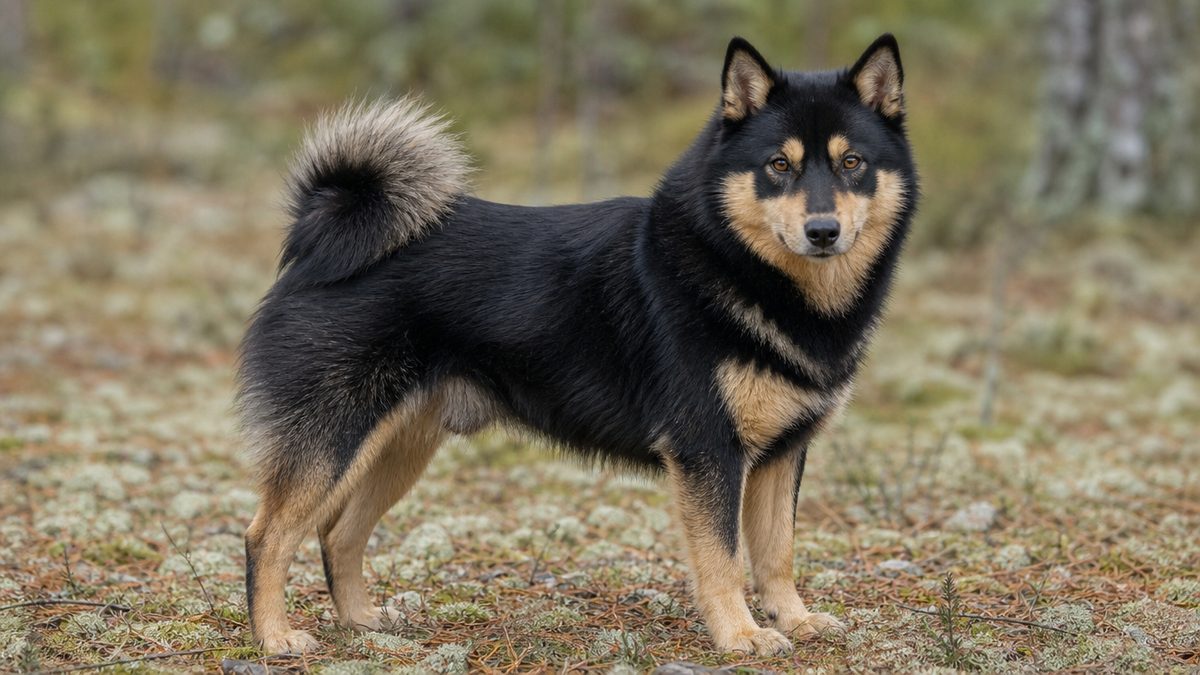
The head is wedge-shaped and "forms an equilateral triangle when viewed from above", over a neck the standard calls muscular, dry and set at 40 to 50 degrees to the horizontal, and forelegs it calls lean and muscular. The ears are "Pricked, mobile, V-shaped with pointed or slightly rounded tips", set wide and in line with the eyes, and prick ears are not optional here: dropped or semi-dropped ears are a disqualifying fault.
The eyes are medium, oval, slanting, "with truthful and friendly expression", and "dark brown or any shade of brown in accordance with coat colour";. Wall eye and flecked eyes disqualify, and light or amber eyes on an all-black dog are a listed fault. Dentition is a complete 42 teeth with a scissor bite; four or more missing teeth disqualify.
The curled tail is a defining spitz feature: "Curled or in sickle shape carried over the back. A sickle shape tail carried without touching the back or semi-dropped is acceptable. When fully straightened it reaches the hock joint or may be 1 to 2 cm shorter."; A stumpy tail disqualifies.
Coat and coat colour
The coat is a working double coat: a harsh, straight outer coat over a well-developed, soft, rich, woolly undercoat. It is short and shining on the head and ears, longer on the shoulders and neck where it forms a collar, and forms side-whiskers on the cheekbones. Males carry longer coat on the withers. There are trousers on the back of the rear legs without feathering, and "a protective growth of brush-like hair between the toes". Too short or too long a coat, or no undercoat, all disqualify.
| Status | Colours |
|---|---|
| Most typical | Black and tan, black, black and white, white, and white with patches (piebald) |
| Permitted detail | Slight specks in shades of the main colour on the legs |
| Disqualifying | Genetic brown, genetic blue, brindle, albino |
That disqualifying line matters more than it looks, because the colours most often attributed to this breed online, including brown and salt-and-pepper grey, are either disqualified outright or belong to a different breed. The blending section sets out exactly where they come from.
Temperament, in the standard's own words
The standard gives four sentences: "Steady, balanced temperament. A vigorous dog with a very well developed sense of scent and detection of game and a pronounced passion for hunting, especially larger prey. Very independent when hunting. Friendly, kind and trustful towards people." Aggressive or overly shy dogs disqualify.
The Russian word laika is a noun formed from the verb layat, to bark. These dogs bark to hold treed or bayed game and to tell the hunter where it is, which is the whole basis of the hunting method they were bred for. A laika that does not bark is not doing the job the breed exists to do, and that has consequences for anyone keeping one in an Indian apartment block.
East, West and Russo-European: how to tell the three Russian laikas apart
The three Russian hunting laikas are separated by size, body proportion, coat colour and their attitude to strangers, and every one of those four is written into their own FCI standards.
All three were formalised out of the same continuum in 1947, which is why they blend so easily. Before then they existed as regional types named after the peoples who kept them. The Russo-European was assembled in 1947 from Arkhangelsk, Komi, Karelia and Votyak stock; the West Siberian in the same year, when "closely related Khanty and Mansi off-springs were united into one breed"; and the East Siberian "achieved breed status" in 1947 as well. Federation Cynologique Internationale Federation Cynologique Internationale Three breeds, one administrative moment.
| Point | Russo-European, FCI 304 | West Siberian, FCI 306 | East Siberian, FCI 305 |
|---|---|---|---|
| Male height | 52 to 58 cm | 55 to 62 cm | 57 to 64 cm |
| Female height | 48 to 54 cm | 51 to 58 cm | 53 to 60 cm |
| Format index, males | 100/100-103, square to almost square | 100/103-107 | 100/104-109, almost rectangular to rectangular |
| Format index, females | 100/100-105 | 100/104-108 | 100/106-111 |
| Typical colours | Black with white or white with black; solid black; solid white | Grey, red, fawn and reddish-brown in all shades; pure white; parti-colour | Black and tan, black, black and white, white, piebald |
| Toward strangers | Not addressed | "Self-confident and alert towards strangers" | "Friendly, kind and trustful towards people" |
| Quarry emphasis | Not addressed | "Equally keen to hunt feathered as furred game" | "Especially larger prey"; "very independent when hunting" |
| Weight | Not specified | Not specified | Not specified |
| Origin region | European forest areas of Russia | Ural, West and East Siberia forest | Taiga and mountains of Central and East Siberia |
The four checks that settle it in front of a real dog
- Measure the height. At 64 cm a male can only be an East Siberian, since the West Siberian ceiling is 62 cm and the Russo-European's is 58. Below 55 cm a male cannot be an East Siberian at all.
- Look at the outline. The Russo-European is square, at 100/100-103. The East Siberian is the most drawn out of the three, at 100/104-109. Standing side-on, the difference is visible without a tape.
- Read the colour. Black and tan is the East Siberian's signature and appears on neither of the other two standards' colour lists. A grey, red or fawn laika is a West Siberian pattern; a black-and-white one is the Russo-European's.
- Ask about strangers. The West Siberian standard says "self-confident and alert towards strangers". The East Siberian standard says "friendly, kind and trustful towards people". These are opposite descriptions of the same situation, written by the same organisation, published on the same day.
That last row is the one buyers should care about most, and it is the one no popular page reports. If you want a laika that will treat a stranger at the gate as a problem, the standards point you at the West Siberian Laika, not this breed.
Why the breed itself is not uniform
There is an honest complication, and the Russian breed press states it plainly: "in silu shirokogo geograficheskogo rasprostraneniya poroda sokhranila mnozhestvo otrodiy", because of its wide geographic distribution the breed has retained many local varieties, and it is "a dog of varied type";. The foundation stock is listed there as Evenki, Yakut, Buryat, Irkutsk and Amur laikas, against the FCI standard's "Tungus, Yakut, pre-Baikal and pre-Amur", the same populations under older names.
So an East Siberian Laika from Kachug in Irkutsk oblast and one from the Amur will not look identical, and both are correct. That internal variation is real, it is documented by the people who breed the dog, and it is a large part of why an outsider blends this breed with its siblings.
The Soviet monograph on the breed is explicit about the geography: "Zapadnoy granitsey ee rasprostraneniya sluzhit r. Enisey", the western boundary of its distribution is the Yenisei river. East of the Yenisei you are in East Siberian Laika country; west of it you are in West Siberian Laika country. It is the cleanest single fact about the two breeds.
The top-ranking page has assembled this breed out of its two siblings
The page ranking first for this breed contradicts FCI standard 305 on proportion, on height and on colour, and in each case the wrong answer is a different laika's correct answer.
This is worth doing in detail, because it is the mechanism by which a reader ends up with the wrong dog. The page in question belongs to the largest canine DNA testing company, carries a veterinary review byline dated 9 July 2021, and lists exactly two resources at the foot: a free Jimdo site and the United Kennel Club. It does not cite the FCI standard for a breed the FCI has recognised definitively since 1980. Federation Cynologique Internationale
| Claim on the page | What FCI 305 says | Where the wrong answer comes from |
|---|---|---|
| "a square or slightly rectangular body" | Index of format 100/104-109 in males, described as "almost rectangular to rectangular" | Square is the Russo-European Laika's proportion, at 100/100-103 |
| Height 20 to 25 in, that is 50.8 to 63.5 cm | Males 57 to 64 cm, females 53 to 60 cm | Both ends are wrong. The floor is below the female minimum and the ceiling is below the male maximum |
| "Standard colors include salt and pepper, white, grey, black, red, and brown" | Typical colours are black and tan, black, black and white, white, piebald. Genetic brown is a DISQUALIFYING fault | Salt and pepper, grey and red are the West Siberian Laika's palette |
| "protective of their people and make excellent guard dogs" | "Friendly, kind and trustful towards people" | "Self-confident and alert towards strangers" is the West Siberian Laika's temperament clause |
Read the right-hand column and the pattern is unmistakable. The proportion came from FCI 304, the colours and the guarding temperament came from FCI 306, and the result is presented as FCI 305. The page describes a dog that does not exist, assembled from two neighbours of the breed it names. Federation Cynologique Internationale Federation Cynologique Internationale
The colour error is the one with consequences. Under FCI 305 a genetically brown dog is disqualified outright, so a buyer told brown is a standard colour could pay for a dog that can never be shown, never be bred under an FCI-recognised pedigree, and is not correct for the breed at all.
The blending runs through the whole ranking set
- A Pinterest result advertising "Buy East Siberian Laika Puppy" offers "a mix litter of husky puppies in various colors". A Siberian Husky is not a laika of any kind and belongs to a different FCI section.
- A commercial breed directory ranking in the top ten for this breed serves its West Siberian Laika page instead, complete with that breed's weight and colour list. Search engines treat the two as interchangeable because the pages do.
- A puppy marketplace ranking for this term quotes prices for the West Siberian Laika, at 900 to 1,500 US dollars, under a search for the East Siberian.
- The Russian breed press describes the East Siberian as a dog "of varied type" retaining many local varieties, which makes the blending easier to get away with and harder for a buyer to detect.
How to check any page about this breed in ninety seconds
Three questions settle it, and all three are answerable from the free FCI standard PDF.
- Does it give a male height ceiling of 64 cm? If it says 62, it is describing a West Siberian.
- Does its colour list contain black and tan and exclude brown? If brown or salt-and-pepper appears, it has borrowed from another breed or from nothing.
- Does it call the dog friendly to people rather than a guard dog? The standard's phrase is "friendly, kind and trustful towards people", and a page that promises a guard dog has swapped in the West Siberian's clause.
The page carries a veterinary reviewer, which is a genuine quality signal for medical content and no signal at all for breed-standard accuracy. A veterinarian reviewing nutrition and vaccination advice has no reason to open an FCI conformation standard. Treat a vet byline as evidence about the health sections and about nothing else.
Recognition: FCI 305 since 1980, and what that means for India
The East Siberian Laika is recognised by the FCI on a definitive basis, which puts it in a completely different position from most rare breeds this site covers.
The FCI's own nomenclature entry records the breed's status as "Recognized on a definitive basis", with the date of acceptance given as 3 June 1980 and the country of origin as the Russian Federation. The official authentic language of the standard is English, and the valid text is dated 13 October 2010.
That matters because the FCI's provisional register, which we read in full, is where breeds sit while they wait. This breed is not on it, and it does not need to be. The provisional list currently holds twenty-one breeds, its four newest entries dated 11 February 2026, and it is a waiting room this dog left in 1980.
The India consequence, which is unusually favourable on paper
India is a full member of the FCI, represented by the Kennel Club of India in Chennai. Because the KCI issues pedigrees against FCI nomenclature, and because this breed sits in that nomenclature as breed 305, a KCI pedigree for an East Siberian Laika is possible in principle. That is not true of most breeds on this site, and it is a genuine difference from the East European Shepherd, which the FCI does not recognise at all.
In principle is doing a lot of work in that sentence. A pedigree can only be issued for a dog that exists in India, and the import law section below explains why none lawfully arrives through trade. Recognition removes the paperwork obstacle and leaves the supply obstacle entirely intact.
The name problem, which is a recognition problem in disguise
This breed is filed under different names by different registries, and searching the English name returns false absences.
| Register | Name on file | Code or number |
|---|---|---|
| FCI, nomenclature | VOSTOTCHNO-SIBIRSKAIA LAIKA, English EAST SIBERIAN LAIKA | 305 |
| Orthopedic Foundation for Animals | VOSTOZNO-SIBIRSKAJA LAJKA | VS |
| OFA, its siblings, kept separate | WEST SIBERIAN LAIKA / RUSSIAN EUROPEAN LIAKA / YAKUTIAN LAIKA / NENETS HERDING LAIKA | WSL / not listed here / YL / NHL |
The string "EAST SIBERIAN LAIKA" does not appear anywhere in OFA's breed list. Searching it returns nothing, and an agent or a reader who stopped there would report the breed as unknown to OFA, which is false. It is on the list under VOSTOZNO-SIBIRSKAJA LAJKA with the registry code VS, read out of OFA's own markup. What OFA does not hold is data, and the health section sets out how that absence was established rather than assumed.
Confirm the breed name printed inside the document you are reading, not the URL you typed. FCI nomenclature pages resolve on the trailing number, not the breed name in the slug, so a guessed number returns a real, complete page for a different dog. The page used here prints VOSTOTCHNO-SIBIRSKAIA LAIKA (305) in its own heading, which is how we know 305 is this breed and not another.
History: an aboriginal taiga dog that became a breed by committee in 1947
The East Siberian Laika became a formal breed in 1947, when Soviet cynology gathered the aboriginal hunting dogs east of the Yenisei into a single standard, and its final Soviet standard was approved in 1981.
The FCI standard tells the story in five sentences. The breed "is one of the principle hunting dogs of the Taiga region as well as mountain areas in Central and East Siberia" and "evolved from off-spring of Tungus, Yakut, pre-Baikal and pre-Amur Laikas". The first description of the pre-Amur Laika, which later became the basis of the standard, dates from the beginning of the 20th century. "In 1947 East-Siberian Laika achieved breed status. In 1949 the provisional standard was published and in 1981 the final standard was approved."
The Russian breed press adds the institutional detail. The breed "gained the right to its own existence in 1947", following the first descriptions presented at the All-Russian Cynological Conference on the proposal of the All-Union Research Institute of the Hunting Industry, with the standard adopted in 1949. It names the foundation populations as Evenki, Yakut, Buryat, Irkutsk and Amur laikas, which are the same peoples and regions the FCI standard lists under their older names.
A date worth getting right
There is a one-year oddity in the record that no English page mentions. The FCI recognised this breed on a definitive basis on 3 June 1980, a year before the Soviet final standard was approved in 1981. Federation Cynologique Internationale Those are two different documents from two different bodies, so there is no contradiction, but a page that says the breed was recognised in 1981 has conflated them.
What the dog was actually for
This was economic infrastructure, not sport. The Soviet monograph on the breed opens by noting that for the peoples of the East Siberian taiga, hunting has been the principal occupation since ancient times, and it devotes chapters to the laika as a transport animal, as the supplier of the fur trade, and as a tool for censusing wild animals. More than thirty species of animal and bird were taken with a laika's help in East Siberia.
The productivity figures explain why the dog mattered. Citing Egorov's 1961 work in the Yakut ASSR, the monograph reports that in the Nyurbinsky district, in a season of high squirrel numbers, two hunters using deadfall traps took 140 squirrels in 25 days, while hunters hunting with a laika averaged 250 to 300 squirrels over the same period, making trap-based productivity 3.6 times lower than hunting with a dog.
The dilution that was already under way
The same monograph is unusually frank about what was happening to the breed. "Across most of the range, over recent decades, local laikas have mixed with non-pedigree dogs and dogs of other breeds brought in by people arriving in previously inaccessible and remote districts." The rapid mixing was helped by "the system of keeping dogs untethered, which has survived to this day";.
It then names the pockets where the type survived best, which reads as a conservation map: in Irkutsk oblast the Kachug district, particularly the villages of Vyatkino, Bolshaya Tarel and Shevykan; the village of Karam in the Kazachinsko-Lensky district, where black-and-tan dogs with light spots above the eyes are locally called karamistye; the village of Baikalskoye on the shore of Lake Baikal, sixty kilometres from its district centre and protected by bad roads, where "more than 80 percent of dogs are distinguished by good working qualities"; and in the Yakut ASSR the Lensky and Olyokminsky districts.
Where the breed lives now
The FCI standard's own closing paragraph tracks the shift westward. The breed "is widespread in its native/original areas", foundation stock from established working kennels "has been introduced to the Irkutsk region", and "there is a vast population of the breed in the European part of Russia, especially in the Leningrad, Smolensk, and Tver regions and part of the Moscow region". It adds that the breed "is also appreciated in Scandinavia";.
Laika comes from the Russian verb layat, to bark. The dog finds game, holds it, and barks to bring the hunter. Everything else about the breed, the prick ears, the curled tail carried clear of undergrowth, the independence, the scent, follows from that one method.
How many East Siberian Laikas exist, and the one estimate whose arithmetic works
The only published population estimate for the East Siberian Laika puts it at roughly 66,000 to 68,000 dogs across six Soviet administrative regions, and its component figures sum exactly to that range.
The estimate comes from the Soviet monograph on the breed, and the author states his own limitation before giving it: the clearest gap was "the total number of East Siberian Laikas, which followed from the fact that in recent times no count of hunting dogs is kept in the hunting enterprises";. He compiled it instead from reports supplied by hunting organisations across East Siberia and the Far East, plus his own surveys in many trapping districts.
| Region | Estimate, thousands of dogs |
|---|---|
| Krasnoyarsk Krai | 25 |
| Irkutsk oblast | 20 |
| Yakut ASSR | 7 to 8 |
| Chita oblast | 6 |
| Buryat ASSR | 6 |
| Tuva ASSR | 2 to 3 |
| Stated total | about 66 to 68 |
Check the arithmetic, because most published totals do not survive it. Taking the low end of every band gives 25 plus 20 plus 7 plus 6 plus 6 plus 2, which is 66. Taking the high end gives 25 plus 20 plus 8 plus 6 plus 6 plus 3, which is 68. The components reproduce the stated range exactly at both ends. That is a small thing and it is worth saying, because this site has repeatedly caught percentages and totals that do not reconcile with the counts printed beside them.
The estimate is old, it is Soviet, and it is an estimate. What it is not is invented, and no more recent figure for the breed's total population appears to have been published anywhere we could reach.
The distribution boundary, stated as a line on a map
The same source draws the range precisely. "The western boundary of its distribution is the Yenisei river. In the south, the southern state border. The northern boundary runs east from Turukhansk along the northern boundary of the Evenki National Okrug, through the village of Olenyok, Verkhoyansk and further south-east in the direction of the village of Ozernaya in Magadan oblast. The eastern, along the boundary with Khabarovsk Krai and Amur oblast.";
A modern number, from one Russian region
Recent figures exist only regionally. In the Moscow region, breeding is now carried out solely by private breeders plus one small private kennel, and 3,819 East Siberian Laikas have been registered there in total since the 1970s. The same account records that 3,798 pedigree puppies were supplied to hunting enterprises across Siberia and the Far East, while exactly one dog, Vega 1211/lvs, was transferred to the Moscow region at that time, which is a striking measure of how one-directional the breed's distribution was.
How rare it is beside its siblings, measured at one show
A single regional show gives the cleanest comparison. At the Nizhny Novgorod oblast hunting dog show held on 7 June 2015, 250 dogs of 21 breeds were graded. Among the laikas the entry was: West Siberian 50, Russo-European 53, East Siberian 4.
So in European Russia the East Siberian made up four dogs out of 107 laikas of the three breeds, under four percent. And the grades are as informative as the count: of the 50 West Siberians, 29 were graded excellent, and of the 53 Russo-Europeans, 31 were. Not one of the four East Siberians was graded excellent; all four were graded very good. Four dogs is far too small a sample to conclude anything about breed quality, but it does show what the breed's presence outside Siberia actually looks like.
There is no Indian population figure for this breed, because there is no Indian population. No registry publishes one, no Indian seller offers the breed, and the import law section explains why no lawful commercial supply can form. The numbers above describe Russia.
Field trials: what the breed is tested on, and the test it refuses to take
The East Siberian Laika is tested in Russia on live quarry under RKF-approved rules, and its own regional club reports that these dogs refuse to work penned quarry even when they hunt the same species for real.
The breed is classified with working trial by the FCI, which is a status rather than a description. The rules that give it effect are the Russian Federation of Hunting Dog Breeding's Rules for conducting trials and competitions of hunting dogs, approved by the RKF Presidium on 18 February 2010.
Those rules set the frame. Dogs may enter from 8 months to 10 years of age, must hold pedigree documents recognised by the RKF and the FCI, and must carry a veterinary certificate showing valid rabies vaccination. Judging is by a panel of at least three, and diplomas are awarded in first, second and third degree. Entering a competition additionally requires a conformation grade no lower than good and an existing working certificate in that discipline.
What a laika is tested on
The rules list the quarry disciplines by name, and they map directly onto what these dogs did for a living. Field trials for laikas run on squirrel, marten, sable, forest fowl, pheasant, mink, polecat, kolonok and ermine, elk and deer, free-ranging boar, penned bear, penned boar and penned badger.
The rules also cap how many dogs one panel may judge in a day, which is a useful proxy for how demanding each test is.
| Discipline | Maximum dogs per day |
|---|---|
| Penned bear | 30 |
| Pheasant | 7 |
| Squirrel | 5 |
| Forest fowl | 5 |
| Mink, polecat, kolonok, ermine | 5 |
| Sable | 3 |
| Elk and deer | 3 |
| Free-ranging boar | 3 |
The Soviet monograph records how the scoring worked, and it is stricter than a single total. A first, second or third degree diploma required 80, 70 or 60 total points, but a dog also had to reach a floor on each of the important elements: at least 13, 11 or 8 points for tracking, and at least 4, 4 or 3 for its attitude to the killed animal. A dog could not average its way to a diploma.
The modern record, from one Russian region
The Moscow Regional Society of Hunters and Fishermen publishes what its East Siberian Laikas actually achieved. Across 2021 to 2023, 13 dogs were awarded diplomas: 8 on elk (61.5 percent), 2 on marten (15.3 percent), 2 on mink (15.3 percent) and 1 on free-ranging boar (7.6 percent). The counts sum to 13 and the percentages sum to 99.7, so the table reconciles.
Two things follow. Thirteen diplomas in three years across an entire Russian region tells you the working population outside Siberia is small. And the concentration on elk, at eight of thirteen, matches the standard's own line about "a pronounced passion for hunting, especially larger prey";.
The test this breed will not take
This is the most interesting behavioural fact published about the breed, and it appears in no English-language source. The same regional account reports: "A somewhat different picture is seen at trials and competitions on penned quarry. East Siberian Laikas perceive them as a game and do not wish to take part. Even dogs with which boar, bear and badger are actually taken in the hunt refuse to work them in an enclosure."
Read that carefully, because it is not a claim that the dogs cannot do the work. It is a claim that they can do it and decline to do it when the situation is artificial. That is the standard's "very independent when hunting" clause showing up as a measurable outcome in a testing system.
It also has a direct consequence for anyone considering this dog outside a hunting country, which is the whole of the Indian argument on this page. A breed that refuses a staged substitute for real work is a poor candidate for a life made entirely of staged substitutes.
The monograph records squirrel trials in 1963 in the Kachug district of Irkutsk oblast. In the village of Vyatkino, all the village's laikas received second-degree diplomas. In Bolshaya Tarel, of five dogs one received a second-degree and four a third-degree diploma. Small numbers, but they are the kind of primary working record that no commercial breed page carries.
Heat tolerance: the taiga is not mild, and India is still far outside it
The East Siberian Laika's home climate has an annual mean of 0.32 degrees Celsius, against 27.95 in Chennai, and the honest complication is that its homeland also reaches 38 degrees in summer.
We used NASA POWER queried by explicit latitude and longitude, because a climate site that resolves on a place-name slug can silently return another city's document. The origin point is Irkutsk at 52.287 N, 104.305 E, chosen because the FCI standard names the Irkutsk region as where working foundation stock was established and the breed's core survives. Two further Siberian points are included for range.
| Place | Lat, lon | Annual mean | Warmest month | Coldest month |
|---|---|---|---|---|
| Irkutsk, breed heartland | 52.287, 104.305 | 0.32 | 20.32 (Jul) | -21.11 (Jan) |
| Yakutsk | 62.035, 129.676 | -8.39 | 19.47 (Jul) | -36.88 (Jan) |
| Blagoveshchensk, Amur | 50.291, 127.527 | 0.13 | 21.54 (Jul) | -24.38 (Jan) |
| Chennai | 13.083, 80.271 | 27.95 | 31.51 (May) | 24.09 (Jan) |
| Mumbai | 19.076, 72.878 | 26.77 | 31.19 (May) | 23.19 (Jan) |
| Kolkata | 22.573, 88.364 | 25.81 | 31.53 (May) | 17.31 (Jan) |
| Delhi | 28.614, 77.209 | 25.60 | 35.88 (Jun) | 13.61 (Jan) |
| Bengaluru | 12.972, 77.595 | 23.74 | 28.37 (Apr) | 20.22 (Dec) |
| Leh, Ladakh grid cell | 34.153, 77.577 | -2.75 | 10.18 (Jul) | -16.01 (Jan) |
Chennai's coldest month, January at 24.09 degrees, is 3.77 degrees warmer than Irkutsk's hottest month, July at 20.32. The annual means are 27.63 degrees apart. A dog bred east of the Yenisei would spend its coolest Chennai week warmer than any week its heartland ever produces.
The complication that makes this breed hardier than it looks
Continental Siberia is not uniformly cold; it is extreme in both directions. Irkutsk's record maximum in the NASA POWER series is 38.29 degrees Celsius, and Blagoveshchensk reaches 39.14. Against record minima of minus 48.65 at Irkutsk and minus 58.07 at Yakutsk, that is an annual swing of nearly 87 degrees at one point.
So this is a hardy dog with genuine experience of hot days, though hardy is not the same word as heat-tolerant and the difference is what the rest of this section measures. It is not a coastal Arctic breed that has never met summer. What it has never met is a hot season that lasts, and it has never met humidity with heat, which is the subject of the next section.
Where north India sits
Delhi's January mean of 13.61 degrees is 6.71 degrees cooler than Irkutsk in July, and December at 15.2 and February at 17.4 are also below the breed's home summer. For roughly three to four months, north India is climatically easier than the taiga at its warmest.
Then Delhi's June mean reaches 35.88 degrees with a record maximum of 48.79, and nothing in the origin climate resembles that. The verdict is therefore seasonal rather than absolute, which is a more useful answer than a flat refusal, and a harder one to act on.
Ladakh again inverts the problem. Its grid cell runs an annual mean of minus 2.75 degrees, colder than Irkutsk's 0.32, with a July mean of 10.18 against Irkutsk's 20.32. State the caveat: that cell has an elevation of 4,533 metres against Leh town's roughly 3,500, so it reads colder than the streets. On temperature alone it is the only Indian place this dog would find unchallenging.
A 1 belongs to a breed whose origin climate has no summer. Irkutsk reaches 38 degrees. What earns the 2 rather than a 3 is the coat: a harsh outer coat over a rich woolly undercoat, where too short a coat or no undercoat is a disqualifying fault, so the dog cannot reduce its own insulation when the season stops ending.
Wet bulb: the taiga's worst month is milder than most of India's best
Wet bulb temperature decides whether a panting dog can shed heat, and Irkutsk's most hostile month is more evaporatively forgiving than the mildest month in four Indian metros.
A dog cools by evaporating water from its respiratory tract, so what constrains it is not air temperature but how much more water the air can take. Wet bulb temperature measures exactly that, which is why a humid 31 degrees is more dangerous than a dry 38.
| Place | Annual mean | Worst month | Best month |
|---|---|---|---|
| Irkutsk, breed heartland | -2.02 | 16.18 (Jul) | -21.38 (Jan) |
| Yakutsk | -9.82 | 15.54 (Jul) | -36.96 (Jan) |
| Blagoveshchensk, Amur | -1.99 | 18.86 (Jul) | -24.72 (Jan) |
| Chennai | 24.94 | 27.36 (May) | 21.77 (Jan) |
| Kolkata | 22.85 | 27.86 (Jun) | 13.64 (Jan) |
| Mumbai | 22.73 | 26.55 (Jun) | 17.06 (Jan) |
| Bengaluru | 19.80 | 22.66 (May) | 16.43 (Jan) |
| Delhi | 18.03 | 27.74 (Jul) | 6.86 (Jan) |
| Leh, Ladakh grid cell | -7.66 | 4.03 (Aug) | -18.86 (Jan) |
Use Irkutsk's worst month as the yardstick, July at 16.18 degrees, because it is the most evaporatively hostile week the breed's heartland produces. Counting Indian months worse than that turns the comparison into a calendar.
| City | Months worse than Irkutsk's worst | Which months |
|---|---|---|
| Chennai | 12 of 12 | Every month; the mildest, January, is 21.77 |
| Mumbai | 12 of 12 | Every month; the mildest, January, is 17.06 |
| Bengaluru | 12 of 12 | Every month; the mildest, January, is 16.43 |
| Kolkata | 10 of 12 | February to November |
| Delhi | 7 of 12 | April to October |
| Leh grid cell | 0 of 12 | None; the annual maximum is 4.03 |
Three Indian metros never give this dog a single month as forgiving as the worst month at home. Chennai, Mumbai and Bengaluru all clear the bar in all twelve months, and Bengaluru does so despite sitting at 842 metres and being the mildest large Indian city on air temperature. Elevation buys cooler nights; it does not buy dry air.
Delhi is the exception and the reason the verdict on this breed is seasonal. Its January wet bulb of 6.86 degrees is a genuine winter, well below the taiga's July, and its seven bad months run April to October. A north Indian owner gets five real months and seven hard ones.
The monsoon problem specific to this coat
Relative humidity peaks where it hurts most. Mumbai reaches 90.4 percent mean relative humidity in August, Kolkata 89.3 percent in September, and Bengaluru 81.0 percent in October. Irkutsk's own relative humidity is higher on paper at 76.6 percent annual mean and 96.0 percent in January, but at minus 21 degrees a saturated atmosphere holds almost no water, which is exactly why relative humidity alone misleads and wet bulb does not.
For this breed the consequence is physical rather than abstract. A harsh outer coat over a rich woolly undercoat, with brush-like hair between the toes, is built to shed snow and hold warmth. In 90 percent humidity it holds water instead, against skin, for hours.
Walk on the wet bulb, not the thermometer. If your own shirt has stopped drying, evaporative cooling is already failing for you, and it is failing far worse for a dense double-coated dog carrying a fixed layer of insulation it cannot take off.
What the heat-illness evidence covers, and what it does not cover here
The strongest study of canine heat illness does not model any laika, so only its transferable risk factors apply to this breed, and the most important of them is that most heat casualties are exercising.
Two companion papers drawn from the same cohort carry the numbers, both built on 905,543 UK dogs under primary veterinary care in 2016. Hall EJ, Carter AJ The incidence paper found 395 confirmed heat-related illness events from 390 dogs, a one-year incidence risk of 0.04 percent (95% CI 0.04 to 0.05), and an event fatality rate of 14.18 percent (95% CI 11.08 to 17.96).
The trigger paper carries the figure this site quotes most and that others most often break. Of 1,259 prevalent events, 380 had no trigger recorded, leaving 879 events with a recorded trigger, of which 652 were exertional, 74.2 percent, then environmental at 113, 12.9 percent, and vehicular confinement at 46, 5.2 percent. The percentages are computed on 879, not on 1,259.
For a hunting breed that has to be exercised hard, that single statistic is the whole warning. Dogs do not mostly overheat locked in cars. They overheat working, with their owner, on a day the owner judged acceptable.
No laika is in the model
The study's breed inclusion rule required at least five heat-illness cases or at least 5,000 dogs of a breed in the study population. No Russian laika of any kind meets that in a UK cohort, so there is no East Siberian Laika odds ratio, and any page quoting one has produced it from nothing.
Three findings are not breed-specific and do carry over.
| Risk factor | Finding | Application here |
|---|---|---|
| Bodyweight at or above the breed and sex mean | OR 1.42, 95% CI 1.12 to 1.80 | Applies directly, and is the one factor an owner controls. Made harder because the standard specifies no weight to be lean against. |
| Age over two years | Greater odds in the 2 to under 4, 6 to under 8 and 12 or more year bands | Applies directly. Risk is not a puppy problem. |
| Bodyweight over 50 kg | Greater risk | Does not apply. This is a medium-sized breed at 57 to 64 cm in males. |
| Brachycephalic skull shape | Greater risk | Does not apply. The head is wedge-shaped with a muzzle a little shorter than the skull. |
For scale, the breeds that were significant ran from the Golden Retriever at OR 2.65 to the Chow Chow at OR 16.61, while the Siberian Husky, the northern breed most often compared with this one, came in at 1.18 with a confidence interval of 0.28 to 5.06, which spans 1 and shows no difference. A Husky figure is not this breed's figure, and in any case it is not a result.
Why the UK numbers understate the Indian problem
Forty percent of the UK's 2016 cases, 158 of 395, occurred in July, and there were no events at all in February, October or December. A UK dog gets a nine-month recovery season. Chennai, Mumbai and Bengaluru give this breed no month as forgiving as the taiga's worst. The 0.04 percent incidence is a UK figure and there is no basis for expecting it to hold here.
Do not work or run this dog between 10 am and 5 pm anywhere in mainland India from March to October. That single restriction addresses the trigger behind 652 of the 879 recorded events, and for a breed whose entire purpose is sustained work in cover, it is also the restriction that makes the breed pointless here.
East Siberian Laika price in India: no Indian price exists, and here is what the search returns instead
There is no East Siberian Laika price in india, because no Indian seller offers the breed, and the pages that rank for the query in India are selling something else.
We searched the term in India and read the results. The top ten contained a US DNA-testing company's breed page, an animal-facts site, two US puppy marketplaces, a Pinterest pin, a British retailer's magazine article, two copies of a US pet-care site, a US breed directory serving its West Siberian Laika page, and one Indian result: an auto-generated Justdial category page. Not one Indian rupee figure appeared anywhere in the set.
The two published prices, and neither is for this breed in India
| Source | Figure as published | What it is actually pricing | At 84.38 / at 80 |
|---|---|---|---|
| zooplus Magazine, UK | At least GBP 1,300 | "A Laika puppy", treating four breeds as one | Not a dollar figure |
| A US puppy marketplace ranking for this term | USD 900 to 1,500 | The West Siberian Laika, a different breed | Rs 75,942 to 1,26,570 / Rs 72,000 to 1,20,000 |
| A US pet-care site | USD 600 to 1,500 a year | Estimated annual vet bills, not a purchase price | Not a purchase price |
The rupee column exists for one purpose: so that if an Indian page ever prints Rs 72,000 or Rs 1,20,000 as this breed's price, you can recognise where it came from. None of these is an Indian transaction and none of them is an East Siberian Laika price.
The pricing page in the set is for the wrong laika
This is the blending problem showing up in money. A US marketplace page pricing the West Siberian Laika at 900 to 1,500 dollars ranks in the top ten for a search for the East Siberian, and a breed directory does the same, serving its West Siberian entry with that breed's weight and colour list. A buyer following either link is being quoted for FCI 306 while shopping for FCI 305. Federation Cynologique Internationale
The British magazine article is more honest about what it is doing and still causes the same problem. It covers the laikas collectively, states that they "share many characteristics and typically only differ in the minutest of details", and quotes one price for all of them. The standards say otherwise: male heights of 52 to 58, 55 to 62 and 57 to 64 cm across the three breeds, and directly opposite temperament clauses about strangers. Federation Cynologique Internationale Those are not minute details to anyone buying a dog.
What a rupee figure for this breed would have to survive
If someone quotes you one, four questions settle it before any money moves.
- Which register issued the pedigree, and may I read the breed name printed on it? FCI 305 is a real, definitively recognised breed, so a genuine dog has genuine papers naming it.
- Which port did the parents enter through, and under which DGFT policy condition? Import for breeding or sale is not permitted at all.
- What field trial diplomas do the parents hold, and in which discipline? Russian breeding practice tests these dogs on live quarry, and a working breed sold with no working record is a pet-shop dog with a Russian name.
- How tall is the sire, measured at the withers? Under 55 cm and the standard has already answered.
Bonbeno will not publish a rupee band for a breed with no Indian seller, no Indian registered dogs and no lawful commercial import route. Inventing one would be the single most useful thing this page could do for a fraudulent seller.
What an Indian search actually returns, including two pages one integer apart
An Indian search for this breed returns a substituted result set, a foreign marketplace and one auto-generated Indian shell page whose node id sits one integer away from the same site's East European Shepherd page.
1. The search engine discards the breed's name
Bing India returned HTTP 200 for "east siberian laika", with the correct page title and roughly 126 KB of markup, and served ten results about the word "east";: East on Wikipedia, the Merriam-Webster definition of EAST, East India on Wikipedia, the Simple English Wikipedia entry for East, Wiktionary, two Cambridge Dictionary entries, The Free Dictionary, "East meaning in Hindi", and an East India zone map. A control query, "german shepherd price in india", run in the same session against the same endpoint, returned ten genuine Indian German Shepherd price pages.
The finding that makes this more than an anecdote: the identical ten results, in the same order, came back for "east european shepherd" on the same day. The substitution is triggered by the word "east", not by either breed being obscure. Two unrelated breeds share a failure mode because they share a first word.
PubMed does the same in its own idiom, translating "East Siberian Laika" into `east AND ("north asian people"[MeSH] OR "siberian") AND "laika"` and returning zero. Two major information systems, one search engine and one bibliographic database, both dissolve this breed's name into common words.
2. The Justdial shell, and the number that gives it away
Justdial publishes "Popular Pet Shops For East Siberian Laika Dog in Khanna" at the path `nct-13797922`. Khanna is a town of roughly 130,000 people in Punjab, an unlikely place to specialise in a Siberian hunting breed.
The same site publishes "Popular Pet Shops For East European Shepherd Dog in Mumbai" at `nct-13797921`. The two node ids are consecutive integers. That is what a generated table looks like from the outside: one row per breed, numbered in sequence, each crossed with whichever city the template picked. Fetching either URL directly returns HTTP 200 with a body of 14 bytes.
So the single Indian result for this breed is a row in a database, not a shop, and the neighbouring row belongs to an unrelated Russian breed. Neither page evidences that any Indian pet shop has ever stocked either dog.
3. What is actually on offer
- A Pinterest pin headed "Buy East Siberian Laika Puppy in Alaska Range, AK" offering "a mix litter of husky puppies in various colors". A Siberian Husky is not a laika and sits in a different FCI section.
- US marketplaces listing puppies for sale in the United States, which is not an Indian supply route under any reading of the import rules.
- A breed directory serving its West Siberian Laika page to a search for the East Siberian.
- One British magazine article treating four FCI breeds as a single dog with a single price.
Laika, the dog launched into orbit in 1957, was not a member of any of these breeds. She was a mixed-breed street dog. The name was the common Russian word for a barking dog, not a breed attribution, and Indian pages occasionally present the space dog as an East Siberian Laika.
Why no lawful commercial supply of this breed can form in India
Indian import law makes dogs a Restricted import and permits only three purposes, none of which is breeding or sale, so no commercial supply of this breed can lawfully form here.
The instrument is DGFT Trade Notice No. 22/2022-23, dated 19 December 2022. Dogs fall under ITC (HS) 01061900, "Mammals: Other", with an import policy of Restricted, subject to Policy Condition 6 of the chapter.
Policy Condition 7 permits import for exactly three purposes:
- A pet dog with a valid pet book and relevant records or documents in the name of the importer.
- Dogs imported by R&D Organisations for conducting research, with the recommendation of the CPCSEA.
- For the internal security by the Defence and Police Force.
Policy Condition 8 closes the rest: "Import of commercial dogs for breeding or any other commercial activities other than the purposes mentioned above is not permitted."; There is no lawful way to import East Siberian Laikas into India to breed and sell them, so a breeding population cannot form through trade.
Unlike a service or guarding breed, this dog has no plausible route through the third clause either. It is classified by the FCI as a hunting dog for all-round purposes, tested on squirrel, sable, marten, elk and bear, and its standard describes it as "friendly, kind and trustful towards people". Nothing about that profile fits an internal security requisition.
The pet route, in the notice's own terms
A permanent import of up to two pets travels as passenger baggage without DGFT authorisation only for a person transferring residence to India after two years of continuous stay abroad, and only cats and dogs qualify under the baggage rules. DGFT authorisation is required where the stay abroad was shorter, where the animal is not travelling as passenger baggage, or for more than two pets, in which case the application goes to the Department of Animal Husbandry and Dairying.
The notice names its ports: "Import of pet animals is allowed only through airports and seaports of Delhi, Mumbai, Chennai, Hyderabad, Bangalore and Kolkata." Six ports, read from the notice itself, with an Advance No Objection Certificate required from that port's Regional or Quarantine Officer, and quarantine where required.
The hunting problem sits on top of the import problem
Even a lawfully imported dog runs into what it was bred to do. This breed is tested and bred on live quarry under Russian rules that name squirrel, sable, marten, mink, polecat, ermine, elk, deer, boar and bear. India's wildlife protection regime does not make that available to a private owner, and nothing on this page should be read as suggesting otherwise.
So an Indian owner inherits a hunting dog with no hunting, in a climate that restricts exercise for seven to twelve months a year depending on the city, from a breed whose own club reports it refuses even staged substitutes for real work. That combination is the honest case against the breed here, and it is stronger than any climate figure on its own.
A separate instrument under the Livestock Importation Act 1898, S.O. 4396(E) of 10 October 2024, permits pet dogs and cats through Cochin International Airport, Kochi, under the Animal Quarantine and Certification Station, Chennai. That is a confirmed addition to the personal pet route. The DGFT notice still names six ports for its own licence route, so this page prints the notice's list as the notice prints it, and a pet arriving under the baggage rules can land at seven ports today. Both lists are right for their own route, as how to import a dog to India sets out.
Cost of ownership in India: a borrowed structure, plus the line nobody budgets
No cost of ownership figure exists for an East Siberian Laika in India because no Indian owner base exists to survey, so the nearest honest guide is the published Indian cost structure for a comparably sized working breed.
The German Shepherd is the closest widely kept Indian analogue by size, and unusually close: FCI 166 gives males 60 to 65 cm at the withers, against this breed's 57 to 64 cm. India's benchmark cost guide, vet-reviewed and published in 2026, puts monthly maintenance for a healthy adult German Shepherd at Rs 6,000 to Rs 12,000, covering food, healthcare, grooming and flea and tick prevention, plus Rs 3,000 to Rs 6,000 a month during training periods.
| Line | Published Indian figure, first year | Direction for this breed |
|---|---|---|
| Puppy purchase from a good breeder | Rs 30,000 to Rs 50,000 | Not quotable. No Indian source of this breed exists |
| Food, 12 months | Rs 36,000 to Rs 84,000 | Similar. Comparable size, though a working metabolism runs high |
| Grooming, 12 months | Rs 9,600 to Rs 24,000 | Higher. A woolly undercoat in Indian humidity is not a low-maintenance coat |
| Professional training | Rs 10,000 to Rs 30,000 | Higher, and for longer. Independence is written into the standard |
| Vaccination series | Rs 2,500 to Rs 5,000 | Same |
| Deworming, four rounds | Rs 1,200 to Rs 2,400 | Same |
| Spay or neuter | Rs 5,000 to Rs 12,000 | Same |
| Anti-flea and tick, 12 months | Rs 3,600 to Rs 9,600 | Higher. A dense double coat hides ticks |
| Accessories | Rs 8,000 to Rs 20,000 | Similar |
| Total first year | Rs 1,00,000 to Rs 2,40,000 | A floor, not an estimate |
From year two that guide puts ongoing annual costs at Rs 60,000 to Rs 1,20,000. Its monthly food table spans budget kibble at Rs 2,500 to Rs 4,000, premium kibble at Rs 5,000 to Rs 8,000, home-cooked at Rs 3,000 to Rs 5,000, and raw at Rs 4,000 to Rs 7,000. The raw line is worth noting for this breed specifically, because the laikas are described as preferring raw meat and meaty bones and tolerating carbohydrates poorly.
The two lines the benchmark leaves out
There is no cooling line anywhere in that cost table. For a German Shepherd in India that is a defensible omission. For a dog whose standard makes an absent undercoat a disqualifying fault, and which cannot be kept in Chennai, Mumbai or Bengaluru during any month as forgiving as the taiga's worst, it is not. Budget cooling as a seven-month line in Delhi and a twelve-month line almost everywhere else.
The second missing line is enrichment. A hunting dog with no hunting needs its working drive spent on something, every day, for its whole life. In practice that means paid dog sports, scentwork classes or a trainer, and it is a recurring cost rather than a one-off, because the alternative is a bored, barking, escaping dog.
One line a responsible owner adds
Hip radiographs and a real working assessment. Russian breeding practice tests these dogs on live quarry under RKF-approved rules before they are bred, and a dog sold in India with no field record and no radiographs has met neither its own registry's expectations nor a buyer's reasonable ones.
A monthly figure for this breed in India would have to be invented, because there is no Indian population to survey and no Indian seller to quote. The structure above is real, sourced and labelled as borrowed from a different breed of similar size. Treat it as a floor.
Temperament: friendly to people, independent about everything else
The East Siberian Laika is described by its own standard as friendly, kind and trustful towards people and very independent when hunting, which makes it a poor guard dog and a demanding companion.
The standard's temperament clause is four sentences and every one of them matters: "Steady, balanced temperament. A vigorous dog with a very well developed sense of scent and detection of game and a pronounced passion for hunting, especially larger prey. Very independent when hunting. Friendly, kind and trustful towards people." Aggressive or overly shy dogs are disqualified.
This is not a guard dog, whatever the ranking pages say
The top-ranking English page calls these dogs "protective of their people" and says they "make excellent guard dogs";. The standard says the opposite in plain words, and the guarding language belongs to the West Siberian Laika, whose standard reads "self-confident and alert towards strangers";. Federation Cynologique Internationale
If you want a laika that treats a stranger at the gate as a problem, the standards point you at FCI 306, not FCI 305. Buying this breed for security is buying against its own written description.
The barking, which is the breed's whole method
The name is the job. Laika comes from the Russian layat, to bark, and the hunting method is that the dog finds game independently, holds it, and barks to bring the hunter. A laika that does not bark is a laika that is not working.
In an Indian apartment block that is not a quirk, it is the central problem. The British guide states it directly: "Their proclivity for barking could become problematic in a city apartment", and recommends a rural area with a house and garden. India's dense urban housing is the worst possible setting for a dog selected across centuries for vocal persistence.
Who this dog suits
- Experienced owners who have kept an independent primitive or spitz breed before and know what recall costs with one.
- Households with a secure garden and no shared walls, where barking will not end the tenancy.
- People who will provide daily working substitutes, meaning scentwork, tracking or canicross rather than a walk.
- Homes in the far north or in hill stations, where a real cool season exists.
Who should not buy one
- First-time owners. The British guide's verdict is one word long: "not suited for beginners".
- Apartment dwellers. Barking plus a seven to twelve month exercise curfew is not a solvable combination.
- Anyone wanting a guard dog. Read the standard's own sentence again.
- Anyone with free-roaming cats or small pets nearby. A dog with "a pronounced passion for hunting" and very high prey drive is a poor neighbour to small animals.
A well-exercised laika is reported to be calm and gentle at home and generally good with children. The standard's "friendly, kind and trustful towards people" is not marketing; it is a working requirement, because a dog that had to be handled by a hunter in a remote camp could not be a liability. The catch is the phrase well-exercised, and India is where that phrase breaks.
Training: an independent hunter, and the test it declines to take
To train an East Siberian Laika, work with its independence rather than against it, because this is a breed whose own club reports it refusing staged tests it is perfectly capable of passing.
Start from the standard's own sentence: "Very independent when hunting." That is not a euphemism for stubborn. It describes a dog selected to leave its handler, range widely in cover, locate game on its own judgement, hold it, and call the human in. Obedience was never the point; initiative was.
The strongest evidence for what that means in practice is the enclosure finding. The Moscow regional society reports that at trials on penned quarry, East Siberian Laikas "perceive them as a game and do not wish to take part", and that "even dogs with which boar, bear and badger are actually taken in the hunt refuse to work them in an enclosure";. The dogs can do it. They decline when the situation is fake.
Take that seriously as a training constraint. A breed that distinguishes real work from staged work, and withholds effort from the staged version, will not be motivated by artificial exercises indefinitely. It is also, bluntly, an argument against keeping one where only artificial exercises are available.
What the Russian system actually requires
The formal benchmark is the RFOS Rules for trials and competitions, approved by the RKF Presidium on 18 February 2010. Dogs enter from 8 months to 10 years, hold RKF and FCI recognised pedigrees, and carry valid rabies vaccination. Judging is by a panel of at least three and diplomas run in first, second and third degree. For competitions a dog additionally needs a conformation grade of at least good and an existing certificate in that discipline.
The Soviet scoring shows what "trainable" meant here. A diploma needed 80, 70 or 60 points overall, plus a floor on individual elements: at least 13, 11 or 8 for tracking, and at least 4, 4 or 3 for the dog's attitude to the killed animal. A dog could not compensate a weak element with a strong one.
A realistic Indian timeline
- Weeks 8 to 16, socialise hard and early. Traffic, lifts, tiled floors, autorickshaw horns, calm strangers. The standard's "friendly, kind and trustful towards people" is a starting point, not a guarantee.
- Months 3 to 6, build recall before prey drive matures. A recall trained now competes with nothing. A recall attempted at fourteen months competes with the dog's own reason for existing.
- Months 4 onward, start scentwork. This is the one discipline that uses what the breed actually has, and it can be run indoors in air conditioning during the seven to twelve months outdoor work is unsafe.
- Months 6 to 18, manage the barking deliberately. Teach a quiet cue early, reward silence, and never let barking be what produces attention. A breed named after barking will not stop barking, but it can learn when.
- Lifelong, never trust off-lead recall near small animals. "A pronounced passion for hunting, especially larger prey" is the standard's wording, and Indian streets have free-roaming animals everywhere.
What it resists
Repetition without purpose, above all. It also resists heat as a practical training constraint rather than a welfare footnote: exertional heat illness accounted for 652 of the 879 events with a recorded trigger in the largest study of the subject, so sessions between March and October should be short, early and shaded.
Overseas working-dog guidance sometimes recommends breeding practice Indian law prohibits. Second Schedule Part II paragraph 6(3) of the 2017 Rules bans in breeding, defined as "breeding between relatives of the 2nd to 4th grade in straight or side line within the first four generations e.g. uncle to niece, nephew to aunt, cousin to cousin, grandparents to grandchildren", and incest breeding, "mating between parents and children or between brother and sister";. In a breed this rare outside Russia, that constraint bites hard.
Exercise: a working ranging dog, in cities that allow four hours a day
An adult East Siberian Laika needs at least two hours of real physical work a day plus deliberate scent work, and most Indian cities can only supply it before sunrise and after dark.
The standard describes the gait as "a far-reaching trot, alternating with gallop or walking pace", and the dog as a free mover. This is a breed built to cover taiga for a working day, not to complete a park circuit. Published guidance for the laikas is blunt about it: "these breeds need a lot of exercise", and if not kept for hunting they should be worked in dog sports, sledding or search and rescue.
The Indian constraint is not the quantity. It is the window.
| City | Months needing restricted hours | Practical window in those months |
|---|---|---|
| Delhi | April to October, 7 months | Before 6:30 am and after 8 pm. Full daytime use returns November to March |
| Kolkata | February to November, 10 months | Before 6 am and after 8:30 pm. December and January are usable |
| Bengaluru | All 12 months | Early morning and late evening year-round, helped by 842 m of elevation |
| Mumbai | All 12 months | Before 6 am only. Evening humidity often stays punishing after dark |
| Chennai | All 12 months | Before 6 am, short sessions, always. There is no easy season |
| Leh grid cell | None on heat grounds | Cold and altitude become the limiting factors instead |
Those windows follow from counting the months whose mean wet bulb exceeds 16.18 degrees, the worst month at Irkutsk. They are deliberately conservative, because the evidence says exercise is what harms dogs in heat rather than mere exposure.
What to do with the hours you cannot use
- Scentwork indoors, which is the single best substitute for this breed because it uses the trait the standard singles out, "a very well developed sense of scent and detection of game".
- Food-delivery puzzles instead of a bowl, so the dog works for every meal through the hot months.
- Short obedience and trick sets of five minutes, several times a day, in air-conditioned rooms.
- Canicross or bikejoring in winter, in the months a northern city genuinely offers them.
- Structured rest. A bored working breed is a management problem. A heat-stressed working breed being exercised anyway is a veterinary emergency.
There is one honest caveat about substitutes. The breed's own regional club reports these dogs refusing staged versions of work they will do for real. Nobody should promise that puzzle feeders and scent games will fully satisfy a dog that declines penned quarry on principle. They are the best available, not the equivalent.
Unlike the breeds at the top of the heat-illness table, this dog has a full-length wedge muzzle and an unobstructed airway, so its cooling problem is insulation and humidity rather than anatomy. Insulation and humidity can be scheduled around. Anatomy cannot.
Grooming: the coat advice in every English source was written for a cold country
Brush this breed at least twice a week year-round and daily through coat change, which is considerably more than the published English guidance recommends, because that guidance assumes a climate India does not have.
The published advice is consistent and, for its own setting, correct. One British guide says "Coat care for a Laika is minimal. Occasionally brushing the fur is typically sufficient, except during shedding periods when it should become a daily routine."; The top-ranking US page says a pin brush once or twice a week suffices for most of the year.
Neither was written for a country where Mumbai reaches 90.4 percent mean relative humidity in August and Chennai never has a month as evaporatively forgiving as the taiga's worst.
What the coat actually is
The standard specifies a harsh, straight outer coat over an undercoat that is "well developed, soft, rich and woolly", short and shining on the head and ears, forming a collar on the neck and shoulders, side-whiskers on the cheekbones, and trousers on the rear legs without feathering. There is "a protective growth of brush-like hair between the toes", and the tail is profusely coated. Too short a coat, too long a coat, or no undercoat, are all disqualifying faults.
That last clause is the crux. This is a breed whose registry disqualifies it for carrying too little insulation. It cannot thin its own coat when the season refuses to end, so the owner has to remove the dead undercoat that would otherwise hold water against the skin.
What to actually do in India
- Brush to the skin twice weekly minimum, daily through the two annual coat changes, with an undercoat rake rather than a slicker alone.
- Never shave the dog. Removing the outer coat destroys the layer that reflects solar radiation and leaves the undercoat that actually traps heat.
- Dry the dog completely after every bath and every swim, including the brush-like hair between the toes. Air-drying is the specific instruction that does not transfer here.
- Check to the skin weekly for ticks, working against the lie of the hair. Punjab PCR data found Babesia gibsoni in 8.9 percent of sampled dogs.
- Expect the dog to shed heavily twice a year and lightly the rest of the time. This is not a low-maintenance coat in this climate.
The prick ears are a measurable advantage
The best evidence on ear disease and ear shape comes from a VetCompass study of a random sample of 22,333 dogs from 905,554 UK dogs under veterinary care in 2016. Its one-year period prevalence of otitis externa was 7.30 percent (95% CI 6.97 to 7.65), and compared with breeds carrying erect ears, breeds with pendulous ear carriage had 1.76 times the odds (95% CI 1.48 to 2.10) and breeds with V-shaped drop ears 1.84 times the odds (95% CI 1.53 to 2.21).
This breed's ears are "Pricked, mobile, V-shaped with pointed or slightly rounded tips", and dropped or semi-dropped ears are a disqualifying fault, so it sits squarely in the lowest-risk reference category. No page currently ranking for this breed mentions it.
Erect does not mean immune, and two Indian series show why. A Palam Valley study of 2,476 dogs found 81 otitis externa cases and attributed 30.86 percent, 25 of 81, to erect-eared breeds; a Bengaluru series of 1,008 cases put prick-eared dogs at 28.07 percent, against 47.72 percent for drop ears. Chaudhary M, Mirakhur KK. Non-descript… Two independent Indian series agreeing closely on roughly three in ten.
| Season | Palam Valley, Himachal Pradesh (n=81) | Bengaluru (n=1,008) |
|---|---|---|
| Rainy | 59.25 percent | 41.87 percent |
| Winter | 12.34 percent | 32.83 percent |
| Summer | 18.51 percent | 25.30 percent |
| Autumn | 9.87 percent | Not reported separately |
Both find the monsoon worst, which is the actionable point. They disagree sharply on the rest: in Himachal summer outranks winter, while in Bengaluru winter outranks summer by a wide margin. Chaudhary M, Mirakhur KK. Non-descript… The monsoon is the reliable risk; the remainder is local.
The Palam Valley paper prints pendulous ear breeds as 53 cases, 69.13 percent, and erect as 25 cases, 30.86 percent, on a denominator of 81. Those cannot both hold: 25 divided by 81 is 30.86 percent exactly, but 53 divided by 81 is 65.43 percent, and 53 plus 25 is 78 rather than 81. 69.13 percent of 81 is 56, and 56 plus 25 balances. So the count 53 looks like the error. We quote the erect-ear figure, which reconciles, and flag the discrepancy rather than silently repeating either number.
Health: no screening registry publishes a single figure for this breed
No screening registry publishes any statistic for the East Siberian Laika, and both absences below were established with working controls rather than assumed.
OFA registers the breed and publishes nothing for it
The Orthopedic Foundation for Animals does list this breed, under a name nobody would search for. It appears in OFA's own markup as `data-name="VOSTOZNO-SIBIRSKAJA LAJKA"` with the registry code VS. Orthopedic Foundation for Animals The string "EAST SIBERIAN LAIKA" appears nowhere in OFA's breed list, so searching the English name produces a false absence.
Searching the transliterated name gives a real absence. Across OFA's statistics dataset, roughly 5.9 million characters covering 222 statistics tables and 13,165 breed rows, there are zero rows for this breed in any database. The West Siberian Laika, code WSL, has zero rows as well. The control worked: LABRADOR returns 109 occurrences, with the hips table giving Labrador Retrievers 324,743 evaluations at 87.5 percent normal and 11.3 percent dysplastic, against an all-breeds total of 1,712,430 evaluations at 84.3 percent normal.
The reason is a publication threshold, and OFA prints its own suppression notice in tables that fall short, in the words "No individual breeds have had 50 or more individuals tested";. The hips table does publish small entries: the Yakutian Laika, which the FCI recognised only provisionally, as standard 365 on 4 September 2019, appears at 88 evaluations, ranked 199th, at 96.6 percent normal and 2.3 percent dysplastic. Federation Cynologique Internationale So the only laika of any kind with published OFA statistics is a different laika, and this breed sits below even 88 evaluations.
PubMed holds no paper on this breed, and the controls prove it
Searching PubMed for "East Siberian Laika" returns zero records, and the engine reports its own rewrite: `east AND ("north asian people"[MeSH] OR "siberian") AND "laika"`. "West Siberian Laika" returns zero and "Yakutian Laika" returns zero. Controls run in the same session were healthy: laika alone returned 27, Labrador plus hip dysplasia 126, and Siberian Husky 252. The tool works; the literature is empty. A broadened query that still returns zero is a stronger negative than a narrow one.
Two records in that set of 27 are genuinely about laikas, and neither is about this breed. One is a 2025 surgical case report describing a prophylactic gastropexy in a five-year-old female Russo-European Laika considered at high risk of gastric dilatation and volvulus "due to being purebred and deep-chested, and a positive family history". That is a single dog of a sibling breed, so it establishes nothing about prevalence here, but it is worth noting that FCI 305 also specifies a chest that is "broad, deep... long; oval-shaped in cross section", reaching the elbow or 1 to 2 cm below.
Neither of the absences above is a failed search. OFA's LABRADOR control returned 109 rows and PubMed's controls returned 27, 126 and 252 in the same session, so both tools were working. What follows next is the one real dataset that does exist for this breed.
Genetics: 37 dogs genotyped, and the best result in the ranking set
One peer-reviewed study genotyped 37 East Siberian Laikas and reported a median heterozygosity of 0.38, the third highest of thirteen northern Eurasian breeds and well above both of its sibling laikas.
The other is a 2018 PLoS ONE study that genotyped 1,319 SNP markers across 13 northern Eurasian breeds using a commercial panel, from buccal swabs taken by veterinarians from pet dogs. It included 37 East Siberian Laikas and reported their median heterozygosity as 0.38.
| Breed | Dogs genotyped | Median heterozygosity |
|---|---|---|
| Nordic Spitz | 122 | 0.41 |
| Lapphund | 224 | 0.39 |
| East Siberian Laika | 37 | 0.38 |
| Lapponian Herder | 31 | 0.38 |
| Karelian Bear Dog | 90 | 0.36 |
| Finnish Hound | 224 | 0.34 |
| Finnish Spitz | 143 | 0.31 |
| Norwegian Elkhound, Grey | 253 | 0.31 |
| Swedish Elkhound | 6 | 0.31 |
| Swedish Vallhund | 136 | 0.30 |
| West Siberian Laika | 2 | 0.29 |
| Russian-European Laika | 9 | 0.28 |
| Norwegian Lundehund | 8 | 0.05 |
Read the third row against the last. The endangered Norwegian Lundehund sits at 0.05, a well-known genetic bottleneck. The East Siberian Laika sits at 0.38, third highest of the thirteen, ahead of the Finnish Spitz, the Norwegian Elkhound and the Swedish Vallhund. High heterozygosity is protective against recessive inherited disease, so on the one genuine genetic measurement that exists, this breed does well.
Two caveats, stated plainly. The West Siberian Laika figure rests on two dogs and the Russian-European on nine, so neither is a population estimate and neither should be compared with the East Siberian's 37 as though it were. And heterozygosity is not a health screen; it says the gene pool is wide, not that any particular joint or eye is sound.
The finding does fit the history. A Soviet survey of the breed described a population spread across six administrative regions, kept untethered, and freely mixing with local dogs, which is precisely the demography that preserves diversity. A 1960s field observation and a 2018 SNP panel agreeing is worth more than either alone.
What is claimed without evidence
One British guide states that the laikas are "robust, resilient dogs with few breed-specific ailments known", noting some genetic eye disease and hip dysplasia "most notably in the Yakutskaya Laika", which is again a different breed. That is the extent of the published health picture. Anyone offering you a percentage for this breed has invented it.
Absence of population data does not excuse absence of individual data. Ask for hip radiograph readings on both parents, an eye examination, and a field trial diploma, and read the breed name printed on the pedigree. Russian breeding practice tests these dogs on live quarry before breeding them, so the record exists where the breed is taken seriously.
The Indian risks a taiga hunting dog's registries never had to consider
Three Indian exposures sit entirely outside what the FCI, the Russian breed press and the Soviet monograph ever had to address, and all three land on the coat and the working drive.
1. Tick-borne blood parasites, and how badly a smear misses them
A woolly undercoat with brush-like hair between the toes is an excellent tick habitat, and Indian tick pressure is substantial. A 2024 molecular survey of 719 canine blood samples from Punjab found by multiplex PCR: Babesia gibsoni 8.9 percent, Hepatozoon canis 5.1 percent, Ehrlichia canis 2.6 percent and Babesia vogeli 1.1 percent, plus concurrent infections.
The comparison inside that study is the part owners need.
| Pathogen | By microscopy | By multiplex PCR |
|---|---|---|
| Babesia gibsoni | 5.0 percent | 8.9 percent |
| Hepatozoon canis | 1.0 percent | 5.1 percent |
| Ehrlichia canis | 1.4 percent | 2.6 percent |
| Babesia vogeli | 0.1 percent | 1.1 percent |
Routine blood-smear examination detected roughly a fifth of the Hepatozoon canis infections PCR found, and a little over half the Babesia gibsoni. So run year-round prevention, inspect to the skin weekly against the lie of the coat, and if a dog with a tick history has fever, anaemia or lethargy and a clean smear, ask about PCR rather than accepting the negative. Breed, sex and location were all significantly associated with Babesia gibsoni infection in that study.
2. The monsoon against a woolly undercoat
Both Indian otitis series place the case peak in the rainy season, at 59.25 percent in the Palam Valley and 41.87 percent in Bengaluru. Chaudhary M, Mirakhur KK. Non-descript… This breed's prick ears put it in the lowest-risk conformation, at the reference category against which pendulous ears carry 1.76 times the odds. The risk here is not ear shape. It is an undercoat described by the standard as "soft, rich and woolly" staying wet for hours in 90 percent humidity, against skin that then macerates. NASA POWER, Prediction Of Worldwide Energy…
3. The exertional trap, which this breed walks into willingly
This is the risk specific to a hunting breed rather than to a coat. Exertional heat illness accounted for 652 of the 879 events with a recorded trigger in the largest study of canine heat illness, against 113 environmental and 46 vehicular. Most dogs that overheat are working when it happens.
Now add what this breed is. It has "a pronounced passion for hunting", is "very independent when hunting", and ranges away from its handler by design. A dog that self-directs its own effort, out of sight, in cover, in an Indian March, is a dog that will not moderate for the weather because moderating was bred out of it. The owner has to impose the limit, because the dog will not.
Bodyweight is the one modifiable factor the evidence identifies, at OR 1.42 for dogs at or above the breed and sex mean. It is made harder here by the standard specifying no weight at all, so there is no target to be lean against and body condition scoring is the only usable tool.
None of the above is a prevalence estimate for this breed. The tick survey sampled the general Punjab dog population, the otitis series covered whichever breeds walked into two Indian hospitals, and the heat study did not model any laika. They are transferable exposures applied to a dog about which almost nothing is measured. Treat them as a watch list, not a risk profile.
Life expectancy: two published figures, no study behind either
No measured life expectancy exists for the East Siberian Laika, and the two figures in circulation come from commercial breed pages that name no dataset.
Here is every published figure we could find, with what stands behind it.
| Source | Figure published | Evidence cited |
|---|---|---|
| Wisdom Panel | 12 to 15 years | None. Its resources are a free Jimdo site and the UKC |
| zooplus Magazine | Approximately 12 years, for the laikas collectively | None, and it is a figure for four breeds at once |
The two overlap at 12 and diverge above it, and neither is breed-specific in the way a buyer needs. zooplus Magazine, Laika: character, price The British figure is explicitly given for the laikas as a group, which is the same collapsing of four FCI breeds into one that this page has taken apart elsewhere.
There is no study to appeal to. PubMed holds zero papers on this breed against working controls run in the same session, and OFA publishes nothing for it in any of 222 databases. Orthopedic Foundation for Animals The large longevity datasets are built from UK and US veterinary records, and a Siberian hunting breed with a European Russian registered population measured in the thousands does not appear in them.
So Bonbeno publishes no life expectancy for this breed. What can be said is bounded and sourced. It is a medium-sized dog, and medium breeds generally outlive giant ones. Its genetic diversity, on the one measurement that exists, is high at 0.38 median heterozygosity across 37 dogs, which is a favourable sign for recessive disease load and is not the same thing as a lifespan.
Ask where the number came from. There is no correct answer available, so a confident one tells you the seller is reciting a directory. A serious breeder will tell you what age their own oldest dogs reached and what they died of, which is a smaller claim and a far more useful one.
Feeding: there is no target weight, so feed to body condition
Feed an East Siberian Laika to body condition rather than to a number, because FCI 305 specifies no weight at all and the figures circulating for the breed disagree with each other.
The standard gives heights, proportions and disqualifying limits, and no kilogram figure anywhere. The same is true of the West Siberian and Russo-European standards; the string "kg" appears in none of the three. Federation Cynologique Internationale Federation Cynologique Internationale So there is no authoritative adult weight to feed toward.
The circulating figures show what fills that vacuum. One US page gives 40 to 65 lb, which is 18.1 to 29.5 kg; one British page gives "about 21 to 30 kilograms" for all the laikas collectively. zooplus Magazine, Laika: character, price Those overlap but neither traces to a standard, and the second is a figure for four different breeds averaged into one.
Why leanness is the most important feeding decision in India
The largest study of canine heat-related illness found that dogs whose bodyweight was at or above the mean for their breed and sex had 1.42 times the odds of heat illness, 95% CI 1.12 to 1.80. It is one of only three risk factors in the model an owner can change, and it is the one that matters most for a dense double-coated working dog in an Indian summer.
Use body condition scoring rather than a scale target. Ribs easily felt under a thin fat cover but not visible across a room, a visible waist from above, an abdominal tuck from the side. Have a veterinarian score the dog at every visit and record the score, because drift is invisible week to week.
What the breed actually eats well
Published guidance for the laikas is consistent on one point: they are described as unfussy but carbohydrate-intolerant, doing best on a high meat content, with raw meat and meaty bones suiting them. The Soviet monograph describes dogs sustained in trapping camps on the products of the hunt.
In India that is expensive and it is also the more heat-appropriate choice, because a grain-forward diet in a working breed tends toward the over-conditioning the heat data penalises. India's benchmark cost guide puts raw feeding at Rs 4,000 to Rs 7,000 a month and premium kibble at Rs 5,000 to Rs 8,000, against budget kibble at Rs 2,500 to Rs 4,000.
Life stage
- Weeks 8 to 16. Four meals of a medium-breed puppy food. Indian law prohibits selling a pup under eight weeks under Rule 8(1)(a) of the 2017 Rules, so no correctly sourced puppy arrives earlier.
- Months 4 to 12. Three meals, then two. Keep the dog visibly lean rather than filling it out.
- Months 12 to 24. Transition to adult food. A medium breed finishes growing sooner than a giant one, but the second year is where weight creeps on.
- Adult. Two meals, adjusted seasonally. Feed less in the hot months, not more, since digestion itself generates heat.
- Senior, from about seven. Watch the age bands the heat data flags, since dogs in the 6 to under 8 and 12 or more year categories showed greater odds.
Timing matters more than brand here. Feed the main meal after the evening walk once the dog has cooled, never immediately before or after hard work in a deep-chested breed, and never as a reward for a session that should not have happened at that hour.
Overseas sources call the laikas hardy and unfussy, and they are, in a climate with a real winter. Hardiness in Soviet field conditions meant surviving cold, distance and irregular food. It has never meant tolerance of a nine-month hot season, and it is not a feeding instruction.
What Indian law requires, quoted from the gazette
Three provisions of the Prevention of Cruelty to Animals (Dog Breeding and Marketing) Rules 2017 bear on anyone breeding or selling this dog in India, and all three are quoted below from the gazette text.
The instrument is G.S.R. 496(E). Its main Rules run 1 to 13, and its Second Schedule carries paragraphs 1 to 30 across four Parts, made binding by Rule 6. The citation form matters, because a reader who looks up "Rule 6(8)" will find a different provision entirely.
1. Mutilation, including the tail
Second Schedule Part II paragraph 6(8) reads: "There shall be no tail docking, ear cropping de-barking, de-clawing, branding, dyeing, injecting substances to enhance visual appeal, performing a surgery or procedure to camouflage or hide any defect or infirmity or any other kind of mutilation of any body part of the pup and any change of appearance by artificial means is strictly forbidden."
Two clauses matter for this breed specifically. De-barking is named, and this is a breed whose entire working method is barking and whose name means barker. An owner in a dense Indian neighbourhood who finds the noise unmanageable cannot lawfully have the dog de-barked, and should not have taken on a laika. And a stumpy tail is already a disqualifying fault under FCI 305, so a docked dog is both unlawful here and outside its own standard.
2. Breeding techniques
Paragraph 6(3) prohibits two named techniques. "In breeding" is defined as "breeding between relatives of the 2nd to 4th grade in straight or side line within the first four generations e.g. uncle to niece, nephew to aunt, cousin to cousin, grandparents to grandchildren", and "incest breeding" as "mating between parents and children or between brother and sister". Only out breeding and line breeding are permitted.
For a breed whose entire European Russian registered population is measured in the low thousands, and which has no Indian population at all, that constraint is not theoretical. It is also, on the evidence, aligned with the breed's own interests: the one genetic measurement that exists put its median heterozygosity third highest among thirteen northern breeds, and inbreeding is exactly how a population loses that.
3. Mandatory genetic-defect testing
Second Schedule Part III paragraph 8(10) reads: "The dogs shall have been tested for genetic defects, including hip dysplasia, progressive retinal atrophy, night blindness, hypothyroidism, entropion, ectropion, overshot, undershot jaw (when incisors do not touch or mesh), wry mouth, two or more missing teeth, unilateral cryptorchid or full cryptorchid males."
Two of those line up with this breed's own disqualifying faults. FCI 305 requires a complete 42-tooth dentition and disqualifies four or more missing teeth, and it disqualifies an incorrect bite and a wry mouth by name. So Indian law's mandatory test list and the breed standard point the same way on dentition, which is unusual enough to note.
The clause says "including", so the list is illustrative rather than closed, and a defect is not outside it merely for being unlisted. Two absences are real and citable: across all fourteen pages of the gazette, "BAER" and "deaf" appear zero times, and "patella" appears zero times. There is no Indian patella-testing requirement and no Indian hearing-test requirement.
4. Sale conditions
Rule 8(1)(a), which is a Rule rather than a Schedule paragraph, requires that "pups less than eight weeks in age are not sold". Rule 8(1)(b) adds that dogs over six months are not sold without first being sterilised, unless sold to another licensed breeder. Second Schedule Part III paragraph 8(9) states that vaccination "can start at the age of seven-eight weeks, and are usually completed at the age of eighteen weeks".
These provisions are paragraphs of the Second Schedule, not Rules. Write "Second Schedule Part II para 6(8)", never "Rule 6(8)", because Rule 6 of the main Rules is a different provision headed "Requirements to be met by breeders and establishments". The eight-week minimum genuinely is a Rule, at Rule 8(1)(a), and should be cited that way.
The quashed 2024 breed circular does not name this breed
The Union circular of 12 March 2024 that asked states to stop licensing certain breeds does not name the East Siberian Laika, and two High Courts have struck the circular down.
The full list survives in CBIC Instruction 05/2024-Customs of 14 March 2024, which reproduces the Department's letter and prints 24 comma-separated entries, while press reports say 23 because they fold the closing Bandog clause in, and 25 appears where Japanese Tosa and Akita is split into two. No laika appears on it, and neither does any spitz-type hunting breed.
The East Siberian Laika is not named in either reproduction. The list as The Hindu prints it runs: Pitbull Terrier, Tosa Inu, American Staffordshire Terrier, Fila Brasileiro, Dogo Argentino, American Bulldog, Boerboel, Kangal, Central Asian Shepherd Dog, Caucasian Shepherd Dog, South Russian Shepherd Dog, Tornjak, Sarplaninac, Japanese Tosa and Akita, Mastiffs, Rottweiler, Terriers, Rhodesian Ridgeback, Wolf Dogs, Canario, Akbash, Moscow Guard, Cane Corso, and every dog of the type commonly known as Ban Dog. No laika of any kind appears on it.
The circular is legally dead in any case. The Karnataka High Court quashed it, holding that the Central government could not impose a blanket ban on dog breeds through a circular in the absence of any such power under the Prevention of Cruelty to Animals Act 1960. The Delhi High Court set it aside, directing that an opportunity be given to all stakeholders before any order prohibiting the import, breeding and selling of dogs dangerous to human life.
So no Indian law in force today bans owning, breeding or selling this breed. The Delhi order expressly leaves the door open to a properly made rule after due process, so "banned" and "settled all-clear" are both wrong, and neither is the position here in any event, since the breed was never listed.
Month by month through the first year in India
Plan the first year around three collisions: the eight-week legal floor, a socialisation window that will fall inside the monsoon for most litters, and prey drive maturing during the hottest months.
Weeks 0 to 8, before the puppy is yours
Nothing lawful happens before eight weeks. Rule 8(1)(a) of the 2017 Rules requires that "pups less than eight weeks in age are not sold", and Second Schedule Part III paragraph 8(9) says vaccination "can start at the age of seven-eight weeks";. A seller offering a six-week puppy has already told you what kind of operation it is.
Use these weeks to see the parents, read their hip readings and any field trial diploma, and read the breed name printed on the pedigree document itself. Measure the sire at the withers: under 55 cm and FCI 305 has answered the question for you.
Months 2 to 4, the window that does not reopen
- Socialise daily and deliberately: traffic, lifts, tiled and metal floors, autorickshaw horns, calm strangers of every age. The standard's "friendly, kind and trustful towards people" is a starting point, not a guarantee.
- Complete the vaccination course, usually finishing around eighteen weeks.
- Start tick prevention immediately rather than at six months, given 8.9 percent PCR prevalence for Babesia gibsoni in sampled Punjab dogs.
- Brush daily even though there is little coat yet, so the adult accepts an undercoat rake without a fight.
- Teach a quiet cue now. A breed named after barking will bark; the only variable is whether it learns when.
Months 4 to 8, prey drive and the wrong season
A puppy bought in winter reaches its fastest development in the Indian summer, and that is the collision to plan for. Restrict outdoor work to before 6:30 am and after 8 pm in the months your city's mean wet bulb exceeds 16.18 degrees, which is seven months in Delhi and all twelve in Chennai, Mumbai and Bengaluru.
This is also when the recall has to be finished. A dog described by its own standard as having "a pronounced passion for hunting" and being "very independent when hunting" will, from around six months, begin weighing your recall against a squirrel. Train it before it has anything to weigh it against.
Move to three meals a day. Expect the prick ears to rise and fall through teething; dropped ears in an adult are disqualifying, but an ear that softens at five months during a growth spurt is normal.
Months 8 to 14, the ranging instinct
This is when the dog starts to range on walks rather than orbit you, which is the breed working as designed. Assume the recall will fail at least once in this period, and fence accordingly. Never test off-lead reliability near free-roaming animals in an Indian street.
Two meals a day from around twelve months. Radiograph hips at the age your veterinarian advises, and record the reading whether or not you intend to breed, because that is the only way this breed accumulates any data at all.
Months 14 to 24, still filling out
Keep the dog visibly lean through the second year, since bodyweight at or above the breed and sex mean carries 1.42 times the odds of heat illness, and the dog is now entering the 2 to under 4 year band the same study flags. Establish the lifelong enrichment routine now: daily scentwork, food puzzles, and a real job in whatever form your city allows.
In Mumbai and Kolkata the puppy's first monsoon lands somewhere in months 4 to 10 for most litters. Both Indian otitis series place the case peak in the rainy season, at 59.25 and 41.87 percent. Chaudhary M, Mirakhur KK. Non-descript… Dry the coat to the skin after every wetting, including between the toes, and check the ears weekly even though prick ears are the low-risk conformation.
Head to head against the breeds Indian buyers actually reach for
Buyers looking at an East Siberian Laika are usually cross-shopping a Siberian Husky or a German Shepherd, and the comparison that matters is availability and job, not looks.
| Point | East Siberian Laika | West Siberian Laika | German Shepherd |
|---|---|---|---|
| Male height | 57 to 64 cm | 55 to 62 cm | 60 to 65 cm |
| Weight in the standard | Not specified | Not specified | 30 to 40 kg |
| FCI status | Definitive since 3 June 1980, standard 305 | Definitive, standard 306 | Definitive since 1 January 1955, standard 166 |
| Purpose | All-round hunting dog | All-round hunting dog | Herding and service |
| Toward strangers | "Friendly, kind and trustful towards people" | "Self-confident and alert towards strangers" | Attentive and willing to please |
| Available in India | No | No | Yes, widely |
| India price | None exists | None exists | Rs 18,000 to Rs 1,20,000 by quality tier |
| Barking | Central to the breed's working method | Central to the breed's working method | Trainable to a normal level |
The German Shepherd figures come from FCI standard 166, which gives males 60 to 65 cm and 30 to 40 kg, and from India's benchmark price guide. The point of the table is not that one dog is better. It is that two of the three columns describe animals an Indian buyer cannot lawfully obtain.
Against the Siberian Husky, which is the usual confusion
The Siberian Husky is the breed most often mistaken for a laika, and it is not one. It sits in a different FCI section, it was developed as a sled dog rather than a barking hunting dog, and it does not bay treed game. A Pinterest listing in this breed's own Indian search results offers "a mix litter of husky puppies" under an East Siberian Laika heading, which is the confusion doing commercial work.
On heat there is no useful contrast either. The Husky sits at OR 1.18 in the largest heat-illness model, with a confidence interval of 0.28 to 5.06 that spans 1, so the study found no difference for it, and no figure at all exists for this breed. Neither dog has a heat credential to trade on.
Against its own siblings, one more time
If the appeal is the laika type rather than this specific breed, the practical ranking outside Russia is the reverse of what a buyer expects. The Russo-European Laika is described as the most widespread of the strains outside Russia, and it is the smallest at 52 to 58 cm in males. Federation Cynologique Internationale The West Siberian Laika is the one whose standard actually promises alertness to strangers. The East Siberian is the largest, the most rectangular, and the one whose regional club reports it refusing staged work.
The comparison this page actually recommends
None of the above solves an Indian buyer's problem, because none of them is available and all of them are northern working dogs. The honest comparison is against the Indian pariah dog, a landrace that needs no cooling budget, no seven-to-twelve-month exercise curfew and no imported screening protocol, and against a rescued German Shepherd if what you want is a large trainable dog with a known adult temperament.
The East European Shepherd page documents the same pattern from the other direction: a Russian breed constantly folded into a better-known relative, with six German Shepherd figures refused one by one. Two different Russian breeds, the same failure mode, and in both cases the fix is to read the breed's own standard.
Nine mistakes buyers make with this breed, and the check that catches each
Every mistake below appears on a page currently ranking for this breed, which is why each one names the specific check that catches it.
- Accepting a West Siberian Laika as an East Siberian. Measure the adult at the withers and read the colour. A male above 62 cm cannot be a West Siberian, and black and tan appears on no laika standard except FCI 305. Federation Cynologique Internationale
- Believing the colour list on the top-ranking page. It names salt and pepper, grey, red and brown as standard colours. FCI 305's typical colours are black and tan, black, black and white, white and piebald, and genetic brown is a disqualifying fault. Federation Cynologique Internationale
- Buying this breed as a guard dog. Its standard says "friendly, kind and trustful towards people". The guarding language belongs to the West Siberian's standard, and pages that promise a guard dog have swapped clauses.
- Feeding to a published weight. No FCI laika standard gives a weight, and the circulating figures come from breed directories. Feed to body condition score.
- Assuming it is a sled dog. It is classified as a hunting dog for all-round purposes and tested on squirrel, sable, marten, elk and bear. Sledging appears in its history as incidental transport, not as the job.
- Expecting a quiet dog. The name means barker, and barking to hold and announce game is the working method. Indian law names de-barking among prohibited mutilations, so an owner who cannot live with the noise has no lawful remedy.
- Importing health figures from another laika. OFA publishes zero rows for this breed and zero for the West Siberian; the only laika with published OFA hip data is the Yakutian Laika, at 88 evaluations. A percentage attributed to this breed is invented.
- Copying overseas grooming advice. "Coat care for a Laika is minimal" is true in Britain. In Indian humidity a woolly undercoat left to air-dry stays wet against the skin for hours.
- Exercising by the thermometer. Exertional heat illness accounted for 652 of the 879 events with a recorded trigger in the largest study of the subject, and a humid 31 degrees is more dangerous to this dog than a dry 38. NASA POWER, Prediction Of Worldwide Energy…
The one check that catches most of them
Open FCI standard 305 and verify the breed name printed in its own heading against the dog you are being offered. It costs nothing, it is a free PDF, and it settles proportion, height, colour and temperament in four paragraphs.
That discipline matters more than usual here, because FCI nomenclature URLs resolve on the trailing number rather than the breed name in the address, so a guessed number returns a real, complete, correctly formatted page for a different dog. The page used throughout this article prints VOSTOTCHNO-SIBIRSKAIA LAIKA (305) in its own heading, which is how we know it is this breed.
Wanting this dog is not one of them. It is a genuine breed with an FCI standard, a documented working record, a real field trial system and, on the one genetic measurement that exists, unusually wide diversity. The mistakes above are about how it is described and sold, not about whether it is worth admiring.
Adoption and responsible sourcing: what to do instead
No East Siberian Laika is available for adoption in India, so the honest options are an Indian landrace, a rescued working breed, or a genuine import through the one narrow route the law allows.
Start with availability. The breed has no Indian registered population, no Indian seller, and no lawful commercial import route. There is no Indian rescue pipeline for a breed that was never imported, and the one Indian page ranking for the term is an auto-generated category row.
1. Consider an Indian breed, which the climate already suits
This is the recommendation this page actually makes. The Indian pariah dog is a landrace that evolved in this climate. It needs no cooling budget, no seven-to-twelve-month exercise curfew, and no imported screening protocol. If what appeals about a laika is the alert, primitive, independent, prick-eared type rather than a Russian pedigree specifically, India already produces one and shelters are full of them.
2. Adopt a working breed with a known adult temperament
If the appeal is a large trainable working dog, India has a substantial German Shepherd population and therefore a substantial German Shepherd surrender population. Adopt an adult rather than buying a puppy if this is your first working breed: an adult's size, temperament and health history are facts you can assess rather than predictions you have to make, and the cost is a fraction of the Rs 1,00,000 to Rs 2,40,000 first-year figure a purchased puppy carries.
3. If you are genuinely importing one
- Qualify under the pet route. Up to two pets travel as passenger baggage without DGFT authorisation only for a person transferring residence to India after two years of continuous stay abroad.
- Hold the documents in your own name. Policy Condition 7 permits a "Pet dog with valid pet book and relevant records/documents in the name of importer".
- Use one of the named ports: Delhi, Mumbai, Chennai, Hyderabad, Bengaluru, Kolkata or, since October 2024, Kochi, with an Advance No Objection Certificate from that port's quarantine officer. Department of Animal Husbandry…
- Do not attempt a commercial import. Policy Condition 8 states that import for breeding or any other commercial activity is not permitted.
- Buy from a registry, not a website. Source through an RKF-affiliated club, and read the breed name, the hip reading and the field trial diploma printed on the papers before money moves.
What a responsible source looks like
A serious breeder of this breed can show you a field trial diploma for at least one parent, name the discipline and the degree, and tell you what the dog was tested on. Russian rules award diplomas in first, second and third degree by a panel of at least three judges, on live quarry, and require pedigrees recognised by the RKF and FCI. They will also tell you which regional type their dogs come from, because the breed retains many local varieties and a breeder who does not know theirs is not breeding to anything.
They will not have puppies waiting. A breed whose entire showing at one Russian regional event was four dogs, against 103 for its two siblings, does not have surplus stock in Europe or America. Immediate availability is the warning sign, not the convenience.
Bonbeno does not recommend breeders, link puppy listings or take payment for placement. If a page offers you an East Siberian Laika puppy in India today, the most likely explanations are a husky cross, a West Siberian Laika, or a generated page that exists identically for every breed. Justdial, Popular Pet Shops For East…
East Siberian Laika questions, answered from the standards
What is the difference between an East Siberian Laika and a West Siberian Laika?
Size, proportion, colour and temperament, all set out in their own FCI standards. East Siberian males stand 57 to 64 cm against the West Siberian's 55 to 62; the East Siberian is more rectangular at 100/104-109 against 100/103-107; black and tan appears only on the East Siberian's colour list; and the West Siberian standard calls its dogs self-confident and alert towards strangers while the East Siberian standard calls them friendly, kind and trustful towards people.
Is the East Siberian Laika recognised by the FCI?
Yes. It is FCI standard 305, recognised on a definitive basis on 3 June 1980, with the country of origin listed as the Russian Federation and the breed classified in Group 5, Section 2 Nordic hunting dogs, with working trial. The official valid standard is dated 13 October 2010.
What is the East Siberian Laika price in India?
There is no East Siberian Laika price in india, because no Indian seller offers the breed. An India-located search returns no rupee figure anywhere in the top ten, and the only Indian result is an auto-generated Justdial category page whose node id sits one integer away from the same site's East European Shepherd page.
How big does an East Siberian Laika get?
Males stand 57 to 64 cm at the withers and females 53 to 60 cm, which makes it the largest of the three Russian hunting laikas. The standard gives no weight at all, and neither do the West Siberian or Russo-European standards, so every weight range published for these breeds comes from somewhere other than a standard.
Are East Siberian Laikas good guard dogs?
No, and the standard says so. FCI 305 describes the breed as friendly, kind and trustful towards people. The guarding description repeated on English breed pages belongs to the West Siberian Laika, whose standard reads self-confident and alert towards strangers. Buying this breed for security is buying against its own written description.
Can an East Siberian Laika survive Indian heat?
In north India through winter, yes; almost nowhere else comfortably. Delhi's January mean of 13.61 degrees Celsius is 6.71 degrees cooler than Irkutsk in July. But Chennai, Mumbai and Bengaluru have no month whose mean wet bulb is as forgiving as the worst month in the breed's heartland, so there is no recovery season at all in those cities.
Do East Siberian Laikas bark a lot?
Yes, and it is the point of the breed. Laika comes from the Russian verb layat, to bark. The dog finds game independently, holds it, and barks to bring the hunter. Published guidance warns the barking becomes problematic in a city apartment, and Indian law names de-barking among prohibited mutilations, so there is no lawful shortcut.
What is the East Siberian Laika's life expectancy?
No measured figure exists. Two commercial pages publish 12 to 15 years and approximately 12 years, and neither names a dataset, with the second giving one figure for four different laika breeds together. PubMed holds zero papers on the breed against working controls, so Bonbeno publishes no life expectancy for it.
Do East Siberian Laikas have hip dysplasia?
Nobody knows the rate. OFA registers the breed as VOSTOZNO-SIBIRSKAJA LAJKA under the code VS but publishes no statistics row for it in any of its 222 databases, and the same is true of the West Siberian Laika. The only laika with published OFA hip data is the Yakutian Laika, at 88 evaluations, 96.6 percent normal and 2.3 percent dysplastic.
How many East Siberian Laikas are there?
The only published estimate puts it at about 66,000 to 68,000 dogs across Krasnoyarsk Krai, Irkutsk, Chita, the Yakut ASSR, Buryatia and Tuva, and its regional components sum exactly to that range at both ends. That figure is Soviet-era and its author noted that no formal count of hunting dogs was kept. In the Moscow region, 3,819 have been registered since the 1970s.
Can you import an East Siberian Laika to India?
Only as a personal pet, not commercially. DGFT Trade Notice 22/2022-23 makes dogs a Restricted import and permits entry only for a pet dog with a valid pet book in the importer's name, for R&D with CPCSEA recommendation, or for internal security by the Defence and Police Force. Import for breeding or any other commercial activity is not permitted.
Is the East Siberian Laika banned in India?
No. The Union circular of 12 March 2024 does not name this breed, or any laika. Its full list, reproduced in CBIC Instruction 05/2024-Customs of 14 March 2024, prints 24 comma-separated entries and none of them is a laika. The circular is legally dead in any case: the Karnataka High Court quashed it and the Delhi High Court set it aside, both in April 2024. No Indian law in force today bans owning, breeding or selling this breed.
What colours do East Siberian Laikas come in?
The standard's most typical colours are black and tan, black, black and white, white, and white with patches or piebald, with slight specks permitted on the legs in shades of the main colour. Genetic brown, genetic blue, brindle and albino are all disqualifying faults, so the brown and salt-and-pepper listed on popular breed pages describe a dog the standard rejects.
Is the space dog Laika an East Siberian Laika?
No. The dog launched into orbit in 1957 was a mixed-breed street dog and belonged to none of the laika breeds. Laika was simply the common Russian word for a barking dog, derived from the verb layat, rather than a breed attribution, and Indian pages occasionally present her as a member of this breed.
How much exercise does an East Siberian Laika need?
At least two hours of real physical work a day plus deliberate scentwork. Its standard describes a far-reaching trot alternating with gallop, and published guidance says these breeds need a lot of exercise and should be worked in dog sports if not hunted. In Chennai, Mumbai and Bengaluru that has to happen before sunrise and after dark every month of the year.
Are Laika dogs good family pets?
A well-exercised East Siberian Laika is, and the qualifier is the whole answer. FCI Standard 305 describes the breed as friendly, kind and trustful towards people, which is a working requirement rather than marketing, and published guidance reports a well-exercised laika as calm and gentle at home and generally good with children. It is not a guard dog, it barks because barking is the point of the breed, and it needs at least two hours of real physical work a day, which in most Indian cities has to happen before sunrise and after dark.
How much does a Laika dog cost?
No East Siberian Laika price exists in India, because no Indian seller offers the breed and an India-located search returns no rupee figure in its top ten. The two published figures in that ranking set are not this breed's either: a UK retailer's magazine says at least GBP 1,300 for a Laika puppy while treating four breeds as one, and a US marketplace quotes USD 900 to 1,500, roughly Rs 75,942 to 1,26,570, for the West Siberian Laika, a different breed.
Compare with similar breeds
East Siberian Laika sits in 1 Bonbeno group. Each one compares it directly against the breeds it is genuinely an alternative to, on the same figures.