
Provisional FCI breed
Yakutian Laika: FCI 365, What the Standard Says, and India
It is the only breed in this cluster that passes Bonbeno's two-condition test, and the register says something more precise than the internet does. Here is FCI Standard 365 read from the PDF, the OFA screening data nobody quotes, and what an Arctic coat means in Chennai.
Quick answer
The Yakutian Laika is a real breed holding FCI-Standard N 365 on a PROVISIONAL basis since 4 September 2019, in Group 5, Section 1 Nordic Sledge Dogs. The standard gives heights of 55 to 59 cm for males and 53 to 57 cm for females, and no weight at all. It requires a thick dense undercoat, which is why it suits the Indian plains poorly: Yakutsk averages -8.51 C against Chennai's 27.94 C. OFA holds 131 hip evaluations at 13.0 percent dysplastic. There is no Indian market and no Indian price.
Nothing on this page is veterinary advice. The screening figures here come from OFA's published tables and were checked against the tables' own arithmetic before publication, and there is no lifespan study for this breed, so no lifespan is given. A figure measured in one population does not transfer cleanly to the animal in front of you. For any decision about a real dog in front of you, consult your nearby vet, who can examine the animal and knows local disease pressure.
Yakutian Laika trait ratings, and what each rating rests on
What the Yakutian Laika is, and why it is the only breed in this cluster
The Yakutian Laika is a medium-sized Arctic sled and hunting dog from the Sakha Republic in north-eastern Russia, and it is a breed in the full documentary sense, holding FCI Standard N 365 since 2019.
That sentence is doing more work than it looks. Bonbeno files most rare northern dogs as a type, because a type is what you get when a regional population has a name and a job but no written standard and no studbook. The Yakutian Laika has both, and the deciding document is FCI-Standard N 365, published in English on 26 September 2019 with the Federation Cynologique Internationale as its author and the Russian Kynological Federation as its translator.
The FCI files the breed in Group 5, Spitz and primitive types, Section 1 Nordic Sledge Dogs, with a working trial, and gives its country of origin as the Russian Federation. Its utilization line is four words long and tells you what the animal is for: "Sledge and hunting dog".
The one qualification that matters, and most pages miss it
Recognition here is provisional, not definitive. The FCI's own breed record prints breed status as "Recognized on a provisional basis", with the date of acceptance on a provisional basis given as 9/4/2019. A provisional breed carries a real FCI standard and a real number, and it is not yet in the definitive register. Pages that call this dog "FCI recognised" without the qualifier are not wrong, but they are telling you less than the register does.
The number is 365, and it was read the long way round rather than assembled from the breed name. On fci.be the trailing integer decides which document you get and the name slug is discarded entirely, so a URL built from a breed name plus a guessed number returns a real, complete, correctly formatted page for a different dog. The number here came off the FCI's own letter Y index, which returned three entries in one fetch: YAKUTSKAYA LAIKA at 365, alongside YORKSHIRE TERRIER at 86 and YUZHNORUSSKAYA OVCHARKA at 326 as controls proving the index had rendered.
The breed answers to four names, and the FCI files it under the Russian one
The FCI prints four names for one dog, and they are not interchangeable in a search box. Its own record gives YAKUTIAN LAIKA in English, LAIKA DE IAKOUTIE in French, YAKUTSKAYA LAIKA in German and LAIKA DE YAKUTIA in Spanish. The letter index and the standard's own title page both head the breed YAKUTSKAYA LAIKA, the transliterated Russian, with (Yakutian Laika) in brackets beneath it.
That matters for an Indian buyer for a practical reason. A seller quoting paperwork will quote whichever name is on the document in front of them, and a pedigree headed Yakutskaya Laika and a pedigree headed Yakutian Laika are the same breed. A pedigree headed anything else is a different question.
This is a real breed with a real standard and a real number, provisionally recognised since 2019, bred by aboriginal people of north-eastern Russia to pull sledges and hunt. It has no Indian market, it carries a coat the standard requires to be thick and dense, and that coat is the whole argument about whether it belongs in an Indian city.
Bonbeno's two-condition test, applied to a breed that passes it
To count as a breed on this site an animal needs two documents: a written breed standard and a studbook. The Yakutian Laika has both, which makes it the only one of the five dogs in this cluster to pass, and the test is worth running anyway because it shows exactly which document supplies which half.
Most pages on this site run this test and reach a negative. Running it on a clear positive is what makes the negatives mean anything, so here it is with the documents named in every cell.
| Condition | Verdict | Evidence |
|---|---|---|
| A written breed standard | Yes, twice over | FCI-Standard N 365, English edition dated 26.09.2019, seven pages, retrieved as bytes and extracted with pypdf rather than read through a rendering. Its own history section records an earlier Yakutian Laika Breed Standard published in 2005 by the Russian Kynological Federation, and before that a 1958 standard for the North-East Sled Dog |
| A studbook | Yes, through the FCI pedigree system | The FCI holds the breed at number 365 and its member national organisations issue pedigrees against FCI nomenclature. India is a full FCI member represented by the Kennel Club of India, Chennai, so an FCI pedigree for this breed is a document an Indian buyer could in principle be shown |
| Which register, and at what level | Provisional, not definitive | The FCI breed record prints breed status as Recognized on a provisional basis, with acceptance dated 9/4/2019 and the group link on that same record pointing at the provisional register rather than the definitive one |
| Country of origin | Russian Federation | Printed on the FCI breed record and repeated as ORIGIN: Russia on the standard's own second page |
| Is the name a bloodline name or a place word? | A place word that became a bloodline name | Laika is a general Russian term for a barking hunting spitz and names several separate breeds, so the qualifier Yakutskaya is what makes it specific. Bonbeno holds four other laikas, and they are different dogs |
| Formal verdict | Breed | It satisfies both conditions from documents that can be opened and checked, which is the whole test. The honest refinement is provisional breed, because that is what the register says |
Why the qualifier is not pedantry
Provisional status has a consequence a buyer can feel, and the FCI states it in writing on the provisional register itself. Breeds recognised on a provisional basis "are not eligible for the CACIB until they are recognised on a definitive basis, but are eligible for the FCI titles (Winner of the World Dog Show, Winner of the Section Shows ...). In addition, the pedigrees issued to the dogs of these breeds have to carry the FCI logo". So a page that flattens "provisional" into "recognised" has removed the one fact that changes what somebody could do with the dog in a show ring.
The absence from the definitive side was checked directly rather than inferred. The FCI's definitive Group 5 index carries the Russo-European Laika at 304, the East Siberian Laika at 305 and the West Siberian Laika at 306, along with the Samoyed at 212 and the Siberian Husky at 270, and contains no 365 at all. Three laikas on the definitive list, and this one on the provisional list, established from the same document set.
It also dates. A registry class is an event, not a permanent label. The FCI accepted this breed provisionally on 4 September 2019; whether it has since moved to the definitive register is a question about today, and this page states the position as read on 10 September 2026 rather than as a settled fact.
One date the FCI gives two answers to
The FCI's nomenclature database dates the provisional acceptance to 4 September 2019. The FCI's own 2019 Annual Report says something different, recording that the Standards and Scientific Commissions recommended provisional recognition of the Estonian Hound, the Miniature American Shepherd and the Yakutian Laika, and that these "were confirmed by the FCI GC in its meeting in November 2019". Two FCI documents, two answers, and this page publishes the disagreement rather than picking one.
That report is worth reading for a second reason. It records the same 2019 provisional intake as six breeds, giving the Yakutian Laika its number in the FCI's own prose, and it introduces a synonym that appears in none of the FCI's other documents for this breed: Kolyma-Indigirka Laika. That name matters, because it is the river basin the breed's sledge lines actually come from.
What FCI Standard 365 actually says, read from the PDF rather than from a summary
FCI Standard 365 gives heights but no weights, requires a thick dense undercoat, permits blue and odd eyes, and disqualifies any solid colour except white. Every figure below was extracted from the PDF with pypdf, because a rendering of a PDF has been caught on this project dropping whole sections and inserting captions that are not in the file.
The English edition is the one to read. The standard's own front matter says "TRANSLATION: Russian Kynological Federation, revised by Raymond TRIQUET, May 2019. Official language (EN)", so English is authentic and the French and German editions are translations of it. Both translations were pulled and extracted as well, to confirm they are the same document rather than a separate authority: the French edition runs to eight pages and 9,355 extracted characters and heads the breed LAIKA DE IAKOUTIE. Where an FCI standard's language editions disagree on a figure, the authentic language is the one that governs, and here that is English.
Size, and the weight that does not exist
The standard gives height and gives no weight at all. Its SIZE section reads, in full, height at the withers males 55 to 59 cm, females 53 to 57 cm. There is no SIZE AND WEIGHT heading in the document and no kilogram figure anywhere in its 8,144 extracted characters.
That is worth stating plainly, because weight figures for this breed circulate freely online. Any of them may be accurate as an observation of real dogs. None of them comes from the breed standard, and a seller who quotes a weight range "per the FCI standard" is quoting something the FCI did not write.
| Attribute | What the standard says |
|---|---|
| Height at withers | Males 55 to 59 cm, females 53 to 57 cm |
| Weight | Not given. No weight figure appears anywhere in the document |
| Body proportion | Body length from point of shoulder to point of buttocks exceeds height at withers by 10 to 15 percent |
| Head proportion | Head length a bit less than 40 percent of height at withers; muzzle 38 to 40 percent of head length |
| Coat | Thick, glossy, straight, coarse, of medium length, with very well developed thick and dense undercoat, forming a mane on the neck |
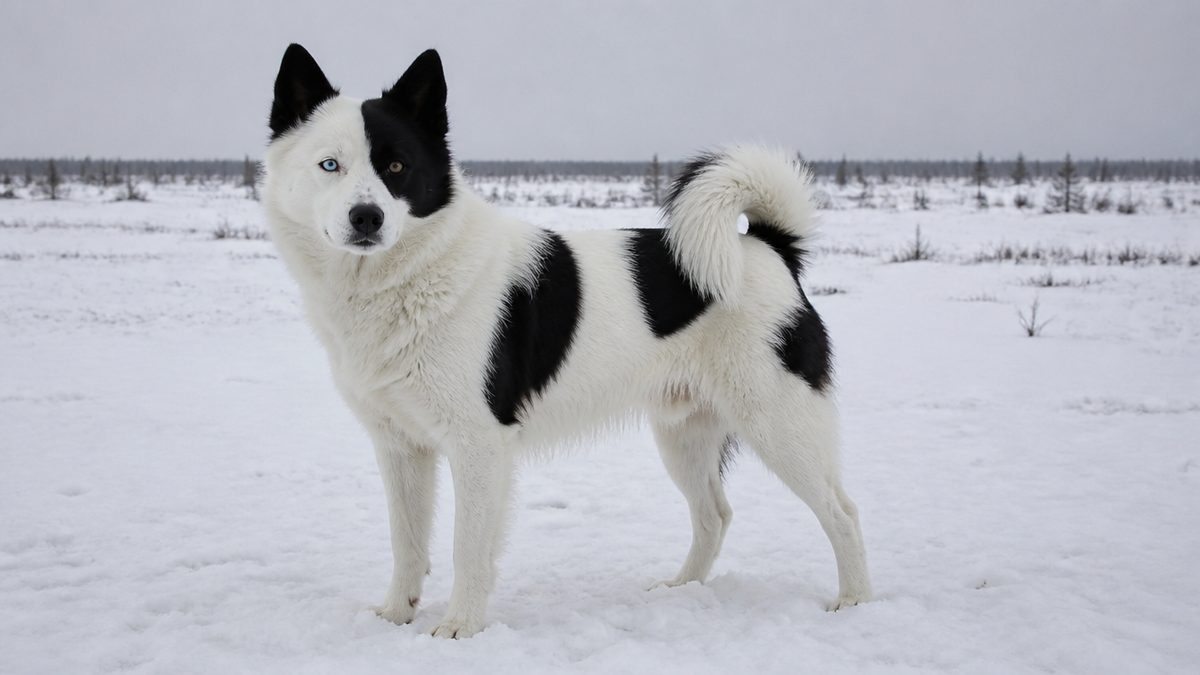
| Colour | White and any patching, bicolour or tricolour. Any solid colour except white is a disqualifying fault |
| Eyes | Dark brown, or blue, as well as odd eyes (one brown, one blue) or blue segments on a brown iris |
| Ears | Triangular, set high, thick, erect or half-pricked |
| Bite | Scissors or level bite. A tight undershot without a gap is acceptable for dogs older than 3 years |
| Temperament | Bold, lively, close to man, friendly, sociable and energetic |
The coat clause is the one an Indian reader should read twice
The standard does not merely describe a thick coat, it requires one and penalises its absence at two levels. "Wavy, soft, too short hair with a poorly developed undercoat" is listed as a SEVERE FAULT, and "Short (smooth) hair" is a DISQUALIFYING FAULT. The GENERAL APPEARANCE section explains why in one line: the coat "should be sufficient for living and working in severe Arctic conditions".
So the document that defines this breed defines it partly by the feature that suits it worst to Chennai or Ahmedabad. That is not an argument against the dog. It is an argument about where the dog belongs, and it is made by the breed's own standard rather than by this page.
The history section, and what it can and cannot support
Many FCI standards carry no history section at all, so it is worth saying that this one does, and that it is unusually specific. Its BRIEF HISTORICAL SUMMARY names dated documents rather than gesturing at antiquity.
- 1633 is given as the date of the very first references to dogs in the region.
- 1692 is the year of the first published account, "How Yakutians travel in winter", inside Nicholas Witsen's "Northern and Eastern Tartary", Amsterdam.
- 1843 is the year of the first description of the Yakutian Laika, in "Geography of the Russian Empire", Derpt, which called it "a dog of a special breed".
- 1856 supplies the first population figure, from "Statistical tables of the Russian Empire", St Petersburg: "There are 15157 dogs in the Yakut region used for sled work".
- 1958 is the year the first Breed Standard for the North-East Sled Dog was adopted, and it formed the basis of the 2005 Russian Kynological Federation standard.
One claim in that section is weaker than the others and the page says so. The standard asserts that "Certain archaeological discoveries confirm that the local people used dogs for sledding and hunting as far back as 8000 years ago" and names no discovery. Published work does exist on ancient canids from exactly this region: Lee and colleagues analysed fourteen canid remains from Siberian Arctic sites including the Upper Palaeolithic Yana RHS and the Early Holocene Zhokhov Island, with estimated ages from about 1,700 years before present to at least 360,000 years before present. That paper is about ancient canids of the region and says nothing about the Yakutian Laika as a breed, so it supports the idea of very old dog use in the Siberian Arctic and does not verify the standard's specific 8,000-year sentence. Both halves of that are worth knowing.
Which registers hold the Yakutian Laika, and the Russian one nobody checks
Three bodies matter for this breed: the FCI, which holds it provisionally at 365; the Russian Kynological Federation, which wrote the 2005 standard and translated the FCI text; and the United Kennel Club in the United States, which lists it in a group for breeds it will register without publishing a standard.
Take them in order of what they let you actually do with a dog.
The FCI, and therefore the Kennel Club of India
India is a full FCI member represented by the Kennel Club of India in Chennai, which means the KCI issues pedigrees against FCI nomenclature. FCI recognition is therefore the question that effectively answers the India recognition question for any imported breed, and for this dog the answer is provisional recognition at number 365.
That is the honest way to put it. The KCI publishes no breed list for any breed, so querying the KCI directly returns nothing for this breed and nothing for a Labrador either. A zero from an instrument that returns zero for everything is a broken instrument, never a finding about the breed, and this page does not report one.
Russia runs two parallel registers, and only one of them is a kennel club
The Russian Kynological Federation is not the only body in Russia that keeps a dog studbook. The RKF maintains the All-Russian Unified Pedigree Book, abbreviated VERK, and is the FCI's partner body, which is why it is the RKF that supplied the translation printed on FCI Standard 365. Alongside it, Rosokhotrybolovsoyuz, the Russian association of hunters and fishermen, keeps a separate hunting-dog studbook.
The RKF's own breeding regulation was opened for this page rather than described from memory. It is a 78-page document approved by the RKF Presidium on 11 December 2019 and in force from 1 March 2020, and it was fetched as bytes and extracted with pypdf, yielding 136,704 characters with VERK named 60 times.
The Yakutian Laika appears in it twice, and the two appearances say different things. In Appendix 1, the nomenclature of breeds recognised by the FCI and the RKF, it is listed as "ЯКУТСКАЯ ЛАЙКА / YAKUTSKAYA LAIKA (YAKUTIAN LAIKA) (365)", carrying the same number the FCI gives it. In Appendix 5, the list of breeds receiving VERK pedigrees with the right to be bred from, Group V holds exactly six entries, verbatim: East Siberian Laika, West Siberian Laika, Olenegonny Spitz, Russo-European Laika, Chukotka Sledge Dog and Yakutian Laika. A breed sitting in both lists is what provisional FCI status looks like from the Russian end.
That second register was checked rather than assumed, and for this breed the answer is no. Rosokhotrybolovsoyuz's own breed-standards page lists its entire laika section as five entries, the Russo-European, Karelian, West Siberian and East Siberian Laikas plus the Norwegian Elkhound. The Yakutian Laika is not among them, which makes sense: that studbook is for hunting dogs, and FCI 365 is filed as a Nordic sledge breed. So the two-register warning is real for laikas in general and does not change this breed's answer.
The hunting register is worth naming precisely anyway, because its authority is older than the RKF's and no kennel-club search surfaces it. It runs on an order of the Main Administration of Hunting Economy and Nature Reserves under the Council of Ministers of the RSFSR, number 140 of 12 June 1962. One nuance to carry: the book created in 1962 was the VRKOS, and today's VPKOS continues its numbering rather than replacing it.
The register that actually settles it is not a kennel club at all
The Russian state admitted this breed in 1993, and no cynological document says so. The Yakutian Laika holds an entry in the State Register of Selection Achievements Approved for Use, Volume 2, Animal Breeds, maintained by the State Commission on Selection Achievements. Its record gives variety code 9358072, species *Canis familiaris*, category porода, and direction of use hunting (laika) and working (draught), with the application registered on 1 January 1993 and inclusion in the register in 1993.
Read the chronology that produces. The state register admitted the breed in 1993. The revival group of enthusiasts formed in 1998. The Russian Kynological Federation adopted the standard in 2004. The FCI accepted it provisionally in 2019. The state was eleven years ahead of the kennel club and twenty-six years ahead of the FCI, and a page that checks only cynological bodies gets that backwards. Ministries, agriculture departments and selection-achievement registries all recognise breeds, and none of them appears in a kennel club's index.
One further register is worth knowing about, because it is the one an English-speaking reader is likeliest to meet. The Royal Kennel Club holds the breed on its Imported Breed Register, where it appears in the Breeds A to Z as "Working Yakutian Laika (Imp)". The "(Imp)" suffix is the Kennel Club's marker for a breed on the imported register rather than a fully established one, and it is a fourth distinct naming of the same dog after the FCI's four.
This is the same lesson this site learned on the Japanese native breeds, where each breed has its own preservation society and any single registry systematically understates the breeds it is not primary for. Before believing a rarity figure for any breed, ask whether a rival national body or a single-breed society exists, and check the registry's own reciprocity page, because that is where a registry names its competitors.
The UKC, and a fourth state called register without standard
The United Kennel Club runs a group most people have never heard of, the Bloodlines Listing Service Group, which holds ten breeds the UKC will register while publishing no standard for them. The Yakutian Laika is one of the ten, and the UKC's own breed page says so in as many words: "No breed standard exists for the Yakutian Laika and this breed is not eligible to compete in UKC Conformation events".
That is a real and separate status, and it is why this site treats "register without standard" as a verdict in its own right rather than as a half-hearted recognition. This breed is the clean worked example, because the standard and the register are supplied by different organisations on different continents: the standard by the FCI and the RKF, the American listing by the UKC, which explicitly declines to publish one.
The distinction is easy to get wrong in one specific way, and the trap is on the page itself. The same UKC page prints "Official UKC Breed Standard" and "Revised December 1, 2014" in its footer, directly contradicting its own body. That footer is boilerplate, provably so: the UKC's East Siberian Laika page carries a different footer with no revision line at all. Read the body, never the footer.
The AKC, which is further along than most pages say
The Yakutian Laika sits in the AKC's Miscellaneous Class, not merely in its Foundation Stock Service, and the AKC publishes a full written standard for it, approved 7 August 2023 and effective 26 June 2024. Miscellaneous Class is the last step before full recognition, and reaching it requires 150 dogs with three-generation pedigrees in the studbook plus a viable standard and a parent club, so the class itself is a usable population floor.
Two cautions on that. AKC's own record still reads year recognized 0, so Miscellaneous Class entry is not AKC recognition and Russian secondary sources that report "AKC recognition on 26 June 2024" have mistaken the standard's effective date for a recognition date. And the AKC standard gives size as 21 to 23 inches and 40 to 55 pounds in a single unisex range, where the FCI gives separate male and female ranges in centimetres and no weight at all. Two registries, two standards, two different size statements. Quote whichever you are actually reading, and say which.
Which register holds this dog, and at what level. What is the dog's registration number, and in which studbook. Which body issued the pedigree, and does that body appear in the FCI's members and contract partners list. Three questions, and a seller who cannot answer them is selling a description rather than a documented animal.
Yakutian Laika price in India, and why no honest number exists
There is no established Yakutian Laika price in India, because there is no Indian market for the breed and no lawful route by which one could form. Any rupee figure quoted for this breed is either a conversion of a foreign asking price or an invention, and both are detectable.
Start with the legal position, because it settles the supply question before any price question arises. Dogs are a Restricted import into India under ITC(HS) 01061900. DGFT Trade Notice 22/2022-23 permits entry only for a pet accompanied by a valid pet book in the importer's name, for research with a CPCSEA recommendation, or for Defence and Police use, and states that applications for trading or breeding purposes "shall be duly rejected". Entry is limited to seven named ports. The full route is set out in how to import a dog to India.
So no importer can lawfully bring this breed into India to breed or sell it. A pet moving with its owner is a different matter and is permitted. Those two facts together explain the absence of a market better than any search result count could.
How to test a rupee figure you are shown, in about thirty seconds
Indian breed pages routinely publish a foreign asking price run through one exchange rate and print the result as an Indian price. The test is arithmetic and you can run it in a calculator.
- Divide the figure by 84.38. This is the strong test. If it lands on a round dollar number such as 800, 1,500 or 2,000, you are looking at a converted US price rather than an Indian observation.
- Divide by 74. A second rate in wide circulation, and one Indian directory's 155-breed table was found to divide to exact whole dollars at 74.00 on 453 of its 463 rupee values.
- Divide by 80, but do not trust it alone. Any rupee figure ending in three zeros divides cleanly by 80 by construction, so a match at 80 means nothing unless the quotient is also a price a real seller would print.
- Look at the quotient, not just whether it divided. Quotients like 1,875, 3,125 or 6,875 are not prices anybody quotes for a dog, and they mean the rupee figure was invented rather than converted.
- Check the host country of any "Rs" figure. Rs is used for Pakistani rupees too, and for a Russian-origin breed you should also check whether a figure is a rouble price wearing a rupee sign.
One more check applies to answer engines rather than to sellers. A generated answer will state that no Indian price exists and then print a confident rupee band in the same breath, derived by converting a European or American asking price. The tell is the sequence rather than any particular divisor, and a rupee band produced that way is a conversion, not an Indian observation.
Bonbeno publishes no Yakutian Laika price for India, because no verifiable Indian transaction price exists and publishing a converted foreign figure would be inventing one. If you are shown a price, run the five checks above, then ask which register holds the dog and what its registration number is. The paperwork question is the one that actually protects you.
Monthly cost of keeping a thick-coated 25 kg northern dog in India
A dog of this size and coat costs roughly Rs 6,000 to Rs 14,000 a month to keep properly in an Indian metro, and the figure is built from published Indian rate cards below rather than borrowed from a breed page, because no Indian rate card for this breed exists.
Every figure here is a real published Indian price with its source named. Treat them as a structure to price your own city against, not as a quote.
| Item | Published rate | Source and caveat |
|---|---|---|
| Puppy core vaccination course | From Rs 6,499 | Vetic national page. A promotional floor from one chain, and Vetic quotes Rs 7,199 on its Mumbai page on the same day, so record which city page a figure came from |
| Annual booster | From Rs 3,199 | Same chain, same caveat |
| Anti-rabies, single | Rs 699 | Compare against Greater Chennai Corporation's six municipal clinics, which give anti-rabies vaccination free of cost |
| Consultation | Rs 500 to Rs 1,000 | Count this as ONE data point, not two: a stray-dog charity and a general insurer publish byte-identical ranges, so one copied the other |
| Tick and flea control, monthly | Rs 1,103 | NexGard Spectra 15-30 kg, 3 tablets at Rs 3,308. Covers the tick and flea role plus roundworm and hookworm |
| Grooming, per session | Bath from Rs 934, full bath and styling from Rs 1,869 | Vetic Delhi. A double-coated northern dog needs this more often in Indian humidity than a smooth-coated dog does |
| Boarding, per 24 hours | Rs 899 | PawSpace Bengaluru. For this breed, ask specifically about air conditioning and generator backup |
| Municipal registration | Rs 500 in Delhi, Rs 50 in Chennai | Delhi MCD registers pet dogs only; Chennai licenses pet animals generally and issued 9,115 licences in 2024 |
| Microchipping | Rs 1,250 | A named Chennai clinic's own transacted price |
The line that is bigger for this breed than for most
Cooling is a running cost here, not a comfort. A dog the standard requires to carry a very well developed thick and dense undercoat is a dog that will need air conditioning through an Indian summer in most of the country, and that is an electricity bill rather than a vet bill. Ask a Bengaluru boarding facility about generator backup before you book, because load-shedding through March to May is a real local problem and an air-conditioned room without backup is not an air-conditioned room.
Grooming is the second line that runs high. The coat is not a coat you can shave your way out of, and the section below explains why shaving makes the problem worse rather than better.
Where these numbers come from, and where they will drift
Retail prices in India move and municipal fees rarely do. Of the figures above, the municipal ones are durable and the clinic and retail ones are perishable, so re-check any retail row before you make it load-bearing in your own budget. One earlier Bonbeno reference figure for a 15 kg bag of food went stale within days of being recorded, which is why this page prices the recurring items and refuses to publish a monthly kibble figure as though it were a quoted price.
Yakutian Laika heat tolerance in India, measured against its own homeland
The Yakutian Laika comes from the coldest inhabited region on earth, and the gap between its homeland and an Indian metro is about 34 degrees of annual mean temperature, which is the largest homeland-to-India gap Bonbeno has measured for any breed. The figures below come from NASA POWER queried by explicit latitude and longitude, with the grid cell elevation checked against the real town elevation on every point.
Take the homeland first. Yakutsk, the capital of the Sakha Republic, returns an annual mean of -8.51 C, a July mean of 19.47 C and a January mean of -36.88 C. Chennai's annual mean is 27.94 C. The difference is 36.45 C, and it is not a rhetorical figure; it is two numbers from one dataset.
The cell check, which most pages skip and which changes what the number means
NASA POWER returns a grid cell, not a point, and in hilly terrain the cell's mean elevation can miss the town underneath it by more than a kilometre. Temperature falls with elevation at roughly 6.5 C per 1,000 m, so an unchecked cell can make a place look habitable when it is not, or unlivable when it is.
So every point below was checked. Yakutsk's cell sits at 204.82 m against a real town elevation near 95 m, an error of about +110 m. At the standard lapse rate that makes the real town roughly 0.7 C warmer than the cell reports, which is immaterial next to a January mean of -36.88 C and is stated here anyway rather than quietly absorbed.
Two other Yakutian points were rejected outright for the same test. Verkhoyansk's cell is +174 m out and Oymyakon's is +165 m out, so neither is quoted as a town figure. Tiksi, on the Arctic coast, was the cleanest of the four at +84.5 m, returning an annual mean of -12.18 C and a July mean of just 7.81 C.
| Place | Cell elevation vs real | Annual mean | Warmest month mean | Coolest month mean | Annual mean RH |
|---|---|---|---|---|---|
| Yakutsk, Sakha Republic | 204.82 m vs ~95 m (+110) | -8.51 C | 19.47 C (Jul) | -36.88 C (Jan) | 85.5% |
| Tiksi, Arctic coast | 116.48 m vs ~32 m (+85) | -12.18 C | 7.81 C (Jul) | -31.28 C (Jan) | 94.7% |
| Delhi | 206.37 m vs 216 m (-10) | 25.57 C | 35.88 C (Jun) | 13.61 C (Jan) | 45.5% |
| Chennai | 48.95 m vs 6 m (+43) | 27.94 C | 31.51 C (May) | 24.09 C (Jan) | 72.4% |
| Mumbai | 97.15 m vs 14 m (+83) | 26.77 C | 31.19 C (May) | 23.19 C (Jan) | 67.3% |
| Bengaluru | 841.72 m vs 920 m (-78) | 23.74 C | 28.37 C (Apr) | 20.22 C (Dec) | 67.8% |
| Pune | 635.99 m vs 560 m (+76) | 23.86 C | 28.93 C (Apr) | 19.62 C (Dec) | 66.7% |
| Kolkata | 7.35 m vs 9 m (-2) | 25.80 C | 31.53 C (May) | 17.31 C (Jan) | 73.8% |
Read the warmest-month column carefully, because the obvious guess is wrong
Delhi's hottest month is June, not May, at 35.88 C, and Bengaluru and Pune both peak in April, at 28.37 C and 28.93 C, and are coolest in December rather than January. Chennai, Mumbai and Kolkata genuinely do peak in May. A table that prints May for every Indian city has not been checked, and this one was.
Humidity is not the problem here, and saying so is the useful part
The reflex claim about a northern breed in India is that the humidity will finish it. For this breed the reflex is wrong, and the homeland figures say so. Yakutsk runs an annual mean relative humidity of 85.5 percent and Tiksi 94.7 percent, against Chennai's 72.4, Kolkata's 73.8 and Delhi's 45.5. The Sakha Republic is not a dry place. It is a cold place, and cold air at high relative humidity is a completely different load from warm air at the same reading.
The thing that hurts this dog in India is heat, or heat combined with humidity, and the right way to express the combination is wet-bulb temperature rather than either figure alone. Yakutsk's peak wet bulb, computed by the Stull method from POWER's T2M and RH2M, is 15.16 C in July. Chennai's peak is 26.11 C in May. That gap of about eleven degrees is the real measure of what an Indian summer asks of this animal.
No Indian plains city is a reasonable home for this dog without year-round climate control. Bengaluru and Pune are the least bad of the large cities, at annual means near 23.8 C and April peaks under 29 C, which is still roughly 32 C above the Yakutsk annual mean. Hill stations look like the answer and are the place to be most careful with data, because NASA POWER's grid cells for Indian hill stations are documented wrong by 700 to 1,935 metres in both directions, so a cell figure for Manali, Shimla, Ooty or Darjeeling should never be quoted as that town's climate without checking the elevation first.
One last note on heat risk, and it is a limit rather than a finding. The largest study of canine heat-related illness, Hall and colleagues on 905,543 UK dogs under primary veterinary care in 2016, modelled breed types with at least five heat-related illness cases and/or at least 5,000 dogs in the study population. The Yakutian Laika is nowhere near that threshold in a UK population and is not in the model, so no breed-specific odds ratio exists for it and this page invents none. What does transfer is the paper's finding that bodyweight at or above the breed and sex mean raised the odds of heat-related illness, at an odds ratio of 1.42 with a confidence interval of 1.12 to 1.80.
Yakutian Laika temperament, and the household it actually fits
FCI Standard 365 describes the temperament in eight words: "bold, lively, close to man, friendly, sociable and energetic". That is a sociable working spitz rather than a guard dog, and the household it fits is an active one with time rather than a quiet one with space.
Take the standard's wording seriously, because it is unusually warm for an FCI document. "Close to man" is not boilerplate; a dog bred to live in close quarters with a family through an Arctic winter and to work in a team was selected for tolerance of people and of other dogs.
The disqualifying faults tell you the same thing from the other side. "Aggressive or overly shy dogs" are disqualified, as is any dog clearly showing physical or behavioural abnormalities. A breed standard that disqualifies aggression is describing a temperament target, and it is a target an Indian buyer looking for a watchdog should read as a warning rather than a recommendation.
Who should not buy this dog
- Buyers wanting a guard dog. The standard disqualifies aggression and describes the breed as friendly and sociable. A dog that greets strangers is doing what the standard asks.
- Buyers in a plains city without reliable cooling. The coat clause and the climate section above are the whole argument, and no amount of temperament suits a dog to a wet-bulb load it cannot shed.
- Buyers who are out all day. A sledge and hunting breed left alone in an apartment for ten hours is a destroyed apartment, and this is the commonest failure mode for every northern breed sold in India.
- Buyers who want a low-shedding dog. The undercoat the standard requires comes off, seasonally and heavily, and no grooming regime stops it.
Who it does fit
The breed suits a household that walks or runs daily whatever the weather, that has cooling it can rely on, and that treats grooming as a routine rather than an emergency. It is a good dog with children on the evidence of its own standard, which selects for sociability, and it is a poor dog for anybody buying on looks alone, which is how most northern breeds reach Indian homes.
How to train a Yakutian Laika, and what the breed resists
To train a Yakutian Laika, work with its independence rather than against it, keep sessions short and rewarding, and start recall in a fenced space, because a hunting spitz that has locked on to a scent will not hear you.
This is a laika, and laika is a Russian word describing a barking hunting spitz. The breed was selected to make decisions at a distance from its handler, tracking and holding game and telling the hunter where it is by voice. A dog selected to work out of earshot of instructions is not a dog that has been selected for instant obedience, and treating that as disobedience is the single commonest handling error with the type.
- Start recall early, and start it on a long line. Never assume off-lead recall in an unfenced Indian park, where the competing stimulus is other dogs and street traffic rather than game.
- Keep sessions short. Ten focused minutes twice a day beats one long session, because a bored spitz disengages and a disengaged spitz rehearses ignoring you.
- Reward with food and with movement. A dog bred to pull finds forward motion reinforcing, so releasing the dog to move is itself a reward.
- Expect vocalisation, and shape it rather than punishing it. The breed's whole working style is to speak, and a household rule about when barking stops is more achievable than a household rule that it never starts.
- Socialise deliberately with traffic and crowds. An Indian street is a harder environment than a Siberian one, and habituation has to be built rather than assumed.
Train in the cool hours, if you are anywhere in the Indian plains. That is a training constraint as much as a welfare one, because a dog that is thermally uncomfortable does not learn well, and the practical window in an Indian summer is early morning and late evening.
Daily exercise requirement, and what happens without it
A healthy adult Yakutian Laika needs one to two hours of real activity a day, split across the coolest hours, and the breed is one of the few where the exercise requirement and the heat constraint pull in opposite directions.
This is a sledge dog by the FCI's own utilization line, built to move at a brisk trot for long periods across snow. Its standard describes the characteristic gaits as "brisk trot and gallop" and calls the movement "fast, elastic". That is an animal with real endurance and a real need to use it.
In India the constraint is thermal rather than physical. The window in which a thick-coated northern dog can safely work in an Indian plains summer is roughly 5 am to 7.30 am and after 8 pm, and even then surface temperature matters as much as air temperature, because tarmac holds heat long after sunset. Put the back of your hand on the road for five seconds before you walk the dog on it.
- Morning, 45 to 75 minutes of brisk walking or trotting alongside a bicycle, in the coolest part of the day.
- Evening, 30 to 45 minutes after the ground has cooled, with training or scent work folded in.
- Indoors, daily, food puzzles and scent games, which do the mental work without the thermal load.
- Never at midday, and never in a car without running air conditioning, at any time of year, anywhere in India.
Without that, the breed does what every under-exercised working spitz does. It digs, it vocalises, it escapes, and it redirects energy into the furniture. None of that is a temperament fault; it is an unmet requirement showing up as behaviour.
Grooming a double coat in Indian humidity, and why you must not shave it
Brush a Yakutian Laika two to three times a week and daily through a moult, dry it completely after every bath, and never shave the coat, because the undercoat is insulation against heat as well as cold and it does not always grow back correctly.
The standard requires "thick, glossy, straight, coarse" hair "of medium length, with very well developed thick and dense undercoat", with a mane on the neck that is especially pronounced in males and feathering on the backs of the legs. That is a working double coat, and it behaves in Indian humidity in ways an Arctic owner never has to think about.
The shaving question, answered plainly
Do not shave this breed to keep it cool. A double coat works by trapping a layer of still air against the skin, and that layer insulates in both directions. Removing it exposes skin that has never seen direct sun to Indian sun, raises the risk of sunburn and of heat gain at the skin surface, and can produce a coat that grows back patchy or with an altered texture. Brushing the dead undercoat out is what actually helps, because it is the trapped shed hair, not the coat itself, that blocks air movement.
The bathing instruction that has to change for India
Overseas breed clubs routinely tell owners to towel a dog off and let it air dry. That advice is written for a different climate and it does not transfer to an Indian monsoon. A dense undercoat that stays damp against the skin in high humidity is a substrate for hot spots and for ear disease, and Indian veterinary series report a real seasonal signal in canine otitis, although they disagree about which season peaks: one Indian series found the majority of cases presenting in July and August, while a series from Durg found prevalence peaking in summer at 41.18 percent against 33.33 percent in the monsoon. Publish the disagreement rather than picking one, and act on the part both agree about, which is that a wet ear in a humid month is a problem.
- Brush two to three times weekly with an undercoat rake, and daily while the dog is moulting.
- Dry the dog completely with a forced-air dryer or repeated towels, right down to the skin, and never leave it to air dry.
- Plug the ears before bathing, and dry them afterwards, because bathing without doing so has been named as a common cause of otitis in Indian practice.
- Check the skin under the mane and behind the elbows weekly, which is where matting and hot spots start.
- Bathe only as often as the dog actually needs, since over-bathing strips coat oils and makes the drying problem more frequent rather than less.
Budget for professional help if you cannot dry the dog properly at home. A full bath and styling in Delhi starts at Rs 1,869 and a bath alone from Rs 934, and for this coat the drying is the part you are paying for.
Yakutian Laika health, screening data and life expectancy
The Yakutian Laika's documented health issues are hips and eyes: OFA holds 131 hip evaluations at 13.0 percent dysplastic and 88 eye examinations, and both datasets clear OFA's own inclusion thresholds. There is no published lifespan study for the breed and this page does not borrow one.
Start with what exists, because for most rare breeds the answer to the health issues question is nothing at all. Wikipedia's article on the breed, which is what most other pages paraphrase, carries no screening figures whatever, so everything below is material a reader cannot get from the popular account.
Hips, with the table's own arithmetic closed
OFA's hip table gives the Yakutian Laika 131 evaluations, 83.2 percent normal and 13.0 percent dysplastic, broken down as Excellent 11.5, Good 55.0 and Fair 16.8 on the normal side, and Mild 12.2, Moderate 0.8 and Severe 0.0 on the dysplastic side.
Those figures were checked before being published, using the table's own arithmetic. The normal grades sum to 83.3 against a printed 83.2, and the dysplastic grades sum to exactly 13.0 against a printed 13.0. A row that closes both ways is a row you can trust from a dump too large to read end to end; a row that does not close means you have the wrong row or the wrong disease marker, not a finding.
The disease was confirmed from the marker row above the table rather than from the row's position, and the column identities were read off OFA's own header, which runs Breed, Rank, # Evaluations, Normal %, Excellent %, Good %, Fair %, Dysplastic %, Mild %, Moderate %, Severe %. The hip, elbow and patella tables share a near-identical layout, so matching a row to a header is the only safe way to know what a number is.
| Database | Evaluations | What OFA reports |
|---|---|---|
| Hips | 131 | 83.2% normal (Excellent 11.5, Good 55.0, Fair 16.8); 13.0% dysplastic (Mild 12.2, Moderate 0.8, Severe 0.0) |
| Eyes, summary row | 88 | 96.6% normal, 0.0% breeder option, 2.3% abnormal |
| Eyes, detail row NORMAL | 88 | 77 of 88 recorded normal, which is 87.5% |
| Eyes, named findings | 88 | Cataract of unknown significance 3 (3.4%); other, suspected not inherited 3 (3.4%); incomplete posterior cortex cataract 2 (2.3%); and single instances of uveal cyst, two forms of persistent pupillary membrane, punctate and incipient cataracts and retinal dysplasia folds, each 1.1% |
The eye figures contradict each other, and both are printed here
OFA's eye summary and its own eye detail rows do not agree. The summary says 96.6 percent of 88 examinations were normal. The detail row headed NORMAL, on the identical denominator of 88, says 77 dogs, which is 87.5 percent. That is a gap of 9.1 percentage points on the same 88 dogs, and 88 minus 77 is 11 dogs not recorded normal, against a summary abnormal figure of 2.3 percent, which is two dogs.
The eye summary row does not even sum to 100 by itself. Read off OFA's own header of Breed, Rank, # Evaluations, Normal %, Breeder Option %, Abnormal %, the row gives 96.6 plus 0.0 plus 2.3, which is 98.9. Neighbouring rows in the same table do close: the Welsh Terrier, the Mudi and the Harrier each read 97.7 plus 0.0 plus 2.3 for exactly 100.0. On 88 dogs those percentages imply 85 normal and 2 abnormal, leaving one animal unaccounted for. So this is not a rounding artefact, and the Yakutian Laika's OFA eye percentages should not be presented as a complete breakdown.
This is not unique to this breed. Bonbeno has now recorded the summary-against-detail contradiction in OFA's eye registry on more than a dozen breeds, across denominators from 69 to over 21,000, so treat it as a property of the tables rather than as a finding about the Yakutian Laika. Neither figure is quoted here as "the" rate. Both are printed with the arithmetic so you can see the problem. The hip row, by contrast, closes both ways and can be used.
Why these tables exist for this breed at all
OFA states its own inclusion rule in writing: "Breeds are not included in the OFA statistics tables until a minimum number of individuals have been evaluated. For hips, each breed must have at least 100 evaluations in the database. For all other databases, there must be at least 50". With 131 hip evaluations and 88 eye examinations, the Yakutian Laika clears both bars, which is why it appears where most rare breeds do not.
One caveat on reading any OFA hip grade, from OFA itself. When 1.8 million radiographic evaluations by 45 radiologists were analysed, all three radiologists agreed on normal, borderline or dysplastic 94.9 percent of the time, but agreed on the same specific phenotype, meaning excellent, good, fair, borderline, mild, moderate or severe, only 73.5 percent of the time. So the normal-against-dysplastic split above is firmer than the excellent-against-good split within it.
Lifespan, and the number this page will not give you
There is no published lifespan figure for the Yakutian Laika, and this page prints none. A search of PubMed on 10 September 2026 returned zero records for every name form of the breed, with PubMed's own quotedphrasesnotfound warning on each, while controls run in the same session returned 126 for Labrador retriever hip dysplasia and 188 for "Siberian Husky"[tiab]. A controlled zero is a real finding. A borrowed Siberian Husky lifespan presented as this breed's would not be.
The largest study of dog longevity was checked properly rather than assumed. McMillan and colleagues analysed 155 recognised purebred groups against crossbreds, and absences in that paper are adjudicated in its Supplementary Table S5, not by a missing row in the headline table. Table S5 lists the East Siberia Laika, the Russian-European Laika and the West Siberian Laika, each flagged N for not included, and does not list the Yakutian Laika at all. So the breed is outside that study's universe entirely. For scale, the same paper's Table S3 gives the Siberian Husky 11.9 years and the Samoyed 13.1 years, and neither figure belongs to this breed.
One search result deserves explaining, because a count can look like coverage. Europe PMC returns seven hits for "Yakutian Laika", and not one of them is a study of the breed. All seven were opened: every one is a dog-cognition study from Eotvos Lorand University in Budapest in which individual Yakutian Laikas appear as named test subjects inside a mixed breed panel. A non-zero count is not evidence of a literature, and reporting seven papers here would have been wrong in a way no reader could have detected.
The Cyrillic search deserves its own sentence, because a zero there means nothing at all. A PubMed query in Cyrillic returns a blank translation line, which means the query was emptied before it ran. So the Russian-language literature on this breed was not searched and found empty; it was not searchable by this instrument, and those are different claims.
The India-specific risk nobody in Yakutia has to think about
Tick-borne disease is the health problem an imported northern dog meets in India and never met at home. Indian series report high burdens, though every one of them sampled dogs presented at veterinary clinics rather than a random population, which matters for how you read the figures. A West Bengal survey of 584 dogs screened found Babesia gibsoni in 76.54 percent and reported that 72.9 percent of the 584 dogs screened carried two or more pathogens. A Kerala survey of 120 dogs found Babesia in 80 of 120, which is 66.7 percent, with cases peaking pre-monsoon between March and May.
Say the denominator out loud when you use figures like these. "72.9 percent of the 584 dogs screened" and "72.9 percent of infected dogs" are different claims, and the second overstates co-infection among positives while understating how common it is in the population your dog would join. For a long-coated dog in India, a monthly parasiticide and a genuine weekly tick check down to the skin are the two interventions that matter, and the dense undercoat makes the check harder and more necessary at the same time.
Feeding a Yakutian Laika in India, by life stage
Feed a Yakutian Laika a complete large-or-medium-breed diet split across two meals, adjust by body condition rather than by a chart, and expect the adult ration to fall as the dog does less work in the heat, because a working ration fed to a dog that cannot exercise becomes weight the dog carries into an Indian summer.
There is no breed-specific feeding research for the Yakutian Laika, so the guidance here is life-stage guidance applied to a 25 kg-ish active dog, and it is labelled as that rather than dressed up as breed science.
- Puppy, to 4 months, three to four meals a day on a complete growth diet, kept lean rather than round.
- Puppy, 4 to 12 months, two to three meals a day, with growth rate controlled deliberately because rapid growth is one of the few environmental factors that can worsen the expression of hip dysplasia in a genetically predisposed dog.
- Adult, two meals a day, portioned to hold a body condition where you can feel ribs easily without pressing.
- Senior, two meals a day with the ration reduced as activity falls, and joints monitored given the breed's 13.0 percent OFA dysplastic rate.
Weight control is a heat intervention on this breed, not a cosmetic one. Hall and colleagues found that dogs at or above the mean bodyweight for their breed and sex carried 1.42 times the odds of heat-related illness, with a confidence interval of 1.12 to 1.80. For a thick-coated dog in an Indian city, keeping the animal genuinely lean is one of the few levers an owner controls.
Feed and water in the cool hours, keep water available continuously, and watch intake in summer, because a dog that is off its food in May in Delhi is telling you something about its thermal comfort rather than about the food.
Month by month through the first year
The first year of a northern breed in India is organised around two things a Yakutian Laika owner in Yakutsk never thinks about: the vaccination and parasite schedule, and the first hot season, which will arrive before the dog is fully grown.
- Months 0 to 2. The puppy stays with its dam. Indian law is explicit that pups less than eight weeks of age are not to be sold, under Rule 8(1)(a) of the Dog Breeding and Marketing Rules 2017. A seller offering a younger puppy is offering to break that rule in front of you.
- Month 2 to 4. Core vaccination course, which a chain such as Vetic prices from Rs 6,499 nationally. Begin habituation to traffic, crowds and handling. Start the undercoat rake now, while the coat is still easy, so grooming is never a fight later.
- Month 4 to 6. Monthly parasite control begins in earnest, at roughly Rs 1,103 a month for a 15 to 30 kg dog. Municipal registration where your city requires it, at Rs 500 in Delhi or Rs 50 in Chennai. Recall training on a long line.
- Month 6 to 9. The first real hot season for most Indian puppies. Move all exercise to the cool hours and treat air conditioning as equipment rather than luxury. Growth should be steady rather than fast.
- Month 9 to 12. Adult coat and the first significant moult. Establish the weekly skin and tick check as routine. Discuss neutering timing with your vet rather than with the internet, because timing interacts with joint development in larger breeds.
- Month 24. The earliest age at which OFA will certify hips: "For certification purposes, the animal must be at least 24 months of age to be eligible". Preliminary evaluations are available from 4 months and under 24 months, and they are preliminary.
If you intend ever to breed a dog of this breed in India, the Dog Breeding and Marketing Rules 2017 require breeding dogs to have been tested for genetic defects under Second Schedule Part III paragraph 8(10), and that clause names hip dysplasia first. It is a Second Schedule paragraph, not a Rule; the Rules themselves stop at Rule 13, so any citation reading Rule 14 or higher is wrong by construction.
Yakutian Laika against the northern breeds Indian buyers actually cross-shop
Indian buyers looking at a Yakutian Laika are usually choosing between it and a Siberian Husky, an Alaskan Malamute or a Samoyed, and the honest comparison is that all four share the same fundamental problem in an Indian city and differ mainly in availability and in how much screening data exists.
The table below compares the things that actually differ. Note what it does not compare: none of these breeds is suited to an Indian plains summer without climate control, and ranking them by heat tolerance would imply a winner that does not exist.
| Breed | Registry position | OFA hip data | Realistic availability in India |
|---|---|---|---|
| Yakutian Laika | FCI 365, provisional since 2019 | 131 evaluations, 13.0% dysplastic | Effectively none. No lawful commercial import route |
| Siberian Husky Price in India 2026 and Heat Reality | FCI definitive, long established | Present in OFA with a large denominator | Widely and often irresponsibly sold |
| Alaskan Malamute Price in India 2026 and Heat Reality | FCI definitive | Present in OFA | Sold in India, less common than the Husky |
| Samoyed Price in India 2026 and Heat Reality | FCI definitive | Present in OFA | Sold in India at a premium |
| West Siberian Laika: India Price, Heat, Care | Not FCI definitive; a Russian laika like this one | Check the current table before quoting | Effectively none |
The comparison that actually matters
If you want a northern-looking dog in India, the choice is not really between these breeds. It is between a northern breed with the cooling, grooming and exercise commitment it requires, and an Indian dog that is already adapted to the climate you live in. Bonbeno's page on the Indie Dog: Indian Pariah Dog Breed and Care Guide 2026 exists for exactly that comparison, and it is the honest counter-offer to every page on this site about an Arctic breed.
If it is the laika group specifically that interests you, the Russo-European Laika: India Price, Heat, Care and East Siberian Laika: India Price, Heat and Care guides cover the two nearest relatives, and the Nenets Herding Laika: The RKF Heat Claim, Tested page tests a heat claim made by a Russian registry about a related breed.
Mistakes Indian buyers make with this breed and its lookalikes
The five mistakes below account for most of what goes wrong when a northern breed reaches an Indian home, and four of the five happen before the dog arrives.
- Buying the look rather than the coat. The photograph that sells this breed is a photograph of the undercoat that makes it unsuitable for most of India. The standard requires that undercoat and disqualifies short smooth hair, so it is not a variable the buyer gets to choose.
- Accepting a rupee price without testing it. Run the figure through the 84.38, 74 and 80 divisions and look at the quotient. A dog priced at a converted foreign asking price is a dog whose seller has no Indian transaction to point at.
- Believing paperwork that names no register. Ask which studbook, at what level, and for the number. A pedigree headed Yakutskaya Laika and one headed Yakutian Laika are the same breed; a certificate from a body that appears in no register is a printed page.
- Shaving the dog in April. It feels like help and it removes the insulation that works in both directions, exposes untanned skin to Indian sun, and can permanently alter coat regrowth.
- Treating a Siberian Husky page as a substitute for research. The breeds are not interchangeable, they sit in different registry positions, and only some of them have published screening data. Borrowing a lifespan or a health figure across breeds is the most common way a plausible page becomes a wrong one.
An earlier generation of pages on rare breeds reported 'no PAA box exists for this query' as a fact about the breed, when the real explanation was that the retrieval tool was down that day. A failing instrument is never evidence about the world. The same discipline governs every absence on this page: each one carries a control that succeeded in the same session, and where no control passed, no absence is claimed.
Adoption, and the realistic route to a dog like this in India
You will not adopt a Yakutian Laika in India, because there is no population here to surrender from. What you can do is adopt the northern-breed dog that Indian shelters genuinely hold, which is most often a Siberian Husky or a Husky cross given up for exactly the reasons this page describes.
That is the honest version of an adoption section for a breed with no Indian presence, and it is more useful than a list of imaginary rescues.
What Indian shelters actually have
Indian shelters and breed-rescue groups in the metros regularly take in northern-breed dogs surrendered in their first two summers. The reasons are consistent and they are the reasons above: the coat, the exercise requirement, and an owner who bought a photograph. A dog surrendered for those reasons is not a defective dog. It is a dog that was placed in the wrong house, and it comes with the advantage that its temperament is already known to the people fostering it.
- Ask the shelter what the dog's summer has looked like, since a northern dog that has already come through an Indian May in that city is a known quantity.
- Verify vaccination and parasite history in writing, and re-test rather than assume if records are thin.
- Budget for the same cooling and grooming costs the rest of this page describes, because adoption changes the acquisition cost and not the running cost.
- Consider an Indie instead, and read the Indie Dog: Indian Pariah Dog Breed and Care Guide 2026 guide before deciding, because a dog already adapted to your climate solves the hardest problem on this page for free.
Bonbeno does not broker sales, does not recommend breeders and does not link puppy listings. What it will do is tell you what document to ask for, and for this breed that document is an FCI or KCI pedigree naming the breed at number 365.
Indian law, this breed, and the clause its own standard collides with
No Indian law bans the Yakutian Laika, and two Indian instruments still govern anyone who acquires or breeds one: the import rules, which make commercial import impossible, and the Dog Breeding and Marketing Rules 2017, one clause of which collides directly with something FCI Standard 365 permits.
Start with the collision, because it is the part no other page will tell you.
The undershot clause
FCI Standard 365 states that "A tight undershot (without a gap) is acceptable for dogs older than 3 years". India's Dog Breeding and Marketing Rules 2017, at Second Schedule Part III paragraph 8(10), require that breeding dogs "shall have been tested for genetic defects, including hip dysplasia, progressive retinal atrophy, night blindness, hypothyroidism, entropion, ectropion, overshot, undershot jaw (when incisors do not touch or mesh), wry mouth, two or more missing teeth, unilateral cryptorchid or full cryptorchid males".
So the breed standard permits a bite that Indian law names in its list of genetic defects a breeding dog must have been tested for. Those two things are not strictly contradictory, since the clause mandates testing rather than exclusion, and the word in the clause is "including", so the list is illustrative rather than closed. But an Indian breeder following the FCI standard on bite would be breeding toward something the Rules single out, and that is worth knowing before it becomes an argument.
What the Rules do and do not say
- Sale below eight weeks is prohibited, at Rule 8(1)(a). This is a genuine Rule and not a Schedule paragraph.
- In-breeding and incest breeding are prohibited, at Second Schedule Part II paragraph 6(3), which defines in-breeding as breeding between relatives of the second to fourth grade within the first four generations, and incest breeding as mating between parents and children or between brother and sister.
- Tail docking, ear cropping, de-barking, de-clawing and any change of appearance by artificial means are strictly forbidden, at Second Schedule Part II paragraph 6(8). None of these applies to this breed's standard, which requires a natural tail and natural ears.
- Breeding to create new breeds or unusual looks is strictly prohibited, at Second Schedule Part II paragraph 6(9).
- Outdoor housing is restricted, at Second Schedule Part IV paragraph 21(1), which bars keeping in outdoor facilities without the attending veterinary practitioner's written approval dogs not accustomed to local temperatures, and breeds that cannot tolerate them "such as long-haired breeds in high temperature locations". That clause names this breed's exact situation, and it is the statutory hook an Indian owner of any thick-coated northern dog should know.
- There is no Indian patella-testing requirement and no dental requirement. Across the whole gazette, "patella" and "luxation" occur zero times, as do "BAER" and "deaf". The only dentition hook is inside 8(10) itself.
Two citation habits worth copying. The Rules run 1 to 13 and there is no Rule 14, so any citation of the form "Rule 21" is wrong on its face; paragraph 21 is a Second Schedule Part IV paragraph. And the document numbers clauses twice, with a Rule 8 on conditions for sale and a separate Second Schedule paragraph 8 on veterinary care, so always say which of the two you mean.
Import, in one paragraph
Commercial import is closed and personal import is not. Dogs sit under ITC(HS) 01061900 as a Restricted import, with entry permitted for a pet accompanied by a valid pet book in the importer's name, for research with a CPCSEA recommendation, or for Defence and Police use, and with applications for trading or breeding purposes to be "duly rejected". A separate personal-pet route runs under the Livestock Importation Act, 1898. Do not conflate the two, and if you need a current port list, read the instrument that governs the route you are actually using.
Yakutian Laika: the questions people actually ask
Are Yakutian laikas rare?
Yes, Yakutian Laikas are rare outside Russia, and the honest answer names what can and cannot be counted. The FCI recognised the breed only provisionally, on 4 September 2019, and OFA holds 131 hip evaluations for it against tens of thousands for a Labrador. Inside Russia no single number is available, because Russia runs two parallel studbooks, the Russian Kynological Federation's VERK and Rosokhotrybolovsoyuz's separate hunting-dog register, and a count from one is not a count of the breed.
Are Yakutian laikas aggressive?
No, Yakutian Laikas are not an aggressive breed, and their own standard says so twice. FCI Standard 365 describes the temperament as bold, lively, close to man, friendly, sociable and energetic, and it lists aggressive or overly shy dogs as a disqualifying fault. A buyer looking for a guard dog is looking at the wrong breed.
Is Laika the dog's body still in space?
No, Laika's body is not still in space. That question is about a different animal entirely, and the collision is worth explaining because it dominates this breed's search results. Laika was the Soviet dog launched aboard Sputnik 2 on 3 November 1957; Sputnik 2 re-entered the atmosphere on 14 April 1958 and burned up, so nothing remains in orbit. Laika is also a general Russian word for a barking hunting spitz and names a whole group of breeds, of which the Yakutian Laika is one. The space dog was not a Yakutian Laika.
How much does a Laika dog cost?
No verifiable Indian price exists for the Yakutian Laika, and Bonbeno publishes none rather than converting a foreign figure. Dogs are a Restricted import under ITC(HS) 01061900 and DGFT Trade Notice 22/2022-23 states that applications to import for trading or breeding purposes shall be duly rejected, so no lawful commercial supply chain exists to set a price. If you are quoted a figure, divide it by 84.38 and by 74 and look at the quotient: a round dollar result means you are being shown a converted foreign asking price.
Is the Yakutian Laika recognised by the FCI?
Yes, but provisionally rather than definitively. The FCI holds the breed at number 365 in Group 5, Spitz and primitive types, Section 1 Nordic Sledge Dogs, and its own breed record prints the status as Recognized on a provisional basis, accepted on 4 September 2019. Pages that say simply FCI recognised are not wrong, but they omit the one qualifier that changes what an owner can do with the dog.
How big does a Yakutian Laika get?
FCI Standard 365 gives height at the withers as 55 to 59 cm for males and 53 to 57 cm for females, and gives no weight at all. There is no weight figure anywhere in the standard, so any kilogram range quoted as coming from the FCI standard has been added by somebody else.
Can a Yakutian Laika live in India?
A Yakutian Laika can survive in India only with year-round climate control, and most of the country is a poor fit. Its homeland at Yakutsk averages -8.51 C across the year against Chennai's 27.94 C, and the breed standard requires a very well developed thick and dense undercoat while disqualifying short smooth hair. Second Schedule Part IV paragraph 21(1) of the Dog Breeding and Marketing Rules 2017 separately restricts outdoor housing for long-haired breeds in high temperature locations without a vet's written approval.
Do Yakutian Laikas have blue eyes?
Yes, and the standard allows more variation than most breeds do. FCI 365 permits eyes that are dark brown or blue, as well as odd eyes, meaning one brown and one blue, and blue segments on a brown iris. None of those is a fault in this breed.
What health problems does the Yakutian Laika have?
The published screening picture is hips and eyes. OFA records 131 hip evaluations at 83.2 percent normal and 13.0 percent dysplastic, and 88 eye examinations whose summary and detail rows disagree, the summary giving 96.6 percent normal and the detail row 77 of 88, which is 87.5 percent. There is no published lifespan study for the breed, and this page borrows none from a related breed. Consult your nearby vet for any decision about a real dog.
Is the Yakutian Laika the same as a Siberian Husky?
No. They are separate breeds with separate standards, separate registry positions and separate origins. The Yakutian Laika comes from the Sakha Republic in north-eastern Russia and holds FCI number 365 provisionally since 2019; the Siberian Husky is a long-established definitively recognised breed. Health and lifespan figures do not transfer between them, and borrowing one breed's numbers for another is the commonest way a plausible page becomes a wrong one.
Why is it called a laika?
Laika is a general Russian term for a barking hunting spitz, from a root meaning to bark, and it names a whole group of dogs rather than one breed. That is why the qualifier matters: Yakutskaya Laika means the laika of Yakutia, and the Russo-European, West Siberian and East Siberian Laikas are different breeds under the same group word. It is also why the Soviet space dog Laika crowds this breed out of search results.
Does the Kennel Club of India recognise the Yakutian Laika?
Effectively yes, through the FCI. India is a full FCI member represented by the Kennel Club of India in Chennai, so the KCI issues pedigrees against FCI nomenclature and FCI status answers the India recognition question. The KCI publishes no breed list for any breed, so a direct query there returns nothing for this breed and nothing for a Labrador either, which is a limit of the instrument rather than a finding about the dog.
Compare with similar breeds
Yakutian Laika sits in 1 Bonbeno group. Each one compares it directly against the breeds it is genuinely an alternative to, on the same figures.