
Breed profile
Nenets Herding Laika: The Only Registry That Recognises It Says It Handles Heat
Every English page about this dog repeats that it is a Paleolithic breed, unchanged for ten thousand years, and most of them cite a genomics paper that says the opposite. Here is what the Russian registry documents, the FCI registers and the ancient-DNA record actually say, and what the one sentence in the standard about heat means for an Indian buyer.
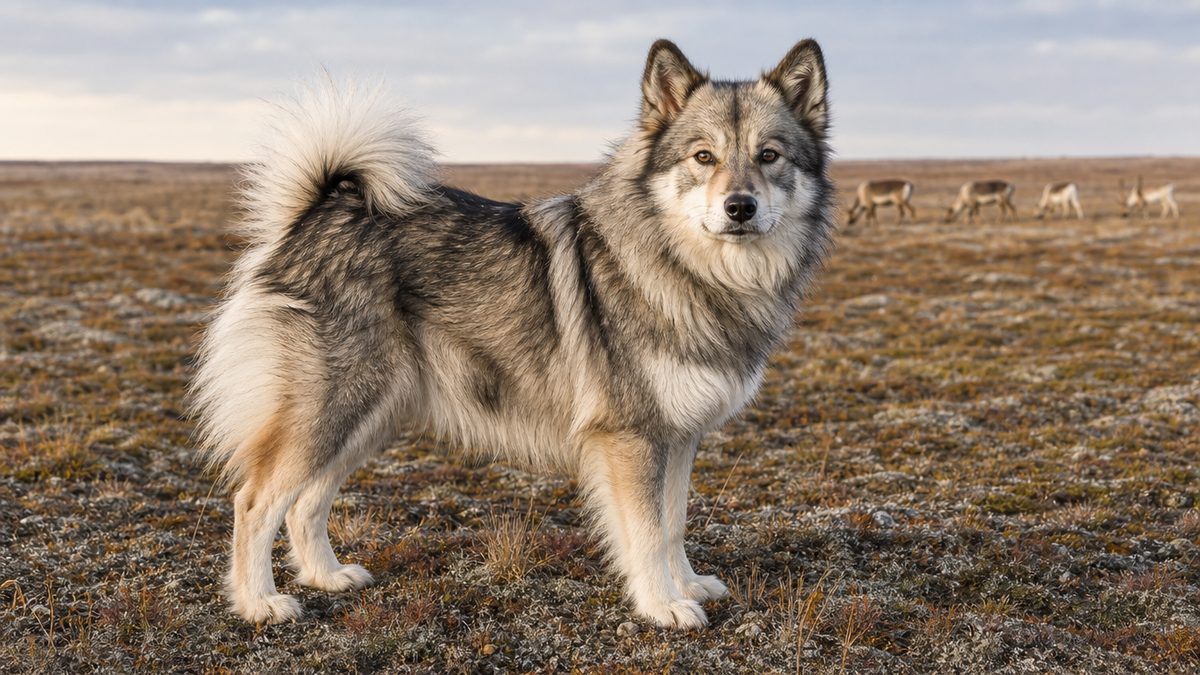
Quick answer
The Nenets Herding Laika is a small Arctic reindeer-herding spitz from northern Russia, standing 42 to 50 cm in males and 38 to 46 cm in bitches under the Russian Kynological Federation standard. The RKF has recognised it since 1999 and issues it real pedigrees, but the FCI holds no number for it, and no Nenets Herding Laika has a recorded price in India. Its homeland averages minus 5.7 C. Chennai's coolest month is warmer than the tundra's hottest.
This guide summarises Russian registry documents, a peer-reviewed Russian heritage-journal article, ancient-DNA genomics, Indian breeding and import law, Indian parasitology surveys and satellite climate data as general information for Indian readers. It is not veterinary advice and no page can substitute for examining an animal. Consult a registered veterinary practitioner before making any decision about vaccination, parasite control, heat management, diet or breeding for a dog in your care, and treat any sign of heat stress in a double-coated northern dog as an emergency requiring a veterinarian the same day.
Nenets Herding Laika trait ratings, and what can honestly be rated
What the Nenets Herding Laika actually is
The Nenets Herding Laika is a small aboriginal reindeer herding spitz from Arctic Russia, standing 42 to 50 cm in males under the current Russian Kynological Federation standard and weighing 11 to 17 kg. It is the only true herding dog Russia has, and it is far smaller than almost every English page implies.
Start with size, because size is where the ranking pages go wrong first. The RKF standard approved by the Federation's Presidium on 16 March 2022 gives males 42 to 50 cm at the withers with an ideal of 46 cm, and bitches 38 to 46 cm with an ideal of 42 cm. Weights are 11 to 17 kg for males, ideal 14 kg, and 8.5 to 12 kg for bitches, ideal 10 kg. That is a dog about the size of a Shetland Sheepdog. It is not a husky, it is not a Samoyed, and a photograph of a 55 cm northern dog is not this breed.
The standard describes a small, compact, agile, hardy and energetic animal of firm and dry build with well-developed muscle and strong bone, carrying the wedge-shaped head, erect ears, thick coat and back-carried tail of every northern dog. Sexual dimorphism is well expressed and males are larger than bitches.
Two coats, and they have Nenets names
The breed comes in two coat varieties, and the standard names both in the Nenets language rather than in Russian. The long-coated variety is «ерре», erre, whose body coat runs at least 8 to 10 cm, with cheek whiskers, a collar over neck and shoulders, feathering on the backs of the forearms, breeches of 15 to 20 cm on the backs of the thighs, and the longest hair of all, up to 25 cm, on the croup. The short-coated variety is «яндо», yando, whose body coat runs at least 4 cm with the longest hair, at least 6 cm, on the cheeks.
Both varieties carry the same structure underneath: a straight, coarse guard hair over a dense, soft, water-resistant undercoat, with stiff hair growing between the toes to form a brush that widens the foot and lets the dog move over crust ice, and bog. Coat length barely differs between the sexes.
Extra toes are normal here
Polydactyly is written into the standard as a feature rather than a fault. The RKF text states that the presence of dewclaws is a characteristic morphological trait of the breed and does not affect assessment, and the American Stock Dog Registry's reproduction of the older 1999 text says the same thing in English American Stock Dog Registry. An Indian reader should know this cuts with the law rather than against it, because de-clawing and any change of appearance by artificial means are strictly forbidden under the Prevention of Cruelty to Animals (Dog Breeding and Marketing) Rules, 2017.
Origin, and the job that made it small
The breed's origin is the Russian Arctic, specifically the modern Nenets Autonomous Okrug of Arkhangelsk Oblast and the Yamalo-Nenets Autonomous Okrug of Tyumen Oblast, where it was developed for driving reindeer, and it is now spread through the traditional reindeer herding districts of northern and north-eastern Russia.
The smallness is functional, and a Russian veterinary-sciences article gives the mechanism precisely. A small reindeer-herding laika bites a driven reindeer on the lower part of the leg, which is protected by the kamus, the tough leg skin, because at a run it cannot reach any higher. It therefore does not break the reindeer's hide. Since broken skin lets in the necrobacilli that cause necrobacillosis in reindeer, the disease herders call kopytka, using small laikas for herding actively prevents that disease. A larger dog would reach higher, cut skin and cost the herd.
A 46 cm dog with a 25 cm coat that turns reindeer by nipping ankles it is too short to miss. Everything else about the breed follows from those two facts.
Is the Nenets Herding Laika a recognised breed? Two documents settle it
Yes, nationally, and no, internationally. The Russian Kynological Federation recognises the breed, publishes a standard for it and issues it real studbook pedigrees, while the Fédération Cynologique Internationale holds no number for it in either of its registers. Recognition is not one question with one answer.
Almost every page ranking for this term treats recognition as a yes or a no, and gets it wrong in one direction or the other. The pages that call the dog a mere landrace miss a functioning national studbook. The puppy marketplace ranking on page one of Google India goes the other way and states, in terms, that the FCI recognises the breed. Neither is right, and the documents are public.
Condition one: is there a written standard?
There is, and it is current. The RKF publishes a full breed standard for the НЕНЕЦКАЯ ОЛЕНЕГОННАЯ ЛАЙКА under the explicit heading Порода признана РКФ, breed recognised by the RKF. The current edition was approved by the RKF Presidium on 16 March 2022, having been agreed, edited and prepared for publication by the RKF Standards Commission on 28 May 2021. The first standard was published in 1994, and the Federation recognised the breed in 1999.
The standard has the detail a real one has: proportions, dentition requiring a full 42 teeth, disqualifying faults including blue eyes and a curly coat with no undercoat, and a measurement appendix. Condition one passes without qualification.
Condition two: does a studbook actually register it?
It does, and this is the part no ranking page has checked. Appendix 1 to the RKF's Regulation on Breeding Work is the Federation's nomenclature of breeds recognised by the FCI and by the RKF, and Group V of that appendix carries the entry НЕНЕЦКАЯ ОЛЕНЕГОННАЯ ЛАЙКА / NENETSKAYA OLENEGONNAYA LAIKA (NENETS REINDEER HERDING LAIKA), sized С for medium.
Appendix 5 is the operative one. It lists the breeds that receive ВЕРК РКФ R pedigrees, meaning entries in the All-Russian Unified Studbook, with the right of breeding use and the right to take RKF titles on a set of certificates. Group V of that list carries the breed. A dog with a pedigree, breeding rights and a title route is registered in any sense that matters. Condition two passes.
The trap inside the RKF's own regulation: the breed is filed under two different names
Appendix 5 does not say Ненецкая оленегонная лайка. It says ОЛЕНЕГОННЫЙ ШПИЦ, reindeer-herding spitz. Search that document for the current name and you get nothing, and you would conclude the breed has no pedigree route at all.
The two names are the same dog, and a peer-reviewed Russian article records the sequence. The standard was officially approved by the RKF on 23 December 1999; the Russian Federation of Service Dog Breeding registered the breed under the name оленегонный шпиц; five years later the name ненецкая лайка was restored; and in March 2016 an updated standard fixed the name as ненецкая оленегонная лайка. The RKF's own standard confirms it by listing ненецкий оленегонный шпиц among the names the breed has carried.
One national federation files one breed under two names in two appendices of the same regulation, and one of those names was replaced in 2016. Anyone checking a register for a rare breed should search every name it has ever held before reporting an absence.
Three sources give three different heights, and all three claim the RKF
Three heights circulate for this breed and no two agree, which matters because height is the one number a buyer uses to tell a Nenets Herding Laika from a husky. All three sources attribute their figures to the RKF, and only one of them is actually the RKF.
Where sources disagree, Bonbeno publishes the disagreement rather than averaging it. Here the spread is small in centimetres and large in consequence, because it decides whether a 39 cm bitch is inside the standard or two centimetres below it.
| Source | Males | Bitches | What the source actually is |
|---|---|---|---|
| RKF standard, Presidium 16 March 2022 | 42 to 50 cm, ideal 46 | 38 to 46 cm, ideal 42 | The current standard, on the recognising federation's own site |
| American Stock Dog Registry | 40 to 52 cm, preferable 46 | 39 to 47 cm, preferable 42 | Labelled on its face as the PREVIOUS version, RKF 1999 |
| English Wikipedia infobox | 44 to 50 cm | 40 to 45 cm | Sourced to a Primitive and Aboriginal Dog Society newsletter via a 2014 archive capture, but labelled RKF standard |
Follow the current RKF text. It is the document the recognising body publishes today, it carries a dated Presidium approval, and it is the only one of the three that is what it says it is.
What changed between 1999 and 2022, and why it matters in India
Comparing the two texts is possible because the American Stock Dog Registry publishes the older one and labels it honestly, giving its header as the date of publication of the previous version of the standard, Russian Kennel Federation, 1999. Reading them side by side shows real drift.
- Weight appears. The 1999 text gives no weight at all; the 2022 text gives 11 to 17 kg for males and 8.5 to 12 kg for bitches.
- A second coat variety appears. The 1999 text describes one coat, at 8 to 10 cm; the 2022 text splits the breed into the long erre and the short yando, the latter at a minimum of 4 cm.
- The dog gets smaller in words. The 1999 text opens medium-sized; the 2022 text opens небольшая, small.
- Dentition tightens sharply. The 1999 text accepts a missing molar and a missing M3; the 2022 text requires the full 42 teeth and makes the absence of any tooth beyond a listed few a disqualifying fault.
- Brindle stops being named. The 1999 text disqualifies brindle and speckled patterns specifically; the 2022 text disqualifies any colour not provided for in the standard.
The sentence that is not in the 1999 text
One addition matters more than all the others to an Indian reader. The 2022 coat clause ends with a claim about climate: that the coat lets the dog easily bear severe frosts and winds and protects it in summer from midges, and that it is also worth noting that the dog easily tolerates high air temperature and humidity, that is, it has the ability to adapt to various climatic conditions.
That sentence does not appear in the 1999 text the American Stock Dog Registry publishes. It carries no measurement, no study and no citation. It is the only warm-climate endorsement this breed has anywhere, it is the newer of the two texts, and the climate section below tests it against the tundra it describes.
Nenets Herding Laika price in India
There is no Nenets Herding Laika price in India, because there is no Indian market for the breed at any level. No breeder, no shelter record, no classified listing and no marketplace entry for it could be found, and the searches that returned nothing ran in the same session as a control that returned a full Indian commercial result set.
Say the absence first, because it is the answer. An Indian buyer searching this term is not looking at a thin market. They are looking at an empty one, and the useful question becomes what the search results actually contain instead.
What an Indian search for this breed actually returns
Pull the Indian result page and the commercial entries on it are all foreign or all something else. There is a US rare-breed marketplace quoting a national band in dollars. There are two live US puppy listings, both from one Texas location, both priced in dollars. And there is one Amazon.in entry, which is not a dog.
- The Amazon.in result is a 44-page paperback published by Original Milestones on 23 September 2019, a print-on-demand puppy milestone journal generated per breed name. It is the only Indian retail result of any kind, and it sells stationery.
- The US marketplace prices are dollar figures for a US buyer, quoted here as editorial observation and not as an offer.
- Google India's own AI panel states that the breed is not commercially bred or available for sale in India and that there is no standard Indian rupee price for it, which for once agrees with what the underlying pages show.
Why Bonbeno publishes no rupee figure here
No rupee figure exists for this breed anywhere, so there is nothing to test and nothing to convert. That distinction is worth stating plainly, because the standard failure on rare-breed pages is to take a foreign price, divide it by an exchange rate and print the result as an Indian price. A converted dollar figure is not an Indian price. It is a dollar figure wearing a rupee sign, and this site will not publish one.
It follows that the honest cost answer for an Indian reader is not the price of the dog. It is the cost of ownership of a 14 kg heavily coated northern dog living in an Indian climate, and every figure in that calculation is real, published and in rupees. The next section does that arithmetic.
Could you lawfully import one?
Not easily, and probably not at all for most readers. The Department of Animal Husbandry and Dairying states that import of live animals falls under the restricted list, is not free to import, and requires a licence from the Director General of Foreign Trade issued on the Department's recommendation after examination of the proposal and a risk analysis. The Department also names the ports through which animal imports are allowed, being the sea ports and airports of Bangalore, Chennai, Delhi, Hyderabad, Kolkata and Mumbai, where animal quarantine and certification services exist.
Combine that with the supply side. The breed's working population sits at roughly 2,000 dogs in one Arctic okrug, and its studbook is a Russian one. There is no lawful, ordinary route by which an Indian buyer acquires this dog, and no Indian seller who could supply one honestly.
Assume it is a different dog. A Siberian Husky cross, an Indian Spitz, or a mislabelled northern mix are all far likelier than a genuine imported Nenets Herding Laika with a VERK RKF pedigree. Ask to see the pedigree document and check the breed name printed on it.
Monthly cost of ownership in India for a dog this size
Running a 14 kg double-coated dog in an Indian city costs real money in rupees, and unlike the purchase price every figure here is published and checkable. The heavy items are grooming and climate control, not food, because this coat is the expensive part.
The breed has no Indian price, but the cost of ownership of a dog of this size and coat in India is entirely calculable. Treat the numbers below as one chain's or one operator's published rates rather than a national average, because Indian veterinary pricing varies by city page and by delivery model rather than by the drug.
| Item | Published rate | Source and caveat |
|---|---|---|
| Puppy vaccination course | From Rs 6,499 | Vetic national page, a promotional floor against a struck-through Rs 8,111 |
| Annual booster | From Rs 3,199 | Vetic, against a struck-through Rs 3,806 |
| Anti-rabies, single | Rs 699 | Vetic. Chennai Corporation clinics give it free |
| 9-in-1 DHPPiL, single | Rs 899 | Vetic |
| Kennel cough | Rs 1,349 | Vetic |
| Consultation | Rs 500 to 1,000 | VOSD. Counted as ONE data point, see the note below |
| Deworming, per dose | About Rs 189 | Drontal Plus at Rs 125.67 a tablet, dosed one per 10 kg, so 1.5 tablets for a 14 kg dog |
| Grooming, full bath and styling | From Rs 1,869 | Vetic Delhi. Haircut from Rs 1,359, bathing from Rs 934 |
| Boarding, 24 hours | Rs 899 | PawSpace Bengaluru |
| Municipal registration, Delhi | Rs 500 a year | MCD, late fee Rs 100 a month |
| Municipal licence, Chennai | Rs 50 | Greater Chennai Corporation |
| Microchipping, Chennai | Rs 1,250 | One clinic's own transacted price |
VOSD and a large general insurer publish byte-identical consultation and vaccination ranges. Two unrelated organisations agreeing exactly on two separate quantities is evidence of copying, not of corroboration, so the Rs 500 to 1,000 consultation band is counted here as a single data point.
Where the money actually goes for this breed
Grooming dominates, and that is breed-specific rather than generic. A dog carrying 8 to 10 cm of guard hair with 15 to 20 cm breeches and up to 25 cm on the croup, over a dense undercoat, cannot be maintained on a monthly bath. In an Indian summer moult the realistic pattern is home brushing several times a week plus professional de-shedding sessions, which at Vetic Delhi rates means the Rs 1,869 line more than once a quarter.
The second heavy item does not appear on any price list, because it is your electricity bill. A dog that cannot safely be kept in an outdoor facility in an Indian summer has to live in cooled air, and that cost scales with your city rather than with your dog.
The third is a bill you should hope never to see. Heat stroke in a heavily coated northern dog is an emergency, and emergency veterinary care is the one line item no published rate card usefully predicts.
Two Indian facts worth more than any price list
Chennai residents should know the Greater Chennai Corporation's pet clinics provide treatment and anti-rabies vaccination free of cost, and that the pet dog licence there costs Rs 50. Delhi residents pay Rs 500 to register a dog with the MCD, renewable, with a late fee of Rs 100 a month. Those municipal fees are stable in a way retail prices are not.
Boarding is the line most owners forget until they travel, and for this breed it carries an extra condition. PawSpace in Bengaluru publishes overnight boarding to 24 hours at Rs 899, with daycare to 10 hours at Rs 799 and short stays to 4 hours at Rs 599, while VOSD reports a wider Indian band of Rs 500 to 2,000 a day. Any reputable Indian boarding operator will require the dog to be fully vaccinated before arrival, and for a heavily coated northern dog you should also ask a question most owners never think to ask, which is whether the facility has generator backup for its air conditioning. A power cut in a Bengaluru May is a different event for a dog wearing 25 cm of croup hair than it is for an Indian pariah.
Heat tolerance: testing the one sentence that says this dog can take Indian heat
The Nenets Herding Laika cannot live comfortably in the Indian plains, and the only document that suggests otherwise is the RKF standard's own coat clause. Measured against satellite climatology, the breed's homeland is 31 C colder than Delhi on an annual mean, and Chennai's coldest month is warmer than the tundra's hottest.
The claim under test is specific. The RKF standard states that the dog easily tolerates high air temperature and humidity and can adapt to various climatic conditions. No measurement supports it in the document, and the sentence is absent from the 1999 text. So measure the homeland.
NASA POWER was queried by explicit latitude and longitude for four homeland points and six Indian cities, with the model's cell elevation echoed and checked against each place's real elevation, because a grid cell in mountainous terrain can sit a kilometre away from the town underneath it. Every Arctic point here is flat tundra and the cells landed between 7 m below and 36 m above the real elevations, so the figures describe the places asked about.
| Place | Annual mean | Coldest month | Warmest month | Annual humidity |
|---|---|---|---|---|
| Salekhard, Yamalo-Nenets AO | -5.73 C | Jan, -24.18 C | Jul, 14.48 C | 91.7% |
| Yar-Sale, Yamal peninsula | -5.91 C | Jan, -22.94 C | Jul, 12.67 C | 93.8% |
| Naryan-Mar, Nenets AO | -3.13 C | Jan, -18.47 C | Jul, 13.44 C | 93.1% |
| Delhi | 25.60 C | Jan, 13.61 C | Jun, 35.88 C | 45.6% |
| Chennai | 27.95 C | Jan, 24.09 C | May, 31.51 C | 72.4% |
| Mumbai | 26.77 C | Jan, 23.19 C | May, 31.19 C | 67.4% |
| Bengaluru | 23.74 C | Dec, 20.22 C | Apr, 28.37 C | 67.9% |
The single number that settles it
Salekhard's warmest month averages 14.48 C. Chennai's coolest month averages 24.09 C. Chennai's coldest month is 9.61 C hotter than the hottest month this dog's homeland ever averages, and Delhi in June runs 21.4 C above the tundra's July. There is no season anywhere in the Indian plains that resembles a Yamal summer.
Where the standard has a point, and it is not the part people quote
Give the RKF its due on humidity, because the data support that half. Salekhard averages 91.7 percent relative humidity across the year and Yar-Sale 93.8 percent, against Chennai's 72.4 percent and Mumbai's 67.4 percent. The Arctic tundra is genuinely more humid than coastal India. A dog from there is not naive about damp.
But humidity at minus 20 C and humidity at 30 C are different physiological problems, and only the second one kills dogs. Humidity matters to a dog because a dog sheds heat by panting, and panting is evaporative. High humidity only becomes dangerous once the air is warm enough that the animal needs to evaporate heat at all. The homeland gives this breed lifelong experience of wet air and no experience whatsoever of wet warm air.
The temperature half of the claim has no support at all. Note also that the tundra does produce warm days: July daily maxima average 27.93 C at Salekhard and 29.01 C at Naryan-Mar. A handful of 28 C afternoons in a 14 C month is not the same as a 24 C monthly mean sustained through the coolest part of a Chennai year.
What Indian law says about a dog like this
The Rules are unusually direct. Second Schedule Part IV paragraph 21(1) of the Prevention of Cruelty to Animals (Dog Breeding and Marketing) Rules, 2017 bars keeping in outdoor facilities, without the attending veterinary practitioner's written approval, dogs that are not accustomed to the temperatures prevalent in the area, and dog breeds that cannot tolerate them, giving as its example long-haired breeds in high temperature locations. This breed answers to both limbs at once.
Keep it indoors in cooled air through the hot months, walk it before sunrise and after dark, never shave the coat, and treat heavy panting that does not settle within minutes of rest and shade as an emergency. Get it to a veterinary practitioner the same day.
Temperament and household fit
The Nenets Herding Laika is a friendly, lively, biddable-but-independent working dog that follows its person everywhere and can be reserved with strangers. Its household risk in India is not aggression. It is a herding instinct that has nowhere to go.
The RKF standard describes the temperament in unusual detail for a Russian text. It gives a lively, mobile, friendly temper; a dog that is easily trained, obedient and disciplined, capable of learning varied skills; initiative-taking, brave and able to make its own decisions; with high working capacity, good memory, good hearing and a good nose carrying a strongly developed innate herding instinct. It calls the breed a companion dog that follows its person everywhere and can be relied on in a difficult situation, while allowing that it may be mistrustful of strangers.
Read that list again and notice the tension inside it. Obedient and disciplined sits next to able to make its own decisions. Both are true, and both come from the job. A dog working a reindeer herd at distance has to take direction and then act without it for minutes at a time.
The herding instinct is the practical problem
This is a dog bred to move large animals by nipping the lower leg. That behaviour does not switch off in a flat in Pune. It redirects, and what it redirects onto is whatever moves fastest, which in most Indian homes means children and other pets.
The fix is management rather than correction. A dog with a real outlet for the instinct is a pleasant companion; a dog with none becomes a dog that herds the family.
- Give it a job that uses the drive, whether that is structured recall work, scent games or a herding-shaped activity.
- Teach a settle deliberately, because a working spitz does not decompress on its own.
- Manage running children rather than punishing the response to them.
- Expect reserve with strangers, and let the dog be socialised at its own pace rather than forcing greetings.
- Accept that the drive is the breed, and that removing it would leave a different dog.
Who should not get one
Anyone in the Indian plains without air conditioning, anyone who wants a dog that will lie quietly on a balcony for eight hours, and anyone hoping for a Samoyed's look with a small dog's needs. This is a hardy, energetic working animal with a decision-making habit, and India offers it almost nothing it was built for.
One thing the standard does not claim
Nothing in the RKF text describes this breed as a guard dog. It is watchful and may be reserved, and the standard's stated modern uses are search-and-rescue and customs work alongside herding American Stock Dog Registry. A 14 kg spitz is not a deterrent, and buying one for security in an Indian city would be a mistake on top of a climate mistake.
Training a dog bred to decide for itself
Train the Nenets Herding Laika with short, varied, reward-based sessions that give the herding drive somewhere to go, and expect a trainable dog that is not an obedient one in the retriever sense. The standard itself describes both halves of that.
The RKF text is explicit that this dog is easily trained, obedient and disciplined, and capable of being trained in varied skills, while in the same paragraph calling it initiative-taking, brave and able to take decisions independently, with a strongly developed innate herding instinct and a good memory. Both descriptions are accurate and they set the training approach between them.
A dog that works reindeer at distance is selected to take a cue and then improvise. That produces an animal that learns fast, generalises well and stops offering a behaviour the moment the behaviour stops making sense to it. Drilling does not work. Varying the problem does.
What works
- Keep sessions short and end them early, because a fast learner gets bored before it gets tired.
- Pay well and pay variably, since a dog with initiative will test whether the contract still holds.
- Build recall as the first and last priority, because prey and herding drive both override a half-trained recall.
- Train a settle explicitly, as a behaviour with its own cue and its own reward.
- Use scent work, which the standard singles out as a strength alongside hearing.
What this breed resists
Repetition without purpose, correction-heavy handling, and being asked to ignore movement. The third one is not stubbornness. Herding is the behaviour the breed exists for, and asking a Nenets Herding Laika never to respond to a running animal is asking it to stop being the breed.
Realistic timelines in an Indian home
Expect basic manners inside eight to twelve weeks of consistent work, a reliable recall in a fenced space by six months, and a recall you would trust off-lead near livestock possibly never. Expect the settle to take longer than the sit. And expect all of it to be constrained by the clock rather than the dog, because in Delhi or Chennai the trainable hours in summer are before dawn and after dark.
One Russian finding that bears on working use
A peer-reviewed Russian article records a specific limit on this breed's scent work. It notes that a distinguishing feature of the reindeer laika's olfaction is the ability to catch and differentiate scents in low temperature ranges, and states that this feature rules out using reindeer-herding laikas for odorological work in more southerly regions.
That sits directly against the RKF standard's list of modern uses, which includes search-and-rescue and customs service, and against its claim that the dog adapts easily to various climatic conditions. Two Russian sources, one a registry and one a federal research institute's journal, disagree about whether this dog functions in warm conditions. Bonbeno publishes the disagreement rather than choosing.
Daily exercise requirement, and the Indian clock problem
A Nenets Herding Laika needs one to two hours of real movement a day plus mental work, and in most of India it can only take that safely in darkness. The exercise problem in India is not the quantity. It is the window.
The standard describes the movement it was built for: free, light, fast, coordinated gaits, with gallop and accelerated trot named as the characteristic ones, and a dog that manoeuvres well and can move at high speed over ground that is awkward to run on. That is a working herding animal's specification, not a companion's.
The Nenets themselves ranked their dogs on working ability, judging them on herding and on catching Arctic foxes, with the fastest dogs reportedly taking up to three in a day. Whatever the exact figure, the selection pressure it describes is for speed and stamina in a small frame.
What that means in Chennai, Delhi and Pune
Delhi averages 35.88 C through June and Chennai holds 24.09 C even in its coolest month. A double-coated dog galloping in either is generating heat it cannot shed. So the requirement becomes a scheduling problem.
- Move the hard exercise to before sunrise and after full dark, and treat midday as indoor time all year in the plains.
- Split the requirement into two or three short bouts rather than one long one.
- Replace distance with problem-solving on hot days, because scent games tire this breed and generate far less heat than running.
- Watch the surface as much as the air, since Indian pavement holds heat long after sunset and this dog's foot has a brush of hair but no defence against a hot road.
- Stop at the first sign of heavy panting that does not settle in shade, rather than at the end of the planned walk.
What happens without it
An under-exercised herding spitz does not become calm. It becomes noisy, destructive and busy, and it starts using the family as a herd. In an Indian apartment that shows up as circling, nipping at heels, and barking at movement in the corridor.
This breed's exercise need is not extreme in absolute terms for a 14 kg working dog. It is extreme relative to the number of hours in an Indian summer day when a heavily coated Arctic dog can safely run.
Coat care in Indian humidity
Brush a Nenets Herding Laika several times a week with a slicker and an undercoat rake, daily through a moult, and never shave it. The double coat is an insulation and sun-shield system, and in Indian humidity the risk is what the undercoat traps rather than what it keeps out.
The coat is the most demanding thing about this breed and the most misunderstood. Both varieties carry a straight coarse guard hair over a dense, soft, water-resistant undercoat. The long erre runs at least 8 to 10 cm on the body with 15 to 20 cm breeches and up to 25 cm on the croup; the short yando runs at least 4 cm on the body and at least 6 cm on the cheeks. Even the short variety is a heavy coat by Indian standards.
Why shaving is the wrong answer, every time
The instinct of every new owner of a northern dog in India is to take the coat off, and it makes the problem worse. A double coat works by trapping still air, which insulates in both directions, and by holding a guard layer that reflects sun off skin. Shave it and you remove the sun barrier, expose skin that has never seen direct light, and risk the guard coat growing back patchily over undercoat that regrows faster. The dog is then hotter, not cooler.
Brush instead. Removing dead undercoat is the intervention that actually reduces heat load, because it is the packed dead undercoat rather than the guard hair that stops air moving.
An Indian-specific risk the Russian standard does not mention
Care guidance written for the Arctic assumes the dog dries. In an Indian monsoon it does not. A dense water-resistant undercoat that stays damp against skin for hours is exactly the environment for moist dermatitis, and the standard's own note that this coat protects the dog in summer from midges and gnats is describing a tundra summer, not a Mumbai one.
- Dry the dog to the skin after any bath or rain, not just the surface, using a forced-air dryer or towels and time.
- Check the thick hair between the toes, which the standard describes as a brush that widens the foot, because it holds water and grit.
- Part the coat weekly over the croup and thighs where it is longest and look at the skin underneath.
- Reduce bathing frequency rather than increasing it, and let brushing do the work.
- Expect heavy shedding twice a year and constant light shedding in a warm climate, because seasonal moult cues weaken without a real winter.
What it costs in India
A full bath and styling starts at Rs 1,869 at Vetic in Delhi, with a haircut from Rs 1,359 and bathing alone from Rs 934, and VOSD reports a wider market band of Rs 300 to 2,000 Voice of Stray Dogs (VOSD). For this coat the realistic pattern is home brushing several times a week plus a professional de-shed several times a year, not a monthly salon visit.
Health, screening and lifespan: what is actually known
No lifespan study, no screening scheme and no breed-specific veterinary literature exists for the Nenets Herding Laika, so this page publishes no median lifespan. What can be said honestly is what the Indian disease environment would do to any dog living here, and what Indian law requires of anyone breeding one.
Start with what is missing, because the ranking pages fill it in. The marketplace page prints a lifespan of 12 to 15 years and states that no serious breed-specific hereditary conditions have been formally documented. The second half is true. The first half has no source, and Bonbeno will not repeat it.
- No VetCompass or equivalent cohort includes this breed, so no median lifespan can be calculated.
- No national breed club publishes a screening scheme or prevalence estimates for it.
- No breed-specific veterinary literature was located under any of its names.
- The RKF standard imposes no health test as a condition of breeding, requiring only that dogs used in breeding be functionally and clinically healthy with breed-typical characteristics.
- The same marketplace recommends OFA hip, DNA testing for progressive retinal atrophy and OFA CAER eye evaluations, without pointing to any breed-level data for any of the three.
The honest position on inherited risk
A population of roughly 2,000 working dogs recovered from a bottleneck so severe that Soviet-era cynologists believed no purebred examples survived is a population with real genetic risk, and nobody has measured it. That is a reason for caution, not a licence to import another breed's numbers. Never substitute a Siberian Husky's or a Samoyed's screening data for this dog.
What Indian law requires of a breeder
The Prevention of Cruelty to Animals (Dog Breeding and Marketing) Rules, 2017 impose their own testing floor regardless of what a breed club does or does not publish. Second Schedule Part III paragraph 8(10) requires that dogs shall have been tested for genetic defects, including hip dysplasia, progressive retinal atrophy, night blindness, hypothyroidism, entropion, ectropion, overshot, undershot jaw, wry mouth, two or more missing teeth, and unilateral or full cryptorchid males. The word is including, so the list is illustrative rather than closed.
Two more clauses bear on this breed specifically. Rule 8(1)(a) prohibits selling pups under eight weeks of age, and Second Schedule Part III paragraph 8(9) records that vaccination can start at seven to eight weeks and is usually completed at eighteen weeks. Any Indian offer of a younger puppy is unlawful on its face.
The Indian disease pressure that would actually apply
Tick-borne disease is the risk an imported northern dog would meet in India that it never meets at home, and Indian veterinary surveys measure it. A Kerala study of 120 dogs found Babesia in 66.7 percent and Ehrlichia canis in 5.0 percent, with a pre-monsoon March to May peak. A West Bengal study of 584 dogs found Babesia gibsoni in 76.54 percent and Anaplasma in 55.75 percent, with 72.9 percent carrying two or more pathogens. An Odisha study of 178 dogs found E. canis in 56, or 31.46 percent, of which 75 percent weighed over 20 kg and 79 percent had a tick history. An Andhra Pradesh study of 442 dogs found E. canis in 11.54 percent by PCR against 8.37 percent by microscopy.
Every one of those studies sampled clinically suspected dogs or clinic caseloads, not random populations. They measure how common these pathogens are among dogs already taken to a vet, not among Indian dogs generally. Quoted without that caveat, 76.54 percent is materially misleading.
The practical consequence is that year-round tick control matters more here than any inherited condition anybody has failed to document, and a heavy double coat makes finding an attached tick harder. Screening a long-coated dog for ticks means working through the undercoat by hand, not looking at it.
Feeding and body condition in an Indian climate
Feed a Nenets Herding Laika to body condition rather than to a chart, and expect an adult of 11 to 17 kg to need markedly less in an Indian summer than any Arctic feeding guide suggests. Calorie needs for this breed are driven by cold and work, and India removes both.
The RKF standard sets the target weights: males 11 to 17 kg with an ideal of 14 kg, bitches 8.5 to 12 kg with an ideal of 10 kg. Those are the numbers to feed toward, and they are low. Owners who have seen photographs of northern dogs and expect a 25 kg animal will overfeed a dog that should be 14.
Why Arctic feeding advice does not transfer
A working reindeer dog in Yamal spends its winter in an environment averaging minus 22.9 C in January, burning calories simply to hold temperature, and working across open tundra. The same dog in Bengaluru at a 20.22 C December mean, walked twice a day on pavement, is a different metabolic animal. Any guide written for the breed's homeland will overfeed it in India, and every English page about this breed carries advice written for a North American or Arctic owner.
- Feed twice daily on measured portions, never free-choice, and weigh the food rather than scooping it.
- Score body condition monthly: ribs easily felt but not seen, a waist visible from above, a tuck visible from the side.
- Cut the ration in the hot months rather than in the cool ones, because activity falls when the temperature rises here.
- Shift the main meal to the cooler end of the day, since digestion itself generates heat.
- Keep water available constantly and check intake in summer, because a panting dog loses water fast.
Life stages
Puppies are fed three to four times a day to about four months, then three times to about six months, then twice for life. There is no breed-specific growth curve published for this dog, so use a general small-to-medium breed schedule and let body condition arbitrate. Do not push growth: a dog with no published screening data for hip dysplasia is a dog whose joints you should not gamble on.
Availability in India
Nothing about this breed requires a special diet, which is the one easy thing about keeping it here. Any complete Indian small-to-medium adult food meeting a recognised nutritional adequacy standard will serve, and the parasite-control budget matters more than the food brand. A monthly deworming dose for a 14 kg dog runs about Rs 189 at Drontal Plus's per-tablet price of Rs 125.67, dosed one tablet per 10 kg.
Month by month through the first year
Plan a Nenets Herding Laika puppy's first year around three things Indian owners routinely get wrong: the eight-week legal floor on sale, a vaccination course that runs to about eighteen weeks, and a first summer that arrives before the dog has any coat management habits.
No breed-specific developmental data exists for this dog, so the timeline below combines the RKF standard's own age-linked provisions with Indian legal requirements and general canine development. Where a figure is breed-specific it is marked as such.
Months 0 to 2
The puppy stays with its litter. Indian law makes this non-negotiable: Rule 8(1)(a) of the 2017 Rules prohibits selling pups less than eight weeks in age. Vaccination can start at seven to eight weeks under Second Schedule Part III paragraph 8(9).
One practical note for Indian owners. Rabies vaccination is a legal requirement for dogs in India regardless of whether the animal ever leaves the house, so a dog kept indoors through the hot months to protect it from heat still has to be vaccinated on schedule. In Chennai the Corporation's own pet clinics administer anti-rabies vaccination free of cost.
Months 2 to 4
The core course runs, usually completed around eighteen weeks. At Vetic's published rates a full puppy course starts at Rs 6,499. This is also the window in which the puppy must be socialised deliberately, because a breed described in its own standard as potentially mistrustful of strangers will become more so without early, unforced exposure. Introduce grooming now, before there is any coat to fight about.
Months 4 to 6
The adult coat starts arriving and with it the first real brushing routine. Teeth matter here for a breed reason: the current standard requires a full complement of 42 teeth and makes the absence of any tooth beyond a short listed set a disqualifying fault, a tightening from the 1999 text which accepted a missing molar American Stock Dog Registry. Herding behaviour toward moving children and pets typically appears in this window and should be redirected rather than punished.
Months 6 to 9
Growth slows and the dog approaches its adult 42 to 50 cm frame. Keep it lean. Recall work should be at its most intensive now, before adolescent independence peaks in a breed selected to make its own decisions.
Months 9 to 12
The first full Indian summer usually lands in this period, and it is the highest-risk moment in the dog's life here. A young dog with a newly complete adult coat, no heat experience and adolescent enthusiasm is the classic heat-stroke presentation. Restrict exercise to darkness, keep the dog in cooled air, and do not shave the coat.
Whatever month you take the puppy home, work backwards to when its first Indian April will fall, and have the cooling and the pre-dawn walking routine in place a month before that.
Registration and identification
Register the dog with your municipality in the first year. Delhi charges Rs 500 with a Rs 100 per month late fee; Chennai charges Rs 50 and runs pet clinics that provide treatment and anti-rabies vaccination free of cost. Microchipping in Chennai runs about Rs 1,250 at one clinic's own transacted price. For a breed this rare in India, permanent identification is worth more than usual, because a lost dog nobody can identify is a dog nobody can return.
Head to head against the breeds Indian buyers actually cross-shop
Anyone drawn to the Nenets Herding Laika in India is really choosing between a dog they cannot get and four they can. The comparison that matters is not against other laikas. It is against the northern-looking dogs Indian sellers will offer instead.
Set the frame honestly. This breed is not available in India, so the practical question is what an Indian buyer should do with the preference that brought them here. If the appeal is the reindeer-herding working history, the FCI recognises exactly one such breed. If the appeal is the look, three far more available dogs supply it.
| Breed | Registry status | Male height | Available in India | Heat verdict |
|---|---|---|---|---|
| Nenets Herding Laika | RKF only, no FCI number | 42 to 50 cm | No | Homeland's hottest month is 14.5 C |
| Lapponian Herder | FCI 284, definitive | 51 to 56 cm | Rarely | Also a Nordic reindeer dog, also unsuited |
| Finnish Lapphund | FCI 189, definitive | 46 to 52 cm | Occasionally | Longer coat, same problem |
| Samoyed | FCI 212, definitive | 54 to 60 cm | Yes, widely | Larger, whiter, equally heat-sensitive |
| Siberian Husky | FCI 270, definitive | 53.5 to 60 cm | Yes, very widely | The dog most often sold as any northern breed |
| Indian Spitz | No FCI number | Small | Yes, widely | Actually adapted to Indian conditions |
The Lapponian Herder is the real comparator
FCI 284, Lapinporokoira, sits in Group 5 Section 3, Nordic Watchdogs and Herders, and is the only reindeer-herding dog the FCI recognises definitively. It occupies exactly the niche the Nenets dog occupies in Russia, and it has the number the Nenets dog does not. If you want a registered reindeer dog with an FCI pedigree, that is the breed. It is also, for the same climate reasons, a poor fit for the Indian plains.
The Samoyed is the historical relative and the practical substitute
The Nenets dog is widely described as feeding into the Samoyed's foundation, and English Wikipedia names the Samoyed as the best-documented modern breed descended from it. The Samoyed carries FCI 212 and definitive recognition, is available in India, and answers the aesthetic. It is also a bigger dog with a bigger coat and the same heat problem, so substituting it solves availability and nothing else.
The Indian Spitz is the answer nobody wants to hear
A buyer attracted to a small, erect-eared, curl-tailed, alert northern-looking dog can have exactly that in India, in a breed that has lived here for generations and is genuinely adapted to the climate. The Indian Spitz is smaller, cheaper, obtainable, and will not spend April in distress. It is the sane end point of this comparison, and this page would rather send a reader there than to an import that cannot lawfully or humanely arrive.
Mistakes Indian owners and buyers actually make with this breed
The commonest mistake with the Nenets Herding Laika in India is buying a different dog under its name, and the second is believing the one sentence in its standard that says it handles heat. Both are avoidable in an afternoon of checking.
1. Taking an Indian listing at face value
There is no Indian supply of this breed. An Indian advertisement using the name is describing a Siberian Husky cross, an Indian Spitz, a northern-looking mixed dog or nothing at all. Verify by asking for the pedigree document and reading the breed name printed on it, and remember the studbook that would issue it is Russian.
2. Believing a page that says the FCI recognises this breed
A puppy marketplace ranking on page one of Google India states plainly that the FCI recognises the Nenets Herding Laika. It does not. The breed appears in neither the definitive Group 5 register nor the 20-entry provisional list, and the RKF's own standard says in Russian that the FCI has not recognised it to date Российская кинологическая федерация.
3. Trusting a specification card without doing arithmetic
The same page's specification card gives the height of this dog as 43 to 53 inches, which is 109 to 135 cm at the withers. No dog on earth is that tall; the tallest breeds stand around 80 cm. Its own body text three paragraphs later says 43 to 53 cm. The card has centimetres labelled as inches.
The same site's Labrador Retriever page proves this is a template defect rather than invention about this breed. That card reads 56 to 61 inches and 29 to 34 lbs, while its own text says 22.5 to 24.5 inches and 65 to 80 pounds. The numbers are right and the unit labels are inverted, on every page, including the most popular breed in America. A reader can catch it without leaving the page, by asking whether the figure makes sense.
4. Repeating the Paleolithic story
English Wikipedia states that the breed survives from the Paleolithic era almost unchanged with little genetic inflow, and cites a 2021 ancient-DNA paper in the Proceedings of the National Academy of Sciences. That paper does not say it. Across its full text the words Paleolithic and unchanged appear zero times, and the word laika appears twice, both inside one bibliography entry.
What the paper actually reports is close to the opposite. Its own significance statement says that analysis of 49 ancient dog genomes reveals that the ancestry of Arctic Siberian dogs shifted over the last 2,000 years due to an influx of dogs from the Eurasian Steppe and Europe, and it names the Iamal-Nenets region as the clearest case, where Iron Age dogs of about 2,000 years ago carry substantially less European and Steppe ancestry than medieval dogs of about 1,000 years ago.
The paper's genuine finding about these dogs is better than the myth and nobody repeats it. Two dogs sampled in 1927 from a Nenets community on the Yamal peninsula were closest, by identity-by-descent distance, to a medieval Yamal dog from Ust-Voikar, suggesting population continuity from the medieval period through to the early twentieth century. That is real, dated continuity of about a thousand years. It is not ten thousand, and the paper also dates the emergence of reindeer pastoralism itself to roughly 800 years ago, which caps how old any reindeer-herding dog role can be.
There is also direct archaeological evidence against the antiquity of the herding role itself, and it comes from the breed's own part of the world. An osteological study of dogs from Nadym Gorodok, an aboriginal settlement in Western Siberia, examined more than 1,600 bones preserved in a permafrost cultural layer, including almost complete skeletons of dogs of various ages, spanning the 14th to 18th centuries AD.
The findings are close to ideal for this question. Dogs were numerous and were bred on site; across those four centuries the settlement kept middle-sized dogs of a consistent build; and in size and general skull shape those dogs resembled the modern laika. Their use is stated plainly: mainly hunting, with the dogs stalking prey and pulling sledges as draft animals. The abstract's closing sentence is the one that matters here, and it reads There were no herding dogs.
So in the region this breed comes from, across a four-century window ending around 1800, a large and well-preserved assemblage of laika-like dogs shows hunting and haulage and no herding at all. That does not prove reindeer-herding dogs were absent everywhere, and one site is one site. It does mean the confident claim that this breed has herded reindeer essentially unchanged since the Paleolithic is contradicted by the nearest hard evidence anyone has published, and it sits comfortably with the genomics dating reindeer pastoralism to roughly 800 years ago Bachura OP, Lobanova TV, Kardash OV.
5. Shaving the coat in April
Covered above and worth repeating, because it is the mistake that does immediate physical harm. Brushing out dead undercoat lowers heat load. Shaving raises it and removes the sun barrier.
Before believing any claim about a rare breed, ask which document says it and open that document. Three of the five mistakes above are visible to anyone who reads the source the page itself names.
Adoption and responsible sourcing
Nobody in India can adopt a Nenets Herding Laika, because there are none here to adopt. What an Indian reader can do is adopt the dog this preference actually points at, and verify hard if anyone claims to have the real thing.
Adoption is the honest ending to this page rather than a disclaimer on it. A breed with roughly 2,000 working dogs in one Arctic okrug, a Russian studbook and a restricted Indian import regime has no rescue pipeline into India and will not develop one.
What to adopt instead
- Indian Spitz, which supplies the small alert northern look and is genuinely suited to the climate, and turns up in Indian shelters regularly.
- Northern-mix rescues, since Siberian Husky and Samoyed crosses are surrendered in Indian cities in significant numbers by owners who underestimated the coat.
- An Indian pariah dog, which is the most heat-adapted, most available and least expensive dog in the country.
- A Samoyed or husky from breed-specific rescue, if the look is genuinely the point and you can supply cooled air year-round.
The second option deserves emphasis, because it is the direct consequence of the mistake this page is about. Indian shelters take in northern-coated dogs bought on an image and given up on a summer. Adopting one of those is the closest an Indian reader will get to this breed, and it fixes a problem rather than creating one.
If someone in India claims to have a real one
Verify it, and verify the document rather than the dog's appearance, because a mislabelled northern mix looks the part to almost anyone.
- Ask for the pedigree and read the breed name printed on it, in Russian if necessary, remembering the breed is filed as Оленегонный шпиц in one RKF appendix and Ненецкая оленегонная лайка in another.
- Ask for the import paperwork, since a live animal entering India needs a DGFT licence issued on the Department of Animal Husbandry and Dairying's recommendation and must arrive through one of the named ports.
- Check the height against the standard, because a dog over about 52 cm is outside it and is probably something else.
- Check the eyes, since blue eyes are a disqualifying fault in this breed and a common sign of husky ancestry.
- Walk away from any seller offering a puppy under eight weeks, which is prohibited outright by Rule 8(1)(a).
Where the breed actually needs help
The conservation work that matters for this dog is happening in Russia, not India. A preservation project was funded by grant at the end of 2017 with the stated aim of forming a register of purebred Nenets reindeer-herding laikas and establishing a cynological club in Naryan-Mar. Whether a registry is even the right instrument is itself contested: the same peer-reviewed article argues that the most effective measure is not to intervene directly in the dog population at all but to support reindeer herding as an industry, on the view that natural selection and herders' own judgement produced the dog in the first place.
That argument connects to the deepest disagreement about this animal. The RKF treats it as a breed with a standard and a studbook. The same article argues that nomadic peoples never had the means to create true breeds of hunting, sledge or reindeer laikas, that what exists are differently-named local strains, and that assigning breed status on the basis of minor conformation features does not withstand serious zootechnical criticism. English Wikipedia splits the difference and calls the dog an aboriginal spitz landrace.
A registry says breed, a peer-reviewed article says landrace, and both are arguing in good faith from the same animal. We publish the disagreement rather than settling it, and we note that it changes nothing practical for an Indian reader: either way, this dog belongs in the tundra.
Nenets Herding Laika questions people actually ask
How rare is the nenet herding Laika breed?
About 2,000 purebred dogs are estimated to be herding reindeer in the Yamalo-Nenets Autonomous Okrug, and the breed is effectively unknown outside Russia and Norway. Rarity here is not a marketing line. By the 1980s Soviet cynologists widely believed no purebred examples survived at all, and small populations were only rediscovered after 1991.
How rare is the Nenets Herding Laika breed?
Rare enough that the working population is counted in thousands rather than measured, and rare enough that no Indian seller, shelter or classified listing for it could be found at all. The Russian Kynological Federation recognises it and issues pedigrees, so it is a registered breed with a very small base, not an invented one.
Did they ever find Laika's body?
No, and no body survived to find. Laika the Soviet space dog stayed in orbit aboard Sputnik 2 for 162 days, and the spacecraft burned up in the atmosphere on 14 April 1958, destroying her remains with it. This question reaches this page because of a name collision, and Laika was a Moscow mongrel, not a dog of the laika type.
Is Laika's dog still in space?
No. Sputnik 2 and Laika with it re-entered the atmosphere and burned up on 14 April 1958, after 162 days in orbit, so nothing of either remains in space. Google attaches this question to laika dog breeds because they share a name, and the Russian word laika comes from the verb meaning to bark.
How long did Laika the dog suffer?
Five to seven hours, according to Dimitri Malashenkov of Moscow's Institute for Biomedical Problems, who revealed at the 2002 World Space Congress that Laika overheated, panicked and died within hours of launch. Soviet authorities had said for 45 years that she had food and oxygen for up to ten days.
Is the Nenets Herding Laika recognised by the FCI?
No. It appears in neither the FCI's definitive Group 5 register nor its 20-entry provisional list, both of which were read with in-document controls. The Russian Kynological Federation's own standard states in Russian that the FCI has not recognised the breed to date, and a puppy marketplace ranking on page one of Google India says the opposite.
What is the price of a Nenets Herding Laika in India?
There is no price, because there is no Indian market. No breeder, shelter, classified listing or marketplace entry for the breed exists in India, and the searches that found nothing ran alongside a control returning a full commercial result set. Any Indian advertisement using the name is describing a different dog.
Can a Nenets Herding Laika live in India?
Not comfortably anywhere in the plains. Its homeland averages minus 5.73 C across the year and its warmest month averages 14.48 C, while Chennai's coolest month averages 24.09 C. Indian law also names long-haired breeds in high temperature locations as dogs not to be kept in outdoor facilities without an attending veterinary practitioner's written approval.
How big is a Nenets Herding Laika?
Small. The current RKF standard gives males 42 to 50 cm at the withers with an ideal of 46 cm and 11 to 17 kg, and bitches 38 to 46 cm with an ideal of 42 cm and 8.5 to 12 kg. That is a dog around the size of a Shetland Sheepdog, not the husky-sized animal most English pages imply.
Is the Nenets Herding Laika the same as the Samoyed?
No, though the two are historically linked and the Nenets dog is often described as feeding into the Samoyed's foundation. They are separate today: the Samoyed is FCI 212 with a definitive number, is much larger, and is white by standard, while the Nenets dog holds no FCI number and comes in zonar grey, red, black, brown, white and piebald.
How long does a Nenets Herding Laika live?
Nobody has published a lifespan study for this breed, and Bonbeno will not repeat the 12 to 15 year figure the marketplaces print, because none of them cites anything. There is no VetCompass cohort, no breed-club survey and no veterinary literature on the breed from which a median could be calculated.
Is the Nenets Herding Laika a breed or a landrace?
Both answers are defended in print, and that disagreement is the honest position. The RKF recognises it as a breed with a written standard and a studbook, while a peer-reviewed Russian article argues that nomadic herders never produced true breeds and that assigning breed status on minor conformation points does not withstand serious zootechnical criticism.
Does the Nenets Herding Laika shed a lot?
Heavily, and the coat is the whole point of the animal. The long erre variety carries guard hair of at least 8 to 10 cm with breeches of 15 to 20 cm and up to 25 cm on the croup, over a dense soft undercoat. Never shave it in India, because the same coat that insulates against cold also shields skin from sun.
Why do Nenets Herding Laikas have extra dewclaws?
Because the standard treats them as normal rather than as a fault. The RKF text states that the presence of dewclaws, polydactyly, is a characteristic morphological feature of the breed and does not affect assessment. Indian law agrees by a different route, since de-clawing and any change of appearance by artificial means are strictly forbidden.
Compare with similar breeds
Nenets Herding Laika sits in 2 Bonbeno groups. Each one compares it directly against the breeds it is genuinely an alternative to, on the same figures.