
Breed profile
Finnish Lapphund: Price in India, Heat Tolerance and Health Data
A reindeer-herding spitz from inside the Arctic Circle, measured against Indian heat with NASA POWER wet-bulb data and against 30,562 Finnish registrations of open health results.
Quick answer
There is no verified Finnish Lapphund price in India, because no Indian seller publishes one and no listing we could verify exists. The rupee range Google India shows, Rs 80,000 to Rs 4,00,000, is two United States dollar figures divided by a flat rate of 80. The breed is a reindeer-herding spitz from inside the Arctic Circle, and Chennai's coolest month is warmer in wet-bulb terms than Lapland's hottest.
This page summarises published breed-standard text, open kennel-club registry statistics, government notifications and peer-reviewed veterinary research for general information. It is not a diagnosis and it is not treatment advice. Consult a registered veterinarian near you about your own dog before acting on anything here. Two things in this breed are worth raising the same day rather than watching. A red, cloudy, watery or suddenly painful eye needs an intraocular pressure reading within hours, because closed-angle glaucoma can destroy vision quickly. And a dog that pants heavily, staggers, vomits or collapses after exercise in Indian heat is a heat-illness emergency: begin cooling with cool water immediately and go to a veterinarian at once, because the case fatality rate for heat-related illness in the largest published study was 14.18 percent.
Finnish Lapphund at a glance
What a Finnish Lapphund actually is
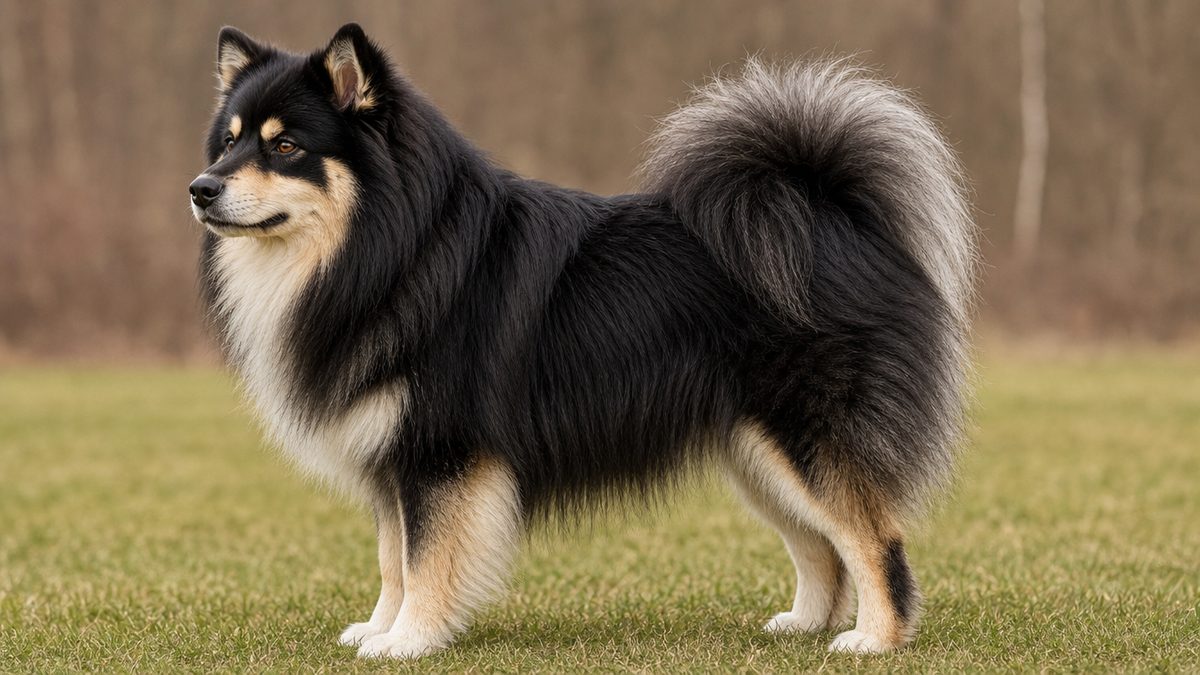
The Finnish Lapphund is a medium-sized double-coated spitz bred by the Sami people of Lapland to herd reindeer and guard camps, registered by the Fédération Cynologique Internationale as standard 189 under its Finnish name, suomenlapinkoira.
Start with the name, because three of them are in circulation and only one is official. The FCI register prints the breed as SUOMENLAPINKOIRA (189) and gives its English name as Finnish Lapponian Dog, not Finnish Lapphund. The Kennel Club in Britain and the American Kennel Club both use Finnish Lapphund, and so does almost every Indian page, which is why this guide does too. If you ever chase the breed through a pedigree database, a health register or a Finnish import document, the word you will need is suomenlapinkoira.
The FCI recognised the breed on a definitive basis on 22 August 1955, places it in Group 5, Spitz and primitive types, Section 3.4 Nordic Watchdogs and Herders, records Finland as the country of origin, and states that it is not subject to a working trial. English is the authentic language of the standard, which matters, because it means the English text is the original rather than a translation and its wording carries no translation drift.
The standard's own utilisation line is blunt about what the dog was for. It reads "Originally a herder and watch dog used in work of keeping reindeer. Today also popular as a companion dog";. Everything a buyer in Pune or Kochi needs to weigh follows from that sentence. A dog selected to work loose stock across open tundra, in air that is below freezing for roughly half the year, carries a coat and a temperament built for a job that does not exist in India.
The coat the standard requires
The breed standard makes the undercoat compulsory, not optional. It specifies hair that is "Profuse, especially the males have an abundant mane. The outer coat is long and harsh... There has to be an undercoat that is soft and dense", and it lists "Lack of under coat" and "Flat coat" among the faults. So a Lapphund without a working undercoat is not a lighter-coated Lapphund. It is a faulty one under the document that defines the breed.
That is the single most important line on this page for an Indian reader, and it is worth being precise about why. A double coat is an insulating system: the dense undercoat traps a still-air layer, and the long harsh outer coat sheds water and repels snow. Insulation works in both directions. The same structure that keeps a herding dog alive at minus 30 also slows the loss of body heat when the air outside is warmer than the dog.
Colour, ears and the tail
Colour is wide open. The standard permits all colours, requires that the basic colour dominate, and allows other colours on the head, neck, chest, underside, legs and tail. Purina India describes the same thing loosely as all colours except merle, with a light mask over the face. The FCI text does not mention merle at all, so treat the merle exclusion as a national or club position rather than an FCI one.
Ears are the breed's identifying feature and the standard is unusually relaxed about them. They are "Medium sized, carried erect or semi-erect... triangular in shape and very mobile", and the current text adds in bold that "It is equally acceptable that one ear is erect and the other semi-erect";. Full drop ears are a disqualifying fault, alongside an overshot or undershot mouth, a kinky tail, and aggression or extreme shyness. A puppy sold to you with two soft, permanently folded ears is outside the standard.
Ear carriage is also where the modern genetics land. A 2024 analysis of eight dog fur samples, 100 to 200 years old, taken from traditional North Swedish clothing, found eleven genes under positive selection during the development of the Nordic Lapphund and Elkhound breeds, and reported that MSRB3, the gene associated with breed-related ear morphology, was selected in all Lapphund and Elkhound breeds. The erect ear you are looking at was bred for, deliberately, and recently enough to be visible in the genome.
The Finnish Lapphund and the Lapponian Herder are separate FCI breeds from the same Sami herding tradition, and Indian listings routinely blur them. The Lapphund is the longer-coated, shorter-legged one. Purina India notes that the Finnish Lapphund, built to gallop, often worked alongside the shorter-legged Lapponian Herder.
How big is a Finnish Lapphund, and why every source gives a different weight
A Finnish Lapphund stands 49 cm at the withers for males and 44 cm for females, with a tolerance of plus or minus 3 cm, and the FCI breed standard gives no weight figure at all.
The height is the only size number that comes from the defining document. FCI-Standard 189 states "Ideal height: males 49 cm and females 44 cm with a tolerance of 3 cm", printing the tolerance with no plus-or-minus sign anywhere in the document, which is worth quoting exactly because the same Finnish Kennel Club writes ± 3 cm in its other Lapland standard, FCI 284, and then adds a sentence most breed pages drop: "The type is more important than the size";. So the legal range is 46 to 52 cm for a male and 41 to 47 cm for a female, and a judge is told in the standard itself to weigh type above the tape.
Weight is where the sources scatter, and they scatter because the standard is silent. It prescribes proportions instead: the depth of chest is approximately half the height at the withers, the muzzle slightly shorter than the skull, and the body slightly longer than the height at the withers. A dog built to those proportions at 49 cm can honestly weigh anywhere across a wide band.
| Source | Height | Weight | What the number is |
|---|---|---|---|
| FCI-Standard 189 | Males 49 cm, females 44 cm, tolerance ±3 cm | None given | The breed definition, and it deliberately omits weight |
| Purina India | 44 to 49 cm | 17 to 19 kg | A 2 kg band, narrower than any breed's real spread |
| American Kennel Club | 18 to 21 in male, 16 to 19 in female | 33 to 53 lb, about 15 to 24 kg | A wide band, closer to what breeders report |
| Puppiezo, India | 18 to 21 in | 16 to 25 kg | Male-only height applied to both sexes |
Read that table across rather than down. Purina India's 44 to 49 cm exactly matches the FCI ideal heights for the two sexes with the tolerance stripped off, which is a tidy-up rather than a measurement. Its 17 to 19 kg weight band is two kilograms wide for a breed whose height range spans 11 cm, which is arithmetically implausible. The AKC's 33 to 53 pounds, roughly 15 to 24 kg, is a nine-kilogram band and describes the same dog far more honestly.
The Indian listing is the odd one out and the reason is visible. Puppiezo prints height as "18-21 inches" with no sex split, which is the AKC's male figure applied to the whole breed, and a weight of 16 to 25 kg. Whoever built that spec card copied an American page and did not carry the female row.
What to do with this if you are buying
Use height, not weight, to judge whether the dog in front of you is the breed it is sold as. A tape measure at the withers costs nothing, the standard's range is public, and it is the one check a seller cannot argue with. A 60 cm dog sold to you as a Finnish Lapphund is 8 cm outside the male maximum and is something else.
- Measure the withers, not the head, with the dog standing square on a hard floor.
- Compare against 46 to 52 cm for a male and 41 to 47 cm for a female.
- Check the ears are erect or semi-erect, because full drop ears are a disqualifying fault.
- Check the bite is a scissors bite, because overshot and undershot mouths are disqualifying faults.
- Look for a visible undercoat when you part the outer coat, because its absence is a listed fault.
The Kennel Club in Britain places the breed in the Pastoral Group and publishes its own standard, while the American Kennel Club recognised the breed in 2011 and put it in the Herding Group. McMillan's 2024 breed classification table records it as Kennel Club Pastoral, FCI Spitz and primitive types, body size medium, cephalic index mesocephalic. That last word matters later: this is a normal-muzzled dog, not a flat-faced one, and it changes which heat risks apply.
Reindeer herding, and how recent the modern breed really is
The Finnish Lapphund descends from Sami reindeer-herding dogs of northern Fennoscandia, but the modern breed is young: the first standard was written by the Finnish Kennel Club in 1945 and the breed only took its present name in 1993.
The FCI standard's own historical summary sets out the sequence, and it is shorter than most breed pages imply. "For hundreds of years the Sami people have used dogs of the same type as Finnish Lapponian Dog as reindeer herders and watchdogs in the northern parts of Fennoscandia and Russia. The first standard of the Lapponian Herder was established by the Finnish Kennel Club in 1945. The breed's name was changed into Lapponian Dog in 1967... The breed name was again changed into Finnish Lapponian Dog in 1993";.
Three name changes in fifty years is not trivia. It means that a pedigree, a study or an old health record can refer to this dog under any of three labels, and that some early Lapponian Herder records describe animals that later became Finnish Lapphunds. When you read a claim about the breed's health history before 1993, check which population the author meant.
What the genetics say about the origin
Two independent genomic studies place the breed in the northeastern Eurasian group rather than with the Scandinavian elkhounds. A 2018 analysis using a commercial SNP panel found that the Finnish Spitz, Nordic Spitz and Karelian Bear Dog, "as well as the reindeer herding Lapphund and Lapponian herder are all closely related and have common origins with the northeastern Eurasian Laika breeds, rather than with other Scandinavian Spitz breeds, such as Elkhounds and Swedish Vallhund";.
The 2024 fur study went further and reached back before the breeds existed. Working from eight dog fur samples 100 to 200 years old, taken from traditional North Swedish clothing, it confirmed that the Lapphund and Elkhound breeds originate from the local dog population, and "showed a distinct decrease in genetic diversity in agreement with intense breeding". So the ancestry is genuinely ancient and the breed is genuinely narrow. Both things are true, and breed marketing usually reports only the first.
The job ended, and the dog stayed
The herding work largely stopped within living memory. Purina India's account is that with the damage done to Lapland during the Second World War, and then the invention of the snowmobile, Lapphunds are rarely used for reindeer herding today, although some still are. The FCI standard agrees that the breed is now popular "mainly as a companion and utility dog in the whole of Finland";.
One behavioural trait survived the job. The AKC describes a distinctive breed trait as a strong startle reflex, "the result of centuries spent ducking the antlers of ornery reindeer";. Whatever the historical explanation is worth, the observable behaviour is real and it has consequences in an Indian flat: a dog that reflexively springs away from sudden movement near its head is a dog that needs careful, unhurried introductions to small children, to sudden hands, and to crowded lifts.
A narrow breed that is managing itself well
The Finnish Kennel Club publishes the breed's gene-pool arithmetic openly, and it is better than the fur study's warning would suggest. Across a four-year generation, the effective population of the Finnish Lapponian Dog in Finland was 847 dogs in 2024 and 749 in 2025, and the mean inbreeding coefficient of registered litters fell from 5.05 percent in 2000 to 2.59 percent in 2024 and 1.87 percent in 2025. Halving the coefficient across a generation is what active outcrossing looks like in a register.
The countervailing finding is fragmentation. A 2020 genome-wide SNP study detected genetic differentiation into subpopulations in six breeds including the Finnish Lapphund, either from geographical isolation or from differing breeding strategies, and reported that "The subpopulation differentiation was strongest in show dog lineages";. A breed can carry a healthy national inbreeding figure and still be splitting into show and working pools that do not exchange dogs.
A dog imported into India comes from one subpopulation, not from the breed average. If it comes from a closed show line, the national effective population of 847 tells you nothing useful about the animal in front of you. The pedigree does. Ask for it, and ask which country's register it sits in.
How popular is the Finnish Lapphund, and is it really Finland's third breed?
The Finnish Lapphund was the third most registered breed in Finland in 2024 with 1,063 registrations, and the fifth in 2025 with 874, so the widely repeated claim that it is Finland's third most popular breed is a year out of date rather than wrong.
Purina India's page tells Indian readers that "The Finnish Lapphund is the third most popular breed in Finland";. That is a checkable claim and it is worth checking, because it is the single fact most Indian pages repeat about this breed.
The Finnish Kennel Club's own news release for 2024 says exactly that: it reports 40,364 dogs registered that year and states, in Finnish, that after the Labrador the next most registered were golden retrievers at 1,224 and "kolmanneksi eniten suomenlapinkoiria (1 063)", third most suomenlapinkoiria at 1,063. So the claim was true for 2024.
The 2025 release moves it. Kennelliitto reports 37,538 dogs registered in 2025 and places the breed fifth, noting that two domestic breeds sit in the top ten, "viidenneksi eniten rekisteröidyn suomenlapinkoiran (rekisteröintejä 874)" alongside the Finnish Hound at eighth with 636. KoiraNet's own five-year table gives the same series: 1,533 in 2021, 1,251 in 2022, 1,082 in 2023, 1,063 in 2024 and 874 in 2025, a fall of 189 dogs or 17.8 percent in the last year alone.
| Year | Finland | Rank in Finland | United Kingdom |
|---|---|---|---|
| 2021 | 1,533 | - | 93 |
| 2022 | 1,251 | - | 47 |
| 2023 | 1,082 | - | 68 |
| 2024 | 1,063 | 3rd | 42 |
| 2025 | 874 | 5th | 51 |
The two columns are worth reading side by side because they describe two completely different situations. In Finland this is a mainstream family breed that a fifth of the country would recognise on sight. In the United Kingdom it is genuinely rare, at 42 registrations in 2024 and 51 in 2025 against a Pastoral group total of 9,263. In India it does not appear at all.
The Royal Kennel Club publishes the same 2025 figure in two documents. Its ten-yearly Pastoral comparative table prints 51 for 2025. Its quarterly Pastoral table prints a year total of 51 as well, but its own four quarter columns as we read them sum to 61. Two documents agree on 51 and one quarter figure is out by ten, so we publish 51 and say where the discrepancy is rather than averaging or picking silently. Kennelliitto has a smaller version of the same problem: its 2024 release gives a national total of 40,364 and its 2025 release restates that same year as 40,355.
One status the breed does not have
The Finnish Lapphund is not a Royal Kennel Club Vulnerable Native Breed, and it cannot be, however few there are. The RKC defines the list as covering "dog breeds of British and Irish origin that are considered to be vulnerable due to their declining registration numbers", with the vulnerable list set at fewer than 300 registrations a year and an at-watch list between 300 and 450. Fifty-one registrations clears the numeric bar comfortably. Finland is not Britain or Ireland, so the breed fails the origin gate that comes first.
This matters because Indian and international pages sometimes describe any low-registration breed as vulnerable, which reads as an official conservation status and is not one. The Finnish Lapphund is uncommon in Britain. It is not endangered anywhere, and in Finland it is one of the most registered breeds in the country.
The American picture sits between the two. The AKC recognised the breed in 2011, its 173rd, and placed it in the Herding Group. In the 2025 popularity list it ranks 127, sitting between the Norfolk Terrier at 126 and the Norwegian Elkhound at 128, out of the 202 numbered breeds in that list. Note that the AKC's own breed-page widget renders the rank as "127 of 210", a denominator no AKC document we could open supports; the ranked list itself has 202 rows, and the same article explains that three breeds recognised in January 2026 will take the total to 205 from the 2026 rankings.
Heat tolerance: the Lapland and India numbers do not overlap
The Finnish Lapphund is the least heat-suited category of dog Bonbeno rates, and the arithmetic is not close: the coldest month in Chennai is warmer, in wet-bulb terms, than the hottest month in Finnish Lapland.
We work this from NASA POWER 20-year monthly climatology (2001 to 2020), queried by explicit latitude and longitude so no city can be substituted for another, and convert air temperature and relative humidity to wet-bulb temperature using the Stull (2011) formula Stull R. Wet-Bulb Temperature from Relative…. Wet-bulb is the right measure for a dog because a panting dog cools by evaporation, and evaporation is what wet-bulb temperature limits.
| Place | Lat, lon queried | Annual mean air temp | Coldest month wet-bulb | Warmest month wet-bulb |
|---|---|---|---|---|
| Rovaniemi, Finnish Lapland | 66.50, 25.73 | 0.71 C | -13.03 C (January) | 13.43 C (July) |
| Inari, Finnish Lapland | 68.90, 27.03 | -0.84 C | -13.15 C (January) | 11.64 C (July) |
| Helsinki | 60.17, 24.94 | 6.37 C | -4.56 C (February) | 15.29 C (July) |
| Chennai | 13.08, 80.27 | 27.95 C | 21.00 C (January) | 26.11 C (May) |
| Kolkata | 22.57, 88.36 | 25.81 C | 13.21 C (January) | 27.09 C (June) |
| Mumbai | 19.08, 72.88 | 26.77 C | 16.62 C (January) | 25.77 C (June) |
| Delhi | 28.61, 77.21 | 25.60 C | 7.58 C (January) | 26.50 C (July) |
| Bengaluru | 12.97, 77.59 | 23.74 C | 16.41 C (January) | 21.86 C (May) |
| Pune | 18.52, 73.86 | 23.86 C | 14.06 C (January) | 22.97 C (June) |
Read the Rovaniemi row against the Chennai row and the argument is finished in one line. Rovaniemi's warmest month sits at 13.43 C wet-bulb. Chennai's coldest month sits at 21.00 C. The two annual ranges do not touch, and the gap at the closest point is 7.6 C. There is no month of the year in which Chennai resembles any month of the year in the homeland of this breed.
The air-temperature gap is starker still. Rovaniemi's annual mean is 0.71 C and Chennai's is 27.95 C, a difference of 27.2 C. A dog whose coat was selected across centuries for an annual mean of about freezing is being asked to live at an annual mean close to blood-warm ground temperature.
The one Indian window that does overlap
Delhi in January is the exception, and it is worth naming precisely because it is the only one. Delhi's January mean wet-bulb is 7.58 C, which falls inside Rovaniemi's own annual range, between its October figure of 0.37 C and its July figure of 13.43 C. For roughly eight to ten weeks a year, a north Indian winter is genuinely comfortable for this coat.
That window closes hard. Delhi's July mean wet-bulb is 26.50 C and its August figure is 26.16 C, both above Chennai's annual maximum. So Delhi does not offer a milder year than Chennai. It offers a colder winter and a worse summer, and the swing between them is 18.9 C of wet-bulb in six months. A double-coated dog cannot re-engineer its insulation on that schedule.
Bengaluru and Pune are the two mainland cities that genuinely help, and only a little. Bengaluru sits at 841 metres and its annual mean wet-bulb is 19.48 C, with a warmest month of 21.86 C in May. That is still 8.4 C above Rovaniemi's warmest month, but it is 4.6 C below Chennai's. Between two bad options it is the better one.
Shimla is worth a sentence because people reach for hill stations. NASA POWER's grid cell for Shimla returns a January mean wet-bulb of 5.41 C and a July figure of 23.27 C. The July number is 9.8 C above Rovaniemi's July. A Himalayan hill station is a cooler place to keep this breed than Chennai, and it is still not Lapland.
There is no Indian city where the Finnish Lapphund's coat is doing the job it was selected for. In Bengaluru, Pune or a Himalayan town, with genuine indoor cooling and dawn-and-dusk exercise, a Lapphund can live a normal life. In Chennai, Kolkata, Mumbai or coastal Kerala, you are managing a permanent thermal deficit for twelve to fifteen years. That is a choice a buyer is entitled to make, but it should be made with the numbers in front of them.
One caveat on the humidity column, because it is easy to misread. NASA POWER gives Rovaniemi an annual mean relative humidity of 92.29 percent, higher than Chennai's 72.39 percent. That is not a wetter place in any sense a dog experiences. Cold air holds almost no water, so a high relative humidity at minus 12 C is a tiny absolute quantity. This is exactly why wet-bulb, not relative humidity, is the number to compare.
What the heat-illness evidence does and does not say about a thick coat
No study has measured how much a double coat raises a dog's heat-illness risk, because the largest study of the subject never tested coat as a variable at all, and the Finnish Lapphund is absent from it entirely.
The reference dataset is VetCompass. Hall, Carter and O'Neill reviewed the electronic patient records of 905,543 UK dogs under primary veterinary care in 2016 and identified 1,259 heat-related illness events from 1,222 dogs. The companion paper puts the 2016 incidence at 0.04 percent and the event fatality rate at 14.18 percent, which is the number worth carrying: roughly one in seven dogs that reaches a vet with heat-related illness does not survive it.
The trigger breakdown is the most quoted statistic in dog-heat writing and it is routinely given the wrong denominator. The paper states that "There were 380/1259 (30.2%) prevalent HRI events with no trigger recorded", and that of the remaining 879 events the triggers were exertional 652, environmental 113 and vehicular confinement 46. So the correct form is that 652 of the 879 events with a recorded trigger, 74.2 percent, were exertional, with environmental at 12.9 percent and vehicles at 5.2 percent. It is not 74.2 percent of 1,259, which would be 934 events and is not what the paper reports.
That correction changes the practical advice more than it looks. The single largest cause of veterinary heat emergencies in dogs is not a hot car. It is exercise. Of the 652 exertional events, the type of exercise was unspecified for 101, and of the remaining 551, 372, or 67.5 percent, occurred after walking. Ordinary walking, not sport.
The coat question, answered honestly
The Scientific Reports paper tested seven explanatory variables: breed type, purebred, skull shape, adult bodyweight, bodyweight relative to breed or sex mean, sex and neuter status, and age. Coat type and coat length are not among them. In the companion Animals paper the word coat appears once in the whole document, inside the justification prose for the purebred variable, which notes that purebred dogs are more likely to carry an exaggerated conformation "such as brachycephaly, thick coat, or giant body size". That is a stated reason for testing a different variable, not a measurement of coat.
The authors say so themselves, in the discussion rather than the results. They write that "Coat type is potentially an important risk factor for HRI in dogs", and they reach for the Chow Chow as the illustration. Anybody citing these papers as proof that a thick coat raises heat risk is quoting a hypothesis and presenting it as a finding. Bonbeno will not do that, and the honest position is that the double coat's contribution to heat-illness risk has never been quantified.
The Chow Chow, the only very thickly double-coated spitz in the model, carries the highest breed odds ratio in the Scientific Reports paper at 16.61 against the Labrador Retriever baseline, with a 95 percent confidence interval of 6.21 to 44.44. Note two things. The paper's own discussion quotes that figure as 16.17, so the article disagrees with its own table, and we quote the table. And a confidence interval seven times wide cannot separate coat from muzzle length, size or anything else.
The Finnish Lapphund is not in the model
Searching the complete text of both papers for lapphund, lapponian and finnish returns zero hits in each Hall EJ, Carter AJ. That is not an oversight. Both papers include a breed as its own category only where it has at least 5 heat-illness cases or at least 5,000 dogs in the study population. With 42 to 51 UK registrations a year, the Finnish Lapphund never came close, and falls into the pooled "other purebred" category.
So no odds ratio exists for this breed and importing one from a different breed would be fabrication with a citation attached. What the papers do supply are risk factors that are not breed-specific, and three of them apply to a Lapphund living in India:
- Bodyweight at or above the breed and sex mean carries an odds ratio of 1.30 for exertional heat illness, with a confidence interval of 1.09 to 1.55. A heavy Lapphund is a higher-risk Lapphund, and this is the one factor an owner fully controls.
- Adult bodyweight of 10 to under 20 kg carries an odds ratio of 2.52 against dogs under 10 kg, with a confidence interval of 1.97 to 3.22. A 17 to 19 kg Lapphund sits squarely inside that band.
- Age is protective, not aggravating, for exertional heat illness: dogs aged 8 to 10 years show an odds ratio of 0.48 against dogs under two. Young dogs get exercised harder, and that is what the number is describing.
- Mesocephalic skull shape is the baseline, and the Finnish Lapphund is mesocephalic, so it carries none of the brachycephalic penalty of 1.32 that flat-faced breeds do.
Read together, that is a mixed verdict rather than a doom-laden one. This is a normal-muzzled, medium-sized dog with functioning airways, and its heat risk in India comes overwhelmingly from what its owner asks it to do, not from a structural defect in its face. Walk it at 6 am and 9 pm, keep it lean, and the modifiable risks are largely handled. Walk it at 4 pm in Chennai in May, when the mean wet-bulb is 26.11 C, and the coat is a genuine problem.
Finnish Lapphund price in India: there is no Indian market, and the rupee figures are converted dollars
No verified Finnish Lapphund was found for sale anywhere in India, no Indian seller publishes a price for the breed, and the rupee range Google India shows for the query is two United States dollar figures divided by a flat exchange rate of 80.
Say the conclusion first, because it is the answer to the query. A Finnish Lapphund price in India does not exist as a market fact. Searching Indian marketplaces on 27 August 2026 returned no verified listing, no rescue population, and no seller-published rupee figure for the breed. The control query, labrador retriever price in india, returned sane results in the same tool in the same session every time, so the zeros are real rather than a broken search.
What Google India does show is a price, and it is worth taking apart because the mechanism is instructive. Google's AI Overview for the query states a range of Rs 80,000 to Rs 4,00,000 plus, and cites Adopt a Pet among its sources. Adopt a Pet's page reads, verbatim, "Depending on their breeding, they usually cost $1,000 to $2,500, while imported puppies can cost up to $5,000".
| Rupee figure shown | ÷ 84.38 | ÷ 80.00 | ÷ 74.00 | ÷ 66.67 | Verdict |
|---|---|---|---|---|---|
| Rs 80,000 (low end) | 948.09 | 1,000.00 | 1,081.08 | 1,199.94 | Exactly USD 1,000 at a flat 80 |
| Rs 4,00,000 (high end) | 4,740.46 | 5,000.00 | 5,405.41 | 5,999.70 | Exactly USD 5,000 at a flat 80 |
Both endpoints land on a round dollar figure at exactly 80.00, and both of those dollar figures are printed on the American page the AI Overview cites. No Indian seller set that price. An answer engine converted an American one and rendered it as an Indian market range. You can check the arithmetic in a calculator in ten seconds, which is the point of printing it here.
What the ranking Indian pages are actually selling
Puppiezo holds position one on Google India for this query with a page titled "Finnish Lapphund Puppies For Sale in India At Best Prices", whose meta description promises "KCI registered, vaccinated, and delivered across India";. The page prints no price for a Finnish Lapphund. Its "Other Available Pets" carousel holds eight animals: two Maltipoos, two Poodles, a Cane Corso, a Goldendoodle, a Rottweiler and a Doxiepoo. Zero Finnish Lapphunds.
The rupee figure Google's snippet lifts from that page, Rs 98,999, belongs to Fizey, an eight-week-old Maltipoo. The identical Rs 98,999 also tags Samy, another Maltipoo, and Yoki, a Doxiepoo, on the same carousel, alongside Rs 92,599 twice for the Poodles, Rs 94,999 for the Cane Corso, Rs 1,20,000 for the Goldendoodle and Rs 76,499 for the Rottweiler. Rs 98,999 divides to 1,173.25 dollars at 84.38 and to 1,237.49 at 80, neither of which is a price a seller would print, so it is not even a conversion. It is a rupee-native charm price attached to whichever puppy is in stock.
The rest of the top ten is no better. Positions three and nine are JustDial category shells at the identical URL stub for Kolkata and Hyderabad; the Kolkata page contains no Finnish Lapphund, no breed mention and no price, and lists an aquarium and two veterinary hospitals among its "pet shops for Finnish Lapphund dog", while rendering an unfilled template variable reading "undefined in Kolkata". Position four is a Pet India Online page about the Finnish Spitz, a different breed, quoting a starting price of Rs 18,000. Position six is a book on Amazon at Rs 14,561.55.
Search this breed and price in India and you are offered a Finnish Spitz, a Maltipoo, a German Shepherd, an aquarium, a veterinary clinic, a book, a T-shirt and a clipart file. Every rupee figure in the top ten belongs to something other than a Finnish Lapphund.
Two further absences are worth recording because they are cheap to check and they point the same way. PawSpace's Top 40 dog price table for India does not contain the breed in any of its 40 rows. DogExpress India has a Finnish Lapphund page with no price on it at all, last modified in 2016, which contradicts itself twice on the same screen: its header says availability "Rare" and lifespan 10 to 13 years while its body says "Availabilty: Easy to get" and 12 to 15 years.
The one route that might have produced a real Indian figure could not be verified. Two PetzLover URLs claim Finnish Lapphund listings, at Rs 10,000 in Rewa, Madhya Pradesh, and an index page whose visible entry is a German Shepherd at Rs 35,000. Both returned HTTP 403 behind a CAPTCHA across three proxy modes. Those figures are snippet-only, we could not read the pages, and we therefore do not report them as Indian prices.
The only lawful way a Finnish Lapphund reaches India
You can bring a Finnish Lapphund into India only as your own pet when you transfer residence after two continuous years abroad, because the Directorate General of Foreign Trade classes dogs as a Restricted import and rejects any application made for trading or breeding.
The instrument is DGFT Trade Notice No. 22/2022-23, dated 19 December 2022. It lists ITC (HS) 01061900, "Mammals: Other", as Restricted, and prints the conditions in full. Policy Condition 7 allows import of dogs "only for the following specific purposes": a pet dog with a valid pet book and relevant records in the name of the importer, dogs imported by R&D organisations with the recommendation of CPCSEA, and dogs for internal security by the Defence and Police Force.
Policy Condition 8 closes the commercial route in one sentence: "Import of commercial dogs for breeding or any other commercial activities other than the purposes mentioned above is not permitted";. Paragraph 6 of the same notice adds that "any applications for trading/breeding purposes, or applications made on behalf of some another person/ entity shall be duly rejected".
That is why no Indian breeder can lawfully build a Finnish Lapphund breeding population from imports, and it is the structural reason the Indian market described in the previous section is empty rather than merely small. There is no supply chain, because the law does not permit one to form.
What the personal route actually requires
The notice sets out the baggage route precisely. Permanent import of up to two pets is allowed as passenger baggage without DGFT authorisation only to persons transferring their residence to India after two years of continuous stay abroad, and only cats and dogs may come under baggage rules. If the stay abroad was shorter than two years, if the pet is not travelling as passenger baggage, or if there are more than two animals, a DGFT import authorisation is required and applications go to the Department of Animal Husbandry and Dairying for examination.
- Complete two continuous years of residence abroad before you plan the move, because this is the gate that decides whether you need an authorisation.
- Assemble the vaccination book or pet passport, the certificate for emotional support, and the pet's own passport, which are the three mandatory documents for a permanent import.
- Begin the application at least two months before travel, which is the notice's own advice.
- Route the animal through Delhi, Mumbai, Chennai, Hyderabad, Bangalore or Kolkata, the six airports and seaports named in paragraph 7. DAHD added a seventh port, Cochin International Airport at Kochi, for pets arriving under the baggage rules in October 2024. The full route is set out in how to import a dog to India.
- Obtain an advance No Objection Certificate from the AQCS Regional or Quarantine Officer at that port seven days before travel, relaxable to three days.
- Expect quarantine at the government station of that port where required.
Do not read a headline about Kochi as changing that list. A separate notification, S.O. 4396(E) of 10 October 2024, permits pet dogs and cats through Cochin International Airport under the jurisdiction of the Animal Quarantine and Certification Station, Chennai, under the Livestock Importation Act 1898. That is a different instrument governing a different route, and whether it alters the DGFT notice's own port list is a question the notice itself does not answer. If you need the current list for your route, read that route's own instrument.
What Indian breeding law says about this breed's two headline diseases
Indian law already names hip dysplasia and progressive retinal atrophy as genetic defects a breeding dog must have been tested for, which happens to be exactly the pair the Finnish Kennel Club screens in this breed.
The Prevention of Cruelty to Animals (Dog Breeding and Marketing) Rules 2017 apply to anyone breeding dogs in India, and one clause lands directly on the Finnish Lapphund's headline inherited disease. Second Schedule Part III paragraph 8(10) reads, verbatim: "The dogs shall have been tested for genetic defects, including hip dysplasia, progressive retinal atrophy, night blindness, hypothyroidism, entropion, ectropion, overshot, undershot jaw (when incisors do not touch or mesh), wry mouth, two or more missing teeth, unilateral cryptorchid or full cryptorchid males".
Hip dysplasia and progressive retinal atrophy are both named in that list, and both are the two conditions the Finnish Kennel Club's own compulsory programme screens for in this breed. The word in the clause is "including", so the list is illustrative rather than closed, and a defect is not outside the clause merely because it is unnamed.
Two neighbouring paragraphs are worth knowing before you accept breeding advice from anywhere. Second Schedule Part II paragraph 6(3) prohibits two named techniques: "in breeding", defined as "breeding between relatives of the 2nd to 4th grade in straight or side line within the first four generations e.g. uncle to niece, nephew to aunt, cousin to cousin, grandparents to grandchildren", and "incest breeding", defined as "mating between parents and children or between brother and sister, i.e. 1st grade relatives". Paragraph 6(4) adds that "Female dogs shall not be mated after the age of eight years", and Rule 8(1)(a) of the main Rules requires that "pups less than eight weeks in age are not sold".
The only case report of osteogenesis imperfecta in this breed describes two eight-week-old Finnish Lapphund puppies whose bones broke on handling. The authors record that "Inbreeding of the sire and female offspring led to a suspicion of recessive inheritance". A sire-to-daughter mating is exactly what Second Schedule Part II paragraph 6(3)(ii) defines as incest breeding and prohibits. The mating that produced those puppies could not lawfully be repeated in India.
Two absences in the Rules are also citable, because Indian pages routinely invent requirements that are not there. Across the whole 14-page gazette, the terms BAER and deaf appear zero times, and patella appears zero times. There is no Indian patella-testing requirement and no hearing-test requirement. If a seller tells you otherwise, ask them to point at the clause.
What a Finnish Lapphund actually costs to keep in India each month
Budget Rs 8,000 to Rs 18,000 a month to keep a 17 to 19 kg double-coated dog in an Indian metro, and treat cooling and coat care as the two lines that separate this breed from a similarly sized short-coated one.
We will not give you a purchase price, because the previous section explains that no honest one exists. Running costs are a different matter: they follow from the dog's weight, its coat and its climate, and all three are known. What follows is a structure to fill in with your own city's prices, not a quotation.
| Line | Why it applies to this breed | How to size it |
|---|---|---|
| Food | 17 to 19 kg adult on the Purina India figure, 15 to 24 kg on the AKC's | Price a large-breed adult kibble at the daily gram figure on the bag for your dog's actual weight, not the breed average |
| Air conditioning or evaporative cooling | The section above shows no Indian city sits inside the breed's home wet-bulb range | This is the line most owners underestimate. Cost the hours you will actually run it in April to June |
| Grooming | Compulsory dense undercoat under the FCI standard, shed heavily twice a year | A slicker brush and an undercoat rake are one-time. Budget salon visits only if you will not brush |
| Preventive parasite control | Year-round tick pressure in most of India rather than a summer season | Monthly, not seasonal. See the health section for why |
| Routine veterinary care | Annual vaccination, dental checks, and an eye examination this breed genuinely needs | The eye examination is the one line a generalist practice may not offer |
| Eye screening by a specialist | The Finnish programme requires an eye examination valid for 24 months before mating | Budget a trip to a veterinary ophthalmologist, of which India has few |
The cooling line is the one that makes this breed structurally more expensive than a Labrador of similar weight in the same city, and it is worth being blunt about the mechanism. You are not buying comfort. You are buying the difference between a dog that can shed heat and a dog that cannot. In Chennai, where the mean wet-bulb sits above 21 C in every month of the year, that is a twelve-month cost, not a summer one.
Two costs specific to this breed
Eye examination is not optional care for a Lapphund, it is the core of the breed's health programme. The Finnish Kennel Club's compulsory PEVISA programme for the suomenlapinkoira requires an official eye examination whose result is no more than 24 months old at the time of mating. An Indian owner is not breeding, so the letter of that rule does not apply, but the reason behind it does: this is a breed with a documented late-onset retinal disease, and an annual look at the retina is how you find it early.
Undercoat management is a recurring cost in a way it is not in Finland. In a cold climate the undercoat is shed on a photoperiod, in two clean seasonal moults. In an Indian metro with year-round warmth and artificial light, the moult tends to smear across the calendar. That does not increase the total hair, but it does mean the brushing is a weekly habit for twelve months rather than an intense fortnight twice a year.
Two costs you can strike off the list. There is no docking or cropping to pay for, because the FCI standard requires a natural erect or semi-erect ear and a natural tail, and because Indian law forbids both procedures outright: "There shall be no tail docking, ear cropping, de-barking, de-clawing... and any change of appearance by artificial means is strictly forbidden";. And there is no patella certification to buy, because the Rules never mention the patella.
Temperament: friendly, extremely vocal, and built to startle
The Finnish Lapphund is a friendly, calm and docile family dog by the breed standard's own words, with two traits that decide whether it suits an Indian flat: it barks a great deal and it startles hard.
The FCI standard's behaviour clause is short and unusually warm. It reads "Intelligent, courageous, calm and docile. Friendly and faithful";. It also makes aggression and extreme shyness disqualifying faults, which puts them outside the breed rather than at one end of it. A snappy or cowering Lapphund is not a variant temperament; it is a dog the standard would exclude from a show ring.
That description is accurate as far as it goes, and it is also the part of the breed that markets itself. The two traits that actually determine whether this dog works in your home are the ones the standard does not mention.
The barking is not a training failure
This is a very vocal dog and the vocality is functional. Purina India lists the breed as a "Very vocal dog" and a "Guard dog. Barks and alerts", and notes that although Lapphunds are not as noisy as some spitz types, "they will still require some effort put into training to stay quiet as they are naturally inclined to alert to anything they perceive as novel or suspicious";. A reindeer herder that could not make itself heard across open ground was of no use to anyone.
In an Indian apartment building, novel and suspicious things happen roughly every four minutes. The lift arrives. The maid's keys turn. A delivery rider knocks on the neighbour's door. A cat crosses the parapet. Each of those is a legitimate alert to a dog bred to announce movement, and none of them is a behaviour problem you can extinguish, only a habit you can shape. If a shared wall and a strict housing society are part of your situation, weigh this before the coat.
One thing you must not do about it is illegal in India, and worth naming for that reason. De-barking is explicitly prohibited by Second Schedule Part II paragraph 6(8) of the 2017 Rules, in the same sentence as tail docking and ear cropping.
The startle reflex
The AKC describes a distinctive breed trait as a strong startle reflex, "the result of centuries spent ducking the antlers of ornery reindeer";. Whether the historical explanation holds is not something we can verify, and the AKC gives no study. The behaviour it describes is well attested by owners and it has a practical consequence in Indian homes, where space is tight and hands come at a dog from above more often than in a Finnish farmyard.
Handle this by teaching the dog that hands from above are predictable, from the first week. Approach from the side, ask for the head rather than reaching for it, and coach visiting children to hold a hand out low rather than patting the skull. This is ordinary good practice with any dog and it is load-bearing with this one.
Household fit
Purina India's assessment is that the breed is "Great for families with older children" while noting that "a noisy family with very small children may find the addition of a barking dog insistent on rounding up toddlers rather stressful";. That is the herding instinct describing itself. A dog selected to move stock will try to move whatever moves, and a toddler running across a room is stock.
| Situation | Verdict |
|---|---|
| Bengaluru, Pune or a hill town, house with a garden, older children, someone home in the day | The best case this breed gets in India |
| Air-conditioned flat, adults or teenagers, owner who enjoys training | Workable, if you accept the barking and the brushing |
| Chennai, Kolkata, coastal Kerala, no reliable cooling | Do not. The wet-bulb numbers do not support it |
| Shared-wall apartment with a noise-sensitive society | Do not. The barking is the breed doing its job |
| Household with a toddler and no adult supervision time | Do not. Herding pressure on small running children is the predictable failure |
| First-time owner who wants a low-maintenance dog | Do not. Purina India rates it as suiting owners with some experience |
Purina India also records that the breed is a "Non hypoallergenic breed" and that it will "Some drool";. On the allergy point the evidence is settled and does not need re-litigating per breed: measuring the major dog allergen Can f 1 across 196 dogs of so-called hypoallergenic breeds against 160 control dogs, hair samples came back higher in the hypoallergenic group, 2.26 against 0.77 micrograms per gram, and the authors concluded there is no evidence for classifying any dog breed as hypoallergenic. A heavily shedding double-coated spitz was never going to be the exception.
Training a Finnish Lapphund: the recall is the whole job
Train a Finnish Lapphund by making recall the first and most rehearsed behaviour it knows, because the breed combines high trainability with an intact hunting and herding drive that will take it away from you.
Front-load the recall, because everything difficult about this breed routes through it. Purina India's training guidance is explicit: "Pay particular attention to teaching a strong recall to avoid hunting and herding instincts getting them (and you!) into trouble", and adds "Teach them to be quiet on cue and socialise well from an early age to avoid them becoming a barky nuisance";.
The raw material is good. The breed retains a strong herding instinct and is described as keen to work with its owner, and Purina India notes that the Lapphund "will actively enjoy training for its own sake";. The AKC's account adds the flip side: without the brain exercise they need, "they'll create their own projects to keep their minds busy";. This is a dog that will be occupied either way. You choose by what.
A realistic Indian timeline
- Weeks 8 to 16. Socialise hard and socialise early, in the cool hours. Indoor surfaces, lift doors, autorickshaw noise, doorbells, the building watchman, umbrellas. Every one of these will later be a barking trigger if it is novel at eight months instead of at ten weeks.
- Weeks 10 to 20. Build recall on a long line in a walled space before you ever need it. Pay it with food the dog actually values, every single time, for the first six months.
- Months 4 to 8. Teach a quiet cue. The reliable method is to reward the pause after the bark rather than trying to suppress the bark, because you cannot extinguish an alert the dog was bred to give.
- Months 6 to 12. Introduce the grooming routine as a trained behaviour, not a wrestling match. Brush for thirty seconds, pay, stop. This is the single highest-return training investment for a double-coated dog in a warm country.
- Months 9 to 18. Add a real activity. Purina India lists agility, canicross and man-trailing; the AKC lists herding trials, agility, obedience, rally and tracking.
- Month 18 onwards. Maintain the recall for life. It decays, and this breed's default when it decays is to go and investigate something.
Two Indian adjustments to that plan. First, every training session belongs in the cool hours, and the reason is not comfort but evidence: 372 of 551 exertional heat-illness events with a specified activity, 67.5 percent, followed ordinary walking. A long training session in afternoon heat is a heat-illness risk factor with a number attached to it. Second, do the socialisation indoors where the outdoor temperature forbids it, because a puppy that misses its window because of the weather is a barky adult by twelve months.
What this breed resists
Repetition without purpose is where a Lapphund switches off. It is an intelligent, problem-solving spitz rather than a biddable gundog, and Purina India records that some owners report they are "too smart for their own good";. Drill the same sit twenty times and you will lose the dog. Change the picture every few repetitions and you will keep it.
Heavy-handed correction is the other failure, and it interacts badly with the startle reflex described above. A dog that reflexively springs from sudden movement near its head is a poor candidate for a training method built on physical corrections, and Indian trainers who default to a check chain will produce a worse animal than they started with.
Teach a settle on a mat in the coolest room in the house, and pay it generously for six months. It gives you a place to send the dog when the doorbell goes, a place it will choose in April, and a way to interrupt the barking chain without confrontation. In an Indian flat it does more work than any other single behaviour.
Daily exercise: two hours in Finland, and the same two hours split around the Indian sun
A Finnish Lapphund needs roughly one to two hours of activity a day, and in India that requirement does not shrink, it simply has to be moved into the cool hours and partly replaced with work the dog does with its head.
The published requirement is consistent across sources and it is not small. Purina India states the breed "ideally requires two hours exercise per day, although some of this can be in the form of training and dog-based sports or activities", and lists the breed as one that "Enjoys walking one to two hours a day";. The AKC's account is gentler, describing a half-hour play session with an owner and a ball, or with another dog, as capable of satisfying their exercise needs, and notes that "Lappies tend not to exercise themselves";.
Publish the disagreement rather than splitting it. Purina India and the AKC differ by a factor of four on the same breed, and the difference is not sloppiness; it is that they are answering different questions. Two hours is what keeps a working-bred spitz mentally settled. Thirty focused minutes is what stops a companion Lapphund becoming obese. An Indian owner should plan for the larger figure and build in the smaller one as the floor on a bad-weather day.
The Indian schedule
| City | Coolest month wet-bulb | Hottest month wet-bulb | Practical window |
|---|---|---|---|
| Bengaluru | 16.41 C (January) | 21.86 C (May) | Before 8 am and after 7 pm year round; December to February is genuinely comfortable |
| Pune | 14.06 C (January) | 22.97 C (June) | Similar to Bengaluru, with a better winter and a worse June |
| Delhi | 7.58 C (January) | 26.50 C (July) | December to February is the best window in India. May to September, dawn only |
| Mumbai | 16.62 C (January) | 25.77 C (June) | Dawn only from March. The June to September humidity is the hard part |
| Kolkata | 13.21 C (January) | 27.09 C (June) | A real winter, then the highest wet-bulb figure in this table |
| Chennai | 21.00 C (January) | 26.11 C (May) | No comfortable month exists. Dawn and late night, all year |
Notice what the Delhi and Chennai rows do together. Delhi gives you a genuine winter in which a Lapphund can be a normal dog for eight to ten weeks, and then a July that is worse than anything Chennai produces. Chennai gives you nothing comfortable but nothing extreme either. Neither is good. They are bad in different shapes, and the training plan has to match the shape.
Replacing distance with difficulty
When you cannot walk the dog for an hour, make the twenty minutes you can walk it harder for its brain. This is not a consolation prize for a herding spitz; it is closer to the original job than a road walk is.
- Scatter feed the daily ration across a room or a balcony rather than putting it in a bowl.
- Hide a toy and send the dog to find it, building to a scent game with three identical boxes.
- Practise recall between two people in a corridor, which costs no outdoor time.
- Teach a trick chain of four or five known behaviours run together, which tires a thinking dog fast.
- Use a snuffle mat or a frozen stuffed toy in the hottest hours, which occupies the dog and cools it at once.
Do not substitute swimming without thinking about the coat. A soaked double coat takes a long time to dry, and a persistently damp undercoat in Indian humidity is how skin problems start. If the dog swims, dry it properly, and dry it down to the skin rather than to the surface.
The consequence of skipping the exercise is predictable rather than dramatic. An under-exercised Lapphund does not usually become destructive in the way a working terrier does. It becomes noisier, because barking is the outlet it already has, and it gains weight, which is the one heat-illness risk factor with a published odds ratio attached to it, at 1.30 for dogs at or above the breed and sex mean bodyweight.
Grooming a double coat in Indian humidity, and why you must not shave it
Brush a Finnish Lapphund twice a week with a slicker and an undercoat rake, daily through a moult, and never clip the coat short, because the dense undercoat the FCI standard makes compulsory is the dog's insulation against heat as well as cold.
The coat is defined, not incidental. The standard requires hair that is "Profuse", an outer coat that is "long and harsh", and states "There has to be an undercoat that is soft and dense", with "Lack of under coat" listed as a fault. Purina India rates the breed as needing grooming "every other day" and flags that the coat "may pick up considerable amounts of wet and mud, so space to groom and dry off is necessary";. The Indian listing agrees on the one thing it gets right, printing "Shedding: YES" on its own spec card.
The shaving question, answered
Do not clip a Finnish Lapphund short in the belief that it will cool the dog. The double coat is an insulating structure: the dense undercoat traps a still-air layer that slows heat transfer in both directions, and the long harsh outer coat also blocks direct solar radiation from reaching the skin. Remove it and you remove the shade the dog carries with it, in a country where midday solar load is the problem.
There is a second reason, and it is the one that persuades owners who are not persuaded by the first. A clipped double coat frequently does not regrow correctly. The undercoat regrows faster than the guard hairs, producing a woolly coat that mats more, dries slower and insulates worse than the coat you removed. That is a permanent cost paid for a temporary and probably illusory benefit.
The right intervention is to remove dead undercoat, which is the part that traps heat without doing any useful work, and to leave the guard coat intact. That is what an undercoat rake does and what a clipper cannot.
- Brush twice a week as the baseline, working in sections down to the skin rather than skimming the top coat.
- Rake daily during a moult, and expect the moult to be smeared across the calendar in India rather than falling in two clean seasons.
- Check the mane, the trousers and behind the ears weekly, because those are where a profusely coated spitz mats first.
- Dry to the skin after every bath or swim, not to the surface, because a damp undercoat in Indian humidity is a skin problem waiting to happen.
- Trim nothing except the hair between the pads, which the standard describes as dense and which collects grit and mud.
Where overseas advice does not transfer
British and American breed guidance routinely tells owners to towel a double-coated dog and let it air dry. In a Finnish or Yorkshire summer that is sound. In an Indian monsoon it is the instruction that produces the skin and ear cases, because the air the coat is drying into is already close to saturated. In Mumbai the July mean relative humidity is 89.6 percent and in Pune 89.1 percent. Air drying in that is not drying.
Use a dryer on a cool setting, or dry with towels in stages down to the undercoat, and do it every time. This is one of the few places where an Indian owner should knowingly ignore the parent-club instruction.
The one thing about this breed that Indian weather does not punish
The Finnish Lapphund's erect or semi-erect ear ventilates the canal, which puts it on the right side of the single most seasonal skin complaint in Indian dogs, and both Indian series we could open show otitis externa peaking in the monsoon rather than the summer.
One structural feature genuinely works in the Finnish Lapphund's favour in India, and it deserves saying because so little else does. The standard requires ears "carried erect or semi-erect", with full drop ears a disqualifying fault. An erect ear ventilates. A pendulous ear seals a warm, humid canal.
The Indian data supports the distinction. A cross-sectional study at Palampur, Himachal Pradesh, screened 2,476 dogs and diagnosed otitis externa in 81, a hospital prevalence of 3.27 percent, and split the cases by ear carriage into pendulous-eared and erect-eared groups, recording 25 erect-eared cases, 30.86 percent of the series. So erect-eared dogs are not immune, but they are the minority of a condition dominated by drop-eared breeds.
The Palampur paper prints its pendulous-eared count as 53 with a percentage of 69.13. Those disagree: 53 of 81 is 65.43 percent, and 53 plus 25 is 78, not 81. The figure consistent with the rest of the table is 56, because 56 of 81 is 69.13 percent and 56 plus 25 balances to 81. Note also that 53 is exactly the paper's bacterial-infection count of 30 cocci plus 23 rods, so a number appears to have been copied into the wrong row. We quote the erect-eared figure of 25, which reproduces exactly at 30.86 percent, and we flag the other.
Both Indian series we could open peak in the rainy season, not the summer. Palampur records 48 of 81 cases in the rainy season, 59.25 percent, against 15 in summer, 18.51 percent, with counts that sum correctly to 81. A Bengaluru series of 1,008 otitis externa cases among 76,161 dogs reports rainy 41.87 percent, winter 32.83 percent and summer 25.30 percent, summing to 100.00. So the monsoon, not the peak of the heat, is when the coat and the ear canal need most attention.
One correction to a claim in circulation on this site and elsewhere, made plainly because it affects other pages. A frequently repeated Indian figure of a summer otitis peak at 41.18 percent against 33.33 percent in the monsoon, attributed to a Durg series, could not be located as a published paper. What exists at Durg is an unpublished 2017 M.V.Sc. thesis, cited as a reference by the Bengaluru study but not obtainable. Bonbeno does not report those figures, and every Indian series we could actually open peaks in the rains.
The parasite risk that is genuinely worse in India, and how badly it is under-detected
Tick-borne disease is the Indian health problem this breed's coat makes harder rather than easier, because a dense undercoat hides an attached tick from an owner running a hand over the dog. A 2024 study of dogs in and around Hisar, Haryana, gives the clearest available picture of scale, and it also shows how often the standard test misses it.
On the same 120 dogs, Giemsa-stained blood smear examination found 15 infected, 12.5 percent, while PCR found 77, or 64.16 percent. Both figures reproduce from their own counts: 15 of 120 is exactly 12.5 percent, and 77 of 120 is 64.17 percent, which the paper prints as 64.16 after truncation. The microscopy species counts of 7, 4, 3 and 1 sum exactly to the stated 15, and the 56 single infections plus 21 mixed infections sum exactly to 77.
By PCR, *Hepatozoon canis* was most abundant at 35 percent, followed by *Ehrlichia canis* at 25.8 percent, *Babesia vogeli* at 20 percent and *Babesia gibsoni* at 2.5 percent. The practical lesson is the five-fold gap: a negative blood smear does not clear a dog. If a Lapphund in India is lethargic, anaemic, feverish or losing weight and the smear comes back clean, ask about PCR rather than accepting the negative. And run parasite prevention monthly and year-round, not seasonally, because in most of India tick pressure does not take a winter off.
Hips, elbows and patellas: 30,562 Finnish dogs of open data
Across Finnish Lapphunds born between 2000 and 2026, 10,399 of 30,562 registered dogs were hip-scored and 38.2 percent were graded C or worse, which makes hip dysplasia the breed's most common screened orthopaedic finding by a wide margin.
Finland is the best country in the world for breed health data, because the Finnish Kennel Club publishes per-breed screening results openly in its KoiraNet breeding database rather than behind a members' wall. Every figure in this section comes from KoiraNet's own statistics for the suomenlapinkoira, breed code 189, filtered by year of birth from 2000 to 2026, on database version v2026.4.29. These are denominators, not estimates.
| Screen | Dogs born | Evaluated | Screening rate | Headline result |
|---|---|---|---|---|
| Hips (FCI A to E) | 30,562 | 10,399 | 34.0 percent | 38.2 percent graded C, D or E |
| Elbows (0 to 3) | 30,562 | 6,937 | 22.7 percent | 7.2 percent graded 1 or worse |
| Patella (0 to 4) | 30,562 | 4,437 | 14.5 percent | 2.3 percent abnormal |
| Spondylosis (0 to 4) | 30,562 | 1,149 | 3.8 percent | 13 of 1,149 graded 1 or worse |
| Eyes (official examination) | 30,562 | 9,798 | 32.1 percent | 16.1 percent not clear |
Hips, in detail
Of the 10,399 dogs hip-scored, 3,150 graded A (30.3 percent), 3,274 graded B (31.5 percent), 3,133 graded C (30.1 percent), 769 graded D (7.4 percent) and 73 graded E (0.7 percent). The five grades sum exactly to 10,399, so the table is internally consistent. Grouping C and worse gives 3,975 dogs, 38.2 percent; grouping the two clearly clinical grades, D and E, gives 842 dogs, 8.1 percent.
Which of those two numbers matters depends on what you are asking. C is a mild grade and many C-hipped dogs live a normal life without ever showing lameness. 8.1 percent moderate or severe is the number that predicts a dog whose hips will cost it something, and 38.2 percent is the number a breeder has to manage.
Among dogs born in 2000, 41 percent of those scored graded A and 22 percent graded C. Among dogs born in 2020, 21 percent graded A and 43 percent graded C. The A and C proportions have almost exactly swapped over twenty years, on screening rates that stayed between 32 and 41 percent throughout. Whatever is driving it, the breed's hip distribution in Finland has shifted toward C across a generation, and no ranking page on this breed mentions it.
Elbows are much better and the numbers are worth keeping in proportion. Of 6,937 elbows evaluated, 6,439 graded 0, or 92.8 percent, with 364 at grade 1, 78 at grade 2 and 56 at grade 3. That is 498 dogs with any degree of elbow dysplasia, 7.2 percent, and the four grades again sum exactly to the printed total.
Patellar luxation is close to a non-issue in this breed. Of 4,437 dogs examined, 4,335 graded 0, or 97.7 percent, leaving 75 at grade 1, 17 at grade 2, four at grade 3, two at grade 4 and four recorded as operated: 102 abnormal results, 2.3 percent. Anyone marketing a patella certificate to you for this breed in India is selling you a test for something that occurs in roughly one dog in forty-three, and Indian law does not require it in any case.
Reading a screening rate honestly
A third of the breed is screened, not all of it, and that matters for how you read every percentage above. Owners who screen are disproportionately breeders and show homes, which can push a figure either way: they may be breeding better hips, or they may be the only people bothering to X-ray a dog that already limps. KoiraNet does not resolve that, and neither can we.
What a 34 percent screening rate does give you is scale. 10,399 hip evaluations is a larger sample than most breeds have anywhere in the world, and it is a sample you can inspect yourself, year by year, in a public database. Treat it as the best available picture of the breed rather than as the truth about your individual dog.
Eyes: 9,798 official examinations, and what they actually found
Of 9,798 Finnish Lapphunds given an official eye examination between the 2000 and 2026 birth years, 8,223 were clear and 1,575, or 16.1 percent, were not, and the findings are dominated by persistent pupillary membranes and cataract rather than by the blinding diseases the breed is known for.
The eye examination is the centrepiece of this breed's health programme, so it gets its own section. KoiraNet records 9,798 official examinations against 30,562 dogs born, a 32.1 percent screening rate, of which 8,223 were recorded as clear, 83.9 percent. One caution before the detail: the diagnosis table counts findings, not dogs, and one dog can carry several. Do not add the rows.
| Finding as KoiraNet records it | Confirmed findings | What it is |
|---|---|---|
| PPM, iris to iris, confirmed | 379 | Persistent pupillary membrane, usually harmless strands |
| Cortical cataract, confirmed | 257 | Lens opacity at the cortex |
| Posterior polar cataract, confirmed | 235 | The classic inherited canine cataract location |
| Severity of eye changes, mild | 206 | The grading applied to a finding, not a separate disease |
| Distichiasis, confirmed | 194 | Extra lashes growing from the lid margin |
| Retinal dysplasia, multifocal, confirmed | 121 | Folds in the retina, usually non-progressive |
| PHTVL/PHPV, grade 1 | 66 | Persistent fetal vasculature, grade 1 is not sight-limiting |
| Corneal dystrophy or degeneration, confirmed | 58 | Deposits in the cornea |
| PRA, confirmed | 48 | Progressive retinal atrophy, the blinding one |
| PHTVL/PHPV, grade 2 to 6 | 28 | The sight-limiting grades |
| PRA, suspicious | 15 | Recorded as suspected, not confirmed |
| Glaucoma, raised intraocular pressure | 10 | The emergency |
| Lens luxation, confirmed | 2 | Rare in this breed |
Read the shape of that table before any individual row. The three commonest findings, persistent pupillary membranes at 379 and the two cataract locations at 257 and 235, are between them why the clear rate is 83.9 percent rather than 95 percent. Most of what an ophthalmologist finds in this breed is not going to blind the dog. The clear rate is a poor guide to how dangerous this breed's eyes are, in either direction.
Progressive retinal atrophy: 48 confirmed, and why that number understates it
PRA is confirmed in 48 examinations and suspected in 15 more, against 9,798 examinations. Taken at face value that is roughly one confirmed case in 204 examinations, which sounds reassuring. It is not, and the reason is timing.
The Finnish Lapphund's PRA is late-onset. The paper that mapped the locus describes the breed as "a dog breed presenting late-onset progressive retinal atrophy". The Finnish programme requires an eye result no more than 24 months old at mating, and the minimum breeding age is 22 months, so a very large share of those 9,798 examinations were performed on young adults, years before a late-onset retinal disease would show. A cross-sectional eye screen systematically undercounts a disease that arrives at seven or eight.
That is exactly why the breed's PRA is managed by DNA test rather than by ophthalmoscope, and why the genetics section below matters more than this row does.
Goniodysplasia and glaucoma, with an honest denominator
Glaucoma appears in this dataset ten times, as "Glaukooma, Kohonnut silmänpaine", raised intraocular pressure. Ten findings across 9,798 examinations is not a breed epidemic, and we found no published study of glaucoma in this breed at all: PubMed searches for lapphund combined with glaucoma, and for lapphund combined with goniodysgenesis or pectinate, both returned zero records, against controls in the same session that returned 126 and 13.
What KoiraNet does hold is gonioscopy. The iridocorneal angle grading, which is the screen for the pectinate ligament abnormality that predisposes to closed-angle glaucoma, appears as 92 results of not found, 27 mild, 19 moderate and 22 severe. That is 160 graded results in total, of which 68, or 42.5 percent, showed some degree of abnormality.
Gonioscopy is a separate procedure ordered on a subset of dogs, not part of the routine examination, and 160 results against 9,798 eye examinations means it was performed on under 2 percent of them. A vet who orders a gonioscopy usually has a reason. That makes this a heavily self-selected sample and 42.5 percent an upper bound on a suspect population, not a rate for the breed. It is still the only real gonioscopy dataset that exists for the Finnish Lapphund, and it is enough to say the abnormality is present in the breed and worth screening.
The practical consequence for an Indian owner is simple and it belongs in your head rather than in a spreadsheet. A red, cloudy, watery or suddenly painful eye in a dog of this breed needs an intraocular pressure reading the same day, not an appointment next week. Closed-angle glaucoma destroys vision in hours, and India has few veterinary ophthalmologists, so knowing in advance which clinic in your city can measure pressure is a genuinely useful thing to do before you need it.
The four inherited diseases with real Finnish Lapphund evidence behind them
Four inherited conditions have been documented in the Finnish Lapphund by name in the peer-reviewed literature: progressive retinal atrophy mapped to chromosome 9, a second retinal variant in IFT122, Pompe disease caused by a nonsense mutation in GAA, and osteogenesis imperfecta reported in two puppies.
This is a small literature and that is worth saying up front. A PubMed search for lapphund returns 12 records and for finnish lapphund returns 9, against controls of 126 for labrador retriever with hip dysplasia and 13 for bergamasco with dog run in the same session. Four of those records concern inherited disease in this breed, and they are the four below. Anything else you read about Finnish Lapphund genetics is extrapolated from a relative.
1. Progressive retinal atrophy, and what is and is not established
The locus is mapped; the mutation is not. Working from a pool of 12 Finnish Lapphund cases against 12 first-degree relatives and 133 microsatellite markers, then confirming with a further 4 cases and 59 controls, Aguirre-Hernández, Wickström and Sargan localised the breed's retinal atrophy to a marker at the GALK1 locus on chromosome 9, with p less than 0.001. Inheritance was concluded to be autosomal recessive after pedigree analysis ruled out dominant and X-linked patterns.
The authors are careful about what follows, and so should any page quoting them be. Their conclusion is that because the locus for progressive rod-cone degeneration is known to lie near GALK1, the disease in the Finnish Lapphund "may correspond to progressive rod-cone degeneration";. May, not does. The same study found that Swedish Lapphund cases shared the marker genotype but Lapponian Herder cases did not, so the three related Lapland breeds do not all carry the same thing.
So the accurate statement is this: a commercial DNA test for prcd-PRA is sold for the Finnish Lapphund, and the published evidence is a linkage mapping consistent with prcd rather than a confirmed causal mutation in this breed. That distinction matters if a seller shows you a certificate. Ask which laboratory, which variant, and what the result was for both parents.
2. A second retinal variant, IFT122, with unresolved relevance
In 2021 a Helsinki group studying Lapponian Herders with PRA, in which the known PRCD and BEST1 variants had been excluded, ran a genome-wide association study on 10 affected and 34 unaffected dogs, found a locus on chromosome 20, and identified a missense variant, c.3176G>A, p.(R1059H), in the IFT122 gene.
The sentence that matters for this breed is the authors' own: "The variant was also found in Finnish Lapphunds, in which its clinical relevance needs to be studied further";. So the variant is present in the Finnish Lapphund and nobody has yet shown it causes disease here. Report it as an open question, not a second confirmed PRA.
3. Pompe disease, the one that kills puppies
This is the most serious condition on the list and it has a definite mutation. Pompe disease, glycogen storage disease type II, is caused by deficiency of acid alpha-glucosidase. A 2013 study established that affected dogs are homozygous for the GAA c.2237G>A mutation, producing a premature stop codon at amino acid position 746, and that three related Scandinavian breeds carry the same mutation: the Finnish Lapphund, the Swedish Lapphund and the Lapponian Herder.
The clinical picture is bleak and the paper says so: the affected dogs mimic infantile-onset human Pompe disease "genetically, but also clinico-pathologically", and the human disease is described as recessively inherited and often fatal. It is also, unusually, entirely avoidable. A DNA test exists for all three breeds, and a carrier-to-carrier mating is the only way to produce an affected puppy.
Ask for the sire's and dam's Pompe (GAA) results, in writing, from a named laboratory. Two clear parents cannot produce an affected puppy. A clear-to-carrier mating produces no affected puppies either. Only carrier-to-carrier does, and a breeder who has not tested cannot tell you which of those three you are looking at.
4. Osteogenesis imperfecta, one case report
In 2021 a Cornell team reported two eight-week-old Finnish Lapphund puppies presenting with pain on manipulation, abnormal long-bone conformation, retrognathism and stunted growth compared with their litter mates, with multiple long-bone fractures on radiographs. On necropsy "all bones were soft and easily broken", and histology confirmed osteogenesis imperfecta. Both were euthanised for poor quality of life.
Two things follow. The authors record that "Inbreeding of the sire and female offspring led to a suspicion of recessive inheritance and the particular genetic collagen disorder remains to be identified in this breed";. So there is no DNA test, because the causal variant has not been found. And the mating that produced the litter, sire to daughter, is precisely what Indian law calls incest breeding and prohibits outright.
Two case reports are not a prevalence and we will not dress them up as one. What they justify is a question about the pedigree, not alarm about the breed.
Lifespan: 11 years 2 months in Finland, 13.8 years in the UK, and both numbers are right
Finnish Lapphunds recorded as dead in the Finnish Kennel Club's database averaged 11 years 2 months across 4,714 deaths, while a UK survival analysis put the breed's median survival at 13.8 years on 23 deaths, and the gap is a difference of method rather than a contradiction.
Two large datasets exist and they answer different questions. KoiraNet's cause-of-death statistics record 4,714 Finnish Lapphund deaths with a mean age at death of 11 years 2 months. McMillan's 2024 UK study, working from 584,734 dogs of which 284,734 were deceased, reports a median survival for the Finnish Lapphund of 13.8 years.
The difference is not error. A mean age at death across everything a register records is dragged down by every puppy, every road accident and every young dog euthanised for behaviour. A Kaplan-Meier median survival estimates the age by which half a cohort has died, handles dogs still alive as censored observations, and answers the question an owner is actually asking. Use 13.8 years as the expectation and 11 years 2 months as the average outcome including the things that go wrong.
What Finnish Lapphunds die of
| Cause as KoiraNet records it | Deaths | Share | Mean age at death |
|---|---|---|---|
| Old age, natural or euthanasia | 1,332 | 28.3 percent | 14 years 2 months |
| Tumours and cancer | 777 | 16.5 percent | 11 years 4 months |
| Cause of death not reported | 675 | 14.3 percent | 10 years 9 months |
| Euthanasia without a diagnosis | 317 | 6.7 percent | 11 years 7 months |
| Other disease not on the list | 259 | 5.5 percent | 8 years 10 months |
| Accident or road traffic | 246 | 5.2 percent | 5 years 5 months |
| Bone and joint disease | 180 | 3.8 percent | 10 years 3 months |
| Liver or digestive tract disease | 145 | 3.1 percent | 9 years 2 months |
| Died without a diagnosis | 131 | 2.8 percent | 10 years 8 months |
| Urinary and reproductive tract disease | 117 | 2.5 percent | 11 years 1 month |
| Heart disease | 89 | 1.9 percent | 11 years 3 months |
| Neurological disease | 73 | 1.5 percent | 8 years 5 months |
| Endocrine disease | 70 | 1.5 percent | 9 years 6 months |
| Euthanasia for behaviour problems | 64 | 1.4 percent | 6 years 2 months |
| Eye disease | 40 | 0.8 percent | 9 years 3 months |
| All causes | 4,714 | 100 percent | 11 years 2 months |
The rows sum exactly to 4,714, which is the first thing to check in any table like this. Three findings are worth pulling out.
Cancer is the disease that ends this breed. At 777 deaths, 16.5 percent of all recorded deaths, it is more than four times the next disease category, and it arrives at a mean of 11 years 4 months. That is a normal pattern for a medium-sized dog that lives a long time, and it is what a breed dies of when nothing else gets it first.
Behaviour kills 64 dogs at a mean of 6 years 2 months. That is the youngest mean age in the table apart from accidents, lost dogs and congenital puppy defects, and it is the section on barking and herding pressure showing up in a mortality register. A Lapphund euthanised for behaviour loses roughly eight years. Read the temperament section as a survival argument, not a lifestyle one.
Eye disease as a direct cause of death is rare, at 40 deaths. PRA blinds a dog; it does not usually kill one. That is worth knowing when you weigh the screening advice above: you are screening to avoid a blind dog, not a dead one.
Where it sits among the spitz breeds
| Breed | Dogs | Deaths | Median survival | Hazard ratio vs crossbred |
|---|---|---|---|---|
| Shiba Inu | 423 | 91 | 14.6 years | 0.45 (0.37 to 0.55) |
| Finnish Lapphund | 105 | 23 | 13.8 years | 0.77 (0.51 to 1.16) |
| Samoyed | 723 | 336 | 13.1 years | 0.75 (0.67 to 0.84) |
| Norwegian Elkhound | 145 | 64 | 12.9 years | 0.78 (0.61 to 1.00) |
| Keeshond | 171 | 55 | 12.3 years | 0.84 (0.65 to 1.10) |
| Pomeranian | 2,941 | 1,170 | 12.2 years | 1.03 (0.97 to 1.09) |
| Chow Chow | 940 | 395 | 12.1 years | 1.05 (0.95 to 1.16) |
| Crossbred, for comparison | 111,053 | 72,445 | 12.0 years | reference |
| Siberian Husky | 4,453 | 1,947 | 11.9 years | 1.15 (1.10 to 1.21) |
| Akita | 3,828 | 2,358 | 11.4 years | 1.29 (1.24 to 1.34) |
13.8 years is the second-longest figure in that table, and it rests on 23 deaths. The hazard ratio of 0.77 has a confidence interval of 0.51 to 1.16, which crosses 1, and the paper's p-value is 0.21. So the Finnish Lapphund is NOT statistically distinguishable from crossbred dogs in this study. The upper confidence limit on its median survival is not even estimable, printed as NA. Also note that the paper's own supplementary tables disagree on the sample size, giving 120 dogs in Table S3 and 105 in Table S6 while both report the same 23 deaths. We build on the death count and the median, name the disagreement, and do not pick one N.
The Finnish screening programme, and what an Indian owner can realistically get
Finland makes hip radiography, elbow radiography and an eye examination compulsory before a Finnish Lapphund litter can be registered, and an Indian owner buying an imported dog should ask for exactly those three results on both parents.
PEVISA is the Finnish Kennel Club's compulsory breed-specific screening system: fail to meet it and the litter is not registered. For the suomenlapinkoira the programme in force runs from 1 January 2025 to 31 December 2029 and the breed association states its terms in plain Finnish.
| Requirement | What it says | Grade limit |
|---|---|---|
| Hip radiograph | Both parents X-rayed and the films read by the Kennel Club before mating | Grade C is the limit. A C dog must be mated to an A dog, or the pair's mean hip index must be at least 101 |
| Elbow radiograph | Both parents X-rayed and read before mating | No grade limit |
| Eye examination | Result must be no more than 24 months old at the time of mating | No grade limit. The result does not affect registration |
| Patella | Not required for this breed | None |
| Spine | Not required for this breed | None |
| Minimum age | The dog must be at least 22 months old at mating | Not applicable |
| Offspring cap | At most 50 registered offspring in a lifetime, of which at most 20 from matings before age five | Not applicable |
Two features of that programme are unusual and both are informative. The eye examination is compulsory but carries no grade limit, and the breed association says so explicitly: the result does not affect registration. Finland is collecting eye data on the whole breeding population without excluding dogs on it, which is why the KoiraNet eye dataset has 9,798 examinations in it. The hip rule is the one with teeth, and it is a pairing rule rather than a ban: a C-hipped dog can still breed, but only to an A, or on a combined index of at least 101.
The offspring cap of 50 per dog is the quiet one, and it is why the breed's effective population is as large as it is. Capping any individual's contribution is the single most effective structural defence against a popular-sire effect, and the register shows the result: an effective population per generation of 847 in 2024 and a mean litter inbreeding coefficient that has fallen from 5.05 percent to 1.87 percent since 2000.
What to ask for in India, and in what order
- The Pompe (GAA) DNA result for both parents, from a named laboratory, in writing. This is first because it is the only condition on the list that kills puppies and the only one a DNA test can eliminate outright.
- The PRA DNA result for both parents, with the laboratory and the variant named. Ask which variant, because the published evidence in this breed is a linkage mapping rather than a confirmed causal mutation.
- Both parents' official hip grades, and the grades of the grandparents if the breeder has them. Given that 38.2 percent of scored Finnish dogs grade C or worse, this is not a formality.
- Both parents' official elbow grades, which Finland requires without a limit.
- Both parents' eye examination certificates, dated within 24 months of the mating.
- The dog's own registration number, so you can look it up yourself in KoiraNet, which is free and public.
That last step is the one Indian buyers almost never take and it costs nothing. KoiraNet holds individual dogs, not just breed statistics: pedigree, inbreeding coefficient, health results, show and trial results, siblings and offspring. If a seller gives you a Finnish registration number, you can verify the parents' hip grades yourself in about two minutes. If a seller will not give you the number, that is the answer to your question.
One honest limitation. India has very few veterinary ophthalmologists, and an official ECVO-standard eye examination of the kind KoiraNet records is not routinely available here. What you can get in most metros is a competent general practice examination and an intraocular pressure reading, and those are worth having annually. What you should not do is treat an Indian clinic's brief look at the eye as equivalent to the Finnish certificate, or accept a breeder's claim that it is.
Feeding: keep it lean, keep it drinking, and know the oxalate stone finding
Feed a Finnish Lapphund to a lean body condition and make water available everywhere, because bodyweight at or above the breed mean is the one heat-illness risk factor an owner fully controls and the breed carries a published odds ratio for calcium oxalate stones.
There is no breed-specific feeding science for the Finnish Lapphund and we are not going to invent any. What exists is a body-condition argument with a number behind it and one urinary finding that names the breed directly. Everything else is ordinary good practice, which Purina India summarises as needing the right balance of nutrient groups, a constant supply of fresh water, regular body condition scoring and feeding at least twice daily to the guidelines on the food.
Body condition is a heat argument, not a vanity one
Hall's model gives dogs at or above the mean adult bodyweight for their breed and sex an odds ratio of 1.30 for exertional heat-related illness, with a confidence interval of 1.09 to 1.55. That interval sits entirely above 1, so the finding is real rather than marginal. It is also the only heat risk factor on the list that you can change: you cannot alter the dog's breed, skull shape or age, and you can absolutely alter what goes in the bowl.
In an Indian summer, a lean Lapphund and a heavy Lapphund are not the same animal. Score the body condition monthly, feel for ribs under the coat rather than looking for them through it, and adjust the ration rather than the exercise when the weather makes the exercise unsafe.
The calcium oxalate stone finding, with its real denominator
The Finnish Lapphund appears by name in the largest published series of canine calcium oxalate uroliths. Of 22,456 uroliths submitted between 1979 and 2015, 6,690, or 29.8 percent, were composed of more than 70 percent calcium oxalate, and the proportion of calcium oxalate stones rose from 4 percent in 1979 to 46 percent in 2015. The study split those into Whewellite, the monohydrate, and Weddellite, the dihydrate, and reported the Finnish lapphund among the five highest odds ratios for Weddellite.
The breed's own figures from that paper's Table 3 are 6 Weddellite stones and 9 non-Weddellite stones, giving an odds ratio of 3.87 with a 95 percent confidence interval of 1.13 to 12.18 against all other breeds combined, and 4.40 with an interval of 1.28 to 13.9 against mixed breeds.
The denominator is stones, not dogs, and the breed contributed six of them. A confidence interval running from 1.13 to 12.18 is nearly eleven-fold wide, which tells you the estimate is unstable even though it clears 1. Treat this as a reason to keep the dog well hydrated and to take a straining dog seriously, not as a reason to buy a prescription urinary diet for a healthy puppy.
The Indian angle here is genuine rather than forced. Concentrated urine favours stone formation, and a double-coated dog in a hot country loses more water through panting than the same dog would in Finland. Water availability is the intervention, and it is free. Put bowls in more than one room, refresh them twice a day in summer, and add water to dry food if the dog is a reluctant drinker.
A number that belongs to a different breed
One finding gets misattributed to this breed constantly and it is worth stopping. A Norwegian study of serum samples submitted between 2001 and 2018 reported that "Australian terrier, Swedish lapphund, Samoyed, and Schipperke were at highest risk for DM", meaning diabetes mellitus. That is the Swedish Lapphund, FCI 135, a separate breed. The Finnish Lapphund is not among the breeds named at highest risk in that paper.
The two breeds are close relatives and they share the Pompe mutation, so the temptation to transfer a finding is understandable. It is still wrong. A diabetes risk established in one breed is not evidence about another, and Bonbeno will not carry it across on the strength of a shared name.
Practical feeding notes for India
- Feed to the dog's weight, not to the breed's, because published Finnish Lapphund weight bands run from 15 kg to 25 kg depending on which source you read.
- Split the ration into two meals rather than one, which Purina India recommends generally and which suits a dog you are exercising at dawn and dusk.
- Move the main meal away from the exercise window in summer, because a full stomach and a hot walk is a bad pairing in any deep-chested dog.
- Score body condition monthly and write it down, because coat hides gradual weight gain and a Lapphund's coat hides it well.
- Keep treats inside the daily ration, since training this breed properly means a lot of food changing hands.
The first year, month by month, in an Indian household
Plan a Finnish Lapphund's first year around three deadlines: the socialisation window closing at about sixteen weeks, the first full moult somewhere after nine months, and the first official-standard eye examination at around a year.
This timeline assumes a puppy that arrives at eight weeks or later, which is not merely good practice in India but law: Rule 8(1)(a) of the 2017 Rules requires that "pups less than eight weeks in age are not sold";.
| Age | What is happening | What you do |
|---|---|---|
| 8 to 10 weeks | Arrival, vaccination course under way, everything is novel | Introduce the brush for ten seconds a day. Start indoor socialisation immediately |
| 10 to 16 weeks | The socialisation window is open and closing | Lift doors, doorbells, autorickshaws, the watchman, umbrellas, cats, other dogs. Do it in the cool hours or indoors |
| 16 to 20 weeks | Recall foundations, teething | Long-line recall in a walled space. Frozen chews for the teeth, which also cool the dog |
| 5 to 7 months | Barking becomes purposeful rather than random | Teach the quiet cue now. Reward the pause after the alert, do not suppress the alert |
| 6 to 9 months | Coat begins to change from puppy to adult texture | Move from a soft brush to a slicker plus an undercoat rake. Build tolerance before you need it |
| 9 to 12 months | First real moult, often smeared rather than seasonal in India | Daily raking through the moult. Expect more hair than you were promised |
| 12 months | Growth plates closing, adult structure visible | First adult veterinary check. Ask for a full eye examination and an intraocular pressure reading |
| 12 to 18 months | Adolescence, recall decays, herding pressure emerges | Re-drill recall from the beginning. Manage interactions with small running children |
| 18 to 24 months | Skeletally mature. Finland's own minimum breeding age is 22 months | If the dog is a breeding prospect, this is when official hip and elbow radiographs are meaningful |
The three deadlines, in order of consequence
The socialisation window is the one you cannot repeat. Everything the puppy meets calmly before roughly sixteen weeks becomes background; much of what it first meets at eight months becomes a barking trigger. In a hot city the temptation is to keep the puppy indoors until the weather improves, and that is how you produce the noisy adult described in the temperament section. Socialise indoors, in lifts, in the car, at 6 am, on a friend's balcony. Do not skip it.
The first moult is where owners are surprised. Nobody who has not lived with a double coat believes the volume, and Indian owners get the additional problem that the moult may not arrive as one clean event. If the brushing habit is already built by month nine, the moult is a chore. If it is not, it is a fight with a nine-month-old spitz, and the dog wins.
The twelve-month eye examination is the one nobody schedules. The Finnish programme wants an eye result no older than 24 months at mating and sets a minimum breeding age of 22 months, which means even the breeding population is often first examined properly at about two years. For a pet dog in India, an annual look at the eye from twelve months onward is the practical equivalent, and it is how a late-onset retinal problem gets found while it can still be managed.
Weigh the puppy on the same scale every month and write the number down. It costs nothing, it catches the growth problems worth catching, and it gives you the baseline that makes the adult body-condition score meaningful. Bodyweight relative to the breed and sex mean is the one heat risk factor with a published odds ratio that an owner can actually move.
Finnish Lapphund compared with the breeds Indian buyers actually cross-shop
Against the Samoyed, the Siberian Husky and the Indian Spitz, the Finnish Lapphund offers a longer published median survival and better published health data, and offers no advantage at all on the thing that decides the outcome in India, which is the coat.
People who search for this breed in India are usually looking at a picture of a fluffy Nordic dog rather than at a breed. So the honest comparison set is the other fluffy Nordic dogs and the one Indian breed that looks like them.
| Breed | UK median survival | Deaths in that estimate | Coat | Available in India |
|---|---|---|---|---|
| Finnish Lapphund | 13.8 years | 23 | Long harsh outer coat, compulsory dense undercoat | No verified listing found |
| Samoyed | 13.1 years | 336 | Very heavy double coat, white | Yes, widely |
| Chow Chow | 12.1 years | 395 | Very heavy double coat | Yes |
| Siberian Husky | 11.9 years | 1,947 | Dense double coat | Yes, widely |
| Akita | 11.4 years | 2,358 | Dense double coat | Yes |
| Indian Spitz | Not in the study | Not applicable | Double coat, smaller dog | Yes, everywhere |
| Crossbred, for reference | 12.0 years | 72,445 | Varies | Yes |
Two columns in that table do the work. The deaths column tells you how much to trust the survival figure: the Finnish Lapphund's 13.8 years rests on 23 deaths and its hazard ratio is not statistically significant, whereas the Siberian Husky's 11.9 years rests on 1,947 deaths and is. The coat column tells you that switching between the first five rows does not solve the heat problem, because every one of them is a double-coated northern dog.
Against the Samoyed
The Samoyed is the closest realistic substitute and it is available in India, which the Lapphund is not. On the published numbers the Lapphund lives slightly longer, 13.8 against 13.1 years, but the Samoyed's estimate is built on 336 deaths against 23 and its hazard ratio of 0.75 is statistically significant where the Lapphund's is not. If you want a defensible longevity claim, the Samoyed's is the stronger one.
The real difference is data, not dogs. The Finnish Kennel Club publishes 10,399 hip evaluations, 9,798 eye examinations and 4,714 recorded deaths for the Finnish Lapphund, all inspectable by breed and by birth year Suomen Kennelliitto. Buying a Lapphund from a Finnish pedigree means buying into that transparency. Buying one from an unverifiable Indian source means buying none of it.
Against the Siberian Husky
The Siberian Husky is the comparison most Indian buyers are actually making, because it is the northern breed India already has in quantity. It is a shorter-lived dog on far better evidence, at 11.9 years on 1,947 deaths with a hazard ratio of 1.15 that sits entirely above 1. It also has a well-documented Indian problem with heat and with owners who bought a picture.
The Lapphund is a calmer, more biddable and more owner-focused animal than a Husky, which matters in a flat. It is not a cooler one. Both carry a double coat and neither has an Indian city inside its home wet-bulb range.
Against the Indian Spitz, which is the answer for most people
The Indian Spitz is a smaller double-coated dog that has been kept across India for generations, is available everywhere, costs a fraction of an import, and has adapted to Indian conditions in a way no Lapland breed has. It has no published KoiraNet-grade health dataset behind it, which is a genuine loss, and it has decades of Indian climate as lived evidence, which is a genuine gain.
If what you want is a fluffy, alert, family-friendly spitz that will live in an Indian city, that is the honest recommendation and the Finnish Lapphund is not. If what you want is specifically this breed, with its Sami history, its documented genetics and its published health register, then the climate section above is the price of admission and you should read it twice.
The Finnish Spitz is a different Finnish breed, a red hunting dog rather than a reindeer herder, and it is what Google India serves at position four for the Finnish Lapphund price query, at a starting figure of Rs 18,000. If you have been reading Indian pages about a Finnish dog and the price seemed unusually specific, check which breed the page was about.
For completeness, two other double-coated breeds worth reading before you decide: the Chow Chow, which carries the highest heat-illness odds ratio in the UK dataset, and the Japanese Spitz, which is smaller and more common in Indian cities. Both sit on the same side of the coat problem as the Lapphund.
Six mistakes Indian owners make with this breed
The six failures that recur with double-coated Nordic breeds in India are shaving the coat, buying on a fabricated price, underestimating the barking, skipping socialisation because of the weather, exercising in the afternoon, and treating the eye examination as optional.
1. Shaving the coat to cool the dog
This is the most common and the most damaging, and it is done with good intentions. A clipped double coat removes the insulating still-air layer and the solar barrier at once, and it frequently regrows woolly and wrong. Rake out the dead undercoat instead, which is the part that traps heat without doing useful work, and leave the guard coat alone. The FCI standard treats the undercoat as compulsory and lists its absence as a fault, which tells you what the breed's own definition thinks of removing it.
2. Paying a price that an answer engine invented
Google India's AI Overview quotes a Finnish Lapphund range of Rs 80,000 to Rs 4,00,000 plus. Divide those endpoints by 80 and you get exactly USD 1,000 and USD 5,000, which are the two figures printed on the American page the Overview cites. No Indian seller set that range. If someone quotes you a price inside it, ask them which dog they have, where it is, and what its registration number is.
3. Assuming a calm breed is a quiet breed
The standard calls the breed calm and docile and Purina India calls it a very vocal guard dog that barks and alerts. Both are true. Calm describes the temperament; vocal describes the output. In a shared-wall Indian apartment the second one is what your neighbours experience, and the mortality register shows what happens when it is not managed: 64 Finnish Lapphunds euthanised for behaviour problems at a mean age of 6 years 2 months.
The one solution that is not available to you is illegal. De-barking sits in the same prohibited sentence as tail docking and ear cropping in the 2017 Rules.
4. Keeping the puppy indoors until the weather improves
The socialisation window closes at roughly sixteen weeks whatever the temperature is doing. A puppy that arrives in April in Delhi and is kept in until October has missed it. Socialise indoors and at dawn instead: lifts, stairwells, the watchman, delivery riders, the car, other vaccinated dogs. The cost of skipping this is paid in barking for the next twelve years.
5. Walking the dog in the afternoon
Of the exertional heat-illness events in the UK dataset where an activity was specified, 372 of 551, or 67.5 percent, followed walking rather than sport. Ordinary walks are the commonest trigger, and the case fatality rate for heat-related illness in that population was 14.18 percent. Move the walk to before 8 am and after 7 pm, all year, in every Indian city in our table.
6. Treating the eye examination as an optional extra
Finland makes an eye examination compulsory before this breed can be bred, with a result no more than 24 months old. That is not bureaucracy. It is a breed with a mapped late-onset retinal disease, a second retinal variant of unknown significance, and 68 abnormal iridocorneal angle gradings in its public health record. Book the annual eye check, and find out now which clinic in your city can measure intraocular pressure.
Do not accept a claim of KCI registration without seeing the certificate and the parents' registration numbers. Puppiezo's Finnish Lapphund page advertises "KCI registered, vaccinated, and delivered across India" in its meta description while its own inventory carousel for that page contains two Maltipoos, two Poodles, a Cane Corso, a Goldendoodle, a Rottweiler, a Doxiepoo and no Finnish Lapphund at all.
Adoption and responsible sourcing
No Finnish Lapphund rescue exists in India and no verified Finnish Lapphund was found for sale here, so the realistic routes are adopting a different dog that needs a home, or importing your own pet lawfully after two years abroad.
Start with the search result, because it is unusually clear. Searching for Finnish Lapphund adoption and rescue in India on 27 August 2026 returned no Indian rescue organisation for this breed at all. Every apparently Indian result was a United States place name: Petfinder listings for "Finnish Lapphunds for Adoption in Indian Harbour Beach, Florida" and Good Dog listings in Indian Trail, North Carolina. The genuine India-linked rescues that surfaced move Indian street dogs to the United States, which is the opposite direction and a different animal.
The control query, labrador retriever price in india, returned sane results in the same tool in the same session every time, so the absence is real and not a broken search. So is the marketplace absence: a search for Finnish Lapphund listings on OLX and Quikr returned zero results twice, with the Labrador control returning results immediately alongside.
The three honest routes
- Import your own dog lawfully. This is the only route that reliably produces a real Finnish Lapphund in India. It requires two continuous years of residence abroad for the baggage route, or a DGFT import authorisation otherwise, and it is available to you as a pet owner and never as a breeder.
- Adopt an Indian dog that needs a home. An Indian street-descended dog is adapted to the climate, is free or nearly so, and is the only option on this list where a dog's life is materially better because you chose it.
- Choose a double-coated breed that already exists in India, understanding that you are accepting the same coat problem with better availability. The Indian Spitz is the sensible version of that choice.
If you are offered one anyway
Somebody will eventually offer you a Finnish Lapphund in India, and the checks are the same ones this page has already given you. Ask for the registration number and look it up in KoiraNet yourself. Ask for the parents' Pompe DNA results, PRA DNA results, official hip and elbow grades, and dated eye certificates. Measure the dog at the withers against 46 to 52 cm for a male and 41 to 47 cm for a female.
And apply the two cheap tests this page has demonstrated. Divide any rupee price by 84.38, 80, 74 and 66.67 and look at the quotients: if one of them lands on a round dollar figure a real seller would print, you are looking at a converted American price rather than an Indian one. Ask what the listing actually contains, because the ranking Indian pages for this breed contain a Finnish Spitz, a carousel of unrelated puppies, an aquarium, two veterinary hospitals and a book.
What we cannot tell you
Bonbeno does not recommend breeders, does not link puppy listings and does not quote a live price as an offer. On this breed there is a further limit worth stating plainly: we found no Indian source we would trust for anything about this dog. The Indian pages that rank either contain no price, contain another breed's price, or contain a figure an answer engine converted out of dollars. The useful information on this page comes from Finland, from the FCI, from the peer-reviewed literature and from NASA, and that is not an accident.
If you find a genuine, verifiable Finnish Lapphund in India with a traceable pedigree and screening results, that is a real finding and it changes this page. Until then, the answer to "what does a Finnish Lapphund cost in India" is that there is no Indian market to have a price.
Finnish Lapphund questions Indian buyers actually ask
How much does a Finnish Lapphund puppy cost?
No Indian seller publishes a Finnish Lapphund price, and no verified listing was found in India on 27 August 2026. Overseas, Adopt a Pet reports a United States range of 1,000 to 2,500 dollars with imported puppies up to 5,000 dollars. The Rs 80,000 to Rs 4,00,000 range Google India shows is those two endpoints divided by a flat exchange rate of 80.
Are Finnish Lapphunds rare?
In India, yes, to the point of absence. Worldwide, no. The breed had 1,063 registrations in Finland in 2024, which made it the third most registered breed in the country that year, and 874 in 2025. In the United Kingdom it is genuinely uncommon, with 42 registrations in 2024 and 51 in 2025.
Are Finnish Lapphunds good pets?
In a cool climate, yes. The FCI standard describes the breed as intelligent, courageous, calm and docile, friendly and faithful, and makes aggression and extreme shyness disqualifying faults. The two things that decide it in India are the coat, which no Indian city suits, and the barking, which is the breed doing the job it was bred for.
What is the no. 1 costly dog?
Bonbeno does not rank dogs by price and no reliable figure supports any single answer, because the headline crore-rupee numbers Indian pages quote are one-off auction or publicity claims rather than market prices. What we can say about this breed is that the rupee figures attached to it online are converted United States dollar prices, not Indian ones.
Which dog is 20 crore price in India?
No dog has a 20 crore market price in India, and this question reaches the Finnish Lapphund only because Google attaches generic most-expensive-dog queries to breeds with no Indian price data of their own. Crore-rupee figures in Indian coverage describe one-off publicity claims, not prices anyone can pay. For this breed the honest position is that no Indian seller publishes any price at all.
Which dog's price is 1 crore?
No verifiable Indian sale of a dog at one crore rupees exists in any source we could open, and the question appears on this breed's search results only as a generic price query rather than a breed-specific one. The useful answer for a Finnish Lapphund buyer is that the rupee figures circulating for this breed are converted dollar prices, most visibly Rs 80,000 and Rs 4,00,000, which are exactly 1,000 and 5,000 United States dollars at a flat rate of 80.
What is the no. 1 lazy dog?
The Finnish Lapphund is not it. Purina India lists the breed as one that enjoys active walks and ideally requires two hours of exercise a day, and the AKC notes that Lappies tend not to exercise themselves and will invent their own projects without mental work. A dog bred to gallop after reindeer across open tundra is a poor candidate for the laziest breed in any list.
Can a Finnish Lapphund survive in India?
It can live in India with permanent indoor cooling, dawn and dusk exercise and careful weight management, most plausibly in Bengaluru, Pune or a hill town. It cannot do so comfortably anywhere. Rovaniemi's hottest month reaches 13.43 C wet-bulb and Chennai's coolest month is 21.00 C, so the two ranges never overlap.
Do Finnish Lapphunds shed a lot?
Yes, heavily. The FCI standard requires a profuse long harsh outer coat over a soft dense undercoat and lists lack of undercoat as a fault, so the shedding is structural. Even the Indian sales listing for the breed prints Shedding: YES on its own spec card. In India the moult tends to spread across the year rather than falling in two clean seasons.
Is the Finnish Lapphund hypoallergenic?
No, and Purina India classes it explicitly as a non hypoallergenic breed. The evidence is settled across breeds: measuring the major dog allergen Can f 1 in 196 dogs of so-called hypoallergenic breeds against 160 controls found higher levels in hair from the hypoallergenic group, 2.26 against 0.77 micrograms per gram, with no difference in airborne allergen.
What health problems do Finnish Lapphunds have?
Hip dysplasia is the commonest screened finding: 38.2 percent of 10,399 hip-scored Finnish dogs graded C or worse and 8.1 percent graded D or E. Four inherited conditions are documented by name in the literature: progressive retinal atrophy, a second retinal variant in IFT122 of unclear significance, Pompe disease caused by a GAA nonsense mutation, and osteogenesis imperfecta in two puppies.
How long do Finnish Lapphunds live?
A UK survival analysis puts median survival at 13.8 years, though that rests on only 23 deaths and its hazard ratio of 0.77 is not statistically significant. The Finnish Kennel Club records 4,714 deaths at a mean age of 11 years 2 months, which is lower because it includes accidents and young euthanasias. Old age accounts for 1,332 of those deaths at a mean of 14 years 2 months.
Is the Finnish Lapphund the same as the Finnish Spitz?
No. They are separate FCI breeds from the same country. The Finnish Lapphund is FCI 189, a long-coated reindeer-herding spitz in Group 5 Section 3.4. The Finnish Spitz is a red hunting dog, and it is what Google India serves at position four for the Finnish Lapphund price query, quoting a starting price of Rs 18,000 that belongs to the other breed.
Can I import a Finnish Lapphund into India?
Only as your own pet. DGFT Trade Notice 22/2022-23 classes dogs as a Restricted import and allows entry only for a pet dog with a valid pet book in the importer's name, for R&D with CPCSEA recommendation, or for Defence and Police use. Applications made for trading or breeding purposes shall be duly rejected, and entry is limited to seven named ports.
Does a thick double coat make heat illness more likely?
Nobody has measured it. The largest study of canine heat-related illness tested seven variables, breed type, purebred status, skull shape, adult bodyweight, bodyweight relative to breed mean, sex and neuter status, and age. Coat type was not among them, and the authors raise it only as a hypothesis in their discussion. Anyone citing that paper as proof is quoting a suggestion as a result.
What eye tests does a Finnish Lapphund need?
Finland requires an official eye examination no more than 24 months old before a litter can be registered, alongside hip and elbow radiographs. For an Indian pet owner the practical equivalent is an annual eye check from twelve months, including an intraocular pressure reading, because the breed has a mapped late-onset retinal disease and 68 abnormal iridocorneal angle gradings in its public health record.
Compare with similar breeds
Finnish Lapphund sits in 2 Bonbeno groups. Each one compares it directly against the breeds it is genuinely an alternative to, on the same figures.